
Cash Home Buyers: Offers, Process & Red Flags
Sooner or later, most owners who think about selling a house get a message from a cash buyer. It might be a postcard addressed to “Homeowner,” a text asking whether you’ve considered selling, a banner ad promising an offer in minutes, or a neighbor’s story about a purchase that closed in a couple of weeks. The pitch sounds simple: no showings, no repairs, no waiting on a bank. What it leaves out is everything that decides whether the deal is actually good for you, such as who the buyer really is, how the number was reached, what the contract lets them do after you’ve signed, and what you’ll walk away with once the mortgage payoff, closing costs, and every other deduction come out. This guide is written for the stretch of time between “someone has offered to buy my house for cash” and “I know what I’m going to do about it.”
Here is the short version. Cash home buyers are a varied group of people and companies, including investors who renovate and resell, landlords, wholesalers who put a property under contract and pass the contract along, funds, instant-offer platforms, and ordinary individuals who simply happen to pay without a loan. They tend to offer certainty and speed because they don’t depend on a lender’s underwriting, and they tend to offer less than a retail buyer would pay because they are pricing in repairs, risk, and their own profit. Whether that trade is worth it depends on your house, your deadlines, your equity, and your alternatives, and the only reliable way to judge it is to compare what you would net under each route rather than the headline price on each offer.
Cash home buyers purchase without a mortgage, so their offers aren’t held up by loan approval or an appraisal. They usually pay less than a retail buyer would because they price in repairs, resale risk, and profit. A cash sale still requires clear title, a mortgage payoff if one exists, a written contract, and a proper closing.
The word “cash” does less work than people assume. It describes how the buyer pays, not how the transaction is handled. A cash sale still needs a purchase contract, a title search, payoff of any mortgage or lien, a deed that is signed, delivered, and recorded, and a closing run by a title company, an escrow agent, or an attorney depending on where the property sits. Disclosure duties that apply to a seller in an ordinary sale generally follow the seller into a cash sale too. What does change is the part of the process that tends to slow conventional sales down, which is the buyer’s financing. When that piece disappears, the deal can move quickly, and that same speed is also why a careless seller can sign something important before understanding it. We’ll spend real time on both sides of that.
A home is usually the largest asset a household owns, so the stakes of a sale are not abstract. A difference of a few percent in net proceeds can equal months of income, and a single contract clause can decide whether a deposit comes back or an obligation follows you past closing. At the same time, much of what separates a good cash sale from a poor one is not mysterious. It comes down to a short list of items that can be checked in an afternoon: whether the buyer exists and has the money, whether the contract binds the buyer as firmly as it binds you, whether a neutral party holds the deposit and runs the closing, and whether the numbers still work after every deduction. A seller who checks those items before signing has done most of what can be done to avoid an unpleasant surprise. The aim here is to help you do that without treating every buyer as an adversary and without pretending that speed is free.
The guide is organized to follow the decisions you will actually face. It starts with the kinds of cash home buyers you may meet, then walks the whole sale from first contact to recorded deed, then separates what a cash buyer truly removes from what stays exactly the same. From there it explains how offers are priced, compares your likely net proceeds against listing with an agent, and lays out the other routes that sometimes beat a cash sale. The middle sections cover proof of funds, earnest money, contingencies, assignment, and the mechanics of closing in different parts of the country, followed by taxes, liens, and payoffs. A full section on red flags and verification comes next, then a section on special situations such as inherited houses, tenant-occupied homes, damaged properties, and vacant homes. The FAQ and a final decision section close the guide.
Because this page is the hub for the topic, it covers every slice at overview depth and points to a deeper article on each. If you are mainly trying to understand how fast you can sell in general, the guide on selling a house fast across every route is the better starting point. If your main worry is whether a particular company deserves your trust, the longer treatment in how to judge whether a cash buyer is legitimate goes much deeper than the verification section here. Specific figures, such as how a buyer’s margin works out line by line or what a contract clause means in a given state, are handled in sibling articles, and this page links to them where it makes sense.
One note about the numbers you will see throughout. Every dollar figure in a worked example is hypothetical and labeled that way, because real offers depend on the property, the neighborhood, the season, and the buyer’s costs, and no honest article can tell you what your house is worth to a particular investor. Where a rule comes from a federal agency or a state agency that publishes it, the text says so and names the source. Where the answer depends on your state, county, lender, or title company, the text says that too, rather than guessing.
Who the Cash Home Buyers Are and How Each Type Thinks
Before you can compare two offers, it helps to understand that “cash buyer” is a payment method and not a business model. The person who pays cash for a house might intend to gut it, rent it for twenty years, resell the contract to someone else by Friday, or simply move into it. Each of those buyers has a different cost structure, a different tolerance for surprises, and a different reason to offer what they offer. A seller who knows which type is on the other end of the table can read an offer’s price, timeline, and contract language far more accurately than one who treats every cash buyer as interchangeable.
The market data are worth putting in context, too. The National Association of REALTORS® reported in its September 2026 REALTORS® Confidence Index, released October 13, 2026, that 27 percent of buyers paid cash, unchanged from August and down from 30 percent in September 2025. That number covers every all-cash purchase tracked in the survey, including retirees buying with proceeds from another sale and second-home buyers, so it is not a count of investor purchases or of the “we’ll make you an offer” companies that advertise to homeowners. Its usefulness here is simply to show that paying cash is a normal and sizable part of the market, which makes it likelier that a seller will encounter a legitimate cash buyer and also likelier that a seller will encounter a poor one.
Buyers Who Renovate, Rent, or Keep the Property
The most familiar cash buyers are people who take a house and change what it is, either by renovating and selling it or by renting it out and holding it. These buyers make money from the property itself rather than from a middleman’s fee, which gives them a strong reason to inspect carefully and to price conservatively. Their offers are usually grounded in the home’s condition, and their ability to close tends to be real, because they intend to own the property and typically have the capital, a line of credit, or a private lender arranged before they make offers.
Flippers and Rehabbers Who Resell After Repairs
A flipper, sometimes called a rehabber, buys a house below its repaired value, renovates it, and sells it to a retail buyer. The pricing logic is straightforward even when the arithmetic gets detailed. The flipper estimates the after-repair value, or ARV, which is what the finished house should sell for based on comparable sales nearby. From that figure the flipper subtracts the cost of the renovation, the cost of carrying the property while the work is done and while it sits on the market, the selling costs that will come out of the eventual sale, and a profit margin large enough to justify the risk. What remains is the most the flipper can offer you and still expect to make money.
This explains a pattern that frustrates many sellers: flippers tend to be most competitive on houses that need work but have sound bones in neighborhoods with strong resale demand, and least competitive on houses that need work and sit in areas where finished homes sell slowly. It also explains why two flippers can offer very different amounts for the same house. One may have a contractor who prices a kitchen at half what another’s does, one may be able to borrow money more cheaply, and one may simply be more optimistic about the neighborhood. When you gather offers from several rehabbers, you are in effect collecting different guesses about the same renovation budget, and the spread between those guesses is information you can use.
Experienced flippers also care about speed for reasons that have nothing to do with you. Every month a house sits unfinished costs them interest, taxes, insurance, and utilities, so a quick closing lowers their carrying cost. That is one reason cash buyers can be willing to work around a seller’s timeline, and it is a useful bargaining point when a seller needs more time than the buyer would like to offer. A buyer who is under no pressure on timing may be flexible on closing dates in exchange for a smoother, lower-risk purchase.
Landlords and Buy-and-Hold Investors
A buy-and-hold investor purchases a house to rent, and the offer reflects what the property can earn over years rather than what it will sell for in months. That changes the math in ways that can work in a seller’s favor. A rental investor may care less about cosmetic condition, since a rental doesn’t need granite counters, and more about the roof, the systems, and whether the monthly rent supports the purchase price. A house that a retail buyer would pass over for dated finishes can look perfectly acceptable to a landlord who plans to repaint, replace the flooring, and list it for rent.
Landlords are also the buyers most likely to take on a property with a tenant already in place, because an occupied rental with a lease and a payment history is, to them, an income stream they don’t have to create. If you own a tenant-occupied house, the pool of buyers who want it, and the terms they will accept, can differ sharply from the pool for a vacant house, a subject taken up in the section on special situations and in the dedicated guide on cash buyers for rental properties.
The trade-off is that landlords often model their numbers closely and have little emotional attachment to the purchase. A rental investor usually works from a target return, so the offer may drop if inspection findings raise the repair estimate. That is not a sign of bad faith, but it is a reason to understand what the contract allows the buyer to renegotiate after inspection, which the contingency discussion later in this guide covers in detail.
Scale matters too. A landlord who owns four houses and buys one more a year will usually move at a pace that feels personal, may do their own walkthrough, and may negotiate the closing date around your move. A larger rental operator with hundreds of units may run each purchase through an acquisition checklist, a standard contract, and a fixed underwriting model. Neither approach is better in the abstract. The smaller buyer offers flexibility but may have limited cash reserves if a deal falls apart; the larger buyer offers consistency but is less likely to bend a term for you. If you value a particular closing date, the right buyer type is the one with enough operational slack to honor it.
Buyers Who Intermediate or Invest at Scale
The second group of cash buyers does not necessarily plan to live in, renovate, or rent your house. Some pass the contract along for a fee, some deploy large pools of capital across thousands of properties, and some are technology companies that make standardized offers. These buyers can be perfectly legitimate, and some provide real convenience, but they also introduce additional questions about who is actually going to close the sale and who is accountable if it fails.
Wholesalers and the Assignment Model
A wholesaler signs a purchase contract with a seller and then, rather than buying the house, sells or assigns the contract to another investor, who is the one who actually closes. The wholesaler earns the difference between the price promised to the seller and the price the end buyer pays. Wholesaling is a recognized business model, and in a well-run version a seller gets a clear offer, a fair period to decide, and a closing that happens on schedule. The risks arise when a wholesaler holds only a contractual right to buy, cannot find an end buyer at the price needed to profit, and then tries to lower the price, extend the closing, or walk away.
Because the seller in an assignment transaction can end up dealing with someone other than the person who made the offer, some states have written specific rules for wholesaling. Oregon, Oklahoma, and Pennsylvania are examples of states that have adopted statutes requiring written disclosures to sellers and giving sellers a defined right to cancel, and the details, which are discussed in the contracts section below, differ from state to state. In many other states no wholesaling-specific statute exists, and the contract and general real estate licensing law do the work. For a seller, the practical point is that you should always know whether you are dealing with a buyer who intends to close personally or one who intends to find someone else to close, and you should know it before you sign.
Nothing about this is inherently improper. A seller who understands that the party on the contract may hand the deal to someone else, and who has a contract that discloses this plainly and protects the deposit, is in a very different position from a seller who finds out at the closing table. The difference is transparency, and a good contract builds it in.
Funds, iBuyers, and Owner-Occupant Cash Purchasers
Institutional investors and funds buy houses at scale, usually in markets where the numbers are consistent and the houses fit a defined profile. Their offers tend to be formula-driven, which can make the process predictable and can also leave less room for negotiation. They are likelier to have a legal department, a standard contract, and a title partner already in place. The flip side is that the seller may find the terms firm: the price is set by a model, the contract is a template, and exceptions are scarce.
The term iBuyer refers to companies that use automated valuation models to make instant or near-instant offers on homes that fit a typical profile, then perform an inspection or review and adjust the offer. Some charge a service fee that functions like a commission, and some adjust the price after an in-person assessment, so the first number you see may not be the number on the closing statement. Many iBuyer programs limit themselves to certain markets, price ranges, and conditions, so a house outside the pattern may not qualify at all. For a house in good, ordinary condition in a covered area, such an offer can be a convenient benchmark to hold against other routes.
Finally, remember that plenty of cash buyers are simply individuals. A downsizing couple who sold their last home, a family member, an adjoining neighbor, or a buyer relocating with equity from a prior sale can all pay cash and can all be legitimate retail buyers who don’t price in renovation margins at all. When one of these buyers is interested, the offer may come closer to market value than any investor’s, and the transaction usually looks like an ordinary sale without the financing contingency.
It is also worth saying a word about how these categories overlap in the real world, since a single advertisement rarely tells you which one you are dealing with. A company that markets itself to homeowners may buy some houses directly, assign others, and refer still others to partners, and its website may describe all of that with one friendly sentence about working with a network of partners. That is not a reason to walk away. It is a reason to ask, in writing, whether the entity named on the contract intends to close on the purchase itself, whether it expects to assign the contract, and what happens to your deposit and your timeline if it does. A legitimate buyer will answer that directly. A buyer who dodges the question has told you something useful about how the rest of the process is likely to go.
| Buyer type | Plan for the house | What drives the offer | What to confirm |
|---|---|---|---|
| Flipper or rehabber | Renovate and resell | After-repair value minus repairs, carrying costs, and margin | Who will close, funding source, inspection terms |
| Landlord or buy-and-hold investor | Rent for years | Expected rent, systems and roof condition, target return | Flexibility if the repair estimate changes |
| Wholesaler | Assign the contract to another buyer | Spread between your price and the end buyer’s price | Assignment clause, state disclosure rules, deposit refund terms |
| Fund or institutional buyer | Hold or resell at scale | Model-based pricing within a defined buy box | Contract flexibility, closing partner, timeline commitments |
| iBuyer or instant-offer platform | Light repairs, then resell | Automated valuation, then adjustments after review | Service fees and how the offer can change after inspection |
| Individual or owner-occupant paying cash | Live in it or hold it | Personal value and local market comparables | Proof of funds, whether any sale of another home is pending |
The table is a map of tendencies rather than a rulebook, since one company can wear several hats and some investors flip one house and keep the next. What matters in practice is the last column. For any buyer, the questions are the same: who exactly will own the house at closing, where is the money coming from, and what can this buyer change after you sign. The pages on cash house buyers as a business category and on how investors who buy houses make their money cover the taxonomy and strategies in greater detail, and the guide to the property criteria cash buyers screen for explains what makes a particular house attractive to them.
How a Cash Sale Runs From First Contact to Recorded Deed
A cash sale looks mysterious mostly because sellers see it from the outside, as a phone call followed by a check. In reality it is an ordinary real estate transaction with one major component removed. Every step that protects the buyer’s right to know what they’re buying and the seller’s right to be paid still happens, only in a different order and often at a different speed. Walking through the sequence once, from the first message to the recorded deed, makes the later sections on pricing, contracts, and red flags easier to follow, because you will know where each of those issues lives in the timeline.
The timeline below is divided into two halves. The first covers everything that happens before a contract exists, when you have the most bargaining power and the least obligation. The second covers the period after signing, when the buyer’s due diligence, the title work, and the closing arrangements are in motion and your options become more limited. Most seller regrets trace back to rushing the first half, so it deserves the more careful attention.
From First Contact to a Signed Purchase Agreement
The pre-contract phase is where information gets exchanged and where a seller’s choices are widest. Nothing you say in these early conversations commits you to sell, and a legitimate buyer will not pressure you to commit before you’ve had a chance to compare. What the buyer needs from you is enough information to value the property; what you need from the buyer is enough information to judge whether the offer is real.
First Contact, Information Sharing, and the Property Review
Contact begins in one of two ways. Either you reach out to a buyer, perhaps through an online form, a referral, or a search, or the buyer reaches out to you through mail, calls, texts, or door-knocking. In both cases the first exchange usually covers the same ground: the address, the size of the house, its condition, whether it is occupied, whether there’s a mortgage or other lien, and why you’re thinking of selling. Answer honestly and as completely as you reasonably can, because an offer built on inaccurate information tends to be revised later, and the revision is almost always downward.
You do not have to explain your personal circumstances, and you should be careful about volunteering them. A divorce, a probate timeline, a looming foreclosure date, or a job relocation are legitimate reasons to sell, but they can also signal to an unscrupulous buyer that you have little time to compare alternatives. You can say you’re evaluating options and have a general timeframe, and leave it there. Honest buyers understand that, and they don’t need your whole story to price a house.
After the initial conversation, most buyers want to see the property or at least recent photos. Some buyers run a quick desktop review using public records, listing history, and aerial imagery. Others schedule a walkthrough that can last twenty minutes or two hours, during which they note the roof, the foundation, the mechanical systems, the kitchens and bathrooms, and any signs of water intrusion, pests, or deferred maintenance. The buyer is building a repair estimate, and the larger the estimate, the lower the offer. If you know about significant problems, tell the buyer; hiding a known defect is not only ethically wrong but, in many states, a legal problem for the seller, and it tends to come out during inspection anyway.
It’s reasonable to prepare for this stage by gathering the paperwork you already have: your mortgage statement or payoff estimate, a recent property tax bill, any homeowners association information, receipts or permits for major work, and any prior inspection or repair reports. Having these on hand makes you look organized and gives the buyer less reason to pad the offer for unknowns. For a more complete walk through preparing a house for a quick sale, see the guide on preparing for a fast home sale.
The Written Offer, Negotiation, and Signing
A serious offer arrives in writing. It should name the buyer, identify the property, state the price, specify the deposit (earnest money) and who will hold it, describe any contingencies, and give a closing date or a timeline for setting one. Verbal offers and numbers floated in a text message are not offers you can rely on, and you should not compare them to written terms as if they were equivalent. If a buyer is reluctant to put a price in writing before you commit, that reluctance is information.
Negotiation in a cash sale is real, and it is not limited to price. A buyer might hold the price firm but agree to a longer or shorter closing period, a larger deposit, a shorter inspection window, a seller’s right to stay in the house for a short time after closing, or a commitment to pay certain closing costs. Because each of those items has a dollar value to you, comparing offers on price alone can steer you toward the wrong one. A slightly lower offer with a larger deposit, a shorter inspection period, and a firm closing date can be worth more than a higher offer that leaves the buyer free to walk away.
The purchase agreement is where the offer becomes binding, and it deserves a careful read before you sign. Check that the buyer named in the contract is the buyer you’ve been dealing with, that every blank is filled in, that the price and deposit match what was discussed, that the inspection and cancellation terms are what you expected, and that any right to assign the contract is spelled out. Never sign a document with blank fields that someone promises to complete later, and never accept a contract that is substantially different from what was described without taking time to review the changes. If something is unclear, have a real estate attorney read it. A review is an inexpensive step relative to the stakes, and in some states it is the norm.
Illustrative example (hypothetical numbers, not market data): A homeowner with a remaining mortgage balance of $142,000 receives two written offers on a house with a dated kitchen and a roof near the end of its life. Offer A is $218,000 with a $2,000 deposit, a 21-day inspection period during which the buyer may cancel for any reason, and a 14-day closing after that. Offer B is $211,000 with a $10,000 deposit, a 7-day inspection period, and a closing set for 28 days after signing. On paper, A is $7,000 higher. But under A, the buyer can walk away for three weeks at the cost of nothing, and the seller’s house sits off the market during that time. Under B, the buyer’s larger deposit and shorter exit window mean the house is likelier to close, and the seller learns within a week whether the buyer is serious. Which is better depends on how much the seller values certainty, and the point is that the comparison needs to include more than the price line.
Once you sign, the contract becomes the controlling document. Anything that was said but not written is difficult to enforce, and anything written is generally enforceable as drafted. That is the reason the hours before signing are the most valuable ones in the entire transaction.
From Signed Agreement to Funded Closing
After the contract is signed, the transaction moves into the phase where third parties become involved. The title company or closing attorney opens a file, the buyer completes its inspection, and the numbers for the closing statement begin to take shape. This stretch is usually shorter in a cash deal than in a financed one, but it covers many of the same tasks, and understanding them keeps you from being surprised by a request for a document or a signature.
Title Work, Payoff, and the Due Diligence Window
Almost immediately after the contract is signed, the earnest money is delivered to whoever holds it, which is typically the title company, escrow agent, or closing attorney. That firm orders a title search, which examines the public record to confirm who owns the property and whether anything is recorded against it. The search can reveal mortgages, tax liens, judgment liens, mechanics’ liens, easements, unreleased prior mortgages, boundary issues, or an ownership problem such as a missing signature from a former co-owner. Anything found has to be resolved or accepted before the buyer can receive clean title, and problems surfaced here are the most common reasons a cash closing takes longer than anyone planned.
If you have a mortgage, the closing firm will request a payoff statement from your servicer, which states the exact amount needed to satisfy the loan on a particular closing date, including interest accrued to that day. The figure is different from the balance on your monthly statement, and it changes each day. At closing, the payoff is sent directly to the servicer out of the sale proceeds, and the remainder goes to you. Liens other than a mortgage are handled the same way when the amount can be established and paid from proceeds, which is why a lien that you didn’t know about can reduce your check or complicate the closing date.
Meanwhile, the buyer’s due diligence period runs. During it, the buyer might hire an inspector, get contractor bids, order a survey, review any homeowners association documents, and confirm the financing it said it had. Many contracts give the buyer a right to cancel or renegotiate during this window, and it is the point in the process where an initial offer is most likely to change. A prepared seller who disclosed known issues up front is less likely to face a major price reduction here than one whose house reveals unexpected problems. If the buyer asks for a reduction, you can accept, counter, or decline, depending on what the contract allows, and your alternatives at that moment, such as a second offer you’ve kept warm, shape how firm you can afford to be.
Final Walkthrough, Signing, Funding, and Recording
In the days before closing, the closing firm prepares a settlement statement showing every dollar flowing in and out of the transaction: the purchase price, the payoff of your mortgage or liens, your share of closing costs, prorated property taxes, any association fees owed, and your net proceeds. Ask to see a draft several days ahead and check each line against your contract. This is a routine request, and a reputable firm will honor it. Mistakes and surprise charges are much easier to correct before the closing appointment than at it.
Many buyers do a final walkthrough shortly before closing to confirm the house is in the condition the contract describes. Leave the property clean and empty unless the contract says otherwise, and remember that anything attached to the property generally conveys with it unless you’ve excluded it in writing. Keys, garage openers, manuals, and any remaining personal property should be handled as the contract directs.
At the closing itself, you’ll sign the deed and several supporting documents. In some regions the parties meet in person; in others, particularly where escrow companies handle the closing, each party signs separately and the funds are released once everything is in order. Once the buyer’s funds have been received by the closing firm and verified, the firm disburses money according to the settlement statement, and the deed is submitted to the county recording office. The sale is generally treated as complete when the deed is delivered and recorded and the proceeds are released, though local practice varies on the precise moment, and you should ask the closing firm how it handles possession and funding on the day. Sellers should arrange for the proceeds to be wired to an account they’ve confirmed by phone with the closing firm, using a number they found independently, because the closing process is a prime target for wire fraud.
How long all of this takes depends on the property, the title, and how many people have to sign. Sellers often hear about closings in a week or two, and those do happen when title is clean, the buyer is ready, and the contract sets a short timetable. But a title issue, a probate requirement, a mortgage servicer that is slow to produce a payoff, or a missing signature can stretch the process well beyond what anyone predicted. The article on how fast cash buyers can close examines the variables that make closings shorter or longer.
Several ordinary things delay closings, and most are avoidable with early preparation. A mortgage servicer that is slow to issue a payoff, an owner who is out of the country and needs documents notarized abroad, a co-owner who has not yet agreed, a power of attorney that the closing firm needs to review, and a missing release for an old paid-off loan can each add days. Sellers who know their situation includes one of these can ask the closing firm at the start what it needs and how long it usually takes. A short list of known complications, handed to the buyer before the contract is signed, lets both sides set a closing date that is realistic instead of aspirational.
| Stage | What happens | Illustrative duration | What makes it longer |
|---|---|---|---|
| Initial contact and information | Details shared, photos or walkthrough, property review | One to several days | Scheduling, unclear condition or occupancy |
| Written offer and negotiation | Price, deposit, timeline, and contingencies discussed | One to a few days | Comparing multiple offers, counteroffers |
| Contract review and signing | Terms read, questions answered, agreement signed | One to several days | Attorney review, co-owner or estate approvals |
| Inspection or due diligence | Buyer inspects, gets bids, reviews documents | Negotiated, often under two weeks | Large repair scope, access problems |
| Title search and payoff | Liens found, payoff requested, issues cured | Overlaps with due diligence | Liens, ownership gaps, slow servicer |
| Closing and funding | Documents signed, funds verified, deed recorded | One day to a few days | Missing signatures, funding delays, recording backlogs |
Read this table as a planning aid and not a promise. The durations are described in ranges because actual timing depends on the property and the participants, and a buyer who advertises a specific number of days without knowing your title status is offering a hope rather than a timeline. If a deadline matters to you, such as a purchase of your own or a court date, tell the buyer early, ask what would have to go right for that date to hold, and put the closing date in the contract along with what happens if it slips.
The process map below condenses the same journey into six stages: sharing property details, the buyer’s review of the home, the written offer, the contract read-through, title work, and the closing where funds are verified and the deed is recorded. Keep it in mind as the sections that follow take up each stage in more detail, beginning with what actually changes when a buyer pays in cash.
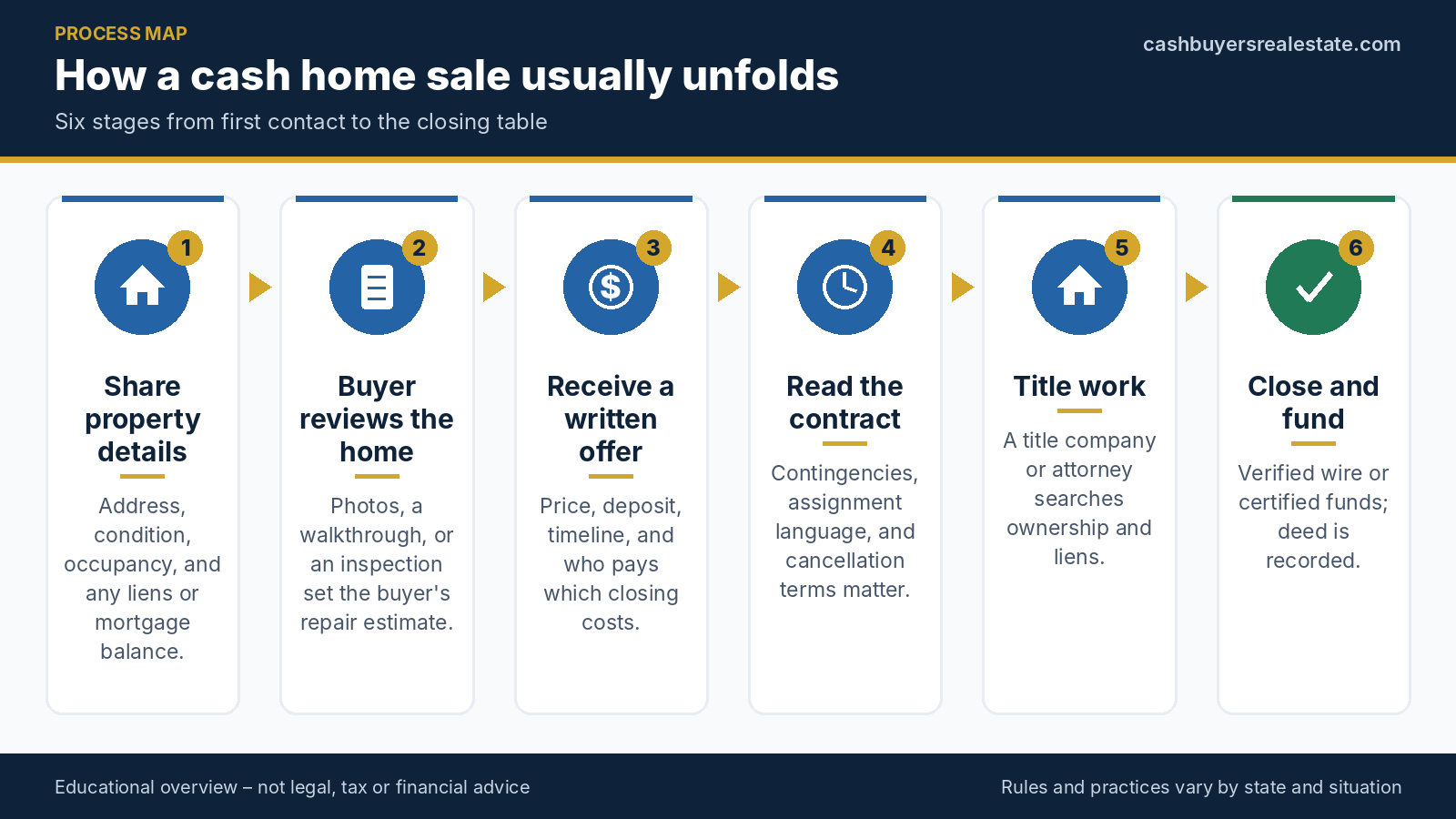
Text version of this infographic
- Share property details — Address, condition, occupancy, and any liens or mortgage balance.
- Buyer reviews the home — Photos, a walkthrough, or an inspection set the buyer's repair estimate.
- Receive a written offer — Price, deposit, timeline, and who pays which closing costs.
- Read the contract — Contingencies, assignment language, and cancellation terms matter.
- Title work — A title company or attorney searches ownership and liens.
- Close and fund — Verified wire or certified funds; deed is recorded.
What a Cash Buyer Changes, and What Stays the Same, Compared With a Financed Sale
The most common mistake sellers make about cash sales is assuming that “cash” means “simple.” They picture a buyer handing over money and taking the keys. Seasoned closers know otherwise: the buyer’s payment method changes who takes risk, how long certain steps take, and which parties need to sign off, but it leaves the legal skeleton of a home sale intact. Seeing precisely where the line falls helps you set realistic expectations and spot claims that don’t hold up, such as a promise that a closing will happen “with no paperwork.”
It also helps with the comparison that matters most to many sellers, which is cash buyer versus financed buyer. A financed buyer brings a lender into the transaction, and the lender brings its own requirements. A cash buyer brings none of those requirements, which is both the appeal and, in some cases, the source of looser habits. The sections below separate the two cleanly, and the longer guide on cash buyers compared with financed buyers takes the same question further.
What a Cash Purchase Removes From the Transaction
Removing the lender removes a whole layer of conditions that a financed buyer must satisfy before the sale can close. Three of them matter most to sellers: the loan approval, the appraisal, and the clock that those two processes impose on everyone. When those disappear, the number of ways a sale can fall apart drops, and the schedule becomes much more flexible.
No Underwriting, No Lender Appraisal, and No Loan Commitment to Lose
When a buyer uses a mortgage, the lender needs to be satisfied about the borrower’s income, credit, debts, and assets, and about the property itself. The borrower’s file goes through underwriting, which can take weeks and can end in a denial or a request for more documents at any point, including days before closing. A change in the buyer’s job, a new debt, or a credit event between contract and closing can derail a purchase that looked solid. A cash buyer has no underwriting file, so that entire category of risk is absent. The seller’s question shifts from “will the bank approve this person” to “does this person actually have the money,” which is a different question with a different answer, and the answer is verified through proof of funds.
Financed purchases also require an appraisal, ordered by the lender to confirm the home is worth at least the loan amount. If the appraisal comes in under the contract price, the buyer must renegotiate, bring more cash, or cancel under an appraisal contingency, and sellers in a financed deal often have to cut the price or lose the sale. A cash buyer has no lender to satisfy, so the appraisal gap problem generally doesn’t arise. Some cash buyers still order an appraisal or a broker opinion of value for their own reasons, and some contracts include an appraisal contingency even in a cash deal, so it’s worth reading the contract rather than assuming. The article on whether cash buyers require appraisals covers when it does and doesn’t happen.
The loan commitment also carries conditions that fall on the property: many lenders will not fund a loan against a house with a failing roof, active water damage, or missing safety features, and government-backed loans carry minimum property standards. A house that fails those standards can be hard to sell to a financed buyer at any reasonable price, yet may be perfectly acceptable to a cash buyer who plans to repair it. That asymmetry is the basic reason cash buyers dominate the market for homes in poor condition, a subject explored in the guide to selling a fixer-upper quickly.
Speed, Certainty, and a Lighter Workload for the Seller
Without lender conditions, a cash purchase can close as quickly as the title work and the parties’ schedules allow. That is the main reason the cash route is associated with speed. It is also the reason a cash buyer’s offer is often more certain than a financed offer at the same price, since the biggest source of last-minute failure has been removed. For a seller who has already bought another home, who faces a hard deadline, or who simply wants to avoid the uncertainty of a long escrow, certainty can be worth real money, and it is one of the things you should price into any comparison.
Certainty has a practical meaning that is easy to overlook until a sale fails. When a financed purchase collapses three weeks into escrow, the seller does not just lose the buyer; the seller loses the weeks, usually pays carrying costs through them, may have already committed to a new home or a move-out date, and must restart with a listing that is no longer new. The harm is concentrated on sellers who have scheduled their lives around the closing, such as those buying another house with the proceeds, relocating for work, or settling an estate with a deadline for distributions. For them, a slightly lower price from a buyer whose funds are already verified can be the more economical choice. For a seller with no schedule at all, the same certainty has less value, and the discount is harder to justify.
The seller’s workload also shrinks. In a conventional listing, the seller prepares the house for photographs and showings, keeps it clean for weeks or months, tolerates strangers walking through, negotiates repairs after the buyer’s inspection, and sometimes pays for those repairs. A cash buyer who buys as-is usually conducts one walkthrough and accepts the condition, subject to the contract’s inspection terms. For an elderly owner, an heir living out of state, or a landlord weary of managing a property, that reduction in effort is a real benefit and not just a convenience.
But speed is a double-edged tool. Fast processes leave less time to compare, think, and consult a professional, and a seller who feels hurried is more likely to accept terms that deserve a second look. A good buyer will let you take the time you need to read the contract. A buyer who treats your deliberation as an obstacle is showing you how the rest of the transaction may go. The cost of certainty is usually a lower price, and the section on pricing later in this guide shows why.
What a Cash Purchase Leaves Exactly As It Was
The second half of the comparison is where unrealistic promises tend to appear. Whatever the buyer’s source of funds, the law still requires that the seller own the property, that liens be addressed, that required disclosures be made, and that the transfer be recorded properly. None of those steps depends on a loan.
Title, Liens, and the Mortgage Payoff Do Not Go Away
Clear title is the seller’s central obligation in almost every sale. The buyer, whether paying cash or financing, wants to know that the person selling actually owns the property, that nobody else holds a claim to it, and that any debts secured by the property will be paid from the proceeds. That is why a title search happens in cash sales just as it does in financed ones. According to the Consumer Financial Protection Bureau, an owner’s title insurance policy protects a homeowner against claims that predate the purchase, such as a previous owner’s unpaid taxes or contractors who say they were not paid for work done before the sale. Most lenders require the borrower to buy a lender’s policy, while an owner’s policy is optional, and a cash buyer with no lender has no one requiring a policy, so some cash buyers skip it. Whether to buy it is the buyer’s decision, but it is a question worth asking because it signals how seriously the buyer treats the title.
Your mortgage must still be paid off at closing, in full, from the proceeds. If the sale price is lower than what you owe, you would need to bring money to the closing or negotiate with the lender in a separate process, because a cash buyer cannot make a mortgage disappear. The same goes for tax liens, judgment liens, and contractor liens: they attach to the property and must be satisfied or addressed for the buyer to receive clean title. An offer that promises to “take care of” liens deserves a close look at who pays what, because the payoff comes from your proceeds unless the contract states otherwise. The guide on selling a house quickly when it has liens addresses the options in more detail.
A related misunderstanding involves “buying the house subject to the existing mortgage,” a structure in which the buyer takes title without paying off the loan. This arrangement can trigger a lender’s right to demand full repayment and leaves the original borrower legally responsible for a loan on a house they no longer own. It is not a standard cash purchase and should be treated with great caution; in any case, it needs an attorney’s review before anything is signed.
Disclosures, Inspections, and the Formalities of Closing
Seller disclosure duties depend on state law and the type of property, and they generally do not turn on how the buyer pays. Many states require sellers to complete a property condition form, and other states put the burden on the buyer to inspect, but nearly all states hold sellers responsible for hiding known material defects. Selling to a cash buyer “as-is” does not erase these duties; it describes the condition the buyer accepts, not the information the seller must provide. At the federal level, sellers of most housing built before 1978 must disclose known information about lead-based paint, provide the EPA’s pamphlet, and attach a lead warning statement to the contract, and the buyer gets a ten-day opportunity to inspect unless both sides agree to change it in writing, according to the Environmental Protection Agency. Check which rules apply to your property and state, and see the page on disclosures in an as-is sale for more.
Inspections also continue to matter. A cash buyer can waive the right to inspect, and some do, but most investors inspect carefully because they are pricing repairs. Whether a particular buyer inspects, how long the buyer has, and what the buyer can do with the findings are all matters of contract, which is why the inspection terms deserve attention. The article on whether cash buyers require inspections explains why the answer varies.
Finally, the closing formalities remain. A deed is drafted, signed, and often notarized; a settlement statement is prepared; funds are collected and disbursed; transfer taxes and recording fees, where they apply, are paid; and the deed is recorded. Taxes and utilities are prorated. The only formality the lender’s absence eliminates is the lender’s own documentation, such as the Closing Disclosure that a mortgage lender must give a borrower at least three business days before closing, according to the CFPB. A cash closing uses a settlement statement from the closing firm instead, and the details of it vary by state and firm.
| Part of the sale | Financed buyer | Cash buyer | Why it matters to you |
|---|---|---|---|
| Loan approval | Required; can be denied or delayed | Not applicable | Removes a common point of failure |
| Lender appraisal | Ordered by the lender; low value forces renegotiation | Generally not required, but check the contract | Avoids appraisal gaps |
| Property condition standards | Lender may require repairs or refuse the loan | Buyer decides what it will accept | Makes damaged homes sellable |
| Title search and lien payoff | Required | Required in practice | Liens still come out of your proceeds |
| Seller disclosures | Required under state and federal law | Same duties apply | As-is does not cancel disclosure duties |
| Proof of ability to pay | Pre-approval letter | Proof of funds | Verify either one before relying on it |
| Closing paperwork | Lender documents plus deed and settlement statement | Deed and settlement statement | Fewer documents, same legal transfer |
| Typical timeline pressure | Set largely by underwriting | Set by title work and agreement | Can be faster, or slower, depending on title |
The table shows why the real advantage of a cash buyer is narrower than the marketing suggests. The buyer removes financing risk, appraisal risk, and property standards from the equation. The buyer does not remove title, liens, disclosures, or the legal mechanics of transferring ownership. If a company implies otherwise, treat that as a prompt to ask exactly which steps are being skipped and why.
One more practical difference deserves a mention. When a buyer is financing, a lender’s interest in a sound transaction acts as a built-in checkpoint: an underwriter reads the contract, a closing agent follows lender instructions, and a standard set of disclosures is required. With a cash buyer, that second set of eyes is absent. The checkpoints that remain are the closing firm, your own attorney if you hire one, and your own diligence. That doesn’t make cash sales less safe in general, but it does mean that a seller who would have relied on the lender’s process needs to supply the scrutiny personally, which is the purpose of the verification toolkit later in this guide.
How Cash Offers Are Priced: After-Repair Value, Repairs, and Margin
Few moments in a home sale feel as opaque as receiving a cash offer that is far below what a neighbor’s house sold for. The number can seem arbitrary, even insulting, particularly when it arrives with a one-page explanation or none at all. In most cases it is neither random nor personal. It is the output of a fairly consistent calculation, and the calculation can be understood, checked, and challenged. Once you can see how a buyer got from a market value to an offer, you can tell which parts of the reduction are reasonable, which are negotiable, and which are padding.
Methods differ from one buyer to the next, and no formula is universal. What follows is the common framework that real estate investors use when they price a house they intend to renovate and resell, with a note on how rental buyers adjust it. The framework is deliberately explained at overview depth, because the sibling guides on how cash buyers calculate offers and on after-repair value in cash offers go through each component in detail.
The Investor’s Arithmetic
An investor’s offer is the end of a subtraction problem. It begins with what the property could sell for if it were in excellent condition, removes everything that stands between today’s condition and that sale, and finishes by subtracting the profit the investor needs. Each line in the subtraction is an estimate, and the estimates are where most of the difference between buyers arises.
After-Repair Value and How Comparable Sales Set It
The starting point is after-repair value, usually shortened to ARV. It is the price the buyer believes the house will bring after renovation, and it comes primarily from comparable sales, often called comps. Comps are recent sales of similar homes nearby, matched on size, age, style, lot, number of bedrooms and bathrooms, and renovation level. A buyer generally prefers sales from the last several months within a short distance, and gives the most weight to renovated houses that sold at a similar price point. Each difference between your house and a comp, such as a bigger garage or a busier street, calls for an adjustment, and the adjustments are judgment calls.
The ARV is not what your house is worth today in its current condition, and it is not necessarily what an agent would list it for in that condition. It is a forecast of a finished product. Two buyers looking at the same comps can arrive at ARVs that differ by tens of thousands of dollars because one expects to finish to a higher standard, one reads a recent sale as an outlier, or one fears a softening market. Sellers who want to test a buyer’s ARV can ask the buyer to share the comps used, and can ask a real estate agent for a comparative market analysis to see whether the figures hold together. A buyer who is unwilling to explain the ARV at all is making it hard to evaluate the rest of the offer.
Two traps are worth knowing. The first is the very optimistic ARV, which makes a buyer’s offer sound generous relative to “what it will be worth” while remaining low relative to what the house could sell for as is to a retail buyer. The second is the overly pessimistic one, where the buyer chooses the weakest nearby comps to justify a low number. A third check is to compare the ARV with what an agent says the house would list at today with modest preparation. The gap between those two figures is where your trade-off lives.
Repairs, Holding Costs, Transaction Costs, and Required Margin
From ARV, the buyer subtracts a repair budget. The budget might be a rough per-square-foot estimate for a cosmetic update, an itemized list for a deeper renovation, or bids from contractors the buyer has used before. Repair estimates are the most discretionary line in the calculation, because a buyer can reasonably include a contingency for surprises such as hidden rot, outdated wiring, or permit problems, and because buyers with their own crews often have lower costs than the typical homeowner would face. A buyer should be able to describe what the budget covers. If it is lump-sum with no breakdown, you can still ask which major systems are included.
Next come the costs of holding and selling. While a flipper owns the house, it incurs property taxes, insurance, utilities, and often interest or fees on borrowed money, and it incurs them for the entire renovation and sale period. The eventual retail sale carries its own costs, which typically include agent commissions and closing costs. Because these costs depend on the length of the project, a realistic estimate of months matters. A buyer who expects three months of work and two months on the market counts five months of carrying costs, while a buyer more worried about the market might count seven.
Finally, the buyer subtracts a margin. Margin is the profit that justifies the risk, effort, and capital tied up in the project. It is not fixed by law or custom. A buyer may want a margin large enough to absorb a mistake in the repair budget or a slow resale, and may set a bigger cushion on houses that look riskier. Some sellers find the margin offensive, but it is the buyer’s compensation for taking on a project that can lose money, and a buyer without a margin would soon be out of business. The question for the seller is not whether a margin exists but whether the total package of discounts is acceptable compared with the alternatives.
For a rental buyer, the structure shifts. Instead of ARV, the buyer estimates what rent the property will support, subtracts expenses, and works backward to a price that delivers a target return. The output is still a subtraction, and the seller’s most useful move is the same: ask what assumptions the number rests on.
| Line item | Amount | What it represents |
|---|---|---|
| After-repair value (ARV) | $286,000 | Estimated resale price after renovation, from comparable sales |
| Less: resale costs | ($22,880) | Commission and closing costs at the eventual sale, assumed at 8 percent |
| Less: repair budget | ($41,500) | Kitchen, flooring, paint, a roof section, and a contingency |
| Less: holding costs | ($8,250) | Five months at $1,650 for taxes, insurance, and utilities |
| Less: financing costs | ($6,400) | Interest and fees on short-term borrowing |
| Less: required margin | ($25,000) | Buyer’s target profit for the project |
| Maximum offer | $181,970 | Result of the subtraction |
Read the worksheet from the top down and notice how many of the lines are assumptions. If the repair budget is $30,000 rather than $41,500, the maximum offer rises by $11,500. If the buyer has cash instead of borrowed money and no financing costs, it rises by $6,400. If the margin is $15,000, it rises by $10,000. Each change is plausible, and together they can swing the offer by nearly $28,000 without changing the house at all. That is exactly why asking for the buyer’s assumptions is productive, and why the numbers in this table should not be treated as typical of any market. The page on how repair deductions work in cash offers goes line by line through the biggest swing factor.
Reading an Offer Against Your Own Numbers
Knowing the buyer’s framework lets you test an offer without having to match the buyer’s expertise. The idea is to compare the offer with a realistic picture of your own best alternative, and to challenge the specific assumptions that are doing the most work.
Why Two Honest Buyers Can Offer Very Different Prices
It’s tempting to assume that a wide spread between offers means one buyer is cheating. More often, the buyers are telling you about their own costs and risk tolerance. A buyer with a skilled in-house crew and cheap capital can pay more for the same house than a buyer who has to hire outside contractors and borrow at high rates. A buyer who already has a retail buyer lined up for a finished house in your area can price tighter than one who would be guessing at resale. A buyer entering a neighborhood for the first time may add a risk premium. None of this implies dishonesty.
Differences also come from what each buyer sees in the house. A buyer who spots a foundation crack may reduce the offer sharply while another buyer, with a structural engineer on call, treats it as a modest repair. A buyer who walks the property carefully will tend to make a more accurate offer than a buyer who relies on photos, and the latter’s offer is likelier to change after inspection. This is a good reason to ask each buyer whether the offer is based on an in-person visit and how much it can move.
Local knowledge accounts for a surprising share of the difference. A buyer who has completed several renovations within a mile of your house knows which finishes buyers pay for on your street, how long comparable houses sit before selling, and which contractors are reliable at what price. That experience reduces the cushion the buyer must build into the offer for the unknown, and so it can support a higher number than an out-of-area buyer can justify. The reverse also happens: an experienced local buyer may know about a drainage problem, a zoning quirk, or a pending road project that a distant platform’s model has never seen. Asking each buyer how many houses it has bought nearby, and when, is a fair question, and the answer helps you weigh why the numbers differ.
The takeaway for sellers is that several offers are more informative than one. Three bids from different kinds of buyers, such as a local rehabber, a landlord, and an instant-offer platform, will show you the range, the shape of the market for your particular house, and which buyer seems to value it most. The guide on how to compare cash offers gives a more detailed method for lining them up.
Questions and Negotiation That Test an Offer’s Assumptions
Good questions are specific and non-confrontational. Ask what ARV the buyer used and which comparable sales support it. Ask for a summary of the repair estimate, and whether the buyer visited the house. Ask whether the offer includes any fees or service charges, who pays closing costs, and whether the price can change after inspection. Ask whether the buyer plans to close in its own name. Responses reveal as much about the buyer’s professionalism as about the numbers, and a buyer who answers plainly is giving you a basis for trust.
When you negotiate, the most effective bargaining strength comes from information and alternatives, not from emotion. If your agent’s analysis shows an ARV higher than the buyer’s, share it. If you have a repair quote lower than the buyer’s budget, share that too. If another offer exists, mention it truthfully. You can also trade items other than price: a flexible closing date is valuable to a buyer who is still lining up financing, and a short post-closing stay in the house is valuable to you. The article on negotiating a cash offer offers more examples.
Illustrative example (hypothetical numbers, not market data): A seller receives a $181,970 offer, matching the worksheet above, and asks the buyer for its repair summary. The seller then obtains two contractor estimates for the same scope, both near $33,000. Showing the estimates, the seller asks the buyer to revisit the repair line. The buyer, who plans to use its own crew, agrees to move the repair budget to $36,000 but keeps its margin unchanged, raising the offer by $5,500 to $187,470. The seller didn’t get everything requested, but the exchange worked because it was specific, polite, and based on documents. A seller who simply said “your offer is too low” would have given the buyer nothing to respond to.
Know where to stop. A seller who negotiates endlessly for a few hundred dollars may lose a buyer who would have closed cleanly, while a seller who accepts the first number without a single question may leave thousands on the table. The right target is an offer you understand, can compare, and could defend to a friend. If a buyer refuses any discussion of how the figure was reached, or if the offer changes materially between the first call and the written contract, take that as a sign to widen your search.
Net Proceeds: Comparing a Cash Sale With Listing Through an Agent
The number on an offer letter is not the number that lands in your bank account. That sentence is easy to agree with and surprisingly hard to apply, because the two routes being compared produce their costs in different ways. A listing has visible costs, such as commissions and closing charges, plus invisible ones, such as the months of mortgage payments, taxes, and utilities while the house is on the market and the repairs or credits a buyer’s inspection will bring. A cash offer typically has fewer deductions but a lower starting price. Only a side-by-side calculation of what you keep, not what you are offered, tells you which route is better for your situation.
This section builds that comparison step by step and then applies it to two hypothetical houses. It also leaves room for the factors that don’t fit in a spreadsheet, like how much you value a firm closing date. The sibling guides on choosing between a cash sale and a listing and on net proceeds in cash and traditional sales go deeper on the arithmetic.
Building a Fair Comparison
A fair comparison treats both routes with the same discipline. That means counting every cost on each side, assigning a realistic length of time to each, and being honest about the probability that each route works as planned. A seller who compares the cash offer’s headline price with an optimistic list price, minus nothing, is comparing a real number with a daydream.
Headline Price Versus Net Proceeds: The Line Items
Start with what you would receive before any deductions: the cash offer on one side and a realistic sale price on the other. For the second figure, ask an agent for a comparative market analysis and for a range, not a single number, and be cautious about the highest figure, because an agent who is competing for your listing has a reason to be optimistic. Then subtract what each route costs you. On a listing, the main deductions are the listing agent’s and buyer’s agent’s compensation, which is negotiable and varies by market and agreement, and the seller’s share of closing costs such as title fees, transfer taxes where applicable, and prorated taxes and association dues. A seller should read the listing agreement carefully to understand exactly what the compensation covers and how any buyer-side payment is handled.
On a cash sale, the deductions are usually smaller but still real. There may be no agent commission if the buyer found you directly, though some cash buyers or the platforms they use charge service fees, and a seller who works with an agent on a cash sale will still owe that agent’s compensation. The seller still pays the portion of closing costs the contract assigns to the seller, and the contract can assign a great deal or very little. The page on whether cash buyers pay closing costs explains why the answer is entirely a matter of what the contract says, and the article on closing costs in a fast home sale breaks out the typical categories.
Whichever route you take, the mortgage payoff and any liens come out of the proceeds, but they come out of both routes equally, so they do not change which is better. Where they matter is in determining whether you walk away with cash or need to bring money to the table, so calculate them separately. If you are unsure about the shape of the payoff, the guide on selling fast while you still have a mortgage addresses it.
The Costs of Time: Carrying Costs, Repairs, and the Risk of a Failed Sale
Time is the least visible and often the largest difference between routes. A house that sits on the market for several months costs money every month: loan interest, property taxes, insurance, utilities, lawn care, and maintenance. If you have already moved out, you’re paying for a house you aren’t using. These carrying costs are real even if they never show up on a settlement statement, and they should be estimated for each route using your own monthly figures. A shorter route has lower carrying costs, which partly offsets a lower price.
Repairs and preparation are the second hidden cost. A listing aimed at retail buyers usually requires cleaning, minor repairs, perhaps staging, and a response to the buyer’s inspection report, which often produces a list of requested repairs or a credit. Homes that need major work face a harder choice: spend money first, price the house low and let a buyer handle it, or accept a cash investor’s discount. Each choice has a cost that belongs in the comparison. The guide on selling without making repairs discusses how to weigh them.
The third item is probability. A listing can fail to sell at the target price, can lose a buyer to financing problems, or can fall out of contract after an inspection. A cash offer can also fail, if the buyer lacks funds or uses its right to cancel, but a cash buyer with verified funds and a solid deposit usually carries less closing risk than a financed buyer. If the first deal falls apart, the seller starts over with more carrying costs and a house that may now carry the stigma of a contract that fell through. That risk can’t be calculated exactly, but it deserves a line in your thinking even if you leave it out of the spreadsheet.
Two Hypothetical Sellers, Side by Side
The best way to see the trade is to run the numbers for two houses with very different conditions. The examples below are hypothetical and simplified. They ignore the mortgage payoff because it affects both routes equally, and they use round assumptions that will not match any real market, so use them as a template for your own calculation and not as a prediction of what you will net.
A House in Solid Condition
When a house is clean, well maintained, and in a neighborhood with active buyers, the gap between a cash offer and a listing narrows, because the cash buyer’s repair reduction is small and the retail market works well. In this situation the cash buyer’s discount is mostly a fee for speed and certainty rather than a reflection of condition, and the seller is mainly deciding whether those two things are worth a few thousand dollars.
Another way to see why the gap narrows is to ask what the cash buyer is really being paid for. In a house that needs nothing, the buyer is not buying a renovation project; it is buying a quick, low-friction transaction and taking on the risk that the market moves before it resells. The discount compensates for that risk and for the buyer’s carrying and selling costs. Retail buyers, by contrast, pay for the house itself and for the pleasure of living in it. When both are interested in the same property, the seller is essentially choosing between a premium for patience and a smaller price for certainty. That framing is more useful than asking which route is “better,” because it tells the seller exactly what the extra money on the listing side is buying.
Illustrative example (hypothetical numbers, not market data): A seller expects a listed house in good condition to sell for $335,000 after a few weeks of showings and a negotiation. Commissions and buyer-side concessions of 5 percent come to $16,750; other seller closing costs of 1.5 percent come to $5,025; light preparation costs $3,500; and three extra months of taxes, insurance, interest, and utilities at $2,100 a month come to $6,300. Net proceeds before any mortgage payoff: $303,425. A cash buyer offers $306,000, the seller agrees to pay 1 percent in closing costs ($3,060), and carrying costs for one month are $2,100. Net proceeds before payoff: $300,840. The listing leads by $2,585 on paper, a margin that an unexpected price reduction, a financing failure, or a longer time on the market could erase. In a case like this, the decision turns on certainty, convenience, and the seller’s tolerance for risk more than on the arithmetic.
Notice what the example does not include: the chance that the listed sale price falls below $335,000, which in a slower market is very possible. A seller who lists at $335,000 and ends up accepting $322,000 after two price cuts would see the cash route come out ahead. Conversely, a seller in a hot market who receives multiple offers above the asking price could widen the gap in favor of the listing. The comparison is only as good as the realism of the assumptions behind it.
A House That Needs Major Work
When a house needs significant repairs, the cash buyer’s reduction grows and the retail route becomes more complicated, because a typical financed buyer may not be able to purchase the house, or may demand large credits. The seller then has three realistic paths: sell as-is for cash, list as-is to the broadest pool of buyers, or invest in repairs and list the improved house.
| Item | Cash sale as-is | List as-is | Repair, then list |
|---|---|---|---|
| Sale price | $182,000 | $225,000 | $286,000 |
| Commissions (5 percent where applicable) | $0 | ($11,250) | ($14,300) |
| Other seller closing costs | ($2,500) | ($3,375) | ($4,290) |
| Repairs or buyer credits | $0 | ($5,000) | ($41,500) |
| Carrying costs ($1,650 a month) | ($1,650) | ($6,600) | ($11,550) |
| Months assumed | 1 | 4 | 7 |
| Net proceeds | $177,850 | $198,775 | $214,360 |
The table lines up the three paths using the same house as in the pricing worksheet earlier. In this scenario, repairing and listing yields the highest net, listing as-is falls in the middle, and the cash sale yields the least, about $36,500 less than the repair route. That gap is the price of avoiding seven months of work, risk, and carrying costs, and of not putting $41,500 into a project first. Whether that price is worth paying depends on your circumstances. If you lack the cash to renovate, if a contractor’s bids tend to run over, if you cannot manage a project from another city, or if you need the money within weeks, the cash route may be the only one that works at all. If you have time, capital, and a reliable contractor, the repair route earns more.
The example also assumes everything goes right. A repair project that runs 30 percent over budget, or a market that softens while the work is in progress, would pull the repair route’s net down, perhaps below the as-is listing. The as-is listing, in turn, assumes a retail or investor buyer appears at the stated price in the stated time. The cash route has the narrowest range of outcomes, and a narrow range is a form of value for a seller who cannot absorb a bad result. For a plain-language look at the decision from the repair side, see the guide on whether to fix a house before selling.
A final caution is about timing and taxes, which can affect net proceeds in ways the table does not show. If you owe capital gains tax on a sale, the amount will depend on your basis, how long you lived in the house, and whether you qualify for the home-sale exclusion, covered later in this guide. Repairs you make to prepare a house for sale are generally not the same as improvements that add to basis, and the difference is a topic for a tax professional. For a quick estimate of your own figures, the home sale proceeds calculator can help structure the inputs.
Alternatives to a Cash Buyer, and the Situations Where Each One Wins
A cash buyer is one route among several, and an honest guide has to say when it is not the best one. Plenty of sellers who receive a cash offer would do better listing with an agent, doing a modest amount of work first, or selling to a financed buyer who simply needs a few weeks. Others would do much worse if they waited. The way to tell the difference is to hold each route up against the things you care about most, such as price, speed, effort, risk, and privacy, and to be candid about which of those actually ranks first for you right now.
This section describes the realistic alternatives and the conditions in which each tends to come out ahead. It’s a map and not a ranking, since the right answer shifts with the property, the market, and your life. The related guides on urgent home sale options and on selling a house as-is look at the same trade-offs from slightly different angles.
Routes Through the Open Market
The conventional alternatives all put the house in front of the widest possible group of buyers. That exposure is their strength, because competition among buyers is the most dependable way to raise a price, and it is also their cost, because exposure takes time, preparation, and tolerance for uncertainty.
Listing With an Agent, With or Without Repairs
An agent-listed sale is the baseline against which every cash offer should be measured. The agent prices the house, markets it, handles showings and negotiation, and coordinates the transaction through closing. In a healthy market, a house in decent condition and priced correctly attracts several buyers, some of whom will bid against each other, and the final price often exceeds what an investor would offer because the buyer is a person who will live in the house and values it accordingly. The seller pays for this through agent compensation, preparation, and time on the market.
The decision within this route is how much to fix. A seller with time and money can make repairs that deliver a greater return than they cost, such as paint, flooring, a deep clean, and any repair a buyer’s inspection would certainly flag. A seller who cannot or will not do the work can list as-is at a price that reflects condition, which appeals to buyers who want a project but may require flexibility about financing and inspection requests. Listing as-is does not remove the seller’s disclosure duties, and some buyers’ loans will not close on a house with certain defects, which narrows the pool. A frank conversation with a local agent about what the house would realistically need to qualify for a conventional loan is a useful early step.
The listing route wins when time is available, the house is in saleable condition or can be made so affordably, the market has active buyers, and the seller can live with showings and uncertainty. It loses when the house has problems that scare off financed buyers, when a deadline is hard, or when the seller cannot manage the preparation and showing process. The page on selling as-is versus renovating helps with the repair decision specifically.
For Sale by Owner and Limited-Service Listings
For sale by owner, usually shortened to FSBO, means the seller markets and negotiates without a listing agent. The appeal is obvious: no listing commission, and the seller may keep more of the sale price. The cost is that the seller takes on pricing, marketing, screening buyers, negotiating, contract preparation, and coordination with the closing firm, along with the legal and safety risks of showing a house to strangers. A buyer who is represented may still expect the seller to compensate the buyer’s agent, so the savings are often smaller than a seller first imagines, and the decision should be based on realistic net numbers rather than the headline commission rate.
Limited-service and flat-fee listings sit between FSBO and a full-service listing. The seller pays a smaller fee for access to the multiple listing service and perhaps some paperwork support, then handles showings and negotiations. Those arrangements suit confident, organized sellers who are comfortable with the process, in markets where houses sell readily. They are a poor fit for properties that need careful positioning or for sellers who are short on time. The guides on selling fast without a real estate agent and the broader hub for selling without an agent cover this territory in depth.
Whichever version you choose, the transaction still needs a contract, a title search, and a closing firm. Hiring a real estate attorney for contract review is common in FSBO sales and is inexpensive compared with the risk of a flawed agreement. A seller who goes this route should also plan for the possibility that, after weeks of effort, a cash offer from an investor may look better than it did at the start, and should have a sense of the number at which that switch would make sense.
Routes Between a Listing and a Cash Sale
A second group of alternatives promises some of the convenience of a cash buyer with more of the price of a market sale, or a different structure entirely. Each deserves skepticism proportionate to its claims, and each has circumstances where it is the right tool.
Instant Offers, iBuyers, and Agent-Run Cash Programs
Instant-offer platforms and iBuyers present a convenient middle path. You enter an address and some information, receive an initial offer quickly, and, if you proceed, the company inspects the house and finalizes the price. Some programs charge a service fee that functions like a commission, and the final price often reflects repair adjustments made after inspection, so the number you see first can differ from the number you sign. Their offers tend to be most competitive for typical houses in good condition in the markets they serve, and least useful for unusual properties, older homes, or those needing significant work.
A few practical cautions apply to any platform-style offer. Read how the final price is determined after the inspection and what the platform counts as a repair; some programs publish a schedule of adjustments, and some leave the amount to a post-inspection estimate. Look at the closing timeline the platform states and what it does if it cancels. Ask whether the platform will buy the property in its own name or pass it to a partner, since that determines who is bound. And save a copy of the first offer so that you can compare the final number with the one that first caught your attention. These steps take minutes and make it far easier to tell a convenient service from a pattern of bait and adjust.
Another variation is a program run by real estate brokerages, in which an agent arranges a cash purchase through a partner investor or lists the house with a guarantee of a backup cash offer. These programs combine listing services with an investor’s willingness to buy, and their terms vary widely. When evaluating one, ask who is paying for what: whether there is a commission on top of the discount, whether the buyer is a related company, and whether you are free to decline the cash offer and keep the listing. The aim is to understand whether the convenience comes with fees that reduce your net.
Instant offers are most useful as benchmarks. Getting one costs little and takes little time, and it tells you roughly where the automated market sees your house. Combined with a local investor’s offer and an agent’s price range, it gives you three data points to calibrate expectations. The longer discussion of local cash buyers compared with national companies applies here as well.
Auction, Seller Financing, Renting, and Waiting
Auctions can produce a quick sale for properties that are hard to price, such as unusual or collectible houses, but they come with auction fees, reserve prices, and sale terms that can be less favorable than they appear. Because auction rules differ by state and auction house, anyone considering this route should read the terms and talk to an attorney.
Seller financing, in which the seller acts as the lender and accepts payments from the buyer over time, can widen the pool of buyers and sometimes produces a higher price. It also leaves the seller carrying credit risk, requires careful documentation, and may be affected by federal and state lending rules, so it is a route to take only with professional help. Related structures, such as lease-options and installment contracts, have produced a long history of disputes in some states, and their legal treatment varies, which is another reason to involve an attorney before agreeing to one.
Two alternatives are easy to overlook. One is renting the house out rather than selling it, which makes sense if the property would produce positive cash flow after taxes, insurance, and maintenance, and if you can tolerate being a landlord. The other is waiting, whether for a better market, for repairs to be finished, or for the dust from a life event to settle. Waiting has a cost in carrying expenses and risk, but when the pressure behind a quick sale is mostly emotional or imagined, it is sometimes the wisest choice. Neither of these alternatives is exciting, but a trustworthy guide mentions them because they are real options.
| Route | Tends to win when | Main trade-off | Seller effort |
|---|---|---|---|
| Cash home buyer | Speed, certainty, or poor condition outweigh price | Offer is usually below retail value | Low |
| Agent listing | The house is saleable and time is available | Preparation, showings, and uncertainty | Moderate |
| Repair, then list | Repairs are affordable and return more than they cost | Upfront money and project risk | High |
| iBuyer or instant offer | A typical house in good condition in a covered area | Service fees and post-inspection adjustments | Low to moderate |
| For sale by owner | The seller is organized and the market is active | Seller handles pricing, paperwork, and risk | High |
| Seller financing or lease-option | Few conventional buyers exist and legal help is available | Credit risk and legal complexity | Moderate to high |
| Rent or wait | Pressure is low and carrying costs are manageable | Ongoing costs and market risk | Varies |
Treat the table as a starting point for a conversation with yourself and a professional. The “tends to win when” column deliberately describes conditions rather than outcomes, since no route is best in every circumstance. If you read your own situation in more than one row, which is common, the practical next step is to price each of those routes using the net-proceeds method from the previous section, and to compare the results alongside the non-financial factors you care about.
The infographic below places five of these routes side by side, showing what each is best for and what it trades away. A cash home buyer, an agent-listed sale, an iBuyer or instant offer, a for-sale-by-owner listing, and a repair-then-list plan each solve a different problem, and the trade-off line under each is the part sellers most often overlook when they focus on a single number.
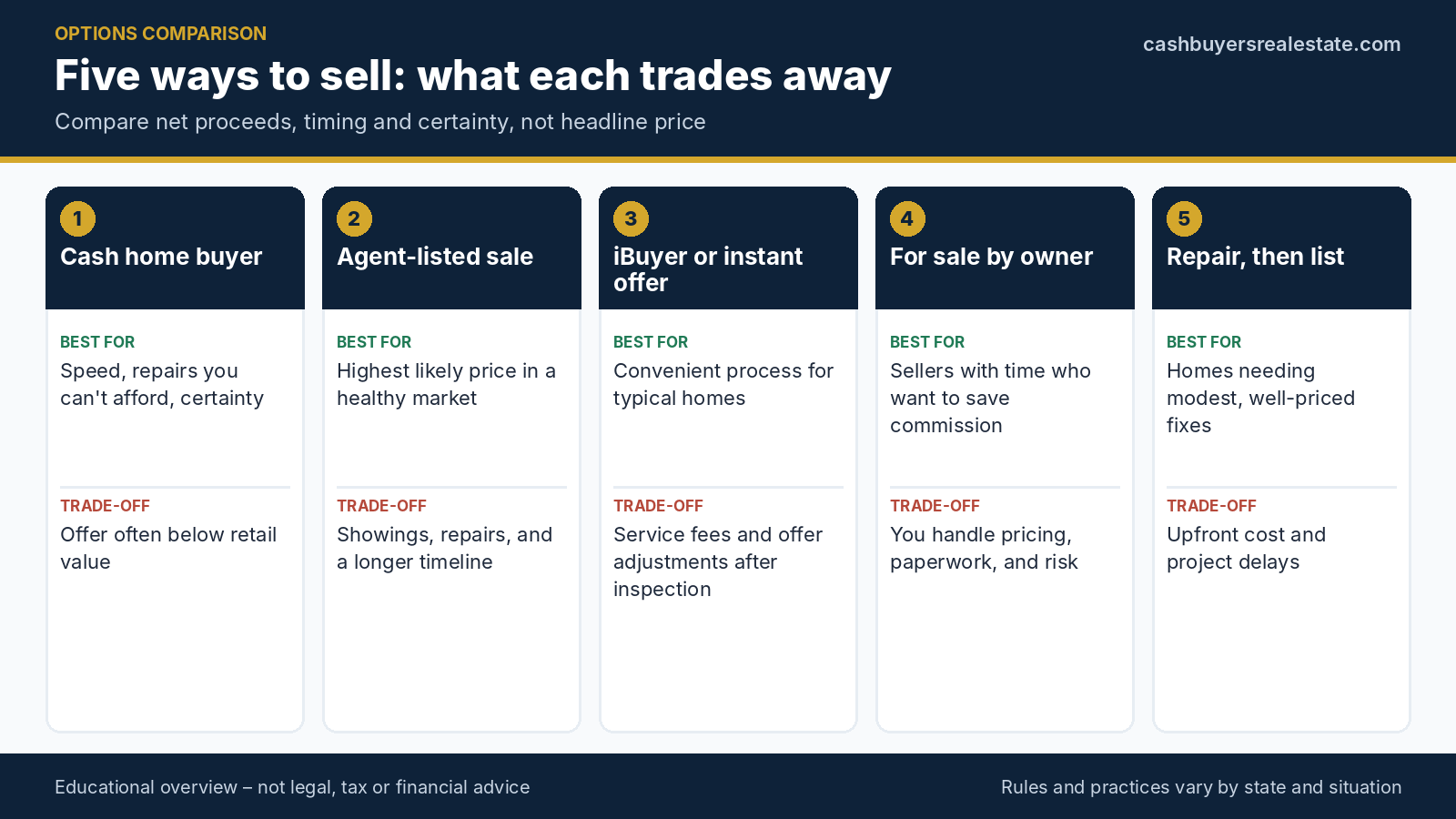
Text version of this infographic
- Cash home buyer — Best for: Speed, repairs you can't afford, certainty. Trade-off: Offer often below retail value.
- Agent-listed sale — Best for: Highest likely price in a healthy market. Trade-off: Showings, repairs, and a longer timeline.
- iBuyer or instant offer — Best for: Convenient process for typical homes. Trade-off: Service fees and offer adjustments after inspection.
- For sale by owner — Best for: Sellers with time who want to save commission. Trade-off: You handle pricing, paperwork, and risk.
- Repair, then list — Best for: Homes needing modest, well-priced fixes. Trade-off: Upfront cost and project delays.
Proof of Funds, Earnest Money, Contingencies, and Assignment: The Terms That Protect You
An offer is a promise, and a contract is the machinery that makes the promise enforceable. When a buyer says “I’m paying cash,” the claim has three parts that can each be tested: does the buyer have the money, has the buyer put some of it at risk, and what rights does the buyer keep to walk away or pass the deal to someone else. Proof of funds answers the first question, earnest money answers the second, and contingencies together with the assignment clause answer the third. A seller who understands these four terms can read nearly any cash contract with confidence, because the same few provisions decide who bears the risk if something goes wrong.
The terms are covered here at overview depth, with each of the four having a dedicated sibling article for readers who want the details: proof of funds for cash buyers, earnest money in cash sales, contingencies in cash offers, and the cash home buyer contract itself.
Evidence That the Buyer Can Actually Perform
Two things show whether a buyer is capable of closing: a document demonstrating access to the money and a deposit that puts some of it at risk. Neither is conclusive alone, but together they separate buyers with real capacity from those who are hoping to find it.
Proof of Funds: What Counts, What Doesn’t, and How to Check It
Proof of funds, often abbreviated POF, is a document showing that the buyer has enough money available to complete the purchase. The strongest form is a recent bank or brokerage statement showing a balance at or above the purchase price, with account numbers partly redacted and the account holder’s name visible. A letter from a bank or financial institution confirming that the buyer has funds on deposit is also common. Buyers who use a private lender or a line of credit may present a commitment letter stating the amount available and the conditions, which is acceptable but needs to be read as carefully as any other document, because a commitment that depends on conditions is not the same as cash on hand.
Check three things on any proof of funds. First, the name on the document should match the name of the buyer on the contract. A statement in someone else’s name, or a company with no apparent link to the buyer, is not proof of the buyer’s ability. Second, the date should be recent, since a statement from a year ago says nothing about today. Third, the amount should cover the price plus the closing costs the buyer is expected to pay. If the buyer’s funds are tied up in a retirement account, an investment that must be sold, or a loan that has not funded, ask how and when they will be available. Documents can be altered, so a prudent step is to ask the title company or closing attorney to confirm the funds, which many will do as a matter of routine.
Be cautious in both directions. A buyer who refuses to show any proof of funds is a poor sign, but a buyer who is asked to hand over sensitive financial details to a stranger on a website is also entitled to protect their privacy, and redacted statements are normal. A seller is entitled to evidence of ability to perform, not full account access. If a buyer says the funds will be “ready at closing” without evidence, you are being asked to take the buyer’s word on the one point that matters most. The guide on proof of funds with a cash offer treats the documents more closely.
Earnest Money: Amounts, Who Holds It, and When It Can Be Lost
Earnest money is a deposit the buyer pays after the contract is signed, usually held by a neutral third party such as a title company, an escrow agent, or an attorney’s trust account. It shows commitment and gives the seller some compensation if the buyer defaults without a contractual reason. The size of the deposit is negotiable and varies widely by market and deal. A larger deposit is a stronger signal of seriousness, and a token deposit means the buyer has little to lose by walking away.
The critical questions are who holds the money and under what conditions it is refunded or forfeited. The deposit should go to the neutral holder named in the contract and not to the seller, the buyer, or an individual whose role is unclear, and you should be able to confirm receipt with the holder directly. The contract should spell out when the buyer gets the deposit back, typically when the buyer cancels within a permitted contingency period, and when the seller may keep it, usually when the buyer defaults after the permitted period. Contracts that let the buyer cancel for any reason at any time make the deposit effectively refundable in all circumstances, which weakens its purpose.
Disputes over deposits are common enough that they deserve planning. If a deal falls apart and both sides claim the money, the holder will typically refuse to release it without a written agreement from both parties or a court order, and in some states specific procedures apply. The state-by-state rules vary, so the safest approach is to read the clause carefully, ask the closing firm how it handles a dispute, and consult an attorney if a large amount is at stake. The page on questions to ask a cash home buyer includes several that bear on deposits.
Illustrative example (hypothetical numbers, not market data): A buyer agrees to purchase a house for $240,000 and delivers a $1,000 deposit, with a contract that allows cancellation for any reason during a 14-day review period. On day twelve, the buyer cancels and receives the deposit back. The seller has lost two weeks and learned that the house is now stale on the market for anyone who has seen it listed. Had the contract set a $10,000 deposit that became nonrefundable after a 7-day inspection period, the buyer would have needed to decide within a week or lose real money. The seller’s exposure is the same dollar price in both scenarios, but the incentives differ sharply, which shows why the deposit terms matter as much as the price.
Terms That Decide Who Can Walk Away
Even a buyer with genuine funds and a decent deposit can have broad rights to cancel or to hand the contract to someone else. Two sets of clauses decide how much real certainty a contract gives you: the contingencies and the assignment language.
Contingencies, Inspection Periods, and Cancellation Rights
A contingency is a condition that must be satisfied, or waived, for a buyer to be required to close. Familiar examples are inspection, financing, appraisal, and title. A cash buyer has no financing or appraisal contingency in the ordinary sense, but may still write in an inspection or due diligence contingency, a title contingency, or something less conventional, like the buyer’s satisfaction with the property or approval of the buyer’s partners. The broader and vaguer the contingency, the more power the buyer has to leave without consequences.
Pay special attention to three things. First, the length of the period: a due diligence window of five to seven days is a different proposition from sixty days, during which your house is effectively off the market. Second, the standard: does the buyer need a specific, documented reason to cancel, or only “sole discretion”? Third, what happens after the period ends. The contract should state clearly that, once the period expires and the buyer has not canceled, the buyer is bound and the deposit is at risk. An offer with no contingencies at all is attractive to sellers, and the guide on cash offers with no contingencies examines how real those promises tend to be.
Finally, look at how the contract treats a repair request or price renegotiation. Many cash contracts say the buyer may cancel or propose a revised price if inspection reveals conditions the buyer finds unacceptable, and the seller may accept or decline. That is a reasonable structure. What deserves caution is a contract that lets the buyer reduce the price unilaterally after inspection, or that does not give the seller a corresponding right to cancel and keep the house on the market. A high headline price followed by a series of reductions during due diligence is a pattern sellers should watch for, and a clear cancellation framework is the best protection against it.
Assignment Clauses and State Wholesaling Statutes
An assignment clause allows the buyer to transfer its rights under the contract to another party, who then closes the purchase. Phrases like “and/or assigns” after the buyer’s name are a signal that assignment is permitted. Assignment is lawful in most contexts, and plenty of reputable investors use it, but the seller deserves to know in advance, because the entity that ultimately buys the house may differ from the one that signed the contract, and the seller’s closing date and deposit depend on the first buyer finding the second.
A growing number of states regulate this practice. Under Oklahoma law, as presented on the state real estate commission’s cancellation form (59 O.S. § 858-314), a wholesaler must give the homeowner advance written notice that it intends to resell or assign its interest for more than the homeowner is being offered, a statement advising the homeowner to seek legal advice, and a statement of the right to cancel within two business days; if a required disclosure is missing, the homeowner may cancel at any time. Oregon’s Real Estate Agency describes a law, enacted as House Bill 4058, that requires unlicensed wholesalers to register, requires a written disclosure before the wholesale contract is signed, and lets either side cancel without penalty by the end of the third business day after the disclosure is received, with a longer right to terminate if the disclosure was never provided. Pennsylvania’s Act 52 of 2024, as summarized by the Pennsylvania Association of REALTORS®, brings wholesaling within the state’s real estate licensing law and requires contract statements, including a right to cancel until midnight of the 30th day after signing or until the property is conveyed, whichever comes first.
Illinois approaches the issue through its licensing statute. Illinois REALTORS® guidance explains that, under amendments made in 2019, a person who regularly deals in real estate contracts, including assignable contracts, may need a broker license, with two or more occasions in a year being the threshold the guidance discusses. These four examples show the range, from disclosure-and-cancellation statutes to licensing rules, but they are examples only. Many states have no wholesaling-specific law, rules continue to change, and the details of each statute, including its effective date and exceptions, should be confirmed with the statute itself, your state’s real estate regulator, or an attorney.
| Term | What to look for | Why it matters |
|---|---|---|
| Buyer’s legal name | An individual or entity that matches the proof of funds and the person you met | Confirms who is bound and who is paying |
| Purchase price and deposit | Amounts match the written offer; deposit holder is named | Prevents silent changes and unclear custody |
| Inspection or due diligence period | Length, standard for canceling, and what ends it | Controls how long the house is effectively off the market |
| Cancellation and refund terms | When the buyer gets the deposit back and when you keep it | Shows whether the deposit is real commitment |
| Assignment language | “And/or assigns,” consent requirements, and any required notice | Tells you whether a different buyer may close |
| Closing date and extensions | A date, who can extend, and the cost of extensions | Prevents open-ended delays |
| Costs and prorations | Who pays title, transfer, and recording charges | Changes your net proceeds |
| Possession and condition | Move-out date, condition at closing, personal property | Avoids disputes at the walkthrough |
To use this table, mark each row on the actual contract and note anything missing. Missing terms are as important as bad ones, because a silent contract leaves a gap that the buyer, or a court, will fill. The dedicated page on contract red flags in cash offers goes through the clause patterns that most often cause trouble.
Closing Mechanics and State-by-State Differences in Practice
Real estate closing is one of the most local activities in American commerce. The same signed contract can lead to very different experiences depending on whether the property sits in a state where title companies run closings, one where escrow agents collect signatures separately, or one where an attorney is expected to be involved from the first day. Costs, forms, timelines, and even the order of events vary, and a seller who assumes that the process they saw in a television drama or experienced in another state will repeat itself is likely to be surprised.
This section explains the common structures, the single most important safeguard in any closing, which is protecting the movement of money, and the categories of state-level difference that change a seller’s costs and obligations. It stays at the level of patterns, and it deliberately avoids listing state rules that are easy to get wrong. For the specifics of your state, the authoritative sources are your state’s real estate regulator, the county recorder, and a local attorney or closing professional.
Who Runs the Closing and How Money Moves
Every sale needs a neutral party to collect documents and funds, confirm that conditions are met, and release money and the deed at the right moment. Who plays that role, and how formally, depends on the region.
Title Company, Escrow, and Attorney-Closing Practice
According to the Consumer Financial Protection Bureau’s description of closing services, in most of the country a settlement agent from a title insurance company usually conducts the closing, in the West an escrow agent is typically used and the parties usually sign documents separately rather than meeting in person, and in some states in the Northeast and South each side may need a closing attorney. Those are descriptions of tendencies and not rules, and practice varies by county, by transaction, and sometimes by the preferences of the buyer and seller. The takeaway for a seller is that the phrase “escrow” or “title company” in a buyer’s pitch may describe a process that does not match how closings are done where your property is located.
In a title company or escrow state, the firm opens a file after the contract is signed, holds the deposit, orders the title work, prepares the settlement statement, and collects signatures. In an attorney-closing state, a lawyer performs those functions and typically also reviews the contract, examines title, and prepares the deed. The attorney’s duty may run to the buyer, the seller, a lender, or all of them, depending on the arrangement, so it matters who has retained whom. Sellers in attorney-closing states often hire their own lawyer, which adds cost but also adds a professional whose job is to protect their interests.
A related question is who selects the closing firm. In many transactions, the buyer chooses, and an investor who buys frequently may use a favored firm. That’s not improper, and a familiar firm can speed things up, but a seller has the right to understand the arrangement. Ask who the firm represents, whether it is independent of the buyer, whether it is licensed in your state, and whether it is an escrow or title company that you can verify through the state’s regulator. If you want your own attorney to review the documents, say so early so that the schedule allows it. The guide on selling quickly with an outstanding mortgage shows how the payoff request is coordinated with the closing firm.
Protecting the Wire: Fraud Patterns and Safeguards
Wire fraud is the single most damaging risk at the end of a transaction, and it targets sellers as well as buyers. In a typical scheme, criminals break into the email account of an agent, attorney, or title company, watch for upcoming closings, and send a message from a lookalike address with new wiring instructions, often “updated” at the last minute. The Federal Bureau of Investigation’s FY2022 congressional report on business email compromise and real estate wire fraud noted that business email compromise complaints to the Internet Crime Complaint Center in 2021 claimed losses exceeding $2.4 billion, the largest of any crime type the center tracked that year. That figure covers business email compromise generally, with real estate wire fraud as one category, and it dates from 2021, but it gives a sense of the scale of the problem.
The CFPB’s guidance on mortgage closing scams offers a set of practical safeguards that apply equally to a cash sale. Identify two trusted contacts, such as your agent or attorney and the closing agent, and discuss payment methods with them in person or by phone. Write down their direct phone numbers early in the process. Before any money moves, confirm account details by calling a number you already trust, never one printed in an email, and treat any email that changes instructions as suspect until verified by phone. Do not send sensitive financial information by email, and consider agreeing on a code phrase with your trusted contacts to confirm identity later.
For a seller, the risk is most acute when you provide your own account details for receiving proceeds. Give them in person, through the closing firm’s secure portal, or by phone to a number you looked up independently, and then confirm by phone that the firm received them correctly. If you ever suspect that funds were sent to the wrong place, the CFPB and the FBI both say to contact your bank immediately and request a wire recall, then file a complaint with the FBI’s Internet Crime Complaint Center. Speed matters, because recovering money is likelier when the request is made quickly.
Documents, Costs, and Rules That Differ by State
Beyond who runs the closing, the paperwork and the cost structure also depend on location. A seller who knows the general categories can ask better questions and recognize when a quoted cost or form does not fit local practice.
What You Sign and Receive at a Cash Closing
A cash closing involves fewer documents than a financed one, but a core set remains. The central document is the deed, which transfers title; the type of deed, whether general warranty, special warranty, or quitclaim, and the promises it makes about title, differ by state and by agreement, and a seller should know which one is being used and what it means. The settlement statement summarizes the money. Because no mortgage lender is involved, the lender’s Closing Disclosure is not part of a cash purchase, as that form is a lender document that the CFPB describes as a five-page statement of final loan terms and costs delivered to a borrower at least three business days before closing. The closing firm will usually prepare its own settlement statement instead.
Sellers are often asked to sign an affidavit about title, confirming that they know of no unrecorded liens, claims, or disputes, and to provide identification. If there are payoffs, the firm collects payoff letters from the lenders or lienholders. For tax reporting, the person responsible for closing generally files Form 1099-S reporting the sale to the IRS, and the IRS instructions explain that a sale of a principal residence for $250,000 or less ($500,000 for married sellers who so certify) need not be reported if the seller gives the filer a written certification, signed under penalties of perjury, that the full gain is excludable under section 121. The firm may therefore ask you to sign a certification about your use of the home. Other forms may relate to withholding for foreign sellers, personal property left behind, and keys or possession.
After closing, you should receive a copy of the signed documents, and you should keep them. The deed will be recorded with the county recorder or land records office, often within days, though timing varies. Keep the final settlement statement permanently with your tax records, since it supports the figures you report on a return. The IRS Topic 701 notes that if you receive a Form 1099-S you must report the sale even if the gain is fully excludable.
| Item | Who prepares it | What you do |
|---|---|---|
| Deed | Closing firm or attorney | Review the type of deed, sign, and have it notarized if required |
| Settlement statement | Closing firm | Compare each line with the contract several days ahead |
| Payoff letters | Lender or lienholder, requested by the firm | Authorize the request and confirm the good-through date |
| Title or seller’s affidavit | Closing firm | Answer accurately; disclose anything you know |
| Identification and entity documents | You or the estate’s representative | Bring valid ID; estates and entities need authority documents |
| Form 1099-S information and residence certification | Closing firm and you | Provide taxpayer details; certify only what is true |
| Proceeds instructions | You | Give account details securely; confirm by phone |
| Keys, openers, and possession | You | Hand over as the contract states and take final meter readings |
The table is a working checklist and not a legal list of what every state requires. Print it, ask the closing firm which of these items apply in your transaction, and add whatever the firm tells you is missing. Having each item ready before the appointment is the simplest way to prevent a delay on closing day.
Disclosures, Transfer Taxes, and Other State-Level Differences
Several categories of difference deserve a seller’s attention. Seller disclosure laws range from states that require a detailed condition report to states that rely largely on buyer inspection and general fraud principles, and many fall in between. Transfer, documentary, or recording taxes and fees are imposed by some states and localities and not others, and in places where they exist, custom or contract assigns them to the seller, the buyer, or both. Attorney involvement, deed forms, homestead protections, spousal signatures, and the timing of recording differ as well. Even the vocabulary changes: what one state calls escrow another calls settlement or closing.
Because of this variety, claims about “how it always works” deserve skepticism. A buyer who says closing costs are always paid by the buyer, or who says no disclosures are needed on a cash purchase, is speaking in absolutes about a patchwork. The right response is to ask for the reference: which statute, which regulator, or which closing professional. The closing firm in your area knows the local custom and can answer these questions for the specific transaction, and a local real estate attorney can confirm what is required.
There is also variation at the edges of the timeline. Some states set specific periods for delivering the deed to the recorder, some require particular forms to be filed with the transfer, and some regulate how soon a closing firm must release sale proceeds after funds are received. In some localities, a seller must also obtain a certificate or inspection from the local government, such as a certificate of occupancy or a safety-compliance record, before a sale can close. A closing firm that works in your county will know which of these apply. If a buyer’s firm is from out of state, or the transaction is being handled remotely, ask specifically whether the local requirements have been checked.
The same caution applies to specific situations that interact with state law, such as probate, tenant rights, and foreclosure timelines, which are covered later. For all of them, the pattern is the same: federal rules set a floor on certain subjects, such as lead-paint disclosure and tax reporting, while states control most of the rest. A seller who confirms the local rules early avoids both underestimating costs and agreeing to something the law does not require.
Taxes, Liens, and Mortgage Payoff: What Comes Out at Closing and What Follows at Tax Time
When a seller finally sees the settlement statement, the surprise is rarely the purchase price. It is the long list of deductions between the price and the check: a mortgage payoff larger than expected, a lien nobody remembered, prorated property taxes, title and recording charges. And months later, there is a second set of questions at tax time, about whether any of the gain is taxable and how to report the sale. Neither set of surprises is specific to cash sales, but both interact with the way cash deals are structured and marketed, so a seller considering a cash offer should understand them in advance.
This section is an overview of how debts attached to the property are paid at closing and how federal income tax generally treats the sale of a home. State tax law, local transfer taxes, and personal circumstances change the answer, and nothing here replaces advice from a tax professional or attorney. The dedicated guide on cash buyers for houses with liens and the sibling on moving quickly with liens on the title discuss the lien side in greater depth.
Liens, Mortgage Payoff, and Other Claims on the Proceeds
A buyer expects to receive the house free of debts the seller owes, so the transaction is structured to pay those debts from the sale proceeds. The order in which they are paid and the ability to pay them in full determine how much is left for you, and in some cases whether the sale can close at all.
Mortgage Payoff and What Happens When the Price Is Below the Balance
If you have a mortgage, the closing firm requests a payoff statement from your servicer. The payoff is the total needed to satisfy the loan on the closing date, including principal, interest accrued up to that day, and any fees, and it is usually higher than the balance on your last statement because interest accrues daily. Payoff statements typically specify a good-through date, so a delay in closing can change the number. At closing, the firm sends that amount to the servicer directly from the proceeds, and the servicer later releases its lien, which is recorded in the land records. You should confirm that a release has been recorded, and keep a copy.
The difficulty arises when the offer, after costs, will not cover the payoff. A cash buyer cannot make the shortfall disappear. Your choices are to bring money to closing, to ask the lender to approve a short sale, in which the lender agrees to accept less than the full balance, or to look for a way to raise the price. A short sale requires the lender’s written approval, takes time, and may leave the seller liable for the difference in some situations, depending on state law and on what the lender agrees to in writing. Debt that a lender forgives can also have tax consequences. Because the rules are technical and the stakes are high, anyone in this position should speak with a HUD-approved housing counselor, which the Federal Trade Commission notes is available at no cost, and with an attorney, before accepting any offer that depends on the lender’s cooperation.
Be particularly careful when a buyer proposes an arrangement in which you stay on the mortgage or sign over title in exchange for the buyer’s promise to make payments. The Federal Trade Commission warns that transferring the deed in a distress situation may mean you are unlikely to get it back, and the CFPB identifies pressure to transfer title as a foreclosure-relief scam red flag. Those warnings arise in the context of foreclosure rescue, but the principle is broader: a sale in which you remain responsible for the loan is a different thing from a sale that pays it off, and you should understand which one you are being offered.
Tax Liens, Judgments, Contractor Claims, and Association Dues
Beyond the mortgage, recorded claims can attach to a property and must be addressed at closing. Common ones are unpaid property taxes, which in many places take priority over other claims; judgments won by creditors, which in many states become liens on real estate in the county where they are recorded; mechanics’ or materialmen’s liens filed by contractors or suppliers who say they were not paid; liens filed for unpaid association assessments in some communities; and federal or state tax liens. The rules about which claims attach, how long they last, and what priority they hold are matters of state law and vary considerably.
Timing also changes the picture. A lien that appears in the title search a week before closing can usually be paid if the claimant provides a payoff quickly, but some claimants take weeks to respond, and some require written requests in a particular format. If the amount is disputed, the seller may have to resolve the dispute, post a bond, or negotiate a partial release before the buyer’s title insurer is willing to insure. A prudent seller who has any reason to suspect a lien, from an unpaid contractor to a tax bill that went to an old address, orders a title report before accepting offers. The report costs little and prevents the worst scenario, which is signing a contract with a short closing date and then discovering a claim that cannot be cleared by that date.
The title search identifies most of these. Some are quick to resolve: a lienholder may provide a payoff letter, and the closing firm pays it from proceeds and obtains a release. Others take longer, such as a disputed contractor claim, a lien on a property you co-own with someone who has not agreed to sell, or a lien that was paid long ago but never released on the record. Each can delay a closing, which is why sellers who suspect a problem do well to order their own title report early, before accepting an offer or signing a contract with a short closing date.
Expect any serious cash buyer to run a title search, and expect that it will reveal anything recorded against the property. Sellers sometimes assume that an investor’s offer “includes” paying liens, and they may be correct in the sense that the lien will be paid at closing, but it will be paid out of their proceeds unless the contract specifies something else. Look at the settlement statement draft early and ask about every deduction you don’t recognize.
Illustrative example (hypothetical numbers, not market data): A seller accepts a $190,000 cash offer. The payoff on the first mortgage is $118,400, a contractor’s lien recorded years ago stands at $6,200, and unpaid property taxes with penalties come to $3,150. Seller-paid closing costs are estimated at $3,800. Total deductions are $131,550, leaving about $58,450 before any adjustment for taxes owed on a gain. The seller had expected closer to $70,000 because the offer, minus the mortgage, suggested $71,600. The difference came entirely from items that existed before the offer, which is why a payoff-and-lien checklist belongs at the start of the process rather than the end.
| Item | What it is | How to find out the amount |
|---|---|---|
| Mortgage payoff | Principal, accrued interest, and fees to satisfy the loan | Written payoff statement from the servicer with a good-through date |
| Home equity loan or line of credit | A second lien that must also be paid and released | Payoff statement and a request to close the line |
| Property taxes | Past-due balances plus a prorated share for the current year | County tax office records and the settlement statement |
| Judgment or tax lien | A recorded claim by a creditor or taxing authority | Title search and payoff letter from the claimant |
| Contractor or mechanics’ lien | A claim by a builder or supplier for unpaid work | Title search, then the claimant’s payoff or a recorded release |
| Association dues and assessments | Unpaid fees or special assessments, where an association exists | Association statement or resale certificate |
| Closing and transfer costs | Title, escrow, recording, and any transfer taxes assigned to the seller | Contract terms and the closing firm’s estimate |
Use this table as a worksheet. Write the amount you expect next to each row, mark the ones you don’t know, and ask the closing firm or title company to fill in the gaps. A realistic estimate of deductions turns an offer into an actual proceeds figure, and it stops you from comparing a cash offer to alternatives on the basis of numbers that were never going to reach your account.
Federal Tax Basics for a Home Sale
Income tax on a home sale is a separate matter from the deductions at closing, and for many homeowners the answer is simply that no tax is owed. But the rules depend on how long you owned the house, whether you lived in it, what you paid for it, and what you spent on it, and a seller who skips the analysis can be surprised either way.
The Home-Sale Exclusion, Basis, and Reporting
Under the Internal Revenue Service’s Topic 701, a homeowner may exclude up to $250,000 of gain from the sale of a main home, or up to $500,000 for joint filers who meet the requirements. To qualify, you must have owned the home and used it as your main residence for at least 24 months within the five years before the sale, and, with exceptions, you generally cannot have excluded gain from another home sale in the two years before this one. If you receive a Form 1099-S, the IRS says you must report the sale on your return even if the gain is entirely excludable. Reporting uses Schedule D and Form 8949 when required.
Gain itself is computed under IRS Publication 523: the amount realized, which is the selling price minus selling expenses, less the adjusted basis. Basis starts with what you paid and is adjusted for improvements and certain other items, which is why keeping records of major home improvements matters years later. A partial exclusion may be available when a sale is mainly due to work, health, or certain unforeseen events, such as a home being destroyed or condemned. Because a quick cash sale usually produces a lower price than a retail sale, it may also produce a smaller gain, which can matter if your gain is near the exclusion limit.
Illustrative example (hypothetical numbers, not market data): A single owner bought a house for $150,000 and lived in it for eight years. Over that time, documented improvements of $22,000 raised the adjusted basis to $172,000. The sale price is $430,000, and selling expenses are $20,000, so the amount realized is $410,000 and the gain is $238,000. That is under the $250,000 limit for a single filer, so the gain would be fully excludable if the ownership and use tests are met. Without the improvement records, the basis would be $150,000, the gain would be $260,000, and $10,000 would exceed the limit. The records changed the answer, which is the reason to keep them. This is an illustration of the structure, not tax advice.
Each state decides its own treatment of capital gains, and some localities impose their own taxes, so a federal exclusion does not settle the question of state income tax. Anyone with a large gain, an unusual ownership history, or a sale that straddles a life change such as divorce should consult a tax professional before closing, when there is still time to plan.
Inherited, Rental, and Other Special Tax Situations
Inherited homes often involve a favorable adjustment. The IRS explains in Publication 551 that the basis of property inherited from a decedent is generally its fair market value on the date of death, with an alternate valuation date available in some estates. That means the gain on a sale shortly after inheritance is measured from the date-of-death value and not from what the original owner paid, so a quick sale at a price near that value may produce little or no taxable gain. The home-sale exclusion itself depends on the seller’s own ownership and use, so an heir who never lived in the house generally relies on the adjusted basis, not the exclusion. Because estate administration, appraisal, and filing details vary, a tax professional should confirm the result.
Surviving spouses have a special rule. Publication 523 says a surviving spouse can use the $500,000 exclusion if the sale occurs within two years of the spouse’s death and other conditions are met. Rental use brings its own complications: depreciation claimed on a rented house, or that could have been claimed, generally cannot be excluded and is recaptured and reported using Form 4797. A landlord who has depreciated a property for years may owe tax even when the sale price seems modest. The guides on cash buyers for inherited houses and on selling a rental property fast build on these points.
The general principle is that the tax consequence of a sale belongs in your comparison of routes, even though it is not a line on the settlement statement. A seller who has lived in a home for decades, with large unrecorded gains, may find that timing or the form of the sale matters. A seller whose gain is clearly below the exclusion limit may find the question moot. In both cases, a short conversation with a qualified preparer, ideally before signing the contract, is inexpensive compared with the amounts involved.
Red Flags, Scam Patterns, and a Verification Toolkit for Any Cash Buyer
Most people who buy houses for cash are exactly what they say they are. Some are skilled, careful professionals who treat sellers fairly. Some are well-meaning amateurs who write sloppy contracts. A smaller number are opportunists who rely on a seller’s urgency, confusion, or grief, and a very small number are outright criminals. The reason this section exists is that you usually cannot tell which kind you are talking to from the first phone call, so the sensible approach is to verify instead of trusting your impression, and to treat the warning signs as questions to investigate rather than as proof of wrongdoing.
No single warning sign proves fraud, and honest buyers sometimes do things that look odd out of context. What matters is the pattern and how the buyer responds when you ask about it. A legitimate buyer will answer questions directly and give you time. The sibling guides on deciding whether a cash home buyer is legitimate and the planned trust hub on cash home buyer scams and prevention cover this territory much more fully, so treat the material below as the practical core.
Warning Signs in the Buyer, the Offer, and the Contract
Warning signs fall into two groups: behaviors that try to hurry or confuse you, and contract terms that quietly shift risk to you. The first group shows up in conversation, the second in the document.
Pressure, Vagueness, and Money-Handling Red Flags
Pressure is the most common tool. A buyer may say the offer expires today, that another seller is waiting, that the price will drop if you take time to think, or that a lawyer will only slow things down. A legitimate offer has a deadline, but a reasonable one, and a buyer who objects to your reading the contract or consulting an attorney is working against your interests. The Consumer Financial Protection Bureau lists being pressured to act immediately and being pushed to sign papers you don’t understand among the red flags of foreclosure-relief scams, and the logic applies to any high-stakes real estate decision.
Vagueness is another signal. Be wary if the buyer won’t tell you the legal name of the entity buying, if the company’s address turns out to be a mailbox, if you are bounced among people who give different accounts of who is buying, or if answers about funding and closing are evasive. A buyer who cannot say who will own the house after closing, or who dodges questions about assignment, may be planning something you wouldn’t agree to if you understood it.
Money handling provides the clearest red flags. The Federal Trade Commission’s advice on mortgage relief scams warns against paying a company up front for promises of help and notes that scammers ask for payment by cashier’s check, wire transfer, or mobile payment apps because those methods are hard to reverse. In a sale, you should not be paying a buyer anything: no application fee, no “processing” charge, no fee to hold the offer. Be equally careful with any request to send a portion of a deposit or check back to the buyer, or to send money to a third party. The FTC page also lists, among pitches that homeowners facing foreclosure should treat with caution, offers to buy a home for cash below market value, being told to stop contacting your lender or housing counselor, and being asked to sign over your deed. Those lines are written about foreclosure rescue, but the cautions fit anyone in financial trouble.
Contract and Price-Change Patterns That Deserve a Second Look
In a contract, look for terms that give the buyer far more freedom than the seller has. An unlimited right to cancel, a deposit that is described as refundable under every scenario, an assignment right that does not require notice to you, a closing date that the buyer alone may extend, and a price that may be adjusted after inspection without a matching right for you to cancel all shift risk. Individually each may be negotiable. Together they describe a contract that is more of an option than a purchase, and a house tied up under an option is a house you cannot sell to anyone else while the buyer decides.
Price changes are the pattern sellers report most. A high initial number brings the seller to the table, and the buyer then discovers expensive problems during inspection and reduces the offer repeatedly. Sometimes reductions are legitimate, because an inspection really did uncover a problem the seller had not disclosed. Sometimes they are tactical. You can protect yourself by asking, before signing, what findings could lead to a reduction and by how much, by requesting that the inspection report be shared with you, and by confirming that you can cancel and keep your option to sell elsewhere if the buyer proposes a price change you don’t accept. A related protection is to line up a second offer in advance, even a lower one, so you are not negotiating from a corner.
Finally, be alert to documents that are incomplete or that differ from what was discussed. Missing signature lines, blank price fields, references to exhibits that aren’t attached, and a contract that arrives only minutes before a deadline are all reasons to pause. If anything is out of order, the page on cash offer contract red flags lists clause patterns in detail.
| Warning sign | Why it matters | What to do |
|---|---|---|
| Offer expires “today” or pressure to skip review | Prevents comparison and legal review | Ask for a reasonable deadline in writing; walk away from refusals |
| Buyer won’t name the purchasing entity | You can’t verify who is bound or who has the money | Request the legal name and confirm it in public records |
| No proof of funds, or a document in another name | Ability to close is unproven | Ask for a recent statement or lender letter and have the closing firm confirm it |
| Fees requested from you up front | A buyer pays to buy; a seller usually doesn’t pay to sell to a buyer | Decline and seek independent advice |
| Deposit held by the buyer or an unclear party | Your protection depends on a neutral holder | Require a named title company, escrow agent, or attorney trust account |
| Broad cancellation and assignment rights | The contract may work as an option, not a commitment | Negotiate limits, deposit terms, and notice of assignment |
| Price drops after inspection with no explanation | The headline price may not be the real price | Request the inspection findings and keep alternatives alive |
| Wiring instructions that change by email | A common pattern in wire fraud | Call a trusted number and verify every detail by phone |
| Request to sign over a deed or stop talking to your lender | Could cost you the home and your options | Stop, speak with an attorney or a HUD-approved counselor |
None of these entries proves bad intent on its own, and several have innocent explanations. The table’s purpose is to turn vague unease into specific questions. If you encounter two or three at once, or if the buyer reacts badly to a polite question, treat that as meaningful. And if you are in a hurry, remember that a pressured decision is the one most likely to be regretted.
Verifying the Buyer and the Closing Before You Commit
Verification is not about suspicion. It is a series of small checks that an organized seller can complete in a day or two, and that reliable buyers are used to seeing. The goal is to confirm that the buyer exists, that the money exists, that the closing partner is independent and licensed, and that the paperwork matches the promise.
Checking Identity, Entity, Funds, and Reputation
Start with identity. If the buyer is a company, find its legal name on the contract and look it up in the business entity database that your state’s secretary of state or equivalent office maintains, which generally shows whether the entity is active, when it was formed, and who is registered to receive legal papers. Compare the address and name with what you were given. Search the name, and the names of the principals, with words like “complaint,” “lawsuit,” or “review,” and read court records where they are accessible. Search the county property records to see whether the buyer has actually purchased other houses in the area, in its own name, and when. An investor who claims to close dozens of purchases but cannot be found in any public record is worth another look.
Check the money next. Ask for proof of funds, have the closing firm verify it, and confirm the deposit arrives at the neutral holder. Check licenses: if a real estate broker, attorney, escrow officer, or title company is involved, your state’s licensing agency or bar generally has a lookup tool. If the buyer is a wholesaler in a state that requires registration or licensing, verify that status. Ask for references from sellers who have recently closed with the buyer, and call them. A reference list supplied by the buyer is not independent, but a thoughtful conversation with someone who sold last month will tell you a lot about how the buyer handled changes and delays.
Last, test the closing partner. Confirm that the title company or attorney is licensed in your state, that it is not owned by the buyer in a way that compromises neutrality, and that you can reach it by a phone number you found on your own. You are entitled to ask who the firm represents. If it is the buyer’s own firm, consider whether paying for a separate attorney to review the documents is worth it. The article on questions to ask a cash home buyer provides a longer list of questions for these conversations.
A Step-by-Step Verification Routine and Where to Report Problems
Putting the checks in order makes them easier to carry out. A practical routine, in sequence, looks like this.
- Get the buyer’s full legal name, entity type, and address in writing, and confirm them in the state business registry.
- Request a recent proof-of-funds document and ask the title company or attorney to verify it.
- Read the whole contract, filling every blank, and mark the deposit, cancellation, assignment, and closing terms.
- Confirm the neutral deposit holder directly, by a phone number you looked up yourself.
- Check licenses and references, and search public records for complaints or lawsuits.
- Have a real estate attorney or a trusted professional review anything you do not fully understand before signing.
- Verify wiring and payment details by phone, and do not act on emailed changes.
Doing these seven things takes time, but the time is short compared with the cost of an error, and a legitimate buyer who understands the process will usually respect the care. If something goes wrong, report it quickly. The FTC directs people who think they have been scammed to report at ReportFraud.ftc.gov and to their state attorney general, and the CFPB likewise urges immediate reporting, because speed can improve your chances of recovering money or stopping a transfer. For wire fraud specifically, call your bank at once to request a recall and file a complaint with the FBI’s Internet Crime Complaint Center. For foreclosure-related pitches, certified housing counseling through HUD-approved agencies is free.
The decision checklist shown in the infographic below condenses these steps into six checks: verify the buyer’s identity, ask for proof of funds, read the cancellation clauses, check the assignment terms, use a reputable closing partner you can verify, and never sign blank forms. The first two and the fifth are generally low-risk once confirmed, the cancellation and assignment terms deserve caution, and signing anything incomplete is the item to avoid above all.
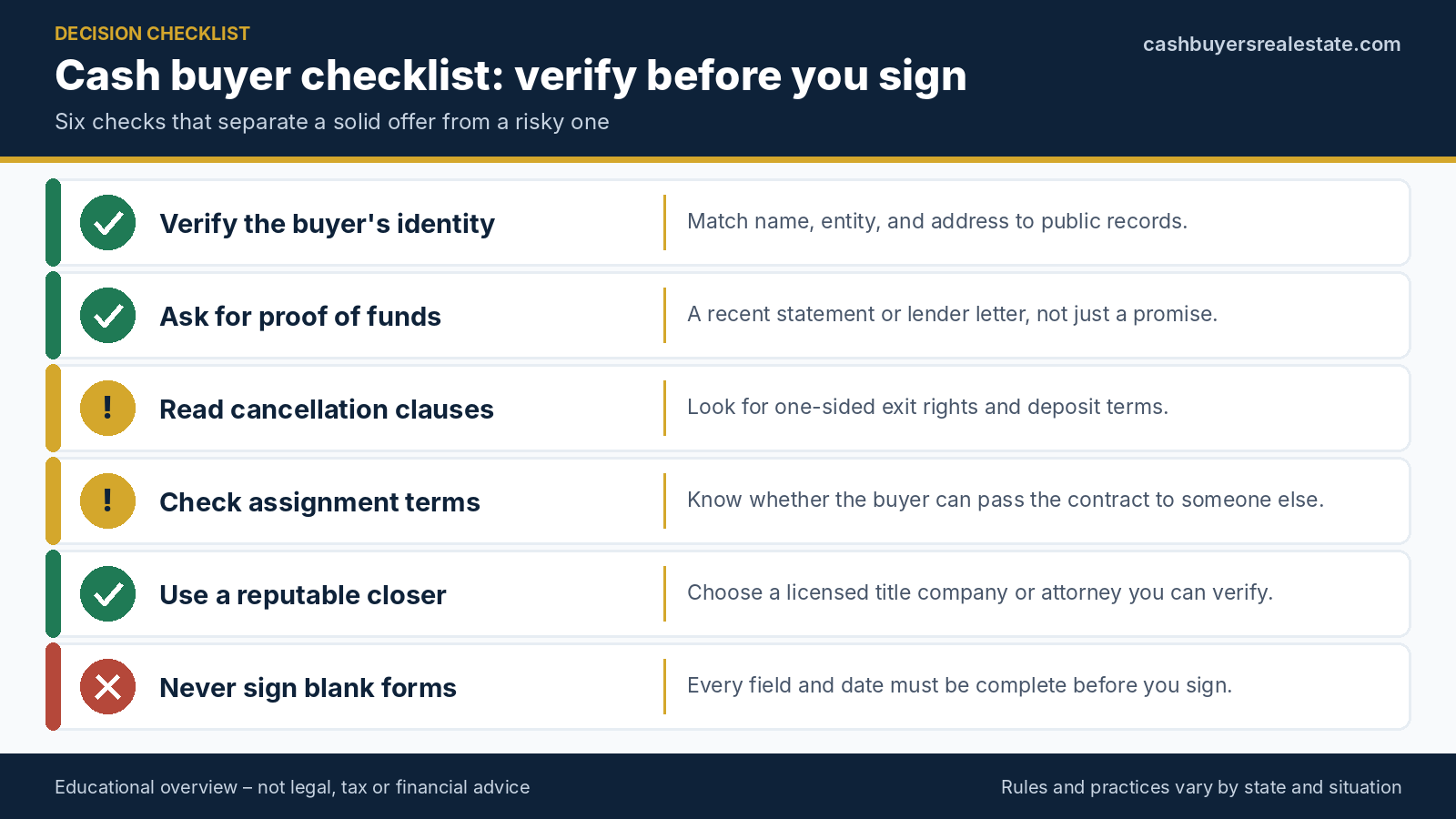
Text version of this infographic
- Verify the buyer's identity — Match name, entity, and address to public records.
- Ask for proof of funds — A recent statement or lender letter, not just a promise.
- Read cancellation clauses — Look for one-sided exit rights and deposit terms.
- Check assignment terms — Know whether the buyer can pass the contract to someone else.
- Use a reputable closer — Choose a licensed title company or attorney you can verify.
- Never sign blank forms — Every field and date must be complete before you sign.
Special Situations: Inherited, Tenant-Occupied, Damaged, Vacant, and Encumbered Properties
Cash buyers have a reputation for taking on houses that others won’t, and in many cases the reputation is deserved. Properties that cannot be financed, that are occupied by someone other than the owner, that are tied up in an estate, or that are physically or legally compromised are the properties where the absence of a lender’s requirements matters most. They are also the situations in which a seller is most likely to be under emotional or financial strain, and where careless or opportunistic buyers do the most harm. The goal of this section is to explain what changes for each type of property, what to confirm first, and where the deeper guides on each topic can be found.
The common thread is that special situations rarely make the sale impossible, but they do change who can sign, what the buyer is purchasing, and how long it takes. Understanding those changes before you talk to a buyer gives you a realistic timeline and a better sense of which offers are credible. A buyer who treats a complicated property as routine may not understand the complications, and a buyer who exaggerates them to justify a deep discount may be using them as a bargaining chip.
Properties With People or Legal Process Attached
Two of the most common special situations involve a person or a court: an estate that must be administered before anyone can sell, and tenants who have a right to stay. In both, the main question is not price but authority and timing.
Inherited Houses and Probate
When a homeowner dies, the house generally cannot be sold by an heir simply because the heir expects to inherit it. Someone usually needs legal authority to sell, which in many states comes from a court appointing a personal representative, called an executor or administrator depending on whether there is a will and on the state. That person signs the contract and deed on behalf of the estate, and the title company will typically ask for court-issued documents proving authority. Some states allow certain transfers without a full court process, particularly when a trust holds the property or when small-estate procedures apply, but the rules, the paperwork, and the timelines vary a great deal by state and sometimes by county.
For an heir considering a cash offer, the practical sequence is to confirm who has authority, to learn whether the sale requires court approval or notice to other heirs, and to make sure every person with an ownership interest agrees. Disagreements among siblings are one of the most common sources of delay, and a cash buyer cannot fix them. A buyer who suggests that they can close in days on an inherited house without addressing authority is either not familiar with the process or is hoping you won’t ask. The guides on selling an inherited house fast and selling quickly while the estate is in probate cover the steps, and the planned hub on probate real estate will go further.
Taxes and condition matter here too. As described earlier, the basis of an inherited home is generally its fair market value at the date of death, which often limits taxable gain on a prompt sale. Many inherited houses also carry deferred maintenance, personal belongings, and sentimental weight, and a cash buyer who purchases as-is, belongings included, can relieve a family of a heavy task. That convenience is worth something, but the family should still consider an appraisal, an agent’s opinion, or multiple offers, because an estate’s fiduciary duty generally includes getting a reasonable price. The longer treatment is in the guide on cash buyers for inherited houses.
Tenant-Occupied Properties
If a tenant lives in the house, the sale cannot ignore that tenant. In many states, a sale does not automatically end an existing lease, which means the buyer may take the property subject to the tenant’s rights, though the details depend on state and local law and on the lease terms. That is attractive to a buyer who wants a rental, who sees an occupied house as income, and who may pay more for a property with a reliable tenant. It is less attractive to a buyer planning to renovate or resell, who needs the house vacant and may offer less to cover the cost and risk of removing a tenant.
For a landlord, the decision is therefore as much about who the buyer is as about price. Be clear with prospective buyers about the lease term, the rent, the deposit, any arrears, and the tenant’s cooperation with showings and inspections. Provide a copy of the lease and an accurate rent roll. Do not pressure a tenant to leave in a way that violates state or local landlord-tenant law, because eviction procedures and tenant protections are strictly regulated and mistakes can lead to liability. Some buyers offer to pay the tenant to move out voluntarily, sometimes called cash for keys, and that arrangement can work when the tenant agrees freely and the terms are put in writing. The guides on selling quickly with tenants in place and cash buyers for rental properties discuss options in more detail.
Security deposits deserve a note. Most states require a landlord to account for a tenant’s deposit, and in a sale the deposit generally has to transfer to the new owner or be returned according to state rules. The contract and the closing statement should say how this will be handled, and a buyer who is vague about it is creating a liability for you. As with other points in this section, the state’s landlord-tenant statute and a local attorney are the authorities, not a buyer’s assurances.
Properties With Physical or Ownership Complications
The second group of special situations involves the condition or status of the property itself: damage that makes it hard to finance, vacancy that makes it hard to insure, or a recorded problem that clouds ownership. These are cases where cash buyers’ flexibility can be real, and where disclosure and verification duties matter most.
Damaged, Condemned, and Fire- or Water-Affected Houses
A house damaged by fire, flood, storm, mold, or long neglect often cannot be sold to a financed buyer, because lenders generally will not lend against a property that fails their condition standards. That leaves cash buyers, and the price reflects the risk. Before selling, check whether an insurance claim is open, since proceeds may be payable to your mortgage lender as well as to you, and since selling the house may affect your rights under the claim. Ask your insurer and lender how pending claims are handled in a sale. Document the damage with photographs, estimates, and any inspection or claim reports, and share them honestly with buyers, because accurate documentation tends to produce more reliable offers than a buyer’s guess.
Condemned houses and those with outstanding code violations present another layer. A local government may have declared the building unsafe or ordered repairs, and the order, fines, or liens may stay with the property. A buyer can purchase subject to the orders, but you should understand what they require and what penalties accrue, and the closing firm will see anything recorded. Disclosing known violations is part of an honest sale. Several of the sibling guides deal with these properties directly, including those on selling a damaged house fast, cash buyers for fire-damaged houses, and selling a condemned house.
Tax law offers some relief in unusual cases. The IRS notes in Publication 523 that a sale prompted by certain unforeseen events, including a home being destroyed or condemned, may qualify for a reduced exclusion even if the usual ownership and use periods were not met. Whether your situation qualifies is a question for a tax professional, but it is a reason to keep documentation of the event.
Vacant, Hoarded, and Title-Troubled Properties
Vacancy creates its own problems. Vacant houses deteriorate faster, draw vandalism and squatters, and may be affected by insurance policy provisions that limit coverage after a stated period of vacancy, so check your policy and talk to your insurer. Carrying costs continue with no one living there, which is why owners of vacant property are often eager to sell. Be careful, because that eagerness is exactly what some buyers look for. The guides on selling a vacant house fast and cash buyers for vacant houses address the particular pitfalls, including the risk of impersonation scams in which a criminal poses as the owner of an empty property, which is one reason closing firms verify identity carefully.
Hoarded houses and homes full of belongings add a labor and emotional component. A buyer who purchases as-is and handles the cleanout takes on real work and expense, and an offer will reflect it. A family member or owner who is overwhelmed may find that relief is worth a discount, but should still compare offers and understand what the buyer is taking on. See the guide on selling a hoarder house for sensitive, practical advice.
Title problems form the last category. A missing heir, an old unreleased mortgage, an error in a deed, a boundary dispute, or an unrecorded transfer can each prevent a clean sale. Some can be fixed with a corrective document or a court action, and some require waiting. A cash buyer may be willing to take on a modest title cleanup, or may insist that you resolve it first, and in either case the title search will surface it. The planned hub on selling a house with title problems will cover the options, and an attorney is the right resource when ownership is unclear.
| Situation | Main complication | First thing to confirm |
|---|---|---|
| Inherited house in probate | Who has legal authority to sell, and whether the court must approve | Court-issued documents showing the personal representative’s authority |
| Inherited house with several heirs | Every owner must agree and sign | A list of all heirs and their written consent |
| Tenant-occupied rental | The lease and tenant rights may continue after sale | Lease terms, rent roll, deposit, and state landlord-tenant rules |
| Fire, flood, or storm damage | Financing is hard; insurance claim may be open | Claim status and whether the lender must approve the sale |
| Condemned or code-violation property | Orders, fines, or liens may remain on the property | Written orders from the local building or code office |
| Vacant house | Insurance limits, deterioration, and impersonation risk | Policy vacancy terms and identity verification at closing |
| Hoarded or heavily cluttered house | Cleanout labor and unknown condition behind belongings | Who handles the contents and what the offer assumes |
| Title defect or unclear ownership | Clean title may require a corrective filing or court action | A title report and an attorney’s opinion on the fix |
Think of the table as an intake form for your own property. If more than one row fits, which is common, as with a vacant inherited house with an old lien, solve the legal questions first, because authority and title determine whether any buyer, cash or otherwise, can close. After that, the questions of price and speed become much easier to answer.
Frequently Asked Questions About Selling to Cash Home Buyers
The questions below come up repeatedly once a seller has read an offer and started to look closely at the details. They are grouped by theme, and each answer is kept brief on purpose, with the fuller discussion in the sections above and in the linked guides. Where an answer depends on your state, it says so.
Questions About Offers, Timing, and Money
Questions About Offers and Pricing
- Is a cash offer ever higher than what I could get by listing?
It can be, though it isn’t the usual result. A listing generally exposes a house to more buyers, which tends to raise the price, but a cash offer can come out ahead once you subtract repairs, carrying costs, concessions, and the chance that a financed buyer’s loan falls through. This is most likely with houses that need major work or that cannot be financed, and with sellers who would otherwise carry the property for months. Compare net proceeds, not headline prices, and let at least two written offers inform your judgment.
- How do I know whether an offer is reasonable?
No single number is correct, but you can test an offer. Ask the buyer for the after-repair value, the comparable sales behind it, and a summary of the repair estimate, then ask a local agent for a comparative market analysis of the house as it stands and as it could be after repairs. If an offer sits far below both, ask why. Offers from two or three different kinds of buyers will also show you the range. A buyer who explains the math plainly is easier to trust than one who won’t.
- Will the buyer or I pay the closing costs?
That is a matter of the contract, not a rule. Some cash buyers agree to pay most closing costs, some split them, and some leave the seller with the usual seller charges. In some states, custom assigns particular fees, such as transfer taxes, to one side. Look at the settlement statement draft in advance and confirm every line against the contract, since this is where an apparently generous offer can lose value. The guide on closing costs in cash offers goes through the common categories.
- Can an offer change after the buyer inspects the house?
Often, yes, if the contract allows it. Many cash contracts give the buyer an inspection or due diligence period during which it may cancel or propose a different price, and repairs the buyer finds can justify a revised number. Protect yourself by asking beforehand what findings could cause a change, by reading the cancellation terms, and by keeping a backup option. A revised price is not necessarily improper, but a pattern of repeated reductions deserves a closer look.
Questions About Timing and Closing
- How long does a cash sale really take?
The honest answer is that it depends on title, the buyer’s process, and your own paperwork. A clean house with a ready buyer and a simple payoff can close in a matter of weeks, and a house with a lien, a probate requirement, or several owners can take much longer. Be skeptical of any promise of a specific number of days made before the buyer has seen the title search. The article on cash offer timelines explains what moves the schedule.
- When do I get my money?
At closing, after the closing firm has received and verified the buyer’s funds and the deed has been signed. Proceeds are usually sent by wire or delivered by check according to the firm’s practice, and wires can reach your account the same day or the next business day depending on timing and your bank. Confirm the method in advance, give your account details securely, and verify them by phone. Funds that are delayed for more than a day deserve a call to the closing firm.
- Can I stay in the house after closing?
Sometimes. Buyers can agree to let a seller remain for a short period after closing, often called a rent-back or post-closing occupancy, but it must be in writing with a clear end date, a daily charge or deposit, responsibility for utilities, and insurance. Without that agreement, the buyer expects possession at closing or on the date the contract states. If you need extra time to move, raise it during negotiation, when it can be traded against price or other terms.
- What if I need to cancel after I sign?
Your options depend on the contract and state law. Some states give sellers statutory cancellation rights in specific wholesaling transactions, such as the rights described earlier for Oklahoma, Oregon, and Pennsylvania, but most contracts do not give a seller a general right to walk away. Backing out without a contractual reason can expose you to a claim for damages or specific performance. Before signing, ask an attorney what you can do if circumstances change.
Questions About Safety, Taxes, and Special Cases
Questions About Trust and Verification
- Is it normal for a buyer to want me to sign quickly?
Buyers like speed, and a motivated buyer may ask for a prompt answer, but there is a difference between a reasonable deadline and pressure. A deadline of a day or two to respond to a written offer is common. Pressure to sign before reading, to skip an attorney’s review, or to commit on the first phone call is a warning sign. You can always say that you will respond after reviewing the documents, and a legitimate buyer will agree.
- Are companies that advertise heavily to homeowners trustworthy?
Advertising volume says very little about quality. Some heavily advertised buyers are reputable and some are not, and small local investors with no marketing budget can be excellent. Judge the buyer by what you can verify: the legal entity, the proof of funds, the contract terms, the closing firm, and references from recent sellers. The page on how to tell whether a cash buyer is legitimate gives a framework you can apply to any company.
- Should I hire my own attorney?
It is often worth it, especially if the contract is nonstandard, the amount is large, an estate or lien is involved, or the closing firm is chosen by the buyer. In attorney-closing states, hiring counsel is routine. An hour of review before signing costs little compared with the stakes. Ask for an attorney who handles residential real estate in your state, and ask what the review will cover and what it will cost.
- Who should I report a problem to?
It depends on the problem. The Federal Trade Commission accepts reports of scams at ReportFraud.ftc.gov, and your state attorney general handles consumer complaints. Wire fraud should be reported immediately to your bank and then to the FBI’s Internet Crime Complaint Center. Problems with a licensed professional can go to the licensing board, and an attorney can advise on a contract dispute. Report promptly, since delay can make recovery harder.
Questions About Taxes, Liens, and Unusual Properties
- Will I owe taxes on the sale?
Possibly, depending on your gain and your situation. The IRS allows many homeowners to exclude up to $250,000 of gain, or $500,000 for qualifying joint filers, if they owned and lived in the home for at least 24 months of the last five years. Heirs, landlords, and people who recently moved face different rules, and your state may tax gain differently. A tax professional can estimate your result before you sign.
- Can I sell for cash if I owe more than the house is worth?
A cash buyer cannot erase the difference, because the mortgage must be paid at closing. You would need to bring funds, negotiate a short sale with your lender, or consider other approaches. Each carries consequences for your credit and possibly your taxes, so speak with a HUD-approved housing counselor and an attorney first. Do not transfer your deed or stop communicating with your lender because a buyer suggests it.
- Can I sell if the house has liens or unpaid taxes?
Usually yes, as long as the liens can be paid from the proceeds or otherwise resolved at closing. The title search identifies them, and the closing firm obtains payoff amounts. The practical concern is whether the proceeds cover everything, and whether any lien is disputed or needs a court action. Find out early, and review the options in the guide on selling to cash buyers when liens exist.
Deciding Whether a Cash Sale Is Right for You, and What to Do Next
After the mechanics, the math, and the warnings, the decision comes down to a question only you can answer: what does this sale need to accomplish? For some sellers the answer is a fast, certain exit from a property that has become a burden. For others it is the highest net price, with time and patience available to get it. Most people want some of each, which is why a decision framework helps. It turns a vague preference into a ranked list and then lets you see which route fits the list.
The aim is not to steer you toward a cash buyer or away from one. A cash sale is a legitimate and sometimes ideal choice, and it is also sometimes an expensive way to solve a problem that a few weeks of patience or a modest repair would have solved at lower cost. The final section brings the earlier material together into a method you can apply this week.
A Framework for Matching the Route to Your Priorities
A good framework starts with the facts that cannot be changed, such as a court date, a closing on another house, or a medical need, and then looks at what you can change. It treats price, speed, effort, certainty, and privacy as trade-offs rather than as goals you can maximize all at once.
Ranking What Matters: Certainty, Price, Speed, Effort, and Privacy
Begin by writing down the five factors and ranking them from most to least important for this particular sale. Certainty means how confident you need to be that the sale will close on a known date. Price means your net proceeds, after every cost. Speed is how soon you need the money or the house off your hands. Effort is how much preparation, showing, repair coordination, and negotiation you can handle. Privacy is how much you want to avoid public listings, open houses, and neighbors watching. Ranking forces trade-offs into the open: if certainty and speed rank first and price third, the cash route fits comfortably; if price ranks first and you have months to spare, a listing fits better.
Next, assign each factor a rough value. How many dollars would you give up for a firm closing date? How many for not having to repair the roof? Few people have a number ready, but thinking about it exposes whether the gap between a cash offer and your best alternative is worth paying. If the cash route nets $20,000 less than a listing but spares you six months of mortgage payments, a repair project, and the risk of a failed sale, the true cost may be much smaller than the headline gap. If it nets $50,000 less and your deadline is flexible, the answer may be the opposite.
Finally, test your ranking against a fixed constraint. If there is a hard deadline, work backward from it and ask which routes can realistically meet it with a margin for error. A route that can meet the deadline only if everything goes perfectly is not really a candidate. And if you notice that someone else’s urgency, such as a buyer’s offer expiring, is driving your ranking, pause and ask whether the urgency is real. Urgency created by the other side is rarely in your interest.
How the Answer Changes Across Common Seller Profiles
Sellers in similar situations tend to land in similar places, though no profile guarantees an outcome. The table below shows how the framework often plays out. It is a starting point for discussion with your own advisers and not a prescription, and the rows can overlap.
| Seller situation | Priorities that usually lead | Routes that often fit | Main caution |
|---|---|---|---|
| House in good shape, no deadline | Price | Agent listing; compare an instant offer as a benchmark | Do not let a convenient offer hide a better net result |
| House needing major repairs, limited cash | Certainty, effort | Cash buyer; list as-is with an agent experienced in such sales | Gather several offers; the repair estimate drives the price |
| Hard deadline such as a relocation or court date | Speed, certainty | Cash buyer with verified funds and a firm closing date | Fast does not mean skip verification |
| Inherited house with multiple heirs | Agreement, simplicity | Cash buyer, or listing after authority and consent are in place | Authority and heir consent come before price |
| Tenant-occupied rental | Smooth transition, price | Landlord or investor buyer; listing with tenant in place | Follow state landlord-tenant rules strictly |
| Owing more than the house will sell for | Avoiding harm, options | Housing counselor and attorney first; lender-approved routes | A buyer cannot erase the shortfall |
| Vacant house with rising carrying costs | Stopping the drain | Cash buyer or listing, depending on condition | Check insurance and watch for impersonation scams |
Look for your row, then read across and treat the final column as the thing to guard against. You may find that two rows apply, in which case the stronger constraint, usually a legal one or a deadline, tends to settle the matter. Related guides to consult include selling a house for cash for the seller-side overview of the route, and selling fast before foreclosure and selling fast during a divorce for the two situations where emotion and law interact most heavily.
Two cautions about using a table like this one. First, the priorities column describes what usually drives decisions, but your priorities may differ, and a seller who ranks privacy first, for instance, may prefer a quiet off-market sale even in a strong market. Second, the “routes that often fit” column is not a ranking of price outcomes. A route that fits a seller’s priorities can still produce a lower net, and the table cannot tell you by how much. That is why the next step after finding your row is to price the routes using the method from the net-proceeds section, with your own numbers, and to check the result against the written offers you actually receive.
What to Do Next: First Steps, Documents, and Questions
Once you have a sense of your priorities, the work becomes concrete. The best first steps cost little, commit you to nothing, and improve every later decision.
A Sensible First Week: Documents to Gather and Offers to Collect
Begin by assembling your paper trail. You’ll want the deed or a copy of the title, your latest mortgage statement and a request for a payoff estimate, the most recent property tax bill, homeowners insurance information, any association documents, a list of recent repairs and receipts for major improvements, any inspection or appraisal reports, and, if the house is rented, the lease and rent roll. If you are acting for an estate, add the court documents showing your authority. Having these ready speeds every conversation and signals to buyers that you are organized.
Then gather perspective. Ask a local real estate agent for a price range for the house as it stands and for what it might fetch with modest repairs; many agents offer this without obligation. Request written offers from two or three buyers of different kinds, such as a local investor and an instant-offer platform, and use the questions from the pricing and verification sections to compare them. If a lien, an inheritance, or a foreclosure notice is involved, consult an attorney or a HUD-approved housing counselor early, since those professionals can shape your options before any buyer does.
Resist the urge to spend money before you have information. Many sellers start repairs, hire cleaners, or pay for staging before they know which route they will take, and the money may be wasted if the buyer plans to gut the kitchen anyway. Hold off on anything beyond basic safety and maintenance, such as stopping a leak or securing a vacant property, until you have seen at least two offers and an agent’s opinion. Keep the utilities on, keep the insurance current, and keep the property secure, because a lapse can complicate both a sale and an insurance claim. Small steps like these keep your options open and your costs down while you decide.
Finally, set your own timeline. Decide the date by which you must have a signed contract and the date by which you must close, and tell every buyer only what you need to. Keep a log of conversations, with dates, names, and what was promised. If a buyer’s offer changes, the log makes it easier to see how. The page on choosing among local cash home buyers offers more help with the local side of the search.
Questions to Put to Every Buyer, and How to Pace the Decision
A short set of questions, asked of every buyer in the same way, makes offers comparable. Who is the buyer, legally, and will it close in its own name? How was the price calculated, and what could change it? How much is the deposit, who holds it, and when is it refundable? What is the inspection period, and what can the buyer do at its end? Is assignment allowed, and will I be told? Which firm will close, and can my attorney review the documents? What are the costs I will pay, line by line? What is the closing date, and what happens if it slips? A buyer who answers these in writing is giving you what you need to decide. A buyer who won’t has already given you an answer of a different kind.
Pacing matters as much as the questions. Take the time the contract needs, but not more than your real deadline allows. Sleep on any offer that arrives with a short fuse. Ask for a day to have an attorney look at the contract, and treat resistance as information. If you are working through a hard personal event such as a death, a divorce, or a financial setback, ask a trusted friend or advisor to sit in on key conversations. Being kind to yourself does not mean being slow, but it does mean refusing to be rushed.
There is no single right answer to the question this guide started with. A cash home buyer may be the best fit for a house that needs more work than you can manage or a deadline that a listing cannot meet, and it may be the wrong fit for a sound house in a healthy market where time is on your side. What serves you in either case is the same set of habits: gather more than one offer, compare net proceeds and not headline prices, verify the buyer and the closing partner, read every page before you sign, and keep alternatives open until the deed is recorded. If the numbers and the terms make sense after that process, you can proceed with confidence. If they don’t, walking away costs you nothing, and there will be other buyers and other routes to consider.