Cash Buyer Contingencies: Offers, Process & Red Flags
The offer arrives in an email or a text, and the number looks good. You read it once for the price and then, a little more slowly, for everything else. Somewhere in the second page there is a sentence that starts with “subject to,” or a paragraph that gives the buyer a number of days to “review and approve” something, or a line about the buyer’s “partners” or “funding source.” Nobody has told you what those words mean for your timeline, and the buyer’s friendly voice on the phone has said only that the deal is “all cash.” If you’ve ever wondered how a purchase can be all cash and still have conditions attached, you are asking exactly the right question. Cash buyer contingencies are the conditions that let a buyer pause, renegotiate, or walk away after the contract is signed, and they decide how firm a cash offer really is.
The direct answer is that cash removes one contingency, the mortgage, and leaves nearly every other one available. A cash contract can still hold an inspection or due diligence window, a title review, an access requirement, an approval by a partner or lender, an assignment right that lets the buyer hand the deal to someone else, or plain “satisfaction” language that works as an exit with a polite name. Some of these are ordinary and fair, and a few protect you as much as the buyer. Others are doors left open so that the buyer can test the market, wait for a better property, or lower the price once you’ve stopped showing the house. The skill is not in avoiding contingencies altogether. It is in telling the working ones from the disguised ones, understanding how much time each one gives the buyer, and negotiating the list down until what remains is a price you can count on.
A cash contract removes the loan contingency, not the others. Look for inspection or due diligence periods, title review, funding or partner approval, assignment rights, and “satisfaction” language. Each one is a buyer exit with a clock attached. Shorten the clocks, make the standards objective, and compare offers on the likelihood of closing, not only the headline price.
It helps to think of an accepted cash offer as a probability and not a promise. A $230,000 offer with three open-ended exits and a $1,000 deposit may be worth less to you than a $222,000 offer with a seven-day review period, a larger deposit at risk, and a buyer who has shown funds. The first number is a hope; the second is closer to a plan. Because the difference lives in the fine print, this guide spends its time on the fine print: what each common contingency says, what it lets the buyer do, how the notice and deadline mechanics work, and what you can ask for in return. The same logic applies when a house is tied up in probate or needs a court’s approval, which creates contingencies that neither side controls.
The article is organized to follow the contract from definitions to decisions. It starts with what a contingency is and why a cash sale still has them, then catalogs the conditions you are likely to meet and rates the risk each one carries for a seller. After that it looks at the soft language and one-sided rights that function as hidden exits, explains how deadlines and notices work, and describes what happens when a clock runs out. A separate section covers the contingencies created by probate courts and other third parties, and another covers negotiation, including the protections a seller can ask for, such as a rent-back period or a repurchase right. The last topical section covers how to verify the buyer and weigh alternatives, and the closing sections answer common questions and offer a decision framework.
Several neighboring subjects are covered in their own guides, and this one touches them only where the contingency question requires it. If you are comparing offers that come with no conditions at all, the guide to a cash offer with no contingencies examines that structure and its price trade-offs. The general layout of the paperwork is explained in the guide to the cash home buyer contract, and the money side of verification is handled in the pages on proof of funds and earnest money. Here the lens is narrower and, for most sellers, more practical: which words in the agreement can take the deal away, and what can you do about them before you sign?
One last point of orientation. Nothing in this guide assumes that a buyer who asks for contingencies is acting in bad faith. A careful buyer is entitled to look at a house before committing, and a seller who refuses every condition may end up with no buyer at all. The aim is balance: enough protection for the buyer to feel safe paying a real price, and enough certainty for you to plan your move, your next purchase, your tax year, or your estate’s final accounting around the closing date.
What a Contingency Is and Why a Cash Sale Still Has Them
A contingency sounds like jargon, but the idea is simple and the reasoning behind it is practical. Before looking at the specific clauses, it helps to see what a contingency does legally, why cash does not erase the need for them, and how to value the certainty they take away. This section builds that foundation so the later catalog of clauses makes sense.
The legal job a contingency performs
A real estate contract is a promise to buy and sell on a future date, and a great deal can change between signing and closing. A contingency is a condition written into the agreement that lets one party adjust, delay, or cancel if something specific turns out badly. Without conditions, the buyer who discovers a cracked foundation in week two would still be bound to close. With them, the buyer may be able to leave, usually without losing the earnest money deposit.
A condition with a trigger, a deadline, and a consequence
Every well-drafted contingency has three working parts. The first is the trigger: the fact or event the condition depends on, such as an inspection result, a title problem, or approval by a third party. The second is the deadline, because a right to cancel that never expires would leave the seller in limbo forever. The third is the consequence, which says what the party who invokes the condition gets (usually a refund of the earnest money deposit) and what the party who misses the deadline loses (often the right to cancel at all). When you read any contingency, ask yourself which of the three is missing or vague, because the vague part is where disputes grow.
The deadline and consequence are especially important in practice. Under the One to Four Family Residential Contract published by the Texas Real Estate Commission (the form version in circulation is dated May 2026), the buyer’s option to terminate must be exercised by 5:00 p.m. local time on the last day of the option period, and the contract states that time is of the essence for that paragraph. A buyer who is one hour late has not exercised the right at all. The same principle runs through other states’ forms in different words: a contingency is a right with an expiration date, and expiration changes the buyer’s position from “free to leave” to “committed unless the seller defaults.”
A practical way to apply the three-part test is to read a clause aloud and try to fill in the blanks: “If ___ happens by ___, the buyer may ___, and if the buyer does not act by then, ___.” A good contingency fills all four blanks without help from anyone’s memory of a phone call. A weak one leaves the first blank vague (“any issue”), the second blank empty, or the last blank unanswered, and each gap shifts power to whichever party is more willing to argue about it later. Sellers who do this exercise on the first read often discover that the clause they worried about is fine and a short, innocent-looking sentence elsewhere is the real problem.
Why cash removes the loan condition and leaves the rest
When most people hear “all cash,” they assume the contract is stripped down to a price and a closing date. In reality, the thing a cash buyer removes is the financing contingency, the clause that lets a buyer cancel if a lender declines the loan or the appraisal comes in below the price. That one change matters, since loan denial and low appraisals are among the common reasons financed sales fall apart. It’s also the reason many sellers prefer cash in the first place.
But the other reasons a buyer might want to leave have nothing to do with a bank. The buyer might find a roof problem, discover a lien, learn that the neighborhood has a planned zoning change, lose a business partner, see a better property, or simply run into cash-flow trouble with another project. A cash contract can protect the buyer against any of those risks by keeping the corresponding contingency. Federal rules reflect the same split for financed purchases: HUD’s model amendatory clause, used with FHA and VA loans, says the purchaser is not obligated to complete the purchase or lose the earnest money unless a written appraisal meets the stated value. When no loan exists, that clause isn’t needed, but the buyer can still write in other exits by agreement.
Certainty is the currency a seller is really being paid in
Sellers often compare offers by the number on the first page. A better habit is to treat each offer as a price multiplied by the chance that it closes on time, minus whatever the delay and the failed attempt would cost you. Contingencies are what move that chance up or down, and understanding the reasoning will save you from accepting the wrong offer for the right-looking price.
Reading an offer as price times likelihood of closing
Imagine two offers on the same house. One is higher and rests on three open exits; the other is lower, firmer, and shorter. If the first one collapses after 45 days, you have not simply lost the difference between the two prices. You have also spent 45 days of mortgage interest, taxes, insurance, utilities, and upkeep on a house you hoped to be rid of. You may also have turned away the second buyer, who may have found another property by then. The expected value of the first offer is its price discounted by the chance of collapse, with a penalty for the time lost in the attempt.
No one can compute those chances precisely, and this guide does not pretend otherwise. What you can do is rank the exits by how much control the buyer has over them. A title review that depends on public records is mostly outside the buyer’s control and tends to resolve cleanly or not. A “buyer’s satisfaction” clause is entirely within the buyer’s control and can be invoked for any reason, including a change of heart. The more of the buyer’s exits that depend on the buyer’s own mood, the lower the effective value of the headline number, and the more you should ask in return, whether that means a higher deposit, a shorter window, or a better price.
One more consideration is how fast you could recover if the deal did fail. A seller with a vacant, easily shown house and an active market can relist within days and may lose little. A seller whose house has a long list of visible problems, an unusual layout, or a title complication may find that the second buyer takes just as long as the first, in which case a lost month is a lost month. Ranking your own recovery speed honestly is part of valuing an offer, because the less cushion you have, the more weight certainty deserves relative to price.
Who pays when a contingency is used
It’s easy to think of a canceled deal as a neutral event, with both sides returning to where they started. That isn’t how it feels on the seller’s side. Between acceptance and cancellation, a seller usually stops showing the house or pursuing other buyers, may schedule movers or sign for a replacement home, and keeps paying the carrying costs. After the cancellation, the property may carry a small stigma if it returns to a listing as “back on the market,” and time that could have gone toward a better plan has been spent. Buyers who invoke contingencies in good faith aren’t doing anything wrong, but the cost of the delay lands on you anyway.
For that reason, negotiated contingencies often include some price for the option. In North Carolina’s standard offer form, the buyer pays the seller a negotiated due diligence fee for the right to investigate and terminate, and the North Carolina Real Estate Commission explains in its due diligence guidance that the buyer typically gets back the earnest money but not that fee. Texas works the same way through its option fee, which the seller keeps if the buyer terminates and which the form credits toward the sales price when the sale closes. These payments recognize that a seller who takes a house off the market is granting something of value. When a cash contract offers an inspection window with no fee at all, no deposit at risk, and no firm deadline, that price has been set at zero, which should figure into how you value the offer.
Illustrative example (hypothetical numbers, not market data): A homeowner has a house valued at about $240,000 in the market and receives two cash offers. Buyer A offers $236,000 with a 21-day “approval period,” a $500 deposit, and a clause allowing assignment to any party. Buyer B offers $229,000 with a 7-day inspection window, a $5,000 deposit, a title review, and proof of funds attached. Suppose the homeowner’s carrying costs run about $65 a day. If Buyer A walks away on day 21, the homeowner has spent roughly $1,365 on carrying costs and is back at the start with a house that has sat for three weeks. Even setting that aside, there is no way to know whether Buyer A will close, while Buyer B’s exits are narrow and time-limited. The $7,000 headline gap is real, but it is not the whole comparison.
The rest of this guide works from that principle. A contingency is not good or bad on its own; what matters is who controls it, how long it runs, what it costs the person who uses it, and whether the price reflects the freedom it gives. With that frame in place, the next section catalogs the conditions most often found in cash contracts.
The Catalog: Contingencies That Appear in Cash Contracts
Cash contracts vary from a one-page letter agreement to a full state-approved form with addenda, and the same condition may appear under different names. This section organizes the most common contingencies into two families: those that concern the physical property and your access to it, and those that concern title and the authority to sell. For each one, the discussion covers how it works, what it lets the buyer do, and where the risk to you sits.
Conditions that concern the property itself
The first family covers what the buyer learns by walking through, testing, and measuring the house. These are the conditions most sellers expect, and most of them are reasonable when they are bounded by a short period and a clear standard. The trouble begins when the period is long or the standard is left vague.
Inspection and due diligence windows
The inspection or due diligence contingency gives the buyer a defined number of days after the effective date to inspect the house and to cancel if the results are unsatisfactory. State forms handle this differently in structure, even though the effect is similar. The Texas form grants what it calls the unrestricted right to terminate within the number of days the parties write in, in exchange for an option fee that the buyer must deliver within three days of the effective date; without timely payment, the buyer does not get the right. North Carolina’s offer-to-purchase form uses a due diligence period with a negotiated fee paid to the seller, and the state’s Real Estate Commission notes that the buyer can terminate in writing for any reason or no reason during that period, with no need for the seller’s consent.
Florida’s “As Is” residential contract works on a related model, in which the buyer may cancel for any reason related to the property during the inspection period and recover the deposit. A summary of that contract by a Florida real estate law firm points out that the seller has no obligation to make repairs the inspection finds, and that a seller who declines a repair request risks the buyer’s cancellation. For a seller, the practical meaning of these designs is that an inspection window is an option contract in miniature. During the window, the buyer holds a free or low-cost right to leave. After it, the buyer is committed. The length of the window, which the forms leave to the parties, is therefore the most important number in the agreement.
It also matters whether the buyer’s right is tied to the inspection’s findings or to the buyer’s general satisfaction. A clause that lets the buyer cancel only if the inspection reveals defects costing more than a stated sum gives you a measurable standard. A clause that lets the buyer cancel “if not satisfied with the property in the buyer’s sole discretion” gives you none. In the first case, you can argue about whether the repairs cost more than the sum. In the second, there is nothing to argue about, because the buyer decides alone.
Access, occupancy, and condition-at-closing clauses
A less obvious group of property conditions concerns whether the buyer can get into the house and whether it will be in the same shape at closing as at signing. Access clauses require you to allow inspectors, appraisers, contractors, and sometimes a partner or end buyer to visit during the review period. They are usually harmless, but a clause allowing “reasonable access at any time” on 24 hours’ notice can strain a seller who lives in the home or has tenants, and a clause that makes the buyer’s access a condition of the seller’s performance can turn a locked door into a technical default.
Condition-at-closing clauses say that the house must be delivered in substantially the same condition as at signing, reasonable wear excepted, and that utilities must remain on, personal items removed, and the house vacant. The Texas form, for example, requires the seller to keep existing utilities on while the contract is in effect so inspections can happen. Where a fire, storm, or break-in damages the house before closing, these clauses decide who bears the loss and whether the buyer can cancel; state law often supplies a default rule, and the contract may change it. If you plan to leave belongings, sell the house with tenants, or move out after closing, say so in the contract, since a delivery-of-possession clause that conflicts with your actual plans can become a hidden condition of its own. For more on how buyers handle inspection practice in cash purchases, the guide to whether cash buyers require inspections covers the mechanics in detail.
Conditions that concern title, authority, and paperwork
The second family covers whether you can legally deliver what you are selling. These conditions are less visible to sellers, partly because they involve documents that the title company handles in the background, and partly because most of them are seller obligations in the first place. They still count as contingencies, since a failure on your side may give the buyer a right to cancel or extend.
Title commitment, survey, and objection periods
A title review contingency gives the buyer a window to examine a title company’s commitment for insurance and to object to anything unacceptable, such as an unreleased mortgage, a judgment lien, an easement, or a gap in the chain of ownership. The Texas form shows how structured these periods can be. The seller furnishes the title commitment within 20 days after the title company receives the contract, the buyer must object within the time stated, the seller then has 15 days to cure, and after the cure period the buyer has five days to terminate with a refund of earnest money or accept the title as it stands. The form notes that the delivery period can be extended by as many as 15 days or until three days before closing, whichever is earlier.
These steps have a wide impact on timing even if nobody ever terminates. A cash buyer who promised to close in two weeks cannot do so if the commitment arrives on day 18, the seller needs 15 days to clear a lien, and the contract allows another five days for the buyer’s decision. For a seller, the right response is to order a payoff statement for every mortgage or lien early, collect any prior surveys, and tell the buyer promptly about problems you already know about. The deeper treatment of liens belongs in the guide to cash buyers for houses with liens, but the principle is straightforward: a title issue you disclose in the first week is a negotiation point, while one the buyer discovers in week three is a reason to question your honesty.
Seller-authority conditions and third-party documents
Finally, there are conditions that depend on documents or approvals you must obtain from others: payoff letters from lenders, releases of liens, homeowners association resale certificates or estoppel letters, municipal certificates of occupancy or utility letters, and signatures from every co-owner or spouse whose consent state law requires. Contracts commonly make each of these a closing condition, which means that if you cannot produce the document in time, the buyer may cancel or extend. These conditions tend to be invisible until a deadline is missed, because everyone assumes someone else is handling them.
The sensible practice is to treat them as your own contingencies and to start the paperwork on the day you accept the offer. Association documents in particular can take days or weeks, and some states cap the fee that associations may charge while others do not. A payoff statement from a lender has a per-day interest figure and a shelf life. Where the owner of record has died, or the title is held by a trust or a business entity, the authority question can be the longest item on the list, and the later section on probate and third-party approvals returns to it. A seller who has these documents requested before the buyer asks for them gives the buyer less reason to extend, and the buyer fewer excuses to renegotiate.
| Contingency | What it lets the buyer do | How the clock is set | Seller risk | Question to ask before signing |
|---|---|---|---|---|
| Inspection or due diligence | Cancel, or ask for repairs or a lower price, after testing the property | Number of days written into the contract; the form may not supply one | High if the standard is “sole satisfaction”; moderate if tied to a repair-cost threshold | How many days, what fee or deposit is at risk, and what exactly triggers termination? |
| Title and survey review | Object to liens, easements, or ownership gaps and cancel if not cured | Delivery, objection, and cure periods that run one after another | Moderate; mostly within your control if you clear liens early | Who orders the commitment, and how many days does each step allow? |
| Access and occupancy | Enter the property, require vacancy, or refuse to close if the condition changed | Often continuous until closing | Low to moderate; high with tenants or occupants | What notice must be given before visits, and who bears loss before closing? |
| Funding or partner approval | Cancel if the buyer’s funds, partner, or lender does not approve | Frequently open-ended or loosely worded | High; works as a general exit | Who is the partner, and where is the proof of funds today? |
| Assignment right | Transfer the contract to another buyer, sometimes at a profit | Usually until closing | Moderate to high; the person who closes may be a stranger | Is assignment allowed, does the original buyer stay liable, and must you be told? |
| Third-party or court approval | Wait for, or cancel if there is no, court confirmation or other consent | Set by the court or the third party, not the contract | Moderate to high; outside both parties’ control | What happens to the deposit if approval is denied or delayed? |
Reading this table from left to right shows why the first two rows are not the same kind of risk as the fourth and fifth. Inspection and title contingencies are tied to something that can be examined, measured, and sometimes fixed, so a seller who prepares can narrow them. Funding approval and assignment rights are tied to the buyer’s own business arrangements, which you cannot inspect, and for that reason they deserve more scrutiny than their short length on the page suggests. The right-hand column is meant to be used as a question list when you read the draft.
Taken together, these conditions line up in a rough order along the life of a contract, and the map below shows that order. The effective date starts every clock. The buyer’s inspection or due diligence window usually opens first, title review and cure periods run alongside or just after it, third-party documents and approvals are collected in the middle weeks, written notice either removes a contingency or exercises a right to cancel, and closing through a title company, escrow agent, or attorney ends the whole sequence. Seeing the stages as a single line makes it easier to notice where a deadline is missing or where two periods stack end to end, which is the usual way a quick closing turns into a slow one.
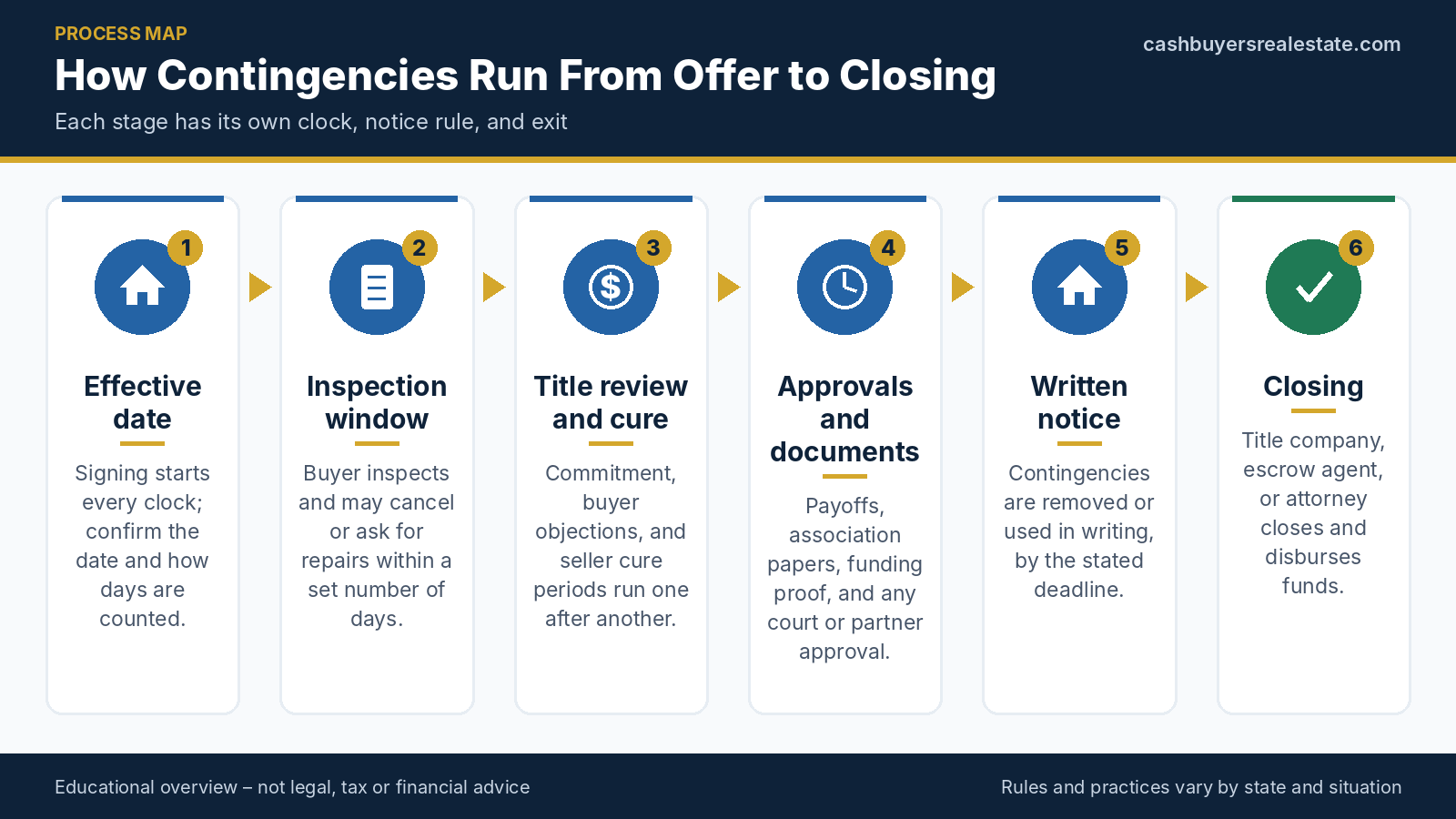
Text version of this infographic
- Effective date — Signing starts every clock; confirm the date and how days are counted.
- Inspection window — Buyer inspects and may cancel or ask for repairs within a set number of days.
- Title review and cure — Commitment, buyer objections, and seller cure periods run one after another.
- Approvals and documents — Payoffs, association papers, funding proof, and any court or partner approval.
- Written notice — Contingencies are removed or used in writing, by the stated deadline.
- Closing — Title company, escrow agent, or attorney closes and disburses funds.
Disguised Outs: When Soft Language Works as a Contingency
The conditions in the previous section announce themselves with headings and deadlines. The ones in this section usually don’t. They appear as a phrase in the price paragraph, a sentence in the closing section, or an addendum titled something harmless, and they matter because they do the same work as a contingency while escaping the attention a contingency would receive. Learning to recognize them is the most valuable reading skill a seller can develop.
Funding, partner, and satisfaction language
The first group of disguised outs attaches to the buyer’s money and the buyer’s mood. Both are things you cannot verify from the outside, and a clause that lets the buyer leave because of either one turns the contract into an expensive form of wait-and-see.
“Subject to funding,” “partner approval,” and “subject to buyer’s satisfaction”
A true cash buyer has the money in an account. When a contract says the sale is “subject to funding,” “subject to approval of the buyer’s partners,” or “subject to the buyer’s satisfactory review of all matters,” the buyer is signaling something different: that the funds may come from a source that has not yet said yes. That source might be a private lender, an investor group, a line of credit that needs a draw request approved, or a larger company whose acquisitions committee meets monthly. None of those arrangements is improper, and many legitimate investors work this way. But the clause converts a promise to buy into a request for a decision, and you are the one waiting for it.
Satisfaction clauses work the same way from a different angle. Words such as “in buyer’s sole discretion” or “if buyer is not satisfied for any reason” give the buyer an exit without needing to identify a problem. The result is not necessarily bad if the clause is short and paid for, as in the option period used in some state forms, but it is quite different from an inspection contingency tied to a defect or cost. Look for whether the clause has an end date, whether it names a specific subject (the property, the title, the financing) or covers “all matters,” and whether the earnest money is refundable if the buyer invokes it. If the answers are no date, all matters, and fully refundable, you are looking at an unpaid option that can run until closing.
A reasonable response is not to refuse the clause but to bound it. Ask the buyer to state a date by which funding approval must be confirmed in writing, to identify the funding source in a form you can check, and to agree that if approval is not confirmed by that date, you may cancel and keep any deposit. Most buyers who actually have the money will agree without fuss, because the request costs them nothing. A buyer who resists any date at all has told you something about how firm the funding is. The guide to cash buyer proof of funds goes through what acceptable evidence looks like and how to read it.
Assignment clauses and the buyer who never intends to close
Many cash contracts include a sentence allowing the buyer to “assign this contract to a third party” or granting the buyer’s “successors and assigns” the right to close. Assignment is common in the real estate investing world, where a person signs a contract and then transfers it to an end buyer for a fee. It is lawful in many places, and it isn’t always a problem for sellers, since the end buyer may be well funded and the transaction may close on time. The concern is that you are signing with one party and closing with another whose identity, funds, and plans were not part of your decision.
Several things follow from that. If the original buyer remains liable under the contract after assignment, you retain a claim against someone you met. If the clause releases the original buyer on assignment, you now rely entirely on a stranger. A contract that gives the buyer a period of weeks to find an end buyer, without any obligation to tell you who it is, makes the buyer’s real contingency the success of the marketing effort, which looks like financing contingency under another name. Some states regulate the practice: Illinois Realtors’ legal guidance explains that, under the Real Estate License Act as amended in 2019, a person who deals in assignable contracts on two or more occasions in a year may need a broker’s license, and that a wholesaler must disclose a position as contract buyer and an intent to profit. The rules in your state may be stricter, looser, or silent, so ask a local attorney before relying on any general statement.
From the seller’s side, the practical protections are modest and mostly cost nothing. Ask for the contract to state whether assignment is allowed, to require written notice to you of any assignment at least a few days before closing, and to keep the original buyer on the hook for performance. If the buyer says the property will be sold on to someone else, you are entitled to ask who, and whether the price you are accepting reflects what the property is likely to be worth to that person. The guide to local cash home buyers versus national companies discusses how buyer type affects who ends up at the closing table.
One-sided termination rights and repricing patterns
The second group of disguised outs does not look like a contingency at all. It gives the buyer a unilateral right that the seller does not have, or sets up a process in which the price can be reopened after the seller has stopped looking for other buyers.
Unlimited termination rights and the question of a real commitment
Some cash contracts say that the buyer “may terminate this agreement at any time prior to closing by written notice” with no reason required and the earnest money returned. In plain terms, this is an option with no strike date and no price. It differs sharply from the Texas and North Carolina forms, in which the right to terminate for any reason runs for a stated number of days and is bought with an option fee or due diligence fee. A termination right that lasts until the closing table is not a contingency at all; it means the buyer has not committed.
Courts in various states have examined whether a contract in which one side can walk away at will is an enforceable bilateral agreement or a mere invitation to deal, and the outcome depends on state law and the exact wording. For a seller, the legal puzzle matters less than the practical one: if the buyer can leave with a text message the day before closing, and you cannot, then the deposit and the contract carry little weight. The fix is to ask that any unconditional right to terminate expire on a date, be paid for with a fee that you keep, and be exercised in writing in the manner the notice clause describes. The guide to cash buyer earnest money explains how deposit terms interact with these rights.
It is also worth paying attention to the interplay between an at-will termination right and the earnest money clause. If the contract says the buyer may terminate at any time and also says the deposit is refundable on termination, the buyer risks nothing by signing and then continuing to look at other houses. In effect the seller has granted a free option on the property for as many weeks as the closing date allows. Sellers who recognize this pattern early can ask for a modest nonrefundable payment in exchange for the privilege, which is how the more structured state forms already treat the same idea, and they can judge from the buyer’s reaction whether the buyer ever intended to be bound.
Reprice-after-inspection patterns and how the language sets them up
The most common disguised out is not a termination right but a repricing opportunity. The buyer signs at a price that looks attractive, uses the inspection window to find reasons to lower it, and presents the lower figure as the only way to keep the deal alive. In a market where the house is one of many the buyer is considering, this can be a deliberate strategy; in other cases the inspection reveals real problems and a reduction is fair. Telling the two apart requires looking at what the contract promised and what the buyer did with it.
Clues often appear in the contract’s language. A price stated as “approximately” or “subject to adjustment based on inspection” invites renegotiation. An inspection clause that lists no cost threshold lets the buyer use any finding, however minor, as a reason. A short window with a long extension option allows the buyer to hold the property while collecting information. By contrast, a contract that says the buyer may cancel or request a credit only for defects not disclosed to the buyer, or only for repair costs above a named dollar figure, narrows the room to reprice. You can also protect yourself by sharing known defects and inspection reports before signing, so that nothing in the buyer’s inspection is a surprise that justifies a lower number.
Illustrative example (hypothetical numbers, not market data): A seller accepts a $184,000 cash offer on a house with an older furnace and some deferred painting. The contract gives the buyer 14 days to inspect and “to approve the condition of the property.” On day 12, the buyer writes that the furnace is near the end of its life and the siding needs work, and proposes $163,000 or a termination. The seller had mentioned the furnace’s age in the listing conversation and had a quote showing a $5,800 replacement. A fair adjustment might have been around that figure; the proposed $21,000 reduction is nearly four times larger. Because the contract tied the inspection window only to the buyer’s approval, with no cost threshold, the seller has little bargaining power except to refuse and relist, which now means two weeks lost. Had the clause required a defect over a stated dollar amount, the buyer’s request would have been harder to justify.
| Phrase you may see | What it can do in practice | A reasonable tightening to ask for |
|---|---|---|
| “Subject to buyer’s satisfaction of all matters” | Lets the buyer cancel for any reason at any time the clause remains open | Name the subjects (property, title), set an end date, and require written notice |
| “Subject to funding” or “subject to partner approval” | Makes the closing depend on a decision by someone who has not signed | Require written confirmation of funds by a date; deposit retained by the seller if not confirmed |
| “Buyer may assign this agreement” | Lets a different party appear at closing with unknown funds | Notice before assignment, original buyer remains liable, assignee’s funds verified |
| “Price subject to adjustment after inspection” | Invites a reduction on any finding, however small | Fixed price; adjustment only for undisclosed defects above a stated dollar amount |
| “Buyer may extend closing as needed” | Lets the buyer delay while the seller carries the house | Limited number of extensions of fixed length, each paid with a nonrefundable fee |
| “Earnest money refundable at buyer’s election” | Makes the deposit a placeholder rather than a commitment | Deposit becomes nonrefundable after the review period ends, in writing |
This table is not a script for rejecting offers. Each phrase on the left has a legitimate use, and some good buyers use them out of habit. The right-hand column shows the direction in which a seller can push, and the usual result is not a refusal but a compromise: a shorter clause, a payment attached to it, or a clearer standard. The reaction to a request for tightening is itself informative. A buyer who explains the reason for a clause and agrees to a boundary is behaving like someone who intends to close.
Time Limits, Notices, and What Happens When a Clock Runs Out
A contingency that is well chosen but badly timed can still hurt you. Most disputes about contingencies are not arguments about whether the clause exists; they are arguments about whether a notice arrived on time, whether a period had been extended, or whether silence meant approval. This section follows the clock through a typical cash contract, starting with how deadlines are written and then moving to the consequences of expiry and extension.
How deadlines and notices are written
Deadlines are drafted with a few recurring conventions, and each convention can shift a date by a day or more. Knowing them lets you count the days yourself instead of relying on the buyer’s summary.
Effective dates, day counts, and the hour of the deadline
Most contracts begin counting from an effective date, which is typically the date the last party signs or delivers the signed document to the other side. If the contract does not define it, or if the parties sign on different days, two people can reasonably disagree about whether day one is Monday or Wednesday. A seller who signs on Friday and receives the buyer’s countersignature on Tuesday should see the effective date written in the contract, ideally in a box or line meant for it. Next comes the question of how days are counted. Some forms use calendar days, others exclude weekends and legal holidays, and some switch between the two for different periods within the same document. A ten-day inspection window that is counted in calendar days ends on a different date from a ten-business-day period, and the difference can be a full week.
Then there is the hour. The Texas form requires the buyer to give notice of termination by 5:00 p.m. local time where the property is located on the last day of the option period, and states that time is of the essence. Other forms use midnight or “close of business,” and many contracts say nothing at all. A deadline that falls on a weekend or holiday may roll to the next business day under the contract or state law, or may not. When the date matters to you, count it out on a calendar and ask the agent, attorney, or title company to confirm the end date in writing. A seller who knows precisely when the buyer’s right expires can plan a showing, a move-out, or a call with an alternative buyer around that date.
Written notice, delivery methods, and extensions in writing
The notice clause says how a party must give notice for it to count. It may require writing, name an email address or physical address, require delivery by a particular method such as hand delivery or overnight courier, or treat an email as effective upon sending. In North Carolina’s guidance on its form, termination during the due diligence period must be in writing, and an agreed extension of the period should also be in writing, because an oral understanding can disappear when a dispute begins. The same advice applies in every state: a conversation that ends with “sure, take a few more days” has not extended anything.
For sellers, two habits help. First, identify in the contract the address or email at which you will receive notices, and check it daily during the contingency period. A termination notice sent to an address you never monitor is still valid if the contract says so. Second, when you agree to an extension, put the new date in a short signed addendum that says exactly which period is extended, to what date, and whether the buyer paid anything for it. An extension without those details can be read as extending every contingency in the contract, which was almost certainly not your intent. The mechanics of the paper itself are covered in the guide to the cash home buyer contract.
What happens at expiry, and what extensions really cost
A deadline passes whether or not anyone notices, and the contract states what follows. The consequences differ depending on whether the buyer gave notice, stayed silent, or asked for more time, and the differences affect both your money and your options.
Waiver, expiry, and the status of the deposit
If the buyer sends a valid termination notice in time, the contract ends and the deposit is handled according to its terms, usually returned to the buyer, though a fee paid for the option stays with you. If the buyer does nothing, the usual result is that the contingency expires and the buyer is bound. North Carolina’s Real Estate Commission puts it plainly: the buyer’s loss of the right to terminate for any or no reason places the earnest money at stake. Once the clock has run, a buyer who walks away is typically in default, and the contract controls what the seller can do next.
The remedies vary. In the Texas form, if the buyer fails to comply, the seller may seek specific performance or other legal relief, or terminate and keep the earnest money as liquidated damages; if the seller defaults, the buyer has parallel options. Other states’ forms limit the seller to the deposit, give the choice of remedies to the party who did not default, or require mediation before any suit. Because the deposit is often the only money actually at risk, its size matters far more than its label. A $1,000 deposit on a $200,000 purchase makes a default cheap; a deposit equal to one percent or more of the price makes the commitment more credible. Whether to ask for more is addressed later in the negotiation section.
Seller remedies deserve a second look as well, because many sellers assume they can simply keep the deposit and move on when a buyer defaults. Some contracts limit the seller to the deposit as the exclusive remedy; others reserve the right to sue for damages; a few require mediation or arbitration first. The deposit may also be held by a neutral escrow holder who will not release it without both signatures or a court order, which can leave the money frozen for months while the parties argue. Knowing these mechanics before you sign helps you set expectations: the deposit is a deterrent, not a guaranteed payment, and the practical value of a default remedy depends on how easily it can be collected.
Serial extensions and who carries the house meanwhile
The more subtle risk is not a termination but a slow bleed of time. A buyer asks for three more days to finish the inspection, then a week to obtain a quote, then ten days to finalize “funding,” and each request sounds reasonable in isolation. You hold the property the entire time, still paying the mortgage, the insurance, and the utilities, and you have probably stopped talking to other buyers. By the fourth extension the original timeline has doubled and your bargaining position has weakened, because walking away now means starting over.
A way to prevent this is to agree on extension rules at the start. The contract can allow one extension of a fixed length, at a stated price, payable to you and not credited to the purchase price, and can say that further extensions require your written consent. It’s also reasonable to ask that a buyer who has requested an extension confirm in the same message that every other contingency has been satisfied or removed. When a buyer repeatedly asks for time without ever completing a stated step, the delay itself is information, and you may want to consider asking for removal of the contingencies or releasing the contract so that you can move on. The guide to cash offer negotiation covers additional bargaining tactics.
| Day after effective date | Milestone | Who acts | What goes wrong if it slips |
|---|---|---|---|
| 0 | Contract signed; deposit due to the escrow or title company | Buyer and seller | Late deposit may let the seller cancel |
| 1-3 | Title company opens an order; payoff statements requested | Title company, seller | Late payoffs delay the title commitment |
| 7 | Inspection or due diligence window ends | Buyer | Buyer holds a free exit longer than agreed |
| 10 | Title commitment delivered; objection deadline begins | Title company, buyer | Late delivery pushes every later date |
| 17 | Seller cure period for title objections ends | Seller | An uncured lien lets the buyer terminate |
| 21 | Proof of funds and third-party approvals confirmed in writing | Buyer, third parties | Funding doubt arrives with little time left |
| 27 | Final walk-through; closing documents reviewed | Buyer, seller | Condition changes become closing disputes |
| 30 | Closing and recording through the title company, escrow agent, or attorney | All parties | Wire problems or missing signatures push closing out |
The table shows how many separate steps sit between a signature and a closing, even when every party is acting in good faith. In a real contract each date comes from the document itself, and a slip anywhere in the sequence moves the later ones. The most useful habit it illustrates is working backward from your own deadline, whether that is a mortgage on a replacement home, a tax-year consideration, or an estate’s accounting date, and asking whether the contract’s contingencies leave room for that date.
Illustrative example (hypothetical numbers, not market data): A seller accepts a cash contract with a 10-day review period, a 20-day closing, and a $3,000 deposit. She needs to close within 25 days because her purchase of a replacement home has a fixed date. On day 9, the buyer asks for a five-day extension to get a quote from a contractor. She agrees verbally. On day 14, the buyer asks for another week because the contractor is slow. She now has about 11 days left on her own timeline, and no written record of either extension. Had she agreed to a single, written five-day extension priced at $500, with a sentence confirming that all other contingencies would be removed at the end of it, she would have known on day 14 that the buyer was either closing or in default, and she could have turned to a backup plan with two weeks to spare.
Different routes to a sale carry different amounts of contingency risk, and it helps to see them next to each other before the discussion turns to probate and other approvals. The comparison below sets five routes against the same questions. A cash offer with short, objective contingencies tends to offer the quickest and firmest path when the buyer is verified. A cash offer with long or subjective conditions can look similar on paper while behaving like a loose option. A financed buyer adds appraisal, lender, and underwriting conditions that run on someone else’s schedule. A court-confirmed sale adds a hearing and an overbid process. And a listing with an agent exposes the property to the widest set of buyers and the longest typical wait, with whatever contingencies each buyer’s offer contains.
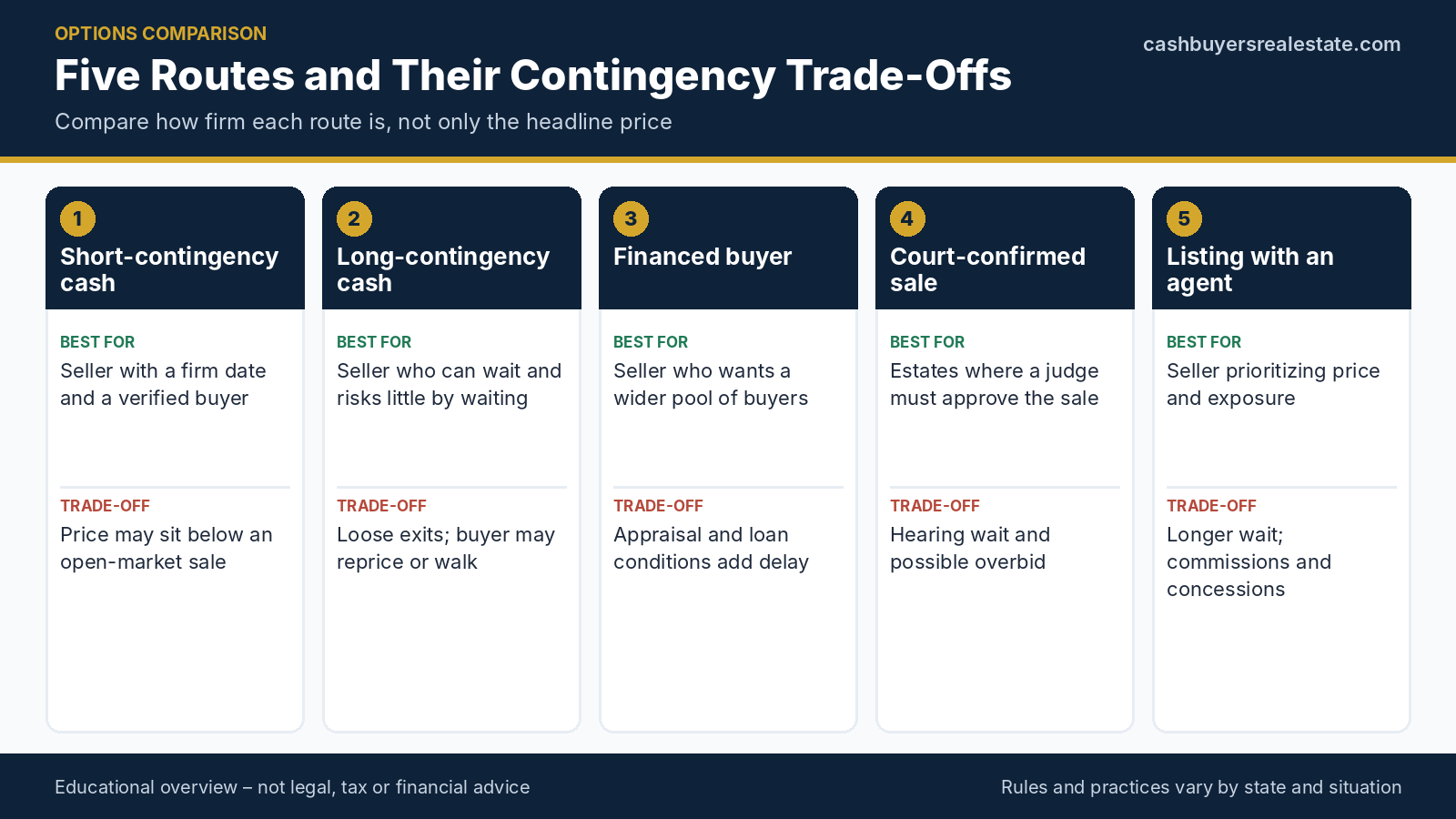
Text version of this infographic
- Short-contingency cash — Best for: Seller with a firm date and a verified buyer. Trade-off: Price may sit below an open-market sale.
- Long-contingency cash — Best for: Seller who can wait and risks little by waiting. Trade-off: Loose exits; buyer may reprice or walk.
- Financed buyer — Best for: Seller who wants a wider pool of buyers. Trade-off: Appraisal and loan conditions add delay.
- Court-confirmed sale — Best for: Estates where a judge must approve the sale. Trade-off: Hearing wait and possible overbid.
- Listing with an agent — Best for: Seller prioritizing price and exposure. Trade-off: Longer wait; commissions and concessions.
Probate, Court Approval, and Other Contingencies You Don’t Control
Everything discussed so far assumes that the seller can sign and the only open question is what the buyer will do. In a meaningful share of cash sales that assumption fails. The owner has died, a court supervises the property, several heirs must agree, or a lender or association has to approve. These situations create contingencies that neither buyer nor seller can shorten by negotiation, and the contract has to say how they are handled. This section explains how court approval works, using California as a documented example, and then covers the other approvals that can sit between a signed contract and a closing.
When a court has to confirm the sale
Some states require a judge to approve a sale of estate property, some require it only in certain circumstances, and some allow a representative with broad authority to sell without any hearing. Because the rules differ so much, the most useful thing a seller can do is learn which category applies before accepting any contract.
How confirmation and overbidding work in one documented example
California offers a clear illustration because its court forms and legal aid materials are public. When an estate’s personal representative has limited authority, the sale of real property generally requires a court hearing to confirm it. The California Judicial Council’s petition for confirmation (form DE-260) asks the representative to report the sale, state whether it was private or public, list the deposit and the amount of the bid, and provide the property’s appraised value. The form notes that if more than a year has passed between the date of the appraisal and the hearing, a reappraisal is required. It also sets out a minimum overbid formula: 10 percent of the first $10,000 of the original bid plus 5 percent of the amount above $10,000.
A California legal aid organization explains the practical effect. At the hearing, the judge asks whether any qualified buyer present wants to bid higher, and bidding can proceed like a live auction; the original buyer can be outbid and lose the property. The same source says a court-confirmed sale generally must be for at least 90 percent of the appraised value, so the appraisal sets a floor. For a buyer, that process is a contingency in the plainest sense: the contract cannot close until a judge says so, and a stranger can take the house at the hearing. For the estate, it is a mixed arrangement, since an overbid raises the price but the wait and the uncertainty come with it.
Many states differ. Some confirm every estate sale; others require court involvement only when the will does not authorize a sale or when an heir objects; some are largely out of the courthouse. A seller or personal representative should ask the probate court clerk or an estate attorney how the process works in the county where the case is open, and a buyer’s offer should be judged with that answer in hand. The guide to selling a house quickly in probate covers how timelines vary across states.
What buyers do with a confirmation contingency, and how contracts handle it
A cash buyer who learns that court confirmation is required often responds in one of three ways. Some decline, because a buyer with several other opportunities may not want to tie up money and time. Some proceed with a lower price to compensate for the risk of an overbid, since they might spend weeks and legal fees only to be outbid. And some write the court approval into the contract as an explicit condition, with a date by which the hearing must occur and a statement about what happens to the deposit if the court refuses. That third approach is the cleanest, because it gives both sides a frame.
Contracts that handle confirmation well tend to answer a handful of questions. Who files the petition, and who pays for it? What happens to the buyer’s deposit if the judge denies confirmation or an overbidder wins? Is the buyer required to appear at the hearing and be ready to bid up? Does the buyer have the right to match an overbid? Are the contract’s other contingencies running during the wait, or do they pause? Contracts that skip these questions create friction later. A related note on the buyer’s side: a buyer who comes to court prepared with funds and a deposit improves the odds of a smooth confirmation and demonstrates good faith to the judge. The page on cash buyers for inherited houses covers how buyers approach estates generally.
Illustrative example (hypothetical numbers, not market data): An estate house in a state that requires court confirmation is appraised at $300,000, and the personal representative accepts a private cash offer of $285,000, which is 95 percent of the appraisal. Under a minimum-overbid formula of 10 percent of the first $10,000 plus 5 percent of the remainder, the first overbid at the hearing would need to be at least $1,000 plus 5 percent of $275,000, or $13,750, for a total increase of $14,750, which makes the lowest qualifying overbid $299,750. The original buyer who wants to keep the house must be ready to bid more than that figure at the hearing. The estate nets more if an overbidder appears, but the estate also waits for the hearing date, and the buyer carries the risk of spending weeks on a house that someone else may take. A contract that addresses what the buyer receives if outbid, and how long the buyer must wait for the hearing, protects both sides.
Other approvals that sit between signature and closing
Court confirmation is the best-known third-party condition, but it is far from the only one. Several other people and institutions may need to say yes, and the contract should name each one that applies. The sooner you list them, the sooner you can tell a buyer whether a quick closing is realistic.
Personal representatives, heirs, co-owners, and trusts
The first question in any estate sale is who has the legal authority to sign. A personal representative appointed by the court usually holds a document, often called letters testamentary or letters of administration, which a title company will want to see before it insures the sale. Without it, a family member who lives in the house has no authority to sell it, even if everyone agrees. The scope of the representative’s power also varies. In California, as a legal aid summary of the Independent Administration of Estates Act describes, a representative with full authority can sell real property without a confirmation hearing after giving a Notice of Proposed Action to interested parties, who generally have 15 days to object in writing, while a representative with limited authority generally needs court confirmation. Other states use different names and different thresholds.
Co-owners and trusts add a similar layer. Where title is held by several heirs, every owner of record must sign unless a court orders otherwise, and a single holdout can stop the sale or force a court process. A trustee must have power to sell under the trust document and must usually provide a certification of trust to the title company. A buyer who sees any of these facts will often add contingencies tied to delivery of the right documents by a date, and a seller can get ahead of the request by gathering death certificates, letters, the trust certification, and signatures before accepting an offer. The page on selling an inherited house fast walks through this paperwork in more detail.
Lenders, associations, courts of other kinds, and public agencies
A lender who must agree to take less than the full payoff in a short sale is a third party whose decision can take weeks and whose timeline is not governed by the contract. A homeowners association may need to issue a resale certificate or approve a buyer, and in some communities it holds a right of first refusal. A divorce court may have to approve the sale or the division of proceeds, a bankruptcy trustee may have to consent, and a guardianship or conservatorship court may need to approve a sale on behalf of someone who cannot sign. Municipal agencies can also be involved when a certificate of occupancy, a code-violation clearance, or a utility lien release is required to transfer title.
For each of these, the contract should state two things: the date by which the approval is expected, and the right of each side if the date passes without the approval. A seller who knows that a bankruptcy trustee must sign should not accept a 14-day closing, and a buyer who knows that an association has a first-refusal right should plan for a longer period. When a third-party contingency is real, a buyer’s interest in a longer timeline is not an excuse; it is a fact of the property. A seller’s best course is to disclose it at the start, put it in the contract, and ask the buyer to commit to the schedule it produces.
Negotiating Contingencies Down, and Asking for Protections of Your Own
Reading a contract carefully is only half the work; the other half is deciding what to ask for. Most sellers negotiate the price and treat the conditions as fixed, when in fact the conditions are often more flexible than the number. A buyer who is serious about closing can usually accept a shorter window, a clearer standard, or a larger deposit without much pain, and a buyer who cannot accept any of them has told you about the offer’s real strength. This section covers the practical levers, how to put a price on them, and the contingencies that work in the seller’s favor.
Shortening, tightening, and trading
Negotiating a contingency down rarely means deleting it. Buyers usually need some protection, and a contract that gives them none may simply lose the buyer. The goal is to reduce the buyer’s freedom to what is actually necessary, and to make sure that whatever freedom remains is clearly defined.
Shorter windows, objective standards, and specific notices
The easiest change is the length of the window. If a buyer asks for 21 days to inspect a house they can walk through in an afternoon, a counter of 7 or 10 days costs the buyer little, since inspectors and contractors can usually be scheduled in that time. Where the buyer needs more time because a specialist must visit or a permit history must be pulled, you can agree to a longer period for that single item and keep the general window short. Short periods work in the buyer’s favor too, as they signal commitment and tend to produce a cleaner contract.
Beyond length, the more valuable change is the standard. A clause that allows termination “if the buyer is not satisfied” becomes more reliable when it allows termination only if the inspection reveals defects that the buyer reasonably estimates will cost more than a stated amount, or if a licensed inspector reports a structural, safety, or system failure the seller did not disclose. A dollar threshold tied to a percentage of the price is a common compromise. You can also require that the buyer’s notice identify the specific defect, attach the report, and offer a chance to cure or credit within a few days before termination takes effect. This does two things: it forces the buyer to articulate a reason, and it gives you an opportunity to respond instead of simply losing the contract. These changes cost little and they turn an open-ended exit into a process.
Finally, ask for the contingencies to be removed in writing as they are satisfied. Instead of waiting for a long period to expire on its own, a short removal form signed by the buyer on the inspection’s completion tells you precisely where you stand. If the buyer is not ready to sign a removal by the stated date, the contract should say what follows, which is usually the seller’s right to cancel and keep any fee. The guide to negotiating a cash offer addresses the broader bargaining picture, including when to hold firm and when to trade.
Trading price, deposit, and fees for fewer exits
Every contingency has a price, and it is often possible to make the trade explicit. A buyer who wants a 14-day review might accept 7 days in exchange for a modest price increase, or a seller might accept the longer period if the buyer pays a nonrefundable fee that is credited to the price only at closing. The Texas and North Carolina forms both build this idea into their structure: the option fee in Texas and the due diligence fee in North Carolina are payments to the seller for the right to leave, and the seller keeps them when the buyer terminates. Adopting the same logic in any state, even where the form says nothing about it, is a way to turn a free exit into a paid one.
The earnest money deposit works the same way. A deposit that becomes nonrefundable when the review period ends gives the buyer a financial reason to finish the review quickly. A larger deposit increases the cost of walking away. Some sellers ask for a split structure: a small refundable deposit at signing, and a larger one that is released to the escrow or title company after the review period and is at risk from then on. The deposit’s custody is part of the picture; the guide to cash buyer earnest money discusses who should hold it and why.
There is a limit to how much a seller can ask. A buyer who takes the property off the market for you is entitled to some safety, and a package of demands that would turn a reasonable inspection window into a hard commitment will probably end the conversation. Think of the negotiation as a menu rather than a list: you might trade a shorter window for a lower price, or a larger deposit for a longer inspection, and pick the combination that best matches the thing you care about, which is usually the date and the certainty of closing.
Illustrative example (hypothetical numbers, not market data): A seller receives a cash offer of $198,000 with a 21-day “satisfaction” period, a $1,000 refundable deposit, and the right to assign. She counters with a 10-day inspection window tied to undisclosed defects above $4,000, written notice that attaches the report, a $5,000 deposit that becomes nonrefundable at the end of the window, and assignment only with five days’ prior notice and the original buyer remaining liable. The buyer agrees to everything except the nonrefundable feature, and offers a $2,500 nonrefundable portion instead. The seller accepts the compromise and a $196,000 price, which is $2,000 below the original number. In exchange she has a defined standard, a shorter clock, and a deposit large enough that walking away costs real money. Whether that $2,000 is worth paying depends on her timeline, and that is a decision only she can make.
Seller-side contingencies and protections
Contingencies are not only for buyers. A seller may need protection too, particularly when the sale is part of a larger plan such as buying another home, relocating, or settling an estate. Cash buyers who want to close quickly are often willing to agree to terms that give you room, provided you ask early and explain the reason.
Rent-back, replacement housing, and post-closing occupancy
A rent-back, sometimes called a leaseback or post-closing occupancy agreement, lets the seller stay in the house for a stated number of days after closing. It is common when a seller needs time to complete a purchase or a move, and it can be written into the main contract or into a separate addendum. The elements worth specifying are the length of the stay, the daily or monthly rate, a security deposit or holdback from proceeds that is released when the seller leaves in good condition, who pays utilities and insurance during the stay, and what remedies the buyer has if the seller does not leave on time. Without these, the arrangement turns into a source of friction between people who did not mean to be in conflict.
A related seller-side condition is a replacement-housing contingency, which makes the sale depend on the seller finding or closing on another property by a date. Buyers dislike these because they pass the seller’s risk to the buyer, and a cash buyer with other options may refuse. A more acceptable alternative is a longer closing window or a rent-back without a contingency. Insurance deserves a mention here: after closing the buyer owns the house, and the buyer’s insurer may have rules about occupancy by someone else. Asking the buyer and the insurer how a rent-back affects coverage, and putting the answer in writing, avoids an unpleasant surprise if a claim arises during the stay.
Rent-backs also raise a question of fairness to both sides, and thinking it through helps the numbers come out right. A daily rate that tracks the buyer’s carrying costs, meaning the mortgage payment or opportunity cost on the purchase price, plus taxes and insurance, is easier to justify than an arbitrary figure. A holdback from the seller’s proceeds, often a modest percentage of the price or a flat sum, gives the buyer a source of recovery if the house is left damaged or the seller overstays, and it is returned after a walk-through confirms the condition. Sellers who agree to these terms generally receive a smoother closing and a more cooperative buyer than those who ask for a free extended stay.
Repurchase rights, buy-back options, and their risks
Occasionally a cash buyer offers a seller the right to buy the house back after a period, usually at a stated price, so the seller can stay or return if circumstances change. The idea can be appealing, and in some arrangements it is legitimate. But a repurchase option or a “lease with option to buy” attached to a sale deserves close attention because it can also be structured in ways that favor the buyer heavily, with high repurchase prices, short exercise windows, strict default triggers, and fees. Some states have specific consumer-protection laws for sales to homeowners in financial difficulty, and they vary widely, so a local attorney should look at any contract of this type before it is signed.
Questions to put to the buyer include: what exactly is the repurchase price and how is it calculated; what are the dates by which the right must be exercised; what happens if a payment is late; is the right recorded or does it exist only between the parties; and who pays closing costs on the second transaction? A buy-back right that is not described in writing in the main contract, or that the buyer describes only in conversation, should be treated as if it does not exist. If the main goal is to remain in the house, the alternatives are different and are better explored with a housing counselor or attorney before any sale is signed. The sale of a property with a continuing occupant also touches the issues discussed in the guide to selling a house fast without repairs, since the buyer’s condition expectations change if the seller stays.
| Term | Offer A | Offer B |
|---|---|---|
| Headline price | $212,000 | $205,000 |
| Review period | 21 days, sole satisfaction | 7 days, defects over $4,000 |
| Deposit at signing | $1,000 refundable | $5,000, nonrefundable after day 7 |
| Funding evidence | “Funds available” | Bank letter attached |
| Assignment | Allowed without notice | Allowed with 5 days’ notice; original buyer liable |
| Seller carrying cost if the deal fails on day 21 (at $60 per day) | $1,260 | $420 if it fails on day 7 |
| Price gap versus the other offer | +$7,000 | -$7,000 |
The table is built to show that a $7,000 price gap is not the same as a $7,000 advantage. If Offer A has even a modest chance of failing, say one in four, the expected gain shrinks as soon as you subtract the carrying costs and the delay to the next buyer. If you believe Offer A is likely to close, the extra money is real. If you doubt it, the shorter and better-supported Offer B may leave you in a stronger position. The numbers here are invented to show the method, and your own comparison should use your actual costs, as described in the guide on how to compare cash offers.
The last step before relying on any of these negotiated protections is to confirm that the person promising them can deliver. A tightly written contract is only as good as the buyer behind it, and the checklist that follows condenses the verification habits that matter most: confirm who the buyer actually is, ask for proof of funds, read every clause that describes cancellation, check the assignment terms, use a reputable closing professional, and never sign a document that contains blanks. The next section explains the reasoning behind each of those six items and how to carry them out without turning the conversation adversarial.
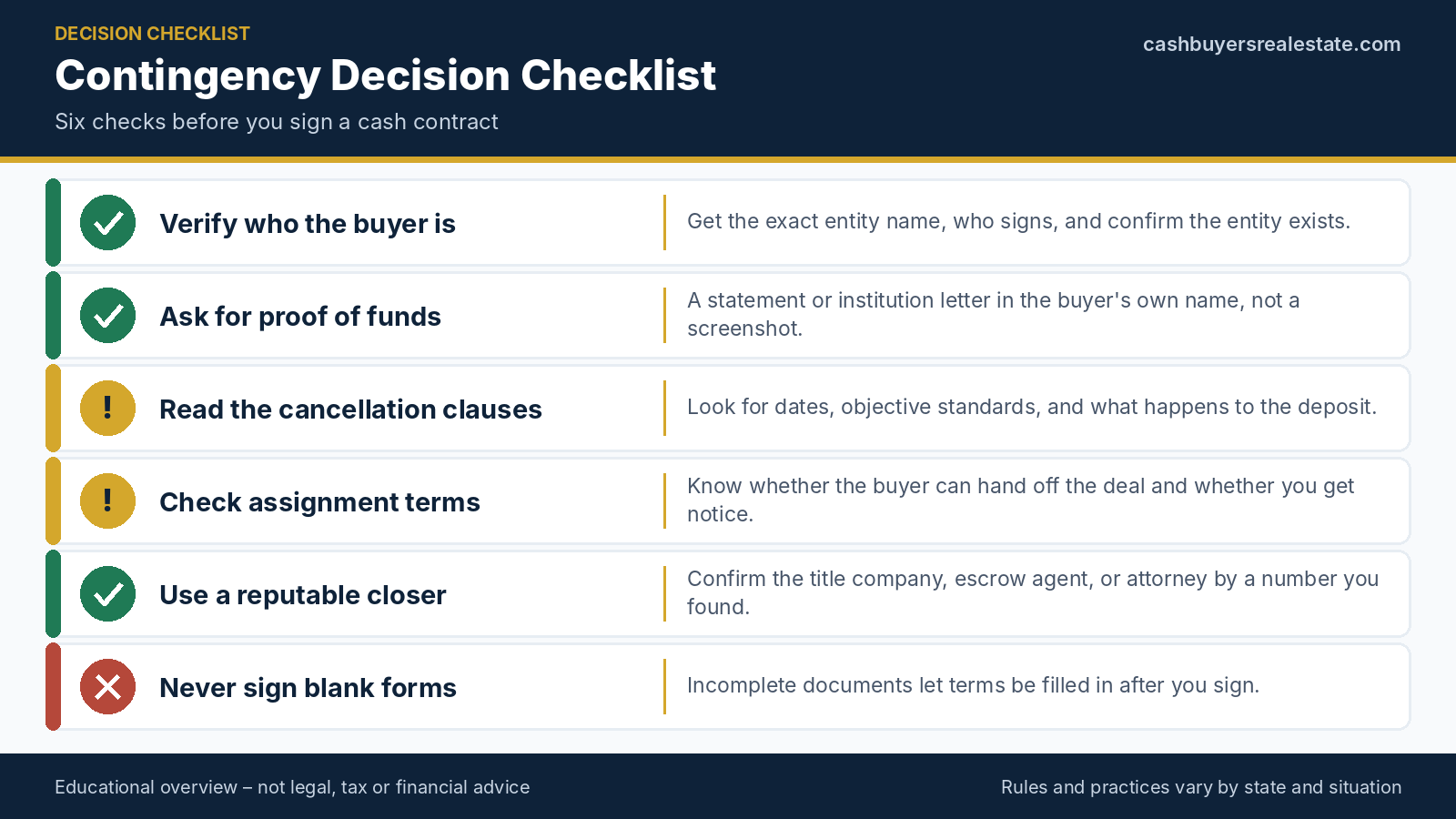
Text version of this infographic
- Verify who the buyer is — Get the exact entity name, who signs, and confirm the entity exists.
- Ask for proof of funds — A statement or institution letter in the buyer's own name, not a screenshot.
- Read the cancellation clauses — Look for dates, objective standards, and what happens to the deposit.
- Check assignment terms — Know whether the buyer can hand off the deal and whether you get notice.
- Use a reputable closer — Confirm the title company, escrow agent, or attorney by a number you found.
- Never sign blank forms — Incomplete documents let terms be filled in after you sign.
Verifying the Buyer, Protecting the Money, and Weighing Alternatives
A contract full of well-drafted protections is only as strong as the party who signs it. The previous sections dealt with the words on the page; this one deals with the people and the money behind those words. It covers how to verify a buyer before relying on any promise, how to keep the closing funds from being diverted, and how a cash contract with contingencies compares with the other routes available to you. The point is not to treat every buyer as a suspect but to make the checking routine, since routine checking is the only kind that does not feel like an accusation.
Checking the buyer before you rely on the contract
Verification takes a few days at most, and the earlier it happens the more useful it is. The reason is timing: contingencies run on a clock, and a buyer who has to prove funds in the first week gives you far more room to react than one who produces the proof on the day before closing.
Identity, proof of funds, and who holds the deposit
Start with who the buyer is. The contract should name a legal person: an individual, a limited liability company, a trust, or a corporation. If it names an LLC, ask for the exact entity name and the state of formation, and look it up in that state’s business registry, which is usually free and shows whether the entity exists, when it was formed, and who its registered agent is. A company that formed last month is not necessarily a problem, since many investors set up a new entity for each purchase, but it means the entity has no track record and that the individual behind it matters more. Ask who will sign, in what capacity, and whether that person has authority to bind the entity.
Proof of funds should answer a narrow question: does the party who signs the contract, or the party who will close, have the money for this purchase? A recent bank or brokerage statement or a letter from a financial institution showing a balance at least equal to the price is the usual form, with the account holder’s name matching the buyer. A screenshot, a statement with the name blanked out, or a document that shows a credit line the buyer “can access” proves much less. Where the buyer’s funds come from a lender or partner, ask for the commitment letter and its conditions, since a conditional commitment is a financing contingency under another name. The guide to cash buyer proof of funds goes through the different documents and what each one does and does not show.
The deposit deserves similar attention. Ask who will hold it, in what kind of account, and when it is due. A title company, escrow agent, or attorney’s trust account is the norm because the money sits with a neutral third party under rules the contract describes; a deposit delivered to the buyer’s own company or to a personal contact offers far less protection. Ask for written confirmation from the holder that the deposit has been received, since a deposit that was promised and never funded is a classic way for a weak contract to look strong. Whether that deposit comes back to the buyer is decided by the contract’s terms, which is another way of saying that the contingencies decide it.
The closing partner, wire safety, and pressure tactics
The closing partner is the title company, escrow office, or attorney who handles the funds and documents. Closing practice varies by state: in some states a title or escrow company conducts the closing, in others an attorney does, and a seller cannot assume the process they know from another state applies. Before signing, ask the buyer which firm will close, then verify it independently by finding its phone number through a search or the state’s licensing authority and calling to confirm it is handling the transaction. You are entitled to suggest your own closing agent as well, and a buyer who refuses any alternative to a closer you have never heard of has given you something to think about.
Wire fraud is the other serious risk at the closing stage. The Consumer Financial Protection Bureau’s guidance on mortgage closing scams warns that scammers compromise email accounts of real estate professionals, learn about upcoming closings, and send spoofed messages with false wiring instructions. Its guidance is to confirm any instructions by phone, using a number you already have, and never to follow instructions contained only in an email. Sellers are less often asked to wire money than buyers, but they can be targeted when the scammer redirects the proceeds to a different account or changes payoff instructions. If money is sent to the wrong account, the CFPB advises contacting the bank or wire-transfer company right away to ask for a wire recall and filing a report with the FBI’s Internet Crime Complaint Center at ic3.gov. Speed matters, since recovery chances fall as time passes.
Pressure tactics round out the picture. Statements such as “this offer disappears tonight,” “I can’t hold the price if you talk to anyone else,” or “the attorney review is just a formality” are designed to shorten the time you have to read, and a short window to read is a larger risk than any single clause. A legitimate buyer will usually accept a reasonable time for you to review the contract with an attorney or a trusted adviser, and will understand that a contingency period of a week is an exchange between equals. None of the individual warning signs proves fraud, and a buyer under time pressure of their own may simply be hurried. But a pattern, such as vague funds, an unfamiliar closer, urgency, and resistance to any change, calls for a pause.
| What you notice | Why it matters | A reasonable response |
|---|---|---|
| Open-ended “satisfaction” or “partner approval” clause with no date | The buyer can leave at any point, and you cannot test the buyer’s intent | Ask for a date, a named subject, and a written confirmation of funds by that date |
| Proof of funds offered only as a screenshot or with names hidden | It does not show that the buyer controls the money | Ask for a statement or institution letter showing the account holder’s name |
| Deposit to be held by the buyer or a person you cannot verify | Your remedy depends on collecting from the buyer if the deal fails | Ask that the deposit be placed with a title company, escrow agent, or attorney trust account |
| Pressure to sign without review, or blanks left in the document | Terms can be filled in after you sign | Do not sign incomplete documents; take time to have the contract reviewed |
| Price reduced sharply after the review period, with no new defect | The review may have been a way to reprice rather than a search for problems | Compare to the defects you disclosed; consider relisting if the change is not justified |
| Wiring or payoff instructions changed by email | A common pattern in wire fraud | Confirm by calling a number you already have, not one from the email |
As with the earlier tables, the point of this one is to turn vague unease into a specific question. Any single item on the list can have an innocent explanation. If you can fix it with a phone call or a revised clause, the transaction continues, and the buyer’s response tells you how much weight to give the rest of the contract. If you cannot, the contingency period you negotiated is your chance to leave without losing money.
The alternatives to a cash contract with open conditions
A seller who understands contingencies is in a better position to judge whether the cash route is the right one. Cash is not always the fastest or the most profitable path, and an honest comparison treats contingencies as part of the price of each route.
Financed buyers, listing, and where their conditions differ
A buyer using a mortgage brings contingencies that a cash buyer lacks: loan approval, an appraisal that supports the price, and sometimes the sale of another home. For FHA and VA loans the federal amendatory clause explicitly provides that the buyer is not obligated to complete the purchase or lose the earnest money unless a written appraisal meets the contract price, though the buyer may choose to close anyway. In an ordinary listing, the offers you receive will come with inspection periods, appraisal and financing conditions, and your agent will negotiate them. The upside is exposure to more buyers, which can produce a higher price; the downside is a longer timeline and more places where the sale can slip. The guide comparing a cash buyer with a financed buyer sets out these differences in detail.
A fair comparison looks at net proceeds and not just the price. A listed sale may involve agent commissions, repairs requested after inspection, concessions, carrying costs during the time on the market, and the chance that the first buyer falls through. A cash sale to an investor typically involves a lower price but may involve fewer costs and a shorter wait. Which wins depends on the property, the market, and your own timeline, and neither is the right answer in every case. The guide to cash sale versus traditional sale net proceeds shows how to run the arithmetic.
The timing of the two paths also differs in a way that sellers sometimes overlook. A financed buyer’s conditions are mostly resolved by third parties, such as the lender’s underwriter and the appraiser, so neither you nor the buyer can speed them up by good behavior. A cash buyer’s conditions are mostly resolved by the buyer, which means a motivated buyer can finish quickly and an unmotivated one can take weeks. That difference is why verification matters more in a cash sale: with a lender in the picture, an outside institution has already tested the buyer’s finances, and with cash, you have to ask for that test yourself.
Other ways to shorten the contingencies you face
Between a full listing and a single cash buyer there are several middle paths. You can solicit more than one cash offer and use the competing terms to negotiate; buyers who know they are not alone tend to shorten their windows. You can order a pre-sale inspection and share the report, which takes away one of the buyer’s reasons for a long review period and narrows the room to reprice. You can clear liens and gather title documents in advance, so that the title review has little to find. And you can make the repairs that most affect a buyer’s reaction, as the guide to selling fast without repairs discusses, where doing so costs less than the price reduction it prevents.
Each of these steps costs some time or money up front, and none is guaranteed to pay for itself. The point is that contingencies are not a fixed cost of selling to a cash buyer; they respond to how much the buyer needs to learn and how much you are willing to show. A seller who has done the groundwork gets better terms, not by tricking anyone, but because there is less uncertainty to price in.
Frequently Asked Questions About Cash Buyer Contingencies
The questions below come up most often once a seller has an offer in hand and starts reading it closely. They are grouped by theme, and the answers assume general U.S. practice; your state’s forms and rules may differ, so treat each reply as a starting point for a conversation with a local attorney or title professional.
Questions about what contingencies mean and how they work
The first group covers the basic meaning of the terms and how conditions interact with an as-is purchase. These are the questions that sellers tend to ask before they have even decided whether an offer is worth pursuing.
Questions about scope and meaning
- If a buyer is purchasing as-is, why would the contract still include an inspection period?
“As-is” describes who is responsible for repairs, not whether the buyer may look at the property first. Texas’s standard form, for instance, defines the term as the present condition with any and all defects and without warranty, yet still lets the buyer inspect, negotiate repairs, or terminate during the option period. In practice, the inspection period lets the buyer decide whether to take the house as it is. Your obligation to disclose known material defects generally continues regardless of the label, so check your state’s rules.
- Is it normal for a cash offer to be “subject to funding”?
It is common among investors who borrow short-term money or work with partners, but it is not what most sellers picture when they hear “all cash.” The phrase means that the buyer’s money depends on a decision by someone else, so the clause works much like a financing contingency. It can be acceptable if it has a short deadline and you receive written confirmation by that date. If the clause has no date, ask for one or ask for proof of funds in an account the buyer controls.
- What is the difference between a contingency and a condition of closing?
People use the terms loosely, and contracts do as well. A contingency usually lets one party cancel or adjust if a specific event does not occur, while a closing condition is something that must be done before the transaction can close, such as delivering a payoff letter or obtaining an association certificate. The difference matters because a failed contingency may entitle the buyer to leave with a refund, whereas a missed closing condition may let either side extend or may lead to a dispute over who was responsible. Reading the clause for what it says about cancellation will tell you which one you have.
- Can a contract have a contingency that only the buyer can use?
Yes, and many do. Inspection, funding, and satisfaction conditions are typically written for the buyer’s benefit, and they can usually be waived by the buyer alone. A seller can also have conditions of their own, such as a replacement-housing requirement or a rent-back period, though buyers may resist them. If a clause seems to give one side a right the other does not have, ask what the other side receives in exchange, such as a fee, a deposit at risk, or a shorter deadline.
Questions about timing and deadlines
- How long should an inspection or review period be in a cash contract?
No rule sets a length that applies everywhere; the number is negotiated, and the state forms leave a blank for it. A shorter window tends to suit a house that is simple to inspect and a buyer who has already seen it, while a longer one may fit a larger or older property that needs specialists. A useful test is whether the buyer can explain what they will do on each day of the period. If the answer is “wait and see,” the window is probably longer than the work requires.
- What does “time is of the essence” mean for a contingency deadline?
It means that the stated dates are strict, and that a party who misses one may lose a right or be treated as in breach, even by a small margin. Some forms apply the phrase to the whole contract, and others to particular paragraphs. The Texas form, for example, applies it to the option paragraph and requires notice by 5:00 p.m. local time. If you are unsure whether a deadline is strict, ask the attorney or title company to confirm in writing before you rely on it.
- Can the buyer ask for extra time after the period ends?
A buyer can ask, and you can say no. Once a contingency expires, the buyer generally loses the right to cancel under that clause, and any extension is a new agreement that should be written, signed, and specific about which deadline moves. Many sellers agree to a limited extension in return for a fee or a firmer deposit. Be wary of repeated extension requests that never conclude with a decision.
Questions about disputes, deposits, and special situations
The second group deals with what happens when something goes wrong and with situations that change how contingencies operate, such as repairs, estates, and post-closing occupancy.
Questions about default and deposits
- If the buyer cancels within the contingency period, who gets the earnest money?
Typically the buyer does, because cancellation within a valid contingency is not a default. Some forms add a separate fee paid to the seller for the right to cancel, which the seller keeps, as with the option fee in Texas and the due diligence fee in North Carolina. Check the contract for language about how and when the deposit is released, and who authorizes release. Disputes over deposits are often held by the escrow or title company until both sides agree or a court orders otherwise.
- What can I do if the buyer misses a deadline or stops responding?
Start by reading the default and notice provisions, which control what you may do and how. Many contracts require you to send a written notice and allow a short cure period before you can cancel, and sending a proper notice protects your position. A letter from an attorney is often the practical next step, because it sets out the contract rights and records the timeline. Avoid putting the house under contract with a new buyer until you know the first contract has been properly ended.
- Do I have to make repairs the buyer asks for after an inspection?
Generally not, unless the contract requires it. Explanations of Florida’s As Is contract note that the seller is not obligated to make repairs found in an inspection, and that a buyer who is refused may cancel within the inspection period. Under many forms the choice is between agreeing to a repair or credit, declining and risking cancellation, or negotiating a price change. Weigh the cost of the request against the cost of losing the buyer and restarting the process.
- Does the buyer’s right to cancel mean they can renegotiate the price whenever they want?
Only while the right lasts. During the contingency period a buyer can propose a different price, and you are free to refuse. After it expires, the buyer needs your agreement to change terms. Because the period is when the buyer holds the most freedom, a seller who has disclosed known defects and obtained estimates in advance is better placed to resist a reduction that is out of proportion to the problem.
Questions about special situations
- Do estate and probate sales have extra contingencies?
Often, yes. Depending on the state and the personal representative’s authority, a sale may require court confirmation, notice to heirs, or both, and a buyer will usually want these steps written into the contract with dates. In California, for example, a court-confirmed sale can be overbid at the hearing, so a buyer faces the possibility of losing the house. Ask the probate court clerk or an estate attorney which steps apply in your county.
- Can I stay in the house after closing?
You can ask for it, and many buyers will agree for a short period if the terms are written down. A rent-back agreement should state the number of days, the daily or monthly charge, a deposit or holdback, who pays utilities, and what happens if you stay past the end date. Check with the buyer how it affects their insurance. Without a written arrangement, remaining in a property you no longer own can create legal and financial problems.
- Should I have an attorney review a cash contract?
For most sellers it is worth the cost, especially when the contract is not a standard state form, contains assignment or option language, involves an estate or lien, or includes a buy-back right. Attorney involvement is routine in attorney-closing states, but it is useful elsewhere too. A review before signing is typically far less expensive than a dispute afterward. If cost is a concern, ask whether a local bar association, legal aid office, or housing counselor offers a low-cost consultation.
Choosing Between Offers and Deciding What to Do Next
By this point the central idea should be familiar: a cash offer is a price attached to a set of conditions, and the conditions decide how much of the price you can count on. The remaining task is practical. You need a way to compare real offers against your own priorities, and a short list of steps to take before you sign anything. This closing section offers both, without pushing you toward any particular route.
A framework for matching the contingency package to your priorities
Different sellers need different things from a sale, and the same offer can be excellent for one and poor for another. A framework helps by forcing you to decide, before the negotiation, which of your needs are fixed and which are flexible.
Ranking certainty, price, speed, and flexibility
Begin by writing down the four things that most often compete in a sale: the price you will net, the date by which you must close, the certainty that the sale will actually happen, and the flexibility you need after closing, such as time to move out. Rank them in the order that matters to you, and be honest about which are hard limits. A seller with a fixed closing on a replacement home has a date that cannot move. A seller managing an estate may care most about certainty and a clean paper trail. A seller with a house in decent condition and no deadline can afford to wait for a better price.
The ranking then tells you how to read the contingencies. If certainty and date come first, the contingencies you should push hardest on are the ones the buyer controls alone: satisfaction clauses, funding approvals, open-ended extensions, and broad assignment rights. If price comes first, you can tolerate a longer review period from a well-funded buyer, provided the deposit is meaningful and the standard for cancellation is objective. If flexibility after closing is the priority, the rent-back terms become part of the offer’s value and deserve equal attention to the headline number.
| If your top priority is | Terms to press on | Terms you may be able to relax | Route that often fits |
|---|---|---|---|
| A firm closing date | Short review window, funding evidence now, limited extensions, deposit at risk | Somewhat lower price | Cash offer from a verified buyer with tight conditions |
| Highest net price | Net proceeds after repairs, commissions, and carrying costs | Longer timeline, more conditions from financed buyers | Listing, or several competing offers |
| Certainty with a court or heirs involved | Dates for approvals, treatment of overbids, authority documents | Speed | Offer written around the approval process |
| Time to move after closing | Rent-back length, rate, deposit, insurance | Some price | Cash or financed offer with a post-closing occupancy addendum |
| Avoiding repairs and showings | Defined inspection standard so the price does not erode | Price relative to repaired value | As-is cash offer with disclosed defects and a short review |
The table is a guide for thinking, not a ranking of routes. Each row pairs a priority with the contract terms that deserve your attention and the terms you might be willing to give up in exchange. The route on the right is only the one that often fits, and your own situation, market, and property may point somewhere else. If two rows both describe you, as is common, use the higher-ranked priority to break ties.
When to accept, counter, or decline
Once you have the ranking and the terms, the decision comes down to three choices. Accept the offer as written if its conditions are narrow, objective, and time-limited, the buyer has verified funds and a credible closer, and the price meets your needs after you have subtracted the costs and risks of the alternatives. Counter if the price and the buyer look sound but one or two conditions create more freedom than the price justifies; in that case, propose specific changes, such as a shorter window, a dollar threshold, a deposit that hardens, or notice before assignment, and see how the buyer responds. Decline, or let the offer lapse, if the buyer will not explain a clause, will not provide basic verification, or presses you to sign before you understand what you are signing.
Whichever choice you make, keep the comparison fair. An offer that is lower but firmer can be the better deal, and a higher offer with loose conditions can be the worse one, but there is no formula that makes this decision for you. The cost of declining is real, since a good buyer may not come back, and the cost of accepting a weak contract is also real. Taking a day to read, comparing the offers in a table like Table 4, and speaking to a local attorney or title professional gives you a more reliable basis for choosing than any rule of thumb.
What to do next: documents, questions, and the first week
Preparation is the most reliable way to shorten contingency periods, because most of what a buyer wants to examine is information you already have or can obtain. The more you have in hand before the contract is signed, the less the buyer needs to investigate afterward.
Documents to gather and questions to put in writing
Start with the documents that establish who you are and what you own: the deed or other proof of title, a current mortgage statement or payoff request, property tax bills, any lien or judgment paperwork, and, for an estate, the court documents showing the representative’s authority. Add what describes the property: previous inspection reports, repair receipts and permits, a list of known defects, association documents and rules if any, and the terms of any lease or tenancy. A buyer who sees these early has less reason to ask for a long review period, and you have a paper trail showing what you disclosed.
- Deed, trust certification, or letters of authority, plus government photo identification for each signer.
- Payoff statements for every mortgage, lien, or judgment, requested early because they carry per-day figures and expiration dates.
- Prior inspection reports, repair records, permits, and a plain list of problems you know about.
- Association contact details and any resale or estoppel documents the community requires.
- Leases, rent rolls, or written confirmation of vacancy and possession plans.
Alongside the documents, prepare questions for the buyer and ask for the answers in writing, since written answers can be attached to or referenced in the contract. Ask who the buyer is and who will close. Ask for proof of funds in a form you can check. Ask which contingencies the buyer is relying on, how many days each runs, and what standard allows cancellation. Ask whether the buyer intends to assign the contract and, if so, whether you will have notice. Ask who holds the deposit and when it becomes nonrefundable. If any of the answers is evasive, the contingency period you negotiate becomes your protection, and a contract that shortens it should be treated with caution. The guide to questions to ask a cash home buyer offers a longer list.
A sensible first week after you receive an offer
Spend the first day or two reading the offer, marking each condition, and building a simple table like those in this guide with the clause, its deadline, and the buyer’s exit. In the same period, request payoff statements and gather the documents above, which costs little and speeds everything that follows. On the next day or two, verify the buyer: look up the entity, ask for proof of funds, call the proposed closer on a number you found yourself, and confirm who would hold the deposit. By the middle of the week, you should be able to say what your priorities are, which conditions you will accept, which you will counter, and what you will do if the buyer says no.
Before you sign, have the contract reviewed by an attorney or title professional licensed where the property is located, especially if it has assignment language, repurchase rights, an estate, or anything you do not understand. Then use the broader guides on this site as needed: the overview of cash home buyers explains the landscape, and the guide to selling a house fast compares the routes by speed and cost. If you decide that a cash sale is not the right fit, that is a perfectly sound outcome, and a decision to list, repair, wait, or sell later deserves the same careful reading of terms.
No single contract is right for everyone, and the aim of reading contingencies carefully is not to find the offer with the fewest conditions but the one whose conditions you understand, can live with, and have had a chance to improve. Many cash sales close smoothly with sensible, short contingencies and honest buyers. Others fall apart because a clause was left vague or a deadline went unwatched. If you take your time, put what matters in writing, and compare offers on what you will actually receive and when, you will be in a good position to choose well, whichever route you choose.