
Do Cash Buyers Require Inspections? Offers, Process & Red Flags
Somewhere between the first phone call and a signed contract, nearly every homeowner weighing a cash sale runs into the same question: do cash buyers require inspections, or can a house with a stained ceiling, an elderly furnace, and a sewer line nobody has looked at really change hands without a professional crawling through the attic? The answers people hear tend to be quick and confident in both directions. A buyer’s marketing may say “no inspections, no appraisals, no repairs,” while a cautious relative insists that no sensible buyer would hand over a large sum for a house sight unseen. Both statements are partly right, and the part each one leaves out is where homeowners lose money. Nothing in federal law or in a lender’s rulebook forces a cash buyer to hire a home inspector. Almost every buyer who intends to wire real money still looks closely at the property, and many reserve the right to lower the price or walk away after they have.
That gap between “not required” and “not done” is what this guide explores. A mortgage lender sets conditions that a financed buyer must meet, and an inspection is usually one of the conditions the buyer builds in for personal protection. A cash buyer has no lender and therefore no outside party insisting on any step at all. Every protection the buyer wants has to be written into the contract, and every protection the seller wants has to be negotiated before signing. Once you see the transaction as a set of choices rather than a set of requirements, the questions that matter become more practical: what does this particular buyer plan to examine, when, with what right to change the deal, and what does the contract say happens if the examination goes badly?
No law or lender requires a cash buyer to order a formal home inspection, and many cash contracts waive the inspection contingency. Buyers still evaluate the property through walkthroughs, contractor estimates, and specialist checks, and they often build a short due-diligence period into the contract. An “as-is” clause shifts repair costs, but it does not erase a seller’s disclosure duties.
It helps to separate three ideas that sellers and buyers often use interchangeably. A home inspection is a standardized, mostly visual examination by a trained inspector who writes a report. Due diligence is the contractual period during which a buyer may investigate anything at all, including title, zoning, permits, and repair costs, and may cancel for reasons the contract describes. A walkthrough is a quick look, either before the offer to price the house or just before closing to confirm that the property is in the condition promised. A cash buyer might skip the first, insist on the second, and rely heavily on the third. The sections ahead give each its own treatment, along with the specialist checks that investors favor for the expensive parts of an older house.
The guide moves in a deliberate order. It starts with what “no inspection” really means and why cash buyers are free to skip a formal one, then turns to the contract language that creates, waives, or limits inspection rights, including what an as-is clause does and does not accomplish. From there it follows what investors typically examine in worn-out houses even when no inspector is hired, what sellers are usually asked to allow, and how findings turn into price changes, a pattern often called a re-trade. It then explains why disclosure duties survive an as-is sale, and it closes the body with the case for and against ordering your own inspection before you sell, followed by answers to common questions and a decision framework.
Several neighboring topics are covered elsewhere and appear here only in brief. How a buyer’s valuation process works, and why lenders require it for financed purchases, belongs to the companion article on whether cash buyers require appraisals. The arithmetic of subtracting repairs from a resale value is unpacked in cash offer repair deductions, and the broader picture of selling a house without fixing it first lives in the guide to selling a house as-is. If your priority is the calendar, the page on how fast cash buyers can close shows how an inspection period fits into a timeline. For a general orientation to the buyer category, start with the cash home buyers guide.
One note on tone before the first section. Inspections, in this setting, are not an obstacle created by suspicious buyers or a trap set by cautious ones. They are the mechanism by which two parties with unequal knowledge of a building agree on what it is worth. A seller who has lived in the house for twenty years knows where it leaks. A buyer who has seen four hundred houses knows which leaks are cheap and which are not. The honest question for you, as the seller, is not whether an inspection will happen but which version of one is likely to occur, who controls it, and how much room it leaves for the price to move after you have agreed to it.
What “No Inspection” Actually Means in a Cash Offer
When a cash buyer tells you the sale is “inspection-free,” the phrase can describe several different arrangements, and they carry very different consequences for your final check. Sometimes it means the buyer has looked at the house already and is pricing everything they saw. Sometimes it means the contract contains no inspection contingency, so the buyer cannot cancel based on what an inspector finds. Occasionally it means the buyer will never set foot inside before closing. The first section untangles these meanings, starting with the vocabulary and then moving to the reasons the rules that bind financed buyers do not bind cash buyers.
Inspection, Due Diligence, and Walkthrough: Three Different Things
Sellers sometimes assume that any buyer who looks at the property is “inspecting” it. In practice the three terms describe different activities with different legal weight, and mixing them up makes it hard to read a contract or to understand what a buyer is really promising.
What a Formal Home Inspection Is and Who Controls It
A formal home inspection is a limited, standardized service. The InterNACHI standards of practice, one of the two best-known sets in the United States, define a home inspection as a non-invasive, visual examination of the accessible areas of a residential property, and the ASHI standard, the other widely used benchmark, similarly describes inspecting systems and components that are visually observable, readily accessible, and installed. Both frameworks say outright that the work is not technically exhaustive. The inspector checks the roof covering, exterior, foundation and structure, heating and cooling, plumbing, electrical, interior, and attic spaces as far as safe access and normal controls allow, then reports what appears defective, unsafe, or near the end of its service life. The report is a snapshot of a single afternoon, not a prediction and not a guarantee.
Equally important is what falls outside the typical scope. The standards generally exclude septic systems, wells, underground items, swimming pools, and environmental concerns such as mold, radon, lead paint, and wood-destroying insects, and they do not require an inspector to determine code compliance or estimate repair costs. The ASHI document reviewed for this article is the 2014 edition, and associations revise their standards from time to time, so ask any inspector which edition and which state requirements apply. The party who hires the inspector normally controls the report. That matters for you as a seller, because a report commissioned by a buyer belongs to the buyer, and nothing obliges a buyer to share it unless the contract says so.
Licensing adds another layer of variation. Some states regulate home inspectors by license and some leave the field largely to professional associations, so the title on a business card tells you less than you might expect. If a cash buyer says an inspector is coming, it is reasonable to ask who that person is, whether the person is independent of the buyer, and whether the contract gives you a copy of the findings.
How Due Diligence and the Final Walkthrough Differ
Due diligence is broader than inspection and more flexible. It is a contract concept: a period, often written as a number of days, during which the buyer may investigate the property and the transaction and, if the contract allows, cancel or renegotiate. An investor might use that time to have a contractor price a roof, order a title search, confirm the zoning, check for open permits, and line up financing for the renovation that follows. A formal inspection may or may not be part of it. Some cash contracts replace the phrase “inspection contingency” with “due diligence period,” and the change in wording is not cosmetic, because the right to cancel for any reason, or only for specified reasons, is what determines how much power the buyer holds over the price.
The final walkthrough is a different animal again. It happens shortly before closing, and its purpose is narrow: the buyer confirms the house is in the same condition as when the contract was signed, that agreed repairs or removals were made, and that nothing was damaged in the interim. It is not a second chance to discover long-standing problems, although a poorly drafted contract can let a buyer treat it that way. A seller who understands the distinction can read a contract with the right question in mind: does this clause give the buyer a cleanup check, or a second bite at the price?
Illustrative example (hypothetical numbers, not market data): A homeowner receives a written offer of $164,000 from a local investor for a two-bedroom house with a seventeen-year-old roof. The contract calls for a seven-day “due diligence period,” a $2,000 earnest money deposit, and a final walkthrough on the day before closing. During the seven days the investor’s roofer measures the house, an engineer is never hired, and no formal inspection takes place. On day six the investor confirms in writing that the due diligence period is over and the deposit is now at risk. At the walkthrough, the investor notes that a stored mattress has been left in the garage, which the contract said would be removed, and asks the seller to haul it away. The investor never asked for a price change, because under this contract only the due diligence period, not the walkthrough, could reopen the price. All three activities occurred, none of them was a formal inspection, and the seller could see from the paperwork exactly which stage carried the power to renegotiate.
Do Cash Buyers Require Inspections? What the Law and Lenders Say
The short legal answer is that no federal or state rule generally requires a buyer who pays cash to order an inspection of a house for sale. What exists instead is a patchwork of requirements and conventions that apply to particular kinds of transactions, and nearly all of them attach to financing, to specific hazards, or to a local sale rule rather than to the form of payment.
Why Financed Purchases Create Inspections and Cash Purchases Do Not
A lender wants assurance that the house is worth the loan, so a financed purchase includes an appraisal ordered by the lender. That appraisal is a valuation, not an inspection, and the government is careful to say so. The Department of Housing and Urban Development’s notice for FHA buyers, titled “For Your Protection: Get a Home Inspection,” states plainly that an appraisal does not replace a home inspection, that FHA does not perform home inspections, and that buyers who want one must arrange it themselves, ideally early enough to make the purchase contract depend on the results. In other words, even in a financed purchase backed by a federal agency, the inspection is the buyer’s choice rather than a government requirement. Lenders and loan programs may impose specific condition standards, such as minimum property requirements in some programs, but those are about eligibility for the loan, not a complete investigation of how the house works.
What a mortgage does create is a web of time-limited promises. The buyer has an inspection contingency because losing a deposit over a surprise would be costly, and a lender has a commitment window, so the contract builds in a few weeks for those steps to happen. Take the loan away and the web loosens. A cash buyer has no loan commitment to protect, no appraisal deadline to meet, and no outside party who will refuse to fund if conditions are not satisfied. Whether an inspection takes place becomes a question of how much risk the buyer is willing to carry and how much price the buyer is willing to pay to avoid learning the answer.
Closely related is the subject of valuation. Because a cash buyer’s own estimate of resale value replaces the lender’s appraisal, price, inspection, and speed all hang together in the same decision, and the companion piece on appraisals in cash sales explains that side of the pairing in detail.
How the Freedom to Skip Inspections Shifts Risk Onto Price
The absence of a requirement does not mean the absence of a cost. If a buyer decides not to inspect, someone has to absorb the possibility that the house has a hidden problem, and in a competitive market that someone is usually priced into the offer. Investors generally cover unknowns by adding a contingency to their repair estimate, by lowering the purchase price, or by keeping a right to cancel for a few days. A homeowner who gets a bid on a Monday for a house the buyer has viewed only from the curb is often looking at an offer padded for everything the buyer cannot see. That padding is the quiet price of “no inspection.”
From the seller’s side, the equation runs the other way. An offer with a long inspection period and a generous price carries the risk of a later reduction, while an offer with a short or waived period and a lower price carries the risk of having left money on the table. Neither is automatically better. The useful move is to put numbers on the unknowns by estimating the realistic cost of the problems you already know about, the likely cost of ones you can guess at, and the chance that the buyer will find something you did not expect. Later sections show how to do that, and the net-proceeds discussion in how repair deductions get calculated supplies the formula investors use on their side of the table.
A final distinction deserves a sentence: a cash buyer who skips an inspection and a cash buyer who is not allowed to inspect are very different counterparties. The first has made a business decision; the second has been refused information, and a contract that bars the buyer from looking is one a careful seller should ask about, because the seller’s protections depend on the buyer having had a fair chance to see what they were buying.
Inspection Waivers, As-Is Clauses, and Your Rights Under the Contract
Whatever a buyer says on the phone, the contract is where inspection rights actually live. The same three or four sentences can give a cash buyer a short window to cancel for any reason, a longer window to cancel only for serious defects, or no right to cancel at all. Reading those sentences closely, and understanding how they interact with an as-is clause, is the most valuable twenty minutes a seller can spend before signing. This section takes the clauses apart one by one, starting with the mechanics of a due-diligence period and then turning to the as-is language that so often accompanies it.
How Inspection and Due-Diligence Rights Are Written Into a Cash Contract
Contracts for cash purchases range from a state association’s standard purchase form to a short investor-drafted agreement of a few pages to a custom document prepared by an attorney. Because there is no lender to make the buyer use a particular form, the buyer often supplies one, and the buyer’s form will usually favor the buyer. That is not a reason to refuse it, but it is a reason to understand each clause that touches inspection.
The Anatomy of a Due-Diligence or Inspection Contingency
An inspection contingency has four moving parts, and the order in which they appear in the contract rarely reflects the order in which they matter. The first is the length of the period, usually counted in days from the date both parties sign. The second is the scope of what the buyer may investigate: a narrow clause covers only a “professional home inspection,” while a broad one covers “any matter the buyer deems relevant.” The third is the buyer’s remedy, which may be a right to cancel with a full refund of the deposit, a right to request repairs or a price reduction, or both. The fourth is the notice mechanism, meaning how the buyer tells you what was found and by when. A well-drafted clause makes all four explicit, and a poorly drafted one leaves one or more to be argued later.
Two details deserve special attention. The first is what happens if the buyer says nothing before the deadline. Many contracts treat silence as acceptance, so the contingency lapses and the earnest money, the deposit a buyer posts to show good faith, becomes harder for the buyer to recover. Some treat silence the opposite way, which leaves the sale in limbo. The second is whether the period can be extended and by whom. An extension right held only by the buyer gives the buyer a free option on your house for as long as they choose to keep extending it, which is why the companion discussion of cash buyer contingencies and the explanation of earnest money in cash purchases are worth reading side by side with the contract itself.
Closing customs add one more variable. In some states a title or escrow company manages the paperwork and holds the deposit, while in others an attorney handles the closing and holds funds in a trust account. Your contract should say who holds the deposit and under what conditions it is released, because those conditions decide how painful a failed inspection is for each side.
What an Inspection Waiver Does, and What It Leaves Untouched
A waiver removes the buyer’s right to cancel or to renegotiate because of the condition of the property. It is a trade: the buyer gives up a protection, and in a healthy deal the seller gives something back, usually in the form of a firmer price or a faster closing. A waiver is also narrower than it sounds. It generally does not cancel the buyer’s right to review title, it does not stop the buyer from walking through, and it does not alter the seller’s legal duties to tell the truth about what the seller knows. A buyer who waives inspection and then discovers that the seller hid a known foundation problem has not given up a fraud claim by signing a waiver, and a seller who assumes otherwise has misunderstood the document.
Waivers also come in degrees. A full waiver says that the buyer will not inspect or seek any remedy for condition. A partial waiver keeps the right to cancel for a short list of problems, such as a sewer line failure or structural damage above a stated repair cost. A time-limited waiver keeps the right to inspect but shortens the window to a few days. Sellers who hear “no inspection” in a sales conversation would do well to ask which of the three they are being offered, because a partial or time-limited waiver can still lead to a price reduction a week into the contract.
Illustrative example (hypothetical numbers, not market data): A homeowner with a ranch house on a slab foundation receives two offers on the same afternoon. The first, at $152,000, includes a five-day inspection period and a right for the buyer to cancel with a full refund of a $3,000 deposit for any reason. The second, at $146,500, waives the inspection contingency but keeps a right to cancel if a sewer camera shows a collapsed pipe costing more than $4,000 to repair. The $5,500 gap looks like the price of certainty, but it is not the whole story. Under the first offer, a typical inspection finding of $3,000 in electrical and plumbing issues would give the buyer room to reopen the price, which could narrow the gap to $2,500. Under the second, only one named category can reopen the deal. Which is better depends on how likely the seller thinks the sewer line is to fail and how much the seller values a firm number, and the arithmetic makes that judgment visible.
As-Is Clauses: What They Transfer and What They Leave Alone
“As-is” is among the most misunderstood phrases in real estate. Sellers read it as a shield and buyers read it as a bargaining chip, and each reading is half of the truth. The phrase describes an allocation of repair responsibility, not a rewriting of the law about honesty, and the courts and legislatures of different states have drawn the lines in different places.
What “As-Is” Means Between Buyer and Seller
At its core an as-is clause says that the seller will not make repairs and will not give credits for them, and that the buyer accepts the property in its present condition. That has real value to a seller whose house needs work: it removes the lengthy back-and-forth over repair requests and lets the sale proceed on the basis of the price already agreed. The clause also tends to remove any implied promise that the house is fit for a particular purpose, where such promises exist for resales at all. The guide to selling a house as-is covers the full picture, and this article focuses on how the clause interacts with inspection.
The clause does not bar the buyer from inspecting. An as-is contract can still have a ten-day period in which the buyer examines everything and then either accepts the house or cancels. What the clause removes is the seller’s duty to respond by repairing or paying. The distinction matters because a buyer who says “I’m buying as-is” in conversation often means “I’m not asking for repairs,” while a contract that reads “as-is with inspection rights” means “I may still leave if the findings disappoint me.” Each reading leaves the seller in a different position, and only the written words decide which one applies.
There is a second limit worth stating plainly. An as-is clause governs what the buyer can demand of the seller after closing and during the contract period. It does not stand in for the seller’s duty to disclose what the seller knows, a topic taken up in its own section later in this guide, and it does not turn a misleading statement into a true one.
Reading Inspection Language: Fair Terms and Red Flags
Because contracts vary so much, a short comparison of the clauses that most often appear can help you see what you are being asked to sign. The table below sets out common inspection-related provisions, what each one usually does, and a plain question you can put to the buyer or your attorney before signing.
| Clause | What it usually does | Where sellers get surprised | Question to ask |
|---|---|---|---|
| Inspection contingency with fixed days | Lets the buyer inspect and cancel or request changes until a stated deadline | Findings arrive on the last day, leaving little time to respond | Must the buyer give notice by a date, and is silence treated as acceptance? |
| Full inspection waiver | Removes the buyer’s right to cancel because of condition | Assuming it also removes the buyer’s right to review title or to a final walkthrough | What other contingencies remain, and what does the buyer give up in return? |
| Partial or capped waiver | Keeps a right to cancel only for named defects or above a repair cost | A single large item, such as a sewer line, reopens the whole price | Which defects and what dollar threshold trigger the right? |
| As-is statement | Frees the seller from repair or credit requests | Reading it as a waiver of disclosure duties or of the buyer’s right to cancel | Does the contract say “as-is” alone, or “as-is with inspection rights”? |
| Buyer-only extension right | Lets the buyer extend the period without the seller’s consent | The house is tied up for weeks while the seller bears carrying costs | Is there a limit on extensions, and does the seller receive anything for them? |
| Access and testing clause | Sets terms for entry, utilities, and any invasive testing | Open-ended permission to drill, cut, or enter without notice | Who pays for damage, restoration, and the cost of reports? |
| Right to terminate “in buyer’s sole discretion” | Lets the buyer cancel for any reason during the period | The inspection becomes a free option to shop for a better deal | Is the deposit refundable, and who holds it? |
To read the table, start with the third column: it names the failure mode that each clause makes possible. Most of these provisions are acceptable when they are limited by days, dollars, and notice requirements. Trouble tends to come from combinations, such as a buyer-only extension paired with a sole-discretion termination right and a refundable deposit, which together let a buyer tie up a house at no cost while shopping for something better. The companion guide on cash offer contract red flags gathers more patterns of this kind, and anyone facing an unusual clause should show it to a licensed attorney in the state where the property sits.
The sequence that connects all of this can be pictured as a path with five stops. A seller shares details about the property, and the buyer reviews the home, either by photographs, a visit, or both. The buyer then issues an offer, and the seller reviews the contract, including the inspection, access, and as-is language discussed above. Finally the sale closes through a title company, escrow company, or closing attorney, depending on the state. Each stage carries its own inspection moment: the first look informs the number, the contract fixes the rights, and the closing is where the final walkthrough and any agreed credits are settled. The infographic below maps those five stages and shows where inspections can enter.
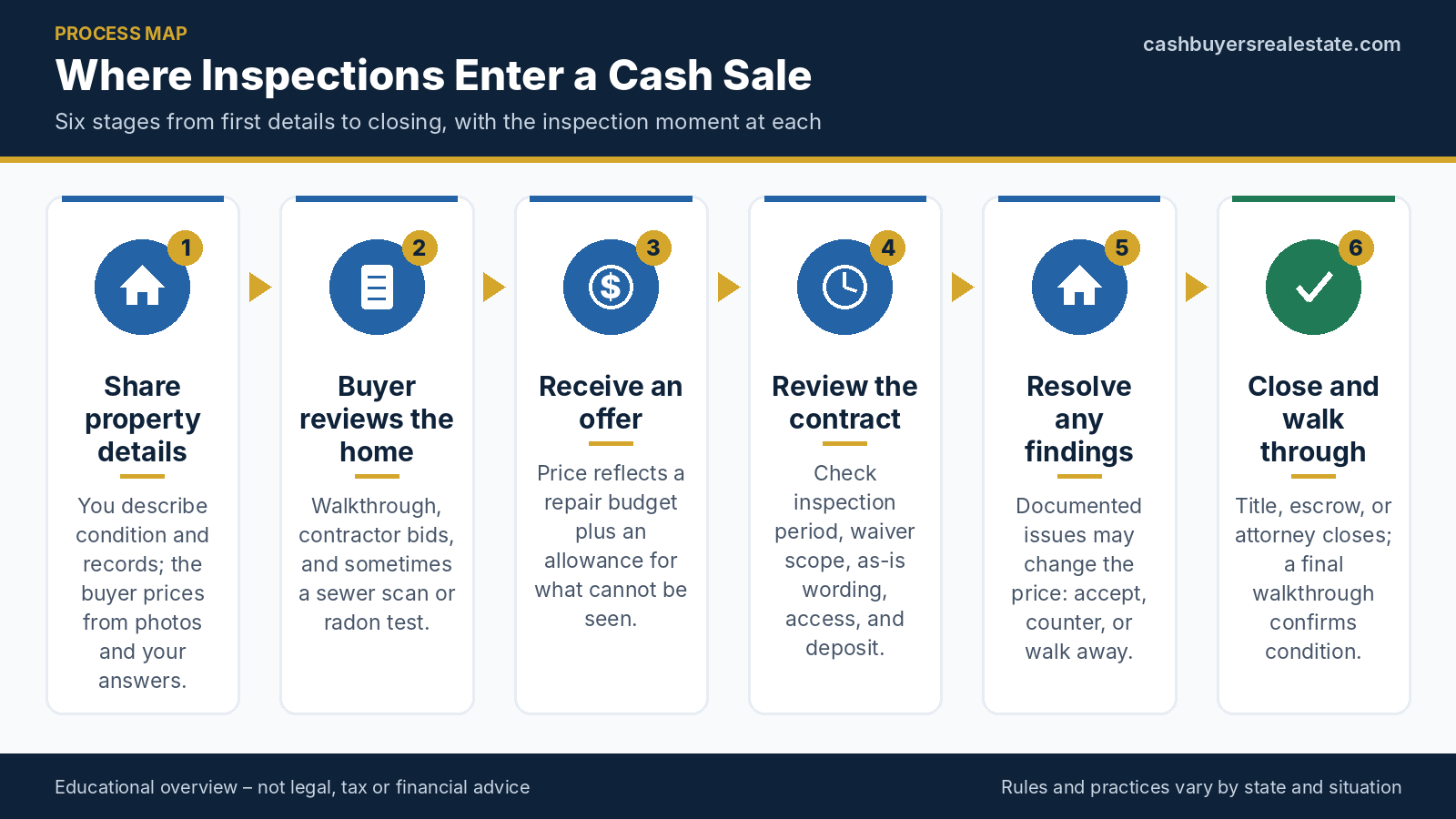
Text version of this infographic
- Share property details — You describe condition and records; the buyer prices from photos and your answers.
- Buyer reviews the home — Walkthrough, contractor bids, and sometimes a sewer scan or radon test.
- Receive an offer — Price reflects a repair budget plus an allowance for what cannot be seen.
- Review the contract — Check inspection period, waiver scope, as-is wording, access, and deposit.
- Resolve any findings — Documented issues may change the price: accept, counter, or walk away.
- Close and walk through — Title, escrow, or attorney closes; a final walkthrough confirms condition.
What Cash Buyers Examine Anyway: Walkthroughs, Contractor Bids, and Specialist Checks
A buyer who never orders a formal inspection is not a buyer who never looks. Investors who purchase worn or neglected houses for a living tend to be better at reading a building than most general inspectors are, in one specific sense: they are reading it for cost. They are not asking whether the house meets a standard. They are asking how much money, how much time, and how much uncertainty stand between the property as it is and the property as it will be when they resell or rent it. This section describes how that reading happens, what usually triggers a closer look, and where a specialist is likely to be hired.
The Investor’s Walkthrough and the Repair Budget
The first and often the only on-site examination is the walkthrough that happens before or just after the offer. It may last fifteen minutes or two hours, and it may involve one person or a small crew. Whatever its length, it produces the number that drives the offer, and understanding what goes into that number puts you in a stronger position to correct it where the buyer has misjudged.
What an Experienced Buyer Notices in the First Twenty Minutes
Experienced buyers tend to follow a rough order even if they never articulate it. They begin outside, looking at the roof line for sag, the gutters for pooling, the grade around the foundation for slope toward the house, the siding and trim for rot, and the windows for failed seals. Inside, they check for the smell that signals moisture, scan ceilings for stains in a pattern that suggests a roof leak rather than a one-time spill, and open the electrical panel to see what kind it is and whether it looks tidy or improvised. They flush toilets and run faucets, because slow drains and weak pressure hint at pipe problems, and they glance at the water heater’s date and the furnace’s age. Floors that slope, doors that stick, and cracks that run diagonally from the corners of doors and windows suggest movement that deserves a second look.
Equally telling is what the buyer asks. Questions about when the roof was replaced, whether there has ever been water in the basement, who did the electrical work in the addition, and whether the work was permitted all point to the items that will carry the biggest deduction. A seller who answers truthfully and offers records, such as receipts, warranty cards, or permits, often shortens the buyer’s uncertainty and, with it, the margin the buyer adds for the unknown. A seller who does not know the answer can say so; “I’m not sure, but the previous owner told us it was replaced about ten years ago” is better than guessing, and a later section explains why accuracy matters beyond politeness.
Keep in mind that a walkthrough is not neutral. The buyer is simultaneously learning about the house and shaping the seller’s expectations. Sighs, long pauses, and remarks like “this is going to be a lot” are sometimes sincere and sometimes bargaining. The best defense is not to react but to write down the items the buyer mentions and ask for the repair estimate in writing, because a number on paper can be checked while an impression cannot.
How Contractor Bids Turn Observations Into Deductions
When an investor sees a problem that costs real money, the next step is usually to price it, either by calling a contractor the investor uses regularly or by applying a rule of thumb gathered from past projects. The result is a repair budget, typically broken into line items such as roof, mechanical systems, flooring, paint, kitchen, bathrooms, and a contingency percentage for surprises. The offer then works backward from the expected resale price, subtracting repairs, holding and selling costs, and the profit the investor requires. The guide to repair deductions in cash offers walks through the formula, and a sibling discussion of how cash buyers calculate offers places it in the broader context of valuation.
Two features of the repair budget explain why price changes after a contract are so common. First, the investor’s contractor bid is only as good as what the contractor could see. An estimate built from a brief visit includes allowances for what might be behind a wall, and those allowances shrink or grow once the walls are opened. Second, a repair that is bid at retail contractor rates is always more expensive than the same repair done by an owner with time and a friend’s skills. When the seller compares a $14,000 deduction for a roof against a $9,500 quote from a local roofer, the difference is not necessarily an error. It is partly a difference in who is paying for the project management, the guarantee, and the risk of overruns.
Illustrative example (hypothetical numbers, not market data): A buyer examines a 1,400-square-foot house built in the 1960s and writes up a repair budget: $11,500 for a roof replacement, $4,200 for replacing a failing water heater and updating the kitchen plumbing, $6,000 for flooring and paint, $3,300 for an electrical panel upgrade, and $5,000 for exterior drainage and trim. The subtotal is $30,000, and the buyer adds a 10 percent contingency of $3,000 for a total of $33,000. The seller later gets two independent quotes. The roofer comes in at $9,800 and the electrician at $2,600. If the seller shares the quotes, the buyer might trim $2,400 from the subtotal, bringing it to $27,600, and with the 10 percent contingency the total budget falls from $33,000 to $30,360, a change of $2,640 that could flow straight into the offer. The numbers do not make the buyer wrong. They show how an independent estimate moves an offer when the seller can provide it before the buyer’s contractor visit rather than after.
Specialist Checks on the Expensive Parts of an Older House
For most properties the walkthrough and a contractor’s quote are enough. A smaller group of components carries enough cost and enough uncertainty that buyers commonly hire a specialist even when they decline a general inspection. What distinguishes these items is that a visual look does not tell you much about them, so the specialist uses a tool.
Sewer Lines, Septic Systems, and Other Hidden Plumbing
The sewer line is the standard example. A line that runs underground from the house to the street or to a septic tank cannot be seen, and a general inspection typically does not cover it. The InterNACHI and ASHI standards both exclude underground items, and the ASHI document also excludes septic and other sewage disposal systems. A buyer who worries about the line commonly hires a plumber to run a small camera through it, producing a video that shows cracks, root intrusion, offsets, or collapsed sections. A failure can be expensive because the fix may involve excavation under a driveway, a yard, or a slab, and that is why a camera scan is among the most common specialist checks in cash purchases of older houses.
Septic systems raise a related question. The Environmental Protection Agency advises that the average household septic system be inspected at least every three years and that tanks typically be pumped every three to five years, with more frequent service for systems that include mechanical parts. Those numbers describe maintenance, not the sale, and the agency’s page does not address real estate transactions. Whether a septic inspection is required, recommended, or merely customary at sale depends on the county and state, so a seller should ask the local health department or permitting authority rather than assume. The subject is covered more fully in the guide to selling a house with septic problems.
Beyond sewers and septic tanks, buyers sometimes check buried fuel tanks, private wells, old galvanized or polybutylene water supply lines, and shared or private utility easements. None of these is visible in a routine inspection, all can be costly, and sellers who have records of replacement, testing, or maintenance often find those records reduce or remove the deduction.
Roofs, Foundations, and Environmental Concerns Such as Radon, Mold, and Lead
Roofs and foundations draw specialists for a different reason: the price swing between a minor and a major finding is large. A roofer can usually tell whether a roof has a few years or a few months left, and whether decking beneath the shingles is sound. A structural engineer or a foundation repair contractor can assess whether a crack is cosmetic or a sign of movement, and may recommend monitoring rather than repair. Buyers who plan to flip tend to be less worried about the cause and more worried about the cost, so they will often accept a contractor’s bid. Buyers who plan to hold the property for years may press for an engineer’s letter. The guides to selling a house with foundation problems and selling a house with a bad roof explore each in depth.
Environmental concerns call for specific, authoritative guidance. The EPA recommends fixing a home when radon measures 4 picocuries per liter or higher and suggests considering a fix between 2 and 4. For real estate transactions its buyer and seller guide to radon describes short-term tests lasting at least 48 hours and urges buyers and sellers to use a qualified tester, to agree in the contract on who pays for any mitigation, and to retest if the last result is more than two years old or the house has been renovated. On mold, the agency says that sampling is usually unnecessary when mold is visible, that no federal limits exist for mold or mold spores, and that the key to control is moisture control, because cleaning without fixing the water source usually leads to a return. Lead is the one hazard with a federal sale rule, which the EPA explains on its lead disclosure rule page: a seller of most housing built before 1978 must disclose what the seller knows, give the buyer an EPA pamphlet, and allow a ten-day opportunity for a lead inspection or risk assessment that the buyer may waive. The point for sellers is that these checks are frequently done by specialists a buyer hires on their own, and the results can alter the price even when a general inspection never occurs.
The table below summarizes the checks buyers commonly use on older or neglected houses, what each can change in an offer, and what you can do ahead of time to shrink the uncertainty. It describes patterns, not requirements, and none of the rows applies to every house.
| Area | Typical check | What it can change | Seller preparation |
|---|---|---|---|
| Sewer or drain line | Plumber’s camera scan of the underground line | Repair or replacement deduction, or a contract right to cancel | Gather past drain-cleaning invoices; consider your own scan |
| Septic system | Inspection and pumping by a septic professional | Deduction for pumping, repair, or replacement | Find service records and the permit; ask the local health department about sale rules |
| Roof | Roofer’s visual assessment and measurement | Replacement line item in the repair budget | Locate the installation date, warranty, and any invoice |
| Foundation and structure | Contractor review or engineer’s letter | Large deduction, or an engineer’s recommendation to monitor | Keep any prior engineering letters and repair guarantees |
| Radon | Short-term test of at least 48 hours by a qualified tester | Cost of a mitigation system, negotiated in the contract | Locate earlier tests that followed a recognized protocol |
| Mold and moisture | Visual review, moisture meter, source tracing | Remediation line item and a possible condition on closing | Fix and document the water source before the visit |
| Lead-based paint (pre-1978 homes) | Certified inspection or risk assessment, if the buyer elects | Remediation costs; a contract right during the opportunity period | Complete the federal disclosure and pamphlet at the start |
Read across the columns and one pattern stands out: in nearly every row the seller’s best preparation is documentation. A buyer prices uncertainty as if it were a defect, so any record that turns an unknown into a known tends to shrink the deduction. The records also help in the disclosure forms discussed later, since a seller who has them can answer honestly instead of guessing.
What Sellers Are Asked to Allow: Access, Testing, and Paperwork
Even a buyer who says the house will be bought as-is needs something from you before the sale closes. There are visits to schedule, utilities to keep running, doors to open, and questions to answer. If the contract permits a due-diligence period, the buyer may also want to test, measure, photograph, and in rare cases open up part of the building. The requests are ordinary, but they are also the moment when a smooth sale either stays smooth or becomes irritating, because each request carries a small risk to the seller’s property, privacy, or leverage. This section covers what is commonly asked and how to respond with your interests intact.
Access, Utilities, and Occupancy During the Buyer’s Visits
Access is a negotiation in miniature. The buyer wants as much of it as possible, on short notice, and the seller wants control. Settling the terms in writing before the first visit avoids most conflicts, and a few simple practices make the visits go better regardless of how the contract is worded.
Scheduling Visits and Opening Up Attics, Crawl Spaces, and Panels
Buyers and their contractors need to see the parts of the house that sellers rarely open. That usually means the attic hatch, the crawl space or basement, the electrical panel cover, the water heater closet, and any exterior cleanouts. A visit goes faster, and the results are more accurate, when those places are reachable without moving furniture or stored belongings. An inspector or contractor who cannot get into a crawl space will note that fact in a report, and a buyer reading “not inspected” is likely to assume the worst and adjust the price for the unknown. Clearing a path to these spaces before the visit is a low-cost way to avoid that outcome.
Utilities matter just as much. The standards that most inspectors follow expect them to operate systems using normal controls, which means the electricity, water, and gas must be on for a furnace, water heater, and plumbing fixtures to be tested. In a vacant house with the utilities turned off, an inspector may report that systems could not be tested, and the buyer may respond by pricing in replacement. If you plan to keep the utilities on until closing, say so in writing. If the house has been vacant for a while, think about whether the water has been drained or the pilot lights extinguished, and whether a plumber or the utility needs to restore service safely before a visit.
Scheduling also deserves a ground rule or two. Ask that visits be arranged in advance, that you or your agent or a representative be present during any visit by anyone other than the buyer, and that a list of everyone entering the property be kept. These are modest requests that serious buyers rarely resist, and a buyer who resists them tells you something about how the rest of the transaction might go.
Occupied Homes, Tenants, and Estates: Extra Layers of Permission
Occupied houses add complications. If the seller lives there, the visits disrupt household life, and a buyer who wants to return three times in a week is imposing a real cost. If the house is rented, the tenant holds rights to privacy and notice that depend on the lease and on state and local landlord-tenant law, so the seller cannot promise a buyer free access simply because the buyer is paying. A contract should recognize this reality by building in the notice period the law requires, and the seller should check the rules for the state where the property sits or ask an attorney. The discussion in selling a house quickly with tenants covers the topic from the landlord’s perspective.
Estates and trusts raise another layer. When an executor or trustee is selling a house they have rarely lived in, the person signing may not know the property’s history, may not hold the keys to every room, and may need approval from a court or co-fiduciaries before agreeing to testing or repairs. Those constraints should be stated openly at the outset. A buyer who knows the seller is a fiduciary with limited knowledge can plan for a different pace and different expectations, and the seller avoids making promises about access or condition that the estate cannot keep.
Testing Limits, Records, and Paperwork Requests
Beyond access, buyers ask for two things that deserve careful attention: permission to do more than look, and documents about the history of the property. Both can be reasonable and both can be used as pressure, and the difference lies in how specific the request is and what the contract says about consequences.
Invasive Testing, Damage, and Who Pays
Most inspection work is non-invasive. The standards describe it that way, and a camera in a sewer pipe, a moisture meter on a wall, or a radon monitor in a basement leaves no mark. Some testing goes further, such as cutting a small hole in drywall to look at framing, removing a section of siding to check for rot, or digging near a foundation. A seller is within their rights to refuse destructive tests or to permit them only on written terms. A common compromise is to allow limited, specified tests by a licensed professional who carries insurance, with the buyer responsible for repairs to any opening, and to require that the work be restored to its original condition within a short time.
The contract should answer who pays for reports and who owns them. A seller may reasonably ask for a copy of any report the buyer commissions, particularly if the buyer cancels because of it, since the report may contain information the seller will have to disclose to the next buyer. Not every buyer will agree, and some contracts say reports are the buyer’s property. In that case, ask the buyer to state in writing which items they found, because the seller’s disclosure duties depend on what the seller knows, and a defect described by a buyer’s inspector is something the seller now knows.
That last point catches people by surprise. If a buyer’s inspector tells you there is active water intrusion at the chimney and the sale falls through, you cannot later list the house and truthfully say you know of no leaks. Information you receive during one transaction travels with you into the next. This is one reason many sellers prefer to receive findings in writing and to keep them, rather than relying on conversation, so that later disclosures are accurate and complete.
Repair Records, Permits, and Warranties Buyers Ask to See
Document requests usually follow what the buyer saw. A visible addition draws a question about permits. An old roof draws a question about the date of installation. A recently painted ceiling draws a question about why. The most common requests concern the roof, the heating and cooling equipment, the water heater, the electrical panel, the plumbing, any additions or conversions, appliance warranties, utility bills, and any insurance claims. Providing what you have is straightforward and generally helps. Answering “I don’t have it” is also acceptable; what a seller should not do is invent a date or a history to fill a gap.
Permits deserve a special note. Work done without a required permit, such as a finished basement, a converted garage, or a replaced water heater, can complicate a sale in several ways. It can lead a buyer to price in the cost of legalizing the work or removing it, it can turn up in a municipal records check, and in some places it can trigger a point-of-sale inspection or certificate requirement. The topic is broad enough to deserve its own treatment in the guide to selling a house with unpermitted work. For this article the point is simpler: buyers discover unpermitted work through records and through what they see, and a seller who raises the subject first is in a much better position than one who has it raised.
Insurance claims history also surfaces during this stage. Buyers may ask whether the property has had water, fire, or wind claims, and the answer can affect what they pay and whether they can insure the property cheaply. The best course is to answer accurately from your own records, and if you are unsure, to ask your insurer or agent for a claims history before the request arrives.
Taken together, the access and paperwork requests are what make an unstructured “no inspection” sale a structured one in practice. Before the contract is signed, a cash buyer might prefer a quick visit and a handshake. After it is signed, the buyer is usually entitled to everything the contract allows, and the seller’s job is to know what that is. The next step is to compare how different ways of handling inspection affect the outcome. There are five common arrangements: a cash sale with the inspection waived; a cash sale with a short due-diligence period; a cash sale with a full inspection contingency; a conventional listing sold to a financed buyer; and a sale after the seller commissions an inspection before marketing the property. The infographic below sets them against the same factors, namely offer price, repairs avoided, closing costs, timeline, contingencies, and certainty. A waived inspection usually trades some price for firmness. A full contingency usually offers a higher price and weaker certainty. A conventional listing may produce the highest price on a well-kept house but adds agent compensation, buyer inspection, appraisal risk, and a longer timeline. A seller’s own inspection costs money up front and reduces surprises later. No arrangement wins on every factor, which is exactly why the comparison is worth drawing.
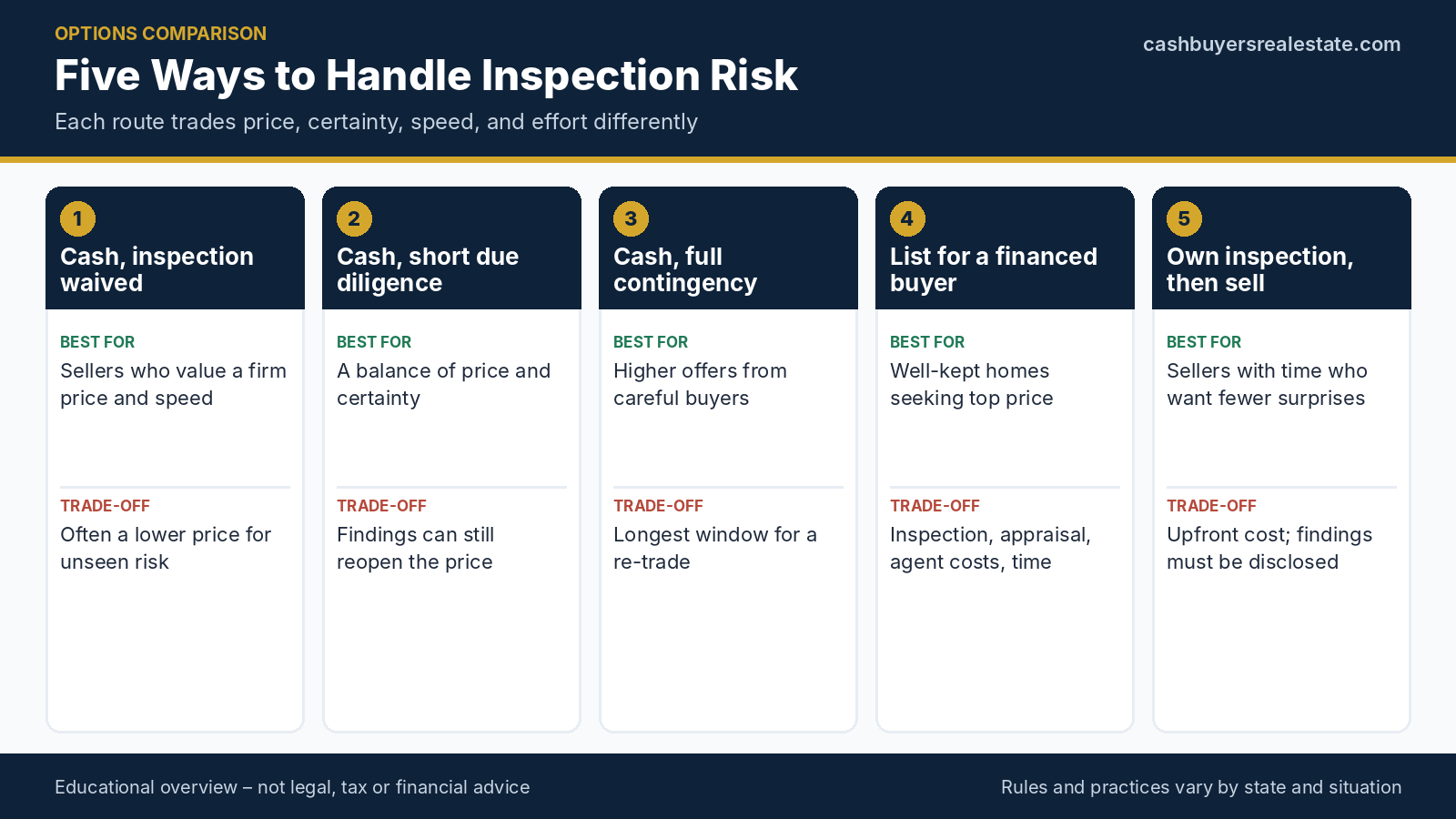
Text version of this infographic
- Cash, inspection waived — Best for: Sellers who value a firm price and speed. Trade-off: Often a lower price for unseen risk.
- Cash, short due diligence — Best for: A balance of price and certainty. Trade-off: Findings can still reopen the price.
- Cash, full contingency — Best for: Higher offers from careful buyers. Trade-off: Longest window for a re-trade.
- List for a financed buyer — Best for: Well-kept homes seeking top price. Trade-off: Inspection, appraisal, agent costs, time.
- Own inspection, then sell — Best for: Sellers with time who want fewer surprises. Trade-off: Upfront cost; findings must be disclosed.
When Findings Arrive: Re-Trades, Credits, and Price Changes
The moment a seller dreads in any inspected sale is the one in which a buyer comes back with a list. In a cash transaction that moment looks a little different from the financed version, because the buyer does not need a lender’s approval, an appraisal, or a repair addendum to make the request. The buyer simply says that the price was based on one set of facts and the facts have changed. Sometimes that is true and fair. Sometimes it is a tactic. Learning to tell which is which, and to respond in a way that protects your net proceeds, is the most practical skill a seller can bring to the inspection period.
How Findings Become Price Changes
Understanding the mechanics of a price reduction makes the conversation less emotional. A re-trade is not a judgment about you or your house. It is arithmetic that follows from the way the buyer set the original number, and once you see the formula you can check whether the new number follows from it.
The Arithmetic Behind a Re-Trade
Think of the buyer’s offer as a sum of fixed and variable parts. The resale value, the buyer’s profit requirement, and the holding and selling costs are, from the buyer’s point of view, the fixed parts. The repair budget is the variable part. If the repair budget rises, the offer must fall by the same amount for the buyer to keep the same profit, which is why requested reductions so often match the size of a newly found problem dollar for dollar. The buyer is not necessarily being greedy. The buyer is holding the margin constant, and a seller who understands that can respond to the number rather than to the tone.
The math has a few predictable wrinkles. A contingency percentage on top of repairs means each dollar of added repair can carry additional dollars of cushion, so the price reduction may exceed the contractor’s estimate. A timing assumption may change too: if the new repair adds three weeks to the renovation schedule, the buyer may add holding costs for utilities, taxes, insurance, and loan interest. And the buyer’s perception of risk may rise even if the cost estimate does not, since one unpleasant surprise often leads a buyer to suspect others. Each of these effects is a legitimate input, and each can be questioned. Ask which line items changed, what the buyer assumed before, and what the buyer assumes now.
Timing is the other lever. A finding that arrives on the last day of a due-diligence period leaves the seller little time to respond, gather a second quote, or find another buyer, and the seller’s carrying costs, such as mortgage payments, insurance, and utilities, continue to run. A well-informed buyer knows this and may use it. A well-informed seller counters by gathering information earlier and by asking, at the time of signing, for a deadline by which any request for changes must be made in writing with supporting documentation.
Legitimate Adjustments Versus Pressure Tactics
Not every price change deserves suspicion. A genuine adjustment usually has recognizable features: it concerns a condition that was not visible or not disclosed earlier, it is tied to a document such as a camera video, a contractor’s written estimate, or a test result, it is proportionate to the cost of the problem, and it comes once, with a reasonable chance to respond. A buyer who finds a collapsed drain line behind the wall and shares the video has given you a reason to talk. That is the system working as intended.
Pressure tactics look different. A request that cites a problem the buyer saw before making the offer, such as an obviously old roof, is difficult to justify as new information. A request that grows with each conversation, from $4,000 to $7,500 to “we should talk about the whole number,” suggests that the finding is a pretext. A request that arrives without documentation, or that is paired with a deadline of a few hours, shifts the burden to you in a way a fair negotiation would not. A buyer who refuses to show you the underlying estimate or report is asking you to accept a number on faith. None of these patterns proves bad intent, and some buyers simply communicate poorly, but all of them are reasons to slow down.
The companion article on negotiating a cash offer addresses the broader craft, including how to use competing offers, and it pairs well with the guide to contract red flags for the points at which a price change may be built into the paperwork from the start.
Responding When the Offer Drops
When a reduction request arrives, the instinct is either to accept quickly to save the sale or to refuse angrily to defend one’s dignity. A better response is a structured one, which begins by understanding what you are allowed to do under the contract and what the realistic alternatives are.
Your Options: Accept, Counter, Split the Difference, or Walk Away
You have four basic choices, and the contract determines which are available without penalty. You can accept the reduction as presented, which keeps the timeline intact and is sensible when the finding is real, the estimate is fair, and your alternatives are weaker. You can counter, supporting your counter with an independent quote or a documented fact, which is often the most productive course. You can propose to split the difference, which tends to work when the estimates are close and both parties want to finish. Or you can decline and, if the contract allows, release the buyer so that you may market the property again, which is a reasonable choice when the reduction would leave you worse off than your next-best path.
Before choosing, check three things. First, what does the contract say about the buyer’s right to cancel and the return of the deposit? A buyer who has already waived the right to cancel for condition may have less leverage than the buyer is implying. Second, what are your carrying costs per week, and how long would it take to find and close with another buyer? A fall-through that costs two months of carrying costs can erase much of the gain from refusing a reduction. Third, what must you disclose to the next buyer? Information from the failed inspection travels with you, which means that your next negotiation may begin from a lower baseline unless you fix the issue or price it in.
The decision is also easier when you know your alternatives. A seller who has already collected a second offer, even a lower one, can respond to a re-trade calmly. A seller with a single offer has less room to say no. The guide to comparing cash offers explains how to line up offers on net proceeds, which is the correct basis for this kind of decision.
A Worked Scenario From Finding to Final Price
An example makes the pattern concrete. The scenario below is hypothetical, and the figures are not drawn from any market.
Illustrative example (hypothetical numbers, not market data): A homeowner has agreed to sell a 1950s bungalow for $198,000 to a cash buyer. The contract allows a seven-day due-diligence period, and the homeowner’s mortgage payoff is about $121,000. On day six the buyer sends a sewer camera video showing roots and an offset joint in the line near the street and asks for a $9,000 reduction, citing a plumber’s verbal estimate. The homeowner asks for the written estimate and requests permission to get a second opinion. A second plumber quotes $5,800 for a section repair, not a full replacement. The homeowner presents the quote to the buyer, who agrees the narrower repair is reasonable but wants to keep a small allowance for surprises. They settle at a reduction of $7,000, a closing price of $191,000, with the buyer’s plumber to perform the work after closing. Compared with accepting the first request, the homeowner keeps $2,000 more. Compared with walking away, the homeowner avoids relisting, but accepts a lower price than the original agreement. The outcome is a compromise, and the homeowner’s evidence made it possible.
Different paths from the same finding produce different results, and the table below lays them side by side. It is illustrative only: the figures show the shape of the trade-offs, and the actual numbers in any sale depend on the contract, the cost of the repair, and the market.
| Path | Resulting price | Time effect | What the seller gives up | Main risk |
|---|---|---|---|---|
| Accept the buyer’s request | $189,000 | None | $9,000 of price | Paying more than a documented repair would cost |
| Counter with a second written quote | $192,200 | A few days to obtain and discuss the quote | $5,800 of price | Buyer cancels within the period if offended or unconvinced |
| Split the difference between the two estimates | $190,600 | Short | $7,400 of price | Splitting a number that is itself overstated |
| Seller repairs before closing | $198,000, less the cost of the repair | Possibly a week or more for the work | Repair cost, scheduling control, and the repair risk | Hidden extent of the damage; the buyer may require proof of quality |
| Decline and market again | Unknown | Weeks to months | Certainty of the first buyer | The finding is disclosed to the next buyer, and the carrying costs continue |
To read the table, compare the first three rows by price, then compare the fourth and fifth rows by the kind of risk the seller takes. The first three rows keep the sale alive and differ only by a few thousand dollars, so the main question is whether the extra effort of getting a second quote is worth it. In this example the answer is plainly yes, because a single phone call moved the result by thousands of dollars. The fourth row shows why some sellers choose to repair, since it can preserve the price, but it asks the seller to take on the project risk the buyer had planned to carry. The last row, walking away, is sometimes the right call, though it hands the seller the same finding to disclose to every buyer who follows. What to disclose, and when, is the subject of the next section.
Why “As-Is” Does Not Erase Disclosure Duties
Few misunderstandings cost sellers more than the belief that selling as-is means selling without having to say anything. The as-is clause answers one question, who pays for repairs, and the disclosure laws answer a different one, what the seller must tell the buyer. The two operate side by side. Because the rules differ so much from state to state, this section sticks to what has been verified in primary sources, uses a few examples to show the range, and points to the places where a seller should check their own state’s law before filling out a form.
What the Law Requires No Matter What the Contract Says
There is no single national seller-disclosure statute covering the physical condition of homes. What exists is a federal rule for one hazard, lead-based paint, and a patchwork of state laws and court decisions governing everything else. Some states mandate a standardized form, some require disclosure of specific items only, and some lean on older doctrines under which a buyer was expected to look out for himself unless the seller actively concealed something. Knowing which category your state falls into, and whether your particular sale is exempt, is the starting point.
State Disclosure Regimes: California, Texas, and New York as Contrasting Examples
Three examples, each drawn from the statute’s own text, show how much the details can vary. California’s transfer disclosure statute applies to sales of single-family residential property and states that any waiver of the requirements of the article is void as against public policy. That sentence is the most direct statutory answer to the question of whether a contract can contract out of disclosure: in California, it cannot. Texas takes a different route. Its Property Code requires a seller of residential property with no more than one dwelling unit to deliver a written notice, in the statutory form or a substantially similar one, on or before the effective date of the contract, and if the notice is delivered late the buyer may terminate for any reason within seven days after receiving it. The Texas notice must be completed to the best of the seller’s belief and knowledge, and a seller who does not know an item may mark it unknown.
New York’s Property Condition Disclosure Act requires a seller of one- to four-family residential property to complete and sign a disclosure statement and deliver it to the buyer or the buyer’s agent before the buyer signs a binding contract of sale. The same section says the parties may still agree to sell the property as-is, and it adds that the seller is not required to investigate the property or check public records. A neighboring section limits a seller’s liability to a willful failure to perform the article’s requirements. Read together, the three states illustrate how a legislature can allow an as-is clause while still insisting on the disclosure form, and how the standard of liability can vary from “void waiver” in one place to “willful failure” in another.
The examples are only examples. Many states have their own forms, deadlines, and remedies, and several have different rules for new construction, for sales between family members, and for sales by court-appointed representatives. The safest approach is to find out which form your state uses by asking the state’s real estate regulator, a local attorney, or a title company, and to complete it carefully.
For lead-based paint, the federal rule applies in every state. A seller of most housing built before 1978 must disclose known information about lead-based paint and lead hazards, provide available records and reports, hand over EPA’s pamphlet on lead, include a lead warning statement in or attached to the contract, allow the buyer ten days, unless both sides agree otherwise in writing, to conduct a lead inspection or risk assessment, and keep a signed copy of the disclosures for three years. The buyer may waive the inspection opportunity. The rule is enforced by federal agencies, and noncompliance can bring penalties, which is why a sale that appears to be “inspection-free” still includes a lead-paint step on older homes. The companion discussion of disclosures in as-is home sales gives a fuller tour of what typical forms ask.
Known Defects, Concealment, and What As-Is Protects
Even in states with minimal statutory forms, a seller who knows of a serious hidden problem and says nothing, or who takes steps to hide it, takes on legal risk that an as-is clause generally does not remove. Courts in many states distinguish between conditions the buyer can see and those the buyer cannot, and between a seller who is silent about a defect and one who makes it harder to find. A fresh coat of paint over a water stain, a rug placed to cover a soft spot in a floor, a sump pump disconnected so a basement looks dry, and a sewer odor masked with air freshener or a freshly poured layer of concrete over a cracked slab are the sort of acts that convert a defect into a concealment. A seller should never do any of these, and no responsible buyer or professional would advise it.
What does an as-is clause protect, then? In general it protects a seller from claims about conditions the seller did not know about and the buyer could have discovered, and from demands for repairs or credits. It shifts the burden of discovery to the buyer. It does not necessarily protect against claims of fraud or misrepresentation, and in states with statutory forms it does not replace the form. The phrase “buyer accepts the property with all faults” is a common line in cash contracts, and it is a fair statement of the bargain, but it does not turn a known undisclosed defect into one the buyer assumed.
Disclosure duties are also a reason not to treat the buyer’s silence as comfort. A buyer who waives the inspection is making a choice about their own investigation. They are not releasing you from yours. Sellers who give honest, complete answers lose little by doing so, because an informed buyer who knows about the issue has priced it already, and they avoid the far larger risk of a claim after closing.
Estates, Trusts, and Limited Knowledge
Not every seller has lived in the house. Heirs, executors, trustees, and relatives managing a property for someone else may know very little about its condition, and the law recognizes that. The practical challenge is to be honest about what you do not know without creating the impression that you are hiding something.
Fiduciary Sellers and Statutory Exemptions
Several state statutes exempt or treat differently sales made by fiduciaries such as executors, administrators, trustees, guardians, and conservators. The Texas statute, for example, excludes transfers by a fiduciary administering a decedent’s estate, a guardianship, a conservatorship, or a trust, along with transfers under a court order or foreclosure sale. New York lists a set of exempt transfers that includes court-ordered transfers and transfers related to foreclosure. These exemptions reflect the reality that fiduciaries often lack personal knowledge, but they do not give a fiduciary permission to conceal what they have learned. A fiduciary who discovers a leak while cleaning out the house knows about the leak, and the other duties that attach to knowledge, including the duty not to mislead, remain.
Exemptions also turn on details. Whether an exemption covers only the personal representative’s sale or also a later sale by an heir who takes title, and whether it still applies to a fiduciary who lived in the house, depends on the exact wording of the statute in the state where the property sits. If you are selling on behalf of an estate, ask the estate’s attorney or the probate court clerk whether an exemption applies and whether the buyer should still be given whatever information you have. For the broader topic, the page on selling an inherited house fast covers the practical side of estate sales.
Practical steps help a fiduciary seller more than legal nuance does. Walk the property with a notebook before the first buyer visit and write down what you see, including stains, odors, closed-off rooms, and equipment that does not work. Ask neighbors, caretakers, and former tenants what they remember about leaks, flooding, or repairs. Collect any records the decedent or prior owner left in the house, and tell buyers plainly that you are selling on behalf of an estate or trust and have limited firsthand knowledge. That candor sets expectations, and it tends to produce an offer that accounts for the uncertainty without treating it as a hidden problem.
Writing an Honest Disclosure When You Don’t Know the Answer
The core principle of disclosure is simple: say what you know, and say honestly what you do not. Most forms have a way to mark an item as unknown, and the Texas statute expressly contemplates that. Using that option is not an evasion when it is true. Where a seller does know something, the answer should be specific. “There was water in the basement after the heavy rain two springs ago, and we added a sump pump the following summer” is more useful and more protective than “occasional dampness.” Specific answers show good faith, and they tend to produce smaller deductions than vague ones.
A paper trail helps here. Keep copies of the completed form, any reports you have received, quotes from contractors, and messages in which a buyer or inspector described a problem. If you later face a dispute, the record of what you said and when is the best evidence of honest dealing. If your knowledge changes before closing, because a new leak appears or an inspector finds something, update the disclosure rather than leaving the old one in place; the New York act contemplates revisions, and many states have comparable provisions.
Pulling the threads together, six checkpoints keep inspection promises and disclosure duties on solid ground. The first is a completed, honest disclosure form for your state, plus the federal lead-paint step if the house predates 1978. The second is a written record of any findings you receive from a buyer or a professional. The third is a plain reading of the contract’s inspection, as-is, and termination language, matching what the buyer told you with what the paper says. The fourth is confirmation of who holds the deposit and when it is refundable. The fifth is verification of the buyer, including proof of funds, the name of the entity buying, and whether the contract can be assigned to someone else. The sixth is a closing handled by a reputable title company, escrow company, or closing attorney in your state, with wire instructions confirmed by phone. Two of these items ride on a distinction that matters for any inspection promise: the person you negotiated with and the person who ultimately buys may not be the same, so find out who will actually do the inspecting and who will own the contract. The infographic below turns those six checkpoints into a checklist you can mark up before you sign, with the ones that cause the most trouble flagged for extra care.
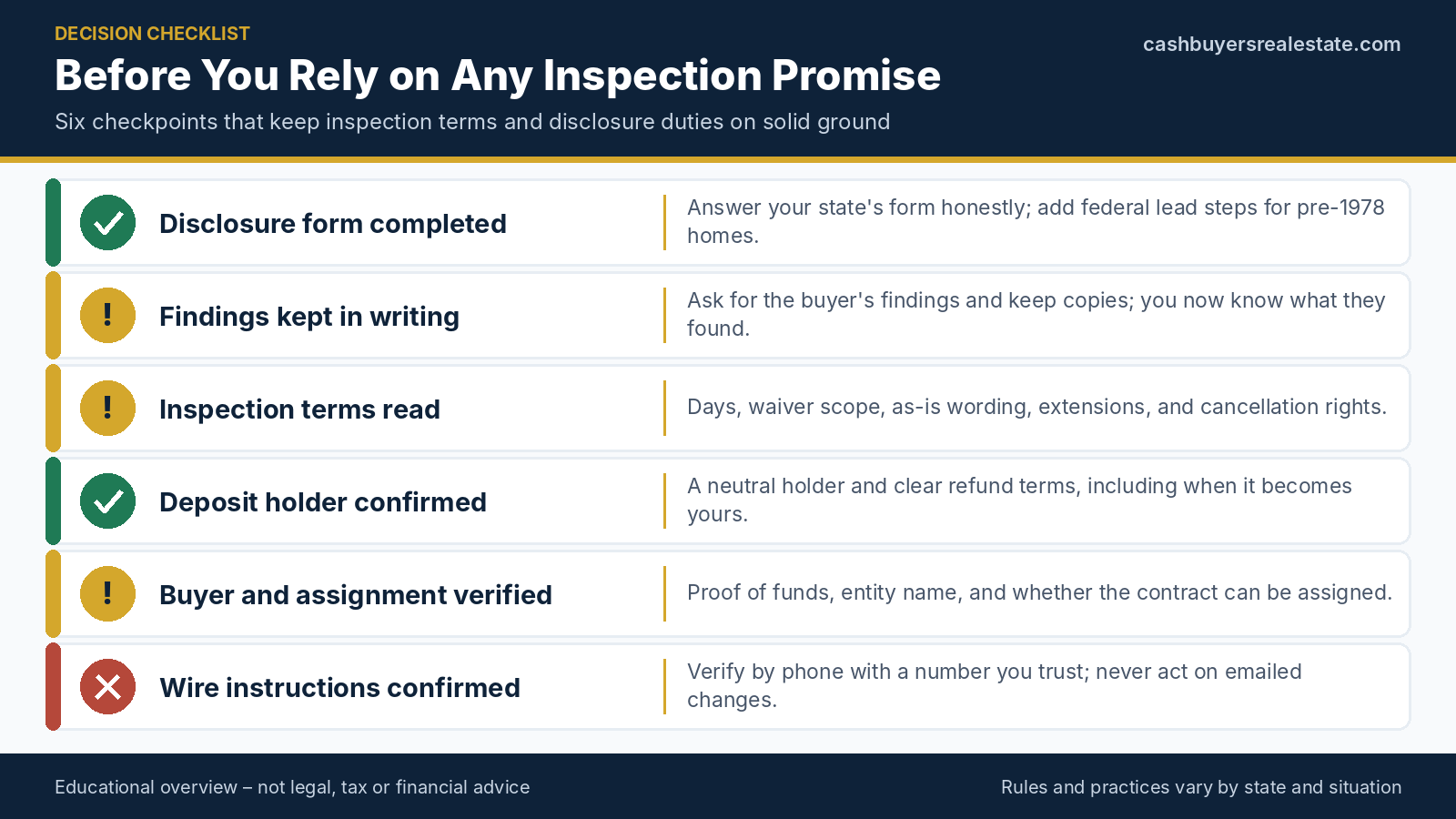
Text version of this infographic
- Disclosure form completed — Answer your state's form honestly; add federal lead steps for pre-1978 homes.
- Findings kept in writing — Ask for the buyer's findings and keep copies; you now know what they found.
- Inspection terms read — Days, waiver scope, as-is wording, extensions, and cancellation rights.
- Deposit holder confirmed — A neutral holder and clear refund terms, including when it becomes yours.
- Buyer and assignment verified — Proof of funds, entity name, and whether the contract can be assigned.
- Wire instructions confirmed — Verify by phone with a number you trust; never act on emailed changes.
Ordering Your Own Inspection Before You Sell: Benefits, Costs, and Smarter Shortcuts
Every earlier section assumed that the buyer controls the inspection. A seller can reverse that arrangement by commissioning an inspection before the house goes to market or before accepting an offer. Pre-sale inspections have a loyal following among real estate professionals and a skeptical one among some attorneys, and both camps have a point. Whether it makes sense for you depends on the condition of the house, who you expect to sell to, how much you already know, and whether any surprise would change your decision about selling at all. This section sets out the case on each side and then looks at narrower, cheaper steps that capture most of the benefit.
The Case For and Against a Pre-Sale Inspection
An inspection you order yourself changes the sequence of information. Instead of learning about the house’s problems in the middle of a contract, with a buyer holding a deposit and a deadline, you learn about them first, when the only people affected are you and your inspector. That shift in timing is the central benefit, and it also explains most of the drawbacks, since knowledge carries consequences.
What a Seller’s Inspection Can Do for You
The most tangible benefit is the removal of surprises. A seller who knows the water heater is failing, the panel is outdated, and the attic has a patch of damp insulation can decide in advance which to fix, which to price in, and which to explain. That control extends to the negotiation. A buyer who sees a report that matches the seller’s claims has less reason to believe there is more behind the wall, and may reduce the uncertainty allowance built into the offer. Second, the report becomes a pricing tool. If a cash buyer’s repair estimate is much higher than the figures you get from your own contractors, you can show your documentation, which turns a contest of impressions into a comparison of numbers.
A seller’s inspection also improves disclosure. As earlier sections explained, state forms ask what the seller knows. A seller who has no idea whether the roof leaks can answer only “unknown.” A seller with a current report can answer precisely, and precise answers tend to reduce disputes after closing. Finally, the inspection can reveal that the house is in better shape than feared, which is itself useful. Some sellers who assume their house is a total repair project discover that the issues are modest, and that discovery may lead them toward a traditional listing instead of a discounted cash sale. The companion guides on whether to fix your house before selling and repairing a house before selling go further on that decision.
It helps to be realistic about what a report can do. It is a snapshot taken by one person on one day, bound by the limits discussed earlier: visual, non-invasive, and silent on items such as septic systems, mold, radon, and underground lines. A cash buyer is under no obligation to accept it, and many investors will run their own numbers regardless. The report is evidence, not a binding price.
Costs, Downsides, and Disclosure Consequences
The direct cost of an inspection is a fee that varies by region, house size, and the scope of the service, so a seller should get quotes rather than rely on a figure from an article. The indirect costs matter more. The report creates knowledge that must be disclosed. If the inspector finds an active roof leak, it goes on the disclosure form, and the buyer will learn about it whether you fix it or not. A seller who is not prepared to repair or to reduce the price for the problem may be worse off having learned of it, in the narrow sense that the information now limits how the house can be presented. That is not a reason to avoid learning about a problem, because a seller who avoids knowledge in order to avoid disclosure takes a different kind of risk, but it is a reason to think through the plan before ordering.
Other drawbacks are practical. Reports age: a report from six months earlier may not reflect a new leak, a storm, or a vacancy. Buyers may discount a report commissioned by the seller on the theory that the seller picked a lenient inspector, so the choice of inspector matters. A seller should hire a credentialed inspector who works under a published standard, ask for the standards and a sample report, and avoid anyone who offers to soften findings. A report that is later found to be misleading harms the seller’s credibility more than no report at all.
Finally, there is cost in time and attention. Scheduling a visit, clearing access, reading a long report, and obtaining quotes for the items it flags can take weeks, which is a poor fit if a tight timeline is the main reason you are considering a cash sale. In that case a more targeted approach, described next, may deliver most of the benefit in a fraction of the time.
Illustrative example (hypothetical numbers, not market data): A homeowner preparing to sell a 1978 split-level orders a general inspection and a sewer camera scan before talking to buyers. The report flags a twelve-year-old water heater, two ungrounded outlets, a damp patch on the garage ceiling, and a sagging section of gutter. The camera shows the sewer line is intact. The homeowner spends $450 on an electrician’s visit, $300 on gutter repair, and has a roofer confirm that the garage ceiling stain is an old, dry leak from a flashing repaired years ago. When a cash buyer later proposes a $12,000 repair allowance for “unknown electrical, plumbing, and roof issues,” the homeowner shares the report, the invoices, and the roofer’s letter. The buyer reduces the allowance to $4,500 and the final price rises accordingly. The seller spent $750 on repairs beyond the inspection fee and, in this illustration, recovered $7,500 of the allowance. The numbers are invented, and the same investment on a different house could return nothing.
Targeted Checks, Quotes, and Repair-or-Credit Decisions
A full inspection is one tool among several. When the question is about a single expensive component, a narrower check can answer it faster and for less, and when the question is about repair costs, a contractor’s quote is often better evidence than a general report. This part of the guide sorts those tools by purpose.
Single-Issue Checks and Contractor Quotes That Do the Most Work
The checks most likely to change a buyer’s behavior are the ones that address the largest unknowns. A plumber’s camera scan of the sewer line answers a question no general inspector will. A roofer’s written assessment states whether the roof has remaining life and what it would cost to replace. A radon test by a qualified tester, run for at least 48 hours according to the EPA’s real estate guidance, turns an unknown into a number, and if the reading is high, a mitigation quote establishes the price of fixing it. An engineer’s letter on a foundation crack can convert a frightening observation into a manageable one, or confirm that the concern is real. In each case the output is a document that a buyer can read and that stays with the house.
Quotes work similarly. Two or three written quotes for the same defined scope give you a range that you can compare against a buyer’s estimate. Make sure the scope is the same, since a quote for patching a section of drain line is not comparable to a quote for replacing the whole run. Ask contractors to state what they included and excluded, and keep the quotes with the disclosure paperwork. When a buyer’s estimate is much higher than the range, the written quotes give you a reasonable basis to ask why. When the buyer’s estimate falls inside the range, the quotes give you confidence that the deduction is fair.
If you decide to hire an inspector for a broader review, a few questions help you choose well:
- Which standards of practice do you follow, and may I see a sample report?
- Are you licensed or certified where the property is, and what insurance do you carry?
- Which systems and areas are excluded, such as septic, crawl spaces, or the roof surface?
- Who owns the report, and who may you share it with?
- Can you refer me to specialists for anything you flag?
- How soon after the visit will I receive the written report?
Deciding Whether to Repair, Offer a Credit, or Leave Things Alone
Once you know what is wrong, three broad choices follow. You can repair before selling, which gives the buyer a cleaner house but puts you in charge of cost, quality, and timing. You can offer a credit or a lower price, which hands the repair to the buyer and lets you move quickly. Or you can leave the item unaddressed, disclose it honestly, and let the buyer price it. None is always right. Repairing tends to pay when the repair is small, visible, and inexpensive relative to the deduction it will otherwise cause. Credits and price reductions tend to make sense when the repair is large, when the buyer plans a renovation that would redo the work anyway, or when time is short. Leaving things alone is common with cash investors who intend to gut a kitchen and so will not value a fresh coat of paint on the walls.
The table below organizes common situations by whether a seller’s inspection is worth considering, what a lighter alternative might be, and the main caution. It is a general guide, not a rule.
| Situation | Full pre-sale inspection? | Lighter alternative | Main caution |
|---|---|---|---|
| Well-kept house, plan to list with an agent for financed buyers | Often worthwhile | Targeted checks on the roof and mechanical systems | Anything found must be disclosed or fixed |
| Known major problem, such as foundation movement or a failing roof | Sometimes unnecessary | Specialist letter or two written quotes | A general report may add cost without changing the price |
| Inherited or estate house the seller has not lived in | Often helpful | Walkthrough with a notebook, plus a sewer scan | Fiduciary duties and any required court approvals |
| Vacant house with utilities off | Limited until utilities are restored | Restore service safely, then test major systems | Untested systems are usually priced as failed |
| House built before 1978 | Consider a lead assessment only if records are lacking | Complete federal lead disclosure and gather past reports | The disclosure step applies whatever else you decide |
| Quick as-is sale to an investor | Usually not worth the time | Gather records and one or two quotes for the largest items | An unknown is priced as a defect, so records pay off |
Use the table by finding the row closest to your situation and then reading across. The lighter alternatives share a theme: they target the one or two items most likely to move the price, rather than the whole house. A seller who has the time and a home in decent condition may find a full inspection helpful. A seller who needs to move quickly, or whose home has obvious problems, is usually better served by a few focused documents. In neither case is the choice permanent, and a cash buyer’s due-diligence period can still happen afterward.
Frequently Asked Questions About Cash Buyers and Inspections
The questions below come up repeatedly once sellers start reading cash offers closely. The answers are brief and general, and they deliberately avoid repeating the longer explanations above. Where a question turns on state law or on the exact words of a contract, the answer says so and points you to the source that decides it.
Questions About Inspection Rights and What Buyers Check
The first group of questions concerns what a buyer may or may not do, and what a seller can expect to see during the buyer’s evaluation.
Questions About Waivers and Contract Terms
- Can a cash buyer really buy a house without any inspection?
Yes. No federal rule and no lender requirement obliges a cash buyer to order an inspection, and many contracts waive the inspection contingency entirely. The buyer has usually still seen the house, priced its problems, and built a margin for what could not be seen. The practical meaning of “no inspection” is that the buyer is accepting condition risk in exchange for a lower price, a faster closing, or both.
- If the buyer waives the inspection, can the price still change?
Only if the contract leaves a door open. A full waiver generally removes the right to renegotiate over condition, but a partial waiver may keep rights for named defects, and other contingencies such as title review may remain. Read the paragraph that lists what the buyer can still cancel for, and ask a lawyer to explain any phrase you do not follow before you sign, not after the buyer raises a question.
- Is an inspection ever required by law in a cash sale?
Not as a general rule, but local programs exist. Some municipalities require an inspection or certificate before a house can be sold; the city of Cherry Hill, New Jersey, for example, requires a certificate of continued occupancy before the sale of a single-family home, based on an exterior inspection. Septic and sewer rules are set locally, too. Ask your city or county building department what applies to your address.
- Who should hold the deposit during an inspection period?
A neutral third party is the safest choice, such as a title company, an escrow company, or an attorney’s trust account, depending on how closings work in your state. The contract should say when the deposit is refundable and when it becomes the seller’s. A deposit held by the buyer or by a person with no formal role gives you less protection and makes disputes harder to resolve.
Questions About What Buyers Look At
- Why does a buyer want to see the attic, crawl space, and electrical panel?
Those areas reveal the costly components that cannot be judged from the living space: roof framing and insulation, moisture and pests under the floor, and the age and condition of the wiring. Experienced buyers know that a house can look fine in the kitchen and still hide thousands of dollars of work above and below it. Giving access shortens their uncertainty, which usually means a smaller cushion in the price.
- Will a cash buyer order a sewer camera scan, and who pays for it?
Many do on older houses, because a general inspection typically excludes underground lines. Normally the buyer hires the plumber and pays, unless the contract says otherwise. Ask whether you will receive a copy of the video, since the findings may matter for your later disclosures if the sale does not close.
- Should I be at the house while the buyer’s crew is there?
It is usually wise for you or a trusted representative to be present or reachable. Being there lets you answer questions accurately, keeps access to the agreed areas, and lets you hear what is said about the property. You do not have to follow anyone around, and a buyer who objects to a seller’s reasonable presence is worth a second look.
Questions About Findings, Disclosure, and Your Own Inspection
The second group covers what happens after the buyer finds something, what you owe the buyer in honesty, and whether getting an inspection of your own is worth the trouble.
Questions About Price Changes and Walking Away
- Is it normal for a cash offer to drop after the buyer visits?
It is common enough to plan for. Offers made from photographs and phone descriptions are estimates, and a closer look often changes the repair budget. A reduction tied to a documented, newly found problem is a normal part of the process. A reduction for something that was visible from the start, or one that arrives in repeated rounds, deserves more questions.
- Can I refuse a requested reduction, and what happens to the deposit?
You can refuse, and the contract decides the consequences. If the buyer still has a right to cancel during the inspection period, the buyer may do so and recover the deposit. If the right has lapsed or been waived, a buyer who walks away may forfeit the deposit, depending on the wording. Because the outcome turns on specific language, check with an attorney before treating the deposit as lost or won.
- Can I get a copy of the buyer’s inspection report?
Only if the contract provides for it or the buyer agrees. A report commissioned by the buyer usually belongs to the buyer. It is reasonable to ask for a copy, or at least a written list of the findings, especially if the buyer relies on them to change the price. What you learn can affect your later disclosure duties.
- How can I tell whether a lowered offer is fair?
Compare the buyer’s numbers with independent written quotes for the same scope of work, and compare the net proceeds of the revised offer with your next-best alternative. A fair adjustment is documented, proportionate, and consistent with what the buyer saw earlier. If the buyer will not share the estimate behind a number, you cannot check it, and that alone is a reason to slow down.
Questions About Disclosure and Pre-Sale Inspections
- Do I have to disclose problems if I sell as-is?
In most places you do have duties, although they vary. Some states require a statutory form, some require disclosure of specific items, and nearly all penalize concealing a known serious defect. California’s statute, for instance, voids any waiver of its disclosure requirements. An as-is clause limits repair demands; it does not license silence about what you know. A local attorney can tell you which form applies to you.
- If I order my own inspection, do I have to share the report?
The answer depends on your state and on what the report reveals. Many forms ask what you know, and a report tells you things you now know, which can carry a duty to disclose. Sharing a report can also build trust with a buyer. Decide how you will handle the findings before you order the inspection, and ask a real estate attorney if you are unsure.
- Does the lead-paint rule apply when the buyer pays cash?
Yes. The federal rule covers sellers of most housing built before 1978 and does not depend on how the buyer pays. You must disclose what you know, provide the EPA pamphlet, include the warning statement in the contract, and give the buyer the opportunity to inspect for lead, which the buyer may waive in writing. Keep a signed copy of the disclosures.
Choosing How to Handle Inspections When You Sell for Cash
By this point the central idea should be clear: whether an inspection occurs is the least interesting part of the question. What matters is who controls it, what rights it creates, how it ties to price, and how well you have prepared for its results. The closing section turns that understanding into a way of choosing, and then into a short sequence of steps you can start on before you have signed anything. For the wider landscape of quick-sale routes, the pillar on how to sell a house fast places inspection questions in context.
A Decision Framework: Matching Inspection Terms to Your Priorities
No inspection arrangement is best in the abstract. The right one follows from what you need from the sale, and a clear view of your priorities will tell you which terms to push for and which to give up.
Weighing Certainty, Net Proceeds, Speed, and Effort
Start by ranking four priorities honestly. If certainty comes first, because you have a closing date elsewhere, a mortgage payment you cannot carry, or a family situation that makes delay costly, look for terms that reduce the buyer’s ability to change the deal: a short due-diligence period, a partial waiver limited to major defects, a meaningful and neutrally held deposit, and a buyer who has shown proof of funds. Expect to give up some price in return, and decide in advance how much you will accept. If net proceeds come first, accept a longer inspection period and a more flexible buyer, but go in with documentation that limits what the buyer can argue, such as quotes, records, and perhaps a sewer scan.
If speed comes first, remember that an inspection period is a timeline component. A seven-day period adds up to a week before the contract is firm, and extension rights can add more, as the guide on how fast cash buyers can close explains. If effort comes first, an as-is sale to an investor with a short inspection period and a clear price is hard to beat for simplicity, provided you accept that simplicity is something you are paying for; the guide to selling a house fast without repairs explores that trade in more depth. Most sellers weigh two or three of these, not one, and the useful exercise is to name the one you would trade away if forced to choose.
A written order of priorities also protects against being steered. A buyer’s script will usually emphasize whichever advantage fits that buyer’s offer. Having your own list helps you notice what is missing from the pitch. A buyer who talks only about speed and never about deposit terms, or who dwells on price and says nothing about re-trade rights, has not answered the whole question, and you can ask for the rest in writing.
Comparing Inspection Risk Across Cash, Financed, and Self-Inspected Routes
The fairest comparison is on net proceeds after realistic costs and risks, not on headline price. A conventional sale to a financed buyer typically involves a buyer inspection, an appraisal ordered by the lender, a repair negotiation, and a longer timeline, but on a house in decent condition it may bring a higher price. A cash sale with a waived or short inspection trades price for certainty and speed. A sale after your own inspection and targeted repairs may land in between, with more effort and more control. The guides to cash sale versus listing for a fast sale and net proceeds in cash versus traditional sales go through the arithmetic in detail.
An illustrative formula captures the shape of the comparison: expected net proceeds equal the agreed price, minus commissions and the closing costs that fall to you (who pays what is covered in whether cash buyers pay closing costs), minus repairs and credits, minus carrying costs for the time the sale takes, with an allowance for the chance that the deal falls through and you start again. Each route fills in these terms differently. The cash route tends to shrink commissions, repairs, and time while lowering price; the financed route raises price while adding the others; and the self-inspected route spends some money early to reduce credits later. A modest difference in headline price can vanish once a few weeks of carrying costs and a probable credit are subtracted, and a large difference can survive them. Run the figures for your own house rather than trusting any general rule.
What to Do Next: Documents, Questions, and Safeguards
With a framework in hand, the next steps are concrete. They take a few hours of organizing and a few phone calls, and none of them commits you to selling to anyone.
Documents to Gather and Questions to Ask Before You Sign
Gather the paper that answers a buyer’s questions before they are asked. The most useful items are the deed or other proof of ownership, your most recent mortgage statement or payoff information if there is a loan, receipts and warranties for the roof, water heater, heating and cooling equipment, and major repairs, any permits and final inspection records, past inspection or radon or sewer reports, insurance claims history, utility bills, and your state’s seller disclosure form completed as honestly as you can. For a house built before 1978, add whatever you have about lead-based paint. Each item answers a question a buyer would otherwise price as a risk: the roof receipt turns “how old is it?” into a date, the permit record turns “was it done legally?” into a yes, and a past sewer or radon report turns an unknown into a measured result that the buyer can read for themselves. Even documents that show a problem are useful, because a buyer can price a known defect with a quote, while an unknown defect is priced with a guess.
Organize the papers in one folder, paper or digital, so that you can hand the same set to every serious buyer and to your attorney or closing professional without hunting for pieces. Note next to each item whether it is original, a copy, or a recollection, so that nothing is presented as more certain than it is. Then use the list of questions below at the first real conversation about contract terms. The point is not to interrogate the buyer but to learn, in plain words and early, whether the buyer’s idea of an inspection matches yours.
- Is the inspection or due-diligence period waived, shortened, or kept, and how many days does it last?
- What exactly can the buyer cancel for, and who holds the deposit?
- Does the buyer plan to bring a plumber, roofer, or engineer, and will I receive the findings in writing?
- Can the buyer extend the period, and what do I receive if they do?
- May the buyer assign the contract to someone else, and will I be told who the final buyer is?
- If the buyer asks for a lower price, what documentation will be provided?
Put the answers in the contract, not in conversation. The companion guide to questions to ask a cash home buyer offers a longer set, and the page on the cash home buyer contract explains how its parts fit together.
Safeguards at Contract and Closing, and a Balanced Way to Decide
Before you rely on any promise, confirm that the buyer can perform. A written proof of funds, discussed in the guide to cash buyer proof of funds, shows that money exists, though it does not prove that the money will be used for your house. Check the name of the purchasing entity, whether the contract allows assignment, and how the buyer describes the closing. Insist on a title company, escrow company, or closing attorney that you can verify independently, and never sign a form with blank fields. The broader question of trust is treated in are cash home buyers legit, and no single sign proves a buyer is honest or dishonest. Wire fraud deserves its own care: the Consumer Financial Protection Bureau advises against following instructions sent by email, against emailing financial information, and for confirming payment details by phone using a number you agreed on earlier. In a 2019 post that the agency now lists as archived, it also said that anyone who sends money to the wrong account should contact their bank at once and file a complaint with the FBI’s Internet Crime Complaint Center.
Whether a cash sale suits you is a decision only you can make, and nothing in this guide suggests it is the right choice for every house. For some homeowners, a cash buyer with a short inspection window is a sensible way to move on from a house that needs more work than they want to take on. For others, a conventional listing, a limited set of repairs, or a sale to a relative produces more money or more peace of mind. Collect more than one written offer if you can, compare them on net proceeds and on how much room each leaves for the price to move, and take the time you need to read the paperwork. A decision made after you understand what the inspection language means is almost always a better one than a decision made under the clock, and a buyer who is comfortable with your questions is usually a buyer worth continuing the conversation with.