Do Cash Buyers Pay Closing Costs? Offers, Process & Red Flags
The question usually arrives attached to a piece of paper. A homeowner has a postcard, a text message, or an emailed offer that says the buyer will “cover closing costs,” and wants to know whether that sentence means the check at the end will equal the price on the first line. So, do cash buyers pay closing costs? Sometimes they pay some of them, and in almost every case the answer lives in the purchase contract rather than in the word “cash.” A buyer who is not borrowing has a shorter list of expenses than a buyer who is, but the sale still produces title charges, closing fees, recording fees, taxes, and adjustments, and each of those lands on one side of the table or the other according to contract language, state law, and local habit.
That is why the more useful question is not whether the buyer pays but which costs exist, who customarily carries each one where the property sits, and how much of the offered price was quietly adjusted to make the generosity possible. A buyer who says “I’ll pay all the closing costs” is making a pricing decision, not performing a favor. Buyers work from a ceiling, a total amount they are willing to spend to own the property, and every dollar they agree to absorb on your side of the ledger is a dollar they cannot add to the price. The sentence can be perfectly honest and still leave you with less money than a plainer offer from someone who asked you to pay your usual share.
Cash buyers usually pay the costs that belong to their own side, such as their title search and recording fees, and may agree in writing to pay some of yours. A cash deal removes lender-related charges, but transfer taxes, the owner’s title policy, closing fees, and prorations still get assigned by contract, state law, and local custom, so compare offers by net proceeds.
Because a cash sale avoids the mortgage, many sellers assume the whole closing-cost problem disappears with it. Part of it does. The appraisal, the lender’s title policy, loan origination charges, prepaid interest, and escrow reserves all belong to financed purchases, and a cash buyer does not generate them. What remains is a smaller but still real set of charges, and the biggest ones for a seller, such as a state transfer tax, the payoff of an existing mortgage, or the owner’s title policy where local custom puts it on the seller, are not affected by how the buyer pays at all. A cash sale can leave a seller with a lower bill than a financed sale, a similar bill, or a higher one if the contract quietly assigns extra items.
The guide moves from the general to the specific. It begins with what a settlement statement for a cash sale actually contains and which charges disappear when no lender is involved, then goes through the allocation line by line, including verified examples of how transfer taxes work in several states and how the owner’s title policy is customarily handled in different regions. It then turns to the phrase at the heart of the question, “the buyer pays all closing costs,” and shows how such a promise can be read and priced. After that come credits and concessions, agent commissions and assignment fees, the seller-side obligations that no buyer absorbs, the costs that are fixed versus those open to negotiation, the patterns that should make a seller ask questions, and three worked net-proceeds scenarios built on different closing systems. The final sections answer common questions and help you match a route to your priorities.
Several neighboring subjects are covered in their own guides, and this one touches them only where they affect who pays what. The step-by-step view of a full offer lives in the guide to closing costs on a cash offer, the same ground for urgent sales is covered in closing costs in a fast home sale, and the broader picture of buyer types and how they operate sits in the cash home buyers hub. How long a closing takes is explained in how fast cash buyers can close, and the arithmetic of what you finally take home is the subject of net proceeds from a cash offer. Here the focus is narrower: the cost lines themselves, and who customarily bears them.
A note on numbers before going further. Tax rates and fee rules that this article attributes to a state or agency were checked against that agency’s own published material in October 2026, and they are cited where they appear. Every dollar figure inside a worked example or a table captioned “Illustrative” is hypothetical, built to show the mechanics and not to describe any market. Title premiums, escrow fees, recording charges, and association fees change from county to county, so treat the examples as templates for your own arithmetic and not as predictions of your closing statement. Where a practice cannot be confirmed from an authoritative source, the text says it varies, because it does.
What Counts as a Closing Cost When Nobody Is Borrowing
Closing costs is a loose label for everything that gets paid because ownership of a house is changing hands, apart from the price itself. The Consumer Financial Protection Bureau (CFPB) describes closing costs from the buyer’s side as the fees and charges that come with the purchase, including title insurance, government taxes, and, in a financed deal, appraisal fees and prepaid expenses. A cash sale has its own version of that list, and understanding what sits on it is the first step to reading any promise about who pays.
The settlement statement behind a cash sale
Every sale ends with a document that lists money coming in and money going out. In a financed purchase that document is a standardized federal form, and in a cash purchase it is typically a settlement statement prepared by the title company, escrow officer, or closing attorney in whatever format that office uses. What matters for a seller is what the document contains, because each line is a place where a cost can be assigned to you or to the buyer.
Costs that exist in every sale
Start with the charges that appear no matter who the buyer is or how the buyer pays. A title search examines the public record for the history of the property, looking for unpaid liens, old mortgages that were never released, judgments, easements, and gaps in the chain of ownership. The cost of that search is usually folded into a title or settlement charge. An owner’s title insurance policy protects the new owner against defects that the search missed, and in most states it is bought once, at closing, with a premium based on the purchase price. A closing, settlement, or escrow fee compensates whoever runs the transaction: the title company, the escrow company, or the attorney who holds the funds, prepares the statement, collects signatures, disburses money, and sends the deed for recording.
Government charges form the next group. The deed must be recorded at the county recorder’s office, which charges a recording fee, and many states and localities levy a tax on the transfer itself, sometimes called a transfer tax, a documentary stamp tax, or a real estate excise tax. Property taxes and, where they apply, association dues and special assessments are divided between seller and buyer according to the date of closing, an adjustment known as a proration. Finally there are the obligations that attach to the seller’s side of the deal specifically: payoff of any mortgage or lien, a charge for recording the lien release in some places, utility final readings, and an association certificate when the property belongs to a homeowners association. None of these items depend on the buyer’s financing, which is why a “cash” label alone never removes them.
If an agent represented either side, a commission also appears on the settlement statement, but only when an agent was actually engaged. In a direct sale between a homeowner and an investor there may be no commission line at all, a point developed later in the section on commissions and middleman compensation. For now the useful takeaway is that the baseline list has roughly six families of cost, title, closing services, recording, taxes, prorations, and payoffs, and that a seller reviewing an offer should ask which of the six families the buyer’s wording touches.
Costs that disappear without a mortgage
The charges that fall away in a cash purchase are the ones a lender requires. Appraisal fees are the clearest example: the CFPB lists them among common closing charges, but they exist because the lender wants an independent opinion of value before committing its money, and a buyer paying cash can skip the appraisal entirely or order one voluntarily. Loan origination and underwriting charges, credit report fees, flood determination fees, the lender’s title insurance policy, and prepaid interest all vanish for the same reason. So do escrow reserves for property taxes and insurance, which a lender collects to protect its collateral. If you are wondering whether an appraisal will be demanded, the separate guide on whether cash buyers require appraisals goes into when one still appears.
The consequence for a seller is subtler than it first seems. Because those charges belong to the buyer in nearly every financed sale, their disappearance mostly lowers the buyer’s cost, not yours. A seller whose costs consist of a transfer tax, a mortgage payoff, a share of title and closing fees, and prorations will see roughly the same seller-side list in a cash sale as in a financed one. The cash buyer’s savings are real, and they are part of why some buyers can offer a clean number quickly, but those savings do not automatically flow to the seller unless the offer says so in the contract.
One more difference deserves a mention. A federal disclosure framework, often called TRID, governs the standardized loan estimate and closing disclosure that accompany mortgage transactions. A title-industry summary of the CFPB’s interpretations puts it bluntly: cash deals are not covered by that framework, and the closing disclosure is designed for transactions that include a mortgage. That does not mean a cash sale goes unrecorded or unregulated; it means the format of the closing paperwork, and the early-warning estimates a borrower receives, are left to the closing office and to state rules. A seller should therefore ask to see a draft settlement statement well before closing day, because no federal timetable guarantees it.
Who decides the split
With the list of costs in view, the next question is who decides which party carries which line. The honest answer has three layers, and they stack in a specific order. Knowing the order prevents the two most common seller mistakes: assuming a custom is a rule, and assuming a verbal promise outranks the written contract.
The contract comes first, then statute and custom
The purchase agreement is the governing document between you and the buyer. Whatever it says about who pays title fees, transfer taxes, recording charges, and prorations generally controls the allocation between the two of you, as long as it does not conflict with a statute. Where the contract is silent, the closing office falls back on local custom, the pattern that title companies, attorneys, and agents in that county follow routinely. That is why a one-page cash offer with no cost language can still produce a detailed allocation at closing: the closing agent filled the silence with the local default, and the seller discovered it on the settlement statement.
Statutes occasionally override both. A tax law may make the seller responsible, or may make both parties jointly liable to the government regardless of what the contract says. Pennsylvania’s revenue department states that both grantor and grantee are held jointly and severally liable for its realty transfer tax, and Florida’s revenue department states that all parties are liable for documentary stamp tax regardless of which party agrees to pay. Those statements do not stop a contract from assigning the cost to one party, but they mean the government can pursue either one if the tax is not paid, so the allocation in the contract is a matter between you and the buyer and not a shield against the taxing authority.
Practical advice follows from the layering. Read the cost language in the contract line by line instead of relying on the offer email, ask what the local default is wherever the contract is silent, and confirm that the settlement statement matches the contract before you sign it. If a buyer insists that “this is just how it’s done” for a charge you did not agree to, ask the closing agent to point to the contract clause, the statute, or the written local practice that supports it. A fair buyer and a competent closing office can usually answer that question in a sentence.
Why closing practice differs by state
Closing is not conducted the same way everywhere, and nothing in this article should be read as implying that a title company and an escrow officer handle every sale. In some states a neutral escrow or title company holds documents and funds. In others, attorneys conduct the closing, often representing the buyer, sometimes the lender, and sometimes both sides to varying degrees under state ethics rules. Some places record documents and disburse funds on the same day, others delay disbursement until the deed is recorded, and fee conventions change with each arrangement. The consumer education site run by the title industry’s national association says plainly that who pays for the owner’s policy varies from state to state because of differences in state laws and local real estate customs.
Regional habits can be surprisingly specific. The University of California’s loan programs office, writing about title insurance in that state, notes that the owner’s policy fee is customarily paid by the seller in Southern California and usually by the buyer in Northern California, and describes it as negotiable between the parties. A single state can therefore contain two customs, and a seller who relocates, inherits across state lines, or sells an out-of-state rental should never assume that the practice they know applies to the next property.
The sensible response is to ask early and in writing: which office will close this sale, who does it represent, what are the fee components, and what does the local default say about each line that the contract leaves open. Closing agents are used to these questions, and the answers anchor everything that follows in this guide, from the allocation table to the net-proceeds comparisons.
Line by Line: Who Customarily Pays Each Cost in a Cash Sale
A general rule about who pays closing costs would be easy to remember and wrong in half the country, so this section works through the main cost lines one at a time. For each, it explains what the charge is, who usually carries it, what moves that answer from place to place, and whether you have room to negotiate. The word “customarily” is chosen deliberately: it describes a habit, and habits are overridden by contracts every day.
Taxes, title, and closing fees
The three largest seller-side lines in many sales are the transfer tax, the owner’s title policy, and the closing or escrow fee. They are also the ones where geography matters most, which is why a seller comparing a buyer’s quoted costs against a friend’s experience in another state often ends up confused for no good reason.
Transfer taxes and documentary stamps by state
A transfer tax is a government charge on the act of conveying real estate, usually calculated as a rate applied to the price or “consideration” stated in the deed. States, counties, and cities each set their own rules. Some places have no general transfer tax at all, some levy a flat percentage, and some use graduated brackets that rise with the price. Because the tax belongs to the transfer and not to the financing, a cash sale triggers exactly the same tax as a financed one at the same price. What the buyer’s cash status changes is nothing; what the contract says about who bears the tax changes everything.
The examples in the table below were taken from the published pages of state revenue agencies in October 2026. They are meant to show how different the systems are, not to serve as a complete directory, and they cover state-level taxes only, since counties and cities often add their own. Dollar amounts in the last column are an illustration of the arithmetic on a hypothetical $300,000 price and are not a quote for any property.
| State | How the tax is described | Who the agency says is responsible | State-level tax on $300,000 |
|---|---|---|---|
| Florida | Documentary stamp tax on deeds: 70 cents for every $100 of consideration; Miami-Dade uses 60 cents for deeds of single-family homes | All parties are liable, whichever party agrees in the contract to pay | $2,100 (about $1,800 at the Miami-Dade single-family rate) |
| New York | Two dollars for each $500 of consideration, with additional taxes for certain New York City transfers | The grantor (seller) pays the base tax; the buyer is responsible if the seller does not pay or is exempt | $1,200 |
| Pennsylvania | State realty transfer tax of 1 percent of value, usually collected along with a local transfer tax | Grantor and grantee are jointly and severally liable | $3,000 (state portion only) |
| Washington | Graduated state excise tax; first bracket 1.10 percent up to $525,000 under the current thresholds, with local tax added | Usually the seller; the buyer is responsible if the seller does not pay | $3,300 (state portion only) |
| California | County documentary transfer tax of $1.10 per $1,000 of value, with city taxes possible in some jurisdictions | The county page consulted does not assign the payer; contract and local custom decide | $330 (county portion only) |
Reading the table, notice first that the same $300,000 sale produces anywhere from a few hundred dollars to a few thousand in state-level tax, and that the party named as responsible is not always the party who customarily pays. Florida’s revenue department, for example, says all parties are liable regardless of who agrees to pay, which is a statement about the government’s collection rights and says nothing about what a contract may assign. New York’s agency says the grantor pays the base tax, so a New York seller should assume the line is theirs unless an exemption applies. Pennsylvania’s joint and several liability means a contract that shifts the entire tax to the buyer still leaves the seller exposed if the buyer does not pay, which is one reason closings collect the tax at the table and not afterward. Washington’s brackets are scheduled to shift upward for sales beginning January 1, 2027, per the Department of Revenue’s page, so a seller whose closing straddles a year-end should ask the closing agent which schedule applies.
Two more observations matter for sellers weighing offers. First, because these taxes are generally computed on the stated consideration, an offer that is described as a lower price with the buyer absorbing other costs produces a slightly smaller tax than an offer with a higher price and the seller paying those costs. The difference is usually small, but it is real, and it is one of the reasons the structure of a deal can change the net even when the headline totals look the same. Second, any quoted tax figure from a buyer should be checked against the agency’s own rate and the county’s local add-ons. If a buyer lists a transfer-related charge that you cannot match to a statute, a county schedule, or a closing agent’s worksheet, ask for the source before accepting it.
Owner’s title insurance and escrow fees by region
The owner’s title policy is the line where regional custom is strongest and most often misunderstood. A one-time premium, calculated from the price, buys protection for the new owner against covered title defects. Because a lender requires its own policy in a financed purchase, the lender’s policy is nearly always a buyer cost, but the owner’s policy has no lender behind it, and so every region developed its own habit. The title industry’s consumer education site states that the owner’s policy payer varies from state to state, with buyers usually covering it on the East Coast and sellers typically covering it on the West Coast. One national title insurer’s consumer page describes the allocation as a matter of local custom and says sellers usually pay in 26 states without listing them, which is a reminder to treat any state list from a secondary source cautiously and ask the closing office directly.
Texas offers a clean example of how a regulator can shape the cost without choosing the payer. The Texas Department of Insurance states that it sets the premium rate, that all title companies charge the same premium for a policy, and that the buyer and seller may negotiate who pays. That means a Texas seller cannot shop the premium but can negotiate who carries it, and a buyer who wants to shift it needs a contract term, not a discount from a different company. In California, the University of California’s loan programs office reports that the policy fee is customarily paid by the seller in Southern California, usually by the buyer in Northern California, and negotiable either way. The pattern repeats elsewhere: custom sets the default, and the contract can change it.
In a cash deal one additional wrinkle arises. With no lender requiring a policy, an owner’s policy is something the buyer chooses to purchase, and some investors skip it or buy a minimal version, particularly when they plan to resell quickly. A seller in a region where sellers customarily pay for the owner’s policy should therefore ask whether the buyer intends to order one, because being charged for a policy that the buyer then declines to buy is an obvious mismatch. The closing, settlement, or escrow fee is the other line to read carefully. In some places it is divided between the sides, and in others one side carries it, and in attorney-closing states the buyer’s attorney may charge separately from any title-company fee. Since the choice of closing office can move these fees, ask the buyer which office they have chosen, and ask that office for a written fee schedule before you commit.
It helps to see where each of these decisions is made in the life of a sale, because the moments at which costs get assigned are fewer than most sellers expect. The first is the offer itself, when the cost scope is either itemized or left vague. The second is the signed contract, where the cost sentences become binding. Third, the title or escrow office opens an order, runs the search, and issues a commitment that reveals what must be paid or cleared. Fourth comes a draft settlement statement, which is the first time every line appears with a dollar figure. Fifth is a final check of the payoff, prorations, and tax figures, and the sixth is signing and disbursement. The process map that follows lays out those stages, and the practical lesson is that the cheapest moments to change an allocation are the first two, while the statement review in the fourth stage is the last moment when a mistake can be corrected without friction.
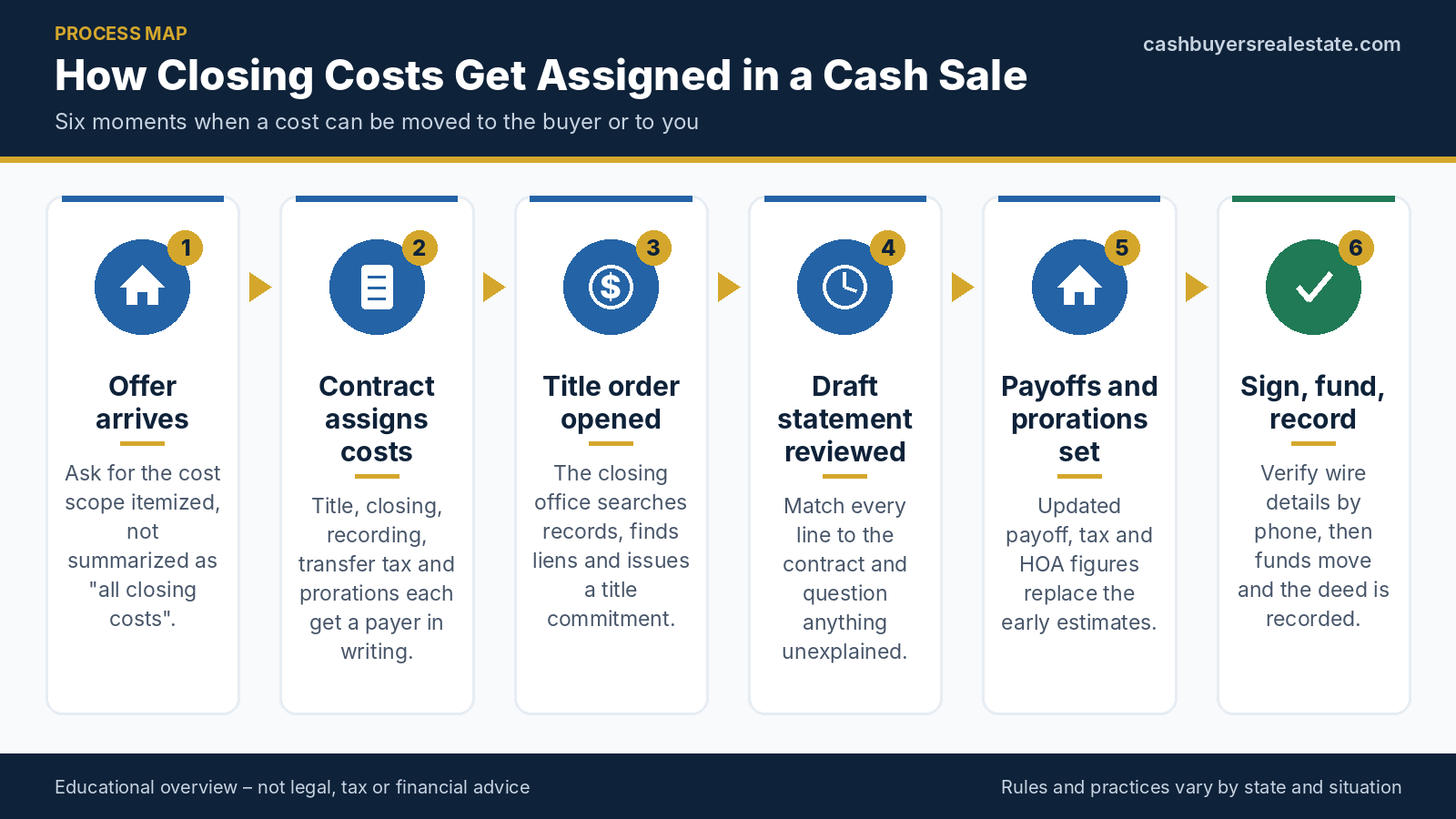
Text version of this infographic
- Offer arrives — Ask for the cost scope itemized, not summarized as "all closing costs".
- Contract assigns costs — Title, closing, recording, transfer tax and prorations each get a payer in writing.
- Title order opened — The closing office searches records, finds liens and issues a title commitment.
- Draft statement reviewed — Match every line to the contract and question anything unexplained.
- Payoffs and prorations set — Updated payoff, tax and HOA figures replace the early estimates.
- Sign, fund, record — Verify wire details by phone, then funds move and the deed is recorded.
The remaining line items
Beyond taxes and title, a handful of smaller charges appear on nearly every statement. Individually they are modest, but together they can add up to several hundred or a couple of thousand dollars, and they are where a vague “buyer pays closing costs” sentence either helps or leaves a gap.
Recording, survey, inspection, and attorney fees
Recording is the simplest. The county charges a fee to record the deed, and the American Land Title Association’s consumer site says the buyer usually pays the fees for legally recording the new deed, while noting that who pays can depend on the sale agreement. Seller-side recording is a different matter: if a mortgage satisfaction, a corrective affidavit, or a release of an old lien must be recorded to clear title, that cost typically belongs to the seller, because it is the seller’s obligation to deliver the title promised in the contract. Recording fees are set by the county, often per page, so they vary but are rarely large.
Surveys, inspections, and similar due-diligence items follow the party who wants them. The same ALTA page says survey fees are usually the buyer’s but sometimes paid by the seller. Home inspections, pest inspections, and septic or well tests ordered during an option or inspection period are generally the buyer’s expense, since the buyer is the one deciding whether to proceed; the question of when investors inspect at all is addressed in the guide on whether cash buyers require inspections. If the contract promises that the seller will provide a survey, a certificate of occupancy, or a municipal compliance letter, those costs belong to the seller by virtue of the promise, even though the buyer asked for them.
Attorney fees depend on the closing system. In a state where attorneys conduct closings, someone has to pay the closing attorney, and the contract should say whom. In escrow-and-title-company states, a seller who hires a lawyer to review the contract pays that lawyer directly, and the cost never appears on the settlement statement unless the lawyer is paid through closing. Courier, notary, wire, and mobile-signing fees are small but real, and they are commonly assigned to whichever party made the request that created them. A useful rule of thumb is that the party who asks for an extra service pays for it unless the contract says otherwise.
A line-item allocation table
The table below pulls the lines together into one reference. It describes what usually happens, not what must happen, and the “negotiable” column reflects whether the contract is free to reassign the cost, not whether the buyer will agree. Use it as a checklist when reviewing an offer: for each row, find the contract sentence that covers it, or note that the contract is silent and ask the closing office what the local default is.
| Cost line | Customary payer | What moves the answer | Open to negotiation? |
|---|---|---|---|
| Owner’s title insurance premium | Seller in some regions, buyer in others | State law, county habit, regulator-set rates in some states | Yes, by contract |
| Title search and examination | Usually bundled with the policy and paid by the same party | Title company pricing and local practice | Yes |
| Closing, settlement, or escrow fee | Divided between the sides or assigned to one, depending on place | Escrow versus attorney closing, office fee schedule | Yes |
| Transfer or documentary tax | Varies; some statutes name a payer, others make parties jointly liable | State and local law, exemptions | Allocation yes; the tax itself no |
| Recording of the new deed | Buyer, usually | County fee schedule, contract | Yes |
| Recording of lien releases and corrections | Seller | Obligation to deliver clear title | Rarely |
| Prorated property taxes and assessments | Each side for its own days of ownership | Billing calendar, proration method in the contract | Method yes; the bill itself no |
| Association certificate, transfer, or capital fees | Often the seller for the certificate; transfer fees vary | Statute, governing documents, management company | Partly |
| Mortgage payoff and release | Seller | Lender payoff statement and per-diem interest | No |
| Survey | Buyer, usually; sometimes seller | Contract promise, title requirements | Yes |
| Agent commission, if any | Whoever agreed in a signed agreement; none in a direct sale | Listing or buyer-agent agreement | Yes, before signing |
| Courier, notary, and wire fees | The party that requested the service, often split | Closing office policy | Yes |
The second column should be read as a starting guess, not as a promise. The third column explains why the guess might be wrong: if your state is an attorney-closing state, a regulator sets the title premium, or an association has its own fee rules, the entry changes. Notice also how many rows end in “yes.” That is the underlying reality of a cash sale: most of the money is movable by contract, and the few fixed lines are the ones set by governments, lenders, and associations. In practice that means the sensible order of attention runs from the biggest movable lines to the smallest, starting with the owner’s policy and the transfer tax, then the closing fee, then the small items, and it means the questions worth asking are about assignment, not about amounts. A seller who learns to read an offer this way tends to notice quickly when a buyer’s cost language touches only the cheap rows of the table and leaves the expensive ones untouched.
Illustrative example (hypothetical numbers, not market data): A homeowner is selling a $247,000 house, and the buyer’s one-page offer is silent on the owner’s title policy. The title premium on that price is hypothetically $1,380. If the house sits in a county where sellers customarily buy the policy, the closing office will place the $1,380 on the seller’s side of the statement. If it sits in a county where buyers customarily buy it, the line lands on the buyer’s side. The seller’s net differs by $1,380 between those two counties on an identical contract, and nothing about the buyer’s cash status explains it. Had the seller asked one question before signing, “Who pays the owner’s policy here, and is it written in the contract?”, the surprise would have been avoided or the cost negotiated.
When an Offer Says the Buyer Pays All Closing Costs
Few phrases in cash-offer marketing are as common or as loosely used as the buyer paying “all” closing costs. It appears in mailers, on websites, in text messages, and in the first line of emailed offers, usually without a definition. Because it sounds like a benefit stacked on top of the price, sellers often treat it as one. Whether it is depends on what it covers and on how the number it travels with was built.
Reading the promise closely
Before comparing anything, a seller needs to know what the sentence obliges the buyer to do. That means looking past the marketing phrase to the contract language that implements it, and noticing that the same four words can describe three quite different arrangements.
Three things the phrase can mean
The narrowest meaning is the one that the phrase has always carried in conventional real estate: the buyer pays the buyer’s closing costs. In that reading, nothing is being given to the seller; the buyer is simply stating that they will cover their own title, recording, and similar charges, and the seller will cover theirs. It is accurate, and it is not a concession. Sellers who hear it as a gift sometimes accept a price lower than they would otherwise because they believe a cost has been lifted from them.
A broader meaning is that the buyer will pay both sides’ ordinary transaction charges, typically the title and escrow or closing fees, the owner’s policy where the seller would customarily buy it, and recording. That is a concession with a measurable size, often between a few hundred and a few thousand dollars depending on the local fee schedule and the price. The broadest and least common meaning is that the buyer pays every charge on the statement that is not a debt of the seller’s, including a transfer tax that would otherwise be the seller’s. Each of these is legitimate, and each deserves to be written in the contract as a list. A fourth possibility is less friendly: the buyer “covers” the costs up front and then deducts them from the proceeds, so that the seller pays them anyway. That reading is unusual in a clean deal, but the ambiguity is the reason to insist on an itemized sentence.
The practical test is simple. Ask the buyer to put in the contract a sentence that names the items they will pay, such as “Buyer will pay the owner’s title policy premium, the closing or escrow fee, and all recording fees for the deed.” If the buyer resists listing items, that is useful information, because a promise that cannot be itemized cannot be enforced. A reasonable buyer who really intends to cover your costs will be glad to say which costs, for the same reason you want it written: it prevents arguments at the table. For a deeper look at how contract language works in these sales, see the guide to the cash home buyer contract.
What the phrase rarely covers
Even a generous version of the promise leaves several categories untouched, and the seller should know them in advance. The mortgage payoff and any other lien payoff are debts of the seller; no buyer pays them on top of the price, since the price is what funds them. Prorated property taxes, association dues, and utilities for the days the seller owned the property belong to the seller, and a phrase about “closing costs” does not usually reach them. Real estate agent compensation, when an agent is involved, follows its own written agreement. Costs to cure title defects, such as paying off an old judgment or recording a corrective deed, are generally the seller’s obligation under the promise to deliver the title described in the contract.
Two further gaps are worth anticipating. Transfer taxes are the first: depending on the state, a statute may name the seller as the responsible party, and a buyer who says “I pay all closing costs” may or may not consider the tax a closing cost. The second is the repair or credit adjustment that sometimes follows an inspection. Some investor contracts allow a price reduction after the buyer sees the property, and that reduction can absorb whatever the closing-cost promise appeared to deliver. These patterns do not prove anything about a buyer, and many buyers perform exactly as promised. They show why the phrase, in isolation, tells you very little.
How costs move into the price
The reason this phrase deserves attention is that closing costs and price are not independent. A buyer with a fixed budget treats everything it pays as one pool, and the way the pool is divided between “price” and “costs” changes how generous the offer looks without necessarily changing what you receive.
The buyer’s all-in budget
Investors, like any other buyers, think in terms of a ceiling. They decide what the property is worth to them, subtract their planned repairs, holding costs, and profit target, and arrive at a total they are willing to spend to own it. That total includes the price they pay you and the costs of the transaction on their side. If they agree to absorb additional costs that would otherwise be yours, those costs come out of the same ceiling, and the maximum price falls by the same amount. This is the same economic logic that the CFPB describes from the other direction when it explains that a seller who agrees to give a credit toward a buyer’s closing costs will usually require a higher price for the home. Costs and price move together because both come from the same pocket.
Illustrative example (hypothetical numbers, not market data): A buyer’s all-in ceiling for a house is $223,000, including the price and the buyer’s own title, closing, and recording charges of $3,200. The seller’s customary costs, such as the owner’s policy, half of the closing fee, and the transfer tax, would be $4,300. If the buyer pays only their own costs, the highest price they can offer is $219,800 ($223,000 minus $3,200), and the seller pays $4,300, so the seller keeps $215,500 before the mortgage payoff. If the buyer instead pays both sides’ costs, the highest price is $215,500 ($223,000 minus $3,200 minus $4,300), and the seller pays nothing at closing, so the seller still keeps $215,500. The second offer looks lower on paper and feels better at the table, yet the money in the seller’s hands is identical. If the buyer’s promise misses one item, say a $600 association fee, the seller’s real net drops to $214,900.
The example is deliberately symmetrical, which is the most important lesson. When a buyer’s ceiling is the real constraint, “pay all closing costs” is a repackaging of the price and not an additional benefit. It does not follow that the packaging is irrelevant. Taxes computed on the stated price are slightly lower when the price is lower, so a structure with a smaller price and larger buyer-absorbed costs can reduce a percentage-based transfer tax a little. Some sellers also prefer the clarity of a clean number with no costs, while others prefer a higher price because it is easier to compare with listing alternatives. But anyone who sees a lower price with “all costs paid” and assumes the buyer has been more generous than a competing buyer with a higher price and a normal split is probably comparing the wrong figures.
Where a buyer’s ceiling is not binding, the story changes. A buyer with deep margins on a particular property may be willing to absorb costs without reducing the price at all, particularly when the property is easy to resell. Conversely, a buyer working with a tight margin may reduce the price by more than the absorbed costs, because the sentence in the offer is an opportunity to look generous. You cannot tell which case you are in from the sentence. You can tell from the arithmetic of the net.
Comparing offers on net proceeds
The only way to compare offers with different structures is to build the same statement for each. Start from the contract price, subtract the seller-side costs that the specific contract assigns to you, subtract the items that are yours regardless of structure, such as proration and the mortgage payoff, and compare the final number. The net-sheet method is simple, and doing it for each offer removes most of the confusion that cost language creates. The companion guide on net proceeds from a cash offer walks through the broader version, including repairs and timing.
| Line item | Offer A: higher price, customary split | Offer B: middle price, buyer pays listed title costs | Offer C: lowest price, buyer pays everything listed as closing costs |
|---|---|---|---|
| Contract price | $246,000 | $241,500 | $238,000 |
| Owner’s title policy | -$1,320 | Buyer pays | Buyer pays |
| Seller’s half of closing fee | -$540 | Buyer pays | Buyer pays |
| Transfer tax at assumed 0.5 percent | -$1,230 | -$1,208 | Buyer pays |
| Seller’s share of prorated taxes | -$1,150 | -$1,150 | -$1,150 |
| Lien release recording and payoff fees | -$95 | -$95 | -$95 |
| Mortgage payoff | -$118,400 | -$118,400 | -$118,400 |
| Estimated net to seller | $123,265 | $120,647 | $118,355 |
In this stylized comparison, the offer with the most generous-sounding cost promise has the lowest net, because the price was reduced by more than the costs it absorbed. The offer with the highest price and no promise at all comes out ahead by $2,618 over the middle offer and $4,910 over the lowest. Different numbers could flip the order, and no pattern here is a prediction; the table shows the method. Also notice that the rows that do not change from column to column, the proration, the payoff fees, and the mortgage payoff, are the same in every offer, which is why they are easy to forget and why a single missing line makes a comparison misleading.
To use this approach on a real offer, ask each buyer to confirm the cost items in writing, ask the closing office for a rough statement for each structure, and add the factors the table leaves out: the likelihood that the buyer actually closes, any repair deductions, the timeline, and your own carrying costs while you wait. A cash offer that is $2,000 lower but closes with certainty in two weeks may be worth more than a higher offer that can fall apart in a third week. Net proceeds is a necessary comparison, not a sufficient one.
Credits, Concessions, and Commissions in a Cash Sale
Once the basic cost lines are understood, the next layer of complexity comes from the adjustments that buyers and sellers make on top of them: credits toward costs, price reductions framed as concessions, commissions to agents, and fees that a middleman collects from the transaction. Each of these moves money between the parties, and each tends to be described in a way that makes the effect on the seller less obvious than it is.
Seller concessions and how they are priced
A concession is anything the seller gives up to make a deal work other than the price on the first line. In a financed sale, concessions are mostly credits toward the buyer’s closing costs. In a cash sale the vocabulary is looser, but the mechanics are the same, and the pricing logic behind them is the same too.
Credits in financed and cash deals
In conventional home sales financed by a mortgage, a seller credit toward the buyer’s closing costs is a familiar negotiating tool. The CFPB explains the economics plainly: a buyer can ask the seller for a credit, but the seller will usually require a higher price for the home, so the buyer still pays through the loan. Lenders and loan programs often place their own limits on how much of the buyer’s costs a seller may contribute, and an appraiser may need to account for a credit when valuing the property. Those limits belong to financed deals; a cash buyer faces no lender cap, so the negotiation is wide open and governed only by what the two parties are willing to sign.
That freedom can work in either direction. Retail cash buyers, such as a family moving from another city who happens to be paying with proceeds from a previous sale, sometimes ask for a credit because they would like to preserve cash for moving costs. Some investors prefer a price reduction to a credit, because a lower price reduces the amount they must fund and keeps the paperwork simple. If a seller lists the house with an agent and receives a cash offer, the National Association of REALTORS® notes that since the August 2024 practice changes, sellers can still offer buyer concessions, such as help with closing costs, even though offers of compensation to buyer agents may no longer appear on the multiple listing service.
Whatever the buyer calls it, a credit is a reduction in your net, dollar for dollar. A $4,000 credit that appears in a cash deal reduces your proceeds by the same amount as a $4,000 lower price, with a few secondary differences in tax computation and in how a lender, an appraiser, or a later buyer might view the record. The question to ask is not whether a concession is acceptable in principle, but whether it is the cheapest way for you to get the deal done, and whether the buyer will accept an alternative, such as a price reduction of the same size, that is simpler to document.
Concessions, price cuts, and the tax picture
Because a credit and a price reduction of the same size leave you with the same cash, sellers sometimes assume the two are interchangeable. They are close, not identical. A price reduction lowers the stated consideration, which slightly lowers any transfer tax calculated from it, as the New York and Florida agencies describe their taxes as based on consideration. A credit leaves the stated price intact and moves the adjustment onto the settlement statement as a separate line. The practical difference is a few dollars of tax in most cases, though in a high-rate jurisdiction on a large credit it can be noticeable, and it can matter to how a later buyer, a lender, or a county assessor interprets the sale price.
The income tax treatment is a separate question that depends on your facts and deserves a professional’s attention. The IRS explains in its guidance on selling a home that selling expenses, such as commissions, legal fees, and other costs of selling, reduce the amount realized from the sale, and that taxes the buyer pays on your behalf are added to the sale price. Many sellers of a primary residence exclude some or all of their gain under the rules the IRS describes, but those rules have ownership, use, and amount conditions, and a rental or inherited property follows other rules. How a particular credit should be reported is a question for a tax professional, and a seller who expects a taxable gain should ask before signing and not after the year closes.
Illustrative example (hypothetical numbers, not market data): A retail buyer paying cash for a $212,000 house has an inspector’s estimate of $5,800 to replace a failing furnace. The buyer offers three ways to settle it: the seller gives a $5,800 credit at closing, the seller lowers the price to $206,200, or the seller replaces the furnace beforehand for a quoted $4,600. The credit and the price reduction both leave the seller with $5,800 less, ignoring small tax differences. The replacement route costs $4,600 up front but must be finished before closing and may reveal other issues. The seller who compares only the headline price would see the price reduction as a “lower offer” and the credit as “just a closing item,” yet they are economically the same, and the cheapest of the three on these assumptions is the one that requires the seller to do the work.
Five common ways of structuring a sale each handle these costs differently, and they are worth laying side by side because the choice among them shapes everything about closing costs. A direct cash sale with the customary split leaves you paying the lines your local custom assigns to the seller. A direct cash sale in which the buyer pays a listed set of costs usually comes with a lower price. A cash offer received through a listing agent adds the commission you agreed to pay. A conventional listing with a financed buyer adds both the commission and the possibility of buyer-requested credits. And a light repair followed by a listing trades up-front work and time for a higher potential price. The options graphic that follows compares them on what each is best for and what it costs.
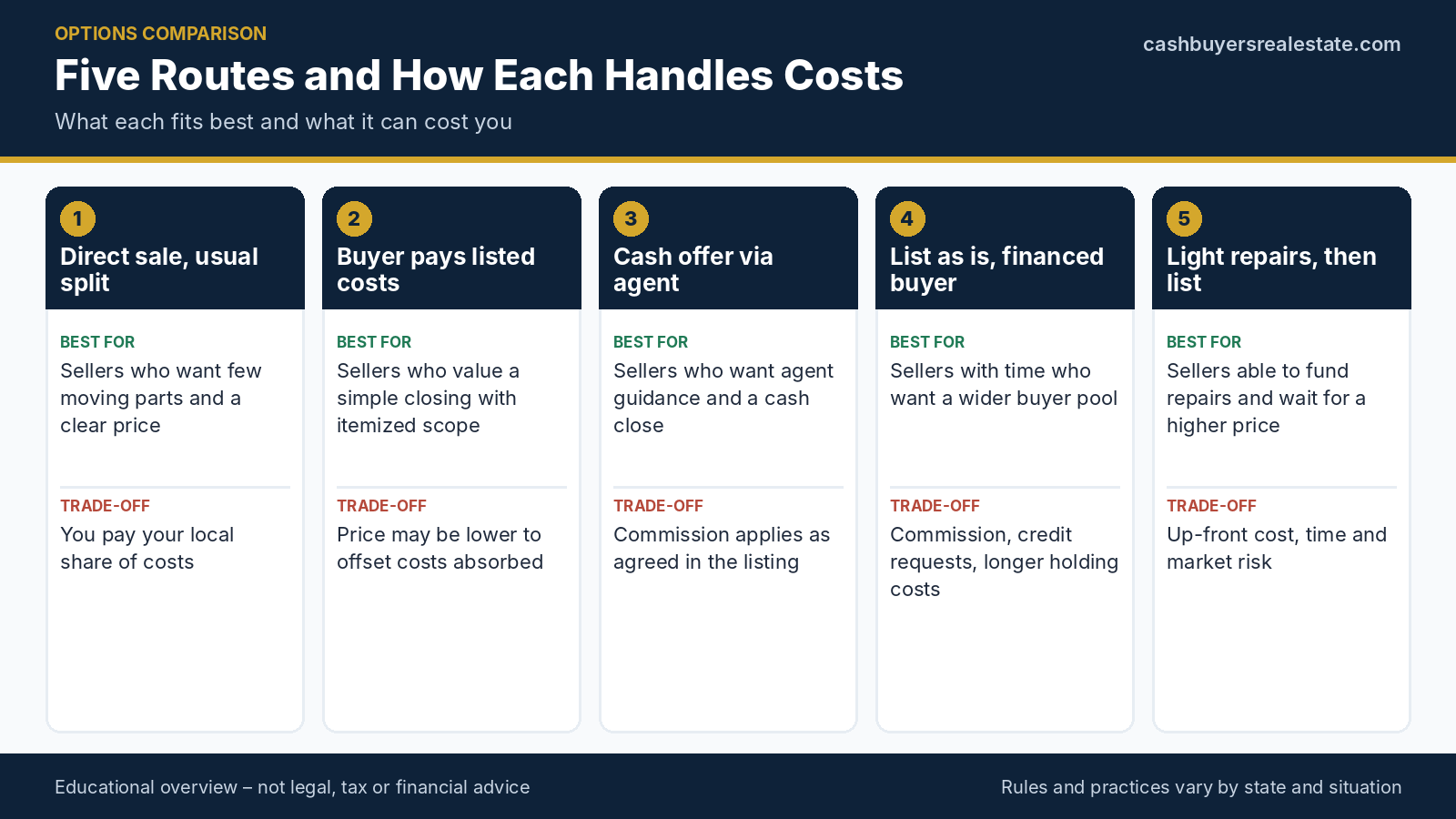
Text version of this infographic
- Direct sale, usual split — Best for: Sellers who want few moving parts and a clear price. Trade-off: You pay your local share of costs.
- Buyer pays listed costs — Best for: Sellers who value a simple closing with itemized scope. Trade-off: Price may be lower to offset costs absorbed.
- Cash offer via agent — Best for: Sellers who want agent guidance and a cash close. Trade-off: Commission applies as agreed in the listing.
- List as is, financed buyer — Best for: Sellers with time who want a wider buyer pool. Trade-off: Commission, credit requests, longer holding costs.
- Light repairs, then list — Best for: Sellers able to fund repairs and wait for a higher price. Trade-off: Up-front cost, time and market risk.
Commissions and middleman compensation
Beyond credits, two other forms of compensation can sit inside a cash transaction, and both are easy to overlook because they are not always labeled as closing costs. One is the commission of a licensed agent. The other is the fee, or the spread, that a contract wholesaler earns by passing the deal to another buyer.
When a real estate agent is paid
In a direct sale between a homeowner and an investor with no agent on either side, there is no commission, and the line does not appear on the statement. In a listed sale, a commission exists because the seller signed a listing agreement, and its amount is whatever that agreement says. The title industry’s consumer site describes the real estate commission as usually paid by the seller and typically calculated as a percentage of the sale price, which describes the traditional practice. Since the NAR settlement practice changes took effect on August 17, 2024, the association states that agent compensation for buyers and sellers continues to be fully negotiable, that offers of compensation are no longer allowed on its multiple listing service platforms, and that buyers working with an agent who uses a multiple listing service must sign a written agreement stating the agent’s pay before touring a home.
For a seller receiving a cash offer, those rules translate into three practical questions. If you listed with an agent, what does the listing agreement say about the commission when the buyer pays cash, and does it change if the buyer is unrepresented or represented by an agent who has a separate written agreement with the buyer? If the buyer has an agent, is the buyer paying that agent directly, or is the buyer asking you to cover it as part of the offer? And if you did not list, is anyone on the other side claiming a fee for introducing the deal? A commission is negotiable before you sign an agreement and much harder to change afterward, so the best time to ask is at the beginning.
Cash does not make a commission smaller or larger in itself. What cash changes is the buyer’s certainty, which an agent may cite when negotiating, and the timeline, which can shorten the period of agent services. Some sellers negotiate a reduced rate or a flat fee on the logic that a cash buyer reduces the agent’s workload, while others find the service they need is the same regardless of the buyer’s funding. Either way, the number that matters is the one in the signed agreement, not the one in conversation.
Assignment fees and the wholesaler’s spread
A wholesaler is a person or company that signs a contract to buy a property and then sells the contract, or assigns it, to another buyer for a fee, without ever intending to own the house. Their compensation is the difference between the price in their contract with you and the price at which they place it with the end buyer. That difference is not a closing cost in the usual sense; it does not appear as a line on your side of the statement. It shows up as a gap between the price you accepted and the price the end buyer pays, and you can see it only if the documents are disclosed or the closing office reveals the second transaction.
Several features of this arrangement affect cost allocation. If the end buyer pays the assignment fee, it appears on the buyer’s side or in a separate agreement, and the cost has effectively been absorbed in the price you accepted. If the wholesaler instead closes twice, buying from you and selling immediately to the end buyer using that buyer’s funds, there may be two sets of title and closing charges on the same day, and each side of that chain must decide which transaction bears which fee. Rules about disclosing an intent to assign, about licensing, and about advertising vary by state, so the right move is to ask in writing whether the buyer intends to buy the property personally or to assign the contract, and to read the contract’s assignment clause before signing.
None of this makes assignment improper, and many sellers receive acceptable offers from buyers who assign. The reason to understand it in a discussion of closing costs is that an offer built on a thin spread can look just like an offer from a buyer who intends to renovate and keep the house. The deeper arithmetic of how an investor sets a number is covered in how cash buyers calculate offers, and the trust questions that follow from it are part of the guide on whether cash home buyers are legitimate.
Seller-Side Costs That Stay With the Seller, Whoever the Buyer Is
A good deal of the confusion around who pays closing costs comes from treating every deduction on the settlement statement as a fee. Some of the largest deductions are not fees at all. They are repayments of debts, adjustments for time, or compliance steps that attach to the seller by the nature of ownership, and no buyer, however generous, takes them over. Knowing which items fall into this group lets you separate genuine concessions from obligations that were always going to be yours.
Debts and obligations tied to the property
Sellers who own with a mortgage or other liens typically find that the biggest line on their settlement statement has nothing to do with closing costs. These items travel with the property, and the title search will find them whether or not the seller mentions them.
Mortgage payoff, liens, and release fees
If you have a mortgage, your lender will provide a payoff statement showing the principal balance, accrued interest, and any fees, usually good through a specified date with a daily interest amount added for each day beyond it. The closing office orders this statement, applies it on closing day, and wires the money to the lender from the buyer’s funds. The payoff comes out of your proceeds, so it reduces your net as surely as any fee does. Because interest accrues daily, a closing that slips by a week costs a few extra days of interest, which is one of the less visible ways delay becomes expensive. The mortgage lender also records a satisfaction or release of the lien after payoff, and in some places the county charges a recording fee for that document, which may be charged to the seller on the statement.
Other liens work the same way. A judgment lien from an unpaid court award, a tax lien, a lien for unpaid association assessments, a contractor’s lien, or a lien for code enforcement penalties will usually be discovered in the title search and must be paid or otherwise resolved for the buyer to receive the clear title the contract promises. The practical effect is that unexpected liens are paid from your proceeds, which is why a title review before accepting an offer is worth more than most sellers expect. When the total of all payoffs and costs exceeds the sale price, the sale cannot close in the ordinary way without extra cash, a lender agreement to accept less, or a different route altogether. That situation is discussed in the guides on selling while still carrying a mortgage and on selling quickly with liens.
Cash buyers can sometimes help in these situations in a structural way, for example by agreeing to a closing that pays off liens from proceeds and by moving quickly to meet a lender’s payoff deadline. They do not make the debts disappear. A buyer who says “the closing costs are on me” is not agreeing to pay a judgment against you, and a seller who assumes otherwise can be surprised by a payoff line that dwarfs every fee in the contract.
Property taxes, assessments, and prorations
Property taxes are billed on a calendar that rarely matches the day you sell, so the closing office adjusts them. The adjustment, called a proration, assigns to each party the taxes for the days that party owned the property. Whether you owe the buyer a credit or the buyer owes you one depends on how the local tax system bills: in places where taxes are paid in arrears after the year is over, the seller usually credits the buyer for the days of ownership that remain unpaid; where they are paid in advance, the seller may receive credit for the portion the buyer will enjoy. Condominium and association dues, special assessments, and some utilities follow similar logic. The method used, such as a 365-day year or a 360-day year with 30-day months, is a contract term and is occasionally negotiated.
Illustrative example (hypothetical numbers, not market data): A house closes on June 18 in a non-leap year, and the annual property tax of $4,380 is paid in arrears after year-end. Using a 365-day year, the daily rate is $12. The seller owned the property for 168 days before closing (151 days from January through May and 17 days in June), so the seller owes the buyer a credit of $2,016. The buyer will receive the full year’s bill later and has already received credit for the seller’s share. If the contract used a 360-day method with 30-day months, the daily rate would be about $12.17 and the seller would be charged for 167 counted days (five 30-day months plus 17 days), or roughly $2,032. A $16 difference is trivial here, but on a larger bill or with a different billing calendar the method can matter.
That example conceals two assumptions worth stating. It assumes the tax bill is known, and in many places the current year’s bill is not issued until after the sale, so the closing office estimates using the prior year, with a clause for re-adjusting later. And it assumes taxes are current. Delinquent taxes are a seller obligation; they are paid from proceeds at closing and often carry penalties and interest. Any buyer who offers to “handle taxes” should be asked precisely what is meant, since a buyer can handle taxes by paying them at closing and deducting the amount from your proceeds.
Association, tax-reporting, and withholding items
The last group of seller-side items arises from third parties who are not the buyer: homeowners associations, tax authorities, and in some cases federal anti-money-laundering rules. They cost little in most sales, but they affect timing, and when they apply, they can be surprisingly specific.
HOA estoppel certificates and transfer fees
When a property belongs to a homeowners or condominium association, the buyer’s closing office will typically ask the association for a certificate showing what is owed, whether any violations or special assessments are pending, and what the governing documents require of a new owner. States regulate these certificates differently. Florida’s statute on association estoppel certificates, for example, requires delivery within 10 business days of a written or electronic request, caps the base fee at $250 where no amounts are delinquent, allows an additional $100 for delivery within 3 business days when requested on an expedited basis, and allows an additional fee not exceeding $150 if the account is delinquent, with the fees adjusted every five years for inflation. The statute states that if a sale or mortgage closing does not occur, the fee is refunded to the payor and the refund is the parcel owner’s obligation.
The statute does not say who must pay the fee at closing, which leaves the answer to the contract and to local custom. In many transactions the seller carries the certificate fee because the certificate documents the seller’s account, while a transfer fee or a capital contribution charged to a new owner is sometimes assigned to the buyer. Other states set different limits or none at all, and management companies can add their own charges for rush service or additional documents. Since the numbers in the Florida statute are subject to periodic adjustment, treat them as an illustration of how a statute can cap a fee and check the current figures if you are in that state.
Tax reporting, withholding, and entity-buyer rules
Three federal items can touch a cash sale without being closing costs in the ordinary sense. The first is information reporting. The IRS instructions for Form 1099-S say that the person responsible for closing the transaction generally files it, and that the closing person is determined by a defined order when no single person closes. For a principal residence, the instructions describe an exemption when the seller provides a written certification and the sale price is within the stated limits, which is why sellers are often asked to sign a certification at closing. It is paperwork and not a charge, but it is another reason to read what you sign.
The second item is withholding when the seller is a foreign person. Under the rules the IRS explains in its guidance on dispositions by foreign persons, the buyer is in most cases the withholding agent, and the withholding rate is generally 15 percent of the amount realized, with an exemption when the amount realized is $300,000 or less and the buyer will use the property as a residence, and a reduced rate for sales between $300,000 and $1 million under that residence test. A seller who is a foreign person, including an heir living abroad, can apply for a withholding certificate on Form 8288-B to reduce or eliminate the withholding, and the IRS says it normally acts on a complete application within 90 days. The amount withheld is not a fee, but it can tie up a large part of the proceeds, so a seller in that position should raise it with a tax professional before accepting a closing date.
The third item is a federal reporting rule for certain non-financed purchases by entities and trusts, which has been in legal flux. FinCEN adopted a residential real estate rule that applied to reportable non-financed transfers to entities or trusts with closing dates on or after March 1, 2026. On March 19, 2026, a federal district court in Texas vacated the rule, and FinCEN’s updated frequently asked questions, issued on May 18, 2026, state that reporting persons are not required to file reports, or liable for failing to do so, while the court order remains in force. FinCEN appealed to the Fifth Circuit on May 11, 2026. The filing duty falls on a “reporting person,” usually the closing or settlement agent, not on the buyer or seller, though the parties to a covered transaction may be asked by the closing office for additional information. Because this area is changing, check FinCEN’s own page or ask the closing office whether anything has changed since this article’s research date in October 2026.
Negotiable Versus Fixed Costs, and Where Sellers Get Overcharged
Not every number on a settlement statement is up for discussion, and not every number that looks fixed really is. Telling the two apart is one of the most valuable skills a seller can bring to a cash offer, because it focuses effort where it can change the outcome and keeps you from arguing with a county recorder over a fee that only a county commissioner can change. It also makes it much easier to spot the line items that were never legitimate in the first place.
What can be negotiated and what cannot
Think of costs as sitting on a spectrum. At one end are amounts set by law, by a regulator, or by the facts of the property. At the other are items where the only constraint is what two parties agree to put in a contract. Most of the money in a closing-cost discussion sits in the middle, where a number is fixed but the question of who pays it is open.
Costs fixed by statute, regulator, or the facts
Transfer tax rates are set by statute or local ordinance, and no buyer or closing agent can lower them. What the parties control is the allocation, and sometimes the stated price on which the tax is computed. Recording fees are set by the county, usually per page or per document. Title insurance premiums are set by regulation in some states; as the Texas Department of Insurance explains, the department sets the premium rate there and every company charges the same, so the useful negotiation in that state is about who pays, not about shopping for a lower premium. In other states, rate filings allow more variation, and comparing quotes may save something. Association certificate fees may be capped by statute, as in the Florida example discussed earlier, and a statute that caps a fee also limits what a management company can bill.
The payoff of a mortgage is fixed by the lender’s payoff statement, and the daily interest figure is a function of the loan terms. Unpaid property taxes are what the taxing authority says they are. Prorations are arithmetic: given the tax bill and the closing date, the credit follows from the method chosen in the contract. In each of these cases, the seller’s leverage is not over the amount but over timing, accuracy, and verification. Request itemization, compare it to the original document, and ask the closing office to correct anything that does not match. Errors in payoff figures, tax dates, and per-diem calculations do occur, and they cost real money when they are not caught before disbursement.
Lenders also control some amounts the seller cannot negotiate with the buyer at all. A payoff letter is valid for a limited period, and if closing slips beyond the good-through date, the lender issues an updated figure. If the payoff includes fees such as a prepayment penalty permitted by the loan, the buyer’s cash does not change that. A seller who suspects an error in the payoff should contact the lender through a known phone number and ask for a written breakdown, rather than relying on the figure shown in an email forwarded by anyone else.
Costs open to negotiation
The flexible items are those where the contract has the final say. Who pays the owner’s title policy is the most prominent, followed by the choice of closing office, how the closing fee is divided, whether the buyer pays recording fees on the deed, whether a survey is required and by whom, and the proration method. The date of closing and possession are also negotiable, and they interact with costs: an earlier closing may reduce your carrying costs for taxes, utilities, and insurance, while a later closing may give you time to arrange a move without paying rent elsewhere. A seller who values a specific closing date can treat it as something the buyer is getting and ask for a cost concession in return, or the reverse.
| Cost | Fixed or flexible | Who sets it | Practical lever for the seller |
|---|---|---|---|
| Transfer tax rate | Fixed | State or local law | Negotiate who pays; verify the rate and exemptions with the closing office |
| Owner’s policy premium | Often fixed by rate filings; payer is flexible | State insurance regulator and title underwriter | Ask who pays; request a quote before signing |
| Closing or escrow fee | Flexible | Closing office | Ask for a written fee schedule; propose an even split or buyer payment |
| Recording fees | Fixed per document | County recorder | Confirm page counts and which documents are recorded |
| Mortgage payoff | Fixed | Lender | Request an updated payoff statement if the date moves |
| Prorations | Method flexible; arithmetic fixed | Contract and tax bill | Agree on the day-count method and re-adjustment clause |
| Association charges | Capped in some states; otherwise set by documents | Statute and governing documents | Order the certificate early; ask who pays each charge |
| Commission, if any | Flexible until signed | Written agreement | Negotiate before listing; ask what applies to a cash buyer |
The pattern in the table is that “fixed” lines can almost always be reassigned between the parties even when their amount cannot change, and that the most flexible lines are those controlled by a single office’s fee schedule. Sellers who concentrate on those two features will find the most room to improve their net. As a sanity check, a negotiation that spends an hour on a $75 courier fee while accepting a $1,400 title charge without a question has its priorities reversed.
Fee-shifting patterns that deserve questions
Most cash buyers and most closing offices perform honestly. Even so, certain cost patterns appear often enough in seller complaints and consumer-protection guidance to justify a short list of questions. None of them proves wrongdoing on its own, and many have innocent explanations. They are the patterns that, if you meet them, call for a calm request to see the source of the charge.
Charges that should prompt questions
The first group involves charges the buyer adds to the seller’s side that are not part of the ordinary list. Examples include a “processing,” “administrative,” or “transaction coordination” fee deducted from the seller’s proceeds without a contract clause that authorizes it, a lump-sum “closing costs” deduction with no itemization, and an owner’s policy charged to the seller when the buyer does not intend to buy one. Another group involves changes after signing: a price reduction after an inspection that was not discussed in the contract, a new “assignment” or “extension” charge, or an unexpected requirement to sign a document that will be recorded in the public record, such as a memorandum of contract, which an attorney should review before you sign.
| Pattern | Why it matters | A reasonable question |
|---|---|---|
| Lump-sum “closing costs” deduction with no breakdown | Hides which items you are paying and whether they match the contract | “Please send an itemized statement and the contract clause for each line.” |
| Fee for “processing” or “coordination” charged to the seller | May not be authorized by the contract or customary in your area | “Which clause allows this charge, and who receives it?” |
| Owner’s policy charged to you, but the buyer declines to buy one | You would pay for protection no one receives | “Will the buyer order an owner’s policy, and from which underwriter?” |
| Price lowered after signing without a documented reason | Can erase any closing-cost promise made in the original offer | “What in the contract permits this change, and what evidence supports it?” |
| Pressure to use a closing office you did not choose | Fees and independence of the closer are harder to check | “May I see the office’s fee schedule and licensing information?” |
| Request to sign blank or incomplete forms | Blank lines can be filled in later with terms you did not approve | “I will sign when every field is complete.” |
| Recorded document you do not understand | Public filings can affect your title and your ability to sell elsewhere | “What is the purpose of this recording, and can I have an attorney review it?” |
Read the table from the right column inward. In every row, the question in the third column can be asked politely, in writing, and without accusation, and the quality of the response often tells you more than the original charge. A buyer or closing officer who answers promptly with a clause number, a fee schedule, or a corrected statement is behaving as a professional would. One who deflects, creates urgency, or declines to put anything in writing has given you information that no website could. For a fuller treatment of contract-specific warning signs, see the guide to cash offer contract red flags.
Wire instructions and last-minute changes
The final category sits outside the cost lines and inside the money flow. Closing-fund fraud typically works by compromising an email account in the transaction chain and sending altered payment instructions that look like they came from a trusted party. The CFPB describes how scammers read real estate professionals’ messages to learn about upcoming closings and then send spoofed emails with changed wiring instructions. Most of the attention in this area goes to buyers wiring funds, but sellers face a version too: a message that appears to come from the closing office asking you to confirm or change the account where your proceeds will be sent.
The CFPB’s practical advice is consistent across its guidance: agree early with your closing office on how money will move, write down names and direct phone numbers before closing, and verify any change using contact details you already had. Do not click links or call numbers in an unexpected message, and keep sensitive financial details out of email where possible. Closing offices increasingly use secure portals and call-back verification, and sellers who ask about those procedures at the start of the transaction often find that the office welcomes the question.
A last-minute change can also be innocent: a corrected payoff, a revised proration, an updated tax bill. The test is whether the change can be traced to a document and explained by a person you can call at a known number. When the explanation arrives only as pressure to move fast, slowing down is a reasonable response. For a wider view of the scam patterns that surround cash offers, the trust hub on cash home buyer scams collects the main ones, and the checklist below summarizes the six habits that protect you in this part of the sale: verify who you are dealing with, ask for proof of funds, read the cancellation language, understand any assignment terms, use a reputable closing office, and never sign blank forms. Each of those habits is explained in its own guide, and the infographic that follows presents them as a quick decision checklist.
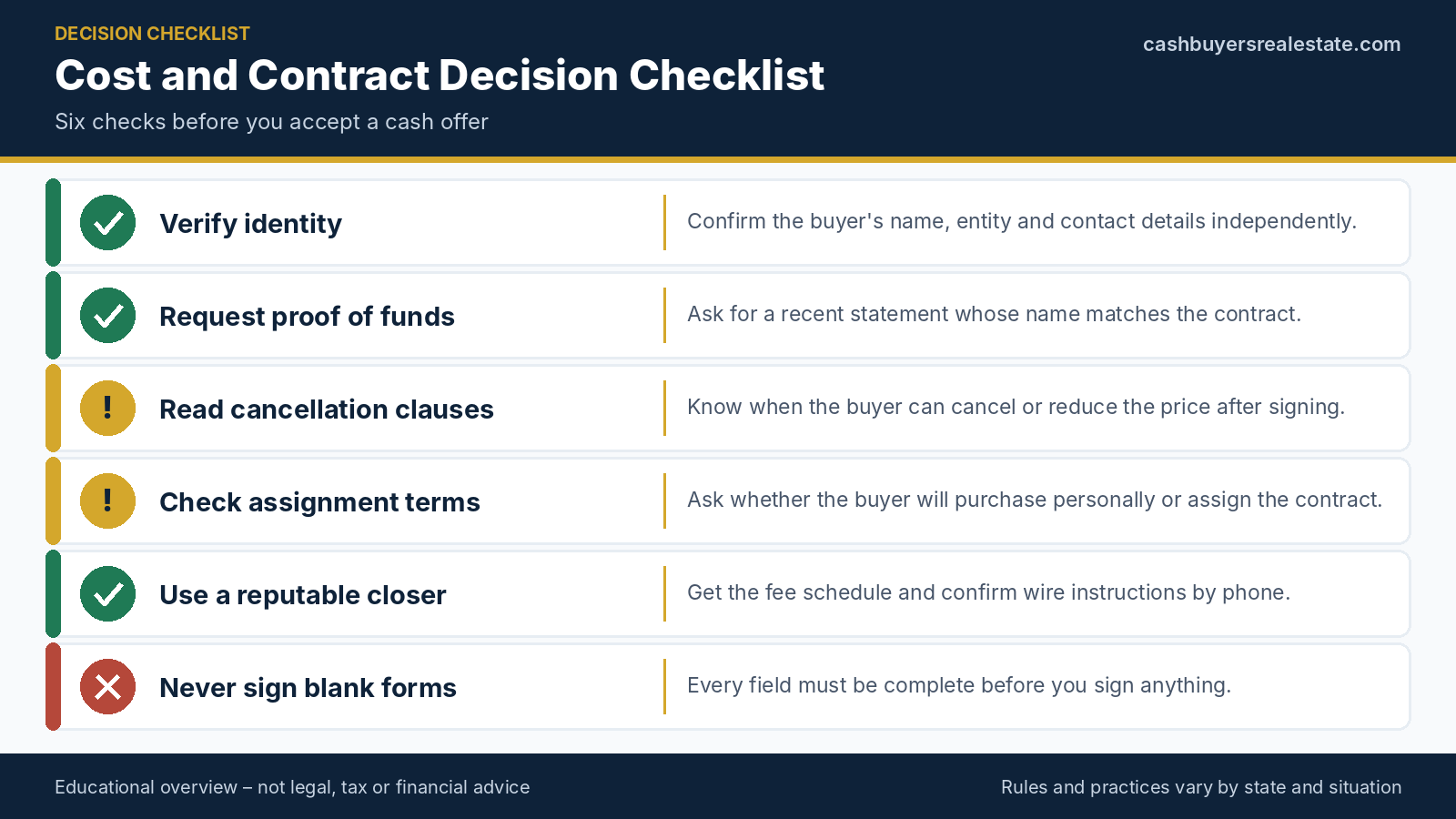
Text version of this infographic
- Verify identity — Confirm the buyer's name, entity and contact details independently.
- Request proof of funds — Ask for a recent statement whose name matches the contract.
- Read cancellation clauses — Know when the buyer can cancel or reduce the price after signing.
- Check assignment terms — Ask whether the buyer will purchase personally or assign the contract.
- Use a reputable closer — Get the fee schedule and confirm wire instructions by phone.
- Never sign blank forms — Every field must be complete before you sign anything.
Three Worked Scenarios Across Different Closing Systems and Routes
Abstract rules about who customarily pays what become useful only when they are run through numbers. This section builds three hypothetical net sheets: one in a state where a title or escrow company closes and the seller customarily buys the owner’s policy, one in a state where attorneys close and the buyer customarily buys it, and one comparing a direct cash sale with two ways of selling through an agent. All figures are invented for illustration and are not market data or a prediction for any property.
Net proceeds under two closing systems
The same cash offer can produce different seller costs depending on the closing system it lands in. The two scenarios below use deliberately different structures, so the contrast shows which lines move with the system and which stay put. In each, the buyer’s one-page offer says only that the buyer “will pay customary closing costs,” which, as the earlier sections showed, leaves the closing office to apply local default.
An escrow-state sale with a seller-paid owner’s policy
Picture a homeowner with a mortgage balance who accepts a cash offer on a house in a county where escrow companies close sales and the local custom is for the seller to purchase the owner’s policy. The offer lists a price and a closing date, promises that the buyer will pay “customary closing costs,” and says nothing else. When the seller later asks the escrow officer for a draft statement, the officer applies the county’s defaults, and the results are not what the seller pictured when reading the offer.
Illustrative example (hypothetical numbers, not market data): The contract price is $318,000 and the mortgage payoff is $142,600. The escrow officer assigns the following to the seller under local custom: an owner’s title policy of $1,780, half of the escrow fee at $620, a county transfer tax of $350, recording of the lien release at $85, and a prorated tax credit to the buyer of $1,640. The seller’s costs total $4,475, so the estimated net is $170,925 ($318,000 minus $142,600 minus $4,475). The buyer’s “customary closing costs” in this setting consist of the buyer’s own items, such as the other half of the escrow fee and the recording of the deed. Had the seller asked for the owner’s policy to be added to the buyer’s list before signing, the net would have been $172,705, which is $1,780 higher.
Two things stand out in this scenario. First, the seller was not misled by anyone; the phrase “customary closing costs” was accurate, and the local custom decided what was customary. The surprise arose because the seller assumed customary meant “the buyer’s side,” when in this county it meant “each side’s usual share.” Second, the most valuable action was available before signing: a single sentence in the contract assigning the owner’s policy to the buyer would have moved $1,780 across the table at no cost to anyone except the buyer’s ceiling, which, as the earlier example showed, may have changed the price offered. That trade-off is the actual negotiation, and it is better conducted with numbers than with adjectives.
An attorney-closing sale with a buyer-paid owner’s policy
Now consider a house owned free and clear, sold in a state where attorneys conduct closings and where, by local habit, the buyer pays for the owner’s policy. The seller has no payoff to make and hires a lawyer to review the contract and attend closing. The tax system in this hypothetical state assigns a transfer tax to the seller at a rate of 0.4 percent of the price, and there is a prorated tax credit for the buyer.
Illustrative example (hypothetical numbers, not market data): The contract price is $189,500 with no mortgage. The seller’s costs are an attorney fee of $850 for contract review and attendance, a transfer tax of $758 (0.4 percent of the price), and a $730 credit to the buyer for prorated property taxes. The buyer pays the owner’s policy, the buyer’s attorney, and recording of the deed. The seller’s costs total $2,338, and the estimated net is $187,162. If this seller had received an offer at $192,000 in a seller-pays-policy county with a $1,500 policy and a $768 transfer tax, the costs would have been $1,500 + $768 + $850 + $730 = $3,848, and the net would have been $188,152, only $990 higher than the $187,162 net from the $189,500 offer despite a headline price $2,500 higher.
The second scenario shows how a modest-looking headline difference shrinks when costs differ by system. A $2,500 higher price in a seller-pays-policy setting produced less than $1,000 more in the seller’s pocket, because the policy, the additional tax, and the same fixed items absorbed most of the difference. It is a small illustration of why friends’ advice from another state can mislead: a seller who hears “my buyer paid everything, and I netted almost the price” may be describing a place where the system, not the buyer’s generosity, did the work. A seller receiving advice from a family member in another state should translate it into the local system by asking the closing office to run the same numbers.
Cash compared with the alternatives
Cash offers deserve an honest comparison against the routes that do not involve a direct cash sale, because closing costs are only one input to the decision. Sometimes a direct sale yields the best net, and sometimes it does not. Which one is better for a given seller depends on condition, timing, debts, and tolerance for uncertainty.
Listing with an agent versus a direct cash sale
The traditional route gives access to the broadest pool of buyers, which often means a higher contract price, but it adds a commission, usually larger seller-side closing costs, possible buyer-requested credits after inspections, and a longer carrying period. A direct cash sale gives up potential price in exchange for fewer moving parts, a quicker closing, and certainty about condition, since the buyer typically takes the property as is. Neither is universally better, and the comparison turns on arithmetic that includes costs that never appear on a settlement statement, such as three more months of mortgage interest, taxes, insurance, and utilities. The guide on cash sale versus traditional sale net proceeds walks through those comparisons in more depth, and the broader question of timing is addressed in cash sale versus listing for a fast sale.
| Route | Contract price | Commission and closing costs | Repairs, credits, and holding costs | Estimated net before payoff |
|---|---|---|---|---|
| Direct cash sale, as is, quick close | $245,000 | $3,900 | $0 | $241,100 |
| List as is with an agent | $268,000 | $18,200 | $5,700 (a $3,000 credit and $2,700 holding costs) | $244,100 |
| Repair, then list | $289,000 | $19,550 | $19,000 (repairs plus $4,500 holding costs) | $250,450 |
The table is built so that the three nets are closer to each other than the three prices, which is the usual shape of these comparisons. The direct sale gives up about $3,000 relative to listing as is and about $9,350 relative to repairing first, in exchange for a shorter timeline and none of the work or uncertainty. Whether that exchange is worthwhile depends on factors the table does not capture: the seller’s ability to front $14,500 in repairs, a deadline created by a job change or an estate, the chance that the listing sits longer or sells for less than assumed, and the risk that the cash buyer reduces the price after an inspection. A seller who compares only the prices in the second column would conclude the repair route is $44,000 better, which is not the story the last column tells.
Light repairs, retail buyers, and the middle path
Between a direct investor sale and a full renovation lies a middle ground that many sellers overlook. A seller can make inexpensive repairs, such as fixing a leaking faucet, clearing debris, and replacing missing hardware, and then market the property as is to a broader audience that includes retail buyers who pay cash. Some retail cash buyers, such as downsizers or relocating families, are willing to pay more than an investor because they intend to live in the house and are not building a resale margin. A seller can also solicit more than one cash offer and compare structures, including the cost language, to learn how much of the spread between offers comes from price and how much from cost allocation. The guide on selling a house fast without repairs covers the as-is path in detail.
Whatever route you choose, your legal disclosure duties remain. Most states require sellers to disclose certain known defects in some form, and a cash sale does not remove that duty because the buyer is paying cash or buying as is. State rules about what must be disclosed, on which form, and with what consequences differ, so ask a local real estate attorney or your closing office what applies. Concealing a known material defect to secure a quicker or higher offer exposes the seller to claims after closing, and no allocation of closing costs offsets that risk.
The broader point of the three scenarios is that the number that matters is the amount that reaches your account after every line has been applied, and that it comes from the interplay of price, system, condition, and timeline. The guide to selling a house fast places these routes in the larger context of speed-driven decisions. Sellers who run the numbers on two or three structures before choosing seldom regret it, and those who skip the step often learn the arithmetic at the closing table.
Frequently Asked Questions About Cash Buyers and Closing Costs
The questions below come up repeatedly when sellers compare cash offers. The answers are intentionally brief and general; the earlier sections explain the reasoning, and your state’s rules and your contract’s wording govern in the end.
Do Cash Buyers Pay Closing Costs? Questions About Who Pays What
The first cluster covers the core issue of allocation, starting with the buyer’s side of the ledger and then turning to what a seller should expect to carry.
Questions about the buyer’s side
- Does a cash buyer pay closing costs on their own purchase?
Yes, a cash buyer pays the charges that belong to the buyer’s side of the transaction. Those commonly include their own attorney or closing fees where applicable, recording of the new deed, and any title charges the contract assigns to them. They avoid the lender-driven charges because there is no loan. The exact split between buyer and seller still depends on the contract and local custom.
- If an offer says the buyer pays all closing costs, do I receive the full price?
Not necessarily. The phrase usually covers specific transaction fees and does not reach your mortgage payoff, prorated property taxes, association charges, or often a transfer tax. In addition, a buyer working to a fixed budget may have lowered the price to offset the costs absorbed. Ask for the covered items in writing and build a net sheet before comparing.
- Do cash buyers pay for the owner’s title policy?
It depends on where the property is located and what the contract says. Regional custom varies widely, with sellers customarily paying in some areas and buyers in others, and the payer is negotiable in many states. Because no lender requires an owner’s policy in a cash purchase, ask whether the buyer intends to order one at all before agreeing to pay for it.
- Can I ask a cash buyer to pay the transfer tax?
You can ask, and the contract can assign it to the buyer, but the answer to your request will usually show up in the price. In some states the statute names the seller as responsible, and in others both parties are liable to the government regardless of the contract. Check your state revenue agency or county recorder to learn what applies, and ask the closing office to confirm the amount.
Questions about the seller’s side
- What closing costs does a seller usually pay in a cash sale?
Sellers typically face their mortgage payoff and lien releases, their share of prorated property taxes and association dues, any transfer tax assigned to them, and title or closing fees if local custom or the contract puts them on the seller. An association certificate and a commission, if an agent is involved, may also appear. The list is shorter than in many financed sales but rarely empty.
- Are my closing costs lower because the buyer pays cash?
The buyer’s costs are lower, because lender-related charges disappear. Your costs depend on the tax system, the closing system, and the contract, and they are often similar to those in a financed sale at the same price. Where cash does help is certainty and speed, which can reduce your carrying costs and the risk of a deal falling apart.
- Do I owe a real estate commission in a cash sale?
Only if you signed an agreement that provides for one. A direct sale between you and an investor with no agent involved has no commission line. If you listed the property with an agent, the listing agreement controls, and commissions are negotiable before you sign. The National Association of REALTORS® states that agent compensation continues to be fully negotiable.
- What happens to costs if the sale does not close?
It depends on the contract and on why the sale fell through. Contracts usually spell out who bears title-order cancellation charges, inspection expenses, and earnest money. Some statutes address specific fees; Florida’s association certificate law, for example, provides that the fee is refunded if a sale does not close. Read the cancellation and default clauses before signing, and ask what you would owe if either side withdraws.
Questions about timing, trust, and paperwork
The second cluster covers the process around the numbers: when you will see them, what to gather, and how to check that the person promising to pay is able and willing to do so.
Questions about timing and documents
- When will I see the final settlement statement?
Federal timing rules for the closing disclosure apply to mortgage transactions, and a title-industry summary of the CFPB’s interpretations says cash deals are not covered by that framework. That means timing is set by your contract, your closing office, and state practice. Ask for a draft statement several days before closing and compare it to the contract line by line.
- Which documents should I gather before closing?
Start with a recent mortgage statement and a request for a payoff letter, your most recent property tax bill, any association contact and governing documents, a copy of your deed or title policy, and government identification. If the property is held in an estate, trust, or company, add the authority documents that show who can sign. Having these ready shortens delays caused by missing paperwork.
- Can costs affect how quickly the sale closes?
Yes, indirectly. Slow association certificates, payoff errors, title defects discovered late, and disagreements over who owes a charge can all push a closing date. Resolving the cost allocation in the contract, and ordering third-party documents early, removes common causes of delay. The guide on closing timelines for cash buyers describes the usual sequence.
Questions about trust and verification
- How can I tell whether a buyer who promises to cover costs can actually pay?
Ask for written proof that the buyer has the funds, such as a recent bank or brokerage statement showing available balances, and confirm the closing office’s role independently. Compare the buyer’s name on the statement to the name on the contract. A fuller treatment is in the guide to proof of funds, which also explains what documents can and cannot prove.
- Is it a warning sign if the buyer wants to use their own title company?
Not by itself. Buyers commonly choose the closing office they work with regularly, and a professional office is neutral about the parties. Ask for the office’s fee schedule and licensing information, confirm its phone number independently, and ask how the fees will be divided. Practices differ by state, and in some places the seller has a say in the choice.
- Should I hire a real estate attorney for a cash sale?
In attorney-closing states, you will probably work with one anyway. In other states, a short consultation to review the contract can be inexpensive relative to the stakes, especially when the contract includes assignment language, extension fees, or cost provisions you do not fully understand. An attorney can also advise on disclosure duties and on any recorded documents. The choice is yours, and the cost is a fee between you and the lawyer.
Choosing a Route and Taking the Next Steps
Everything above comes down to one practical task: turning a promise about costs into a number you can compare, and then choosing the route that fits your situation, not the one with the most appealing headline. There is no single right answer for every seller. A cash sale is the best fit for some circumstances and a poor one for others, and the closing-cost allocation is one input among several.
Matching the route to your priorities
Start by deciding what you are optimizing for, because the priorities pull in different directions. A seller who needs a firm date within weeks is solving a different problem from one who can wait several months for a higher price, and the cost language that makes sense for one can be a poor fit for the other.
When speed and certainty come first
If you face a deadline, such as a job relocation, an estate that must be settled, a lease ending, or a payment you cannot keep making, speed and certainty may be worth some price. In that situation a direct cash sale with a clear contract is often the natural candidate, since a buyer without financing removes the appraisal and lender-approval steps that cause delays in many financed sales. The cost question becomes narrower: you want to know the date the money arrives, the net you will receive, and the probability that both hold. A buyer who offers a slightly lower price but agrees to itemize the cost scope, name the closing office, and show funds is often a better partner than a higher offer with vague terms.
In this situation, the most useful cost-related steps are to get the offer’s cost scope in writing, ask the closing office to run a draft statement at once, and order third-party documents, such as the payoff letter and any association certificate, immediately after the contract is signed. Sellers in a hurry sometimes skip the net sheet because the decision feels urgent, and that is the moment when it is most valuable. A ten-minute comparison of two offers can reveal a gap of several thousand dollars that no amount of urgency justifies leaving behind. Keep in mind that a firm deadline gives the buyer leverage, and a calm request for itemization is a reasonable way to keep the balance fair.
When net proceeds come first
If time is flexible, the comparison widens considerably, and the seller has the luxury of testing the market instead of reacting to the first number. You can obtain an agent’s market analysis, collect more than one cash offer, and estimate what light repairs would cost and return, then decide how much of the potential gain is worth the delay and the effort. The earlier table showed how three routes with very different prices can end up within a few thousand dollars of one another once commissions, repairs, credits, and holding costs are counted, and how a route that looks best by price may not be best by net. In this mode, the cost allocation is a tool to measure and negotiate, and it deserves a place in a spreadsheet beside the other variables.
| Your priority | Route that often fits | Cost issue to watch | First step |
|---|---|---|---|
| A firm date within a few weeks | Direct cash sale to a verified buyer | Vague cost scope; price changes after signing | Request an itemized scope and a draft statement |
| Highest net, flexible timeline | Listing with an agent, possibly after light repairs | Commission, credits, and holding costs | Build net sheets for two or three routes |
| Avoiding repairs and showings | Cash sale as is, direct or through a listing | Repair deductions that erase a cost promise | Ask how condition will be assessed and when |
| Clearing debts or liens | Either route, with a payoff plan | Payoffs that exceed the net | Order payoff letters and a title review |
| Selling from out of state or an estate | Either route with a responsive closing office | Authority documents, local custom you do not know | Ask the closing office to explain local defaults |
Use the framework as a starting point and remember that the rows overlap: most sellers have two or three priorities at once and must decide which one wins. The right column is the part that costs nothing and prevents most regret. If you find yourself uncertain after running the numbers, an hour with a local real estate attorney or a closing officer is usually inexpensive compared with the amounts at stake. It is also worth revisiting the framework after each new piece of information, since a title commitment that reveals a lien, a repair estimate that comes in higher than expected, or a second offer with a different cost structure can shift which row describes you best. Treat the table as a living checklist, not a verdict, and let the net sheet, not the label on the route, make the final call.
What to do next
With a route in mind, the remaining work is practical. Gather what you will be asked for, ask the questions that bring costs into the open, and decide in advance what would cause you to walk away from an offer.
Documents and numbers to gather
A prepared seller moves faster and negotiates better, because the facts that drive cost lines are already on the table. Most of the following can be assembled in an afternoon, and none requires paying anyone. The reason to do it before an offer is signed, instead of after, is that several of these items determine the largest lines on your statement. A payoff balance, a tax bill, and an association balance are the numbers that decide whether the sale nets what you expect, and discovering a surprise in one of them after you have committed to a date leaves you with little room to adjust. Gathering them first also lets you answer a buyer’s or closing office’s questions in a day instead of a week, which is often the difference between meeting a closing date and missing it.
- A recent mortgage statement and the lender’s contact information, so a payoff letter can be requested as soon as a contract exists.
- The latest property tax bill, including any notices of unpaid taxes, assessments, or liens.
- Your deed or prior title policy, which helps the closing office find the chain of ownership quickly.
- Association contact details, governing documents, and any recent notices of fees or special assessments.
- Government identification and, for property held in an estate, trust, or company, the documents that show who has authority to sign.
- Estimates of your monthly carrying costs, so you can value the time a faster or slower closing saves.
With those in hand, write down three numbers before you talk to any buyer: the payoff you must clear, the lowest net you would accept, and the date by which you need the money. Those numbers turn every offer into a yes-or-no comparison. They also make it easier to notice when an offer has quietly changed shape, because you will know what the new terms do to your net before anyone asks you to agree to them.
Questions to ask before you sign
The questions that matter most are short and can be asked in writing. They are designed to bring costs, structure, and timing into the open without confrontation, and to give you a record of the answers.
- Which closing costs, item by item, will you pay, and is there a dollar cap?
- Who pays the owner’s title policy, the transfer tax, and the closing or escrow fee, and where is that written?
- Which office will close the sale, and may I see its fee schedule?
- Do you intend to buy the property yourself, or might you assign the contract to someone else?
- Under what conditions can the price change after signing, and how would that be documented?
- Can you share proof of funds, and will the closing office confirm receipt of funds before I deliver the deed?
Keep the replies, compare them with the contract before signing, and ask a licensed attorney in your state to review anything that is unclear. Remember that a good answer is specific, written, and consistent, and that a good buyer will not be offended by the request. The guide to questions to ask a cash home buyer expands this list with questions about timing, inspection, and condition.
Whichever way you go, the decision remains yours, and it does not have to be made quickly to be made well. Some sellers will find that a direct cash sale with a clear contract fits their situation, and others will find that listing, repairing, or waiting leaves them better off; plenty will land somewhere in between. What helps in every case is treating “closing costs” as a list of specific lines and not as a slogan, and comparing every offer on what reaches your account. If the numbers and the paperwork both hold up when you read them slowly, you can move forward with confidence, and if they do not, saying no to an offer and asking for a revised one is an ordinary part of selling a house.