
Cash Home Buyers for Fixer Uppers: Offers, Process & Red Flags
Somebody walks through your house with a flashlight, a tape measure and a phone full of photos, spends forty minutes in the basement and ten in the attic, and a day or two later sends a number that is far below what the neighbor’s renovated place sold for. If the house needs work, that gap can feel like an insult. Usually it is arithmetic. Cash home buyers for fixer uppers don’t price the house you live in; they price the house they would have after paying for a roof, a kitchen, a furnace and a few months of carrying costs, and then they work backward from what that finished house could sell for. The number you receive is the end of a chain of estimates, and the most influential link in that chain is a repair budget you probably never saw.
The short version is that a fair-looking cash offer for a fixer-upper is only as meaningful as the repair estimate inside it, and investors’ repair estimates are almost always higher than a homeowner’s. That isn’t necessarily because anyone is padding the numbers. Professionals price work as if they were hiring licensed crews at market rates, with a margin for surprises and a finish level that appeals to the next buyer. You, standing in your own kitchen, tend to price the work as if you had a patient brother-in-law with a truck. Both views are honest, and they produce very different totals.
Short answer: Cash buyers of fixer-uppers start from the repaired value of the house, subtract their estimated repair costs, a contingency buffer, holding and selling costs, and a profit target, and offer what remains. You can test that number by building your own scoped estimate from two or three contractor bids.
That framing changes what you should do with an offer. Instead of asking whether the figure feels fair, you can ask what repair scope it assumes, what contingency it carries, how long the buyer expects to hold the property and whether those assumptions match the house you actually own. Each of those questions has an answer you can check with a few phone calls and an afternoon of reading. Doing so rarely turns a cash offer into a retail price, and it shouldn’t be expected to, but it often separates the offers built on a realistic budget from the ones that lean on worst-case guesses or vague language about “unknowns.”
The article moves in a deliberate order. It begins with who actually buys houses that need work and why lenders’ condition standards narrow the field, then follows the sale from first contact to closing and unpacks the formula investors use to turn a repaired value into an offer. From there it takes up the heart of the subject: how repair scope is sorted into tiers, how per-square-foot shortcuts and line-item bids differ, which building systems and materials move a budget the most, and why contingency buffers and risk premiums make a professional’s estimate larger than yours. The later sections cover contract terms and red flags, how to assemble your own comparison estimate, what is not worth fixing before you sell, and how to choose among routes.
Neighboring questions get only a brief treatment here. The mechanics of how a buyer subtracts specific defects and what you can say in response are covered in the guide on repair deductions in cash offers, the broader playbook for selling a property in rough shape is in the article on how to sell a fixer-upper, and the general picture of how this type of buyer operates sits in the overview of cash home buyers. If your goal is mainly to avoid doing repairs at all, the page on selling a house fast without repairs is the better starting point. Here the focus stays on the estimate: how it is built, why it differs from yours and how to test it.
Why Cash Home Buyers for Fixer-Uppers Exist and Who They Really Are
A house that needs real work sits in an awkward corner of the market. Many ordinary buyers can’t or won’t take on a project, and the ones who can are a mixed group with different goals, different financing and different tolerance for risk. Knowing which kind of buyer sits across the table tells you how to read their numbers, because a business that will renovate and resell, a landlord who will hold the property for rent and a middleman who intends to pass the contract along each define “a good price” differently.
The kinds of buyers behind a cash offer on a house that needs work
Most investor offers on a fixer-upper come from one of three groups, and the label on the letterhead often hides which one. The first two buy to own and improve the house themselves. The third buys the right to purchase and hopes to sell that right to someone else. Each group has its own arithmetic.
Flippers and landlords: two business models with different numbers
A renovate-and-resell investor, usually called a flipper, is trying to turn a purchase into a sale within a few months. Everything in the model is organized around the after-repair value, or ARV, which is the price a finished and updated version of your house is expected to bring from a retail buyer. The flipper’s profit is the gap between that eventual sale price and the sum of what they pay you, what they spend on the work, what they pay in interest or other carrying costs while the project runs and what it costs to sell. Because time is money in that model, flippers tend to prefer houses where the scope is clear, the permits are manageable and the finished product will compete with other renovated homes in the neighborhood.
A landlord, by contrast, is buying a stream of rent rather than a quick resale. A buy-and-hold investor will often accept a lower-quality finish than a flipper, because tenants and rental comparisons don’t demand granite counters, but will be intolerant of anything that threatens occupancy or insurance, such as a failing roof, old electrical problems or evidence of water damage. That investor’s calculation compares the all-in cost of acquiring and repairing the house with the rent it should produce and the price a similar rental would bring later. The result can be an offer that is higher than a flipper’s for a house with mostly cosmetic needs, and lower for a house whose problems would be expensive to cure to rental standards.
For you as the seller, the practical point is that the same house can produce quite different offers from these two buyers, and neither figure is wrong. If you can find out which business model a buyer follows, you can read their repair assumptions in context. A landlord who plans a modest refresh may leave the aging kitchen alone, while a flipper almost certainly won’t, and that single choice might account for a five-figure swing in the repair line.
Wholesalers, assignments and owner-occupant cash buyers
The third group is the least visible. A wholesaler signs a purchase contract with you and then, before closing, assigns that contract to another buyer for a fee, or arranges a second closing in which the wholesaler briefly appears in the chain of title. The wholesaler’s income is the spread between the price in your contract and the price the end buyer is willing to pay, and the wholesaler’s repair estimate is usually a shortcut that gets to a defensible number fast. Wholesaling is not inherently improper, but it explains why the name on the first offer may not be the party who funds the closing, and why a contract’s assignment language deserves a careful read. How states regulate the practice varies, and rules have been changing in a number of places, so ask your state’s real estate regulator or a local attorney how licensing and disclosure requirements apply where your house sits.
The fourth kind of cash buyer is the one people forget: an ordinary household with money. Someone who sold another home, received an inheritance or simply has savings may buy a fixer-upper to live in, and may pay more than an investor because they aren’t trying to earn a profit margin on top of their purchase. These buyers rarely make unsolicited offers, which is why they tend to show up through a listing, a neighbor or an agent’s network rather than through direct mail or an online form. Their existence is the main reason to weigh any investor’s number against what the open market might produce, a comparison we return to when looking at your alternatives.
Why condition narrows the field of financed buyers and where that leaves you
When a house needs substantial work, the pool of buyers who can finance it shrinks, and that is the structural reason investors with cash get to set the pace. The shrinkage has less to do with buyers’ preferences than with how mortgage underwriting treats a property that isn’t in sound condition.
Lender condition standards and renovation loans
Mortgage lenders lend against the house, so they care about its condition in a way that a cash buyer does not. Many loan programs set minimum condition standards that an appraiser is asked to check: working heat, safe electrical service, a roof that isn’t leaking, no major structural defects and safe access. If the property fails those tests, the appraisal may be conditioned on repairs, or the loan may be unavailable until the work is done. Details differ by loan program and by lender, which is why a house that one buyer’s lender would reject might be acceptable to another. The consequence is that a seller with a visibly deteriorated roof or an inoperable furnace faces fewer financed offers, and the offers that remain are often weaker, because buyers worry about the appraisal.
Renovation loans exist precisely to bridge that gap, and they matter because they widen the pool of retail buyers who might compete with an investor. The Federal Housing Administration’s 203(k) program, described on HUD’s program page, finances both the purchase and the rehabilitation in a single mortgage, with the repair money held in escrow and released as work is completed. HUD describes a Limited version for less costly repairs, with up to $75,000 available for repairs and improvements, and a Standard version for major rehabilitation with a minimum rehabilitation cost of $5,000. Fannie Mae’s HomeStyle Renovation product, which is a conventional first mortgage, serves a similar purpose for borrowers who qualify under that program’s rules. These loans carry paperwork, inspections and timelines that a cash purchase doesn’t, so a buyer using one is typically less able to promise a quick close.
Five realistic routes for a house that needs work
Before comparing offers, it helps to see the full menu. A seller with a fixer-upper can sell to a cash investor as-is, list the property as-is with an agent and accept whatever mix of investors, renovation-loan buyers and ordinary buyers appears, make a limited set of repairs and then list, renovate more thoroughly and then list, or sell to someone the family already knows. Each route moves cost, time and risk to a different party, and none dominates the others in every case. The table below sets out how they compare on the dimensions that matter most for a house in rough condition.
| Route | Who carries the repairs | Typical pace | Price pattern | Main risk |
|---|---|---|---|---|
| Cash investor, as-is | The buyer, priced into the offer | Often the shortest of the five | Discounted for repairs, contingency and profit | An offer built on inflated repair assumptions, or a contract that changes late |
| List as-is with an agent | The buyer, negotiated after inspection | Depends on market and condition | Wider range; may attract investors and retail buyers | Financing and appraisal problems, repair credits and longer holding costs |
| Limited repairs, then list | You, for a selected scope | Longer, because work comes first | Closer to retail for the repaired items | Spending on work the market won’t repay |
| Full renovation, then list | You, for the whole scope | Longest | Nearest to the repaired value | Cost overruns, delays and carrying costs |
| Private sale to family or a known buyer | Negotiated between the parties | Varies widely | Negotiated; may include gift or related-party considerations | Informal terms, tax and title questions that need professional review |
Read the table as a map of who carries what. In the first row you are buying speed and certainty by letting the buyer absorb the repairs and the risk, and you pay for that with a lower price. In the middle rows you keep some of the project and some of the upside, along with the chance of misjudging either one. The remainder of this guide focuses on the first row, because that is the offer most fixer-upper sellers are actually holding, but the other four rows are your benchmark for deciding whether the investor’s number is reasonable. The section on testing an offer later in the article puts hypothetical dollar figures on three of these routes so the trade-offs become visible rather than abstract. For a closer look at the investor’s side of that comparison, the guide on local cash home buyers versus national companies explains how buyer type affects the experience.
How a Fixer-Upper Sale Unfolds and How an Investor Turns Repaired Value Into an Offer
Two things happen in parallel during a cash sale of a house that needs work. On the surface there is a transaction with visible milestones, such as a walk-through, an offer, a contract and a closing. Underneath it there is a valuation exercise in which the buyer keeps revising a repair budget as new information arrives. Seeing both tracks at once is what lets you notice when a number moves for a reason and when it moves for leverage.
From first contact to closing: the sequence of a fixer-upper sale
The path from the first conversation to the closing table is shorter and less formal than in a listing, but it isn’t free of steps. Understanding the order matters here because the repair estimate gets built, tested and sometimes renegotiated at different points along the way, and each point carries its own risks for the seller.
Contact, walk-through and the offer
Most cash sales begin with you sharing basic details about the property: its address, size, age, the work you know it needs and the reason you’re selling. Treat that first exchange as the foundation of everything that follows. Whatever you tell a buyer about the roof, the foundation, a past leak or an unpermitted addition will color the first number, and anything you leave out will resurface when the buyer’s own eyes or an inspector find it. Honest, specific descriptions tend to produce more reliable offers, because the buyer isn’t forced to price in the possibility that you’ve missed something large.
Next comes the buyer’s review of the home. Some investors want to see the property in person, with a contractor or a project manager along; others work from photos, videos and public records for a first-round figure and visit only after you’ve agreed to a price range. In either case the visit is where the repair scope is born. Expect questions about the age of the roof, furnace and water heater, whether you know of leaks or pest damage, and whether any work was done without permits. Expect, too, that the person walking the house will open closets, run taps, look at the electrical panel and photograph ceilings, because every one of those observations can turn into a line in the budget.
The offer follows, and it should be described to you in terms you can interrogate. A reasonable buyer can tell you roughly which repair scope the price assumes, even if they don’t hand over a spreadsheet. If an offer arrives as a single round number with no explanation, you’ve learned something about the buyer’s style, and you can respond by asking which condition issues drove the price. That request is ordinary, and a buyer who finds it unreasonable is giving you information too.
Contract, inspection period and closing
If you accept an offer, you and the buyer sign a purchase agreement, and the buyer typically posts earnest money with a title company, escrow agent or attorney. The agreement then usually provides an inspection or due diligence period during which the buyer can test their assumptions about the house, often with a contractor or inspector, and either cancel or ask for changes. This is the stage where a repair estimate gets its second life. The first number was built from a walk-through; the second look has a licensed trade in the attic or crawl space, and what they find can confirm the original budget, lower it or raise it. The contract language about what happens when the buyer finds something new is therefore among the most important clauses in the document, and the guide to the cash home buyer contract goes through it clause by clause.
The closing process depends on where the property sits. In many states a title company or escrow officer handles the paperwork and funds; in others, attorneys conduct the closing, and in some places both are involved. The title search happens in the background, looking for liens, judgments and ownership gaps, and any payoff of your mortgage or other liens comes out of the proceeds at closing. Because closing practice is not uniform across the country, ask early who will conduct it, what you will be asked to sign and what charges will appear on the settlement statement. Timelines also vary with title complexity, the buyer’s funding and local recording practices, so be skeptical of anyone who treats a specific number of days as universal.
The investor’s formula in plain words
Behind every investor offer sits a version of one formula. It is simple enough to write on an envelope, and understanding it makes the rest of this guide fall into place, because every component other than the first is an estimate that you can examine.
Starting from after-repair value and subtracting costs
The calculation begins with the after-repair value. An investor estimates it by looking at recent sales of comparable houses that have already been renovated, in the same neighborhood, of similar size, age and style, which are known as comps. Each of those sales is adjusted for differences, such as an extra bedroom or a larger lot, and the result is the price at which the finished house should sell to an ordinary retail buyer. Notice what this step means for you: a high repair estimate hurts, but so does a conservative ARV, and an investor who picks the lower end of the comps lowers the offer before a single repair dollar is counted. The related guides on cash offers based on after-repair value and on how cash buyers calculate offers spend more time on that step.
From the ARV, the investor subtracts the costs of getting the house from your hands to the next buyer’s. Those costs include the resale transaction costs, such as agent compensation and closing charges; the repair budget; a contingency for repairs that cost more than expected; the holding costs for the months the project takes; the expenses of acquiring the property; and finally the profit the investor needs for taking the risk. What is left is the maximum the buyer can pay and still reach the profit target. A real buyer will usually offer somewhat below that ceiling to leave room for negotiation, which is one more reason the first figure rarely represents the most they would pay.
Illustrative example (hypothetical numbers, not market data): A 1960s ranch house has comparable renovated sales that point to an after-repair value of $310,000. The investor assumes resale costs of 8% ($24,800), repairs of $62,000, a 10% contingency on repairs ($6,200), six months of holding costs at $1,150 a month ($6,900), acquisition costs of $4,000 and a target profit of $30,000. Subtracting those items from $310,000 leaves $176,100, which is about 57% of the repaired value. A different investor who assumes $48,000 in repairs and the same other inputs would reach a ceiling of about $191,500, and one who uses a thinner profit target would go higher still. The three figures differ because their inputs differ, not because one of them is dishonest.
Holding time, financing costs and the profit target
Time enters the formula as holding costs, and it’s the input sellers most often overlook. While an investor owns the property, they pay property taxes, insurance, utilities and, if they borrowed money, interest or fees on that money. A project estimated at four months that stretches to seven because of permit delays or a contractor’s schedule costs the investor several months more of those expenses, so careful buyers build a schedule into the budget and price in some slippage. That is also why a house with permit complications, a hard-to-schedule trade or a seasonal constraint, such as exterior work in a cold climate, tends to draw lower offers than an otherwise similar house with a simple scope.
The resale side has its own time-related rules. A federal rule for FHA-insured mortgages, adopted by HUD in 2003 to curb property flipping, makes a house ineligible for an FHA-insured loan if it is resold within 90 days of the seller’s acquisition, and it adds documentation requirements for certain resales between 91 and 180 days where the price has risen sharply. Because FHA loans are a major way entry-level buyers finance purchases, an investor planning to sell to such buyers has an incentive to hold the house past the initial window, which in turn adds to the holding period in the model. The details have been refined since 2003, and exceptions exist, so treat this as a description of why timing matters rather than a current statement of the rule; a lender or HUD’s current handbook is the place to confirm it.
Profit targets are a matter of business judgment, and they vary with the investor’s capital costs, the neighborhood’s volatility and the perceived risk of the project. You may hear a shorthand called the 70% rule, which says an investor should pay no more than 70% of the after-repair value minus repair costs. It is a rule of thumb from the investing trade rather than a regulation or a market standard, and applying it to the example above would yield $155,000, noticeably less than the more detailed calculation. Some buyers use it, some ignore it, and many adjust it by market. If someone cites it to justify an offer, ask what other inputs they used, because a rule of thumb is a place to start the analysis, not a substitute for one.
The process stages and the formula come together in the graphic below, which lays out a typical fixer-upper cash sale in six steps: sharing property details honestly, the buyer’s walk-through, the buyer’s repair scope and offer, your review of the offer and contract against your own estimate, the inspection period when assumptions get retested, and closing through a title company, escrow office or attorney, depending on the state. The point of the sequence is that the estimate you can influence most is the one made early, before the buyer’s contractor has finished looking, which is why good information up front matters.

Text version of this infographic
- Share property details — Describe age, systems and known defects specifically and honestly.
- Buyer reviews the house — A walk-through or photos place the house in a tier: cosmetic to gut.
- Repair scope and offer — Buyer subtracts repairs, contingency, holding, selling costs and profit.
- You review the offer — Ask for the scope and contingency; test them with written contractor bids.
- Inspection period — The buyer's contractor rechecks assumptions; changes should rest on documents.
- Close with a verified firm — Title company, escrow office or attorney, by state; read the settlement statement.
How Investors Estimate Repairs: Scope Tiers, Shortcuts and Contractor Bids
The repair line is the most negotiable and the least transparent number in a fixer-upper offer. It’s negotiable because two competent professionals can walk the same house and disagree by tens of thousands of dollars, depending on what they assume the finished product should look like. It’s opaque because most sellers have never seen how a rehab budget is assembled. Pulling back the curtain on that process is the single most useful thing a seller can do before replying to an offer.
Repair-scope tiers from cosmetic to gut
Investors think about a project in tiers, because the tier tells them what kind of crew, how much permitting, how long a schedule and how much risk to expect. The vocabulary varies from one firm to the next, but the underlying logic is similar everywhere: as the tier rises, more of the house is opened up, and every opened wall adds both cost and uncertainty.
Cosmetic and moderate scopes
A cosmetic scope covers surface work that leaves the house’s bones, layout and major systems alone. Think paint, floor coverings, light fixtures, hardware, deep cleaning, junk removal, minor drywall patching and tidying up the yard. A cosmetic project can usually be carried out by a small crew in a few weeks, rarely needs permits beyond a dumpster in some places, and carries limited risk of surprises. Houses that qualify are those that are dated or worn but sound, and sellers who say “it just needs a little TLC” are usually describing this tier, whether or not the buyer agrees with the word “little.”
A moderate scope adds replacement of significant finishes and some components. The kitchen and bathrooms are updated rather than refreshed, flooring is replaced throughout, interior doors and trim are redone, and one or two aging components, perhaps a water heater, a set of windows or a section of roofing, are replaced. Permits become likelier because electrical, plumbing and mechanical changes often require them, and the schedule extends to several months in many cases. The critical feature of this tier is that the budget now depends on what is behind the surfaces being replaced. A kitchen remodel that reveals corroded supply lines or an overloaded circuit turns into a larger job, which is why investors include a contingency rather than trusting the walk-through alone.
The boundary between these two tiers is where seller and buyer most often talk past each other. A seller who calls the house cosmetic may have in mind a weekend of painting, while a buyer who sees stained ceilings, lingering odors, tired cabinets and carpet that has outlived its usefulness may classify the same house as moderate because nearly every room needs something. One practical way to find common ground is to walk the house together, room by room, and agree on a label for each space. Disagreements usually narrow to a few rooms, and a handful of rooms is a far easier conversation than an argument over the whole house.
Heavy and gut scopes, and the line between them
A heavy scope involves replacing several major systems or addressing structural, moisture or envelope problems. A new roof structure, a furnace and air conditioner, repiping, rewiring, foundation repair, significant mold or water remediation and a reconfigured layout can all land here. Permits, inspections and licensed trades become unavoidable, and the project length is measured in months. A gut renovation takes the house down to its framing and rebuilds the interior, and in some cases the exterior envelope, from scratch. Because nothing is left to chance in a gut, the budget has fewer unknowns inside the walls, but it has the largest total and the longest schedule, and it brings the highest carrying costs.
The line between heavy and gut often depends on the house’s age and the buyer’s standards. A 1950s house with original electrical and plumbing may need the same attention as a 1990s house with a flooded basement, yet an investor might treat the first as a gut and the second as heavy. The table below summarizes how the four tiers typically differ, and it is worth studying because the tier an investor assigns to your house drives almost everything that follows.
| Tier | What the work usually includes | Systems usually touched | How investors price it | Common seller misjudgment |
|---|---|---|---|---|
| Cosmetic | Paint, flooring, fixtures, cleaning, debris removal, landscaping | Rarely any | Per-square-foot shortcut, small contingency | Underestimating how much of the house needs paint and flooring |
| Moderate | Kitchen and bath updates, new flooring throughout, trim, a few components | Some plumbing and electrical, possibly a water heater | Room-by-room allowances plus contingency | Assuming surfaces can be updated without finding what lies behind them |
| Heavy | Several major systems, envelope or moisture repairs, partial layout changes | Roof, HVAC, wiring or piping, possibly foundation | Line-item bids from trades, larger contingency | Treating a system repair as a patch rather than a replacement |
| Gut | Interior rebuilt to the framing; most systems new | Nearly all | Full scope of work, detailed bids, schedule-driven carrying costs | Comparing the cost to a cosmetic update instead of to a rebuild |
To use this table, find the row that matches the work the house actually needs, not the work you’d choose to do, and notice which pricing method an investor would apply. The further down the table, the less reliable a shortcut becomes and the more weight falls on detailed bids. If you find that your own description of the house sits in a lighter tier than the buyer’s, that is the first mismatch to resolve, and it deserves a direct conversation about which defects led them to the heavier classification.
Per-square-foot shortcuts versus line-item budgets
Professionals use two broad methods to put a number on a tier. The first is quick and rough, the second is slower and more accurate. The first offer a buyer sends usually rests on the first method; the final deal, after the inspection period, rests more on the second.
Per-square-foot heuristics and where they mislead
The per-square-foot method multiplies the house’s living area by a dollar figure chosen for the tier. An investor who has completed many projects in a market carries a sense of those figures: roughly this much for a cosmetic freshening, more for a moderate update, much more for heavy and gut work. The method is fast, it works well on houses similar to the ones that produced the figures, and it lets a buyer produce an offer from photos. It breaks down when the house isn’t typical. A small house with an expensive kitchen, a large house with few bathrooms or a home with a failing foundation will be misrepresented, because costs don’t scale with floor area in a straight line. Kitchens, bathrooms and mechanical systems cost roughly the same whether the house is 900 or 2,400 square feet.
Illustrative example (hypothetical numbers, not market data): An investor in a hypothetical market uses $20 per square foot for a cosmetic scope, $40 for moderate, $70 for heavy and $105 for a gut. For the 1,450-square-foot ranch, that yields $29,000, $58,000, $101,500 and $152,250 respectively. If the investor classifies the house as moderate, the shortcut returns $58,000, which sits near the $62,000 line-item total used elsewhere in this guide. But if a second buyer believes the same house is heavy because of the furnace and wiring, their shortcut returns $101,500, and the offer shrinks by about $43,500 before contingency. Same house, same method; the difference is the tier.
Two implications follow. First, ask a buyer which tier they assigned and why, because the tier alone can explain most of the gap between two offers. Second, treat the shortcut as an opening position. A buyer who has used it to produce a first figure often revisits the budget with line items after the walk-through, and a seller who comes prepared with documentation about the real condition can pull the final estimate toward the facts.
Contractor bids, line-item budgets and what investors do with them
A line-item budget lists each piece of work with a cost, and a bid is a contractor’s written price to carry out some portion of it. Investors who run many projects often have a stable of contractors they trust, and they will send one or two of them through the house to price the scope. The bids are then adjusted: the investor may reduce a quote because they’ve used that contractor before at a lower price, or add to it because the contractor’s last project ran late. What emerges is a working budget with allowances for items nobody could price on the first visit, such as rotted subfloor under a bathroom or wiring behind plaster.
Two features of this process affect you. First, the quality of the bid depends on the quality of the access: a contractor who couldn’t enter the crawl space or open the electrical panel will price conservatively, and conservative pricing means a lower offer. Making sure the buyer’s contractor can see the problem areas, and that you can show documentation of repairs already done, narrows the uncertainty premium. Second, bids contain assumptions about materials and finish quality that may or may not match your own. A contractor pricing a kitchen for an investor will usually specify durable, mid-grade cabinets and counters suitable for resale, whereas you may have in mind a modest laminate update. Neither is wrong, but they aren’t the same project. When you later gather your own bids, which is covered in a later section, you’ll need to state the finish level explicitly so the numbers can be compared fairly.
The logic of individual deductions is treated at length elsewhere on the site. What matters for this article is the underlying logic: a repair estimate is a product of a tier, a pricing method, the buyer’s access to the house and a set of assumptions about finish. Change any of these and the number changes, which is exactly why it can be tested.
Building Systems, House Age and the Hidden Items That Move a Rehab Budget
A repair budget has two kinds of lines. Surface lines, such as paint and flooring, are easy to see and easy to price. System lines, such as the roof, the furnace, the panel and the pipes, are harder to see and far more consequential, because they’re expensive, they’re often hidden and a failure in one can damage the rest of the house. Investors spend most of their walk-through on the second kind, and a seller who understands why can anticipate the questions and gather the answers in advance.
Reading the major systems by age
Age is the first filter. A professional looking at a house asks of each major system how old it is, what condition it’s in and what would happen if it failed in the next year. Published tables of average service lives exist, but they describe averages across climates, installation methods and maintenance habits, and the real spread is wide. A roof on a sunny, mild coast can outlast one in a hard-freeze climate by a margin that no table captures, so the more reliable test is observed condition backed by a tradesperson’s written opinion.
Roof, heating and cooling, and water heating
The roof is the first system an investor examines because its failure destroys everything beneath it. From the ground and the attic they look for curling or missing shingles, stains on the ceiling below, sagging, daylight at penetrations, and the number of layers visible at the edge. A roof that is near the end of its life but not yet leaking is handled differently by different buyers: a flipper will often replace it to make the house appealing and insurable, while a landlord may patch and reassess. In the 2025 edition of the Cost vs. Value report published by the Journal of Light Construction, the national average cost of an asphalt shingle roof replacement was $31,871, which gives a sense of why the roof line is one a buyer takes seriously. That is an average for a particular type of job in the report, not a quote for your house, and costs differ greatly with roof size, pitch and local labor.
Heating and cooling equipment gets a similar look. A furnace or air conditioner that runs but is old will usually be assigned a replacement cost in the budget, on the theory that the next buyer’s inspector will flag it and the investor would rather fix the problem on their own schedule. Water heaters sit in the same category on a smaller scale. For a seller, the most valuable evidence is a recent service record from a licensed HVAC contractor stating that the equipment is operating normally, along with the age shown on the data plate. A buyer who sees that documentation has a reason to treat the system as a monitored item rather than a line in the replacement budget.
Electrical service and plumbing materials
Electrical and plumbing are where age and materials interact. A buyer will look at the panel, the type of wiring visible in the attic and basement, the number of grounded outlets and the condition of supply and drain lines. Some historical materials draw particular attention. The U.S. Consumer Product Safety Commission notes in its publication on repairing aluminum wiring that aluminum branch-circuit wiring was widely used from about the mid-1960s to the mid-1970s, that connections can deteriorate over time and overheat, and that homes built before 1972 with aluminum wiring were found in a CPSC-commissioned survey to be far more likely to have outlet connections reaching fire-hazard conditions than copper-wired homes. The agency lists permanent repair approaches, including complete rewiring in copper and certain special connector methods installed by qualified electricians, and says that common twist-on connectors are not an acceptable permanent fix.
Plumbing works the same way: the material and its condition matter more than the calendar. Supply lines made of materials known to corrode or fail, drain lines that have settled or are root-infested, and signs of past leaks under sinks and around fixtures raise the odds that a budget needs to include repiping or camera inspection of the sewer lateral. Inspections of these items are exactly where a licensed professional’s opinion can move a deduction up or down. The table below collects the main systems, the age or material signals that raise questions and the evidence that tends to help a seller.
| System | Age or material signal buyers notice | What it usually triggers in a budget | Evidence a seller can gather |
|---|---|---|---|
| Roof covering | Curling, missing or patched shingles; stains below; multiple layers | Replacement or major repair allowance | Roofer’s written inspection; leak history; permit records |
| Furnace and air conditioner | Data-plate age, rust, noisy or short-cycling operation | Replacement allowance, sometimes only the older unit | Recent service invoice; technician’s operating report |
| Water heater | Age on the label, corrosion at fittings, rust-colored water | Small replacement allowance | Install receipt; plumber’s note on condition |
| Electrical panel and wiring | Older or undersized service; aluminum branch wiring; ungrounded outlets | Electrician’s evaluation, panel replacement or rewiring allowance | Licensed electrician’s inspection letter; permit history |
| Supply and drain plumbing | Corroded or discolored supply lines; slow drains; past leaks | Repiping or sewer-line allowance | Plumber’s camera report; water pressure test results |
| Foundation and framing | Stair-step cracks, sloping floors, sticking doors, bowed walls | Structural engineer’s evaluation and repair allowance | Engineer’s report; drainage and grading photos |
| Windows and exterior envelope | Failed seals, soft trim, rot at sills, deteriorated siding | Window replacement and exterior carpentry allowance | Photos of operation and condition; repair receipts |
Use the table as a rehearsal. Before a buyer arrives, go down the first column and note which items apply to your house, then ask yourself what documentation could answer the buyer’s likely question. Investors price uncertainty at the high end, and a document from a licensed tradesperson is a cheap way to remove the uncertainty. If you can’t gather evidence, at least be ready to say when the system was installed, who serviced it last and whether you’ve seen symptoms.
Structure, moisture, pests and pre-1978 materials
The second group of items is less about age than about consequences. They include defects that are expensive to cure, that may be hidden until a wall is opened and that carry legal or safety obligations beyond the budget. A buyer treats them with caution, and sellers should too.
Foundation, water intrusion and wood-destroying pests
Structural and moisture problems are the largest source of budget uncertainty. Cracks in a foundation wall range from harmless settlement to signs of movement that demand an engineer’s attention, and a buyer who isn’t sure will assume the worse case. Water in a basement or crawl space can come from grading, gutters, a failing sump pump or a plumbing leak, and the right fix depends on the source. Wood-destroying insects and rot add another layer, since damage can extend well beyond what’s visible from the surface. When a walk-through turns up any of these signs, the investor’s budget typically adds an allowance for further investigation plus a repair figure, and a conservative buyer carries a larger contingency until a specialist has looked.
For a seller the best response is often to replace speculation with a professional’s findings. A written evaluation from a licensed structural engineer, a waterproofing contractor or a pest inspector may cost a few hundred dollars, and it can replace a worst-case allowance with a specific scope. The result isn’t always favorable, because the specialist may confirm a problem. But even a confirmed problem usually costs less to the seller than an unexplained one, since buyers price a known repair at its likely cost and an unknown one at the cost of the worst case plus a safety margin.
Timing and honesty matter here as much as the findings. Moisture and pest problems tend to worsen with time, so a seller who knows of a leak and lets it continue can turn a modest repair into a large one, and a buyer who later discovers the delay may feel misled. Disclosure forms in many states ask directly about water intrusion, past treatment for wood-destroying insects and structural repairs, and answers should reflect what you actually know. If you have receipts for earlier waterproofing, a transferable pest-treatment agreement or engineering letters from past work, include them with your information, since they show that a problem was addressed and not merely painted over.
Lead paint, asbestos-containing materials and the rules around them
Houses built before 1978 bring federal rules and extra cost. Under the EPA’s lead-based paint disclosure rule, sellers of most pre-1978 housing must disclose what they know about lead-based paint and lead-based paint hazards before the sales contract is signed, hand over available records and reports, provide the EPA pamphlet on lead in the home, include a lead warning statement in the contract and give the buyer an opportunity, described by the EPA as 10 days, to arrange a paint inspection or risk assessment. The EPA’s description of the rule lists exclusions, including housing built in 1978 or later and foreclosure sales, so confirm how it applies to your situation. On the repair side, the EPA’s Renovation, Repair and Painting rule requires firms paid to disturb paint in pre-1978 housing to be certified, covers work such as remodeling, electrical, plumbing, carpentry and window replacement, and exempts only minor jobs that disturb 6 square feet or less of paint per room inside or 20 square feet or less outside, as described on the EPA’s page for contractors. Window replacement and demolition of painted surfaces are always covered. Those requirements are one reason investors’ budgets for older houses run higher than a homeowner’s: lead-safe work practices cost more than ordinary demolition.
Asbestos follows a similar logic. The EPA advises that vermiculite insulation, much of which came from a mine near Libby, Montana, and was sold in the United States between 1919 and 1990, should be treated as asbestos-containing without testing, left undisturbed and handled by a trained professional if renovation will disturb it. Pipe wrap, some older flooring and some textured ceilings are other materials that older-house buyers worry about. The point for a seller isn’t to test everything but to understand that the buyer’s budget for an older house often includes an allowance for materials that can’t be disturbed casually. If you know of lead paint, vermiculite or other hazards, disclose them according to the rules where you live, and expect the allowance to appear in the offer.
Illustrative example (hypothetical numbers, not market data): A homeowner selling a 1971 ranch receives a cash offer that includes a $14,000 line labeled “electrical.” She asks the buyer what drove it and learns that the investor’s electrician saw silver-colored branch wiring marked “Al” in the attic. She hires a licensed electrician, who confirms aluminum branch wiring, finds the connections at the outlets in working order and recommends one of the permanent connector repairs rather than a complete rewire. The electrician’s written scope is $5,200. The buyer had assumed a full rewire. Taking the written scope to the buyer does not guarantee that the line drops to $5,200, since the buyer may still prefer a rewire for resale appeal, but it turns a vague figure into a negotiation about specifics.
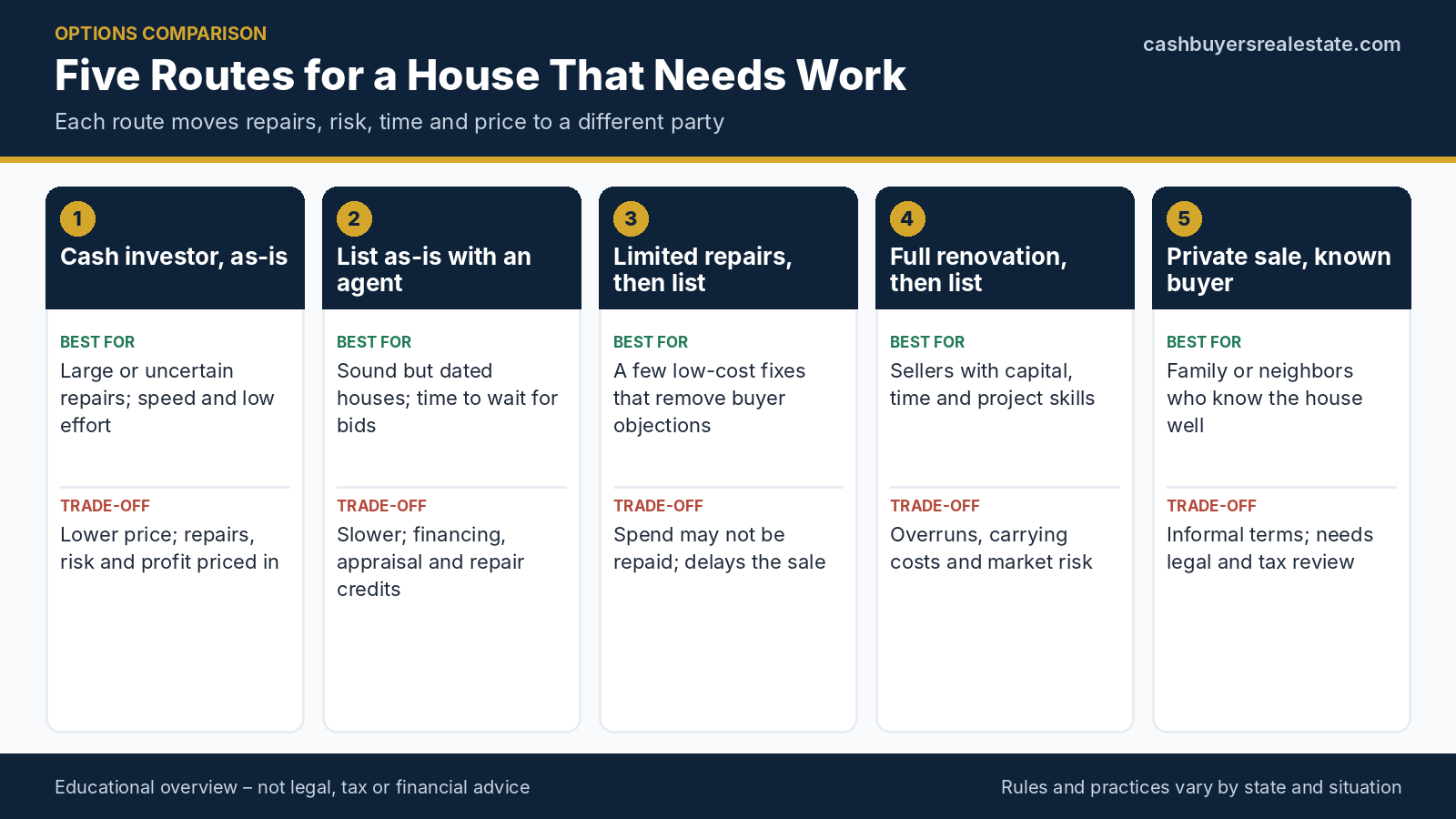
These building-system and hazard findings do more than adjust a repair line. They also change which route makes sense for the sale. A house with a failing roof, aluminum wiring and suspect insulation is a poor candidate for a quick cosmetic refresh and a retail listing, and a stronger candidate for an as-is sale to a buyer equipped to manage the scope. A house with sound systems and tired finishes may do better on the open market or with a limited set of repairs. The graphic below compares five routes by who they suit and what they cost: a cash investor sale as-is, an as-is listing with an agent, limited repairs before listing, a full renovation before listing and a private sale to someone you know. Each trades certainty, effort, price and speed differently, which is why the systems findings above should be in hand before you choose.
Text version of this infographic
- Cash investor, as-is — Best for: Large or uncertain repairs; speed and low effort. Trade-off: Lower price; repairs, risk and profit priced in.
- List as-is with an agent — Best for: Sound but dated houses; time to wait for bids. Trade-off: Slower; financing, appraisal and repair credits.
- Limited repairs, then list — Best for: A few low-cost fixes that remove buyer objections. Trade-off: Spend may not be repaid; delays the sale.
- Full renovation, then list — Best for: Sellers with capital, time and project skills. Trade-off: Overruns, carrying costs and market risk.
- Private sale, known buyer — Best for: Family or neighbors who know the house well. Trade-off: Informal terms; needs legal and tax review.
Contingency Buffers and Why a Professional’s Estimate Runs Higher Than Yours
Sooner or later every seller of a fixer-upper sees the same pattern: the buyer’s repair figure is far above what a contractor friend, a relative or the seller’s own research suggested. The difference is real, it’s usually explainable and a good deal of it is legitimate. Two ingredients account for most of it. One is the contingency buffer, which exists to absorb surprises. The other is a set of structural differences between how a business prices work and how a homeowner imagines it.
How contingency buffers work
A contingency is money set aside for costs that can’t be known in advance. Every renovation, however carefully scoped, runs into conditions that nobody could see: wiring that isn’t what the panel suggested, subfloor that has softened under a tub, a permit inspector who wants an extra upgrade. Experienced investors don’t try to predict which surprise will occur; they reserve a share of the budget for all of them.
Contingency as a percentage of scope
Contingency is normally expressed as a percentage of the repair budget, and the percentage rises with the uncertainty. A cosmetic project with little hidden is usually carried with a small buffer. A heavy rehab in an older house, where walls will be opened and systems tested for the first time, calls for a larger one. There’s no legal or industry-wide standard for the percentage, and it varies with the investor’s experience, the house’s age and the quality of the information available at the time of the offer. Formal programs offer a glimpse of how seriously the idea is taken. Fannie Mae’s guidance for its HomeStyle Renovation mortgage, for example, says a contingency reserve is not required for one-unit properties although the lender may establish one, requires a reserve equal to 10% of repair and renovation costs for two-to-four-unit properties and allows lenders to raise it to 15% where the scope warrants. That is a lending rule for a particular loan product, not a guide to what an investor uses, but it shows that double-digit buffers are ordinary in renovation finance.
The buffer matters to you because it multiplies the repair line. If the repair estimate is $62,000 and the contingency is 10%, the buyer subtracts $68,200 from the repaired value, not $62,000. Every extra dollar in the estimate costs you $1.10 in offer price, and a buyer who raises the contingency to 15% on an uncertain house adds a further $3,100 to the deduction. This leverage is why disagreements about the repair estimate matter more than they appear, and why reducing uncertainty tends to be worth more to you than arguing about the buffer itself.
Reserve versus padding: telling them apart
A contingency is a reserve when it is applied once, transparently, to a defensible budget and shrinks as uncertainty falls. It becomes padding when it’s stacked on top of line items that already contain generous allowances, when it’s applied at different rates to different parts of the house without explanation, or when it stays the same after you’ve delivered evidence that removes the uncertainty it was meant to cover. You can’t always tell from the outside, but there are questions that reveal the structure without being confrontational. Ask whether the repair figure includes a contingency and what percentage it is. Ask which items the buyer considers least certain. Ask whether the figure would change if an inspection found no additional problems.
Their answers tell you how the number was built. A buyer who says, “We carry ten percent on everything, and we’d drop it to five on the finish items if your electrician’s report confirms the panel,” is describing a reserve that responds to evidence. A buyer who can’t explain the percentage, or who says it is fixed and non-negotiable regardless of what you document, is describing a pricing policy rather than a risk estimate. Either can be a legitimate business choice, but the second leaves you with less room to improve the offer by providing information, and that is itself useful to know when you compare buyers.
Why a professional’s estimate runs higher than a homeowner’s
Even without a contingency, an investor’s budget for the same work would typically exceed a homeowner’s. The causes are structural, and nearly all of them are reasons a seller shouldn’t take the gap personally.
Labor rates, overhead, scheduling and licensed trades
When a homeowner prices a bathroom update, the mental model is often materials plus a few days of a handyman’s time, perhaps with some work done by family. When an investor prices the same bathroom, the model is a contractor’s bid that includes labor at market rates, the contractor’s overhead and profit, permits where required, dumpster and disposal fees, and the cost of coordinating several trades. The investor is also buying speed. A project that sits idle while waiting for a friend with weekends free is a project that costs carrying money, so the investor pays for crews that can start immediately and finish on schedule. Add the premium for licensed and insured trades, which investors typically require because unlicensed work can cause problems at resale, and the line item grows well past the homeowner’s figure.
There’s also a scale effect that runs the other way, but it rarely benefits the seller. An investor who runs many projects may negotiate better rates with a trusted crew, which makes the budget lower than a one-time homeowner would pay. If that discount is real, a reasonable buyer would include it in their estimate and the final figure would sit between what a homeowner would pay a stranger and what a retail contractor would charge. The practical lesson is that the right comparison for the investor’s repair line is not your do-it-yourself guess, but what three licensed contractors would charge you to do the same scope. Getting those bids is the subject of a later section.
Different finish standards, different goals
The other major source of difference is the target. A homeowner asks what it would take to make the house acceptable. An investor asks what it would take to make the house competitive against renovated listings in the neighborhood, because that is the product the next buyer will compare it to. If the renovated comps have quartz counters, luxury vinyl plank and updated lighting, the investor is going to price the same, even if you’d be happy with laminate and carpet. This is a defensible decision for a flipper, whose entire margin depends on matching the market’s expectations, and less defensible for a landlord, whose tenants don’t require the finish.
| Line item | Homeowner’s estimate | Investor’s estimate | Gap | Main reason for the gap |
|---|---|---|---|---|
| Interior paint, whole house | $2,800 | $5,500 | $2,700 | Hired painters, wall repair and two coats on every surface |
| Flooring | $5,200 | $10,500 | $5,300 | Whole-house replacement to a single resale-grade product |
| Kitchen | $8,000 | $16,000 | $8,000 | New cabinets, counters and appliances versus a refresh |
| Two bathrooms | $6,000 | $12,000 | $6,000 | Full tile, fixtures and vanity replacement |
| Heating and cooling | $0 | $8,500 | $8,500 | Owner sees equipment that runs; buyer budgets for aging units |
| Water heater | $0 | $1,500 | $1,500 | Replacement included for age rather than failure |
| Electrical | $1,200 | $4,500 | $3,300 | Panel and device upgrades to satisfy inspection |
| Exterior and landscaping | $1,000 | $2,500 | $1,500 | Curb appeal work and gutter, fascia and trim repairs |
| Debris removal, dumpster, permits | $400 | $1,000 | $600 | Disposal fees and permit costs |
| Subtotal before contingency | $24,600 | $62,000 | $37,400 | Sum of the lines above |
| Contingency at 10% | $0 | $6,200 | $6,200 | Reserve for conditions found once work starts |
| Total used in the formula | $24,600 | $68,200 | $43,600 | Gap that flows directly into the offer |
Look first at the lines where the gap is largest, because those are the ones worth examining. The heating and cooling gap exists because the seller and the buyer are answering different questions: does it run, and will it need replacing before the next owner’s inspector gets involved. The kitchen and flooring gaps trace to finish level, which is a choice rather than a fact. If you were to replace those lines with your own bids at the buyer’s finish level, the gap would shrink but not disappear. The portion that remains is the part attributable to risk, speed and the buyer’s business model, and that is the portion you’re paying for when you sell as-is.
Illustrative example (hypothetical numbers, not market data): Suppose a homeowner sets her own estimate for the same ranch at $24,600 and receives an offer built on $68,200 with contingency. Because the repair line flows dollar for dollar into the ceiling the buyer calculates, the $43,600 gap would, in a simplified model, account for about the same amount of the offer. If she then obtains three licensed bids at the buyer’s finish level, averaging $54,000 for the same scope, and the buyer accepts $54,000 plus the same 10% contingency, the repair deduction falls to $59,400, which is $8,800 less than before. That change alone raises the ceiling by $8,800 without any argument about profit or after-repair value.
The takeaway of the exercise is not that sellers should expect the gap to close entirely. It’s that every dollar of the gap sits somewhere identifiable: in a finish choice, an assumption about a system, a schedule premium or a reserve. Once you can see where, you can decide which portions to challenge with evidence, which to accept as the price of speed and which to treat as a sign that a different buyer or a different route might serve you better.
Contract Terms, Late Price Changes and Red Flags on a House That Needs Work
On a fixer-upper, the contract is where the repair estimate either holds or unravels. A buyer who offers a figure based on a quick look and then retains the right to adjust it after a closer inspection is, in effect, offering a range that ends at their discretion. That isn’t necessarily improper, because the closer look is the whole purpose of an inspection period. But it means the clauses about inspection, cancellation and price changes decide how much of the headline number you can count on.
Contract clauses that matter most when condition is the issue
The terms below are not unusual, and none is a warning sign by itself. They matter because condition is the one topic the buyer is entitled to revisit, which gives these clauses more weight in a fixer-upper sale than in a typical purchase of a well-kept house.
Inspection periods, as-is language and the right to cancel
Most cash purchase agreements give the buyer a defined window to inspect the property, review title and decide whether to proceed. The length is negotiated, and so are the buyer’s options once the window opens: cancel and recover the earnest money, ask for a price reduction or repairs, or go forward as agreed. An “as-is” clause usually means the seller isn’t promising to make repairs, but it doesn’t erase disclosure duties that your state’s law imposes, and it doesn’t stop the buyer from walking away during the inspection period if the contract allows. Read the clause to learn whether the buyer’s right to cancel is unrestricted, limited to specific findings or tied to a dollar threshold. The more open-ended the right, the more the offer functions as an option that costs the buyer little to exercise.
Look at the sequence of dates too. A contract that gives the buyer a long inspection period, followed by a short closing deadline, shifts risk to you: you may spend weeks off the market while the buyer decides. A shorter window with specific, objective grounds for cancellation shifts the risk back. Rules about contract formation, attorney review and cooling-off periods differ by state, so a few states build attorney review or other waiting periods into residential contracts. Ask where you live whether any such rules apply before you sign, and have an attorney read the agreement when the stakes warrant it. The earlier discussion of the contract sequence applies here, and the page on red flags in cash offer contracts collects the patterns most worth noticing.
Re-trades: when the price changes after the contract is signed
A re-trade is a request to lower the price, or to add conditions, after the contract is signed. In a fixer-upper sale it’s common because buyers often sign based on a walk-through and then bring a contractor through during the inspection window. Some re-trades are legitimate: the contractor found rot under the bathroom floor, or the roof is in worse shape than the photos suggested, and a revised figure reflects real information. Others are tactics, in which the buyer signs a contract at an attractive price to tie up the property, discovers during the inspection period that the seller has few alternatives and then reduces the price by an amount that seems arbitrary.
The way to tell the difference is documentation. A legitimate re-trade names the specific problem, shows photographs or a written report, ties the price change to a cost estimate and is proportionate to what was found. A tactical re-trade cites unspecified problems, cannot produce a bid or a report, or arrives in several rounds, each a little smaller. You’re entitled to ask for the evidence, to get your own opinion on the finding and to decline a revision you consider unsupported, provided you understand the consequences under the contract. If the buyer’s earnest money is at risk only after the inspection period ends, declining may mean the buyer cancels and you return to the market, so it’s useful to have a fallback in mind before the inspection starts.
Illustrative example (hypothetical numbers, not market data): A seller signs at $176,000 with a ten-day inspection period. On day eight the buyer asks for $14,000 off, citing “foundation concerns,” with no report. The seller asks for the engineer’s findings; the buyer replies that the contractor “just didn’t like what he saw.” The seller hires an engineer, who finds minor settlement cracks and recommends sealing and monitoring at an estimated $1,800. With that report in hand, the seller offers a $2,000 credit. The buyer may accept, counter or cancel. The value of the report is that every outcome is now based on a documented number rather than an impression, and the seller has a basis for deciding whether a larger concession is justified.
Verification and red flags specific to fixer-upper offers
The scam and trust topics covered in the cash home buyer scams hub apply to every kind of property, but they take particular forms when a house needs work. Sellers of such houses are often busy, tired of the property and aware that the numbers are going to be low, which makes it easier for a pressured decision to seem sensible. A few checks, made calmly, remove most of the risk.
Proof of funds, earnest money and assignment terms
A buyer who claims to pay cash should be able to show it. Proof of funds typically takes the form of a recent bank or brokerage statement, or a letter from a financial institution, title company or attorney confirming funds are available. The document should show the name of the buyer or the entity named in the contract, the amount and the date, and sellers can redact account numbers while keeping the information that matters. If the purchase will go through an entity, check that it matches the contract. The guide to proof of funds for cash buyers covers what counts as acceptable evidence and what its limits are. No single document proves anything by itself, and an absence of one doesn’t prove bad faith; but a buyer who resists every reasonable request to show funds is telling you how the rest of the transaction might go.
Earnest money is the buyer’s deposit, and its terms matter more than its size. Find out who holds it, whether it’s refundable during the inspection period, what triggers forfeiture and where it’s deposited. A very small deposit paired with a very long, unrestricted right to cancel leaves you with little protection if the buyer walks away. Assignment language deserves similar attention. Phrases such as “and/or assigns” show that the buyer may transfer the contract to someone else, which is legal in many places and common in wholesaling, but it means the party who closes might be unknown to you today. Ask whether the buyer intends to assign, whether you’ll learn the final buyer’s identity before closing and what your state requires the buyer to disclose. A few contracts also allow a buyer to record a notice of the agreement against the property, which can complicate a sale to someone else if the deal falls apart, so have an attorney read for it.
Pressure, closing partners and wire-fraud safeguards
Pressure to sign quickly, to skip a review or to avoid talking to others is the most reliable pattern in the problem cases. A buyer might say the offer expires in hours, that an attorney will only slow things down or that the price will fall if you shop around. Genuine offers do have expiry dates, and a short fuse by itself proves nothing. But a legitimate buyer will understand a seller’s wish to read the contract, compare another offer and ask a professional for advice. Never sign a document with blank lines, including a blank price, closing date or buyer name, and never sign anything you haven’t received in full.
Choosing the closing partner is another safeguard. A title company, escrow office or attorney that you can independently verify, and that holds the earnest money and the closing funds, provides a layer of neutrality that a buyer-controlled arrangement does not. Search for the company yourself, confirm its license with the state regulator if one applies, and call the number you found. The CFPB’s guidance on closing scams also suggests agreeing on contacts in advance and discussing money transfers by phone rather than email. The table below organizes the patterns by what they look like, why they matter and how to check.
| What you see | Why it matters | How to check |
|---|---|---|
| A repair deduction with no explanation or scope | You can’t test a number you can’t see; the contingency may be stacked | Ask for the scope, the tier and the contingency percentage; compare with your bids |
| Offer valid for hours, with pressure to skip review | Pressure reduces time to compare and consult | Ask for a reasonable deadline and read the whole agreement first |
| Proof of funds refused or from an unrelated party | The funding may not exist or may belong to someone else | Request a recent statement or institution letter naming the actual buyer |
| Long unrestricted cancellation right, tiny earnest money | The buyer holds an option that costs little to abandon | Compare the deposit and refund terms with the inspection window |
| “And/or assigns” with no disclosure of the end buyer | Your actual buyer may differ from the party you vetted | Ask about assignment; check your state’s disclosure requirements |
| Price cut after inspection with no report or bid | May be a tactic rather than a finding | Request documentation; get a second opinion on the issue |
| Blank lines in documents or closing at the buyer’s own office only | Blank fields can be filled in later; control of funds matters | Never sign incomplete forms; verify the title company or attorney independently |
| Changed wire instructions delivered by email | A common method of diverting funds | Call a verified number before any transfer |
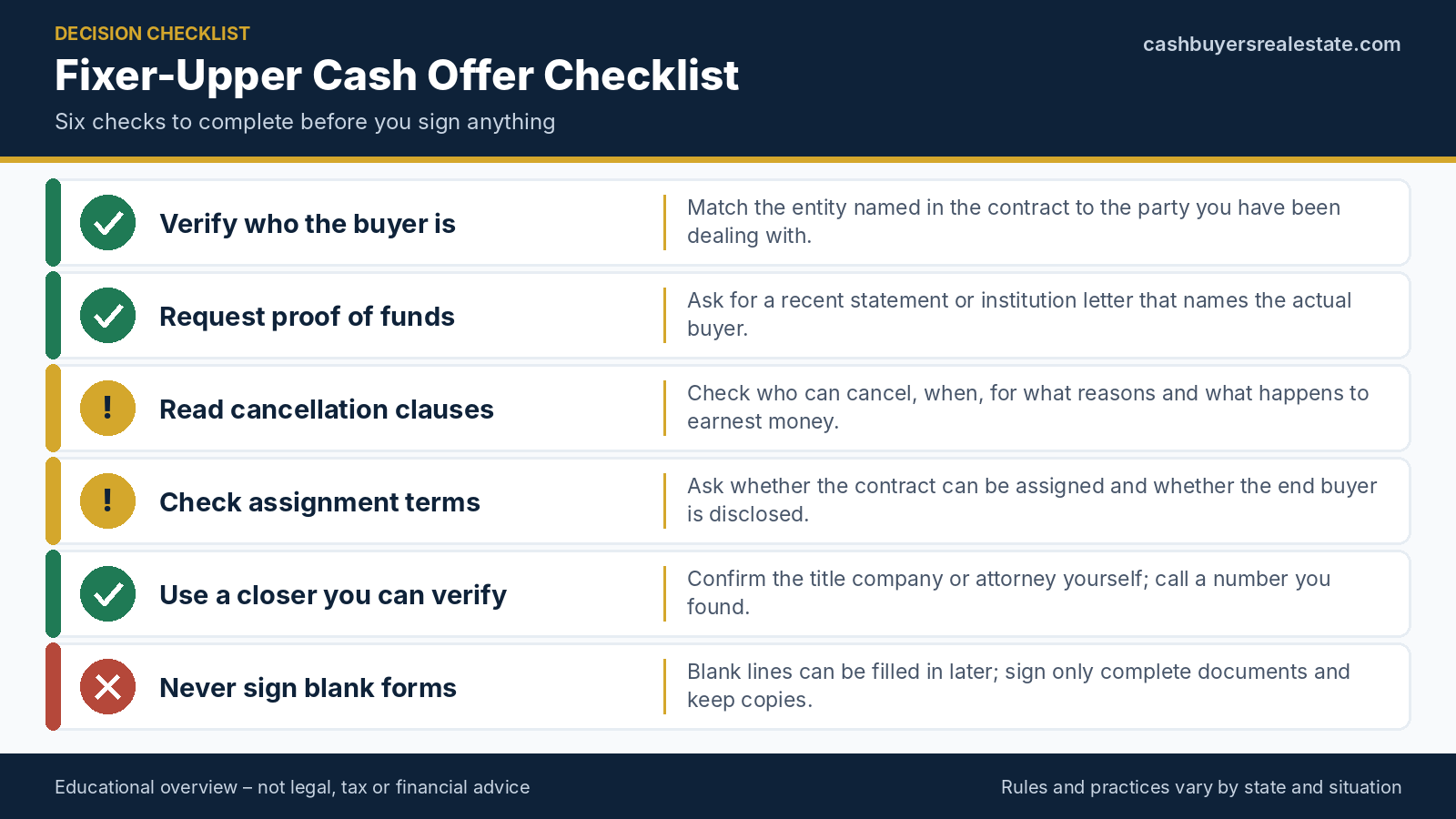
Treat this table as a prompt for questions, not a verdict. A single entry may have an ordinary explanation, and a legitimate buyer may trigger one or two of them. What deserves concern is a cluster, or a buyer who responds to reasonable questions with more pressure. The graphic below summarizes six checks that apply to almost any cash offer on a house that needs work: verify who the buyer is, request proof of funds, read the cancellation clauses, check the assignment terms, use a closing partner you can independently confirm, and never sign a form with blanks. Several of those checks cost nothing but a phone call, and doing them before you debate the price protects you from the problems that no price can offset.
Text version of this infographic
- Verify who the buyer is — Match the entity named in the contract to the party you have been dealing with.
- Request proof of funds — Ask for a recent statement or institution letter that names the actual buyer.
- Read cancellation clauses — Check who can cancel, when, for what reasons and what happens to earnest money.
- Check assignment terms — Ask whether the contract can be assigned and whether the end buyer is disclosed.
- Use a closer you can verify — Confirm the title company or attorney yourself; call a number you found.
- Never sign blank forms — Blank lines can be filled in later; sign only complete documents and keep copies.
Testing the Offer: Your Own Estimate, Negotiating With Evidence and What Not to Fix
Everything so far leads to a practical question: how do you find out whether the number in front of you is reasonable? You can’t audit an investor’s private spreadsheet, but you can build an independent estimate good enough to show whether the offer sits inside a believable range. The effort is modest compared with the dollars involved, and even if you end up accepting the offer, you’ll do so knowing which parts of it were the price of speed and which were simply assumptions you hadn’t checked.
Building a comparison estimate you can defend
An estimate you can defend has three properties: it describes a specific scope, it comes from people who’d actually do the work and it states the finish level so someone else can reproduce it. A vague guess, even an informed one, will be dismissed in a negotiation; a set of written bids will not.
Getting two or three contractor bids you can compare
Start by writing a plain scope that matches what the investor assumes, because bids are only comparable when they describe the same job. Walk through the house room by room and note what you believe would be replaced or repaired, then ask the buyer for the scope their number rests on. Where the two differ, price both versions. Then invite two or three licensed and insured contractors to walk the property, and give each of them identical information. The Federal Trade Commission’s consumer guidance on hiring contractors advises getting written estimates that capture every verbal promise, taking time before signing, and not choosing a bidder on price alone, and the same habits make for good comparison bids. Ask in advance whether a contractor charges for an estimate, because some do, and tell them that you’re gathering pricing for a possible sale rather than hiring for the job. That honesty is usually accepted and keeps expectations clear.
To make the bids line up, give each contractor the same short list of instructions and ask for the answers in writing:
- The finish level for each room, such as mid-grade cabinets, luxury vinyl plank or tile in the baths, so every bid prices the same product.
- Itemized prices by trade or room, not a single lump sum, so differences can be traced.
- Whether permits, disposal fees and debris removal are included.
- Any work the contractor excluded or considers uncertain, and what they’d expect an allowance to be.
- Their license and insurance details and the expected duration of the project.
When the bids come back, look for what’s missing before you look at totals. A low bid that leaves out permits, disposal or an entire trade is not low, it’s incomplete. A high bid might reflect a contractor’s busy schedule or an assumption of better materials. The comparison that matters is the middle of the range for the same scope and finish. If the three bids cluster within a few thousand dollars, the market is telling you something. If they scatter widely, ask the outliers why, because the explanation often reveals a condition one contractor noticed and the others didn’t. Do not assume the lowest figure is the right one to use against the buyer, since the investor will rightly say that a rushed, thin bid is not what they’d be able to rely on.
Putting your numbers beside the investor’s and the market’s
With bids in hand, rebuild the investor’s formula using your figures and the buyer’s other inputs. Replace the repair line and the contingency, leave the after-repair value, holding costs and profit target as the buyer stated them, and see what ceiling results. That ceiling is not an offer you should expect, but it tells you how much of the buyer’s number is explained by the repair assumption alone. If the ceiling moves only a little, the buyer’s price is driven by other inputs, and your argument should shift to ARV, timing or profit instead.
Illustrative example (hypothetical numbers, not market data): Using the ranch from earlier, three licensed bids at the investor’s finish level average $54,000. With the buyer’s own 10% contingency, the repair deduction becomes $59,400. The ceiling is $310,000 less $24,800 in resale costs, $59,400 for repairs and contingency, $6,900 in holding costs, $4,000 in acquisition costs and a $30,000 profit target, which leaves $184,900, or $8,800 more than the buyer’s original $176,100. A seller who also documents that the furnace was serviced and works may justify a further reduction in the HVAC line. Even so, the realistic outcome is a negotiated figure between the two numbers, not the new ceiling.
Next, compare that investor ceiling with the other routes, using net proceeds rather than headline price. The table below does so for three routes using hypothetical assumptions: an as-is cash sale at the original offer, an as-is listing with an agent and a moderate repair before listing. All figures are before payoff of any mortgage or liens, which differ for each seller, and every cost is an assumption you would replace with local quotes.
| Route and timeline assumed | Sale price | Selling costs and credits | Repairs paid by seller | Carrying costs | Net proceeds |
|---|---|---|---|---|---|
| Cash investor, as-is; about 1 month | $176,100 | $1,500 | $0 | $1,150 | $173,450 |
| List as-is with an agent; about 3 months | $215,000 | $18,975 | $0 | $3,450 | $192,575 |
| Moderate repairs, then list; about 5 months | $290,000 | $18,850 | $38,000 | $5,750 | $227,400 |
| Same, with a 25% repair overrun | $290,000 | $18,850 | $47,500 | $5,750 | $217,900 |
Read the table by asking what each extra dollar of net proceeds requires from you. The listed route nets about $19,000 more than the cash sale on paper, in exchange for roughly two extra months, uncertainty about whether the buyer’s financing and appraisal will hold and the chance of repair credits after inspection. The repair-then-list route nets the most on paper, but requires $38,000 up front or financed, about four more months than the cash sale, tolerance for overruns and confidence that the market will pay the assumed price. Those assumptions are the whole story. If your actual repair bids are higher, your price expectation lower or your carrying costs heavier, the ranking can change, which is why the exercise belongs in your own spreadsheet and not in this article. Selling costs, such as agent compensation and closing charges, vary widely by market and by contract, so use your local quotes.
Negotiating deductions and deciding what not to fix
Once you know where the numbers differ, the next step is to decide what to say and what to do with the house in the meantime. Two principles help: negotiate the specific, not the general, and spend money only where the spending changes the outcome.
Negotiating deductions with evidence
Start with the deductions that are largest and most uncertain, because they offer the most room to move. Pick two or three lines from the buyer’s scope, such as HVAC, electrical or foundation, and bring documentation for each: a licensed technician’s report, photographs, receipts for past work or a bid for the specific repair. Present them as questions rather than accusations. “Your budget includes $8,500 for HVAC; my technician says the furnace is operating normally and the air conditioner is older, with a repair or replacement quote of $4,200. Would you adjust?” invites a response that deals with substance. Buyers differ in how receptive they are, and some will hold their numbers regardless, but a polite, specific request leaves a record and clarifies whether the buyer’s pricing responds to information.
Keep a sense of proportion. Investors take real risks, and some of the gap between your estimate and theirs is the legitimate price of those risks. Aim to remove the portions of the deduction that are based on assumptions you can disprove, not the profit margin or the schedule premium. Also be ready to hear no. If the buyer won’t move on documented items, you have learned that the offer isn’t responsive to evidence, and you can weigh other buyers or other routes with that knowledge. The earlier sections on repair tiers, systems and contingency are the reference for what each deduction is made of.
Illustrative example (hypothetical numbers, not market data): A buyer’s budget lists $8,500 for heating and cooling. The seller brings a technician’s report showing the furnace in working order, a $350 tune-up recommendation and a $4,200 estimate to replace only the older air conditioner. The buyer agrees to revise the line to $4,550. With the 10% contingency, the line falls by $3,950, and the contingency on it falls by another $395, so the total deduction drops by $4,345. The seller spent a few hundred dollars on the report and traded a speculative figure for a documented one.
What not to fix, and where repairs do pay
The default for a seller who intends to sell to an investor is to fix very little. An investor prices the house as if they’ll do the work in their own way, so a repair you complete usually returns less than it cost you, and a repair done to the wrong standard may be torn out. Choosing finishes, repainting rooms the buyer plans to repaint and replacing flooring they’ll replace again are classic examples of money that doesn’t come back. Data on remodeling projects in the retail market illustrates the principle. In the 2025 Cost vs. Value report from the Journal of Light Construction, the national average midrange bath remodel cost $26,138 and was associated with resale value of $20,915, or 80% of cost, while an asphalt shingle roof replacement cost $31,871 against $21,501 of resale value, or 67.5%. A midrange minor kitchen remodel at $28,458 was associated with $32,141, or 112.9%, and a garage door replacement at $4,672 with $12,507. These figures describe national averages for projects in the owner-occupied market, they aren’t promises for any house, and they say nothing about what an investor pays, but they show that returns differ widely by project and that big-ticket items rarely return their full cost.
Where repairs do pay, the pattern is small, cheap and visible. Removing trash and personal belongings, cleaning, trimming overgrowth, letting buyers see the whole house with the lights and utilities on, and fixing active leaks or safety hazards typically cost little and improve every buyer’s read of the property. Gathering evidence, such as the inspection reports mentioned earlier, is a form of repair too, since it repairs the buyer’s uncertainty. And keep paperwork: for tax purposes, the IRS explains in Publication 523 that improvements add to a home’s basis while ordinary repairs that keep it in good condition generally don’t, so receipts for major work can matter when you calculate gain. Whether that is relevant depends on your circumstances, so ask a tax professional.
If you’re weighing a larger renovation, the comparison of selling as-is versus renovating works through that choice in more depth. For most sellers choosing the cash route, the guiding rule is to spend money only on actions that reduce the buyer’s uncertainty or prevent harm, and to leave the improvements to the party who intends to profit from them.
Frequently Asked Questions About Selling a Fixer-Upper to a Cash Buyer
Questions about offers, repairs and condition
Questions about price and deductions
- Why is a cash offer so much lower than what a renovated house down the street sold for?
The renovated sale reflects a finished product, and your house is an unfinished one. A buyer who pays cash for yours must also pay for the repairs, carry the property during the work, cover selling costs and keep a margin for risk. The fair comparison is with sales of houses in similar condition, or with the net you’d keep after your own repairs, commissions and carrying costs. Comparing a cash offer with a renovated neighbor’s sale price overlooks every cost that sits between the two.
- Is it normal for a buyer to lower the price after seeing the house in person?
Yes, it happens often, because a first number built from photos and records meets the actual condition for the first time at the walk-through. What matters is whether the change is explained. A revised price tied to specific findings you can look at yourself is ordinary business, while a vague reduction that arrives with pressure to decide immediately deserves a request for details. You can always ask what changed and whether the original figure assumed something that turned out to be wrong.
- Does the repair estimate in an offer include a profit for the buyer?
Usually the repair estimate is separate from profit, which is a different line in the buyer’s formula. The two interact, though, because a buyer who sets a higher contingency or uses a conservative scope is, in effect, protecting the profit target. If you ask which parts of the gap between your offer and the repaired value are repairs, holding costs, selling costs and margin, a thoughtful buyer will be able to answer in broad terms.
- Will the offer change if I give the buyer more information about the house?
It can, in either direction. Records of recent work, service reports and a professional’s findings may lower the buyer’s uncertainty and the contingency attached to it. On the other hand, a disclosure about a problem the buyer hadn’t spotted can raise the repair estimate. Giving accurate information is still the better course, both because the law may require it and because a price built on missing facts tends to come undone during the inspection period.
Questions about repairs and estimates
- How accurate is a quick per-square-foot repair estimate?
It is accurate when the house resembles the ones that produced the figures and inaccurate when it doesn’t. Kitchens, bathrooms and mechanical systems do not scale with floor area, so unusual layouts, small houses with expensive features and houses with structural issues can be badly misjudged. Treat a shortcut as an opening position and ask what a line-item version would show after the buyer’s contractor has seen the property.
- Should I order a home inspection before selling to a cash buyer?
Neither law nor most cash buyers require it, but an inspection can pay for itself when you suspect hidden issues, because it replaces speculation with documented findings. It can also reveal items you’d need to disclose, so consider that before you commission one. A narrower specialist report, such as a roofer’s opinion or an electrician’s evaluation of a specific concern, is often cheaper and more persuasive on the line it addresses.
- Is a contractor’s estimate better than an inspector’s report?
They answer different questions. An inspector describes condition and flags concerns, while a contractor prices the work needed to correct them. For testing an offer you want both: the report to establish what is wrong and the bid to attach a cost. A bid without a clear description of the problem is easier to dispute, and a report without a price gives you no number to negotiate with.
- If I complete a repair, will the buyer pay more?
Sometimes, but rarely dollar for dollar. An investor prices the house assuming they will do the work to their own standards and may still discount for items you haven’t touched, for their margin and for schedule risk. Small, low-cost actions such as cleaning, debris removal and fixing active leaks often help more than major projects. Before starting anything large, get the buyer’s view in writing about whether it would change the offer.
Questions about process, contracts and special situations
Questions about timing, inspections and closing
- How long does the buyer’s inspection period usually last?
There is no universal length, because the period is negotiated and varies by state practice and by the buyer’s plans. Shorter windows give you more certainty and longer ones give the buyer more flexibility. What deserves attention is what the buyer can do during that window, such as cancel freely, request credits or adjust the price, and how the earnest money is treated at each stage.
- Can a cash buyer back out after the inspection period ends?
It depends on the contract. Many agreements make the earnest money non-refundable after the inspection window, which gives the buyer a reason to follow through, but other clauses such as financing, title or assignment conditions can still provide exits. Read every cancellation provision rather than the inspection clause alone, and ask an attorney to explain any language you can’t interpret.
- Who pays for closing costs in a cash sale of a fixer-upper?
The contract decides, and local custom influences the default. Title insurance, escrow or attorney fees, transfer taxes and recording charges are divided differently from state to state, and a buyer’s statement that they will cover costs should appear in the signed agreement. Ask for a written estimate of your costs and compare the net proceeds, not only the price.
Questions about trust, contracts and special cases
- What if I inherited the house and haven’t been inside it in years?
Tell the buyer that plainly, and expect the repair estimate to carry more contingency until someone has walked the property with a contractor. Authority to sell, probate status and title questions are separate from condition and vary by state, so involve an attorney early. The guide to cash buyers for inherited houses covers those issues in detail.
- What if the house is a rental with tenants inside?
Occupancy complicates both access for the buyer’s contractor and the timeline, and tenants’ rights under a lease and state or local law don’t disappear because of a sale. Some buyers prefer occupied rentals as investments and others avoid them. See the discussion of cash buyers for rental properties for the specifics, and confirm tenant notice rules with a local attorney.
- What if the house has code violations or unpermitted work?
Requirements vary widely by city and county, and some places require resolution or disclosure at the time of sale while others leave it to the buyer. An investor will typically price the cost of legalizing the work or removing it, plus uncertainty about what the building department will demand. Before accepting a deduction for permits, check with the local building department about what would actually be required.
Choosing Your Route and Taking the First Steps on a House That Needs Work
By this point you have a way to read an investor’s offer, a way to test its repair assumptions and a sense of the alternatives. What remains is the decision itself, which depends less on any formula than on what you need from the sale and how much of the work, risk and waiting you’re willing to carry.
A decision framework for matching the route to your priorities
A useful decision framework starts with your constraints, because they usually narrow the field faster than the numbers do. Decide how much time you have, how much money you can put into the house before it sells and how much uncertainty you can tolerate, and then see which routes remain feasible.
Weighing speed, certainty, price and effort
Four questions do most of the sorting. How soon do you need the money, and what happens if the sale takes three months instead of one? How much can you put into repairs without borrowing or draining reserves, and how comfortable are you managing contractors? How would you feel if a buyer’s financing fell through two weeks before closing? And how important is the last dollar of price compared with a clean, predictable process? Your answers tend to point in a direction. A seller who needs certainty, has little cash for repairs and doesn’t want to manage a project will usually find an as-is sale to an investor most compatible. A seller with time, savings and patience may do better with a listing or repairs. Most sellers sit between those poles, and the numbers from your own bids and net-proceeds comparison are what settle the close calls.
It helps to rank the four priorities in writing before you open any new offers, since an attractive number can quietly rearrange them. If speed is first and price is third, a quick offer that’s $15,000 below a hypothetical listing outcome may be exactly right. If price is first, the same offer will feel like a loss, and you should treat it as a benchmark for what the open market has to beat. Writing the ranking down turns a feeling into a criterion. For broader situations in which timing dominates, the pillar on how to sell your house fast sets out the full range of urgent options.
When a cash investor fits a fixer-upper sale and when another route does
A cash investor tends to fit when the repair scope is large or uncertain, when the condition would make financing difficult for retail buyers, when you lack the money or appetite to renovate, or when speed and low effort carry real value. Houses with significant system failures, structural questions, hazardous materials or long-vacant conditions often fall in this group, as do properties in an estate where heirs live elsewhere and want to avoid managing a project from a distance.
Other routes tend to fit better when the house is basically sound and mainly dated, when you have time to wait for retail buyers and when the neighborhood market is strong enough that an as-is listing draws many bidders, including renovation-loan buyers. A limited repair program can make sense when a handful of inexpensive fixes would remove the objections that keep financed buyers away. A house with an unclear title, an unresolved estate or tenants whose lease runs for months raises questions that condition alone doesn’t answer, and those are better sorted out with a professional before choosing any route. None of these tendencies is a rule. The point of testing the repair estimate is to make the call on your own facts, not on the generic idea that a cash sale is quick or that a listing is profitable.
It is also worth remembering that the choice isn’t permanent until a contract is signed. Many sellers learn the most by running two tracks at once for a short time: collecting bids and documents while listening to what investors offer, and perhaps asking an agent for an opinion of what the house might bring as-is. The information from the second track often sharpens the first, and the cost of gathering it is small compared with the value of the decision. The sections on net proceeds and on negotiating with evidence describe how to use the results once you have them.
What to do next: first steps, documents and questions
With a route in mind, the next steps are practical and mostly inexpensive. You don’t have to commit to anything to complete them, and finishing them puts you in a stronger position whichever route you choose.
First steps and documents to gather
Begin by writing down everything you know about the house’s condition and history, including the age of the major systems, past repairs and any problems you’ve observed, because that account will anchor every conversation that follows. Keep it factual and dated, noting what you saw and when, not what you suspect. Then gather the paperwork that supports it. The following items are the ones buyers and their contractors ask about most often:
- Receipts, permits and contractor invoices for roof, HVAC, electrical, plumbing and foundation work.
- Service records or technician reports for heating, cooling and water heating equipment.
- Any prior inspection, engineering, pest or environmental reports, and insurance claim records.
- Your mortgage payoff information, a recent property tax bill and any lien or homeowners association details.
- Whatever disclosures your state requires, including lead-based paint information if the house was built before 1978.
After that, request two or three written contractor bids against a common scope, using the method described earlier, and build a net-proceeds comparison for at least two routes. If the property is inherited, in probate, tenant-occupied or subject to liens, speak with a local attorney before you sign anything. None of this commits you to a sale, and the documents are reusable for every offer you receive. A single folder, paper or digital, that holds the written account, the supporting records, the bids and your net-proceeds worksheet lets you respond to a new offer in an afternoon rather than a week, and it demonstrates to any serious buyer that you know the property well enough to price it sensibly.
Timing the steps sensibly helps as well. Bids and reports can take a week or two to arrive, so it makes sense to request them as soon as you decide to explore a sale, even before any offer is in hand. Specialist visits, such as a structural engineer or a licensed electrician, can usually be scheduled around your own calendar, and booking them early avoids the pressure of a short inspection period later. If the house is occupied or shared with relatives, settle who will give access and when, so appointments don’t turn into disputes.
Questions to ask before you decide
When an offer arrives, ask the buyer to explain the repair scope behind it, the contingency percentage, the assumed after-repair value and the holding period. Ask who the funds come from and how you can verify them, how the earnest money is held, whether the contract may be assigned and what the buyer can do during the inspection period. Ask who will conduct the closing, who pays which charges and how long the process typically takes in your area. Buyers who answer clearly, in writing where possible, are demonstrating the same transparency you will want at the closing table. Those who dodge are telling you something too.
Questions for your own advisers matter as well. An attorney can tell you what your state requires you to disclose, how its contract and closing practices work and whether anything in the draft agreement should change before you sign. A tax professional can explain how the sale affects your situation, including whether records of past improvements matter. A real estate agent, if you consult one, can give a view of what the house might bring on the open market in its present state. These conversations are often short, they cost far less than a misstep, and the answers will help you judge which route deserves your time.
Whichever way you lean, there’s no deadline imposed by this guide, and a good decision rarely requires a rushed one. A cash investor, a listing, a limited renovation and a private sale each solve a different problem, and each has costs that are easy to underestimate when you’re tired of the house or short on time. Take the numbers seriously, ask for the evidence behind them, get the contract read by someone who is on your side and choose the route that leaves you with the net proceeds, timing and peace of mind that matter most to you. If the first offer doesn’t meet that test, you can usually afford the time it takes to compare it against another.