
We Buy Houses for Cash: Offers, Process & Red Flags
Sooner or later, a homeowner who has typed “we buy houses for cash” into a search bar ends up holding a piece of paper. It might be a one-page offer letter with a price in bold type, a six-page purchase agreement a stranger has emailed for electronic signature, or a text message promising that the agreement is coming tomorrow. The marketing that led there was friendly and brief. The paper is neither. It was written by the buyer, for the buyer’s protection, in the order the buyer prefers, and the sentences that decide how much money you keep and how much risk you carry tend to sit in the third paragraph of page two, phrased so that they sound routine.
That is why this guide is organized around the document rather than the sales pitch. The headline price matters, but it is only one of roughly a dozen terms that together determine what a cash sale is worth to you. A generous number attached to a contract that lets the buyer walk away for any reason, assign the deal to a stranger, and record a claim against your title is a different product from a modest number attached to a short, closed contract with a real deposit and a fixed closing date. Neither is automatically right for you. What you need is the ability to tell which one you are holding, and to know which questions to put in writing before you sign.
A “we buy houses for cash” offer is only as good as the contract behind it. Before accepting, check your net proceeds after costs, how much earnest money is truly at stake, how long the buyer can cancel for any reason, whether the contract can be assigned or recorded against your title, who chooses the closing company, and what happens if either side defaults.
Those items are the backbone of the article. You will see a hypothetical offer letter reproduced in full, then taken apart clause by clause: the price and the math behind it, the “as-is” language, the deposit and the due diligence window, the closing date and the closing company, the phrase “and/or assigns,” the memorandum of contract and what it can do to your title, and the default clause that decides who loses what if a deal collapses. Along the way you will find state-by-state examples that were checked against primary sources, because the same words can carry different legal consequences in Texas, North Carolina, Oklahoma, Pennsylvania, and elsewhere.
It helps to be clear about what this page does not try to do. A complete anatomy of every provision in an investor purchase contract belongs in the dedicated guide to the cash home buyer contract, and a ranked list of warning signs in the page on cash offer contract red flags. Whether a particular company is trustworthy is the subject of are cash home buyers legit, while the broader picture of who these buyers are and how they work sits in the main cash home buyers guide. Readers who arrived through a different phrasing may also find the overview of we buy houses and the page on home buyers for cash useful, and those looking for a local angle can start with cash home buyers near me or house buyers near me, which explain how to evaluate nearby companies without endorsing any of them. Here the focus is narrower and more practical: you have an offer in hand, and you want to know what it says.
The tone throughout is deliberately even-handed. Plenty of cash purchases close on schedule, at a fair price for the property’s condition, and spare the seller months of repairs and showings. Others stall, get re-priced at the last minute, or hand the seller a bill nobody mentioned. The difference is rarely visible in the first phone call. It shows up in the paperwork, in the buyer’s willingness to answer written questions, and in whether the terms still make sense after you have run the numbers against a conventional sale or a lightly prepared listing. By the end you should be able to read a cash offer the way a title officer or real estate attorney would, and to decide calmly whether it deserves a signature, a counteroffer, or a polite no.
What a We Buy Houses for Cash Offer Letter Really Contains
An offer letter is a compact document with a lot riding on small words. The price is easy to find, and so it draws all the attention, but a cash offer is better understood as a bundle of promises and options: what the buyer will pay, what the buyer may later change, when the buyer can leave, what the buyer can do with the contract, and what you can do if the buyer does not perform. Seeing the bundle as a whole is the first step. The sections that follow take it apart in the order you would meet it.
From Marketing Message to Binding Agreement: Where the Offer Letter Sits
Most sellers meet a cash buyer through a sequence of increasingly formal steps, and the legal weight of each step is different. A phone call or web form carries no obligation on either side. A number quoted by text carries almost none. Somewhere between that number and the closing table comes a signature, and from that moment the relationship is governed by whatever the document says, not by what was said on the phone.
Three Documents That All Get Called the Offer
People use the word “offer” for at least three different things, and mixing them up is how sellers end up bound by a contract they thought was only a conversation. The first is an expression of interest: an email, text, or letter that names a price range, says the buyer would like to move forward, and usually states that it is not a binding commitment. It tells you the buyer is serious enough to put a figure in writing, and nothing more. The second is a formal offer letter, which lists specific terms and invites you to accept them by signing. Whether it binds the buyer on its own depends on the wording and on state law, so treat it as potentially binding on you the moment you countersign.
The third document is the purchase agreement itself, sometimes called a purchase and sale agreement, real estate contract, or simply “the contract.” This is the instrument that, once signed by both parties, creates enforceable rights: the right to have the deposit refunded or retained, the right to close, the right to sue. Some buyers fold the offer letter and the agreement into a single document, which is fine, but it means your signature on a page labeled “offer” may already be the contract. A reliable test is to look for signature lines for both parties, a deposit amount, a closing date, and remedies for default. If those elements are present, read it as a contract regardless of what the first page is called.
A related habit worth noticing is the request to sign before you have seen the whole thing. Sometimes the buyer sends a one-page summary and says the full agreement will follow after you accept. Accepting the summary can obligate you to sign what follows, or at least leave you arguing about what was agreed. The safer course is to ask for the complete agreement, including every attachment and addendum, before any signature or electronic click, and to read it from the first line to the last with the same care you would give a loan document.
Who Writes the Paper, and Why That Shapes Every Clause
In a conventional listing sale handled by a real estate agent, the contract usually starts from a form that a state real estate commission, a statewide association of real estate agents, or a local bar has developed and revised over years. Those forms are not neutral in every respect, but they are public, familiar to title companies and attorneys, and relatively balanced because both buyer-side and seller-side professionals have a say in them. Texas, for example, publishes a promulgated residential contract (form TREC 20-18, dated November 2024 in the version reviewed for this article), and North Carolina Realtors maintain a standard Offer to Purchase and Contract that was revised most recently in July 2024.
Direct-to-seller investor deals often skip those forms. The buyer supplies its own agreement, written by its own attorney or copied from a template, and the terms reflect the buyer’s business model. That is not sinister in itself; an investor who must carry a property, finance repairs, and resell at a margin has real reasons to want a short due diligence window or flexibility on assignment. But it does mean that “standard” has no fixed meaning, and a clause that sounds ordinary may be one the buyer inserted precisely because it helps the buyer. Consumer protection offices have said as much. The Pennsylvania Attorney General’s office, in a public warning about roadside signs offering to buy homes for cash, advises owners to get independent real estate legal advice on the key terms of any cash-for-homes contract, and the Nebraska Real Estate Commission’s consumer guidance likewise tells owners to review end dates and assignability and to consider legal advice before signing.
A Mock Offer Letter, Clause by Clause
Abstract descriptions only go so far. To make the rest of this article concrete, the box below reproduces a hypothetical offer letter of the kind a seller might receive. Every name, number, and term in it is invented for illustration. It is deliberately drafted with several buyer-favorable provisions packed into a single page so that each can be examined in the sections that follow. It does not represent any real company’s form, and nothing in it should be treated as a market standard.
The Hypothetical Letter in Full
Illustrative example (hypothetical numbers, not market data): offer letter, written in the third person for clarity. Sample Home Acquisitions LLC (“Buyer”) offers to purchase the property at 100 Example Street, Anytown (the “Property”) from its owner of record (“Seller”) on these terms.
1. Price. $187,500, paid in cash at closing. No financing is required.
2. Condition. Buyer purchases the Property as is, where is, with all faults. Seller makes no repairs and gives no credits except as stated in paragraph 5.
3. Deposit. Within two business days after both parties sign, Buyer delivers $1,000 to the closing company as earnest money.
4. Due diligence. For ten days after signing, Buyer may inspect the Property, review title, and cancel for any reason by written notice. If Buyer cancels in time, the deposit is returned.
5. Price adjustment. If inspection reveals conditions not visible at Buyer’s first walkthrough, Buyer may propose a lower price. If the parties do not agree within three days, either may cancel.
6. Closing. On or before 24 days after signing, at a title company or attorney’s office chosen by Buyer. Buyer may extend the closing date by up to 14 days by written notice.
7. Costs. Buyer pays the closing company’s fee and the title search. Seller pays the existing mortgage payoff, unpaid property taxes through closing, any transfer tax, and the cost of preparing the deed.
8. Assignment. Buyer may assign this agreement, in whole or in part, to any person or entity without Seller’s consent, and the assignee receives all of Buyer’s rights.
9. Recording. Seller agrees to sign a memorandum of this agreement on Buyer’s request, and Buyer may record it in the county land records.
10. Default. If Buyer fails to close, Seller’s sole remedy is to keep the deposit. If Seller fails to close, Buyer may seek specific performance or damages and recover attorney’s fees.
11. Possession. Seller delivers the Property vacant at closing. Anything left behind becomes Buyer’s property.
12. Acceptance. This offer expires unless Seller signs within 48 hours.
At first glance the letter looks tidy, even generous: a clear number, no financing contingency, a modest deposit, and a closing in about three and a half weeks. It reads quickly because each paragraph is short, and short paragraphs feel safe. The trouble is that several of those short paragraphs hand the buyer an option while giving you an obligation. The buyer can leave for any reason in the first ten days, reopen the price after an inspection, extend the closing date, hand the contract to someone else, and file a document in the county records, while your remedy for the buyer’s failure is limited to a deposit that is small compared with the price.
How to Read It: Money, Time, Control, and Risk
A useful way to read any offer letter is to sort its clauses into four groups before judging any of them. The money clauses are the price (paragraph 1), the deposit (3), the cost split (7), and any adjustment mechanism (5). The time clauses are the due diligence period (4), the closing date and extension right (6), and the expiration of the offer itself (12). The control clauses are assignment (8), recording (9), and the buyer’s choice of closing company (6), because each decides who is on the other side of the transaction and what stands in the public record. The risk clauses are the condition language (2), possession (11), and default (10), which allocate what happens when something goes wrong.
Sorting this way exposes patterns that a straight read hides. In the mock letter, the money clauses look reasonable on their own, but the time and control clauses mean the buyer holds your property off the market for a month, with a free exit for the first ten days and a possible price cut after that. A seller who accepts such terms is effectively giving the buyer an option on the house at a price that can move. If the numbers still work for you, perhaps because the property needs more repair than you can finance and a quick exit is worth a lower net, then accepting is a rational choice made with open eyes. If not, the same grouping tells you which clauses to question or strike.
The remaining sections take the groups one by one, starting with money because that is where most sellers start. Each section returns to the letter above, quotes the relevant clause, and explains what questions to put in writing. Where state law shapes the answer, the discussion says so and points to a primary source, rather than guessing at how your state’s courts or legislature would treat a given clause.
The Price Line Is Not the Number You Take Home
Paragraph 1 of the mock letter says $187,500, and that figure will dominate every conversation about the offer. Yet the number that ends up in your bank account is the result of subtracting a series of costs and adjustments, some written in the contract, some left to custom, and some that only appear after the inspection. Understanding where the price comes from and where it can move is what separates a seller who compares offers on equal footing from one who compares headlines.
Where the Headline Number Comes From and What Can Change It
Investors rarely pick a price by looking at what your neighbor’s house sold for and shaving a few percent. They work backward from what they believe the property will be worth once it is repaired and resold, then deduct what it will cost to get there. Knowing the shape of that calculation helps you judge whether a number is plausible and which of its inputs are open to challenge.
How a Buyer Arrives at a Number Like $187,500
The standard investor method starts with an estimate of the home’s after-repair value (ARV), meaning what a renovated version of the house would likely sell for, usually drawn from recent comparable sales (comps) nearby. From that figure the buyer subtracts the cost of the work the house needs, the expenses of selling it later, the cost of carrying it while the work is done, the cost of money, and a margin for profit and for the chance that the estimates are wrong. What remains is the most the buyer can pay and still reach the target. Methods differ from one buyer to the next, and a buy-and-hold landlord thinks about rent and appreciation instead, so treat any formula as a sketch. The detailed mechanics are the subject of the page on how cash buyers calculate offers.
Illustrative example (hypothetical numbers, not market data): A buyer estimates that a renovated version of the ranch house on Example Street would sell for $262,000. The buyer subtracts $36,000 for a roof, kitchen, flooring, and paint; $15,720 for agent commissions and closing costs on the eventual resale (6 percent); $6,400 to carry the property for about four months; and $5,180 in acquisition and financing costs. That leaves $198,700. After setting aside an $11,200 margin for profit and estimating error, the offer is $187,500. If the repair estimate proves $10,000 too low, the buyer’s margin disappears, which is why the buyer will want the right to reprice after inspection.
Two lessons follow from this arithmetic. First, the biggest levers are the ARV and the repair estimate, and both are opinions. You can test the first by asking an agent for a broker price opinion or by reviewing recent sold listings, and the second by getting a contractor’s bid for the major items. Second, the buyer’s margin is thin enough that small surprises can erase it, so an investor who has priced tightly may behave very differently after the inspection than before. That is not proof of bad faith; it is the economics of the business. It is a reason to read the clause that lets the buyer adjust the price with great attention.
Adjustments That Sit Outside the Price Line
The first adjustment to look for is the re-pricing mechanism, which in the mock letter is paragraph 5. It allows the buyer to propose a lower price if the inspection turns up something not visible at the first walkthrough, and it lets either side cancel if no agreement is reached in three days. That sounds balanced, but consider who holds the stronger hand. By the time the inspection happens, you may have stopped marketing the house, told family you were selling, or committed to a move. The buyer has a $1,000 deposit at risk and the right to leave. A clause like this is not unusual, yet it turns the stated price into an opening position, and sellers who treat it as final are sometimes surprised.
Other adjustments hide in small phrases. “Seller delivers the Property vacant” can mean you pay for hauling away furniture, which can cost real money in a full house. “Anything left behind becomes Buyer’s” cuts the other way, but only if the buyer does not later bill you for disposal. Per-day charges for late closing, repair credits that the buyer may claim at the table, and prorated property taxes or homeowners association dues all move the final figure. The Pennsylvania Attorney General’s office has described a pattern in which a buyer promises to take a house “as is,” then demands repairs before accepting the deed; the practical defense is to make sure the contract says in plain words that no repairs are required as a condition of closing.
A quieter adjustment is the one you cannot see at all: the profit the buyer makes by assigning the contract. If the buyer plans to pass the deal to someone else for a fee, that fee comes out of the gap between your price and what the end buyer pays. It does not change your number, but it tells you something about how much room the price may have had. The later section on assignment returns to this point.
Turning the Offer Into a Net Sheet
A net sheet is a one-page estimate of what you will actually receive at closing, built by starting with the price and subtracting every cost you will pay. Title companies and agents produce them routinely for conventional sales. For a cash offer, you can build your own in half an hour, and the exercise is the single most reliable way to compare the offer with anything else.
Costs the Seller Usually Still Carries
Cash buyers sometimes advertise that they cover closing costs, but that phrase hides a lot of variation, and the contract is the only place the answer lives. Start with the payoff of any mortgage or lien, which you must pay from proceeds in every sale and which a payoff letter from your servicer will state to the dollar. Next come prorated property taxes and any homeowners association dues through the closing date, utility final bills, and, in many places, a transfer tax or recording fee whose amount and payer depend on state and county law. Preparing the deed, clearing minor title defects, and paying for a survey or certificate may also fall to you under the contract. Who pays for an owner’s title insurance policy follows local custom in some states and negotiation in others; the page on whether cash buyers pay closing costs goes into the details.
Then come the costs that never appear on the settlement statement at all. If you must clear the house, cleaning, hauling, and storage are yours. If you are moving, the move is yours. Any months of mortgage interest, taxes, insurance, and utilities you carry while the deal is pending are real money, which is one reason the speed of a cash closing has value that deserves a number. On the tax side, the sale of a main home may allow you to exclude up to $250,000 of gain, or $500,000 on a joint return, if you meet the ownership and use tests, according to IRS Topic No. 701, and you must report the sale if you receive a Form 1099-S even when the gain is excludable. Whether those rules fit your situation is a question for a tax professional.
Comparing the Net With a Conventional Sale
A fair comparison puts the cash offer next to at least two alternatives: selling through an agent with the house as it stands, and selling after a limited round of repairs. The table below does that with invented numbers for the same hypothetical ranch house, assuming a mortgage payoff of $62,400 and carrying costs of $1,350 per month. It is a template for your own arithmetic, not a forecast of what any listing would achieve.
| Line item | Cash offer | List as-is with an agent | Light repairs, then list |
|---|---|---|---|
| Sale price | $187,500 | $214,000 | $231,000 |
| Agent commissions (5% assumed, negotiable) | $0 | ($10,700) | ($11,550) |
| Repairs paid by seller before listing | $0 | $0 | ($14,500) |
| Repair credits after buyer inspection | $0 | ($5,500) | ($2,000) |
| Seller closing costs (transfer tax, deed, other) | ($1,950) | ($3,200) | ($3,400) |
| Carrying costs while selling | ($1,350) | ($4,050) | ($5,400) |
| Mortgage payoff | ($62,400) | ($62,400) | ($62,400) |
| Estimated cash to seller | $121,800 | $128,150 | $131,750 |
| Assumed time to closing | About 1 month | About 3 months | About 4 months |
Read the table from the bottom up. The cash route nets about $6,350 less than listing as-is and about $9,950 less than the repair-and-list route under these assumptions, but it also arrives two to three months sooner, requires no up-front repair money, and carries less price risk, because the other columns assume the sale price holds and the buyer’s financing does not fall through. Whether that difference is a fair price for speed and certainty depends on what those months are worth to you. If a tight timeline, a vacant house, or a lack of repair funds dominates your situation, the cash route may come out ahead; if you can wait and have the cash to prepare the house, it may not. The related page on cash sale versus traditional sale net proceeds builds the same comparison with more variables.
Once the numbers are on the table, the next question is how the transaction unfolds from the first phone call to the recorded deed, since each stage has a different decision point and a different document attached. The process map below shows six stages in sequence: sharing property details with the buyer, the buyer’s review of the house, the offer letter, the purchase agreement and due diligence window, title work and payoff arrangements, and closing with recording and payment of proceeds. Every clause discussed in this article lives at one of those stages, and the later sections explain where your bargaining position is strongest.
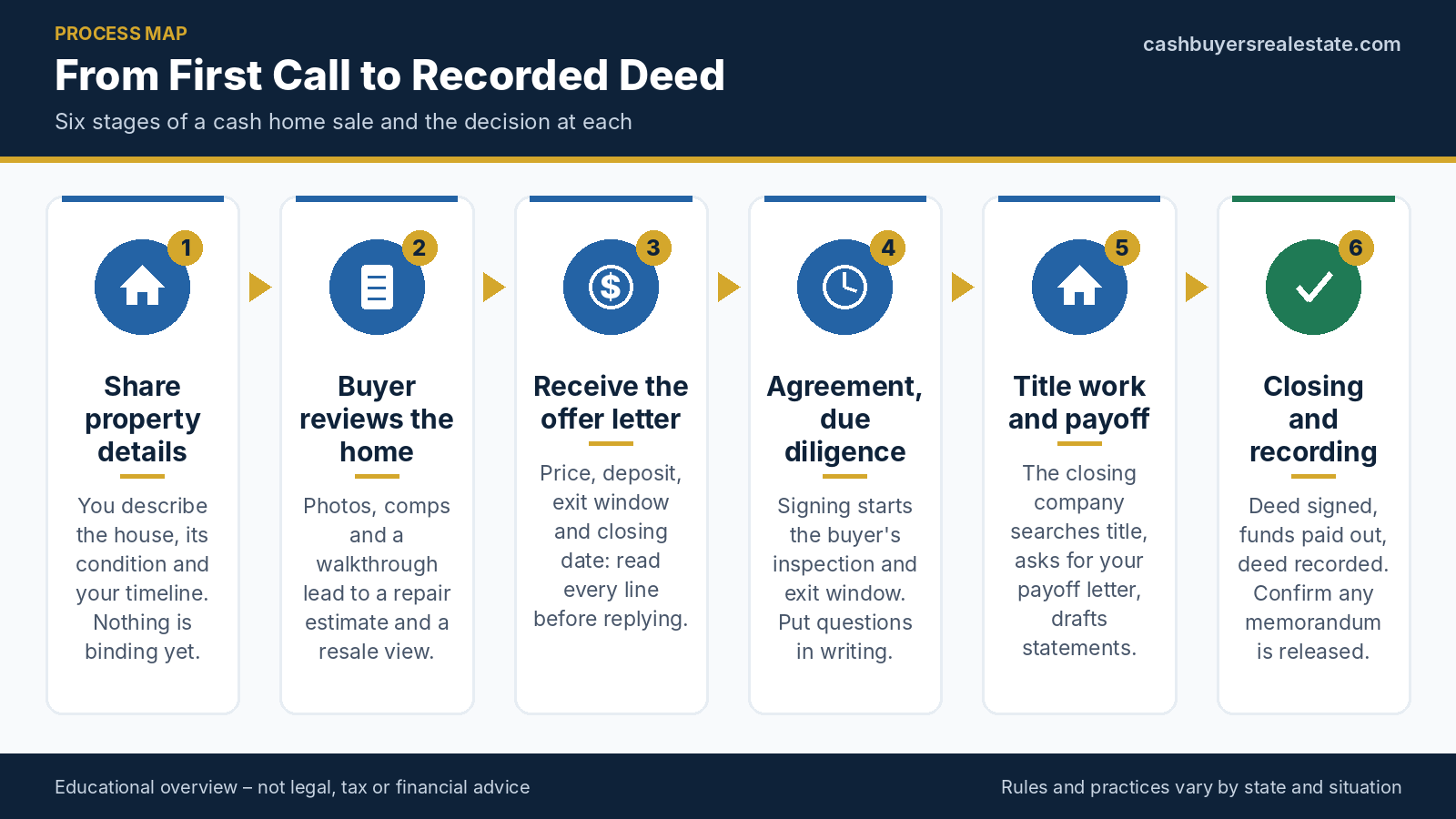
Text version of this infographic
- Share property details — You describe the house, its condition and your timeline. Nothing is binding yet.
- Buyer reviews the home — Photos, comps and a walkthrough lead to a repair estimate and a resale view.
- Receive the offer letter — Price, deposit, exit window and closing date: read every line before replying.
- Agreement, due diligence — Signing starts the buyer's inspection and exit window. Put questions in writing.
- Title work and payoff — The closing company searches title, asks for your payoff letter, drafts statements.
- Closing and recording — Deed signed, funds paid out, deed recorded. Confirm any memorandum is released.
As-Is Language, the Due Diligence Window, and the Deposit
Paragraphs 2 through 5 of the mock letter carry most of the real negotiation in a cash sale, though they occupy only a few lines. Together they say what condition the buyer expects, how long the buyer can investigate and leave, how much money sits in trust while that happens, and how the price can change in between. Sellers who understand these four provisions can usually predict how the deal will behave under stress, long before the closing date arrives.
What “As Is” Does and Does Not Change
Few phrases in real estate are as widely used and as widely misunderstood. To a seller, “as is” often sounds like a promise that nobody will ask for repairs. To a buyer’s attorney, it is a risk allocation clause with limits, and the limits matter most when something is wrong with the house that the seller knew about.
As Is Allocates Repair Cost, It Does Not Cancel Disclosure Duties
The ordinary meaning of an as-is clause is that the buyer accepts the property in its present condition and will not ask the seller to fix it. Texas’s promulgated contract defines the term as “the present condition of the Property with any and all defects,” and in the same form the buyer’s choice to accept the property as is does not waive the buyer’s right to inspect or the unrestricted right to terminate during the option period. In other words, even a form that uses the phrase prominently treats it as a statement about who pays for repairs, not as a gag on the buyer’s investigation. The related guide to selling a house as is explains the repair side of the choice.
Disclosure is a separate matter, and it follows state law. Many states require sellers of residential property to complete a written condition disclosure or to disclose known material defects, and some allow specific exemptions; the Texas form, for instance, lets the parties check a box indicating that a seller’s disclosure notice under Texas Property Code section 5.008 is not required in the transaction, and otherwise gives the buyer a right to terminate if the notice is not delivered. At the federal level, sellers of most housing built before 1978 must give buyers an EPA pamphlet, disclose known lead-based paint hazards and share available records, and allow a 10-day window for a paint inspection unless the buyer waives it, according to the EPA’s real estate disclosure guidance. Nothing on that page suggests that an as-is clause changes those duties.
The practical conclusion is simple. Selling as is can legitimately shift repair risk to the buyer, and it can save you the cost and effort of fixing a house you no longer want to improve. It does not entitle anyone to hide a known problem, and no honest buyer’s contract should ask you to. If a document tries to have you certify that you know of no defects when you do, or pressures you to skip a form your state requires, treat that as a reason to call an attorney before proceeding rather than as routine paperwork.
Re-Trades: When the Price Moves After the Inspection
A re-trade is a request, made after the contract is signed, to lower the price or add a credit based on what the buyer found. In traditional sales it happens when an inspection uncovers a real problem, and the negotiation is usually bounded by contingencies and by the practical threat of losing a financed buyer. In a cash sale with a free exit, the threat runs mostly one direction: the buyer can leave, while you have already taken your house off the market in your own mind.
Illustrative example (hypothetical numbers, not market data): Under paragraph 5 of the mock letter, the buyer’s inspector reports a cracked sewer lateral and an electrical panel that a utility contractor recommends replacing. The buyer proposes dropping the price from $187,500 to $175,000, citing $12,500 of newly discovered work. The seller gets a contractor’s written estimate of $6,900 for those items, shares it, and counters at $181,500. The buyer accepts at $181,000. Had the seller declined, the cost of starting over would have been roughly ten lost days plus the carrying cost of another listing cycle, which is the real comparison to weigh.
Several habits protect you in a scenario like that one. Ask that any price-adjustment request come with a written inspection report and an itemized cost estimate, so you can test the figures against your own bids. Ask for a ceiling in the contract itself, such as a statement that the buyer may not reduce the price by more than a stated amount or percentage, or that adjustments are limited to defects not visible at the original walkthrough and not listed in your disclosures. And confirm in writing that your cancellation right after a failed negotiation returns the deposit to you or to the buyer exactly as the contract says. None of this stops a determined buyer from leaving, but it turns an open-ended renegotiation into a bounded one.
It is also fair to say that some re-pricing is simply honest. A buyer who learns that the foundation needs underpinning, or that a past water leak left mold behind the drywall, has found something that would affect any buyer’s price. The warning sign is not the request itself but the pattern: reductions that arrive in several rounds, reasons that change, or an unwillingness to show the report. The page on cash offer repair deductions looks at how legitimate repair estimates compare with inflated ones.
The Due Diligence Window and the Deposit That Backs It
Two linked provisions determine how much risk you absorb while waiting for closing. The due diligence window decides how long the buyer can leave without penalty, and the deposit decides what the buyer gives up if it leaves later. When the window is long and the deposit is small, the buyer holds an inexpensive option on your house.
What the Window Is and Who It Protects
Due diligence is the period after signing in which the buyer investigates the property, orders title work, and decides whether to proceed. During it, the buyer typically has the right to cancel for any reason or for no reason, and the earnest money comes back. North Carolina’s standard form, for example, gives the buyer a negotiated due diligence period during which the buyer may terminate for any reason, provided any agreed due diligence fee has been paid, and Texas’s form achieves a similar result through an option period for which the buyer pays a separate option fee. Dates matter enormously: the clock may start on the date both parties sign, the date the buyer receives a document, or a date the contract defines separately, and the notice must usually be written and delivered by a stated time.
For a buyer who intends to keep and renovate the house, a ten-day window is a sensible period for inspections and a title search. For a buyer who intends to assign the contract, the same window can double as marketing time. The Nebraska Real Estate Commission’s consumer guidance describes how wholesalers sign a purchase contract, then market it to third-party buyers, and warns that such contracts may allow cancellation for any reason and can run for years, which can keep an owner from selling to anyone else. That does not make a long window improper by definition, but it does mean you should ask directly what the buyer intends to do during it and whether a shorter period is acceptable.
Seen from your side, the window is time during which your house is effectively off the market. If you accept a thirty-day window and the buyer cancels on day twenty-nine, you will have lost a month of listing time in a market that may have moved. Shortening the window, requiring the buyer to complete inspections within the first several days, or asking for a non-refundable fee that compensates you for tying up the property are all reasonable requests, and a buyer’s reaction to them says something about its intentions.
Earnest Money, Option Fees, and What You Keep If the Buyer Leaves
Earnest money is a deposit held by a neutral party, usually the title company, closing attorney, or a broker’s trust account, as evidence of the buyer’s good faith. If the buyer cancels within the window, the deposit normally returns to the buyer. If the buyer defaults after the window, the contract usually lets the seller keep it as compensation. The size of the deposit relative to the price is therefore a rough measure of the buyer’s commitment: a deposit of $1,000 on a $187,500 purchase is about half of one percent, so walking away costs very little. The dedicated page on cash buyer earnest money covers how much is typical and how to verify that the money was actually delivered.
| Feature | Texas (TREC form 20-18) | North Carolina (Form 2-T overview, rev. 7/2024) |
|---|---|---|
| Name of the exit window | Option period, with an unrestricted right to terminate | Due diligence period, with a right to terminate for any reason |
| Separate payment for the window | Option fee, paid to the seller, credited to the price at closing, not refunded if the buyer terminates | Due diligence fee, paid to the seller, generally non-refundable, credited to the price if the buyer closes |
| If the fee is not paid | No unrestricted termination right if the fee is unstated or not delivered on time | The right to terminate for any reason applies only if any agreed fee has been paid |
| Earnest money if the buyer exits in time | Refunded to the buyer | Refunded to the buyer |
| Delivery deadline for earnest money | Within 3 days after the effective date | Initial deposit due within 5 days of the effective date |
| Seller’s remedy if the buyer defaults | Seek specific performance or other relief, or terminate and keep the earnest money as liquidated damages | Earnest money paid to the seller as liquidated damages; seller’s damages limited to that amount |
The table shows that standard forms treat the exit window as something the buyer pays for, at least in these two states. That is the opposite of the mock letter, where the buyer’s ten-day exit is free. A seller who is offered a free option should be aware that other contract frameworks put a price on it, and can ask whether the buyer would add a modest non-refundable fee. The table also shows that the deposit is typically the seller’s main remedy for a buyer’s failure to close, which is why its size and delivery date deserve attention. Before relying on any of this, confirm what your state’s forms and statutes say, because the forms above are used mainly in transactions involving licensed agents.
Deposit forfeiture rules are also shaped by state law. California Civil Code section 1675, for instance, makes a liquidated damages clause up to three percent of the price presumptively valid in the purchase of a dwelling of up to four units that the buyer intends to occupy, and requires the party enforcing a larger amount to prove it reasonable. By its own terms that statute is about owner-occupant buyers, so it should not be assumed to govern an investor’s deposit. The lesson for a seller anywhere is to ask the title company or an attorney how a deposit would be treated in your state if the buyer simply stopped responding.
Closing Date, Closing Company, and How the Offer Compares With Other Routes
Paragraphs 6 and 7 of the mock letter look administrative, and sellers often skim them because the date seems like a detail and the closing company seems like a formality. They are neither. The date controls your own moving plans and carrying costs, and the choice of closing company decides who holds your money, who prepares your deed, and who you will call when something looks wrong. Once those mechanics are understood, it becomes much easier to set the offer beside other ways of selling and to see what each really trades away.
Closing Mechanics: Date, Place, and Who Controls the Table
A closing is the meeting, or the exchange of signed documents, at which the deed is delivered, funds change hands, and the sale is recorded. Practice differs by state. In some states a title company or escrow officer handles the entire process, in others an attorney does, and in some a mix is common. Whichever applies where your property sits, the person who runs the closing is a stakeholder in your sale and deserves the same scrutiny as the buyer.
The Closing Date, Extension Rights, and “On or Before”
Paragraph 6 of the letter sets a closing “on or before 24 days after signing” and lets the buyer extend by up to 14 more days. The phrase “on or before” gives the buyer the ability to close early, which sounds like a benefit to a seller who wants speed, but it can also compress your timeline for packing, clearing the house, and arranging your next home. The extension right is more consequential. It is one-sided, free, and limited by nothing but the buyer’s notice, so a seller who plans around day 24 may need to plan around day 38. Texas’s promulgated form shows how this kind of flexibility is often bounded in standard documents: closing occurs on or before a stated date, or within seven days after certain objections are cured or waived, whichever is later, and a party that fails to close exposes itself to the contract’s default remedies.
Illustrative example (hypothetical numbers, not market data): A homeowner signs the mock letter on a Monday and arranges to close on a replacement condo 26 days later, planning to move the same weekend. On day 22 the buyer’s closing company asks for the extension in paragraph 6. The seller now has two housing payments, roughly $50 per day in utilities, taxes, and insurance on the old house, and a moving truck booked for the wrong date. Ten extra days cost about $500 in carrying costs, plus rescheduling fees, which the contract does not require the buyer to reimburse. A line stating that any extension requires the seller’s written consent, or carries a per-day payment to the seller, would have changed the math.
The practical points are straightforward. Ask for a fixed closing date, or a narrow window, and tie any extension to your written consent or to a daily payment that covers your actual carrying costs. Make sure the contract states what happens if the buyer misses the date without an extension: whether you may cancel, keep the deposit, or list the property elsewhere. And ask whether the buyer’s funds are already in the account that will be used, because a buyer who must borrow short-term money after you sign carries a financing risk even when the offer is labeled cash. How quickly a genuine cash purchase can close in different circumstances is covered in the page on how fast cash buyers can close.
Who Picks the Closing Company, and What You Can Still Control
The mock letter says closing takes place at a company or attorney “chosen by Buyer.” That is common in investor transactions, and it is not wrong in itself, because the buyer is usually paying for the title work and wants a closer it trusts. But the closing company holds the deposit, receives the payoff funds, prepares the settlement statement, and disburses your proceeds. A seller who agrees to a buyer-selected closer should therefore verify it independently rather than rely on the buyer’s description. Look the company up through your state’s insurance or banking regulator or attorney licensing board, call the number you find yourself, and ask for the name of the person handling your file.
Fee splits belong in the same conversation. The letter has the buyer paying the closing company’s fee and the title search, with the seller covering payoff, taxes, transfer tax, and deed preparation, but those allocations vary by state custom and by negotiation. Ask for a written estimate of every charge that will appear on your side of the settlement statement, and compare it with the contract. Ask who pays for the owner’s title insurance policy and whether a policy will be issued at all, since a buyer who plans to resell quickly may prefer to skip it. Asking for a draft settlement statement a few days before closing, and reading it line by line against the contract, is the single best habit for avoiding surprises.
Sellers sometimes assume that the closing company works for them. Often the company acts as a neutral stakeholder or does title work for the buyer, and its staff generally cannot give you legal advice. If you want someone whose only client is you, hire a real estate attorney for a flat fee or an hourly review, which may cost far less than a single price reduction. In states where an attorney conducts closings, ask whether that attorney represents the buyer, the seller, or both, and what that means for your protection.
Putting the Offer Beside the Alternatives
No contract can tell you whether a cash offer is the right route, only whether it is a good version of that route. To judge the route itself, set it beside the real alternatives on the dimensions that actually change your outcome, and be honest about how much each one matters to you.
Five Routes Compared on Price, Repairs, Timing, and Certainty
The table below compares five common ways to sell a house that needs work or a quick exit. It is qualitative on purpose, since real prices and timelines depend on your market, your property, and the buyer, and any numbers attached to these routes without a local source would be guesses. Use it to see which trade-offs apply to you, then fill in your own figures using the net sheet approach shown earlier.
| Route | Price tendency | Repairs and prep | Timing drivers | Main certainty risk |
|---|---|---|---|---|
| Investor cash offer | Often below retail value because the buyer prices in repairs, costs, and margin | Usually none by the seller; buyer takes the property as it stands | Contract terms, due diligence window, title work | Buyer cancels or re-prices; assignment to a third party |
| Agent listing, as-is | Market-driven; condition discounts set by buyers and inspections | Little or none, though buyers may ask for credits | Showings, offers, inspection, appraisal, lender timing | Financed buyer’s loan or appraisal falls short |
| Agent listing after light repairs | Often the strongest of the five when repairs are affordable | Seller pays and manages work before listing | Contractor schedules plus the listing cycle | Repair costs overrun; price may not recover them |
| Instant-offer program from a technology-driven buyer | Varies; fees or service charges can reduce proceeds | Buyer may still request repair credits after its inspection | Program’s own process; limited by market and home type | Eligibility changes; the offer may be revised after inspection |
| Sale by owner | Can save commission if you find a qualified buyer | Seller’s choice | Marketing, showings, negotiation, paperwork | Seller carries legal and contract risk without a professional |
Two things stand out when the routes are lined up. No route wins on every dimension, and the choice tends to turn on one or two priorities more than on a total score. An investor offer buys relief from repairs and uncertainty about showings in exchange for a lower price and, as this article has shown, a contract that leaves some choices with the buyer. A listing with an agent offers the widest buyer pool and often the highest price, but the timeline is less predictable. The pages on selling a house fast and selling a house fast without repairs explore the speed and condition angles in depth.
Matching a Route to Your Priorities
Think of the decision as five questions asked in order of importance to you. How soon must the sale close, and what does a delay cost in cash and stress? How much repair work does the house need, and can you pay for it or manage it? How comfortable are you with strangers touring the house, and can you keep it show-ready? How much uncertainty can you tolerate between signing and closing? And how much price are you willing to give up to resolve the first four? A seller whose answers are “very soon, extensive repairs, no showings, low tolerance for uncertainty” is describing the situation in which a well-drafted cash contract earns its keep. A seller whose answers are “flexible, light repairs, comfortable with showings, tolerant” is describing someone who can likely do better elsewhere.
The honest middle ground is large. Many owners have a house that needs moderate work, a timeline of a few months, and a preference for fewer showings. For them, the cash offer is a benchmark as much as an option: it sets a floor that a listing must beat after commissions and repairs. Getting two or three written offers, including at least one from a licensed agent’s pricing analysis, costs little and gives you a range instead of a single number. The mock letter’s buyer-favorable terms are not a reason to refuse every investor; they are a reason to ask for better ones.
The infographic below sets five routes side by side: an investor cash offer, an agent listing as is, an agent listing after light repairs, an instant-offer program, and a sale by owner. For each it gives the situation where that route fits best and the main trade-off to accept. The text above carries the same information, but a one-page comparison is easier to pin to a refrigerator while you are talking with family.
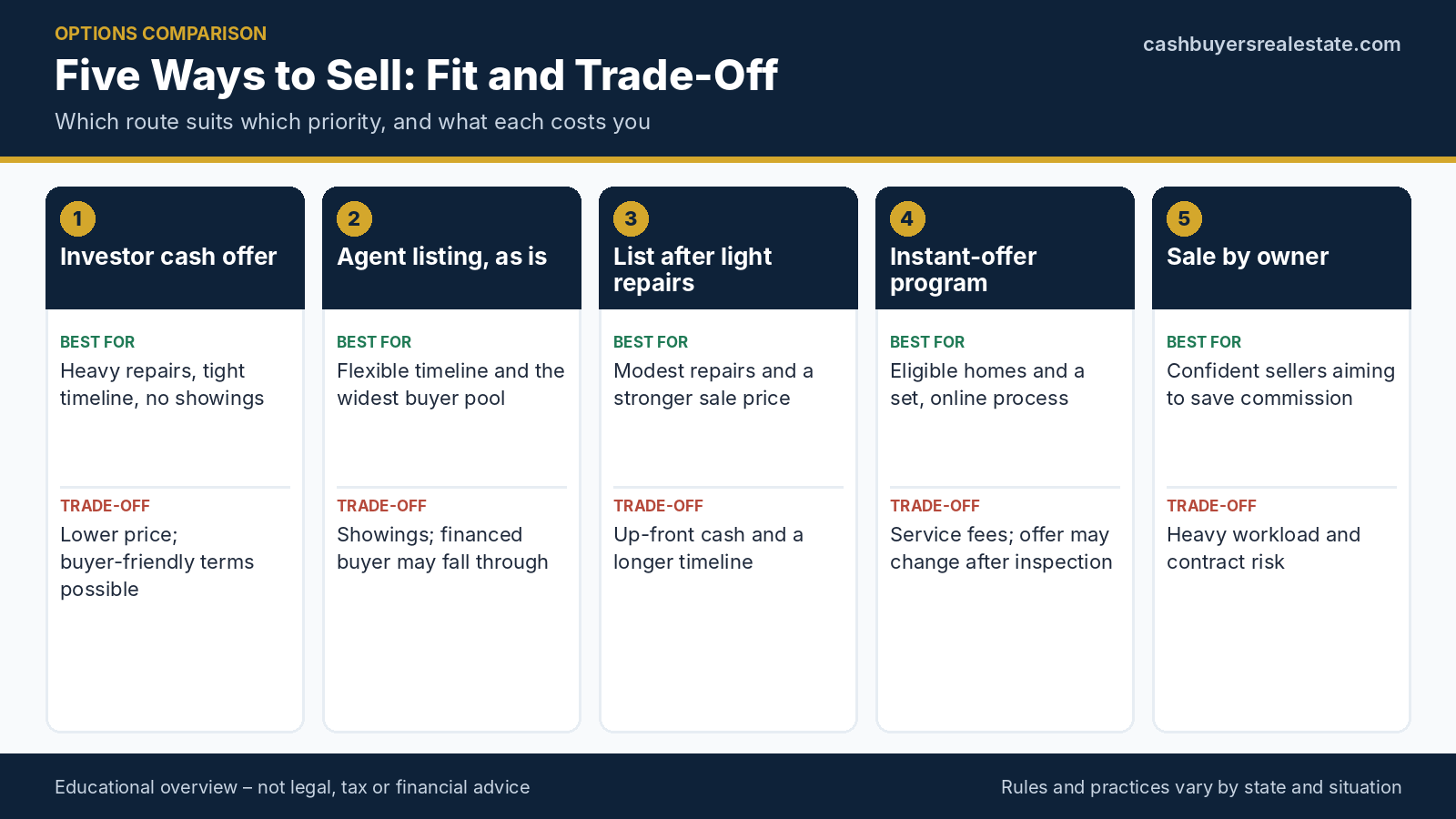
Text version of this infographic
- Investor cash offer — Best for: Heavy repairs, tight timeline, no showings. Trade-off: Lower price; buyer-friendly terms possible.
- Agent listing, as is — Best for: Flexible timeline and the widest buyer pool. Trade-off: Showings; financed buyer may fall through.
- List after light repairs — Best for: Modest repairs and a stronger sale price. Trade-off: Up-front cash and a longer timeline.
- Instant-offer program — Best for: Eligible homes and a set, online process. Trade-off: Service fees; offer may change after inspection.
- Sale by owner — Best for: Confident sellers aiming to save commission. Trade-off: Heavy workload and contract risk.
Assignment Clauses, Memoranda of Contract, and the Cloud on Your Title
Paragraphs 8 and 9 of the mock letter are the two that most often surprise sellers, because they have nothing to do with price. One decides who may end up standing in the buyer’s shoes. The other decides what appears in the public land records while the deal is pending. Both are legal, both are common in some corners of the investor market, and both deserve a seller’s full attention before signing, since the harm they can cause is hard to repair once it has happened.
“And/Or Assigns” and What It Lets the Buyer Do
Contract rights can usually be transferred unless the contract says otherwise. When a purchase agreement names the buyer as “John Smith and/or assigns,” or states that the buyer may assign the agreement without the seller’s consent, the seller has agreed in advance that someone other than the named buyer may complete the purchase. That is the simple legal core of what the industry calls wholesaling, and it deserves a plain explanation because so much heated language surrounds it.
Assignment, Double Closing, and Buying for Yourself
There are three ways a contract buyer can end up with the benefit of your sale. The first is to close personally: the named buyer buys the house with its own money or its lender’s, and keeps or resells it. The second is an assignment, in which the buyer signs a separate document transferring its contract rights to a new buyer for a fee, and the new buyer closes with you. The third is a double closing, in which the original buyer actually takes title from you and immediately sells to the end buyer in a second transaction. The seller’s price is the same in all three; what differs is who takes title, who shows up at the closing table, and who profits from the spread between your price and the end buyer’s price.
Settlement professionals treat assignments as a point of caution. A June 2023 issue of Fidelity National Financial’s Fraud Insights newsletter tells settlement agents to check first whether the agreement bars assignment, names the buyer “and/or assigns,” or requires the seller’s consent, and recommends handling the transfer through a separate assignment agreement. It also flags risks such as releasing the original buyer’s deposit before the replacement deposit clears and unclear ownership of the deposit if the deal fails. None of that is a condemnation of assignments. It is a reminder that the paper trail should be clean and that a seller is entitled to know which entity is ultimately funding the purchase.
Illustrative example (hypothetical numbers, not market data): A seller signs the mock letter at $187,500. During the ten-day window, the original buyer markets the contract to other investors and finds one who will pay $201,000 for the house as it stands. The buyer assigns the contract for a $13,500 fee and the new investor closes with the seller at the original $187,500. The seller never meets the assignee and sees the fee only if the settlement statement shows it. Had the seller known the house could draw $201,000 from a different investor, the seller might have asked for $195,000 or listed the house; because the contract allowed assignment without notice, the choice was never presented.
The point of the example is not that the buyer did anything wrong. Marketing a contract is a recognized business model, and it can make sense for owners who want a fast sale and little involvement. The point is information. When the buyer’s intention to assign is disclosed, you can weigh whether the price still works; when it is hidden or buried, you cannot. Three direct questions fix much of the problem. Does the buyer intend to close in its own name? If it may assign, will it tell you the assignee’s name and funds before the due diligence window ends? And will it agree that any assignment leaves the original buyer responsible for performance if the assignee fails to close?
State Rules That Give Sellers a Say: Disclosure, Licensing, and Cancellation
Legislatures have noticed. Stateline reported in September 2026 that at least 15 states have recently approved new wholesaler rules, naming Missouri, Maryland, Ohio, Oklahoma, Texas, Illinois, South Carolina, and Rhode Island among them, and that no state has outright banned the practice. The rules fall into three families: disclosure to the seller, licensing or registration of the wholesaler, and cancellation rights for the seller. The table below summarizes six jurisdictions whose rules were checked against primary or professional-association sources for this article. It is a sample, not a survey, and statutes get amended.
| State | Rule as reported | What it gives a seller |
|---|---|---|
| Oklahoma (59 O.S. § 858-314) | Wholesaler must give written notice before signing that it intends to assign or sell its equitable interest for a higher price, and the contract must advise legal counsel and state the cancellation right | Cancel without penalty within two business days after the contract is executed; cancel at any time if required disclosures are missing, in which case the form describes the contract as unenforceable and the seller entitled to the earnest money |
| Oregon (HB 4058, effective July 1, 2025) | Wholesalers must register (unless licensed) and give a written disclosure before the contract is signed | Cancel without penalty before midnight of the third business day after receiving the disclosure; terminate at any time without penalty if the disclosure was never given |
| Pennsylvania (Act 52 of 2024) | Wholesaling is licensed activity, and the contract must state that it is a wholesale transaction, with notice of appraisal, counsel, and cancellation rights | Cancel until midnight of the 30th day after signing or until conveyance, whichever comes first; cancel any time before conveyance if required elements are missing; refunds within 10 days |
| Illinois (2019 amendments to the Real Estate License Act) | A pattern of dealing in real estate contracts, including assignable ones, on two or more occasions in a year requires a broker’s license, per the state REALTORS association’s legal hotline | State regulatory oversight of those wholesalers; the hotline article does not describe a specific seller cancellation right |
| Missouri (law enacted 2026) | Written disclosure to the seller at least 14 days before closing that the wholesaler may offer below market value and may reassign the contract | Advance notice and an encouragement to consult an attorney; Stateline did not describe a cancellation right |
| Nebraska (per Real Estate Commission guidance) | A wholesaler who publicly markets an assignable contract must use a licensed real estate agent | A licensed professional with regulatory accountability involved in the marketing; the commission urges owners to check whether their contract is assignable |
Reading the table, notice how differently the same practice is treated. Oklahoma and Pennsylvania hand the seller a short cancellation window, Oregon ties cancellation to receipt of a disclosure, Missouri relies on advance notice, and Illinois uses licensing. If your property is in one of those states, ask whether the buyer is acting as a wholesaler and whether the required notice is attached. If your state is not listed, that does not mean the practice is unregulated; it means these sources do not describe it, and your state real estate commission or attorney general can say what applies. The related page on selling a house directly to an investor looks at the investor side of the same relationship.
Memoranda of Contract and the Cloud on Title
Paragraph 9 of the letter has the seller agree to sign a memorandum of the contract and lets the buyer record it. Many sellers wave this through because it sounds like housekeeping. In fact, it is one of the few clauses that reaches outside the transaction and affects the legal status of your property in public records.
What a Memorandum Is and Why a Buyer Records One
A memorandum of contract, sometimes called a memorandum of agreement or notice of contract, is a short document that identifies the property, the parties, and the existence of a contract to sell, usually without disclosing the price or other terms. When it is recorded in the county land records, it gives the world notice that the buyer has a claimed interest in the property. A buyer with a legitimate interest may want that protection: it helps secure the buyer’s place in line ahead of later liens or a second sale of the same house, and some title companies like to see it when a contract is assigned. In that sense, a memorandum is a tool of fairness between buyer and seller as well as a source of bargaining power.
The question is what happens if the deal ends. A recorded memorandum does not remove itself when a contract is canceled. Unless someone records a release, it can remain in the chain of title for years. Careful contracts therefore address the release in the same breath as the recording: the buyer must record a release within a few days after termination, the buyer signs and delivers a recordable release at the same time it signs the memorandum, or the memorandum states an expiration date after which it has no effect. If a contract allows recording but says nothing about release, ask for a sentence that fixes the problem before you sign. Ask, too, whether the memorandum will state only the bare facts of the agreement or attach the full contract, because anything recorded becomes a public document that anyone can read.
When Recording Clouds Your Title, and How It Gets Cleared
A cloud on title, in the plain definition offered by Cornell’s Legal Information Institute, is an outstanding claim or encumbrance that calls a property’s ownership into question and may deter buyers. A recorded memorandum from a canceled deal fits that description. A title company asked to insure a later sale will see the document, ask what happened to it, and often refuse to insure over it until it is released or a court resolves the claim. The consequence for you can be a stalled sale to the next buyer, even one who is financed and in no way connected to the first. The same source notes that clouds of this type can be lifted by a quiet title action, a lawsuit that asks a court to declare who holds the interest, which is far slower and costlier than getting a release at the outset.
States have started to deal with the problem directly. Texas Property Code section 12.020, added by House Bill 4063 and effective September 1, 2025, addresses what it calls a unilateral memorandum of contract: a document concerning residential property signed only by a non-owner who claims a contract, option, or right to buy. The filer must mail the owner a copy and a notice by registered or certified mail, and an owner who receives it or otherwise learns of it may record an affidavit that operates as a release of record, unless the filer records a contradicting affidavit within 45 days. After that period, a bona fide purchaser or lender may rely on the owner’s affidavit, and the filer’s remedy is money damages. The statute’s own text should be read before any action, and the details differ by state, so treat it as an illustration of how legislatures address the issue rather than as a rule that applies everywhere.
Recorded agreements can also be unrelated to a purchase contract. In January 2023, the registers of deeds for Kalamazoo and St. Joseph Counties in Michigan publicly warned residents about a program that paid cash in exchange for long-term exclusive listing rights, noting that such an agreement recorded against the property could bind future owners. The product was different from a cash purchase, but the lesson transfers: before signing anything that you or the other party can record against your property, understand how long it lasts, what it restricts, and exactly how it is removed.
Default, Forfeited Deposits, and the Red Flags Worth Testing
Contracts are written for the day something goes wrong, and paragraph 10 of the mock letter says what happens on that day. It is short, but it governs the most valuable thing a signed agreement gives you: a remedy. A seller who understands how remedies work can judge whether the deposit is meaningful, whether the contract is balanced, and which of the behaviors a buyer shows along the way deserve concern and which are only business as usual.
What Happens When a Deal Fails
Many cash transactions close as planned, but some do not, and the reasons run in both directions. Buyers lose funding or interest. Sellers discover liens, unexpected heirs, or a tenant who will not leave. Looking at both directions of failure is the fairest way to evaluate a default clause, and it keeps the analysis honest about what you are promising as well as what the buyer is promising.
When the Buyer Defaults: Deposits and Their Limits
In the mock letter, if the buyer fails to close after the due diligence window, the seller’s sole remedy is to keep the $1,000 deposit. This kind of clause is called a liquidated damages provision, and it has two edges. It gives the seller certainty, because there is no need to prove damages in court. It also caps the seller’s recovery at the deposit, even if the failed deal cost far more in lost time, carrying costs, and a softer market. North Carolina’s standard form, for example, states that on a buyer’s breach the seller’s damages are limited to the earnest money, and Texas’s form lets the seller either terminate and keep the earnest money or pursue other relief such as specific performance.
Illustrative example (hypothetical numbers, not market data): A seller accepts the mock letter, takes the house off the market, and the buyer stops answering calls on day twenty-nine, after the window has closed. The seller keeps the $1,000 deposit, but the lost month cost roughly $1,350 in carrying costs, and the next buyer, approached in a slower season, offers $183,000, which is $4,500 below the first. The deposit covers less than a fifth of the loss. A deposit equal to one or two percent of the price, or a daily fee payable to the seller for each extension, would have shifted more of that loss back to the buyer.
The lesson is not that deposits must be large, since a large deposit also makes a buyer hesitate to sign and can reduce the offers you receive. It is that the deposit should bear some relationship to the cost you absorb if the buyer leaves. Ask how much earnest money the buyer will put up, when it is due, and who holds it. Ask the closing company to confirm in writing that the money arrived. And ask whether the buyer would convert part of it into a non-refundable payment after the due diligence window, a feature that many state forms treat as an ordinary part of a negotiated deal.
State law may also shape what a seller can keep. California, for instance, limits how much of a deposit is presumptively valid as liquidated damages when the buyer intends to occupy the home, under Civil Code section 1675, and other states have their own approaches. Because the rules differ so widely, the safest practice is to ask the title company or an attorney for a short written explanation of how a defaulted deposit would be handled in your state before you accept a clause that makes it your only remedy. The page on cash offers with no contingencies explains how contingencies and deposits interact more generally.
When the Seller Cannot Close or Wants Out
The mock letter treats the seller’s default very differently: the buyer may seek specific performance, meaning a court order requiring the sale, or damages, and may recover attorney’s fees. Specific performance is a normal remedy for real property because each parcel is considered unique. Texas’s standard form gives the buyer the same option on a seller’s default. The difference lies in the combination with a one-sided fee-shifting provision and a free buyer exit. Together they mean you cannot walk away without risk, while the buyer can walk away at little cost for the first ten days.
A seller can find itself unable to close for entirely ordinary reasons. A mortgage payoff may exceed the price. A contractor may have filed a lien the owner forgot about. A deceased relative’s name may still be on the deed. A tenant may refuse to leave. The best protection is to learn about such issues before you sign: order a payoff letter, review your title records or ask a title company for a preliminary report, and put every known issue into the disclosure you give the buyer. If a problem surfaces after signing, tell the buyer and closing company promptly and in writing. Silence makes a solvable problem into a default.
Many sellers also believe they can cancel any contract within three days. That is a common misconception. The Federal Trade Commission’s Cooling-Off Rule covers certain sales made at a consumer’s home or other non-business locations, but the definition of a door-to-door sale in 16 CFR Part 429 excludes transactions pertaining to the sale or rental of real property. Any right you have to cancel a home sale contract comes from the contract itself or from state law, such as the wholesaling statutes summarized earlier, and not from a general federal three-day right. If you have already signed something you regret, the first call should be to a real estate attorney, before the due diligence window and any state cancellation period expire.
Red Flags and How to Test Them Calmly
A red flag is a reason to look closer, not a verdict. The consumer-protection agencies that warn about cash-home-buyer problems make a similar point: investors vary, and the same behavior can have a harmless explanation or a harmful one. The approach that works is to turn each concern into a small, specific test whose result you can see for yourself.
Verifying the Buyer: Identity, Funds, and the Closing Partner
Start with who the buyer is. A contract signed by an LLC is common and legitimate, but you should know the entity’s exact legal name, the state where it is registered, and who has authority to sign for it. Many states post business registrations on a secretary of state website, where you can confirm that the entity exists. Ask the person you are dealing with to explain their role: principal buyer, member of the entity, or someone marketing the contract to others. A clear answer is a good sign, and a refusal to say is information too. The page on proof of funds for cash buyers explains what a genuine proof looks like and why a screenshot is weaker than a letter from a bank.
Proof of funds is a starting point rather than an end point, because a statement shows money at one moment and says nothing about whether that money is committed elsewhere. A stronger check comes from the closing company: ask it to confirm in writing that the deposit has been received and that it has opened a file. Call the company on a number you find independently, not one the buyer provides. And ask for the preliminary title commitment, which shows the exceptions an insurer will take and whether the buyer has already ordered title work, a concrete sign of progress. No single item here proves or disproves honesty, but a buyer who can satisfy all of them has made the most important questions easy to answer.
Pressure, Blank Forms, and Requests That Do Not Belong in a Purchase
The pressure patterns that consumer agencies describe tend to fall into a few families. One is artificial urgency: a 48-hour expiration, a claim that the offer is only available today, or an insistence that you skip the attorney because “it just slows things down.” A second is incomplete paperwork: blank lines, missing dates, or an agreement that will be “filled in later.” A third is a request to hand over legal title or money before the sale closes. The Nebraska Real Estate Commission cautions that in distressed situations a quitclaim deed may not disclose that the homeowner remains responsible for the mortgage, and the Pennsylvania Attorney General’s office describes foreclosure-relief schemes in which the buyer takes the deed without paying off the loan. The broader cash home buyer scams guide covers those patterns in depth.
| What you notice | Why it matters | A calm way to test it |
|---|---|---|
| Blank lines or “we’ll fill that in later” | A signed document can be completed in ways you did not intend | Decline to sign until every field, date, and attachment is complete, and keep a copy |
| Offer expires in hours, or the buyer discourages legal review | Pressure reduces your chance to compare and to ask questions | Ask for a reasonable extension in writing; consider whether an attorney review fits inside it |
| Free buyer exit with a very small deposit and a long window | The buyer holds an inexpensive option on your house | Ask for a shorter window, a larger deposit, or a non-refundable fee |
| Assignment permitted without notice | You may not know who actually closes or what the house can fetch | Ask whether the buyer intends to assign and for notice and the assignee’s identity |
| Recording of a memorandum with no release mechanism | A canceled deal can leave a cloud on your title | Ask for a signed, recordable release delivered at signing or an automatic expiration date |
| Request for a deed or power of attorney before closing | You could lose control of the property while the mortgage remains yours | Refuse; title transfers at closing, through a closing company you have verified |
| Fees requested up front from you | A purchase offer does not normally require a seller to pay in advance | Decline and ask what the fee covers and why it is not paid from proceeds at closing |
| Changed wiring instructions or a last-minute price change | Both are recognized warning signs in closings | Verify by phone using a number you already have, and ask for the change in writing |
Use the table as a checklist rather than a scorecard. One yellow flag, such as a short deadline, is often explained by the buyer’s own funding or schedule and can be resolved with a question. Several at once, particularly a request for a deed or fees combined with discouragement of legal review, justify stepping back and getting independent advice. If something goes wrong, the Federal Trade Commission directs victims to report the problem at ReportFraud.ftc.gov and to their state attorney general.
The infographic that follows condenses these tests into a six-item decision checklist: verify the buyer’s identity, request proof of funds, read the cancellation clauses, check the assignment terms, use a reputable closing company, and never sign blank forms. Each item corresponds to a section of this guide, and together they cover most of what a careful seller can verify before deciding.
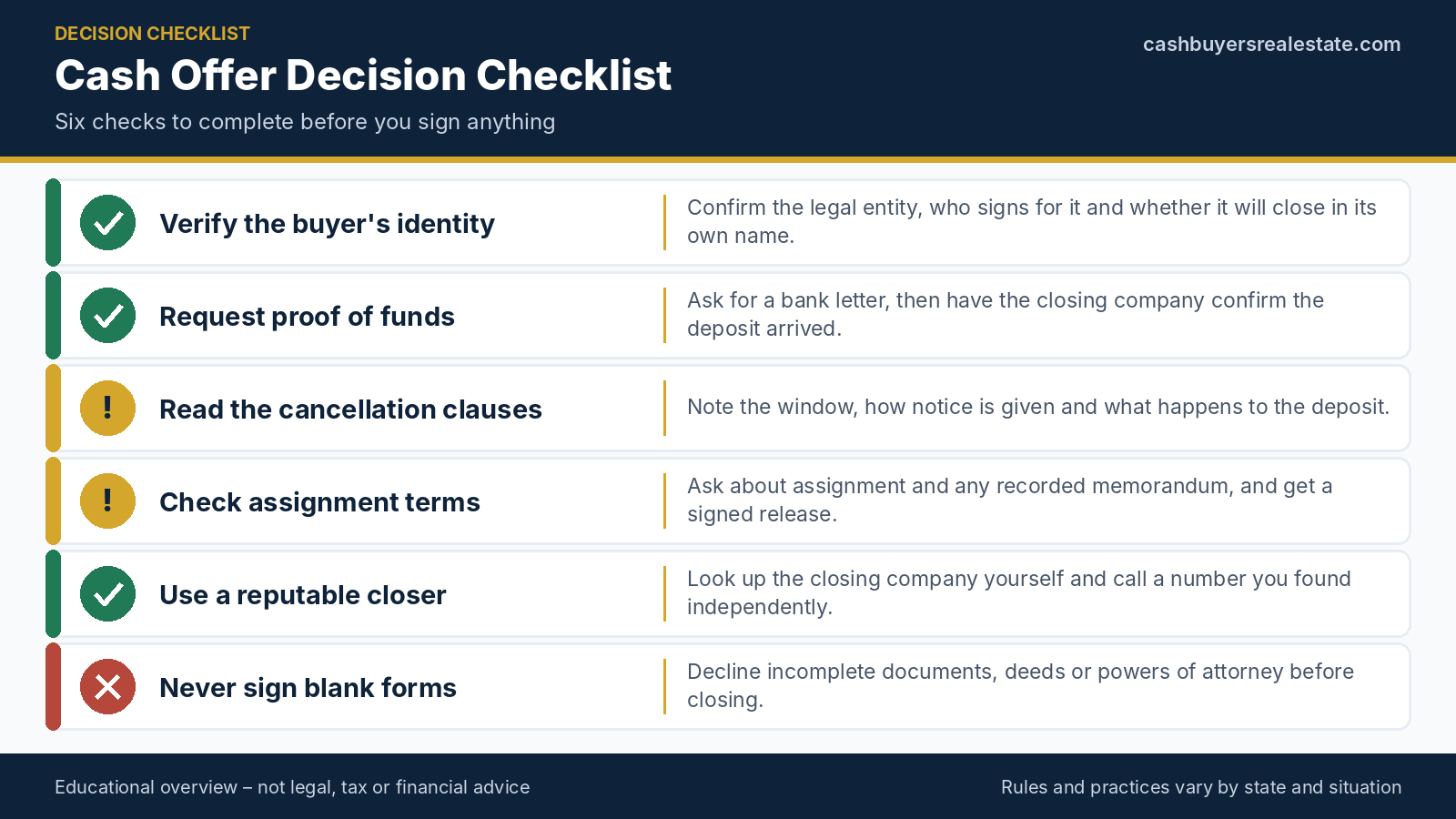
Text version of this infographic
- Verify the buyer's identity — Confirm the legal entity, who signs for it and whether it will close in its own name.
- Request proof of funds — Ask for a bank letter, then have the closing company confirm the deposit arrived.
- Read the cancellation clauses — Note the window, how notice is given and what happens to the deposit.
- Check assignment terms — Ask about assignment and any recorded memorandum, and get a signed release.
- Use a reputable closer — Look up the closing company yourself and call a number you found independently.
- Never sign blank forms — Decline incomplete documents, deeds or powers of attorney before closing.
Putting Your Questions in Writing Before You Accept or Counter
By this point, the mock letter has been taken apart clause by clause, and what remains is turning understanding into action. The most effective step a seller can take is also the least dramatic: write down the questions, send them to the buyer by email or text so there is a record, and see what comes back. Answers delivered in writing are something you can compare, forward to an attorney, and rely on later. Answers delivered by phone tend to be forgotten, softened, or denied.
The Written Questions Worth Asking
Good questions are specific and easy to answer in a sentence or two. A buyer who is organized and acting in good faith can usually respond within a day, and the quality of the response is evidence in itself. It helps to group the questions by what they protect: your money first, then your rights and your ability to exit.
Questions About Money, Costs, and Timing
Begin with the figures that determine your net. Ask the buyer to confirm the purchase price in writing and to list every deduction, credit, or fee that could reduce it between signing and closing. Ask who pays each closing cost, and request a written estimate of your side of the settlement statement from the closing company. Ask how much earnest money will be deposited, on what date, and with whom, and ask for the deposit confirmation once it is made. If the contract includes a price-adjustment clause like paragraph 5 of the mock letter, ask whether there is a ceiling on the reduction and what documentation the buyer will provide to justify one. The dedicated page of questions to ask a cash home buyer offers a longer menu if you want to go further.
Timing questions come next. What is the exact closing date, and is any extension allowed? If the buyer needs an extension, must it be requested in writing, and does the seller have to agree? What does the buyer expect from you before closing in terms of access, cleanout, or possession? When will the buyer’s inspection take place, and how much notice will you receive? If you have a mortgage, the payoff amount and any per-day interest after a missed date can change your proceeds, so ask the closing company how a delay would affect the payoff. Written answers to these points turn the loosely worded promises of a sales conversation into terms you can hold the buyer to.
Questions About Rights, Control, and Exits
The second group of questions addresses the clauses discussed in the last three sections. Short as they are, they cover the points where sellers most often discover, too late, that a clause meant something different from what they assumed. Send them as a numbered message and ask the buyer to reply under each item.
- Do you intend to close in your own name, or may you assign the contract? If so, will you tell me who the assignee is before the due diligence period ends?
- Do you plan to record a memorandum of the contract, and will you sign a recordable release at the same time you sign the memorandum?
- How many days does the due diligence period last, what starts the clock, and how must you give notice to cancel?
- Is any part of the deposit non-refundable after that period, and who holds the money?
- If you cancel or fail to close, what do I keep and what must you return, including any inspection reports you commissioned?
- Which company or attorney will handle closing, and may I call them directly?
- If the price is reduced after inspection, can I receive a copy of the report and cost estimates, and can I cancel without penalty if we do not agree?
A buyer’s tone in answering matters as much as the content. Straight, brief answers suggest a business accustomed to scrutiny. Irritation, evasion, or an insistence that these questions are unnecessary suggests a buyer who would rather you not know the answers. Neither reaction is conclusive, because a rushed investor may simply be busy, but together with the objective facts in the contract it helps you decide whether to move forward. The ranked warning signs covered elsewhere on this site can help you weigh answers that fall in the gray zone.
Preparing Your Response
With answers in hand, you have three possible responses: accept the offer as written, counter with changes, or decline. Each is easier to make when your documents are in order and you know who can help you check them. Preparation is also the best defense against pressure, since a seller with a payoff letter and a net sheet in hand is harder to hurry.
Documents to Gather and Professionals Worth Consulting
Gathering paperwork takes a day or two and prevents the kind of last-minute discovery that derails closings. Beyond the documents the buyer asks for, collect the items in the table below, which are the ones most often needed by a closing company and most often delayed when the seller starts late.
| Document | Why it matters | Where to get it |
|---|---|---|
| Mortgage payoff letter | States the exact amount needed to release the loan, with a per-day interest figure | Your loan servicer, on written request |
| Copy of your deed and any recorded liens | Confirms who owns the property and what claims already appear in the records | County recorder or register of deeds; a title company |
| Property tax bills and homeowners association statements | Show amounts to be prorated or paid off at closing | County tax office; association manager |
| Existing disclosures, inspection reports, and repair invoices | Support your own disclosure and help you rebut inflated repair estimates | Your files; contractors; prior sale records |
| Written contractor bids for major items | Test the buyer’s repair assumptions with independent numbers | Two or more licensed local contractors |
| Lead-based paint records, if built before 1978 | Federal disclosure rules apply to most pre-1978 housing | Your records; EPA’s sample forms and pamphlet |
| Authority documents if title is in an estate, trust, or multiple names | Show who is legally allowed to sign the contract and deed | Probate court, trustee, or attorney |
| A written net sheet comparing at least two routes | Lets you weigh the offer against alternatives | Your own worksheet; an agent; a title company |
The table is a working list, not a legal requirement; your state or your situation may add items. Notice that several entries help you in more than one way. A payoff letter lets you build a net sheet and also tells you whether any deal makes financial sense, and a set of contractor bids gives you a stronger hand if a buyer claims large repair costs. Collecting them before you reply to the offer also shows the buyer that you are organized and that the quick sign-now approach will not work.
As for professionals, three are worth considering depending on the stakes. A real estate attorney, hired for a limited-scope review of the contract, can explain what each clause means under your state’s law and may spot a problem a layperson would not. A title company or closing attorney can pull a preliminary title report that shows liens or claims, and can say how a recorded memorandum or a deposit dispute would be handled locally. A tax professional can address questions such as the home-sale exclusion described by the IRS. If you are behind on your mortgage, a HUD-approved housing counselor is free, and the FTC points consumers to one before they sign anything promising to rescue a home.
Countering, Accepting, or Declining Without Burning Bridges
A counteroffer is simply a written list of the changes you would need in order to accept. The most effective counters are short and prioritized: a few terms that matter most, stated plainly, instead of a dozen. Using the mock letter, a seller might ask for a seven-day due diligence window instead of ten, a $5,000 deposit with $1,500 becoming non-refundable once the window ends, a fixed closing date with no extension without the seller’s consent, notice and the assignee’s identity before any assignment, a memorandum only if a signed release is delivered at the same time, and a cap of $5,000 on any price adjustment. Those numbers are hypothetical, but the structure shows how to ask for better terms without rejecting the whole offer.
Whatever the buyer says in response, keep the record in writing and do not agree to anything by phone alone. If the buyer accepts your counter, ask for a fresh copy of the full agreement showing the changes, and read it again, since changes made in one place sometimes fail to carry through to another. If the buyer refuses everything and the price is the only attractive feature, that is information about how the relationship would continue after signing. Declining is always an option, and a polite message saying that the terms do not fit your needs closes the door without damaging your ability to talk later if circumstances change.
Finally, remember that you control the pace. An offer that expires in 48 hours can be extended if the buyer values the deal, and a buyer who will not extend, when the extra time costs nothing, is telling you how the closing will go. Give yourself the time to compare other routes, whether a listing consultation with an agent, a second investor, or a light-repair plan, and return to the cash offer only if its terms still beat the alternatives once you have run the numbers side by side.
Frequently Asked Questions About Cash Offers and Purchase Agreements
The questions below come up repeatedly once a seller has an offer on the table. Answers are general; the specifics of your contract and your state’s law control, so use them to prepare better questions for an attorney or title professional rather than as a substitute for one.
Questions About the Offer and the Paperwork
The first cluster deals with what counts as an offer, what can change after you sign, and who should look at the documents. The second cluster covers money held in trust and the clock that governs the buyer’s exit.
Offer letters, prices, and contracts
- Is an offer letter the same as a binding contract?
Not necessarily. A non-binding expression of interest commits no one, while a letter with signature lines, a deposit, a closing date, and remedies for default may already be the contract. Look at what the document asks you to sign and ask directly whether your signature creates a binding agreement. When the answer is unclear, treat it as binding and have it reviewed first.
- Can the buyer lower the price after I sign?
Only if the contract allows it or you agree. Many cash contracts include a price-adjustment clause tied to inspection findings, and a buyer with a free exit during due diligence can also simply walk away. Ask for a ceiling on any reduction and a written report supporting it. If no such clause exists and the buyer asks for a lower price anyway, you are free to say no and rely on the contract.
- Do I have to use the buyer’s contract form?
No. You can ask the buyer to use a state-promulgated or association form, or you can have your own attorney draft or revise the agreement. Some buyers resist because their forms are built around their business model, which is useful to know. A willingness to negotiate the form itself is a reasonable sign that the buyer expects to be held to the terms.
- Do I need a real estate agent to accept a cash offer?
Generally no, though rules vary by state and an agent or attorney can add a layer of protection. An agent can also pull comparable sales that show whether the price is reasonable. If you choose to work without one, an attorney’s limited review of the contract is the most efficient substitute. Ask your state’s real estate commission what requirements apply to your transaction.
Deposits, inspections, and timing
- How much earnest money should a cash buyer put down?
There is no universal amount. Practice differs by state, price range, and buyer type, and some contracts use a small deposit with a separate fee for the due diligence window. What matters is whether the amount would meaningfully compensate you for the time your house is tied up. Ask who holds it and request written confirmation that it arrived.
- What does the inspection period mean in a cash sale?
It is the time the buyer has to inspect the house, review title, and decide whether to continue, usually with the right to cancel and recover the deposit. Because cash buyers have no lender or appraiser, this window often replaces the contingencies that a financed sale would have. Confirm how the clock starts, how notice must be given, and what happens to the deposit if the buyer cancels.
- What if the buyer asks for more time to close?
You can agree, refuse, or agree for something in return. Common requests include a short extension and a payment to cover your carrying costs. Put any change in a signed amendment rather than a text message, and check how it affects your payoff figure and your own move. If the contract already gives the buyer a unilateral extension, you may have less choice than you thought.
Questions About Risk and Your Rights
The remaining questions concern assignment and recorded documents, then scams and cancellation. They address the points where sellers most often feel caught off guard.
Assignment, recording, and title
- Is it legal for a buyer to assign a purchase contract?
In general, contract rights are assignable unless the contract or a state rule says otherwise. A growing number of states regulate the practice through disclosure, licensing, or cancellation rules, so the answer depends on where the property sits. Ask the buyer whether it plans to assign and check your state real estate commission’s guidance. If the idea troubles you, ask for a clause requiring your written consent.
- Can I refuse to sign a memorandum of contract?
You can ask to change or strike the clause before you sign, since it is an agreed term and not a legal requirement. Once it is in a signed contract, refusing later may count as a breach. If you accept recording, insist that the buyer provide a signed, recordable release at the same time, or that the memorandum expire on a stated date.
- How can I tell whether something has been recorded against my property?
Search the county recorder or register of deeds, many of which offer online indexes, or ask a title company to run a search. Check again after a canceled deal to confirm any memorandum has been released. If a document appears that you did not sign, consult an attorney promptly, because the remedy depends on your state’s law.
- Does a clause that says “and/or assigns” mean I cannot learn who the final buyer is?
The words themselves do not require disclosure, but nothing stops you from asking for it. A buyer that is comfortable with an assignment should be willing to name the assignee and show that its funds are in place before the due diligence window ends. A refusal to say, together with a hurry to close, is worth weighing carefully.
Scams, cancellation, and walking away
- Do I have a three-day right to cancel a home sale contract?
There is no general federal three-day right for real estate sales, since the FTC’s Cooling-Off Rule excludes transactions pertaining to the sale of real property. Cancellation rights come from the contract or from state law, as with the wholesaling statutes in Oklahoma, Oregon, and Pennsylvania. Read the cancellation clause and calendar any deadline immediately.
- Is every company that advertises that it buys houses for cash a scam?
No. The market includes legitimate local investors, landlords, renovators, and larger funds, along with some operators who use aggressive or unfair tactics. The better approach is to evaluate the specific buyer and the specific contract rather than the category. Verify identity, funds, and the closing company, and compare the net to your alternatives.
- What should I do if I signed and now have doubts?
Read the contract for any cancellation rights, note the deadlines, and contact a real estate attorney right away; the window to act without penalty can be short. Tell the closing company you have questions about the file and do not sign a deed. If you suspect fraud, report it to your state attorney general and to the FTC at ReportFraud.ftc.gov.
Choosing Your Route and Taking the Next Steps
No single clause in a cash offer decides whether it is a good one. What matters is whether the combination of price, risk, speed, and control matches what you need, and whether the buyer will put in writing the answers that make you comfortable. The final section pulls the guide together into a way to decide and a way to proceed.
A Decision Framework for Cash Offers
Start with your own priorities rather than the buyer’s pitch. The table below pairs common seller priorities with the contract terms to look for and the kind of route that often fits. It is a thinking tool, not a rule, and your circumstances may point elsewhere.
Matching the Offer’s Terms to Your Priorities
| If your top priority is | Look for these terms | Routes worth comparing |
|---|---|---|
| Speed and a firm date | Short due diligence window, fixed closing date, meaningful deposit, verified closing company | Investor cash offer with strong terms; a listing priced to move |
| The largest net amount | Not applicable to a discounted cash price; compare net sheets across routes | Agent listing, with or without light repairs |
| Avoiding repairs and showings | Clear as-is language, capped price adjustments, no repair demands as a closing condition | Investor cash offer; as-is listing |
| Protecting your title and flexibility | No assignment without notice, memorandum only with a recordable release, no long option | Any route with a clean, short contract |
| Minimizing workload and uncertainty | Written answers to your questions, a single point of contact, a draft settlement statement in advance | Investor cash offer; agent with a full-service plan |
Reading across a row tells you where your bargaining power sits. A seller who needs speed has value to offer in return for a better contract, because a quick, certain closing is worth something to a buyer. A seller whose priority is the largest net amount should be skeptical of any route that advertises convenience first. And a seller worried about title should treat the assignment and recording clauses as deal-breakers unless they are fixed. If you are unsure which row describes you, rank your top three priorities on paper and see which answers repeat.
When an Offer Fits and When Another Route Does
A cash offer tends to fit best when the property needs substantial work you cannot or do not want to fund, when your timeline is short and fixed, when showings are impractical, and when the contract is short, balanced, and verified. It tends to fit worst when your house is in good condition and close to market-ready, when you can wait for the best price, when the contract favors the buyer on assignment, recording, and exit rights, or when the buyer will not answer your written questions. In the large middle ground, the cash offer becomes a benchmark for what a listing needs to beat.
Three hypothetical profiles show how differently the same contract can land. An owner who lives out of state and inherited a dated house with a leaking roof may value a short, certain closing and a buyer who handles cleanout, provided the deposit is real and the title company is verified. An owner whose house needs only paint, flooring, and landscaping may find that a modest repair budget and a listing produce a materially higher net, making the cash offer a useful floor rather than the choice. And a landlord with a vacant rental and a pile of deferred maintenance may care most about avoiding repeated showings, in which case clean as-is terms matter more than the last few thousand dollars. None of the three is wrong, and each reaches a different answer from the same facts about contract terms.
If a traditional route sounds better, the comparison of cash and traditional net proceeds earlier in this guide shows how to price it, and the material on speeding up a listing explains how to shorten the timeline. If a cash offer sounds better, nothing in this guide should discourage you from taking one; it should only make you a better-informed counterparty. Either decision is a reasonable one when it is made from your own numbers and priorities.
What to Do Next
Having a plan for the next several days lowers the pressure of a deadline and keeps you from signing out of fatigue. The steps are modest, and none of them requires committing to a buyer.
Your First Week: Documents, Questions, and Comparisons
On the first day, do nothing irreversible. Ask for the complete agreement and every attachment, and decline to sign anything incomplete. In the next two or three days, request your payoff letter, pull a copy of your deed, gather tax bills and disclosures, and send the buyer your written questions about the deposit, the due diligence period, assignment, recording, and the closing company. At the same time, ask a local agent for a broker price opinion or a listing consultation, and obtain a repair bid or two so you can test the buyer’s assumptions against your own. By midweek you should be able to build a net sheet comparing the offer with at least one alternative.
Before the week ends, have a real estate attorney or a title professional review the contract, especially paragraphs on assignment, recording, default, and cancellation. Verify the closing company independently, confirm that the deposit arrived, and read the preliminary title report if one has been issued. If you decide to counter, send a short list of priorities in writing, and give the buyer a reasonable period to respond. If you decide to decline, a brief, courteous message is enough. At every stage, remember that a legitimate buyer will understand that a seller who asks careful questions is being responsible, not difficult.
Keep a simple record as you go. Save every email and text, write down the date and substance of each call, and put the key deadlines on a calendar the day you learn them: the expiration of the offer, the end of the due diligence window, any state cancellation period, the closing date, and the date any extension would run out. A missed deadline is one of the few errors in this process that cannot be negotiated away afterward, and a dated paper trail also makes it far easier for an attorney, a title officer, or a state agency to help if a dispute does arise.
A Balanced Way to Decide
Deciding is easier once you accept that most good outcomes here are not perfect ones. Every route gives something up: the cash offer gives up some price for speed and certainty, the listing gives up some certainty for price, and a repair-and-list plan gives up time and cash for a stronger sale. The useful question is not which route has no downside but which downside you can live with, and which you can reduce with better terms, a fuller deposit, a shorter window, a cleaner title process. Seeing the choice as a set of reducible risks, instead of a single yes or no, tends to produce calmer and better decisions.
It is natural to want the uncertainty to end, and a cash offer can feel like the shortest path to relief. Sometimes it is. A well-drafted contract with a real deposit, a verified closing company, a fixed date, and honest answers to your questions can give you a clean exit from a property you no longer want to carry. Other times the same relief is available at a higher net through a different route, or the contract in front of you is simply too one-sided to sign as written. Neither outcome is a failure. The sound decision is the one you can explain to yourself in plain terms: here is what I will receive, here is what I give up, and here is what could go wrong and how I have protected against it. If you can say that about the offer in front of you, you are ready to move forward, and if not, you have lost nothing by taking the time to find out.