
Cash Home Buyers Near Me: Offers, Process & Red Flags
Typing “cash home buyers near me” into a search box feels like a narrow, practical request. You want someone close enough to walk through the house this week, familiar enough with your neighborhood to price it sensibly, and dependable enough to show up at a closing table. What comes back is a map with three or four pins, a column of ads, a handful of comparison sites, and a long run of websites that all use the same vocabulary: fast, simple, as-is, no repairs. Some of those results lead to a person who lives twenty minutes away and has bought dozens of houses in your county. Others lead to a call center in another time zone, a form that sells your details to whoever bids the most, or a contract-marketing operation that has never owned a house in your state. From the results page alone, you can’t tell which is which.
The short version is that “near me” describes where a search engine believes you are, not where the buyer is, and it says nothing at all about how the buyer behaves. Proximity can be genuinely useful. A buyer who knows your market can inspect quickly, price from real comparable sales, and work with a closing agent your state recognizes. But proximity is a claim until you verify it, and it is an easy claim to make: addresses can be rented, phone numbers can be forwarded, and reviews can be shaped. The encouraging part is that most of the evidence you need is public. Business registrations, recorded deeds, license databases, and complaint files are open to anyone willing to spend an afternoon looking, and they tend to say more than a polished website does.
A “near me” listing shows what a search engine considers relevant and nearby. It is not proof that a buyer is local, licensed, funded, or experienced. Verify the legal entity with the secretary of state, check recorded deeds at the county, confirm proof of funds and the closing agent, and compare net proceeds against at least one other route before signing.
This guide is organized around that verification habit rather than around a sales process. It begins with what a local search page really shows and why a map pin is weaker evidence than it looks. It then covers the business checks that establish who the buyer is: state registration, physical presence, and the licensing questions that differ so sharply from one state to the next. After that comes the part few sellers use, which is the county recorder’s index, where a buyer’s actual purchase history sits in plain view. From there the article compares local, regional, and remote buyers against other ways to sell, explains how to read reviews and why they have limits, goes through the offer and the contract with a local-buyer lens, and finishes with closing safeguards, frequently asked questions, and a decision framework.
Several neighboring topics are handled elsewhere so that this page can stay on its own question. The mechanics of the buying process in general are explained in the main guide to cash home buyers, and the head-to-head comparison between hometown operators and large multi-market companies has its own page on local cash home buyers versus national companies. If you searched with slightly different words, the pages on house buyers near me and on companies that advertise that they buy houses near you cover the same terrain from other angles. Here, those subjects appear only where they help you judge whether a particular buyer’s local claim holds up.
Nothing in this article assumes that local buyers are better, or worse, than anyone else. Plenty of small investors who live and work in their market are careful, fair, and easy to deal with, and plenty of large operators are as well. Equally, some people who use a neighborhood name in their branding have little connection to the neighborhood. The goal is to replace a guess with a short list of checks, so that whichever buyer you end up considering, you know who they are, what they have actually done, and what you’re being asked to sign. Because selling a home is usually the largest single financial transaction a household makes, spending a few hours on verification is cheap by comparison with the dollars involved, and it keeps the decision where it belongs: with you, made at your pace.
What a “Near Me” Search Actually Shows, and What It Cannot Prove
A local search page looks like a neutral directory, but it is closer to a shop window arranged by an algorithm, partly by paid placement, and partly by whoever has worked hardest at being visible. Reading it well means knowing which parts of the page are ranked by relevance, which are bought, and which are simply claims that a business typed into a form. Once you see how the page is assembled, the limits of a map pin become easier to appreciate, and so does the value of checking the underlying facts yourself.
How the Results Page Gets Assembled
Different parts of a results page answer different questions. The map listings try to answer “who is nearby and relevant,” the ads answer “who paid to appear,” and the organic links answer “which pages does the search engine consider useful.” None of the three is designed to answer “who will treat me fairly and close on time,” which is the question you actually care about.
Relevance, distance, and prominence behind the map listings
Google explains in its help documentation that local results rest mainly on three factors. Relevance is how well a business profile matches what someone typed, distance is how far the business sits from the searcher, and prominence is how well known the business is, which Google says depends on signals such as links from other websites and the number of reviews. The same page states plainly that there is no way to request or pay for a better local ranking. That is reassuring about fairness in one sense, yet it also exposes what the ranking is not measuring. Nothing in relevance, distance, or prominence involves whether a buyer completed purchases, paid sellers on schedule, or handled a surprise at the inspection with good faith.
The practical consequence is that visibility and quality can come apart. A company that has invested in collecting reviews, publishing pages, and earning links may sit at the top of the map, while a quiet investor who has closed thirty purchases through referrals and has never asked anyone for a rating may not appear at all. The reverse can also happen, since a small local buyer can do everything right and rank first. The ranking simply cannot tell you which situation you’re in.
Distance deserves a second look as well. When a searcher has not shared a precise location, Google estimates it from other information, and in a large metropolitan area “near” can stretch across forty miles of highway. A pin that reads “3.2 miles” may reflect the center of a city rather than your street. Treat the distance shown as a loose hint, and ask the buyer directly which neighborhoods and counties they have actually bought in during the past year.
Ads, lead-generation sites, and directories sitting beside real businesses
Above and below the map, a results page usually carries paid placements, and further down it lists websites whose job is to gather inquiries rather than to buy houses. A lead-generation site presents itself as a local brand, collects your address, phone number, and a few details about the property, and then passes that information to one or more investors who pay for it. This is a legal and common business model, and it isn’t necessarily harmful, but it changes who calls you back. The friendly voice may belong to a buyer, to a sales agent working on commission, or to an intermediary who plans to sell your information several times over.
Directory pages are similar. A list titled “top cash buyers in your city” may be an editorial ranking, or it may be arranged by who pays for placement or who sends the directory referral fees. Because the page rarely explains its method, the ranking should not be treated as an assessment. A cautious approach is to use such pages to collect names, then verify each name independently using the steps in the next sections, and to give the minimum information in the first contact: the address, a few words about condition, and your preferred way of being reached.
Why “Near Me” Is Not Proof of a Local Buyer
A buyer can be physically close without being local in any way that helps you, and a buyer can be hundreds of miles away yet attentive and accountable. What matters is accountability: a named person or company that can be found, that knows the market, and that has something to lose if the transaction goes badly. Several common features of local listings can suggest accountability without actually supplying it.
Addresses, mailboxes, and listings that overstate a physical presence
Google’s guidelines for business profiles say a listing should represent the business’s real-world location, that an address-based profile should be staffed during its stated hours, and that mailboxes at remote locations, P.O. boxes, and rented virtual-office addresses are not acceptable. Service-area businesses that travel to customers and don’t have a storefront are directed to hide their address instead. Read as a rule, this suggests that a pin with a street address and posted hours should correspond to an actual place where someone works. The guideline, though, describes what Google asks of listings, and it cannot guarantee that every listing follows it.
It helps to keep the opposite point in mind too. A buyer whose profile hides the address, or who has no listing, is not suspicious for that reason alone. Many successful local investors work from a home office, meet sellers at the property, and have never needed a storefront. For them, a street address would add nothing. The useful test is not whether there is a sign over a door but whether there is a person you can name, a registered business you can look up, and a track record you can see in county records. A buyer who offers all three has met the real purpose of a local presence, whatever the office looks like.
If an address matters to you, check it. Look at the address on a map, compare it with the county assessor’s record for that parcel, and notice whether it’s a house, a suite in an office building, or a shared-mail storefront. Then ask where the buyer would meet you if you wanted to talk in person, and whether the business name on the sign matches the name that will appear on the contract.
Call routing, shared brands, and finding out who actually answers
A local area code on a phone number proves very little, because numbers can be forwarded, rented, or assigned to a call center anywhere. Branding can mislead in a similar way. Some companies run the same website template under dozens of neighborhood-style names, and some brands operate through independent local owners who license the name, so the person in your town may be neither the company that wrote the offer nor the entity that will sign the contract. None of this is improper by itself, but it raises a question that should be answered in plain terms before you share documents.
The most efficient way to cut through it is to ask three things in the first conversation. Who is the legal buyer named on the contract? Is the person I’m speaking with that buyer, an employee, or an independent contractor? And will the contract be assigned to someone else before closing? An open buyer answers these in a sentence each. A hesitant answer isn’t proof of wrongdoing, but it tells you where to slow down. You can reasonably repeat the same questions in writing so the answers exist in an email, which makes later disagreement about what was said much less likely.
If the answers show that the voice on the phone works for a company that matches sellers to investors, that is still workable. It simply means your real counterparty is someone you haven’t met yet, and the verification steps in the next section should be applied to that party, not just to the brand that answered your inquiry.
Verifying the Business: Registration, Physical Presence, and Licensing Questions
Most of what makes a buyer trustworthy can be reduced to three plain facts: there is a legal entity or individual who will sign, that signer can be found at a real address, and nothing in the public record contradicts the story being told. None of these facts requires special access. They require patience and a willingness to ask for names, and they work the same whether the buyer is a one-person operation in your town or a company with branches in several states. The sections below take the checks in the order most sellers can complete them, from desk research to a conversation to a look at state licensing rules.
Confirming the Company Exists and Who Stands Behind It
The first step is to move from a brand name to a legal name. Brands are marketing; legal names are what contracts, deeds, bank accounts, and court filings use. Until you know the legal name, you can’t check anything else, and a buyer who is reluctant to provide it has told you something about the likely rest of the transaction.
Secretary of state entity records and what they reveal
According to the U.S. Small Business Administration, most states require businesses organized as limited liability companies, corporations, and partnerships to register with the secretary of state’s office or an equivalent agency, and those entities also need a registered agent located in the state who receives official papers on their behalf. Most states put the resulting index online. Florida’s Sunbiz site, for example, lets anyone search by entity name, by officer or registered agent, and by document number. Searching the name from the offer letter typically returns the date the entity was formed, its current status, the registered agent, and in many states a list of managers, members, or officers and a principal address.
These records answer a narrow set of questions well. They show whether the entity is real, whether it is active or dissolved, who accepts legal papers for it, and in some states who controls it. They do not show whether the company has money, whether it completes purchases, or whether the person on the phone has any authority to bind it. Registered agent addresses are another common stumbling block: the agent is often a commercial service, so an address that appears in the record may be a filing office rather than the buyer’s workplace. An entity formed three weeks ago is not a problem in itself, since investors do start new companies, but it makes the question “how many houses have you bought?” worth asking and answering with evidence.
Because state systems differ, the exact search steps vary. Look for the secretary of state’s business search page, enter the name exactly as it appears on the document, and try a few variations if nothing comes up, such as omitting “LLC” or checking whether punctuation matters. If no entity appears and the buyer says they operate as an individual, SBA notes that owners using their own legal name may not need to register at all, so the next step is to compare their name with county deed records, which the following section explains.
| What to confirm | Where to look | A reassuring result | What it cannot tell you |
|---|---|---|---|
| The legal entity exists | Secretary of state business search | Name matches the contract; status is active; a registered agent is listed | Whether the company has capital or experience |
| The address is real | Entity record, county assessor parcel page, street-level map | An actual building, consistent across the offer, contract, and website | Whether anyone is present or whether the business is more than a mail drop |
| The signer has authority | Signature block and a written statement of the signer’s role | A named manager or member who signs for the entity | Limits placed on that person in the company’s internal documents |
| A license is held, where required | State real estate commission license lookup | Active license in the same name, with no discipline noted | Whether your state requires one for this kind of buyer |
| Purchases have actually closed | County recorder index, by buyer name | Recorded deeds into the entity over several years | Off-record deals, new entities, or buyers who rotate company names |
| The closing agent is credentialed | State licensing board, bar, or insurance department lookup | A licensed title agent, escrow officer, or attorney you can call yourself | Whether the buyer’s price is fair |
Read the table as a series of small tests, not a pass-fail exam. A buyer that clears four of the six, with a sensible explanation for the others, is behaving like a legitimate business. A buyer that can’t be found in any record, has no history anywhere you can see, and wants a signature quickly is asking you to supply trust that the records have not supplied. The same table works in reverse for a company you are considering from another state, since each row has a local counterpart wherever the property sits.
Trade names, one-deal companies, and matching the contract signer
Many sellers learn only at the closing table that the brand that impressed them is not the party buying their house. A business can legally operate under a trade name, often called a DBA, short for “doing business as.” The SBA points out that registering a DBA does not by itself give legal protection and that most states require one to be registered when it’s used, with rules that vary by state, county, and city. So the name on a yard sign or website may be a trade name of an LLC, which is in turn owned by someone else, and the contract may name a third entity formed for your particular property.
That last pattern is common and not sinister. Investors often create a separate company for each project so that a lawsuit or a lien tied to one house cannot reach the others. For a seller, the consequence is practical: if the buyer entity has no other assets, your real protection comes from the deposit held by the closing agent, the contract’s default terms, and the buyer’s documented financing, not from the owner’s reputation. A larger earnest money deposit, a shorter inspection window, and confirmation of funds from the closing agent matter more when the contracting party is a single-purpose company.
Before you sign, check that the same legal name appears everywhere it should: on the written offer, on any proof of funds, on the purchase contract, on the receipt for the deposit, and in the instructions the closing agent gives for payment. A mismatch is often innocent, such as a document drafted with an old company name, but it should be corrected in writing. Also ask what role the signer holds in the entity. If the person who signs is “managing member” or “president,” that’s straightforward; if the signature block names an agent or attorney-in-fact, ask to see the document that grants the authority.
Illustrative example (hypothetical numbers, not market data): A homeowner receives three responses to an online inquiry about a 1,450-square-foot house. The first caller is an individual who says he buys and renovates houses; a search of the state business registry finds an LLC formed four years ago with him as manager, and the county recorder shows nine deeds into that LLC. The second reply comes from a website that, after a few questions, reveals it forwards leads to investors and has not yet chosen a buyer. The third is a company with an out-of-state address and a local phone number; the registry shows it registered in the seller’s state only last month. Forty minutes of checking did not decide which offer was best, but it settled whom to ask for proof of funds first and which conversation needed a direct question about who the buyer would be.
Testing Physical Presence and Licensing
Registration confirms that a company exists on paper. Presence and licensing speak to whether it operates in the world your property lives in, and whether the rules your state applies to this kind of buyer are being followed. Neither can be settled with a search alone, but both can be tested with a few direct conversations and one visit to your state’s regulator.
Meeting in person, video calls, and questions a local operator answers easily
An in-person visit is the most direct test of a local buyer, and it is also the most useful, since an experienced local investor typically wants to see the property before making a firm offer. When a buyer comes to the house, notice what they look at: roof, foundation, drainage, the age of mechanical systems, evidence of past water intrusion. Their questions tell you how carefully they will price. A buyer who spends ten minutes and gives a number may be working from a formula; a buyer who walks every room, asks about permits and repairs, and explains the arithmetic is giving you the information you need to compare offers.
Where a visit isn’t possible, a video call with the buyer or the buyer’s representative can serve, and local knowledge shows quickly in conversation. Someone who works in your area can generally say which recent sales near you set the price range, whether your city or county requires an inspection or certificate at resale, which contractors are booked out for months, and which local attorneys or title offices handle sales like yours. You are not quizzing them for trivia. You’re checking whether the knowledge they claim translates into specifics about your market, because that knowledge is what a local buyer is supposed to add to the transaction.
Remote operators can and do buy houses successfully without ever visiting, using photos, public records, and local contractors’ estimates. A remote approach isn’t a mark against a buyer. The difference is that more of your confidence has to come from documents and a reliable closing agent, because you can’t see the person. Whichever model the buyer uses, ask who will inspect the house, when, and what happens to the offer if their findings differ from the photos they were given.
Why wholesaling and licensing rules differ so much by state
Some of the buyers who appear in “near me” results are wholesalers, meaning they sign a contract with you and then try to sell their rights under that contract to another buyer, rather than buying the house themselves. States treat this activity in sharply different ways. A recent Stateline news report found that at least 15 states have recently approved new wholesaling regulations and that no state has banned the practice outright. The report describes a Missouri law enacted earlier in 2026 that requires written disclosure at least 14 days before closing that the wholesaler may be offering less than market value and may reassign the contract, a 2026 Rhode Island law requiring wholesalers to hold a state real estate license, and licensing requirements in Illinois and South Carolina that reach many wholesalers.
Two further examples show how much the details vary. The Illinois Association of Realtors describes the state’s 2019 amendments to its Real Estate License Act as treating a “pattern of business” of two or more covered activities in any 12-month period as brokerage that requires a license. Oklahoma’s S.B. 1075, effective November 1, 2025 and summarized in a title-underwriter bulletin, requires a wholesaler to disclose in writing that it intends to sell its equitable interest for a higher price, to advise the homeowner to seek legal advice, and to give a two-business-day right to cancel without penalty; if the statutory steps aren’t followed, the contract can’t be enforced by the wholesaler. The Nebraska Real Estate Commission’s consumer guide says a wholesaler who publicly markets an assignable contract in that state must do so through a licensed real estate agent.
The takeaway is not to memorize these rules but to understand why a license check is helpful in some states and nearly meaningless in others. AARP notes that the industry is lightly regulated and that in many states wholesalers do not need a license, so a clean result does not prove a buyer is reliable, and a missing license is not proof of misconduct where none is required. Start with your state’s real estate commission website, search the buyer’s name and the entity name in its license lookup, and read the commission’s consumer guidance on investors and wholesalers if it publishes any. When the answer is unclear, an hour with a real estate attorney in your state is a modest cost.
Taken together, these checks form a sequence that works for almost any buyer who turns up in a local search. You start by shortlisting names without sharing sensitive details, then pin down the legal buyer behind each name, then check state registration and any license your state requires, then read the county record for evidence of real purchases, then ask for proof of funds and the name of the closing agent, and finally compare what you’ve learned with at least one other way of selling. The graphic below lays the same path out as a map, and the sections that follow take the later stages in turn.
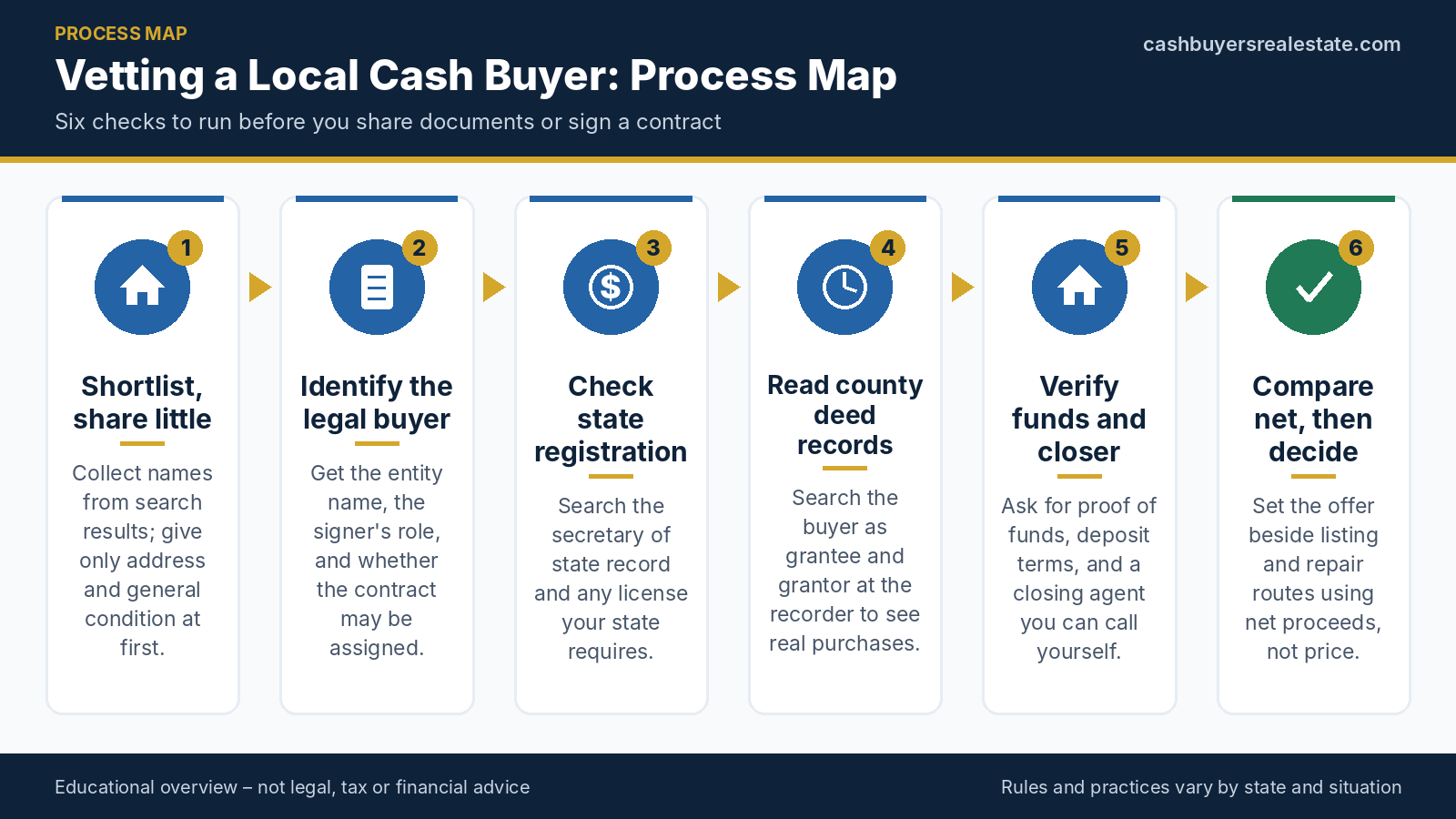
Text version of this infographic
- Shortlist, share little — Collect names from search results; give only address and general condition at first.
- Identify the legal buyer — Get the entity name, the signer's role, and whether the contract may be assigned.
- Check state registration — Search the secretary of state record and any license your state requires.
- Read county deed records — Search the buyer as grantee and grantor at the recorder to see real purchases.
- Verify funds and closer — Ask for proof of funds, deposit terms, and a closing agent you can call yourself.
- Compare net, then decide — Set the offer beside listing and repair routes using net proceeds, not price.
Using County Recorder and Assessor Records to See What a Buyer Has Actually Done
Websites describe what a buyer says. County records describe what a buyer did. Every county or equivalent local government keeps an index of recorded property documents, and in most places that index is open to anyone and increasingly searchable online. Depending on the state, the office goes by recorder, register of deeds, county clerk, or clerk of court, and the assessor’s office, which sets property tax values, keeps a separate set of parcel data. Together, they let you test a buyer’s claims of local experience with something much harder to fake than a testimonial: a dated trail of deeds, loans, and releases attached to real addresses.
Searching Recorded Documents
Recorded-document searches are less intuitive than a web search, because the index is organized by name and date rather than by topic. Counties vary in how much they put online, how far back their digital records reach, and whether images of the documents are free to view. A little preparation turns a frustrating search into a quick one.
How name-based indexes work and how to search for an entity or individual
Most recorder indexes are keyed to the names of the parties. Stanislaus County, California, for instance, tells the public that searching the grantor and grantee index by name is the easiest method and works about 95 percent of the time, and it explains that you need to look in the index for the year the document was recorded. The county’s electronic records reach back to 1978, with older records on microfilm, and copies can be requested only from terminals inside the office. Washoe County, Nevada, says its recorder does not perform searches for the public and that recorded documents are indexed by name, so a searcher needs at least one party’s name and an approximate date; searching by address, legal description, or parcel number is not possible in that system, and the office refers parcel-number questions to the assessor.
For a buyer, the practical method is to search the buyer’s legal name in the grantee field, which lists documents where the buyer received something, mainly deeds from sellers. Then search the same name as grantor, which finds the deeds where the buyer sold. Together, the two searches sketch how often the buyer purchases, how long it holds property, and whether it resells. Try variations: with and without “LLC,” with a common abbreviation, and under the names of managers shown in the state entity record if the entity changes names between projects. Many counties offer a free index search and charge for document copies, though policies differ, and some smaller counties still require a courthouse visit.
The steps below describe a reasonable order of operations. They apply in most counties, though the labels on each website will differ.
- Identify the county where the buyer says it operates, and then find that county’s recorder or register of deeds page; the property’s own county may be a different one.
- Search the buyer’s exact legal name as grantee for the past three to five years and note the dates, document types, and any lender named.
- Repeat the search under the grantor field to find resales, and open any deeds for properties near yours.
- Look up two or three of those addresses on the assessor’s site to compare the recorded dates with any listings or sales you can see.
- Write down what you found and the questions it raises, then put those questions to the buyer instead of drawing a conclusion on your own.
What deeds, mortgages, and memoranda of contract reveal
Each document type tells a different part of the story. A deed recorded into the buyer’s name is evidence that a purchase closed, and the document names the previous owner and sometimes the type of deed used. A deed of trust or mortgage recorded on the same day reveals that the buyer borrowed, and the lender’s name suggests whether the money came from a bank, a private lender, or a short-term investor loan. A later release or satisfaction shows that the loan was paid off. A quitclaim deed, which transfers whatever interest the grantor holds without promises about title, is common in transfers among family or related entities and says little about price.
Documents that record a contract rather than a completed sale deserve closer attention. Some buyers record a “memorandum of contract,” “memorandum of agreement,” or similar notice to put the public on notice that they hold an interest in the property under a purchase agreement. In legitimate use, that protects a buyer who has paid for the right to purchase. In misuse, it can place a cloud over the owner’s title that makes selling to someone else harder until it’s released. A 2025 Texas bill, H.B. 4063, addressed memoranda that the owner did not sign: according to the enrolled bill analysis, the filer must send the owner a copy by certified mail, the owner may record an affidavit releasing it, and a filing that skips the notice steps has limited effect. A Texas real estate law firm advises sellers to search county records for a buyer’s earlier memoranda, and a long list of them without matching deeds is a reason to ask pointed questions.
Once you have signed a contract of any kind, it is also sensible to search your own parcel periodically. Nothing should appear against it that you didn’t expect. If something does, call the closing agent or an attorney promptly instead of waiting until a later buyer’s title search finds it. Rules about recording, notice to owners, and removal of unwanted filings vary widely by state, so treat the Texas example as an illustration of how legislatures have approached the problem, not as a rule you can assume applies where you live.
Turning Records into Conclusions
A pile of search results is not an opinion about a buyer. The value comes from recognizing patterns and then testing them with a conversation. A handful of patterns appear again and again, and each suggests a business model and a corresponding question.
Reading patterns: holding, reselling, and repeated transfers
A buyer who acquires houses and resells them several months later is renovating and selling, which makes the repair estimate and the resale value assumption the center of the negotiation. A buyer who acquires and keeps property for years is probably a landlord, and the question becomes how the purchases are financed and how fast the buyer can move. A buyer whose records show many transfers into the entity followed within days by transfers out, or recorded assignments of contracts, is likely dealing in contract rights, which means someone else may end up as the actual purchaser of your house. None of these is wrong by definition, but they each change what you should ask and what protections you want in the contract. The table below summarizes common patterns and the follow-up question each one suggests.
| Pattern in the records | What it may suggest | Question to ask the buyer |
|---|---|---|
| Several deeds into the entity each year, with resales a few months later | Renovate-and-resell business | What resale value and repair budget did you use for my house, and can I see the reasoning? |
| Deeds into the entity, few or no resales, rental use on assessor records | Buy-and-hold landlord | How do you fund purchases, and how quickly can you close without selling something else first? |
| Transfers into the entity followed within days by transfers out, or recorded assignments | Contract assignment or back-to-back closings | Do you plan to assign this contract, and who would the final buyer be? |
| Memoranda of contract on many addresses with no matching deeds | Contracts that did not close, or long option periods | What happened with those properties, and how long will you tie up my house if you cancel? |
| Few or no records under the buyer’s name | New entity, individual buyer, or a business operating under other names | Under what names have you bought before, and who closed those deals? |
| Large loans from private lenders recorded at purchase | Short-term financed buyer | Is your closing date tied to a lender’s timeline, and what happens if the lender declines? |
To use the table well, remember that each pattern is a hypothesis, not a finding. A buyer with few records may simply be starting out, and a long record of back-to-back transfers can include legitimate transactions such as a buyer partnering with a family member. The more helpful use of the pattern is to adjust the questions. If you see assignment activity, you’ll want to read the assignment clause carefully and consider asking for a larger deposit or a right to approve any assignee. If you see a flipper’s pattern, you’ll want to compare their implied repair costs with quotes from a contractor you trust.
Illustrative example (hypothetical numbers, not market data): A homeowner searches a recorder’s index for the LLC that sent her an offer. Over the past three years, the index shows 14 deeds into the LLC, and nine of those addresses show a deed out within about five months. Four houses remain in the LLC’s name and three have rental registrations in the city’s database. She concludes the buyer is mostly a renovator who sometimes keeps properties. That tells her the offer is probably built from a resale estimate and a repair budget, so she asks for both. The buyer’s repair estimate is $38,000 higher than a contractor’s written bid for the same work. She does not assume bad faith; she asks the buyer to explain the difference, and the conversation ends up shifting the offer by a meaningful amount in her favor, or it doesn’t, and she moves to the next option with better information.
Limits: non-disclosure states, recording delays, rotating entities, and your own parcel
Public records have gaps, and a careful reader keeps them in mind. In roughly a dozen states, government offices are barred from releasing the sale price even when the deed is recorded. ATTOM Data lists Alaska, Idaho, Kansas, Louisiana, Mississippi, Missouri in some counties, Montana, New Mexico, North Dakota, Texas, Utah, and Wyoming as non-disclosure states, and it notes that some counties in those states operate as full-disclosure jurisdictions. In those places, you can still see that a purchase occurred but not what the buyer paid, so any claim about “paying market value” will be harder to check against the index and you may need to rely on listing data, appraisal-based estimates, or an agent’s comparative analysis.
Timing gaps matter too. A deed may be recorded days or weeks after closing, so the most recent purchases may not appear yet. Contracts that fall through leave no deed at all, which means the records cannot tell you how many offers a buyer made and then abandoned. Buyers who form a new company for each project also fragment their own history, which is why it helps to search managers’ names and to ask for addresses of recent purchases directly. If the buyer gives you addresses, verify them in the index instead of relying on the list, and call the closing agent on at least one to ask whether the deal closed as scheduled.
Finally, your own parcel is worth a look. The assessor’s page for your property typically shows the recorded owner, tax value, lot size, building details, and the owner’s mailing address. Assessed value is a tax figure, not a market price, so don’t use it to judge an offer, but it can confirm that a buyer has the square footage and bedroom count right. The recorder’s index for your name shows whether any mortgages, liens, or notices are attached, which you will want to know before any buyer’s title search reveals them. Resolving a surprise early saves money and goodwill later.
Local Buyer, Remote Buyer, or Another Route Entirely: Comparing Options by Net Proceeds
Once a buyer has passed the basic identity checks, the next question is whether this kind of buyer is the right kind for your house and your situation. A local investor, a company that operates in many markets, a contract-assignment buyer, and a conventional listing each solve different problems and create different costs. Comparing them fairly means looking past the headline price to what lands in your account after repairs, commissions, closing costs, and the months you carry the property. It also means being honest about what each route asks of you in effort and risk.
Local In-Person Buyers Versus Remote and Multi-Market Companies
The most common choice a “near me” search presents is between a buyer who lives and works close to your house and a company that buys in many places and manages the purchase from a distance. A fuller head-to-head comparison lives on its own dedicated page; the points below focus on what proximity changes in practice.
What local presence tends to add, and what it does not guarantee
A buyer who works in your market usually adds several practical things. They can see the house quickly, often within a day or two, and they price from sales they know firsthand, including quirks that a data model can miss, such as a street with chronic drainage problems or a school-boundary change that shifted demand. They typically have contractors, inspectors, and closing agents they’ve worked with before, which can shorten the path from signed contract to keys. A small buyer may also have more flexibility on the details sellers care about, such as leaving belongings, extending occupancy for a few days, or timing the closing around a move.
Reputation can matter more in a small market, too. An investor who deals repeatedly with the same real estate agents, attorneys, and title offices has a reason to keep a clean record, because word travels. That incentive is real but conditional: it works when the buyer plans to stay in the market and when the people who would hear about a bad deal are the people the buyer needs. It doesn’t protect you from a local buyer who cuts corners on price, because knowing your neighborhood cuts both ways. The same knowledge that lets an investor pay a fair price for a house with an odd floor plan also lets them recognize exactly how much equity you have and how badly you may need to sell.
Local also does not mean well capitalized. Some small investors rely on short-term private loans, partners, or the expectation of assigning the contract, any of which can slow or derail a closing. A locally based wholesaler is still a wholesaler. So the question is never simply “local or not,” but whether this buyer, whoever they are, has the funds, the record, and the contract terms to close on the date promised.
What remote and multi-market operators tend to add, and where friction arises
Companies that buy across many markets bring different strengths. They often have deeper reserves or established credit lines, written processes for each stage, staff dedicated to coordination with closing agents, and the ability to respond to an online form within hours. For a seller who values a predictable process, that structure can be a real advantage. Large operators have also seen thousands of transactions and tend to have standard contract language that has been reviewed by attorneys, which makes terms easier to compare even if they are harder to negotiate.
The friction points are mostly about fit. Pricing may rely on automated valuation models and photographs, which work well for ordinary houses in active neighborhoods and less well for unusual properties. Contact may run through a call center or a rotating set of coordinators, so you may not speak with the same person twice. Remote operators frequently depend on local contractors or partner investors to look at the property, and the offer they send may be revised after that visit. This is not unfair on its face, since photographs can’t show everything, but it makes it important to ask when the number is final and what conditions could change it.
Size isn’t a proxy for integrity in either direction. Some large companies treat sellers carefully and some local investors do not, and the reverse is just as true. The checks from earlier in this article apply identically: identify the legal buyer, confirm the funding, read the contract, and name the closing agent. After that, the choice between a hometown buyer and a broader one comes down to the specifics of your house, your timeline, and how much you value a face-to-face relationship.
Putting a Cash Offer Beside Listing and Other Routes
A cash offer is best judged against the realistic alternatives, and the alternatives are not just “list it” or “don’t.” Each route carries its own mix of price, cost, time, and risk, and the right choice often depends more on your circumstances than on the market. The comparison below uses invented numbers to show the structure of the arithmetic, and you should rebuild it with figures from your own property and local professionals.
Comparing net proceeds instead of headline price
Headline prices mislead because they hide who pays for what. A cash buyer’s offer is usually lower than a retail sale price, but it may involve no agent commission, no repairs, fewer concessions, and a shorter holding period. A listing may bring a higher price while adding commission, closing costs, repair credits, and months of mortgage, tax, insurance, and utility payments. The only fair comparison is the amount you would expect to keep after all of those, before paying off any mortgage. The next table does this for one hypothetical house.
| Line item | Cash offer, as-is | List as-is with an agent | Repair, then list |
|---|---|---|---|
| Sale price | $228,000 | $262,000 | $300,000 |
| Repairs paid by seller | $0 | $0 | $25,000 |
| Agent commission (5.5% where applicable) | $0 | $14,410 | $16,500 |
| Seller closing costs and buyer concessions | $2,500 | $7,430 | $6,500 |
| Carrying costs ($1,400 per month) | $1,400 (1 month) | $4,200 (3 months) | $7,000 (5 months) |
| Estimated net before payoff | $224,100 | $235,960 | $245,000 |
In this invented example, the cash route nets about $11,900 less than listing as-is and about $20,900 less than repairing and listing, which is the price of speed and certainty. Whether that price is worth paying depends on facts the table can’t capture: whether the repair estimate might run over, whether the house would sit on the market longer than three months, whether you have a hard deadline, and how much risk of a failed sale you’re willing to carry. Change a few inputs and the ranking changes. If the repairs were $60,000 instead of $25,000, or if carrying costs were double, the cash route would look much better, and if the cash offer were $20,000 higher, it would roughly match the repair-then-list result. Rebuild the table with your own numbers before drawing any conclusion, and see the guide to cash offer net proceeds for a fuller method.
Illustrative example (hypothetical numbers, not market data): A homeowner has accepted a job in another state with a start date in eight weeks and a mortgage payment of $1,400 a month on a house that needs a new roof. Listing as-is might net more on paper, but if the house sits for four months, she pays four months of the mortgage and the new rent on top. Her carrying cost doubles, and the difference between the routes narrows. She asks two local investors and one agent for written numbers, compares the net after all costs, and chooses based on the closing date she can count on. Another seller with no deadline and a house that needs only cosmetic work might reasonably decide differently, using the same method.
Other routes and when each one fits
Cash buyers are one answer among several. Listing with a real estate agent in the open market usually reaches the widest group of buyers and often the highest price, but it brings showings, negotiation with buyers who use financing, inspections, appraisals, and a timeline you can’t control. Making light repairs before listing can lift the price by more than the repairs cost in some markets and not in others, and it adds time and the risk of overruns. Selling to a neighbor, relative, or tenant can be simple when both sides are comfortable, though a sale below market value between related parties can raise tax and lender questions that a professional should review. Direct-offer programs from technology-driven buyers offer convenience, so read their fee and closing-cost terms as carefully as the price. Auctions can produce a quick result for unusual properties, with reserve prices and fees to understand.
For a house that needs work, a conventional buyer’s lender may require repairs or reduce the loan, which is one reason as-is cash sales exist; the page on selling a house fast without repairs covers that terrain, and the broader overview in the guide to selling a house fast compares the main speed-oriented routes. The table below sets five common routes next to each other in terms of who each fits best and what it costs you in trade-offs.
| Route | Often fits best when | Main trade-off | What drives the timeline |
|---|---|---|---|
| Local in-person investor | The house needs work and you want a quick, flexible closing | Offer reflects repairs and the buyer’s profit; capital varies by buyer | Buyer’s funding and the closing agent’s schedule |
| Multi-market company | You value a structured process and written terms | Less personal contact; pricing may rely on models and photos | Remote review, then local inspection |
| Contract-assignment buyer | Rarely a first choice; may fit if terms are clear and the deposit is meaningful | Your buyer may not be the final buyer; cancellation risk | How quickly an end buyer is found |
| List as-is with an agent | The house is livable and you can wait | Showings, negotiation, and uncertain timing | Market activity and buyer financing |
| Repair, then list | Repairs are limited, affordable, and likely to raise the price | Upfront cost and overrun risk | Contractor availability, permits, then marketing |
Treat this table as a map rather than a verdict. A route that fits poorly on one dimension may still be right if that dimension isn’t important to you. If certainty and speed are the priority, the first two rows deserve the closest look. If the highest net matters most and time is flexible, the last two do. And if the situation is complicated by a lien, a tenant, or an inherited title, a professional in your state should review your options before you decide.
The graphic below summarizes how these five routes compare on what each is best for and what it costs you.
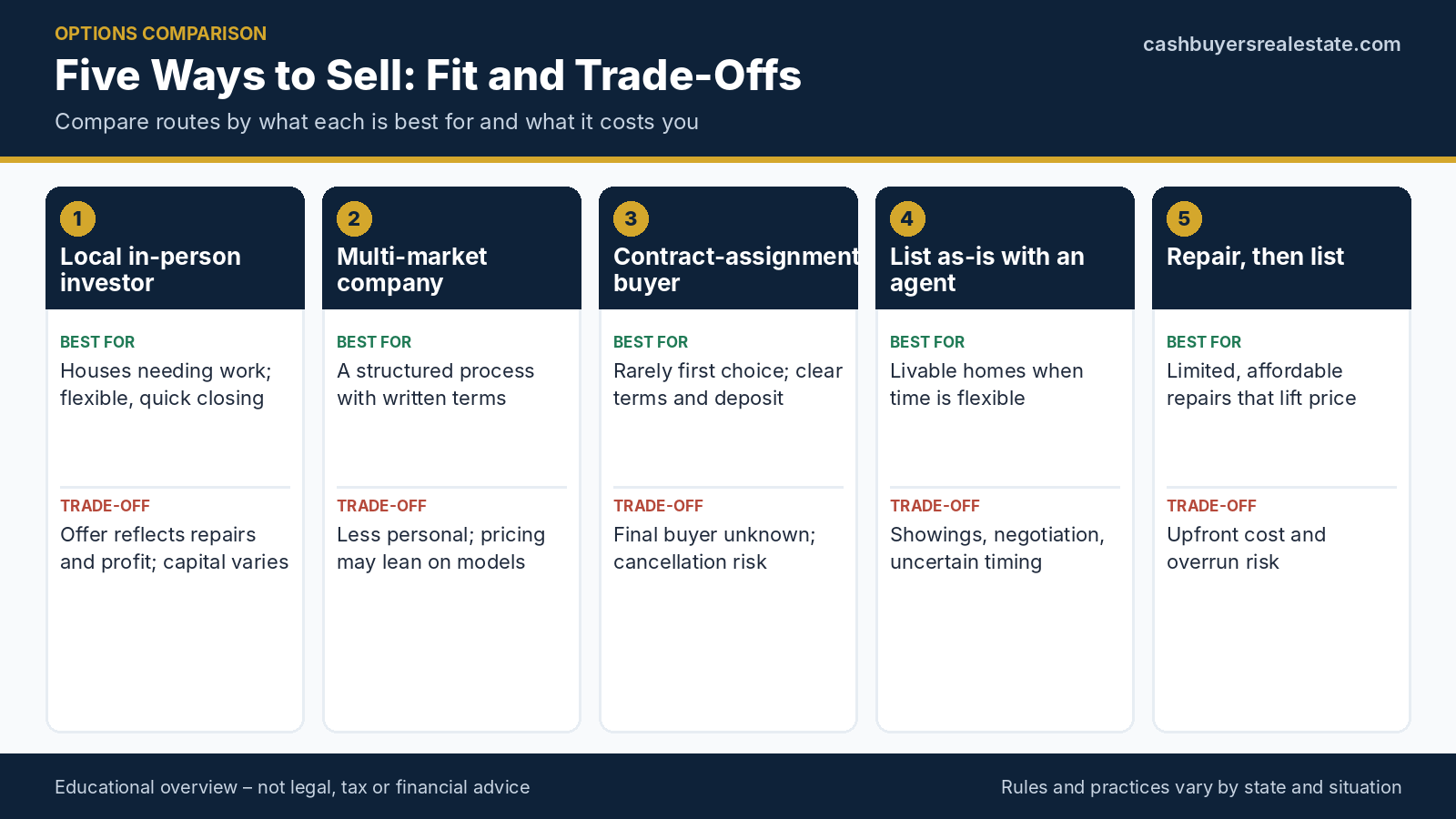
Text version of this infographic
- Local in-person investor — Best for: Houses needing work; flexible, quick closing. Trade-off: Offer reflects repairs and profit; capital varies.
- Multi-market company — Best for: A structured process with written terms. Trade-off: Less personal; pricing may lean on models.
- Contract-assignment buyer — Best for: Rarely first choice; clear terms and deposit. Trade-off: Final buyer unknown; cancellation risk.
- List as-is with an agent — Best for: Livable homes when time is flexible. Trade-off: Showings, negotiation, uncertain timing.
- Repair, then list — Best for: Limited, affordable repairs that lift price. Trade-off: Upfront cost and overrun risk.
Reviews, References, and Reputation: Useful Evidence With Clear Limits
After the legal entity and the public record, the third source of evidence about a local buyer is what other people say. That includes star ratings on a map listing, testimonials on the buyer’s own website, comments in neighborhood groups, and, most valuable of all, the words of someone who has actually sold to this buyer. Each of these has a place in your research, and each has limits that deserve a clear-eyed look, especially in a business where most of the people leaving feedback have done exactly one transaction and have no way to know what a different route would have produced.
Reading Online Ratings Without Over-Trusting Them
Online ratings are the easiest evidence to find and the easiest to misread. A score of 4.9 out of 5 looks decisive, but the number is the end of a long chain of choices: who was asked to review, who chose to, what they were reviewing, and what the platform displays first. Reading the pattern beneath the number is far more informative than the number itself.
What a rating pattern can show, and what it cannot
Start with volume, timing, and specificity. A buyer with a few dozen reviews spread over several years, written in different styles, with details like the closing date, how the inspection went, or how the buyer handled a surprise, looks like a business with a real stream of customers. A listing whose reviews arrived in a burst over a few weeks, share similar phrasing, and describe nothing particular deserves more caution. Look also at the way the buyer replies. A calm, specific response to a critical review, which acknowledges the problem and explains what happened, tells you more about how disagreements are handled than any five-star comment.
The deeper limit is structural. Reviewers are sellers whose transactions closed, and a seller who was delighted by a quick closing may never learn whether a retail sale would have produced thousands of dollars more. Satisfaction and fairness are different things. A review that says “they were fast and easy” is evidence of a smooth process, which has value, but it can’t tell you whether the price was reasonable. Reviews also leave out people whose deals fell through, who walked away after a revised offer, or who never posted. Because Google’s own help page notes that more reviews and positive ratings can help a business’s local ranking, buyers have a built-in incentive to collect them, which is one more reason to treat the total as a marketing signal as much as a quality signal.
Read the negative and middle reviews first, and separate complaints about style from complaints about substance. A seller who didn’t like a phone call tone is reporting a preference. A seller who describes a price reduction after the inspection, a delayed closing, a deposit that wasn’t returned, or a contract clause they did not understand is reporting something you can test with questions of your own. If several unrelated people describe the same problem, treat it as a pattern and ask the buyer about it directly.
Illustrative example (hypothetical numbers, not market data): A homeowner compares two buyers. The first has 140 reviews averaging 4.9 stars, and 90 of them were posted within a six-week period using almost identical wording. The second has 18 reviews averaging 4.6 stars, spread over three years, with detailed comments that include one complaint about a price change after inspection and the owner’s written reply explaining the repair findings. The homeowner does not conclude that the first buyer is dishonest or that the second is perfect. She concludes that the second profile gives her more usable information, and she puts the price-change question on her list for both buyers, along with a request for the names of two recent sellers.
Fake, incentivized, and suppressed reviews, and the FTC rule behind them
Review manipulation is a known problem, and federal rules address it. The Federal Trade Commission’s rule on consumer reviews and testimonials took effect on October 21, 2024. According to the FTC’s announcement and its business guidance, it prohibits creating or selling fake or false reviews, including AI-generated ones, buying reviews or offering compensation conditioned on a particular sentiment, and posting insider reviews without clearly disclosing the writer’s connection to the business. It also bars using unfounded legal threats, intimidation, or false accusations to suppress negative reviews, and it prohibits a business from claiming that a site it controls offers independent reviews of its own category. The rule authorizes courts to impose civil penalties for knowing violations.
For a homeowner, the rule has two practical meanings. First, it means that buying five-star reviews for a business is not just distasteful but, under the FTC’s rule, an unlawful practice, so a seller who suspects a pattern of fake praise has somewhere to report it, and legitimate buyers have reason to avoid the shortcut. Second, it shows what manipulation looks like in practice: reviews from people who never used the service, reviews from employees or relatives who don’t say so, “review sites” run by the businesses they rate, and a displayed set of reviews curated to hide the critical ones. None of those features proves a violation on its own, and the rule says ordinary consumers aren’t liable for their own reviews.
When you want to judge a profile, look for the quiet signs. Reviewers with only one review and no history, unusually uniform language, reviews that mention services the business does not provide, and glowing testimonials that appear only on the company’s own website are all worth noticing. A reputable buyer should not mind if you ask for contact details for a recent seller, since a business that has real satisfied customers can usually find two or three who will speak for it, and you can combine those conversations with the public-record checks from the previous section.
Evidence That Holds Up Better Than Stars
Sources that are harder for a buyer to shape sit closer to the transaction itself: the people who handled the closing, the records that capture complaints, and the offices that regulate parts of the business. These sources take longer to reach than a rating, but they are worth the effort when a decision involves the largest asset you own.
Asking for local references and the closing agent’s contact
Ask for two or three recent sellers who agreed to be contacted, the addresses of the last few purchases, and the name and phone number of the closing agent used on them. The first request tests whether the buyer has satisfied customers. The second lets you verify purchases in the county index. The third is the most revealing, because a title or escrow officer or closing attorney has seen the transaction from beginning to end and can usually confirm basic facts, such as whether the closing took place on the scheduled date. Some closers will limit what they say for confidentiality reasons, and that is understandable, but a quick call is still informative, and a buyer who refuses to name a closer at all is withholding something you will need to know anyway.
Keep in mind that references are selected by the buyer, so they’re a curated sample. To widen the view, ask local real estate agents and attorneys who work in your area, since they often know which investors close and which ones renegotiate. Public records can also lead you to people who sold to the buyer’s entity in the past. Some of those former owners will talk if approached politely and briefly, and some will decline, and the respectful approach is to ask one time and accept the answer. Whoever you speak with, ask open questions: Did the final price match the first offer? Did the closing happen on the original date? What would you do differently?
Complaint records: consumer bureaus, attorneys general, and license boards
Complaint files add a different kind of evidence. The Better Business Bureau says its A+ to F ratings are based on a business’s complaint history, how it responds to complaints, its transparency about its practices, and licensing and government actions, and that customer reviews do not affect the rating. It also says accreditation is voluntary and separate from the rating, that accredited businesses pay dues, and that the BBB is not a government agency and has no regulatory power. In other words, a BBB profile is a useful record of complaints and responses, not a regulator’s finding, and a buyer who isn’t accredited hasn’t necessarily done anything wrong.
State agencies hold stronger records for what falls within their authority. Your state attorney general’s consumer protection division may take complaints and sometimes will tell you whether a business has a history of them. A state real estate commission lists license status and disciplinary actions for those it licenses; the Nebraska Real Estate Commission, for example, points consumers to its website to check an individual’s license and disciplinary history. County and state court search pages can show whether a buyer has been sued over a transaction, though a lawsuit alone is hard to interpret without reading the filings. Because each source covers only part of the picture, the table below compares them with the other evidence discussed so far.
| Evidence | What it can show | Main limit | Reasonable weight |
|---|---|---|---|
| Star ratings and written reviews | Patterns in how sellers experienced the process | Only completed sales; easy to curate or manipulate | Low to moderate |
| Closing agent’s account | Whether purchases closed on schedule | May decline to share details; named by the buyer | High when independent |
| Recorded deeds at the county | Actual purchases, lenders, and holding patterns | No price in some states; shows nothing about contracts that never closed | High for track record |
| Consumer bureau profile | Complaint volume and how the business responds | Voluntary system with no regulatory power | Moderate |
| License and disciplinary records | Status and sanctions for licensed activity | Covers only people who must be licensed | High where a license applies |
| Court records | Disputes that reached litigation | Context needed; absence does not mean none | Moderate |
The table suggests a simple rule: weight what is hard to fake and close to the transaction more heavily than what is easy to produce. A clean closing-agent account and a consistent county record outweigh a perfect star rating. Combined with the entity and licensing checks, they let you build a picture that no single source can give, and you’ll notice that none of it requires accusing anyone of anything. If the evidence is consistent, you can move forward with more confidence; if pieces conflict, you now know exactly which question to ask.
Reading the Offer and the Contract When the Buyer Presents as “Local”
A friendly local manner can make paperwork feel like a formality, and that is precisely when careful reading matters most. Whether the buyer meets you at the kitchen table or sends documents by email, the offer and contract determine who bears risk if something changes between signing and closing. The goal of this section is to show what a complete, balanced offer package looks like, and which contract terms deserve a second read, whether you’re dealing with an experienced neighborhood investor or a company that merely uses a local name.
What a Credible Offer Package Contains
An offer is more than a number. A serious one comes with enough detail that you can compare it to another and enough documentation that you can tell whether the buyer can perform. Gaps in the package don’t necessarily mean bad faith, since some buyers prepare a brief offer first and the paperwork afterward, but you should know which pieces are missing and when you will receive them.
Written terms, the deposit, and proof of funds
The written offer should name the legal buyer, state the price, give the earnest money amount and identify who will hold it, set a target closing date, describe the inspection period, and say which side pays which closing costs. Earnest money is a deposit that shows the buyer’s commitment, and it is typically held by the closing agent in a trust or escrow account rather than by the buyer or the buyer’s representative. A deposit of a few hundred dollars on a six-figure house gives you little protection if the buyer later walks away, while a deposit that is meaningful relative to the price, with clear terms about when it becomes nonrefundable, shifts some of the risk back to the buyer. Ask what the deposit amount is, where it will be held, and when it is delivered.
Proof of funds is a document showing that the buyer has, or can obtain, the money to pay. For a buyer paying from savings, that usually means a recent bank or brokerage statement with account numbers redacted. For a buyer using a short-term loan, a commitment or approval letter from the lender serves the same purpose. Check that the name on the document matches the buyer on the contract, that the date is recent, and that the amount covers the price plus closing costs. Remember what the document does not show: a statement proves money existed on a particular day, not that it will be used for your house. Many sellers ask the closing agent to confirm that the buyer’s deposit has been received and that the funds are expected on time. For a detailed look at what to request, see the guide to proof of funds for cash buyers.
A buyer who answers these questions promptly and in writing is behaving in a way that supports trust. A buyer who says funds are available but can’t say from where, or whose documents show a different name from the contract, is presenting you with a mismatch that should be resolved before you sign. It is entirely reasonable to say that you’ll need the documents before you commit, and to put that request in an email so there is a record.
Inspection period, closing date, and condition language
The inspection period is the window in which the buyer may examine the property and, in many contracts, cancel or ask for a lower price. The length matters because the buyer holds an option during that time while your house is off the market in practice. A short, defined period with a clear statement that the buyer must either proceed at the agreed price or cancel is easier to live with than an open-ended right to renegotiate. Ask what the buyer is looking for, whether the price can change only for conditions that were not already visible or disclosed, and what happens to the deposit if the buyer cancels within the period. Experienced local buyers typically know what they’re likely to find in a house of your age and style, and a thoughtful one will tell you in advance where the number could move.
Closing dates also deserve attention. Some contracts state a fixed date; others say the closing will happen a number of days after title is cleared or after the inspection period ends, which can drift. Ask whether the date can be extended, who can extend it, and whether an extension costs the buyer anything. A fair contract usually gives the seller a right to terminate and keep the deposit if the buyer fails to close by an outside date. Possession terms matter as well: when you must move out, what happens to items left in the house, and whether you can stay a few days past closing if you need to.
Condition language such as “as-is” is another place where a plain reading helps. In an as-is sale, the buyer agrees to accept the property in its present condition, but that does not erase the duties many states place on sellers to disclose known material defects. Rules differ by state, so check yours, and never conceal a known problem to make an offer look cleaner. The article on cash offer contract red flags goes deeper into clause-by-clause concerns, and an hour with a local attorney can clarify what your own state requires before you sign anything.
Contract Terms That Matter Most in Local-Buyer Deals
A short list of contract provisions accounts for most of the surprises sellers report, and several of them look harmless on first reading. The provisions below deserve attention no matter how friendly the buyer, because a contract governs the relationship long after the friendliness fades.
Assignment, cancellation, and long option periods
The phrase “and/or assigns” after the buyer’s name means the buyer may transfer its rights to someone else, and you would then be obligated to sell to that person on the same terms. Many legitimate buyers include it as boilerplate, and some use it because they plan to sell the contract to another investor. It isn’t always a problem, but you should know which situation you’re in. You can ask to remove it, to require your written consent to any assignment, or to require that you receive the assignee’s name and proof of funds before closing. The Nebraska Real Estate Commission’s consumer guide warns that some wholesaler contracts allow cancellation for any reason and can run for years, and AARP lists contracts with no expiration date and with a buyer’s right to cancel at will among its red flags.
States have begun to respond to these concerns. Oklahoma’s law, effective November 1, 2025, gives homeowners a two-business-day right to cancel certain wholesale contracts without penalty and makes noncompliant contracts unenforceable by the wholesaler, according to a title-underwriter bulletin that summarizes it; Missouri’s 2026 law, as reported by Stateline, requires written disclosure at least 14 days before closing. Those rules apply only in those states and only to the transactions they cover. The general lesson is that you should look for three things in any contract: how long it binds you, what lets the buyer out, and what, if anything, lets you out. If the buyer can cancel freely for months and you cannot, you’ve granted a free option on your house.
When a contract includes a long option or inspection period, consider asking for a payment that reflects it. Real option fees compensate a seller for taking the house off the market, whereas a nominal fee does little. Also ask whether the buyer can record a memorandum of the contract in the county records, since a recorded notice can make it harder to sell elsewhere until it is released; the earlier section on recorded documents explains how to look for one.
| Clause | Why it matters | What to ask for |
|---|---|---|
| Assignment (“and/or assigns”) | Your actual buyer may be someone you have never met | Removal, written consent, or notice of the assignee with proof of funds |
| Buyer’s cancellation right | A one-sided right to cancel is a free option on your house | A defined window with a clear end, and a deposit that is forfeited if the buyer cancels outside it |
| Length of contract or option period | Long periods tie up the property | A firm outside date and a meaningful option payment |
| Deposit terms | Determines how much the buyer risks | An amount held by the closing agent, with dates when it becomes nonrefundable |
| Closing date and extensions | Vague dates can drift for months | A specific date and a seller right to terminate after an outside date |
| Condition and repair language | May allow repricing after you have committed | Limits on price changes to conditions not disclosed or visible at signing |
| Recording of the contract | A recorded notice can cloud title | A clause that prohibits recording or requires release if the deal ends |
As you read the table, notice that most rows ask for the same thing in different forms: clarity about who is bound, for how long, and what each side gives up. A buyer who agrees readily to those changes is signaling confidence in its ability to close. A buyer who resists every one of them, or who says the contract is standard and cannot be changed, has told you how much room there is to negotiate and perhaps how much risk is being placed on you. Either response is information, and you can use it when you compare offers.
Pressure, deadlines, and the right to take a day
Urgency is a negotiating tool, and sellers should recognize it. AARP’s guidance lists high-pressure sales tactics, such as insisting that an offer expires today, among the red flags it hears about from state officials, and the Nebraska guide advises caution toward anyone who approaches you about a sale you had not been considering. A legitimate buyer may have real constraints, such as a lender’s deadline or a competing property, but an offer that is only good if you sign before you have read the document is a reason to pause. Taking a day or two to review the paperwork costs a serious buyer very little.
Practical safeguards are simple. Never sign a blank or partially completed form, and don’t sign anything you haven’t read in full. Ask for the complete contract, with all attachments and addenda, in advance. Keep copies of everything you sign, and ask for fully executed copies afterward. Be careful with verbal promises, since the written contract controls: if the buyer says they will pay for a repair or let you stay in the house, make sure it is in the document. And if anything feels wrong, speak to a real estate attorney in your state before you sign, because the cost of an hour is small compared with the cost of exiting a signed contract.
The checklist in the graphic below pulls together the main verification steps from the last several sections: confirm the buyer’s identity and registration, request proof of funds, read the cancellation and assignment terms, look at the county record, use a reputable closing agent in your state, and never sign blank or incomplete forms. The first five get an “ok” or “caution” depending on how well they’re answered, while the last is a clear stop sign.
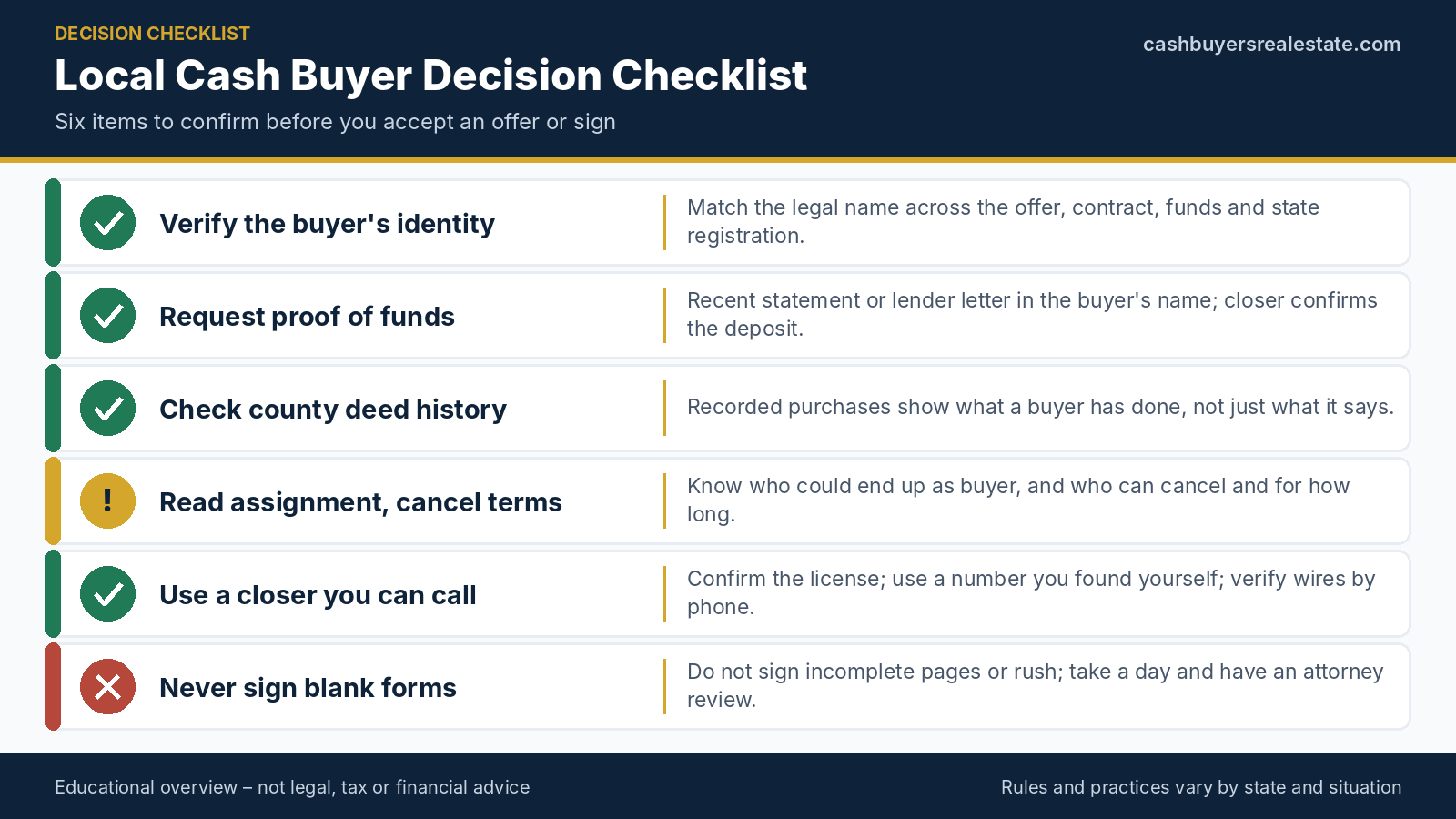
Text version of this infographic
- Verify the buyer's identity — Match the legal name across the offer, contract, funds and state registration.
- Request proof of funds — Recent statement or lender letter in the buyer's name; closer confirms the deposit.
- Check county deed history — Recorded purchases show what a buyer has done, not just what it says.
- Read assignment, cancel terms — Know who could end up as buyer, and who can cancel and for how long.
- Use a closer you can call — Confirm the license; use a number you found yourself; verify wires by phone.
- Never sign blank forms — Do not sign incomplete pages or rush; take a day and have an attorney review.
Closing in Your State: Who Handles the Money, the Deed, and the Risks After Signing
The signed contract is not the finish line. Between signature and the moment funds reach your account, someone has to search the title, collect the buyer’s money, pay off your mortgage and any liens, prepare the deed, and record it with the county. Who does that work, and how well they do it, matters more than most sellers realize, because the closing agent holds the money and the paperwork at the most sensitive point in the transaction. For buyers marketed as local, this is also where the “near me” claim should be tested one last time: is the closing handled by a professional who practices in the state where your house sits?
Choosing and Checking the Closing Agent
In most deals the buyer proposes the closing agent, and many sellers accept without a second thought. That is often fine, because reputable title and escrow offices handle thousands of closings and answer to state regulators. It’s still your right to ask who the agent is, to confirm that they’re licensed, and, in many places, to ask to use your own. The questions you ask here take ten minutes and can prevent the most costly kind of mistake.
Title company, escrow office, or attorney: how practice varies by state
Closing customs differ sharply across the country. In many states, a title company or an escrow company acts as a neutral party that collects documents and funds from both sides, disburses money according to the signed instructions, and arranges recording of the deed. In other states, attorneys customarily or legally handle the closing, and a lawyer prepares the deed, examines the title, and oversees the transfer of funds. Some states blend the two, with title companies conducting closings under an attorney’s supervision or in a county-by-county pattern. Because of this variation, nothing in this article should be read as implying that one model is universal, and it’s worth asking a local professional how closings are typically conducted where your property sits.
Whichever model applies, remember whom the closer works for. A title or escrow officer is generally neutral and is not your advocate, and in many cases is not permitted to give legal advice. An attorney conducting a closing may represent the buyer, the lender, the seller, or more than one party, and you should know which. If you want someone looking out for you specifically, you can hire your own attorney to review the contract and settlement statement, and in attorney-closing states you’ll likely do so as a matter of course. That review is especially valuable if the contract contains assignment language, unusual repair terms, or a long option period.
Ask for the closer’s full name, company, address, and license information, and then verify them with the state agency that licenses that profession. The most reliable contact is the one you find yourself, not a phone number or email supplied in a message from the buyer. A buyer who welcomes a call to the closing office and promptly names a well-established firm is easy to deal with. A buyer who prefers that you not speak to the closer, or who changes the closing agent late in the process without explanation, has given you a reason to slow down and ask why.
What the closer does with liens, payoffs, and surprises
Before a closing can happen, the closer typically orders a title search to uncover anything attached to the property that must be cleared: your mortgage, home equity lines, judgments, tax liens, unpaid property taxes, contractor liens, homeowners’ association assessments, and old filings that were never released. They request a payoff letter from each lender, which states the exact amount needed to satisfy the loan on a given date, including interest. The closer then prepares a settlement statement showing the price, the payoffs, the costs charged to each side, and the net amount you will receive. Ask for a draft of that statement a few days before closing, compare it with the offer, and question any line you don’t understand.
Surprises are common enough that you should plan for them. An old mortgage that was paid but never formally released, a lien from a contractor who was not paid by a previous owner, an unpaid city utility bill, or a name that doesn’t match across documents can all delay a closing while someone clears it. A calm buyer with a flexible contract will extend the date for a short time. A buyer whose financing depends on a fixed date may not, which is another reason to ask early about extensions. You can reduce risk by running your own search of the county records before listing or signing, and by gathering mortgage statements, tax bills, and any past permit or lien paperwork that you have.
Illustrative example (hypothetical numbers, not market data): A seller signs a contract with a local investor for $210,000 and a closing date three weeks away. During the title search, the closer finds a $4,800 mechanic’s lien recorded against the property by a roofing company that worked for the previous owner. The investor’s lender requires the lien to be cleared. The seller learns about it eight days before closing, calls the roofing company with the closer’s help, obtains a written release after a payment negotiated down to $3,900 from the sale proceeds, and the closing moves back five days. A seller who had searched the county index earlier would have found it sooner, and a contract with a reasonable extension clause kept the delay from becoming a cancellation.
Protecting the Money and the Paper Trail
At the end of a closing, a large sum moves between accounts in a very short time, which makes it an attractive target for criminals. Meanwhile, the documents produced at closing are the proof you will need if a question arises months or years later. Both deserve a deliberate routine.
Wire-fraud safeguards for sellers
The most common closing scam involves a criminal who gets into an email account of an agent, attorney, or title office, studies an upcoming transaction, and then sends convincing instructions to wire money to a fraudulent account. The Consumer Financial Protection Bureau’s archived guidance on closing scams describes how such messages impersonate the real professionals involved, and it recommends choosing trusted contacts at the start, agreeing on the payment process by phone or in person instead of by email, writing down their numbers, and confirming the account details by phone using a number you already have before sending any money. The American Land Title Association’s consumer page adds specifics: check the email domain letter by letter, confirm that the account name matches the title company and not an individual, and treat last-minute changes in wiring instructions as a red flag because legitimate processes do not usually change near closing.
Sellers face a variation of the same risk, since you will provide your own bank details to receive proceeds. Send those details through a secure portal or deliver them in person if you can, and when you must email them, follow up with a call to the closing office at a number you found independently. Be wary of any message that says your payment instructions have changed or asks you to send funds or fees to claim your proceeds. Use multi-factor authentication on your email and bank accounts, forward messages instead of replying to unfamiliar addresses, and don’t hurry because someone says a wire window is closing. A real closing can be rescheduled, but a wire sent to the wrong account is very hard to retrieve.
After closing: records, confirmations, and where to turn if something goes wrong
Once the closing is complete, collect a copy of the signed settlement statement, the recorded or to-be-recorded deed, and confirmation of any mortgage payoffs. Keep them with your tax records. A few weeks later, search the county index for the deed into the buyer and for the satisfaction or release of your mortgage; both should appear. Recording can take longer in some counties than others, but if nothing shows up after a reasonable time, ask the closer to confirm the status in writing. Do not cancel homeowners insurance or utilities until you’ve confirmed that the sale has closed and funds have been received, and keep track of any property tax prorations or refunds due to you.
If something goes wrong, the right office depends on the problem. A dispute about the contract or deposit calls for an attorney in the property’s state. A suspected violation of licensing or disclosure rules can go to the state real estate commission, and a pattern of deception can be reported to the state attorney general’s consumer protection division. Fraud involving wires or online impersonation belongs with the FBI’s IC3 and local law enforcement. The related page on cash home buyer scams goes through warning signs in more detail, and the guide to whether cash home buyers are legitimate offers a broader framework for sorting trustworthy buyers from the rest. Documentation helps in every case, so keep emails, texts, contracts, and notes of phone calls with dates.
Most sales close without trouble, and most buyers, local or otherwise, are simply trying to complete a purchase. The reason for these safeguards is not to expect the worst. They exist because the one transaction that does go wrong can be expensive, and because a few quiet habits, such as verifying a phone number, keeping documents, and checking the county record, cost almost nothing to practice.
Frequently Asked Questions About Finding and Vetting Cash Home Buyers Near You
The questions below come up repeatedly when homeowners move from searching to actually contacting buyers. They are grouped by the stage at which they usually arise, and the answers add detail beyond the main sections without repeating them. Rules differ by state, so where an answer touches law or licensing, check with your state’s regulator or an attorney.
Questions About Finding and Verifying Local Buyers
Questions about search results and listings
- Does a business showing up on the map mean Google has vetted it?
No. A map listing means the business created a profile and the search system judged it relevant, close, and reasonably well known. Profile verification generally confirms that the business controls the listing, not that anyone has assessed how it treats sellers. Think of the listing as an introduction and then do your own checking through state business records, county deeds, and conversations with people who have dealt with the buyer.
- Is the closest buyer automatically the safest choice?
Not automatically. Distance helps with quick inspections and local knowledge, but it says little about funding, honesty, or how the contract is written. A buyer two counties away with a documented purchase history, a clear contract, and a respected closing office can be a better bet than a nearby buyer who is new and vague. Judge each one on evidence you can check.
- Why did one web form lead to so many calls and texts?
Many sites that look like local buyers are lead-generation services that sell or share your inquiry with several investors. Each recipient may call, which can feel like a flood. Before submitting a form, look for a privacy statement that explains who receives your information, and give only your address, general condition, and preferred contact method. AARP suggests registering numbers on the national Do Not Call list and forwarding unwanted spam texts to 7726, although these steps may not stop every call.
- Can I rely on a list of the “top cash buyers” in my city?
Use it as a source of names, not as a ranking you can trust. These lists are often assembled by publishers whose revenue may depend on referrals, and the criteria are seldom explained. If a page includes companies you’ve seen elsewhere, look up the legal entity behind each one, and compare what you learn with what the page claims. Pages that discuss companies that advertise they buy houses can help you recognize the usual marketing language before you evaluate individual names.
Questions about records and licensing
- Do I need an attorney to look through county records?
You don’t need one to search; recorded documents are generally open to the public, and many counties have free online indexes. Some recorder offices will not run searches for you, so plan to do it yourself, and you usually need a party’s name and an approximate date. An attorney or title professional becomes useful when you need to interpret a document, such as a memorandum of contract or an unusual deed.
- What if I search the buyer’s name and find nothing?
That could mean the buyer is new, buys under several company names, works in a different county, or lives in a place where the index isn’t online. It could also mean a spelling variation. Ask the buyer for the legal names of the entities used on recent purchases and for two or three addresses, then search those. If the buyer has no verifiable history, consider a larger deposit, a shorter inspection period, and closer attention to the closing agent.
- Does a real estate license make a buyer trustworthy?
It adds a layer of regulatory accountability, but it isn’t a guarantee of fair treatment. In states that require licensing for certain wholesaling activity, a licensed person can be disciplined by the commission, which is a meaningful check. In states that do not require it, the absence of a license says little. A license lookup is worth doing for any licensed party, and the results should be one input among several.
- Is wholesaling illegal?
Not as a category. A recent Stateline report found that no state has banned the practice outright, although at least 15 states have recently approved new rules that add disclosures, licensing, or other requirements. The rules differ widely, so what is allowed in one state may need a license or written disclosure in another. Your state real estate commission or an attorney can tell you what applies to your sale.
Questions About Offers, Contracts, and Closing
Questions about offers and proof of funds
- How do I compare a cash offer with a listing price fairly?
Build a simple net sheet for each route. Start with the price, subtract repairs you would pay for, commissions, closing costs and concessions, and the months of mortgage, taxes, insurance, and utilities you would carry, then compare the remainders. Add a note about risk: a listing can fall through, and a cash buyer can renegotiate. Keep every figure in writing, and rebuild the sheet when an offer changes.
- How large should the earnest money deposit be?
There’s no single standard, and customs differ by market and by contract. A useful way to think about it is that the deposit should be large enough that the buyer would feel a real loss by walking away without a valid reason. Ask where it will be held, when it becomes nonrefundable, and what events allow the buyer to get it back. A nominal deposit with a broad right to cancel offers you little protection.
- Can the price drop after the buyer inspects the house?
In many contracts, yes. The inspection period often lets the buyer cancel or ask for a lower price after finding issues. Ask in advance what kinds of findings would justify a change, whether the buyer must provide the inspection report or contractor estimates, and whether you may cancel and keep the deposit if you decline the new price. Clear answers before signing reduce the chance of an unpleasant surprise.
- Is it a red flag if a buyer will not show proof of funds?
It’s a reason to ask why, though not proof of a problem. Some buyers value privacy, and some do not hold the money themselves because they plan to assign the contract or use a short-term lender. A workable middle path is a lender letter or confirmation from the closing agent that funds will be available, combined with a meaningful deposit. If the buyer offers none of these, weigh that against the rest of the contract.
Questions about contracts and closing
- May I choose the closing agent instead of the buyer?
Often you can ask. In many sales the buyer proposes the title company, escrow office, or attorney, and that’s frequently fine, but you’re entitled to verify the agent’s license and call the office yourself. If you are uneasy, you can propose a firm you’ve researched or hire your own attorney to review the documents. Practices differ by state, so a local professional can say what is customary.
- What happens if I change my mind after signing?
It depends on the contract and your state. A purchase agreement generally binds both sides unless it contains a contingency or cancellation right, or a statute provides one. Oklahoma, for example, gives homeowners a two-business-day right to cancel certain wholesale contracts, but that applies only to the transactions its law covers. Talk to an attorney promptly, because deadlines for exiting may be short.
- When should I see the settlement statement?
Ask for a draft a few days before closing so you have time to compare it with the contract. Timing practices vary by state and closing office, and in a cash sale there may not be a single required lead time. Check the price, payoff amounts, fees charged to you, tax prorations, and the net figure, and ask the closer to explain anything unfamiliar. Listings that advertise cash purchases of houses often stress speed, which makes this review even more worthwhile.
Deciding Whether a Local Cash Buyer Is the Right Route for Your Sale
By this point, the central idea should be clear: “near me” is a starting point for research, not a conclusion. A local cash buyer can be an excellent fit for the right house and the right circumstances, and a poor fit for others. The most useful move you can make now is to turn what you’ve learned into a decision you can explain to yourself in plain language, and then to take the next steps at a pace you control.
A Framework for Matching the Route to Your Priorities
No route wins on every dimension. Cash buyers tend to trade price for speed and certainty, listings tend to trade time and effort for a higher price, and wholesale-style arrangements add a layer of uncertainty about who the final buyer is. A framework helps by forcing you to decide, before talking to anyone, which of those trade-offs matters most to you.
Ranking speed, certainty, price, and effort for your situation
Start by ranking four things in order of importance to you: how soon you need to close, how sure you need to be that the sale will happen, how much you want to net, and how much work and disruption you can tolerate. Most people discover that two of the four matter far more than the others. A seller who must be in another state in six weeks may put speed and certainty first. A seller with a livable house, a steady income, and no deadline may put net proceeds first and accept the effort of showings. Write the ranking down, because it prevents a persuasive conversation from reshaping your priorities for you.
Then translate the ranking into numbers. Estimate the net from each realistic route, as in the earlier comparison, and attach a rough cost to time: the monthly cost of holding the house, plus any cost of delay in your plans. If a cash offer nets less than a listing but saves four months of carrying costs and the risk of repair overruns, the gap may be smaller than it first appears. If the gap remains large and your timeline is flexible, the listing route may be worth the work. The aim is not to find the right answer in the abstract but the right answer for your finances, your property, and your life.
Illustrative example (hypothetical numbers, not market data): Three homeowners with similar houses rank their priorities differently. The first, relocating in two months, puts certainty and speed first and decides a verified local investor with a meaningful deposit and a reputable closer is the best fit, as long as the net is within a range she can accept. The second, who inherited the house and lives nearby, ranks net proceeds first and lists after modest repairs. The third, with a tenant lease running another year, asks several buyers whether they will honor the lease and picks the offer that does so in writing. Each uses the same facts and reaches a different, defensible conclusion.
Local, multi-market, wholesaler, or listing: how the answers point
With your ranking in hand, the route choice becomes easier to reason about. If speed and certainty rank highest, buyers who show documented funds, a meaningful deposit, and a recognized closing office deserve the closest look, whether they are local or not. If personal contact and flexibility matter, a verified local investor who can meet you and explain the arithmetic may suit you best. If you want a uniform process and written terms, a multi-market company may fit. The dedicated page on choosing between local and national buyers expands on those trade-offs.
A contract-assignment buyer is rarely the first choice for a seller who wants certainty, because the final buyer is unknown at signing. That doesn’t make every such arrangement improper, but it does mean you should demand clear disclosures, a meaningful deposit, a firm outside date, and no recorded claim against your title. If any of those are missing, the cost to you is high. Listing with an agent remains the strongest option when you have time and a house that appeals to financed buyers, and light repairs can improve both price and certainty. A reasonable plan for many sellers is to gather two or three cash offers and one agent’s opinion of value, compare net proceeds, and then decide.
What to Do Next: First Steps, Questions, and Documents
Having a framework is useful only if it leads to action. The next steps are modest: collect a few documents, ask the same questions of every buyer, and give yourself enough time to compare answers. None of it commits you to selling.
Documents and information to gather before you talk to buyers
Preparing in advance speeds every conversation and puts you in a stronger position, since a seller who knows the facts of the property is harder to hurry or underprice. Collect the paperwork that establishes ownership and debts, the details that affect value, and the records of past repairs. A tidy folder also prepares you for the title search, which will surface much of this information anyway.
- Your most recent mortgage statement and the lender’s contact information, to estimate the payoff.
- The latest property tax bill and any notices of liens, assessments, or code violations.
- A list of repairs and upgrades with dates, plus permits and warranties if you have them.
- Homeowners’ association contact details and fee information, if there is an association.
- Photos of any issues you know about, such as roof leaks or foundation cracks, and any inspection reports.
- A copy of your deed, and the current lease and tenant contact information if the property is rented.
Next, get an independent sense of value before any buyer names one: an agent’s comparative market analysis, recent sales near you, and the assessor’s page for your property. Those are not offers, and they will not match a cash buyer’s number, but they tell you how far apart the routes are. Finally, run the same searches on yourself that you’d run on a buyer: look up your parcel in the recorder’s index to see whether anything unexpected is attached, so that a title surprise does not surface in the middle of a contract. If you find an old mortgage that was paid but never released, a lien from a contractor, or a judgment against a previous owner, begin resolving it now, because the paperwork to clear such items can take weeks and a buyer’s closing date will not wait for it. Having those answers before you negotiate also lets you tell each buyer exactly what to expect, which tends to produce firmer offers.
Questions to ask every buyer, and a sensible sequence for the next two weeks
Asking every buyer the same set of questions makes their answers comparable, and it shows quickly who answers plainly. The guide to questions to ask a cash home buyer offers a longer set, but these are the essentials for a local-search context: What is the legal name of the buyer, and who signs? Will the contract be assigned? Who holds the deposit, and how large is it? What is the inspection period, and what could change the price? Who is the closing agent, and what is their phone number? Can you give me addresses of recent purchases? Putting each answer in writing creates a record and filters out evasive replies.
A workable sequence for the next two weeks runs as follows. In the first few days, gather your documents, request a market opinion from an agent, and shortlist two or three buyers without sharing sensitive data. In the following days, verify the entity, check the county record, and ask for proof of funds and the closing agent’s name. By the end of the second week, compare written offers using net proceeds, have an attorney review the contract you prefer, and take at least a day to decide. If anything feels rushed, slow down, because a serious buyer can usually wait a day for a considered answer.
Selling a home is a major decision, and there is no single correct route. Some sellers will be best served by a local cash buyer who moves quickly and fairly, others by a listing, and others by something in between. What this research gives you is the ability to tell the difference, to ask for what you need, and to walk away from an offer that doesn’t hold up under a few ordinary questions. Take the time that you need, keep your documents in order, and let the evidence, not the urgency of the pitch, guide the choice.