
We Buy Houses Near Me: Offers, Process & Red Flags
A yellow sign zip-tied to a utility pole, a postcard addressed to “Homeowner,” a text message that lands at eight in the evening, a search result that sits above everything else on the page: they all say roughly the same thing, and they all say it in the same four words. Typing we buy houses near me into a search bar is how a great many people begin when they own a property they would rather not keep, whether it’s an inherited house in another county, a rental that has worn out its welcome, or a home that needs more work than the budget allows. What comes back is a crowded field of phone numbers, forms, and promises, and nothing about the page itself tells you which of them can actually write a check.
The direct answer is that the phrase describes a style of marketing, not a type of company. Behind identical words you might find an investor spending their own money, a wholesaler who plans to sell your signed contract to someone else, a real estate agent collecting leads, or a website whose real business is selling your phone number to whoever pays for it. Any of them can be legitimate, and any of them can leave you with a worse experience than you expected. What separates them is rarely how polished the website looks. It’s whether the people involved can be identified, whether they can show funds that are really theirs, whether a neutral third party handles the closing, and whether the terms they describe on the phone are the terms printed in the contract.
Short answer: a “we buy houses near me” search returns a slogan, not proof of a local, funded buyer. Before you share details or sign anything, confirm the legal entity behind the number, whether it buys with its own money or resells your contract, who handles the closing, and what your state requires it to disclose in writing.
This guide is built around that kind of checking, which is sometimes called due diligence on the buyer. It starts with what the slogan does and doesn’t tell you, then sorts the businesses that use it into models you can recognize, including the lead-generation sites that sit between you and an actual buyer. From there it moves to the practical work: a verification method with scripts you can read aloud on a first call, a way to use county records to see what a buyer has really purchased, the local and federal rules that shape signs, mailers, calls, and texts, and several state laws that require wholesalers to disclose what they are. Later sections cover proof of funds, earnest money, contract language, and the point at which walking away is the sensible move.
Two neighboring questions get only brief treatment here because they have their own pages. How a buyer arrives at a number is covered in the guide on how cash buyers calculate offers, and the broader question of whether this category of buyer is trustworthy at all is taken up in are cash home buyers legit. If your main goal is simply to find and compare buyers in your area, the page on cash home buyers near me approaches the same search from that angle.
One more thing before the detail. Most people who call one of these numbers have a perfectly ordinary reason for wanting a simple, quick sale, and there is nothing embarrassing about that. Checking out a buyer isn’t an accusation, either. It’s what any careful person does before handing over a deed, and a legitimate buyer expects it and usually answers without fuss. The goal of everything that follows is to let you make the call from a position of knowing who you’re talking to, so that the speed and simplicity you were hoping for don’t arrive with a surprise attached.
What a “We Buy Houses Near Me” Message Really Tells You
The cleanest way to approach any message of this kind is the way you would approach a flyer from an unfamiliar contractor: as an introduction that tells you someone would like your business and very little else. It doesn’t establish that the sender has money, that the sender is nearby, that the sender will be the one who ends up owning your house, or that the price will survive a walk-through. Those things get established later, one question at a time, and the first section of this guide is about why the slogan can’t establish them on its own.
A slogan, not a license or a business model
When a phrase is useful to everyone, everyone adopts it. That’s the situation here. The words match what homeowners type into a search box, so every kind of buyer, and several kinds of non-buyer, uses them, and the result is a marketplace where the label carries almost no information about what’s inside.
Who uses the words, and why they sound identical
Consider the range of people who might legitimately put “we buy houses” on a sign. A rehabber who purchases a handful of properties a year with a business line of credit and a crew of subcontractors is one. A landlord assembling a rental portfolio is another, as is a small investment fund with a few partners and a pool of capital. A wholesaler, who contracts to buy a property and then assigns that contract to a different buyer for a fee, uses the same phrase. So does an agent or brokerage that uses the slogan as a lead magnet to find future listings, and so does a marketing company that owns the website and sells the inquiries it generates. Every one of these can honestly say they “buy houses,” in some sense, and each of them does something quite different with your property after you say yes.
Because the slogan is effectively public property, nothing about it is regulated as such. No state issues a “we buy houses” license, and no agency reviews the claim before it appears on a billboard. What the law does regulate is conduct: whether a person is acting as an unlicensed broker, whether they assign contracts and what they must tell sellers when they do, how they close the sale, and how they solicit by phone, text, and mail. That’s why checking a buyer means looking past the words to the activity. Two operations can share a phrase and a similar-looking website and still run on opposite models, and the only dependable way to learn which one you’ve reached is to ask, directly, and then confirm the answer against records that don’t depend on the buyer’s own description.
Why “near me” is the least reliable part of the phrase
The “near me” in the search is really a signal about your intent, not about the buyer. Search engines show results based on where they think you are, and advertisers can target a city or ZIP code without having any physical presence there. A local-looking phone number can be purchased in any area code and forwarded anywhere. Websites often generate pages for hundreds of towns from a single template, swapping the place name into otherwise identical text. A map listing can point to a shared office, a mailbox store, or a registered-agent address. None of this is dishonest in itself, because plenty of legitimate buyers operate remotely in several markets and run their advertising by geography, but it means that “local” may describe the advertising rather than the buyer.
Local presence does matter for practical reasons, though, and it’s worth knowing which ones. A buyer who has actually closed deals in your county knows how comparable sales behave there, can usually inspect the property within days, understands the local recording office and any municipal inspection or certificate requirements, and is familiar with the closing practices that apply, which are not the same everywhere. So the useful question is not “are you local?” but “where have you bought, and how could I confirm it?” Section four returns to that with a method that relies on public records. If you’d rather start from a list of ways to locate and compare nearby buyers, the guide to house buyers near me covers that ground separately.
The economics behind the offer you’ll hear
Even the most reputable buyer is running a business, and understanding the arithmetic they run helps you separate an explained offer from an unexplained one. A vetting conversation goes better when you know what a straight answer sounds like.
Why discounts exist and what they imply for vetting
A buyer who pays cash and takes the house as-is is typically pricing several things at once: the cost of repairs and updates, the carrying costs while the project is underway (taxes, insurance, utilities, interest on any borrowed money), the expense of selling or renting it afterward, and a margin for risk and profit. Subtract all of that from what the finished property is likely to be worth and you arrive at a figure well below what an owner-occupant might pay for a move-in-ready house. An offer that lands below the retail market value is therefore not, by itself, a sign of anything wrong. It’s what the model produces. The detailed mechanics belong to the offer-calculation guide linked earlier, so this section only needs the principle.
The principle has a direct consequence for vetting: an honest buyer should be able to explain how the number was reached, at least in outline. They should be able to say what condition they assumed, roughly what they expect the repairs to cost, and what value they used for the finished home. If the reply is a shrug, a change of subject, or pressure to decide before any explanation arrives, the missing explanation is the information. It’s also worth remembering the other side of the arithmetic: a wholesaler who contracts with you at one price and assigns the contract at a higher one is adding a layer of margin that has to come from somewhere, and in that structure the final buyer’s willingness to pay is the number that actually matters.
Illustrative example (hypothetical numbers, not market data): A homeowner in a two-bedroom house hears two offers within a day. The first caller says $131,000 and, when asked how it was reached, explains that comparable repaired houses nearby sell for roughly $178,000, that the roof and kitchen need about $26,000 of work, and that holding and resale costs plus a margin account for the rest. The second caller offers $139,000 but won’t discuss the reasoning and wants a signature by the end of the day. The second number is higher on paper, yet the first caller has shown the logic and can be checked against local sales. Whether either buyer holds up is a question for the verification steps in the next sections, but only the first has so far given the homeowner anything to verify.
What a legitimate buyer can promise before seeing the house
There’s a good deal that nobody can responsibly promise sight unseen, and recognizing the boundary protects you from promises that were never going to be kept. A buyer cannot know a final price until the property has been inspected, because condition drives the repair estimate. They cannot know a firm closing date until a title search shows whether the ownership history is clean, whether liens or judgments need to be paid off, and whether an heir, former spouse, or co-owner has to sign. They cannot say that nothing will change after the first look, because inspections routinely reveal items that photographs and a phone description don’t. What they can do is state a preliminary range, explain what conditions it rests on, name the steps that will turn it into a firm figure, and put the terms in a written agreement before you commit to anything.
That distinction gives you a simple test for the claims you hear. A statement such as “based on what you’ve described, we’d expect to land in this range, and here’s what could move it” is the kind of conditional promise a buyer can honestly keep. A flat statement that a price is locked in, that closing will happen on a specific day regardless of what turns up, or that no inspection is needed, deserves a follow-up question about what happens if the facts turn out differently. The answer will tell you a lot about who you’re dealing with. It also connects to the alternatives available to you: if a conditional range doesn’t beat what a conventional listing would net after commissions and repairs, a faster route to selling a house fast without repairs may or may not be the better trade, and the only way to know is to compare net figures instead of headline numbers.
Who Is Really on the Other End of the Phone
A phone number on a sign or a form on a website is a doorway, and the room behind it can be furnished in several quite different ways. Sorting the possibilities before you speak to anyone is worthwhile, because the right questions depend on which kind of operation you’ve reached. The same inquiry that is perfectly sensible to put to an investor who buys with their own funds can be answered with a cheerful evasion by someone whose real product is a lead, and you won’t know the difference unless you’ve learned what each model looks like.
Four business models that share one slogan
Four patterns account for most of what you’ll meet under a “we buy houses” banner. Two of them involve a party that actually signs a purchase contract with you, and the other two involve parties whose main activity is passing your information along or selling services around the sale. The distinctions are about money and obligations, not about whether anyone is acting in bad faith.
Direct buyers who close with their own funds
The simplest model is an investor who intends to be the one who owns your house. That might be a renovator who will repair and resell it, a landlord who will rent it out, or a small fund that holds properties for the long term. The money comes from the buyer’s savings, from partners, from a business line of credit, or from a short-term private or “hard money” loan arranged for each purchase. This last point trips up many sellers: “cash” in the sense that matters to you means there’s no mortgage-approval contingency and no appraisal gatekeeper, but it doesn’t necessarily mean the buyer has the full price sitting in a checking account. Funds that are lined up and available at closing are what count, and that’s something you can ask to see before you commit, as the later section on proof of funds explains.
With a direct buyer, the person who walks through your house is usually the person with authority to decide, and the entity that signs the contract is the entity that will take the deed. That alignment is the quality to look for. Scale tells you very little about reliability, so a single individual with a good record may be a safer counterparty than a large operation with a thin one, and the reverse is equally true. A direct buyer will normally close through a title company or a closing attorney, depending on local practice, and will not need to find someone else to complete the purchase. If you want a fuller picture of this group, the page on investors who buy houses describes how they find deals and what they look for, while this guide stays focused on how to check one.
Wholesalers, assignments, and double closings
A wholesaler signs a contract to buy your house, usually with language that lets the buyer assign the contract to someone else, and then looks for an end buyer willing to pay more than the contract price. When one is found, the wholesaler assigns the contract and collects an assignment fee, which is the difference between your price and what the end buyer pays. In a variation called a double closing, two closings happen back to back: the wholesaler buys from you and immediately sells to the end buyer, briefly appearing in the chain of title. Both structures are lawful in many places when handled honestly, and some wholesalers are open, efficient, and good at placing difficult properties. The concern is not the structure but the gap in what a seller may understand about it.
The practical risks follow from the fact that the wholesaler is selling a right, not a house. If no end buyer materializes, the wholesaler may ask for more time, try to renegotiate your price downward once your property is tied up, or let the contract expire after weeks of marketing your address to strangers. Some wholesaling contracts are long or open-ended, and some are accompanied by a recorded notice of the agreement that can complicate selling to anyone else until it’s cleared. Several states have responded by requiring written disclosures that tell the seller the buyer may assign the contract for a profit; section six describes four of them. For now, the useful reflex is to ask early, “Will you be the one buying my house with your own funds, or do you plan to assign the contract?” A clear answer in either direction is acceptable. A vague one is worth noticing.
Illustrative example (hypothetical numbers, not market data): A seller signs a contract at $147,500 with a buyer whose agreement allows assignment. Two weeks later the buyer finds an end buyer willing to pay $166,000 and assigns the contract, keeping the $18,500 difference as a fee. Nothing improper has necessarily happened, and the seller received exactly the price in the contract. But the seller never learned that another buyer valued the house at nearly $20,000 more than the figure on the page, and might have asked for a different price or timeline had that been disclosed up front. That information gap, rather than the assignment itself, is what disclosure laws in several states are designed to address.
The table below puts the four common models side by side, along with the question that most efficiently separates each from the others.
| Model | Whose money buys the house | How the business is paid | First question to ask | Main risk for a seller |
|---|---|---|---|---|
| Direct end buyer | The buyer’s own funds, partners, or a line of credit | Resale profit or rental income after repairs | “Which entity will sign the contract and take title?” | An offer that shrinks after inspection if the original assumptions were loose |
| Wholesaler (assignment) | An end buyer found after the contract is signed | Assignment fee, the spread between two prices | “Do you plan to assign this contract to someone else?” | No end buyer appears, so the deal is delayed, renegotiated, or lapses |
| Wholesaler (double closing) | Funds supplied at the second closing, often by a transactional lender | Resale margin between two back-to-back closings | “Will you take title yourself, and who funds the first closing?” | Extra complexity and dependence on the second buyer closing on time |
| Lead-generation site | Not applicable; it sells inquiries to others | Fees from buyers or agents who receive your details | “Is the offer from the company named on this site or from a partner?” | Your information reaches many parties, producing repeated calls and texts |
| Agent or brokerage using the slogan | Usually a listing or referral, not a purchase | Commission or referral fees if the home is listed or placed | “Are you buying the house yourself or representing a buyer or seller?” | The pitch changes from a quick purchase to a listing, which is a different trade-off |
How to read this table: none of these rows is automatically good or bad, and the same person can occupy more than one row at different times. The columns to focus on are the second and fourth. Whose money buys the house tells you who has to perform for the deal to close, and the first question tells you whether you can get that fact out of the person on the phone in a single sentence. Anyone who is comfortable in their model tends to answer plainly.
How a lead-generation intermediary looks from the outside
A lead-generation business exists to capture homeowner inquiries and sell or route them to buyers, agents, or other service providers. It isn’t illegal and it isn’t always misleading, and some homeowners value the convenience of receiving more than one response. The trouble comes when the site is written to look like a buyer, because the homeowner then expects to hear from the buyer and instead hears from a stream of strangers who each paid to be in the conversation.
Clues on the website and in the intake form
Start with the footer and the legal pages. A buyer that is a real business usually names its legal entity in the terms of use and the privacy policy, and lists a physical address that’s more than a mailbox. A site that never states who operates it, or whose terms refer instead to “our partners,” “participating investors,” “network companies,” or “affiliated buyers,” is describing a structure in which the people you reach may not be the people whose name appears at the top of the page. Other signals include one template reused across many city names, an intake form that asks for substantial detail about the property and your situation before any human has said who they are, and language promising offers “from multiple buyers” or “matched” to you. None of these is conclusive. Several of them together suggest that the business model is routing inquiries.
The fine print beside the submit button deserves a careful read as well, since that is often where consent is created. Intake forms commonly include a sentence stating that by submitting you agree to be contacted by phone, text, or email, sometimes including automated or prerecorded contact, by the site and by its partners or affiliates. Such language is routine in lead generation, and a business may later point to it as the permission it relied on to call or text you. That doesn’t make every follow-up call improper, but it does mean that typing your number into a box is not a neutral act. If you want to learn more before deciding, a phone call that you place yourself, to the number published on the site, gives you a chance to ask who the operator is without agreeing to anything in writing.
What happens to your information after you hit submit
Once a lead is captured, it is typically a product. It may be sold once, to a single buyer, or distributed to several at the same time, which is why some homeowners report a burst of calls within minutes of submitting a form. Each recipient is competing to be first, so the early calls often come with more urgency than the situation warrants, and callers may open with a price before learning anything about the property. Information in the lead, including your address, name, phone number, and whatever you said about the house’s condition or your circumstances, can also be retained in databases, appended with other public data, and reused for later outreach by the original site or the buyers who received it.
There are practical ways to limit this without avoiding the market altogether. Share the minimum needed to receive a preliminary response, and hold back sensitive context such as a deadline, a divorce, or a foreclosure date until you know who you’re dealing with. Ask directly which companies received your inquiry and request that your information be deleted if you decide not to proceed; a growing number of states give residents rights over how businesses use and sell their personal data, though whether yours does, and whether it covers a particular company, depends on state law and on the business’s size. Finally, keep a simple log of who contacted you and when. It costs nothing and becomes useful if you later need to demonstrate a pattern of unwanted contact, a subject taken up in section five.
The rest of this guide follows the path a typical sale takes, from the first contact through verification, the offer, the contract, the proof of funds, and the closing. The map below lays out those stages, and each of them gets a closer look in the sections that follow.
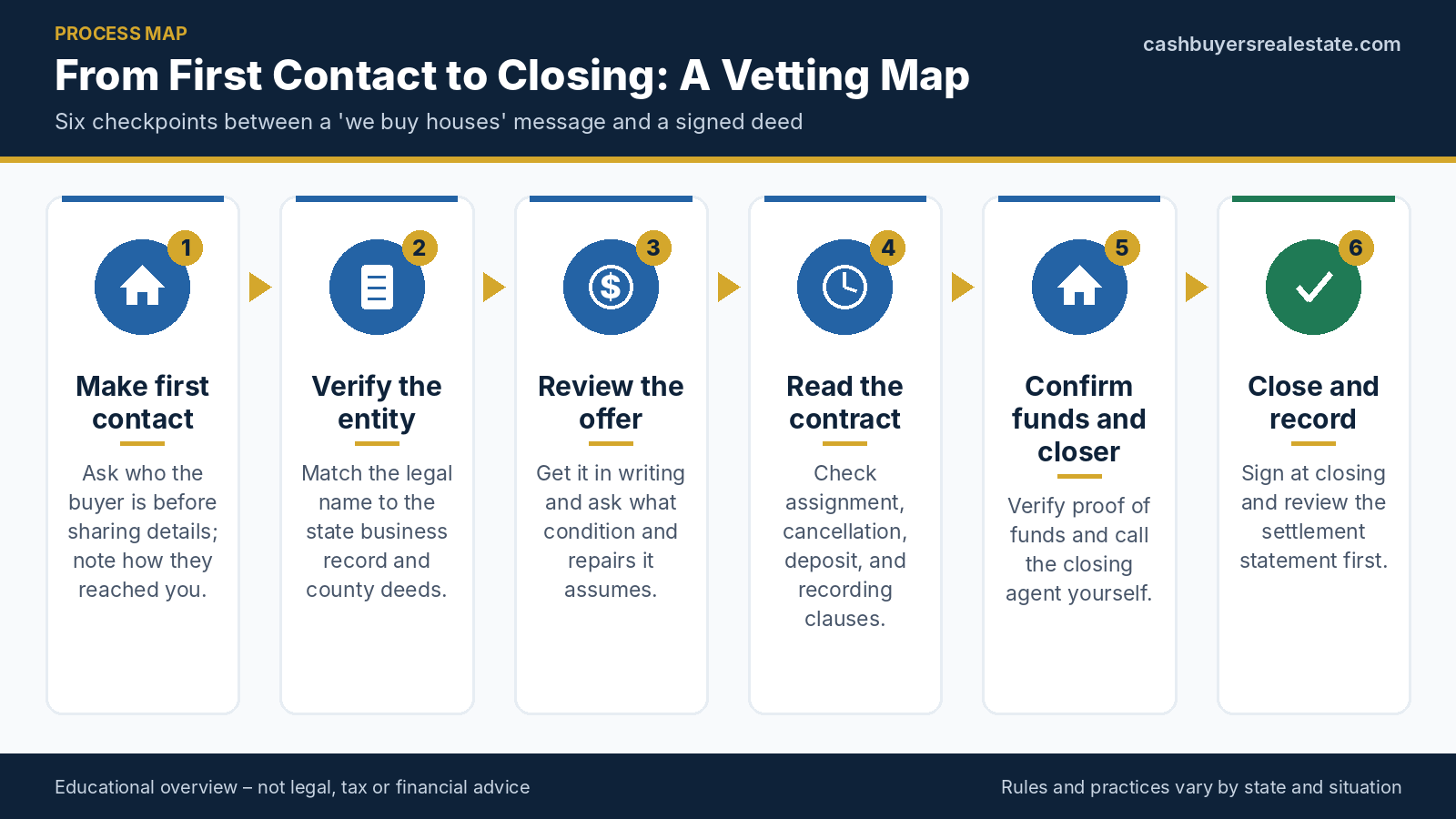
Text version of this infographic
- Make first contact — Ask who the buyer is before sharing details; note how they reached you.
- Verify the entity — Match the legal name to the state business record and county deeds.
- Review the offer — Get it in writing and ask what condition and repairs it assumes.
- Read the contract — Check assignment, cancellation, deposit, and recording clauses.
- Confirm funds and closer — Verify proof of funds and call the closing agent yourself.
- Close and record — Sign at closing and review the settlement statement first.
A Practical Method for Verifying the Business Behind the Number
Verification sounds more formidable than it is. In most cases it comes down to a half-dozen questions, three or four public-record lookups, and one phone call to a person the buyer didn’t pick for you. The work can be done in an evening, none of it requires a lawyer, and it replaces a feeling about whether someone seems trustworthy with a handful of facts you can check. This section lays out the method, and the next one extends it to the county records that show what a buyer has really purchased.
Confirming the entity, the people, and the closing partner
Three things need to line up before money or a deed changes hands: the legal identity of the buyer, the authority of the person you’re dealing with, and the neutrality of whoever will run the closing. Each can be checked independently of the buyer’s own claims, and that independence is the point.
Matching the name on the contract to a state business record
Begin by asking for the full legal name of the company that would sign as buyer, along with the state where it’s registered. A trade name on a sign or a website is often only a brand, and the entity that signs a contract can be an entirely different limited liability company or corporation. Once you have the legal name, search the state’s business entity database, which is usually maintained by the Secretary of State or a similarly named office and is free to use. Look for the exact name, the entity’s status (active or in good standing versus dissolved, revoked, or inactive), the formation date, the registered agent, the principal address, and, where the state discloses them, the managers or officers. If the trade name appears in an assumed-name or “doing business as” filing, that record, held at the state or county level depending on where you live, links the brand to the entity.
Interpreting what you find takes judgment, not just a checklist. A company formed five weeks ago isn’t automatically a problem, since investors often create a new entity for each project or each year, but it does mean the company itself has no history, and any track record has to come from the people behind it. A registered agent that is a commercial service is routine and says little. A principal address that turns out to be a mailbox store, or a status showing the company was administratively dissolved for missing a filing, deserves a question. Similarly, check that the person who will sign has authority to do so, which you can often infer from a listed manager or from a signature block that states a title. If the person claims to be a licensed agent, broker, or attorney, the state’s licensing board or bar association publishes lookups that show status and any discipline, and those are far more reliable than a badge on a website.
Illustrative example (hypothetical numbers, not market data): A homeowner we’ll call Dana receives a purchase agreement naming an LLC that doesn’t match the brand on the mailer. The state database shows the LLC was formed forty days earlier, lists a commercial registered agent, and gives a suite number that turns out to be a mailbox. Dana calls the buyer’s representative and asks about the company’s history. The representative explains that earlier purchases were made through a different entity owned by the same principal, names it, and offers three addresses. The state record for that entity is several years old and active, and the county deed index later shows all three addresses. The new LLC, it turns out, was created for tax and liability reasons. Dana’s concern is resolved by evidence, not by reassurance. Had the explanation failed to match the records, the same lookups would have shown that too.
Reaching the closing agent on your own
Ask who will handle the closing, and get a name, an address, and a phone number. Then do not rely on any of the contact details the buyer supplies. Instead, find the firm through an independent source: the state insurance department, which licenses title agents and title insurers in most states; the state bar, if an attorney is named; or a plain search that you confirm against the licensing record. Call the firm using a number you found yourself, and ask whether they have an open file for your property address, who the buyer on file is, and whether they have received or will be holding an earnest money deposit. This single call catches a surprising number of problems, because a closing agent who has never heard of the transaction, or who turns out not to exist, is a fact that can’t be explained away.
Closing practice varies by state. In some places a title company or escrow company handles the closing, while in others a real estate attorney does, and in a few the attorney’s role is effectively required. The agent who closes a transaction is usually neutral toward its terms, but neutral isn’t the same as representing you. A title company’s closer will not advise you on whether the contract is good for you, and an attorney hired by the buyer represents the buyer. Investors often have a preferred title company or a closing attorney they use repeatedly, and that is not inherently improper, but it is another reason to confirm that the firm is independently licensed and to consider having your own attorney review the contract, particularly where the amounts are significant or the terms unusual. For what to ask, see the guide to questions to ask a cash home buyer.
Scripts for the first call and the follow-up
Knowing what to check is half of it, and the other half is asking in a way that is polite, brief, and hard to evade. A script helps, particularly if you tend to soften questions when you’re nervous or if the person on the phone is skilled at steering the conversation. Reading from a page is perfectly acceptable, and a serious buyer will treat it as a sign that you’re organized.
A first-call script you can read aloud
Open with something plain, such as: “Thanks for calling back. Before I share details about the house, I have a few questions about how you work, if that’s all right.” That sets the sequence, because you’re asking before you’re telling. The questions below are ordered so that the most revealing ones come while the person is still being cooperative, and each can be answered in a sentence or two by someone who is comfortable with their own business.
- What is the full legal name of the company that would sign the contract as buyer, and in which state is it registered?
- Would that company buy the house with its own funds, or might the contract be assigned to another buyer?
- Which title company or closing attorney would handle the closing, and may I call them directly?
- Can you give me the addresses of two or three houses you’ve bought in this county in the past year?
- Will you provide a proof-of-funds letter in the buyer’s name before we sign anything?
- Is the offer going to be in writing, and what conditions could change it after you’ve seen the house?
- Will you send me the full contract ahead of time so I can have an attorney read it before I decide?
Notice what the script leaves out. It doesn’t ask about price at the start, because price is the part the caller most wants to discuss and the part least useful for judging them. It also doesn’t ask about the caller’s feelings or promise to decide quickly. If you plan to record the call, check your state’s consent rules first, since some states require every participant to agree to recording and others require only one; when in doubt, take handwritten notes with the date and time instead. After the call, send a short email restating the answers you were given, such as the entity name, the closing agent, and whether assignment is planned, and ask the buyer to confirm that it’s accurate. A written confirmation is what turns a pleasant conversation into something you can compare with the contract later.
Reading the answers without jumping to conclusions
A clear answer usually has three features: it’s specific, it can be checked, and the person gives you the time to check it. “The buyer is an LLC registered in this state, I’ll text you the exact name, and the title company is an independent firm in town whose number you can look up” is a response you can act on. The pattern that should slow you down is a series of answers that all push the verification to a later point: the entity name arrives “after you sign,” the closing agent will be chosen “once we’re under contract,” the proof of funds comes “at closing,” and the offer expires tonight. Taken one at a time, each of those might have an innocent explanation. As a group, they ask you to commit first and learn later, which is the reverse of what you want.
It’s equally important to avoid reading too much into a single awkward answer. A small operator may genuinely not have chosen a title company yet, and an honest wholesaler may truthfully say they haven’t decided whether to assign. Someone who is new may have a thin record but may be transparent about it, and someone with a long record may still be sloppy in conversation. The more productive question is whether the answers, taken together, are consistent with the documents and with each other, and whether the buyer is willing to be checked. Match your scrutiny to the size of the commitment too: a conversation costs you nothing, a signed contract can tie up your property for weeks, and a deed transfer is much harder to undo. The checklist in the table below brings the items together.
| Item to confirm | Independent place to check | A consistent picture looks like | Reason to pause |
|---|---|---|---|
| Legal entity of the buyer | State business entity database | Exact name matches the contract; status is active | Name differs from the brand with no explanation; status is dissolved or revoked |
| Authority of the signer | Manager or officer listings; signature block title | Signer is a listed manager or states a clear role | Signer cannot say what role they hold |
| Past purchases | County recorder or register of deeds index | Deeds into the entity or its principal at addresses the buyer named | No record at any addresses offered, and no explanation for it |
| Closing agent | State insurance department or bar association lookup, then a call you place | Firm is licensed, knows the file, and holds any deposit | Firm cannot be found, or discourages you from calling |
| Proof of funds | The institution named, by a number you found yourself | Letter names the buyer entity and the institution confirms it | Letter names a different party, or is a screenshot with no source |
| Claimed license | State real estate or bar licensing lookup | Active status, name matches | No record, or the license belongs to someone else |
| Contract copy | Your own attorney or title company | You received it ahead of time and had time to read it | Blank spaces, a same-day deadline, or reluctance to share it |
Treat the table as a way to organize your own notes rather than a scorecard. A line in the third column that holds up is reassuring, and a line in the fourth column is a prompt for a follow-up question, not a verdict. If several lines in the fourth column apply at once, the sensible move is to pause the conversation and, if the situation is complicated or the stakes are large, get a licensed attorney to look at the paperwork before you proceed.
Using County Records and Public Filings to Check a Buyer’s Track Record
Anyone can say they have bought hundreds of houses. The county land records are where those claims either leave a trail or don’t. Property transfers are public documents in the United States, recorded in the county where the land sits, and the indexes that make them searchable are among the most underused consumer-protection tools available to a seller. A forty-minute session with the right website can tell you more about a buyer than an hour of phone calls, and it costs little or nothing.
What the recorder or register of deeds can and can’t tell you
The office that keeps land records goes by different names depending on the state: recorder of deeds, register of deeds, county clerk, land records office, and in parts of New England a town or city clerk. Whatever it’s called, it holds the deeds, mortgages, liens, and other instruments that affect title. The records are authoritative about what was recorded, but they are silent about what was never recorded, and learning to read both the presence and the absence of entries is most of the skill.
Searching the grantor-grantee index for purchases
Most counties offer an online search by name, with a grantor index (people or entities giving up an interest, typically sellers) and a grantee index (people or entities receiving one, typically buyers). Some counties provide free access, some charge a subscription fee, and some allow only in-person terminals, in which case a phone call to the clerk’s office will tell you what’s available. Search for the buyer’s legal entity name as a grantee, set the date range to the last one or two years, and write down the property addresses or parcel numbers that come back. Then do the same for the principal’s personal name, since some investors buy individually and some use several entities over time. Compare the list with what the buyer told you in the first call, and look up each parcel on the county assessor’s or property appraiser’s website, which usually displays the current owner, the sale history, and sometimes the recorded price.
Several limits are worth knowing before you draw conclusions. A number of states do not make sale prices part of the public record, so a missing price is a feature of the state, not a clue about the buyer. Indexes can lag, sometimes by days or weeks, so a very recent purchase may not have appeared yet. Names can be recorded with variations, such as a missing “LLC” or an abbreviation, so try several spellings. And in some cases the records exist but are held in a different county, because investors who work across a metro area may buy in several adjacent counties. The aim is not an exhaustive audit. It’s to see whether a pattern of real purchases supports the story you were told.
Interpreting deeds, mortgages, and recorded contracts
Once you have a few documents in front of you, details start to carry meaning. The type of deed, whether warranty, special warranty, quitclaim, or a trustee’s or sheriff’s deed, tells you what kind of promise the seller made and often how the buyer acquired the property. A deed into an entity followed within weeks by a deed out to a new owner points toward a resale, and two deeds recorded on the same day in a chain that includes the same middle party suggests a double closing. One insight surprises many sellers: in a straightforward assignment, the deed generally runs from the original seller directly to the end buyer, so the wholesaler who arranged the deal never appears on the deed at all. A wholesaler who truthfully says they have done many transactions may therefore show few or no deeds in their name, and the explanation, once offered, should be consistent with recorded assignments, if any were recorded, and with the closing agent’s records.
Mortgages and deeds of trust recorded around the time of a purchase show whether the buyer used financing. A buyer who describes the offer as “cash” and then appears in the records with a recorded loan from a private or short-term lender isn’t necessarily being dishonest, since many investors fund purchases that way, but it tells you the money was borrowed for the deal and that a lender’s timeline and conditions may sit behind the buyer’s. Also look for recorded memoranda of contract or option agreements, which a buyer can file to give public notice of a contract and which can cloud your title until they’re released. Liens, judgments, and tax delinquencies recorded against the buyer or its property are worth a note. None of this requires legal training: you’re looking for whether the records are coherent with each other and with what you’ve been told.
Illustrative example (hypothetical numbers, not market data): A buyer says he has completed about twenty purchases in the county in the past two years. A search of the grantee index under his entity name returns six deeds, four of which were followed by resale deeds within roughly three months. The parcel pages for the other fourteen addresses he later provides show the original sellers conveying directly to different owners, and the clerk’s index also shows a recorded assignment of contract at two of them. The picture is consistent with someone who both buys some houses outright and assigns contracts on others. The seller now knows what to ask: for this house, which of those two things is the plan, and what should be written into the agreement about it?
Cross-checking courts, complaints, and a thin record
Land records show deals that closed. They don’t show disputes, and a number of sellers’ bad experiences never reach a county recorder at all. Courts, regulators, and consumer agencies fill that gap, with the caveat that each source has its own blind spots.
Court dockets, attorney general complaints, and review sites
State court systems and county clerks often provide online case search, and federal cases are searchable through PACER. Search the entity and the principal for civil suits, small claims, and any actions brought by former sellers, title companies, or lenders. Lawsuits are a normal part of operating any active business, so the presence of a case isn’t itself a warning; the signal comes from patterns, such as several separate sellers alleging the same thing, a judgment that hasn’t been satisfied, or a case brought by a state agency. Your state attorney general’s consumer protection division generally accepts and sometimes publishes complaints, and a state real estate commission can tell you whether a person has been disciplined or whether a complaint about wholesaling has been filed against a licensee.
It helps to know what the common case types would mean if one turned up. A suit by a former seller to void a contract or recover a deposit speaks directly to the buyer’s dealings with homeowners. An action by a buyer to force a sale, usually called specific performance, shows that the entity enforces its contracts aggressively, which matters if you are considering a long option period. Quiet-title actions and lis pendens notices suggest disputes over who holds what interest in a property, and bankruptcy filings, searchable through the federal courts, show financial stress that could affect a buyer’s ability to close. Mechanic’s liens, which contractors file when they have not been paid, are recorded with the county and can hint at how the buyer treats the people who work on its projects.
Online reviews and business-rating profiles sit lower on the reliability scale, because they’re easy to inflate and easy to sabotage. They still have some use when you read them for substance, such as whether complaints describe a specific, repeated problem like a price reduction after the contract was signed, and when you notice how the business responded. Remember, too, that silence proves little. A new company will have no complaints because it has no history, and a company with a clean public record can still be a poor match for your situation. Think of these sources as ways to find reasons for concern, not as a certificate of good character.
What to do when the record is short or hard to read
Plenty of legitimate buyers have a short record. They may be new, they may hold property in trusts or in a series of different entities, they may operate from out of state, or they may prefer privacy. When the public trail is thin, shift the burden to documents the buyer can supply. Ask for redacted settlement statements from two or three recent purchases, showing the closing agent and the buyer’s name, and ask whether the title company that will close your sale has closed deals with this buyer before. A title company will not share confidential details, but it can often say whether it knows the buyer. A reference from a former seller can also help, with the understanding that references are chosen by the buyer and will tend to be favorable.
A thin record doesn’t have to end the conversation, but it should change how much you’re willing to risk. You might insist on a smaller period during which the buyer can back out, require that earnest money be held by an independent closing agent immediately, refuse a recorded memorandum of contract, or choose a shorter timeline so that your property isn’t off the market for long. If the record is thin and the answers are also evasive, the combination is worth taking seriously. If the record is thin and everything else checks out, including a confirmed closing agent, verified funds, and a complete written contract, a careful sale may still make sense. The table below summarizes where each type of public record lives and what it can and can’t show.
| Record | Where it is kept | What it can show | Its limits |
|---|---|---|---|
| Deeds (grantor-grantee index) | County recorder, register of deeds, or clerk | Properties the buyer or entity actually acquired and resold | Assignments may never put the wholesaler on a deed; indexes can lag |
| Property tax and sale history pages | County assessor or property appraiser | Current owner, ownership timeline, sometimes price | Many states do not publish sale prices |
| Mortgages and deeds of trust | County recorder | Whether a purchase was financed and by whom | Does not reveal private arrangements that were never recorded |
| Memoranda of contract, option, lis pendens | County recorder or court clerk | Public notices that may cloud a seller’s title | Only what someone chose to record |
| Business entity filings | Secretary of State or equivalent | Legal name, status, formation date, registered agent | Principals may not be listed in every state |
| Civil and small claims dockets | State and county courts; PACER for federal | Suits and judgments involving the entity or principal | Cases reveal allegations, not outcomes, until resolved |
| Consumer complaints and license discipline | State attorney general; real estate commission or bar | Patterns of complaints, discipline of licensees | Not every complaint is public; unlicensed actors do not appear |
Reading across the table, the common theme is that no single source settles the question, while several that point the same way do. Public records work best as a cross-check on what you were told, and as a way to formulate sharper follow-up questions, not as a final judgment on a person’s character.
With the buyer checked, the next question is which route actually fits your goals, since a verified buyer is only one of several ways to sell. The comparison that follows sets five realistic routes against each other on the dimensions that matter in practice: how much you’re likely to net, how much effort and repair work you take on, how long it may take, and where the risk sits. The same trade-offs are repeated in the paragraphs that follow so that they are available in text as well as in the graphic.
Selling to a direct local cash buyer tends to offer the least preparation and the most speed, with the trade-off of a price set by the buyer’s repair and resale math. Selling to a wholesaler can produce a similar experience on the surface, but the contract may depend on finding someone else to close, which adds uncertainty about timing and, in some cases, about price. Responding to offers routed through a lead-generation site gives you several proposals to compare at the cost of being contacted by many parties. Listing with an agent as-is usually reaches the widest pool of buyers and may produce a higher price for houses in decent condition, but it brings commissions, showings, and the possibility that a financed buyer’s appraisal or inspection changes the deal. Making repairs and then listing can raise the price further, but it requires cash, time, and tolerance for the risk that the work costs more than expected. The guide to cash sale versus listing for a fast sale works through that last comparison in more depth.
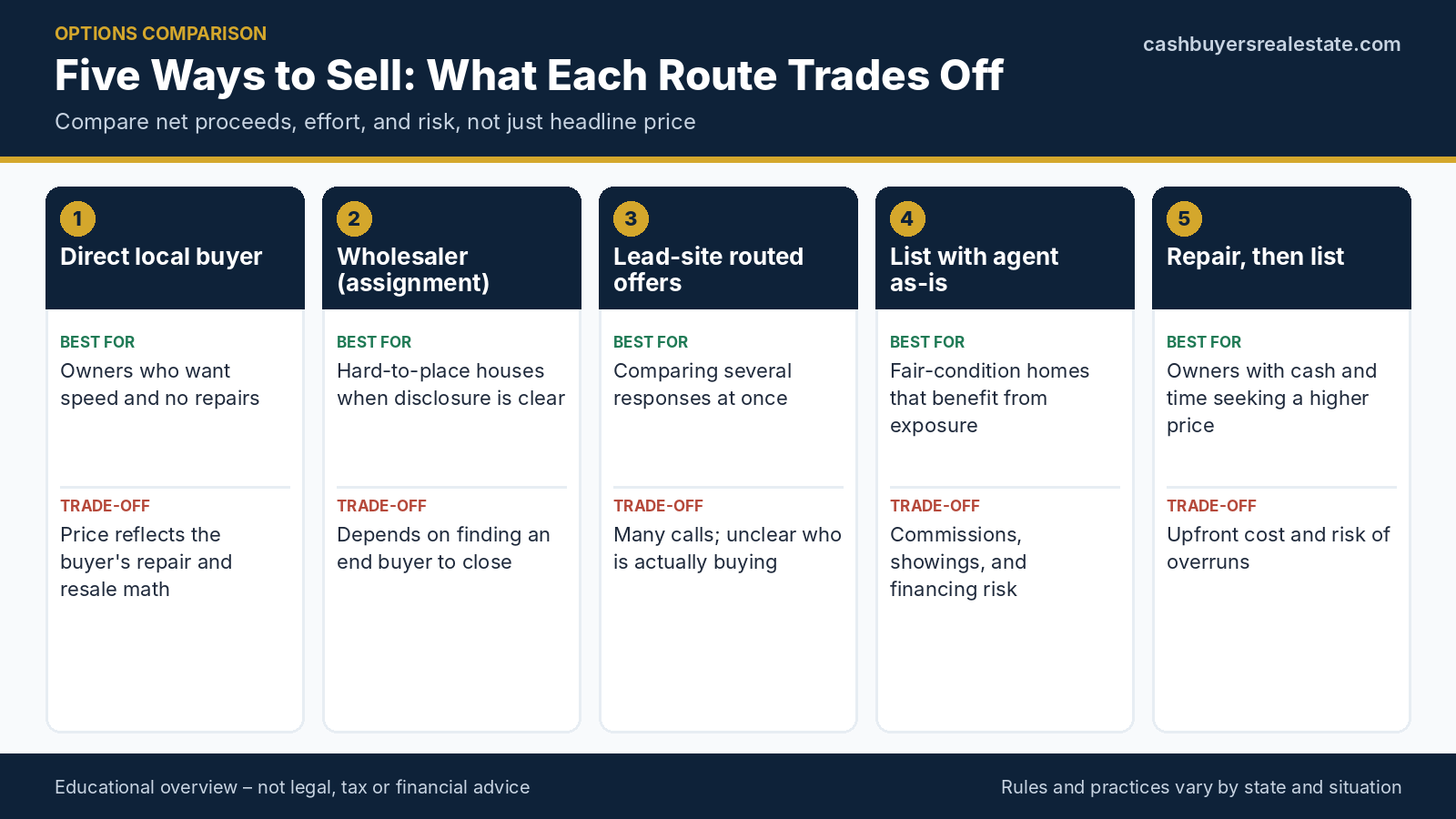
Text version of this infographic
- Direct local buyer — Best for: Owners who want speed and no repairs. Trade-off: Price reflects the buyer's repair and resale math.
- Wholesaler (assignment) — Best for: Hard-to-place houses when disclosure is clear. Trade-off: Depends on finding an end buyer to close.
- Lead-site routed offers — Best for: Comparing several responses at once. Trade-off: Many calls; unclear who is actually buying.
- List with agent as-is — Best for: Fair-condition homes that benefit from exposure. Trade-off: Commissions, showings, and financing risk.
- Repair, then list — Best for: Owners with cash and time seeking a higher price. Trade-off: Upfront cost and risk of overruns.
Signs, Mailers, Calls, and Texts: The Rules Around Solicitation
Much of the time, the first contact you have with a “we buy houses” operator is one you didn’t ask for. The sign was already on the corner, the letter was already in the mailbox, the phone was already ringing. That unsolicited start doesn’t make a buyer legitimate or illegitimate, but it does raise two practical questions: which rules govern this kind of outreach, and what can you do when you’d rather not receive it? The answers differ by channel, and some of them differ by city, county, or state, so this section sticks to patterns and to the federal rules that could be confirmed against official sources.
Signs, flyers, and mailers: what local rules usually govern
Print and physical outreach is regulated mostly at the local level. There’s no single national rulebook for a sign on a street corner or a flyer on a doorknob, and that means the practical answers live in your city or county code. The categories below are the ones homeowners ask about most.
Roadside signs and right-of-way ordinances
The small signs that advertise cash home purchases, sometimes called bandit signs, are commonly placed on utility poles, medians, and street corners, which are often public right-of-way. Many cities and counties restrict or prohibit signs in those locations through their sign codes, and enforcement is usually handled by code enforcement or public works staff who can remove signs and, in some places, issue fines. The details vary widely: some jurisdictions ban all off-premises signs in the right-of-way, some allow temporary signs under specific conditions, and some rarely enforce at all. If you want to know the rule where you live, the municipal code is typically searchable online, and the code enforcement office can answer a quick phone question.
For a homeowner, the relevance of this is modest but real. A sign in a prohibited location is a data point about how a business operates, not proof of bad intent, because some perfectly honest small operators put up signs without checking local rules. What a sign does give you, though, is a phone number that can be searched, called, and compared against a business record, and it tells you the advertiser is spending money to reach owners in your neighborhood, which means they’re probably active in your market. If a sign bothers you, reporting it to your local code enforcement office is a normal, low-drama step. The important point is that the sign isn’t evidence in either direction about whether the buyer can close, so move from the sign to the verification steps in section three as soon as you decide to make contact.
Direct mail, door hangers, and unannounced visits
A letter that arrives just after a death in the family, a missed tax payment, a code violation notice, or a foreclosure filing is rarely a coincidence. Many investors build mailing lists from public records such as delinquent-tax rolls, probate filings, code enforcement cases, absentee-owner data, and lis pendens or foreclosure notices, and then send letters or postcards to those owners. Mailing to people on those lists is generally lawful, although a number of states have separate laws about offers aimed at owners in foreclosure, with required contract terms and cancellation rights for the homeowner, so the foreclosure context can change the rules that apply. Knowing why you received a letter explains the timing and removes some of the sense that someone has been watching you.
If you don’t want more mail, write to the sender at the return address and ask to be removed from their list, and keep a copy of your request. Mail can’t be stopped completely, because the same record that triggered the first letter may be used by other senders, but discarding the pieces you don’t want costs nothing. Door-to-door visits are governed by local solicitation or “peddler” ordinances in many municipalities, some of which require permits, restrict hours, or honor posted “No Soliciting” signs, though how far they reach to someone who wants to buy rather than sell something varies. You’re always free to decline politely at the door, to ask the visitor for a business card, and to follow up later by phone, once you’ve had time to run the checks. No legitimate offer to buy a house needs an answer on your front step.
Phone calls and texts: what Do Not Call does and doesn’t do
Calls and texts raise a more complicated legal picture than signs and mail, because federal law applies and because the definitions in those laws were written with sales calls in mind. It helps to understand what the system was designed to do before deciding how much to rely on it.
What the federal registry covers, and its exemptions
The National Do Not Call Registry is run by the Federal Trade Commission. According to the FTC’s consumer guidance, it is meant to stop unwanted sales calls from real companies that follow the law, and it works by telling registered telemarketers which numbers not to call, not by blocking calls technically. The FTC’s registry FAQs say that registration is for personal numbers, that cell phone numbers can be listed just like landlines, that a registration does not expire, and that after registering it can take up to 31 days for sales calls to stop. Political, charitable, debt-collection, survey, and purely informational calls are not restricted, as long as they don’t include a sales pitch, and a company you have recently done business with or given written permission to may still call, although it must stop if you ask it to. Complaints can be filed at DoNotCall.gov, or at ReportFraud.ftc.gov if you lost money.
The text of the Telemarketing Sales Rule matters here. In its business guidance, the FTC describes the rule as covering plans to sell goods or services by telephone, and says sellers must synchronize their call lists with the registry at least every 31 days and keep a company-specific list of numbers they may not call. The same guidance says an established business relationship based on a purchase lasts up to 18 months, one based on an inquiry lasts three months, and either ends early if you tell the company to stop; the FTC’s page lists civil penalties of up to $53,088 per violation, adjusted periodically for inflation. A separate federal statute, the Telephone Consumer Protection Act, defines a telephone solicitation as a call or message “encouraging the purchase or rental of, or investment in, property, goods, or services,” and allows private lawsuits for $500 per violation, with up to triple damages for willful violations, while also restricting autodialed or prerecorded calls to cell phones without consent (see 47 U.S.C. § 227). Courts have read parts of that statute narrowly in recent years, so the details are for an attorney.
Here is the wrinkle specific to this topic. The registry and the telemarketing rule are built around calls that try to sell you something, and a call from someone who wants to buy your house doesn’t fit that description in an obvious way, because you’re being asked to sell. Whether such a call counts as a regulated sales call is a legal question this guide does not try to answer, and the safest assumption is that the registry will not reliably stop it. That is no reason to skip registering, since many companies that call at scale screen against it as a matter of routine and since it reduces unrelated sales calls. It is a reason to rely on the more direct tool in the next subsection: telling the caller, in plain words, to stop.
Stopping unwanted contact in practice
The most effective step is also the simplest: tell the caller or texter, clearly and in writing if possible, to put you on their internal do-not-contact list and to stop. Under the FTC’s guidance, a company must honor a request to stop calling even where an established relationship exists, and telling a business directly creates a dated record you can point to later. After that, the sequence below works for most people, and it’s ordered so that each step builds on the one before it.
- Write down the date, the time, the number that appeared on caller ID, and what was said, and keep screenshots of texts.
- Say plainly, by reply or by phone, “Please add me to your do-not-contact list and stop calling and texting me,” and keep a copy of the message.
- Register your number at DoNotCall.gov if you haven’t already, and check back after 31 days.
- Block the number, and use your phone’s or carrier’s call-filtering tools for repeat sources.
- Forward spam texts to 7726 (SPAM) and report them, along with unwanted calls, at ReportFraud.ftc.gov, as the FTC’s guidance on spam texts recommends.
- If a company keeps contacting you after you told it to stop, consider a complaint to your state attorney general, and talk to a consumer attorney about whether the contact violated a law that applies where you live.
The FTC’s advice on suspicious texts is also worth remembering: don’t click links in unexpected messages that ask for personal or financial information, and if you think a message could be real, contact the sender using a phone number or website that you already know is genuine. A text claiming to be from a buyer who “saw your property” is a good candidate for that treatment. Reply by calling the number the business publishes elsewhere, or simply ignore the message. If you submitted a web form at some point and later regret it, revoke permission in writing to the business named in the form’s terms, since consent that was given by a form can usually be withdrawn the same way. The table below summarizes the channels and where each stands.
| Channel | Main rule source | What you can do | Caveat |
|---|---|---|---|
| Roadside signs | City or county sign code | Report to code enforcement; look up the number | Rules and enforcement vary widely by location |
| Door-to-door visits | Local solicitation ordinances; trespass law | Decline, post a no-soliciting sign, ask for a card | Whether permits apply to buyers varies |
| Direct mail | Generally lawful; state foreclosure-related laws may apply | Ask the sender in writing for removal | Other senders may use the same public records |
| Live sales calls | Telemarketing Sales Rule; state laws | Register, tell the caller to stop, report | A call to buy a home may not clearly count as a sales call |
| Autodialed or prerecorded calls | Telephone Consumer Protection Act | Do not press keys; report; consider legal advice | Courts have read parts of the statute narrowly |
| Text messages | Telephone Consumer Protection Act; carrier policies | Forward to 7726; report to the FTC; block | Replying to unknown senders may invite more messages |
| Web-form follow-ups | The consent language you agreed to | Withdraw permission in writing | Partners named in the fine print may keep your data |
As you read the table, notice how little of this is within your control at the moment of first contact, and how much is within your control afterward. You can’t prevent a letter, but you can decide not to answer it. You can’t make a sign disappear, but you can decide what to do with the number on it. The sensible response to unwanted outreach is the same as the sensible response to wanted outreach: slow down, write things down, and verify before you engage.
What State Wholesaler Disclosure Laws Require, With Verified Examples
In the past several years a growing number of state legislatures have turned their attention to wholesaling, and the laws that resulted are among the clearest statements anywhere of what a seller is entitled to know before agreeing to sell. They are also a useful lens even if you live in a state with no such law, because they show which facts lawmakers concluded sellers were not being told. This section explains why the rules exist, how they tend to be built, and what four of them say, using the statutes and official forms themselves as the source.
Why states regulate contract assignment
Selling a house to a wholesaler is not inherently different from selling to anyone else. The difference lies in what the wholesaler intends to do with the contract, and in how much of that intention is shared with the person on the other side of the table. Lawmakers have approached the gap from two directions, which are worth separating.
The equitable interest and the information gap
When you sign a contract to sell your house, the buyer acquires what lawyers call an equitable interest in the property: not ownership, but an enforceable right to complete the purchase under the contract’s terms. If the contract allows assignment, that right can be transferred to someone else, and the person selling it can charge for doing so. A wholesaler’s business consists of buying that right cheaply from sellers and selling it for more to end buyers. Nothing about this is secret to the wholesaler, but sellers frequently assume that the person who signed the contract will be the person who closes on it, and that the price in the contract reflects what the house is worth to the buyer. Both assumptions can be wrong, and neither is corrected unless someone says so.
That gap is what the statutes target. They don’t, in general, prohibit the practice or cap the profit. They require the wholesaler to say what they are and what they intend, in writing, at a specific time, and they give the seller a way out if that didn’t happen. The reasoning is straightforward: a seller who knows the buyer plans to resell the contract can still choose to proceed, can negotiate a higher price, can ask for a shorter timeline, or can decide to list the home with an agent. The law is trying to ensure that the choice is informed, not to make the choice for them. Seen that way, a disclosure is a favor to the seller even when it comes from a wholesaler who would rather not make it.
Two legislative approaches: licensing and disclosure
States have broadly followed two paths. The first treats the marketing of a contract as a form of real estate brokerage, so that someone who advertises another person’s property, or an interest in a contract on it, without holding a license is violating the licensing law. Oklahoma’s earlier legislation, described in a 2022 summary by a law firm, took this direction by limiting the ability of unlicensed people to publicly market an equitable interest in a purchase contract. Texas takes a related approach, in which a person doesn’t need a license to assign a contract if they disclose the nature of their interest in writing, and loses that protection if they don’t. The second path leaves wholesaling lawful but requires a specific written disclosure and gives the seller rights to cancel, usually until closing, if the disclosure was skipped. Ohio and Wisconsin are examples.
Not every state has a statute aimed at wholesaling, and the list has been changing, so it would be a mistake to treat the four examples below as a map of the country. Where there is no wholesaler-specific law, general rules still apply: contract law, fraud and misrepresentation law, real estate licensing requirements, and consumer-protection statutes. Those are less targeted and usually harder for an individual seller to use, which is one reason it’s worth asking your state’s real estate commission or an attorney whether anything specific applies to your sale before you sign. As with every legal point in this guide, the statutes can be amended, and the text you rely on should be the version in force on the day you sign.
Four state examples and how to use them
The four examples below were checked against the statutory text or an official state form in October 2026. They are meant to illustrate the shapes these laws take, not to substitute for advice on your own contract.
Ohio and Wisconsin: disclosure forms and rescission
Ohio Revised Code section 5301.95, effective March 2, 2026, applies to residential property with one to four dwelling units. A wholesaler who takes the property as buyer and assigns the contract must give the record owner a written disclosure before entering a binding contract. The disclosure must be conspicuous, separate from the purchase contract, in boldface type of at least 12 points, and substantially in the statutory form, and both the wholesaler and the owner must sign and date it before the contract can become binding. The form tells the owner that the wholesaler is acting on its own behalf and does not represent the owner, that the owner may seek legal or professional advice, that the wholesaler may assign its interest without the owner’s consent before closing, that the wholesaler may charge the third-party buyer a separate fee, and that the agreed price may be below market value. If the disclosure was not made, the owner may cancel at any time before the close of escrow without penalty, the closing agent must return earnest money within 30 days, the rights cannot be waived, and a violation is treated as a deceptive practice under Ohio’s consumer sales law, which the attorney general can enforce.
Wisconsin Statutes section 710.13 takes a similar but leaner approach. It defines a real property wholesaler as a buyer under a purchase agreement who intends to assign the buyer’s rights to a third party for consideration, and it applies to residential property with one to four dwelling units. The wholesaler must give the seller written notice that the buyer is a wholesaler no later than when entering the purchase agreement, and must tell the eventual assignee that the assignor holds an equitable interest and is conveying its interest in the agreement, not title to the property. If the seller doesn’t receive timely notice, the seller may rescind before closing, without liability, by written notice and keeps any deposits or option fees. The rights can’t be waived, and they end if the person proceeds to closing, a detail that makes timing important: if you suspect a problem, act before the closing date, not after.
Illustrative example (hypothetical numbers, not market data): Two sellers receive nearly identical contracts at $126,000 with $2,000 in earnest money. The first lives in a state with a separate-disclosure statute, and her buyer never gives her the required form. A week before closing she learns the buyer has assigned the contract to someone paying $141,000, and she cancels in writing. Under the statute she is not penalized and the deposit is returned to her. The second seller lives in a state with no wholesaler-specific law and the same facts; he can still examine the contract, general licensing rules, and fraud and misrepresentation principles, but he has no statutory right to cancel simply because the disclosure was missing. His position isn’t hopeless, only more dependent on the specific wording of his contract and on how a court or regulator reads it, which is why checking before signing matters more where no special statute exists.
Oklahoma and Texas: required notice and license exemptions
Oklahoma’s real estate commission publishes an official form for canceling a wholesale contract, which cites 59 O.S. section 858-314. According to the form, a wholesaler must give the homeowner written notice, before any contract is signed, that it intends to assign or sell its equitable interest in the property for a higher price than the homeowner is being offered. Every contract must also state in writing that the homeowner should seek legal advice and may cancel without penalty within two business days after the contract is executed. A homeowner may cancel at any time if the required disclosures weren’t provided, and the form states that a contract lacking them is invalid and unenforceable and that the homeowner is entitled to any earnest money deposit. The two-business-day window is short, so a seller who wants to use it should calendar it the moment the contract is signed.
Texas works differently. Under Occupations Code section 1101.0045, a person who acquires an option or an interest in a contract to purchase real property, and then sells or assigns it, does not need a real estate license so long as the person doesn’t use the option or contract to engage in real estate brokerage and discloses in writing the nature of the equitable interest to any seller or potential buyer. Selling or offering to assign such an interest without that written disclosure is treated as engaging in real estate brokerage. The section, in the text reviewed for this guide, does not set a specific timing rule, and its remedy is regulatory in character: it attaches licensing consequences to a failure to disclose, instead of handing the seller a stated right to rescind. A Texas seller who has doubts about a wholesaler would ask for the written disclosure by name and could raise concerns with the Texas Real Estate Commission or an attorney. The table summarizes all four.
| State and citation | What the wholesaler must do | Timing | What the seller can do if it was skipped |
|---|---|---|---|
| Ohio, R.C. 5301.95 (effective March 2, 2026) | Give a separate, bold, 12-point written disclosure in the statutory form, signed by both parties | Before any binding contract | Cancel any time before close of escrow without penalty; earnest money returned within 30 days; attorney general may enforce |
| Wisconsin, Wis. Stat. 710.13 | Give written notice that the buyer is a real property wholesaler | No later than entering the purchase agreement | Rescind in writing before closing without liability and keep deposits or option fees |
| Oklahoma, 59 O.S. 858-314 (per official commission form) | Give written notice of intent to assign for a higher price; include legal-advice and cancellation statements in the contract | Notice before any contract is signed | Cancel within two business days for any reason, or at any time if disclosures were missing; contract described as invalid and unenforceable |
| Texas, Occ. Code 1101.0045 | Disclose in writing the nature of the equitable interest to any seller or potential buyer | Not specified in the text reviewed | No stated rescission right; failure to disclose is treated as unlicensed brokerage |
The table shows how much the details differ even among laws with the same purpose. Ohio and Oklahoma give the seller a concrete exit, Wisconsin ties the exit to a window that closes at settlement, and Texas relies on the licensing system. The one thing they have in common is a requirement that the seller be told, in writing, that an assignment may be coming.
In practice, you can use these laws even if your state has no statute of its own. The disclosures they require are a good template for what to ask any buyer to put in writing: that the buyer is acting for itself and not as your representative, whether it may assign the contract, whether it may charge another buyer a fee, and that you may consult a lawyer first. A buyer who will give you those statements voluntarily, in plain language, is showing the kind of transparency the laws are trying to produce. If a buyer resists writing down something it said freely on the phone, that resistance is itself information about how the rest of the transaction is likely to go.
Proof of Funds, Earnest Money, and Contract Terms: Where Vetting Meets Paperwork
Everything learned so far converges on a handful of documents. The buyer’s identity is only as good as the name printed on the contract, the buyer’s funds are only as real as the letter that describes them, and the buyer’s promises are only as binding as the words that survive into the signed agreement. This section looks at the three places where verification either becomes concrete or dissolves into assurances: proof of funds, the earnest money deposit, and the clauses of the contract itself.
Proof of funds and earnest money in practice
Sellers sometimes feel awkward asking a buyer to demonstrate that they have the money, as though the request implied distrust. In reality it is among the most ordinary requests in real estate, and a buyer who presents themselves as a cash purchaser should expect it. The more useful skill is understanding what the documents actually establish, because a letter can be perfectly genuine and still tell you less than it appears to.
What a proof-of-funds letter does and doesn’t establish
A proof-of-funds letter, or a redacted bank or brokerage statement, shows that a certain amount of money existed in an account at a particular time. It does not show that the money belongs to the entity named in your contract, that it’s free of other claims, that it will still be available on the closing date, or that it covers your price once closing costs are included. A letter written for one purchase can be shown again for another, and a statement can be edited by anyone with basic software. Verification therefore has several parts. Check that the name on the letter matches the contract’s buyer exactly, that the date is recent, that the amount comfortably exceeds your price, and that the issuer is a real institution you can reach through contact details you found yourself. A short call to the institution to confirm that the letter is genuine settles the question in a way that no amount of examining the page can.
Different funding sources produce different documents. A buyer using their own cash will typically offer a bank or brokerage letter. A buyer using short-term private financing may provide a commitment or pre-approval letter from the lender, which shows the lender’s willingness to fund a purchase, subject to its conditions, instead of money already in an account. A wholesaler may not have funds at all, and the honest evidence there is the end buyer’s proof, supplied once an assignment is arranged. Redacting account numbers is a reasonable courtesy, but an unwillingness to show any evidence of capacity, or a pattern of promising it “closer to closing,” is something to weigh against the rest of the picture. The guide to cash buyer proof of funds covers acceptable formats and common problems in more detail.
Earnest money: who holds it, when it’s refundable, and wire safety
Earnest money is a deposit that demonstrates the buyer’s commitment, and the question that matters most is who is holding it. In a typical transaction it goes to a neutral third party, such as a title or escrow company or an attorney’s trust account, which disburses it according to the contract or a mutual instruction. A deposit that the buyer holds, or that goes to a company controlled by the buyer, is not protection of the same kind. Equally important is the amount and the circumstances in which it is refundable. A small deposit isn’t wrongdoing, and plenty of fair deals use modest deposits, but a token amount combined with a long period in which the buyer can cancel for any reason means the buyer risks very little by tying up your property. In that case the cost of failure falls on you, in the form of weeks of lost time. If that trade is not acceptable, ask for a larger deposit held by the closing agent immediately, a shorter inspection period, or both. The page on cash buyer earnest money explains how deposits are usually structured.
Money moves by wire in many closings, and wire fraud is one of the best-documented risks around them. The Consumer Financial Protection Bureau has described a scheme in which criminals compromise a real estate professional’s email account, watch for upcoming closings, and send spoofed messages carrying false wiring instructions. Its recommended protections include choosing two trusted contacts, recording their phone numbers before closing, verifying any wiring instructions by phone using a number you already have rather than one in an email, never sending financial information by email, and, if funds have been sent to the wrong place, contacting your bank immediately and filing a complaint with the FBI’s Internet Crime Complaint Center (see the CFPB’s guidance, published in 2019 and still a clear statement of the basics). As a seller you are more likely to give wiring instructions for your proceeds than to receive them, and that creates the same exposure in reverse, since a fraudster can impersonate you or the closer.
Before turning to the contract itself, it helps to hold the whole set of checks in one place. Six decisions most often separate a careful sale from a regrettable one: confirming who the buyer really is, asking for proof of funds, reading the cancellation terms, understanding what the assignment language permits, using a closing agent you have verified yourself, and never signing a form with blanks in it. The checklist below lines them up, and the rest of this section takes the paperwork items one at a time.
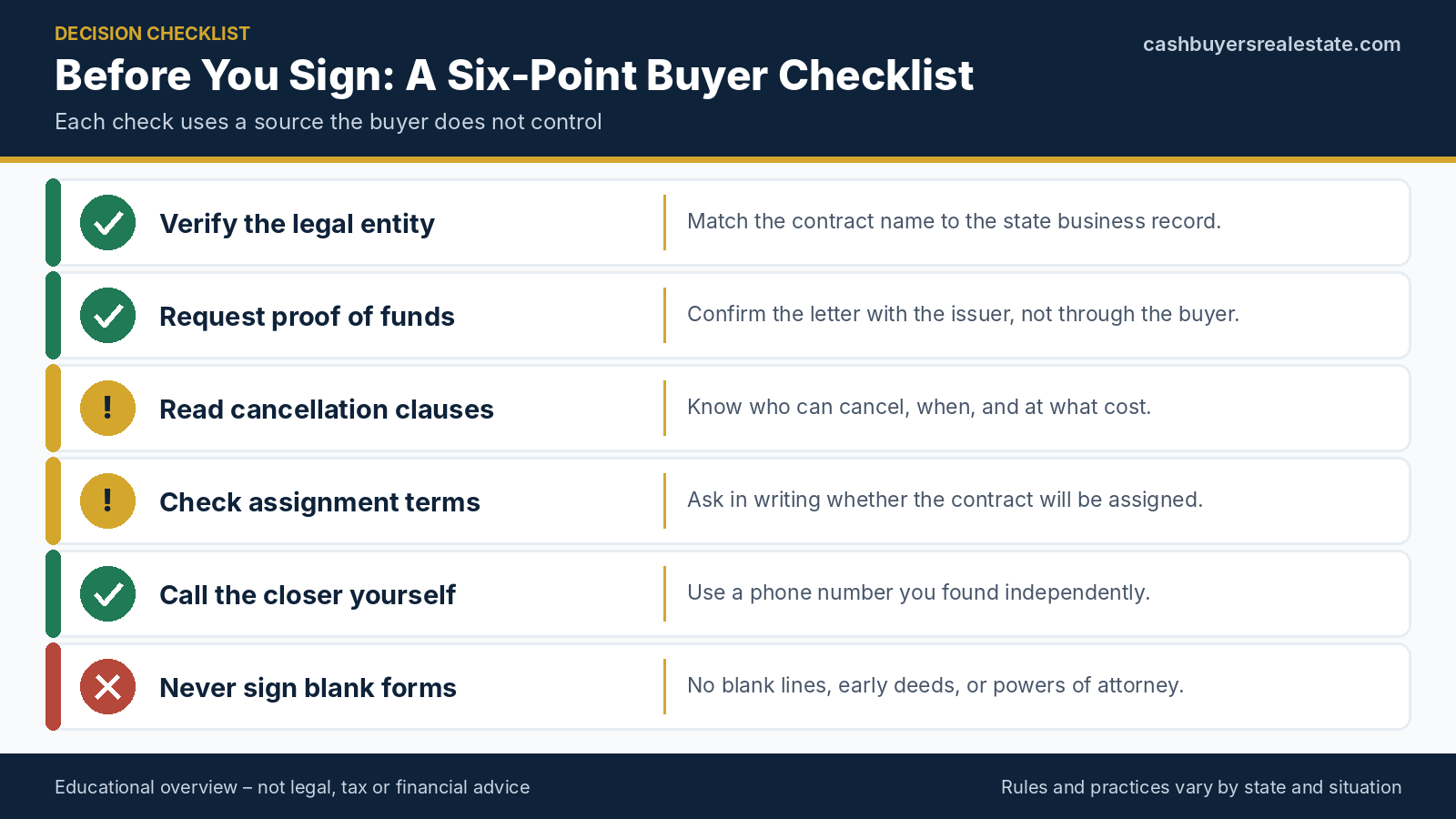
Text version of this infographic
- Verify the legal entity — Match the contract name to the state business record.
- Request proof of funds — Confirm the letter with the issuer, not through the buyer.
- Read cancellation clauses — Know who can cancel, when, and at what cost.
- Check assignment terms — Ask in writing whether the contract will be assigned.
- Call the closer yourself — Use a phone number you found independently.
- Never sign blank forms — No blank lines, early deeds, or powers of attorney.
Contract clauses that deserve a slow read
Contracts from investors are often short, sometimes only a couple of pages, and brevity can be a virtue or a disguise. Whether a particular clause is a problem depends on the whole deal. What follows is a way to read the paper, clause by clause, for the ones that most often change a seller’s position.
Assignment, cancellation, and recorded notices
Start with the language about who the buyer is. A buyer listed as “John Doe and/or assigns” has reserved the right to substitute someone else, which should match what you were told about assignment and, in states with disclosure rules, what the separate form says. Then look at who can cancel, when, and at what cost. A common pattern gives the buyer a long period to inspect and cancel for any reason, sometimes called an option, while giving the seller no comparable right, and the longer that period runs, the longer your house is effectively off the market. Look also for any clause authorizing the buyer to record a memorandum of the contract in the county records. A recorded memorandum is public notice of the buyer’s claim, and until it is released it can prevent a clean sale to anyone else, which is why many sellers insist it be prohibited or released within a few days of any termination. Compare the closing-agent clause with what you were told and with the independent check you made.
The remaining terms matter as well. If the buyer describes the purchase as all cash, ask why the contract contains a financing or appraisal contingency, because such a clause lets the buyer cancel if a loan or valuation falls through. Check who pays for title insurance, recording fees, and transfer taxes, and what the contract says about the condition of the property at closing and about possession. Confirm that the contract says what happens to your earnest-money protections if the buyer defaults, such as whether you keep the deposit as a fixed remedy. An “entire agreement” clause, common in contracts, means that anything said on the phone and not written down is effectively out of the deal, so any promise that matters has to be in the document. If a contract describes an exclusive right to sell, or a commission, or authority to market the property, it may be a listing agreement in disguise, and the transaction is different from what the phone call suggested.
Illustrative example (hypothetical numbers, not market data): A seller is handed a two-page agreement at $118,000 with a $100 deposit held by the buyer, a 75-day period in which the buyer may cancel for any reason, assignment rights, and permission to record a memorandum of contract. Nothing in it is unusual for a wholesaler’s form, and nothing in it protects the seller. The seller asks for a $2,500 deposit held by an independent title company, a 14-day inspection period, and no recorded memorandum. A buyer who agrees has shown real capacity and commitment. A buyer who refuses every change and repeats that the offer expires today has told the seller something about how the next two months would go, and walking away costs the seller nothing but an offer that was never well secured.
Blank spaces, side promises, and manufactured urgency
A signed contract with blank lines can be completed later by someone else, which is why the rule is simple and absolute: don’t sign anything with blanks in it. That includes the price, dates, the buyer’s name, the closing agent, and any addendum. The same principle applies to documents that are presented in a stack. A purchase agreement, an assignment, a listing agreement, an authorization to market the property, a power of attorney, and a deed are all different instruments with different consequences, and a pile of papers that mixes them can hide a document you didn’t expect to sign. You should never sign a deed, or a power of attorney that would allow someone else to sign one, before the closing agent has confirmed the buyer’s funds and the settlement statement, and the transfer of title should happen at closing, not before.
Urgency is the pressure point most often used to keep these steps from happening. A deadline is a legitimate part of many deals, but one that expires before you can make a call or read a page is designed to prevent checking. If your home is in foreclosure, the FTC warns that scammers may ask you to sign over your deed, may tell you to stop paying your lender, and may rush you through documents, and it advises contacting your servicer and a HUD-approved housing counselor (the Treasury and HUD help line is 888-995-HOPE), as its mortgage relief guidance explains. A legitimate buyer will wait a reasonable time for a seller to consult an attorney or a counselor, and a reasonable time is measured in days, not hours. The table below turns these clause-level points into questions you can put to any buyer.
| Clause or feature | Why it matters | Question to ask | Safer approach |
|---|---|---|---|
| “And/or assigns” language | Lets the buyer substitute another party and charge for it | “Do you plan to assign, and will you say so in writing?” | Written disclosure of any intent to assign; buyer remains responsible |
| Long inspection or option period | Keeps your house tied up while the buyer can walk away freely | “Why this many days, and what is it for?” | A short, defined period with a clear cost to cancel late |
| Small deposit held by the buyer | Little at risk for the buyer; no neutral holder | “Who holds the deposit, and when is it released?” | Deposit in an independent trust or escrow account right away |
| Memorandum of contract | A recorded notice can cloud title until released | “Will you agree not to record anything?” | No recording, or release within a few days of termination |
| Financing or appraisal contingency | Allows cancellation if a loan or value falls short | “If this is cash, why is the clause there?” | Remove it, or understand it as a financed purchase |
| Entire-agreement clause | Verbal promises are not part of the deal | “Can you put that promise into the contract?” | Every important term written into the document or an addendum |
| Deed or power of attorney signed early | Moves control of title before funds are confirmed | “Why does this need to be signed before closing?” | Sign only at closing, with the closing agent present |
None of these items is a trick, and several have fair uses. What the table gives you is a way to compare the contract in front of you with a more balanced version of the same deal. The distance between the two is a measure of how much of the risk the buyer has written onto your side, and it’s a fair thing to raise in negotiation or to show an attorney.
Frequently Asked Questions About Checking Out Local Cash Home Buyers
The questions below come up repeatedly when homeowners start vetting buyers who advertise with the “we buy houses” slogan. The answers are brief by design and point back to the fuller treatment above where there is one. As elsewhere in this guide, nothing here is legal advice, and state rules vary.
Questions about finding and contacting buyers
Questions about signs, mail, and web forms
- Does a roadside sign mean the buyer is a scam?
No. A sign is a marketing choice, and the rules about where signs may go are set locally and enforced unevenly. Some honest small operators post them without checking the code, and some less careful ones use more polished channels. Treat the sign as a phone number to verify, not as evidence of anything.
- Why did I get a letter right after a death in the family or a missed payment?
Many investors build mailing lists from public records such as probate filings, delinquent-tax rolls, code cases, and foreclosure notices. The timing is a function of when those records are created, not a sign that someone is watching you personally. You can ignore the letter or write to the sender and ask to be removed from the list.
- Is it safe to type my address and phone number into a “get my offer” website?
It depends on who operates the site. Read the terms for the legal entity’s name, and read the sentence beside the submit button to see whether you’re agreeing to calls and texts from unnamed partners. If that is unclear, calling the published number and asking who the operator is gives you information without creating a written consent.
- Can I get several offers without being flooded with calls?
Yes, by choosing whom you contact instead of submitting one form that routes to many. Reach out to two or three buyers you have checked, ask each the same questions, and request written offers. A separate email address used only for these inquiries also keeps the replies in one place.
Questions about calls, texts, and Do Not Call
- Will registering with the Do Not Call Registry stop investors from calling?
It may reduce calls from businesses that screen their lists, but it is built around sales calls, and a call from someone who wants to buy your house doesn’t clearly fit that description. Registration is free and doesn’t expire, so there’s little downside. For a persistent caller, a direct request to stop, made in writing, is the stronger tool.
- May I record a call with a buyer?
That depends on your state. Some states require every person on the call to consent to recording, and others require only one. If you’re unsure, announce at the start that you’d like to record, or take dated handwritten notes and send a recap email afterward.
- What should I do about a text from a number I never contacted?
Don’t click links or share account details. Forward the message to 7726, report it at ReportFraud.ftc.gov, and block the number. If you think the sender might be a genuine buyer, look up the business independently and call a number you found yourself.
Questions about verifying and signing
Questions about records and verification
- How do I find out who owns an LLC that wants to buy my house?
Start with the state business entity search, which shows the registered agent and, in some states, the managers or members. Other states reveal very little by design. If the record doesn’t name a principal, ask the buyer who will sign and in what capacity, and compare the answer with the signature block.
- How can I tell whether a buyer has really purchased houses nearby?
Search the county grantee index for the entity and the principal, then check each parcel on the assessor’s site. Keep in mind that a wholesaler who assigns contracts may not appear on deeds at all, so ask for a plain explanation instead of treating a blank result as proof of anything.
- Is an out-of-state business address a problem?
Not by itself. Many investors operate across several markets from one office. The more relevant questions are whether the entity is in good standing, whether it has closed deals in your county, and whether a local, independent closing agent will handle the sale.
- Are online reviews enough to trust a buyer?
Reviews can alert you to a pattern, but they’re easy to inflate, and a new business may have none. Read for specifics, such as a price reduced after the contract was signed, and weigh them below what you can confirm in public records and with the closing agent.
Questions about contracts and walking away
- Is wholesaling legal?
In many places it’s lawful when handled honestly, and a growing number of states regulate it through licensing rules, mandatory disclosures, or both. Some states have no wholesaler-specific statute. Your state real estate commission or an attorney can tell you what applies to your sale.
- Do I need an attorney for a sale to an investor?
You aren’t always required to have one, but a short review of the contract by a licensed attorney in your state is inexpensive compared with the amounts at stake, and it is especially worthwhile where there is an assignment clause, a long option period, or a recorded memorandum. In attorney-closing states, one may be involved anyway, though the closing attorney may not represent you.
- Can I cancel after I’ve signed?
It depends on the contract and your state. Some statutes give sellers cancellation rights when a wholesaler skipped required disclosures, and a few contracts include their own cancellation windows, but there is no general federal right to cancel a home sale contract. Read the cancellation language before signing and calendar any deadline immediately.
Choosing a Route and a Buyer: A Decision Framework and Next Steps
By this point you have a way to tell what kind of operation you’ve reached, a method for checking it, and a sense of the rules around the process. What remains is the decision itself: whether a quick sale to a local buyer is the right route for your situation, which buyer if so, and what to do in the next few days. A good decision here doesn’t require a perfect buyer. It requires that you understand the trade, you’ve confirmed what can be confirmed, and you’re signing because the terms suit you and not because a deadline said so.
Matching the route to your priorities
People contact buyers for different reasons, and the right route depends on which of those reasons weighs most. A framework helps because the feelings that accompany a house you want gone, such as fatigue, worry about cost, or a long list of repairs, can make the fastest option look like the only one.
How speed, price, effort, and certainty trade off
Four priorities usually compete. Speed favors a direct buyer who can close without a mortgage approval, since a financed buyer’s lender, appraiser, and underwriter add steps and dependencies. Price tends to favor an exposed market sale, in which an agent markets the home to a broad pool of buyers, particularly if the house is in reasonable shape. Effort favors the buyer who takes the house as-is and relieves you of repairs, cleaning, showings, and staging, a point examined in the repairs-focused guide mentioned earlier. Certainty depends on the specifics: a funded, verified buyer with a clean contract and a short inspection period can offer more certainty than a financed buyer whose loan could fall through, while an unverified buyer with a long option period offers less than either. The broad overview of options in selling a house fast places these routes alongside others.
The sound way to compare is by net proceeds, which is what lands in your account after commissions, closing costs, repairs, and the cost of carrying the house while it sells, not by the headline price in each offer. A cash offer that looks low can net close to a listing price that looks high once those items are subtracted, and sometimes it nets less, so the only way to know is to run both sets of numbers. Ask a title company or an agent for a net sheet on the listing route, ask each buyer for an itemized offer, and put them side by side. The exercise takes an hour and often changes the choice in one direction or the other.
Illustrative example (hypothetical numbers, not market data): A homeowner expects a listing to sell for $214,000 after about ten weeks. Subtracting 6 percent in agent commissions ($12,840), roughly $3,400 in seller closing costs, $9,500 in repairs and credits the buyer would negotiate, and about $3,600 of taxes, insurance, and utilities during the sale leaves a net of $184,660. A verified direct buyer offers $176,000 as-is, with about $1,900 in closing costs paid by the seller, no commission, and a two-week close, for a net of $174,100. The listing route nets about $10,560 more but takes around eight additional weeks and carries more uncertainty about repairs and buyer financing. Whether that gap is worth the time is a personal judgment, and the exercise is useful because it turns a vague sense into an actual figure.
When walking away is the sensible move
Most conversations with buyers end in a clear yes or no without drama. Occasionally something happens that suggests the best choice is to stop, and it’s easier to recognize that moment if you’ve decided ahead of time what it looks like. No single item below proves that a buyer is acting in bad faith, and each could have an innocent explanation, such as a disorganized small operator or a misunderstanding about who handles which step. But the more of these signals are present at once, the less sense it makes to continue, and the cost of pausing is almost always lower than the cost of proceeding. The signals most worth treating as stopping points are these.
- The buyer won’t give the legal name of the company that would sign the contract, or the name doesn’t match the state record.
- You aren’t allowed to speak to the closing agent, or the agent can’t be found through an independent source.
- Proof of funds can’t be confirmed with the institution named, or it names someone other than the buyer.
- You’re asked to sign a deed, a power of attorney, or a form with blank lines before closing.
- You’re asked to pay any fee up front, to stop paying your lender, or to keep the deal secret from family members or your attorney.
- The contract differs materially from what was said on the phone, and the buyer won’t put the earlier promises in writing.
- The offer expires before you can reasonably read it or consult anyone.
Walking away doesn’t have to be adversarial, and it shouldn’t be treated as a failure of the process; it is the process working. A short, courteous message, such as “I’ve decided to go a different direction,” is enough, and you don’t owe an explanation or a debate. If you’ve already signed something and the signals appear afterward, the situation is different: stop, photograph or copy everything, avoid signing anything further, and speak to an attorney promptly, because cancellation rights under a contract or a state statute can be tied to short deadlines. If you think a buyer has misrepresented something material, you can also report it to your state attorney general’s consumer protection office, your state real estate commission, or the FTC, and the log you’ve been keeping becomes useful at that point. The broader landscape of problem patterns is described in the guide to cash home buyer scams, and the contract-specific warning signs are in the page on cash offer contract red flags.
What to do next
Most of the useful work here is preparation, and it can be done in any order, in a few evenings, before you speak to a buyer you’re serious about. Having the pieces in hand also makes you a better negotiating counterparty, since buyers can price a clear file with more confidence than an uncertain one.
Documents to gather and steps for this week
Gather the paperwork that every transaction will eventually require, so that no one has an excuse to delay or to build uncertainty into their offer. A buyer who is pricing a house with missing information protects themselves by assuming the worst, and that assumption comes out of your price or your timeline. A tidy file also lets you notice quickly when a buyer asks for something unusual, such as documents that have no bearing on the purchase. The items below are what a title company, an investor, or a listing agent will typically ask for first, and most owners can assemble them from their own files or a few phone calls without paying anyone.
- A copy of your deed or the closing documents from your purchase, or the probate paperwork if you inherited the property.
- The most recent mortgage statement and a payoff estimate, and details of any second mortgage, home equity line, or lien.
- The latest property tax bill and notices about any delinquency, special assessments, or code violations.
- Homeowners association contact details, dues, and any unpaid charges.
- Lease copies and tenant contact information, if the property is rented.
- Any repair estimates, inspection reports, permits, and insurance claims that exist.
If something is missing, it can usually be replaced. The county recorder can provide a copy of a recorded deed, your mortgage servicer can produce a payoff statement on request, the county tax collector keeps current and past tax records, and an association manager can supply a statement of dues. For an inherited property the court file or the personal representative holds the authority documents, and a title company will want to see them before it agrees to close. None of this has to be perfect before you start talking to buyers, but the more of it you hold, the less room there is for surprises later.
With those in hand, request a net sheet from a title company or an agent for a conventional listing so that you have a baseline, then ask two or three buyers the same questions from the first-call script and compare their written answers. Run the entity, closing-agent, and county-record checks on each one before you share more than the basics. If you want to broaden the field, the pages on cash home buyers and the general explainer on “we buy houses” companies describe the wider category from different angles. Give yourself a few days, because a legitimate opportunity will still be there.
Questions for an attorney or title company, and a balanced way to finish
A licensed real estate attorney in your state, or a title company that will stay neutral, can answer questions that no article can. The cost of an hour or two of an attorney’s time is usually small next to the amounts involved in selling a house, and it buys something a buyer’s paperwork cannot: a person whose only job in the transaction is your side of it. If you hesitate to pay for that, remember that a title company’s closer, however courteous, works to complete the transaction and does not advise you about whether its terms favor you.
Specifically, ask whether the contract you’ve been offered gives you all the protections your state’s law provides, whether it contains an assignment or recording clause that you would want changed, what the title search shows about liens, heirs, or other claims that could delay closing, and whether any state-specific disclosure rule applies to your sale. For tax questions, such as how a gain might be treated, a tax professional is the right person to ask, and you’ll want that answer before you decide, not after.
The sensible conclusion is a balanced one. A sale to a local cash buyer can be a fine choice for a house that needs work, a tight timeline, or an owner who wants a simple exit, and many such sales close without incident. A conventional listing, a sale after modest repairs, or a different kind of buyer may net more or fit better for another owner. Neither path is right for everyone, and the point of checking a buyer is not to find a reason to say no, but to make sure that when you do say yes, you know who you’ve said it to and what you’ve agreed to. Take your time, ask for things in writing, and let the answers you get guide the decision.