
Cash Sale vs. Listing for a Fast Sale: Timeline, Costs & Seller Options
You need to sell within weeks, not months, and two roads lead there. One is a sale to a cash buyer who skips the mortgage process. The other is a listing that puts the house in front of every buyer, including those who need a loan. Both can work. Neither is automatically better, and which one wins for you depends on your deadline, the home’s condition, your equity, and how much uncertainty you can live with.
In a cash sale vs listing for a fast sale, you’re usually trading price for time and certainty. A cash sale tends to have fewer moving parts and can close sooner, but buyers typically price in repairs, risk, and margin, so offers often come in below what a prepared listing might earn. A listing can reach a higher price, but it adds showings, financing, appraisal, and inspection steps. Compare net proceeds and deadlines, not headline prices.
That one-sentence version hides a lot of arithmetic. A listing’s higher price gets reduced by commissions, concessions, repair credits, preparation, and the months of mortgage, tax, and insurance payments you carry while waiting. A cash offer’s lower price gets partly offset by what you don’t pay: no commission in a direct sale, little or no preparation, and a shorter wait. Whether the offsets close the gap is a numbers question, and the answer changes from house to house.
This guide is built to help you answer it for yours. It starts by walking through how each route actually unfolds, then sets them side by side across twelve dimensions. Three hypothetical net-proceeds scenarios follow: a clean move-in-ready home, a dated home that needs work, and a home with a title complication. After that, the guide compares the contract terms you’d sign on each route, offers a decision matrix keyed to your top priority, explains hybrid strategies that borrow from both, and shows how to collect offers you can compare fairly. The final sections cover common questions and concrete next steps.
A few notes on how to read it. All dollar figures in the worked examples are hypothetical and are not market data; they exist to show how the arithmetic works. Survey figures cited from the National Association of REALTORS® (NAR) are labeled with their source and period. And because closing practice, taxes, and disclosure rules vary by state, nothing here should be read as a prediction of how your sale will go.
If you want a deeper look at what a discount for speed costs you, see the economics of a quick home sale. If you’re weighing a sale without an agent, the guide to selling without a realtor covers that route. And for an overview of how cash buyers and agents differ more broadly, the planned cash buyer versus real estate agent comparison goes through it. This page stays on one question: when speed matters, how do you choose between selling for cash and listing?
How Each Route Unfolds When the Clock Is Running
The cash-sale path from first conversation to closing
The steps and what drives the timing
A cash sale replaces the lender with the buyer’s own funds. The sequence usually runs like this: the buyer gathers basic information about the property, sometimes after a walkthrough or photos; the buyer presents an offer; you negotiate and sign a purchase agreement; earnest money goes to a neutral holder such as a title company, escrow company, or attorney; a due diligence or inspection period runs; the closing agent searches title and prepares the paperwork; and you close and are paid.
Because no loan underwriting or lender appraisal sits in the middle, the process can be shorter than a financed sale. But the pace is set by more than funding. Title work, payoff letters, your availability to sign, and the length of any inspection period all matter. A closing within a couple of weeks is feasible in some transactions when title is clean and both sides move quickly, while a messy title can push even a cash closing well past a month. Treat any promised timeline as a target to be tested against the contract language, not as a guarantee.
The contract sets the timeline more reliably than any conversation. Look for a stated closing date or window, a defined due diligence period, and what happens if either side misses a deadline. A short closing date that comes with a long, open-ended inspection period can leave you less protected than it appears.
Where cash closings slow down or fall apart
A cash sale isn’t immune to delay. Common slowdowns include an unreleased lien or an unexpected title defect; an unresolved ownership issue, such as an heir who hasn’t signed; a buyer who finds a repair estimate higher than expected and asks to renegotiate; a closing agent with a backlog; and a payoff letter that takes days to arrive. Cash buyers sometimes rely on short-term financing, such as a bridge loan, hard-money loan, or a line of credit, so confirming that the buyer’s funds are available matters even when the sale is described as “cash.”
Some investor contracts also include an assignment clause that lets the buyer transfer the contract to another party. That’s not inherently improper, but it changes who you’re actually closing with, and it may affect timing. Read that clause and ask who the ultimate buyer will be.
Delays on the seller’s side deserve a mention too, since they’re the ones you can control. An heir or co-owner who hasn’t signed, a payoff letter you haven’t requested, a missing HOA document, or a home that isn’t accessible for the final walkthrough can each cost days. Closing companies can also be busiest near month-end, so confirm the closing agent’s capacity if your date falls in that window.
Cash sales can also fall through. When they do, the cost to you is usually time: the days or weeks you spent under contract, during which you didn’t market the house. A strong contract limits that exposure by defining how long the buyer has to inspect and by requiring meaningful earnest money. For verification steps, see the guide to cash home buyer scams and the planned page on proof of funds.
The listing path from preparation to closing
Preparation, marketing, and the offer stage
A listing starts before the sign goes up. Pricing, cleaning, light repairs, photography, and the paperwork for the listing agreement take days to weeks, depending on how ready the house is. After the home is listed, showings and open houses generate offers. A seller’s market might produce several offers in days; a slower market can mean weeks of showings and a price reduction or two. Once you accept an offer, the clock for the closing begins, and it usually has contingencies attached.
The first days of a listing matter more than the later ones, because that is when interest peaks and agents’ clients see the home first. Strong photos, accurate details, and a price in line with recent comparable sales help the early traffic turn into offers; a price set too high tends to produce a reduction later, after the early attention has passed. Ask your agent which comparable sales support the price and what they’d change if there are no showings in the first week.
Contingencies are conditions that let the buyer back out or renegotiate, and in a financed sale they commonly include financing, appraisal, and inspection. Each one is a place where the timeline can lengthen or the price can change. A buyer who fails to get the loan can cancel under a financing contingency; a low appraisal can force a price renegotiation; an inspection can produce a repair request or credit.
This stage is also where your own workload sits. Showings need access, and a home that must be tidy for every showing is an effort for a household that’s also packing. Privacy suffers too, since photos and details are public. If you want the preparation checklist for a short timeline, the guide to how to prepare for a fast home sale covers it.
Financing, appraisal, and closing mechanics
After you accept an offer from a buyer who needs a loan, the lender orders an appraisal, underwrites the file, and issues final approval. The lender must give the borrower a Closing Disclosure at least three business days before closing, according to the Consumer Financial Protection Bureau, which is one reason the closing date can’t be moved up on a whim once the loan is in motion. Your side of the process includes responding to the buyer’s inspection requests, providing payoff information, and signing documents.
How often does this process go wrong? NAR’s REALTORS® Confidence Index Survey for March 2026 (fieldwork in early April 2026) offers a rough picture from member agents’ recent transactions. It reported that 5 percent of contracts were terminated and 13 percent had delayed settlement over the past three months, and that 7 percent of the delayed contracts involved appraisal issues. The report also gave a median of 30 days to close. These figures describe a survey of REALTORS® and their recent transactions, not your market or your buyer, and they cover all types of contracts, not just financed ones. They show that most contracts close on time, and that delays and terminations are a real but minority outcome.
The takeaway for a seller on a deadline is practical. Even when the odds of a delay are modest, the consequence of one can be severe if your timeline is fixed. Ask your agent how they screen buyers, whether the buyer’s lender has issued a preapproval letter, and what happens if the appraisal falls short.
Head-to-Head: Twelve Dimensions That Separate Cash Sales From Listings
Speed, certainty, and risk
The comparison table
The table below sets the two routes side by side. Every cell describes a tendency, not a rule, because both routes vary widely depending on the buyer, the property, and the local market.
| Dimension | Cash sale | Listing | Why it matters on a deadline |
|---|---|---|---|
| Typical time to closing | Often shorter; set by title work and the contract | Preparation and marketing, plus a contract-to-close period | Fixed move dates, court dates, and deadlines |
| Price relative to market value | Offers usually reflect repairs, risk, and margin | Exposure to many buyers can support a higher price | The size of the gap decides whether speed is worth it |
| Net proceeds | No commission in a direct sale; few credits | Commissions, concessions, credits, carrying cost | Net, not price, is what you keep |
| Financing risk | Lower, if funds are verified | Present when the buyer needs a loan | A failed loan resets the clock |
| Appraisal risk | Usually none | A low appraisal can force a renegotiation | Late price changes cost time and money |
| Inspection leverage | Buyer may renegotiate, but repairs are often priced in | Buyer may request repairs or credits | Renegotiation consumes days |
| Contingencies | Often fewer; verify in the contract | Often several | Each contingency is an exit door for the buyer |
| Showings and disruption | Usually few visits | Frequent during the marketing period | Matters if you’re living in the home or relocating |
| Privacy | Typically more private | Public listing, photos, and details | Matters in sensitive situations |
| Repairs and preparation | Often sold as-is | Usually expected, at least cosmetic | Time and cash you may not have |
| Closing-date flexibility | Often flexible on both ends | Tied to the lender’s schedule | Lets you align the sale with a move |
| Seller workload | Lower on the marketing side | Higher, though an agent shoulders much of it | Capacity is limited when life is already full |
Look at where your own priorities sit in this list. If three or four rows describe the pressure you’re under, the right route will usually show up quickly.
Fall-through risk on each side
Both routes have a way to fail, and the failure modes differ. In a listing with a financed buyer, the most common exits are financing, appraisal, and inspection. In a cash sale, the most common exits are title surprises, a buyer’s change of mind during due diligence, and a buyer who can’t produce funds as promised. The NAR survey cited above suggests that a minority of contracts are delayed or terminated in the market overall, but the survey doesn’t separate cash contracts from financed ones, so it can’t tell you which type is safer.
What you can do is look at the protections each contract gives you. On a financed offer, look at the preapproval letter, the size of the down payment and earnest money, the length of the contingency periods, and whether the buyer is waiving any of them. On a cash offer, look at proof of funds from a bank or other financial institution, the size of the earnest money, the due diligence period, and the identity of the closing agent. The same question applies to both: how many ways can this buyer legitimately leave, and what do I keep if they do?
NAR’s survey also reported that all-cash purchases were 27 percent of sales in its March 2026 report. That is the share of sales, not a measure of how reliable they are, but it shows that cash buyers are a regular part of the market and not an exotic exception. Its relevance to you is that a listing can attract cash buyers too, which comes up again in the section on hybrid strategies.
Price, net proceeds, and effort
Where the price gap comes from
A cash offer below a listing’s likely price is not necessarily unfair; it reflects what the buyer must cover. Investor buyers commonly consider the home’s value after repairs, the cost of those repairs, holding costs, transaction costs on both purchase and resale, and a margin for risk and profit. Owner-occupant cash buyers, who exist too, often pay closer to market value but are fewer in number and rarely as flexible on timing. Methods vary, so ask any buyer how they got to their number and compare that reasoning against a local agent’s view of value.
On the listing side, the price is a hope until a buyer signs. An asking price reflects a pricing strategy and a market read. What the home actually sells for depends on demand, condition, and how long you’re willing to wait. In a fast sale the pressure runs toward price reductions, and each reduction narrows the gap with a cash offer.
For a deeper explanation of how investor offers are built, including the after-repair value arithmetic, see how cash offers are calculated. The purpose here is narrower: to remember that both prices are estimates, and the one you should trust is the one that has survived a contract, an inspection, and, for a financed sale, an appraisal.
Illustrative example (hypothetical numbers, not market data): An investor might reason this way about a house with a repaired value of $350,000: subtract $40,000 for repairs, $25,000 for holding, financing, and transaction costs on both ends, and $30,000 for risk and profit, leaving an offer near $255,000. Another buyer might use a smaller margin, or a lower repair estimate, and arrive at $270,000. Neither is “the” right number; each is a function of assumptions that you can ask about and test with your own repair quotes.
Showings, privacy, repairs, and workload
Effort is a cost even if it never appears on a statement. Preparing a home for the market means decluttering, cleaning, repairing visible defects, and keeping the home showing-ready, often with little notice. If you’re also packing, working, or caring for family, that’s a heavy load. A listing agent can handle much of the coordination, but you still live with the disruption.
Privacy is another dimension. A listing makes your address, interior photos, and sale status public. Some sellers, particularly those dealing with a divorce, an estate, or a financial setback, prefer not to have that exposure. A direct sale can be quieter, though that preference should never override the need to compare offers.
Repairs deserve their own caution. A cash buyer may take the house as-is, which spares you from fixing things, but “as-is” doesn’t excuse you from disclosing known material defects where state law requires disclosure. And repairs that you skip will probably show up as a lower price. Weigh the repair cost you’re avoiding against the discount you’re accepting, a trade that the dated-home scenario below puts into numbers.
The process map below summarizes the steps for a seller choosing between routes. In text: set your timeline, pick a path, price for your goal, prepare your title documents, and compare net proceeds before accepting anything.
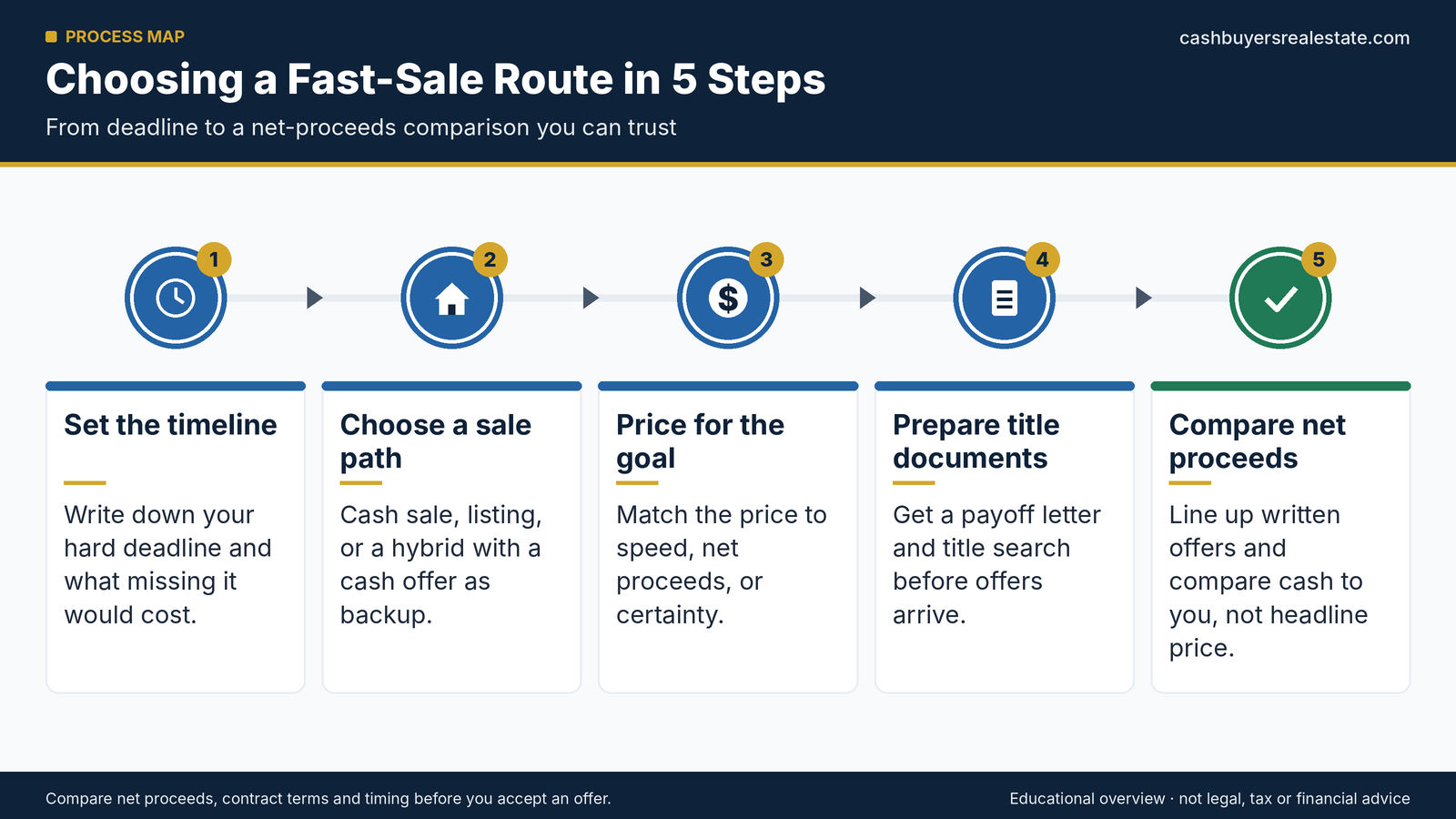
Text version of this infographic
- Set the timeline — Write down your hard deadline and what missing it would cost.
- Choose a sale path — Cash sale, listing, or a hybrid with a cash offer as backup.
- Price for the goal — Match the price to speed, net proceeds, or certainty.
- Prepare title documents — Get a payoff letter and title search before offers arrive.
- Compare net proceeds — Line up written offers and compare cash to you, not headline price.
Three Net-Proceeds Scenarios With Hypothetical Numbers
A move-in-ready home and a dated home
Scenario one: a move-in-ready home
Start with the easy case. A homeowner has a clean, updated house worth about $400,000 to a financed buyer, owes $220,000 on the mortgage, and carries about $2,400 a month in interest, taxes, insurance, and utilities. The numbers below are hypothetical and chosen to show structure, not to predict a market. The listing assumes combined agent compensation of 5 percent, a 1 percent buyer concession, light preparation, and a three-month path from preparation to closing. The cash offer assumes a 10 percent discount to the listing price, no agent compensation, and a one-month closing.
| Line item | Listing, financed buyer | Direct cash sale |
|---|---|---|
| Sale price | $400,000 | $360,000 |
| Agent compensation (5% assumed) | $20,000 | $0 |
| Transfer and recording (0.5% assumed) | $2,000 | $1,800 |
| Title and escrow, seller’s side | $3,000 | $2,500 |
| Buyer concessions (1%) | $4,000 | $0 |
| Preparation | $3,000 | $0 |
| Carrying costs | $7,200 (3 months) | $2,400 (1 month) |
| Total deductions | $39,200 | $6,700 |
| Mortgage payoff | $220,000 | $220,000 |
| Cash to seller | $140,800 | $133,300 |
The listing nets about $7,500 more, and it takes about two months longer. Divide the difference by the time gap and you get roughly $3,750 a month for the extra wait. If your deadline is flexible, that’s a good return on waiting. If one failed financing or a low appraisal restarts the clock for two months, the margin vanishes. And if the seller must also pay rent on a new place during the wait, the margin turns negative quickly.
The lesson from the clean-house case is that the cash discount isn’t fixed by nature. A 10 percent gap in price looks large, but after commission, concession, preparation, and carry, the $40,000 headline difference shrinks to $7,500, or under 2 percent of the listing price. When a house is easy to sell, listing is a good default. When a deadline is short, the question becomes whether that two percent is worth the added uncertainty.
Scenario two: a dated home that needs repairs
Now take a house that has not been updated. It would be worth about $350,000 after $38,000 of repairs, owes $190,000, and carries $2,000 a month. There are three plausible routes. The seller could repair and list, list as-is to a financed buyer who will ask for credits, or sell as-is to a cash buyer.
| Line item | Repair, then list | List as-is | Cash, as-is |
|---|---|---|---|
| Sale price | $350,000 | $320,000 | $280,000 |
| Repairs paid by seller | $38,000 | $0 | $0 |
| Repair credits after inspection | $0 | $12,000 | $0 |
| Agent compensation (5% assumed) | $17,500 | $16,000 | $0 |
| Transfer and recording (0.5% assumed) | $1,750 | $1,600 | $1,400 |
| Title and escrow, seller’s side | $2,800 | $2,600 | $2,200 |
| Buyer concessions (1%) | $3,500 | $3,200 | $0 |
| Preparation and staging | $2,500 | $1,500 | $0 |
| Carrying costs | $10,000 (5 months) | $8,000 (4 months) | $2,000 (1 month) |
| Total deductions | $76,050 | $44,900 | $5,600 |
| Mortgage payoff | $190,000 | $190,000 | $190,000 |
| Cash to seller | $83,950 | $85,100 | $84,400 |
The three routes land within about $1,200 of each other, but the effort, risk, and timeline are not close. Repairing first means spending $38,000 up front, managing contractors, and waiting about five months, with no assurance that the market pays full value for the work. Listing as-is nets slightly more than the cash sale but takes about four months and relies on a financed buyer surviving inspection and appraisal. The cash sale ends in one month with the least cash outlay.
That’s why a dated home is where cash offers often look best. The repair discount may feel like a loss, but the numbers show that the seller who repairs also loses money in costs, credits, and time. The comparison can reverse if repair costs are lower than assumed, if the market pays a premium for finished work, or if the cash discount is larger than shown. Get contractor quotes, not guesses, before deciding. Related guidance for properties in rough shape appears in the guide to selling a fixer-upper quickly and selling without repairs.
A title complication, and what the scenarios teach
Scenario three: a home with a title problem
The third home is worth about $300,000 and has a $150,000 mortgage. The title search finds an unreleased $12,000 contractor lien and a prior deed that left a former co-owner’s name on record, which a lawyer says must be cleared with a recorded document costing about $4,500 in legal and filing fees. Carrying costs are $1,800 a month. A financed buyer’s lender and title insurer will want clean title before closing, so the listing path must clear both problems first. A cash buyer may be willing to close while the cleanup is under way, and will price that risk into the offer.
| Line item | Listing, financed buyer | Direct cash sale |
|---|---|---|
| Sale price | $300,000 | $240,000 |
| Agent compensation (5% assumed) | $15,000 | $0 |
| Transfer and recording | $1,500 | $1,200 |
| Title and escrow, seller’s side | $2,800 | $2,400 |
| Buyer concessions | $3,000 | $0 |
| Contractor lien payoff | $12,000 | $12,000 |
| Legal cleanup of prior deed | $4,500 | $4,500 |
| Preparation | $1,500 | $0 |
| Carrying costs | $9,000 (5 months) | $3,600 (2 months) |
| Total deductions | $49,300 | $23,700 |
| Mortgage payoff | $150,000 | $150,000 |
| Cash to seller | $100,700 | $66,300 |
On paper, the listing wins by about $34,400. Read that number with suspicion. It assumes the lien and deed problem are fully resolved in time and a financed buyer closes after that. If the cleanup takes longer, or the co-owner can’t be found, the listing may not close at all, and the seller who counted on its $100,700 has nothing. The cash sale’s discount is larger, 20 percent in this example, because the buyer is pricing in uncertainty and the cost of working through the problem.
The decision here is rarely listing versus cash; it’s whether to cure the title problem first, which helps every route. A short consultation with a real estate attorney usually clarifies how long the cure will take. See the guide to selling with title problems for the common issues and how they’re resolved.
Patterns across the three scenarios
Three patterns repeat. First, the cash route’s net is more stable, because it has fewer variable items, while the listing route’s net depends on price, time, and credits, all of which the seller doesn’t control. Second, the gap between routes shrinks when the home needs repairs and grows when the home is in good condition. Third, the longer the listing takes, the faster the advantage melts, because carrying costs accrue every month.
These examples also depend on assumptions. Change the commission, the cash discount, or the monthly carry, and the answer moves. That’s the reason to rebuild the table with your own figures. The planned net proceeds calculator is designed for this; until then, a spreadsheet with the same rows works fine.
Sensitivity is the other lesson. In scenario one, the listing’s $7,500 lead would be erased by two extra months of carry ($4,800) plus a $3,000 price reduction (about $2,850 after the commission and transfer charges that shrink with the price). Two ordinary setbacks, neither dramatic, are enough. In scenario three, the listing’s lead is large enough to survive a lot of slippage, but only if the title can be cured at all. When you run your own numbers, test the two or three assumptions you’re least sure about and see which ones move the answer.
Be cautious about the one number you can’t verify in advance: the cash discount. Hypothetical cash discounts, such as 10 percent in scenario one and 20 percent in scenario three, appear here solely to show how the outcome shifts. Real offers differ, and a market-specific discount must come from actual written offers, not from any figure in this article. The way to find out is to ask for offers, which the later section on comparable offers explains.
Contract Terms Compared: What You Would Actually Sign
The cash purchase agreement
Price, earnest money, due diligence, and as-is language
A cash offer should arrive as a written contract, not a promise. The central terms are the price, the earnest money deposit, the due diligence period, and the condition language. Earnest money is a deposit that shows the buyer’s good faith. It’s usually held by a neutral party, such as a title company, escrow company, or attorney, and whether it’s refundable depends on the contract: typically it’s returned if the buyer cancels within a contractual contingency, and may be forfeited to the seller if the buyer defaults. How defaults are handled varies by state and by contract language, so read that section rather than assuming.
The due diligence period gives the buyer time to inspect and, in most contracts, the right to cancel. The risk for sellers lies in its length and its exit terms. A seven-day period with a modest fee is different from a 30-day period that lets the buyer walk away for any reason. In some states the arrangement is called an option period and involves a fee paid to the seller; the name and rules differ locally.
As-is language says the buyer accepts the property’s present condition. It doesn’t, by itself, cancel a seller’s legal duty to disclose known material defects where state law requires disclosure. And it doesn’t prevent a buyer from using a bad inspection to renegotiate during due diligence, so a low offer plus a big renegotiation can add up to a lower price than you first agreed to.
Closing date, assignment, and proof of funds
Look for a specific closing date or a defined window and an explanation of what happens if either side misses it. Some contracts say that time is of the essence, which makes deadlines strict; others allow extensions. If you need a firm date, say so in writing and ask what the buyer owes you if they can’t meet it.
Assignment clauses deserve special attention. If the contract says “and/or assigns” after the buyer’s name, the buyer may be able to transfer the contract to another party. Wholesalers rely on this; they don’t always intend to buy the property themselves. Some states regulate wholesaling activity or require disclosure of the buyer’s intent, and rules differ, so check with a local attorney if the buyer’s identity isn’t clear. At a minimum, ask whether the buyer intends to close in their own name, and what the contract says about notice if the contract is assigned.
Proof of funds is the other protective step. A recent bank or brokerage statement, or a letter from a financial institution, shows funds on hand. Verify it by contacting the institution through a phone number you found independently, and confirm the name on the account matches the buyer in the contract. Even then, proof of funds only shows the money exists, not that it will be used to close. The page on proof of funds goes into this in detail, and the scam guide lists related red flags.
The listing agreement and the financed purchase contract
Listing agreement terms that affect a fast sale
If you list, you’ll sign an agreement with your agent before any buyer appears. The terms most relevant to a fast sale are the length of the listing term, the compensation, the cancellation rights, and the protection period. A shorter term, such as 30 or 60 days, gives you an exit if the agent’s plan isn’t working. A long term with a tough cancellation clause can lock you in during exactly the time you need flexibility.
Since the August 2024 MLS practice changes, compensation to a buyer’s agent can’t be offered through the MLS, according to NAR’s settlement FAQ, and compensation is negotiable. Your listing agreement should say what you pay your agent and whether you’ve agreed to contribute toward the buyer’s agent. Ask for both numbers in writing and put them on your net sheet. The guide to fast home sale closing costs explains how these amounts appear at closing.
Protection periods, sometimes called tail clauses, entitle the agent to a fee if you sell to a buyer who saw the home during the listing, even after the listing expires. If you have a cash buyer in mind, ask to exclude that buyer by name from the listing agreement, or confirm in writing how a direct sale would be handled.
Ask about the marketing plan in writing, too. Who pays for photography and any advertising, what happens to those costs if you cancel, and how often will the agent report on showings and feedback? In some states and brokerages, an agent can act for both sides of a deal or work for a variable fee; the rules differ locally, so ask what applies. A good listing agreement is specific enough that you can tell later whether the agent did what was promised.
Contingencies, concessions, and possession on a financed contract
The financed contract adds contingencies: inspection, financing, appraisal, and sometimes the sale of the buyer’s current home. Each has a deadline, and the deadlines together determine the earliest realistic closing. If a buyer needs to sell their own home first, you’re now depending on a second transaction. In a fast sale, many sellers decline home-sale contingencies or ask for a backup offer clause.
Concessions are the other lever. Loan programs cap how much a seller can contribute. Fannie Mae’s Selling Guide, for example, lists conventional-loan limits of 3, 6, or 9 percent of the price for primary residences depending on the loan-to-value ratio, and 2 percent for investment properties, on the page dated May 2025. A buyer’s request above the cap typically becomes a price reduction. Possession is a third term: most contracts transfer possession at closing, but a rent-back or post-closing occupancy agreement can give you extra days to move, with its own cost and risk.
| Term | Cash purchase agreement | Financed purchase contract | What to check |
|---|---|---|---|
| Earnest money | Often held by a neutral closing agent; refundable only as the contract says | Same, usually tied to contingency deadlines | Amount, holder, and when it becomes nonrefundable |
| Inspection or due diligence | Defined period, sometimes with a fee | Inspection contingency with a deadline | Length, exit rights, and renegotiation terms |
| Financing contingency | Usually none; verify | Present unless waived | Deadline and buyer’s preapproval |
| Appraisal contingency | Usually none | Present unless waived | What happens if value falls short |
| Closing date | Often flexible; may be firm if stated | Tied to lender timeline | Extension rights and penalties |
| Assignment | May be allowed (“and/or assigns”) | Rare | Who the final buyer is |
| Seller concessions | Negotiated freely | Capped by loan program | Dollar amount and what it covers |
| Possession | At closing or as negotiated | At closing; rent-back possible | Move-out date and who bears risk of loss |
| Default remedies | Per contract and state law | Per contract and state law | Whether earnest money is your sole remedy |
Use the table as a prompt for questions rather than a legal summary. Every row has a state-specific wrinkle, and a local attorney or your closing agent can tell you which ones apply.
Choosing by Priority: A Decision Matrix for Sellers Who Need Speed
What each priority points toward
When speed or net proceeds comes first
Start by naming the deadline and what happens if you miss it. A relocation date, a court-ordered timeline, a missed-payment pattern that is heading toward a foreclosure filing, or a closing on your next home all create real costs for lateness. If missing the deadline would cost you more than the likely cash discount, speed is your top priority, and a direct cash sale, or a very aggressive listing with a backup, deserves serious consideration. Be precise: a deadline you can move by two weeks is a different problem from one you can’t move at all.
If, instead, net proceeds comes first and you have room in the calendar, a prepared listing usually deserves first look because broad exposure tends to support a better price. Even then, set guardrails. Choose a decision date, say 30 days after listing, by which you’ll revisit price or switch to another route if offers haven’t met your target. Without a date, a flexible timeline can drift into a costly one. Remember what each month of waiting costs you in carrying costs and compare that figure to the improvement you expect from waiting.
A related caution applies when speed is the priority: speed alone isn’t a reason to accept the first offer. Ask for at least two written offers where possible, because a modest comparison costs a day or two and may show a spread of thousands. The guides to selling a house in 14 days and selling in 30 days examine what’s realistic on those clocks.
When certainty, privacy, or low effort comes first
Certainty means different things to different sellers. For some it means a buyer who doesn’t need a loan. For others it means a contract with few contingencies, a substantial earnest money deposit, and a closing agent they’ve verified. Either way, certainty isn’t a feature of a route; it’s a feature of a specific buyer and contract. A cash buyer with weak funds and a long due diligence period offers less certainty than a financed buyer with a strong preapproval, a large down payment, and waived contingencies.
Privacy tends to matter most in sensitive situations, such as a divorce, an estate, or a health crisis, where a public listing may feel intrusive. A direct sale or an agent-brokered private sale to a vetted buyer can limit exposure. If privacy is high on your list, say so to everyone you speak with and ask how each route handles marketing, photos, and showings.
Low effort is often a hidden priority. A seller who is caring for a parent, working long hours, or living far from the property may value a route that asks little of them more than a route that offers a slightly higher price. That’s a legitimate choice, as long as it’s a choice made with the numbers in view. A full-service agent and a direct sale can both reduce workload, so compare the net as well as the effort.
Scoring the options and recognizing deal-breakers
A weighted scoring worksheet
When priorities conflict, a simple scoring exercise can clarify the tradeoffs. List the criteria that matter to you, give each a weight from 1 to 5 for how much it matters, and score each route from 1 to 5 on how well it delivers. Multiply and add. The result is a thinking aid, not a verdict, but it forces you to confront the weight you’re giving to speed versus price.
| Criterion | Weight (1–5) | Cash sale score | Listing score | Cash weighted | Listing weighted |
|---|---|---|---|---|---|
| Net proceeds | 3 | 3 | 5 | 9 | 15 |
| Speed | 5 | 5 | 2 | 25 | 10 |
| Certainty | 4 | 4 | 3 | 16 | 12 |
| Low effort | 2 | 4 | 2 | 8 | 4 |
| Privacy | 1 | 4 | 2 | 4 | 2 |
| Total | 62 | 43 |
For this seller, cash wins comfortably because speed carries a weight of 5. Now rerun it for a seller with a flexible calendar who weights net proceeds 5, speed 1, certainty 2, effort 1, and privacy 1, with the same scores. The cash total becomes 36 and the listing total 37, which is effectively a tie. Small changes in weights can flip the result, so the exercise tells you less about which route is right and more about what you actually care about.
Use real data to score. If your net sheet shows a $7,500 gap, a 3 versus a 5 on net proceeds may be reasonable. If the gap is $35,000, the gap in scores should be wider. A score is only as good as the number it summarizes.
Situations that change the answer
Certain circumstances shift the comparison enough to deserve their own treatment. The matrix below lists common ones, where each tends to point, and what to watch.
| Situation | Often leans toward | Why | Watch for |
|---|---|---|---|
| Hard deadline within a few weeks | Cash sale, or a listing with a backup | Fewer steps between contract and closing | Verify funds; don’t accept the first offer unexamined |
| Flexible timeline, home in good shape | Prepared listing | Exposure can support a higher price | Set a decision date for repricing |
| Major repairs needed | As-is cash sale, or as-is listing | Repair cost and delay are avoided | Compare discount to contractor quotes |
| Liens or title defects | Cure title first, then compare routes | Every buyer needs insurable title | Payoffs and legal costs reduce proceeds |
| Tenants in place | Depends on lease terms and buyer type | Vacant-possession listings need tenant cooperation | Local landlord-tenant law and deposits |
| Inherited or probate property | Confirm authority first | Only authorized parties can sign | Court approval requirements vary by state |
| Mortgage balance near or above value | Talk to the lender before choosing a route | Proceeds may not cover the payoff | Short sale approval, tax consequences |
| Multiple owners (divorce, siblings) | Whichever route all owners will sign | All owners usually must agree and sign | Delay if agreement is lacking |
If your situation matches more than one row, that’s common, and the answer will usually come from the stricter constraint. A property with a lien and a looming deadline needs the title question answered first, whichever route follows.
The options chart below compares five ways of selling, including the two main ones here. The essential comparison is also in the text: a direct cash sale suits deadlines and as-is condition; a listing suits time to prepare and a higher price; selling without an agent saves the listing fee but adds work; an instant-offer platform trades price for convenience; and an auction suits unusual properties or fixed dates with less predictable results.
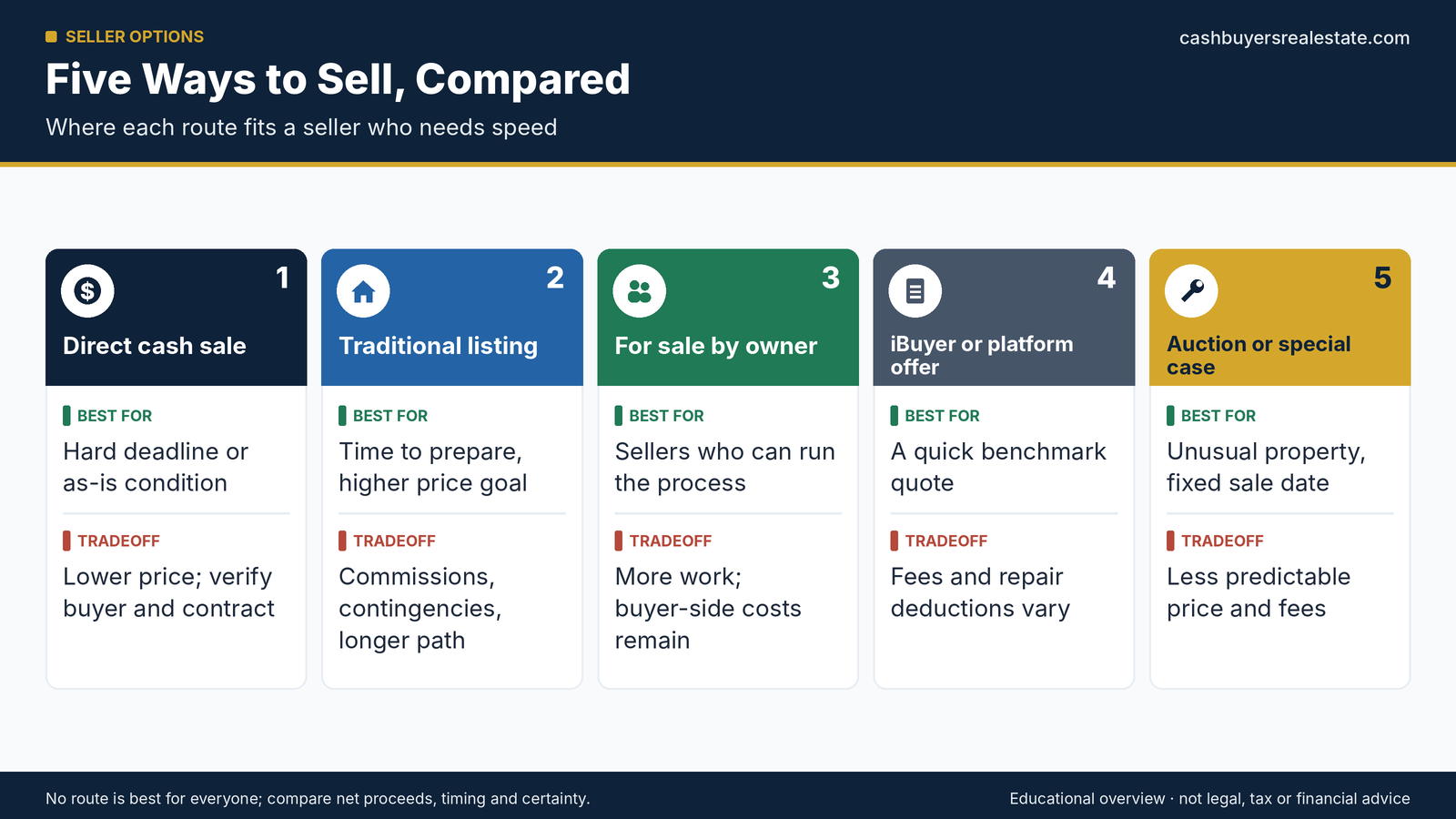
Text version of this infographic
- Direct cash sale — best for: Hard deadline or as-is condition; tradeoff: Lower price; verify buyer and contract
- Traditional listing — best for: Time to prepare, higher price goal; tradeoff: Commissions, contingencies, longer path
- For sale by owner — best for: Sellers who can run the process; tradeoff: More work; buyer-side costs remain
- iBuyer or platform offer — best for: A quick benchmark quote; tradeoff: Fees and repair deductions vary
- Auction or special case — best for: Unusual property, fixed sale date; tradeoff: Less predictable price and fees
Hybrid Strategies That Borrow From Both Routes
Running two tracks at once
Listing with a cash offer as your backup
One way to reduce regret is to put a floor under the listing. Before you list, ask one or more cash buyers for written offers and note their expiration dates. Then list the house with an agent, knowing that if the listing doesn’t produce a better net within your window, you can return to the cash offer. The cash offer becomes a benchmark: any listing offer has to beat its net, not just its price.
Be realistic about the limits. Cash offers expire, and a buyer who sees the house on the market may change the number. A buyer’s willingness to hold an offer open depends on their own risk, so ask how long the offer stays valid and whether it will be honored if the listing doesn’t work out. Some buyers will, some will reprice, and some won’t be available. Get the answer in writing if you can.
Listing agreement terms matter here, too. If you’ve signed an exclusive agreement, make sure it allows you to accept a direct sale to a buyer you’ve already identified without owing a commission, or that you’ve negotiated what the fee would be. Otherwise your backup plan can be costly. The simplest fix is to name the buyer as an exclusion in the agreement before you sign.
Illustrative example (hypothetical numbers, not market data): A seller holds a written cash offer of $262,000 that nets about $255,000 after costs and one month of carry, valid for 14 days. The seller lists at $289,000 with a 5 percent combined fee, expects $8,000 in concessions and credits, and estimates $2,000 a month in carry. A listing offer at $280,000 with a 60-day close would net about $280,000 − $14,000 − $8,000 − $4,800 in transfer and title − $4,000 carry = $249,200, which is below the cash floor. The seller declines it, lets the cash offer’s window do its job, and decides on day 14 with real numbers instead of hopes.
A short listing window, then a planned pivot
A time-boxed listing sets a checkpoint and a plan for what you’ll do at that point. The core idea is to price the home to attract offers quickly, review progress at a fixed date, and pivot if the results fall short. Here’s one way to lay it out.
- Days 1 to 7: gather payoff and title information, complete light repairs, and list at a price that reflects recent comparable sales and the speed you want.
- Days 8 to 14: collect showings and feedback. If showings are thin, ask your agent for specific reasons rather than general reassurance.
- Day 14 to 21 checkpoint: compare any offers on a net basis against your backup cash offer. Decide whether to reduce the price, accept, or pivot.
- Days 22 to 30: if you pivot, finalize the cash route or a price reduction with a clear closing date. If you accept a listing offer, track contingency deadlines closely.
This schedule is an illustration, not a promise. Markets, properties, and sellers differ, and a window of 30 days won’t produce a closing in 30 days; it produces a decision in 30 days. A listing offer accepted on day 20 still needs time for inspection, appraisal, and financing. If your deadline is hard, count backward from it to choose the checkpoint.
A price-to-sell approach means setting the asking price at or modestly below what recent comparable sales suggest, so the home attracts attention in the first days. It raises the chance of quick competition for the home, but it isn’t a guarantee, and it can leave money on the table if the market is hot. Your agent’s comparative market analysis is the right input; ask to see the comparable sales the pricing is based on.
Other ways to combine the routes
Pre-listing steps that strengthen every option
Some preparation helps whichever route you choose. A pre-listing inspection identifies repair issues and gives you defensible numbers for credits and negotiations, which also helps you evaluate a cash buyer’s repair estimate. A payoff letter and a preliminary title search give you a clear picture of what you owe and what might delay closing. Gathering HOA documents, permits, and warranties saves time with any buyer.
Repair triage is worth doing too. Safety and code issues, active leaks, and anything that could block financing or insurance should be priced out first. Cosmetic updates are the most likely to be overdone in a rush; compare their cost to the price effect you can reasonably expect, and remember that a cash buyer will typically discount for them either way. The guide to preparing for a fast home sale provides a sequence that suits a short clock.
These steps cost a little and keep your options open, which matters because the best route often isn’t clear until you have real numbers. They also make you a better negotiator: a seller who can answer questions about condition, title, and payoff quickly gets cleaner offers.
If you commission an inspection, think ahead about what you’ll do with the report. In many states a seller who knows of a material defect has to disclose it, and a report you’ve received counts as knowledge. That is not a reason to skip the inspection, which is usually good protection, but it is a reason to decide beforehand which items you’ll fix, which you’ll credit, and which you’ll disclose. A report shared up front with serious buyers, cash or financed, can also reduce late renegotiation, because the surprises have already surfaced.
Agent-assisted investor sales, instant offers, and rent-backs
An agent can sometimes help you reach investor buyers while handling the contract, which adds compensation but may add negotiating strength and process support. Ask whether the agent works with investors, how they’d present your home to them, and what their fee would be in that case. Compare that against a direct sale on net proceeds.
Instant-offer platforms, sometimes called iBuyers, generate offers from data about your home and then typically inspect it before finalizing. Their terms vary, including whether they charge a service fee and how they handle repair deductions. Even if you don’t plan to sell to one, a quote is a useful benchmark. Treat the quote as an input, and read the final terms line by line, because the number that arrives after inspection can differ from the first one.
A rent-back arrangement lets you stay in the home for a defined period after closing, often by paying rent to the buyer. It can ease a move timeline and works with either route, but it adds risk: who insures the home, who handles repairs, what happens if you overstay, and whether the buyer’s lender allows it. Put the agreement in writing, with a firm move-out date and a deposit, and ask your attorney or closing agent to review it.
Auctions belong in this list as a special case. A property sold at auction goes to the highest bidder on a fixed date, often with a reserve price, a buyer’s premium, and short closing terms, and the details vary by auction house and state. Auctions can suit unusual properties or situations where a firm date matters, but the outcome is less predictable than a negotiated sale, and fees can be significant. Read the auction terms as carefully as any contract, and compare the likely net with the other routes.
Collecting Comparable Offers and Avoiding Comparison Mistakes
Getting like-for-like written offers
What to request, and how to line the offers up
An offer you can’t compare isn’t much use. Ask every buyer and agent for the same information in writing: the price, the earnest money amount and who holds it, the length and terms of any inspection or due diligence period, the contingencies, the proposed closing date, which closing costs they expect you to pay, and any credits or conditions they anticipate. For a listing, ask the agent for an estimated net sheet with the assumptions spelled out. Then put everything in one table.
| Item | Offer A: cash | Offer B: cash | Offer C: financed buyer |
|---|---|---|---|
| Headline price | $268,000 | $275,000 | $292,000 |
| Earnest money | $5,000 to title company | $1,000 to title company | $6,000 to title company |
| Inspection or due diligence | 7 days | 21 days, price renegotiation allowed | 10 days, repair requests allowed |
| Other contingencies | None | Contract assignable | Financing and appraisal |
| Proposed closing | 21 days | 30 days | 45 days |
| Seller costs (title, transfer, commission) | $4,300 | $6,200 | $19,400 |
| Expected credits or concessions | $0 | $5,000 likely after inspection | $8,000 concession |
| Carrying cost to closing (at $2,000 a month) | $2,000 | $2,000 | $5,000 (2.5 months) |
| Estimated net before payoff | $261,700 | $261,800 | $259,600 |
| Main risk to watch | Buyer’s funds and title timing | Longer exit window; assignment | Loan and appraisal outcome |
On these invented numbers, the three offers net within about $2,200 of each other even though their headline prices span $24,000. That’s the pattern worth remembering: headline gaps shrink and sometimes disappear when costs and credits are counted. So the tiebreakers are the risk row and the timeline row. Offer A closes soonest with the fewest exits, Offer B gives the buyer the most room to renegotiate, and Offer C asks the most patience.
Ask the same questions of all three and see who answers clearly. A buyer who explains the assumptions behind a number, puts terms in writing, and doesn’t pressure you to decide before you’ve read the contract is easier to trust. Be wary of any offer that changes between the first conversation and the written contract, or that expires within hours.
Verifying the people and the money behind each offer
Before you sign, confirm who you’re dealing with. Ask for the buyer’s legal name, or the name of the company, and make sure the name on the contract matches the name on the proof of funds. Look up a company’s registration with the state’s business filing office, and check any claimed license through the state’s licensing board. Ask for references you can actually reach, then call them yourself.
Public records can help as well. County recorder or assessor sites often let you search for deeds recorded in a company’s or person’s name, which can show whether they have closed purchases in your area. A thin record doesn’t mean a buyer is unreliable, since some buyers use differently named entities, but a consistent record is reassuring and an inconsistent story is worth asking about.
Proof of funds should come from a financial institution, show a recent date, and cover the purchase price. Verify by calling the institution on a number you’ve found independently. The earnest money should go to a neutral holder, such as a title or escrow company or an attorney, not to the buyer or to an individual’s account. Confirm the closing company by looking up its phone number yourself, not by using contact information from an email. The CFPB advises verifying wire instructions through a known phone number and never following instructions in an email, advice that applies to everyone at the table.
None of these steps proves a buyer is dishonest if something looks off; a missing document may just be a disorganized buyer. The point is to make the checks routine for every offer, cash or financed. For fuller guidance, read the guide to cash home buyer scams and the overview of the cash home sale process.
Mistakes that distort the comparison
Mistakes with the numbers
The most common error is comparing price to price. A $292,000 financed offer and a $268,000 cash offer are different things until each has been through a net sheet. The second is ignoring time: months of carrying costs matter, and so do the costs of the second housing payment if you’ve already moved. A third is treating estimates as facts. A repair estimate from a buyer, an agent’s net sheet, and a contractor’s quote are inputs that can all be wrong in either direction, so get at least one independent number.
Another mistake is forgetting what a failed deal costs. If a financed contract falls through after six weeks, you haven’t just lost the sale; you’ve lost the six weeks, plus perhaps a price reduction when you relist. In the table above, a failure on Offer C would cost about $2,800 in carry for a six-week delay, before any price change. An offer with more exits should be discounted for that risk in your own mind, even if you can’t put an exact number on it.
Illustrative example (hypothetical numbers, not market data): Suppose Offer C nets $259,600 if it closes, but the buyer’s appraisal comes in low and the deal collapses. The seller loses roughly two months at $2,000 a month ($4,000), relists, and ends up accepting $285,000, which nets about $244,000 after the same type of costs and another stretch of carry. Compare that with Offer A’s $261,700 at a 21-day close. You don’t need to estimate probabilities exactly to see the shape: the downside of the financed route is larger than the downside of the cash route, and a seller on a hard deadline should weigh that asymmetry heavily.
Finally, don’t anchor on an automated home value estimate. Those tools can be useful starting points, but they don’t see the condition of your home or the nuances of your block. A local agent’s comparative market analysis, built on recent nearby sales, is usually more reliable. If a number on your screen is far from what buyers are saying, ask why before assuming that either one is wrong.
Mistakes with the process
Process mistakes cost money too. Accepting a verbal promise rather than a written term is the classic one. If a buyer says they’ll pay your closing costs, extend the closing date, or let you rent back the house, it belongs in the contract. Skipping the contract read is the second. Pay special attention to assignment, inspection exits, closing date, default remedies, and any fee that falls on you.
A third mistake is negotiating against yourself. If you tell every buyer exactly how desperate your deadline is, you may lose leverage, though honesty about your timeline is still important so offers can be built around it. State the date, not the stress. A fourth is signing a listing agreement before you’ve checked for alternatives, or accepting a cash offer without learning what a listing might achieve; either order can leave money behind. And a fifth is skipping professional input in complicated situations: title issues, estates, tenants, taxes, and multiple owners are the places where an hour of advice pays for itself.
Last, don’t let a pressure tactic set your schedule. A genuine deadline from a court or a lender is real. A buyer’s deadline, such as “this offer expires tonight,” may be a negotiating technique. You can ask for a short extension, and how the buyer responds is information.
The checklist below distills six factors that can swing your decision: whether you owe a payoff, the property’s condition, how the buyer is financing, title issues, closing readiness, and your moving deadline. Each is also discussed in the text above: know your payoff, price the condition honestly, understand the buyer’s funding, search title early, line up your documents, and check that any timeline matches your real deadline.
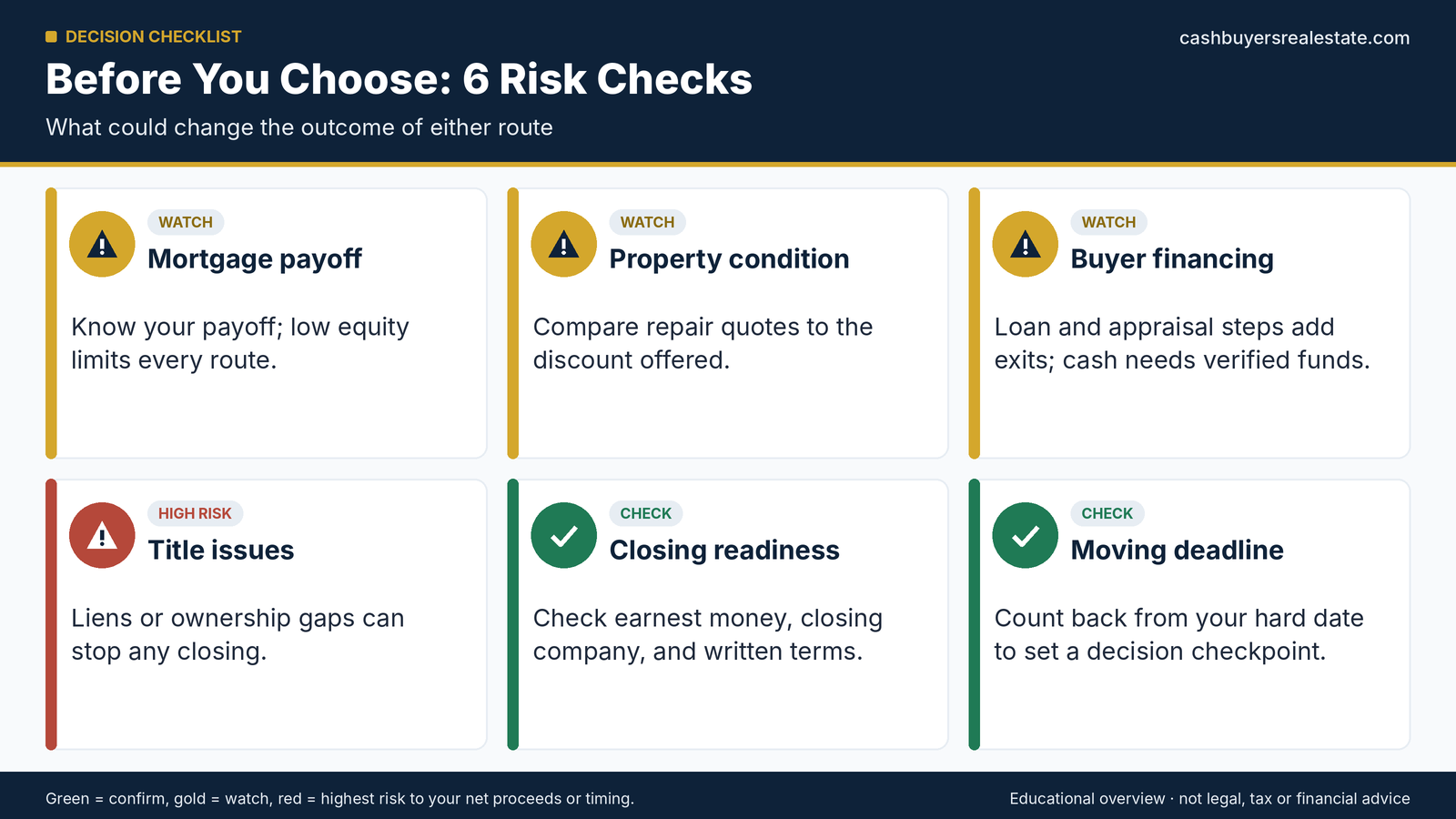
Text version of this infographic
- Mortgage payoff — Know your payoff; low equity limits every route.
- Property condition — Compare repair quotes to the discount offered.
- Buyer financing — Loan and appraisal steps add exits; cash needs verified funds.
- Title issues — Liens or ownership gaps can stop any closing.
- Closing readiness — Check earnest money, closing company, and written terms.
- Moving deadline — Count back from your hard date to set a decision checkpoint.
Frequently Asked Questions About Choosing Between a Cash Sale and a Listing
Deciding between the routes
Questions about the decision itself
- Is a cash sale always faster than a listing?
Not always. A cash sale removes the lender, but title work, payoff letters, and the due diligence period still set the pace. Many cash sales close faster than financed ones, and some don’t. Read the closing date and exit terms in the contract before relying on a quoted timeline.
- Does a cash sale always bring a lower price?
Usually the headline price is lower, because buyers factor in repairs, risk, and margin. The net can be closer than it looks once commissions, concessions, credits, preparation, and carrying costs are counted. In some cases, particularly with a home that needs work, the two nets are nearly the same.
- Can I list the house and still accept a cash offer?
Yes, in most cases, but check your listing agreement first. If you’ve signed an exclusive agreement, ask whether a sale to a buyer you found yourself triggers a commission, and consider naming that buyer as an exclusion before you sign.
- How do I know whether a cash offer is reasonable?
Ask the buyer how they reached the number, get at least one other written offer, and ask a local agent for a comparative market analysis. Then compare nets, not prices. A reasonable offer should be explainable in terms of value, repairs, costs, and timing.
Questions about costs and taxes
- Do cash buyers pay the closing costs?
It depends on the contract. Some buyers agree to pay most of them, and some expect you to pay your customary share. Your mortgage payoff and prorated taxes remain yours either way. Ask for a written list of who pays which item.
- What commission should I expect on a listing?
There’s no required rate. Since the August 2024 MLS practice changes, compensation is negotiable and can’t be offered through the MLS, according to NAR. Get the listing fee and any buyer-side contribution in writing and put both on your net sheet.
- Will I owe tax on the sale?
It depends on your gain, ownership, and use of the home. The IRS describes an exclusion of up to $250,000, or $500,000 for joint filers, if its ownership and use tests are met, and notes that a reported sale must be reported on your return even when the gain is excludable. A tax professional can apply this to your numbers.
- Is a pre-listing inspection worth paying for?
Often, if you have time. It costs relatively little compared with the price of a surprise, gives you repair quotes you can compare against a buyer’s estimate, and shows financed buyers you’ve nothing to hide. If your timeline is days rather than weeks, spend that money on the payoff letter and title search first.
Risk, timing, and paperwork
Questions about risk and fall-through
- What happens if the buyer’s loan falls through?
Depending on the contract, the buyer may be able to cancel under a financing contingency and recover the earnest money, and you return to the market. That’s why a strong preapproval, a large deposit, and short contingency periods matter on a fast timeline.
- What if a cash buyer backs out?
Your options depend on the contract. If the buyer cancels within the due diligence period, the earnest money is often returned. If the buyer defaults after that, the contract may allow you to keep the deposit, but the specifics vary by state and contract language, so ask an attorney.
- How do I verify proof of funds?
Ask for a recent statement or letter from a financial institution, confirm that the account name matches the buyer, and call the institution on a number you found yourself. Proof of funds shows money exists, not that it will be used, so pair it with earnest money held by a neutral third party.
- Can I cancel a listing agreement if it isn’t working?
It depends on the cancellation terms you signed. Some agents will release a seller early; others hold to the term. Ask about cancellation and protection-period terms before signing, and negotiate a shorter term if speed matters.
Questions about timing and documents
- How quickly can a cash sale close?
It depends on title, payoff letters, the due diligence period, and everyone’s schedules. Some close in a couple of weeks and others take over a month. Judge a timeline by the contract’s dates and your title search, not by a verbal promise.
- How long does a listing usually take?
It varies with condition, price, and the market. You’ll have preparation time, a marketing period, and a contract-to-close period. NAR’s March 2026 survey reported a median of 30 days to close, but that excludes the preparation and marketing stages.
- What documents should I gather first?
Start with your latest mortgage statement and a payoff letter, your property tax bill, HOA contact details, the deed if you have it, and any repair or permit records. For an inherited property or a home with tenants, add authority documents, leases, and deposit records.
- Can I speed up a closing once I’m under contract?
Sometimes. Respond to requests quickly, order the payoff letter early, sign documents promptly, and ask the closing agent what is holding things up. You can’t skip required steps, though. A financed closing still has lender timing, including the three-business-day rule for the buyer’s Closing Disclosure.
Making the Call and Taking the Next Step
A decision path you can follow
Five questions that settle most decisions
- What is my real deadline, and what does missing it cost? A fixed date favors routes with fewer steps; a flexible date favors waiting for a better net.
- What does each route net on my numbers? Build the table from written quotes, not averages.
- What condition and title problems exist? Repairs and liens affect every route, but they weigh heaviest on a financed sale.
- How many ways can each buyer legitimately exit? Count contingencies and check the earnest money.
- What can I live with if the deal fails? Imagine the fallback and make sure you’d still be okay.
Illustrative example (hypothetical situation, not a case study): A homeowner relocating for work has a start date eight weeks away, a $210,000 payoff, and a house worth about $330,000 with an older kitchen and an aging roof. Question one: the deadline is firm at eight weeks but not at four. Question two: a listing nets perhaps $14,000 more on paper but needs a roof repair and two or three months, while a cash offer closes in about a month. Question three: a roof quote of $9,000 is the main condition issue and title looks clean. Question four: the financed route has appraisal and inspection exits; the cash offer has a seven-day due diligence period and earnest money at a title company. Question five: if the financed deal fails at week six, the seller would miss the start date and carry two houses. The seller concludes that a cash sale, or a listing with a cash backup and a 14-day checkpoint, protects the deadline best, and picks the second because the backup keeps the better-net possibility alive at modest cost.
If your answers point clearly one way, trust them. If they split, a hybrid approach, such as listing with a cash backup or a short listing window, may keep your options open without committing to a discount. And if the numbers show that neither route solves the problem, say because the payoff exceeds the likely price, pause the sale decision and speak to your lender or a housing counselor. The guide to urgent home sale options covers those alternatives.
When to bring in a professional
Some questions are worth paying an expert to answer. A real estate attorney can review a purchase contract, explain state-specific rules on assignment, default, and disclosure, and help with title cures. A tax professional can estimate your gain and the effect of the home sale exclusion. A real estate agent can supply a comparative market analysis and an estimated net sheet. A HUD-approved housing counselor can help if you’re behind on payments or considering a short sale, often at low or no cost.
You don’t need all of them, and you don’t need them all at once. Pick the one whose answer would change your decision the most, and ask that question first. A short consultation before signing costs less than a dispute after.
When you do consult someone, bring the facts that let them answer precisely: the contract or draft you’re considering, the payoff letter, the title report if you have one, your net sheet, and the specific question. “Is this assignment clause a problem for me?” gets a better answer than “Can you look at this?” Ask what the professional would want to know before you sign, and ask what they’d change. A one-hour review focused on three clauses usually beats a longer, vaguer discussion.
What to do in the next seven days
A seven-day action plan
- Day 1: write down your hard deadline, your preferred deadline, and your monthly carrying cost.
- Day 1 to 2: request a payoff letter and gather your property tax bill, HOA details, and any recorded documents.
- Day 2 to 3: order a preliminary title search, or ask a title company to run one, and list any liens or ownership questions.
- Day 3 to 4: ask a local agent for a comparative market analysis and a written net sheet, and ask two cash buyers for written offers with all terms.
- Day 5: put the offers and the net sheet in one table, using the worksheet above, and verify the funds and closing company behind each.
- Day 6: have an attorney or your closing agent review the contract terms you’re considering.
- Day 7: choose a route or a hybrid plan, set a checkpoint date, and confirm the next steps in writing.
Seven days is a guideline. If your deadline is shorter, compress the plan and prioritize the payoff letter, title search, and two written offers. If it’s longer, use the extra time for a pre-listing inspection and repair quotes.
If you have only forty-eight hours before you must decide, do three things. Request the payoff letter and tell the servicer you’re preparing to sell. Ask a title company to start a title search. And contact at least two buyers or agents with the same request for a written offer or net sheet with every cost listed. Then use the offer worksheet to compare, and decide with whatever information you have, noting what you couldn’t confirm. Imperfect information used well beats perfect information that arrives after the deadline.
What if the offers tie? It happens more often than you’d think, as the worksheet showed. Break a tie by looking at risk and effort: choose the offer with the fewest ways to fail, the clearest paperwork, and the most reliable closing company. Then ask the buyer for a modest improvement, such as a longer rent-back, a higher earnest money deposit, or a shorter inspection window. Buyers who want the house can often give one of those without much cost to themselves, and the answer shows how they handle small requests.
Questions to put to every buyer and agent
- What is the total price, and what costs or credits do you expect me to cover?
- Who holds the earnest money, and when does it become nonrefundable?
- What contingencies or exit rights do you have, and for how long?
- What is the proposed closing date, and what happens if either side needs more time?
- Can you put your assumptions and fees in writing, including any assignment rights?
- How can I independently verify your funds and the closing company?
Clear, specific answers in writing are a good sign. Vague answers, shifting terms, and pressure to sign before you’ve seen the numbers are worth noting too.
Keep a simple record as you go. After each call, send a short email summarizing what you understood, such as “You said the buyer pays the title policy, the earnest money is $5,000, and closing is within 21 days; please correct anything I have wrong.” A reply, or a lack of one, gives you a paper trail and exposes misunderstandings early. If the other side’s written offer later differs from what you wrote down, you’ll have a reasonable basis for asking why. Good counterparties welcome this; they have nothing to hide and appreciate the clarity.