
Quick Home Sale: Timeline, Costs & Seller Options
Most people who search for a quick home sale already know the house will sell eventually. What they don’t know is what the speed will cost. A job transfer has a start date, a second mortgage payment is draining a savings account, or an inherited house is racking up taxes and utilities every month it sits. In each case the question underneath is the same: how much money am I willing to give up to be done sooner, and am I giving up more than I need to?
A quick home sale is a trade: you accept a lower price, pay specific fees, or take on a different kind of risk in exchange for a shorter and more predictable timeline. A cash or investor offer typically sits below what a patient retail listing might bring because the buyer must cover repairs, holding costs, resale costs, and a profit margin. Whether the discount is worth it depends on your net proceeds and what each extra month of waiting would cost you.
That second sentence is where most sellers lose track of the math. A $240,000 cash offer and a $265,000 listing are not a $25,000 difference once you subtract commissions, closing costs, repair credits, and several months of mortgage interest, taxes, insurance, and utilities. Sometimes the gap shrinks to a few thousand dollars. Sometimes it widens, because the listing sits, the buyer’s financing falls through, and the price gets cut twice. You can’t tell which scenario applies to you by looking at headline prices, so this guide works with net numbers throughout.
The sections below take the quick-sale discount apart piece by piece. You’ll see how an investor builds an offer (after-repair value, repair estimates, holding and resale costs, margin), how instant-offer platforms describe their own fees in public filings, and what a seller’s side of the ledger looks like when you add up commissions, concessions, and carrying costs. You’ll also get a side-by-side net-proceeds example for four routes, a plain-English look at when the discount is worth paying and when it isn’t, and a practical way to test any offer before you sign: comparable sales, repair bids, second offers, and the contract terms that quietly change the real price.
One more expectation to set before diving in. Nothing here assumes a cash sale is the right answer. For some homes and some deadlines it is. For others, a well-priced listing, a short-term price strategy, or even waiting two or three weeks for a second offer produces a better outcome. The goal is to help you choose on purpose rather than by default, and to recognize an offer that fits your situation from one that merely feels urgent.
What You Are Really Buying When You Choose Speed
Speed, certainty, and convenience are separate products
Unbundling the three things a quick sale delivers
When sellers say they want a quick sale, they are usually asking for three different things at once, and each carries its own price tag. The first is speed, meaning a short stretch between deciding to sell and having money in the bank. The second is certainty: a contract unlikely to collapse over an appraisal gap, a lender’s last-minute condition, or a buyer who loses a job. The third is convenience, which covers fewer showings, no staging, no repair negotiations, and a flexible move-out date.
Here’s why the distinction matters. A buyer paying cash can deliver certainty without being especially fast, because title work and a payoff letter still take time. A well-priced listing in a busy market can be fast without being certain. An investor who buys as-is can offer convenience that no retail buyer will match, since a retail buyer’s lender and inspector are part of the deal. If your real priority is certainty, you may be willing to accept a modest discount for a buyer with verified funds and a clean contract. If your real priority is convenience, you are paying for the absence of work, and you should price that work honestly instead of assuming it’s free.
Write down which of the three matters most before you compare offers. People under pressure tend to say “all of them,” but trade-offs only become visible when you rank them. A seller who ranks certainty first reads an offer very differently from one who ranks price first.
Where a quick sale sits between a retail listing and a distressed sale
Think of price and time as a curve. At one end is a patient retail sale: the home is prepared, priced against recent comparable sales, shown widely, and sold to the buyer who values it most. At the other end is a forced sale, such as a foreclosure auction, where the timeline belongs to someone else and the price usually reflects it. A quick home sale occupies the middle, and its position on that curve is something you can influence.
Sellers sometimes assume the middle is a single price: “cash buyers pay about 70 percent.” There is no such standard. Offers reflect the property’s condition, the neighborhood’s resale strength, how much work the buyer expects to do, the buyer’s financing and overhead, and how many competing offers exist. Two investors looking at the same house can land $30,000 apart because one expects a lighter renovation or has a buyer lined up for the finished product.
For perspective on the retail end of the curve, the National Association of Realtors’ 2025 Profile of Home Buyers and Sellers (covering sales from July 2024 through June 2025) reported that recently sold homes spent a median of about four weeks on the market and sold for a median of 99 percent of the listing price, according to a summary published by Virginia REALTORS. Those are national medians for homes that did sell, and they say nothing about your street. They do show that a typical retail sale isn’t slow by default, which is why the comparison should be made with your own numbers, not with an assumption that listing means waiting for months.
The seller’s side of the ledger: costs a quick sale can avoid
Commissions, concessions, and closing costs a listing carries
A traditional listing usually comes with a compensation arrangement for the listing agent and a decision about whether to offer compensation to the buyer’s agent. After the 2024 NAR settlement changed how buyer-side compensation is handled, those numbers became more explicitly negotiable, and no single figure applies everywhere. For context, Redfin’s analysis of its closed sales found the average buyer’s agent commission was 2.40 percent in the first quarter of 2025, up slightly from 2.37 percent in the fourth quarter of 2024. Redfin’s report did not publish a listing-side average, and the seller’s side is set by the listing agreement you sign.
In the examples that follow, we’ll use an illustrative combined commission of 5.5 percent. Treat it as a placeholder: replace it with the exact percentage or flat fee in a written listing proposal. Beyond commission, a financed sale often includes a repair credit negotiated after the buyer’s inspection, seller-paid title and escrow fees that vary by state, prorated property taxes, and sometimes a home warranty or buyer closing-cost assistance. The share of sellers who use an agent is high; NAR’s 2025 profile put it at 91 percent, a record in that survey, so agent-assisted sales are the baseline against which most quick-sale offers get compared.
For a seller computing taxes later, these selling costs aren’t just an expense. IRS Publication 523 lists sales commissions, advertising fees, and legal fees among the selling expenses that reduce the amount realized when you figure gain on a home sale. That matters in the tax section later in this guide, but it also tells you where to look when you total the cost of each route.
Carrying costs, repairs, and the cost of waiting
The cost of waiting is the line most sellers underestimate, because it arrives in small monthly pieces. Add the mortgage payment (or at least the interest portion, if you’re thinking about equity), property taxes, homeowners insurance, utilities, lawn or snow service, HOA dues, and routine maintenance. A vacant house may need different insurance coverage than an occupied one, so ask your insurer, and the property still needs heat in winter to avoid frozen pipes. A simple monthly figure might look like $1,800 or like $4,500, depending on the loan and the area. Your number, calculated from your statements, is the only one that counts. One subtlety: the principal portion of a mortgage payment is not a cost of waiting, because it reduces what you owe and comes back to you as equity at closing. The costs that truly disappear into the calendar are the interest portion, taxes, insurance, utilities, HOA dues, and upkeep. Counting your whole payment as a loss makes waiting look more expensive than it is and can push you toward a deeper discount than the facts support.
Repairs sit on the same ledger. A listing that stays at full price may need a roof patch, fresh paint, or a plumbing fix that a retail buyer will insist on. Those repairs cost money up front and time to schedule, and then the home usually needs a week or two of photography and showings before the first offer. In contrast, an as-is investor purchase typically prices the work into the offer instead of asking you to do it.
Illustrative example (hypothetical numbers, not market data): A seller’s carrying costs run $1,800 a month. A listing that takes three months from first showing to closing carries $5,400 of those costs, while a one-month cash closing carries $1,800. The $3,600 difference is real money, but it is smaller than most sellers expect when comparing it to a $20,000 difference in offer price. The lesson isn’t that carrying costs don’t matter; it’s that they rarely explain a large discount on their own, so ask what else the discount is paying for.
That last question leads straight into the buyer’s side of the arithmetic, which is where the next section picks up.
How a Quick-Sale Offer Gets Built: The Buyer’s Math
The investor’s formula, line by line
After-repair value is the starting point, not your home’s value today
Investors who buy to renovate and resell almost always start from after-repair value (ARV): what they believe the house would sell for once it is renovated to the standard buyers in that neighborhood expect. They estimate ARV from recent comparable sales of similar, updated homes nearby, so the number depends heavily on which sales they pick. A seller who sees an ARV of $300,000 on an offer worksheet is looking at the buyer’s projection of a finished product, not an appraisal of the house as it stands.
That distinction explains a lot of sticker shock. If your kitchen is 25 years old and the roof is near the end of its life, the market value of your house in its present condition really is lower than the finished-home comps you’ve been reading online. The question to ask is whether the buyer’s ARV is reasonable and whether the repair estimate subtracted from it is reasonable. An ARV that is too low, or a repair budget that is padded, both shrink the offer without any single line looking dishonest.
Methods vary from buyer to buyer. Some use a rule of thumb, often expressed as a maximum percentage of ARV minus repairs. Others build up the cost line by line. Neither approach is a standard, and neither is inherently unfair; what you want is a buyer willing to show their assumptions. You can check the ARV yourself by pulling recent sales of renovated homes in your area and subtracting the work your home actually needs. We’ll walk through that test in the section on checking an offer.
Repairs, holding, financing, selling costs, and margin
After ARV comes the subtraction. The buyer deducts a repair budget (usually with a contingency, because renovations rarely go exactly to plan), the cost of owning the property while work and resale happen, the cost of the money used to buy and fix it, the expense of selling the finished house, and a target profit for taking the risk. Whatever is left is the most the buyer can pay and still reach the margin.
Illustrative example (hypothetical numbers, not market data): An investor estimates ARV at $300,000. Repairs with contingency: $35,000. Taxes, insurance, utilities, and loan interest during a five-month hold: $9,000. Agent and closing costs on the resale at 6 percent of ARV: $18,000. The investor’s own closing costs on the purchase: $3,000. Target profit: $20,000. Maximum offer: $300,000 − $35,000 − $9,000 − $18,000 − $3,000 − $20,000 = $215,000, about 72 percent of ARV. Change any assumption and the answer moves: a $25,000 repair estimate instead of $35,000 raises the offer to $225,000.
The table breaks the same example into the pieces a seller can ask about.
| Component | Illustrative amount | Share of ARV | What pushes it up or down |
|---|---|---|---|
| Repairs and contingency | $35,000 | 11.7% | Roof, systems, kitchens and baths, foundation, code items; contractor bids; permits |
| Holding and financing | $9,000 | 3.0% | Length of renovation and resale, loan rate, taxes, insurance, utilities |
| Resale selling costs | $18,000 | 6.0% | Agent fees, concessions to the next buyer, resale closing costs |
| Buyer’s purchase closing costs | $3,000 | 1.0% | Title, escrow, recording; varies by state and county |
| Target profit and risk margin | $20,000 | 6.7% | Market uncertainty, buyer’s overhead, how many competing offers exist |
| Total gap from ARV | $85,000 | 28.3% | Leaves an offer of $215,000, or 71.7% of ARV |
Read the table as a list of questions, not a verdict. Two things sit inside the margin line that sellers rarely see. One is the buyer’s overhead: staff, marketing to find sellers, and the cost of deals that never close. The other is any fee a wholesaler earns by assigning the contract, which the end buyer must back out of the price it pays you. In a market with many active investors, margins tend to compress, so a single offer is a weak data point. The first row is usually the biggest and the most negotiable, because repair costs can be checked with two or three contractor bids. The last row is the buyer’s reward for risk, and if several buyers are competing for your house, it tends to compress. For a deeper walk through offer formulas, see the explainer on how cash offers are calculated.
Instant-offer platforms and what their filings disclose
Service fees, repair credits, and the two-step offer
Instant-offer companies, often called iBuyers, buy homes with their own capital and resell them, so they face a version of the same math with algorithms doing the first pass. Their public documents are more specific than most sellers realize. Opendoor’s annual report for fiscal 2025 says offers are “algorithmically generated” and then reviewed by its pricing team, that offers are adjusted for how certain the company is about a home’s price, and that final offers include a condition-based adjustment for repairs. The same filing refers to a 5 percent service fee in the way it defines its spread. Meanwhile the company’s seller guide, updated in April 2026, says the fee varies by market and property and appears in each seller’s offer, and its worked example uses an illustrative 5 percent fee on a $350,000 home.
The sequence matters more than any single number. A preliminary online offer comes first, and in Opendoor’s description it typically arrives within a day or two. A home assessment follows, and the final offer can change, most often downward, through repair credits. The company’s guide describes minor repairs as roughly $500 to $2,000 in credits, moderate repairs as $2,000 to $8,000, and major repairs as $8,000 to $20,000 or more. Offerpad’s annual report likewise says its valuation includes renovation and holding costs and that it may verify a seller’s information with a physical or video inspection.
For you as a seller, the takeaway is practical: treat the first online number as an estimate, ask what the fee will be in dollars, and ask how repair credits are determined. Compare the final expected proceeds, not the first screen. Fees, programs, and availability change, so read the current terms in the offer itself. Some programs also split proceeds, with part paid at closing and part after the company resells; one of Opendoor’s products is described in its filing that way, which is a very different transaction from a simple purchase.
What the Zillow Offers shutdown teaches about pricing risk
On November 2, 2021, Zillow announced it was exiting its iBuying business, Zillow Offers. Inman’s reporting at the time put the program’s losses at more than $1 billion over about three and a half years and quoted Zillow’s shareholder letter citing “higher-than-anticipated conversion rates” and “unintentionally purchasing homes at higher prices.” Inman also noted that as the market cooled that summer, competitors began paying less while Zillow kept paying more.
The episode is useful for sellers in two ways. First, it shows why every buyer who purchases and resells builds a margin into the offer. Predicting resale values months ahead is hard, even for companies with large data sets and real money at risk, and the margin is the cushion against being wrong. A buyer offering no cushion at all is either unusually confident, planning to pass the risk to someone else, or planning to renegotiate later.
Second, it shows that offer programs can change or disappear. If you’re planning around an instant-offer platform, confirm that it operates in your market and for your type of home before you build a timeline around it, and check how long the offer stays valid. In a falling market, an offer from last month may not survive the home assessment this month. That risk is exactly what the quick-sale discount compensates for, and it is why a seller with a firm, written contract from a buyer with verified funds may reasonably prefer that over a higher number with more conditions.
The process map below lays out the sequence this guide follows, from naming your deadline to comparing net proceeds, so you can see where the buyer’s math and your own math meet.
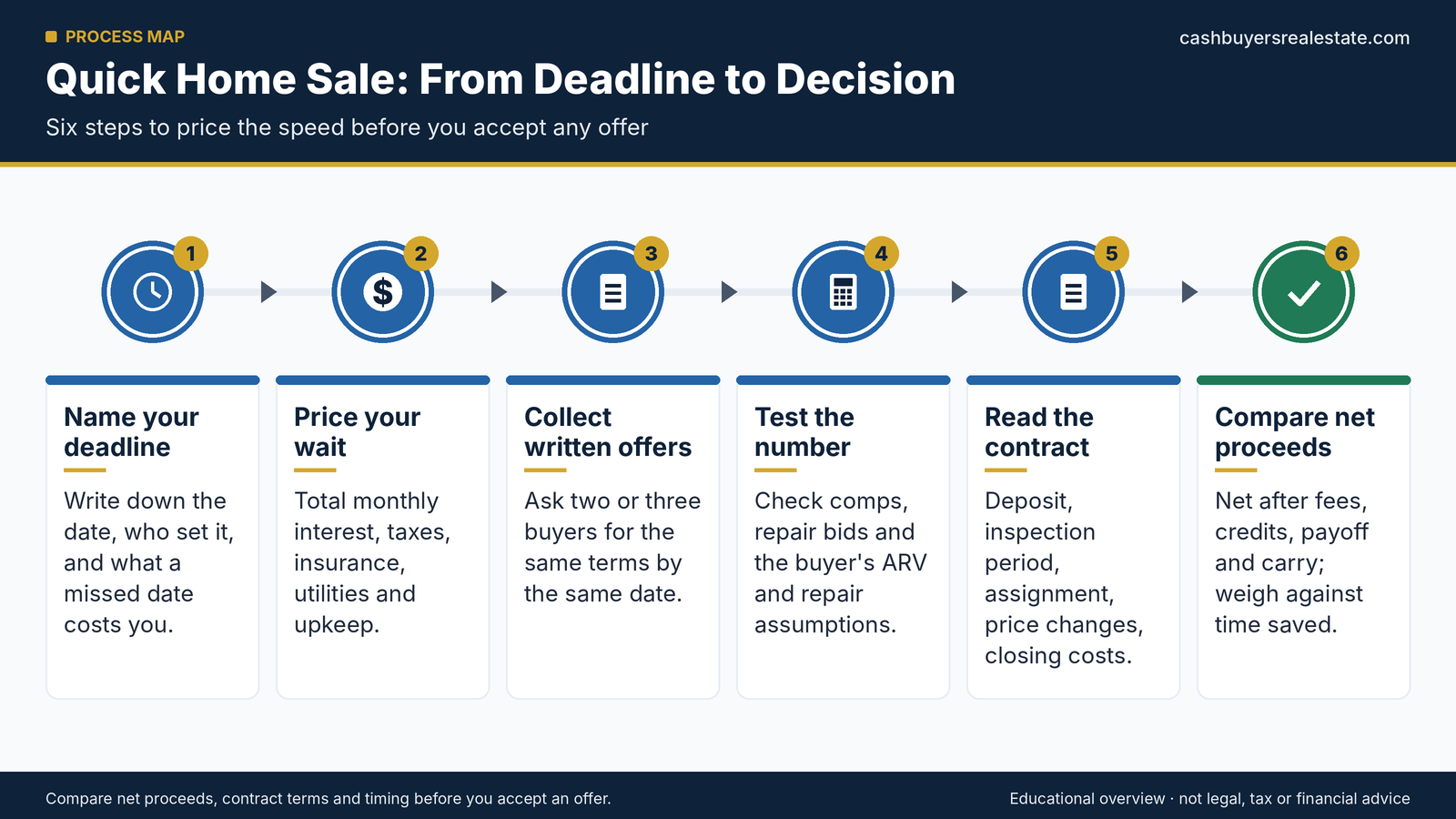
Text version of this infographic
- Name your deadline — Write down the date, who set it, and what a missed date costs you.
- Price your wait — Total monthly interest, taxes, insurance, utilities and upkeep.
- Collect written offers — Ask two or three buyers for the same terms by the same date.
- Test the number — Check comps, repair bids and the buyer's ARV and repair assumptions.
- Read the contract — Deposit, inspection period, assignment, price changes, closing costs.
- Compare net proceeds — Net after fees, credits, payoff and carry; weigh against time saved.
Net Proceeds Compared: One House, Four Routes
Building a fair comparison
Use one net sheet format for every offer
Offers arrive in different shapes: a flat cash price, a listing price with a commission, a platform offer with a fee and credits, an auction reserve with a buyer’s premium. To compare them, translate each into the same set of lines, in the same order, using your own numbers. The version below works for almost any route.
- Sale or offer price, after any price adjustments already agreed.
- Minus commissions, service fees, auction or marketing fees, and any transaction coordination fees.
- Minus repair credits, closing-cost credits, and other concessions to the buyer.
- Minus your closing costs: title and escrow charges, recording fees, transfer taxes where applicable, and prorated property taxes and HOA dues.
- Minus mortgage payoff and any liens, which are the same under every route and can be left out of a comparison, but must be known before you commit.
- Minus carrying costs from today until the closing date.
- Minus any repairs or cleaning you’d pay for yourself before closing.
- Equals net cash to you, before income tax considerations.
Offers that refuse to fit this format are worth noticing. A proposal that quotes only a headline price, or describes costs as “standard,” leaves the unknowns with you. A buyer or agent who is happy to fill in each line, and to update it if something changes, is making the comparison easier for you. Ask each buyer or agent to fill in that estimate in writing, and ask a title company for a preliminary seller’s statement if you can. A line the buyer leaves blank is a line you should ask about, because blanks at the offer stage tend to turn into charges at the table. For a longer worksheet, the net proceeds calculator follows the same structure.
Worked example: the same house sold four ways
Take a hypothetical house worth $300,000 in move-in condition that needs about $15,000 of repairs and updates. The mortgage payoff is identical in every route, so the table stops at net proceeds before payoff.
| Line item | Agent listing | Investor cash offer | iBuyer platform | Auction |
|---|---|---|---|---|
| Sale or offer price | $280,000 | $236,000 | $262,000 | $255,000 |
| Commission, service, or auction fees | −$15,400 | $0 | −$13,100 | −$12,750 |
| Repair credits and concessions | −$5,000 | $0 | −$12,000 | $0 |
| Seller closing costs | −$4,200 | −$2,360 | −$2,620 | −$2,550 |
| Carrying costs (months assumed) | −$5,400 (3) | −$1,800 (1) | −$2,700 (1.5) | −$3,600 (2) |
| Net before mortgage payoff | $250,000 | $231,840 | $231,580 | $236,100 |
The assumptions: a 5.5 percent combined commission on the listing, a 5 percent platform fee, a roughly 5 percent auction fee, and carrying costs of $1,800 a month. Notice the iBuyer’s headline offer is $26,000 higher than the investor’s, yet the net is nearly identical once the fee and repair credits come out. That’s the reason to compare net proceeds, not price. Your own results could look nothing like this table, and a competitive local market can shrink or reverse every gap shown.
What the waterfall can hide
The implied price of each month saved
Once you have a net comparison, you can express the discount as a price for time. In the example above, the agent listing nets $18,160 more than the investor’s offer ($250,000 versus $231,840) but takes about two months longer. Dividing gives roughly $9,080 for each month saved. Put differently, the investor route makes sense in this hypothetical only if two extra months of waiting would cost you more than about $18,160 beyond the $3,600 of carrying costs already counted.
Another way to see the same trade is as an annualized cost. An $18,160 net difference on a $250,000 outcome is about 7.3 percent of the proceeds, paid to save two months. Stretched over a year in simple terms, that is roughly 44 percent, a steep rate compared with nearly any other way of buying time. That doesn’t make the quick route wrong; it means the route belongs to situations where the cost of waiting is also steep. Either way of framing it turns a vague worry into a concrete question you can answer. If delay means a second housing payment of $2,500 a month, a relocation bonus you’d lose, or a looming deadline with a penalty, the number may clear the bar. If the cost of waiting is mostly stress and inconvenience, which matter and deserve respect, the number may not. The point isn’t that stress is irrelevant. It’s that you can decide how much of your own money you’d spend to relieve it, with the figure in front of you, instead of finding out at the closing table.
The calculation also helps you negotiate. If a buyer’s offer implies you’re paying $9,000 per month saved while your actual cost of waiting is closer to $2,000, you have a data-based reason to ask for a better price, a shorter list of conditions, or a second opinion from a competing buyer.
Fall-through risk and renegotiation after inspection
Net sheets assume the sale closes at the contract price. Real contracts don’t always cooperate. A financed buyer’s deal can fail over an appraisal shortfall, an inspection dispute, or a loan denial. A cash buyer can also walk away, particularly during an inspection period, or reopen the price after a walk-through. Neither route is risk-free; they carry different risks.
Illustrative example (hypothetical numbers, not market data): Suppose you assume a 15 percent chance that a financed contract falls apart, and that when it does, you lose six weeks (about $2,700 of carrying costs at $1,800 a month) and agree to a $5,000 lower price with the next buyer. The expected cost is 0.15 × ($2,700 + $5,000) = about $1,155. That figure is small next to the $18,160 gap in Table 2, yet for a seller with a hard deadline, the real cost of failure is the missed deadline, not the average. Likewise, if a cash buyer reduces the offer by $10,000 after inspection, the investor’s net falls from $231,840 to $221,840, and the gap widens.
Some sellers also ask whether they can keep marketing the house after signing, so a backup contract is waiting if the first one fails. Whether that is allowed, and on what terms, depends on the contract language and on local practice, so raise it before you sign, not after a problem appears. The 15 percent is an assumption for illustration, not a statistic. The useful habit is to ask each buyer what they would need to see to hold the price, and to read the inspection and cancellation terms before you celebrate an offer. A contract that lets the buyer walk for any reason during a long inspection period is worth less than the same price with a short one.
Quick-Sale Routes Side by Side: Listing, Auction, FSBO, Investor, and Platform
Routes that rely on retail buyers
Pricing a listing so it sells quickly
The oldest quick-sale tool is the simplest: price the house where buyers already want to buy. In practice that means looking at what comparable homes sold for in the last few months, noting how long each took, and choosing a list price at the lower end of the plausible range instead of the top. A home priced slightly under its closest comps tends to draw more early interest, and early interest is where leverage lives. Listings that sit tend to collect price cuts, and the cuts tell later buyers there’s room to negotiate.
Ask any agent you interview for three scenarios, not one: a price aimed at a sale within two weeks of listing, a price aimed at about a month, and an ambitious price with the likely time to a first reduction. Then ask what repairs or presentation steps are worth doing before photos. A seller who understands the trade-off between a $5,000 lower list price and an extra month of carrying costs can make the decision with real numbers. NAR’s national median of about four weeks on the market for homes sold in its 2025 survey gives you a rough benchmark, but local conditions dominate: in August 2026 NAR’s data, as summarized by the National Association of Home Builders, showed a median of 31 days on the market nationally, and local figures can differ a great deal by metro area and price tier.
The weakness of the listing route is dependence on the buyer’s financing. Most retail buyers need a mortgage, which brings an appraisal, underwriting, and lender deadlines. Those timelines are covered in the guide to how fast you can realistically sell a house. For quick-sale purposes, the practical point is that a listing with a pre-approved buyer, a short inspection window, and a flexible possession date can close faster than many people expect, even though it will rarely match a cash buyer’s ability to skip underwriting.
FSBO and auctions: where each fits and where each bites
Selling without an agent saves the listing-side fee, and about 5 percent of recent sales in NAR’s 2025 profile were for-sale-by-owner, described as a historic low. The same summary reported median sale prices of $425,000 for agent-assisted sales and $360,000 for FSBO sales, but those groups aren’t like-for-like: FSBO sellers often sell to people they know, and the homes differ in size and location. Don’t read the gap as proof that an agent will raise your price by $65,000. The real FSBO trade-off is workload and exposure. You handle pricing, showings, negotiation, paperwork, and legal compliance yourself, and a buyer’s agent may or may not bring clients to a home that doesn’t offer them compensation. The overview of selling a house without a Realtor covers that route in depth.
Auctions compress the timeline by design. A property is marketed for a short window and sold to the highest bidder under terms announced in advance, which usually means as-is condition, a deposit due at signing, and a closing deadline fixed in the auction contract. Details differ by auction company and state: some sales have a reserve price below which the seller can decline, some charge a buyer’s premium on top of the winning bid, and some charge the seller marketing or entry fees. A reserve protects you from an embarrassing low bid, but a high reserve can also produce no sale at all. If you’re considering an auction, ask for the full fee schedule and a sample contract before you agree to a date, and ask what happens to the deposit if the winning bidder fails to close.
Routes that rely on one investor or platform
Direct investor purchases versus contract assignments
Not everyone who offers to buy your house plans to close on it. Some investors buy and renovate. Others, often called wholesalers, sign a contract with you and then sell their rights under that contract to a different end buyer for a fee. The legal rules around this practice, including licensing, disclosure of the assignment, and consumer protections, differ from state to state, so don’t assume the person across the table is licensed or unlicensed based on what they say. What you can do is read the contract: look for words like “and/or assigns” after the buyer’s name, ask whether the buyer intends to close in their own name, and ask for proof of funds if they say they will.
Illustrative example (hypothetical numbers, not market data): A homeowner signs a contract to sell at $200,000, and the buyer’s name is followed by “and/or assigns.” The buyer markets the contract and an end buyer agrees to pay $217,000 for the right to close, leaving the first buyer a $17,000 fee. The homeowner’s price is still $200,000, and nothing was concealed if the contract allowed assignment. But the example shows why a second offer is useful: it reveals whether $200,000 was the market’s price or one buyer’s price.
Neither structure is automatically a problem. An assignment can be a legitimate way to connect a seller with a buyer who has the money. The risk lies in the gap between what you were told and what happens: a price that falls when the end buyer’s inspection arrives, a closing date that slips because the end buyer hasn’t been found, or an earnest money deposit that is smaller than the buyer’s exposure. A buyer who is straightforward about the arrangement, shows funds, and puts a meaningful deposit into escrow with a neutral title company or attorney is behaving differently from one who avoids those questions. The guide to proof of funds explains what acceptable evidence looks like, and the page on cash home buyer scams covers the patterns to watch for.
The routes compared on one page
The table below summarizes how each route generally behaves. These are patterns, not promises, and individual offers vary.
| Route | Price relative to a retail sale | Typical seller-paid costs | Repairs | Closing certainty |
|---|---|---|---|---|
| Agent listing, priced to move | Closest to retail; depends on pricing | Listing-side fee, buyer-side compensation if offered, closing costs, repair credits | Buyer inspection often drives requests or credits | Depends on buyer financing and appraisal |
| For sale by owner | Varies widely; no listing fee but less exposure | Buyer-side compensation if offered, legal and closing costs | Same as listing | Same as listing, with more paperwork on you |
| Auction | Set by bidding; reserve can floor the price | Marketing or auction fees, closing costs | Usually as-is | Depends on deposit terms and buyer funding |
| Investor cash offer | Below retail to cover repairs, holding costs, and margin | Often lower fees; closing costs vary by contract | Priced into offer; as-is | High if funds are verified; inspection period still applies |
| iBuyer or instant-offer platform | Between investor and retail; service fee applies | Service fee, repair credits, closing costs | Condition adjustment after assessment | Moderate to high; offer can change after the assessment |
Use the table to decide which two or three routes deserve a real quote. Asking all five to compete for the same house is rarely necessary, and a smaller, well-chosen set keeps the comparison manageable. The page on companies that buy houses for cash helps you sort the investor and platform category before you request offers.
The infographic below compares five seller routes and what each is best suited for, so you can scan the trade-offs before the next section digs into when a discount makes sense.
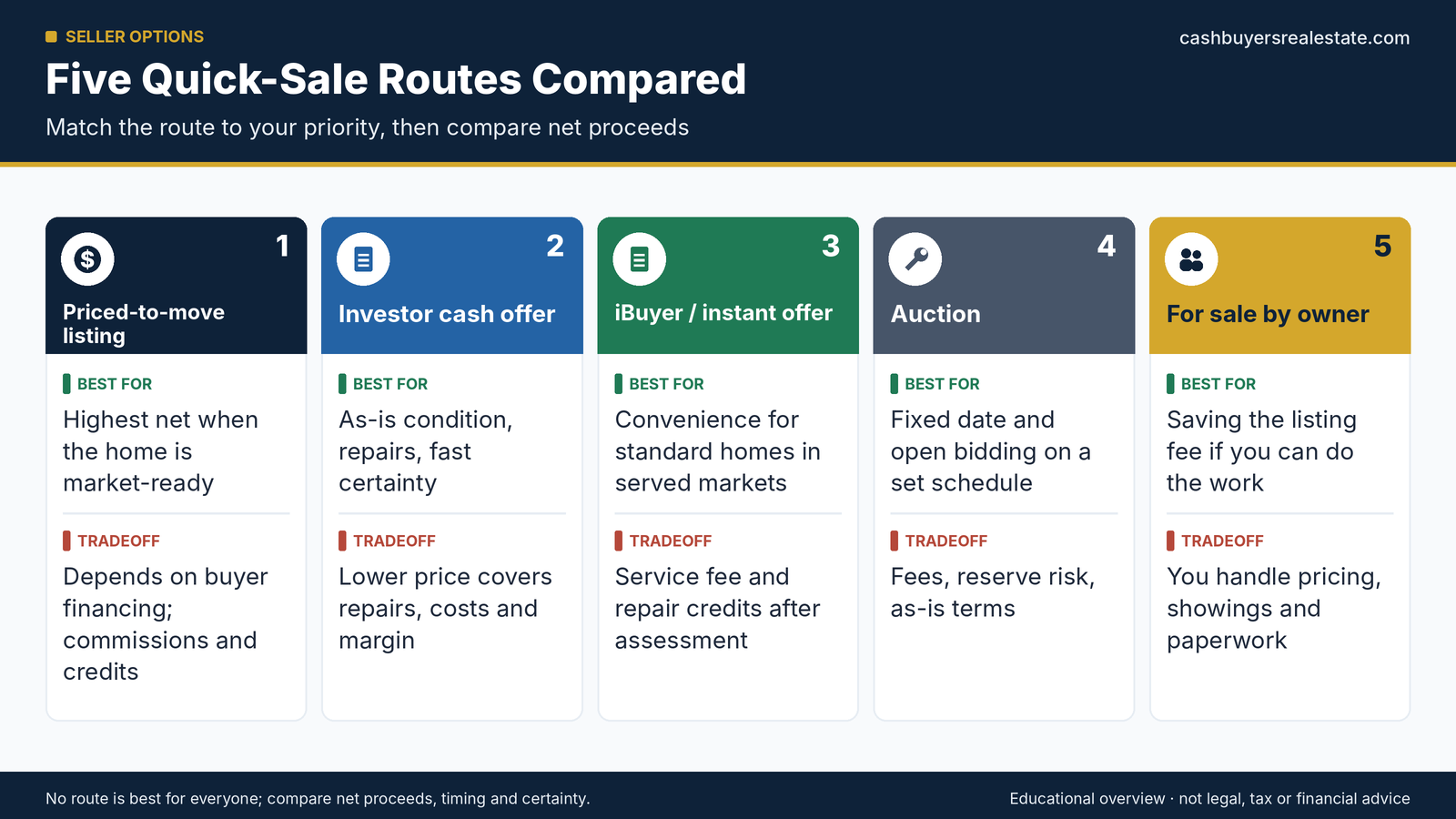
Text version of this infographic
- Priced-to-move listing — best for: Highest net when the home is market-ready; tradeoff: Depends on buyer financing; commissions and credits
- Investor cash offer — best for: As-is condition, repairs, fast certainty; tradeoff: Lower price covers repairs, costs and margin
- iBuyer / instant offer — best for: Convenience for standard homes in served markets; tradeoff: Service fee and repair credits after assessment
- Auction — best for: Fixed date and open bidding on a set schedule; tradeoff: Fees, reserve risk, as-is terms
- For sale by owner — best for: Saving the listing fee if you can do the work; tradeoff: You handle pricing, showings and paperwork
When the Discount Is Worth Paying and When It Isn’t
Situations where speed has a real dollar value
Deadlines with hard costs attached
Speed earns its price when delay has a measurable cost that exceeds the discount. Consider a hypothetical heir who inherits a vacant house with carrying costs of $1,300 a month (taxes, insurance, utilities, and basic upkeep), lives in another state, and has not yet decided what to do. Six months of indecision cost $7,800 before any sale, a figure that can persuade the family to sell sooner at a modest discount or push them to a listing with a firm decision date. Either choice is reasonable once the number is on the table. A seller relocating for a job who must carry two housing payments for months is one example. Another is an heir managing an inherited property where taxes, insurance, and utilities accumulate while the family decides what to do. A seller facing a lender’s default timeline, a code-enforcement deadline, or a lease-up date for a new home has a clock that doesn’t stop for market conditions. In each case, you can write down the monthly cost of waiting and compare it to what the quick-sale route would save.
If a lender has started a foreclosure process, the calculus shifts again, because a sale that closes before the deadline may preserve equity that an auction would not. State foreclosure timelines differ widely and are governed by state law, so a conversation with the lender, a housing counselor, or a local attorney should happen early. The guide to selling a house fast before foreclosure goes into that situation, and the general point here is that urgency created by a real deadline is different from urgency created by a sales pitch.
When the deadline is real, buy certainty deliberately. A seller with a firm closing date at stake may rationally prefer a slightly lower offer with verified funds and a short inspection period over a higher offer with a financing contingency. That’s not a loss; it’s the price of a guarantee that the sale occurs on time, assuming the contract is written to deliver it.
Homes that retail financing struggles to reach
Some properties are hard to sell to buyers who need a mortgage. Lenders and their appraisers impose condition standards, and a house with an active roof leak, missing mechanical systems, or serious structural issues may not qualify for certain loans until it’s repaired. Properties with title defects, unresolved liens, occupants who won’t leave, or unpermitted additions create their own friction, since the title company has to clear each issue before a buyer’s lender will fund. For a house like this, a retail listing may sit unsold or draw only low offers, and the investor’s willingness to take on repairs and uncertainty is exactly what you’d be paying for.
In such cases the discount isn’t a penalty so much as a price for assuming problems you can’t or don’t want to solve. The important step is verifying that the problems are real and sizing them: get a contractor’s bid for the roof, ask a title company what it takes to clear the lien, and then compare the cost and time of solving them yourself with what the buyer subtracts. The guide to selling a damaged house covers condition-driven sales in more detail.
Situations where the discount is a mistake
Move-in-ready homes in a steady market
A well-kept house in a neighborhood where similar homes sell within weeks is the strongest candidate for a listing. Retail buyers will pay for condition, location, and the comfort of an inspected, financed purchase, and an investor planning a renovation has far less to subtract from your price because there’s less to renovate. In that situation, an investor’s offer is likely to be low relative to the listing outcome, since the repair line in Table 1 shrinks while the buyer’s margin and resale-cost lines stay put.
The right test is empirical. Ask for a market analysis from an agent, get at least one written cash offer, and run both through the net sheet from the previous section. If the cash offer nets within a few thousand dollars of the listing and closes two months sooner, take it seriously. If the listing nets $30,000 more and the market is moving, the discount is a poor trade unless you have a genuine deadline.
Keep in mind that the listing route isn’t free of risk or effort either. It requires showings, negotiation, and patience, and a seller who cannot tolerate any of that has a legitimate reason to pay for relief. The mistake is paying a large premium for convenience without noticing it.
Pressure that is softer than it feels
Many sellers feel more time-pressed than their calendar requires. Stress about a vacant house, a family disagreement, or a pile of paperwork can make a short deadline feel permanent. Buyers sometimes reinforce the feeling with offers that expire in 24 hours or language about “today only” pricing. A legitimate offer can have a deadline, but the buyer’s time limit isn’t your time limit, and you’re entitled to ask for a few days to compare.
Before you accept a quick-sale discount, separate hard deadlines from soft ones. A hard deadline has a date, a dollar consequence, and a source: a lender letter, a lease, a court date. A soft deadline is a wish to be done. For soft deadlines, consider intermediate steps that cost far less than a deep discount: a two-week trial listing at an aggressive price, a request for a second investor offer, a flexible closing date that lets you move on your own schedule, or a short rent-back after closing so you aren’t rushed out. The page on the cash home sale process shows where flexibility usually exists in the timeline.
If the pressure is coming from a family disagreement, a divorce, or an estate, an attorney or mediator can often move the timeline more effectively than any sale route can. Sorting out who has authority to sign, and when, may matter more than which buyer you choose.
How to Test an Offer Before You Sign Anything
Check the number
Comparable sales, price opinions, and appraisals
A fair test of any offer begins with the same evidence a buyer uses: recent sales of similar homes near yours. Look for closed sales (not asking prices) from the last three to six months, in the same neighborhood or school zone, with similar size, age, and lot. Sort them into two piles. Updated homes show you the ARV a renovation buyer is chasing. Homes in your current condition show you what retail buyers actually paid for a house like yours. The gap between the piles is the market’s own estimate of what your home’s condition is worth, and it’s the figure to hold against a buyer’s repair line.
There are three common ways to put a number on this. An agent’s comparative market analysis is an opinion based on comps, usually offered at no charge in the hope of earning the listing. A broker price opinion is a similar opinion prepared for a lender or investor, and it isn’t an appraisal. A formal appraisal by a licensed appraiser is the most defensible and also the one that costs money, with fees that vary by market and property type. For most quick-sale decisions, two agents’ analyses of the same house plus your own comp search are enough to tell whether an offer is in the right zip code. For a large estate or a contested divorce, an appraisal can also protect you against later disputes about whether the price was reasonable.
Adjusting comps is where judgment enters. Suppose a renovated house two blocks away sold for $310,000 last month, and yours is similar but has its original kitchen and a 20-year-old roof. You would subtract an estimate of what those two items are worth to a buyer, perhaps $30,000 to $40,000 together, to reach a rough as-is figure near $270,000 to $280,000 (hypothetical). Then compare that range with the offer on the table, and remember that a buyer also needs room for profit. One caution on online value estimates: automated valuation tools are starting points, not conclusions. They can’t see your roof, your basement, or your kitchen, and they lag behind fast-moving markets. Use them to frame questions, not to answer them.
Repair bids and the “what would a buyer deduct” test
The largest single line in a quick-sale discount is usually repairs, and repairs are the easiest line to verify. Walk the house with two or three licensed contractors (or the trades relevant to the work: a roofer, an HVAC technician, a general contractor for cosmetic updates) and ask for written bids covering only the items that matter to a buyer. Compare the total with the repair figure inside the offer. If a buyer assumes $35,000 and your bids total $22,000, you have a specific, polite question: what’s in the extra $13,000?
There may be an honest answer. Investors work at scale, pay for permits and project management, build a contingency into every budget, and often price repairs to a standard of finish that suits resale, not to the minimum your own contractor would do. A buyer who can explain the scope, share a photo-based walk-through list, and say which items are allowances versus firm numbers is giving you useful information. A buyer who can’t explain the repair line at all, or who changes it dramatically after inspection, is signaling something too.
Illustrative example (hypothetical numbers, not market data): A buyer’s offer assumes $35,000 of repairs. Your three bids come in at $21,000, $24,500, and $29,000, a middle value of $24,500. If the buyer’s other assumptions hold, replacing $35,000 with $24,500 raises the supportable offer by about $10,500. You might not get all of it, because the buyer’s contingency and scope are legitimately their own, but you now have a reasoned basis to ask for a better price.
Keep your bids. They also double as disclosure documentation if you later sell to a retail buyer, and they show you what the house will cost to fix if you decide to keep it.
Check the paper and the buyer
Second offers and a side-by-side scorecard
The single best defense against a low offer is another offer. Two or three written quotes, collected over a few days, usually reveal the market’s range far better than any article can. When you ask, give each buyer the same information and the same deadline so the comparison is fair, and tell them you’re collecting more than one proposal. Reputable buyers expect it.
When offers arrive, put them on one scorecard. The goal isn’t to find the highest number. It’s to find the offer with the best combination of net proceeds, certainty, and terms you can live with.
| Question | Why it matters | Better sign | Sign to slow down |
|---|---|---|---|
| Who is the buyer, and will they close in their own name? | Assignments change who performs on the contract | Named buyer or entity, clear on any assignment | Vague about identity or intent |
| What proof of funds can you show? | Certainty depends on actual money | Recent statement or letter from a financial institution | Refuses or offers only a screenshot of unclear origin |
| How much earnest money, and who holds it? | Shows commitment and protects you if they default | Meaningful deposit with a neutral title company or attorney | Token deposit, or paid to the buyer’s own account |
| How long is the inspection or due-diligence period? | A long window is a free option for the buyer | Short, clearly defined, with specific reasons to cancel | Open-ended or “any reason” at any time |
| What costs do I pay at closing? | Changes your net more than most price tweaks | Written estimate of seller costs | “We’ll sort it out at closing” |
| Can the price change after the offer? | Late reductions are the biggest source of disappointment | Price adjustments tied to named, documented findings | Broad right to renegotiate for any reason |
Compare the rows, not just the totals. An offer that wins on price but loses on three of these questions may be worth less than the one next to it. The checklist in the cash home buyer scam prevention guide expands the verification steps if you’re dealing with an unfamiliar buyer.
Contract terms that change the real price
The contract is where an apparently fair offer turns into a different deal, so read it before you sign, not at the closing table. A few clauses deserve close attention. An assignment clause lets the buyer transfer the contract to someone else. An inspection or due-diligence clause says when and why the buyer can cancel and whether the deposit comes back. A price-adjustment clause may let the buyer reduce the price if findings exceed a threshold. A closing-cost clause says who pays title, escrow, transfer taxes, and prorations. A possession clause sets your move-out date and whether you can stay after closing and under what terms.
Also confirm who will handle the closing: an escrow or title company in some states, an attorney in others, because customary practice differs by state. The closing agent should be a neutral third party, and any wiring instructions should be confirmed by phone using a number you found independently, not one from an email. Wire fraud is a recognized risk in real estate closings because the sums are large, and a changed set of instructions arriving by email just before closing deserves a phone call, not a reply.
Costs and Taxes That Move the Final Number
Items that sit outside the offer sheet
Mortgage payoff, liens, and unpaid taxes
The offer price is not the amount you receive. Before any cash reaches you, the closing agent pays off whatever is recorded against the property: your mortgage, any second mortgage or home equity line, and any liens such as unpaid property taxes, certain judgments, contractor claims, or HOA assessments. You can learn the mortgage amount by requesting a payoff statement from your servicer. Under federal Regulation Z, a servicer must send a payoff statement within a reasonable time and in no case more than seven business days after receiving a written request, with exceptions for loans in bankruptcy or foreclosure, reverse mortgages, and some disaster situations. Ask early, because the figure also includes per-day interest and can change by closing day. As a hypothetical, a $200,000 balance at 6.5 percent accrues about $35.62 a day, so a closing that slips by 30 days adds roughly $1,070 to the payoff.
Liens are harder to see. A title search done at the beginning of the transaction will reveal recorded claims, and a quick sale that discovers a $12,000 lien at the closing table can fall apart or shrink your proceeds without warning. If you suspect a lien, ask a title company to run a preliminary search before you accept an offer. The guide on selling a house quickly with liens covers payoff options and how liens affect timelines.
The practical effect on your quick-sale analysis is simple. Subtract payoff and liens from every offer’s net, and compare the remainder to the cash you need. A seller who owes $240,000 on a house with a $236,000 cash offer faces a very different decision from one who owns the home free and clear, and no amount of speed solves a shortfall. In that case, options such as a lender-approved short sale or negotiation with the servicer enter the conversation, and the lender must agree to them.
Transfer taxes, prorations, and local requirements
Closing costs for sellers fall into predictable categories and unpredictable amounts. Some states and localities charge transfer or documentary taxes on the sale, calculated on price and paid by the seller, the buyer, or split by custom; others charge little or nothing. Property taxes and HOA dues are prorated to the closing date, so you reimburse the buyer for any days of taxes you haven’t yet paid and receive credit for any days you prepaid. Title insurance, escrow or attorney fees, recording charges, and municipal certifications round out the list. Which of those fall on the seller varies by state and by contract.
Local rules can add steps. Some cities require inspections, certificates, or compliance letters before a sale, and some condo and HOA communities require resale certificates or transfer fees. Ask your title company or the local building department whether anything is required in your jurisdiction, so you don’t discover it a week before closing. Even who runs the closing differs: in some states an escrow or title company handles it, while in others attorneys customarily do, and the fees and timing follow that local practice.
Because costs range so widely, request a written estimate of seller costs from any buyer or agent and a preliminary statement from the closing agent. The explainer on closing costs when selling a house and the narrower guide to fast home sale closing costs give itemized lists to check yours against.
The tax side, explained in general terms
Selling expenses and the home-sale exclusion
Federal tax law gives many homeowners a significant break on profit from selling a main home. According to IRS Publication 523, you can generally exclude up to $250,000 of gain, or $500,000 for a married couple filing jointly, if you owned and used the home as your main home for at least two of the five years before the sale. You can generally use the exclusion once in any two-year period. The publication also explains that selling expenses, such as real estate agent commissions, advertising fees, and legal fees, are subtracted from the sale price to arrive at the amount realized, which in turn determines your gain.
For a quick sale, two things follow. If the gain on your home is below the exclusion, the tax difference between selling routes may be negligible, and the price of the route can matter more. If your gain is above the exclusion, or you don’t meet the ownership and use tests, the commission you save in one route and the discount you accept in another both flow through the gain calculation, and the comparison needs a tax professional’s help.
Why a lower price changes the tax math, and when it does not
Gain equals amount realized minus adjusted basis. A lower sale price reduces the amount realized and therefore the gain, which is why the headline cost of a discount can shrink slightly after tax for sellers whose gain exceeds the exclusion. For most owners who qualify for the exclusion, however, the tax effect is zero, and the discount is simply money lost.
Repairs complicate things. The IRS publication states that you add the cost of additions and improvements to your basis, but ordinary repairs and maintenance, such as painting or fixing leaks, are not added. If you decide to complete repairs before selling, the line between a basis-increasing improvement and a nondeductible repair matters, and the rules for rental property, inherited property, and property used partly for business differ again. Inherited houses, rentals, and investment properties follow other rules, so seek a tax professional’s advice before choosing a route, not afterward.
This section is general information, not tax advice. The point of raising it in a guide about quick sales is that tax consequences belong on the same net sheet as commissions and credits, and an hour with a CPA before accepting an offer can be worth more than any negotiating tactic.
Before the final sections, the checklist below pulls the main checkpoints together: mortgage payoff, property condition, buyer financing, title issues, closing readiness, and your moving deadline. Each row is also explained in the text above, so use the graphic as a quick review rather than the only place to find them.
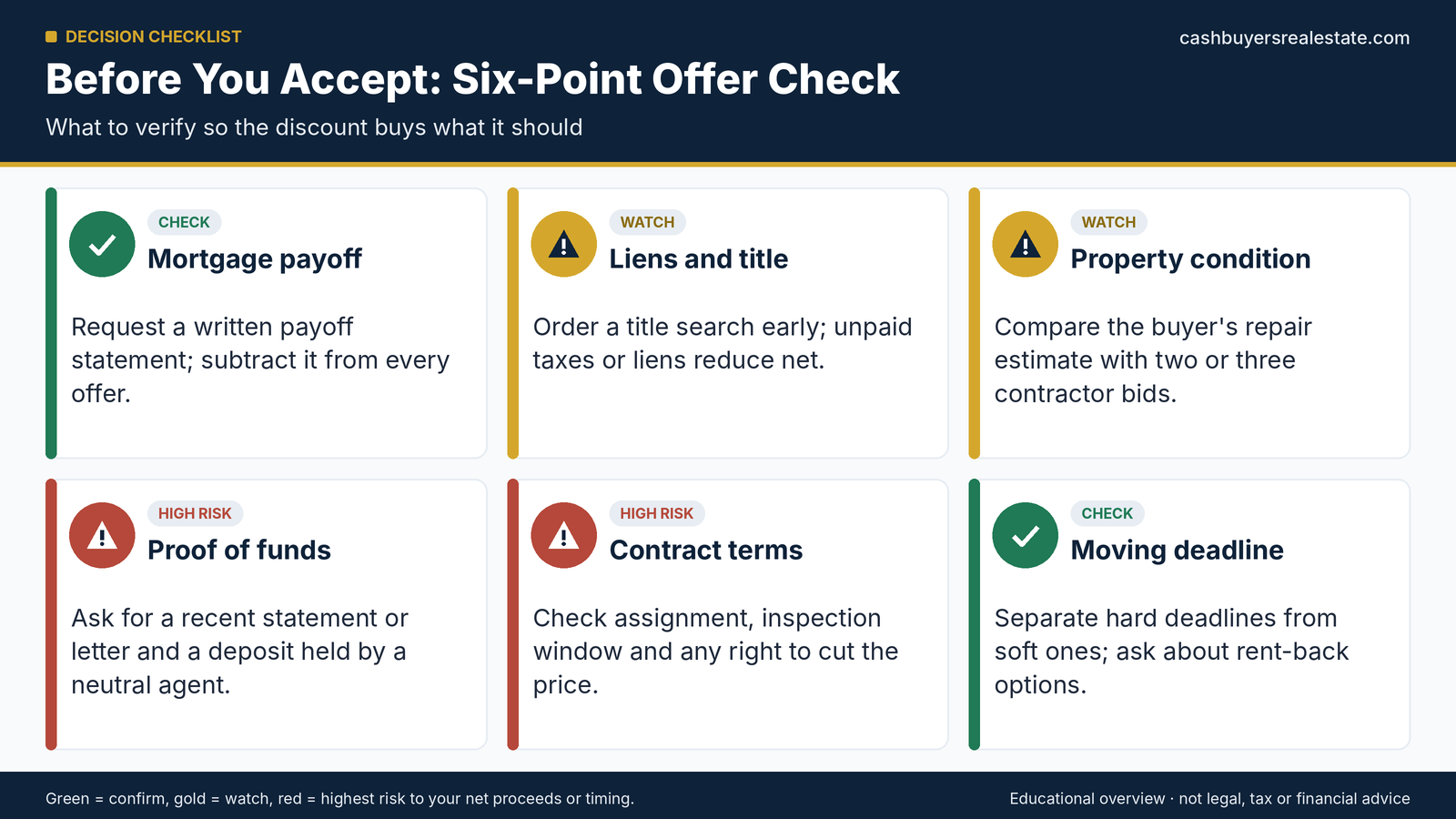
Text version of this infographic
- Mortgage payoff — Request a written payoff statement; subtract it from every offer.
- Liens and title — Order a title search early; unpaid taxes or liens reduce net.
- Property condition — Compare the buyer's repair estimate with two or three contractor bids.
- Proof of funds — Ask for a recent statement or letter and a deposit held by a neutral agent.
- Contract terms — Check assignment, inspection window and any right to cut the price.
- Moving deadline — Separate hard deadlines from soft ones; ask about rent-back options.
Quick Home Sale Questions Sellers Ask Most
Questions about price and offers
Discounts, fees, and what they cover
- Is a 30 percent discount from retail value normal for a cash offer?
There is no normal figure, and any single percentage can mislead. In the hypothetical in this guide, the buyer’s gap from after-repair value came to about 28 percent, but that was an assumption built from an assumed repair budget. A light-cosmetic house in a hot neighborhood may draw an offer much closer to retail, and a house needing structural work may draw one much farther. Ask the buyer for the repair estimate, ARV, and margin behind the number.
- Do cash buyers charge fees or commissions?
Practices differ. Many investors buy directly and don’t charge the seller a commission, but a contract may still allocate title, escrow, and transfer costs to you, and a wholesaler’s assignment fee is typically paid by the end buyer rather than shown to you. Read the closing-cost clause and ask for a written estimate of seller-paid costs. The absence of a line called “commission” does not mean the discount contains no cost.
- Why would a platform’s final offer differ from its first online estimate?
The first number usually comes from a valuation model using public records and your answers. After a home assessment, the company adjusts for condition and may deduct repair credits, and its pricing team may adjust for market changes. Company materials describe the early number as subject to change after that assessment. If you want a sense of the spread, ask what repair credits typically look like for homes like yours before you schedule the assessment.
- Do lower prices mean lower closing costs?
Only partly. Some costs scale with price, such as percentage-based commissions, certain transfer taxes, and title insurance premiums in many states. Others are flat, like recording fees, courier charges, or attorney fees. A $20,000 reduction in price will not shrink every cost by the same percentage, so run each offer through its own net sheet.
Comparing and testing offers
- How many offers should I collect?
Two or three written offers on the same information is usually enough to see the range. More can add confusion and time without improving the information. If the first three cluster tightly, that’s reassuring; if one is far from the others, ask the outlier why before you assume it’s the winner or the loser.
- Is it appropriate to share one buyer’s offer with another?
You can tell buyers you are comparing offers and what factors matter most. Sharing the exact figure or documents of a competing buyer may violate a confidentiality expectation or an agreement you signed, and it invites a race to a number that doesn’t reflect real terms. Describe the structure instead, such as “I have a proposal with a two-week closing and a five-day inspection period,” and let each buyer decide how to respond.
- Should I order an appraisal before accepting a cash offer?
It’s optional, and usually unnecessary for a modest-value house when you have two agent opinions and your own comps. An appraisal earns its fee when stakes or disputes are high: an estate with multiple heirs, a divorce settlement, or a property that’s unusual enough that comparable sales are thin. Ask the appraiser for the effective date and the condition assumptions, since an as-is value differs from an after-repair value.
- What if the buyer’s repair estimate looks inflated?
Ask for the scope behind it: which systems, which finishes, and which items are allowances. Then compare it to your contractor bids. Some of the gap may be contingency or standard-of-finish differences, which are legitimate. If the buyer can’t or won’t itemize, treat the figure as a negotiating position instead of a fact.
Questions about process and risk
Timing, possession, and cancellation
- How long can a quick sale really take?
It depends on the route and the paperwork, not just on the buyer’s promise. A cash purchase skips lender underwriting, but title work, payoff letters, association documents, and signing logistics still take time, and a financed purchase adds appraisal and underwriting. Ask any buyer for a milestone schedule with dates, and read the dedicated timeline guide on how fast a house can sell for stage-by-stage detail.
- Can I stay in the house after closing?
Often, if the contract says so. A rent-back or post-closing occupancy agreement lets sellers remain for a fixed number of days, usually paying a daily charge and agreeing to keep the property insured and in its closing condition. Terms vary, lenders may restrict them for financed buyers, and it should be in writing before you sign. A cash buyer may offer more flexibility than a financed one, or less, depending on their plans.
- What happens to the earnest money if the buyer backs out?
The contract controls. It will state when the deposit is refundable (for example, during an inspection period), when it’s forfeited, and who holds it. A deposit held by a neutral title company or attorney is generally easier to track than money held by the buyer. If the buyer cancels within a valid inspection window, expect to return the deposit; if not, the remedy depends on the contract and state law, and disputes can take time.
- Can I cancel after I sign?
Don’t assume you can. A right to cancel, if any, comes from the contract’s terms or from state law, and rules differ from place to place. Some contracts allow a short attorney-review period, while others provide none. Before signing anything, ask a local attorney or the closing agent what exits exist, and treat the signature as binding.
Taxes, alternatives, and pressure tactics
- Is a quick sale taxed differently from a regular sale?
Tax treatment follows the facts of the sale, such as your gain, how long you owned and lived in the home, and whether it’s a main home, rental, or inherited property, not the speed of the sale. A lower price usually means a lower gain, and selling expenses can reduce the amount realized. See IRS Publication 523 and ask a tax professional about your situation.
- What are the alternatives if the discount feels too steep?
Consider a short listing at an aggressive price, an auction with a reserve, a for-sale-by-owner sale, a request for a second investor offer, a negotiated later closing date, or addressing a few repairs yourself. The comparison pages on cash sale versus listing for a fast sale and urgent home sale options lay out these paths side by side.
- How can I recognize a pressure tactic?
Be cautious when an offer expires within hours, the buyer won’t put terms in writing, identity or funds are unclear, or someone asks for upfront payments before any contract is in place. None of these alone proves bad intent, but each is a reason to slow down, verify, and ask a neutral third party such as a title company or attorney for help.
- Can I sell quickly if I owe more than the house is worth?
Possibly, but you will need your lender’s cooperation, because proceeds must cover liens or the lender must accept less. A short sale is one route; negotiating a repayment plan or modification is another. Start by requesting a payoff statement and talking with the servicer or a HUD-approved housing counselor, then see the guide to selling a house fast with a mortgage.
Choosing a Route and Taking the First Steps
A decision framework: match the route to your priority
Match each priority to the route that tends to fit
Most sellers carry several priorities at once, but one or two usually dominate. Rank yours, then check which route has historically served that priority best. The table is a starting point, and your market and property may point somewhere else.
| If your top priority is… | Routes that often fit | Main trade-off | First step |
|---|---|---|---|
| Highest net proceeds | Agent listing priced to move; possibly a short-term auction | More time and effort; dependence on buyer financing | Ask two agents for price-and-time scenarios |
| Certainty of a closing date | Cash buyer with verified funds; platform offer with firm terms | Lower price; inspection-period renegotiation risk | Request proof of funds and the contract draft |
| Minimal repairs and showings | Investor or platform purchase as-is | Repair costs are priced into the offer | Get contractor bids to test the repair line |
| Lowest total cost | FSBO or reduced-fee listing, if you can manage the work | More responsibility; less exposure | Price out legal and closing support |
| Complicated title or occupancy | Experienced investor plus a title company and attorney | Fewer buyers; discount for complexity | Order a title search before listing |
| Hard deadline within weeks | Cash or auction contract with a fixed date | Deeper discount; limited negotiation | Document the deadline and its cost |
If two rows describe you, weigh the one with the larger dollar consequence first. A deadline with a penalty usually outranks a preference for the highest price.
A break-even test for any discount
Once you have net sheets for two routes, use one more calculation to turn the comparison into a decision. Take the difference in net proceeds between the slower, higher route and the faster, lower one. Divide it by the number of months the faster route saves. The result is the implied price of each month, which you can set against what a month of waiting actually costs you beyond the carrying costs already counted.
Illustrative example (hypothetical numbers, not market data): Using Table 2, the listing nets $250,000 and the investor offer nets $231,840, a difference of $18,160. The investor route closes about two months sooner, so each month saved costs roughly $9,080. If waiting would cost you an extra $2,500 a month in a second housing payment, the faster route doesn’t pay off on dollars alone. If the delay would cost you a $20,000 relocation bonus, or push you past a lender’s date, it clearly does. Adjust the result for the chance that a listing falls through and for the risk that the cash buyer renegotiates.
This test doesn’t capture everything. Peace of mind and family circumstances have value, and a modest premium for them can be reasonable. The aim is to make the premium visible so you’re choosing it, rather than discovering it later. The overview of the fastest way to sell a house compares routes on speed alone, which pairs well with this price-of-speed view.
What to do next
A practical first-week plan
You don’t need to decide everything this week. You need to replace uncertainty with numbers. A workable sequence looks like this.
- Day 1: Request a written payoff statement from your mortgage servicer, and list every lien, tax balance, and HOA balance you know about.
- Day 1 to 2: Total your real monthly carrying costs from statements, not estimates.
- Day 2 to 4: Ask two local agents for a market analysis and price-and-time scenarios. Pull your own recent comps.
- Day 2 to 5: Request two or three written cash or platform offers using the same property information and the same response date.
- Day 3 to 5: Collect repair bids if condition is driving the discount.
- Day 5 to 6: Fill in a net sheet for each option and score the terms using Table 4.
- Day 6 to 7: Have a local real estate attorney or the closing agent review the contract you’re leaning toward before you sign.
If anything on the list is impossible within a week, such as a probate appointment or a lender delay, say so to each buyer. A good-faith buyer will adapt; one who treats your constraints as an opening to push you will show it quickly.
Documents to gather and questions to ask
Having paperwork ready shortens every route. Collect the deed or title information, the latest mortgage statement, the property tax bill, the homeowners insurance declarations page, HOA contact details and documents, any past inspection reports, permits and receipts for major work, utility bills, and the contractor bids you gather. If the property is tenant-occupied, add the leases and rent ledger. If the owner is deceased, add the death certificate and whatever court documents show who has authority to sell.
Then take a short list of questions to every buyer or agent:
- What is the full list of costs I would pay, in dollars?
- Who holds the earnest money, and when is it refundable?
- How long is the inspection or due-diligence period, and on what grounds can the price change?
- Will you close in your own name, or may you assign the contract?
- What is the closing date, and what has to happen before it?
- Who is the closing agent, and can I get contact details I can verify independently?
If a buyer answers those clearly and in writing, you have the raw material to compare offers fairly. If the answers are vague, that tells you something too.