
Sell House Fast before Foreclosure: Timeline, Costs & Seller Options
You’ve missed some mortgage payments, a letter arrived with words like “default” or “notice of intent,” and now you’re wondering how much time you have and whether selling the house could get you out cleanly. If you’ve typed “sell house fast before foreclosure” into a search box, you’re asking a practical and reasonable question, and the honest answer has several parts.
Often you can sell before a foreclosure sale and keep any equity, but only if the sale closes before the sale date and the payoff covers what the lender is owed. Selling isn’t always the best option. Loss mitigation, a repayment plan or a modification may let you stay. Timelines and rights vary by state, so start by talking to your servicer and a HUD-approved housing counselor.
Foreclosure is a legal process, not a single event, and it moves at very different speeds depending on where you live, what kind of loan you have and what you do while it’s underway. That’s good news in one sense: a notice in your mailbox is usually the beginning of a sequence, not the end of it. Federal servicing rules, which we’ll walk through with the actual regulation text, give you protections and some breathing room, and state law adds its own notices, waiting periods and, in some places, a right to redeem the property after a sale.
This guide covers the whole picture rather than pushing a single answer. It explains the federal baseline (including the 120-day rule and the way a complete loss mitigation application can pause foreclosure), how judicial and non-judicial foreclosure differ, the typical stages and where the time goes, how to talk to your servicer, and what a sale before the auction actually looks like in dollars. It compares selling with modification, a short sale and a deed in lieu of foreclosure, explains redemption periods and surplus funds, covers the tax and credit questions to raise with a professional, and spells out how foreclosure rescue scams work so you can avoid them.
It also takes a firm position on one point: this isn’t a page that tells everyone to sell. Some homeowners can keep the house with a plan the servicer approves. Some have little or no equity, which turns the question into a short sale or a deed in lieu. Some have a short runway and a strong reason to sell. Which of these applies to you depends on your income, your equity, your loan type and your state, and you deserve to see the options side by side before you choose.
If your deadline is driven by something other than foreclosure, the guides on needing to sell fast and urgent home sale options take a wider view. If you’re current on your mortgage and just want to understand payoff mechanics, see selling fast with a mortgage. For the broader foreclosure topic, the selling before foreclosure hub collects the related guides.
How Foreclosure Works: The Federal Baseline and the State Calendar
The calendar you’re on depends on two layers of law. Federal mortgage servicing rules set a floor that applies broadly across the country. State law then governs the foreclosure procedure itself: who files what, what notices you must receive, how long each stage takes and what happens after a sale. Understanding both layers is the quickest way to figure out how much time you realistically have.
What federal servicing rules guarantee
Early intervention and the 120-day rule
The Consumer Financial Protection Bureau’s mortgage servicing rules, known as Regulation X, require your servicer to reach out early. Under 12 CFR 1024.39, the servicer must establish, or make good-faith efforts to establish, live contact with a delinquent borrower no later than the 36th day of delinquency, and must send a written notice no later than the 45th day. That notice has to encourage you to contact the servicer, give contact information, describe loss mitigation options that may be available and include information about housing counselors, including HUD’s toll-free number.
The rule that matters most to your timeline is in 12 CFR 1024.41(f)(1). A servicer may not make the first notice or filing required by law to begin a foreclosure unless your loan is more than 120 days delinquent. There are narrow exceptions, such as foreclosure based on a violation of a due-on-sale clause or a servicer joining another lienholder’s foreclosure action. Small servicers, which are exempt from many other parts of the rule, remain subject to this 120-day prohibition under paragraph (j).
Two practical points follow. First, the 120-day period is a floor, not a countdown with a guaranteed length: a servicer can start foreclosure on day 121, and state law then sets what happens next. Second, the rules have scope limits and exemptions, so confirm with a housing counselor or attorney that they cover your particular loan and property. An investment property or a home equity line, for example, may be treated differently.
The Bureau’s consumer guidance puts the practical message plainly: reach out for help as soon as you think you might have trouble paying, because earlier applications bring more protection. The 120 days are time to use, not time to wait out.
Loss mitigation applications and the 37-day line
“Loss mitigation” is the set of ways a servicer can work with you to avoid foreclosure, such as repayment plans, forbearance, loan modifications, short sales and deeds in lieu. When you submit a complete loss mitigation application, Regulation X sets deadlines for the servicer and, depending on timing, limits what it can do while the application is pending. The servicer must acknowledge the application in writing within five business days, stating whether it’s complete or incomplete, and for a complete application received more than 37 days before a foreclosure sale, it must evaluate you for the options available and give you a written decision within 30 days.
Under paragraph (g), if a complete application arrives after foreclosure has started but more than 37 days before a scheduled sale, the servicer generally may not move for a foreclosure judgment or order of sale, or conduct the sale, unless one of a few exceptions applies: you’ve been denied and the appeal period has run out, you reject all the options offered, or you fail to perform under an agreed option. If the servicer denies a loan modification, you generally have 14 days to appeal, and the servicer must answer within 30 days. These rules are often described as limits on “dual tracking,” meaning pursuing foreclosure and loss mitigation at the same time.
Don’t over-read this. The regulation does not require a servicer to offer any particular loss mitigation option, and it doesn’t guarantee that you’ll qualify. What it does is create a process, with deadlines and written explanations, and it lets a borrower enforce the provisions in court under the Real Estate Settlement Procedures Act. If you’re close to a sale date, the 37-day line matters a great deal, which is why the timing of a complete application, with every requested document, is worth planning around with a counselor’s help.
How your state changes the calendar
Judicial and non-judicial foreclosure: two different roads
The Bureau’s explanation of how foreclosure works describes the two basic models this way. In a judicial foreclosure, the process goes through a court, and the borrower can raise defenses there. In a non-judicial foreclosure, the lender or trustee proceeds without filing a lawsuit, following the notice and sale procedures laid out in a power-of-sale clause and state law. Some states use mostly one model, some permit both, and the rules inside each model differ from state to state, so you can’t tell from the label alone how fast things will go.
Real statutes show how different the details are. New York, which uses court proceedings, requires under Real Property Actions and Proceedings Law section 1304 that a home loan borrower receive at least 90 days’ notice, in a prescribed format that includes a list of housing counseling agencies, before the lender starts legal action. California, where non-judicial foreclosure under a deed of trust is common, requires that at least three months pass after a notice of default is recorded before a notice of sale can proceed, and a sale date set at least three months and twenty days after the notice of default. Florida foreclosures are handled in court, and its statute allows the owner to redeem only until the later of the clerk’s filing of a certificate of sale or the time set in the judgment, with no right of redemption afterward.
These three examples are illustrations, not a map of every state, and statutes get amended. Some states also offer mediation or settlement conferences before foreclosure. The reliable way to learn your state’s rules is to read the notice you received, check your state attorney general’s or housing finance agency’s website, and ask a HUD-approved housing counselor or a local attorney.
A stage-by-stage timeline, with state examples
Putting the federal and state pieces together gives you a rough sequence. The table lists the stages most homeowners encounter, what drives the timing and where state law changes the picture.
| Stage | What happens | Federal baseline | State variation |
|---|---|---|---|
| 1. Missed payment and early outreach | Servicer calls and mails notices; late fees accrue | Live contact attempt by day 36; written notice by day 45 | Grace periods and late fees come from the note and state law |
| 2. Delinquency under 120 days | Servicer may discuss options; you can apply for loss mitigation | No first foreclosure notice or filing before day 120 (with narrow exceptions) | Some states add pre-foreclosure notices or mediation steps |
| 3. Pre-foreclosure notice or default notice | Formal warning that the lender may proceed | Servicer must still follow loss mitigation rules if you apply | New York requires 90 days’ notice before suit; California ties the sale to a recorded notice of default |
| 4. Filing, lawsuit or recorded notice | Court complaint (judicial) or recorded notice (non-judicial) | A complete application more than 37 days before a sale limits further steps while pending | Length varies widely; court calendars matter in judicial states |
| 5. Judgment, order of sale or notice of sale | Sale date is set and published | 37-day line applies to complete applications | Required notice periods before sale differ by state |
| 6. Sale or auction | Property is sold to the highest bidder, often the lender | Servicer may not conduct sale while a protected application is pending | Postponements, sale hours and bidding rules are state-specific |
| 7. After the sale | Possible redemption, surplus claim, deficiency questions, eviction | None specific to timing | Redemption rights range from none to months in various states |
Treat the table as a framework for the questions to ask, not as a prediction of your timeline. The most important entry for a seller is stage 5 to 6: once a sale date exists, every other decision has to be measured against it, and the options in the next sections work very differently depending on whether you’re months away from that date or weeks.
Talking to Your Servicer and the Options That Keep the House
Most people avoid this conversation for as long as they can, and it’s understandable. Calls about missed payments are stressful, and it’s easy to assume nothing can be done. But the servicer is the party that decides most of what happens next, and nearly every alternative to foreclosure, including a sale that works, runs through it. Making the call before you’ve decided anything keeps all of your options open.
Making the first call count
Why early contact changes your options
There are several reasons that earlier is better, and none of them is about panic. The first is the regulation itself: complete applications received well before a scheduled sale come with stronger protections than applications received days before it. The second is arithmetic. Every month of missed payments adds interest, late fees and, if foreclosure starts, attorney and processing costs to the amount a servicer would require for reinstatement or payoff. A smaller gap is easier to cover through a repayment plan or a sale. The third is that servicers have more choices when a loan is lightly delinquent than after it has been referred to a foreclosure attorney.
The Bureau’s guidance on avoiding foreclosure says plainly that a servicer must contact you, give you accurate information and tell you about the loss mitigation options you may qualify for, which may help you keep the home or, if that makes more sense, leave it. A free HUD-approved housing counselor can help you understand those options, and counselors can often help you organize and submit the application. The Bureau notes that HUD-approved agencies can often provide independent advice at little or no cost, so it costs you little to have one in your corner before the call. You can search for one through the CFPB’s housing counselor tool or by calling HUD at (800) 569-4287.
Early contact also gives you information you may not have. You’ll learn the exact amount past due, whether the loan has been referred to a foreclosure attorney, whether a sale date exists, who owns or insures the loan, and what program options that investor allows. Every other part of your decision depends on those facts, so it’s worth collecting them before choosing a route.
A contact-servicer script, in plain prose
You don’t need a polished speech, but it helps to know what to say and to write down what you hear. Start by confirming who you’re talking to and noting the date, time and the representative’s name. Then say something like: “I’m behind on the mortgage for this address, and I’d like to be reviewed for every loss mitigation option available to me, including repayment plans, forbearance, modification and, if appropriate, a sale or a short sale. Can you tell me exactly how much is past due, whether the loan has been referred for foreclosure, and whether a sale date has been set?”
Next, explain your situation briefly and truthfully: what caused the hardship (a job change, illness, a divorce, a spike in expenses), whether it’s temporary or ongoing, and what your income looks like now. You don’t have to share more than the servicer asks for. Ask what documents are needed for a complete application, what the deadline is, and how you’ll be told that the application is complete. Because the date a complete application is received can affect your protections, ask the servicer to confirm that date in writing.
Then ask two practical questions. “While my application is pending, what is the status of the foreclosure?” and “Please send me a written payoff statement.” The payoff request is worth making early even if you’re only exploring a sale, because it tells you what the sale would have to cover, and we’ll look at why timing matters in the next section. End the call by repeating what you understood, and follow up in writing, by mail or through the servicer’s portal, so there is a record. Don’t agree to payments you can’t make, and don’t sign anything you don’t understand. If anything is unclear, pause and call a counselor.
The main ways to stay in the home
Reinstatement, repayment plans and forbearance
Three tools address a temporary shortfall. Reinstatement means paying the full past-due amount, plus allowable fees and costs, to bring the loan current as if the default hadn’t happened. Whether and until when you can reinstate is set by your loan documents and by state law. In California, for instance, the statute allows reinstatement of a monetary default from the recording of the notice of default until five business days before the date of sale in the initial notice of sale. In other states the deadline is different, and some require payoff of the whole balance once the loan is accelerated.
A repayment plan lets you catch up over a set period by adding part of the missed amount to your regular payment. The Bureau’s guidance suggests confirming that you can afford the new payments before agreeing, and that’s wise advice: a plan you can’t sustain only delays the same problem. A forbearance is a temporary pause or reduction in payments that you request from the servicer; you’ll have to make up the missed or reduced payments afterward, in a lump sum, through a plan or by another arrangement the servicer offers.
These options fit best when the problem is a temporary loss of income that has ended or is about to. If the shortfall is ongoing, a plan that only spreads out the arrears may not be enough, and the conversation shifts to modification or to a sale. The point isn’t to find the cleverest option; it’s to match the option to the cause of the problem.
Loan modification, bankruptcy and state help
A loan modification changes the terms of your mortgage, for example by extending the repayment period, lowering the rate or reducing principal, so that the payment becomes affordable. What a servicer can offer depends on who owns or insures the loan (a private lender, Fannie Mae, Freddie Mac, FHA, VA, USDA or another investor), and not every borrower will qualify. If a modification is denied, Regulation X requires a written explanation of the reasons and gives you a right to appeal within 14 days.
Bankruptcy is a different legal tool, not a loss mitigation option, and it deserves a serious conversation with a bankruptcy attorney before you consider it. According to the federal courts, filing a chapter 13 petition stops a foreclosure proceeding immediately through the automatic stay and can let a debtor bring past-due mortgage payments current over a plan that usually lasts three to five years, as long as the regular payments continue. It doesn’t protect a home if the foreclosure sale was completed before filing, and missed payments after filing can cost the home. Chapter 13 carries its own costs, eligibility limits and consequences, so it’s a decision for an attorney.
State and local programs sometimes provide help as well. Some states offer mediation or housing assistance, and the National Council of State Housing Agencies keeps a directory of state housing finance agencies. HUD-approved counselors can often tell you which programs are active where you live. If a sale ends up being the better choice, the work you did with the servicer and counselor isn’t wasted; the same documents, payoff figures and relationships feed straight into the sale. The process map below summarizes the stages and decision points we’ve covered so far, from the first missed payment through the sale date.
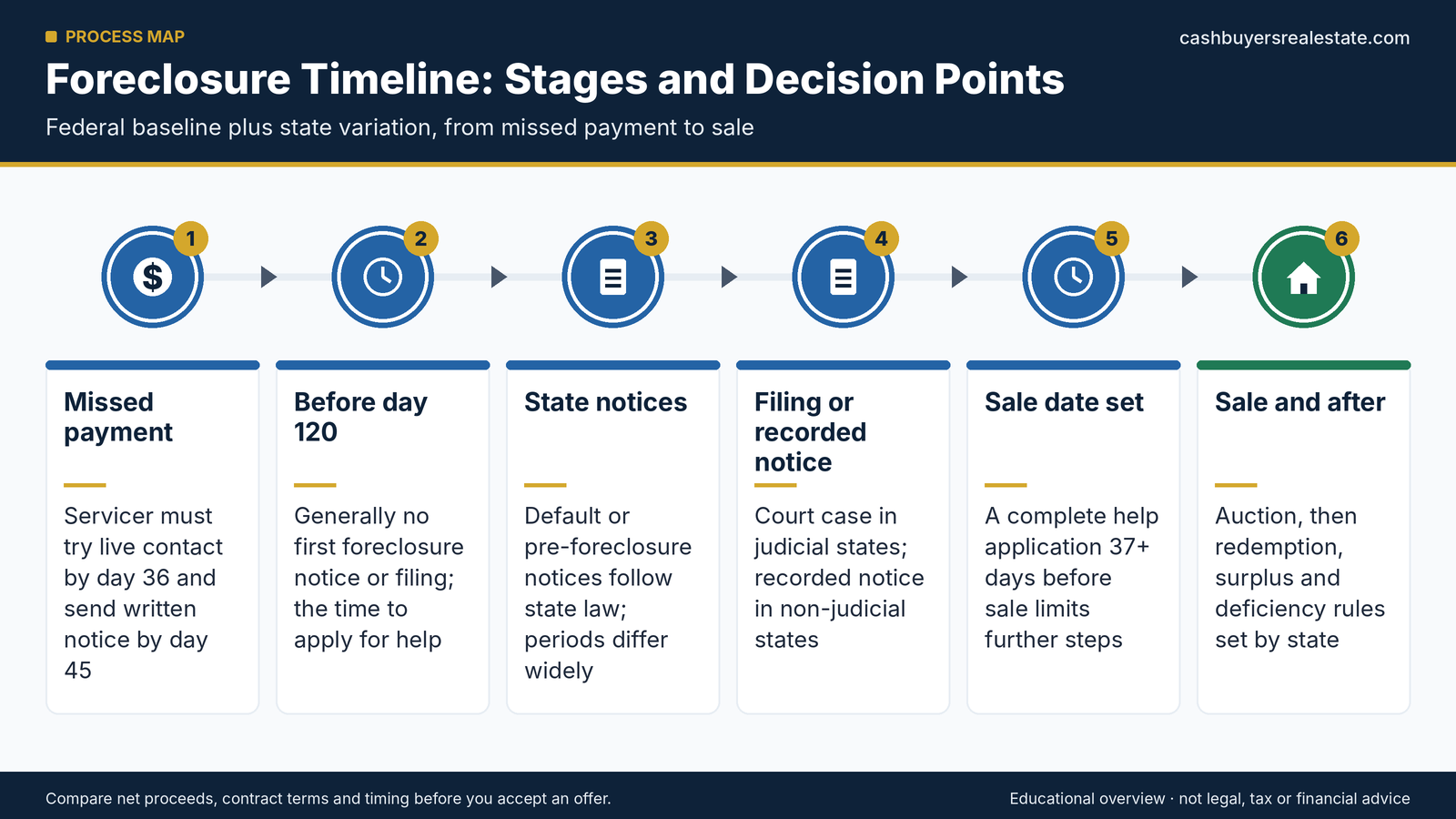
Text version of this infographic
- Missed payment — Servicer must try live contact by day 36 and send written notice by day 45
- Before day 120 — Generally no first foreclosure notice or filing; the time to apply for help
- State notices — Default or pre-foreclosure notices follow state law; periods differ widely
- Filing or recorded notice — Court case in judicial states; recorded notice in non-judicial states
- Sale date set — A complete help application 37+ days before sale limits further steps
- Sale and after — Auction, then redemption, surplus and deficiency rules set by state
Selling Before the Sale Date: Payoff, Equity and the Clock
For homeowners with enough equity, or enough time and servicer cooperation, a sale before the foreclosure auction can end the debt, protect the equity and avoid a foreclosure on the credit record. It works only when the numbers and the calendar both cooperate, so this section is about checking both before you commit.
What a pre-foreclosure sale has to accomplish
Payoff, arrears and fees: what must be paid at closing
A sale ends the foreclosure when the lender’s lien is paid off at closing and released. The amount required is the payoff, which is not the same as the loan balance on your last statement. It typically includes the unpaid principal, accrued interest, the missed payments, late charges and the costs the servicer has incurred in foreclosing, such as attorney fees, filing costs and property inspections. The loan documents and state law limit what can be charged, and a payoff statement should itemize it.
Federal law gives you a way to obtain it. Under 12 CFR 1026.36(c)(3), a creditor, assignee or servicer must send an accurate payoff statement within a reasonable time, and in no case more than seven business days, after receiving a written request. There’s a catch that matters here: when a loan is in foreclosure or bankruptcy, the statement must be provided within a reasonable time rather than within the seven-day limit. In other words, ask early, in writing, and don’t count on a seven-day turnaround once foreclosure is underway.
Be aware that the payoff changes daily as interest accrues and as fees are added, so a title company or closing attorney will request an updated figure shortly before closing. Other liens matter too: second mortgages, home equity lines, homeowners association liens, judgment liens and tax liens usually must be paid or otherwise resolved at closing as well. The guide to selling a house quickly with liens covers those in more detail.
Equity: three hypothetical outcomes
Whether selling makes sense often comes down to one question: after the payoff and the costs of selling, is there money left, break-even, or a shortfall? The example below uses the same house in three different value situations so you can see how the picture changes.
Illustrative example (hypothetical numbers, not market data): A homeowner is six payments behind. In the first scenario the house sells for $320,000 against a payoff of $257,000, which includes missed payments, interest and foreclosure-related fees, with selling costs assumed at 7% of the price ($22,400). In the second, a weaker market or a house in worse shape brings $290,000 against a $265,000 payoff. In the third, the house sells for only $230,000 against the same $265,000 payoff. The selling cost percentage is an assumption and varies by state and route.
| Scenario | Sale price | Payoff including arrears and fees | Selling costs (assumed 7%) | Left over or (short) |
|---|---|---|---|---|
| A. Strong equity | $320,000 | $257,000 | $22,400 | $40,600 |
| B. Thin equity | $290,000 | $265,000 | $20,300 | $4,700 |
| C. Underwater | $230,000 | $265,000 | $16,100 | ($51,100) |
The table shows why the same strategy can be wise for one homeowner and unworkable for another. In scenario A a conventional sale preserves significant equity. In B, the sale roughly breaks even, so a small change in price, repairs or fees could erase the margin, and a repayment plan or modification might deserve a harder look. In C, the sale cannot cover the debt, so the servicer would have to agree to accept less, which turns it into a short sale. We compare those paths in the next section.
Working with the servicer and the calendar
Working backward from the sale date
Selling is a project with a deadline, and it helps to plan it backward. An accepted offer doesn’t stop a foreclosure by itself. The process continues unless the sale is postponed, the loan is reinstated or the loan is paid off at closing. If a sale date is posted, the realistic target is a closing that has a comfortable margin before that date, not on it.
Illustrative example (hypothetical schedule, not a prediction): Suppose a notice sets a sale date 60 days away. In the first week, the owner contacts the servicer, requests a written payoff statement and a loss mitigation package, and speaks with a housing counselor. In weeks two and three, the owner interviews a listing agent or collects offers from cash buyers, and decides on a route. Around week four, a contract is signed with a buyer who can close without a lender. Weeks five through seven are title work, payoff updates and signing. That leaves about a week of cushion. A buyer who needs a mortgage typically adds underwriting and appraisal steps, which can use up the cushion quickly.
Servicers can sometimes postpone a sale when there’s a signed contract and evidence that the sale will close, but whether and for how long depends on the servicer, the investor and state procedures; it’s a request, not an entitlement. When you ask, bring a signed contract, proof of the buyer’s funds or financing, and a title commitment if you have one. Ask for the postponement in writing and confirm the new date with the foreclosure trustee or attorney, because the lender’s attorney or the trustee, not your servicer’s customer service line, often controls the sale calendar.
Also read your contract through the lens of the deadline. Financing contingencies, inspection periods and appraisal conditions are all ways a deal can slip past a sale date. A contract with a firm closing date, modest contingencies and a buyer who can show funds is more useful on this timeline than a slightly higher price with open-ended conditions.
Who can realistically buy on this timeline
Buyers who can close inside a short window fall into a few groups. A conventional buyer with a mortgage can sometimes make it if the sale date is far enough away, but lender timelines are outside your control. A cash buyer or investor can often move faster because there’s no lender underwriting or appraisal, although the buyer still needs to review title, which will show the foreclosure filing, and arrange the closing. Some owner-occupant buyers use cash from savings or proceeds from another sale.
Whoever the buyer is, verify before you rely on the contract. Ask for proof of funds or a lender commitment, confirm the earnest money amount and where it’s held, and use a title company or real estate attorney, depending on your state’s closing practice, to handle payoff and recording. The guide to proof of funds explains what to look for. An investor’s offer will usually reflect a discount, because the buyer is pricing in the speed, the repairs and the risk; you can compare that to what an open-market sale would leave you after costs and time, and our comparison of a cash sale versus listing for a fast sale shows how.
Finally, an honest note about timing: if you’re only a few weeks from a sale, a conventional listing may not be practical, and your realistic choices may narrow to a quick cash sale, a postponement request, a loss mitigation application or a bankruptcy filing. That’s a reason to start sooner, but it is also a reason to talk to a counselor or attorney before agreeing to anything on a compressed schedule. No offer is so good that it can’t wait for a day of review.
Sell, Modify, Short Sale or Deed in Lieu: Comparing the Paths
When people say they want to “avoid foreclosure,” they usually mean one of several different outcomes. Some mean keeping the house. Some mean getting out without a foreclosure on their record. Some mean protecting whatever equity exists. The routes below deliver those outcomes in different ways and with different side effects, which is why comparing them side by side matters more than picking the fastest.
Short sales and deeds in lieu of foreclosure
How a short sale works and who has to approve it
The Bureau’s mortgage key terms define a short sale as selling the home for less than you owe on the mortgage, an alternative to foreclosure in which you must leave the home. Because the sale proceeds won’t cover the payoff, the lender (and any other lienholder) has to agree to accept less than it’s owed, and that approval is what makes a short sale different from an ordinary sale. In practical terms, you or your agent submits the buyer’s offer along with a hardship explanation, financial documents and a purchase contract. The servicer reviews the package, often obtains its own valuation of the property, and responds with an approval, a counteroffer or a denial.
Several details decide whether a short sale works. All lienholders must approve, so a second mortgage or home equity line holder has to sign off too, and junior lenders sometimes ask for a payment in exchange for releasing their lien. The approval letter should state the terms, including the net amount the lender will accept and the deadline to close. The most important sentence to look for, or to request, is what happens to the remaining balance: does the lender waive the deficiency and release you from liability, or does it reserve the right to pursue you for the difference? That answer varies by lender, by loan and by state, and it should be in writing before you close.
Timing is the constraint. A servicer’s review can take weeks, and the buyer’s contract needs enough time to survive that review. If a foreclosure sale date is close, the short sale package should be submitted as a complete loss mitigation application well ahead of the 37-day line described earlier, and you should ask whether the servicer will postpone the sale while it reviews. An experienced agent or attorney who has handled short sales can be valuable here, as can a housing counselor who knows how your servicer processes them.
How a deed in lieu of foreclosure works
A deed in lieu of foreclosure is a voluntary transfer of ownership to the lender. The Bureau describes it as turning over your home to avoid foreclosure, and notes that it may help you avoid personal liability for the remaining balance. It’s a loss mitigation option, which means it’s offered at the servicer’s discretion and under the investor’s rules, not as a right.
Deeds in lieu tend to fit a particular situation: little or no equity, no buyer in sight, and a homeowner who wants a clean and predictable exit. They often come with conditions. The servicer may require that the property be marketed for a period first, that it be in reasonable condition and that the title be free of other liens, because a lender who takes a deed in lieu generally takes the property subject to junior liens such as a second mortgage, a judgment or a tax lien. If those exist, they may have to be resolved before the lender will accept.
Compare it with a short sale on three points. A short sale ends with a buyer purchasing the home, so the lender receives cash; a deed in lieu ends with the lender owning the property and having to sell it later. A short sale may let you keep some control over timing and may produce a better price. A deed in lieu is usually simpler for the owner but gives up the chance of finding a buyer who would pay more. As with a short sale, insist on a written statement of what the lender will do about any deficiency before you sign.
Comparing outcomes side by side
The comparison table: money, credit, liability and control
The table lines up the main paths on the factors homeowners most often ask about. Because credit scoring, lender policies and deficiency rules vary, the entries describe general patterns, not guarantees.
| Path | Keep the home? | Money to you | Credit and future-loan effect | Remaining balance and tax questions |
|---|---|---|---|---|
| Sell on the market before the sale date | No | Equity after payoff and costs, if any | Mortgage paid in full; no foreclosure recorded if it closes first | Possible capital gain; main-home exclusion may apply |
| Repayment plan, forbearance or modification | Yes, if you can sustain the payments | None; you keep the equity and the obligation | Late payments may already be reported; depends on servicer reporting | No sale; modification terms vary |
| Short sale | No | Usually little or none | Shorter waiting periods than foreclosure under some lender rules | Deficiency waiver should be written; canceled debt may be taxable |
| Deed in lieu of foreclosure | No | Usually little or none | Shorter waiting periods than foreclosure under some lender rules | May limit liability for balance; get it in writing; tax questions |
| Foreclosure sale | No | Any surplus after debts, by state process | Longest waiting periods under some lender rules | Deficiency exposure depends on state and loan |
The pattern is that the paths that keep you in the house keep both the equity and the obligation, while the paths that end ownership trade control for certainty. None of them is a free pass: each has a cost in time, money, credit or flexibility. If you can sustain a modification, it may be the best outcome, and a sale, a short sale or a deed in lieu may be better if you can’t.
Credit waiting periods and deficiency claims: what to ask before you choose
Credit is where the paths diverge most for people planning to buy again. Fannie Mae’s Selling Guide illustrates the pattern for conventional loans it purchases: a standard waiting period of seven years after a foreclosure, four years after a short sale or deed in lieu, and shorter periods (three years and two years) when documented extenuating circumstances apply, with additional loan conditions between three and seven years after a foreclosure. Those are conventional-loan rules for one investor. FHA, VA, USDA and other lenders have their own periods, and individual lenders may add requirements. Credit scores themselves respond to the whole payment history, including late payments before the foreclosure, so these waiting periods are only one piece of the picture.
The second question is the deficiency, the difference between what you owe and what the property brings. After a foreclosure sale or short sale, state law and the loan documents determine whether the lender may seek a deficiency judgment, how long it has to do so, and whether the type of loan or the type of sale matters. Some states restrict deficiency claims in certain circumstances; others allow them with fewer limits. Because this varies so much, never assume that “the house is gone, so the debt is gone.” Ask the servicer and an attorney in your state, and get any waiver or release in writing.
Third, ask about taxes. Debt that a lender forgives or cancels can be taxable income, and the lender may report it on Form 1099-C. The exclusions that might apply, and an important change to one of them, are covered later in this guide. For now, the takeaway is practical: before accepting a short sale or deed in lieu, ask the servicer in writing whether it expects to report canceled debt, and speak with a tax professional about how it would be treated for you.
The graphic that follows compares the five broad routes available to a homeowner facing foreclosure, so you can see the trade-offs on one page.
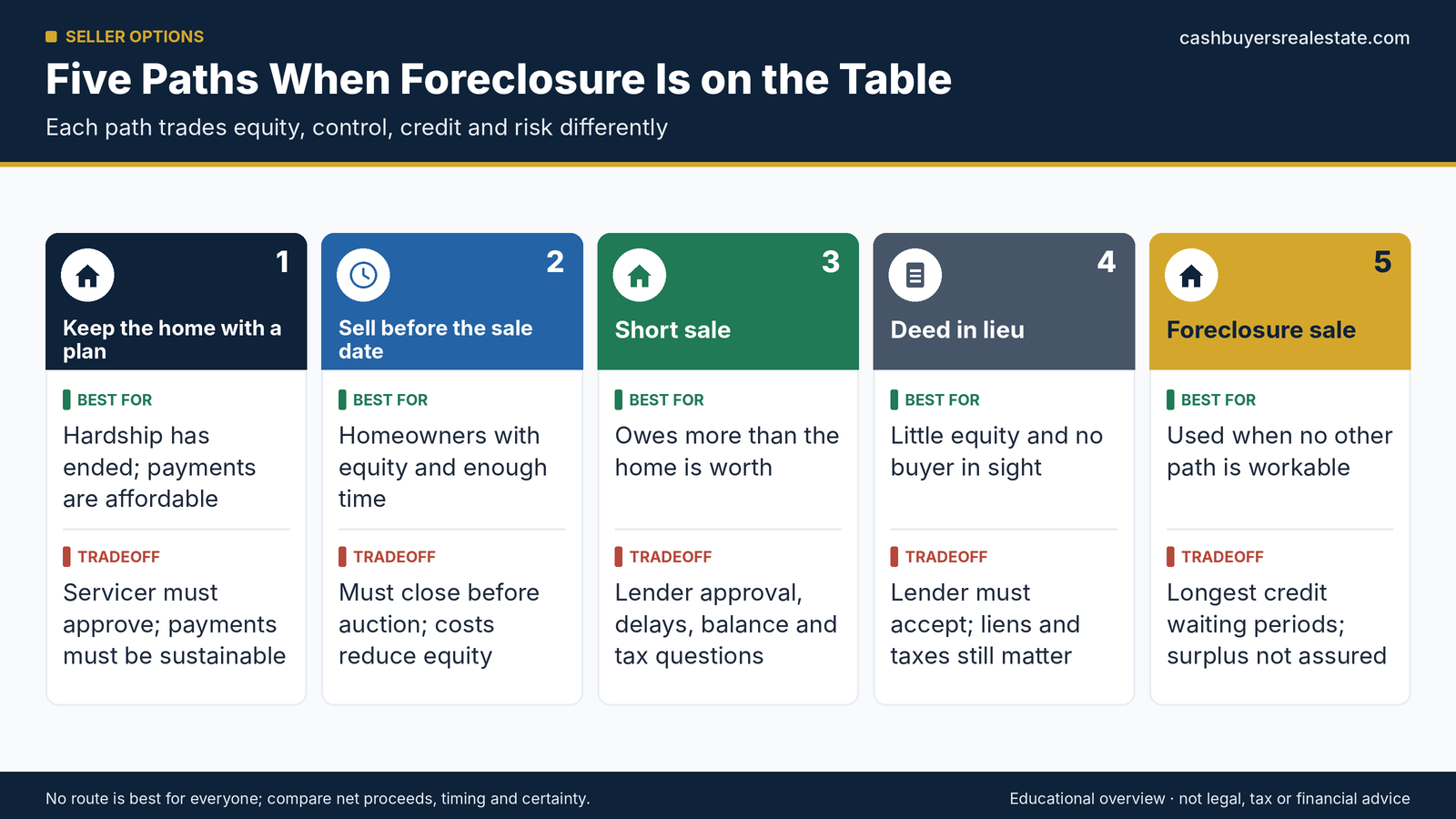
Text version of this infographic
- Keep the home with a plan — best for: Hardship has ended; payments are affordable; tradeoff: Servicer must approve; payments must be sustainable
- Sell before the sale date — best for: Homeowners with equity and enough time; tradeoff: Must close before auction; costs reduce equity
- Short sale — best for: Owes more than the home is worth; tradeoff: Lender approval, delays, balance and tax questions
- Deed in lieu — best for: Little equity and no buyer in sight; tradeoff: Lender must accept; liens and taxes still matter
- Foreclosure sale — best for: Used when no other path is workable; tradeoff: Longest credit waiting periods; surplus not assured
When a Sale Date Is Set: Redemption, Auctions and Surplus Funds
Many homeowners assume that once a sale date appears, nothing can be done. In fact, options often remain until the sale occurs and, in some states, afterward. They differ so much by state, however, that this section is mostly about knowing what to ask and what the statutes in a few states look like.
Redemption, reinstatement and postponement
Reinstatement and redemption rights vary widely
It helps to separate two ideas. Reinstatement is the right, in some states and under some loan documents, to cure the default by paying the arrears and costs before the sale and resume the loan. Redemption is the right to take the property back by paying what the law requires; in some states that right ends at the sale or soon before, while in others it continues for a period after the sale.
Real statutes illustrate the range. Florida’s statute lets a mortgagor redeem by paying the amount due plus costs at any time before the later of the clerk’s filing of a certificate of sale or the time set by the judgment, and states that otherwise there is no right of redemption. California’s statute permits reinstatement of a monetary default up to five business days before the date of sale in the initial notice of sale. Minnesota’s statute, by contrast, gives a mortgagor a default period of six months after the sale to redeem by paying the sale price plus interest, extended to twelve months in certain listed circumstances. Michigan’s statute sets redemption periods that depend on the property type and circumstances, from one month for abandoned residential property to six months in the circumstances the statute describes for residential property, to one year in the default and agricultural cases.
The takeaway isn’t that your state looks like any of these. It’s that the same word, “redemption,” can mean no right at all, a right that ends the day before the sale, or a right that lasts for months after it. Ask your housing counselor or attorney three direct questions: Can I reinstate, and by what date? Is there a redemption period after the sale, and how long is it? What exactly must I pay to use either right?
Postponements, bankruptcy and the final days
Sales are postponed for many reasons: the lender’s request, a court order, a pending loss mitigation review, a bankruptcy filing or a scheduling issue. Statutes often regulate notice when a sale is postponed. California’s statute, for example, requires written notice to the borrower within five business days after a sale is postponed for at least ten business days. A postponement is not a guarantee of anything, and you shouldn’t assume it will happen; confirm the current sale date directly with the trustee, the foreclosure attorney or the court, and keep checking.
If you’ve applied for loss mitigation, your servicer’s compliance obligations under Regulation X apply to the sale, and a sale conducted in violation of those rules may be challengeable, which a lawyer can evaluate. A chapter 13 bankruptcy filing stops a foreclosure through the automatic stay, but as the federal courts note, it doesn’t help if the sale was completed before the filing, and it requires continued payments. These are high-stakes legal questions that depend on the facts, so in the final days the most useful step is usually a same-day call to an attorney who handles foreclosure defense or bankruptcy, or to a legal aid office.
Keep your own record, too. Save every notice, envelope and email, note the dates you applied and the dates the servicer acknowledged, and keep copies of what you sent. If something goes wrong, those dates are your evidence.
What happens to the money and the house after an auction
Sale proceeds and surplus funds
When a foreclosure sale produces more than the debt, the extra is called surplus, and state law controls who receives it. California’s statute orders the distribution of trustee’s sale proceeds first to the costs and expenses of the sale, then to the secured debt being foreclosed, then to junior liens in order of priority, with any remainder going to the owner. Florida’s surplus statute presumes that the owner of record at the filing of the lis pendens is entitled to surplus after subordinate lienholders who timely file claims, and provides that surplus not disbursed one year after the sale is presumed unclaimed and is handled under the state’s unclaimed property law.
The practical advice is simple. If a sale could produce a surplus, keep your mailing address current with the trustee, the court clerk and the foreclosing attorney, ask how and by when a claim must be made, and watch for junior lienholders making claims ahead of you. Surplus is more likely when there’s substantial equity, which is also when a pre-sale market sale is most likely to put more money in your hands. A foreclosure auction, by contrast, is a bidding event: the price depends on who attends and bids, the lender may bid up to its debt, and a lower sale price means less or no equity for you. You can’t count on an auction to match what a marketed sale would bring.
Deficiencies, eviction and moving out
After a sale, two practical questions arise: whether there is a remaining debt, and how long you can stay. The first is the deficiency issue discussed above and depends on state law and the type of loan. If a deficiency is possible, a lawyer can tell you whether and when the lender can pursue it and what the limitation periods look like.
The second depends on state eviction procedures. The new owner, which is often the lender, can generally begin the process to take possession after the sale, but how fast it proceeds, what notice you receive and whether you have a right to remain during a redemption period are all state-specific. If anyone offers money to leave by a certain date or to leave the property in good condition, get the offer in writing and have it reviewed before you rely on it. Avoid assuming that a posted notice means you must leave on that day, and avoid ignoring it; ask a counselor or attorney what the notice means in your state.
Planning where you’ll live is as important as the legal steps. If the home will be lost or sold, start looking at rentals early, gather documents landlords request and ask whether your servicer or a counselor can connect you to relocation resources. A planned move on your schedule is better than one forced by a deadline.
Agents, Cash Buyers and Rescue Scams: Selling When Time Is Short
If you decide that selling is the right route, the next question is who buys the house and how. Two legitimate approaches dominate: listing with a real estate agent, and selling directly to a buyer who can pay cash. There is also a third category you need to be able to recognize and avoid, because people in foreclosure are targeted by schemes that look like help.
Comparing ways to sell on a short timeline
Listing with an agent: price, process and the sale-date risk
A conventional listing exposes the home to the widest group of buyers, which is how homeowners with real equity tend to capture the most of it. A real estate agent who has handled pre-foreclosure sales will understand the timeline, will price the house to attract offers in the first couple of weeks and can coordinate with the servicer, the title company and any foreclosure attorney. You pay agent compensation, which is negotiable and varies, along with the usual seller closing costs, and you accept showings and the possibility that an offer falls through.
The weak point is the calendar. Buyers who finance their purchase need an appraisal and underwriting, and an inspection period gives them a way to renegotiate or exit. If the foreclosure sale is close, each of those steps eats into the cushion. Ask the agent how many days from contract to closing are typical in your area for financed buyers, which offers they would prioritize, and what they’d do if the buyer asks for repairs or credits when time is short. A firm closing date, a buyer with a strong pre-approval and a limited inspection period are worth more to you than a slightly higher price on a slower contract.
Pricing strategy matters too. Pricing a house at or slightly below market value can generate several offers quickly, while overpricing can burn the weeks you don’t have. If the home needs work, the guide to selling a fixer-upper quickly explains how buyers value condition. For a general comparison of listing and investor routes, see cash buyers versus real estate agents.
Selling to a cash buyer or investor: speed, discount and terms
A cash buyer or investor can often close faster because there’s no lender underwriting or appraisal, and the buyer usually takes the property as-is. In exchange, the offer typically sits below what an open-market buyer might pay, because the buyer is pricing in repairs, holding costs, resale risk and a profit margin. Methods differ, so the same house can draw different offers, and your equity determines how much room you have to accept a discount. The following example puts hypothetical figures on the three possibilities for the house in scenario A.
Illustrative example (hypothetical numbers, not market data): The home from scenario A could sell on the open market for $320,000. An investor offers $285,000 as-is, and the seller pays $3,000 in closing costs. If the loan is not resolved and the property goes to a foreclosure auction, the price depends on who bids; assume for illustration that the only bid equals the debt and no surplus remains. The payoff in each case is the same $257,000 and does not include any other liens.
| Route | Price | Payoff | Costs | Left over | Timing and risk |
|---|---|---|---|---|---|
| List with an agent | $320,000 | $257,000 | $22,400 | $40,600 | Longer; depends on buyer financing and closing before the sale date |
| Cash buyer or investor | $285,000 | $257,000 | $3,000 | $25,000 | Often shorter; verify funds and contract terms |
| Foreclosure auction | $257,000 | $257,000 | $0 | $0 | No control over price; deficiency or other claims depend on state |
The investor’s offer in this example leaves $15,600 less than the listing, and in exchange removes showings, financing contingencies and most of the schedule risk. Whether that is worth it depends on how much time remains and how confident you are that a listing would close. The auction row illustrates that equity can disappear when a sale is left to the bidding process, which is the main reason homeowners with equity usually find it worth at least comparing a marketed sale first. Our net proceeds calculator can help you run your own figures.
Foreclosure rescue scams and how to verify a buyer
How foreclosure rescue scams work
The FTC’s guidance on mortgage relief scams describes the common patterns. Under the federal Mortgage Assistance Relief Services rule, a company generally can’t charge a fee until it has given you a written offer from your lender or servicer that you’ve accepted, and it must make specific disclosures first. Lawyers have a limited exception, but only if they are licensed in your state, provide real legal services and put your money in a client trust account. The CFPB’s mortgage help page adds that anyone who promises to stop a foreclosure or asks for payment up front isn’t legitimate, and that free help from HUD-approved counselors exists.
Equity-skimming schemes work differently and can look like a sale. A “buyer” offers to purchase the house quickly and let you stay as a renter with an option to buy it back, but the deed transfer and the rent terms are written so that you lose both the home and the equity. The FTC lists rent-to-buy and sell-for-cash pitches among the warning signs. Not every sale-leaseback is a scam, but this structure deserves a lawyer’s review before you sign.
| Warning sign | Why it matters | What to do |
|---|---|---|
| Asks for payment before delivering results | Federal rules restrict advance fees for mortgage relief services | Don’t pay; report to the FTC and your state attorney general |
| Tells you to stop paying or stop talking to your servicer | Legitimate companies don’t say this, and it can speed the process | Keep communicating with your servicer and a counselor |
| Asks you to sign over the deed or title | You may lose ownership and equity, sometimes inside a stack of papers | Don’t sign anything transferring title without attorney review |
| Guarantees a modification or stopping the foreclosure | No one can promise what a lender will approve | Treat guarantees as a reason to walk away |
| Pressures you to sign quickly | Leaves no time to read or get advice | Take the documents home; have a lawyer or counselor review |
| Offers a rent-back or buy-back arrangement | Equity-skimming deals can end with the loss of home and equity | Get a lawyer’s review of every term before agreeing |
| Claims government affiliation or tells you to pay someone other than your servicer | Typical of impersonation and payment fraud | Verify through your servicer and HUD-approved counselors |
Read the table as a prompt to slow down, not as a checklist that proves a company is crooked or honest. Some of these features, such as a fast sale or a rent-back, can occur in legitimate deals, which is why the response in each row is to verify and get independent advice rather than to assume.
Verifying a buyer and the contract before you sign
Whoever you sell to, ask for the buyer’s full legal name and the name of the closing company or attorney. Ask for proof of funds, such as a bank letter or a lender commitment, and for the earnest money to be deposited with the title company or attorney rather than paid to the buyer or an individual. Confirm whether the contract can be assigned to a different buyer and what happens if the end buyer can’t close. The cash buyer scam prevention guide goes through each of these in detail.
Read what you are signing. A purchase contract for a pre-foreclosure sale should state the price, the closing date, who pays which costs, how the mortgage payoff will be handled and what happens if the sale date arrives first. Be cautious with any document that transfers title before closing, that makes you responsible for continuing mortgage payments after you sign, or that gives the buyer rights to the property without paying you. Closing practice varies by state, with attorney closings in some and title or escrow company closings in others, but in every state the payoff of your mortgage should come from the closing, not from a promise.
Protect the money, too. Confirm wire instructions by phone with a number you already trust, and never send money to anyone claiming to help with the foreclosure. Some states also have specific statutes for people who advise on or buy homes in foreclosure, and your state attorney general’s office can tell you whether such rules apply. And do not feel rushed: a legitimate buyer will let you have an attorney read the contract, and a few days of review is usually possible even on a tight schedule. The cash home sale process guide shows what a normal closing sequence looks like.
Complications That Change the Plan: Liens, Co-Owners, Taxes and Starting Over
The straightforward case, one owner with one mortgage and a clean title, is only part of the picture. Several complications can change which route is feasible and how much time you need, and they’re worth checking before you commit to a plan.
Title, ownership and who must sign
Second mortgages, HOA liens, judgments and tax liens
Foreclosure on a first mortgage is rarely the only claim against a property. Home equity loans and lines, second mortgages, homeowners association assessments, judgment liens and unpaid property taxes can all attach to the title. In a normal sale, they get paid from the proceeds at closing, and the title company will not close until it has payoff figures for each one. If the sale price doesn’t cover all of them, the house is effectively underwater and the conversation moves to short sale or other routes.
Different liens have different priorities and different consequences. In many places a property tax lien takes priority over mortgages, and an unpaid tax bill can create its own foreclosure risk. A second mortgage holder may be wiped out by a foreclosure of the first, in which case the debt may remain as an unsecured claim against you in some states; in a short sale, the second lender usually has to agree to release its lien, sometimes for a negotiated payment. Order a title search or ask a title company to run a preliminary report early, so there are no surprises. The guide to selling quickly with liens covers the mechanics.
Also check for recorded notices you haven’t seen. A lis pendens, which announces a pending foreclosure lawsuit in judicial states, or a recorded notice of default in non-judicial states, will appear on any title search. That’s normal, and a title company knows how to handle it, but it also means any buyer will know about the situation; there is nothing to hide, and it’s best to be matter-of-fact about it.
Co-owners, divorce, death of a borrower and probate
Everyone whose name is on the title generally has to agree to a sale and sign the deed, whether or not they’re on the mortgage. If you divorced and one spouse left the house, if siblings co-own an inherited property or if a co-owner can’t be found, the sale may stall until ownership is sorted out. In those cases, a real estate attorney in your state is often the quickest way through, and the housing counselor can help coordinate.
If the borrower has died, the situation changes again. Heirs or a personal representative may be able to talk to the servicer, but proving authority takes documents, and in many cases a court-supervised probate process is involved in transferring or selling the property. This is a specialized area, and it overlaps with the guides on selling an inherited house and selling a house in probate. Divorce adds its own complications, covered in selling a house fast during divorce, including who is liable on the loan and what a court order requires.
If you’re in one of these situations, say so at the start of every conversation with the servicer, the agent and the counselor. It affects who can sign, who can speak for the loan and which documents the servicer will request. Starting those conversations early can save weeks.
The financial aftermath
Canceled debt, gains and the 1099-C
Taxes are the part of this process that surprises people most. According to the IRS, canceled debt is generally taxable income, reported in the year the cancellation occurs, and a creditor may send Form 1099-C showing the amount. That can apply when a lender forgives part of a mortgage in a short sale, accepts a deed in lieu for less than is owed or releases a deficiency. Several exclusions exist: debt discharged in a Title 11 bankruptcy case, debt canceled to the extent you were insolvent, and, for some years, qualified principal residence indebtedness. Claiming an exclusion involves filing Form 982 with your return.
The principal residence exclusion is the one to check carefully. The IRS page, last reviewed on September 24, 2026, says the exclusion applies if the debt is discharged before January 1, 2026, or is discharged under an arrangement made and documented in writing before that date. That means a short sale, deed in lieu or principal reduction finalized now may not qualify unless a written arrangement predated 2026, and the rules could change, so confirm the current status with a tax professional. The insolvency and bankruptcy exclusions are separate and have their own requirements.
Taxes can also arise from the sale itself. If you sell your main home for more than your tax basis, the IRS allows many homeowners to exclude up to $250,000 of gain ($500,000 on a joint return) if they meet the ownership and use tests, which generally means owning and living in the home for at least two of the five years before the sale. Foreclosures and short sales can have their own tax treatment, which IRS Publication 4681 covers. None of this is a reason to delay action. It is a reason to bring a tax professional into the conversation before you accept any deal that involves forgiven debt.
Rebuilding: renting, credit and finding your next place
Plan the next chapter alongside the legal one. If you’ll rent, collect the documents landlords typically request, such as pay stubs, bank statements, references and identification, and be ready to explain the circumstances briefly and factually. Some landlords look closely at recent payment history, and a documented explanation can help. Budget for a security deposit and moving costs from your sale proceeds, if there are any, or ask a counselor about assistance programs.
On credit, the effects of the route you choose combine with the effects of the missed payments that came before. Payment history carries weight in credit scoring, so catching up or resolving the loan sooner generally limits the damage compared with letting delinquencies stretch on. Lender waiting periods for a new mortgage, such as the Fannie Mae periods mentioned earlier, count from the completion of a foreclosure, short sale or deed in lieu, so the date and type of resolution matter. A housing counselor can help you build a budget, plan a credit rebuilding strategy and, later, work out when and how to buy again.
Finally, give yourself some grace. Falling behind on a mortgage is far more common than people admit, and it often follows a layoff, an illness, a divorce or a family emergency, not carelessness. What matters now is making informed choices with the information in front of you. The checklist graphic below pulls together the six items that most often determine how this goes: your payoff and equity, the condition of the property, buyer financing, title issues, closing readiness and the date you need to be done.
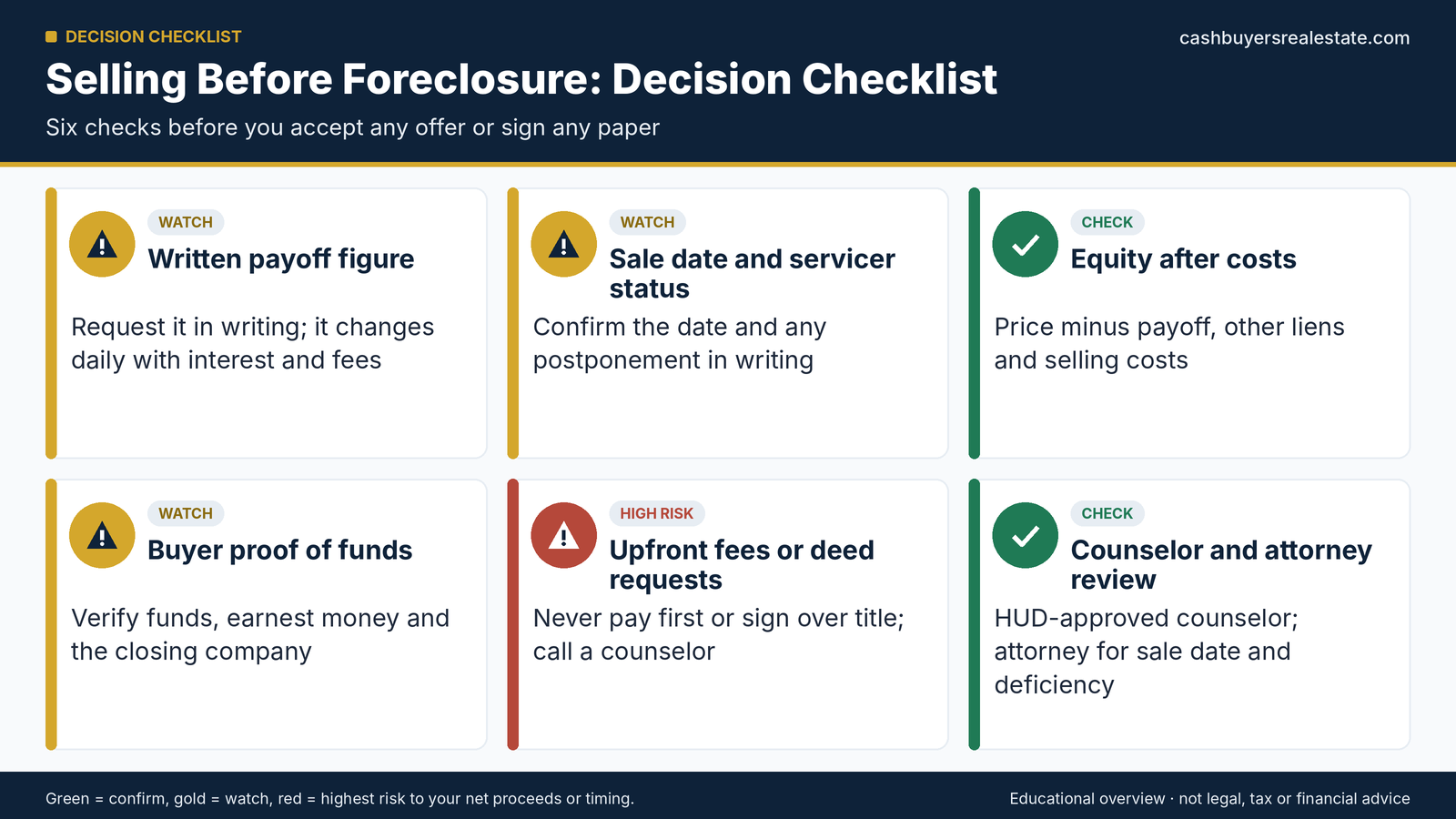
Text version of this infographic
- Written payoff figure — Request it in writing; it changes daily with interest and fees
- Sale date and servicer status — Confirm the date and any postponement in writing
- Equity after costs — Price minus payoff, other liens and selling costs
- Buyer proof of funds — Verify funds, earnest money and the closing company
- Upfront fees or deed requests — Never pay first or sign over title; call a counselor
- Counselor and attorney review — HUD-approved counselor; attorney for sale date and deficiency
Frequently Asked Questions About Selling Before Foreclosure
These answers are general. Your state, your loan and the stage your case has reached can change them, so use them to frame questions for your servicer, a housing counselor or an attorney.
Questions about timing and your rights
Questions about deadlines and protections
- How long do I have before the house is foreclosed on?
There’s no single answer. Under federal servicing rules a servicer generally can’t make the first foreclosure notice or filing until your loan is more than 120 days delinquent, with narrow exceptions. After that, state law controls the notices, waiting periods and sale date, and the total time can range widely. The notice you receive and your state’s statutes are the best guide, and a housing counselor can help you read them.
- Can the servicer keep foreclosing if I’ve applied for help?
Often it can’t, if you submit a complete application early enough. Regulation X limits a servicer’s ability to start foreclosure or to move for judgment or conduct a sale while a complete application received more than 37 days before the sale is pending, subject to exceptions such as a denial after the appeal period ends. The rule doesn’t guarantee approval, and application timing and completeness matter a great deal.
- Does signing a contract to sell stop the foreclosure?
Not by itself. The foreclosure generally continues until the loan is paid off at closing, reinstated or the sale is postponed or stopped by a court. A servicer or foreclosure trustee may agree to postpone a sale when a solid contract is in hand, but that is a request and not a right, so keep the closing date comfortably before the sale date.
- Can I still sell if the case is already in court?
In many cases, yes, as long as the sale closes and the lien is paid before the property is sold at auction. In a judicial state, the court case continues until the lender is paid or the matter is dismissed, so your attorney and the lender’s counsel will need to coordinate the payoff and dismissal. Check with a local attorney about the steps in your state.
Questions about equity, payoff and costs
- Do I keep my equity if I sell?
If the sale price exceeds the payoff, the sale costs and any other liens, the remainder is yours before taxes. At a foreclosure auction, equity can be reduced or lost depending on the bidding, and any surplus is distributed under state law, usually to junior lienholders first and then to the owner. That difference is why homeowners with real equity often compare a marketed sale against the auction outcome.
- How do I find out how much I’d have to pay off?
Ask your servicer for a written payoff statement. Federal rules generally require one within seven business days of a written request, but when the loan is in foreclosure or bankruptcy the deadline becomes “a reasonable time,” so request it early. Remember that the payoff changes daily and includes interest and fees, so the final number will be updated before closing.
- What costs come out of the proceeds at closing?
Typically the mortgage payoff, any other liens, real estate agent compensation if you list, title and closing fees, recording and transfer charges that vary by state, prorated property taxes and any agreed credits to the buyer. Our guide to fast home sale closing costs breaks these down, and a title company or closing attorney can prepare an estimated settlement statement.
Questions about alternatives, buyers and the aftermath
Questions about short sales, deeds in lieu and bankruptcy
- Is a short sale better than a foreclosure?
Often it’s easier on the borrower, partly because lender waiting periods for a new mortgage can be shorter after a short sale than after a foreclosure, and because you control more of the process. But a short sale requires the lender’s approval, can take time and may leave questions about the remaining balance and taxes. Whether it’s better depends on your loan, your state and the lender’s terms.
- Will a short sale or deed in lieu erase what I owe?
Not automatically. Some lenders agree to waive the remaining balance, and the CFPB notes that a deed in lieu may help you avoid personal liability for it, but practices and state laws differ. Get any release or waiver in writing before you close, and ask a tax professional how canceled debt would be treated.
- Does bankruptcy stop foreclosure?
Filing a chapter 13 petition stops a foreclosure immediately through the automatic stay, and the plan can let you catch up on past-due payments over time, usually three to five years, as long as you keep making regular payments. It doesn’t help if the home was already sold at auction before you filed. Bankruptcy has serious consequences, so talk to a bankruptcy attorney before deciding.
- Can I rent or buy again after a foreclosure or short sale?
Usually yes, though it takes planning. Renting depends on each landlord’s screening standards. Buying depends on the lender’s waiting periods, which for conventional loans purchased by Fannie Mae are generally seven years after a foreclosure and four years after a short sale or deed in lieu, with shorter periods for documented extenuating circumstances. Other loan programs set their own rules.
Questions about buyers, scams and getting help
- Is it safe to sell to a cash buyer when I’m in foreclosure?
It can be, with precautions. Verify the buyer’s identity and proof of funds, use a title company or attorney for the closing, confirm that your mortgage will be paid from the proceeds and have a real estate attorney read the contract. Be cautious about anyone who asks for a deed before closing, wants fees up front or discourages you from contacting your servicer.
- How do I find a legitimate housing counselor?
Use the CFPB’s housing counselor search, which draws on HUD’s list, or call HUD at (800) 569-4287. You can also call the HOPE Hotline at (888) 995-HOPE (4673). HUD-approved agencies can often provide advice at little or no cost, and not every counselor offers every service, so check what the agency covers.
- What should I do if I think I’ve been scammed?
Act quickly. Stop sending money, keep every document and message, and report the scheme to the FTC at ReportFraud.ftc.gov and to your state attorney general. If you signed a deed or other transfer, contact a real estate attorney right away to find out what can be done, and tell your servicer and your housing counselor.
Choosing Your Path and Taking the First Steps
You now have the framework: how the process works, what your servicer owes you, what a sale can accomplish, how it compares with the alternatives and where the risks lie. The remaining task is to turn that into a decision that fits your own finances and your own timeline, without being rushed into one by anyone.
Matching the path to your situation
A decision framework by equity, income and time
Three variables do most of the work: how much equity you have, whether you can afford the payment going forward and how much time remains before a sale date. The table maps common combinations to the options usually worth exploring first. It isn’t a recommendation for your specific case; it’s a way to focus your conversation with a counselor or attorney.
| Your situation | Options often worth exploring first | Key question to ask |
|---|---|---|
| Temporary hardship that has ended; income recovered | Reinstatement, repayment plan, forbearance, modification | What will the new payment be, and can I sustain it? |
| Ongoing shortfall, meaningful equity, weeks or months before a sale | Marketed sale with an agent, or a direct sale to a buyer with funds | What is my net after payoff and costs, and can it close in time? |
| Meaningful equity but very little time | Fast sale to a verified cash buyer, postponement request, attorney consult | How much does the discount cost me compared with auction risk? |
| Little or no equity; cannot sustain payments | Short sale or deed in lieu, with written deficiency terms | Will the lender waive the balance, and what are the tax effects? |
| Co-owners, death of a borrower or title problems | Attorney and counselor first; then sale or loss mitigation | Who has authority to sign and speak with the servicer? |
| Want to stay but have complex debts | Consultation with a bankruptcy or foreclosure-defense attorney | Which legal route protects the home and what does it cost? |
If you find your situation matches two rows, that’s normal. Start with the option that keeps the most choices available, because a loss mitigation application or a counselor meeting rarely rules out a later sale, while some sale decisions can’t be undone.
When selling is not the right answer
It’s worth saying directly that a sale is not the right move for everyone. If your income has stabilized and your servicer offers a modification or repayment plan you can sustain, staying may preserve your equity, your housing and your credit better than selling. If the home has little equity and sale costs would consume what’s left, a short sale or a modification may be wiser than a conventional listing. If you rely on the home for your family’s stability, a sale on a rushed timeline may be the most costly option emotionally and financially, even when the numbers look acceptable.
Selling also trades one set of risks for another. A deal that falls through can leave you with less time than before. A discounted cash sale can leave real money behind if you had other options. And a sale that produces forgiven debt or a taxable gain can carry costs that don’t show on the closing statement. The goal is not to avoid foreclosure at any price but to reach the outcome that serves your household best, with the help of professionals who are not paid only if you sell.
The hub page on selling before foreclosure collects related guides, and selling a house in 30 days covers what a compressed timeline demands.
What to do this week
Documents and numbers to gather
You can make real progress in a few days. Collect the following, and keep copies in one folder, physical or digital.
- Every notice, letter and court paper you’ve received about the loan, in date order, with envelopes if the postmark matters.
- Your most recent mortgage statement, the note and deed of trust or mortgage if you have them, and your homeowners insurance and property tax bills.
- Pay stubs, benefit letters, bank statements and a list of monthly expenses, which servicers use to evaluate a loss mitigation application.
- A hardship letter in plain language that explains what happened, whether it is temporary and what you can pay now.
- Information about other liens, such as a second mortgage, home equity line, HOA dues or judgments.
- Photos and notes on the condition of the house, plus a list of repairs and any known defects.
- The names, contact details and any signed agreements for anyone else on title or the loan.
Then run the numbers: a payoff request in writing, an estimate of what the house would sell for from a real estate agent’s comparative market analysis, and a rough net sheet that subtracts the payoff and costs. Even if you never sell, the exercise shows you what you have to work with, and the guide to closing costs when selling a house can help you complete the cost side.
Who to call and what to ask
Call in this order if you can. First, a HUD-approved housing counselor, ideally the same day you decide to act; they’ll help you understand the notices, prepare the application and weigh the options without a stake in the outcome. Second, your servicer, with the script described earlier, to confirm the amount owed, the status of any foreclosure and the documents needed. Third, a real estate attorney or legal aid office in your state if you have a sale date, a court case, co-owner issues or questions about deficiency and bankruptcy. Fourth, if selling is on the table, one or more agents and, if you want to compare, a direct buyer, using the verification steps above. A tax professional belongs on the list before you accept any deal involving forgiven debt.
With each, ask what the options are, what each costs and how long it takes, what you will owe afterward, and what the downside is if something goes wrong. Ask for answers in writing. Anyone who is unwilling to explain the downside, who pressures you to sign before you have had time to read, or who asks for money before delivering a result is giving you information about how to treat their advice.