
How Fast Can I Sell My House? Timeline, Costs & Seller Options
When people type “how fast can I sell my house” into a search box, they usually want a number. Two weeks? A month? Ninety days? The trouble is that a single number hides two separate clocks, and the answer you get depends on which clock is slower for your house. One clock runs from the day you decide to sell until a buyer signs a contract. The other runs from that signature until the money moves and the deed changes hands. Almost every delay a seller experiences lives in one of those two stretches, and each stretch responds to different fixes.
Selling runs on two clocks: time to find a buyer and time from contract to closing. National benchmarks put the median home at about 31 days on the market (NAR, August 2026) and purchase mortgages at about 37 days from application to closing (ICE, March 2026). A cash buyer can skip the lender’s clock, but title work, payoff letters, and paperwork still set the floor.
Add those two medians together and you get a rough guide of about two and a half months for a typical financed sale, with the caveat that adding medians is a sketch, not a forecast. Your own timeline could be much shorter if you price sharply and a pre-approved or cash buyer shows up in the first week. It could be much longer if the house needs probate, an unpaid lien must be cleared, or a condo association takes weeks to produce its documents. The rest of this guide takes each stage apart so you can see which parts of your timeline you control and which belong to someone else.
You’ll find a stage-by-stage model of a home sale, from preparation through funding, with notes on how long each stage tends to take and what stretches or shrinks it. You’ll see how timelines differ among financed listings, cash purchases, instant-offer platforms, and auctions, and how a few common complications (a mortgage payoff, HOA documents, a probate appointment) change the schedule. There’s also a section on calendar math, because a surprising number of closings slip over a weekend, a holiday, or a bank’s wire cutoff. And because a faster closing isn’t automatically a better one, the final sections compare when to choose an early date, when to accept a late one, and how to write the date into a contract so it protects you.
One more point before the details. A fast sale and a good sale are different things, and the fastest route is not always the best one for your situation. If you are selling because of a deadline, the later sections show how to work backward from it. If you are simply curious how quickly you could sell, the same math tells you how much flexibility you have, and flexibility is worth money.
How Fast Can I Sell My House? The Two-Clock Answer
What the benchmark data says
Time to contract: what days on market actually measures
The most quoted speed statistic in real estate is days on market, and it measures only the first clock: how long a listing is active before a buyer is under contract. In its August 2026 existing-home sales report, as summarized by the National Association of Home Builders, the National Association of Realtors reported a national median of 31 days on the market, up from 29 days in July and unchanged from August 2025. The same report showed 4.9 months of supply, the highest since November 2015, and cash buyers accounting for 27 percent of sales, down from 28 percent a year earlier. NAR’s 2025 Profile of Home Buyers and Sellers, which covered sales from July 2024 through June 2025, put the median time on the market for recently sold homes at about four weeks.
Other sources produce different figures, and that is normal. Realtor.com’s 2026 seasonal analysis, as reported by FOX television stations, found that homes listed in mid-April 2025, the week it now flags as the best of the year, spent 50 days on the market, 10 days faster than that year’s average of 60. Differences like these come from methodology: where the clock starts, whether relisted properties reset it, which listings are included, and whether it stops at contract or at closing. When two benchmarks disagree by 20 days, check what each one counts before deciding which applies to you.
The takeaway for a seller is modest but useful. A month is a reasonable national reference for how long a priced-right listing takes to find a buyer, and the national figure moves a few days from month to month. It says nothing about whether your listing will fit that pattern, which depends on price, condition, and neighborhood competition.
Time to close: what lending data shows
The second clock starts when the buyer applies for a mortgage (or, for a cash buyer, when title work begins) and ends at closing. ICE Mortgage Technology’s May 2026 Mortgage Monitor reported that purchase loans closed in an average of 36.8 days in March 2026, down from 37.3 days a year earlier and the fastest average since ICE began tracking the metric in 2019. A typical purchase loan took about 11 days from application to rate lock and then roughly 26 more days from lock to closing. For all loan types, including refinances, the average was 38.2 days.
Two caveats apply. First, an average of financed purchases says nothing about cash purchases, which skip underwriting and appraisal but not title work, and this guide does not quote a cash-closing benchmark because it could not verify a reliable one. Second, the statistic describes loans that did close. Contracts that fall apart over an appraisal gap or loan denial are not in the sample, even though they add real time for the seller who has to start over. Sellers who want certainty about the second clock should ask how the buyer is paying and how far along they are.
If you take one lesson from the lending data, it’s that 37 days is roughly the floor for a typical mortgage purchase after the buyer starts the process in earnest, and that a lot of the time goes to steps (lock, underwriting, appraisal, final approval) that you can’t speed up from the seller’s side. What you can do is remove obstacles that would add days: a clean title, a ready payoff request, and responsive scheduling.
Reading benchmarks without fooling yourself
Medians hide the tails
A median is the middle outcome: half of homes sold faster and half slower. It does not describe the fastest 10 percent or the slowest. A national median of 31 days can coexist with a local market where well-priced homes get contracts in a week and overpriced ones sit for four months. Price tier matters, as does property type; condominiums, rural properties, and homes with unusual features often follow different patterns than the typical suburban house.
You can get a more useful benchmark with a short exercise. Ask a local agent for the most recent 10 sales in your neighborhood and price range, along with the listing date, contract date, and closing date for each. Look at the spread. If eight of ten went under contract within three weeks and two took three months, you’ve learned that your market rewards pricing and that the long tail is real. Ask the agent which factors separated the quick ones from the slow ones, because those factors (price relative to comps, condition, showing access) are what you control.
The same exercise works for a cash sale. Ask any buyer how many purchases like yours they’ve closed recently and how long they took, from contract to funding. A buyer who can answer with specifics is better evidence than any national average, though you should verify claims with the title company or attorney who closed those deals if you can.
Closing date versus possession date
Sellers use “sold” to mean three different events: the day the contract is signed, the day the closing documents are signed and funds are disbursed, and the day they hand over the keys. These usually fall on different calendar days, and conflating them causes misunderstandings. The closing date is when ownership transfers and your proceeds are released. The possession date is when the buyer can occupy. In many contracts the two coincide, but they don’t have to.
If you need money first and have time to move, you can sometimes close early and arrange a short rent-back, staying for a set number of days under a written occupancy agreement. If you need to be out quickly but don’t need the money right away, a later closing with earlier access (rare, because it exposes the buyer to risk) is the reverse. Neither arrangement is automatic; both need to be negotiated and written down, and lenders may restrict them on financed purchases. Think of time-to-money and time-to-keys as two separate targets, and be clear with every buyer about which one drives your schedule.
This distinction also matters when you compare routes. A buyer who promises “closing in two weeks” might also expect you to leave on closing day. A buyer who offers a “30-day close” might be happy to let you stay another two weeks. The headline number rarely tells you which situation you’re in until you read the possession clause.
A Stage-by-Stage Timeline Model
Before the buyer: preparation, pricing, and launch
Preparation: documents, pricing, and access
The first stage is the one sellers most often skip, and it is the one that saves the most time later. Preparation covers everything you can do before a buyer exists: requesting a mortgage payoff statement, locating the deed and survey, finding the HOA or condo contact, gathering utility and tax bills, deciding on a price strategy, and making the house easy to show. None of these tasks is difficult. Several of them depend on other people’s calendars, which is why they belong at the start, not in the middle of a contract.
Federal rules put an upper bound on one of those waits. Under Regulation Z, a mortgage servicer must provide a payoff statement within a reasonable time and in no case more than seven business days after receiving a written request, with exceptions for loans in bankruptcy or foreclosure, reverse mortgages, and some disaster situations. Seven business days is nearly a calendar week and a half, so waiting until a contract is signed to ask for a payoff can cost you a part of your timeline. Association documents can take longer, as the later section on HOA paperwork explains.
Realistic preparation for a house in decent condition might take a few days of focused effort. A house that needs cleaning out, minor repairs, or a decision about a bigger repair takes longer, and that is where you should decide how much work is worth doing in the name of speed. A seller with a hard deadline will sometimes skip nonessential repairs entirely and let the buyer’s offer reflect the condition, an approach covered in the guide to selling a house fast without repairs.
Launch and the first two weeks of marketing
Interest in a new listing is front-loaded. Buyers who have set alerts see it within hours, the first weekend usually brings the most showings, and the strongest offers often arrive in the first days. That pattern is why pricing and presentation decisions made before launch carry so much weight, and why a listing that draws little traffic in its first two weeks deserves a hard look instead of a wait-and-see approach.
A sensible launch has a short list of milestones: professional-quality photos on day one, a clear showing process, and a planned decision point, such as reviewing offers on a specific date or reviewing the price after the first weekend’s feedback. If you receive a pre-approved offer on day three, ask the buyer’s agent about the lender, the proposed inspection and appraisal windows, and the earnest money amount before treating the number as final. The speed of the second clock begins to take shape in these early conversations.
When offers arrive, compare them on timeline as well as price. An offer with a shorter inspection period, a pre-approval letter from a lender with a record of timely closings, and a larger deposit may be faster and more certain than a slightly higher one with contingencies that push the schedule. Flexible possession terms can also be a bargaining chip: a buyer who needs a specific date may pay more to get it.
From signed contract to funded closing
Contract-to-close milestones, in order
After both sides sign, the transaction moves through a series of steps, some running in parallel. The order below is typical for a financed purchase, though contracts and local practice vary.
- Earnest money deposit. The buyer delivers a deposit to the escrow or title company or the closing attorney within the number of days stated in the contract.
- Inspections. The buyer’s inspection period runs for the number of days written into the contract, during which the buyer can request repairs, ask for a credit, or in some contracts cancel.
- Appraisal. The buyer’s lender orders an appraisal; the outcome can affect the loan amount and trigger renegotiation if value comes in below the price.
- Title search and commitment. The title company or attorney searches records for liens, judgments, easements, and ownership problems, then lists what must be cleared.
- Payoffs, association documents, and seller paperwork. Payoff statements, resale certificates, and any needed estoppel or compliance letters arrive.
- Underwriting and conditions. The lender requests documents from the buyer and issues conditions; when all are met, it issues final approval, often called “clear to close.”
- Closing disclosure, signing, funding, and recording. Documents are signed, the lender and buyer fund, the closing agent disburses proceeds, and the deed is recorded.
ICE’s data gives you the lender-side proportions: about 11 days from application to rate lock and roughly 26 more from lock to closing for the average purchase loan in March 2026. The seller-side steps (payoff, association documents, title clearing) run alongside those 37 days, and the whole sequence moves at the pace of its slowest item. A single missing document can hold up the “clear to close” for days.
The last seven days: disclosure, walk-through, and funding
The final week has its own rhythm. For most mortgage purchases, federal rules require the lender to ensure the buyer receives the Closing Disclosure at least three business days before closing, and the buyer cannot sign until that period has passed. The Consumer Financial Protection Bureau explained when the rule took effect that only three kinds of change restart the three-day review: an annual percentage rate that rises beyond a set threshold (more than one-eighth of a percentage point on a fixed-rate loan, more than one-quarter on an adjustable-rate loan), a change in loan product, or the addition of a prepayment penalty. Other late changes, including seller credits, do not by themselves restart the clock.
For sellers, that means a negotiation over a repair credit in the final week should not by itself push the closing date, though other problems can. The buyer typically conducts a final walk-through within a day or so of closing to confirm the property’s condition and that agreed repairs were done. This is a custom, not a federal requirement, but most contracts provide for it. On closing day the buyer signs and funds the loan, you sign the deed and settlement documents, and the closing agent disburses funds and records the deed. In some places the closing agent waits for recording to be confirmed before disbursing proceeds, which can add hours or a day; ask your title company or attorney how it works locally.
Good communication in this stretch pays off. Confirm the buyer received the disclosure and on what date, ask whether any underwriting conditions are open, and make sure utilities are scheduled to transfer. A seller who knows these facts three days out can solve a small problem before it turns into a postponement.
| Stage | Financed listing | Cash investor | Instant-offer platform | Auction |
|---|---|---|---|---|
| Preparation before launch or offer request | A few days to several weeks, depending on repairs and documents | Often days; mainly gathering documents | Often days; photos and questionnaire | Days to weeks; auction company onboarding |
| Finding the buyer | National median about 31 days on market (NAR, Aug. 2026); local range wide | Offers may arrive within days of a request, if buyers are active locally | Preliminary offer described as typically within 24 to 48 hours (Opendoor guide) | Fixed by the auction calendar |
| Contract to closing | Purchase loans averaged about 37 days (ICE, Mar. 2026) | Set by title work and the contract; no lender steps | Closing date negotiated within the program’s terms | Stated in the auction contract |
| Main source of slippage | Appraisal, underwriting conditions, repair negotiations | Title clearing, payoff, buyer’s funding source | Home assessment adjustments | Buyer’s funding and deposit terms |
Treat the table as a framework for questions: when a buyer or agent gives you a date, ask which stage the date assumes will go smoothly. The process map below condenses the stages into a single view, from preparation through funding, so you can see where the two clocks start and stop.
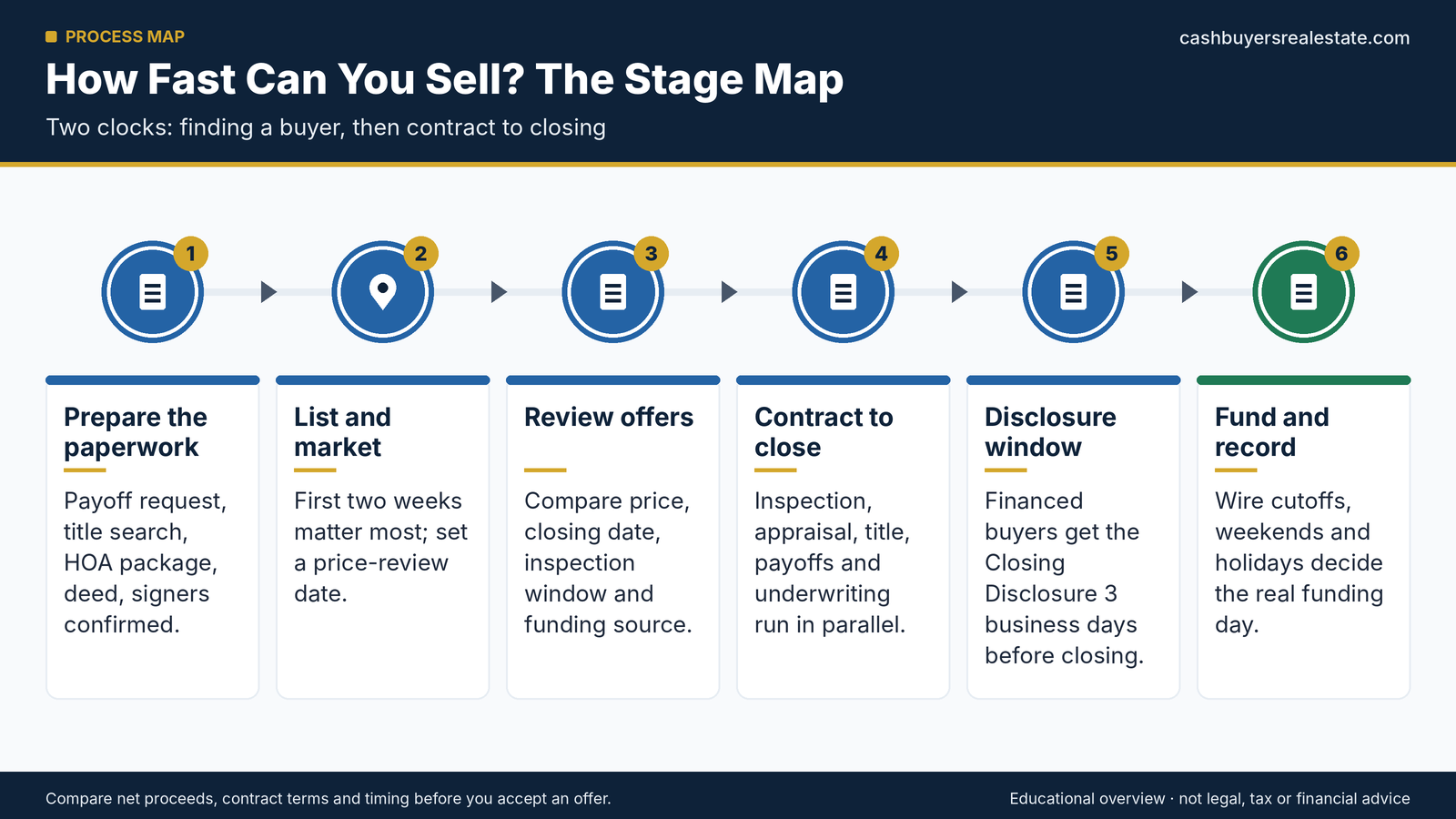
Text version of this infographic
- Prepare the paperwork — Payoff request, title search, HOA package, deed, signers confirmed.
- List and market — First two weeks matter most; set a price-review date.
- Review offers — Compare price, closing date, inspection window and funding source.
- Contract to close — Inspection, appraisal, title, payoffs and underwriting run in parallel.
- Disclosure window — Financed buyers get the Closing Disclosure 3 business days before closing.
- Fund and record — Wire cutoffs, weekends and holidays decide the real funding day.
How Each Sale Route Changes the Timeline
Financed buyers and the listing route
Why mortgage financing adds a predictable layer
Most buyers need a mortgage, and mortgage lending is a process with built-in steps that no seller can eliminate. The lender verifies income and assets, orders an appraisal, reviews the title commitment, and checks that the property meets the loan program’s standards. Each step has a typical duration, and together they explain the 37-day average in the ICE data. The advantage of this predictability is that you can plan a schedule around it. The disadvantage is that any failure, such as an appraisal below the contract price, a lender overlay, or a buyer’s change in employment, can pause or end the contract.
Government-backed loans add property standards. FHA, for example, requires that the property meet its Minimum Property Requirements, and its appraisal or inspection can generate a list of required repairs before the loan can close. In a May 2026 request for public input, HUD noted that a considerable number of FHA appraisals require a condition for repair or inspection and that those repairs can create real costs. VA loans likewise require that a home be suitable for dwelling purposes under VA’s minimum property requirements, which the agency has been reviewing, according to a 2023 Federal Register notice. If your house has visible defects, an FHA or VA buyer’s timeline may stretch while repairs and a reinspection take place, so ask any buyer’s agent what type of loan is involved. The guide to selling a house fast with a mortgage covers the seller’s side of payoff and lender timing in more detail.
Appraisals also come with a calendar of their own. An appraiser must schedule an inspection, write a report, and deliver it, and in a busy market that can take longer than the buyer expects. If value comes in below the price, the parties may negotiate a lower price, a bigger down payment, or termination. A seller who has strong comps ready, and who makes the house easy to access on the appraisal day, can reduce that risk.
Where a listing can speed up
A financed sale can be faster than the average suggests when the seller removes friction. Pricing close to the buyer’s likely appraised value reduces the odds of an appraisal gap. Requesting pre-approval letters and checking with the lender improves your read on the buyer’s strength. A shorter inspection period, a pre-listing inspection that lets the buyer skip a surprise, and a prompt response to every request each shave days off the schedule.
Flexibility on possession and closing date also speeds negotiations because buyers often have constraints of their own: a lease ending, a rate lock expiring, a child starting school. A seller who can say “we can close on your date” has an advantage over one who can’t. Be careful, though, about promising a date you cannot meet. A closing date extension, once agreed, can cost the buyer a rate-lock extension fee and may give them grounds to reduce the price.
The compounding effect matters most. Saving a few days in each stage (documents ready, responsive scheduling, a clean title commitment, quick answers to underwriting questions) can move a closing by a week or more, without anyone cutting a corner. If your goal is the fastest possible route, the overview of the fastest way to sell a house compares the options on speed alone, and the head-to-head page on cash sale versus listing for a fast sale weighs price against time.
Cash buyers, platforms, and auctions
What a cash purchase removes, and what remains
A cash purchase, covered more broadly in the overview of selling a house for cash, eliminates the lender’s clock: no loan application, no underwriting, no appraisal ordered by a lender, no rate lock. It doesn’t eliminate everything else. The buyer still orders a title search, the closing agent still has to clear any liens and obtain your payoff, association documents still must be produced, and the contract still sets an inspection or due-diligence period that may be as long or as short as the parties agreed. The buyer must also produce funds in a form the closing agent will accept, which typically means a wire.
For that reason, a cash buyer’s promised closing date is only as reliable as the title and funding steps behind it. Before you plan around a date, ask for proof of funds and confirm who the closing agent is. The guide to proof of funds explains what acceptable documentation looks like, and the walk-through of the cash home sale process follows a cash transaction step by step. A cash sale with a clean title and a ready seller can move faster than a financed sale; a cash sale with an unresolved lien or a missing signature can move slower.
Speed also depends on the cash buyer’s own situation. An investor buying with a line of credit or hard-money loan may have lender steps of their own. A buyer who is purchasing in a company name may need additional documents to prove authority to sign. None of this is unusual, but all of it is worth asking about.
Instant-offer platforms and auctions
Instant-offer companies compress the first clock. According to Opendoor’s seller guide, a preliminary online offer typically arrives within 24 to 48 hours of a request, after which a home assessment can adjust it into a final offer. Offerpad’s annual report says it may verify a seller’s information through physical or video inspection. Closing dates are generally set in the purchase agreement, and sellers often have some choice within the program’s rules, though terms vary by company, market, and property. Ask what happens to the schedule if the assessment turns up repair credits that you dispute.
Auctions compress the process differently. A property is marketed for a defined period, bidding closes on a set date, and the winning bidder signs a purchase contract with a closing deadline stated in the auction terms. The pace is fixed by the auction calendar, not by negotiation, which is helpful for sellers who want a date and less so for those who need flexibility. Ask for the auction calendar, the contract form, and the deposit terms before you commit.
| Route | First clock (finding the buyer) | Second clock (contract to closing) | Main pace-setter |
|---|---|---|---|
| Financed listing | Market conditions, price, showings | Lender steps plus title | Appraisal and underwriting |
| Cash investor | Days to a few weeks to gather offers | Title, payoff, signing | Title condition and buyer funding |
| Instant-offer platform | Online request, then assessment | Title and chosen closing date | Assessment findings and program terms |
| Auction | Fixed marketing window | Deadline in auction contract | Buyer’s funding and deposit terms |
The table is a map of where delays tend to originate. If one row’s pace-setter is something you can influence, such as a clean title, you can start there.
What Stretches or Shrinks Each Stage
Paperwork that other people control
Mortgage payoffs and lien releases
If you have a mortgage, the closing agent needs a payoff figure good through the closing date, and the lender or servicer is the only source. Federal rules set a ceiling on how long the servicer may take: under Regulation Z, a payoff statement is due within a reasonable time and in no case more than seven business days after a written request, with exceptions that include loans in bankruptcy or foreclosure. That ceiling is a legal outer limit, not a typical wait, but because you can’t know in advance where in the range your servicer falls, the safe move is to ask as soon as you decide to sell. The statement will include per-day interest, so the exact amount changes with the closing date and usually must be updated if the date moves.
Liens add a second layer. A title search can reveal unpaid property taxes, judgment liens, mechanics’ liens, HOA liens, or a second mortgage you’d forgotten about. Each one needs a payoff figure from its holder and, after payment, a recorded release. Lien holders aren’t always fast, and some require written requests, wire instructions of their own, or a negotiated reduction. That work can add days or weeks, which is why sellers who suspect a lien are better off ordering a title search before listing than discovering it in week three of a contract. The guide to selling a house quickly with liens covers how payoffs and releases work.
Practical timing advice: ask for the mortgage payoff on listing day, order a preliminary title search if you have any reason to suspect a lien, and have the account numbers and contact details of every lender and tax authority in a single folder. When a buyer’s title company asks for the payoff, you want the answer to be “already requested.”
HOA, condo, and association documents
Homes in a managed community often require a package of documents before closing: a resale or disclosure certificate, financial statements, governing documents, and a statement of unpaid assessments. Associations or their management companies produce these, usually for a fee, and the turnaround is set by state law, the governing documents, or nothing at all. Where state law sets a deadline, it can be considerable. In Florida, for example, a homeowners’ association must issue an estoppel certificate within 10 business days after a written or electronic request, and if it misses the deadline it may not charge a fee. The statute also caps the standard fee at $250, allows a $100 add-on if the certificate is requested on an expedited basis and delivered within 3 business days, and sets separate fees for delinquent accounts. Those figures come from the Florida statute as checked in October 2026 and can change; other states have different deadlines and fees, and condominiums are often governed by separate rules.
The planning lesson is the same everywhere: association paperwork isn’t something to request after the buyer’s inspection period. Ask the management company for its processing time and fees at listing, and order the package early if your state or contract allows. If the community is slow, build the delay into the closing date a buyer is offered, because a closing date you can’t meet will cost you credibility and sometimes money.
If you are selling a home in an association with unpaid dues or violations, expect more time. Open violations, special assessments, or pending litigation may need to be disclosed or resolved, and some lenders won’t finance units in associations with certain financial problems. A buyer’s lender will review those documents as part of underwriting, so a thin or late package slows both clocks at once.
People, probate, and property condition
Probate, multiple owners, and signing authority
Nobody can sell a property without the authority to sign for it. When the owner has died, authority typically comes from a court appointment, such as letters testamentary or letters of administration, or from a trust’s successor trustee. When several people own the home, each must agree and sign, and when an owner lacks capacity, a guardian or an agent under a power of attorney may need to act. Whether court approval of the sale is required, how long an appointment takes, and what notices must go out to heirs and creditors all depend on state law and sometimes on the individual court’s docket.
For timeline purposes, the point is that these steps cannot be rushed by a buyer’s offer or a seller’s urgency. A buyer can be ready to close in a week, but if the personal representative has not been appointed or a required court confirmation is pending, the closing waits. Plan for weeks to months in many cases, and ask the estate’s attorney for a realistic schedule. Contracts in these situations often include contingencies tied to the appointment or court approval, which protects the buyer but also means the closing date is a target, not a promise. The guides to selling a house quickly in probate and to selling an inherited house fast explain the state-by-state pattern in more depth.
The same logic applies to divorces, co-ownership disputes, and trusts. Align the signers first; the contract second. A signature from only some owners is, in most circumstances, not enough.
Condition, occupancy, and access
The house itself can slow a sale through repairs, inspections, and who is living in it. Findings from an inspection can lead to repair negotiations, and on an FHA or VA purchase they can also require repairs and a reinspection before the loan can close. Permit problems or unpermitted additions can complicate title insurance, appraisals, or lender approvals. A tenant-occupied property adds showing limits, notice requirements, and, depending on the lease and state law, questions about whether the tenant stays or leaves. Vacant homes need working utilities for inspections and appraisals, and a house that’s hard to access slows every visit.
Sellers can often cut days here with simple steps: make sure utilities are on, keep a lockbox or a reliable contact for access, give tenants proper written notice of showings as the lease and state law require, and fix or disclose known problems early. If the house needs more work than you want to take on, selling as-is to a buyer who accepts the condition removes the repair negotiation from the schedule, though not the inspection period. The guide to selling a house quickly with tenants covers the occupancy side in detail.
| Scenario | What changes | Effect on the schedule | Early action |
|---|---|---|---|
| Clean title, no mortgage, no association | Few third parties involved | Baseline; buyer’s financing or due diligence sets the pace | Order title search anyway to confirm |
| Mortgage payoff | Servicer must issue a payoff figure | Up to seven business days after a written request, plus updates if the date moves | Request on listing day |
| HOA or condo documents | Association must produce a package | Statutory deadlines vary (Florida: 10 business days for an estoppel certificate); some states have none | Ask the manager for turnaround and fees at listing |
| Recorded lien or judgment | Holder must provide payoff and release | Days to weeks, longer if a dispute exists | Preliminary title search before listing |
| Probate or estate sale | Authority to sign must exist | Weeks to months, set by state law and the court | Consult the estate’s attorney before accepting a closing date |
| Tenant-occupied | Notices, access, lease terms | Showings limited; possession may be delayed | Review lease and state notice rules; talk to the tenant |
The pattern across the table is that almost every long delay starts with someone else’s paperwork. The seller who maps those third parties at the start has the best chance of staying on the calendar.
The graphic below compares cash sale, traditional listing, for-sale-by-owner, instant-offer, and auction routes at a glance, with the situations each tends to suit and the trade-off to expect.
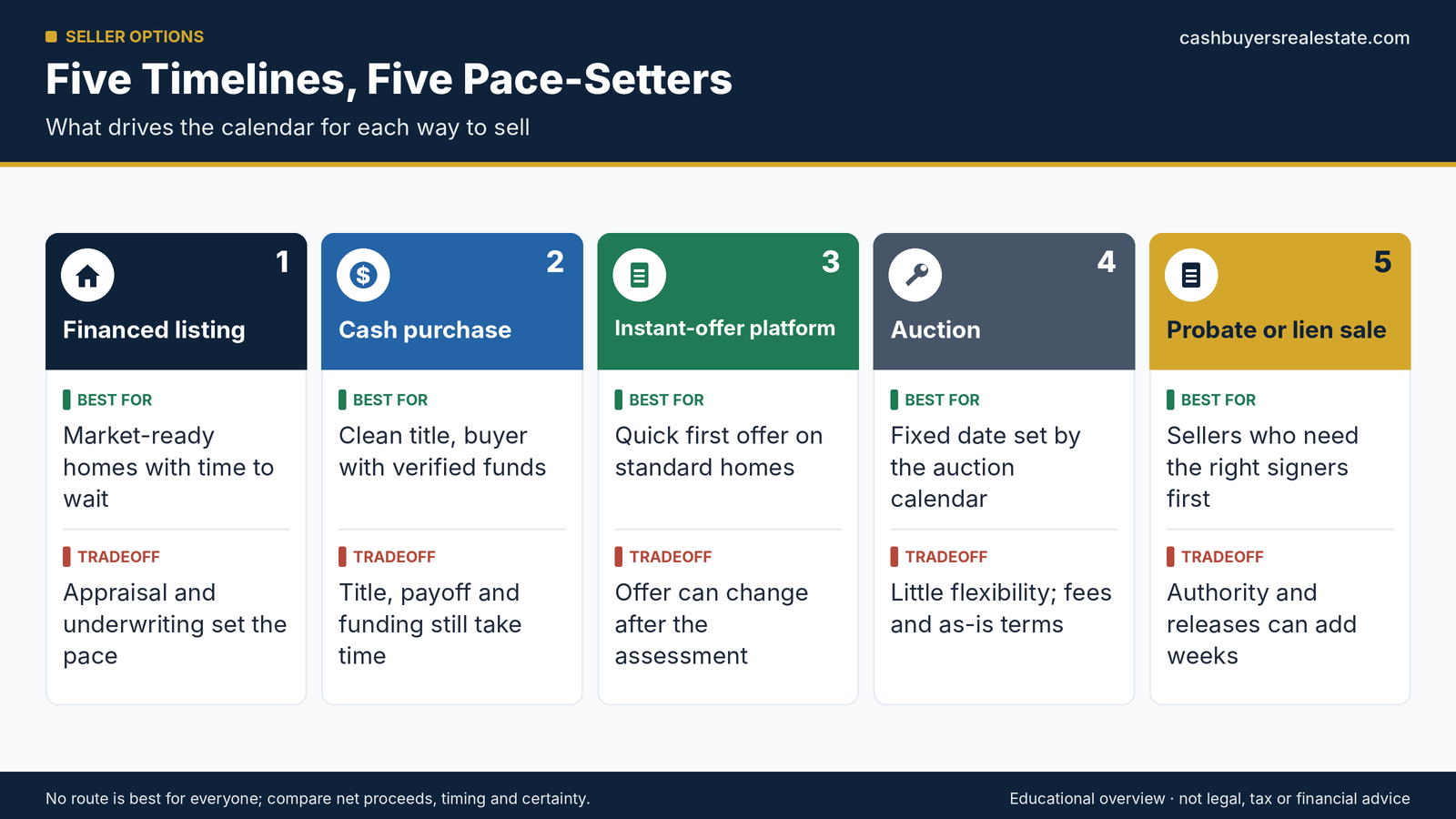
Text version of this infographic
- Financed listing — best for: Market-ready homes with time to wait; tradeoff: Appraisal and underwriting set the pace
- Cash purchase — best for: Clean title, buyer with verified funds; tradeoff: Title, payoff and funding still take time
- Instant-offer platform — best for: Quick first offer on standard homes; tradeoff: Offer can change after the assessment
- Auction — best for: Fixed date set by the auction calendar; tradeoff: Little flexibility; fees and as-is terms
- Probate or lien sale — best for: Sellers who need the right signers first; tradeoff: Authority and releases can add weeks
Calendar Math, Funding Cutoffs, and Wire Timing
Counting days correctly
Business days, calendar days, and the three-day disclosure clock
Contracts use calendar days or business days, and the two are not interchangeable. A seven-day inspection period in a contract that counts calendar days ends on the same weekday one week later. A seven-business-day payoff window does not. A closing planned for a Monday can fail because a document needed Friday landed on a holiday weekend. When a date matters, read how the contract defines each period and count on a real calendar.
The federal Closing Disclosure rule uses its own definition. Regulation Z defines a business day, for general purposes, as a day the lender’s offices are open for substantially all business functions. For several provisions, including the Closing Disclosure waiting period, it instead counts all calendar days except Sundays and legal public holidays. That means Saturdays count toward the three-business-day waiting period and Sundays and federal holidays do not. The rule requires that the buyer receive the disclosure at least three business days before closing, not just that the lender send it.
Illustrative example (hypothetical dates): A buyer’s closing is set for Wednesday, November 25, 2026, the day before Thanksgiving. Counting back three business days under the Closing Disclosure definition: Tuesday, November 24 (one), Monday, November 23 (two), and Saturday, November 21 (three), because Sunday, November 22, does not count. The buyer must receive the disclosure by Saturday, November 21, which in practice means the lender must deliver it earlier if delivery is by mail or if proof of receipt is required. Move the same closing to Tuesday, December 29, and the count skips Friday, December 25, a federal holiday: Monday, December 28 (one), Saturday, December 26 (two), and Thursday, December 24 (three).
These calculations apply to financed purchases where a lender issues the disclosure. A cash purchase has no lender and no Closing Disclosure, though the closing agent will still prepare a settlement statement and may have its own cutoffs. If a buyer’s lender is cutting it close, ask the lender or closing agent to confirm the date by which the disclosure must be received and when it was sent.
Weekend and holiday traps for a funding date
Wires move only when the banking system is open, and the federal holiday calendar determines many closures. The U.S. Office of Personnel Management lists the federal holidays, and several fall inside the busy fall and winter selling season.
| Date | Holiday | Why it matters for closings |
|---|---|---|
| Mon, Oct. 12, 2026 | Columbus Day | Federal holiday; wires typically do not move and many government offices are closed, so a Monday closing may shift to Tuesday |
| Wed, Nov. 11, 2026 | Veterans Day | Midweek holiday; one lost day can push funding and recording to Thursday |
| Thu, Nov. 26, 2026 | Thanksgiving Day | The week’s closings compress into Monday to Wednesday; the following Friday is often slow |
| Fri, Dec. 25, 2026 | Christmas Day | Counts out of the three-day disclosure clock; late-December closings face year-end volume |
| Fri, Jan. 1, 2027 | New Year’s Day | A Thursday, Dec. 31 closing is the last funding day before the weekend and holiday |
| Mon, Jan. 18, 2027 | Martin Luther King Jr. Day | Long weekend; a Friday closing that misses its funding window waits until Tuesday |
Dates come from OPM’s published 2026 and 2027 schedules. County recorder offices and local government closures may differ, so ask your title company which days its recording office is open. A closing scheduled on the last business day before a long weekend has no cushion: any hiccup rolls forward by three or four calendar days. If you have a choice, schedule the closing earlier in the week and earlier in the day.
Wire timing and safety
How wires move: Fedwire hours and your closing agent’s cutoff
Most closings that involve large sums move money by wire. According to Federal Reserve Financial Services, the Fedwire Funds Service operates Monday through Friday except designated holidays, with online transfers running from 9:00 p.m. Eastern on the preceding calendar day until 6:30 p.m. Eastern. Banks and closing agents set their own earlier cutoffs for customer requests, often well before the system closes, so the effective deadline for a buyer’s wire is whatever the buyer’s bank and the closing agent say it is.
Time zones matter more than most people expect. A buyer in the Pacific time zone who initiates a wire at 4:00 p.m. local time has reached 7:00 p.m. Eastern, past the end of the system’s day, so the wire will likely settle the next business day (hypothetical timing for illustration). If funds arrive late, many closing agents will not disburse proceeds to the seller that day, and the closing technically occurs but the money waits. For a seller counting on those funds to buy another home, the lost day can matter.
Ask the closing agent for its funding cutoff, and ask the buyer to send funds the day before closing if possible. Ask your own bank whether it receives incoming wires on weekends or holidays (it generally does not) and how quickly funds are available once they arrive. Planning for a morning closing and a next-day wire cushion removes most of the risk.
Verifying wire instructions without losing a day
Real estate closings are a target for wire fraud, where criminals impersonate a title company or agent and send changed payment instructions by email. A sensible habit protects both sides: treat any email that changes wiring instructions as unverified, and confirm instructions by calling a phone number you obtained independently, such as one from the title company’s website or an earlier signed document, never one in the email itself. Send your own payout instructions through a secure channel recommended by the closing agent and confirm them by phone.
The verification call takes minutes and shouldn’t delay anything. What slows closings is the opposite: a wire sent to the wrong account, a mismatch discovered after funding, or a frantic search for recovery. If something looks off, contact the closing agent and your bank immediately. The guide to cash home buyer scams covers other trust checks, from earnest money to contract completeness, that fit into the same early-week routine.
Seasons, Local Markets, and Pricing as a Speed Lever
Seasonal and local effects
What seasonal data suggests, and what it cannot promise
Spring has a reputation as the best selling season, and the available data partly supports it. Realtor.com’s 2026 Best Time to Sell report, as summarized in broadcast coverage, identified April 12 to 18 as the best listing week of 2026. Homes listed during that window historically sold at a price about 1.3 percent above the average week, saw roughly 18.9 percent fewer price reductions than the annual average, and, using 2025 data, spent 50 days on the market compared with 60 for the year overall. The analysis used weekly listing metrics from 2018 to 2019 and 2021 to 2025, with 2020 excluded because of the pandemic, and measured each week against a benchmark from the first full week of the year.
That is useful context, but it isn’t a reason to hold a necessary sale until April. National seasonal curves smooth over very different local patterns: a snowy northern market and a Sun Belt retirement market do not share a calendar. A 1.3 percent premium on a $350,000 house is $4,550, a meaningful amount, but one that disappears quickly against several months of carrying costs, a second housing payment, or a missed deadline. If you have flexibility, timing a listing for the stronger weeks is a reasonable tactic. If you do not, the better strategy is to price and prepare so the listing performs well in whatever season you are in.
Winter and holiday periods deserve their own consideration. Fewer buyers search, but those who do are often relocating or motivated by a deadline. Showings can be harder to schedule, closings run into holiday closures (see Table 4), and appraisers and title staff may be on reduced schedules. Plan for the second clock to run a bit slower in late December, and ask lenders and closing agents about holiday processing.
Local inventory, price tier, and property type
Local supply and demand set the first clock more than any national statistic. NAR’s August 2026 report showed 4.9 months of supply nationally, up from 4.6 in July and the highest since November 2015. As NAHB’s summary of the report notes, the range of 4.5 to 6 months is generally treated as balanced, which suggests a national market that has moved toward balance, not a uniform buyer’s or seller’s market. In your county, the figure may be under three months or over eight. Ask your agent for months of supply and recent sale-to-list price ratios in your price band, since a $250,000 house and a $1.2 million house can sit in very different markets within the same ZIP code.
Property type matters too. Condominiums depend on the association’s financial health and lender approval of the project. Rural properties with acreage, wells, and septic systems draw smaller buyer pools and may need additional inspections. Homes with unusual layouts, deferred maintenance, or high ongoing costs may sit longer regardless of season. Cash buyers made up 27 percent of sales in NAR’s August 2026 data, which tells you that a meaningful share of buyers in the market can skip the lender’s clock, though the share varies by area and price range.
A practical step: ask your agent for three numbers specific to your segment, namely the median days to contract, the share of listings that took a price cut, and the typical gap between list price and sale price. Together they reveal whether your market rewards aggressive pricing or patient waiting, and they help you decide how much speed you can reasonably expect.
Pricing and terms as speed levers
Price relative to comps in the first two weeks
Of all the levers available to a seller, price is the strongest, and the first two weeks are when it works hardest. Buyers compare a new listing to recent sales within hours of seeing it. A price at or slightly below the closest comps tends to bring showings and, sometimes, competing offers; a price above them tends to bring comments and a quiet phone. Reducing the price later can recover the situation, but the listing has lost its freshest attention, and a visible price history can lead buyers to expect further cuts.
Build a decision point into the plan. Before listing, agree with your agent on a review date, ideally 10 to 14 days out, and on what signals trigger a price change: for example, few showings, or showings with consistent feedback about price. Feedback from agents who toured but did not offer often points to the issue. If showings are strong but no offers arrive, the problem may be condition or terms instead of price.
Illustrative example (hypothetical numbers, not market data): A seller with $2,200 in monthly carrying costs can price a home at $355,000 and wait, or at $349,000 and invite earlier interest. If the higher price adds one extra month on the market before a reduction, that month costs $2,200, so the $6,000 price difference nets to about $3,800 in favor of the higher price only if the home sells at $355,000 at all. If it instead sells at $349,000 a month later than the lower price would have, the seller has paid $2,200 for the experiment and gained nothing. Sellers with a firm deadline usually benefit from pricing to sell in the first window.
Whatever the strategy, tie it to evidence: recent sold comps, current active competition, and feedback, rather than to a figure you hope for. The guide to how cash offers are calculated shows how professional buyers reach their own numbers, which is a useful check against optimism.
Concessions, flexible dates, and rent-backs as speed tools
Money isn’t the only lever. A buyer’s needs often include dates, certainty, and costs at closing, and a seller who can meet those needs sometimes closes faster without cutting the price. Offering to cover part of the buyer’s closing costs can make a financed deal work for a buyer short on cash, but lenders cap how much a seller can contribute. Under Fannie Mae’s Selling Guide, for example, the cap on interested-party contributions for a principal residence is 3 percent of the price when the loan-to-value ratio is above 90 percent, 6 percent for 75.01 to 90 percent, and 9 percent at 75 percent or less, and 2 percent for an investment property; other programs set their own limits. Those caps matter if you plan to use credits to cover repairs, since the same pool of allowable contributions applies.
Flexible dates can matter as much as dollars. If you can close quickly, say so; if you need to stay for a few weeks after closing, a written rent-back agreement may let you sell sooner than you could move. Both sides should agree on the daily charge, insurance, utilities, condition at move-out, and a deposit or holdback to secure it. Short inspection windows and a prompt response to repair requests also help, because every day a buyer waits for an answer extends the second clock.
Pay attention to the cost of each concession, and keep in mind that a listing agent’s advice on which concessions buyers in your area actually respond to is part of what the commission pays for; the page comparing a cash buyer and a real estate agent sets out that trade-off. A $5,000 credit is a $5,000 price reduction, and a free month of occupancy has a rental value. The question to ask is whether the concession buys more speed or certainty than the same money would buy as a lower price. Often the cheapest speed comes from flexibility, not from dollars.
Closing Early or Late: What Each Date Costs You
The case for an early closing date
What you give up by moving fast
Asking for a short closing can limit the buyers who can say yes. A financed buyer needs time for the appraisal, underwriting, and the three-business-day disclosure period, and ICE’s 37-day average suggests why a demand for a 14-day closing can rule out many mortgage buyers. Cutting the window also gives you less time to find a new home, pack, schedule movers, and clear whatever paperwork the title company needs. A rushed move can mean paying for storage, a second move, or a temporary rental, costs that rarely appear in the comparison of offers.
There are subtler costs. A tight schedule leaves no cushion for a missing document, a delayed payoff letter, or an HOA package that arrives late. If any one of them slips, the sale can miss its date, and a buyer who was promised a closing on a given day may be entitled to remedies under the contract. A seller who has agreed to a date they cannot meet has less leverage than one who offered a realistic date.
Prorations are also affected, in small ways. Property taxes, HOA dues, and utilities are divided as of the closing date, so moving the date moves who pays for those days. Those adjustments are usually modest, but they add up, and they appear on the settlement statement. The real costs of speed show up as limited choice and thin margins for error.
When paying for an early date is rational
An early closing makes sense when the cost of delay is larger than the price you pay to avoid it. A seller carrying two mortgages, a seller whose lender has set a deadline, an estate paying for a vacant house, and a seller relocating for a job all have a measurable cost for each additional week. The right approach is to write the cost down and compare it directly with the price difference between offers.
Illustrative example (hypothetical numbers, not market data): Offer A is $350,000 with a 45-day closing. Offer B is $344,000 with a 14-day closing. Offer B closes 31 days sooner. If carrying costs are $2,200 a month, those 31 days are worth about $2,273. Offer B nets roughly $3,700 less than Offer A after that saving, so on dollars alone Offer A wins. If a second housing payment of $4,000 a month applied on top, the cost of delay would be $6,200 a month, the 31 days would be worth about $6,407, and Offer B would come out ahead by roughly $400. The arithmetic is simple, but it changes the conversation from feeling to numbers.
Certainty belongs in the same comparison. A seller with a hard deadline should weigh the probability that each offer closes on time, not just its date. A financed 14-day closing, if a lender will agree to it, may be less likely to hold than a cash 21-day closing with proof of funds. When timelines matter, ask each buyer what has to happen for the date to be met and what happens if it isn’t.
| Factor | Earlier closing | Later closing |
|---|---|---|
| Carrying costs | Fewer months of taxes, insurance, utilities, interest | More months, though modest per month |
| Moving logistics | Compressed; storage or temporary housing more likely | More time to pack, move, and find the next home |
| Buyer pool | Narrower; favors cash buyers or those ready to move | Broader; financed buyers fit more easily |
| Price leverage | Seller may pay for speed with a lower price or credits | Seller can sometimes ask for a higher price or better terms |
| Paperwork cushion | Thin; one late document can break the date | Room for payoffs, association packages, and title clearing |
| Risk of change | Less time for markets, rates, or circumstances to shift | More exposure to buyer rate-lock expirations, job changes, or market moves |
No row makes one date better in every case. The point of the table is to turn “sooner is better” into a list of specific costs and benefits you can check against your own deadline.
The case for a later date, and how to write the date down
Why buyers ask for later dates, and what delay costs you
Buyers often ask for a later closing because their own circumstances require it: a lease ending, a home they must sell first, a rate lock tied to a date, or a child finishing the school year. Accepting a later date can be the price of a stronger offer, and it can give you time to move without rushing. A seller who needs to find the next home may welcome the cushion.
Delay has a price, though. Each extra week adds carrying costs, and the longer the contract runs, the more chance for something to change: interest rates move, a buyer’s job situation shifts, a market softens, or an appraisal comes in differently than hoped. Buyers who need to extend a rate lock may seek to pass the cost along in negotiation. If you’re asked to extend, treat it as an opportunity to ask for something in return, such as a larger deposit, a per-day payment, or a firm outside date.
Another factor is the buyer’s financing deadline. A contract often sets dates for the loan commitment and appraisal. If those dates pass without the buyer proceeding or asking for an extension, you may have rights under the contract, depending on how it is written. Know those dates and track them on a calendar so you can act promptly.
Contract language that protects your timeline
A closing date is only as firm as the language around it. Look for an outside date, the latest day on which closing may occur before one side can cancel. Look for extension terms, including how many days either side can extend and at what cost. Check the financing, appraisal, and inspection deadlines, which should be specific calendar dates or a clear number of days from a defined starting point. In some states and forms, a “time is of the essence” clause makes deadlines strictly enforceable, while in others it works differently, so ask a local attorney how it operates where you live.
Possession terms deserve equal attention. If you will remain in the home after closing, the contract or a separate agreement should state the date and time you will vacate, the daily charge, who pays utilities and insurance, the condition you must leave the property in, and the remedy if you overstay. If the buyer will occupy early, the reverse applies, and the risk shifts to you, so many sellers decline. Request the full contract before the offer deadline so you have time to read it. The guide to the cash home sale process shows where these clauses typically sit in a purchase agreement.
Finally, put the schedule in writing as a shared milestone list: the dates for earnest money, inspection, appraisal, loan approval, title commitment, payoff, final walk-through, and closing. A short, shared list reduces misunderstandings and lets either side flag a slipping item early. Most closings that miss their dates did so because one small item slid in the middle, not because of any one dramatic failure.
The checklist graphic below summarizes six factors to review before you commit to any closing date: mortgage payoff, property condition, buyer financing, title issues, closing readiness, and your moving deadline. Each is covered in the sections above.
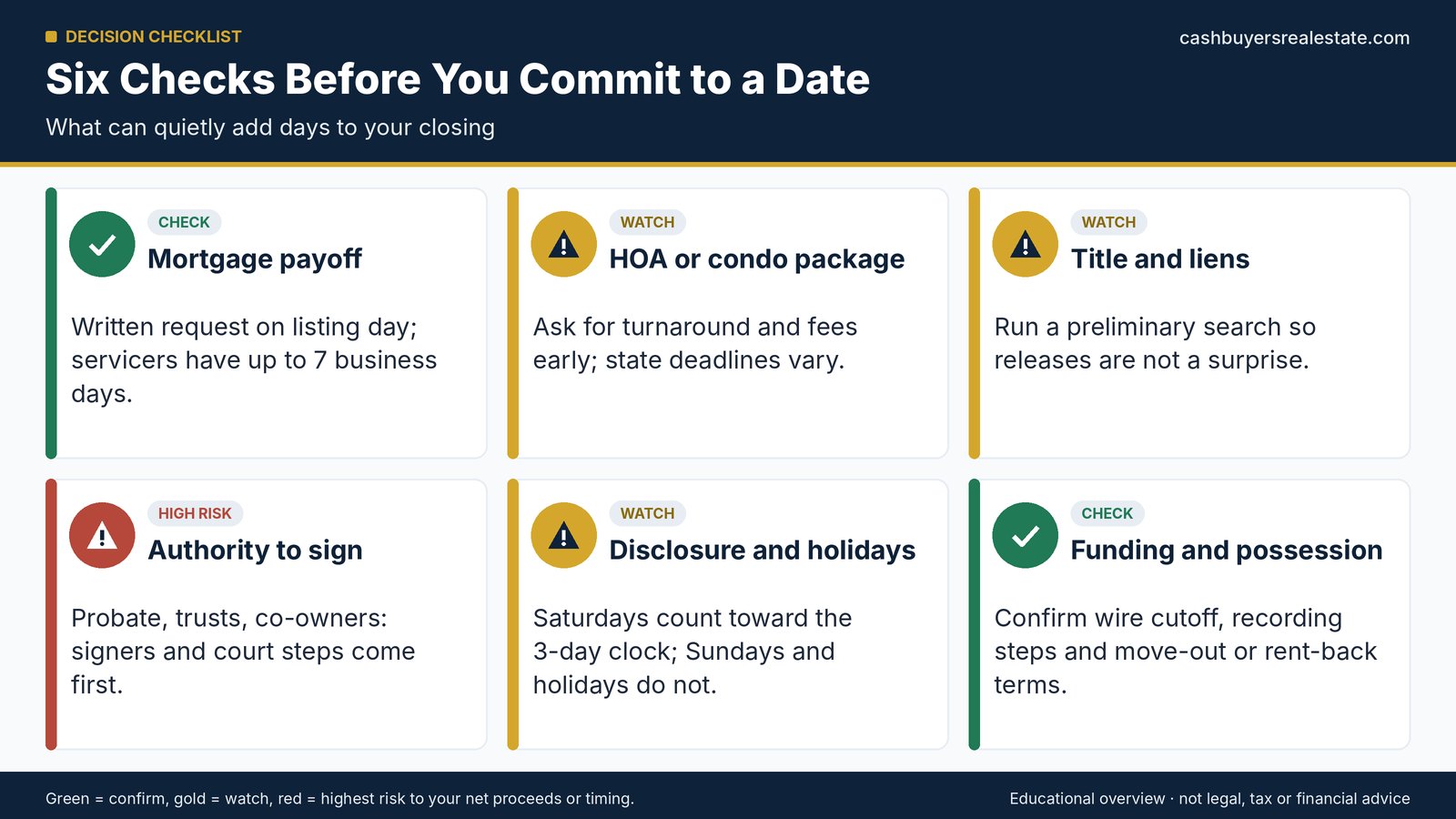
Text version of this infographic
- Mortgage payoff — Written request on listing day; servicers have up to 7 business days.
- HOA or condo package — Ask for turnaround and fees early; state deadlines vary.
- Title and liens — Run a preliminary search so releases are not a surprise.
- Authority to sign — Probate, trusts, co-owners: signers and court steps come first.
- Disclosure and holidays — Saturdays count toward the 3-day clock; Sundays and holidays do not.
- Funding and possession — Confirm wire cutoff, recording steps and move-out or rent-back terms.
Questions Sellers Ask About Selling Speed
Questions about timing and benchmarks
How long each stage takes
- What is the fastest a house can realistically sell?
The quickest paths combine a buyer who needs no lender approval, a clean title, a ready payoff figure, and a seller who can sign promptly. Some instant-offer platforms say a first online offer can arrive within a day or two, but an offer is not a closing. How soon the deed actually transfers depends on the title search, any liens, association paperwork, and the contract’s inspection period, so ask for dates, not promises.
- Is 30 days realistic for a financed sale?
It is possible but at the fast end. ICE reported that purchase loans averaged about 37 days from application to closing in March 2026, so a 30-day close from contract requires an efficient lender, quick appraisal, and no surprises. Counting the time to find a buyer, most financed sales take longer than 30 days from the listing date. The guide to selling a house in 30 days walks through a fixed-window plan.
- Can I sell in two weeks?
Two weeks from decision to closing is a stretch for any route and generally requires a buyer who can pay cash, a title company that can clear the property quickly, and no complications such as probate or liens. Speed at that level often costs price or leaves little room for error. The 14-day sale guide covers what has to go right and what to give up.
- Does “days on market” include the time to close?
No. Median days on market, such as NAR’s 31 days for August 2026, measures marketing time. Closing adds the second clock on top, and different datasets define the start and end differently. Treat any single figure as one stage of the timeline and add the other stages yourself.
Seasons, rates, and pricing
- Is spring really the best time to sell?
National data suggests mid-April has been the strongest listing week, with fewer price cuts and a modestly higher price, according to Realtor.com’s 2026 analysis. But local climates, school calendars, and inventory change the picture. If you can choose, a spring listing is a reasonable tactic; if you have a real deadline, price and prepare for the season you’re in rather than waiting.
- Does a lower price really sell a house faster?
A price at or slightly under the closest comps tends to draw more early showings, and early attention is where competing offers come from. It’s not a guarantee, because condition, photos, and terms matter too. Before cutting your price, check whether showings are low (price or marketing) or showings are high with no offers (condition or terms).
- How do mortgage rates affect how fast a house sells?
Rates change what buyers can afford and when they’re willing to move. NAHB’s summary of NAR’s August 2026 report noted that homes were sitting on the market longer as buyers waited for rate relief. For sellers, that supports pricing realistically and being flexible on terms, because the buyer pool can shrink when affordability tightens.
- Do cash buyers always close faster than financed buyers?
Not always. Skipping the lender removes underwriting and appraisal time, but title issues, payoffs, association documents, and the buyer’s own funding steps still apply. A cash buyer with verified funds and a clean title can be quick; a cash buyer waiting on a lien release or a funding source may not be. Ask for specific dates and the proof of funds behind them.
Questions about closing logistics and complications
Closing dates, wires, and paperwork
- When should I request my mortgage payoff statement?
On the day you decide to sell. Federal rules give servicers up to seven business days after a written request to respond, with exceptions for loans in bankruptcy or foreclosure, reverse mortgages, and some disasters. The figure will be updated for the closing date, so you may need to request a refresh if the date changes.
- What can I do if the HOA is slow with documents?
Ask the management company for its processing time and fees as soon as you list, and order the package early. Some states set deadlines, as in Florida’s 10-business-day rule for estoppel certificates, while others don’t. If the delay threatens the closing date, tell the buyer’s agent early so the contract can be adjusted instead of broken.
- Why would a closing slip a day after everything is signed?
Often it’s funding, not signatures. If the buyer’s wire arrives after cutoffs, or a bank’s processing runs late, the closing agent may not disburse or record until the next business day. Weekends and federal holidays add days. Ask the closing agent for its funding cutoff and schedule an earlier slot when possible.
- Can a closing be moved earlier once it’s scheduled?
Sometimes, if the buyer, lender, and closing agent agree and the paperwork is ready. On a financed purchase, the buyer must have received the Closing Disclosure at least three business days before closing, so moving the date up may require delivering it earlier or issuing a corrected one. Start by asking the lender what the earliest permissible date is.
Complications and alternatives
- How long does it take to sell an inherited or probate house?
It depends on state law and the court. The key variable is when someone has legal authority to sign, and in some places a sale also needs court confirmation or notices to heirs. That can take weeks or months and cannot be rushed by a buyer’s offer. Speak with the estate’s attorney before agreeing to a closing date, and see the guide to selling a house quickly in probate.
- Does selling as-is make the sale faster?
It can remove the repair negotiation and pre-listing work, which is often a large share of the delay on a house that needs work. It doesn’t remove the buyer’s inspection period, the title search, or disclosure duties. The overview of selling a house as-is explains what that label does and doesn’t change.
- Can I sell quickly with tenants in the home?
Yes, but the lease and state law shape the timeline. Showings may require advance written notice, a tenant who stays through closing changes the buyer pool, and a tenant who must leave may need a legally required notice period. Some investors buy tenant-occupied properties as they stand. Start by reading the lease and your state’s landlord-tenant rules.
- What if my deadline is shorter than any route allows?
Look at ways to move the deadline instead of the sale: ask a lender about options, request an extension from a landlord or a buyer of your next home, or negotiate a rent-back after closing. The guide to urgent home sale options compares the fallback routes, and the explainer on what slows down a home sale helps you find which stage is the bottleneck.
Choosing a Timeline and Taking the First Steps
A decision framework: match your deadline to a route
Work backward from the date that matters
The most reliable way to answer “how fast can I sell?” is to start from the date you actually need and subtract the stages. Pick the date by which you need money or need to be out, then decide which of the two you’re targeting. Subtract the second clock to find the latest contract date. Subtract the first clock to find the latest listing date. Then add a buffer for holidays and surprises.
Illustrative example (hypothetical dates, using the benchmarks cited above): A seller needs funds by Friday, January 29, 2027. Working back 37 days (the March 2026 average for purchase loans) puts the contract signing around Wednesday, December 23, 2026. Working back another 31 days (the August 2026 national median on market) puts the listing around Sunday, November 22, 2026. The plan crosses Thanksgiving, Christmas, and New Year’s Day, three stretches when title and lender staff may be slower, so a prudent seller would list by mid-November and ask the closing agent about holiday schedules. A cash buyer with a clean title could shorten the second clock, which would move the latest listing date later, though the buyer’s funding and the title work would still need to be confirmed.
Once you have the working dates, match them against the options. The table lists some typical fits for different time horizons; it is a planning tool, not a guarantee, and your title, financing, and local market determine what is actually possible.
| If your deadline is… | Routes to compare | Watch for | First move |
|---|---|---|---|
| Under three weeks | Cash purchase with verified funds; auction with a fixed date | Clean title is essential; price trade-off; short inspection windows | Order a title search and request payoff the same day |
| Three to six weeks | Cash purchase; instant-offer platform; aggressive listing with a pre-approved buyer | Appraisal and underwriting if financed; assessment adjustments on platform offers | Gather offers from two route types |
| Six to ten weeks | Priced-to-move listing; cash purchase if the price is better | Holiday closures; repair requests; HOA documents | Pre-order association documents; set a price review date |
| Flexible or longer | Standard listing timed for a stronger season; renovation before listing | Carrying costs; market shifts | Run a net sheet comparing waiting and selling now |
If more than one row fits, choose according to the cost of missing the date. A deadline with a penalty argues for the route with the most certain closing, even at a lower price.
Questions that reveal whether a promised date is real
Every buyer and agent will offer a date. The questions below separate dates built on specific steps from dates built on hope.
- Who is the closing agent, and has the title search been ordered?
- If the buyer needs a loan, what is the lender’s current turnaround, and has the buyer been pre-approved by that lender in writing?
- If the buyer is paying cash, what proof of funds can they provide today?
- How long is the inspection or due-diligence period, and when does it begin?
- What has to happen for the closing date to hold, and what happens if one of those steps slips?
- Does the date assume possession at closing, or will you be able to stay for a set period?
A buyer who answers promptly and can name the steps has probably done this before. One who answers with reassurance and no specifics has given you a hope, not a schedule.
What to do next
A practical first-seven-days checklist
The first week sets the tone for the whole timeline. This sequence puts the slowest, least controllable items first.
- Day 1: Send a written payoff request to your mortgage servicer, and note any other lien holders.
- Day 1 to 2: Contact the HOA or condo manager for the document package, timing, and fees, if applicable.
- Day 1 to 3: Order a preliminary title search through a title company or attorney to uncover liens, ownership gaps, or old mortgages.
- Day 2 to 4: Identify everyone who must sign, and confirm authority if the owner is deceased, incapacitated, or a trust.
- Day 3 to 5: Ask two agents for price-and-time scenarios, and request one or two written cash or platform offers for comparison.
- Day 5 to 6: Map the holidays and weekends between now and your target closing, using the calendar math above.
- Day 6 to 7: Choose a route, set a decision date for your first price review, and write down the milestone list.
If you can’t complete a step in the week, such as a probate appointment, note the expected date and build it into your timeline with the buyer. Being open about constraints usually produces a more realistic schedule than hiding them.
Documents and questions to have ready
Gather these items now, because each one removes a possible delay later: the deed or recorded ownership information; your latest mortgage statement and the servicer’s contact details; property tax bills; homeowners insurance information; HOA or condo contact and any recent statements; recent utility bills; surveys, permits, and receipts for major work; inspection reports from previous purchases or repairs; and copies of leases and rent ledgers if tenants are involved. If the owner has died, add the death certificate and any court documents showing who has authority to sell.
For the closing agent, prepare a short list: What is your funding cutoff? What is your recording process? Which days are you closed? Who will hold the earnest money? How will you confirm wire instructions with me by phone? Answers to those questions take minutes to get and can prevent days of delay.