
Sell Damaged House Fast: Timeline, Costs & Seller Options
A fire, a burst pipe, a storm that took the roof, a foundation that has started to shift: damage like this turns a house from an asset into a daily problem. The mortgage payment keeps coming, the insurance adjuster has questions, contractors disagree about the scope, and everyone around you has an opinion about what to do next. If you’re trying to sell a damaged house fast, the first thing to know is that the damage itself rarely decides the timeline. The insurance claim, the mortgage lender, the buyer’s financing, and the paperwork you can produce usually decide it.
You can sell a seriously damaged house quickly if you pick the route before you chase the offer. A buyer who pays cash and accepts the home as-is can often move faster than a buyer who needs a mortgage, but the price will reflect repairs and risk. Settle how the insurance claim and your lender fit in first, disclose what you know, and compare net proceeds, not headline prices.
That answer has a few moving parts, and each one can change your result by thousands of dollars. The claim might pay for repairs you never make if you sell as-is, or it might be assignable to the buyer, or it might be tied up with the lender. Banks and government-backed loan programs set property standards that a badly damaged home often can’t meet, which is why financed buyers frequently drop out. Cash buyers, investors, and rehabbers fill that gap, but they price the repair bill, the schedule risk, and their own margin into every offer.
Here’s what the guide covers. First, how different kinds of damage (fire, water, wind, foundation, mold) change who will buy and what they’ll want to see. Then the first days after a loss, when safety and documentation protect both your claim and your sale. From there we’ll look at how insurance proceeds and the mortgage lender’s loss-draft process work, and what happens to a claim when the house changes hands. We’ll compare three routes in plain numbers: claim and repair, claim then sell, or sell as-is. You’ll see who really buys damaged houses, what disclosure and safety rules apply, how to vet an offer, and how to decide.
One note on tone. Damage to a home is rarely only a financial event. If the house held years of family life, or the fire or flood happened to you with no warning, it’s reasonable to feel stuck. Nothing here assumes you must sell, and nothing assumes you must hurry. Some owners are better off waiting for the claim to settle. Others want the property off their hands so they can stop paying for a house they can’t live in. Both are legitimate, and the sections below are built so you can tell which describes you.
A few terms will come up repeatedly. Actual cash value (ACV) is what an insurer pays for damaged property after depreciation. Replacement cost value (RCV) is what it costs to repair or replace with similar materials, usually paid in stages as work is completed. After-repair value (ARV) is what a rehabber expects a house to be worth once all work is finished. Loss draft is the mortgage industry’s term for insurance proceeds that pass through the lender or servicer. As-is means you won’t repair anything, though it doesn’t cancel your duty to disclose known problems.
Sell a Damaged House Fast: How Different Kinds of Damage Change the Sale
Buyers and lenders don’t treat all damage alike. A dated kitchen and a scorched roof structure are both “repairs,” but they belong in different conversations. Sorting your damage into the right bucket tells you which buyers to expect, which professionals to hire, and how much time the process will probably take.
Sorting the damage by type and severity
Fire and smoke damage: structure, soot, and odor
Fire damage has three layers, and each one costs differently to fix. The first is structural: charred framing, burned roof members, and anything that heat has weakened. The second is water, since firefighting often leaves more moisture in a house than the fire itself did. The third is smoke and soot, which travel far beyond the room where the fire started and settle into insulation, ductwork, and drywall.
That third layer is why a house that looks only partly burned can still need most of its interior replaced. Odor is hard to remove from porous materials, and buyers know it. A rehabber looking at a fire-damaged house tends to assume the worst about hidden wiring and HVAC contamination until an inspection says otherwise, which pushes offers down.
For you as a seller, the practical points are these. Ask the fire department for the incident report number, because insurers and buyers’ title companies may want it. Don’t throw out burned materials until the adjuster has seen them or documented them. And if an engineer or fire restoration firm has already assessed the structure, keep that report, since it can replace weeks of buyer guesswork with a number someone can price.
Water, storm, and flood damage: speed and water source matter
Water damage is the category where time works against you most. The EPA’s guidance on mold says to dry water-damaged areas and items within 24 to 48 hours to prevent mold growth, and the longer materials stay wet, the more of the house moves from “dry out” to “tear out.” A roof leak that was fixed in a week is a different sale than the same leak left for two months.
The source of the water matters as much as the amount. Clean water from a supply line is one situation. Sewage backup or floodwater is contaminated, and the EPA says to bring in a professional with experience in that type of damage. Storm damage from wind can include lost shingles, broken windows, fallen trees, and wet insulation, and it often arrives with an open claim and a wave of contractors in the same neighborhood, all booked solid.
Whether the loss is covered also depends on the cause. Standard homeowners policies and flood coverage are generally separate products, so a house flooded by rising water may have a very different claim picture than one hit by a burst pipe. Read your declarations page before assuming either.
Structural, foundation, and hidden damage
Foundation and structural movement: when you need an engineer
Foundation problems are the damage type buyers fear most, partly because the cost range is wide and partly because a visible crack tells you little. Hairline settlement cracks in a poured foundation can be cosmetic. Stair-step cracking in block walls, doors that no longer close, sloping floors, and gaps between walls and ceilings can signal movement that continues.
A licensed structural or geotechnical engineer is the right person to say which it is. A contractor who also sells foundation repair has a built-in interest in the answer. An engineer’s letter describing the cause, the severity, and a recommended repair gives investors and agents something concrete to price, and it often narrows the gap between your view and theirs.
Foundation trouble tied to a storm, a plumbing leak, or an earth-movement event can raise coverage questions, because many policies treat settlement and earth movement differently from sudden damage. That’s one more reason to read the policy language before you sell. If the cause is gradual or excluded, your sale price carries the whole problem, and the decision to sell as-is becomes mostly a math exercise.
Mold, asbestos, and lead paint: hazards that change everyone’s math
Mold usually follows water. The EPA says most people can handle a moldy area smaller than about 10 square feet on their own, and that heavier damage or larger areas call for a professional with mold-cleanup experience. It also notes that bleach isn’t recommended as a routine cleanup method and that dead mold can still trigger allergic reactions, so the material has to be removed, not just treated.
Asbestos and lead paint are different kinds of problems because they live in the house’s age, not in the damage itself. A fire or water event can disturb older materials and turn a latent issue into an active one. The EPA advises assuming that vermiculite insulation may contain asbestos and not disturbing it, and its lead renovation rule (the Renovation, Repair and Painting rule) covers paid work that disturbs paint in homes built before 1978.
For selling, the lesson is simple. If your house predates 1978, or has older insulation, ceiling texture, or flooring, say so, and don’t start demolition before someone qualified has looked. A buyer who finds an unmentioned hazard after the contract is signed has leverage to renegotiate or walk away.
The table below turns those categories into a quick reference. Use it to figure out what kind of paperwork each type of damage tends to need and how the damage usually affects the buyer pool.
| Damage type | Typical buyer concern | Helpful documentation | Effect on financed buyers |
|---|---|---|---|
| Fire and smoke | Hidden structural, electrical, and HVAC damage; odor | Fire report, adjuster estimate, structural or restoration assessment | Often blocked until repairs; lender and insurer may both object |
| Water or flood | Mold, contaminated materials, ongoing moisture | Source repair invoice, drying logs, moisture readings, mold test if done | Depends on extent; active moisture or mold usually blocks |
| Wind or storm | Open roof, wet interior, repeat exposure | Roofing estimate, tarp invoices, claim file | Sometimes workable if the envelope is secured and repairs are scoped |
| Foundation or structural | Unknown repair cost, resale difficulty | Engineer’s letter with cause and repair scope | Often blocked if safety or soundness is in question |
| Mold | Health risk, hidden extent, remediation cost | Moisture-source fix, professional assessment, clearance results if available | Frequently flagged by appraisers and lenders |
Read the right-hand column as a tendency, not a rule. Individual lenders, appraisers, and insurers decide case by case, and a well-documented repair scope can change the answer. What the table does show is why damage type shapes your buyer pool before you ever discuss price.
The First Days After a Loss: Safety, Mitigation, and Paperwork
What you do in the first days after damage often matters more to your final result than anything you do later. Fast, well-documented steps protect your insurance claim, limit the damage from growing, and give any future buyer a clear picture. Skipping them tends to cost money in ways that don’t show up until the claim or the sale.
Safety, utilities, and securing the property
Making the house safe, or deciding it isn’t
Safety comes before every other task. After a fire or major storm, the structure may not be sound, and utilities that are normally harmless, such as electricity and natural gas, can turn dangerous. Local building or fire officials can tell you whether the house is safe to enter, and in some cases they will post an unsafe-structure notice. If that happens, follow the posted instructions and ask the issuing office what it would take to lift the notice, since a posted notice affects what a buyer can legally do with the property.
If the house is livable only in part, think about whether anyone should be staying in it. Insurance policies commonly include additional living expense (ALE) coverage when a covered loss makes a home unlivable, but the details, limits, and time caps differ by policy. Ask your insurer to explain your ALE coverage in writing before you make long-term housing decisions.
Check also whether you can secure the house against trespass and theft. Damaged houses draw scavengers and vandals, and a break-in after the loss adds a second claim and a second set of repairs. Boarding up openings, changing locks, and keeping a log of visits are routine steps that also help your insurer see you acted responsibly.
Mitigation: protecting the house from further damage
Most homeowners policies expect you to take reasonable steps to prevent further loss after a covered event. Covering a damaged roof with a tarp, shutting off the water, and starting dry-out are the standard examples. Keep receipts, because reasonable emergency costs are normally part of the claim, and ask your adjuster to confirm what the policy requires before you spend large sums.
Mitigation also protects your sale. A house that was dried out within days and has moisture readings to prove it sits in a different category than one left standing in damp conditions. The EPA’s 24-to-48-hour drying window is a reminder that decisions made in the first weekend tend to determine how much mold work is needed later.
Avoid permanent repairs before the adjuster has seen the damage. Emergency mitigation is expected, but replacing drywall, flooring, or cabinets before the claim is documented can erase the evidence your insurer needs. If a mitigation company wants a signed contract or an assignment of your claim on the spot, take your time and read it carefully. Ask what it does to your control of the claim, and check with your insurer or a local attorney first.
Building the paper trail
Photos, video, and the damage log
Document everything before anything is moved, cleaned, or thrown away. Take wide shots of each room and close-ups of each damaged area, and record a slow walk-through video narrating what you see. Photograph the exterior from all four sides, the roofline, the foundation perimeter, the meters, and the electrical panel. Date-stamped images are better than undated ones.
Start a damage log in a notebook or a notes file. Record the date and time of the loss, who you called and when, the claim number, the adjuster’s name and phone, and every promise someone made to you. A log is dull to keep and enormously useful later, because memory fades fast when the process stretches across months and several companies.
Keep an inventory of damaged contents too, even though contents belong to the personal-property part of the claim and not to the sale of the house. A buyer cares about the structure. The insurer’s contents payment is separate money that stays with you, and an inventory made at the start is easier to produce than one rebuilt from memory.
Estimates, inspection reports, and what to keep
Get at least two written repair estimates from licensed contractors, plus an engineer’s or restoration specialist’s report if the damage is structural or involves water, smoke, or mold. The estimates serve three purposes at once. They support your insurance claim, they give you a benchmark for judging cash offers, and they show a buyer you aren’t guessing.
Ask each contractor to break the estimate down by line item and say whether it includes permits, code upgrades, and demolition. Estimates that read like a single lump sum are hard to compare and harder for an adjuster or buyer to trust. If estimates differ widely, ask the contractors why. The answer is often a different scope, not a different price for the same work.
Build a single folder, digital and paper, containing the policy, the declarations page, the claim correspondence, the adjuster’s estimate, contractor estimates, inspection reports, the loss photos, mitigation invoices, and your mortgage statement. You’ll hand pieces of it to your lender, your agent or buyer, the title company, and possibly an attorney. Having it in one place can save days during the stretch when a sale is most time-sensitive.
Once the house is stabilized and documented, the process can be pictured as a sequence from securing the property through comparing net proceeds. The infographic below maps those stages so you can see where each decision sits.
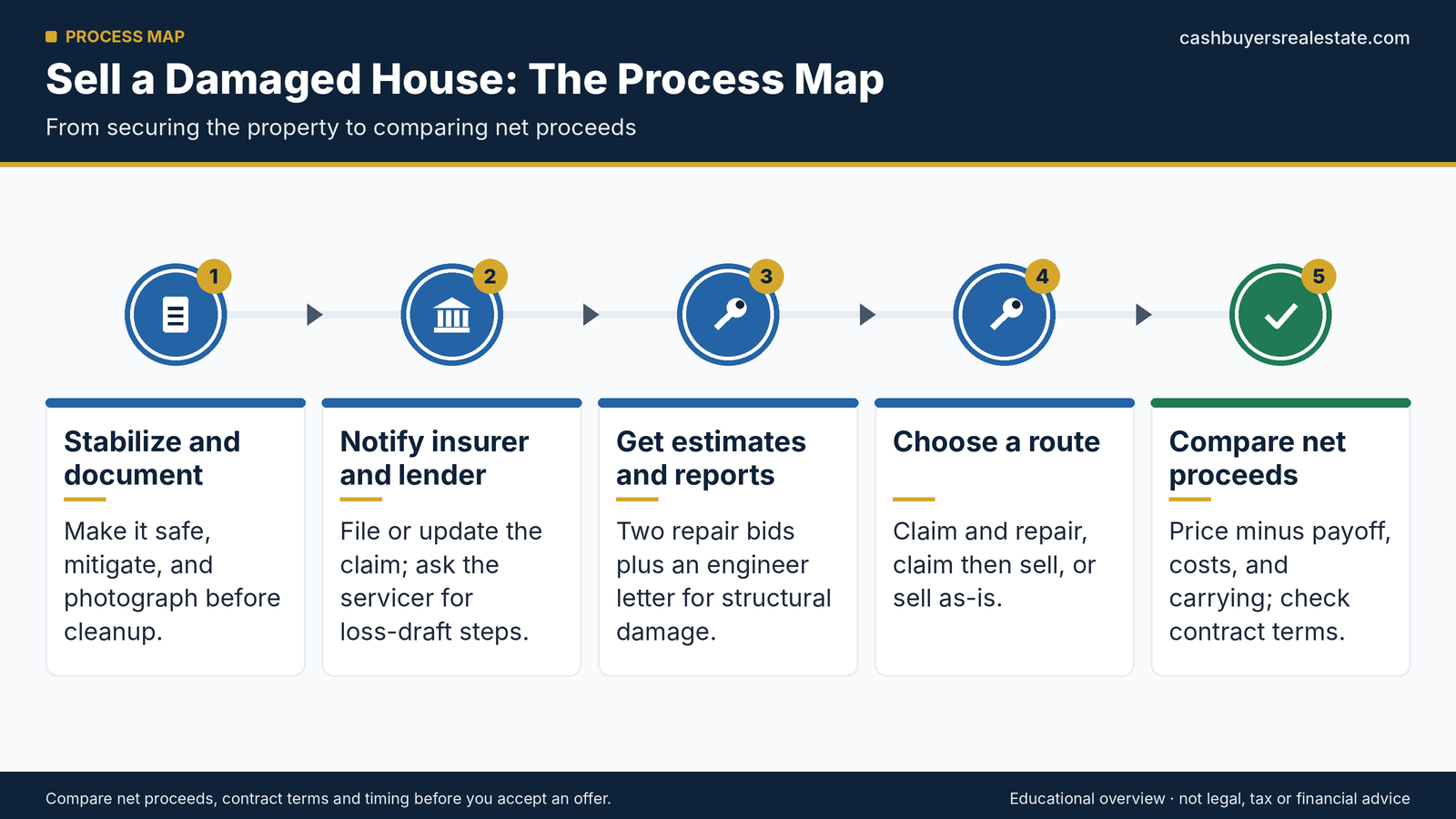
Text version of this infographic
- Stabilize and document — Make it safe, mitigate, and photograph before cleanup.
- Notify insurer and lender — File or update the claim; ask the servicer for loss-draft steps.
- Get estimates and reports — Two repair bids plus an engineer letter for structural damage.
- Choose a route — Claim and repair, claim then sell, or sell as-is.
- Compare net proceeds — Price minus payoff, costs, and carrying; check contract terms.
The same stages in text: stabilize and document the damage, notify your insurer and lender, collect estimates and expert reports, choose between the claim-and-repair, claim-then-sell, and sell-as-is routes, and then compare net proceeds before you sign anything. The rest of this guide follows that order.
How the Insurance Claim and Your Mortgage Lender Fit Into the Sale
For most owners of damaged houses, two outside parties hold more control over the timeline than any buyer does: the insurance company and the mortgage servicer. Understanding what each one does with the money, and when, tells you whether a quick sale is realistic and what you should ask before you sign a purchase contract.
How the claim works while you still own the house
Actual cash value, replacement cost, and the holdback
After an adjuster inspects the damage, a typical settlement comes in two layers. The first payment is usually based on actual cash value, which is the repair or replacement cost minus depreciation and minus your deductible. If your policy covers replacement cost, the withheld depreciation (often called the holdback or recoverable depreciation) is released when the repairs are finished and documented. Whether your policy works this way, and how long you have to complete repairs, are questions for the policy itself and your insurer.
That structure matters for a seller because it separates the money you can get early from the money that depends on repairs. If you sell as-is, you generally won’t do the work that unlocks the holdback, so the realistic claim value for a seller is often closer to the actual cash value figure than to the full replacement cost. United Policyholders, a nonprofit consumer group, makes the same point in its guidance: a seller who isn’t rebuilding is generally entitled to actual cash value whether or not the repairs happen, while the holdback depends on the policy, the type of loss, and the insurer.
Look also at your policy’s deadlines and exclusions. Policies set time limits for reporting a loss, submitting a proof of loss, and sometimes for suing over a denied claim, and those clocks keep running while you shop for a buyer. The National Association of Insurance Commissioners (NAIC) notes in its consumer material that if a claim is denied in whole or in part, you should ask for the denial in writing, and your state insurance department is the place to turn if you can’t resolve a dispute with the insurer.
Finally, ask about “ordinance or law” coverage. Rebuilding to current building codes can cost more than restoring what was there, and some policies cover that difference only if you actually rebuild. A seller who isn’t rebuilding should ask the adjuster in writing which parts of the settlement depend on repairs being completed.
The mortgage loss-draft process, step by step
If you have a mortgage, your lender is almost certainly named on the policy as a mortgagee. The NAIC explains that lenders typically require this, which means large claim checks come made out to both you and the lender, and you’ll need the lender’s signature to cash them. The lender then holds the money and releases it as repairs progress. This is the loss-draft process, and it’s where many owners lose weeks.
Fannie Mae’s Servicing Guide gives a concrete picture of how it works for loans that Fannie Mae owns. Servicers document the damage, discuss repair plans with the borrower, and hold undisbursed proceeds in an interest-bearing account. On a loan that’s current or less than 31 days delinquent, the initial release is the greatest of $40,000, 33% of the proceeds, or the amount by which the funds exceed the unpaid principal balance, accrued interest, and advances. The remaining funds go out after periodic inspections. For loans 31 or more days delinquent, the releases are smaller and more tightly staged. Loans owned or insured by other entities follow their own rules, so treat these numbers as an illustration of how structured the process is, not as your lender’s policy.
The same guide covers the case where the borrower doesn’t intend to repair. The servicer is expected to protect the property and, depending on the loan’s status, evaluate it for a workout or assign the proceeds. The takeaway for a seller is to call the servicer early, tell them you’re considering a sale, and ask in writing what happens to held proceeds when the loan is paid off at closing.
- Report the loss to your insurer and notify your servicer that a claim exists.
- Ask the servicer for its loss-draft instructions, forms, and inspection schedule.
- Endorse and return claim checks as the servicer directs, and keep copies.
- Ask what the servicer will do with undisbursed funds if you sell instead of repair.
- Get the payoff statement in writing, and ask the title company to confirm how held funds are handled at closing.
What happens to the claim when the house is sold
Keeping the claim, or transferring it with the property
Selling a damaged house doesn’t automatically end the insurance claim, but who collects depends on the policy, the sale contract, and your state’s rules. United Policyholders’ guidance says to tell your insurer you’re selling and to give it time to complete its inspection and investigation before the house changes hands. Once the damage is repaired or the buyer starts demolition, the evidence is gone, and an insurer that never saw the loss may have grounds to question it.
There are two basic structures. In the first, you keep the right to the insurance payment and sell the house for a price that reflects its damaged condition. In the second, the sale contract assigns the post-loss benefits to the buyer, who then pursues the claim and typically pays more for the house because of it. A property-insurance attorney’s published guidance for Florida sellers describes both approaches, and notes that documenting the unrepaired damage and the open claim in the seller’s disclosure helps avoid disputes later.
State law changes the picture. Many policies say benefits aren’t assignable, though United Policyholders notes that most states allow assignment of benefits after a loss has occurred. Florida moved the other direction: according to the Florida Insurance Adjusters Association’s legislative summary, the 2022 special-session reforms prohibit assigning post-loss benefits under residential and commercial property policies issued on or after January 1, 2023, while earlier policies remain assignable. If you live in Florida, or any state with recent insurance changes, ask an attorney whether a claim assignment is available to you at all.
Whichever structure you choose, the contract should say in plain words who owns the claim, who must cooperate with the adjuster, what happens to any supplemental payment, and how the price was adjusted. Vague language here is one of the most common sources of post-closing arguments.
Other money that overlaps: FEMA, taxes, and public adjusters
If the damage came from a federally declared disaster, FEMA assistance may be available, but it works in layers behind insurance. Colorado’s Division of Insurance, relaying FEMA guidance after a wildfire, explains that FEMA cannot duplicate benefits already covered by insurance, so most insured homeowners won’t get FEMA grants for repairs, and survivors need to report insurance payments and keep their cases updated. Small Business Administration disaster loans are another source after insurance. Neither is a reason to delay a decision, but both can affect the numbers if you plan to repair.
Taxes enter in two places. For losses, IRS Publication 547 says that for tax years after 2017, personal casualty losses were generally deductible only when attributable to a federally declared disaster, subject to a $100 reduction per casualty and, for most such losses, a 10%-of-income reduction. The IRS has also announced that legislation passed in 2025 made the personal casualty loss deduction permanent and, beginning in 2026, expanded it to losses from state-declared disasters as well, subject to the usual requirements. For the sale itself, IRS Publication 523 explains the home-sale exclusion (up to $250,000, or $500,000 for qualifying joint filers, if ownership and use tests are met) and how insurance reimbursements adjust your basis. A tax professional should run your specific numbers.
Public adjusters are licensed professionals who negotiate claims on policyholders’ behalf for a fee, usually a percentage of the recovery. Licensing, fee caps, and contract rules vary by state, so confirm the adjuster’s license with your state insurance department and read the fee terms before signing. Be careful with any contractor or investor who offers to “handle” your claim in exchange for control over it. Control of the claim can be worth more than the repairs.
Claim and Repair, Claim Then Sell, or Sell As-Is: Comparing the Three Routes
Almost every damaged-house decision reduces to three paths. You can fix the house and sell a finished product, you can pursue the claim and sell the damaged property, or you can sell as-is and let the buyer deal with everything. None is always best. Each trades time, effort, risk, and money differently, and the right one depends on your claim, your mortgage balance, your cash on hand, and how much you want to be done.
The three routes side by side
Repair first, then list: when it can pay
Repairing and listing the house can produce the highest sale price because you’re selling a finished, financeable home to the full pool of retail buyers. It makes the most sense when the damage is moderate, the insurance coverage is strong, the payments flow smoothly through your lender, and you can live elsewhere comfortably while contractors work.
It’s also the slowest route. NAIC’s consumer material says many people find it takes at least 18 to 24 months to repair or rebuild after a major disaster, and while a single-house fire or pipe burst won’t always take that long, permits, material delays, and contractor schedules can stretch any project. You carry mortgage payments, taxes, utilities, and insurance the whole time, plus the risk that final costs exceed the estimate. Repairs also create a record: permits, lien waivers from contractors, and warranties that you’ll want to hand to the buyer.
Choose this route when you have the patience and the financial cushion to see it through, or when the claim covers most of the work and the finished value comfortably exceeds the cost of carrying the project. It’s a weaker fit when the claim is disputed, the deductible is large, or you need to relocate soon.
Sell as-is, with the claim kept or transferred
Selling as-is means you won’t repair anything. The buyer, usually a cash investor, a rehabber, or a contractor-owner, takes the house in whatever state it is in, and the price reflects what the work will cost plus their margin and risk. Many sellers choose this route because it ends the project and the carrying costs, and because the sale can close in weeks if title and payoff are clean.
The trade-off is price, and the question of the claim. If you keep the claim, you may still collect actual cash value from your insurer while the buyer takes the structure. If you transfer the claim, you’ll likely get a higher purchase price but give up the insurance payment. You can read more about the general mechanics of an as-is house sale, and about selling without repairs when the issue is ordinary wear instead of catastrophic damage.
As-is does not mean without disclosure, and it does not mean without negotiation. Buyers will inspect and may adjust their price when they find conditions you didn’t mention. The cleaner your documentation, the fewer surprises, and the more likely the original price survives to closing.
| Factor | Claim and repair, then list | Claim, then sell damaged | Sell as-is, minimal claim role |
|---|---|---|---|
| Best fit | Moderate damage, strong coverage, time to wait | Covered loss, you want out but want the insurance money | Excluded or uninsured damage, or claim already resolved |
| Typical timeline | Many months; depends on permits and contractors | Weeks to a few months; depends on claim and lender | Often the shortest if title and payoff are clean |
| Main risk | Cost overruns and carrying costs | Claim disputes, lender holding funds | Lowest price; buyer renegotiation after inspection |
| Who handles repairs | You, with contractors | The buyer | The buyer |
| Buyer pool | Widest, including financed buyers | Investors, rehabbers, some contractors | Investors, rehabbers, some contractors |
| What to confirm first | Lender loss-draft schedule, permit timeline | Claim ownership language in the contract | Disclosure form, payoff amount, title status |
Use the table to find the column that matches your situation, then use the following section to test it with numbers. Notice that “Claim, then sell damaged” sits between the other two: it often works best when the loss is covered and you want a quicker exit than a full rebuild.
Running the numbers on a damaged house
A hypothetical net comparison
Headline offers are easy to compare and nearly useless. What matters is what lands in your bank account after the mortgage is paid, the claim is accounted for, and the carrying costs are settled. The example below uses invented figures to show the structure of the comparison, not market data or typical prices.
Illustrative example (hypothetical numbers, not market data): A house would be worth $320,000 undamaged. The mortgage payoff is $180,000. A fire causes damage that contractors estimate at $95,000 to repair. The deductible is $2,500, and the insurer’s initial actual-cash-value payment is $78,000 after depreciation. Monthly carrying costs (mortgage interest, taxes, utilities, insurance) are $2,400.
In Route A, the claim funds the repairs over about seven months, the house is listed at $320,000, selling costs run 8%, and $5,000 of costs exceed the estimate. In Route B, the owner keeps the $78,000 claim payment and sells as-is to a cash buyer at $175,000 with 2% selling costs and two months of carrying costs. In Route C, there is no claim payment because the loss is excluded or uninsured, and the same $175,000 sale applies.
| Line item | A: Claim, repair, list | B: Claim, sell as-is | C: No claim, sell as-is |
|---|---|---|---|
| Sale price | $320,000 | $175,000 | $175,000 |
| Selling costs | -$25,600 | -$3,500 | -$3,500 |
| Mortgage payoff | -$180,000 | -$180,000 | -$180,000 |
| Claim proceeds kept by seller | $0 (spent on repairs) | +$78,000 | $0 |
| Deductible and cost overruns | -$7,500 | $0 (netted in claim) | $0 |
| Carrying costs | -$16,800 (7 months) | -$4,800 (2 months) | -$4,800 (2 months) |
| Estimated net | $90,100 | $64,700 | -$13,300 |
Read it this way: Route A produces the largest net in this invented case, but it takes about five months longer and carries cost-overrun risk, while Route B gets the owner out sooner with roughly $25,400 less. Route C shows why coverage matters: with no claim payment, the same as-is sale would fall short of the payoff, which would mean bringing cash to closing, negotiating with the lender, or looking at an alternative such as a short sale. A net proceeds calculator lets you replace these figures with your own.
Costs and credits that hide outside the headline price
Several costs rarely appear in a first offer comparison. Carrying costs are the biggest: every month the house sits unsold or under repair, you pay interest, property taxes, insurance, and utilities. Insurers may also change coverage on a house that is vacant or under major renovation, so ask your insurer how a long vacancy or construction project affects your policy before you assume you’re covered.
On the sale side, closing costs when selling a house differ by route, state, and county. Agent commissions apply in a listing but may not in a direct investor sale, while transfer taxes, title charges, and attorney fees depend on where you live. Some buyers also deduct holding costs or request credits for repairs the inspection reveals. Ask each prospective buyer for a written estimate of who pays what at closing.
Don’t forget what you might give up. If you hand over a claim, you give up that money, and if you repair, you take on contractor risk. If your mortgage is larger than the house is worth in its damaged state, you may need funds at closing or a lender-approved alternative. Understanding how cash offers are calculated will help you read an investor’s math instead of just their number, and a quick comparison of cash buyers and real estate agents shows how costs shift between the two routes.
Once you’ve sorted routes and numbers, the question becomes which sale method fits your priorities. The next infographic lines up five common methods and the main trade-off for each, from a direct cash sale to an auction or special-case sale.
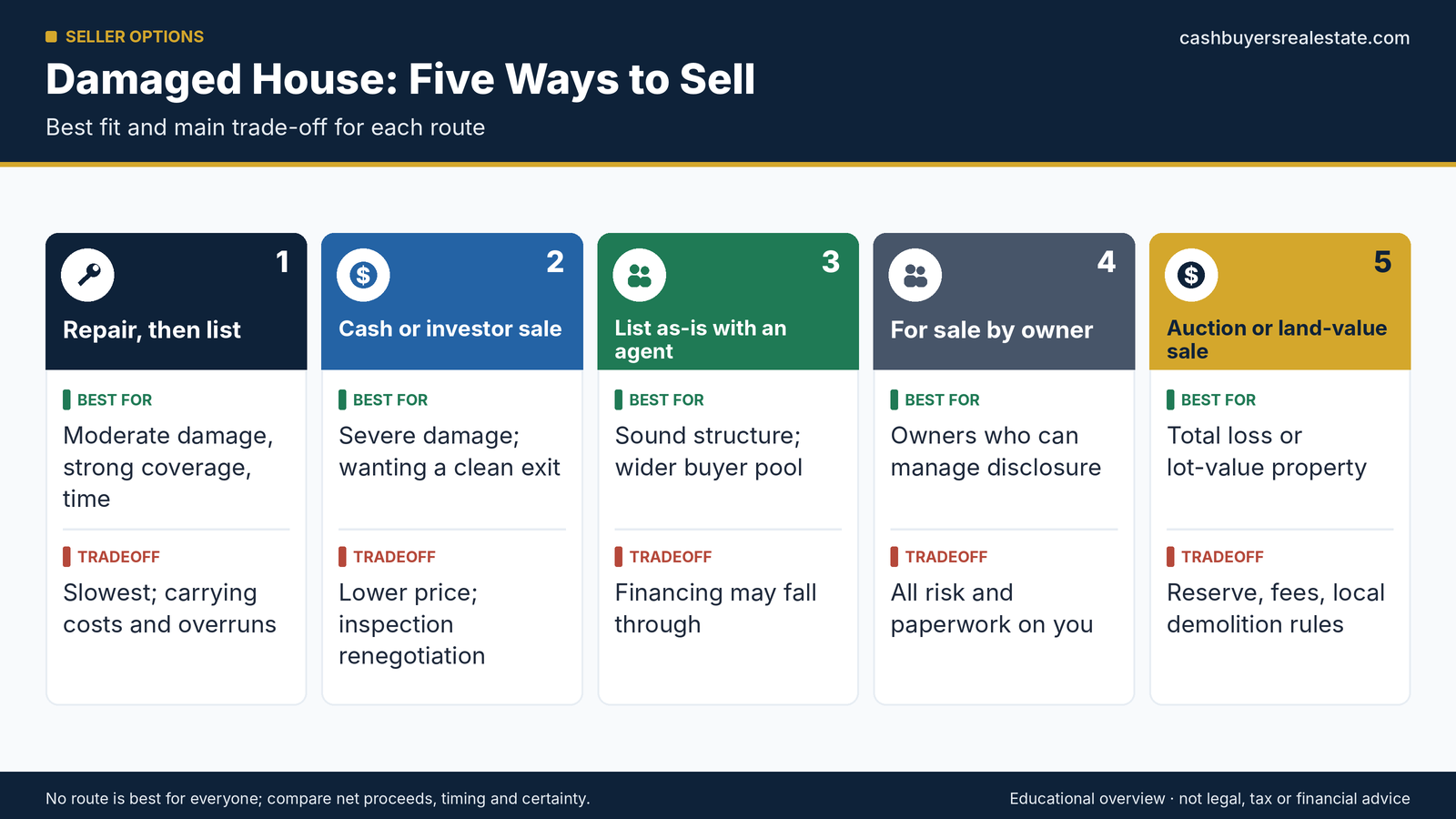
Text version of this infographic
- Repair, then list — best for: Moderate damage, strong coverage, time; tradeoff: Slowest; carrying costs and overruns
- Cash or investor sale — best for: Severe damage; wanting a clean exit; tradeoff: Lower price; inspection renegotiation
- List as-is with an agent — best for: Sound structure; wider buyer pool; tradeoff: Financing may fall through
- For sale by owner — best for: Owners who can manage disclosure; tradeoff: All risk and paperwork on you
- Auction or land-value sale — best for: Total loss or lot-value property; tradeoff: Reserve, fees, local demolition rules
In text form: a cash or investor sale favors speed and certainty but usually at a lower price, a traditional listing favors price but works best when the house is financeable, a for-sale-by-owner sale saves commission but puts all of the disclosure and negotiation on you, an iBuyer or platform generally prefers houses in marketable condition and may decline severe damage, and an auction or special-case sale suits unusual situations such as land-value properties or condemned structures.
Who Buys a Damaged House, and Why Financed Buyers Often Can’t Close
Walk through any listing of a burned, flooded, or structurally compromised house and you’ll notice a pattern: the buyers who close are rarely the ones who needed a standard mortgage. That’s not because ordinary buyers dislike risk, but because the lending process is built to protect the lender’s collateral, and a badly damaged house can fail the test at several points.
Why mortgage financing breaks down on damaged homes
Appraisal condition ratings and lender property standards
When a buyer applies for a mortgage, the lender orders an appraisal, and the appraiser rates the property’s condition. Fannie Mae’s Selling Guide describes a six-point scale. A C5 rating means obvious deferred maintenance and some significant repairs, with the home still usable. A C6 rating applies to defects severe enough to affect the safety, soundness, or structural integrity of the improvements, and if any part of the dwelling is C6, the whole dwelling is rated C6. According to the guide, loans on C6 properties aren’t eligible for sale to Fannie Mae until the deficiencies are repaired to at least C5.
Appraisers may complete a report “as is” only when existing conditions are minor and don’t affect safety, soundness, or structural integrity. When they do, the appraisal has to be done “subject to” specific repairs, and the lender needs proof that the repairs were completed before it funds. Infestation, dampness, or settlement problems require the appraiser to comment on value and marketability, and the lender must show the problem was corrected or provide a professional report that it poses no threat of structural damage.
Government-backed loan programs, including FHA and VA, apply their own property standards, and individual lenders sometimes add stricter ones of their own. You don’t need to memorize the rules. What matters is the pattern: a house with active safety or structural problems usually can’t be financed until someone fixes it, and the buyer can’t fix it until they own it. That circular problem is the main reason a mortgage-dependent buyer drops out.
Insurability, occupancy, and the closing clock
Lenders generally require proof of homeowners insurance before they fund a loan, and a house with open damage can be difficult to insure. Some insurers decline to write policies on properties with unrepaired damage, while others limit coverage or require repairs within a set period. Because insurer rules vary, a buyer’s agent should check insurability early. If the buyer can’t get a policy, the lender can’t close, no matter how motivated everyone is.
The closing clock adds pressure. A typical financed contract includes inspection, appraisal, and financing contingencies, and each one needs time. A damaged house tends to trigger extra steps: a specialist inspection, a second appraisal, a request for repair credits, an extension of the closing date. Any of those can pull the closing past the date you planned around, and if the buyer then walks, the listing history can make the next buyer wary. The usual causes of delays in a home sale all show up in a damaged-house transaction, usually in amplified form.
Financed offers aren’t impossible. If damage is limited, the structure is sound, and repairs are cosmetic or already underway, a conventional buyer may succeed. But when you need speed and certainty, the pool of buyers who can reliably close on a severely damaged home is narrower than the pool for an ordinary house, and it’s worth planning around that.
Who actually buys damaged houses
Cash investors and rehabbers: how they price the risk
Investors and rehabbers buy damaged houses for a living, so they don’t need a lender’s approval and can often close on their own timeline. They price a purchase backward from what the finished house will be worth. A common approach starts with the after-repair value (ARV), subtracts resale costs, repair costs, a contingency for surprises, holding and financing costs, and then a margin for profit and risk. Methods vary from buyer to buyer, and no formula is universal.
Illustrative example (hypothetical numbers, not market data): An investor estimates the repaired house will sell for $320,000. Resale costs at 8% are $25,600. The investor’s own repair budget, using a crew and wholesale materials, is $70,000, with a 10% contingency of $7,000. Holding and financing costs for five months are $15,000. The investor wants a $27,400 margin. Offer = $320,000 – $25,600 – $70,000 – $7,000 – $15,000 – $27,400 = $175,000.
Notice that the investor’s repair budget in this example is lower than the $95,000 retail contractor estimate used earlier. That’s common: investors may have lower costs because of crews, volume pricing, and a different quality standard, and homeowners often get retail estimates that include a contractor’s overhead and profit. A gap between your estimate and a buyer’s isn’t automatically a sign something is wrong, but it’s a reason to ask what repair scope and unit costs the buyer assumed.
You can learn more about how offers are built in the guide to how cash offers are calculated. For the damaged-house specifics, the broader damaged house selling hub covers the other damage types in more detail, and the article on selling a fixer-upper quickly is the better fit if your house needs work but isn’t catastrophically damaged.
Renovation-loan buyers, contractors, and builders
Not every buyer of a damaged house pays cash. The FHA 203(k) program, run by HUD, lets a buyer finance the purchase and the rehabilitation in one mortgage through an FHA-approved lender. HUD describes two versions. The Limited 203(k) allows up to $75,000 for minor, non-structural repairs and doesn’t require a consultant. The Standard 203(k) covers major rehabilitation, including structural work, requires projects of at least $5,000, and requires a HUD-approved consultant who inspects the home, prepares the work write-up and cost estimate, and certifies completed work at each draw. HUD’s figures can change, so confirm the current limits with a 203(k) lender.
For a seller, these buyers are a mixed blessing. They may pay more than investors because they’re aiming to live in the house, but the process takes longer: the consultant’s work, the extra appraisal steps, and the staged release of repair funds all add time, and a severely damaged house may not qualify at all. Conventional lenders offer their own renovation products, and the details vary by lender, so a buyer’s loan officer is the right person to say whether a given house is eligible.
Two other buyer types are worth knowing. Contractors and builders sometimes buy damaged houses to renovate for themselves or to resell, and they price the repairs more precisely because they’ll do the work. And where a structure is a total loss, builders and neighbors may value the lot more than the building, which is the situation where an auction or land-value sale can make sense.
Disclosure, Permits, and Hazard Rules for Damaged Houses
Damage raises the stakes for honest disclosure. A buyer who learns after closing that you knew about a hazard and said nothing can bring claims that cost far more than any discount you would have given up front. Disclosure rules differ by state, but the principle of telling the truth about known material problems does not.
What you have to tell a buyer
Why “as-is” does not erase disclosure duties
Many sellers assume that “as-is” shields them from disclosure. It doesn’t. In California, for example, the Civil Code provision governing the transfer disclosure statement says that any waiver of the article’s requirements is void as against public policy, which is why the statement is required even when the property is sold as-is. Texas takes a similar practical approach through Property Code Section 5.008, which requires sellers of residential property with no more than one dwelling unit to give the purchaser a written notice, delivered on or before the effective date of the contract. If it isn’t delivered, the buyer may terminate for any reason within seven days after receiving it.
The Texas notice shows how directly damage questions are asked. The statutory form asks about previous fires, about flooding and flood insurance claims, and about whether the property has received FEMA or SBA flood-damage assistance. The statute also lists transfers that are exempt, such as transfers under a court order or foreclosure sale, and transfers by a fiduciary administering an estate, so your own exposure may differ if you’re selling in one of those roles.
These are two examples, not a survey. Disclosure law in other states ranges from detailed statutory forms to narrower duties, and some states have specific rules about prior damage, flood-zone status, or known environmental hazards. Always check the form for your state and county.
Disclosing claims, prior repairs, and unpermitted work
Disclosure of damage usually has three layers. First is the damage itself, including what you know about its cause and extent. Second is anything you’ve done about it, such as emergency mitigation, partial repairs, or earlier work after a previous event. Third is the claim: whether you filed, what was paid, whether a claim remains open, and whether any repair funds are still held by your lender.
Open claims matter to buyers for a practical reason. As an attorney’s published guidance for Florida sellers points out, an open claim or a history of claims can affect a buyer’s ability to obtain new insurance, and a clear written description of the unrepaired damage helps keep the price adjustment tied to the actual condition. Include reports and estimates with the disclosure instead of summarizing from memory.
Be especially careful with unpermitted work. If a contractor repaired part of the house without permits, or an earlier owner finished space without them, say so if you know. Buyers and lenders may ask for permits to be closed before they proceed, and discovering missing permits late can be a deal-breaker. If you don’t know the permit history, you can ask the local building department for records on the address and tell the buyer what you found.
Permits, safety orders, and hazardous materials
Permits, unsafe-structure notices, and code upgrades
Your local building department controls what can be done to a damaged house. Repairs beyond a certain scope typically need permits, and a fire or storm event can lead officials to restrict entry or post an unsafe-structure notice. A buyer taking over a house with such a notice has to resolve it, so ask the issuing office what a buyer would need to do and in what time frame. Put that information in writing for anyone who makes an offer.
Code upgrades are a common surprise. Rebuilding or substantially repairing a damaged house can require bringing some systems up to current codes, such as electrical, smoke detection, or energy features, and your insurance may or may not cover the extra cost, which is the “ordinance or law” question from earlier. Investors know this and price it in, so a clear letter from the building department about which upgrades apply can narrow the gap between offers.
Also check local rules for vacant or damaged properties. Some cities require owners to secure and maintain damaged structures and can charge costs to the owner if they step in. Contact your building or code enforcement office to find out what applies to your address, and see the guide on selling a vacant house fast if the house will sit empty during the sale.
Mold, lead paint, and asbestos: a seller’s checklist
Three hazards deserve a place on every damaged-house checklist. For mold, the EPA recommends drying wet materials within 24 to 48 hours, fixing the moisture source, removing moldy porous materials, and using a professional for large areas or contaminated water. For lead, the EPA’s Renovation, Repair and Painting rule applies to paid work that disturbs painted surfaces in homes built before 1978, and while homeowners working on their own homes are generally exempt, the rule does apply to people who renovate homes to sell for profit, which can affect investor buyers’ costs and schedules. For asbestos, the EPA advises assuming that vermiculite attic insulation may contain asbestos and not disturbing it.
The table below organizes the main safety and disclosure items into a working checklist. Use it as a starting point and add local items your agent or attorney identifies.
| Item | Why it matters | What to do before listing or signing |
|---|---|---|
| Unsafe-structure notice or entry restriction | Limits what a buyer can do and who can enter | Get the notice and the steps to lift it in writing |
| Utilities status | Gas, electric, and water may be off or unsafe | Document which services are shut off and by whom |
| Moisture and mold | Affects health, repair scope, and financing | Fix the source, document drying, keep any test or clearance reports |
| House built before 1978 | Lead paint rules apply to certain paid work | State the build year; share any lead reports; avoid demolition without guidance |
| Older insulation, flooring, or ceiling texture | May contain asbestos | Leave undisturbed; disclose suspicion; hire a qualified professional before disturbing |
| Insurance claim status | Affects price, insurability, and who gets paid | Provide claim number, payments received, and open amounts; state who owns the claim at closing |
| Permits and prior repairs | Missing permits can stall a lender or a closing | Request permit history; list repairs with dates and contractors |
| State disclosure form | Required content and timing vary by state | Complete the form truthfully and attach supporting reports |
Treat every row as a conversation starter with a professional, not a final answer. The table shows what buyers and lenders tend to ask for, which means a seller who walks in with these answers already collected will usually spend less time responding to requests and more time choosing among offers.
Realistic Timelines and Vetting the Buyer Before You Sign
A damaged-house sale has more parties than an ordinary one: your insurer, your lender, the buyer, the title company, possibly a building department and an engineer. Each one has its own pace. Planning around the slowest party, not the fastest, is the difference between a sale that closes on schedule and one that drifts for months.
A realistic timeline for selling a damaged house
Stage by stage: what happens and how long it tends to take
The table below sets out the stages of an investor or cash sale of a damaged house with illustrative planning ranges. The ranges are not industry standards or promises, and any one of them can be shorter or longer depending on your state, your lender, and the condition of your title. They’re here so you can sketch a realistic calendar and spot where a stage is most likely to move.
| Stage | What happens | Illustrative range | Main variable |
|---|---|---|---|
| 1. Stabilize and document | Safety, mitigation, photos, estimates, reports | A few days to two weeks | Weather, contractor availability, adjuster visit |
| 2. Notify insurer and lender | Claim filed or updated; servicer instructions received | Days to a few weeks | Servicer responsiveness; claim complexity |
| 3. Choose a route and gather offers | Compare repair, claim-then-sell, and as-is options; solicit written offers | One to two weeks | Number of buyers who can view the property safely |
| 4. Contract and inspection period | Signed contract, earnest money, buyer’s inspection | About one to two weeks | Access, utilities, specialist inspections |
| 5. Title, payoff, and claim handling | Title search, payoff statement, claim-assignment language, lien releases | Overlaps stage 4; can take weeks | Open liens, held loss-draft funds, probate or ownership issues |
| 6. Closing | Signing, funding, recording, possession | A few days once everything is cleared | State closing practice; attorney or title company schedule |
The pattern to notice: the stages that tend to run long, the claim and the lender, can happen at the same time as the buyer-facing stages, so starting them first saves the most time. If you wait until you have a contract to call your servicer, you’ve added their processing time to your closing date.
Illustrative scenario (hypothetical, not a case study): A homeowner has water damage from a failed supply line and an open claim. On day 3 the plumber repairs the leak and a drying company sets equipment; the homeowner photographs everything on day 1. On day 6 the adjuster visits. The homeowner calls the servicer on day 7, learns the claim check will be issued to both parties, and asks for the loss-draft instructions in writing. Offers arrive between days 10 and 18. A contract is signed on day 20 with a clause stating who owns the claim, and closing is scheduled for day 45. The schedule works because the claim and lender questions were already answered when the contract was drafted.
What stretches the schedule: claims, lenders, title, and weather
The most common source of delay in damaged-house sales is the claim. If the insurer disputes coverage, requests more documentation, or hasn’t inspected yet, the seller often hesitates to commit to a sale price or to a claim assignment. Pushing for a written decision on coverage, and asking the insurer how a sale would affect the claim, brings the uncertainty forward instead of letting it surprise you at closing.
The second is the lender. Held loss-draft funds, a payoff statement that doesn’t match your records, and slow responses to authorization forms are all routine hold-ups. Servicers process requests in queues, and the people who answer the phone may not be the ones who can approve a release. Escalate in writing, and keep a log of dates, names, and reference numbers.
Title and ownership issues come next. Liens from contractors who worked on earlier projects, unreleased mortgages, judgment liens, or unpaid property taxes can each delay a closing, and a damaged house may have unresolved ownership questions if an owner died or divorced. For liens in particular, see the guide to selling a house quickly with liens.
Finally, weather and seasonal demand can intrude. Contractors, engineers, and inspectors get overbooked after a regional storm, and winter conditions can limit roof or foundation inspections. If your timeline is tight, ask each professional for their earliest realistic date and have a backup, since a report that arrives late can hold up the offers that depend on it.
Vetting buyers and contracts on a damaged house
Proof of funds, earnest money, and inspection rights
When a buyer says they pay cash, ask them to show it. Proof of funds is normally a recent bank or brokerage statement, or a letter from a financial institution, showing that the money exists and belongs to the buyer. Ask whether the buyer is the one purchasing or is planning to assign the contract to someone else, because an assignment changes who closes and who holds the funds. The guide on proof of funds goes through what to look for.
Earnest money is the deposit that shows the buyer’s commitment, and the contract should say how much it is, who holds it, and under what conditions it’s refundable. Be wary of contracts that make the deposit non-refundable for the buyer from day one while giving the buyer broad rights to cancel, or that put the money in an account you can’t identify. Using a licensed title company or an attorney as the neutral holder is common, though practice varies by state.
Inspection rights deserve a close read on a damaged house. The buyer will probably want a period to inspect, and that’s reasonable. The question is what happens afterward: can the buyer cancel for any reason, or only for defects? Can they demand a price cut after seeing conditions you already disclosed? A contract that lets the buyer renegotiate on disclosed, documented conditions isn’t necessarily improper, but you should know about it before you accept the offer, not after.
Price changes, pressure, and wire safeguards
Price changes after inspection aren’t unusual, especially when something genuinely new turns up. The red flag isn’t a change as such but a change that doesn’t match any new information, particularly if it comes right before a deadline and with pressure to sign without time to consult anyone. Ask for the reason in writing, compare it with your documents, and decide whether to counter, walk away, or move to another offer. No single behavior proves bad faith, but a pattern of vague terms and urgency is worth slowing down for. The guide to cash home buyer scams and verification covers the warning signs in more depth.
Read the entire contract, including anything that lets the buyer assign it, extend the closing date at will, or change the closing company. Ask who pays for title insurance, who chooses the closing agent, and what happens to the earnest money if the buyer doesn’t close. If you’re uncomfortable with a clause, ask for it to be removed or explained in writing, and consider having a real estate attorney review the contract before you sign.
Wire fraud is a serious risk in any closing, and a damaged-house sale is not exempt. Confirm wiring instructions by calling a phone number you found independently, not one listed in an email, and be suspicious of last-minute changes to account details. Never send money to a buyer or an intermediary in order to receive an offer or a payout. Real buyers pay sellers at closing; sellers don’t pay to get paid.
The next infographic condenses six checks that matter most before you commit: payoff, property condition, buyer financing, title, closing readiness, and your moving deadline. It marks which items usually need professional input and which are risks to watch.
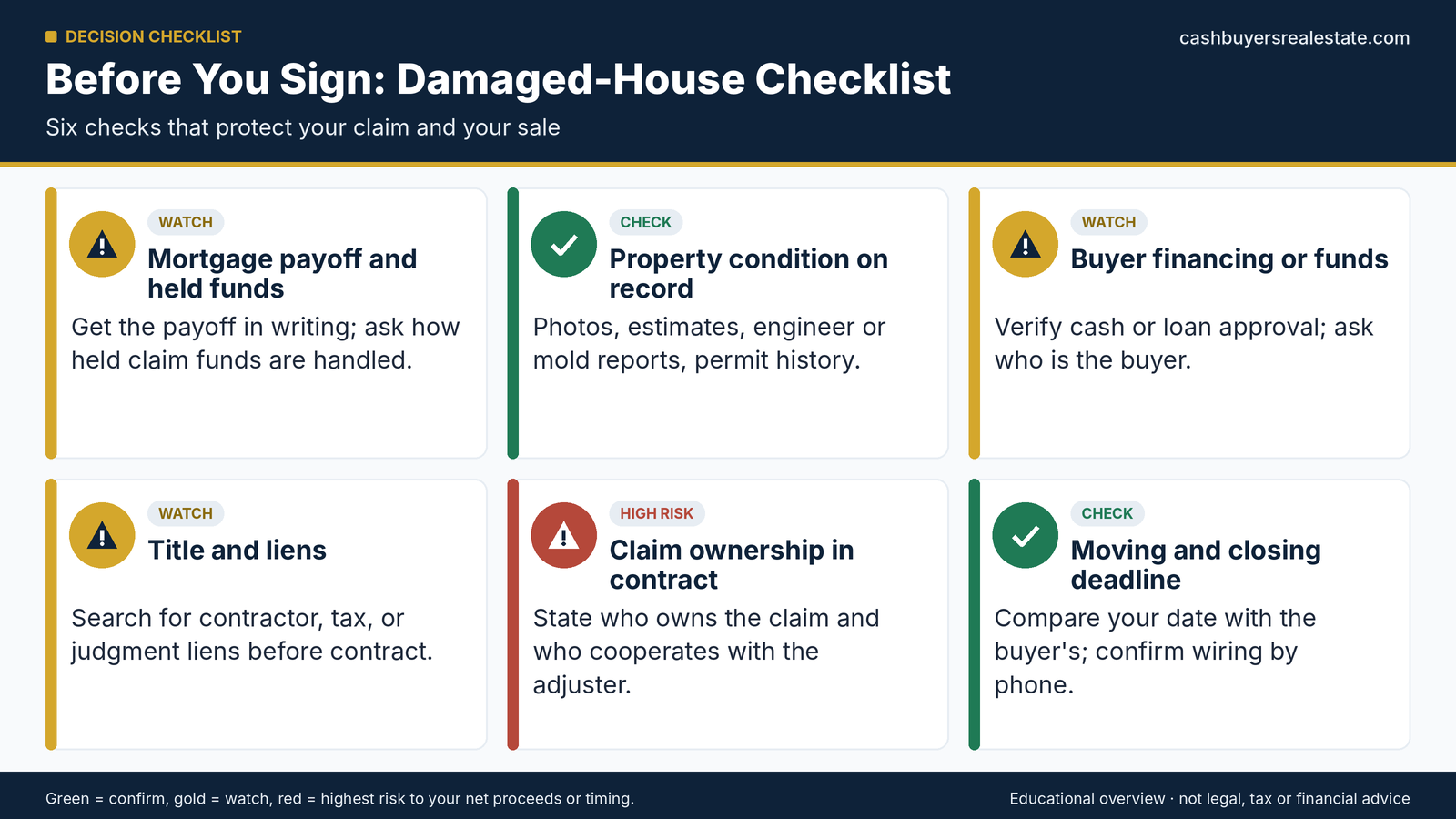
Text version of this infographic
- Mortgage payoff and held funds — Get the payoff in writing; ask how held claim funds are handled.
- Property condition on record — Photos, estimates, engineer or mold reports, permit history.
- Buyer financing or funds — Verify cash or loan approval; ask who is the buyer.
- Title and liens — Search for contractor, tax, or judgment liens before contract.
- Claim ownership in contract — State who owns the claim and who cooperates with the adjuster.
- Moving and closing deadline — Compare your date with the buyer's; confirm wiring by phone.
In words: confirm the exact mortgage payoff and how held claim funds will be handled, document the property’s condition with reports and photos, verify that the buyer’s funds are real, clear any title issues or liens, make sure the closing agent and signing arrangements are set, and compare your own moving or occupancy deadline with the buyer’s proposed closing date.
Frequently Asked Questions About Selling a Damaged House
Questions about insurance, mortgages, and taxes
Insurance claims and selling
- Should I file an insurance claim before I sell a damaged house?
In most cases, yes, or at least report the loss promptly. Policies have notice requirements, and an unreported loss can complicate both the claim and the sale. Filing a claim doesn’t commit you to repairing the house. A claim also gives you documented numbers from the adjuster, which help you judge investor offers. Your insurer and your state insurance department can explain deadlines that apply to you.
- Will my insurer still pay if I sell the house before the claim is settled?
It depends on the policy, the facts, and your state. United Policyholders says selling usually doesn’t cancel a claim, but who collects depends on the contract and on whether you assign the benefits. Tell your insurer you’re planning to sell and allow time for an inspection before the damage is altered. Put the answer in your sale contract so the buyer and seller agree on who owns the claim.
- Can I sell my house while the insurance company is investigating the cause of damage?
You can, but a pending investigation makes everything less certain. The insurer may want to inspect the house, interview people, or hire an engineer before any repair work or demolition. If you sell too soon, you may lose the chance to prove what happened. Ask the insurer in writing when it expects to finish, and ask a local attorney whether the sale could affect your rights.
- What if my claim is denied?
Ask for the denial in writing, which NAIC recommends, and read the stated reason. Some denials rest on exclusions, such as flood or earth movement. Others come from missing documentation that you can supply. You can appeal with the insurer, and your state insurance department can help with complaints. If the denial stands, the as-is price you can get becomes the main number in your plan.
Mortgage and tax questions
- What happens to insurance money my lender is holding if I sell?
It depends on your loan, the servicer, and the status of the repairs. Servicers generally hold undisbursed proceeds in a separate account and release them in stages as work is inspected. If you pay off the loan at closing, ask the servicer in writing how the held funds will be treated. Raise this question before you sign the sale contract, not after.
- What if I owe more than the house is worth in its damaged condition?
Then a sale at closing may not cover the payoff, and you’d need to bring cash, negotiate with the lender, or look at options like a lender-approved short sale. Insurance proceeds, if you have them, may close part of the gap. Talk to your servicer and a housing counselor before you accept an offer. The guide on selling before foreclosure covers what to do if payments are already behind.
- Can I deduct the loss on my taxes?
Sometimes. The IRS says that for tax years after 2017, personal casualty losses were generally deductible only for federally declared disasters, and that newer legislation made the deduction permanent and extended it to state-declared disasters beginning in 2026. Reimbursements reduce the loss, and amounts above your basis can create taxable gain. Because the rules depend on your facts, check with a tax professional.
- Do I owe tax on the sale of a damaged house?
It depends on your gain and on whether you meet the ownership and use tests for the home-sale exclusion. IRS Publication 523 says the exclusion can be up to $250,000, or $500,000 for qualifying joint filers, and that insurance reimbursements adjust your basis. A tax professional can calculate your situation.
Questions about buyers, disclosure, and timing
Buyers and offers
- Why are offers on damaged houses so much lower than the repair estimates would suggest?
Buyers price in more than the repair bill: contingency for surprises, holding and financing costs, resale costs, and a profit margin. They also price in risk, because hidden damage often surfaces after demolition begins. Ask each buyer for the repair scope and unit costs they assumed so you can compare their math with your estimates.
- Is an iBuyer or instant-offer platform likely to buy a badly damaged house?
Often not. Many platforms focus on houses in marketable condition and may decline properties with fire, structural, or major water damage, though policies differ by company. It costs little to ask. If a platform does make an offer, read what conditions it attaches and how it adjusts the price after inspection.
- Should I get more than one offer?
Yes, when you can. Written offers from different kinds of buyers, such as an investor, a rehabber, and an agent-listed price opinion, show the range of the market for your specific damage. Compare net proceeds, closing timelines, and contract terms, not only the headline number.
Disclosure, safety, and scheduling
- Do I have to disclose damage I already repaired?
Often, yes. Many state disclosure forms ask about past damage and repairs, including fires, floods, and insurance claims, as the Texas statutory form does. Disclose what happened, who repaired it, when, and whether permits were pulled. If you’re unsure what your state requires, ask an attorney or licensed agent.
- Can I sell a house that’s been declared unsafe?
In many places you can, but the notice stays with the property and the buyer must resolve it. Ask the issuing office what would lift the notice, put that information in writing for buyers, and expect investor and land-value buyers to dominate. Financed buyers generally can’t close on a house with an active unsafe designation.
- How long does it take to sell a damaged house?
It varies. An as-is sale to a cash buyer with clean title can sometimes close in a matter of weeks, while a repair-and-list path can take many months. The claim, the lender, and title issues usually drive the schedule more than the buyer does. The guide to selling a house in 30 days explains what has to be true for a short timeline.
- What if the house is in a flood zone or an area hit by a regional disaster?
Expect more buyer questions and slower contractor schedules. Flood-zone status and past flooding are common disclosure items, and a regional disaster can mean many nearby sellers and limited inspectors. Check whether a disaster declaration exists for your county, because it can affect available assistance and tax treatment. Document everything, and give buyers more time.
Choosing Your Route and Taking the First Steps
By now you’ve seen that a damaged house can be sold quickly, slowly, with the insurance money or without it, and for a price that ranges widely depending on the route. The best choice isn’t a universal answer. It’s the one that fits your priorities, your coverage, your mortgage, and your tolerance for work and uncertainty.
A decision framework: match the route to what matters most
Matching your priority to a route
Start by ranking what you want most: the highest possible net, the fastest exit, the least effort, or the most certainty. You rarely get all four. The table below pairs common priorities with the route that tends to serve them and the main thing to watch.
| If your top priority is | Route that often fits | What to watch |
|---|---|---|
| Highest net proceeds | Claim, repair, then list | Months of carrying costs and cost overruns |
| Speed with some insurance money | Claim, then sell as-is | Claim ownership wording; lender-held funds |
| Least effort and a clean break | Sell as-is to a cash buyer | Lowest price; buyer renegotiation after inspection |
| Certainty of closing | Cash buyer with verified funds | Proof of funds, contract terms, earnest money |
| Maximum price with limited repairs | List as-is with an agent who knows rehabbers | Showing safety; financing fall-throughs |
| Land or lot value is the real asset | Auction or builder sale | Demolition rules, liens, local permits |
Use the table to narrow your options, then run your own numbers. If two routes land within a few thousand dollars of each other, the tie-breaker is usually time and stress, which are real costs even though they don’t show up on a settlement statement.
Illustrative scenario (hypothetical, not a case study): A homeowner with a strong policy, a modest mortgage, and a flexible living situation chooses to claim and repair, because the finished house is worth far more than the carrying costs. Another homeowner relocating for work in six weeks, with a covered loss and a lender that releases funds slowly, chooses to sell as-is while keeping the claim. A third, with an excluded loss and a mortgage near the damaged value, talks to the servicer before accepting any offer, because the real question is whether the sale can pay off the loan. The same damage leads to three different decisions because the facts around it differ.
If you’re comparing how a cash buyer differs from an agent-led sale, the guide on cash buyer vs. real estate agent lays out the trade-offs. For a general overview of how fast-sale options compare, the main sell house fast hub is the place to start, and the page on selling a house for cash explains the cash route in more detail.
When waiting, or not selling, is the better choice
Sometimes the best move is to slow down. If your claim is still under investigation, selling before the adjuster has finished can limit your options. If the damage is moderate and your policy is strong, repairing might beat any as-is offer by a wide margin. If an emotional factor is clouding the decision, such as a family home, a recent loss, or a dispute among heirs, a few weeks of stability may serve you better than a quick close.
There are also cases where selling isn’t the right tool. If you’re behind on the mortgage, you may need a lender conversation or a housing counselor first. If the house is in an estate, the executor’s authority matters before anyone can sign a contract. If you’re being pushed to sign something immediately by a buyer you can’t verify, that pressure is itself information. A good offer survives a day or two of review.
None of this means a fast sale is a mistake. For many people it’s the right call. The point is to arrive at it by comparing numbers and options, with enough time to check the contract and confirm the payoff, instead of letting urgency pick for you.
What to do next
A first-two-weeks action list
- Make the house safe and secure it, following any instructions from local officials.
- Photograph and video everything before cleanup, and start a damage log.
- Report the loss to your insurer, ask about additional living expenses, and request a copy of your policy.
- Call your mortgage servicer, tell them about the loss and that you are considering a sale, and ask for their loss-draft instructions in writing.
- Arrange mitigation (water removal, tarping, boarding) and keep every receipt.
- Get two or more written repair estimates and, if the damage is structural, an engineer’s letter.
- Request a payoff statement and review your title for liens.
- Ask your insurer in writing how a sale would affect the claim, and whether the benefits can be assigned in your state.
- Talk to a real estate attorney or licensed agent about your state’s disclosure form and contract practice.
- Collect written offers or price opinions from at least two different kinds of buyers, then compare net proceeds.
You don’t need to finish the list in order, and you don’t need to finish it before you talk to buyers. But steps 3 and 4 shape everything else, so they’re worth doing first.
Documents to gather and questions to ask buyers
Pull together the insurance policy and declarations page, the claim number and adjuster’s contact information, all claim correspondence, the adjuster’s estimate, your contractor estimates, inspection and engineering reports, photos and video, mitigation invoices, your latest mortgage statement, a payoff statement, permit records, and your deed or title information. If you’re selling for an estate or with co-owners, add the documents that show who has authority to sign.
When you talk to buyers, ask questions that reveal how the deal will actually work. Can you show proof of funds? Who is the buyer on the contract, and is assignment allowed? How much is the earnest money, and who holds it? What inspection period do you need, and on what grounds can you cancel? What repair scope and costs did you assume? Who pays for title insurance and closing costs? How will you handle the insurance claim? What is your target closing date, and what could move it?
Compare the answers across buyers. The strongest offer isn’t always the highest number; it’s the one with the clearest terms, the verified funds, and the fewest conditions that could change the price later. If you want local context, the local market guides explain how state and county practices differ, and the overview of the cash home sale process walks through what happens from contract to closing.