Need to Sell My House Fast: Timeline, Costs & Seller Options
When you tell yourself “I need to sell my house fast,” the word that matters most isn’t “fast.” It’s the deadline hiding behind it. A closing date on the home you’re buying, a job that starts in six weeks, a foreclosure sale on a court calendar, an estate hearing, a lease that ends, a tax bill, or the monthly cost of someone’s care: each of these puts a different amount of pressure on you, and each one leaves a different set of moves available.
If you need to sell your house fast, start by writing down every deadline you face, then sort each as hard (set by a court, lender, contract, or law) or soft (a preference you can renegotiate). Find out who controls each date and whether it can move. Only then choose a sale route, because the right route depends on which deadline is truly fixed.
That order matters because the usual advice runs the other way. Search results are full of buyer types and offer promises, and they push you toward picking a method before you’ve defined the problem. A cash buyer is a good fit for some deadlines and a poor fit for others. A traditional listing sometimes meets a date comfortably and sometimes can’t. A request for more time from a mortgage servicer, a landlord, or a buyer on the other side of your own purchase may be the cheapest fix of all, and it only works if you ask before the date arrives.
This guide is built around triage. You’ll sort your deadlines using a matrix, apply a simple test for hard versus soft, and work through a calm first-48-hours checklist. From there it covers how routes line up with each type of deadline, how to negotiate more time, what HUD-approved housing counselors, attorneys, and tax professionals can do, what speed can cost in dollars, and the mistakes that people under pressure tend to make. The FAQ and final decision section close with a plan you can start today.
Urgency can be real without being an emergency. Many people reading this have more room than they feel they do, and some have less. The aim here is to help you tell which is which, calmly and with documents in hand, so you aren’t choosing a sale route out of anxiety. If you’re looking for a broader view of every fast-sale option, the sell house fast hub maps them, and the guide to urgent home sale options includes alternatives that aren’t sales at all.
One note about scope. This article is about triage by deadline. If your deadline is a foreclosure sale, the guide on selling before foreclosure goes deeper into that process. If the question is what a fast offer needs from you and what can really happen in a day, a week, or a month, see what “sell my house now” can mean at each stage. What follows is the framework that sits above all of those.
Why “I Need to Sell My House Fast” Starts With a Date, Not a Buyer
A date turns a vague feeling into a plan. Once you know exactly what has to happen by when, you can see how much of the timeline is in your hands, how much belongs to other people, and where a conversation might buy you weeks. This section shows how to define the clock accurately and sort your deadlines into types.
Defining the Clock Accurately
Calendar days versus decision days
Every deadline has two dates attached to it, and sellers often confuse them. The first is the date something happens: a closing, a foreclosure sale, a hearing, a lease start. The second is the date by which you must decide, which is earlier because the steps leading up to the event take time. A closing on a new home in 45 days doesn’t give you 45 days to find a buyer for your current home. It gives you 45 days minus however long your own sale needs to close.
Work backward to find the real decision date. Start with the event date, subtract the time a sale needs from signed contract to funded closing, and subtract the time to receive and compare offers. What remains is how long you can explore before you must commit. For a financed buyer, the contract-to-close stage usually runs several weeks; for a cash buyer, it can be shorter, though title work and payoff letters still take days. Those are planning assumptions, so confirm them with a title or closing professional in your state.
A good habit is to keep two dates on every deadline on your list: the event date and the decide-by date. It prevents the common error of treating the event date as your working deadline and discovering, two weeks out, that every route has already closed its window. It also gives you something concrete to tell a lender, a buyer, or a landlord when you ask for an extension: not “I need more time,” but “I need until the 20th, and here is why.”
What waiting actually costs you each day
Time pressure is easier to manage when you know what a day costs. Add up the monthly costs of keeping the home: mortgage interest (not the whole payment, since principal reduces what you owe), property taxes, homeowners insurance, utilities, HOA dues, lawn or snow service, and any second housing payment you’re making. Divide by thirty. That’s your daily carrying cost. If you’re also paying for a rental or short-term housing, add it.
Then add the costs that don’t show up on a statement: late fees if a payment is at risk, a deposit you might lose on a new purchase, the cost of extending a lease, or travel between two cities. Those numbers are specific to your situation and often dominate. A $110-a-day carrying cost sounds modest until a $5,000 deposit is at stake on day 40.
Knowing your daily cost makes later comparisons honest. If a faster route nets $16,000 less than a slower one but saves 60 days, you can compare $16,000 against 60 days of whatever your days actually cost. Without the figure, you’re guessing; with it, you can see that a 25-percent discount for speed might be wise in one situation and wasteful in another. The break-even example later in this guide uses this arithmetic directly.
A quick illustration: suppose interest on your mortgage runs $620 a month, property taxes are $310, insurance is $120, and utilities and lawn service add $180. That’s $1,230 a month, or about $41 a day. Add $1,600 in monthly rent on the apartment you’ve already leased and the total jumps to about $94 a day. The figure isn’t a prediction of what you’ll spend. It’s a yardstick for deciding whether a slower, higher-priced path is still the better deal.
The Deadline-Type Matrix
Seven common deadlines and what each puts at stake
Most urgent sales trace back to one of seven deadline types. Each has a different owner, a different degree of flexibility, and a different risk if missed. The matrix below sorts them. Use it to place your own situation, and keep in mind that you may have more than one row.
| Deadline | Who sets or controls it | Often movable? | What’s at stake | First move |
|---|---|---|---|---|
| Closing on a new home | Purchase contract; the other side’s seller and lender | Sometimes, by written extension | Deposit, loan lock, possible contract default | Ask your agent and lender about extension terms |
| Job start or relocation | Employer | Often, within limits | Position, relocation benefits | Ask HR about start date and benefit conditions |
| Foreclosure sale or court date | Lender, court, state law | Rarely without lender or court action | Loss of the home and equity | Call the servicer; contact a HUD-approved counselor and an attorney |
| Estate or probate date | Court, personal representative, other heirs | Sometimes, by petition or agreement | Carrying costs, authority to sell | Confirm who has legal authority to sell |
| Lease end or tenant issue | Lease terms, landlord-tenant law | Sometimes, by agreement | Housing gap, possible penalties | Read the lease; check notice rules in your state |
| Tax deadline | IRS, state, or county | Rarely; sometimes payment plans | Penalties, liens, lost tax benefit | Ask a tax professional what the date actually requires |
| Medical or care costs | Care provider, family, benefit rules | Often more flexible than it feels | Funding for care | Speak with an elder-law attorney before any transfer |
Read across a row, not just down a column. The foreclosure row looks different from the job-start row not because one is more urgent in feeling, but because one is controlled by third parties with legal authority and the other usually has someone you can negotiate with. That difference drives almost everything that follows.
Stacked and hidden deadlines
Deadlines rarely arrive alone. A job start often comes with a lease on a new place, and a probate case brings property taxes, insurance, and a family timeline all at once. Write all of them on one page, even the ones that feel minor, and mark which depend on which. A purchase closing might depend on your sale closing. A rent-back might depend on a lender’s consent. Dependencies show you where one delay would ripple.
Look for hidden deadlines too. Homeowners insurance policies may limit coverage when a home is vacant for a stretch of time, so a move-out can start a clock you didn’t know about; check your policy and ask the insurer. HOAs can have rules about move dates, parking for moving trucks, or approval of buyers. A utility shutoff could affect a pending inspection. Tenant notices have their own timing under state law, which the guide on selling quickly with tenants explains.
The point of this exercise isn’t to make the list longer. It’s to catch the date that would end your plan if you missed it, so you can protect that one first.
Dependency chains deserve a quick sketch. Draw a line from each event to whatever relies on it: your sale funds the down payment on your purchase, your purchase closing sets the date your lease ends, your lease end determines where you sleep. If the first link slips by a week, the sketch shows which later links break and which have slack. Where there’s no slack, you’ve found the deadline you must protect with a backup plan, such as a second offer in hand or a lender’s written commitment to extend a rate lock.
The Hard-Versus-Soft Deadline Test
Not every deadline deserves the same response. Treating a soft deadline as hard leads to unnecessary discounts, and treating a hard one as soft leads to missed protections. A short test, applied honestly, sorts them in minutes.
Five Questions That Sort Deadlines
The test, with a scoring table
Ask five questions about each deadline: who set it, what happens if it’s missed, whether anyone has authority to move it, whether a workable alternative exists, and how much the miss would cost in dollars and in things that can’t be bought back. A deadline is hard when it’s set by a court, a lender with a legal process underway, a statute, or a signed contract whose penalties apply automatically. It’s soft when it rests on a preference, an estimate, or a promise that the other party can relax.
| Question | Signals a hard deadline | Signals a soft deadline |
|---|---|---|
| Who set it? | Court, statute, servicer with a legal process, signed contract | You, family, an employer’s estimate |
| What happens if it’s missed? | Automatic legal or financial consequence | Inconvenience, awkward conversation, or modest cost |
| Can the controlling party move it? | Only through a formal process | Yes, by simple agreement |
| Is there a workable alternative? | No practical substitute | Yes: temporary housing, delay, partial solution |
| Can the cost be measured? | Large or irreversible (loss of a home, forfeited deposit) | Measurable and recoverable |
Count the answers in each column. Four or five in the “hard” column means the date probably controls your plan; four or five in the “soft” column means you have room to negotiate. A split result usually points to a deadline that’s firm on paper but bendable in practice, such as a contract extension that requires the other side’s written consent.
A quick scoring example helps. Suppose your employer’s start date is set by a manager’s estimate (soft), missing it would cost you a relocation stipend of a few thousand dollars (measurable), the manager can move it by agreement (soft), and you could work remotely for a few weeks (alternative exists). That scores four soft. Now suppose your purchase contract sets a closing date with a deposit forfeited on default and no extension clause. That scores hard on source, consequence, and control. The first deadline is a conversation; the second is a constraint.
Who controls each deadline, and what to ask them
Every deadline has a controlling party, and the quickest way to create room is to talk to that party early. For a mortgage, it’s the servicer. For a purchase contract, it’s the seller and possibly their lender. For a start date, it’s your employer. For a probate hearing, it’s the court and, informally, the other heirs. For a lease, it’s the landlord or tenant. Knowing who holds the pen tells you whom to call and what to request.
Prepare a short, specific request. Name the date, the reason, the new date you need, and what you can offer in return. A landlord might accept a month-to-month extension at a slightly higher rent. A buyer on the other side of your own purchase might accept a three-day extension for a per-day fee. An employer might allow remote work during the transition. These are requests, not entitlements, but they are asked and granted more often than people expect when they’re made early and clearly.
If the first person you reach can’t decide, ask who can. Front-line staff at a lender or property manager are often able to explain the process but not to approve an exception. Ask for the name and direct line of the person with authority, ask when they’ll respond, and keep a log of each call with the date, the name, and what was said. If a request is denied, ask what would change the answer: a different date, a larger payment, extra documentation.
Always get the answer in writing. A verbal “that should be fine” is worth little if the person who said it leaves, forgets, or disagrees later. An email confirming what was agreed, with the new date, is often enough to protect you.
What Soft Deadlines Can Still Cost
Soft deadlines with hard edges
Soft doesn’t mean free. A start date may be flexible, but the relocation benefit attached to it might expire on a certain day. A buyer might grant a closing extension, but a rate lock could expire or a loan approval could age out, which can cost money or require a new application. A landlord might agree to extra time and then raise the rent. Each of these has a price, and the price belongs on your comparison sheet.
The test is whether there’s a dated condition attached. Read the fine print on any benefit, extension, or agreement and look for expiration dates, fees, or conditions. Ask directly: “If we move this date, does anything else change?” The answer sometimes surprises people, and it’s much better to hear it before you rely on the extension.
One of the most common hard edges involves financing. A buyer’s preapproval, an interest-rate lock, and an appraisal can each have their own expiration dates. If a closing slips past one, the buyer may need to renew or requalify, which can add weeks and sometimes changes the loan terms. When you ask a buyer to wait for you, or when you’re the one asking to move your closing, find out which of those dates sits behind the closing and whether an extension would trigger a new round.
Consider also how soft deadlines interact. An employer’s start date might be soft, but combined with a lease that begins on a fixed day and a spouse’s job in the new city, the cluster may behave like a hard deadline. When several soft items depend on each other, treat the group as one unit and ask which single date, if missed, would force you to redo the others.
Turning a soft deadline into a working calendar
Illustrative example (hypothetical numbers, not market data): Maria’s employer wants her in a new city by day 60, but says a start two weeks later is possible. Her new lease begins on day 50 with a $2,200 monthly rent. Her own home sale needs about 35 days from contract to funding. She sorts her list: the lease date is hard unless the landlord agrees to a later start; the job date is soft by two weeks; the sale needs a contract by day 15 to fund by day 50. She asks the landlord for a day-65 start in exchange for paying 15 days of rent early, which would cost roughly $1,100. That one conversation turns a 15-day squeeze into a 30-day window, and she can price her home without a distress discount.
Maria’s approach shows the general method. List each date, mark it hard or soft, find the controlling party, and negotiate the soft ones first. Notice that she paid for time with a small, predictable amount of money, instead of paying with a large, uncertain discount on her home’s price. Many sellers have an equivalent trade available and never ask.
The map below turns this triage into a six-step process: name every deadline, test hard versus soft, find who controls each date, ask for movement, choose a route, and set checkpoints. The essentials are stated in the text above, so the graphic works as a quick reference.
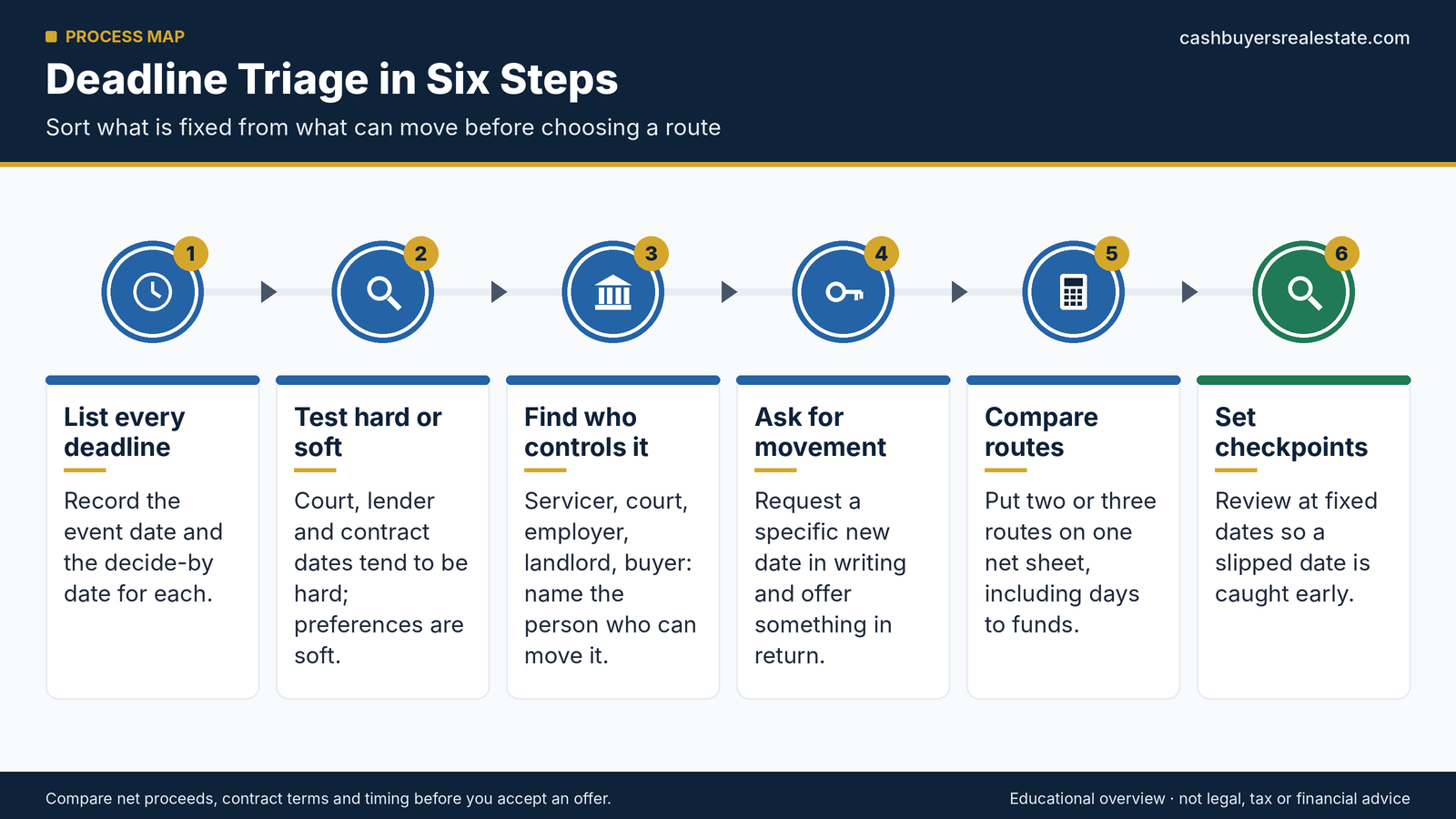
Text version of this infographic
- List every deadline — Record the event date and the decide-by date for each.
- Test hard or soft — Court, lender and contract dates tend to be hard; preferences are soft.
- Find who controls it — Servicer, court, employer, landlord, buyer: name the person who can move it.
- Ask for movement — Request a specific new date in writing and offer something in return.
- Compare routes — Put two or three routes on one net sheet, including days to funds.
- Set checkpoints — Review at fixed dates so a slipped date is caught early.
The First 48 Hours: A Calm, Ordered Checklist
When the clock is running, the temptation is to do everything at once or nothing at all. A short, ordered checklist avoids both. The goal of the first two days isn’t to sell the house. It’s to know exactly where you stand, protect the deadline that can’t move, and gather what you need to compare real options.
Day One: Facts, Contacts and Documents
A sequenced checklist for the first 24 hours
Start with paper, not phone calls. You’ll make better decisions, and better calls, once the facts are in front of you. Work through the list in order; most items take less than an hour.
- Write down every deadline. For each, record the event date, the decide-by date, who controls it, and whether it’s hard or soft.
- Collect notices in one folder. Include mortgage statements, any letter from your servicer, court papers, HOA or tax notices, and the lease if tenants or a new rental are involved. Read each one fully, since the key date is often buried in a paragraph.
- Request a payoff statement. Your lender can tell you exactly how much is owed through a given date, which sets the floor for any sale price.
- Confirm who has to sign. Check the deed for every owner, and consider spouses, co-owners, trusts, and estates. A sale can’t move until everyone with authority is aligned.
- List known liens and judgments. Property tax arrears, contractor liens, and judgments can attach to the property and must be paid or resolved at closing.
- Check insurance and taxes. Make sure the homeowners policy is active and that property taxes aren’t about to become delinquent.
- Photograph the home and gather records. Condition photos, repair receipts, permits, warranties, and utility bills will all be requested by someone later.
If your difficulty is paying the mortgage, add one more step: call your servicer today. The Consumer Financial Protection Bureau advises contacting your servicer right away, explaining your situation, and asking what forbearance or hardship options exist, because some servicers require you to request help within a set time after a qualifying event. Ask the servicer to explain any option in writing, including what happens to interest and when repayment begins.
Be realistic about timing. Many items on this list depend on other people’s schedules, so start the requests that involve waiting, such as the payoff statement and any title or lien search, early in the day. Then use the waiting time for the documents you control. By evening you should have a one-page summary of your deadlines, your payoff, your ownership status, and your known obstacles.
What to avoid in the first 48 hours
The most expensive mistakes happen early, when a stressed homeowner receives an offer of help. The Federal Trade Commission’s guidance on mortgage-related scams lists patterns to recognize: upfront fees for services such as loan modification, instructions to stop talking to your lender, requests to transfer your deed, pressure to sign quickly, and payment demands by wire, cashier’s check, or payment app. The FTC says companies that tell you to stop communicating with your lender are breaking the law, and that under its Mortgage Assistance Relief Services Rule, companies generally can’t charge you until you’ve accepted a written offer from your lender.
Beyond scam patterns, a few plain rules are worth keeping in mind. Don’t sign a contract or an agreement you haven’t read in full, and don’t sign anything that transfers ownership of your home when you only expected to receive advice or a loan. Don’t send mortgage payments to anyone other than your servicer, and don’t assume a verbal promise from a buyer or adviser will hold; get commitments in writing. Don’t hide known problems when you prepare a sale, because disclosure obligations apply in most states and concealing material defects creates legal exposure.
Notice what isn’t on the avoid list: talking to professionals. Calling your servicer, a HUD-approved counselor, an attorney, or an agent costs little and carries no commitment. The things to avoid are irreversible steps taken under pressure, not honest questions asked early.
Day Two: Choices, Comparisons and Conversations
Collecting two quick comparisons on the same footing
On the second day, move from facts to options. You don’t need to choose yet. You need two or three comparable pictures of what each route might look like: how long it would take, what you’d net, and what could go wrong. Ask a local real estate agent for a pricing opinion and a realistic timeline from listing to closing. Ask at least one cash or investor buyer for an offer in writing, including the buyer’s closing timeline and who pays which costs. Then lay the answers side by side.
| Question | Agent or listing path | Cash or investor path | Why it matters |
|---|---|---|---|
| What price range, and on what comps? | Comparative market analysis with sales cited | Offer with stated assumptions about condition | Net proceeds depend on price and deductions |
| How many days from contract to funds? | Depends on buyer’s lender and appraisal | Depends on due diligence and title work | Must fit inside your decide-by date |
| What are my costs? | Agent fees, closing costs, credits, prep | Fees, credits, or deductions the buyer applies | Compare cash to you, not the headline |
| What can cancel the deal? | Financing, appraisal, inspection contingencies | Inspection, funds verification, re-pricing | Fall-through restarts the clock |
| What do you need from me? | Prep, showings, repairs, disclosures | Access, documents, possibly cleanout | Workload competes with your other deadlines |
Treat the table as a script. If an answer is vague, ask again, and note who gave it. The point is not to find a perfect option but to see how large the gaps are. Sometimes the faster route costs a surprisingly small amount; sometimes the difference is large enough to justify spending time on an extension request instead. For the economics behind investor offers, see the guide on how cash offers are calculated, and for what to verify about a buyer, the page on proof of funds.
Telling the right people, in the right order
Some conversations are better early. If you share ownership, talk to your co-owners before anyone else, because their cooperation is required. If you have a servicer, lender, or landlord who can extend a date, contact them before the date is close, since a request made with weeks to spare is taken more seriously than one made with days. If you have an employer who might adjust a start date, a short, factual note to your manager or HR often goes better than an informal hint.
Keep other conversations narrow. You don’t need to announce your plan to neighbors or post it publicly, and you shouldn’t share financial details or account numbers by email or text with people you haven’t verified. Use known phone numbers, not numbers from unsolicited messages, when you contact institutions. Keep a simple log: date, person, what was discussed, what was promised, and what you will do next.
A short script helps for the harder calls: state who you are, what the date is, what you’re trying to accomplish, what you are asking for, and by when you need an answer. For example: “My closing is on the 28th, and I’m trying to sell my current home first. Can you tell me whether you grant a five-day extension, what it would cost, and whether you can confirm it in writing by Friday?” It’s polite, specific, and easy for the other person to answer.
Matching a Sale Route to Each Deadline Type
With deadlines sorted and a first set of comparisons in hand, route choice becomes a matching problem. Different deadline types favor different routes, and some routes strain particular deadlines. This section explains the pairings and the rules behind the hard ones.
Hard Deadlines Set by Courts, Lenders or Contracts
Foreclosure sale dates and court calendars
If your deadline involves a foreclosure sale, begin with what the rules actually say, because the timeline is often longer than people fear and shorter than they hope. Under the federal mortgage servicing rule, Regulation X, a servicer generally may not make the first notice or filing for foreclosure unless the borrower is more than 120 days delinquent, with limited exceptions such as a due-on-sale violation or a servicer joining another lienholder’s action. The Consumer Financial Protection Bureau explains the same 120-day rule in plain terms and adds that the time between the start of legal action and an actual sale varies by state.
The rule also contains a protection tied to the sale date. If you submit a complete loss mitigation application more than 37 days before a foreclosure sale, the servicer generally may not move for a foreclosure judgment or order of sale, or conduct the sale, until certain conditions are met: for example, you’ve been told you aren’t eligible for any option and any appeal has run, you rejected the options offered, or you failed to perform under an agreement. These are federal minimums, they have exceptions, and state law adds its own procedures, so a housing counselor or attorney should confirm how they apply to your loan.
For a foreclosure deadline, route choice usually includes four possibilities: working with the servicer on a loss mitigation option, selling on the open market with enough time to close before the sale, a cash sale on a short timeline, or lender-approved alternatives such as a short sale or deed in lieu, which require the lender’s agreement and can have credit or tax consequences worth discussing with a professional. The detailed mechanics are in the guide on selling a house before foreclosure. Whatever you choose, keep communicating with your servicer in writing and watch for anyone who asks for fees up front.
Closing on a new home or starting a job: bridging the gap
Contract-driven and employer-driven deadlines usually leave more room, but the margin can be thin. The core problem is the same: your sale must fund before, or at least near, the date your next obligation begins. Sellers solve it in several ways, and each has a different cost.
One approach is to make your own purchase contingent on the sale of your current home, which protects you but weakens your offer on the new place. Another is to sell first and arrange a rent-back, a post-closing occupancy agreement that lets you stay for a set period. A third is to close both transactions on the same day or in tight sequence with help from your title or closing professionals. A fourth is short-term bridge financing, such as a loan secured by your current home; terms and costs vary by lender, so ask for a written estimate before relying on one. A fifth is temporary housing and storage, which can cost less than a steep discount on price.
| Deadline type | Routes that often fit | Routes that often strain | Watch-out |
|---|---|---|---|
| Foreclosure sale date | Servicer options, lender-approved alternatives, a fast cash or open-market sale started early | Long listing campaigns; any route started late | Fees charged up front; deed transfers |
| Closing on new home | Listing at market with a rent-back, cash buyer, bridge terms | Contingent listing with long financing contingencies | Rate-lock and approval expiration |
| Job start | Listing priced to move, flexible closing, temporary housing | High price with a long wait | Relocation benefits with end dates |
| Estate or probate date | As-is sale after authority is confirmed | Any route before authority exists | State rules on court approval |
| Lease end or tenants | Sale with tenant in place, or timed notice | Plans that ignore notice rules | State and local tenant law |
| Tax or care costs | Retail listing if time allows; verified buyer if not | Below-value transfers to relatives | Tax and benefit rules vary |
Read the first two columns as options and the third as cautions, not prohibitions. A long listing campaign might still work for a foreclosure deadline if the sale date is months away and the servicer is cooperating. The table only says which routes carry the most timing risk.
Tax, Lease, Care and Estate Deadlines
Tax, lease and care-cost deadlines
Tax deadlines come in several forms, and it helps to be exact about which one you mean. For a primary residence, the federal home-sale exclusion lets many sellers exclude up to $250,000 of gain, or $500,000 on a joint return, if they’ve owned and used the home as a main residence for at least 24 months within the five years before the sale, according to the IRS. Generally, you can’t claim it if you excluded gain on another home sold within the previous two years. If you’re close to the 24-month mark, a few weeks of waiting could change your tax result, and that’s a question for a tax professional. IRS Publication 523 also describes a reduced exclusion when the main reason for the sale is a change in workplace location, a health issue, or certain unforeseen events; a new job at least 50 miles farther from the home is one test it describes.
For investment property, the relevant clock may belong to a like-kind exchange under Section 1031. IRS Form 8824 instructions say replacement property must be identified within 45 days after you transfer the property you gave up, and received by the earlier of 180 days after the transfer or the due date of your return, including extensions, for that year. These deadlines are strict, and a qualified professional should guide any exchange. Most homeowners selling a personal residence don’t use this route.
Lease deadlines depend on whether you are the tenant or the landlord. If you’re ending your own lease, read its notice and early-termination provisions. If tenants live in the property you want to sell, notice periods and tenant rights are set by state and local law and are covered in the hub on selling a house with tenants. Care-cost deadlines are the most delicate. Federal and state benefit rules can treat transfers of a home for less than its value as relevant to eligibility, so speak with an elder-law attorney before selling to a relative at a discount or transferring the property.
Estate and probate deadlines
When the house belongs to a person who has died, the first deadline isn’t the market; it’s authority. Someone must have legal power to sell, which typically comes from a court appointment or, in some states and situations, a trust or a transfer-on-death arrangement. The names of the documents and the steps to get them differ by state, as do requirements for court approval of a sale. Without authority, a buyer’s title company won’t insure the transfer, and a closing can’t happen.
With authority established, the timeline usually depends on the court’s calendar, other heirs’ agreement, and carrying costs in the interim: taxes, insurance, utilities, and upkeep on a home that may be vacant. Vacancy can affect insurance coverage, so ask the carrier. If heirs live in different states, agree on one person to coordinate and put decisions in writing. When a quick sale is the plan, a buyer who accepts the home as it is can avoid clearing out belongings and making repairs first, but you should compare the net, not just the speed.
For the details, the guides on selling quickly in probate and selling an inherited house fast go step by step, and the hub on probate real estate covers the legal frame. Because every state has its own probate process, an attorney licensed where the property sits should confirm the sequence before you list.
The chart below compares five routes a seller might choose across these deadline types: a listing priced to move, a cash or investor purchase, a lender-supported alternative, a rent-back or extension strategy, and a stay-and-pause option when time allows. Each route’s main tradeoff is summarized in the text above.
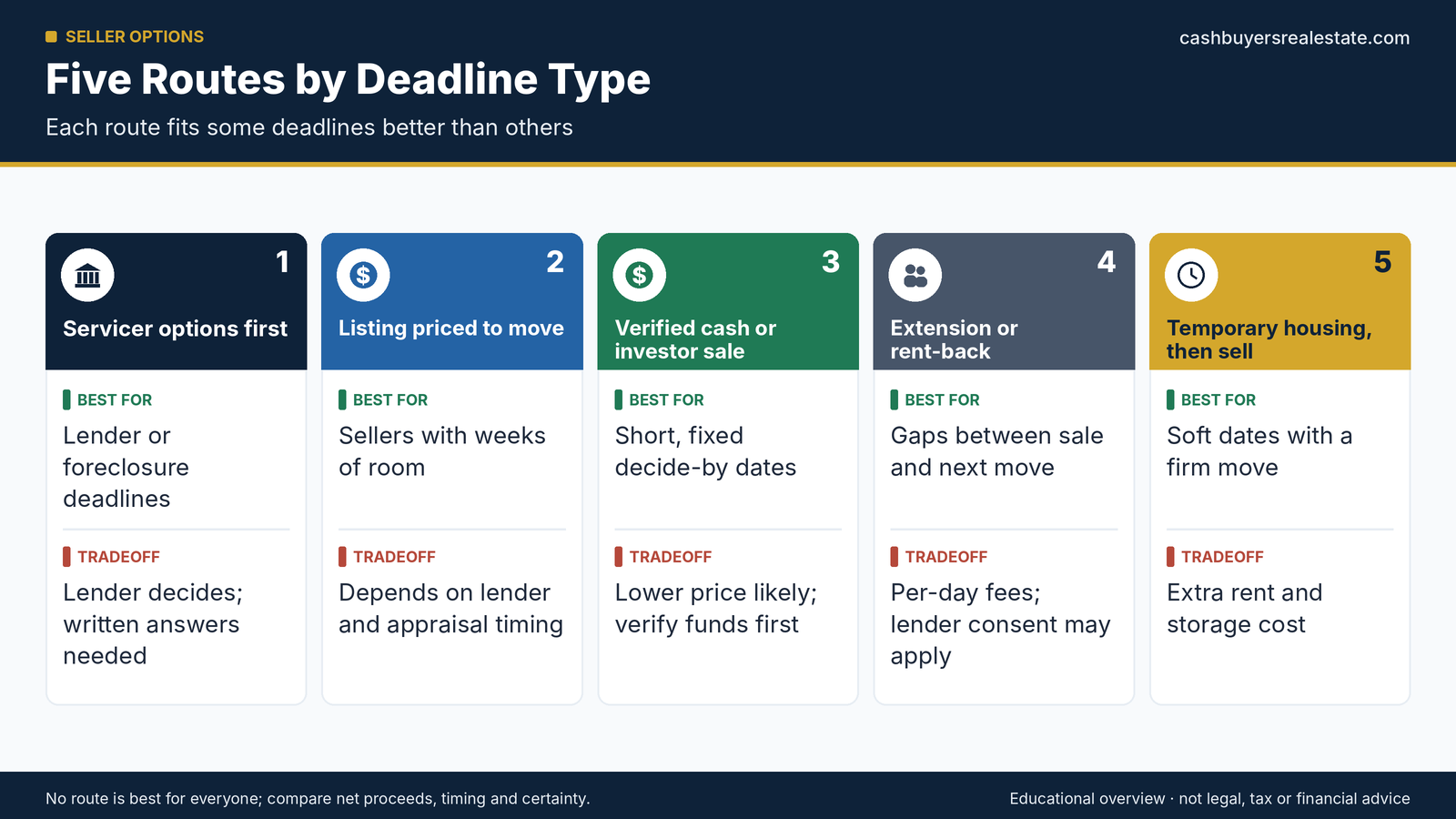
Text version of this infographic
- Servicer options first — best for: Lender or foreclosure deadlines; tradeoff: Lender decides; written answers needed
- Listing priced to move — best for: Sellers with weeks of room; tradeoff: Depends on lender and appraisal timing
- Verified cash or investor sale — best for: Short, fixed decide-by dates; tradeoff: Lower price likely; verify funds first
- Extension or rent-back — best for: Gaps between sale and next move; tradeoff: Per-day fees; lender consent may apply
- Temporary housing, then sell — best for: Soft dates with a firm move; tradeoff: Extra rent and storage cost
Negotiable-Deadline Tactics That Buy Time
The cheapest day you’ll ever buy is one you negotiate before it’s needed. Asking for time feels uncomfortable, and people often assume the answer will be no. In practice, lenders, buyers, landlords, and employers regularly grant reasonable requests when they come early, with a clear reason and a specific new date. This section covers who to ask, what to ask for, and how to build slack on your own side.
Asking the Other Side for Time
Mortgage servicers: forbearance, loss mitigation, and written answers
If the pressure comes from your mortgage, your servicer is the first conversation. The Consumer Financial Protection Bureau describes forbearance as a way to temporarily pause or reduce payments while you still owe the full amount, and lists three common structures: paused payments repaid in a lump sum when payments restart, paused payments repaid at the end of the loan, and reduced payments repaid through higher monthly payments for a set period. Each carries tradeoffs, such as interest that keeps accruing or a large bill later, so ask the servicer to spell out the amount due, the length of the pause, how interest accrues, and when repayment begins.
Forbearance isn’t a sale strategy by itself, but it can provide breathing room while you sell on a normal timeline instead of a compressed one. Ask whether any available option would pause collection activity while you list the home, and whether the servicer would consider a short sale or other arrangement if a sale falls short of the payoff. Those decisions belong to the lender and carry consequences, so a HUD-approved counselor or attorney should review them with you.
Timing rules can matter here. As covered earlier, the federal servicing rule restricts moving forward with a foreclosure sale when a complete loss mitigation application arrives more than 37 days before the sale, subject to conditions. That makes a request made weeks ahead considerably stronger than one made days before. If you serve or have served in the military, the CFPB also suggests contacting your local Legal Assistance Office about protections that may apply. Get every approval, denial, and instruction in writing, and ask for the date by which you must respond.
Purchase contracts, closing dates, and rent-backs
On the other side of a purchase contract, you’re dealing with a seller who also has a move to coordinate. An extension of a few days is often easier to grant than people assume, particularly when you offer something in return: a per-day payment, a larger deposit, or flexibility on their own post-closing needs. Ask your agent or attorney to draft a written addendum that states the new date and anything that changes, such as a rate-lock fee or a revised deposit schedule.
If you’re the seller of the home you need to leave, a rent-back works in reverse. You close on the sale, receive your funds, and stay for an agreed number of days under a short occupancy agreement. Terms to settle include a daily rate, a security deposit, who pays utilities, insurance responsibilities, and the condition in which you’ll leave the home. Buyers’ lenders often have rules about occupancy, so the buyer needs to confirm that the arrangement is permitted before it’s written into the contract.
Illustrative example (hypothetical numbers, not market data): A seller closing on a new home needs seven more days than the contract allows. The other side’s seller agrees to extend if the buyer pays $150 per day, or $1,050 total, and a $1,000 additional deposit that applies to the purchase. Compared with accepting an $8,000 price cut from a faster buyer on the current home, the extension costs about $1,050 in real money plus a deposit that comes back at closing. The seller keeps the better offer and keeps the new home.
The principle behind these tactics is that extension costs are usually small relative to the price discounts people accept for speed. Compare them in dollars before deciding which problem to solve with price and which to solve with time. If your closing date is the bottleneck on both sides, a rent-back or an extension is also a way to avoid being forced into a buyer who only offers speed.
Creating Slack on Your Own Side
Temporary housing, storage, and splitting the move
Sometimes the most flexible lever is your own logistics. If you can’t make two dates line up, a month of furnished short-term housing or a month-to-month rental can separate them. A storage unit holds belongings for a few weeks while you wait for a closing. A move in two phases, with essentials first and the rest later, can let you start a job on time even if the house hasn’t sold. These costs are real, but they’re usually measured in hundreds or low thousands of dollars, and they can be compared directly with the discount a fast buyer would ask.
Consider the arithmetic with hypothetical figures. A 30-day furnished rental might cost $2,400, with $180 for storage and $600 for an extra moving trip, about $3,180 in all. On a $300,000 home, a three percent price concession for speed would be $9,000. If the temporary arrangement lets you hold out for a better offer, you may come out $5,800 ahead, and you’ve reduced the risk of agreeing to a deal under pressure. If the numbers go the other way, because the discount is small or the temporary costs are high, you’ve learned the speed route is the better value.
Family and friends can help too, but treat these arrangements with the same clarity as any other: agree on dates and expectations in advance. Also check how a move-out affects your homeowners insurance and utilities. A vacant house can have different coverage conditions, so ask your insurer before you leave it empty. The goal is to turn a rigid timeline into a flexible one at the lowest cost.
Writing it down: extension requests, confirmations, and a decision log
Most requests for time fail not because the answer is no, but because the request is vague or unrecorded. A good written request is short and specific. It states the date at issue, the reason in a sentence, the new date you need, what you can offer, and when you need a reply. For example: “I’m writing about the closing scheduled for the 28th. My current home closes on the 3rd, and I’d like to move the purchase closing to the 5th. I can pay $150 per day and increase the deposit by $1,000. Could you confirm in writing by Friday?”
When the other party agrees, ask them to confirm by email or sign an addendum, and save it where you can find it. If the agreement affects a contract, send it through your agent, attorney, or closing company so it’s formalized, since a casual email can fall short of a binding amendment. If you receive a denial, ask what would change the answer. Often there’s a smaller version of your request that they can approve.
Keep a decision log. For each deadline, record the original date, the request you made, whom you asked, the response, and the new date. A log keeps you honest about which deadlines have moved, protects you if there’s later disagreement about what was promised, and shows your professionals exactly where things stand. Add calendar reminders a week and three days before each confirmed date so a successful extension doesn’t become a missed one.
Where Professional Help Fits: Housing Counselors, Attorneys and Tax Pros
You don’t have to decode legal, tax, and lending rules alone, and you shouldn’t. Some of the best help is free, and some of the most costly mistakes involve skipping a short conversation with the right person. This section explains who does what.
HUD-Approved Housing Counselors
What counselors do, what they cost, and how to reach one
HUD’s housing counseling program connects people with certified counselors at participating nonprofit and government agencies. Counselors give independent advice tailored to your situation, and HUD says foreclosure, eviction, and homelessness counseling is always free, while other services may carry a modest fee that agencies must disclose in advance and waive if you can’t afford it. Topics include foreclosure prevention, budgeting and credit, predatory lending, rental issues, and reverse mortgages. To reach one, you can call HUD’s counseling line at 800-569-4287, use HUD’s online search, or use the CFPB’s Find a Housing Counselor tool.
The CFPB adds that HUD-approved counselors can review your finances, weigh options if you’re struggling to pay your mortgage, build a plan, and help you communicate with your servicer and understand the options it offers. The CFPB lists the HOPE Hotline at 888-995-4673, available 24 hours a day, and its own number, 855-411-2372, which can connect you to a counselor. Counselors can’t guarantee that you’ll keep your home, and if foreclosure is imminent or you’ve been served legal papers, you may also need an attorney.
A counselor can be especially helpful when you’re deciding between selling and staying. They can help you compare what’s owed, what the home might bring, and which of the servicer’s options fit your income. They are not agents of a particular buyer, and they cannot require you to use any product or service as a condition of counseling. If anyone presenting as a counselor asks for a large fee or tries to steer you to a specific buyer, check the agency against HUD’s list before proceeding.
Preparing for a counseling session
A first session goes further when you arrive prepared. The CFPB says counselors will likely ask for your mortgage details, such as the balance and date of your last payment, usually found on your latest statement, and may ask for pay stubs, tax returns, recent bank statements, and information about other monthly bills. Bring any letters from your servicer, any court papers, and your list of deadlines with the event and decide-by dates.
Write down your questions in advance. Useful ones include: What options does my servicer have for my loan type? How much time do I realistically have before the next step in the process? What does each option cost, and what are the credit or tax consequences? If I decide to sell, what steps should come first? Can you review any offers or agreements I’ve been given? Ask the counselor to explain anything you don’t understand in plain language, and take notes.
If you can’t reach a counselor right away, don’t let that delay your other steps. Many agencies have waiting lists, so call early, and while you wait, continue gathering documents and speaking with your servicer. Counselors often work with people at many different stages, so you don’t need to be at crisis stage to ask for an appointment.
Attorneys, Tax Professionals and Agents
Which professional for which problem
Different problems call for different advisers, and using the right one saves time and money. Attorneys handle questions about court deadlines, foreclosure notices, probate authority, title defects, contract disputes, and landlord-tenant law. Tax professionals handle the home-sale exclusion, exchanges, estimated payments, and the tax effect of selling an inherited or investment property. Real estate agents handle pricing and marketing, and title or closing professionals handle payoffs, lien searches, and the mechanics of closing in your state.
| Problem | Best first contact | What to ask |
|---|---|---|
| Missed payments, servicer options | HUD-approved housing counselor | Which options fit my loan, and how long do I have? |
| Foreclosure papers or court date | Attorney licensed in your state | What are my deadlines and defenses, and what does a sale do to them? |
| Probate, authority to sell | Probate or estate attorney | Who can sign, and does the court need to approve the sale? |
| Capital gains, exchanges, estimated tax | CPA or enrolled agent | Do I qualify for the exclusion, and what do I owe by when? |
| Pricing and timeline | Local real estate agent | What comps support the price, and how long will it take? |
| Payoffs, liens, and closing mechanics | Title or closing company, or closing attorney | What do you need from me, and how long will closing take here? |
Use the table to plan the order of your calls. If more than one row applies, start with the one tied to the hardest deadline. A short consultation often settles the main question. If you need ongoing representation, ask for a written scope and fee estimate before you agree.
Vetting help and avoiding fee-first offers
Panic is a gift to people selling expensive solutions, so a few simple screens are worth applying to anyone who offers help. Confirm that an attorney is licensed in your state through the state bar. Ask for fees and scope in writing. Be wary of unsolicited calls, letters, or ads promising to stop a foreclosure or reduce your payment for a fee, particularly if the fee comes first. The FTC says its rule generally bars companies from collecting fees for mortgage relief until you’ve accepted a written offer from your lender, and that attorneys may take upfront fees only under specific conditions such as using a client trust account.
The FTC also warns about mass joinder lawsuit mailers that charge upfront fees; these aren’t class actions and are unlikely to save a home. It cautions against anyone who tells you to stop communicating with your lender or to make payments to them instead, and anyone who asks you to transfer your deed. If you’ve already paid a scammer, act quickly and report it at ReportFraud.ftc.gov and to your state attorney general.
The same screens work for buyers and agents. Ask a buyer for the contract in writing and for evidence of funds, and ask any agent how they’re paid. Pay attention to whether you’re given time. A trustworthy professional can tolerate your taking a day to compare options and verify credentials. The page on cash home buyer scams lists further verification steps.
What Speed Costs and the Mistakes Deadlines Invite
Every route to a faster sale costs something, whether in price, fees, or effort. The question isn’t whether to pay but whether the payment matches the problem. This section puts numbers on the tradeoff and covers the errors that show up most often when time is short.
Putting a Number on Speed
Net proceeds by route for one hypothetical house
To see how the tradeoff works, take one hypothetical house with a $180,000 mortgage payoff and a daily cost of waiting of $110. Route 1 is a retail listing after $6,000 of preparation. Route 2 is an as-is listing priced lower, with a modest buyer credit. Route 3 is an as-is cash offer, assumed here to carry no agent fee. Every figure is invented for illustration, not a market average, and real cash offers can be higher or lower.
| Line item | Route 1: prepped listing | Route 2: as-is listing | Route 3: as-is cash offer |
|---|---|---|---|
| Sale price | $300,000 | $288,000 | $255,000 |
| Agent fees | −$15,000 | −$14,400 | $0 |
| Other closing costs | −$4,500 | −$4,320 | −$3,825 |
| Preparation or buyer credit | −$6,000 | −$5,000 | $0 |
| Days to funds | 75 | 60 | 14 |
| Carrying cost at $110/day | −$8,250 | −$6,600 | −$1,540 |
| Net after carrying cost | $266,250 | $257,680 | $249,635 |
| Cash after $180,000 payoff | $86,250 | $77,680 | $69,635 |
The pattern is what matters. Speed costs more than $16,000 between the first and third routes in this example, but the third finishes 61 days sooner. Whether that is a fair price depends on what those 61 days are worth to you, which is the break-even question. Buyers’ fees and credits vary a great deal in practice, so treat any one offer as one data point.
Break-even: what a faster date is worth to you
Break-even math is simple division. Take the difference in net proceeds between a slower and a faster route, and divide it by the days saved. In the table, Route 1 nets $16,615 more than Route 3 and takes 61 days longer, so the faster route costs about $272 per day saved. Route 2 nets $8,045 more than Route 3 over 46 more days, about $175 per day. Going from Route 2 to Route 1 gains $8,570 over 15 extra days, about $571 per day, which makes that step look worthwhile if you can afford the 15 days.
Now compare those per-day figures against your real cost of waiting. If a missed closing would forfeit a $10,000 deposit, a single day might be worth thousands, and the fastest route is the rational choice. If your real cost is roughly the $110 of carrying costs, then paying $272 a day to save time is a poor trade, and a slower route is better. If you’re somewhere in between, your tolerance for risk and effort decides.
Remember the figures omit risk. A route that is faster on paper can still fail, and a slower route can fall through, so adjust each net sheet for the chance of a restart. A companion guide on closing costs in a fast home sale breaks down the cost lines in more detail, and the page on the net proceeds calculator can help you run your own numbers.
Mistakes and Warning Signs Under Pressure
Seven mistakes people make when a deadline is close
The same errors show up again and again. The first is treating every deadline as hard, which leads to discounts that an extension would have avoided. The second is the reverse: treating a hard deadline as soft, then discovering that no one with authority will move it. The third is waiting to contact the servicer, the landlord, or the other side of a purchase until the last week, when options narrow.
The fourth is accepting the first offer because it arrived quickly, without comparing a second. The fifth is comparing headline prices instead of net proceeds, which hides fees, credits, and carrying costs. The sixth is skipping documentation, so that an agreed extension or credit exists only in memory. The seventh is signing documents that include more than the seller expected, such as a deed transfer, an assignment, or a long exclusive agreement, because the stress of the moment discouraged reading.
Underneath all seven is the same fix: slow down for ten minutes at each decision point and ask three questions. What does this commit me to? What is the cheapest alternative that still meets my hardest deadline? Who can confirm it in writing? Those questions don’t take long, and they prevent most of the expensive surprises.
Warning signs in offers aimed at people in a hurry
People under time pressure get targeted by offers that exploit it. Pay attention to a few patterns. An offer that expires within hours, unless it is tied to something real like a rate lock, is a pressure tactic. A request to sign a contract before you’ve seen the full terms is a problem. A buyer who won’t provide proof of funds, won’t identify the closing company, or won’t explain how the price was calculated has told you something. A last-minute price drop that isn’t connected to a documented finding deserves a direct question.
The FTC’s general guidance lists pressure to act now and unusual payment demands among the signs of a scam, and notes that honest businesses give you time to decide. None of these patterns proves bad intent by itself; some legitimate buyers have short windows, and some legitimate investors adjust offers after inspection. The point is to match the pressure to a reason you can verify. A deadline that comes from a lender or a court is real. A deadline that comes from a salesperson is a negotiating position.
When something doesn’t feel right, pause, verify through a number you’ve looked up yourself, and talk to a counselor, attorney, or agent you trust. Wire instructions deserve extra care: confirm them by phone with a known number before sending money, since fraudsters sometimes impersonate closing professionals by email. If your deadline is truly tight, a legitimate buyer will usually work within the time it takes to verify.
The checklist below condenses the triage into six checks to run before you commit to any route: whether your mortgage payoff is known, what condition the property is in, how a buyer’s financing could affect the date, whether title or liens could surprise you, whether closing readiness matches your decide-by date, and what your moving deadline really allows. The facts behind each check appear in the sections above.
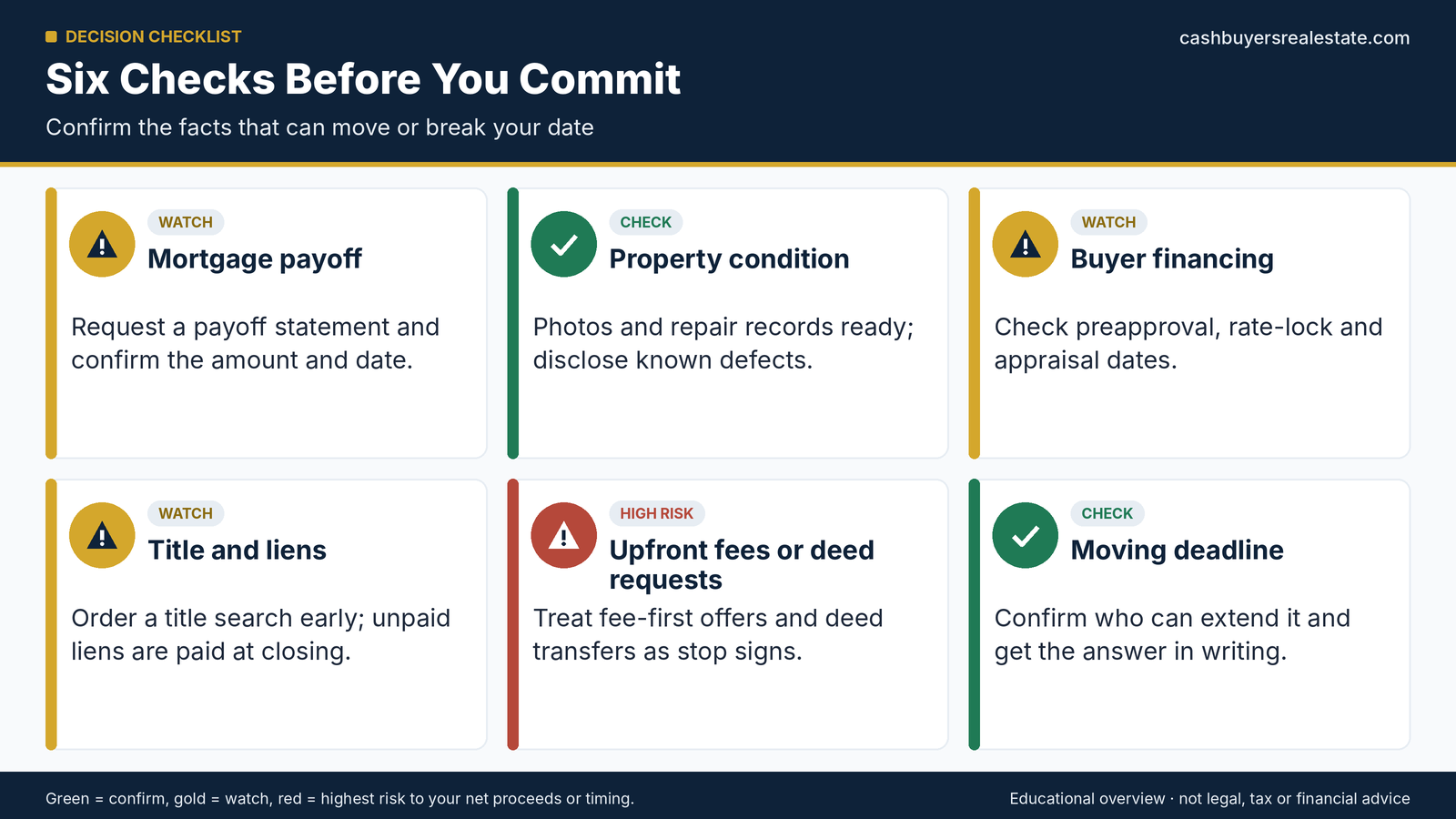
Text version of this infographic
- Mortgage payoff — Request a payoff statement and confirm the amount and date.
- Property condition — Photos and repair records ready; disclose known defects.
- Buyer financing — Check preapproval, rate-lock and appraisal dates.
- Title and liens — Order a title search early; unpaid liens are paid at closing.
- Upfront fees or deed requests — Treat fee-first offers and deed transfers as stop signs.
- Moving deadline — Confirm who can extend it and get the answer in writing.
Frequently Asked Questions When You Need to Sell Quickly
Questions About Deadlines and First Steps
Questions about deadlines and extensions
- How fast can a house actually sell?
It depends on the route and the stages involved. A buyer who needs a mortgage has to move through an appraisal and underwriting, which usually takes weeks. A buyer paying cash can skip the lender, though inspection, title work, and payoff letters still take days. Anyone promising a specific number of days without knowing your property, title, and state is guessing. The guide on how fast you can sell a house breaks the stages down.
- Can a lender postpone a foreclosure sale?
Sometimes. The federal servicing rule limits a servicer from moving to judgment or conducting a sale while a complete loss mitigation application submitted more than 37 days before the sale is pending, with conditions and exceptions. Courts and state procedures can also affect timing. Postponement isn’t guaranteed, so ask your servicer and a housing counselor or attorney what applies to your loan.
- What if my deadline is tomorrow?
A house rarely sells and funds in a day, so focus on what tomorrow’s deadline actually controls and who can move it. Call the controlling party now, explain the situation, ask for a specific extension, and get the answer in writing. A housing counselor or attorney can help if the deadline involves a lender or a court.
- If someone says a deadline is flexible, can I rely on that?
Only if it is in writing. A verbal “that should be fine” can disappear when a person changes jobs or the situation changes. Ask for an email or signed addendum that states the new date and anything that goes with it, such as a fee, a deposit, or a changed rate lock.
Questions about getting started
- What should I do first?
Write down every deadline with its event date and decide-by date, then gather notices, your mortgage statement, and ownership documents. Request a payoff statement and, if payments are the issue, call your servicer. Those steps cost nothing and make every later conversation more useful.
- Do I need an attorney?
If you have court papers, a foreclosure notice, a probate matter, a title problem, or a contract dispute, speaking with a licensed attorney in your state is wise. For a straightforward sale with no complications, a good agent and a title or closing professional may be enough. Many attorneys offer short initial consultations.
- Should I tell buyers I’m in a hurry?
Tell your own advisers everything, since they need the full picture to help you. With buyers, sharing urgency can weaken your negotiating position, so you can say you have a target date without explaining the pressure behind it. Don’t misrepresent facts, and never conceal known defects.
- Can I sell if I’m behind on my mortgage?
Generally yes, because the payoff is satisfied from the sale proceeds at closing. If the sale price wouldn’t cover the balance, the lender must approve a short sale, which has its own process and possible credit or tax consequences. A housing counselor or attorney can walk you through the choices.
Questions About Costs, Offers and Taxes
Questions about costs and offers
- Will I get less money if I sell fast?
Often, but not always, and the gap varies. Speed can mean a lower price, a buyer credit, or fees, though it can also save carrying costs and avoid repairs. The only fair comparison is net proceeds after all costs and time. The earlier break-even example shows how to run it.
- Should I ever pay someone upfront to help me sell or avoid foreclosure?
Be very cautious. In a normal sale, fees come out of proceeds at closing. For mortgage relief services, the FTC says companies generally can’t charge until you’ve accepted a written offer from your lender. Requests for upfront payment by wire, cashier’s check, or payment app are warning signs worth verifying independently.
- Is a cash offer always the fastest way?
Not always. Cash can remove the lender and appraisal, which often shortens the calendar, but title work, payoffs, and closing logistics still take time, and a disorganized buyer can be slower than a prepared financed one. Ask for the buyer’s proof of funds and a written timeline.
- Can I sell quickly if there are liens or tenants?
Often yes, but each complication changes the timeline. Liens are typically paid from proceeds at closing, which requires payoff figures, and tenants have rights under state and local law. See the guides on selling quickly with liens and selling quickly with tenants.
Questions about taxes and special situations
- Will I owe tax when I sell my home?
Many sellers qualify to exclude up to $250,000 of gain, or $500,000 on a joint return, if they meet the ownership and use tests of 24 months within the previous five years, according to the IRS. You may still need to report the sale if you receive Form 1099-S. A tax professional can confirm how the rules apply to you.
- What if I haven’t lived in the home for two years?
IRS Publication 523 describes a reduced exclusion when the main reason for the sale is a change in workplace location, a health issue, or an unforeseen event, such as a new job at least 50 miles farther from the home. The reduced amount is prorated by time. A tax professional should check whether your reason qualifies.
- Can I sell to a relative to move quickly?
You can, but a sale below market value can raise gift-tax, income-tax, and benefit-eligibility questions, including care-cost programs that review property transfers. Talk to an attorney or tax professional before you agree on a price with family.
- Does selling an inherited house have different deadlines?
Yes. Authority to sell, court approval in some states, and the other heirs’ agreement all affect timing, and tax treatment can differ from selling your own home. See the guide on selling an inherited house fast, and confirm the steps with a probate attorney in the property’s state.
Choosing Your Path and Starting Today
You now have the pieces: a deadline list, a hard-versus-soft test, a first-48-hours checklist, route fit by deadline type, negotiation tactics, professional help, and a way to price speed. The final step is choosing, and starting with something small enough to do today.
A Decision Framework: Match the Route to the Deadline
A decision sequence you can follow in order
Work through four questions in sequence. First, does any deadline carry a legal or financial consequence you can’t undo? If yes, that deadline sets the plan, and you protect it first, usually with help from a counselor or an attorney. Second, who controls each deadline, and can they move it? Contact the controlling party early. Third, is time cheaper than price? If a few hundred dollars buys the days you need, don’t pay thousands in discount. Fourth, only then, which route fits the days you have left?
| Room before your decide-by date | Routes that tend to fit | Main focus | Main risk |
|---|---|---|---|
| Plenty of room (the route’s full timeline fits with a buffer) | Prepared listing priced at market, tested at checkpoints | Net proceeds | Complacency; carrying costs |
| Some room (fits only if nothing slips) | Listing priced to move with a cash backup; flexible closing | Certainty and a fallback | Fall-through with no plan B |
| Little room (shorter than a financed timeline) | Verified cash buyer, extension request, rent-back | Closing mechanics and verification | Discount and scam exposure |
| No room (date is fixed and close) | Servicer, court, or counselor options first; then the quickest verified sale | Protecting the hard deadline | Irreversible choices made under pressure |
The matrix is a starting point, not a verdict. A seller with plenty of room may still choose a fast cash sale for convenience, and a seller with no room may find that an extension was available all along. What the matrix does is keep the sequence honest: protect the hard date, buy time cheaply, then choose the route.
Three scenarios, worked through
Illustrative example (hypothetical numbers, not market data): Priya is buying a new home with a firm closing in 42 days. Her current house would need about 35 days from contract to funds with a financed buyer. That leaves a week to find a buyer, which is tight. She lists at the low end of her comps band, asks a cash buyer for a written backup offer, and asks the seller of her new home about a three-day extension at a per-day fee. If the listing draws a financed contract in the first week, she proceeds. If not, she has two alternatives ready.
Illustrative example (hypothetical numbers, not market data): Luis has missed several payments and received a notice from his servicer. Instead of searching for buyers, he first calls a HUD-approved housing counselor, who helps him compile documents and submit a complete loss mitigation application. While that is reviewed, he gets an agent’s pricing opinion and one cash offer to compare. With the facts in hand, he can decide whether keeping the home, selling on the open market, or pursuing a lender-approved alternative fits better, and he has time to choose.
Illustrative example (hypothetical numbers, not market data): An adult daughter is the personal representative for her late father’s estate, with a probate hearing set in about eight weeks. The house is vacant and needs work. She confirms with the estate attorney that she has authority to sell and whether court approval is required, asks the insurer about vacancy coverage, and requests offers from a listing agent and from buyers who purchase as-is. She compares the nets and decides based on what the family wants to do with the property’s contents and how soon the hearing can be completed.
Notice the common thread: each person first identified what the deadline controls and who could move it, then compared two routes on the same net sheet, and then acted. No one needed to guess.
What to Do Next
Your first-week plan
The following sequence works whether you eventually list, sell to a cash buyer, or find that an extension solves the problem. It commits you to nothing beyond gathering information and making calls.
- Day 1: List every deadline with event and decide-by dates; mark each hard or soft and note who controls it.
- Day 1: Gather mortgage statements, notices, the deed, tax and insurance information, and any lease or court papers into one folder.
- Day 1 or 2: Request a payoff statement; call your servicer if payments are involved; contact a HUD-approved counselor if foreclosure is a possibility.
- Day 2: Confirm who must sign and whether any lien, tenant, or probate issue affects authority or timing.
- Days 2 and 3: Ask for an agent’s pricing opinion and at least one written cash or investor offer, and put them on the same net sheet.
- Days 3 through 5: Make extension requests on the soft deadlines, in writing, with a specific new date and anything you can offer.
- Day 5 to 7: Speak with an attorney or tax professional about any issue they should review before you sign; then choose a route, or choose a second checkpoint date.
If the week reveals that your timeline is looser than you feared, you’ve saved yourself from a discount you didn’t need. If it reveals that it’s tighter, you’ve found out while there is still time to act. Either result is better than not knowing.
Questions to ask and documents to gather
To a servicer or lender, ask what options exist for your loan, what each costs, what deadlines apply to your request, whether collection or foreclosure steps pause while an application is reviewed, and how long a decision takes. To an agent, ask how the pricing opinion was built, how long similar homes took to sell and close, and what the plan is if the first two weeks are quiet. To a buyer, ask for the contract and proof of funds in writing, the closing company’s name, the timeline, and what could change the price after inspection.
To a title or closing professional, ask what documents they need from you, how payoffs and liens are handled, whether your state uses attorneys or escrow companies, how long funding takes, and how they confirm wire instructions. To a tax professional, ask whether the home-sale exclusion applies, what the sale might do to your estimated taxes, and whether any date in the tax calendar interacts with your closing. To an attorney, ask what deadlines you have, what documents are binding, and what would be risky to sign.
Documents to gather include the deed, your latest mortgage statement, a recent payoff statement, property tax and insurance bills, HOA information, any lease or tenant details, court or lender notices, photos of the home, repair and permit records, and identification for all owners. If the owner has died, add the death certificate and court appointment papers. Keep copies together and share sensitive documents only through verified channels.