Sell Rental Property Fast: Timeline, Costs & Seller Options
The tenant gave notice, or didn’t. The roof quote came in higher than the rent will cover for two years. Your property manager retired, a major repair is overdue, or you simply stopped enjoying the phone calls. Whatever the trigger, landlords who set out to sell a rental property fast usually discover that a rental is a different kind of asset than a home. Buyers price it by the income it produces, the lease that comes with it, the paperwork behind it, and the taxes it triggers, and each of those can speed a sale up or slow it down.
You can sell a rental property fast, often to an investor who buys as-is, but the real question is what you keep after tax. Investors value a rental by net operating income and cap rate, occupied and vacant sales net different amounts, and depreciation recapture or a missed 1031 deadline can cost more than a lower price. Run the net-after-tax number first.
That framing is the heart of this guide. A homeowner selling a primary residence compares a few offers, subtracts closing costs, and often owes little or no tax. A landlord compares offers that were built from different assumptions, subtracts costs that include a property manager, tenant-related obligations, and possibly a tax bill measured in five figures, and may be juggling a lease that does not end when the closing does. Speed matters, and so does the order in which you do things.
The guide starts with value: how a rental is priced by income rather than by comparable home sales, with a worked cap-rate example using made-up numbers. It then covers who actually buys rentals and the documents they ask for, a checklist worth assembling before you take the first offer. The middle sections compare selling with tenants in place against selling vacant, lay out the realistic routes to a fast sale, and show how net proceeds are built. After that come the tax pieces landlords most often underestimate (depreciation recapture, capital gains, the net investment income tax) and the rules of a section 1031 exchange as the IRS describes them, including why a rushed sale is the usual way to lose the option. The final sections cover timelines, closing mechanics, buyer verification, frequently asked questions, and a framework for choosing your route.
A word on what this article does not cover in depth. Lease law, notice periods, eviction procedures, and how to handle a tenant who is behind on rent vary enormously by jurisdiction and fill their own guides. If tenant mechanics are your main concern, start with selling a house quickly with tenants and the tenant-occupied property hub. This article takes the landlord’s economic view: value, buyers, tax, timing, and net proceeds.
One more point of honesty. There is no universal best route. A fast as-is sale to an investor can be the right call for a landlord who is exhausted, behind on repairs, or short of cash. A listing, a slower vacant sale, or a tax-deferred exchange can net far more for a landlord who has time. Where the guide says “often” or “typically,” it means patterns, not promises, and every number labeled as an example is hypothetical. For the broader set of ways to sell on a short clock, the sell house fast hub compares them all, and the rental property hub collects the related landlord guides.
What a Rental Property Is Worth: Income Value Versus Retail Value
The Income Approach in Plain Terms
Net operating income and the cap rate, explained without the jargon
Most investors price a rental with a simple ratio. Net operating income (NOI) is the income the property produces in a typical year after vacancy and operating expenses, before any mortgage payment, income tax, or depreciation. The capitalization rate, or cap rate, is NOI divided by the property’s value or price. Flip the formula and you get the pricing rule investors use: value equals NOI divided by the cap rate.
What goes into NOI matters. Counted: rent, other income such as parking or laundry, less a realistic vacancy allowance. Subtracted as operating expenses: property taxes, insurance, repairs and maintenance, property management, utilities you pay, and sometimes a reserve for big-ticket replacements. Left out: your mortgage payment, depreciation, and your income taxes, because those depend on you rather than on the property. This is why two owners of identical buildings, one with a loan and one without, hand a buyer the same NOI.
Cap rates are not published by a regulator, and they vary by market, property type, condition, and the buyer’s appetite for risk. A lower cap rate generally means a higher price for the same income, because buyers accept a smaller return for perceived safety. A higher cap rate means a lower price, usually reflecting more risk, older systems, or a weaker location. Treat any cap rate you hear in an offer as an assumption to ask about, not as a fact about your building. A local broker with rental experience or an appraiser who values income property can tell you which range is plausible nearby, and the buyer’s own number usually shows up in how the offer is explained.
A worked cap-rate example with hypothetical numbers
Here is the arithmetic for a made-up duplex. Nothing in it reflects a real property or market.
Illustrative example (hypothetical numbers, not market data): A duplex rents for $1,800 per unit per month, so scheduled rent is $43,200 a year. A 5 percent vacancy allowance removes $2,160, leaving effective income of $41,040. Annual operating expenses are property taxes $5,400, insurance $1,800, repairs and maintenance $2,400, property management at 8 percent of income $3,283, and common-area utilities $1,200, a total of $14,083. NOI is $41,040 minus $14,083, or $26,957.
At a 6.5 percent cap rate the indicated value is about $414,700 ($26,957 divided by 0.065). At 7.5 percent it is about $359,400. A single percentage point in the assumed cap rate moves the value by roughly $55,000, which is why the buyer’s cap-rate assumption matters more than any single line in the expenses.
Two lessons follow. First, if you can raise NOI, you raise the price. Documented rent increases, cheaper insurance, or correcting expense items that were overstated can matter more than a coat of paint. Second, an offer that looks low might rest on a more conservative expense estimate rather than a lowball. Ask any investor how the offer was built and compare it with your own NOI. The method is covered in more depth in how cash offers are calculated.
Be careful with inflated numbers. A buyer’s lender or appraiser will verify rents and expenses, and a rent roll that overstates income only delays or kills the deal. Honest, documented figures sell faster than optimistic ones.
Retail Comparable Sales Versus Investor Pricing
When comps set the price: owner-occupant buyers and single-family rentals
A single-family house or condo that happens to have a tenant can be priced two ways. Owner-occupant buyers, who plan to live in it, care about the same things as any home buyer: condition, location, schools, and what similar houses nearby sold for. For them, comparable sales (“comps”) drive the price, and a vacant, well-presented house tends to attract the widest buyer pool. If most of your potential buyers are people who would live there, retail value is the benchmark, and the tenant is an obstacle between you and them.
Appraisals for financed owner-occupant buyers also use comps. A lender’s appraiser compares recent sales of similar homes, and a gap between the contract price and appraised value can reduce the loan or trigger a renegotiation. That is a good reason to understand your retail value even if you expect an investor to buy.
The weakness of retail pricing for a rental is time. Reaching owner-occupants usually means vacancy (or a long wait for the lease to end), cosmetic work, listing, and showings, and possibly a month or two of lost rent. The gain from the higher retail price has to exceed those costs, a calculation covered in the vacant-versus-occupied section below.
When income and condition set the price: investor buyers and multifamily
An investor buying a tenant-occupied rental thinks in terms of returns. The investor looks at the in-place rent, the lease terms, the expenses, and the repairs the building needs, then works backward to a price that leaves room for risk and profit. A property with below-market rents, a tenant in trouble, or deferred maintenance gets a lower number than the same building would command if it were repaired and fully leased, and that gap is not necessarily unfair; the buyer is pricing real work and real uncertainty.
For buildings of five or more units, income valuation is the norm, and lenders underwrite the property on its income. For one-to-four-unit properties, valuation blends both lenses, and local practice varies. The cheapest way to learn which lens your buyers will use is to ask two or three investors and one agent who works with investors how they would value the property and which documents they need.
The table below summarizes how common buyer types usually look at a rental. It describes tendencies, not rules, and any buyer can differ.
| Buyer type | Main pricing lens | Typically wants | Speed pattern |
|---|---|---|---|
| Owner-occupant (financed) | Retail comps and condition | Vacant possession, inspection, appraisal | Slower; lender timelines |
| Small local investor, cash | Income, repairs, and required margin | Lease, rent roll, access to inspect | Often faster when funds are verified |
| Financed investor | NOI and lender underwriting | Leases, T-12 operating statement, estoppels | Moderate; lender and appraisal steps |
| Portfolio operator | NOI, cap rate, scale benefits | Complete records, clean books | Moderate; thorough diligence |
| 1031 exchange buyer | Replacement-property timeline and price | Clean title, reliable closing date | Date-driven; can be quick or strict |
| Fix-and-flip investor | After-repair value (ARV) less repairs and margin | Vacant or short-lease property | Fast when the property is vacant |
Read the table as a guide to whom to approach. A fix-and-flip buyer may pay quickly for a vacant, dated house but have no interest in a stabilized building, while a portfolio operator may pay more for the same stabilized building and take longer to close. ARV, short for after-repair value, is what the buyer expects the property to be worth once improved.
Who Buys Rental Property and What They Ask to See
Understanding the Buyer Pool for a Rental
Owner-occupants, local investors, operators, and exchange buyers
Owner-occupants buy rentals more often than landlords expect. A duplex or small house with a unit in good shape can appeal to a buyer who wants to live in one unit and collect rent from the other, and that buyer may use financing that allows a lower down payment than an investor’s loan. Because their lender requires owner occupancy, these buyers usually need the unit vacant at closing or require lease handling terms spelled out.
Local investors are the group most often associated with fast sales. Many buy with cash or short-term financing, inspect quickly, and are comfortable with tenants and deferred maintenance. They also bargain hard, since their return depends on buying at a discount. Operators with larger portfolios use property managers, buy on NOI, and value clean records. Exchange buyers are people completing a 1031 transaction who must close within IRS deadlines; they can be flexible on price but rigid on dates.
No buyer type is superior. Which ones show up depends on property type, price point, location, and condition. Ask an agent with investor experience where the last few comparable rentals found their buyers. For help comparing routes, the page on cash buyer versus real estate agent breaks down the trade-offs, and the cash home buyers hub explains how investor purchases are structured.
Cash versus financed buyers, and what lenders need that cash buyers skip
A cash buyer needs no loan approval, no lender appraisal, and no underwriting of the property’s income. That removes the most common causes of delay and cancellation, which is why cash offers are associated with speed. The buyer still performs diligence, and a serious cash buyer will ask for the same documents as a lender would, only on a faster schedule and without the lender’s rules.
A financed investor must satisfy the lender. Lenders vary in what they require, but investment-property loans commonly involve larger down payments and stricter income documentation than loans for primary residences, and lenders for small multifamily buildings typically review leases and operating statements. Ask a prospective financed buyer for a lender’s pre-approval letter, and ask how the appraisal will be handled if it comes in below the contract price.
A financed offer at a higher price can still lose to a lower cash offer once you subtract the risk and delay. The comparison that counts is expected net proceeds adjusted for the chance of closing, and a proof of funds letter or a lender’s commitment helps you judge that chance.
The Investor Due-Diligence Package
The documents buyers ask for, and why each one matters
Landlords who assemble the paperwork early close faster and negotiate from a stronger position. Buyers use these documents to confirm that the income is real, find hidden costs, and decide what to offer. Missing records are interpreted as risk and priced accordingly.
The rent roll lists each unit, tenant, rent, lease dates, deposit, and balance owed. Leases and addenda show the actual terms. A trailing twelve-month operating statement, sometimes called a T-12, shows income and expenses by month. Property tax bills, insurance declarations, and utility bills let the buyer rebuild NOI. Maintenance records, invoices for big repairs, permits, and inspection reports reveal the building’s condition. Service contracts, such as landscaping or snow removal, and any management agreement show obligations that may need to be assigned or ended.
An estoppel certificate is a document in which a tenant confirms the lease terms, rent, deposit, and any disputes. Buyers and lenders often ask for these on larger buildings, and some ask for them on small ones. Tenants have no universal legal duty to sign one unless their lease says so, so a good relationship with tenants helps. The table below puts the common requests in one place.
| Document | What the buyer learns | Where it usually comes from | Common problem |
|---|---|---|---|
| Rent roll | Income, lease dates, arrears, deposits held | Your records or property manager | Outdated or inconsistent with leases |
| Signed leases and addenda | Terms, renewals, pet and utility rules | Files, manager, tenants | Missing pages or unsigned copies |
| 12-month income and expense statement | Actual NOI and expense patterns | Accounting software, manager statements | Personal expenses mixed in |
| Property tax and insurance records | Fixed costs; reassessment and coverage risk | County bill; insurance declarations | Unpaid or escrow confusion |
| Repair history and invoices | Condition, deferred maintenance | Receipts, contractor records | Cash repairs without paperwork |
| Permits, certificates, inspection reports | Compliance with local rental rules | City or county, inspection files | Lapsed rental license or open permits |
| Security deposit ledger | Amount to be credited or transferred | Bank account and tenant ledger | Deposits commingled or unrecorded |
| Estoppel certificates | Tenant confirms terms; flags disputes | Tenants | Slow responses; refusals |
Start with the rent roll and the leases, since those two documents answer most of a buyer’s first questions. The security deposit ledger deserves extra attention because deposits are a liability the buyer will want credited at closing.
The property manager’s role, deposit transfer, and keeping records clean
If a property manager runs the rental, involve them early. They hold the leases, the maintenance history, the tenant ledgers, and often the security deposits in a trust or escrow account. Read the management agreement for termination notice, fees on a sale, and what happens to deposits held. Some agreements require 30 days’ notice or charge a fee if the property sells; others automatically end when ownership changes.
Security deposits must go somewhere at closing, and the rules vary. Texas offers one example: Property Code section 92.105 provides that when a landlord’s interest ends by sale or otherwise, the new owner is liable for returning security deposits and must give each tenant a signed statement acknowledging that the new owner has acquired the property and is responsible for the deposit, stating the amount. Other states handle transfers, accounting, and former-owner liability differently, so ask the closing agent and a local attorney how deposits move in your state. In practice the sale contract usually credits the buyer with the deposit amounts at closing, or the seller transfers the funds.
Keep the books clean before you sell. Separate personal and rental expenses, reconcile the deposit account, and update the rent roll. These steps seem tedious, but they are the difference between a buyer who trusts your numbers and one who discounts them. For a landlord whose tenant situation is complicated, the guide to selling quickly with tenants covers lease and notice issues in detail.
The map below summarizes the sequence a landlord usually follows from a decision to sell to a closed sale: set the timeline, gather the records, price by income, choose a sale path, estimate the tax, and close and hand over. The sections that follow explain each stage in text.
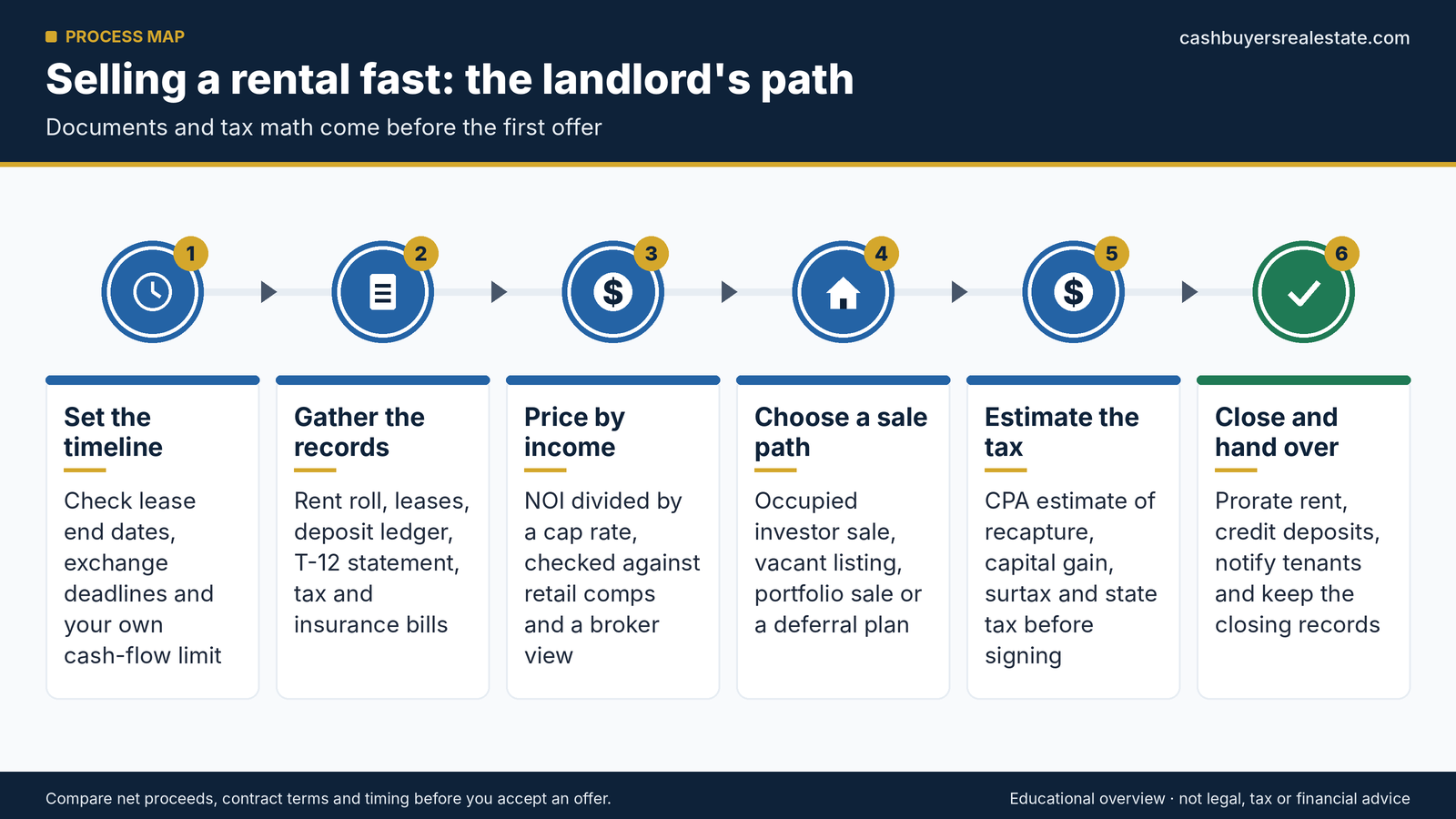
Text version of this infographic
- Set the timeline — Check lease end dates, exchange deadlines and your own cash-flow limit
- Gather the records — Rent roll, leases, deposit ledger, T-12 statement, tax and insurance bills
- Price by income — NOI divided by a cap rate, checked against retail comps and a broker view
- Choose a sale path — Occupied investor sale, vacant listing, portfolio sale or a deferral plan
- Estimate the tax — CPA estimate of recapture, capital gain, surtax and state tax before signing
- Close and hand over — Prorate rent, credit deposits, notify tenants and keep the closing records
Selling With Tenants in Place or Vacant: The Economics of Each
What a Tenant in Place Does to Value and Timing
The case for selling occupied: income continues and investors stay interested
A rental with a paying tenant is an income-producing asset, and that is the version investors know how to price. The rent keeps arriving until closing, your carrying costs are partly or fully covered, and you avoid the turnover gap that vacancy creates. For a landlord who wants out quickly, selling occupied often means one fewer project: no move-out coordination, no make-ready work, no marketing a vacant unit while paying its bills.
The trade-off is the pool of buyers. Owner-occupants who need to live in the property generally cannot buy it while a lease runs, so the buyer pool narrows to investors and to owner-occupants willing to wait or to buy a multi-unit building. A tenant’s lease also usually travels with the property; in many states the buyer takes over as landlord and must honor the lease terms, although details like notice requirements and early-termination rights depend on state and local law. Ask a local attorney how a sale affects the existing lease in your jurisdiction.
The tenant’s behavior affects the price. A reliable tenant on a lease with months left is an asset. A tenant who is behind on rent, disputes repairs, or refuses showings is a risk the buyer will price in. Some jurisdictions restrict entry for showings, require advance written notice, or limit the number of showings, and some require landlords to give tenants notice of a sale. Treat every tenant interaction around the sale as a legal event: keep communications in writing, give required notices, and don’t interfere with the tenant’s possession. Self-help measures such as shutting off utilities or changing locks are unlawful in many places and can expose you to claims.
Closing-day mechanics: prorated rent, deposits, and notices to tenants
At closing, rent for the month is typically prorated between buyer and seller based on the closing date, and any rent paid in advance for later periods is credited to the buyer. Security deposits and any prepaid rent become the buyer’s responsibility, so the settlement statement usually credits the buyer with the deposits you hold. The same applies to pet deposits and similar funds. Get the ledger right before closing, because a mistake here becomes a dispute with a buyer or a tenant.
After closing, tenants need to know whom to pay and whom to call. Many states and cities require a written notice of the change in ownership or management, and the Texas provision cited earlier requires the new owner to acknowledge the deposit in writing. Coordinate a joint letter from buyer and seller that gives the new owner’s name, the payment instructions, and a maintenance contact. Warn tenants about payment-redirection scams: fraudsters sometimes impersonate a new landlord, so the notice should come on documents the tenant can verify and should be consistent with what the property manager has told them.
A small number of jurisdictions go further and give tenants a purchase opportunity. In the District of Columbia, for example, the Tenant Opportunity to Purchase Act (D.C. Code section 42-3404.02) requires an owner to give tenants an opportunity to purchase before selling the housing accommodation, with timelines, a negotiation process, and an appraisal mechanism if a tenant organization challenges the offer. Few places have a regime that elaborate, but any city could have notice or first-refusal rules, which is one more reason to check with a local attorney before signing a contract. The deeper lease-law side is the subject of the tenant-occupied sale guide.
Selling Vacant: What You Gain and What You Lose
The retail premium against lost rent and make-ready costs
A vacant property can be shown at any time, inspected without scheduling around a tenant, and sold to an owner-occupant with conventional financing. Those buyers often pay more because they value the house as a home and can make it theirs immediately. Photos are better, showings are easier, and there are no lease questions. In a competitive market a clean, vacant, well-presented house can attract several offers.
Vacancy has a price. Rent stops, but taxes, insurance, utilities, and the mortgage don’t. Between tenants you will usually spend on cleaning, paint, repairs, and flooring, and the time on market adds months of holding costs. Insurance can change too: many policies limit coverage after a property has been unoccupied for a stretch, commonly 30 to 60 days according to Triple-I, so confirm your policy before the tenant leaves. The related guide on selling a vacant house covers insurance, security, and city vacancy rules in detail.
Vacancy can also create regulatory duties. Some cities require owners of vacant buildings to register them and pay a fee within a set number of days; Chicago, for example, requires registration within 30 days of a building becoming vacant, with fees and insurance requirements. Whether your tenant’s departure triggers such a rule depends on your city’s definition of vacant, so check before the keys are returned. The table below compares the two paths across the factors that most change a landlord’s net.
| Factor | Occupied sale | Vacant sale |
|---|---|---|
| Likely buyers | Investors and some multi-unit owner-occupants | Owner-occupants plus investors |
| Price pattern | Priced on income, lease, and condition | Priced on retail comps; may be higher |
| Rent during sale | Continues until closing | Stops once the tenant leaves |
| Make-ready cost | Often left to buyer | Usually yours, to show well |
| Showings and inspections | Need tenant cooperation and legal notice | Flexible; lockbox or appointment |
| Insurance and vacancy rules | Standard landlord coverage | Possible vacancy limits and registration |
| Legal exposure | Lease, deposit, and notice obligations | Move-out process must be lawful |
| Speed | Can be quick with investor buyers | Slower if prepared and listed; quick if sold as-is |
No row decides the question alone. A landlord with a good tenant and a motivated investor offer may favor the occupied sale, while one with a tenant already leaving and a hot market may prefer to sell vacant.
Waiting out a lease, offering a move-out incentive, or selling occupied: a worked comparison
When a lease still has months to run, landlords face a three-way choice. They can sell with the tenant in place, wait for the lease to end and then sell vacant, or negotiate an early move-out. A voluntary agreement in which the tenant moves out early in exchange for money, often called “cash for keys,” can be a practical tool, but it must be voluntary, in writing, and consistent with local law. Pressure, threats, or lockouts are never part of it.
The right answer depends on arithmetic more than preference. Run the same sale both ways and compare what you keep.
Illustrative example (hypothetical numbers, not market data): A landlord owns a single-family rental with a tenant paying $2,000 a month and about eight months left on the lease. An investor offers $275,000 as-is with the tenant in place. Seller closing costs of about 1.5 percent ($4,125) leave $270,875.
The alternative: pay the tenant a $5,000 move-out incentive, spend $6,000 on make-ready work, and list vacant. Holding costs of about $1,400 a month for four months ($5,600) and three months of lost rent ($6,000) apply. Suppose it sells for $305,000 with a 5.5 percent commission ($16,775) and 1.5 percent in other closing costs ($4,575). Net: $305,000 minus $43,950 in costs, or $261,050.
In this scenario the occupied sale nets about $9,800 more. The vacant route would need a sale price near $315,600 to break even once the percentage-based fees are included. Change the numbers, such as a hotter market or a higher retail premium, and the answer flips. The point is to run your own version of both paths before deciding.
Also factor in time. The vacant route in this example takes months, while an investor closing on an occupied property might take a few weeks. If you are weighing a very quick sale, selling a house in 30 days explains which parts of the schedule you can compress and which you can’t.
Routes to a Fast Rental Sale, and How Net Proceeds Are Built
Fast Routes: Investor Sale, Listing, and Selling in Bulk
An as-is investor sale: what you gain and what you give up
The fastest route for most landlords is an as-is sale to an investor who pays cash or uses short-term funding. You skip repairs, showings to the public, and lender delays. Because the buyer takes the building as it stands, with the tenant, the deferred maintenance, and the missing paperwork, the offer reflects those burdens. The discount relative to a fully prepared, well-marketed sale is the price of speed, and it varies with the property and buyer.
Gains beyond speed: certainty, if the buyer is credible, and flexibility in closing date. Many investors will accept a seller’s chosen closing date, take assignment of leases, and handle tenant communications after closing. Drawbacks include reliance on one buyer’s assumptions, limited competition, and contract terms that can favor the buyer. Read the inspection and cancellation provisions, the earnest money terms, and any assignment clause. The article on selling a house as-is covers the seller’s side of those terms.
Be realistic about what an as-is price includes. If the buyer inherits an unpaid utility bill, a code violation, or an unlicensed unit, expect a deduction or a request that you fix the issue first. Resolve what you can before the offer and disclose what the law requires. Concealing a known defect or a legal problem is never an option.
Agent-listed sales, auctions, and selling several properties together
Listing with an agent exposes the property to the broadest pool, including owner-occupants and investors. For small rentals, a residential agent may be enough, while larger or multi-unit properties often fit better with a commercial or investment broker who markets on income. Expect commissions, preparation, and a timeline measured in weeks to months, though a well-priced property in a strong market can move quickly. An agent who has sold tenant-occupied properties will know how to schedule showings, present the rent roll, and attract investors.
Auctions can set a firm date and attract competition for some property types, but they come with fees, minimum price decisions, and tight closing terms. They are not suited to every property, and buyers at auction often expect to purchase with little time for diligence, which can depress the price on a rental with complex leases. Ask any auction firm for its fee structure and terms in writing.
If you own several rentals, you can sell them separately or together. A portfolio sale can appeal to operators who want scale and may close faster than several separate sales, but buyers often negotiate a package discount and require full records on every property. Selling one at a time lets you pick the best buyer for each but extends the timeline and keeps you landlord of the rest. The table below compares the routes by the factors landlords weigh most.
| Route | Speed pattern | Price pattern | Landlord workload | Main risk |
|---|---|---|---|---|
| As-is investor sale (cash) | Often weeks once funds are verified | Discounted for repairs and risk | Low | Buyer reliability; renegotiation |
| Agent listing, tenant in place | Weeks to months | Investor-oriented; income-based | Moderate | Showing friction; narrow buyer pool |
| Agent listing, vacant | Longest, including turnover | Potentially highest retail price | High | Lost rent; holding costs |
| Auction | Fixed date; short closing window | Competitive but uncertain | Moderate | Fees; reserve and terms |
| Portfolio sale | Moderate; heavy diligence | Possible package discount | High at first | Records gaps hurt every asset |
| Owner financing or installment sale | Closing can be quick; cash arrives over time | Terms can support a higher price | Moderate to high | Buyer default; your own loan’s due-on-sale |
Speed and price pull in opposite directions in most rows, and the row that wins for you depends on your tax position, your mortgage, and how much time you can spare.
Alternatives to a Quick Sale
Keeping the property but shedding the work: management, refinance, and repairs
Many “tired landlords” don’t actually want to sell the asset. They want to stop doing the work. Hiring a property manager typically costs a percentage of rent plus leasing and sometimes maintenance fees, and it can turn a frustrating self-managed rental into a hands-off one. Compare the fee to what your time and stress are worth, and interview more than one company.
If the issue is cash flow or a looming repair, a refinance or a home equity loan may free money to fix the problem, though borrowing against a property you plan to sell soon may not make sense. A targeted repair that raises rent or reduces vacancy may increase NOI enough to raise the sale price later. This route trades speed for potentially higher value and a different tax outcome, because holding longer defers recapture and gain.
Don’t dismiss the option of waiting for a better moment. If the tenant is paying and the building isn’t deteriorating, a delay of a year may cost little, and a sale timed to the lease’s end or to the start of a new tax year can improve the net. The key is to make that a decision, with numbers, not a default.
Owner financing and installment sales: slower cash, different tax timing
In an owner-financed sale, you act as the lender: the buyer pays you over time, secured by the property. This can widen the buyer pool, support a higher price, and spread gain across years. IRS Publication 544 refers readers to Publication 537 for installment sales, and a CPA can explain how the reporting works for your facts, including how depreciation recapture is treated.
The risks are real. The buyer may default, which means foreclosure on your own timeline and at your own expense. If you have a mortgage on the property, your lender’s due-on-sale clause may allow it to demand repayment when title or an interest in the property transfers, so ask the lender and an attorney before you offer seller financing. Federal and state rules on seller financing also exist, so use an attorney who handles these transactions.
For most landlords seeking a fast exit, owner financing is the opposite of fast cash, so it fits mainly when the price or tax benefit justifies the wait. The example below builds a simple net-proceeds comparison to show how a lower fast offer and a higher listing price can end up closer than the headline numbers suggest.
Illustrative example (hypothetical numbers, not market data): The duplex from the cap-rate example has an NOI of $26,957. An investor values it at a 7.5 percent cap rate, about $359,400, but offers $350,000 as-is, closing in a few weeks. Seller closing costs of 1.5 percent ($5,250) leave $344,750 before the mortgage payoff and taxes.
A broker suggests listing at $385,000. After negotiation it sells for $375,000. Commission at 5 percent is $18,750, closing costs at 1.5 percent are $5,625, and pre-sale repairs and cleaning cost $7,000. The net is $343,625 before the mortgage payoff and taxes, about $1,100 less than the faster offer, and it takes months longer. A different commission, a higher sale price, or lower repair costs could easily change the ranking. Always compare the net, not the headline.
The next image compares five common landlord routes by who each one suits and what it trades away. The table above carries the same facts in text.
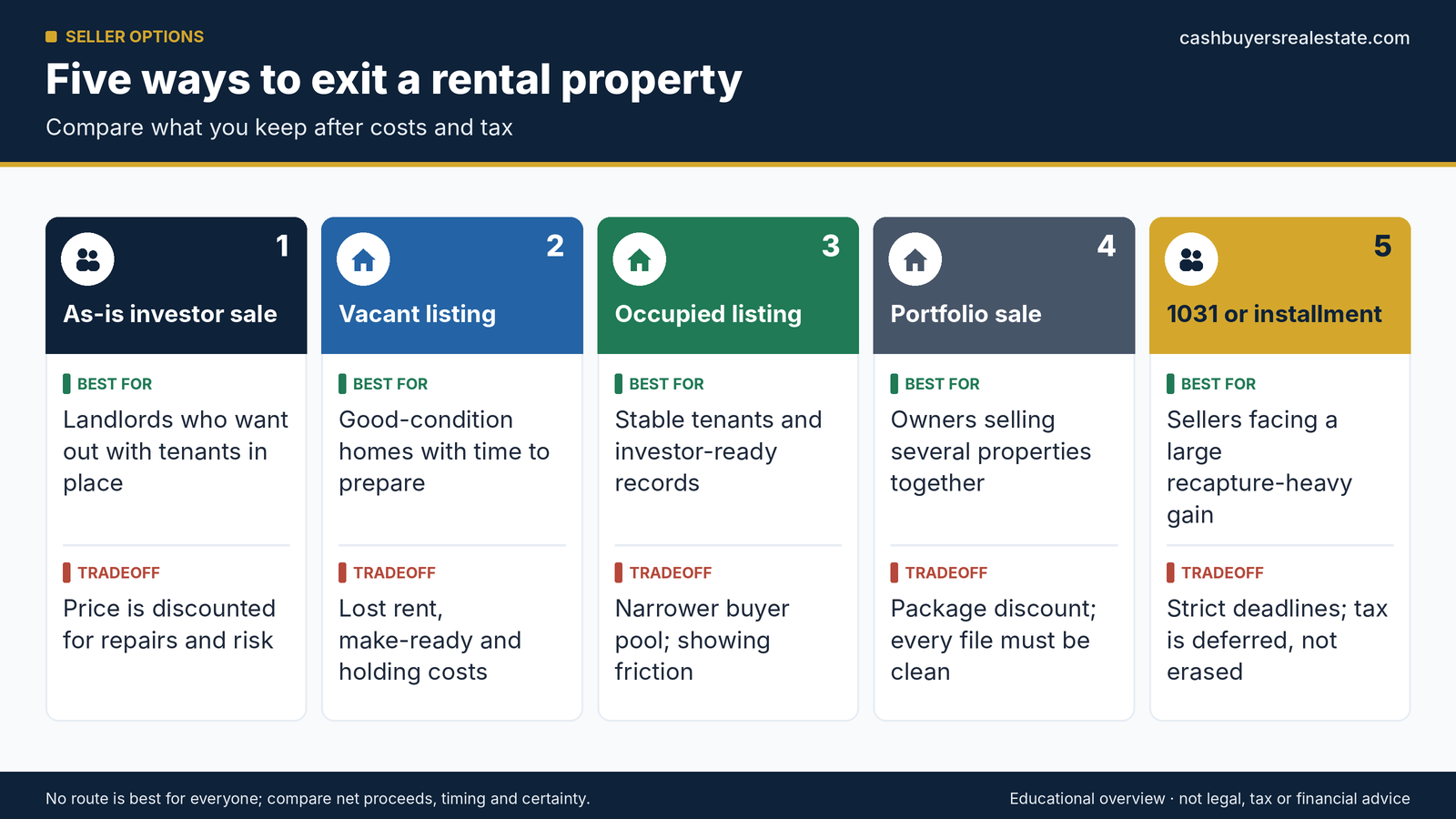
Text version of this infographic
- As-is investor sale — best for: Landlords who want out with tenants in place; tradeoff: Price is discounted for repairs and risk
- Vacant listing — best for: Good-condition homes with time to prepare; tradeoff: Lost rent, make-ready and holding costs
- Occupied listing — best for: Stable tenants and investor-ready records; tradeoff: Narrower buyer pool; showing friction
- Portfolio sale — best for: Owners selling several properties together; tradeoff: Package discount; every file must be clean
- 1031 or installment — best for: Sellers facing a large recapture-heavy gain; tradeoff: Strict deadlines; tax is deferred, not erased
Tax Exposure on a Rental Sale: Depreciation Recapture, Capital Gains, and the Surtax
How the Taxable Gain Is Built
Adjusted basis and the depreciation you were allowed to take
Taxable gain is the amount you realize from the sale (the price minus selling costs) minus your adjusted basis. For a rental, adjusted basis starts with what you paid, adds the cost of capital improvements, and subtracts depreciation. That last step surprises many landlords. Depreciation is a deduction that spread the cost of the building over its recovery period, which IRS Publication 527 gives as 27.5 years for residential rental property. Land cannot be depreciated, so the purchase price must be split between land and building.
The important wording is “allowed or allowable.” Publication 527 explains that when you compute accumulated depreciation for basis purposes, you count any depreciation you were allowed to claim, even if you didn’t claim it. A landlord who skipped depreciation on past returns doesn’t avoid the basis reduction; the IRS treats the basis as reduced anyway. That makes a CPA’s review of past returns an essential early step for anyone planning a sale, and it is worth doing before you accept an offer, not after.
Improvements are the other side of the ledger. A new roof, an addition, or a major system replacement increases basis (and is itself depreciated), while ordinary repairs are expenses deducted in the year paid. Keep invoices. A landlord who can document $40,000 in improvements reduces taxable gain by that amount, and a missing receipt is a missing deduction. Records of the original purchase, the closing statement showing the land-and-building allocation, and prior tax returns with depreciation schedules form the core file for your tax preparer.
A worked example with hypothetical numbers
An example makes the mechanics concrete. The figures below are invented and ignore many details a preparer would consider, such as mid-month conventions and state rules.
Illustrative example (hypothetical numbers, not market data): A landlord bought a rental for $250,000, of which $50,000 was land and $200,000 was the building. Over the years the landlord added $20,000 of capital improvements to the building. Depreciation of about $8,000 a year ($220,000 divided by 27.5) over ten years totals roughly $80,000.
Adjusted basis: $250,000 plus $20,000 minus $80,000 equals $190,000. The property sells for $400,000, with selling costs of $24,000, so the amount realized is $376,000. Taxable gain is $376,000 minus $190,000, or $186,000.
Of that gain, up to $80,000 (the depreciation) may be treated as unrecaptured section 1250 gain, and the remaining $106,000 is ordinary long-term capital gain. Notice that the gain is far larger than the “profit” a landlord might compute from the original price alone, because the depreciation deductions already enjoyed are partly given back at sale.
That outcome is why landlords sometimes feel a sale price “disappears” into taxes. The deductions that lowered income in earlier years are now reflected in a lower basis. Knowing the number before you negotiate lets you judge a quick discounted offer against, for example, a slower sale with better terms or a tax-deferral strategy.
The Tax Layers on Top of the Gain
Unrecaptured section 1250 gain and the long-term capital gains rates
Federal tax on the gain comes in layers. Gain attributable to depreciation on real property is commonly called unrecaptured section 1250 gain. IRS Publication 523 says that depreciation claimed after May 6, 1997 on business or rental use can’t be excluded and is taxed as unrecaptured section 1250 gain, reported on Form 4797. IRS Topic 409 states that unrecaptured section 1250 gain is taxed at up to 25 percent. The word “up to” matters: the rate depends on your overall income, and some taxpayers pay less.
The rest of the gain, the part that comes from appreciation, is generally long-term capital gain if you owned the property for more than a year. Topic 409 lists the long-term rates as 0, 15, or 20 percent, depending on taxable income, with thresholds adjusted each year, so check the current-year figures rather than relying on an old number. A sale that adds a large gain to your income in one year can push some of it into a higher bracket, which is one reason timing and installment reporting are worth discussing with a CPA.
Gain on a depreciable rental is generally reported on Form 4797, with related schedules, rather than only on Form 8949. The details depend on the property and your situation, and that is another reason not to treat a rental sale as a simple do-it-yourself return. The mechanics, not the labels, determine what you owe, and a preparer who handles rentals will know which forms apply.
The net investment income tax, state taxes, and moving back in
Higher-income sellers may owe an additional net investment income tax (NIIT) of 3.8 percent. IRS Topic 559 says the tax applies to the lesser of net investment income or the amount by which modified adjusted gross income exceeds a threshold: $250,000 for married filing jointly, $125,000 for married filing separately, and $200,000 for single or head of household. The topic explains that net gain from the disposition of property, including real estate, is generally included unless the property is held in a trade or business to which the tax does not apply. Whether a given landlord’s rental activity falls on one side or the other is a fact-specific question for a tax professional.
State income tax can add to the bill, and a few states have no income tax at all. Some local governments also impose transfer taxes on the sale itself, which appear on the settlement statement rather than your income tax return. Out-of-state landlords may owe tax in the state where the property sits as well as in their home state, so ask your CPA about both.
Another approach appears in Publication 523: a rental can qualify for the home-sale exclusion if you converted it to your principal residence and met the ownership and use tests (two of the five years before the sale), but the publication is explicit that the portion of gain equal to depreciation allowed or allowable can’t be excluded, and that periods of nonqualified use after 2008 can reduce the exclusion. Moving back in for two years purely to reduce a tax bill is a significant lifestyle decision with partial benefits, not a clean escape, and it is the opposite of a fast sale. The table below summarizes the layers.
| Layer | What it is | Federal rate or limit (per IRS) | What affects it |
|---|---|---|---|
| Depreciation recapture (unrecaptured section 1250 gain) | Gain equal to depreciation allowed or allowable | Up to 25 percent | Years held; depreciation taken or available |
| Long-term capital gain | Appreciation above adjusted basis, owned more than a year | 0, 15, or 20 percent by taxable income | Your total income that year |
| Net investment income tax | Surtax on investment income above a threshold | 3.8 percent | Modified adjusted gross income; filing status; trade or business status |
| State income tax | Tax from the state of the property and your home state | Varies by state | Residency; state treatment of gain |
| Local transfer taxes | Charged on the deed or sale price | Varies by jurisdiction | Locality; who pays by custom or contract |
| Deferral tools | Section 1031 exchange; installment reporting | Defers tax, does not erase it | Deadlines; structure; later sale |
Use the table to build a list of questions for your preparer. The first one should be a simple one: given my records, what is the estimated total tax if I sell this year, and how does it change if I wait until January?
Illustrative example (hypothetical numbers, not market data): Using the $186,000 gain above, a rough federal ceiling would be 25 percent on $80,000 ($20,000) plus 20 percent on $106,000 ($21,200), or about $41,200, before any NIIT or state tax. A landlord in lower brackets would owe less. The point is not the figure but the size: a sale price headline can hide a tax cost of tens of thousands of dollars, which can exceed the gap between a quick offer and a slower, higher one.
The Section 1031 Exchange, and Why Rushing Is the Usual Way to Lose It
What the IRS Rules Require
Real property only, like-kind, and what “boot” does to the deferral
A section 1031 like-kind exchange lets an investor defer tax by trading investment real estate for other investment real estate. The IRS states that section 1031 now applies only to exchanges of real property, a change that took effect for exchanges on or after January 1, 2018. Real properties are generally like-kind regardless of whether they are improved or unimproved, but U.S. property is not like-kind to property outside the United States. A property used solely as your personal residence at the time of the exchange does not qualify.
The deferral is not a forgiveness. Under the IRS description, if you receive other property or money in the exchange (commonly called boot), you must recognize gain to the extent of what you receive, and you can’t recognize a loss. The instructions for Form 8824 also treat net liabilities assumed by the other party as money received, so paying off more debt than you take on in the replacement property can create taxable gain even if no cash reaches your pocket. Form 8824 is the form used to report an exchange.
Related-party exchanges have their own restrictions. The Form 8824 instructions say that if you or the related party disposes of the property received in the exchange before the second anniversary of the last transfer, the deferred gain generally must be reported. An exchange with a relative, an entity you control, or someone else the tax code treats as related is not off the table, but it should be reviewed by a professional who knows the rules.
The two clocks: 45 days to identify and 180 days to complete
A deferred exchange runs on two clocks that start when you transfer the property you are giving up. According to the Instructions for Form 8824, the replacement property must be identified within 45 days after the transfer, in writing, in a signed document or written agreement, with a description clear enough to identify it, such as a legal description or street address. The replacement property must be received by the earlier of 180 days after the transfer or the due date of your tax return, including extensions, for the year of the transfer.
Those periods are not extended for weekends, a slow lender, a tenant who won’t move, or a title problem on the replacement property. The IRS instructions also discuss qualified intermediaries: if you make a deferred exchange using a qualified intermediary (QI), the transfer and receipt are treated as a like-kind exchange, and if the QI causes you to miss the timing requirements, the transaction may not qualify as a deferred exchange and the gain may be taxable in the year you transferred the property. Publication 544 devotes a section to safe harbors against actual and constructive receipt of proceeds in a deferred exchange. The practical message is to avoid handling the sale proceeds yourself and to choose the intermediary carefully.
The key dates are easy to lay out and hard to meet under pressure. The table shows them in order.
| Milestone | When it falls | What must happen | Common failure |
|---|---|---|---|
| Transfer of the property you give up | Day 0 (closing of the sale) | Exchange arrangements already in place | Proceeds paid to the seller instead of an intermediary |
| Identification deadline | 45 days after Day 0 | Replacement property designated in writing | Naming nothing suitable; unclear descriptions |
| Receipt deadline | Earlier of 180 days after Day 0 or the tax return due date, with extensions | Replacement property received (closed) | Financing or title delays; return due date arrives first |
| Reporting | Tax return for the year of the transfer | Form 8824 filed | Misreported boot or related-party details |
Notice that the “earlier of” language means a December closing can leave much less than 180 days unless the return deadline is extended. Ask your CPA how the calendar affects your specific closing date.
Combining a Fast Sale With an Exchange
Why speed and exchange planning pull in opposite directions
A fast sale compresses the early part of the timeline, while an exchange needs advance planning at the front end. The exchange arrangements, including the intermediary and the language in the sale contract, generally need to be in place before the closing, because the structure of the transaction at closing is what determines whether the proceeds are treated as received. A landlord who accepts a fast cash offer, closes in two weeks, and only then calls a tax adviser may find the option already gone.
The 45-day clock also meets the market at an awkward moment. You must find a suitable replacement property while negotiating a sale under time pressure, and sellers who rush sometimes buy the wrong property to protect the deferral. The tax deferral is not worth a bad purchase. A replacement with weak rents, heavy repairs, or too much debt can cost more than the tax saved. That is the clearest sense in which rushing is how people lose a 1031 exchange: they miss a deadline, or they meet it by overpaying.
If you want both speed and deferral, build the plan in the right order. Talk to a CPA and an intermediary before you sign a sale contract. Ask the buyer to cooperate with the exchange structure in the contract, which many investors do routinely. Begin searching for replacement property before closing, and know what you will do if you can’t find one in time. Consider whether a longer closing date, which many cash buyers will grant, buys you more time.
Deciding between an exchange, paying the tax, and other deferral options
An exchange is a tool, not a goal. Compare the outcomes honestly. Option one is a straight sale: you pay the tax, take the net cash, and decide what to do with it, including investing in something that suits you better than real estate. Option two is an exchange into another rental, deferring the tax but keeping the landlord role (or moving into a different kind of property, such as a managed building). Option three is an installment sale, spreading the gain.
The exchange makes sense when you want to remain an investor in real estate and the replacement property is genuinely better than what you own. It makes less sense when the reason for selling is that you are tired of being a landlord, since you would be buying another rental. Deferred gain also stays alive: the basis carries over into the replacement property, and the tax can come due later unless future planning changes it.
Illustrative example (hypothetical numbers, not market data): A landlord with an estimated $41,200 federal tax ceiling on a sale (see Table 5) faces a choice. Paying the tax leaves about $334,800 of the $376,000 amount realized before any mortgage payoff, state tax, or NIIT, which can be invested however the landlord chooses. An exchange would carry the full amount into a replacement property but requires identifying a property within 45 days and closing within 180, and it keeps the landlord in the business. If the only replacement candidates have weak rents or need major repairs, the deferred tax may not justify the risk. Neither choice is universally better.
Before you decide, review the tax picture with a CPA who handles rentals and, if an exchange is likely, an intermediary. For the closing-cost side of the net sheet, see closing costs when selling a house, and for the wider comparison of routes, the cash home sale process hub walks through each stage.
Timeline, Closing Mechanics, and Vetting the Buyer
A Realistic Schedule for a Landlord’s Sale
Before you accept an offer: records, notices, and a pricing view
The fastest rental sales begin before the first offer. Spend the first days collecting the rent roll, leases, deposit ledger, tax and insurance records, and maintenance history listed in Table 2. Check the lease for clauses that affect a sale, such as a right of first refusal, a restriction on showings, or a requirement to give notice to the tenant. Call the property manager, if you have one, to ask about termination terms and to line up their cooperation.
Decide how you will talk to the tenant. A short, honest letter explaining that the property may be sold, that the lease remains in effect, and how showings and inspections will be scheduled prevents rumors and panic. Where local law requires notice before entering the unit, follow it to the letter. Tenants who feel respected tend to cooperate with estoppel requests and inspections, and tenants who feel ambushed can slow everything.
Form a pricing view from two sources: your own NOI-based estimate, as in the cap-rate example, and a broker opinion or appraisal that reflects retail value if the property could appeal to owner-occupants. Add your tax estimate from a CPA. With those three numbers you can judge an offer in minutes instead of days. If you also need to check how a cash number was derived, see the overview of how cash offers are calculated.
Under contract: diligence, estoppels, prorations, and closing
Once a contract is signed, the buyer’s diligence period begins. Expect requests for unit access, copies of leases, and estoppel certificates. Respond promptly and keep a log of what you send. Slow responses are among the most common reasons a rental closing slips, and each delay gives the buyer a reason to renegotiate.
Title work runs in parallel. The title company or closing attorney searches for liens, judgments, and unpaid taxes, and prepares the settlement statement with prorations for rent, taxes, and utilities, and credits for deposits. If a mortgage exists, request the payoff statement early. Landlords sometimes discover a forgotten lien, an unpaid code fine, or a mismatch in the names on the deed, all of which take time to fix. The guide to selling with liens explains how payoffs work at closing.
Closing practice varies by state: some use a title company or escrow officer, others require an attorney to close. After closing, send tenant notices, transfer utilities, and hand over keys, access codes, and records. Then plan for the next tax season: the sale is reported on your return for the year of closing, and you will want the settlement statement, the closing disclosure, and your depreciation schedule in one folder. The table below shows illustrative stages and ranges. These are planning ranges, not statistics, and local practice can differ.
| Stage | What happens | Illustrative planning range | What shortens it |
|---|---|---|---|
| 1. Records and tax check | Assemble Table 2 documents; CPA estimates tax | Days to two weeks | Organized books; early CPA call |
| 2. Price and route | NOI view, broker opinion, investor conversations | Days to two weeks | Clear goals and net-sheet math |
| 3. Offers and contract | Compare nets; negotiate; sign with exchange language if needed | Days to a few weeks | Verified proof of funds |
| 4. Diligence | Inspections, estoppels, lease review, title search | Roughly one to several weeks | Quick tenant coordination |
| 5. Financing (if any) | Appraisal, underwriting, lender conditions | Several weeks | Cash buyer; strong pre-approval |
| 6. Closing and handover | Settlement, prorations, notices, deposit transfer | Days | Pre-signed documents; clean ledger |
Notice how much of the schedule rests on things you control: records, responsiveness, and decisions. The stages you cannot control, such as lender timelines or a tenant’s slow reply, are the ones to plan buffers around.
Buyer Verification and Protecting the Money
Checking out an investor buyer before you sign
Investor offers vary widely in quality, and a headline number tells you little about whether the buyer can close. Ask for proof of funds, such as a recent bank statement or a letter from a financial institution, and check that the name matches the buyer or the entity in the contract. For a financed buyer, ask for the lender’s pre-approval and how the appraisal will be handled. Ask who holds earnest money, the amount, and the conditions for its return. The proof-of-funds guide explains these checks in more detail.
Read the contract for provisions that shift risk. An assignment clause lets the buyer transfer the contract to another party, which is common and lawful in many places but changes who ultimately closes. Broad inspection or financing contingencies that let the buyer cancel late can leave you holding a deal you cannot rely on. A price that drops late in the process with no change in the property’s condition deserves a clear explanation. None of these is proof of bad faith alone, but together they help you decide how much to trust the offer.
Ask the buyer what happens to your tenants. A buyer who plans to raise rents, convert the building, or end leases when the law allows is entitled to have those plans, but you may care about the outcome for people who have lived in the home, and local law may limit what the buyer can do. The page on cash home buyer scam prevention lists patterns to watch for.
Wire safety, rent and deposit funds, and records you will need later
Real estate closings involve large wire transfers, which attract fraud. The CFPB’s closing-scam guidance advises verifying wiring instructions, including account name and number, using a phone number you obtained independently, and warns against following wiring instructions found in an email. It lists last-minute changes to wiring instructions among the red flags. If a wire goes to the wrong account, contact your bank right away to ask for a recall and file a report with the FBI’s Internet Crime Complaint Center. As a seller you mostly receive wires, but you may also send payoff funds or pay a tenant’s deposit refund, so the same discipline applies.
Rent and deposits need their own care in the final weeks. Collect rent as usual and keep receipts. If rent is due after closing, the settlement statement should allocate it to the right party. Keep deposits in the account where the law says they must be held, and reconcile them to the ledger before the closing agent prepares the statement. Mixing deposits with operating funds is a common source of trouble at closing.
After the sale, keep the records. The settlement statement, the depreciation schedule, and the improvement receipts matter for your tax return and for any later exchange or reporting question. Scan them and store copies in two places. If the buyer or the IRS asks a question a year later, you will be glad you did. The six checks in the next image summarize what to confirm before you commit to a buyer: payoff, property condition, buyer funding, title, tenant and lease readiness, and the tax and exchange plan.

Text version of this infographic
- Mortgage payoff — Written payoff statement requested; net sheet shows cash after payoff
- Property condition — Known defects, permits and rental license status disclosed and priced
- Buyer funding — Proof of funds or lender approval verified; earnest money holder named
- Title and liens — Title search clear of liens, judgments and unpaid taxes
- Tenants and leases — Rent roll, deposits and notices match the leases; estoppels in progress
- Tax and 1031 plan — CPA estimate done; any exchange intermediary engaged before closing
Frequently Asked Questions About Selling a Rental Property Quickly
Questions About Value, Buyers, and Timing
Questions about pricing and buyers
- How do investors decide what to offer on a rental?
Most start with the income the property produces after vacancy and expenses, then apply a cap rate or work backward from a target return. Investors who plan repairs also estimate the after-repair value and subtract repair costs and a margin. Ask any investor to explain the method so you can compare offers fairly.
- Do I have to tell a buyer about problems with the tenant or the property?
Disclosure duties depend on your state and the type of sale, and concealing a known material defect or legal problem is never advisable. Rent arrears, lease disputes, and code violations will surface in diligence, and the estoppel process asks the tenant directly. Ask a local attorney what you must disclose.
- Can I sell a rental while the tenant lives there?
Generally yes. The lease usually continues with the new owner, though notice, showing, and termination rules vary by state and city. An investor may prefer an occupied property, while an owner-occupant buyer may require vacant possession.
- Will a cash buyer take the property with tenants in place?
Many investors do, and some prefer it because the rent continues. Others want the property vacant for a renovation or resale. Ask each buyer early so you do not spend time on an offer that depends on a move-out you cannot deliver.
Questions about timing, deposits, and leases
- How fast can a rental property sell?
It depends on the buyer, the property, the title, and the tenant. An as-is sale to an investor with verified funds can close in a matter of weeks, while a listing, a financed buyer, or a complicated title usually takes longer. Table 7 shows illustrative stages.
- Do I need to notify tenants before showings or a sale?
Often, yes. Many states and cities require advance written notice before entering a rented unit, and some require notice of a sale or of the new owner’s identity. Check your lease and local law, and keep copies of every notice.
- What happens to the security deposit when I sell?
It is usually credited to the buyer at closing or transferred, and the tenant is told who holds it. Texas, for example, makes the new owner liable for deposits after a sale and requires a signed acknowledgment to the tenant (Property Code section 92.105). Other states differ, so ask your closing agent.
- Can I end a tenant’s lease early so I can sell vacant?
Usually not unilaterally. A landlord generally needs the tenant’s agreement or a legal ground for ending a lease early. Voluntary move-out agreements are common but must be in writing and free of pressure. A local attorney can explain what your lease and state law allow.
Questions About Taxes and 1031 Exchanges
Questions about depreciation recapture and tax
- Do I owe depreciation recapture if I never claimed depreciation?
Probably still yes. IRS Publication 527 counts depreciation you were allowed to claim even if you did not claim it when it reduces your basis. Have a CPA review past returns before you sell, and ask whether any corrective filing makes sense.
- What federal rates apply to a rental sale?
The IRS says unrecaptured section 1250 gain is taxed at up to 25 percent, and long-term capital gain at 0, 15, or 20 percent depending on taxable income. A 3.8 percent net investment income tax may also apply above income thresholds. State tax is separate.
- Can I move into the rental to avoid the tax?
Only in part. Publication 523 says the exclusion can’t cover gain equal to depreciation allowed or allowable, and periods of nonqualified use can reduce the exclusion. You also need to meet the two-of-five-years ownership and use tests, which takes time.
- Does the net investment income tax always apply?
No. It applies when modified adjusted gross income exceeds a threshold ($250,000 married filing jointly, $200,000 single or head of household, $125,000 married filing separately, per IRS Topic 559), and a trade-or-business exception exists. Whether it applies to you depends on your income and the nature of your rental activity.
Questions about 1031 exchanges and moving quickly
- How long do I have to find a replacement property?
Per the IRS instructions for Form 8824, you must identify replacement property in writing within 45 days after you transfer the property you are giving up, and receive it by the earlier of 180 days or your tax return due date, including extensions.
- Can a fast cash sale work with an exchange?
It can, if the exchange is planned before closing and the buyer cooperates with the structure. Contact a CPA and a qualified intermediary before you sign a contract, not after you close. A sale that has already closed with proceeds in your hands may no longer qualify.
- What if I miss a deadline?
The exchange generally fails and the gain is taxable in the year of the sale. The IRS instructions note that if an intermediary causes you to miss the timing requirements, the deferral may be lost. Deadlines are strict, so build in buffers.
- Can I exchange my own home or a vacation property?
Property used solely as a personal residence at the time of the exchange does not qualify, according to the IRS instructions. Second homes and vacation properties raise detailed questions about use, so get professional advice before relying on an exchange.
Choosing Your Route and Taking the First Steps as a Landlord
Matching a Route to Your Priority
When speed or simplicity comes first
If your priority is to stop carrying the property, a quick as-is sale to a verified investor, with the tenant in place, is the shortest path. It fits best when the building has deferred repairs, when the rent roll is messy, when your cash flow is strained, or when you simply cannot take on a vacate-and-list project. Make sure the numbers still work after tax, because a quick sale that creates an avoidable five-figure tax bill is not a bargain.
Speed also depends on what you do before the offers arrive. Landlords who have a clean rent roll, deposit ledger, and estoppel-ready tenants can say yes to a good offer in days. Those who start from scratch lose weeks to document gathering. The checklist in this guide is worth completing even if you end up choosing another route. If you are working against a hard date, the guides on selling in 30 days and the fastest ways to sell show which steps can be compressed safely.
Finally, consider asking for a flexible closing. Many investors will agree to a later closing date in exchange for a firm contract, which can give you time to line up a 1031 intermediary, finish a lease term, or begin a new tax year. A contract with a longer closing is not a slower sale in any way that matters if you were never going to be ready sooner.
When net proceeds, tax, or tenants decide the question
If you have time and a property in decent shape, a listing or a vacant sale may net more, but only after you subtract make-ready costs, lost rent, holding costs, and commission. If a large depreciation-recapture bill looms, a deferral strategy such as a 1031 exchange or an installment sale might shift the economics, as long as you can meet the deadlines. If the tenants are long-term, pay on time, and are protected by strong local laws, an occupied sale to an investor can avoid conflict and keep the income flowing until closing.
Also decide what you want from your remaining time as a landlord. A seller who plans to keep other rentals may care more about reputation with tenants and the local investor community than a one-time landlord. A seller exiting the business altogether might accept a clean break at a slightly lower net. Neither choice is wrong; both should be made with the arithmetic in view.
The matrix below connects common priorities to routes and to the condition that has to hold. Read across a row to see what must be true before a route makes sense.
| If your top priority is | Routes that often fit | Condition that must hold | Main trade-off |
|---|---|---|---|
| Fastest exit | As-is investor sale, tenant in place | Records ready; funds verified | Discounted price; buyer reliability |
| Highest price | Vacant listing to owner-occupants | Strong retail demand; time to prepare | Lost rent, holding costs, longer timeline |
| Lowest tax this year | 1031 exchange or installment sale | Deadlines can be met; CPA and intermediary engaged early | Complexity; stays invested or waits for cash |
| Least tenant conflict | Occupied sale with lease honored | Lease is clean; notices are given | Narrower buyer pool |
| Staying in real estate with less work | Keep and hire a manager; exchange into easier property | Cash flow supports management fees | Ongoing ownership and risk |
| Selling several properties | Portfolio sale or phased sales | Clean records on every asset | Package discount versus longer timeline |
Many landlords blend rows, such as selling the weakest property quickly and keeping the best. Use the table to put your priority in words, then test the route against your own net-after-tax figures.
What to Do Next
A first-month sequence and the mistakes it prevents
Start with the tax conversation, because it can change everything else. Ask a CPA who handles rentals to estimate the tax on a sale this year and next, and to confirm whether any depreciation history needs attention. Gather the due-diligence documents. Review your leases and the local rules for notices and showings. Decide whether you are exploring a 1031 exchange, and if so, contact an intermediary before you sign anything. Then collect two or three offers or opinions, ask each buyer to explain how the number was built, and compare net proceeds.
Common mistakes recur. Landlords sign a contract before talking to a CPA and lose the chance to exchange. They underestimate the tax effect of past depreciation. They accept an offer based on a buyer’s inflated income assumption and later discover it fell apart in diligence. They let a deposit ledger drift out of balance until closing. They promise tenants something about the future owner that they cannot control. They try to speed things up with pressure on the tenant, which can create legal problems and delay the sale.
Some beliefs deserve correction as well. A tenant in place does not automatically make a property unsellable, and a vacant property is not automatically worth more. A cash offer is not always the lowest net, and a listing is not always the highest. A 1031 exchange does not eliminate tax; it defers it. And a quick sale is not the same as a hasty one: preparing in parallel is what makes fast possible. The related hub on selling rental property and the walkthrough of the sell-without-an-agent option cover the alternatives in more depth.
Questions to ask your CPA, attorney, manager, and any buyer
Prepared questions make short meetings productive. Use the lists below and take notes.
- CPA: What is my adjusted basis, including depreciation allowed or allowable? What is the estimated federal and state tax if I sell this year, and what changes if I sell after January 1? Does the net investment income tax apply? Does an installment sale or exchange make sense?
- Real estate attorney: How does a sale affect the existing leases here? What notices do I owe tenants? How are deposits transferred? Are there local first-refusal or registration rules? What must I disclose?
- Property manager: What does the management agreement say about termination and sale fees? Who holds the deposits? Can you provide the rent roll, ledgers, and maintenance history on request?
- Investor or buyer: How did you arrive at this price? Can you show proof of funds? Who holds earnest money? Is the contract assignable? What are your inspection and cancellation rights? Will you honor the existing leases?
- Listing agent or broker: What price range do you expect for occupied and vacant sales? How many rentals have you sold? What are your costs and timeline? What would you do about showings with a tenant in place?
- Exchange intermediary: What do you need before closing? How are proceeds held? What happens if I cannot identify a property in 45 days?
Share the answers with anyone who co-owns the property, and keep them in the same folder as your records. For a local starting point after you decide, browse the local guides directory, and for the sibling scenario of inherited property that turned into a rental, see selling an inherited house.