
How to Sell a House Fast: Timeline, Costs & Seller Options
You’ve made the decision, and now the calendar is the problem. Maybe a job starts in five weeks, a second housing payment is about to begin, or an inherited house is costing money every month it sits. The hard part of learning how to sell a house fast usually isn’t finding a buyer. It’s the sequence: a payoff letter nobody requested, a co-owner who hasn’t agreed to sign, a buyer whose loan needs an appraisal you never planned for. Each of those can quietly add a week or two.
To sell a house fast, set a hard deadline and a minimum net number, request your mortgage payoff in writing on day one, gather ownership and disclosure paperwork within 72 hours, pick a route (cash buyer, agent-led listing, for sale by owner, or platform offer), and run title work, buyer steps, and your move in parallel. Financing, title, and possession usually set the pace.
That’s the short version. The rest of this guide is the long one: the order of operations, what can safely overlap, what can’t, and where real sellers lose days. It is built as a playbook rather than a sales pitch. You’ll find day-by-day action tables for a 30-day and a 14-day sale, a dependency map showing what blocks what, a document checklist, ten sequencing mistakes, and worked examples that compare what you’d keep under different routes.
A few honest framing points before the steps. Speed is not free; in nearly every route, moving faster means giving up some price, some certainty, or some of your own time. A cash sale can be the quickest path in many situations, but it isn’t the best answer for everyone, and a traditional listing can be quicker than people expect when a house is priced and prepared well. For the broader question of which route fits you, the sell house fast guide compares them side by side. This article assumes you’re ready to act and want the order of operations.
One more thing about numbers. Where you see dollar figures in worked examples, they’re hypothetical and labeled that way. Where you see a rule or a market statistic, it comes from a source named in the text and listed at the end of the article, with the date it was checked. Anything that varies by state or lender is flagged as variable rather than guessed at.
Day 0: Turning a Decision into a Deadline and a Floor Price
Define what “fast” means for your situation
Convert the deadline into a date range and a walk-away number
“As soon as possible” isn’t a plan, because it can’t be tested against any offer. Start by writing down two dates. The hard date is the day something real happens if the house hasn’t closed: a lease at your new place begins, a loan payment is due, a job starts, a probate deadline arrives. The soft date is the day you’d prefer to be done. The gap between them is your working range, and it tells you which routes are even worth considering.
Next, set a floor. Don’t think in terms of price; think in terms of what lands in your bank account. Your walk-away number is the minimum net proceeds you can accept, after the mortgage payoff, closing costs, and anything else owed at closing. Without it, every offer feels either impossibly low or tempting, and you end up deciding emotionally on day 12.
A quick way to build the floor: list what must be paid from the sale (payoff, unpaid property taxes, liens, an HOA balance), then list what you need to walk away with (a down payment elsewhere, a debt you must clear, a cushion). The sum is the net you need, and the price you can accept is whatever produces that net after costs. The net proceeds calculator walks through the arithmetic if you want to test a few scenarios.
Illustrative example (hypothetical numbers, not market data): A seller owes $140,000 on a mortgage, expects roughly $6,000 in seller closing costs on a lower-priced route, and needs $85,000 in hand to fund a rental deposit and a car loan payoff. The minimum price that works on that route is $140,000 + $6,000 + $85,000 = $231,000. Any offer below that fails the seller’s own test, however fast it closes, and any offer well above it leaves room to negotiate on dates or terms instead of price.
Decide who needs to say yes before anything is signed
Speed dies at the signature page when an owner is missing. Before you contact a single buyer or agent, confirm who holds title. Read your deed or ask your county recorder for a copy. Everyone listed as an owner generally has to sign the sale documents, and in some states a non-owner spouse has homestead or marital rights that affect who must sign. Those rules vary by state, so ask a title company or attorney if the situation isn’t clear.
Common holdups at this stage include an ex-spouse who is still on title after a divorce, siblings who inherited together and disagree, a parent who has moved into care and whose signature depends on a power of attorney, or an owner who is out of the country. Each one has a workable solution, but each solution (a recorded power of attorney, a notary appointment abroad, a court order) takes days or weeks to arrange. Starting that paperwork on day 0 rather than day 20 is often the biggest single time-saver in the whole process.
Also decide now whether anyone else has a say that doesn’t appear on the deed. A lender holding the mortgage will need to approve any payoff arrangement. A homeowners association may have approval rights or transfer fees. A tenant has lease rights that a sale doesn’t automatically end. For the occupied-property version of this problem, the guide to selling quickly with tenants goes deeper.
The first 24 hours, 72 hours and week one
Hours 0–24: the calls that start long clocks
Some tasks have waiting periods built in, so they come first even though they feel administrative. The most important is the payoff request. Under the federal mortgage servicing rule in Regulation Z, a servicer must send a payoff statement within a reasonable time, and in no case more than seven business days, after receiving a written request from the borrower or someone acting on the borrower’s behalf (12 CFR 1026.36(c)(3), checked October 2026, see the CFPB’s regulation text). Seven business days is more than a week and a half on the calendar, so a request made on day 12 can by itself push a closing past a tight deadline. Many servicers respond faster, but you can’t plan around it.
On day 0, also gather these: a copy of your latest mortgage statement (and any home equity line of credit or second mortgage statement), your homeowners insurance declarations page, your most recent property tax bill, and the contact details for your homeowners association if there is one. Make a single digital folder and name it something obvious. Everything you collect for the next three weeks goes in it, because every buyer, agent, and title company will ask for pieces of the same pile.
Finally, tell the people who control your calendar. If you rent a truck, book movers, or have a landlord waiting, nothing needs to be booked yet. But a quick conversation about what your flexibility looks like (can you move out two weeks after closing, can you stay a few days after?) will matter when offers arrive with different closing dates.
Hours 24–72 and the rest of week one
By day 3, aim to have three things in hand: your payoff request submitted and acknowledged, a rough picture of what the house would sell for, and your decision on which routes you’ll actually explore. For the value picture, ask two or three real estate agents for a written pricing opinion, or run recent comparable sales in your neighborhood yourself. Comparable sales (comps) are recently sold, similar homes nearby. A cash buyer’s offer will be built from similar data plus the cost of any repairs and the buyer’s margin, so understanding the retail number first lets you judge the gap between it and an investor offer. The explainer on how cash offers are calculated shows the typical building blocks.
Mid-week, triage repairs. Make a short list of what’s broken, what’s cosmetic, and what you’d disclose anyway. Do not start major repairs yet. If you plan to sell to an investor, repairs are often wasted money, and if you plan to list with an agent, the agent should tell you which repairs buyers in your price range will punish and which they’ll ignore. The one exception is anything that blocks a showing or an appraisal, such as a broken lock, a nonworking utility, or an unsafe stair.
By the end of week one, decide on the route (or at most two routes you’ll run side by side), request any offers you want to compare, and line up your title or closing partner. If you plan to pursue offers from more than one buyer, ask each for terms in writing, with the closing date, any inspection or due diligence period, and who pays which closing costs, so you can compare apples to apples later.
Gathering the Paper Trail That Controls the Calendar
Documents every route needs
Ownership, identity and payoff documents
Start with proof that you can sell. A copy of your deed shows how title is held (individually, jointly, as a couple, in a trust, or through an entity) and who must sign. If you can’t find yours, the county recorder or clerk’s office where the property sits can usually provide a copy, and many counties let you search and order records online. Add a government-issued photo ID for each owner and, if the property sits in a trust or LLC, the trust certificate or entity documents the title company will ask for.
Payoff paperwork comes next. Your payoff statement is more than the balance on your last bill: it includes interest accrued through a stated date, any fees, and a per-day interest figure so the closing agent can adjust for the actual closing day. Ask for it in writing, name the property address and loan number, and mention that you’re selling so the servicer routes the request correctly. If you have a home equity line of credit, a second mortgage, or a reverse mortgage, request a payoff from each. A line of credit often needs a separate written instruction to close the account, or the lien may stay on record after the balance reaches zero.
How common is this step? A March 2026 study by the American Land Title Association, based on a survey of title professionals, reported that mortgage payoffs occur in more than 90 percent of transactions, and that involuntary liens turn up in roughly a quarter of them (ALTA study, March 2026). Payoff logistics are the rule in home sales, not the exception, which is why requesting yours early is the single cheapest way to protect the calendar.
If you inherited the property or an owner has died, you’ll likely need a certified death certificate and the court-issued authority for whoever is signing (the exact paperwork differs by state). That path has its own timeline; the probate-focused guide covers it, and this article treats it only as a possible hold on your schedule.
Condition, disclosure and association documents
Disclosure rules are set mostly by states, so the form you complete depends on where the house is. Texas offers a useful illustration: under Texas Property Code section 5.008, a seller of residential property must deliver a written Seller’s Disclosure Notice on or before the effective date of the contract, and if the notice isn’t delivered by then, the buyer may terminate the contract for any reason within seven days after receiving it (checked October 2026, see the Texas statute). The statute also exempts certain transfers, including some by fiduciaries administering an estate. Other states use different forms, different timing, or different exemptions, and some require far less. Ask your agent, attorney, or title company which form applies where you live, and complete it truthfully. Never conceal a known defect or skip a disclosure the law requires; it exposes you to claims after closing and, in the short run, makes buyers and their lenders slower, not faster.
One disclosure is federal. For most housing built before 1978, sellers must disclose known information about lead-based paint, give buyers the EPA’s lead pamphlet, include a disclosure statement in the contract, and allow a 10-day window for a paint inspection or risk assessment, which the parties can change by written agreement and the buyer can waive (EPA, checked October 2026).
If the home belongs to an association, request the governing documents, the current dues statement, and any resale or estoppel certificate right away. Those documents are prepared by someone else on their schedule. In Florida, for example, a homeowners’ association must issue an estoppel certificate within 10 business days of a written or electronic request, with a fee capped at $250 in the ordinary case, and the certificate is effective for 30 days (35 if mailed) after it is issued (Florida Statutes section 720.30851, official text, checked October 2026). Your state’s period may be shorter, longer, or unregulated. Finally, collect permits for any major work, warranties you can transfer, recent utility bills, and any survey you have; buyers and lenders often ask.
Document timing and common gaps
Checklist: where each item comes from and how long to plan for it
The table below lists the items most sellers need, who produces them, and a realistic way to plan for the wait. Where a wait is fixed by law, the source is named above; everywhere else it’s flagged as variable, because county offices, servicers, and associations all work at different speeds.
| Document | Where it comes from | Wait to plan for | Who relies on it |
|---|---|---|---|
| Deed copy | County recorder or clerk | Varies by county; sometimes same day online | Title company, buyer |
| Mortgage payoff statement | Your loan servicer | Servicer must send within 7 business days of a written request | Closing agent, buyer |
| HELOC or second-lien payoff | Each lender | Varies; ask about closing the line | Title company |
| Seller’s disclosure form | You, on your state’s form | 1 to 3 hours if you have the facts | Buyer, buyer’s lender |
| Lead-based paint disclosure (pre-1978) | You or your agent; EPA forms | Same day | Buyer |
| HOA estoppel or resale package | Association or its manager | Varies by state; Florida sets 10 business days | Buyer, title company |
| Trust certificate or entity papers | Your attorney or accountant | Days; varies | Title company |
| Proof of funds (buyer) | Buyer’s bank or lender | Often same day to a few days | You, as verification |
The practical reading: only two lines on that list are completely out of your hands, the payoff and the association package. Order those first, and do the items you control while you wait.
Gaps that stall the calendar and how to close them
Most delayed closings are not caused by hostile buyers or surprise inspections. They come from gaps found late in the title process. The most common one is an old mortgage that was paid off years ago but never formally released in the public record. In the ALTA study mentioned earlier, 59 percent of respondents named obtaining releases for prior unreleased mortgages as a pain point. If you paid off a loan in the past, find the satisfaction letter or the release, and if you can’t, ask the old lender (or its successor) for a copy now.
Name mismatches are another quiet delay. If your deed says “Robert J. Alvarez” and your ID says “Roberto Alvarez,” or a former name still sits on title after a marriage or divorce, the title company will want a short explanation or an affidavit. Those are easy fixes if you know in advance and annoying ones if you learn at the closing table.
Unpermitted additions, open code violations, and unpaid municipal charges (water, sewer, trash, or a city lien for mowing or cleanup) can all surface in a title search or a buyer’s inspection. Call the local building or code department before you list and ask whether anything is open on your parcel. Also check for judgments or tax liens in your name; the title problems hub covers what each type means and how it gets cleared.
Finally, if anyone on title is unavailable, unwilling, or deceased, treat it as a project of its own. A recorded power of attorney, a court order, or a probate appointment is not something you can fix in the final week. Put it first on your list, not last.
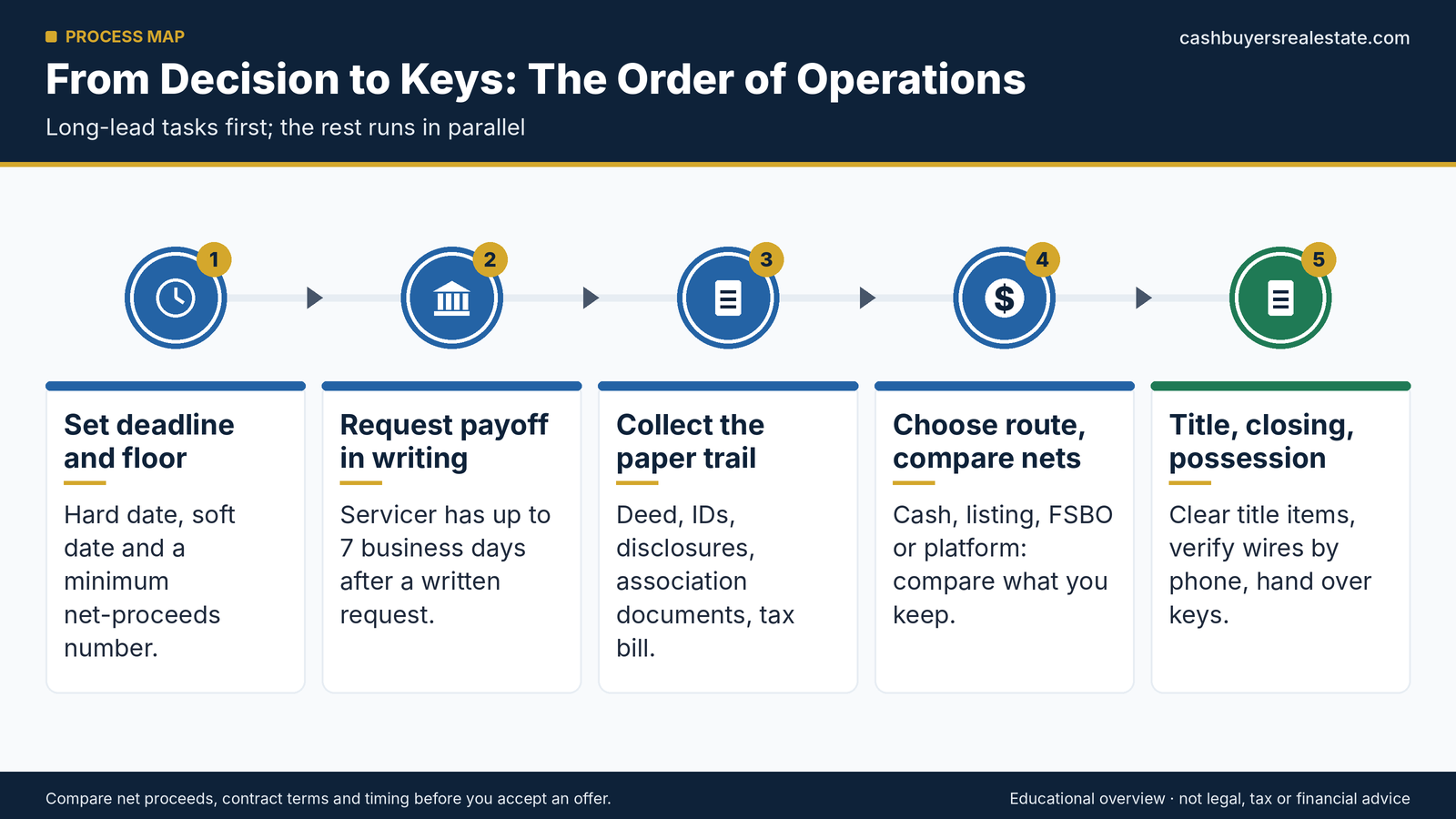
Text version of this infographic
- Set deadline and floor — Hard date, soft date and a minimum net-proceeds number.
- Request payoff in writing — Servicer has up to 7 business days after a written request.
- Collect the paper trail — Deed, IDs, disclosures, association documents, tax bill.
- Choose route, compare nets — Cash, listing, FSBO or platform: compare what you keep.
- Title, closing, possession — Clear title items, verify wires by phone, hand over keys.
How to Sell a House Fast: Choosing a Route Before You Price It
Four routes and how each one starts the clock
Cash buyers and investors: what the first week looks like
A cash buyer is simply a buyer who isn’t relying on a mortgage. That can be an individual with savings, a family buying for a relative, or a real estate investor who plans to repair and resell or rent the property. According to NAR, 27 percent of existing-home transactions in August 2026 were cash sales (NAR, released September 10, 2026), so cash is a normal part of the market and not an exotic niche. Not every cash buyer buys as-is, and not every investor offers quickly; the point is what the absence of a lender removes: underwriting, an appraisal ordered by a lender, and the delays that come with them.
In the first week, the sequence tends to look like this: you contact one or more buyers or request offers, a buyer views the property or reviews photos, you receive a written offer with a proposed closing date and a due-diligence period, and you compare terms. A responsible buyer will provide proof of funds before you sign. Once you accept, the title company opens an order, earnest money (a deposit that shows the buyer’s commitment) is delivered, and the buyer completes inspections within the agreed period.
The trade is price. Investor offers usually reflect the cost of repairs, holding and resale costs, and the buyer’s required margin, so they typically land below what a fully prepared retail sale might bring. The guide to selling a house for cash explains how those pieces fit together, and a worked comparison appears later in this article.
Agent-led listing priced to move: the compressed version
A traditional listing can be fast when three things line up: the house is show-ready, the price is aimed at the quickest-selling band of comparable sales rather than the highest, and the access is easy. A compressed plan looks like three to five days of prep, one day for photos and listing, a first weekend of showings, and an offer review within the first 7 to 10 days. Agents sometimes set an “offer deadline” a few days after listing to gather competing offers at once.
For context on market speed, NAR reported a median time on market of 31 days for August 2026 sales (NAR release above). Treat that as a market-wide marker, not a forecast for your house. It measures the marketing period for homes that sold, and it doesn’t include the weeks a financed buyer needs after the contract. A well-priced home in a busy segment can attract offers in days, and an overpriced one can sit for months.
Commission and cost structure matter to your net. Since NAR’s settlement-driven practice changes took effect on August 17, 2024, offers of compensation to buyers’ agents can no longer be made on MLS platforms, while agent compensation remains fully negotiable and sellers can still offer buyer concessions, such as help with closing costs (NAR). Ask any listing agent to put their fee, and what they’ll do about buyer-side compensation, in writing before you sign a listing agreement. The cash buyer versus realtor comparison goes through the full cost picture.
Selling without an agent, and platform or auction routes
For sale by owner: what you take on
Selling on your own can save the listing-side commission, but it moves every task onto you: pricing, marketing, scheduling showings, screening buyers, negotiating, drafting or choosing the contract, handling disclosures, and coordinating with the title or closing company. NAR’s 2025 Profile of Home Buyers and Sellers found that for-sale-by-owner (FSBO) sales fell to a record low of 5 percent and that a record 91 percent of sellers used an agent; NAR’s survey found FSBO sellers most often struggled with pricing, preparing the home, and selling within their desired timeframe, and 40 percent did not actively market their homes (NAR REALTOR Magazine, November 2025). Note that the same article says FSBO homes skew toward lower-priced and rural properties, so the price comparison there isn’t apples to apples.
If speed is your priority, FSBO is rarely the fastest route unless you already have a buyer lined up, such as a neighbor, a relative, or a tenant. If you do go this way, hire a real estate attorney or a flat-fee closing service to review the contract, and plan to negotiate the question of buyer-agent compensation, since buyers who bring an agent will usually expect it to be addressed. Two related guides cover this ground in more detail: selling fast without a realtor and the broader sell without an agent pillar.
Platform offers and auctions: when they fit
Some companies, often called iBuyers, make offers based on automated valuations plus a property review, and they may charge a service fee or deduct repair costs from the offer. Availability depends on the market, the price range, and the home’s type and condition, and the process and fees vary by company. If you request one, get the offer and fee structure in writing, ask what could change the number after the inspection, and compare the final net to other routes. Don’t assume the headline number is what you’ll receive.
Auctions can fix a sale date, which sounds appealing when time is tight. But auction terms differ widely: reserve prices, minimum bids, buyer’s premiums, deposit requirements, and closing windows are set by each auction company and sometimes by state law. Auctions suit unusual properties or situations where a price discovery event is useful, and they’re a poor match when you need a certain floor on net proceeds.
| Route | What starts the clock | Main delay risk | Seller workload | Price pattern |
|---|---|---|---|---|
| Cash buyer or investor | Written offer and signed contract | Title issues; buyer due diligence | Low to moderate | Often below retail; no commission in many cases |
| Agent-led listing | Listing goes live, show-ready | Financing, appraisal, inspection negotiations | Moderate; showings and prep | Closest to market value; commission and prep costs |
| For sale by owner | You list and screen buyers | Pricing errors; paperwork; buyer financing | High | Saves listing-side fee; buyer-side compensation may still be negotiated |
| Platform (iBuyer) offer | Online request, then property review | Market and property eligibility; offer adjustments | Low to moderate | Offer plus service fee or repair deductions; varies |
| Auction | Auction date set by the auction company | Reserve not met; terms and deposit rules | Moderate | Set by bidding; varies widely |
Use the table to shortlist, not to decide. Two routes that look equal on speed often differ by tens of thousands of dollars in what you keep, which is why the next section compares costs head-on.
What a Fast Sale Costs: Comparing Net Proceeds Across Routes
The cost lines and a worked comparison
The cost lines that move your net
Every route has the same basic cast of costs. What changes is who pays them and how large they are. The ones to price out before you accept anything:
- Agent compensation. Negotiable, and not fixed by law or rule. In an agent-led sale you may pay a listing-side fee, a buyer-side fee, or both, depending on what you agree to. Some investor purchases involve no commission at all.
- Seller concessions. Credits toward a buyer’s closing costs or repairs. These are common in financed sales when an inspection or appraisal turns up problems.
- Title, escrow, and attorney fees. Who pays what is set by state law, local custom, and the contract. In some places the seller pays for the owner’s title policy; in others the buyer does.
- Recording and transfer taxes. These differ widely by state, county, and sometimes city. Look up your local rate before running any numbers.
- Prorations. Property taxes, HOA dues, and sometimes utilities are split between you and the buyer by closing date.
- Repairs and preparation. Cleaning, paint, minor fixes, and, in an as-is sale, usually nothing at all.
- Holding costs. Mortgage interest, taxes, insurance, utilities, and upkeep during each extra week you own the house.
The mistake to avoid is comparing a headline price on one route to a net number on another. A $292,000 sale and a $240,000 sale are not a $52,000 difference once you subtract what each one costs you; whether the gap is $30,000, $40,000, or $15,000 depends on your own line items, which is why the guide to seller closing costs and the fast-sale closing cost breakdown are worth keeping open while you work through offers.
Two cost categories get missed most often. The first is the cost of time: if a sale takes ten more weeks, you pay ten more weeks of taxes, insurance, utilities, and interest. The second is the cost of the unexpected: a financed buyer’s appraisal comes in low, an inspection triggers a repair credit, a deal falls apart and you restart. These aren’t predictable in dollars, but you can account for them by comparing the range of outcomes rather than the best case.
Worked example: one hypothetical house, three routes
Illustrative example (hypothetical numbers, not market data): Assume a house that would sell for about $300,000 if fully repaired and show-ready, with a $140,000 mortgage payoff. It needs repairs a buyer would price at about $20,000. Assume carrying costs of $1,100 per month (taxes, insurance, utilities, upkeep). Commission rates, closing cost percentages, and offer discounts below are assumptions chosen for arithmetic, not typical or recommended figures; real numbers are negotiated and vary by market.
The cash offer assumes an as-is purchase with no commission and a closing in about two to three weeks. The agent-led sale assumes a price of $292,000 after an $8,000 repair credit negotiated with a financed buyer, a 5 percent combined commission, and about 60 to 75 days from listing to closing. The FSBO sale assumes the same price and buyer behavior as the agent-led sale, but a 2.5 percent buyer-side payment and a $1,500 flat-fee and legal cost in place of the listing-side commission, with a slightly longer timeline.
| Line item | Cash investor offer | Agent-led listing | For sale by owner |
|---|---|---|---|
| Sale price | $240,000 | $292,000 | $292,000 |
| Commissions and service fees | $0 | $14,600 | $8,800 |
| Seller closing costs | $2,400 | $4,380 | $4,380 |
| Prep and minor repairs | $0 | $3,000 | $3,000 |
| Holding costs during the sale | $500 | $2,200 | $2,750 |
| Net before mortgage payoff | $237,100 | $267,820 | $273,070 |
| Mortgage payoff | $140,000 | $140,000 | $140,000 |
| Cash to seller | $97,100 | $127,820 | $133,070 |
| Illustrative time to closing | 14 to 21 days | 60 to 75 days | 70 to 90 days |
In this set of assumptions, the cash route puts about $30,720 less in the seller’s pocket than the agent-led route but closes roughly six to eight weeks sooner. Those weeks have a value only you can price: a second housing payment, a job start, a hotel stay, or simply the stress of waiting. Change any assumption (a lower commission, a bigger repair bill, a financed buyer who walks away at week five) and the gap moves, which is exactly why you should run your own version of this table. The FSBO column nets the most only if the house sells at the same price in the same time, and the NAR data cited earlier suggest that FSBO sellers often struggle with pricing and timing.
Trade-offs, verification and alternatives
What the numbers don’t show
A net-proceeds table can only measure what you can put a dollar value on. Three things sit outside it. The first is certainty: a financed sale has more points where it can fail (the loan, the appraisal, the buyer’s own home sale), and a fall-through can cost weeks and a restart. A cash buyer removes the lender, but not every risk, because the buyer can still cancel within a due-diligence period or fail to close for other reasons. The second is effort: showings, repairs, and negotiation cost time and emotional energy even when they don’t show up on a settlement statement. The third is taxes, which depend on your basis, your holding period, and your situation. For a primary residence, the federal exclusion can shield up to $250,000 of gain ($500,000 on a joint return) if you owned and used the home as your main residence for at least two of the last five years, and you generally can’t claim it if you excluded gain on another home sold within the previous two years (IRS Topic No. 701, checked October 2026). Whether you qualify is worth confirming before you pick a date, and the details are for a tax professional.
Sensitivity matters too. If the repair estimate in the example were $35,000 rather than $20,000, a retail buyer would likely ask for a bigger credit, and an investor would lower the offer by a similar amount; the gap between the routes would narrow but not disappear. If you could find a cash buyer paying 90 percent of the repaired value rather than 80 percent, the gap would shrink by tens of thousands. The point of the exercise isn’t to pick a winner from invented numbers but to see which inputs your decision depends on, then get real quotes for those inputs.
Verifying a buyer and an offer before you sign
Speed makes verification feel like an obstacle. It’s actually the thing that keeps a fast sale from turning into a failed one. A short list of checks that applies to any buyer, cash or financed:
- Proof of funds or pre-approval. For cash, a recent bank or brokerage statement or a letter from the institution. Confirm it by calling the institution at a number you found yourself. For financed buyers, ask for a lender pre-approval letter, then speak with the lender if the terms are unusual. The proof of funds explainer shows what good documentation looks like.
- Earnest money. It should go to a title company, escrow agent, or attorney trust account, not to an individual. Know whether it’s refundable and under what conditions.
- A complete contract. Price, closing date, who pays which costs, inspection or due-diligence period, what happens at default, and possession terms. Be cautious with contracts that are vague about any of these, and read any clause that lets the buyer assign the contract to someone else.
- The closing partner. Confirm that the title company or attorney is a real, licensed business, using the state licensing lookup, and that you can contact it independently.
- Pressure and last-minute changes. A demand to sign today, a sudden new “fee,” or a late price cut isn’t proof of bad faith, but it deserves a pause and a second opinion.
For a fuller treatment of red flags and how to verify companies that make offers, read the cash home buyer scams guide. No single item on this list proves anything alone; the pattern is what to watch.

Text version of this infographic
- Cash buyer or investor — best for: As-is condition and a short, firm closing date; tradeoff: Offer often below a prepared retail sale
- Agent-led listing — best for: Highest likely price with weeks to spare; tradeoff: Showings, prep costs, loan and appraisal risk
- For sale by owner — best for: You already have a buyer or want to control the sale; tradeoff: You handle pricing, paperwork and marketing
- Platform (iBuyer) offer — best for: Convenience when your home and market qualify; tradeoff: Service fees or repair deductions may apply
- Auction or special case — best for: Unusual property or a defined sale date; tradeoff: Less certainty about price and terms
From Accepted Offer to Keys: The Contract-to-Closing Sequence
Contract dates and title work
Reading the contract for the dates that set your calendar
Once you accept an offer, your calendar stops being something you plan and becomes something the contract dictates. Read it for every date and every condition. A contingency is a condition that has to be satisfied, or waived, before the buyer is required to close, and each one comes with a deadline. These are the dates to extract and write on a single calendar page:
- The effective date, which often starts every other clock.
- The deadline for the buyer to deliver earnest money.
- The inspection or due-diligence period, and what the buyer can do at the end of it (terminate, request repairs, or proceed).
- The financing and appraisal contingency dates, if the buyer is using a loan.
- The title objection period, during which the buyer can raise problems found in the title commitment.
- The closing date, and whether it can be extended and on what terms.
- The possession date, which may be at closing or later.
Forms and customs differ by state. Some states use a standardized form promulgated by a real estate commission; others use association or attorney-drafted forms. Cash contracts often compress or eliminate the financing and appraisal pieces, but they still carry inspection and title clocks. If a date confuses you, ask your agent, attorney, or closing agent to explain it before you sign, not after. A missed deadline, such as responding late to a repair request, can hand the buyer a right to cancel or shift costs to you.
Title work: search, commitment, payoffs and curative items
Title work is where the unseen problems surface. After the contract is signed, the title company or closing attorney searches the public record for the history of ownership and for anything that clouds it: mortgages, tax liens, judgments, easements, unreleased prior loans, and recorded claims. The results come back as a title commitment (or, in some places, an attorney’s title opinion), which lists what must be done before the buyer can get clear title. Those to-do items are the “requirements,” and clearing them is called curative work.
Your job is to respond quickly. Payoff letters, releases of old liens, affidavits, and signatures from every owner are the usual requirements, and each one has a person on the other end who works on their schedule. In the ALTA study cited earlier, 27 percent of respondents reported having to obtain records in person, which adds time and cost, and nearly 60 percent said they typically removed three to five commitment requirements or exceptions to close, with more than 20 percent removing six or more. In plain terms: expect a few items to clear, and don’t count on your file being the unusually clean one.
Owner’s title insurance protects the owner against claims arising from before the purchase, such as a previous owner’s unpaid taxes or an unpaid contractor (CFPB, checked October 2026). Who pays for the owner’s policy depends on the state and the contract. Whether a title company or an attorney runs the closing is also a state-by-state question, and in attorney-closing states the attorney often handles the title examination, the payoffs, and the settlement statement.
Closing paperwork, funds and possession
The Closing Disclosure and the three-business-day rule
If the buyer is using a mortgage, the lender must provide the buyer with a Closing Disclosure three business days before the scheduled closing (CFPB). The regulation says the consumer must receive it no later than three business days before consummation, and it requires a new three-business-day waiting period if the annual percentage rate becomes inaccurate, the loan product changes, or a prepayment penalty is added (12 CFR 1026.19(f), text at Cornell Legal Information Institute, checked October 2026). For this rule, a business day means every calendar day except Sundays and federal legal public holidays (CFPB, 12 CFR 1026.2), so Saturdays count and Sundays don’t. That makes a Monday closing harder to hit than it looks.
What the rule does and doesn’t do for you as a seller: it governs the lender’s disclosure to the borrower, not a timeline you control. Other changes to numbers can be corrected without restarting the clock. The practical effect is that a financed closing can’t happen sooner than the lender’s final approval and disclosure allow, which is why the 30-day plan later in this guide builds in a buffer. As for your side of the paperwork, ALTA notes that settlement agents must provide the seller with the Closing Disclosure under the rule, and the Bureau allows separate buyer and seller versions (ALTA). For an all-cash sale, the same ALTA post notes that the parties may choose their forms, and some states mandate particular settlement statements.
Funding, wire safety, possession and the final walk-through
The last 48 hours hold both the most relief and the most risk. Wire fraud aimed at closings is a known problem, and the CFPB’s guidance is plain: agree in advance on two trusted contacts who can confirm the closing process and payment instructions, record their phone numbers now, never follow instructions in an email without confirming, and treat last-minute changes to wiring instructions as suspect (CFPB blog, June 2019, archived). As the seller, you’ll typically give wiring instructions for your proceeds; deliver them by phone or in person where you can, and confirm the receiving instructions by calling a number you already have.
Before closing, do a final walk-through with the buyer if the contract allows it (many contracts do), or make sure the property is in the agreed condition: empty of your belongings, broom-clean, with agreed fixtures in place. At closing, you sign the deed and settlement documents, and funds are disbursed after the transaction is recorded or the closing agent confirms the conditions of disbursement; the exact sequence differs by state. Hand over keys, garage openers, and access codes when possession transfers. If possession is after closing, a written occupancy agreement is essential, as the article on selling a home fast while living in it explains.
Afterward, keep your settlement statement and records of improvements. If you receive Form 1099-S, the IRS says you must report the sale even if all of the gain is excluded (IRS Topic No. 701).
Parallel Tracks, Dependencies and the Sequencing Mistakes That Cost Days
What can run at the same time, and what can’t
Four lanes you can run at once
A fast sale is mostly a scheduling problem. Plenty of tasks look like they must happen one after another, but many don’t. Think of the sale as four lanes that move at once.
The paper lane holds the payoff request, deed copy, disclosures, association documents, and, after a contract, the title order and its requirements. The buyer lane covers offers, negotiation, proof of funds, the contract, and, if a loan is involved, the appraisal and underwriting. The property lane is preparation, repairs, access for showings or inspections, and the final clean-out. The life lane is everything about your own move: where you’ll live, storage, utilities, mail, school or work logistics, and the timing of your keys.
A single person can’t do all of it alone, so decide early who owns each lane. If you have a spouse, adult child, or trusted friend, hand them the life lane. If you have an agent or attorney, they typically run most of the buyer lane and part of the paper lane. Your own attention then goes to the items only you can do: signatures, decisions, and the final walk-through.
The table below is a dependency map. Read across a row to see when a task can start, what it needs first, and what usually blocks it.
| Task | Can start | Needs first | Usual blocker |
|---|---|---|---|
| Payoff request | Day 0 | Nothing; written request to servicer | Servicer response time (up to 7 business days) |
| Disclosure forms and documents | Day 0 to 1 | Your own knowledge of the property | Missing records for repairs or permits |
| Association documents | Day 0 to 1 | A written request to the association | Manager turnaround; state-set deadlines |
| Repairs or cosmetic prep | After choosing a route | Route decision, budget | Wasted money if the buyer is an as-is investor |
| Offers and negotiation | After pricing and prep | Price floor, documents ready | Mismatched dates or terms |
| Title search and commitment | Right after the contract | Signed contract, title order | Unreleased liens, ownership gaps |
| Buyer inspection or due diligence | Right after the contract | Access to the property | Scheduling; repair negotiation |
| Appraisal (financed buyer) | After the contract, ordered by the lender | Lender engagement, access | Value gap; property condition conditions |
| Final loan approval and Closing Disclosure | After appraisal and title are done | Appraisal, title, buyer documents | Underwriter conditions; the three-business-day rule |
| Signing, funding, keys | Last | Everything above | Wire verification; missing signer |
Look at which rows have the same “can start” entries. Title, inspection, and appraisal all begin once the contract exists, and none of them has to wait for the others. That overlap is where a financed closing in about a month becomes possible. The final steps, though, are strictly sequential.
How the path differs for cash, financed and for-sale-by-owner sales
The same house follows a different critical path depending on who buys it and who manages the sale. A cash buyer’s path is short because there’s no lender, but it isn’t empty: proof of funds, inspection, and title all still happen. A financed buyer’s path is longer because the lender adds an appraisal, underwriting, and a disclosure waiting period. A sale you run yourself adds the steps an agent would normally handle: setting a price, marketing, screening, and drafting or choosing the contract.
| Stage | Cash buyer | Financed buyer | Sale you run yourself |
|---|---|---|---|
| Finding the buyer | Request offers; verify funds | List, show, receive offers | Price, market, screen buyers yourself |
| Contract | Negotiate price, dates, due diligence | Add financing and appraisal contingencies | Use a state form with attorney review |
| Buyer checks | Inspection and title review | Inspection, appraisal, underwriting | Depends on buyer type |
| Closing paperwork | Settlement statement; forms may be set by state or agreement | Lender’s Closing Disclosure, three-business-day wait | Same as buyer type, with you coordinating |
| Main schedule risk | Title clearance; buyer’s diligence | Appraisal and lender conditions | Pricing, paperwork errors, slow marketing |
The reading is straightforward: choose the path whose main schedule risk you can best control. If your title is clean and the house is in good shape, the financed path’s risks shrink. If your title has unknowns, the buyer type matters less than fixing the title.
Ten sequencing mistakes that waste days
Mistakes one through five: before the contract
- Pricing before knowing your payoff. You can’t judge an offer without the number it has to cover. Get the payoff first, even if the figure shifts a bit by closing day.
- Waiting for a buyer before requesting the payoff. With up to seven business days of servicer time, the request belongs to week one, not week three.
- Repairing before choosing the route. A $4,000 bathroom refresh is a sound move for a retail listing and often a wasted expense when the buyer is an investor who will gut the room anyway. Ask the buyer type first.
- Committing to a move date before the contract’s contingencies pass. Booking movers and signing a lease against a closing date that depends on an appraisal is a common cause of double-paying. Make the commitments flexible or refundable until the inspection and financing deadlines clear.
- Assuming every owner will sign. An owner who has to be located, convinced, or legally represented takes weeks. Find out on day 0 who needs to sign, and begin any power of attorney or court process immediately.
Beyond the list, notice a pattern: every one of these mistakes involves doing a task in the wrong order, not doing it badly. Moving the payoff request up costs you nothing; moving the repairs back saves you money.
Mistakes six through ten: after the contract
- Answering repair requests late. Inspection periods end on a date. If a buyer’s repair request sits in your inbox past the response deadline, the buyer may be entitled to cancel or the request may be treated as accepted, depending on the contract. Set an alert for the response date.
- Ordering association documents after the contract. Those packages have their own deadlines (10 business days in the Florida example noted earlier) and expire. Request them early enough to be fresh at closing but not so early they lapse.
- Ignoring lender conditions on the buyer’s side. The appraiser needs access and working utilities. The lender may require a repair, a document, or proof of insurance, and the buyer may need your help getting it. A two-day lag on a simple request can push a closing past a rate-lock date or the three-business-day mark.
- Switching closing partners or accepting new wiring instructions late. Changing the title company or receiving “updated” payment instructions by email in the last week is both a delay and a classic fraud pattern. Confirm by phone, with a number you looked up yourself.
- Shutting off utilities, canceling insurance, or moving out before funds are confirmed. A final walk-through and a last-minute re-inspection can need power, and insurance should stay in place until the deed is recorded and the money has actually moved. Cancel only after your closing agent confirms the transaction is complete.
If you notice yourself rushing, run a quick audit: what’s the next date on the contract, and who owns it? That one question catches most of these before they cost you a day. The related guide on what slows down a home sale covers the causes in more depth.
Day-by-Day Action Plans for 30 Days and 14 Days
A 30-day sequence for an agent-led sale to a financed buyer
The day-by-day table
Thirty days from listing to closing with a financed buyer is a tight timeline. It can happen when the house is well prepared, priced competitively, and the buyer’s lender moves quickly, but it’s not something to promise yourself. The table is a template to adapt, not a forecast.
| Days | You do | Runs in parallel | Gate before moving on |
|---|---|---|---|
| 1 to 3 | Request payoff in writing; collect documents; interview agents or price with comps | Declutter and deep clean; schedule photos | Payoff requested; price and listing agreement set |
| 4 to 6 | Finish prep; photos; listing goes live; showing access set | Order association documents; complete disclosures | Listing live and show-ready |
| 7 to 10 | Showings; collect offers by a set deadline; negotiate | Line up temporary housing or movers (flexible terms) | Accepted contract with dates |
| 10 to 12 | Deliver earnest money instructions; give inspector access | Title order opened; payoff letter arrives | Earnest money received; inspection scheduled |
| 12 to 18 | Respond to repair requests by the deadline | Lender orders appraisal; title commitment issued | Repair terms agreed; appraisal done |
| 18 to 24 | Clear title requirements; confirm closing logistics | Underwriting finishes; final loan approval | Clear to close from the lender |
| 24 to 27 | Review settlement statement; verify wiring by phone; arrange keys | Buyer receives Closing Disclosure (3-business-day wait) | Disclosure delivered; no new changes |
| 28 to 30 | Final walk-through; sign; handover | Utilities transfer; mail forwarding | Funds disbursed; deed recorded |
The weak points in this table are days 12 to 24. Anything the appraiser or underwriter raises lands there, and each item can add days. If your deadline can’t absorb a week of slip, build in a backup plan, such as parallel interest from a cash buyer or an agent who tells buyers at the start that you’ll consider back-up offers.
Where the 30-day plan breaks, and the buffers to build in
The most common break is the appraisal. A lender generally won’t lend more than the appraised value, so if an appraisal comes in below the contract price, the buyer faces a gap. The CFPB advises buyers in that position to get a copy of the appraisal, ask the seller to lower the price, and consider canceling if the seller refuses (CFPB, checked October 2026). For a VA-financed buyer, the VA guide lists options including a Reconsideration of Value with additional sales data, renegotiating the price, bringing cash to cover the difference, or using the required escape clause, which lets the buyer cancel without losing earnest money if the price exceeds the VA’s reasonable value (VA Home Loan Guaranty Buyer’s Guide). That’s a week or more of negotiation in the middle of your 30 days.
The second break is property condition. The VA appraisal also addresses whether the home meets VA minimum property requirements, and FHA appraisers must note deficiencies against FHA’s minimum property requirements or standards for the lender (HUD Mortgagee Letter 2025-18). If your house has peeling paint, a failing roof, or a missing handrail, a government-backed buyer’s loan may be conditioned on repairs. You can’t predict which buyer you’ll get, so fix safety and soundness items you already know about, and say so in disclosures.
The third break is calendar math. A Closing Disclosure waiting period, a weekend, and a federal holiday can turn a planned Friday closing into the following Tuesday. Add at least five to ten days of buffer to any financed timeline you share with a landlord, an employer, or a moving company. For a plan built around a firm 30-day target, the 30-day sale guide goes into it directly.
A 14-day sequence for a cash purchase
The two-week table
Fourteen days is possible with a cash buyer when conditions line up. The table shows the compressed sequence. Treat it as a best-case template, not a promise from any buyer.
| Days | You do | Runs in parallel | Gate before moving on |
|---|---|---|---|
| 1 | Request payoff in writing; gather deed, ID, disclosures | Request offers from more than one buyer | Documents folder ready |
| 2 to 3 | Buyer views the property; you compare written offers, dates and terms | Ask each buyer for proof of funds | Funds verified; offer accepted |
| 3 to 4 | Sign contract; confirm title company | Earnest money delivered; title order opened | Contract signed by all owners |
| 4 to 8 | Give access for the buyer’s walk-through or inspection | Payoff letter arrives; title search runs | Inspection period closes without cancellation |
| 8 to 11 | Answer title requirements; sign affidavits | Pack and move out; storage arranged | Title commitment cleared |
| 11 to 13 | Review settlement statement; verify wire details by phone | Final utility readings scheduled | Statement agreed; funds ready |
| 13 to 14 | Sign; hand over keys | Mail forwarding; insurance cancellation after funds confirmed | Funds sent; deed recorded |
What has to be true for 14 days to be realistic
Several things have to line up. Title should be clean or nearly so, with a mortgage payoff as the main requirement and no unreleased old liens or judgments. All owners must be available, located, and legally able to sign. The buyer’s funds should be verified, and the contract should have a short, clearly defined due-diligence window. The property should be empty or ready to empty quickly, because a seller who needs a month to pack can’t close in two weeks no matter who the buyer is. And there should be no association approval period, probate step, or tenant notice period that sits outside the contract.
If even one of those isn’t true, the schedule stretches. A lien needing a federal discharge, for instance, can’t be rushed by the buyer; the IRS asks applicants to submit a certificate-of-discharge request at least 45 days before the transaction date (IRS Publication 783). The fixed-deadline guides, selling a house in 14 days and the 30-day version above, treat these cases separately. For this guide’s purposes, the point is to know in advance which of these conditions you meet, so a two-week target doesn’t turn into a surprise.
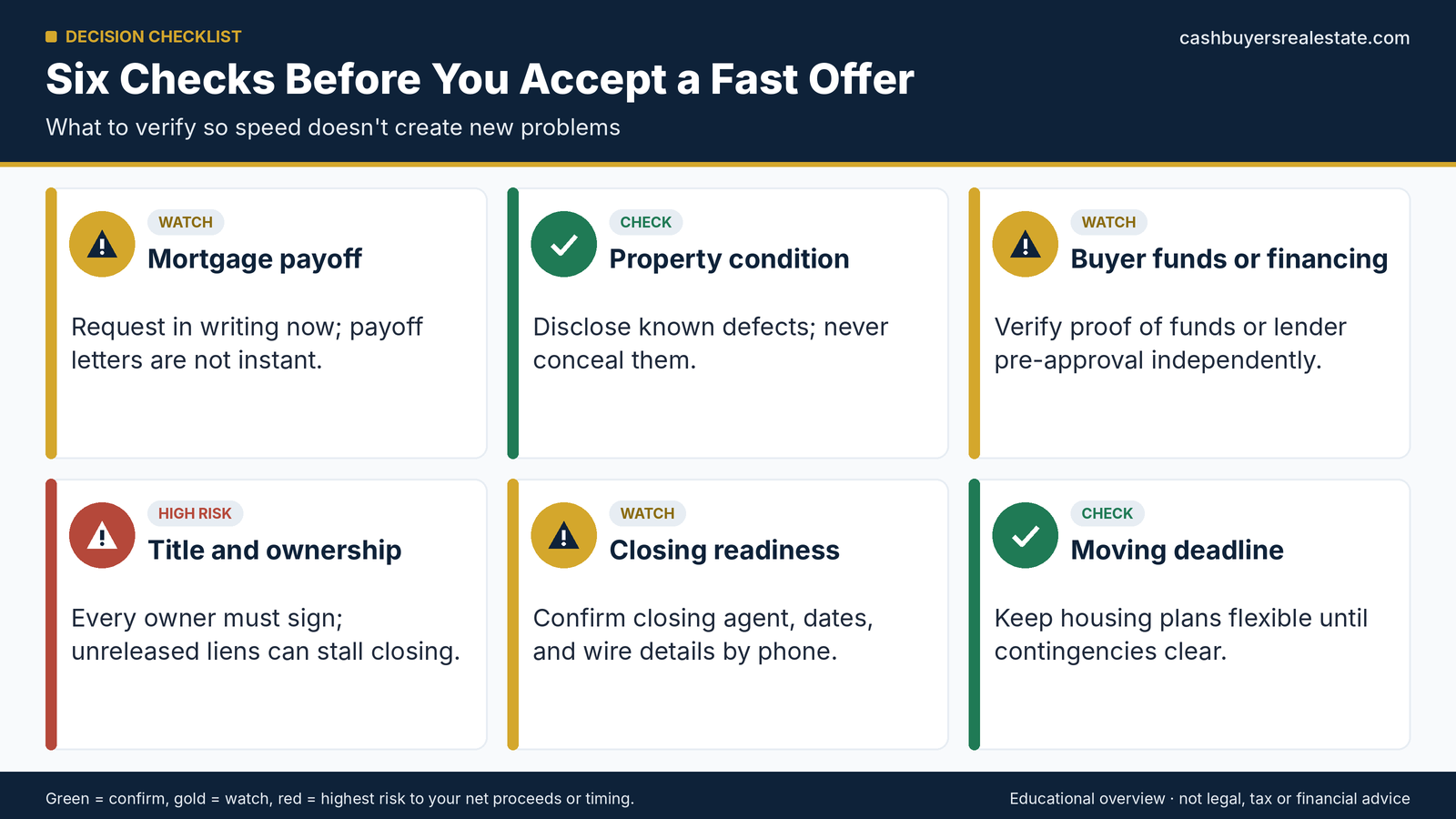
Text version of this infographic
- Mortgage payoff — Request in writing now; payoff letters are not instant.
- Property condition — Disclose known defects; never conceal them.
- Buyer funds or financing — Verify proof of funds or lender pre-approval independently.
- Title and ownership — Every owner must sign; unreleased liens can stall closing.
- Closing readiness — Confirm closing agent, dates, and wire details by phone.
- Moving deadline — Keep housing plans flexible until contingencies clear.
Frequently Asked Questions About Selling a House Fast
Questions about timing, paperwork and closing
Questions about the calendar
- How fast can a house realistically sell?
It depends on the route and on three conditions: whether the buyer needs a loan, whether title is clean, and whether the house can be handed over on time. A cash contract can set a short closing date in the contract itself, and a financed sale generally needs additional weeks after the contract for the appraisal, underwriting, and the disclosure waiting period. NAR’s median time on market of 31 days in August 2026 describes the marketing period only, so don’t read it as a listing-to-keys timeline.
- Which week matters most?
Usually the first. That’s when you request the payoff, order or request the documents that have waiting periods, choose a route, and set your price floor. Tasks started in week one run in the background while you do everything else, and tasks started in week three become the schedule. If you can only do three things in the first week, make them the payoff request, the ownership check, and the decision about which one or two routes you’ll test.
- Can I speed things up by skipping the inspection?
That decision belongs to the buyer, not you. Some cash buyers shorten or waive an inspection voluntarily, and some financed buyers do too, but a lender’s appraisal and property requirements still apply to a financed purchase. As a seller you can offer a pre-listing inspection or share one you already have, which may shorten negotiations without removing the buyer’s right to look.
- What if my closing date lands on a weekend or holiday?
Plan on a business day. Recording offices are generally closed, and money transfers typically don’t move on weekends or federal holidays. For a financed buyer, the Closing Disclosure rule counts Saturdays but not Sundays or federal holidays when it measures the three-business-day wait, so the closing date can move because of the calendar alone. Ask your closing agent to confirm the actual date funds will move, and don’t schedule movers or a new lease around a date that hasn’t been confirmed in writing.
Questions about documents and closing mechanics
- How long does a mortgage payoff statement take?
Under Regulation Z, a servicer must send a payoff statement within a reasonable time and no more than seven business days after receiving a written request from you or someone acting for you. Many servicers are quicker, and a title company can request one on your behalf once there is a contract. Ask for a per-day interest figure so the amount can be adjusted if the closing date moves.
- Do I need an attorney to sell my house?
It depends on your state and the route. In some states an attorney customarily handles the closing, and in others a title or escrow company does. Even where it isn’t required, a real estate attorney can be worth hiring for a sale you run yourself, for an unusual title situation, or for reviewing a contract you didn’t draft. A short flat-fee review is often cheaper than a mistake. If you hire one, do it before you sign the contract rather than after, since the contract is where most of the dates and obligations are fixed.
- What happens if the buyer’s appraisal comes in below the price?
The buyer usually has to renegotiate the price, bring extra cash, challenge the appraisal, or cancel under an appraisal contingency if the contract has one. The CFPB notes that an appraisal below the price is strong evidence that the price was above market value. A cash buyer without a lender avoids this specific problem, though a cash buyer may still adjust an offer after inspecting. If the contract does have an appraisal contingency, read its deadline carefully, because the buyer’s right to cancel usually ends on a set date.
- Do I have to disclose problems if I’m selling as-is?
Often, yes. “As-is” generally describes who pays for repairs, not whether known issues must be disclosed, and the rules vary by state. Some states require a standardized written disclosure (Texas does for most residential sales), and federal law requires lead-based paint disclosures for most pre-1978 homes. Ask a local attorney or agent what applies, and never conceal a known defect.
Questions about money, risk and special situations
Questions about costs and offers
- Will I still pay closing costs on a fast sale?
Almost always some, though the amount and who pays what varies by state, contract, and route. Typical items include title or escrow fees, recording charges, prorated taxes, and possibly a transfer tax. Don’t assume a buyer will cover them; confirm in writing which costs are yours and compare the offers by net proceeds.
- Is a cash offer always lower than a listing?
Not always, but investor offers commonly come in below what a fully prepared retail sale might bring because they price in repairs, holding costs, and a margin. The gap can narrow when a house needs substantial work, when a listing would need price cuts, or when a long vacancy is costing you money. Run both nets before you decide. The cash offer pillar explains how those offers are built.
- Should I accept the first offer I receive?
Not automatically, and not necessarily after waiting either. Set a decision window, such as 48 to 72 hours after your last scheduled showing or call, collect written offers with dates and terms, and compare them side by side. If you have a hard deadline, tell each buyer the time you need an answer by and ask if they can match your closing date. A slightly lower offer that closes on your date can beat a higher one that will need extensions.
- Will I owe taxes on the sale?
It depends on your gain and your situation. For a main home, a federal exclusion of up to $250,000 of gain ($500,000 on a joint return) may apply if you meet the ownership and use tests, per IRS Topic No. 701, and state taxes differ. If the closing agent sends you Form 1099-S, report the sale even if all the gain is excluded. A tax professional can look at your actual basis, including the cost of improvements, which is why keeping receipts and the settlement statement from your original purchase is worth the effort.
Questions about safety and special situations
- How do I protect myself from wire fraud at closing?
Decide in advance whom you’ll call to confirm payment instructions, write down their phone numbers, and treat any emailed change to wiring details as suspect until you’ve verified it by phone using a number you already trust. The CFPB also advises never emailing financial information and contacting your bank immediately if you think you’ve wired money to the wrong place. The cash home sale process guide covers the closing-day mechanics.
- What if I’m behind on my mortgage and need to sell?
Talk to your loan servicer early, because options and timelines depend on your loan and your state. HUD-approved housing counselors, listed through the CFPB, provide independent advice on defaults, forbearances, and foreclosures, often at little or no cost. A sale can be one option among several, and the foreclosure alternatives hub explains the choices without pressure.
- Can I sell quickly if tenants live in the house?
Sometimes, but a sale doesn’t automatically end a lease. The lease terms and your state and local landlord-tenant law control what the buyer can expect. Some investors buy occupied rentals and keep tenants in place, which may shorten the process. The tenants hub goes through the options.
- Can I sell an inherited house quickly?
Only once the person signing has legal authority to sell. That may be an executor, administrator, or trustee, or the heirs themselves after title transfers, and the process depends on the state and how the property was owned. Court steps can set the pace more than any buyer. The inherited house hub and probate guide lay out the paths.
Matching a Route to Your Priority and Taking the First Steps
A decision framework by priority
Decision matrix: what you value, what usually fits, what you give up
There isn’t a universal best route, only a best fit for your priority and your constraints. The matrix below sorts common priorities. Use it to choose your first one or two routes to test, then let real offers and real numbers confirm or overrule it.
| Your priority | Route that often fits | What you give up | Check first |
|---|---|---|---|
| Closing in two to three weeks, as-is | Cash buyer or investor | Likely a lower price than a retail sale | Proof of funds, contract completeness, title |
| Highest net, with about two to three months | Agent-led listing | Time, showings, prep costs, commissions | Realistic price, repair priorities, fee terms |
| Keep control and avoid a listing fee | For sale by owner, with an attorney | Your time; risk of pricing or paperwork errors | State contract and disclosure rules |
| Convenience and a simple online process | Platform (iBuyer) offer | Service fees or repair deductions | Eligibility in your market, final net |
| Unusual property or a price-discovery need | Auction | Price certainty; flexibility on terms | Reserve, premium, deposit and closing terms |
| Unclear ownership, liens or court steps | Fix the title issue first, then choose | Time spent before any route can close | Title commitment, attorney input |
If two rows apply to you, run both routes in parallel for the first week. Offers on the table are better information than predictions. And if the row that fits you says to fix a title or ownership issue first, resist the urge to pick a route anyway; no buyer, however fast, can close over an unresolved owner or lien.
Three short scenarios (hypothetical)
Illustrative example (hypothetical numbers, not market data): The relocating homeowner. A job starts in five weeks, the house is in good shape, and there’s meaningful equity. An agent-led listing with a flexible possession date is a reasonable first move, and a parallel request for a cash offer gives a fallback and a comparison number. The payoff request and association documents go out on day one.
Illustrative example (hypothetical numbers, not market data): Three heirs in three states. The house is outdated, one sibling isn’t responding quickly, and the estate has no appointed representative yet. Before any route matters, the group needs to settle who has legal authority to sign. After that, an as-is sale to a cash buyer or a lightly prepared listing could both work, and the timeline is set by the court and title steps, not by the buyer.
Illustrative example (hypothetical numbers, not market data): The homeowner two payments behind. The first calls go to the servicer and a HUD-approved housing counselor, to understand timelines and alternatives before choosing a sale route. If a sale is the right answer, a payoff request and a clear price floor come next, and the seller can compare listing and cash routes without feeling cornered.
These three snapshots are deliberately generic, and your own situation will have details they leave out. What they share is the order: establish who can sign and what must be paid off, then choose a route, then compare real written terms. The sequence changes the conversation with every buyer or agent you speak to, because you arrive knowing your floor, your dates, and your paperwork instead of discovering them under pressure.
What to do next
Your next seven days, in order
- Day 1: Write your hard date, soft date, and walk-away net number. Request your payoff in writing from every lender on the property.
- Day 1 to 2: Confirm everyone on title and how each will sign. Start any power of attorney or authority paperwork.
- Day 2: Pull your document folder together: deed, IDs, latest mortgage statement, tax bill, insurance page, association contact.
- Day 2 to 3: Request association documents if they apply. Call the local building department and ask about open permits or violations.
- Day 3: Get a pricing opinion from two agents or pull your own comps, and decide which one or two routes to test.
- Day 4 to 5: Request written terms from buyers or agents. Ask for proof of funds, closing date, due-diligence period, and who pays which costs.
- Day 6 to 7: Compare net proceeds, not headline prices. Pick a route or a deadline for deciding, and line up your title or closing partner.
A note on pace. If you have less than seven days, compress the list by running the first four items on day one and treating the offer stage as the deadline for everything else. If you have more time, use the extra days on preparation that raises your net, such as repairs a retail buyer would care about, rather than on waiting. Either way, set a calendar reminder for the payoff request response, since it’s the one item that almost every sale depends on and few sellers track.
Questions to ask any buyer, agent or title company
- What exactly will I net at closing under this offer or listing plan, and which costs did you assume?
- Which dates in the contract can move, and what happens if they do?
- Is the buyer using a loan, and if so, what are the appraisal and inspection terms?
- Where will earnest money be held, and under what conditions is it refundable?
- Who is the closing agent, and can I contact them directly?
- What would make this price change before closing?
- If I need to stay a few days after closing or leave early, what can we put in writing?
Why these questions? Each one targets an assumption that tends to stay unspoken until it costs money. The first exposes whether a “price” is a number you will actually receive or one that shrinks at the closing table. The next three surface timing and risk, and the last few test whether the people involved are reachable, accountable, and flexible. A buyer or agent who answers them clearly, in writing, is easier to trust than one who tells you not to worry about it.
Selling quickly doesn’t require giving up your judgment. It requires doing the long-lead items first, getting offers in writing, and comparing what you keep rather than what you’re told. If it would help to see how a cash offer stacks up against a listing in your case, the next step is simply to get that second data point.