
Sell Inherited House Fast: Timeline, Costs & Seller Options
A parent, grandparent, aunt, or friend has died. A house is now part of what they left behind, and you are one of the people expected to decide what happens to it. Maybe you live three states away. Maybe two siblings want to sell and one wants to keep the place. Maybe the furniture is still in the closets, the property tax bill arrived last week, and nobody is sure whether the mortgage can simply be paid off. People who search for how to sell an inherited house fast are rarely rushing for the sake of it. They want the monthly bills to stop, the family disagreements to end, and the paperwork to make sense.
You can sell an inherited house quickly only once someone with legal authority can sign the deed. That authority comes from probate court, a trust, or a non-probate transfer, depending on how the house was owned. After that, an as-is cash sale can move fastest, while a listing may net more. Taxes, a mortgage, and co-heirs shape the real timeline.
That answer hides the part most heirs trip over: the question is not really “how fast can a buyer close?” It is “who is allowed to sell, and what has to happen first?” A cash buyer can say yes in a day. A title company still will not insure a sale signed by someone who has no authority to sign it. For that reason the guide starts with authority, then moves through the family and money questions that decide how quickly the sale can actually happen.
Here is what you will find. The first sections cover who can sell (a table matches each way a house passes to the person who can sign), what to do when siblings disagree, and what it costs to carry a house while you decide. The middle sections compare the realistic ways to sell or not sell, including an as-is cash sale, a traditional listing, repair-and-list, keeping or renting the home, and buying out co-heirs. They are followed by the tax basics (the step-up in basis and why it often matters more than the sale price), the inherited mortgage, and the liens and title issues that quietly slow closings. The last stretch lays out a realistic timeline, how to vet a cash buyer, and a framework for choosing a route.
One note on tone. Grief and paperwork arrive together, and nothing here assumes you are in a hurry to be done with someone’s life. Some heirs want the house sold in a month; others need a year to sort belongings and feelings. Both are reasonable. The goal is to help you pick a pace on purpose rather than because a deadline, a bill, or a persuasive phone call picked it for you. Neither a cash sale nor any other route is automatically best, and the sections below try to show where each one earns its place and where it costs you.
For the wider picture on selling any house on a short clock, the sell house fast hub compares every route. If probate court is already involved, selling a house quickly in probate covers the court mechanics in more detail, while this article stays focused on the heir’s own decisions: authority, family, carrying costs, taxes, and the mortgage.
Who Has the Legal Authority to Sell an Inherited House
Match How the House Passed to the Person Who Can Actually Sign
Probate property: personal representatives and the paperwork that proves their authority
If the house was owned in the deceased person’s name alone, with no co-owner who survives and no beneficiary designation on the deed, it is usually a probate asset. In that case the right to sell generally belongs to a court-appointed personal representative, called an executor when named in a will and an administrator when there is no will. The court issues a document, called letters testamentary, letters of administration, or letters of authority depending on the state, that proves the appointment. A title company will almost always ask to see it.
Being named in the will is not the same as having authority. A named executor typically has to be formally appointed by the court first, and until that happens the person cannot sign a deed. Some states allow the will itself to grant broad power to sell without further court approval (often called independent or unsupervised administration), while others require the court to approve a sale of real estate or require notice to heirs. That difference can change a four-month process into an eight-month one, so it is worth learning early which version your state uses.
A practical consequence: an heir who is not the personal representative cannot sell the house, even if the will leaves it to them. The beneficiary’s share is usually delivered by a deed from the estate after debts, taxes, and expenses are handled. Before that distribution, the personal representative signs. A buyer who offers a quick close to an heir without any appointed representative is either planning to wait for the court or is skipping a step that a title insurer will not skip.
Non-probate transfers: trusts, transfer-on-death deeds, and survivorship
Plenty of houses never enter probate. If the home sat in a revocable living trust, the trust becomes irrevocable at the owner’s death and the successor trustee named in the trust document, not the court, holds authority to sell. The trustee usually proves that authority with a certification of trust and a death certificate, and the title company may ask to review parts of the trust. A trustee who sells follows the trust’s instructions, which may require dividing proceeds among beneficiaries on a schedule or in unequal shares.
A transfer-on-death (TOD) deed, available in many but not all states under various names, names a beneficiary who receives the property at death without probate. The beneficiary typically records a death certificate and sometimes an affidavit, after which the beneficiary owns the house and can sell it. Requirements and timelines vary. Some states keep the property exposed to the deceased owner’s creditors for a period, so check your state’s rules before assuming the house is free and clear.
Joint tenancy with right of survivorship and tenancy by the entirety work differently again: the surviving owner already owned the whole house, and recording the death certificate clears the deceased owner from title. A life estate gives one person the right to use the house for life, and the remainder passes at death to the named person, who then can sell. In community property states, the surviving spouse’s rights come into play. In each case the sale can move faster than probate, but only after the recording step is complete.
The table below lines up the common situations. Use it to find the likely signer and the first document to gather. It describes general patterns; your state may differ.
| How the house was held | Who usually signs the sale | First proof a title company asks for | Typical speed bump |
|---|---|---|---|
| Sole name, will, estate in probate | Court-appointed personal representative | Letters from the probate court plus death certificate | Waiting for appointment; some states need court approval or notice |
| Sole name, no will (intestate) | Court-appointed administrator on behalf of heirs set by state law | Letters of administration; list of heirs | Identifying all heirs; bonds or notices |
| Revocable living trust | Successor trustee | Certification of trust, death certificate | Trust terms on distribution; trustee unfamiliar with the role |
| Transfer-on-death or beneficiary deed | The named beneficiary after recording | Recorded death certificate or affidavit per state rule | Creditor exposure in some states; more than one beneficiary |
| Joint tenancy with survivorship | Surviving joint owner | Recorded death certificate | Mortgage in the deceased owner’s name only |
| Life estate with remainder | Remainder owner after the life tenant’s death | Deed creating the life estate; death certificate | Old deeds and unclear remainder names |
| Small-estate affidavit route | Heirs per the statute’s affidavit procedure | Approved affidavit or court order per state | Value caps and waiting periods; real estate often treated differently |
Read the table from left to right: the second column is who you need on the closing documents, and the third is what to request from the court, trustee, or county recorder before listing or accepting an offer. If your house fits two rows, such as a sole-name house with a TOD deed, the deed generally controls what happens at death, so confirm which instrument governs.
When There Is No Will, No Appointed Representative, or Only a Small Estate
Intestacy and the heirs who may own a share
When someone dies without a valid will, state intestacy law decides who inherits, usually in an order that starts with a surviving spouse and children and moves outward to parents, siblings, and more distant relatives. That list can surprise families. A stepchild who was close to the deceased may receive nothing, while a distant relative who has not spoken to the family in years may hold a share in a state with certain intestacy rules.
For a sale, this matters because every heir with an ownership share typically has to be identified before a clean sale can close. A court-appointed administrator can sell on behalf of the estate, but the court often requires notice to all known heirs, and a title company wants confidence that nobody with an interest was left out. Finding a missing heir can add weeks to a timeline, and an unlocated heir’s share may need to be held by the court until they are found.
If you are one of several possible heirs and nobody has opened a probate case yet, the first practical step is usually to obtain certified copies of the death certificate and locate any will, deed, trust, or beneficiary designation. A will found in a drawer after a sale has started can reroute authority entirely, which is the best argument for checking the deed records and the court’s index of filings before you commit to a buyer.
Small-estate shortcuts and why they differ so much by state
Most states offer a streamlined path for small estates, such as a sworn affidavit or a summary procedure, to avoid full administration. The value caps, waiting periods, and treatment of real estate vary widely, so one family’s experience will not map onto another state’s.
Two official examples show the spread. Texas Estates Code chapter 205 lets distributees of an intestate estate collect assets by affidavit when the estate does not exceed $75,000 (a calculation that leaves out homestead and exempt property), at least 30 days have passed since the death, and no petition for a personal representative is pending; a judge must approve the affidavit. Florida’s summary administration statute, section 735.201, makes that route available when the estate, excluding property exempt from creditors, does not exceed $150,000 or when the decedent has been dead more than two years, as the statutes read when checked in October 2026. Neither description tells you whether a particular house can be sold through the shortcut, because real estate is often handled under separate rules.
The practical takeaway is to ask the probate clerk or an attorney a specific question: “Can the house be conveyed under the small-estate procedure here, or do we need an appointed representative?” A wrong guess can leave you with a deed a title insurer will not accept. If a full probate is unavoidable, the guide on selling quickly during probate explains how to keep the court timeline from dominating the sale, and the probate real estate hub collects the related articles.
Siblings, Co-Heirs, and Shared Decisions About the House
Reaching a Decision When Several People Own or Inherit Shares
When everyone wants to sell: choosing a point person and a plan
When all heirs agree to sell, the problems are usually logistical rather than legal. Someone has to talk to the agent or buyer, someone has to sign for the estate, and everyone has to approve the price and the timeline. Families that name one point person (often the personal representative or the heir who lives closest) and agree in writing on how decisions will be made tend to avoid the slow, repeated group chats that stall offers.
Write down a few things early: the minimum acceptable price or net, who covers carrying costs until closing and how they will be reimbursed from sale proceeds, who handles the personal property and keepsakes, and how long you will wait for the best offer before taking a decent one. A short email thread that everyone replies “agreed” to is not a legal contract, but it prevents the “I never said that” conversation three weeks later.
Keep every heir informed of offers in real time, including those who live far away. An heir who feels sidelined often becomes the one who refuses to sign. If you plan to accept a discounted cash offer for speed, share the net math (see the net proceeds calculator and the overview of how cash offers are calculated) so the discount is a decision everybody made, not a surprise.
When one heir wants to keep the house: buyouts, appraisals, and refinancing
It is common for one sibling to want the family home and others to want cash. A buyout can solve this: the keeping heir pays the others for their shares, usually based on an appraisal or an agreed value. Money for the buyout often comes from a refinance, a home equity loan, or an agreed installment plan, and each of those has its own lender requirements and its own timeline.
Value is the sticking point. A licensed appraiser’s opinion of market value, ideally from one the family agrees on, keeps the debate away from emotions. Remember that the “market value” buyout price does not account for selling costs the others would have paid in a sale, so some families negotiate a modest adjustment. Whatever you choose, put the buyout price, payment date, and what happens if financing falls through in a written agreement drafted or reviewed by an attorney.
The inherited basis of the house also matters in a buyout, because the keeping heir inherits a higher basis only for the share received through the estate and takes a cost basis in the shares they buy. Tax is covered in a later section; for now, note that the person keeping the house should talk to a CPA before settling on a price.
When Agreement Breaks Down: Partition and the Alternatives
How partition works and what Texas’s heirs-property law shows
If co-owners cannot agree, any co-owner can ask a court for partition, which means either dividing the property or ordering it sold with the proceeds split. Courts historically ordered a sale readily, which led to heirs losing family land at low auction prices. Many states have since adopted the Uniform Partition of Heirs Property Act, which adds protections when relatives inherited the land.
Texas shows the pattern. Under Property Code chapter 23A as enacted in 2017, for partition actions filed on or after September 1, 2017, the court first decides whether the land is heirs’ property. If it is, the court generally orders an appraisal, gives the other co-owners a chance to buy out the shares of those who want to sell (45 days to elect and 60 days to pay into court), and orders a physical division unless that would substantially prejudice the owners as a group. A sale, when ordered, is generally an open-market sale with a broker rather than a courthouse auction. Other states’ laws differ, so treat Texas as an example, not a rule.
Partition is slow, public, and expensive, and legal fees often come out of everyone’s share. It exists as a backstop, not a plan. Its practical value is leverage: everyone knows what a judge could do, which tends to make negotiated outcomes more attractive.
Cheaper off-ramps: mediation, written agreements, and selling one share
Before anyone files a lawsuit, consider mediation. A neutral mediator, often available through local courts or community programs at modest cost, can help siblings surface the real issue, which is often less about the house than about fairness, caregiving history, or sentiment. Agreements reached in mediation can be written into a binding settlement.
Another off-ramp is for one heir to sell their share to a co-owner, to an outside buyer, or to an investor who buys partial interests. Outside purchasers of fractional interests usually pay steep discounts because they inherit the same co-ownership problem, so treat these offers carefully and compare them with a buyout from within the family. A shorter rental arrangement can also help, with one heir living in the house temporarily and paying a fair rent or covering the carrying costs, while the family decides on a long-term plan.
The table below shows common co-heir situations and the routes that tend to fit them. Use it to match your family’s situation to the next step, not to predict the outcome.
| Situation | Usually fits | Watch for | Time pressure it adds |
|---|---|---|---|
| All heirs want cash and agree on a price | Listing or as-is sale through the personal representative | Unequal carrying-cost contributions | Low once authority is settled |
| One heir wants to keep it, others want cash | Appraisal-based buyout, funded by refinance | Financing delays and disputes about value | Moderate; lender timelines drive it |
| One heir refuses to engage or sign | Mediation, then a written offer; partition as the backstop | Court cost and public record | High; months to a year or more |
| An heir cannot be found | Court notice and possible guardian or fiduciary for that share | Title insurer requirements | High; depends on the court |
| Heirs live in different states | Remote signing, power of attorney, mobile notary | State rules on acknowledgments | Moderate; manageable with planning |
| Family disagrees on contents and keepsakes | Written division list or neutral appraiser for valuable items | Emotional disputes that stall the sale | Moderate; solvable early |
The table is a map, not a prescription. The row that fits you will often change as the family’s goals do. Revisit the plan whenever new information arrives, such as a creditor claim, a different appraisal, or a will that surfaces late.
The process map below puts the whole path in one view: confirm who can sign, settle the family decision, count the carrying costs, pick a sale path, clear the tax and mortgage questions, and close. The sections that follow explain each stage in text, so the image is a quick reference rather than the only place the steps appear.
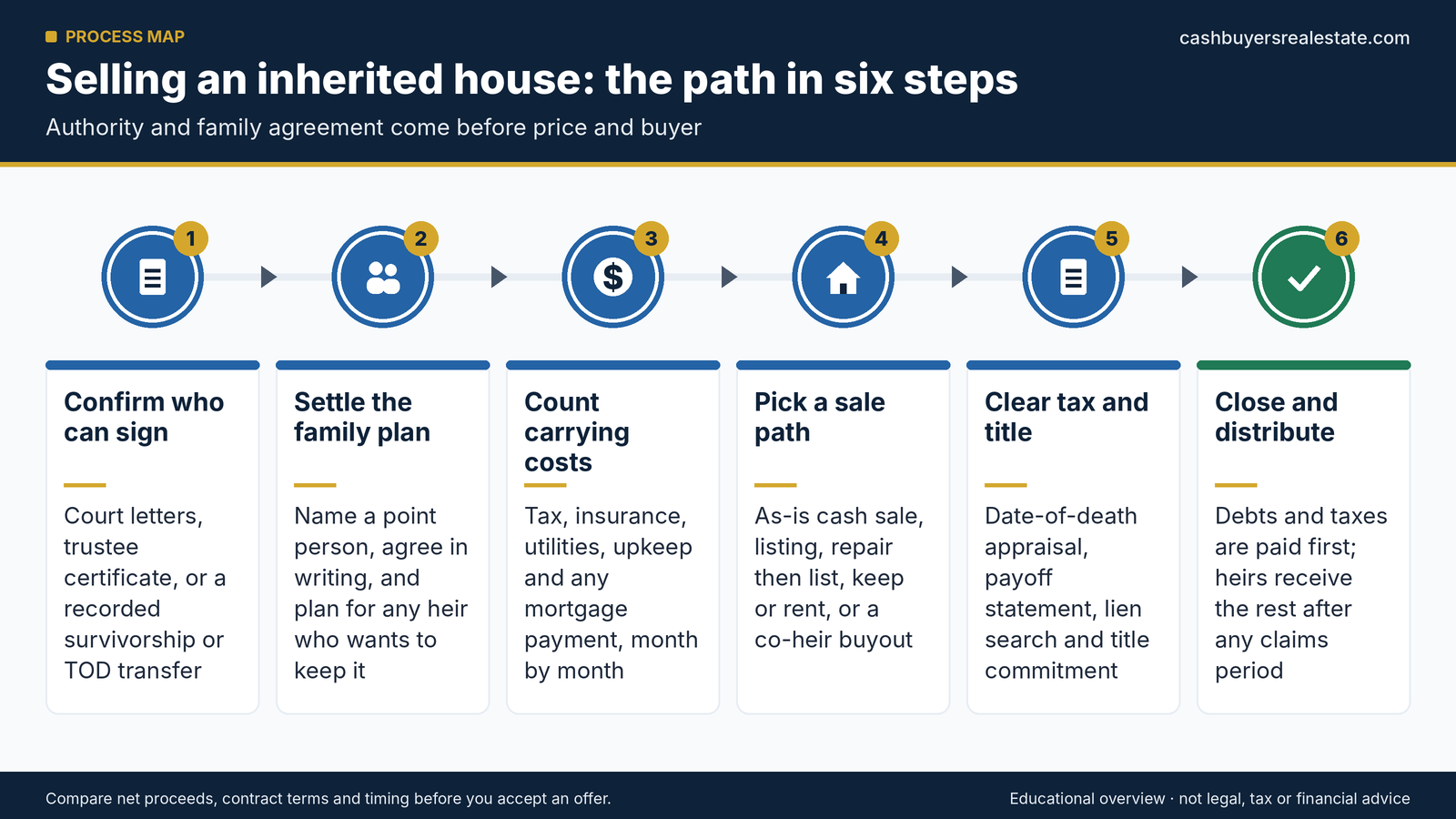
Text version of this infographic
- Confirm who can sign — Court letters, trustee certificate, or a recorded survivorship or TOD transfer
- Settle the family plan — Name a point person, agree in writing, and plan for any heir who wants to keep it
- Count carrying costs — Tax, insurance, utilities, upkeep and any mortgage payment, month by month
- Pick a sale path — As-is cash sale, listing, repair then list, keep or rent, or a co-heir buyout
- Clear tax and title — Date-of-death appraisal, payoff statement, lien search and title commitment
- Close and distribute — Debts and taxes are paid first; heirs receive the rest after any claims period
What an Inherited House Costs Each Month While You Decide
Building a Carrying-Cost Worksheet You Can Actually Use
Fixed costs that keep running: property tax, insurance, mortgage, and association dues
Death does not pause the bills. Property taxes keep accruing, and in many places the bill arrives on a schedule that has nothing to do with probate. Missing a payment can lead to penalties and interest, and unpaid taxes can eventually become a lien on the house or lead to a tax sale. The timelines differ by state and county, so find your county tax collector’s due dates early and put them on a shared calendar.
Homeowners insurance deserves a phone call in the first weeks. The policy was written for the deceased owner, and insurers often want to know when the named insured dies and who now has an insurable interest. A policy can also change character when a house stops being lived in, since many standard policies limit or exclude certain losses after a property has been vacant for a stretch, commonly described by the insurance industry as 30 to 60 consecutive days. Triple-I (the Insurance Information Institute) described that pattern in a June 2025 explainer, and it noted that vacancy endorsements or separate vacant-dwelling policies exist at higher cost. Ask the insurer exactly how your policy defines vacancy and what it excludes, and read the longer discussion of vacancy risk and holding costs if the house will sit empty.
If there is a mortgage, the payment continues, and so does interest. A homeowners association may keep billing monthly or quarterly dues and assessments, and some associations charge late fees or file liens. Add these four lines to the worksheet first because they are the least flexible. Unlike utilities, you cannot dial them down by turning the thermostat lower.
Variable costs: utilities, upkeep, security, and the repair nobody planned for
Utilities are the line most heirs underestimate. A house with the heat set low for winter still has a water bill, an electric bill, and often a trash or sewer charge. If the house has pipes that can freeze, shutting off the heat to save money can cost far more than it saves. Triple-I’s guidance for unoccupied homes includes keeping the heat at a minimum level in cold weather or winterizing the plumbing, and it warns that neglected maintenance can jeopardize coverage even on specialty policies.
Lawn care, snow removal, pest control, and gutter cleaning keep the property from drawing attention or code enforcement letters. In some cities an unkempt or empty house triggers a notice or a vacant-property registration requirement, which is another reason to keep the exterior looking cared for. Add a small maintenance reserve too. Roofs leak and water heaters fail on their own schedule, and a house that has been lived in by one elderly owner for decades often has deferred maintenance waiting to surface.
Security is cheap relative to a break-in. Rekeying the locks, collecting the mail, putting lights on timers, and asking a neighbor to watch the place are small steps that matter. The table below pulls the lines into one worksheet with hypothetical numbers. Replace each figure with the real bill from your own mail and your county’s tax statement.
| Cost line | Monthly (illustrative) | 3 months | 9 months | What to check |
|---|---|---|---|---|
| Property tax (annual bill divided by 12) | $380 | $1,140 | $3,420 | County due dates; any unpaid prior-year balance |
| Homeowners or vacancy-capable insurance | $190 | $570 | $1,710 | Vacancy definition; named insured; liability coverage |
| Utilities at a minimum safe level | $240 | $720 | $2,160 | Heat in freezing weather; water; sewer or trash fees |
| Lawn, snow, pest, and exterior upkeep | $130 | $390 | $1,170 | Local code rules; seasonal swings |
| Maintenance reserve | $150 | $450 | $1,350 | Age of roof, water heater, HVAC |
| Association dues, if any | $0 | $0 | $0 | Dues, special assessments, resale certificate fees |
| Mortgage payment, if any | $0 | $0 | $0 | Principal, interest, escrow; see the mortgage section |
| Total (without a mortgage) | $1,090 | $3,270 | $9,810 | Add the mortgage payment to see the full clock |
This example is arithmetic rather than a forecast, but the pattern holds in most houses: even a modest monthly total becomes a five-figure sum in nine months, and a mortgage payment can double it. Those dollars come out of the estate, and therefore out of the heirs’ shares, which is the reason carrying costs belong in any decision about how long to wait.
Contents, Cleanout, and Who Pays the Bills Along the Way
Handling belongings: sorting, estate sales, donation, and disposal
The house is rarely empty. Sorting decades of belongings takes longer than most families expect, and it is easy to confuse sorting with sentimental review. A workable approach starts with a short window for the family to claim keepsakes, then moves to a sale of valuable items, donation of useful ones, and disposal of the rest. Photograph everything before anything leaves the house, especially if heirs live in different states, because a visual inventory prevents later disputes.
Before removing anything, check with the personal representative or the will about who has authority over personal property. In some estates, items of significant value, such as jewelry, art, firearms, or vehicles, need to be appraised or listed with the court. Paperwork matters too: look for deeds, insurance policies, tax returns, bank statements, safe-deposit box keys, and mortgage statements. These items may be the best evidence of what the estate owns and owes.
Professional help can shorten the process. An estate-sale company, a senior-move manager, or a cleanout contractor typically charges a fee or a percentage, and prices vary widely by region, so get written quotes. If the house will be sold as-is to a buyer, some buyers will take contents along with the property, which may save weeks, though you should confirm in the contract exactly what stays and what you remain responsible for.
Paying carrying costs: estate funds, family advances, and keeping receipts
Who pays while the house waits? If the estate has cash, the personal representative generally pays property taxes, insurance, and upkeep from it, with receipts kept for the accounting the court may require. If the estate has no cash, an heir sometimes advances funds personally. Treat those advances as loans to the estate and document them in writing, since reimbursement rules differ by state and the court or the other heirs may want proof.
Avoid informal arrangements where one sibling quietly pays everything for a year. Resentment follows, and the heir who paid may not recover the money if the estate turns out to owe creditors first. A simple spreadsheet shared with all heirs, listing each expense, date, amount, and payer, does more to preserve family peace than any legal argument.
The question of who pays also shapes the sale route. If an heir is covering costs out of pocket, a quicker discounted sale may be worth more to that person than to a sibling who is not paying. Surface that difference in the open. When you can show everyone the same worksheet, the conversation moves from “you are rushing” to “here is what each month costs.”
Illustrative example (hypothetical numbers, not market data): Three siblings inherit a house with no mortgage. Carrying costs run about $1,090 a month, as in Table 3. One sibling wants to wait nine months for a higher offer, hoping for $12,000 more. Over nine months the estate spends $9,810 carrying the house, compared with about $1,090 for a one-month sale. That is an $8,720 difference, so the extra $12,000 would be worth only about $3,280 once the added costs are subtracted, and only if the better offer actually arrives. Change any number, such as a house that carries a mortgage, and the answer changes too.
Ways to Sell, Keep, or Divide an Inherited House, Compared by What You Keep
Selling Routes Compared by Speed, Effort, and Net Proceeds
An as-is sale to a cash buyer or investor: what speed saves and what it costs
An as-is sale to a cash buyer or investor trades price for speed and simplicity. The buyer typically purchases without a financing contingency, may skip or shorten inspections and an appraisal, and expects to take on repairs and the clean-out themselves. In return, the offer is usually below what a financed owner-occupant might pay for the same house in good condition, because the buyer budgets for repairs, holding time, and resale risk. How large that gap is varies by buyer, house, and market, which is why comparing two or three offers matters.
For an heir, the benefits are practical. There may be no showings, no staging, no repair negotiations, and fewer places for a deal to fall apart. Cleaning out may be unnecessary if the buyer takes the contents. The drawbacks are equally concrete: a lower headline price, the chance that a buyer renegotiates after an inspection, and a wide range of buyer quality. Check proof of funds, read how earnest money is handled, and look for an assignment clause if the buyer plans to sell the contract onward. The guide to proof of funds and the cash buyer scam-prevention hub explain what to verify.
An as-is sale from an estate still needs authority. A personal representative with full power to sell can usually accept an offer and close within the buyer’s time frame. One whose authority depends on court approval has to wait, and a buyer who promises a fixed date without asking about authority has not read the situation. For a general overview, see selling a house as-is.
Listing with an agent: full-price potential, with and without repairs
A traditional listing exposes the house to the widest set of buyers, including financed owner-occupants, and often produces the highest sale price. It also brings agent commissions, seller closing costs, showings, buyer inspections, appraisal risk, and negotiated repairs or credits. Timelines run from a few weeks of marketing to a month or more for closing once a buyer’s lender is involved, and probate approvals can add more.
A common middle path is to make limited repairs and then list. Fresh paint, deep cleaning, minor fixes, and removing clutter often return more than they cost; large projects such as a new roof or kitchen frequently do not, particularly when heirs would be financing them out of the estate. Get a pre-listing opinion from a local agent about which repairs buyers in your neighborhood actually pay for, and weigh any plan against the months of carrying costs it adds.
An agent who understands estate sales can also coordinate with the personal representative, order the probate documents the title company wants, and handle court-confirmation steps in states that require them. Interview more than one, ask for their experience with estates, and compare commission structures. The page on cash buyer versus real estate agent compares the two routes side by side.
Routes That Keep the House in the Family
Keeping it: living there, renting it, or holding it for later
Not every inherited house should be sold. An heir may move in, rent it out, or hold it as a long-term investment, especially if the mortgage is small or nonexistent and the neighborhood is stable. Keeping the house changes the tax picture in several ways: you begin with the stepped-up basis, you may later qualify for the home-sale exclusion only if you live there long enough, and rental income and depreciation bring their own rules. Property-tax reassessment can also change the cost of holding, and this varies sharply by state.
Renting an inherited house sounds simple and rarely is. Landlord-tenant law, licensing and registration rules, insurance changes, and repair obligations all apply. An out-of-state heir may need a property manager, which typically costs a percentage of rent. Before choosing this route, compare realistic rent against taxes, insurance, maintenance, and vacancy, and decide whether you want to be a landlord at all. The article on selling rental property explains what a later exit looks like.
Holding the house without using it is the costliest form of keeping, because carrying costs continue and insurance may not cover an empty property well. If you choose to hold, set a review date and a limit, such as a maximum number of months or a maximum total spend, so that the decision is not made by default.
Buying out co-heirs or selling to a family member at an agreed value
A buyout lets the house stay in the family without a market sale. One heir pays the others their share, typically based on an appraisal. A sale to a family member at below-market value can raise gift tax and basis questions, so it needs professional advice before anyone signs.
Financing a buyout generally means a mortgage refinance or a new loan. Lenders look at the keeping heir’s income and credit, an appraisal, and the title. If the house still carries the original mortgage, remember that the lender may need to approve any structure that changes who is on the loan, even though federal law restricts acceleration after certain transfers on death (covered in the mortgage section below).
The table below compares the routes by the factors that matter most to most heirs. The net-proceeds example that follows it uses hypothetical numbers; no real house or buyer is represented.
| Route | Speed | Typical effort for heirs | Price pattern | Main risk |
|---|---|---|---|---|
| As-is sale to a cash buyer or investor | Fastest once authority is settled | Low; buyer handles repairs and sometimes contents | Often below a repaired, financed sale | Buyer reliability; renegotiation |
| Agent listing, as-is condition | Moderate; weeks to months | Moderate; showings and cleaning | Wider buyer pool; condition discounts | Financing and inspection falling through |
| Repair, then list | Slower; adds project time | High; contractors, permits, decisions | Potentially highest list price | Spending more than buyers will pay |
| Keep and live in it | No sale | High; ongoing ownership | No sale price; tax basis steps up | Cost of ownership and reassessment |
| Keep and rent | No sale | High; landlord duties | Rental income minus costs | Vacancy, repairs, regulation |
| Buy out co-heirs | Depends on financing | Moderate; legal and lender steps | Appraised or agreed value | Disputes about value; failed financing |
Treat the “speed” column as relative rather than a promise. A cash sale to a reliable buyer can close in weeks when title is clear and authority exists, while a listing might take months, but those ranges shift with the local market, the house, and the court.
Illustrative example (hypothetical numbers, not market data): An estate owns a house with no mortgage. A cash buyer offers $255,000 as-is, with about $1,500 in seller closing costs and one month of carrying costs ($1,090). The estate would net about $252,410. The alternative: list for $300,000, accept $290,000 after negotiation, then pay 5.5 percent in agent commission ($15,950), about $4,350 in other seller closing costs, $8,000 for cleaning and minor repairs, and five months of carrying costs ($5,450). That nets about $256,250, or roughly $3,840 more, in exchange for months of extra waiting and uncertainty. A $10,000 lower sale price or two more months of carrying costs would erase the difference. The point of the exercise is the comparison of net figures, not the specific numbers.
The five options in the next image line up the typical sale and non-sale routes by who each fits best and what each one trades away. The details of each are in the table above and the text before it, so you do not need the image to follow the comparison.
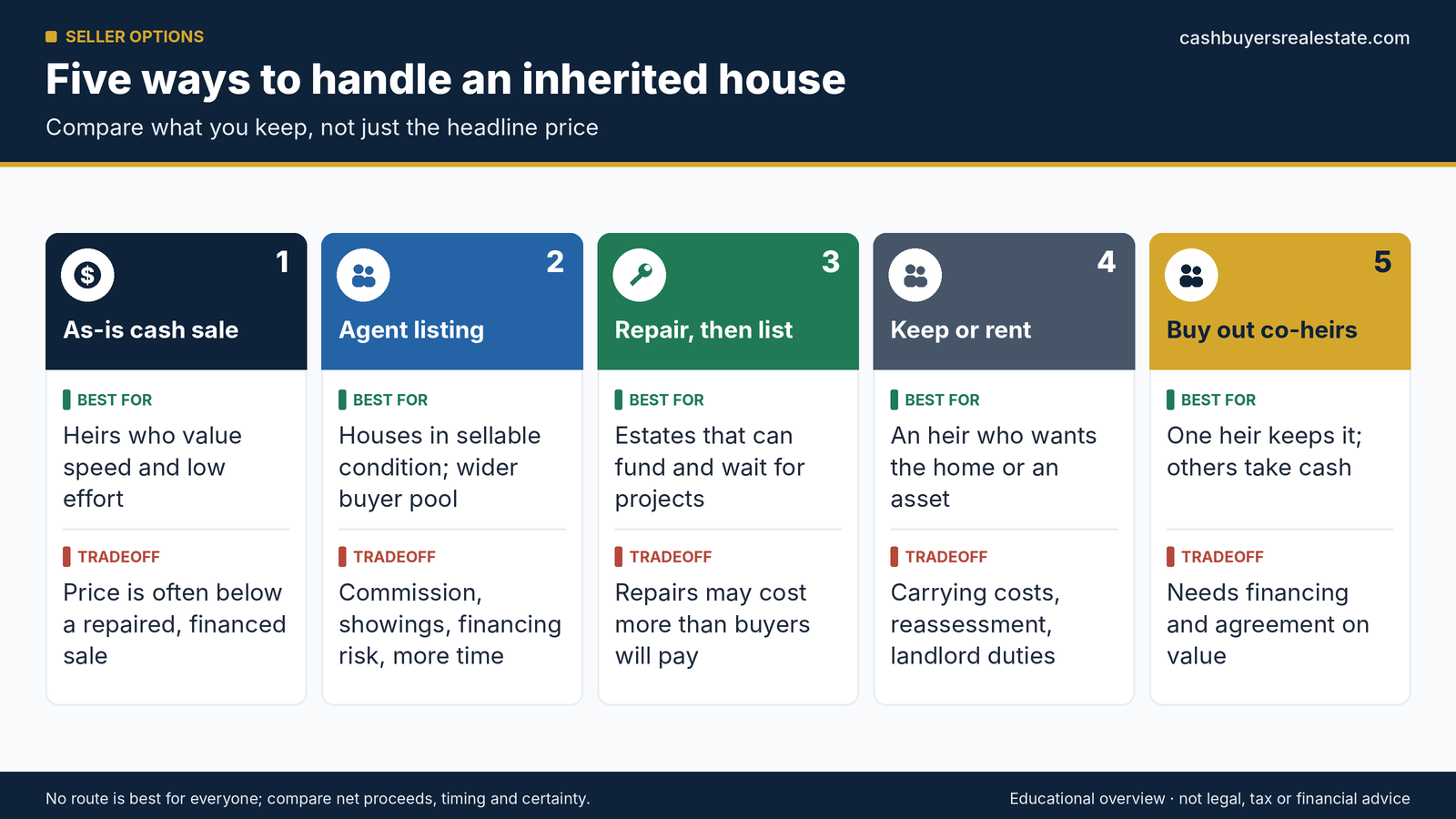
Text version of this infographic
- As-is cash sale — best for: Heirs who value speed and low effort; tradeoff: Price is often below a repaired, financed sale
- Agent listing — best for: Houses in sellable condition; wider buyer pool; tradeoff: Commission, showings, financing risk, more time
- Repair, then list — best for: Estates that can fund and wait for projects; tradeoff: Repairs may cost more than buyers will pay
- Keep or rent — best for: An heir who wants the home or an asset; tradeoff: Carrying costs, reassessment, landlord duties
- Buy out co-heirs — best for: One heir keeps it; others take cash; tradeoff: Needs financing and agreement on value
Taxes on an Inherited House: Stepped-Up Basis, Capital Gains, and Reassessment
How the Stepped-Up Basis Works and Why It Often Matters Most
What basis means and how the date-of-death value is set
Taxable gain on a sale is roughly the sale price minus selling costs minus your basis. For a house you bought, basis starts at what you paid plus certain improvements. For a house you inherit, the general rule under Internal Revenue Code section 1014 is different: the basis is the property’s fair market value on the date of the decedent’s death. IRS Publication 551 (December 2025 revision) states that rule for property inherited from a decedent, and it notes that the estate’s personal representative may elect an alternate valuation date in the limited cases where the estate files an estate tax return.
The “step-up” label comes from the common case in which a house bought decades ago for a modest price is worth far more at death. The old, low purchase price is replaced by the date-of-death value, which wipes out the appreciation for income-tax purposes. Heirs in that situation often owe little or no capital gains tax if they sell soon after inheriting at roughly the date-of-death value. The opposite case exists too: if the house lost value, the basis steps down to the lower figure.
Evidence of that value matters. A date-of-death appraisal from a licensed appraiser, ordered soon after the death, is the cleanest record. Publication 551 explains that beneficiaries of estates required to file Form 706 generally receive a Schedule A (Form 8971) showing values to use, and it says that if you did not receive one you can use the appraised value at the date of death for state inheritance or transmission tax purposes. The IRS’s estate tax page reported a $15,000,000 filing threshold for decedents dying in 2026 (page reviewed December 2025), which means most estates never file the federal return, so the practical record for many families is the appraisal they obtained themselves.
A few exceptions change the picture. If the heir or the heir’s spouse gave appreciated property to the decedent within a year before death, Publication 551 says the basis does not step up in the same way. When the house was owned jointly, only the deceased owner’s share generally receives the new value for a surviving co-owner, as Publication 523’s example shows (a $50,000 adjusted basis and a $100,000 value produce a $75,000 basis for the surviving spouse in the example). In community property states, both halves can receive the new basis when at least half the community interest is included in the decedent’s estate.
A worked example, and why a CPA belongs in the room
Numbers make the rule less abstract. The example below is hypothetical, and it keeps the arithmetic simple so you can substitute your own figures.
Illustrative example (hypothetical numbers, not market data): A parent bought a house in 1992 for $90,000. At the parent’s death, a date-of-death appraisal puts the value at $310,000. An heir sells it eight months later for $325,000 and pays $20,000 in selling costs (commission, closing costs, cleanout).
With the stepped-up basis: amount realized $305,000 ($325,000 minus $20,000), minus basis $310,000, leaves a loss of about $5,000. Nothing is taxable, though whether a loss is deductible depends on how the house was used, which is a question for a tax professional.
If basis had carried over from the parent: $305,000 minus $90,000 would produce a $215,000 gain, taxed at long-term capital gains rates. The difference between those two results shows why the date-of-death value, not the old purchase price, is the number to document.
Now change one assumption. If the heir had waited three years and sold for $380,000 after the market rose, the gain would be measured from the $310,000 basis, plus any capital improvements the heir made, minus selling costs. If the heir lived in the house for two years before selling, the home-sale exclusion might come into play. Each variation changes the analysis, and tax rules are detailed enough that a short consultation with a CPA before listing is usually inexpensive insurance.
Bring the CPA these documents: the date-of-death appraisal, the closing statement from the sale, receipts for improvements, records of estate-paid expenses, and any Form 8971 or Schedule A. Ask three questions: how should the sale be reported, which expenses reduce gain, and how do state taxes treat the sale?
Capital Gains, Estate Tax, and Property-Tax Reassessment
How the sale is reported, and why inherited houses rarely qualify for the home-sale exclusion
The IRS instructions for Form 8949 state that property you acquired by inheritance and later dispose of is reported as long-term, regardless of how long you held it; you write “INHERITED” in the column for the date acquired. That matters because long-term gains are taxed at preferential rates. IRS Topic 409 lists those federal rates as 0, 15, or 20 percent depending on taxable income, with the thresholds adjusted each year, and it notes that some categories of gain face higher rates. Your state may also tax the gain.
The federal home-sale exclusion under section 121, up to $250,000 of gain for a single filer or $500,000 for joint filers, generally requires that the seller owned and used the home as a main home for at least two of the five years before the sale (IRS Publication 523). An heir who never lived there usually will not meet that test. A surviving spouse has an additional rule: Publication 523 says a surviving spouse who sells within two years of the spouse’s death, and meets the other conditions, can use the larger exclusion, counting the late spouse’s ownership and use. These rules cover many families, but they are not universal, so a short check with a tax professional is wise.
Closing agents often report a home sale to the IRS on Form 1099-S. A 1099-S does not mean you owe tax; it reports the proceeds. Your own return reports the basis, the costs, and any gain, which is where the date-of-death appraisal earns its fee. If you need a quick refresher on the transaction itself, see closing costs when selling a house.
Estate tax, inheritance tax, and the property-tax reassessment surprise
Federal estate tax applies to very large estates only. For decedents dying in 2026, the IRS reports a filing threshold of $15,000,000 (page reviewed December 2025), up from $13,990,000 for 2025. A few states have their own estate or inheritance taxes at much lower thresholds, which is a question for the estate’s attorney because these taxes are paid by the estate or by the heirs depending on the state.
The surprise many heirs meet is property-tax reassessment. In many places a change of ownership triggers a new assessed value at market price, which can raise the annual bill sharply for an heir who keeps the home. California is the well-known example: under Proposition 19, the California State Board of Equalization explains that the parent-child exclusion applies to a family home that was the transferor’s principal residence and becomes the transferee’s principal residence (rental homes do not qualify), the exemption claim must be filed within one year, and the excluded value is capped at the factored base year value plus an adjustable $1 million amount ($1,044,586 for transfers from February 16, 2025 to February 15, 2027). Other states have their own limits, caps, and exemptions, and some have none.
For a seller the reassessment matters less because the house leaves the family, but it matters for the keep-or-sell decision, and it matters for buyers who calculate their own taxes. The table below sorts the tax questions heirs most often ask. It sorts them by who answers them and what to prepare, not by the dollar amount at stake.
| Question | Federal or state | Starting point | Bring to your CPA |
|---|---|---|---|
| What is my basis in the inherited house? | Federal rule (IRC section 1014) | IRS Publication 551 | Date-of-death appraisal; Form 8971 if issued |
| Is my gain long-term or short-term? | Federal | Form 8949 instructions | Closing statement; date of death |
| Can I use the home-sale exclusion? | Federal | IRS Publication 523 | Records of where you lived and when |
| Does the estate owe federal estate tax? | Federal | IRS estate tax page | Estate inventory; attorney’s opinion |
| Is there a state estate or inheritance tax? | State | State revenue department | Estate attorney’s analysis |
| Will property taxes be reassessed? | State and county | County assessor | Transfer documents; any exemption forms |
| Is a loss deductible? | Federal | Tax professional | Use of the house; sale documents |
Use the table as a question list for the appointment rather than an answer sheet. Tax outcomes depend on facts that no general guide can see, and a CPA who knows estates will tell you which rows apply.
The Inherited Mortgage, Liens, and Title Problems That Slow a Sale
What Happens to a Mortgage When the Borrower Dies
Federal protections under Garn-St Germain, and what they do not do
Most mortgages contain a due-on-sale clause that allows the lender to demand full repayment if the property is transferred. Federal law limits that right in certain death-related situations. Under the federal regulation implementing the Garn-St Germain Act (12 CFR 191.5(b)), for a loan on a home occupied or to be occupied by the borrower, a lender may not exercise a due-on-sale clause upon a transfer by devise, descent, or operation of law on the death of a joint tenant or tenant by the entirety, or upon a transfer to a relative resulting from the borrower’s death, or a transfer where the borrower’s spouse or children become owners, so long as the transferee occupies or will occupy the property. The regulation excludes reverse mortgages from that protection.
Read what that does and does not mean. It generally means a lender cannot call the whole loan due merely because an eligible relative inherits the house and lives there. It does not erase the debt, and it does not relieve anyone from making the payments. If the payments stop, foreclosure remains possible. If the heir does not occupy the property and plans to sell or rent it, the protection may not apply, and the regulation notes that a lender may enforce its clause if a later event disqualifies a transfer.
For a sale, the practical consequence is simpler: most heirs who sell pay off the loan at closing from the proceeds. Ask the servicer for a written payoff statement with a per-day interest amount, and read the guide to selling with a mortgage for how payoff, escrow balances, and prepayment terms affect net proceeds. If the loan balance is greater than the likely sale price, the situation moves toward a short sale or negotiation, which merits an attorney’s help.
Successors in interest: getting the servicer to talk to you
An heir who has inherited a house with a mortgage but is not on the loan often struggles to get information, because the servicer’s records list only the deceased borrower. Federal mortgage servicing rules (Regulation X, 12 CFR 1024.31) address this by defining a successor in interest: a person who receives an ownership interest from a borrower through transfers that include a transfer to a relative upon the borrower’s death, a transfer to a surviving joint tenant or tenant by the entirety, and a transfer that makes the borrower’s spouse or children owners. Once the servicer confirms the person’s identity and ownership interest, the person becomes a confirmed successor in interest, and the rule treats a confirmed successor as a borrower for the servicing provisions in that subpart. The official interpretation states that a servicer may not require the successor to assume the loan under state law before giving this treatment. Certain servicers, such as small servicers, are exempt from some provisions of the rule.
The CFPB’s consumer materials say that when you inherit a home, the servicer should tell you how to prove ownership. In practice, call the number on the mortgage statement, say you are a successor in interest, and ask what documents the servicer needs. Typical requests include the death certificate, proof of your ownership interest such as a deed or court letters, and your identification. Keep copies and note each call’s date, representative’s name, and reference number.
Once you are confirmed, you can usually request the payoff figure, loss-mitigation options, and account history. That information drives the decision: pay it off through a sale, refinance, or keep making payments. Don’t send money to anyone who contacts you offering to “handle” the loan for a fee; verify any servicer contact using the number printed on the statement.
Liens, Judgments, and Clouded Title
Debts that attach to the house before the heirs can sell
A mortgage is not the only claim on a house. Others include a home equity line of credit, unpaid property taxes, judgments against the deceased owner, mechanic’s liens, homeowners association liens, and sometimes claims from government programs. Some of these attach to the title directly, while others are claims against the estate that the personal representative must address before distributing assets. The difference matters for deciding who pays and when.
A title search ordered through a title company or attorney reveals most recorded liens before a buyer does. Ordering one early, even before you list, gives you time to resolve problems instead of discovering them when a closing date is set. Liens are usually paid from sale proceeds at closing, which means the buyer receives clean title and the heirs receive what remains. If liens exceed the sale price, the personal representative should speak with an attorney before agreeing to anything.
Estate creditors have their own process. Many states set a claims period during which creditors must present claims against the estate, and heirs who distribute assets too early can sometimes be held responsible for unpaid claims. This is one reason a personal representative should not distribute sale proceeds before checking the state’s rules. For more on this subject, the article on selling a house with liens and the hub on title problems and liens go deeper.
Title defects specific to inherited homes, and how to catch them early
Inherited houses often have title issues that ordinary sales don’t. A previous owner may have died without anyone recording the transfer, leaving a chain of deceased owners in the records. A deed may have been signed but never recorded. Names may have changed through marriage or errors. A property line may have shifted informally, or a fence may sit on a neighbor’s land. A long-ago divorce or a half-forgotten co-owner can leave an unexpected name on the title.
These issues are fixable, but fixes take time: corrective deeds, affidavits of heirship, court orders, or quiet-title actions in the hardest cases. They are also precisely why a quick sale that skips the title step can fail at the table. A cash buyer may close faster because it has no lender, but its title company still needs to insure the title. Sellers who order a title commitment on day one see problems while they still have time to solve them.
The checklist below shows what to gather, in order, to keep title from becoming the bottleneck.
- Certified death certificates, usually several copies, since county recorders, banks, and servicers each keep one.
- The current deed, plus any trust documents, TOD deed, or survivorship deed that governs how the house passed.
- The will and the court’s letters, if probate is open, or the case number if you are not sure.
- The most recent mortgage statement and a written payoff request, if a loan exists.
- The last two years of property tax bills and any HOA statements.
- A title commitment or preliminary report from a title company showing liens, judgments, and exceptions.
- A list of every heir and their contact details, including anyone who must sign or consent.
With these in hand, the decision-making stages that follow, from choosing a buyer to scheduling closing, mostly become a matter of sequencing.
A Realistic Timeline for Selling an Inherited House, and How to Vet a Buyer
The Timeline, Stage by Stage
Before the house is on the market: authority, title, and value
The part of the timeline that heirs can’t control is usually the first part. A death certificate must be issued, a will located, and, if probate is needed, a petition filed and a hearing held before the court appoints a representative. Courts differ widely: some appoint within a few weeks, others take months, and contested matters take longer. After that, the representative collects letters, opens an estate bank account, obtains an employer identification number for the estate, and takes inventory.
Alongside the legal steps, run the practical ones in parallel. Order the date-of-death appraisal, request a title commitment, obtain a payoff statement, contact the insurer, and secure the house. None of those require the court’s blessing, and each shortens the later stages. Heirs who wait for letters before doing anything often lose a month or two that they didn’t need to lose.
The table below lays out the stages in order, with planning ranges that are illustrative and not statistics. Real durations depend on the state, the court’s calendar, the family’s cooperation, and the house, so treat the numbers as a way to see which stages tend to be long, not as promises.
| Stage | What happens | Illustrative planning range | Can you speed it up? |
|---|---|---|---|
| 1. Documents and secure the house | Death certificates, locate will and deed, rekey, insure, forward mail | Days to a few weeks | Yes; start immediately |
| 2. Establish authority | Probate appointment, trustee certification, or recording of a survivorship or TOD transfer | Weeks to several months | Limited; attorney and court calendar drive it |
| 3. Value and title | Appraisal, title commitment, payoff statement, lien check | Two to several weeks, in parallel | Yes; order before authority is final |
| 4. Choose route and market | Cash offers, listing prep, or buyout negotiation | Days (cash offers) to weeks (listing prep) | Yes; decisions among heirs matter most |
| 5. Contract to closing | Inspection, financing, title work, any court confirmation | Roughly weeks; longer with financing or approvals | Partly; cash buyers skip lender steps |
| 6. Proceeds and distribution | Pay debts and taxes, final accounting, distribute to heirs | Weeks to months after closing | Rarely; claims periods and accountings apply |
Notice where the long bars sit: establishing authority and distributing proceeds. A buyer can compress stage five, but not the first and last. That is why “sell fast” for an inherited house mostly means starting parallel tasks early, not finding a magical closing date.
After an offer is accepted: contract terms, closing, and where the money goes
Once an offer is accepted, the contract should state who is selling (the estate through the personal representative, the trustee, or the individual heirs), the purchase price, the earnest money, the deadline for any court approval, the closing date, and what stays or goes with the house. A contingency clause tied to court confirmation protects both sides if approval is required. Ask whether the buyer will extend the closing if the court is slow, and what happens to the earnest money if approval is denied.
Closing practice differs by state. In many states a title company or escrow officer handles the closing; in others, a real estate attorney does, and some states have attorney-closing customs. Either way, the estate usually signs through the representative, with the letters attached, and the proceeds are paid to the estate or to the trust account rather than to individual heirs. Out-of-state heirs who must sign can often use a mobile notary, a remote online notarization where the state permits it, or a properly drafted power of attorney, but each of those has state-specific rules to confirm with the closing agent.
Distribution comes after. The representative pays the mortgage, liens, taxes, and expenses, waits out any claims period required by state law, and then distributes what remains in line with the will or intestacy law. That is why heirs sometimes see a gap of weeks or months between closing and getting a check. Building that gap into your expectations is the kindest thing you can do for family relationships.
Vetting a Buyer and Protecting the Closing
Proof of funds, earnest money, and contract terms that deserve a slow read
Heirs often receive unsolicited offers by mail, phone, or text shortly after a death becomes public record. Plenty of those come from legitimate local investors; plenty are speculative or are designed to tie up the property. A solicitation by itself proves nothing either way. What counts is whether the buyer can do what they promise, and the checks are the same for every buyer.
Ask for proof of funds in the form of a recent bank or brokerage statement or a letter from a financial institution, and look at whether it matches the buyer’s name or entity. Ask who holds the earnest money and under what conditions it is refundable. Ask who the closing agent will be, and speak to that office directly using contact information you looked up yourself. Read any assignment clause; it allows a buyer to sell its contract rights to someone else, which is common and legal but changes who actually closes. Read the inspection and cancellation terms, and be wary of any contract that lets the buyer walk away for any reason at the last minute while locking you in. The proof-of-funds guide goes into more detail.
Pressure tactics are the other signal worth noticing: demands to sign on the day you first talk, refusal to let an attorney review the contract, or a quoted price that drops at the table without explanation. Neither one proves bad faith on its own, but each justifies slowing down. The cash home buyer scam hub lists patterns to know.
Wire fraud, remote signing, and keeping the proceeds safe
Real estate closings attract fraud because large sums move quickly. The CFPB’s guidance on closing scams, first published in 2019 and reviewed since, recommends verifying wiring instructions, including account name and number, in person or by a phone number you obtained independently and agreed on earlier, and never following instructions found in an email. It lists last-minute changes to wiring instructions and spoofed messages that appear to come from your agent or settlement agent among the red flags. If you suspect fraud after sending money, the CFPB advises contacting your bank or wire-transfer company immediately to ask for a recall and filing a complaint with the FBI’s Internet Crime Complaint Center.
For an estate, the risk runs mainly in one direction. Sellers rarely wire money; they receive it. But sellers also send payoff funds, pay for cleanouts, and sometimes pay fees, so the same discipline applies. Confirm any payment instruction by calling a number you looked up yourself. Never pay a fee to receive a sale price, and never share the full login details for the estate account with anyone.
Keep the process on paper. Save every signed document, closing statement, and payoff confirmation in a shared folder, and give each heir a copy. When the file is complete, any future question from a county office, the IRS, or a family member has an answer.
The checklist in the next image gathers the six checks that decide whether an inherited-house sale is ready to move: authority to sign, mortgage and liens, co-heir agreement, tax records, buyer proof of funds, and the plan for contents and possession. Each of those is explained above, and the image is meant as a last look before you commit to a buyer or a listing.
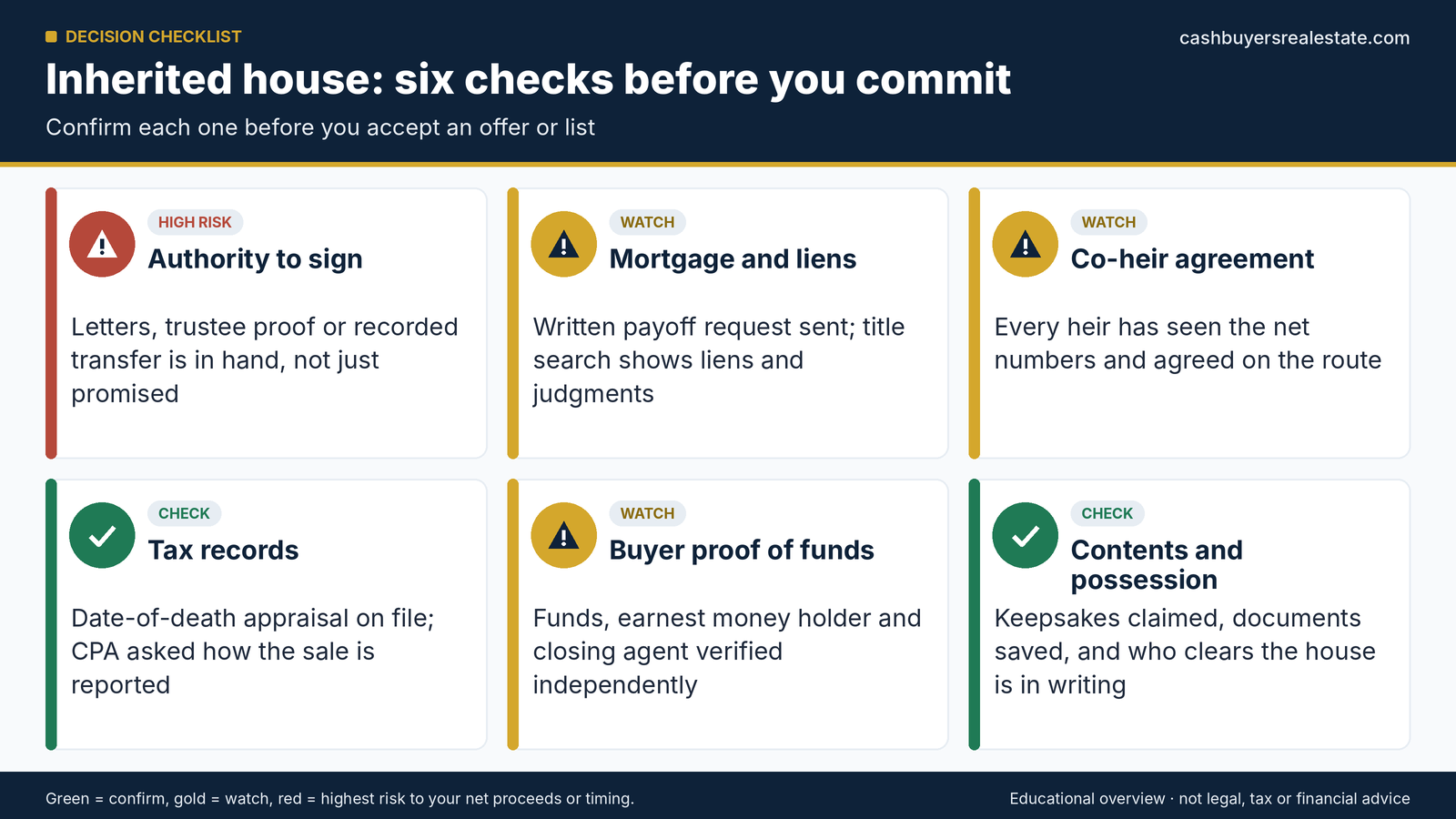
Text version of this infographic
- Authority to sign — Letters, trustee proof or recorded transfer is in hand, not just promised
- Mortgage and liens — Written payoff request sent; title search shows liens and judgments
- Co-heir agreement — Every heir has seen the net numbers and agreed on the route
- Tax records — Date-of-death appraisal on file; CPA asked how the sale is reported
- Buyer proof of funds — Funds, earnest money holder and closing agent verified independently
- Contents and possession — Keepsakes claimed, documents saved, and who clears the house is in writing
Frequently Asked Questions About Selling an Inherited House
Questions About Authority, Family, and Timing
Questions about authority and probate
- Can I sell an inherited house before probate is finished?
Sometimes. A court-appointed personal representative can often sell during probate, subject to the will, the state’s rules, and any required court approval. An heir who has not been appointed generally cannot. If the house passed outside probate, through a trust, a TOD deed, or survivorship, the new owner or trustee may be able to sell as soon as the transfer is recorded.
- Do I need an attorney to sell an inherited house?
Not in every case, but one is often worth the cost when probate is open, when heirs disagree, or when title looks messy. An attorney can confirm who has authority and which documents the court and title company require. Fees vary by state and by the complexity of the estate, so ask for a written estimate.
- What if the executor named in the will does not want the job?
A named executor can usually decline or resign, and the court then appoints someone else, often another person named in the will or a qualified heir. The change adds time, so a named executor who is unsure should decide early and tell the family.
- Can a buyer close before the court issues letters?
It is risky. Title insurers typically want proof that the seller has authority to sell, and a deed signed without it can be challenged later. Some buyers sign a contract that is contingent on appointment, which keeps the deal alive while the court works.
Questions about co-heirs, belongings, and timing
- What if my sibling refuses to sell?
Start with a conversation about what the sibling actually wants, because the objection is often about timing, money, or sentiment. Mediation, a buyout, or a rent-and-wait arrangement can resolve many standoffs. If nothing works, any co-owner may be able to ask a court for partition, which is slower and costlier.
- How long does it take to sell an inherited house?
It depends on authority, title, condition, and the route. Once someone can sign and title is clear, a cash sale can close in a matter of weeks, while a listing usually takes longer. Probate, missing heirs, or lien payoffs can add months. See Table 6 for the stages.
- Can an heir live in the house while the estate is open?
Often yes, with the personal representative’s agreement. Put the arrangement in writing, address who pays utilities and insurance, and tell the insurer, because occupancy affects coverage. Some families treat it as paid rent against the heir’s share.
- Should I clean out the house before selling?
It depends on the route. Listing usually needs a clean, uncluttered house, while some as-is buyers take the contents. Photograph everything, remove valuables and documents first, and confirm in writing who is responsible for what remains.
Questions About Taxes, Mortgages, and Buyers
Questions about taxes and basis
- Will I owe tax when I sell an inherited house?
You owe tax on gain, which is the sale price minus selling costs minus your basis. Because the basis is generally the date-of-death value, a sale at or near that figure often produces little or no gain. Gain on inherited property is treated as long-term, and your state may tax it separately. A CPA can run your actual numbers.
- Do I need a date-of-death appraisal?
It is strongly advisable. Most estates do not file a federal estate tax return, because the 2026 filing threshold is $15,000,000, so your own appraisal may be the main evidence of basis. IRS Publication 551 discusses using the appraised value at the date of death when no Form 8971 schedule was provided.
- What if I sell for less than the date-of-death value?
The result is a loss rather than a gain. Whether the loss is deductible depends on how the property was used and held, so ask a tax professional before assuming either way. Keep the appraisal and closing statement.
- Does the home-sale exclusion apply to an heir?
Usually only if you owned and lived in the house as a main home for two of the five years before the sale. A surviving spouse who sells within two years of the spouse’s death may qualify for the larger exclusion under Publication 523.
Questions about mortgages, liens, and buyer offers
- Can the lender demand full payment because the borrower died?
Federal rules limit that for transfers to certain relatives who occupy or will occupy the home, but they do not stop foreclosure if payments stop, and reverse mortgages are treated differently. Contact the servicer promptly, identify yourself as a successor in interest, and ask what documents it needs.
- What if the loan balance is more than the house is worth?
Talk to the servicer and an attorney before accepting any offer. Heirs who did not sign the loan are generally not personally responsible for it, but the lender can look to the house and, in some situations, the estate. Short sales and deed-in-lieu arrangements need lender approval.
- Are unsolicited offers after a death a scam?
Not necessarily. Many buyers mail letters based on public records. Judge the buyer on proof of funds, contract terms, and willingness to let you take time, not on how the contact began.
- Should I accept the first cash offer?
Compare at least a couple of offers and a listing opinion, and compare net proceeds after all costs. A fast offer that suits your goals can be a good choice, and a higher offer with more risk can be worse. Neither is automatically right.
Choosing Your Route and Taking the First Steps
Matching a Route to What You Care About Most
When speed, simplicity, or distance is the priority
Some heirs value being finished above squeezing out the last few thousand dollars. If you live far away, work full time, carry the bills yourself, or watch the family wear down over the house, an as-is sale to a reliable cash buyer may suit you. It tends to fit when the house needs work you do not want to manage, when the contents are overwhelming, or when the carrying costs in Table 3 are large compared with the likely price difference.
Speed works only after the groundwork is done. Authority has to exist, heirs have to agree, and title has to be insurable. If any of those is missing, a promise of a quick close cannot be kept, no matter how willing the buyer is. In that case the fastest step is to fix the missing piece, whether that means petitioning the court, recording a death certificate, or locating an heir. The related guides on the fastest ways to sell a house and what slows a home sale down explain which delays you can influence.
Also, price your own time. Hours spent coordinating contractors, showings, and relatives are real costs, even when no invoice arrives. An heir who values those hours at their normal income may find that a lower offer with less effort compares well against a higher but more demanding route. Another heir with free time and local knowledge may reach the opposite conclusion, and both are making a sound decision.
When price, fairness, or keeping the house matters more
If the house is in decent condition, the market is healthy, and the estate can carry the costs, a listing or a repair-and-list plan may produce a higher net. That route fits families who want an open-market price as proof of fairness, which can matter when one heir worries that others are accepting a discount. A buyout fits when one heir truly wants the home and can finance it. Keeping and renting fits heirs who want an asset and are ready for landlord duties.
Fairness often matters as much as price. An outcome that every heir understands, backed by an appraisal and a net sheet, is worth more to a family than a slightly larger check that leaves one sibling feeling pressured. Put the numbers on one page, discuss them together, and record the decision.
The matrix below connects the priority to the route and to the main condition that must hold. Read across a row to see what has to be true before the route makes sense.
| If your top priority is | Routes that often fit | Condition that must hold | Main trade-off |
|---|---|---|---|
| Finishing quickly | As-is cash sale | Authority and title are in order | Lower headline price |
| Highest likely price | Listing, or repair then list | Estate can carry costs for months | Time, effort, buyer financing risk |
| Keeping the home in the family | Keep, or buy out co-heirs | Heir can finance and carry the house | Money tied up; reassessment possible |
| Family peace and equal treatment | Appraisal-backed sale or buyout | All heirs see the same numbers | More meetings; slower decisions |
| Minimizing tax surprises | Sell soon at or near date-of-death value, or plan a hold with a CPA | Date-of-death appraisal on file | Market change after death alters gain or loss |
| Handling it from another state | As-is sale or agent with estate experience | Remote signing options confirmed | Less hands-on control |
Few families fit a single row. Most choose a blend, such as a quick cleanout to protect the property, a short wait for an appraisal, and then an as-is offer or a listing. Your own order of priorities is the thing to settle first.
What to Do in the First Thirty Days
A first-month sequence, and the mistakes it helps you avoid
The first month is mostly about protecting the house and gathering paper. Secure the property by rekeying locks, collecting mail, and checking for leaks or hazards. Call the insurer. Locate the will, the deed, trust papers, and mortgage statements. Order several certified death certificates. Consult a probate or estate attorney in the state where the house sits, because even a short consultation clarifies who has authority and what the court will require. Order the date-of-death appraisal, and make a shared folder for the family.
A handful of mistakes come up again and again. Heirs sign a contract before anyone has authority. They let utilities lapse and then face frozen pipes. They assume the mortgage must be paid off immediately, or the opposite, that it can be ignored. They throw away papers that later turned out to matter. They skip the appraisal and have no basis evidence. They accept the first offer without comparing net proceeds. They agree to oral promises among siblings that nobody remembers the same way. None of these is a moral failure, only a lack of a checklist, and a checklist is the cure.
A few common beliefs deserve correction as well. A will does not by itself give the named person power to sell; the court must usually appoint them first. A cash offer is not automatically lower or higher than a listing; the net figure decides. And selling quickly does not erase the tax question, since the stepped-up basis is what usually keeps the gain small. For a broader view of costs on any quick sale, the article on closing costs in a fast home sale is a good companion.
Questions to bring to the attorney, the CPA, the servicer, and any buyer
Good questions save appointments. A short list for each person you talk to keeps conversations focused and makes comparison easy.
- Probate or estate attorney: Who has authority to sell in this state, and what documents prove it? Does the sale need court approval? What is the claims period, and when can proceeds be distributed? What will this cost, and how is it billed?
- CPA or tax professional: What is the basis, and how do we document it? How is the sale reported, and what does the state do? Does any exclusion apply? What happens if we hold the house for a year?
- Mortgage servicer: Can you confirm me as a successor in interest, and what documents do you need? What is the payoff with a per-day interest figure? What options exist if we want to keep making payments?
- Insurance agent: How does the policy define vacancy? What is excluded after that point? Do we need an endorsement or a different policy while the estate is open?
- Cash buyer or investor: Can you show proof of funds? Who holds the earnest money? Who is the closing agent? Does the contract allow assignment? What are the inspection and cancellation terms?
- Listing agent: How many estate sales have you handled? What price range do you expect, and what costs come out of it? Which repairs do you advise, and which would you skip?
Write the answers down and share them with the other heirs. The record helps everyone, and an inherited house is one of the transactions where a shared paper trail pays off for years. For a state-level starting point, see the hub on selling an inherited house and the directory of local guides.