What Slows Down a Home Sale? Timeline, Costs & Seller Options
Your house has been on the market for weeks and the phone isn’t ringing. Or maybe you accepted an offer, cleared your calendar for closing, and then the lender went quiet. Either way you’re asking the same question: what slows down a home sale, and is it something you can fix? The honest answer is that delays come from a short list of repeating causes, and they show up at predictable stages. Once you know which stage you’re stuck in, the cause usually narrows quickly.
Home sales most often slow down for a handful of reasons: a price that doesn’t match the market, condition or access problems, buyer financing and appraisal hurdles, inspection renegotiation, title or lien surprises, association paperwork, occupancy or authority-to-sign issues, and slow third parties such as lenders and courts. Match the symptom to the stage, then remove the bottleneck that fits.
A one-minute diagnosis can save you a lot of guessing. If almost nobody is scheduling showings, the problem is usually exposure or price. If buyers are touring but no offers come, look at price against condition. If you have a signed contract and the closing date keeps moving, the bottleneck is almost certainly one of the contract-to-close items: the buyer’s loan, the appraisal, the inspection response, the title commitment, or a document that somebody hasn’t produced yet.
Those categories are not equally within your control. You decide the price, the condition of the house, and how quickly you answer emails. You don’t decide how long a county office takes to return a lien release, whether a buyer’s appraisal comes in low, or when a probate court has an opening on its calendar. A useful diagnosis separates the two lists so you spend your effort where it can change the outcome.
It’s also worth saying plainly that “slow” is relative. A sale that takes two months in a market where homes typically take two months is not broken. A sale that stalls for three weeks at the title stage because nobody ordered the search until day ten is. Part of the work here is learning to tell normal pacing from a genuine problem, using signals like days on market, showings per week, and the ratio of showings to offers.
The sections that follow walk through the sale stage by stage. They cover pricing and presentation, the contract-to-close gauntlet of financing, appraisal and inspection, title and lien surprises with a few worked examples, association paperwork, occupancy and probate, and the document logistics that quietly eat days. A matrix puts the causes against the stages so you can see overlaps, and a “who controls it” table sorts what you can fix from what you can only manage. Later sections give you early-warning signs, a prevention checklist, and a decision framework for choosing between waiting, repricing, fixing a problem, or changing routes.
If you’re racing a specific deadline, you may also want the narrower guides on a 14-day sale and a 30-day sale plan. For the bigger map of options, including the tradeoffs of selling to a cash buyer versus listing, start with the overview of selling a house fast. If your question is how long a normal sale takes in the first place, see how fast you can sell a house. This article stays on the diagnostic question of why a sale stalls and what to do about it.
A final note on expectations. Nothing here promises that any fix will work or that a sale will close by a particular date. Some bottlenecks, such as a lien that takes weeks to release, are slow no matter how motivated everyone is. The goal is to help you spot the problem early, choose a remedy that fits the cause, and weigh the cost of waiting against the cost of changing course.
How a Home Sale Actually Moves: Four Stages, Four Clocks
A sale is not one clock. It is a relay of four, each run by different people with different incentives. Delays that look the same from the outside, such as “nothing is happening,” can have completely different causes depending on which leg of the relay you’re in.
| Cause of delay | Prep and pricing | Marketing and offers | Contract to close | Closing and possession |
|---|---|---|---|---|
| Price above buyer demand | Primary | Primary | Appraisal risk | — |
| Condition or clutter | Primary | Primary | Inspection fallout | Walkthrough disputes |
| Limited access or exposure | Possible | Primary | — | — |
| Buyer financing | — | Offer quality | Primary | Last-minute funding |
| Appraisal gap | — | — | Primary | — |
| Inspection renegotiation | Possible (pre-inspection) | — | Primary | — |
| Title, liens, survey | Preventable | — | Primary | Release recording |
| HOA or condo documents | Preventable | — | Primary | Final dues |
| Occupancy and possession | Plan ahead | Showing access | Move-out terms | Primary |
| Probate, trust, or authority | Primary (before listing) | Offer acceptance | Court steps | Deed signing |
| Lender payoff and documents | Preventable | — | Payoff request | Primary |
Scan down the columns to see why the contract-to-close stage is the crowded one, and scan across a row to see how one cause, like price, can pop up in more than one place.
Where the time goes in a typical sale
Preparation and pricing: the stage you control most
Preparation is the one stage where nearly every minute of delay is a choice, even if it doesn’t feel like one. It includes deciding to sell, choosing a route, collecting documents, fixing or deciding not to fix what needs attention, getting photographs, and setting the price. Sellers who skip this stage and go straight to a listing often pay for it later, with price cuts, a rushed document hunt in the middle of a contract, or a deal that sits waiting for paperwork.
Pricing is the biggest lever inside this stage. A price that matches what comparable homes have actually sold for, adjusted for condition, tends to bring showings in the first couple of weeks. A price that reflects what you hope to get, or what you owe, tends to produce showings without offers or no showings at all. Comparable sales, or “comps,” come from recent closed sales of similar homes nearby, and your agent or an appraiser can pull them. Asking prices of other active listings tell you about competition, not value.
A related guide on pricing and evaluating offers for a quick sale goes deeper on comp selection and price bands. For now, the key point is diagnostic: if you haven’t finished this stage properly, every later stage is more likely to stall.
Marketing, showings, and offers: the demand clock
Once the home is live, the clock belongs to buyers. How many people see the listing, how many tour, and how many write offers is a function of price, photos, condition, location, and market conditions. You can influence the first four. You can’t change the fifth.
This stage generates the most useful diagnostic data, if you read it correctly. The number of showings in the first one to two weeks, the number of offers, and the content of any feedback tell you whether the market is rejecting the price, the condition, or the presentation. Sellers sometimes treat a lack of offers as bad luck. Usually it is information.
Exposure matters too. A listing that’s hard to find, has weak photographs, or can only be shown with 24 hours’ notice on weekdays reaches fewer buyers than an identical home that is easy to see. If you are selling without an agent, getting the listing onto the multiple listing service (MLS) in some way, such as through a flat-fee listing service, is often the difference between a normal pace and a stall. The guide to selling fast without a real estate agent covers the options.
From accepted offer to keys
Contract to close: the stage with the most third parties
After you sign a contract, the number of people with a hand on the timeline jumps. There is the buyer, and perhaps a buyer’s lender with an underwriter and an appraiser. There is a home inspector, possibly a specialist such as a roofer or a plumber, and a closing office or attorney. There may be a title examiner, a county recorder, your own mortgage servicer, a homeowners association manager, and sometimes a probate court.
Each of them has a queue. None of them works for you alone, and most of them do not care about your closing date as much as you do. This is why the contract-to-close stage generates the most delay even when everyone is cooperative. The longer the list of dependencies, the more likely one of them slips and the more likely a slip in one forces a second slip in another. A late appraisal pushes the lender’s decision, which pushes the closing disclosure, which pushes the closing date.
The National Association of REALTORS® tracks some of this in its monthly Realtors Confidence Index survey. In the report released September 10, 2026, members said 14% of their contracts had delayed settlements in the previous three months and 7% were terminated, with 6% delayed specifically because of appraisal issues (survey of NAR members, NAR Realtors Confidence Index, checked October 2026). Those figures describe member experience across all contracts, not your sale, but they show delays are common and appraisal trouble is a recurring cause.
Closing and possession: the last mile
Even after the loan is approved and the title is clear, the final stretch has its own ways of stalling. Documents have to be signed, often with a notary. Funds have to be confirmed. The deed has to be recorded. A final walkthrough might reveal that something has changed. The buyer needs the keys, and you need your money.
Possession can create a second, separate delay. If you can’t be out of the home at closing, the buyer’s plans may be affected, and the parties need a written rent-back or a revised date. If the buyer has a mortgage, the lender’s rules may restrict seller occupancy after closing. Sellers who learn this late sometimes scramble, which is why the topic is better settled at contract signing than at the closing table.
Finally, remember that “closing” can mean the signing, the funding, or the recording, as the guide to a 14-day sale explains in more detail. When someone says your sale is delayed, ask which of those events has not yet happened. The answer tells you who to call.
Slowdowns Before the First Offer: Price, Condition, and Exposure
When a listing sits, sellers are tempted to blame the market, the season, or the buyers. Sometimes those are the cause. More often the signals point back to something inside the seller’s control, and the signals are readable if you know where to look. The table below translates what you see into what it probably means.
| What you see | Likely cause | What to check | First response |
|---|---|---|---|
| Few online views in week one | Weak exposure or poor photos | Is the listing on the MLS? Are the main photos bright and complete? | Fix photos and listing details first |
| Views, but few showing requests | Price or first impression | Compare list price to recent closed sales, not other asking prices | Reprice or reposition the home |
| Showings but no offers | Price relative to condition | Feedback themes: price, smell, dated finishes, repairs | Address the repeated objection |
| Offers far below asking | Market value lower than your price, or condition risk | Do offers cluster around a similar number? | Counter, or recalibrate to the cluster |
| Offers that fall through | Weak buyer financing or inspection fallout | Proof of funds or pre-approval strength | Screen buyers; consider pre-inspection |
| Showings stop after two to three weeks | Price stale or listing fatigue | Days on market versus the local norm | Make a decisive price move, not a trim |
None of these rows is a verdict. Treat each as a hypothesis to test with one or two quick checks before you change anything.
Pricing mismatches and how they show up in the data
When the list price runs ahead of the market
An overpriced home rarely announces itself. Instead you see a pattern: a flurry of interest in the first week from curious buyers and neighbors, then a steady drop in showing requests. Buyers who are comparing a few homes in the same neighborhood and condition tend to dismiss the one that costs more than the others without offering a lower number. That silence is the market answering.
The usual reason sellers overprice is anchoring to a number that isn’t a market price: what they owe, what they paid, what a neighbor asked, or what an online estimate said. An online estimate is a statistical guess that may not account for your kitchen, your roof, or your street. Closed sales of truly comparable homes in the last few months, adjusted for differences, are a better anchor.
Illustrative example (hypothetical numbers, not market data): A seller lists a three-bedroom home at $425,000 because that is what she needs to net after the mortgage and the move. Recent closed sales of similar homes cluster between $390,000 and $405,000. In the first two weeks she gets four showings and no offers. By week five, showing requests have stopped. She cuts the price to $415,000, which is still above the cluster, and gets one lowball offer at week eight. A seller who had priced at $400,000 from the start might have had several offers in the first fortnight and saved weeks of mortgage payments, utilities, and taxes. The cost of the slow sale is not only the eventual price reduction. It’s every month of carrying costs on the way there.
The example is not an argument for underpricing. It illustrates that price cuts of a few thousand dollars at a time often fail to restart interest, while one decisive move to a price buyers recognize as competitive can. The value of that move is greater early than late.
Reading days on market and the showings-to-offer ratio
Days on market (DOM) is the number of days a listing has been active. On its own it means little, because normal DOM varies by region, price tier, season, and property type. A useful comparison is your listing’s DOM against the median for similar homes in your area, which a local agent can pull from the multiple listing service. If your home is well past the local median without a contract, you have a signal worth acting on.
The second metric is the showings-to-offer ratio. Count how many distinct parties have toured the house and how many have made offers. There’s no universal benchmark, but the pattern matters more than the number. Ten showings and no offers suggest something that visitors dislike once they are inside: the price for what they see, a smell, a layout problem, a repair they noticed. Two showings in three weeks suggest the problem is upstream: price versus market, weak exposure, restricted access.
Feedback fills in the rest. Ask your agent or the showing service to collect comments, and look for repetition. One buyer saying the kitchen is dated is an opinion. Four buyers saying it is a data point. If you’re selling without an agent, ask visitors directly and write down what they say. The point of this exercise is to replace “the market is slow” with a specific, testable statement such as “buyers think the home is $15,000 over price for its condition.”
Condition, access, and presentation
Condition and clutter that quietly cost weeks
Condition affects timing in two ways. First, it influences whether buyers will make an offer at all. Second, it influences what happens after, when an inspection turns an offer into a renegotiation. Homes with visible deferred maintenance, strong odors, or heavy clutter lose buyers at the front door, and those who stay discount their offers to cover the unknowns.
Many of the most effective fixes are inexpensive and unglamorous: a deep clean, removing excess furniture, repainting a few loud walls, fixing leaks and stuck doors, replacing burned-out bulbs, and clearing the yard. These matter most when the house is otherwise sound. For big-ticket items, such as a roof near the end of its life or an outdated electrical panel, the choice is usually between repairing before listing, offering a credit, or reducing the price. The repair-or-sell-as-is guide works through that decision, and the fixer-upper guide covers homes that need major work.
Some sellers order a pre-listing inspection to see problems before buyers do. The advantage is fewer surprises and a chance to fix or disclose in advance. The drawback is that you now know about issues you may have to disclose, depending on state rules, and the report itself costs money. It is a tool, not a requirement, and the guide to preparing for a fast sale weighs it in more detail.
Access, photos, and seasonality
A beautiful house that is difficult to see sells slowly. Requiring 24-hour notice, limiting showings to certain hours, or insisting on being present for every tour reduces the number of buyers who see the home, especially buyers who work full time or are touring several homes in one day. A lockbox, a reasonable notice window, and flexible evening and weekend slots expand the pool. If you live in the house with children, pets, or night-shift work, the guide to selling while living in the home covers realistic routines.
Photos are the first showing. Most buyers decide what to tour from the listing images, so dark, cluttered, or incomplete photos can leave a home out of consideration before anyone enters. Cleaning, opening blinds, turning on lights, and photographing every main room is a simple fix with a high return. A floor plan or video tour adds helpful context where the layout is unusual.
Seasonality is real but local. In many markets, buyer activity changes through the year with weather, school calendars, and holiday schedules, but the pattern differs by region and by price tier, and a particular year can break from it. Ask a local agent how listing activity and days on market have moved in your area across seasons, instead of relying on a national rule of thumb. If you have to list in a slow period, price and presentation matter even more.
The first graphic maps the six stages where a home sale most often stalls, from preparation through closing and possession. It’s a quick way to place your own situation on the timeline, while the sections here and below describe each bottleneck in detail.
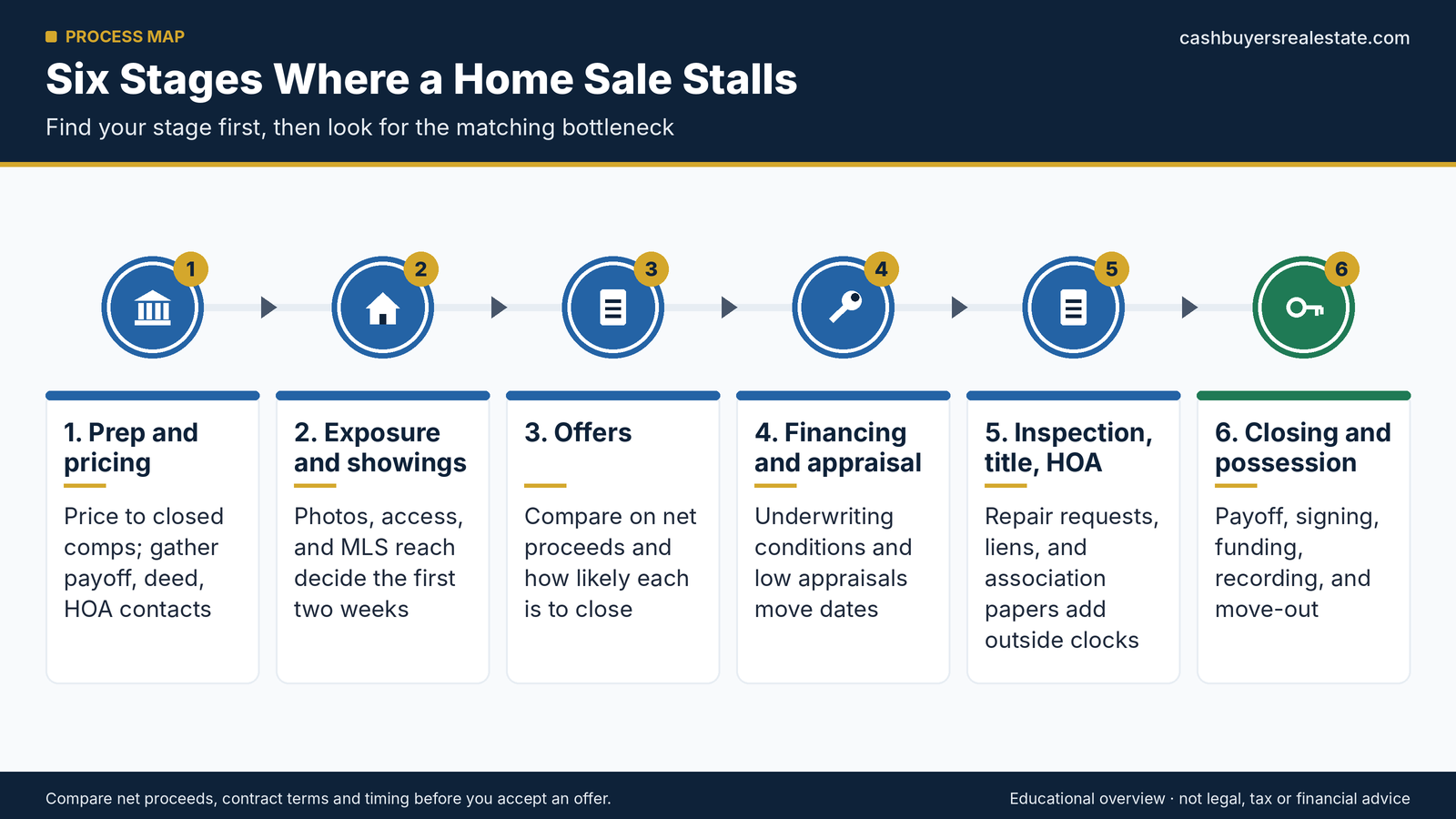
Text version of this infographic
- 1. Prep and pricing — Price to closed comps; gather payoff, deed, HOA contacts
- 2. Exposure and showings — Photos, access, and MLS reach decide the first two weeks
- 3. Offers — Compare on net proceeds and how likely each is to close
- 4. Financing and appraisal — Underwriting conditions and low appraisals move dates
- 5. Inspection, title, HOA — Repair requests, liens, and association papers add outside clocks
- 6. Closing and possession — Payoff, signing, funding, recording, and move-out
Slowdowns After the Contract: Financing, Appraisal, and Inspection
A signed contract feels like the finish line, but it’s closer to the start of the hardest part. Most of the delays sellers describe afterward happen between signature and closing, and most of them involve the buyer’s lender, the buyer’s inspector, or both. You can’t eliminate those steps. You can choose buyers who are likelier to pass them and respond efficiently when something comes up.
Buyer financing and the appraisal
Loan approval, underwriting conditions, and the three-business-day rule
A pre-approval letter and a final loan approval are not the same thing. A pre-approval is an early estimate based on documents the buyer has submitted. Final approval comes after underwriting, which verifies income, assets, credit, the property, and the appraisal. In between, the underwriter often issues conditions: requests for updated pay stubs, explanations of deposits, proof of insurance, or additional documents. Each condition takes the buyer time, and the clock keeps running.
A federal timing rule adds a floor. For most mortgages, the lender has to provide the buyer’s Closing Disclosure three business days before the scheduled closing, according to the Consumer Financial Protection Bureau. Certain changes to the loan can restart that waiting period, and the lender can explain which. For a seller, the practical meaning is that a closing date cannot be moved up on a whim and that a late loan approval can force it back.
You can reduce financing risk, not remove it. Look at the strength of the pre-approval, ask whether the lender is a direct lender or a broker, and consider how much cash the buyer is putting down. Large down payments and ample reserves tend to make financing smoother. An all-cash buyer removes this stage entirely, though cash comes with its own checks, as the cash sale process guide explains. In NAR’s September 2026 confidence survey, members said 27% of their buyers had all-cash sales, a reminder that cash is common but far from universal.
Appraisal gaps: what happens and what the options are
When a buyer uses a mortgage, the lender orders an appraisal to confirm the home is worth enough to secure the loan. If the appraisal comes in below the contract price, the lender will generally base the loan on the lower figure. That leaves a gap that someone has to fill, or the deal changes. In the NAR survey cited earlier, 6% of members’ contracts were delayed by appraisal issues over the preceding three months.
Illustrative example (hypothetical numbers, not market data): A buyer agrees to pay $400,000 and plans a loan of 80 percent ($320,000) with $80,000 down. The appraisal comes in at $385,000. The lender now lends 80 percent of $385,000, or $308,000. To close at $400,000, the buyer must bring $92,000 instead of $80,000, a $12,000 gap. If the buyer can’t or won’t cover it, the seller may be asked to lower the price, share the difference, or release the buyer if the contract has an appraisal contingency.
| Response | Effect on timing | Effect on seller’s net | Watch for |
|---|---|---|---|
| Buyer covers the gap in cash | Minimal delay | None | Whether the buyer truly has the extra funds |
| Seller lowers price to the appraised value | Quick resolution | Reduces net by the full gap | Whether other terms still work for you |
| Split the difference | Short negotiation | Reduces net by part of the gap | Putting the new price in a written amendment |
| Request a reconsideration of value | Adds days | Possibly none | Need for strong comps the appraiser missed |
| Cancel or relist | Restarts the clock | Depends on the next offer | The next buyer’s lender will order its own appraisal, which may or may not agree |
The table is a map of options, not advice. If you disagree with an appraisal, your agent or the buyer’s lender can explain whether a reconsideration is available, and note that the buyer’s lender, not you, typically controls that request.
Inspection findings and renegotiation
How an inspection reopens the deal
A home inspection is a visual survey of the property’s major systems and structure, typically ordered by the buyer within a window set in the contract. The report lists findings, ranging from minor maintenance to concerns about the roof, foundation, electrical, plumbing, HVAC, or water intrusion. Buyers then decide whether to accept the home as it is, ask for repairs, ask for credits or a price reduction, or terminate within the contract’s rights.
Renegotiation slows a sale because it adds a new round of offers and counteroffers after a deal everyone thought was done. It can also add specialist visits, with a roofer, structural engineer, or sewer-line camera crew, and each visit adds days. In a hot market, some buyers waive inspections to compete, which members of NAR’s September 2026 survey reported for 20% of buyers. In a slower market, buyers tend to use the inspection to reopen terms.
The seller’s exposure depends heavily on what is already known. Defects you disclosed before the contract are less likely to surprise a buyer. Defects discovered at inspection, especially safety-related ones, tend to prompt bigger asks. State disclosure rules vary, and you should never conceal a known material defect. Honest, documented disclosure protects the seller as much as the buyer, and the as-is sale guide explains what “as-is” does and doesn’t cover.
Responding without losing weeks
Speed in this phase comes from structure. When the repair request arrives, read it with your agent or attorney, separate the items into safety or system issues, cosmetic issues, and negotiating items, and respond in writing with a clear position and a date. Offering a credit at closing in place of repairs often resolves a dispute faster than scheduling contractors, because it avoids coordination and keeps the buyer’s lender from questioning workmanship.
If repairs are required, whether by the buyer’s loan program or by agreement, get quotes quickly and agree on who hires the contractor, what standard applies, and how completion will be verified. Pull permits where the work requires them. A repair done without proof of completion invites another delay at the final walkthrough.
Finally, know your walk-away number before you start. A seller who has run the numbers can respond in an hour. A seller who hasn’t tends to take a day to react to each request, and those days add up. If your price already sits at the bottom of your range, a short, firm response is fair. If it doesn’t, you may prefer to concede a modest credit and keep the schedule intact.
Title, Lien, Survey, and Association Surprises
Few delays frustrate sellers more than the ones nobody saw coming. Title and association problems fit that description: they live in public records and association files that most homeowners never look at, and they tend to surface after a contract is signed. Knowing the usual suspects in advance converts a surprise into a task.
| Surprise | What it is | Who controls the clock | Timing note |
|---|---|---|---|
| Unreleased old mortgage | A paid loan with no recorded release | Prior lender, county recorder | Often a letter plus a recording; varies |
| Contractor’s (mechanic’s) lien | A claim by a contractor who says they weren’t paid | Lien claimant | Payoff letter or release must come from claimant |
| Judgment or tax lien | A court or government claim attached to the property | Court, agency, or creditor | IRS asks for discharge applications 45 days ahead |
| HOA or condo lien and unpaid dues | Assessments the association says are owed | Association or its manager | Statements often take days; state rules vary |
| Name or legal description mismatch | Deed names differ from IDs, or errors in the record | Seller, attorney, sometimes a court | Affidavit or corrective deed |
| Missing heirs or owners | An owner who can’t be located or signed | Court or family | Can be open-ended |
Read across the “timing note” column: the fixes with the most uncertain schedules are the ones that depend on someone who has no stake in your closing date.
Title and lien surprises
What a title search can turn up
When a contract is signed, a title company or closing attorney orders a search of the public record to confirm who owns the property and what claims exist against it. The American Land Title Association describes how the results are analyzed and summarized in a title commitment, which sets out what must be resolved before the insurer will issue a policy (ALTA, Title Insurance Facts). Because records are indexed in different ways in different places, the search isn’t instant, and no source offers a universal turnaround.
Most searches find routine items such as the current mortgage, property taxes, and easements for utilities. Occasionally they find something that changes the timeline. A homeowner may have refinanced years ago, and the old loan was paid off but the release never recorded. A contractor may have filed a lien after a disagreement over a bathroom remodel. A divorce decree may have required a spouse’s name to come off the deed, and the deed was never changed. Each has a fix, and each fix involves someone other than the buyer and seller.
Illustrative example (hypothetical numbers, not market data): A seller accepts an offer and expects a three-week closing. On day nine, the title commitment lists two requirements the seller didn’t expect: a $6,800 mechanic’s lien recorded after a kitchen job, and an unreleased mortgage from a refinance eleven years earlier. The lien claimant answers a payoff request within a few days, and the closing office pays it from the proceeds, reducing the seller’s net by $6,800. The old lender takes longer: it must confirm the loan was paid and send a release for recording. The closing slips by about ten days while the seller, the closing office, and the lender exchange documents. Nobody did anything wrong in the closing. The slip came from records nobody had checked.
Sellers who suspect an old lien or an unusual ownership history can ask a closing office to run a preliminary search before listing. The cost is typically modest compared with the cost of a stalled closing, though fees and practices vary. The hub on title problems and the guide to selling quickly when there are liens cover each type in detail.
Third-party clocks: payoff statements, tax-lien discharges, and releases
Some delays are baked into the rules that govern third parties. Your mortgage servicer, for example, doesn’t have to produce a payoff statement the same day. Under the federal regulation covering most home loans, the servicer must provide an accurate payoff statement within a reasonable time and in no case more than seven business days after receiving a written request from the borrower or someone acting for the borrower (12 CFR 1026.36(c)(3)). Longer periods are allowed in some circumstances, including bankruptcy and foreclosure. Seven business days is more than a week and a half of calendar time.
Federal tax liens run on a longer clock. The Internal Revenue Service instructs taxpayers who need a certificate of discharge of property from a federal tax lien to submit the application at least 45 days before the date the transaction needs the certificate, according to IRS Publication 783. A discharge is not the only way to handle a federal tax lien, and the right approach depends on the facts, but the 45-day figure shows how a single lien can outlast a typical contract period. A tax professional or attorney can advise on options.
Releases of satisfied mortgages work differently again. After a loan is paid off, the lender is expected to record a release or send a satisfaction document within a period set by state law, and that period varies. In the meantime, the closing office typically relies on the payoff and a title company’s own procedures to insure the transfer. Keep your payoff confirmation and watch for the release afterward, since it affects your future title record even after the sale is complete.
Association paperwork, surveys, and permits
HOA and condo resale documents: why timing varies by state
If your home belongs to a homeowners association or condominium, the buyer will usually receive a package of association documents, which may include financial statements, rules, insurance information, and a statement of amounts owed. The package is often called a resale certificate, estoppel certificate, or disclosure packet, and what must be in it, how fast it must be produced, and what it may cost are matters of state law and the association’s governing documents.
Two examples show how different the rules can be. In Florida, a condominium association must issue an estoppel certificate within 10 business days after receiving a written or electronic request, and the statute caps the standard fee and allows an additional capped charge for delivery within three business days; a certificate sent electronically or by hand is effective for 30 days, per Florida Statutes section 718.116(8). In Texas, a property owners’ association must deliver the required subdivision information and resale certificate no later than the 10th business day after a written request, and the certificate must have been prepared within 60 days before delivery, under Texas Property Code chapter 207.
The common thread is that ten business days is two full calendar weeks. A seller who waits until the contract is signed to request the package may be losing the first half of the contract period. Requesting it at listing, or at the latest on contract day, keeps the clock from starting late. Rules in your state may be different, so ask your agent or closing office what applies and what the association charges.
Surveys, permits, and unrecorded changes
A survey shows the property’s boundaries and the location of improvements such as the house, fences, and driveways. Whether one is required depends on the contract, the lender, the title insurer, and local practice. When a survey is needed and none exists, ordering one adds days or weeks, depending on the surveyor’s schedule and the weather. An old survey may be accepted with an affidavit in some places and rejected in others.
Permits create a different kind of surprise. A finished basement, a converted garage, or an addition built without a permit may be flagged by an inspector, appraiser, or buyer’s agent who sees it in the layout but not in the tax records. Resolving it can involve retroactive permits, inspections, or a price adjustment, and municipal offices set their own pace. Disclosure duties vary by state, and an unpermitted improvement is the sort of fact that a seller should raise early rather than hope nobody notices.
Unrecorded agreements can matter too: a driveway shared informally with a neighbor, an old easement mentioned in a prior deed, or a boundary understanding that never made it to paper. A title examiner may flag them, or a buyer’s surveyor may. Having an attorney or closing professional review them before you list is cheaper than discovering them mid-contract. For more on managing the paperwork stack in advance, see the readiness packet guide.
The next graphic lays out five practical ways to get a stalled sale moving again, from repricing to changing buyer type. The reasoning behind each lives in the text and tables above and below, and the picture is a side-by-side reminder of what each option is best for and what it costs you.
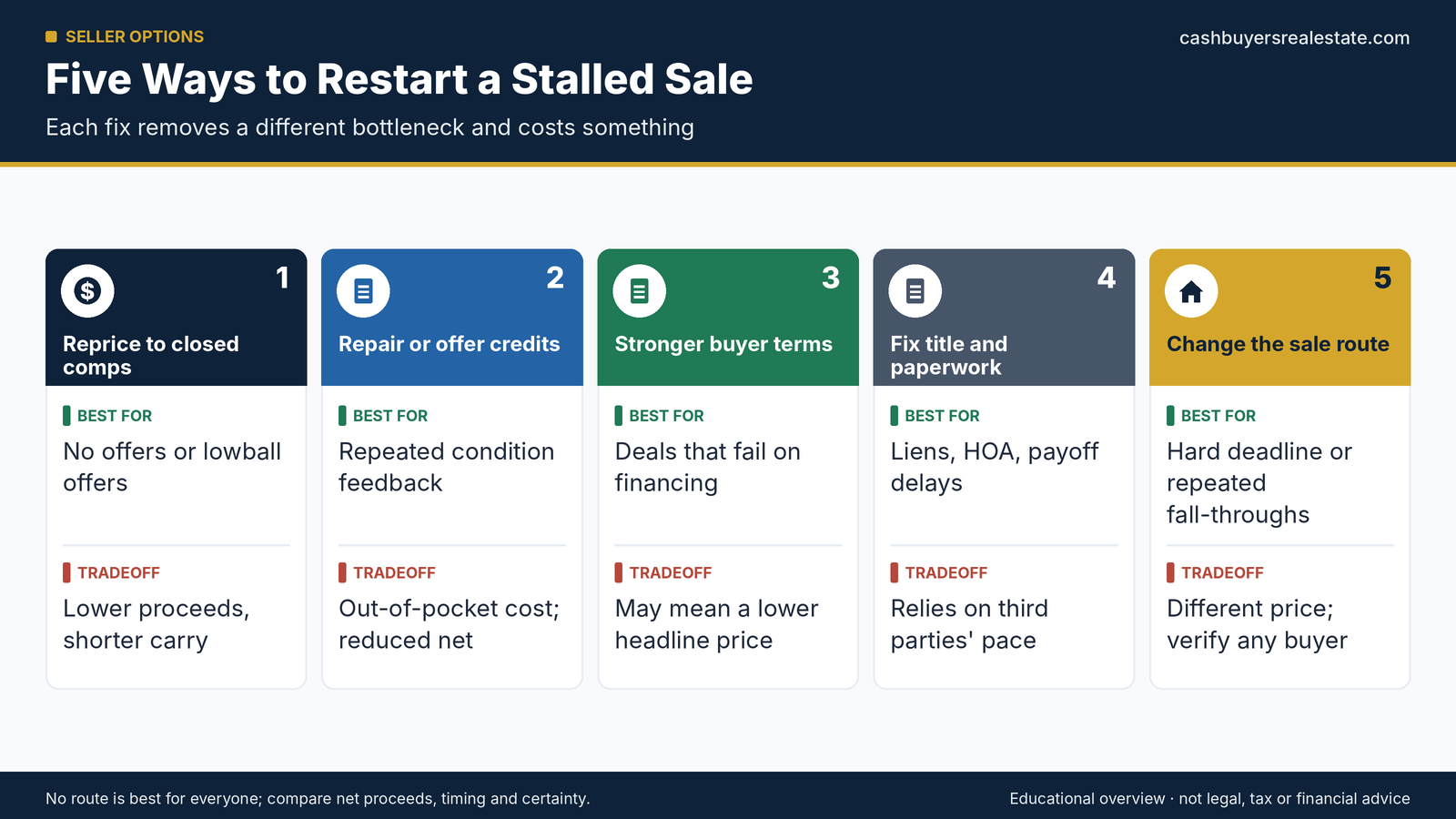
Text version of this infographic
- Reprice to closed comps — best for: No offers or lowball offers; tradeoff: Lower proceeds, shorter carry
- Repair or offer credits — best for: Repeated condition feedback; tradeoff: Out-of-pocket cost; reduced net
- Stronger buyer terms — best for: Deals that fail on financing; tradeoff: May mean a lower headline price
- Fix title and paperwork — best for: Liens, HOA, payoff delays; tradeoff: Relies on third parties' pace
- Change the sale route — best for: Hard deadline or repeated fall-throughs; tradeoff: Different price; verify any buyer
Occupancy, Authority, and Document Delays
The last group of bottlenecks doesn’t involve markets or buyers. It involves people, courts, and paperwork: who lives in the house, who has the legal right to sell it, whether the lender has sent the numbers, and whether everyone can sign in time. These delays are often invisible until the closing date is close.
People and possession
Occupants, tenants, and move-out timing
If the home is occupied by you, showing and move-out timing set the pace. If it’s occupied by a tenant, the lease and local landlord-tenant law set it. In many places an existing lease continues after a sale, and a tenant may have notice and access rights for showings, but the details differ by state and city. A tenant who is cooperative can make a sale smooth. One who is not, or one whose lease runs another year, can narrow the buyer pool considerably.
Owner-occupants face a simpler version of the same problem: the buyer’s closing date and your move-out date must line up. If you’re buying another home, a delayed closing on one can push the other, which is the classic domino. Build slack into your own schedule if you can, and talk to the buyer early about a short rent-back, with the terms in writing. The tenants guide covers lease mechanics, and the vacant house guide covers the opposite situation, where nobody lives there and the property needs separate care.
Possession problems also show up at the final walkthrough, when a buyer finds belongings left behind, damage from moving, or a utility turned off. Agree in advance on what stays and what goes, take dated photographs the day you leave, and keep the utilities on until closing is complete.
Probate, trusts, and authority to sign
A sale cannot close unless the people signing the deed have legal authority to do so. When a homeowner has died, authority usually comes from a probate court appointment, a trust’s successor trustee, or a transfer mechanism that bypasses probate; which one applies depends on state law and how the property was titled. Until that authority exists, no buyer can close, however motivated.
Court timelines are the slowest in this category, because they depend on filing dates, notice periods, and a judge’s calendar. Some states require court confirmation of certain probate sales, and that adds hearings and notice steps. The result is that a probate sale often has two timelines, the real estate timeline and the court’s. The guides to selling quickly in probate and the inherited house decision explain the process, and the probate real estate hub collects related topics.
Authority problems appear in other forms too. In a divorce, both spouses may need to sign, and court orders can restrict asset sales; the divorce guide addresses that. An owner who is out of the country, incapacitated, or unreachable needs a valid power of attorney or a court-appointed representative, and not every closing office accepts every power of attorney without review. Sort this out before you list, not after a buyer is waiting.
Lender payoff and document logistics
Payoff statements and the lender’s clock
Even a routine mortgage payoff has timing hazards. The payoff statement is a snapshot: it states the amount needed to pay off the loan on a particular date and usually includes a daily interest figure for later dates. If the closing slips past the date on the statement, the closing office needs an updated number. If you have a second mortgage or a home equity line of credit, each lien needs its own payoff, and a line of credit often requires a written request to close the account after payoff so that no new draws are made.
Request the payoff early, in writing. As noted above, federal rules give servicers up to seven business days from a written request for most home loans, so a request made the day after a contract is signed can push into the second week. A request made at listing costs you nothing and gives you a current number for pricing decisions.
After closing, your servicer refunds any balance in your escrow account for taxes and insurance, and eventually the lender records or sends a release. Those steps don’t hold up the sale, but they affect your cash and your record. The guide to selling fast with a mortgage follows these details, including what to do if the payoff exceeds your expected proceeds.
E-signing, notaries, and closing practice by state
Signing logistics become delays when people are out of town, when a notary can’t be found, or when a state’s rules limit electronic closings. Practice varies. In some states, attorneys handle closings; in Georgia, for example, the state’s highest court has held that closing real estate transactions and preparing deeds is the practice of law that must be done by a licensed Georgia attorney (In re UPL Advisory Opinion 2003-2). In others, title or escrow companies run the process. Whether remote online notarization or e-signing is available for your deed depends on state law and the closing office, so ask early.
Mailing documents back and forth adds days, especially for sellers in another state. If you can’t attend, ask the closing office what it accepts: a mobile notary near you, a remote signing, or an overnight package with clear instructions. Give it a few business days of slack.
Money logistics can delay a closing too, and fraud makes them riskier. Criminals target closings with fake wire instructions, so confirm any payment instructions by phone using a number you found independently. The Consumer Financial Protection Bureau recommends never following wiring instructions contained in an email, and the FBI advises verifying account changes through a second channel (CFPB; FBI IC3). A delay to verify is cheap compared with a lost wire.
What You Can Control, What You Can Influence, and What You Can’t
Frustration in a slow sale often comes from spending energy on the wrong things. Calling a county office every morning rarely speeds a lien release. Rewriting the listing description for the fifth time rarely fixes a price problem. Sorting delays by who controls them lets you spend effort where it counts.
| Cause of delay | Who mainly controls it | Seller’s influence | Best lever |
|---|---|---|---|
| List price | Seller, guided by the market | High | Price to recent closed sales |
| Condition and presentation | Seller | High | Cleaning, light fixes, honest disclosure |
| Showing access and exposure | Seller and listing agent | High | Flexible windows, MLS exposure, strong photos |
| Document readiness | Seller | High | Gather and request early |
| Buyer financing | Buyer and lender | Medium (choice of offer) | Favor strong pre-approval or proof of funds |
| Appraisal result | Appraiser, lender | Low to medium | Provide comps and improvement lists |
| Inspection requests | Buyer | Medium | Disclose early; respond in writing |
| Title and lien clearing | Claimants, county, title office | Low to medium | Search early; pay or negotiate promptly |
| Association documents | Association, manager | Low to medium | Request at listing |
| Court steps | Court, personal representative | Low | Hire counsel; build slack |
| Market and season | Market | Very low | Adjust price and expectations |
The pattern is easy to see: the further down the table you go, the less influence you have and the more your best strategy shifts from fixing to planning for slack.
Delays you largely control
Price, condition, access, and responsiveness
The first four rows of the table add up to the part of the timeline that is entirely yours. Price, condition, access, and responsiveness decide how many buyers show up and how fast you move once they do. Two sellers with identical homes can have wildly different outcomes because one priced to the market, kept the house tidy, accepted showings on short notice, and answered every message the same day, while the other did none of those things.
Responsiveness is the least glamorous and the most underrated lever. A contract has deadlines for everything: responding to a repair request, delivering a disclosure form, signing an addendum. Each time a seller takes two days to answer a message, the whole schedule shifts by two days. Set a personal rule, such as replying within the same business day, and ask your agent or attorney to flag anything with a deadline. If you travel, designate a reliable person or arrange remote signing capability in advance.
Honesty belongs on this list too. Disclosing known problems early does not slow a sale; hiding them does, when the buyer’s inspector finds them or when a dispute follows closing. Disclosure requirements are set by state and vary, and an as-is sale does not erase them.
Documents, orders, and early requests
Documents are the second thing you fully control, and they’re where preparation pays the most. A short list of items to request or gather before listing covers most of the delays described above: a written payoff request to each lender, the deed and any trust or estate paperwork, the property tax statement, the association’s contact and, where permitted, its resale documents, recent utility bills, warranties and permits for work done, and records of repairs and insurance claims.
Most of these cost little or nothing. A payoff request is free. Association packages carry fees that vary by state and association, but the cost is usually small compared with a stalled closing. A preliminary title search costs more but can reveal a lien while you still have time to deal with it before a buyer is waiting. The companion guide on preparing for a fast home sale lists each document and where to get it.
One more thing in this category is choosing your closing partner in advance. Whether it is a title company, an escrow officer, or an attorney, having someone lined up who answers the phone and understands your timeline lets you start the title work the day a contract is signed instead of the day after you finally decide.
Delays you can only influence
Buyer and lender behavior: choosing stronger offers
You can’t control whether a buyer’s loan is approved, but you do choose which offer to accept, and offers differ in how likely they are to close on time. Strength shows up in several features: a verified pre-approval rather than a casual letter, a larger down payment, a short or waived financing and inspection contingency, an appraisal gap provision, and an earnest money deposit large enough to matter. All-cash offers remove the loan from the equation, but they require their own verification of funds, covered in the proof of funds guide.
The highest price is not always the strongest offer. A slightly lower price with fewer contingencies and a credible closing date can produce more money in your account, sooner, than a higher price with a long list of ways to fall apart. Compare offers on expected net proceeds and risk, not just the number at the top. The comparison of cash buyers and real estate agents shows how to lay the routes out side by side.
Illustrative example (hypothetical numbers, not market data): A seller’s carrying costs (mortgage interest, taxes, insurance, utilities, and upkeep) total about $2,600 a month, or roughly $87 a day. Offer A is $410,000 with a financing contingency and a 45-day close. Offer B is $403,000 with a verified pre-approval, a 10 percent down payment, and a 30-day close. The 15 extra days of carrying cost in Offer A come to about $1,300, so the price advantage over Offer B shrinks from $7,000 to about $5,700 before considering the greater chance Offer A fails and the sale restarts. If a failed Offer A costs another six weeks, that is roughly $3,700 more in carrying costs. Which offer is better depends on how likely each is to close, which no formula can tell you, but the arithmetic shows why the top number alone is a poor guide.
Your agent or attorney can help assess the odds, and a direct conversation with the buyer’s lender, where the buyer permits it, is another way to test how solid the financing is.
Courts, counties, seasons, and the market
Some delays are simply weather. A court’s schedule, a county recorder’s backlog, a lienholder’s response time, a spring or fall demand pattern, and shifts in mortgage rates are not things any individual seller can move. Fighting them tends to waste energy and, in some cases, money, because fast fixes often involve paying someone for a rush that doesn’t actually shorten the underlying process.
The better strategy is to plan around them. Build slack into every date that depends on an outside party. Run tasks in parallel rather than in sequence: request the payoff, the association package, and the title search in the same week instead of one after another. Keep a written list of every outstanding item with the name of who owns it and the date you last checked. And let the people who need to know, such as the buyer, your next landlord, or the sellers of the home you’re buying, hear about delays from you early.
If outside clocks make your timeline unworkable, that is a signal to consider a different route rather than to push harder on the same one. The article on the fastest way to sell a house ranks routes by which bottlenecks they avoid, and the urgent sale options guide includes alternatives to selling at all.
Early-Warning Signs and a Prevention Checklist
Most delays announce themselves before they become delays. A lender who stops replying, an appraisal that hasn’t been scheduled, or a title commitment that hasn’t arrived by the middle of the contract period are small signals that a bigger slip is coming. Catching them early gives you time for a different response.
| Warning sign | What it may mean | Quick action |
|---|---|---|
| No appraisal ordered after several days | Lender is behind or waiting on the buyer | Ask the agents when it was ordered and the expected date |
| Buyer asks for a closing extension without a clear reason | Loan conditions outstanding or funds not ready | Ask for specifics and a written extension with terms |
| Title commitment not received by mid-contract | Search backlog or complicated record | Ask the closing office for status and requirements so far |
| Association package not delivered | Manager backlog or unpaid fee | Confirm the request, the fee, and the state deadline |
| Long repair request list after inspection | Buyer testing for a price cut | Respond in writing with a credit or targeted repairs |
| Payoff statement not yet received | Servicer slow or request not logged | Resend in writing; document the date |
| Buyer changes closing partner or wire details late | Possible fraud attempt or ordinary change | Verify by phone with a number you found yourself |
A warning sign is not proof of trouble. It is a prompt to ask a question while there’s still time to act on the answer.
Reading the signals as they appear
Listing-stage signals from week one to week four
On the market, the first week or two is the most informative. A well-priced, well-presented home often draws its strongest interest early, from buyers who have been waiting for something in that neighborhood and price range. If week one brings strong showing activity and no offers, consider whether the price or condition is the sticking point and ask for feedback right away. If week one brings little activity, check exposure and photos before assuming the price is wrong.
By week two or three, you should have enough data to make a decision. No showings means something basic is off: price, photos, or listing details. Showings without offers means price relative to condition. Offers below your expectations mean the market has a different view of value, and the cluster of offers shows what that view is. Waiting a few more weeks without changing anything seldom changes the pattern. A deliberate adjustment, even a modest one, is more likely to.
By week four, a listing that hasn’t generated an offer has usually run through the buyers who were actively looking at that price. At that stage a meaningful repositioning, whether in price, condition, or the sale route, tends to be better than a series of small trims. This isn’t a rule. In a slow local market, four weeks might be normal, which is why the local median days on market is the right benchmark.
Contract-stage signals in the first ten days
After a contract is signed, the first ten days show whether the sale is on track. Within that period, a financed buyer’s lender should have ordered the appraisal, the inspection should have happened, the title search should be underway, and the earnest money should be in the closing office’s hands. Missing any of those is a reason to ask a question.
Pay attention to the tone of communication as well as the facts. A buyer or agent who suddenly becomes hard to reach, who answers only after repeated follow-up, or who begins hinting at problems without specifics may be preparing to renegotiate or withdraw. A calm, direct request such as “Where are we on the loan and when do you expect final approval?” often draws out the real status.
Keep a log. Write down every request you make, who you made it to, and what the response was. A log makes it easier to see when a delay is yours, the buyer’s, or a third party’s. It also helps if there is a later dispute over who missed a deadline under the contract. The process guide traces the standard sequence so you can see what should have happened by when.
A prevention checklist you can actually use
Before you list: the pre-emptive fixes
The best time to prevent a delay is before anyone has a stake in the date. A short checklist, completed in the week before listing, removes most of the avoidable ones:
- Pull recent closed comps and set the price from them, not from hopes or debts.
- Send a written payoff request to every lender with a lien on the property.
- Locate the deed, tax statement, survey, permits, and warranty or repair records.
- Ask the closing office about a preliminary title search, particularly if you have old liens, a divorce, an inheritance, or a name change in your history.
- Request the association’s resale documents if there is an HOA or condo, and note the state deadline and fee.
- Confirm who must sign, and make sure each can sign on short notice or has valid authority.
- Clean, declutter, and complete low-cost repairs; decide how you will handle larger known issues.
- Arrange photos, access, and a showing routine that fits your household.
None of these steps guarantees a quick sale. Together they remove most of the surprises that cause the longest delays.
After the contract: a weekly check-in routine
Once under contract, a simple weekly routine keeps the sale visible. On the same day each week, ask the closing office for a status update, check on the buyer’s loan progress through the agents, confirm that outstanding items have an owner, and note the next three deadlines. Follow these steps:
- Confirm the earnest money was received by the closing office.
- Confirm the appraisal and inspection are scheduled or complete.
- Review the title commitment the day it arrives and flag any requirement that depends on someone else.
- Check that the association package and payoff statement have been received and are current.
- Verify the closing date, signing method, and location with every signer.
- Review the settlement statement a day or more before signing.
- Confirm wire instructions by phone before any money moves.
The routine takes about twenty minutes a week. Its value is not in any single call but in the fact that a missed step is spotted days earlier than it would be otherwise.
The last graphic gathers six early-warning checks, from pricing against comps through signing logistics, into one checklist you can run on a listing or a contract. Everything on it is explained in the text, and the picture is meant to be a one-glance reminder.
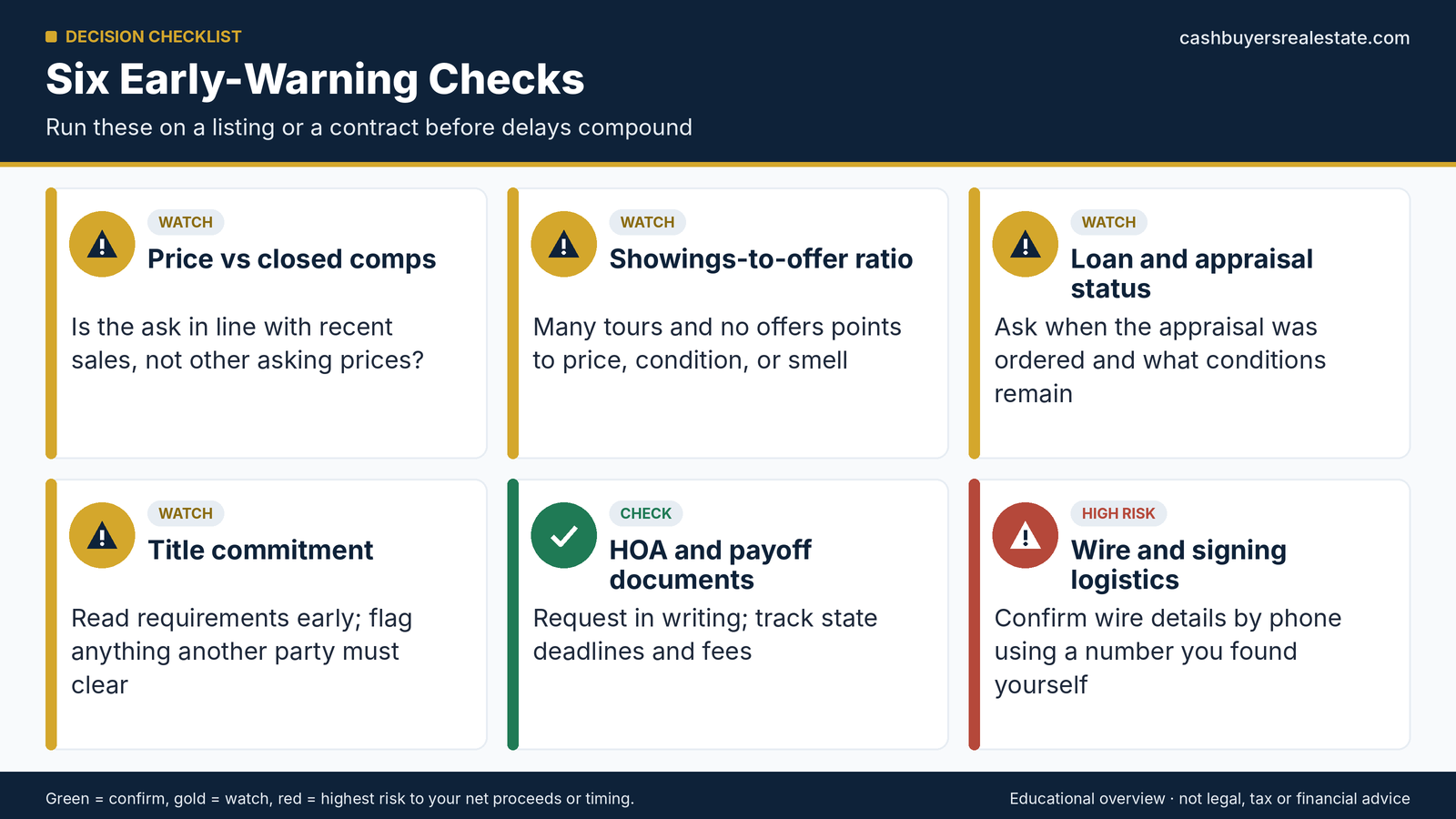
Text version of this infographic
- Price vs closed comps — Is the ask in line with recent sales, not other asking prices?
- Showings-to-offer ratio — Many tours and no offers points to price, condition, or smell
- Loan and appraisal status — Ask when the appraisal was ordered and what conditions remain
- Title commitment — Read requirements early; flag anything another party must clear
- HOA and payoff documents — Request in writing; track state deadlines and fees
- Wire and signing logistics — Confirm wire details by phone using a number you found yourself
Frequently Asked Questions About Delays in a Home Sale
Questions before and during the listing
Questions about price and days on market
- How long is too long for a house to sit on the market?
There isn’t a single number, because normal days on market vary by area, price range, and season. Compare your listing with the local median for similar homes, which an agent can pull from the multiple listing service. If you’re well beyond it with few showings or no offers, treat that as a signal to change something.
- Should I lower my price a little at a time or all at once?
Small cuts of a few thousand dollars often don’t change how buyers see the home, especially if it remains above comparable sales. A single move to a price clearly in line with recent closed sales is more likely to restart interest. Base the number on comps, not on what you hope to net.
- Why do I get showings but no offers?
Buyers who tour and don’t offer are usually telling you that the price does not fit what they saw. Common reasons include condition, odors, dated finishes, or comparisons with other homes. Collect feedback, look for repeated comments, and address the most common objection first.
- Does an online home value estimate tell me what to ask?
It can be a starting point, but it’s a statistical estimate that may not reflect your home’s condition or recent nearby sales. Closed sales of similar homes, adjusted for differences, are a firmer basis. An agent’s market analysis or an appraisal is a better check.
Questions about condition, access, and timing
- Will repairs help my home sell faster?
Inexpensive fixes and a deep clean often do, because they change a buyer’s first impression. Large repairs are a judgment call that depends on cost, the price you expect to receive, and how much work buyers in your market will accept. Comparing repair, credit, and as-is scenarios on net proceeds clarifies the choice.
- Is there a bad time of year to sell?
Buyer activity does change through the year in many markets, but patterns vary by region, and an individual year can differ. Ask a local agent how listing activity and days on market have moved in your area across seasons. If you list in a slow period, price and presentation carry more weight.
- Do restrictive showing hours really slow a sale?
They can. Every restriction reduces the number of buyers who can see the home, particularly working buyers and those touring several homes in a day. A lockbox, reasonable notice, and evening or weekend slots widen the pool.
- Does listing without an agent slow things down?
It depends on how the home is marketed and how well you handle pricing, showings, and contracts. Lack of MLS exposure is a common cause of slow activity in owner-sold homes. The guide to selling fast without an agent explains what to replace.
Questions after you have a contract
Questions about financing, appraisal, and inspection
- How common are delays after a contract is signed?
Fairly common. In the National Association of REALTORS® Realtors Confidence Index report released September 10, 2026, members said 14% of their contracts had delayed settlements and 7% had been terminated over the previous three months. It’s a survey of members, not a measure of your sale, but it shows delays are a normal risk.
- What happens if the appraisal is lower than the contract price?
The lender will generally base the loan on the lower value. The buyer may cover the gap in cash, the parties may renegotiate the price, the buyer may ask for a reconsideration of value, or the contract may allow the buyer to cancel. Each choice has a timing and net-proceeds effect.
- Can I refuse repairs a buyer requests after an inspection?
Usually you can, but the buyer may then cancel if the contract gives them that right during the inspection period. Many sellers respond with a partial repair, a credit, or a small price adjustment. Respond in writing and within the deadline in your contract.
- Does a cash buyer avoid these delays?
A cash buyer avoids loan underwriting and a lender’s appraisal, which removes some common causes. Title searches, payoffs, association paperwork, and inspections can still slow the sale, and the buyer’s funds need verification. Cash can shorten a timeline, but it doesn’t guarantee one.
Questions about title, liens, and paperwork
- How can I find out about liens on my property before I sell?
A title company or real estate attorney can run a preliminary title search, and county recorder and tax offices often provide public records. Check for mortgages, home equity lines, tax liens, judgments, contractor liens, and association liens. Finding them early leaves time to arrange payoffs.
- How long does a mortgage payoff statement take?
For most home loans, federal regulation requires the servicer to provide it within a reasonable time and no more than seven business days after a written request, with longer periods allowed in certain situations such as bankruptcy or foreclosure. Send the request as early as you can.
- How long do HOA documents take?
It depends on state law and the association. Florida requires a condominium association to issue an estoppel certificate within 10 business days of a request, and Texas requires a property owners’ association to deliver resale information no later than the 10th business day. Your state may differ, so ask the closing office.
- Can I sell if there is a federal tax lien on the house?
Often yes, but the lien has to be dealt with at or before closing, typically through payoff or an IRS process such as a certificate of discharge. The IRS asks that discharge applications be submitted at least 45 days before the transaction date. A tax professional or attorney can advise on options.
Choosing a Remedy and Your Next Steps
Once you know which stage is slowing your sale, the next move is picking a remedy that fits both the cause and your own priorities. Not every bottleneck deserves the same response, and not every response is worth its cost.
Match the bottleneck to the fix
A decision framework: reprice, repair, wait, or change route
Start with the symptom, then ask what a remedy would cost you in money, time, and risk. The table below pairs common bottlenecks with options worth considering.
| If the bottleneck is… | Consider… | Cost or tradeoff | Consider a different route when… |
|---|---|---|---|
| Price above buyer demand | A decisive reprice based on closed comps | Lower proceeds, shorter carry | You can’t afford any price the market will pay |
| Condition or presentation | Cleaning, light repairs, repair credit | Out-of-pocket cost and time | Repairs exceed what you can fund or manage |
| Buyer financing or appraisal risk | Stronger offers, larger deposits, gap clauses | May accept a lower headline price | Deadlines don’t allow another failed financing |
| Inspection fallout | Credit, targeted repairs, written response | Reduced net, scheduling effort | Repeated renegotiation wears down the deal |
| Title or lien problem | Early search, payoff, release, corrective documents | Payment of claims, professional fees | Resolution depends on parties outside your reach |
| Association paperwork | Request at listing; track deadlines | Fees, possible days of waiting | Rarely a reason to change routes alone |
| Probate or authority | Counsel, court steps, completed appointments | Court time and cost | Carrying costs exceed the benefit of waiting |
The right-hand column matters as much as the left. A sale route is a means, not an identity, and sometimes the most reasonable choice is to change it.
A few misconceptions tend to distort these choices, so it helps to name them. A delay does not necessarily mean the buyer is backing out; many are ordinary and resolve with a document or a phone call. A cash offer is not automatically faster, because it still depends on title and payoff steps. A price cut does not always restart interest, particularly if the real issue is condition or exposure. And a title company does not control every part of the timeline: it can only move as fast as the county, the lienholders, and the associations it depends on.
When a different sale route removes the bottleneck
Different sale routes remove different bottlenecks, and none removes all of them. A buyer who pays cash and accepts the home as it is can bypass loan underwriting, the lender’s appraisal, and some inspection renegotiation. That can matter if financing failures have already cost you a deal or two. It does not bypass a title search, a payoff, association paperwork, or an occupant who isn’t ready to leave.
The price of that convenience is typically a lower offer, because the buyer is accepting condition and resale risk. Whether the lower price is worth it depends on how much waiting is costing you. If carrying costs are modest and the market is steady, repricing a listing may be the better choice. If you face a hard deadline, rising costs, or a house that needs more work than you can fund, a cash offer may produce a better net than another round of failed contracts. Run both through a net sheet, using the net proceeds calculator and the guide to seller closing costs, and compare using the head-to-head framework in cash sale versus listing.
Illustrative example (hypothetical numbers, not market data): A seller owes $200,000 and has carried a listing for ten weeks without an offer. Carrying costs run about $2,600 a month, or roughly $600 a week. Option 1 is to reprice to $395,000 and expect about six more weeks to close: $395,000 − $27,650 in selling costs (7 percent) − $3,600 in carrying costs − $200,000 payoff = $163,750. Option 2 is a hypothetical cash offer of $360,000 closing in about a week: $360,000 − $4,000 costs − $600 carrying − $200,000 payoff = $155,400. The listing nets about $8,350 more on paper. But if a financing failure adds another month, the gap shrinks by roughly $2,600, and a second failure shrinks it again. The listing is the better bet only if it is likely to close on schedule and the seller can afford the wait.
If you do pursue a cash buyer, verify the buyer before you commit: proof of funds confirmed by the closing office, a complete written contract, a closing partner you can contact independently, and no pressure to skip review. The scam prevention hub lists the checks. And if the real issue is an unusually tight deadline, the guide to the full map of urgent sale options includes alternatives to selling at all, such as loan modifications, refinancing, or temporary income solutions, which are worth a look before you commit.
For sellers weighing fast routes by local rules and conditions, the local pages add state-specific context. And if you are choosing among routes mainly by speed, the economics of a quick sale explains what the discount is made of.
What to do this week
A seven-day diagnostic plan
If your sale is stalled now, a short, structured week can turn vague worry into a decision. Work through these steps in order:
- Write down your stage: not yet listed, listed without offers, or under contract.
- Collect the facts for that stage: days on market, number of showings and offers, or the contract’s deadlines and outstanding conditions.
- Pull recent closed comps and compare your price with them honestly.
- Gather the feedback and look for repeated comments.
- Request any missing documents today: payoff statement, association package, preliminary title search.
- Estimate your monthly carrying cost so you know what waiting costs.
- Choose one change to make this week and one date to review the results.
Reading the results is mostly about patience versus action. Waiting makes sense when the listing is new, the local market is moving at a normal pace, an outstanding item has a known date, and the carrying cost is affordable. Acting makes sense when you’ve passed the local median days on market with no clear explanation, when feedback repeats the same objection, when a third-party clock threatens a hard deadline, or when carrying costs are climbing faster than the price cut you’re resisting. A modest, deliberate change followed by a short review date usually beats both stubborn waiting and panicked overcorrection.
The goal is to replace a feeling with a hypothesis you can test. If the first change doesn’t help, the second step is easier because you’re working from data.
Questions to ask your agent, buyer, and closing office
Good questions shorten delays because they expose them early. To your listing agent: What are the closed comps, and where does my price sit among them? What feedback have showings produced? What is the median days on market for similar homes? What do you recommend changing, and why?
To a buyer or the buyer’s agent: Where is the loan in underwriting? When was the appraisal ordered and when is it due? What conditions remain open? Is the closing date still realistic? And for a cash buyer: Can the closing office confirm the funds, and may I see the contract in full before signing?
To the closing office or attorney: What did the title search show, and what requirements remain? Who owns each open item? When do you expect the payoff and association documents? What will my itemized costs be, and when will I receive my proceeds? How do I confirm wire instructions? Write down each answer with the date. A sale that is progressing will produce clear answers. A sale that is stuck will produce vague ones, and vague answers tell you where to dig.