
Sell House Fast during Divorce: Timeline, Costs & Seller Options
When a marriage is ending, the house is usually the biggest asset, the biggest debt, and the biggest source of disagreement all at once. One spouse may want out as quickly as possible. The other may want to keep the home for the kids, or may need more time before agreeing to anything. If you’re trying to sell your house fast during divorce, the first thing to understand is that speed depends less on the buyer and more on two things you can only partly control: whether both owners can agree, and whether a court order or filing deadline stands in the way.
You can sell a house quickly during a divorce when both spouses agree to the sale, both can sign, no court order blocks it, and the mortgage payoff is clear. Cash buyers can sometimes close faster than financed buyers, but price, net proceeds, and how the funds are held matter more than speed alone. Confirm the legal rules in your state and the terms of any court orders before you list or sign a contract.
That answer hides several decisions. Selling isn’t the only option, and it may not be the best one: one spouse can buy out the other, or the couple can agree to delay the sale until a set date. Each path changes who is on the mortgage, who owes taxes, and who walks away with how much. The sections below compare these paths side by side, explain who has to sign and when a court’s restraining order can stop a sale, show how proceeds are commonly divided and held, and walk through the tax and valuation questions that tend to surprise people.
Here’s how the guide is organized. We start with what makes a divorce sale different from an ordinary one: two owners, a court in the background, and a property that may be classified differently depending on where you live. Next comes the central choice among selling, buying out your spouse, or deferring the sale, with a decision table. From there we look at who must sign and which orders restrict sales, how to handle the money, what the main tax rules say, how to agree on a value, how the common sale methods compare, and how to manage showings and communication when you’d rather not be in the same room.
A note on tone. People searching for this topic are often tired, stretched, and dealing with decisions that feel too big for the calendar. Nothing here assumes one spouse is right or the other is wrong, and nothing assumes you have to sell. If safety is a concern in your household, tell your attorney early, because courts can address occupancy and property in ways that a standard sale process cannot.
A few terms will come up repeatedly. Marital property or community property generally means property acquired during the marriage, though the label and the rules differ by state. Equitable distribution means a court divides marital property fairly, which isn’t always equally. A decree is the court’s final judgment ending the marriage. A settlement agreement is the written deal between spouses on how to divide property and debts, and courts often adopt it into the decree. Net proceeds are what remains after the mortgage, liens, and selling costs are paid.
Selling a House Fast during Divorce: What Makes It Different
An ordinary home sale has a seller, a buyer, and a closing date. A divorce sale adds a second owner whose interests may differ, a legal process with its own calendar, and rules about what either spouse can do with property while the case is pending. Understanding these three differences up front keeps you from agreeing to a closing date that the paperwork can’t support.
Two owners, two goals, and a court in the background
Why both spouses’ cooperation sets the real timeline
In most sales, a seller’s willingness is the starting gun. In a divorce sale, it’s closer to a relay: both owners have to agree on the decision to sell, the listing or offer route, the asking price, the acceptable offer, and how the money will be handled. A disagreement at any handoff stops the process. A buyer with cash in hand can’t change that.
That’s why the quickest divorce sales tend to be the most cooperative ones. If both spouses sit down, even with attorneys or a mediator present, and agree on a written plan for the house, the sale itself can move at normal fast-sale speed. If they disagree, the fastest route may be neither spouse’s preference but the one a court or mediator can help them accept.
One practical step helps in nearly every case: put the plan in writing before you contact buyers. Cover who will talk to buyers and agents, what minimum price or net you’ll both accept, how offers will be compared, who signs, where the proceeds will be held, and how disagreements will be resolved. Even a one-page agreement, reviewed by each side’s attorney, prevents the common problem of one spouse accepting an offer the other never saw.
What “fast” realistically means when a divorce is pending
A divorce case has its own milestones, and the house sale may need to line up with them. In general terms, the sequence runs from filing, to temporary orders and financial disclosures, to negotiation or mediation, to a settlement agreement or trial, to the final decree. Some states set minimum waiting periods before a divorce can be granted. Texas, for example, provides in Family Code Section 6.702 that a court may not grant a divorce until after the 60th day following the date the suit was filed, with exceptions in cases involving family violence. Other states have different waits or none, so check your own.
The sale doesn’t have to wait for the decree. Many couples sell while the case is pending, with court approval or written agreement, and split the proceeds according to a temporary order or by holding the money until the final settlement. What matters is that the sale doesn’t violate any order and that the proceeds are accounted for.
Some couples ask whether it makes sense to sell before anyone files. The answer depends on your state and circumstances, but a few general points hold. Restrictions like automatic orders usually attach once a case is filed or served, so before filing there may be fewer formal limits on a sale, yet both owners must still agree and sign. A sale before filing doesn’t take the money out of the divorce: the proceeds are generally still part of what the court or the settlement will divide, and moving or spending them in ways the other spouse hasn’t agreed to can create problems later. If you’re considering a pre-filing sale, tell your attorney first and put the proceeds-handling plan in writing.
| Stage | What usually happens | House-sale implication |
|---|---|---|
| Before filing | Consult attorneys, gather documents, discuss separation | Best time to agree on a plan for the house and to get a value estimate |
| Filing and service | Petition filed; the other spouse is served; some states apply automatic property restrictions | Confirm whether any restraining order now limits selling or borrowing against the house |
| Temporary orders | Court or agreement sets interim support, occupancy, and bill-paying | May decide who lives in the house and pays the mortgage until the sale |
| Disclosure and negotiation | Financial statements exchanged; mediation or settlement talks | A sale agreement can be drafted: price floor, listing route, proceeds handling |
| Settlement or trial | Spouses agree, or a judge decides property division | A court can order a sale or a buyout and set the timing |
| Decree and after | Final judgment; deeds, refinances, and closing follow | Closing may be completed before or after, depending on the agreement |
Use the table as a map, not a schedule. Your state’s rules and your court’s calendar set the actual dates, and your attorney can tell you which stage you’re in. The sale itself, once both spouses are aligned and the title is clear, often takes weeks, not months.
Where the house sits in the marital estate
Community property versus equitable distribution
How the house is classified affects who has to agree and how the money is split. Nine states are community property states, according to IRS Publication 555: Arizona, California, Idaho, Louisiana, Nevada, New Mexico, Texas, Washington, and Wisconsin. In those states, property acquired during the marriage while both spouses are domiciled there is generally community property unless it can be traced to a separate source, and it’s typically divided under community-property rules.
Most other states use equitable distribution, in which the court divides marital property fairly based on a set of factors. New York offers a clear example in its Domestic Relations Law, Section 236(B): marital property includes all property acquired by either spouse during the marriage regardless of how title is held, it is to be distributed equitably, and the court weighs factors such as the length of the marriage, each spouse’s income and property, contributions to acquiring the property, and wasteful dissipation of assets.
The practical point: whose name is on the deed doesn’t necessarily decide who owns what. A house titled to one spouse can still be marital or community property, which is why a spouse who isn’t on the title often still has a say, and why buyers’ title companies ask about marital status. Which rules apply to you depends on where you live and where the marriage was based, so ask your attorney how your state treats the home.
Separate property, down payments, and premarital ownership
Not every house is entirely marital property. If one spouse bought the home before the marriage, inherited it, or received it as a gift, part or all of it may be separate property. IRS Publication 555 describes separate property in community-property states as property owned before marriage, gifts and inheritances, and property bought with separate funds. Other states have their own concepts, and some treat the growth in value or marital contributions to a separate asset as partly marital.
Down payments and mortgage payments complicate the picture. A spouse who put a premarital savings account into the down payment, or who paid the mortgage from separate funds, may have a claim to be credited for it, and a spouse who contributed to improvements or paid the mortgage during the marriage may have claims too. Tracing these contributions takes records: bank statements, closing documents, renovation invoices.
If this applies to you, collect the paperwork before the house is listed. Whether the sale proceeds are divided equally or according to a formula that credits separate contributions is a legal question, and it’s better answered in the settlement agreement than discovered after the closing statement is signed.
Sell, Buy Out, or Defer: Choosing the Path for the House
You have three broad choices for the house. Both spouses can agree to sell it and divide what’s left. One spouse can keep it and pay the other, which is a buyout. Or the couple can postpone the sale, letting one spouse stay for a period before selling. Each has consequences for the mortgage, taxes, and cash flow.
Selling now, or buying out your spouse
When a prompt sale makes sense, and what it requires
A prompt sale fits when neither spouse can or wants to keep the house, when carrying it on one income isn’t realistic, when the equity is needed to fund two new homes, or when keeping the house would tie up the settlement for months. It’s also common when the mortgage is large relative to income and a refinance in one name isn’t possible.
The requirements are straightforward but strict. Both owners (and sometimes a non-owner spouse, as a later section explains) generally need to sign the sale documents. Both need to agree on price and terms. Any court order that restricts sales must allow it. And the proceeds need a designated destination: paying off the mortgage and liens, covering costs, and then the remaining balance, which should be held or divided as the agreement or court order directs.
If speed is the priority, preparation is the lever. Order a payoff statement, gather the deed and loan documents, agree on a listing route, and decide in advance what to do with an offer. The guide on selling a house fast with a mortgage covers the mortgage side in more detail, and the overview of urgent home sale options compares the available routes.
Buyout and refinance: what must be true
In a buyout, one spouse takes sole ownership and pays the other for their share of the equity. The money usually comes from a refinance, from other assets, or from an offset against other property in the settlement. A buyout can be the least disruptive choice, especially when children are in school and one spouse wants stability.
Two separate questions arise. First, can the mortgage stay in place? Federal law limits a lender’s ability to call a loan due when ownership changes in certain family situations. The Garn-St Germain Act, at 12 U.S.C. 1701j-3(d), says a lender may not enforce a due-on-sale clause on residential property with fewer than five units when a transfer results from a decree of dissolution of marriage, legal separation agreement, or incidental property settlement agreement in which the borrower’s spouse becomes an owner. The Consumer Financial Protection Bureau’s mortgage servicing rules similarly treat a person who receives an ownership interest through such a transfer as a “successor in interest” under Regulation X, Section 1024.31.
Second, does the departing spouse come off the loan? Staying on the mortgage doesn’t happen automatically. Unless the lender releases a borrower, an ex-spouse who leaves the home may still be legally responsible for the debt. A refinance into one name, or a lender-approved assumption with a release of liability, is how liability is typically removed, and the remaining spouse has to qualify on their own income. If neither is possible, a sale may be the cleaner choice.
Deferring the sale, and comparing the three paths
Deferred-sale arrangements and their risks
Some couples agree that one spouse (often the parent with primary custody) will live in the house for a set period, such as until a child finishes school or a particular date, after which the home is sold and the proceeds divided. This can serve stability, but it carries real risks that need to be spelled out in writing.
Who pays the mortgage, taxes, insurance, and repairs during the deferral? What happens if the occupying spouse stops paying, and both names are still on the loan? What triggers the sale: a date, an event, a remarriage? Who decides the listing price and accepts offers if the spouses disagree later? And what happens to the value of the house, which could rise or fall, and to the unsold equity in the meantime? An agreement that doesn’t answer these questions invites disputes.
Tax and credit consequences deserve a check too. IRS Publication 523 notes that a spouse who is allowed to live in the home under a divorce or separation instrument can still count that use toward the residence test for the home-sale exclusion, which may help the departing spouse preserve the exclusion. But both spouses remain exposed to the mortgage’s credit effects. Ask your attorney and tax professional to look at the deferral terms before you sign.
A decision table: sell, buy out, or defer
The table below lines up the three paths against the factors that usually decide the choice. Treat it as a conversation guide for your attorney, not a formula.
| Factor | Sell now | Buy out | Defer the sale |
|---|---|---|---|
| Best fit | Neither spouse can or wants to keep the home | One spouse wants the house and can qualify and pay | Stability needed now; equity can wait |
| Speed to separate finances | Fast once both agree and title is clear | Depends on refinance or assumption approval | Slowest; finances stay linked |
| Mortgage effect | Loan paid off at closing | Refinance or lender release usually needed to remove a spouse | Both stay liable unless the lender agrees otherwise |
| Cash to each spouse | Equity released at closing, after costs | Departing spouse paid from refinance or offsets | Equity stays tied up until sale |
| Main risk | Disagreement on price or offer; selling costs | Qualifying on one income; appraisal disputes | Missed payments, repairs, market changes |
| What to settle in writing | Listing route, minimum net, how proceeds are held | Value, payment timing, release of liability | Who pays what, sale trigger, who decides price |
Read across a row to see how the paths differ on a single question, then down a column to see how one path fits your whole situation. If two paths look close, run the numbers for each with your own figures. Comparing net outcomes, including selling costs and carrying costs, usually clarifies what a headline price hides.
Once the path is chosen, the sale itself follows a familiar sequence, with a few divorce-specific adjustments. The first infographic maps those stages, from setting the timeline with your spouse and counsel to comparing net proceeds across offers.
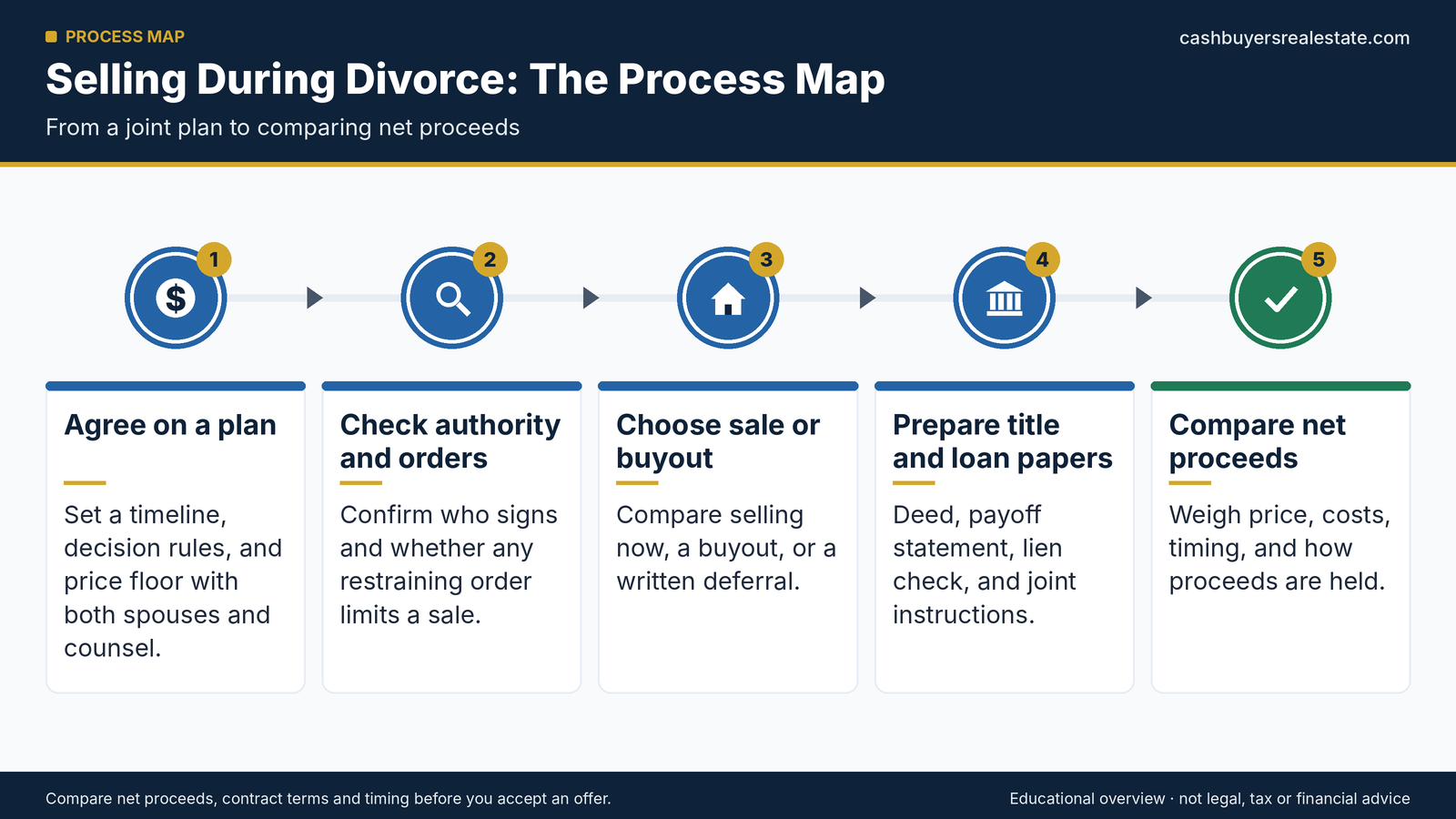
Text version of this infographic
- Agree on a plan — Set a timeline, decision rules, and price floor with both spouses and counsel.
- Check authority and orders — Confirm who signs and whether any restraining order limits a sale.
- Choose sale or buyout — Compare selling now, a buyout, or a written deferral.
- Prepare title and loan papers — Deed, payoff statement, lien check, and joint instructions.
- Compare net proceeds — Weigh price, costs, timing, and how proceeds are held.
In text: agree on a timeline and decision rules with your spouse and attorneys, choose the sale route, set a price floor you both accept, prepare the title and loan documents (deed, payoff statement, any orders), and compare net proceeds from each offer before anyone signs.
Who Must Sign, and What Can Stop a Sale
Few things delay a divorce sale more reliably than discovering, late in the process, that a signature is missing or a court order forbids the sale. Both problems are avoidable if you ask the right questions at the start. The answers depend on state law, on how the house is titled, and on where your case stands.
Authority to sell: title, homestead rights, and court orders
Title, marital status, and the signature rule
The basic rule of any home sale is that everyone who holds title must sign the deed. If both spouses are on the deed, both sign. If only one spouse is on the deed, many buyers’ title companies will still ask about the other spouse, because in some states a spouse has rights in the marital home regardless of whose name appears on the record. Title companies handle this routinely, and a missing signature is one of the quickest ways to stall a closing.
Texas shows how strong such a rule can be. Family Code Section 5.001 says neither spouse may sell, convey, or encumber the homestead without the joinder of the other spouse. That applies whether the homestead is one spouse’s separate property or community property, with a narrow exception in Section 5.002 when a court has declared the other spouse incapacitated. Other states have their own versions of homestead, dower, or marital-rights rules, and the details vary. Ask the title company or your attorney which apply where you live.
Signing logistics matter as well. If one spouse has moved out of state or can’t attend the closing, many states allow a power of attorney or a remote notarization, but rules differ, and some title companies are cautious about powers of attorney in divorce cases. Raise that question early. Also check that names on the deed match names on your identification, since a name change after marriage or divorce can require a correction before closing.
Automatic and temporary restraining orders on property
Courts in some states restrict what spouses can do with property as soon as a divorce case begins, and a sale or refinance can be among the restricted acts. The rules differ sharply, so it helps to see three examples.
In California, Family Code Section 2040 provides that the summons in a divorce case contains a temporary restraining order binding both parties. Under it, neither party may transfer, encumber, hypothecate, conceal, or otherwise dispose of any property, whether community, quasi-community, or separate, without the other party’s written consent or a court order. It excepts transactions in the usual course of business or for the necessities of life, and it permits extraordinary expenditures with five business days’ notice to the other party and an accounting. The published text of that section states that it remains in effect only until January 1, 2027, and that a revised version becomes operative on that date, so confirm the current wording with an attorney before you rely on it.
In New York, Domestic Relations Law Section 236(B)(2)(b) sets automatic orders that take effect against the plaintiff immediately on filing the summons and against the defendant on service. Neither party may sell, transfer, encumber, conceal, assign, remove, or in any way dispose of property without the other’s written consent or a court order, with exceptions for the usual course of business, customary household expenses, and reasonable attorney’s fees.
Texas works differently. Family Code Section 6.501 authorizes a temporary restraining order, but it’s not automatic: the court issues it on a party’s motion or its own motion, and it can prohibit selling or otherwise alienating property unless the court authorizes it. The order cannot exclude a spouse from the residence except under a protective order. In each state, the sensible approach is the same: ask your attorney whether any order applies, and if one does, get the other spouse’s written consent or a court order before you list, accept an offer, or sign.
The authority checklist, and what to do if you disagree
The who-signs and authority checklist
Use this table as a pre-listing checklist. Each row names someone or something whose permission or documentation may be needed, why it matters, and what to gather. Not every row applies to every couple.
| Party or document | Why it matters | What to gather or confirm |
|---|---|---|
| Spouse on the deed | Every record owner must sign the deed | Copy of the recorded deed; ID matching the deed name |
| Spouse not on the deed | Homestead or marital rights may require a signature in some states | Title company’s written requirement for your state |
| Court orders or restraining orders | May forbid selling without consent or approval | Copies of all orders; written consent or court approval if required |
| Settlement agreement or temporary order | Sets the plan, price floor, and proceeds handling | Signed agreement; attorney sign-off from each side |
| Mortgage servicer and other lienholders | Payoff must be satisfied at closing | Current payoff statement; HELOC and lien payoff letters |
| Power of attorney (if used) | Allows signing when a spouse can’t attend | Recorded or certified document; title company approval in advance |
| Trust or LLC ownership | The trustee or manager signs, not the individual | Trust certification or operating agreement |
| Closing agent (title company or attorney) | Controls signing, funding, and disbursement | Written instructions on who receives and holds proceeds |
The pattern to take from this table: the closing agent is the ultimate gatekeeper, so ask them for a written list of what they need from each owner. A short phone call at the start can prevent a delay at the end.
When spouses disagree: mediation, court-ordered sale, and receivers
Disagreement is common and doesn’t mean the sale is dead. Mediation, where a neutral professional helps spouses reach a deal, is often the quickest way to break a stalemate on price, timing, or who lists the house. Even when the rest of the divorce is contested, couples sometimes agree on the narrow question of how to sell the house, because both benefit from a better price and a lower carrying cost.
If spouses can’t agree, a court can often decide. Judges in many states have the authority to order the sale of a marital home as part of dividing property, and to set terms such as listing price, the agent, and the handling of proceeds. Texas, as one example, allows a court to appoint a receiver to protect property during the case under Section 6.502, with notice to lienholders. Court-ordered sales are slower and less flexible than negotiated ones, which is why many attorneys encourage clients to agree on a framework early.
Some agreements build in guardrails that keep a sale from stalling: a neutral agent chosen jointly, a pricing schedule that lowers the list price by an agreed percentage after set intervals, a rule that any offer at or above the agreed floor is accepted, and a fallback to mediation if the parties can’t agree on a lower price. Ideas like these are worth raising with counsel.
Dividing the Money: Payoff, Costs, and Holding Proceeds
After the signing question, the next most common point of friction is money: how much is actually left after the sale, who gets it, and who holds it in the meantime. Handling those questions in advance is far better than discovering at the closing table that spouses expect different outcomes.
How the money flows at closing
The closing waterfall: what gets paid before anyone is paid
Sale proceeds flow in a set order. The first claims are the mortgage payoff and any other liens on the property, such as a home equity line, judgment liens, unpaid property taxes, or HOA assessments. Next come the selling costs: agent commissions if any, title and escrow or attorney fees, transfer or recording taxes where they apply, and prorations for taxes and utilities. Whatever remains is the net proceeds.
Closing practice varies by state. In some states, a title or escrow company handles the closing and funds; in others, an attorney conducts it and holds the money in a trust account. The settlement statement or closing disclosure shows exactly where each dollar goes. Ask the closing agent for a draft early so you can compare it with your own estimate. The guide to closing costs when selling a house explains the typical line items, and a net proceeds calculator can help you plan.
Two divorce-specific points belong here. First, if the house is in negative equity or breakeven, sale proceeds may not cover the payoff, and someone will have to cover a shortfall or the lender will have to approve a short sale. Second, any outstanding second mortgage or line of credit that one spouse drew on needs to be identified before listing, because it affects the net the couple expects to split.
Holding proceeds in escrow or trust until the split is settled
If the divorce isn’t finished when the house sells, the couple has to decide where the money sits. A common solution is to have the closing agent hold the net proceeds in an escrow or attorney trust account under joint written instructions, to be released only on the signatures of both spouses or on a court order. That keeps either spouse from walking away with the whole amount and lets the couple settle the division later.
Another approach is to split the proceeds at closing according to an agreed percentage or a temporary court order, with a portion held back for disputed items. The right structure depends on the settlement terms and on how well the spouses trust each other. The key is that the instructions are written, signed by both, and delivered to the closing agent before closing day.
Do not rely on a verbal promise of how the money will be handled. Closing agents generally follow written instructions, and they can’t release funds in a way that contradicts them. Also remember wire-fraud safeguards: confirm any wiring instructions with the closing agent by phone, using a number you found independently, and be careful of emails that change account details at the last minute.
A worked example of splitting net proceeds
A hypothetical split under two sale routes
Numbers make the trade-offs concrete. The example below uses invented figures to show the structure of the comparison. It isn’t market data and it doesn’t reflect how any court would divide your property.
Illustrative example (hypothetical numbers, not market data): A couple owns a home with a $228,000 mortgage and a $22,000 home equity line, for a total payoff of $250,000. A listing route would sell for $410,000, with selling costs of 8% and three months of carrying costs at $2,800 per month. A cash-sale route would sell for $372,000, with selling costs of 2.5% and one month of carrying costs. The spouses plan to split the net 50/50.
| Line item | Listing route | Cash-sale route |
|---|---|---|
| Sale price | $410,000 | $372,000 |
| Selling costs | -$32,800 (8%) | -$9,300 (2.5%) |
| Mortgage and HELOC payoff | -$250,000 | -$250,000 |
| Carrying costs | -$8,400 (3 months) | -$2,800 (1 month) |
| Net proceeds | $118,800 | $109,900 |
| Each spouse at 50/50 | $59,400 | $54,950 |
The listing route nets $8,900 more in total, or $4,450 more per spouse, but takes two months longer and depends on a financed buyer closing. Whether that gap is worth the wait is a personal and financial judgment, and the answer shifts if the market is slow, if repairs are needed, or if the carrying costs are higher than assumed. Compare net, timeline, and certainty together. The guide on how cash offers are calculated explains why cash offers land where they do.
Credits, interim payments, and costs specific to divorce sales
Real settlements often adjust the split. Suppose, in the example above, one spouse paid the full mortgage for six months after separating while the other lived elsewhere. The agreement might credit that spouse for a share of those payments, for instance $6,000, taken off the top before the remaining proceeds are divided. In the cash-sale route, that would leave $103,900 to split equally, so the spouse who made the payments receives $6,000 plus $51,950, or $57,950, and the other receives $51,950.
Other adjustments are common. Temporary support orders may require one spouse to cover the mortgage, taxes, or insurance during the case. Credits may be given for separate-property down payments, for repairs paid by one side, or for one spouse’s occupancy of the house. Legal fees may be paid from proceeds if both agree. Each of these needs to appear in the written agreement or court order so the closing agent can apply it.
Don’t overlook costs outside the settlement statement. Two households cost more than one: second rent or deposit, duplicate utilities, storage, moving expenses. A fast sale that ends carrying costs sooner can offset a lower price, and a slower sale at a higher price can leave you with a larger check but more months of expenses. Run both scenarios, with real numbers, before choosing.
With the money mechanics in view, the next question is which sale method best matches your priorities. The second infographic compares five common options (a cash sale, a traditional listing, for-sale-by-owner, an iBuyer or platform, and auction or special-case sale) and shows who each suits best and what each trades away.
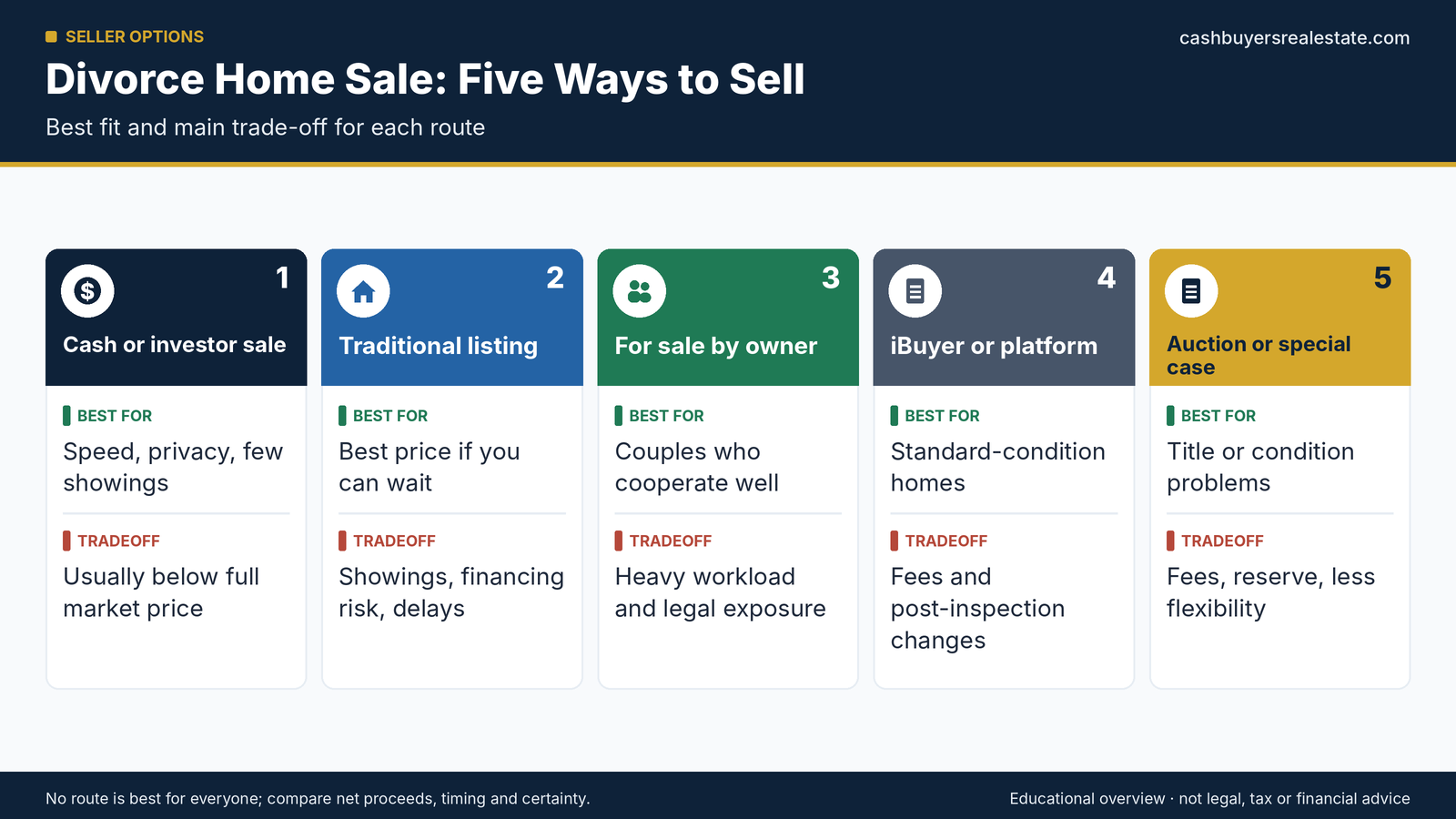
Text version of this infographic
- Cash or investor sale — best for: Speed, privacy, few showings; tradeoff: Usually below full market price
- Traditional listing — best for: Best price if you can wait; tradeoff: Showings, financing risk, delays
- For sale by owner — best for: Couples who cooperate well; tradeoff: Heavy workload and legal exposure
- iBuyer or platform — best for: Standard-condition homes; tradeoff: Fees and post-inspection changes
- Auction or special case — best for: Title or condition problems; tradeoff: Fees, reserve, less flexibility
As a text summary: a cash sale favors speed and certainty at a lower price, a traditional listing favors price but depends on buyer financing and showings, a for-sale-by-owner sale saves commission but adds workload and legal exposure, an iBuyer or instant-offer platform offers convenience for homes in standard condition, and an auction suits unusual situations such as properties with title or condition problems.
Taxes and Valuation: Questions to Settle Before You Agree on a Price
Two topics tend to blindside divorcing owners because they sit outside the real estate transaction itself: how the tax code treats a home transfer or sale between spouses, and how the couple agrees on what the house is worth. Both can change the economics of the choice between selling, buying out, and deferring.
Tax rules that touch a divorce home sale
Transfers between spouses and the carryover basis
When one spouse transfers the house to the other as part of a divorce, federal tax law generally treats it as a non-event for income tax. Under Internal Revenue Code Section 1041, no gain or loss is recognized on a transfer of property to a spouse, or to a former spouse if the transfer is incident to the divorce. The statute defines a transfer as incident to the divorce if it happens within one year after the marriage ends or is related to the ending of the marriage. IRS Publication 504, Divorced or Separated Individuals, covers payments and transfers of property that often occur in a divorce.
The catch is basis. The spouse who receives the property generally takes the transferor’s adjusted basis, a carryover basis, as though the property had been a gift. IRS Publication 523 says the same for a home acquired in a divorce: the starting basis is generally the former spouse’s adjusted basis. In a buyout, that means the spouse who keeps the house also keeps the built-in gain from the original purchase price. If the house later sells for much more than the original basis, the receiving spouse may owe tax on gain that the home-sale exclusion doesn’t fully shelter.
Illustrative example (hypothetical numbers, not tax advice): A couple bought a home years ago for $250,000, and it is now worth $400,000. In a buyout, one spouse receives the house with a carryover basis of $250,000 (ignoring improvements and selling costs to keep the arithmetic simple). If that spouse later sells for $400,000, the gain is about $150,000 before any exclusion. If the home-sale exclusion applies in full, the gain may be fully sheltered, but if the person doesn’t meet the tests, or if the home keeps appreciating, some of the gain could be taxable. In a sale now, the same $150,000 gain is measured at closing and may be covered by the couple’s combined exclusion if they qualify. The point is not the arithmetic but the timing: a buyout moves the tax question into the future and onto one person.
That’s a reason to compare a buyout with a sale using after-tax numbers. Two options that look equal on a settlement spreadsheet can differ once the receiving spouse’s future tax exposure is counted. An exception exists for a spouse or former spouse who is a nonresident alien, where the nonrecognition rule does not apply, so check this too if either of you lives abroad or isn’t a U.S. person for tax purposes.
The home-sale exclusion for divorcing owners
If you sell a home you’ve owned and lived in, you may be able to exclude part of the gain from income. IRS Publication 523 says the maximum exclusion is $250,000, rising to $500,000 for a married couple filing jointly, and that you generally need to have owned the home for at least 24 months and used it as your residence for at least 24 months during the five years before the sale. The months of use don’t need to be consecutive, and you generally can use the exclusion only once in a two-year period.
Divorce adds some specific rules. Publication 523 says that if your spouse or former spouse transferred the home to you, you can count the time that person owned it toward your ownership test, though you must satisfy the residence test on your own. It also says you can treat a home as your residence if you own it and your spouse or former spouse is allowed to live there under a divorce or separation instrument and uses it as a main home. That second rule matters in deferral arrangements: the spouse who moved out might still qualify for the exclusion if the other lives there under the decree.
The $500,000 amount is not automatic for former spouses. Per the publication, it requires a married couple filing jointly, with both spouses meeting the residence and look-back requirements and at least one meeting the ownership requirement. Once spouses file separately or are no longer married at the relevant time, each is typically looking at a $250,000 limit. Because filing status depends on the date and timing of the divorce and the sale, ask your tax adviser whether closing before or after a particular date changes your result.
Valuation: agreeing on what the house is worth
Appraisals, agent opinions, and investor offers as evidence
Almost every divorce decision about the house starts with a number. In a buyout, the value sets how much the departing spouse is paid. In a sale, the value frames the listing price or the lowest acceptable offer. Different tools give different kinds of evidence, and it helps to know what each one is.
A licensed appraiser’s report is the most formal. It uses comparable sales and an inspection of the property, and courts and lenders recognize it. An agent’s comparative market analysis (CMA) is less formal: it estimates what the house might list or sell for based on recent comparable sales, but it isn’t an appraisal and it reflects the agent’s judgment about marketing and pricing. An investor’s cash offer is something else again. It’s priced for a fast, as-is purchase and includes the buyer’s costs and margin, so it tells you what that buyer will pay, not what the open market might pay after a full listing period.
For divorce purposes, it’s common to use a combination. An appraisal sets a baseline for a buyout, a CMA informs the listing price, and a cash offer sets a floor that shows what a quick, certain sale would produce. Comparing all three gives each spouse the same information to work from. If your appraisal date matters to the settlement, say whether it should reflect today’s value, the separation date, or the filing date, since your attorney may want a specific date.
Avoiding a valuation standoff
When spouses disagree on value, one side tends to argue high and the other low, depending on who plans to keep the house. The best defenses are neutral process and shared information. Agree on a single appraiser both accept, or let each side choose one and set a rule: average the two, or bring in a third if they differ by more than a set percentage. Give the appraiser the same list of improvements, repairs, and known problems so the report is based on shared facts.
Another approach is to let the market decide. Agree to list the house at a set price for a set period, with a schedule of reductions, and to accept any offer above an agreed minimum. If it doesn’t sell, one spouse can buy out the other at the market-tested value, or the spouses can revisit the plan. This removes the argument from the spreadsheet and puts it in front of real buyers.
Be careful with condition. A house that needs repairs or that has deferred maintenance will appraise differently from the same house in good shape, and sellers often disagree about whether to spend money to fix it. The guide on selling fast without repairs explains the trade-offs, and the main article on selling a house as-is covers what buyers can still inspect.
Choosing a Sale Method When a Marriage Is Ending
The sale method matters more in a divorce than in an ordinary sale, because it determines how many showings you’ll sit through, how much cooperation you’ll need from your spouse, how long carrying costs run, and how much of the process stays private. There isn’t one best method. The right fit depends on your priorities and on how well the two of you can work together.
Cash buyers and investors in a divorce sale
How a cash sale fits a settlement timeline
Cash buyers don’t need a mortgage, so their offers typically don’t depend on an appraisal or a lender’s underwriting timeline. That can shorten the path from accepted offer to closing, and it can reduce the chance of a financing failure. Cash offers are also commonly made on an as-is basis, which means you may avoid repairs, staging, and the repeated showings that a listing involves. For couples who can barely coordinate a single walk-through, that can be a major advantage.
Privacy is a quieter benefit. A cash sale to an investor usually involves one or two visits instead of weeks of open houses, which means fewer chances for awkward encounters between spouses or for children to see strangers touring their home. For a family in transition, that can matter as much as the price.
The trade-off is price. Investors pay for speed and certainty, and they price repairs, resale costs, and their own margin into the offer, so cash offers generally land below what a well-marketed listing might bring. Whether the difference is worth it depends on how much time you have, how much the carrying costs are, and how the sale fits into your settlement. A timeline guide such as selling a house in 30 days explains what must be true for a short closing.
Checking a cash offer when two owners must agree
When two people have to accept an offer, the quality of the process matters. Make sure both spouses receive the same written offer, with the same terms, at the same time. A buyer who negotiates separately with each spouse, or who pressures one to sign before the other has reviewed, creates exactly the kind of conflict that can unravel a settlement. Ask for offers in writing and share them with your attorney.
Verify the buyer too. Ask for proof of funds, such as a recent bank statement or a letter from a financial institution. Ask who the contract buyer is, whether the buyer plans to assign the contract to someone else, how much earnest money will be deposited and who holds it, and what inspection rights the buyer retains. Read the contract for completeness, and be cautious if terms change at the last minute. The guide on proof of funds and the overview of cash home buyer scams explain these checks in more detail.
Also remember the money. Under a cash offer, the closing agent still follows written instructions about who receives the proceeds, so your joint instructions need to be in place before closing. Don’t let the speed of a cash offer rush you past the step of getting both spouses’ signatures and the proceeds-handling agreement in order.
Listings, for-sale-by-owner, and other routes
Traditional listing with an agent
A listing aims at the broadest buyer pool and often the highest price. An agent prices the home, markets it, schedules showings, negotiates offers, and guides the sale through inspection, appraisal, and closing. For a couple who wants the best price and can wait, it’s often the strongest option.
The costs are time and friction. Listings usually require staging and cleaning, flexible showing schedules, and decisions about repairs after the buyer’s inspection. Offers from financed buyers depend on appraisals and loan approvals, so the closing date can slip. And both spouses must sign the listing agreement and every counteroffer, which makes clear communication essential.
Choosing the agent is a decision to make together. Look for someone both of you trust, preferably with experience in divorce sales, who will communicate with both spouses equally and won’t take sides. Ask how they handle showings when one spouse is still living in the house, how they’ll share offers, and what their marketing plan and commission are. For a wider comparison of routes, see the guide on cash buyers versus real estate agents.
For-sale-by-owner, iBuyers, and auctions
Selling without an agent can save commission, but a divorce sale has complications that a first-time FSBO seller may not expect: two parties to coordinate, legal restrictions to check, and the risk of mistakes in the contract and disclosures. If you go this way, have an attorney review the purchase contract, and be extra careful about disclosure forms and closing logistics. The guide on selling a house fast without a realtor covers the basics.
iBuyers and instant-offer platforms buy homes using algorithmic pricing and typically target houses in fairly standard condition. They can offer convenience and a predictable timeline, but they may charge service fees and adjust the offer after an inspection, and they decline some properties. Get the offer, the fees, and the repair-credit terms in writing, and compare net proceeds.
Auctions are a niche option for unusual cases, such as a property with title or condition problems, or a situation where a court-ordered sale needs a defined process. They offer a firm date and sometimes high competition, but they involve fees, reserve prices, and less flexibility on terms. The table below compares these routes on the factors that matter most to divorcing owners.
| Method | Speed and certainty | Price tendency | Spousal workload and privacy |
|---|---|---|---|
| Cash or investor sale | Often faster; no financing contingency; depends on buyer verification | Usually below full market value | Few showings; one contract to review together |
| Traditional listing | Slower; financing and appraisal can delay or derail | Often the highest potential price | Many showings and decisions; both sign listing and counteroffers |
| For sale by owner | Varies with your marketing and buyer pool | Saves commission; price depends on your pricing skill | Highest workload and legal exposure; needs close coordination |
| iBuyer or platform | Fast process for eligible homes; may adjust after inspection | Convenience pricing; fees may apply | Limited visits; standard-condition homes only |
| Auction or special case | Firm date; best for unusual circumstances | Depends on bidding and reserve | Fewer negotiations; fees and limited flexibility |
Read the table across for your top priority, whether that’s speed, price, privacy, or simplicity. If two methods are close, compare their net outcomes with real quotes. And if you aren’t sure which fits, a short consultation with your attorney and one or two agents or buyers can narrow the field before you commit.
Living Through the Sale: Communication, Showings, and Daily Logistics
The legal and financial structure of a divorce sale gets most of the attention, but the sale often succeeds or fails on much smaller things: whether texts get answered, whether the house is ready for a showing, and who has the garage code. This section is about the practical side, since a fast sale needs steady execution as much as a good plan.
Communication and decision-making between spouses
Setting up a neutral channel and decision rules
When trust is low, loose communication creates problems. A sale involves dozens of small decisions (accept a showing request, approve a repair credit, respond to a counteroffer), and each one can become an argument if it’s handled through impulsive texts. A neutral setup helps. Agree to use one channel, such as a shared email thread or a co-parenting or document-sharing app, for all sale-related messages, and keep personal topics out of it.
Agree on decision rules in advance. For routine items, such as scheduling showings, one spouse or the agent can decide. For major items, such as accepting an offer or changing the price, both must approve in writing within a set time, such as 24 or 48 hours. Define what happens if one person doesn’t respond: a default to the agreed price floor, a call to the mediator, or a quick consult with each attorney. Rules like these keep a missed email from costing you a buyer.
Keep records. A running log of offers, decisions, and approvals protects both sides if a dispute arises later, and it gives your attorneys what they need to confirm that the sale followed the agreement. Keep children out of the logistics, and avoid using the sale as a negotiating chip in other disputes. If tension is high, ask your attorneys to handle direct communication on major terms and let the agent handle everyday scheduling.
Who helps: attorneys, mediators, and other professionals
Divorcing owners often need a small team. Each spouse’s family law attorney advises on the legal side: orders, deadlines, the settlement agreement, and how the house fits into the overall division of property. A mediator is a neutral professional who helps spouses reach agreement; mediators typically can’t advise either spouse individually, so you still need your own counsel to review any deal.
A tax professional can model after-tax outcomes for selling versus buying out, which is the kind of analysis that spreadsheets from the real estate side often miss. A neutral financial professional can help with cash-flow planning for each household. A loan officer or mortgage broker can tell a spouse who wants to keep the house whether a refinance is feasible and at what payment. And a HUD-approved housing counselor can help if mortgage payments are behind or hardship is a factor.
On the real estate side, a title or escrow officer, or a closing attorney, is the person who will tell you exactly what documents and signatures they need. Meeting with the closing agent early, even before listing, is one of the best-value steps in the process. Costs add up when you bring in several professionals, so ask each for a fee estimate and decide together which roles matter most.
Showings, occupancy, and moving
Showings, privacy, and who stays in the house
If both spouses still live in the house, or one of them does, showings can be stressful. A few arrangements make them easier. Set showing windows, such as certain afternoons or weekends, so each person knows when to be out. Use a lockbox or showing service with agent-to-agent scheduling, so neither spouse has to coordinate individually with every visitor. Ask that showings be by appointment with advance notice.
Protect private items. Before showings begin, secure financial records, passports, medications, and valuables, or move them to a safe place. Take dated photos or video of the home’s contents and condition, which can help later if there’s a dispute about belongings. Agree on who is responsible for keeping the house clean and ready, since a house that looks neglected can reduce the offers you receive.
Think, too, about how much exposure you want. An agent can hold broker previews and a limited number of open houses, or restrict access to scheduled private showings only. Fewer, better-qualified visits are easier on everyone living in the home and on children who see strangers walk through their bedrooms. The tradeoff is that a narrower showing schedule may reduce the number of offers. Weigh that against your priorities: a slightly longer marketing window at a higher price, or a quieter, shorter one that may bring a lower number. If you’re asking an agent to limit access, say so at the listing appointment and write it down in the listing agreement.
Safety comes first. If you’re concerned about your safety or a child’s safety in the home, speak to your attorney as soon as possible, because courts can address occupancy and protection in ways that an ordinary sale process can’t. As the Texas statute on temporary restraining orders illustrates, a general order restricting property sales generally can’t exclude a spouse from the residence except under a protective order, which is a separate legal step. Don’t try to resolve a safety problem through a sale schedule.
Possessions, repairs, utilities, and the move
The details of leaving a shared home are a project in themselves. Make an inventory of furniture and household items, agree in writing on who takes what or how disputed items will be handled, and photograph valuables before anything is moved. If the house will be sold with some contents, state clearly what stays.
Decide who will handle repairs and who will pay for them. Small fixes before listing, such as patching walls or fixing a leaky faucet, can help with showings and inspections, and the cost should be treated in the settlement: from proceeds, shared equally, or charged to the occupant. Utilities, insurance, and lawn care need an owner as well. If the house will stand empty while the sale is pending, check with your insurer, since vacant houses can face coverage limits, and read the guide on selling a vacant house fast for common issues.
Plan the move for the closing timeline, not the other way around. Know the possession date in the contract, schedule movers and storage, and arrange a final walk-through. Collect keys, garage openers, and codes for the buyer. Afterward, update your address with banks, employers, and government agencies, and make sure each spouse’s name is off accounts tied to the house that no longer concerns them. A short written checklist split between the two households keeps closing week from turning into a scramble.
Before you commit to any route, it helps to review a short list of checks that apply to divorce sales in particular. The final infographic covers six: the mortgage payoff, the property’s condition, buyer financing, title issues, closing readiness, and your moving deadline, and shows which items typically need a professional’s input.
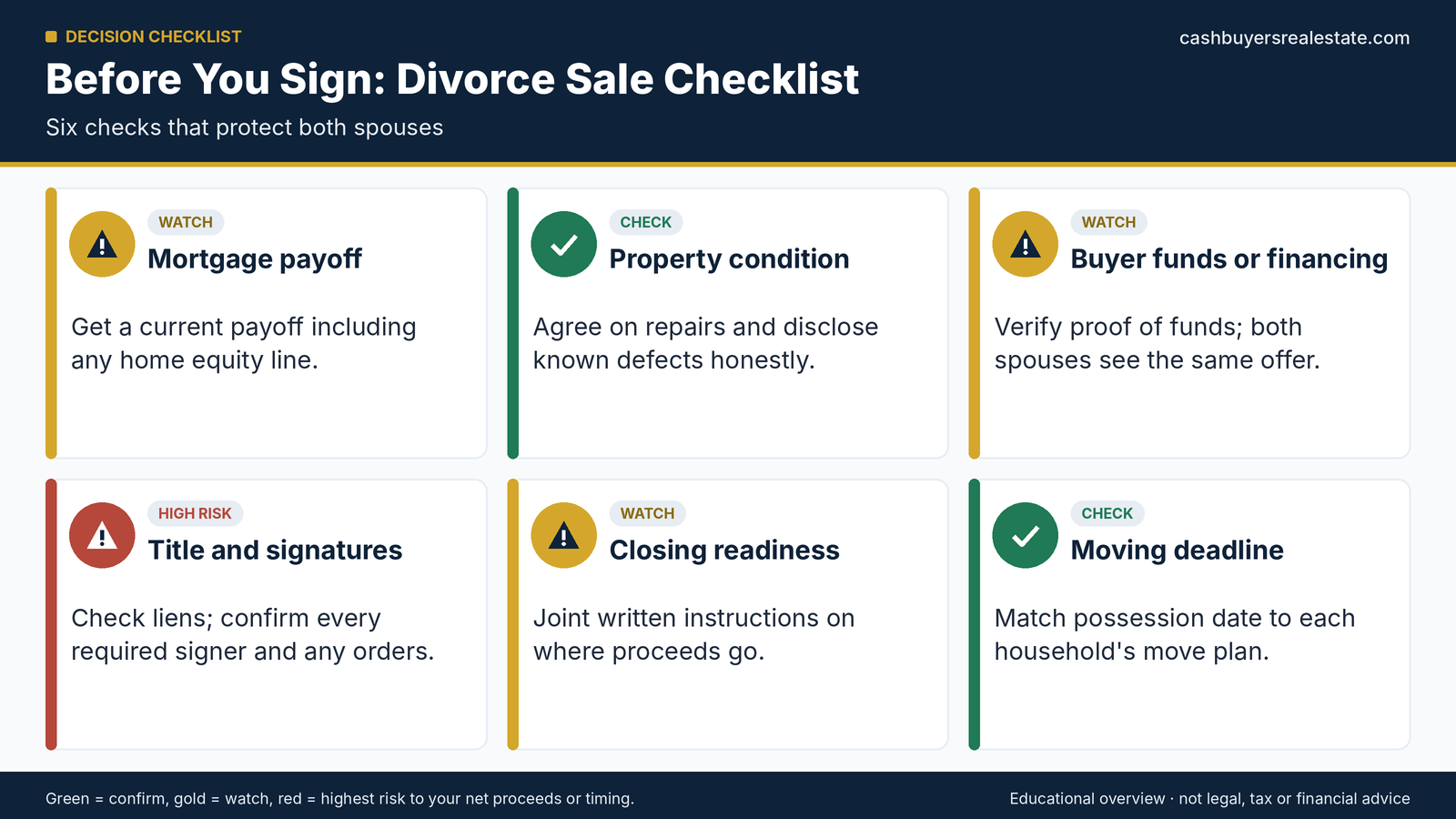
Text version of this infographic
- Mortgage payoff — Get a current payoff including any home equity line.
- Property condition — Agree on repairs and disclose known defects honestly.
- Buyer funds or financing — Verify proof of funds; both spouses see the same offer.
- Title and signatures — Check liens; confirm every required signer and any orders.
- Closing readiness — Joint written instructions on where proceeds go.
- Moving deadline — Match possession date to each household's move plan.
In text: confirm the exact payoff (including any home equity line), document and disclose the home’s condition, verify the buyer’s funds or loan approval, check title for liens and make sure all required signatures are available, confirm the closing agent has your joint instructions for proceeds, and compare your moving date with the proposed closing date.
Frequently Asked Questions About Selling a House during Divorce
Questions about the legal process and ownership
Signing, court orders, and permissions
- Can I sell the house without my spouse’s signature?
If your spouse is on the deed, no: all record owners must sign. If only you are on the deed, you may still need your spouse’s signature in some states because of homestead or marital-property rights, as in Texas, where Family Code Section 5.001 requires a spouse’s joinder on a homestead sale. Title companies enforce these rules strictly, so ask the closing agent before you list.
- Can we sell the house before the divorce is final?
Often yes, if both spouses agree and no court order forbids it. Many couples sell while the case is pending and hold the proceeds in escrow or trust until the property division is settled. If a restraining order applies, you’ll need written consent from your spouse or a court order, depending on the state. Check with your attorney before accepting any offer.
- What if my spouse refuses to sell?
Start with mediation or attorney-to-attorney negotiation, which often resolves disputes about timing and price. If that fails, many courts can order a sale or award the house to one spouse as part of the property division. Those routes take longer, so build in time. Agreeing early on a neutral process, such as a joint agent and a pricing schedule, can avoid the standoff.
- Does a restraining order always stop me from selling?
Not always, but it can. California’s automatic order and New York’s automatic orders restrict transfers of property without written consent or a court order once they take effect, while Texas restraining orders are issued by the court on request. Exceptions exist for ordinary expenses. If an order applies, the safe path is written consent from your spouse or court approval before you sign.
Mortgage and title questions
- Can my ex stay on the mortgage after I keep the house?
Yes, but it carries risk. Unless the lender releases a borrower, an ex-spouse who leaves the home generally remains legally responsible for the debt, which can affect credit and borrowing. Refinancing into one name or getting the lender’s approval for an assumption with a release is how liability is usually removed. Your settlement can require the spouse keeping the house to do this by a certain date.
- Does signing a quitclaim deed remove me from the mortgage?
No. A deed changes ownership of the property, not who owes the loan. Federal law prevents a lender from calling a loan due solely because of a divorce-related transfer to a spouse, but you stay liable on the note unless the lender agrees to release you. Talk to the servicer and your attorney before signing any deed.
- What if we owe more than the house is worth?
Then a sale may not cover the payoff, and someone will need to cover a shortfall, or the lender would need to approve a short sale. Your settlement should say who bears the shortfall. If you’re behind on payments, a HUD-approved housing counselor can help, and the guide on selling a house before foreclosure explains your options.
Questions about money, taxes, and buyers
Money and taxes
- How are sale proceeds usually divided in a divorce?
It depends on your state’s property rules and your settlement. Community property states generally divide community property equally, while equitable-distribution states divide marital property fairly, which may not be equal. Credits for separate-property contributions or mortgage payments can adjust the split. Your attorney can explain the approach in your state.
- Will we owe taxes on the sale?
Possibly. IRS Publication 523 explains that you may exclude up to $250,000 of gain, or $500,000 for qualifying joint filers, if you meet the ownership and use tests. Divorce can change who qualifies and for how much, so have a tax professional review the numbers before you pick a closing date. Also check any state or local taxes.
- Who pays the mortgage while the house is being sold?
The answer comes from your temporary orders or written agreement. Without either, the person living in the house often pays, but the couple should document who pays what and whether payments are credited against that spouse’s share of the proceeds. Missed payments hurt both borrowers’ credit, so don’t leave this open.
- Can legal fees be paid from the sale proceeds?
Only if both spouses agree in writing or a court orders it. Some settlements allow each spouse to pay fees from their share. Others advance fees from proceeds with an accounting. Put the arrangement in the closing instructions so the closing agent knows how to disburse the funds.
Buyers, timing, and disclosure
- How fast can a divorcing couple realistically sell?
When both spouses agree, the title is clear, and no order blocks the sale, a sale to a cash buyer can sometimes close in a matter of weeks, while a traditional listing usually takes longer. Disagreements, missing signatures, and payoff problems cause most delays. The guide on what slows down a home sale covers the common ones.
- Is a cash buyer a good choice in a divorce?
It can be, if speed, privacy, and certainty matter more than the last dollar of price. Cash sales tend to bring fewer showings and no financing contingency, but offers are generally lower than a full-market listing. Compare net proceeds, verify the buyer’s funds, and make sure both spouses see the same written offer.
- Should we use the same real estate agent?
Usually yes, and it’s often better to share one agent who treats both spouses equally than to have two agents negotiating against each other. Choose someone both of you trust, put expectations in writing, and confirm that both spouses will receive all offers and messages. Some couples add a clause that either spouse can ask for a replacement agent for cause.
- Do we have to tell buyers about the divorce?
Marital status isn’t a property condition, so it isn’t a typical disclosure item, but the title company will ask who the owners are and may need divorce documents to confirm authority to sell. What you must disclose are known material defects in the property, using your state’s form. Never use a divorce as a reason to skip required disclosures.
Choosing Your Path and Taking the First Steps
Selling quickly can be the right move in a divorce, and so can selling slowly, buying out a spouse, or waiting. The point of everything above is to help you choose with your eyes open, with numbers on the table and the legal pieces checked, instead of choosing because a deadline or a disagreement made the decision for you.
A decision framework: match the path to your priority
Matching priorities to a path
Start by ranking what matters most to each of you. Typical priorities include a clean financial break, maximum proceeds, keeping the children in their home, privacy, and a predictable schedule. They rarely line up perfectly between two people, so write them down separately and compare. The table below pairs common priorities with the path that often serves them and the main thing to watch.
| If your top priority is | Path that often fits | What to watch |
|---|---|---|
| A fast, clean financial break | Cash or investor sale with joint proceeds instructions | Lower price; both spouses must see and sign the same contract |
| Highest total proceeds | Traditional listing with an agent both trust | Longer timeline, showings, financing risk, carrying costs |
| Stability for children | Buyout, or a deferred sale with written terms | Qualifying on one income; shared mortgage liability during deferral |
| Privacy and few showings | Cash sale or a quiet, short listing window | Verify the buyer; price tradeoff |
| Certainty about taxes | Whatever path your tax adviser models best | Carryover basis in a buyout; exclusion rules and filing status |
| Avoiding a court fight over the house | A written plan with a pricing schedule and a neutral agent | Gaps in the agreement; unclear tie-breakers |
Treat this as a way to start the conversation, not to settle it. If two paths fit, price both with real numbers and compare net proceeds, timeline, and risk side by side. The numbers frequently clarify what the emotions don’t.
Illustrative scenario (hypothetical, not a case study): One couple has a modest mortgage, agrees on the price, and both want to move on within two months. They choose a cash sale, give the closing agent joint written instructions to hold the proceeds in escrow, and settle the split in mediation. A second couple has two school-age children and a spouse who can refinance. They choose a buyout, with the refinance deadline written into the settlement. A third couple owes slightly more than the house is worth and can’t agree on a price. They ask their attorneys to arrange mediation and a pricing schedule before any listing, because the shortfall matters more than the speed. The same question, “what do we do with the house?”, has three different answers.
For a wider view of how fast-sale options compare, the main sell house fast guide lays out the routes, and the page on selling a house for cash covers the cash route in detail. If relocation is part of your situation, the article on selling a house fast after relocation may help.
When to slow down
Sometimes the best decision is to wait. If a restraining order applies and you haven’t yet received consent or court approval, hold off until you do. If you don’t have a recent payoff statement, don’t accept an offer until you know the number. If the house is underwater, talk to your attorney and the lender before listing, since a shortfall can change the whole plan.
Other signals are softer but real. If one spouse is still absorbing the decision to divorce and can’t engage with price and terms, a rushed sale invites regret and conflict. If the school year, a child’s transition, or a medical issue makes this month a poor time to move, a short delay might protect more than it costs. If tax advice suggests that a different closing date could change the exclusion or filing status outcome, that is worth a conversation before you set the date.
None of this is a reason to drift. Slowing down works best when there’s a defined plan: a date to revisit, a list of items to resolve, and agreed interim responsibilities for the mortgage and upkeep. Open-ended waiting while carrying costs accumulate can be as costly as a hasty sale. The test is whether the delay buys you information or protection, not whether it simply postpones a hard conversation.
What to do next
A first-month action plan
- Consult a family law attorney about the house, including any restraining orders, homestead rules, and the likely treatment of the property in your state.
- Gather the deed, mortgage statements, and a current payoff statement, plus any home equity line, lien, or tax notices.
- Agree with your spouse, in writing, on a shared channel, decision rules, and a basic plan for the house.
- Get at least one valuation, such as an appraisal or an agent’s comparative market analysis, and collect one or two cash offers or price opinions for comparison.
- Ask a tax professional how a sale, buyout, or deferral would affect each of you.
- Talk to the closing agent about signatures, powers of attorney, and joint written instructions for holding proceeds.
- If a buyout is on the table, ask a loan officer whether a refinance or assumption is realistic and what the timeline would be.
- Choose an agent or buyer together, and review the contract with your attorneys before signing.
- Plan showings, possessions, utilities, and the move with a shared checklist.
- Revisit the plan after the first week of offers, and compare net proceeds, not just prices.
You don’t have to complete these in strict order, but items 1 through 3 shape everything that follows. If you can only do three things this week, do those.
Documents to gather and questions to ask
Pull together the deed, mortgage statements and payoff letter, any second mortgage or line-of-credit statements, property tax bills, homeowners insurance declarations, HOA documents if any, recent utility bills, and records of improvements and major repairs. Add your marriage certificate or divorce filings if the closing agent needs proof of authority, plus copies of any temporary orders, settlement drafts, or restraining orders that touch the property.
When you talk to agents and buyers, ask questions that reveal how the deal will work. What will you ask both spouses to sign? How will you share offers with both of us? What are your fees and costs? How do you handle showings when one of us still lives here? Can you show proof of funds? Is the contract assignable? How much earnest money will you put down, and who will hold it? What inspection rights do you want? What happens to the price if the inspection finds something? And what closing date do you need, and what could move it?
Keep a single folder, digital or paper, that both spouses and both attorneys can access, so no one has to chase a document on the day a buyer asks for it. Label each file with its date, and note which documents are originals and which are copies. If either spouse holds the only copy of a key paper, such as the recorded deed or a lender letter, make a duplicate for the shared folder at the start. Compare the answers across more than one source. The best option is usually the one with clear written terms, verified funds or financing, and the fewest surprises, rather than simply the highest number. For more on what happens between contract and closing, the guide to the cash home sale process walks through each step, and the local market guides explain how state and county practices differ.