
Sell House Fast without Repairs: Timeline, Costs & Seller Options
Plenty of homeowners search for a way to sell house fast without repairs because the repair list has started to feel bigger than the sale itself. There’s a roof with two seasons left, carpet nobody wants to touch, a water stain that may or may not be an active leak, and a contractor who can’t start for six weeks. The question isn’t really whether you can sell without fixing things. You can. The question is what that choice costs, who ends up doing the work, and whether a few inexpensive fixes would leave you with more money than none at all.
You can sell a house without making repairs, but the work doesn’t disappear: it shows up as a lower price, a repair credit, or a buyer who takes on the project. An “as-is” label doesn’t cancel your disclosure duties. Small, visible, low-cost fixes and genuine safety items often pay off; large projects often don’t. Compare net proceeds for fixing, crediting, and selling as-is before deciding.
Think of the decision as three separate questions that people tend to blur together. First, does this specific problem actually reduce what buyers will pay, or only how the house looks in photos? Second, can the buyers you’re likely to attract finance a purchase with this problem, given lender and appraiser condition rules? Third, how much time will the fix take, and what does that time cost you in taxes, insurance, utilities, and interest? A seller who answers those three for each item on the repair list usually ends up with a short list of things to fix, a medium list of things to credit or price in, and a long list of things to leave alone.
This guide works through that process. It explains what an as-is sale does and doesn’t change, then builds a repair triage framework with a table you can apply to your own list. You’ll find a plain-language walk through disclosure duties with verified examples from California, Texas, and Florida, a comparison of how retail buyers, lenders, and cash investors treat condition, and hypothetical net-proceeds examples for a roof, cosmetic updates, and a major structural repair. It also covers safety and permit problems, pre-listing inspections, and the records that make buyers (and your own future self) trust the file.
One more expectation. Skipping repairs isn’t automatically the smart move, and fixing everything isn’t automatically the safe one. Sometimes a $600 fix removes the one item that scares off financed buyers. Sometimes a $25,000 renovation returns less than it costs and delays closing by two months. The point of the framework below is to make those calls with numbers and evidence, not guilt or guesswork.
What It Means to Sell a House Fast without Repairs
The as-is sale, defined
What “as-is” does and does not change
In a purchase contract, an as-is clause says the seller won’t make repairs or give credits for the property’s condition, and that the buyer accepts the home in its present state. That’s the entire promise. It tells the buyer not to expect a punch list from you. It doesn’t tell the buyer they can’t inspect, it doesn’t turn off the contract’s cancellation rights, and in most places it doesn’t erase what the law requires you to disclose.
Sellers sometimes treat “as-is” as a kind of legal force field: sell it as-is and nothing can come back to bite me. Courts and statutes generally don’t see it that way. In Florida, for example, a Florida Bar Journal article on the state’s leading disclosure case reports that an “as is” sale does not remove a seller’s duty to disclose known latent defects, and quotes an appellate decision stating that no “as is” contractual exception exists to the duty the Florida Supreme Court recognized. California goes further in statute: its Civil Code says any waiver of the requirements of its transfer disclosure article is void as against public policy. The state-by-state detail comes later in this guide. For now, the working rule is simple: as-is changes who pays for repairs, not whether you must tell the truth about what you know.
The clause does matter in practical terms. It sets expectations, it shapes negotiations after inspection, and it signals to investors and handy buyers that you aren’t offering a renovated product. For more on the contract mechanics and the broader topic, the guide to selling a house as-is covers how the label works across different sale routes.
Who buys homes that need work
Condition shapes the buyer pool as much as it shapes price. Several kinds of buyers consider homes that need work, and each one weighs the repair list differently.
Cash investors buy to renovate and either resell or rent. They estimate repairs, holding costs, and resale costs, then subtract a margin, as the companion piece on the economics of a quick home sale explains. Owner-occupant buyers with some sweat equity, a contractor in the family, or a renovation loan may also be interested; HUD’s FHA program, for instance, includes 203(k) rehabilitation mortgage insurance for buyers who want to finance a purchase and renovation together, and other lenders offer their own renovation products with their own rules. Builders and small developers may want a lot more than a house, and a teardown candidate is priced on land value. Family and neighbors sometimes buy in a pinch, and a clear agreement protects everyone.
The important thing is that each type brings a different tolerance for risk and a different financing path. A buyer who needs a standard mortgage will face the lender’s property standards, while a buyer paying cash faces none beyond their own judgment. The next sections show how those differences move price and timing. The related guides on selling a damaged house and selling a fixer-upper quickly go deeper on severe damage and renovation-grade properties.
Three ways repair costs get priced into a sale
A lower price: the buyer absorbs the project
The most common form of “skipping repairs” is a lower contract price. The buyer sees the house, estimates the work, and offers less. For a retail buyer, the reduction often tracks the estimated repair cost plus some extra for hassle. For an investor, the reduction covers the repair budget, a contingency, financing and holding costs, and a profit margin, so it is usually larger than the repair bids alone.
That structure has a real advantage for the right seller. You do not hire contractors, wait for permits, or carry the house through a renovation. You also avoid the risk that a repair uncovers something worse behind the wall. What you give up is the difference between the buyer’s discount and the true cost of the repairs, because the buyer’s margin and risk allowance are part of the price. If the buyer’s price reduction is $40,000 and honest contractor bids total $22,000, you’ve paid $18,000 for convenience and certainty. That may be a good trade, or a poor one, and the only way to know is to get the bids.
A price reduction is also clean: it changes the contract price, and there is nothing left to argue about at inspection except genuine surprises. The downside is that it’s permanent. If you reduce the price for a roof and the buyer later learns the roof is fine, you’ve still paid for the assumption.
A credit, a holdback, or repairs done by the buyer after closing
The second form keeps the price where it is and moves money at closing. A repair credit reduces what the buyer must bring to the table, and it’s common after a buyer’s inspection turns up items. A repair holdback or escrow, used in some transactions, sets aside funds from the proceeds until specified work is done. In other deals the buyer simply agrees to take the home as-is and handle repairs after closing, with no money changing hands for them.
Financed buyers face a rule that cash buyers don’t: lenders limit how much the seller can contribute to the buyer’s costs, and a credit that exceeds those caps may need to be restructured as a price reduction instead. The limits vary by loan type and down payment, and a later section on credits and reductions gives verified numbers. For now, the point is that the form of the concession can matter as much as the amount. A credit that the buyer’s lender refuses to allow is worth nothing at the closing table, and discovering that in the final week is an avoidable problem.
Whichever form you choose, put it in writing. The contract should say what the concession is, who benefits, when it applies, and what happens if the buyer’s lender or appraiser objects. Verbal agreements about repairs have a way of dissolving under deadline pressure.
Sell House Fast without Repairs? The Fix-or-Skip Decision
A framework for sorting every repair
Four questions that sort a repair list
A long repair list is easier to manage when each item passes through the same four questions. They’re not a formula so much as a way to stop treating a $40 faucet washer and a $40,000 foundation problem as the same kind of decision.
First: does this item affect safety, habitability, or financing? A roof that leaks into the living room, an electrical panel with scorched wiring, or a house with no working heat in winter will stop some buyers cold and may stop their lenders. Those items usually move to the “fix or price explicitly” column, and you should disclose them whatever you decide. Second: is it cheap, visible, and quick? Fresh paint on stained walls, a cleaned-up yard, new cabinet pulls, and a dripping tap are inexpensive fixes that change a buyer’s first impression out of proportion to their cost. Third: can you get a firm bid and a start date? If the scope is unknown, the price is a guess, and the buyer’s inspector will find it anyway, so a credit or price adjustment is often cleaner than starting a job you can’t define. Fourth: does the likely price benefit exceed the cost, the carrying time, and the selling costs on the added price? That last test is arithmetic, and the next sections give you the formula.
If an item fails all four, leave it alone and say so in your disclosures. If it passes only the first, price it. If it passes the second and fourth, fix it. Most real lists end up with a handful of each.
The triage table: fix, credit, or leave
The table below applies those questions to repairs sellers commonly ask about. Every house differs, and the “usual call” is a starting point for a conversation with your agent and contractor, not a rule.
| Item | Usual call | Reasoning | Check first |
|---|---|---|---|
| Interior paint, small wall patches | Fix | Low cost, quick, strong first impression | Lead-safe practices if the home predates 1978 |
| Yard cleanup, trash removal, deep clean | Fix | Cheap, visible, shows care | Schedule before photos |
| Minor plumbing leaks, running toilets | Fix | Inexpensive; leaks raise inspection flags | Look for hidden moisture damage |
| Dated kitchen or bathrooms that work | Leave | Buyers choose their own finishes; projects rarely return full cost | Condition of fixtures and flooring |
| Stained or worn flooring | Fix cheaply or credit | Depends on how widespread; refinishing can be modest | Subfloor condition; asbestos concerns in very old tile |
| Failed or leaking roof | Fix, credit, or price, but disclose | Can block financing and scare buyers; cost is large | Written roofer bid; insurer’s view of roof age |
| Heating or cooling not working | Fix or price | Habitability and lender concern in many cases | Whether repair or replacement is needed |
| Electrical hazards or unsafe panels | Fix by a licensed electrician, or price and disclose | Safety risk; inspectors flag it | Permit requirements for the work |
| Foundation movement or major structural signs | Evaluate first; usually credit or sell as-is | Large, uncertain scope; engineer’s report clarifies | Engineer evaluation before any cosmetic cover-up |
| Unpermitted additions or conversions | Disclose; weigh permit versus price | Can affect appraisal, insurance, and title questions | Local building department process |
Use the right-hand column as a to-do list before you decide. A written bid, an engineer’s letter, or a permit history often turns an uncomfortable unknown into a number you can negotiate.
What the numbers can and cannot tell you
Cost-versus-value reports and their limits
Industry reports offer national averages on what projects cost and what they might return. Remodeling magazine’s 2025 Cost vs Value report, for example, listed garage door replacement at 268 percent of its cost recouped (a $4,672 job cost against a $12,507 resale value), a steel entry door replacement at 216 percent, manufactured stone veneer at 208 percent, and a midrange minor kitchen remodel at 113 percent. At the other end, an upscale primary suite addition recouped 18 percent and an accessory dwelling unit 41 percent. The National Association of Realtors publishes a separate Remodeling Impact Report with the National Association of the Remodeling Industry, combining members’ cost-recovery estimates with Realtors’ views on buyer demand.
Read the pattern, not the exact percentages. Small, exterior, visible projects top the lists, while large additions and luxury upgrades return a fraction of their cost. That pattern lines up with the triage table: cheap fixes with visible effect are the best candidates for a seller, and big projects are the worst. But the figures are national averages for projects completed to a standard scope, and resale values in these reports are estimates, not promises. A garage door in your neighborhood might return much less if every house on the block already has a new one, and a kitchen remodel might return less than the national figure if the rest of the house is still tired.
Another limit is that these reports usually describe improvements to a house that’s otherwise in market condition. They don’t tell you whether a $12,000 roof repair will change what buyers pay for a home with six other problems. For a house with many needs, the question is less about each project’s return and more about whether the house as a whole is closer to a retail sale or an investor purchase.
The time cost: contractors, permits, and carrying costs
Even a repair that pays for itself costs time, and time costs money. Good contractors may be booked weeks out. Permits take as long as the local department takes. Weather delays exterior work, and discoveries behind walls expand the scope. While all of that happens, you’re paying property taxes, insurance, utilities, mortgage interest, and upkeep, and the house isn’t on the market earning offers.
A simple break-even formula captures the idea. The price lift a repair must produce is its cost plus the added carrying costs, divided by one minus your selling-cost rate, because you pay commission and closing costs on the extra sale price too.
Illustrative example (hypothetical numbers, not market data): A seller considers $7,500 of paint and flooring that will take three weeks. Carrying costs run $1,900 a month, so three weeks adds about $1,330. Selling costs total 7 percent of the price. Required price lift = ($7,500 + $1,330) ÷ (1 − 0.07) = $8,830 ÷ 0.93 = about $9,500. If the work realistically raises the sale price by $6,000, it loses money. If agents tell you comparable updated homes sell for $15,000 more, it likely pays.
Contractor choice adds its own risk. Prices from the first caller may not reflect the real scope, the cheapest bid can leave out items the others included, and unlicensed or unpermitted work can create the very problems you’d be disclosing later. When time matters, ask each contractor for a start date, a finish date, and what could change the price, and put the answers in writing. A contractor who can start in two days and finish in a week changes the math; one who can start in six weeks usually doesn’t. Add a cushion for cost overruns, which are common in renovation, and for the chance that buyers don’t value the work as much as you do. The guide to how fast a house can sell shows how the schedule stacks up when repairs are added before listing.
The process map below outlines the sequence for a repair decision, from listing defects to comparing net proceeds. The key point it makes is the order: sort and price the items first, then choose the sale route, then run the numbers.
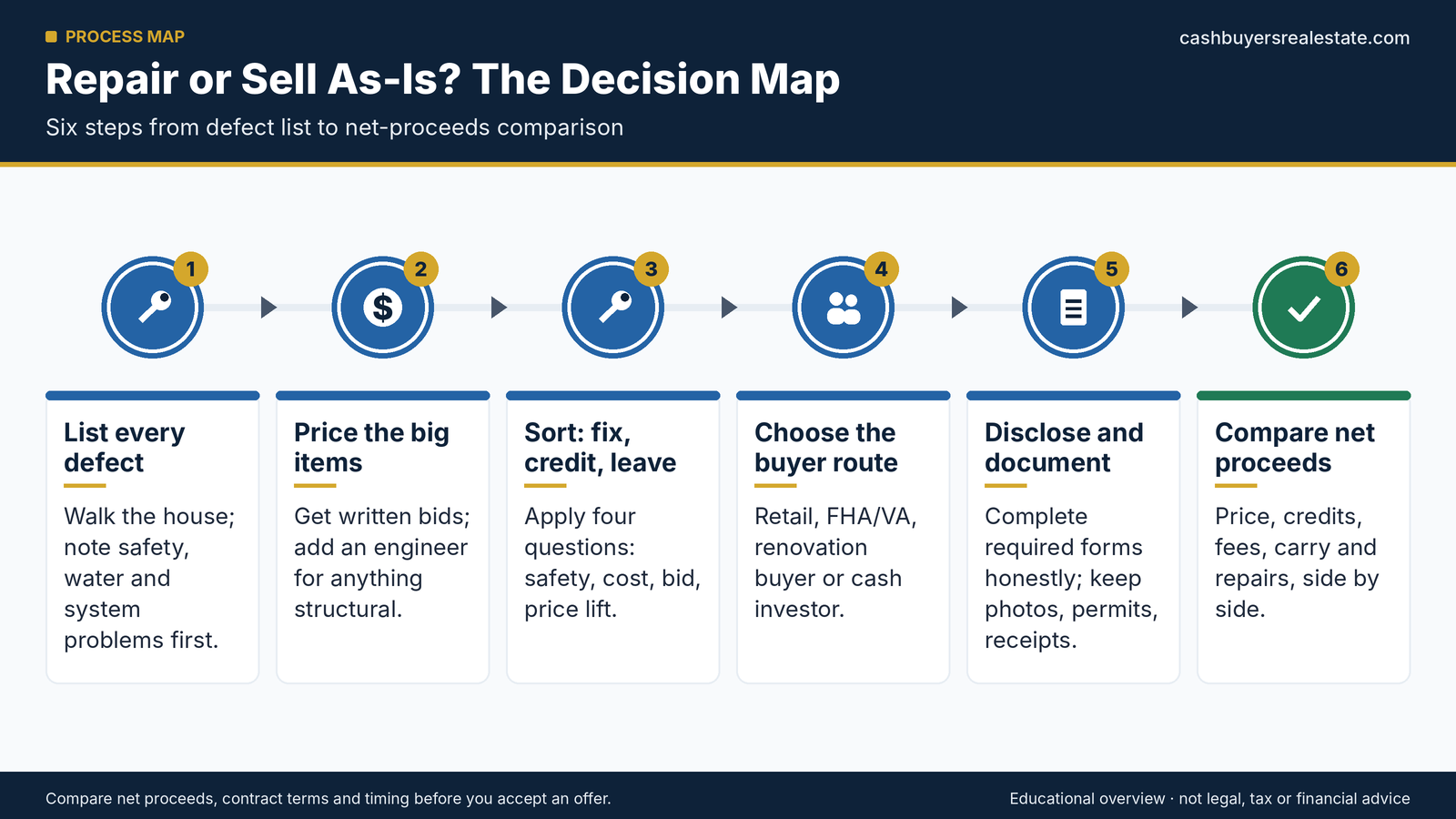
Text version of this infographic
- List every defect — Walk the house; note safety, water and system problems first.
- Price the big items — Get written bids; add an engineer for anything structural.
- Sort: fix, credit, leave — Apply four questions: safety, cost, bid, price lift.
- Choose the buyer route — Retail, FHA/VA, renovation buyer or cash investor.
- Disclose and document — Complete required forms honestly; keep photos, permits, receipts.
- Compare net proceeds — Price, credits, fees, carry and repairs, side by side.
Disclosure Duties That Survive an As-Is Sale
What federal and state law require
The federal baseline: lead-based paint in older homes
Most disclosure law is state law, but one federal rule applies across the country to homes built before 1978. According to the Environmental Protection Agency, sellers of pre-1978 housing must disclose what they know about lead-based paint and lead hazards, including where the paint is and the condition of painted surfaces. They must give the buyer the EPA pamphlet “Protect Your Family From Lead In Your Home,” provide any available records and reports, and include a Lead Warning Statement in the contract. Buyers get a 10-day period to conduct a paint inspection or risk assessment, which the parties can change by written agreement or the buyer can waive. Sellers must keep the signed disclosures for three years after the sale is completed.
EPA lists several exemptions, including housing built after 1977, zero-bedroom units, short leases, certain housing for the elderly or disabled, housing found lead-free, and foreclosure sales. The EPA page notes that a seller who fails to provide the proper information may be subject to penalties. An as-is clause is not on the EPA’s list of exemptions, which means the safe assumption is that the rule applies whether or not the contract says “as-is.” If your house predates 1978, add this to your checklist at the start of the process, since the 10-day window can add time to a sale.
Lead-safe practices apply to repair work too. Disturbing old paint during renovation can create hazards, so hire contractors who follow lead-safe work practices if you repair a pre-1978 home. That is another reason a painting project might not be as simple in an older house as the cost chart suggests.
State patterns: statutory forms and case-law duties
States take different approaches, and three examples show the range. California and Texas require sellers of covered residential property to deliver written disclosure statements, though the details differ. Florida relies primarily on a court-made duty. Other states have their own statutes, some with detailed forms and others with limited requirements. Because the rules and exemptions vary, treat the table as an illustration of different designs, not a survey of all fifty states.
| Jurisdiction | How the duty arises | What the sources show | What it means for an as-is sale |
|---|---|---|---|
| California | Statute (Civil Code 1102 and following) | Section 1102(c) states that any waiver of the article’s requirements is void as against public policy | An as-is clause cannot waive the statutory disclosure |
| Texas | Property Code 5.008 seller’s disclosure notice | Written notice on the prescribed form for residential property with one dwelling unit; delivered by the contract’s effective date; if not, buyer may terminate within seven days of receiving it; completed to the best of the seller’s belief and knowledge; listed exemptions | Notice is required unless an exemption applies; it is not a warranty |
| Florida | Court decision (Johnson v. Davis, 1985) rather than a statutory form | Seller must disclose known facts that materially affect value and are not readily observable; as-is clauses do not remove the duty for known latent defects; buyer must prove actual knowledge | As-is helps on defects you did not know about, not on ones you did |
| Federal (all states) | EPA lead-based paint disclosure rule for pre-1978 housing | Disclose known lead information, give the pamphlet, include the warning statement, allow a 10-day inspection window | Applies regardless of an as-is label unless an exemption applies |
Finding your own state’s rule is usually quick. Start with your state real estate commission’s website, which often links the statute and the approved disclosure form, then confirm with a local real estate attorney or your agent, since forms are revised from time to time and exemptions are specific. If your transaction involves an estate, a trust, a foreclosure, or an unusual buyer, mention that when you ask, because those are the situations where exemptions most often come into play. The point of the examples is not that your state matches any of them. It’s that each of these jurisdictions, with very different designs, ends in the same place for a seller: you can sell without repairs, but you can’t treat an as-is clause as permission to stay silent about what you know. Check your state’s real estate commission, statute, or a local attorney before filling out any form.
Disclosing well
Disclose what you know and document what you did
The standard in most disclosure regimes is knowledge, not perfection. The Texas notice, for instance, is completed to the best of the seller’s belief and knowledge as of the date of signing, and if a required item is unknown, the seller says so. Florida’s case law, as later decisions describe it, requires proof that the seller actually knew of the undisclosed defect, not merely that the seller should have known. In Jensen v. Bailey, a Florida appellate court reversed a judgment against sellers who had checked “no” on a form question about unpermitted work after the trial court found they had no actual knowledge of it, noting that the Johnson decision “does not convert a seller of a house into a guarantor of the condition of the house.”
That doesn’t license willful blindness. If you’ve seen the stain, heard the contractor’s warning, received an inspection report, or filed an insurance claim, you know something, and the form asks about it. The honest, protective approach is to answer from what you know, say “unknown” where it truly is, and attach supporting records. Photos with dates, receipts, permits, inspection reports, warranty paperwork, and insurance claim documents establish what you did and when. Keep your own copy of everything you sign.
Never paint over a stain to hide it, patch a crack to disguise a structural issue, or ask a buyer to waive an inspection while you hold back what you know. Concealment can turn a manageable price negotiation into a fraud claim. Honest disclosure of a problem usually costs a price adjustment; dishonest concealment can cost the whole sale and more.
When a form may not apply and why that is not a loophole
Disclosure statutes often exempt certain transfers. Under the Texas statute, for example, the seller’s notice does not apply to transfers made under a court order or foreclosure sale, by a bankruptcy trustee, to or by a mortgage lender after foreclosure, by a fiduciary administering an estate, guardianship, conservatorship, or trust, between co-owners, to a spouse or lineal relatives, resulting from a divorce decree, to or from a governmental entity, of certain new residences, and in a few other situations. Other states list their own exemptions, and the EPA lead rule exempts foreclosure sales, among others.
An exemption from a form is not the same as permission to hide a defect. An executor or heir who sells an inherited house may legitimately know little about its history, and a statute may excuse them from a long questionnaire, but if they know about a roof leak, a fraud theory doesn’t care which form applied. Exempt sellers are also encouraged to share what they do know, because buyers adjust their offers to the information they have, and a buyer who feels misled after closing is more likely to complain.
If you are selling as an executor, trustee, or guardian, ask the estate’s attorney which disclosures apply, and consider providing what records exist. The guides to selling an inherited house fast and selling a house quickly in probate explain how authority and timing work for estate sales.
How Different Buyers Treat Repairs
Retail buyers with mortgages
Inspections, repair requests, and renegotiation
Most retail buyers hire a home inspector once the contract is signed. The inspection report becomes a negotiating document. The buyer reviews it, decides which items matter, and sends a request: fix this, credit me for that, or reduce the price. In a typical sequence you have a few options for each request. You can agree to the repair, offer a credit in lieu of the repair, offer a smaller concession, or decline. The buyer then accepts, counters, or, within the contract’s inspection or due-diligence period, cancels.
An as-is clause changes this in a specific way: it tells the buyer you do not intend to make repairs or give credits. It doesn’t remove the inspection, and in many contracts it doesn’t remove the buyer’s right to terminate during the inspection window. What it does is set the tone and make clear that the buyer’s alternatives are to accept the condition, negotiate the price, or leave. Savvy buyers account for this by pricing their offers lower from the start, which is why an as-is listing’s early offers often come in below those on a repaired home.
Illustrative example (hypothetical numbers, not market data): A buyer’s inspector lists 12 items. Three are safety-related (a missing stair railing, an ungrounded outlet near the kitchen sink, a dead carbon monoxide alarm) and cost about $450 to fix. One is a roof nearing the end of its life, which a roofer bid at $14,000. Eight are cosmetic or routine maintenance. A reasonable as-is response might be to fix the three safety items immediately, offer a $6,000 credit toward the roof while pointing to your bid, and decline the eight minor items in writing. The buyer gets what matters for safety, you hold your position on price, and the file shows what you did and why.
Several habits keep this stage from derailing a sale. Respond to repair requests in writing and inside the contract’s deadlines, since missing a deadline can sometimes be treated as acceptance or can give the buyer a reason to cancel. Separate genuine safety findings from cosmetic ones, and concede the first before debating the second. Keep the list of agreed items short and specific, so nobody argues at the final walk-through about what “fix the roof” meant. If you’ve commissioned a pre-listing inspection or have repair bids in hand, you can answer with facts instead of impressions.
Lender and appraiser condition rules: FHA, VA, and conventional
A financed buyer brings a second inspector in the form of the lender’s appraiser, and loan programs differ in how much condition they tolerate. The details change over time, so confirm them with the buyer’s lender, but the broad outlines are worth knowing.
FHA. HUD’s Minimum Property Requirements are meant to ensure that properties securing FHA-insured loans are, in HUD’s words, “safe, sound, and secure.” In a May 2026 request for public input, HUD acknowledged that a considerable number of FHA appraisals require a condition for repair or inspection, that repairs can create real costs, and that the agency was asking whether requirements could be streamlined. Comments closed on June 29, 2026, and no final changes were identified at the time this guide was checked. A separate HUD draft summary of proposed handbook revisions described using the Fannie Mae and Freddie Mac condition ratings, with a minimum of C4 for FHA acceptability, but the document showed no effective date, so treat it as a proposal. If an FHA buyer makes an offer on a house with visible defects, repairs and a reinspection may be part of the schedule.
VA. VA-guaranteed loans require that a property be suitable for dwelling purposes under VA’s minimum property requirements. A 2023 Federal Register notice said the agency was seeking comment on whether to replace those requirements with industry condition ratings. VA’s rules can change, so ask the buyer’s lender which version applies to the loan in question.
Conventional loans. Fannie Mae’s Selling Guide rates condition from C1 to C6. A C4 home has minor deferred maintenance from normal wear and tear; a C5 has obvious deferred maintenance and needs some significant repairs; and a C6 has deficiencies severe enough to affect safety, soundness, or structural integrity. Homes rated C1 through C5 are eligible as-is when the existing conditions are minor and do not affect safety, soundness, or structural integrity, while loans on C6 properties are not eligible for sale until the problems are repaired to at least C5. In practice, that means a worn but sound house can often be financed conventionally, while one with a failing roof or structural defect may need repairs or a different kind of buyer.
Cash buyers and investors
How cash buyers price condition
A cash investor’s offer starts from the finished value and subtracts what it will take to get there, as laid out in the guide to how cash offers are calculated. The repair estimate usually includes a contingency, the buyer’s holding and financing costs, resale expenses, and a profit margin. The same house can produce quite different offers depending on whether the buyer plans a cosmetic flip, a full gut renovation, a long-term rental, or a teardown.
For a seller, the practical consequence is that condition shows up in the offer as a lump subtraction instead of a series of line-by-line negotiations. You don’t schedule contractors, wait for inspection reports, or negotiate a credit list, and that’s the value of the route. The price is the difference between the investor’s all-in discount and what the work would cost you to do or credit. The economics of that gap are the subject of the companion guide to the price of a quick home sale, including a worked example and a net-proceeds comparison.
Two cautions apply. First, a cash buyer’s estimate can change after they inspect the house in person, so understand whether the offer is subject to a walk-through adjustment and what triggers one. Second, investors differ widely in experience and funding. Ask for proof of funds, a clear contract, and a neutral closing agent, and see the guide to proof of funds for what to expect.
What a no-repairs contract should still say
Selling as-is to a cash buyer doesn’t mean signing a blank check. A well-drafted contract still needs to address several things, and the gaps are where disputes start.
- The as-is clause itself, stating that the buyer accepts the property in present condition and what, if anything, the seller must do before closing, such as removing trash.
- Inspection or due-diligence terms: how many days the buyer has, what the buyer can do in that time, and under what conditions the buyer may cancel and recover the deposit.
- Price-adjustment limits: whether and when the price may change after the buyer inspects, and what evidence is required.
- Personal property and cleanout: what stays, what goes, and who removes it.
- Condition at closing: whether the property must be in substantially the same condition as at signing, and what happens if damage occurs before closing.
- Disclosures: the forms or statements your state or federal law requires, delivered when required.
- Closing logistics: closing agent, who pays which costs, date, and possession terms.
Have a local attorney or the closing agent look at the contract before you sign, and keep your own copy of everything. The walk-through of the cash home sale process shows where each clause usually sits, and the page on cash home buyer scams lists verification steps for buyers you don’t know. The shorter the contract and the more it relies on handshake understandings, the more reason to slow down.
| Buyer type | How repairs are handled | Rules that apply | What it means for the seller |
|---|---|---|---|
| Retail buyer, conventional loan | Inspection, repair requests, credits, or price cut | Lender’s appraisal and condition ratings; contract deadlines | Most negotiation; best price for a sound, presentable house |
| Retail buyer, FHA or VA loan | Same, plus possible required repairs and reinspection | Program property requirements apply to the loan | Safety and habitability items matter most; ask the lender what is required |
| Owner-occupant with a renovation loan | Buyer plans work and finances it with the purchase | Program rules for the renovation product | Wider buyer pool for fixers; paperwork and timelines can run longer |
| Cash investor | Repairs priced into the offer; sold as-is | No lender standards; the contract governs | Fewer negotiations; discount covers repairs, costs, and margin |
| Builder or developer | Home may be valued mainly as land | Zoning, permits, and demolition rules | Condition matters less than lot and approvals |
The pattern is that the more condition-sensitive the buyer’s financing, the more the repair list affects both price and schedule. Use the table to decide which buyers belong in your marketing plan.
The graphic below compares five practical ways to sell a house that needs work and notes what each is best suited for.
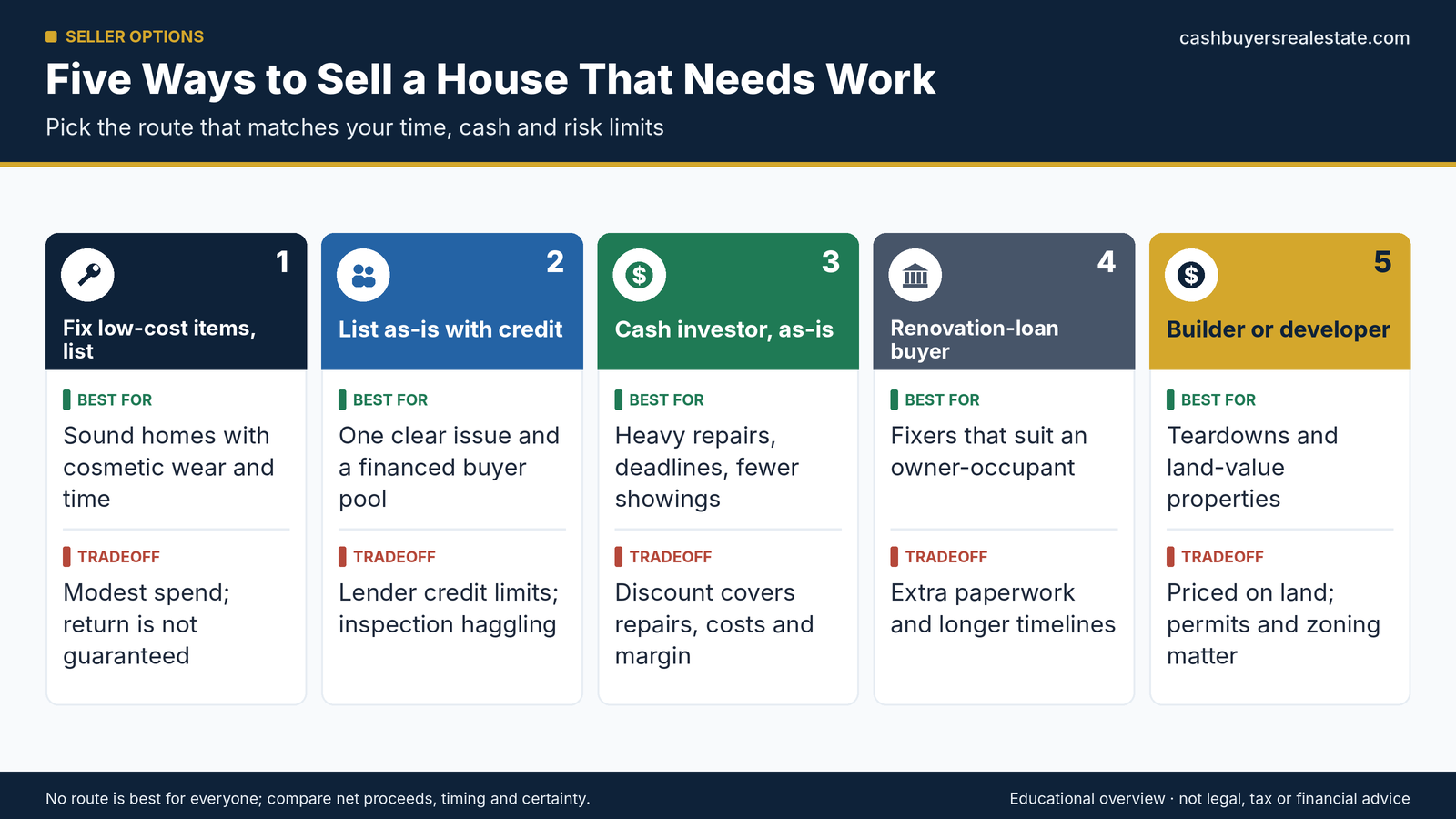
Text version of this infographic
- Fix low-cost items, list — best for: Sound homes with cosmetic wear and time; tradeoff: Modest spend; return is not guaranteed
- List as-is with credit — best for: One clear issue and a financed buyer pool; tradeoff: Lender credit limits; inspection haggling
- Cash investor, as-is — best for: Heavy repairs, deadlines, fewer showings; tradeoff: Discount covers repairs, costs and margin
- Renovation-loan buyer — best for: Fixers that suit an owner-occupant; tradeoff: Extra paperwork and longer timelines
- Builder or developer — best for: Teardowns and land-value properties; tradeoff: Priced on land; permits and zoning matter
Repair Credits, Price Cuts, and Net Examples
How credits and price reductions work
A credit at closing versus a lower price
On paper, a $10,000 credit and a $10,000 price cut leave you with the same cash. In practice they work differently. A price reduction changes the contract price itself. That can affect how the appraisal compares to the price, and it changes any costs calculated as a percentage of price, such as commissions and certain transfer taxes. A credit leaves the price intact and reduces the buyer’s cash due at closing, so the recorded sale price stays higher, which can matter for how the sale appears in neighborhood comparable-sales data.
Lenders limit how much a seller can contribute toward a buyer’s costs, and credits count against those limits. Fannie Mae’s Selling Guide sets maximum interested-party contributions at 3 percent of the price for a principal residence or second home when the loan-to-value ratio is above 90 percent, 6 percent for a ratio of 75.01 to 90 percent, and 9 percent at 75 percent or less, with 2 percent for an investment property. The limits are calculated on the lower of the sales price or the appraised value. Contributions beyond those limits are treated as sales concessions that reduce the price used for the loan. Other loan programs set their own caps; in a 2023 notice, HUD referred to a 6 percent interested-party limit on the sales price for FHA forward mortgages.
If you are weighing a listing against an investor purchase for a house with repair needs, the comparison pages on cash sale versus listing and cash buyer versus real estate agent put the fee and timing differences side by side. The takeaway: if a financed buyer asks for a credit that would exceed the lender’s limit, you may need to restructure it as a price reduction or ask the buyer’s lender what is allowed before you agree. A credit the lender refuses is a concession you thought you gave and the buyer thinks they received, and sorting it out at the last minute is stressful.
Escrow holdbacks, post-closing repairs, and saying no
Some transactions set aside money for a specific repair. A holdback or repair escrow leaves part of the seller’s proceeds with the closing agent until the work is done or verified. Availability depends on the contract and the lender, and not every transaction allows it. A holdback can help when weather prevents work before closing, but it adds complexity and ties up your money.
Buyers can also agree to complete repairs after closing, with no credit, as part of an as-is purchase. Cash investors do this routinely. For a financed buyer, the lender’s requirements still apply, and some repairs may be required before the loan can close.
You may also say no. An as-is seller who declines every request has the right to do so, and the buyer has the right to leave within the contract’s cancellation rights. A flat refusal is a legitimate position when your price already reflects condition. It tends to work best when you’ve been transparent from the start, pre-disclosed the known issues, and priced accordingly. Where it fails is when the buyer finds something new that you didn’t disclose, because the conversation then turns from a repair request to a question of trust.
Worked net examples with hypothetical numbers
A $14,000 roof: fix, credit, or sell as-is
Suppose a house would sell for $320,000 with a sound roof. The roof is near the end of its life, and a roofer quotes $14,000 to replace it. You pay 7 percent in combined commissions and closing costs on a listing, and carrying costs are $1,900 a month. The table compares three paths. All numbers are hypothetical.
| Line item | Replace roof, then list | List as-is, grant credit | Cash investor, as-is |
|---|---|---|---|
| Sale or offer price | $320,000 | $320,000 | $262,000 |
| Roof cost or buyer credit | −$14,000 | −$18,000 | $0 |
| Commission and closing costs | −$22,400 (7%) | −$22,400 (7%) | −$2,620 (1%) |
| Extra carrying costs for repair time | −$2,850 | $0 | $0 |
| Net before payoff | $280,750 | $279,600 | $259,380 |
The first two columns are nearly identical, which is a common result: when repair bids and buyer credits are in the same range, fixing and crediting tend to be roughly even in dollars, and the choice rests on certainty, time, and effort. The credit route assumes the buyer asks for $18,000 against your $14,000 bid, because buyers often add a cushion for hassle and risk. The investor column is lower by roughly $20,000 to $21,000, and that gap is the price of skipping repairs, showings, inspection negotiations, and, in some cases, months of waiting. It might be worth it if the roof is only one of many problems or a deadline looms; it probably isn’t if the roof is the only issue and you have time.
Cosmetic updates and a major structural repair
The break-even formula from the earlier section applies to cosmetic work. Suppose $7,500 of paint and flooring takes three weeks and the break-even lift comes to about $9,500. Ask two agents what comparable updated homes sold for, and compare it with comparable homes in your condition. If the gap is $15,000 or more, the work likely pays. If the gap is $6,000, you’d lose money after you count time and selling costs. The gap you’d gain on its face is not your profit; the formula tells you what you actually keep.
Illustrative example (hypothetical numbers, not market data): A house would sell for $350,000 once a $38,000 structural repair is complete. Contractors warn that costs in similar jobs often run over, so you assume a 20 percent overrun ($45,600), four months of work at $2,100 a month in carrying costs ($8,400), and 7 percent selling costs ($24,500). Net after repair: $350,000 − $45,600 − $8,400 − $24,500 = $271,500. An investor offers $265,000 as-is, with 1 percent closing costs ($2,650), for a net of $262,350. The repair route is ahead by $9,150, but it requires four months of work, exposure to cost surprises, and the risk that the repair uncovers something else. If the overrun were 40 percent instead of 20, the repair route’s advantage would nearly disappear.
That last sentence is the lesson of most big-repair decisions: the nominal advantage is smaller than it looks once you count uncertainty. When the margin is thin, selling as-is to a buyer who accepts the risk can be the better trade. When the margin is wide, and the work is well-scoped by an engineer or contractor, fixing may be worthwhile. Either way, run the numbers on paper before committing money to the job, and compare those numbers with at least one real offer. The guide to selling a damaged house covers severe damage cases in more detail.
Safety, Code, and Permit Problems You Cannot Wave Away
Safety hazards and habitability
Hazards that stop financed sales and worry every buyer
Cosmetic flaws lower a buyer’s offer. Safety problems can end a deal. The difference matters because lenders, appraisers, insurers, and inspectors all treat hazards as a separate category, and many buyers who would shrug at a dated bathroom walk away from a house with an active water intrusion or a scorched electrical panel.
The typical hazards fall into a few groups. Water intrusion covers a leaking roof, damp basement walls, or plumbing failures that have soaked framing, because ongoing moisture leads to rot and mold. Electrical hazards include exposed or overloaded wiring, double-tapped breakers, and equipment that shows heat damage. Heating, ventilation, and fuel-burning appliances matter when a furnace or water heater doesn’t work or vents improperly. Structural concerns include foundation movement, sagging beams, and rot in load-bearing elements. Smaller safety items include missing stair railings, absent or dead smoke and carbon monoxide alarms, and broken stair treads.
The loan standards described earlier explain why these items weigh so heavily. HUD describes FHA’s requirements as aimed at homes that are “safe, sound, and secure.” Fannie Mae’s lowest condition category, C6, is defined by deficiencies serious enough to affect safety, soundness, or structural integrity, and those loans can’t be sold until repairs bring the rating up. VA requires that homes be suitable for dwelling purposes. When a house has a hazard of this kind, its pool of financed buyers narrows and, in some cases, the only workable buyers are those who can pay cash or renovate.
What to do about them depends on the hazard and the fix. Cheap safety items (alarms, railings, covers for exposed wiring done by a licensed professional) are almost always worth doing immediately, both for the buyer and for the safety of anyone walking through during showings. For large hazards, get a professional evaluation, such as a roofer’s report or a structural engineer’s letter, and then choose among repair, credit, price reduction, or an as-is sale to a buyer who can handle it. Whatever you choose, disclose what you know. Hiding a hazard isn’t just a bad negotiating strategy; it can expose you to liability if someone gets hurt or the buyer later proves you knew.
Insurance, utilities, and access during the sale
Condition affects insurance in ways sellers don’t always anticipate. Insurers can restrict or decline coverage on properties with older roofs, outdated electrical panels, or certain plumbing materials, and they may require different coverage for a vacant house than for an occupied one. A buyer who can’t get homeowners insurance usually can’t close on a financed purchase, so insurability is part of marketability. Ask your own insurance agent how the policy treats a vacant or partly renovated home, and ask whether your coverage continues to cover the house until the closing date. If a buyer’s insurer raises concerns, ask what specific repairs or documentation would satisfy them.
Utilities also need attention. Inspectors, appraisers, and lenders generally expect power, water, and heat to be on when they visit so that systems can be tested. A house with utilities shut off tends to produce more cautious inspection reports and slower appraisals. Keeping utilities active costs money, but a delayed appraisal or an incomplete inspection costs more. If the house is vacant, schedule visits so someone can provide access, make sure the property is secure, and keep the heat set to prevent frozen pipes in cold weather.
Finally, watch for the interplay between safety and timing. A repair required by a lender can only be done by a licensed professional in some cases, and the contractor’s lead time becomes part of your closing schedule. The guide on what slows down a home sale explains how these small dependencies add up.
Permits, unpermitted work, and local requirements
Unpermitted work: what Jensen v. Bailey does and does not tell you
Previous owners often did work without permits: a finished basement, a converted garage, a deck, a moved wall. Whether that work is a problem depends on the work, the local rules, and what you know. The Florida appellate case discussed earlier, Jensen v. Bailey, involved sellers who answered “no” on a disclosure form question about unpermitted work. The trial court found they had no actual knowledge of it, and the appellate court ruled that the buyer must prove the seller’s actual knowledge, not merely that the seller should have known.
The lesson is not that ignorance is safe. It is that disclosure obligations hinge on knowledge, and that careful, honest answers matter. If you know or have reason to suspect that work was done without permits, say so. If you do not know, say that, and consider checking the municipal permit history, which in many places is public. An unpermitted addition can affect appraisals, insurance, and title questions, and some appraisers and lenders may not count unpermitted square footage in valuation.
You have several options if you know about unpermitted work. Many jurisdictions have a process to legalize it after the fact, usually through inspection and sometimes by opening walls to show what was done. Requirements and costs vary a great deal, and an unexpected finding can lead to required corrections, so ask the local building department what the process looks like before you commit. You can also disclose the work and adjust your price, or sell as-is to a buyer who accepts the risk. Each route has trade-offs in time and money, and a local attorney or real estate agent familiar with your jurisdiction can help you choose.
Local point-of-sale requirements and code issues
Some cities, counties, and states attach their own requirements to a sale: certificates of occupancy, smoke and carbon monoxide alarm compliance, inspections of sewer laterals or septic systems, energy or water-efficiency disclosures, or compliance with local housing codes. Whether yours does, and what it asks, is a local question that no national guide can answer. Your title company, your agent, or the local building department can tell you what is required in your jurisdiction, and it’s worth asking at the start because a requirement discovered in the last week can derail a closing.
Open code violations deserve their own attention. Notices from a city can come with deadlines and fines, and in some places unpaid fines or abatement costs can attach to the property as liens that the title company will want cleared. If you’ve received any notice, gather it, note the deadline, and ask the issuing office what resolution looks like. A cash buyer may agree to take on a property with violations, but the discount will reflect it. The guide to selling a house quickly with liens explains how recorded claims are handled at closing.
A final thought on timing: jurisdictions differ in how long they take to schedule inspections, issue permits, or provide compliance letters, and those waits are outside your control. When you know a local requirement applies, start early and build the delay into your plan, or choose a sale route better suited to a short timeline. The guide to how fast a house can sell shows how third-party waits shape a realistic schedule.
Pre-Listing Inspections, Bids, and a Defect File
Pre-listing inspections
What a pre-listing inspection can do for you
A pre-listing inspection is a home inspection ordered by the seller before the house goes on the market. It does three useful things. It tells you what a buyer’s inspector is likely to find, so you can decide what to fix, what to credit, and what to leave, with time to get bids. It lets you price the house accurately from day one instead of discovering a $12,000 surprise after a contract is signed. And it can shorten negotiations, because both sides start from the same report instead of arguing over a buyer’s discoveries.
An inspection can also help you separate scary-sounding findings from real ones. Inspectors write long reports, and many items are routine maintenance notes. An inspector’s summary of the major items, with photographs and recommendations, helps you explain the condition to buyers in plain language. Sellers who share the report and the repair bids often find that buyers feel more comfortable making a straightforward offer.
Illustrative example (hypothetical numbers, not market data): A pre-listing inspection finds a slow leak under a bathroom sink that has softened the cabinet floor, estimated at $850 to fix. If it is found first by the buyer’s inspector after a contract is signed, the buyer might ask for a $3,000 credit because the full extent of any hidden moisture is unknown. Fixing it before listing, with a plumber’s invoice and photos in the defect file, removes the open-ended concern for a fraction of the cost. The same inspection might also find items that need no action, which you can leave alone with a clear conscience.
The cost is modest compared with the stakes on a sale of this size, though fees vary by region and house size. Hire a licensed or credentialed inspector where your state requires it, ask for a sample report, and make sure the person has no stake in repairs they recommend. If you’re selling to a cash investor who will do their own walk-through and price the work regardless, a pre-listing inspection may be unnecessary, though a basic evaluation of a major system can still help you judge the offer.
When a pre-listing inspection backfires
The main risk is that findings become knowledge. Anything the inspector reports is now something you know, and disclosure forms ask what you know. That is not a reason to avoid an inspection, because willful ignorance rarely works, but it means you should plan to disclose the report’s material findings and address them. A seller who orders an inspection and then ignores a significant defect is in a worse position than one who never ordered it.
There are practical limits as well. A report from months ago may be stale if conditions changed, and buyers and their lenders often want their own inspections. An inspection can’t reveal everything, especially hidden defects behind walls or underground. And a seller who gets a long list of minor items may feel pressure to fix all of them, which wastes money. Decide in advance what threshold triggers action, such as safety items and anything above a stated dollar amount.
If you decide to skip a pre-listing inspection, consider a narrower evaluation of a major concern instead: a roofer’s opinion, an HVAC technician’s assessment, a plumber’s camera inspection of the sewer line, or a structural engineer’s letter. These targeted reports cost less and give you specific numbers to negotiate with.
Bids and records
Repair bids as price support
Contractor bids turn a vague fear into a number. When an investor’s offer assumes a certain repair budget, your bids give you a basis to question it; when a financed buyer asks for a credit, your bids help you offer a reasonable one. Ask for written, itemized bids from licensed contractors (two or three for any significant work) and be specific about scope, so they are comparable. A bid for “roof repair” and a bid for “full tear-off and replacement with new decking allowance” aren’t the same product.
Keep in mind what a bid is and isn’t. It’s an estimate valid for a limited time, based on what the contractor can see, and it may change if hidden problems appear. Buyers know this, and they may add a cushion. Don’t expect a buyer to accept your lowest bid as the repair value, but do expect a good-faith buyer to engage with the evidence. The guide to the economics of a quick home sale shows how a repair estimate fits into an investor’s offer formula and how to test it.
Bids also protect you in a different way. If you later sell with a repair credit or price cut tied to a documented estimate, you have a record that the concession was based on a professional’s number, not a guess. That can help if there are questions down the road.
Building a defect file buyers can trust
A defect file is a simple folder, paper or digital, that collects what you know about the house’s condition and history. Its purpose is to make disclosure accurate, speed up negotiation, and show good faith. A buyer who sees an organized file tends to trust the seller and may ask fewer questions.
| Document | Why it helps | Where to get it |
|---|---|---|
| Completed disclosure forms and dated photos | Shows what you knew and when; supports accurate answers | State or association forms; your own records |
| Permits and final inspections for past work | Proves work was approved; resolves appraisal and title questions | Local building department; prior owner |
| Receipts and warranties for roofs, systems, and major repairs | Documents age and condition; may transfer to the buyer | Contractors; manufacturers; your files |
| Prior inspection or specialist reports | Gives buyers a baseline; you must disclose material findings | Earlier sale or refinance; inspectors; engineers |
| Written repair bids | Supports credits or price cuts with numbers | Licensed contractors |
| Insurance claim history | Explains past damage; answers a common form question | Your insurer or agent |
| Lead-based paint records (pre-1978 homes) | Required to be provided to buyers of covered housing | Prior tests, remediation records, EPA pamphlet |
Share relevant items with the buyer’s agent when a contract is signed, or earlier if you’re marketing the house with an honest “needs work” message. Keep your own copies indefinitely. Disputes sometimes surface years later, and the paper you saved is your best evidence of what you disclosed and what you did.
The checklist graphic below gathers six checkpoints to review before accepting an offer on a house you are selling without repairs: safety and financing items, disclosures, unpermitted work, buyer type, contract terms, and the net-proceeds math. Each one is explained in the sections above.
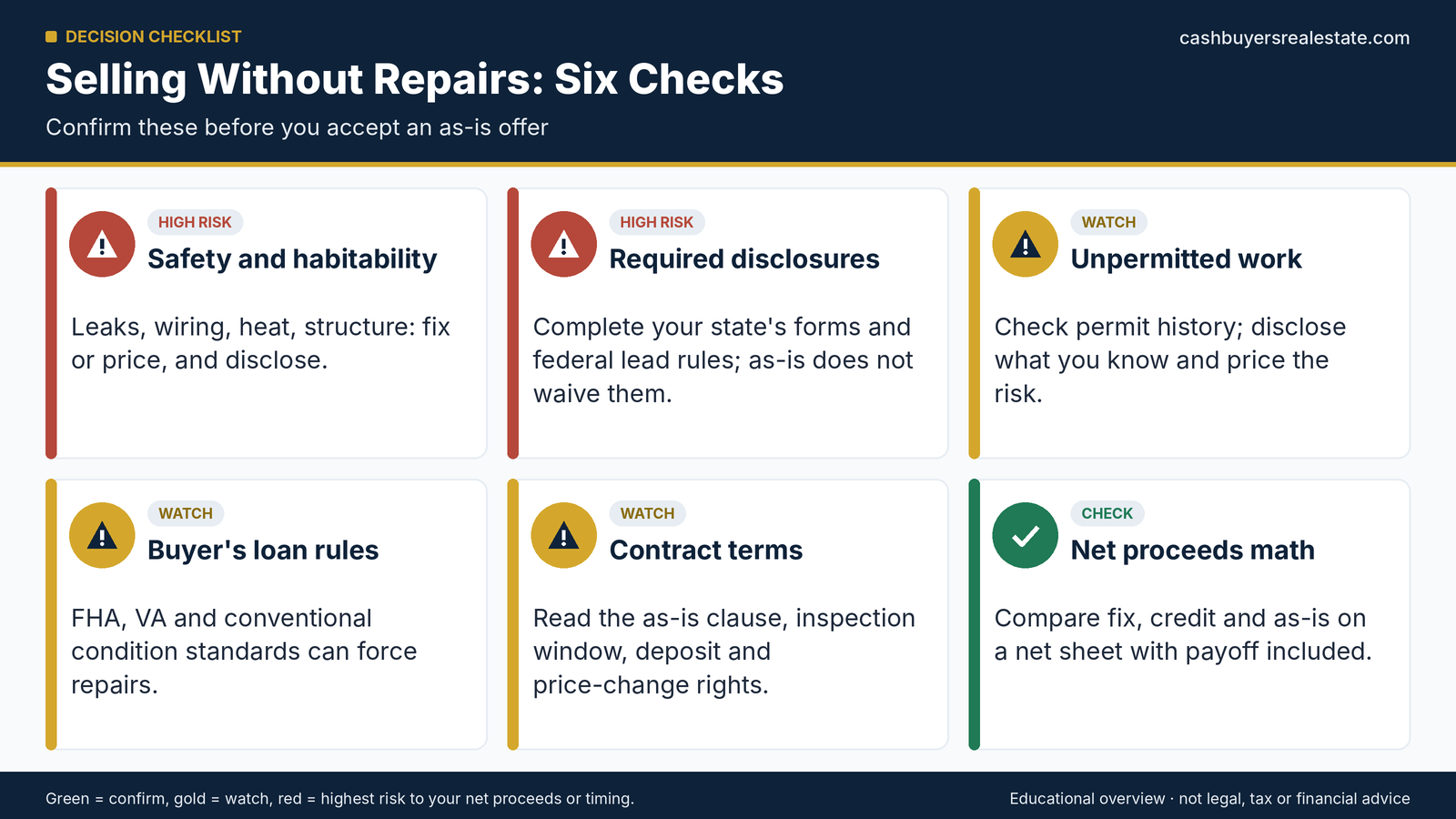
Text version of this infographic
- Safety and habitability — Leaks, wiring, heat, structure: fix or price, and disclose.
- Required disclosures — Complete your state's forms and federal lead rules; as-is does not waive them.
- Unpermitted work — Check permit history; disclose what you know and price the risk.
- Buyer's loan rules — FHA, VA and conventional condition standards can force repairs.
- Contract terms — Read the as-is clause, inspection window, deposit and price-change rights.
- Net proceeds math — Compare fix, credit and as-is on a net sheet with payoff included.
Questions Sellers Ask About Selling Without Repairs
Questions about repairs, price, and offers
Deciding what to fix
- Which repairs are usually worth doing before selling?
Inexpensive, visible items and genuine safety problems tend to earn their keep: paint, cleaning, small plumbing leaks, working smoke and carbon monoxide alarms, and loose railings. Large projects, such as kitchen remodels and additions, rarely return their full cost in national cost-versus-value data. Apply the four questions and the break-even formula in this guide to your own list instead of relying on a general rule.
- Should I replace worn carpet or repaint before listing?
Often yes if the cost is modest and the colors you choose are neutral, because fresh paint and clean floors affect how every buyer sees the house. The test is whether the likely price lift exceeds the cost, the extra carrying time, and the selling costs on the lift. If a quick quote shows the job is large, offering a flooring credit may be simpler than doing the work yourself.
- Does a new roof add its full cost to the sale price?
Usually not in a straightforward way. A failing roof is an objection that can lower offers or block financing, so replacing it can remove that objection, but buyers tend to expect a sound roof as a baseline instead of paying extra for it. Compare the roofer’s bid to what a buyer would likely ask as a credit, as in Table 4, before deciding.
- What if I can’t afford any repairs at all?
Selling as-is is a legitimate choice. You’d disclose what you know, price the house to reflect its condition, and consider a buyer who can handle the work, such as a cash investor or a renovation-minded owner-occupant. Ask your agent or closing agent whether a credit or holdback paid from sale proceeds could work in your transaction, and remember that any such arrangement should be in writing.
Pricing and negotiation
- How much do cash investors discount for repairs?
There is no standard figure. Offers usually reflect after-repair value minus a repair budget, a contingency, holding and financing costs, resale costs, and a profit margin, so the discount typically exceeds the repair bids alone. Ask the buyer to show their assumptions and compare them with your own contractor bids. The companion guide to quick home sale economics walks through an example.
- Is a repair credit or a price reduction better for me?
The dollars may match, but the mechanics differ. A price cut lowers the contract price and the costs calculated from it; a credit keeps the price but is limited by the buyer’s lender on financed purchases. Ask the buyer’s lender what is allowed before you agree, since a credit the lender won’t permit has to be redone as a price reduction.
- Can a buyer back out after the inspection of an as-is house?
Often yes, if the contract gives the buyer an inspection or due-diligence period with cancellation rights. An as-is clause tells the buyer you will not make repairs; it doesn’t necessarily remove the buyer’s right to walk away within the contract’s window. Read the termination language and the deposit refund terms before you sign.
- What if the sale price won’t cover my mortgage payoff?
Then the sale needs your lender’s involvement, because the proceeds must satisfy the loan or the lender must agree to accept less. A short sale is one possibility, and the lender must approve it. Request a written payoff statement early and talk to the servicer or a housing counselor. The guide to selling a house fast with a mortgage explains the options.
Questions about disclosure, loans, and local rules
Disclosure and liability
- Do I have to disclose problems if I sell as-is?
Generally yes, to the extent your state and federal law require it. Examples in this guide show the pattern: California’s statute says waivers of its disclosure requirements are void; Texas requires a written notice unless an exemption applies; Florida’s courts impose a duty to disclose known latent defects despite an as-is clause; and federal law requires lead-based paint disclosures for pre-1978 housing. Ask a local attorney about your state.
- What if I don’t know about a defect?
Disclosure duties are generally tied to your knowledge. Texas’ form is completed to the best of your belief and knowledge and lets you mark items unknown, and Florida’s appellate courts have required proof of actual knowledge. Answer honestly, say “unknown” where it truly is, and don’t avoid learning facts you could easily check in order to protect a later claim of ignorance.
- Can I be sued after closing if the buyer finds a problem?
It’s possible, especially if the buyer alleges you knew of a defect and concealed it or answered a disclosure question falsely. An as-is clause generally does not protect against misrepresentation or concealment. Accurate disclosure, written records, and a clear contract make a claim less likely and easier to defend. Questions about your specific exposure belong with an attorney.
- Do heirs and executors disclose differently?
Sometimes. Some statutes exempt transfers by fiduciaries administering an estate; Texas’ list includes them. An exemption from a form is not permission to hide a known defect, and many estate sellers choose to provide whatever records and observations they have. Ask the estate’s attorney which rules apply, and see the guide to selling an inherited house fast.
Loans, inspections, and local rules
- Can a buyer using an FHA or VA loan buy a house that needs work?
Sometimes, but the property must meet the program’s requirements, and appraisers can require repairs or reinspection before the loan closes. HUD said in 2026 that a considerable number of FHA appraisals require a condition for repair or inspection. Houses with obvious safety issues may fit better with cash or renovation-loan buyers.
- Is a pre-listing inspection a good idea if I’m not repairing anything?
It can be, because it tells you what buyers will find and helps you price and disclose accurately. It also creates knowledge you must disclose. If you plan to sell to a cash investor who will price the work anyway, a targeted evaluation of a major system may be enough.
- Can I sell a house with unpermitted work?
Yes, with accurate disclosure and a price that reflects the risk. Unpermitted work can affect appraisals, insurance, and lender approval. Ask the local building department whether a legalization process exists, and weigh its cost and time against disclosing and adjusting the price or selling as-is to a buyer who accepts the risk.
- How long does a sale without repairs take?
Skipping repairs saves the time of contractors and permits, but title work, payoffs, inspections, and buyer financing still run on their own schedules. Cash buyers can remove the lender’s steps, though not the others. The guide to how fast a house can sell lays out the stages and benchmarks.
Choosing Your Approach and Taking the First Steps
A decision framework: match your situation to a repair strategy
Match your situation to an approach
There isn’t one right answer for every house. The approaches differ mainly in how much time, money, and risk you take on yourself versus pass to a buyer. Use the table to find the row closest to your situation, and treat the trade-off column as a prompt to check numbers.
| Your situation | Approach to compare | Main trade-off | First step |
|---|---|---|---|
| Sound house, cosmetic wear, time to list | Fix low-cost visible items, then list | Small outlay and a few weeks; modest return | Get quotes; run the break-even formula |
| One clear safety or financing problem with a firm bid | Fix it, or list with a documented credit | Money and time versus a narrower buyer pool | Get two written bids; ask a lender what is required |
| Large or uncertain damage | Evaluate first; likely sell as-is to a buyer who can renovate | Bigger discount; fewer showings and negotiations | Order an engineer or specialist report |
| Hard deadline in weeks | As-is cash sale with verified funds and a short contract | Deeper discount; less negotiating room | Request proof of funds and the full contract |
| Tired but sound house, no deadline | List as-is with a pricing and credit strategy | Longer timeline; buyer inspection negotiations | Ask two agents for price scenarios |
| Inherited or estate property with limited knowledge | Disclose what is known; sell as-is; confirm authority first | Probate timing; limited ability to repair | Consult the estate’s attorney on disclosure and authority |
If more than one row fits, compare the two approaches with the same net sheet: price, concessions, commissions or fees, closing costs, carrying time, and repairs you’d pay for yourself.
A final checklist before you commit
Before accepting an offer on a house you are selling without repairs, run through a short list. Each item guards against a specific kind of regret.
- Net proceeds compared. Have you compared at least two routes on a net basis, with carrying time and any repairs included?
- Disclosures complete. Have you filled out every form your state and federal law require, honestly, and kept copies?
- Financing realities checked. If the buyer needs a loan, have you asked the lender what condition standards and credit limits apply?
- Contract terms read. Do you understand the as-is clause, the inspection window, the deposit terms, and any right to change the price?
- Payoff known. Do you have a written mortgage payoff and know about any liens?
- Legal review done. Has a local attorney or the closing agent looked at the contract?
If you can answer yes to each, you’re in a strong position whichever route you choose. If any answer is no, that is where to spend the next day.
What to do next
A first-week plan
You do not need to decide everything at once. The first week is about turning an overwhelming list into a short set of numbers.
- Day 1: Walk the house with a notepad or phone and list every defect you know about, noting which ones affect safety, water, or systems.
- Day 1 to 2: Request a written mortgage payoff statement and check for liens and unpaid taxes.
- Day 2 to 5: Get written bids for the two or three largest items, and a specialist’s evaluation if anything looks structural.
- Day 3 to 5: Ask two agents for price scenarios as-is and with selected fixes, and request one or two written cash offers using the same information.
- Day 5 to 6: Sort the list using the triage table, and build a net sheet for the strongest two or three routes.
- Day 6 to 7: Gather disclosure forms for your state, complete them honestly, and have a local attorney review the contract you lean toward.
If a step takes longer than a week, such as a permit history or an engineer’s appointment, note the date and decide whether it changes the route. A short delay to get a number you can rely on is usually worth it.
Documents to gather and questions to ask
Pull together the deed or title information, your mortgage statement, tax bills, insurance details, HOA contact information, any prior inspection reports, permits, receipts and warranties, and the bids you collect. If the house predates 1978, add any lead-paint records you have and locate the EPA pamphlet your contract must include. If the owner has died, add the court documents that show who can sign.
When you talk with buyers and agents, ask:
- What condition do you assume, and how did you estimate repairs?
- Can the price change after your inspection, and on what grounds?
- If I grant a credit, will the lender allow it, and in what form?
- How long is the inspection or due-diligence period, and what is my deposit exposure?
- Who is the closing agent, and what costs will I pay at closing?
- Which disclosures do you expect from me, and when?
Clear answers, in writing, are a good sign. Vague answers are a reason to slow down and ask again. The overview of selling a house as-is and the national sell house fast hub are good places to compare other routes.