
Sell House Quickly in Probate: Timeline, Costs & Seller Options
A house that belongs to an estate is a strange kind of asset. Someone you cared about has died, the home still needs insurance, taxes, and a lawn mowed, and the family may live in another state. You want to know whether you can sell the house quickly in probate, or whether everything is frozen until a court says otherwise. The honest answer is that probate does not forbid a sale, but it does decide who is allowed to make one and what paperwork has to exist first.
Short answer: a home in probate can often be sold, but only by the person the court recognizes as having authority, usually an executor or administrator holding official letters. Depending on the state and the type of administration, a sale may need no court approval, or it may need the judge to confirm it. Speed is set mostly by when authority is granted, not by how fast a buyer can close.
That distinction explains most of the delays people run into. A cash buyer can close in a short window once the right person can sign, and a traditional buyer can too. What neither can do is skip the step where a court appoints the representative, issues letters, and, in some places, approves the price. So this guide takes the court-process view. It explains who has authority at each stage, which documents prove it, how independent and supervised administration differ, what buyers and title companies require, and what an estate needs in cash while it waits.
Here is what you will find below. First, how authority works: wills, intestacy, personal representatives, and the letters that prove who can sign. Next, the stages of a probate case and what moves the clock, followed by the difference between independent and supervised administration, with examples from Texas, California, and Florida. Then we cover how cash sales, listings, and other routes fit in; what buyers and title companies will ask for; the estate’s cash needs and carrying costs; and the mistakes and red flags that cause trouble. Frequently asked questions and a decision framework close the guide.
If you inherited a house and are weighing what to do with it as an heir, whether to keep it, buy out siblings, or sell, that decision has its own guide: selling an inherited house fast. This article stays with the court process and the authority to sign. For the full range of probate topics, the probate real estate hub and the inherited house hub collect the related guides, and the main sell house fast guide compares every route.
One more framing point. Grief and urgency often arrive together, and some businesses treat that as a sales opportunity. A good process does the opposite: it slows down long enough to confirm authority, compare offers on net proceeds, and keep the estate’s obligations in view. You can still move efficiently. You just want each step to hold up if a judge, an heir, or a title insurer looks at it later.
Who Has the Power to Sell: Authority Before Anything Else
The question that matters first in a probate sale is not price or timing but authority. A buyer’s money is useless if the person signing the contract can’t legally convey the house.
Wills, intestacy and the personal representative
Will or no will: how the court picks the person who can sign
When someone dies owning real estate in their own name, title does not simply pass to the family by default. If there is a valid will, it usually names an executor (some states say personal representative), and a court must formally appoint that person. If there is no will, the person died intestate, and state law sets who may ask the court to become the administrator and who inherits. In both cases, the court’s appointment is what gives one individual the right to act for the estate.
Terminology varies by state, which is a common source of confusion. “Executor” generally means someone named in a will. “Administrator” generally means someone appointed when there is no will or when the named executor can’t or won’t serve. Many statutes use “personal representative” for both. The Uniform Probate Code, a model law drafted by the Uniform Law Commission in 1969 and last amended in 2019, covers wills, intestacy, estate administration and related topics, and a number of states have adopted it in whole or in part. Even in those states, local court rules, forms, and practices differ, so use the model as background rather than as your local rulebook.
The person named in a will is not automatically the person who can sell. The court may need to admit the will, confirm that the named person is qualified, and require a bond or other conditions before issuing letters. The will may also limit or expand powers, for example by giving the executor an express power of sale, which affects whether court approval is needed later. Read the will for those instructions, but don’t treat a copy of the will as proof of authority.
Letters testamentary and letters of administration: proof of authority
The document that proves authority is the court’s letters. In many states, “letters testamentary” go to an executor under a will, and “letters of administration” go to an administrator. The name changes by state, but the function is the same: a certified document from the court stating that this person has been appointed and has stated powers. Title companies, banks, and buyers rely on letters before they will deal with the representative.
California’s Judicial Council form DE-150, “Letters (Probate),” shows what the document contains. It identifies whether the person was appointed as executor or as administrator with will annexed, states whether the person may act under the Independent Administration of Estates Act with full or limited authority, and says that a representative with limited authority is not authorized to take possession of money or any other property without a specific court order. It also includes a certification block in which the clerk certifies that the letters have not been revoked, annulled, or set aside and are still in full force and effect. That last point matters in practice: many title companies ask for a recently certified copy, because letters can be revoked or can expire.
When you see letters, read three things: the type of appointment, the level of authority, and the certification date. A representative with limited powers may be able to run the estate but not to sell the house without further court action. And if the certification is old, expect to be asked for a fresh one. Ordering several certified copies at the outset is a small expense that saves repeated trips to the clerk.
What happens before the court appoints anyone
Can anyone sign a contract before appointment?
In general, no. Until a personal representative is appointed, nobody has clear legal authority to sell estate real property. Heirs and beneficiaries may expect to inherit, but they usually don’t have the power to convey the house on their own while the estate is open, and a named executor typically needs to be appointed first. A contract signed by someone without authority can be unenforceable, can expose that person to liability, and will not survive a title company’s review.
That doesn’t mean nothing can happen early. A named executor, or a family member acting carefully, can usually take protective steps: secure the house, notify the insurance company, keep up mortgage and utility payments where possible, collect mail, and gather documents. Many jurisdictions also offer a special or temporary appointment for urgent situations, such as a vacant house at risk, though availability and standards vary. If the property is deteriorating before the regular appointment is made, ask a probate attorney about the option rather than improvising.
Marketing the house before authority exists is a separate question. Some agents will pre-market a probate property with a clear disclosure that no contract can be accepted until appointment, which can shorten the gap between letters and a signed contract. Others won’t. If you plan to prepare early, make sure nothing you sign binds the estate or you personally, and be wary of anyone who asks you to sign a purchase agreement, a listing agreement with fees, or an option before authority is confirmed. See also preparing for a fast home sale for the non-legal readiness steps.
The authority-documents checklist
Whatever route you choose, you’ll end up gathering the same core set of documents. The table lists what they are, why each matters, and where they come from.
| Document | Why it matters | Where it comes from |
|---|---|---|
| Certified death certificate | Establishes the date of death and starts the process | State or county vital records office |
| Original will and any codicils | Names the executor and may grant or limit powers, including power of sale | Filed with the probate court |
| Court order appointing the representative | Confirms who was appointed and any conditions | Probate court |
| Letters (testamentary or of administration), recently certified | Proves current authority; shows full or limited powers where applicable | Court clerk; order several certified copies |
| Bond, if required | Required unless waived by the will, beneficiaries, or the court | Surety company, through the representative |
| Estate employer identification number (EIN) | Needed for the estate’s bank account and tax filings | IRS, free online |
| Deed or vesting information | Shows how title was held, which affects whether probate applies | County recorder; title company |
| Court order authorizing or confirming the sale, if required | Gives the buyer and title insurer proof the sale is approved | Probate court, after petition and notice |
Use the list as a working folder. A buyer’s title company will ask for most of these anyway, and having them on hand before an offer arrives turns a weeks-long back-and-forth into a few emails. Notice, too, that the IRS lists estates among the entities that need an EIN, so that step is part of the process rather than an optional extra; we return to the estate’s tax paperwork later.
Before moving on, a quick reality check on property that avoids probate. A house held in joint tenancy with survivorship, in a living trust, or with a transfer-on-death deed may pass without a probate case at all. In that situation, the authority to sell comes from the surviving owner, the successor trustee, or the beneficiary named in the deed, with their own documents. If you’re unsure how the house was titled, a title search will show it, and the answer changes your whole plan. The guide to selling an inherited house fast covers those paths from the heir’s side.
Location adds one more wrinkle. Probate is generally handled in the state where the decedent lived, but real estate is governed by the law of the state where it sits. When someone who lived in one state owned a house in another, the family often has to open a second, smaller proceeding in the property’s state before anyone can sell. Lawyers commonly call this an ancillary proceeding, and the terminology and procedures differ by state. If the house is out of state from the main case, ask the attorney handling the estate whether a second filing is needed and who will handle it, because it can add its own weeks or months and its own certified letters.
Probate Stages and Timeline: What Moves the Clock
Probate timelines are the question everyone asks first and the one nobody can answer with a single number. What you can do is understand the stages, know which ones you can influence, and plan around the ones you can’t.
The stages of a probate case, in order
From petition to letters: getting the authority in place
Most probate cases begin with a petition filed in the court for the county where the decedent lived (or, for out-of-state owners, where the property sits). The petition asks the court to admit the will, if there is one, and to appoint a personal representative. It typically lists the heirs and beneficiaries, so far as they are known, and states the value of the estate. California’s Judicial Council petition form (DE-111), for example, asks the petitioner to list heirs and beneficiaries with their relationships and addresses, to request publication of notice in a named newspaper, to say whether bond should be waived or set, and to choose full or limited authority under the Independent Administration of Estates Act.
After filing, the court sets a hearing or processes the matter administratively, depending on the state and whether the case is contested. Heirs and beneficiaries receive notice, and in many places a notice is also published so that unknown creditors and heirs can learn of the case. If no one objects and the paperwork is in order, the court appoints the representative. The representative then takes an oath, posts any required bond, and receives letters. Some states have streamlined or “informal” procedures that move this step through the clerk’s office rather than a judge, while others require a hearing.
This front end is the part you control most. Complete petitions, a correct list of heirs, a valid original will filed promptly, and a proposed bond decision all reduce the chance of the clerk sending the file back. A probate attorney can often tell you how long the local court takes at this step; the court clerk’s office may also publish typical processing times. If the case is contested, whether by a challenge to the will or a dispute over who should serve, the front end can stretch considerably.
Creditor claims, inventory and the claims period
Once the representative has letters, the estate has duties: collect and protect assets, file an inventory, notify creditors, pay valid debts and taxes, and eventually distribute what’s left. Notice to creditors starts a claims period during which creditors can present claims. Florida’s statute is a clear example. Under section 733.702, a claim must generally be filed by the later of three months after the first publication of the notice to creditors or, for a creditor who must be served, 30 days after service. A claim filed after that period is barred unless a court extends it for limited reasons. Florida’s section 733.710 adds an outer limit: two years after death, the estate, the representative, and the beneficiaries generally cannot be held liable for claims, though recorded mortgages and other liens are not affected.
Why does this matter to a seller? Because in most states the claims period does not have to end before a house can be sold, but it controls when proceeds can be safely distributed. A representative who hands out sale money to heirs and later discovers valid debts may be personally responsible. So a quick sale may produce a quick closing but a longer wait for the heirs to see money. If the family expects a check the week after closing, set expectations early.
Inventory and appraisal affect the sale too. Many courts expect a formal valuation of the real property, and in states that require court confirmation of a sale, the appraised value can set a price floor. California’s order confirming a sale, for example, includes a finding that for a private sale the amount bid is 90% or more of the appraised value, as appraised within one year of the hearing. That kind of rule is a reason to plan the appraisal early.
The timeline table and what no one can promise
Probate stages and their effect on selling
The table lists each stage in sequence, what drives its pace, and what it means for a sale. It is qualitative on purpose. Real durations vary by state, county, and case, and the sources opened for this guide did not support any statewide averages.
| Stage | What happens | What controls the pace | Effect on a sale |
|---|---|---|---|
| Preparation | Locate will, gather death certificate, list heirs, secure the house | Family organization and availability of documents | You can prepare to sell but cannot sign a binding contract |
| Petition and notice | Petition filed; heirs and beneficiaries notified; publication where required | Court calendar; accuracy of the petition; any objections | No authority yet; marketing, if any, must disclose this |
| Appointment and letters | Court appoints representative; oath and bond; letters issued | Court processing; bond requirements; contests | Authority exists; scope depends on full or limited, independent or supervised |
| Inventory, appraisal, creditor notice | Assets valued; creditors notified; claims period runs | Statutory claims period; appraisal availability | Sale often possible; appraisal may set price rules; proceeds held |
| Sale and confirmation, if required | Contract signed; court notice and hearing in states or cases that require confirmation | Notice periods; hearing dates; overbid rules | Closing waits for approval |
| Closing and payoffs | Mortgage and liens paid; net proceeds to estate account | Title work; payoff letters; buyer funds | Standard closing steps apply once authority is clear |
| Accounting and distribution | Debts, taxes and expenses paid; heirs receive shares | End of claims period; tax filings; court approval of accounting where required | Heirs usually wait for distribution after closing |
If you take one idea from the table, take this: the stages before “Appointment and letters” are about permission, and the stages after are about money. A buyer can only help with the money.
Why published timeline ranges mislead, and how to plan anyway
You will see confident claims online that probate takes “a few months” or “a year or more.” Treat those with skepticism. Without a source tied to your court, they’re guesses. Case timing depends on whether the will is contested, whether the estate has complicated assets, how busy the court is, whether bond is required, and how quickly the family responds to requests. A simple uncontested estate in one county and a disputed one in the next can be a world apart.
The better approach is to plan in scenarios and ask the people who know. Ask the court clerk how long it currently takes from filing to hearing. Ask a probate attorney in that county how long appointments have been taking and whether the court tends to require confirmation of sales. Then build your sale plan with a cushion and a fallback.
Illustrative example (hypothetical numbers, not market data): Three estates each own a house with a $2,100 monthly carrying cost for taxes, insurance, utilities and upkeep.
Estate A has a clear will, an agreeable family, and appointment arrives within about 6 weeks. A cash buyer is lined up and the sale closes 3 weeks later. Carrying cost during that time is roughly $4,500.
Estate B has no will, three adult children who need to agree on an administrator, and appointment takes about 4 months. Carrying cost before any contract is signed is about $8,400.
Estate C faces a challenge to the will, and the court does not appoint a representative with sale authority for about 9 months. Carrying cost is about $18,900, plus the risk the house deteriorates. The estate may ask the court about a limited early appointment to protect the property.
The point is not the specific numbers, which are invented, but the pattern: a delay in authority costs real money every month, and a plan that ignores it understates the true price of waiting.
The graphic that follows summarizes the sequence in five steps, from confirming authority through closing and distribution. In text: confirm who holds authority and what kind; get letters and the right scope; decide whether the sale needs court approval; line up buyer, title work and payoffs; then close and handle the estate account and distributions.
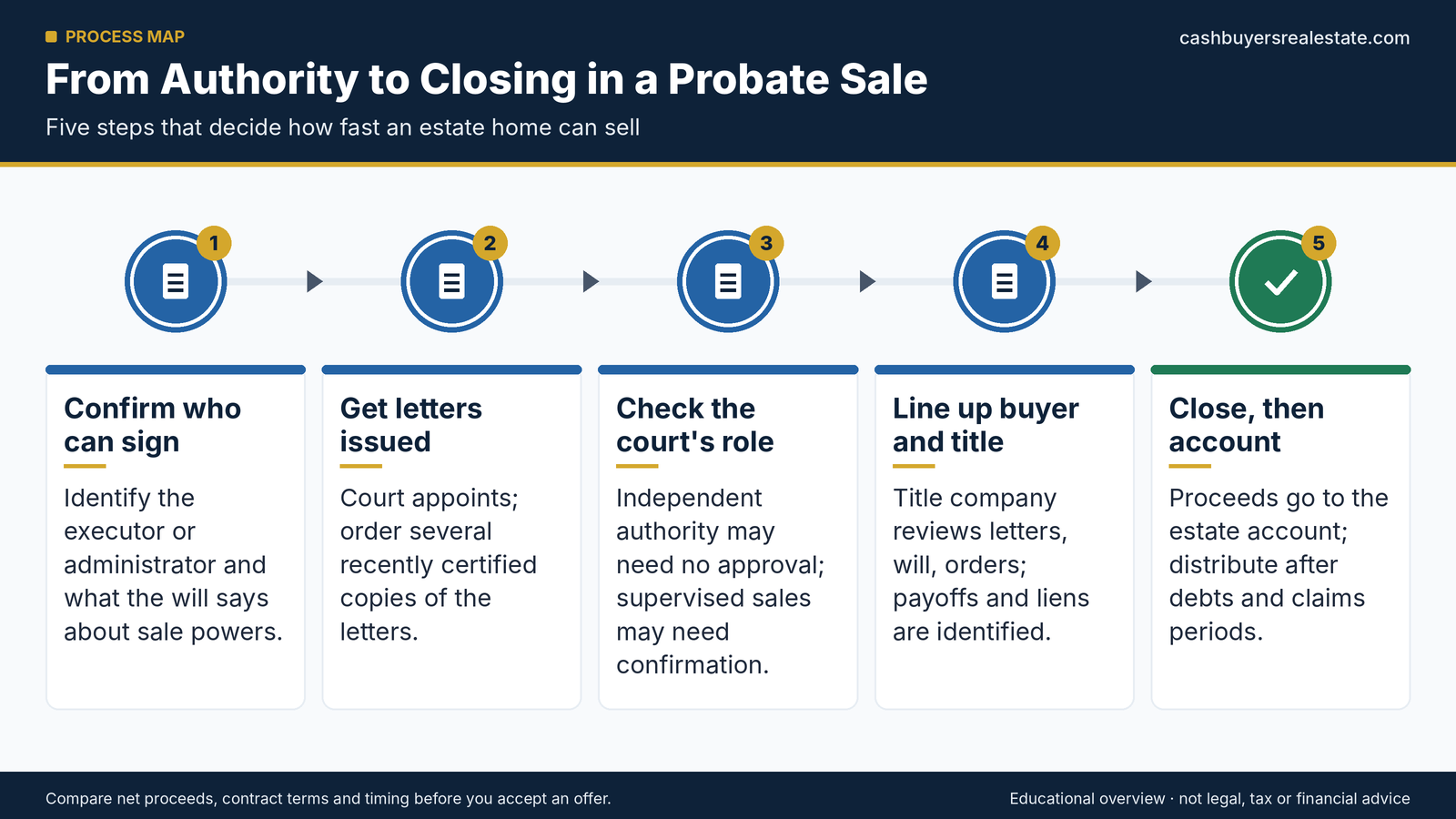
Text version of this infographic
- Confirm who can sign — Identify the executor or administrator and what the will says about sale powers.
- Get letters issued — Court appoints; order several recently certified copies of the letters.
- Check the court's role — Independent authority may need no approval; supervised sales may need confirmation.
- Line up buyer and title — Title company reviews letters, will, orders; payoffs and liens are identified.
- Close, then account — Proceeds go to the estate account; distribute after debts and claims periods.
Independent and Supervised Administration: How the Court’s Role Changes a Sale
Two estates with identical houses can have very different sale processes depending on how much the court stays involved. The type of administration, along with what the will says, decides whether the representative can simply sign or must ask for approval first.
Independent administration and what it allows
Texas, California and Florida: three ways the court’s role can look
Texas is often held up as a state where the court’s role can be light. Under Texas Estates Code section 402.052, an independent executor or administrator may sell estate property, unless limited by the terms of the will, with the same power of sale a personal representative has in a supervised administration but “without the requirement of court approval.” That means a Texas representative in an independent administration can often negotiate and close without asking a judge to approve the contract, which can shorten the schedule once letters are issued. A will can restrict that power, so read it.
California uses a different structure. Its Independent Administration of Estates Act lets a court grant a representative “full” or “limited” authority, and the Letters form (DE-150) records which one. Where authority is limited, the form states that the representative is not authorized to take possession of money or any other property without a specific court order, and for special administrators the form notes that certain real property actions, such as selling, exchanging, or borrowing against it, require court supervision or are not authorized without it. For a seller, the practical lesson is to check what the letters in your hands actually say, not what you assume.
Florida ties the answer to the will. Under section 733.613, if the will gives the personal representative a power of sale, the representative may sell, mortgage, or lease real property without court authorization or confirmation, and the sale is valid. If the will gives no power of sale, the representative may still sell when it is in the best interest of the estate and those interested in it, but “no title shall pass until the court authorizes or confirms the sale.” These three examples are a sample, not a map. Your state may use different terms and different thresholds, and the same state’s rules can change, so confirm with local counsel.
Court confirmation of sale: what California’s order shows
Where court confirmation is required, the sale is not final when the contract is signed. It becomes final when a judge confirms it. California’s Judicial Council form DE-265, “Order Confirming Sale of Real Property,” lays out what the court finds. It states that the sale was legally made and fairly conducted, that the confirmed sale price is not disproportionate to the value of the property, that all required notices were given, and, for a private sale, that the amount bid is 90% or more of the appraised value, as appraised within one year of the hearing. The form also refers to offers that exceed the amount bid by the statutory percentages, which is the overbid process.
For a seller and a buyer, those findings translate into several practical effects. The price has to clear the court’s value test. Notice has to be given to interested persons, which takes time. Another bidder may appear at the hearing and top the offer. And the buyer’s deposit and closing date depend on the court’s calendar. Buyers who are not used to the process may ask for a longer closing window, a lower price to compensate for the overbid risk, or a clause that lets them withdraw if the court does not confirm.
If your state requires confirmation, ask your attorney early whether an overbid process applies, how notice is given, and how long hearings are being scheduled. Then make sure your buyer understands the process before signing, because a buyer who is surprised halfway through is much more likely to renegotiate or walk away.
Supervised versus independent: comparison and consequences
Side-by-side comparison
The table sets the two models next to each other. Terms and rules differ by state, so read it as a general pattern.
| Feature | Independent or unsupervised | Supervised or court-confirmed |
|---|---|---|
| Court approval of the sale | Often not required, unless the will or the court’s grant of authority limits it | Required; the court confirms or authorizes the sale |
| Price rules | Fewer court-set rules; representative still owes a duty to the estate | May require appraisal and a minimum percentage of appraised value |
| Notice to interested persons | Varies; some states require advance notice of the proposed sale | Formal notice and a hearing date |
| Overbid possibility | Generally not part of the process | May apply, as in California confirmations |
| Timeline effect | Closing can follow title work and payoffs once letters exist | Closing waits for the hearing and the order |
| What the buyer needs to see | Letters showing authority; will if it affects power of sale | Letters plus the petition, notice proof and the court’s order |
| Cost and attorney involvement | Usually lower, though counsel is still wise | Higher; petition, notice, and hearing add work |
The comparison does not mean independent is always better. Court supervision can protect a representative from later challenges, and some families prefer that. But for a seller who values speed, the first question to ask counsel is whether your estate qualifies for the lighter process and whether the will or the court has limited it.
Bonds, co-executors and multiple heirs
Three practical issues often come up. The first is bond. A bond is an insurance-style guarantee that the representative will perform the job, and courts often require one unless it is waived. California’s petition form lists common reasons for asking that bond not be required, such as a will that waives bond, adult beneficiaries or heirs who have waived it, or a corporate fiduciary. If bond is required, arranging it with a surety company takes some time and costs money, so start early.
The second is co-executors. When a will names two or more, the default rules on whether they must act together differ by state and by the will’s wording. Some sales require all signatures; others allow one to act. The title company will want to see how the letters read. Disagreement between co-executors is a common cause of stalled sales, and it may require a court’s direction.
The third is multiple heirs. Heirs are not the same as representatives, but their interests matter. Many states require notice to heirs and beneficiaries of the petition and, in confirmed sales, of the proposed sale. Heirs who disagree about selling, about the price, or about who should get the house can object, and an objection can delay confirmation or lead to litigation. A representative who keeps heirs informed in writing, shares appraisals and offers, and documents how decisions were made is far less likely to face a challenge. For sibling disagreements and buyout options, see the heir’s side of the decision.
Cash Buyers, Listings and Other Routes for an Estate Home
Once authority is in place, the sale itself looks a lot like any other, with a few probate-specific twists. The routes below are the ones representatives and heirs most often compare.
Selling to a cash buyer during probate
How a cash buyer fits: speed after authority, not before
A cash buyer does not need a lender’s appraisal or underwriting, so once the representative can sign, the path to closing is often shorter than with a financed buyer. That is a real advantage for an estate paying monthly carrying costs. Cash buyers also often purchase as-is, which can spare a representative from repairs, cleanouts, and staging on a house nobody lives in. For families scattered across several states, a buyer that handles most of the work remotely can be a relief.
What a cash buyer can’t do is create authority. The same letters, the same court rules, and the same title requirements apply. If your state requires court confirmation, a cash buyer must accept the hearing and the possibility of an overbid just like anyone else, and the contract should say what happens if the court declines to confirm. A buyer who says confirmation is unnecessary when your attorney says it is required is giving you a reason to double-check.
Heirs and representatives sometimes receive unsolicited letters or calls from people offering cash for the property soon after a death or a probate filing. Receiving an offer is not a problem in itself, and some of these buyers are legitimate, but nothing obliges you to respond, and no one can lawfully buy the house from someone who lacks authority to sell it. Don’t sign anything, including an “option” or “agreement to negotiate,” until you have letters or a clear legal basis and have had the document reviewed. The guide to cash home buyer scams covers the warning signs, and the cash home buyers hub explains the types of buyers.
Reading an estate offer: net math and verification
As with any sale, compare net proceeds to the estate, not headline price. A cash offer that is lower on paper can come out close to a listing once commissions, repairs, and months of carrying costs are counted. The reverse can also be true, so run the numbers for your own house.
Illustrative example (hypothetical numbers, not market data): An estate receives a cash offer of $215,000, as-is, with no agent commission and about $3,000 in seller closing costs. Alternatively, a listing at $245,000 is expected to sell, with a 6% total commission, $3,500 in seller closing costs, $9,000 in repairs and cleanout, and three extra months of carrying costs at $2,100 a month.
The cash route nets about $212,000. The listing route nets about $211,500: $245,000 less $14,700 in commission, $3,500 in costs, $9,000 in repairs and $6,300 in carrying costs. The numbers are close. Which one is better would depend on risk, such as whether the listing price is realistic and whether the buyer’s financing holds, and on the family’s preferences.
Verification matters more in a probate sale because several parties, including heirs, creditors, and sometimes a judge, may review the transaction later. Ask any buyer for proof of funds in writing (see the proof of funds guide), and confirm the earnest money amount and who holds it. Check that the contract addresses probate specifics: the representative’s authority, any required court confirmation and overbid process, who pays for title work, and what happens to the deposit if the court says no. Close through a neutral title company, escrow company, or attorney. And apply the CFPB’s wire safeguard: never act on wire instructions sent by email, and verify them by phone using a number you already trust.
Watch the pressure level. A buyer who insists you sign today, discourages a lawyer’s review, asks you to deed the house before the estate is settled, or wants an assignment fee hidden from you is signaling a mismatch with what an estate should do. No single behavior proves fraud. A pattern of pushing you around the protections is simply a reason to slow down and compare. The method buyers use to arrive at their numbers is explained in how cash offers are calculated.
Alternatives: listing, buyouts and waiting
Comparing the routes
Cash is one of several options, and for some estates it is not the best. The table lays out the main ones, with attention to how authority and court rules interact with each.
| Route | How authority and the court enter | What drives the timeline | Main trade-off |
|---|---|---|---|
| Cash buyer | Representative signs once letters exist; confirmation if required | Title work, payoffs, any court hearing | Offer is often discounted for speed and as-is condition |
| Listing with an agent experienced in probate sales | Same authority rules; agent may pre-market with disclosure | Marketing time, buyer financing and appraisal | Commissions, repairs and longer carrying costs, with a wider buyer pool |
| Sale or buyout to an heir or family member | Needs authority and often court or heir approval; fair-value concerns | Financing for the heir; agreement among heirs | Family conflict risk; valuation disputes |
| Distribute the house to heirs, who then sell | Court or representative distributes title once the estate is ready | End of claims period and estate accounting | Estate carrying costs continue; heirs share the burden of selling |
| Hold temporarily and rent or wait | Representative manages the asset under court rules | Market timing and landlord workload | Costs, risk and tenant issues; see the tenant guide |
Reading the table, consider which constraint matters most to your estate: cash flow, family harmony, price, or simplicity. A well-organized estate with a lot of equity and little pressure may do well with a listing. An estate paying monthly bills out of a family member’s pocket, with a distant, empty house, may value a firm closing date more.
For broader comparisons that aren’t specific to probate, see cash sale versus listing for a fast sale and cash buyer versus realtor. If the house is occupied by renters, selling a house quickly with tenants explains how the lease interacts with a sale.
Selling during administration or after distribution: and when probate may not apply
There are two timing choices. A representative can sell during administration, using letters, and distribute the net proceeds. Or the estate can distribute the house to the heirs (after claims and taxes are handled), and the heirs can sell together as owners. The first generally shortens the period of estate carrying costs, but it puts the burden on the representative. The second can simplify the sale if the heirs agree, but it may keep the estate open longer.
Some estates qualify for streamlined procedures. Florida’s summary administration statute (section 735.201), for example, allows that route when the value of the estate subject to administration, less exempt property, does not exceed $150,000, or when the decedent has been dead for more than two years. Other states have affidavit or small-estate procedures with their own thresholds, and whether real estate can pass that way differs by state. Don’t assume a house qualifies; ask the court clerk or an attorney. When heirs sell after distribution, the paper trail changes: the deed into the heirs, recorded after the court or representative distributes the property, becomes the starting point for the buyer’s title search, and every heir who holds an interest will need to sign the sale deed. An heir who cannot be located or will not sign can hold up the whole closing, which is one reason representatives sometimes prefer to sell during administration and distribute cash instead. And remember that a house held in a living trust, in joint tenancy with survivorship, or with a transfer-on-death deed may bypass probate entirely, in which case the authority to sell comes from different documents.
If your plan is to sell quickly, the right comparison is between the estate’s total cost of waiting and the price concession a faster route requires. The graphic below sets out five routes, with the kind of seller each fits and its main trade-off. The same information appears in the table above: cash and distribution routes trade price or effort for speed and simplicity, listings trade time and expense for a broader market, and buyouts trade speed for family agreement.
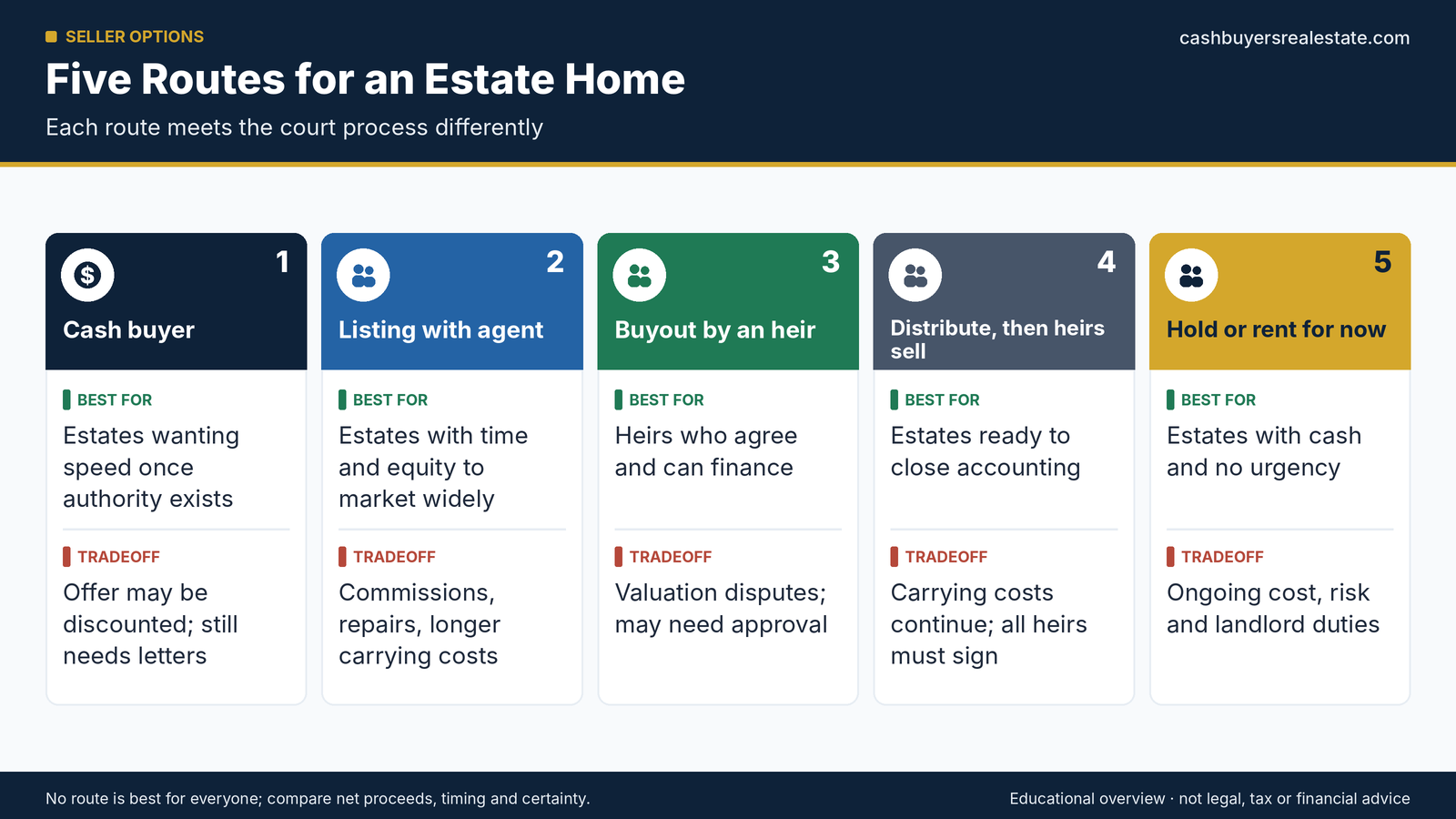
Text version of this infographic
- Cash buyer — best for: Estates wanting speed once authority exists; tradeoff: Offer may be discounted; still needs letters
- Listing with agent — best for: Estates with time and equity to market widely; tradeoff: Commissions, repairs, longer carrying costs
- Buyout by an heir — best for: Heirs who agree and can finance; tradeoff: Valuation disputes; may need approval
- Distribute, then heirs sell — best for: Estates ready to close accounting; tradeoff: Carrying costs continue; all heirs must sign
- Hold or rent for now — best for: Estates with cash and no urgency; tradeoff: Ongoing cost, risk and landlord duties
What Buyers and Title Companies Require in a Probate Sale
A probate sale closes the same way other sales do, with a title company or attorney, a deed, and a settlement statement. The differences are in what the title insurer needs before it will insure the buyer.
Documents and title requirements
The title company’s checklist: authority, estate documents and the commitment
Title insurers want to be sure that the person signing the deed has the power to do so and that no one will later challenge the transfer. In a probate sale, that usually means a certified copy of the letters (often recent), the death certificate, the will and any order admitting it, any court order authorizing or confirming the sale, and proof of the representative’s identity. If the will grants or limits powers, the underwriter may want to read the relevant provisions. If bond is required, they may ask for evidence it was posted. For the estate’s tax identity, the IRS says estates are among the entities that need an EIN, and the estate’s account and filings generally run on that number.
A title commitment is the title company’s statement of what must happen before it will issue a policy. As the American Land Title Association describes the 2016 form, a commitment is an offer to issue a specified policy if its conditions are met, with a part listing requirements and a part listing exceptions. In a probate sale, the requirements will almost always include proof of the representative’s authority, and they may include recording a certified copy of the letters or the court order with the deed. Ask the title company early which exact documents it wants, and in what form, so the representative can order them while the contract is pending.
Unrelated liens and problems found in the title search are handled the same way as in any sale. A recorded judgment against the decedent, an unpaid tax lien, or an old unreleased mortgage can all appear. Several of these have their own rules in an estate, since creditors’ claims and liens are different things: Florida’s statutes, for instance, say that the two-year claims bar does not affect a recorded mortgage or security interest. For the mechanics of paying liens at closing, see selling a house quickly with liens and the title problems hub.
Seller disclosures and the representative’s limited knowledge
Representatives often did not live in the home and may know little about its condition. Many states recognize this: some exempt estates or fiduciaries from seller disclosure forms, while others allow a limited form saying the seller has no personal knowledge. Rules differ, so ask your attorney or agent what your state requires. Even where a form is not required, a representative must not conceal defects they know about, and a buyer’s inspection rights still apply.
Be careful about statements regarding things you haven’t verified. If you haven’t been inside the house in years, say so rather than guessing at the age of the roof or whether there was a leak. Share what the estate has: inspection reports, repair receipts, utility bills, and anything the decedent left behind. The more the buyer knows up front, the less likely it is that a late discovery will lead to a renegotiation or a claim.
Contents are another practical issue. Furniture, papers, and personal property belong to the estate and may be spoken for by heirs or specific bequests in the will. Before you agree to deliver the house empty or “broom clean,” confirm who is entitled to what, document what you remove, and keep valuables and important papers safe. A contract that gives the buyer the contents should be cleared with the heirs first.
Title insurance and buyer concerns
Why buyers worry about probate sales, and what reassures them
Buyers sometimes hesitate over probate properties because of a few fears: that an heir who wasn’t notified will appear later, that creditors will make claims against the property, that the person who signed lacked authority, or that the court will undo the sale. Good process answers each fear. Proper notice to heirs and creditors, letters in full force, the right level of court involvement, and a title policy backed by a reputable insurer are the signals that matter.
State law can add protection for buyers. Florida’s section 733.613, for example, provides that when a sale is made under a specific power of sale in a will or under a court order, the buyer or lender takes title free of estate creditors’ claims and of beneficiaries’ interests, while prior mortgages and liens remain, and that no bona fide purchaser is required to examine the proceedings before an order of sale. Not every state has the same rule, but the principle is common: when the process is followed, a purchaser can rely on the court’s order and the representative’s authority.
Owner’s title insurance is a separate layer. The CFPB explains that a lender’s policy protects only the lender, and that an owner’s policy is what protects the buyer’s own equity. A buyer who is paying cash may choose to buy an owner’s policy for exactly that reason, and the title company will tell you who customarily pays for it in your area. For a representative, a clean title commitment and a title policy issued to the buyer are the best evidence that the sale was done right.
Mortgages, liens and taxes attached to the property
A house in probate often carries a mortgage, and the loan doesn’t pause because the borrower died. Interest, taxes, and insurance continue, and the lender expects payments or a plan. Ask the servicer how it handles successors and personal representatives, and request a payoff statement in writing once a sale is in view. The mechanics are covered in the guide to selling a house fast with a mortgage. Property taxes and association dues also continue and become liens if unpaid.
Equity matters here too. If the home is worth more than all of the debts against it, the sale pays the mortgage and liens and the rest goes to the estate account. If the debts exceed the value, the representative faces harder choices and should get legal advice before signing anything, because the estate’s other assets and creditors’ rights come into play. Note also that tax and lien rules are different for each category of claim: a creditor’s claim against the estate is not the same as a recorded lien on the house, and each follows its own rules.
Keep the paper trail. Save the letters, the court orders, the payoff letters, the title commitment, and the final settlement statement together. The representative may be asked to account for the sale to the court, to heirs, or to the IRS, and a complete file makes that straightforward.
Estate Cash Needs, Carrying Costs and Paperwork While the House Waits
A house in probate is both an asset and a bill. While the case moves forward, the property keeps generating costs, and the estate’s other obligations accumulate. Understanding the cash side helps you decide how much speed is worth.
Paying for the house during probate
Carrying costs and who pays them
The ordinary costs of owning a house don’t stop at death. Property taxes, homeowners insurance, utilities, lawn care, snow removal, minor repairs, and any mortgage payments continue. If the estate has liquid funds and a representative with authority, those costs are paid from the estate. If it doesn’t, because the bank account is frozen pending appointment or there was little cash to begin with, family members often advance the money. If you do, keep receipts and tell the attorney, since reimbursement from the estate is usually possible when expenses are reasonable and documented, but it isn’t automatic.
Insurance deserves special attention. Many standard homeowners policies restrict or end coverage when a house sits vacant for an extended period, and the rules differ by insurer and policy. A vacant estate home with lapsed coverage is a serious risk. Call the insurance company, tell them about the death and the vacancy, and ask in writing whether the policy still applies and whether a vacant-property policy or endorsement is needed. Also arrange for someone to check the property regularly, keep the heat or air conditioning at a safe level, and manage mail.
The law gives representatives some room to protect property before a sale. Florida’s statute on the right to possess estate property, for example, says that real property other than protected homestead is treated as assets in the representative’s hands for payment of devises, claims, and expenses, and allows the representative to take possession of property that appears to be protected homestead and is unoccupied, for protection while its status is determined. Your state’s rules may differ, but the principle is common: the representative has both the authority and the responsibility to preserve the asset. That responsibility is one reason a delayed sale has a real cost.
Estate cash needs and the cost of delay
The estate has its own expenses on top of the house. These typically include funeral and last-illness costs, debts, taxes, court fees, attorney fees, appraisal fees, and sometimes bond premiums. A house is often the largest asset, but it can’t be spent until it’s sold, so an estate with little cash may need a sale to pay what it owes. In that situation, paying a price discount for speed may make sense. In an estate with plenty of cash and no pressure, patience and a wider market might serve the heirs better.
| Expense category | When it arises | Usual source of funds |
|---|---|---|
| Funeral and burial costs | At death | Estate assets or family advances, reimbursed if allowed |
| Court filing fees, publication, bond premium | At petition and appointment | Family advances or estate funds once available |
| Attorney and appraisal fees | Throughout the case | Estate, subject to court rules on fees where they apply |
| Mortgage, taxes, insurance, utilities, upkeep | Monthly or on due dates, starting at death | Estate account after appointment; family advances before |
| Valid creditor claims and final taxes | During the claims period and at filing deadlines | Estate assets, including sale proceeds |
| Costs of sale: title, recording, any commission | At closing | Deducted from sale proceeds |
Add up the monthly carrying costs and multiply by the months you expect to wait, then compare the total to the discount a faster route would require. That number is not the whole decision, but it keeps the trade-off honest. A $1,500 discount to save two months at $2,100 a month is a different proposition than a $20,000 discount for the same two months.
Taxes and paperwork the representative handles
EIN, Form 56 and the estate account
An estate is treated as its own taxpayer for many purposes, and it needs its own identification number. The IRS includes estates among the entities that need an employer identification number (EIN), and says an EIN can be obtained free directly from the IRS online; it also accepts applications on Form SS-4 by fax or mail, with the IRS noting that faxed requests receive a response in about four business days and mailed ones take about four weeks. With the EIN, the representative opens an estate bank account. Sale proceeds should go into that account, not into a personal account, and estate money should never be mixed with the representative’s own.
The IRS also provides Form 56, Notice Concerning Fiduciary Relationship, which notifies the agency of the creation or termination of a fiduciary relationship. A representative typically files it so the IRS knows who is acting for the estate. Your attorney or tax preparer can tell you when and how to file, and whether any state notices apply.
Keep records from day one: a ledger of every receipt and payment, copies of bills and receipts, and a log of significant decisions such as why one offer was accepted over another. If the representative is later asked to account, in court or to heirs, those records are the proof of careful work. The same is true for the sale: save the appraisal, the offers, the listing agreement or buyer’s contract, and the final settlement statement.
Closing proceeds, creditors and distribution timing
When the sale closes, the settlement agent pays off the mortgage and liens and pays the net proceeds to the estate account. At that point the money belongs to the estate, not to the heirs, until the representative has handled debts, taxes, and expenses. In states with a creditor claims period, like Florida’s three-months-from-publication rule, a representative who distributes too early can be exposed if valid claims later surface. Many attorneys therefore hold back a reserve or wait until the claims period closes.
Heirs sometimes expect the closing to produce a check within days. Set expectations early, in writing, about the difference between closing the sale and distributing the money. A short update letter that says what happened, what remains to be done, and the likely order of events costs nothing and prevents most disputes.
Tax questions also arrive here. IRS Publication 551 says that, generally, the basis of property inherited from a decedent is its fair market value at the date of death, or on an alternate valuation date if the personal representative chooses it. That often limits the taxable gain on a prompt sale, but the details depend on valuation, ownership structure, and holding costs, and some states have their own estate or inheritance taxes. These are the topics of the guide on selling an inherited house fast, and a CPA or tax attorney should confirm how they apply to your estate. The estate’s final income tax return and any estate tax filings also run on their own timelines.
Timeline, Scenarios and Mistakes in a Probate Sale
Putting the pieces together, the best way to see how a probate sale unfolds is through scenarios. The three below are hypothetical and qualitative on purpose, since the actual timelines depend on the court and the facts.
Three scenarios: named executor, no will, multiple heirs
A named executor and an intestate estate
Illustrative example (hypothetical, not a prediction): Scenario 1, a named executor. A woman dies leaving a short will naming her son as executor and giving him power to sell real property. He lives out of state. He hires a probate attorney, files the petition with the original will, and the court appoints him with letters. Because the will grants a power of sale and his state allows independent administration, he can sign a sale contract without asking the court to approve the price. He orders several certified copies of the letters, obtains an EIN, opens an estate account, and chooses a cash buyer who will purchase as-is. The title company asks for a recently certified copy of the letters and a copy of the will. The sale closes, and the net proceeds go into the estate account until debts and taxes are settled. He keeps copies of the settlement statement, the payoff letters, and the contract in the estate file, and sends the siblings a short written update after closing.
What makes Scenario 1 move is the combination of a named executor, a will with express powers, and an independent process. If the will had given no power of sale, or the state required confirmation, the same estate would take longer. If the executor had tried to sign a contract before appointment, the title company would have rejected it.
Illustrative example (hypothetical, not a prediction): Scenario 2, no will. A man dies without a will. His two adult children agree that the older sibling will petition to be administrator. The court appoints her after notice to the heirs. Because the state requires court confirmation of a private sale in this type of administration, she lists the house with an agent who explains the process. The buyer’s contract states that it is subject to court confirmation and that overbids may be presented at the hearing. The hearing is scheduled after the required notice period. No overbid appears, the court confirms, and the sale closes shortly afterward.
Scenario 2 shows the cost of confirmation: a longer path, a hearing, and a clause that protects the buyer if the court declines. It also shows what keeps it manageable, which is agreement among the heirs from the start and a buyer who understands the process before signing.
Multiple heirs who disagree, and what stretches the calendar
Illustrative example (hypothetical, not a prediction): Scenario 3, multiple heirs. A man dies with a will that leaves the house equally to four children and names two of them as co-executors. One lives in the house, one wants to sell immediately, one wants to keep it, and one is unreachable. The co-executors disagree, and the resident heir refuses access for an appraisal. The court is asked to resolve who may act, and the sale waits. Meanwhile, taxes and insurance continue, and the estate’s account is nearly empty. After a mediated agreement, the co-executors both sign a sale contract, the resident heir moves out on a set date, and the unreachable heir is served through the court’s notice process.
Scenario 3 is the pattern behind most long delays: disagreement over who decides, no access to the property, and a missing party. Others include a contested will, a lack of bond, an incomplete heir list, a missing original will, creditor disputes, title defects discovered late, and a court that is slow to schedule hearings. The remedies are procedural and legal, not just practical, which is why having an attorney involved before disputes harden is usually cheaper than after.
For the general causes of delay that apply to any sale, see what slows down a home sale. For a compressed timeline once authority is in place, selling a house in 30 days shows what is realistic, and if the property is also at risk of foreclosure because the mortgage fell behind, selling before foreclosure explains the timing issues.
Mistakes, red flags and when to hire a probate attorney
Acting without authority and other common mistakes
Most probate sale problems come from a few repeated errors, and the most expensive is acting without authority. The table pairs each with the more careful approach.
| Mistake | Why it causes trouble | Safer approach |
|---|---|---|
| Signing a sale contract before appointment | No authority; contract may be unenforceable and the title company will refuse to insure | Wait for letters, or ask counsel about a limited early appointment |
| Assuming the will’s executor can sell immediately | The court must appoint and may limit powers | Read the letters for the type and scope of authority |
| Skipping court confirmation where it is required | Title may not pass; the sale can be set aside | Ask counsel whether confirmation applies before signing |
| Distributing sale proceeds too early | Valid creditor claims may surface; the representative can be exposed | Wait out the claims period or hold a reserve |
| Mixing estate money with personal money | Looks like misuse and makes accounting difficult | Open an estate account with the EIN |
| Clearing out the house without a plan | Heirs may claim items; valuables and papers can be lost | Inventory contents, photograph them and agree in writing with heirs |
| Letting the house sit uninsured or unmonitored | Vacancy can limit coverage; losses may not be covered | Notify the insurer and ask about vacant-property coverage |
If any row looks familiar, pause before taking the next step. The cost of fixing most of these after the fact, including reopening a closed sale, defending a claim, or paying back distributed money, is far higher than the cost of asking first.
Red flags and when to call counsel
Probate sales draw some predictable problems from the outside. Be cautious about any buyer or intermediary who wants you to sign before appointment, who suggests that court approval is unnecessary when your attorney says it is required, who asks for a deed to the property or a power of attorney before closing, or who pushes you to avoid a lawyer or title company. Treat unsolicited offers that arrive within days of a death with the same patience. None of these behaviors proves bad faith by itself, but together they are reasons to slow down.
Hire a probate attorney in the decedent’s state when the will is contested or missing, when heirs disagree, when the estate may be insolvent, when the sale price must be approved by a court, when a bond is required, when there are tax or lien complications, or when you are unsure what your letters allow. Many attorneys offer an initial consultation, and some work on flat fees for straightforward estates. If cost is a concern, the court’s self-help center or a local legal aid organization may help with basic questions, though they can’t always give case-specific advice.
Before the final sections, here is the checklist that sums up the six checks most worth running before you accept an offer on an estate home: authority and letters, the level of court involvement, title and liens, the buyer’s verification, the estate’s cash position, and the creditor and distribution timeline. The graphic below shows each as a quick check, and the preceding sections explain every one.
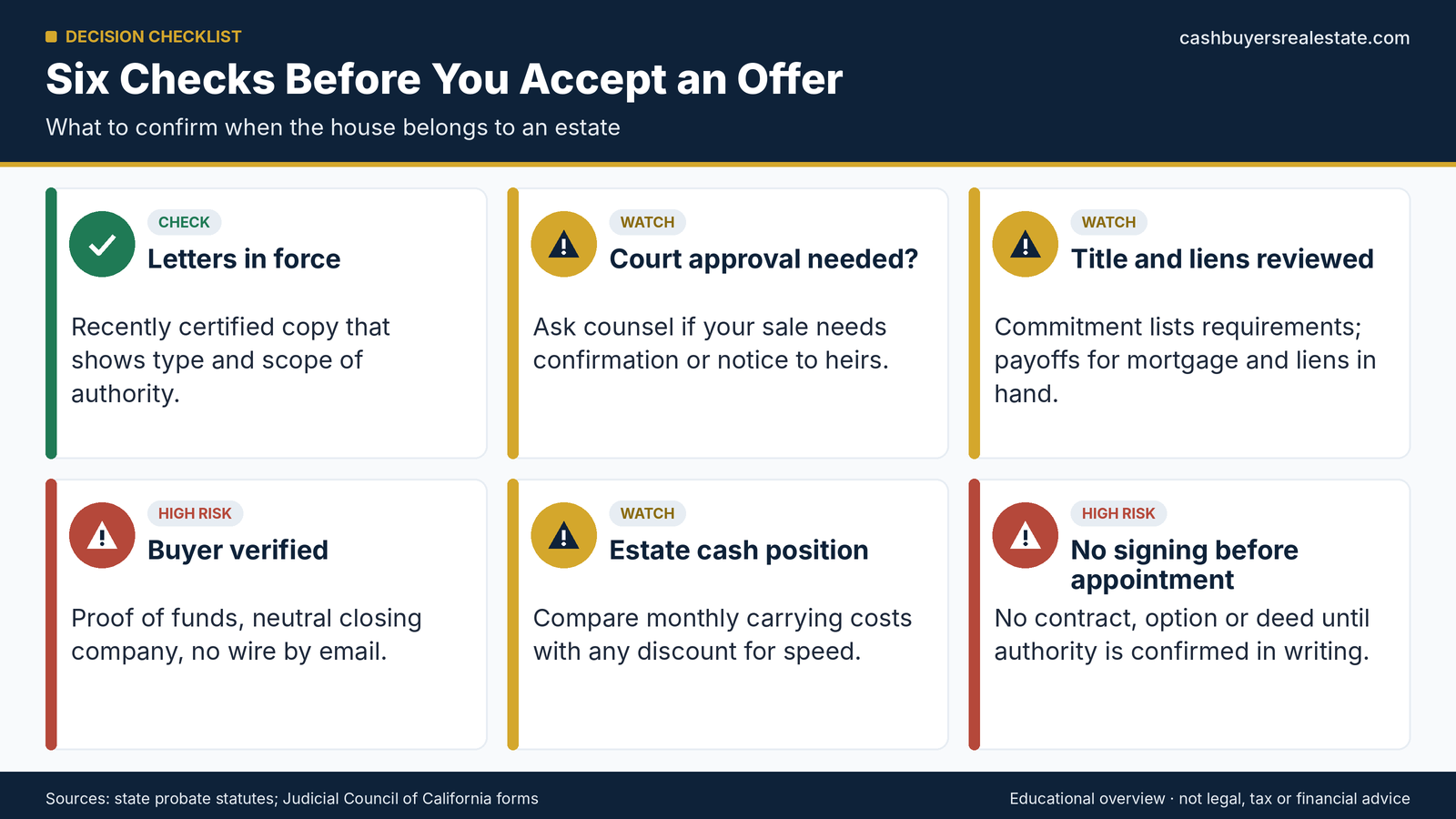
Text version of this infographic
- Letters in force — Recently certified copy that shows type and scope of authority.
- Court approval needed? — Ask counsel if your sale needs confirmation or notice to heirs.
- Title and liens reviewed — Commitment lists requirements; payoffs for mortgage and liens in hand.
- Buyer verified — Proof of funds, neutral closing company, no wire by email.
- Estate cash position — Compare monthly carrying costs with any discount for speed.
- No signing before appointment — No contract, option or deed until authority is confirmed in writing.
Questions Representatives and Heirs Ask About Probate Home Sales
These answers are brief and general. Probate rules vary by state and by county, so use them to know what to ask, and confirm the specifics with the court or an attorney.
Authority, the court and timing
Questions about authority and the court
- Can a house be sold while it is in probate?
Usually yes, by the personal representative once the court has appointed one and issued letters. Whether the court must also approve the sale depends on your state, the type of administration, and what the will says. Nobody else, including heirs who expect to inherit, can normally sell estate real property on their own while the estate is open.
- Can I sign a contract before the court appoints a representative?
It is risky and often ineffective. Without appointment there is generally no one with authority to convey estate real property, and a title company will not insure on that basis. Ask an attorney about a limited early appointment if the property is at risk, and avoid signing listing or purchase documents until authority is confirmed.
- Does a judge always have to approve the sale?
No. Some estates are administered independently, and a representative may sell without court approval, as the Texas Estates Code allows for independent executors unless the will limits the power. In other situations, such as a Florida will with no power of sale, no title passes until the court authorizes or confirms the sale. California confirmations include notice and an appraisal-based price test.
- What are letters, and why does every buyer ask for them?
Letters are the certified court document showing who has been appointed and what powers the person has. Buyers and title companies need them to be sure the signature on the deed is valid. Expect to be asked for a recently certified copy, so order several when the court issues them.
Questions about timing and cost
- How long does probate take before I can sell?
There is no reliable single answer. The time to appointment depends on the court, whether the will is contested, and how complete the paperwork is. Ask the court clerk and a local probate attorney for current experience in your county, and plan with a cushion rather than a promise.
- Will selling the house end the probate case?
No. A sale converts the house to cash in the estate account, but the case usually remains open until debts, taxes, and expenses are handled and the assets are distributed. Selling can reduce carrying costs and simplify distribution, but it doesn’t close the estate by itself.
- Who pays the property taxes, insurance and utilities while we wait?
The estate pays them once there is an account and a representative to pay from it. Before then, family members often advance the money. Keep receipts, tell the attorney, and ask whether reimbursement from the estate is permitted. Also check that the homeowners policy remains valid while the house sits empty.
- What happens to the mortgage on an inherited house in probate?
The loan stays in place and the lien remains. Interest and escrow items continue, and at a sale the mortgage is paid from the proceeds like any other lien. Ask the servicer for a written payoff statement and for how it deals with a personal representative. The guide to selling fast with a mortgage explains the mechanics.
Buyers, heirs and proceeds
Questions about buyers and offers
- Will cash buyers purchase a house that is in probate?
Many buyers do, but each one must wait for the representative’s authority and any required court approval. Compare offers on net proceeds, speed after authority exists, and how the contract handles confirmation and title requirements. Verify the buyer’s funds and use a neutral closing company.
- Why did I get offers right after the death?
Some buyers and marketers contact families soon after a death or a probate filing. An offer isn’t an obligation, and you do not have to respond. Do not sign anything until authority is confirmed, and have any document reviewed by an attorney.
- Can I accept an offer that is subject to court approval?
Yes, where confirmation is required, contracts are usually written that way. Make sure the contract states the buyer’s deposit treatment, the closing date after approval, and what happens if the court declines or an overbid appears. A buyer unfamiliar with the process may need an explanation.
- Do I need a probate attorney to sell?
Not in every case, but most representatives benefit from one, particularly for the petition, the scope of authority, and any court confirmation. A flat-fee consultation can tell you whether your estate is straightforward. Hire one right away if the will is contested or heirs disagree.
Questions about heirs and proceeds
- Do all the heirs have to agree to the sale?
Not necessarily. The representative has legal authority, but heirs must receive whatever notice the law requires, and objections can slow or stop a sale where court approval applies. Keeping heirs informed in writing, and sharing appraisals and offers, lowers the risk of disputes.
- When do the heirs get paid?
Usually after the sale closes and the estate has paid its debts, taxes, and expenses, and the claims period has run where one applies. Florida, for instance, sets claim deadlines by publication and service dates. A representative who pays out too early can be exposed to later claims.
- What if the heirs live in other states?
They can usually participate by signing documents before a notary and by phone or video. The representative’s authority is what matters for the sale, and the court notices go by mail. A local attorney in the state of probate can coordinate, and remote cash buyers often handle out-of-state heirs routinely.
- Can one of the heirs buy the house?
Often, yes, but it raises fairness issues because the representative owes a duty to all beneficiaries. Courts may require an appraisal, notice to the other heirs, or approval. The practical path is an independent valuation, written consent of the other heirs, and counsel’s review.
Choosing a Route and Taking the First Steps
With the court process in view, the choice between routes becomes more concrete. You are matching three things: the authority you actually hold, the cost of waiting, and what you are willing to trade for speed.
A decision framework: match the route to your estate
Authority, pressure and priority: which route fits
Start by deciding where your estate sits on each of three questions. Do you already hold letters, and with what scope? Is the estate under financial pressure, or can it carry the house for a while? And is your priority speed, price, or family agreement? The table pairs common answers with routes worth comparing.
| Your situation | Routes worth comparing | Watch out for |
|---|---|---|
| Letters in hand, independent authority, pressure to close | Cash buyer with a firm date; listing if equity and time allow | Buyers who ignore title requirements; discounts that exceed the carrying costs saved |
| Letters in hand, court confirmation required | Listing or cash offer written subject to confirmation | Overbid risk; buyers who cannot wait for the hearing |
| Authority not yet granted | Prepare and gather documents; protect the property; consult counsel | Signing anything before appointment |
| Heirs disagree or the will is contested | Attorney-led resolution first; sale after authority is clear | Delays; carrying costs; claims against the representative |
| Little cash in the estate | Faster sale route; family advances with documentation | Paying too steep a discount; insurance gaps |
| Small estate or non-probate transfer | Streamlined procedure or direct sale by the new owner | Assuming a house qualifies without checking your state |
The table is a prompt, not a ruling. A probate attorney in your state can tell you which row you are in and what the local court expects, which will change the answer more than any national rule of thumb.
When to wait, and when to get legal help first
Waiting is the right call more often than people expect. If authority isn’t granted yet, you can’t sell, so use the time to prepare: gather documents, secure and insure the house, collect repair and maintenance records, and compare how local agents and buyers handle probate sales. If a will contest or a sibling dispute is brewing, resolving it comes first; a sale cannot fix it, and a rushed sale may deepen it.
Get legal help before acting when you are unsure about any of the following: whether the will is valid, whether you are the right person to serve, what your letters allow, whether court confirmation applies, how heirs must be notified, or whether the estate can pay its debts. These questions are cheaper to answer at the start than to unwind later. Remember that the goal is a sale that stands up when the court, an heir, a creditor, and a title insurer all look at it.
The bottom line is that a probate sale can move quickly once the legal foundation is solid, and it moves slowly or fails when it is not. Speed comes from preparation, not shortcuts.
A realistic plan has a rhythm. In the first weeks, the work is legal and organizational: find the will, talk to the attorney, secure the house, and file the petition. Between filing and appointment, the work is preparation, with documents gathered, an appraisal arranged if one will be needed, and contact made with a title company and one or two candidate buyers or agents so they know what the process will require. After letters issue, the work shifts to the transaction itself: contract, title commitment, payoffs, and, where required, notice and a hearing. The last stage is the estate’s: closing the account, paying what is owed, and distributing what remains. Seeing the plan in those four phases makes it easier to explain to heirs who are waiting and to buyers who need a date.
What to do next, and what to ask
First steps and documents
- Locate the original will and the death certificate, and keep the original will safe until it is filed with the court.
- Consult a probate attorney in the state where the decedent lived or the property sits, and ask about timelines, authority, and court confirmation.
- Secure the house, change or re-key locks if appropriate, redirect mail, and notify the insurer about the death and vacancy.
- List the heirs and beneficiaries with contact information, and decide who will communicate with them.
- Gather the deed, mortgage statements, tax bills, HOA information, and any liens or notices on the property.
- Photograph the house and contents, and inventory valuables and papers.
- Once appointed, order several certified copies of the letters, obtain the estate’s EIN, and open an estate account.
- Request a title commitment and written payoff statements so you know what must be paid at closing.
For the cost side, the net proceeds calculator and the guides on seller closing costs and closing costs in a fast home sale help you build the worksheet. To see how the closing itself works, read about the cash home sale process. For area-specific information, the local pages apply where available.
Questions to ask buyers, the title company and your attorney
- Ask the buyer: Do you understand that the representative’s authority and any court confirmation are required? What are your terms if the court declines or an overbid appears? Can I see proof of funds? Who is the closing company?
- Ask the title company: Which authority documents do you need, and how recent must the certified letters be? Is any court order required before you will insure? What do the requirements in your commitment say about the estate?
- Ask your attorney: What authority do my letters give? Is court confirmation required for this sale? When can proceeds be distributed? What records should I keep as representative?
- Ask the court clerk: What is the current processing time for appointments? What forms and fees apply? Are there self-help resources for representatives?
Keep every answer in writing and in one file. A representative who can show what was asked, what was learned, and why a decision was made is well protected. To explore the broader category, return to the probate real estate hub or the sell house fast guide.