
Sell House Quickly with Tenants: Timeline, Costs & Seller Options
You own a house with someone else’s life inside it. The tenant pays rent, has a lease or a verbal understanding, and may not be thrilled to hear that the place is for sale. You, meanwhile, have a reason to move quickly: a mortgage you’re tired of carrying, a move of your own, a repair bill, a tax bill, or just the end of your patience with being a landlord. The question is whether you can sell a house quickly with tenants still in place, or whether you must first get them out.
Short answer: yes, you can usually sell a house with tenants in it, and you often don’t have to wait for them to leave. In most places the existing lease continues after the sale, so the new owner takes over as landlord. How fast it goes depends on the type of lease, your tenant’s cooperation with showings, your state and local landlord-tenant rules, and whether the buyer wants a rental or a vacant home.
That answer hides a lot of mechanics, and this guide is about the mechanics. Selling a tenant-occupied property quickly is less about marketing and more about three things: understanding what the lease and the law require of you, keeping the tenant informed and reasonably cooperative, and matching the property to the kind of buyer who can actually close on it. An investor who wants rental income can treat a good tenant as an asset. A buyer who plans to live in the house usually needs it empty at closing, and that is where most of the friction, cost, and legal risk shows up.
You’ll find the rules and decisions laid out in the order most sellers meet them. First, what happens to a lease when the property is sold, and how to read your tenant’s lease status. Then the practical side of showing an occupied home, including the entry-notice rules that apply in a few example states. After that, what happens to the security deposit and the rent at closing, and what buyers ask to see. We compare routes (investor, owner-occupant, vacant delivery), look at voluntary move-out agreements and why eviction rarely speeds a sale, then cover local tenant laws, the federal foreclosure rule for tenants, and the mistakes that sink deals. Frequently asked questions and a decision framework close the guide.
A note on scope. If your main questions are about the economics of selling an investment property, including income valuation, depreciation, and tax on the gain, those belong in the guide on selling a rental property fast. This article stays with the lease and the law: who has what rights, who must give what notice, and how to keep a deal from tangling in tenant issues. For the broader category of tenant situations, the tenants hub collects related guides, and the main sell house fast guide compares every route to a quick sale.
Two principles are worth carrying through every section. The first is that a tenant is a person with legal rights, not an obstacle, and treating those rights seriously is the fastest way to avoid delays, disputes, and penalties. The second is that you should compare net outcomes. A cash buyer that takes the house as a rental with the lease intact, an owner-occupant who needs it vacant, and a waiting strategy that lets the lease run out will all produce different dollars and different dates.
What Happens to a Lease When the Owner Sells
Before any marketing, you need a clear idea of what the sale does and doesn’t do to the tenancy. This is the question tenants ask first, and it’s the one that determines which buyers are realistic.
The default rule: the tenancy continues after the sale
Why a sale doesn’t automatically end the lease
As a general rule, a lease is a property right, not just a personal promise between two people. When you sell, the buyer takes the property subject to the existing tenancy and steps into your shoes as landlord. The tenant keeps the right to stay through the lease term, pays rent to the new owner, and holds the same rights against the new owner that it held against you. You can’t end a fixed-term lease early simply because you’ve found a buyer, and the buyer can’t either unless the lease or the law provides a way.
You can see this continuity in the way state laws handle the security deposit. Texas provides that when an owner’s interest is terminated by sale, the new owner is liable for returning the tenant’s deposit and must give the tenant a signed statement acknowledging that it has acquired the property and is responsible for the deposit. Florida requires deposits and advance rent to be transferred to a new owner with an accounting. Minnesota lets the former landlord either transfer the deposit to the successor or return it, and gives the successor the landlord’s rights and obligations. None of these rules would be needed if a sale ended the tenancy.
Exceptions and wrinkles exist. Some leases contain a clause that lets the landlord end the lease on sale, though courts and statutes in some places limit whether such a clause can be enforced, and many jurisdictions require just cause for ending a tenancy at all. And a month-to-month tenancy can be ended by either side with proper notice, which can look like a sale-triggered exit even though the sale isn’t legally the reason. The safe working assumption is that the lease continues unless a lawyer who knows your jurisdiction tells you otherwise.
Reading the lease itself: clauses that matter at sale
Your lease is the first document a buyer or title company will ask for, so read it as they will. Start with the term: the start date, the end date, and any renewal or holdover language. Next, check the rent amount, due date, and any prepaid rent. Look for the security deposit amount and where it is held. Find the access clause, which usually gives the landlord a right to enter on notice for showings and repairs, subject to state law. Check for a sale or early termination clause, an option to purchase or right of first refusal in the tenant’s favor (rare in single-family leases, but it happens), and any rent concessions, such as free months or reduced rent in exchange for repairs.
Pay special attention to anything that is not in the lease. Verbal promises to a tenant (“you can stay as long as you like,” “I’ll fix the roof by spring”) can be enforceable depending on the state and the circumstances, and buyers will ask whether any exist. If the tenant has paid a pet deposit, a cleaning fee, a key deposit, or last month’s rent, those amounts need to be tracked, because each may have to be credited or transferred at closing.
Finally, check whether the lease is signed by everyone living there and whether the people living there match the people named. Unlisted occupants, subtenants, and roommates who moved in later complicate everything from showings to possession. If you discover them now, you can address them while you still have time. If a buyer’s inspector discovers them, you will be negotiating from behind.
Lease status decides your options
Fixed term, month to month, and no written lease
Three basic tenancies cover most situations. A fixed-term lease runs for a set period, such as twelve months, and generally can’t be ended early by the landlord without cause. A periodic tenancy, usually month to month, renews automatically and can be ended by either party on notice. And an informal or oral arrangement sits somewhere in between, often treated as periodic by default, though the rules differ by state and you shouldn’t assume without checking.
For periodic tenancies, notice rules are set by statute. Florida’s statute, in the version posted by the state legislature in 2026, requires not less than 30 days’ notice before the end of any monthly period to end a month-to-month tenancy, and 7 days before the end of a weekly period. Other states set different periods, and some cities require a specific reason. Ending a month-to-month tenancy only to deliver a vacant house raises its own question in places with just-cause rules, so look up the local rule before you send a notice.
The takeaway for a fast sale: month-to-month is the most flexible status for a seller who wants a vacant home, but even there, the notice period is a floor on the timeline. A fixed-term lease with a long time left is the least flexible, but it can be attractive to an investor buyer who wants the income. And a missing written lease is a risk for everyone, because the buyer cannot verify the terms. Where possible, document the arrangement in writing before you list.
The lease-status decision table
Use the table to find the row that matches your situation. It describes general patterns, and your jurisdiction’s rules can change the details.
| Lease status | What usually happens on sale | Effect on speed | What buyers tend to ask |
|---|---|---|---|
| Fixed term with many months left | Lease continues; new owner becomes landlord | Fast with an investor buyer; slow or impossible for a buyer needing possession | Copy of lease, rent history, deposit amount, tenant’s payment record |
| Fixed term ending soon | Lease ends on its date unless renewed or converted to month to month | Often a natural exit; some sellers simply wait or decline to renew | Whether renewal is planned, and what the holdover rules are |
| Month to month | Continues until either side gives proper notice | Flexible; notice period sets the earliest vacant date | Whether notice has been given and whether local rules require a reason |
| Oral or no written lease | Usually treated as periodic; terms hard to prove | Uncertainty can slow or lower offers | Written statement of rent, start date, deposit, who lives there |
| Tenant behind on rent or in a dispute | Lease continues; remedies run through the lease and court process | Can stall showings and reduce the buyer pool | Ledger, notices sent, any filings or agreements |
| Subsidized or voucher tenancy | Lease continues; the housing agency’s rules may add steps | Depends on the program’s paperwork for a change of owner | Program contract, inspection status, who the agency contact is |
Read it this way: the faster the tenancy can end or be handed over cleanly, the more buyer types you can reach. If you have a month-to-month tenant who is cooperative, you have choices. If you have a long fixed term and an unhappy tenant, your best audience is probably investors who will keep the lease and the rent.
Showing an Occupied Home: Entry Notice, Access and Tenant Cooperation
Showings are where tenant-occupied sales most often get stuck. You can’t sell what buyers can’t see, and you can’t make buyers see it on your schedule without respecting the tenant’s right to the home. The solution is almost always a combination of following the law to the letter and making the process easy for the person who lives there.
What the law usually allows
Entry-notice rules differ by state: three examples
Most states regulate when and how a landlord may enter a rented home, and showing the property to prospective buyers is typically a recognized reason. The details vary a lot, including the amount of notice, whether it must be written, the hours entry is allowed, and the penalties for getting it wrong. A few states don’t set a statutory notice period at all and leave it to the lease and a standard of reasonableness. The only safe approach is to look up your own state’s rule.
| State | What the statute says about showings | Other features |
|---|---|---|
| Florida (§ 83.53) | Tenant may not unreasonably withhold consent to entry to exhibit the unit to prospective or actual purchasers | The statute defines “reasonable notice” as at least 24 hours for repair entries; entry at reasonable times; emergency entry allowed |
| Washington (RCW 59.18.150) | Tenant may not unreasonably refuse a set time when at least one day’s notice of intent to enter to exhibit the unit has been given | Two days’ written notice for most other entries; notice must state time or window; no abuse of access |
| Minnesota (§ 504B.211) | Showing to a prospective buyer is a permitted purpose; good-faith effort to give at least 24 hours’ notice | Entry generally between 8 a.m. and 8 p.m.; tenant can’t be required to waive the notice right; remedies include rent reduction and up to a $500 civil penalty per violation |
Use the table as a reminder of how much the rules can differ, not as a substitute for your own research. In all three examples, entry for showings is allowed, notice is expected, and the tenant has remedies if the landlord ignores the process. Some cities add their own rules on top of the state’s.
Lease clauses, local rules and the limits on landlord access
Your lease probably contains an access clause that mirrors or promises something close to the statute. If the lease requires more notice than the statute, follow the lease. If the lease gives you less than the statute does, the statute usually controls, and a clause waiving a tenant’s statutory protections may be unenforceable. Minnesota’s statute, for instance, says a tenant can’t be required to waive the notice right as a condition of a lease. Other states have comparable rules, but you need to check them.
Practical limits matter as much as legal ones. Entering when the tenant isn’t expecting you, bringing strangers through at odd hours, putting a lockbox on a door the tenant uses without asking, or letting an agent photograph personal belongings without permission can each create a complaint, a retaliation claim, or a tenant who stops cooperating. Washington’s statute specifically bars a landlord from using access to harass the tenant, and similar principles exist elsewhere.
Keep a log. Record each notice you send (date, method, what it said), each showing (who attended and when), and any objections or rescheduling requests. If a dispute arises, a simple, consistent record shows you acted in good faith. Also remember that fair housing and anti-retaliation laws apply: don’t treat a tenant differently because of a protected characteristic, and don’t take adverse action against someone for asserting their rights. If a tenant has complained about conditions, speak to an attorney before you do anything that could look like payback.
Getting cooperation without pressure
Practical showing arrangements that tenants can live with
Most tenants cooperate when they know what to expect. Offer a predictable schedule rather than constant interruptions. Group showings into a few fixed windows, such as two evenings a week and a weekend morning, and give at least the legally required notice for each. Limit open houses, which put many strangers in someone’s home at once. Where it makes sense, use professional photos and a video walkthrough so serious buyers see the house before they visit, which cuts down on casual viewings.
Respect the tenant’s daily life. Avoid early mornings and late evenings, accommodate shift work and children’s schedules where you can, and let the tenant choose to be present or not. Ask in advance about pets, since a dog that barks at strangers or a cat that slips out the door can ruin a showing. If the house is cluttered, a polite request for tidying is reasonable, but the tenant isn’t obligated to stage it. A tenant who is asked nicely often does more than one who is told.
Some landlords offer a small incentive for cooperation, such as a modest rent credit, a gift card, or a cleaning service before photos. That is a business decision, not a legal requirement, and it should be documented in writing so it isn’t misread as a rent change or a lease modification. Keep it voluntary and proportional. An incentive that looks like a payment to leave, or a threat to withhold something if the tenant says no, moves you into the territory covered in the section on voluntary move-out agreements.
Communicating with the tenant: what to say, when, and in writing
Silence causes more trouble than bad news. Tell your tenant as soon as you decide to sell, preferably before a sign goes up or a stranger knocks. A short written notice works better than a phone call alone, though you can do both. It should cover several points, and a clear message prevents most of the confusion that turns into a dispute:
- That you intend to sell, and that the lease remains in effect (if that is the case in your jurisdiction).
- That rent continues to be due on the same terms and should still be paid to you until you notify the tenant of a new payee in writing.
- How showings will work: days, time windows, how much notice you’ll give, and who will attend.
- Who to contact with questions or to reschedule, and how quickly you’ll respond.
- That the security deposit stays protected and will be handled as the law requires at closing.
Update the tenant at each milestone. When you have an accepted contract, say so. When the closing date is set, give it. When ownership changes, make sure the tenant receives written notice identifying the new owner, how to pay rent, how to reach the new landlord for repairs, and, in states that require it, a statement acknowledging responsibility for the deposit. Texas requires the new owner to give the tenant a signed statement to that effect. A tenant who has been kept informed is far less likely to refuse access, withhold rent, or call a lawyer.
It may help to picture the first message. A good one is short and plain: it says you’ve decided to sell the house, that the lease and the tenant’s rights stay in place, and that rent continues exactly as before. It lists the proposed showing windows and asks the tenant to say which ones are a problem. It gives one name, a phone number and an email address for questions. And it ends by saying you’ll send an update when there is an accepted offer. What it leaves out matters just as much: no hints about the tenant moving, no mention of what a buyer might do, and no deadlines the lease doesn’t create.
A follow-up message after an accepted contract should confirm the expected closing date and what changes for the tenant, which is usually the name of the landlord and the place to send rent. If the buyer plans repairs or inspections that need access, say so in advance and offer dates. If the tenant raises a concern, answer in writing and keep the answer factual. These small habits are cheap, and they build the record that protects you if a tenant later claims they were left in the dark.
Don’t put anything in a notice you couldn’t defend in front of a judge. Avoid threats, deadlines to move out that the lease doesn’t support, and statements about what the buyer will or won’t do. If you’re not sure what you can say, have an attorney review the notice. The graphic below summarizes the sequence most tenant-occupied sales follow, from reading the lease to handing the tenancy to the new owner; the steps are repeated in text right after it.
In short: read the lease and confirm its status; notify the tenant in writing; schedule access within the legal notice rules; choose the route and buyer type that fits the lease; and complete the deposit, rent, and notice handoff at closing.
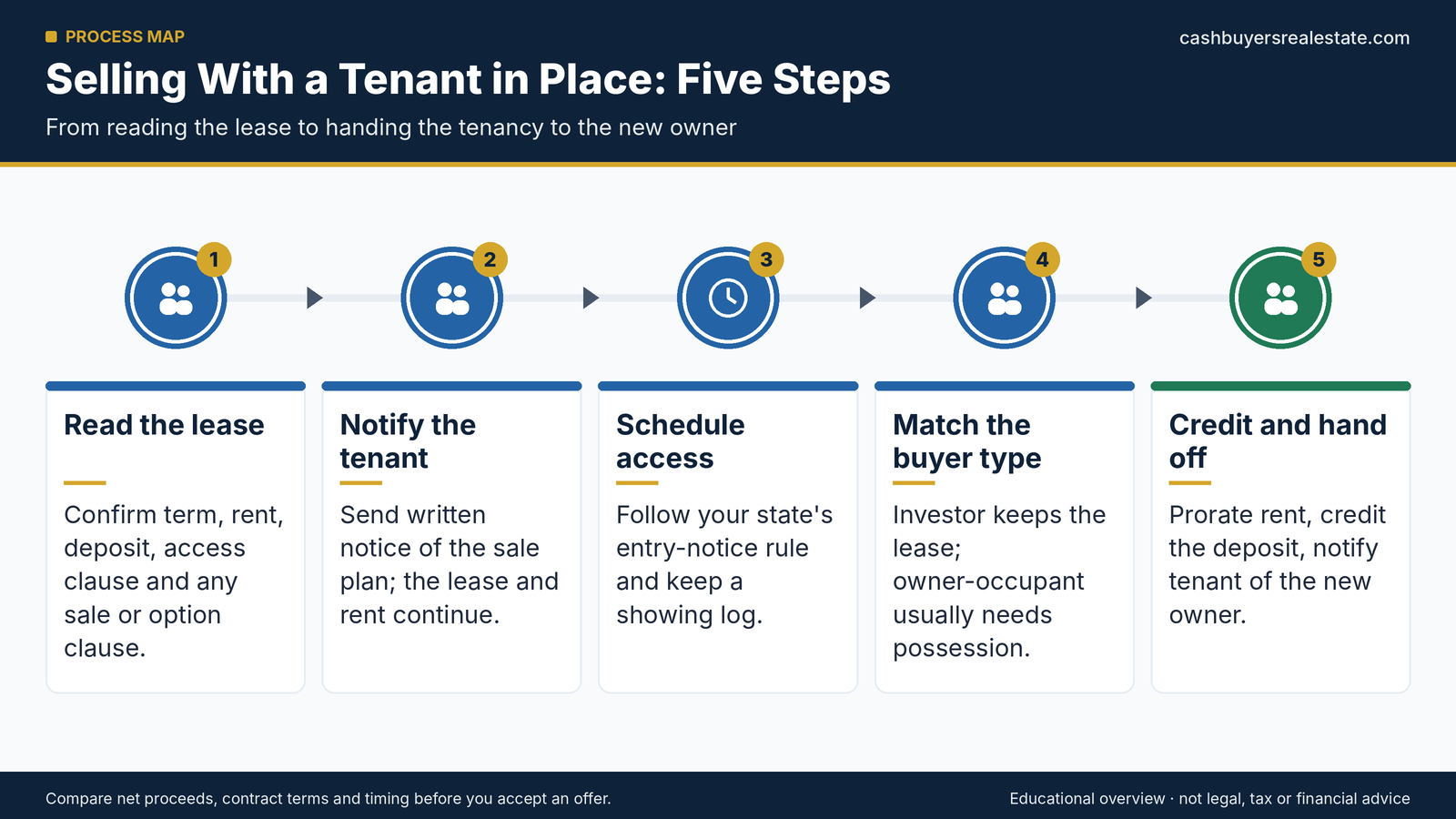
Text version of this infographic
- Read the lease — Confirm term, rent, deposit, access clause and any sale or option clause.
- Notify the tenant — Send written notice of the sale plan; the lease and rent continue.
- Schedule access — Follow your state's entry-notice rule and keep a showing log.
- Match the buyer type — Investor keeps the lease; owner-occupant usually needs possession.
- Credit and hand off — Prorate rent, credit the deposit, notify tenant of the new owner.
Security Deposits, Rent Proration and What Buyers Ask For
Money details can look minor next to the larger questions, but they’re where tenant-occupied closings most often go wrong. A missing deposit, a miscalculated credit, or a lease the buyer never saw can erase days or dollars at the last moment.
Money that moves with the tenancy at closing
Security deposits: who holds them and how they transfer
A security deposit belongs to the tenant, subject to lawful deductions, even though the landlord holds it. When ownership changes, someone has to be responsible for returning it at the end of the tenancy, and state laws spell out who. Under Texas Property Code § 92.105, a new owner is liable for returning deposits from the time it acquires the property and must give the tenant a signed statement acknowledging that. Florida’s § 83.49 requires the deposit and advance rent to be transferred to the new owner along with any interest and an accurate accounting, after which the previous holder is released from the duty to hold the funds. Minnesota’s § 504B.178 gives the landlord 60 days after its interest ends to transfer the deposit to the successor, with notice to the tenant, or return it to the tenant.
The common approach in a sale contract is a credit: the seller gives the buyer a closing credit equal to the tenant’s deposit (plus any interest the law requires), and the buyer takes over the obligation. Alternatively, the seller transfers the actual funds. Which method applies depends on your state and what the contract says. Whatever you do, get it in writing, make sure the amount matches the lease and the ledger, and keep a copy of the transfer confirmation.
Mistakes here are expensive. Landlords who commingle deposits with personal money, who can’t document deductions, or who sell without handling the deposit properly can face penalties in some states. If the deposit has been spent, the seller will need to fund it at closing. A buyer’s closing agent will usually catch the issue, but it’s far better to know your number before the contract is signed.
Rent proration: a worked example
Rent is usually prorated at closing so that each owner keeps the rent for the days it owned the property. The details vary by contract and local custom, including whether the proration uses actual days or a 30-day month, and who collects unpaid rent after closing. Your contract and closing agent set the method.
Illustrative example (hypothetical numbers, not market data): A landlord sells a rented house with closing on the 18th of a 30-day month. Rent is $1,800, paid in full on the 1st. The tenant’s security deposit is $1,800, and the tenant also prepaid the last month’s rent of $1,800 at move-in.
The landlord has received the full month’s rent but owns the house only through the 17th. Assuming the buyer owns the property from the 18th, the buyer is credited with the 13 days from the 18th through the 30th. At $60 a day ($1,800 divided by 30), that is $780. The buyer also receives credits for the $1,800 deposit and the $1,800 prepaid last month’s rent, because it will be the one honoring them.
| Item | How it is figured | Credit to buyer |
|---|---|---|
| Prorated rent for the closing month | 13 days at $60 per day, from the 18th through the 30th | $780 |
| Security deposit held by seller | Equal to the deposit under the lease | $1,800 |
| Prepaid last month’s rent | Equal to the amount the tenant prepaid | $1,800 |
| Total credits to buyer | Subtracted from the seller’s proceeds | $4,380 |
The table shows why a tenant-occupied seller should run the numbers early: these credits come off your proceeds even though you have the cash in the bank. If the tenant owes back rent, the contract should say whether that debt stays with you, transfers to the buyer, or is split, and whether the buyer will collect it or has any duty to. Don’t leave it to chance.
Documents, disclosures and what buyers ask for
The tenant-occupied package buyers expect
Buyers of occupied property are buying a lease along with a building, and they will want proof of what that lease says. Prepare a short package before you go to market. Providing it up front shortens due diligence and makes your property easier to compare with a vacant one.
| Document | Why buyers ask for it | Where it comes from |
|---|---|---|
| Signed lease and any addenda | Confirms term, rent, access rights, and special terms | Your files; get missing pages or signatures |
| Rent ledger or payment history | Shows whether rent is current and how it has been paid | Your bank records or property management software |
| Security deposit record | Confirms the amount, where it is held, and any interest | Your records and bank statements |
| Tenant estoppel statement | Tenant confirms lease terms, rent, deposit, and that no side deals exist | Signed by tenant on request; voluntary in many cases |
| Notices sent and received | Shows access notices, rent demands, repair requests, and any disputes | Your log and correspondence |
| Subsidy or housing agency paperwork, if any | Shows program requirements that pass to the new owner | Housing agency contract and recent inspections |
Think of the tenant estoppel statement as a signed snapshot: it asks the tenant to confirm the lease terms, current rent, deposit, and whether the tenant has any claims against the landlord. Whether a tenant must sign one depends on the lease and local law, so ask an attorney if the tenant declines. Many tenants will sign a plain-language statement if you explain why a buyer needs it, and a refusal is information the buyer will want to know.
Disclosures you owe even in a sale to an investor
Selling to an investor or a cash buyer doesn’t remove your disclosure duties. Federal rules, as the EPA explains, require sellers and landlords of most housing built before 1978 to disclose known information about lead-based paint and lead-based paint hazards before a sale contract is signed and to provide the EPA’s lead pamphlet. The EPA also says buyers must be given a 10-day period to arrange a paint inspection or risk assessment; renters have no such inspection right under that rule. Signed disclosure records must be kept for three years after the sale closes.
State disclosure rules vary. Some states require a seller disclosure form for most residential sales, some exempt certain transfers, and some exempt sales between investors or sales where the seller never lived in the home. Whatever the form says, never conceal a known defect. If your tenant has reported a leak, a mold issue, a heating problem, or a safety concern, that is information you know, and a buyer who learns about it later may have claims against you. Disclose the problems and the repair history accurately, and state clearly that the property is tenant-occupied, with the terms of the tenancy.
If you’re planning an as-is sale, the as-is language does not erase these duties. The same applies to code violations or open permits you know about. The article on selling a house as-is covers how those fit together. Being transparent protects the sale, and it protects you.
Investor, Owner-Occupant or Vacant Delivery: Choosing the Buyer Type
The most important decision in a tenant-occupied sale is not the price you list at. It’s which kind of buyer your property can serve, because that choice determines whether the lease is an asset, a nuisance, or a deal-breaker.
Who buys a tenant-occupied house
Investors and cash buyers: what an in-place lease means to them
To an investor, a lease with a paying tenant can be useful. It means rent starts on day one of ownership, there is no vacancy period to absorb, and the property’s income can be documented. Investors who plan to keep a house as a rental often prefer it occupied by a reliable tenant over vacant, because finding and screening a new tenant takes time and money. A cash buyer in this category can sometimes close quickly because it needs no lender’s approval and may not need to disturb the tenant at all.
The same lease can also cut the other way. A below-market rent, a long term that locks in that rent, a tenant with a poor payment history, or a house in poor condition behind a tenant who won’t allow inspections will each push an investor’s offer down or add conditions. Investors price in what they can’t see: deferred maintenance, deposit liabilities, tenant disputes, and the cost of turning the unit if the tenant leaves. If the tenant has a lease running well beyond the closing date, the investor cannot easily renovate or reposition the property until it ends.
That is why your records matter so much with this buyer. A clean ledger, a signed lease, and a tenant estoppel statement let the investor underwrite the property with fewer discounts. The mechanics of how buyers translate rents, repairs, and risk into offers are covered in the guide on how cash offers are calculated, and the economics of income valuation and taxes on a rental sale are in the guide to selling a rental property fast. For a wider look at who buys in this category and how they differ, see cash home buyers.
Owner-occupant and financed buyers: why possession matters
A buyer who intends to live in the house is in a different position. Such a buyer typically needs possession at or shortly after closing, so a lease that runs past that date is a serious problem. Even if the tenant would gladly stay, the buyer can’t move in, and the buyer’s lender and appraiser may add their own requirements about access, occupancy, and documentation. That narrows your pool and often lengthens the timeline, since a financed purchase already has an appraisal and underwriting to complete.
To reach this buyer group, you’ll usually have to deliver the house vacant. That means either waiting for the lease to end, reaching a voluntary move-out agreement, or ending a periodic tenancy on proper notice where the law allows it. Each has costs and timing, which the next sections explain. A common mistake is to list the home as if it will be vacant, sign a contract with a possession date, and then discover that the tenant has no obligation to leave by then.
A sale contract that promises vacant possession is a promise you must be able to keep. If the tenant stays, you may be in default, which can mean losing the earnest money, being sued for damages, or both. Before you commit to a possession date, know the lease end date, the notice rules, and whether the tenant has agreed to leave in writing.
Comparing the routes and the contract terms that protect you
Five routes side by side
The table compares the main ways to sell a tenant-occupied house. It deliberately avoids timeline numbers that depend on your state and lease. Look instead at what drives the speed in each row.
| Route | What happens to the tenant | What drives the timeline | Main trade-off |
|---|---|---|---|
| Sell to an investor with the lease in place | Stays; new owner becomes landlord | Lease review, estoppel, title, buyer’s due diligence | Offer may be discounted for lease terms, condition and unknowns |
| Cash buyer who needs the house vacant | Must leave first, by agreement or lease end | Notice period, lease end, voluntary move-out | You carry the cost and risk of delivering vacant possession |
| List on the open market, tenant-occupied | Stays during marketing; showings on notice | Showing cooperation, buyer financing, lease length | Smaller pool of buyers; owner-occupants may pass |
| Wait for the lease to end, then list vacant | Leaves at lease end or after proper notice | How far away the lease end date is | Holding costs and lost time; market may change |
| Offer a voluntary move-out agreement, then sell vacant | Leaves by agreement for an agreed payment | Tenant’s willingness; time to move | Buyout cost; local rules on tenant buyouts |
The best way to use this table is to circle the cost you can least afford, whether that’s time, price, or legal risk, and see which route minimizes it. A seller with a long mortgage clock and a month-to-month tenant may lean toward vacant delivery. A seller with a good tenant and a fixed lease may be best served by an investor who wants the income.
For the broader comparison between selling for cash and listing, including how commissions and timing play out, see cash sale versus listing for a fast sale. And if you’re weighing whether to use an agent at all, cash buyer versus realtor sets out the trade-offs.
Contract terms that protect you when a tenant is in place
An ordinary purchase contract doesn’t cover tenant-specific issues well, so make sure yours does. A short list of terms deserves careful attention, and a local attorney or the closing agent can help you draft them:
- Possession: whether the buyer takes the house subject to the lease or vacant, and the exact date and condition of possession.
- Lease assignment: the buyer’s written assumption of the lease and the landlord’s obligations from closing forward.
- Deposit and rent credits: the amounts credited at closing and how they are calculated.
- Estoppel and tenant documents: whether a tenant estoppel is a condition of closing and what happens if the tenant won’t sign.
- Access for inspections and appraisal: the notice you will give and the tenant’s right to refuse.
- Condition at closing: what you must deliver, and who bears the risk of damage by the tenant before closing.
- Back rent and claims: who keeps or collects past-due rent, and who handles any tenant claims arising before closing.
Look closely at any clause that gives the buyer a unilateral right to cancel if the tenant misbehaves, refuses access, or won’t sign a document. Those are reasonable protections for the buyer, but they also shift risk to you, and you should price them. And be skeptical of contracts that ask you to take steps against the tenant, such as removing them or changing locks, as a condition of closing. Those steps may be unlawful, and the legal exposure is yours.
The next graphic compares five routes by who each suits and what it costs you. The table above covers the same ground in text: an investor with the lease in place is usually the shortest path when the tenant is stable, vacant-delivery routes serve owner-occupant buyers but depend on lease timing, and waiting trades time for a cleaner sale.
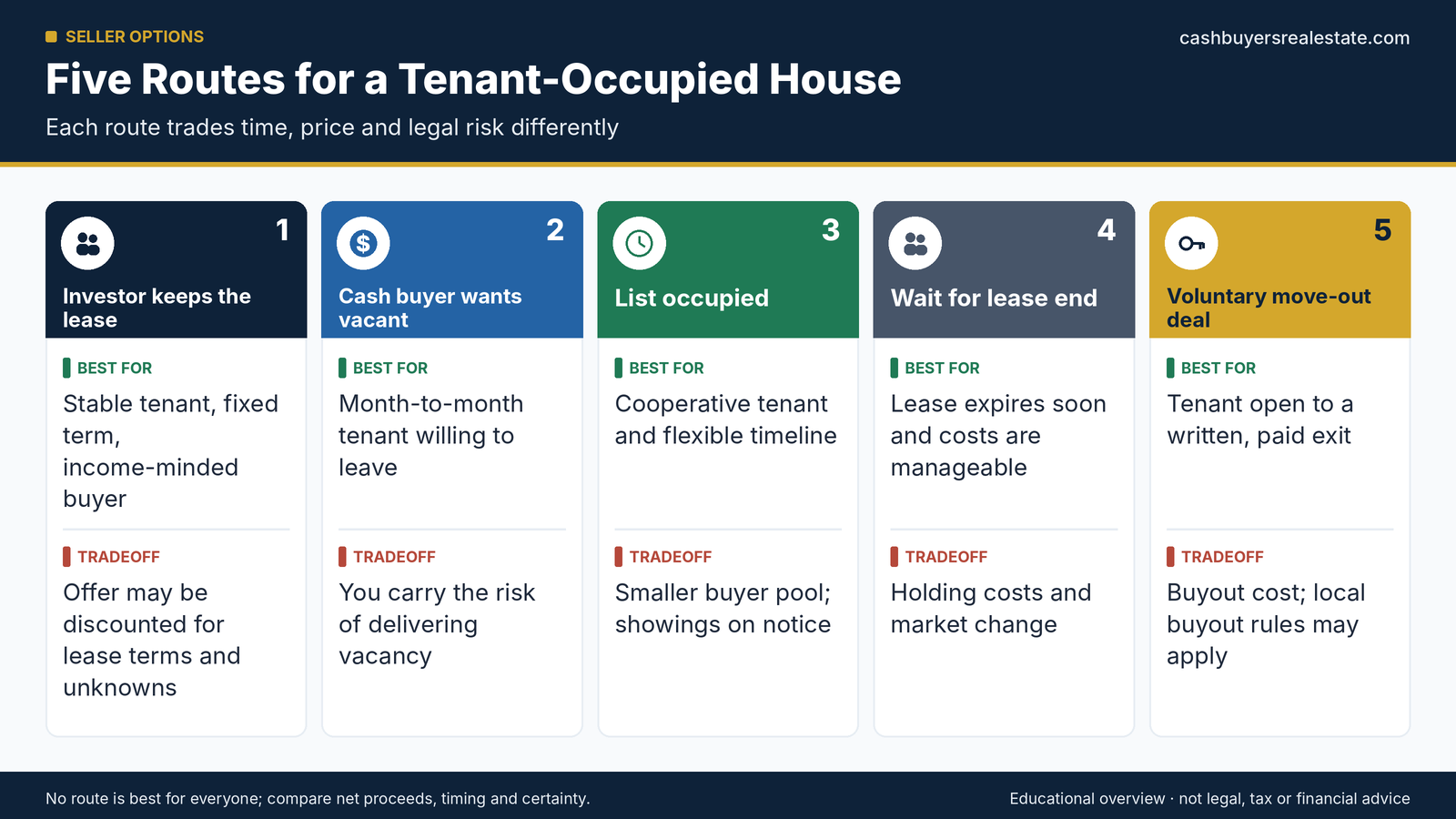
Text version of this infographic
- Investor keeps the lease — best for: Stable tenant, fixed term, income-minded buyer; tradeoff: Offer may be discounted for lease terms and unknowns
- Cash buyer wants vacant — best for: Month-to-month tenant willing to leave; tradeoff: You carry the risk of delivering vacancy
- List occupied — best for: Cooperative tenant and flexible timeline; tradeoff: Smaller buyer pool; showings on notice
- Wait for lease end — best for: Lease expires soon and costs are manageable; tradeoff: Holding costs and market change
- Voluntary move-out deal — best for: Tenant open to a written, paid exit; tradeoff: Buyout cost; local buyout rules may apply
Voluntary Move-Out Agreements and Why Eviction Rarely Speeds a Sale
If you need the house vacant, there are two ways to get there: the tenant leaves because they agree to, or the tenant leaves because a court orders it. The first is often faster and almost always cheaper, and the second belongs to a different set of problems than selling.
Cash for keys: paying a tenant to move out voluntarily
How a voluntary move-out agreement works
“Cash for keys” is an informal name for a written agreement in which a tenant agrees to leave by a certain date, in a certain condition, in exchange for a payment. It works because it solves two problems at once: the landlord gets a predictable vacancy date, and the tenant gets money and time to find a new place without an eviction record. It is voluntary on both sides. A tenant who isn’t interested can say no, and the lease continues.
A typical agreement states the move-out date, the amount and timing of payment (often part at signing and the balance when keys are returned and the unit is inspected), the condition in which the unit must be left, the handling of the security deposit, whether rent is owed through the move-out date, and a release of claims. Because of the release and the legal effect on the tenancy, have an attorney draft or review it. Keep the language plain, give the tenant time to read it, and note that the tenant is free to consult a lawyer or a tenant organization.
Be careful about tenants who are subsidized, who have disabilities, or who are elderly, since additional protections may apply in your area. If the tenant receives rental assistance, check with the housing agency before you offer a payment, because the program may have its own rules about moves and about what counts as income. And never present the buyout as a deadline: pressure turns a negotiated agreement into a dispute.
Is a buyout worth it? A worked comparison
A buyout is worth considering when the cost is less than the price discount, delay, or risk it removes. Run the numbers by comparing the net result of each path rather than the headline price.
Illustrative example (hypothetical numbers, not market data): A landlord has a month-to-month tenant and two possible paths. Path one is to sell the house occupied to an investor at $205,000. Path two is to offer the tenant $3,500 to move out in 30 days, then sell vacant to an owner-occupant buyer at $219,000, with an extra 45 days to reach closing.
Path two costs $3,500 for the buyout and, at an assumed $1,950 a month in mortgage, tax, insurance and utilities, roughly $2,900 more in holding costs for the extra 45 days, plus any cleaning or repairs after move-out, assumed at $1,500. Total added cost is about $7,900. The price difference is $14,000, so path two nets roughly $6,100 more on paper.
That gap doesn’t account for risk: the tenant may refuse, a buyer may fall through, or the market may shift. A smaller price difference would flip the answer. And if the tenant refuses, you’re back to path one with extra delay. Build a margin into your estimate and decide in advance what you’ll do if the offer is declined.
Eviction: the slow path and when it applies
Notice periods and court steps: Florida as an example
Eviction is a legal process with required steps, and the steps vary by state. Florida’s landlord-tenant statute (sections 83.56 and 83.57, in the 2026 version posted by the legislature) illustrates the pattern. For unpaid rent, the landlord delivers a written demand and can terminate if the default continues for 3 days, excluding Saturdays, Sundays and legal holidays. For a violation that can be cured, the tenant has 7 days after written notice to fix it. For a month-to-month tenancy, the statute requires not less than 30 days’ notice before the end of a monthly period. Those notices are only the beginning. If the tenant doesn’t leave, the landlord generally must file a court case, serve the tenant, wait for a hearing or response, win a judgment, and have the court’s officer carry out the order.
Each of those later steps depends on the court’s calendar, the tenant’s response, and any defenses raised, which is why this article gives no average duration. It would be misleading to promise one. In some places the process moves quickly; in others it takes far longer, and courts differ even within one state. The key planning point is that none of it is under your control once the case is filed.
Equally important, in many jurisdictions a landlord can’t evict a tenant just because the property is for sale. An eviction needs a legal ground, such as nonpayment or a lease violation, and some places require just cause even to end a month-to-month tenancy. Filing a case on a weak ground can backfire, with penalties, fee awards, or a retaliation finding. The legal ground is a question for your attorney, not the buyer.
Why eviction rarely helps a sale, and what to do about a tenant who isn’t paying
Even a justified eviction usually lengthens a sale. The case may or may not finish before your target closing, it creates a court record, it can strain access for showings, and a tenant who is being evicted has little reason to cooperate. A buyer who sees a pending case may walk away or discount heavily, and an owner-occupant buyer may simply want no part of it. If a closing date depends on a court outcome, the contract has to say what happens when the date slips.
If the tenant is not paying, you have a handful of realistic options. You can finish the eviction for cause and then sell vacant, accepting the time it takes. You can negotiate a voluntary exit with a payment, which sometimes costs less than months of unpaid rent and legal fees. Or you can sell the house with the tenant in place, usually to an investor who is willing to take on the situation at a discount, with the contract spelling out what happens to the arrears and the court case. Whether a pending case can continue after a sale, and under whose name, is a procedural question for a local attorney.
If the house is empty after the tenant leaves, different guidance applies, such as securing it and managing holding costs; see the guide to selling a vacant house fast. For issues that can slow any sale, whatever the tenant situation, what slows down a home sale is a useful checklist.
Local Tenant Laws, Purchase Rights and the Foreclosure Rule
Federal law touches landlord-tenant relationships only at the edges. Most of the rules that decide how quickly you can sell come from your state and, increasingly, from your city or county. This section covers the types of local rules that can change a sale and one federal rule that every landlord facing foreclosure should know.
Tenant purchase rights and just-cause rules
Opportunity-to-purchase and sale-notice laws: the District of Columbia example
A few jurisdictions give tenants a legal right to be offered the chance to buy before the owner sells to someone else. The District of Columbia’s Tenant Opportunity to Purchase Act (TOPA) is the best-known example. Under D.C. Code § 42-3404.02, before an owner sells a housing accommodation, the owner must give the tenant an opportunity to purchase at a bona fide price and terms. That sets up a notice-and-response process that can add real time to a sale.
The detail that matters for a house is the single-family exemption. D.C. Code § 42-3404.09 provides that the purchase-rights subchapter generally does not apply to single-family accommodations, with an exception that preserves the rights of elderly tenants and tenants with disabilities who signed a rental agreement by March 31, 2018 and took occupancy by April 15, 2018. The same section separately requires owners who intend to sell to notify tenants in writing within 3 calendar days of receiving or soliciting an offer to purchase, and says that notice requirement does not itself create enforceable rights under the subchapter. In other words, a seller of a rented single-family home in the District may still face notice duties and, for certain tenants, purchase rights, even though most single-family homes are exempt.
The broader lesson is not about the District specifically. Some states and cities have rules that require notice of a planned sale, give tenants a window to make an offer, or restrict how a seller may market a rented property. Others have none. These laws are easy to miss because they’re local, and violations can carry penalties or let a tenant challenge the sale. Before you list or sign, check your city or county housing department’s website and ask the title company or a local attorney whether any notice or purchase-right law applies to your address.
Just-cause and rent-stabilization rules
Some states and cities require a landlord to have a specific legal reason to end a tenancy, even a month-to-month one. These “just cause” rules often list acceptable grounds, such as nonpayment, lease violations, or the owner’s or a relative’s move-in. Whether a sale to a third party is an acceptable ground depends entirely on the local law, and in many jurisdictions it is not. If you are in a just-cause area, you can’t simply send a notice to a month-to-month tenant to clear the house for a buyer. You may need the tenant’s voluntary agreement or a ground the law recognizes.
Rent-stabilization or rent-control ordinances limit how much and how often rent can be raised, and in some places they also set rules about relocation payments when a tenancy ends for certain reasons. Raising rent sharply to push a tenant out before a sale is a bad idea almost everywhere, and in these areas it can be illegal. Buyers who know the local rules will also factor them into price, since a regulated rent may stay below market for the whole holding period.
The practical step is to identify the rule set early. Search for your city’s or county’s rental housing office, your state attorney general’s tenant resources, and your state’s landlord-tenant statute. Check whether your property is covered or exempt, since many ordinances exempt single-family homes under certain conditions. Because the answers vary so much and the penalties can be real, this is a situation where an hour with a local landlord-tenant attorney is cheap insurance. Local housing departments and legal aid organizations also publish plain-language guides.
Foreclosure and special tenancy situations
The Protecting Tenants at Foreclosure Act: what it covers and what it doesn’t
The Protecting Tenants at Foreclosure Act (PTFA) is a federal law that applies when a rental property is sold at foreclosure. Under the note to 12 U.S.C. § 5220 as published by Cornell’s Legal Information Institute, an immediate successor in interest in the property after foreclosure takes the property subject to the rights of bona fide tenants. It must give a bona fide tenant a notice to vacate at least 90 days before the effective date of the notice. A successor that will occupy the unit as a primary residence may end a lease that was in effect at the time of the foreclosure sale, but it still must give the 90-day notice.
A lease or tenancy counts as bona fide only if three conditions are met: the tenant is not the mortgagor or a close relative of the mortgagor, the lease resulted from an arm’s-length transaction, and the rent is not substantially less than fair market rent (unless the rent is reduced or subsidized by a government program). The act was originally set to expire at the end of 2014. The same source reports that the repeal was itself repealed by Public Law 115-174 in May 2018, and the provisions were restored and revived, so as of the text reviewed in October 2026 no sunset date applies.
Two limits to keep in mind. First, the PTFA is about foreclosure, not a voluntary sale. If you sell your rental yourself, state and local law governs the tenancy, though the PTFA’s approach (a successor takes subject to a bona fide lease) is a helpful reference point. Second, state law may give tenants additional protections at foreclosure. The practical effect for a landlord is that tenants at a foreclosure keep significant rights, which also reduces what a foreclosure buyer will pay and makes a negotiated sale more attractive to some owners. If you’re a landlord behind on a mortgage and thinking of selling to avoid foreclosure, see selling a house fast before foreclosure, and talk to a housing counselor or attorney about the timing.
Informal occupants, family members, roommates and unclear arrangements
Not every occupied house has a clean landlord-tenant file. A relative living there rent-free, an ex-partner who moved out of the lease but not out of the house, a subtenant who pays another tenant, or a friend who pays cash with no paperwork can each complicate a sale. In many states a person who pays rent, even informally, is a tenant with legal rights, and removing them requires the same legal steps as any other tenancy. Sellers often assume otherwise and run into trouble.
The first step is to establish who lives there and on what terms. Ask each occupant, in writing, to confirm whether they pay rent, how much, to whom, and since when. Get a copy of any agreement, text message, or receipt. If someone claims an ownership or tenancy right that you dispute, that is a legal question, and a buyer’s title company will want it resolved before closing. If a person is staying without rent or any agreement, the status is often treated differently, but the process to remove them still depends on your state.
Buyers care about these arrangements because unknown occupants become their problem the day after closing. A clear paper trail, ideally including a signed statement from each occupant, protects you. If you can’t get one, disclose what you know and let the buyer price the risk. Hiding an occupant, or promising that a house will be vacant when you can’t guarantee it, is among the most reliable ways to lose a contract or end up in court. Do not try to resolve the matter by removing belongings or changing locks, which can be unlawful even when the occupant has no written lease.
Timeline, Mistakes and Red Flags When Tenants Are in Place
Tenant-occupied sales have more moving parts than vacant ones, so the schedule needs to be built around the slowest legal step rather than the fastest. This section lays out the stages, then the mistakes that most often undermine them.
A realistic timeline by stage
Stage by stage: what is fixed and what varies
The table lists the stages of a typical sale with a tenant in place. Where a rule fixes a number, it shows that number; where it depends on your lease, court, or buyer, it says so instead of inventing an average.
| Stage | What happens | What is known from rules | What varies |
|---|---|---|---|
| Prepare | Read lease, gather ledger and deposit record, notify tenant | Some places require notice of a planned sale (for example, the District’s 3-day owner notice duty after an offer) | How quickly records can be assembled |
| Show | Schedule showings on proper notice | Washington: 1 day’s notice for showings; Minnesota: good-faith effort at 24 hours; Florida: reasonable notice, 24 hours defined for repairs | Tenant cooperation; showing windows |
| Contract | Negotiate price, possession and lease terms | Lead-based paint disclosure before contract for most pre-1978 homes | Buyer type; number of contingencies |
| Due diligence | Buyer reviews lease, ledger, estoppel, inspection | Lead paint: buyer has a 10-day period for inspection or risk assessment (unless modified by agreement) | Access for inspection; estoppel response time |
| Vacant delivery (if required) | Lease ends, notice period runs, or buyout is completed | Florida month-to-month: 30 days’ notice before the end of a monthly period | Lease end date; court calendar; tenant decision |
| Closing and handoff | Deposit and rent credited, tenant notified of new owner | Texas: new owner gives tenant a signed deposit statement; Minnesota: 60 days to transfer or return the deposit | Title issues; financing |
Look at the table as a set of dependencies. A fast investor closing might be limited only by due diligence and title, while a vacant-delivery closing is limited by the lease and notice rules, which you don’t control.
Illustrative example (hypothetical numbers, not market data): Three landlords list on the same day.
Landlord A has a stable fixed-term tenant with eight months left and sells to an investor who takes the lease. The investor requests the lease, ledger and an estoppel, and the deal closes in about the time any cash sale needs, with the tenant barely affected.
Landlord B has a month-to-month tenant, gives proper notice, and lists vacant for an owner-occupant. The notice period alone sets the earliest vacant date, and a financed closing follows. The total time is longer than A’s by at least the notice period.
Landlord C has a tenant who stopped paying and starts an eviction, intending to sell vacant. The court calendar controls the date, and the sale can’t be scheduled with confidence until the case ends. C might do better to sell to an investor with the tenant in place, at a discount, and use the contract to allocate the risk.
What stretches the calendar
Several recurring problems turn a plan into a delay. A tenant who refuses access, even lawfully, reduces the number of showings and may force you to rely on photos and a smaller group of buyers. A tenant who won’t sign an estoppel statement makes a careful buyer nervous. A lease end date that falls just after the target closing leaves a gap that someone has to fill. Back rent adds disputes about who collects it and under what terms.
Other delays come from the paperwork. A deposit that was never separated from your personal funds, a lease missing a signature, or an unlisted occupant discovered during inspection each send both sides back to the table. A buyer’s appraiser who cannot get access may delay a financed closing. And local rules, such as notice requirements or purchase rights, can add steps that nobody planned for.
The remedy for most of these is preparation. The guide to preparing for a fast home sale lists the documents and decisions to settle before you list, and selling a house in 30 days shows what a compressed schedule demands. If an inherited or estate property has a tenant, the authority questions are separate; see selling a house in probate.
Mistakes, red flags and when to call an attorney
Common mistakes and myths
Many tenant-related sale problems come from a handful of misunderstandings. The table pairs the most common myths with what the rules generally say, so you can check your assumptions before you act on them.
| Common belief | What is generally true |
|---|---|
| “The sale ends the lease.” | A sale usually does not end a lease; the buyer typically takes the property subject to it and becomes the landlord. |
| “The tenant has to let anyone in whenever I want.” | Entry usually requires notice and reasonable timing, and states set their own rules. Violations can bring penalties. |
| “A cash buyer will take care of the tenant.” | Some buyers take the lease, some want the home vacant. Either way, the contract should say who does what. |
| “I can evict because I’m selling.” | Eviction needs a legal ground, and some places require just cause. Selling alone may not qualify. |
| “Changing the locks speeds things up.” | Self-help measures are restricted or prohibited in many states and can lead to liability. |
| “The deposit stays with me.” | The deposit belongs to the tenant, subject to lawful deductions, and must be transferred or returned as state law requires. |
If one of those beliefs matches your plan, pause and check the rule before moving forward. The cost of a wrong assumption is usually higher than the cost of a short consultation.
Red flags in offers, and when to call an attorney
Landlords under pressure can attract offers that sound easy and shift risk to the seller. Be cautious about a buyer who asks you to deliver the house vacant by a date you can’t control, without a clause that protects you if the tenant won’t leave. Be cautious about any request to remove the tenant yourself, to change locks, or to collect rent in a way that departs from the lease. Be wary of buyers who want a deed, a power of attorney, or control of the rent before closing. And treat pressure to skip a title search, the estoppel, or an attorney’s review as a reason to slow down, not speed up. No single practice proves fraud, but a pattern of avoiding the basic protections is worth taking seriously; the guide to cash buyer scams explains what verification looks like.
Call an attorney when any of these apply: the tenant refuses access or disputes the sale; you want to end a tenancy to deliver a vacant house; you are considering a cash-for-keys agreement with a release; your city or state has just-cause, rent-stabilization or purchase-right rules; a case is pending in court; the tenant has a subsidy or special protection; or your lease contains a purchase option or right of first refusal. Choose a lawyer who handles landlord-tenant matters in your state, and bring the lease, ledger, and any notices.
The checklist in the next graphic collects six checks that sellers with tenants in place should run before they accept an offer: lease status, access plan, deposit and rent figures, buyer type, local law, and the possession date. The text above explains each of them, and the final section turns them into a decision framework.
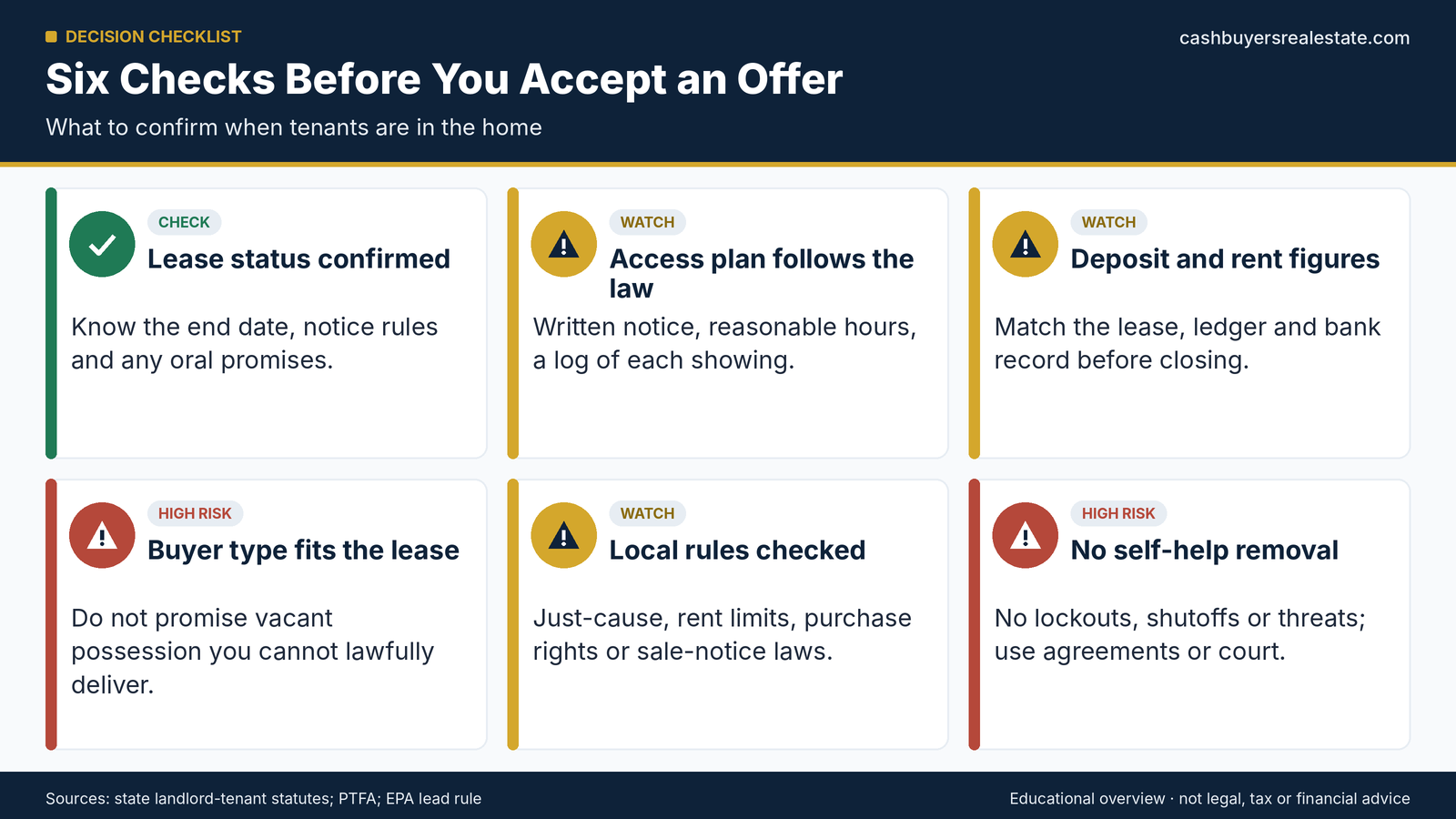
Text version of this infographic
- Lease status confirmed — Know the end date, notice rules and any oral promises.
- Access plan follows the law — Written notice, reasonable hours, a log of each showing.
- Deposit and rent figures — Match the lease, ledger and bank record before closing.
- Buyer type fits the lease — Do not promise vacant possession you cannot lawfully deliver.
- Local rules checked — Just-cause, rent limits, purchase rights or sale-notice laws.
- No self-help removal — No lockouts, shutoffs or threats; use agreements or court.
Questions Landlords Ask About Selling with Tenants
These short answers point to the longer sections above. Because landlord-tenant rules vary by state and city, treat them as starting points to confirm locally.
Leases, showings and tenant rights
Questions about the lease and the sale
- Does my tenant have to move out when I sell?
Usually not. In most places the lease continues after a sale and the buyer becomes the landlord. The tenant leaves only if the lease ends, the tenant agrees to go, or a lawful termination or eviction process is completed. Check your state and city rules, since some require specific grounds to end a tenancy.
- Can I end the lease early just because I found a buyer?
Generally not for a fixed-term lease, unless the lease itself includes a sale clause that your jurisdiction will enforce. For month-to-month tenancies you can give the notice the law requires, but in just-cause areas a sale may not be an accepted reason. Ask a landlord-tenant attorney before sending any notice.
- Do I have to tell the tenant I’m selling?
Practically, yes, because you will need access for showings, and notices work better when the tenant isn’t surprised. Some places also require formal notice of a planned sale. The District of Columbia, for instance, requires owners to notify tenants in writing within three calendar days of receiving or soliciting an offer. Written notice protects you either way.
- What if there is no written lease?
The tenancy still exists, usually as a periodic one, but it is harder for a buyer to verify. Put the key terms in writing now: rent, due date, start date, deposit, and who lives there. Ask the tenant to sign a simple statement confirming it, and expect buyers to ask questions or discount for the uncertainty.
Questions about access and cooperation
- How much notice do I need to show the house?
It depends on the state, the lease, and sometimes the city. Washington, for example, refers to one day’s notice for showings, and Minnesota calls for a good-faith effort at 24 hours. Florida requires reasonable notice and sets 24 hours for repair entries. Give at least the notice your law and lease require, and put it in writing.
- Can the tenant refuse to allow showings?
Most statutes bar a tenant from unreasonably refusing proper entry, but a tenant may object to a poorly noticed or unreasonable request. If a tenant is refusing outright, document your notices, try to resolve it by agreement, and ask an attorney before escalating. Forcing entry can create liability for you.
- Should I hold an open house or use a lockbox?
Open houses put many strangers in the tenant’s home and are best avoided or tightly limited. A lockbox on a door the tenant uses should be placed only with the tenant’s agreement. Scheduled, accompanied showings are usually smoother and better for the relationship.
- Can I offer the tenant something for cooperating?
You can, if it is voluntary and in writing, such as a small rent credit or a pre-photo cleaning. Keep it clearly separate from any request to move out. If the offer starts to look like pressure or payment to leave, follow the cautions for cash-for-keys agreements and check local buyout rules.
Money, buyers and timing
Questions about deposits and rent
- What happens to the tenant’s security deposit when I sell?
It is either transferred to the buyer or credited to the buyer at closing, depending on your contract and state law. Texas, Florida and Minnesota, for example, each have statutes on how a new owner takes over deposit responsibility. Get the amount and the transfer in writing.
- Who gets the rent for the month of closing?
Usually it is prorated by days, so each owner keeps rent for the period it owned the house. The contract should say how the proration is calculated and who keeps rent paid in advance. If the rent was collected before closing, expect a credit to the buyer.
- What if the tenant owes back rent?
The contract should say whether the arrears stay with you, pass to the buyer, or are split, and who has the right to collect. A buyer may discount the price instead of taking on a collection problem. If an eviction case is pending, ask an attorney how a sale affects it.
- What is a tenant estoppel and do I need one?
It is a signed statement from the tenant confirming the lease terms, rent, deposit, and that no side agreements or landlord defaults exist. Buyers of occupied property often ask for one. Whether a tenant must sign depends on the lease and local law, so ask politely and have an attorney help if the tenant declines.
Questions about buyers and speed
- Will cash buyers purchase a house with tenants in it?
Some will, particularly investors who want rental income. Others want the house vacant. Ask each buyer how it treats the lease, what it needs from you, and how it prices the tenancy, and compare offers on net proceeds and certainty of closing.
- Is it always better to sell vacant?
No. Vacant houses reach owner-occupant buyers, but delivering vacant takes time and may cost money. A good tenant on a fixed lease can be an asset to the right buyer. The better route depends on lease timing, local rules and what you must net.
- Will evicting the tenant make the sale faster?
Rarely. Eviction needs a legal ground, follows court timelines you don’t control, and may reduce cooperation and buyer interest. For a tenant who isn’t paying, compare finishing the case, negotiating a voluntary exit, and selling to an investor with the tenant in place.
- How long does it take to sell with a tenant in the home?
There is no standard answer. An investor purchase with the lease in place can move like any cash sale. A vacant-delivery sale is paced by the notice period, lease end, or move-out agreement. Build the schedule around the slowest legal step, and add a cushion.
Choosing a Route and Planning the First Steps
Selling a rental or an occupied house quickly doesn’t require guesswork. It requires reading the lease, knowing your local rules, and picking the route that matches what you can actually deliver.
A decision framework: match the route to your situation
Situation by situation: which route fits
The table links common tenant situations to the routes that tend to fit them. Use it as a way to organize the conversation with your attorney and your buyer, not as a substitute for it.
| Your situation | Routes worth comparing | Watch out for |
|---|---|---|
| Good tenant, fixed term with months left | Investor buyer taking the lease; waiting for lease end | Discounts for lease terms; buyers who need possession |
| Month-to-month tenant, cooperative | Voluntary move-out then vacant listing; investor purchase | Notice rules and just-cause limits; local buyout rules |
| Tenant not paying | Negotiated exit; finishing the eviction; investor purchase with tenant | Court timelines; contract language on arrears and cases |
| Tenant refuses access | Photo and video marketing; investor purchase; attorney guidance | Entry-law penalties; retaliation claims |
| Subsidized tenancy or unclear occupants | Investor experienced with the program; documentation first | Program rules; unknown occupants; disclosure duties |
| Facing foreclosure on a rental | Sale before foreclosure, with counseling and attorney advice | Short timeline; PTFA rights for tenants if foreclosure happens |
The table works best as a prompt for the next question: what is the actual lease status, what does the law of this city require, and what does the buyer need? Each row is a starting point, not a recommendation to a specific person.
When keeping the property or waiting is the better answer
A quick sale is not always the best move. If the tenant is reliable and the lease has a few months left, waiting for lease end may produce a higher price and a simpler closing, as long as you can carry the costs. If the property is a decent investment but the work of managing it is the problem, hiring a property manager can solve the stress without selling. If a short-term cash need is driving the decision, a refinance or a loan against the property might bridge it, though each has costs and risks.
Other choices are worth a look when the numbers are tight. You could sell with the tenant in place but extend the closing date so you don’t have to resolve the tenancy yourself. You could ask a buyer to assume the lease and handle the move-out after closing, with the contract spelling out the responsibilities. Or you could decide that a discounted investor sale with the tenant in place is worth it because it saves months of effort and legal risk. The right answer depends on the net outcome and your tolerance for uncertainty.
The bottom line is that tenants change the route you take more than they change whether you can sell. A seller who respects the lease and the law, communicates early, and documents everything can often sell within a reasonable window. A seller who tries to shortcut those steps risks the opposite.
What to do next, and what to ask
Your first week: documents and decisions
- Pull the lease, all addenda, and any notices or agreements. Note the end date, rent, and deposit.
- Build a rent ledger and confirm the deposit amount and where it is held.
- Look up your state’s entry-notice rule, your city’s tenant ordinances, and any sale-notice or purchase-right law.
- Write to the tenant about the sale plan, the showing schedule, and who to contact.
- List everyone who lives in the property and on what terms, and gather statements from informal occupants.
- Decide whether you want an investor sale with the lease or a vacant sale, and what you can lawfully deliver.
- Gather disclosure information, including lead-based paint records for pre-1978 homes, repair history, and tenant complaints.
- Talk to a landlord-tenant attorney and your title company before signing a contract with a possession date or a buyout agreement.
These steps don’t commit you to anything, and they put you in a position to compare offers fairly. For the costs around a sale, see closing costs in a fast home sale and the net proceeds calculator. For how the closing process works, the cash home sale process guide walks through the stages. If liens or unpaid claims are part of the picture, see selling a house quickly with liens, and for area-specific information, the local pages will apply where available.
Questions to ask buyers, agents, attorneys and the tenant
- Ask the buyer: Will you take the property subject to the lease, or do you need it vacant? What do you need from me and the tenant, and when? What happens to the earnest money if the tenant won’t sign an estoppel or won’t allow an inspection? Can I see proof of funds?
- Ask the agent or closing company: How will the deposit and prorated rent be handled on the closing statement? Who sends the tenant notice of the new owner? What does the contract say about possession?
- Ask your attorney: What notice must I give for showings and for ending a tenancy? Do any just-cause, rent-stabilization or purchase-right laws apply? Is a cash-for-keys agreement allowed, and how should it be written?
- Ask the tenant: What times work best for showings? Are there any problems in the home that you want addressed? Is there anything in writing, or any agreement with a previous owner, that I should know about?
Keep the answers and every notice in one file. A clear paper trail helps your closing agent, reassures buyers, and gives you a record if a question comes up later. For a broader view of the sales options, return to the sell house fast hub, or to the tenants hub.