Fast Home Sale Closing Costs: Timeline, Costs & Seller Options
You’ve decided to sell quickly, and then a different question shows up: how much of the sale price will actually reach you? Fast home sale closing costs are the charges that come out of the seller’s side of the ledger between the contract price and the check you receive. They don’t disappear because the timeline is short. What changes with speed is which charges you pay, how long you carry the house, and how much negotiating room you have.
In most fast sales, the seller’s closing costs come from six places: agent compensation (if an agent is involved), government transfer and recording charges, title and escrow or attorney fees, the mortgage and lien payoff, prorated taxes and dues, and any concessions or repair credits the buyer negotiates. Which ones apply depends on your sale route and your state. Compare routes by net proceeds, not by headline price.
That last sentence is the whole discipline of this article. A cash offer that looks $15,000 lower than a listing price can leave you with more or less money in hand, depending on commissions, repair credits, concessions, and the months of mortgage, tax, and insurance payments you’d carry while waiting. A cash offer that claims to “pay the closing costs” can still cost you money through the price it was built around. Until you run the numbers on a net sheet, you’re comparing two different things.
Here’s what we’ll walk through. First, the full list of seller-side charges and where they show up on your paperwork. Then the biggest line items one by one: agent compensation after the 2024 industry practice changes, transfer taxes with verified examples from several states, title and escrow charges, payoffs and prorations, and the extras buyers request. After that comes a side-by-side net sheet for three routes using hypothetical numbers, a walk-through of a settlement statement, and a list of fees worth questioning. The last sections cover common questions and a decision framework for choosing a route.
A few ground rules before the details. Every dollar figure in the worked examples is hypothetical, built to show how the arithmetic works, and isn’t market data. Where this guide cites a rate or rule, it comes from an official source opened in October 2026, and the text says so. Where a number varies too much to state, you’ll see that plainly instead of a made-up average. And because rules differ across the country, treat the state examples as illustrations of how widely things vary, not as a prediction of your closing.
If you’re still deciding whether speed is worth it at all, the related guides on the economics of a quick home sale and cash sale versus listing cover that decision. This guide stays on the cost side: what you’ll owe, when you’ll see it, and how to keep it from surprising you.
What Sellers Pay at Closing, and Why a Short Timeline Doesn’t Change the List
The seller’s side of the ledger
Charges sellers carry by default or by custom
Think of seller closing costs in two buckets: charges that attach to the property or the existing loan, and charges that depend on the deal you negotiate. The first bucket is close to fixed. You’ll owe whatever’s left on your mortgage and any recorded liens, the property taxes and association dues for the days you owned the home, and usually the cost of delivering clear title. The second bucket is where routes diverge: agent compensation, concessions to a buyer, repair credits, and who covers the title and escrow fees.
Several of these are matters of local custom rather than law. In some regions the seller customarily pays for the buyer’s owner’s title insurance policy; in others the buyer does. Transfer taxes may be assigned to the seller by statute, split by custom, or left to the contract. Closing practice also varies: some states route closings through escrow and title companies, others through attorneys. Because custom isn’t law, the purchase contract is where your actual obligations get written down, and a fast sale doesn’t excuse you from reading that section.
One practical consequence: two sellers with the same price in the same city can leave the table with different amounts because one agreed to pay the buyer’s title policy and the other didn’t. Before you accept any offer, find the paragraph that allocates closing costs and ask who pays each item, in writing.
| Line item | Traditional listing, financed buyer | Direct cash sale | What controls it |
|---|---|---|---|
| Agent compensation | Negotiated with your listing agent; buyer-side payment, if any, is also negotiated | Often none when no agent is involved; confirm no one else is being paid from your proceeds | Listing agreement, purchase contract |
| Transfer and recording charges | Statutory; who pays depends on state law and contract | Same statutes apply | State and local law |
| Title search and owner’s policy | Customary allocation varies; negotiable | Often negotiated as part of the offer | Local custom, contract |
| Escrow, settlement, or attorney fee | Usually split or assigned by custom | Frequently assigned by contract | Contract, state practice |
| Mortgage and lien payoff | Paid from proceeds | Paid from proceeds | Payoff letters |
| Prorated taxes, HOA dues, utilities | Prorated to closing date | Prorated to closing date | Contract, local method |
| Concessions and repair credits | Common after inspection or appraisal | Usually built into the offer price | Negotiation |
| Carrying costs while waiting | Longer exposure | Shorter exposure | Your timeline |
Read the table by rows, not columns: the rows that stay identical across routes are the ones you can’t avoid, and the rows that differ are where comparing offers pays off.
What speed adds and what it leaves alone
A shorter timeline mostly affects three things. It shrinks your carrying costs, because every week you don’t own the house is a week of mortgage interest, taxes, insurance, and utilities you don’t pay. It can eliminate the preparation costs of marketing a home, like staging, deep cleaning, and photography. And it can reduce the number of negotiated credits, because a buyer who isn’t relying on an appraisal or a lender’s repair requirements has fewer reasons to renegotiate.
Speed doesn’t touch the fixed bucket. Title still has to be searched, liens still have to be paid, and the closing agent still has to prepare the statement. If anything, a compressed schedule can add small charges: courier fees for original documents, expedited payoff requests, mobile notary visits, or same-day wire fees. Those are usually modest, but they’re worth asking about up front, because “rush” is also a label that gets attached to charges that don’t reflect any real extra work.
The other thing speed does not do is guarantee a lower or higher total. A sale that closes in ten days with a deep discount can net less than a sale that closes in sixty with a full price and two rounds of repair credits. The only way to know is to compare each route’s net, which is why a later section builds three hypothetical net sheets side by side.
Where the numbers show up on your paperwork
Settlement statement versus Closing Disclosure
If the buyer is using a mortgage, federal rules require the lender to give the borrower a Closing Disclosure at least three business days before closing. The Consumer Financial Protection Bureau (CFPB) describes it as the form that lays out the final details of the loan, including closing costs and cash to close, and its borrower version shows items tied to the seller too: any seller credit toward closing costs, and prorated items the seller prepaid or still owes. That document is the buyer’s, though. As a seller you’ll see your own side on a settlement statement prepared by the closing agent.
How that statement is formatted depends on the transaction. According to the American Land Title Association (ALTA), settlement agents must provide sellers a Closing Disclosure for their side when the loan rules apply, and the rules allow separate buyer and seller versions so that the seller doesn’t see the buyer’s loan terms. The National Association of REALTORS® (NAR) adds that seller-paid costs such as real estate commissions must still appear on the buyer’s version. For an all-cash purchase, the loan disclosure rules generally don’t apply, and ALTA notes the parties may use another settlement statement format, or a form that state law requires. In practice, a cash sale produces a statement that carries the same categories under a different layout.
Don’t let the form name distract you. Whatever it’s called, the document must show the sale price, what’s being paid off, what each party owes, and the net to you. If a draft is missing any of those, ask why.
When you should see the figures
The three-business-day rule applies to the borrower’s Closing Disclosure, so it doesn’t promise you a seller statement three days out. Your own timing is set by the closing agent and the contract. In a fast sale, that can mean receiving final figures the day before signing, or the day of. Don’t wait for that.
Ask the closing agent for an estimated seller statement as early as the contract is signed, and again once payoff letters are in. An estimate won’t be final, but it shows the structure: which charges are present, which are missing, and which fall on you. Compare the estimate to your own net sheet. If a line you didn’t expect appears, you have time to ask about it before you’re sitting at a signing table with a deadline.
Keep a simple routine: request the draft, ask the closing agent to explain any line you don’t recognize, and request a corrected draft before signing if something is wrong. A closing agent will usually fix a mistake in minutes when it’s caught early and in hours or days when it’s caught at the table.
What should an early estimate contain? At minimum: the price, a line for each payoff you’ve disclosed, the commission or fee lines if an agent is involved, title and escrow charges, transfer and recording charges, and the prorations the closing agent can calculate from the proposed closing date. It won’t be perfect, because payoff letters and final tax figures arrive later, but gaps are informative. If the estimate leaves out your equity line, for example, either the closing agent doesn’t know about it or something is wrong. Sellers on a tight timeline sometimes skip this review to save a day, and that’s usually the wrong place to save one.
Agent Compensation and Commissions After the 2024 Practice Changes
Listing-side and buyer-side compensation
What changed in August 2024
For decades, a listing on a Multiple Listing Service (MLS) typically carried an offer of compensation to whichever agent brought the buyer. NAR’s settlement of antitrust litigation changed that. NAR’s settlement FAQ reports the new MLS policies took effect August 17, 2024: offers of compensation can no longer be published on a participating MLS, and an agent working with a buyer must have a written agreement with that buyer before touring a home. The compensation in that agreement has to be objectively ascertainable and can’t be open-ended. The rules also call for a disclosure that compensation isn’t set by law and is fully negotiable.
For a seller, three things follow. Your listing agent’s fee is a negotiated number with no required rate. The buyer’s agent may be paid by the buyer, by you as part of a negotiated arrangement, or through a concession built into the offer. And because NAR has updated its settlement FAQ since 2024 and local MLS rules can add detail, ask any agent you interview to explain how the rules apply in your market today.
This guide doesn’t quote an average commission rate. Published averages come from surveys and listing data that shift over time and vary by region, and quoting one here without a dated, primary source would risk misleading you. Ask for the actual percentage or flat fee in writing from every agent you consider, and put it on your net sheet as a real number.
How buyer-agent costs still reach the seller
Since the MLS can’t carry an offer of compensation, buyer-side costs show up in other places. A buyer might ask you to contribute toward their agent’s fee as part of a concession. The Florida Realtors association notes that sellers can still offer buyer concessions on the MLS, such as help with closing costs, and that cooperative compensation can still be negotiated outside the MLS. A buyer who has agreed to pay their own agent may try to recover that expense by asking for a lower price or a credit.
The practical effect for a fast sale is that the headline listing price tells you less than it used to. Ask each offer’s writer: is any amount being requested from me for the buyer’s agent, directly or as a credit, and where does it appear in the contract? If the answer is “it’s a concession of X,” put X in your net sheet beside the commission line.
Illustrative example (hypothetical numbers, not market data): On a $300,000 sale, a percentage arrangement of 2.5 percent for the listing agent and a 2 percent buyer-side concession would total $13,500. A flat-fee listing at $4,000 with the same $6,000 buyer-side concession would total $10,000, a $3,500 difference. But a lower fee can mean fewer services, and a slower or lower sale could erase the savings, so compare the services included as well as the number.
When no agent is involved
Direct cash sales and what replaces the commission
A direct sale to a cash buyer usually has no commission line, because no agent is paid out of your proceeds. That’s real money saved, but it isn’t free. The buyer builds the cost of their own risk, repairs, holding time, and resale expenses into the price they offer, so the savings on your side of the ledger tend to show up as a discount on the other side. Whether the exchange favors you depends on how large the discount is and how much the traditional route would have cost you in commissions, credits, preparation, and waiting.
One way to judge whether a discount is reasonable is to ask the buyer how the number was reached. A buyer who can walk you through the after-repair value they assumed, the repair estimate, the holding and resale costs, and their margin is giving you something you can test. You can then price the repairs yourself with a contractor’s quote, or ask a real estate agent for a comparative market analysis of the as-is and repaired value. A buyer who can’t explain the number, or who explains it only in general terms, hasn’t given you enough to compare.
Two cautions apply. First, “no commission” shouldn’t be assumed. Some buyers who are themselves licensed agents represent themselves, some wholesalers assign contracts for a fee, and some arrangements include a transaction fee paid by the seller. If a fee appears on the draft statement, it needs a clear description and a clause in the contract that supports it. Second, if an agent or finder brought you the buyer, ask whether you’ll owe them anything at closing and get that in writing. The question is simply “who is being paid from my proceeds, and why?”
For a broader view of how cash offers are built and why they come in below market value, see how cash offers are calculated and the comparison in cash buyer versus real estate agent.
For-sale-by-owner and limited-service paths
A for-sale-by-owner (FSBO) sale lets you keep the listing-side fee, but you’ll still face the buyer-side question and the work of pricing, marketing, showing, negotiating, and managing the contract. Flat-fee and limited-service arrangements sit in between: you pay a smaller, fixed amount for specific services, like MLS entry or paperwork review, and handle the rest. These models can lower the commission line, but they rarely shorten the timeline by themselves.
If you try an FSBO sale on a deadline, plan for the costs that don’t show up as a commission: professional photos, signage, a lockbox or showing arrangement, and possibly an attorney to review the contract. Those can total less than a commission, but they aren’t zero, and a missed contract detail can cost more than the fee you saved. The guide to selling without a realtor goes through that route in detail.
Whichever way you go, the principle is the same one running through this article: every route has costs, and the question is which costs you can see, which you can negotiate, and which you can avoid for the money you’d otherwise pay.
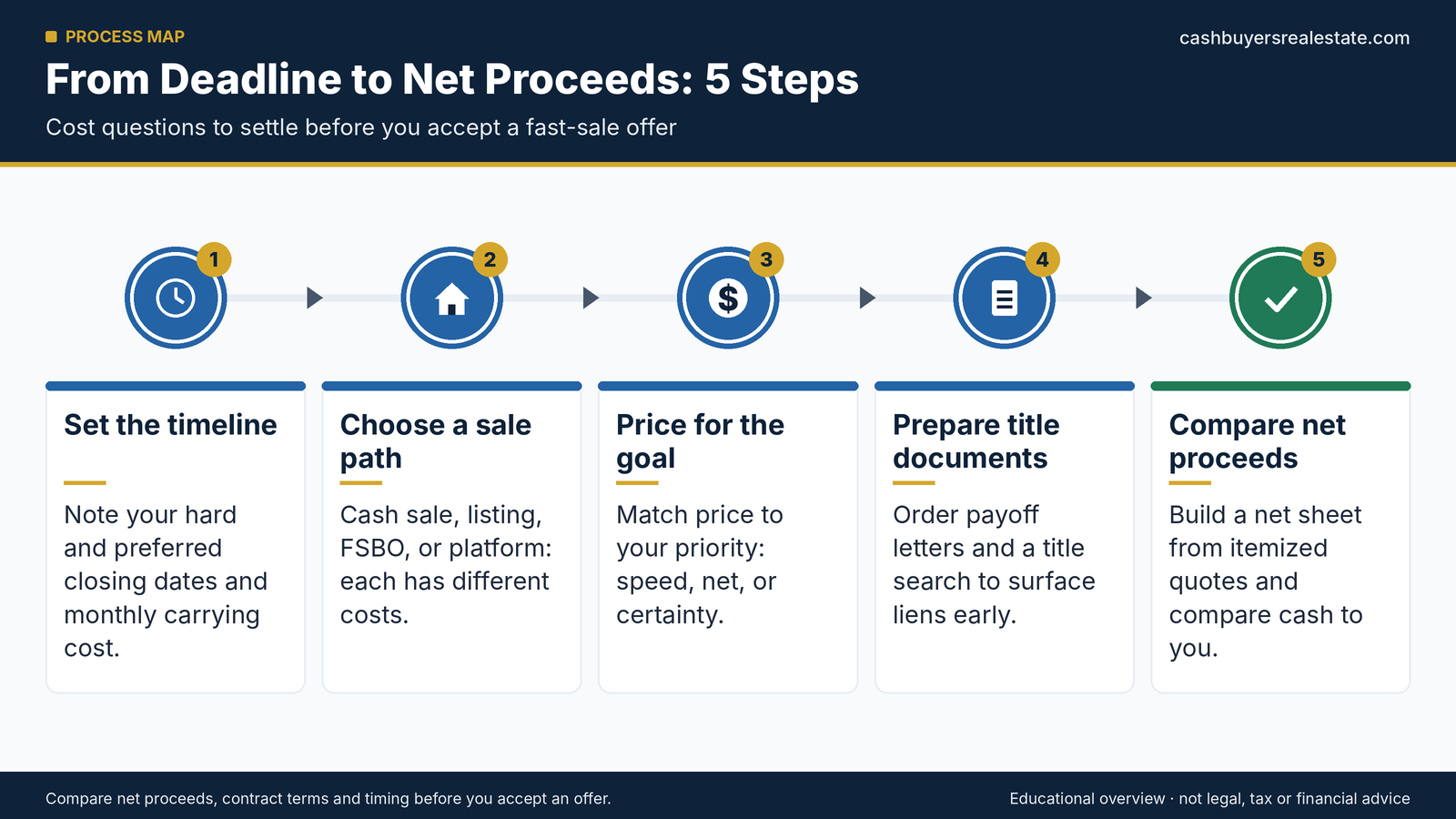
The process map below puts the whole sequence in one picture, from setting a timeline to comparing net proceeds. Its essential points are also in the text: set the timeline first, choose a sale path, price for your goal, prepare the title documents early, and compare routes by net proceeds before accepting anything.
Text version of this infographic
- Set the timeline — Note your hard and preferred closing dates and monthly carrying cost.
- Choose a sale path — Cash sale, listing, FSBO, or platform: each has different costs.
- Price for the goal — Match price to your priority: speed, net, or certainty.
- Prepare title documents — Order payoff letters and a title search to surface liens early.
- Compare net proceeds — Build a net sheet from itemized quotes and compare cash to you.
Transfer Taxes, Recording Charges, and Title-Related Fees
Government charges on the transfer of the deed
How transfer and documentary taxes are structured
Many states and some counties and cities tax the transfer of real estate. The structures differ enough that a seller in one state can owe nothing while a seller in the next owes thousands on the same price. The figures below come from official state and county pages opened in October 2026 and are shown against a hypothetical $300,000 sale price purely to illustrate how different the formulas are. Treat them as examples of structure, not as a quote for your sale.
| Jurisdiction | Structure described by the official source | Illustrative tax on $300,000 | Who pays, per the source |
|---|---|---|---|
| New York State | $2 for each $500 of consideration; extra taxes apply in New York City and for high-priced residences | $1,200 (state base tax) | The seller (grantor) pays the base tax; buyer if the seller doesn’t or is exempt |
| Pennsylvania | 1 percent state tax, plus a local realty transfer tax collected by the county Recorder of Deeds | $3,000 (state portion only) | Buyer and seller are jointly and severally liable |
| Florida | Documentary stamp tax of 70 cents per $100 on deeds (Chapter 201, Florida Statutes) | $2,100 | Paid to the clerk when the deed is recorded; the contract allocates who bears it |
| Los Angeles County, California | $0.55 per $500 county rate ($1.10 per $1,000); several cities, including Los Angeles, levy their own additional tax | $330 (county rate only) | Preparer calculates; exemptions must be stated on the document |
| Washington State | Graduated state real estate excise tax; first bracket 1.10 percent up to $525,000 as of the state guide’s 2023 rates; local add-ons possible | $3,300 (state portion only) | The seller usually pays |
The point of the table is the spread: flat per-dollar charges, graduated brackets, locally added layers, and different default payers. Because the formulas, brackets, and default payers differ this much, a national “average closing cost” figure tells you very little about your closing.
Two sourcing notes. The Florida rate comes from the statute text on the Florida Senate’s website, which was the version available when this was checked, so confirm with the Florida Department of Revenue or your closing agent before relying on it. The Washington brackets come from the Department of Revenue’s guide reflecting rates effective January 1, 2023; thresholds in that system are adjusted periodically, so verify the current brackets.
Who pays, what’s exempt, and how to check yours
Even where a statute names the taxpayer, the parties often negotiate who actually bears the cost, and legal liability can differ from the economic split. New York’s tax department, for example, says the seller is responsible for the base tax and the buyer becomes liable if the seller doesn’t pay or is exempt. In other places the statute leaves allocation to the parties, and local custom fills the gap. Exemptions exist too: transfers between certain family members, transfers under court orders, or deeds into and out of some trusts may be exempt or taxed differently. The Los Angeles County recorder, for instance, requires a stated reason on any document claiming an exemption.
To check your own situation without hiring a consultant for every question, ask your closing agent three things in writing: which transfer, documentary, or excise taxes apply to this deed; what statute or ordinance each comes from; and who the contract assigns to pay each one. Then verify the rate against the state revenue department’s page or the county recorder’s fee schedule. If the closing agent can’t cite the source, that’s worth knowing before the day of closing.
| Cost | What decides who pays | Where to confirm |
|---|---|---|
| State or county transfer tax | Statute names a taxpayer in some states; contract can reallocate in many | State revenue department, county recorder |
| Owner’s title insurance premium | Local custom and the contract | Title company, a local real estate attorney |
| Escrow or settlement fee | Custom, often split; contract controls | Closing agent’s fee sheet |
| Closing attorney fee (attorney-closing states) | Often each side pays its own attorney; contract controls | Your attorney, the contract |
| Recording of deed and releases | County fee schedule; payer set by custom or contract | County recorder’s website |
| Prorated taxes and dues | Closing date and local method of proration | Closing agent, tax collector |
If a contract is silent on an item, ask the closing agent what the default practice is in your county rather than assuming. A sentence added to the offer before signing is far easier than a dispute afterward.
Title, escrow, and attorney charges
Title search and the owner’s policy
A title company or attorney searches public records to confirm who owns the property and what claims are recorded against it. The search is how liens, judgments, unpaid taxes, and ownership gaps get found. A lender’s title insurance policy protects the buyer’s mortgage lender and is typically required for a financed purchase. An owner’s policy protects the buyer’s ownership interest, and it’s optional in many places, although buyers commonly purchase one.
Who pays for the owner’s policy is a classic local-custom item. In a cash sale it can be a negotiating point rather than a given. The cost itself also varies by state: in Texas, for example, the Texas Department of Insurance sets basic premium rates that apply across companies, so shopping among insurers won’t change the premium, while the choice of who pays can. In other states premiums can differ by insurer and by underwriter, which makes asking for a quote worthwhile when you’re the one paying.
The search itself also determines your timeline. A clean search can clear in days. A problem found late, such as an old mortgage that was never released or an unrecorded heir, can push a closing back by weeks. That’s why a title search is one of the earliest steps in the process map, and why title and lien issues deserve their own attention in a fast sale.
Escrow, settlement, and closing-attorney fees
The closing agent, whether a title or escrow company or an attorney, handles funds, prepares the statement, collects signatures, and arranges recording. Their charges can include a settlement or escrow fee, document preparation, notary service, wire fees, courier fees, and electronic recording fees. Most of these are small individually. Together they often form a noticeable block of the statement, and they’re the category where itemization matters most, because fee names differ from company to company.
Closing practice differs by state. In some states an attorney typically conducts the closing and charges a fee for it; in others a title or escrow company does the work and charges an escrow or settlement fee. Don’t assume your state follows the pattern you’ve seen on television. Ask the closing agent to explain their role, what the fee covers, and whether it’s quoted as a flat amount or varies with the price.
When a cash buyer chooses the closing company, ask who is paying that company’s fee, and whether the choice affects you. It’s reasonable for a buyer to pick a closing partner they trust, and it’s equally reasonable for you to ask for an itemized fee schedule and to confirm the company’s identity independently, as the guide to cash home buyer scams recommends.
Logistics can change the cost. Sellers who live out of town or can’t attend may sign with a mobile notary, by mail, through a remote online notarization where the state permits it, or by power of attorney. Each method carries its own fees and lead time, and not every state or lender accepts every method. If your timeline is tight and you won’t be there in person, raise this the day the contract is signed so the closing agent can build it into the schedule and the statement.
Mortgage Payoffs, Prorations, and the Cost of Carrying the Home
Paying off the mortgage and other recorded claims
Payoff letters and per-diem interest
The balance on your monthly mortgage statement is not your payoff figure. Interest accrues daily between statements, so the amount needed to satisfy the loan on closing day is calculated by the servicer and delivered in a payoff letter good through a specific date, with a per-diem (per-day) interest amount if closing slips past that date. The closing agent requests the letter, but you can speed things up by asking your servicer for one yourself and sharing it.
Illustrative example (hypothetical numbers, not market data): Suppose your principal balance is $180,000 at a 6.5 percent interest rate. Annual interest is $11,700, which works out to about $32 a day ($180,000 × 0.065 ÷ 365 ≈ $32.05). If the payoff letter is good through the 15th and closing slips to the 22nd, you’d owe roughly seven more days of interest, or about $224, on top of the stated payoff. Servicers calculate interest in different ways, so use their per-diem figure, not this one.
Check three other items when the letter arrives. Whether any prepayment penalty applies, which is uncommon on modern home loans but worth confirming in writing. Whether a second mortgage or home equity line of credit also needs payoff and a signed request to close the line, since leaving a line open can cause trouble after sale. And what happens to your escrow account: if your lender collects taxes and insurance, leftover escrow funds are generally refunded after payoff, but the refund arrives after closing, not at the table. The guide to selling fast with a mortgage covers the payoff mechanics in more depth.
Other liens and obligations that appear in the title search
Beyond the mortgage, recorded claims can include unpaid property taxes, homeowners association liens, judgment liens, contractor (mechanic’s) liens, tax liens, and code-enforcement fines. Each has to be paid, bonded, released, or otherwise resolved before a buyer’s title insurer will insure clean title. The ordinary route is payment from sale proceeds at closing, with the closing agent collecting a payoff statement from each lienholder.
That works smoothly when the amounts are known and the lienholders respond promptly. It gets slow when a lien is disputed, when the holder is hard to locate, or when the same recorded item appears under a misspelled name. Surprises are the enemy in a fast sale, so order a preliminary title search before you accept an offer, or ask the buyer to share theirs once the contract is signed. If the lien total approaches or exceeds your equity, the options change significantly, and the guide to selling quickly with liens walks through them.
The mechanics are worth knowing. The closing agent requests a payoff statement from each lienholder, with a good-through date and instructions for delivering funds. Unknown or hard-to-find holders slow that step, which is why the title search comes first. A lien that was paid years ago but never formally released can also surface; in that case the lienholder must record a release, and chasing one can take weeks. Municipal charges for unpaid utilities, mowing, or code enforcement can also attach to a property, so ask the city or county whether anything is outstanding. Leave extra room in your timeline for any item you can’t resolve with a single phone call.
One distinction worth holding onto: liens reduce your net proceeds directly, dollar for dollar. They aren’t closing “costs” in the sense of fees for services, but they sit on the same statement and shape your final check just as much.
Prorations and the monthly cost of waiting
Property tax, HOA, and utility prorations
Prorations divide recurring expenses between buyer and seller as of the closing date. If you’ve prepaid something that covers a period after closing, the buyer reimburses you; if an expense covering days you owned the home is unpaid, you credit the buyer. The CFPB’s description of the buyer’s Closing Disclosure reflects both directions, noting adjustments for prepaid items the seller already paid and for unpaid taxes or fees the seller owes.
Property taxes are the biggest proration for most sellers. The mechanics depend on whether your jurisdiction bills in advance or in arrears, and on how the contract counts days. A common method uses a 365-day year, while others use a 360-day year or count by month. With an annual bill of $4,800, a 365-day method values each day at about $13.15, so a closing on day 212 of the year would credit the buyer for roughly $2,788 of unpaid, accrued taxes if your bill is paid in arrears. That’s a hypothetical illustration of arithmetic, not a rule for your county.
Homeowners association dues, special assessments, and transfer or resale-certificate fees add further lines. Ask the HOA early for its resale package and fee schedule, because some associations take days to produce documents and charge for them. A pending special assessment can be a negotiating point if the buyer or contract treats it as a seller obligation.
What waiting costs: carrying costs on a timeline
Carrying costs are the quiet part of a net sheet. While the house is unsold you keep paying mortgage interest (the principal portion of a payment builds equity rather than costing you, but the interest does not), property taxes, homeowners insurance, utilities, lawn or snow care, and any HOA dues. If the home is vacant, insurance can change or require added coverage, so ask your insurer rather than assuming. Add a figure for each month of expected time on the market and in escrow.
Illustrative example (hypothetical numbers, not market data): Say interest, taxes, insurance, and utilities add up to $1,900 a month. A sale that closes after three months costs about $5,700 to carry; one that closes in thirty days costs about $1,900. The $3,800 difference is a real item in the comparison, even though it never shows up on a settlement statement.
Carrying costs matter most when the timeline gap between routes is large and the price gap is small. They matter least when you’re comparing two routes with similar timelines. Either way, put a monthly carry number on your net sheet so the cost of time is visible, and revisit it if the expected closing date moves. The guide to what slows down a home sale explains the delays that tend to stretch that number.
Net Sheets for Three Routes: A Hypothetical Side-by-Side
Building the three net sheets
The assumptions behind the comparison
A net sheet is a simple subtraction: start with the price, remove every cost that comes out of your side, remove the payoff, and see what’s left. To show how routes can diverge, the comparison below uses one hypothetical house and three ways of selling it. The numbers are invented for illustration, they aren’t market data, and your own figures will differ. What matters is the structure of the comparison.
- The house: a home a seller values at about $300,000 in a market with ordinary demand, with a $180,000 mortgage payoff and minor cosmetic issues.
- Route A, traditional listing with a financed buyer: sells at $300,000 after about three months from preparation to closing. Combined agent compensation of 5 percent is an assumption, not a market rate. Includes concessions, a repair credit after inspection, and preparation costs.
- Route B, direct cash sale with the buyer paying its own costs: a $255,000 offer, closing in roughly thirty days, no agent compensation, no concessions, no preparation.
- Route C, direct cash sale with a higher headline and the seller covering both sides’ closing charges: a $270,000 offer that drops by $6,000 after the buyer’s inspection, closing in about forty-five days.
- Shared assumptions: transfer and recording charges of 0.6 percent of the price, a $1,900 monthly carry, and title and escrow charges as shown. All three routes pay off the same mortgage.
Resist the urge to treat the assumptions as predictions. If your local transfer tax is zero, or your agent agrees to a lower fee, Route A improves. If your home needs more repair credit than shown, or a financed buyer’s appraisal comes in low, Route A weakens. The exercise is useful because it tells you which assumptions drive the answer.
The side-by-side net sheet
The table below runs the same arithmetic on each route. Check the totals yourself; it’s the habit worth building for any net sheet you’re handed.
| Line item | A: Listing, financed buyer | B: Cash, buyer pays own costs | C: Cash, seller covers both sides |
|---|---|---|---|
| Contract price | $300,000 | $255,000 | $270,000 |
| Price change after inspection | $0 | $0 | −$6,000 |
| Agent compensation | $15,000 | $0 | $0 |
| Transfer and recording | $1,800 | $1,530 | $1,584 |
| Title and escrow, seller’s side | $2,400 | $2,000 | $2,000 |
| Buyer’s closing costs paid by seller | $0 | $0 | $1,900 |
| Buyer concessions | $4,500 | $0 | $0 |
| Repair credit | $2,000 | $0 | $0 |
| Preparation (cleaning, paint, staging) | $2,500 | $0 | $0 |
| Carrying costs | $5,700 (3 months) | $1,900 (1 month) | $2,850 (1.5 months) |
| Total deductions | $33,900 | $5,430 | $8,334 |
| Net before mortgage payoff | $266,100 | $249,570 | $255,666 |
| Mortgage payoff | $180,000 | $180,000 | $180,000 |
| Cash to seller | $86,100 | $69,570 | $75,666 |
On these assumptions, Route A produces the most cash, about $16,500 more than Route B, and takes roughly two months longer. Route C sits between them. That’s the honest shape of many comparisons: more money usually costs more time and more uncertainty, and the question is how much each is worth to you.
Because Route A’s result depends so heavily on how long the sale takes and what it sells for, the next table varies those two assumptions while holding the rest constant. Commissions and transfer charges scale with the price; carrying costs scale with the months.
| Scenario | Sale price | Months to close | Total deductions | Cash to seller |
|---|---|---|---|---|
| Sells at asking | $300,000 | 3 | $33,900 | $86,100 |
| Small reduction | $292,000 | 3.5 | $34,402 | $77,598 |
| Larger reduction | $285,000 | 4 | $34,960 | $70,040 |
| Slow market | $275,000 | 4.5 | $35,350 | $59,650 |
Compare the last two rows with Route B’s $69,570 and Route C’s $75,666. The listing wins at asking, roughly ties after a $15,000 reduction, and loses when the market is slow. Since nobody can know in advance which row they’ll land on, the comparison is really about how much risk of landing in the bottom rows you’re willing to carry.
Reading the comparison without fooling yourself
Why the higher headline doesn’t always win
Notice that Route A’s $300,000 headline is $45,000 above Route B’s, but the difference in cash to the seller is only about $16,500. The gap shrinks by roughly $28,500 once commissions, concessions, credits, preparation, and carry are included. That’s the whole reason to compare net rather than price.
Now change one assumption. Suppose the listing needs a price reduction to $285,000 and takes four months to close. Commissions fall to about $14,250 and transfer charges to about $1,710, but carrying costs rise to $7,600. Total deductions come to roughly $34,960, net before payoff to about $250,040, and cash to the seller to about $70,040. That’s within a few hundred dollars of Route B’s $69,570. A $15,000 reduction and one extra month erased nearly the entire advantage.
You can turn that into a rule of thumb for your own sheet. Under these assumptions, every dollar of price reduction costs the seller about 94 cents, because the commission and transfer charges shrink slightly along with the price. Route A’s $16,530 lead over Route B therefore disappears after a reduction of roughly $17,500 if nothing else changes, or roughly $15,500 if the sale also takes a month longer. Your own break-even depends on your own inputs, but the exercise of finding it is worth doing before you decide how aggressively to price a listing.
The reverse can happen too. A buyer with unusually thin margins, a strong cash offer, or a competitive market could push a cash offer closer to listing value, and a listing in a hot market could sell above list with no credits at all. The takeaway isn’t that cash wins or listing wins. It’s that the order can flip with ordinary variations, so you can’t rank routes from headline numbers. For the risk side of this comparison, including how often financed contracts fall through, see the head-to-head guide on cash sale versus listing.
What an offer that “covers your closing costs” really means
Somebody always pays for a closing. When an offer is described as covering closing costs, the useful questions are which costs, whose, and how that promise affects the price. In Route C above, the seller pays both sides’ title and escrow charges in exchange for a higher headline. In Route B, the buyer pays its own side and the headline is lower. Which one nets more depends on the arithmetic, not on which phrase sounds friendlier.
If an offer says the buyer pays closing costs, ask for a written list of what that includes. Does it cover your transfer tax? Your share of the escrow fee? The owner’s title policy? Your mortgage payoff and the prorations for days you owned the home are your own obligations, and a buyer can’t absorb them by agreeing to “cover costs.” A phrase like “we cover costs” that’s vague on these points can leave you surprised at the table.
Also watch for pricing that shifts costs to a different line. A buyer can offer a higher price and then request a credit, or offer a lower price with no credits. Both can produce the same net. What you want is visibility: an offer that states each item, so you’re comparing like with like. The net proceeds calculator is built for exactly this comparison, and the article on how cash offers are built explains why those discounts exist in the first place.
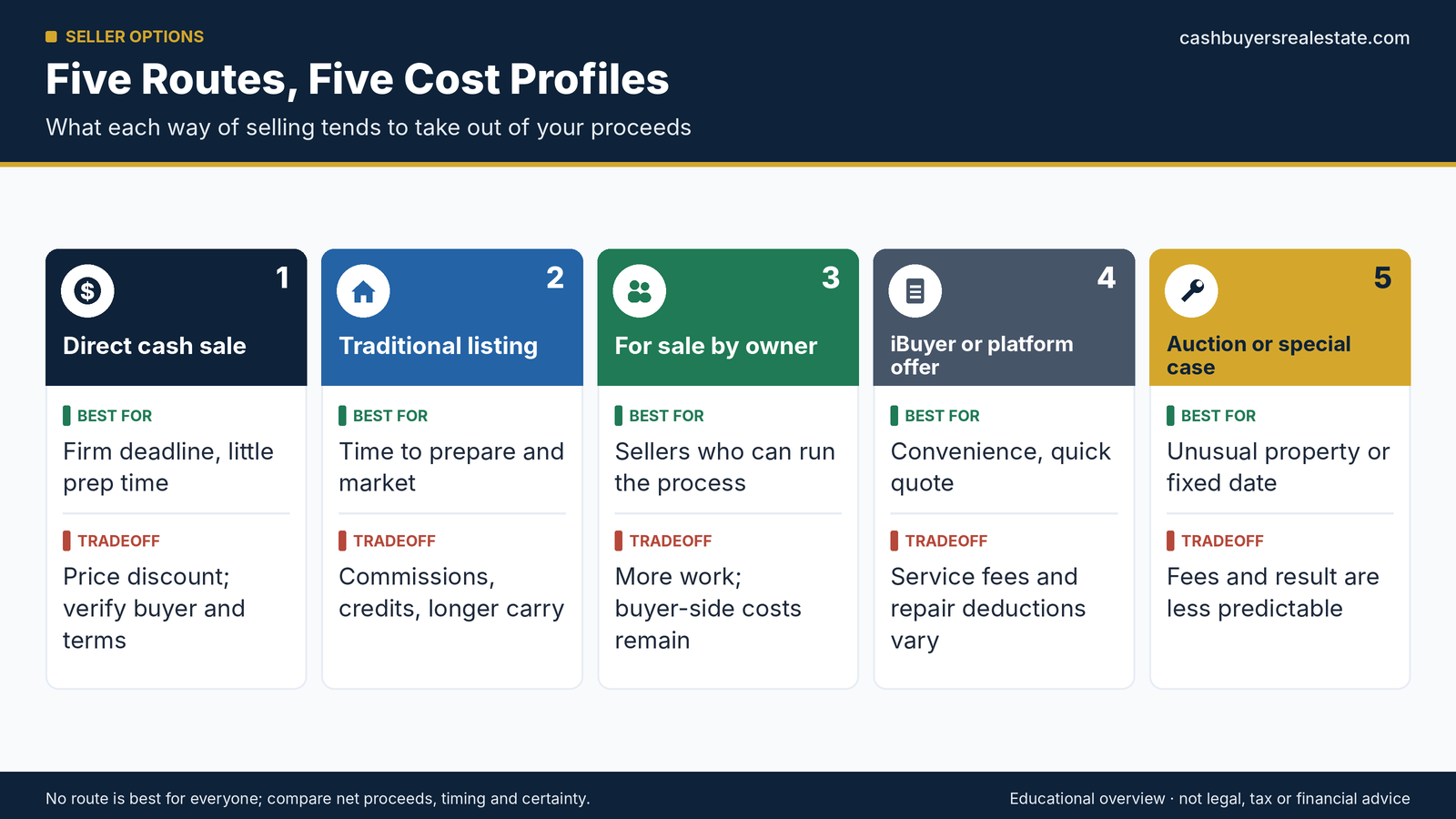
The seller options map below sets out the routes in this section side by side with each one’s best use and main tradeoff. The key facts are in the text above: listing routes tend to produce a higher price but carry commissions, credits, preparation, and a longer wait, while direct cash routes shorten the timeline and remove agent compensation but usually come with a discount.
Text version of this infographic
- Direct cash sale — best for: Firm deadline, little prep time; tradeoff: Price discount; verify buyer and terms
- Traditional listing — best for: Time to prepare and market; tradeoff: Commissions, credits, longer carry
- For sale by owner — best for: Sellers who can run the process; tradeoff: More work; buyer-side costs remain
- iBuyer or platform offer — best for: Convenience, quick quote; tradeoff: Service fees and repair deductions vary
- Auction or special case — best for: Unusual property or fixed date; tradeoff: Fees and result are less predictable
Buyer Requests, Add-On Charges, and Fees Worth Questioning
Credits and concessions the buyer may ask for
Seller concessions on financed purchases
When a buyer uses a mortgage, the loan program limits how much of the buyer’s closing costs a seller can pay. Fannie Mae’s Selling Guide, dated May 2025 on the page opened for this article, sets maximum financing concessions as a percentage of the lower of the sales price or appraised value. For a principal residence or second home, the limit is 3 percent when the loan-to-value ratio is above 90 percent, 6 percent between 75.01 and 90 percent, and 9 percent at 75 percent or lower. For investment properties, it’s 2 percent. Amounts above those limits are treated as sales concessions that reduce the price used in valuation.
Government-backed loan programs, such as FHA and VA, have their own concession rules, and the numbers differ from the conventional ones above. A cash buyer isn’t subject to any of them. That difference matters: a financed buyer’s request for concessions has a ceiling set by the loan program, and when the request exceeds that ceiling, a price reduction is the usual substitute.
Illustrative example (hypothetical numbers, not market data): A buyer putting 5 percent down on a $300,000 conventional purchase has a loan-to-value ratio of 95 percent, so the 3 percent cap would allow up to $9,000 in seller-paid financing costs. If the buyer asks for $12,000, the extra $3,000 can’t be paid as a concession and typically comes off the price, or the buyer pays it from their own funds. The buyer’s lender confirms the actual cap for the loan program in use.
As a seller, you rarely need to calculate the cap yourself. Ask the buyer’s agent or lender to confirm any limit on the credit being requested, and put the dollar amount into your net sheet. The agreed concession is a real deduction, even though it’s tucked inside a “buyer credit” line.
Repair credits, inspection requests, and appraisal gaps
After an inspection, a financed buyer may ask you to repair items or give a credit. A credit lowers your net immediately and moves the repair risk to the buyer, which many sellers prefer on a tight timeline. Repairs keep the price intact but cost time, and unfinished work can cause a delayed closing. A price reduction may be cleaner than either, because it doesn’t involve contractors and doesn’t depend on a reinspection.
Appraisals add another wrinkle. A lender won’t finance more than the appraised value supports, so if an appraisal comes in below the contract price, the buyer may ask you to reduce the price, split the difference, or cover the gap with extra cash. You have no obligation to agree, but if you don’t, the contract may allow the buyer to cancel and the clock resets. A cash buyer doesn’t need an appraisal, which removes this risk, though the cash buyer’s own valuation was baked into the offer.
Sell-as-is doesn’t mean you can skip disclosures. Many states require sellers to disclose known material defects, and the rules vary, so ask a local attorney or your agent what applies. Never conceal a known problem to protect a closing date; the legal exposure can be far larger than the credit you were trying to avoid. The guide to selling a house as-is covers disclosure and condition issues in more detail.
Add-on charges and how to question them
Warranties, certificates, inspections, and rush charges
Several small items commonly appear on a seller’s side. A home warranty is sometimes offered as a sweetener by the seller or requested by the buyer; ask for the plan’s price and what it covers before agreeing. Some municipalities require a certificate of occupancy, a point-of-sale inspection, or a smoke and carbon monoxide compliance certificate before transfer, and those carry fees and sometimes repair requirements. Homeowners associations charge for resale documents, and some states require specific disclosure forms.
Disclosure paperwork can add cost and time too. For housing built before 1978, EPA’s real estate disclosure rules require sellers to give buyers the lead hazard pamphlet, disclose what they know about lead-based paint, share available records, include a Lead Warning Statement in the contract, and allow a 10-day window for a paint inspection or risk assessment unless the buyer waives it or the parties agree to a different period. Plan for the paperwork early, since a missed form can delay a closing.
Closing-day logistics can also add charges: a mobile notary who comes to your home, overnight delivery of original documents, a wire fee for sending your proceeds, and electronic recording fees. These are individually minor. The thing to watch is whether a charge is for a service that was actually provided, and whether the amount is in line with what the same company charges everyone.
If a timeline is tight, ask each party about expedite options and their prices before you need them. A $50 courier fee to meet a deadline is easy to approve. A vaguely described “rush processing” line of several hundred dollars is not, and the closing agent should be able to explain what work it paid for.
A checklist for questioning the fee lines
Most fees on a settlement statement are legitimate, and most fee disputes come from poor labeling rather than bad intent. The table below sorts common questions so you can raise them politely and early.
| Line item | When it can be legitimate | What to ask | Why it deserves attention |
|---|---|---|---|
| Processing, administrative, or coordination fee | A closing agent’s documented charge for a real service | Who receives it, and what exact service does it cover? | Vague names can hide duplicate or inflated charges |
| Seller-paid assignment or transaction fee | Rare; must be in the contract if applicable | Which contract clause creates it? Who is paid? | Fees that appear only at closing change your net |
| Rush or expedite charge | Actual courier, overnight, or wire cost | What was the cost, and can you see the receipt? | May be a flat markup for ordinary handling |
| Doubled recording or e-recording fees | Releases and deeds are recorded separately | How many documents are being recorded, and at what county rate? | Duplicate or misquoted county fees are a common error |
| Payoff-related fees | Servicer’s reconveyance or wire fee | Does the payoff letter list this charge? | Should match the servicer’s written figure |
| Upfront payment to “hold” an offer | Seldom; earnest money flows from buyer to a neutral holder | Why am I paying, and to whom, before closing? | A seller shouldn’t be paying to receive an offer |
Use the table as a script: the best time to ask is while the statement is still a draft. If an explanation arrives quickly and matches the contract, you’ve lost nothing. If it doesn’t, you’ve learned something worth knowing before you sign.
Reading the Seller’s Settlement Statement Line by Line
A walk-through of the statement itself
The sections: price, charges, credits, and cash to you
Layouts differ, but a seller’s settlement statement always answers the same questions in roughly the same order: what was the sale price, what is being deducted, what was prorated, and how much is left. If you see the statement for the first time on closing day, the page can look dense. Knowing the sections in advance makes it readable in a few minutes.
| Section | What it shows | What to check |
|---|---|---|
| Contract sale price | The price in the signed contract, plus personal property if included | Matches the contract and any signed amendments |
| Payoff of loans and liens | Each mortgage, equity line, tax, or lien paid at closing | Totals match the payoff letters; per-diem interest is correct for the actual closing date |
| Real estate commissions | Amounts paid to listing and buyer-side brokers, if any | Match your listing agreement and any negotiated buyer-side arrangement |
| Title, escrow, and attorney charges | Search, policy, settlement, notary, document prep | Each item has a clear name; the allocation matches the contract |
| Government recording and transfer charges | Deed recording, release recording, transfer taxes | Rates match the county or state schedule; no duplicate charges |
| Prorations and adjustments | Property tax, HOA dues, utilities, rent or deposits | Dates and per-day amounts are right; direction (credit or debit) is correct |
| Credits and concessions | Seller credits to the buyer, repair credits | Equal to what you agreed in writing, not more |
| Cash due to seller | The bottom-line amount to be wired or issued | Compare with your net sheet and explain any gap |
Read the table as a review order. Start at the top and bottom, where the sale price and cash to seller bracket everything else, then work inward to find any difference between what you expected and what you see.
Checking the math, and what to do when something is off
Start by confirming that the price minus the sum of all deductions equals the cash to you. That’s elementary, and it catches transposed numbers more often than you’d expect. Then confirm each payoff against the servicer’s letter, including the good-through date and per-diem amount. Compare the prorations against the dates in the contract, and compare every credit with the paragraph that created it.
When a line doesn’t make sense, ask the closing agent for the source document, not just an explanation. A charge that’s correct should be easy to support with an invoice, a fee schedule, a statute, or a contract clause. If the answer is “that’s our standard fee,” ask for the fee schedule. If a figure differs from your net sheet by a small amount, find out why before signing, because a small recurring difference can point to a bigger assumption that was off.
The tax side is separate from the statement but connected to it. The IRS explains in Topic No. 701 that a seller may receive a Form 1099-S reporting the sale, and that a sale reported on that form must be reported on your return even if the gain is fully excludable. The IRS also describes a home sale exclusion of up to $250,000 of gain, or $500,000 on a joint return, if the ownership and use tests are met, and a limit on claiming the exclusion again within two years. Whether any gain is taxable for you depends on your cost basis, improvements, and how long you lived there, so keep the final statement and ask a tax professional how to treat selling costs.
Protecting your money on and after closing day
Wire fraud and payout safeguards
Fraudsters target real estate closings because large sums move quickly between parties who don’t know each other well. The CFPB’s guidance, written chiefly for buyers, still applies to sellers when you’re giving or receiving payment instructions. It advises picking two trusted contacts, such as your agent or the settlement agent, discussing the money-transfer process with them in person or by phone, and recording their names and phone numbers in advance. It says to verify wire instructions by confirming the account name and number through a known phone number or in person, and never to follow instructions contained in an email.
For a seller the practical version is this. When you send your payout instructions to the closing agent, do it through a secure channel, or deliver them by phone to a number you’ve verified independently. If someone emails to say the instructions have changed, treat the message as suspect until you’ve confirmed by phone. Be equally cautious about emails that appear to come from the closing agent, from a buyer, or from your own agent asking for banking details.
If you think funds were sent to the wrong account, contact your bank immediately and ask about a wire recall, then file a complaint with the FBI’s Internet Crime Complaint Center. Speed improves the odds of recovery, as the CFPB notes. For the broader set of safeguards, the guide to the cash home sale process follows a transaction from contract to closing.
After closing: releases, refunds, and records
A few things remain after the signatures. Confirm that your mortgage lien was released, which the servicer or closing agent should record and which you can verify with the county recorder’s office. Watch for the refund of any leftover escrow funds from your lender; it can take a few weeks. Collect final utility readings, close or transfer service accounts, and notify your homeowners insurer once you’ve confirmed the sale has recorded, not before.
Keep the final settlement statement, the closing documents, and your records of improvements and selling expenses. They help establish your cost basis if tax questions arise, and they’re the proof you need if a disputed charge or an unreleased lien comes up later. Many sellers file them with the year’s tax records.
If you discover an error after closing, contact the closing agent promptly in writing. Corrections are far easier within days than months. If the problem involves a lien that wasn’t paid or a payoff that wasn’t released, move quickly, because it can affect the buyer’s title as well as your own record.
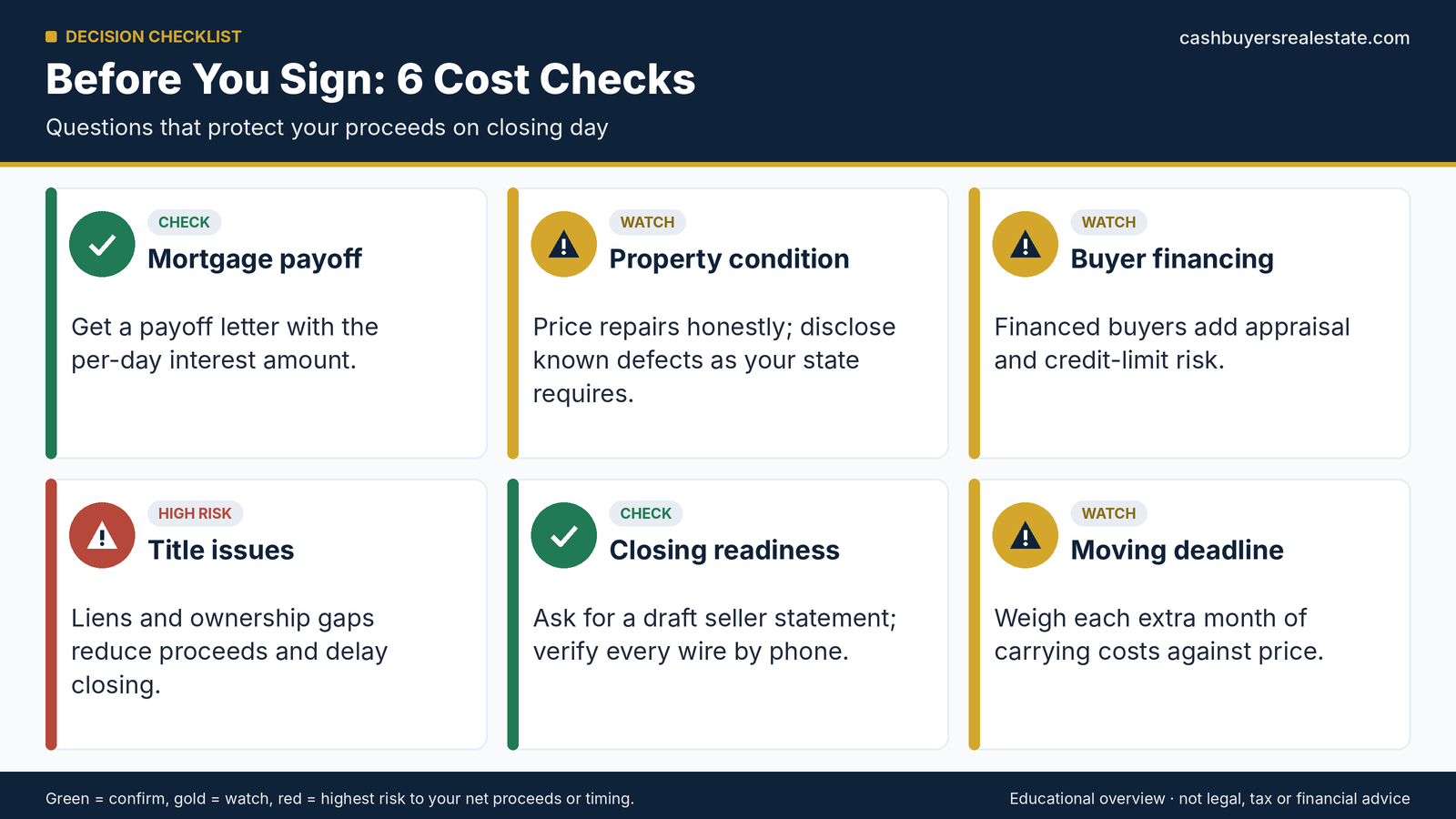
The decision checklist below pulls these closing-day factors into six checks: your payoff, the property’s condition, whether the buyer needs financing, any title issues, how ready the closing agent and documents are, and your moving deadline. Each is also described in the text: confirm payoff figures early, price in the condition honestly, understand the buyer’s financing, search title before accepting an offer, line up your documents, and ask whether the timeline matches your move.
Text version of this infographic
- Mortgage payoff — Get a payoff letter with the per-day interest amount.
- Property condition — Price repairs honestly; disclose known defects as your state requires.
- Buyer financing — Financed buyers add appraisal and credit-limit risk.
- Title issues — Liens and ownership gaps reduce proceeds and delay closing.
- Closing readiness — Ask for a draft seller statement; verify every wire by phone.
- Moving deadline — Weigh each extra month of carrying costs against price.
Frequently Asked Questions About Fast-Sale Closing Costs
Costs, fees, and negotiation
Questions about specific charges
- Do I still pay closing costs if I sell to a cash buyer?
Usually some, yes. Your mortgage payoff, prorated taxes and dues, and any transfer taxes your state levies still apply, and the contract will say who pays title and escrow charges. What often disappears in a direct cash sale is agent compensation, repair credits, and preparation costs. Always ask for the allocation in writing.
- Is there a standard percentage I should expect to pay?
No single figure applies. Costs vary by state, price, route, and negotiated terms, and published averages shift with the survey and the year. The reliable approach is to collect real quotes for commissions, title, escrow, and local taxes and build a net sheet from them.
- Which closing costs can I negotiate?
Plenty. Agent compensation, who pays the owner’s title policy, how escrow fees are split, concessions, and credits are all negotiable. Statutory taxes and your payoff aren’t, although the contract can sometimes shift who bears a tax. Ask early, because leverage shrinks as closing gets closer.
- What counts as a junk fee?
It’s an informal label for charges that are vague, duplicated, or unsupported by a real service, not a legal category. The test is simple: can the closing agent point to the contract clause, fee schedule, or invoice behind the line? If not, ask for it to be removed or explained.
Questions about offers and negotiation
- If a buyer says they’ll cover closing costs, do I get the full offer price?
You get the contract price minus the costs that remain yours, such as the payoff and prorations. Offers that cover costs are often priced with that generosity in mind, so compare net proceeds against an offer that doesn’t make the promise.
- Should I take the offer with the highest price?
Not on price alone. A higher offer with financing and appraisal contingencies can carry more risk and more credits than a lower offer without them. Compare price, net, timeline, contingencies, and the buyer’s ability to close.
- Can a buyer change the terms right before closing?
Contracts bind both sides, but many allow renegotiation after inspection or appraisal, and some buyers try to change terms late. A new price cut or a new fee that wasn’t in the contract deserves a close look, ideally with an attorney’s input, before you agree.
- Do I need an attorney for a fast sale?
It depends on your state and your situation. Some states customarily involve an attorney in every closing; elsewhere a title or escrow company handles it. Even where it’s optional, a brief consultation helps if there are liens, an estate, tenants, or a contract you don’t fully understand.
Timing, taxes, and safety
Questions about timing and paperwork
- When will I see the seller’s settlement statement?
It depends on the closing agent and the contract. The buyer’s lender must give the borrower a Closing Disclosure three business days before closing, but that doesn’t set your timing. Ask for a draft or estimate as soon as the contract is signed.
- How soon after closing do I receive my proceeds?
It varies by closing agent, state funding rules, and the method of payment. Many sellers receive a wire the same day or shortly after recording, while checks take longer. Ask the closing agent how and when funds will be disbursed so you can plan.
- Does a faster closing mean lower closing costs?
Not necessarily. A faster timeline reduces carrying costs and may eliminate credits and preparation expenses, but it can add rush charges and doesn’t change payoffs, taxes, or title fees. Compare totals on a net sheet.
- What happens if closing slips past the payoff date?
Interest keeps accruing, so you’ll owe the servicer’s per-diem amount for each extra day. Ask the servicer to update the payoff letter, and have the closing agent use the new figure.
Questions about taxes, documents, and safety
- Will I owe taxes on the sale?
It depends on your gain, how long you owned and lived in the home, and the rules that apply. The IRS describes an exclusion of up to $250,000, or $500,000 for joint filers, when its ownership and use tests are met. A tax professional can apply this to your numbers.
- What do I bring to closing?
The closing agent will give you a list, but expect to bring government-issued photo ID and all keys, garage openers, and codes. Have any HOA documents, power-of-attorney papers, or trust documents ready if they apply. Confirm wire details separately through a verified phone number.
- How do I avoid wire fraud as a seller?
Verify every set of payment instructions by phone using a number you found independently, never an email’s contact details. Treat last-minute changes as suspicious until confirmed. If something goes wrong, call your bank right away and report it to the FBI’s Internet Crime Complaint Center.
- What if my payoff is larger than the sale price?
Then the sale proceeds won’t cover the loan, and you can’t close without lender involvement. Options such as a short sale or other lender-approved arrangements exist, and a HUD-approved housing counselor can help you weigh them. The urgent home sale options guide outlines them.
Choosing a Route and Taking the Next Step
Match the route to what matters most
A decision framework based on your priority
You won’t minimize every cost and maximize speed and certainty at the same time. So choose the priority that matters most, then pick the route that serves it at an acceptable cost. If your top priority is the highest net and you can wait, a well-prepared listing is the natural place to start. If your top priority is a fixed date, a direct cash sale with a short, clear timeline may fit, as long as you’ve compared the net and the offer’s terms. If your top priority is certainty, look at which route has the fewest contingencies you don’t control, whether that is a cash purchase, a non-contingent listing offer, or a deal with a trusted buyer you’ve verified.
Use the net sheet as your tie-breaker. A route that wins on your priority but loses by a large margin on net deserves a second look. A route that loses on your priority but wins on net may be worth a modest compromise, such as extending the deadline by two weeks. The aim isn’t to find a perfect option; it’s to know what each choice costs you.
| If your top priority is… | A route that often fits | Why | Cost to watch |
|---|---|---|---|
| A fixed closing date | Direct cash sale with a stated closing window | Fewer financing and appraisal steps | Price discount; deadline fees |
| The highest net, with time to spare | Prepared listing, priced with comps | Wider buyer pool and competitive offers | Commissions, credits, carry |
| The least effort | Direct sale or full-service listing | Fewer showings, fewer decisions | Less price leverage |
| Privacy | Direct sale or off-market arrangement | No public marketing or open houses | Fewer competing offers |
| Certainty of closing | Cash sale with verified funds, or a clean non-contingent offer | Fewer outside approvals | Must verify the buyer and contract |
| A property that needs major repairs | As-is sale to a buyer who prices repairs in | You skip repair cost and delay | Repair discount may exceed repair cost |
| Title or lien complications | Whichever route lets you clear title first | Every buyer needs clean title | Payoffs and legal fees reduce proceeds |
Use the table as a starting point for conversations, not as a ruling. A direct sale that fits your priority still has to survive the net sheet, and a listing that fits your priority still has to survive the timeline.
Illustrative examples (hypothetical situations, not case studies):
The relocating seller. A homeowner starts a new job in five weeks and carries $2,200 a month in costs on the old house. A listing might net about $10,000 more on paper, but if it takes four months it adds roughly $6,600 in extra carry compared with a thirty-day closing, plus a second housing payment at the new location. After carry, the gap narrows, and the certainty of a short closing may be worth the rest.
The heir with a vacant house. An heir inherits a house that needs updating and has $2,400 in monthly costs, including insurance for a vacant property. A traditional listing would need repairs and staging. An as-is sale at a discount avoids that work, but the heir should still compare it with an as-is listing and confirm authority to sell, which the guide to selling an inherited house fast explains.
The seller with equity and time. A homeowner has 30 percent equity, a flexible move date, and a house in good shape. Here a listing’s higher price may outweigh a few extra weeks, and the seller may use a cash offer as a backup price rather than as the primary plan.
Where the cost drivers differ by situation, adjust. A home with title problems needs title work whichever route you pick. A tenant-occupied property raises its own proration and deposit questions, covered in the guide to selling quickly with tenants. A house with a looming deadline calls for a realistic timeline discussion, like the one in selling a house in 30 days.
When the numbers point away from a quick sale
Sometimes the comparison shows that speed costs more than it’s worth. If a listing nets thousands more and your deadline has room, the extra weeks may be a good trade. If a quick sale would leave you with too little to pay off your mortgage and fees, a different path may be better, and the first step is a conversation with your lender or a HUD-approved housing counselor, not a faster closing. The guide to urgent home sale options covers alternatives that don’t involve selling at all.
Seven mistakes show up again and again in cost comparisons:
- Comparing price to price. A listing price and a cash offer aren’t the same kind of number until each has been run through a net sheet.
- Forgetting the cost of time. Months of carrying costs are real money, even though they never appear on a statement.
- Treating every quote as final. An estimate before inspection or appraisal can change, so ask what could move it.
- Assuming a fee is mandatory because it’s printed. Many lines are negotiable, especially title allocations and administrative charges.
- Leaving out payoffs and liens. They reduce proceeds as surely as fees do.
- Waiting until closing day to read the statement. Errors are cheapest to fix early.
- Relying on a verbal promise. If a cost is being covered or waived, it belongs in the contract.
Also consider whether the problem is really about closing costs. If you’re worried about what a sale will leave you with, ask for a written net sheet from each person or company proposing a route. A seller who knows the number can make a calm decision. A seller who doesn’t is more likely to make a rushed one.
What to do next
First steps, in order
- Request a payoff letter from your mortgage servicer, and ask about any second loan or equity line.
- Gather your property tax bill, HOA statement and contact information, and any recorded documents you have, such as the deed.
- Order or request a preliminary title search so liens and ownership questions surface early.
- Write down your hard deadline and your preferred deadline, and put a monthly carrying cost on each.
- Ask for written offers or fee quotes from at least two routes, with all costs itemized.
- Build a net sheet for each route using real quotes, and compare cash to you, not headline price.
- Read the contract’s closing-cost paragraph and confirm who pays each item before you sign.
Having documents ready shortens every step, and most closing agents will ask for the same core set. This list isn’t exhaustive, and your state or situation may add items.
- Identification and ownership: a government-issued photo ID, a copy of your deed if you have it, and, for an inherited or trust-held property, the court or trust documents showing who has authority to sign.
- Loan information: the latest mortgage statement, the payoff letter, and details of any second mortgage or equity line.
- Tax and association records: your latest property tax bill, HOA contact and dues schedule, and any notice of a special assessment.
- Condition and disclosure records: permits, warranties, repair receipts, and any state-required disclosure form you complete.
- Occupancy records: for a rental, leases, tenant contact information, and records of security deposits held.
- Closing logistics: keys, openers, codes, your forwarding address, and bank details delivered through a verified channel.
If the sale is tied to a mortgage, a lien, an inherited property, or tenants, consider a short consultation with a local real estate attorney. Rules on transfer taxes, disclosures, and closing procedure are local, and an hour of advice costs little against a closing-day surprise.
Questions to ask every buyer, agent, and closing agent
- Which costs am I responsible for, and which are you covering? Please list them.
- Who is the closing agent, how do I verify their contact information, and what is their fee schedule?
- Will I see an estimated seller statement before closing day, and when?
- Is any fee, deposit, or commission payable by me that isn’t in the contract?
- What happens to the price or terms if an inspection or appraisal reveals a problem?
- How will my proceeds be paid, and how will payment instructions be verified?
Knowing which items to push on, and when, helps you use the answers. Agent compensation and the allocation of title and escrow fees are easiest to negotiate before you sign a listing agreement or purchase contract, because that’s when you have the most alternatives. Concessions and credits are negotiated after inspection and appraisal, when the buyer has leverage and you have the least time. If you’re comparing a cash offer to a listing, you can ask the cash buyer to itemize what’s built into the price, and you can ask the listing agent to put their estimated net sheet in writing with the assumptions listed. Either request is routine, and how a company handles it tells you something about how it will handle the closing.
When you ask for a change, tie it to a number. “Can the buyer pay the owner’s title policy, which would be about $X” is easier to accept or decline than “can you help with costs.” A specific request also makes it easier to compare responses across buyers, because you’ll get the same question back from each.
Good answers are specific and arrive in writing. Hesitation, vagueness, or pressure to sign before you’ve seen the numbers is useful information, too.