
Sell My House Now: Timeline, Costs & Seller Options
When you type “sell my house now,” you’re usually asking one of three different questions without realizing it. Do you want an offer today? Do you want the sale to close this week? Or do you need money in your account as quickly as possible? Those aren’t the same thing, and the gap between them is where most of the confusion, and most of the sales pitches, live. A buyer can truthfully say “offer in hours” and a closing can still be weeks away.
If you want to sell your house now, expect an estimate or conditional offer within hours, a verified written offer within a day or two at best, and a closing that depends on title work, your payoff, and funding steps that no buyer can skip. Money in hand the same day you start is rare. Ask which “now” a buyer means, then confirm it in writing.
That doesn’t mean speed is out of reach. Some steps can compress dramatically when you prepare for them: getting a payoff statement in advance, assembling documents in a single folder, and choosing a buyer whose funds can be verified quickly. Other steps carry floors that are set by lenders, title companies, county recording offices, and the banking system. Knowing which are which is the whole game. It lets you push where pushing works and stop paying a discount for speed that the calendar won’t deliver anyway.
This guide decodes “now” stage by stage. You’ll see what can really happen in hours, days, and a week, which documents a fast offer needs from you, how an instant online offer differs from a verified one, and which promises in same-day cash pitches deserve a hard question. It also covers wire and email safety, what speed can cost, and the alternatives if the answer is “not now.” The last section gives you a numbered plan for today and a sketch for the week.
One more framing point before the detail. Wanting a fast sale isn’t a weakness, and you aren’t obligated to explain your reasons to a buyer. But pressure is exactly what makes sellers easy to rush, so the safest posture is steady and specific: ask for the same information from everyone, write down the answers, and notice which parties are willing to be precise. If your situation is driven by a particular date, the guide on deadline triage shows how to sort hard deadlines from soft ones. If you’d like the full menu of options, the sell house fast hub maps them, and the page on selling in 14 days looks closely at a two-week closing.
What “Sell My House Now” Can Mean: Offer, Close, or Cash in Hand
Words like “now,” “today,” and “instant” show up in almost every fast-sale ad, and they rarely mean the same thing from one advertiser to the next. Before you compare buyers, separate the three outcomes, because each has its own clock and its own constraints.
Three Different “Nows”
Offer now: what a fast response actually is
An offer can arrive in minutes or hours, but it comes in several forms, and they carry different weight. At the light end is an automated estimate: you enter an address and some basics, and software returns a number or a range based on public records, recent sales, and your answers. Next is a conditional offer, usually after a phone call or photos, where a buyer states a price that depends on a walkthrough or inspection. At the heavy end is a written purchase offer or contract with a price, a closing date, a deposit, and stated contingencies.
The first two are useful for orientation but they aren’t commitments. The estimate may rest on assumptions about condition that no one has verified. The conditional offer will usually include language giving the buyer the right to adjust the price after an inspection. Only the written contract binds both sides to something specific, and even a contract usually has contingencies that let a party exit or renegotiate under defined conditions.
So when a buyer says “offer in 24 hours,” the useful follow-up is “what form will it take, and what could change it?” A number you can screenshot is a data point. A number you can sign is a different thing, and the difference is often where a sale gets re-priced late in the process. The section on instant versus verified offers later in this guide goes through that difference in detail.
Close now and cash in hand now: where the calendar really starts
Closing means the legal transfer of the property, and funding means that money has been disbursed. In many transactions they occur close together, but they aren’t identical. In a closing run by an escrow or title company, you sign documents, the buyer’s funds arrive, the deed is recorded, and the company disburses your proceeds. In states where attorneys handle closings, similar steps happen through an attorney’s office. Practices on recording and disbursement timing vary, so ask your closing professional exactly when your funds will be released and by what method.
Several things sit between a signed contract and money in your account. A payoff of your mortgage must be requested and calculated. The title company must search records and resolve anything that clouds ownership. The buyer’s funds must be verified and delivered. Documents must be signed, often before a notary. Wires must be sent, and banks only process them within certain hours and on business days. Even on the fastest tracks, each step has its own floor.
That is why “cash in hand now” is the most misleading phrase of the three. It may mean cash within days of a clean closing, or cash eventually, or a smaller advance of some kind. If you need funds by a specific day, say so up front, ask the buyer or closing professional what has to happen by when, and request a stage-by-stage schedule that you can check against what the rules and calendars allow.
Which “Now” Do You Actually Need?
Matching the “now” to your real constraint
It helps to work out which outcome you truly need, because it changes what you’re willing to trade. If you only need to know your options today, an estimate and a couple of phone calls are enough, and you can compare without committing to anything. If you need a signed contract this week, perhaps to move forward with a mortgage preapproval on a new home, then a written offer from a buyer with verified funds matters most. If you need the keys handed over by a specific date, the closing calendar and possession terms matter most. If you need cash on a specific day, you need a firm funding schedule.
Each need points toward different questions. For a signed contract, ask how quickly the buyer can issue paperwork and what contingencies it contains. For possession, ask about inspection windows, title timeline, and rent-back terms. For funding, ask who holds the money, how it will be wired, and what could delay it. A buyer who answers these precisely, and in writing, is giving you more to work with than one who simply promises speed.
If you’re unsure, write a one-sentence statement of your constraint, such as “I need a signed contract by Friday and funds by the 28th.” That single sentence will keep you from paying a premium for a form of speed you don’t need, and it’ll help any professional you talk to make a useful recommendation.
Decoding the wording sellers commonly see
Fast-sale wording can blur the three outcomes on purpose or by habit. The table below translates phrases sellers often encounter into plain questions. It isn’t a claim that any particular company uses these phrases, and each phrase can be perfectly honest in context. It’s a way to ask precise questions when the wording is loose.
| Wording you may see | What it may actually describe | Question to ask |
|---|---|---|
| “Offer in 24 hours” | An estimate or conditional offer, not a contract | Will it be in writing, and what could change the price? |
| “Close in as few as 7 days” | A best case for a prepared property with clear title | What would make my closing longer, and can you give a schedule? |
| “Cash today” | A quick conversation or estimate, not necessarily funds | On what date are funds released, and by what method? |
| “No repairs needed” | The buyer accepts condition but may adjust price after inspection | How will the price change if issues are found? |
| “No commissions or fees” | Costs may be built into the price or deducted at closing | Where will every cost appear on the settlement statement? |
| “Guaranteed price” | May be limited by conditions in the fine print | What conditions apply, and can I see them before I sign? |
When an answer is vague, ask again and then note who gave it. A buyer who is precise about timing and price conditions is usually showing you how they’ll behave later in the transaction. Precision isn’t proof of good faith, but vagueness before you’ve signed anything deserves caution.
Stage by Stage: What Can Be Sped Up and What Can’t
Every sale moves through the same sequence: information, offer, contract, due diligence, title and payoff, funds, and keys. Some of those stages respond to preparation; others run at a speed set by third parties. The table below lays out the sequence with realistic pacing ranges. The ranges are illustrative planning figures, not guarantees, and your market, property, and state can move them in either direction.
| Stage | Realistic fastest pace | What you can speed up | What you can’t |
|---|---|---|---|
| Information request and first response | Minutes to hours | Have address, basics, and photos ready | A buyer’s review capacity |
| Offer | Hours to 2 days | Answer questions fully; provide payoff estimate | Walkthrough scheduling |
| Contract signed | Same day to a few days | Read terms in advance; decide quickly | Your need to read and understand it |
| Inspection and due diligence | 1–7 days | Provide access, records, utilities | Contractor and inspector availability |
| Payoff statement | Up to 7 business days after written request | Request it before you have a buyer | Lender processing time |
| Title search and cleanup | Days; longer if issues appear | Disclose liens and owners early | Court, lienholder and county speed |
| Closing, funding, and recording | 1–3 days after clear to close | Pre-sign what is allowed; confirm wire details by phone | Bank hours, notary, recording office |
Look at the last column. Almost everything you can’t control comes from outside parties, and many of them have no incentive to move faster because you asked. That’s why preparation matters so much: the things you do control, such as having documents ready, requesting the payoff early, and answering questions promptly, are the only portion of the timeline you can reliably shorten.
From Inquiry to Signed Contract
Information request, offer, and the hours that are realistic
The earliest stages are where hours are real. A buyer can review the property address, your answers, and photos and respond quickly, particularly if the process is automated or the buyer is experienced and local. Your job here is to give complete, accurate information. Describe the condition honestly, including known problems such as a roof leak, foundation crack, or old plumbing. Incomplete or optimistic answers lead to a number that collapses at the walkthrough, which costs you the very time you’re trying to save.
Prepare a short fact sheet before you contact anyone: the address, year built, approximate size, bedrooms and bathrooms, major systems and their ages, known defects, occupancy status (owner, tenant, vacant), and whether the mortgage balance is above or below what you think the house is worth. Add a dozen current photos taken in daylight. With that in hand you can answer in minutes, and you can give the same facts to each buyer, which keeps the offers comparable.
Also decide in advance what you will and won’t accept. Write down a minimum net amount, your must-have closing date, and any terms that are deal-breakers. A fast offer is easy to evaluate when you already know your limits, and difficult when you’re deciding under pressure on a phone call. If an offer pushes you to answer immediately, treat that as information about the buyer, not about the property.
Contract and due diligence: where days enter
Once you have an offer you like, the contract stage begins. Contracts can be signed quickly, but a fast signature shouldn’t be a careless one. Read the price, closing date, deposit amount and who holds it, contingencies, who pays which costs, what happens to the deposit if either side backs out, and any assignment clause, which lets the buyer transfer the contract to someone else. If anything is unclear, ask a real estate attorney or a closing professional to review it. In many states that review takes hours, not days.
Due diligence is when the buyer confirms what they’re buying. It may include an inspection, a review of repair needs, a title search, and a check of liens, permits, and utilities. For cash buyers it can be short, but it isn’t instant: inspectors and contractors have their own schedules, and weather, access, and vacancy matter. If you can provide a prior inspection report, repair estimates, permits, and utility records up front, the buyer has less to discover and fewer reasons to re-price.
Disclosure obligations also apply regardless of how fast the sale moves. Most states require sellers to tell buyers about known material defects, and the forms and rules vary. Never skip required disclosures to save time, and never conceal a known problem; hidden defects tend to surface during due diligence or after closing, and either outcome costs more than honesty would have.
From Contract to Keys and Funds
Title, payoff, and documents: the stages with floors
Two items consistently set the floor on a fast sale: your payoff and the title work. For the payoff, a federal rule under Regulation Z requires a covered servicer or creditor to send an accurate payoff statement within a reasonable time, and no more than seven business days after receiving a written request from the borrower, with exceptions for loans in bankruptcy or foreclosure, reverse mortgages, and natural disasters or similar circumstances. In practice many lenders respond faster, but you can’t count on it, and that’s why you should request it before you have a buyer.
Title work involves searching public records to confirm who owns the property and whether anything is attached to it: mortgages, tax liens, judgments, easements, unpaid assessments. A clean file moves quickly. A problem, such as a lien you didn’t know about or an owner who hasn’t signed, can add days or weeks while it is resolved. If you suspect something, tell your buyer and closing professional now. The guide on selling quickly with liens covers how those are paid from proceeds.
Associations and local governments add their own steps. An HOA may take days to produce documents or confirm balances. A municipality may require an inspection or certificate before transfer. Probate or trust sales require proof of authority. None of these can be shortened by a buyer’s enthusiasm, so identify them early and ask who is responsible for each.
Closing, funding, recording, and possession
The final stages feel quick, but they have timing rules too. If the buyer uses a mortgage, federal rules require the lender to deliver the Closing Disclosure at least three business days before closing, as the Consumer Financial Protection Bureau explains, so the earliest a financed closing can occur is shaped by that notice. A cash buyer isn’t subject to that waiting period, but the title company still needs the final figures, signed documents, and verified funds.
On closing day, documents are signed, often in front of a notary, though mobile and remote options exist in some places. Funds move by wire, which banks process only on business days and within daily cut-off times, so a late-afternoon signing can push your money to the next business day. Recording at the county level confirms the transfer, and when funds are released relative to recording depends on state practice and the closing company’s procedures. Possession is a separate term: it may transfer at closing, at funding, or after a rent-back.
The practical advice is to ask your closing professional three questions in advance: When will documents be ready for review? What is the latest time on closing day that still lets funds go out the same day? And when exactly will my proceeds be released, to which account, and how will wire instructions be confirmed? Write down the answers, because they’re the real schedule.
The process map below puts the stages in order, from information request through offer, contract, due diligence, title and payoff, and funds and keys. The essentials are in the text above, so the graphic works as a quick reference.
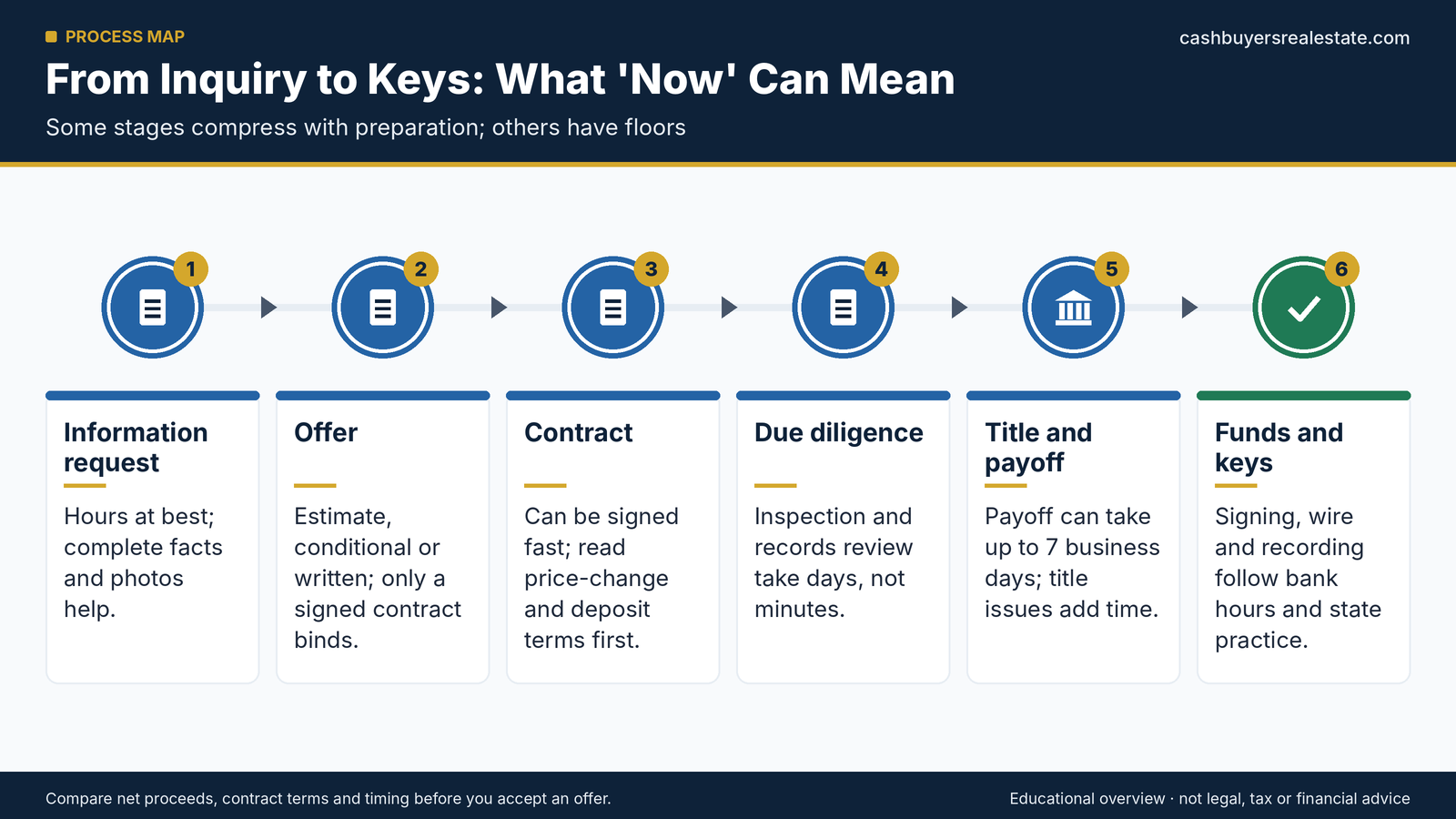
Text version of this infographic
- Information request — Hours at best; complete facts and photos help.
- Offer — Estimate, conditional or written; only a signed contract binds.
- Contract — Can be signed fast; read price-change and deposit terms first.
- Due diligence — Inspection and records review take days, not minutes.
- Title and payoff — Payoff can take up to 7 business days; title issues add time.
- Funds and keys — Signing, wire and recording follow bank hours and state practice.
Your Document Kit: What a Fast Offer Needs From You
Preparation is the one part of a fast sale you control completely. A seller who has the right documents in one folder can answer a buyer’s request in minutes, while a seller who has to hunt for a deed or call a lender for a balance loses days. Assemble the kit before you talk to anyone, and you’ll move faster with every buyer, whatever route you choose.
The Core Document Kit
Ownership, mortgage, and identity documents
Start with proof that you own the property and the authority to sell it. A copy of the recorded deed shows who holds title, how names are spelled, and the legal description. Your county recorder or clerk’s office can usually provide a copy, and many offer online searches. Every owner named on the deed will generally have to sign, so confirm that the names on the deed match the identification each owner will present at closing. Mismatches, such as a name change after marriage or a missing middle initial, are common and fixable, but they take time if discovered late.
Next, gather your mortgage information. Your most recent statement shows the lender, the loan number, and an approximate balance, but it isn’t a payoff figure, since interest accrues daily and fees may apply. Send your lender a written request for a payoff statement and keep the confirmation. Include any second mortgage, home equity line, or other lien you know about; each will need its own payoff. If a borrower or owner has died, or if someone signs under a power of attorney, the closing professional will want to see the documents that give them authority.
| Document | Why it’s needed | Where to get it | Speed tip |
|---|---|---|---|
| Government-issued ID for every owner | Identity check at closing and for title | You already have it | Check expiration dates now |
| Deed or proof of ownership | Confirms who must sign and how names appear | County recorder or clerk | Request a copy before you list |
| Latest mortgage statement | Identifies lender and loan number | Servicer portal or mail | Download it today |
| Written payoff request, then payoff statement | Sets the exact amount owed through a date | Your servicer | Ask early; federal rules allow up to 7 business days |
| Property tax bill and tax account number | Prorations and lien check | County treasurer or assessor | Print the current bill |
| HOA name, contact, and fees | Document requests and dues balance | Association manager | Ask for the document package now |
| Seller disclosure information | Required statements about known conditions | State or local forms | Draft it before you need it |
| Repair records, permits, warranties, prior inspections | Supports condition and reduces re-pricing | Your files, contractors, building department | Scan them into one folder |
Treat the table as a checklist and tick items off as you go. The ones with outside dependencies, such as the payoff statement and the HOA package, deserve the earliest requests because you can’t control how fast they arrive.
Property, tax, and association documents
The second group describes the home. Property tax bills tell the closing company what has been paid and what must be prorated. Homeowners association documents, where an HOA exists, typically include governing documents, fee schedules, any special assessments, and a statement of what you owe. Associations sometimes charge for these packages and take several days to produce them, so request them when you start, not when the buyer asks. Utility information, including providers and recent bills, helps the buyer plan and helps with final meter readings at transfer.
Records of the home’s condition do two jobs. They help a buyer price the property accurately, and they reduce the chance of a late surprise. Gather receipts and permits for roofs, HVAC, water heaters, additions, and electrical or plumbing work, along with any past inspection reports and warranties. If unpermitted work exists, tell your closing professional or attorney rather than hoping it goes unnoticed, because it can surface in due diligence and affect title or insurance.
Federal rules add a requirement for older homes. Under the Lead-Based Paint Disclosure Rule, the EPA says sellers of homes built before 1978 must disclose known information about lead-based paint, provide any available records and reports, give buyers the EPA’s lead pamphlet, and include a warning statement in the contract. Buyers have a 10-day window to inspect for lead-based paint, which the parties can change in writing and the buyer can waive, a detail that matters when speed is the goal. Keep signed copies; the EPA says to retain them for three years after the sale.
Special-Situation Documents
Estates, trusts, divorce, and multiple owners
Some sales require extra paper before anyone can sign. If an owner has died, expect to need a death certificate and documents showing who has legal authority to sell, such as a court appointment, or evidence of a trust or other transfer arrangement. The specific documents and any need for court approval depend on the state and on how the property was held. Title companies are cautious here for good reason, and they won’t insure a transfer signed by someone without clear authority.
Trusts require a copy of the trust or a certification of trust and the trustee’s identification. Divorce adds its own paperwork: a decree or settlement agreement that assigns the property or directs its sale, and the signatures of both spouses unless a court order says otherwise. When several people co-own, everyone with an ownership interest needs to agree to the sale and sign, so build their schedules into your timeline. If one owner lives out of state, ask the closing professional about mobile or remote notary options, and about mailing documents, because courier time adds days.
If you hold the property through a limited liability company or another entity, the buyer’s title company will ask for organizational documents and proof that the person signing has authority. None of this is unusual. The point is that special situations create special documents, and requesting them on day one is the best way to keep the calendar short. For more on these cases, see the guides on selling quickly in probate and selling fast with a mortgage.
Tenants, liens, and unusual title
Occupied properties and clouded titles need their own preparation. If tenants live in the home, gather the lease, rent roll, deposit information, and any notices already served. A buyer will want to know the terms, and some states give tenants rights that affect timing. For specifics, the hub on selling a house with tenants and the guide on selling quickly with tenants explain the options.
For liens and judgments, list what you know and where it came from: a tax lien notice, a contractor’s claim, a judgment from a court case, an unpaid HOA assessment. Liens are normally paid from proceeds at closing, but each requires a payoff figure from the creditor, and some require releases or court steps. A title search will show what is recorded, so you may learn about items you hadn’t heard of. It’s better to find them in the first days than in the last.
Code violations and open permits also deserve a line on your list. Municipalities may require inspections, certificates, or fixes before a transfer, and the rules vary widely. If you’ve received any notice from a local government, include it in the kit. Unusual title issues, such as a gap in the chain of ownership, an old mortgage that was paid but never released, or a boundary question, typically require a title professional or attorney. Raise them early, because they’re the items most likely to determine whether “now” is days or weeks.
Instant Online Offers Versus Verified Offers
The word “instant” appears everywhere in this market. An instant number can be useful, but only if you understand what’s behind it and what has to happen before it becomes money. This section compares an instant online offer with a verified one and shows how a figure can change on the way to closing.
What an Instant Offer Is and Isn’t
How instant figures are produced, and what the FTC has said
Most instant figures start with an automated valuation model that combines public records, recent sales, and the details you enter. The model doesn’t see your kitchen, your roof, or your street. Some platforms then send someone to verify condition, adjust the offer for repairs, and add a service fee or other charges. Others treat the first number as a rough range. In either case, the quick number is an opening position, not a final price.
The Federal Trade Commission has spoken to this directly. In an August 2022 consumer alert about a settlement with a large home-buying company, the FTC said the company marketed that it would pay market value and that sellers would make thousands more than on the open market. The FTC alleged this wasn’t true, that offers were below market value, and that sellers were asked to pay repair costs higher than typical. The company agreed to pay $62 million to resolve the charges. The FTC’s advice to sellers is practical: compare an instant offer with recent sales of similar homes nearby, consider an independent appraisal or a local agent’s market analysis, ask for the full breakdown of price, repair deductions, and fees, and compare net proceeds with what a traditional sale might net after its costs.
That advice applies to every fast offer, not only the platforms the alert describes. A number is only as good as its assumptions. Ask what condition the buyer assumed, what comparable sales were used, and which charges will appear between the first figure and your closing statement. If the buyer can’t or won’t say, you’ve learned something.
What turns an estimate into a verified offer
An offer becomes verified when the key facts have been checked and committed to paper. The buyer has seen the property, in person or through a documented walkthrough, and has stated any repair deductions. A written contract sets out the price, deposit, closing date, contingencies, and who pays each cost. Proof of funds, such as a recent bank or brokerage statement or a letter from a financial institution, shows that the money exists, and a closing company has been named so you can contact it independently. The page on proof of funds explains what to look for.
Verification also means understanding how the price can change. Contracts commonly give the buyer an inspection period during which they may ask for repairs, credits, or a lower price, or cancel. That’s normal, but the terms matter: Is the buyer entitled to renegotiate for any reason, or only for defects above a stated dollar amount? Does a lower price require your agreement? What happens to the deposit if you decline? A verified offer answers those questions before you sign, while an estimate leaves them open.
| Feature | Instant online estimate | Verified written offer | Why it matters |
|---|---|---|---|
| Basis | Automated model plus your answers | Walkthrough or documented inspection | Condition drives price |
| Binding? | No; usually a range or opening figure | Yes, once signed, subject to stated contingencies | Only a contract commits both sides |
| Proof of funds | Rarely shown | Statement or lender/financial letter | Funds are the buyer’s real promise |
| Fees and deductions | May be unclear until later | Listed in the contract or addendum | Net, not headline, is your money |
| Price-change terms | Often open-ended | Defined inspection and re-pricing rules | Prevents a late surprise |
| Speed | Minutes to hours | Hours to days | Verification is the price of certainty |
Read the table as a spectrum, not a binary. Some instant offers are backed by firm commitments, and some verified offers have wide outs. What matters is which row describes the one you’re holding.
Comparing Instant and Verified Offers on Net Proceeds
Worked example: how a quick figure can shift on the way to closing
Consider a hypothetical house with an instant estimate of $250,000. Suppose the buyer later verifies the property and identifies $9,000 of repairs, deducts it, and adds a service charge of 5 percent of the adjusted price. A competing local buyer issues a written offer of $236,000 with no service charge. A third path is an agent listing at $268,000 with preparation costs and a longer timeline. The table shows the illustrative result for each; every figure is invented to show the mechanics.
| Line item | Instant figure, then verified | Written local cash offer | Agent listing |
|---|---|---|---|
| Headline price | $250,000 | $236,000 | $268,000 |
| Repair deduction after verification | −$9,000 | $0 | $0 |
| Service charge or agent fees | −$12,050 | $0 | −$13,400 (5%) |
| Other closing costs (1.5%) | −$3,615 | −$3,540 | −$4,020 |
| Preparation costs | $0 | $0 | −$4,000 |
| Days to funds | 14 | 12 | 60 |
| Carrying cost | −$1,120 | −$960 | −$4,800 |
| Net to seller before payoff | $224,215 | $231,500 | $241,780 |
The instant figure started highest of the two quick routes and ended lowest. The written local offer netted about $7,285 more, because every deduction was stated in advance. The listing nets the most on paper but takes 46 to 48 days longer. These numbers aren’t forecasts, but the pattern is real: a headline price tells you very little until deductions, fees, and time are counted.
Questions that make offers comparable
To compare apples to apples, put the same questions to every buyer, and ask for answers in writing. What exactly is the price, and what conditions can change it? How will condition be assessed, and by whom? What fees, service charges, or credits apply, and where will they appear on the closing statement? Who is paying for title insurance, escrow or attorney fees, transfer taxes, and recording? How much is the deposit, who holds it, and when is it refundable?
Ask about timing in specific terms, too: How many days from signed contract to closing, and what must happen in that period? Does the buyer need a lender, or are funds on hand, and can the buyer show proof of funds? Does the contract allow the buyer to assign it to another party, and if so, will you be told? Is a closing company named? How will wire instructions be provided and confirmed?
If a buyer answers some questions precisely and avoids others, note which. Then compare the final numbers on a net sheet, as the guide on how cash offers are calculated and the net proceeds calculator page show. Comparing in dollars is the surest way to see through wording. For a deeper look at retail-market pricing and offer comparison, see the guide on selling a house quickly.
The chart below compares five routes to a “now” sale: an instant online offer, a verified cash offer, a listing priced to move, a direct sale to a known buyer, and a bridge or pause strategy. Each route’s headline tradeoff is stated in the text above.
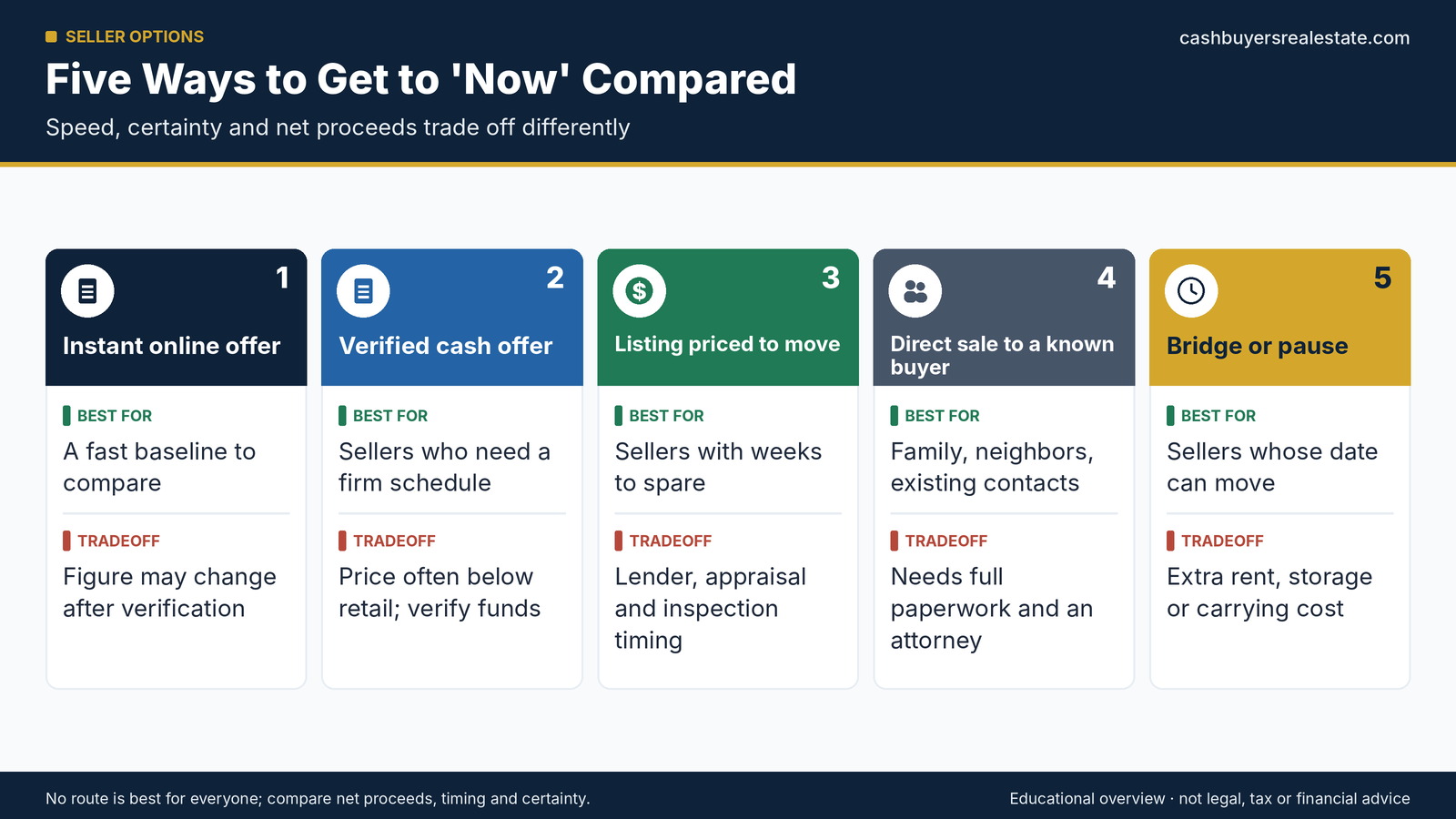
Text version of this infographic
- Instant online offer — best for: A fast baseline to compare; tradeoff: Figure may change after verification
- Verified cash offer — best for: Sellers who need a firm schedule; tradeoff: Price often below retail; verify funds
- Listing priced to move — best for: Sellers with weeks to spare; tradeoff: Lender, appraisal and inspection timing
- Direct sale to a known buyer — best for: Family, neighbors, existing contacts; tradeoff: Needs full paperwork and an attorney
- Bridge or pause — best for: Sellers whose date can move; tradeoff: Extra rent, storage or carrying cost
Red Flags in Same-Day Cash Pitches and How to Stay Safe
Most buyers who respond quickly to a seller are doing exactly what they say they’re doing. A small share are not, and the combination of urgency and a large payment makes fast sales an attractive target for fraud. This section helps you recognize pitches that skip steps, pressure you, or ask you to move money in unusual ways, and it explains how to protect your closing funds.
Promises That Should Slow You Down
Speed claims that skip a step
The easiest way to test a speed claim is to walk through the stages you saw earlier and ask which one the claim leaves out. A buyer who says funds will reach you tomorrow still has to explain the payoff, the title search, the signing, and the wire. A buyer who promises a price before seeing the property needs to say what happens if the property isn’t what the buyer assumed. A claim isn’t wrong because it’s fast. It’s suspicious when it can’t be tied to a schedule.
| Pitch | Why it deserves a question | What to ask |
|---|---|---|
| “Closing is tomorrow” | Payoff statements and title work have their own timing | What is the schedule for payoff, title, signing, and funds? |
| “Price is final, no inspection” | Buyers usually reserve the right to adjust after seeing the property | Is that in the contract, and what exactly can change the price? |
| “Sign today or the offer expires” | Artificial deadlines limit comparison | Can I have 24 hours to have the contract reviewed? |
| “Send a deposit or fee to hold the deal” | In a sale, the buyer normally pays the deposit, not the seller | Why would a seller pay anything before closing? |
| “Sign this power of attorney or deed first” | Transfers ownership or authority before you receive money | What does this document do, and has an attorney reviewed it? |
| “Wire the funds to this new account” | Changed instructions are a classic fraud pattern | Can I confirm by calling a number I already have? |
Use the right-hand column as a script. Honest buyers answer these questions without defensiveness, and many will welcome them, since they protect both sides. Treat refusal to answer, or answers that change from one call to the next, as a reason to slow down further.
Pressure tactics, unusual payments, and contract traps
The Federal Trade Commission describes four signs that show up across scams. Scammers pretend to be from an organization you know. They say there’s a problem or a prize. They pressure you to act now, sometimes insisting you stay on the line. And they tell you to pay in a specific way, such as with a wire transfer, cryptocurrency, payment app, or gift cards. The FTC’s summary line is worth remembering: honest businesses will give you time to make a decision.
In home sales, those signs take particular forms. A caller or mailer may claim a “final notice” about your property or a time-limited offer. A mailer may include a check-like item that isn’t a check and push you to call right away, a pattern the FTC has warned about in a 2025 consumer alert, where the call led to a sales pitch rather than the notice’s apparent subject. A person may ask for fees before any written offer exists, or for your signature on a document that does more than you were told. If you are facing mortgage trouble, the FTC’s mortgage relief guidance adds that companies generally can’t charge until you’ve accepted a written offer from your lender, and that anyone telling you to stop communicating with your lender or to transfer your deed should be treated with great caution.
Contract traps are quieter. Read for an assignment clause, which allows the buyer to transfer the contract to someone else. Assignment can be legitimate and is common in some investor transactions, but you should know whether it’s allowed, whether you’ll be told, and who will ultimately close and fund the purchase. Read for deposit terms, for cancellation rights that run only one way, for price-change language, and for any clause that restricts you from marketing the property or talking to other buyers while the contract is pending. If a term isn’t clear, ask a real estate attorney or your closing professional to explain it before you sign.
Wire and Email Safety in a Fast Closing
How closing-fund scams work
Fast closings concentrate large sums into a short window, which is why criminals focus on them. The Consumer Financial Protection Bureau explains the usual pattern: scammers compromise a real estate professional’s email account, watch correspondence to learn about upcoming closings, and then send spoofed emails posing as an agent, settlement agent, or attorney with false wire instructions, often presented as a last-minute change. The FBI describes the same crime, business email compromise, as one of the most financially damaging online crimes, and its example is a homebuyer who receives what looks like a message from the title company with wire instructions.
The warning signs the FBI lists are worth memorizing. Email addresses may differ from legitimate ones by a character or two. Messages may ask you to update or verify account information. Requests may change account numbers or payment procedures. And the sender may press you to act quickly. Although the examples often involve buyers, sellers face related risks: you may be asked to provide account details for your proceeds, and anyone who intercepts that exchange, or who impersonates the closing company, can redirect money. The same discipline protects you either way.
A mismatch between the story and the channel is often the tell. Legitimate closing companies generally expect to verify wire details by phone and may use secure portals for documents. A sudden email saying “our bank changed, use this account instead,” arriving from an address that looks almost right, is a very different matter from a call you place to a number you looked up independently.
A protective routine for the last 72 hours
You can reduce risk considerably with a routine that takes only a few minutes. Follow it in order as closing approaches.
- Identify your contacts early. The CFPB suggests choosing two trusted contacts, such as your agent and the settlement agent, and discussing the closing and payment process with them in person or by phone.
- Record phone numbers independently. Look up the closing company’s number yourself and save it. Do not rely on a number in an email signature.
- Agree on a verification method. The CFPB mentions a code phrase for future verification. Even without one, plan to confirm anything involving money by voice.
- Confirm every change by phone. If wire instructions, closing location, or amounts change, call the number you recorded before acting on the email.
- Share account details only through channels the closing company designates. Avoid sending financial information by ordinary email.
- Secure your own email. The FBI recommends turning on two-factor or multi-factor authentication wherever it is offered.
- Confirm receipt. After funds are sent to you, verify the deposit directly with your bank.
These steps feel excessive until the day they matter. They cost a few phone calls, and they close a gap that criminals use against sellers who are rushing. For the wider set of verification steps on buyers, see the hub on cash home buyer scams.
What a Fast Sale Can Cost, and What Can Go Wrong Between Yes and Keys
Speed usually has a price, and sometimes it has a hidden one. This section explains where the cost of “now” tends to show up and which problems commonly appear after you’ve said yes, so you can plan for them instead of being surprised.
The Price of Speed
Where the money goes: price, fees, deductions, and time
The cost of a fast sale appears in four places. The first is price: a buyer who is taking on condition, resale risk, and a tight timeline will usually price in a margin, which is why headline offers often differ from retail value. The second is fees and credits: closing costs, service charges, buyer credits, and the cost of any agent involvement. The third is deductions: repair estimates and other adjustments after inspection. The fourth is time: carrying costs, which are small per day but add up, and the personal cost of delay.
Not all of these are bad. A buyer who accepts the home as it is may save you cleanout, repairs, showings, and the uncertainty of a financed buyer’s loan. The right way to judge speed is to count both sides. The table below shows qualitatively how different timing tiers tend to trade off. It’s a map of tradeoffs, not a price list.
| Timing tier | What usually has to be true | Typical tradeoff | Main risk |
|---|---|---|---|
| Offer within hours | Fast information, a responsive buyer | Estimate may be preliminary | Price changes after verification |
| Contract within days | Verified buyer, prepared documents | Possible discount for certainty and condition | Weak funds or open-ended contingencies |
| Closing in roughly 1 to 3 weeks | Clean title, payoff on time, cash or very prepared buyer | Discount versus a longer retail process | Title or payoff delays |
| Closing in roughly 4 to 8 weeks | Typical financed process | Often closer to retail value | Appraisal and financing risk |
These tiers are illustrative. A prepared seller with a clear title may beat a tier, and a complicated file may miss it. The practical use of the ladder is to match your need to the right tier, and to be suspicious when a buyer offers the top tier’s speed with the bottom tier’s price.
Reading a net sheet when speed is the priority
When you’re in a hurry, it’s tempting to skip the paperwork that tells you what you’ll actually receive. Do the opposite. Ask the closing company for a draft settlement statement as early as possible and compare it line by line with what the buyer told you. You should be able to find the sale price, your payoff, any prorated taxes and association dues, title and escrow or attorney fees, recording fees and transfer taxes where applicable, credits to the buyer, and the net amount due to you.
Look for items that weren’t discussed. A fee called a “service fee,” “administrative fee,” or “closing coordination fee” deserves an explanation. A deduction for repairs that exceeds the estimate you were given should be tied to a written scope. Credits that weren’t in the contract need a reason. If you don’t understand a line, ask the closing professional to explain it, and ask the buyer to confirm in writing what was agreed.
If the final figure differs from the figure you were promised, you still have choices before closing: negotiate, ask for documentation, bring in an attorney, or in some cases walk away under the contract’s terms. Those options narrow quickly once documents are signed, which is one more reason to review early. The page on closing costs when selling a house and the guide on fast home sale closing costs explain the common lines.
What Can Go Wrong After You Say Yes
Fall-through, re-pricing, and extensions
Three problems account for most late disappointments. The first is fall-through: the buyer’s funds don’t materialize, a financing contingency fails, or the buyer simply changes course. The second is re-pricing, sometimes called a re-trade, where the buyer returns after inspection with a lower number. The third is extension, where a closing date slides because something wasn’t ready. Each can cost days or weeks, and each is more likely when the original promise outran the facts.
You can limit exposure with a few habits. Before signing, confirm how the price can change and by how much. Insist on a defined inspection period, with a stated end date. Check that the deposit is meaningful and is held by a neutral party, and ask when it becomes non-refundable. Keep other options alive, such as a second buyer’s written interest, where your contract permits. And don’t pack, rent a truck, or commit to a new purchase based on a closing date that still has open conditions.
If a buyer does ask for a lower price, treat it as a negotiation, not an ultimatum. Ask for the inspection findings and any contractor quotes, compare them with your own repair estimates, and decide whether the request is reasonable. You may agree, counter, or decline and return to the market. It helps if you already know your minimum net, because a decision made against a known number is calmer than one made under deadline pressure.
Title surprises and possession problems
Title issues are the other main source of late delay. A lien you didn’t know about, an old mortgage that was paid but never released, a missing signature from a co-owner, or a boundary dispute can all appear in the title search. Some are quick to fix. Others require a court filing or a third party’s cooperation. This is why disclosing everything you know up front is not only honest but fast: a buyer who learns about a problem from you can plan around it, while one who finds it on day eight may re-price or walk.
Possession problems are less discussed but common. A tenant who hasn’t left, belongings that haven’t been moved, utilities shut off before a walkthrough, or keys that can’t be located can all hold up a closing or lead to disputes after it. Agree in writing on the possession date, the condition in which the home will be left, what stays and what goes, and what happens if you need extra days. A short rent-back agreement, with a daily rate and clear insurance and damage terms, solves many of these.
On closing day, do a final check with the buyer or the buyer’s representative if the contract provides for a final walkthrough. Take photos of the condition when you leave. Keep copies of everything you sign. If something goes wrong after the sale, your documentation is the best defense, and a real estate attorney in your state can tell you what recourse exists.
Alternatives When “Now” Isn’t Required or Isn’t Possible
Sometimes the most useful discovery is that the date isn’t as fixed as it felt. If you have more room than you thought, other routes may net more, and some options buy time without selling at all. This section outlines those alternatives and the tradeoffs of each.
Other Routes to a Quick Sale
Listing priced to move
An agent-led listing remains the route most likely to reach the widest group of buyers. When priced with discipline and prepared well, it can produce an accepted offer in a few weeks in many markets, though the closing of a financed sale depends on the lender, appraisal, and inspection. The tradeoff is certainty and workload: showings, negotiations, and a longer, more variable calendar, with agent compensation and closing costs coming out of the proceeds. The guide to selling a house quickly covers the pricing method and offer comparison in detail.
If you are weighing this against a cash route, the comparison page on cash sale versus listing for a fast sale sets out the tradeoffs side by side, and the page on cash buyer versus realtor frames the choice from the seller’s perspective. A hybrid is possible: list with an agent while keeping a written cash offer as a fallback, if your agreement permits and you understand the terms.
If you keep a cash fallback while listing, read the listing agreement closely first. Ask how long the agreement lasts, whether you can cancel it, and whether any compensation is owed if you end up selling to a buyer you found yourself or to a buyer who first learned of the home through the listing. Agreements differ, and compensation terms are negotiable. A short term with a clear exit lets you pivot to a faster route if the first weeks go quietly, while a long exclusive term can limit your choices at exactly the moment you need them.
The key question is whether the extra weeks buy enough extra money. Use the net-sheet method: put each route’s price, fees, credits, and time on one page, and decide whether the difference is worth the wait given what your days actually cost.
For sale by owner, direct sales, and auctions
Selling without an agent avoids the listing-side fee but puts pricing, marketing, showings, negotiations, and contract details on you, along with the question of how to handle buyer-agent compensation if the buyer has an agent. It can work for experienced sellers in strong markets and for sales to a known buyer, such as a neighbor or relative, though those deals need an attorney or closing professional to paper them properly. The guide on selling fast without a realtor explains the mechanics and the risks.
Auctions offer a hard date and a competitive process, but they carry marketing costs and buyer’s premiums, require attention to reserve prices, and don’t suit every property or market. Ask the auction firm to explain fees, reserve rules, and what happens after the sale: how long buyers have to close, and what happens if they don’t.
Each of these routes changes who carries which risk. A direct sale to a known buyer shifts trust and paperwork to you. An auction shifts price certainty to the bidders. An agent-led sale shifts workload to the agent but not the market. Choose the route whose risks you are best able to carry.
Whatever route you pick, put a direct sale in writing. A signed purchase contract, a title search, title insurance for the buyer, required disclosures, and a closing handled by an attorney or a title company protect both sides, even if the buyer is a friend. If the buyer is a relative and the price is below market value, tax and benefit questions can arise, so speak with a tax professional or attorney before you set the number. Buyers using a mortgage will need an appraisal, which can bring the same value questions as any retail sale.
Buying Time Without Selling Yet
Extensions, payment arrangements, and temporary solutions
If “now” is driven by a payment problem, the CFPB advises contacting your mortgage servicer right away and asking about forbearance and other options, and HUD-approved housing counselors can help you weigh them, and HUD says foreclosure counseling is always free. Those conversations don’t commit you to staying or selling. They may buy weeks or months of breathing room during which a normal sale becomes possible. The guide on deadline triage and the page on selling before foreclosure go deeper.
If “now” is driven by another purchase or a move, extensions, rent-backs, temporary housing, and storage can separate your sale date from your move date. Each costs something modest and can save you from a steep discount. If the pressure is carrying cost on a vacant home, ask about whether the insurer imposes conditions on vacancy and whether the property could be rented or cared for in the interim.
The idea behind all of these is to separate the deadline from the sale. When you can’t sell as fast as the date demands, the next best thing is to move the date, soften its consequences, or cover the gap more cheaply than a price cut would.
Start these conversations early and be specific. If another purchase is the source of the date, ask the other seller and your lender what extension options exist and what they’d cost, including any fee to extend a rate lock. If your employer has a relocation benefit, ask what it covers and when its deadlines fall. Offering something in return, such as a per-day payment or a larger deposit, makes a yes easier, and a written addendum makes it dependable.
When waiting is the better call
Occasionally the right answer is to wait. If your carrying costs are modest, the home is in decent shape, and your only pressure is impatience, a few more weeks might raise your net more than any speed premium could. A tax milestone can also matter: the IRS home-sale exclusion generally requires that you’ve owned and lived in the home for at least 24 months within the five years before the sale, so selling a few weeks before that mark could change your tax result. A tax professional can check where you stand.
Seasonal timing, pending repairs that would raise value, and neighborhood developments can also justify waiting. None of these apply if a hard deadline is driving the decision. The test is whether anything about your situation actually requires speed. If not, a calmer timeline gives you leverage to compare offers.
Put a price on patience. If waiting costs $80 a day, an extra month costs $2,400. Compare that with the discount a speed-oriented buyer would require, and with the net you could expect from a retail process. If the discount is larger than the cost of a month or two of waiting, patience pays; if it is smaller, speed does. Doing this arithmetic once, with real numbers, often resolves an argument you’ve been having with yourself for weeks.
The checklist below condenses the guide’s cautions into six checks to run before accepting any “now” offer: your payoff, the property’s condition, the buyer’s funds or financing, title and liens, closing readiness, and your moving deadline. The reasons for each appear in the sections above.
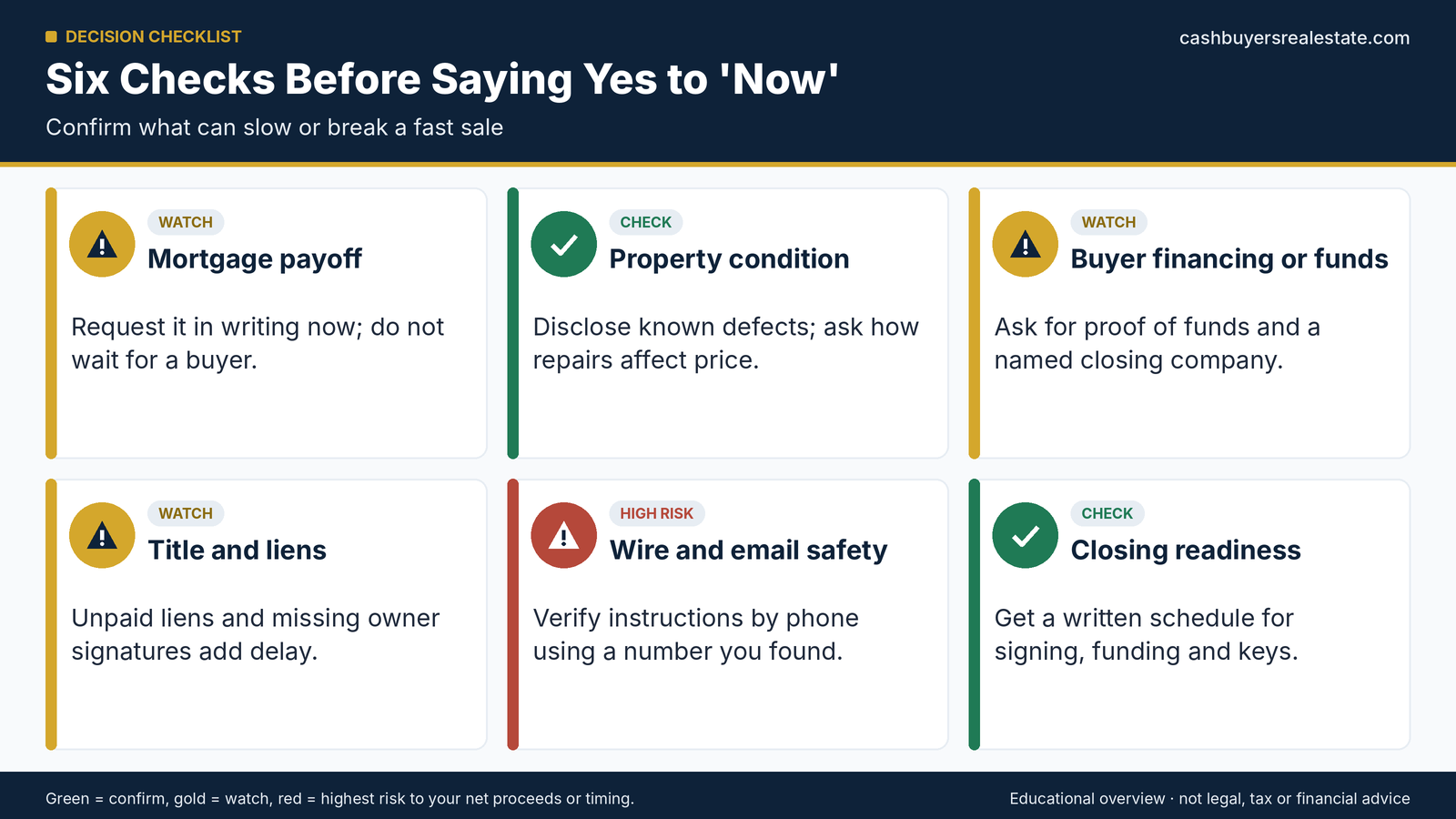
Text version of this infographic
- Mortgage payoff — Request it in writing now; do not wait for a buyer.
- Property condition — Disclose known defects; ask how repairs affect price.
- Buyer financing or funds — Ask for proof of funds and a named closing company.
- Title and liens — Unpaid liens and missing owner signatures add delay.
- Wire and email safety — Verify instructions by phone using a number you found.
- Closing readiness — Get a written schedule for signing, funding and keys.
Frequently Asked Questions About Selling Your House Now
Questions About Timing and Offers
Questions about how fast “now” can be
- Can a house sell and close in a single day?
It’s rarely realistic. Between an offer and keys sit a payoff statement, a title search, document signing, and wire transfers, and each depends on third parties. Federal rules allow a servicer up to seven business days to answer a written payoff request, with exceptions. A buyer may respond within hours, but that is the offer, not the closing.
- What is the fastest realistic closing?
It varies with the property, the title, and the buyer’s funding. A prepared seller with clean title and a buyer who doesn’t need a lender can sometimes close in a matter of weeks, and occasionally faster. A financed buyer usually takes longer. Treat any specific number promised before the buyer has reviewed your title and payoff as a best case, and ask for a written schedule.
- What is the difference between an offer and a contract?
An offer states what a buyer proposes. A contract is created when both sides agree and sign terms that cover price, deposit, closing date, contingencies, and responsibilities. Verbal or emailed figures that haven’t been formalized can change. Have an attorney or closing professional review a contract before you sign it, especially if the deadline is tight.
- Do I have to be at closing in person?
Not always. Some closings allow documents to be signed in advance, by mobile notary, or remotely, depending on state law and the closing company. Ask early, because courier time and notary availability can add days. Your closing professional can tell you what your state and county allow.
Questions about instant and online offers
- Is an instant online offer a real offer?
Sometimes it is a firm proposal, but often it is an estimate or opening figure based on automated data and your answers. It typically changes after the buyer verifies condition and terms. Ask whether it is in writing, what conditions apply, and what could change the price.
- Why did the price change after the walkthrough?
Because the first number rested on assumptions about condition that the walkthrough checked. Ask for an itemized list of what changed and why, along with the repair estimates behind it. The FTC advises asking for the full breakdown of price, repair deductions, and fees, and questioning repair costs that seem high.
- Can I collect more than one instant offer?
Yes, and doing so is wise. Give each buyer the same facts and photos so the figures are comparable, and note how long each offer stays open. Then compare the net proceeds after fees, deductions, and closing costs, not the headline numbers.
- How do I compare an instant offer with listing the house?
Build a net sheet for each route, including price, fees, repairs, credits, and the cost of the extra time. The listing may net more but take longer; the quick offer may net less but cost fewer days. The comparison guide on cash sale versus listing walks through it.
Questions About Documents, Safety and Costs
Questions about documents and preparation
- Which documents should I gather first?
Start with your ID, the deed or proof of ownership, your latest mortgage statement, and a written payoff request. Then add the property tax bill, HOA contact and fees, repair and permit records, and any disclosure information. Items that depend on outside parties, like the payoff and HOA package, should be requested first.
- How do I get a payoff statement?
Send your lender or servicer a written request, using the method they specify, and keep a record. Federal rules say a covered servicer must provide an accurate payoff statement within a reasonable time and no more than seven business days after the request, with exceptions for loans in bankruptcy or foreclosure, reverse mortgages, and disasters.
- Do I have to repair the house before selling?
Usually not, but you still have disclosure duties. Many states require sellers to disclose known material defects, and federal rules require lead-based paint disclosures for homes built before 1978. Selling as is changes who does the repairs and how the price is set; it doesn’t remove disclosure obligations.
- What if the house is in a trust or an estate?
Expect the closing company to ask for proof of authority, such as trust documents or a court appointment, plus identification and sometimes a death certificate. Requirements vary by state. Start that paperwork first, since it can set the pace for everything else.
Questions about scams, wires, and costs
- How can I tell whether a same-day cash pitch is legitimate?
Speed alone doesn’t tell you. Look for specifics: a written offer, a named closing company you can contact independently, verifiable proof of funds, and clear price-change terms. Be wary of pressure to decide immediately, fees requested up front, and unusual payment methods.
- What if someone asks me to wire money or pay a fee to move the sale along?
Stop and verify. In a normal sale, the buyer provides the deposit and costs come out of your proceeds at closing. Any request that you send money first deserves independent verification and, ideally, review by an attorney. Report suspected scams at ReportFraud.ftc.gov.
- Is it safe to email my documents?
Ordinary email isn’t the safest channel for sensitive information. Ask the closing company whether it uses a secure portal, and verify the company’s identity through a phone number you looked up yourself. Avoid sending account numbers by email, and turn on multi-factor authentication for your email account.
- What does a fast sale usually cost?
It depends on the buyer, the property, and the route, so no single figure applies. Costs can appear as a lower price, fees, repair deductions, and credits, along with the carrying cost of the days involved. The only reliable answer comes from a net sheet built from written offers. See the net proceeds calculator page for a starting point.
Choosing Your “Now” and Taking the Next Step
You’ve seen what can really happen in hours, days, and a week, and where the floors are. The last step is to choose which “now” matters most to you and to start with actions you can take today without committing to a buyer.
A Decision Framework: Match the “Now” to Your Priority
Four priorities and the routes that tend to fit them
Most sellers care most about one of four things: learning their options today, getting a signed contract this week, handing over keys by a specific date, or receiving funds by a specific date. Each leads to a different emphasis. The table below pairs them with the route features that matter and the confirmations to request.
| Your main “now” | What matters most | Routes that often fit | Confirm in writing |
|---|---|---|---|
| Know my options today | Comparable information | Several estimates plus an agent’s opinion | What each figure assumes |
| Signed contract this week | Buyer certainty and clear terms | Verified written offer with proof of funds | Price-change rules and deposit |
| Keys by a set date | Closing and possession schedule | Prepared cash or well-qualified buyer; rent-back if needed | Closing date, possession terms |
| Funds by a set date | Payoff, title, and funding mechanics | Buyer without a lender, early payoff request | Wire timing and verification steps |
Pick the row that describes your hardest need, and treat the others as secondary. If two rows both apply, note which one has a consequence you can’t undo. That’s the one to protect, and everything else is negotiable around it.
One pattern to avoid is asking for several kinds of speed at once and paying for all of them. A seller who needs a signed contract this week doesn’t necessarily need funds this week, and a seller who needs funds on the 28th may not need to sign until the 20th. Separating the needs lets you negotiate each separately: a later closing date might be traded for a firmer price, or a smaller discount for a buyer who can close early only if your payoff arrives on time. Spell out the priority ranking to any adviser you work with, and ask them to flag conflicts between your priorities.
Three scenarios, worked through
Illustrative example (hypothetical numbers, not market data): Nadia wants to buy a new home and her lender needs a signed contract on her current house before it will finalize her mortgage plan. She doesn’t need funds until her purchase closes in about five weeks. Her priority is a signed contract this week. She gathers her documents, requests a payoff statement, and asks two buyers for written offers with proof of funds. She picks the one that has a clear price-change clause and a named closing company, and she asks the buyer for a closing date that matches her purchase.
Illustrative example (hypothetical numbers, not market data): Omar must be out of state by the 14th and needs his proceeds to cover a deposit. He has twelve days. He knows the stages he can’t speed up, so he requests his payoff in writing on day one, asks the closing company for a schedule, and focuses on buyers who don’t need a lender. He compares two written offers on a net sheet, picks the one with a defined inspection window, and confirms wire instructions by phone before closing. He also arranges a rent-back for three days in case the funding slips.
Illustrative example (hypothetical numbers, not market data): Erin inherited a vacant house and feels she should sell immediately. When she writes down her real constraints, she finds none are urgent: carrying costs are about $85 a day, there is no deadline, and a few repairs might add value. She collects three estimates to understand the range, builds a net sheet for a listing and for an as-is offer, and decides to list with a plan to reassess in two weeks. Because she needed information more than speed, a calm comparison served her better than a same-day offer.
In each case the person began with a specific outcome, not a general sense of hurry. That specificity kept them from paying for speed they didn’t need and let them push where it counted.
What to Do Next: Today and This Week
What to do today
You can make real progress in a few hours without committing to anything. Work through these steps in order.
- Write one sentence about your constraint. For example: “I need a signed contract by Friday and funds by the 28th.”
- Request your payoff statement in writing. Keep a record of when and how you sent it.
- Gather the core documents. ID, deed, mortgage statement, tax bill, HOA details, repair and permit records, and disclosure information.
- Write a one-page fact sheet. Include the address, size, systems and ages, known defects, occupancy, and an honest condition summary, plus a dozen daylight photos.
- Set your minimum net and must-haves. Know the lowest net you’d accept and the dates you can’t miss.
- Ask two or three sources for information. Include an agent’s pricing opinion and at least one written buyer offer, giving each the same facts.
- Look up a closing company’s phone number yourself. Save it for later verification; never rely on a number in an email.
- Do not sign, pay, or wire anything today. Use today to learn, compare, and prepare.
If the day goes well, you’ll finish with a folder, a fact sheet, a payoff request in motion, and two or three comparable pieces of information. That is a stronger position than most sellers have after a week of phone calls.
A few cautions apply to today’s list. Don’t send identity documents, account numbers, or the deed to anyone you haven’t verified through an independent channel. If a buyer or adviser asks for money or a signature before you have a written offer in hand, treat that as a reason to wait a day and check. And if your situation involves a lender notice, a court date, tenants, or an estate, add a call to the right professional to the list: a housing counselor, an attorney, or a tax professional, as appropriate. Those calls are free or inexpensive to start, and they often change which steps matter most.
This week: a day-by-day sketch, checkpoints, and questions
Days two and three are for comparison. Review the offers and estimates you’ve collected, ask follow-up questions, and request written terms. Build a net sheet for each, including fees, deductions, and the days involved. Ask your closing professional what documents they’ll need and how long they expect title work to take. If you uncover a lien, a missing owner signature, or a tenant issue, raise it now.
Days four and five are for decisions. Have an attorney or closing professional review the contract you prefer, especially assignment, inspection, price-change, and deposit terms. Confirm proof of funds and the closing company’s identity independently. Days six and seven are for preparation: confirm the schedule in writing, line up a notary if needed, arrange possession, and verify any wire instructions by phone.
At the end of the week, check your position against your one-sentence constraint. If a step is behind, decide whether to ask for an extension, change routes, or accept a later date. Questions worth asking along the way include: What exactly is the price, and what can change it? Who is the closing company, and how can I reach them? What is the schedule for payoff, title, signing, and funds? What happens to the deposit if the deal ends? Keep every answer in writing.