Sell House Fast without a Realtor: Timeline, Costs & Seller Options
You’ve decided the commission is too big a bite, or you’ve been burned by a listing that sat, or you simply want to keep control of the sale. Now you’re typing “sell house fast without a realtor” into a search box and hoping for a plan, not a sales pitch. The good news is that a sale without a listing agent is legal in every state and happens every day. The less comfortable news is that an agent’s fee pays for a long list of tasks, and when you skip the agent, every one of those tasks either lands on you or gets bought from someone else.
Yes, you can sell a house quickly without a real estate agent, but speed depends on what you replace, not on what you skip. You still need a realistic price, buyer exposure, a compliant contract, required disclosures, and a closing agent. The fastest no-agent routes are usually a direct sale to a cash buyer or a well-priced, well-marketed owner sale.
This guide walks through that trade honestly. You’ll see the agent’s job broken into tasks so you can decide which ones you’ll do yourself, which ones you’ll hire out, and which ones you can’t afford to get wrong. We’ll cover a realistic timeline, how to price without a professional comparative market analysis, what flat-fee MLS services and limited-service brokerages do, and how the rules for paying a buyer’s agent changed after the National Association of Realtors settlement. We’ll also look at the paperwork, the attorney-versus-title-company question that differs by state, and the fraud patterns that target owners who sell on their own.
A note on vocabulary before we go further. “Realtor” is a registered trademark for members of the National Association of Realtors, so this guide says “real estate agent” or “listing agent” for the general role and uses the trademark only when naming that association. If your state licenses brokers and salespersons separately, the idea is the same: the licensed person you pay a commission to is the one doing the marketing, negotiating and coordinating.
Here’s the shape of the decision. A conventional listing with an agent trades a commission for convenience, reach and negotiating skill. A for-sale-by-owner sale, usually shortened to FSBO, trades your time and risk for a potentially larger check. A direct sale to a cash buyer or investor trades some price for speed and certainty, and it needs no listing agent at all, though some buyers work through their own agents or wholesalers. None of the three is right for everyone. What matters is which one produces the best net result by your deadline, and that’s what the sections below help you measure.
A few ground rules for reading the numbers. Every dollar figure in this guide is hypothetical and labeled that way, because your result depends on your price, your loan payoff, local transfer taxes and customs, and who pays what under your contract. Where we cite a federal rule, a court decision or a statute, we name the source so you can read it yourself. Where practice changes from state to state, we say so instead of pretending there’s one national answer. And because fast and cheap rarely arrive together, we’ll keep asking the same practical question: what does this choice do to the money you actually walk away with, and by what date?
If you’d rather start from the broader picture, the category overview on how to sell a house fast covers every route side by side. This article stays narrow on purpose. It’s about the logistics of selling without an agent, from the first pricing decision to the day the funds arrive.
What a Listing Agent Actually Does, and What You Take On When You Skip One
It’s tempting to think of an agent as a sign in the yard and a photographer. In practice, a competent agent handles a dozen separate jobs, and most of them stay invisible until something goes wrong. Seeing the whole list is the first step toward deciding which pieces you can honestly cover.
The Agent’s Work, Task by Task
Think of a listing as a small project with distinct phases: before the house hits the market, while it’s being shown, and after you have a signed contract. Agents typically touch all three, and the phase you underestimate is usually the one that costs you.
Pricing and positioning
Before a listing goes live, an agent usually builds a comparative market analysis, often called a CMA. That means pulling recent closed sales of similar homes nearby, adjusting for differences in size, condition, lot, garage and upgrades, and deciding where your house sits in the pack. The agent also knows which comparable sales (“comps”) appraisers and buyers’ agents tend to accept and which they discount, such as a sale between relatives, a distressed sale, or a pending sale that never closed.
Pricing is where most owner sales are won or lost. An overpriced house collects stale days online and eventually sells for less than it would have fetched at a realistic price. An underpriced one sells quickly and leaves money behind. There’s also a third problem that only shows up late: if the buyer uses a mortgage, the lender orders an appraisal, and a contract price the appraiser can’t support can force a renegotiation or collapse the deal. When you skip the agent, the pricing judgment is yours unless you hire an appraiser or buy a one-time opinion, a point we’ll return to in the pricing section.
Marketing, showings and negotiation
An agent puts the property into the local multiple listing service (MLS), which feeds most of the major home-search sites, writes the description, arranges photography, and fields calls from buyers’ agents. Then comes screening and scheduling showings, collecting feedback, and negotiating the offer. A single offer typically contains several moving parts: price, closing date, possession date, who pays which closing costs, repair requests after inspection, and contingencies for financing, appraisal and inspection. Each of those has a dollar value, and a good negotiator trades them against each other instead of fighting only about price.
A good negotiator also reads the other side. The buyer who needs a particular closing date might pay more for flexibility, and an offer with a weak preapproval letter might deserve a lower weight than a slightly lower offer from a buyer with verified funds. Without an agent you’ll field the calls yourself, often at inconvenient hours, and you’ll negotiate directly with a buyer’s agent who does this every week. That isn’t a reason to give up on the idea. It’s a reason to decide your walk-away terms in writing before the first offer arrives.
Where the Work Lands When You Go Without
Skipping the listing agent doesn’t delete any of those jobs. It reassigns them, and the question is who gets them: you, a paid specialist, or a buyer who takes the property as it stands.
The hours a self-managed sale really takes
Owners often underestimate the time. Pricing research, photographs, writing the listing, answering inquiries, scheduling and attending showings, reviewing offers, negotiating counteroffers, chasing paperwork and coordinating closing add up, and they tend to cluster on evenings and weekends because that’s when buyers look. A sale that drags past the first few weeks also adds a second kind of cost: every month you own the house you still pay the mortgage, taxes, insurance and utilities.
Illustrative example (hypothetical numbers, not market data): Suppose a seller budgets 6 hours for pricing research and photos, 4 hours for listing setup, 15 hours for inquiries and showings across three weeks, 6 hours negotiating, and 8 hours for contract-to-close coordination. That’s roughly 39 hours. If the seller values their time at $40 an hour, the “free” labor is about $1,560 of effort, spread over weeks when the seller probably has a job and a move to plan.
Your own figures will differ, and plenty of owners decide the time is worth the savings. The point is to count it so the trade is visible, and to notice whether your schedule can actually absorb it before your deadline.
If you can’t realistically give the project that many hours, that’s useful information. It points toward buying help for specific tasks, or toward a route that needs fewer hours, such as a direct sale.
What you can buy piece by piece
Going without a full-service agent doesn’t mean going without help. Sellers commonly buy individual services: a flat-fee listing on the local MLS, a photographer, a real estate attorney to review or prepare the contract, an appraiser for a pricing opinion, a transaction coordinator to track deadlines, and a title company or closing attorney to run the settlement. The right mix depends on how comfortable you are with contracts and how much of the process your state hands to an attorney or a title company by default.
The table below lays each agent task next to the most common replacement and the trap to watch. Costs vary widely by market, so none are shown here; get written quotes and put them on your net sheet.
| Agent task | Common replacement when you sell yourself | Main risk to manage |
|---|---|---|
| Price recommendation (CMA) | Your own comp research, a paid appraisal, or a one-time paid agent opinion | Anchoring on an asking price from emotion or a portal estimate instead of closed sales |
| MLS exposure | Flat-fee MLS listing or a limited-service brokerage | Service level varies; you may field every call and negotiate against a buyer’s agent |
| Photos, description, signage | Hired photographer, your own writing, yard sign | Weak photos shrink the buyer pool in the first week online |
| Showings and screening | Lockbox with showing-request app, scheduled open times, a trusted friend | Personal safety, unaccompanied visitors, items left in the house |
| Negotiation | You, optionally coached by an attorney | Conceding price or terms without seeing the net-proceeds effect |
| Contract and addenda | Attorney-drafted or state-approved forms; title company form in some areas | Missing contingency language or deadlines; forms that don’t fit your state |
| Disclosures | Required state and federal forms completed by you | Liability for incomplete or inaccurate answers |
| Closing coordination | Title or escrow company, or closing attorney; optional transaction coordinator | Missed deadlines, unresolved liens, wire-fraud exposure |
Read the table as a shopping list, not a verdict. Every row you cover with a competent professional, or with careful work of your own, narrows the gap between a self-managed sale and a full-service one. Every row you leave blank is a place where a week or a deal can disappear.
One more distinction matters for speed. If your goal is “fast” rather than “highest price,” the agent-replacement question changes. A buyer who purchases as is, for cash, and without a listing agent removes several tasks entirely: staging, showings to dozens of strangers, and the appraisal and lender timelines that come with a mortgage buyer. That route carries its own tradeoffs, mostly a lower price than a fully marketed sale might fetch, and we’ll put numbers on it in the route-comparison section. For a broader look at how the two paths compare, see this overview of cash buyers versus listing with an agent, or the guide on selling without a realtor if you want the complete owner-sale picture.
How Long a Sale Without an Agent Realistically Takes
“Fast” means different things to different sellers. For one household it’s under a month because a job starts in another city. For another it’s before the next mortgage payment. Either way, the clock has two halves with different drivers: the stretch from deciding to sell until you have a signed contract, and the stretch from contract to the day money lands in your account.
From Decision to Signed Contract
The first half is the part you control the most, and it’s also the half where owners selling alone most often lose time by starting in the wrong order.
Preparation and pricing happen in parallel, not in sequence
The quickest sellers don’t finish one task before starting the next. In the first week or two they decide on a target price range, order a title search or at least locate their deed, request a payoff figure from any lender, gather the disclosure forms their state requires, and book photography. Meanwhile they handle the visible cleanup: decluttering, deep cleaning, and fixing the handful of defects a buyer will notice in the first thirty seconds. Large repairs rarely pay off on a short clock, and for the repair-versus-skip decision the companion guide on how to sell a house fast without repairs goes through the math.
Paperwork is the hidden bottleneck. If you can’t produce the deed, the mortgage payoff, the homeowners’ association documents (if there is an association), the survey or plat, and recent utility and tax bills, a buyer’s side will wait on you. Pulling those together before you list typically takes days, not weeks, but only if you start before the first showing. The checklist on preparing for a fast home sale covers the document pile in more detail.
Market exposure to signed contract
This is the least predictable stretch, and nobody can honestly promise you a number. How long a correctly priced house takes to attract an acceptable offer depends on your local market, the season, interest rates, the price band, and how the house shows. In a market where buyers are scarce, you may wait through several weeks of showings; in a market with strong demand for your kind of home, a well-presented house may draw offers within days. What you can control is the setup: a realistic price from day one, strong photographs, a visible listing on the portals buyers search, and a showing process that doesn’t turn buyers away.
It also helps to decide your decision rules before the first offer arrives. For example: how long you’ll hold at the starting price, what you’ll do if the first two weeks produce no serious offers, and which offer terms matter more to you than the last few thousand dollars. A short written plan keeps a stressful week from turning into an expensive impulse. If a no-agent listing doesn’t produce an acceptable offer on your schedule, selling directly to a cash buyer is a fallback worth researching in advance, not on the day your deadline arrives.
From Signed Contract to Funds in Your Account
Once both sides sign, the pace is set less by your marketing and more by the buyer’s financing, the property’s title, and the way your state handles closings.
What sets the contract-to-closing clock
The biggest variable is how the buyer pays. A cash buyer can often close as quickly as title work and paperwork allow, since there is no lender, no underwriting and no appraisal requirement. A buyer using a mortgage adds an application file, an appraisal, underwriting conditions and a lender-imposed schedule. Federal rules require the lender to give the buyer a Closing Disclosure at least three business days before closing, according to the Consumer Financial Protection Bureau, which means the closing date can’t be moved up on a whim once the lender’s package is final.
Other drivers include inspection and repair negotiations, the length of any contingency periods you agreed to, whether your state or local custom includes an attorney review period, how fast the title company can clear any liens or judgments, and whether a homeowners’ association must supply documents. The contract is where you can influence the clock: shorter contingency periods, a defined closing window, and a clear rule for what happens if the buyer misses a deadline can all shave days. Those terms deserve the review of an attorney in states where that’s customary, and for most sellers a contract written by the other side’s agent deserves a second pair of eyes.
Where no-agent sales lose days
Three patterns repeat. First, deadlines slip unnoticed. A contract may contain a dozen dates: earnest money due, inspection period ends, repair response due, loan commitment, appraisal, title objections, closing. Agents track these on a calendar, and a seller going alone should do the same on day one. Second, late-surfacing title problems: an unreleased old mortgage, a contractor’s lien, an unpaid tax bill, or a name that doesn’t match across documents can freeze a closing for weeks. Ordering a title search early, as in the first week rather than after the contract, is one of the cheapest ways to protect the schedule.
Third, communication gaps. A buyer’s agent who has never worked with an unrepresented seller may send forms that don’t match your state’s standard, or may wait for instructions you didn’t know you were supposed to give. Treat the title or closing company as your project manager: ask them for a written list of what they need from you and by when, and answer the same day. For a deeper look at the specific causes, the guide to what slows down a home sale catalogs them one by one.
| Stage | Owner sale, buyer with a mortgage | Owner sale, buyer paying cash | Direct sale to an investor |
|---|---|---|---|
| Preparation and pricing | 1–2 weeks | 1–2 weeks | Days; little staging needed |
| Marketing to signed contract | Varies widely by market and price | Varies; depends on how many cash buyers are active locally | Days to a couple of weeks if offers are gathered quickly |
| Inspection and negotiation | About a week or two | Often shorter | May be waived or short, per contract |
| Appraisal and underwriting | Several weeks | None required | None required |
| Title work and closing prep | Runs alongside lender timeline | Often the main clock | Often the main clock |
| Funds after signing | Same day to a few days, depending on state and closing method | Same | Same |
Illustrative example (hypothetical numbers, not market data): A seller needs to hand over keys by the end of a 10-week window because of a job start. In week 1 she orders a title search, requests her payoff, books photos and finishes minor cleanup. The house is listed in week 2 and receives a workable offer from a buyer using a mortgage in week 4. The contract sets a 30-day closing window with a 7-day inspection period. Inspection negotiations take about a week, and the lender’s appraisal lands near the end of week 7. Closing is scheduled for week 9, leaving one week of slack.
The slack matters. If the appraisal had come in low or the buyer’s underwriter had asked for another document, the closing date could have slipped past her deadline. A seller in this position might line up a backup, such as a cash buyer’s written interest, by week 5.
Treat these as planning assumptions to adapt, not promises. The pattern is the useful part: removing a lender removes the appraisal and underwriting stages, and removing marketing removes the most unpredictable stage. Your own closing company can give you a more realistic reading of the contract-to-closing stretch in your county.
The first infographic below summarizes the five decisions that set the pace of a no-agent sale: fixing the deadline, choosing the sale path, pricing for your goal, preparing title documents, and comparing net proceeds. Each of those is covered in text in the sections that follow, so treat the graphic as a quick reference, not the full explanation.
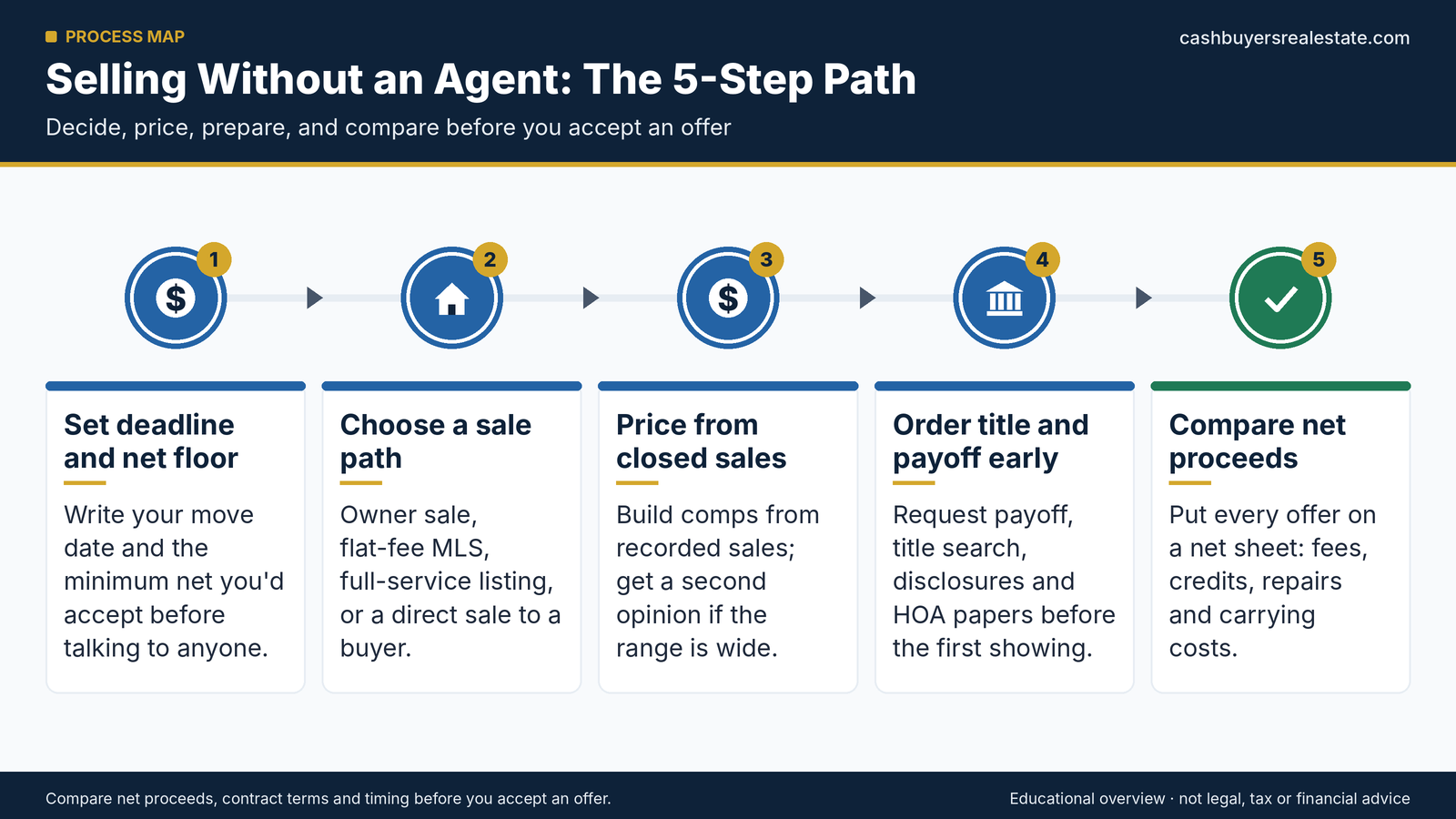
Text version of this infographic
- Set deadline and net floor — Write your move date and the minimum net you'd accept before talking to anyone.
- Choose a sale path — Owner sale, flat-fee MLS, full-service listing, or a direct sale to a buyer.
- Price from closed sales — Build comps from recorded sales; get a second opinion if the range is wide.
- Order title and payoff early — Request payoff, title search, disclosures and HOA papers before the first showing.
- Compare net proceeds — Put every offer on a net sheet: fees, credits, repairs and carrying costs.
Pricing and Exposure: Getting Buyers to Show Up Without an Agent’s Network
Two things decide how fast an owner-sold house sells: whether the price matches what buyers will actually pay, and whether enough of the right buyers can find and tour the property. Both can be done without a full-service agent. Both are easy to do badly.
Pricing for Speed with Your Own Research
An agent’s pricing advice rests on recent sales data and local judgment. You can replicate much of the data part yourself, and you can rent the judgment part.
Building a comp set you can defend
Start with closed sales, not asking prices. A neighbor’s list price tells you what someone hopes to get; the recorded sale price tells you what a buyer paid. County recorder or assessor websites often show sale prices, and public portals show recent sold listings. Look for homes similar in size, age, style, lot, bedroom and bathroom count, and condition, located close by and sold recently. How narrow to make the window depends on how active your market is. In a busy neighborhood a few months of sales may be plenty; in a sparse rural area you may need to widen the radius and the time frame.
Then adjust. A comp with a finished basement, an extra garage bay or a renovated kitchen sold for more than a plain version of the same house, and a house on a busy street sells for less than the same floor plan on a quiet one. Lenders’ appraisers make these adjustments in dollars, and so should you, even if roughly. Watch for traps: price per square foot varies with size and with how basements and additions are counted; a distressed or family sale is a weak comp; and an automated estimate on a portal is a starting guess, not an appraisal.
Illustrative example (hypothetical numbers, not market data): You find three closed sales of similar three-bedroom homes at $292,000, $301,000 and $307,000. The $307,000 home had a finished basement and a newer roof; your house has neither. After you adjust the highest comp downward for those features and look at all three together, a realistic range for a mortgage-financed buyer might be $292,000 to $302,000.
Your own adjustments will rely on local judgment, which is why many sellers confirm the range with a professional before committing to a price.
Paying for a second opinion
If your comp set leaves you uncertain, buying a second opinion is cheap relative to a six-figure sale. Options include a licensed appraiser, who will charge a fee for a formal report that a buyer’s lender may or may not accept; a real estate agent who will prepare a CMA, sometimes in the hope of earning the listing; and, in some areas, a broker price opinion. Their incentives differ. An appraiser is paid for accuracy, while an agent offering a free opinion may be tempted to quote a high number to win the listing, so ask for the closed sales that support any figure.
Whatever you choose, decide on a price strategy in advance. A common approach for a faster sale is to price at or modestly below the middle of the comp range and to commit to a review point, for example a price check after two weeks of limited showings. Waiting months and then cutting the price twice usually costs more in carrying costs than pricing correctly at the start. Pairing a defensible price with realistic expectations on speed is also what makes the next decision, whether to accept a cash offer at a discount, easier to evaluate on the numbers instead of on stress.
Getting Seen: Exposure Channels Without a Full-Service Agent
Buyers look where inventory is easiest to search, and in most markets that means the MLS and the portals fed by it.
Flat-fee MLS and limited-service brokerages
A flat-fee MLS service is typically a licensed brokerage that, for a set fee, enters your listing into the local MLS so it appears on the major search sites. A limited-service brokerage may add extras such as a lockbox, a showing-scheduling service, or contract forms. What these services generally don’t do is represent you in negotiation or manage the transaction for you, although some offer those as add-ons. Packages, prices, contract lengths and refund terms vary a lot from one company to the next, so treat any description here as general and read the listing agreement before you pay.
Questions worth asking before you sign: Is your listing agreement tied to a minimum term, and can you cancel? Who answers calls from buyers’ agents, and who sets up showings? Does the service handle price changes, status changes and photo updates? Which MLS will the listing appear in, and does the company hold the required license in your state? Since the 2024 industry changes described later in this guide, you will also want to know how the service handles buyer-agent compensation, because the MLS itself no longer carries a compensation field.
Photos, signs, showings and safety
Photography has an outsized effect, because the first impression online decides whether anyone books a tour. Well-lit, straightened, wide-angle photos of the front exterior, kitchen, main living area and primary bedroom do most of the work. A yard sign still catches neighborhood traffic, and a short written description should mention the things buyers search for, like updates, lot features and the school district, without making claims you can’t back up.
Showings need rules. Many owners ask for a phone call and a short conversation before scheduling, request that a buyer’s agent attend or that buyers share a preapproval letter or proof of funds, and avoid showing the house alone. Before any visit, put away medications, mail, laptops, jewelry, spare keys, and financial paperwork. And keep advertising clean: the federal Fair Housing Act limits discriminatory advertising even by owners who qualify for its limited owner-sale exemption, as the statute’s text at 42 U.S.C. 3603 explains. Describe the house, not the type of buyer you’d prefer.
Comparing Routes and Net Proceeds: Owner Sale, Full-Service Listing and Direct Sale
A commission is easy to see and easy to resent, which is why “I’ll save the commission” is the most common reason owners try to sell alone. Whether that saving survives contact with the rest of the transaction is a math question. The honest approach is to run the same hypothetical house through each route and compare what’s left at the end.
Net Proceeds on One Hypothetical House
Net proceeds are what you receive after every cost of selling, before you account for your mortgage payoff. Comparing routes on net, instead of on sale price, is the single habit that prevents the most expensive mistakes in this process.
Three routes, one house
The example below uses invented assumptions to show how the lines interact. It is not a forecast, and your costs, fee structure and local customs will differ. Percentages for agent compensation are negotiable and vary by market and by agreement.
Illustrative example (hypothetical numbers, not market data): A seller owns a house that a fully marketed listing might sell for $300,000. Route A is a full-service listing. Route B is an owner sale on a flat-fee MLS listing, priced a bit lower because the seller negotiates alone and accepts an earlier offer. Route C is a direct cash sale at a discount in exchange for speed, with no repairs, no showings and no buyer-agent fee. The assumptions below are for illustration only.
| Line item | A: Full-service listing | B: Owner sale, flat-fee MLS | C: Direct cash sale |
|---|---|---|---|
| Sale price | $300,000 | $296,000 | $255,000 |
| Listing agent fee (assumed 3%) | −$9,000 | $0 | $0 |
| Flat-fee MLS, photos, attorney review | $0 | −$1,600 | −$500 |
| Buyer-agent compensation (assumed 2.5%) | −$7,500 | −$7,400 | $0 |
| Other seller closing costs (title, taxes, fees) | −$3,000 | −$3,000 | −$1,500 |
| Repair credits and prep costs | −$2,000 | −$2,000 | $0 |
| Holding costs (assumed $2,000 per month) | −$5,000 (2.5 months) | −$6,000 (3 months) | −$1,500 (0.75 month) |
| Net before mortgage payoff | $273,500 | $276,000 | $251,500 |
Read across the bottom row. In this made-up scenario the owner sale beats the full-service listing by about $2,500 after the seller’s own buyer-agent payment, additional costs and extra month of carrying cost, which is far less than the commission the seller “saved.” The direct cash sale nets about $22,000 less than the full-service listing and arrives roughly two months sooner, so the question becomes what those two months and the lower stress are worth to you. A different house, a stronger market or a larger discount would flip the ranking. Plug in your own numbers with a tool like the planned net proceeds calculator.
One more calculation is worth doing before you commit to an owner sale: the break-even gap. In Table 3, the owner-sale seller avoids a $9,000 listing fee, spends $1,600 on services and carries the house for an extra half month, about $1,000. That leaves roughly $6,400 of room. If the owner sale ends up $4,000 below the full-service price, a bit of that room remains, since the buyer-agent payment is slightly lower on the lower price. If the gap were $7,000, the commission “savings” would be gone and then some. The break-even gap is your reality check on pricing and negotiating discipline, because it shows how much concession you can afford to make before the route stops paying.
The costs people forget
Net sheets go wrong when they leave out lines. For an owner sale the usual omissions are the buyer’s-agent payment, which many sellers assume will vanish with the listing agent; the cost of professional help for contracts; price reductions after weeks on the market; and the carrying cost of the home. Carrying cost is the sum of your mortgage interest, property taxes, insurance, utilities, lawn or snow service and any association dues, for every month you own the property, and on a short timeline it can rival a commission.
Others hide in the closing statement: transfer or recording taxes that your state or county charges the seller, prorated property taxes, association transfer or resale-certificate fees, title insurance for the buyer where local custom puts that on the seller, and a payoff fee or recording fee on your own loan. These differ so widely by state that a national average would mislead; your title or closing company can give you an estimate before you list. For the full catalog, see the guides on closing costs when selling a house and costs specific to a fast sale.
Finally, negotiate with the net in mind. A $5,000 price concession that avoids a $6,000 repair request is a good trade; a $5,000 concession that saves you nothing is just a gift. Keep a one-page net sheet and update it with each counteroffer, so a number on a screen never replaces the number in your account.
Selling Directly to an Investor: The No-Agent Route
The cleanest way to sell without an agent is to sell to someone who doesn’t need a listing at all. Investors and some other cash buyers purchase directly from owners, which skips marketing, staging and most of the negotiation timeline.
How a direct sale works and why it skips the agent
A typical direct sale starts when you contact one or more buyers, or when one contacts you. The buyer asks about the property and your timeline, may tour it, and then makes an offer. Investors who plan to renovate and resell often work backward from an estimated after-repair value (ARV, the expected resale price once the work is done), subtract repair costs, holding and financing costs, transaction costs and a profit margin, and arrive at an offer. Methods vary from one buyer to another, which is exactly why a single offer tells you little. The explainer on how cash offers are calculated breaks down the common ingredients.
If you accept, you sign a purchase contract, a title or closing company runs a title search and prepares the closing documents, and the buyer pays the price in funds the closing company can verify. Some buyers purchase through their own agents, and some are wholesalers who sign a contract with you and then assign it to another buyer, which changes who ends up on the other side of the closing table. Each of those is lawful in most places when done openly and in compliance with state rules, but each affects who you’re actually dealing with and what happens if the first buyer can’t find an end buyer. The overview page on selling a house for cash covers the variations.
Verify before you sign
Because there is no agent between you and the buyer, you carry the verification. Ask for proof of funds and confirm it with the institution that issued it; a screenshot isn’t proof. Learn who the buyer is, whether it’s an individual or an entity, and whether the buyer intends to close or to assign the contract. Ask who holds the earnest money and under what conditions it is returned. Read every clause about inspection periods, cancellation rights and assignment, and watch for pressure to sign quickly, last-minute price cuts after you’ve committed, or requests for upfront fees. None of these automatically proves bad faith, but each deserves a pause and, ideally, an attorney’s review.
Illustrative example (hypothetical numbers, not market data): A seller collects three written offers on a house that needs work. Offer A is $245,000 with a 14-day close and no inspection contingency. Offer B is $252,000 with a 30-day close and a 10-day inspection period that lets the buyer cancel. Offer C is $258,000 but includes a clause allowing the buyer to assign the contract to someone else and a 21-day due-diligence window. Which is best depends on what the seller values. Offer B’s cancellation right makes it less certain than its price suggests, and Offer C’s assignment clause means the seller may close with a different buyer than the one who signed. The seller checks proof of funds for all three and asks each buyer to explain the terms in writing before choosing.
Two further habits help. Gather more than one offer if time allows, since offers on the same house can differ by a large margin. And use a neutral closing company or attorney that you or your lawyer vetted, not one the buyer insists on without explanation. The pages on proof of funds and on cash home buyer scams explain what to check and how to check it.
| Route | Agent needed? | What sets the speed | Seller workload | Main tradeoff |
|---|---|---|---|---|
| Full-service listing | Listing agent | Market demand, price, buyer financing | Lower | Seller pays commission and still waits on market |
| Owner sale with flat-fee MLS | No listing agent; buyer may bring one | Price, exposure, buyer financing | High | Savings can be eroded by buyer-agent cost, price gap and time |
| Owner sale without MLS (known buyer, sign, word of mouth) | No | Whether a buyer appears | High | Small buyer pool, so pricing and negotiation risk rise |
| Direct sale to cash buyer or investor | No | Buyer’s inspection and title work | Low to moderate | Price is usually lower than a full-market sale |
| Online offer platform or iBuyer | No listing agent | Platform’s evaluation and schedule | Low | Fees and offer adjustments after inspection; availability is limited by home type and area |
Use the table to eliminate routes first. If you can’t spare the hours, strike the high-workload rows; if you can’t accept a discount, strike the direct sale; if your property needs major repairs, expect fewer routes to work for a financed buyer. What remains is your shortlist.
The second infographic summarizes the main seller routes and what each is best for, and the text above states each tradeoff in full, so the image is a quick scan and nothing more.
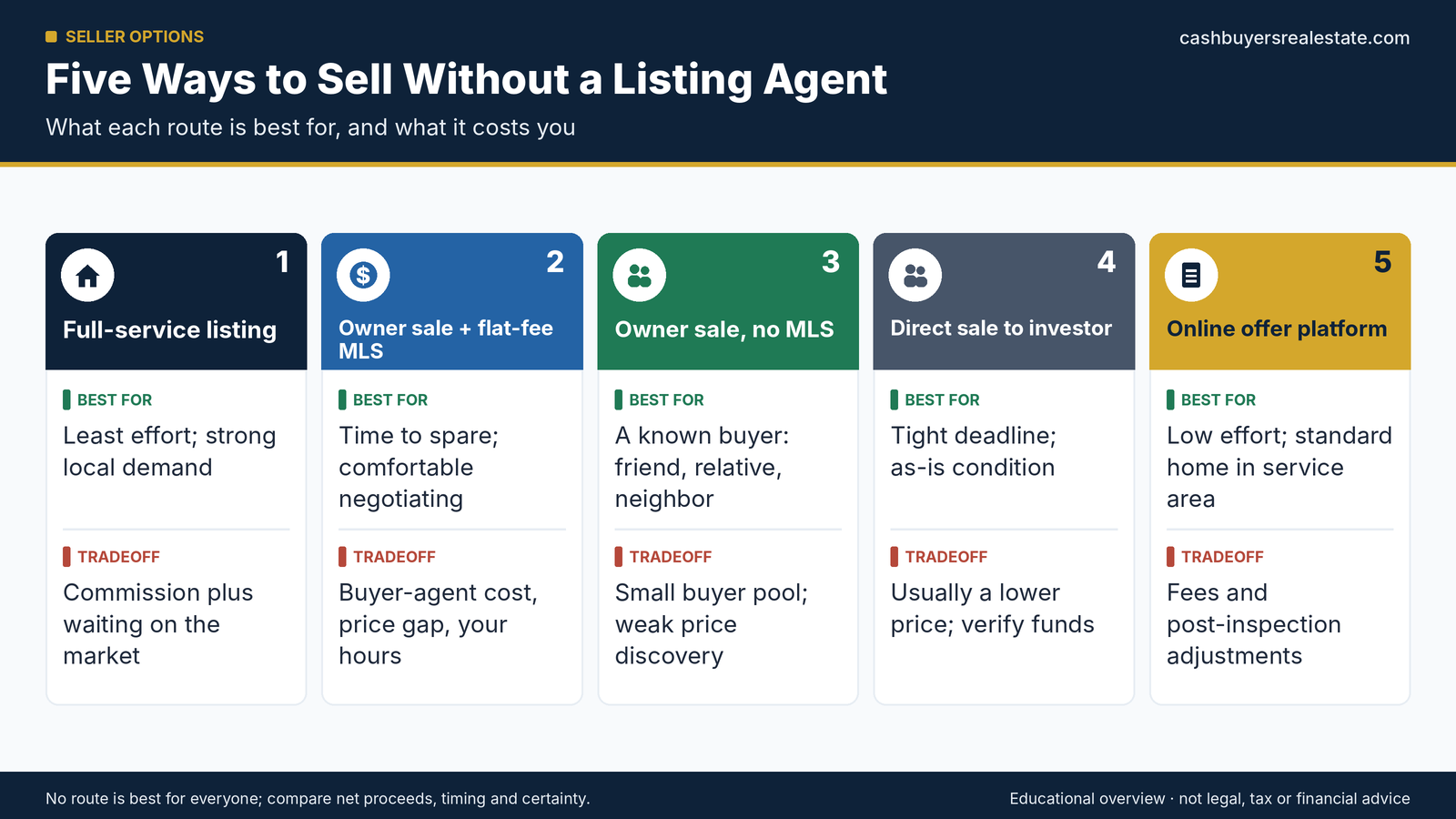
Text version of this infographic
- Full-service listing — best for: Least effort; strong local demand; tradeoff: Commission plus waiting on the market
- Owner sale + flat-fee MLS — best for: Time to spare; comfortable negotiating; tradeoff: Buyer-agent cost, price gap, your hours
- Owner sale, no MLS — best for: A known buyer: friend, relative, neighbor; tradeoff: Small buyer pool; weak price discovery
- Direct sale to investor — best for: Tight deadline; as-is condition; tradeoff: Usually a lower price; verify funds
- Online offer platform — best for: Low effort; standard home in service area; tradeoff: Fees and post-inspection adjustments
Buyer’s-Agent Compensation After the NAR Settlement, Explained Neutrally
The biggest question owners have when they list without an agent is, “Do I still have to pay the buyer’s agent?” The honest answer is that nothing in law forces you to, and the market still expects an answer from you. Understanding the 2024 changes helps you decide what to offer.
What Changed in August 2024 and What Stayed the Same
Several rule changes came out of a legal settlement involving the National Association of Realtors. They took effect August 17, 2024, according to the association’s own announcement of the practice changes, with MLSs that opted in given until September 16, 2024 to implement them.
The practice changes in plain English
Three changes matter most to a seller. First, MLSs governed by the association’s rules had to remove broker compensation fields and compensation information from the listing database, so you no longer see a standard “offering X percent to the buyer’s agent” box in the MLS. Second, agents working with buyers must enter a written agreement with the buyer before touring a property, which means a buyer’s agent now has a signed document that states how that agent will be paid. Third, compensation disclosures are required to sellers, prospective sellers and buyers.
These changes bind association members and participating MLSs. They don’t create obligations for you as an individual owner, and they don’t regulate a sale that never enters an MLS. Their practical effect reaches you through the agent on the other side of the table: that agent has a written agreement with their client, and the question of who covers the fee becomes part of the negotiation instead of a line already set in the listing.
What stayed the same
Agent compensation remains negotiable, as the association’s guidance for home sellers puts it. Sellers can still choose to offer compensation to a buyer’s agent, and the association’s seller page notes that concessions, such as a credit toward the buyer’s closing costs, can still appear in an MLS listing. Marketing outside the MLS, including social media, flyers and websites, remains allowed. You can read the association’s summary for sellers in its page on what the settlement means for home sellers.
Nothing in these rules fixes a percentage or sets a standard rate, and no law requires a seller to pay for the buyer’s representation. Because practice is still settling and local MLS rules can differ, treat anything here as a description as of October 2026 and confirm current local practice with your MLS, a real estate attorney, or your state’s real estate regulator.
Your Options as an Unrepresented Seller
With no listing agent to negotiate for you, the compensation decision falls to you, and it usually comes up in the first offer.
Three ways to handle the buyer’s agent
You can offer to pay a buyer’s agent, offer the buyer a credit to use however they like, or offer neither. Each changes the buyer pool and the price conversation.
| Approach | How it works | Effect on buyers | Watch for |
|---|---|---|---|
| Offer agent compensation in the contract | You agree in writing to pay a stated amount or rate at closing | Keeps buyers with agents comfortable | Vague language; amount not on the settlement statement |
| Offer a closing-cost credit to the buyer | Buyer chooses how to use the credit, possibly toward their agent | Flexible; appeals to financed buyers | Lender limits on seller contributions vary by loan type |
| Offer no compensation | Buyer pays their own agent | Smaller pool; some buyers may skip your listing | Slower sale; price pressure later |
The tradeoff is simple. A credit or a stated fee costs money you’d otherwise keep, but buyers who work with agents are a big part of the market, and a seller who refuses to engage with them is choosing a smaller audience. If speed is the goal, many owners treat a modest, clearly written offer as a cost of reaching more buyers, then negotiate the price with that cost in mind.
Putting it in writing without surprises
Whatever you decide, put it in the contract, not in a phone call. State the amount or rate, say who pays it, and say when it’s paid, which is normally from your proceeds at closing. Ask the closing company to show the payment on the settlement statement so you can see it before you sign. Avoid open-ended promises such as “whatever is customary,” since customs differ by area and the sentence leaves the amount to the other side.
Illustrative example (hypothetical numbers, not market data): A buyer offers $300,000 and asks the seller to cover $7,500 toward their agent. The seller could accept a $7,500 payment stated in the contract and paid from proceeds at closing, counter by offering a $4,000 closing-cost credit and holding the price at $300,000, or counter at $292,500 with no compensation and let the buyer decide how to pay their agent. The first and third both leave the seller about $292,500 before other costs, while the credit version leaves about $296,000 but may not satisfy the buyer’s agent. They also differ in how the buyer’s lender treats the money and in how the offer reads to the buyer’s side. Comparing them on the net sheet, not on the headline price, is what keeps the choice clear.
If the buyer is financing, ask the buyer’s lender or agent whether a credit would exceed the limits that apply to the loan type, because exceeding them can force the deal back to the negotiating table. And consider having an attorney read the compensation clause, which is short and, for a modest fee, easy to review. For the larger picture of how this affects your route choice, see the comparison of a cash buyer and a listing with an agent, and the overview of cash sale versus listing for a fast sale.
Contracts, Disclosures and Closing Paperwork: Who Prepares What
On a conventional listing, the agent usually supplies the contract forms and tells you which disclosures to sign. On your own, you have to find out what your state requires, choose who drafts what, and keep the paper trail clean. This is the area where state law differs most, so use this section as a map of questions to ask, not as a form kit.
The Document Set a No-Agent Seller Has to Assemble
Most residential sales involve the same cast of documents, even when the names and formats change from state to state.
Contract, addenda and deed
The purchase agreement is the backbone. It identifies the parties and property, states the price and earnest money, sets the closing date and possession terms, lists what stays with the house, and names the contingencies and their deadlines: financing, appraisal, inspection, and sometimes the sale of the buyer’s own home. Addenda handle everything the base form doesn’t, such as homeowners’ association terms, lead-based paint, repairs, rent-back after closing, or an as-is provision. In many states the standard forms are published by real estate associations, bar associations or regulators, and some are available only through members, while title companies and attorneys can supply or draft alternatives. A buyer’s agent will often offer their form, which is convenient but written with their client in mind, so have it reviewed.
The deed transfers ownership, and the type matters. A general warranty deed makes broad promises about title; a special warranty or limited warranty deed promises less; and a quitclaim deed promises nothing about title at all. Which one is used in a sale depends on state custom and on the contract. Most sellers don’t draft the deed themselves, and in some states only an attorney may prepare it, which we cover below. The practical rule: let the attorney or the title company prepare it, then read it for the exact names, legal description and type before closing day.
Disclosures you can’t skip
Federal law adds one disclosure that applies to most sellers of homes built before 1978: lead-based paint. According to the Environmental Protection Agency’s page on real estate disclosure, sellers must give the buyer an EPA pamphlet, disclose known lead-based paint and hazards and provide available records, include a lead warning statement in the contract, and allow a 10-day period for a lead inspection or risk assessment unless the parties agree otherwise in writing. Keep a signed copy of the disclosures for three years after the sale. The rule places responsibility on the seller, so an owner selling alone can’t assume someone else will handle it.
State rules layer on top. Many states require a seller’s property disclosure form. Texas is an example: under Texas Property Code Section 5.008, a seller of residential property with no more than one dwelling unit generally must deliver a written seller’s disclosure notice on or before the effective date of a binding contract, and a buyer who doesn’t get it before signing may terminate within seven days after receiving it. Other states use different forms, different timing, or rely more on a seller’s general duty not to hide known problems. The one rule that doesn’t vary is the one that matters most: never conceal a known defect or skip a legally required disclosure, because that is how a closed sale turns into a lawsuit.
| Document | Who usually prepares it | State variation to check |
|---|---|---|
| Purchase agreement and addenda | Buyer’s agent, your attorney, or a title company form | Standard forms, required language and attorney-review periods differ |
| Seller’s property disclosure | You complete a state form | Required in many states; content and timing vary; some states rely on common-law duties |
| Lead-based paint disclosure (pre-1978 homes) | You, using the federal pamphlet and lead warning statement | Federal rule; applies across states |
| Homeowners’ association documents | The association or its manager | Fees, turnaround and buyer-review periods vary |
| Deed | Attorney or title/escrow officer | Deed type and who may prepare it vary |
| Payoff statement | Your lender or servicer, on request | Lender process and timing vary |
| Settlement statement | Closing attorney or title/escrow company | Format and review practice vary |
Use this as a checklist when you call your closing company: ask them which of these they will prepare, which you must supply, and when each is due. For the payoff and lien side of that conversation, the guide on selling a house quickly with liens explains what can appear in a title search.
Attorney, Title Company or Escrow: Who Closes Your Sale
Who runs the closing is partly your choice and partly your state’s. Assuming one model is universal is a common and costly mistake.
Attorney-closing and title-company states
In some states, lawyers must be involved in closing a real estate sale. The Georgia Supreme Court’s decision in In re UPL Advisory Opinion 2003-2 held that preparing and executing a deed, or facilitating its execution, by anyone other than a licensed Georgia attorney is the unauthorized practice of law, and that a lawyer cannot delegate responsibility for a closing to a non-lawyer. In South Carolina, the state’s Supreme Court in Doe v. McMaster reaffirmed that real estate and mortgage closings should be conducted under attorney supervision. If you live in one of these states, an attorney isn’t an optional extra for your sale; they are part of the required process.
In many other states, title companies or escrow companies handle the closing, with attorneys involved optionally or only on request. Practice also varies within states: some states have attorney-closing customs in some regions and escrow customs in others. Check with your state bar, your state’s real estate regulator, or a local title company about your county’s practice. Never assume the arrangement your friend had in another state applies to you.
Choosing and working with a closing agent
A neutral closing agent, whether an attorney or a title or escrow officer, collects the signed documents, runs the title search, pays off your mortgage and any liens from your proceeds, prepares the settlement statement, records the deed, and disburses funds. Remember that a title or escrow company is usually a neutral party, not your representative, so it won’t give you negotiating or legal advice. If you want advice, you need your own attorney.
Practical steps: choose a closing agent before you list, ask for a written estimate of seller costs, request an early title search so surprises appear in week one, ask for the settlement statement at least a day before closing so you can compare it with your net sheet, and confirm how and when you’ll receive funds. If you’re out of town, ask about mobile or remote signing options, which vary by state. Throughout, use independently verified phone numbers for wire instructions, a point we return to below. The general walkthrough on the cash home sale process also shows how closing normally unfolds step by step.
FSBO Risks: Pricing, Liability and Fraud, and How to Manage Each
Selling without an agent isn’t reckless, but it removes a layer of professional review. The risks fall into three groups: financial misjudgments, legal exposure after the sale, and fraud or safety problems during it. Most of them are manageable once you know where they hide.
Money and Legal Exposure
These risks are quieter than fraud, and they cost owners more in aggregate, because they’re easier to commit by accident.
Pricing errors in both directions
The most common financial mistake is a price set by hope. Overpricing produces few showings, then price cuts, then a stale listing that buyers read as a problem. Underpricing produces a quick sale and a loss you may never see. Some statistics circulate about owner-sold homes selling for less. The National Association of Realtors reported, in its coverage of its 2025 buyer and seller profile, that FSBO sales made up about 5% of home sales, a record low, and that the median FSBO sale price was $360,000 versus $425,000 for agent-assisted sales. Those figures compare different groups of homes and sellers, such as sales to friends and relatives, so they don’t prove that skipping an agent lowers your price by any particular amount. They do suggest that price is a risk worth managing, which is why a defensible comp set and a second opinion matter.
A safeguard that costs little: before accepting an offer, write down the net you’d receive and compare it with your pre-listing estimate. If the number is far below, ask why before you counter, and consider whether a paid appraisal would be cheaper than the gap.
Liability after the sale
After closing, sellers can face claims that they misrepresented or failed to disclose a material fact, such as a past leak, a foundation repair, or an unpermitted addition. An “as is” clause may limit certain claims, but it doesn’t license concealment, and its effect varies by state. When there’s no agent, there’s also no agent’s file of disclosures and showing records to help you prove what you said, so keep your own: copies of every signed disclosure, inspection reports, repair receipts, and the key emails.
Fair housing is a second exposure. Even owners who qualify for the limited owner-sale exemption under federal law must avoid discriminatory advertising, and state or local fair housing laws may be broader than the federal statute. Describe the property and keep your selection criteria objective: price, terms, and verified funds. If you’re unsure, ask an attorney to review your listing text and your process for choosing among offers.
Several misconceptions cause trouble here. One is that a signed “as is” addendum cancels all disclosure duties; it doesn’t, and its effect on other claims differs by state. Another is that a title company reviews the contract for your protection; a neutral closing officer typically follows the contract rather than judging it. A third is that an informal agreement with a friendly buyer needs no paperwork; undocumented terms are the ones people remember differently six months later. And a fourth is that being unrepresented excuses mistakes; courts generally hold sellers to the documents they sign, which is why even a short consultation with a local real estate attorney is often worth the fee.
A final habit: keep a complete sale file for at least as long as your state’s limitations period for real estate claims runs, which varies and is worth asking about. At a minimum, keep the lead-based paint disclosure for the three years the federal rule requires for older homes, plus the contract, settlement statement, deed, inspection reports and any repair invoices.
Fraud, Scams and Personal Safety
Owners who advertise themselves invite attention from people who aren’t buyers. The best defense is process: verify, delay when pressured, and use only contact details you found yourself.
Closing-side wire fraud and fake funds
Wire fraud is the best-documented threat around closings. The FBI’s page on business email compromise advises verifying any change in account number or payment procedures by calling the requester, using a phone number you looked up yourself, and slowing down when someone pushes you to act quickly. The Consumer Financial Protection Bureau’s guidance on closing scams adds that you shouldn’t follow instructions contained in an email and shouldn’t email financial information. If a wire goes to a fraudster, both agencies say to contact your bank immediately and report the incident at the FBI’s Internet Crime Complaint Center, ic3.gov.
As a seller, you typically receive funds, not send them, but you may be asked to send an earnest-money refund, a payoff amount, or a fee, and imposters can pose as your closing company or a buyer. Related patterns include “proof of funds” documents that look real but can’t be confirmed, checks that bounce after you’ve given a refund or credit, and sudden requests to change closing instructions. A short list of two trusted contacts at your closing company, with numbers you verified before the contract, is your best backstop.
Unsolicited approaches and showing safety
Once your listing is public, expect calls from service vendors, other investors and people who claim to have buyers. Some are legitimate; some push upfront fees, exclusive agreements you didn’t ask for, or contracts that tie up your house. Never sign anything on the first call, never pay to receive an offer, and check any company’s license, registration and references independently. If someone presents a contract that gives them rights to market or assign your property, read the assignment and cancellation language or have an attorney do it.
Showing safety is the other half. Meet strangers at the property only with someone else present or someone who knows the time and address, ask for an introduction and ID by message before the visit, keep valuables locked away, and don’t hand over keys or lockbox codes without a log. Table 7 lays out the main risks, how they appear, and the matching safeguard.
| Risk | How it can show up | Safeguard |
|---|---|---|
| Mispricing | No showings, or offers at once with no negotiation | Closed-sale comps, second opinion, written price-review date |
| Incomplete disclosure | Buyer finds an undisclosed issue after closing | Complete every required form truthfully; keep copies and receipts |
| Weak or missing contract terms | Unclear deadlines, no remedy if buyer defaults | Attorney review; calendar every date |
| Wire or payment fraud | Last-minute change in instructions, urgency | Verify by phone with known numbers; no financial details by email |
| Fake or weak proof of funds | Statement that can’t be confirmed | Confirm with the institution; use the closing company to verify funds |
| Fair-housing missteps | Listing language or choices tied to protected traits | Objective criteria; attorney review of ad text |
| Personal safety | Unknown visitors, valuables on display | Screening, company, lock-up, showing log |
None of these is a reason to avoid selling on your own, and none is automatic proof that someone is acting in bad faith. They are reasons to build checks into the process before a deadline compresses your judgment. The third infographic turns the same checks into a decision checklist covering mortgage payoff, property condition, buyer financing, title issues, closing readiness and your moving deadline, and the text above already states each point so the image only reinforces it.
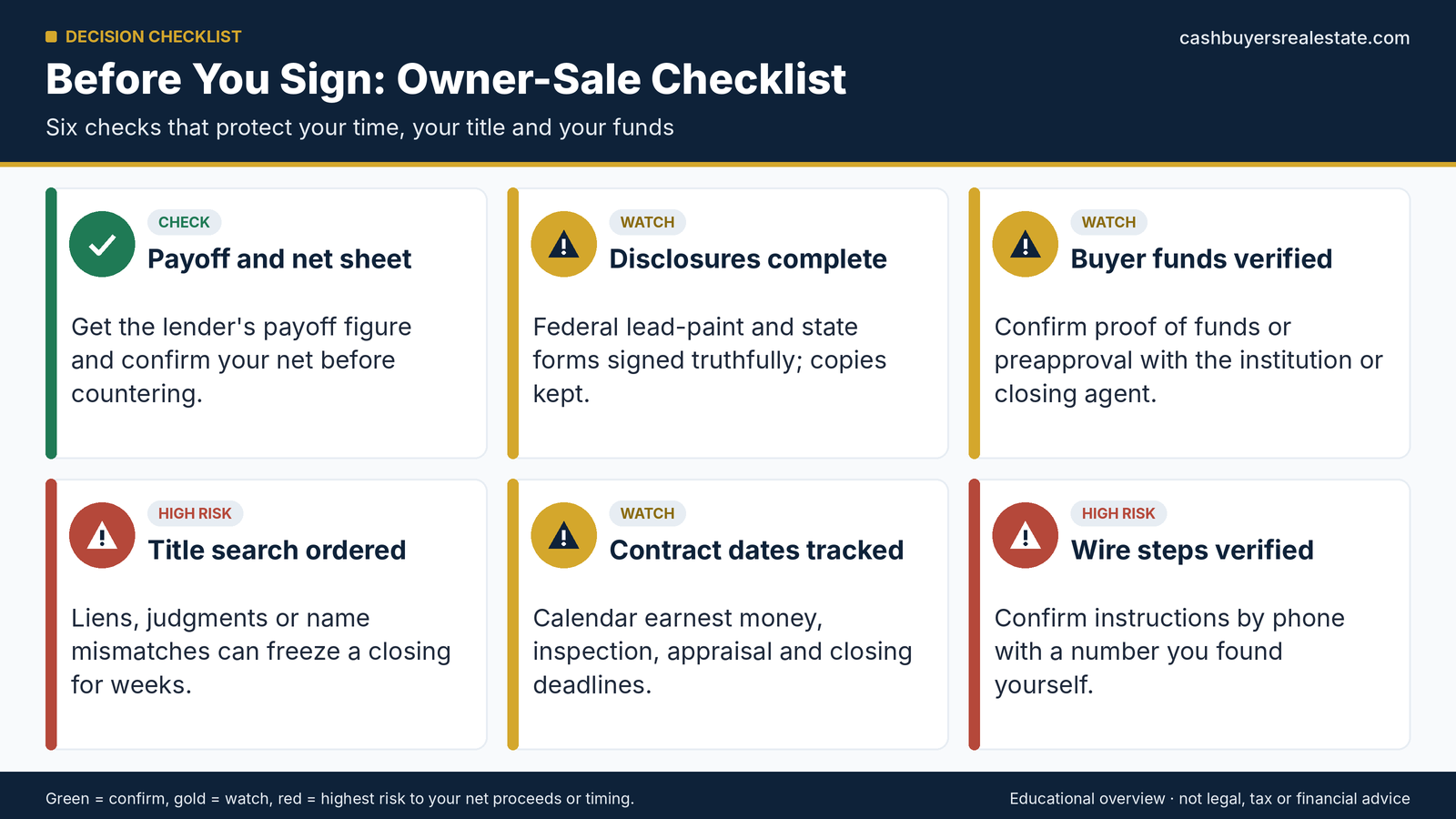
Text version of this infographic
- Payoff and net sheet — Get the lender's payoff figure and confirm your net before countering.
- Disclosures complete — Federal lead-paint and state forms signed truthfully; copies kept.
- Buyer funds verified — Confirm proof of funds or preapproval with the institution or closing agent.
- Title search ordered — Liens, judgments or name mismatches can freeze a closing for weeks.
- Contract dates tracked — Calendar earnest money, inspection, appraisal and closing deadlines.
- Wire steps verified — Confirm instructions by phone with a number you found yourself.
Frequently Asked Questions about Selling a House Without an Agent
These answers cover the follow-up questions owners ask most often. They stay general because contract rules, closing customs and fees depend on your state and your property.
Questions About Speed, Price and Costs
Questions about timing
- How fast can I realistically sell without a realtor?
It depends on the route more than on the absence of an agent. A direct sale to a cash buyer can move as quickly as the title work and paperwork allow, which is sometimes a matter of a few weeks. An owner listing aimed at buyers using mortgages is limited by market demand, the buyer’s appraisal and underwriting, and your preparation. Anyone who promises a specific number of days before seeing your property and title is guessing.
- Is a cash buyer always faster than an owner listing?
No. A cash buyer removes the lender, the appraisal and most of the marketing wait, which usually shortens the timeline. But if title problems, an unpaid lien, an estate that hasn’t been opened or a co-owner who hasn’t signed block the closing, the speed advantage disappears. A cash offer also tends to come at a discount, so the faster route isn’t automatically the better one on net proceeds.
- Can I list the house and still talk to cash buyers?
Often yes, but read your listing agreement first. Some flat-fee and limited-service agreements are non-exclusive about buyers you find yourself, while others require a fee if the house sells during the listing term, regardless of who finds the buyer. Ask the company in writing how a sale to a buyer you sourced is treated before you sign.
- What usually delays an owner-sold house the most?
Missing paperwork and late-discovered title issues top the list, followed by untracked contract deadlines and a price that doesn’t match the comps. All four are avoidable with early preparation: order the title search, request the payoff, gather disclosures, and put every date on a calendar before you list.
Questions about price and costs
- How much will I actually save by skipping the listing agent?
You avoid the listing side of the commission, but only that. You may still pay a buyer’s agent, flat-fee listing costs, attorney or closing fees, repair credits, and carrying costs for any extra weeks on the market. Build a net sheet like Table 3 with your own numbers and compare the bottom lines, not the commission line.
- Do I have to pay the buyer’s agent if I don’t have a listing agent?
No law requires it, and compensation remains negotiable. Many buyers still bring agents, though, so most owners decide in advance whether to offer a stated fee, a closing-cost credit or nothing. Whatever you choose, put it in the contract in clear terms, and confirm any credit fits the buyer’s loan limits.
- Is it worth paying for an appraisal before I list?
It can be when the home is unusual, comps are thin, or the number matters a great deal, such as when you’re negotiating against a cash offer. A private appraisal gives you an independent value opinion, but a buyer’s lender will still order its own appraisal. Many sellers decide after building a comp set: if the range is narrow, the fee may not be needed; if it’s wide, it may be money well spent.
Questions About Paperwork, Safety and Backup Plans
Questions about contracts and disclosures
- Do I need a real estate attorney?
That depends on your state. Georgia and South Carolina courts, for example, treat closing work as the practice of law, so an attorney is part of the process there. In states where title or escrow companies close sales, an attorney is optional, but a one-time review of the contract and compensation language is usually inexpensive compared with the stakes. Ask a local title company or your state bar what’s customary.
- If I sell “as is,” do I still have to disclose problems?
Yes. Selling as is generally means you won’t make repairs the buyer requests, not that you can hide what you know. Federal lead-based paint disclosure for older homes and your state’s required disclosure forms still apply, and knowingly concealing a defect can create liability regardless of an as-is clause. The guide to selling a house as is goes deeper.
- Can a title company write my purchase contract?
In some areas title or escrow companies supply standard contract forms, and in others they will only prepare documents from an executed agreement. Some are prohibited from giving legal advice either way. Ask early who will draft and who will review, and don’t assume a neutral closing officer is looking out for your interests.
- Can I put my house on the MLS myself?
Generally, MLS access is provided through licensed brokers, which is why flat-fee MLS companies exist. Policies differ by MLS and by state. If your goal is exposure on the major search sites, a flat-fee service or a limited-service brokerage is the usual way in.
Questions about safety and alternatives
- How do I verify a buyer’s proof of funds?
Ask for a recent bank or brokerage statement showing available funds in the buyer’s or entity’s name, and confirm it with the institution or through your closing company instead of trusting a forwarded file. Funds that are committed elsewhere, held in retirement accounts, or listed as a loan approval aren’t the same as cash on hand. See the page on proof of funds for a fuller checklist.
- What if a buyer’s agent asks for a fee I never agreed to?
Your signed contract governs. Compensation should be stated in writing before you’re committed, and a closing company will generally pay only what the contract or a signed instruction authorizes. If someone demands a fee not found in your documents, don’t pay it, and ask an attorney before closing.
- What if my owner sale stalls?
You have options: adjust the price against your pre-set review date, extend your marketing with better photos or a flat-fee MLS listing, hire an agent on a short listing term, or invite offers from cash buyers. Each has tradeoffs described in urgent home sale options. The key is to decide your fallback while you still have time, not on the week your deadline hits.
Deciding Your Route and Taking the First Steps
You now have the pieces: what an agent does, how long a no-agent sale takes, how to price and market it, how the money works, who prepares what, and where the risks hide. The last step is matching a route to what matters most to you, then moving through a short list of first actions.
A Decision Framework: Match the Route to Your Priority
No route is best for everyone. Pick the priority that would hurt most to lose, then see which route protects it.
If speed and certainty come first
A direct sale to a cash buyer or investor removes the agent, the lender and most of the marketing wait, so it tends to be the most predictable route when the calendar is tight. The cost is price: expect offers below a fully marketed sale, and compare them on net. Make sure the buyer’s funds are verified, the contract is complete, and the closing company is one you trust. If your title is clean and the house needs work, this route may be the most practical one. If title problems or co-owner issues exist, solve those first.
If price, control or a partial-service middle path come first
If you have several weeks and can handle the work, an owner sale with a flat-fee MLS listing may preserve more of your equity. If you want help but not a full commission, ask agents about reduced-service arrangements or a shorter listing term. And if you’d rather not be on the hook for showings, negotiation and compliance, a full-service listing buys back your time at a known price. Table 8 matches the main priorities to routes and the conditions under which each fits.
| Main priority | Route that often fits | Works best when | Think twice if |
|---|---|---|---|
| Fastest, most predictable close | Direct sale to a cash buyer | Title is clean; you accept a discount | You haven’t verified funds or compared offers |
| Highest net with time to spare | Owner sale with flat-fee MLS | You can run showings and negotiate | Your deadline is fixed and short |
| Least personal effort | Full-service listing | Market demand is solid | The commission would erase your margin |
| Known buyer (friend, relative, neighbor) | Owner sale with attorney | Price is supported by an appraisal or comps | Paperwork is informal or disclosures are skipped |
| Major repairs needed, limited funds | Direct sale as is | You compare several offers on net | You’re pressured to decide in a day |
Use the table as a prompt, not a rule. Your state’s closing requirements, a lender’s payoff, a pending move date or a title issue can change the answer, and that’s where a short consultation with an attorney or closing officer pays for itself.
What to Do in the Next Seven Days
The first week sets the pace. These actions are cheap, reversible and useful on every route.
First steps and the documents to gather
- Write down your deadline and your minimum acceptable net, so every offer is judged against it.
- Request a payoff statement from your lender, and find your deed, survey, tax bills and any homeowners’ association contacts.
- Call a title company or real estate attorney, ask what your state requires, and request an early title search.
- Build a closed-sale comp set and decide whether to pay for a second opinion.
- Complete the required disclosure forms truthfully while the house’s history is fresh.
- Draft a net sheet for two routes, such as an owner sale and a direct sale, and update it as quotes arrive.
- Decide your buyer-agent compensation position and your fallback date for changing course.
Questions to ask any buyer, service or closing company
- Who exactly is the buyer, and are they buying for themselves or planning to assign the contract?
- Can the proof of funds be confirmed with the institution, and who holds the earnest money?
- What fees, charges or conditions apply if the deal doesn’t close, and what are my cancellation rights?
- Which documents will you prepare, which must I supply, and by what dates?
- How will I receive funds, and how will wire instructions be verified by phone?
- If a flat-fee or limited-service company: what happens if I find a buyer myself, and can I cancel?
If you’re weighing a direct sale against other routes and want to see how cash buyers, investors and listing options compare before you commit, the overviews of companies that buy houses for cash and selling a house in 30 days can help you set expectations. For help finding local options, start at the locations hub.