
Sell House for Cash: Offers, Costs & Closing
Type “sell house for cash” into a search box and the results suggest a single product, as though cash were a kind of buyer. It isn’t. Cash describes how a purchase is paid for, and at least six quite different buyers or sale formats can close without a mortgage: a local investor who renovates and resells, a wholesaler who puts a house under contract and passes that contract to someone else, an instant-offer platform that charges a service fee, a cash buyer who finds your house on an agent’s listing, an auction bidder, and a private buyer such as a neighbor, a relative, or a tenant. Each prices risk differently, collects its payment for that risk in a different place, and suits some houses and some sellers far better than others. Choosing the wrong one rarely feels wrong on the day you sign, because the headline number looks fine. The difference shows up weeks later on the settlement statement.
The practical rule is that the route should follow the problem you are actually trying to solve. If the house is in sound shape and you have time, the route that exposes it to the most buyers usually nets the most, even when the person who finally pays cash is only one of many bidders. If the house has condition, title, occupancy, or timing problems that frighten off buyers who need a mortgage, the routes built to absorb risk earn their discount honestly, and the useful question becomes how large a discount is fair for the risk being removed. If the calendar is tight and the equity is thin, certainty may be worth more than the last few thousand dollars. None of those answers is universal, and the purpose of this guide is to make the trade visible enough that you can choose on purpose rather than by default.
To sell a house for cash, match the route to your situation: investors and wholesalers fit damaged or complicated houses, instant-offer platforms fit typical homes in markets they cover, and an as-is agent listing or an auction fits sellers who want wider exposure. Compare every offer by net proceeds after repairs, fees, closing costs, and holding costs, never by headline price alone.
This is a navigation guide rather than the complete manual. It lays out each route, then puts routes and situations side by side in a matrix so you can see where to start, then shows what each route costs in discount and fees, explains in words how price changes as the closing date moves closer, and works through seven sample situations with a recommendation for each. After that it covers how to use one offer against another honestly and how to decide in advance when a route has stopped working. If you want the full walkthrough of a cash sale from first contact to funding, the cornerstone guide on selling my house for cash covers that sequence, and the page on selling my house fast treats the calendar as the main problem.
It helps to know how ordinary cash purchases are before reading about the unusual ones. According to National Association of Realtors data for August 2026, as summarized by the National Association of Home Builders, all-cash buyers accounted for about 27 percent of existing-home sales that month, against 28 percent a year earlier. Cash buyers are therefore not a fringe group that only appears when a house is in trouble. A large share of them are ordinary purchasers on ordinary listings, and that fact shapes the matrix later in the guide, because it means a seller with a sound house can often reach cash buyers without giving up the discount that dedicated investors need.
A note on the numbers you will meet. Every dollar figure inside a worked example or an “illustrative” table is hypothetical, built to show how the arithmetic behaves and not to describe what any buyer pays in any market. Market statistics carry their month and source. Where a fee or timeline varies by lender, state, county, or buyer, the text says so and sends you to the office or professional who can answer for your property, because guessing at a number in a transaction this large helps nobody. The topics that deserve their own pages, such as the contract itself, proof of funds, and the tax treatment of a sale, get a paragraph and a link here and no more.
Six Routes That End in a Cash Closing, and What Each Buyer Is Really Pricing
Every route below ends with funds wired at closing and a deed recorded, which is why they all get called cash sales. Underneath that shared ending, the buyers are making different bets. One is betting on a renovation budget, another on a resale a few weeks away, another on a fee schedule, and another on the strength of a bidding crowd. Understanding the bet explains the price, and understanding the price explains which sellers each route serves well.
Buyers who purchase the house themselves
Two of the six routes involve a business that signs a contract expecting to own, or at least control, the house. They look similar from the kitchen table, yet the obligations, the risks, and the incentives differ enough that treating them as one category is a common and costly mistake.
Local investors and renovators who buy to fix and resell or rent
The classic cash buyer is a person or small company that buys houses, repairs them, and either sells them to a retail buyer or keeps them as rentals. Their offer comes from a calculation that starts with the after-repair value (ARV), meaning what the house should be worth once it is finished to the standard buyers in that neighborhood expect. From that figure the investor subtracts the cost of the work, a contingency for what the walkthrough could not reveal, the costs of buying and later selling, the interest or opportunity cost of tying up money while the project runs, and a profit margin that justifies the risk. What remains is the offer. Because every subtraction is the buyer’s estimate, and the buyer is the one carrying the downside if the estimate is wrong, offers from this route tend to sit well below what the same house would bring on the open market in repaired condition.
That discount is not automatically unfair, and it is not automatically fine. A seller who would otherwise have to find a contractor, front thousands of dollars, and wait through a project is buying a service, and the investor’s margin is the price of that service. The honest test is whether the discount roughly matches the cost and risk being removed. A house needing a new roof, a kitchen, and foundation work legitimately supports a large gap between as-is value and repaired value, while a house needing paint and flooring does not. Investors also differ in what they will close on: some buy only inside a narrow price range and neighborhood, some insist on a short inspection window, and some are comfortable with tenants, liens, or probate. A seller who learns the buyer’s actual criteria, usually by asking directly, can tell quickly whether the offer is a considered number or an opening bid. The broader mechanics are laid out in the guide to selling a house directly to an investor.
Wholesalers and the assignable contract
A wholesaler works differently. Instead of planning to renovate, a wholesaler signs a purchase contract with the owner and then looks for another buyer, usually an investor, to take over that contract for a fee. The contract is assigned, or the wholesaler arranges two back-to-back closings, and the wholesaler keeps the difference between what the owner is paid and what the end buyer pays. Wholesaling can serve an owner well when it brings a buyer faster than the owner could find one. It also carries a particular risk that other routes do not: the person who signed the contract may not have the money to close, and the sale depends on the wholesaler finding someone who does before the contract’s deadline. A seller whose house is tied up for three weeks while that search fails has lost time and often negotiating strength.
Several states have started regulating the practice. Oklahoma, for example, adopted a wholesaler law effective November 1, 2025, that, according to a title-industry bulletin summarizing it, requires written disclosure that the wholesaler intends to buy the owner’s interest and resell at a higher price and gives the homeowner a right to cancel without penalty within two business days. Illinois amended its Real Estate License Act in 2019 so that a pattern of dealing in real estate contracts, including assignable ones, can require a broker license, as the Illinois REALTORS association explains. Most states have no comparable statute, and the rules that exist differ in scope, so the safest habit is to read any contract for language about assignment, ask the buyer directly whether the contract will be assigned, and have a real estate attorney review the document before you sign.
Platforms, listings, and sales to people you know
The remaining four routes are less about a single business and more about a format: a fee-based platform, a regular listing that attracts cash purchasers, a bidding event, or a private deal. Each changes who sets the price and how the seller pays for the service.
Instant-offer platforms and their fee-based model
Instant-offer platforms, often called iBuyers, use pricing models built on recent sales data, followed by an inspection or assessment, to make an offer on homes that fit their buying criteria. They typically earn money in two ways: a service fee charged to the seller and the margin on resale after any work. One large platform’s published guide says it does not post a fixed percentage, that the service fee varies by market and property and appears in the offer breakdown, and it uses 5 percent only as an illustration. The same guide says repair credits are deducted after an assessment, with minor, moderate, and major repairs falling into bands that run from roughly $500 to $2,000 at the low end to $8,000 to $20,000 or more at the high end, and that closing dates can be set from about 21 to 60 days out. The guide itself notes that its figures reflect the time of writing and may have changed, which is a good reminder to read the fee line of the actual offer.
Two limits matter more than the fee. First, eligibility is narrow: these platforms operate in selected markets and generally buy typical, relatively standard homes within a defined price range, so a house that is unusual, badly damaged, or outside coverage will often not qualify. Second, availability changes. One major listing portal announced in its November 2021 annual report that it was winding down its own instant-offer operation, in part because it served too narrow a portion of its customers. That does not make the model unsound, but it does mean a seller should not assume a platform will cover their market or still offer the same terms next year. For sellers who qualify, the route trades a fee and a repair deduction for convenience and a predictable calendar, and the comparison belongs in any set of offers. The page on how to get a cash offer on a home goes deeper on how these offers are produced.
Cash buyers on an agent listing, auctions, and private buyers
The fourth route needs no special buyer at all. A house listed with an agent on the multiple listing service (MLS) can attract a purchaser who happens to pay cash, and, as the 27 percent figure suggests, that happens often. A seller can improve those odds by listing the house as-is, pricing it for the condition, allowing investors to tour, and being open to short inspection windows, a strategy that keeps wide exposure while still welcoming cash. The costs are the ones every listing carries. Compensation is negotiable: the National Association of Realtors states that since August 17, 2024, offers of compensation to buyer agents are no longer allowed on MLS platforms, although sellers may still offer compensation outside the MLS and may offer buyer concessions, such as help with closing costs, on it. The time cost is the exposure period itself. The comparison with a pure investor sale is developed on the page about cash sale versus listing for a fast sale.
Auctions and private sales fill out the list. In an auction, the National Association of Realtors describes three structures: an absolute auction sells to the highest bidder regardless of price, a minimum-bid auction sets a published floor, and a reserve auction treats the top bid as an offer the seller may accept or reject within a stated period that can run up to 72 hours. Auctions create competition and a firm date, but the seller pays auction costs, and in an absolute auction accepts whatever the room produces. Private buyers, such as a neighbor who wants the adjoining lot, a relative, a tenant, or a business owner who needs space, can pay cash without the discount a professional buyer needs, because they are buying for their own use. The price is usually negotiated against a recent appraisal or a set of comparable sales, and because the relationship adds pressure, a written contract and an attorney’s review matter more, not less.
A Route-by-Situation Matrix for Deciding Where to Start
A matrix cannot choose for you, but it can stop you from wasting the first week on a route that was never going to fit. The table below lines up the six routes against the situations they serve best and worst, and then names the force that usually sets the speed and the force that usually sets the price. Treat each row as a starting hypothesis to be tested with real offers, not as a verdict, because individual buyers within a category vary widely and local conditions change the picture.
| Route | Strongest fit | Weak fit | What usually sets the speed | Where price pressure comes from |
|---|---|---|---|---|
| Local investor or renovator | Houses needing major work; tenants, clutter, or title quirks the buyer already knows how to handle | Move-in-ready homes in strong demand; sellers with months to spare | Buyer’s funds, title work, and payoff letters | Repair estimate, contingency, and the buyer’s required margin |
| Wholesaler with an assignable contract | Owners comfortable with an assignment who want a quick commitment on a house local investors want | Sellers who need certainty about who will actually close; short fixed deadlines | How fast an end buyer is found within the contract window | The wholesaler’s fee stacked on top of the end buyer’s margin |
| Instant-offer platform | Typical homes in covered markets; sellers who want a chosen closing date and no showings | Unusual or heavily damaged houses; locations outside coverage; complex title or occupancy | The closing date the seller selects, often several weeks out | Service fee plus repair deductions after assessment |
| Agent listing open to cash buyers | Sound or moderately dated homes; sellers with weeks to months and a price focus | Houses with unresolved title or occupancy problems; hard deadlines | Exposure period, then the buyer’s inspection window | Local demand, buyer concessions, and the agent’s compensation |
| Auction | Unusual or hard-to-price property; sellers who want a fixed date in a competitive setting | Thin markets with few bidders; sellers who need a minimum price but chose an absolute auction | Marketing period before the event, then the closing window in the terms | Bidder turnout and auction costs |
| Private buyer (neighbor, relative, tenant, business) | Buyers with an own-use motive who value the property more than the market does | Sellers who cannot afford relationship strain; any sale with no price benchmark | The buyer’s own funds and the parties’ willingness | Negotiation against an appraisal or comparable sales |
To read the table, find the row whose “strongest fit” resembles your house, then check the “weak fit” column for anything that also describes your situation. Most sellers match more than one row. A dated but sound house with a three-month horizon, for instance, appears in the strongest-fit column for an agent listing and in the weak-fit column for the platforms, which is useful because it suggests running a listing first and keeping an investor bid in reserve as a floor. A house with a collapsed porch, a tenant on a month-to-month lease, and a seller who wants out by the end of next month points the opposite way. The next four sections explain the four filters that do most of the sorting: condition, urgency, price priority, and ownership details. The fuller treatment of the whole sale from first contact to funding is in the guide on how to sell a home for cash.
How condition and urgency narrow the field
Condition and urgency do most of the early eliminating. Condition decides which buyers can even consider the house, and urgency decides how much waiting you can afford while they do.
Condition, from move-in ready to unfinanceable
Think of condition as a spectrum with a cliff in the middle. At one end, a clean, sound house with a working roof and systems appeals to nearly every buyer, financed or cash, and the competition among them supports the highest price. In the middle, a house with cosmetic wear, older finishes, or a few deferred repairs still qualifies for most mortgages, but a buyer’s lender and inspector may attach conditions, and some buyers will ask for credits. Past a certain point, the cliff arrives: the house has a defect, such as a failed roof, active water intrusion, missing utilities, or structural movement, that an appraiser or lender will flag, and the pool of buyers who can proceed shrinks to those paying cash or using renovation financing. On the near side of the cliff, the open-market routes usually net more. Beyond it, the routes that exist to buy difficult houses stop being a compromise and become the practical option.
Where your house sits on the spectrum is less obvious than it seems, because owners and buyers measure condition differently. Owners notice what bothers them; buyers and their lenders notice what costs money and what blocks financing. A useful exercise is to assume a skeptical inspector walks the house and then sort the findings into three piles: items that are cosmetic and cheap, items that cost real money but would not stop a loan, and items that would stop a loan or an insurance policy. If the third pile is empty, treat the listing routes as the default and require investors to beat them. If the third pile has anything in it, the investor and platform routes deserve real attention, and the decision becomes how to compare their discounts against the cost and delay of fixing those items yourself, a question the next section answers with numbers.
Urgency: what a hard deadline removes and what a soft one leaves open
Urgency is worth sorting into hard and soft before any route is chosen, because the two call for different strategies. A hard deadline is a date that carries consequences you cannot negotiate away: a closing on a new house you have already contracted to buy, a court-ordered sale date, a lender’s scheduled action, a job start that cannot move. A soft deadline is a preference, such as wanting to be done by the holidays, or a budget strain that grows with time but does not break on a given day. A hard deadline removes routes that cannot reliably meet it, which usually means a full open-market listing and sometimes an auction whose marketing period is too long. It favors buyers who can show funds and a title company’s willingness to close on the date, and it makes the quality of the buyer’s proof of funds more important than the price, since a failed closing costs you the calendar you did not have.
A soft deadline leaves most routes open and gives you the one thing that improves outcomes in nearly every situation: the ability to run routes in parallel. You can list the house as-is for a defined period while holding a standing investor offer, and you can ask a platform for an estimate while you wait for showings. The danger on this side is drifting. A soft deadline that quietly becomes a hard one, because the listing sat for ten weeks and the carrying costs piled up, pushes you into the worst version of a quick sale. Writing the date on which a soft deadline converts into a hard one, and deciding in advance what you will accept on that date, keeps your bargaining position intact. The longer treatment of speed itself lives in the guide to how fast cash buyers can close.
How price priority and ownership details break the tie
When condition and urgency leave two or three routes standing, two softer filters decide among them: how much the last dollars matter to you, and whether anything about ownership or occupancy complicates a closing.
Price priority: when net dollars matter more than days
Price priority is a statement about trade-offs, not about wanting a high price, since every seller wants one. The question is how much waiting, effort, and uncertainty you will accept to move the net result upward. A seller with ample equity, no deadline, and a sound house can reasonably say that net dollars come first, and the matrix then points to exposure: a well-prepared listing that welcomes cash buyers, with investor offers collected as a safety net. A seller whose equity is thin, whose mortgage payment strains the budget, or who simply values peace over optimization may say the opposite, and the matrix then points to the routes with the shortest, firmest calendars even at a larger discount. Both are legitimate. What is not legitimate is to claim to want the most money while behaving as though the date were all that mattered, because buyers can read the signals, and a seller who visibly cannot wait invites the lowest figure the buyer is willing to try.
It helps to translate price priority into a number you can use in conversations. Decide the smallest net amount you would accept from any route and the amount at which you would be pleased, and write both down before the first call. The lower figure is your floor, and it is what makes an exit possible when an offer falls short. The higher figure is your target, and it tells you how much patience a route is worth. Between the two lies the range where trade-offs between speed and certainty are genuinely personal, and no guide can settle them for you. If your floor depends on a payoff or a purchase elsewhere, be sure it includes the costs that come out of the sale price; the net-proceeds worksheet in the next section walks through those deductions line by line.
Ownership, occupancy, and who has to sign
The last filter has nothing to do with the house’s walls. It concerns who owns the property, who lives in it, and who must sign. A house held by a single living owner with clear title and no occupants fits every route. A house held jointly by siblings after a parent’s death, with one heir out of contact, fits routes whose buyers are experienced with probate and can wait for court authority, and fits poorly any route that depends on a short fuse. A rented house with a tenant whose lease runs eight more months can attract investors who want rentals and repel buyers who want to occupy it, so the lease changes the buyer pool before the price discussion starts. Properties that are not ordinary houses, such as land, manufactured homes, or small multifamily buildings, shrink the pool further, and the page on how to sell property for cash covers those categories.
The signing question deserves its own attention because it is where good deals quietly fail. Every person with an ownership interest, every trustee or personal representative with authority, and sometimes a spouse who does not appear on the deed must be able to sign, and the signers’ availability sets a floor under the closing date. Mortgage holders, tax authorities, and homeowners associations all have to be paid or released, and none of them works on the seller’s schedule. Before choosing a route, list every person and institution whose signature or payoff letter the closing needs, and note which of them you can influence. A route that looks fast on paper will not beat a signer who is out of the country, and a route with a longer calendar can be the faster one in practice if it gives that signer time to act.
Pulling the filters together gives a sequence worth following. First, define the problem in your own terms by stating condition, deadline type, price priority, and ownership details in a few sentences. Second, shortlist two or three routes from the matrix, deliberately including one that sounds slower. Third, collect offers or estimates from each, with the same facts shared with every buyer. Fourth, convert every offer into net proceeds and a realistic closing date. Fifth, review the contract and verify the buyer before you sign. Sixth, close with funds confirmed through a channel you trust. The process map below shows those six stages in order, and the rest of this guide fills in each one.
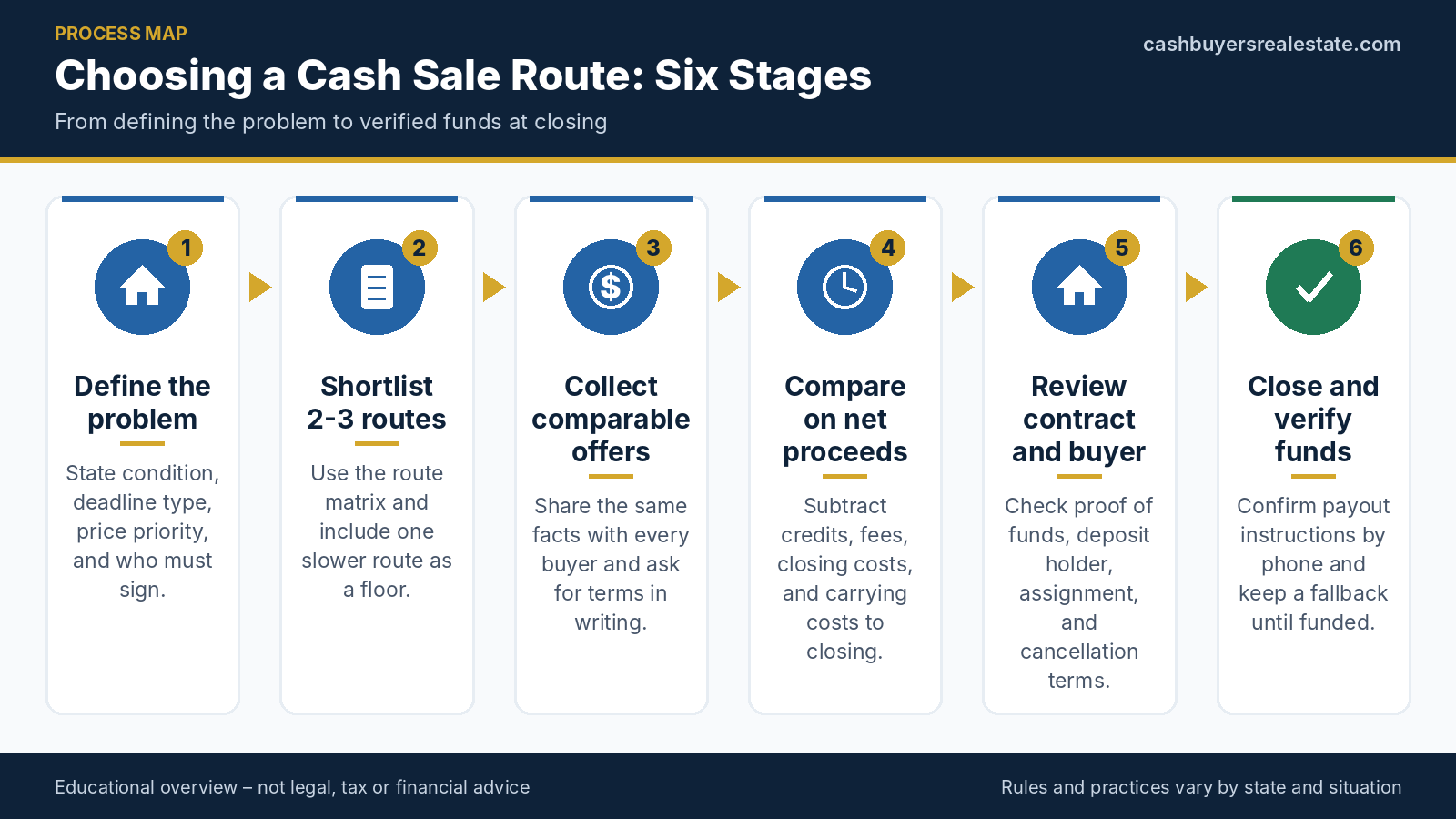
Text version of this infographic
- Define the problem — State condition, deadline type, price priority, and who must sign.
- Shortlist 2-3 routes — Use the route matrix and include one slower route as a floor.
- Collect comparable offers — Share the same facts with every buyer and ask for terms in writing.
- Compare on net proceeds — Subtract credits, fees, closing costs, and carrying costs to closing.
- Review contract and buyer — Check proof of funds, deposit holder, assignment, and cancellation terms.
- Close and verify funds — Confirm payout instructions by phone and keep a fallback until funded.
What Each Route Costs: Discounts, Fees, and Net Proceeds Side by Side
The price a buyer quotes and the money you leave the closing table with are two different numbers, and the gap between them is different for every route. Some routes take their payment as a lower price, some as a fee, some as a deduction after inspection, and some as time, which shows up as months of mortgage payments, taxes, and insurance. A fair comparison puts all of those on one page, which is what this section does, first in words and then with a worked table built on a single hypothetical house.
Where the money goes on each route
Four kinds of cost separate a headline price from net proceeds: the discount built into the offer, fees charged for the service, the closing costs any sale carries, and the cost of time. The first two differ sharply by route, while the last two are partly shared but still vary in size.
The discount from market value: repairs, risk, and the buyer’s margin
For investors and wholesalers, the discount is the entire fee. Nothing appears on the settlement statement labeled “service charge,” because the service is priced into the purchase price. That discount contains at least four parts, and it is worth naming them, because a seller who can name them can ask about them. The first is the cost of the work the buyer expects to do. The second is a contingency, the buyer’s allowance for problems the walkthrough could not reveal, such as concealed water damage or aging pipes. The third is the buyer’s costs of owning the house during the project and of selling it afterward. The fourth is a profit margin for taking the risk. When an offer arrives, a short written conversation about which of those parts are large in your case often reveals whether the number is built on a real inspection or on a rule of thumb applied from a desk.
Instant-offer platforms and listings take the discount in different shapes. A platform usually starts nearer to the house’s estimated market value, because it expects to do limited work and resell quickly, and then charges a service fee and deducts repair credits after its assessment. An as-is listing starts from a price the market might support in the house’s current condition, and the discount appears afterward, as a buyer’s inspection credit, a price reduction after a slow first month, or a concession toward closing costs. Auction results sit wherever the bidders push them. Because the discount moves around, no route can be called cheap or expensive from its label. A route with a visible fee can net more than a route with a hidden discount, and the reverse also happens, which is why the net comparison in the next sub-section matters more than any rule about percentages.
Fees and closing costs that appear on the settlement statement
Every sale carries closing costs, and a cash sale is not exempt. Typical seller-side items include the title search and title insurance (customary charges for who pays differ by state and county), the fee for the closing agent, an attorney in states where attorneys close, recording and transfer taxes where they apply, prorated property taxes and any association charges, and payoff of the mortgage and any liens. Transfer taxes and who bears them vary a great deal, from nothing in some places to a visible percentage in others, so a seller should ask the title company or closing attorney for an estimate early. The page on closing costs in a fast home sale goes through these items in more detail, including which ones a buyer sometimes agrees to cover in a negotiated contract.
Fees specific to a route sit on top of those. An agent’s compensation is negotiable, and since the National Association of Realtors’ practice changes took effect on August 17, 2024, offers of compensation to buyer agents may not be made through the MLS, which makes the total commission, and any concession to the buyer, a matter for the listing agreement and the sale contract. An instant-offer platform’s service fee, as one large platform’s guide explains, varies by market and property and is stated in the offer. Auctions can involve marketing costs, auctioneer fees, and sometimes a buyer’s premium, depending on the terms. Investors and wholesalers often present themselves as paying “no commissions,” which can be accurate and still tell you little, since the discount carries the cost instead. When a payoff is involved, federal rules require the servicer of a home loan to send a payoff statement within a reasonable time and no more than seven business days after a written request, subject to exceptions, according to 12 CFR 1026.36, so ask for the statement as soon as you start comparing routes, not after you sign.
Comparing ways to sell a house for cash on net proceeds
Net proceeds are what remains of the sale price after repairs you must pay for, credits you agree to give, fees, closing costs, and the cost of carrying the house until closing. The following example shows how the same house can produce very different headline numbers and much closer nets, and, equally, how the quick route can cost a great deal.
One hypothetical house run through four routes
Illustrative example (hypothetical numbers, not market data): A three-bedroom house would sell for about $320,000 if repaired to the neighborhood standard, but it needs roughly $28,000 of work, including a roof section and an outdated electrical panel. Carrying costs (mortgage interest, property tax, insurance, and utilities) run about $2,450 a month. The owner compares four routes: a local investor, an instant-offer platform, an as-is listing that ends with a cash buyer, and repairing the house and listing it for financed buyers. The assumptions in the table are invented for the example and will differ in any real market.
| Line item | Local investor | Instant-offer platform | As-is listing, cash buyer | Repaired listing, financed buyer |
|---|---|---|---|---|
| Sale price or offer | $214,000 | $289,000 | $292,000 | $320,000 |
| Repair credits or work paid for | $0 (priced in) | $9,000 | $6,000 | $28,000 |
| Service fee or commissions | $0 | $14,450 (5%) | $11,680 (4%) | $12,800 (4%) |
| Seller closing costs | $3,400 | $4,000 | $4,400 | $4,800 |
| Carrying costs until closing | $2,450 (1 month) | $3,675 (1.5 months) | $7,350 (3 months) | $12,250 (5 months) |
| Estimated net proceeds | $208,150 | $257,875 | $262,570 | $262,150 |
| Assumed days to closing | 30 | 45 | 90 | 150 |
Several things stand out when you read the table with the question “what did each route cost me?” in mind. The investor’s offer is the lowest by a wide margin, and the gap of roughly $50,000 to $54,500 against the other three is the price of getting the house off the owner’s hands in about a month, with no repairs, no showings, and no financing contingency. The platform, the as-is listing, and the repaired listing land within about $4,700 of one another, even though their headline prices differ by more than $30,000, which shows how fees, credits, and carrying costs close the gap. And the repaired listing, which commands the highest price, nets no more than the as-is listing once the work, the extra months, and the risk of cost overruns are counted. That is a hypothetical result. A house needing $90,000 of work, a slower market, or a seller who can do much of the work personally would change every figure and could reverse the ranking.
A reader should also notice what the table cannot show: certainty. The as-is listing’s $262,570 assumes the house sells at the assumed price within the assumed time, which is a forecast, whereas the investor’s $208,150 is a number in a signed contract once the buyer proves funds. The platform’s figure depends on the assessment matching the estimate. Some sellers rationally take a lower, firmer number, and others rationally take a higher, softer one. The useful discipline is to put an honest probability on each outcome, and to remember that a deal that falls through at day 60 restarts the carrying-cost clock. The page on net proceeds from a cash offer offers a line-by-line template for building your own version.
Taxes, payoffs, and holding costs that move the comparison
Three items outside the table can change the ranking for a particular seller. The first is mortgage or lien payoff, which comes out of the proceeds at closing and is the same dollar amount on every route but matters enormously to the decision, because the lower the equity, the more a quick low offer eats into what you walk away with. If the payoff exceeds a route’s offer, that route cannot close without lender approval or extra funds from you. The second is tax. The Internal Revenue Service explains in Topic No. 701 that a homeowner may exclude up to $250,000 of gain on a main home, or $500,000 on a joint return, if the ownership and use tests (24 months in the five years before the sale) are met, and that a seller who receives Form 1099-S must report the sale even when the gain is fully excludable. Rental, inherited, and second-home sales follow different rules, and state tax may apply, so a tax adviser should look at the numbers before you sign. The broader tax discussion is on the page about taxes when you sell a home for cash.
The third item is holding cost, which rewards a careful look because it is the one most often underestimated. Mortgage interest, property taxes, insurance, utilities, lawn or snow care, and the upkeep a vacant house needs add up month after month, and an insurance policy on a vacant house may have conditions of its own, so check the policy rather than assuming it continues unchanged. A route that closes sooner saves exactly those costs, which is why the quick route sometimes loses less than its discount suggests, and the slow route sometimes gains less than its price suggests. If the house carries a mortgage with a high rate or the owner is paying for two housing situations at once, the monthly figure belongs in the comparison explicitly. A seller who has never added these up is often surprised by the total, and by how much of the apparent discount a faster closing recovers.
How Price Changes With Speed: The Trade-Off Curve in Plain Language
Every seller who asks for a quick closing is, whether they realize it or not, moving along a curve. Picture a graph with the number of days until closing along the bottom and the best net price you could expect along the side. The curve is not a straight line, and it is not the same for every route. Understanding its shape, in words, is among the most useful things a seller can do, because it explains why one buyer’s offer for a two-week closing sits so far below another’s for ten weeks, and it shows when paying for speed is sensible and when it is simply expensive.
Why the curve is flat at first and then drops steeply
Most people assume that each day shaved from the calendar costs the same amount. In practice there is a stretch where days are cheap, a stretch where they become very expensive, and, for sellers who list, a far end where waiting itself starts to cost money.
The flat stretch: where a few extra days cost almost nothing
A cash closing has a natural minimum length that no amount of money shortens much. Someone has to run a title search and clear any problems, the servicer has to produce a payoff statement, the closing agent has to prepare documents and schedule signers, and funds have to be moved and recorded. For a clean file that natural process takes a couple of weeks at best and commonly longer, and a buyer who is already prepared to follow it pays little extra for it. Moving a closing date from three weeks to five usually changes an investor’s offer very little, because the buyer’s money is not idle in any costly sense and the project is not delayed in any meaningful way. The same holds for a listing in its first weeks, when the most motivated buyers see the house first. Median time on the market for existing homes was 31 days in August 2026, according to National Association of Realtors data summarized by the National Association of Home Builders, so a few weeks of exposure is ordinary and not a sign of failure.
The practical lesson of the flat stretch is that sellers rarely get much for squeezing it, and they rarely lose much by using it. If a buyer offers a closing in three weeks and you would be comfortable with five, asking for the extra time costs little in most cases, and the extra time can buy you a move-out, a coordinated purchase elsewhere, or a calmer signing schedule. The same logic argues against paying for a speed you do not need. When a buyer says an offer is good only if you close in seven days, and your actual need is thirty, you are being asked to pay for days you cannot use. A seller who knows the real edge of their flat stretch can tell a genuine constraint from a negotiating tactic and can answer one with the other.
The steep stretch: what a buyer charges for removing every day and every contingency
Below the natural minimum, price starts to fall much faster, because compressing a closing is no longer a matter of waiting less; it means taking on risk. A buyer who agrees to close in a week without a full title review, without an inspection period, and without the ability to walk away is absorbing the chance that something is wrong with the house, with the title, or with the paperwork. That risk is real and uneven, and the buyer prices it as insurance, which is why a seven-day promise typically comes with a lower number than a thirty-day one. The discount is not an arbitrary penalty. Whether it is fair depends on how closely it tracks the risk actually removed, and that is the test to apply whenever you compare a very fast offer to a slower one: could the buyer have learned the same facts with a few more days?
A second force steepens the curve further, which is the seller’s visible need. A buyer who understands that a seller has a hard date, a looming payment, or no alternative offers has less reason to compete, because the seller’s walk-away option is weak. This is why the first conversation matters, and why a seller who has already collected a second offer, even a slower one, negotiates from a different position than a seller who has one. The curve also bends the other way at the far end for sellers who list: a house that sits for months can acquire a stale reputation, invite lower offers, and rack up carrying costs, so waiting eventually costs money too. The best outcomes tend to sit in the middle of the curve, where the buyer’s costs of waiting are still small and the seller’s costs of waiting are not yet large. Where that middle sits differs by house, market, and seller.
Reading the curve against your own carrying costs
A curve is only useful when it is tied to your numbers. The vertical axis is price, but the horizontal axis costs money too, at a rate set by your own mortgage, taxes, insurance, and utilities.
Finding the point where waiting stops paying
The break-even question is simple to state: if a slower route is expected to pay more, does the extra amount exceed what the extra time will cost you, including the chance that the slower route fails? Answering it takes three inputs: the difference in expected net proceeds between the two routes, the carrying cost for each extra month, and an honest estimate of how likely it is that the slower route disappoints. The guide to selling a house for cash fast develops the break-even method in detail, and what follows is a compact illustration of the logic.
Illustrative example (hypothetical numbers, not market data): An owner pays about $1,980 a month to carry a vacant house. A quick buyer offers terms that would net $224,000 in three weeks. A listing is expected to net about $236,000 in twelve weeks, or $12,000 more. The extra nine weeks cost roughly two months of carrying, about $3,960, leaving $8,040 of apparent gain. But the owner thinks there is a 30 percent chance the listing needs a $10,000 price cut and an extra six weeks, which would cost about $12,970 including carrying costs. The expected shortfall is about $3,890, so the expected gain from waiting is roughly $4,150, with a wide spread around it.
The example’s lesson is not that waiting wins, because with slightly different inputs it would lose. The lesson is that the decision turns on a small expected gain surrounded by a large range of outcomes, and that is precisely the situation in which personal tolerance for uncertainty should decide. A seller who values certainty at more than about $4,000 should take the quick offer, and a seller who would regret leaving that money behind should list. Notice also that the example ignores the value of the owner’s own time, stress, and the effort of keeping the house showing-ready, all of which belong in the comparison if they matter to you. Writing the break-even in a sentence, such as “I will accept the quick offer unless the slower route is likely to net at least this much more,” turns a vague worry into a rule you can apply when offers arrive.
How the curve shifts by route and by market
The curve is not fixed, and it moves with both route and market. A route that already includes a fixed, buyer-friendly calendar, such as an instant-offer platform whose guide describes closings of about 21 to 60 days at the seller’s choice, has a flatter curve in that range because the date is a seller option rather than a concession. A route whose price depends on bidder turnout, such as an auction, has a curve that is flat until the event and then steep, because the result is decided on one day. Market conditions shift every curve at once. National Association of Realtors data summarized by Mortgage News Daily showed existing-home inventory at 1.62 million units in August 2026, up 5.9 percent from a year earlier, equal to 4.9 months of supply, and the first reading above 1.6 million since November 2019. More choice for buyers generally means that a seller who needs a quick sale has less pull and that a seller who can wait has more to prove with a well-priced, well-presented house.
| Route | If you compress the calendar | If you stretch the calendar | Where the curve is flattest |
|---|---|---|---|
| Local investor | Discount grows as inspection time and contingencies shrink | Offer often holds or improves slightly; risk of buyer losing interest rises | From about the natural title and payoff timeline out to several weeks |
| Wholesaler | Fee stays; offer drops if end buyer must be found faster | Longer window helps the wholesaler find a buyer, which can help your odds of closing | Inside the contract’s marketing period |
| Instant-offer platform | Earliest dates may be unavailable or carry little price change | Seller-chosen later dates usually change the fee little | Across the range of dates the platform allows |
| Agent listing open to cash | A short listing period narrows the buyer pool and invites a lower figure | A long period risks a stale listing and rising carrying costs | The first several weeks, while the house is new to the market |
| Auction | Less marketing time can reduce bidder turnout | More marketing can widen the pool, up to a point | Before the event; the result itself is steep |
| Private buyer | Price is negotiated against comps, not the calendar | Relationship strain and the buyer’s own plans can change the terms | Usually wide, set by the buyer’s funds |
To use the table, locate your route and ask which edge of the calendar you are being pushed toward. If the answer is “compress,” ask what the buyer is skipping in exchange, whether an inspection, a title review, or a financing contingency, and what that skipped step would have cost the buyer to complete. If the answer is “stretch,” ask what keeps the buyer committed during the extra time, since a long closing window with a refundable deposit favors the buyer more than it favors you. The stages that make up the natural minimum, listed earlier, let you judge whether a promised date is realistic for your file.
One more consideration: timing risk is not symmetrical across routes. A closing that slips by two weeks costs an investor a modest amount of interest and costs a seller who has already contracted to buy elsewhere a lot more. If your calendar is tied to another transaction, ask each buyer what happens when a date slips, whether the earnest money is refundable, and who pays for extensions. Those answers affect your real cost of speed just as much as the headline number does, and they belong in the same comparison as the price. The comparison below sets five of the routes side by side, with what each is best for and what each costs you in return.
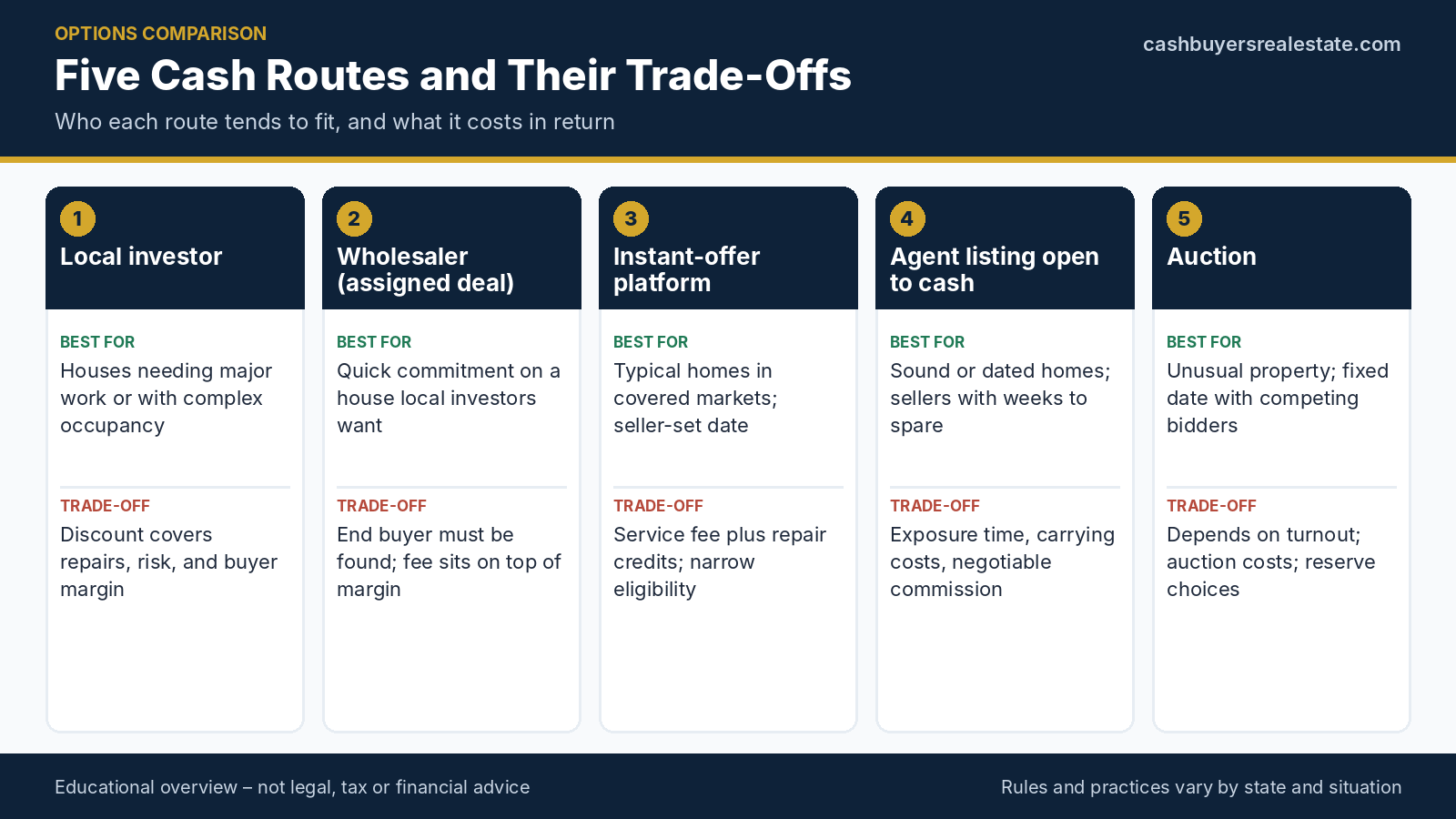
Text version of this infographic
- Local investor — Best for: Houses needing major work or with complex occupancy. Trade-off: Discount covers repairs, risk, and buyer margin.
- Wholesaler (assigned deal) — Best for: Quick commitment on a house local investors want. Trade-off: End buyer must be found; fee sits on top of margin.
- Instant-offer platform — Best for: Typical homes in covered markets; seller-set date. Trade-off: Service fee plus repair credits; narrow eligibility.
- Agent listing open to cash — Best for: Sound or dated homes; sellers with weeks to spare. Trade-off: Exposure time, carrying costs, negotiable commission.
- Auction — Best for: Unusual property; fixed date with competing bidders. Trade-off: Depends on turnout; auction costs; reserve choices.
Seven Seller Situations and the Route That Fits Each
Rules of thumb are easier to trust once you have watched them handle a messy case. The seven situations below are composites invented for this guide, not real transactions, and each one ends with a recommended starting route, a first move, and the fact that would change the answer. They are grouped by what is really in the way: the house itself, or the owner’s circumstances. If your situation sits between two, run both lines of reasoning and see which recommendation survives.
When the house itself is the obstacle
Physical condition is the cleanest dividing line, because it decides whether ordinary buyers can participate at all. The first three situations differ mainly in how far the house is from a mortgage-ready state.
A dated house with deferred maintenance and a flexible calendar
Consider an owner of a 1964 split-level with a furnace near the end of its life, original single-pane windows, a cracked driveway, and a bathroom last updated in the 1990s. Nothing about it is dangerous, there is no deadline beyond a preference to be finished within about three months, and the owner has a modest mortgage and real equity. This is the textbook case for exposure. A lender-financed buyer could probably close on the house, though some will ask for credits, and a cash buyer who spots the potential will compete on price. The recommended route is an as-is listing priced for its condition, with showings open to investors, and a standing investor offer obtained in advance as a floor. The first move is to collect that offer in the first week, so there is a known number to beat. If the listing has not produced an offer above the floor, net of the extra carrying cost, by about week five or six, the owner accepts the floor or lets the investor re-bid.
A related case shows what the matrix looks like at the other end. A second owner has a house that needs only fresh paint and carpet, and a competitive neighborhood supports a regular listing. Here a cash route would be an unnecessary discount, because financed buyers will pay a full price and repairs are cosmetic and inexpensive. The right route is a traditional listing, perhaps with a paint-and-clean pass first, and the cash options matter only as a fallback if the listing stalls. Seeing the two cases together clarifies a point that sellers often miss: choosing a cash route does not mean the house is in bad shape, and a house in bad shape does not automatically need a dedicated investor. The deciding fact is whether a lender’s appraiser and a buyer’s inspector would let a financed sale proceed without a cost that the market will not absorb. What would change the answer in the first case is a deadline, and in the second a problem found in the inspection.
A hoarded or fire-damaged house that lenders will not finance
Now consider a house that is not merely dated but unfit for a lender: contents fill most rooms to the ceiling, a kitchen fire two years ago was patched but never finished, and the utilities are partly off. An appraiser may refuse to value it as is, an inspector cannot reach the systems, and an insurance underwriter may decline coverage. Financed buyers are effectively excluded. The realistic routes are an investor with experience in cleanouts and repairs, an auction that is marketed to that same group, or a clean-and-sell approach in which the owner pays to clear and stabilize the property first. For a seller without the energy, money, or time for a cleanup, an investor who will take the house with its contents is a sensible choice, and the discount is the honest price of a service few people want to perform.
Illustrative example (hypothetical numbers, not market data): An investor offers $128,000 and will take the house with its contents, closing in about a month, for roughly $125,000 after $3,000 of closing costs. If the owner instead hires a cleanout for $12,000 over six weeks and then sells the cleared house as-is to a cash buyer at $172,000, the net is about $153,400 after $3,600 of closing costs and $3,000 of extra carrying costs. The cleanup route nets about $28,400 more, but only if the owner can manage the project, the contents are not hazardous, and the estimate holds.
The numbers in that example argue for a middle path that many sellers overlook: ask the investor for two offers, one with the contents left in place and one assuming the house is cleared, and compare the gap to your own cleanup quote. A cleanout contractor’s bid, a donation or estate-sale arrangement for items of value, and family members who can help can all shrink the cost. Fire damage adds an insurance dimension, since a claim may be open, payments may be going to the mortgage servicer, and the lender’s interest affects what can be sold and when. Those mechanics are covered in the pages on damaged houses, and a seller should ask the insurer and servicer what a sale does to an open claim before accepting any offer. The recommendation here is an investor route, with a cleanup comparison, and the fact that would change it is a hazard, such as mold or structural danger, that makes even the cleanup route unsafe or impractical.
When the owner’s circumstances are the obstacle
In the remaining four situations the house may be perfectly sound. What complicates the sale is who has to decide, when, and under what pressure, and those problems favor different routes than condition does.
Inherited and divorce-related sales with several decision-makers
Take a house inherited by three siblings who live in three different states. One wants to sell quickly, one is attached to the house, and one has not yet agreed to anything. The estate is still moving through probate, and none of them has the legal authority to sign. A route that depends on a short fuse will fail, because no valid contract can be signed until a court or the estate documents confer authority, and the timing of that authority varies by state and county. The recommended starting point is a conversation with the probate attorney about timing, followed by outreach to investors who say they have experience with estate sales and can wait for authority, or to an agent who handles estates. The first move is to establish who can sign and when, since that date, and not the offer, controls the calendar. The fact that would change the answer is agreement among the heirs: if all three want a quick sale and authority arrives early, speed becomes available.
A divorce-related sale shares the multiple-decision-maker problem and adds emotion and, often, a court timetable. Suppose a couple must sell the marital home under a settlement and neither wants to go on carrying it. If both agree on price, a listing handled by an agent they both trust usually nets the most, and a neutral closing agent keeps the money flow clean. If they disagree on price or timing, an offer from a third-party cash buyer can end a stalemate, because it gives both a number that neither negotiated, though both should still ask whether the discount is justified. Whichever route they pick, the attorney should confirm how the proceeds are to be divided and who must sign. The mistake to avoid is allowing a buyer to play one spouse against the other, so every communication should reach both owners, and neither should sign a contract alone. Sensitive situations deserve patience, and a good buyer or agent will not manufacture urgency.
A relocating owner with a mortgage, and a landlord with a tenant in place
A relocating owner has a clear deadline and a payment problem: a new job starts in seven weeks, the mortgage has a payoff of $198,000, and paying for two housing situations will strain the budget. The house is typical and sound, which makes it a candidate for both an instant-offer platform, if it covers the market, and a regular listing. The decision is a two-way comparison between a firm date and a higher expected price.
Illustrative example (hypothetical numbers, not market data): A platform offers $297,000, less a 5 percent service fee of $14,850, $4,000 in repair credits, and $4,500 in closing costs, netting $273,650, with closing in about 40 days. A listing at $305,000 with 4.5 percent total compensation ($13,725), $4,500 in closing costs, and $3,000 in buyer concessions nets $283,775, but takes about 85 days and costs roughly $3,450 more in carrying costs, leaving $280,325. The listing leads by about $6,675 but risks missing the seven-week move.
For this owner the recommendation is to request the platform estimate and an agent’s pricing opinion at the same time, and to list with a plan: if the house is not under contract by a date well before the move, accept the platform’s offer, provided it is still open. Because platform offers expire, the plan should include asking how long an offer remains valid and whether it can be refreshed. What would change the answer is the equity cushion. With thin equity, the fee and credits could push proceeds below the payoff, and the firm date matters less than avoiding a shortfall.
A landlord with a long-term tenant poses a different puzzle. The lease runs another eight months, the rent is steady, and the tenant is respectful. Selling vacant would require tenant cooperation or a negotiated move-out, and landlord-tenant law governing notices, deposits, and the tenant’s rights when a property is sold varies by state and sometimes by city. Investors who want rental income may value the house with the tenant in place and may pay more for a stable lease than a buyer who needs possession, so the tenant can be an asset rather than an obstacle. The recommended route is to approach investors who buy rentals, disclose the lease terms honestly, and compare the offer with the net from waiting until the lease ends. What would change the answer is a lease that has already gone sour, with unpaid rent or conflict, since a tenant-in-place discount then grows, and the legal path to possession becomes part of the price.
Using One Offer Against Another Without Misleading Anyone
Competing offers are the strongest legitimate bargaining tool a seller has, and they are also the easiest thing to misuse. The advantage disappears the moment a buyer senses that the “other offer” is invented, because that buyer will discount everything else you say, and a seller who plays buyers against each other with false numbers can end up with no deal and a damaged reputation in a small local market. The approach that works over time is plain: gather real offers, compare them accurately, and let the true differences do the negotiating. This section covers how to build the comparison and then how to use it honestly.
Building an apples-to-apples comparison before you negotiate
You cannot negotiate well with numbers that mean different things. One offer includes repairs in its price, another deducts them later, a third requires you to pay a commission. Until those are translated into the same terms, every discussion about “which is higher” is a discussion about presentation.
Normalizing offers into a single net figure and date
The method is straightforward. For each offer, write down the headline price, every deduction you expect between the price and your bank account, the closing date you can realistically rely on, and the cost of carrying the house until then. Then subtract. The deductions to look for include repair credits that the contract allows the buyer to claim after an assessment, service fees, commissions you must pay, closing costs the contract assigns to you, prorations, and any credit toward the buyer’s costs. A useful habit is to ask each buyer to state, in writing, which of those items apply, because a verbal promise that nothing will be charged does not bind anyone and does not say whether the same cost has been moved into the price.
| Item | Offer A: investor | Offer B: instant-offer platform | Offer C: as-is listing buyer |
|---|---|---|---|
| Headline price | $252,000 | $301,000 | $288,000 |
| Repair credits or expected inspection concessions | $0 | $11,000 | $5,000 |
| Fees or commissions | $0 | $15,050 (5%) | $10,080 (3.5%) |
| Seller closing costs | $3,500 | $4,200 | $4,300 |
| Days to closing | 21 | 45 | 70 |
| Carrying costs until closing | $1,470 | $3,150 | $4,830 |
| Buyer’s deposit at signing | $2,500 | Set by contract | $5,000 |
| Estimated net proceeds | $247,030 | $267,600 | $263,790 |
Reading the table, the first thing to notice is that the order of the headline prices ($301,000, $288,000, $252,000) is the same as the order of the nets, but the gaps change. The platform leads the listing buyer by $12,000 on price and only about $3,800 on net, because of the fee, the credits, and the different timelines, while the investor trails the platform by $20,570 on net and finishes about seven weeks sooner than the listing. The right conclusion depends on what the quicker date is worth to the owner. Choosing the investor over the listing buyer gives up about $16,760 of net to finish seven weeks sooner, which works out to roughly $2,400 for each week saved, and for many sellers that is a steep price. For a few, with a purchase elsewhere about to close, it is the right one. The page on how to compare cash offers adds further columns, including the buyer’s identity and funds.
Pricing certainty: contingencies, earnest money, and the odds of a fall-through
A net figure treats every offer as certain, and none is. Add a second layer of judgment by asking how likely each offer is to close on the stated terms. Several features move that probability. Contingencies give the buyer reasons to leave or renegotiate, and cash does not remove them: an investor’s contract may contain a due-diligence period with a right to cancel, an assessment-based repair credit may reduce a platform’s offer, and a listing buyer may keep an inspection contingency. A larger deposit that becomes non-refundable after a short period signals commitment, while a small deposit that is returnable for any reason signals an option. Proof of funds, in the form of a current statement or a letter from a financial institution, shows the buyer can actually pay, and a statement that names the buyer and is recent carries far more weight than a screenshot or a generic letter.
Translating those features into numbers does not require precision, only honesty. If you think there is a one-in-ten chance an offer falls through after the due-diligence period, and a failed deal costs you two months of carrying and a likely price cut, multiply that cost by the probability and subtract it from the offer’s net. You will rarely have a basis for a precise probability, but even a rough estimate prevents a common error, which is to treat the highest-net offer as the best when it is also the least certain. Weighting also helps you decide how much of a discount to accept in exchange for firmness. If a buyer offers $4,000 less than another but removes the inspection contingency and posts a nonrefundable deposit after three days, the firmer offer can be the better one, depending on how much the contingency was likely to cost you.
Negotiating honestly across routes
Once the offers are comparable, negotiation becomes a matter of telling each buyer something true that is relevant to their decision. That is both the ethical course and the effective one.
What you can truthfully say about a competing offer
You can say that you have other offers, that you are comparing them on net proceeds, that a decision date is coming, and that you will consider improved terms from anyone. You can describe, in general terms, the kind of difference that matters, such as “another buyer is offering a longer closing with a higher price” or “another offer has no repair deductions.” You can ask a buyer whether they can improve their price, their timeline, or their deductions. What you cannot honestly do is invent an offer that does not exist, inflate one that does, or claim a deadline that is not real. If a buyer has marked their offer as confidential or you have been asked not to share it, respect that, and do not forward a competitor’s paperwork. Treat each buyer as someone who may well become your actual buyer, which requires that they still trust you after the negotiation ends.
There are also things a seller should not accept as proof. A buyer who says “my price is the best you will get” is offering an opinion, and a buyer who says “other sellers in the area accepted less” is offering a comparison with no data behind it. Ask for the basis of any claim about value, and compare with recent sales that you can verify through the county’s records or an agent’s market analysis. Some terms, particularly a platform’s service fee and the structure of its repair credits, may be fixed or only partly negotiable, while an investor’s price and timeline usually are not. If a buyer says the price is final, test it politely once. Often it is, but sometimes a written counteroffer that trades a longer closing for a better number gets a yes.
Common counter-moves and how to answer them
Buyers have their own standard moves, and recognizing them keeps you from reacting to pressure. The most common is the re-trade: after the contract is signed and the buyer has completed a walkthrough or inspection, the price is reduced because of “new” findings. Others include the exploding offer, which expires within hours, the request for a long exclusive period during which you may not talk to other buyers, and the request for an assignment right that was not in the first draft. None of these is improper by itself. Each, however, shifts risk toward you, and each deserves a measured response based on your alternatives, your documented disclosures, and your read of whether the new information is genuinely new.
Illustrative example (hypothetical numbers, not market data): The owner in Table 4 signs with the investor at $252,000. Ten days later the buyer asks for $14,000 off, citing the roof and a drain line. The owner had disclosed the roof’s age in writing at the start and still holds the platform’s offer, which is valid for five more days. A reduced price of $238,000 would net about $233,030, roughly $34,570 below the platform’s net. The owner asks the buyer to put the findings in writing, counters with a $4,000 credit for the drain line only, and prepares to go to the platform if the buyer declines.
The example’s useful feature is not the dollar figures but the sequence: the owner knew the alternatives and their deadlines before the re-trade arrived, which allowed a calm and specific response. A seller in the same spot with no alternative would probably accept the cut. That is the case for keeping a second route alive until the first closes, for confirming how long each offer remains open, and for reading contract clauses on cancellation, extensions, and deposits before signing rather than after. If you are working with an attorney, ask them to review any clause that lets the buyer cancel without cost, and ask whether your state gives either side a statutory cancellation right, because the federal three-day cooling-off rule for door-to-door sales excludes sales of real property, so a signed contract at the kitchen table is not automatically cancelable. The detailed language to watch for is in the guide to cash offer contract red flags.
Before moving on to exit planning, it is worth consolidating the comparison into the six checks that every route has to pass. First, know the market value of the house in both its current and repaired condition, using sold comparables you have seen. Second, rate the property’s condition honestly, in the three piles described earlier. Third, set a repair budget you trust, ideally from a contractor’s bid rather than an estimate from the buyer. Fourth, add up your holding costs for the number of days each route actually takes. Fifth, itemize every transaction cost, from title charges to fees. Sixth, estimate the buyer’s margin by working backward from the offer, because a margin that looks very large relative to the work involved is a sign to push back or compare. The checklist below shows those six checks with the level of caution each deserves.
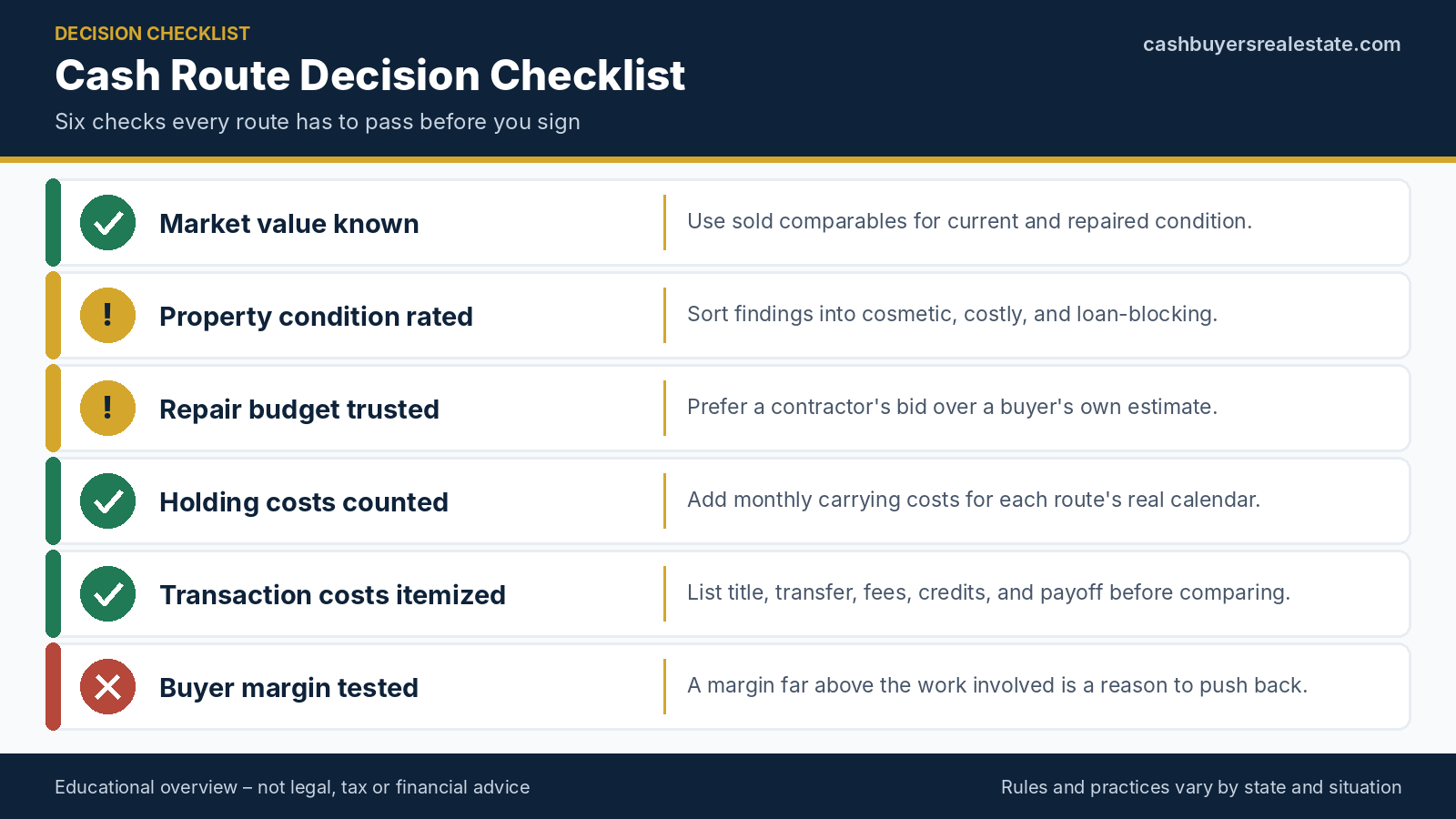
Text version of this infographic
- Market value known — Use sold comparables for current and repaired condition.
- Property condition rated — Sort findings into cosmetic, costly, and loan-blocking.
- Repair budget trusted — Prefer a contractor's bid over a buyer's own estimate.
- Holding costs counted — Add monthly carrying costs for each route's real calendar.
- Transaction costs itemized — List title, transfer, fees, credits, and payoff before comparing.
- Buyer margin tested — A margin far above the work involved is a reason to push back.
Exit Criteria: How to Know a Route Has Stopped Working
Most guidance about selling a house focuses on how to start. Far less is said about when to stop, and stopping is where sellers lose the most ground. Sunk effort, a sympathetic buyer, and the fear of starting over all push owners to stay with a route after the facts have turned against it. Exit criteria are conditions you write down in advance, while your thinking is clear, that tell you when to change course. They do not make a sale harder; they make it safer, because they replace a stressful judgment call with a rule you already agreed to follow.
Setting your criteria before the first offer arrives
Criteria set after an offer is on the table tend to bend toward the offer. Setting them first means they reflect your needs rather than a buyer’s pitch.
Price floors, deadlines, and the number that triggers a switch
An exit criterion has two parts: a measurable condition and a prepared response. The most useful conditions fall into three families. The first is price: the lowest net amount you would accept from any route, which comes from your payoff, your next housing costs, and your tolerance for risk. The second is time: the date by which a route must show progress, such as a signed contract or a funded deposit, and the date by which closing must occur for the sale to still serve its purpose. The third is trust: behaviors that end the relationship regardless of price, such as refusing to give a legal name, declining to provide any proof of funds, or pressing you to sign before an attorney has read the contract. For each condition write the response, whether that is “move to the next offer,” “re-list,” or “call the attorney.”
A good floor accounts for what you will actually receive and not what the contract says. A seller who sets a floor of $240,000 and then receives an offer of $255,000 that carries $18,000 of fees and credits has not cleared the floor, and an explicit criterion expressed as net proceeds prevents that confusion. Deadlines should be tied to events, so that “no signed contract by the end of week four” triggers a review, and “no funded deposit within two business days of signing” triggers a call to the buyer’s closing agent. The point is to define in advance what a failing route looks like. Experienced sellers often record the criteria in an email to themselves or a trusted adviser, which makes it harder to rationalize an exception later and gives a spouse, an heir, or a co-owner a clear reference point.
Reviewing the contract and verifying the buyer before you sign
The strongest exit is the one that never needs to be used, and the best protection is the review you do before signing. Start with the buyer’s identity. Who is the actual buyer, and is it an individual, a limited liability company, or a trust? If it is an entity, who has authority to sign for it, and who is behind it? Ask for proof of funds in a form that names the buyer and shows current balances or a lender’s commitment, and ask which title company or closing attorney will hold the deposit. A deposit held by a neutral third party is more reliable than one held by the buyer, and a contract that does not say who holds it deserves a question. Then read the contract for assignment rights, due-diligence periods, the buyer’s right to cancel and what happens to your deposit when they do, remedies if either side defaults, and deadlines for each step.
Pay particular attention to language that makes the contract an option rather than a commitment. A contract that lets the buyer cancel for any reason for an extended period while binding you to remain off the market is an option in disguise, and it has value to the buyer that you are not being paid for. Be careful with documents that grant a buyer rights over your property before closing, such as a memorandum recorded against the title, an exclusive listing right bundled into the purchase agreement, or a power of attorney. State law governs much of this, including whether an attorney must be involved, which is why a real estate attorney or the closing agent in your state should review any contract before you sign. The guide to contract red flags, linked below, covers clause-level detail.
Warning signs once you are under contract
Signing does not end the need for judgment. The period between contract and closing is when most problems surface, and your criteria should keep operating through it.
Signals that a deal is drifting: silence, shifting terms, and funding gaps
Deals rarely collapse suddenly; they drift. The signals are usually small and cumulative: the buyer stops returning calls for several days, the closing date moves without a reason, the title company has not received a deposit, or the buyer asks for extensions in exchange for nothing. A seller who treats each of these as a minor annoyance can find themselves three weeks past the original date, with a house that has been off the market and a buyer who still has not funded. A better practice is to name the signal and ask a direct question. If the deposit has not arrived, ask the closing agent to confirm receipt in writing. If the date moves, ask for a written reason and whether the buyer will pay for the extension, perhaps with a nonrefundable payment that compensates you for the delay.
The wire-fraud figure comes from the FBI’s 2025 Internet Crime Report, and it understates the topic for two reasons: the category is broader than closing-table fraud, and many incidents are never reported. For a seller, the relevant point is on the receiving side. You will usually provide payout instructions for your own proceeds, and that is the moment an impostor can divert them. Provide instructions through a secure channel, confirm them by phone with the closing agent, and expect a confirmation call before any wire is sent. Funding gaps are the other major signal. A buyer who says funds will arrive “tomorrow” for several days, who cannot say which institution holds them, or who proposes to bring part of the price from a source you have not seen, is sending information you should weigh with your deadline in mind.
Switching routes without losing ground
When a route fails, the cost of switching depends on how you prepared. A seller who kept a second offer alive, who knows the status of the listing agreement, and who understands the terms of the first contract can pivot within days. A seller who dropped every alternative at signing often finds that the earlier offers have expired or changed. Preparation for a switch includes keeping a list of the buyers you spoke with, noting how long each offer remained valid, and asking whether it can be refreshed. It also includes understanding what your first contract says about termination: whether you may cancel for the buyer’s default, whether you keep the deposit, and whether the contract restricts you from dealing with other buyers while it is in force. A real estate attorney can answer these quickly and for far less than the cost of an improvised exit.
| Route | A reasonable exit trigger | First response | Natural fallback |
|---|---|---|---|
| Local investor | Deposit not received on schedule; re-trade without documented new findings | Ask the closing agent for written deposit status; request the findings in writing | A prior investor bid or an as-is listing |
| Wholesaler | No end buyer identified near the contract deadline; unwillingness to confirm who will close | Ask in writing for the end buyer and proof of funds; review the termination clause with an attorney | A direct investor or a platform estimate |
| Instant-offer platform | Assessment lowers the offer below your net floor; offer is about to expire | Ask what the repair credits cover and whether the offer can be refreshed | An as-is listing or an investor bid |
| Agent listing open to cash | No qualified offer by your review date; showings fall off | Revisit price and condition with the agent; review the listing agreement’s cancellation terms | A standing investor offer or an auction |
| Auction | Reserve not met; bidder turnout is thin before the event | Decide whether to accept the high bid within the confirmation window or relist | A private sale or an as-is listing |
| Private buyer | Financing or funds uncertain; price disagreement that strains the relationship | Obtain written terms and an appraisal; involve your attorney | An as-is listing or an investor bid |
Use the table as a template, not a script. The triggers are examples, and your own should reflect your floor, your deadlines, and your trust criteria. The “first response” column matters most, since a trigger that leads to no action simply records a problem. The fallback column is a reminder that an exit is only as good as the alternative behind it, which is why keeping a second route alive, even a slower one, is the most reliable form of protection. If you are weighing whether a particular contract term is reasonable, the page on contract red flags gives further guidance. A seller who leaves a route cleanly, with the deposit resolved and the other options intact, has done something skillful, not something wasteful.
Frequently Asked Questions About Choosing a Cash Sale Route
The questions below are the ones sellers raise most often once they have seen the routes side by side. The answers are short on purpose and avoid repeating the earlier sections, so use them as a quick check on points that may still feel unsettled.
Questions about picking a route and judging the price
Questions about choosing between routes
- Which cash route usually pays the most?
No route wins in every case. For a sound house, the formats that expose it to the widest set of buyers, such as an as-is listing or a well-attended auction, tend to produce the strongest prices. For a house with serious defects, a professional buyer’s offer may beat what the open market would pay after discounts and delays. The only reliable way to know is to compare offers on net proceeds, with repairs, fees, and carrying costs included.
- Is an instant-offer platform better than a local investor?
Neither is better in the abstract. A platform tends to suit typical homes in markets it covers, and it charges for convenience through a service fee and repair credits. A local investor can often take houses outside a platform’s standard criteria, and the cost is carried in the price instead of a line item. Many sellers request one of each, because the comparison shows what the convenience is actually costing.
- Can I sell for cash if I still owe money on the mortgage?
Yes, as long as the sale pays off the loan or the lender agrees to something else. At closing the payoff is sent to the servicer, and the lien is released. If the offer would not cover the payoff, the lender must approve a shortfall arrangement, which is a different process with its own timeline. Ask your servicer for a payoff statement in writing before you compare offers.
- Should I collect more than one offer if I need to sell quickly?
Usually yes. A second offer rarely costs more than a few days, and it gives you a measure of the first one and an alternative if the first falls through. If your deadline is very short, ask each buyer to respond within a day or two and tell them the date by which you will decide. The effort pays for itself if it prevents even one poor acceptance.
Questions about price and fees
- Why are investor offers so far below listing prices?
The offer has to cover the work, a cushion for surprises, the buyer’s costs of buying and reselling, and a profit. Because the buyer takes all of that risk, the gap between the offer and a retail price can be large on a house that needs substantial work and small on one that does not. The right test is whether the gap tracks the real cost and risk of the project.
- If a buyer says there are no commissions, does that mean no costs?
No. Title charges, recording fees, transfer taxes where they apply, and prorated bills still exist in most sales. The absence of a commission also does not mean the cost has vanished; it may be sitting in the price. Ask for a written estimate of what you will pay at closing, and compare it with the numbers from other buyers.
- How do I know whether a discount is fair?
Start by getting a contractor’s bid for the work the buyer says is needed, and look at what comparable repaired houses sold for nearby. Ask the buyer to explain the major assumptions behind the number. If the buyer’s repair estimate is far higher than the bid and the explanation is vague, that tells you something, though it does not by itself prove anything improper.
- Will I owe taxes on a cash sale?
A cash sale is taxed the same way as any other sale, because the tax depends on your gain and your situation rather than on how the buyer paid. Many owners of a main home can exclude part or all of the gain under federal rules, while rental, inherited, and second-home sales follow different treatment. State taxes may also apply. A tax adviser can run the numbers for your facts before you sign.
Questions about timing, paperwork, and safety
Questions about timing and closing
- How long does a cash sale usually take?
The calendar depends on title work, payoff letters, the availability of signers, and the closing agent’s schedule far more than on the buyer’s money. Clean files can move quickly, while probate, liens, tenants, or association paperwork add time. Some routes, like platforms, let you pick a date within a range, and a listing adds an exposure period before any contract exists.
- Can I choose my own closing date?
Often you can, within limits, and the date is a term like any other. A buyer may accept a later date if the price and deposit are right, and may offer a rent-back so you can stay a few days after closing. Put any agreement about possession in the contract, not in a conversation, so that everyone knows who bears the risk and costs during the extra time.
- What if the buyer asks to extend the closing?
Ask why, and ask for the reason in writing. A reasonable request for a few days to finish a title issue is different from an open-ended delay with no explanation. You can accept an extension in exchange for a nonrefundable payment, a fixed new date, and a clear statement of what happens if that date is missed. Check the contract’s default terms before you agree, because an extension can change your remedies.
- What happens to the furniture and belongings I leave behind?
That depends entirely on the contract. Some buyers expect the house to be empty and swept, while others agree to take it as is with contents, usually at a lower price. Whatever you decide, write it down, and remove anything of sentimental or legal importance, such as papers, photographs, and medications, before the final walkthrough.
Questions about contracts, taxes, and safety
- Can I cancel after I sign a purchase contract?
It depends on the contract and the state. The federal three-day cooling-off rule for door-to-door sales does not cover sales of real property, so there is generally no automatic right to cancel. Some states provide specific rights in particular situations, and the contract may have its own cancellation provisions. Read the termination language before you sign, and ask an attorney about your options if you have doubts.
- How can I tell whether a buyer is legitimate?
Look for a verifiable name, written proof of funds, a neutral title company or attorney who will hold the deposit, and a contract that you are given time to read. Pressure to sign immediately, reluctance to put things in writing, and requests for money from you are worth pausing over. No single sign proves a problem, but several together are a good reason to slow down and verify.
- Do I really need an attorney?
In some states an attorney is part of every closing, and in others a title or escrow company handles it. Even where it is not required, having a real estate attorney review the contract before you sign is a modest cost compared with the amounts involved. This matters most when the contract involves assignment, a long option period, an unusual closing structure, or a property with liens or multiple owners.
Matching a Route to Your Priorities and Taking the First Steps
You now have the pieces: a set of routes, a way to compare their costs, a sense of how price bends with time, and a plan for leaving a route that fails. This final section turns them into a decision. It does not tell you which route to choose, because that depends on facts only you know, but it offers a way of arriving at your own answer and a short list of first steps to take this month.
A decision framework that matches route to priorities
The framework is a ranking exercise followed by an elimination, and it takes less than an hour with the information on hand. Its value comes from forcing the trade-offs into the open before an offer, with its own emotional weight, arrives.
Ranking what matters: net dollars, days, certainty, and effort
Four priorities compete in nearly every sale: how much you net, how soon you close, how certain the outcome is, and how much work and disruption you accept along the way. Rank them from most to least important, and be honest even when the ranking is not flattering. A seller whose first priority is certainty is not being unreasonable, and neither is one who puts net dollars first. Then give a rough weight to each: if net dollars matter twice as much as effort, you will tolerate showings and an uncertain timeline for a better price, while a seller who ranks effort and certainty first will pay for a route that removes both. The ranking is not permanent, and it can change if your circumstances do, but it should be explicit when you evaluate offers.
Write the ranking in a sentence that a skeptical friend could check against your behavior. “Certainty first, net dollars second, speed third, effort last” implies one set of routes, while “net dollars first, effort last” implies another. It also helps to attach a figure to the trade-off you are most unsure about, such as how much net you would give up to close two weeks sooner. Having that figure turns the difficult question of whether a fast offer is worth it into a simple comparison of two numbers. If you share the sale with co-owners or heirs, ask each person to rank independently and then compare, since a disagreement about priorities is better discovered now than during a counteroffer.
Turning your ranking into a first-choice route and a fallback
With a ranking in hand, return to the matrix and test each route against it. A route that fails your top priority is eliminated, however attractive its other features. Among the survivors, pick the one that best serves your top two priorities as your first choice, and pick a second that serves the top priority in a different way as your fallback. The fallback matters because it is the route you will move to if your exit criteria trigger. A seller whose top priority is certainty might choose a direct investor sale as the first choice and an instant-offer platform as the fallback, while a seller whose top priority is net dollars might choose an as-is listing first and a standing investor bid as the fallback.
Two cautions apply. First, avoid choosing a route because it is the one you know. A seller who has been contacted repeatedly by one type of buyer may assume that is the only type, when the matrix shows several. Second, let the facts about the house override the ranking where they must. If the house cannot be financed by a lender, an as-is listing may not attract buyers regardless of how highly you rank price, and your ranking should then drive the choice among the routes that are actually available. The framework works best as a filter applied to real offers and not as a substitute for gathering them. Once you have a first choice and a fallback, you can begin collecting the information that makes offers meaningful.
What to do in the next two weeks
Preparation is the part of a sale you fully control, and doing it early shortens the calendar on every route. The tasks below are modest, and none requires you to commit to anyone.
Facts and documents to gather before you ask anyone for an offer
Gathering information first makes every offer more accurate, because buyers price uncertainty, and fewer unknowns mean fewer reasons to discount. Begin with ownership, since who holds title and who must sign shape the whole timeline. Next, document the money: what you owe, what you pay each month to carry the house, and what the sale needs to produce, because those three figures are the raw material for your price floor. Then document the property, including what you know about repairs, permits, and anything a buyer would reasonably want to hear from you. If several people share ownership, make sure each of them knows what is being gathered and why, since a co-owner who learns about a sale late is the most common reason a signing slips. The following items cover most of what buyers, closing agents, and attorneys will ask for.
- The deed or other proof of ownership, and the names of everyone who holds an interest or must sign
- A recent mortgage statement and the servicer’s contact information, so you can request a written payoff statement
- The latest property tax bill and any association information, including dues and pending assessments
- Your homeowner’s insurance policy, especially if the house is vacant or has had a claim
- A written list of known defects, repairs, and any permits or unfinished work, to share honestly with every buyer
- Lease and deposit records if a tenant lives in the house
- Identification for each seller, and trust or estate paperwork where it applies
Disclosure deserves a final word. Rules about what a seller must tell a buyer vary by state, and selling a house as-is changes what a buyer may expect to repair, not whether known material problems may be hidden. Tell every buyer the same facts, ask your attorney or agent what your state requires, and never conceal a defect to improve an offer. A seller who has done this groundwork early usually finds that offers arrive on firmer terms and that the discussions about repairs become shorter and more specific.
Questions to ask and how to pace the decision
When you begin talking with buyers, ask the same questions of each so that the answers can be compared. Who is the buyer, and who will close? What proof of funds can they provide? Which title company or attorney will hold the deposit, and how large is it? What contingencies does the contract include, and what is the due-diligence period? Which fees and deductions will appear on my settlement statement? Can the contract be assigned? What is the closing date, and what happens if it slips? A fuller version of this list, organized by topic, is available in the guide to the questions to ask a cash home buyer, and it is worth keeping beside you during calls.
Pacing matters as much as the questions. Give yourself a short window, perhaps a week, to collect offers and complete the comparison, and then decide on a date for a first choice. If any buyer insists that you must decide immediately, treat the insistence as information, because a sound offer usually survives a night’s sleep and a call to an attorney. There is no obligation to accept the first offer, the highest headline, or the fastest date, and there is no shame in choosing a quieter route if it fits your life better. Some sellers will find that the right answer is a conventional listing after all, and others will find that a firm cash closing is exactly what the situation requires. Either result is a good outcome when it comes from comparing real numbers, understanding the trade you are making, and keeping the freedom to walk away until the contract is signed.