
How Fast Can Cash Buyers Close? Offers, Process & Red Flags
A homeowner holding a cash offer usually cares about one number almost as much as the price: the closing date. The mortgage payment comes due on the first of every month, an estate’s carrying costs keep arriving, a new job starts in six weeks, or the roof simply isn’t getting any younger. So the question of how fast cash buyers close is rarely idle curiosity. It is a planning question with money attached, and the honest answer is both better and worse than most advertising suggests. Better, because a purchase with no lender in it really can be completed in days when the file is clean. Worse, because paying cash removes exactly one party from the calendar, the mortgage lender, and leaves nearly everything else a closing requires: a title search, payoff letters for existing loans, signatures from every person with authority to sell, association paperwork, a house that is either empty or not, and a closing agent with an opening on the schedule.
This guide treats speed as the product of a handful of separate clocks that run side by side. The title clock measures how long it takes to find and fix whatever is attached to the property’s record. The money clock measures how long the buyer’s funds take to be verified, moved, and received. The authority clock measures how long it takes to put every legally required signer in a position to sign. The people-and-property clock covers tenants, belongings, associations, and inspections. A closing happens on the day the slowest of those clocks finishes, which is why two houses with identical offers can close two weeks apart. Understanding which clock is likely to be slowest on your file is worth more than any single advertised number, because it tells you where to spend effort first.
Cash buyers can sometimes close in one to two weeks when title is clean, payoffs are in hand, and every owner can sign. Thirty days or more is a realistic plan when probate, liens, association documents, or tenants are involved. Paying cash removes lender underwriting and appraisal; it does not remove title work, payoff letters, signing logistics, funding, or recording.
Those ranges deserve a caution before anything else. They are illustrative planning ranges built from how the steps interact, not statistics about the market, and nothing about the process guarantees that a given closing will land inside them. A county recorder with a backlog, a servicer that answers a payoff request slowly, or a signer who is traveling can each add days that no buyer controls. What a seller can do is learn which delays are structural, which are fixable, and which are warning signs that a buyer is promising something the paperwork cannot support. The sections below build that map one stage at a time, starting with what a lender-free purchase takes off the calendar and then following a file from signed contract to recorded deed.
The guide moves in the order a closing unfolds. It begins by separating what cash eliminates from what it leaves in place, then lays out the stage-by-stage clock from a signed contract to the day the deed is recorded, with a timeline table you can adapt. Next come the bottlenecks that most often set the date, including payoff letters, tax liens, probate authority, and association documents, followed by realistic ranges and two worked examples: one closing in about ten days and one that takes about thirty-five. After that it covers closing-day mechanics and the differences between attorney, title-company, and escrow-company states, how preparation shortens the clock, and the warning signs that make a very fast promise worth a second look. Frequently asked questions and a decision framework close the piece.
Some neighboring topics are handled on their own pages, and this article touches them only where they affect timing. The broader sequence of a cash sale, from first contact to funding, is laid out in the guide to the cash offer timeline, while sellers working against a specific deadline may want the more targeted pieces on selling a house in 14 days and selling a house in 30 days. If you are still learning who these buyers are and how they operate, start with the overview of cash home buyers and the explanation of how cash home buyers work. Here the focus stays narrow: the clock, what moves it, and what a reasonable seller can do about it.
One last framing point. Speed has a price, and the price is not always visible on the offer sheet. A buyer who closes quickly is often a buyer who has priced in the risk of surprises, and a seller who insists on the fastest possible date may be giving up negotiating room, inspection time, or net proceeds without realizing it. For some sellers, a short fuse is the whole point and the trade is a good one. For others, a slower path with a higher net is the better outcome. The aim of this guide is to let you tell the difference with real numbers and a clear picture of the calendar, rather than with a promise made over the phone.
What a Cash Purchase Takes Off the Calendar and What It Leaves On
The phrase “cash buyer” compresses a long list of tasks into a single reassuring word. In a financed purchase, a good share of the calendar belongs to the lender: verifying the borrower, valuing the house, drafting a loan, and delivering required disclosures on a fixed schedule. Remove the lender and those tasks go away, which is precisely why cash offers have a reputation for speed. But a closing is also a transfer of legal title, a payoff of existing debts, and a movement of money, and none of that depends on the buyer’s source of funds. This section separates the two groups so that the rest of the article can focus on the work that remains.
The Lender Steps That Disappear in a Cash Purchase
When a buyer uses a mortgage, the lender becomes a third party with its own interests, deadlines, and queues. Its underwriters decide whether the borrower qualifies, its appraiser decides whether the house supports the loan amount, and its closing department decides when documents are ready to sign. Each of those decisions arrives on the lender’s schedule, not the parties’ schedule, and each can produce a request that sends the file back a step. Taking the lender out of the picture eliminates that entire layer, along with the cascade of conditions that can attach to a loan approval.
Underwriting, appraisal, and the mortgage commitment
Underwriting is the lender’s review of the borrower: income, employment, assets, credit history, and the source of the down payment. Documents are requested, reviewed, and sometimes requested again after a reviewer spots a gap, such as an unexplained deposit in a bank statement or a job change since the application. A borrower who answers promptly can move through this stage briskly, but the stage is still driven by the lender’s workload and the completeness of the borrower’s paperwork. When the review is finished, the lender issues a commitment, often with conditions that must be satisfied before it will fund. In a cash purchase, none of this exists. The seller never waits on a stranger’s pay stubs or on a loan officer’s reply to a conditions list.
The appraisal is the other large item. A lender will not lend more than the house supports, so it orders its own valuation, typically from an appraiser it selects, who must schedule a visit, inspect the property, research comparable sales, and write a report. The report then goes through the lender’s review. If the value comes in below the contract price, the parties must renegotiate, bring more cash, or cancel, and that conversation can consume days or weeks. Loans backed by government programs also come with minimum property standards, so a house with peeling paint, a failed roof, or a missing handrail can generate repair demands that have nothing to do with price. A cash buyer is not bound to any of this, which is why a house that would struggle to appraise for a loan can still sell quickly for cash.
There is one subtle point worth keeping in mind. Removing the appraisal does not remove the question of value; it moves the question to the buyer’s own judgment. An investor will usually run an internal analysis of what the house could sell for after repairs, and that analysis can take a day or two to complete if the buyer needs to see the property first. The seller’s calendar benefits from the missing appraisal, but the buyer’s willingness to proceed still depends on numbers the seller does not see. Related pieces on whether cash buyers require inspections explain how that evaluation typically happens.
The waiting periods that apply only to financed closings
Federal rules for mortgage lending add fixed waiting periods that a cash sale never encounters. The best known is the Closing Disclosure requirement: a lender must deliver the final disclosure of loan terms and closing costs to the borrower at least three business days before closing, according to the Consumer Financial Protection Bureau’s explanation of the rule, which took effect October 3, 2015. Certain late changes restart that three-day period, including an increase in the annual percentage rate beyond a set tolerance (more than one-eighth of a percentage point for a fixed-rate loan or one-quarter of a point for an adjustable-rate loan), the addition of a prepayment penalty, or a switch to a different loan product. A date that looked firm on Monday can slide by days because of a pricing change on Wednesday. The CFPB’s own description of the three-day review rule is the source for those details.
That rule is written for mortgage loans, so a purchase with no loan is simply not on that clock. Other financing-related timers vanish as well. A financed buyer typically holds a rate lock that expires on a certain date, which creates pressure and sometimes extension fees; a lender usually requires a homeowners insurance binder and a flood zone determination before funding; and the lender’s own closing department must prepare, review, and release a package of documents. A cash closing still produces a settlement statement and still requires insurance if the buyer wants it, but the timing of those items is a matter of the parties’ preference, not a regulatory countdown. The practical result is that the earliest possible closing date in a cash deal is limited only by how quickly the remaining tasks can be completed.
How Fast Can Cash Buyers Close When the Remaining Tasks Are Counted?
With the lender gone, the useful question becomes what is left and how long each remaining task needs. The answer depends on the file, and the file depends on the seller’s situation more than on the buyer’s wallet. Three groups of tasks remain in nearly every transaction: the legal work of transferring title, the financial work of paying off existing debts and moving money, and the human work of getting the right people to sign and the house ready to hand over. Cash simplifies none of them by itself.
Title, payoff, and signatures do not depend on how the buyer pays
A buyer paying cash still wants to know that the seller owns the property, that no one else has a claim on it, and that the deed being delivered will be accepted at the county recorder’s office. That means a title search, which examines the public record for mortgages, judgments, liens, easements, and previous transfers. Most buyers also want title insurance, because the search cannot catch every defect, such as a forged prior deed or an undisclosed heir. Title work is done by a title company or, in some states, by an attorney, and the time it takes depends on how organized the record is, how many prior transactions it contains, and whether anything needs to be cleared. A house owned by the same person for thirty years with one mortgage is a different project from a house that passed through two estates.
Payoffs and signatures sit in the same category. If the seller has a mortgage, the lender must provide a payoff figure, the closing agent must wire exactly that amount on closing day, and the lender must later record a release. If the property is owned by two spouses, an estate, or a trust, every person with authority must sign, and each signature must be properly witnessed or notarized. The Consumer Financial Protection Bureau notes that closing formats vary by state and can involve a title company, an escrow company, or an attorney, and that some closings are completed by mail or online. None of that changes because the buyer is paying with cash. The mechanics of who is in the room are determined by state custom and the contract, not by the buyer’s bank balance.
For many sellers this is the most useful reframing in the whole article. If you are sitting on a clean, single-owner title with a mortgage that is easy to pay off, the cash buyer’s speed advantage will be real and large. If your title has questions attached, the advantage shrinks, because the questions have to be answered before anyone can legally or safely close. That is why timeline guides for cash sales tend to describe ranges instead of single numbers, and why a buyer who names a day before seeing your title report is making an estimate, not a commitment.
When “cash” is borrowed, committed, or still in transit
The word cash can describe several very different positions. At one end is a buyer whose money sits in an ordinary bank account today and can be wired the morning of closing. At the other is an investor who plans to borrow the purchase price from a short-term lender, sell another property first, or collect money from investors who have committed but not yet sent funds. All of these buyers legitimately pay without a conventional mortgage, but the speed of their closing varies with the speed of their funding. A buyer whose money depends on another transaction closing first inherits that transaction’s delays, and a buyer who borrows from a private lender inherits that lender’s requirements, which may include its own valuation, a title policy naming it as the lender, and a review of the contract.
Funds also have to be verifiable. A proof-of-funds letter or a bank statement shows that a balance existed on a particular date; it does not by itself prove that the money will be available on closing day, or that it came from a source the closing agent is comfortable with. Title and escrow companies run their own procedures for receiving large wires, and funds that were deposited very recently, or that arrive from an unusual source, can prompt extra questions. A seller can ask for current proof of funds in the first conversation and read the response critically, using the checklist in the guide to cash buyer proof of funds. The point is not to distrust every buyer; it is to understand that “cash” describes a way of paying and says little about when the money will actually arrive.
The Stage-by-Stage Clock From Signed Contract to Recorded Deed
A cash closing is not one task but a bundle of tasks that start at different moments and overlap. The title search begins as soon as the contract is signed and runs while the seller requests payoff letters and the buyer arranges access to the house. Funds are verified while the closing agent prepares the settlement statement. That overlap is the reason a very fast closing is possible at all, and also the reason one slow task can hold up everything else: the closing date is set by the longest path through the tasks, not by their total. The table below lays out the stages in the order they usually begin, with illustrative durations for a clean file and for a file with complications.
The following table is a planning model, not a record of what any buyer or market has produced. Durations are expressed as ranges because the same stage can take an afternoon in one county and a week in another.
| Stage | What happens | Who mostly controls the pace | Clean file | Complicated file |
|---|---|---|---|---|
| 1. Contract signed | Price, closing date, and conditions agreed; signatures collected | Buyer and seller; attorneys in review states | Same day to 2 days | 2 to 7 days |
| 2. Deposit and title order | Earnest money delivered; title or escrow file opened | Buyer and closing agent | 1 to 3 days | 2 to 5 days |
| 3. Title search and commitment | Record examined; liens and requirements identified | Title company or attorney; county records access | 2 to 7 days | 1 to 4 weeks |
| 4. Payoffs and association documents | Payoff letters and any resale or estoppel documents requested and received | Servicers, associations, seller | 3 to 10 days | 2 to 6 weeks |
| 5. Buyer review | Walk-through, inspection if any, buyer decision on proceeding | Buyer; seller for access | 1 to 5 days | 1 to 3 weeks |
| 6. Closing figures and signing | Settlement statement approved; documents signed and notarized | Closing agent; every signer | 1 to 3 days | 3 to 10 days |
| 7. Funding and recording | Buyer’s funds received; deed recorded; payoffs sent; keys released | Banks, closing agent, county recorder | Same day to 2 days | 1 to 5 days |
Read the table by remembering that rows overlap: stages three through five normally run at the same time, so the total for a clean file is far less than the sum of the ranges, and the slowest row in a complicated file usually dominates. Seeing that row early is the most useful thing a seller can do. If a title company reports an unreleased lien in the first week, the lien becomes the schedule, and every other stage has to be timed to finish when the lien is resolved, not before.
Days One Through Five: Contract, Deposit, and Title Order
The opening days set the foundation for everything that follows, and they are also the days most within the parties’ control. A contract can be signed electronically within hours of agreement, a deposit can be wired the same day, and a title order can be placed before the ink is dry. What slows this phase is rarely the technology; it is a missing signature, an unclear term, or a state rule that gives someone a review period. Sellers who know the rules in their state can plan for them instead of being surprised.
Contract formation and the attorney-review states
The contract fixes the closing date, but how it states that date matters. Some contracts name a specific day, some say “on or before” a day, and some tie the closing to the completion of title work, such as a set number of days after the title company delivers a clean commitment. A fixed date creates a clear target and a clear default if someone misses it, while an open-ended formulation gives flexibility to a buyer and uncertainty to a seller. A seller who needs speed should read the closing-date clause as carefully as the price, and should ask what extension rights each party has and what each extension costs. The guide to cash offer contract red flags covers the clauses that most often turn a stated date into a moving target.
State practice also shapes the first days. In some states an attorney review period follows the signing of a residential contract, so the deal is not final until a lawyer for either side has had a chance to approve or disapprove it. New Jersey is the best-documented example: the state’s courts describe a three-business-day attorney review period, excluding weekends and legal holidays, that applies to traditional residential transactions in which a broker negotiates the contract, and the parties may extend it by written agreement. Elsewhere there may be no review period at all, or a different kind of short window, such as an option or due diligence period built into the form contract. The takeaway for timing is simple: ask a local attorney or closing professional what must happen before a signed contract becomes binding in your state, and add those days to the front of your calendar.
Earnest money and the opening of the title file
Most contracts require the buyer to deposit earnest money within a specified number of days after signing, and the contract usually names who holds it, often the title company, an escrow company, or an attorney’s trust account. The deposit matters to the clock for two reasons. First, a buyer who delivers it promptly is signaling that funds are real, and a missed deposit deadline is one of the earliest observable warning signs that a closing may not happen. Second, the receipt of the deposit commonly triggers the closing agent to open a formal file, assign a closing officer, and begin ordering the title search. A deposit delayed by three days often delays the file’s opening by three days, with a ripple effect on every later step.
Once the file is open, the seller’s job is to feed it quickly. The closing agent will ask for the seller’s identification, the names in which title is held, mortgage account information, and a signed authorization allowing the closing agent to request a payoff from the servicer. Every day between the contract and that authorization is a day the payoff clock has not started. Sellers who return the authorization and identification the same day are often saving more time than any buyer-side improvement could. The cost question that often arises here is addressed in the article on whether cash buyers pay closing costs, but the timing lesson is independent of who pays: the sooner the file has what it needs, the sooner every dependent task can begin.
The Middle Stretch: Title Work, Buyer Due Diligence, and Payoffs
Once the file is open, the middle stretch begins, and it is where most delays emerge. Three processes run at once: the title company examines the record, the buyer decides whether the house matches its expectations, and the seller’s lenders and associations prepare their paperwork. Each has its own owner and its own queue, which is why closings often feel quiet for several days and then suddenly compress into a rush.
What the title examiner is actually doing
A title examiner works backward through the public record to build the chain of ownership and to list everything recorded against the property. The search looks for open mortgages and deeds of trust, judgments against current and prior owners, tax liens, mechanics’ liens, easements, restrictions, pending lawsuits that affect the property, and unpaid property taxes or assessments. The result is a commitment to insure, which lists what the insurer will require before it will issue a policy and what it will except from coverage. The requirements are the part that drives the calendar, because each one is a to-do item: pay off this loan, obtain a release of that lien, record a corrected deed, produce the death certificate or court order, sign an affidavit.
Most requirements are routine and can be satisfied through the closing itself, such as paying off the seller’s mortgage from the proceeds. Trouble comes from items that require a third party who has no reason to hurry. An old mortgage that was paid years ago but never formally released, a judgment against someone with a similar name, a deed that was signed but never recorded, or a gap in the chain of ownership after a death can each require letters, affidavits, or even a court order. Title examiners call fixing these problems curative work, and its duration is the single largest source of variation between a one-week closing and a six-week one. Because the examiner sees the problems first, the best habit a seller can adopt is to ask for the commitment as early as possible and to read the requirements list line by line.
Buyer inspections, walk-throughs, and the right to ask for more time
Cash buyers differ widely in how much inspection they do. Some want a full walkthrough with a contractor before signing, some inspect during a short due diligence window after signing, and some rely on photographs and a quick visit and accept the rest as a risk. Whatever the pattern, the contract usually gives the buyer some period in which it may review the house and either proceed, ask for a price adjustment, or cancel. That window is one of the places a stated closing date can quietly stretch, because a finding in the inspection, such as an old roof, foundation movement, or a sewer line problem, can lead to a request for more time or a lower price. Buyers differ in what they examine, which is why the same house can produce very different review periods.
Sellers can shorten this window without giving up protection. Providing full access promptly, disclosing known problems up front, and sharing documents such as prior inspection reports or repair invoices reduces the surprises that lead to renegotiation. A buyer who learns about a bad roof on day two has less reason to ask for more time on day nine. It also helps to understand the buyer’s final walk-through, which typically happens shortly before closing to confirm that the house is in the condition described in the contract. If the walk-through shows that an agreed item was not handled, a closing can be delayed while the parties settle the difference, so completing agreed work and clearing belongings before that visit keeps the date intact.
Taken together, the stages above form a process that most files follow in the same general order: the seller shares property details, the buyer reviews the house, an offer becomes a signed contract, the title company examines the record and the seller requests payoffs, the buyer completes its review, and the closing agent coordinates signing, funding, and recording. The map below summarizes that sequence so you can see where your own file currently stands and which stage is likely to take the longest.
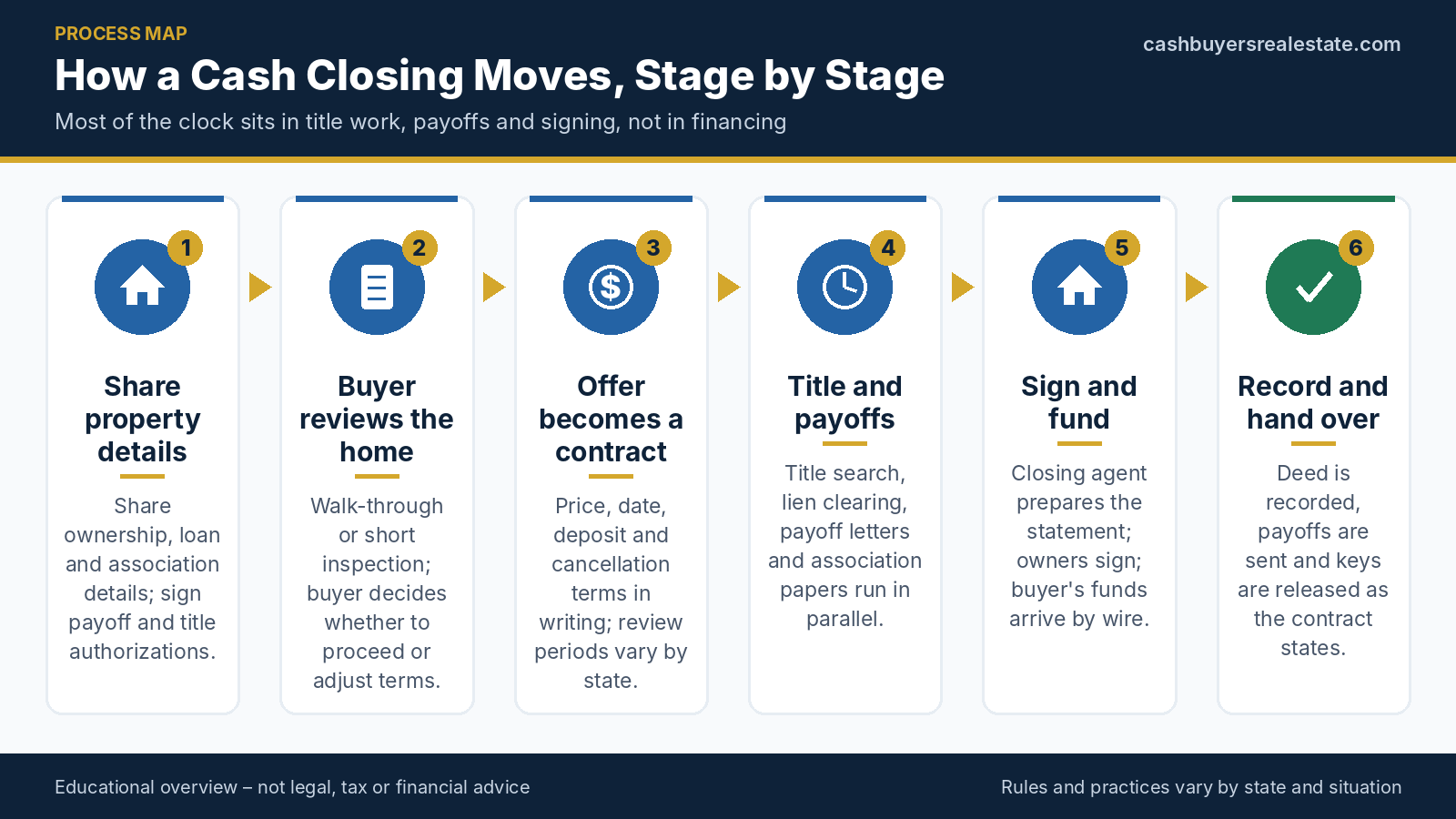
Text version of this infographic
- Share property details — Share ownership, loan and association details; sign payoff and title authorizations.
- Buyer reviews the home — Walk-through or short inspection; buyer decides whether to proceed or adjust terms.
- Offer becomes a contract — Price, date, deposit and cancellation terms in writing; review periods vary by state.
- Title and payoffs — Title search, lien clearing, payoff letters and association papers run in parallel.
- Sign and fund — Closing agent prepares the statement; owners sign; buyer's funds arrive by wire.
- Record and hand over — Deed is recorded, payoffs are sent and keys are released as the contract states.
The Bottlenecks That Really Set the Closing Date
Every experienced closing officer has a mental list of the things that turn a smooth file into a stalled one, and the list is remarkably consistent from state to state. The items fall into two families. One family concerns money and title: payoffs, liens, taxes, and whatever else is recorded against the property. The other family concerns people and property: who has the authority to sign, which organizations must supply paperwork, and who or what is inside the house. Knowing both families, and which one your file is likely to trigger, turns an unpredictable process into a manageable one. The table that follows summarizes the most common bottlenecks, and the two sections after it explain how each one works.
| Bottleneck | Why it takes time | Usual remedy | Who can act |
|---|---|---|---|
| Mortgage or home equity payoff | Servicer must produce a dated figure; lines of credit may need a separate closure request | Send a written payoff request the day the contract is signed; ask about line-of-credit closure forms | Seller and closing agent |
| Old mortgage never released | Lender or successor must record a release or provide a satisfaction letter | Locate the original lender or its successor; title company often runs this down | Title company |
| Judgment or tax lien | Creditor must supply a payoff or release; some federal matters need a formal discharge request | Pay from proceeds with a payoff letter; start any discharge application early | Seller, creditor, title company |
| Estate or trust sale | Authority to sign must be documented, sometimes by court order | Obtain letters or trustee certification before listing the property for sale | Personal representative or trustee, attorney |
| Co-owner who cannot sign | Each owner’s signature and identification must be properly notarized | Arrange mobile or remote notarization; confirm powers of attorney in advance | Co-owners, closing agent |
| Association documents | Association manager or management company must prepare and deliver statements | Request documents on day one; ask about expedited delivery and its fee | Seller, association |
| Tenant or other occupant | Legal notice periods apply; leases may carry over to a buyer | Decide in advance whether the buyer takes the lease or needs the house vacant | Seller, buyer, attorney |
| Foreign seller | Federal withholding rules may apply to the sale proceeds | Consult a tax professional about withholding and certificates before closing | Seller, tax advisor, closing agent |
As you read the table, notice that most remedies are about starting early rather than about doing something unusual. A payoff request submitted on day one rather than day eight, or an association document ordered immediately rather than after the title commitment arrives, can pull a file forward by a week without costing anything. The slowest items, estate authority and formal discharges, are slow because someone outside the transaction decides the pace, which makes early identification worth even more.
Title and Money Problems: Liens, Payoffs, and Tax Matters
Money problems tied to the property itself are usually the most predictable bottleneck, because the amounts are written down somewhere and the parties who hold them are professionals with procedures. They are also the most common reason that a seller who was told “we can do it in a week” ends up closing in three. The question is rarely whether the debt can be paid at closing; most debts can be. The question is how long it takes the creditor to produce an accurate, dated number and a promise to release the lien.
Mortgage payoff letters and the seven-business-day rule
When a house is sold with a mortgage on it, the closing agent needs a payoff statement showing the total required to satisfy the loan on a specific date, including principal, accrued interest, and any fees. Federal regulation gives homeowners a right to this document: under Regulation Z, a creditor, assignee, or servicer must provide an accurate payoff statement within a reasonable time, and in no case more than seven business days after receiving a written request from the consumer or from someone acting on the consumer’s behalf. The rule appears at 12 CFR 1026.36(c)(3) and is available in the Electronic Code of Federal Regulations. The same provision allows longer periods in specific circumstances, such as when a loan is in bankruptcy or foreclosure, so a seller in those situations should not assume the seven-day limit applies.
Seven business days is a ceiling, not a typical turnaround, and it is also a reminder of how a short closing can fail on arithmetic alone. A request made on a Friday might arrive after the following Tuesday week; a request made after a holiday weekend might arrive later still. Payoff figures also expire, because interest accrues each day, so the letter is written for a specific good-through date and usually includes a daily interest figure. If closing slips past that date, a fresh letter may be required. Home equity lines of credit add another wrinkle: many lenders require a signed request to close the line, in addition to a payoff, so that a borrower cannot draw more funds after the sale. Asking the servicer on the first call whether any closure form is needed prevents a surprise a day before signing.
Judgment liens, tax liens, and the 45-day federal discharge process
Liens other than mortgages come in many forms. A court judgment against an owner can attach to real property in the county where it is recorded, and state law determines how and when. Unpaid property taxes generally take priority as a lien on the property, and the local tax collector can usually supply a payoff quickly, though the figure may be updated periodically as bills are issued. Contractors who were not paid may record mechanics’ liens, which in many states have their own deadlines and release procedures. For most of these, the usual path is simple: obtain a payoff letter from the creditor or its attorney, pay the amount at closing from the seller’s proceeds, and have the creditor record a release afterward. The speed of that path depends on whether the creditor answers promptly and whether the amount is disputed.
Federal tax liens can be slower because certain steps run through the Internal Revenue Service rather than a local office. When a sale will not generate enough money to satisfy a federal tax lien in full, or when the owner of the property is not the person named on the lien, the parties may need a formal certificate of discharge. The IRS’s Publication 783 instructs applicants to submit the request at least 45 days before the date they need the certificate, with a completed Form 14135, an appraisal by a disinterested third party plus an additional valuation, a title report, the proposed sales contract, and the proposed closing statement, among other items. Readers can review those instructions in IRS Publication 783. If a lien that proceeds will fully satisfy is the only issue, a payoff and release may be handled differently, so ask the title company which route applies. The article on selling a house quickly with liens covers the full range of lien scenarios.
People and Property Problems: Authority, Associations, Occupants
The second family of bottlenecks is about people. A title company can be fast, a buyer can be ready, and the payoffs can all be in hand, yet a closing still stops because a required signer cannot sign, a management company has not produced a statement, or a tenant has not moved out. These problems tend to appear in particular types of properties, which means a seller can often predict them from the first minute of the conversation.
Probate, trusts, and multiple owners: who has the power to sign
When the owner of a house has died, the person who can sell it is whoever the law or the will authorizes, usually an executor or administrator appointed by a court. In many states that appointment results in a document, often called letters testamentary or letters of administration, that the title company will require before it will insure the sale. How long the court takes to issue that document varies by state and by county, from a few days in some settings to many weeks in others, and in some states a sale also requires notice to heirs or court confirmation. Sellers in this position should talk with a probate attorney before signing a contract with a closing date, because the date has to account for a step that no buyer controls. The article on selling a house quickly in probate explains the common patterns.
Trusts and co-ownership raise similar issues in less dramatic form. A trustee usually must provide a certification of trust or similar document, and every co-owner must sign, even if one lives overseas or in another time zone. A surviving joint owner needs to provide proof of the other owner’s death. A signer who holds a power of attorney needs a document that the title company finds acceptable, and some companies are cautious about older documents. Sellers who are not US residents face an additional layer: the Internal Revenue Service explains that, in most cases, the buyer is the withholding agent for a sale by a foreign person and that the rate of withholding is generally 15 percent of the amount realized, with a narrow residence-based exception that depends on the buyer planning to live in the property. Because an investor buyer would not qualify for that exception, the practical path is usually a withholding certificate application or a conversation with a tax professional well before closing.
HOA documents, tenants, and the house that is not empty
Condominiums and homes in planned communities introduce a third party with a legal role in the sale. The association typically prepares a statement of dues, assessments, and unpaid charges, sometimes called an estoppel certificate or resale certificate, and the buyer or closing agent uses it to prorate fees and confirm that nothing is owed. Rules differ widely. Florida’s homeowners’ association statute, for example, requires the association to issue an estoppel certificate within 10 business days of a written request, caps the base fee at $250 where no delinquent amount is owed (with an additional capped amount if one is), allows an extra $100 for delivery within three business days, and limits the certificate’s validity to 30 or 35 days depending on the delivery method. Those details come from the Florida Statutes, and they illustrate how much a single state rule can influence a calendar. Other states have other deadlines, fees, and formats, and some associations also have approval or first-refusal procedures that add time.
Occupants are the last major variable. A vacant house can usually be handed over at closing, but a house with tenants has a lease that may continue after the sale, and a buyer who wants vacant possession may need to negotiate a move-out or follow state notice procedures. A house with a seller still living in it may need a few days after closing, which is commonly arranged through a short post-closing occupancy agreement. Belongings are another factor: a buyer who agreed to take a house as-is may still expect it to be free of personal property by closing, and clearing a full house takes time that should be built into the date. Ask early whether the buyer will accept belongings left behind, because that single answer can save a week. Landlords weighing these options should read the state’s notice rules before agreeing to any date, and anyone dealing with a very full or hoarded home should approach the clearing process with patience and professional support rather than pressure.
Realistic Closing Ranges: From a Ten-Day Closing to a Thirty-Five-Day Closing
Any honest answer to how long a cash closing takes begins with “it depends,” but that answer becomes useful once you can say what it depends on. The method is simple. Identify the longest chain of tasks that must happen in sequence, add a margin for the things no one controls, and compare the result to the date being proposed. If the proposed date is shorter than the longest chain, either the chain is shorter than you think or the date will move. This section applies that method to five common scenarios and then walks through two complete closings, one fast and one slow, so the logic is visible in action.
Reading the Ranges: Five Scenarios and Their Drivers
The scenarios below are archetypes, and real files often combine them. They are useful because each one is dominated by a different clock, which makes it easier to see why a stated closing date does or does not hold up. The durations are illustrative planning ranges that assume ordinary diligence by everyone involved, and they should be adjusted for your county, your closing agent, and your own file.
The clean, vacant, single-owner file
At the fast end sits a vacant single-family house owned by one adult who is available to sign, with one mortgage that is easy to pay off, no association, no recorded liens other than the mortgage, and a buyer whose funds are already liquid. In that setting the longest chain is usually the payoff letter plus the title search, and both can often be completed inside a week when requests go out the first day. Add a signing appointment and a funding day, and a closing in roughly seven to fourteen days is a reasonable illustrative expectation, with the faster end requiring everything to line up. Closing agents do not skip steps to hit a date, and a file that is rushed is the file most likely to hit a surprise such as a misspelled name on a prior deed.
Even in this best case, the schedule has few spare days. Electronic signatures and remote notarization, where available, help compress the signing step, and a bank wire can move money in a matter of hours. But a wire sent after the bank’s cutoff on a Friday arrives on Monday, a closing agent with a full calendar may not be able to prepare documents before the middle of the week, and a county recorder that is not accepting electronic recordings may add a day or two after closing. That is why even the cleanest file is better planned as a range than as a single date. If a buyer proposes a closing in under a week, ask what specifically will be done on each day, because a plan with named tasks is more credible than a number.
Files with one complication, and files with several
Add a single complication and the range moves out. A condominium adds an association document that may take a week or two. A second mortgage or home equity line adds a second payoff. A recorded judgment adds a creditor who must supply a release. A co-owner living in another state adds a notarization that has to be arranged. Because these tasks often run in parallel with title work, one complication typically adds days rather than doubling the schedule, and a range of roughly two to four weeks becomes a sensible illustrative plan. The risk is that the parallel tasks all land on the same last day, so that any one slip becomes the new closing date.
Multiple complications behave differently because some of them depend on each other. A probate sale needs court-issued authority before the personal representative can sign anything; the title company cannot finalize its requirements until it knows who the signer is; the association cannot always issue its document until it has a name to put on it; and a buyer may not release funds until the title commitment is clear. Tasks that must happen in order add together instead of overlapping, and ranges of four to eight weeks or longer become normal. This is not a sign that something has gone wrong. It is a sign that the file contains more steps than the buyer’s marketing implied, which is why the best sellers can do is to count the steps early and ask each party for its own estimate.
| Scenario | What drives the calendar | Illustrative range | What a faster promise would require |
|---|---|---|---|
| Clean, vacant, single owner, one mortgage | Payoff letter, title search, signing appointment | 1 to 2 weeks | Same-day requests, available signer, buyer funds already liquid |
| Mortgage plus association or second lien | Association statement, second payoff, buyer review | 2 to 4 weeks | Expedited association delivery and all requests sent on day one |
| Recorded judgment or tax lien | Creditor payoff or release; possible federal discharge process | 3 to 6 weeks | Creditor cooperation; no formal discharge needed |
| Estate or trust sale | Court-issued authority, notices, title requirements | 4 to 8 weeks or longer | Authority already in hand before the contract is signed |
| Tenant-occupied or seller needs extra time in the home | Lease terms, notice periods, post-closing occupancy terms | 3 to 6 weeks | Buyer willing to take the lease or a short occupancy agreement |
To use the table, find the row closest to your situation, then ask which drivers apply to you and which do not. If your property is a condominium with a recorded lien, you are not choosing between rows but combining them, and the longer chain wins. Treat the right-hand column as a diagnostic: when a buyer offers a date that is shorter than the range in your row, the useful question is which of the listed conditions the buyer believes is already true.
Two Closings Walked Through Day by Day
Ranges become clearer when you see how the days actually fall. The two hypothetical files below sit at opposite ends of the spectrum. Neither is typical, and both are invented for illustration, but each shows how ordinary tasks combine to produce a short or a long closing. Following the calendar line by line is also a good way to see where a seller can intervene.
A ten-day closing and what had to be true
For a ten-day closing, nearly every condition has to be favorable at the same time. The seller must be reachable and decisive, the title must be uncomplicated, the buyer must hold liquid funds, and the closing agent must have room on the calendar. The example below shows one way the days might fall, with deliberately modest assumptions about how fast each step moves.
Illustrative example (hypothetical numbers, not market data): A homeowner owns a vacant single-family house outright in her own name, with a remaining mortgage balance of about $96,000 and no other recorded liens. On day one she accepts a cash offer, signs the contract electronically, and signs the payoff authorization the title company emails that afternoon. The buyer wires a $5,000 deposit on day two. The servicer’s written payoff arrives on day five, and the title commitment arrives on day six showing only the mortgage as a requirement. On day seven the buyer does a final walk-through; on day eight the closing officer sends the settlement statement and the seller approves it. She signs before a mobile notary on day nine, the buyer wires the balance that morning, and the deed is submitted for recording that afternoon. Keys change hands on day ten.
Several conditions had to be true for that calendar to hold. The servicer answered the written request in well under the seven-business-day outer limit, which is common enough but never certain. The title search turned up no surprises, so no curative work was needed. The seller was available to sign on the day the paperwork was ready, and a notary could meet her at home rather than at an office with limited hours. The buyer’s money was already in an account and the wire left before the bank’s cutoff. Remove any one of those, and the closing date moves by a few days. If two fail together, the closing is no longer a ten-day closing.
The example also shows where a seller’s actions make the biggest difference. Returning the payoff authorization on day one rather than day three, approving the settlement statement within hours, and scheduling the notary in advance each preserved a day or two that could have been lost. None of those actions costs money or requires special skill; they only require knowing that the clock is running. Sellers who plan for a short closing should treat the first forty-eight hours as the most valuable on the calendar, because the longest tasks in the chain, the payoff and the title search, cannot start until the seller’s documents arrive.
A thirty-five-day closing and where the days went
A thirty-five-day closing is not a failure. It is the natural length of a file that contains several steps in sequence, and a buyer who accurately predicts it deserves more trust than one who promises ten days and delivers fifty. The next example shows how the days accumulate in an inherited property sale where authority, an association, and a payoff must all be handled.
Illustrative example (hypothetical numbers, not market data): Two siblings inherit a condominium after their mother’s death; one of them has been named personal representative, but the court has not yet issued formal authority. They accept a cash offer on day one with a closing date of day thirty-five, which the buyer and sellers chose after discussing the court’s schedule. Court authority arrives on day fourteen. The title company, which began its search at once, issues a commitment on day nine listing an unpaid association assessment and a small mortgage the mother had taken out years earlier. The association statement is requested on day fifteen, after authority is confirmed, and arrives on day twenty-eight. The payoff arrives on day twenty-two. One sibling, living abroad, signs through a remote notary on day thirty-two. Funds are wired on day thirty-four and the deed is recorded on day thirty-five.
Most of the calendar in that example was spent waiting for third parties: a court, an association, and a servicer. The sellers did not make mistakes; they were limited by steps that run in sequence. Authority had to arrive before the association would treat the personal representative as the owner’s agent, and the association’s statement had to arrive before the closing officer could finalize the figures. A buyer who understood that sequence agreed to a thirty-five-day date at the outset, which gave everyone a realistic target and kept the earnest money safe.
A few lessons carry beyond the example. First, long closings usually involve at least one party that is not in the buyer-seller relationship, so the best protection is a contract that expects delays and states what happens if they occur, such as an automatic extension for a stated number of days or a right for the buyer to extend by paying a modest fee. Second, a seller in this situation should get every outside request out the door the moment authority arrives, not at the point it seems needed. Third, a seller who expects a delay may prefer a buyer experienced with probate and association sales, a theme that matters most when the target is about a month. Nothing about a longer closing makes a cash sale a poor choice; it simply means the speed advantage has narrowed.
Seen together, the five scenarios and two walkthroughs point to a handful of routes a seller might realistically be on: a clean file that closes in about two weeks, a file with one association or second lien that takes a month, a lien file that needs creditor cooperation, an estate sale that waits for the court, and an occupied property that depends on lease or possession terms. The comparison below sets those routes side by side, showing for each one who it suits best and what it costs in time or certainty.
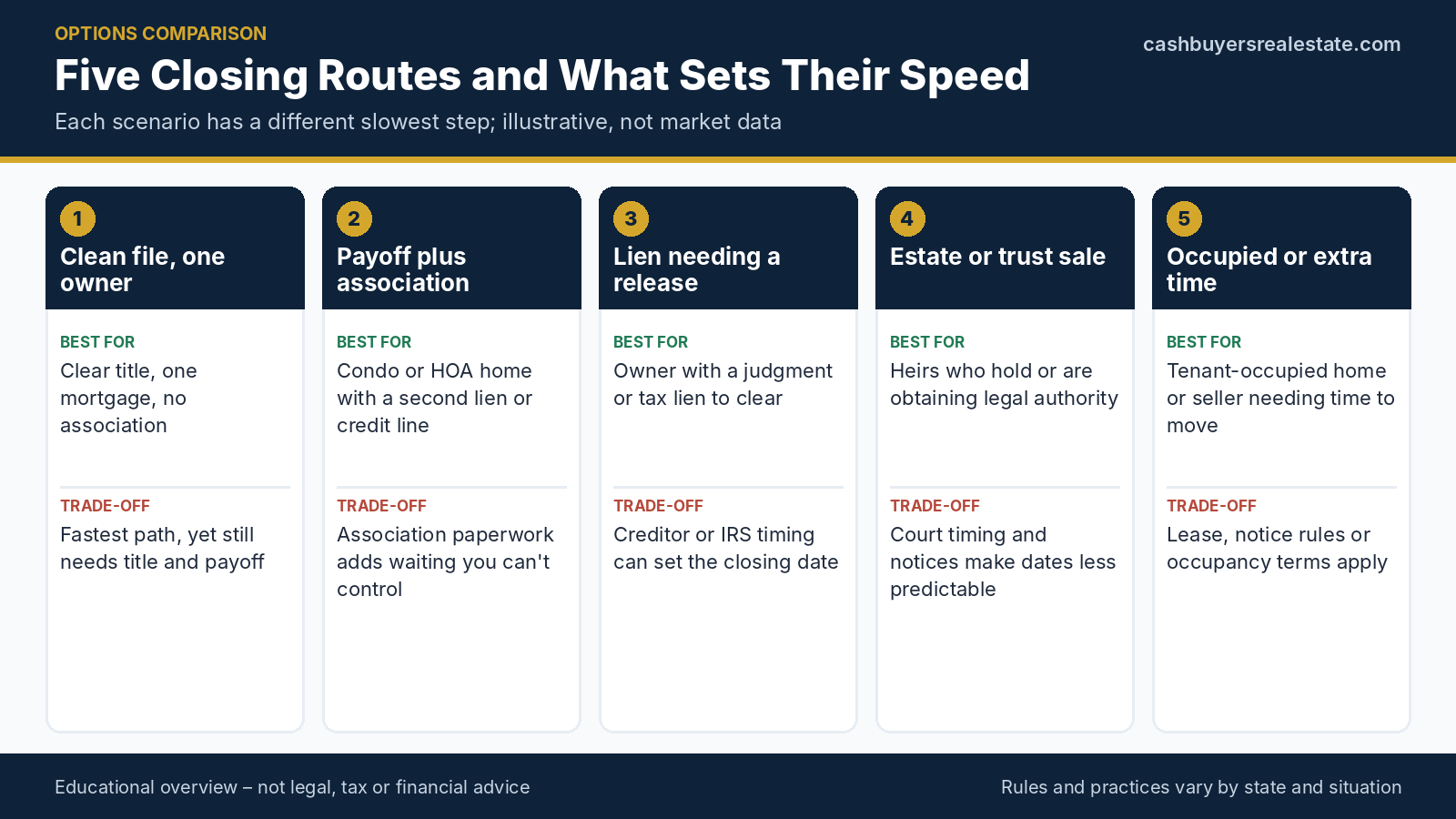
Text version of this infographic
- Clean file, one owner — Best for: Clear title, one mortgage, no association. Trade-off: Fastest path, yet still needs title and payoff.
- Payoff plus association — Best for: Condo or HOA home with a second lien or credit line. Trade-off: Association paperwork adds waiting you can't control.
- Lien needing a release — Best for: Owner with a judgment or tax lien to clear. Trade-off: Creditor or IRS timing can set the closing date.
- Estate or trust sale — Best for: Heirs who hold or are obtaining legal authority. Trade-off: Court timing and notices make dates less predictable.
- Occupied or extra time — Best for: Tenant-occupied home or seller needing time to move. Trade-off: Lease, notice rules or occupancy terms apply.
Closing Day Mechanics: Signing, Funding, Recording, and Possession
The last few days of a transaction feel different from the weeks before them. The open questions have been answered, the numbers are on a settlement statement, and what remains is logistics: collecting signatures, moving money, recording the deed, and handing over the keys. Those logistics are governed by state custom as much as by the parties’ wishes, which is why a seller who has closed a sale in one state can be surprised by how a closing works in another. Understanding the local model lets you predict how many appointments there will be, who will conduct them, and what has to happen between the signature and the moment funds reach your account.
How the Closing Method Changes the Calendar by State
There is no single American way to close a real estate sale. The Consumer Financial Protection Bureau, in its general description of the closing process, notes that depending on the state all the parties may sit around a table and sign everything at once, that in other places the process can run over several weeks as signatures are collected separately, and that some closings are conducted by mail or online. It also notes that attorneys conduct closings in some states. A seller who reads advice written for a different closing model may plan the wrong sequence, so it is worth learning which model applies to your property before agreeing to a date.
Attorney-closing, title-company, and escrow-company states
In attorney-closing states, a lawyer typically examines title, prepares or reviews the deed and settlement statement, conducts the signing, and handles the disbursement of funds. The National Notary Association’s summary of state practice lists Connecticut, Delaware, Georgia, Massachusetts, South Carolina, Vermont, and West Virginia among the states that require attorney involvement in real estate closings, and describes North Carolina as requiring attorney oversight and supervision; other states may use attorneys by custom without requiring them. For timing, the practical consequence is that the closing date depends on the attorney’s calendar and on the time the attorney needs to complete a title examination, which can be quick in a small office with a good records system and slower where the record must be searched in person.
In title-company states, a title company or its agent usually acts as the closing agent, holding the deposit, issuing the title commitment, preparing documents, and conducting signing at its office or at a location of the parties’ choice. In escrow-company states, an escrow officer coordinates the paperwork and conditions, and the parties often sign separately on different days; the escrow officer then records the deed and releases funds once every condition is satisfied. The escrow model can feel slow to a first-time seller because “closing” is not a single meeting, but it can also accommodate people who live far apart. Whichever model applies, the central point for timing is that the closing agent, not the buyer, controls the final steps, so choosing an experienced closer and being responsive to that office is among the most reliable ways to protect a date.
Mail-away, remote online, and mobile signings
Signing logistics have improved considerably, but they still produce delays when someone is out of town. A mail-away closing sends the documents to the signer, who signs before a notary and returns the originals by courier; the originals must arrive before the deed can be recorded in many places, so a courier delay of a single day becomes a closing delay of a single day. Mobile notaries who travel to the signer’s home or workplace can eliminate the trip to an office and are often used for sellers who are traveling, ill, or simply busy. Remote online notarization, where a notary witnesses the signing over a live video session, is available in many states under their own laws, but each state sets its own rules, and acceptance by the county recorder where the property sits is a separate question the closing agent should confirm.
A seller living outside the United States faces an extra step. The title company must be satisfied that the notarization is valid for recording in the property’s state, which can mean signing before a U.S. consular officer or using a notary and certification the title company has approved in advance. Asking the closing agent for written signing instructions the day the contract is signed prevents the common mistake of completing a notarization that the recorder later rejects. For any signer who cannot attend in person, plan the signing step a few days earlier than the funding date and have a backup, such as a second notary appointment, in case the first one falls through.
| Closing model | Who runs the closing | Where days are often saved | Where days are often lost |
|---|---|---|---|
| Attorney-led closing | An attorney, who may also examine title | Direct communication; problems resolved in one office | Attorney availability; in-person records searches |
| Title company with a single signing | Title company closing officer | One appointment; funding and recording the same or next day | Waiting for every party to be available together |
| Escrow company with separate signing | Escrow officer, with parties signing on different days | Flexible scheduling for parties in different places | Releasing funds only after all documents and conditions arrive |
| Mail-away or remote signing | Any of the above, working with a notary | No travel; signing can happen the day documents are ready | Courier delays; recorder acceptance of remote notarization |
The table is meant to show tendencies, not rules, because individual offices vary in speed and technology. Notice that no model is inherently faster; each shifts the likely delay to a different place. A seller choosing among title companies, where the choice is available, can ask how far in advance the office books signings, whether it offers mobile or remote options, and whether it records electronically. The answers reveal more about speed than a promise ever will.
From Signature to Funded to Recorded
Signing is not the end of the process, and in many places it is not even the moment the sale becomes final. Between the signature and the keys come three events that are often confused: funding, when the buyer’s money reaches the closing agent; disbursement, when the agent pays the seller, the lender, and others; and recording, when the deed is submitted to the county. Their order and timing vary, and each carries its own risk of delay.
Wire cutoffs, funding, and why finality matters
Most cash purchases are funded by wire transfer, and wires follow a calendar of their own. The Federal Reserve describes the Fedwire Funds Service as opening at 9:00 p.m. Eastern Time on the preceding calendar day and closing at 7:00 p.m. Eastern Time, Monday through Friday except designated holidays, with a 6:45 p.m. Eastern Time deadline for transfers made on behalf of a bank’s customers. The Reserve Banks add that transfers are immediate, final, and irrevocable once processed. In practice, individual banks usually set earlier internal cutoffs for customer wires, and large wires can prompt a verification call, so a buyer who starts a wire in the late afternoon can easily miss the day. A wire that misses the cutoff does not fail; it simply arrives on the next business day, which is how a Friday closing becomes a Monday closing.
The finality of wires explains why closing agents are so careful about verifying who receives them. Once a wire is processed, getting it back depends on the receiving bank’s cooperation and on speed, so closing agents usually insist on collected funds before releasing any money and follow strict procedures for confirming payoff and disbursement instructions. For a seller, this caution is a feature: it is the reason a payoff goes to the right lender and your proceeds go to the right account. It also means last-minute changes, such as a new account for your proceeds, may be delayed while the agent verifies them by phone. Entity buyers add paperwork of their own; title companies commonly ask a limited liability company for its formation documents and evidence of who may sign, and these should be requested at the start of the transaction rather than the end.
Recording, possession, and the first days after closing
Recording is the step that puts the buyer’s ownership on the public record, and the county recorder’s office controls its pace. Many counties accept electronic submissions that are processed quickly, while others rely on paper filings that can take longer. Practices differ on whether funds are disbursed at signing or only after the deed is recorded; in some states the closing agent waits for recording before paying the seller, and in others it disburses on the day of signing and relies on title insurance to protect against intervening events. Ask your closer which approach applies, because it determines when the proceeds arrive in your account. When the proceeds actually become usable then depends on the closing agent’s disbursement method and on your bank’s own rules for large incoming wires, so ask both for a plain statement of the expected timing.
Possession is a separate item that the contract should state clearly. The usual arrangement is that the buyer receives keys at closing or upon recording, and the seller leaves the property empty and in the agreed condition. If you need a few extra days to move, negotiate a written occupancy agreement before closing that states the end date, the daily charge if any, who pays utilities, and what happens if you stay longer; informal promises are a poor substitute. After closing, expect a few follow-up items: the lender will record a release of the mortgage, the title insurer will issue its policy to the buyer, and you will receive a copy of the final settlement statement, which you should keep with your tax records. None of these steps delays the transfer of the house, but each confirms that the closing is complete and that the paperwork on the public record matches what you signed.
Preparing the Property and Paperwork So the Clock Runs Shorter
Much of what makes a closing slow is not buried in the transaction but sitting on the seller’s kitchen table or in a drawer somewhere: a mortgage statement nobody has looked at, a deed with a name spelled two ways, an association manager’s phone number nobody has saved. Preparation does not make the title search faster or the court quicker, but it removes the self-inflicted delays, and those are often the largest controllable part of the schedule. Preparation also improves a seller’s negotiating position, because a buyer who sees organized paperwork prices in fewer surprises. This section covers what to assemble before accepting an offer and how to think about the price of speed once you know what a faster date is worth.
Front-Loading the Paperwork Before You Accept Any Offer
The best moment to gather documents is before the contract is signed, when there is no pressure and no clock. A seller who has everything ready on day one can send payoff authorizations, association requests, and identification to the closing agent within hours, which shifts the entire schedule forward. Gathering is mostly a matter of asking the right questions about your own property, and the answers are often easier to find than sellers expect.
Documents that save days: payoff, entity, and association paperwork
Start with the debts. Find the most recent statement for every loan secured by the property, including any second mortgage or home equity line, and note the servicer’s name, loan number, and payoff department contact. Many servicers accept written payoff requests by secure message or fax, and the written request is what starts the regulatory clock for the payoff statement. Next, locate your deed, because the exact way your name appears there is the way it must appear on every document you sign; if you have married, divorced, or changed your name since you bought the property, tell the closing agent immediately so the paperwork can reflect the connection. Collect the contact information for any homeowners’ association or condominium manager, plus recent statements showing the current dues.
Entity and estate sellers have a heavier load. A limited liability company should have its formation documents, operating agreement, and a resolution or written consent authorizing the sale ready to hand over. A trustee should have the trust agreement or a certification of trust. A personal representative should have the court’s letters of authority or equivalent. Each of those documents answers a question the title company would otherwise ask after the contract is signed, and each question asked later costs days. A short checklist helps keep the list in view as you collect, and it can double as a handoff document to give your closing agent on the first day.
- Government-issued photo identification for every person on the deed
- The most recent statement and servicer contact for each loan or line of credit
- A copy of the deed, plus marriage, divorce, or name-change documents if the names differ
- Association manager contact and recent dues statement, if any
- Entity, trust, or estate authority documents, if the owner is not an individual
- Names and contact details for any tenant or occupant
- Keys, access codes, and utility account information for the final walk-through
Disclosures, lead paint rules, and inspection timing
A cash sale does not automatically remove a seller’s disclosure duties. Many states require sellers of residential property to complete a disclosure form describing known conditions, and some states permit sales to be made as-is with limited disclosures, while others do not relax the duty at all. Because the rules differ and the penalties for getting them wrong can be serious, the safest practice is to complete any disclosure form your state requires before the contract is signed and to hand it over with the first offer, rather than after the buyer has already built a closing date around a house it thinks it understands. Disclosing known defects early also protects speed in a more practical way: a buyer who learns of the foundation crack on day one will price it in, while a buyer who discovers it on day nine may demand a new price or more time.
For homes built before 1978, a federal rule adds specific requirements. The Environmental Protection Agency states that sellers of pre-1978 housing must give the buyer its pamphlet on lead hazards before the buyer is bound by the contract, disclose any known lead-based paint or hazards along with available records, include a lead warning statement in the contract, and keep signed copies for three years. The rule also gives the buyer a 10-day period to conduct a paint inspection or risk assessment, which the parties can lengthen or shorten by mutual written agreement and which the buyer may waive. The exemptions the agency lists, such as foreclosure sales and housing built after 1977, do not turn on how the buyer pays, so a cash sale of an older home should still include the forms. Details are on the EPA’s real estate disclosure page. A buyer who wants a faster close may ask you to sign a written waiver of the inspection period, which is the buyer’s right to waive, not yours to demand.
Speed Versus Net Proceeds: What a Faster Date Is Worth
Speed is not free, and neither is slowness. A buyer who closes in two weeks takes on risk and typically prices that risk into the offer, while a seller who waits three months for a conventional sale pays carrying costs and takes on market risk. The right comparison is not the offer price against the listing price; it is what each route leaves in your pocket on the day the money arrives, after every cost has been counted. Making that comparison honestly is the only way to know what speed is worth.
Comparing the speed discount with the cost of waiting
The structure of the comparison is simple. For each route, start with the sale price, subtract the loan payoff, subtract the seller’s closing costs, subtract any repairs or credits, and subtract the carrying costs for each month the house remains yours. Carrying costs include the mortgage payment, property taxes, insurance, utilities, and upkeep, and they run whether or not the house is for sale. A route that sells for less but ends sooner can leave you with the same or more money than a route that sells for more but takes months. The example below uses invented numbers to show the mechanics, not to suggest what any route will produce.
Illustrative example (hypothetical numbers, not market data): A homeowner compares two routes for a house that might list at $250,000. On the listing route, she assumes selling costs of 7 percent ($17,500), $6,000 in repairs and preparation, and 75 days of carrying costs at roughly $1,100 per month ($2,750), for about $223,750 before paying off her mortgage. On a cash route, she assumes a $228,000 offer, $3,420 in seller closing costs, no repairs, and 14 days of carrying costs ($510), for about $224,070. The two routes land within a few hundred dollars of each other, and the cash route gets her there about two months sooner. Change any assumption, such as a faster listing sale or a lower cash offer, and the answer changes.
This kind of arithmetic often surprises sellers, who tend to compare the headline numbers only. The lesson is not that cash always wins; it is that the gap between routes is smaller or larger than it looks depending on costs that are easy to overlook. The reverse can also happen: a cash offer that is 20 percent below a realistic listing price will rarely recover through saved carrying costs alone. The article on cash sale versus listing for a fast sale lays out the full comparison, and the analysis changes if you have a hard deadline, such as a foreclosure date, that makes time itself the most valuable asset.
Slower routes that sometimes net more
A cash sale is one of several routes, and an honest decision includes the others. A conventional listing with a real estate agent exposes the house to the full market and can attract a financed buyer willing to pay a higher price, at the cost of showings, negotiation, and the lender timeline discussed earlier. A financed buyer is not necessarily slower than a weak cash buyer; a well-qualified, pre-approved buyer with a flexible closing can be more reliable than an investor whose funds depend on a short-term loan. The comparison in cash buyer versus financed buyer shows how to weigh those trade-offs. Selling after light repairs, selling to a relative or neighbor, or accepting an investor’s offer with a deliberately longer closing date are other options that sometimes net more for sellers with some time to spare.
There is also a middle path: negotiate the date itself. A buyer who can close in ten days may be willing to pay slightly more for a closing in forty-five if the seller needs time, or may charge a modest premium for a closing in a week. Asking how the price changes with the date reveals how much of the offer is a speed discount and how much is a repair or risk discount. Sellers with a flexible calendar can sometimes capture value that sellers in a hurry cannot, and sellers who must move quickly can decide knowingly whether the discount is worth paying. In both cases, the goal is to choose the route whose net proceeds, timing, and certainty fit your priorities, not to defend a single route as the best one for everyone.
When a Fast-Closing Promise Is a Warning Sign
Fast closings are real, and most buyers who offer them are doing exactly what they say. But the promise of speed is also the most common hook in the less careful corners of this market, because a homeowner under time pressure has less patience for questions. The aim of this section is not to make you suspicious of every buyer; it is to show which patterns genuinely make a quick close unreliable, which contract terms quietly move risk onto the seller, and how to check for both without slowing a legitimate deal. No single feature below proves bad intent, and every item has an innocent explanation in some transactions. It is the combination, and the buyer’s reaction when you ask about it, that tells you the most.
Patterns That Make a Quick Close Unreliable
A closing date is only as good as the party standing behind it. When the buyer holds the money, controls the decision, and intends to close on the house itself, a stated date reflects the real schedule. When the party who signed the contract is something else, such as a middleman hoping to find someone who will pay more, the date reflects a hope. Both arrangements can use the word cash, and both can email a contract in an hour, so the difference has to be found in the paperwork and in direct questions.
Wholesale assignments and buyers who do not hold the money
Some businesses in this market do not plan to buy the house at all. They sign a purchase contract with the seller at a low price, then look for another buyer, usually an investor, and assign their right to buy to that buyer for a fee, or arrange a back-to-back closing in which they briefly take title. This practice is lawful in many places and is often described as wholesaling. It is not inherently improper, and a seller can do well with it, but it changes the reliability of a quick closing. The seller’s closing date now depends on the wholesaler finding an end buyer, and a wholesaler who cannot may ask for an extension, offer a lower price, or cancel under a clause the seller did not notice.
The paperwork usually gives hints. A contract that names the buyer “and/or assigns,” gives the buyer a long inspection window with a unilateral right to cancel, or sets a very small or fully refundable deposit suggests that the buyer is keeping its options open. A buyer who cannot say which title company will close the deal, or who will not provide proof of funds until after you sign, is also worth a second look. Some states regulate how assignable contracts may be marketed or require disclosures when a buyer intends to assign, so check the rules where the property sits. The simplest check is a direct question: will you close on this house with your own funds, or might you assign the contract to someone else? A straightforward answer is a good sign; a vague one is useful information. More background is in the guide to whether cash home buyers are legit.
Contract terms that shift the risk onto the seller
Even a buyer with real money can sign a contract that leaves the seller carrying most of the risk. Look first at who has the right to cancel and at what cost. A contract that lets the buyer walk away for any reason during a long due diligence period, with the full deposit returned, while binding the seller to sell and imposing penalties if the seller backs out, is lopsided in a way that makes the stated closing date meaningless. Look next at extension rights: a clause allowing the buyer to extend the closing date without payment, or at its sole discretion, means the date is a suggestion. A “time is of the essence” clause that applies to the seller but not the buyer is another asymmetry worth noticing.
A second category of terms affects what you can do while the contract is pending. Some contracts require the seller to stop marketing the property or to accept liability if a different buyer appears, and a few buyers record a notice of the contract in the public records, which can complicate selling to anyone else until it is removed. None of these terms is automatically abusive, and your state’s law governs what is enforceable, but each reduces your flexibility. This is a good place to pay a local real estate attorney for an hour of review, particularly where the contract is long or the buyer’s form is unfamiliar. The point here is simply that a short closing period and a one-sided contract often arrive together.
The checks that matter most can be reduced to six, and they apply to nearly every quick-close offer. Confirm the identity of the buyer and the closing company, so you know who you are dealing with. Request proof of funds that is current and from a source you can verify. Read the cancellation and extension clauses for who can exit and at what cost. Check the assignment terms to learn whether the buyer intends to sell the contract to someone else. Use a reputable closing agent whose contact details you have confirmed independently. And never sign blank or incomplete forms. The map below shows each item with a rating for how seriously to treat a failure, which is a useful way to decide where to push and where to move on.
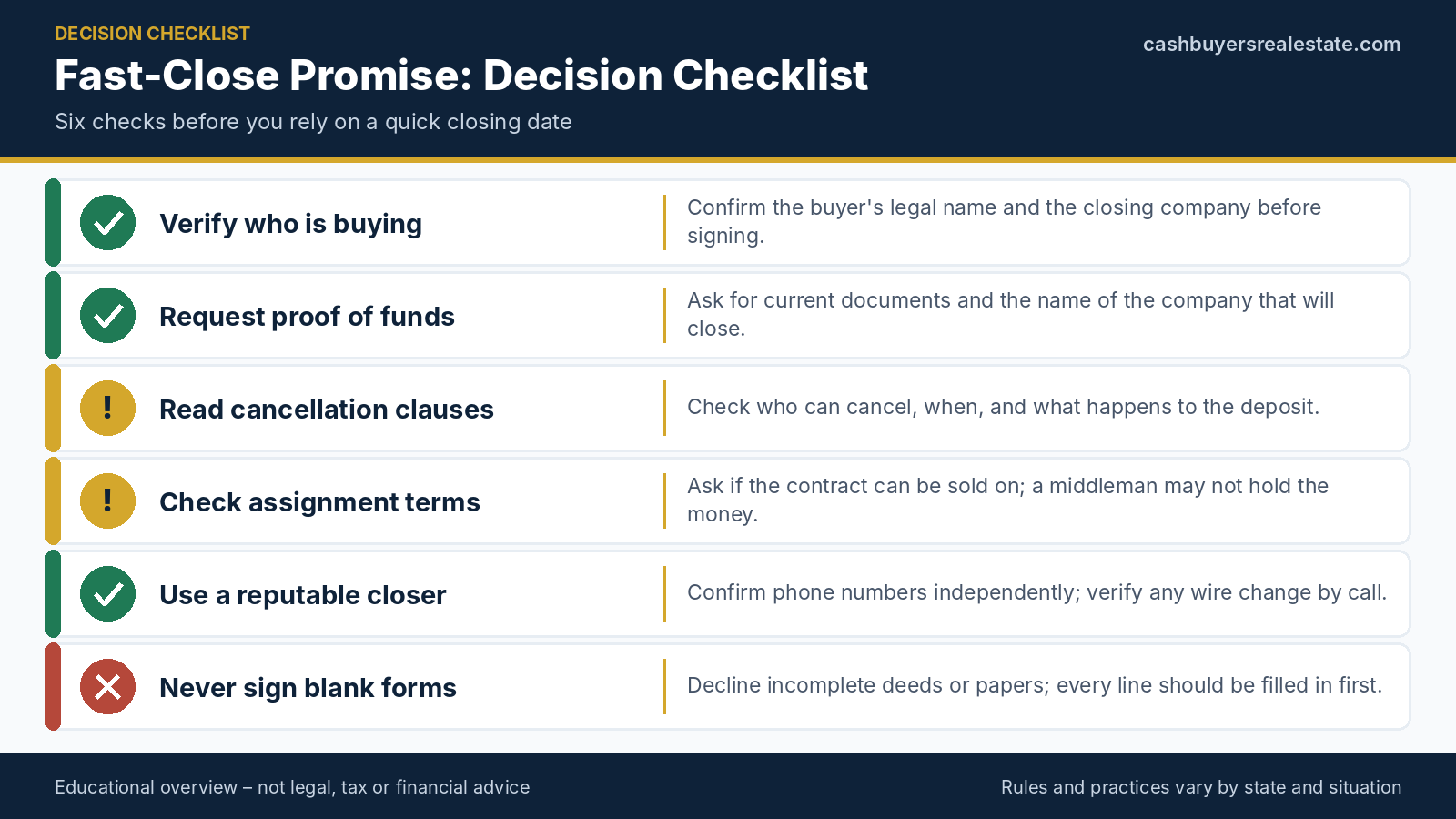
Text version of this infographic
- Verify who is buying — Confirm the buyer's legal name and the closing company before signing.
- Request proof of funds — Ask for current documents and the name of the company that will close.
- Read cancellation clauses — Check who can cancel, when, and what happens to the deposit.
- Check assignment terms — Ask if the contract can be sold on; a middleman may not hold the money.
- Use a reputable closer — Confirm phone numbers independently; verify any wire change by call.
- Never sign blank forms — Decline incomplete deeds or papers; every line should be filled in first.
Fraud and Pressure Risks Around Closing Day
The second group of warning signs involves not the buyer’s reliability but the surrounding environment. Closings move large sums on tight timetables, which makes them attractive to criminals who impersonate parties by email. They also bring emotional stress for sellers, and some counterparties use that stress as leverage. Knowing the patterns in advance makes both easier to handle without slowing the legitimate transaction.
Wire fraud, seller impersonation, and verifying instructions
Closing-related fraud usually works by intercepting or imitating an email conversation. A criminal who gains access to an email account, or who creates a look-alike address, sends payment instructions that appear to come from the title company or from the seller, and the recipient wires money to the criminal’s account. The Federal Bureau of Investigation’s Internet Crime Complaint Center reported 12,368 real estate fraud complaints with losses of $275,110,419 for 2025, up from 9,359 complaints and $173,586,820 in 2024, though the report defines the category broadly, to include real estate investment fraud and rental and timeshare fraud, and tracks closing-wire scams within a separate business email compromise category. The report also describes cases in which victims received compromised emails with wire instructions from a purported title company. The category numbers are not a measure of closing scams alone, but they show that the risk is real and rising.
Sellers face a related risk in reverse: impersonation of the owner. Criminals sometimes pose as the owner of vacant or unencumbered property to sell it, and title and closing professionals respond with identity verification that can add a day or two to a file, especially when the owner is out of state or the property is not occupied. A seller who has taken the obvious precautions, such as providing a clear photo identification promptly, using a notary the closing agent has approved, and answering verification calls, helps the process along. These steps are worth tolerating; they are the reason a closing agent can safely release your proceeds. If you are asked to send identification or account details, use a secure portal or deliver them in person, not an unencrypted email.
Pressure tactics, blank forms, and how to slow down safely
Artificial urgency is the most common pressure tactic. A message that says an offer expires within hours, that another seller is waiting, or that the price will drop if you consult someone first is trying to take away the time you need to compare. Legitimate buyers have deadlines too, but they rarely object when a seller asks for a copy of the contract to review overnight or has an attorney read it. Another warning sign is a request to sign a document with blank lines, such as a deed with the buyer’s name or the date left empty, with the promise that it will be filled in later. A signed deed or power of attorney with blanks gives someone else control over what you actually agreed to. Decline, and ask for a completed version.
Slowing down safely is possible even when you are under real time pressure. Ask for a written summary of the buyer’s timeline and proof of funds, request that the title company or attorney of your choice hold all signed documents until funds are received, and confirm that the settlement statement shows exactly what you were told. If a buyer reacts badly to routine requests, treat that reaction as a signal. Sellers facing foreclosure, an estate deadline, or a divorce are especially likely to meet pressure, and a calm, documented process protects them best. Unexplained fees that appear late in the process are a common form of pressure, so ask early what each party will pay.
| Warning sign | Why it matters for the closing date | Safer check |
|---|---|---|
| Buyer will not say whether it plans to assign the contract | The date depends on finding another buyer, not on the signer’s funds | Ask directly and compare the answer with the contract’s assignment language |
| Proof of funds offered only after signing | No way to judge whether the schedule is financed in reality | Request current documentation before agreeing to terms |
| Long, one-sided cancellation window | The buyer can leave late, after your calendar has been committed | Negotiate a shorter review period or a deposit that becomes nonrefundable on a stated day |
| Closing date promised before title is reviewed | Liens and authority issues are unknown, so the date is a guess | Ask for a date tied to delivery of the title commitment |
| Pressure to sign immediately | Leaves no time for the checks that protect you | Request a copy overnight and have an attorney read it |
| Blank or partly completed documents | Someone else controls what the document will say | Decline to sign until every line is complete |
| Wire or payment instructions changed by email | Common pattern in closing-wire fraud | Verify by phone using a number found independently |
The table works best as a list of questions to ask rather than a list of accusations. When a flagged item appears, the next step is to ask about it politely and see how the buyer responds. A buyer with a legitimate explanation will usually provide documents or adjust the terms; a buyer who becomes evasive or hurried has told you something about how the closing will go. Either way, you will be making the decision with information rather than with hope.
Frequently Asked Questions About How Fast Cash Buyers Close
The questions below come up repeatedly once a seller has a cash offer in hand and starts to plan around it. The answers are general, because timing, contract law, and closing practice vary by state and by property. Treat them as a starting point for conversations with a licensed attorney, title company, or escrow officer where you live, not as a substitute for them.
Questions About Timing and Contracts
Timing questions and contract questions are linked, because the date written into a contract is only as firm as the conditions attached to it. The first set of answers addresses the calendar itself, and the second addresses the paper and the money behind it.
Questions about timing
- What is the fastest a cash purchase can realistically close?
In a clean file, with one owner, one easily paid-off mortgage, no association, and a buyer whose funds are already liquid, closings in about a week are possible, and a few days is not unheard of when every step is requested immediately. There is no federal waiting period for a purchase without a loan, so the limits are practical: a title search, a payoff, a signing, and a wire. If someone promises a closing in a day or two, ask which of those steps they expect to skip or have already completed.
- Why do cash closings sometimes take longer than the buyer first said?
Most early estimates are made before anyone has seen the title commitment, the payoff letter, or an association statement. Once those arrive, the real schedule appears. Delays also come from parties neither side controls, such as servicers, courts, and county offices. A buyer who revises a date after the title report arrives is often being more accurate rather than less honest, though a pattern of repeated revisions is worth discussing directly.
- Does the day of the week matter?
It can. Fedwire, the system banks use for many large transfers, operates on weekdays and excludes designated holidays, and wires started late in the day may not arrive until the next business day. County recorders also close on weekends and holidays. A Friday afternoon closing that misses a wire cutoff can slide to Monday, so many sellers prefer an early-week date when they have a choice.
- Can I choose a later closing date to give myself time to move?
Yes, closing dates are negotiable, and many sellers want a few weeks. Ask the buyer whether the price or terms change with a later date, and put the agreed date, any extension rights, and any occupancy arrangement in writing. A short occupancy agreement after closing is another route if you need only a few extra days.
Questions about contracts and funds
- Does a cash buyer need an appraisal or an inspection before closing?
No lender is involved, so no lender appraisal is required. Many buyers still want to see the property and may inspect it during a review period, and a buyer who borrows short-term money may face its own lender’s valuation. What matters for timing is how long the buyer’s review period lasts and whether the contract lets the buyer cancel or renegotiate after it.
- What happens to the earnest money if closing is delayed?
The answer depends entirely on the contract. Many contracts hold the deposit with a title company, escrow company, or attorney and state when it is refundable to the buyer and when it may be paid to the seller. A delay caused by title problems is usually treated differently from a delay caused by a buyer who simply cannot perform. Read the deposit clause before signing, and ask an attorney if the language is unclear.
- Should I see proof of funds before I sign?
Yes, ideally before agreeing to terms. A bank statement or letter shows that a balance existed on a certain date, which is useful but not conclusive. Ask the buyer to name the title or escrow company that will close, and consider confirming through that office that it has worked with the buyer. The closing agent will verify that funds have actually arrived before disbursing anything.
- Can a cash buyer back out after I sign?
Sometimes. A buyer can cancel only in the ways the contract allows, such as during a due diligence period or if a stated condition fails. Contracts that give the buyer a broad right to cancel for any reason are common in this market, and they make the closing date less certain. If you cannot accept that uncertainty, negotiate a shorter review period or a deposit that becomes nonrefundable on a specific day.
Questions About Problems and Safety
The remaining questions concern the situations that most often change a closing date and the choices a seller has when the date matters more than the details. They are written for sellers who want to move quickly without giving up the protections that make a sale reliable.
Questions about title, probate, and occupancy
- Can a house in probate be sold for cash quickly?
It can be sold, but speed depends on whether the person signing has legal authority yet. In many states that authority comes from a court document, and the time to obtain it varies. Some contracts are signed subject to that authority being granted, with a closing date tied to its arrival. Speak with a probate attorney in the state where the property sits before agreeing to a date.
- What if I owe more on the mortgage than the cash offer?
Closing requires that existing liens be paid or released. If the offer is lower than the payoff, either you bring money to closing or the lender must agree to accept less, an arrangement often called a short sale that requires lender approval and usually lengthens the timeline. Ask your servicer about options and consult a HUD-approved housing counselor or an attorney before accepting an offer that does not cover the payoff.
- Will a tenant slow down the closing?
It depends on the lease and on what the buyer wants. A buyer who plans to keep the tenant may close on schedule and take the lease with it, while a buyer who wants vacant possession must wait for the lease to end or for a negotiated move-out, subject to your state’s notice rules. Decide with the buyer who is responsible for each step before signing.
Questions about risk and alternatives
- How can I tell whether a fast closing promise is realistic?
Ask for a step-by-step plan that names the closing agent, the date the title commitment is expected, and the buyer’s proof of funds. Then call the closing agent yourself, using a number you found independently, and ask whether that schedule is achievable given what the title search has shown. A plan that cannot be explained in steps is probably a hope rather than a schedule.
- Is it safe to sign before the title work is finished?
Signing the contract before title work is normal, since the search begins after the contract exists. What protects you is the contract itself: look for a clause that lets either side cancel or adjust if title problems appear, and for clear language about who pays to resolve them. Do not sign a deed or any closing document until the title commitment and settlement statement have been reviewed.
- When is listing a better choice than taking a fast cash offer?
Listing often makes sense when you have time, when the house is in good condition, and when a realistic net-proceeds comparison shows more money after commissions, repairs, and carrying costs. It also makes sense if you want the widest possible pool of buyers. A cash offer fits better when certainty and speed outweigh price. The honest comparison uses net numbers, not headline prices.
Choosing a Route and Taking the Next Steps Without Pressure
Everything above comes down to a decision that is yours to make: how much a faster date is worth to you, and which route gets you there with the least risk to your net proceeds. The decision is easier when you separate what you must do from what you would merely like to do, and when you evaluate every route with the same criteria. This final section offers a framework for doing that and a practical list of steps for the first week after you decide to explore a sale.
A Decision Framework for Matching Closing Speed to Your Priorities
A framework is useful because it prevents the most common error in this situation: letting a single attractive feature, such as the closing date or the headline price, decide the outcome. By identifying your hard limits first and weighing the remaining factors in order of importance to you, you can compare routes without being swayed by the last conversation you had.
Sorting hard deadlines from preferences
Start by writing down the date that actually matters and why. A hard deadline has a consequence that cannot be reversed: a court-ordered date, a job that starts on a fixed day in another city, a lease that ends, or an estate that must be settled within a period set by law or by the family. A preference is a date you would like but could live without. Many sellers discover that the hard deadline is weeks later than the date they have been telling themselves, which opens up routes they had dismissed as too slow. Others discover that the deadline is genuine and that certain routes are simply unavailable.
Once the real deadline is clear, work backward from it using the ranges in this guide. If your deadline is three weeks away and your file includes a condominium association and a second lien, a realistic schedule may require starting every request today and choosing a buyer with a track record on files like yours. If your deadline is three months away, you have room to compare a cash offer against a listing, or to negotiate a cash buyer’s price for a later closing. The point is to let the deadline define the set of routes that work, rather than letting the loudest promise define the deadline.
It also helps to put a price on delay, because the cost of waiting is the other half of the speed trade. Add up what the house costs you each month, including the mortgage payment or interest, property taxes, insurance, utilities, and upkeep, and compare it with the amount a faster route would cost you in price. If carrying the house costs about $1,400 a month in a hypothetical case, a route that closes six weeks sooner is worth roughly $2,000 in avoided costs before any other consideration, which is a number you can set against a lower offer. When several people share the decision, such as siblings who inherited a property or spouses who own it jointly, agree on the deadline together and write it down, because disagreement about the date is one of the most common causes of delay that no buyer can fix.
Scoring routes on certainty, net proceeds, and effort
With the real deadline in hand, compare each remaining route on three or four criteria: certainty that the sale will close, estimated net proceeds after all costs, time and effort required from you, and fit with your deadline. One simple method, offered here as an illustrative approach and not a formula, is to rate each route from one to five on each criterion, then weight the criteria according to what matters most. A seller facing a fixed deadline might weight certainty and timing heavily, while a seller with time to spare might weight net proceeds most. The scores are only a way of making your reasoning visible, and they should never replace a conversation with a professional about your specific facts.
Whatever scores you assign, test them against the downside. Ask what happens if the closing slips two weeks, if the buyer asks for a price reduction after review, or if the sale falls through completely. A route with a slightly lower net but a firm contract, a well-capitalized buyer, and a reputable closing agent may be a better choice than a higher offer with fragile terms. Conversely, a route that looks slow may be safe for a seller who has the time to wait. Reviewing the worst case for each option, not just the best case, tends to reveal which choice you can live with whichever way things go.
What to Do Next: First Steps, Questions to Ask, and Documents to Gather
Having chosen the criteria, the next step is action. The first week sets the tone for the rest of the process, because the longest tasks cannot begin until you provide documents and authorizations. The material below assumes you have not yet signed a contract and are collecting information, which is the best time to do so.
The first week: documents, calls, and requests
Begin with the paperwork described earlier, gathering identification, loan statements, the deed, and association contacts. In parallel, ask your servicer how to submit a written payoff request and whether any home equity line requires a closure form, and ask any association for its document ordering process and fees. If the property involves an estate or trust, speak with the attorney handling it about when authority will be available. Then talk to at least two buyers or other sale routes, so you have a basis for comparison, and request each offer in writing. A sensible order of operations looks like this.
- List every owner, lender, association, and occupant connected to the property.
- Gather identification, loan statements, the deed, and authority documents.
- Request payoff figures and association documents in writing, and note the dates.
- Ask each interested buyer for a written offer, a proof of funds, and the name of the closing agent.
- Have an attorney or other qualified professional review any contract before you sign it.
- Confirm the closing agent’s contact details independently, before any money or documents move.
The sequence matters because some steps must finish before others can start. Written payoff and association requests should go out within the first two days, since they have the longest waiting periods and no dependence on which buyer you eventually choose. Buyer conversations can run alongside them, and the contract review should come last, once you have at least one written offer in hand and the first responses to your requests have started to arrive. If a buyer asks you to sign something before those requests have been made, ask what the rush is. A legitimate buyer will usually accept a day or two for review, and the responses you collect in the meantime may change what a realistic closing date looks like.
Notice that none of those steps commits you to a sale. They produce information you will need whether you ultimately choose a cash buyer, a listing, or something else. Sellers who do this work early frequently find that their timeline shortens, because the delays they might have discovered on day twelve are discovered on day two, while there is still time to address them.
Questions to ask any buyer about timing
The questions you ask a buyer reveal how well the buyer understands the process. Ask who will close the transaction and when the title search will begin. Ask whether the buyer will close with its own funds or may assign the contract, and what documentation of funds it can provide today. Ask what the buyer expects to find in the title report, how it would handle a lien or an association delay, and what happens to the deposit if the closing date moves because of something outside either party’s control. Ask whether the price changes if you choose a later or an earlier date, and whether the buyer will accept belongings left in the house. Each answer helps you judge whether a stated date is a plan or a hope.
Listen to the form of the answers as well as their content. A buyer who explains the steps, names the closing agent, and says what could delay the date is describing a process it has run before. A buyer who answers every question with reassurance and no detail is giving you nothing to check. Ask for the key answers in writing, in an email or in the contract itself, so that the stated timeline, the extension terms, and the deposit conditions all exist on paper before you rely on them. If an answer changes between the first call and the contract, ask why, and let the written version control what you decide.
Finally, remember that you are allowed to take your time deciding. A cash sale can be an excellent solution for a seller who needs certainty and speed, a conventional listing can be better for a seller who has time and a house in good condition, and a middle path with a longer closing date works for many people in between. The better choice is the one that fits your deadline, your net proceeds, and your tolerance for risk, and you are entitled to verify every claim, ask every question, and wait for the answers before you sign. If the first buyer cannot accommodate that, the next one probably can.