
Cash Buyers for Vacant Houses: Offers, Process & Red Flags
An empty house looks like a problem that ought to be easy to solve. Nobody lives there, so nobody has to be moved out, and there’s no household to schedule a closing around. Then the months pass. The utility bills keep arriving, the insurance company sends a letter you weren’t expecting, a neighbor mentions that the grass has gotten tall, and the search for cash buyers for vacant houses starts to look like the practical way out. Often it is a reasonable way out. But a vacant property isn’t simply an occupied one with the furniture removed. Buyers read emptiness as information, insurers and city governments treat it as a category with its own rules, and the building itself changes in ways that an owner who stops by once a month rarely notices.
The direct answer is that cash buyers do purchase vacant houses, and many find them easier to deal with than occupied ones, because there is no tenant to work around, no family to relocate and no argument over a move-out date. What they don’t do is ignore the vacancy when they set a price. They look for what the empty months may have done to the plumbing, the roof and the interior finishes, they add the time and money they expect to spend securing and insuring the property until it’s resold, and they subtract all of that from what a healthy comparable house would bring. Your job as the seller is to understand that arithmetic, shrink the unknowns you can legitimately shrink, and compare any offer against your realistic alternatives on a net-proceeds basis rather than on the headline number.
Short answer: Yes. Cash buyers regularly purchase vacant houses, and vacancy can simplify a sale because no one has to move out. The price usually reflects expected repairs, holding and insurance costs, and uncertainty about hidden damage. Verify the buyer’s funds, read the whole contract, and compare the money you would actually keep against listing before you accept.
Three kinds of pressure tend to push the owners of empty houses toward a decision. The first is money: taxes, insurance, utilities and maintenance continue whether or not anyone is home, and some of those costs rise once the house is classified as vacant. The second is risk, because a house with no one in it is more exposed to frozen pipes, slow leaks, break-ins and neighbors’ complaints, and the owner carries the liability for all of it. The third is distance, since many vacant-house owners live in another city or state, inherited the property, or moved for work and never quite finished the job of selling. Vacancy is also far from rare. The Census Bureau’s Housing Vacancy Survey for the second quarter of 2026, released July 28, 2026, estimated about 12.2 million year-round vacant housing units nationwide, a category that includes homes for rent, homes for sale and homes held off the market for other reasons, along with a homeowner vacancy rate of 1.2 percent. A good decision accounts for all three pressures, and it begins with seeing the house the way a buyer, an insurer and a city inspector each see it.
What follows starts with how cash buyers evaluate an empty property and how a purchase actually unfolds, then moves through what vacancy does to a building, how insurance and mortgage lenders respond, and what it costs to wait. From there the guide covers the vacant-property registries, code enforcement and vacancy taxes that some cities impose, how to secure and present an empty house, and the contract and verification points that matter most when the seller isn’t living on site. The last sections answer common questions and lay out a way to choose between a cash sale and the alternatives.
Several neighboring situations get only a brief mention here because they have their own guides. A house left empty after a death is covered in the article on inherited houses that sit empty, a former rental is the subject of the guide to selling rental properties to cash buyers, and structural loss is handled in the article on fire-damaged houses. Unpaid taxes and recorded claims against the title get their own treatment in the guide to houses with liens. For the broader picture of how this kind of buyer operates, see the overview of cash home buyers in general, and for speed-focused tactics on an empty property, the guide on selling a vacant house quickly goes further into timing. This article stays on the buyer’s view of vacancy and the risks an owner has to manage.
How Cash Buyers for Vacant Houses Evaluate an Empty Property
Every buyer of a distressed or neglected property is solving the same puzzle: what is this house worth after it’s in sellable condition, what will it cost to get it there, and how long will the money be tied up? Vacancy changes the inputs to each of those questions. It removes some uncertainty, such as who lives there and when they’ll leave, and adds other uncertainty, such as what has been happening inside a closed-up building for the past year. Seeing which unknowns a buyer worries about tells you which ones you can resolve with a little documentation.
What a buyer reads before the first walkthrough
Most of a buyer’s judgment about an empty house forms before anyone turns a key. The first pass is a desk review done from a computer: public records, past listings, map imagery and whatever you’ve said in your first message. The buyer isn’t trying to be unfair; they’re trying to decide whether a visit is worth the drive and what price range is plausible, and every blank in the picture gets filled with a cautious assumption.
Signals from the street, the listing history and the public record
The records a buyer can pull without talking to you are extensive. County assessor and recorder files show how long you’ve owned the property, whether a mortgage or other claim is recorded against it, and whether taxes are current. Past listings, if any, show how long the house sat on the market and how far the asking price fell, which tells a buyer whether other people already tried and walked away. Street-level imagery and a quick drive-by show the roofline, the condition of the siding and gutters, whether windows are boarded, whether mail is piling up, and whether the lawn has been kept. Each of these is a clue about how much deferred maintenance might be waiting inside.
Buyers who specialize in empty houses often keep an informal checklist of the clues that predict trouble. A blue tarp on the roof suggests an old leak and probably wet insulation below it. A water-stained ceiling visible through an uncovered window, a gutter hanging loose, a downspout that dumps against the foundation, and vegetation growing against the walls all point toward moisture, and moisture is the single most expensive thing a vacant house can accumulate. A tidy exterior, trimmed shrubs and a recently cleared walkway point the other way, which is why the cheapest improvement to your negotiating position is often a weekend of yard work.
Your own description is the third input. Buyers ask how long the house has been empty, why, when the water and power were last on, whether the heat has run through winter, and what you know about the roof, the furnace and the water heater. Honest, specific answers earn trust and tighten the range of the first offer, while vague ones get priced for the worst case. Some investors also build outreach lists from public ownership and tax data, so an unsolicited letter or call about an empty house is common and isn’t a sign that anything is wrong with your property. The first-contact conversation is worth preparing for, because what you say there anchors the number that follows.
Vacant, unoccupied and abandoned: three words with different consequences
People use “vacant,” “unoccupied” and “abandoned” as synonyms, but insurers, cities and lenders do not, and the difference can decide who pays for a loss. In the insurance world, a commentary on property policies published by PropertyCasualty360 explains that vacancy generally means a building without contents as well as without occupants, while a dwelling that still holds furniture and belongings but has no one living in it is typically described as unoccupied. That distinction matters because the policy provisions that restrict coverage often turn on exactly which word applies, and courts have sometimes had to decide the question when a claim was denied.
Cities draw their lines in other places. The vacant-building program that St. Paul, Minnesota publishes lists conditions rather than a single definition: a building that is unoccupied and also unsecured, condemned, dangerous, or unoccupied for more than a year under an enforcement order must be registered. Cincinnati’s program page, by contrast, describes a vacant building as one not occupied by people with legal authority to be there, or one that is 95 percent or more unoccupied, and attaches duties to buildings vacant for 180 days or more. Those are two real examples of a much larger variety, so the label that applies to your house depends on the jurisdiction and sometimes on a code inspector’s judgment.
“Abandoned” is the heaviest word of the three, because it implies the owner has given up control, and it’s the one that makes lenders and municipalities act. Fannie Mae’s servicing guide, for example, tells mortgage servicers to inspect when they suspect a property may be vacant or abandoned and, once vacancy is confirmed, to arrange to protect the property from vandalism and the elements. You don’t want your house to land in that category by default. If you’re keeping the house furnished, visited and insured, you may be able to keep it in the gentler “unoccupied” category, and if you’re not, it’s better to know that early and plan around it.
How a cash purchase of an empty house unfolds from first call to keys
Although every buyer has their own habits, the sequence of a cash purchase is fairly standard, and an empty house changes a few of the steps in your favor and a few against you. Knowing the order of events lets you prepare the pieces that otherwise cause delay, which is almost always access to the building and clarity about who has the authority to sign.
From the first inquiry to a written offer
The sequence usually starts with a short exchange in which you describe the property and the buyer asks questions: address, size, age, how long it’s been empty, known problems, what you owe, who is on the title and how soon you’d like to close. A buyer then runs the desk review described above and decides whether to visit. For an empty house the visit is simpler than for an occupied one because nobody has to be home, but it does require a working way in. A lockbox, a key left with a neighbor you trust, or a scheduled appointment with you or your agent are all common arrangements, and an owner in another state can sometimes substitute a live video walkthrough for a first look.
The walkthrough is where the buyer’s conditions meet the building. They’ll want water and electricity on if possible, because a buyer can’t judge a furnace, a water heater or a plumbing system in the dark with the supply shut off. If you’ve turned the utilities off to save money, expect the buyer to either discount for the unknowns or ask you to restore service for an inspection. That small decision, paying a reconnection fee and a month of base charges, can change the offer more than its cost would suggest, because it replaces assumptions with facts.
After the visit comes the written offer. A serious one states the price, the amount and holder of the earnest money, the closing date, whether the sale is as-is, any inspection or due-diligence period and its length, who pays which closing costs, what happens to items left in the house, and any right the buyer reserves to assign the contract. You don’t have to accept the first version. A reasonable buyer expects questions, and the back-and-forth over those terms often matters more to your final result than the last few thousand dollars of price.
From signed contract to funds and possession
Once both sides sign, the file moves to a title company or closing attorney, depending on local practice. In some states a title or escrow company coordinates the closing; in others an attorney handles it, and a few states split the roles by region, so never assume your transaction will follow the pattern a friend described in another state. The closing agent searches the title, identifies payoffs for any mortgage or recorded claim, holds the buyer’s earnest money in a neutral account, and prepares the deed and settlement statement. If the buyer has a due-diligence window, the buyer’s inspectors may visit during that time, and a house with the utilities already on will pass through that stage more smoothly.
Sellers who live far from the property often wonder how they’ll sign. The answer varies by state and by the closing agent’s procedures: some closings can be completed by mail with a notary near you, some allow remote online notarization, and some require a power of attorney, which is a legal document that deserves careful drafting and independent advice. Raise this with the closing agent early, because a deed signed incorrectly or notarized in a way the county recorder won’t accept is a classic cause of last-minute delay.
The final stretch deals with the house itself. The contract should say whether you’re leaving any contents and in what condition the buyer takes the property, since “as-is” doesn’t automatically mean you may abandon junk in the garage. You hand over keys, garage-door openers, alarm codes and any manuals, you arrange final utility readings so you’re not billed for the buyer’s usage, and the buyer typically does a last walk-through to confirm nothing has changed since the contract. Funds then move through the closing agent, and the keys change hands when the contract says possession passes, which is most often at closing and recording.
What Months of Emptiness Do to the House Itself
A house is a machine that runs on use. People turn faucets on and off, open windows, run the furnace, flush toilets, notice odd smells and report small problems before they become large ones. Remove the people and the machine keeps running anyway, only unsupervised. Water still sits under pressure in the supply lines, the roof still sheds rain onto whatever is beneath it, and the air inside still carries moisture that nobody is venting. A buyer who walks through a long-empty house is mostly trying to estimate what the unsupervised months cost, and the estimate always leans toward caution when the evidence is thin.
Water, heat and moisture: where the slow damage starts
Water is behind most of the large surprises in a vacant house, for a simple reason: it is patient. A leak that would be heard or seen within days in an occupied home can run for weeks behind a wall or under a floor when nobody is there. The two problems below, sudden failure and slow accumulation, produce very different repair bills, and buyers price them differently.
Plumbing, freezing and slow leaks
Frozen pipes are the dramatic version of the problem, and the guidance published by Arlington County, Virginia for leaving a home unoccupied is a useful plain-language summary of the standard precautions. It advises keeping the thermostat above 55 degrees if you’ll be away for an extended time, and, for a home that will be left empty, shutting off the main water valve, opening every faucet from the top floor down to drain the lines, draining outdoor lines, and cutting power or gas to the water heater before draining it. It also recommends a licensed plumber for boilers and other wet heating systems. The point for a seller is that a house with the water shut off and the lines drained is protected from a burst pipe, while a house with the water on and the heat set low is exposed to one.
Slow leaks are subtler. Supply lines, toilet connections, water heater fittings and the drain under a kitchen sink can all begin to weep, and in an occupied house the first drop usually gets noticed. In an empty one, the weeping can continue until the subfloor softens or the drywall stains, and by then the damage can include mold, rot and ruined flooring. A buyer who sees a brown ceiling stain or a buckled floor assumes the water has been running for a long time and prices the repair accordingly, even if the actual leak turns out to have been brief. Documentation can narrow that guess, which is why a dated plumber’s invoice or a photo log from monthly visits can be worth more than it looks.
Illustrative example (hypothetical numbers, not market data): Dana moved to another state for work in October and left a three-bedroom house with the water on and the thermostat set at 50 degrees to save money. In January a cold snap froze a supply line in the exterior wall of the laundry room. The line split, ran for about two weeks before a neighbor noticed water at the curb, and soaked the flooring in two rooms. Suppose a contractor estimates $17,500 for drying, flooring and drywall, and the insurer applies a vacancy condition that Dana hadn’t known about. A buyer then evaluating the house prices the repair, adds a cushion for hidden damage, and the offer falls by well beyond the contractor’s number. The same house with the water shut off and the lines drained in October would likely have shown no such damage.
Humidity, mold and pests in a closed-up building
Moisture doesn’t need a pipe failure to do harm. A sealed house with no air conditioning running through a humid summer can drift into the range where mold grows on drywall paper, carpet backing, cabinets and stored cardboard. The Environmental Protection Agency’s mold course states that mold can grow on virtually any organic material as long as moisture and oxygen are present, that controlling indoor moisture is the way to control mold, and that indoor relative humidity should be kept below 60 percent, with 30 to 50 percent suggested where possible. For an owner, that means that a house with no climate control in a damp region is not just sitting still; it’s actively creating a condition buyers will smell the moment they open the door.
Pests follow the same logic. Rodents look for quiet shelter, wasps and birds nest in eaves and attics, and insects thrive where nobody disturbs them. A few droppings in a garage do not alarm a buyer, but a pattern of chewed insulation, nests in the attic and evidence of activity inside walls leads to a pest inspection and a cushion in the price. Sump pumps and dehumidifiers matter in basements, since a pump with no power does nothing during a storm, and a basement that floods once while the house is empty can undo the value of every other maintenance dollar.
The table below summarizes what a thorough buyer typically examines in an empty house and what documentation helps you respond.
| Area | What months of vacancy can change | What the buyer looks for | Records that help the seller |
|---|---|---|---|
| Plumbing and water heater | Leaks, frozen or split lines, corroded fittings, stagnant water | Stains, soft floors, water at the meter, results of a pressure test | Plumber’s invoice, shutoff or draining date, photos of dry cabinets |
| Roof and attic | Undetected leaks, nesting animals, damp insulation | Ceiling stains, daylight in the attic, tarps, shingle age | Roofer’s inspection, age of the roof, repair receipts |
| Heating and cooling | Unused equipment that may not restart, condensate backups | Whether the system runs, filter and drain condition, age | Service records, a start-up test with utilities on |
| Electrical and sump systems | Tripped breakers, dead sump pump, theft of wiring or fixtures | Panel condition, working outlets, pump function, missing fixtures | Electrician’s note, power restored for inspection |
| Interior finishes and air | Mold, odors, warped flooring, pest evidence | Musty smell, discoloration, humidity readings, droppings | Humidity log, dehumidifier use, pest-service invoice |
| Doors, windows and locks | Break-in damage, failed seals, unsecured openings | Forced entry marks, boarded openings, working locks | Police report numbers, lock-change receipts, repair photos |
Read the table by columns rather than rows. The second column is why buyers worry, the third is what they test, and the fourth is the part you control. A seller who can hand over records for even two or three of the six rows changes the conversation from “what might be wrong” to “what has actually been checked,” and that shift tends to narrow the discount a buyer applies for uncertainty. Records are cheap to create going forward: a monthly visit with dated photos of the water meter, the basement floor and the ceilings costs almost nothing and builds a file that a buyer, an insurer or a city inspector can all use.
Security, vandalism and unauthorized occupants
An empty house sends signals to the neighborhood. The same unmown lawn that tells a buyer about deferred maintenance tells a passerby that no one is watching. Security problems in a vacant property are partly about losing things and partly about losing control over who is inside, and each carries consequences for both price and liability.
Break-ins, theft and damage: what buyers see and insurers exclude
The most common loss patterns are easy to imagine: fixtures, appliances and anything of salvage value removed from the building, windows or doors forced, and interior damage caused by people who have no stake in the place. Copper plumbing and wiring are sometimes stripped from empty houses because the metal has resale value, and a house with stripped systems can need far more than cosmetic repair before it can be lived in. A buyer who finds missing fixtures or open walls will price the work and will usually also ask how long the damage has been there, since that affects how much additional water or weather damage followed the intrusion.
The insurance side is where many owners are caught off guard. PropertyCasualty360’s commentary on policy language notes that vandalism or burglary damage can be excluded when a property has been vacant for more than 60 consecutive days immediately before the loss, and that some older forms use 30 days. Triple-I, the industry research group formerly known as the Insurance Information Institute, similarly describes vacancy clauses that limit or exclude coverage after a period that is typically 30 to 60 consecutive days, and says many standard policies exclude or limit coverage for theft and vandalism once a home is deemed vacant. Whether your policy does so depends entirely on its wording, which is why the insurance section later in this guide matters before you decide to wait.
For a seller, the practical lesson is to treat any break-in as a documented event. File a police report, photograph the damage before repairing anything unless safety requires it, notify your insurer promptly, and keep receipts for any emergency board-up. When you later describe the property to a buyer, you can state what happened and what was done, and the buyer can price a known, repaired loss instead of an unknown one.
Unauthorized occupants and why the response has to be lawful
Sometimes the surprise on a monthly visit is that someone else has moved in. It may be a person who believes they have permission, a relative of the previous owner, a squatter or a trespasser who took advantage of a door left open. The legal treatment of these situations varies by state and sometimes by city, and the line between a trespasser and a person with tenant-like rights can turn on facts such as how long the person has been there and whether any rent or agreement exists. Because of that variation, the safest rule is to avoid self-help.
Changing the locks while someone’s belongings are inside, removing their property, or shutting off utilities to force them out can be unlawful in many places even when the person has no right to be there, and can expose an owner to claims. The more reliable path is to contact local law enforcement or the court procedure your state provides for removing unwanted occupants, and to speak with a local attorney early. If a cash sale is the goal, that sequence takes time, and a buyer will usually discount heavily for an occupied house or insist on delivery of possession at closing.
From a buyer’s viewpoint, the key question is disclosure. Any known history of unauthorized entry or occupancy is something a seller should be ready to describe accurately, in the manner required by the state’s disclosure rules where they apply to the sale. Hiding it would not only create legal risk but also tends to surface during the buyer’s due diligence anyway, through neighbors, code records or police reports. A calm, factual explanation of what happened, what was done and what has been repaired tends to be received far better than a story that comes out sideways.
Before the discussion moves to insurance, it helps to see the whole path on one page. The process map below traces the stages of a cash purchase of an empty house, from the first description you give a buyer to the handover of keys, and marks where vacancy changes what a buyer will ask for: access and utilities during the visit, documentation of condition during due diligence, and contents and possession at closing.
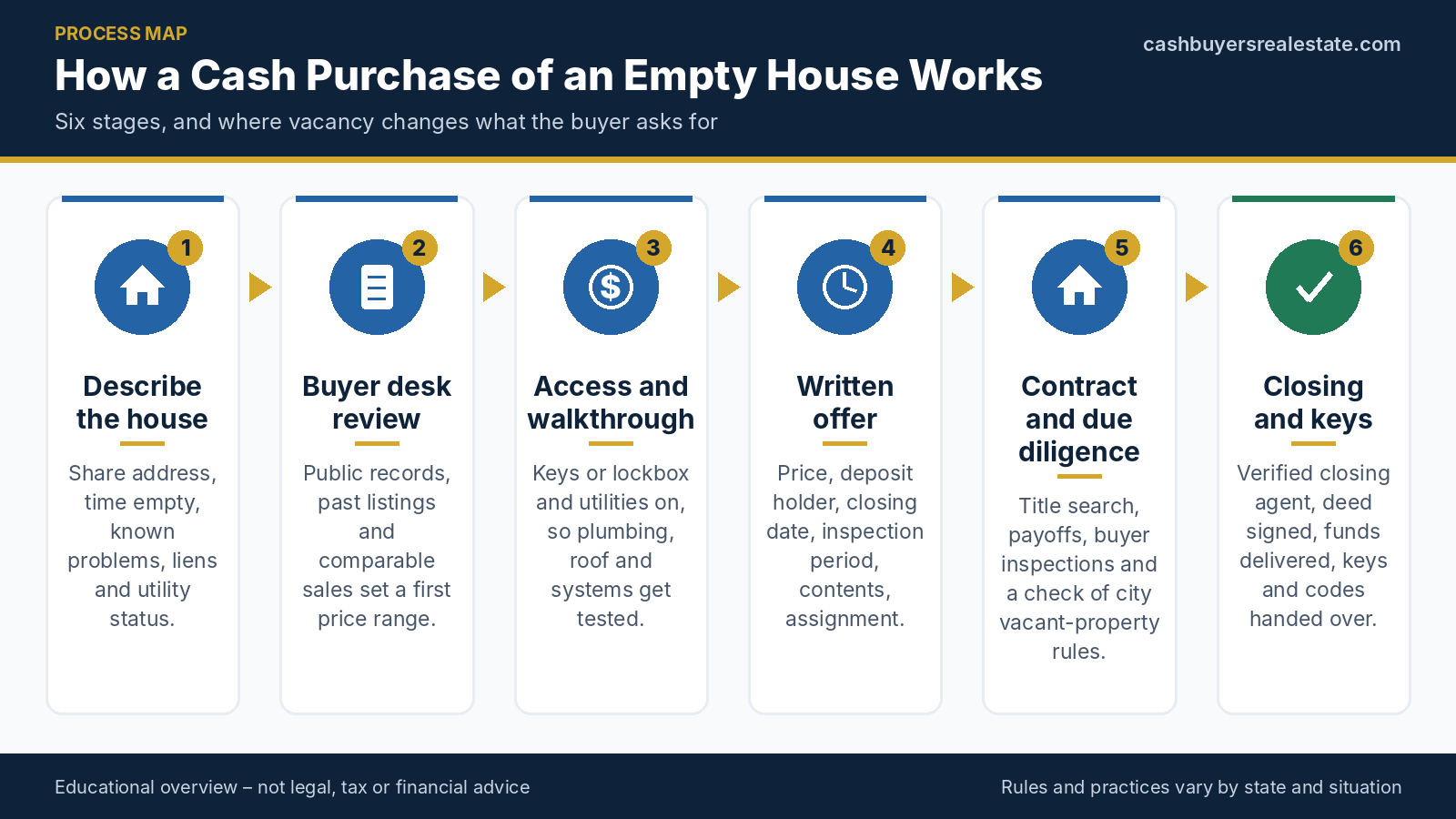
Text version of this infographic
- Describe the house — Share address, time empty, known problems, liens and utility status.
- Buyer desk review — Public records, past listings and comparable sales set a first price range.
- Access and walkthrough — Keys or lockbox and utilities on, so plumbing, roof and systems get tested.
- Written offer — Price, deposit holder, closing date, inspection period, contents, assignment.
- Contract and due diligence — Title search, payoffs, buyer inspections and a check of city vacant-property rules.
- Closing and keys — Verified closing agent, deed signed, funds delivered, keys and codes handed over.
Insurance, Liability and Lender Rules While the House Sits Empty
Of all the quiet costs of an empty house, insurance is the one most likely to turn a manageable situation into an expensive one. The policy that protected the home while you lived there was priced and written for an occupied dwelling, and many of its promises depend on that assumption. Understanding how insurers draw the line between an occupied house and an empty one, and what a mortgage servicer is obliged to do when it suspects nobody is home, gives you the information to decide whether waiting for the right buyer is a reasonable plan or a gamble.
How vacancy clauses work in homeowners policies
Policy wording differs from company to company and from form to form, so nothing in this section substitutes for reading your own declarations page, endorsements and conditions. What follows describes the general patterns that industry commentators and insurance research groups describe, so you know which questions to ask your agent.
Vacant versus unoccupied, and the 30- or 60-day clock
Many homeowners forms contain a vacancy condition that reduces or removes coverage for particular perils after the dwelling has been vacant for a stated number of consecutive days. The PropertyCasualty360 commentary explains that vacancy is often not a defined term in the policy itself, so disputes get resolved by looking at ordinary dictionary meanings and at the facts of each case. A building without contents is vacant in that sense. A dwelling that still has furniture and other belongings but nobody living in it is more likely to be classed as unoccupied, which is why the same house can be treated differently depending on whether you moved your things out.
The commentary also notes that, under the pattern it describes, vandalism or burglary damage is excluded when a property has been vacant for more than 60 consecutive days immediately before the loss, and that some older forms use 30 days. Triple-I describes a vacancy clause as one that limits or excludes coverage when a property is unoccupied for typically 30 to 60 consecutive days, with theft and vandalism the perils most often restricted. Both sources illustrate the same logic: insurers regard an unwatched house as a higher risk and write the contract so that the longest-running vacancies fall outside the standard promise.
Two practical details from that commentary are worth remembering. A renovation can change the classification, because owners who move out and remove their belongings while work is done may find the house treated as vacant. And a visit is not occupancy, since the commentary stresses that visiting a property is not the same as living in it, so a monthly trip to check the mail doesn’t reset a vacancy clock. The safest approach is to ask your insurer in writing how it would classify the house, given your actual situation, and keep the answer with your records.
Vacancy endorsements, vacant-home policies and what they cost
When a house will be empty for a long stretch, insurers generally offer one of two solutions. Triple-I explains that carriers offer vacant-home policies or vacancy endorsements that are designed for exactly this situation, that they typically include coverage for water damage from plumbing or heating failures, fire, windstorm, theft, vandalism, damage by trespassers and liability, and that they typically cost more than standard coverage. It also advises telling your carrier and reviewing options if the home will be empty for an extended time, and it recommends keeping the heat at least at 55 degrees in winter, shutting off or winterizing the water, and scheduling regular visits.
Even a vacant-home policy has conditions. Triple-I points out that these policies often still cover sudden and accidental events such as a burst pipe, but the insurer may expect proof of reasonable maintenance, and that failing to heat the home in winter could void coverage even under a vacant-home policy. That fits the way insurers generally think: they will take on the higher risk of an empty house in exchange for a higher premium, but they expect the owner to do the ordinary things that keep the risk from getting worse. A dated record of visits, a thermostat setting and a shutoff date become your evidence that you did.
There is also a timing question that matters to anyone with a sale in progress. Once a contract is signed, the period before closing still carries risk, and who bears a loss in that window depends on the contract language and on state law, which handles it differently from place to place. Keep your own coverage in force until the deed is delivered, ask the closing agent how the contract allocates risk of loss, and let the insurer know that the property is under contract so no conditions are missed.
Illustrative example (hypothetical numbers, not market data): A homeowner pays $1,900 a year for a standard policy and learns that the house, empty since the spring, no longer fits it. The insurer offers a vacant-home policy at $3,300 a year, a difference of $1,400, or roughly $117 a month. If a cash sale can close in two months, the extra cost is about $233, which is small against the exposure. If the house will sit for eight more months while the owner waits for a higher offer, the extra cost is about $933, and the owner should weigh that along with taxes, utilities and the risk of further deterioration before deciding that waiting is cheaper.
Liability and lender obligations when no one lives there
Insurance for the building is only part of the exposure. The other part is what happens when the house hurts a person or another person’s property, and what your mortgage servicer does when it suspects the house is empty. Both depend on documents and local law you should look up rather than assume.
Who is responsible if someone is hurt or a neighbor’s property is damaged
As the owner, you generally remain responsible for the condition of the property whether or not you live there. The details of that duty vary by state, and many states distinguish between invited visitors, people who enter with permission and trespassers, with the standard of care shifting accordingly. Courts in many places also recognize special duties where a hazard is likely to attract children, such as an open pool, an unguarded excavation or a structure with easy access to a dangerous interior. Because a vacant house tends to have broken locks, open openings and deferred repairs, it can present exactly those hazards, and nobody on the premises is present to notice or fix them.
Damage to neighbors is the other half of the exposure. A tree limb that falls on an adjoining house, water from a burst line that reaches a shared wall, or a fire set by an intruder that spreads next door can lead to claims against the owner. This is where the liability portion of your coverage matters, and where Triple-I’s warning bites: it notes that if a home is classified as vacant, liability coverage could be denied. Some municipalities go further by requiring insurance for registered vacant buildings; Cincinnati’s program page, for example, says that buildings vacant for 180 days or more must carry general liability coverage of at least $300,000 when they are residential buildings of up to four units.
For a seller, the sensible response is concrete rather than theoretical. Fix or secure the obvious hazards, cover or fence a pool, keep walkways clear, cut back overhanging limbs, and confirm with your agent in writing that liability coverage applies to the property in its current state. If the answer is unclear, ask whether an umbrella policy sits above the home policy and whether its terms depend on the underlying coverage staying in force.
Mortgage servicers, force-placed insurance and vacancy inspections
If a mortgage is still outstanding, your servicer has its own reasons to care about an empty house. Fannie Mae’s servicing guide, which governs loans that company owns or guarantees, directs a servicer to inspect a property as soon as possible after learning it may be vacant or abandoned, and it says that when the servicer determines a property is vacant it must make immediate arrangements to protect the property from vandalism and the elements and notify the property insurance carrier about the vacancy. Your own loan may be held by a different investor with different procedures, but the logic is the same: the lender holds an interest in the building and expects it to be protected.
The sharper edge for borrowers is what happens if insurance lapses. When coverage is missing, a servicer can buy force-placed insurance and charge the cost to the borrower, and that product protects the lender’s interest rather than yours. Federal rules in Regulation X, which the Consumer Financial Protection Bureau publishes, require a servicer to send written notice at least 45 days before charging for force-placed insurance and a reminder at least 15 days before assessing a charge, require charges to be bona fide and reasonable, and require the servicer to cancel the policy and refund overlapping premiums within 15 days of receiving evidence that you had continuous coverage. If a lapse happens, those timelines are your opportunity to fix it.
The most useful step is simply to call the servicer, confirm that the insurance on file is current and that the vacancy has been reported to the insurer, and ask what inspections or property-preservation actions to expect. If you’re also behind on the mortgage, the situation is different and more urgent, and a housing counselor or an attorney who handles foreclosure matters in your state can explain the options before any sale decision is made. For payoff arithmetic in a cash sale, request a written payoff statement from the servicer early, because an outdated payoff figure can force a correction late in the process and delay the closing.
What an Empty House Costs You Each Month and How Buyers Price Around It
The cheapest-looking decision about a vacant house is usually to wait, because waiting requires no signature and no negotiation. It isn’t actually free. Each month of ownership has a price, some of it visible on a bill and some of it arriving later as deterioration, a fine or a tax. A cash buyer is quietly doing this same arithmetic from the other side, converting your house’s condition and vacancy into a purchase price. Putting both calculations on paper, yours and theirs, is the best defense against accepting a number that sounds generous or rejecting one that is better than waiting.
The anatomy of carrying an empty house
Carrying cost is the sum of everything you pay to keep a property while it earns nothing and shelters no one. Owners tend to remember the large items, such as a mortgage payment or the annual tax bill, and forget the smaller recurring ones that together can match them. A complete picture also includes costs that don’t show up on a monthly statement at all.
The monthly costs that continue whether or not anyone lives there
Start with the obligations that arrive on a schedule. Property taxes are due regardless of occupancy, and in some jurisdictions a long-empty house can be assessed differently, as the vacancy-tax discussion later in this guide explains. Insurance continues, and a vacant-home policy generally costs more than a standard one. Utilities rarely drop to zero if you want the house inspectable and protected: some heat in winter, power for a sump pump or a dehumidifier, and the base charges that water and sewer providers apply to an active account. If there is a mortgage, interest accrues every month, and homeowners’ association dues, where they exist, keep coming. Add lawn or snow service, a security or monitoring service if you use one, and the travel cost of the monthly visits an out-of-town owner needs to make.
The table below puts hypothetical numbers on a typical set of those costs so you can build your own version. Replace each figure with your actual bill, because the sum is only useful when it’s yours.
| Cost item | Hypothetical monthly | Over six months | Why it persists |
|---|---|---|---|
| Property taxes | $360 | $2,160 | Owed on ownership, not on occupancy |
| Vacant-home insurance | $275 | $1,650 | Standard coverage may not apply once vacancy conditions are met |
| Utilities kept on for heat, pump and inspections | $190 | $1,140 | Needed to prevent damage and allow buyer visits |
| Lawn, snow and exterior upkeep | $110 | $660 | Keeps the house from looking and being unattended |
| Mortgage interest, if a loan exists | $780 | $4,680 | Accrues until payoff, whatever the house is doing |
| Association dues, if any | $85 | $510 | Billed to the owner of record |
| Monitoring, visits and travel | $95 | $570 | Replaces the supervision an occupant provides |
| Total | $1,895 | $11,370 | Before any repair or fine |
Read the totals as a rate of loss, not a bill. At roughly $1,900 a month in this scenario, a house that sells for the same price in six months as it would today has still cost the owner more than $11,000 to hold. That figure is why a cash offer slightly below a listing’s hoped-for price can leave an owner with more, and why the same figure should make you skeptical of any plan that depends on waiting through several seasons for a small price improvement. If your total looks smaller, great; if it looks larger, that is information the next section on buyer pricing will use.
The costs that grow with time: damage, deadlines and a tax clock
The first column of carrying costs is linear; the second kind is not. A house that sits empty through a winter, a rainy season or a summer of humidity is exposed to damage whose cost can far exceed the monthly bills, and the risk is not evenly spread across the year. The example in the earlier section on plumbing is typical in shape: a modest-looking choice followed by a large and irregular bill. There are also municipal costs that escalate, such as registration fees that double after a year in some vacant-building programs, which the municipal section of this guide takes up with real examples.
For owners who used the house as their main home, there is a tax clock too. The Internal Revenue Service explains in Tax Topic 701 that a taxpayer may be able to exclude up to $250,000 of gain from income on a home sale, or up to $500,000 on a joint return, if both an ownership test and a use test are met: owning the home and using it as a main residence for at least 24 months out of the five years before the sale. The two tests can be met in different two-year periods but both must fall within that five-year window. The arithmetic implies that a house left empty for more than about three years after you moved out starts to cost you the use test, though exceptions and special rules exist, so check IRS Publication 523 or a tax professional rather than relying on a summary.
That clock is easy to overlook because nothing announces it. The tax cost of waiting is also one of the few that only affects some owners, such as those who lived in the house and not those who inherited it or bought it as an investment. If the house was your residence and you moved because of work, divorce or a health change, ask a tax professional how many months of margin you have before a sale loses its exclusion, and put that date on your calendar next to the insurance and registry deadlines.
How a cash buyer turns vacancy into a number
An investor’s offer is not a verdict on what your house is worth. It’s the answer to a different question: what can this buyer afford to pay and still end up with an acceptable result after repairing, holding and reselling it? Understanding the parts of that formula lets you see which of them vacancy affects and which you can influence.
The building blocks of an offer on an empty house
A buyer who plans to renovate and resell usually begins with the after-repair value, often shortened to ARV, which is the price the house would likely bring once it’s in good condition, estimated from comparable recent sales nearby. From that figure the buyer subtracts the expected cost of repairs, a contingency for problems that can’t be seen, the cost of holding the property during the project, the transaction costs of buying and later selling, and the profit margin needed to make the risk worthwhile. The guide to how cash buyers calculate offers walks through the general version of this method. Vacancy touches three lines directly: the contingency grows because nobody can vouch for the condition, holding costs include the higher insurance and the inspection visits, and the margin may widen if the buyer is worried about insurability or municipal registration.
Different buyers run different versions of the formula. An owner-occupant paying cash thinks about living there, and may accept a smaller margin. A small landlord thinks about rent and tenant-readiness, and may care less about cosmetic work. A renovation investor focuses on resale value and a time-limited project. A wholesaler, who contracts to buy a property and then sells that contract to another investor, builds an assignment fee into the number and needs enough room for the end buyer’s margin as well. Asking a buyer which category they fall into is not rude, and the answer helps you judge whether the offer is a fair expression of that strategy or an opening bid with a lot of padding.
| Component | Hypothetical amount | How vacancy can influence it |
|---|---|---|
| After-repair value (ARV) | $240,000 | Largely independent of vacancy; set by comparable sales |
| Known repairs (flooring, paint, kitchen refresh) | −$28,000 | Larger if long vacancy has dulled finishes or damaged floors |
| Contingency for unseen damage | −$12,000 | Rises when utilities are off and no records exist |
| Holding costs, five months at $1,900 | −$9,500 | Includes vacant-home insurance and utilities |
| Buying and resale costs, about 7% of ARV | −$16,800 | Similar to occupied houses |
| Required margin, about 10% of ARV | −$24,000 | May widen if the buyer fears hidden problems |
| Resulting offer | $149,700 | About 62% of ARV in this scenario |
The table is built to show structure, not to predict your offer. Notice that two lines, the contingency and the margin, are where uncertainty gets priced, and that both respond to information you can supply. In this scenario, the offer works out to roughly 62 percent of the after-repair value, but a different house, market or buyer could produce a very different ratio, and a figure that looks low only means something once you have run the same arithmetic for your own property.
Illustrative example (hypothetical numbers, not market data): Suppose the seller in the table restores power and water for a walk-through, supplies a plumber’s pressure-test report and a roofer’s note that the roof has about eight years of life left, and shares dated photos of dry basement walls. The buyer, who had set aside $12,000 for unseen damage, now sees the contingency as closer to $5,000. The $7,000 difference flows straight into the offer, which rises from $149,700 to $156,700. The seller spent perhaps $600 on utilities, a test and two inspections, which is a return that no other pre-sale spending is likely to match.
Comparing five routes by what you keep, not what you are quoted
A price is only meaningful after the costs attached to getting it. A cash offer typically carries few seller-paid selling costs and a quick close, while a listing can produce a higher price but adds agent compensation, concessions, repairs the buyer’s financing may require and months of continued carrying cost. The guide on cash sales versus listing for a fast sale compares the two in general terms. For an empty house, five routes are worth laying side by side: selling for cash as-is, listing as-is with an agent, repairing and then listing, selling privately to someone you already know, and holding the property to rent or revisit later.
| Route | Illustrative price | Costs and carrying you pay | Illustrative net | Time and effort |
|---|---|---|---|---|
| Cash sale as-is | $149,700 | $3,400 | $146,300 | Shortest; little prep |
| List as-is with an agent | $168,000 | $22,360 | $145,640 | Months; showings and negotiation |
| Repair, then list | $235,000 | $61,850 | $173,150 | Longest; contractors and cash up front |
| Private sale to a known buyer | $160,000 | $6,200 | $153,800 | Depends on finding the buyer |
| Hold and rent, sell later | Not applicable | Repairs plus ongoing costs | Deferred | Ongoing landlord duties |
Two lessons come out of the comparison. First, the headline prices span a range of more than $85,000, yet the first, second and fourth rows land within about $8,000 of each other once costs and carrying are counted, which is the central reason to compare nets. Second, the repair-then-list route comes out ahead by about $27,000 on paper but requires roughly $34,000 spent before any buyer appears, a contractor who stays on budget, and about six months, and each of those assumptions can fail. Which row is right depends on your cash, tolerance for risk, time and the condition of the house, and no single route is best for everyone. The cash-sale row is the one a stressed owner often needs most: it fixes the outcome early, while the others leave the result open.
The five-route graphic below puts these options side by side, with the situation each one suits best and the trade-off it carries.
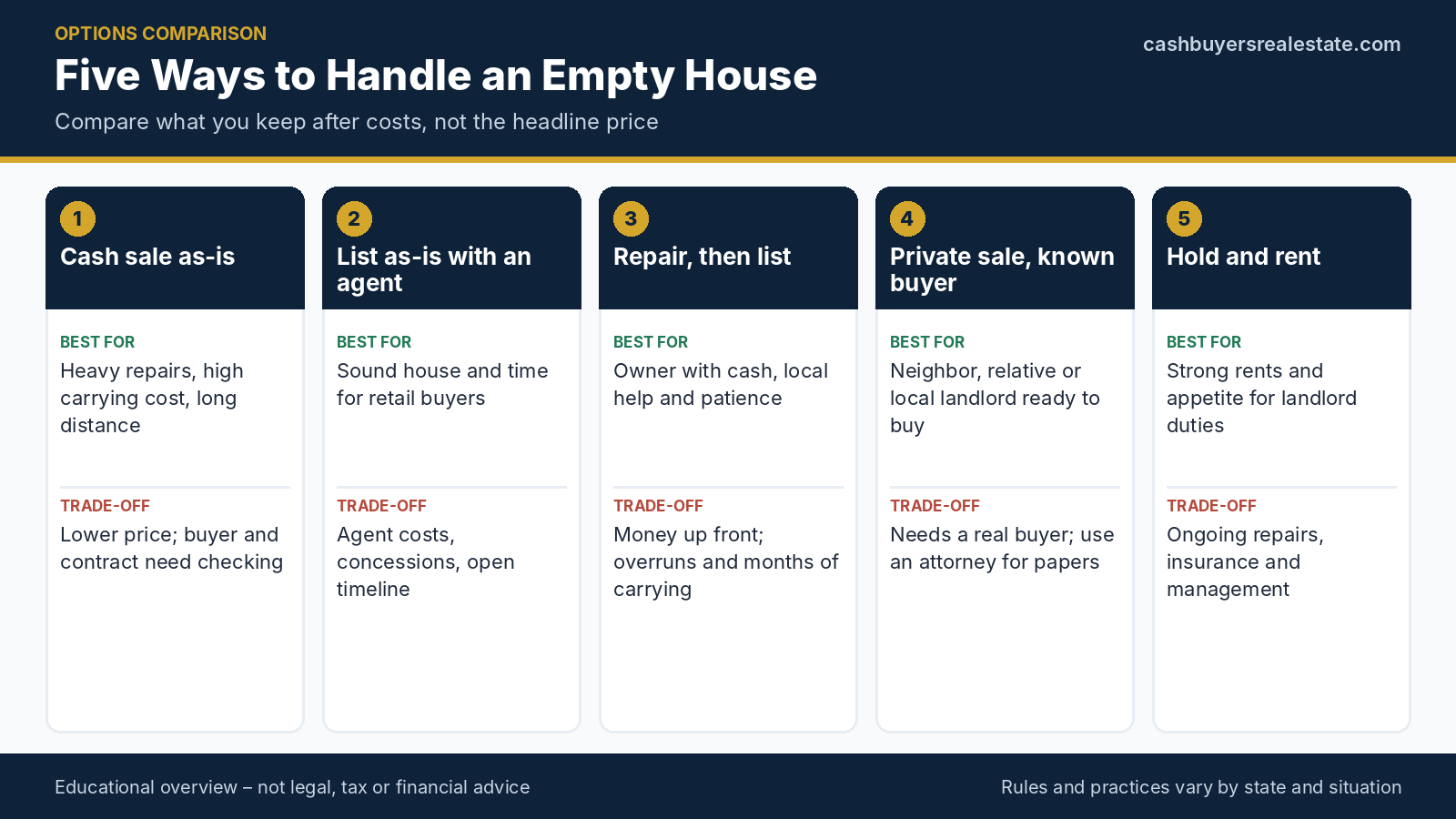
Text version of this infographic
- Cash sale as-is — Best for: Heavy repairs, high carrying cost, long distance. Trade-off: Lower price; buyer and contract need checking.
- List as-is with an agent — Best for: Sound house and time for retail buyers. Trade-off: Agent costs, concessions, open timeline.
- Repair, then list — Best for: Owner with cash, local help and patience. Trade-off: Money up front; overruns and months of carrying.
- Private sale, known buyer — Best for: Neighbor, relative or local landlord ready to buy. Trade-off: Needs a real buyer; use an attorney for papers.
- Hold and rent — Best for: Strong rents and appetite for landlord duties. Trade-off: Ongoing repairs, insurance and management.
Vacant-Property Registries, Code Enforcement and Vacancy Taxes
Insurers and buyers are private parties, and you can negotiate with them. Cities are different. A municipality that decides empty houses are a neighborhood problem can require owners to register, secure and maintain them, pay fees that climb with each year of vacancy, and in some cases get approval before the property can change hands. Because these rules are local, the single most useful thing a vacant-house owner can do is read the code of the city or county where the house sits. The examples below come from the published materials of real jurisdictions and are meant to show what the rules look like, not to tell you what yours says.
How vacant-property registration works
A vacant-property registration ordinance is a local law requiring owners of qualifying empty buildings to file with the city, pay a fee, and meet maintenance and security standards. They differ widely in what counts as vacant, how long a building must be empty before the duty arises, and what happens if the owner ignores the notice. A cash buyer familiar with your city will already know its rules, and a buyer who doesn’t know them is a reason for extra care.
What these ordinances are and how common they have become
The most thorough national picture comes from a study in the U.S. Department of Housing and Urban Development’s research journal Cityscape, in which Lee, Terranova and Immergluck documented the spread of vacant property registration ordinances. They counted more than 550 such local ordinances as of May 2012, up from fewer than 20 in 2000 and fewer than 100 at the end of 2007, with growth concentrated in the years of the foreclosure crisis. That data is more than a decade old, so the number today is likely different, but the study remains a reliable description of how these laws are built. It identified three designs: ordinances triggered by a period of vacancy, those triggered by foreclosure notices, and hybrids that use either trigger.
The obligations they impose follow a consistent pattern. Owners generally have to register covered properties and maintain and secure them in specified ways, and some ordinances require minimum insurance or a bond or deposit. Fees are usually periodic and may rise the longer the building stays empty. Most ordinances set fines for noncompliance, and some add criminal penalties or liens on the property. The study describes the purposes as improving data on vacant and foreclosed properties, keeping reliable owner contact information, and reducing the harms and public costs that vacant properties create.
Cincinnati’s published program shows the typical shape. As described on the city’s program page when reviewed in October 2026, a building that has been vacant for 180 days or more triggers duties: openings must be secured against weather, vermin and trespassers, with missing coverings replaced by at least half-inch plywood fastened with screws or bolts; liability insurance of at least $300,000 is required for residential buildings with up to four units; the owner must register within 30 calendar days; and an authorized agent living within 100 miles must be designated to respond to emergencies. Registration certificates in that program last six months, and the page warns that failure to register could result in fines. The page does not state the fee amount, which is a reminder to check the current schedule with the city.
What registration can cost and how it interacts with a sale
St. Paul, Minnesota, publishes a vacant-building registration form and information sheet dated 2025 that shows how costs can escalate. Owners of buildings falling into its vacant-building categories must submit the form within 30 days of receiving the city’s letter, describing plans to rehabilitate, reoccupy or demolish. The fee for a Category I or a new Category II building is $2,705, while the renewal for a building that has been in Category II for a year or more, or for Category III, is $5,410, double the initial amount. If the fee is not received within 45 days of the due date, the full amount is assessed to the property and collected with its taxes. A building vacant because of a fire can qualify for a 90-day exemption from the fee, but the owner must still file the form on time.
The most important part for anyone planning to sell is that the same document describes sale requirements. In three tiers, an owner must at minimum have current registration and fees, notify the city and restore utilities; for the middle tier, no sale may occur without city approval, supported by a code compliance report, a repair cost estimate, a completion schedule and proof of financial capability; and for the most serious tier, no sale is allowed without a Certificate of Code Compliance or a Certificate of Occupancy. A sale review fee also applies. In plain terms, in that city the cash buyer must be able to do what the city requires, and the contract has to leave time to do it.
This is not typical of every place, and many jurisdictions have no sale restrictions at all. But it shows why asking a buyer whether they’ve bought in your city before is a sound question, and why you should ask the code office directly whether your house is on a list, whether fees are accruing, and whether any approval or inspection is required for a transfer. Put the answers in writing, share them with the buyer and the closing agent, and make sure the contract addresses who pays any outstanding registration fees and who handles compliance steps.
Code enforcement and vacancy-based taxes
Registration is only one tool. Cities enforce property maintenance rules on empty buildings through citations, repair orders and sometimes demolition, and a few places go further by taxing vacant property at a rate far above the residential one. Both can follow a property into a sale.
Nuisance abatement, citations and liens that follow the property
Property maintenance codes commonly address overgrown grass and weeds, accumulated trash, unsecured doors and windows, deteriorated exteriors and unsafe structures. When an owner doesn’t respond to a notice, the city may impose fines, order repairs, or carry out the work itself and bill the owner. The St. Paul material illustrates one version: owners are expected to keep buildings secure, remove refuse and debris, cut grass and weeds, clear snow and ice from sidewalks, and allow inspectors access, and unpaid fees can be assessed to the property tax bill. How those charges become liens, and how quickly, varies by state and city.
For a sale, the key is that charges attached to the property usually have to be resolved at or before closing. A title search will reveal many recorded liens and assessments, and the closing agent will typically pay them from your proceeds, so they reduce what you keep. That is also why absentee owners should be certain the city has a correct mailing address. A notice sent to a former address can turn a small, curable citation into a large accumulated charge before anyone realizes. Update your mailing address with the county tax office and with the city’s code enforcement department, and ask for a printout of any open cases on the property.
If open violations already exist, a cash sale can be one of the more workable routes because investors often buy properties with unresolved violations and plan to cure them. How recorded charges are handled at the closing table is explained in the lien guide mentioned at the start of this article. In either case, honesty about what the city has already told you keeps the buyer’s price grounded and the contract clean.
Vacancy-based tax classes and delinquent taxes
A small number of jurisdictions treat vacancy as a property tax category. The District of Columbia’s Office of Tax and Revenue lists a Class 3 for vacant property taxed at $5.00 per $100 of assessed value and a Class 4 for blighted property at $10.00 per $100, compared with $0.85 per $100 for ordinary residential property in its Class 1A. The page states that the city’s Department of Buildings alone decides whether a property is Class 3 or Class 4, and that the council sets the rates, which can change from year to year. Treat those figures as an example of how steep the penalty can be where it exists, not as something that applies broadly.
Illustrative example (hypothetical numbers, not market data): If a property were assessed at $300,000, the published residential rate of $0.85 per $100 would produce an annual bill of $2,550, while the vacant-property rate of $5.00 per $100 would produce $15,000, a difference of $12,450 a year, or roughly $1,040 a month. An owner facing that gap would have a strong financial reason to sell, rent or reoccupy quickly, and any buyer would want to understand how reclassification works before agreeing on a price.
More common than special vacancy rates is the ordinary problem of unpaid property taxes on a house nobody is minding. Delinquent taxes generally accrue penalties and interest, and under state law can lead to a tax lien and eventually a tax sale, on timelines that differ widely. If you’ve fallen behind, a cash sale can pay the taxes from proceeds at closing, but only if the sale happens before the process advances too far. Ask the county treasurer or tax collector for an exact payoff figure and the status of your account, and share that with any buyer. The table below puts the three examples side by side.
| Jurisdiction | What triggers the rule | What owners must do | Money and sale consequences |
|---|---|---|---|
| St. Paul, Minnesota | Unoccupied buildings that are unsecured, condemned, dangerous, in violation or vacant over a year under an order | Register within 30 days of the city’s letter, keep the building secure and maintained, allow inspection | $2,705 initial and $5,410 renewal fees; unpaid fees assessed to taxes; sale requirements tiered by category |
| Cincinnati, Ohio | Building vacant 180 days or more | Secure openings, carry liability insurance, register within 30 days, name a local agent | Fines for failure to register; fee amount not stated on the program page |
| Washington, D.C. | Property classified as vacant (Class 3) or blighted (Class 4) by the Department of Buildings | Owners do not choose the class; the Department of Buildings decides it | $5.00 or $10.00 per $100 of assessed value, versus $0.85 for residential |
The point of the comparison is the variety, not any single rule. One city puts the burden on registration and maintenance, another on tiered fees tied to a sale, a third on a tax rate. Your own city may combine several, or none, which is why a short call or email to the local code enforcement office and the county tax office should be on every vacant-house owner’s list. Ask three questions: is my property on any vacant-building list, what charges or fees are open against it, and does the city require anything before it can transfer? Write down who answered and when.
Securing, Maintaining and Presenting a Vacant House Before Buyers See It
Everything discussed so far points toward one practical conclusion: whichever route you eventually choose, the weeks before a sale are easier and cheaper if the house is in a stable, documented condition. Securing the building reduces the chance of a loss, maintenance slows deterioration, and a modest amount of presentation turns an unknown into a known. None of this requires a renovation budget. It requires a plan, a few inexpensive supplies and a routine you can keep up from a distance if you have to.
Protecting the property while you decide
The goal at this stage is not to make the house attractive but to stop it from getting worse. The best steps address the largest risks first, which are water, heat and moisture, and then the problems that come from an unattended building looking unattended.
A heat, water and utilities plan that matches your timeline
The central choice is between keeping the house conditioned and shutting its water system down, and the right answer depends on how long you expect the house to sit and what season it is. If a sale is likely within a few weeks and buyers will need to test systems, keeping utilities on and the heat at a safe level is usually the better path. The thermostat guidance in the Arlington County material, above 55 degrees for an extended absence, matches the figure Triple-I gives for vacant homes. If you expect the house to sit through a hard winter and cannot visit often, shutting off the main water valve and draining the system is the other well-established option, and the same county guidance describes how: close the main, open every faucet starting at the top floor, drain exterior lines, flush toilets, and cut power or gas to the water heater before draining it.
Each choice has a cost when a buyer arrives. A drained house must be refilled and tested before anyone can judge the plumbing, and the county guidance advises opening all faucets first and then slowly opening the main to push air out of the lines, and calling a licensed plumber when you have a boiler or any doubt. A house kept running, on the other hand, carries the steady costs from the carrying-cost table and the risk of a failure that goes unnoticed between visits. A reasonable middle path for a short wait is to keep power and a low heat setting on, shut off the water at the main when you leave, and have a plumber recommission it before each inspection.
Humidity needs its own attention in warm or damp climates. The EPA advises keeping indoor relative humidity below 60 percent, ideally between 30 and 50 percent, and a closed house with no cooling can exceed that quickly. A small dehumidifier on a drain line or a thermostat that runs the air conditioner at a high setpoint costs far less than remediation. Test the sump pump if you have one, and check that downspouts discharge away from the foundation. Do not leave any of these arrangements undocumented: your insurer, a future buyer and a city inspector will each want to know what you did and when.
Locks, lighting, mail and a visit routine you can sustain
A house looks occupied when it behaves like an occupied house. That means a maintained lawn, cleared walks, a mailbox that’s emptied, and some form of light at night. Redirect your mail through the postal service or ask a trusted neighbor to collect it, and set a couple of lamps on timers inside. Change the locks if you’re uncertain who holds keys, including former tenants, contractors, family members and anyone who had a garage code. Remove valuables, and consider a monitored alarm or a camera system if the cost is reasonable for the house. A conversation with an adjoining neighbor, who can call you if something looks wrong, often outperforms any device, and it costs only a favor.
The visit routine is the backbone of the plan. How often you go should reflect the season, the insurer’s expectations, and what a problem would cost. In cold or wet weather, more frequent checks make sense, since a burst line found in two days costs a fraction of one found in two weeks. A simple, repeatable list keeps each trip short and produces a record that supports your insurance and your negotiating position later.
- Walk the exterior and look for open or damaged doors, windows, gutters and roof surfaces.
- Check the water meter, which should be still if the water is on and nothing is running.
- Inspect ceilings, under sinks, the water heater and the basement floor for stains or moisture.
- Confirm the thermostat setting, humidity and that the sump pump runs when tested.
- Collect mail and flyers, then photograph each room and the meter with a date visible.
- Note the date, the time and anything unusual in a log you keep in one place.
If you live too far away to manage this routine, a local property manager, a trusted relative or a vacant-property inspection service can handle it for a fee. Whoever you use, give them clear written instructions, a way to reach you, and a list of whom to call in an emergency, and tell your insurer that someone is checking the property regularly. The point is not perfection, but reasonable, documented care.
Presenting an empty house to cash buyers
Investors discount for condition, and they know what lies under cosmetic problems, so presentation for a cash buyer looks different from presentation for a retail buyer. For an investor, the persuasive things are access, clean documentation and a house that has been kept dry and open to inspection. For a retail buyer who might purchase with cash, appearance and the ability to visualize living there matter more.
A presentation and document pack that earns a better offer
Start with what you can remove. A clean-out of trash, abandoned belongings and anything broken makes it easier for a buyer to see the structure and removes the worst-case assumption about what lies behind the clutter. A basic cleaning, working bulbs in every fixture, ventilated rooms and an uncluttered yard take little money and no skill. If you do not have the time or energy to do this, a junk-removal service can clear a house in a day, and the cost belongs in your net-proceeds comparison rather than being treated as a cost of the cash route alone.
Presentation matters differently depending on the buyer. The National Association of REALTORS® 2025 Profile of Home Staging, based on a February 2025 survey of its members, found that 83 percent of buyers’ agents said staging made it easier for a buyer to picture a property as a future home, and 26 percent said it affected most buyers’ views of a property. Those are opinions of agents about retail buyers, and they help if you plan to list an empty house, where bare rooms can be hard to read in photographs. An investor doing a desk review cares less about furniture and more about whether the roof, the plumbing and the foundation are sound.
The document pack is the highest-value part of presentation, because it converts your word into evidence. The following items are what most buyers and closing agents end up asking for, and gathering them in advance shortens the due-diligence period and tightens the buyer’s contingency.
- The most recent property tax bill and any notice of delinquency or special assessment.
- Insurance declarations, any vacancy notices, and the history of claims on the property.
- Receipts and reports for repairs, plumbing and roof work, with dates.
- Recent utility bills, which let a buyer estimate holding costs from facts.
- Any city notices, citations, registration letters or permits, and association documents.
- Your maintenance log and dated photographs from visits.
Illustrative example (hypothetical numbers, not market data): A homeowner living two states away spends a weekend preparing an empty house. The costs are a junk-removal service at $650, a reconnection fee and one month of base utility charges totaling $240, a plumber’s pressure test at $180, and about $90 in bulbs and cleaning supplies, for a total of $1,160. The owner then sends a buyer a folder with the tax bill, an insurance declaration, the plumber’s report and dated photographs. If, as in the earlier build-up, that documentation lets the buyer trim a $12,000 unseen-damage contingency to $6,000, the preparation produced a $6,000 improvement in the offer for $1,160 of spending, with the added benefit of a more credible conversation about the rest of the numbers.
Access, showings and disclosures for an owner who is not there
Access is the most common logistical bottleneck in a vacant-house sale. A buyer’s visit needs a working way in, and an owner who lives far away usually has to choose among a lockbox, a local agent or helper who meets visitors, or scheduled appointments. Each has trade-offs. A lockbox is convenient but needs a strict code-change habit, an unaccompanied visitor has chances to take or damage things, and an escort limits the number of visits you can offer. A reasonable standard is to ask for the buyer’s name, company and some evidence of the ability to pay before granting repeated or unescorted access, which links to the verification steps in the contract section that follows.
Disclosure obligations do not disappear because a house is empty or sold as-is. Most states require sellers to give buyers information about known material defects, but the form, the exemptions and the timing vary, and some states exempt certain kinds of sellers, such as estates or lenders, from standard forms. An as-is clause tells the buyer you won’t repair; it generally does not authorize you to hide something you know. If the house had a leak, a break-in, a pest problem, an unauthorized occupant or an unresolved city notice, the responsible approach is to describe it accurately in the manner your state requires, and to ask the attorney or closing agent what form applies. The guide to selling a house fast without repairs explains how as-is terms work alongside disclosure.
Before you grant anyone access or sign anything, run a short verification of the buyer and the offer. The checklist graphic that follows collects the six checks that matter most for a vacant property, and the contract section that comes next explains each in turn.
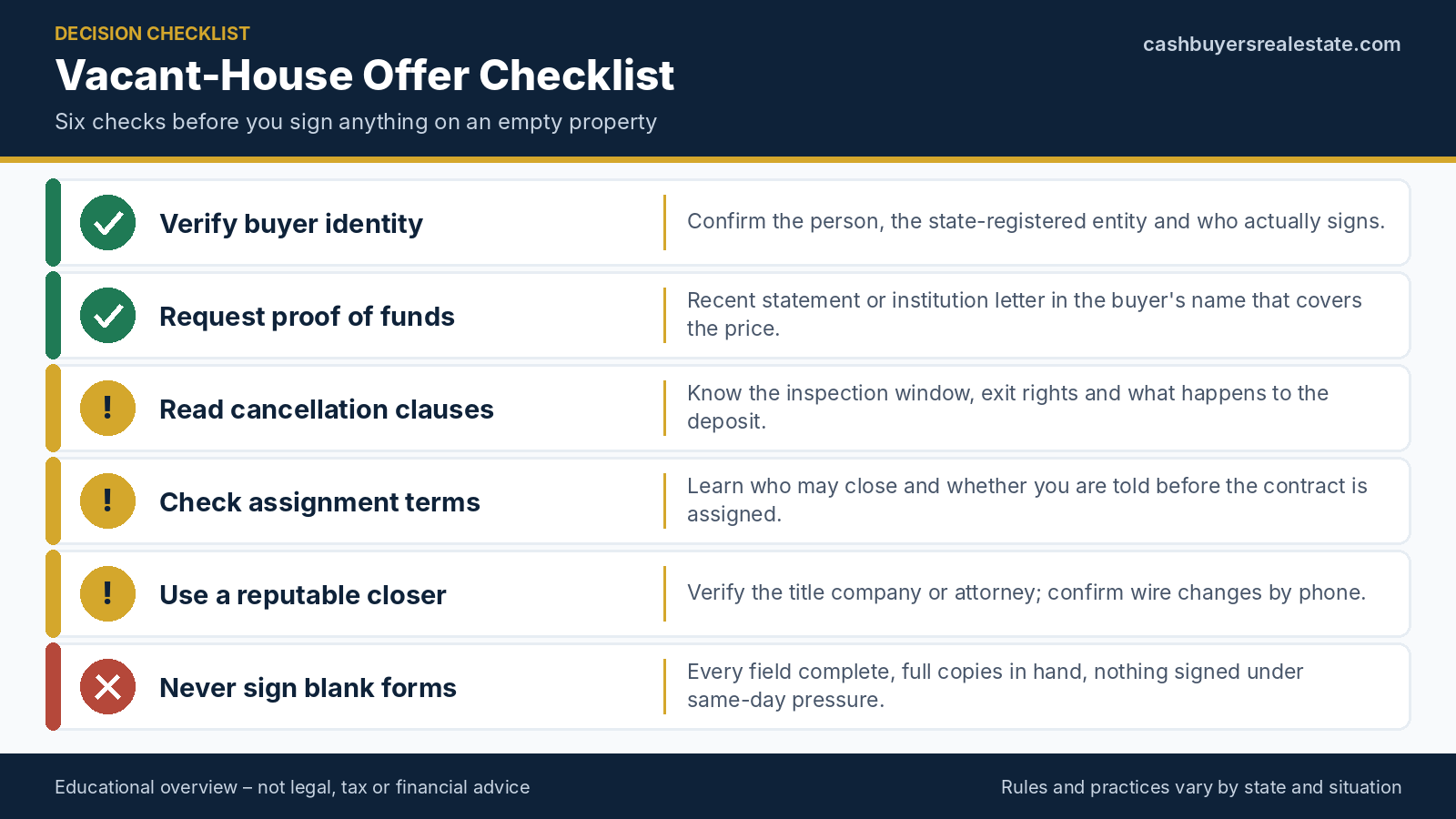
Text version of this infographic
- Verify buyer identity — Confirm the person, the state-registered entity and who actually signs.
- Request proof of funds — Recent statement or institution letter in the buyer's name that covers the price.
- Read cancellation clauses — Know the inspection window, exit rights and what happens to the deposit.
- Check assignment terms — Learn who may close and whether you are told before the contract is assigned.
- Use a reputable closer — Verify the title company or attorney; confirm wire changes by phone.
- Never sign blank forms — Every field complete, full copies in hand, nothing signed under same-day pressure.
Offers, Contracts and Red Flags When the Seller Isn’t Living There
Selling an empty house from a distance changes the dynamics of a transaction in ways that favor careful owners and punish hurried ones. You may never meet the buyer. The house may be visited by people you do not know, often alone. Documents may move by email and courier rather than across a table. Each of these facts is manageable, and most cash transactions on vacant houses close without incident, but each is also a place where mistakes and bad actors find room. The practices below don’t assume that any buyer is dishonest. They simply make sure your outcome doesn’t depend on assuming that every buyer is honest.
Verifying the buyer, the money and the paper
Three questions anchor the verification process: who is actually buying, can they pay, and what does the contract let them do? You’ll find a more detailed treatment of the general version of these questions in the guide to questions to ask a cash home buyer; this section adds the points that matter most when the property is empty and the owner is away.
Identity, proof of funds and earnest money
Begin by establishing the legal identity of the buyer. A person who signs for a company should be able to name it, show that it is registered with the state, and explain who stands behind it. That matters because many investors buy through limited liability companies, which is common and not suspicious in itself, but it means the entity on the contract is what you are relying on. Ask whether the named buyer intends to close in its own name or assign the contract, and whether the person you speak with is the decision maker or an intermediary. Searching the company name together with the state’s business registry and checking that the address and contact details match what you have been given takes minutes.
Proof of funds is the second step, and the article on proof of funds for cash buyers goes through the acceptable forms in depth. In general, what you want is a recent statement or a letter from a financial institution showing funds in the buyer’s name, or a commitment from a lender if the buyer is using private financing, in an amount sufficient to cover the price. Red flags include screenshots with the account number cropped out, figures that do not cover the offer, statements in a name unrelated to the buyer and reluctance to provide anything at all. None of these automatically proves fraud, but each is a reason to slow down before granting repeated access or agreeing to a timeline.
Earnest money is the third. This is a deposit that shows the buyer is serious, and where it sits matters nearly as much as how much it is. A deposit held by a neutral title company or closing attorney is protected by the closing agent’s processes, while a deposit held by the buyer or a middleman depends on that person’s honesty. Common arrangements vary by state and by closing agent. Ask who holds the deposit, when it’s due after signing, and what conditions allow its return to the buyer, because those conditions are what make the number meaningful.
Cancellation clauses, assignment terms, closing partners and blank forms
The paper deserves slow reading. The cancellation language determines how easily the buyer can walk away and what, if anything, you keep when they do. Look for an inspection or due-diligence period, how long it lasts, whether the buyer can cancel for any reason during it, and whether the earnest money is refundable. A contract with a generous exit for the buyer and no deposit at risk is closer to an option than a commitment, which may be fine if the price is right but should be understood for what it is. The guide to the cash home buyer contract covers each clause in general; for a vacant property, add the question of what happens to your carrying costs if the buyer cancels late.
Assignment terms deserve equal attention. Many investor contracts allow the buyer to assign their rights to someone else, and wholesalers rely on that to profit from the gap between your price and their end buyer’s. Assignment is lawful in most places and not inherently improper, but it means the party who closes may not be the party you vetted. Ask whether the contract permits assignment, whether you will be notified and have approval rights, and whether the proof of funds and earnest money will carry over to the end buyer. Some buyers also record a notice of the contract with the county, which can complicate a cancellation, so ask directly whether one will be recorded.
Illustrative example (hypothetical numbers, not market data): A homeowner signs a contract to sell an empty house for $150,000. The buyer is a small company with a clause allowing assignment to “any person or entity.” Three weeks later, the contract is assigned to another investor who pays $162,000 to the first company, and the first company keeps the $12,000 difference. The homeowner still receives the agreed $150,000, so no promise was broken, but the owner could have asked for more, or at least for a market check, had the clause and the intended resale been discussed at the start. The remedy is not to avoid every wholesaler, but to know which kind of buyer you’re dealing with and to compare other offers.
The last two items are the simplest and the most commonly ignored. Use a reputable closing partner, meaning a title company or attorney you have independently verified, and be wary of any arrangement where you are told you cannot choose or ask questions. And never sign a form with blank fields, whether a purchase agreement, an addendum, a deed or an authorization, since a missing price, date or name can later be filled in by someone else. Ask for complete copies of everything you sign. The table below pulls the six checks together as a quick reference to use before you agree to anything.
| Check | What reasonable practice looks like | What should slow you down |
|---|---|---|
| Buyer identity | Named person and entity, registered with the state, consistent contact details | Shifting names, no entity information, only a phone number or messaging app |
| Proof of funds | Recent statement or institution letter in the buyer’s name covering the price | Cropped screenshots, mismatched names, amounts below the offer |
| Earnest money | Deposit held by a neutral title company or closing attorney | Deposit held by the buyer or an intermediary, or no deposit at all |
| Cancellation rights | Defined inspection period, clear refund conditions, reasonable length | Open-ended exits, vague conditions or terms that change after signing |
| Assignment | Disclosed in the contract, with notice to the seller | Broad assignment rights, recorded notices or secrecy about the end buyer |
| Closing partner and forms | Verified title company or attorney, complete documents, copies for you | Pressure to use an unverified closer, blank fields, last-minute substitutions |
Use the table as a gate rather than a score. A single entry in the third column is a prompt for a question, and the response to the question is the useful information. A buyer who answers openly, supplies documents promptly and accepts a neutral closing agent is giving you evidence in their favor. One who becomes impatient, shifts the story or insists you skip steps is giving you evidence as well, and the cost of walking away from a transaction before signing is far smaller than the cost of unwinding one after.
Red flags that are specific to empty and absentee-owned houses
Some warning signs apply to every home sale. Others arise precisely because the owner is absent and the building is unoccupied. They deserve separate treatment because they can involve people who are not buyers at all.
Owner impersonation, title fraud and diverted payments
The FBI’s Internet Crime Complaint Center issued a public service announcement on June 16, 2026, titled “Protect Your Property from Illegal Sales Through Parcel Owner Impersonation.” It describes criminals who impersonate owners of vacant property parcels and try to sell them without the owners’ knowledge, using fake identification, new email accounts and internet phone numbers, with information gathered from public county websites, data brokers and phishing. The announcement concerns vacant parcels, which is mostly a land problem, and it does not say whether houses are included. But the vulnerabilities it describes are an absent owner and public records, and an empty house has the same two.
For owners, the announcement’s practical advice is easy to follow. Ask your county recorder, register of deeds, clerk or appraisal district whether they offer free alerts when a document is recorded under your name, and check your title insurance for post-policy protection, which may cover forgery and the legal costs of restoring ownership. Keep your mailing address current with the county so that notices reach you. For buyers and the professionals who deal with sellers, the same announcement lists indicators of an impersonator, such as a seller who communicates only by email, text or internet phone and refuses to meet, who rushes the process or offers a below-market price, who knows little about the property, or who asks for proceeds to be wired to an unrelated account. If any of this ever turns up in your transaction, you can report it to the Internet Crime Complaint Center at ic3.gov.
Payment fraud is the second concern. The Consumer Financial Protection Bureau’s guidance on closing scams, written for buyers, explains that criminals watch email traffic around closings and send spoofed instructions, and advises never following wiring instructions in an email, verifying the account details by calling a number you already have, and agreeing in advance on the people you will call. A careful seller applies the same habit to any message that changes payoff, disbursement or account instructions. An owner who lives in another state and conducts the entire sale by email is exactly the kind of person a fraudster hopes to reach.
Pressure, retrades and early access requests
The other cluster of red flags involves leverage. Pressure to sign the same day, to skip a lawyer’s review, or to agree before you have seen the full contract is a sign to slow down, not speed up, even when the pressure is framed as a favor. The price may also change after the buyer’s walk-through, which sellers often call a retrade. A reduction is not necessarily improper, since an inspection can reveal real problems, but the buyer should be able to explain it with specific findings, and you have the right to compare it with other offers and decide whether the revised number still beats your alternatives. Upfront fees paid by the seller to the buyer or a related party, other than ordinary closing costs set out at the closing agent’s table, are another reason to stop and ask questions.
Early access deserves special care with an empty house. A buyer who asks for the keys before closing to start work, to store equipment, to show the property to partners or to move someone in creates risks: injuries on your property, damage, liens from unpaid contractors and complications with your insurance, which may not cover activities the policy did not anticipate. If you agree to any early access at all, it should be written into the contract or a separate agreement reviewed by an attorney, with insurance and responsibility spelled out. More guidance on spotting the full pattern of common problems appears in the hub on cash home buyer scams and trust checks.
Frequently Asked Questions About Selling a Vacant House for Cash
Questions about price, timing and the sale itself
Questions about offers and price
- Will a cash buyer automatically pay less because the house is empty?
Not automatically, but vacancy usually affects the number through uncertainty rather than through emptiness itself. A buyer who cannot see how the house has been maintained, whether the utilities work or what the winter did to the plumbing prices in a cushion for the unknown. You can reduce that cushion with records, restored utilities and an honest description of the history. A house that is clean, dry and well documented can draw an offer close to what the same house would bring if a family still lived there, adjusted for its condition.
- Is a vacant house easier to sell than an occupied one?
In many ways it is, because there is no tenant or household to coordinate, showings can happen at nearly any time, and possession is simple to deliver at closing. Those advantages are offset by the concerns about condition and security that this guide covers. The balance depends on how long the house has been empty and how well it has been looked after. A house that was vacated recently and kept in good order often benefits from the simplicity, while one that has sat for years without attention may need more explanation.
- How long does a cash sale of an empty house take?
The closing date is something you and the buyer agree on in the contract, so it is a negotiated term rather than a fixed feature of cash sales. Clean title, a ready closing agent, restored utilities for any inspection and a seller who can sign quickly all help a sale close sooner. Open liens, ownership disputes, probate steps, municipal approvals and an absent owner who needs documents notarized can lengthen it. Ask each buyer for a proposed timeline in writing and ask what would cause it to change.
- Should I order my own inspection before selling?
It can help, but it carries trade-offs. A report from a licensed inspector or a specialist, such as a plumber or roofer, gives buyers facts in place of assumptions and can shrink the contingency they add to their price. It may also create a record of defects that you will then be expected to disclose under your state’s rules, and a sale to a buyer who plans to gut the house may not need it. A narrow, targeted check of the systems buyers worry about most is often a better value than a full inspection.
Questions about timing and logistics
- Do I have to be at the closing if I live in another state?
Often you do not, but the rules and the closing agent’s procedures decide. Depending on the state, you may be able to sign in front of a local notary and send the documents by courier, use an online notary where the law permits it, or appoint someone under a power of attorney. A power of attorney is a significant legal step that should be drafted with a lawyer’s help. Raise the question with the closing agent at the start of the transaction so the document formalities do not become the cause of a delay.
- What if the utilities are turned off?
You can still sell, but expect the buyer to either discount for what they cannot test or ask you to restore service for an inspection. Reconnecting power and water for a short window is usually inexpensive compared with the price effect of uncertainty. If the water was drained for winter, a plumber should refill and test the system rather than leaving a buyer to discover a leak. Ask the utility about reconnection fees and lead times before you schedule a buyer’s visit.
- Should I leave furniture and belongings in the house?
Decide this in writing, because the contract should state what stays and what goes. Some buyers will take the house with contents and handle removal themselves in exchange for a lower price, while others expect it to be empty at closing. Anything left behind that the contract does not address can lead to disputes about who owns it or who pays to remove it. Photograph what remains, take anything of value or sentimental importance out beforehand, and keep a copy of the agreement.
- What happens to my homeowners insurance once I sign a contract?
Keep it in force until the deed is delivered at closing. The contract and state law determine who bears the risk of loss between signing and closing, and that allocation can be less favorable to the seller than people assume. Let your insurer know the house is under contract and ask how coverage applies to a vacant property in that period. After the closing is complete and funds have been disbursed, you can cancel your coverage and request any refund of unused premium.
Questions about rules, taxes and protecting yourself
Questions about insurance, registration and liability
- Can my insurer cancel or refuse to renew because the house is empty?
It may be able to change or end coverage, depending on the policy terms and on state rules about cancellation and nonrenewal, which differ by state. Some insurers respond to a vacancy by offering a vacant-home policy or endorsement at a higher premium, as the Triple-I research discussed earlier describes, while others may decline to continue coverage. Read any notice carefully and note the dates in it. Your state insurance department can explain your rights and, in many states, accepts complaints from consumers.
- Am I required to register my house as vacant?
Only if a local rule applies to your property. Some cities require registration after a stated period of vacancy or after certain code violations, and others have no such program. The requirements, the fee and the penalties come from the municipal code, so the quickest answer is a call or email to the city’s code enforcement or building department. Ask whether any registration, fee or inspection is open on your address and ask for the answer in writing.
- Am I responsible if someone is injured on my vacant property?
Owners can be held responsible for dangerous conditions even when no one lives on the property, and the standard depends on state law and on the circumstances of the injury. Unsecured pools, open stairwells, broken glass and unguarded excavations are the kinds of hazards that tend to lead to claims. Make the property safe, confirm that your policy still provides liability coverage in its current status, and if an incident occurs, notify your insurer promptly and speak with a local attorney.
Questions about taxes, offers and professional help
- Will I owe tax on the sale of an empty house I used to live in?
It depends on your gain and your history with the property. The IRS explains that a taxpayer may exclude up to $250,000 of gain, or up to $500,000 on a joint return, if the ownership and use tests are both met within the five years before the sale, and that a sale must be reported if you receive a Form 1099-S even when the gain is fully excludable. A vacant stretch that is long enough can affect the use test, and other rules apply to inherited and investment property. A tax professional can apply them to your specific dates.
- How can I tell whether a low offer is just low or actually a scam?
A low offer by itself isn’t evidence of a scam. The more telling signs are behaviors, such as refusing to provide proof of funds, holding the deposit outside a neutral closing agent, pressuring you to sign immediately, asking you to pay fees upfront, or changing terms after you sign. Compare the offer against your own net-proceeds estimate and against at least one other route. If the numbers make sense and the buyer’s identity, funds and closing partner check out, a low-looking figure can still be the best available choice.
- Do I need an attorney to sell a vacant house for cash?
Requirements vary: in some states an attorney conducts every closing, while in others a title or escrow company does. Even where a lawyer is optional, a review of the purchase contract, assignment language and deed can be inexpensive protection compared with the size of the transaction. It is especially worth considering if the title is unclear, if you are signing from a distance, or if the contract differs from standard forms. Ask the attorney what they charge before they begin.
Choosing Your Route and Your Next Steps with a Vacant House
By now the shape of the decision should be clear. A vacant house is an asset that costs money to hold, drifts outside the assumptions behind standard insurance and many local rules as time passes, and tends to be priced by buyers according to what they cannot see. A cash sale is one sensible answer to those pressures, and it is not the only one. The remaining task is to turn what you have learned into a choice you can defend and a short list of actions you can start this week.
Matching the route to your priorities
A decision framework does not tell you what to do; it makes sure that you are comparing the right things. For a vacant house, four questions do most of the work, and the honest answers to them usually point toward one or two routes and away from the others.
Four questions that sort the options
The first question is what waiting costs you per month, using a table like the carrying-cost example earlier, and whether any date is approaching that changes the math: an insurance renewal, a winter, a registration deadline, the end of a tax exclusion window, or a mortgage payment you cannot keep making. The larger the monthly cost and the nearer the date, the more value a faster, more certain route has. The second question is the physical condition of the house and your ability to pay for repairs. If the roof, plumbing or interior need substantial work and you do not have the money or the appetite to manage contractors, a buyer who takes the house as it is carries something you would otherwise carry.
The third question concerns certainty and tolerance for risk. A listing can produce a higher headline price, but the result depends on buyers, financing, inspections and appraisals, and the timeline stays open. A cash contract with a verified buyer narrows those uncertainties, though it usually also narrows the price. If an uncertain outcome would cause real hardship, the certainty has value that does not appear in the net-proceeds table. The fourth question is about distance and capacity: how far away you are, how many trips you can make, whether someone local can help, and how much time and energy the project will take from the rest of your life. Remote owners often underestimate this last factor because it is invisible on paper.
Taken together, the answers sort themselves fairly cleanly. High carrying costs, a near deadline, heavy repairs and long distance favor a cash sale to a verified buyer. A sound house, low carrying costs, available cash and a local helper favor repairing and listing, or at least listing with an agent. Strong rental economics and an appetite for landlord duties favor holding. A known buyer, such as a neighbor, relative or local landlord, is worth testing before anything else because it can combine speed with a better price. When two routes score close to each other, the tie-breaker is usually the one that leaves you with less to regret if the assumptions turn out to be wrong.
When a cash sale fits, when it does not, and how to weigh the middle ground
A cash sale tends to fit well when the house needs work you do not want to fund, when carrying costs are heavy, when the title is clean enough for a quick closing, when you live far away, and when certainty matters more than squeezing out the last dollar. It fits less well when the house is in good condition and you have time, when the local market is strong and well-conditioned houses sell fast, or when the offer you are given leaves the net materially below what a listing would produce after costs. The illustrative comparison earlier showed that headline prices can mislead in either direction, which is why the comparison belongs on paper before you decide.
The middle ground is more useful than it may seem. You can get a cash offer and an agent’s opinion of value at the same time, which gives you a floor and a ceiling for the same house. You can list at a realistic price with a firm date to reconsider, so that waiting has an end point rather than drifting. You can make low-cost improvements that remove the largest unknowns, such as restoring utilities and obtaining a plumbing and roof assessment, and then collect offers on a better-documented house. For broader background on fast-sale tactics and the trade-offs among them, see the main guide to selling a house fast, and for the other situations that commonly overlap with vacancy, the hub on selling a vacant house collects the related guides.
Whichever way you lean, remember that no route is universally best. A cash buyer is one of several legitimate ways to sell, and the strongest position is to have at least two real alternatives in hand so you are choosing rather than reacting. An offer that survives a comparison against your best alternative on a net-proceeds basis, with a verified buyer and a contract you understand, deserves serious consideration. One that cannot survive that comparison does not become better because the clock is ticking.
What to do in the next two weeks
The most valuable actions are small and mostly free: making calls, collecting documents and writing down what you learn. None of them commits you to a sale, and each one improves the position you will negotiate from, whichever route you choose.
First steps: call, collect and document
Start with the three calls that protect you from the largest unpleasant surprises. Call your insurance agent and ask, in writing if possible, how your policy treats the house today, whether a vacancy clause or time limit applies, and what a vacant-home policy or endorsement would cost. Call your mortgage servicer, if you have one, to confirm the insurance on file, ask for a written payoff figure and learn what inspections to expect. Call or write the city’s code enforcement or building department and the county tax office to ask whether any registration, fee, citation or delinquency is open on the address, and update your mailing address with both.
Then collect and document. Gather the items in the document pack described earlier: tax bills, insurance papers, repair receipts, utility bills and any city correspondence. Visit the property, or send a local helper, and photograph every room, the meter, the roof line and the yard with dates visible. Fix or secure anything that could injure a visitor. Decide whether to restore utilities for the next stage, and if you own property in a county that offers recording alerts, sign up for them so that anything filed in your name reaches you. If you inherited the house, own a former rental or have a lien or fire loss in the picture, read the guides linked near the start of this article as well, since those situations bring additional steps.
Use the answers to rank your problems by how quickly they can grow. A lapsed or restricted insurance policy, an open city notice with a running fee, and a delinquent tax account all get more expensive with time, so they come first. Condition problems such as a stained ceiling or a dead sump pump come second, because they can be stabilized cheaply once you know they exist. Cosmetic work and staging come last, and for a sale to an investor they may not be worth doing at all. Writing the ranked list on one page, with a date and the person responsible beside each item, turns a vague sense of worry into a plan that a relative, a property manager or a buyer’s representative can understand at a glance.
Questions to ask buyers, and a balanced way to finish
When offers begin to arrive, treat them as the start of a conversation. Ask each buyer who will own the property at closing and whether the contract may be assigned, how they will prove their funds and where the deposit will be held, what inspection period and cancellation rights they expect, and what closing date they propose. Ask who pays which costs, what happens to anything left in the house, and whether they will provide the contract in full in advance of any signing so that you can have it reviewed. Ask how they came up with the price, what repairs they assumed, and what could change it. A buyer who answers these questions plainly is easier to trust than one who treats them as obstacles, and the answers also give you something concrete to compare.
Taking a step back, an empty house is not an emergency, even when it feels like one at the end of a long month of bills. Your options are real, your timeline is probably more flexible than any one buyer suggests, and you are entitled to take the time to verify who you’re dealing with and what the contract says. For some owners, a clean cash sale to a verified buyer will be the sensible, low-stress answer. For others, listing, repairing, renting or selling to someone they know will leave them better off. The best choice is the one you reach by running your own numbers, checking the facts with the people who administer the rules where you live, and giving yourself permission to say no to any offer that does not hold up.