
Cash Buyers for Fire-Damaged Houses: Offers, Process & Red Flags
The fire is out, the smell is not, and within a few days the mail, the phone and sometimes the front door start bringing offers. A contractor wants to board up the house and rebuild it. A public adjuster wants to take over your insurance claim. A stranger with a business card says an investor will pay cash for the property exactly as it stands. Each of these people may be perfectly honest, and each is also describing a different future for the same house. That is the real subject of this guide to cash buyers for fire-damaged houses: not only who will purchase a burned property, but how a sale fits together with an insurance claim, a mortgage and a structure that can’t be priced the way an ordinary fixer-upper can.
The short version is that cash buyers for fire-damaged houses do exist, and many can close without a lender’s approval of the property, without an appraisal tied to repairs and without the back-and-forth of a repair negotiation. What they offer, though, reflects uncertainty about hidden damage, permits and time, and you can often narrow that uncertainty with the right paperwork. The decision to sell for cash also can’t be made apart from your claim. Selling can change who is entitled to insurance money, what your mortgage servicer does with funds it is holding, and how much you really keep. Sometimes repairing through the claim and then selling is worth considerably more. Sometimes an as-is sale is the better route, particularly when the repair path is long, uncertain or financially out of reach. Your policy, your loan balance, the extent of the damage and your state’s rules decide which.
Short answer: Cash buyers for fire-damaged houses are usually investors who price a home from its repaired value minus repair costs, risk and profit. An as-is sale can be faster than repairing and listing, but it interacts with your insurance claim and mortgage, so compare net proceeds rather than headline price and get the claim treatment in writing.
It helps to see why the interaction exists. A homeowner’s policy pays for a covered loss to the property, and the mortgage lender is usually named on the policy to protect its collateral. When a damaged house is sold, three questions arise at once: does the seller still have a claim after the title changes hands, does the lender have to consent to anything before the loan is paid off, and does the price the buyer offers already assume that insurance money will or will not be part of the deal. A buyer who prices the house as though no claim exists and a seller who plans to keep the claim payment can both be right, or can both be disappointed, depending on how the contract and the insurer’s rules treat that money. The pages that follow take those questions one at a time.
The guide begins with why burned houses are difficult to sell through ordinary channels and who fills that gap. It then walks through what an investor actually looks at when touring a fire-damaged property, explains the choice between pursuing a claim and selling as-is, and spends a full section on the mortgage lender’s role in insurance payments and payoffs. After that comes the arithmetic of how buyers price fire damage, the permit and structural realities that limit what any buyer can do, and the fraud and pressure patterns that cluster around fire victims. A set of frequently asked questions and a decision framework close the guide.
A few neighboring subjects are handled lightly on purpose. The general route for homes with many kinds of damage is covered in the guide to selling a damaged house fast, and the broader homeowner-side questions after a blaze, such as cleanup, cause-and-origin reports and rebuilding, belong to the article on selling a house after fire damage. How investors operate in general, apart from fire, is explained in the overview of cash home buyers. Here the focus stays on the cash buyer and the insurance claim, since that pairing is where most of the money and most of the mistakes are.
Why a Burned House Is Hard to Sell the Usual Way and Who Fills the Gap
Most homes sell to a buyer who borrows money, relies on an appraisal and expects a working house. A fire removes several of those assumptions at once. Understanding which ones, and why, explains both the narrower pool of buyers and the discounts they apply. It also shows why the first weeks after a fire matter so much to the eventual sale price.
What makes a fire-damaged house hard to sell through ordinary channels
An ordinary listing depends on three things working together: a buyer’s lender, a buyer’s insurer and a property that can be occupied. Fire disrupts each. The question for a seller is not whether the house has value, because the land, the foundation, the utilities hookups and often much of the structure still do. The question is whether anyone with conventional financing and ordinary insurance can legally and practically take it on in its current state.
Financing, insurance and condition standards that shut out many buyers
Mortgage lenders sell most of their loans to investors and agencies that set condition standards, and those standards apply to damage from any cause. Fannie Mae’s Selling Guide, for example, tells lenders that when a property has been affected by a disaster they must take prudent steps to determine whether its condition has materially changed, and that damage which is uninsured, or which affects safety, soundness or structural integrity, must be repaired before the loan is delivered to Fannie Mae. Insured damage that doesn’t touch safety or structure can sometimes be handled with funds set aside for completion. Those rules are written for Fannie Mae loans, and other investors, FHA, VA and portfolio lenders have their own versions, but the pattern is consistent: a lender wants a house it can treat as sound collateral.
For a typical owner-occupant buyer with a conventional mortgage, a burned shell fails that test, so most financed buyers are effectively locked out until repairs are complete. Insurance is the second barrier. A buyer needs a policy before closing, and carriers can be reluctant to bind coverage on a structure that is unoccupied, partly gutted or under a safety posting, or they may attach conditions. A buyer who can’t insure the property can’t close with most lenders, and even a cash buyer wants protection for the months of work ahead. The third barrier is more mundane: a cautious buyer can’t see what’s behind the walls. Appraisers value a house in its present condition, and when the present condition is unknown, the value is unknown too. Buyers who need certainty simply move on to other listings. That leaves the sale to people who are comfortable with uncertainty, own their own capital and know how to price it.
The kinds of buyers who do consider a fire-damaged house
The group that remains is broader than the phrase “cash buyer” suggests. Rehab investors buy damaged houses to repair and resell, pricing the project from the repaired value they expect, less repairs, carrying costs and profit. Landlords who hold rentals long-term may buy a burned house if the location and rent potential justify a rebuild. Builders and small developers sometimes want the lot more than the structure, particularly where zoning permits something larger than what stands there now. Neighbors occasionally purchase to expand a yard or assemble a parcel. And a handful of owner-occupants with renovation experience may buy with a specialty rehab loan or cash savings, accepting years of construction in exchange for a lower entry price.
Each of these buyers values different things, which is why offers on the same burned house can vary widely. A rehabber cares about speed and the resale market. A builder cares about the land and the permits attached to it. An owner-occupant may care about neighborhood and the chance to design the house from the studs out. Knowing which type is calling tells you what questions they are likely to ask and what information could move their number. Investors are also not interchangeable in how they structure the transaction: some buy directly, some sign a contract and then assign it to another buyer, and some bring partners or private lenders. How those structures work in general is covered in the guide to how cash buyers calculate offers, and the fire-specific adjustments appear later in this article.
Three clocks that run at once after a fire: claim, mortgage and carrying costs
After a house fire, most owners are not choosing between a sale and a repair in a calm moment. They are managing several overlapping deadlines, most of which they did not set. Sorting them by owner makes the picture manageable: some clocks belong to the insurer, some to the lender, and some simply tick because a damaged house still costs money to own.
The claim clock: reporting, documentation and the adjuster’s estimate
The National Association of Insurance Commissioners (NAIC) advises policyholders to report a loss promptly, because most insurers set a reporting deadline in the policy, and to document everything before debris is removed or belongings are discarded. Its consumer guidance also says to make temporary repairs that prevent further damage, such as boarding openings or tarping a roof, and to keep the receipts, since a covered loss typically includes the reasonable cost of those steps. An adjuster will inspect the property at no charge to you, estimate the cost to repair or replace, and apply the policy’s terms to arrive at a payment, and the NAIC notes that payments often arrive in stages, starting with an advance.
The practical consequence for a seller is that the most valuable documents in a later sale are created in the first weeks: photographs taken before cleanup, the fire department’s incident report if one exists, the insurer’s scope of loss and estimate, and receipts for emergency work. A buyer’s willingness to pay more than a worst-case price depends on how much of this exists. Owners who discard damaged materials early, or who let weeks pass without recording conditions, often find that a prospective buyer assumes the worst because nothing proves otherwise. Other claim dates are policy-specific and worth reading in full: when a sworn proof of loss is due if the insurer requests one, how long you have to complete repairs to collect any withheld depreciation, how long additional living expense coverage runs, and how long you have to file suit if a dispute can’t be resolved. These vary by insurer and state, and none of them pauses because you’re talking to a buyer.
The mortgage and carrying-cost clock, and why delay costs money
If a lender holds your mortgage, the loan does not pause for a fire. The Consumer Financial Protection Bureau’s guidance to disaster-affected homeowners says plainly that damage to a home does not end the responsibility to pay the mortgage, and recommends calling the servicer early, because options may exist to postpone or reduce payments. That guidance was written after an earlier disaster, so the specific programs have changed over the years, but the principle holds: the servicer is easier to work with before a payment is missed than after. Alongside the loan payment, a burned house generates other costs that continue whether or not anyone is living in it. Property taxes and homeowner’s insurance keep accruing, utilities may need to be maintained or safely shut off, and the property has to be secured against trespassing and weather, since an open structure deteriorates quickly. Some policies add conditions when a house sits vacant for an extended period, so the insurer should be told about the status of the property instead of discovering it later. Those carrying costs are exactly what an investor will price into an offer, which is another reason that time spent without a plan has a real cost to you as well.
Illustrative example (hypothetical numbers, not market data): A homeowner has a mortgage payment of $1,150 a month, a tax and insurance escrow of $420, and about $180 a month for utilities, a lockable fence rental and periodic site checks, for a total of $1,750 a month. If the house sits for nine months while the claim is negotiated, scope is debated and permits are requested, those carrying costs reach $15,750. Part of that may be reimbursed through additional living expense coverage, depending on the policy, but the mortgage and tax portion usually isn’t, because that coverage is designed to pay the extra cost of living elsewhere, not costs you’d have anyway.
Reading the three clocks together, a pattern emerges. The claim rewards documentation and patience, the loan rewards early communication, and carrying costs reward a decision. None of this means selling quickly is the right answer. It means that whichever route you pick should be chosen deliberately, with an estimate of how long it will take and what the waiting will cost, rather than by drift.
How Cash Buyers for Fire-Damaged Houses Inspect and Assess the Damage
A walk-through of a burned house by an experienced investor looks different from an ordinary showing. There is a flashlight instead of a staging tour, a moisture meter instead of a comparable-sales printout, and a good deal of looking up. The buyer is trying to answer one question with limited information, which is how much it will really cost to turn this building into a sound, insurable and sellable one. Everything in the offer follows from that estimate, so it pays to understand what goes into it.
Structure first: whether the house can be saved at a sensible cost
Structural condition decides whether a project is a repair or a rebuild, and that distinction moves the price more than any other single factor. A fire that stayed in the kitchen and scorched the ceiling above it is a very different proposition from one that burned through the roof. Buyers look at structure first because it determines what else is worth looking at, and because structural unknowns are the ones most likely to expand a budget after demolition begins.
Framing, roof system and the depth of char
Wood doesn’t burn away cleanly. The outer layer chars, and the char acts as a thin insulating barrier that protects the wood beneath, which means a charred framing member may still carry load if enough sound wood remains. Whether it does is an engineering judgment, not an investor’s guess, and a buyer who sees heavily charred rafters or studs will usually either bring in a structural engineer or build a large contingency into the number. The more of the roof system that was involved, the more likely it is that replacement, not repair, is the sensible scope. Roofs are also where fire and water damage tend to overlap, since firefighters often cut ventilation openings and the exposed structure then takes in rain.
Modern construction adds a wrinkle. Engineered products such as trusses held together with metal connector plates and wood I-joists tend to lose strength faster in a fire than solid sawn lumber of similar size, so a floor or roof that looks intact can be compromised in ways a casual inspection won’t reveal. Buyers who have worked on fire projects know this and tend to discount heavily for structures built with lightweight components that were exposed to heat, unless an engineer’s letter says otherwise. For the seller, the useful move is to find out what’s already known. An insurer’s adjuster, a fire investigator or a municipal inspector may have written something about structural stability, and the fire department’s report may describe where the fire traveled. A structural engineer’s evaluation, commissioned by you or by the insurer, can turn an open-ended risk into a bounded one, and a buyer pricing a bounded risk almost always offers more than one pricing an open question.
Foundation, masonry and the hidden effects of heat
Foundations and masonry are less likely to burn but are not immune to heat. Concrete and masonry can crack or flake when exposed to high temperatures, and chimneys, fireplaces and brick veneers sometimes suffer damage that isn’t obvious until the debris is gone. Slabs under rooms where a fire burned hot can show cracking, and stem walls may have been affected near openings. A basement or crawl space also tends to hold suppression water, which can undermine soil, insulation and any finishes below the main floor. Investors usually inspect these elements for two reasons. First, foundation problems carry a high cost per fix and a high amount of uncertainty about scope, so they can turn a profitable project into an unprofitable one. Second, foundation and structural issues affect whether the property can be permitted for repair at all, and what level of engineering review the building department will require. A buyer who sees visible cracking or displacement will typically ask for an engineer’s report before committing, or will insert a due-diligence period into the contract during which the earnest money is protected.
Not all fire damage touches the foundation, and sellers shouldn’t assume the worst either. Many fires are confined to a portion of the house, with the lower level affected mostly by water and smoke. The important thing is that someone qualified looks, writes down what they find, and that you can share it. A short letter from a licensed engineer saying that the foundation shows no fire-related distress is one of the more valuable pieces of paper a seller can hand to a buyer.
Smoke, soot, water and the systems behind the walls
Even where the structure is sound, a fire leaves behind problems that are invisible from the street. Smoke travels through walls and ductwork far from where the flames were. Water used to extinguish a fire soaks insulation, drywall and subfloors. Electrical, plumbing and heating systems may have been damaged by heat or water without showing obvious signs. These are the items that make a repair estimate expand, and they are where a buyer’s contingency tends to go.
Smoke odor, soot residue and contaminated air handling
Smoke damage is often misunderstood because it ranges so widely. A short, small fire can leave a light film that cleaning removes. A longer smoldering fire, or one involving plastics, cooking oils or synthetic materials, can leave residues that cling to every surface and penetrate porous materials such as insulation, upholstery and unfinished wood. Odor is not just unpleasant; it is a sign that residue remains, and it can return in warm weather if the source materials aren’t removed or sealed. Restoration professionals typically combine cleaning, sealing and, where necessary, removal and replacement of porous materials, and the scope depends on the type of fire and the material affected.
Heating and cooling systems deserve particular attention. If the system was running or if air moved through the ducts during the fire, soot and smoke can spread through the entire house, including rooms that look untouched. Buyers commonly assume ductwork and air handlers need to be cleaned or replaced, and a quote for that is routinely part of a repair scope. Insulation in attics and walls, which can absorb odor and soot, is another frequent line item. The takeaway for sellers is that a smoke and odor assessment by a restoration company or an industrial hygienist, where one has been done, can persuade a buyer that the contamination is understood and limited. Without one, buyers tend to price in a full interior strip-out. If the insurer has already authorized or performed cleaning work, keep the invoices and the scope, since they tell a buyer what has been done and what remains.
Suppression water, mold risk and utility safety
Putting out a fire takes a lot of water, and most of it ends up inside the building. It runs down through floors, saturates insulation, soaks drywall and pools in lower levels. If the structure isn’t dried promptly, mold can develop within days, which turns a fire claim into a fire-and-mold problem with a longer, costlier scope. Mitigation companies often begin drying and tarping work immediately after a fire, and whether that happened, and how quickly, is something a buyer will ask about because it affects both the cost of repairs and the likelihood of hidden damage. A buyer evaluating a moisture-affected property may also wish to review the separate treatment in the article on selling a house with mold.
Utilities are the other piece. Electrical service is often shut off at the meter after a fire, and gas service is typically capped. Restoring either generally requires repair, inspection and approval from the utility or the local authority, and the details differ by jurisdiction. Buyers allocate money for rewiring, panel replacement or fixture replacement in the affected areas, and they will test or inspect plumbing for heat damage and freeze risk if the house sits vacant over winter. Heat can damage plastic supply and drain lines inside walls, and water supply lines can fail in cold weather if the system wasn’t drained or heated.
The following table pulls together what an investor typically evaluates, how each item tends to influence the price, and what a seller can provide to reduce uncertainty. It isn’t a pricing formula, and no two buyers weigh these identically, but it shows where documentation has the greatest effect.
| Area of the house | What the buyer looks for | How it tends to affect the offer | What the seller can supply |
|---|---|---|---|
| Roof and framing | Charred rafters, trusses, studs, openings cut for ventilation | Largest swing factor; repair versus rebuild | Engineer’s letter, fire report, adjuster scope |
| Foundation and masonry | Cracking, spalling, displaced chimneys, wet crawl space | High-cost, high-uncertainty items get large contingencies | Engineer’s evaluation, photos, any soil or drainage notes |
| Electrical system | Melted wiring, damaged panel, water exposure | Rewire scope and utility reconnection requirements | Utility shutoff records, electrician’s assessment |
| Plumbing and gas | Heat-damaged lines, freeze damage, capped service | Added cost if lines run through burned walls | Pressure test results, plumber’s report |
| Heating and cooling | Soot-filled ducts, damaged air handler | Cleaning or full system replacement | Equipment age, service records, restoration invoices |
| Smoke, soot and odor | Residue on surfaces and in insulation, lingering smell | Interior strip-out versus cleaning and sealing | Restoration company scope, air-quality testing if done |
| Water and mold | Saturated drywall and floors, visible growth | Drying costs, remediation, schedule delay | Mitigation invoices, drying logs, moisture readings |
| Permits and code status | Unsafe posting, open permits, unpermitted past work | Time, fees, code upgrades added to the budget | Permit history, inspector’s report, posting notices |
Reading the table from right to left is the most useful way to use it. Each row in the last column is something that exists, or can be created, before you accept an offer, and each one replaces a guess in the buyer’s spreadsheet with a fact. A seller who arrives at a negotiation with an engineer’s letter, restoration invoices and the adjuster’s estimate is not guaranteed a higher price, but is far less exposed to the largest discount a buyer applies, which is the discount for not knowing. The sale itself follows a fairly consistent path, even though the details vary. The sequence begins with securing and documenting the loss, moves through the insurance claim and the call to the loan servicer, then through assembling a package of information for buyers, comparing offers against the claim-based alternative, reviewing the contract, payoff and title, and finally closing with a confirmed handoff of the claim and the loan. The graphic below lays those stages out in order, and the rest of this guide fills in each stage.
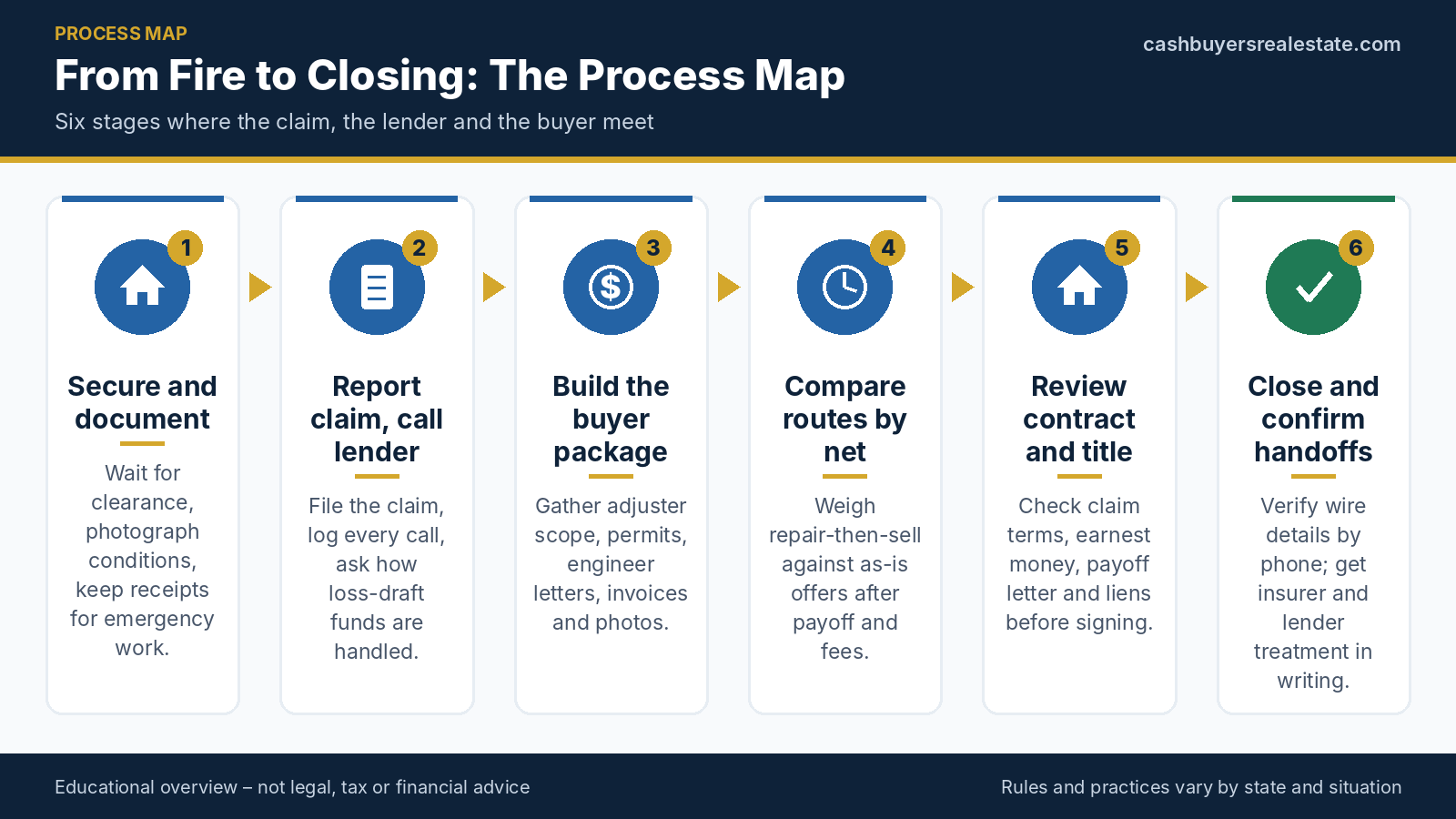
Text version of this infographic
- Secure and document — Wait for clearance, photograph conditions, keep receipts for emergency work.
- Report claim, call lender — File the claim, log every call, ask how loss-draft funds are handled.
- Build the buyer package — Gather adjuster scope, permits, engineer letters, invoices and photos.
- Compare routes by net — Weigh repair-then-sell against as-is offers after payoff and fees.
- Review contract and title — Check claim terms, earnest money, payoff letter and liens before signing.
- Close and confirm handoffs — Verify wire details by phone; get insurer and lender treatment in writing.
Insurance Claim or As-Is Sale: What Each Path Pays and What Happens to the Claim
Many owners treat the claim and the sale as separate matters, handled by separate people on separate timetables. In practice they are two halves of one financial picture. The claim decides how much money the insurer will contribute toward the loss, and the sale decides who ends up owning the damaged house and who bears the cost of repairing it. Combining them wrongly can leave money on the table, or leave a buyer and a seller each believing the other holds the right to the same check.
What a fire claim pays and what it leaves out
Before comparing routes, it helps to be exact about what an insurance settlement is and what it isn’t. The settlement is not the value of the house, not a refund of what you paid for it and not a guarantee that repairs will cost what the estimate says. It is the insurer’s calculation of covered damage under the policy’s terms, reduced by your deductible and often by depreciation, and delivered in parts over a period of time.
Dwelling payments, depreciation and the repair-first logic of replacement cost coverage
Homeowner’s policies commonly measure the dwelling loss in one of two ways. Actual cash value coverage pays the cost to repair or replace minus depreciation for age and wear. Replacement cost coverage aims to pay what it costs to repair or rebuild with comparable materials, but many replacement cost policies pay the actual cash value first and release the withheld depreciation, often called recoverable depreciation, only after the work is finished and documented. That design pushes the owner toward repairing, because the full amount depends on spending it on the house. Policies differ on the details, including deadlines to finish repairs, so the policy language and the insurer’s payment letters are what count.
The repair-first logic matters in a sale because it tells you what an unrepaired house leaves on the table. If the house is sold before repairs are done, you may never complete the work that triggers the holdback, so the withheld portion can be at risk. Whether the insurer will release it to a seller who no longer owns the house, or to a buyer who completes the work, is a question to put to the insurer directly and in writing. Some carriers treat the sale price as relevant evidence of the loss, others do not, and the answer can differ for the same fire depending on the policy and the state.
Illustrative example (hypothetical numbers, not market data): The insurer estimates the cost to repair a kitchen-and-attic fire at $96,000 on a replacement cost policy. It subtracts $14,000 of depreciation and a $2,500 deductible and issues a first payment of $79,500, with $14,000 of recoverable depreciation payable after repairs are completed. If the actual work comes in at $102,000, the owner covers the $6,000 above the estimate plus the $2,500 deductible, for $8,500 out of pocket, unless a supplemental claim for the additional cost is approved. Every dollar figure in the rest of this guide uses these same hypothetical numbers so the routes can be compared fairly.
The words “unless a supplemental claim is approved” matter because first estimates are rarely final. Hidden damage found during demolition, code requirements that surface at permitting and price changes between the estimate and the work all generate supplements. A homeowner who expects the first number to be the last can be surprised, and a buyer who expects the same can be surprised in the other direction, which is partly why buyers pad their own repair budgets.
Living expenses, contents and building-code upgrade coverage
The dwelling payment is only one line in a larger claim. Additional living expense coverage helps pay for temporary housing and other extra costs while the home can’t be lived in, and the NAIC notes that policies may limit the amount and that keeping receipts is essential. Because the coverage reimburses extra costs, it generally doesn’t pay for expenses you’d have anyway; California’s Department of Insurance, for instance, states that this coverage does not pay your mortgage. The length of time it runs is set by the policy and sometimes extended by state rules after declared catastrophes, so the same fire could produce different coverage periods in different states.
Personal belongings are covered separately, usually with their own limit and often a different valuation method, and detached structures such as garages and sheds are typically covered only up to a percentage of the dwelling limit. Neither is part of the house sale, which is worth stating because an owner can mistakenly assume that selling the house ends the contents claim. It doesn’t, though it does mean you’ll want to keep working on that portion with the insurer after the closing. Building-code upgrade coverage, often called ordinance or law coverage, deserves its own attention. When a damaged house is repaired, current building codes may require improvements that the old house didn’t have, such as updated electrical work, smoke alarms, energy requirements or structural connections. Standard coverage pays to restore what was there; extra coverage, where it exists, helps pay for the required upgrades. An owner without it faces repair costs that exceed the estimate, and a buyer pricing the project will include upgrade costs whether or not insurance exists to share them. Check your policy for whether this coverage exists and what its limit is.
What happens to a claim when the house is sold
Whether a sale preserves, transfers or weakens your claim is the most commonly misunderstood part of the process, and it is also the part where general guidance runs out and your policy and your state’s law take over. The general framework is easy to describe even if the answer in any one case is not.
Keeping the claim, assigning it, or letting it lapse
There are three broad ways the claim can travel with the sale. In the first, the seller keeps the claim: the contract says the buyer takes the house in its damaged condition at a price that reflects that, and the seller continues to deal with the insurer for the loss that occurred while the seller owned the house. In the second, the seller assigns the claim or its proceeds to the buyer, who then collects from the insurer and uses the money for repairs, usually in return for a higher price. In the third, the claim is never pursued, either because it was never filed or because it lapsed, and the buyer prices the house as though no insurance money exists.
Which of these is available depends heavily on where you live. Assignment of post-loss benefits has been a contested area; Florida, for example, enacted legislation in a 2022 special session that bars assignment of post-loss benefits under residential and commercial property policies issued on or after January 1, 2023. Other states treat assignments differently, and many policies contain clauses that restrict assigning rights without the insurer’s consent. A seller who assumes assignment is allowed, and then signs a contract promising it, can end up in breach, so the insurer’s written position and an attorney’s review belong before the signature, not after.
Keeping the claim sounds simpler, and often is, but it raises its own questions. Will the insurer continue to adjust a covered loss after the insured sells the property? Will the amount it pays change because the seller no longer needs to repair? Will the lender, which is also on the claim, release funds to a borrower who sold? Some of these have clear answers in the policy and the loan documents, and some depend on the particular insurer’s practice. Treat the answers as items to collect, in writing, before you agree to a price that assumes them.
Timing: selling before, during or after settlement, and the tax angle
When you sell relative to the claim changes both the price and the risk. Selling before the claim is filed or investigated leaves everyone guessing, which usually depresses offers and may complicate the claim if the evidence disappears with demolition or cleanup. Selling in the middle of a claim means the adjuster’s estimate may exist but payments are incomplete, so the contract has to say who gets future payments, including any supplements. Selling after the claim has been paid and the lender has released or applied the funds is cleaner on paper, but it also means you’ve already been carrying the house for months, and any remaining proceeds may be tied up by the lender until repairs are done.
Taxes also come into play, though how much depends on facts that only a tax professional can evaluate. The Internal Revenue Service explains in Publication 547 that you have no casualty loss to the extent you are reimbursed by insurance, and that if reimbursement exceeds your adjusted basis in the property you can have a gain, which may be taxable or may be postponable under special rules. The deduction for personal casualty losses has been limited to federally declared disasters for years after 2017, and the IRS reports that legislation made that deduction permanent and expanded it to state-declared disasters beginning in 2026. An ordinary house fire that isn’t part of a declared disaster usually doesn’t generate a deduction. And the usual exclusion of up to $250,000 of gain, or $500,000 on a joint return, on the sale of a main home has ownership and use tests that matter if you’ve moved out during repairs.
The practical advice is to ask the tax professional two questions before the sale instead of after: does any insurance gain arise, and how does the sale price interact with the exclusion. The answers are specific to your facts and can change the choice between repairing and selling, or the timing of a sale across tax years.
The Mortgage Lender’s Role: Loss Drafts, Payoffs and Shortfalls
If there is a mortgage on the house, the lender is not a bystander to the claim. Its name is on the policy as a mortgagee, its servicer often controls how insurance money is released, and its payoff figure sets the floor for any sale. Owners who understand how the lender handles insurance payments, which are often called loss drafts in the servicing industry, make fewer unpleasant discoveries late in the process, and they approach buyers with a more accurate sense of what a sale can net.
How insurance money moves when a lender is on the policy
The lender’s interest in the claim comes from the same fact that gave it a place on the policy: the house is its collateral. Insurance payments for structural damage are meant to restore that collateral, and the lender wants to be sure they do. That produces a set of procedures that can feel slow, but they follow a logic that becomes clear once you see the lender’s side.
The mortgagee clause, joint checks and staged releases
Insurance companies commonly make payments for structural damage out to both the homeowner and the mortgage servicer. The NAIC’s consumer guidance says the payment for structural damage may be payable to you and your lender and that lenders may place the money into an escrow account and release it as repairs progress. The Office of the Comptroller of the Currency’s consumer site adds that such a check may be payable to both the policyholder and the lienholder and that you should notify your bank before taking further action, including before sending the check in. The Consumer Financial Protection Bureau describes the typical release pattern as a portion before work begins, more when the job is about half done and the remainder after the home passes inspection.
Fannie Mae’s Servicing Guide gives a concrete example of how a major investor instructs servicers on loans it owns. For a loan that is current or less than 31 days delinquent, the initial release is the greater of $40,000, 33 percent of the proceeds, or the amount by which the proceeds exceed the unpaid principal balance, accrued interest and advances, with the rest released based on periodic inspections of repair progress. For loans 31 or more days delinquent, the guide evaluates workout options and uses smaller initial releases, and it states that servicers should not pay public adjusters from the proceeds without written approval from Fannie Mae. The guide also says that if the property is not rebuildable, proceeds are applied to reduce the outstanding debt. Those rules are specific to Fannie Mae-owned loans; Freddie Mac, FHA, VA and private investors have their own schedules, and your servicer can tell you which applies.
Illustrative example (hypothetical numbers, not market data): Using the $93,500 total claim from earlier, suppose the loan is current and the servicer follows a schedule like the Fannie Mae one. Thirty-three percent of the proceeds is $30,855, which is less than $40,000, so the first release would be $40,000. The remaining $53,500 would be released as inspections confirm progress. If instead the owner decides to sell the house and the loan is paid off at closing, the question becomes what happens to the balance still sitting in the servicer’s account, and the loan documents, not the buyer, decide that.
The takeaway is that the lender does not simply hand the owner the check. That can create real cash-flow strain for someone paying contractors or living in temporary housing, and it explains why owners sometimes consider an early sale: the money that would eventually fund repairs is available only gradually, while the bills arrive at once.
Staying current, talking to the servicer and what options may exist
The single most useful step with the lender is to contact the servicer early and ask direct questions in writing. Ask who the investor on your loan is, how loss draft funds are handled, what documents the servicer needs to release the first payment, what inspections it requires and what happens to any funds still held if the loan is paid off through a sale. Keep a log of calls and the names of the people you speak with. The CFPB advises homeowners to take careful notes and to call the servicer early, since options that postpone or reduce payments may be available that aren’t offered once a loan is far behind.
Missing payments changes the lender’s behavior. In Fannie Mae’s published servicing rules, a loan that is 31 or more days past due is evaluated for a workout option and receives smaller initial releases of insurance money, and the servicer is expected to approve repair plans and bids and to inspect as work is completed. That doesn’t mean a late payment ends the claim, but it does mean the lender holds the money more tightly. Owners who expect to struggle with payments during the repair period often do better by raising the subject before the first missed payment, and a HUD-approved housing counselor can help prepare for that conversation.
Finally, remember that force-placed insurance can enter the picture if a policy cancels or lapses. The OCC’s consumer site explains that a lender can buy coverage and charge the borrower for it after sending required notices. After a fire, an insurer may non-renew or cancel, and the loan documents usually require continuous coverage, so a lapse in protection is something to prevent by talking with your insurer, your agent and the servicer about the status of the policy through the repair or sale period.
Selling a mortgaged fire-damaged house: payoff, held funds and shortfalls
Once a sale is on the table, the lender’s role changes from controlling insurance money to demanding payoff. The two roles are linked, and a clear picture of both determines whether a given offer works for you at all.
Payoff letters, undisbursed proceeds and lien releases
At closing, the title or escrow company, or the closing attorney in states where attorneys close, orders a payoff statement from your servicer that shows what is needed to satisfy the loan on the closing date. That figure includes principal, interest and any fees or advances the servicer made. If the servicer also holds undisbursed insurance money, ask the servicer in writing how it will treat it. Possible outcomes include applying it to the payoff, releasing it to you, or retaining it until the claim is resolved, and each one changes how much cash you bring to or take from the closing.
Mortgage payoffs are not negotiable in the ordinary course: the lien must be satisfied, or the lender must agree to release it for less, before the buyer can receive clear title. Other liens matter too. Contractors who performed emergency work, restoration firms, tax authorities and judgment creditors may have recorded or may have the right to record claims against the property, depending on state law, and a title search will reveal any that exist. The guide on cash buyers for houses with liens explains how those are handled at closing. Make sure any invoice you dispute is resolved or documented before listing the house with a title company.
Ask the title company for a preliminary title report early. A burned house with a clean title is far easier to sell than one that requires clearing several recorded claims, and a cash buyer’s confidence in the closing depends on knowing that the title company has seen the same facts you have.
When the payoff is larger than the likely sale price
Some owners owe more than a damaged house is likely to bring, particularly recent buyers with small down payments or owners who have borrowed against equity. Insurance proceeds may close part of that gap, but if a sale price plus any proceeds the lender will release does not cover the payoff, the choices narrow. The owner may bring cash to closing, ask the lender to approve a short sale in which it accepts less than the full balance, or repair the house through the claim and sell once value is restored. A lender’s willingness to approve a short sale is a negotiation, and the rules on deficiency balances, meaning whether the lender can pursue the difference afterward, depend on state law and on the lender’s decision to waive it.
This situation makes a cash buyer’s timeline and a servicer’s slow approval process collide. Short sale approvals can take weeks, while an investor holding a contract expects progress. Owners in this position should start the conversation with the servicer before accepting an offer, ask what documents are needed and whether the servicer will consider both a sale and a repair path, and consider consulting a HUD-approved housing counselor or an attorney with real estate experience in their state. If a foreclosure notice has already arrived, the separate timelines in the article on selling a house before foreclosure become relevant. To see how these pieces combine, the table below applies one set of hypothetical numbers to five different routes. It uses a pre-fire value of $310,000, a mortgage payoff of $128,000, the $93,500 claim from the earlier example and the offer build-up discussed in the next section, so the figures hang together but are not predictions for any real house.
| Route | Who collects the insurance money | Sale price | Illustrative net to seller | Main uncertainty |
|---|---|---|---|---|
| 1. Repair through the claim, then list on the market | Seller, through staged lender releases | $310,000 | $151,800 | Months of work, estimate overruns, market at resale |
| 2. Keep the claim and sell as-is to a cash buyer | Seller, if insurer and lender allow it after a sale | $146,300 | $108,800 | Whether the insurer pays in full once the seller no longer owns the house |
| 3. Assign the claim to the buyer with the sale | Buyer, where law and the policy permit | $216,400 | $85,400 | Assignment may be barred or need insurer consent |
| 4. Sell as-is and never pursue the claim | No one | $146,300 | $15,300 | Gives up the largest source of value |
| 5. List as-is with an agent and keep the claim | Seller, same conditions as route 2 | $160,000 | $114,300 | Longer wait for a buyer who can close without repairs |
Look first at the gap between routes 1 and 4, which is the value of the claim and of restoring the house, and then at the gap between routes 1 and 2, which is mostly the buyer’s margin, repair risk and carrying costs. Route 2 assumes the best case for the claim, including that the $14,000 holdback is collectible, so if part of that is lost the net falls by up to that amount. Route 3 shows a typical logic of assignment: the buyer pays more because it receives the insurance money, but the seller usually discounts that money for uncertainty and gives up control. None of these routes is universally best. A seller who can’t wait many months or fund the $8,500 gap in route 1 may reasonably prefer route 2, while an owner with time, cash reserves and a straightforward claim may find route 1 yields the most.
The routes also differ in time, and the table can’t capture that. Route 1 is the slowest and carries the most execution risk, route 4 is the quickest and the most costly, and routes 2, 3 and 5 sit between them, with their speed depending on how willing the insurer and lender are to cooperate with a sale. The graphic below presents the five routes side by side with the situations each fits best and the principal trade-off of each.
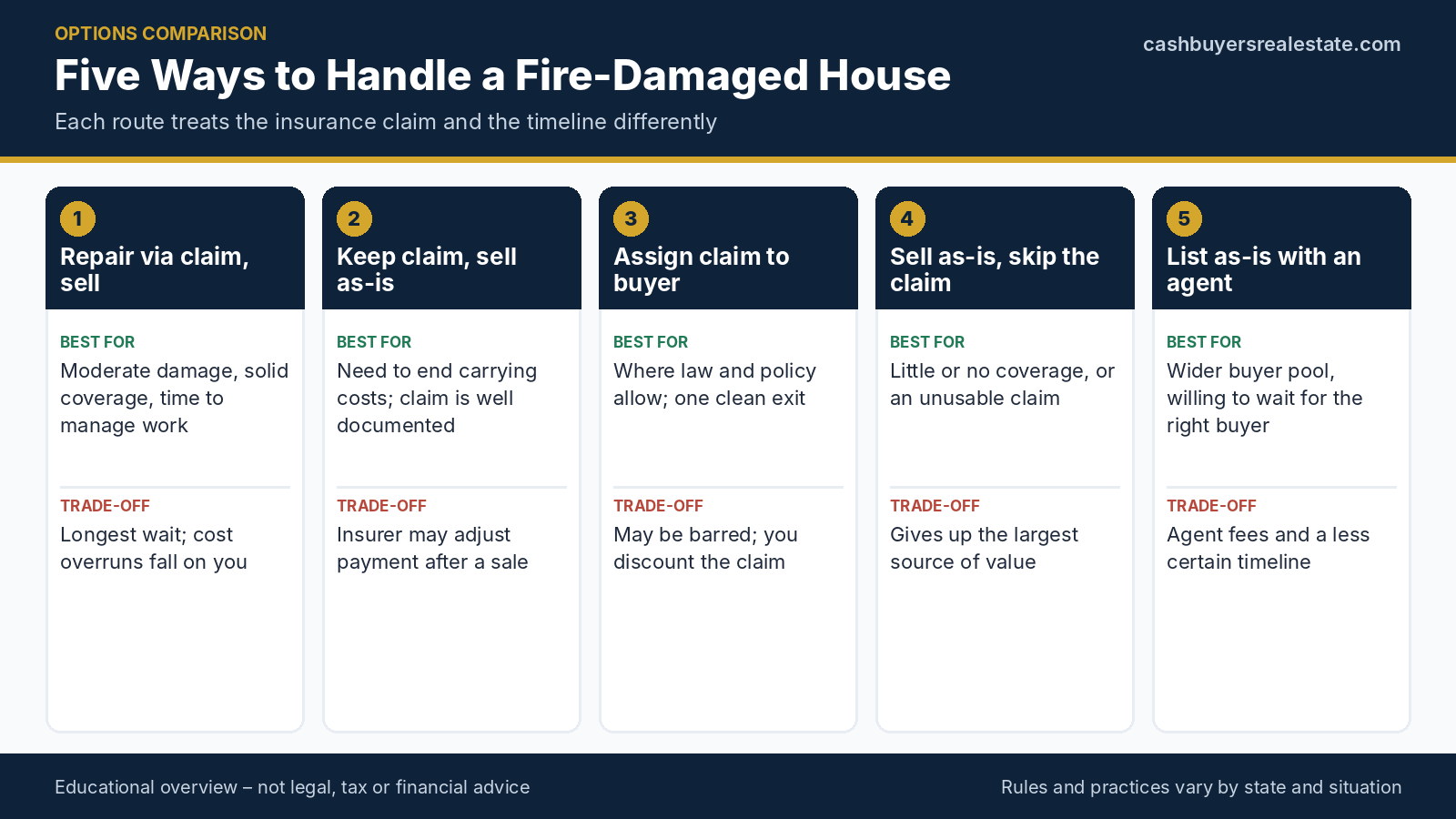
Text version of this infographic
- Repair via claim, sell — Best for: Moderate damage, solid coverage, time to manage work. Trade-off: Longest wait; cost overruns fall on you.
- Keep claim, sell as-is — Best for: Need to end carrying costs; claim is well documented. Trade-off: Insurer may adjust payment after a sale.
- Assign claim to buyer — Best for: Where law and policy allow; one clean exit. Trade-off: May be barred; you discount the claim.
- Sell as-is, skip the claim — Best for: Little or no coverage, or an unusable claim. Trade-off: Gives up the largest source of value.
- List as-is with an agent — Best for: Wider buyer pool, willing to wait for the right buyer. Trade-off: Agent fees and a less certain timeline.
How Cash Buyers Price Fire Damage: Repairs, Risk Margins and Time
An offer on a burned house can feel arbitrary, especially when two buyers who toured the same property on the same afternoon come back with numbers tens of thousands of dollars apart. It isn’t arbitrary, though it is opaque. Behind most investor offers is a short chain of subtractions that starts with what the repaired house would sell for and ends with what the buyer can safely pay. Once you can see the chain, you can see which links are solid and which are padded, and you can decide where to push.
The arithmetic behind a fire-damaged house offer
The details differ from buyer to buyer, but nearly every investor works backward from an expected resale price. That method is the same one used for any distressed property, and it is explained in more general terms in the guide to cash offer net proceeds. What changes with fire is how large and how uncertain the middle lines are.
After-repair value, repair scope and the contingency line
The starting point is the after-repair value, meaning the price the house is expected to bring once it is fully repaired and presentable. Buyers estimate it from recent sales of similar undamaged homes nearby, and they usually adjust for anything that makes the property harder to sell even after repair. A fire history can matter here: some buyers at the eventual resale may expect a modest discount for a home with a documented fire, while others see no difference once the work is permitted and finished. Because the after-repair value is an estimate of a future price, buyers differ on it, and part of the spread between offers comes from this line alone.
The repair scope is the next line, and it is the buyer’s own number, not the insurer’s. An adjuster’s estimate is prepared to determine what the policy owes; a buyer’s estimate is prepared to determine what the buyer will spend, using contractors the buyer expects to hire and prices the buyer expects to pay. The two can differ for sensible reasons, and a seller should not assume the insurer’s figure sets the repair line. Some buyers will ask to see it, since it can be a useful cross-check, but they will add their own view of hidden conditions. Then comes the contingency, which is a cushion for what can’t be seen. On a standard fixer-upper, contingency covers ordinary surprises. On a fire-damaged house, it covers a wider range: charred framing that is deeper than it looked, sub-floors that need replacement, wiring that must be pulled out, mold behind soaked walls and code upgrades triggered by permitting. Buyers set contingency according to how much they know, which is why an engineer’s letter or a contractor’s walk-through report can shrink it. A larger contingency is not a trick; it is the buyer’s price for the risk of being wrong.
Holding time, permits, financing costs and profit margin
After repairs, the buyer subtracts the costs of owning the project. Taxes, insurance on a vacant or under-renovation property, utilities and security continue throughout. Many investors borrow to fund purchases and renovations, and the interest and fees on that money accrue for every month the project runs. A fire project tends to run longer than a cosmetic renovation because of inspections, engineering reviews, permit queues and trade scheduling, and the buyer’s holding line grows accordingly. The more a municipality requires before repairs may begin, the higher this number goes. If the house sits in a market where permits are slow, the buyer’s price reflects that.
Resale costs come next, which usually means agent compensation and closing costs when the investor sells the repaired house, and sometimes a buffer for a price reduction if the market softens. The final subtraction is the buyer’s profit margin, which compensates for their time and capital and for the chance that the project will not go as planned. The margin is where competition shows. If several buyers are active in an area and each is eager for inventory, the margin they accept shrinks and offers rise; when buyers are scarce or cautious, margins widen. Because every line is an estimate, a seller should resist anchoring on any single percentage or rule of thumb. Investors often talk about shorthand formulas, but shorthand is just a compact way to carry the same variables, and none of the formulas is a standard or a guarantee. What matters is the total, the assumptions underneath it and whether the buyer will explain them. A buyer who won’t walk through how the number was built is not necessarily dishonest, but a seller has little to negotiate with when the assumptions are hidden.
Why two offers on the same burned house can differ by tens of thousands
Differences between offers come from two sources that are easy to confuse. Some are real: one buyer can do the work more cheaply, finds a better resale market or accepts a smaller margin. Others come from uncertainty, where the buyer simply knows less and charges for it. The second kind is the one a seller can influence.
The uncertainty premium and how documentation shrinks it
Think of the contingency and the margin as the price of not knowing. When a buyer has only a short walk-through and no reports, both lines grow. When the buyer has an engineer’s evaluation, the adjuster’s scope, restoration invoices and photographs from before cleanup, both lines shrink. The table below shows the same hypothetical house priced by two buyers, one working from limited information and one from a documented package. Everything else, including the after-repair value and resale costs, is held equal so the effect of information is visible.
| Line in the buyer’s calculation | Buyer A, limited information | Buyer B, documented package | Why the line differs |
|---|---|---|---|
| Expected after-repair value | $310,000 | $310,000 | Same comparable sales used |
| Resale costs (7% assumed) | -$21,700 | -$21,700 | Same assumption |
| Repair scope | -$108,000 | -$96,000 | A rounds up for unseen interior; B has scope and photos |
| Contingency for unknowns | -$22,000 | -$10,000 | Engineer’s letter and drying logs reduce the unknowns |
| Holding, permits and financing | -$14,000 | -$12,000 | B knows permit path and unsafe-posting status |
| Target profit margin | -$28,000 | -$24,000 | Lower perceived risk supports a smaller margin |
| Resulting offer | $116,300 | $146,300 | $30,000 gap, mostly from information |
To read the table, notice that nearly every line that differs is a line the seller can influence with paperwork, not by bargaining harder. Of the $30,000 gap, $12,000 comes from the repair estimate, $12,000 from contingency, and $6,000 from holding and margin. A seller who negotiates with Buyer A by asking for more money without supplying documents is likely to hear that the number reflects the risk; a seller who supplies the documents gives Buyer A a reason to revise.
Illustrative example (hypothetical numbers, not market data): A homeowner gets the $116,300 offer from Buyer A and then pays a structural engineer to evaluate the roof framing and foundation. The letter finds that the foundation is sound and that roughly half of the roof framing needs replacement, not all of it. She sends the letter, the drying invoices and the insurer’s scope back to Buyer A, who revises the repair line to $100,000, the contingency to $14,000, holding costs to $12,000 and the margin to $26,000. The new offer is $136,300 before any further negotiation. The engineer’s fee did not guarantee the increase, but it removed the most open-ended assumption in the calculation.
Reading an offer net: what to ask, what to subtract, what to compare
A headline price is only the first number in an offer, and with fire-damaged houses, the other numbers can matter as much. Ask whether the buyer expects the seller to keep the insurance claim, to assign it, or to say nothing about it, and how the price changes in each case. Ask who pays title and closing fees, what the earnest money deposit is and when it becomes non-refundable, how long the due-diligence period lasts and what the buyer can do during it. A low earnest deposit with a long free-cancellation window is not the same commitment as a larger deposit with a short one. The article on questions to ask a cash home buyer provides a fuller list.
Subtract what you would pay regardless of route: the mortgage payoff, any liens, the seller’s share of closing costs and any carrying costs until closing. Then add what you would receive that a headline price hides, which for a fire-damaged house is chiefly insurance money you keep. Compare each offer on this net basis, and compare it against the net from a repair-and-sell route over the time that route takes. When the nets are close, the decision turns on non-financial factors such as certainty, stress, your ability to manage a rebuild and your tolerance for months of carrying costs.
Finally, ask whether the offer is conditional on something you don’t control. Some contracts depend on the buyer’s inspection, financing from a private lender, a partner’s approval or a favorable result of a permit inquiry. Conditions are not improper, but each one is an exit door for the buyer, and an offer with several is worth less than its headline suggests. The more a buyer is willing to remove conditions after verifying the property, the more the offer resembles a firm commitment. Buyers who offer to waive an inspection or other condition in exchange for a lower price are making a trade, and the trade should be evaluated like any other.
Permits, Codes and Hazards That Limit What Any Buyer Can Do
Whoever owns a fire-damaged house, whether it’s you or an investor, doesn’t get to decide on their own what happens next. Local building departments, utilities, environmental rules and sometimes floodplain or historic regulations set the sequence and the standard. A buyer who understands those constraints prices them in; a seller who understands them can explain why a particular repair estimate is not as simple as it looks and can recognize when a buyer’s assumptions are unrealistic in either direction.
Post-fire inspections, unsafe postings and the permit path
Most communities take a structure that has burned out of the ordinary stream of building activity. Until it is inspected and cleared, it may be posted as unsafe, and the owner may be barred from using it or even entering. Those rules protect the public and the people who will eventually work in the building, and they shape the buyer’s timeline from the first day.
From unsafe posting to repair permit: how a typical municipal process runs
The process differs by city and county, so one example illustrates the pattern rather than the rule. The City of Tracy, California, publishes a post-fire procedure in which the owner notifies the building division, secures the structure, obtains a permit for the inspection and schedules it. The inspector then decides whether entry is safe and tags the building with one of three outcomes: approved for continued occupancy in part, safe only to retrieve belongings, or unsafe to live in or occupy. The inspector’s report lists the damage in general terms and identifies the types of permits needed, and the city states that the report is not a final damage list and does not determine insurance coverage. If damage hides conditions such as framing or foundation, demolition may be needed first, and plans and structural calculations may be required before repair permits are issued.
For a buyer, the posting status and the permit history are crucial facts. A house that has already been inspected, with a report identifying the permits needed, is much easier to price than one that no one from the city has examined, because the buyer can see the regulatory path. A house that has an unsafe posting is not unsellable, but the buyer will account for the time and cost of getting it lifted, and may be unable to hold open houses or invite the usual stream of visitors. Keep copies of every notice, inspection report and permit application. If the city has issued orders, such as a requirement to secure or demolish, they must be disclosed and should be reviewed with an attorney before listing.
Most burned houses are vacant while the dispute over scope and the permits run on, and vacancy has its own consequences for insurance, security and neighbors. The separate guide to cash buyers for vacant houses covers how investors handle vacancy risk in general, and the same issues apply here with extra force because an open or unsecured fire-damaged shell attracts trespassers and weather damage.
Substantial damage, code upgrades and flood-zone rules
Some regulatory thresholds can change the nature of a project. In communities that participate in the National Flood Insurance Program, federal regulations define substantial damage as damage of any origin, which includes fire, where the cost of restoring the structure to its pre-damage condition would equal or exceed 50 percent of its market value before the damage. Local floodplain ordinances build on that definition. In a mapped flood hazard area, a substantially damaged building can be required to meet current floodplain standards as part of repairs, which can mean elevating or otherwise changing the structure, and that can make a repair far more expensive than the insurer’s estimate suggests. The local floodplain administrator can say whether the address is in a regulated area and how the community applies the rule.
Zoning can matter too. A house built decades ago may not conform to current setback, height, lot-coverage or parking rules, and local codes sometimes limit how much of a nonconforming structure may be rebuilt after damage. Historic district rules can require particular materials or review boards for exterior changes. These constraints vary widely and are rarely visible from the street, so a buyer who has not checked them may be pricing a project that can’t be built as imagined, and a seller who has checked them has an advantage. Building code upgrades are the third layer. When a damaged house is repaired, current codes can apply to the rebuilt portions, and sometimes to systems that must be brought up to code once a permit is opened. That is why ordinance or law coverage matters, and why a buyer’s estimate can differ from the insurer’s. The table below sets out the general sequence of steps between a fire and a permitted repair, who acts at each step and why each one matters to a buyer. Local practice differs and the order can change, but the structure is common.
| Stage | Who usually acts | What it produces | Why a buyer cares |
|---|---|---|---|
| Fire suppression and clearance | Fire department, then local authorities | Incident report and permission to approach the structure | Shows origin, extent and when entry became safe |
| Securing and emergency work | Owner, mitigation contractor | Boarding, tarping, drying logs, invoices | Shows damage was limited after the fire |
| Post-fire building inspection | Building official | Posting status and a list of permit types needed | Sets the regulatory path and any use restrictions |
| Structural and hazard evaluation | Engineer, environmental consultant | Stability letter, asbestos or lead findings where relevant | Converts open-ended risks into bounded costs |
| Plans and permit application | Owner or contractor, design professional | Plan set, structural calculations, permit fees | Determines time, fees and code upgrades |
| Repairs and inspections | Licensed contractors, inspectors | Approved inspections and a final sign-off | Allows occupancy, insurance and resale |
One lesson from the table is that the front end of the process, before any repair work starts, is mostly paperwork, evaluation and waiting. That is also where a seller can add the most value by completing steps in advance. A property that has cleared the first four stages is a different product from one that has not, and buyers’ offers tend to reflect the difference.
Hazardous materials, licensed trades and unpermitted work
Beyond permits and codes, fire-damaged houses bring environmental and workmanship issues that sellers don’t always anticipate, especially in older homes. These issues affect who can do the work, how it must be done and what buyers will worry about.
Asbestos, lead paint and debris in older houses
Houses built before 1978 may contain lead-based paint, and many older houses contain asbestos in insulation, flooring, siding, roofing or duct wrap. Burning and demolition can disturb these materials. The Environmental Protection Agency’s Renovation, Repair and Painting rule requires firms that disturb lead-based paint in pre-1978 homes to be certified and to follow specific work practices to prevent contamination. Federal asbestos rules for demolition and renovation, known as the asbestos NESHAP, require inspection for asbestos before demolition or renovation of regulated facilities, but state environmental agency guidance notes that isolated residential buildings with four or fewer dwelling units are generally excluded from the federal definition. State and local programs can still impose their own requirements, and the exclusion has exceptions, such as when the building is part of a larger project. Structures demolished under a government order because they are unsound follow a separate provision of the federal rule.
A seller doesn’t need to master those rules, but should understand what they imply. A buyer who plans to gut an older burned house will include testing, containment and disposal costs in the budget, and if no testing has been done, the buyer will assume the worst. Testing before a sale is optional, and results become information that may need to be shared; a seller should talk to the buyer, a licensed professional or an attorney about how to handle the findings, and should never conceal a known hazard or skip a disclosure the law requires. Debris and soot raise health concerns as well, which is why restoration professionals use protective equipment and why the owner should not clean heavily contaminated areas without guidance. If children, pregnant household members or people with respiratory conditions are involved, the cleanup plan deserves extra care. The point for sale purposes is that environmental findings, whether positive or negative, change the repair budget, and documented results tend to narrow buyer uncertainty.
Licensed trades, mechanics’ liens and unpermitted emergency repairs
Work on a burned house is regulated, and the details depend on the state. Electrical, plumbing, gas and structural work usually require licensed trades and permits, and unpermitted work creates trouble later: it may not pass inspection, may complicate insurance and can surface in a buyer’s due diligence. In an emergency, owners sometimes hire the first crew available, and those crews sometimes do work that should have been permitted. If you’ve already had work done, collect the contracts, invoices, permits and inspection records, and be ready to tell a buyer plainly what was done and by whom. The separate article on selling a house fast without repairs explains how buyers treat visible versus hidden work in general.
In most states, contractors and suppliers who aren’t paid for work on a property can record a lien against it, and a recorded lien must be resolved before a title company will insure a clean transfer. That is another reason to keep payments, lien waivers and invoices organized, to avoid paying large amounts in advance and to check that anyone you hire is licensed. If a lien does appear, the buyer’s title company will find it, and it can delay a closing or reduce proceeds. Clearing it early, whether by paying a legitimate invoice or resolving a dispute, is usually easier before a contract is signed than after.
Finally, disclosure obligations apply even when the sale is as-is and for cash. Most states require sellers to disclose known material defects, and a fire, its repairs and the existence of an insurance claim are the sort of facts that matter. The rules vary by state, so the article on as-is home sale disclosures and a local attorney or real estate professional are the right places to confirm what your state expects. Telling a buyer everything you know protects you from later claims and usually helps the buyer price with less fear.
Fraud, Solicitation and Pressure After a Fire: Contractors, Public Adjusters and Buyers
A fire makes a household visible. Incident reports, fire trucks and a boarded-up house signal to anyone looking that a vulnerable, stressed owner now holds an insurance claim and a decision about the property. Most of the people who respond are legitimate professionals. A smaller number use urgency, confusion and grief to push signatures, deposits and assignments. Consumer agencies repeat the same warnings after every disaster because the patterns repeat, and knowing them in advance is one of the cheapest forms of protection available.
Contractors and public adjusters: what state rules commonly require
Public adjusters and contractors are regulated by states, not federal law, and the rules differ widely. That means no national statement can tell you what your adjuster may charge or when a contractor may approach you. It is possible, though, to describe the kinds of rules states commonly adopt and to show with verified examples how much they vary.
Public adjusters: licensing, contracts, fees and cancellation rights
A public adjuster is a licensed professional who represents the policyholder, not the insurer, in preparing and negotiating a claim, usually for a fee based on a percentage of the settlement. The NAIC says that where your state requires a license, you should confirm any agent or public adjuster is licensed by checking with your state insurance department, and that public adjusters offer the same services an insurer’s adjuster provides but at your cost. Hiring one can be reasonable in a complicated loss, particularly a large one with disputes over scope, but it is a financial decision with consequences, and nothing requires you to make it quickly.
State rules vary on nearly every detail. Florida’s Department of Financial Services publishes consumer tips explaining that a public adjuster contract must be in writing with required disclosures, that most claims allow cancellation within 10 calendar days after the contract is executed, that fees are capped by percentage of claim payments and that an adjuster cannot both adjust a claim and perform repairs on it. Texas rules, in 28 Texas Administrative Code section 19.708, require a written contract on a form approved by the department, allow the insured to cancel within 72 hours of signing for any reason, cap total compensation at 10 percent of the insurance settlement and prohibit the adjuster from participating in repairs or holding a financial interest in a repair firm. California’s Department of Insurance tells wildfire claimants that adjusters may not solicit in a declared-disaster area until seven calendar days after the event and that a contract in a declared disaster can be canceled within five calendar days. Read the Florida consumer tips or the Texas rule to see how detailed such regulation can be, and then look up your own state, because the numbers above do not carry over.
For the question of selling, public adjusters introduce two complications. First, a fee often applies to claim payments received after the contract is signed, so you want to know whether a sale could trigger fees on money that arrives later, and what the contract says if you sell. Second, the adjuster’s role is to maximize the claim; a buyer’s role is to buy the house, and the two can pull in different directions if a buyer’s offer assumes you will assign or reduce the claim. Keep the adjuster informed and ask for the contract’s treatment of a sale in writing. And remember that the Consumer Financial Protection Bureau warns homeowners to be wary of adjusters who refer them to a specific contractor, since that arrangement can involve kickbacks, and of those who approach at the door or ask for large upfront fees.
Contractors and restoration firms: pressure, assignments and prepayment
Home repair fraud is common after disasters, according to the NAIC, which advises being wary of aggressive contractors and demands for up-front payment. The Federal Trade Commission’s guidance on avoiding scams after disasters adds several specifics: be suspicious of contractors who say they don’t need a license, don’t pay the full amount in advance, get more than one estimate, get the agreement in writing with no blank spaces, avoid payment methods that are hard to recover such as wire transfers, gift cards and cash, and never sign your insurance check over to a contractor. The FTC also notes that the final payment should wait until you have seen the finished work and are satisfied with it, and that a bank can sometimes release funds in stages against a certificate of completion.
One protection that people sometimes assume exists doesn’t apply here. The FTC’s Cooling-Off Rule gives a three-business-day right to cancel certain sales made at your home, but the FTC says it does not cover sales involving real estate or insurance and excludes sales made to meet an emergency. A repair contract signed under emergency conditions may not carry that right, and a contract to sell the house never does. Some states add their own cancellation rights for home improvement contracts or disaster repairs, so check, but don’t rely on a safety net you haven’t confirmed.
Illustrative example (hypothetical scenario, not a real case): Two days after a fire, a crew arrives at the door of a homeowner and says it works with insurance companies, can start tomorrow and needs a $6,000 deposit plus a signed form “authorizing direct billing” to the insurer. The form turns out to be an assignment of the claim. The homeowner doesn’t sign, asks for the contractor’s state license number, calls the insurer to ask what documentation it needs before paying any contractor, and gets two written bids from licensed firms. Nothing about the first crew proves it was dishonest, but declining to sign on the spot cost nothing and preserved every option, including a later sale.
Putting these warnings together, a simple checklist emerges that applies to contractors, adjusters and buyers alike. Verify who the person is and whether the license they cite is real and current. Ask for proof of the funds or insurance they claim. Read the contract in full, including what it says about your insurance claim. Get the lender’s and insurer’s treatment of any assignment, release or sale in writing. Confirm the closing partner and verify any wire instructions through a number you looked up independently. And notice whether anyone is pressing you to act before you can do those things. The graphic below summarizes the six checks, rating each according to how seriously a failure should weigh on your decision.
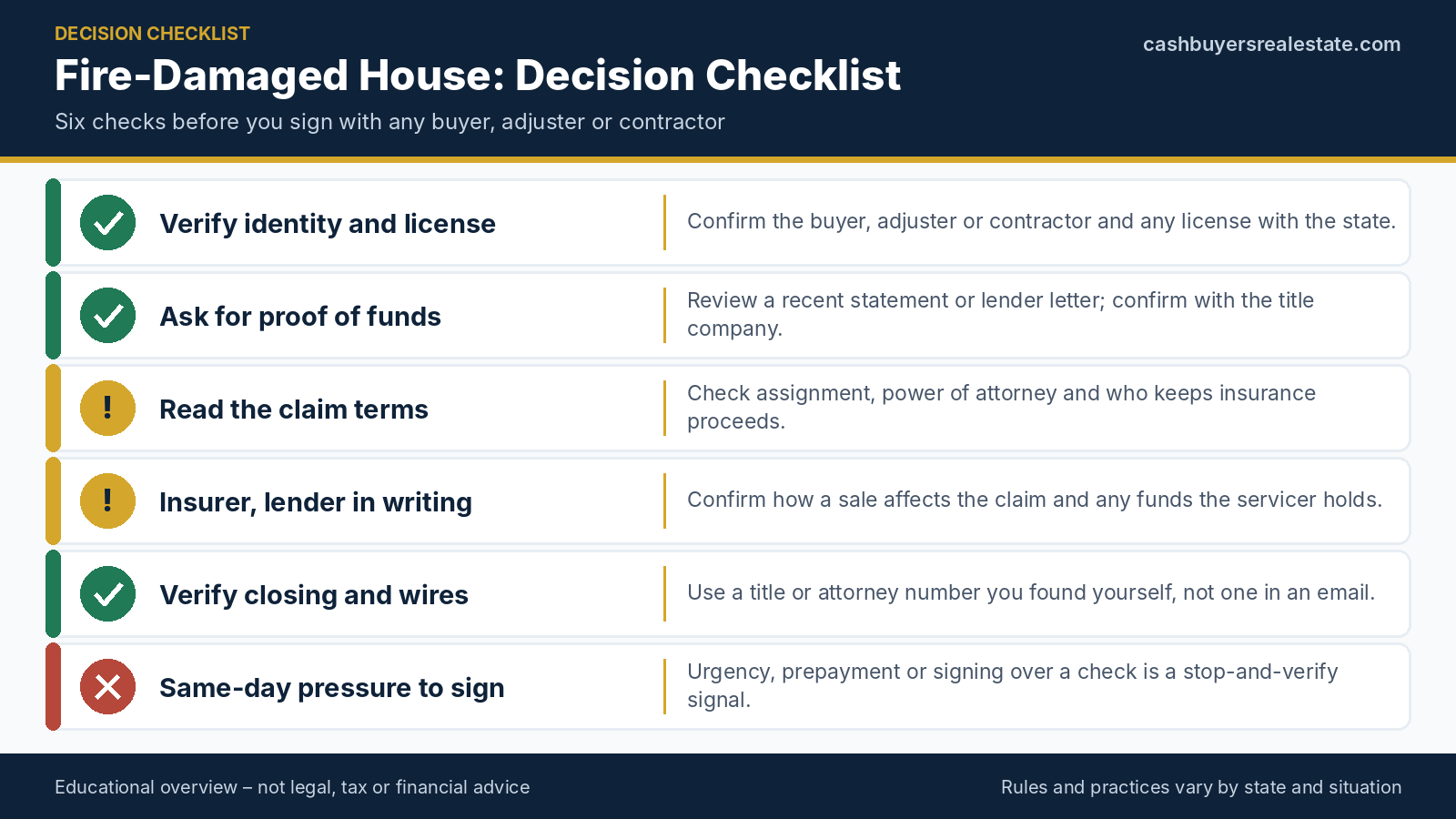
Text version of this infographic
- Verify identity and license — Confirm the buyer, adjuster or contractor and any license with the state.
- Ask for proof of funds — Review a recent statement or lender letter; confirm with the title company.
- Read the claim terms — Check assignment, power of attorney and who keeps insurance proceeds.
- Insurer, lender in writing — Confirm how a sale affects the claim and any funds the servicer holds.
- Verify closing and wires — Use a title or attorney number you found yourself, not one in an email.
- Same-day pressure to sign — Urgency, prepayment or signing over a check is a stop-and-verify signal.
Buyers, solicitation and verification before you sign
Buyers are subject to some of the same temptations as contractors. The overwhelming majority of investors who respond to fire-damaged houses do so legitimately, but the sector includes people with thin capital, unclear contracts and a habit of tying up properties in order to resell the contract to someone else. Verification is not an accusation. It is the ordinary due diligence of any large transaction, applied to a seller who has less time and energy than usual.
Unsolicited offers after a fire, proof of funds and earnest money
Unsolicited letters, calls and visits after a fire are common, and receiving one is not a sign of anything improper by itself. What matters is what happens when you ask questions. A legitimate buyer will usually identify the company or individual behind the offer, say whether they intend to buy the house themselves or assign the contract to another buyer, show evidence that the money exists and explain their terms without insisting on a same-day signature. The general question of who these buyers are is explored in the article asking are cash home buyers legit. Proof of funds typically takes the form of a recent bank or brokerage statement, a letter from a financial institution or a lender’s commitment for a private loan, depending on how the buyer is paying. It shows that the money exists and is available, though it does not prove the buyer will close. You can reasonably ask for it before you grant exclusivity or take the house off the market, and you can ask the title company to confirm funds before closing. A buyer who refuses to show any evidence while insisting on a binding contract is asking you to bear risk they will not share.
Earnest money, the deposit a buyer puts down when a contract is signed, signals commitment, and it matters who holds it and under what conditions it can be returned. A deposit held by a title or escrow company, or by an attorney in states where they handle closings, is typically safer than one handed to the buyer. A very small deposit combined with a long period in which the buyer can cancel for any reason resembles an option more than a purchase, and a seller should understand that tradeoff before agreeing. The separate article on contract terms, the cash home buyer contract, goes through the clauses in detail.
Contract terms, assignment clauses and wire-fraud safeguards
Read every clause that touches the insurance claim. A contract might say the buyer takes all insurance proceeds, that the seller must sign any documents the insurer requires, that the seller grants the buyer a power of attorney, or that the seller must not communicate with the insurer. Each of these can be appropriate in a specific structure or deeply harmful in another, and none should be signed without confirming what your insurer and lender will accept. Also check whether the buyer may assign the contract to someone else, whether a memorandum of the contract may be recorded against your property, what happens to the deposit if the buyer cancels and what the seller must deliver at closing.
Wire fraud deserves its own care, because closing involves large transfers and criminals impersonate title companies and attorneys. The CFPB advises verifying closing instructions, including the account name and number, by phone or in person using a number you obtained independently, identifying trusted contacts in advance, treating wire instructions that arrive in an email as unverified, avoiding links and attachments you haven’t confirmed, and, if money is sent to the wrong place, contacting the bank immediately to ask for a wire recall and reporting to the FBI’s Internet Crime Complaint Center. Although the CFPB’s advice is addressed to homebuyers, sellers receiving proceeds should follow the same discipline, particularly when they’re asked to change payment instructions late in the process.
| Pattern you may encounter | Who may do it | Why it deserves caution | A safer response |
|---|---|---|---|
| Asks you to sign over your insurance check | Contractor | FTC advises never signing a check over; you lose control of the funds | Pay in stages against completed work |
| Says no license is needed or won’t give a license number | Contractor, adjuster | Unlicensed work can fail inspection and void protections | Verify with the state licensing agency |
| Large deposit demanded before any work | Contractor | NAIC and FTC both warn against prepaying | Get written bids and a payment schedule |
| Promises a faster or larger settlement | Public adjuster | Some states prohibit such guarantees; no one controls the outcome | Ask for the contract and fee terms in writing |
| Refers you to a specific contractor | Public adjuster | Some states bar adjusters from repair roles; kickbacks are possible | Choose contractors independently |
| Same-day signature required, no proof of funds | Buyer | Pressure prevents verification | Request proof of funds and time to review |
| Broad claim assignment or power of attorney in the contract | Buyer | May conflict with policy terms or your loan documents | Have an attorney review before signing |
| Wire instructions changed by email near closing | Anyone posing as the closer | Common impersonation pattern | Call a number you verified independently |
The table is meant as a scanning aid, not a verdict. Any single row can have an innocent explanation, such as a contractor who is simply poorly organized or a buyer whose funds are tied up in a brokerage account that needs a day to document. The point is to recognize the situation and slow down to verify, and to give more weight when several patterns appear together. If you suspect fraud, your state insurance department, state attorney general and the FTC at ReportFraud.ftc.gov are appropriate places to report it.
Frequently Asked Questions About Selling a Fire-Damaged House to a Cash Buyer
The questions below come up repeatedly once an owner starts weighing a sale against a repair. They are grouped by topic, and each answer is a general explanation rather than advice for a specific house; the details of your policy, loan and state will govern.
Questions about claims, lenders and timing
Owners usually ask about the insurance claim and the mortgage first, since those two determine how much money is available and how quickly a sale can work.
Insurance claim questions
- Can I sell a fire-damaged house while my insurance claim is still open?
Generally yes, because the claim and the title are separate matters, but the sale can change how the claim is handled. The contract has to say who receives future payments, including supplements, and your insurer may have its own view on paying a claim after the insured has sold. Ask the insurer in writing how it will treat an open claim if you sell, and have the sale contract reviewed by an attorney before you rely on any assumption about the money.
- Does selling the house automatically end my claim?
Not automatically, but it is not guaranteed to continue unchanged either. Coverage turns on policy wording, the date of the loss, who owned the property then and your state’s law. Some parts of a claim, such as personal belongings and living expenses, relate to you rather than the building and often continue regardless of the sale. The building portion is the part most affected, so get the insurer’s written position before closing.
- Does the insurance company have to approve the buyer or the sale?
Insurers do not usually approve who buys your house. What they may care about is whether the buyer is taking over the claim, whether the policy allows that and whether the sale changes the amount owed for the loss. If the contract includes any assignment of benefits or proceeds, treat the insurer’s written consent as a condition of the deal. Some states restrict such assignments entirely for certain policies, so do not assume it is permitted.
- How long do I have to report a fire and file the claim?
The deadlines are in your policy and state law, and they differ. Insurers generally ask for prompt notice, may require a sworn proof of loss within a stated period when they request one, and limit how long you can wait before suing over a disputed claim. Report the fire as soon as it is safe to do so, and ask your insurer to confirm in writing each date that applies to your claim, including any deadline to complete repairs and collect withheld depreciation.
Mortgage, payoff and closing-time questions
- Do I still owe my mortgage payment if the house was damaged or is unlivable?
Yes. The loan is a separate obligation from the condition of the property, and the Consumer Financial Protection Bureau’s disaster guidance says damage does not end the responsibility to pay. What you can do is call the servicer early, explain the situation and ask what relief options exist. Servicers are generally more flexible before a loan is far behind than after, and a HUD-approved housing counselor can help you prepare for the call.
- What happens to insurance money my lender is holding if I sell the house?
It depends on your loan documents and the investor that owns the loan. The funds may be applied to the loan balance, released to you or held until the claim is resolved. Ask the servicer for its written procedure before you sign a contract, because the answer changes the cash you will bring to or take from the closing table. Do not let a buyer promise an outcome that only the servicer controls.
- Can I sell if I owe more than the house is worth in its burned condition?
It is possible, but the lender must be paid or must agree to accept less. You might bring cash to closing, use insurance proceeds the lender is willing to release toward the payoff, repair first and sell later, or ask the lender to approve a short sale. Short sale approval takes the lender’s time, and state law governs whether any remaining balance can be pursued, so talk to the servicer and an attorney before accepting an offer.
- How quickly can a cash sale of a fire-damaged house close?
There is no reliable standard, and any buyer who quotes a fixed number without seeing the title report and payoff is guessing. Cash removes loan underwriting from the buyer’s side, but the pace is still set by title work, the payoff statement, any liens, the insurer’s and lender’s responses and the buyer’s own diligence. Houses with unusual claim or permit complications take longer than straightforward ones.
Questions about buyers, price and safety
The second group of questions concerns what buyers pay, how to judge an offer and how to avoid the problems that cluster around a visible loss.
Offer and price questions
- Why would a cash buyer offer less than the insurer’s repair estimate?
The insurer’s figure determines what the policy owes you, while the buyer’s figure determines what the buyer will spend plus the risk it takes on. A buyer adds contingency for hidden damage, carrying costs for permits and construction, resale expenses and profit, so the offer is built from a different set of numbers. Supplying documents such as an engineer’s letter and the adjuster’s scope can narrow the gap by shrinking the unknowns.
- Should I get an engineer’s report or a contractor’s estimate before I sell?
It often helps, especially when structure, foundation or heat damage is uncertain, because a documented condition usually draws better offers than an open question. The report costs money and its findings may become information you need to share, so weigh the cost against the size of the uncertainty. Ask your insurer first, since it may have commissioned its own evaluation that you can obtain.
- Is a cash offer better than listing the burned house as-is with an agent?
Neither is universally better. A cash purchase can offer speed and fewer financing conditions, while an as-is listing may reach more buyers and sometimes a higher price at the cost of agent compensation and a longer wait. Compare each on net proceeds after payoff, fees and carrying costs, and on how well each fits your timeline and your claim.
- Will a house with a fire history always sell for less after it is repaired?
Not necessarily. Some buyers pay less for any property with a documented fire, while others focus on the quality of the repair and the permits. Complete records, final inspections and warranties on the work reduce the concern. Your state’s disclosure rules also affect what buyers will be told, which is why accurate documentation is worth keeping even after the work is complete.
Trust, paperwork and closing questions
- Do I have to tell a buyer about the fire if I’m selling as-is?
In most places you must disclose known material facts about a property, and a fire and its repairs are typically material. Selling as-is generally means the buyer accepts the condition without repair demands, but it does not remove disclosure duties set by state law. Because the rules differ, ask a local attorney or real estate professional what your state requires, and never conceal a known defect.
- How can I tell whether a cash buyer is legitimate?
Look for verifiable identity, evidence that funds exist, a written contract you have been allowed to read in full and a title or escrow company or closing attorney that you can contact independently. No single item proves honesty or fraud, and a legitimate buyer will not object to checks. Be cautious of anyone who pushes for same-day signatures, broad assignments of your claim or payments by unusual methods.
- Could selling the house or receiving insurance money create a tax bill?
It can, depending on your basis in the home, how much insurance reimbursement you receive and how the sale is structured. The IRS explains that insurance reimbursement reduces a casualty loss and that reimbursement above your adjusted basis can produce a gain, which may be taxable or may be postponable. Casualty loss deductions for personal property are limited to certain declared disasters. A tax professional can apply these rules to your facts before you commit to a route.
Choosing a Route for a Fire-Damaged House and What to Do in the First Weeks
By this point the central tension should be clear. A fire gives you an insurance claim that works best when it funds a repair, a mortgage that wants either repairs or payoff, and a house that a certain kind of buyer will take as it stands but at a price that reflects risk and effort. No route is right for everyone, and the right route can change as facts emerge. What follows is a way to organize the choice around your own circumstances instead of around whichever voice is loudest this week.
A decision framework: matching the route to your priorities
Start from what you need the outcome to do. Some owners need the largest total return and can wait; some need to stop carrying a damaged property and can accept a smaller net; some want to stay in the neighborhood and rebuild; some cannot manage a construction project at all. Each priority points toward a different route, and recognizing yours before you talk to buyers keeps their urgency from becoming yours.
When repairing through the claim and then selling, or keeping the house, fits
Repairing through the claim tends to fit when the damage is moderate and well documented, the policy provides replacement cost coverage and reasonable limits for living expenses and code upgrades, the lender is cooperative about releasing funds, and you have the time, health and temporary housing to see a project through. It also fits when the property’s undamaged value is high enough that the gap between a repaired sale and an as-is sale is large, as the comparison in Table 2 illustrated. In that case, the staged payments, the contractor management and the months of waiting are the price of capturing most of the house’s restored value. Owners who intend to stay may also prefer repairing for reasons that no spreadsheet captures.
The route is a poor fit when the estimate is likely to be exceeded by a wide margin, when coverage is thin, when the loan is large relative to the value or when you cannot afford the out-of-pocket gap that appeared in the example. It is also a weak fit for owners who are exhausted or caring for others. Some of these concerns can be eased by hiring a trusted general contractor, a licensed public adjuster where state rules allow, or a family member to help coordinate, but the burden does not disappear. If the property is a rental, the calculation also involves lost rent, and the article on cash buyers for rental properties covers how investors treat tenanted and landlord-owned homes.
A related path is to repair part of the way, such as completing mitigation and getting engineering and permits in place, and then sell the partly restored property. This can raise the price by removing the largest unknowns without committing you to the full rebuild. It is worth asking the insurer whether it will pay for those early steps in a way that supports a later sale.
When an as-is sale, a listing or a sale of the lot fits better
An as-is sale to an investor tends to fit when the repair path is long or uncertain, when you need to end the carrying costs, when you cannot fund the gap between the insurer’s payments and the real cost, or when you simply do not want to manage construction. The cost is a lower price than a repaired house would bring, which is the buyer’s compensation for the work and risk. Keep in mind that the buyer’s offer will be much more favorable if the claim is preserved, documented and clearly handled in the contract, as Table 2 and Table 3 showed.
Several alternatives deserve a fair look. Listing the house as-is with a real estate agent exposes it to more buyers than a single investor’s offer, including owner-occupants who might finance with a renovation loan. The Department of Housing and Urban Development, for example, describes the FHA 203(k) program as insuring a single loan that covers buying a home and rehabilitating it, with repair funds placed in escrow and released as work is finished, and it lists structural repair and reconstruction among eligible improvements; whether a specific burned house qualifies is for a participating lender to determine. Selling the lot to a builder or neighbor who values land more than the structure is another option, particularly where the house is likely to be demolished anyway. And holding the property while the claim resolves, then deciding, sometimes beats a quick sale if carrying costs are manageable.
An honest comparison also notes what cash does not do. It does not make the lender’s payoff smaller, it does not make the insurer’s decision faster, and it does not remove your disclosure duties. Cash buyers for fire-damaged houses solve a specific problem, which is finding someone willing and able to take a damaged building without conventional financing. They are one tool among several, and whether they are the best one depends on the numbers in your situation.
What to do next: first steps, questions and documents
Whichever route you lean toward, the first steps are nearly the same, and most of them cost little. They protect your claim, your credit and your options.
The first steps, in a sensible order
The order below follows the logic of the preceding sections: safety first, then the claim, then the loan, then information for buyers. None of it requires committing to a sale.
- Wait for local authorities to clear the building before anyone enters, and secure the property once it is safe to do so.
- Photograph and record conditions before cleanup, keep damaged items the insurer might need to see, and save every receipt for emergency work.
- Report the claim to your insurer, ask for the claim number and adjuster’s contact information, and write down each conversation.
- Call your mortgage servicer, ask how it handles insurance payments and what it needs, and keep the payment current if you can.
- Ask the building department about the property’s posting and permit status and keep copies of every notice.
- Gather the documents in the table below before you speak with buyers, and hold off on signing anything for which you do not have time to verify the other party.
Contacting a housing counselor, an attorney who handles real estate or insurance matters in your state, and a tax professional is sensible at this stage, not later. Each can answer one narrow question with confidence that a general guide cannot supply, and a short consultation before signing is cheaper than a correction afterward. The reasoning behind the order is worth spelling out. Safety comes first because nothing about the sale matters if someone is injured in an unstable structure. Documentation comes next because it can’t be recreated once debris is hauled away, and because it feeds both the claim and the buyer’s price. Calling the insurer and the servicer early costs nothing, tends to produce the most useful answers while options are still open, and gives you written reference points for every later conversation. Checking the building department’s posting status tells you whether the house can be entered, shown or worked on, which in turn shapes how soon any buyer could start. Only after those steps does it make sense to hear offers, since you will then know what to ask and what to compare them against.
Documents to gather and questions to ask buyers
Buyers value documents that replace guesses with facts. The table lists what to gather, where each item usually comes from and what it tells a buyer. Not every item will exist for every fire, and the absence of one is not a problem as long as you can say so honestly.
| Document | Where it usually comes from | What it tells a buyer |
|---|---|---|
| Insurance policy and declarations page | Your insurer or agent | Coverage type, limits and any special conditions |
| Adjuster’s estimate, scope of loss and payment letters | Your insurer | Insurer’s view of damage and what has been paid or withheld |
| Photos and video before and after cleanup | You, family, the mitigation company | Extent and location of damage as it was found |
| Fire department incident report | The fire department or records office | Origin, spread and date of the fire |
| Posting notices, inspection reports and permits | Local building department | Safety status and the permit path |
| Engineer, contractor or environmental reports | Professionals you or the insurer hired | Structural condition and hazard findings |
| Mitigation and restoration invoices and drying logs | Service companies | Work already done and moisture control |
| Mortgage statement and loss draft correspondence | Your servicer | Payoff magnitude and how insurance funds are handled |
| Deed, prior title policy and survey, if available | Closing file, county records, title company | Ownership, easements and title history |
As you review offers, ask each buyer a consistent set of questions: who exactly is buying and who will own the property at closing, how will the funds be shown, how does the price change if I keep, assign or do not pursue the insurance claim, what are the earnest money amount, holder and conditions, which inspections or due-diligence rights do you want and for how long, who is the title company or closing attorney, and what must I deliver at closing. Ask for the answers in writing. A buyer who answers clearly and without pressure is easier to work with and easier to compare, and a buyer who is vague about basics has told you something about how the rest of the transaction might feel.
There is no deadline that makes a rushed decision necessary, though carrying costs and the claim’s own dates deserve attention. A sale to a cash buyer can be a sensible way to put a damaged property behind you; repairing and selling or rebuilding can be the better financial choice for some owners; and a middle path of partial repair, a listing or a lot sale may fit others. Compare what you would net under each, confirm with your insurer, lender and a qualified professional how the claim and the loan would be handled, and choose the route you can complete with the least regret. The decision is yours, and a good one is the one you made with the facts in hand.