
Are Cash Home Buyers Legit? Offers, Process & Red Flags
The offer usually arrives when you least expect it: a handwritten-looking postcard addressed to “Homeowner,” a text from an unfamiliar number asking whether the property on your street is still yours, a yard sign at the corner promising a quick sale, or a polite voicemail from someone who says they’re “in your area this week.” Within an hour of the first reply you may be holding a number, a contract, and a closing date that is far sooner than anything you had planned. At that point the question most owners type into a search bar is the blunt one: are cash home buyers legit? It is a fair question, and it deserves an answer that is neither a shrug nor a warning siren.
The honest answer is that most cash buyers are lawful businesses or individuals doing exactly what they say, which is paying for a house without a mortgage and keeping the difference between what they pay and what they can resell or rent it for. A smaller number are not what they claim to be. Some have no money behind their offers, some build contracts that quietly trap the seller, and a few are outright thieves who have learned that a house changes hands with large sums moving between strangers on short notice. The point of this guide is not to make you suspicious of every buyer. It is to give you a method for telling which kind you are dealing with, using checks that take an afternoon and cost little or nothing.
Most cash home buyers are legitimate businesses, but legitimacy has to be verified, not assumed. Confirm who the buyer is, check proof of funds directly with the institution, read every clause, use a neutral title or closing agent, never wire money from an emailed instruction, and compare your net proceeds against at least one alternative before signing.
Notice what that answer does and does not say. It does not claim that every cash offer is a good one, because a buyer can be entirely legitimate and still offer you far less than your house would bring on the open market. It also does not treat a low offer as proof of bad faith. Legitimacy and generosity are different measures, and a good deal of the confusion people feel about cash buyers comes from mixing them together. A company can be properly registered, well funded, and honest in its dealings while offering a price that leaves you worse off than your alternatives. Another buyer can promise the moon, collect your signature, and never close. Telling those situations apart is the real work, and it starts with knowing what to look at.
There is also a pattern worth naming at the outset, because it explains why this subject is more tangled than a simple list of scams suggests. The most expensive mistakes sellers make with cash buyers are rarely cases of someone stealing a wire transfer. They are cases of a signed document that the seller did not fully understand: a contract that lets the buyer sell the deal to someone else, a clause that makes the seller pay a penalty for changing course, a recorded notice that clouds the title for years, or a price that quietly drops after the seller has already told the family the house is sold. None of these necessarily involves a crime. Several are legal in many states, and some states have recently passed laws specifically to rein them in. Part of being protected is understanding the paper, not just the person.
The guide moves in the order a cautious seller would actually work. It begins with what “legit” can reasonably mean and how the business model of a cash buyer works, then lays legitimate and problematic behavior side by side. From there it gives a step-by-step verification workflow, including how to ask hard questions without insulting a buyer who is perfectly honest, and then goes through entity and license checks, reviews and track records, proof of funds, contract traps, earnest money and price re-trades, closing agents and wire fraud, and title and deed theft. The last topical section covers what to do if something goes wrong and where to report it. A frequently asked questions section and a decision framework close the guide.
Some neighboring topics are deliberately left to their own articles so this one can stay on the question of legitimacy. How cash offers are calculated line by line is covered in how cash buyers arrive at their numbers, and the mechanics of the sale itself are in how a cash purchase works from first call to closing. If you mainly want a broad overview of the category, start with the guide to cash home buyers as a category, and if your main concern is the pace of a sale, the page on selling a house fast by any route sets out the full range. Here the focus is narrower and more protective: whether this particular buyer, this particular contract, and this particular closing are what they appear to be.
A word about the numbers and rules you will meet along the way. Every dollar figure in a worked example is hypothetical and labeled that way, because real offers depend on the property, the neighborhood, the season, and the buyer’s costs. Where a federal agency, a state regulator, or a county office has published a fact, the text names it and the source list in the article metadata records when it was checked. Where the answer depends on your state, your county, or your title company, the text says so instead of guessing. That last point matters more than it may seem. Real estate law is made largely at the state level, closing customs differ from one region to the next, and a rule that protects sellers in one state may not exist in the next one over.
One more framing point before the substance. The people who read articles like this one are often under real pressure: an inherited house they can’t afford to carry, a job transfer, a divorce, a property in poor repair, a looming payment. Pressure is exactly what both honest and dishonest buyers respond to, in different ways. An honest buyer may move quickly because speed is what you asked for. A dishonest buyer may manufacture a deadline so that you don’t have time to check anything. The remedy for both is the same and it is simple: slow down just enough to verify. A legitimate buyer will understand and, in most cases, expect it. If a buyer cannot tolerate a day or two of checking, you have learned something important already.
What “Legit” Means When a Stranger Offers to Pay Cash for Your House
Before any checklist can help, it’s worth settling what the word is supposed to cover. People use “legit” to mean at least three different things, and the confusion between them leads to two opposite mistakes: trusting a buyer because the paperwork looks professional, and distrusting a buyer because the price is low. This section separates the meanings, explains how a lawful cash buyer actually makes money, and sets up the framework the rest of the guide uses.
The Business Model Behind Legitimate Cash Buyers
Understanding why cash buyers exist at all removes much of the mystery, and with it much of the unease. A buyer who pays cash is providing something a conventional purchase can’t always supply: a certain closing date, no dependence on a lender’s underwriting, and a willingness to take a property in whatever condition it’s in. Those are real services, and like most services they are priced. The price shows up as a lower purchase offer, and the remainder of this section explains where that discount goes.
How an investor’s margin is built, and why it is not inherently predatory
A typical investor who buys to renovate and resell starts from the price the finished house might bring, often called the after-repair value, or ARV. From that figure the investor subtracts the cost of repairs, the cost of holding the property while the work is done, which includes taxes, insurance, utilities, and loan interest if the investor borrowed, then the cost of buying and selling, and finally a profit margin large enough to justify the risk. Whatever is left is the most the investor can pay and still come out ahead. The calculation is not a secret formula designed to cheat anyone. It’s the same arithmetic a homeowner would do if they were buying a worn-out house to fix and sell, and it explains why the offer sits below what a move-in-ready buyer would pay.
The discount is therefore not automatically evidence of bad intent, but it also isn’t automatically fair. Two investors can look at the same house and reach very different numbers because their costs differ, their appetite for risk differs, and their margins differ. One may work with a crew they trust and borrow cheaply; another may plan to resell the contract to someone else without touching the property at all. A seller’s job is to figure out what a reasonable discount looks like for this particular house in this particular condition, and the practical way to do that is to collect an independent price opinion from a real estate agent and at least one other written offer. The detailed arithmetic belongs in the article on how cash buyers calculate offers, but the principle belongs here: a buyer who explains the math is easier to trust than one who won’t.
Predatory behavior starts where the discount stops being a price for services and starts being a product of information gaps or pressure. A buyer who tells an elderly owner that the roof must be replaced when it doesn’t, who hides that a contract can be resold, or who sets a deadline designed to prevent comparison is not pricing risk, they are manufacturing an advantage. The line between aggressive negotiation and exploitation isn’t always crisp, and honest people sit on both sides of it. The more consistent signal is transparency. Legitimate investors tend to describe how they get to a number when asked, tolerate comparison, and put their terms in writing. That openness doesn’t guarantee a fair price, but it gives you what you need to judge it.
The different kinds of buyers hiding behind one phrase
“Cash buyer” is a payment description, not a business type, and at least five different kinds of buyer sit under it. The first is the renovator or flipper described above, who buys to repair and resell. The second is the landlord or rental investor, who may pay a little more for a property that will rent well because the plan is to hold it rather than flip it. The third is the wholesaler, a person or company that signs a purchase contract with you and then sells the contract, or the right to buy, to another investor for a fee, often without ever owning the house. The fourth is an institutional buyer or fund, which may buy in volume and use standardized pricing models. The fifth is the online instant-offer company, sometimes called an iBuyer, which makes algorithm-assisted offers and often charges a service fee.
These categories matter for verification because each one has a different risk profile and a different answer to the question “who is actually going to close on my house?” A renovator who funds deals with their own money and a wholesaler who needs to find another buyer in a few weeks are making very different promises, even if the two contracts look similar. The wholesaler’s business is legitimate in many states and regulated in a growing number of them, but it carries a risk the others don’t: if the wholesaler can’t find an end buyer, the deal may fall apart or be renegotiated at the last minute. For more on the people who do this work, see the guide to investors who buy houses and how they operate. The key habit is to ask early which kind of buyer you’re dealing with. A straightforward answer is a good sign, and an evasive one is information.
Lawful, Fair, and Good for You Are Three Different Tests
Most arguments about cash buyers go nowhere because the two sides are answering different questions. One side says the buyer broke no law and is therefore fine. The other says the price was too low and the buyer is therefore a predator. Both are partly right and partly missing the point. Separating the tests gives you something you can actually work with.
Real, lawful, and good for you: a three-part framework
The first test is whether the buyer is real: whether the person or company exists, has the authority to sign, and has the money or the means to close. This is a question of fact and is mostly answerable with records. The second test is whether the transaction is lawful, meaning the contract is enforceable, required disclosures are made, any licensing or registration rules are met, and the closing is conducted through a proper process that results in a recorded deed. This is a question of law and varies by state. The third test is whether the deal is good for you, which is a question of arithmetic and priorities: what you net compared with your other realistic options, how soon you receive it, and what risks you carry in the meantime.
A deal can pass any one of these tests and fail another. A real buyer with real money can propose a lawful contract that still leaves you with thousands of dollars less than a listing would. A buyer who offers a very high number can fail the first test entirely because no money stands behind it. A transaction can be good for you on paper and still fail the second test if a required disclosure was skipped and the contract is later challenged. The framework matters because it tells you which tool to reach for. Records and direct confirmations answer the first test, an attorney or the state agency answers the second, and a net-proceeds comparison answers the third. This guide spends most of its length on the first two while pointing to the sibling articles on estimating net proceeds and weighing a cash sale against a listing for the third.
Why honest people disagree about what a fair price is
Reasonable people can look at the same offer and disagree about whether it is fair, and it helps to understand why. A seller values the house by what similar homes recently sold for. An investor values it by what is left after repairs, carrying costs, and risk. A neighbor values it by what the seller paid ten years ago. None of these numbers is wrong; each answers a different question. The seller’s number assumes the house is in market condition, the buyer is a retail purchaser using a mortgage, and several weeks or months will be spent finding that buyer. The investor’s number assumes the opposite on all three counts. Neither side is lying, and most of the friction in a cash negotiation is two honest valuations colliding.
That is why this guide keeps returning to the idea of comparing net proceeds rather than headline prices. A cash offer at $210,000 that closes in two weeks with no repairs, no agent commission, and no carrying costs after the sale can leave a seller in a position similar to a $235,000 listing that takes four months, requires repairs, and costs commission and concessions. The figures here are only an example of the structure, not a market claim. In some cases the listing wins by a wide margin; in others the cash offer is clearly better. A fair price is one that survives that comparison and that the seller understands, and a buyer who is comfortable being compared against the alternatives is, almost by definition, one who has nothing to hide. Take that as a screening signal rather than proof, because a polished buyer can still be wrong for your situation.
Illustrative example (hypothetical numbers, not market data): A homeowner receives a $188,000 cash offer for a house a local agent thinks would list near $226,000 after about $14,000 of cosmetic repairs. Selling through a listing, after the repairs, a 5.5 percent total commission and typical seller closing costs, five months of mortgage interest, taxes, and utilities at roughly $1,900 a month, and a possible price concession, the owner’s projected net lands in the neighborhood of $182,000 to $190,000, with a wide range around it. The cash offer nets about $188,000 minus its own closing costs, in three weeks. The two routes are close enough that certainty, timing, and the buyer’s verifiable reliability decide the matter, not the headline number. Had the cash offer been $165,000, the same analysis would point the other way.
It also helps to recognize that “fair” has a legal side in a few places. Some states now require wholesalers to disclose in writing that they intend to resell the contract at a profit and to give sellers a short window to cancel without penalty, precisely because the information gap was considered unfair. Those rules, which the later section on state laws describes, do not set a price. They try to ensure that the seller’s decision is informed. That’s a useful standard for any seller to adopt voluntarily: a deal is fair enough when you understand what the buyer is doing, what the buyer stands to gain, and what your alternatives were, even if you’d have liked a bigger number.
Legitimate and Problematic Buyer Behavior, Side by Side
Few buyers announce which category they belong to, so the most reliable way to sort them is to watch what they do. Behavior is observable in a way that branding is not: a business can buy a polished website in an afternoon, but it’s much harder to fake a consistent pattern of transparency across weeks of contact. This section describes what lawful buyers typically do at each stage of a sale and what problematic buyers tend to do instead, with the caveat that no single behavior proves anything by itself. What matters is the cluster.
How a Lawful Buyer Behaves From First Contact to Closing
Lawful buyers vary widely in style. Some are blunt and fast, some are warm and chatty, some are small family operations and some are large companies with scripted phone calls. Style is not the signal. The signal is whether the buyer’s conduct leaves you better able to check them, not worse.
Communication, identity, and willingness to be checked
A lawful buyer tells you who they are in plain terms: a full name, the name of the company they are buying through, a business address that isn’t just a mailbox or a phone number that goes to voicemail, and a working email on the company’s own domain rather than a free webmail account. If they’re representing a company, they can say what role they hold and whether the company will take title or whether a separate entity formed for this purchase will. When asked what kind of buyer they are, they can explain whether they plan to renovate and resell, hold as a rental, or assign the contract. None of this requires a long conversation. It requires only that the answers come back consistent and that they match what public records later show.
Willingness to be checked is the part many sellers underestimate. A buyer who is comfortable with scrutiny will usually send documents without being chased, answer follow-up questions in writing, and say something like “of course, take a day or two” when you mention that you plan to verify the funds and talk to a title company. They also tend to explain how they arrived at their number when asked politely. A buyer who gets irritable, changes the subject, or suddenly has a limited-time condition each time you mention verification isn’t necessarily dishonest, but the reaction is worth noting. In practice, honest buyers deal with skeptical sellers every week and have usually built the answers into their routine, because skeptical sellers are the norm rather than the exception.
Lawful buyers also tend to leave a paper trail without being asked. After a phone call they send a short email summarizing what was discussed, such as the price range, the kind of buyer they are, and the next step, and they refer to the same company name each time. That habit matters more than it sounds. It means that if a dispute arises later, both sides can look at the same record, and it means the buyer is comfortable having their words preserved. A buyer who prefers to talk only by phone, who deletes messages, or who answers written questions with a call is not necessarily hiding something, but you can solve the problem on your own by sending your own summary email after each conversation and noting any disagreement.
Contract, money, and closing behavior
On paper, a lawful buyer’s contract reads like a normal purchase agreement. It names the parties correctly, describes the property by address and legal description, states a price and a closing date or a closing window, identifies who will hold the earnest money and how much it is, and spells out what happens if either side defaults. It is delivered as a complete document with every blank filled in or struck through, and you are given time to read it and, if you want, have an attorney look at it. If the buyer intends to assign the contract, the paper says so and, in the states that require it, includes the statutory disclosure. If the buyer has an inspection or due diligence period, it has a defined length and a defined consequence.
The money behaves in an equally orderly way. Earnest money, if any, goes to a neutral third party such as a title company, an escrow company, or an attorney’s trust account, and you receive written confirmation that it arrived. Funds for the purchase are shown to exist before you commit significant time. Closing is scheduled with a title or escrow company or a real estate attorney whose name you can look up independently, and the seller’s proceeds are paid through that closer, not through an arrangement made by text message. The wiring instructions, if there are any, come from the closing office and can be confirmed by a phone call to a number you found yourself. That last point sounds minor and turns out to be the difference between a smooth closing and a stolen payout, as the later section on wire fraud explains.
How Problematic Buyers Behave, and Why the Pattern Is Hard to See
Problematic buyers fall into two groups that call for different responses. The first group is outright fraudulent and relies on deception about identity, funds, or intent. The second is lawful in a narrow technical sense but depends on sellers not understanding what they’ve agreed to. The second group is larger and, for most sellers, more likely to cause real financial harm.
Pressure, secrecy, and the manufactured deadline
Pressure is the single most consistent feature of the cases that go badly. The pressure usually takes a recognizable form: an offer that “expires tonight,” a claim that the buyer has “another house to close on” and can’t wait, a warning that the market is about to drop, a suggestion that the seller shouldn’t tell an agent or a family member because “they’ll only complicate things.” Secrecy is the companion tactic. Buyers who ask you not to speak with an attorney, not to contact the title company before signing, or not to share the contract with anyone else are asking you to remove the very people who would spot a problem. A legitimate buyer has no reason to object to a second pair of eyes on the paper, and often welcomes it because it prevents later disputes.
A third sign is the shifting story. The first conversation says the buyer pays all closing costs; the contract says nothing about it. The text message says cash; the paperwork refers to a “financing” or “assignment” arrangement. The company on the website is one name, the entity on the contract is another, and the person who signs is a third. The details can be innocent, because investors do use several entities for tax and liability reasons, but the combination of pressure and a changing story deserves a slow and documented response. The pause isn’t an accusation. It gives you time to find out whether the inconsistency has an ordinary explanation, and it gives a legitimate buyer the opportunity to supply it.
The way a buyer handles your circumstances is also revealing. Owners who sell after a death, a divorce, a job loss, or a health event are often tired and sometimes embarrassed, and honest buyers know to approach those situations without exploiting them. They allow time for family members to weigh in, they do not comment on your finances beyond what the sale requires, and they do not suggest that you are running out of choices. A buyer who treats your hardship as leverage, for example by hinting that nobody else will want the house or that your timeline leaves you no room to compare, is using your stress as a pricing tool. That behavior can be entirely lawful and still be a good reason to look elsewhere.
Gray-area conduct: legal but costly
Not every unfavorable pattern involves lying. Consider the buyer who really does intend to pay but whose contract allows them to walk away freely while binding you tightly, the wholesaler who is not required to tell you in your state that they plan to resell the deal at a profit, or the investor who uses a listing agreement or a recorded notice to keep your property tied up while they decide. In many places these things are lawful, and the people doing them may sincerely regard themselves as running ordinary businesses. From the seller’s side the effect can still be damaging, because the structure shifts risk and time onto the seller while preserving the buyer’s options.
The honest way to handle gray-area conduct is to treat it as a pricing and risk question rather than a morality play. If a contract gives the buyer an extended due diligence period with a free exit, that option has value, and you are entitled to ask whether the price reflects it. If the buyer intends to assign, you are entitled to know the likely end buyer’s price. If a buyer asks to record anything against your title, you are entitled to an attorney’s opinion before agreeing. The extra questions don’t insult an honest buyer, who will usually answer them. They are exactly what a dishonest or merely aggressive buyer hopes you won’t ask, and the answers you get tell you much about what you’ve actually been offered.
The table below summarizes the contrast at each stage of a sale. It’s a quick-reference tool, not a scoring system, and any one entry in the right-hand column can have an innocent explanation.
| Stage | Typical lawful-buyer behavior | Pattern that deserves a closer look |
|---|---|---|
| First contact | States name, company, and what kind of buyer they are; accepts a callback to a number they supplied | Vague about who is buying; refuses to say whether they will assign the contract; contact only by text |
| The offer | Explains roughly how the number was reached; lets you take time to compare | Number arrives with an expiry measured in hours; will not discuss how it was calculated |
| Proof of funds | Supplies documents that name the buyer and can be confirmed with the institution | Statement with blacked-out names, a screenshot, or a letter that can only be confirmed through the buyer’s own contact details |
| The contract | Complete, readable, every blank filled, time to review, attorney review welcomed | Blanks left open, one-page form, signature requested electronically within minutes, pressure not to consult anyone |
| Earnest money | Deposited with a neutral title company, escrow office, or attorney; receipt provided | Held by the buyer, paid to an individual, or offered as a check that you are asked to cash and forward |
| Inspection and price | Walks the property, notes specific problems, adjusts only for real findings | Price drops by a round figure after you have told family and stopped showing the house, with no new facts |
| Closing agent | Title or escrow company or real estate attorney you can look up and call independently | Closer chosen at the last minute, reachable only by email, or unwilling to take your calls |
| Payment of proceeds | Disbursed through the closer after the deed is recorded or per local custom, with a closing statement | Last-minute change in wiring or payment instructions delivered by email or text |
Read the table from left to right rather than top to bottom. If every row in the middle column describes your buyer, you have good reason to proceed with ordinary care. If one or two rows in the right column apply, ask about them directly and give the buyer a chance to explain. If several rows in the right column apply at once, particularly the ones involving money, treat that as a reason to stop and consult an attorney before signing or sending anything. The goal is to turn a vague uneasy feeling into a specific, answerable question. Specific questions produce specific answers, and the answers either settle the matter or confirm the concern.
Illustrative example (hypothetical numbers, not market data): Two buyers contact the owner of a dated ranch house on the same week. The first, a small renovation company, sends a one-page summary of who it is, a letter from its bank confirming that it has funds on deposit, and a draft contract with a $5,000 deposit to be held by a local title company. When the owner says she wants her attorney to read the contract, the buyer says that’s fine and offers to extend the response date by three days. The second buyer texts an offer $9,000 higher, says it expires at 5 p.m., asks the owner to sign an electronic form that has the price but no closing date, and says there is no need for a title company because “we just handle everything ourselves.” The higher offer is the more tempting number. The first buyer is the one whose behavior makes checking possible.
It’s worth ending this section on a point of proportion. Sellers who read a long list of warning signs sometimes conclude that every buyer is a threat, and then make a worse decision by rejecting a sound offer out of fear. The aim of behavioral screening is not to find a reason to say no. It is to build enough confidence to say yes to a good buyer, or enough clarity to negotiate with a questionable one. The checks in the next section are designed to do exactly that, in an order that lets you stop early if something does not hold up and move forward steadily if it does.
A Step-by-Step Verification Workflow, and How to Ask Without Insulting Anyone
Verification works best as a sequence rather than a scattering of ad hoc worries. Done in order, the checks get progressively more demanding, so that a buyer who fails an early, inexpensive test never costs you the time of a later, harder one. Done well, the whole process takes a few days of calendar time and perhaps a few hours of your own effort, most of it waiting for other people to reply. This section lays out the order, then turns to the other half of the problem: how to ask the questions in a way that keeps honest buyers cooperative.
The Order of Operations: Six Checks Before You Sign Anything
The sequence below is built on one idea. Each step uses information the buyer can’t easily fake, because it comes from a public record, an independent institution, or a licensed professional rather than from the buyer’s own materials. The earlier steps are free and take minutes; the later ones involve other people and take longer. Skipping to the contract before the early steps are done is the most common way sellers end up committed to someone they have not checked.
Steps one to three: pause, identify, and request the paperwork
The first step is to pause and write things down. Record the buyer’s full name, the company name, every phone number and email address they have used, how they found you, and the date and substance of each conversation. Keep screenshots of texts. This feels fussy, but it serves two purposes: it creates a record you can use if there’s a dispute, and it makes inconsistencies visible. A buyer who gave a different company name on Tuesday than on Friday is easy to catch if you wrote down Tuesday’s. The second step is to identify the legal entity that would actually sign the contract and take title, which usually isn’t the brand name on a mailer. The later section on entity checks explains how to look that entity up in the state’s business records.
The third step is to ask for the documents that let you verify the rest: written proof of funds, a copy of the proposed contract in full, and the name and contact details of the title company, escrow office, or attorney who will handle the closing. Request these in writing, by email, so that the request and the response are both on record. How the buyer responds to this request is itself informative. A buyer who sends everything within a day has told you something good, and a buyer who sends a partial contract, a screenshot of a bank balance, and no closer’s name has told you something else. Resist the temptation to fill in the missing pieces yourself with optimism. If something has not been supplied, treat it as not yet available rather than as probably fine.
- Pause, and record the buyer’s name, company, contact details, and each promise made.
- Identify the entity that will sign and take title, using the state business registry and a search for its address and officers.
- Request proof of funds, the full draft contract, and the closer’s name, all in writing.
- Confirm the funds directly with the institution or through the closing agent, using contact details you found yourself.
- Have a real estate attorney read the contract, and ask the closer or the county records office whether anything is recorded against the property.
- Call the closing office on a number you looked up independently, confirm the payment path, and then decide whether to proceed, negotiate, or walk away.
Steps four to six: confirm, compare, and consult
Step four is where most of the genuinely protective work happens. Proof of funds is only a piece of paper until someone confirms it. Confirmation means contacting the bank, brokerage, or other institution named on the document using a phone number or website you found independently, not the one printed on the document itself or supplied by the buyer. In many cases the institution will not disclose an account balance to a seller; the practical workaround is to ask the title company or closing attorney to verify, since they can request confirmation as part of their ordinary process and are accustomed to doing so. The later section on proof of funds covers authentic and fake documents in more detail, but the principle holds here: verification means asking the source, not the person presenting the document.
Step five is to put the contract in front of a real estate attorney licensed in your state before you sign. The cost of an hour or two of an attorney’s time is small relative to the value of a house, and attorneys notice things sellers don’t, such as an assignment clause, an unusual cancellation penalty, or a requirement that you allow the buyer to record a document against your property. At the same time, ask the title company or check with the county recorder whether anything is already recorded against the property that could complicate the sale. Step six is the final cross-check: call the closing office using a number you looked up yourself, confirm that they have the file, and ask how and where proceeds will be paid. Only at that point is it sensible to decide whether to proceed, negotiate, or walk away.
The table that follows condenses the sequence into a planning tool. Times are rough planning estimates for a typical case, not guarantees, and they vary with how quickly outside parties respond.
| Step | What you do | What it can tell you | What it cannot tell you |
|---|---|---|---|
| 1. Pause and record | Log names, numbers, promises, and dates; save messages | Whether the buyer’s story stays consistent over time | Whether the buyer is real or funded |
| 2. Identify the entity | Search the Secretary of State business registry; compare names, addresses, and status | Whether the company exists, when it formed, and whether it is in good standing | Whether it has money or a good record |
| 3. Request documents | Ask in writing for proof of funds, the full contract, and the closer’s name | How transparent and organized the buyer is | Whether the documents are authentic |
| 4. Confirm funds | Verify through the institution or the closing agent using independently found contacts | Whether the money exists in the buyer’s name and is available | Whether the buyer will perform on the contract |
| 5. Attorney and records review | Attorney reads the contract; title company or county records checked for recorded items | Contract risks, assignment terms, existing liens or recordings | Future conduct, or a legal outcome |
| 6. Confirm the closer and payment path | Call the closing office independently; confirm file, deposit, and disbursement method | Whether the neutral party exists and holds the file | Whether later emails will be genuine |
The right-hand column deserves as much attention as the others. Each step answers a specific question and leaves others open, which is exactly why the sequence has six steps and not one. A buyer can pass the entity check and fail the funds check, or pass both and present a contract an attorney advises against. If the early steps leave you comfortable, the later steps are confirmation; if an early step turns up a problem, you’ve saved yourself the cost of the rest and kept your options open.
Asking Hard Questions Without Insulting an Honest Buyer
Many sellers hesitate to verify because they worry that questions will offend a buyer who has been courteous so far, or cost them the offer. The worry is understandable and mostly unfounded. Professional investors are asked for proof of funds and references constantly, and the ones who are good at their business have a standard reply. The skill is in framing the request so that it sounds like the ordinary diligence of a careful seller rather than an accusation.
Scripts and phrasing that keep the conversation friendly
The simplest approach is to attribute the request to a process rather than to the buyer. Something like “I’m working through a checklist before I sign anything, and I’d like to see proof of funds and a copy of the contract so I can have my attorney look at it” tells the buyer you are methodical, not hostile. It also avoids the implied question of whether the buyer is lying. Similar framing works for the closer: “Which title company will you use? I’d like to call them and confirm they have the file.” For the buyer’s entity: “Could you tell me the exact name of the company that will sign the contract? I want to make sure the paperwork and the registry match.” Each of these is a request any experienced buyer has heard many times.
If you’d like a longer list of questions to draw on, the guide to questions to ask a cash home buyer goes through them in detail, and the sections of this guide on proof of funds and contracts explain what good answers look like. A few practical habits help the conversation stay friendly. Ask in writing when you can, because it reduces misunderstanding and builds your record. Thank the buyer for the response, even when you intend to keep checking. Give a realistic time frame instead of an open-ended “let me think about it,” since a clear date for your decision signals seriousness and gives a legitimate buyer something to work with. And do not apologize for verifying; a short, warm, confident tone does more than an anxious one.
It also helps to put your own deadline in the first message, not the last. Telling a buyer on day one that you will decide by a certain date, and that before then you plan to review the contract with an attorney and speak with the closing office, sets the expectation early and makes later requests feel consistent rather than suspicious. If the buyer’s schedule truly cannot accommodate your timeline, that is useful to learn before either of you has invested more. Many sellers find that stating the process aloud in this way ends the pressure before it begins, because a buyer who has been told the rules up front has little reason to test them.
Reading the answers: what a good response sounds like and what a stall sounds like
A good response is specific, prompt, and verifiable. It names the company and the closer, attaches a document or points to one, and says something like “Sure, call them any time” about the title company. It may include a mild explanation of why the buyer needs to move quickly, such as a need to line up crews or a loan deadline, but it doesn’t make the pressure a reason to skip a step. The buyer’s tone stays steady even when you ask for more.
A stall sounds different. It is vague where the earlier conversation was precise, or it answers a different question than the one asked. Typical stalls include “we’ll send that over after you sign,” “the title company will explain everything at closing,” “the offer is only good today,” and “you don’t need an attorney for something this simple.” Other stalls are subtler: a document that arrives but has the key names removed, a closer who turns out to have been chosen only that morning, or a promise to “have someone call you” that never materializes. A single stall may reflect a busy buyer. A series of stalls pointed at exactly the information you need most is a pattern, and a pattern is a reason to pause the process until it is resolved or to move on to a different buyer.
Illustrative example (hypothetical numbers, not market data): A retired schoolteacher with an inherited duplex asks a buyer for two things in an email: the exact legal name of the purchasing company and a letter from the buyer’s bank. The buyer replies within two hours with the company name, the name of a title company, and a bank letter, and adds, “Happy to give you time to check it out.” She searches the Secretary of State site, finds a limited liability company formed fourteen months earlier in good standing, calls the title company at a number from its own website, and learns that the buyer has opened a file on three prior purchases in the county. None of that proves the buyer will treat her fairly, but it replaces guessing with information, and it took her an afternoon.
If the replies come back clean, you have earned the right to be more relaxed about the rest of the process, and you can focus your energy on the contract and the price. If they come back evasive, you have saved yourself a larger problem. In both cases, the process of asking has also given you a sense of how this buyer behaves under mild friction, which is a fair preview of how they will behave if a problem comes up between contract and closing. The map below summarizes the sequence as a flow, from the first pause through the final decision.
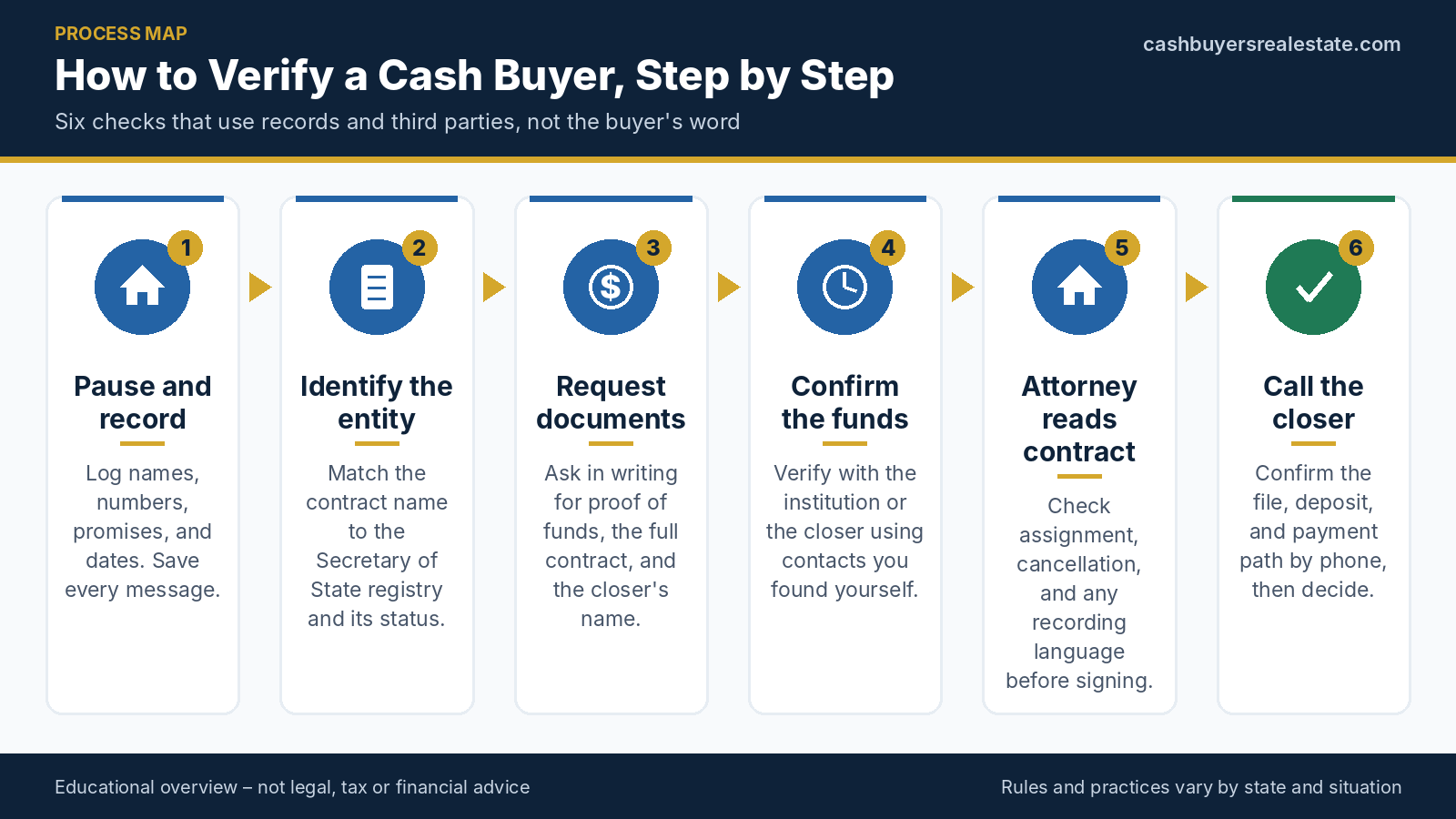
Text version of this infographic
- Pause and record — Log names, numbers, promises, and dates. Save every message.
- Identify the entity — Match the contract name to the Secretary of State registry and its status.
- Request documents — Ask in writing for proof of funds, the full contract, and the closer's name.
- Confirm the funds — Verify with the institution or the closer using contacts you found yourself.
- Attorney reads contract — Check assignment, cancellation, and any recording language before signing.
- Call the closer — Confirm the file, deposit, and payment path by phone, then decide.
Entity, License, and Regulatory Checks: What the Public Record Can Tell You
Public records are the most underused tool in a seller’s kit. They’re free or cheap, they’re maintained by government offices rather than by the buyer, and they answer basic questions that a mailer or website can’t: whether a company exists, how long it has existed, who is responsible for it, and whether a regulator has anything to say about it. This section covers the records worth checking, the licenses that matter and the many that don’t, and the growing set of state laws that apply specifically to the kind of buyer who contracts to buy a house and then resells the contract.
Confirming That the Buyer Exists on Paper
Every business that is organized as a corporation or limited liability company has to register with a state, and that registration leaves a public trail. An individual buying in their own name leaves a thinner trail, though property records and court records still tell you something. The purpose of this check is narrow and modest: to confirm that the party who will sign the contract is the party you think it is, and that nothing about its basic existence contradicts what you have been told.
Secretary of State records, assumed names, and registered agents
Start with the name on the draft contract, not the name on the marketing. Most states operate a free online business entity search, usually run by the Secretary of State or an equivalent office, where you can type the exact name and see whether the entity is active, when it was formed, what kind of entity it is, and who its registered agent is. The registered agent is a person or service designated to receive legal papers, and a professional registered-agent service is common and not suspicious. Pay closer attention to the status. Terms such as “active” and “in good standing” are reassuring; “inactive,” “dissolved,” or “administratively revoked” mean the entity may not have the legal ability to do business, and a contract signed in its name may not bind anyone you can collect from.
Marketing names are a separate layer. Many investors operate under an assumed name, sometimes called a DBA or “doing business as,” that differs from the registered company. Assumed-name filings are made with the state or, in some places, the county, and a search often links the brand to the legal entity behind it. If you cannot connect the name on the postcard to any registered entity, ask the buyer to explain the relationship in writing. A legitimate investor can usually say, “The brand is a trade name of this LLC, which is the purchasing entity.” If the answer involves a company registered in a different state, remember that out-of-state entities doing business locally typically must also register as foreign entities in the state where they operate, so check both registries when the names do not line up.
Small naming details deserve attention, because they are where mismatches hide. “Smith Home Solutions LLC” and “Smith Home Solutions Inc.” can be two different entities, and a contract signed by one does not bind the other. Compare the punctuation, the entity type, and the state of formation on every document you receive. If you need firmer assurance, ask the buyer for a certificate of good standing, which many states issue for a modest fee, or simply print the registry page on the day you review the contract and again a day or two before closing. Entities can fall out of good standing for something as ordinary as a missed annual report, and a quick second look catches that before it matters.
Addresses, officers, and the “new LLC” question
Look at the address on the registration and on the contract. A street address that turns out to be a residential apartment, a vacant lot, or a shared mailbox store isn’t proof of anything, since many small investors work from home offices and use virtual addresses. But a business that claims a large local presence and lists no physical address anywhere deserves a follow-up question. Some states list officers, managers, or members in the public filing, and some do not; when names are listed, you can search them to see whether the same people appear on other entities, in news coverage, or in court records. Where the filing lists only a registered agent, that is usually a feature of state privacy practice and not a signal about the buyer.
The most common worry is the brand-new LLC. A company formed three weeks ago can seem suspect, but in the investing world it is routine to create a separate entity for each project or each purchase to isolate liability. A new entity is therefore a reason to look at who is behind it, not a reason to refuse it. Ask for the sponsor’s track record, ask whether a parent company or individual will guarantee the contract, and ask the title company how many transactions the buyer has closed with them. If the entity is new and the people behind it are anonymous and the proof of funds is a screenshot, the three facts together form a pattern. Each alone is ordinary.
Licenses, Registrations, and the Laws Aimed at Wholesalers
Sellers often ask whether a cash buyer is “licensed,” as though a single credential existed. It does not. Whether a license applies depends on what the buyer is doing, where, and in whose name, and the absence of a license is as often innocent as it is revealing.
Which licenses matter: real estate, mortgage, contractor, and none at all
A person or company buying a house for its own account generally doesn’t need a real estate license in most states, because the license rules are aimed at people who negotiate transactions for others for a fee. That is why many flippers and rental investors hold no license at all and are doing nothing wrong. Licensing questions become sharper when someone is marketing properties they don’t own, arranging sales between third parties, or acting as the middleman for a fee. Rules on that point vary significantly by state, and some states have recently moved to require either a license or a specific registration for wholesalers. If the buyer is licensed as a real estate agent or broker, the state real estate commission or agency usually provides a free online lookup, and the ARELLO organization, which represents license regulators, advertises a license verification service for consumers.
Mortgage licensing is a separate category and matters only if the buyer offers to finance part of the deal, for example by proposing seller financing, a lease with an option to buy, or a note that the buyer will pay off later. In those cases, the Nationwide Multistate Licensing System, known as NMLS, runs a Consumer Access search that lets you look up licensed mortgage companies and loan originators and see in which states they hold licenses. A pure cash investor will not appear there, and not appearing is not a warning sign. Contractor licensing, for its part, matters if the buyer says they will do repair work as a condition of the deal, since many states require contractor licenses for substantial work. The sensible rule is to ask what role the buyer plays, then check the credential that role would require, rather than hunting for a universal seal of approval.
State wholesaler laws: disclosure, registration, and cancellation rights
The fastest-moving area of law for cash buyers is wholesaling, the practice of signing a contract to buy a house and selling the contract, or the right to buy, to another investor for a fee. Wholesaling is not banned in any state, according to news reporting from early October 2026, but at least fifteen states have recently approved regulations aimed at it. Some require written disclosures to sellers, some require licenses or registration, and some do both. For a seller, the practical effect is that the buyer may owe you information and a cancellation window.
Two state examples show how the rules tend to work. Oregon, under House Bill 4058, requires people who wholesale residential property and aren’t licensed brokers to register with the Oregon Real Estate Agency, effective July 1, 2025. The wholesaler must give buyers and sellers a written disclosure, in bold type of at least ten points, before they contract, stating among other things that the wholesaler lacks legal title and may assign the equitable interest for profit. Sellers can cancel without penalty by written notice up to midnight at the end of the third business day after receiving the disclosure, and the right cannot be waived. Oklahoma’s Senate Bill 1075, effective November 1, 2025, requires written notice before signing that the wholesaler intends to sell their interest for more than the homeowner is being offered, a statement advising the owner to get legal advice, and a two-business-day right to cancel; contracts missing the required disclosures are unenforceable by the wholesaler and the owner may terminate at any time. The Oregon Real Estate Agency’s wholesaling overview is a useful example of a regulator explaining the rule in plain terms.
Other states have chosen different routes. News reports in October 2026 described Illinois, South Carolina, and Rhode Island as requiring many wholesalers to hold real estate licenses, and several other states, including Maryland, Ohio, Texas, and Missouri, as requiring disclosures to sellers. The AARP has also published a model act in 2026 that would call for licensing and insurance, an independent appraisal paid for by the wholesaler, a right for homeowners to cancel until the deed is transferred, and limits on repeated calls and messages. A model act is a proposal, not law, so treat it as evidence of where consumer-protection thinking is headed. Because the details are changing quickly, the best practice is to ask your state’s real estate commission or a local real estate attorney what applies today. A buyer who has already complied will be glad to show you the disclosure form.
| Source | What it can show | Effort and cost | Limit to keep in mind |
|---|---|---|---|
| State business entity search (Secretary of State or equivalent) | Existence, formation date, status, registered agent, sometimes officers | Online; searching is often free, copies may carry a fee | Says nothing about funds or conduct |
| Assumed-name (DBA) filings | Link between a brand and its legal entity | State or county office; varies | Not every brand is filed or searchable |
| State real estate commission license lookup | Whether a person or firm holds an active license and any discipline | Online, free | Many lawful investors hold no license |
| State wholesaler registration, where one exists | Whether a wholesaler has registered under a state program | Varies by state | Exists only in some states |
| NMLS Consumer Access | Licensed mortgage companies and loan originators and their state licenses | Online, free | Relevant only if financing is offered |
| County recorder or assessor | Deeds, mortgages, liens, and recorded notices on the property and under the buyer’s name | Online in many counties, counter service in others | Index quality and search tools differ widely |
| Court dockets | Lawsuits involving the buyer or entity, as plaintiff or defendant | State and federal portals; some fees | Absence of a case is not a clean bill of health |
| State attorney general consumer office | Complaint channels and, in some states, public complaint information | Online or by phone | Complaint counts are not verdicts |
Use the table as a menu rather than a requirement. Few sellers need every row, and the right combination depends on what you’ve been told and what worries you. Entity and license checks are the cheapest and quickest, so do them first; county records and court dockets take longer but reveal track record; and the attorney general’s office is the place to ask whether complaints exist and how to file one. Treat each result as one data point. A missing license in a state where none is required, or a dissolved entity that was simply never renewed, can have a harmless explanation. The important thing is that you ask the buyer about whatever you find and judge the quality of the answer.
Track Records, Reviews, and Reputation: Reading the Signals Without Being Fooled
Once you know a buyer exists, the next question is whether the buyer has done what they claim to do, and done it reasonably well. Reputation is the evidence for that question. It comes in two forms: the buyer’s own history, which can sometimes be reconstructed from public records, and what other people say about them, which has to be read with some skepticism. Neither form is conclusive on its own, but together they separate buyers with a long, checkable history from buyers whose entire presence is a website and a phone number.
What a Buyer’s Own Record Reveals
The most reliable evidence of a buyer’s track record is not what the buyer says but what the county recorder’s office shows. Property transactions are public in nearly every county, and the index of recorded documents can be searched by name in many places. The search takes some patience, and the results need interpretation, but it can answer in minutes a question a marketing page might dodge for weeks: has this entity actually bought houses here?
County deed history: how many houses has this buyer actually bought?
Most county recorder or register of deeds offices maintain an index where you can search for documents by the name of a grantor (the person transferring) or grantee (the person receiving). Searching the buyer’s entity name as a grantee shows the deeds that transferred property to it, usually with dates, and sometimes the recorded price or the amount of transfer tax paid, depending on state. A buyer who claims to have purchased hundreds of homes in your area but appears on only two recorded deeds invites a follow-up question. A buyer who shows steady purchases over several years, followed by later sales out of the same entity or related ones, looks like the active renovator or landlord they claim to be. Counties differ in how searchable their records are, so some searches require a visit or a call to the clerk’s office, and some charge small fees for copies.
Interpret the findings with care, because the record has gaps that can mislead in either direction. Wholesalers who assign their contracts before closing often never appear on a deed at all, since the end buyer takes title directly, so a wholesaler’s history may be nearly invisible in the index even if they’re busy. Investors who buy through a different entity each time are harder to trace, and entities that hold properties for years show a thin sale history by design. In the other direction, a busy deed record shows only that a buyer completes purchases, not that sellers were treated well. The record answers the question of existence and volume. It leaves open fairness, which is why it is only the first half of the reputational picture.
Timing in the record is worth reading as well. When an entity buys and then sells the same property within a few months, the gap between the dates suggests how long the buyer typically holds a house, and a very short hold with no visible improvement can mean a quick resale of a contract, not a renovation. Assessor records sometimes show building permits or changes in assessed value that confirm real work was done. None of this proves how a buyer treats sellers, and recording lags mean that the most recent transactions may not yet appear. But a pattern of purchases that fits the story the buyer tells is reassuring, and a pattern that contradicts it is a precise, factual question to put to them.
References from past sellers and professionals
The second way to learn a buyer’s record is to talk to people who have dealt with them. It’s reasonable to ask a buyer for the names of a few recent sellers who will talk to you, and a seasoned investor often has some, or can put you in touch with a title company or closing attorney who has handled their files. Be aware that anything the buyer hands over is a curated sample, so the references will naturally be the satisfied ones. They are still useful, because a buyer who cannot produce one willing reference after years in business has told you something, and because a reference who describes the experience in specific terms is more informative than a glowing star rating.
Questions that bring out useful detail are concrete ones. Did the price change between the first offer and the closing? Did the closing date hold? Who held the deposit? Did the buyer pay the costs they said they would? Were there surprises in the paperwork? You can also ask the closer, the title company, or a local real estate attorney about general experience with the buyer, though professionals are often careful about discussing clients and may simply say whether the name is familiar. A neutral and careful answer such as “they close regularly with us and funds have arrived as scheduled” is valuable precisely because it is modest and checkable. Be wary of references who all sound alike or who are reachable only through the buyer.
Illustrative example (hypothetical numbers, not market data): A homeowner in a mid-sized county searches the grantee index for an LLC that has just offered to buy her late father’s bungalow. The search returns eleven deeds into the LLC over three years, followed by nine deeds out of it to individual buyers within about five to seven months of each purchase, which fits a renovate-and-resell pattern. She asks the buyer for two recent sellers’ contact details and gets one phone number and the name of a title company. The seller she reaches says closing took about three weeks, the price did not change, and the buyer had asked for a few extra days on one occasion. The picture is modest and useful: a functioning business with a normal pattern, not a promise of a good price.
Online Reviews, Ratings, and Local-Versus-National Questions
Online reviews are the evidence most sellers reach for first, and they are also the evidence most open to manipulation. They are worth reading, but the way they are read matters more than the star count, and the structure of the business behind the website matters as much as the reviews.
How to read reviews: patterns, fake praise, and silence
A useful review is specific. It names a stage of the process, a timeframe, or a detail that only someone who had gone through the sale would know. A cluster of five-star reviews with generic phrasing, posted within a few days of one another, tells you less than three plain reviews that describe what actually happened. Read the critical reviews especially closely, not for the existence of complaints, which any busy business will collect, but for what the complaints are about and how the business responded. Complaints about slow communication or a lower-than-hoped price are ordinary. Complaints about a changed price after signing, a deposit that was not returned, a closer who could not be reached, or a recorded document that clouded title describe the harm this guide is meant to help you avoid.
Several features of the review landscape deserve skepticism. Reviews can be solicited from satisfied customers only, bought, or posted by the business itself, and platforms differ in how aggressively they filter. A complete lack of reviews is a weak signal: some honest investors work almost entirely through referrals and word of mouth. A business with a high rating built on a small number of reviews is also a weak signal. State attorney general offices and, in some cases, local consumer protection offices can tell you whether complaints are on file, and a quick search of court records may turn up lawsuits that no review mentions. The best use of reviews is as a source of questions to ask the buyer, not as a verdict.
Local buyers, national brands, and websites that are not buyers at all
It also helps to understand who stands behind the name you are dealing with. Some cash buyers are local individuals or small companies that fund purchases with their own money or a regular lender and close using a title company they know. Some are regional or national companies that operate in many markets with standardized processes. Some are networks in which independent investors license a brand and operate under it. And a surprising number of websites with confident “sell your house fast” messaging are not buyers at all but lead generators, businesses that collect your information and sell or pass it to investors who may bid on your property. The page that asks for your address may belong to a different company than the one that calls you the next day.
None of these structures is illegitimate, but each changes the questions you should ask. With a local buyer, you’d want to know their purchase history in the county and where their funds come from. With a national company, ask who actually signs and funds the deal, and whether the contract is with a local subsidiary. With a lead-generation site, ask directly whether the company buys houses itself or passes inquiries on, and who will receive your information. The guide on local cash buyers versus national companies compares the models, and the page on how “we buy” marketing works explains the advertising language. Legitimacy is also not the same as favorable pricing even for the largest and best-known companies: in April 2024 the Federal Trade Commission announced refunds of nearly $62 million to sellers who it said had been misled by an online instant-offer company’s claims that they would earn more and pay less than they would in a traditional sale. The lesson isn’t that big companies are bad but that every claim about savings deserves to be tested against your own numbers.
| Signal | Stronger version | Weaker version | How to test it |
|---|---|---|---|
| Purchase history | Years of recorded deeds into the entity in your county | “We’ve done hundreds of deals” with nothing to point to | Search the recorder’s grantee index by exact entity name |
| Past sellers | Named people who will take a call and describe specific details | Quotes on a website with first names only | Call two references and ask about price changes and timing |
| Closing professionals | A title company or attorney who confirms regular, uneventful closings | A closer the buyer chose last week | Call the closer on an independently found number |
| Online reviews | Detailed accounts across several platforms, including balanced critical ones | Generic praise posted in bursts | Read the lowest ratings first and look for repeated themes |
| Complaint records | None on file with your state attorney general, or resolved with explanations | Repeated complaints of the same kind | Ask the attorney general’s consumer office; search court records |
| Business structure | Buyer states plainly whether it funds deals itself or assigns | Evasive about who actually buys and who receives your data | Ask in writing: “Will your company be the buyer on the contract?” |
The table is deliberately ordered so that the harder-to-fake signals come first. A recorded deed history and a closing professional who answers the phone are difficult to counterfeit, while a polished website and a handful of effusive reviews are cheap to produce. If you have only limited time, put it into the first, second, and third rows. Whatever you learn, write it down alongside the earlier notes about the buyer. You’re building a file, and a file that is consistent across many sources is a strong basis for trust, while a file with unexplained contradictions is a good basis for a polite delay.
Proof of Funds: What Genuine Documentation Looks Like and How It Gets Faked
The phrase “cash buyer” is a promise about money, and proof of funds is how that promise is tested. It is also the document most often misunderstood by both sides. Sellers sometimes treat any official-looking letter as conclusive, and buyers sometimes treat a request for one as an insult. In practice, proof of funds is a routine part of a serious purchase, and the quality of what a buyer supplies, and how they react when you check it, is among the best predictors of whether the deal will actually close. The sibling guides on what a proof-of-funds document should show and how cash buyers document their funds go deeper on format; this section concentrates on authenticity and on what no document can promise.
What Genuine Proof of Funds Looks Like
There is no single legally mandated form. What a seller is looking for is evidence that the person or entity on the contract controls enough readily available money to complete the purchase, and that the evidence can be confirmed by someone other than the buyer. The more of those qualities a document has, the more weight it deserves.
Bank letters, statements, and what a closer can confirm
The most common form of proof is a letter or recent statement from a bank or brokerage. A useful one carries the institution’s name and letterhead, is dated within the last few days or weeks, names the account holder in a way that matches the buyer on the contract, and states a balance or an amount of available funds at least equal to the purchase price plus closing costs. Account numbers are commonly masked, and that is an ordinary privacy measure and no cause for alarm. What should not be masked are the account holder’s name, the institution, the date, and the balance, because those are the elements that make the document meaningful. A statement with the name blacked out is a document about somebody, but you cannot tell whom.
A seller usually cannot call a bank and ask for another person’s balance, since privacy rules prevent the bank from sharing it. The practical solution is to route verification through a party who can ask the right way. A title company or closing attorney can request confirmation as a normal part of preparing a closing, and a buyer who wants to close has every reason to authorize it. Some buyers instead place the purchase funds, or a substantial deposit, with the title company early, which is stronger evidence than any letter because a neutral party is holding the money. Others obtain a letter from their attorney or from an escrow officer stating that funds are on deposit. Each of these shifts the burden of confirmation away from the seller and onto the professionals whose business is to confirm such things, which is where the burden belongs.
The amount shown should be read against the whole transaction. A letter showing funds equal to the purchase price alone may not cover closing costs, repairs the buyer plans to make, or a second purchase the buyer has under contract at the same time. Ask whether the funds are committed to other deals, and ask for the document to be refreshed within a few days of the closing date, since a balance that was real three weeks earlier may be spent by then. Funds that have been in an account for some time are generally more reassuring than a large deposit that appeared the day before the document was produced, though a sudden deposit can have an innocent explanation such as the sale of another property.
Lines of credit, hard money, partners, and funds that are not cash in the bank
Not every legitimate buyer holds the purchase price in a checking account, and a document showing something else isn’t necessarily a problem. Investors commonly fund purchases with lines of credit, short-term loans from private or “hard money” lenders, or capital contributed by partners. A buyer using those sources can be entirely honest and entirely able to close, and many offers described as “cash” are cash from the seller’s point of view only: no mortgage-style underwriting of the buyer, no appraisal contingency, no loan approval hanging over the closing. The relevant question is whether the committed source of funds is real, whether it is available for this property, and whether any condition could pull it away at the last minute.
A hard-money commitment, for example, may depend on an appraisal or on the lender’s review of the property. A line of credit may be drawn on a schedule or have a limit that other deals have already consumed. A partner’s capital may be real and still not yet transferred. A buyer who tells you that funds come from a line of credit or a lender is giving you useful information, and you can ask whether the commitment has any conditions and how long the funding takes. In a wholesale arrangement, the money that ultimately closes your sale will come from the end buyer, not from the wholesaler on your contract, so the proof you need is arguably the end buyer’s, and you may not be able to see it until an assignment is signed. Understand which situation you are in before you treat a document as a guarantee of anything.
Fake and Misleading Proof of Funds, and How to Test It
Documents are easy to edit, and an authentic-looking letter costs little to produce. Fraud involving proof of funds takes several forms, some deliberately deceptive and some merely misleading, and the common thread is that the paper looks like evidence while saying little about what the buyer can actually do.
How documents get faked, borrowed, or stretched
The simplest fabrication is an edited statement: a real document with a balance, name, or date altered using an ordinary PDF editor, or a screenshot of an online banking page that can be adjusted in a browser. A second pattern uses genuine documents that belong to someone else, for instance a statement from a family member, an employer, or a business account the buyer does not control. A third relies on legitimate but temporary circumstances, such as money moved into an account for a day to produce a balance and withdrawn afterward, or funds that are borrowed on a short-term basis. A fourth is the purchased “proof of funds letter” from an intermediary that does not itself hold the money and simply states that a client has access to funds, which says nothing a bank would stand behind.
Misleading is a different category from fake, and it covers a lot of real-world friction. A document may be completely authentic and still not show what the seller assumes: a pre-approval letter for a mortgage is not proof of cash; a statement showing a large balance in a retirement account may be subject to withdrawal penalties and timing limits; a letter of intent from a lender is not a funding commitment. Sellers who accept the wrong kind of document are rarely the victims of forgery, they are the victims of a mismatch between what the paper proved and what they believed it proved. The remedy is to ask what the document is, what it commits, who stands behind it, and what could stop the money from arriving on closing day.
A practical authentication routine
Authenticating proof of funds does not require forensic skill. Begin by checking internal consistency: does the name on the document match the entity on the contract exactly, is the date recent, does the institution’s name and formatting look right, and are there obvious signs of editing such as mismatched fonts or misaligned numbers? Then verify externally. Look up the institution’s phone number from its own website or from the back of a bank card, not from the document, and ask whether it issues letters of this kind and how a recipient can confirm one. Many banks have a department that handles verification requests and will confirm only with the account holder’s written authorization, which is why the closer is the efficient route.
Finally, ask the title company or closing attorney to confirm the funds as part of their process, and pay attention to the timing. The strongest confirmation comes close to closing, when funds have actually been wired to the closing office, and the right protective step is to confirm receipt before you sign a deed or release anything. Between contract and closing, a seller can ask for a refreshed document a few days before the closing date. Keep one safety point in mind: never agree to send money, cash a check, or forward funds to “verify” anything. Genuine buyers do not need a seller’s money to demonstrate their own, and the Federal Trade Commission explains that fake checks can look real and may take weeks to be discovered even after the bank makes the funds available, by which time any money you sent is gone.
| Document | What it shows | What it does not show | Stronger alternative |
|---|---|---|---|
| Recent bank or brokerage statement | A balance on a past date in a named account | That the funds are still there, or that the account holder is the buyer | Closer confirms funds directly, or funds placed with the title company |
| Bank letter on letterhead | An institution’s statement of available funds as of a date | That the letter is genuine until checked; whether funds stay available | Call the bank’s verification department using an independently found number |
| Screenshot of an online account | An image that looks like a balance | Almost anything; images are easy to alter | Official statement or letter confirmed with the institution |
| Line-of-credit or lender commitment letter | That credit or financing has been offered | That conditions are satisfied or the limit is unused | Ask for conditions in writing and a lender contact |
| Letter from an attorney or escrow officer | A professional’s statement that funds are on deposit | The attorney’s authority or the funds’ availability if unverified | Check the professional’s license and call their office |
| Funds already deposited with the title or escrow company | That a neutral party actually holds money for this deal | Whether the full price is covered, if only a deposit | Written receipt from the closer for the deposit amount |
Read the table by asking, for each document, who stands behind it. A statement stands behind nobody except the person who holds the account, a bank letter stands behind the bank only if the letter is genuine, and a deposit with a neutral closer stands behind itself because the closer holds the money. The further down the table you go, the less you rely on the buyer’s honesty and the more you rely on structures that work regardless of honesty. That is the logic behind most of the protections in a well-run closing, and it is the reason neutral third parties are such a consistent theme in this guide.
Illustrative example (hypothetical numbers, not market data): A buyer offers $142,000 for a small brick house and sends a bank statement showing $318,000 in a checking account. The statement is genuine, but the account is in the name of a different company, which the buyer explains is a related entity. The seller asks the title company to confirm. The closer replies that the related entity can wire funds but that the buyer’s own company, which is the one on the contract, would need the transfer to be documented, and suggests a short letter from the buyer’s attorney. Five days later the closer reports receiving a $10,000 deposit and a signed authorization allowing verification of the related account. The seller’s confidence is now based on a neutral party’s report rather than on the original statement, which was authentic but did not answer the question.
Contract Traps: Where Legitimacy Is Actually Decided
A buyer’s identity, funds, and reputation all matter, but the contract is where those qualities turn into enforceable obligations. Two buyers with equally good credentials can hand you documents that differ enormously in how much risk each places on you. A legitimate, well-funded, honest buyer can still use a contract that is lopsided in the buyer’s favor, because that is what the buyer’s template says and nobody has objected. This section goes through the provisions that most often shift risk to the seller, the recording tactics that can lock a property up, and the habits of reading that prevent most of the trouble. For a complementary checklist built around specific clauses, the page on cash offer contract red flags is a good companion, and the overview of the anatomy of a cash purchase contract shows what a balanced document includes.
Clauses That Shift Risk From the Buyer to You
Contracts distribute risk, and the distribution is negotiable. Many sellers assume a printed form is fixed, when in practice most cash buyers will adjust terms they are asked about, especially when the request is reasonable and specific. The first step is knowing which terms carry the most weight.
Assignment rights and the disclosure that should come with them
An assignment clause allows the buyer to transfer the contract to someone else, who then closes in the buyer’s place. It often appears as the innocuous-looking phrase “and/or assigns” after the buyer’s name. Assignment is not wrongdoing in itself; it is a normal feature of real estate contracts, and an investor who brings in a partner or a related entity may use it for entirely ordinary reasons. The issue is that wholesalers use assignment as their business model: they contract with you at one price and assign to an end buyer at a higher price, keeping the difference, without ever intending to own the house. If you do not know this is happening, you may sell for less than someone else would have paid, and you may be depending on a buyer you have never met to find the money.
The fix is knowledge, and in some states it is also law. Where wholesaler statutes apply, as in Oregon and Oklahoma, the wholesaler has to disclose the intention to assign before you sign, in writing, and you have a statutory right to cancel for a short period. Where no such statute applies, you can still ask directly: “Do you intend to close on this contract yourself, or may you assign it to another buyer?” You can then negotiate accordingly, for example by limiting assignment to related entities, requiring the original buyer to remain responsible for performance, or requiring that you be told the identity of the end buyer and given proof of that buyer’s funds. A buyer who dislikes those conditions is telling you something about the plan. A buyer who agrees has given you protections and, often, a more honest deal.
It is worth separating the fee from the failure to disclose. A wholesaler who earns an assignment fee has done nothing wrong merely by earning it; the seller agreed to a price, received it, and the buyer’s profit came from finding a higher-paying purchaser. The complaint arises when the seller was led to believe the buyer would renovate or hold the property, when marketing implied the buyer was the end purchaser, or when statements about price were misleading. Whether that conduct gives the seller a legal claim depends on the facts, the contract, and the state, which is a question for an attorney. The practical point is that an informed seller can decide whether the convenience is worth the likely difference.
One-sided cancellation, extended due diligence, and penalties for changing your mind
The second major category is the set of provisions that decide who can walk away and what it costs. A balanced contract gives each side defined exits tied to defined events: a buyer may terminate if an inspection reveals serious defects or title can’t be cleared, and a seller may terminate if the buyer fails to deposit funds or close on time. A one-sided contract gives the buyer broad rights to cancel for any reason during a long period, often called a due diligence or inspection period, with the earnest money returned in full, while the seller has no corresponding right and may owe a penalty for backing out. The buyer in effect holds a free option on your house for the length of that period, and options normally have a price.
Read the dates carefully. A 60-day inspection period for a house that a buyer says needs a one-hour walk-through is unusually long, and you are entitled to ask why. Look for clauses that let the buyer extend the closing date at will, because an open-ended extension turns “closing in three weeks” into “closing sometime.” Look for liquidated damages provisions, which set a fixed sum you must pay if you cancel, and for attorney’s fee provisions that apply only to the buyer. Watch for language that makes the buyer’s deposit refundable under almost any circumstances while treating yours as a promise to sell. None of these terms is automatically improper, but each is worth pricing. If a clause gives the buyer an option, ask for a higher price, a nonrefundable option fee, or a shorter window in exchange.
Recorded Memoranda, Options, and Agreements That Tie Up the Property
The most damaging contract problems are those that survive even after the sale does not go forward. A contract that can be canceled is a nuisance. A document that remains on the public record against your property can be a serious obstacle, because it may be visible to every future buyer, lender, and title company.
Memoranda of contract, options, and listing agreements
A memorandum of contract, sometimes called a memorandum of agreement or a notice of interest, is a short document that summarizes a purchase agreement and is recorded in the county land records. Its legitimate purpose is to give public notice that a buyer has a claim on the property, which can protect a buyer against a seller who sells to someone else in the meantime. Recording is common in some kinds of transactions and rare in simple house sales. For a seller it carries a real consequence: while the memorandum sits in the records, a title company will generally want it released or resolved before it will insure a sale to anyone else, so a buyer who records and then does not close can leave you unable to sell until the document is removed. A broker interviewed by a public radio station in Florida in 2025 described exactly this concern, saying that owners who tried to back out of such contracts could find filings that clouded title and made another sale hard unless the buyer agreed to lift them.
The legal details differ by state and are not something a general article can settle. In some places the law limits when a notice can be recorded, in some a contract can bar recording, and the remedy for an improper filing may be a demand letter, a release negotiated through an attorney, or a court action. The practical protection is simple. Do not sign any document that authorizes the buyer to record something against your property unless an attorney in your state has explained exactly what it does and how it is released if the deal falls through. The same goes for options, which give the buyer the right to buy at a set price for a set period, and for listing agreements signed with a buyer who is also a licensed agent or broker, which can obligate you to pay a commission if the property sells to anyone. These documents are not necessarily improper; they are significant, and they deserve a lawyer’s attention before a signature.
Blank spaces, signatures, and the mechanics of reading what you are signing
Most contract disasters begin with an ordinary-seeming moment of convenience: a document sent for electronic signature on a phone, a form with the price filled in and the rest left “to be completed,” a signature page presented at the kitchen table separately from the pages it belongs to. A complete agreement is one in which every blank is filled or struck through before you sign, in which you can see the whole document at once, and in which you keep a full copy. Never sign a document with blanks, and never sign a signature page separated from the terms. The FBI and other agencies have warned for years that the other half of a real estate fraud, the redirected payment, relies on speed and informality, and the same is true of contract problems.
When you read, go through a short list of items on purpose. Confirm that the parties’ names and the property description are right, that the price is stated clearly in numbers and words, that the closing date or window is firm and the consequences of delay are stated, and that the contract says who pays which costs, including transfer taxes, title insurance, and recording fees. Check how the contract treats the condition of the property, since an “as is” provision describes how the buyer takes the house and doesn’t relieve you of disclosure duties that your state imposes. Find the provisions on default, deposits, and who can cancel when. Look for an “entire agreement” clause and make sure that anything promised verbally, such as paying your closing costs, appears in the writing, because a promise that isn’t in the document can be hard to enforce. The sibling article on who pays closing costs in a cash sale explains how to confirm that promise.
| Provision | Why it matters to a seller | Question to ask | Possible adjustment |
|---|---|---|---|
| “And/or assigns” or explicit assignment clause | Buyer may resell the contract; end buyer may differ in funds and reliability | Will you close yourself, or assign? To whom? | Limit to affiliates, keep original buyer liable, disclose end buyer |
| Long due diligence period with free exit | Buyer holds an option while your house is off the market | Why this length, and what will you do in that time? | Shorten the period, require a nonrefundable option fee |
| Penalty or fee if the seller cancels | Cost of changing your mind may be fixed and high | What is the amount, and does the buyer owe the same? | Make remedies mutual or cap them |
| Buyer’s right to extend closing | Closing date may drift indefinitely | How many extensions, for how long, and at what cost? | Fix a final outside date; charge a fee per extension |
| Authority to record a memorandum or notice | Public record may cloud title if the deal fails | Is recording required, and how is it released? | Delete the clause or require a prepared release held by the closer |
| Earnest money held by the buyer or an individual | Deposit may not be protected or recoverable | Who holds it, in what kind of account? | Require a neutral title company, escrow office, or attorney trust account |
| Vague or oral promises on costs | Promised payment of costs may not be enforceable | Where in the document does it say that? | Write each cost allocation into the contract |
| Open blanks or separate signature pages | Terms could be completed later without your review | Can I see the completed document in full? | Sign only complete documents; keep a full copy |
The point of this table is not to suggest that every contract with one of these provisions is a trap. It is a map of the places where a short conversation changes the outcome. For each row, the question column is something you can ask without hostility, and the adjustment column is a reasonable proposal rather than a demand. Buyers who accept some adjustments and decline others are showing you where their real priorities lie. Buyers who refuse every change and insist that you sign the form as written are making a point about how they plan to treat a problem later.
Illustrative example (hypothetical numbers, not market data): A homeowner signs a contract to sell her house for $131,000 to a company that never mentions assignment. The contract contains the standard “and/or assigns” wording, and the company quickly lists the contract with its own buyers’ list at $149,000. An end buyer steps in and, after a few weeks, the closing proceeds at $131,000 to her and an $18,000 assignment fee to the original company. Nothing illegal has occurred in a state without a wholesaler statute, and she receives the price she agreed to. But if she had asked the question in advance, she might have negotiated a higher price, asked for a share of the fee, or chosen to list the house. The lesson is about information: the contract she signed was legitimate, and the missed opportunity was in not knowing what it allowed.
Because the same contract language carries different weight depending on who is buying, it helps to see the routes side by side before moving on to deposits and closings. A renovator who funds the purchase and plans to repair the house usually brings the most certainty about who will close, though the price reflects repair risk. A landlord or rental investor may pay somewhat more for a house that rents well but will scrutinize condition and tenant status. A wholesaler who intends to assign offers speed and flexibility but adds the dependency on an end buyer and, in some states, a mandatory disclosure and cancellation window. An online instant-offer company offers a streamlined process but usually builds service fees and its own margin into the numbers, so the advertised figure is not the figure you take home. A conventional listing with an agent usually asks the most of your time and carries the most uncertainty about timing, and in exchange exposes the house to the widest group of buyers. The comparison below sets these five routes next to one another.
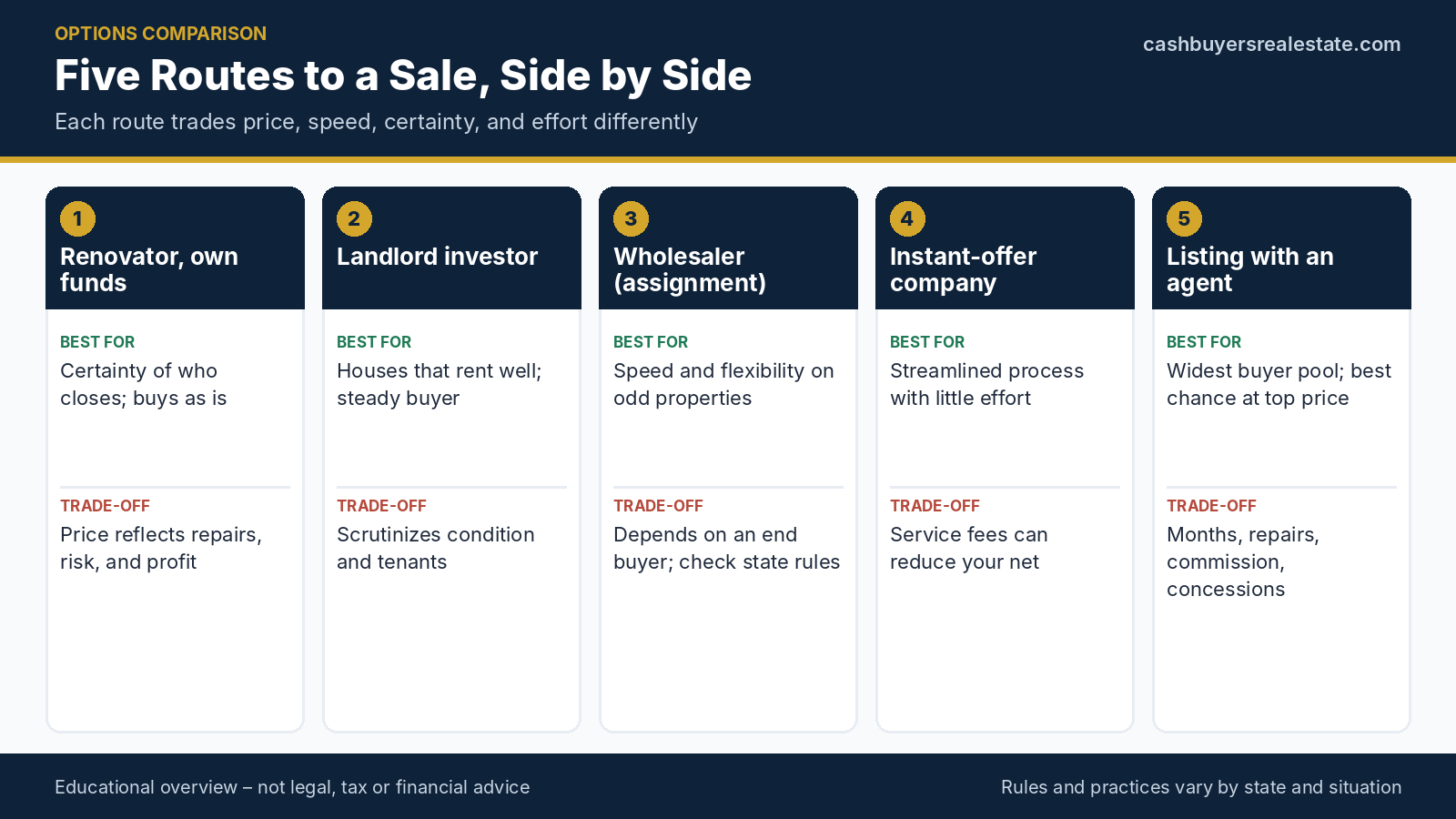
Text version of this infographic
- Renovator, own funds — Best for: Certainty of who closes; buys as is. Trade-off: Price reflects repairs, risk, and profit.
- Landlord investor — Best for: Houses that rent well; steady buyer. Trade-off: Scrutinizes condition and tenants.
- Wholesaler (assignment) — Best for: Speed and flexibility on odd properties. Trade-off: Depends on an end buyer; check state rules.
- Instant-offer company — Best for: Streamlined process with little effort. Trade-off: Service fees can reduce your net.
- Listing with an agent — Best for: Widest buyer pool; best chance at top price. Trade-off: Months, repairs, commission, concessions.
Earnest Money, Price Re-Trades, and Bait-and-Switch Offers
Many sellers who feel cheated by a cash buyer never lose a dollar to a thief. What happens is quieter: a deposit that turns out to protect the buyer more than the seller, or a price that shrinks after the seller has already made plans around the first number. These patterns are common enough that sellers should expect to meet them at least in mild form. Understanding how they work makes them much easier to handle, whether the buyer is acting in bad faith or is simply negotiating hard from a position of strength.
Earnest Money: Where It Sits and What Can Go Wrong
Earnest money is a deposit a buyer puts down to show commitment. In a financed sale it’s a familiar part of the process, and in a cash sale it plays the same role with fewer outside checks around it, because no lender is looking over the buyer’s shoulder. That makes the details of who holds the money and under what conditions it can be returned more important, not less. For a broader treatment of deposits with cash purchasers, see the guide to earnest money in a cash sale.
Neutral holders and written receipts
The basic protection is a neutral holder. A deposit held by a title company, an escrow company, or an attorney’s trust account is subject to the holder’s professional and legal obligations, and the holder will generally release it only according to the contract or on written instructions from both sides, or by court order. A deposit held by the buyer, by a friend of the buyer, or by an individual with no fiduciary duties is simply a promise. Local practice differs: in some parts of the country title or escrow companies hold deposits routinely, and in some states an attorney conducts the closing and holds funds in a trust account, so asking “who holds it, and in what kind of account?” is the right question in either setting. Some state wholesaler laws now address this specifically; Oklahoma’s, for example, requires earnest money to be held in an Oklahoma escrow account at a federally insured institution.
A deposit is only evidence of commitment if you can confirm it exists. Ask the holder, not the buyer, for written confirmation that the deposit has been received, the amount, and the date. An email from the buyer saying “the deposit has been sent” confirms nothing. Confirmation from a title company that you reached by an independently found number confirms a great deal. Also read the contract for the conditions under which the deposit is refundable. Many cash contracts make the deposit fully refundable during the buyer’s inspection period, which means it does not protect the seller during that time, and some set a nominal amount, a few hundred dollars on a house worth many times that. A small, refundable deposit is not a sign of bad faith. It’s a signal about how much risk the buyer is taking on, and it should affect how much you rely on the commitment while the due diligence period runs.
Fake, bounced, and misdirected deposits
The deposit is also a convenient place for fraud to enter. The best-known pattern is the fake check. A buyer sends a check, often a cashier’s check or a check that looks like one, and asks you to deposit it and forward part of it somewhere, perhaps to cover a closing cost or to pay a contractor, or says the deposit was sent in the wrong amount and asks for a refund of the difference. The Federal Trade Commission describes how these schemes work: the checks can look real even to bank employees, banks must make deposited funds available quickly, so funds may appear in your account even though the check is fake, and a fake can take weeks to be discovered. By then the money you sent is gone, and you may owe your bank the amount of the bad check. A real buyer’s earnest money goes to the neutral holder, never through you.
Misdirection is a related problem. A deposit sent to the wrong party, or to an account that someone fraudulently substituted by email, may be unrecoverable. Treat any change in who receives a deposit or how it is paid as an event requiring verification by phone with the holder at a number you found yourself. The same applies in the other direction: if the contract entitles you to keep a deposit after a buyer default, make sure the holder’s instructions and the contract allow release to you and understand what the holder requires, often a written agreement from both sides or a court order if the parties disagree. Disputes over who gets the deposit are common and can sit unresolved for some time, which is another reason to treat a deposit as one element of protection rather than as a complete guarantee.
The Re-Trade: When the Price Drops After You Have Committed
A re-trade is a request by the buyer to lower the price after the contract is signed. In real estate generally, re-trades are routine and often legitimate; inspections reveal problems, appraisals fall short, and prices adjust. In the cash-buyer setting, re-trading also has a reputation as a deliberate strategy: offer a high figure to win the contract, tie up the property, and then cut the price once the seller has lost alternatives. The difficulty for a seller is distinguishing the two, because the buyer’s words are often the same.
How the pattern unfolds, and when a price adjustment is legitimate
The deliberate version tends to follow a recognizable script. An offer arrives that is comfortably higher than other offers or than expectations. The contract is signed quickly and includes a lengthy inspection period. A walk-through happens, and a day or two before the period ends the buyer announces “unexpected” repair costs, a lower resale value than hoped, or a problem with the end buyer, and proposes a new price that is round and sizable. By this time you may have told your family and your landlord, canceled showings, turned away other offers, or started packing. The buyer’s bargaining position is stronger than it was at the start, and the buyer knows it. The reduction may or may not be justified, but the timing and the vagueness of the explanation are the telltale parts.
A legitimate adjustment looks different. It’s tied to a specific, documented finding, such as a sagging beam, a roof leak that wasn’t visible at the first visit, evidence of past flooding, or a mold issue behind a wall, and the buyer can show you the report, photos, or contractor estimate. The size of the change is roughly connected to the cost of the problem. The buyer also gives you an honest choice: accept the new price, propose a repair credit or a repair, or cancel with the deposit returned. Sellers should remember a related point. If you know about a defect and have not disclosed it, a discovery during the buyer’s inspection is not a re-trade, it is the consequence of an earlier omission. Disclosure duties vary by state, and concealing a known defect is never a safe strategy.
Illustrative example (hypothetical numbers, not market data): A seller accepts $176,000 for a split-level house and cancels two other showings. Eleven days into a 21-day inspection period, the buyer says the house needs “at least $30,000” of work and proposes $149,000. The seller asks for the estimate, and the buyer sends a one-line email with no itemization. The seller obtains two contractor bids that total about $11,000 for the items the buyer named, offers a $9,000 credit, and asks the title company to hold the deposit while the discussion continues. The buyer accepts a $165,000 price. A different buyer might have walked away, and the seller had set a minimum acceptable net before the discussion began. That prepared number made the decision calm rather than frantic.
Responding without panic: leverage, contract language, and backup plans
The best defense against a re-trade is built before the contract is signed. Decide your walk-away number, the lowest net amount at which this sale still beats your alternatives, and write it down. Avoid irreversible commitments, such as closing on a new house or giving notice at your rental, until the buyer’s contingencies expire or the funds are in the closer’s hands. If you can, ask for a shorter inspection period and a larger nonrefundable deposit that becomes yours once the period ends, since both reduce the window in which a re-trade can happen. And keep a backup: other interested buyers, an agent’s price opinion, or a listing plan you can switch to quickly.
When a re-trade arrives, slow it down. Ask for the specific findings in writing, with photos or estimates, and take a few days to get independent bids. Read what the contract allows: whether the buyer may cancel for any reason during the period, whether a price change requires your written agreement, and what happens to the deposit if you decline. Counter with evidence, and remember that you can accept part of a requested reduction and reject the rest. If the buyer simply wants to renegotiate without justification, the cleanest response is a polite no, followed by a willingness to part ways. Consider also that your position has more strength than it feels like it does. The buyer has spent time and money on the deal and usually would rather close at a reasonable price than start over.
| Reason given | Often legitimate when | Warning sign | Reasonable response |
|---|---|---|---|
| Inspection found defects | Specific, documented findings with photos or a written estimate | Round-number cut with no itemization | Ask for the report; get your own bids; offer a credit for verified items |
| Repair estimate higher than expected | A contractor’s written bid matches what was seen on site | Estimate arrives only after most of the inspection period has passed | Compare with two independent bids before agreeing |
| Resale value lower than the buyer assumed | Rarely; this is the buyer’s risk, not the seller’s | Used to justify a cut with no change in the house | Decline politely; the contract price was agreed with this information available |
| End buyer has dropped out | Never a ground for cutting the price unless the contract provides one | Sudden request just before the deadline to lower the price | Check whether the contract allows termination; consider letting the deal end |
| Title or lien problem surfaced | A real defect in title documented by the title company | Buyer cites vague “title issues” without a report | Ask the title company for the commitment and exceptions in writing |
| Appraisal or financing issue | In a truly cash deal this should not apply | Appeal to a lender that was never mentioned before | Ask which contract provision makes financing relevant |
The pattern in the table is that legitimate reasons point to evidence you can check and that illegitimate ones point to the buyer’s own circumstances or preferences. A price is a bargain between two people, and either side is free to propose a new number, so a re-trade request is not automatically bad faith. What distinguishes honest from dishonest is whether the new number is connected to something real and whether you are given time and information to respond. Keep the focus on the net you need rather than on the buyer’s motives, because your decision depends on the first and almost never on the second.
Closing Agents and Wire Fraud: Protecting the Money at the End of the Sale
The closing is where a sale becomes real: the deed is signed, recorded, and delivered, any mortgage or lien is paid off, and your proceeds are paid. It is also where a great deal of money moves between people who may have known each other for only a few weeks, which is why criminals focus on it. Protecting yourself here is less about suspicion of the buyer and more about the neutral parties and procedures that keep funds on a safe path. Done properly, a cash closing is as safe as any other; done informally, it’s one of the easiest places in a transaction to lose money that cannot be recovered.
Choosing and Verifying the Closing Partner
In nearly every sale there is a neutral closer: a title company, an escrow company, or a real estate attorney, depending on the state and on local custom. In a cash deal the buyer often selects the closer, which is common and not itself a problem. What matters is that the closer is real, is independent of both parties, and is the party you are actually dealing with at each step.
Title companies, escrow offices, and attorneys: how closings differ by state
Closing practice varies across the country, and it is a mistake to assume that your state works like the one in a story you heard. In some states, title or escrow companies run closings and hold the funds. In others, real estate attorneys conduct the closing, review the title, and hold funds in a trust account, and in still others both models are in use depending on region and type of transaction. The closer’s role is similar everywhere: examine the title, collect the money, arrange payoff of existing liens, have the deed signed and recorded, and disburse proceeds according to a settlement statement. What differs is who does it, what regulators oversee it, and what customs apply. Ask the buyer who the closer is, then ask a local real estate attorney or a real estate agent how closings are typically handled in your county, so that you can tell a normal process from an unusual one.
Verifying the closer follows the same logic as verifying the buyer. Look up the company or attorney yourself rather than relying on a link or a phone number the buyer supplies. Confirm that the business exists at the address listed, that it has a landline and a staffed office, and that it holds the license that your state requires; title agents are commonly licensed through a state insurance regulator and attorneys through the state bar, though the arrangements vary. Then call and ask whether they have a file for your property, who the assigned escrow officer or attorney is, and whether they have received a deposit. A reputable closer will answer these questions, within the limits of confidentiality, and many will happily speak with you directly about the process. An office that cannot be reached by phone, has no history you can find, or was apparently established a few weeks ago deserves caution.
What the closer does for the seller: title search, payoff, recording, and the settlement statement
A good closer protects the seller in several concrete ways. The title search identifies liens, judgments, unpaid taxes, and other claims that could block the transfer or take part of your proceeds, so surprises appear before closing instead of after. The closer orders payoff statements from your lenders and arranges to pay them out of the sale proceeds directly, which means you aren’t responsible for sending money to a lender yourself. The closer prepares the settlement statement, which lists every credit and charge on both sides, and the deed and other documents for your signature, then records the deed with the county and distributes funds when the conditions of the contract are satisfied. The typical timeline for these steps is the subject of the sibling article on how fast cash buyers can close; the point here is that each step is a place where a neutral professional is checking the work.
Use the closer’s work as a checklist for your own review. Ask for a draft settlement statement several days before closing, and compare it line by line to the contract and to the numbers you were quoted. Confirm that the deed names the correct buyer entity, that the property description is right, and that nothing on the deed is left blank. Sign only in front of the notary or closer who is supposed to witness it, and never hand a signed deed to a buyer to be held and delivered later; a deed in the wrong hands can be recorded without the funds ever arriving. Ask how your proceeds will be paid, by wire or by check, and when, and confirm that the payoff of any mortgage or lien appears on the statement. These questions are routine, and a closer’s staff expects them.
Wire Fraud and Payment Redirection From the Seller’s Side
Most public discussion of wire fraud in real estate focuses on buyers whose down payments are stolen. Sellers are exposed too, in less obvious ways, and the techniques are essentially the same: someone gets into an email account, watches the transaction, and inserts false instructions at the moment money is about to move.
How business email compromise works, and why sellers are targets too
The FBI’s Internet Crime Complaint Center, known as IC3, describes business email compromise as a scheme in which criminals compromise legitimate email accounts, often through social engineering or computer intrusion, to make unauthorized transfers. Its public service announcement on business email compromise notes that real estate transactions are a frequent target and that the criminals go after all parties, including buyers, sellers, attorneys, title companies, and agents. They monitor a transaction and then send a fraudulent request, often to change the payment method or to redirect funds to an account they control. IC3 reported that real-estate-related reports of this fraud rose 27 percent between 2020 and 2022 and victim losses rose 72 percent over the same period. AARP describes the same pattern: scammers collect public property records, time their messages to the closing, impersonate someone the parties trust, and then move the money through multiple accounts, often out of the country.
For sellers, the risk shows up in several forms. An email that appears to come from the title company might tell you to send a fee or a payoff directly rather than letting the closer handle it. A message that appears to come from you might tell the closer to send your proceeds to a different bank account. A message that appears to come from the buyer’s side might ask you to send money for a repair or a lien release. Each is a variation on the same trick, which depends on a plausible change in instructions arriving by email or text close to the moment of payment. IC3’s 2025 annual report counted 12,368 complaints in its real estate category and losses of more than $275 million, up from about $173 million the year before, according to a summary by the title industry association ALTA. That category covers loss of funds from real estate investment or fraud involving rental or timeshare property, so it is broader than closing-day wire fraud, but it shows the scale of the problem.
Illustrative example (hypothetical numbers, not market data): A seller is due about $112,000 after payoff of an existing loan. Two days before closing she receives an email that appears to be from the title office, asking her to confirm the account where proceeds should be wired. She replies with her bank details. Later, a second message that appears to be from her, but was actually sent from a look-alike address one letter off from hers, tells the title office to use a different account because her bank is “updating its systems.” The escrow officer, following procedure, calls the number on file for the seller, who says she never sent it. The wire is stopped before it goes out. Had the officer simply followed the email, the money could have vanished within hours. The protective step was a phone call to a number the office already had.
A protocol you can follow, and what to do in the first hour if money goes wrong
The protections are simple and require discipline more than technology. Agree with the closer at the start, by phone, how instructions will be exchanged and how proceeds will be paid. Provide your bank details by a secure method the closer recommends or in person, and ask the office to call you at a number you both already have before sending any wire. Treat any change in instructions, whether it is a new account, a new payee, or a new payment method, as a reason to stop and call. Be skeptical of links and attachments in emails about the closing, use two-factor authentication on your email, and consider choosing a code phrase with the closer, as the Consumer Financial Protection Bureau suggests in its guidance on closing scams. Never send financial details by ordinary email, and never act on instructions that arrive only in an email or text.
If you think money has been sent to the wrong place, the first hour matters. Call your bank immediately and ask for a wire recall, then tell the closer and the other party, and file a complaint with IC3 as soon as possible. The CFPB’s guidance and IC3’s public advisory both stress speed, and the IC3 advisory says it is important to ask your financial institution about recall and to file a report regardless of the amount. No source promises recovery; the chances improve the faster the bank is notified. The section on what to do if something goes wrong, later in this guide, sets out the full reporting and recovery sequence, including state-level and law enforcement channels.
| Moment | What can go wrong | Safeguard |
|---|---|---|
| Choosing the closer | Buyer names a closer who is unreachable, unlicensed, or newly created | Look up the closer yourself; call a number from its own site; confirm the file exists |
| Sharing your bank details | Details sent by plain email are exposed to anyone with access to the account | Use a secure portal or deliver in person; ask for a call-back confirmation |
| Receiving instructions to send money | A spoofed message tells you to pay a fee or lien amount directly | Do not pay outside the closing; confirm any request by phone with the closer |
| A request to change where proceeds go | An impersonation of you redirects the wire | Closer calls the number on file; agree on a code phrase in advance |
| Signing the deed | A signed deed leaves your control before funds arrive | Sign at the closer’s office or before a notary arranged by the closer; no deed held by the buyer |
| Disbursement | Proceeds sent to the wrong account or delayed without explanation | Confirm the settlement statement and the method; verify receipt the same day |
| After closing | Late “corrections” ask you to send money back | Treat any post-closing payment request as suspicious until the closer confirms by phone |
Think of the safeguards in the table as layers rather than alternatives. Each one is cheap on its own, and together they make it very hard for a criminal to find a moment when a single email can move your money. The common thread is the phone call to a number you already trust. Email is excellent for scheduling and paperwork and terrible for authenticating a request to move funds, and most of the damage in closing-day fraud has come from people treating an email as if it were a verified instruction.
Title and Deed Fraud, and the Situations That Attract It
A different kind of risk has nothing to do with whether a particular buyer is honest. It involves criminals who use the property records themselves, forging or manipulating the documents that show who owns a house. Cash buyers are sometimes victims of this fraud, because a scammer who poses as an owner can sell a house to an unsuspecting purchaser. Owners are victims too, when a forged deed moves their property into someone else’s name without their knowledge. Because both groups lose when title is manipulated, legitimate buyers and closing offices have strong reasons to verify identity, and owners have strong reasons to watch their records. Understanding how it works helps both sides.
How Property Gets Taken on Paper
Title fraud depends on a basic feature of the recording system: county recorders generally accept properly formatted, notarized documents without independently investigating whether the signature is real. That feature keeps the system fast and cheap, and it also leaves a gap that fraudsters use. The following patterns are the ones owners and heirs encounter most often.
Forged deeds, seller impersonation, and fraud against vacant or inherited property
In a forged-deed scheme, someone prepares a deed that appears to transfer a property from its true owner to another person or entity, with a fake signature and sometimes a falsified notary stamp, and records it with the county. According to Ohio State University’s agricultural law office, which describes the practice in a guide for owners, the fraudster can then sell, mortgage, or rent the property without the owner knowing, and undoing the damage can take months of hearings, police reports, and legal filings. A related scheme is seller impersonation, in which someone poses as the owner of a property they do not own, typically one that is vacant, and signs a contract with a real buyer, using forged identification and a notary or closer who is not careful. The title industry association ALTA lists deed fraud, identity theft, and falsified documents among the threats that title professionals work to detect before a closing.
Some properties are far more vulnerable than others. Vacant houses, rental properties managed from a distance, houses owned outright with no mortgage, houses held in the name of a person who has died and not yet passed through probate, and properties belonging to elderly owners all share a feature: no one is looking at the record or answering the mail. The same features make such properties attractive to legitimate cash buyers, who are often the people who contact owners about them, and that overlap is one reason scammers can hide behind ordinary-looking outreach. For owners, the lesson is not to avoid selling but to keep contact information current and notice when something changes. For buyers and closers, the lesson is why identity verification, in-person or notarized acknowledgments, and care with documents are standard.
The broader scam landscape around these schemes is tracked in the site’s hub on cash home buyer scam prevention, which gathers the individual patterns in one place. For present purposes the key point is that the paper trail of ownership, which is what makes property sales possible, is also the thing criminals attack. A thorough closer verifies identity against government-issued identification, confirms that the person selling matches the name on record, and checks that any notary acknowledgment is regular on its face. An owner can support that effort by responding quickly to a closer’s questions and by being patient with identity checks that may feel excessive but exist for the protection of everyone in the transaction.
Equity-stripping “rescue” schemes and deed-transfer traps
Owners in financial distress meet a different set of scams, and the pattern is old and well documented. The Federal Trade Commission’s guidance on mortgage relief scams describes foreclosure rescue schemes in which a company demands payment up front, urges the owner to transfer the deed, tells the owner to stop contacting their lender, or hides a deed transfer in a pile of papers presented as a “rescue” loan. In one variation, sometimes presented as a rent-to-buy arrangement, the owner transfers the deed, expecting to rent the home and later buy it back, and instead faces rising rent and eviction. In another, called equity skimming, the scammer buys the home for far less than it is worth, rents it out, and keeps the income while the foreclosure proceeds, leaving the original owner still liable for the mortgage.
These schemes are not the same as an honest investor offering to buy a house that is heading toward foreclosure, which is lawful and sometimes the best available option; the guide to selling a house before foreclosure explains how that works. The difference lies in what happens to the deed, the debt, and the proceeds. In a genuine sale, the buyer pays a price, a closing agent pays off the mortgage out of the proceeds, and any remaining equity comes to you. In a rescue scam, the deed moves first, the debt remains yours, and the promised help never arrives. The FTC advises owners not to pay a company up front for promises of mortgage relief, to contact their lender or servicer directly, to seek free help from a housing counselor approved by the U.S. Department of Housing and Urban Development, and to report scams to the FTC and to their state attorney general. The federal government’s housing counseling referral line, 1-888-995-HOPE (4673), is the number listed in that FTC guidance.
Monitoring and Defending Your Title
You cannot eliminate title fraud risk entirely, but you can make it far more likely that you’ll notice a problem quickly. The measures below are inexpensive, and several are free. Most of their value comes from speed: a fraudulent deed caught in a week is a nuisance, and one caught after the property has been sold or mortgaged is a legal battle.
County alerts, record checks, and other monitoring
A growing number of counties offer alert services that notify owners when a document is recorded under their name. Sussex County, Delaware, announced in February 2023 a free Recording Activity Notification Service that emails subscribed property owners whenever a land record is recorded under their registered name. El Dorado County, California, announced in December 2025 a free property monitoring service, offered through a third-party provider, that watches title and public records, rental and sale listings, and the dark web, with an optional paid premium tier for owners whose properties are flagged as higher risk. Neither service prevents fraud; they’re designed to help owners detect and deter it, which is exactly why timing matters. Ohio State’s guide notes that many counties partner with free alert services and recommends checking your own county government’s website to see whether one exists, then registering every property you own.
Even without a county service, you can check the recorder’s index periodically for documents you don’t recognize, make sure the county auditor, assessor, and treasurer have your current mailing address and email, and investigate if property tax notices stop arriving, since a changed address on the tax record is a classic early sign. For a vacant property, ask a trusted person to visit regularly or consider a camera with remote access. Be skeptical of paid monitoring products marketed aggressively by mail or online, and compare them with whatever the county offers at no charge; for many owners the free county alert does the essential job. Ask your title insurance company whether your existing policy or an available endorsement addresses post-purchase forgery, because coverage differs from policy to policy and a standard owner’s policy is not guaranteed to respond.
Protecting inherited, vacant, and elderly owners’ property
Some situations call for extra care because the usual safeguards are absent. For an inherited house, make sure the person selling has legal authority, which usually means the court has appointed a personal representative or the title has passed through a legal process, and check with a probate attorney before signing anything. Be wary of any request to sign a quitclaim deed, which transfers whatever interest you have without any promise about title, in exchange for a promise of payment later. For an elderly owner, a trusted family member or advisor can serve as a second reader of any paperwork, and a durable power of attorney that is carefully drafted by an attorney can reduce the need to sign things quickly under pressure; it should be set up before it is needed and with advice on who holds the authority. For vacant property, check the record, the mail, and the lock.
Notaries deserve attention too. Fraudulent deeds often rely on a notary stamp that is forged or on a notary who doesn’t verify identity. If someone you do not know arrives with a notary and asks you to sign property documents at your kitchen table on short notice, treat that as a pressure tactic. You can verify a notary’s commission through your state’s notary regulator, which in many states is the Secretary of State, and you may insist on signing at the closer’s office. If you are ever asked to sign a deed for no payment, to sign a deed “temporarily,” or to sign a document you have not read, stop, and talk to an attorney first. Each of those requests removes a safeguard that would normally protect you.
For heirs and for owners of unoccupied houses, the practical guides on selling an inherited house and selling a vacant house go through the property-specific steps in more detail, including who has authority to sign and what to do about insurance and utilities while a sale is pending. The common thread across all of these situations is that someone is looking at the record besides the person with a motive to alter it. That someone may be a county alert system, a relative who visits, a probate attorney, or a closer who insists on seeing identification. Building a few of those watchers around a property costs little compared with the effort of undoing a fraudulent transfer after it is recorded.
| Situation | Why it attracts fraud | Warning sign | Protective step |
|---|---|---|---|
| Vacant house | No one is watching the property or the mail | Utility or tax notices change; unfamiliar people at the house | Register for county alerts; arrange regular visits; keep mail forwarded |
| Inherited house in probate | Ownership is unsettled and heirs may be scattered | Buyer wants a quitclaim deed before authority is established | Confirm legal authority with a probate attorney before any signing |
| Elderly owner living alone | Targeted for pressure and for unfamiliar paperwork | Signature pages presented without the full document; secrecy requests | Trusted second reader; attorney review; carefully drafted power of attorney |
| Owner in default or foreclosure | Urgent need for help makes promises attractive | Up-front fees; request to transfer the deed; advice not to call the lender | Contact the servicer; use a HUD-approved housing counselor; verify any attorney’s license |
| Absentee landlord | Owner is far away and tenants may not notice a change | Rent redirected; unexpected mortgage or lien appears | Monitor recorded documents; keep a local property manager informed |
| Free-and-clear property | Fraudulent loans can be taken out against high equity | Notices from lenders you do not recognize | Alerts on recordings; periodic review of credit reports |
Illustrative example (hypothetical numbers, not market data): A woman inherits her late uncle’s vacant house in another state and lives three time zones away. A caller offers $64,000 and says the buyer’s notary can visit a relative of hers to witness a quitclaim deed, with payment to follow after the deed is recorded. She asks the county recorder’s office what is needed to sell and learns that the estate has not been opened. She hires a local probate attorney, has herself appointed by the court, receives letters showing her authority, and later accepts a cash offer through a title company at a higher price, with payment at the closing. The earlier offer might have been honest, but its structure asked her to hand over the deed before any money had moved and before her own authority was established.
Taken together, the checks from the earlier sections reduce to a short list of habits that protect most sellers most of the time. Verify the buyer’s identity and entity before you invest effort in the deal. Request proof of funds and confirm it through the institution or the closer. Read the cancellation provisions to learn who can walk away and at what cost. Check whether the contract allows assignment and what that would mean for the price and the end buyer. Use a closing agent you have verified yourself, and call that office on a number you found independently before any money moves. And never sign blank forms, incomplete documents, or a deed that is being held for later delivery. The overview that follows turns those six habits into a decision checklist with a risk level for each.
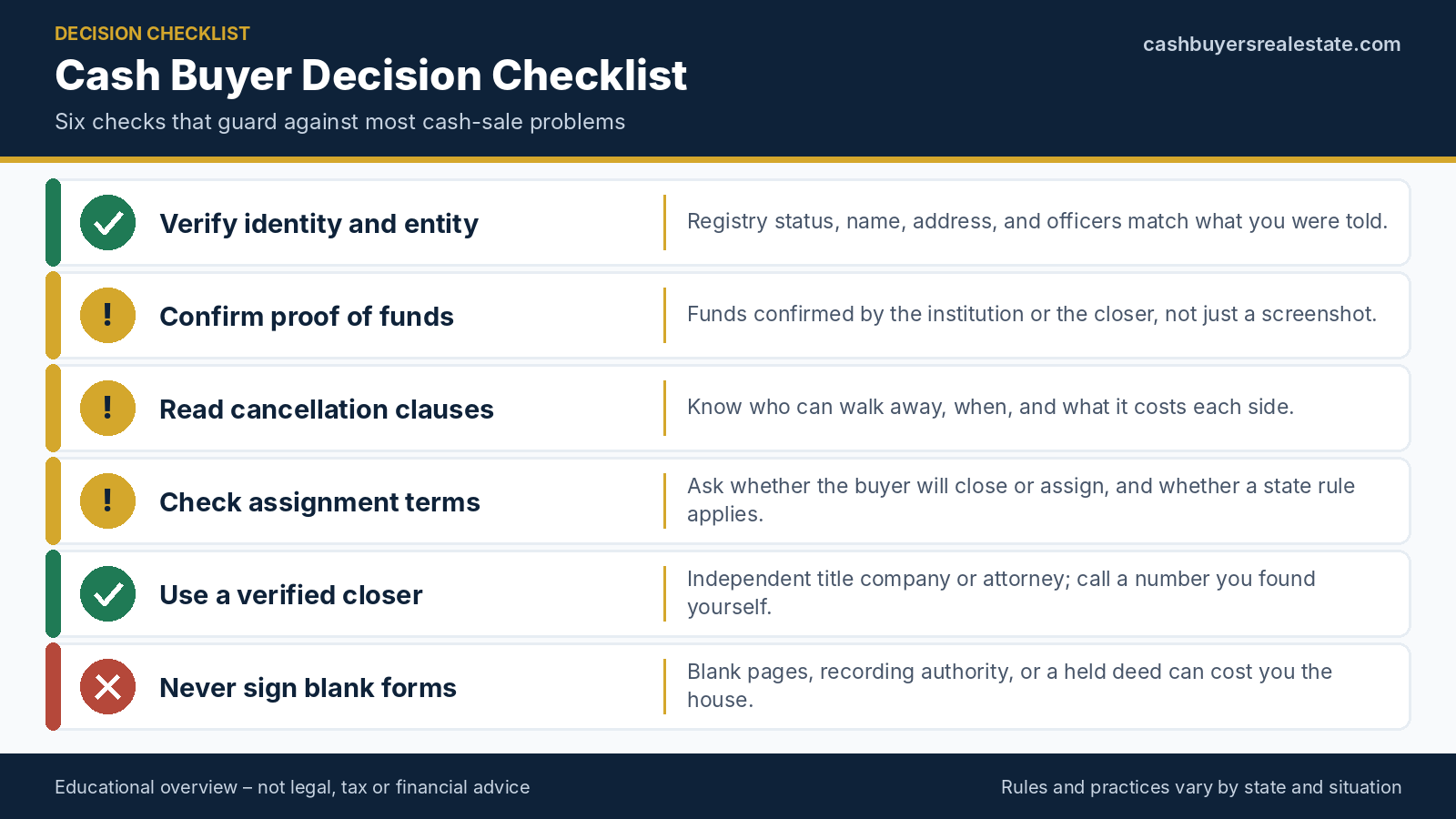
Text version of this infographic
- Verify identity and entity — Registry status, name, address, and officers match what you were told.
- Confirm proof of funds — Funds confirmed by the institution or the closer, not just a screenshot.
- Read cancellation clauses — Know who can walk away, when, and what it costs each side.
- Check assignment terms — Ask whether the buyer will close or assign, and whether a state rule applies.
- Use a verified closer — Independent title company or attorney; call a number you found yourself.
- Never sign blank forms — Blank pages, recording authority, or a held deed can cost you the house.
If Something Goes Wrong: Reporting Channels and Recovery Steps
Nobody plans for a problem, but a short plan made in advance is worth more than a frantic search made in the moment. Problems with cash buyers fall into two broad groups. The first is a loss of money, such as a redirected wire or a deposit that never arrived, where hours matter. The second is a paper problem, such as a contract you regret, a notice recorded against your title, or a deed you never signed, where the clock runs more slowly but the consequences last longer. This section covers what to do in each case, who to tell, and what each agency can and cannot realistically do for you. None of it guarantees recovery. What it does is raise the odds and preserve your options.
The First Days: Stop the Loss and Preserve the Evidence
The first priority is to stop further harm. The second is to preserve evidence so that whoever eventually helps you, whether a bank, an investigator, or an attorney, has what they need. Resist the urge to confront the other party before you’ve done both, because a warned scammer tends to delete accounts and move money faster.
Money moved to the wrong place: recall, report, and notify
If you sent a wire or a payment to an account you now believe was fraudulent, call your bank at once, using the number on your card or its official site, and ask for a wire recall. The Consumer Financial Protection Bureau says quick reporting improves the chance of recovering funds, though it gives no deadline, and the FBI’s public service announcement on business email compromise says time is of the essence and advises contacting your financial institution to request a recall and asking about any indemnification documents, since policies vary. Next, file a complaint with the FBI’s Internet Crime Complaint Center at ic3.gov, regardless of the amount. IC3’s 2025 annual report describes cases in which its recovery team worked with banks to freeze receiving accounts, which illustrates why a prompt report can matter even though no outcome is assured. Also notify the title company or closing attorney immediately, since they may be able to alert the receiving bank or the other parties.
Then secure your accounts. Change the passwords on your email and financial accounts, turn on two-factor authentication, and check your email for forwarding rules you did not set up, since criminals often use these to read messages quietly. File a report with local police or the county sheriff, which creates an official record and is often required by banks and insurers. If a fake check was involved, tell your bank, and consider reporting to the U.S. Postal Inspection Service if mail was used, as the FTC’s fake-check guidance suggests along with a report to the FTC and your state attorney general. AARP also operates a free Fraud Watch Network Helpline at 877-908-3360 where trained specialists can guide victims through next steps. Be cautious about anyone who contacts you offering to recover your money for an advance fee, and never pay a fee to get your own money back.
Paper problems: a signed contract, a recorded notice, or a forged deed
If you have signed a contract you now doubt, begin by reading it again and writing down exactly what happened and when. Check whether your state has a wholesaler statute that gives you a cancellation right. In Oregon, a seller can cancel a wholesale contract by written notice up to midnight at the end of the third business day after receiving the required disclosure, and if the disclosure was never provided the seller may terminate without penalty and keep any deposit. In Oklahoma, the homeowner has two business days after signing to cancel without penalty, and a contract missing the required disclosures can be canceled at any time. Those windows are short, and statutory notices usually have to be delivered in a particular way, so contact a real estate attorney the same day. Do not ignore messages from the buyer, but respond only in writing and stay factual.
If something has been recorded against your property that you did not understand or no longer want, ask the attorney to demand a release in writing from the person who recorded it, and check the contract to see whether you agreed to the recording. If the buyer refuses, the matter may need court action; the cost and timing vary by state, which is another reason to get advice early. If a deed was recorded that you did not sign, the Ohio State University guide suggests getting a certified copy of the recorded deed from the county recorder, filing a police report, alerting the county auditor, treasurer, and recorder, notifying your mortgage company and banks, contacting your title insurance company if you have one, and consulting a real estate attorney about options such as recording an affidavit that the deed is fraudulent or filing a quiet title action. Standards differ by state; in Ohio, for instance, courts can restore ownership but the owner must present clear and convincing evidence, which is why early documentation matters.
Who to Report To, and What Each Agency Can and Cannot Do
Reporting does two things. It may help you directly, by triggering a bank recall or a regulator’s inquiry, and it contributes to a body of evidence that helps investigators see patterns across many victims. It’s also important to be realistic. Most agencies do not act as private lawyers or collection services, and they rarely resolve an individual dispute. A report is worthwhile, but it works best alongside private steps such as notifying your bank and consulting an attorney.
Federal and law-enforcement channels
The Federal Trade Commission takes reports of fraud and deceptive practices through ReportFraud.ftc.gov and uses them to detect patterns and bring enforcement cases, such as the 2024 action that returned nearly $62 million to sellers who the agency said were misled by an instant-offer company’s savings claims. The FTC’s mortgage-relief guidance specifically asks owners who have been scammed to report to the FTC and to their state attorney general. The FBI’s IC3 accepts complaints about internet-enabled crime, including business email compromise and real estate wire fraud, and it is the right place for any payment redirection. The CFPB accepts complaints about mortgages and several other financial products, forwards them to the company, and generally expects responses within 15 days, though its list of covered products centers on consumer financial products, so a dispute with an investor who bought your house may fall outside it unless a mortgage, money transfer, or another covered product is involved. Local police or the sheriff take reports of theft and forgery and provide the case number that banks and insurers usually need.
A practical note: government websites occasionally go offline for maintenance or funding lapses. If a portal is down when you try to file, do not wait. Keep your documentation organized, use the other channels, which are not affected by the same outage, and file with the unavailable agency when it returns. Federal agencies are not a substitute for your own bank and your own attorney, but they are free and they add weight to your account if the matter later goes to court or an insurer.
State channels and private remedies
State agencies often provide the most direct help for conduct involving real estate. Your state attorney general’s consumer protection office takes complaints about deceptive business practices and may mediate or investigate; the National Association of Attorneys General maintains a directory of every state’s attorney general. The state real estate commission or equivalent regulator handles complaints about licensees and, in states with wholesaler registration or licensing, about wholesalers. County offices, including the recorder, auditor, and treasurer, are essential in deed fraud cases. If an attorney or notary was involved in something improper, the state bar or the notary regulator may take complaints. Agencies differ in power and speed, and complaint counts are not verdicts, but a documented complaint establishes a record and may lead to a refund or an enforcement action.
Private remedies can supply what agencies cannot. An attorney can send demand letters, negotiate releases, file suit, and, where the law provides, pursue statutory remedies such as attorney’s fees. Oregon’s wholesaler law, for example, allows the prevailing party in a dispute over a missing disclosure to recover fees and costs from the wholesaler. Time limits for civil claims, called statutes of limitation, vary by state and by type of claim, so delay can cost you rights. Your title insurance company may also play a role if a defect in title is covered by your policy. Gather every document, message, receipt, and note you have kept since the beginning, since a good file is the most valuable thing you can bring to a first meeting with any of these helpers.
| Problem | Where to go | What it can do | Limit to expect |
|---|---|---|---|
| Wire sent to a fraudulent account | Your bank first; then FBI IC3; local police | Recall request; investigation; case number for banks | Recovery is not assured and depends on speed |
| Fake check or advance-fee demand | Your bank; FTC; state attorney general; U.S. Postal Inspection Service if mail used | Fraud reports; pattern tracking; possible enforcement | Agencies seldom return individual losses |
| Deceptive pricing claims or misleading marketing | FTC; state attorney general | Complaint record; possible investigation | Not a substitute for a private claim |
| Wholesaler skipped required disclosure | State real estate regulator; real estate attorney | Statutory cancellation and remedies where a law applies | Short cancellation windows; rules vary by state |
| Recorded notice clouding your title | Real estate attorney; county recorder for record copies | Demand for release; court action if needed | Cost and timing vary; recorder cannot judge the claim |
| Forged deed recorded | Local police; county recorder, auditor, and treasurer; title insurer; attorney | Certified copies; police report; affidavit or quiet title action | Courts may require strong proof; process can take months |
| Foreclosure rescue scam | FTC; state attorney general; HUD-approved housing counselor | Free counseling; complaint record | Money paid up front may be hard to recover |
| Mortgage servicing or money-transfer problem | CFPB complaint portal | Forwards complaint to the company for a response | Covers listed financial products, not every real estate dispute |
The table is a starting map, not an order of operations. In a live emergency involving money, the first call is to your bank, and everything else follows. In a slower paper problem, the first call is to an attorney who can tell you which of these channels will help and in what sequence. In both cases, the most valuable thing you can do for yourself is to keep a written timeline: dates, names, amounts, and copies of everything. Most recoveries, partial or full, begin with a person who can say precisely what happened, and a person who stayed organized under stress is far better placed to say it.
What belongs in that file is simple. Keep every message in its original form, with sender addresses and timestamps, rather than only screenshots of selected lines. Save the marketing that first reached you, the contract drafts, signed pages, receipts, wire confirmations, and the names and phone numbers of everyone involved, including the title company, your bank contact, and any police report number. Add a short written narrative while memories are fresh, noting what you were told and by whom. If you used a shared email or phone, preserve those accounts rather than deleting them, because investigators and attorneys often need the metadata. A clean file can shorten the time it takes for any helper to understand your case, and it protects you from the natural tendency to forget details under stress.
Frequently Asked Questions About Whether Cash Home Buyers Are Legitimate
The questions below are the ones homeowners most often raise after a first conversation with a cash buyer. The answers are brief by design and point back to the fuller treatment elsewhere in this guide and in related articles. As always, state law and local closing practice vary, so use these as a starting point for conversations with a real estate attorney or the relevant state agency.
Questions About Verifying a Buyer and an Offer
Most of these questions come up in the first few days, when a seller is deciding how much time and trust to give a buyer. The answers focus on what you can check yourself and what you should ask others to check.
Questions about identity, licenses, and reputation
- Are cash home buyers legit, or are most of them scams?
Most cash buyers are real businesses or individuals who pay without a mortgage and expect to profit from repairing, renting, or reselling the house. A minority use misleading tactics, and a smaller number are fraudulent. Because you cannot tell them apart from a postcard or a website, the sensible approach is to verify each buyer instead of trusting or distrusting the category. Checking the entity, the funds, the contract, and the closing agent usually settles the question within a few days.
- Does a cash buyer need a real estate license?
A person buying a house for their own account usually does not need a real estate license, which is why many honest investors hold none. Licensing questions become more serious when someone acts as a middleman or markets properties they do not own, and a growing number of states have created licensing or registration rules for wholesalers. Whether a license is required depends on the state and on exactly what the buyer is doing. Your state real estate commission can tell you what applies, and many offer a free online license lookup.
- Is a buyer with a brand-new LLC suspicious?
Not by itself. Investors often form a separate company for each project to limit liability, so a new entity is routine. What matters is who stands behind it, whether it is in good standing in the state registry, and whether the people involved have a track record you can verify through deed records, a closing office, or references. If a new entity comes with an anonymous owner, a screenshot instead of proof of funds, and pressure to sign quickly, the combination deserves a pause.
- Can I rely on online reviews to decide whether a buyer is legitimate?
Reviews are a useful source of questions but a poor verdict. They can be solicited from satisfied customers only, written by the business, or concentrated on one platform, and a missing review history is not proof of anything. Read the critical reviews for repeated themes such as changed prices or lost deposits, then check what the review cannot show, such as county deed history, court records, and complaint records at your attorney general’s office. The strongest evidence is a title company or attorney who confirms regular, smooth closings with the buyer.
Questions about proof of funds and the offer itself
- How can I verify proof of funds if the bank will not discuss the buyer’s account?
Banks protect customer privacy and usually will not confirm a balance to a seller. The workaround is to have the title company or closing attorney verify, which is a normal part of their process and one the buyer can authorize. Even stronger evidence is money placed with the closer, since a neutral party then holds it. Avoid relying on a screenshot, a statement with the name removed, or a letter that can only be confirmed through contact details the buyer supplied.
- Why is a cash offer usually lower than a listing price, and when is a low offer a problem?
A cash buyer prices in repairs, holding costs, resale risk, and profit, so the offer typically sits below what a retail buyer would pay for a finished house. A lower offer is not automatically a sign of bad faith. It becomes a problem when the buyer cannot or will not explain the number, when it depends on misleading statements about your house’s condition, or when it comes with terms that cost you more elsewhere. The right test is your net proceeds compared with at least one realistic alternative.
- Is it a red flag if a buyer will not explain how the number was calculated?
It is a reason for a closer look. Honest buyers usually can describe their reasoning in general terms, such as expected repairs, resale value, and a margin, even if they do not share every figure. A buyer who refuses entirely, or who changes the explanation each time you ask, may be hiding a plan to resell the contract or counting on you not to compare. Asking for the explanation politely, in writing, tends to produce either a helpful answer or a revealing silence.
- What does it mean if a buyer says “cash” but wants a long inspection period?
It means the buyer is asking for a free option to cancel while your house is off the market. Some due diligence time is reasonable, particularly for older or damaged properties, but a long period with an easy exit shifts risk to you. You can ask for a shorter period, a deposit that becomes nonrefundable when the period ends, or a higher price to compensate for the option. A buyer’s response to that request shows how seriously they intend to close.
Questions About Contracts, Closing, Fraud, and Recourse
These questions tend to arise when a seller is holding a contract, nearing a closing, or recovering from a bad experience. They are the questions where an hour with a real estate attorney is most likely to pay for itself.
Questions about contracts, deposits, and timing
- Should I allow a buyer to record a memorandum of contract against my property?
Do not agree until a real estate attorney in your state has explained what it does and how it is released. A recorded memorandum can give public notice of the buyer’s claim, and it can make it hard to sell to anyone else, or get title insurance for another buyer, if the first deal falls through. Some contracts require the seller to permit recording, and some states regulate what can be recorded and when. The safest course is to negotiate the provision out or to require a signed release held by the closing office.
- Is it normal for the earnest money deposit to be small or refundable?
It is common in cash purchases for the deposit to be modest and refundable during the buyer’s inspection period. That means it does not protect you much until the period ends, so the buyer’s commitment during that time rests largely on reputation and funds. What matters most is that a neutral holder, such as a title company, escrow office, or attorney trust account, actually holds the money and confirms receipt to you in writing. You can ask for a larger deposit or for a point at which it becomes nonrefundable.
- Can a buyer assign my contract to someone else, and must they tell me?
If the contract includes an assignment clause, often phrased as “and/or assigns,” the buyer may transfer it to another buyer. Whether they must tell you depends on your state. Oregon and Oklahoma, for example, require written disclosure from wholesalers before signing and give sellers a short window to cancel, but many states have no such rule. Either way, you can ask directly whether the buyer plans to close themselves, and you can negotiate limits on assignment.
- How fast should a legitimate cash buyer be able to close?
Speed depends mostly on the title search, any payoff of a mortgage or lien, the county’s recording process, and how organized the closing office is, rather than on the buyer’s financing. Closings can be faster than financed sales, but there is no standard timeline that every legitimate buyer meets. Treat promises of an exact date with caution unless the contract states a date and consequences for delay. The earlier discussion of closing steps explains what drives the schedule.
Questions about fraud, reporting, and recourse
- What should I do if a buyer asks me to pay a fee up front?
Stop and treat it as a serious warning. Cash buyers pay sellers, and legitimate closing costs are normally handled through the closing statement, not by sending money in advance to the buyer or to someone the buyer names. Requests for gift cards, wire transfers, or forwarding part of a check are classic signs of fraud. Keep the messages, do not send money, and consult an attorney or report to your state attorney general and the FTC.
- How can I protect my house from deed fraud?
Register for any free recording alert your county offers, check the recorder’s index periodically, keep your mailing address current with the tax office, and be alert when tax or utility notices stop arriving. For a vacant or inherited property, arrange regular visits and confirm legal authority before anyone signs a deed. Never sign a deed, blank form, or document you have not read, and be wary of any request to transfer title before payment. Ask your title insurer what protection your policy provides.
- Where do I report a cash buyer I believe is running a scam?
Start with your bank if money is involved, then file with the FBI’s IC3 for internet-enabled crime and the FTC for fraud and deceptive practices. Your state attorney general’s consumer protection office and, where a licensee or wholesaler is involved, the state real estate regulator are often the most useful for local conduct. Local police handle theft and forgery. Keep a written timeline and copies of everything, and talk to a real estate attorney about private remedies.
Deciding What to Do: A Framework for Proceeding, Negotiating, or Walking Away
By now you have a toolkit: a way to check who a buyer is, to test whether the money exists, to read a contract for hidden risk, to protect the deposit and the closing, and to respond if something goes wrong. The remaining job is to turn that information into a decision. A good decision isn’t the one that avoids all risk, since no sale does, but the one that fits your priorities, survives comparison with your alternatives, and rests on facts you have verified rather than promises you were given. This closing section offers a framework for making that call and a practical list of what to do next.
A Decision Framework: Matching the Route to Your Priorities
People sell houses for different reasons, and the right route depends on which reason is loudest. Someone facing a transfer in six weeks has a different problem from someone settling an estate with no deadline. Before comparing buyers, decide which of four things matters most to you, because the answer changes which route makes sense and how much of a price discount you should be willing to accept in exchange.
Matching the route to what you need most
Start by ranking four priorities: price, speed, certainty, and effort. A verified cash buyer typically trades some price for speed, certainty, and low effort; a conventional listing typically trades speed and effort for a better chance at a higher price; an instant-offer platform sits between the two and adds a service fee; a wholesaler can offer speed but brings dependence on an end buyer. None of these is the right answer in the abstract. Pose the question as a net-proceeds comparison under realistic assumptions, and include what each route costs in time. The sibling guides on weighing a cash sale against a listing, comparing several offers side by side, and calculating what you would actually net provide the arithmetic, while cash versus financed buyers explains why a financed buyer sometimes pays more but takes longer.
Be honest about the cost of delay. A house that sits for months has carrying costs, including taxes, insurance, utilities, upkeep, and often a mortgage payment, and those costs reduce what a higher listing price really delivers. Be equally honest about repairs: a house that needs work will either be repaired by you, at your cost and effort, or priced down by the buyer. If you are weighing a sale without fixing anything, the article on selling a house fast without repairs covers the trade-offs. Finally, consider who else is involved. An heir, a co-owner, a lender, or a tenant may have a say in timing and terms, and the right route is one that all of them can accept.
| If your top priority is | A route that often fits | Why it fits | What to watch for |
|---|---|---|---|
| Certainty and a firm date | Verified cash buyer with funds confirmed by the closer | No loan approval or appraisal to fail | Long due diligence with a free exit; assignment to an unknown end buyer |
| Highest likely price | Listing with an agent, possibly after selected repairs | Exposure to the widest pool of retail buyers | Months of carrying costs; concessions after inspection; financing delays |
| Minimal effort and no repairs | Cash buyer or instant-offer company that buys as is | Buyer takes on the condition and the work | A discount for condition; service fees; claims of savings that need testing |
| Speed with a complicated title | Buyer working with an experienced title company or attorney | Liens and probate steps still need clearing, whatever the buyer | Promises to close faster than title work allows |
| Staying in control of the process | Listing, or a negotiated cash sale with your own attorney | You choose the terms and the closer | Time and cost of professional help |
| Avoiding commissions | Direct sale to a buyer, with attorney review | No listing commission on the sale | A lower price can outweigh the commission saved |
Treat the table as a prompt for your own thinking. The “route that often fits” column describes patterns, not guarantees, and any of the rows can reverse depending on your property and your market. The right-hand column is the most useful: it lists the failure mode of each choice, which is where your verification work should concentrate. Choose the route first, then screen buyers within it, because a verified buyer on the wrong route is still the wrong decision for you.
Illustrative example (hypothetical numbers, not market data): A couple needs to move for work within seven weeks and owns a house they expect would list near $284,000 after $9,000 of paint, flooring, and landscaping, with 6 percent total selling costs. They get one verified cash offer of $247,000 from a buyer whose funds the title company has confirmed, and a $259,000 offer from a second buyer who will not name a closer and wants a 45-day inspection period. After repairs and costs, a listing might net around $258,000 if it sells in time, with risk of missing their date; the first cash offer nets close to $247,000 less modest closing costs, on a firm date; the second offer looks higher but depends on a buyer they cannot check. They choose to negotiate with the first buyer for a slightly higher price and a faster deposit, and they keep the listing plan as a backup. The numbers decide less than the verification does.
The proceed, negotiate, or walk test
A simple three-way test turns your checks into a decision. Proceed when the buyer’s identity and entity are confirmed, the funds are verified by a neutral party, the contract is complete and balanced, the closer is independent and reachable, the deposit is held by a neutral holder, and your expected net meets or beats the walk-away number you set before the process began. In that case, there is no benefit to further delay, and you can stop worrying about the stranger on the other end and start planning the move. Proceeding does not mean skipping attention to the later steps, since closing-day safeguards still apply.
Negotiate when the buyer passes the basics but one or two terms need adjustment. The most common examples are an assignment clause that you want disclosed or limited, a long inspection period that you want shortened, a recording provision that you want removed, a deposit that should sit with a neutral holder, and a price that you can support with a better comparison. Negotiation is normal and not hostile, and a buyer who agrees to reasonable changes has often proved their seriousness. Walk away when you meet pressure to skip verification, a refusal to use a neutral closer, a request for fees or gift cards, blank or incomplete documents, a demand to record something against your title that your attorney cannot make safe, instructions to move money by email, or an identity that does not hold together. Walking away costs you the offer, and the offer may have been less valuable than it looked. A fair deal, by contrast, has several visible features: the buyer can explain the price, both sides carry obligations, a neutral party holds the money, costs are written down, and you had time to read and ask. Those features cost a buyer nothing when the buyer is legitimate.
What to Do Next: First Steps, Questions, and Documents
If you are at the stage of holding an offer or expecting one, a short plan keeps the process from feeling like a scramble. The aim is to build a file and a set of comparisons before the buyer’s deadline, real or invented, can push you into a rushed decision.
A practical sequence for the first week
Begin with your own paperwork, because most of the checks above are faster when you have it ready. Gather the deed or the closing statement from when you bought, the latest mortgage statement and the name of the servicer, recent property tax bills, insurance information, any homeowners association details, and records of repairs, permits, and known problems. If there are co-owners, heirs, tenants, or lienholders, list them. Then collect a price opinion from a local real estate agent and, if possible, at least one other written offer, so you have a baseline. Write down the lowest net amount that would make a sale worthwhile, and keep that figure in front of you when the conversation turns to price.
Next, work through the verification steps in order, beginning with the entity and finishing with the closer, and let the buyer see that you are doing it. Book an hour with a real estate attorney in your state before you sign anything, and bring the draft contract. Ask the attorney about your state’s rules on wholesalers, recording, disclosures, and cancellation, and about anything unusual in the contract. Set your own timeline, and communicate it politely. The page on negotiating a cash offer offers ideas for the conversation about price and terms. If at any point you feel rushed, slow down; a deal that cannot survive a few days of checking is not one you should rely on.
Use the same week to line up the people who will need to act with you. If the house is jointly owned, make sure every owner has seen the offer and agrees on a walk-away number, because a signature missing at the last minute is one of the quietest ways for a closing to fail. If there is a tenant, a lienholder, or an estate representative, find out what notices or consents they will need to give and how long each takes, and share that with any buyer you are seriously considering. Keep a single folder, paper or digital, with the offers, notes, and verification results side by side, so that on the day you choose a route you are comparing facts that sit on one page rather than impressions scattered across your memory and your inbox.
Questions to ask and documents to gather
Keep your questions short and specific. Ask the buyer who will sign the contract and take title, whether they intend to close themselves or assign, how they will fund the purchase and who will hold the deposit, which closer they use, what the inspection period is and what happens at its end, and who pays which costs. Ask the closer whether they have a file, what documents they need from you, when they will send a draft settlement statement, and how your proceeds will be paid. Ask your attorney what your state requires and what could go wrong with the clauses you are most concerned about. A fuller list of questions for cash buyers expands each of these.
| Item | Why it helps | Where to get it |
|---|---|---|
| Deed or prior closing statement | Confirms exact owner names, legal description, and vesting | Your records or the county recorder |
| Mortgage statement and servicer contact | Shows payoff needs and lets the closer order a payoff letter | Your lender or servicer |
| Property tax bills and any lien notices | Reveals unpaid taxes or claims that must be cleared at closing | County treasurer or tax office; mail |
| Disclosure information and repair history | Supports accurate disclosures required in your state | Your records; contractors; permit office |
| Agent price opinion and other written offers | Gives a baseline for comparing net proceeds | Local real estate agent; other buyers |
| Buyer’s entity details and proof of funds | Lets you verify identity and the ability to close | Buyer; state business registry; the closer |
| Draft contract and any assignment or recording language | Lets an attorney assess risk before you sign | Buyer; your attorney |
| Closer’s name, address, and licensing | Confirms the neutral party and the payment path | Your own lookup, then a call to the office |
None of this is an argument against selling to a cash buyer. For many owners, especially those with houses that need work, complicated ownership, or tight deadlines, a legitimate cash buyer is a reasonable, even excellent, way to sell, and verification only makes the path smoother. It is also not an argument for always listing with an agent, which has its own costs and uncertainties. What this guide has argued for is a habit: confirm who you are dealing with, make sure a neutral party holds the money and the deed, read what you sign, and measure the result in what you keep. If you take those steps and the numbers still make sense, you can go forward with confidence. If a step turns up a problem, you will have learned it early and cheaply, with your options intact.