
Cash Home Buyer Contract: Offers, Process & Red Flags
The offer usually arrives as a PDF, and the first page is friendly. It has a price in bold, a closing date that sounds quick, and a sentence about buying the house as-is. The remaining pages, which are often six to ten of them, hold everything that decides what you will actually receive: who the buyer really is, how much money is at stake if the buyer walks away, what the buyer may do during an inspection window, which deed you will sign, who pays for which line of the settlement statement, and what happens if either side stumbles. Most sellers read the first page carefully and skim the rest, and that habit is understandable, because the later pages are written in a legal register that feels designed to discourage close reading. A cash home buyer contract rewards the opposite habit. The price is only one term among dozens, and in a cash sale it is often the one term that moves least once the paperwork is signed.
This guide takes the contract apart clause by clause. A cash home buyer contract is the written purchase agreement between you and a buyer who intends to pay for the property without a mortgage, whether that buyer is an individual, an investor, a company, or an entity formed for the purchase. It is the same kind of document as any residential purchase agreement, with certain clauses removed (no loan, no appraisal) and others expanded (a buyer-controlled inspection period, title conditions, assignment rights). Understanding it means knowing what each section is supposed to do, what a well-balanced version of it looks like, and what language should make you stop and ask for a change or for professional advice before you sign.
A cash home buyer contract is an ordinary purchase agreement without lender conditions. Read it for who the buyer is, the deposit and who holds it, the inspection window, the deed you’ll sign, closing and possession terms, default remedies, and any assignment or arbitration language. Compare the net proceeds, not the headline price, and have a real estate attorney review it where state practice or the stakes call for one.
None of this is meant to make a cash sale look suspicious. A purchase agreement with a buyer who has funds in hand can be the cleanest transaction a seller ever completes, with a short timeline, no lender delays, and very few ways for the deal to fall apart for reasons outside the two parties’ control. For a property with deferred maintenance, a complicated title history, a vacant building, or a seller with a firm deadline, it can be the most sensible route available. The risk sits in the details, and the details are knowable. A seller who reads the agreement in the right order, with a short list of questions for each section, can usually tell within an hour whether the contract is balanced or tilted, and whether the problems are fixable by negotiation or serious enough to walk away.
The guide proceeds in the order a contract is built. It starts with what the document is and how it differs from a financed purchase agreement, then moves through the opening clauses on parties, property, and price, followed by the deposit and the buyer’s statement about its funds. The middle sections cover the inspection or due diligence period, title and deed type, closing mechanics, possession, and prorations. The later sections handle default, dispute resolution, disclosures, the federal and state rules that sit around the contract, and the addenda and amendments that can quietly rewrite it. Frequently asked questions and a decision framework close the guide, with a practical sequence for the days before you sign.
Several neighboring subjects are covered in depth elsewhere, and this article touches them only where they explain a clause. The specific clauses that most often cause trouble have their own treatment in the guide to cash offer contract red flags, while the wider question of how these sales compare with financed ones is the subject of cash buyer vs financed buyer. If you are still deciding whether to approach cash buyers at all, the overview of cash home buyers is the better starting point, and if you are weighing how local operators differ from national ones, local cash home buyers vs national companies addresses that comparison. Here the focus stays on the paper itself.
What a Cash Home Buyer Contract Is and How It Differs From a Financed Purchase
Before reading any individual clause, it helps to understand the document’s job. A purchase contract allocates risk between two parties for the period between agreement and closing, and it decides who bears the cost when something unexpected happens: a failed inspection, a title surprise, a late funding wire, a tenant who won’t leave. A cash agreement does this with fewer moving parts than a financed one, but the parts that remain carry more weight, because no lender’s underwriting department is standing behind the transaction to catch problems.
From Offer to Binding Agreement
Sellers often use “offer,” “letter of intent,” and “contract” as if they were the same thing, and cash buyers’ paperwork sometimes blurs them on purpose or by habit. The difference matters, because the legal effect of your signature depends on which document you are signing.
Where an Offer Ends and a Contract Begins
An offer is a proposal. It states a price and a few headline terms, and in many cases it is expressly non-binding, which means either side can walk away or change the numbers without consequence. A letter of intent is a slightly more formal version of the same thing, and it usually says in its own text that it creates no obligation to close. A contract, by contrast, is a document that both sides have signed, that identifies the property and the price with enough precision to be enforced, and that spells out what each side must do and what happens if one of them doesn’t. The practical test is simple: if the document has signature lines, a deposit clause, and a closing date, assume it is binding unless it says otherwise in plain words, and read it as you would read a binding agreement.
The danger zone is the middle ground, where a friendly email thread or a one-page summary is followed by a longer agreement that arrives for signature with terms that were never discussed. Sellers sometimes assume the longer document simply formalizes what was already agreed, and a few discover afterward that it added an inspection window, an assignment right, or a recorded notice that no one mentioned. When the long form is the only document that matters legally, the one-page summary is background, and many agreements contain an “entire agreement” clause that says so. The safest habit is to treat the first moment you see the full agreement as the real start of negotiations, no matter how far the conversation has already gone, and to ask for the complete document before agreeing to any date, deposit, or access arrangement.
A related habit worth building is to ask what is final and what is a placeholder. Blank fields, bracketed text, or phrases such as “to be determined” are normal in drafts but should not survive into a signed copy, and a missing closing date, an unnamed escrow holder, or an empty deposit amount can all be filled in later by whoever controls the document if the agreement is careless. Sellers can protect themselves by insisting that every blank be completed before they sign, and by keeping a fully executed copy, not a photograph of a signature page, in their own records.
A Clause-by-Clause Map of the Whole Agreement
The following table gives a working map of the fifteen sections that appear in most residential cash agreements, with a plain-language description of each and a contrast between how a balanced version tends to read and what deserves a closer look. It is meant as a reading aid, not a verdict, because the same clause can be perfectly fair in one transaction and a problem in another.
| Clause | What it does | Usually looks sound | Deserves a closer look |
|---|---|---|---|
| Parties | Names every seller and the buyer entity | Seller names match the deed; buyer is a named person or registered entity with an address | A missing co-owner; a buyer listed only as “and/or assigns” |
| Property | Identifies the land, structures, and included items | Street address plus legal description; included fixtures listed | Address only; personal property swept in without a list |
| Price and payment | States the amount, form of funds, and adjustments | One stated price; payment by wire or certified funds at closing | Price that can be lowered at the buyer’s sole discretion |
| Deposit | Sets the earnest money, holder, and refund rules | Held by a neutral title company or attorney; conditions written out | Held by the buyer; token amount; refundable to the buyer for any reason |
| Funds statement | Records that no financing is needed | States funds are available and the sale is not conditioned on a loan | “Subject to funding” or partner approval language |
| Due diligence | Gives the buyer time to inspect and cancel | Defined window with a stated end date | Open-ended window the buyer alone can extend |
| Title and deed | Sets title standards and the deed form | Deed type named; process for resolving title objections | Quitclaim demanded without explanation; no cure process |
| Closing | Sets date, place, closer, and cost split | Named neutral closer; cost allocation spelled out | Closer “to be chosen by buyer”; undefined seller fees |
| Possession | Says when the buyer takes the property | Possession at closing or a short written rent-back | Open-ended holdover with uncapped seller liability |
| Prorations and payoff | Splits taxes, dues, and pays off liens | Day-of-closing split; payoff handled by the closer | Unexplained credits to the buyer |
| Default and remedies | Says what happens if a party breaches | Mutual remedies with cure periods | Only the buyer may cancel; seller forfeits or pays fees |
| Dispute resolution | Chooses forum and method | Venue in the property’s county; mediation first | Binding arbitration in a distant place; one-way fee shifting |
| Disclosures | Attaches required seller forms | State and federal forms attached; as-is language limited to condition | Language purporting to waive legally required disclosures |
| Addenda | Adds special terms | Listed in the main text, signed by all parties | Unlisted attachments; blanks left open |
| Assignment | Lets the buyer transfer its rights | Disclosed up front; limited or with notice to the seller | Blanket assignment right with no notice or limit |
Read the table from left to right as a question sequence: what is this clause for, what does a balanced version of it contain, and what would make me ask for a rewrite? The right-hand column is not a list of banned terms, since a thoughtful seller may accept almost any of them in return for something else, such as a higher price or a faster closing date. Its purpose is to flag where the trade-off is hiding. If you find yourself accepting three or four clauses from the last column in a single agreement, the price on page one is probably paying for more than it appears to be, and it is worth running the numbers again before signing.
What Changes When No Lender Is Involved
Removing a mortgage lender from a purchase removes a second set of requirements, and that changes both what the contract says and how much of the protection sellers normally take for granted is still present.
The Clauses That Fall Away
In a financed purchase, the agreement is shaped by what the lender will require. There is a financing contingency that lets the buyer cancel if the loan is denied, an appraisal condition that lets the buyer renegotiate or cancel if the property appraises below the price, and a series of deadlines that exist mainly to fit the lender’s underwriting schedule. Sellers often experience those clauses as the main source of uncertainty in a conventional sale, since a deal can collapse weeks after acceptance because a loan officer wanted one more document or an appraiser saw a different market than the agent did. A cash agreement removes the loan, the lender’s appraisal, and the underwriting timeline from the picture, which is exactly why it can close faster and why it can be offered with fewer outs for the buyer in theory.
Removing those clauses also removes a layer of independent review. When a lender is involved, a third party with money at stake examines the title, orders the appraisal, confirms the buyer’s income and funds, and insists on a settlement process that follows federal disclosure rules. In a cash transaction nobody is required to do those things for the seller’s benefit. Federal law on the integrated mortgage closing disclosures applies to credit transactions, and as the title industry association ALTA has explained, it does not require the Closing Disclosure or older HUD-1 in every cash deal, so the settlement statement used may be whatever form the closing agent or the state prescribes. None of that means a cash closing is careless. It means the seller, rather than a lender, becomes the party checking the buyer, the title work, and the settlement figures.
The Clauses That Grow in Their Place
As lender-driven conditions disappear, other clauses expand to fill the space. The inspection or due diligence period, which in a financed sale is a modest window to evaluate the property, often becomes the buyer’s central right to cancel, and a few agreements stretch it far beyond what a mortgage deal would allow. Title conditions get more attention because there is no lender’s title insurer requiring a clean policy. The assignment clause, which lets the buyer transfer the agreement to someone else, becomes common in agreements drafted by investors who sometimes resell their contract rights instead of buying the house themselves. Termination language, deposit forfeiture rules, and dispute resolution provisions also tend to grow, because the parties are writing their own protections rather than borrowing a lender’s.
| Topic | Financed purchase | Cash purchase | What it means for the seller |
|---|---|---|---|
| Loan condition | Buyer may cancel if the loan fails | Absent if the buyer truly has funds | Fewer outside reasons for the deal to fail |
| Appraisal | Lender requires one; low value can force a price change | Usually not required | Price depends on the buyer’s own valuation, not a third party’s |
| Inspection | Short window, often tied to repair requests | Often a longer buyer-controlled option | The inspection period may be the real exit |
| Timeline | Set by lender underwriting | Set by the buyer’s title work and preferences | Can be faster, or can be stretched by the buyer |
| Settlement form | Federal Closing Disclosure for loan transactions | Closing agent’s or state form | Review every line yourself |
| Assignment | Uncommon | Common in investor forms | Your buyer may not be your closing buyer |
The comparison shows that the trade is not simply speed for price. A cash agreement gives up some independent verification in exchange for fewer outside conditions, and the clauses that replace the lender’s conditions are written by the buyer or the buyer’s attorney. That is why the detailed reading in the sections that follow matters more here than in a conventional transaction, and why the next section begins with the most basic question of all, which is who exactly is on each side of the agreement.
Parties, Property, and Price: Reading the Opening Clauses
The first page or two of a purchase agreement look routine, which is why they are skimmed. They are also the clauses that a court, a title company, and a closing agent will look at first if anything is ever disputed, and mistakes here tend to be expensive to repair after the fact. Names that don’t match the deed, a legal description with a typo, or a price expressed in two different places are the kinds of small errors that delay closings and, occasionally, cloud a title.
Who Is Actually Signing: The Seller and Buyer Clauses
An agreement is only as reliable as the identities and authority of the people who sign it. For cash sales this has a particular edge, since the buyer is frequently a company with a name that sounds like a brand and a legal structure that isn’t obvious from the first page.
Naming the Seller Correctly
The seller clause should list every person who holds an ownership interest in the property, spelled exactly as the names appear on the current deed. If the property is owned by two siblings who inherited it, both must sign, and a contract signed by one sibling who promises to “get the other one on board” is a contract with a serious problem, because the signer cannot convey what the other co-owner holds. Marriage adds its own layer. In some states a spouse who is not on the title must still sign certain documents, particularly where the home is the family residence and homestead protections apply, and other states have no such rule, so the right answer depends on where the property is located and is one of the standard questions for a local attorney or title officer. Sellers who are unsure should look at the vesting language on their own deed, which shows how title is held, and compare it against the names the buyer has typed.
When the owner is not an individual, the clause needs to show the capacity in which the signer acts. An estate sells through a personal representative or executor whose authority comes from a court appointment, and the agreement usually needs to state that appointment and attach or reference the court’s document. A trust sells through its trustee, and a title company will often ask for a certification of trust or a copy of the relevant pages of the trust agreement to confirm the trustee’s power to sell. A limited liability company sells through a manager or member with authority under its operating agreement. A person acting under a power of attorney must show that the document covers real estate sales and, in most places, that it has been recorded or is in a form the closer will accept. For inherited homes in particular, the discussion in cash buyers for inherited houses explains how probate steps interact with the timing of a sale. A seller clause that omits capacity is not necessarily wrong, but it often signals that no one has checked.
Naming the Buyer: People, Companies, and “And/Or Assigns”
The buyer clause is where a cash agreement most often tells you something the headline price doesn’t. The ideal version names a specific person or a registered business entity, gives its legal name exactly as it appears in the state’s business registry, lists a physical address and a working phone number and email, and identifies the individual who signs on its behalf along with that person’s title. You can check a company’s existence, status, and registered agent through the secretary of state’s business search in the state where it was formed, and you can compare the signer’s name against the officers or managers listed there. A business that was formed last month is not automatically suspicious, since many investors form a new limited liability company for each property, but it does mean the entity has no track record, and it makes the deposit and closing arrangements more important.
The wording “and/or assigns” after a buyer’s name deserves particular attention. It indicates that the buyer may transfer its rights to someone else, which is legal in most places and is common in investor-drafted agreements, but which means that the party who actually appears at the closing table may be a different person or company from the one who signed. For some sellers that makes no practical difference, since the money arrives and the deed is delivered. For others it matters a great deal, because the original buyer’s reputation, funds, and promises were the reasons they signed. A balanced agreement either limits assignment, requires notice to the seller, or keeps the original buyer responsible for performance after assigning. Later sections come back to assignment, and the law that some states now apply to it, in more detail. For the moment, the practical step is to ask in writing whether the buyer intends to assign, and to treat a vague answer as information.
Federal reporting rules for certain non-financed transfers to entities and trusts are a related subject that sellers sometimes hear about. FinCEN’s real estate reporting page states that a federal court in Texas vacated that rule in March 2026, that the government has appealed, and that while the order stands reporting persons are not required to file the reports. The status could change, and the rule imposes duties on the settlement professionals rather than on the seller, so it is mainly a reason to ask your closer what information about the buyer’s ownership it will collect and why.
Describing the Property and Stating the Price
Once the parties are identified, the agreement needs to say exactly what is being sold and for how much. These are the clauses sellers assume are simple, and they usually are, with a few exceptions that cost real money.
Legal Description, Fixtures, and What Conveys With the House
A street address identifies a property for convenience, but a legal description identifies it for the purposes of the deed. The legal description is a formal text, which might be a lot and block number from a recorded plat, a metes-and-bounds description tracing the boundaries, or a reference to a condominium declaration, and it usually appears on your existing deed or on your title policy. A good agreement either includes the full legal description or states that it will be taken from the current vesting deed and attached as an exhibit. Mistakes happen when someone retypes a description from memory or from a tax record that abbreviates it, and an error that is discovered at closing can force a corrective deed or a delay while the title company sorts it out. Seller-side readers can help by comparing the exhibit to their own deed line by line.
The second half of the property clause deals with what stays. Real property that is permanently attached, such as built-in cabinets, installed lighting, and the water heater, generally conveys with the house, while furniture and freestanding appliances generally don’t, but the line between the two is a frequent source of friction, which is why careful agreements list the items that stay and the items that go. Sellers clearing out a home after a death or a long tenancy sometimes leave behind belongings, and some investor forms say that anything left is deemed abandoned and becomes the buyer’s property. That language can be a convenience, and it can also be a trap if there is something of value or sentimental importance still in the house. Write down what you intend to remove, set a removal date, and make sure the agreement does not treat anything of yours as included simply because it is physically present at closing. Rights that run with the land, such as easements, mineral rights, and shared driveways, should be reviewed with the title commitment rather than assumed.
Price, Adjustments, and Language That Lets the Number Move
The price clause should state one number, in one place, with a clear description of how it will be paid: wire transfer or certified funds delivered to the closing agent on or before closing. When the number appears twice, such as once in numerals on the first page and once in a different amount in a later addendum, the contract contains an internal conflict that someone will have to resolve, and the resolution rule (often “the addendum controls”) might not favor you. A related point is whether the price is gross or net of items such as the buyer’s closing costs, a seller credit, or a payoff of liens. The cleanest approach is a gross price with everything else shown in the settlement statement, so that you can compare it to other offers on the same basis.
Price clauses that let the number move after signing deserve the most scrutiny. The classic version is a clause that allows the buyer to reduce the price if the inspection, title search, or a later walkthrough reveals something the buyer didn’t anticipate. A modest, objective version of this, tied to defects discovered and documented during a defined window, is a normal part of many agreements. A subjective version, such as a reduction “at buyer’s discretion” or “if the buyer’s evaluation of the condition changes,” makes the stated price an opening bid rather than a commitment. Sellers sometimes call this a re-trade, and the best protection is to understand it before signing, to ask what objective events would justify a reduction, and to have a plan for what you will do if the buyer asks for one.
Illustrative example (hypothetical numbers, not market data): A seller signs an agreement at $210,000 that includes a clause allowing the buyer to reduce the price after inspection “to reflect the buyer’s estimate of repairs.” Ten days later the buyer proposes $184,000, citing a roof estimate and an older water heater, both of which were visible when the offer was written. The seller has already scheduled movers and told the family the sale was done. Had the clause required the buyer to name specific defects found during inspection and to share the contractor’s written estimates, the seller could have tested the claim against a second quote. Instead the only choices are to accept the lower price or to cancel and lose the weeks already spent, which is exactly the leverage the clause was written to create.
The paragraph above is not an argument that every price reduction is a trick. Genuine surprises do occur, and a seller who has known about a bad roof for years is in a different position from one who learns of a problem for the first time through the buyer’s inspector. The point is that the reduction mechanism should be honest and visible when you sign, so that you can decide in advance how much risk you are willing to carry. The same logic applies to other parts of the sale process that the infographic below summarizes, from the first draft of the agreement through the day the keys change hands.
The sequence a typical cash agreement follows runs from reviewing the draft and signing, through the deposit and the buyer’s inspection window, to title work, the deed, closing, and possession. Each stage has its own clauses and its own opportunities for the seller to ask questions, and the graphic that follows lays them out in order as a reference for the sections that come next.
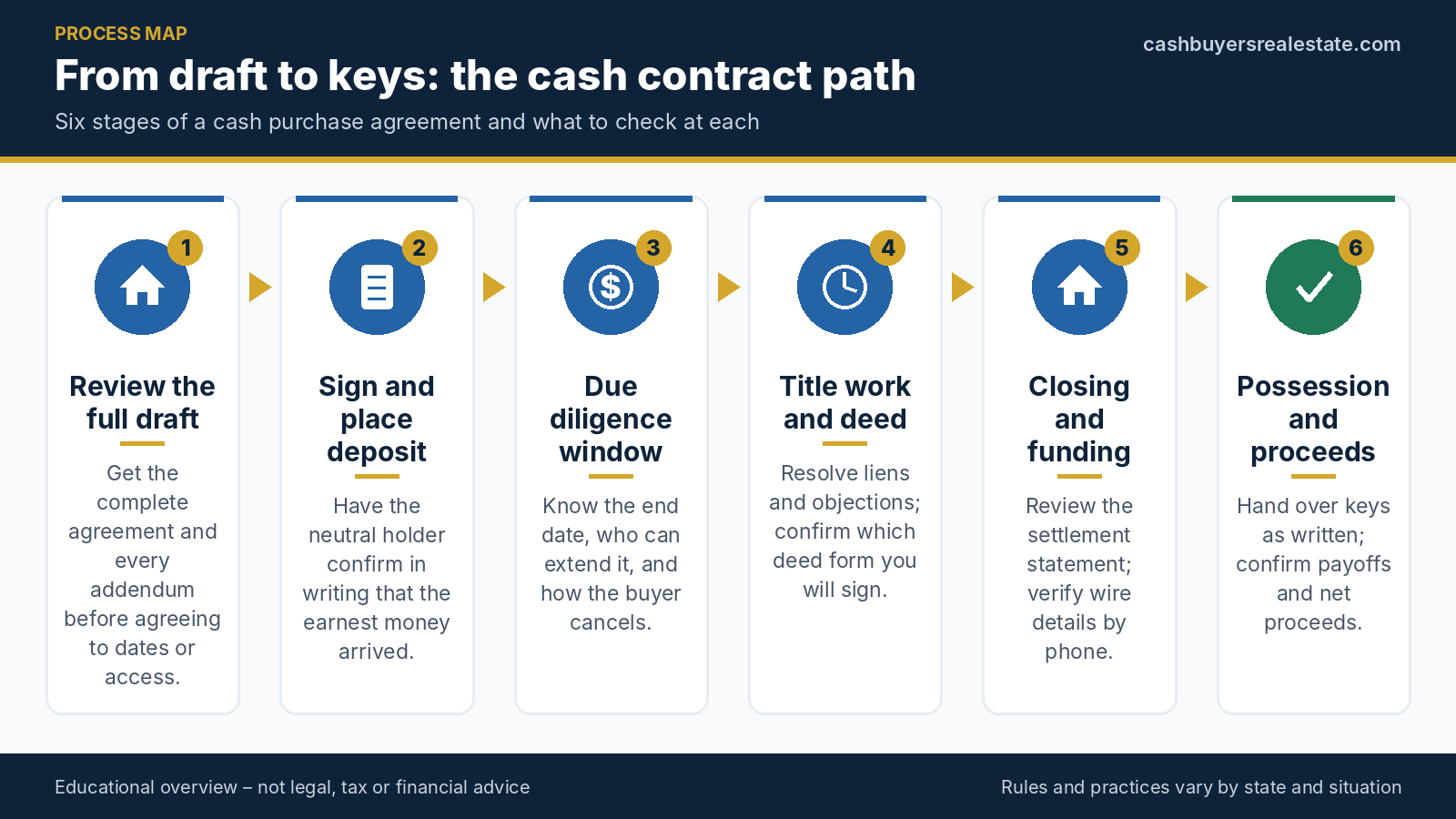
Text version of this infographic
- Review the full draft — Get the complete agreement and every addendum before agreeing to dates or access.
- Sign and place deposit — Have the neutral holder confirm in writing that the earnest money arrived.
- Due diligence window — Know the end date, who can extend it, and how the buyer cancels.
- Title work and deed — Resolve liens and objections; confirm which deed form you will sign.
- Closing and funding — Review the settlement statement; verify wire details by phone.
- Possession and proceeds — Hand over keys as written; confirm payoffs and net proceeds.
The Deposit, the Funds Statement, and Proof That the Money Exists
In a financed sale, the buyer’s seriousness is tested by a lender’s commitment. In a cash sale there is no lender to test it, so the contract relies on two things: the deposit the buyer puts at risk, and the buyer’s written statement about its funds. These clauses carry more of the seller’s protection than their length suggests.
Earnest Money: Amount, Holder, and Conditions
Earnest money is the buyer’s good-faith deposit, and the way the contract treats it tells you a great deal about how the buyer expects the deal to go. The details are covered more fully in the guide to cash buyer earnest money, so this section concentrates on the contract language.
How Much, Held by Whom, and Under What Conditions
Deposit amounts vary widely by region, price range, and buyer type, and there is no national standard, so the useful question is not whether the number matches a rule of thumb but what it represents relative to the seller’s risk. A deposit that is a meaningful fraction of the price, paid promptly to a neutral holder, gives the seller something real to lose on the buyer’s side. A token deposit of a few hundred dollars paired with a long inspection period gives the buyer something close to a free option on the house: if the market moves or a better property appears, the buyer walks away for almost nothing, while the seller has taken the home off the market, perhaps scheduled a move, and lost weeks. Neither extreme is automatically wrong, but the combination of small deposit and wide exit should be priced into your decision.
Who holds the money matters as much as how much there is. The usual neutral holders are a title company, an escrow company, or a closing attorney, depending on local practice, and each of them holds the deposit in a trust or escrow account under written instructions that both parties’ signatures or a court order are needed to alter. A deposit held by the buyer, or by a company affiliated with the buyer, is a promise rather than a deposit, and you should treat it that way. The contract should also say when the deposit is due, for instance within one or two business days after signing, and it should say what happens if the buyer fails to deliver it on time, since a missed deposit deadline is sometimes the first sign that the funds are not where the buyer said they were. Ask the holder directly, by phone or an email address you verified independently, to confirm receipt once the buyer says it has been sent.
The conditions attached to the deposit are the third element. Most agreements make the deposit refundable to the buyer if the buyer cancels during the due diligence period, applicable to the price at closing, and forfeitable to the seller in some or all circumstances if the buyer defaults after that period. The most important sentence is therefore the one that defines when the deposit becomes non-refundable. If it becomes non-refundable only at the end of an inspection period the buyer can extend alone, the deposit gives the seller little real comfort. If it becomes non-refundable on a stated date that the buyer cannot move without the seller’s consent, the deposit does its job.
Default, Liquidated Damages, and Who Keeps the Money
When a buyer breaches after the refund period has passed, the agreement typically sets out what the seller can do. Many residential forms include a liquidated damages clause, which says the deposit is the seller’s agreed compensation for the buyer’s failure to close and is the seller’s sole remedy. Others let the seller choose between keeping the deposit and suing for specific performance or actual damages. Each approach has a logic. Liquidated damages are predictable and cheap to enforce, which suits a seller who only wants to move on, and they cap the buyer’s exposure, which is why buyers like them. A seller who prefers to keep open the option of forcing the sale may negotiate for broader remedies, understanding that litigation is slow and costly. State law shapes what is enforceable, and some states limit how much of a price may be kept as liquidated damages or require specific formalities, so the safest course is to ask a local attorney whether the clause is valid where the property is located.
The clause should also address the opposite scenario, where the seller is the one who fails to close. Most forms give the buyer the right to recover the deposit, and many allow the buyer to pursue specific performance, which is a court order requiring the seller to convey the property. Sellers sometimes overlook this and sign agreements while still uncertain about whether a co-owner will cooperate or whether a payoff figure will cover the mortgage, only to discover that they are exposed to a claim if they cannot deliver. The sensible time to resolve those questions is before signing, not after. Where there are genuine uncertainties, such as a probate case that has not yet issued the authority to sell, the contract can be conditioned on that event with a clear deadline, though that condition shifts risk to the buyer and may change the price you are offered.
Illustrative example (hypothetical numbers, not market data): Two sellers receive agreements at the same $240,000 price. Agreement A has a $12,000 deposit held by a title company, refundable only during a 10-day inspection window that ends on a stated date, and then forfeited to the seller if the buyer doesn’t close. Agreement B has a $500 deposit held by the buyer, refundable at any time for any reason during an inspection window that the buyer can extend by notice. If both buyers walk away on day 25, Agreement A’s seller receives $12,000, which can offset the carrying costs of a month lost, while Agreement B’s seller receives nothing. The two offers look identical on page one and are not remotely the same on page six.
| Scenario | Typical outcome | Wording to look for | Question to ask |
|---|---|---|---|
| Buyer cancels inside the due diligence window | Deposit returns to the buyer | Window defined by calendar date | Can the buyer extend without my consent? |
| Buyer cancels after the window | Seller keeps the deposit, often as sole remedy | “Liquidated damages”; “deposit shall be forfeited” | Is a state-specific notice required to claim it? |
| Title defect the seller cannot cure | Deposit returns to the buyer | Cure period and notice steps | Who decides whether a defect is curable? |
| Seller fails to close | Buyer recovers deposit; may seek other remedies | “Specific performance”; fee-shifting | What obligations do I have before closing? |
| Both sides agree to cancel | Per a written release signed by both | Mutual release; holder’s instructions | Does the holder require both signatures? |
| Buyer never delivers the deposit | No deposit exists to protect the seller | Delivery deadline; right to terminate | Has the holder confirmed receipt in writing? |
Use this table as a rehearsal tool rather than a rulebook. Before signing, run each scenario against the actual wording in your agreement and write down where the document is silent, since silence is where disputes are born. If the agreement says nothing about what happens when the buyer never delivers the deposit, ask for a sentence that gives you the right to terminate after a short grace period. If the holder is not a neutral party, ask for one. Small drafting changes of this kind are routine, and a buyer that resists every one of them has told you something about how the rest of the process is likely to go.
The Buyer’s Statement About Its Funds
The phrase “cash buyer” is a description, not a promise. The agreement should turn it into a representation the buyer can be held to, and the seller should know how to test it.
What an All-Cash Representation Should and Should Not Say
A sound funds clause states that the buyer has, or will have at closing, sufficient immediately available funds to pay the full price and that the buyer’s obligation to close is not conditioned on obtaining a loan or any other financing. Some forms add that the buyer will deliver evidence of funds within a stated number of days, and that failure to do so allows the seller to terminate. That sentence is valuable, because it converts a vague assurance into a date you can enforce. A clause that says the buyer “expects to have” funds, or that the closing is “subject to buyer’s receipt of funds from its investors,” has quietly reintroduced a financing contingency under another name, and sellers who read the second page of such an agreement often miss that the headline promise of cash has been undone on the sixth.
Look also for conditions that appear in other parts of the document but operate as funding outs: a clause that allows the buyer to cancel if a partner declines to approve the purchase, an “internal approval” condition, or an assignment clause that lets the buyer step aside if it finds another buyer to take over the contract. The guide to cash buyer contingencies goes through each of these in detail. The purpose of reading for them here is to make sure that what you sign matches what you were told, because a conversation in which the buyer said funds were ready does not bind anyone once the signed document says something different.
Proof of Funds, Transactional Funding, and Verification
A proof of funds document is usually a recent bank or brokerage statement or a letter from a financial institution confirming that the buyer holds a stated amount. Its value depends on how current it is, whether the account holder matches the buyer’s name, whether the balance is at least the price plus costs, and whether the document can be verified independently. A statement with redacted account numbers is normal, but a screenshot, a template with no institution letterhead, or a statement in the name of a different person or business is a prompt to ask more questions. A letter from a lender offering a line of credit is evidence of access to money, not evidence that the money is the buyer’s own, and the difference can matter if the line can be withdrawn. The workflow for authenticating such documents is laid out in the guide to cash offer proof of funds.
Some investors do not hold the full price in an account at all. They may rely on short-term funding from a private lender, sometimes called transactional or hard-money funding, which is arranged for a few days to bridge a purchase before they resell the property. This is a lawful and common practice, and it can still produce a perfectly good closing. It does mean that the buyer’s statement that no financing is involved needs scrutiny, because a lender is involved after all, just not one that you see. Ask the closing agent whether funds will be wired from the buyer’s own account and whether any loan secured by your property will be recorded at the same time as your deed. Finally, apply the ordinary rule from consumer protection guidance: honest businesses give you time to decide and check, and pressure to skip verification is itself a reason to slow down.
The Inspection Window, Title Conditions, and the Deed You Will Sign
After the opening clauses and the deposit, the agreement turns to the period between signing and closing, when the buyer investigates the property and the title, and to the instrument that will finally transfer ownership. In a cash deal this stretch is where most of the real negotiating leverage sits, and it is also where sellers most often agree to terms they would have questioned if they had understood them.
Due Diligence: The Buyer’s Window to Inspect or Cancel
The due diligence period, sometimes called an inspection contingency, option period, or review period, is the clause that determines how firm the buyer’s commitment is in the first days of the contract. Its details deserve a slow read.
How the Due Diligence Period Works in a Cash Deal
Most agreements give the buyer a fixed number of days after signing to inspect the property, review the title commitment, examine any survey, and decide whether to proceed. During that period the buyer can usually cancel for any reason, or for a narrower set of reasons defined in the contract, and receive the deposit back. The length varies considerably with the property, the region, and the buyer’s practices, and it is shaped by what the buyer needs to learn: a vacant house with an obvious roof problem needs less time than a multi-unit building with tenants, an unknown foundation condition, or a questionable septic system. A short period with a clearly stated end date is a sign of a buyer who has already done most of the thinking. A long period, or one that begins only after some event the buyer controls, such as the buyer’s receipt of a report, effectively turns the contract into an option that the buyer can hold without paying much for it.
The clause also governs access. The buyer will want to enter the house with inspectors, contractors, and perhaps a photographer or a prospective assignee, and the agreement should say how much notice is required, who may come, and whether the seller must be present. Seller-side concerns include the insurance consequences of inspections that involve invasive testing, the condition in which the buyer must leave the property, and who pays for any damage the inspection causes. For occupied homes and rentals, notice rights are often constrained by landlord-tenant law as well. A balanced agreement requires reasonable notice, excludes destructive testing without consent, requires the buyer to restore any disturbance, and makes the buyer responsible for damage caused by its representatives. If the property is vacant and a lockbox or key is handed over, document precisely who holds access and until what date.
Cancellation, Extensions, and Repair Requests
Whatever the length of the window, the contract should spell out how the buyer exercises its right to cancel and what happens if it does not. Common mechanisms include written notice delivered by a stated deadline, with silence meaning that the buyer has accepted the property as it is and that the deposit becomes non-refundable. A clause under which silence preserves the buyer’s right to cancel, or one that lets the buyer extend the period by simply asking, reverses that logic and should be negotiated. Some agreements allow extensions in return for an additional deposit or a fee paid to the seller. That arrangement is a fair trade, since the seller receives something for waiting, and many sellers prefer it to a flat prohibition. The extension should have an outer limit, and the fee should be non-refundable to the buyer, or the sale stays in limbo indefinitely.
The agreement may also allow the buyer to ask for repairs or a price credit as an alternative to canceling. In an as-is sale, the seller typically has no duty to make repairs, but the buyer can still use the inspection findings to ask for a lower price, and the seller can accept, counter, or decline. What matters is that the process is orderly: a written request that identifies the specific items, a short deadline for the seller’s response, and a clear statement of what each side may do afterward. Sellers who accept a price reduction should insist on an amendment signed by both sides so that the new price is the only price in the file. A buyer who requests concessions repeatedly in small increments, each justified by a different discovery, is generating a pattern worth noticing, and the right response is often to ask for a single, complete list.
Illustrative example (hypothetical numbers, not market data): A seller accepts $155,000 with a 14-day due diligence period. On day 12 the buyer sends a list of eleven repair items and requests a $9,000 reduction. The seller counters at $4,500 and asks the buyer to confirm in writing that the revised price is final and the buyer is waiving the remaining inspection rights. The buyer agrees, and both sign a one-page amendment that restates the price, the closing date, and the date the deposit becomes non-refundable. The amendment does not change the buyer’s right to cancel under the title clause. Because every change is on paper, the closing agent prepares the settlement statement from the amended price rather than the original.
Title and Deed: What You Promise About Ownership
Sellers tend to think of title as something the title company takes care of. The contract, however, decides which title standard the seller must meet, how defects are handled, and which promises the deed makes, and those choices have consequences that last long after closing.
Title Commitments, Liens, and Objections
Once the contract is signed, the closer orders a title search and issues a commitment, a document that lists the owner of record, the proposed policy, the liens and encumbrances that appear in the public records, and the requirements that must be met before a policy can be issued. A sound contract gives the seller the duty to deliver marketable title, which in plain terms means title free of significant defects that would make a reasonable buyer hesitate, and sets a process for objections: the buyer has a set number of days after receiving the commitment to identify problems, the seller then has a defined period to cure them, and the buyer may cancel and recover the deposit if the problems aren’t cured. Mortgages, tax liens, judgment liens, and some contractor liens are normally paid from the sale proceeds at closing through a payoff letter, and the contract should authorize the closer to do exactly that.
Problems arise when the title process is vague. Language that lets the buyer object to anything at any time, with no deadline, keeps the seller exposed until the day of closing. Conversely, a seller who knows of a lien, an old unpaid assessment, an unreleased mortgage, or an open permit should disclose it early, because discovering it through the commitment looks like concealment, and concealment erodes trust and sometimes gives the buyer legal grounds to rescind or claim damages. Owner’s title insurance, which protects the buyer against defects that the search missed, is optional in some cash purchases and customary in others, and which party pays for it depends on local custom and negotiation. Ask who is expected to pay and whether the buyer will take a policy at all. If the buyer declines a policy and a defect surfaces years later, the buyer’s first recourse is often the seller’s deed covenants, so the type of deed you give and the presence or absence of a policy are linked decisions rather than separate ones.
Warranty, Special Warranty, and Quitclaim Deeds
The deed is the document that actually conveys the property, and the contract names which kind you will sign. The three forms seen most often differ in the promises the seller makes about title. A general warranty deed carries the broadest set of promises: that the seller owns the property and has the right to convey it, that it is free of encumbrances other than those listed, and that the seller will defend the buyer’s title against lawful claims, including claims that arise from the actions of earlier owners. A special warranty deed makes the same promises but only for defects that arose during the seller’s own period of ownership. A quitclaim deed makes no promises at all and simply passes along whatever interest the seller has, if any. Bar association materials describing these forms in Colorado and Wisconsin use very similar language for the differences, though the names, statutory covenants, and customary usage differ from state to state.
| Deed form | Promises about title | Where it is typically used | Seller’s exposure |
|---|---|---|---|
| General warranty deed | Broad covenants covering the whole history of title | Many residential sales; common where local custom favors it | Highest: can be liable for defects that predate your ownership |
| Special warranty deed | Same covenants, limited to the seller’s period of ownership | Commercial sales, estates, lender and developer sellers, some residential markets | Moderate: limited to what happened while you owned it |
| Quitclaim deed | None; transfers whatever interest exists | Transfers between family, clearing up doubtful claims, some estate transfers | Lowest as to title promises, but may raise buyer concerns |
| Fiduciary or personal representative’s deed | Typically limited or none, by operation of the role | Estates, trusts, guardianships | Limited by the fiduciary’s role; varies by state |
Reading the table, notice that the form of deed is a trade-off between the buyer’s protection and the seller’s exposure, which is why it is negotiable. A seller who has owned the home for a long time, has an owner’s title policy from the original purchase, and has no knowledge of problems may reasonably accept a special warranty deed, which limits liability to the period of ownership. A buyer who demands a quitclaim deed from a seller with a clean title is making a request that has little to do with legal necessity, and it is worth asking why: it may simply reflect a template, or it may mean the buyer intends to avoid title insurance, or it may lower the apparent value of the title for a later resale. The seller whose title really is uncertain, such as an heir selling a house with unresolved ownership questions, may find a quitclaim deed appropriate and even necessary, and should obtain legal advice about what it does and does not accomplish.
Practices vary a great deal across the country. Some regions rely on warranty deeds as a rule, others use special warranty or grant deeds with statutory covenants built into the form, and others use bargain-and-sale deeds. Sellers should not assume that the form named in a buyer’s template is the form that is customary where the property is located, and a local attorney or title officer can answer that question in a phone call.
With the contract mechanics for the inspection window, title, and deed in view, it is useful to step back and compare the cash agreement with the other routes a seller might take, since the right way to judge a contract is against what the alternatives would deliver. The following graphic compares five common routes: a cash contract with an investor, a listing sold as-is through an agent, repairs followed by a conventional listing, a direct sale to a buyer using a mortgage, and an instant-offer program run by an iBuyer. It sets them against the dimensions that matter to most sellers, namely the likely price, the work required, the costs involved, the timeline, and the degree of certainty.
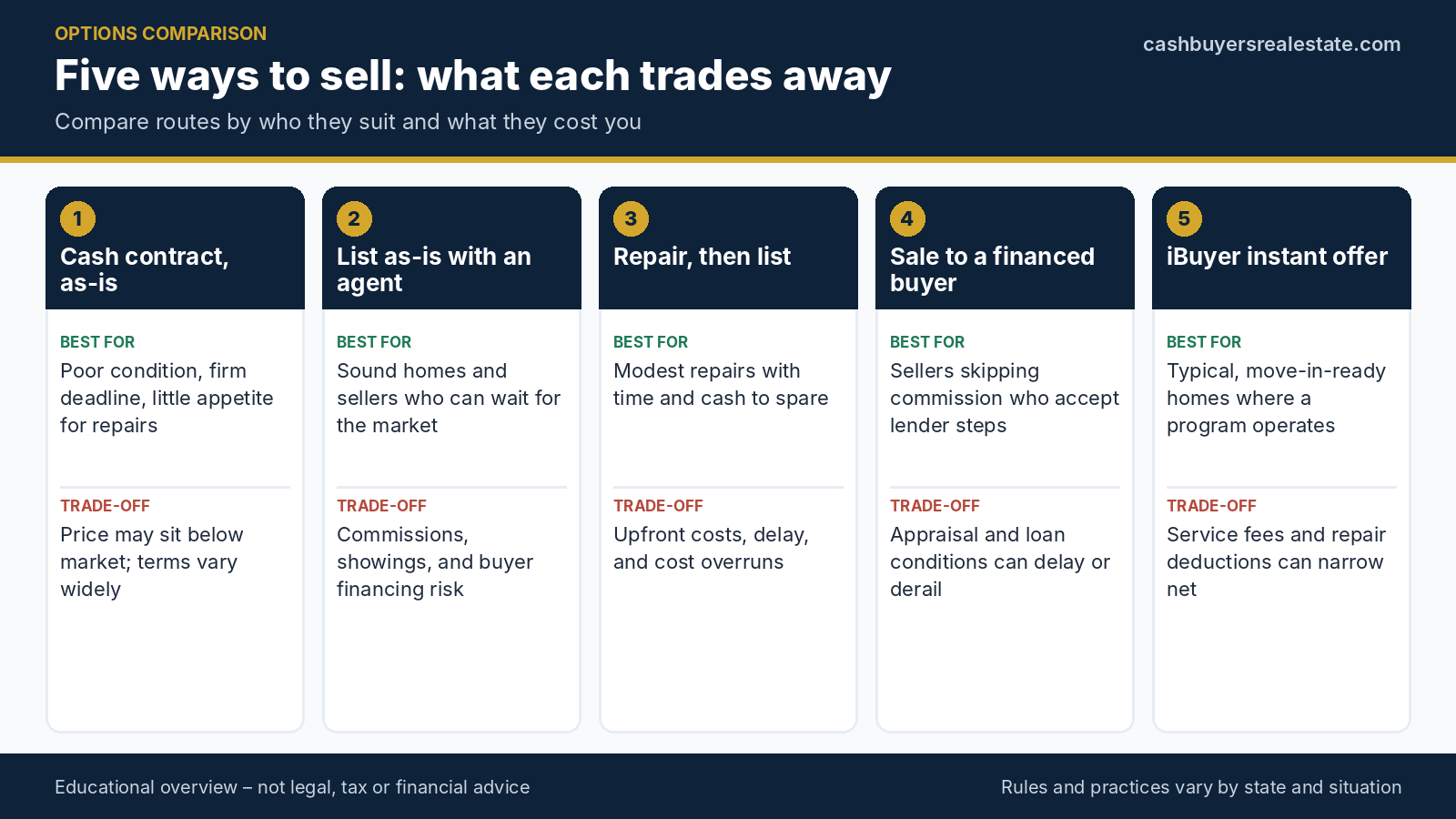
Text version of this infographic
- Cash contract, as-is — Best for: Poor condition, firm deadline, little appetite for repairs. Trade-off: Price may sit below market; terms vary widely.
- List as-is with an agent — Best for: Sound homes and sellers who can wait for the market. Trade-off: Commissions, showings, and buyer financing risk.
- Repair, then list — Best for: Modest repairs with time and cash to spare. Trade-off: Upfront costs, delay, and cost overruns.
- Sale to a financed buyer — Best for: Sellers skipping commission who accept lender steps. Trade-off: Appraisal and loan conditions can delay or derail.
- iBuyer instant offer — Best for: Typical, move-in-ready homes where a program operates. Trade-off: Service fees and repair deductions can narrow net.
Closing, Possession, Prorations, and Payoff Language
The back half of the agreement answers practical questions: when the sale happens, who runs the closing table, when you hand over the keys, and how the money is divided up on the final statement. Disagreements over these points rarely involve villains. They come from vague wording, from local customs that one party assumed were universal, and from arithmetic nobody checked until the day of closing.
The Closing Date, the Closer, and the Money Trail
A cash closing can be quick, but speed comes from preparation on both sides, not from the absence of a lender. The contract sets the schedule and names the professional who will carry it out.
Setting the Closing Date and What Happens If It Slips
Most agreements state the closing date either as a specific calendar date or as a number of days after signing or after the end of the due diligence period. The phrase “on or before” gives the buyer the right to close early, which is convenient for some sellers and troublesome for others, such as a seller who needs time to arrange a payoff or find housing and who could be pushed into a closing earlier than expected. A better approach for a seller with constraints is to ask for a closing window, for example a range of dates, with the exact date set by mutual agreement within it. Whichever structure is used, the seller should confirm that the date leaves enough room to obtain a payoff statement from any lender, to clear any title objections, and to move belongings out in an orderly way.
The agreement should also explain what occurs if the date passes. Many forms state that time is of the essence, which means that missing the date is a breach rather than a minor delay, and that the non-breaching party can cancel or pursue remedies. Others allow either party to extend by a short, stated period for specific causes, such as title cure or a delayed payoff letter, and some require an extension fee. A seller who values certainty should prefer clear outer dates with the consequences written out, because an open-ended closing date leaves the seller with a house that is off the market and a buyer who can cancel or demand concessions near the end. If the buyer asks for a short extension, weigh the request on its merits, ask for something in return such as an additional non-refundable deposit, and put the extension in a signed amendment rather than accepting an email promise.
Escrow, Title Company, or Attorney: How Closing Practice Differs by State
The identity of the closer and the closing method depend heavily on where the property sits. In many states a title company or escrow company serves as a neutral stakeholder, receives the buyer’s funds and the seller’s signed deed, and releases everything when the conditions of the contract have been satisfied. In other states, attorneys conduct the closing, prepare or review the deed, handle the funds, and sometimes represent the buyer or both sides. Georgia is a clear example: the state supreme court held in a 2003 advisory opinion that only a licensed Georgia attorney may prepare or facilitate execution of a deed of conveyance for others, and the court rejected closings run by non-lawyers. Other states have their own rules or customs, and no single list should be trusted without checking it against your state bar or a local title professional, which is why the contract should name the closer and why you should ask whether an attorney is customary where the property is located.
| Method | Who holds the funds and documents | Where common | Seller’s questions |
|---|---|---|---|
| Escrow company closing | Neutral escrow agent under written instructions | Some regions, by local custom | Who is the escrow officer, and what instructions will I sign? |
| Title company closing | Title agent; often issues the title policy | Many states, by local custom | Is the title company independent of the buyer? |
| Attorney closing | Closing attorney, often in the attorney’s trust account | States where attorney involvement is required or customary; Georgia is one example | Whom does the attorney represent, and may I use my own? |
| Mobile or remote signing | Same closer, with notarization at a location you choose | Widely available, subject to state notary rules | Will originals be mailed, and when are funds released? |
The table is a map of questions rather than a guide to what your state requires, since practices overlap and change. The most useful single question for any seller is whether the closer represents only the buyer, or also represents you. A closing attorney hired by the buyer owes duties to the buyer, and a seller who wants independent advice on the deed, the settlement figures, or the payoff may hire a separate attorney for a flat or hourly fee, which is a small share of the price in most sales. Another practical point is the settlement statement itself: federal rules on the integrated mortgage disclosures do not require the Closing Disclosure for a cash transaction, so the form may be an older style settlement statement or a state-prescribed form, and some states require a particular one.
Possession, Prorations, and the Payoff Figures
Money and keys change hands together at a closing, and the contract has to say how both should be handled. Mistakes in this area are the most common reason sellers walk away from a closing table with less than they expected.
Possession at Closing, Rent-Back, and Holdover Terms
The default in most residential agreements is that the seller delivers possession at closing, which means the property is vacant, the seller’s belongings are removed, and keys, garage openers, and codes are handed over. In practice many sellers need a few extra days or weeks, and a cash buyer who plans to renovate rather than occupy the home is often willing to allow it. A rent-back or post-closing occupancy agreement formalizes this by letting the seller stay for a set period after the deed is delivered, usually paying a daily or monthly amount, and it should cover who pays utilities, who carries insurance, what condition the property must be in at move-out, and what happens if the seller overstays. Without a written arrangement, the seller who remains after closing is a tenant at best and a trespasser at worst, and the buyer may owe nothing to a seller who suffers a loss in that period.
Holdover terms deserve a careful look because they can turn a convenience into a liability. Some agreements impose a daily charge many times the original rent-back rate for each day beyond the agreed date, or hold back part of the seller’s proceeds in escrow until the buyer confirms that possession has been delivered and the property is in the promised condition. Holdbacks are reasonable when the amount is proportionate and the release conditions are specific, and they become punitive when the amount is large or the release is controlled solely by the buyer. The seller’s homeowner’s insurance usually ends or changes at closing, so the buyer’s coverage and the seller’s personal property coverage should be confirmed in advance. If the home has tenants, the sale does not by itself end their leases, and the agreement should state whether the buyer takes the property subject to those leases and who is entitled to rent and security deposits.
Illustrative example (hypothetical numbers, not market data): A seller needs 12 days after closing to finish moving and negotiates a rent-back at $60 per day, paid at closing from proceeds, with a $1,500 holdback released once the buyer confirms the house is empty. The agreement caps the holdover charge at $150 per day after day 12 and requires a walkthrough within 24 hours of move-out. The seller moves on day 10, and the walkthrough happens the next morning. Because the amounts and the release conditions were on paper, the holdback is returned within two business days. In a version of the same deal that said only “seller may remain a short time,” the buyer could have held the proceeds indefinitely.
Prorations, Payoff Letters, and Reading the Settlement Statement
Prorations divide the recurring costs of the property between the seller and the buyer based on the days each of them owns it. A title company example from Idaho shows the basic mechanics: the annual property tax is divided by 365 to get a daily rate, the seller is charged for the days of the tax year before closing, and the buyer takes over from there, so that a March closing on a $1,200 annual bill leaves the seller owing a bit over $240. The same logic applies to homeowners association dues, special assessments, utilities, and rents. The details depend on local custom and the contract: whether the day of closing belongs to the buyer or the seller, whether the year is the calendar year or a fiscal year, and whether taxes are billed in advance or in arrears, which determines whether the seller pays the buyer a credit or the buyer pays the seller one. Property tax calendars differ by state and county, so the arithmetic should be checked against your local tax bill.
A payoff letter is the written statement from a lender or lienholder showing the amount needed to release a lien on a stated date, with a daily interest figure for later dates. It is almost always ordered by the closer on your authorization, and it is the reason the settlement statement may show a figure for the loan different from the balance on your last monthly statement. Payoff language in the contract should authorize the closer to pay off all mortgages, liens, and assessments from your proceeds, to obtain release documents, and to account for them on the settlement statement. Ask for a draft settlement statement at least a day before closing, because reviewing numbers at the table, with a buyer and closer waiting, is not a good moment to discover that a fee you didn’t expect has appeared.
A simple review routine helps. Compare each of the following against your contract and your own records before you sign:
- The sale price and any seller credit or concession.
- The payoff amount for each lien, including the per-day figure and the good-through date.
- Prorations of taxes, association dues, and utilities, with the method shown.
- Every fee charged to the seller, matched to a clause in the agreement.
- The net amount you will receive and the method of delivery.
If any line cannot be tied to a contract clause or a bill, ask the closer to explain it in writing. The right to understand your own settlement statement does not depend on the type of buyer, and a closer who answers calmly and in writing is a good sign about the rest of the process. Related costs, including which fees cash sales commonly involve, are discussed in the guide to cash offer closing costs, and the broader question of what you walk away with is the subject of cash offer net proceeds.
Default, Disputes, Disclosures, and the Laws Around the Contract
The clauses covered so far describe how the transaction is supposed to go. This section turns to what happens when it doesn’t, and to the legal rules that apply regardless of what the contract says. Both topics are easy to ignore when everything seems friendly and both are costly to learn about afterward.
Default, Remedies, and Dispute Resolution
A default clause is a contract’s answer to the question of who bears the loss when a promise is broken. A dispute resolution clause answers a different question: where and how the argument will be settled. Together they determine whether a problem becomes a phone call or a lawsuit.
Default, Cure Periods, and Attorney Fees
A balanced default clause treats both parties alike. It defines what counts as a default, such as failing to close on the agreed date, failing to deliver title as promised, or failing to fund the deposit, and it gives the other party the right to send written notice and allow a short period to cure the problem before remedies apply. The notice-and-cure step is particularly valuable to sellers, since a late payoff letter or a missing signature from a co-owner is the kind of problem that is usually fixable in days if the parties communicate. Without a cure period, a technical breach can allow the buyer to terminate and demand the deposit back even when the seller was close to resolving the issue.
Watch for asymmetry. Some investor forms give the buyer a broad right to cancel at almost any time while limiting the seller’s rights to keep the deposit, or they allow the buyer to recover its costs if the seller breaches but not the reverse. Fee-shifting provisions, which award attorney fees to the winning party, are a related issue: a clause that awards fees only to the buyer turns every disagreement into a one-sided risk for the seller. Another feature to look for is a clause that makes the seller liable for the buyer’s lost profit on a planned resale, which can far exceed the deposit if the buyer has already lined up a second buyer. A seller who is uncertain whether they can deliver good title on time is better off negotiating a longer timeline or narrower default definition up front than agreeing to terms that assume nothing will go wrong.
Mediation, Arbitration, Venue, and Jury Waivers
Dispute resolution clauses tend to appear in the final pages, in small type, and they can be the most consequential language in the document. Mediation is a non-binding process in which a neutral person helps the parties try to settle, and a mediation-first clause is common and generally benign. Arbitration is different: it replaces a court case with a private proceeding, often with limited appeal rights, and the decision can be enforced in court. An arbitration clause is not inherently unfair, and many commercial contracts use them, but the details control the fairness: who chooses the arbitrator, where the hearing takes place, who pays the filing and arbitrator fees, whether the clause applies to both parties or only to claims the seller might bring, and whether either party can still go to court for emergency relief such as stopping a recorded claim against the title.
Venue and jury waiver clauses work in a similar way. A venue clause selects the county or state where any lawsuit must be filed, and a clause that requires a homeowner to travel to a distant state raises practical costs even if it is legally enforceable. A jury waiver gives up the right to a jury trial in advance. Because courts and legislatures treat these provisions differently from state to state, a seller who sees binding arbitration, an out-of-state venue, a jury waiver, or one-way fee-shifting in a consumer-facing home sale should treat it as a reason to have an attorney review the document before signing. The companion guide on red-flag clauses covers these provisions in more detail; the point to carry from this article is that dispute language is a trade, and a seller who gives up access to the local courts should be receiving something real in return.
Disclosures and the Rules That Sit Around the Contract
Even in a cash sale to an investor who plans to gut the house, certain obligations do not disappear. Some come from state law, some from federal law, and some from tax rules that only become visible when the paperwork is filed.
Seller Disclosures, As-Is Language, and Lead Paint
An as-is clause says the buyer accepts the property in its present condition and that the seller will not repair it or give credits for its condition. It does not, by itself, cancel the seller’s legal duty to disclose certain information, and agreements that attempt to waive statutory disclosure forms are a pattern to question. Disclosure rules vary considerably. Texas, for example, requires a seller of residential property with no more than one dwelling unit to deliver a written disclosure notice, with a long list of exemptions that include transfers by fiduciaries administering an estate, trust, or conservatorship, and the buyer may terminate within seven days after receiving a late notice. Other states use different forms, have different exemptions, or place more weight on a seller’s duty not to conceal known defects. Because the topic is large, it has its own treatment in the guide to as-is home sale disclosures, and the practical rule is simple: complete the forms your state requires, answer honestly from your own knowledge, and do not sign language that says you never had to.
Federal law adds one more requirement for older homes. For housing built before 1978, the seller must disclose known lead-based paint and lead hazards, provide available records and reports, give the buyer the EPA pamphlet, include a lead warning statement in the contract, and allow the buyer a 10-day opportunity to test, which the parties can shorten or the buyer can waive. The seller must keep a signed copy of the disclosures for three years, according to the EPA’s real estate disclosure page. EPA lists several exemptions, including foreclosure sales and housing built after 1977, but a typical pre-1978 single-family house sold to an investor is not exempt merely because the buyer pays cash. If the agreement you receive for such a house has no lead paint addendum, ask why, and expect the closer to want it.
| Layer | Level | What it can require of the seller | Where to confirm |
|---|---|---|---|
| Lead-based paint disclosure | Federal | Disclosure, pamphlet, warning statement, 10-day opportunity for pre-1978 housing | EPA real estate disclosure page |
| Seller property disclosure notice | State | Written condition disclosure, with exemptions that differ by state | State statute or real estate commission |
| Home-sale gain exclusion and reporting | Federal tax | Report the sale if you receive Form 1099-S or if any gain is taxable | IRS Topic 701 and Publication 523 |
| Foreign-seller withholding | Federal tax | Buyer may need to withhold a share of the amount realized from a foreign seller | IRS FIRPTA page |
| Wholesaler disclosure and cancellation | State, in some states | Written disclosure of the buyer’s role and a short cancellation right | State real estate agency |
| Entity ownership reporting | Federal | Duties fall on settlement professionals; rule currently vacated and on appeal | FinCEN real estate reporting page |
This table shows how many different authorities can touch a single sale without appearing in the agreement. The tax and reporting rows matter even to sellers who owe nothing, because a closer asks for a taxpayer identification number and a forwarding address to prepare the paperwork, and a seller who provides them promptly avoids delays. The state rows are the ones most likely to change over time, since several legislatures have recently revisited how investors may market and assign contracts, so a rule you read about last year deserves a check before you rely on it.
Federal and State Overlays: Taxes, Foreign Sellers, Cooling-Off, and Wholesaler Laws
On taxes, the IRS explains that a homeowner may exclude up to $250,000 of gain on the sale of a main home, or up to $500,000 on a joint return, if the ownership and use tests are met over the five years before the sale, and that a seller who receives Form 1099-S must report the sale even when the gain is fully excludable. The IRS page that states these rules, Topic No. 701, was last reviewed in October 2026, and a tax professional can apply them to your situation, including to inherited property or a home used partly as a rental. For sellers who are not U.S. persons, the IRS explains that the buyer generally must withhold 15 percent of the amount realized, subject to an exception for a buyer who will use the property as a residence at a price of $300,000 or less, which is one reason a closer asks every seller about residency status.
Two further points surprise sellers. First, the Federal Trade Commission’s cooling-off rule, which gives buyers three days to cancel certain sales made away from a seller’s regular place of business, excludes real property, so signing a house contract at your kitchen table does not give you a federal right to change your mind. Second, some states now regulate “wholesaling,” meaning contracting to buy a home with the intention of assigning the contract to someone else. Oregon’s 2024 law, which applies to contracts entered into on or after July 1, 2025, requires registration of wholesalers, a written disclosure before signing, and a right for either party to cancel without penalty until midnight after the third business day following the disclosure. Oklahoma’s statute requires wholesalers to disclose an intent to assign for a higher price, to tell sellers to seek legal advice, and to allow cancellation within two business days, and a contract that lacks the required disclosures is unenforceable and may be canceled at any time. Neither rule is a national standard, and sellers elsewhere should ask their state real estate agency whether similar protections exist. Because so many separate authorities and clauses are involved, it helps to boil the review down to a handful of checks that can be repeated on every offer.
Those six checks are to verify the buyer’s identity and entity, request proof of funds, read the cancellation and termination clauses, examine the assignment terms, use a reputable and neutral closer, and never sign a document with blank fields. Each of them corresponds to a section covered above, and the graphic that follows presents them as a risk checklist that can be reviewed in a few minutes before any signing.
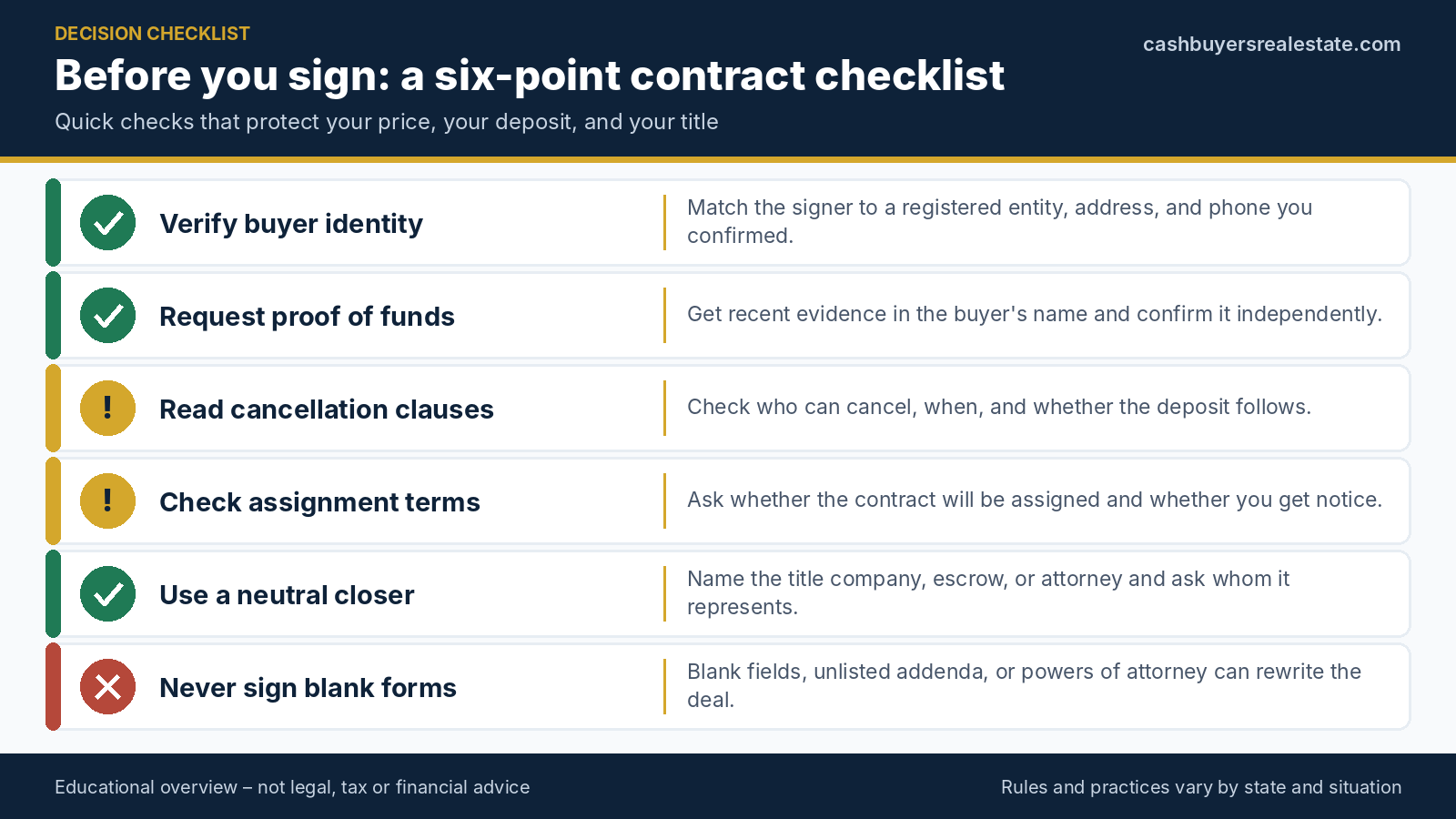
Text version of this infographic
- Verify buyer identity — Match the signer to a registered entity, address, and phone you confirmed.
- Request proof of funds — Get recent evidence in the buyer's name and confirm it independently.
- Read cancellation clauses — Check who can cancel, when, and whether the deposit follows.
- Check assignment terms — Ask whether the contract will be assigned and whether you get notice.
- Use a neutral closer — Name the title company, escrow, or attorney and ask whom it represents.
- Never sign blank forms — Blank fields, unlisted addenda, or powers of attorney can rewrite the deal.
Addenda, Amendments, Assignment, and the Decision to Hire an Attorney
A purchase agreement is rarely a single static page. Attachments are added, dates are moved, prices are adjusted, and rights are transferred, and each of those changes has its own paperwork. The final clauses that sellers should understand are the ones that change the contract after the main text has been read.
Addenda and Amendments: How a Contract Gets Rewritten
Two different mechanisms alter an agreement. An addendum adds terms at or around signing and is usually attached to the original. An amendment changes terms after the agreement is in force. Both are legitimate, and both can leave the seller holding a document that doesn’t match the deal they remember.
Which Addenda Matter and Which Document Wins
Addenda are the contract’s special-purpose pages, and they range from routine to consequential. A lead-based paint addendum is a federal requirement for older housing. A homeowners association addendum allocates responsibility for dues, transfer fees, and resale certificates. A possession or rent-back addendum sets the post-closing arrangement. An inspection or as-is addendum tailors the due diligence rules. A tenant addendum lists leases and deposits. A special stipulations page lets the parties write terms that don’t fit anywhere else, and that page deserves more attention than its small label suggests, because it is where a buyer’s unusual conditions tend to be written, often in a few typed lines. A seller should ask the closer or the buyer for a written list of every addendum before signing and should check that the main agreement refers to each by name, so that nothing can be added later as though it had always been there.
The question of which document wins when two conflict is often answered by an order-of-precedence clause, and sellers should read it. A common rule says that a specific addendum overrides the general text, and another says that handwritten changes override typed text. If an addendum says one thing about the deposit and the main agreement says another, the contract may favor the buyer’s version without anyone realizing it, since the buyer’s template was drafted with that rule in mind. Avoid signing any page that has open blanks or unchecked boxes that could be completed by someone else later, and initial each page only after reading it. Keep your own complete copy of the executed package, including every addendum, in a single folder from the day of signing, since the closing agent’s file and the buyer’s file might not match yours.
| Addendum | Purpose | When it usually appears | What to check |
|---|---|---|---|
| Lead-based paint disclosure | Meets the federal disclosure duty | Housing built before 1978 | Signed by all parties; pamphlet delivered; 10-day period addressed |
| Possession or rent-back | Lets the seller stay after closing | Seller needs time to move | Daily charge, holdback, insurance, move-out condition |
| Association or condominium | Allocates dues, fees, and resale documents | Properties in an association | Who pays transfer fees; how unpaid dues are handled |
| Assignment or wholesaler disclosure | Discloses that the buyer may transfer the contract | Investor-drafted forms | Whether you can cancel; whether the buyer stays liable |
| Tenant and lease | Lists leases, rents, and deposits | Occupied or rental property | Who receives deposits and rent; notice to tenants |
| Special stipulations | Adds terms that fit nowhere else | Almost any negotiated deal | Plain wording; no waiver of statutory rights; no blanks |
As you read the table, treat the final column as the useful one. For almost every addendum the right question is not whether it exists but whether it is complete, signed by everyone who needs to sign, and consistent with the main agreement. A special stipulations page that is blank at signing is an invitation, and a seller who sees blank lines should either strike them through and initial the strike-through or ask for them to be filled before signature. In estate and trust sales, the signature blocks on the addenda should match the capacity shown on the first page, with the fiduciary’s title written out.
Amendments, Extensions, and Price Changes After Signing
After the agreement is signed, almost every important change should be made by a written amendment signed by every party who signed the original. This includes new closing dates, extensions of the due diligence period, price reductions, repair credits, and changes in who holds the deposit. Email exchanges can sometimes serve as binding modifications under the contract’s terms and local law, but relying on that possibility is risky, and many agreements include a clause stating that amendments are effective only if in writing and signed. The seller’s safest practice is to treat any modification, however small, as requiring a one-page amendment that restates the old term, the new term, and the date, with a sentence confirming that all other terms remain unchanged.
The negotiating dynamics deserve attention too. Amendments tend to be requested at moments when the seller is least able to say no: the day before closing, after movers are booked, after a new home has been committed to. The honest buyer who needs an extra week because of a delayed title commitment will usually accept a modest fee or an additional deposit in return, and the less honest buyer will resist that suggestion because the extension is the point. A good test is to ask, for each requested change, what the buyer is giving in exchange, whether the change is limited to a stated item, and whether the seller’s own deadlines move too. Put every answer in the amendment. If the buyer wants to substitute a different buyer entity at this stage, treat that as an assignment, with the questions about identity and funds starting over.
Assignment, Recorded Notices, and Knowing When to Hire an Attorney
The last cluster of terms concerns who the buyer really is, what the buyer may record in the public record, and when the cost of professional advice is clearly worth paying.
Assignment, Wholesaling, and Who Ends Up Owning the Contract
An assignment clause allows a buyer to transfer its right to buy the property to someone else, typically for a fee. Investors who practice what is often called wholesaling use assignment to find an end buyer after signing with the seller, and the seller may never meet the party who finally closes. This is lawful in many places and is not by itself a sign of bad faith, and some sellers are well served by a buyer who has the marketing reach to find a purchaser for a difficult property. The areas of concern are transparency and price. A buyer who signs at $150,000 and assigns to an end buyer at $180,000 has earned a $30,000 spread, and the seller may fairly ask whether that spread reflects services or merely information the seller lacked. Oregon and Oklahoma now require specific disclosures and cancellation rights in this setting, which is a reasonable indicator of where regulators see the risk.
If the agreement contains an assignment clause, ask four things in writing. Will the buyer assign, and if so, to whom and for how much? Will you receive notice and the new buyer’s identity before closing? Does the original buyer remain responsible for performance if the assignee defaults? And does the assignee need to deliver proof of funds before closing? A seller who gets clear answers can proceed with more confidence, and one who receives evasive replies has learned something important about the deal. For the larger picture of investors who contract and resell, see the discussion of selling a house directly to an investor, and for sellers whose property is in poor condition, the guide to cash home buyers for fixer-uppers explains how condition affects the terms investors write.
Recorded Notices, Powers of Attorney, and When to Hire an Attorney
Some agreements include a clause that lets the buyer record a short notice, often called a memorandum of contract, in the county land records. Recording gives public notice that the buyer has a contract interest in the property, which protects the buyer against a seller who might try to sell to someone else, and it is a normal tool in some transactions. It also means that your title is clouded until the notice is released, and a buyer who defaults may not cooperate quickly in releasing it, which can block a sale to anyone else. The sensible questions are whether the agreement requires the buyer to release the notice promptly on termination, within a stated number of days, and whether a failure to do so exposes the buyer to liability. Likewise, any clause asking you to sign a power of attorney in favor of the buyer should be refused or reviewed by an attorney, because it can authorize someone else to sign documents in your name.
Whether to hire a real estate attorney depends partly on where the property is. In states where attorneys customarily or necessarily conduct closings, as in Georgia, one will be involved anyway, and the seller’s decision is whether to have independent advice rather than relying on the attorney the buyer selects. In states where title or escrow companies close deals, an attorney is optional, and the question becomes whether the transaction has features that justify the cost. Reasonable triggers include a probate or trust sale, co-owners who disagree, a title problem or lien that is not routine, tenants, a significant gap between the offer and what you think the property is worth, an assignment clause, a recorded memorandum, any arbitration or venue clause that takes you away from local courts, or a buyer’s refusal to change terms that you consider unfair. Fees vary by place and by the scope of the review, and many attorneys will quote a limited-scope contract review in advance, so it is reasonable to ask before committing. A state or local bar association referral service can point you to a qualified attorney. Weigh the cost against what is at stake in the sale, and keep in mind that a review that finds nothing wrong still has value as confirmation.
Frequently Asked Questions About Cash Home Buyer Contracts
The questions below come up repeatedly when sellers read a cash purchase agreement for the first time. They are grouped by theme, and the answers assume general U.S. practice, so check the state-specific details with a local attorney or title professional.
Questions About Money, Timing, and Possession
Questions about deposits and funds
- Does a cash buyer have to put down earnest money?
No law requires a deposit in every private sale, so it comes down to what the contract says. Most written agreements include one because it gives the seller something to keep if the buyer defaults after the refund period ends. An agreement with no deposit, or a very small one, shifts nearly all the risk to the seller. If the buyer won’t post a meaningful amount with a neutral holder, ask for a shorter inspection period or a clear right to terminate if the buyer misses a deadline.
- Who should hold the deposit?
A neutral third party such as a title company, an escrow company, or a closing attorney is the standard answer, and the contract should name it. The holder acts under written instructions that require the signatures of both sides, or a court order, to release the money. A deposit held by the buyer or by a business the buyer owns is not protected in the same way. Confirm receipt directly with the holder using contact details you found independently.
- Is a bank statement enough to prove a buyer has the money?
A recent statement in the buyer’s own name, showing a balance that covers the price and expected costs, is useful evidence but not a guarantee. Statements can be altered, balances can move between the date of the document and the closing, and a statement in a different name proves little. Better practice is to ask for the document in writing, compare the names against the contract, and have the closer confirm funds when it receives the wire.
- What does it mean if the contract says the buyer may use partner funds?
It can mean that the buyer plans to bring in investors or a short-term lender to cover part of the price. That arrangement is lawful, but it adds parties whose approval might be needed, and some agreements let the buyer cancel if those parties decline. Ask whether the buyer’s obligation depends on anyone else’s approval, and ask for the answer to be written into the contract rather than given by phone.
Questions about closing dates and moving out
- Can a buyer close earlier than the date in the contract?
Only if the contract allows it, and many do through “on or before” wording. An early closing can be helpful, but it can also compress the time you need to obtain a payoff letter, clear a title issue, or move. If you need a minimum notice period, ask for a clause that requires the buyer to give several days’ written notice before accelerating the date.
- What happens if I need more time to move after closing?
Ask for a short written rent-back before you sign. It should state the number of days, the daily charge, who pays utilities and insurance, the move-out condition, and any amount held back from your proceeds until the buyer confirms possession. A verbal promise to be flexible does not protect you once the deed has been delivered, and the buyer may owe you nothing if the house is damaged or entered during that period.
- Do prorations apply in a cash sale?
Yes. Taxes, association dues, utilities, and similar recurring items are divided between seller and buyer by the closing date whether or not a lender is involved. The method depends on local practice and the contract, so ask the closer for the calculation. You can verify it by dividing the annual amount by the number of days and multiplying by the days each party owns the home.
Questions About Rights, Changes, and Professional Help
Questions about canceling and changing the contract
- Do I have three days to cancel after signing a cash home contract?
Not as a matter of general federal law. The FTC’s cooling-off rule, which gives a three-day right to cancel for certain sales made away from a seller’s regular place of business, excludes real estate. A few states give specific cancellation rights in particular settings, such as wholesaling in Oregon and Oklahoma, and a contract may include its own cancellation clause. Read the agreement and ask a local attorney before assuming you can back out.
- Can the buyer change the price after we sign?
Only if the contract allows it or you agree to an amendment. Many agreements include a price reduction tied to inspection findings, and the key is whether the right is limited to documented defects found within a defined period. If the price can be lowered on the buyer’s sole opinion, treat the stated number as provisional. Any agreed change should appear in a signed amendment.
- What should I do if I feel pressured to sign today?
Slow down. Consumer protection guidance from the FTC notes that honest businesses give you time to decide. Ask for the full document in writing, set a review deadline, and tell the buyer you will respond after you have read and checked it. A buyer whose offer disappears when you ask for a day to review it has told you how firm the offer ever was.
Questions about attorneys, deeds, and disputes
- Do I need a lawyer to sell my house for cash?
It depends on the state and the transaction. In states where attorneys customarily handle closings, one will be involved, and you can decide whether to have your own. Elsewhere it is optional, though a limited review is worth considering for estate or trust sales, assignments, recorded notices, arbitration clauses, or title problems. A local bar association referral service can help you find an attorney.
- Is it safe to sign a quitclaim deed?
A quitclaim deed makes no promises about title, which lowers your exposure as a seller, so it is not dangerous for that reason. The question is why the buyer wants it. In family transfers or an uncertain title it can be appropriate, but a buyer who insists on one from a seller with clear title may be using a template or avoiding title insurance. Ask for the reason and consider a special warranty deed as a middle ground.
- What if the contract requires arbitration?
Arbitration is lawful and common in some contexts, but the details decide whether it is fair. Look at who pays the fees, where the hearing takes place, whether the clause binds both sides equally, and whether you keep access to a court for urgent relief. If any of those points are one-sided or distant from your home, ask the buyer to remove the clause or replace it with mediation followed by local courts.
- Can I back out if the buyer assigns the contract to someone else?
Only if the contract or state law gives you that right. Oregon and Oklahoma require wholesalers to give specific disclosures and allow cancellation within a short period, but most states have no equivalent. Without such a rule, an assignment clause that you signed may allow the transfer without your consent. That is why you should ask about assignment plans before signing.
Choosing Whether and How to Sign: A Decision Framework and Next Steps
After reading a cash purchase agreement closely, most sellers are left with a practical question: is this the right deal for my situation, and if it is, what should I do before I sign? The answer rests on priorities more than on any single clause.
Matching the Contract to Your Priorities
No route is best for everyone. A cash contract trades some price for certainty, speed, and convenience, and whether that trade is good depends on what you value and on the numbers.
Weighing Certainty, Price, Speed, and Effort
Start by ranking four things honestly: how much you need certainty that the sale will close, how much the final dollar figure matters, how soon you need the money or the house off your hands, and how much work, noise, and stress you are willing to accept. A seller with a firm relocation date, a property in poor condition, and a limited appetite for managing repairs will weigh certainty and speed more heavily. A seller with time, equity, and a home in sound condition will usually weigh price more heavily. Neither is wrong, and the contract review in this article helps you see which terms protect the priorities you picked. A cash agreement with a meaningful deposit, a short fixed inspection window, a named neutral closer, and a clear closing date delivers certainty. One with a token deposit and an open-ended exit delivers only the appearance of it.
Numbers should settle the rest, and the numbers that matter are net proceeds, not headline prices. A seller who compares a $245,000 cash contract with a $265,000 listing without subtracting commissions, repairs, concessions, carrying costs, and months of waiting has not compared the two. The following table illustrates how the arithmetic might work for one hypothetical property, using assumptions that are explicitly invented for this example, and it is followed by a note on how sensitive the result is to those assumptions.
| Line item | Cash contract, as-is | List as-is with an agent | Repair, then list |
|---|---|---|---|
| Sale price | $245,000 | $265,000 | $300,000 |
| Repairs before sale | $0 | $0 | ($35,000) |
| Agent commissions (assumed 5%) | $0 | ($13,250) | ($15,000) |
| Seller closing costs (assumed) | ($2,500) | ($5,300) | ($6,000) |
| Buyer concessions after inspection | $0 | ($3,000) | $0 |
| Carrying costs while waiting (assumed) | ($1,800) | ($5,400) | ($10,800) |
| Net before mortgage payoff | $240,700 | $238,050 | $233,200 |
In this invented case the cash contract nets slightly more than either alternative, despite the lowest sale price, because commissions, repairs, concessions, and months of carrying costs consume the difference. Change the assumptions and the ranking changes. If the cash price were $215,000 instead of $245,000, the net would fall to $210,700, which is about $27,000 below the as-is listing, and if repairs cost $12,000 instead of $35,000 the repair-and-list route would net far more than shown. The table is a template for your own calculation, not evidence about any market, and the net sheet guidance in cash offer net proceeds gives the method in more depth. What the exercise teaches is to calculate before deciding rather than after.
When Another Route Beats a Cash Contract
A cash contract is not the answer in every circumstance, and a trustworthy guide has to say so. When the home is in good condition, the market is active, and the seller can wait two or three months, a conventional listing often produces a higher net price, even after commissions, because the pool of buyers is larger and the property can be marketed on its merits. When the house needs moderate cosmetic work, a modest investment in paint, flooring, and cleaning may add more than it costs, especially if the seller can do much of it personally. A sale directly to a buyer who is using a mortgage can work for sellers who prefer to avoid commissions and are comfortable with the longer timeline and the lender’s conditions, which the guide to cash buyer vs financed buyer covers. Instant-offer programs run by iBuyers sit between a cash investor and a listing in speed and price, with their own fees and terms.
Sellers whose main problem is condition should read the guides on selling a house fast without repairs and on cash home buyers for fixer-uppers, which compare repair-and-list with selling as-is in more detail. Sellers whose main problem is time should look at the broader overview in sell my house fast, which sets out the trade-offs of each fast-sale path. The honest comparison also considers factors that don’t appear in a table, such as the stress of showings, the risk of an agreement collapsing on a financing problem, and the value of knowing the exact day the money arrives. A good decision is one you can explain to yourself in a sentence: I chose this route because it best serves the priority I ranked first, and I checked that the net figure was acceptable.
What to Do Next
Once you have decided that a cash contract is worth pursuing, the practical steps are modest, and doing them in a sensible order protects you better than any single clause.
Documents to Gather and Questions to Ask Before You Sign
Preparation makes the review faster and your position stronger. Before you sign anything, gather the documents that identify you and the property, and prepare a short set of questions for the buyer and the closer. The documents most sellers need are listed below, and each one answers a question that will otherwise delay closing.
- Your current deed, showing how title is held and the legal description.
- A recent mortgage statement or payoff estimate for every loan or lien.
- The latest property tax bill and any association statements.
- Any prior title policy, survey, or permit records you have.
- For estates and trusts, the court appointment or trust certification.
- Photo identification and a lease for any tenant in place.
The questions are as important as the paperwork. Ask who the buyer is and whether it intends to assign the contract. Ask who will hold the deposit and when it will be delivered. Ask for evidence of funds in writing and confirm it independently. Ask what the inspection period covers and what happens when it ends. Ask who the closer is, who selected the closer, and whom that person represents. Ask which deed you will sign and why, and ask for a draft settlement statement a day before closing. If you want a longer checklist of questions to put to a buyer in writing, the guide to questions to ask a cash home buyer expands each of these. Written answers matter, because a buyer who is comfortable putting an answer on paper has usually thought it through.
A Calm Sequence for the Days Before Signing
Take the process in an order that leaves you room to think. First, read the full agreement once without marking it, simply to understand the structure. Second, read it again with Table 1 beside you and mark each clause as sound, unclear, or concerning. Third, calculate your net proceeds under the agreement and under at least one alternative, using real figures from your payoff letter and tax bill. Fourth, send the buyer a written list of questions and requested changes, keeping the tone cooperative and the requests specific. Fifth, decide whether an attorney review is warranted given your state, the title, and the terms. Sixth, verify the buyer’s entity, funds, and closer independently. Only after those steps should you decide whether to sign, and the decision can still be to ask for more changes or to walk away.
A reasonable buyer will understand that you want to do this, and the process rarely takes longer than a few days. If a deadline is set by the buyer to make you hurry, ask what specifically will happen if you take until tomorrow, and notice whether the answer is a concrete cost or only a feeling of urgency. Many cash sales close without drama, and a careful read of the paper is part of why they do. If the numbers work, the buyer checks out, and the clauses are balanced or can be made so, a cash sale can be a sound way to move on. If they don’t, the alternatives are available, and nothing about this decision needs to be settled before you have the information you need.