
Cash Buyer Earnest Money: Offers, Process & Red Flags
The offer on your kitchen table is a good one by most measures. The price is close to what you hoped for, the buyer says there’s no lender to wait on, and the closing date fits your move. Then you reach the line in the contract that reads “earnest money” and see a figure that looks oddly small, or oddly vague, or a sentence saying the buyer will deliver it “within a reasonable time.” Most sellers know the term only from television and from a vague sense that it is something the buyer puts down. They don’t know what the number is supposed to be, who is supposed to hold it, or what happens to it if the sale falls apart. With a financed buyer, those questions are partly answered by a lender’s process. With cash buyer earnest money, the deposit does much more of the work, and it deserves a careful read.
Earnest money is a deposit a buyer pays after signing to show good faith, and a neutral party normally holds it until closing or until the contract ends. At closing it is credited toward the price. If the buyer cancels for a reason the contract allows, the deposit usually returns to the buyer. If the buyer walks away without such a reason, the seller may be entitled to keep it. That last sentence is the whole reason the deposit matters to a seller, and every serious question about it, from how big it should be to when it stops being refundable, comes back to who bears the cost when a sale fails.
Earnest money is a good-faith deposit, usually held by a title company, attorney, or brokerage rather than by the seller, and credited to the price at closing. In a cash sale, its size, holder, refund windows, and release terms tell you how committed the buyer is and who absorbs the loss if the deal collapses.
It helps to be honest about what a deposit can and cannot do for you. It does not prove the buyer has the rest of the money, and it does not stop a buyer from asking for a lower price halfway through. A large deposit with an open-ended escape clause is weaker than a modest one that becomes non-refundable after a short review window. A deposit held by an unknown party is weaker than one held by a title company or attorney you’ve verified yourself. The amount is only one of at least five terms, and the five together (amount, holder, delivery deadline, refund windows, and release mechanics) decide whether the deposit protects you.
The guide moves in the order a seller actually meets these issues. It begins with what the deposit is and what it is not, then follows the money to the person or company holding it. Next come typical amounts and forms, with the caveat that custom varies widely, and the windows that determine when the deposit is refundable or at risk. The second half looks at the awkward cases: tiny deposits and long option periods, how to read the deposit as one signal among several, and what happens when a deal dies and each side claims the money. Frequently asked questions and a decision framework close the piece.
Neighboring subjects live on other pages, and this one touches them only where they change how a deposit works. The contingencies that let a buyer cancel and recover the deposit are covered in the guide to cash buyer contingencies, the contract as a whole in how a cash home buyer contract is built, and the evidence that a buyer can fund the purchase in the proof of funds article. For the broader landscape, the overview of cash home buyers explains who these buyers are and how their business models differ. Here the camera stays on the deposit itself.
One last framing note. Nothing in this article assumes a buyer is acting in bad faith, or that a small deposit signals a scam. Many legitimate buyers, including experienced local investors, make modest deposits and close reliably, and some homeowners are better served by a quick and simple contract than by a larger deposit that costs them price. The goal is to help you see the trade-offs, ask for the right protections, and recognize the specific patterns, such as vague holders, instructions arriving by email, and escape clauses wider than the deposit, that deserve a slower response.
What Earnest Money Is, and What It Is Not
The phrase gets used loosely, even by people in the business, and the looseness causes real misunderstandings. Sellers sometimes assume the deposit is a payment to them, buyers sometimes assume it is always refundable, and both sides sometimes confuse it with several other payments that share a similar look. This section pins down the concept, then looks at why it carries unusual weight when no lender is involved.
The deposit’s job inside a purchase contract
Before comparing amounts or holders, it helps to see the deposit as a feature of the contract rather than a stand-alone payment. It exists because a signed agreement to sell real estate is only as strong as the parties’ willingness to perform, and a sum of money set aside at the start gives the seller something concrete to point to if the buyer doesn’t.
A good-faith deposit, tied to the contract’s terms
The Consumer Financial Protection Bureau describes earnest money as a deposit a buyer pays to show good faith on a signed contract to buy a home, held by a seller, real estate agent, or title company. If the sale closes, the money is typically applied to the buyer’s costs or down payment, and if the contract ends for a permitted reason, the buyer gets it back. If the buyer fails to act in good faith, the seller may keep it. Notice what that definition leaves out: it never says the deposit is a fee, a price, or a gift. It is a pledge, and it only has force because of the contract wording around it.
That wording is where the sorting happens. A contract states the circumstances in which the buyer may cancel and recover the deposit, such as an inspection finding, a title defect the seller won’t cure, or a deadline the seller misses. It also states what counts as a default by the buyer, and what the seller may do about it. The deposit sits between those two lists. If a dispute arises, the question is rarely “who deserves the money” in a moral sense. It is “which clause was triggered, on which day, and was the required notice given in the required way.” Sellers who treat the deposit as a feature of the contract, not as a free-standing number, ask better questions before they sign.
Illustrative example (hypothetical numbers, not market data): A buyer agrees to purchase a house for $214,000 and delivers a $4,280 deposit, which is 2% of the price, to a title company within three days of signing. At closing, the title company applies the deposit as part of the buyer’s funds, so the buyer wires the remaining $209,720 and the settlement statement shows the deposit as a credit. The seller never receives the $4,280 separately, and never sees it as extra money. It was the buyer’s own money, parked with a neutral party, and it went toward the price like any other part of the payment.
What the deposit does not do
Several things people assume about earnest money are not true. It doesn’t pay the seller anything while the contract is pending, because the holder keeps it in a separate account and the seller has no right to spend it. It doesn’t, by itself, give the buyer a right to cancel, since the right to cancel comes from the contract’s contingencies and deadlines. It doesn’t guarantee the buyer closes, and it doesn’t cap what the seller can claim in every state: some contracts make the deposit the seller’s only remedy, while others let the seller pursue the buyer for more, depending on the form and the law.
Nor does it show that the buyer can fund the whole purchase. A buyer with $2,000 can deliver a $2,000 deposit and still lack the other $150,000. That is why the deposit and the buyer’s evidence of funds are separate checks, and why experienced sellers look at both. The deposit also isn’t the same as a fee paid to the seller for taking the property off the market, a concept that appears in some option contracts and is discussed in a later section. Finally, it isn’t a refundable loan the seller can draw on if the closing runs late. If a seller needs money during a delayed closing, that has to be negotiated separately and in writing.
Why the deposit carries more weight when no lender is involved
In a financed purchase, a mortgage lender sits behind the buyer, running credit checks, ordering an appraisal, and committing to lend only if its conditions are met. That machinery has costs, but it also screens buyers. A cash purchase has no such screen, so the seller’s comfort comes from other places, and the deposit is one of the few pieces of evidence that arrives early and is easy to check.
With no underwriter, the deposit is the buyer’s early commitment
A lender’s approval is a form of third-party vetting: someone other than the buyer has looked at income, assets, and the property. When a buyer says “I’m paying cash,” nobody has vetted anything unless the seller asks for documents. The deposit therefore does a job a lender normally does, which is to put the buyer’s own money at risk early. A buyer who delivers a meaningful sum to a neutral holder within a day or two of signing has made a real commitment. A buyer who negotiates the deposit down, delays delivery, or proposes to hand it over “at closing” has made almost none. None of this proves anything about intent, but the pattern is informative, in the same way that a bank’s early questions tell you how careful it is.
There is a second reason the deposit matters. A cash buyer’s schedule is not controlled by loan processing, so the usual brake on a sale is the buyer’s own diligence period, however long the contract allows. Without a lender’s timetable, the dates in the contract are all the seller has. A deposit that becomes non-refundable at a specific date turns those dates from suggestions into consequences. For a fuller treatment of how financed and cash purchases differ in structure, see the comparison of cash and financed buyers, which covers appraisal, underwriting, and timing differences that this guide mentions only briefly. Seen that way, the deposit is a modest and imperfect substitute for a lender’s scrutiny, but it is one of the few early tests available to a seller, and ignoring it gives that test away for nothing.
Earnest money, proof of funds, option fees, and other payments compared
Because several payments sound alike, a side-by-side view helps. The table below separates the deposit from its look-alikes, since mixing them up is one of the most common ways sellers misread an offer.
| Item | What it is | Who holds or controls it | Seller’s key question |
|---|---|---|---|
| Earnest money | Good-faith deposit credited to the price at closing | Neutral holder such as a title company, attorney, or brokerage | Under what conditions is it refundable, and from what date is it at risk? |
| Option fee | Payment for the buyer’s right to cancel during a set period, often non-refundable | Often released to the seller on request or at once | Is it separate from the deposit, and is it credited at closing? |
| Proof of funds | A document, such as a bank or account statement, showing the buyer can pay | The buyer provides it; nobody holds money | Does the name on the account match the buyer, and is it recent? |
| Additional deposit | A second payment due after a review period or other date | Same neutral holder as the first deposit | What happens if the buyer misses the date? |
| Non-refundable consideration | A small sum that makes an agreement or option legally binding | Usually paid directly to the seller | Is it credited at closing, and does it change the deposit rules? |
| Closing funds | The remaining balance wired at closing | Settlement agent receives it | Were the wiring instructions verified by phone with a known number? |
The point of the table is the last column. In each row the useful question is different, and a seller who asks the same generic question (“is the buyer serious?”) of every payment learns little. Read across, you can see that only the first row and the additional deposit are placed in the custody of a neutral party for the purpose of being credited at closing. The option fee and non-refundable consideration are real money that, in many contracts, the seller keeps whether or not the sale closes, which is why they are worth separating clearly from the refundable deposit in your own mind and in the contract language. Read this way, the table also works as a reminder to ask which of these payments an offer actually contains, and which of them are only promised.
Where the Deposit Sits: Escrow Holders and Who Controls Release
A deposit is only as safe as the party holding it, and only as useful as the rules that decide when it can be released. Sellers often focus on the amount and overlook the holder, even though a modest deposit in a regulated trust account is a firmer comfort than a larger one held by someone you can’t identify. This section walks through the usual custodians, how each is overseen, and what each can and cannot do when the two sides disagree.
Title companies, escrow firms, and attorneys as neutral holders
In most residential sales the deposit goes to a third party whose job is to follow the contract rather than either side’s wishes. Which kind of third party depends on local custom, and the custom is not uniform: in some states a title or escrow company runs the closing, in others an attorney does, and in a few places the real estate brokerage commonly keeps the deposit. Your first task is to find out which pattern applies where your house sits.
Title and escrow companies hold the money under written instructions
Where title or escrow companies handle closings, the deposit normally goes to them within a few days of signing. The contract names the holder and sets a delivery deadline; the standard Texas residential resale form, for example, directs the buyer to deliver earnest money to a named escrow agent within three days after the effective date. The holder deposits the funds in a trust or escrow account, issues a receipt, and then waits. It does not decide who deserves the money. Its role is to follow the contract’s instructions and, if the parties disagree, to refuse to pick a side.
That neutrality is the main reason sellers prefer this arrangement. A title company that receives conflicting demands generally holds the funds until both parties sign a release, a court orders payment, or a contract-specified notice process runs its course. In the Texas form, if one party demands the money and the other doesn’t object in writing within 15 days of receiving a copy of the demand, the escrow agent may pay the demanding party. Other states and other forms use different mechanics, and some require a signature from both parties in every case. Before you sign, ask the holder to explain in plain terms how it handles a disagreement, and ask whether its escrow account is a regulated trust account. Requirements for title and escrow companies, including licensing, insurance, and bonding, vary by state, so treat any specific assurance as something to confirm with your state’s insurance or financial regulator rather than something to assume.
Attorney trust accounts in attorney-closing states
In attorney-closing states, a lawyer commonly handles the transaction and holds the deposit in a trust account. The American Bar Association’s Model Rule 1.15, which states adopt in varying forms, requires a lawyer to keep property belonging to clients or third persons separate from the lawyer’s own, to notify and deliver funds promptly to those entitled to them, and to keep disputed property separate until the dispute is resolved while paying out any undisputed portion. For a seller, the practical meaning is that an attorney holding a deposit is bound by professional conduct rules, not just by a contract, and cannot simply hand you the money because you asked.
That same obligation explains why attorney-held deposits can sit frozen during a dispute. North Carolina, where attorneys close most residential sales, shows how this plays out in practice: according to a North Carolina REALTORS® explanation of the state’s standard contract form, an escrow agent facing a dispute must keep the money in its trust account until it has a written release from the parties, a court order, or has paid the funds to the clerk of court under the state’s statute. Treat that example as illustrative of the pattern, not as a statement of the rule in your state. If an attorney represents the buyer and a different attorney holds the deposit, ask which lawyer actually has custody, because the lawyer who prepares the contract is not always the one who holds the funds.
Brokerage trust accounts and arrangements that deserve more scrutiny
Not every deposit lands with a title company or a lawyer. Brokerages hold some, sellers occasionally hold others, and in off-market investor deals the holder sometimes goes unnamed. Each arrangement works, or fails, for different reasons, and the failures tend to look similar: a holder who can’t be independently confirmed, instructions that arrive by email, or a release that depends on one party’s say-so.
Brokerage trust accounts and the rules that govern them
A licensed real estate broker who holds a deposit must normally keep it in a separate trust or escrow account and follow the state commission’s rules about timing, records, and disputes. Florida offers a detailed example. Under Rule 61J2-10.032 of the Florida Administrative Code, a broker who receives conflicting demands for escrowed funds must notify the Florida Real Estate Commission in writing within 15 business days of the last party’s demand and start one of the statutory settlement procedures within 30 business days. If a party doesn’t respond to the broker’s inquiry, the rule lets the broker send a notice with a seven-business-day deadline and then release the funds to the other party. These rules are specific to Florida and to brokers, and the commission’s website notes that the notice requirement does not apply to deposits held by title companies or attorneys.
Two practical notes follow. First, a broker isn’t automatically the escrow holder. The Texas Real Estate Commission’s guidance says a broker is not required to act as an escrow agent or hold other people’s money unless the broker agrees to, so the contract should name the holder explicitly. Second, in a direct sale with no agent on either side, there may be no brokerage in the picture at all, and the contract has to supply a holder some other way. If the buyer proposes that its own company, a related entity, or an unlicensed intermediary keep the money, treat that as a prompt to ask for a title company or attorney instead.
Deposits sent directly to a seller or to a holder you can’t verify
Handing the deposit straight to the seller sounds convenient, but it undermines the whole purpose of a neutral holder. The seller then has custody of money that may have to be returned, and the buyer has no protection if the seller spends it or disputes a refund. For the buyer’s protection, consumer finance guides generally recommend against paying a seller directly, and sellers have their own reasons to avoid it: if the sale fails, the seller must sort out the refund without a neutral to point to, and a disagreement about the refund can sour an otherwise ordinary cancellation. It’s cleaner for everyone if the money never touches the seller until closing.
A different problem arises when the named holder is not what it seems. Fraudsters target real estate transactions by compromising an email account, watching the deal, and then sending altered wiring instructions. In a 2023 public service announcement the FBI’s Internet Crime Complaint Center reported a 27% rise in real estate-related business email compromise reports and a 72% rise in victim losses from 2020 to 2022, and the CFPB advises people to confirm instructions with a trusted contact using a phone number they already had. The advice is simple: never follow wiring instructions you received by email without calling the title company or attorney at a number you found yourself. Sellers are less often the target of deposit fraud than buyers, but a seller’s name, bank details, and timeline can still be used to impersonate someone in the chain.
| Holder | Typical where | How release usually works | What to confirm |
|---|---|---|---|
| Title or escrow company | States where title companies run closings | Written instructions or contract notice process; release by joint signature or court order | Regulated trust account, receipt in writing, how disputes are handled |
| Attorney trust account | Attorney-closing states | Professional conduct rules require disputed funds to stay separate until resolved | Which lawyer has custody and whether the account is a trust account |
| Brokerage trust account | Where a licensed broker agrees to hold it | State commission rules on timing, conflicting demands, and settlement procedures | That the contract names the broker as holder and the broker has agreed |
| Seller directly | Rare, informal sales | No neutral party; refund depends on cooperation | Whether a neutral holder can be used instead |
| Buyer’s own company or unnamed party | Some investor deals | Unclear; often no independent control | Why the money is not with a regulated third party |
Read the table from top to bottom as a ladder of independence. The first three rows involve a regulated or professionally bound custodian whose duties exist apart from the contract, while the last two depend almost entirely on the goodwill of the people involved. None of that makes the last two automatically wrong, but they shift the work of verification onto you. Notice also the rightmost column: each row ends with a question you can ask before signing, and the seller who asks it early is usually treated as careful rather than difficult.
The route a deposit follows is easier to hold in your head as a sequence. The process map below traces six stages from the signed contract to the final outcome: the contract is signed, the deposit is delivered to the named holder by its deadline, the holder confirms receipt in writing, a review window runs during which the buyer may cancel and recover the money, the deposit becomes firm on a stated date, and finally it is credited at closing or released after a termination. Each stage has its own question, and the later sections of this guide take them in turn.
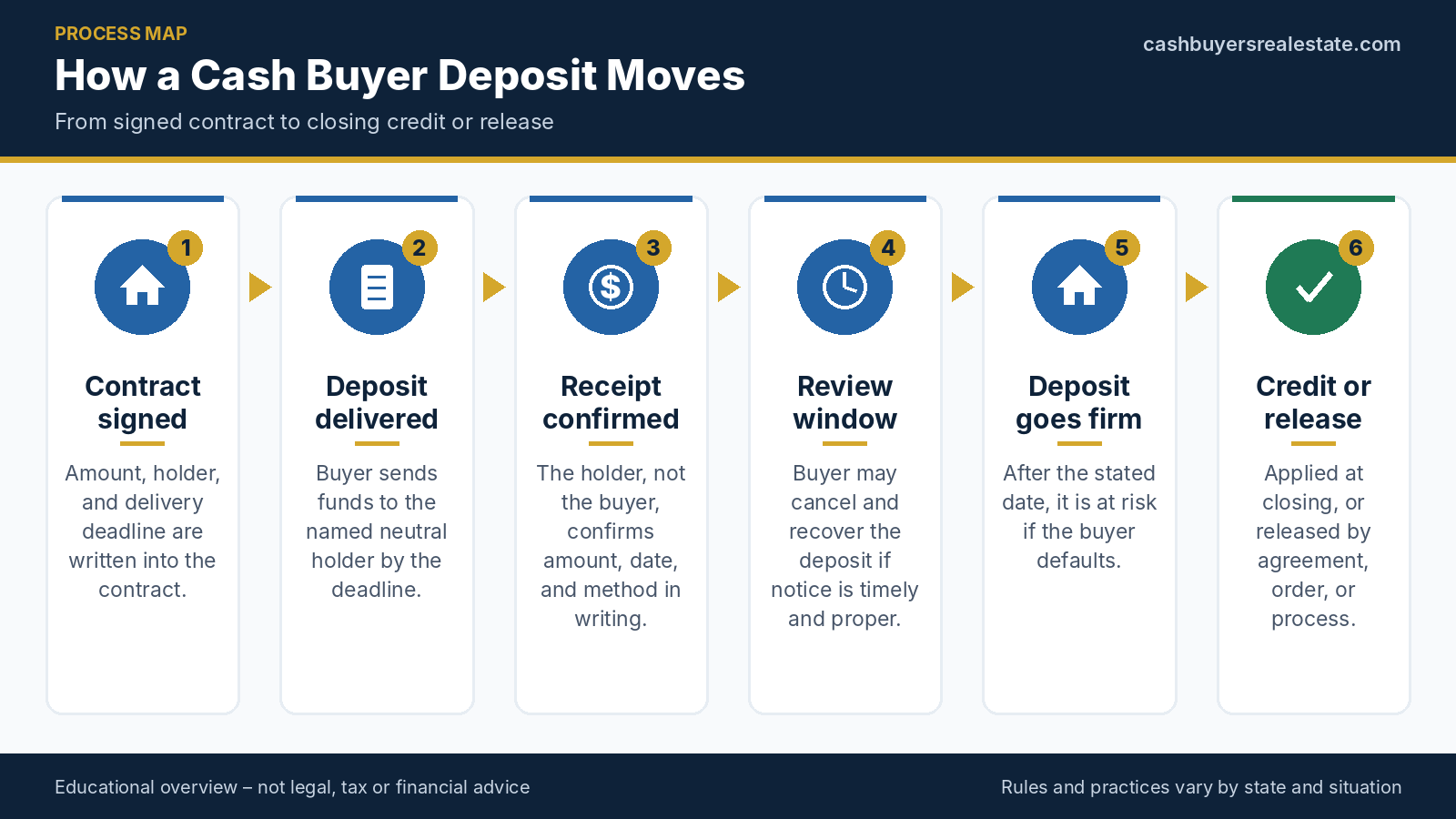
Text version of this infographic
- Contract signed — Amount, holder, and delivery deadline are written into the contract.
- Deposit delivered — Buyer sends funds to the named neutral holder by the deadline.
- Receipt confirmed — The holder, not the buyer, confirms amount, date, and method in writing.
- Review window — Buyer may cancel and recover the deposit if notice is timely and proper.
- Deposit goes firm — After the stated date, it is at risk if the buyer defaults.
- Credit or release — Applied at closing, or released by agreement, order, or process.
Typical Amounts, Forms, and Local Custom
Ask ten real estate professionals what a normal deposit is and you will hear several confident answers that don’t agree. That isn’t because any of them is wrong. Deposit custom is local, shaped by price levels, contract forms, how competitive the market is, and who the buyer is. The honest answer is a range with caveats, plus a method for finding out what’s usual where your house is.
How the size of a deposit gets set
No federal rule sets a required deposit for a home sale. The amount is whatever the parties agree to in the contract, which means it is a negotiated term like the price or the closing date. What follows from that is both freeing and a little unnerving: a seller can ask for more, a buyer can offer less, and the only check on either is what the other side will accept.
Percentages, flat sums, and market custom
Consumer guides tend to express deposits as a share of the price. PNC’s explainer, for example, says that in many markets buyers can expect to put down 1% to 3% of the purchase price as earnest money, and adds that the figure moves with local conditions and demand for the property. That range is a reasonable starting orientation, but it is a description of common practice in many markets, not a rule and not a measured national average. In some areas, and especially for lower-priced houses, deposits are quoted as flat sums such as $1,000 or $5,000 regardless of the price. In hot markets, competitive buyers may offer more to stand out, and in slow ones sellers may accept less to keep a deal alive.
For a cash sale the range is even less predictable. Investors who buy several houses at once spread their cash across contracts and sometimes prefer small deposits with generous review windows. Individual cash buyers, such as downsizing homeowners or people buying a second property, often follow the owner-occupant custom of a percentage. Because there is no authoritative statewide table, the best way to learn what’s usual is to ask a local title company or real estate attorney what deposits they see on comparable contracts. They handle many deposits and can tell you, without naming anyone, whether a particular figure sits inside or outside normal.
| Sale price | 1% deposit | 2% deposit | 3% deposit | $1,000 flat, as % of price | Months of $1,300 carrying cost a 2% deposit covers |
|---|---|---|---|---|---|
| $120,000 | $1,200 | $2,400 | $3,600 | 0.83% | 1.8 |
| $200,000 | $2,000 | $4,000 | $6,000 | 0.50% | 3.1 |
| $350,000 | $3,500 | $7,000 | $10,500 | 0.29% | 5.4 |
The last column is the one that makes the table useful. A deposit matters to a seller because it is meant to offset the cost of a deal that fails, and the main cost is time: the months a house sits under contract, off the market, while mortgage payments, taxes, insurance, and utilities keep running. If your carrying costs are higher than the assumed $1,300 a month, the deposit covers fewer months, and the real shortfall can be larger than the table suggests because it ignores the price you might lose if the market moves while you wait. The table also shows how a flat $1,000 shrinks in relative terms as prices rise, which is why a figure that looks reasonable on a $120,000 house may look thin on a $350,000 one.
How the buyer’s purpose changes the norm
Why the buyer wants the house affects what the deposit looks like and what the law does with it. A buyer who intends to live in the house is in the position the law most often has in mind when it regulates deposits. California offers a clear example: Civil Code section 1675 covers contracts for a dwelling of no more than four units where the buyer intends to occupy it, and it presumes a liquidated damages clause valid when the amount paid is up to 3% of the price, while requiring the party enforcing a larger amount to show it is reasonable. A summary of the statute notes the clause must also satisfy separate formalities, and that the protection applies only to money actually paid.
The important detail for a cash sale is the occupancy condition. An investor who plans to renovate and resell, or to rent the house out, usually isn’t an occupant, so that statutory presumption may not apply to the deal at all, and the enforceability of a forfeiture would rest on the contract and general law instead. California is one state, and other states handle liquidated damages in their own ways, so use it as a reminder to ask your attorney how the buyer’s intended use affects the clause in your contract, not as a rule you can carry to another state. In practical terms, investors often negotiate deposits individually, and a seller should read the default clause carefully rather than assuming a standard remedy.
The form the deposit takes and when it arrives
Beyond the amount, two mechanical details shape how much comfort a deposit gives: the method of payment and the timing. Both are easy to overlook in a contract that was drafted quickly, and both can turn a promising offer into a frustrating one if left vague.
Wire, cashier’s check, and personal check
Deposits arrive by wire transfer, by cashier’s or certified check, or by personal check, and the differences matter because the holder can only confirm what has actually cleared. A wire that lands in the holder’s account is usable funds almost immediately. A cashier’s check is generally reliable but takes time to deposit and, in rare cases, can be counterfeit, so a holder may wait for it to clear before treating the deposit as received. A personal check is the weakest, since it can bounce days after the holder acknowledges receiving it, and by then the contract’s delivery deadline may have passed without anyone noticing. A seller who waits to ask is often the last person to learn that a deposit never arrived, and the cost of that discovery grows with every day that passes.
The remedy is to ask for written confirmation from the holder, not from the buyer, stating the amount received, the date, and the form of payment. Under the Texas residential resale form, a buyer who fails to deliver earnest money on time gives the seller a right to terminate or pursue default remedies, but only if the seller acts before the buyer delivers it. Missing a delivery deadline therefore creates an option for the seller, and it is an option with a short life. If a deadline passes and no receipt arrives, ask the holder directly that day. A sale that has already lost a few days to a missing deposit is a sale where the buyer’s early commitment has already been tested.
Staged deposits, additional deposits, and the language of “going hard”
Many contracts split the deposit into two payments: an initial amount delivered within days of signing and an additional amount due after the review period ends. The Texas form includes a line for additional earnest money and the number of days after the effective date by which it is due. Staging gives buyers a reason to commit more only after they have had a chance to inspect, and it gives sellers a clear signal at the second date: a buyer who pays the additional sum is committing, while a buyer who doesn’t may be heading for the exit.
Investors and agents also say that a deposit “goes hard” or “goes live,” meaning it becomes non-refundable. That is trade vocabulary, not a legal category, and the contract is what counts. A well-drafted clause names the date or event after which the deposit is no longer refundable, states what notice a buyer must give to cancel before then, and says what happens to the deposit after that point. When you read a draft, look for those three items and write the date on your own calendar. If the contract says only that the deposit is “non-refundable” without naming the point at which that happens, ask for a rewrite, because that sentence invites an argument about when the clock started.
Refundable, Conditional, and Non-Refundable: How a Deposit’s Status Changes
The same dollars can be fully refundable on Monday, conditionally refundable on Friday, and forfeitable the following week, without anyone moving them from the holder’s account. What changes is the contract’s calendar. Understanding that calendar is the most valuable thing a seller can do with the deposit clause, because nearly every dispute about earnest money is a dispute about dates, notices, and which side of a deadline an event fell on.
The windows that decide who is entitled to the money
Most contracts give the buyer one or more windows during which cancelling is allowed and the deposit comes back. A cash buyer usually has fewer of them than a financed buyer, since there is no loan to approve, but the ones that remain tend to be broad, because they cover the buyer’s decision about whether to proceed at all. The seller’s job is to know exactly how many windows exist, how long each lasts, and what the buyer must do to use them.
Contingency periods and the refund right they create
A contingency is a condition that must be met for the buyer to be obliged to close, and its practical effect is to protect the deposit. If the buyer cancels properly on the ground of an unmet contingency, the contract entitles the buyer to a refund. Typical contingencies in a cash purchase include an inspection or due diligence review, a title review, review of association documents where the property has them, and sometimes the sale of another property. A financing contingency is normally absent in a true cash deal, and an appraisal contingency is optional and uncommon, as discussed in the article on whether cash buyers require appraisals. The detailed mechanics of each condition belong to the contingencies guide; what matters here is the connection to the money.
Two points deserve a seller’s attention. First, a contingency usually works only if the buyer follows the contract’s notice procedure by the deadline. A buyer who simply stops responding or says in a phone call that the deal is off hasn’t necessarily cancelled in the way the contract requires, which can leave the deposit in limbo. Second, a contingency with no end date is a free option. If the inspection window is described as lasting “until the buyer is satisfied,” the deposit is effectively refundable for as long as the buyer likes. Insist that every contingency carry a specific end date, ideally expressed as a calendar date, and that the contract state what happens to the deposit when the date passes without notice.
Option periods, inspection windows, and the option fee
Some contracts add a separate right to cancel for any reason during a short period, in exchange for a fee. Texas is the best-known example. In the TREC residential resale contract, the buyer pays an option fee to the seller and gets a termination option for a stated number of days after the effective date. If the buyer terminates within that period, the form says the option fee is not refunded but any earnest money is. The fee is credited to the sales price at closing, and if no option fee is stated or the buyer doesn’t deliver it on time, the buyer doesn’t have the unrestricted termination right. The effect is a split: the seller keeps a non-refundable payment for giving the buyer time, and the buyer keeps the refundable deposit.
Other states use different names and structures, such as a due diligence period or a free-look period, and some charge a separate fee while others tie the right to the deposit itself. The distinction that matters is whether the buyer’s exit during the window costs anything. If the window is free, the buyer can leave without paying, and the seller bears the full risk of delay. If the window carries a fee that you receive regardless of what happens, you have been compensated for that risk in some measure. When an offer includes a long window, ask what the buyer is paying for it and whether the payment goes to you or sits in the same account as the refundable deposit.
Illustrative example (hypothetical numbers, not market data): A buyer signs a contract to purchase a house for $176,000 with a $3,500 deposit delivered to an attorney’s trust account on day two and a seven-day review period. On day five, the buyer’s contractor finds a failed sewer lateral and the buyer terminates by written notice sent the way the contract requires. The deposit is refunded in full under the review-period clause, the sale is over, and the seller relists on day eight. Nothing went wrong in the legal sense: the buyer used a right the contract gave. The seller’s real cost was six days of delay, which is why the length of the review period deserved attention before signing, not after the buyer used it.
When a deposit stops being refundable and when the seller may keep it
After the buyer’s windows close, the deposit moves into a different category. If the buyer then fails to close without a contractual excuse, the seller has remedies, and the deposit becomes central to what those remedies are. This is where contract drafting, state law, and the facts of the failure all meet, so it is also where the most careful reading pays off.
Buyer default, liquidated damages, and the seller’s choices
When a buyer defaults after the windows have closed, most residential forms give the seller a choice. The Texas form, as an example, says that if the buyer is in default the seller may enforce specific performance or seek other relief the law allows, or may terminate the contract and receive the earnest money as liquidated damages. Liquidated damages is a legal term for an amount the parties agree in advance will compensate the seller for the buyer’s breach. The seller generally cannot do both: choosing to keep the deposit as liquidated damages usually ends the claim for more, while suing for the actual loss usually means giving up the shortcut. Which option is available, and which is wise, depends on the form, the amount at stake, and the law of the state.
For most sellers the realistic outcome is to keep the deposit and move on, because a lawsuit over an actual loss costs time and attorney fees that can exceed the damages. That is why the deposit’s size matters. A deposit that covers one month of carrying costs on a house that then sits for four more months has not really made the seller whole. The seller is receiving a partial payment for a loss that the contract treats as fully settled. Keep records of costs you incur during the failed contract, such as mortgage payments, utilities, and lost showings, because they bear on whether the agreed amount is reasonable if a buyer challenges it. Questions about how a forfeited deposit is treated for income tax are a matter for a tax professional, not a general guide.
Seller-side defaults and other reasons a buyer recovers the money
The deposit isn’t one-directional. The same Texas form provides that if the seller defaults, the buyer may enforce specific performance or other relief, or may terminate and receive the earnest money. More generally, a buyer is entitled to a refund when the seller cannot deliver what the contract promised: marketable title, access for inspections, or required disclosures, or when a condition such as a casualty loss to the house is addressed by the contract in the buyer’s favor. A seller who misses a deadline to resolve a title objection, or who refuses to close after accepting an offer, may owe the buyer the deposit and possibly more.
The seller-first lesson is to keep your own obligations in order. Respond to title objections on time, provide the disclosures your state requires, allow access for inspections and appraisals if the contract calls for them, and keep written records of every deadline you meet. Many deposits are lost by the party who thought the other side’s miss would be enough. A seller who is careful about their own side of the contract is in the strongest position if the buyer’s performance falls apart, and in the weakest position if they too have missed something the buyer can point to.
| Day | Event | Deposit status | What the seller should check |
|---|---|---|---|
| Day 0 | Contract signed by both parties | Not yet delivered | Name of holder and delivery deadline are written in the contract |
| Day 2 or 3 | Deposit due to the holder | Held in trust; refundable if buyer cancels properly | Written receipt from the holder, not just the buyer’s word |
| Day 3 to 10 | Inspection or due diligence window | Fully refundable if cancelled by the stated deadline and notice method | Calendar the final day and hour; note how notice must be given |
| Day 10 to 11 | Window ends with no notice | Becomes conditionally or fully at risk if the buyer later defaults | Confirm in writing that the review period has ended |
| Day 11 to 29 | Title work, payoff letters, closing preparation | Refundable only for seller-side failures or remaining contingencies | Cure title issues promptly; keep records of your own deadlines |
| Day 30 | Closing | Credited to the buyer’s funds on the settlement statement | Review the statement for the deposit credit and the correct amount |
| After a missed closing | Buyer or seller sends a written demand | Frozen until release, order, or notice process completes | Follow the contract’s demand procedure exactly and keep proof |
The table is a pattern, not a prediction, and your contract may use different durations or add steps. Read the third column as the interesting one: the deposit does not change location in this sequence, only legal status. That is why experienced sellers keep a simple calendar of every date in the contract, with the hour as well as the day, because the difference between a refundable and a forfeitable deposit can come down to a few hours in an afternoon.
Taken together, these windows produce a handful of recognizable deposit structures, and each suits a different seller. A large deposit with a short review period suits a seller who wants certainty and can accept a slightly lower price, though it asks a lot of the buyer and may narrow the field of offers. A moderate deposit paid in two stages suits a seller who wants a signal of commitment after the buyer’s inspection. A small deposit with a long option period suits only a seller who has little risk from delay and a strong reason to prefer that buyer. An option fee plus a refundable deposit compensates you for the buyer’s right to leave, at the price of complexity. A deposit deferred until closing offers no protection and is the weakest structure of all. The comparison below lays out the five side by side.
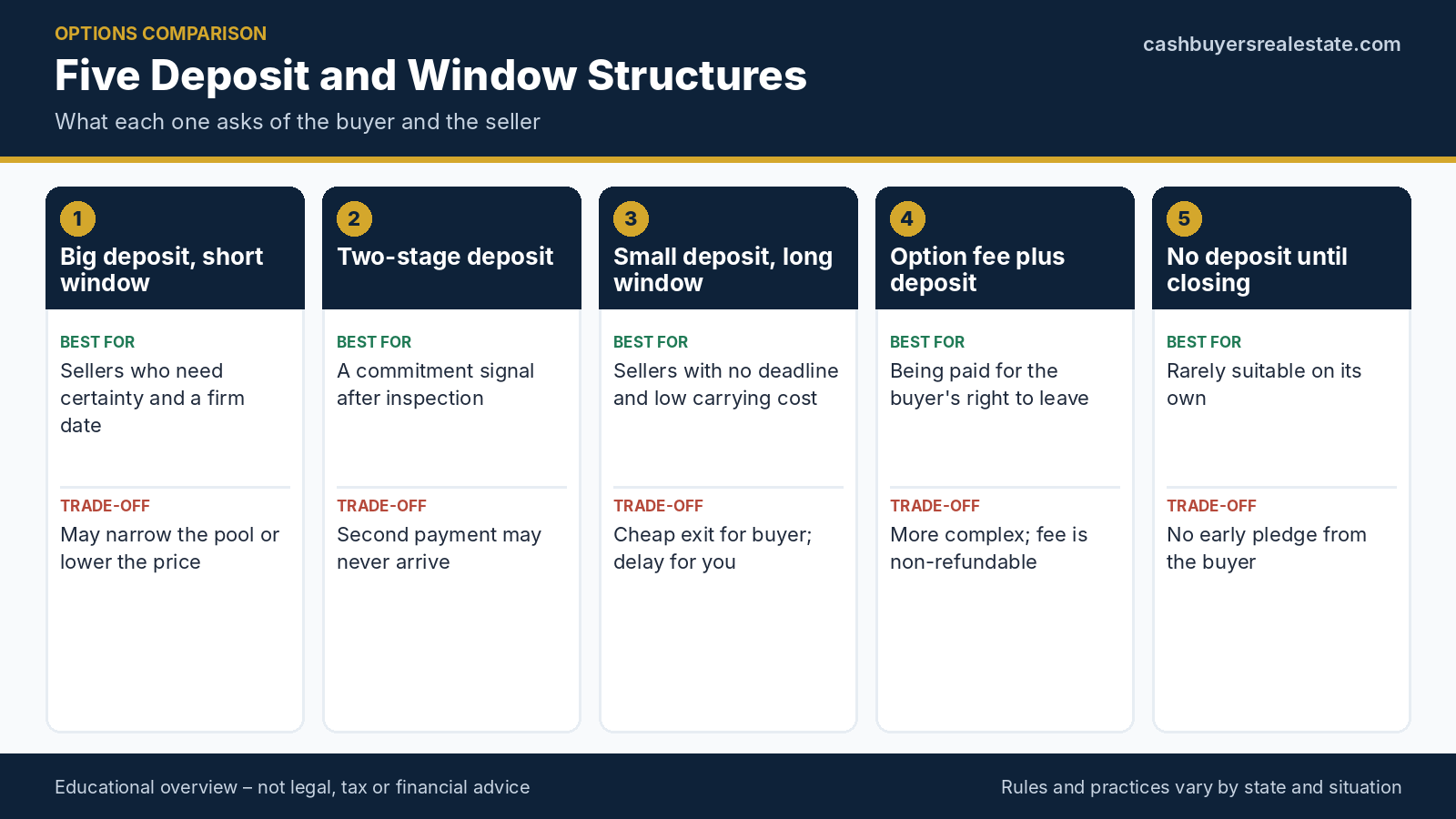
Text version of this infographic
- Big deposit, short window — Best for: Sellers who need certainty and a firm date. Trade-off: May narrow the pool or lower the price.
- Two-stage deposit — Best for: A commitment signal after inspection. Trade-off: Second payment may never arrive.
- Small deposit, long window — Best for: Sellers with no deadline and low carrying cost. Trade-off: Cheap exit for buyer; delay for you.
- Option fee plus deposit — Best for: Being paid for the buyer's right to leave. Trade-off: More complex; fee is non-refundable.
- No deposit until closing — Best for: Rarely suitable on its own. Trade-off: No early pledge from the buyer.
Tiny Deposits, Long Option Periods, and How They Shift Risk
The typical cash offer that worries experienced sellers does not have a high price or an exotic clause. It has a low deposit and a long window, a pairing that quietly hands the buyer an option and leaves the seller holding the risk. Neither feature is improper on its own, and plenty of legitimate buyers use both. The trouble is what they do in combination, and the way a seller’s decision to accept or negotiate them often turns on one hidden question: who pays if the market, the buyer’s plans, or the buyer’s enthusiasm changes?
What a small deposit does to the buyer’s incentives
A deposit works through incentives. It makes walking away costly enough that a buyer who has second thoughts will think twice, and it gives the seller something to hold if the buyer leaves anyway. When the deposit is small compared with the price, both effects weaken, and the relationship between price and promise shifts in ways that are not obvious from the signature page.
The arithmetic of walking away
Consider the decision from the buyer’s side at a moment when something has changed: a better property has appeared, financing for an unrelated project has fallen through, or the buyer simply feels the price is too high. The buyer compares the cost of leaving, which is the deposit if it is at risk, against the cost of proceeding. If the deposit is $500 on a $168,000 house, leaving costs less than three-tenths of one percent of the price. If the deposit is $5,000, leaving costs about 3%, which is enough that many buyers will reconsider. The point is not that buyers behave cynically. It is that incentives are real, and a small deposit makes the contract behave more like an option than a commitment.
An option is a right without an obligation, and the seller is the one who pays for it. During the time a house is under contract, the seller has taken it off the market, turned away other buyers, and often begun planning a move. If the buyer can leave for a small price, the seller has given away that time for little or nothing. This is why advisors often say the question to ask about a small deposit is not “is the buyer honest?” but “what would it cost the buyer to change their mind, and what would it cost me if they did?” The answer might be acceptable for a fast, simple sale and unacceptable for a long, complicated one.
Illustrative example (hypothetical numbers, not market data): A seller accepts $168,000 for a house with a $500 deposit and a 45-day review period, and carries about $1,150 a month in mortgage, tax, insurance, and utility costs. On day 40 the buyer asks for $12,000 off, which is roughly 7% of the price, citing repair estimates. The seller has already spent about $1,530 in carrying costs during those 40 days, and that money is gone whatever happens next. If the seller refuses and the buyer cancels within the window, the buyer’s $500 comes back and the exit costs the buyer nothing. Relisting might add another two months, roughly $2,300, if the house sells again at the same price. Compared with a $12,000 concession, refusing can be the cheaper path, but only if the seller has good reason to believe the market will pay $168,000 again.
Re-trading and price chipping after the review window
Re-trading means asking for a lower price or new concessions after the contract is signed. It is not always improper. An inspection can reveal a genuine problem that neither side knew about, and renegotiating in light of new facts is how many sales succeed. The pattern worth recognizing is different: a request that arrives late in the review period, is large compared with anything the buyer could have discovered, and comes with the implied alternative that the buyer will leave. The leverage in that moment depends on the same incentives, the size of the deposit, and the seller’s alternatives.
The best defense is structural. A shorter review window limits how late the request can arrive. A meaningful deposit that becomes non-refundable on a fixed date makes a threat to leave less credible after that date. A back-up offer, if your state’s practice and your contract allow one, gives you a ready alternative. And a written, itemized response gives you a record of what was requested and why you did or didn’t agree. If you do agree to a reduction, put it in a signed amendment that also restates the deposit terms, and don’t let the buyer’s concession turn into a quiet release of the deposit. Negotiating the price is one conversation and releasing the deposit is another, and the second should happen only when a contract has actually ended.
Long option periods, assignment, and the middleman problem
Time is the second lever. A buyer who has a long window to cancel has a long period of choice, and the longer the period, the more the world can change. Add a clause allowing the buyer to transfer the contract to someone else and you have a structure that sometimes works smoothly and sometimes shifts responsibility away from the person you thought you were selling to.
Extended due diligence and how time shifts market risk
Review periods of seven to ten days are common in many markets, and periods of thirty to sixty days are not unusual in investor deals, particularly where the buyer wants time to line up a partner, a contractor, or financing for a renovation. A seller should understand that a long window transfers market risk. If prices or interest rates move against the buyer during the window, the buyer can cancel and recover the deposit. If they move in the buyer’s favor, the buyer can proceed at the agreed price. The seller has the opposite exposure: the price is fixed while the buyer holds the choice.
That asymmetry is acceptable if you are compensated for it. Sellers can ask for a shorter window, for a non-refundable fee for any window beyond a standard length, or for extension payments that the buyer pays to extend the review period and that you keep whether or not the sale closes. They can also ask for earlier access to the buyer’s reports, so you learn about problems sooner. The table below compares five illustrative combinations of deposit and window for a hypothetical $200,000 sale. It is meant to show how risk moves as the terms change, not to suggest that any one combination is right for everyone.
| Combination | Deposit | Review window | Buyer’s cost to leave early | Seller’s main exposure |
|---|---|---|---|---|
| Firm and short | $6,000 | 7 days | None before day 7; $6,000 at risk afterward | Narrower pool of buyers willing to accept it |
| Two-stage deposit | $1,500 then $4,500 | 10 days | None before day 10; $6,000 at risk after the second payment | Second payment may not arrive; buyer can leave first |
| Small and long | $500 | 45 days | None for 45 days; $500 afterward | Long delay and room for price requests |
| Fee plus deposit | $1,000 fee and $2,000 deposit | 14 days | The $1,000 fee if the buyer leaves during the window | Moderate; fee offsets some delay cost |
| No deposit until closing | $0 | None stated | Nothing, unless the contract adds another remedy | No pledge; the offer is a statement of intent |
To read the table, compare the fourth and fifth columns row by row. The first two rows ask the buyer to put money at risk early and expose the seller mainly to a smaller buyer pool. The third row makes leaving free for a month and a half, and its exposure column describes a cost that the dollar figures do not capture: months of uncertainty. The fourth row shows that a seller can sometimes be paid for time with a separate fee. The last row isn’t really a deposit structure at all. If a buyer proposes it, the useful response is to ask what the buyer would offer in its place, not to treat the proposal as hostile.
Assignable contracts and deposits when the buyer is a middleman
Many investor contracts contain language allowing the buyer to “assign” the contract to another party, often written as the buyer’s name “and/or assigns.” Assignment is a legal and common mechanism, and some buyers use it to bring in a partner or a lender. A wholesaler, on the other hand, may intend to find a different buyer for the property and to transfer the contract to that buyer for a fee. In that case the deposit is typically small, because the wholesaler’s own funds may be limited and the plan depends on finding an end buyer before closing. For a seller, the risk is that the person they signed with may not be the person who closes, and the end buyer may have different funds, different standards, and a different deposit.
Regulation of this practice is evolving and varies by state. Oregon’s property wholesaling law, effective July 1, 2025, requires registration of residential property wholesalers, a written disclosure to buyers and sellers before a wholesale contract, and a right to cancel without penalty until midnight after the third business day following receipt of the disclosure. According to the Oregon Real Estate Agency, a cancellation under that right requires the return of all earnest money or deposits. Other states have different requirements or none, so read the assignment clause carefully and ask direct questions: does the buyer intend to assign, who will hold the deposit after an assignment, and what happens to the deposit if the assignee defaults. More on contract terms to scrutinize appears in the guide to cash offer contract red flags, and the larger structure of such contracts is covered in the cash home buyer contract overview linked earlier in this guide.
Reading the Deposit as One Signal of Seriousness
No single feature of an offer tells you whether a cash buyer will close. The deposit is useful because it is early, concrete, and checkable, but it is one signal among several, and it can mislead in either direction: a generous deposit can accompany a buyer with no funds for the balance, and a modest one can accompany a veteran investor who has closed dozens of purchases without incident. Treat it as a way to start asking better questions, not as a verdict.
Putting the deposit alongside the other signals
Good judgment about a buyer comes from consistency across independent facts. A buyer who offers a sensible deposit, names a verifiable holder, delivers on time, and produces a matching statement of funds is behaving the way a committed buyer behaves. A buyer whose story shifts from one fact to the next gives you information even if every individual answer sounds plausible.
Reading the amount, the holder, and the delivery together
Start with the three terms that the deposit clause itself supplies. The amount should be defensible against local custom and against the risk the contract asks you to carry: a short review period with a modest deposit is a different proposition from a long one. The holder should be a party you can look up and call independently, such as a title company, attorney, or brokerage named in the contract and findable through a source other than the buyer’s email. The delivery deadline should be short enough that the buyer’s commitment is tested while the contract is fresh, commonly a few days, and the receipt should come from the holder.
The combination tells a story. A buyer who proposes a reasonable deposit, a named title company, and delivery within two days, and who then delivers within one, has probably done this before. A buyer who proposes an unusually low deposit, will not name the holder until after signing, and delivers on day five after two reminders has left a pattern worth noticing, even if each choice has an innocent explanation. The practical sequence for a careful seller, once a contract is signed, is short enough to fit in one list.
- Read the deposit clause and write down the amount, the holder, the delivery deadline, and every date on which refundability changes.
- Look up the holder independently and confirm the instructions by calling a number you found yourself.
- Ask the holder for a written receipt that states the amount, date, and form of payment.
- Calendar each deadline with its hour, and record how any notice must be delivered.
- Ask for current evidence that the buyer can pay the balance, and compare the name on it with the name on the contract.
Pairing the deposit with proof of funds and a check on identity
A deposit and a statement of funds answer different questions, so a careful seller wants both. The deposit shows what the buyer will risk now. A bank or account statement, a letter from a financial institution, or a title company’s confirmation of funds received shows whether the rest of the money exists. The details of what these documents should and shouldn’t contain are set out in the proof of funds article linked at the start of this guide; the useful point here is that the name on the document should match the name on the contract, the date should be recent, and any redactions should leave the balance and the account holder visible. A buyer who hesitates to provide any evidence of funds while asking you to take the house off the market is asking you to carry the risk on trust.
Identity matters as much as money. If the buyer is a company, ask for the legal name of the entity, the state where it is registered, and the name of the person authorized to sign. Most states publish business entity records through the secretary of state’s office, which lets you confirm that the company exists and who its registered agent is. That check does not prove a company is reputable, but a mismatch between the name on the contract, the name on the funds, and the name on the entity record is the kind of discrepancy worth resolving before the deposit is even due. For a prepared set of questions to put to any cash buyer, a list of questions to ask a cash home buyer covers the ground in more detail than this section can.
Warning signs and sensible ways to ask for more
The most useful warning signs are patterns of behavior around the deposit, not any one feature. They fall into two groups: things that put the money at risk, and things that put pressure on you. A seller who learns to separate the two can respond calmly, because the response to a risk is verification and the response to pressure is time.
Deposit-related patterns that deserve a slower response
Several patterns around the deposit call for more scrutiny. One is a buyer who asks you, as the seller, to receive the deposit directly, or who proposes that it go to a company or individual whose role in the transaction is unexplained. Another is wiring instructions that arrive only by email, or that change after the first version, which is the signature of the payment-diversion fraud the FBI and the CFPB have warned about. A third is a deposit clause that is refundable at the buyer’s discretion with no end date, which makes the “deposit” a courtesy and not a commitment. A fourth is a request to release the deposit early, for instance “so the buyer can order inspections” or “to show the end buyer,” before a contract has ended. None of these proves bad faith, and some have innocent explanations, but each is a reason to stop, verify, and ask.
Pressure is a separate category. A buyer who insists you decide before you can speak with an attorney, who refuses to let a title company or attorney review the contract, or who says the offer expires within hours is relying on speed, not substance. Your best protection is to slow down on purpose. For the broader picture of what scams in this area look like and where to report them, see the trust and scam prevention hub, and for a more general way to judge a buyer’s reputation, the article on whether cash home buyers are legitimate offers a framework that doesn’t depend on a single document.
Asking for better deposit terms without losing the offer
Most buyers expect some negotiation of deposit terms, and a polite request is rarely taken as hostility. The most common asks are a larger deposit, an earlier delivery date, a two-stage deposit that rises after the review period, a shorter review window, and a fee for any extension. Present each as a way to make the offer more attractive to you, not as an accusation. A buyer who is serious usually agrees to something, and the specific counter-offer tells you how the buyer values the house. A buyer who refuses every request and insists on an open-ended window is communicating that the offer is an option.
There is a price to being picky, and it helps to see it in numbers. Suppose a higher offer comes with weaker terms and a lower offer comes with stronger ones. The right comparison is the expected net result, not the headline price, and the next example shows one way to frame it.
Illustrative example (hypothetical numbers, not market data): Offer A is $190,000 with a $1,000 deposit and a 45-day review period. Offer B is $184,000 with a $9,200 deposit that becomes non-refundable after seven days. Assume the seller carries $1,400 a month, and that if a buyer fails, the house relists and sells for $180,000 two months later. Suppose the seller guesses a 30% chance that Offer A fails and a 10% chance that Offer B fails. These percentages are assumptions made up for the exercise, not statistics. Offer A is worth about 0.7 × $190,000 + 0.3 × ($180,000 − $2,800), or roughly $186,160. Offer B is worth about 0.9 × $184,000 + 0.1 × ($180,000 − $2,800 + $9,200), or roughly $184,240. A is still ahead by about $1,900, but the gap is far smaller than the $6,000 headline difference, and if the seller thought A had a better than 45% chance of failing, B would win. The calculation ignores taxes, closing costs, and legal fees, and it assumes the seller keeps a forfeited deposit in full.
The lesson is not to chase a formula but to see that the deposit and the review window change the value of a price. When two offers differ by a few thousand dollars and one has a materially stronger deposit, the numbers are often closer than they look. Comparing offers on a common basis is the subject of the guide to comparing cash offers, which handles net proceeds, timing, and certainty in more depth, and the same logic applies when you weigh a cash offer against a listing that depends on a lender, as described in the comparison of a cash sale versus listing for a fast sale.
The checks that matter most can be gathered into a short risk checklist, and the one that follows pairs six of them with a level of concern. Verifying the buyer’s identity and entity, requesting current evidence of funds, reading the cancellation and refund clauses, checking whether the contract may be assigned, using a reputable closer such as a title company or attorney whose contact details you found yourself, and never signing a form with blanks are each a small step, and together they cover most of what can go wrong around the deposit. Several of them are fine when done and cause trouble only when skipped, and a few can be skipped only at real risk, which is the idea the checklist graphic expresses with its levels.
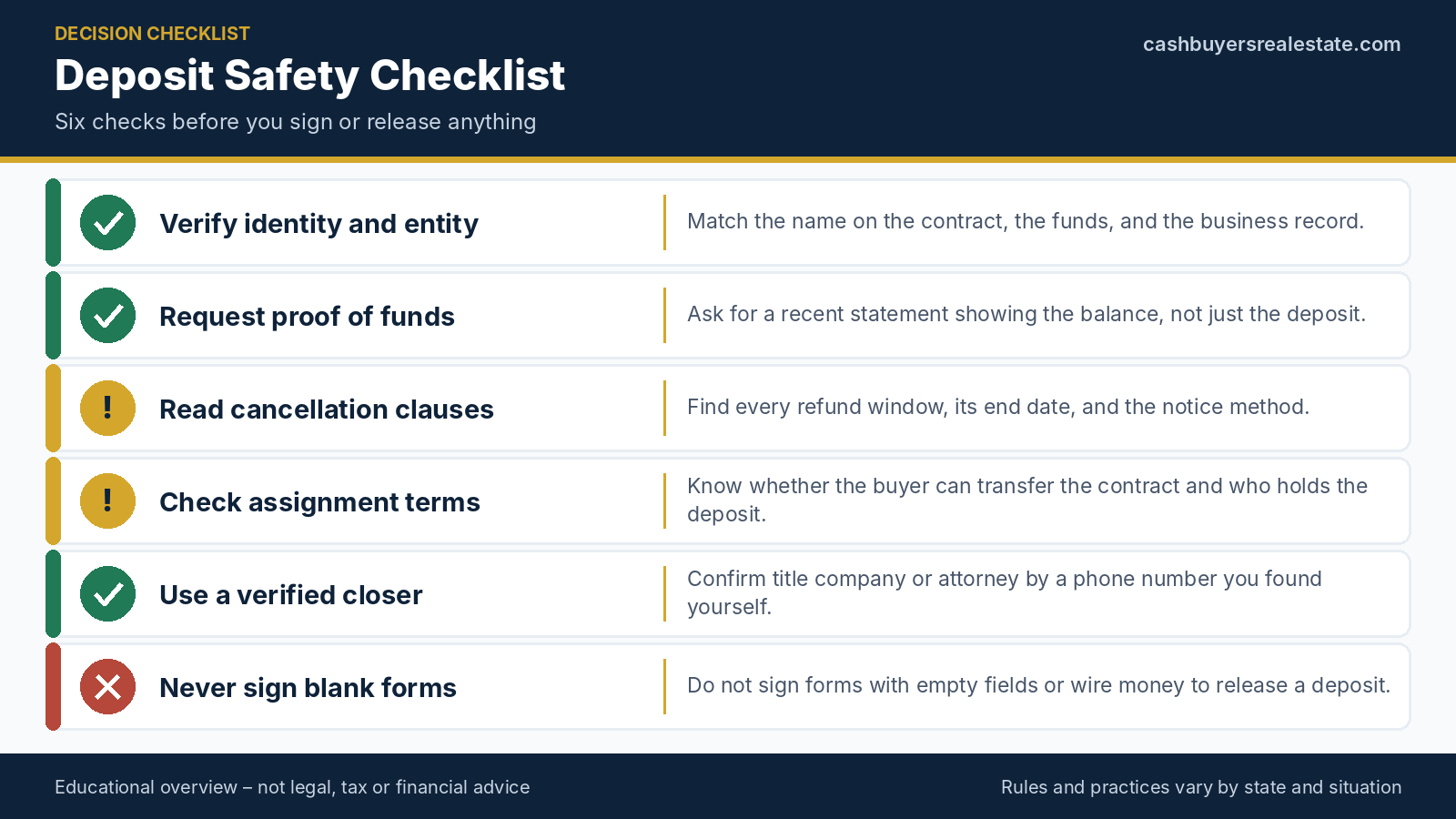
Text version of this infographic
- Verify identity and entity — Match the name on the contract, the funds, and the business record.
- Request proof of funds — Ask for a recent statement showing the balance, not just the deposit.
- Read cancellation clauses — Find every refund window, its end date, and the notice method.
- Check assignment terms — Know whether the buyer can transfer the contract and who holds the deposit.
- Use a verified closer — Confirm title company or attorney by a phone number you found yourself.
- Never sign blank forms — Do not sign forms with empty fields or wire money to release a deposit.
When a Deal Dies: Releases, Disputes, and Getting the Deposit Resolved
Most sales that fail end quietly. The buyer cancels within a window, both sides sign a short form, and the holder returns the deposit within days. A smaller group ends with a disagreement about who is entitled to the money, and those disagreements are what sellers dread, mostly because they don’t know the order of events. This section describes how a release works, why a holder won’t simply pay the person who sounds more convincing, and what the realistic routes are when the parties cannot agree.
How a release works and why holders hold firm
A holder’s neutrality is the source of both its value and its slowness. Because the holder will not decide who is right, it needs something it can rely on: a joint instruction from the parties, a court order, or a contractual process that runs its course without objection. Understanding those three triggers explains most of the waiting that sellers experience.
Mutual releases and written demands
The simplest ending is a mutual release, a one-page form in which both parties agree who receives the deposit and instruct the holder to pay it. Where the buyer cancelled properly within a contingency window, a seller who signs promptly keeps goodwill, avoids unnecessary delay, and often receives something in exchange, such as the buyer’s inspection reports. When the buyer didn’t cancel properly or the seller believes the deposit is owed to them, the contract’s demand procedure matters. In the Texas residential resale form, either party may make a written demand to the escrow agent, which must promptly send a copy to the other party; if the escrow agent doesn’t receive a written objection within 15 days, it may pay the party who made the demand, minus unpaid expenses. The same form says a party who fails or refuses to sign a release acceptable to the escrow agent within seven days of a request may be liable for damages, the earnest money, reasonable attorney’s fees, and court costs.
Those details are specific to Texas, and other forms set other periods or none. The transferable lessons are practical. Use the exact method the contract prescribes for demands and notices, whether that is certified mail, email to a listed address, or delivery through the holder. Keep proof of when you sent it. Respond in writing to any demand from the other side, and calendar the objection deadline the moment you receive one, because silence can be treated as agreement. And do not assume a phone call counts: a friendly conversation with the buyer that ends with “we’ll sort it out” does nothing to stop a clock that began running when a written demand arrived.
Why the holder freezes the money during a disagreement
A holder that receives two demands for the same funds faces a risk of paying the wrong person, so it stops. For attorneys, the stop is an ethical obligation as well as a prudential one: under the model rule on safekeeping property, disputed funds stay separate until the dispute is resolved, with any undisputed portion paid out promptly. For brokers in Florida, Rule 61J2-10.032 requires notice to the Real Estate Commission within 15 business days of the last demand and the start of a settlement procedure within 30 business days, so the broker is under a clock too. The Florida Realtors’ summary of those rules lists four paths for a broker: an escrow disbursement order from the commission, which it describes as available for disputes up to $50,000, interpleader with the clerk of court, mediation or arbitration if the parties consent, and litigation. In North Carolina, according to the REALTORS® association’s explanation of the standard form, the holder keeps the money until it has a written release, a court order, or deposits the funds with the clerk of court.
The takeaway for a seller is that a frozen deposit isn’t a sign that the holder is hiding something or favoring the buyer. It is the system working as designed, and the holder’s incentives are to keep itself out of the dispute. You shorten the wait by responding promptly, documenting your position, and, where the contract and the facts support it, proposing a settlement that both sides can sign. If the dispute is likely to last, ask the holder whether the account bears interest and who would receive any, and ask in writing what its process and timeline are, so you can plan around it.
Resolving a contested deposit
When negotiation fails, the choices narrow to a handful of procedures. They differ in cost, speed, and the degree to which a stranger decides the outcome. For small deposits the economics dominate, because a procedure that costs more than the deposit is usually the wrong one even for a party that is sure it is right.
Negotiation, mediation, arbitration, and court
The practical sequence usually starts with direct negotiation, ideally through agents or attorneys, and moves toward mediation if the contract requires it or the parties agree. Many standard forms include a mediation clause, and some penalize a party that sues without first offering mediation, so read yours before filing anything. Arbitration, if the contract provides for it, produces a binding decision from a neutral decision-maker and can be faster than court. Interpleader is the holder’s tool: it pays the money into court and steps away, leaving the two sides to argue the merits. Court action, whether in small claims or a general civil court, is the last resort, and the maximum amount that small claims courts hear varies by state, so check your local court’s website before deciding where a claim belongs.
An attorney who writes about Texas earnest money disputes observes that legal fees can exceed the deposit, which is why many disputes end with the parties dividing the money. That observation comes from one practitioner’s description of one state’s practice, and it shouldn’t be treated as a statistic. It does capture a common dynamic, though: both sides know that the cost of winning may exceed what is at stake, and the deposit often settles for a compromise number. A seller who is clear about the lowest acceptable figure before negotiating, and who has documented actual losses, is usually better placed than one who enters the discussion with only a sense of grievance.
| Path | Who decides | Relative speed and cost | When it tends to fit |
|---|---|---|---|
| Mutual release | The two parties together | Fastest and cheapest | Buyer cancelled within a window or both sides accept the outcome |
| Written demand and notice period | No one, if the other side does not object in time | Fast if it works; depends on the contract | Clear entitlement and a contract that allows payment after silence |
| Mediation | The parties, helped by a neutral | Moderate; often required before suit | Both sides want a settlement but disagree on the number |
| Arbitration | A neutral arbitrator, if the contract provides for it | Moderate to higher; decision is usually binding | The contract requires it or both parties prefer it to court |
| Interpleader | A court, after the holder pays in the funds | Slower; the holder steps away | The holder cannot get joint instructions and will not release |
| Court action | A judge or jury | Slowest and most costly | Larger amounts or a genuine legal question |
Read the table as a spectrum from cooperation to adjudication. The paths on the first rows depend on goodwill and cost almost nothing; the paths on the last rows replace goodwill with a decision-maker and cost correspondingly more. Because each step up the table tends to cost more than the one before it, a good strategy is to make the first, cheaper options work as long as they reasonably can, while preserving your legal rights by keeping every deadline and sending every required notice on time.
A worked scenario from missed closing to final release
Details help here, because the legal vocabulary makes the process sound more abstract than it is. The following hypothetical follows a seller through the full arc of a failed sale, with numbers chosen to make the arithmetic visible.
Illustrative example (hypothetical numbers, not market data): A seller accepts $240,000 for a house, and the buyer deposits $6,000 with a title company. The review period ends on day 10 with no notice of cancellation, and closing is set for day 30. On day 28 the buyer says a partner has withdrawn and asks for a two-week extension without offering anything in return. The seller declines, sends a written default notice and a demand for the deposit the way the contract requires, and relists the next day. The buyer’s attorney objects within the contract’s notice period, so the title company freezes the funds. After a mediation session around day 75, the parties sign a release dividing the deposit: $4,500 to the seller and $1,500 to the buyer. The seller has paid $1,200 in attorney fees. A new buyer closes on day 68 at $236,000, and the seller carried about 38 extra days of costs at $1,200 a month, roughly $1,520. Put together, the seller’s loss is the $4,000 price difference plus $1,520 carrying cost, less $3,300 from the deposit after fees: about $2,220. The deposit softened the loss; it did not erase it.
Several features of this scenario generalize. The seller acted quickly and used the contract’s own notice procedure, which preserved the claim. The seller also relisted without waiting for the dispute to resolve, since the contract allowed it and mitigation reduced the loss. The settlement divided the deposit because both sides faced costs that made a fight unattractive. Another seller with a larger deposit, better documentation, or a stronger contract might have kept all of it, and another with a weaker record might have kept less. The lesson is about process and records, not about the particular result, and it is worth remembering that the parties who fare best in these disputes are usually the ones who kept their paperwork orderly long before anyone mentioned the word dispute.
Finally, a note on timing and tone. Disputes over deposits are rarely personal, and treating them as business problems with a documented trail usually produces a faster and cheaper resolution than treating them as grievances. If the numbers justify it, consult a real estate attorney in your state before sending a demand, because the contract’s notice provisions and state law decide which steps preserve your rights. If a deposit has already been released to the wrong party, speak with an attorney promptly, since recovering funds after release is harder than preventing the release.
Frequently Asked Questions About Cash Buyer Earnest Money
The questions below are the ones sellers raise most often once an offer is in hand and the deposit clause comes into view. The answers are general and point to the kinds of facts that change them, since contract forms, broker rules, and court procedures differ by state. For a question about your own contract, a local real estate attorney or title professional can read the actual language and apply the law where your house is located.
Amounts, holders, and timing
Sellers usually start with practical mechanics: how much, who keeps it, and how soon. Those are also the terms that are easiest to improve before signing, so they reward careful questions early in the process, while the offer is still being shaped and before either side has spent money or turned away other options.
Questions about deposit size and form
- How much earnest money should a cash buyer put down?
There is no required figure, and custom varies by state, price range, and market. Consumer guides describe 1% to 3% of the price as common in many markets, while some areas use flat sums. A better test is whether the deposit is large enough to matter to the buyer compared with the cost of delay to you. Ask a local title company or attorney what they see on comparable contracts, and weigh the amount together with the review period.
- Is a deposit required in a cash sale at all?
No law requires one, so it is purely a term of the contract. Some cash contracts contain no deposit, or promise one only at closing. That isn’t illegal, but it removes the early pledge that makes a seller’s wait worthwhile. If the buyer proposes no deposit, ask what protection they would offer instead, such as a non-refundable fee, a shorter closing date, or an earlier statement of funds.
- Should I accept a personal check for the deposit?
A personal check is the least certain form, because it can be returned unpaid days after the holder acknowledges it. A wire or a cashier’s check is usually more reliable, and a good holder will tell you when funds have cleared, not just when they arrived. Whatever the form, ask the holder, not the buyer, to confirm in writing the amount, date, and method received.
- Does the deposit reduce what I receive at closing?
No. The deposit is part of the buyer’s payment, not an extra. At closing the holder applies it toward the price, so the settlement statement shows it as a credit to the buyer and the remaining balance arrives as closing funds. Your proceeds come from the price minus your payoff, costs, and any agreed credits, exactly as they would if the buyer had paid the whole price at the table.
Questions about who holds the money and when it moves
- Can I, as the seller, hold the earnest money myself?
It is possible in some informal deals, but it is usually a poor idea for both sides. The money isn’t yours unless the buyer defaults, and holding it exposes you to disputes about refunds and to accusations if you spend it. A neutral holder protects you as well as the buyer. If a buyer insists you take the money directly, treat that as a reason to ask for a title company or attorney instead.
- How quickly should the deposit reach the holder?
Contracts commonly set a short deadline measured from the day both parties sign; the standard Texas resale form uses three days, for example. A shorter deadline tests the buyer’s commitment while the contract is fresh. If the deadline passes with no receipt from the holder, ask the holder directly the same day, and check your contract to see what the missed date allows you to do and by when.
- Does the deposit earn interest, and who gets it?
That depends on the holder, the type of account, and state rules, and it should be spelled out in the contract or the holder’s instructions. Practice differs, and some deposits sit in pooled trust accounts that do not pay interest to individual depositors, so do not assume either way. If it matters to you because the amount is large or the hold could be long, ask in writing how interest is handled and who receives it before the deposit is delivered.
Refunds, disputes, and protection
The second group of questions concerns what happens when things go wrong. Here the answers depend more heavily on contract wording and state law, and the most valuable habit is the same in every case: put communications in writing, follow the notice method the contract prescribes, and keep proof of what you sent and when.
Questions about refunds and forfeiture
- When does a cash buyer lose the earnest money?
Generally when the buyer fails to close after the contract’s cancellation windows have ended and no contingency excuses the failure. Missing a deadline, ignoring a notice requirement, or backing out for a reason the contract doesn’t list can all put the deposit at risk. Whether the seller may then keep it, and whether the seller can also seek more, depends on the default clause and on state law.
- If the buyer asks for a lower price and I refuse, can I keep the deposit?
Not by that fact alone. If the review period is still open, the buyer may usually cancel and receive the deposit back, regardless of your answer. After the period has closed, a request for a lower price does not give the buyer a right to leave, and refusing it does not give you a right to the deposit unless the buyer then fails to perform. The dates and notice rules in the contract decide.
- What if the buyer cancels after the review period for a new reason?
Check whether the contract contains a contingency or condition that covers that reason, and whether the buyer gave notice in the required form and time. If not, the cancellation may be a default, and the seller may have remedies. If the reason involves something you were required to disclose or deliver, such as clear title, the answer may reverse. Get advice from a local attorney before sending a demand.
- Is a forfeited deposit taxable to the seller?
The tax treatment of a forfeited deposit depends on the facts and on how the property was used, and it is a question for a tax professional, not for a general guide. Keep the contract, the release or demand, the holder’s records, and proof of any payment you received. Those documents are what an accountant will need to determine how to report it for the year the money was actually received.
Questions about disputes and safety
- How long can a holder keep the money frozen?
There is no universal limit. A holder facing conflicting demands generally waits for a joint release, a court order, or the completion of a contractual or regulatory process, which can take weeks or months. Some contracts set a notice period after which payment may be made if no objection arrives. Ask the holder in writing for its process and timeline so you can plan around it, and keep it informed of any settlement.
- What if the buyer asks me to release the deposit early?
Release only when a contract has actually ended and you have reviewed the paperwork. Early requests sometimes come with reasons that sound practical, such as paying for an inspection or showing the money to a partner. Those reasons don’t require the seller to give up a protection. If you are unsure, ask the title company or attorney holding the funds what its instructions allow, and have a lawyer read any release before you sign.
- How do I protect the deposit from wire fraud?
Confirm every set of payment instructions by phone with the title company or attorney, using a number from its own website or from paperwork you already trust. Treat emailed changes to account details as suspicious. Don’t send financial information by regular email. If you think a transfer went to the wrong account, call your bank immediately to request a recall, and file a report with the FBI’s Internet Crime Complaint Center.
Choosing Deposit Terms That Match Your Situation
The right deposit is not the biggest one. It is the one that fits what you need from the sale and what a failed contract would cost you. A seller with a fixed closing date on a new home needs something different from a seller with an empty inherited house and no deadline, and both need something different from a seller who is comparing a cash offer with a listing. This final section turns the preceding material into a way of deciding and a way of starting.
A decision framework for weighing deposit, price, and speed
Offers present several variables at once, and the deposit is rarely the one that gets the attention. A framework helps because it makes you rank your own priorities before the numbers begin to pull you toward whatever is largest. The sequence below is not a formula. It is a way to decide what to ask for and what to give up.
Matching the deposit and window to what you most need
Begin by asking what a failed contract would cost you in time and money. If you have a firm date, such as a purchase of your next home that depends on this closing, a failed sale could cost far more than the price difference between offers, and a larger deposit, a short review window, and a verified holder are worth a lower price. If you have no deadline and little carrying cost, a longer window and smaller deposit may be acceptable in exchange for a better price. If the house has complications, such as a lien, a tenant, an estate in probate, or damage, assume that the closing may take longer than planned, and weigh a buyer’s experience with that kind of property more than the deposit alone.
Next, compare the cash offer with at least one realistic alternative. Listing the house with an agent usually exposes it to buyers who rely on mortgages, and in those contracts the deposit sits behind financing and appraisal contingencies, so the structure is different and the timeline longer. The comparison of net proceeds, which subtracts commissions, repairs, closing costs, and carrying costs from the price, is covered in the article on cash sale versus traditional sale net proceeds. A cash offer with a modest deposit might beat a listing that would require repairs and months of waiting, and a listing might beat a cash offer whose price assumes you will accept a thin deposit and a long window. If repairs are the main obstacle, the guide to selling a house fast without repairs explains how sellers handle that part of the choice.
When a smaller deposit can be reasonable, and when it cannot
A small deposit is reasonable when the exposure it leaves is also small. A short review window of a week or less, a closing within two or three weeks, a title company you have verified, and a simple property with clear title together make a deposit’s size less important, because there is little time for the buyer to change their mind and little cost to you if they do. In those cases, a buyer who offers a modest deposit and closes reliably can be a better choice than one who offers a large one and then renegotiates.
The same deposit becomes unreasonable as exposure grows. A window of thirty days or more, a clause that lets the buyer assign the contract, a closing that depends on third parties such as an estate’s court approval, or your own dependency on the proceeds all raise the cost of a failure and justify asking for more. The test is whether the buyer’s cost of walking away is meaningful compared with your cost of being walked away from. When it isn’t, you can ask for a larger deposit, a shorter window, a fee for extensions, or a staged payment, and you can say plainly that the offer is attractive on the other terms. A buyer who can’t or won’t adjust any of them is giving you information about how firmly they intend to proceed.
What to do next
Once you know what you want, the practical work is mostly paperwork and questions. The aim isn’t to turn a simple sale into a project, but to make the few things that can go wrong visible while they’re still cheap to fix.
Documents and questions to gather before you sign
Before signing a contract, collect what you need to read it properly and to answer the buyer’s questions quickly. A seller who has these ready tends to get a smoother process, and a buyer who sees that tends to take the seller seriously. The documents are:
- The full contract, including every addendum, with the deposit clause, the review period, and the default clause marked.
- The name, address, and independently verified phone number of the title company, attorney, or brokerage that will hold the deposit.
- Recent evidence of the buyer’s funds and the legal name of the buyer or the buyer’s company.
- Your payoff statement or a recent mortgage statement, plus any lien, tax, or association balances.
- Your state’s required seller disclosures, completed accurately.
- A calendar of every contract date with the hour, and a note of how each notice must be sent.
Questions to ask matter as much as the documents. Ask the holder how it handles a disagreement, how long it takes to return a deposit after a valid cancellation, and whether it will give you written confirmation when funds arrive. Ask the buyer whether the contract is intended to be assigned, how many properties the buyer has closed recently with the same holder, and what the buyer would do if an inspection finds a problem. Ask your own attorney, if you have one, to read the deposit and default clauses and to tell you what they do under your state’s law. And if you are still weighing whether a cash sale is the right route at all, the broader overview in the sell my house fast guide sets out the full range of options and their trade-offs.
A steady way to move forward
It is tempting, once an offer arrives, to feel that the clock is running. In most cases it isn’t running as fast as the buyer’s wording suggests, and a day spent verifying a holder, reading a clause, or asking an attorney a question costs far less than a deposit dispute. A sensible rhythm is to read the contract once for the price and dates, once for the deposit and default clauses, and once for anything you don’t understand, and to write your questions down before calling anyone. If an answer is vague, ask for it in writing. If a request feels rushed, ask for a day. A buyer who is acting in good faith will usually understand, because a careful seller is also a seller who is likely to read the contract closely and close on time, which is what the buyer wants as well.
Earnest money is a modest piece of a larger transaction, and a good deposit won’t rescue a bad contract any more than a small one dooms a good one. Some sellers will be well served by a quick, simple cash sale with a modest deposit and a clean title company closing. Others will do better by negotiating stronger terms, listing the house, or waiting for a buyer whose offer is easier to rely on. Neither choice is wrong in itself. What serves you is a decision made with the terms in front of you, the holder confirmed, and enough time to ask the questions that matter, and that is within reach for almost any seller who takes the steps in this guide at a steady pace.