
Investors Who Buy Houses: Offers, Process & Red Flags
Investors who buy houses do not all make the same kind of offer, and that single fact explains most of the confusion homeowners feel after the first few phone calls. Picture three written offers on the same dated ranch house. One is a clean number from a buyer who plans to renovate and resell. Another is noticeably lower, from someone who wants to rent the house to a family for the next decade. The third is lower still, and it arrives with a contract that lets the buyer hand the whole deal to somebody else. All three come from “investors.” All three might be honest. The gaps between them are not random, and they are not primarily a measure of how much each buyer likes you; they are the arithmetic of what each buyer plans to do with the property after closing.
That is the organizing idea of this guide. Every investor works backward from an exit: the way the property will eventually produce money for them. A flipper’s exit is a resale to an owner-occupant, so the offer is built from what a finished, retail-ready house will fetch minus renovation, financing, selling costs and a profit. A landlord’s exit is monthly rent, so the offer is built from what the rent can support. A wholesaler’s exit is a fee for assigning the contract to another investor, which leaves the wholesaler needing a price low enough for the next buyer to profit. Understanding which exit is on the other side of the table tells you why a price is what it is, how much of it can move, what the contract will probably say, and which risks fall on you.
Investors who buy houses make money in several different ways: flipping, renting, assigning contracts, lease-options, and creative financing such as seller-carry and subject-to. Each strategy has its own costs and timeline, so each supports a different price and different terms. Identify the strategy first, then compare offers on net proceeds and risk, not headline price.
Because the strategy shapes the offer, it also shapes the red flags. A flip with a hard deadline is a tidy transaction when the buyer has money on hand, and a troubled one when the buyer is counting on a lender who has not yet funded. A rental purchase is usually straightforward but can be sensitive to the age of the roof and the condition of the plumbing. An assignable contract is perfectly lawful in most states yet carries a performance risk that a direct purchase does not. And structures in which you keep the mortgage in your name while someone else lives in or controls the house deserve slow, professional review, because the law gives your lender rights in that situation that neither you nor the investor can waive. We will take each of these in turn, with hypothetical numbers so the mechanics are visible, and with a clear separation between what the law says and what is merely common practice.
The article is organized to follow the seller’s questions in the order they tend to arise. It begins with why exits drive offers and how the main strategies compare. It then examines the fix-and-flip buyer, the buy-and-hold and BRRRR landlord (buy, rehab, rent, refinance, repeat), and the wholesaler who sells the contract rather than the house. After that it covers lease-options, seller financing and “subject-to” deals, including the federal due-on-sale rule that sits underneath the last of those. The final stretch turns practical: how to tell which strategy a buyer is using, where you hold negotiating strength, how to compare net proceeds across routes, and what to do next.
Some adjacent topics are deliberately left to their own pages. How investors investigate a property between agreement and closing is covered in the guide to what real estate investors check before they close, the line-by-line anatomy of a purchase agreement belongs to the page on cash offer contract red flags, and how a buyer arrives at a resale value is unpacked in cash offers and after-repair value. Readers who want the full map of the buyer market can start at the main cash home buyers guide. Here those subjects appear only where they help you understand a strategy. One more promise: the discussion treats investors neither as villains nor as benefactors. For some houses and some owners an investor sale is the best available route, and for others a listing, a modest repair, or a different kind of buyer will leave more money in your pocket.
Why Investors Who Buy Houses Arrive at Such Different Offers
Before comparing individual strategies, it helps to see the common machinery under all of them. Every investor offer is the end of a calculation that starts with a future event, whether that is a resale closing or the first month’s rent check, and subtracts the costs and the return the investor requires along the way. The differences between strategies are mostly differences in which future event is assumed, how long it takes to arrive, and how expensive it is to wait for it.
Every offer is built backward from the investor’s exit
Retail buyers shop forward: they see a house, fall for a kitchen, and stretch to a number. Investors shop in reverse. They begin with the value of the property in its end state and subtract what it takes to get there, which is why two investors can walk the same rooms and write offers that differ by tens of thousands of dollars without either one being unreasonable.
Working backward from the resale or rental value
The core of the method is a short chain of subtraction. Start with the amount the finished property should resell for, or for a rental buyer, the value the income can support. Subtract the cost of the work needed to reach that condition, then the costs of buying, holding and selling, and finally the profit the investor requires for taking the risk. What remains is the most the investor can pay and still hit the target. Notice that your asking price and your own sense of what the house is worth enter this chain nowhere; the property’s condition and the buyer’s required return do the work.
Two inputs dominate and both are estimates. The first is the end value, usually drawn from recent comparable sales (comps) of renovated homes nearby, adjusted for size and features. Investors call this the after-repair value, or ARV. The second is the repair budget, which depends on what a contractor would charge to bring the house up to that standard and how much cushion the investor adds for surprises. A small change in either estimate moves the offer by far more than its own size, because every dollar of overestimated value or underestimated repair cost comes straight out of profit. That sensitivity is why experienced buyers pad the repair line and shade the ARV conservatively, and it is the first place a seller can push back with evidence.
The third thing to understand is that the chain is not tied to a single formula. Some investors use rules of thumb, such as paying no more than a stated percentage of ARV less repairs, and some build a line-by-line spreadsheet. The percentages are habits, not laws; they shift with the market, the investor’s financing, and how quickly similar homes sell. When a buyer cites a rule of thumb, treat it as a description of that buyer’s margin requirement, which you are entitled to ask about, rather than as a market standard.
The cost of the money behind the offer
Money is never free, even when the buyer pays cash from their own account. A buyer using borrowed funds pays interest and fees for every month the loan is outstanding, and short-term lenders who finance investment purchases commonly charge more than conventional mortgage lenders and often collect fees at the start. A buyer using their own cash pays a quieter cost: the return that money could have earned elsewhere. Either way, the longer a strategy ties up capital before it pays out, the more of the property’s potential profit is consumed by waiting, and the less the investor can afford to offer you today.
Source of capital also changes behavior at the negotiating table. A buyer who answers to a private lender or a group of partners often has less flexibility to raise an offer once the budget is approved, because the loan amount was sized against the original plan. A buyer using a bank line of credit or a fund may be able to move quickly but be bound by internal underwriting limits on property condition and price. Sellers sometimes read rigidity as stubbornness when it is really a funding constraint. Asking how the purchase will be financed, and when the money is committed, is not rude; it is the single most useful question for predicting whether a given price can change and whether the closing date will hold. How to verify that answer is covered in the guide to proof of funds for cash buyers.
Financing also explains a pattern that confuses first-time sellers: the same investor will sometimes pay noticeably more for a house that is easy to finance or resell and noticeably less for one that is not. A property with a failing foundation or an unclear title may fall outside what a short-term lender will fund, forcing the buyer to use scarcer, costlier money and to price the extra risk into the offer. The discount you see is partly the cost of that scarcer capital.
Six strategies, six different kinds of buyer
Real estate investing is a family of businesses that happen to shop for the same houses. The six that matter to a seller are fix-and-flip, buy-and-hold rental, BRRRR, wholesale assignment, lease-option, and creative financing in which the seller carries a note or the buyer takes the property subject to the existing mortgage. Each differs in who ends up owning the house, how long they own it, and what would have to go wrong for your sale to stumble.
The strategies at a glance
Seeing the strategies side by side makes the later sections easier to follow. The table below summarizes how each one produces a return, how long the investor typically stays in the deal, and what that implies for the offer you receive. The hold times are descriptive ranges for how the strategies work in general, not market data, and they vary widely with local conditions.
| Strategy | How the investor profits | Typical holding period | Main cost the investor is pricing in | What it usually means for your offer |
|---|---|---|---|---|
| Fix-and-flip | Resale of a renovated house for more than total cost | Months | Repairs, financing, resale commissions and closing costs | Price tracks ARV less repairs and profit; timing is often flexible |
| Buy-and-hold rental | Monthly rent, loan paydown and long-term appreciation | Years | Vacancy, maintenance, taxes, insurance, management | Price tracks rental income; condition matters less than rentability |
| BRRRR | Rent plus recovering invested cash through a refinance | Months to refinance, then years | Rehab, short-term financing, then refinance costs | Price tracks ARV and the loan a lender will make after the rehab |
| Wholesale assignment | A fee for transferring the contract to another buyer | Days to weeks | Marketing, the spread the end buyer needs | Lowest headline price; your contract may be sold to a stranger |
| Lease-option | Option fees, rent spread, and a later purchase or sale | One to several years | Rent obligations, option price risk | Price fixed in advance; most of the money comes later, if at all |
| Seller-carry or subject-to | Use of your loan or note instead of new financing | Years, or until refinanced | Payments on your existing debt or note | Headline price can look high; cash at closing is small |
Read the table from right to left if you are comparing offers, because the first columns describe the investor’s business and the last column describes your experience of it. The final column describes what you will actually experience, and the pattern is worth noticing: the strategies that deliver the most cash at closing tend to be the ones with the shortest holding period and the sharpest price discipline, while the strategies that advertise the highest sticker price tend to defer most of your money into the future or leave obligations in your name. Neither pattern is a verdict. It is simply the trade each structure makes between price, certainty and time.
Why one investor may use several strategies on the same house
Experienced investors rarely commit to one exit in advance. They underwrite a primary plan and a fallback, and the fallback sets the floor on what they will pay. A buyer planning a flip may keep the house as a rental if resale prices soften before the renovation is done; a landlord may sell a stabilized rental to another investor when a lender’s rates change. A wholesaler who cannot find an end buyer may close personally if the numbers still work, or negotiate a lower price using the inspection period. Because the fallback matters, the number you are quoted usually reflects the most conservative of the exits the investor is willing to accept, not the most optimistic.
For a seller, this flexibility cuts both ways. A buyer with a credible rental fallback is less likely to disappear if the resale market turns, which improves the odds that the sale closes. On the other hand, a buyer with several possible plans may be vague about which one applies, and vagueness is where misunderstandings begin. It is reasonable to ask which exit the buyer is pricing, and to notice if the answer changes between conversations. The signals that separate strategies in practice are collected later, in the section on how to tell which strategy a buyer is using.
Finally, a single house can attract several kinds of investors at once, and that is your opportunity. A property that needs a full renovation and sits in a strong resale neighborhood may appeal most to flippers. A tired but livable house in a rental-heavy area may be worth more to a landlord. When a seller approaches only one kind of buyer, the answer will reflect only one kind of math; the sections on bargaining power return to the practical consequences.
Fix-and-Flip Investors: Profit Math, Holding Costs, and the Offer They Can Afford
The fix-and-flip buyer is the investor most homeowners picture when they hear the phrase, and also the one whose business is easiest to model. A flipper buys at a discount, renovates, and resells to a retail buyer, usually an owner-occupant. Everything in the offer flows from three questions: what will the finished house sell for, what will it cost to get it there, and how long will the money be tied up? Answering them honestly shows why the offer is lower than the finished-house price, and also shows how much of the gap is real cost rather than appetite. A broader look at how a buyer’s whole business runs, from acquisition through resale, appears in the explanation of how cash home buyers work.
How a flip makes money and where the margin leaks
A flip looks lucrative from the outside because the visible numbers are large: a purchase price, a resale price, and a gap between them. The gap is gross, and most of it is spoken for before the investor sees any of it. Understanding the leaks is the quickest way to judge whether a flipper’s offer is stingy or simply sober.
A flip’s profit-and-loss, line by line
The cleanest way to see the arithmetic is to build the maximum offer for one hypothetical house, starting from the end value and subtracting every cost a flipper expects to bear. The table below does that with invented but plausible figures. It is a teaching model and not a market benchmark, and the percentages inside it differ from deal to deal, region to region and lender to lender.
| Line item | Illustrative amount | What drives it | Where it can slip |
|---|---|---|---|
| Expected resale price (ARV) | $265,000 | Renovated comps nearby | Weak comps, slower market |
| Selling costs | $21,200 | Commissions, closing costs, transfer charges | Buyer concessions at resale |
| Repairs with contingency | $41,000 | Contractor bids, hidden damage | Plumbing, wiring, structure |
| Holding costs, five months | $5,750 | Taxes, insurance, utilities | Permit or contractor delays |
| Financing: points and interest | $9,875 | Loan size, rate, months outstanding | Extra months on the loan |
| Buyer-side closing costs | $2,600 | Title, recording, lender fees | Title problems |
| Profit the investor requires | $30,000 | Risk and opportunity cost | Negotiable only by the investor |
| Maximum purchase price | $154,575 | What is left | Moves with every line above |
To read the table, start at the top and watch the number shrink. In this invented case the flipper’s ceiling is roughly 58 percent of the finished-house price, and nearly all of the missing 42 percent corresponds to a real cash cost or a required profit. If the seller believes the house is worth $265,000 once repaired, the seller is probably right; what the seller may not have priced in is that the person who repairs it must be paid, and that waiting five months for a resale costs money. The sensitivity is the other lesson. An investor whose margin is thin can be pushed from a comfortable deal to a loss by a handful of ordinary surprises, which is why many flippers write offers with a cushion that looks larger than necessary.
Illustrative example (hypothetical numbers, not market data): A flipper in the model above carries the house at about $2,525 a month, combining $1,150 of taxes, insurance and utilities with $1,375 of loan interest. The renovation runs $12,000 over budget and the resale slips two months. The overrun costs $12,000 and the delay costs about $5,050, so the $30,000 profit target shrinks to roughly $12,950 before any price concession to the final buyer. A second repair surprise or a softer market would erase the rest. Experienced flippers know this pattern, so when you ask them to raise an offer by a few thousand dollars, the answer reflects how little cushion the model actually has, not simply reluctance.
Published data on flipping puts the headline numbers in context, with an important caveat about what they leave out. ATTOM’s first-quarter 2026 home flipping report, released in June 2026, counted 64,348 single-family home and condo flips, about 8 percent of all home sales, with a typical gross profit of $66,000 and a gross return on the original purchase price of 25.4 percent. ATTOM defines a flip as an arm’s-length resale within 12 months of an earlier sale, and gross profit as the difference between purchase and resale price before rehab costs and other expenses. Those figures are therefore not what investors take home. They show the size of the gap flippers work within, and they show that the gap is narrower than in the prior year, when ATTOM’s typical gross profit was $74,172.
Profit is also not the same thing as take-home pay. At a general level, the IRS treats gain on an asset held one year or less as short-term, taxed at ordinary income rates, and the tax code excludes property held primarily for sale to customers in the ordinary course of a trade or business from the definition of a capital asset. A person who flips houses regularly may therefore be treated as a dealer whose profits are ordinary business income, while someone who holds a property as a long-term investment is in a different category. Which category a given investor falls into is a facts-and-circumstances question for that investor’s tax adviser. For a seller, the point is simply that flippers have a tax cost to cover too, which is one more reason the required profit in the model is larger than it first looks.
Holding and financing costs, month by month
Holding costs are the quietest line in a flip and often the most underestimated by sellers. From the day the investor takes title until the day the resale closes, someone must pay property taxes, homeowners insurance, utilities, lawn and snow care, and sometimes homeowners association dues. Vacant houses can be harder to insure than occupied ones, since many policies limit or condition coverage when a home sits empty for a stretch, so investors often buy specialized vacant or builder’s risk coverage that costs more per month than the ordinary policy the seller is dropping. None of these items is large alone. Together they behave like a meter running in the background that charges the same whether the contractors show up or not.
Financing adds a second meter. An investor borrowing to buy and renovate typically pays interest on the purchase portion immediately and on renovation funds as they are drawn, plus one-time fees that are often quoted as “points,” each equal to one percent of the loan. Lenders in this niche often release renovation money in stages after inspecting the work, so a stalled project can mean both unpaid contractors and idle interest. A flipper using their own cash avoids interest but not the opportunity cost, because the money committed to this house cannot be committed to the next one. As a result, an investor with a pipeline of deals watches the calendar closely, and any delay on your side, such as an unexpected need for more time to move or an unresolved lien, has a dollar cost they will try to subtract from your price.
Understanding the meter also tells you where a seller can create value. If a flipper’s carry is a couple of thousand dollars a month in the model above, then closing three weeks sooner is worth roughly what a few thousand dollars of price would be, and a seller who can offer certainty, clean title, and a closing date that fits the investor’s schedule may be able to win a better number without any dispute about value. The same logic runs the other way: asking for a long delay or a series of extensions asks the investor to absorb more carrying cost, and the price will usually reflect it.
Before the first major process picture, it is worth walking the stages of an investor purchase in the order the investor lives them. The investor first chooses the exit that fits the property, then estimates the finished value and repair cost, then builds the offer from those figures and the required return. After an agreement is signed comes a due-diligence window in which the buyer inspects, checks title and confirms funding, and the transaction ends with a closing at a title company or attorney’s office followed by the investor’s own exit. The diagram below maps that sequence, and each stage is a place where a seller can ask a useful question or supply a useful document.
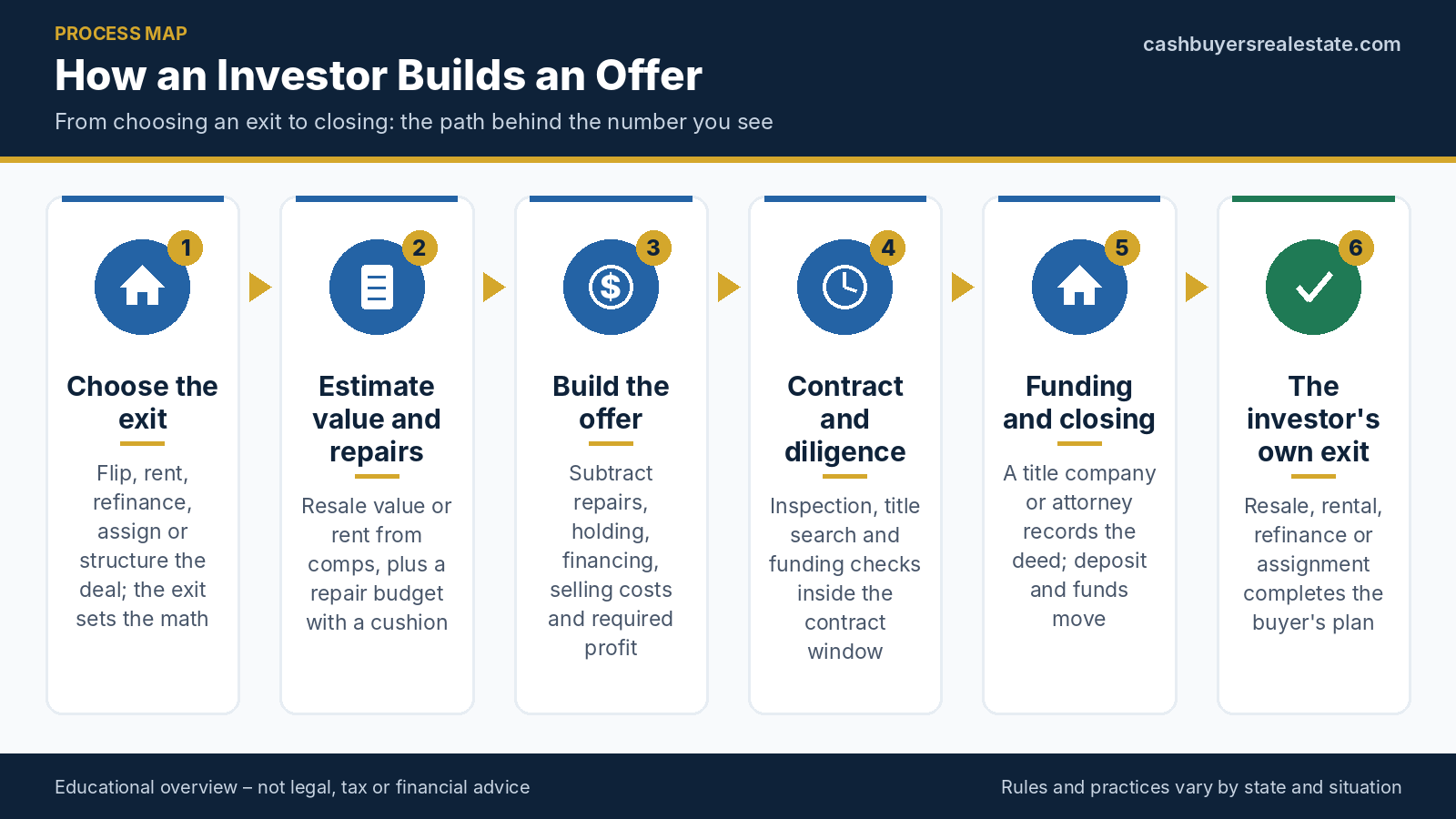
Text version of this infographic
- Choose the exit — Flip, rent, refinance, assign or structure the deal; the exit sets the math
- Estimate value and repairs — Resale value or rent from comps, plus a repair budget with a cushion
- Build the offer — Subtract repairs, holding, financing, selling costs and required profit
- Contract and diligence — Inspection, title search and funding checks inside the contract window
- Funding and closing — A title company or attorney records the deed; deposit and funds move
- The investor's own exit — Resale, rental, refinance or assignment completes the buyer's plan
What a flipper’s offer tells you about the house and the buyer
Once you understand the model, the offer itself becomes information. The number, the way it is delivered, and the way it responds to your questions all reveal how the buyer sees the property and how tightly the deal is constructed.
The repair budget and the margin the investor requires
Two lines of the model do most of the work in a conversation: repairs and required profit. Sellers can influence the first and rarely the second. A flipper’s repair estimate is usually built during a walk-through that takes less than an hour, using experience, a checklist, and a margin for error that grows with the age of the house and the number of unknowns. A seller who has recent contractor bids, receipts for a new roof or furnace, or an inspection report may be able to shrink the unknowns, and unknowns are what investors price most heavily. Documentation does not guarantee a higher offer, but it can narrow the cushion the buyer thinks is necessary, and that cushion is real money.
The required-profit line is the investor’s own business decision and varies with the market, the investor’s overhead and the risk of the project. A buyer working in a hot resale market with short sales cycles may accept a smaller margin than one in a slow market with a long wait for buyers. Some investors use a rule of thumb that caps their purchase at a stated share of ARV after repairs; these rules are shortcuts, not market standards, and they differ by investor and region. If a flipper quotes one, ask for the ARV and the repair estimate behind it. A buyer who can explain both is easier to negotiate with than one who simply states a number, because you can argue with a comp but not with a mood.
It also helps to notice what the budget does not include. A flipper’s repair plan usually aims at a cosmetic and systems refresh that appeals to a retail buyer, not at perfection. Items that do not show up in photographs, such as a sagging crawl space or aluminum wiring, are priced as risks rather than as certain costs, and the less documentation exists the larger the risk premium becomes. When a flipper lowers an offer after the inspection, the change may reflect one of those unknowns turning into a known, which is a different situation from a buyer who is simply trying to renegotiate. The guide to repair deductions in cash offers explains how to evaluate such a reduction line by line.
Resale limits and timing pressures that shape a flipper’s price
A flipper’s exit is not unconstrained. Because most resale buyers use mortgages, the rules that govern those mortgages reach back to the flipper’s own timeline. One example is the federal FHA resale restriction in 24 CFR 203.37a: if the seller of a property acquired it 90 days or less before the sales contract that will result in an FHA-insured loan, the property is not eligible for FHA insurance, and for resales between 91 and 180 days, a second appraisal can be required when the price rises by more than a specified threshold unless the increase is documented as the result of rehabilitation. That rule has exceptions, including for inherited property and sales by certain institutions, and the rule can be adjusted by HUD. The practical consequence is that a flipper who plans to sell to an FHA buyer must hold the house for a minimum period, which affects how the investor schedules the project and what holding costs the investor expects.
ATTOM’s first-quarter 2026 report put the share of flips sold to FHA-backed buyers at 10.2 percent, which shows that this is a meaningful but not dominant slice of the exit market. The report also found that the typical flip took 165 days from purchase to resale, and that 61.1 percent of flipped homes were bought with all cash. Those figures help explain the common profile of the flipper’s buyer pool: many flippers are comfortable closing quickly because they use cash or short-term funds, yet they plan on a hold of several months, so they are less sensitive to a closing date a few weeks out than a wholesaler who is racing a contract deadline.
Permits and condition matter at resale too. A renovated house sold with unpermitted work can run into trouble in an appraisal or an inspection, which is why flippers often prefer properties where past work is documented and why a seller who can disclose and explain earlier improvements is easier to price. More about the interaction of unpermitted work and sale price appears in the page on selling a house with unpermitted work. For sellers whose houses need heavy repairs, the broader trade-off between repairing first and selling as-is is covered in selling a house fast without repairs.
Buy-and-Hold and BRRRR Investors: Paying for Rent, Not Resale
A landlord buying a house is solving a different problem from a flipper. The flipper needs the house to be saleable in a few months, so cosmetics and the retail market dominate the math. The landlord needs the house to produce rent for years, so the math turns on what tenants will pay, what it costs to keep them housed, and whether the structure will behave. That shift in focus changes which flaws matter, which ones do not, and how the price gets built.
How landlords turn rent into a purchase price
A rental buyer evaluates a house much as a lender evaluates a business, by asking how much income is left after the costs of operating it and then deciding what price makes that income worth buying. The calculation is simple to describe and surprisingly easy to get wrong, which is why different landlords reach different numbers on the same property.
From monthly rent to the most a landlord can pay
The starting figure is the rent the house could realistically command in its current or near-term condition, based on what similar homes in the neighborhood are renting for. From that, the landlord subtracts the share of the year the house is likely to sit empty or unpaid, then the fixed costs of ownership: property taxes, insurance, and, if the landlord uses a property manager, the management fee. Maintenance gets two lines, one for routine repairs and one for reserves toward big-ticket items such as a roof or furnace that will eventually need replacing. What remains is net operating income, or NOI. Dividing NOI by a required rate of return, often called a capitalization rate or cap rate, yields the value of the income stream, and subtracting the cost of getting the house rent-ready gives the most the buyer can offer.
| Line item | Illustrative annual amount | Why it is in the model |
|---|---|---|
| Gross rent at $1,650 per month | $19,800 | Starting point drawn from comparable rentals |
| Vacancy and unpaid rent (6 percent) | -$1,188 | Gaps between tenants and occasional nonpayment |
| Property taxes | -$2,900 | Set by the local assessor, not the landlord |
| Insurance | -$1,250 | Landlord policy covering the structure and liability |
| Routine repairs | -$1,600 | Plumbing calls, locks, painting between tenants |
| Reserve for roof, HVAC, appliances | -$1,200 | Big items arrive irregularly but they do arrive |
| Property management (9 percent of collected rent) | -$1,675 | Cost of tenant screening and day-to-day oversight |
| Net operating income | $9,987 | Income left before debt service and income tax |
| Value at a 7.5 percent required return | $133,160 | NOI divided by the required return |
| Less rent-ready work and acquisition costs | -$17,000 | Repairs, closing costs, a small cushion |
| Illustrative maximum purchase price | $116,160 | What this landlord could pay and still earn the target |
The point of the table is the structure and not the numbers. Notice that nothing in it depends on what the house might sell for after a makeover; a landlord who is happy with the rent need not care that a flipper would pay more. Notice too that rent matters twice. A rent estimate that is $100 a month higher raises NOI, and because NOI is divided by a small percentage, the effect on price is magnified many times. That multiplier explains why landlords in the same neighborhood can disagree by a wide margin: they may hold different beliefs about achievable rent, about how well they manage vacancies, or about the return they require, and each belief feeds into the offer.
For a seller, the practical consequences are straightforward. A house that is already rented, with a lease and a rent history, gives a landlord evidence rather than assumptions and may deserve a better price than an empty one. A house that rents poorly because of its layout, location or condition will be priced low by landlords no matter how nice the paint looks. And if you are a landlord yourself, a buyer’s rent assumption is worth questioning against your own records, since your actual rent roll is better evidence than the buyer’s estimate. Related questions for owners of investment property are covered in selling a rental property fast.
Taxes and depreciation at a general level
Rental investors face a different tax picture from flippers, and it feeds into how they value a property. In general terms, the IRS says rental income is taxable when received and that the expenses of renting a property can be deducted against that income, with real estate rentals usually reported on Schedule E. It also explains that you begin to depreciate rental property when you place it in service, and IRS Publication 527 describes a 27.5-year recovery period for residential rental property under the general depreciation system. Depreciation is a paper deduction that spreads the cost of the building over decades, and many landlords value it because it can reduce taxable rental income in the years they hold the property.
The difference between the two strategies matters because the tax code draws a line between property held for sale to customers and property held for investment. As noted earlier, property held primarily for sale to customers in the ordinary course of business is excluded from the definition of a capital asset, while a long-term rental is a different kind of holding altogether. The IRS also states that an exchange of real property held primarily for sale does not qualify as a like-kind exchange under section 1031, which now applies only to real property. Some rental investors buy with a like-kind exchange in mind, funding the purchase with proceeds from another property they sold, and those buyers may have strict deadlines that make them eager for speed or inflexible about schedule.
None of this tells you what any particular buyer will pay, and none of it is advice for your own tax position. If you are selling a rental or an inherited house, your own situation involves questions about gain, basis and depreciation that a tax professional should answer before you sign. What you can take from the tax overview is a better ear for how landlords talk. A buyer who speaks of cash flow, depreciation, a 1031 timeline or reserves is describing a long-term holding plan, and that plan usually means less urgency about resale value and more attention to the property’s ability to produce rent.
BRRRR: when the refinance is part of the offer
BRRRR is an acronym investors use for buy, rehab, rent, refinance, repeat. It is a hybrid strategy, combining a short renovation period with a long holding period and aiming to recycle most of the investor’s cash back into the next purchase. Because the plan involves both a renovation and a lender, it adds a second set of constraints to the price.
How the refinance step caps what the investor can pay
The sequence works like this. The investor buys a distressed house, often with cash or short-term money, and renovates it. After the work is done the investor rents it, which establishes income and, with it, eligibility for a longer-term loan. Then the investor refinances into a permanent mortgage sized as a percentage of the new appraised value, and uses the proceeds to repay the short-term money and recover most or all of the cash invested. The lender decides how much it will lend based on the appraisal and its own underwriting rules, so the investor’s real ceiling on what to pay for your house is set months from now by an appraiser and a lender who have not yet seen the property.
Illustrative example (hypothetical numbers, not market data): A BRRRR investor buys a dated house for $96,000, spends $38,000 on renovation, and pays $9,000 for closing, holding and financing before the house is rented, for an all-in cost of $143,000. The renovated house appraises for $190,000, and the lender will make a refinance loan of 75 percent of appraised value, which is $142,500. That recovers nearly all the cash invested, leaving the investor with a rental and almost no money tied up. If the appraisal comes in at $170,000 instead, the same lender offers only $127,500 and the investor has $15,500 stuck in the property. That risk is why BRRRR buyers shade their offers down when the comparable sales are thin.
The lesson for sellers is that the BRRRR offer is a bet on three future events, namely the rehab cost, the rent, and the appraisal. Any of them can move against the investor, so the offer includes a margin for each. A BRRRR buyer who can walk you through the plan is probably experienced; one who cannot explain how the refinance would work may not have thought it through, and a deal that depends on a loan that is not yet in place is a deal with a financing risk even if the first purchase is made with cash. Lender rules for investment refinances vary, and some require the property to be owned for a minimum period or to be rented before they will lend, so a thoughtful investor will have checked those rules before bidding.
There is one more effect worth noticing: BRRRR investors need houses that appraise well after renovation, which usually means neighborhoods with plenty of renovated comparable sales and homes that fit the typical profile of the area. A house with an unusual layout, a half-finished addition or an out-of-character design can be hard to appraise, and these investors often pass on such properties or price them steeply. If a BRRRR investor lowers an offer after an appraiser’s early look at your house, it may be because the comparable data are thin rather than because the buyer is trying to squeeze you.
How rental buyers behave at the table
Landlords tend to be steadier negotiators than flippers because their holding period is long and their exit is not a single resale date. They typically inspect with the question of habitability in mind: will the roof, plumbing, electrical system and heating survive the next several years of ownership, and what will they cost to replace? Cosmetic problems that scare retail buyers, such as dated finishes, worn carpet or an ugly kitchen, may matter little to a landlord who will repaint and move on. Structural, moisture or safety problems matter a great deal because they affect insurance, tenant safety and the cost of keeping the house rented.
Their financing often differs from the flipper’s. Many individual landlords use investor mortgage products that qualify the loan based on the property’s rent rather than the borrower’s income, and others pay cash from savings or from the sale of another property. A purchase funded with a mortgage means an appraisal, underwriting and the possibility that the lender asks for repairs or changes the terms, so the buyer’s statement that the offer is “cash” deserves the same verification as any other. If the buyer is truly using a lender, the contract should say so, and the closing timeline should look more like a financed purchase than a cash one. The comparison is explored in cash buyers versus financed buyers.
Landlords can also be unusually valuable counterparties for certain sellers. Homeowners with tenants in place, owners of small multi-family buildings, and heirs who inherit a rented house may find that a landlord buyer is the only kind who sees the existing lease as an asset rather than an obstacle. The page on cash buyers for rental properties covers that segment more fully. For a house with no tenant and a tired interior, in a market where rents are strong, a landlord’s offer may beat a flipper’s, because the landlord is paying for the income stream and not for the cosmetic upgrade the flipper must fund and then recover.
Wholesalers and Contract Assignment: Selling the Contract, Not the House
Wholesaling is the strategy that generates the most questions, and the most disputes, among homeowners who deal with investors. The wholesaler does not usually intend to renovate, rent or keep the property. Instead, the wholesaler signs a purchase contract with the owner and then looks for another investor to take over that contract for a fee. The business is legal in many places and controversial in some, and a seller who understands how it works can usually tell within a conversation or two whether the buyer on the phone is a wholesaler.
How the assignment spread works
The central trick of wholesaling is that a contract to buy a house has value separate from the house itself. If the agreed price is below what another investor would pay, the right to complete the purchase can be sold. That right is the wholesaler’s product, and the difference between the two prices is the wholesaler’s pay.
Equitable interest, assignment clauses, and double closings
When you sign a binding purchase contract, the buyer acquires what lawyers call an equitable interest in the property: a right to complete the purchase on the contract’s terms, though not yet title. Whether that right can be transferred depends on the contract. Many investor contracts include language allowing the buyer to assign the agreement, often written as the buyer “and/or assigns,” which means the person who ultimately closes may be someone you have never met. An assignment is normally done through a short written agreement in which the original buyer hands the contract to a new buyer, who then steps into the position of purchaser and pays the seller the contract price at closing, while the original buyer collects an assignment fee from the new buyer’s side of the transaction.
A second approach is the double closing. In a double close, the wholesaler actually buys the property from you in one closing and sells it to the end buyer in a second closing, usually on the same day, so that the end buyer never learns the first price and the wholesaler never discloses the spread. Double closings generally require the wholesaler to have funds on hand for the first transaction, often provided by a transactional lender for a day or less, and they involve two sets of closing costs. Both structures leave you with the same practical outcome: your sale price is the one in your contract, and the buyer who shows up at closing may not be the person you negotiated with.
Illustrative example (hypothetical numbers, not market data): A wholesaler signs a contract at $116,500 for a dated bungalow. A flipper who has run the numbers on the same house can pay up to $128,000 in total. The wholesaler assigns the contract and the flipper pays $128,000 in all, of which $116,500 goes to the seller and an $11,500 assignment fee goes to the wholesaler. From the seller’s side, the closing looks identical to a direct sale at $116,500. What the seller cannot see unless it is disclosed is that the end buyer would have paid more, and that the difference reflects the wholesaler’s marketing, effort and risk as well as the information gap between the two parties.
Because the end buyer’s identity and price are not always shown to the seller, the transparency of the process depends on the wholesaler’s honesty and on state rules. A buyer who volunteers that the contract may be assigned, explains what happens if it is, and puts those terms in writing is behaving very differently from one who hides the plan. The phrase in the contract is usually the first clue, and the later section on identifying the strategy a buyer is using returns to what to look for.
Why wholesale offers sit lower, and when that is fair
A wholesale offer is lower than a direct investor offer for a structural reason. The price must leave room for the end buyer to earn their own margin, using the flip or rental math covered earlier, and room for the wholesaler’s fee on top. In effect, two margins are stacked between the finished-house value and your price. If a flipper could pay $128,000 and still hit a target return, the wholesaler can offer you at most that figure minus the fee, so the same house that would fetch the larger number from a direct buyer fetches the smaller number from a middleman.
That structure is not automatically unfair. A wholesaler spends money on marketing to find motivated owners, absorbs the cost when deals collapse, and typically moves faster than an investor who has to arrange funding. Some owners value precisely that: a person with a rough house, a limited timeline, no desire to answer calls from a string of buyers, and no wish to prepare the property for showings may rationally accept a lower number for a quick, low-effort sale. The test of fairness is whether the owner knew the choice they were making. A seller who understood that a direct investor might pay more and chose speed anyway has made a defensible decision; a seller who was told the offer reflected the true top of the market has been misled.
If you want to find out what a house might fetch from an end buyer, the practical step is to ask other investors for offers before you sign anything, and to ask the wholesaler plainly whether they plan to close on the property themselves. Where the wholesaler hesitates, compare the offer with the others you have in hand. The guide to negotiating a cash offer covers how to use competing offers, and the page on selling directly to an investor covers working without a middleman.
Seller risks in an assignable contract, and the rules that apply
The wholesaler’s main promise is that an end buyer exists. That promise is sometimes kept and sometimes not, and the contract determines what happens to you in the second case. The law around wholesaling is also in motion: several states have adopted disclosure or licensing rules in the last few years, and the picture differs sharply from one state to the next.
Performance risk and the clauses that carry it
The seller’s chief exposure is that the wholesaler cannot find an end buyer at a workable price. In that situation the wholesaler may ask to renegotiate downward, may cancel using a contractual inspection or due-diligence period, or may let the contract lapse. Your house, meanwhile, has been off the market for weeks, and you may have turned down other offers. The clauses that decide who carries this risk are ordinary ones: how long the inspection period runs and who can terminate during it, whether the earnest money is refundable, how much of it there is, what the default remedy is if the buyer fails to close, and whether the contract states a closing date or only a target.
Several protective steps are reasonable to request, though none is a guarantee and the buyer may decline any of them. You can ask that assignment require your written consent, or at least written notice with the new buyer’s name and a proof-of-funds document before the assignment takes effect. You can ask that the original buyer remain responsible after the assignment, so you are not left chasing a stranger. You can shorten the inspection period or specify that a termination notice must be in writing within a set number of days. And you can ask for earnest money that is meaningful relative to the price. The page on earnest money for cash buyers explains how deposits work and what a very small one can signal.
Recording matters too. Some wholesalers record a notice or memorandum of the contract in the county records to protect their position against competing buyers. If the deal then fails, that recorded document can cloud your title until it is released, which may complicate a later sale. The mere existence of the recording is not proof of bad faith, but the contract should say who is responsible for releasing it and how quickly. A line-by-line treatment of those provisions appears in cash offer contract red flags, and a specific discussion of the contract’s structure is in the cash home buyer contract.
State rules: disclosure, licensing, and cancellation rights vary
There is no single national rule for wholesaling; it is governed by state contract law, state licensing statutes and, in a few states, specific wholesaling statutes. Two examples show the range. Arizona’s HB2747, effective September 24, 2022, requires anyone acting as a wholesale buyer or wholesale seller in a residential transaction to disclose that status in writing before a binding agreement is made, and if a wholesale buyer fails to do so, the seller may cancel before close of escrow without penalty and keep the earnest money. Oklahoma’s statute, 59 O.S. section 858-314, is more detailed. The Oklahoma Real Estate Commission’s cancellation form states that a wholesaler must give the seller written notice before signing that the wholesaler intends to assign or sell the contract for a higher price, must include a recommendation to seek legal advice, and must state that the seller may cancel without penalty within two business days after execution. The form adds that a contract lacking the required disclosures is invalid and unenforceable.
Licensing is a separate question. Illinois, for example, rewrote its Real Estate License Act effective August 9, 2019, and according to a summary published by the Illinois REALTORS® association, a person who regularly deals in assignable contracts, meaning a pattern of two or more such transactions in a 12-month period, falls within the definition of a broker and must be licensed. That summary is a trade association’s reading, so check the statute and the state regulator for the current text before relying on it. Other states approach the issue differently, some treating wholesaling as ordinary principal-to-principal dealing, others requiring disclosures only, and some still debating legislation.
For a seller the lesson is not to memorize the rules but to learn which questions to ask. Does your state require the wholesaler to disclose the intent to assign? Does a cancellation window apply? Is the person holding themselves out as a buyer actually licensed if the state requires it? Your county recorder, your state real estate commission and a local attorney can answer those questions in an afternoon, and the answers are worth having before you sign a document that may not be reversible.
Stepping back, the buyer strategies covered so far, the creative structures coming next, and a conventional listing give you five realistic ways to sell, each with a distinct profile. A fix-and-flip buyer fits a house that needs significant work in a neighborhood where renovated homes sell readily, and the trade-off is that the price reflects renovation cost and required profit. A rental or BRRRR buyer fits a house that can be rented with moderate work, especially one with tenants already in place, and the trade-off is that the price follows rent and the lender’s appraisal. A wholesaler fits a seller who values speed and low effort, and the trade-off is the lowest headline price and the possibility that an unknown buyer takes over the contract. A lease-option or seller-financed structure, taken up next, can produce a higher stated price, but the trade-off is that much of the money arrives later and the obligations that remain with you can be significant. A conventional listing may produce the highest gross price, but it takes longer and generally means preparing the home and paying agent commissions. The comparison below puts those routes side by side.
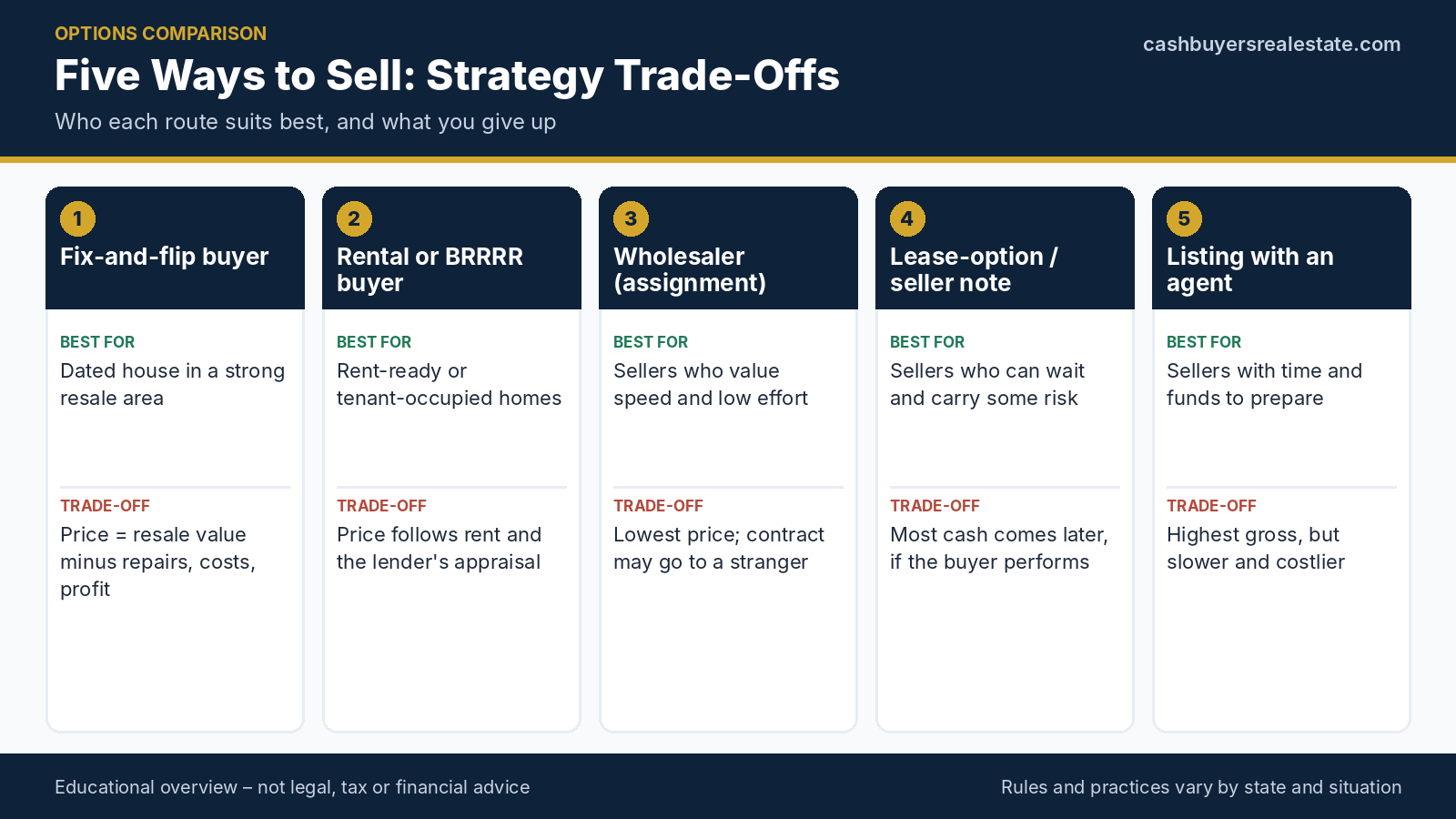
Text version of this infographic
- Fix-and-flip buyer — Best for: Dated house in a strong resale area. Trade-off: Price = resale value minus repairs, costs, profit.
- Rental or BRRRR buyer — Best for: Rent-ready or tenant-occupied homes. Trade-off: Price follows rent and the lender's appraisal.
- Wholesaler (assignment) — Best for: Sellers who value speed and low effort. Trade-off: Lowest price; contract may go to a stranger.
- Lease-option / seller note — Best for: Sellers who can wait and carry some risk. Trade-off: Most cash comes later, if the buyer performs.
- Listing with an agent — Best for: Sellers with time and funds to prepare. Trade-off: Highest gross, but slower and costlier.
Lease-Options, Seller Financing, and Subject-To Deals: Creative Structures and Their Risks
Some investors do not offer a single lump sum at closing. They offer a structure: a rental period followed by a purchase, a promise to pay you over time, or a transfer of the title while your mortgage stays in place. These arrangements are sometimes called creative financing, and the phrase is accurate but unhelpful, because it describes how the deal is built and not whom it favors. For some owners with unusual circumstances they are workable. For many others they trade a certain sum today for obligations that remain with the seller for years, so they deserve slower reading than any other offer in this guide.
Lease-options and seller financing: when you become the lender
Both of these structures put the seller in a role closer to a bank or a landlord than a seller, with responsibilities that continue after the contract is signed. They can raise the headline price, because the buyer is paying for flexibility rather than for immediate cash, and that trade-off is the essence of how they work.
Lease-options: rent now, buy later
In a lease-option, the investor or the occupant leases the house for a set term, often one to three years, and receives the right but not the obligation to buy at a price fixed in advance. The tenant-buyer pays an upfront option fee, which is usually nonrefundable, and monthly rent that may include a credit toward the purchase price. If the buyer exercises the option within the term, the sale closes at the agreed price, normally with the buyer obtaining a mortgage or other financing at that time. If the buyer walks away, the seller keeps the option fee and any rent but is left with a house that has been tied up for the whole period and perhaps a tenant who has not maintained it. The seller remains the owner throughout, so property taxes, insurance on the structure and any underlying mortgage payment continue to be the seller’s responsibility unless the lease says otherwise and the tenant actually pays.
The federal due-on-sale rules touch this structure directly. Under 12 U.S.C. 1701j-3(d) and the implementing regulation at 12 CFR 191.5, a lender may not exercise a due-on-sale clause on a qualifying residential loan because the borrower grants a leasehold of three years or less that contains no option to purchase. The converse is the point to remember: a lease with an option to buy, or a lease running longer than three years, does not fall within that protection, which means the lender may be entitled to treat the arrangement as a transfer that triggers the clause. Whether a given lender would do so is a separate question, but it is a risk that exists only because the option is there.
Another category of risk is behavioral. A tenant-buyer who intends to purchase usually cares for the house better than an ordinary tenant, but one who cannot qualify for a mortgage at the end of the term will not buy, and many lease-option buyers fail that test. If you take the arrangement, your outcome is mostly a return to where you started, minus the time and plus the option fee. State laws on lease-options, landlord-tenant rights and evictions also vary and sometimes treat the arrangement as a tenancy and sometimes as an installment sale, so a local attorney’s review of the contract is more valuable here than in a plain sale.
Seller financing: carrying the note
In seller financing, you sell the house and, instead of receiving the full price at closing, accept a down payment and a promissory note for the rest, secured by a mortgage or deed of trust on the property. The buyer pays you monthly with interest, often for a fixed number of years, followed by a balloon payment, which is a lump sum for the unpaid balance that the buyer typically intends to cover by refinancing. A seller-financed price can be higher than a cash offer because the seller is offering the buyer a service, namely credit, and also accepting the risk that the buyer will stop paying. If the buyer defaults, your remedy is to foreclose under your state’s process, which can be slow and expensive, and you might get the house back in worse condition than you left it.
Federal consumer-lending rules apply to some seller-financed deals involving homes. Under Regulation Z, at 12 CFR 1026.36(a), a natural person, estate or trust that finances the sale of only one property in any 12-month period, did not build the home in the ordinary course of business, and uses a financing arrangement with no negative amortization and a fixed rate, or a rate that adjusts only after five years or more with reasonable limits, is not treated as a loan originator under that rule. A separate exclusion allows financing of up to three properties in a 12-month period, with conditions that include a good-faith determination that the buyer can repay. Investors who regularly use seller financing may fall outside these exclusions, and their buyers may then be subject to additional rules, so a seller should ask an attorney whether the planned structure complies.
One conflict deserves particular attention. If you still have a mortgage on the house, selling with seller financing is a transfer, and your own lender’s due-on-sale clause may allow it to demand full repayment. Paying off the lender from the buyer’s down payment is rarely workable unless the down payment is large. Investors sometimes propose to leave the existing loan in place and “wrap” it with a new note from the buyer to you, and that wrapped structure carries the same lender-consent problem covered in the next section. How the tax consequences of installment payments unfold for a seller is a question for a tax adviser, because it depends on your basis, your holding period and how the sale is structured.
Subject-to deals and the due-on-sale clause
Subject-to is the structure most likely to be proposed to a homeowner who has a low-rate mortgage, is behind on payments, or has little equity. It is also the one where the gap between what is promised and what the law allows is widest. The concept is easy to state, and the risks follow from one sentence of federal law.
What “subject-to” means and why investors like it
In a subject-to purchase, the owner deeds the property to the investor, but the existing mortgage stays in the owner’s name, and the investor agrees to take over making the payments. The phrase means the buyer takes title “subject to” the lien that is already there, as opposed to assuming the loan with the lender’s approval or paying it off. The seller receives whatever cash or other consideration is negotiated, perhaps nothing at all if the owner is underwater, and in return is relieved of the day-to-day burden of making payments while still legally owing the debt.
For the investor, the appeal is cost of money. An owner who borrowed when rates were lower may have a mortgage payment far below what a new loan would require, and taking over that payment lets the investor acquire the house with little cash and then rent it or resell it with the cheap financing as a selling point. For a distressed owner, the appeal can be real relief: the investor may bring a delinquent loan current and stop a foreclosure, which is a legitimate use of the structure. The problem is not that either party’s motive is improper; the problem is what happens if the investor does not pay, or if the lender notices.
Illustrative example (hypothetical numbers, not market data): A homeowner owes $142,000 on a mortgage with a $980 monthly payment, including taxes and insurance, and the house would sell for about $205,000. An investor proposes to take title subject to the loan, pay the owner $4,000 at closing, and make the monthly payment going forward. On paper the owner has handed over roughly $63,000 of equity in exchange for $4,000 and a promise. If the investor stops paying after eight months, the lender looks to the owner, whose name is on the note, for the unpaid balance, the owner’s credit reports the delinquencies, and the lender may start foreclosure on a house the owner no longer controls. A seller who still owes the debt could spend months and legal fees recovering control, and might be unable to qualify for another mortgage in the meantime.
The example is hypothetical, but its structure is real. In a subject-to sale, you give up ownership and keep liability, which is the reverse of what most sellers expect. It is not illegal in itself in the sense that federal law does not forbid a borrower from transferring title, yet the transfer gives the lender a contractual right that the next subsection describes. Some states also regulate related practices, such as foreclosure rescue arrangements, equity purchases from owners in default and certain wholesaling activity, so the legality of a particular structure depends on facts and on where you live.
The due-on-sale clause and what stays with you
Most residential mortgages contain a due-on-sale clause, which federal law defines as a provision letting a lender, at its option, declare the loan due and payable if the property or an interest in it is sold or transferred without the lender’s prior written consent. The Garn-St Germain Depository Institutions Act, codified at 12 U.S.C. 1701j-3, confirms that lenders may enter into and enforce such clauses despite conflicting state law. For loans on residential property with fewer than five dwelling units, the statute lists specific transfers on which the lender may not exercise the option: creating a subordinate lien that does not transfer occupancy rights, certain purchase-money interests in household appliances, a transfer on the death of a joint tenant, a lease of three years or less with no purchase option, a transfer to a relative following the borrower’s death, a transfer in which the borrower’s spouse or children become owners, certain divorce-related transfers, and a transfer into a trust in which the borrower remains a beneficiary.
A sale or deed to an unrelated investor is not on that list. That means the lender can accelerate the loan, demand payment in full, and if the balance is not paid, begin foreclosure. Many lenders do not act immediately, and some never do so while payments arrive on time, which is why investors sometimes tell sellers that due-on-sale clauses are rarely enforced. A lender’s silence is not a promise; it simply reflects a decision not to act yet, and the decision can change when interest rates rise, when the loan is sold to a servicer with different practices, or when a payment arrives late. An investor’s reassurance cannot bind your lender, because the investor is not a party to your loan.
The costs of an acceleration fall on the person whose name is on the note. If the investor cannot refinance or pay off the loan, you remain liable for the balance, the foreclosure would appear in your credit history, and any shortfall after sale may be pursued in states that permit deficiency judgments. Insurance also matters: a homeowner’s policy generally covers the named insured, and if you no longer own or live in the house, claims may be contested. A seller who is nonetheless considering the arrangement should insist on safeguards. Ask a real estate attorney to review it. Ask whether the lender will approve an assumption or release your liability, which the statute encourages lenders to allow. Ask that payments run through a third-party servicer you can monitor, not through the investor’s account. And avoid signing powers of attorney, blank deeds or any document you have not read.
| Structure | Who holds title during the deal | Who pays the existing mortgage | Main risk to the seller | Safeguard worth asking about |
|---|---|---|---|---|
| Lease-option | Seller | Seller, using rent received | Buyer may never exercise; lender may view option as a transfer | Lender consent, short term, sizeable option fee |
| Seller-carried note | Buyer, with a recorded lien in the seller’s favor | Seller must pay off or obtain lender consent | Buyer default and a slow foreclosure | Large down payment, buyer credit review, attorney-drafted documents |
| Subject-to | Buyer | Buyer pays, but the seller stays liable | Acceleration by the lender, missed payments on the seller’s credit | Lender approval, third-party servicing, attorney review |
| Contract for deed | Seller until the contract is paid | Seller, from installments received | Buyer default, state-specific forfeiture and foreclosure rules | Review of state statute and a recorded contract |
The table is meant for a quick comparison, not a decision. The most informative column for most readers is the third: in every structure except a pure sale, someone other than the borrower is expected to make payments on a debt the borrower still owes, or the seller carries a long-term risk of the buyer’s default. If that dependence on another person’s performance is not acceptable, the structure is not suitable regardless of the price quoted. Readers whose real issue is a looming foreclosure should also read the guide to selling a house fast before foreclosure, because the options and deadlines there are different from an ordinary sale.
How to Tell Which Strategy the Buyer Is Using
Investors rarely announce their strategy in the first conversation, and some do not announce it at all. That is not necessarily evasion; many simply say “I buy houses” because that is the shortest way to describe a varied business. But since the strategy determines the price, the risks and the terms, it is worth working out, and the evidence is usually available in the offer, in the public record and in the answers to a few reasonable questions. No single clue is conclusive. The goal is a working picture that you then confirm.
Clues hidden in the offer, the entity and the contract
Documents tell you more than conversations do, because they were written by someone who had a plan. The words and numbers in a purchase agreement are choices, and each choice suggests an exit.
What the contract language reveals
Start with the buyer’s name block. If the contract names an individual or company “and/or assigns,” or “or nominee,” the buyer is reserving the right to hand the deal to someone else, which is the signature of a wholesaler though also sometimes used by flippers who bring in partners or use a different entity for each purchase. The length and structure of the inspection or due-diligence period tell a similar story. A short period, often a handful of days, suggests a buyer who has already inspected and intends to close. A long period that the buyer alone can use to cancel and recover the deposit is more consistent with a buyer who needs time to find an end buyer or lender, and the longer the window, the more of the risk it shifts onto you.
The financing terms are another giveaway. A contract that says the sale does not depend on a loan and attaches proof of funds describes a buyer who plans to pay from their own resources or a committed lender. A contract with a financing contingency, a lender name or an appraisal clause describes a buyer who is borrowing, and that points toward a landlord using an investor mortgage or toward a flipper who has not yet lined up short-term money. The earnest money deposit also carries information. A very small deposit relative to the price suggests a buyer with little to lose by walking away, often a wholesaler, while a substantial deposit held by a title company or attorney suggests a buyer who expects to close. For more on how deposits work see contingencies in cash offers.
Special clauses complete the picture. Language permitting the buyer to market the property, post signs, or show it to prospective buyers during the due-diligence period points to a wholesaler. An addendum describing monthly payments, an interest rate or a balloon date indicates seller financing. Wording that gives the buyer an option to purchase at a later date, or that speaks of rent credits, describes a lease-option. And a phrase like “buyer takes title subject to the existing loan” or a request for your mortgage statement and servicer details before any price is mentioned points toward a subject-to plan. If any of these appear without explanation, ask for a plain-language account of what the clause is meant to do.
What the entity and the public record reveal
Most investors buy through a limited liability company, and that is routine, not suspicious. It protects the owner’s personal assets and keeps each property’s affairs separate. But the entity’s existence leaves a paper trail you can use. State business registries, usually run by the secretary of state, list when the entity was formed, its registered agent and sometimes its managers; a company formed last month to buy your house is a different kind of counterparty from one that has operated for years. County recorder and assessor websites often show the entity’s prior purchases and sales, and the pattern of those transactions is often informative.
A buyer whose records show properties bought and resold within several months, usually with higher sale prices, is likely a flipper. A buyer who has acquired properties and held them for years, with no resales, is likely a landlord. A buyer whose name rarely shows up as the owner at all, but whose contracts appear in the documents of other buyers, may be a wholesaler working through assignment or double closing. These patterns are just patterns. A flipper can hold a house when the market softens, a landlord can sell, and records in some states are less complete than in others, so treat the evidence as a reason to ask better questions rather than as proof.
One more thing the record can show is whether a prior seller left a trail. Court dockets sometimes reveal disputes between a buyer and previous sellers, and a recorded memorandum of contract on a property that the buyer never ended up purchasing is a hint about how deals tend to end. Searching those records takes patience and is no substitute for professional advice, but it costs little and it replaces anonymity with information. The related guide to whether cash home buyers are legitimate goes much deeper into verification, and the vetting guide for buyers who advertise locally, checking out a local buyer, covers the business behind a phone number or yard sign.
Questions that surface the strategy without turning the call into a confrontation
You do not need to cross-examine a buyer to find out what they intend. Most legitimate investors answer plain questions plainly, because they have answered them many times. The manner of the answer is often as informative as the content.
Plain questions and what the answers mean
The most useful question is also the simplest: “After closing, who will own the house?” A buyer who intends to close in their own name and keep or renovate the house will say so. A buyer who hesitates, says “my company,” or speaks of “the buyer I have lined up” is revealing the structure of an assignment. A follow-up of “Do you plan to assign this contract, and if so, will you tell me in writing before you do?” gives them a chance to state the plan openly. In states that require wholesalers to disclose, a refusal to put the answer in writing is itself informative.
Questions about the plan for the property surface the other strategies. A flipper will talk about renovation scope, a resale timeline and the neighborhood’s recent sales. A landlord will ask about the current rent, the lease and the condition of the major systems. A creative-finance buyer will ask early about your mortgage balance, interest rate, monthly payment and whether you are current. None of those questions is improper, but the ones that concentrate on your debt rather than your house are worth noting, since they suggest a structure that depends on your loan. A question you should ask in return is how the buyer would handle the debt, and the answer should match what the contract says.
| Strategy | Questions the buyer tends to ask | Contract language to notice | Public-record pattern | Closing timing |
|---|---|---|---|---|
| Fix-and-flip | Repair needs, access for contractors, recent upgrades | As-is language, short inspection, proof of funds or lender named | Buys and resells within months | Flexible within weeks |
| Buy-and-hold or BRRRR | Current rent, leases, roof and systems age | Tenant assignment, rent roll, possible financing terms | Long ownership of many addresses | Steady; may follow lender timeline |
| Wholesale | Your deadline, your asking price, who else you are talking to | “And/or assigns,” long cancellation window, right to market | Few deeds in own name, contracts passed on | Depends on finding a buyer |
| Lease-option or seller financing | Your equity, your mortgage, your tax situation | Option fee, rent credits, payment schedule, balloon date | Memorandum of option or recorded lien | Long, with payments over time |
| Subject-to | Your loan balance, servicer, payment history | “Subject to existing financing,” deed on signing | Deed recorded but old mortgage unchanged | Quick transfer, long obligation |
Use the table the way a mechanic uses a diagnostic list: as a set of hypotheses to test. If three of the five columns for one strategy match what you see, you probably have a good guess, and you can then ask the buyer to confirm it. If the signals are mixed, which happens with investors who use more than one strategy, the mixed result is also informative, because it suggests you should ask what happens under each scenario.
Confirming identity, funds, and the closing partner
Once the strategy is clear, confirm that the buyer can perform. Ask for proof of funds in the form appropriate to the plan: a recent bank or brokerage statement for a cash buyer, a lender’s commitment letter for a borrower, and a written statement of how the end buyer will be funded for an assignment. The page on proof of funds for cash offers explains what such documents show and what they do not. Statements can be altered, accounts can be borrowed against, and a letter that looks official may not be, so a document is a starting point for verification and not a conclusion.
The closing partner is another point you can check. Depending on the state, closings are run by a title company, an escrow company or a real estate attorney, and you are entitled to know who it is, to look the firm up and to contact it using a phone number you found independently. Earnest money should normally be held by that neutral party. Wire fraud is a recognized risk in real estate closings, so confirm any wiring instructions by calling a known number before you act on an email, and be skeptical of last-minute changes. Whether the closing agent may be chosen by the buyer or the seller varies by state and by contract, and the contract should state which one it is.
Finally, watch pressure, not just paper. Offers that expire within hours, requests to sign before you have seen a complete contract, and instructions not to talk to an attorney or a family member are all reasons to slow down. None of these behaviors proves fraud, and many honest buyers work quickly. But a deal that can only proceed if you do not ask questions is a poor deal for that reason alone. The hub on cash home buyer scams and how to avoid them describes recurring patterns in more detail.
Where Sellers Have Bargaining Power, and How to Compare Net Proceeds Across Strategies
Homeowners often assume that an investor holds all the cards: the investor has the cash, the experience and the contract template. In practice the balance is more even than it looks. Every investor model, as the earlier sections showed, depends on assumptions about cost, time and risk, and a seller can influence several of those assumptions at little cost to themselves. The task is to know which levers are real, and to measure the result in net proceeds rather than in the headline figure on the first page of the contract.
Levers that cost you little and are worth real money to the buyer
Negotiating with an investor is less about haggling over the price and more about reducing the buyer’s costs and uncertainty. Each reduction in the buyer’s risk is an opening to ask for a better number or better terms, and many of them are things the seller can offer without any financial sacrifice.
Timing, possession, and certainty
Time is the largest hidden variable in any investor model. A flipper pays carrying costs every day of ownership, and a landlord loses rent for every vacant day, so a buyer will value a closing date that matches their schedule and a possession date that arrives on time. If you can move out quickly, you reduce the buyer’s holding costs; if you need extra time, you increase them, and a sensible buyer will charge for it. The reverse can be true for some investors: a landlord with a lease already planned may not care if you stay for a few weeks, and some will rent the house back to you at a market rate, which can be mutually useful when you need a gap between closing and moving.
Illustrative example (hypothetical numbers, not market data): A seller needs 45 days to move after signing. The investor’s carrying cost once it owns this house is about $2,100 a month, so if the closing itself were pushed out 45 days, the buyer’s renovation schedule and financing would slip with it, a cost of roughly $3,150 in the buyer’s model. The seller instead proposes closing in 15 days and staying another 30 days as a tenant at $1,500 for the month. The buyer owns the house on its original timetable, has its money committed at the contract price, and recovers most of that month’s carry through the rent. The seller gets the time to move and a firm closing date, and can fairly ask that the price hold in return. The figures will differ in every deal, but the trade is a real one.
Certainty has its own value. An investor looking at a house with a clear title, a mortgage payoff that is already requested, no liens, no tenants who must be removed, and every owner ready to sign has fewer unknowns than one looking at a probate sale or a house with a boundary dispute. Each unknown lengthens the buyer’s timeline and increases the risk premium in the price. If you can resolve a problem before the sale, such as obtaining a payoff statement, locating a missing signature or clearing a minor lien, you may recover more value than the cost of fixing it. When you cannot, disclose it early; a defect revealed at the start of negotiation is a pricing factor, whereas a defect revealed late can look like a deception and undo the deal.
Documentation is a quieter form of certainty. Receipts for work done, warranties, a recent inspection, utility bills that show what the house costs to run, and a clear list of what is and is not included in the sale all reduce the buyer’s need to assume the worst. None of them guarantees a higher offer, but they let you contest a repair estimate or a risk discount with evidence. Remember too that disclosure obligations apply in every sale, regardless of the buyer’s strategy: an as-is sale does not permit concealing known defects, and state law governs what must be disclosed. Related guidance appears in the page on disclosures in an as-is sale.
Competition, and matching the house to the strategy
The second lever is competition. The same house can be worth different amounts to different kinds of investors, which means the best offer is likely to come from the strategy that suits your property. A tired, structurally sound house in a neighborhood where renovated homes sell quickly is usually worth the most to a flipper. A rent-ready or tenant-occupied house in an area with strong rents tends to be worth the most to a landlord. A house with severe problems that scare other buyers, such as fire damage, major foundation work or a hoarding situation, may find its best buyer among investors who specialize in difficult projects, and a house that needs almost nothing may fetch more from an owner-occupant on the open market than from any investor.
Getting offers from more than one type of buyer therefore does two things. It reveals how much each strategy values the property, and it prevents any one buyer’s assumptions from becoming your only reference point. How many offers to seek depends on your situation. A seller who has weeks and no urgent deadline can seek several; a seller under a tight timeline might get two or three and decide. The guide to comparing cash offers explains how to line them up on the same basis, and the fixer-upper segment is covered in cash home buyers for fixer-uppers. The way buyers sort themselves by property type, price tier and condition is laid out in who buys houses for cash.
A few cautions apply. Shopping a property is not the same as shopping a contract: once you have signed an agreement with one buyer, you are bound by its terms, and promising the same house to several buyers can create legal trouble. Be wary too of buyers who ask you to stop talking to others before they have given you a written offer. And remember that some of the “competing offers” you receive may come from wholesalers who are all trying to sell the same contract to the same end buyers; if several offers are strikingly similar, ask whether they come from the same source. Your bargaining power also includes the right to insist on safeguards, and six checks are worth requesting from any buyer regardless of strategy. Confirm the buyer’s identity and entity. Ask for proof of funds. Read every cancellation clause, noting who can cancel, when and with what consequence. Examine the assignment terms, including whether the buyer may transfer the contract and what notice you receive. Use a reputable closing agent whose details you have verified independently. And never sign a blank form, a deed or a document you have not read.
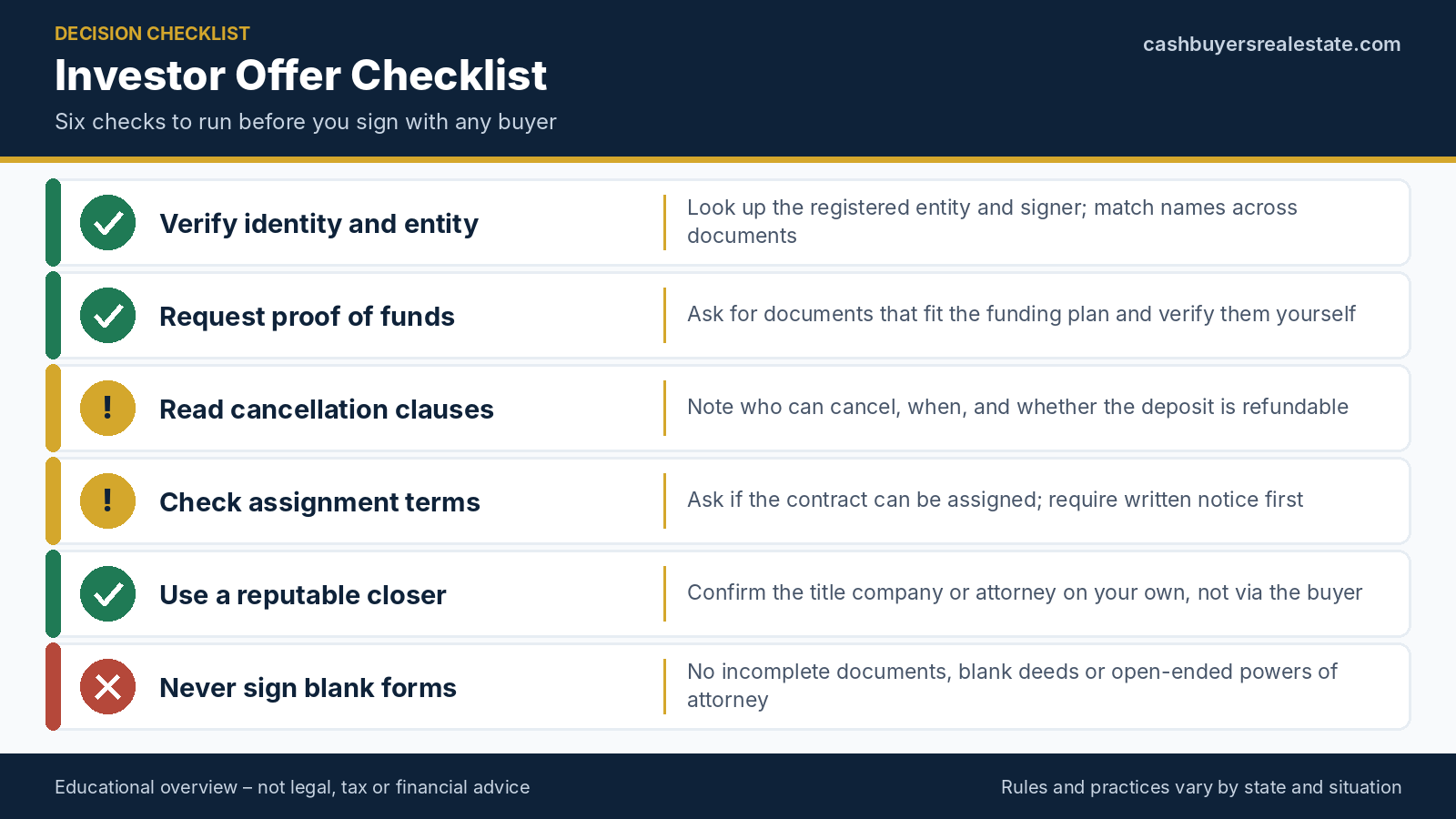
Text version of this infographic
- Verify identity and entity — Look up the registered entity and signer; match names across documents
- Request proof of funds — Ask for documents that fit the funding plan and verify them yourself
- Read cancellation clauses — Note who can cancel, when, and whether the deposit is refundable
- Check assignment terms — Ask if the contract can be assigned; require written notice first
- Use a reputable closer — Confirm the title company or attorney on your own, not via the buyer
- Never sign blank forms — No incomplete documents, blank deeds or open-ended powers of attorney
Comparing net proceeds across strategies and against a listing
The honest way to compare routes is to count what you take home after every cost, and to count the time and risk that each route carries. A higher offer with more obligations may leave you worse off than a lower offer that closes cleanly, and a listing may beat any investor if you can afford to wait and prepare the house.
A net-proceeds comparison with illustrative numbers
The comparison below takes a single hypothetical house that would sell for $240,000 on the open market after $30,000 of repairs, and runs it through five routes. All of the numbers are invented, including the commission rate, the repair costs and the carrying costs, and local conditions will change every line. The aim is to show the shape of the comparison, in particular how a lower price can nonetheless produce a competitive net result for a seller who values speed and certainty.
| Route | Illustrative price | Seller costs and carry | Net at closing | Typical time to cash | Main uncertainty |
|---|---|---|---|---|---|
| Repair, then list with an agent | $240,000 | $54,800 | $185,200 | Several months | Repair surprises, market, buyer financing |
| Flip buyer, as-is | $138,000 | $2,900 | $135,100 | Weeks | Re-trade after inspection |
| Rental buyer, as-is | $148,000 | $2,900 | $145,100 | Weeks, longer if financed | Appraisal and lender conditions |
| Wholesaler, as-is | $126,000 | $2,900 | $123,100 | Weeks, if an end buyer appears | Assignment and performance risk |
| Seller-carried note | $190,000 | $3,500 plus carry | $34,500 now, balance later | Years for the balance | Buyer default and slow foreclosure |
Read the third and fourth columns first. The listing route nets the most on paper, roughly $40,000 to $60,000 more than the as-is investor routes, but it requires spending $30,000 on repairs before any money comes in, it carries market risk across several months, and it assumes the repairs are as cheap and the buyer’s financing as smooth as hoped. The investor routes pay less but substitute certainty and speed for the cost of repairs and the time on the market, which can be decisive for a seller who is moving, settling an estate or short of cash. The seller-carried note has the highest sticker price and the least money at closing, which illustrates why headline price is the wrong yardstick. The articles on net proceeds in a cash sale versus a traditional sale and on cash offer net proceeds provide worksheets for your own figures.
Protecting the deal you negotiate: re-trades, written terms, and your walk-away number
A re-trade is a request to lower the price after the contract is signed, usually following an inspection or a revised repair estimate. Some re-trades are legitimate: the inspection found a failing sewer line that no one could see during the walk-through, and the price should reflect it. Others are tactics: the buyer signed a contract at a price they knew they could not support, expecting to extract a discount once you were committed. You can reduce the second kind in advance. Keep the inspection period short, require that any price reduction be tied to a written finding with a cost estimate, and insist that the buyer share the inspection report. If the buyer asks for a large concession, ask what changed since the first visit.
Equally important is deciding in advance what you will accept. Before you engage with buyers, estimate your net proceeds from at least one alternative, such as listing as-is, repairing lightly or selling to a different type of buyer, and write down a floor below which you would choose the alternative. That figure is your walk-away number, and having it ahead of time protects you from deciding under pressure. It also reframes negotiation: you are no longer asking whether a buyer’s offer is fair in the abstract, but whether it beats your best alternative once all costs are counted.
Finally, put everything in writing and keep copies. Verbal assurances about what the buyer will pay for, who will repair what, or when the money will arrive have no force if they are missing from the contract. Review the final contract with a real estate attorney or the closing agent, particularly if it contains assignment rights, financing terms or an option, and read the closing statement before you sign it. A good transaction is boring at the end: the numbers on the statement match the numbers you were promised, the buyer is the buyer you expected, and the money arrives when it should.
Frequently Asked Questions About Investors Who Buy Houses
The questions below come up repeatedly when homeowners start comparing investor offers. They are grouped by theme, and each answer is deliberately short; the sections above supply the reasoning, and the linked pages go deeper on individual topics.
Questions about offers, price, and strategy
Price is where most conversations begin, and it is also where the strategy behind an offer does the most to explain what you are seeing.
Questions about why offers differ
- Why did two investors offer such different prices for the same house?
Each investor starts from a different exit. A flipper prices the house from its renovated resale value minus work, financing and profit, while a landlord prices it from the rent it can earn. Their repair estimates, required returns and borrowing costs also differ. A spread between offers usually reflects different assumptions rather than a hidden judgment about you, so ask each buyer to explain the plan behind the number.
- Is a low offer from a wholesaler a sign that something is wrong?
Not by itself. A wholesaler’s price has to leave room for an end buyer’s profit and for the wholesaler’s own fee, so it is structurally lower than a direct purchase. The question is whether the wholesaler has been open about the plan to assign the contract and has explained the terms. Compare the offer with others, check your state’s disclosure rules, and decide whether the speed and convenience are worth the difference.
- Do investors who buy houses really pay all cash?
Many do, but not all. ATTOM’s first-quarter 2026 flipping report found that 61.1 percent of flipped homes nationwide were purchased with all cash, which leaves close to four in ten bought with financing of some kind. Some buyers who describe an offer as cash are using short-term loans or a partner’s money. Ask how the purchase will be funded and request documentation that fits the answer.
- Can I negotiate an investor’s offer?
Yes, though the levers differ from a retail sale. Investors rarely move far on price once their model is set, but they often respond to things that reduce their risk or cost, such as a flexible closing date, a clean title or documentation of recent repairs. Competing offers from different kinds of buyers also help. Negotiate for terms as well as price, including the length of the inspection period and the size of the deposit.
Questions about investor profit and taxes
- How much profit does a typical flipper actually make?
Published figures describe gross profit only. ATTOM reported a typical gross profit of $66,000 on flips in the first quarter of 2026, a gross return of 25.4 percent on the original purchase price, but its gross figures come before renovation and other expenses. Net profit after repairs, financing, holding and selling costs is lower and varies a great deal by project. Treat any single number as an average that hides losses as well as wins.
- Are investors taxed differently from homeowners who sell?
Often, yes, though the details depend on each person’s situation. In general terms, gain on an asset held one year or less is short-term and taxed as ordinary income, and property held primarily for sale to customers in the ordinary course of business is not treated as a capital asset. Long-term rental owners depreciate residential rental property over 27.5 years under the general system. None of this changes what you must pay on your own sale, which a tax adviser should review.
- Does the investor’s tax situation affect my sale?
Sometimes indirectly. A buyer using proceeds from another sale to complete a like-kind exchange under section 1031 works against fixed deadlines and may be keen on speed or inflexible about dates. Section 1031 applies only to real property, and the IRS states that an exchange of property held primarily for sale does not qualify. As the seller, your own gain depends on your basis, how long you owned the house and how you used it, so ask a tax professional before you agree to a price.
Questions about contracts, risk, and safety
The second group of questions concerns what can go wrong and how to protect yourself, which matters most in assignable contracts and creative structures.
Questions about assignments and creative financing
- Can an investor assign my contract to someone else without telling me?
It depends on the contract and the state. Many investor contracts allow assignment, often through “and/or assigns” wording, and some states, including Arizona and Oklahoma, require specific written disclosures from wholesalers. You can ask that assignment require your written consent or advance notice with the new buyer’s identity. Read the clause before signing and ask an attorney if the wording is unclear.
- What happens if a wholesaler cannot find an end buyer?
The outcome depends on the contract’s terms. The wholesaler may use an inspection or due-diligence period to cancel and recover the deposit, may ask you to lower the price, or may fail to close and leave you to pursue the remedy in the contract, which is often limited to the earnest money. Meanwhile your house has been off the market. Ask about the cancellation clause and the amount of the deposit before you sign.
- What is the due-on-sale clause and why does it matter in a subject-to deal?
It is a mortgage provision that lets the lender demand full repayment if the property or an interest in it is transferred without the lender’s consent. Federal law, in 12 U.S.C. 1701j-3, generally allows lenders to enforce it, and its exceptions do not include a sale to an unrelated investor. In a subject-to deal the loan stays in your name, so an acceleration or missed payments land on you. Consult an attorney before considering such a structure.
- Is seller financing safe for the seller?
It carries real risk. If the buyer stops paying, your remedy is usually a foreclosure that can be slow and costly, and the property may be returned in poor condition. Federal and state lending rules can apply, including Regulation Z limits on who may offer seller financing without being treated as a loan originator. A large down payment, a careful review of the buyer’s finances and attorney-prepared documents all reduce the risk, though none removes it.
Questions about checking out a buyer
- How can I tell whether a buyer is a flipper, a landlord, or a wholesaler?
Look at the contract wording, the buyer’s questions and the public record. Assignment language and a long cancellation window suggest a wholesaler. Questions about rents and leases suggest a landlord. Repair talk and a history of quick resales in county records suggest a flipper. No signal is conclusive, so ask directly who will own the house after closing and whether the contract may be assigned.
- What documents should I ask an investor for?
Ask for evidence that fits the buyer’s funding plan. A cash buyer can provide a recent account statement, and a borrower can provide a lender commitment letter. Also ask for the entity’s name and registration details and the name and contact details of the title company or attorney who will close. Verify these independently, since a document alone does not prove that the funds are available or the closing partner is real.
- Is it a red flag if the buyer is an LLC?
Not in itself. Many legitimate investors buy through limited liability companies to separate each property’s liabilities from their personal assets. What matters is whether the entity is properly registered, how long it has existed and whether its transaction history in county records fits what the buyer tells you. An entity created recently, with no assets and no track record, deserves more verification than an established one.
Choosing Among Investor Offers: A Decision Framework and Your Next Steps
By this point the central idea should be clear: an investor’s offer is the output of a plan, and the plan determines price, speed, flexibility and risk. The remaining task is to decide what you want from the sale and to match that against what each route can offer. That is a personal decision, and the framework below is meant to structure it rather than to push it in a direction.
A decision framework for matching a route to your priorities
Most sellers hold four priorities in tension: the amount of money kept, the speed of the sale, the certainty that it will close, and the effort required of them. No route maximizes all four, and the honest conversation with yourself is about which two matter most.
Ranking price, speed, certainty, and effort
If maximizing net proceeds matters most and you have time and funds to prepare the house, a conventional listing, perhaps after light repairs, usually produces the highest gross price, though you pay commissions, closing costs and carrying costs and take on market risk. If you need to sell quickly and the house needs significant work, a flipper is often the best match, since the flipper’s business is to renovate and the price reflects the cost. If the house is rentable and especially if tenants are in place, a landlord may pay more than a flipper and may be more relaxed about the schedule. These matches are tendencies, and your local market may differ.
If certainty is your top priority, favor buyers who can show funds, who offer a meaningful deposit held by a neutral party, who close in their own name and who accept a short inspection period. If effort and convenience matter most and you are willing to accept a lower number, a wholesaler or a direct as-is investor sale may suit you, provided the terms are clear and the risks of assignment are acceptable. If you are tempted by a structure that promises a higher headline price, ask what part of it is paid at closing and what part depends on another person’s performance over years. Most sellers who regret a creative deal regret that gap between promised and delivered value.
It helps to put the ranking in writing, even informally. Writing down that you need the money within sixty days, that you can spare no more than a small amount for repairs, and that you want no obligations after closing immediately eliminates certain routes and shapes the questions you ask the others. It also gives a family member or adviser something concrete to react to, which is often more useful than a general conversation about whether an offer feels right.
When a different route beats an investor
Investors are one option among several, and for some properties they are not the best one. A house in good condition, in a market where buyers are active and with enough time to list, may net far more through a traditional sale than any investor can pay, as the net-proceeds comparison suggested. A house needing modest repairs might be worth fixing first; the decision is analyzed in selling as-is versus renovating. An owner-occupant buyer using a mortgage will often pay more than an investor but takes longer and introduces appraisal and inspection risk, a trade-off explored in cash sale versus listing for a fast sale.
Other routes include selling to a neighbor, to a family member, through an auction for unusual properties, or to an institutional buyer or iBuyer where the program operates and the house qualifies. Each has its own costs and rules, and some are unavailable in many markets. If you are unsure, consulting a local real estate agent for a market opinion costs little, provided you understand that the agent has an interest in listing. The goal is not to reject investors but to know what you are giving up and what you are getting before you commit, so that when you do choose an investor, you do so with a clear sense of the alternative.
What to do next: first steps, documents, and questions
Once you know your priorities, the next steps are practical and mostly about preparation. A well-organized seller gets faster and more accurate offers, spots problems earlier and is harder to pressure.
First steps and documents to gather
Begin by finding out exactly what you own and owe. A recent mortgage statement, or a payoff request to your lender, shows what must be repaid at closing, and a copy of your deed and your property tax bill confirm ownership details and what has been paid. Gathering the items below early also lets you answer a buyer’s questions quickly, which reduces the uncertainty that investors price into offers.
- Your deed, the names of every owner and any trust or estate paperwork that shows who has the authority to sign
- The latest mortgage statement and the lender’s contact information for a payoff request
- Recent property tax bills and, if applicable, homeowners association documents and dues
- Receipts, permits and warranties for recent repairs or improvements
- Leases, rent rolls and tenant contact details if the property is rented
- A year of utility bills and a list of known problems you intend to disclose
Each item answers a question a buyer will ask sooner or later. The deed and ownership papers establish who has authority to sell, which is the first thing a title company checks, and a missing signature from a co-owner, an heir or a trustee is one of the most common reasons a closing slips. The mortgage payoff and tax bills fix the amount that must be paid before you receive anything, so you can calculate real proceeds rather than guessing. Repair records and warranties let you push back on a buyer’s estimate of unknown problems, and leases or rent rolls give a landlord buyer evidence to value the house on. If any of the items is missing, start the request now, since lenders, county offices and associations can take days or weeks to respond.
With those in hand, write a rough net sheet for at least one alternative so that you have a number to compare against. Then request offers from more than one kind of buyer, and save every message and draft contract. Do not sign anything that is incomplete, and do not let the pace of the buyer’s schedule substitute for your own. If a deal involves a tenant, an inherited property or a looming foreclosure, add an attorney early, since deadlines and procedures in those situations are set by state law.
Questions to bring to the buyer and to your attorney
Take a short list of questions to every conversation. For the buyer: Who will own the house after closing? Do you intend to assign this contract, and will you tell me in writing first? How will you fund the purchase, and when is the money committed? What will make you change your price after the inspection? Who will close the sale, and who holds the deposit? For your attorney or closing agent: Does my state require disclosures from a buyer who may assign? Are there licensing or cancellation-right rules I should know about? What happens to my existing mortgage under this structure, and does my lender need to consent?
Listen as much to how the answers arrive as to what they say. A buyer who gives specific, consistent answers, who is comfortable with the idea of your attorney reading the contract, and who offers to put key points in writing is behaving like someone with a settled business. A buyer who answers a question with another question, changes the plan from one call to the next, or treats a request for documents as an insult has told you something too. Attorneys vary in how much they charge for a contract review, and in many places a flat-fee review of a short purchase agreement is a modest expense next to the value of the house. Ask what the review will cover and how soon it can be done, so the buyer’s deadline does not squeeze out the step that protects you most.
If your situation involves a creative structure, ask in addition what happens if the buyer stops paying, who is legally responsible to the lender, and how you will be able to verify payments. For help on the scam side of the process, the pages on questions to ask a cash home buyer and the earlier discussion of verification will help you prepare.
Choosing a buyer is rarely a choice between good and bad. Plenty of investors run honest businesses with fair margins, and for the right house and the right seller they offer a faster, simpler and less stressful path than a listing. Others offer less than a house is worth to someone else, or build deals around terms that favor them far more than the headline suggests. The best protection is understanding the strategy behind an offer, comparing it with your best alternative on net proceeds, and taking the time to read the contract. Taking a few days to gather documents and compare offers rarely costs a good opportunity, and it often exposes a weak one.