Cash Buyer vs. Financed Buyer: Offers, Process & Red Flags
Two offers arrive on the same afternoon. One is for $385,000, comes with a letter from a bank showing the buyer’s funds, and promises to close in about two weeks. The other is for $398,000, depends on a mortgage, and asks you to wait six weeks while a lender does its work. The larger number is tempting, the shorter calendar is tempting, and nobody on the thread can tell you which offer will actually put money in your account. That is the real shape of the cash buyer vs. financed buyer decision: it is rarely a contest between two prices, and almost always a contest between two bundles of price, timing, conditions and risk that happen to carry a price tag on the front.
This guide is written for a homeowner who has a house on the market, or is about to put it there, and is weighing offers from both kinds of buyers. It is deliberately neutral. Some sellers are better served by the certainty of a buyer who needs no lender’s approval, and some are better served by a financed buyer who pays more and can reasonably be expected to close. Which group you fall into depends on your house, your calendar, your tolerance for a deal collapsing, and the arithmetic of what you would actually keep after costs, credits and carrying expenses. The goal is to give you the mechanics, the numbers and the questions that let you make that call with your eyes open.
Short answer: A cash buyer pays without a mortgage, so there is no lender appraisal, underwriting or loan approval to delay or derail the sale. A financed buyer relies on a lender, which adds approval steps and conditions but often supports a higher price. Compare net proceeds, closing odds and timing, not the headline number alone.
The differences come from one structural fact. When a buyer borrows, a second organization with its own rules, deadlines and appetite for risk sits between your signed contract and your closing day. The lender orders an appraisal, reviews the buyer’s income and assets again, checks the title and insurance, and can attach conditions at nearly every step. When a buyer pays with their own funds, that second decision-maker disappears, and with it a set of delays and failure points. Nothing is free about the trade, though. Buyers who can pay cash frequently ask for something in return, whether a lower price, a short inspection window, or a condition that the house be sold as it stands.
Cash is also more common than many sellers assume. The National Association of Realtors reported in its 2025 Profile of Home Buyers and Sellers that 26 percent of buyers over the survey year paid all cash, the highest share in the survey’s history, and its September 2026 REALTORS Confidence Index showed 27 percent of reported transactions as all-cash, down from 30 percent a year earlier. In other words, in a typical stretch of the market roughly one offer in four may come from a buyer with no mortgage, and those buyers are not a single type. Retirees moving down from a paid-off house, move-up buyers who just sold, families using inherited money, and real estate investors all pay cash for different reasons and behave quite differently at the negotiating table.
What follows starts with the mechanics of each path and how to tell the two apart when the labels blur, because plenty of offers are neither purely one nor the other. It then compares offers on net proceeds, which is the only honest way to set a $385,000 offer against a $398,000 one, and explains how mortgage underwriting creates both the risk and the discipline that financed deals carry. A full section covers how conventional, FHA and VA loan programs treat a home that needs work, since property condition is where financed offers on older or neglected houses most often stumble. After that the guide turns to timelines, contingencies and earnest money, the practice of presenting and scoring multiple offers, backup-offer strategy, and the red flags that deserve attention on both sides of the table.
Some neighboring questions are handled briefly here and in depth elsewhere. The investor side of the story, including how pricing works when a buyer plans to renovate and resell, is covered in the article on how a cash offer compares with market value. The head-to-head of a cash offer against a mortgage-backed one from the buyer’s perspective belongs to a separate guide on cash offers versus mortgage offers, and the broader question of whether to list at all is taken up in the comparison of a cash sale and a listing for a fast sale. Here the lens stays fixed on you as the seller reading two or more offers on the same property.
What Really Separates a Cash Buyer From a Financed Buyer
A good starting point is to define terms the way a closing table does, not the way advertising does. A cash purchase means the buyer completes the transaction with their own funds and no mortgage secured by the property being bought. A financed purchase means some or most of the price comes from a lender that takes a lien on the house until the loan is repaid. Almost everything else that sellers notice, from timing to price to tolerance for repairs, flows from those two definitions. The distinction sounds academic until two offers land on the same day, at which point it explains nearly every difference in how quickly, and how reliably, each one can turn into money in your account.
Who Pays, and Who Else Gets a Vote
The cleanest way to compare the two buyers is to count the parties whose approval is required before money moves. Every sale involves the buyer, the seller, the agents and a closing agent. A financed sale adds at least three more roles that can say no, and each one operates on its own schedule and under rules the seller cannot see or influence.
Cash buyers: one decision-maker and a funds question
When a buyer pays cash, the only person who has to be satisfied that the purchase makes sense is the buyer. There is no loan committee, no appraiser’s opinion that must support the price, and no underwriter reading bank statements for the third time. The buyer decides whether the house is worth the price, whether the inspection results are acceptable, and when to wire funds, and the contract gives the buyer a contractual duty to do those things on time. This is why cash offers can be accepted, inspected and closed on a compressed calendar, with the limiting factors being the title search, the seller’s own readiness, and any local recording or closing requirements.
The question that replaces underwriting is whether the money is real, available and legitimately the buyer’s. A letter or statement showing the funds, usually called proof of funds, is the standard first check, and a thoughtful seller reads it for specifics: whose name is on the account, whether the balance comfortably exceeds the price plus closing costs, and whether the document is current or months old. Proof of funds is not a guarantee, because balances can move after a statement is printed, but a buyer who cannot produce one quickly or who resists attaching their name to it has told you something worth weighing. The details of what a strong document looks like are covered in the guide to proof of funds for cash buyers.
Because the buyer alone carries the decision, the buyer also carries more of the risk of a bad outcome, and that shapes how they behave. A cash buyer who discovers a foundation problem cannot hide behind a lender’s refusal to fund; they either renegotiate, accept the problem or leave under whatever contingencies the contract allows. For you as the seller, that means the inspection period of a cash deal is where most of the real negotiation happens, since there is no appraisal or loan approval stage to absorb pressure on the price. One practical effect is that you should expect more pointed questions about the house from a cash buyer, not fewer, since nobody else is checking it on the buyer’s behalf.
Financed buyers: a lender, an appraiser and an underwriter join the deal
A financed buyer brings a lender into the transaction, and the lender brings three things the seller does not control. The first is an appraisal, an independent estimate of the home’s value that the lender uses to decide how much it will lend. The second is underwriting, the process by which the lender verifies the buyer’s income, assets, debts and credit and decides whether the loan meets the rules of the program it is written under. The third is a set of property and title standards, because a lender will not lend against a house that cannot be insured, that has an unresolved ownership problem, or, for some loan types, that fails minimum condition requirements.
None of this makes a financed buyer less serious. Most homes in the United States are bought with a mortgage, and most financed contracts close. But the structure means a financed buyer’s promise to purchase is conditional on events that neither the buyer nor the seller fully controls. A buyer can do everything right and still lose a loan approval because a lender discovers a discrepancy, an appraisal comes back low, or an insurance quote arrives at a price that breaks the budget. When that happens, the contract usually gives the buyer a way out, and the seller returns to the market after weeks have passed.
There is a quieter effect worth naming. The lender’s involvement imposes a discipline that benefits both sides. An appraisal that supports the contract price is independent evidence that the price is reasonable, a title review catches problems before closing day, and a required Closing Disclosure puts the final numbers in writing days before the signing. Sellers sometimes experience these as obstacles, but they are also the reason financed deals tend to arrive at the table with fewer surprises about price and ownership than some informal cash deals do. A seller who treats those checkpoints as free quality control, rather than as friction, tends to handle the financed process with far less frustration and far fewer surprises.
Mapping the Differences, Including the Gray Areas
With the roles clear, it helps to see the two paths side by side and then to look at the buyers who do not fit neatly on either side. The table below is a general map; individual offers will differ, and the contract in front of you always controls over any generalization.
Ten dimensions at a glance
The following table compares cash and financed purchases across the dimensions sellers most often ask about. It describes how these deals typically work in the abstract, not a promise about any particular buyer. It is meant to be read quickly and then used as a checklist of topics to raise with your agent, because each row corresponds to a clause, a deadline or a document you will actually see in the contract and its attachments. Where a row says “often” or “can,” the contract in front of you is the only authority on what a particular buyer has agreed to.
| Dimension | Cash buyer | Financed buyer |
|---|---|---|
| Offer price | Often competitive, sometimes below financed offers when the buyer asks for speed or as-is terms | Can be higher, since the appraisal and the buyer’s budget are the main limits |
| Appraisal | Not required by a lender; the buyer may still order one by choice | Required by the lender; a low value can force a price change or cash from the buyer |
| Underwriting | None; the check is on the funds themselves | Full review of income, assets, credit and property before the loan is approved |
| Inspection | Buyer’s choice; often short or sometimes waived | Buyer’s choice, plus any repairs the lender or loan program requires |
| Property condition | Flexible; the buyer prices the repairs into the offer | Must meet the loan program’s standard; heavy repairs can block certain loans |
| Typical closing speed | Can be days to a few weeks once title is clear | Commonly several weeks, tied to appraisal, underwriting and disclosure timing |
| Contingencies | Usually fewer; no financing or appraisal contingency is needed | Often includes financing, appraisal and sometimes sale-of-home contingencies |
| Seller concessions | Rarely requested for closing costs; repair credits are negotiated directly | Frequently requested; loan programs set limits on seller-paid amounts |
| Fall-through risk | Mainly from inspection findings, title problems or funds that are not real | Adds loan denial, appraisal shortfall and late underwriting changes |
| Documents to verify | Proof of funds, identity, entity paperwork if an LLC or trust is buying | Pre-approval or approval letter from a named lender, plus the lender’s contact details |
Read the table as a map of where each path concentrates risk rather than as a scoreboard. Cash removes the lender-related failure points and shifts attention to the buyer’s funds and the inspection. Financing adds the lender-related failure points but often brings a higher price and a buyer whose budget comes with outside verification. Neither column is automatically better, and several rows, including price and closing speed, depend heavily on who the individual buyer is and what the contract says. If you take away only one idea, let it be that the same house can produce very different risks depending on which column the buyer sits in, and your job is to know which risks you are accepting before you sign.
Buyers who don’t fit the labels
Real offers often blur the categories. A buyer who puts down 40 percent and borrows the rest behaves much more like a cash buyer than a typical financed one, because the loan is small relative to the value and an appraisal shortfall is less likely to cause trouble. A buyer who has already sold a previous home and holds the proceeds in cash is in a similar position. At the other end, a buyer whose offer is contingent on selling their current house is financed in a deeper sense than the label suggests, since your closing depends on a second transaction that you cannot see.
Then there are buyers who describe themselves as cash buyers while financing the purchase through someone else. Real estate investors sometimes fund a purchase with a private lender, a hard-money loan or a short-term line of credit, and they present the offer as cash because there is no conventional mortgage underwriting on the buyer. That can be a perfectly legitimate way to close quickly, but the structure matters to you, because the funds are only as certain as the arrangement behind them. Ask directly whether any part of the purchase price is borrowed, from whom, and whether the buyer’s proof of funds shows their own money or a credit line. Some cash buyers also plan to take out a mortgage on the home after closing to replenish their cash, which is their business and doesn’t change your side of the deal, but it can explain why a buyer is eager for a fast closing.
The practical lesson is to evaluate the substance behind a label. Ask what would have to go right for this buyer to close, who besides the buyer has to approve it, and how long each of those approvals takes. An honest buyer or agent will answer those questions plainly, and the quality of the answers is itself useful information about how the deal will go. The follow-up question matters as much as the first answer. A buyer who says funds are on hand should be able to say where they are held, and a buyer who says a lender is involved should be able to name the lender and describe what has already been reviewed. When the answers come easily and match the paperwork, confidence is earned. When they are vague, shifting or slow to arrive, the pause costs you little and may save you a great deal.
Offer Price, Net Proceeds and the Value of Certainty
Price is the first thing sellers read and the least reliable thing to compare. Two contracts can carry numbers thirteen thousand dollars apart and put almost identical amounts in the seller’s account, or carry identical numbers and leave the seller thousands apart. The reason is that a purchase price is only one input to a longer calculation, and the other inputs, which include credits, repairs, timing and the odds that the contract closes at all, are different for the two kinds of buyers. That is why experienced agents ask for a net sheet on every offer before offering an opinion about which one is better.
Comparing Offers by What You Keep, Not What You’re Promised
Net proceeds are the money that actually reaches you after the sale, and they are the right basis for any comparison. Getting to a believable figure means building the same worksheet for each offer and letting the differences show up in the line items rather than in a gut feeling about which buyer seems stronger. Comparing contract prices alone is like comparing paychecks without looking at deductions: the figure at the top tells you little about what lands in your account. The same worksheet, filled in the same way for each offer, is what turns a pile of competing paper into a decision.
The line items that change between a cash and a financed contract
Start with the pieces that stay roughly the same no matter who buys: your mortgage payoff, the listing and buyer-side agent compensation you agreed to, transfer taxes and recording charges where they apply, and the title and settlement fees that sellers customarily pay in your area. Customs differ widely. In some places the seller pays for the owner’s title insurance policy, in others the buyer does, and in attorney-closing states the legal fees and their allocation follow local practice. Whatever your local convention is, it applies to both offers, so it won’t change the comparison unless one of the contracts shifts a cost to a different party.
The pieces that do change are the ones to examine closely. Seller concessions are the first: financed buyers often ask the seller to pay part of their closing costs, and loan programs set limits on how much the seller may contribute. Fannie Mae’s guide, for example, caps interested party contributions on a conventional loan for a principal residence at 3 percent of the price when the buyer’s down payment is under 10 percent, 6 percent when the loan is between 75 and 90 percent of the value, and 9 percent when it is 75 percent or less, while VA says it limits seller concessions to 4 percent of the home’s reasonable value. Those ceilings mean a concession request is bounded, but they don’t mean it is small. On a $400,000 sale, 3 percent is $12,000.
Repair credits and repairs are the second moving part. A cash buyer who inspects the house will usually price what they find into a revised offer or a credit, while a financed buyer may be dealing with both the buyer’s inspection and the lender’s property requirements, which can add required repairs that no one anticipated. The third piece is time. Every extra week between acceptance and closing costs you the mortgage payment, taxes, insurance, utilities and upkeep on a house you have already agreed to sell, and it also delays your own next move. Those carrying costs are small per day and substantial across a month, which makes a faster closing worth something real even when nobody labels it a price.
A worked comparison of two offers on the same house
The easiest way to see how the pieces interact is to run them. The example below uses invented numbers throughout to show the method, and your own figures will differ. The method, building the same worksheet for each contract, is what carries over. Round numbers are used so the arithmetic is easy to follow, and the percentages are placeholders for the figures in your own listing agreement and local cost customs.
Illustrative example (hypothetical numbers, not market data): A homeowner receives a $385,000 all-cash offer with a 15-day closing and no repair requests, and a $398,000 offer from a buyer using a conventional loan with 10 percent down. The financed buyer asks for a $6,000 repair credit and $4,000 toward closing costs, and the contract allows 45 days to close. Assume the seller’s agent compensation, title fees and transfer charges total 6 percent of the price in both cases, and that carrying the house costs $2,400 a month. The cash offer nets about $360,700 after costs and half a month of carrying expense. The financed offer nets about $360,520 after costs, both credits and a month and a half of carrying expense. A $13,000 gap in headline price has shrunk to under $200 in what the seller would keep, before anyone considers whether either deal might fail.
| Line item | Offer A: cash | Offer B: financed |
|---|---|---|
| Contract price | $385,000 | $398,000 |
| Seller-paid selling costs (assumed 6% of price) | −$23,100 | −$23,880 |
| Repair credit requested | $0 | −$6,000 |
| Closing-cost help requested | $0 | −$4,000 |
| Carrying costs until closing ($2,400 a month) | −$1,200 (15 days) | −$3,600 (45 days) |
| Estimated net before payoff | $360,700 | $360,520 |
To read the table, notice that every difference between the columns traces back to a term in the contract: the price, the two credits and the closing date. None of the numbers depends on which buyer seems friendlier or which agent is more persuasive. If a financed buyer waives the credits or an agent can negotiate a shorter timeline, the right column improves immediately, and if the cash buyer comes back after inspection asking for a reduction, the left column drops. Treat the worksheet as a living document that you rebuild each time an offer changes, and keep your mortgage payoff out of it, since the payoff is the same under both and only subtracts equally.
A fuller walk through net-proceeds arithmetic, with more line items and state-by-state cost customs, is available in the guide to cash offer net proceeds. Comparing several cash offers against one another raises its own questions about terms that differ among cash buyers, which belong to a separate discussion. Both are worth reading alongside this one if the offers in front of you are close, since small line items can decide a close call.
Pricing Certainty: When a Lower Number Wins and When It Doesn’t
Net proceeds assume each deal closes. They don’t capture the chance that one of them doesn’t. A fair comparison needs a second step, which is to ask what happens to you if the higher-priced contract fails, and whether the reduced certainty is compensated by enough extra money. Doing so does not require predicting the future. It requires writing down one realistic bad outcome for each offer and testing whether the offer still makes sense once that outcome is priced in, which is a far more reliable guide than a general sense that one buyer feels more solid than another.
Turning fall-through risk into dollars
When a contract collapses, you don’t return to the same place you started. You return to the market after the weeks the failed deal consumed, with a house that has been listed for longer, and sometimes with a record on the listing that buyers can read as a signal. You also carry the house for that entire stretch. The practical question is how bad the realistic fallback is, and you can estimate it by writing down a plausible outcome for the relisted house and subtracting the extra time and cost. Those softer costs are hard to price exactly, but ignoring them is the surest way to overrate a financed offer.
Illustrative example (hypothetical numbers, not market data): Suppose the financed deal from the previous example fails in week six because the appraisal comes in low and the buyer cannot cover the difference. The seller relists, and 75 days later closes with a new buyer at $390,000, agreeing to a $3,000 credit. Total time from the original acceptance is about 115 days, so carrying costs at $2,400 a month are roughly $9,200. After 6 percent selling costs of $23,400, the seller nets about $354,400, which is about $6,300 less than the cash offer would have produced. The fallback is not a catastrophe, but it is a worse result than taking the cash offer, and the financed offer only comes out ahead if the chance of failure is very low and the headline price gap is wide enough to survive the credits.
The same method can be run backward. If the financed contract would net you $360,520 when it succeeds and $354,400 when it fails, and the cash contract nets $360,700 with no meaningful failure risk, the cash offer wins in both scenarios and the decision is simple. The question gets harder when the cash number is lower, which is common. What matters then is the size of the gap relative to the cost of failure, because a failed deal costs thousands, not tens of thousands, in most ordinary scenarios. A cash offer that is $5,000 below the financed net might be worth taking for the certainty. One that is $25,000 below is paying a very high price for something whose value you can estimate at a few thousand dollars.
Real estate agents describe this trade-off as a certainty premium, and the useful discipline is to put a number on it. Ask yourself how much extra net money you would need to see on the financed side to accept a given chance of failure and a longer closing. If your honest answer is a few thousand dollars, then a large cash discount is not a fair trade. If your situation makes failure especially costly, for example because you have a purchase of your own contingent on this closing, the answer rises and a modest discount for certainty can be rational.
Why cash is not automatically cheaper, and where a certainty premium runs out
A common assumption is that cash buyers always pay less. The truth is more mixed. Many cash buyers are ordinary homebuyers who happen to have the money, and they pay market prices, sometimes more than a financed competitor because they are willing to waive contingencies to win. Investors who intend to renovate and resell must leave room for repair costs and profit, so their offers on houses in poor condition tend to sit below what a retail buyer would pay, but they may also be the only buyers willing to take a house that financing programs won’t accept. Which pattern you are seeing depends on the condition of your house and the identity of the buyer, not on the word cash.
Illustrative example (hypothetical numbers, not market data): Imagine a third offer for the same house: $360,000 in cash, as-is, closing in 15 days. With the same 6 percent costs and half a month of carrying expense, it nets about $337,200. The financed offer’s failure-case net of $354,400 is still about $17,000 higher. For the cash offer to be the better choice, the financed deal would have to be more likely than not to fail and to fail badly, for instance because the relisted house sells for several percent less than the earlier $390,000. Absent a specific reason to expect that, the premium for certainty has been priced too high.
The lesson of this scenario is not that cash offers are poor or that financed offers are superior. It is that you should refuse to accept a vague claim of certainty at face value and should instead price it. Some sellers have reasons to pay for speed that no spreadsheet captures: a relocation date, a foreclosure timeline, an estate that needs to be settled. Those reasons are legitimate and they belong in the decision. What they don’t justify is accepting a number you haven’t compared, simply because a buyer says the closing will be easy. Put differently, a certainty premium is worth paying only up to the point where it stops being cheap, and that point is easier to find with a worksheet than with an argument.
The prices in these examples are assumptions, and the percentages stand in for whatever your market and your contract specify. The method is what travels: price the credits, price the calendar, price the chance of failure, and compare. The process map that follows shows the stages every accepted offer passes through, from checking the buyer to funding, and marks the points at which the cash and financed paths diverge, since those are the points where the dollars in the worksheets can change. Lines you might add include homeowners’ association transfer fees, per diem interest on your payoff, prorated taxes and the cost of any repairs you choose to make yourself.

Text version of this infographic
- Collect the offers — Set an offer deadline and ask each buyer's agent for a written summary.
- Verify the buyer — Check proof of funds or a documented lender letter and who holds the deposit.
- Sign and open title — Accept in writing, deliver earnest money and start the title search.
- Run the contingencies — Inspection, appraisal and financing deadlines decide who can still walk away.
- Final approval — Cash: funds confirmed. Financed: underwriting clears and the loan is ready to fund.
- Close and fund — Sign, confirm wire details by phone, fund the sale and record the deed.
How Mortgage Underwriting Creates and Removes Risk for the Seller
Underwriting is the part of a financed sale that sellers see least and feel most. It happens in the lender’s office, on documents the seller never reads, and its results arrive as a phone call from your agent saying that the buyer needs more time, a different closing date or a lower price. Understanding what the lender is doing explains why financed contracts are written the way they are, and it helps you distinguish a buyer who is slowing down for ordinary reasons from one whose approval is genuinely in doubt. Learning the vocabulary of the process is the quickest way to ask better questions of your agent and to notice when an answer sounds routine and when it sounds evasive.
From Accepted Offer to Funded Loan: The Financed Buyer’s Path
A financed buyer has usually completed some lender review before making an offer, but that early review is lighter than the one that follows acceptance. The gap between the two is where much of the uncertainty in a financed sale lives, and a seller who understands it can read an offer package more shrewdly. The distinction is easy to miss because the paperwork looks similar: both stages produce a letter, both letters name a loan amount, and both are handed to the seller’s agent with the offer. What differs is how much of the buyer’s financial picture someone has actually checked against documents, and how much of the remaining risk still sits in the file.
Pre-approval, underwriting and what a letter really proves
Lenders use several overlapping terms for early reviews, and the labels are not standardized, so the substance of a letter matters more than its title. A prequalification is typically a quick estimate based on information the buyer states, often without documents. A pre-approval usually means a loan officer has looked at some documentation, such as pay stubs, tax returns and a credit report, and concluded the buyer is likely to qualify for a stated amount. Neither is a final approval. Final approval comes from underwriting, which verifies everything again, adds the property to the file, and issues conditions that must be satisfied before the lender will fund.
For a seller, the most useful distinction is between a letter that was generated from a conversation and one that followed a documented review. Your listing agent can ask the buyer’s agent which of these the buyer has, whether the lender has already reviewed the buyer’s income and assets, and whether the buyer’s funds for the down payment and closing costs are already sitting in an account that the lender has seen. Better still, the agent can speak directly to the loan officer, with the buyer’s permission, to ask how far along the file is and whether anything unusual is in it. A letter from a lender with a recognizable name, a named loan officer and a working phone number reflects a very different level of confidence than a generic form that can’t be traced to anyone.
None of this means a thorough pre-approval makes a closing certain. It reduces the odds of a failure that comes from the buyer’s own finances, but it can’t remove the risks that arise later in the property-specific parts of the file, such as the appraisal, the title work and the insurance quote. A seller who sees a strong letter should read it as lowering one category of risk, not eliminating risk in general, and should keep the other categories in view until the loan is funded.
Rate locks, disclosures and the three-business-day clock
Two federal consumer-finance features shape the calendar of every mortgage closing. The first is the rate lock. A lock means the buyer’s interest rate stays the same until closing as long as the buyer closes within the locked period and the application doesn’t change, and the Consumer Financial Protection Bureau notes that locks are commonly 30, 45 or 60 days, sometimes longer, and that extending a lock can be expensive. For you, that means a financed buyer has a financial reason to close on time, and a slipping closing date is not only an inconvenience but may cost the buyer real money if the lock expires.
The second is the Closing Disclosure, the form that lays out the loan’s final terms, costs and the cash needed at closing. The CFPB states that a lender must send it at least three business days before closing, and that if something important about the loan changes after it is issued, a new disclosure may be required that in limited circumstances restarts a review period of three full business days. In practical terms, a financed closing can’t happen on short notice. The lender needs the title and settlement figures, the buyer needs time to review, and the three-day window sits in the schedule whether or not the parties would otherwise be ready.
When you set a closing date in a financed contract, therefore, build the calendar backward from the day you want to close. The Closing Disclosure must be delivered three business days earlier, underwriting must clear before that, the appraisal must be completed and reviewed before underwriting finishes, and every one of those steps needs the previous one. A contract that promises a closing in a period shorter than that sequence allows should prompt questions, not applause, and a cash deal can sometimes avoid these constraints altogether. Sellers who plan a move around a financed closing should also keep a cushion of a few days in their own schedule, since a one-day slip in any early step can push the last step past a weekend or a holiday.
Where Financed Deals Break
Most financed contracts close. The ones that don’t tend to fail for a small set of predictable reasons, and a seller who knows them can ask the right questions while the deal is still pending, when problems are cheaper to solve. Seeing the common failure points in advance also changes how you read silence. A quiet week in a financed deal can be perfectly normal, or it can mean an underwriter is waiting on a document that the buyer has not yet supplied, and the difference is worth a polite question to the buyer’s agent.
Appraisal shortfalls and the gap the buyer has to fill
The appraisal is the most common source of mid-contract renegotiation. A lender lends against the lower of the contract price and the appraised value, so if the appraiser concludes the house is worth less than the buyer agreed to pay, the loan amount shrinks and the buyer has to cover the difference or the parties have to change the deal. The appraiser works from comparable sales and the property’s condition, not from the buyer’s enthusiasm or the strength of competition among offers, which is why a bidding contest can push a price above what the recent sales support. The mechanics are mostly arithmetic, and the example that follows shows how a modest valuation shortfall turns into a meaningful sum of cash that someone has to find.
Illustrative example (hypothetical numbers, not market data): A buyer contracts to pay $398,000 with 10 percent down, which means a down payment of $39,800 and a loan of $358,200. The appraisal arrives at $385,000. The lender will now lend at most 90 percent of $385,000, or $346,500, so the buyer must bring $51,500 instead of $39,800, an extra $11,700 in cash. The parties have several choices. The seller can reduce the price toward the appraised value, the buyer can pay the difference, the two can split it, the buyer’s agent can submit additional comparable sales for the lender to consider, or the buyer can use a contingency to leave the contract. Which path is sensible depends on the buyer’s reserves, the seller’s alternatives and how the contract defines the buyer’s rights.
That example shows why an appraisal contingency matters to both sides. If the contract includes one, the buyer who can’t close the gap can usually terminate and recover earnest money, which puts you back on the market. If the buyer waived the contingency or limited it to a stated gap, the buyer has put their own deposit at risk to make the contract more attractive. Some offers include an appraisal gap provision in which the buyer promises to cover a specified shortfall in cash. A seller should treat that as a promise only as strong as the buyer’s liquid funds, which means asking the same proof question you would ask a cash buyer, namely whether there is money to back the statement.
Cash deals avoid this particular failure because no lender is demanding a value opinion, a point examined further in the article on whether cash buyers require appraisals. That doesn’t mean a cash buyer ignores value; it means the cash buyer’s own judgment of the price, rather than a third party’s, decides the matter. The absence of an appraisal also removes a useful reality check for the seller, which is why a thoughtful seller compares a cash price against recent sales whether or not anyone is requiring it.
Late-stage changes in income, credit, insurance, title and the property itself
Underwriting doesn’t stop when the first review finishes. Lenders commonly re-verify employment and check credit again shortly before closing, because a buyer who changes jobs, opens a new account, finances furniture or makes a large unexplained deposit can alter the facts the approval rested on. Buyers are usually told to avoid these steps, and most do, but contracts occasionally fail because of them. Insurance is another stumbling block, since a lender requires evidence of hazard coverage, and a house in an area where coverage is expensive or hard to obtain can produce a quote that changes the buyer’s budget at the last moment.
The property itself can also produce late conditions. A condominium or planned community may need to be reviewed against the lender’s project standards, a septic or well system may require testing, and title work may uncover liens, easements or ownership questions that have to be resolved before the lender will fund. Several of these steps depend on third parties, such as homeowners’ associations and municipal offices, who work on their own schedules and sometimes slowly. The seller’s part is to respond quickly to requests for documents, because a financed closing is a chain of dependent tasks and delays compound. Sellers can reduce the chance of a late surprise by gathering association documents, septic or well records and permit history at the start of the listing, so they are ready the moment a lender or a buyer asks.
It helps to keep the scale of these risks in view. The National Association of Realtors’ September 2026 REALTORS Confidence Index reported that 7 percent of contracts were terminated in the preceding three months and that 16 percent experienced a delayed settlement. The survey covers all contracts reported by members and does not split the figures by cash or financed buyers, so it can’t tell you how much of the risk belongs to financing. What it does indicate is that most contracts reach closing, that delays are more common than outright terminations, and that a seller building a calendar should plan for some slippage on any kind of offer rather than assuming a perfect run.
Property Condition, Appraisals and Loan Program Rules for Homes That Need Work
If your house is in excellent condition, much of this section will matter little, because lenders treat well-maintained homes as routine. If it has a worn roof, a failing furnace, peeling paint, water stains or deferred maintenance of any kind, the loan program behind a financed offer can decide whether that offer is realistic at all. The rules differ by program, they are applied by appraisers and lenders instead of by the buyer, and they are the single largest reason why a cash offer on a house with problems sometimes arrives when financed offers do not. Understanding where those lines fall lets you predict which of the offers you receive are realistic and which are likely to dissolve once an appraiser has walked through the rooms.
How Conventional, FHA and VA Standards Treat Condition
Lenders care about condition because the house is the collateral. A loan secured by a property that is unsafe, unsound or likely to lose value quickly is a worse risk, and the investors and agencies that buy or insure loans write standards to keep that risk in check. Knowing the rough logic behind each standard helps a seller predict which financed buyers can realistically bid on a particular house, and it explains why two lenders can react differently to the same list of problems.
Conventional loans and the C1 to C6 condition scale
Most conventional mortgages are written to the standards of Fannie Mae or Freddie Mac, the two companies that buy a large share of them. Fannie Mae’s Selling Guide rates a home’s condition on a scale from C1, a newly built home that has never been occupied, to C6, which it describes as a property with substantial damage or deferred maintenance severe enough to affect safety, soundness or structural integrity. A C4 home shows normal wear and needs only minimal repairs, and a C5 home has obvious deferred maintenance and significant repairs but still functions as a residence. If any portion of the dwelling is rated C6, the guide treats the whole dwelling as C6.
The consequences follow from those definitions. According to the guide, properties rated C1 through C5 are eligible in as-is condition so long as the existing conditions are minor, don’t affect safety, soundness or structural integrity, and are reflected in the value. A C6 property is not eligible for sale to Fannie Mae unless it is appraised subject to completing the deficient items and reaches at least C5 before the loan is delivered. The appraisal must also be made subject to specific repairs when there are deficiencies affecting safety, soundness or structural integrity, and the appraiser must comment on conditions such as infestation, dampness or abnormal settlement. Freddie Mac publishes its own requirements, and individual lenders sometimes add stricter overlays of their own on top of either company’s rules.
For the seller, the useful translation is that a house with cosmetic wear or modest deferred maintenance can usually support a conventional loan, while a house with active water intrusion, a failing structure, a missing system or damage from fire or flood may not, at least until repairs are done. They are looking for a house whose problems are either small or fixable before closing, and your task is to figure out which description fits yours before the appraiser arrives.
FHA and VA minimum property requirements
FHA and VA loans are backed by federal agencies, and each has its own property standards that go beyond the general idea of a sound collateral. HUD describes FHA’s minimum property requirements as intended to make sure insured mortgages are backed by properties that are safe, sound and secure. In HUD’s own policy materials, the appraiser serves as the lender’s on-site representative and gives a preliminary check on whether the home meets the criteria, listing any repairs needed to bring it into compliance. The lender then decides which repairs are required, must reject a property whose defects cannot be corrected, and, for existing construction, may allow repairs that can’t be finished before closing to be covered through an escrow account. HUD’s draft revisions published in 2026 aim to modernize these standards, so details can change, and a lender can tell you which version applies to a particular loan.
VA operates somewhat differently. The VA appraiser, who is a fee-panel professional and not an employee of VA, the lender or the real estate agent, produces a Notice of Value that includes the estimated value, comparable sales, photographs and a list of any repairs needed to meet VA’s minimum property requirements. The lender orders the appraisal after the purchase agreement is signed and the buyer pays for it. If the property fails a requirement, VA’s consumer guidance says to contact the lender to discuss a possible waiver. VA also states plainly that an appraisal is not a home inspection, which matters to buyers and sellers alike: an appraiser checks specific standards and doesn’t test whether every system in the house works.
| Route | Condition standard | Who decides | What it means for you |
|---|---|---|---|
| Conventional (Fannie Mae guide) | C1 to C5 eligible as-is if issues are minor and don’t affect safety, soundness or structure; C6 not eligible until repaired | Appraiser reports; lender applies the guide and its own overlays | Cosmetic wear is usually workable; serious defects need repair or a different buyer |
| FHA | Property must be safe, sound and secure under FHA’s minimum property requirements | Appraiser lists repairs; lender decides which are required | Required repairs can mean delay, a repair escrow or a rejected property |
| VA | Property must meet VA minimum property requirements shown on the Notice of Value | VA fee-panel appraiser lists repairs; lender can discuss waivers | Required repairs are written into the file; price and seller concessions also have VA limits |
| Cash purchase | No lender standard; the buyer sets their own acceptance level | The buyer, after any inspection | Can say yes to condition that financing won’t accept, usually at a price that reflects the work |
To read the table, look for the column where your house’s weaknesses would land. A modest list of repairs matters little under any route. A major structural or safety problem shifts attention to buyers who can accept it, which usually means cash buyers or buyers using renovation loans designed for that purpose, with the trade-off that those buyers price the work into their offer. In practice, most houses fall somewhere between the extremes, and the best course is to ask the buyer’s agent for the lender’s view of any specific item you are worried about, such as an aging roof or an older heating system.
What Sellers Can Do When Condition Collides With Financing
When a financed buyer’s loan program and your house don’t fit comfortably, there are several ways forward. Each carries costs and risks, and the right choice depends on the size of the problem, your budget and how much time you have before you need the sale to close.
Repairs, credits and repair escrows: choosing the path with fewer failure points
The first option is to fix the item before the appraisal. This works best for small, clear problems, such as a broken window, a missing handrail or a leaking faucet, because an appraiser who sees the issue resolved has nothing to report. The risk is paying for repairs that the buyer would have accepted as is, so it makes sense to ask the buyer’s agent which items are likely to be flagged before spending money. Doing the work yourself at a reasonable cost avoids negotiation altogether, but keep receipts and photographs, since the buyer’s agent and the lender may want evidence that the item was actually corrected.
A second option is to offer a price reduction or a credit and let the buyer handle the repairs. This is less straightforward in a financed deal than in a cash one, because lenders limit what a seller may credit and because required repairs must usually be finished or escrowed before the loan funds. A credit that appears on the Closing Disclosure counts toward the caps on seller contributions, such as the percentages in Fannie Mae’s guide or the 4 percent figure VA describes, and a credit used to cover costs the lender requires the work to be completed on is not the same as a credit for a nice-to-have upgrade. Ask the lender, through the buyer’s agent, how any proposed credit will be treated.
A third option, available in some FHA situations, is a repair escrow in which funds are held at closing to pay for work completed afterward. It can save a deal, but it adds paperwork, a deadline and a source of friction after closing. A seller should understand who holds the money, what happens if the work isn’t finished in time and whether the seller has any responsibility once the sale closes. Because the arrangement outlasts the closing, it is one of the few situations where a seller should ask a title or escrow professional to explain, in plain terms, what happens if the work is delayed.
Inspections, as-is language and why a cash buyer can sometimes say yes where a lender says no
Both kinds of buyers can order a home inspection, and most should. The difference lies in what happens afterward. A cash buyer who reads the report decides alone whether to proceed, ask for a credit or walk away, so the process is relatively short. A financed buyer has the same options, and then the lender’s separate requirements apply to the same house. A sale described as as-is generally means the seller isn’t agreeing to make repairs, but it doesn’t override a lender’s rule that certain conditions be fixed before it will lend. The phrase also doesn’t excuse a seller from disclosing known defects where the law requires it, and disclosure duties differ by state.
That distinction is why some sellers with houses in rough condition find that financed buyers keep drifting away after their appraisers visit, while a cash buyer completes the same purchase without difficulty. The cash buyer isn’t necessarily smarter or more generous; they simply aren’t constrained by a loan program’s condition standard. The difference often shows up in price, since the buyer takes on repair costs and risk. Sellers weighing this route can find more detail in the guide to selling a house fast without repairs, and the question of how a cash buyer approaches inspection is covered in the article on whether cash buyers require inspections.
In the end, the sensible approach for most sellers is to learn what condition problems their house really has before they decide how to compare offers. An inspection ordered by the seller, even a modest one, lets you hear about issues on your own schedule and puts you in a stronger position when a buyer or lender raises them. Knowing the real list of problems also protects you from a negotiation that starts from a buyer’s guesses about what might be wrong, which tend to be more expensive than the facts.
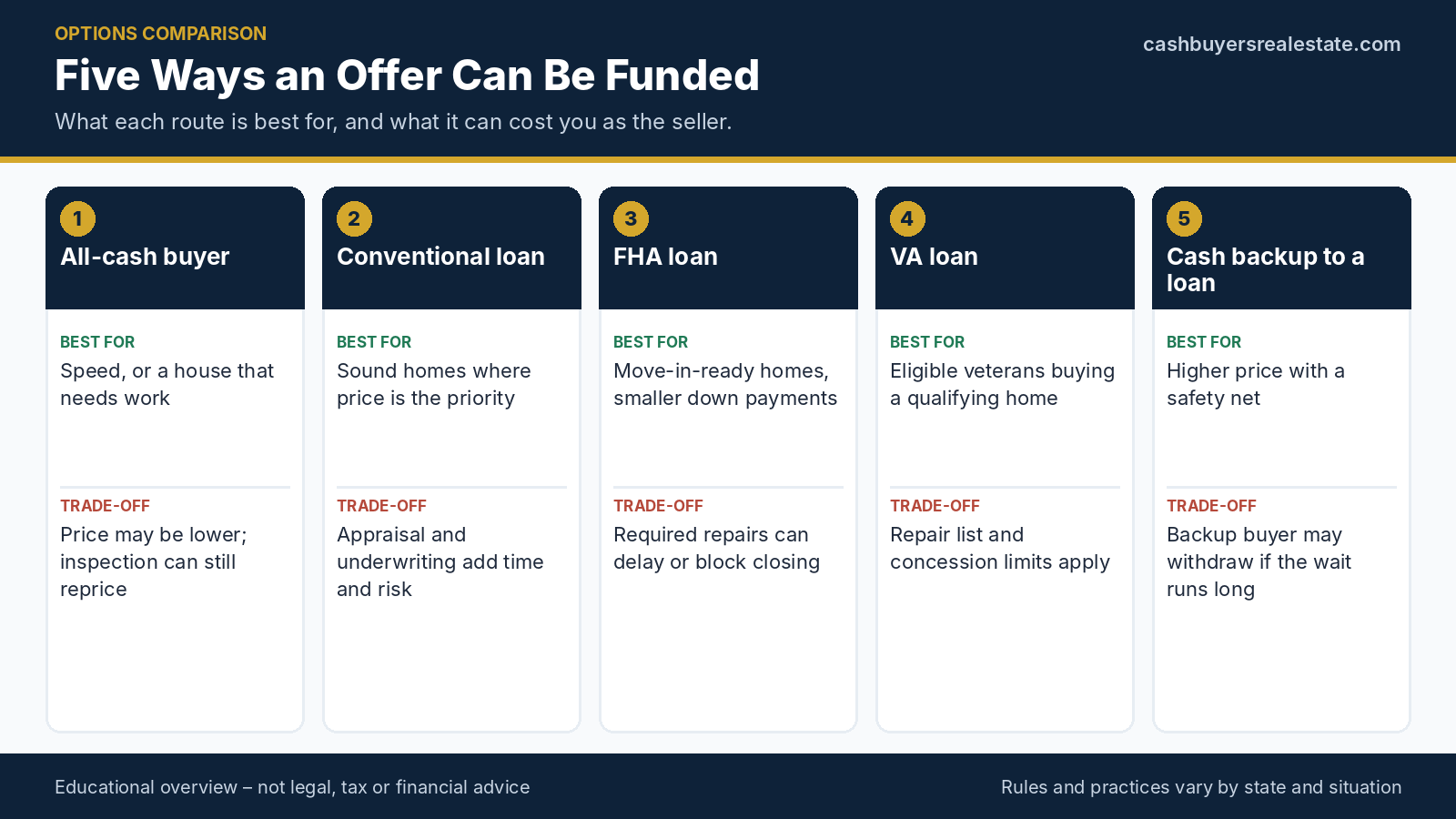
The comparison graphic that follows sets out five ways a sale can proceed, from an all-cash buyer through conventional, FHA and VA financing to a cash backup behind a financed primary offer, and lists what each route is best for and what it costs you. The same route will not suit every house, which is why the choice depends on condition, timing and the strength of the buyer behind the offer. Treat the graphic as a map of trade-offs, not a ranking, because the best route changes when the house, the calendar or the buyer changes.
Text version of this infographic
- All-cash buyer — Best for: Speed, or a house that needs work. Trade-off: Price may be lower; inspection can still reprice.
- Conventional loan — Best for: Sound homes where price is the priority. Trade-off: Appraisal and underwriting add time and risk.
- FHA loan — Best for: Move-in-ready homes, smaller down payments. Trade-off: Required repairs can delay or block closing.
- VA loan — Best for: Eligible veterans buying a qualifying home. Trade-off: Repair list and concession limits apply.
- Cash backup to a loan — Best for: Higher price with a safety net. Trade-off: Backup buyer may withdraw if the wait runs long.
Timelines, Contingencies and Earnest Money Compared
An accepted offer is the beginning of a schedule, not the end of a negotiation. The schedule is built from deadlines written into the contract, each of which gives one party the right to do something or the duty to prove something. Cash and financed purchases use many of the same deadlines, but they stack them differently, and the stacking decides how long you wait, how much bargaining power each side keeps, and where a late surprise can do the most damage. Read with that in mind, a contract is less a single promise than a set of dated checkpoints, and a seller who knows the checkpoints can usually see trouble coming weeks before it arrives.
Two Calendars, Side by Side
Seeing the two calendars next to each other makes it clear why a fast cash closing isn’t magic and why a slower financed closing isn’t a sign of trouble. Both are sequences of dependent tasks, and the tasks differ in kind, so the clearest picture comes from walking through each calendar in order and noticing where the days actually go.
The cash calendar: what actually takes the time
A cash sale has fewer steps, but each of them still has to happen. The contract is signed, earnest money is delivered to the party named in the contract, and the closing agent opens the file. Title work begins immediately, because someone has to confirm that you actually own what you are selling and that any mortgage, lien or judgment against the property will be paid off at closing. The buyer typically orders an inspection within a short period, perhaps a few days, and negotiates any repairs or credits. If the buyer is an entity such as a limited liability company or a trust, the closing agent may need formation documents and proof of who is authorized to sign. The last stretch is scheduling: the signing appointment, the delivery of funds and, in places where it is the custom, the recording of the deed.
The time in a cash closing mostly comes from the title search, from payoff letters that lenders need a few days to produce, and from coordination among the parties’ schedules. When all of that is already in order, a cash closing can happen in a matter of days or a few weeks, and sellers who need to move quickly will find that the shortened calendar is the cash buyer’s biggest practical advantage. Sellers with complicated situations, such as an unresolved lien, a probate matter or an unlocated co-owner, will find that cash does not erase those complications. The title problem has to be solved before any buyer, with any funding source, can close. Realistic closing speeds for cash purchases depend on the title, the payoff process and local closing practice.
One caution deserves a place here. A very short promised closing is not proof of a good buyer, and it is not proof of a bad one. A buyer who truly has funds and a competent closing agent can close quickly, while a buyer who promises speed and then asks for repeated extensions has told you more about their position than any original representation did. Watch what the buyer does when a deadline arrives, because actions are more informative than promises, and a record of small commitments met on time is the best predictor of whether the larger ones will be.
The financed calendar and where the days go
A financed purchase adds the lender’s tasks to the same foundation. The buyer submits a full loan application and the lender issues its required estimates. The lender orders an appraisal, and in the busy periods an appraiser may take days to schedule a visit and more days to deliver a report. Underwriting reviews the file and issues conditions, which the buyer answers with documents. Title and insurance move forward in parallel, and the lender prepares the Closing Disclosure for delivery at least three business days before closing. Only when all conditions are cleared does the lender issue what the industry calls clear to close, and funding follows the signing.
VA publishes some data about the middle of that process, and it gives a sense of scale without describing every lender. In a toolkit for real estate professionals, VA reported that its appraisals averaged seven business days in 2023 and that 90 percent of initial VA purchase appraisals in fiscal year 2023 met or exceeded the contract price. That is one program in one year, and conventional and FHA appraisals may move faster or slower depending on the region and the season, but it shows why financed contracts reasonably allow several weeks. It also shows that most appraisals support the contract price, which is a useful corrective to the idea that a low appraisal is the normal outcome and not the exception that needs a plan.
| Stage | Cash purchase | Financed purchase | What the seller should confirm |
|---|---|---|---|
| Offer review | Proof of funds and buyer identity | Pre-approval or approval letter from a named lender | Documents match the buyer’s name and the offer amount |
| Contract and deposit | Earnest money to a named holder | Earnest money to a named holder, often larger when a contingency is waived | Who holds the deposit and the deadline for delivery |
| Inspection period | Buyer inspects and negotiates | Buyer inspects and negotiates; lender may add property requirements | Length of the window and what the buyer must do to request repairs |
| Valuation | None required; buyer may order one | Lender-ordered appraisal and review | Appraisal contingency terms and any gap provision |
| Funds approval | Closing agent confirms funds in hand | Underwriting conditions, then clear to close | Status updates and the lock-expiry date |
| Final disclosure | Settlement statement reviewed | Closing Disclosure delivered at least three business days before closing | Whether any change restarts a waiting period |
| Closing and funding | Signing, wire, recording | Signing, lender funds, recording | Wire details verified by phone with the closing agent |
The table shows that the biggest differences cluster in the middle: valuation, funds approval and the final disclosure. A simple habit is to ask your agent for a short written update after each milestone, so you can see if a financed deal is moving at a normal pace or is quietly stalling. Those are also the stages where the seller has the least control and the least information, which is why regular status checks matter more with a financed buyer than with a cash buyer.
Contingencies and Earnest Money as Risk-Allocation Tools
Contingencies and earnest money are the contract’s way of deciding who bears what risk and for how long. A buyer who gives up a contingency is accepting risk to make the offer more attractive, and a buyer who insists on one is protecting themselves at your expense. Reading these provisions closely is therefore the nearest a seller can come to measuring how committed a buyer really is.
What each contingency hands the buyer and what it costs you
A financing contingency lets the buyer cancel and recover the deposit if they cannot obtain a loan on the stated terms by a stated date. An appraisal contingency does something narrower: it lets the buyer cancel, renegotiate or proceed if the appraised value is below the price. An inspection contingency gives the buyer a window to examine the house and either accept it, ask for repairs or credits, or end the contract. A sale-of-home contingency makes the purchase depend on the buyer selling their current property. Cash buyers do not need financing or appraisal contingencies, but they often keep an inspection contingency, and many keep title review and similar protections.
From the seller’s side, each contingency is a period of uncertainty during which the buyer can leave, usually without penalty. The questions are how long each period lasts, what exactly triggers the buyer’s right to cancel, and whether the contract requires notice in writing by a specific date. A contingency that expires on a stated day without the buyer acting is typically treated as satisfied or waived, depending on how the contract is written, and some contracts require the seller to deliver a notice that starts a clock. The wording varies by state and by the form your agent uses, so ask for the dates in plain language and put them on your own calendar. The detailed mechanics of these provisions for cash purchases are covered in the article on cash buyer contingencies.
A good rule of thumb is to count contingencies and compare lengths across offers. An offer with three contingencies running 21 days each is a very different promise from an offer with one contingency running five days, even if the price is the same, and the difference is a form of price you can’t see in the number at the top of the page. Ask your agent to tabulate them side by side on the offer summary so the difference is obvious when you sit down to decide, not discovered later.
Earnest money, forfeiture and the federal program clauses
Earnest money is a deposit the buyer makes to show good faith, held by a neutral party such as a title company, an attorney or a broker, depending on local practice. It is usually applied to the buyer’s costs at closing. The contract says when the buyer gets it back and when the seller can keep it, and the answer generally depends on whether the buyer cancels within a contingency period for a reason the contract allows. A buyer who cancels outside those terms may forfeit the deposit, though in practice the release of the money requires either the parties’ agreement or a dispute process that the contract describes. The amount is negotiable, and a larger deposit signals greater commitment. How to evaluate it is explained in the guide to cash buyer earnest money.
Federal loan programs add protective clauses that can override the usual rules. HUD’s model amendatory clause for FHA loans states that if the appraised value is below the sales price, the buyer cannot be required to complete the purchase or forfeit earnest money or suffer any other penalty unless the buyer has received a written appraisal statement showing the value meets the price, though the buyer may choose to proceed anyway. VA’s buyer’s guide says the sales contract for every VA-guaranteed loan must include an escape clause that likewise lets the buyer avoid forfeiting earnest money if the price exceeds VA’s established reasonable value, and VA notes that a buyer who uses the clause can recover the earnest money but not out-of-pocket costs such as inspection or appraisal fees.
These clauses do not mean FHA and VA buyers are poor risks. They mean the contract has a built-in exit tied to valuation that a conventional buyer might not have, unless the contract adds one. If you hold an offer from an FHA or VA buyer, read the attached addendum with your agent, because it may limit your remedies if the appraisal comes in low. Your attorney or a local real estate professional can tell you how these clauses interact with your state’s standard contract form, and whether anything in the form needs to be adjusted to fit them.
Reading Multiple Offers: How Agents Present Them and How to Score Them
When more than one buyer wants your house, the work of comparing the offers falls on a short list of people: you, your listing agent and, if you hired one, your attorney. The mix of cash and financed offers makes the job harder, because the offers differ in kind and not just in degree. A disciplined process helps you avoid choosing on instinct, and it also gives you something concrete to bring to negotiations with each buyer. The sections below describe how the process normally runs, what a clean comparison sheet looks like, and how to turn the sheet into a decision you can defend later to yourself and to anyone who asks.
How Multiple Offers Are Gathered, Disclosed and Presented
Competing offers are managed through a process that your agent runs on your behalf. The process is not identical everywhere, and some of its rules come from state law, some from your listing agreement and some from local custom. Knowing the general shape lets you ask your agent how the process works in your area before the first offer arrives, rather than learning the rules in the middle of a deadline. It also lets you decide in advance how much information you want shared and with whom, which is easier to do calmly than under time pressure.
The listing agent’s role, offer deadlines and what gets shared
An agent who represents the seller owes the seller duties of loyalty and disclosure, which in practice means presenting every written offer promptly, giving candid advice about the strengths and weaknesses of each, and following the seller’s instructions about confidentiality. When several offers arrive close together, agents commonly set an offer deadline so that every buyer’s offer can be considered at the same time. The deadline is usually communicated to every buyer’s agent who has shown interest, and it can be extended or shortened by the seller. Setting a clear time protects you from accepting the first offer before a better one appears, and it protects buyers from being shut out by an opaque process.
What your agent may disclose to one buyer about another buyer’s offer is governed by a combination of state rules, brokerage policy and your instructions. Many agents keep the terms of competing offers confidential unless the seller authorizes otherwise, and some places have rules about telling buyers whether other offers exist at all. Because the practice differs, ask your agent in advance what will be shared with whom, and give written instructions if you want something different. The practice of calling for a buyer’s highest and best offer by a set time is common, though it should be used carefully: a buyer who is asked to improve their offer may do so, but a buyer who feels the process is unfair may withdraw.
Your agent will also usually arrange for each buyer’s agent to submit supporting documents with the offer. For a cash buyer, that means proof of funds. For a financed buyer, it means a lender letter, and many agents also ask for a short note on the buyer’s down payment and whether the buyer has other contingencies. Agents who do this well produce a clean file for each offer, which makes the comparison faster and the decision more defensible, and it spares you the work of chasing missing documents from buyers’ agents while the clock is running.
The offer summary: building an apples-to-apples sheet
Even a well-organized stack of offers is hard to compare without a common format. The best practice is to ask your agent for a one-page summary of every offer, with the same fields in the same order. The summary should cover price, earnest money amount and holder, the type of financing and the down payment, every contingency and its deadline, requested credits and repairs, proposed closing date, possession terms, any personal property included, and the documents attached. The point is that the differences become visible in the same place, so that a seller can see at a glance that one buyer waived the appraisal contingency and another asked for a credit that wipes out the price difference.
When a summary is built this way, patterns tend to appear. Offers with high prices and long contingency lists look different from offers with moderate prices and few conditions, and the summary shows where each offer is spending its credibility. It also helps to mark each term as firm, negotiable or unacceptable from your perspective, because the next step is almost always a counteroffer, and the sheet tells you where to push and where to hold.
A summary like this doubles as a record. If a buyer later argues about what was agreed, or if a contract falls through and you need to explain to the next buyer or an advisor why you chose as you did, the document shows your reasoning. Sellers who are selling without an agent can build the same sheet themselves, and it will serve the same purposes, though they should also arrange for an attorney or title professional to review the contract language. Keeping the summaries from every round of offers also makes it easy to see how a buyer’s position moved from the first submission to the last, which can reveal whether they are negotiating in good faith.
Scoring Offers Beyond Price and Negotiating the Weak Spots
After the offers are laid out, you need a way to decide. Many sellers find a simple weighted scorecard helpful, not because the numbers are precise but because the exercise forces them to say what matters before the emotional pull of a particular buyer or a particular number takes over. The scorecard below is only an illustration, and you should replace its weights with your own.
A weighted scorecard you can adapt
A scorecard assigns a weight to each factor based on how much it matters in your situation and then rates each offer on that factor. The weights are personal. A seller who has already bought another house and needs the funds by a specific date will weight timing and certainty heavily, and a seller who has no deadline and a house in good condition will weight net proceeds more. Writing the weights down before reading the offers keeps you from adjusting them to favor the offer you already like, and it gives your agent a clear picture of what you care about so the agent’s advice can be aimed at your situation instead of a generic one.
| Factor | Weight | Cash offer rating (1-5) | Financed offer rating (1-5) |
|---|---|---|---|
| Estimated net proceeds | 30% | 4 | 4 |
| Likelihood of closing | 25% | 4 | 3 |
| Speed and fit with my calendar | 20% | 5 | 3 |
| Contingencies and flexibility | 10% | 4 | 2 |
| Buyer verification and documents | 10% | 3 | 4 |
| Required repairs and effort | 5% | 4 | 3 |
To read the table, multiply each rating by its weight and add the results. In this invented case the cash offer’s weighted score is about 4.1 and the financed offer’s is about 3.3, driven mostly by the heavy weight on speed and the lower closing likelihood of the financed deal. Change the weights and the answer can reverse. A seller with no deadline might weight speed at 5 percent and net proceeds at 45 percent, which would raise the financed offer’s score. The value of the exercise is the conversation it forces, not the final number, and a result that surprises you is a good prompt to check whether your stated weights match what you really feel.
Illustrative example (hypothetical numbers, not market data): A seller with a relocation that begins in five weeks receives three offers: a cash offer with a 14-day closing, a conventional offer with a 40-day closing and a contingency on the buyer selling their current house, and an FHA offer with a 35-day closing and a request for a repair escrow. The seller gives timing a 30 percent weight and certainty a 30 percent weight. The sale-contingent offer scores poorly on both, because its closing depends on a second sale the seller can’t monitor, and the FHA offer scores moderately because the repair escrow adds a late-stage task. The cash offer wins on the seller’s own criteria even though its price is lower than the others. A second seller with no deadline and a house in excellent condition, using the same offers, picks the conventional offer without the sale contingency, because a longer calendar costs them nothing.
Counteroffers, escalation clauses and strengthening a financed offer
Once you know which offers are viable, you can counter. A counteroffer is a new offer from you that replaces the buyer’s terms, and the original offer generally lapses when you counter, so it is wise to understand your alternatives before you send one. With a financed buyer who has a higher price but weaker terms, a counteroffer can ask for improvements that cost the buyer little and reduce your risk: a larger earnest money deposit, a shorter appraisal or financing contingency period, a letter from the lender confirming that underwriting has begun, a commitment to order the appraisal within a few days, or an appraisal gap provision backed by liquid funds.
With a cash buyer who has a lower price, a counteroffer can ask for a higher price in exchange for a shorter inspection period, a larger deposit or more flexible possession terms, such as a few extra days to move out. Sellers sometimes find that the cash buyer is willing to meet them partway, since the buyer also values speed and a smooth closing. Throughout, keep each exchange in writing, make sure every counteroffer has a stated expiration, and avoid accepting terms by phone or text that are not reflected in the contract.
Escalation clauses deserve a note. An escalation clause is a provision in which a buyer agrees to beat any competing offer by a set amount up to a stated limit. They can raise prices quickly, and they usually require the seller to show the buyer evidence of the competing offer, which raises the confidentiality questions discussed earlier. They also tend to push prices toward the top of what an appraisal can support, which increases the chance of an appraisal gap in a financed deal. If you receive one, ask your agent how to handle verification and whether the escalated price is likely to survive a lender’s valuation. The broader question of choosing among different cash offers, as opposed to cash against financed, is treated in the article on comparing several cash offers against each other.
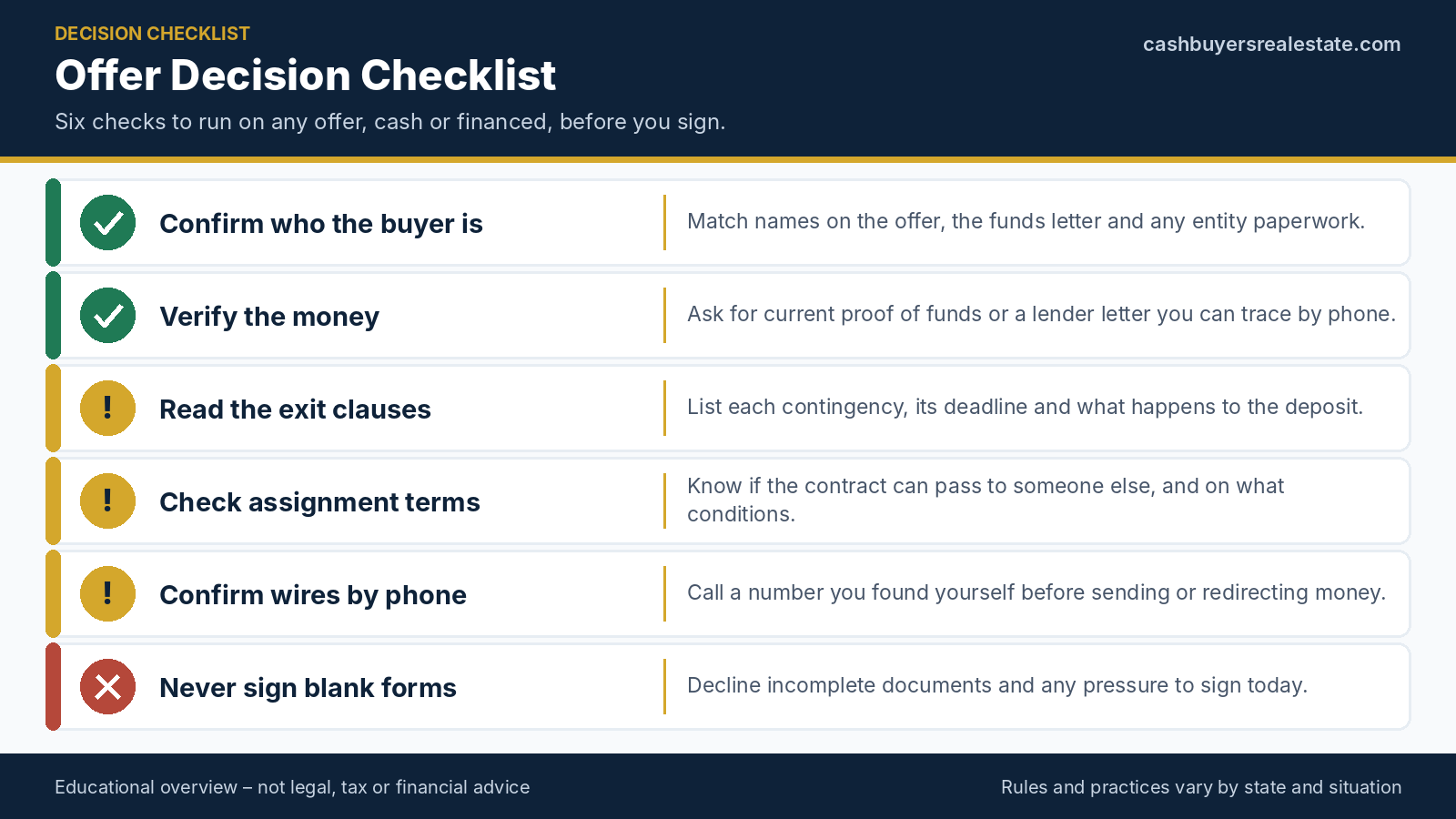
The decision checklist below pulls these threads into six checks that apply to almost any offer, cash or financed: confirm who the buyer is, confirm the money behind the offer, read the exit clauses, understand any assignment terms, use a closing agent you trust, and never sign a form with blanks. Each check carries a different weight depending on the buyer’s type, and the graphic marks which are routine and which warrant more caution.
Text version of this infographic
- Confirm who the buyer is — Match names on the offer, the funds letter and any entity paperwork.
- Verify the money — Ask for current proof of funds or a lender letter you can trace by phone.
- Read the exit clauses — List each contingency, its deadline and what happens to the deposit.
- Check assignment terms — Know if the contract can pass to someone else, and on what conditions.
- Confirm wires by phone — Call a number you found yourself before sending or redirecting money.
- Never sign blank forms — Decline incomplete documents and any pressure to sign today.
Backup Offers, Fall-Through Risk and Red Flags on Both Sides
Choosing a primary offer does not have to mean abandoning the others. A well-managed sale keeps a second path open, and it treats risk checks as a normal part of working with any buyer instead of an accusation. This section covers both: how a backup offer works and when it adds value, and the warning signs that deserve a closer look whether the buyer is paying cash or relying on a lender. Both topics belong together because a backup is only valuable when you can tell, early, that the first contract is in trouble, and spotting trouble is what the red-flag checks are for.
Backup-Offer Strategy
A backup offer is a way of converting a failed deal into a short delay instead of a restart. It costs the seller little when it is set up properly, and it can recover thousands of dollars in a bad scenario. It is also a tool that works best when the seller understands its limits, because the backup buyer is making a commitment that depends on the first contract’s outcome. The sections that follow explain how to set one up, how to pair offers so that their risks do not overlap, and what to watch for when you do.
How a backup position works and where it can fail
In a backup arrangement, the seller accepts a second offer on the understanding that it becomes the active contract only if the first contract ends. The details are typically written in an addendum or a clause in the second contract, which states that the contract is a backup, describes how the backup buyer will be notified when the first contract terminates, and sets a time limit after which either side may withdraw. Many states and local associations publish standard backup addenda, and the wording matters, so your agent or attorney should review whichever version applies in your area. Local rules differ on how long a backup may be kept open and on whether the backup buyer’s deposit is refundable if the primary contract closes, so ask how your area handles these points.
Several points deserve attention. First, the seller must not breach the first contract by treating the backup as live. The first buyer holds the rights, and the backup becomes real only when the first contract is terminated under its own terms, for example through a contingency cancellation or a default. Second, the backup buyer is not obligated to wait forever. Most backup contracts include a date after which the buyer may walk away, and some allow the buyer to withdraw at any time before being promoted. Third, the backup buyer’s price, terms and earnest money should be spelled out in advance, including whether the buyer can renegotiate when the first deal collapses. Without that clarity, a backup buyer who learns the first deal has failed may attempt to lower the price, and the seller has little bargaining room if no other offers remain.
The practical limit of any backup is time. A backup buyer who agreed to a position in week one may feel differently in week seven, especially if the buyer has been looking at other houses. A seller can improve the odds by keeping the backup buyer informed at a reasonable level, such as telling them about the date of the primary buyer’s appraisal and the key contingency deadlines, so they know approximately when they might be promoted. Sellers who go silent for weeks often discover that their backup has quietly disappeared. A short weekly message through the agents costs nothing and keeps a backup warm without implying promises you cannot keep.
Pairing a financed primary with a cash backup, and other combinations
The most logical pairing usually puts the offer with the better price and the weaker certainty in first position and the offer with the stronger certainty behind it, because the two offers fail for different reasons. A financed primary is exposed to appraisal and underwriting risk, which a cash backup doesn’t share, and a cash backup is exposed to its own inspection and funds risk, which a financed primary has in a different form. When the risks are unrelated, the chance that both fail at once is much smaller than the chance that either fails alone. That reasoning is the same reasoning that underlies diversification in any other setting, applied to a single sale, and it is the main reason experienced agents favor backups in uncertain deals.
Illustrative example (hypothetical numbers, not market data): A seller accepts the $398,000 financed offer as the primary contract and also accepts a $388,000 cash offer as a backup that must be promoted within 45 days or the buyer may withdraw. In week six the primary buyer’s appraisal comes in low and the buyer cannot cover the gap, so the contract ends. The backup buyer is promoted and closes 14 days later, about 56 days after the original acceptance. Using the same assumptions as earlier, costs of 6 percent are $23,280 and carrying costs for roughly 56 days at $2,400 a month are about $4,480, leaving a net of about $360,240. The no-backup scenario earlier produced roughly $354,400, so the backup preserved around $5,800 in this invented case, and it also spared the seller a second round of showings and negotiations.
Other combinations exist. Two financed offers can be paired when the sellers want the higher price and can tolerate delay, with the backup using a different loan program from the primary so that a single program-specific problem, such as a condition requirement, doesn’t sink both. A cash primary with a financed backup is rarer but sensible if the cash buyer’s funds seem real and the financed buyer is offering a premium that the seller would want to capture if the cash buyer withdraws during the inspection window. In sale-contingent situations, some sellers use a kick-out clause that lets them keep marketing the house and give the contingent buyer a short period to remove the contingency if a stronger offer arrives, though that arrangement has its own complexities and is worth discussing with an agent who has used it locally.
Whichever structure you use, document it clearly and keep the backup buyer’s earnest money in the same type of neutral hands as the primary’s. If you are selling without an agent, a local attorney or title professional can draft or review the backup language, because the cost of a poorly drafted addendum is usually greater than the fee for a short consultation. A short consultation costs far less than the dispute that can follow a poorly drafted addendum, especially if two buyers each believe they hold the first right to buy.
Red Flags on Both Sides of the Table
Most buyers, whether they pay cash or borrow, are exactly who they say they are and intend to close. Red flags are not proof of bad intent. The goal is to verify calmly and early, and to give no weight to claims that can’t be checked. Red flags are patterns that call for a verification step, the kind of step a careful seller would take before handing over a house worth several hundred thousand dollars, and a buyer with nothing to hide will rarely mind being asked.
Warning signs on cash offers
On the cash side, the most useful flags concern the money and the paperwork. Proof of funds that doesn’t match the buyer’s name, that is vague about the account, or that shows a balance far below the price should be questioned, and a buyer who refuses to provide any document at all has given you a reason to hesitate. An unusually short closing promise paired with an unusually low earnest money deposit deserves a closer look at who is behind the offer and what leverage the buyer retains. A buyer purchasing through an entity should be able to say who controls it and provide authorization to sign, and a closing agent will usually insist on that anyway.
Contract language is another place to look. Terms that let the buyer cancel for any reason at any time, with the deposit refundable and no obligation to explain, give the buyer a free option on your house while you hold the risk. Assignment provisions, which allow the buyer to transfer their rights to someone else, are common among investors and can be legitimate, but a seller should understand who the eventual buyer might be, what fees are involved and whether the contract allows a substitution without the seller’s consent. Details on spotting problematic clauses can be found in the guide to cash offer contract red flags, and the structure of the paperwork itself is covered in the article on the cash home buyer contract.
Pressure is itself a signal. A buyer who insists you must sign today, who discourages you from consulting an attorney or an agent, or who asks you to sign a contract with blank fields to be completed later is asking you to give up your own protections. The CFPB’s closing guidance makes a similar point from the buyer’s side: don’t sign blank documents or documents that differ from what you agreed to. The same advice applies to sellers, who are sometimes asked to sign addenda, authorizations or closing documents in a hurry, and who have every right to read each page and to have their own advisor read it too.
Warning signs on financed offers, and how to verify without accusing
Financed offers carry their own flags, and they are mostly about whether the lender’s approval is as solid as the letter makes it seem. A pre-approval letter from a lender you can’t locate, a letter that has no loan officer’s name or license information, or a letter dated months ago should prompt a call to the lender. A buyer who has already started a loan application but has not yet provided documents is earlier in the process than one who is fully documented, and the difference should show up in the seller’s confidence. A down payment that depends on a gift, a retirement account withdrawal or the sale of another asset is not a problem in itself, but it means more steps stand between you and closing.
Contract terms can also hint at weakness. A sale contingent on the buyer’s own house, a financing contingency with a generous deadline, an appraisal contingency without any gap coverage, and a request for seller credits that equal most of the buyer’s cash to close all point toward a buyer who is stretching. These aren’t reasons to reject an offer. They are reasons to price the risk and to consider a backup. A financed offer from a buyer who is paying a meaningful down payment, has an experienced lender and keeps the contingencies short is generally a sturdy one, and its price often reflects that strength.
On both sides of the table, wire fraud deserves its own caution. The FBI describes business email compromise as a scheme in which criminals send messages that appear to come from a trusted source, such as a title company sending wiring instructions, and its guidance is to confirm any request or change in payment instructions by phone using a number you looked up yourself, not one in the message. Sellers usually receive funds rather than send them, but buyers’ deposits and the seller’s own payoff or net proceeds instructions can be targets, so never change where your proceeds go based on an email alone.
| Signal | Most common on | Why it matters | How to verify |
|---|---|---|---|
| Proof of funds in another name, vague, or outdated | Cash | The funds may not be the buyer’s or may not exist when needed | Ask the closing agent to confirm funds directly; request a current statement |
| Free-cancellation terms with no deadline | Cash | The buyer holds an option on your house at your expense | Have an attorney or agent read the contingency and termination language |
| Broad assignment rights | Cash | The eventual buyer may be someone you haven’t evaluated | Ask who the end buyer would be and require written seller consent |
| Pressure to sign immediately or with blanks | Both | Gives up your chance to review and consult | Decline to sign incomplete documents; set your own review period |
| Approval letter without a traceable lender or officer | Financed | The buyer’s approval may be thinner than it looks | Call the lender using a number you find independently |
| Long financing and appraisal contingencies with no gap plan | Financed | The buyer can leave late with little cost | Counter with shorter deadlines or a gap commitment backed by funds |
| Changed wiring or payment instructions by email | Both | A common pattern in payment-diversion fraud | Confirm by phone with the closing agent before sending or redirecting any funds |
To use the table, treat each row as a prompt for a quick check and not as a verdict. If the situation begins to look like deliberate deception, the broader guidance on how to tell whether cash home buyers are legitimate offers a fuller checklist, and your attorney or state attorney general’s office can advise on next steps. A single flag with a satisfying explanation is normal, and several flags that stay unresolved are a reason to slow down or choose a different offer.
Frequently Asked Questions About Cash Buyers and Financed Buyers
Sellers comparing the two kinds of buyers tend to ask the same practical questions, usually after the first set of offers has arrived and the arithmetic stops looking simple. The answers below assume a typical sale in the United States and avoid repeating the longer discussions above. Because contract forms, deposit rules and closing customs vary by state, treat each answer as a starting point for a conversation with your agent, attorney or closing agent instead of a substitute for it. If a question here does not match your situation, the sections above explain the reasoning in more depth, and your agent or attorney can fit the answer to your contract.
Questions About Offers, Price and Financing
These questions come up when the offers are on the table and you are trying to decide how much weight to give the number, the buyer’s funding source and the possibility that a lender’s opinion of the house will differ from yours. Each answer is short by design, and the longer discussion of the underlying mechanics appears earlier in the guide.
Questions about price and certainty
- Do cash buyers always offer less than financed buyers?
No. Cash is a payment method, not a pricing strategy. A homeowner who just sold a previous house and pays cash may offer the full asking price or more, while an investor planning a major renovation will usually offer less because the repairs and a profit margin come out of the price. Look at who the buyer is and what condition your house is in before assuming how a cash offer will compare.
- Is it worth taking a lower cash offer to avoid the risk of a financed deal collapsing?
It can be, if the gap in net proceeds is smaller than the realistic cost of a failure. That cost includes the extra weeks of carrying expenses, the time to relist and the chance that the next buyer pays less. Run the worksheet for both outcomes of the financed offer, success and failure, and compare each to the cash net. If the cash offer is only a few thousand dollars lower in net terms, certainty often wins, and if it is tens of thousands lower, the financed offer usually deserves the chance.
- Should I ask a financed buyer to waive the appraisal contingency?
You can ask, but a buyer who waives it takes on the risk of covering any shortfall out of pocket, so the answer depends on their reserves. Some buyers prefer a middle path, such as agreeing to cover a stated gap of a few thousand dollars while keeping the right to cancel for a larger one. Whatever the buyer offers, ask for evidence of the cash behind the promise. A waiver from a buyer without extra funds is a promise they may be unable to keep.
- Does a bidding contest favor cash buyers?
Often it does, because a cash buyer can remove one of the biggest uncertainties without reducing the price. But a financed buyer with a large down payment, a short contingency list and a well-documented approval can compete credibly. In a bidding contest, the strongest offers are the ones that combine a good price with few conditions and verifiable money, whatever the funding source.
Questions about financing and appraisals
- What happens to my sale if the buyer’s appraisal comes in below the contract price?
The lender will lend against the lower value, so the buyer must make up the difference, the parties must renegotiate, or the buyer may cancel if the contract has an appraisal contingency. Sellers sometimes reduce the price partway, split the gap with the buyer or ask the buyer’s agent to submit additional comparable sales for reconsideration. Before agreeing to any reduction, rerun your net proceeds, since a lower price may still beat relisting.
- Can a buyer using an FHA or VA loan buy a house that needs repairs?
Sometimes, but the repairs have to be compatible with the program’s property standards. If the appraiser lists required repairs, the lender decides what must be completed before closing, and some situations allow an escrow for work finished afterward. Houses with serious safety or structural problems may not qualify until the work is done. Ask early which program the buyer is using, and what the lender has said about your house’s condition.
- Does a pre-approval letter mean the loan is guaranteed?
No. A pre-approval reflects a lender’s early review of the buyer, and the final decision comes from underwriting after the property has been appraised and the file has been checked again. A strong letter lowers the chance of a problem with the buyer’s finances, but the property, the title, the insurance and any late changes to the buyer’s circumstances can still create difficulties. Treat the letter as a good sign, not a promise.
Questions About Process, Risk and Verification
The next group concerns calendars, exits and trust: how long each path takes, how a buyer can leave, what you can do to protect yourself, and how to confirm that the person across the table is who they say they are. None of the answers replaces the actual contract, and anything that affects your rights, such as deadlines or deposits, should be confirmed with the professional handling your sale.
Questions about timing and contingencies
- How much longer does a financed purchase take than a cash purchase?
A financed purchase usually takes noticeably longer because it includes an appraisal, underwriting and a required waiting period after the final loan disclosure. A cash purchase can close as soon as title work, payoff letters and scheduling allow. The actual difference depends on the lender, the season and the complexity of your title, so ask for a written timeline from each buyer’s agent and compare the dates.
- Can a cash buyer back out after the inspection?
Yes, if the contract gives the buyer an inspection contingency and the buyer ends the contract within its deadline according to its terms. A cash buyer who cancels after the contingency period has ended may risk the earnest money, depending on the contract and state law. Check the length of the inspection window and how the contract treats the deposit before you accept.
- Can I accept a backup offer while the first contract is still active?
Generally yes, as long as the backup is clearly labeled and the first buyer’s rights are not violated. The backup becomes active only if the first contract ends under its own terms. Use the standard backup addendum for your area if one exists, set a date after which the backup buyer may withdraw, and have an agent or attorney review the wording.
- What does clear to close mean, and why does it matter?
It is the lender’s signal that underwriting has finished and the conditions have been satisfied, so the loan can be funded once documents are signed. Until you hear it, a financed closing is still subject to change. If your closing date is close and your agent has not mentioned it, ask where the file stands.
Questions about trust and verification
- How can I confirm a cash buyer actually has the money?
Ask for a recent proof-of-funds document in the buyer’s name, and have the closing agent or your attorney confirm what they can through their own channels. A statement is a snapshot, so the closing agent’s confirmation of funds near the closing date matters more than a document delivered with the offer. If the buyer is using a lender or private funding, ask who that is.
- Should I be concerned if a cash buyer is an LLC or a trust?
Not by itself, because many legitimate buyers purchase through entities for liability or tax reasons. What matters is whether the closing agent can verify who has authority to sign and whether the entity’s funds are real. Ask for formation documents or a certificate of authority, and expect the title company to want them regardless.
- Is an unusually fast closing promise a warning sign?
It can be a sign of a well-prepared buyer or a buyer who is making promises they can’t keep, and the difference shows up in how the buyer behaves. A real buyer with funds and a competent closing agent will usually accept reasonable steps such as title work and funds verification. Be cautious if speed is paired with pressure to skip those steps or to sign incomplete documents.
Choosing Between a Cash Buyer vs. Financed Buyer Offer, and What to Do Next
By this point the mechanics are familiar. A cash offer removes the lender and its approvals, which tends to shorten the calendar and narrow the ways a deal can fail. A financed offer brings in a lender whose checks add time and risk but frequently come with a higher price and an independent opinion of value. Neither route is better in the abstract, and the useful question is which one fits the combination of priorities, house condition and constraints you actually have. What remains is turning that understanding into a decision you can live with, which is mostly a matter of putting your priorities in order and testing each offer against them with real numbers.
A Decision Framework That Matches the Offer to Your Priorities
A framework helps because the loudest factor in the room is rarely the most important one for your outcome. Most sellers feel pulled toward the biggest number, and a few feel pulled toward whoever promises to close fastest. Putting your own priorities in order first makes it easier to read the offers on your terms, and it keeps a persuasive buyer or an anxious week from steering the outcome. The four profiles below are not boxes you must fit into; they are common patterns that show how priorities change the answer.
Four seller profiles and the offer that usually fits each
The first profile is the seller whose calendar is fixed. A relocation, a purchase of another house that depends on these proceeds, a divorce settlement date or an estate deadline all turn time into a hard constraint. For this seller, the offer with the shortest and most reliable path to closing deserves extra weight, and a modest price discount for certainty is often rational. The offer to prefer is usually a cash buyer with documented funds, a short inspection window and few other conditions, or a financed buyer with a large down payment and a lender who can show how far the file has progressed.
The second profile is the seller who is flexible on time and focused on the best net result. With no deadline and a house in sound condition, this seller can usually afford to wait through the extra weeks of a financed closing and can accept a modest chance of a delay or a failure in exchange for a higher price. Such sellers should still run the failure scenario from the earlier examples, and they should seriously consider a backup offer to cap the downside if the primary financed contract stumbles late in the process.
The third profile is the seller whose house needs significant work. Here the property condition rules of conventional, FHA and VA loans may eliminate many financed buyers or turn them into buyers with long repair lists. A cash buyer, including an investor who plans to renovate, may be the realistic buyer, and the question shifts from whether to prefer cash to how to compare several cash offers for the same house. In this profile, price depends heavily on the buyer’s repair estimate, so get more than one opinion. The fourth profile is the seller who is uncertain about everything: unsure of the condition, unsure of the value, unsure whether to sell at all. This seller is best served by gathering information before reacting to offers, including a seller-ordered inspection and a market analysis from an agent, so that any offer can be judged against something firmer than a first impression.
When neither offer fits: realistic alternatives
Sometimes the honest answer is that no current offer is good enough. In that case, the alternatives are worth a clear look. You can adjust the price or the terms of the listing, since offers that arrive low or heavily conditioned are often a signal about pricing. You can make selected repairs and relist, which makes sense when the repairs are inexpensive relative to the price improvement and would let more financed buyers qualify. You can offer a credit or concession aimed at the exact obstacle, such as an allowance for a roof the buyer’s lender flags. You can wait for a different season if your timing permits. Or you can sell directly to an investor, which trades price for speed and certainty in the ways described earlier. The comparison of that route with listing is laid out in the guide to choosing between a cash sale and a listing.
Each alternative should be evaluated the same way as the offers in front of you, by estimating net proceeds under realistic assumptions and by pricing the time and risk. A path that looks attractive because it avoids an uncomfortable decision can cost more than either of the options you’ve been weighing. If your finances or a lender’s deadline are driving the urgency, an attorney, a HUD-approved housing counselor or a trusted agent can help you sort out the choices without pressure. Taking a day to run the numbers is rarely a mistake, while accepting terms you have not compared often is.
State rules also shape these alternatives. Disclosure obligations, transfer taxes, contract forms, attorney involvement and the way earnest money is held differ across the country, and a plan that is routine in one state may need adjustment in another. Whichever route you choose, confirm local requirements with a licensed professional in your state before you sign, and ask for anything you do not understand to be explained in plain language.
What to Do Next: First Steps, Documents and Questions
With a framework in mind, the remaining work is practical. A little preparation before you start comparing offers shortens the process, protects you if a deal changes direction, and makes you a more credible counterparty to every buyer.
Documents to gather before you compare offers
Gathering paperwork early speeds up a closing for either kind of buyer, because title work, payoff requests and the settlement statement all depend on it. Most of the items below sit in your files or are available on request from your lender, the county or your association, and asking for them before a buyer needs them costs nothing, while waiting until a contract is signed can add days to the calendar. Keep copies in a single folder, digital or paper, so that your agent and the closing agent can find what they need without repeated requests. If an item does not apply to your property, a one-line note saying so is better than silence, since it saves someone from asking.
- Your most recent mortgage statement and the lender’s contact information, so a payoff letter can be requested quickly.
- Any recorded liens, judgments or unpaid property tax notices you know about, along with proof that any resolved ones were released.
- Your state’s seller disclosure form, completed honestly, and records of repairs, permits and warranties.
- Homeowners’ association contact details, current dues and any pending assessments, if the property has an association.
- Recent utility bills and tax statements, which help the closing agent prepare prorations.
- If the property is held in a trust, an estate or an entity, the documents that show who is authorized to sign.
Alongside these, keep a folder for each offer containing the proposed or signed contract, the buyer’s proof of funds or lender letter, your one-page offer summary and any correspondence that changed the terms. A clear paper trail matters if a dispute arises, makes it easy to hand the file to an attorney if you decide to seek advice, and helps you recall, weeks later, exactly what each buyer promised and when. If you are juggling a primary offer and a backup, label the folders clearly so nothing intended for one buyer is sent to the other by mistake.
One more document deserves a place in the folder even though it isn’t paperwork in the usual sense: a short written statement of your own priorities. A few lines saying which dates are firm, what net figure you would be comfortable with and which risks you are willing to accept make later decisions faster and keep you from relitigating your own preferences each time a buyer pushes back. Sellers who write this down before the first offer arrives generally describe the process as calmer, because the decisions are being made against a standard they set while they were not under pressure.
Questions to put to each buyer, and a calm way to close the decision
Before you accept any offer, put the same questions to each buyer or buyer’s agent and write down the answers. Asking every buyer the same things keeps the comparison fair, and a written record protects you from remembering a friendlier version of events later.
- Where exactly is the money coming from, and is any part of the price borrowed?
- Which contingencies does the offer include, and what are their deadlines?
- Who will hold the earnest money, and under what terms is it refundable?
- Which closing agent will handle the sale, and how will wiring instructions be confirmed by phone?
- For a financed buyer, who is the lender, what has been reviewed so far and what is the expected closing date?
- Does the contract allow assignment, and if so, to whom and under what conditions?
Good answers tend to be specific, consistent and unhurried. Vague or defensive ones are information too, though not necessarily bad news; a buyer’s agent may simply need a day to check with the lender or the closing agent. What you are looking for is a pattern across the answers rather than a single slip. When the responses are in, rebuild your net-proceeds worksheet for each offer, apply your own priorities, and look at the result once the pressure to decide has eased. You may find that the clear choice is the one you were leaning toward all along, or that a counteroffer or a backup would improve it. Either is a fine outcome, and the pace of the decision should be yours, not the buyer’s.
A cash buyer will suit some sellers well, a financed buyer will suit others, and a few will do best by combining the two with a backup or by waiting for a different offer. What matters is that the choice rests on numbers you have checked, terms you have read and a buyer you have verified. If you want to understand the wider range of purchasers before deciding, the overview of cash home buyers explains the types and how they operate, and you can return to the comparisons in this guide whenever a new offer changes the picture.