
We Buy Houses: Offers, Process & Red Flags
A photocopied sign zip-tied to a utility pole, a postcard addressed to “Homeowner,” a website with a single form and a promise of an answer by tomorrow, a text message from a number you don’t recognize: each of them carries some version of the same four words. Most people meet the “we buy houses” pitch at a moment when the house has become a weight, perhaps because a parent has died, a tenant has left, a repair bill has landed, or a move has to happen sooner than a listing calendar allows. The pitch is built to feel like relief. What it rarely does is tell you who is actually speaking, what that person or company plans to do with your property, or how the money will move on the day of closing.
That missing information is the subject of this guide. The phrase itself is not a license, a certification, a brand, or a promise. It is a marketing slogan that anyone can print, and the people who use it range from an experienced local investor who closes with personal funds to a call center that sells your phone number to the highest bidder. All of them can truthfully say they buy houses, and some of them can say it while having no intention of buying yours. Understanding which kind of speaker you are dealing with is the single most useful thing you can do before you discuss a price, because the speaker’s business model decides how the offer was calculated, how firm it is, and what happens if something goes wrong.
“We buy houses” is a marketing phrase, not a license or a standard. The people behind it include investors who buy with their own or borrowed money, wholesalers who sell the contract to someone else, and lead generators who pass your details along. Identify which one you’re dealing with, verify the entity and the funds, read the contract, and compare the offer with at least one alternative.
None of this means a direct sale to an investor is a bad idea. For a house with deferred maintenance, a messy title, a tenant in place, or a firm deadline, a buyer who purchases as-is with cash can be the most sensible route, and many of these transactions are completed without drama. The point is to choose that route with your eyes open, on the strength of paperwork rather than a slogan. Throughout the article you’ll see the same habit of mind: ask what a claim is based on, find the document that would prove it, and treat reluctance to produce that document as information.
The guide proceeds in a deliberate order. It begins with what the phrase does and doesn’t mean and how the pitch travels from a roadside sign or a mailing list to your phone. It then separates the three or four business models that hide behind the same words, walks through a typical sale from first call to closing, and explains how offers are built and how to compare them with a listing. The second half is more protective: how pressure works and how to slow it down, which contract terms deserve a second read, how to verify a buyer’s identity and ability to pay, and which local, state, and federal rules and complaint channels exist. A set of frequently asked questions and a decision framework close the guide.
Several neighboring topics are handled elsewhere on the site, and this article touches them only where they help you read a “we buy houses” pitch. The broader question of whether a given company can be trusted is the subject of are cash home buyers legit, while the mechanics of a sale to a buyer paying cash are laid out in the guide to we buy houses for cash. If you arrived by searching for someone nearby, the page on we buy houses near me explains how local searches work and why they deserve extra skepticism. Here the focus is the phenomenon itself: why these words are everywhere, what stands behind them, and how to test any specific pitch.
One more framing note before the details. Nothing here assumes that a seller is in crisis or that a buyer is a villain. Most people who answer the phone at a house-buying business are doing a legal job, and many sellers are well served by them. The risk lies in the information gap, which is wide at the start of a conversation and narrows only if you ask the right questions. That is why the guide spends time on process and paperwork: they are the places where the gap closes.
What “We Buy Houses” Means and How the Pitch Finds You
Before looking at who stands behind the phrase, it helps to be precise about the phrase itself and about the channels that carry it. The wording is so familiar that most people treat it like the name of an industry, and that assumption is where many of the later misunderstandings begin. This section separates the slogan from any legal meaning, then follows the pitch along the routes by which it usually reaches a homeowner.
A slogan, not a license or a standard
The first thing to settle is what kind of statement “we buy houses” is. It is an advertising line. It makes a general claim about a business activity, in the same way a sign reading “we fix cars” does, and no one reviews or approves it before it appears on a sign or a website.
No agency, license, or registry stands behind the phrase
No federal or state agency issues a “we buy houses” credential, and no registry lists the businesses that use the words. A person who buys a house for himself needs no license to do so, because an ordinary purchaser is simply a party to a contract. Licensing rules enter the picture in other places: when someone is paid to list, market, or negotiate property on behalf of others, when a business holds itself out as a mortgage lender, or, in a growing number of states, when someone markets a contract on a house they don’t yet own. Whether any of those rules applies to a given speaker depends on what that speaker is actually doing, which the slogan does not reveal.
Particular brands do sometimes protect their own wording. A company can register a trademark for a specific slogan or logo, which controls who may use that exact expression in commerce, and that is the reason you will see slightly different phrasings from competing businesses. A trademark is a statement about branding rights, though, not about quality, funding, or regulatory approval. In the same way, a business that has been operating for years is not necessarily trustworthy, and a business that registered last month is not necessarily careless. The phrase gives you a place to begin asking questions and nothing more.
It’s also worth separating the slogan from the real estate terms it sometimes borrows. “Cash buyer,” “investor,” “direct buyer,” and “as-is purchase” describe how a transaction is funded or structured, and each can be checked against a contract. “We buy houses” describes nothing checkable. When you read an offer, look for the section that names the purchaser in plain legal terms, because that, and not the headline on the website, tells you who has made a promise to you.
Why the wording is everywhere: cheap, plain, and easy to search
The phrase spread for practical reasons. It is short enough to read from a moving car, and it answers the question a motivated seller is silently asking, which is whether anyone will take the house as it is. On a website, it matches what people type into a search box. Because those searches are frequent, the businesses that appear for them can reach a steady stream of homeowners without paying a listing agent or waiting for a buyer to find a property on a public marketplace. A business can test a new region by posting a few hundred signs or sending a few thousand postcards, measure how many calls come back, and expand or stop with little sunk cost.
That low cost of entry explains the enormous range of quality behind the same slogan. Establishing a small local investment company takes a modest filing and a bank account, and putting a hundred signs on poles takes a weekend. The wording does not distinguish a person who has quietly renovated forty houses in the same town from someone who learned about the model last month. This is not an argument against newcomers, since every experienced investor was once new. It is an argument for judging the business by its documents, its closings, and its willingness to be examined, because the marketing is the same for all of them.
There is also a reason the phrase stays plain. A slogan that promised too much, such as a specific closing date or a specific price, would invite complaints from people who were disappointed, and it would be easier for regulators to challenge. A vague promise like “we buy houses” can be defended in nearly any circumstance, because the business does, at least sometimes, buy a house. Plain language that is hard to falsify is a familiar feature of advertising in every industry, and recognizing it helps you read the rest of the pitch with appropriate caution.
From roadside sign to your phone: the channels that carry the pitch
Knowing how a pitch reaches you tells you something about the sender. A sign that anyone driving past can see says something different from a letter that names you and your address. The two broad families are broadcast channels, which aim at everyone in an area, and targeted channels, which aim at people the sender has identified as likely sellers.
Signs, flyers, and postcards: broad nets and targeted lists
Roadside signs and door hangers are broadcast channels. Their appeal is that they cost little per impression and make a business look like part of the neighborhood. A public-radio report from Austin, Texas, in 2017 spoke with a newer participant in the business who said handwritten signs seemed to draw more calls than printed ones because they make the buyer sound local; the same report quoted a city code investigator who described posting signs in the public right-of-way as a violation of the city code that could be charged as a misdemeanor, with enforcement usually beginning with education. One city’s experience in one year isn’t a national rule, but it illustrates two recurring facts: the number on a sign often belongs to a small operator working a volume model, and the sign itself may be unlawful where it stands.
Postcards and letters work differently. Mailing lists can be assembled from information that is generally public in many places, such as property tax records that show an owner’s mailing address differing from the property address, probate filings, code-enforcement notices, or recorded foreclosure steps, and mail houses can sort those lists by criteria like years of ownership or estimated equity. A card that arrives at a time of life change can feel eerily specific, as if the sender knew your situation. In most cases they know only that you fit a filter. The card that seems to know you is a probability bet, not insight, and the sender doesn’t know the condition of your house, the amount of your mortgage, or whether you want to sell.
Flyers, magnets, and cards left on doors fall between the two. They are usually produced in batches and distributed by contractors who are paid per piece, so the person whose name appears on them may have little control over where they end up. If you are considering calling a number from any printed piece, treat the call as the beginning of due diligence rather than the end of your search: ask for the legal name of the business, the address where it receives mail, and the name of the person who would sign the contract.
Websites, forms, calls, and texts: how a click becomes a conversation
Websites are where most of the current volume of “we buy houses” contacts begins. A typical page has a short form that asks for the property address, your name, a phone number, and often a few details about condition or timing. What happens next depends entirely on who operates the page. In some cases the form goes to the owner of a small investment company, who calls back within the hour. In others the form feeds a lead-management system that assigns the contact to a caller, forwards it to a partner, or sells it to one or more buyers, so that you may receive several calls from different businesses within a day. The privacy statement and terms near the form, which few people read, often describe this sharing, and reading them is a quick way to learn whether you are talking to a buyer or to a marketing intermediary.
Outbound calls and texts are a further channel, and they are the most regulated one. Businesses buy or build lists of owners and contact them directly. Federal rules limit unsolicited sales calls to people on the National Do Not Call Registry, subject to exceptions, and there are separate rules about automated calls and messages; a later section looks at what those rules say and where to complain. For now, the practical point is that an unprompted text or call from someone who wants to buy your house has told you very little. You can respond or not, and you can ask the sender to stop. If you do respond, it’s reasonable to ask how they got your number and which company is behind the message, since a legitimate buyer will have an answer.
Across every channel, the number you reach may not be the number that signs the check. A person answering a sign line, a web form, or a text thread might be a principal, an employee, a freelance acquisitions agent working for a share of the profit, or a wholesaler, and the next section explains how these differ. The practical habit to carry forward is to ask, early and politely, whose name will appear as the buyer on the contract. The answer takes only a moment, and it changes the meaning of everything else the caller says.
Who Is Really Behind the Pitch: Principals, Wholesalers, and Lead Generators
The same sign can lead to very different outcomes depending on who answers the call. In practice, four business models share the phrase, and a fifth category, the hybrid, borrows from the others. None is inherently dishonest, and each has a rational logic. What matters to you as a seller is that their incentives differ in ways that show up in offers, contracts, and the reliability of a closing date.
Buyers who purchase, and those who sell the contract
The most important distinction in this field is between a business that intends to take title to your house and a business that intends to sell its right to buy. Both write contracts, both talk about cash, and both can be perfectly lawful, but the risks they ask you to carry are not the same.
Principal buyers: the people who close with their own or borrowed money
A principal buyer is the party that will actually own your house after closing. Some are individuals who renovate and resell several houses a year, some are small companies with a handful of employees and a general contractor, and some are landlords who add single-family houses to a rental portfolio. The money may come from savings, from partners, from a business line of credit, or from short-term loans secured by the property being bought. Borrowed money is not a problem in itself, since a short-term lender may fund a purchase without making the sale conditional on anything a seller would notice, but it does matter in practice, because a lender’s own timeline and requirements, such as an appraisal or a title commitment, can influence when closing happens.
Principals earn their living from the spread between what they pay and what the property is worth after repairs, carrying costs, and selling costs are subtracted. This is why their offers look low compared with a retail listing, and also why they can tolerate a house that a conventional lender would refuse to finance. They price the uncertainty into the number. In return, a principal who has done the arithmetic and has the funds does not need to find another buyer, which removes one of the largest sources of closing risk. You can usually tell you are dealing with a principal because the purchase contract names a company or person as buyer, the proof of funds shows accounts or credit lines in that same name, and the person you’ve been speaking with can explain, in ordinary terms, what the business plans to do with the property.
Many principals also operate through limited liability companies set up for liability protection or accounting convenience, and that alone is not a warning sign. What it does mean is that the entity on the contract should be checked in the state’s business records, a step described later, and that you should understand who stands behind the entity. A newly formed company with no track record and a thin bank balance is a different counterparty from a long-standing one, even though the paperwork looks identical.
Wholesalers: buying the right to buy, then selling the contract
A wholesaler signs a purchase contract with you but does not plan to close with their own funds. Instead, they market the contract, or their right to buy under it, to another investor, who becomes the actual buyer. The wholesaler is paid the difference between the price in your contract and the price the end buyer is willing to pay, which is commonly called an assignment fee. Sometimes the same result is reached through two back-to-back closings, in which the wholesaler briefly takes title and immediately resells. The legal term for what the wholesaler holds in the meantime is an equitable interest, a contractual right to acquire the property rather than ownership of it.
This model is lawful in many places, and it can work smoothly: a skilled wholesaler who knows which investors are buying in a neighborhood can match a house with the right buyer quickly. The seller’s exposure comes from the gap between signing and closing. If the wholesaler cannot find an end buyer at a price that leaves a profit, they may ask to reduce the price, extend the closing date, or exit the contract using a clause that gives them a long review period. The earnest money in these contracts is often small, which means a wholesaler’s financial cost of walking away is limited. Meanwhile your house has been off the market and your plans have been waiting.
States have noticed. Oregon, for instance, defines residential wholesaling in its statute as marketing a residential property when the marketer holds only an equitable interest or an option to purchase, with additional conditions about how long the interest has been held and how much has been invested, and it requires non-licensee wholesalers to register and to give a written disclosure. Oklahoma has adopted a wholesaling statute with its own disclosure and cancellation provisions. Both are described in more detail in the section on rules and complaint channels, and the broader point is that wholesaling is a recognized and increasingly regulated activity, not an invented accusation. If a buyer’s contract uses words like “and/or assigns” without explaining what that means, ask directly whether the contract can be assigned and whether the buyer intends to do so.
Intermediaries and hybrids: lead generators, agents, and franchises
Not everyone who advertises that they buy houses is a purchaser of any kind. Some businesses exist to find sellers and pass them along, and some combine functions in ways that are easy to misread from the outside.
Lead-generation sites and call centers: your details are the product
A lead-generation business earns money by collecting contact information from interested sellers and passing it to buyers or to other intermediaries. It may be paid per lead, per appointment, or per closed transaction. Its website often looks just like a buyer’s site, with a headline promising a cash offer and a form for your address. The difference becomes visible only in small details: the contract, if there is one, is signed by another entity; the privacy statement mentions sharing with “partners”; the person who calls back refers to “our investors” or “the buyer in your area” without naming anyone; and sometimes several different businesses call within a few hours of your submission.
This model is not automatically harmful, and some sellers find it useful because one submission can generate competing responses. The risk is that the party whom you’re speaking with has no obligation to complete a purchase and may not control the offer. A call-center representative can describe a process fluently and still not be able to tell you who will be named as buyer, what funds will be used, or which title company will close. Another practical difficulty is volume. Once your contact information has been shared, you may keep receiving calls and texts long after you have decided to sell some other way, and the original website may offer no clear means of withdrawing the information from the businesses that received it.
The best test is simple. Ask who the buyer will be on the contract, whether the person you are speaking with is an employee of that buyer, and whether your information was shared with anyone else. A direct buyer can answer all three in a sentence. An intermediary will often say it depends, and that answer, while not a wrongdoing, tells you the next step is to find out who is actually making the commitment.
Illustrative example (hypothetical numbers, not market data): A homeowner named Dana inherits a two-bedroom house and calls the number on a roadside sign. The man who answers is friendly, asks about the roof and the furnace, and says an offer of $118,000 can be in writing by Friday. The contract that arrives names a different company as buyer, includes a clause permitting assignment to any party, and gives that buyer 21 days for “review.” Dana asks whether the company intends to buy the house itself, and the answer is that it “works with several investors.” That reply does not prove a problem. It shows that she is probably dealing with a wholesaler, which means the $118,000 depends on a second buyer who hasn’t been named, and her real comparison is with other offers that come from named buyers with verified funds.
Agents, franchises, and hybrid arrangements
A licensed real estate agent or brokerage may also advertise that it buys houses. Some do so by purchasing property themselves through an affiliated investment company, which then sits on the other side of the table from the agent’s own listing clients. Others use the phrase to attract sellers whom they will then offer to list on the open market if the cash route proves unattractive. Both patterns can be legitimate when the agent’s role is clearly explained in writing, and both raise a question you should ask plainly: is this person representing me, or buying from me? An agent who represents sellers owes duties that a buyer does not, and the duties that apply when an agent buys a client’s property vary by state, which is why disclosure of the agent’s interest matters.
Franchises and referral networks add another layer. A recognizable brand name may be operated locally by an independent owner who runs the business under a license from a larger company, with the franchisor providing marketing, training, and standards but not necessarily being the party that signs the contract. The practical consequence is that the contract binds the local operator, not the brand, and the brand’s reputation tells you less than the local entity’s history. Because the legal structures differ so much, the safest approach is to read the contract for the name of the purchaser and then research that name, wherever the signage came from.
| Business model | How it earns money | Who signs as buyer | A question that reveals it | Main thing to verify |
|---|---|---|---|---|
| Principal buyer | Resale or rental profit after repairs and costs | The business that will own the house | “What do you plan to do with the property after closing?” | Entity record, source of funds, track record |
| Wholesaler | Assignment fee or resale spread between two buyers | The wholesaler, who may then assign | “Can this contract be assigned, and do you expect to assign it?” | End-buyer identity, review period, state disclosure rules |
| Lead generator or call center | Fees for leads, appointments, or referrals | Usually another business, if any | “Who exactly will be named as the buyer, and who else receives my information?” | Who makes the commitment and controls the offer |
| Agent, franchise, or hybrid | Commissions, franchise fees, or purchase profit | Local operator or affiliated company | “Are you representing me or buying from me?” | Licensing status, written disclosure of any interest |
Read the table from left to right as a way of sorting a conversation. The second column reminds you what each party needs in order to be paid, and a party that is paid only if a transaction closes will behave differently from one that is paid when you submit a form. The fourth column gives you a sentence to say aloud. The fifth shows where to spend verification effort. No row implies bad intent, and a single business can sit in more than one row, so treat the table as a set of prompts rather than a classification system.
However the business is organized, the path from a first call to the closing table tends to follow the same five stages. You share details about the property and your situation; the buyer reviews the house in person or from photos and records; you receive an offer, which may be verbal or written; you review and sign a purchase contract, usually with a deposit and an inspection or review period; and the sale closes through a title company, an escrow officer, or an attorney, depending on the state. The infographic below maps those stages, and the next section of the guide takes each in turn with the checks that belong at every step.
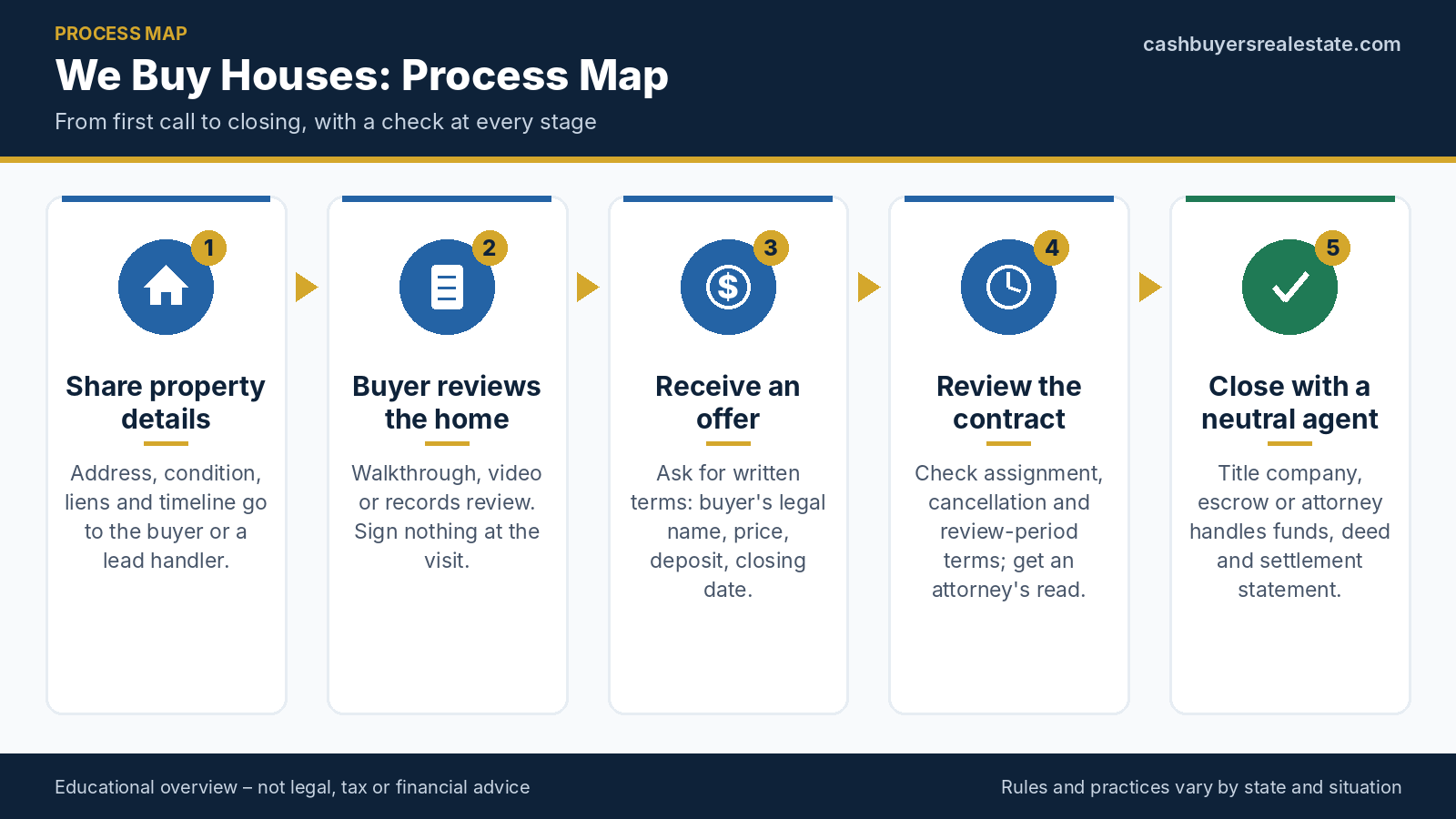
Text version of this infographic
- Share property details — Address, condition, liens and timeline go to the buyer or a lead handler.
- Buyer reviews the home — Walkthrough, video or records review. Sign nothing at the visit.
- Receive an offer — Ask for written terms: buyer's legal name, price, deposit, closing date.
- Review the contract — Check assignment, cancellation and review-period terms; get an attorney's read.
- Close with a neutral agent — Title company, escrow or attorney handles funds, deed and settlement statement.
From First Call to Closing Table: How a Typical Sale Unfolds
A sale to a house-buying business is a normal real estate transaction wrapped in unusually informal marketing. Once the sign or the form has done its job, the steps look much like any other sale: information is exchanged, a price is proposed, a contract is signed, a title search is run, and funds change hands at a closing. What differs is how fast the early steps can move and how much of the structure is left unstated unless you ask. The sequence below describes a common pattern and not a universal one, because buyers, states, and properties vary.
Contact, walkthrough, and offer
The early stages decide most of what follows, yet they feel like small talk. A seller who understands what the buyer is trying to learn, and what the seller is entitled to learn in return, enters the later stages with far more leverage than one who simply answers questions.
What the first conversation collects, and what you can ask in return
On the first call or form, a buyer typically wants to know the address, the number of bedrooms and bathrooms, the general condition of the roof, systems, and structure, whether anyone lives in the house, how much is owed on any mortgage or other lien, and what timeline you have in mind. These are reasonable questions, because a buyer cannot price a house without them, and they also reveal how flexible you might be. A seller who volunteers that a closing must happen within two weeks has told the buyer something that affects the offer, and that is not an argument for secrecy, only for deliberateness. You can describe the property accurately and still decline to explain every reason behind your timing.
There are things that don’t need to be shared at this stage. A buyer who hasn’t yet been identified does not need your Social Security number, a copy of your driver’s license, your bank account details, or a photograph of the deed. The point at which a legitimate transaction needs sensitive identifiers is later, when a title company or attorney prepares the closing documents, and they will request them through their own channels. A first conversation that pushes for those items is moving faster than the process requires, and it is reasonable to say that you will provide them to the closing agent once a contract has been signed.
The conversation is also your chance to learn who you are dealing with. Ask for the business’s legal name and the name of the person who would sign the contract. Ask roughly how many houses the business has purchased in the past year in your area, and whether it buys with its own funds. Ask who the closing agent would be, and whether you can choose a title company or attorney of your own. None of these questions is aggressive, and a buyer who answers them readily is giving you early evidence of how the transaction will go. A buyer who answers with a pivot to the offer, or who says those details will be explained after you sign, has given you evidence too.
The walkthrough and the written offer
Most buyers want to see the house, either in person or by video. Some will make a preliminary number from photographs and public records and then confirm it after a visit. The visit is partly an inspection and partly a negotiation: the buyer is estimating repair costs, noticing what the photographs didn’t show, and deciding how much margin the project needs. It’s usual for this person to walk through quietly and ask little about the house’s history. That should not be read as disinterest or as a sign of a lower number to come, because many buyers form their view on site and calculate afterward.
The offer itself may arrive by phone, text, or email, and a verbal offer is not an offer you can rely on. Ask for it in writing, with the legal name of the purchaser, the price, the amount of any earnest money deposit, the proposed closing date, who pays which closing costs, and whether the offer is subject to an inspection period. An offer that cannot be put in writing, or whose terms change each time you ask, may be a sign that the buyer is still working out how it will fund or resell the deal. A written offer, by contrast, is a document you can compare with other offers and show to an advisor.
Be prepared for the possibility that a price changes after the buyer’s first visit or after the contract has been signed. A change can be legitimate when it is based on something truly new, such as a discovery of foundation movement or a lien that was not previously disclosed. It is a warning sign when it follows a pattern: a strong initial figure that erodes, step by step, as your deadline approaches. If a buyer proposes a lower number after you’ve signed, you generally have the choice of agreeing, negotiating, or enforcing the contract as written, subject to its terms, and that is a good moment to involve a real estate attorney. The article on cash offer contract red flags looks at renegotiation patterns in more detail.
Contract, due diligence, and closing
After an offer is accepted the process becomes more formal, and this is where paperwork replaces conversation. These stages are also where state law matters most, since contract forms, disclosure rules, and closing customs differ.
Inside the purchase agreement: price, deposit, review period, and closing date
A purchase agreement is the written deal, and it should contain at least the identity of the buyer and seller, the property description, the purchase price, the amount and holder of any earnest money, the closing date or the way it will be determined, and the terms that allow either side to end the contract. For a cash purchase the document usually has no financing contingency, which is one of the features that makes it attractive, but it commonly contains an inspection or due-diligence period during which the buyer can examine the property and cancel or renegotiate. The length and conditions of that period, and the question of whether the earnest money is refundable during it, are among the most consequential terms in the document, so read them as carefully as the price.
It’s helpful to understand the difference between an “as-is” sale and a sale with no obligations. As-is means the seller isn’t agreeing to make repairs, and it usually means the buyer takes the property in its present condition. It does not remove a seller’s legal duties in states that require disclosure of known material defects, and it does not stop a buyer from using the inspection period to reduce the price or withdraw. Likewise, a contract that gives the buyer a lengthy period and a nonrefundable-looking deposit in practice may allow cancellation in some circumstances, which is why the wording of the termination clause is worth confirming with an attorney. The page on the cash home buyer contract goes through the clauses one by one.
A cooling-off right is not something to count on. The Federal Trade Commission’s Cooling-Off Rule gives consumers three days to cancel certain door-to-door and temporary-location sales, but the agency’s consumer guidance says the rule does not cover sales involving real estate, insurance, or securities. A signed house purchase contract therefore does not come with a built-in federal right to change your mind. A handful of states have created limited rights for particular kinds of transactions, such as the wholesaling disclosures discussed later, and a few contracts offer a voluntary cancellation window. Absent one of these, signing is a commitment, which is why reading before signing matters more than any later plan to reconsider.
Title work and closing: escrow states and attorney states
Once a contract is signed, a closing agent opens the file. The agent orders a title search to confirm who owns the property and whether liens, judgments, unpaid taxes, or other claims are recorded against it, requests payoff letters from lenders so the exact amounts due can be paid from the proceeds, and prepares a settlement statement that shows all money in and out. In many Western states the closing agent is an escrow officer at a title or escrow company; in many Eastern and Southern states, an attorney conducts the closing; some states use both models, depending on the region or the lender. Do not assume that the process in your state matches the one a buyer describes on a website.
The closing agent’s neutrality is one reason it matters who chooses them. A seller can ask to use a title company or attorney they have researched, and a buyer who insists on a particular closer should be able to explain why. Neither arrangement is improper, since many investors work with the same title company repeatedly and gain speed from the familiarity. The seller’s protection is to read the settlement statement before closing day, check that the payoff and fees match the contract, and confirm wire or check instructions by calling a phone number found independently, not one supplied in an email. MilitaryConsumer.gov, a federal consumer-education site, warns that scammers who compromise email accounts send last-minute messages claiming wiring instructions have changed, and recommends confirming by a number you already know to be genuine.
On closing day the seller signs a deed and any other required documents, the buyer’s funds are delivered to the closing agent, and the agent records the deed and disburses the proceeds, minus liens and costs. Timing depends on title complexity, the buyer’s funding method, and how quickly documents are returned, and a clean title with a prepared buyer can move more quickly than one that needs lien releases. Possession, final utilities, and the handoff of keys are matters the contract should address in plain terms so that nothing is left to be settled informally afterward.
| Stage | What happens | What you usually provide | What to confirm |
|---|---|---|---|
| First contact | Buyer gathers property facts and your timeline | Address, condition, mortgage and lien status | Legal name of the business and who signs the contract |
| Review of the home | Walkthrough or video; buyer estimates repairs | Access to the house | That nothing is signed during the visit |
| Offer | Price and terms proposed, often verbally first | Questions, counteroffers | Written terms with the purchaser’s legal name and deposit amount |
| Contract and review period | Purchase agreement signed; deposit paid; inspection window runs | Signature; disclosures required in your state | Assignment language, termination rights, who holds the deposit |
| Title work | Title search, payoff letters, settlement statement drafted | Lender information, ID to the closing agent | Liens, taxes, and unpaid amounts that reduce proceeds |
| Closing | Deed signed and recorded; funds disbursed | Signed deed and closing documents | Settlement statement matches the contract; wire details verified by phone |
The table is deliberately free of time estimates, because the length of each stage depends on the buyer, the property, and the state, and no single number would be honest. Read the “what to confirm” column as the point at which you can pause without disrupting anything. It’s far easier to ask about assignment language before signing than after the contract has been shared with a second buyer, and it is much easier to question a settlement statement while it is still a draft.
What Direct Buyers Offer, What They Cost, and How to Compare
It would be a mistake to read a guide about red flags as a verdict against direct buyers. The business model exists because it solves real problems for real sellers, and the trade-off it asks you to accept is a price below what a fully prepared retail sale might achieve. The honest way to evaluate an offer is to understand what you are getting in return for that discount and then to check, in dollars, whether the exchange is worth it for your particular house and calendar.
The honest case for selling to a direct buyer
Direct buyers are not a gimmick. They fill a gap that the conventional market handles poorly, which is the sale of a property that is hard to finance, hard to show, or tied to a timeline that a listing cannot respect. Understanding the genuine advantages makes it easier to see when they apply and when they don’t.
Speed, certainty, and fewer moving parts
The most tangible advantage is the removal of steps. A conventional sale to a buyer using a mortgage depends on that buyer’s loan approval, an appraisal that must support the price, and a lender’s underwriting of the property and the buyer’s finances. Any of these can delay or derail the closing. A buyer who is paying with their own funds, or who has funding arranged independently of the house, can skip those dependencies, so the main remaining tasks are title work and signatures. The seller also avoids preparing the house for showings, hosting open houses, and waiting for the right buyer to appear, which for a vacant, cluttered, or inherited property can be a significant relief.
Certainty is a more complicated benefit than it first appears. A cash contract without a financing contingency removes one of the common reasons a sale fails, but certainty depends on the buyer’s actual ability and willingness to perform, and on how the contract is written. A buyer with ample funds and a short, clear review period offers real certainty. A buyer with a long review period, a small deposit, and a right to assign the contract offers much less, even though the word “cash” appears in both. So the question to ask is not whether a buyer pays cash but how the contract allocates the risk of the buyer changing course.
Finally, there is the benefit of simplicity in decisions. Many sellers face a house they cannot afford to improve, a relative’s belongings they don’t have time to sort, or a duty to settle an estate across several households. Passing the property to a buyer who accepts it as it stands can reduce a chain of decisions to one. That relief is worth something, and it is legitimate to weigh it in the comparison, as long as you’ve also weighed what it costs. For a deeper look at sales without repairs, the article on selling a house fast without repairs covers the preparation choices you can skip and the ones worth keeping.
Who benefits most: condition, timing, and complexity
The sellers who tend to gain the most from a direct purchase share one or more of three features. The first is condition: a house with significant deferred maintenance, such as an old roof, outdated electrical service, water damage, or extensive cosmetic wear, may not qualify for a buyer’s mortgage and may attract few offers on the open market. An investor who has a contractor and a budget for those repairs can price the work and still make a profit, which makes the investor the natural buyer. The second is timing: a seller who must relocate quickly, settle an estate, or avoid carrying costs on a vacant house can trade some price for speed.
The third is complexity. Properties with tenants in place, unclear title from an older estate, code violations, unpermitted work, or a lien that needs to be paid out of the proceeds can be difficult to sell through ordinary channels, since a retail buyer and a lender may balk. Investors are accustomed to these problems and know how to solve them, though they will build the cost and the risk into their offer. The sale of a rental property, for instance, raises tenant notice and lease questions that differ by state, and an experienced buyer may handle them routinely. In each of these cases the buyer’s flexibility is part of what you receive.
It helps to see the options side by side. The table below sets out five routes a seller commonly considers and describes them qualitatively, because the numbers depend on your market and house. It’s meant to show which questions a route answers well and which it leaves open.
| Route | Speed | Price tendency | Repairs and preparation | Main trade-off |
|---|---|---|---|---|
| Direct sale to a principal investor | Often fast once terms are agreed | Below a prepared retail sale | Usually none required of the seller | Discount in exchange for convenience and fewer contingencies |
| Contract with a wholesaler | Depends on finding an end buyer | Varies; may be revised if the end buyer pays less | Usually none required of the seller | Your deal relies on a second buyer you may never meet |
| Listing as-is with an agent | Depends on market and condition | Closer to market, negotiated by buyers | Limited, though inspection requests are common | Commission, showings, and a buyer’s financing can slow the sale |
| Repair, then list | Slowest, because work precedes listing | Highest potential price | Seller manages contractors and cost | Spending and delay with no guarantee of recovering the cost |
| Instant-offer (iBuyer) program | Often quick where available | Offer set by the company’s model; fees may apply | Repair requests follow an inspection | Limited markets; offer may change after inspection |
To read the table, start with the column that matters most to you and look for the row whose strength matches it. A seller whose priority is certainty about a date will weigh the first, second, and fifth rows differently from a seller whose priority is the highest possible price. No route dominates, and the best choice often depends on factors outside the table, such as how much work you have the energy to manage and how much risk you can tolerate. For the sale-versus-list question specifically, the guide to cash sale versus listing for a fast sale goes further.
The price side: reading and comparing offers
Price is the part of a pitch that is easiest to see and hardest to interpret. A headline number tells you almost nothing until you know how it was built and what will be subtracted before money reaches your account.
How investor-style offers are built
Most investors work backward from what the property would be worth after repairs, often called the after-repair value, or ARV. From that figure they subtract the estimated cost of repairs, the expenses of reselling, including agent commissions, closing costs, and sometimes the cost of carrying the property, such as taxes, insurance, utilities, and loan interest while the work is underway. They then subtract the profit they need to justify the risk, and what remains is the maximum they are willing to pay. This is a general method, and each investor adjusts it by choosing a margin, by estimating repairs generously or tightly, and by deciding how long the project will take. The step-by-step method is explained in how cash buyers calculate offers.
Illustrative example (hypothetical numbers, not market data): A buyer believes a three-bedroom house would sell for $240,000 once renovated. The buyer estimates $30,000 in repairs, assumes $19,200 in selling costs (8 percent of the expected resale price), allows $7,800 for taxes, insurance, utilities, and short-term interest during the project, and wants an $18,000 profit. The calculation is $240,000 minus $30,000, minus $19,200, minus $7,800, minus $18,000, which gives an offer of $165,000. Change any input and the answer changes: if the buyer’s repair estimate were $22,000, the offer would rise by $8,000, and if the buyer needed a $30,000 profit, it would fall by $12,000. The figures are examples, not a standard.
The example shows why two offers on the same house can differ by tens of thousands of dollars without either buyer being dishonest. A buyer with low-cost contractors, cheap short-term money, and a strong resale network can pay more than a buyer without those advantages. It also shows why asking a buyer to explain the assumptions is a reasonable request. You are unlikely to be given every number, and a business does not owe you its margin, but a buyer who can say what repair figure and resale value they used gives you something to test against a contractor’s quote or an agent’s opinion of value. A buyer who refuses to discuss any assumptions at all is asking you to accept a number on faith.
When the offer comes from a wholesaler, the structure has an extra layer. The wholesaler’s price must leave room for their own fee, so the end buyer’s maximum price is higher than the figure in your contract, and the spread is the wholesaler’s compensation. This does not make the arrangement improper, but it explains why a seller who gets offers from a wholesaler and from a direct investor may see different numbers, and why the question of who ultimately pays what deserves attention. If the wholesaler lacks a buyer willing to pay enough, the figure in the contract may be the first thing to move.
Net proceeds: the number that actually reaches you
The right comparison between routes is not price against price but money in your pocket against money in your pocket, after every cost on each side. A direct sale usually has no agent commission and may involve fewer closing costs and less carrying time, while a listing usually produces a higher price but adds commissions, closing costs, repair credits negotiated after inspection, and months of taxes, insurance, and utilities. Sometimes the cash route comes out ahead after these subtractions, and sometimes the listing wins by a wide margin. Which result you get depends on the specific house, the market, and the offer in front of you.
| Line item | Direct cash offer | List as-is with an agent | Repair, then list |
|---|---|---|---|
| Sale price | $165,000 | $205,000 | $222,000 |
| Agent commission (assumed 5.5%) | $0 | $11,275 | $12,210 |
| Seller closing costs (assumed) | $1,500 | $3,075 | $3,330 |
| Repair spending or credits | $0 | $6,000 | $14,000 |
| Carrying costs while selling (assumed) | $600 | $3,600 | $6,000 |
| Estimated net before mortgage payoff | $162,900 | $181,050 | $186,460 |
Here the cash offer nets about $18,000 less than listing as-is and about $23,500 less than repairing first, in exchange for avoiding repairs, commissions, months of carrying costs, and the uncertainty of a retail sale. Whether that exchange is worth making is a personal judgment, and a seller facing a tight deadline might reasonably accept it while a seller with time and funds might not. Notice also what the table leaves out: the mortgage payoff is the same on every route, so it is omitted, and the repair-first column assumes the work goes as planned, which it does not always do. The related guide on cash offer net proceeds offers a worksheet-style method for building your own comparison.
The routes in the table, together with the factors that most often decide between them, are summarized in the following figure. Its six factors are offer price, repairs avoided, closing costs, timeline, contingencies, and certainty, which are the same ones a seller weighs in the text above. The picture is a convenient reminder, and the numbers for your own house come from written offers and a real estimate of what a listing would net.
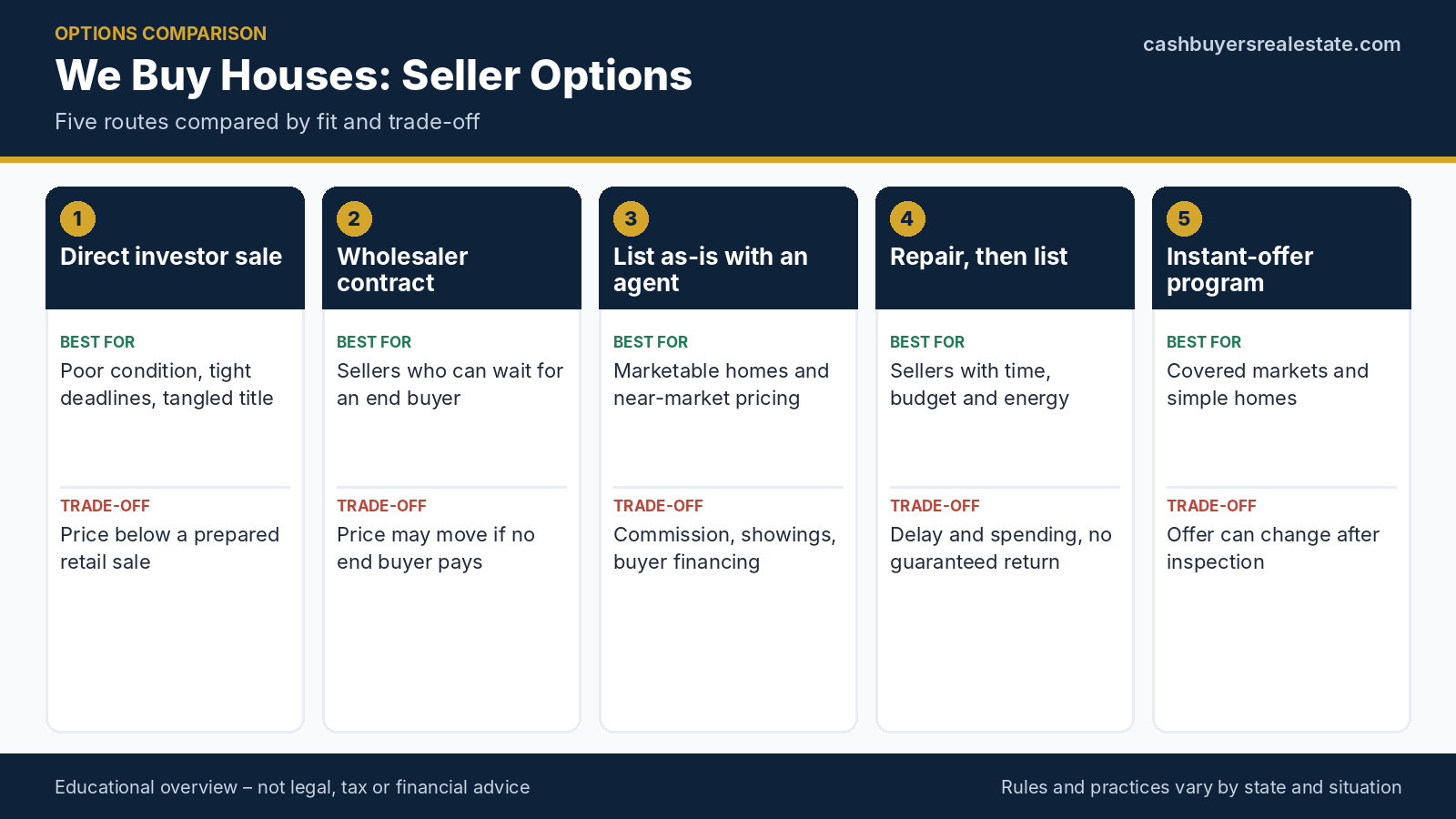
Text version of this infographic
- Direct investor sale — Best for: Poor condition, tight deadlines, tangled title. Trade-off: Price below a prepared retail sale.
- Wholesaler contract — Best for: Sellers who can wait for an end buyer. Trade-off: Price may move if no end buyer pays.
- List as-is with an agent — Best for: Marketable homes and near-market pricing. Trade-off: Commission, showings, buyer financing.
- Repair, then list — Best for: Sellers with time, budget and energy. Trade-off: Delay and spending, no guaranteed return.
- Instant-offer program — Best for: Covered markets and simple homes. Trade-off: Offer can change after inspection.
Pressure Tactics and Contract Red Flags, and How to Slow Down
The majority of sellers who deal with house-buying businesses have ordinary, uneventful experiences. The difficulties that do occur tend to follow recognizable patterns, and the patterns are less about outright lies than about the structure of a conversation in which one side is trying to move quickly and the other is still gathering information. Learning to see those patterns, and having a few plain sentences ready for slowing them, protects you without making you adversarial.
How pressure shows up in a pitch
Pressure rarely announces itself. It arrives as helpfulness, as deadlines that sound administrative, or as friendly reminders that other people are interested. The goal here is to describe these moves so that you can respond calmly if you meet them.
Deadlines, expiring offers, and manufactured urgency
The Federal Trade Commission lists “pressure to act now” among the four signs common to scams, along with impersonation, a claimed problem or prize, and demands for specific payment methods, and the agency’s guidance adds that legitimate businesses give you time. Real estate pitches are not scams by default, but the same dynamic appears in milder forms: an offer that is “only good until five o’clock,” a claim that the buyer has another property to buy if you don’t answer today, a price that will supposedly drop if you wait a week, or a representative who says a manager approved the number only for this call. Each of these compresses your decision into a window shorter than the time you would need to compare an alternative.
Some deadlines are real, and it is worth distinguishing them. A foreclosure auction date, a tax-sale date, a lease end, or a closing date on a house you’re buying are external facts with consequences, and a buyer who works around them is responding to your situation rather than creating pressure. A created deadline is different: its only function is to stop you from consulting anyone. A useful test is to ask what exactly happens if you take two more days. If the answer is a specific, checkable consequence, treat it as real. If the answer is simply that the offer will go away, you can reasonably say that you’d rather lose the offer than decide without reviewing it.
Slowing a conversation does not require confrontation. A few sentences are enough: “I’d like to review this in writing and show it to someone I trust before deciding.” “Please email me the offer with the buyer’s legal name and the terms, and I’ll reply by Thursday.” “I don’t sign documents on the day I first see them.” A buyer who respects the process will say that is fine, and many do. If a buyer responds to a request for time with irritation, escalating urgency, or a lower number, you have learned how that buyer handles disagreement, and that is valuable to know before a contract exists.
Vague answers about who the buyer is and where the money comes from
The second recurring pattern is not pressure but fog. The representative uses “we” and “our investors” without ever naming an entity. The company address turns out to be a mailbox or a shared office, the website lists no individual, and requests for the buyer’s legal name receive answers like “the contract will have all that.” Asked about funds, the representative says that the buyer is “fully capitalized” but cannot or will not supply a proof-of-funds document, or offers a screenshot with the name cropped. None of these facts alone proves anything, since small businesses often use shared offices and privacy is not a crime. Together they leave you unable to answer the most basic question in any contract, which is who is promising to pay.
Requests for money from the seller deserve special attention. A buyer has no ordinary reason to ask you for an upfront fee, a processing charge, a “membership,” or a payment for an appraisal or title search before closing. In a normal sale, the costs a seller pays are deducted from the proceeds at closing and appear on the settlement statement. A request to pay anything in advance, particularly by wire, a payment app, or gift cards, matches the payment-method warnings in the FTC’s guidance and should end the conversation until you’ve verified every detail through independent channels. If any request arrives by email or text and seems to change the previously agreed closing instructions, call the closing agent at a known number before acting.
A final variation concerns promises that exist only in conversation. The representative says the buyer will pay for a certain repair, store your belongings, or let you stay in the house for a month after closing, but the written contract says nothing of the kind. Most contracts contain a clause stating that the document is the entire agreement, which means that earlier verbal statements are generally not enforceable. If a promise matters to you, it needs to be in the document, in clear words, with a date and a consequence. If the buyer will not write it down, treat the promise as absent.
| Pattern | What it may sound like | Why it matters | A calm response |
|---|---|---|---|
| Expiring offer | “This number is only good today.” | Prevents comparison and review | “Please send it in writing; I’ll respond by a date I choose.” |
| Unnamed buyer | “Our investors will take it from here.” | You can’t verify who is bound to perform | “What is the buyer’s legal name, and will you sign as buyer?” |
| Early request for identifiers | “Send a photo of your ID and a voided check.” | Sensitive data shared before a contract exists | “I’ll provide those to the closing agent after signing.” |
| Upfront payment | “A small fee holds the property.” | Normal costs are paid at closing, not in advance | “I don’t pay fees outside the closing statement.” |
| Verbal-only promises | “We’ll cover that, don’t worry.” | Unwritten promises are hard to enforce | “Please add it to the contract.” |
| Escalating discount | “After the walkthrough, the number has to change.” | May reflect new facts or a pattern of re-trading | “Show me what changed and the repair estimate behind it.” |
Use the table as a rehearsal, not as a diagnosis. The aim of a calm response is to give the other side a chance to behave well. If they do, the transaction can proceed at a pace you control. If they do not, the response has cost you nothing, because you have lost only an offer you could not have trusted.
Contract terms that deserve a second read
Contracts for house purchases are written to be signed quickly, and many are drawn from templates that favor the party who supplied them. This is normal, and it is the reason the details matter. The terms below appear in many legitimate contracts, and the question is not whether they exist but whether you understand their effect.
Assignment clauses, options, and recorded memoranda
An assignment clause lets the buyer transfer the contract to someone else, and wording such as “buyer and/or assigns” in the purchaser line is the usual signal. That clause is common and often harmless, but it means the party you meet may not be the party who closes, and it is the sign of a wholesaling arrangement. A seller who is comfortable with this should still ask whether the buyer will disclose the end buyer before closing, whether the assignment fee is to be paid out of the buyer’s side rather than yours, and whether the contract allows the seller to cancel if no end buyer is found by a certain date. In states with wholesaling statutes, certain disclosures about assignment are required in writing before the contract is signed.
Some agreements are structured as options, in which the buyer pays a small fee for the right to buy at a set price within a period, instead of an immediate obligation to buy. An option can be fair, particularly when the property needs time to be cleared or a sale depends on a probate step, but it also leaves the house tied up while the buyer decides whether to proceed. You should know exactly what you are paid for granting the option, how long it lasts, whether it can be extended, and what happens to the money if the buyer does not exercise it.
A related term is the recorded memorandum of contract, a short document filed in the county land records that announces the buyer’s interest. Buyers record such notices to protect themselves against a seller who might sell to someone else, and in that role they are ordinary. The concern for sellers is that a recorded notice can cloud the title and prevent another sale until it is released. In 2023 two U.S. senators wrote to the National Association of Attorneys General raising concerns about cash-offer buyers who allegedly filed such notices or lawsuits when sellers tried to cancel, and asking state attorneys general to monitor complaints and to educate consumers. Whether any specific notice is proper is a legal question for the state where the property sits.
Illustrative example (hypothetical numbers, not market data): A seller signs a contract at $140,000 with a 30-day review period and later receives a better written offer of $152,000 from another buyer. She tells the first buyer she wants to cancel. The first buyer points to a clause that allows only the buyer to terminate during review, and notes that a memorandum of the contract was recorded the day after signing. The second buyer’s title company will not close until the memorandum is released. Had she read the termination clause and asked whether a memorandum would be recorded, she would have known before signing that the contract tied the house to the first buyer. She now needs an attorney’s advice about whether the memorandum can be removed and whether the contract can be ended.
Cancellation terms, deposits, blank spaces, and payment mechanics
A review of the termination clauses is the most useful hour you can spend on a contract. Find the sentence that describes who may cancel, when, and with what consequence. In a balanced contract, both parties have defined remedies if the other fails to perform. In a lopsided one, the buyer may cancel freely during a review period while the seller is bound, or the seller’s remedy for a buyer’s default is limited to a small deposit while the buyer can pursue the seller for damages, attorney’s fees, or a court order forcing the sale. Neither pattern is illegal, but a seller who signs without noticing it may find that the supposed security of a cash offer rests on an unequal bargain.
Deposits deserve their own attention. Ask how much the earnest money is, who will hold it, and whether it is refundable during the review period. A deposit held by a title company or attorney is safer than one held by the buyer, and a deposit large enough to matter shows that the buyer has something at stake. The article on cash buyer earnest money explains how deposits normally work and why amounts vary. A nominal deposit is not wrong, but it means the contract is mostly a promise, and its value depends on the character of the person who made it.
Finally, never sign a contract or any document with blank lines, whether it is a purchase agreement, an addendum, a power of attorney, or a closing form. Blanks for the price, the date, the buyer’s name, or the property description can be completed later in ways you did not intend. If a representative says the blanks will be filled in “once we know the final number,” the correct answer is that you will sign when the numbers are written in. Make sure you receive a complete copy of every signed document at the time, and if a package arrives electronically, confirm that what you sign is the document you reviewed. Payment mechanics belong in the same discussion: the contract should say how and when you will be paid, and the funds should come through the closing agent, not through personal checks, cash handed over at a kitchen table, or transfers arranged by text message.
Vetting a Buyer Before You Share Documents or Sign
Verification is the point at which a slogan becomes a counterparty. Everything in this section can be done from a phone and a computer in an afternoon, none of it requires special expertise, and a buyer with nothing to hide will usually be glad that you did it. The checks fall into two groups: confirming who the buyer is, and confirming that the buyer can actually perform.
Confirming who the buyer is
The first group of checks answers a question that sounds simple and often isn’t: who is making the promise? A name on a website, a first name on a text thread, and a company name on a contract may all refer to the same business, or to three different ones.
Entity lookup, trade names, and physical presence
Start with the legal name on the written offer or contract. According to the U.S. Small Business Administration, most states require businesses organized as limited liability companies, corporations, and similar entities to register with the Secretary of State’s office, a business bureau, or a business agency, and the same agency usually offers a free online search of those records. Searching the exact name typically shows whether the entity exists, whether it is listed as active or in good standing, when it was formed, and the name of a registered agent for legal notices. Some states also list managers or officers, while others show very little. Details vary, so check the website of the agency in the state where the company says it is organized and, if it operates elsewhere, in that state too.
Trade names add a wrinkle. A business may operate under a name that differs from its legal name, often called a doing-business-as or assumed name, and the SBA notes that these are registered with the state, county, or city depending on location and that registering one does not by itself provide legal protection. The brand on the sign is therefore not necessarily the name on the contract. Compare the website, the sign, the proof of funds, and the contract, and ask the representative to explain any difference. A mismatch can be innocent, since many businesses use a brand name across several entities, but it should be explained in a sentence.
Registration is evidence of existence, not of quality. A state filing generally means someone submitted paperwork and paid a fee; it does not mean the state has examined the owner’s finances or conduct. A newly formed entity is not suspect on its face, because investors often create a new company for each project or year, but it means there is no history to rely on and makes the other checks more important. It’s also reasonable to look at the physical presence. Does the address on the website correspond to a real office, and does a person answer the phone at a number you can call back? If the business claims to be local, can the representative describe the neighborhood and recent purchases? A seller who finds nothing but a mailbox can still proceed, but should lean harder on funds and the closing agent.
References, reviews, and recent closings
Next, look for evidence that the business has completed purchases. County land records are generally public and are searchable online in many counties or in person at the recorder’s or register of deeds’ office; they list deeds by the names of the parties, so a search for the buyer’s entity name as a grantee shows the properties it has acquired, and when. A buyer that claims to have purchased dozens of houses locally but appears on no deeds may be buying through other entities, which is something you can ask about. A buyer with a visible history of recorded purchases, on the other hand, has left a trail you can check without relying on anyone’s description of it.
You can also ask for the names of two or three recent sellers who agreed to speak with prospective clients, or for a title company or attorney the business has used who can confirm that it closes. Some sellers and closing offices will not share information because of privacy rules, and a refusal does not establish a problem, but a buyer who has satisfied customers is usually able to find one willing to talk. Court records offer another view. Many state court systems have free online case search, and a quick look at lawsuits involving the business, particularly those brought by sellers or by title companies, can reveal patterns that a review page does not.
Be modest about what online reviews and ratings can tell you. Reviews can be written by affiliates, solicited selectively, or removed, and a high average with few details tells you little. The Better Business Bureau, a private organization rather than a government agency, lets consumers file complaints about businesses, and its listings can be a useful input, but the organization is not a government regulator, and a rating reflects its own methodology. Read the content of complaints for specifics such as price changes after signing, failure to close, or difficulty getting a deposit back, and notice whether and how the business responded. For a broader discussion of how to weigh trust signals, see the guide to whether cash home buyers are legitimate.
Confirming that the buyer can perform
A buyer who exists may still be unable to close. The second group of checks examines whether money, and the neutral party who will move it, are in place.
Proof of funds: what it shows and what it cannot
Proof of funds is a document that shows a buyer has access to the money needed to complete the purchase. It usually takes the form of a recent bank or brokerage statement, a letter from a bank or lender confirming available funds or a committed line of credit, or a letter from an attorney or title company that holds the funds. A statement should be recent, show the buyer’s name, and match the entity on the contract, though the buyer may redact account numbers and unrelated transactions. A document in the name of a different person or company raises the question of who is actually supplying the money and under what arrangement, and the answer may be perfectly ordinary, such as a partner or lender, but you are entitled to know.
It helps to understand the limits. A statement shows a balance on one date, not that the money will be available on closing day, and a line of credit letter shows access, not an unconditional commitment. For that reason proof of funds is a screening step, not a guarantee. Stronger signals include a meaningful earnest money deposit held by a neutral third party, a short and clear review period, and a closing agent who confirms receipt of funds at the proper time. Be wary of requests for you to send your own documents before the buyer sends any, and of a buyer who offers proof only after you’ve signed. The dedicated article on proof of funds for cash buyers covers acceptable forms and what to ask when a document looks incomplete.
A related question is whether the funds are truly the buyer’s own. “Cash” in everyday speech means that no conventional mortgage is involved, but many investors use short-term business loans, private lenders, or partners. That is not wrong, and for most sellers the source matters less than the reliability, but it does bear on timing and certainty. A buyer who says the money is available now and can show the document that proves it is in a better position than one who says it will be arranged after the inspection period.
Choosing and checking the closing agent
The closing agent, whether a title company, an escrow company, or an attorney, is the party that holds the money and records the deed. Because that agent controls the exchange, the choice matters. You can ask to see the name early, search the company independently, and call it at a number you find yourself. You can also propose your own agent, particularly in states where sellers customarily select the attorney. Reasonable buyers often agree, and those who refuse should explain why. If the buyer chooses the closing agent, confirm that the agent is licensed in your state as required, that it is not owned by the buyer in a way that would raise questions about neutrality, and that you receive the title commitment or a title report.
Ask the closing office to confirm in its own words that it has received the earnest money, that it has the contract, and that the closing date is set. Ask how it will deliver your proceeds and how you can confirm instructions. Federal consumer guidance warns about wire fraud in real estate closings, in which criminals who have compromised an email account impersonate a party and redirect funds; it points victims to a bank wire recall and to reports filed with the FTC and ic3.gov, and the common protection is a verbal confirmation through a phone number that you looked up independently. Do the same for any change to payment instructions that arrives near closing, since that is when a message of this type is most persuasive.
The following list shows a sensible order in which to carry out the checks, from least to most effort. It can be done in a few days, and it can be paused at any point if something does not add up.
- Get the offer in writing, with the buyer’s legal name, the price, the deposit, and the closing date.
- Search the legal name in the state’s business-entity records and compare it with the website and the contract.
- Search county land records and court records for the entity’s past purchases and disputes.
- Ask for proof of funds in the same name and confirm its date and source.
- Identify the closing agent, contact it at an independently found number, and confirm the deposit arrangements.
- Have an attorney in your state read the contract before you sign.
| Check | Where to look | A reassuring result | A reason to pause |
|---|---|---|---|
| Legal entity | State business-entity search | Active entity whose name matches the contract and proof of funds | No record, or a name that differs without explanation |
| Physical presence | Address, phone, website | Reachable office or named person who answers questions | Only a mailbox and a texting number |
| Purchase history | County deed records | Recorded purchases in the entity’s name | Claimed volume with no visible deeds and no explanation |
| Disputes | State court case search; attorney general; BBB | No pattern of seller complaints | Repeated complaints about price changes or failure to close |
| Funds | Proof-of-funds document | Recent statement or lender letter in the buyer’s name | Cropped names, old dates, or documents from third parties |
| Closing agent | Title company or attorney, called independently | Agent confirms the file and deposit receipt | Reluctance to name the agent or to let you choose your own |
As with the other tables, the “pause” column is a prompt to ask another question, not a verdict. A single yellow flag explained clearly is usually fine, while several unexplained ones in the same transaction suggest it is time to stop and take advice. The checklist also works in reverse, because a seller who completes it has an informed basis for choosing between buyers.
The checks above translate into a six-item decision checklist: verify identity, request proof of funds, read the cancellation clauses, check the assignment terms, use a reputable closing agent, and never sign a form with blank spaces. Each item is a point at which a seller can pause and ask for clarification, and the figure below puts them in one place so that they are easy to carry into a meeting or a phone call.
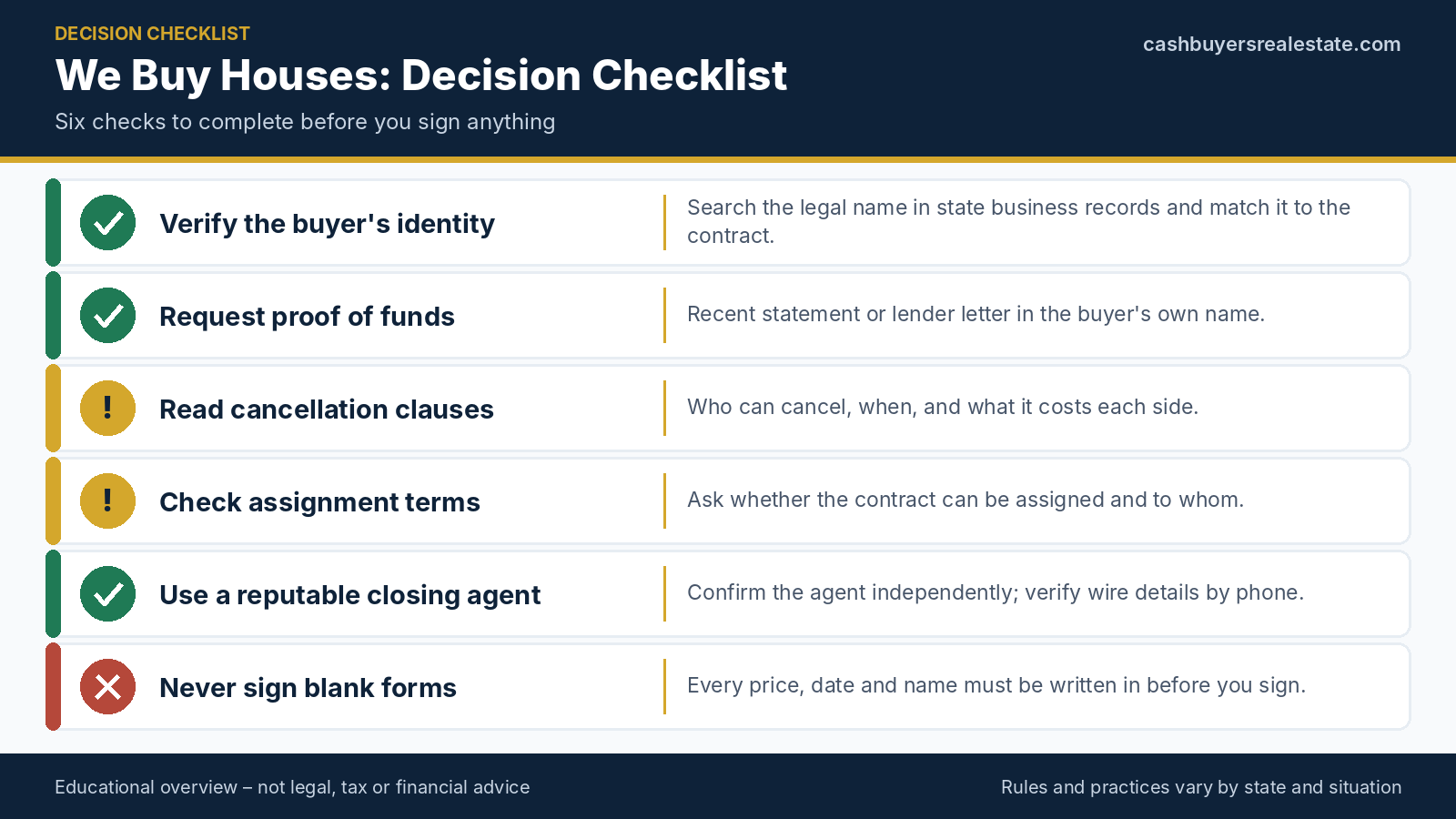
Text version of this infographic
- Verify the buyer's identity — Search the legal name in state business records and match it to the contract.
- Request proof of funds — Recent statement or lender letter in the buyer's own name.
- Read cancellation clauses — Who can cancel, when, and what it costs each side.
- Check assignment terms — Ask whether the contract can be assigned and to whom.
- Use a reputable closing agent — Confirm the agent independently; verify wire details by phone.
- Never sign blank forms — Every price, date and name must be written in before you sign.
Signs, Calls, Mail, and Wholesaling: The Rules and Where to Complain
A reasonable seller might assume that so visible an industry must be tightly regulated. In practice the rules are a patchwork. Some apply to how a pitch is delivered, such as a sign on a pole or a sales call to your cell phone. Others apply to what the seller of the contract must disclose. Most are state or local, a few are federal, and enforcement depends on complaints, which makes it useful to know where complaints go. This section surveys that landscape without pretending it is uniform.
Rules on signs, mail, and unsolicited contact
The channels discussed earlier are regulated by different bodies. Signs are a matter of local land-use law, telemarketing is largely federal, and mail is the least regulated of all. Each has its own logic and its own limits.
Local sign ordinances and what the First Amendment allows
Cities and counties regulate signs through their codes, and nearly all of them restrict signs placed on public property, utility poles, traffic-sign posts, and the public right-of-way beside roads. Enforcement is usually handled by a code-enforcement or planning department, which may remove signs, issue warnings, or assess fines. The 2017 Austin report mentioned earlier quoted a city investigator who described such postings as a misdemeanor under that city’s code, punishable by a fine, with first-time violators typically educated before being charged. That is one city’s approach, and codes in other places differ in penalties and in whether the sign’s owner or the person who posted it is liable.
The law of signs is shaped by the First Amendment. In Reed v. Town of Gilbert, decided on June 18, 2015, the U.S. Supreme Court held that a town’s sign code that applied different rules depending on a sign’s message was content-based and had to survive strict scrutiny, which it did not. The decision made many municipalities rewrite their codes. It did not stop them from regulating signs in ways that do not depend on content. According to the opinion’s discussion, towns may still regulate size, building materials, lighting, moving parts, and portability, and may restrict postings on public property if they do so evenhandedly. So a code that bars every unpermitted sign from utility poles, whatever it says, rests on firm ground, while one that bars only signs about real estate would invite challenge.
For a homeowner, the practical significance is modest. You aren’t responsible for the signs of third parties, and you don’t need to report them. If a sign irritates you, the code-enforcement office of your city or county is the usual place to complain, and most have an online form or a phone line. As for reading the sign, its placement is one data point about the operator’s habits, no more. A business that regularly posts in prohibited places may be careless about other rules or may simply be unaware of local codes, so it is not proof of bad faith. It is, however, a fair reason to look a little harder at the rest of the picture.
Telemarketing, Do Not Call, and direct mail
Phone calls and texts to sell goods or services fall under the Federal Trade Commission’s Telemarketing Sales Rule, which, among other things, requires sellers to promptly disclose their identity and that the call is meant to sell something, and requires that caller ID information be transmitted. The National Do Not Call Registry, which is free to join for a home or cell number, is meant to stop unwanted sales calls from real companies that follow the law. According to the FTC’s Registry FAQs, it will not stop scam calls, and calls can continue for up to 31 days after registration. Companies may still call if you have recently done business with them or gave written permission, and if you ask a company to stop calling, it must stop. The agency suggests noting the date of your request.
If calls continue after registration, the FTC’s guidance is to report them at DoNotCall.gov when no money was lost, and at ReportFraud.ftc.gov when money was lost or you have information about the caller. Include the number that received the call, the number on caller ID, any callback number, and the date and time if you can. The FTC page on the Registry deals with calls rather than texts, so for unsolicited messages check the current federal and state rules, or ask your state attorney general’s consumer protection office how to report them. Because the rules differ by channel and are updated from time to time, do not assume that a text message is governed by the same terms as a phone call.
Direct mail is largely outside these systems. There is no registry that stops a business from mailing you a postcard addressed to your property, and the rules that do apply concern truthfulness, not frequency. If a mailing is persistent, you can write to the sender asking to be removed from its list, and a reputable business will comply. Be careful with mail that looks official. The CFPB warns that scammers often imitate government agencies using logos or names that sound official, and a letter that refers to your mortgage or tax status in alarming terms deserves a call to your lender or taxing authority at a number you find yourself.
Illustrative example (hypothetical numbers, not market data): A homeowner fills out an online form to see what an investor might pay for a rental house. Within an hour, three different numbers call and two send texts, each naming a different company, and over the next week a postcard arrives from a fourth. He had not realized his information was shared. He writes down the date of each request to stop, tells each caller he is no longer interested, and checks that his cell number is on the Do Not Call Registry. He also decides which of the callers, if any, merits a second look: only one answered when he asked for the legal name of the buyer, and that business is the only one he researches further.
Wholesaler disclosure laws and where to complain
Beyond the delivery of the pitch, an increasing number of states regulate the transaction itself, particularly when the party contracting with the seller intends to assign the contract. These laws are recent, vary widely, and are changing, so the examples that follow illustrate a trend and do not describe the rule where you live.
State wholesaling statutes: Oregon and Oklahoma as examples
Oregon’s law, which took effect on July 1, 2025, defines residential property wholesaling as the marketing of residential property by someone who has only an equitable interest or an option to purchase, who has held that interest for fewer than 90 days and has invested less than $10,000 in improvements or development. Wholesalers other than licensed brokers must register with the Oregon Real Estate Agency, pay a registration fee, and give a written disclosure to sellers and buyers before a wholesale contract is signed. The disclosure must state that the wholesaler holds only an equitable interest, may not be licensed, and may assign the interest for a profit, and it gives sellers and buyers a right to cancel without penalty until midnight at the end of the third business day after receiving it, a right that cannot be waived. If no disclosure is given before contracting, the seller may terminate and keep any deposit.
Oklahoma’s statute, cited by the Oklahoma Real Estate Commission as 59 O.S. § 858-314, takes a different form. According to the commission’s form for the wholesale contract, wholesalers must give written notice before any contract is signed of an intent to assign or sell their equitable interest for a higher price than the homeowner is being offered, and the contract must state that the homeowner should seek legal advice. The homeowner may cancel without penalty within two business days after the contract is executed, and may cancel at any time if the required disclosures were left out. A contract lacking the required disclosures is described as invalid and unenforceable, and the homeowner is entitled to any earnest money. These are summaries of agency materials; the statutes themselves control, and cancellation periods and procedures are precise.
The two laws show the common shape of this regulation: a definition based on holding an equitable interest, a written disclosure before the contract, and a right to cancel. They also show the differences, such as registration in one state and not described in the other, and different cancellation windows. Other states have taken other approaches, including licensing requirements for people who market contracts on property they don’t own, and some have taken none. The practical advice is to search your state’s real estate commission or legislature for wholesaling rules before you sign anything with an assignment clause, and to ask an attorney whether your state requires a disclosure. If a wholesaler in a state with such a law omits the disclosure, the omission itself may give you rights.
Where to take a complaint, and what to bring
Complaint channels differ in what they can do. Some can investigate and penalize, some can mediate, and some mainly record patterns that may lead to enforcement later. None of them can promise to recover money, so the value of a complaint lies in creating a record, supporting other consumers, and sometimes producing a resolution. Regulators generally act on patterns, which means that a single well-documented complaint is more useful than a long, angry one, and that a complaint filed early, before memories fade and messages are deleted, is stronger than one filed months later. The Federal Trade Commission’s own guidance on avoiding scams ends with the same advice: report them at ReportFraud.ftc.gov.
| Channel | Best suited to | What it can generally do | Bring with you |
|---|---|---|---|
| City or county code enforcement | Signs on poles and public right-of-way | Remove signs, warn, or fine under local code | Photo, location, date |
| State attorney general consumer protection office | Deceptive practices, pressure, unfair terms | Take complaints; may mediate or investigate under state law | Contract, messages, dates, names |
| State real estate commission or licensing board | Licensed agents, and wholesaler registration where required | Review conduct of licensees; enforce wholesaling rules where they exist | Contract, disclosure form (or its absence), advertising |
| FTC (DoNotCall.gov and ReportFraud.ftc.gov) | Unwanted sales calls, scams, impersonation | Collect reports used for investigation and enforcement | Phone numbers, dates, any payments made |
| CFPB | Mortgage and foreclosure-related scams | Accept complaints and provide information on housing counselors | Loan information, correspondence |
| Better Business Bureau | Disputes with a specific business | Accept complaints; its process and outcomes are its own, not a government’s | Timeline, documents, desired resolution |
| Local police or county recorder | Forgery, fraudulent deeds, stolen funds | Take reports; recorder can advise on recorded documents | Recorded document numbers, ID, bank records |
The table should be read as a map, not a ladder. You don’t need to try them in order, and it often makes sense to file with more than one. The CFPB’s own materials direct people who suspect a foreclosure-relief scam to its complaint form or its toll-free line and to HUD-approved housing counselors for free help. Before you file anywhere, collect your documents and write a short timeline of what was said and when. A plain, dated record helps every agency you contact, and it helps an attorney if the matter goes further.
Questions Sellers Ask About “We Buy Houses” Pitches
The questions below come up repeatedly once a homeowner starts reading offers and talking to buyers. The answers are brief and general, and they point back to the sections above where a topic is treated at length. State law and individual contracts can change the answer, so use them to organize your thinking and then confirm specifics locally.
Questions about the businesses behind the phrase
Questions about who is calling and why
- Is “we buy houses” an official category of business with a license?
No. It is an advertising phrase that carries no regulatory meaning and no certification. Whether a particular business needs a license depends on what it does, such as brokering property for others, lending money, or, in some states, marketing contracts on houses it doesn’t own. The best way to learn what applies is to ask the business what it is and to check the state agency that regulates that activity.
- How did a stranger get my name, address, and number?
Businesses often build lists from public records such as property tax rolls, probate filings, and code-enforcement or foreclosure notices, and then combine them with commercial data on phone numbers. If you filled out a web form, your details may also have been shared with other buyers. It is reasonable to ask the caller where the information came from and to ask to be removed from their list.
- Is it a bad sign if the buyer turns out to be a wholesaler?
Not by itself. Many wholesalers are honest, and some close reliably. What matters is whether the contract and disclosures are clear, whether your state requires specific notices, and whether the price depends on a second buyer who may not appear. If you do proceed, ask about the cancellation terms and how long the wholesaler has to find an end buyer.
- Are lead-generation websites illegal?
Collecting and passing along sales leads is generally a lawful business, subject to privacy and telemarketing rules. The issue for you is clarity: you should be told whether you are dealing with a buyer or a marketer, and what happens to your information. If the website is vague on both points, assume your details may be shared and decide what you are comfortable with.
Questions about trust and verification
- Does a professional website and a high rating mean a buyer is reliable?
It means someone invested in design and, possibly, in collecting reviews, which anyone can do. Ratings are one input, and their value depends on who gathered them and how. Weigh them against verifiable facts: the entity’s state registration, recorded deeds in its name, a proof-of-funds document, and a closing agent who can confirm the file.
- How can I check that a buyer has funds without sharing my own finances?
Ask the buyer to send a recent bank statement or lender letter in the buyer’s own name, with account numbers redacted. You don’t need to share anything comparable about yourself, and a buyer who asks for your bank details at this stage is moving faster than the process requires. After a contract is signed, the closing agent will request the information needed to pay you.
- What should I do if the buyer will not name the closing agent?
Treat it as a reason to slow down. Many buyers have a preferred title company and will name it readily. A buyer who delays naming the closing agent, or who objects when you propose your own, has not necessarily done anything wrong, but you can’t verify where the money will go. You can propose a title company or attorney you’ve researched and see how the buyer responds.
Questions about offers, contracts, and next steps
Questions about price and costs
- Why is the offer so much lower than what a neighbor’s house sold for?
Investors price from the after-repair value and subtract repairs, resale costs, carrying costs, and profit, so a figure well below a renovated neighbor’s price is typical of the model. Differences in condition, size, lot, and location also matter. Ask for the buyer’s assumptions and compare them with a contractor’s estimate and an agent’s opinion of value before concluding that the number is unreasonable.
- Can I negotiate, or is the first offer final?
Most offers can be negotiated, because they usually reflect a margin the buyer built in. You’re in a stronger position with a competing written offer, a clear picture of what a listing would net, and a willingness to decline. Negotiating also works on terms other than price, such as the closing date, the deposit, who pays certain costs, and the length of the review period.
- Will I pay commissions or closing costs if I sell directly?
A direct sale between you and a buyer does not involve a listing commission unless an agent is a party to the deal, but other costs still arise, and who pays which costs is set by the contract and local custom. Review the settlement statement in advance. If the buyer says it pays everything, ask for that statement in writing in the contract and check that nothing else is deducted at closing.
- Are there tax consequences to a direct sale?
A sale can have tax consequences depending on your basis, how long you owned and lived in the property, and whether it was inherited or rented. The consequences are the same regardless of whether the buyer is an investor or a retail purchaser, though the sale price differs. Because individual circumstances vary, a tax professional can tell you what applies before you sign.
Questions about contracts and timing
- Can I cancel after I sign?
That depends on the contract and on your state’s law. The Federal Trade Commission’s Cooling-Off Rule does not apply to real estate, so there is no general federal right to cancel. Some states give sellers rights in specific situations, such as wholesaling disclosures, and some contracts include a cancellation window. Have an attorney in your state read the cancellation and default clauses before you sign.
- How long should a sale like this take?
It varies with the buyer’s funding, the title condition, and whether the contract has a review period. A clean title and a prepared buyer move faster than a house with liens or an estate that needs court steps. Instead of relying on a promised number of days, ask for the contract’s closing date and what conditions could change it, and check how the buyer has handled delays before.
- What if a better offer arrives after I have signed?
You may be bound by the first contract, and a recorded notice or an assignment may complicate matters. Whether you can end the contract depends on its terms and your state’s law. This is a situation where speaking with a real estate attorney before communicating with either buyer is worth the cost.
Deciding Whether a “We Buy Houses” Offer Fits Your Situation
After the pitch has been decoded, the decision comes back to your priorities. The same offer can be a good fit for one household and a poor one for another, and the difference rarely lies in the buyer’s slogan. It lies in how much you value speed, certainty, and effort saved against the dollars you would give up.
A decision framework: matching the route to your priorities
A useful way to decide is to rank what matters to you before you compare offers. Time, price, certainty, effort, and risk each pull in different directions, and the route that ranks first on one may rank last on another.
When a direct sale tends to fit
A direct sale tends to fit when speed or certainty outranks price, when the property would be hard to finance or show, and when the work needed to prepare it is more than you can manage. It tends to fit especially well if you have a specific buyer who has passed the checks described earlier, a contract with a short review period and a meaningful deposit held by a neutral closing agent, and a net-proceeds comparison that shows the difference is one you accept. If an estate involves several relatives, a tenant-occupied building, or a lien that must be cleared, an experienced investor’s familiarity can be worth the discount. The guide to cash home buyers provides further context on how these transactions fit into the wider market.
The signs of a strong fit are consistent. The buyer has a clear legal identity, answers questions without irritation, and puts the offer in writing. The contract names the purchaser, treats both sides evenhandedly, and doesn’t depend on assignment. The closing agent is identified and verifiable. And your comparison of net proceeds shows a gap that you consider reasonable payment for the time, effort, and uncertainty you would otherwise carry. If all of these are true, a direct sale is a sensible choice, and nothing about the slogan should talk you out of it.
It also helps to picture the sale after it closes. A seller who has moved on, paid off the lien, and received proceeds through a neutral closing agent usually remembers the process as a relief, even when the price was lower than a listing might have produced. A seller who signed a vague contract with an unnamed buyer, waited through an extended review period, and then received a request to lower the price remembers it very differently, even though both sellers heard the same slogan on the first call. The difference between those two stories is almost always visible in the documents before closing, which is why the earlier verification steps are the real decision framework and the slogan is only the doorway.
When listing or repairing first may serve you better
Listing with an agent, with or without repairs, tends to serve you better when you have time, the house is in reasonably marketable condition, and the difference in net proceeds is large relative to your needs. A house that needs cosmetic updates but is structurally sound will often draw retail buyers, who generally pay more than investors, and the cost of preparing it may be far smaller than the gap between offers. The same holds when the pitch you’ve received relies on pressure, when the buyer can’t be verified, or when a contract’s terms cannot be explained in plain language. In those cases, the discount is not buying you certainty, and the conventional route offers more protection.
Other routes also deserve a place on the list, including selling to a neighbor or family member, an auction for particular properties, a short sale or lender-assisted option if you are behind on a mortgage, and obtaining several investor offers so that they compete. If foreclosure is the concern, a HUD-approved housing counselor can explain options at no charge before you commit to any sale. The broader fast-sale landscape is covered in the guide to selling a house fast. The goal is not to avoid direct buyers but to ensure that the comparison is real.
What to do next: first steps, questions to ask, and documents to gather
Whichever way you are leaning, the next steps are the same, and they cost very little. Gathering information and asking questions first leaves every option open, including doing nothing for now.
The first week: documents, questions, and second opinions
Begin by assembling what any buyer or agent will ask for, so that you can respond on your terms and not theirs. That usually includes the deed or a recent title document, your latest mortgage statement or payoff information, property tax bills, homeowners association details if any, and a list of known repairs and recent improvements. If tenants live in the house, the leases and rent roll belong in the pile. If the property came through an estate, have the paperwork showing who has authority to sell. A list of this kind turns a vague conversation into a concrete one.
- Deed or title information, and mortgage or lien payoff details
- Recent property tax and insurance statements, plus any homeowners association information
- Known repair issues, permits, and receipts for major work
- Leases and rent history if the house is occupied by tenants
- Estate or court documents if the seller is acting as an heir or personal representative
Then request at least two written offers or estimates, ideally from different kinds of sources: an investor, an agent’s opinion of value for a listing, and perhaps a contractor’s quote for the repairs that matter most. Ask each buyer the questions from the earlier sections, and add the ones in the guide to questions to ask a cash home buyer. Before signing anything, have a real estate attorney in your state read the contract, and if the numbers are large or the situation involves an estate, a divorce, or a tax question, add a tax professional. These steps may take several days, and a legitimate buyer can work with that.
Keeping the decision yours
Selling a house is one of the larger financial decisions most people make, and it deserves more time than a sign or a text message suggests. Nothing in this guide argues for or against selling to a direct buyer. Many sellers are well served by one, and others discover that a listing, a modest repair, or a patient search for the right offer leaves them better off. What separates the good outcomes from the poor ones is rarely the route and more often the information that was in hand when the choice was made.
If you take one habit from this article, make it the simplest: ask who the buyer is, what documents prove it, and what happens if something goes wrong, and give yourself the time to hear and check the answers. A buyer who welcomes those questions is usually one you can work with, and a pitch that cannot survive them has told you what you needed to know. Whatever you decide, you’ll be deciding on the basis of paperwork and verification, which is a far steadier footing than a slogan, and the pace stays yours. That is also the posture most likely to produce a good outcome with an honest buyer, who will have seen careful sellers before and will usually adjust to them without complaint.
Give yourself permission to say no, too. A pitch that doesn’t fit isn’t a failure on your part, and declining costs nothing. Offers come and go, and new buyers appear whenever a house is ready to sell, while a signed contract with the wrong terms can take months or longer to unwind. If you do decide to move forward, write down the date you chose, the offers you compared, and the reasons you picked this route, so that you can explain your decision later to a relative, an attorney, or an accountant without reconstructing it from memory.