
Questions to Ask a Cash Home Buyer: Offers, Process & Red Flags
The offer usually arrives faster than the understanding does. A text message names a figure, a voicemail promises a decision by Friday, or an email thanks you for your interest and attaches a one-page agreement. At that moment you know a number and almost nothing else: not who is really behind the message, not whether the money exists, not what the number leaves out, and not what happens to it if an inspection, a title search, or a change of heart gets in the way. The questions to ask a cash home buyer are the tools that fill in those blanks, and they work best when you ask them early, in a calm voice, and in a form you can keep.
Most sellers feel awkward doing this. A cash sale is sold on simplicity, and a long list of questions can feel like a breach of manners, as though you were accusing a stranger of something. That reluctance is understandable and it is also exactly what makes poorly prepared sellers easy to hurry. A legitimate buyer expects questions, because a sale of this size cannot be completed without a seller who understands the contract, a title company or attorney who has verified the paperwork, and funds that can be traced from an account to a settlement statement. Buyers who work this way every month tend to have clear, quick answers. The questions in this guide are built to be answered by a professional in a few sentences, and to expose the difference between a prepared buyer and an improvised one.
Ask every cash home buyer who exactly is buying, how they will prove they can pay, how the offer was built and what you’ll net, what the contract lets either side cancel, and who handles closing. Get answers in writing, compare at least two sources, and treat vague replies or pressure to sign quickly as information, not as rudeness to be forgiven.
The rest of this article is organized as a toolkit rather than a script. It starts with the preparation that makes questioning easier, including the numbers you should know about your own property and the tone that keeps a conversation productive. It then moves through six themes in the order in which a sale tends to unfold: identity, funds, the offer itself, the contract, the timeline and closing, and the moment when answers come back thin. Each theme explains why the question matters, what a prepared answer sounds like, what a concerning answer sounds like, and which document, if any, should back it up. A summary table near the end condenses the whole toolkit into a page you can print.
Several neighboring subjects have their own pages, and this one deliberately stays on the asking rather than the analyzing. If your main worry is whether a particular company can be trusted at all, the longer discussion in are cash home buyers legit covers that, and the mechanics of evidence that a buyer can pay are developed in the guide to proof of funds for a cash offer. For the broader picture of who these buyers are and how the business works, start with the overview of cash home buyers. Here the emphasis is practical: the exact things to say, in a sensible order, and how to interpret what comes back.
A few ground rules shape everything that follows. Nothing in this guide assumes that a buyer is dishonest, and most people who buy houses for cash are running lawful businesses and completing real purchases. Nothing assumes that you are in crisis either, although many sellers do arrive with a deadline, a vacant property, or an inherited house they never planned to own. The premise is simply that an informed seller gets a better outcome than an uninformed one, whichever route they finally choose, and that the cost of asking is a few minutes while the cost of not asking can be thousands of dollars or a failed closing. The final section of the article returns to the choice itself, because sometimes the best result of a good set of questions is deciding that a cash sale is not the right fit.
Before You Ask Anything: Preparing Your Own Baseline and Your Tone
Questions land better when you already know what a good answer would have to beat. A buyer who senses that you have no reference point has little reason to sharpen a price or tolerate scrutiny, while a seller who can state the payoff on the mortgage, the rough condition of the roof, and a deadline that is genuinely firm sounds like someone worth dealing with honestly. This section covers what to gather before the first serious conversation and how to phrase requests so that they read as ordinary diligence instead of suspicion.
Why the questions to ask a cash home buyer matter before the first number
A price is the least informative thing a buyer can tell you at the start. Two offers with the same headline figure can differ by thousands of dollars in what you eventually receive, and one of them may never reach a closing table at all. The questions are how you convert a number into something you can compare.
Know your payoff, your title picture, and your own deadline
Begin with the facts only you can supply. Request a current payoff statement from each lender with a mortgage, home equity line, or other loan secured by the property, because the balance on last month’s statement is not the figure a title company will use. Payoffs include accrued interest through a specific date and sometimes fees, and the difference between the statement balance and the payoff can be meaningful. Write down any other claims you are aware of, such as unpaid property taxes, a contractor’s lien, a homeowners association assessment, a judgment, or a second owner whose name is also on the deed. If the house came to you through an estate, note whether a court has appointed a personal representative and whether that person has authority to sign. These facts determine what a buyer can offer, and they are the first thing a competent buyer will ask you.
Your own deadline deserves the same honesty. Many sellers say they need to close immediately when what they actually need is certainty by a particular date, or money by the end of the month, or the house emptied of obligations before a lease starts elsewhere. A buyer who hears “as fast as possible” will price that urgency into the offer, since it signals that you have few alternatives. A buyer who hears “I’d like to close in the second half of next month, and I’d like to know by next week whether your offer is serious” is dealing with someone who has a plan. Settling the real deadline before you talk also protects you later, because it gives you a way to judge whether a proposed timeline is helpful or merely convenient for the buyer.
Decide what you are trading, and what you refuse to trade
Every route to selling a house trades something for something else, and you will ask better questions if you have named your own priorities in advance. A sale to a cash buyer typically trades some portion of the price for speed, fewer showings, no repair requests, and a smaller chance that financing collapses. A traditional listing typically trades time and effort for a wider pool of buyers and often a higher price. Neither trade is wrong, but a seller who has not decided which side matters more tends to be talked into whichever frame the person across the table prefers.
It helps to rank four things on paper: the lowest net amount you would accept, the latest date you can close, the repairs you are willing or unwilling to do, and the amount of uncertainty you can tolerate. Then add the non-negotiables, such as a minimum amount of time to remove belongings or a requirement that a co-owner agree in writing. These notes do not need to be shared with the buyer. They exist so that when an answer comes back, you can tell immediately whether it moves you toward what you want or toward what the buyer wants. The comparison pages on cash sale versus traditional sale net proceeds go deeper on the arithmetic behind these trades, and it is worth reading them before you meet a buyer, not after.
Asking firmly without sounding accusatory
Tone does a surprising amount of work in these conversations. The same question can sound like routine diligence or like a challenge, and buyers respond to the difference. A professional will answer either version, but a calm, matter-of-fact version keeps the exchange cooperative and lets you hear how they respond under mild pressure.
Frame each question as a standard step, not a suspicion
The simplest technique is to explain why you are asking in the same sentence as the question. “I’m checking funding with everyone who makes an offer, so could you send proof of funds in the name of the entity that will sign the contract?” is easier to answer than “How do I know you have the money?” The first presents the request as your normal process, which it should be, and makes no claim about the person you are speaking with. You can use the same structure for nearly every theme in this guide: say what you’re doing, say what you need, and say what you will do once you have it.
It also helps to ask open questions first and closed ones second. “Walk me through what happens between signing and closing” invites a narrative, and the narrative tells you how organized the buyer is. A follow-up such as “Who holds the earnest money, and where is it deposited?” then tests the narrative against a specific fact. Pay attention to whether answers are consistent across the call and across the email that follows. Honest, prepared buyers rarely contradict themselves because they are describing something they do every week, while improvised answers tend to shift when the same point is approached from a different direction.
Finally, keep your own commitments small and clear. You can say, “I’m gathering information and comparing options, and I won’t sign anything until my attorney has read it.” That sentence sets a boundary without hostility, and it filters people quickly. A buyer who responds with “of course, that’s reasonable” is behaving the way most professionals behave. A buyer who answers by shortening the deadline on the offer has told you something useful before a single document has changed hands.
Choose the channel: when to talk and when to write
Phone calls are efficient for relationship and tone, and email or text is better for anything you may need to rely on later. A good habit is to take the first call, ask your questions, and then send a short written summary the same day: “Thanks for your time today. To confirm, you said the buyer is the limited liability company named in the offer, that proof of funds will come from a bank statement or lender letter, and that closing will take place through a title company.” That message costs two minutes and gives the buyer a chance to correct a misunderstanding, which is a courtesy to them as well as protection for you.
Written follow-up has a second benefit that is easy to overlook. Because the summary states what you understood, any later change is visible as a change, not as a disagreement about memory. If the buyer agrees, you have a record. If the buyer says nothing, you still have a dated message that shows what you were told. If the buyer replies with a different version, you’ve learned something important about how the process may go once money is at stake. In all three cases you are better off than if the conversation had lived only in two people’s recollections.
Keep personal and financial information out of the channel until it is needed. There’s no reason to send a driver’s license image, a Social Security number, or account details to someone who has not yet been identified, and the Federal Trade Commission advises people not to share such numbers in response to unexpected contact (FTC, How To Avoid a Scam). Property details such as the address, the number of bedrooms, and the general condition are enough for a first discussion. Anything more sensitive can wait until you have verified who is on the other end and have a signed agreement that identifies the closing agent.
Identity Questions: Who Is Actually Buying Your House?
The first theme is the one sellers skip most often, because the person on the phone sounds friendly and the website looks professional. Yet the identity of the buyer decides almost everything that comes later: whose money is used, who signs the contract, who can be held to it, and whether the party who made the offer is the party who shows up at closing. The questions below are meant to establish three things quickly, namely what role the speaker plays, what legal entity stands behind the offer, and what record exists of that entity buying houses before.
Is the person you’re speaking with buying, brokering, or collecting leads?
The same sentence, “we can make you an offer,” is used by people in very different positions. Before discussing price at all, you want to know which position you are dealing with, because each one carries different obligations and different risks for you as the seller.
Four roles that hide behind the same opening line
Broadly, four kinds of speakers answer a seller’s inquiry about a cash offer. A principal buyer intends to purchase the property with funds it controls, whether those are its own cash, a credit line, or money borrowed from a private lender, and will take title at closing. A contract wholesaler signs an agreement to buy the house and then looks for a different buyer to take over that agreement, earning a fee for the difference. A real estate agent or broker may be presenting an offer on behalf of a buyer, or may be acting as the buyer personally, and licensing rules in many states require such a person to say so. A lead generator, finally, is a marketing operation that collects your details and passes them to whoever pays for them, and may never buy anything itself.
None of these roles is automatically improper, and wholesaling in particular is a lawful and common practice in many places, though several states have added disclosure and licensing rules for it in recent years. What matters for you is that the role is stated plainly and early. A useful question is: “Will the company that signs this contract be the one that closes on my house and pays for it, or do you expect to assign the contract to someone else?” A principal answers with a simple yes. A wholesaler who is candid will say that the contract may be assigned and will usually be able to explain how the fee works. A speaker who dodges, changes the subject to how quickly they can move, or insists that “it all works out the same for you” is declining to tell you who will actually be buying.
The answer also changes how you read the rest of the process. If another party will take over the contract, then the proof of funds you receive from the person you spoke with may describe a different pocket than the one that will pay at closing, and the price you were offered may be lower than what the end buyer will pay. That is the nature of the arrangement and not necessarily a reason to refuse it, but it is a reason to learn about it before you sign rather than after.
Names, entities, and the records that confirm them
After the role comes the legal identity. Ask for the full legal name of the person or entity that will sign the purchase agreement, the entity type (individual, limited liability company, corporation, trust), the state where it was formed, and the name and title of the individual who will sign for it. Then check that what you have been told is what the paperwork says. Nearly every state operates a free online business-entity search, usually through the secretary of state or a comparable office, where you can confirm that an entity exists, see its formation date and status, and find its registered agent. The name on the offer letter, the name on the proof of funds, and the name on the contract should all match, or the buyer should be able to explain in one sentence why they do not.
A recently formed entity is not a warning sign by itself; investors routinely create a new limited liability company for a single property or a single year of purchases, and the practice can be a sensible way to separate liability. What deserves attention is a mismatch or an absence: a company name that doesn’t appear in any registry, a signer who cannot say what authority they hold, or a physical address that turns out to be a mail drop with nobody who can be reached in person. If the person says they are a licensed agent or broker, ask for the license number and verify it with the state real estate regulator’s lookup tool, which is generally free to use. The goal is not to catch anyone out. It is to be able to write down, in one line, who your counterparty is, so that if there is ever a dispute you know exactly who to name.
Track record, references, and how to read the answers
Once the identity is clear, the next question is whether the buyer has done this before and whether the people who dealt with them were satisfied. You cannot demand private business data, but a legitimate buyer can usually point to something verifiable, and the way they respond to the request is informative in itself.
Asking about experience without demanding trade secrets
Start with a modest, concrete question: “Roughly how many houses has your company bought in this county in the past year, and could you give me two or three addresses so I can look at the recorded deeds?” A deed recorded with the county recorder or register of deeds is public in most places, and it shows the buyer’s name, the date, and sometimes the stated consideration. An established local investor can usually produce addresses without hesitation. A company that buys across many states may cite a county or two, or may explain that its transactions are handled through different entities in different places, which is also a plausible answer if it is specific.
The concerning response is a statement that sounds large and cannot be tested. “We’ve done hundreds of deals” is neither verifiable nor responsive to a question about this area, and it tells you very little about whether the buyer understands the local title practices, the attorney requirements, or the typical timeline for a closing in your county. Equally, a refusal framed as confidentiality deserves a gentle follow-up. You are not asking for client names or financial statements; you are asking for evidence that deeds exist. If the buyer cannot or will not point to any, you have learned that the claim of experience rests on assertion, and you can weigh the offer accordingly.
Be careful as well not to over-read the opposite signal. A first-time or part-time buyer may be entirely honest and entirely capable of closing, particularly one buying with cash from a recent sale or an inheritance. In that case the experience question should shift to preparation: who is their attorney or title company, what will they do to hold the earnest money, and how do they plan to document the funds? A buyer without a track record who has strong answers on those points can be a reasonable counterparty. A buyer with a long claimed record and weak answers on them cannot.
Independent checks: public records, complaint channels, and neutral professionals
Do not rely on a buyer’s description of themselves, and also do not rely solely on online review pages, which can be incomplete, outdated, or selectively curated. A better set of checks uses sources that have no interest in your decision. The county recorder’s grantee index will show recent purchases under the entity’s name. Your state attorney general’s consumer protection office and, where relevant, the state real estate regulator can tell you how to file or look up a complaint, and many publish guidance on the practices they see in your state. A court search for the entity’s name in the county where it is based will show whether it has been involved in litigation, which proves nothing alone but sometimes explains a pattern.
The most useful independent source is often the closing professional. Title companies and real estate attorneys see which investors close, how quickly, and whether the deals tend to run smoothly. If the buyer proposes a particular title company or attorney, you can call that office directly, using a number you find yourself, and ask whether they are handling the transaction and whether they will hold the earnest money and issue a settlement statement. You can also propose your own closing agent and see how the buyer reacts. A flexible buyer says yes; one who insists on a single closing partner has not necessarily done wrong, but you should understand why, and it is worth confirming that agent’s identity independently.
Illustrative example (hypothetical numbers, not market data): A homeowner with an inherited ranch house receives an offer from “Riverbend Property Partners” and asks the identity question about assignment. The representative replies that the company “works with a network of buyers” and can’t say which one will close. The homeowner searches the state business registry and finds Riverbend formed seven weeks earlier, with a registered agent in another state. She then asks for two recent deed addresses and is told they are confidential. Rather than deciding the company is a fraud, she writes down what is known: unclear role, new entity, no verifiable history. She asks the representative to put in writing whether the contract will be assignable and to name the title company. When the reply is a promise to “get back to you,” she treats that silence as an answer and moves on to two other sources, one of which provides a registry-verified entity and a named attorney within a day.
| Question to ask | A prepared answer | A concerning answer | How to check it |
|---|---|---|---|
| Will your company sign the contract and close on my house? | Yes, or “the contract may be assigned, and here is how that works.” | “It all works out the same for you.” | Read the assignment clause; ask for it in writing. |
| What is the full legal name of the buyer and who signs for it? | Exact entity name, state of formation, signer’s name and title. | A brand name only, or a signer with no stated authority. | State business-entity search; compare names on every document. |
| Are you or the signer a licensed real estate agent or broker? | A direct yes or no and a license number if yes. | Vague references to “being in real estate.” | State real estate regulator license lookup. |
| Which recent purchases can I verify in this county? | Two or three addresses or recorded deed dates. | “Hundreds of deals,” no addresses, claim of confidentiality. | County recorder or register of deeds grantee index. |
| Who will handle closing, and may I call them directly? | A named title company or attorney with a phone number you can look up. | Refusal to name the closing agent until you sign. | Call the office using a number you find independently. |
Read the table from left to right as a conversation rather than as a score sheet. The first two columns describe what a prepared answer tends to look like, and the third describes the kind of response that should make you slow down and ask a follow-up, not necessarily walk away. A single concerning answer is a prompt to dig, whereas two or three of them in the same conversation, particularly about the role of the speaker and the closing agent, usually justify collecting offers from other sources before you invest further time.
Before you move to the money questions, it helps to see the whole sequence in one picture, since the order of the questions follows the order of a typical sale. The process map that follows places each theme at the stage where it matters most, from gathering your own facts through verifying the buyer and funds, testing the offer, reading the contract, and confirming the closing.
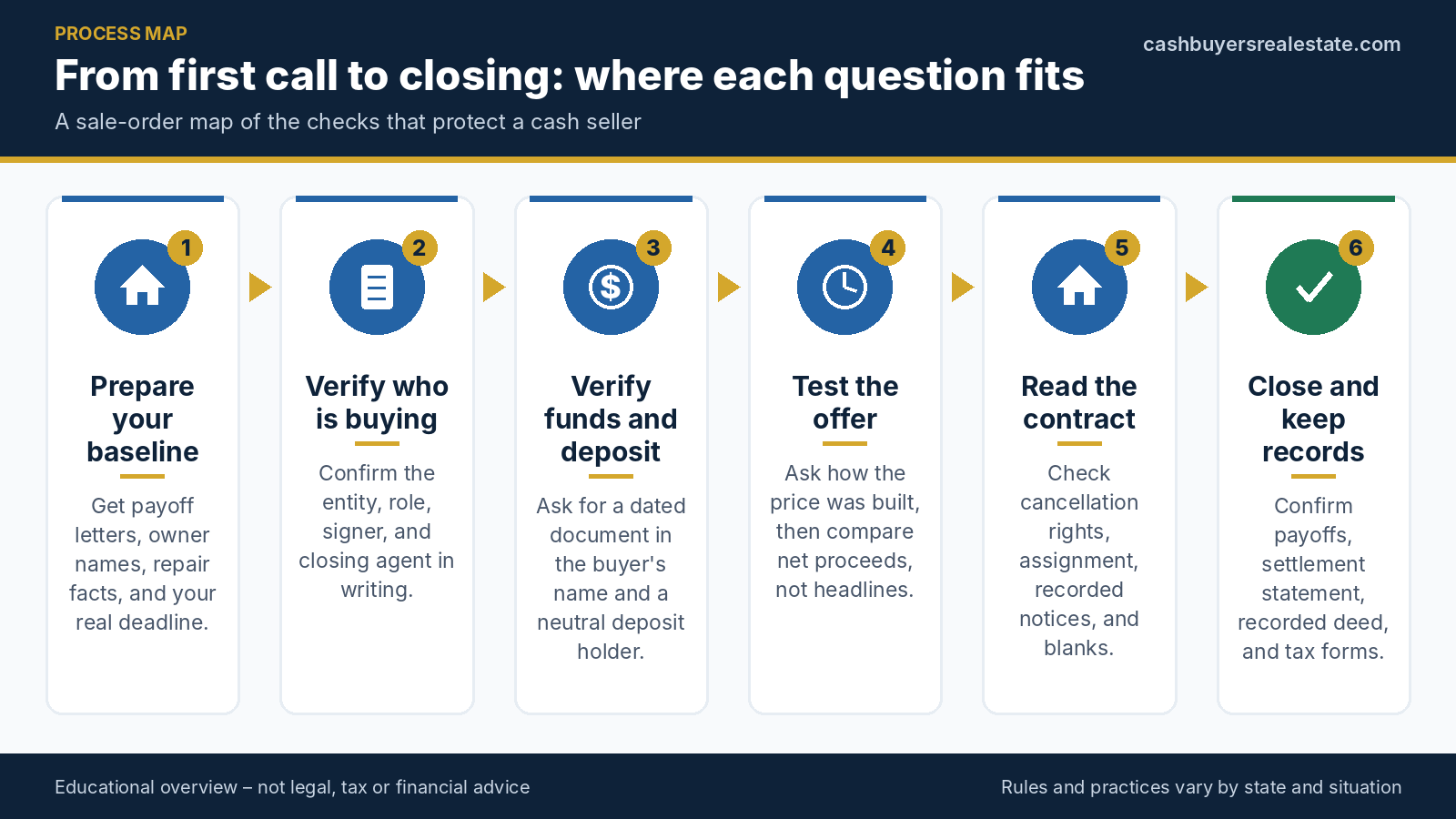
Text version of this infographic
- Prepare your baseline — Get payoff letters, owner names, repair facts, and your real deadline.
- Verify who is buying — Confirm the entity, role, signer, and closing agent in writing.
- Verify funds and deposit — Ask for a dated document in the buyer's name and a neutral deposit holder.
- Test the offer — Ask how the price was built, then compare net proceeds, not headlines.
- Read the contract — Check cancellation rights, assignment, recorded notices, and blanks.
- Close and keep records — Confirm payoffs, settlement statement, recorded deed, and tax forms.
The map makes one point that the text has so far implied: verification is cheaper the earlier it happens. Confirming an entity name costs a few minutes before you share personal information, and the same check after you have signed a contract that names the wrong party can take weeks and legal fees. Each later section of the guide assumes that you are still near the beginning of that sequence, with the freedom to ask for anything and to walk away from any answer you cannot test.
Funds and Money-Handling Questions: Can the Buyer Pay, and Where Does the Money Sit?
Everything attractive about a cash sale depends on one assumption, which is that the cash exists, is available, and will move to the closing agent on the agreed date. That assumption is easy to test in the early stage and hard to repair late, so this theme repays the time you spend on it. The questions cover the evidence that a buyer can pay, the less obvious situations in which “cash” means something more complicated, the deposit that backs the buyer’s promise, and the steps that keep a seller’s own money safe when it finally moves.
What proof of funds shows, and what it cannot show
Proof of funds is the standard first request, and most buyers know how to respond to it. The more useful skill is understanding what each kind of document actually demonstrates, so that you can decide whether it is enough or whether to ask one more question.
The common forms of evidence and how to read them
Buyers typically offer one of three kinds of evidence. The first is a bank or brokerage statement showing a balance, often with account numbers partly hidden, which is normal and acceptable. The second is a letter on letterhead from a bank, lender, attorney, or title company confirming that funds are available or that a commitment exists. The third is a letter or commitment from a private or hard-money lender stating that it will fund a purchase of a particular size. Each shows something different, and each leaves something unshown. A statement shows what was in an account on a certain date, but not whether the same balance has been shown to other sellers this week, or whether the money is already committed to another deal. A letter from a professional is stronger evidence of availability, though it is only as good as the willingness of that professional to stand behind it. A lender commitment shows access to credit, which is not the same as cash in hand and often carries conditions.
Four practical questions improve any document you receive. In whose name is the account or commitment, and does it match the entity that will sign the contract? What is the date on the document, and how recent is it? Is the amount enough to cover the entire purchase price plus closing costs, instead of merely the earnest money? And will the funds at closing come from the account you are looking at? If the answer to the last question is “not exactly,” ask what the actual source will be. A longer treatment of document types, redaction, and what a title company will accept appears in the guide to cash buyer proof of funds, and it is a good companion to this section if you have a document in hand and want to interpret it.
It also helps to be realistic about what any single document can do. Proof of funds is a snapshot, not a promise, and no seller can verify an intention. Its purpose is to remove obvious impossibility, the situation in which a buyer offers $250,000 against an account holding a fraction of that. Once the document makes the purchase plausible, the contract terms, the earnest money, and the choice of a neutral closing agent become the real protections. Sellers who treat a statement as proof that a deal will close sometimes relax at precisely the stage when they should be asking the next question.
When the money comes from somewhere other than the buyer’s own account
Many legitimate purchases described as “cash” are funded in ways that involve a third party. An investor may draw on a line of credit or borrow short-term from a private lender who secures the loan against the property. A buyer may bring in a partner who provides most of the funds. A wholesaler who plans to assign the contract may expect the end buyer to supply the money, or may arrange temporary funding for a same-day resale, often called a double close. None of this is improper, but each arrangement adds a dependency that does not appear in a simple bank statement, and your question is whether the closing depends on anything outside the buyer’s control.
The question can be asked plainly: “Does your ability to close depend on a lender’s approval, an appraisal, the sale of another property, or a resale of this contract to another buyer?” A buyer using only its own money can answer no. A buyer using borrowed funds may answer yes and explain the lender’s timeline, which at least lets you judge it. A buyer who tells you “cash” but later asks for an appraisal contingency, a financing contingency, or a long inspection window is describing a transaction with conditions that your assumptions did not include. “Cash offer” is a trade convention rather than a technical term, which is why it must be tested against the contract and not the label.
Be alert to documents that suggest availability without proving it. A screenshot of a mobile app balance, an unsigned letter, a statement with the name cropped, or a promise that “funds will be ready at closing” are all weaker than the evidence described above. Weak evidence is not the same as fraud, and a polite request for something better often produces it. If it does not, the reasonable conclusion is that the offer carries more risk than its headline suggests, and that it should be compared against offers that come with stronger support.
| Evidence offered | What it shows | What it leaves open | Follow-up question |
|---|---|---|---|
| Recent bank or brokerage statement | A balance on a specific date in a named account | Whether the funds are committed elsewhere or will remain by closing | Is the account in the contracting entity’s name, and will closing funds come from it? |
| Letter from a bank, attorney, or title company | A professional’s confirmation of availability | The conditions behind it and its expiration date | Can I call the author, using a number I find independently? |
| Lender or hard-money commitment | Access to credit for a purchase of this size | Approval conditions, appraisal needs, timing | What must happen before the lender releases funds? |
| Screenshot of an app balance | A balance as displayed to the buyer | Ownership, account type, whether it is real and current | Could you send a statement or a letter instead? |
| Verbal assurance only | Nothing that can be checked | Everything | What document can you provide this week? |
The table is easiest to use as a ladder. The rows toward the top give you something specific to check, and each step down gives you less. If a buyer starts near the bottom, the productive response is to ask for something one rung higher, not to refuse the conversation outright. How quickly and how willingly the buyer climbs the ladder tells you a good deal about whether the rest of the transaction will be equally cooperative.
Earnest money, escrow, and the wire-fraud safeguards
Once you are satisfied that funds plausibly exist, attention turns to the deposit that makes the buyer’s promise costly to break, and to the way real money will later move between accounts. These are the two places where cash sales most often go wrong for reasons that have nothing to do with the buyer’s honesty.
Earnest money: amount, holder, and what happens if the buyer backs out
Earnest money is a deposit paid when the contract is signed, and it signals that the buyer is serious. For a seller it matters in two ways: whether the amount is large enough that walking away would hurt, and whether the money is actually held by someone neutral. Ask how much will be deposited, with whom, and within how many days of signing. The right answer names a title company, a real estate attorney’s trust account, or a licensed brokerage escrow account, not the buyer’s own bank account and not a personal check handed to the buyer’s representative. A deposit held by the buyer is a promise to pay, not a deposit.
Then ask the conditional questions that decide what the deposit means in practice. During what period can the buyer cancel and get the money back? What reasons allow a refund? If the buyer cancels after that period, does the deposit go to you, and is that your sole remedy or one among several? Contracts differ here, and some give the buyer a long inspection or “due diligence” period in which the deposit is fully refundable, which can turn a purchase agreement into something closer to a free option. A small deposit paired with a lengthy refund window is a legitimate arrangement if you understand it, but you should recognize that it gives you less protection than the phrase “earnest money” suggests. The page on cash buyer earnest money examines typical structures, and the answer in your own contract will be specific to your state’s practices.
One more distinction is worth drawing. Some documents presented as purchase contracts are actually option agreements, in which the buyer pays a fee for the right, but not the obligation, to buy within a period. That structure can be legitimate, but the fee is then what you are paid whether or not the buyer proceeds, and the seller’s expectations should be set accordingly. If you cannot tell from the document which kind it is, that uncertainty is itself the finding, and a short consultation with a real estate attorney before signing is a modest cost to resolve it.
Wire fraud: protecting the money when it finally moves
When a closing is approaching, criminals watch for it. The Consumer Financial Protection Bureau warns that scammers can copy email addresses, phone numbers, and formatting closely, and advises people never to follow instructions contained in an email, to verify closing instructions including account name and number with trusted representatives by phone or in person, and to be cautious about exchanging closing details by email (CFPB, Mortgage closing scams). The FBI gives similar advice: confirm any financial transfer by phone using a number you already have on file rather than one provided in the email (guidance published by the FBI’s Portland field office). As a seller, you are most likely to be asked for your own bank details so that proceeds can be sent, and the same rule applies in reverse: provide them only to a closing agent whose identity you verified yourself.
A practical routine is simple. Before closing, call the title company or attorney at a number you found independently, confirm the name of your closing officer, and agree on how payout instructions will be delivered. Treat any message announcing “updated” instructions as suspect until you have reached a person you know by telephone. If you notice something wrong after a transfer, contact your bank immediately and ask about a wire recall, and file a complaint at the FBI’s Internet Crime Complaint Center, as the CFPB recommends. These steps cost almost nothing to practice and they protect the one moment when a very large amount of money moves in a very short time.
Illustrative example (hypothetical numbers, not market data): Two days before a scheduled closing, a seller receives an email that appears to come from the title company: “Due to a banking change, please send your wire details to this new secure portal.” The sender’s address differs from the earlier correspondence by one letter. The seller remembers the advice to verify, looks up the title company’s main number on its own website, and asks for her closing officer. The officer has sent no such email. The seller forwards the message to the company, reports it to the FBI’s complaint center, and confirms by phone that her proceeds of a hypothetical $142,000 will be wired only after she provides her bank details by phone to that officer. Nothing was lost because the one step that mattered, a call to a number she found herself, happened before any information moved.
Offer Questions: How the Number Was Built and What You’ll Really Keep
An offer is a conclusion, and the interesting part of any conclusion is the reasoning that produced it. Sellers often spend an hour negotiating the final figure and a minute asking how it was reached, which gets the priorities backward: if you understand the logic, you can correct a mistaken assumption, and if you can’t get any explanation, you know the number is a negotiating position instead of an estimate. Beyond the logic, there is the separate question of what you will actually receive after every cost, which is a different number from the one in the offer letter.
How the price was reached and when it can change
Investors who buy houses for resale or rental price them with fairly consistent methods, and most are willing to explain the outline of those methods even if they will not share their margins. The point of asking is to find out which assumptions about your house sit underneath the number, since those are the assumptions you can verify.
The logic behind the price: after-repair value, repair scope, and margin
A buyer who plans to renovate and resell typically begins with an estimate of the after-repair value (ARV), meaning what the house might sell for once the work is finished, based on recent comparable sales nearby. From that figure the buyer subtracts the estimated cost of repairs, the cost of holding the property while the work is done, the cost of selling it, and a profit margin that compensates for risk. A buyer who plans to rent the property instead usually works from expected rent and operating costs. Either way, the offer is the result of a chain of estimates, and an illustrative way to picture it is: expected resale value minus repairs minus holding and selling costs minus margin equals what the buyer can afford to pay. That structure is explained further on the page about how cash buyers calculate offers.
The questions that follow from this are straightforward. What value did you assume for the house after repairs, and which sales did you use to support it? What repairs did you include, and what did you assume they would cost? Do you plan to resell or keep it? A prepared buyer can answer these in a few sentences, naming the type of work (roof, mechanical systems, kitchen, flooring) and describing the neighborhood sales that guided the estimate. A buyer who answers with “that’s just our formula” has not necessarily done anything improper, but you are left unable to test the assumptions, and the offer deserves less trust than one that can be explained.
You are not entitled to the buyer’s margin, and asking for it directly tends to end the conversation. What you can reasonably do is look for errors in the inputs. If the buyer has budgeted for a new roof and yours was replaced six years ago, or has assumed a foundation repair that an engineer’s report on file contradicts, a documented correction can legitimately raise the price. The detailed page on cash offer repair deductions shows how those adjustments commonly work, and bringing receipts, permits, and inspection reports to this conversation is often the most effective negotiation you can make.
Inspections, walkthroughs, and the question of whether the price is firm
Many buyers issue a first number from photos, a short description, and public records, then visit the property before a final commitment. That is a reasonable way to work, but it means the figure you receive early may be provisional, and you need to know how provisional. Ask directly: “Is this offer based on a visit or on photos? What would you expect to see during a walkthrough that could change it? If the price changes, by how much and by what process?” Honest buyers can usually name the categories that move a price, such as discovered structural problems, undisclosed liens, or a condition significantly worse than described. It is also fair to ask who will perform the visit and whether that person has authority to confirm the number on the spot, since a walkthrough by a representative who must then report back to a partner or a funder is a different arrangement from one conducted by the decision maker. The first can add days to the process and another round of negotiation, while the second can settle the price in a single appointment, and you are entitled to know which you are scheduling before you rearrange your day around it.
The pattern to watch for is an offer that is firm in tone but open-ended in the contract. A written agreement that lets the buyer renegotiate the price for any reason during a long inspection period amounts to a first offer followed by a second, lower one. The practice is sometimes called re-trading, and the sellers most vulnerable to it are those who have already stopped marketing the house or committed to a move. If you sign, make sure that any right to reduce the price is tied to specific, documented findings, and that your right to cancel without penalty, if the price drops, is written down.
Honesty on your side matters just as much. Describe known defects accurately in your conversations and, where your state requires them, in the written disclosures you must give; concealing a problem to protect a price exposes you to legal risk and tends to be discovered during a walkthrough or a title or inspection step anyway. The page on as-is home sale disclosures explains why selling as-is changes what you must repair, but not necessarily what you must tell. Accurate descriptions also give the buyer less reason to reduce the price after the fact, which protects both sides.
From offer to net proceeds
The number in the offer is a gross figure. What matters to you is the amount that reaches your bank account after the mortgage payoff, closing costs, taxes, and any other charges are settled, and the questions in this section are designed to make that amount visible before you sign.
Who pays which costs, and how to surface the charges that are easy to miss
Closing costs in a cash sale are usually lower than in a financed sale, because there is no lender, no appraisal, and no loan origination, but they are not zero. Sellers commonly bear a share of the title search and settlement or escrow fee, recording charges for any documents they must file, prorated property taxes and association dues through the closing date, any transfer or documentary taxes that the state or locality imposes, and the payoff of any liens or mortgages. Who pays which item is a matter of local custom and of the contract, and customs differ widely between, for example, an escrow state and an attorney-closing state. The article about whether cash buyers pay closing costs examines the typical splits, but your own contract is what controls.
Ask for the allocation in writing: “Could you send me a line-by-line estimate of what I’ll pay at closing and what you’ll pay?” Listen especially for charges that are not on a conventional settlement statement. Some buyers, particularly those who assign contracts, build a fee into the agreement or ask the seller to pay a service or administrative fee; whether that is acceptable depends on what the fee is for and whether it was disclosed up front, not on its name. A charge that appears for the first time at the closing table, when you’ve already moved out or made plans, is the situation to avoid, and the way to avoid it is to ask early for the full list.
If a mortgage or other lien secures the property, ask also who will obtain the payoff statement and how the payoff will be paid. In a properly handled closing, the closing agent receives a payoff letter directly from the lender and pays it from the proceeds, and you receive the remainder. If you hear that the buyer will “take over” your mortgage or that you should keep making payments after closing, stop and consult an attorney before going any further, because such arrangements can trigger the loan’s due-on-sale provision and leave you responsible for a debt on a house you no longer own.
Comparing the offer with a listing and with a second offer on a net basis
The only comparison that tells you anything is the one that turns each option into the same unit: dollars received, on a date, with a degree of certainty. A listing typically produces a higher sale price but adds commissions, repairs or credits that buyers negotiate, staging or cleaning, carrying costs while the house sits, and the risk that a buyer’s financing or inspection will end the contract. A cash offer typically reduces or removes those items but starts from a lower price. Whether the cash route nets less, the same, or more depends on the property and the market, and the honest answer in many cases is that the two ranges overlap.
The table below shows how the arithmetic can work with hypothetical figures. It is not a prediction of what any house will sell for, and your own numbers will differ; its purpose is to show the shape of a comparison you can build for yourself with a payoff statement and a few estimates from a local agent. Ask a real estate agent for a net sheet at a realistic listing price, ask the cash buyer for a line-by-line estimate, and place them side by side. The guide to cash offer net proceeds walks through the same logic in more detail.
| Line item | Cash offer | Listing sells at $205,000 | Listing sells at $190,000 |
|---|---|---|---|
| Sale price | $168,000 | $205,000 | $190,000 |
| Agent commissions (assumed 5%) | $0 | $10,250 | $9,500 |
| Repair credits negotiated with buyer | $0 | $9,000 | $9,000 |
| Seller closing costs | $3,000 | $4,100 | $3,800 |
| Carrying costs (1 month vs. 3 months) | $1,950 | $5,850 | $5,850 |
| Cleaning and staging | $0 | $1,200 | $1,200 |
| Estimated net before payoff | $163,050 | $174,600 | $160,650 |
Reading the table, notice that the listing wins by about $11,550 in the middle column and loses by about $2,400 in the right-hand one, which means the answer depends on whether the market delivers the higher price. Three other things sit outside the numbers: the listing takes about two months longer in this example, it carries the risk that a contract falls through and the process restarts, and it requires showings and decisions that some sellers cannot manage. The cash offer in the left column is less than the best listing outcome but is more certain and quicker. That trade is exactly what the questions in this guide are for, because they let you check whether the certainty is real.
Illustrative example (hypothetical numbers, not market data): A couple owns a three-bedroom house with a 14-year-old roof and a kitchen last updated in the 1990s. A buyer offers $168,000 with a seven-day inspection window; an agent suggests listing near $205,000 after about $9,000 of requested repairs. Before choosing, they ask the buyer for a written statement of costs and a draft contract, and ask the agent for a net sheet at two price points. The paperwork shows a roughly $11,500 advantage for the listing at the higher price, and a small cash-offer advantage at the lower one. Their deciding factor is not the average; it is the fact that they must be out of state in eight weeks, so they choose the option with the shortest uncertain stretch and negotiate the buyer’s inspection language rather than the price.
Net proceeds are only one of several dimensions on which these routes differ. Certainty, timing, effort, repairs, and exposure to contingencies matter just as much for many sellers, and they do not fit in a single dollar column. For that reason, it helps to lay out the main routes on one page before moving on: a direct sale to an investor, a traditional listing after repairs, an as-is listing with an agent, an instant offer from a company that uses automated valuations (often called an iBuyer), and a for-sale-by-owner (FSBO) sale. The comparison that follows shows who each tends to suit and what it costs in return.
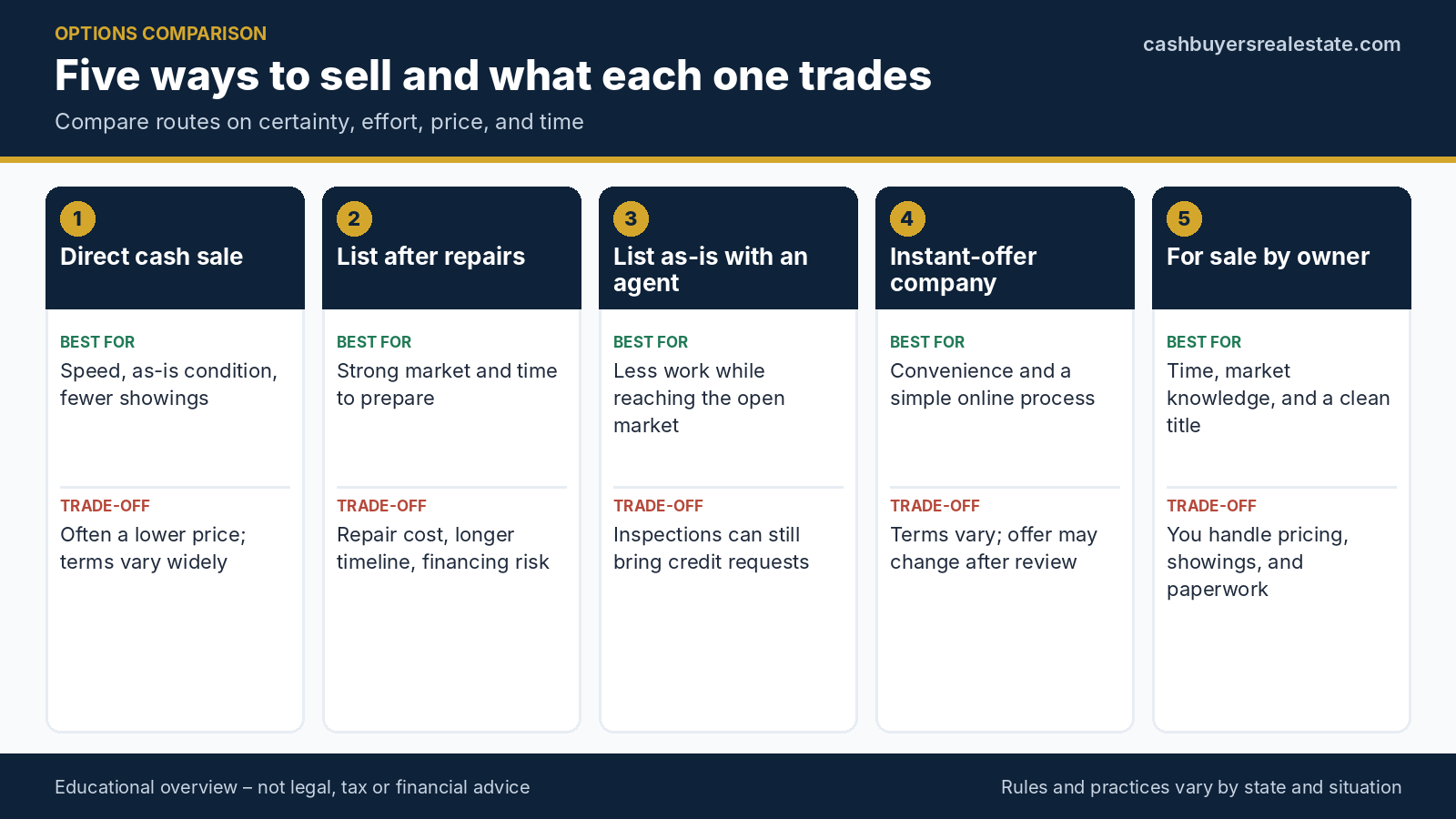
Text version of this infographic
- Direct cash sale — Best for: Speed, as-is condition, fewer showings. Trade-off: Often a lower price; terms vary widely.
- List after repairs — Best for: Strong market and time to prepare. Trade-off: Repair cost, longer timeline, financing risk.
- List as-is with an agent — Best for: Less work while reaching the open market. Trade-off: Inspections can still bring credit requests.
- Instant-offer company — Best for: Convenience and a simple online process. Trade-off: Terms vary; offer may change after review.
- For sale by owner — Best for: Time, market knowledge, and a clean title. Trade-off: You handle pricing, showings, and paperwork.
Each route in that comparison answers the offer questions differently, so the same set of questions works as a screen for all of them: who is paying, how was the number built, what do I keep, and what can change. Carry that screen into the contract itself, where the answers either become binding or turn out never to have been written down.
Contract Questions: Which Terms Decide Who Carries the Risk?
Everything said in conversation is provisional until it appears in the contract, and anything that appears in the contract overrides what was said. That is why a seller’s most valuable skill in a cash sale is reading, or arranging for someone to read, the actual agreement and asking about every clause that moves risk from one side to the other. The questions here concern the conditions that let a buyer cancel, the clauses that extend the buyer’s rights beyond the sale itself, and the terms that are simply missing.
Terms that decide who carries the risk
A purchase agreement is, among other things, a distribution of uncertainty. Each clause answers the question “if something unexpected happens, who bears the cost?” Cash contracts tend to be shorter than financed ones because they omit lender conditions, but the clauses that remain carry a lot of weight, and they vary from one form to the next.
Contingencies, inspection periods, and the right to walk away
A contingency is a condition that, if not satisfied, lets a party cancel the contract, typically with the earnest money returned. Financed purchases usually include financing and appraisal contingencies. Cash purchases frequently omit those, which is one reason sellers find them attractive, but many still include an inspection or due diligence period, a title review period, and sometimes a condition tied to the buyer’s own approval or to the resale of the contract. Ask for a complete list of the conditions under which the buyer may cancel, the date each one expires, and what exactly the buyer must do to cancel. The related page on cash buyer contingencies catalogs the usual ones and how each affects a seller.
The wording matters as much as the list. A right to cancel “for any reason” during a period, or “in the buyer’s sole discretion,” makes the period a free option, and the longer it is, the more the seller bears the risk of an off-market house. Ask what happens if the buyer neither cancels nor proceeds by the deadline: does the contract move automatically to the next stage, or does it simply lapse? Ask what happens to the earnest money at each stage. And ask whether you have a corresponding right, for instance to cancel if the deposit isn’t made on time or if the buyer fails to confirm funding by a stated date. A balanced contract gives both sides clear exits at defined points; an unbalanced one gives the buyer many exits and the seller none.
If the contract mentions a “due diligence fee” or “option fee,” ask whether it is paid to you, is nonrefundable, and is separate from the earnest money. Practices differ by region, and in some places an option fee paid directly to the seller is customary and credited at closing. In others the term is unfamiliar. What matters is that you understand which money is yours regardless of what the buyer does, and which money depends on the transaction closing, because that difference is the measure of how seriously the buyer is committed.
Assignment, recorded notices, and clauses that reach beyond the sale
Some clauses affect your property or your rights outside the sale itself. The first is the assignment clause. Many form contracts name the buyer as an individual or company “and/or assigns,” which allows the buyer to transfer the contract to someone else without further consent. That can be harmless, and it is the mechanism behind wholesaling, but it means the party who ultimately closes may not be the one you vetted. Ask whether assignment is permitted, whether you will be notified, and whether the original buyer remains responsible if the new one fails to close. Some states now regulate this practice directly; in Oklahoma, for example, a law that took effect on November 1, 2025 defines wholesalers and requires written disclosures, including that they intend to sell their interest for a higher price and that the homeowner may cancel within two business days, as summarized in a title underwriter’s bulletin (Stewart Title bulletin OK2025001). Most states differ, and the rules continue to change, so check yours with the state real estate regulator or an attorney.
The second is any document the buyer wants to record. A short notice or memorandum of the contract recorded at the county office gives public notice that the buyer has an interest in the property. Buyers sometimes use these legitimately to protect themselves, but a recorded notice can also cloud your title and make it harder to sell to someone else if the buyer defaults, particularly if the contract does not require its release. Ask whether the buyer intends to record anything, and if so, ask to see the document and to have language in the contract obliging the buyer to release it promptly if the deal ends.
A third group of clauses concerns what happens when someone defaults. Look for provisions that limit your remedies to keeping the deposit, provisions that give the buyer the right to demand that you sell regardless (a remedy called specific performance), clauses that require you to pay the buyer’s attorney’s fees, and mandatory arbitration terms. None is inherently unfair, and many are common, but they are easy to skim past, and they are the terms that matter most when a deal goes wrong. They are also where a one-page contract from an investor may differ most from a form issued by a state realtors’ association or an attorney.
| Term | Why it matters to you | Reassuring answer | Concerning answer |
|---|---|---|---|
| Inspection or due diligence period | It defines how long the buyer holds a free exit and your house is off the market | A short, fixed period with a stated end date | Open-ended, or extendable by the buyer alone |
| Grounds to cancel | Broad grounds turn the contract into an option | Specific conditions tied to documented findings | “Sole discretion” or “any reason” with no end date |
| Earnest money disposition | It measures the buyer’s commitment | Held by a neutral party; paid to you if the buyer defaults after the deadline | Held by the buyer; refundable at all times |
| Assignment rights | The party who closes may not be the party you vetted | Disclosed, with notice to you and continued liability of the original buyer | Silent clause, or an insistence that it “doesn’t matter” |
| Recorded notice or memorandum | It can cloud title if the deal ends | None, or one that must be released promptly on termination | Recording without release terms |
| Default remedies | They decide what you can recover if the buyer fails to close | Clear remedies for both sides | Remedies running only in the buyer’s favor |
A table like this works best as a reading guide to hold next to the draft, not as a verdict. When a term lands in the right-hand column, the question to ask is whether it can be changed, and a buyer’s willingness to change it is useful information in its own right. Many of these provisions are negotiable, and a seller who understands them is in a better position than one who learns about them later from a lawyer after a dispute has already begun.
Reading what is missing and getting qualified help
The second half of contract review is looking for what the document does not say. Blank lines, vague phrases, and promises made on the phone but absent from the paper are where misunderstandings accumulate, and a simple rule applies throughout: if it matters to you, it must be written down.
Missing terms are terms too: what a complete agreement states
A contract that is brief is not necessarily incomplete, but a contract that omits the following items leaves them to be decided by whoever has more leverage at the moment the question arises.
- The full legal names of all sellers and the buyer entity, and the property’s address and legal description.
- The purchase price and exactly how it will be paid, including the amount and holder of the earnest money.
- The closing date or the range in which closing must occur, and the name of the closing agent.
- The date you must deliver possession, and the condition in which the property must be left.
- Who pays each major closing cost, and whether any fee is charged to the seller.
- Every contingency, with its deadline and the consequence of missing it.
- The remedies available to each side if the other fails to perform.
Notice that the items above are mostly mundane, and that is exactly the point: disputes in cash sales rarely begin with an exotic clause. They begin with a basic question that nobody asked because everyone assumed the answer, such as who would pay a water bill that arrived after closing, whether the closing could be moved a week earlier, or what condition “as-is” actually described. Writing the ordinary terms down converts assumptions into obligations that either side can point to, and it takes only a few extra lines in a contract or addendum. Sellers who have been through a sale before often say that the clause they were glad to have was the dullest one, because it settled an argument before it could begin, and the clause they missed was the one nobody thought to discuss.
Pay particular attention to terms left “to be determined” and to handwritten changes. A date left blank invites the buyer to fill it in later, and a handwritten note that is not initialed by both parties can be disputed. Verbal side promises, such as an agreement to leave the washer and dryer, to pay a utility bill, or to allow extra time to move out, have a way of vanishing at closing unless they appear in writing. The page on the cash home buyer contract describes the sections of a typical agreement in more detail, and it is useful to read it alongside your draft.
The complementary habit is to ask what each blank or ambiguous phrase would mean in practice. If the contract says that closing will occur “promptly after clear title,” ask how long the buyer expects that to take and what happens if the title search turns up a lien that takes weeks to clear. If it says the property must be delivered “broom clean,” ask whether that includes furniture and stored items. Specific questions produce specific answers, and specific answers can be added to the document as an addendum signed by both parties.
Attorney review, state variation, and the value of a second pair of eyes
How much legal help you need depends partly on where you live. Some states conduct residential closings through attorneys as a matter of custom or requirement, while others rely on title or escrow companies, and the role of each professional differs accordingly. In an attorney state, the lawyer who handles your closing may also review the contract for you; in an escrow state, the closing officer typically follows the instructions in the contract but does not give legal advice to either side. If you are not sure which applies, ask the title company or a local attorney how closings are normally handled in your county.
Having a real estate attorney read a cash buyer’s contract before you sign is a modest expense relative to the price of a house, and it is most valuable when the agreement is on the buyer’s own form, when the buyer wants you to sign quickly, when the property has complications such as liens, multiple owners, tenants, or an estate, or when you have any uncertainty about assignment or recording. Some attorneys review a contract for a flat fee and others bill by the hour, so ask for the cost up front. Another useful resource is the contract-red-flag guide at cash offer contract red flags, which can help you prepare questions for the attorney so that the consultation is efficient.
Deadlines deserve a final word. A buyer who sets a deadline of a day or two for signing may be doing so because the offer is genuinely time-limited, but the pressure that accompanies it is more common than the reason. A well-run buyer will accept “I’ll respond by Thursday, after my attorney has reviewed it.” If the answer is that the price will expire, you have gained a data point: the offer was as much about speed of signature as about the house. Either way, you keep the freedom to decide, and you keep your attorney’s input, which is worth more than the discount a pressured decision might have saved.
Illustrative example (hypothetical numbers, not market data): A landlord receives a two-page contract at $131,000 that includes an “and/or assigns” clause, a 21-day inspection period at the buyer’s discretion, and an authorization to record a memorandum of contract. She asks three questions: whether the buyer will close personally, whether the inspection period can be shortened to ten days with a defined list of price-adjustment reasons, and whether the memorandum will be released within five business days of any termination. The buyer agrees to the second and third and explains that the first depends on a partner who might be the final purchaser. She signs an addendum naming the closing attorney, limiting changes to documented findings, and requiring release of the memorandum. The price is unchanged, but the risk she carries during the inspection period is far smaller than in the original draft.
Timeline, Closing, and Possession Questions: From Signature to Keys
Sellers are drawn to cash sales partly because of the promise of a short timeline, and that promise is where the least precise language tends to live. “We can close quickly” fits a transaction that takes a week and one that takes two months. The questions in this theme replace the adjective with a sequence of dates and responsibilities, and they cover the practical matters that decide whether the day of closing is uneventful: who handles the paperwork, what could delay it, when you must leave, and what you should hold on to afterward.
Timeline and closing logistics
A closing is the end of a chain of smaller steps, and a delay at any one of them moves the whole date. Knowing the chain lets you ask who is responsible for each link and what the realistic variation is, rather than accepting a single optimistic figure.
The steps between signature and keys, and who is responsible for each
After both sides sign, the closing agent, whether a title company, an escrow officer, or an attorney, normally opens a file, receives the earnest money, and orders a title search to confirm who owns the property and what claims are recorded against it. The search can surface mortgages, tax liens, judgments, unpaid contractor claims, unreleased old mortgages, easements, or errors in the chain of ownership, and each of those must be resolved or accepted before the deed passes. If there are liens to be paid, the agent requests payoff letters, prepares a settlement statement that shows every payment and credit, and arranges for documents to be signed, often at an office, sometimes by a mobile notary, and sometimes by mail. Funds are then delivered, the deed is recorded with the county, and possession is transferred as the contract specifies.
Ask the buyer for a walk-through of this sequence in their own words, and then ask three specifics. Which title company or attorney will handle it, and have they closed with this buyer before? How long does the buyer expect the title search to take, and what happens if it reveals something? What kind of deed will you be asked to sign? Deeds differ in the promises a seller makes about title, and the type that is customary varies by state, so a seller asked to sign one with fewer promises than usual should understand why. When a lien is expected, the discussion in cash buyers for houses with liens shows how those issues are typically resolved at closing, and the answer to “what if the search finds something” should sound similarly concrete.
Be skeptical of a closing plan that avoids a neutral third party. A buyer who proposes to handle paperwork in-house, collect your signature on a deed before funds are confirmed, or “record the deed after you receive payment” without a closing agent has described a process in which you have no one to protect your interests but yourself. A neutral agent holds both the money and the signed documents and releases each only when the other is in place, which is the essential safeguard of the arrangement. The Consumer Financial Protection Bureau describes title insurance as protection against someone later claiming a legal right to the home from before the purchase, and explains that an owner’s policy protects the buyer’s investment (CFPB, What is title insurance?). That is one of several reasons title work is done properly even in a cash sale.
Your own timeline: firm dates, extensions, and what happens when closing slips
Dates slip for ordinary reasons: a lender takes longer to send a payoff letter, a title issue needs a corrective document, a co-owner is out of the country, or an estate’s representative needs a court’s confirmation. The question is not whether delays could occur but who bears the consequences and what choices you have when one does. Ask whether the closing date is firm and what the contract says if it is missed, whether the buyer may extend, for how long, and at what cost. Look for language that makes “time of the essence,” which makes deadlines strictly binding, and ask whether it applies to both sides or only to you.
An extension is a transfer of risk from the buyer to you, because while the closing is postponed you remain the owner, with insurance, taxes, and upkeep, and you may have set up your next move around the original date. A fair contract compensates for that, for instance by increasing the earnest money, charging an extension fee, or setting a cap on the number of extensions. Ask also what you can do if the buyer asks for more time repeatedly, since some contracts give the seller no right to cancel unless the buyer misses a specific date. The page on the cash offer timeline sets out the stages of a transaction and the kinds of things that commonly lengthen them.
| Stage | What happens | Who is responsible | Question to ask |
|---|---|---|---|
| Deposit and file opening | Earnest money delivered and contract sent to the closing agent | Buyer and closing agent | When was the deposit received, and can I get written confirmation? |
| Title search and review | Records checked for liens, owners, and defects | Closing agent | What did the search find, and what must be cleared? |
| Payoffs and corrective items | Lenders and lien holders send payoff letters; errors are fixed | Seller, lenders, closing agent | Which items need my action, and by what date? |
| Inspection and walkthrough | Buyer reviews the property within the contract’s window | Buyer | Is the price still firm, and is the window ending on schedule? |
| Signing and funding | Documents signed; funds delivered to the closing agent | Seller, buyer, closing agent | Have I seen the settlement statement before signing day? |
| Recording and possession | Deed recorded; keys and access transferred | Closing agent, seller | When does possession pass, and do I get recorded copies? |
Think of the table as a checklist of conversations rather than of events. Several stages are the responsibility of people other than the buyer, such as lenders and county offices, so a delay does not always indicate a problem with the buyer. What you should expect from any competent party is a prompt explanation of what is holding up a step and an estimate of when it will clear. Silence at a stage that depends on someone else is a reason to call the closing agent directly, using the number you verified at the start.
Possession, belongings, and the days after closing
The last cluster of questions covers the practical details that decide whether you leave the house calmly or in a scramble, and whether the paperwork you keep afterward is enough to deal with questions that arise months later.
Move-out, personal property, and the condition you must leave
A contract should state when possession passes, usually at closing or funding, and in what condition the property must be left. Ask whether the buyer expects the house to be empty, and whether that includes furniture, stored items, vehicles, and outbuildings. Some buyers will take a property with belongings still in it and deduct a clearing cost from the price, which can be a real benefit for an inherited or heavily stocked house. Others require it to be broom-clean, and the cost of clearing it is yours. Whichever applies, get it in writing, along with a list of any fixtures or appliances that stay. If the property has been damaged, as described in cash buyers for fire-damaged houses, or is in unusually poor condition, the question of who handles clearing and cleanup should be settled before any price is agreed.
If you need time after closing to move, ask for a written occupancy agreement, sometimes called a rent-back or post-closing possession agreement. It should state the end date, the daily or monthly charge, any deposit, who pays utilities, who is responsible for damage, and what happens if you stay beyond the date. Keep your own homeowners insurance in force until the deed is recorded and possession passes, and ask your insurer what coverage applies if you remain after closing. Do not rely on a verbal assurance that you can stay “as long as you need,” because after the sale the buyer owns the house and the agreement is the only thing that governs your right to be there.
Finally, handle the small items that are easy to forget: arrange final readings for utilities, cancel automatic payments once the transfer is complete, collect garage remotes and keys, redirect mail, and photograph the condition of the property at the time you leave. Those photographs cost nothing and can settle a dispute about condition quickly if one arises. If a walkthrough is scheduled just before closing, attend it or have someone you trust attend, and ask what the buyer will do if they find a condition they did not expect on that day.
Paperwork after closing: settlement statement, recorded deed, and tax reporting
Before leaving the closing, or promptly afterward, make sure you have the final settlement statement showing every dollar paid and received, the signed copies of what you signed, and written confirmation of how your proceeds were sent. Keep a copy of the recorded deed when it is available, and confirm that any mortgage or lien paid from the proceeds was released; a payoff that was made but not recorded as satisfied can surface years later as an apparent claim against a property you no longer own. Keep the entire file, including the contract, addenda, and the email summaries described earlier, for as long as your tax advisor suggests.
Tax reporting often begins at closing. The Internal Revenue Service’s instructions explain that the person responsible for closing a real estate transaction generally files Form 1099-S, which reports the proceeds, and must furnish a statement to the seller. A sale of a principal residence may be exempt from this reporting if the seller gives a written certification that meets specific conditions, such as that the full gain is excludable and that the sale price falls at or below stated limits (IRS, Instructions for Form 1099-S). Whether you owe tax on a gain depends on your ownership history, your use of the property, and your basis, so it is a question for a qualified tax professional. Ask your closing agent what they will report and bring your questions to the advisor before the end of the year. The broader overview in the full process of selling for cash shows where those steps fit in the whole sequence.
The final step before leaving the process behind is to compare your outcome with the expectations you wrote down at the start. If the net proceeds on the settlement statement match the estimate you were given, the timeline matched the buyer’s description, and the closing agent handled everything as they said they would, then the questions did their job in the quiet way good questions do. If any piece differs, you now have a record that shows exactly where, which is valuable in itself should a correction or a complaint ever be needed. Having the file in order also makes any later conversation with a tax preparer shorter and less expensive.
Knowing the sequence from first contact through the post-closing file makes it easier to spot which answers are healthy and which are not. The next illustration pulls the major decision points into a single checklist of risk levels, from the items that are ordinary and expected to the ones that deserve a pause before you continue. It is meant for the moment when you have several answers in front of you and need to decide whether to go on, ask more, or step back.
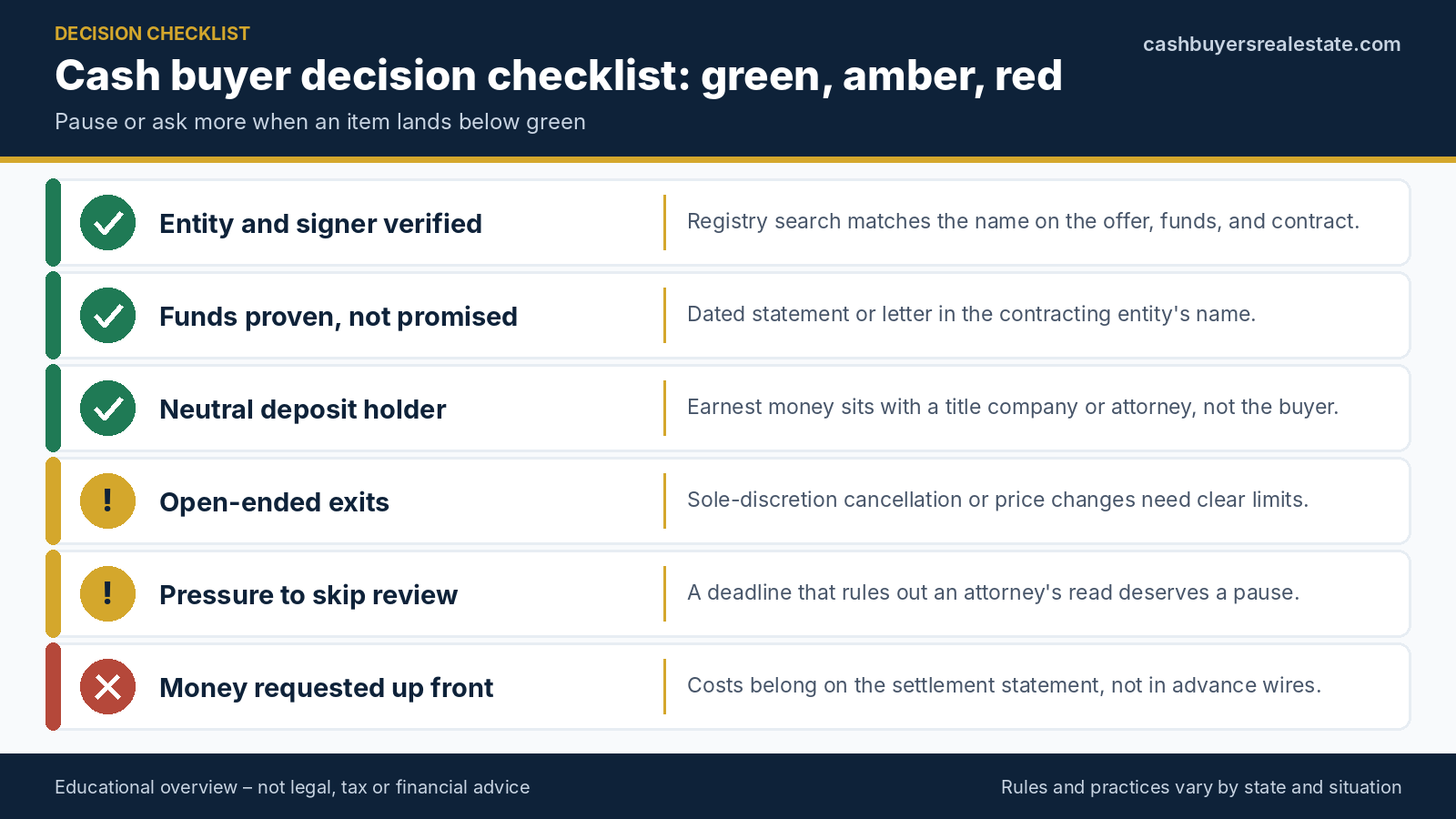
Text version of this infographic
- Entity and signer verified — Registry search matches the name on the offer, funds, and contract.
- Funds proven, not promised — Dated statement or letter in the contracting entity's name.
- Neutral deposit holder — Earnest money sits with a title company or attorney, not the buyer.
- Open-ended exits — Sole-discretion cancellation or price changes need clear limits.
- Pressure to skip review — A deadline that rules out an attorney's read deserves a pause.
- Money requested up front — Costs belong on the settlement statement, not in advance wires.
The checklist is a compression, and the sections around it are the reasoning behind each item. The last section before the guide’s decision framework deals with the moment that every set of questions eventually reaches: the answer that doesn’t quite answer, and what to do about it.
When the Answers Are Vague: Red Flags, Pressure, and What to Do Next
Every set of questions eventually produces an answer that isn’t one. The buyer changes the subject, promises a document that never arrives, or says the point is too complicated to explain on the phone. Sellers often respond by feeling they asked something unreasonable, and that reaction is exactly what a hurried or evasive counterparty hopes for. This section is about the response to thin answers: how to follow up without escalating, how to recognize pressure for what it is, and what to do, and whom to tell, when the pattern points toward something worse than disorganization.
Reading vague, evasive, and pressured answers
Not every unsatisfying answer means bad faith. Busy people answer imprecisely, salespeople have scripts, and some buyers are new to the business. The skill is distinguishing a gap in information from an unwillingness to provide it, and the simplest way to do that is to ask again in a way that makes a real answer easy.
A vague answer is still an answer: how to follow up
Three kinds of unsatisfying reply are worth separating. A vague reply is one that sounds responsive but contains nothing checkable, such as “we’re well funded” or “we close deals like this all the time.” An evasive reply moves away from the question, for instance by answering a question about the closing agent with a remark about how fast the buyer can move. An inconsistent reply contradicts something said earlier, such as a changed entity name or a different deposit amount. The first calls for a more specific question, the second for the same question repeated, and the third for a request to correct the record in writing.
The follow-up has a simple form: restate, ask for a document, and set a date. “You mentioned the buyer has funds available. Could you send a bank statement or a letter from your lender in the buyer’s name by Wednesday? I’m happy to wait until then to continue.” This tone is cooperative, and it converts a feeling into an observable event. On Wednesday either the document arrives or it does not, and in either case you have information that does not depend on how confident anyone sounded. Resist the temptation to fill silence with reassurance, such as “no rush, whenever you can,” because the date is what gives the request meaning.
Keep a running record of what you asked and what came back. A simple log with a handful of columns is enough, and it prevents the common problem of remembering the tone of a conversation but not its content. The following fields work for most sellers, and writing them down takes less than a minute after each call.
- The date, the person you spoke with, and the entity they said they represent.
- The exact question you asked, in a sentence.
- The answer you received, and whether it was specific, vague, or evasive.
- Any document promised, the promised date, and the date it actually arrived.
- Your next step and the date you will take it.
After a few days the log shows patterns that no single call can. A buyer whose promised documents arrive on time, whose answers match from one call to the next, and whose explanations hold up when checked has given you evidence of reliability that no website can. A buyer whose promises slip, whose names change, and whose explanations grow more elaborate as questions get more specific has also given you evidence, of the opposite kind. In both cases, you are deciding based on conduct rather than charm.
Pressure tactics: deadlines, walk-away threats, and special favors
Pressure takes recognizable forms. There is the deadline that expires today, the claim that other sellers are waiting, the offer that “goes away” if you speak to an attorney or another buyer, the suggestion that paperwork can be sorted out later, the invitation to sign at a kitchen table with no time to read, and the request that you keep the conversation private from family members or advisors. Some of these have a legitimate version: an investor may truly have a limited window in which funds are committed. What distinguishes a legitimate deadline is that it comes with a reason you can verify, and that it survives a reasonable request, such as one extra day to have an attorney read the contract.
The Federal Trade Commission’s general advice about scams applies surprisingly well here. It notes that scammers push people to decide quickly, that legitimate businesses give you time, that anyone pressuring you to pay or share personal information is likely a scammer, and that saying a situation out loud to a friend, relative, or neighbor can reveal a problem. Real estate sales are not the same as the scams the agency is mainly describing, and a buyer who sets a firm deadline is not necessarily dishonest. The practical lesson is the same, though: when a decision involves tens or hundreds of thousands of dollars, the time to think is part of the product, and a counterparty who tries to remove it is asking you to take a larger risk.
Sensitive circumstances, such as an inheritance, a divorce, or a pending foreclosure, can make pressure feel more persuasive and a quick resolution more tempting, and the best protection is to shorten the decision into smaller ones. You do not need to decide today whether to sell; you need to decide whether to read the contract, whether to ask a question, or whether to get one more opinion. Each of those is small and reversible. If someone treats those small steps as unreasonable, it is better to learn that now than at closing. A longer discussion of fast-sale pressure and how to evaluate it appears in the guide to selling a house fast.
| Warning sign | Why it matters | A calmer response |
|---|---|---|
| Refusal to name the buyer entity or closing agent | You cannot verify who is paying or who holds the money | Ask for both in writing and pause until you have them |
| Funds described but not documented | The offer may rest on money that does not exist or is committed elsewhere | Request a statement or professional letter by a set date |
| Offer expires in hours and rules out legal review | The time pressure itself removes your protection | Say you will respond after an attorney has read the contract |
| Earnest money held by the buyer, or very small | The buyer has little to lose by walking away | Ask for a neutral holder and a meaningful amount |
| Request for money from you before closing | Closing costs normally come from proceeds, not advance payments | Decline and ask for the item to appear on the settlement statement |
| Contract blanks, handwritten changes, or promises made only by phone | Whatever is not written may not be enforceable | Insist on a complete typed document with every promise added |
| Changed payment instructions by email | A common pattern in wire fraud | Call a verified number before any funds or bank details move |
Treat the table as a set of prompts, not proof. None of these signs establishes dishonesty by itself, and each has an innocent explanation in some situations. A buyer whose offer expires quickly, for instance, may be responding to a genuine funding window. But the more rows that apply to the same buyer at once, the more reasonable it is to slow everything down, ask for more evidence, and seek other offers. The calmer response in the right column is meant to give you an action that preserves the option of continuing if the explanation turns out to be reasonable.
What to do when something feels wrong
When several signs accumulate, or a single one is serious, the goal is to protect your options and your money without escalating a conflict that may turn out to be a misunderstanding. The steps are mostly about slowing down, writing things down, and bringing in people whose interests do not depend on your decision.
Pause, document, and get a neutral second opinion
The first step is to stop sharing new information and stop signing things. You are not obliged to continue a conversation because it has started, and you can say so politely: “I’d like to pause while I review the paperwork with my attorney. I’ll be in touch next week.” Then gather what you have, including the offer, any draft contract, your call log, and the emails, and bring it to a real estate attorney or the title company you chose independently. These professionals see many transactions and can usually say within a short meeting whether a document is unusual and what questions you should still ask. If you have already signed, do not assume it is too late; the contract may include cancellation rights, and some state laws, such as the wholesaler rule mentioned earlier, give homeowners a short window to cancel, so ask an attorney quickly and act on what they tell you.
Obtain at least one other point of view on the sale itself. A second offer, an agent’s opinion of value, or a conversation with a different investor can show whether the first buyer’s number and terms are in a reasonable range. The comparison tools described in how to compare cash offers help here. Persistent unsolicited calls or texts from buyers can be reduced by registering with the National Do Not Call Registry, but the Federal Trade Commission notes that it can take up to 31 days for sales calls to stop and that the registry does not block calls or stop scammers (FTC, National Do Not Call Registry FAQs). Blocking numbers and ignoring unknown callers is often more effective than answering to ask them to stop.
Where to report problems, and why reporting helps
If you believe a buyer, a middleman, or an impersonator has defrauded or tried to defraud you, there are several places to turn. The FTC accepts reports of scams at ReportFraud.ftc.gov, and for identity theft it points people to IdentityTheft.gov. For cyber-enabled fraud, including diverted wire transfers, the FBI’s Internet Crime Complaint Center at ic3.gov is the central reporting point, and its site advises filing even if you are unsure whether your complaint qualifies (FBI Internet Crime Complaint Center). It also warns that IC3 does not work with non-law enforcement entities to recover lost funds, which is a useful caution against anyone who contacts you afterward offering to get your money back for a fee.
Beyond the federal channels, your state attorney general’s consumer protection office takes complaints about deceptive business practices, and the state real estate regulator handles complaints about licensed agents and brokers. If money was taken or you feel physically or financially threatened, contact local law enforcement. If you wired funds, call your bank right away to ask about a recall, as the CFPB advises. Reporting does not guarantee a remedy, but it creates a record, can help investigators see patterns that individual victims cannot, and, in the case of wire fraud, can matter in the first hours. More guidance on patterns and prevention is collected in the trust hub on cash home buyer scams.
Illustrative example (hypothetical numbers, not market data): A man who inherited a duplex from his aunt receives an offer of $96,000 and a text saying it expires at five o’clock. He replies, “I’d like my attorney to review the contract first. Could you send the full agreement and confirm which title company will close?” The buyer answers that the price will drop to $90,000 if he consults a lawyer because “it complicates things.” The man does not argue. He writes the exchange in his log, thanks the buyer, and sends the same property details to two other buyers and an agent. One of the other offers, from a buyer who named an attorney and supplied a lender letter within a day, is $93,500 with a ten-day inspection window and a deposit held by that attorney. He accepts it after the attorney reads the draft. The difference between the three outcomes was not luck; it was the willingness to treat pressure as information.
Frequently Asked Questions About Questioning a Cash Buyer
The questions below are the ones sellers raise most often once they start using a list like this one. They are grouped by theme so that you can jump to the area you are working on, and the answers are deliberately short. Where the right answer depends on your state, your contract, or your property, the answer says so and points toward the kind of professional or office that can settle it.
Questions about the buyer and the money
Sellers hesitate most about asking directly for identity and funding information, so these questions deal with manners, numbers, and what a reasonable buyer should be willing to provide before a contract is signed.
Questions about buyers and verification
- Is it rude to ask a cash buyer for proof of funds?
No. Asking for evidence of funds is a normal part of evaluating any offer, and professional buyers expect it. Frame it as your standard process and ask for a document in the name of the entity that will sign the contract. How the buyer responds, including how quickly and how specifically, tells you as much as the document does.
- How many buyers should I talk to before deciding?
There is no magic number, but comparing at least two or three sources is a sensible habit, and one of them can be a listing agent’s opinion of value. The goal is to see the range of prices and terms, not to run an auction. If every buyer lands near the same figure, you have learned something about the property. If one is far below the rest, the explanation of why is worth asking for.
- Does a cash buyer need a real estate license?
It depends on what the person is doing and where. An individual or company buying a house for itself generally doesn’t need a license for that purchase alone, but licensing and disclosure rules can apply to people who market or negotiate property on behalf of others, and some states have specific rules for wholesalers. Ask directly whether anyone involved is licensed, and verify with your state’s real estate regulator.
- Can I ask to talk to a seller the buyer has worked with before?
You can ask, but many buyers will decline for privacy reasons, so treat a refusal neutrally. More useful substitutes are recorded deeds that you can look up yourself, and a call to the title company or attorney that handled earlier closings. Those sources have no stake in your decision, and the deeds do not depend on anyone’s willingness to vouch.
Questions about funds, deposits, and wires
- How much earnest money is normal?
There is no universal amount. Deposits vary by region, price, and the buyer’s approach, and a small deposit is not wrong in itself. What matters is who holds it, when it is paid, when it is refundable, and what happens to it if the buyer defaults after the deadline. A deposit that is held by the buyer or is always refundable offers little protection.
- Should a buyer ever ask me to pay a fee before closing?
Costs that belong to the seller normally appear on the settlement statement and are paid from proceeds at closing. A request that you wire or send money in advance for processing, release, or a membership is unusual and deserves a hard look. The FTC advises never paying anyone who insists on wire transfers, cryptocurrency, payment apps, or gift cards. Ask for the charge to be itemized in writing and checked with your closing agent.
- What if the buyer says the money comes from a hard-money lender?
Many legitimate investors borrow short term, so the statement alone is not a problem. Ask whether closing depends on the lender’s approval, an appraisal, or any other condition, and request a commitment letter that shows the lender’s name, the amount, and its conditions. The more conditions there are, the less the deal resembles the simple cash purchase you may have assumed, and the more weight the contract deadlines deserve.
Questions about the offer, contract, and closing
The remaining questions concern what can change after you agree, how the paperwork behaves when circumstances shift, and what you should expect from the weeks between signature and keys.
Questions about price and contract
- Can a cash buyer lower the price after I accept?
Only if the contract allows it or you agree to a change. Many contracts include an inspection or due diligence period during which the buyer may renegotiate or cancel, so read that clause carefully. Ask that any right to reduce the price be limited to documented findings and that you may cancel without penalty if a reduction is proposed. If the contract is silent, a lower price is a request, not an entitlement.
- Should an attorney review the contract even if it is only a page or two?
Short contracts can hide significant terms, such as assignment rights, recorded notices, and default remedies, so review is often worthwhile regardless of length. It is most valuable when the buyer uses its own form, the property has liens or multiple owners, or the deadline is short. Ask the attorney for the cost in advance, and send the draft early so the review does not become the reason you rush.
- Does selling as-is mean I do not have to disclose problems?
No. Selling as-is generally means you are not agreeing to make repairs, but disclosure obligations are separate and vary by state. Do not conceal known defects or give inaccurate answers on any form you are asked to complete. An attorney or your state’s real estate regulator can tell you which disclosures apply to your property.
- Can I cancel after I sign?
It depends on the contract and on your state. Some agreements include a cancellation window for the seller, and a few state laws, such as Oklahoma’s rule for wholesalers, provide a short window of two business days. Many contracts include none, and walking away may cost you the buyer’s remedies. If you have doubts, speak to an attorney immediately rather than after a deadline has passed.
Questions about timing and what happens afterward
- How long should a cash sale take?
It varies with title condition, payoff requests, occupancy, and the buyer’s own plans, so be cautious about any single promise. A clean title and a prepared closing agent shorten the timeline, while liens, estates, and missing documents lengthen it. Ask for a written closing date range, and ask what could extend it and what you would receive in exchange for an extension.
- What happens if the buyer cancels?
The contract controls. If the buyer cancels within a contingency period, the earnest money is generally returned to the buyer; if the buyer defaults after the deadline, the contract usually says whether you keep the deposit or have other remedies. You can then return the house to the market, and what you learned from the process is useful for the next buyer. Keep copies of every written communication in case there is a dispute.
- What should I keep after closing?
Keep the signed contract and addenda, the final settlement statement, the recorded deed when it is available, confirmation that liens were released, proof of how proceeds were sent, and any Form 1099-S you receive. Your call log and email summaries are worth keeping with them. A tax professional can tell you how long to hold the file and how the sale affects your return.
Choosing a Route and Taking Your First Steps
A good set of questions does not make the decision for you; it makes the decision visible. By the time you have asked about identity, funds, the offer, the contract, the timeline, and the vague spots in between, you should be able to describe your options in a few sentences each, with real numbers and real conditions attached. This final section turns that information into a way of choosing, then into a short list of actions for the coming days.
A decision framework: matching the route to your priorities
Different sellers should reach different conclusions from the same information, because they are protecting different things. The framework below starts from your priorities, not from the buyer’s pitch, and treats a cash sale as one candidate among several instead of a default.
Weighing certainty, price, effort, and time
Begin with the four things you ranked at the outset: the lowest net amount you would accept, the latest date you can close, the repairs you are willing to do, and the uncertainty you can tolerate. Then place each real option against them. A direct sale to a cash buyer tends to rank high on speed, effort, and, if the funds and contract check out, on certainty; it tends to rank lower on price. A traditional listing, particularly one that follows repairs, often ranks higher on price and lower on speed and certainty, since it depends on the buyer’s financing, inspection, and appraisal. An as-is listing falls in between, reducing the work while keeping the wider market, and the guide to selling a house fast without repairs looks at that middle path in more detail.
The useful discipline is to score honestly on net proceeds after costs rather than on headline price, and to value the non-financial items at what they are worth to you. A seller who must relocate for work in six weeks, who is tired of managing a vacant property, and who values a predictable closing may rationally accept a lower net. A seller with time, a house in decent shape, and a strong local market may reasonably decide that the wider market is worth the wait. Neither is making a mistake; each is making a trade. What would be a mistake is to accept a trade without having seen its price, which is exactly what the earlier sections are meant to prevent.
One further consideration is how the answers you received compare across the options, because quality of information is itself a factor. A buyer who answered every question promptly, named the closing agent, supplied a funding document, and accepted a reasonable addendum has narrowed the uncertainty on the cash route. A listing agent who gave a clear net sheet and a realistic timeline has done the same on theirs. If one route came with documents and the other with adjectives, that difference deserves weight, even when the adjectives are attached to the higher number.
When a cash sale is probably not the right fit
Several situations point away from a direct cash sale, and it is a sign of a sound process to notice them. If the house is in good condition, in a market with active demand, and you have time, the premium that a traditional sale might earn could outweigh the convenience of a quick sale. If the answers you received about identity, funds, or the closing agent were consistently thin, the risk may exceed the benefit regardless of price. If the contract allows the buyer a long, open-ended right to cancel, you may be giving away a free option on your house. And if you feel pressure to decide that no one will justify with a verifiable reason, the pressure is the reason.
There are also situations where a cash sale is not the question at all. If you are facing foreclosure, for example, the options and deadlines are set by state law and your lender, and a housing counselor or an attorney should be involved before you consider any buyer. If the property is part of an estate, the authority to sell must be established first. If the house has liens that exceed its value, the first conversation may be with the lienholders. In each case, the questions in this guide remain useful, but the sequence changes: resolve who may sell and what must be paid, then evaluate buyers. Related situations are covered in the pages on selling a house for cash and the other guides linked throughout this article.
What to do next: first steps, documents, and the questions to carry with you
With a route in mind, the next few days are about collecting the documents that make every conversation faster and putting the questions into a form you can use at the table, on the phone, or in an email.
Documents to gather and a one-page summary of the questions
A small folder of documents shortens almost every part of the process and signals to a buyer or agent that you are prepared. Start with the items below, and add whatever your situation requires.
- A current payoff statement for each mortgage, home equity line, or other loan secured by the property.
- The deed or another record showing how title is held, and the names of every owner.
- For an estate, the document showing who has authority to sell on behalf of the owner.
- Recent property tax bills, association information and dues, and any notices of liens or violations.
- Receipts, permits, and reports for recent repairs, which support your position on price.
- Your call log, the offers in writing, and any draft contracts you are reviewing.
Sellers often find that the document gathering itself brings problems to the surface early, which is useful. A payoff statement may show a balance higher than expected, a deed may reveal a co-owner nobody mentioned, or a tax bill may show an unpaid amount that will be deducted from proceeds. Discovering these items before a buyer does means you can describe them accurately, plan for them in your price expectations, and avoid the awkward moment when a title search turns them up after a contract has been signed. It also lets you tell every buyer the same story, which makes their offers easier to compare. Consistency matters more than it may seem, because an offer built on a rosier description of the house, or on a payoff that was guessed instead of documented, cannot be compared fairly with one built on the facts, and you will not know which is which until the paperwork settles the question.
The table below condenses the whole toolkit into a page you can print and keep beside the phone. It is organized by theme, matching the sections of the article, and it pairs each core question with the answer that should reassure you, the answer that should slow you down, and the evidence worth asking for.
| Theme | Core question | Reassuring sign | Slow-down sign | Evidence to request |
|---|---|---|---|---|
| Identity | Who signs, who closes, and may the contract be assigned? | Named entity, clear role, disclosed assignment | Brand name only, evasive about role | Entity name, registry match, license number if any |
| Funds | What shows the buyer can pay, and does closing depend on anyone else? | Document in the entity’s name with a recent date | Screenshots or verbal assurance | Statement or professional letter |
| Deposit | Who holds the earnest money, and when is it refundable? | Neutral holder, meaningful amount, defined deadline | Held by the buyer, always refundable | Written receipt from the holder |
| Offer | How was the number built, and what could change it? | Specific assumptions and a short list of price triggers | “Our formula,” open-ended re-evaluation | Line-by-line cost estimate and net sheet |
| Contract | What lets either side cancel, and what is recorded? | Clear conditions, defined dates, balanced remedies | Sole-discretion exits, blanks, handwritten edits | Complete typed draft with addenda |
| Closing | Who handles it, and what happens if it slips? | Named title company or attorney, extension terms | No neutral agent, vague “quick” timeline | Closing agent contact verified independently |
| Possession | When must I leave, and what stays? | Dates, condition, and occupancy terms in writing | Verbal promises only | Addendum and photographs of condition |
No buyer will score perfectly on every row, and the table is not a pass-fail test. It is meant to help you see where an offer is strong and where it leaves something open, so that you can ask for the missing piece or decide that the gap is acceptable. A seller who has filled in this table for two or three sources will usually know, without any further advice, which one has earned more trust and which one needs to answer more questions.
Sequencing your next week without feeling rushed
A workable order for the next several days is to gather your documents first, then send the same short written questions to each buyer or agent you are considering, then compare the replies side by side. Verify the entity, the funds, and the closing agent for any source that remains in the running, and ask an attorney to read the draft contract of the front-runner before you sign anything. If the answers are good, the sale can move with confidence. If they are not, you will have lost a few days and gained clarity about what you are dealing with, which is a better trade than the reverse.
It can help to set small checkpoints that keep the process from drifting. Decide in advance the date by which you want a written response from each source, the date by which you want your attorney to have the draft, and the date by which you will decide whether to continue, wait, or try a different route. Share those dates with the people you are dealing with, in a friendly way, because it reveals which of them respects a timetable. If a checkpoint passes without the documents you asked for, treat that as the answer to the question and move to the next step in your plan. Finally, tell one trusted person what you are doing and what you have been told, because explaining a transaction aloud is one of the most effective checks there is.
Whichever route you choose, you can keep the process calm by remembering that a decision made with documents in hand is almost always better than one made under a deadline someone else set. The questions are not a test the buyer has to pass; they’re a way of making sure that you and the other party are agreeing to the same transaction. Some sellers will finish this process and sell to a cash buyer with relief, some will list with an agent, and some will decide to wait. All three are reasonable outcomes if they come from information instead of urgency, and you can always return to the questions, one theme at a time, whenever a new offer or a new complication appears.