
Sell My House for Cash: Offers, Costs & Closing
Most people who type “sell my house for cash” into a search bar are not browsing. Something has usually happened or is about to happen: a job transfer with a start date, an inherited house that nobody wants to keep paying taxes on, a roof that failed the inspection, a marriage that ended, a mortgage payment that has started to feel out of reach, or simply a house that has sat on the market long enough to wear everyone out. The promise in front of you is attractive because it answers all of those pressures with one word. Cash means no lender to wait for, no appraisal to fail, no buyer whose financing falls through three days before closing. What the promise rarely explains is how a cash sale is priced, who is actually on the other side, what you will net after the mortgage payoff and closing costs, and what you give up in exchange for the speed. This guide is built to answer those questions in the order a seller meets them.
The direct answer is that you can sell a house for cash in several different ways, and they are not interchangeable. Real estate investors and investment funds buy houses they intend to renovate, rent, or resell. Instant-offer platforms, often called iBuyers, make algorithm-driven offers on homes that fit their buying criteria. Ordinary individuals with enough savings or sale proceeds from another property sometimes buy outright, either through an agent’s listing or directly. Auctions produce cash closings on a fixed schedule. Each route prices risk differently, charges for convenience differently, and exposes you to different mistakes. A cash sale is usually faster and more certain than a financed sale, and it is usually priced below what a well-prepared, well-marketed listing might bring. Whether that trade makes sense depends on your numbers, your calendar, and the condition of the property, which is why this article spends most of its length on arithmetic and verification rather than on slogans.
Selling a house for cash means the buyer pays without a mortgage, so there is no loan approval or appraisal to delay the sale. Offers are typically lower than a retail sale price because the buyer prices in repairs, risk, and profit. You still need a written contract, clear title, any mortgage payoff, and a proper closing.
It helps to be precise about what “cash” changes and what it does not. Cash describes how the buyer funds the purchase. It does not remove the purchase contract, the title search, the payoff of any mortgage or lien, the signed and recorded deed, the closing statement, or your obligation to disclose what the law in your state requires you to disclose. Those pieces are the same whether the buyer wires $90,000 or borrows $400,000. What disappears is the lender’s underwriting, the appraisal that comes with it, and the financing contingency that lets a financed buyer walk away if the loan falls through. That is where the speed and the certainty come from, and it is also why a seller can find themselves holding a contract that moved faster than they had time to read.
The market for all-cash purchases is larger than most sellers expect. The National Association of Realtors reported that all-cash transactions made up 27 percent of existing-home sales in September 2026, and that individual investors and second-home buyers accounted for 20 percent. Those figures describe the market as a whole, not the businesses that advertise “cash offers,” and they include buyers who simply paid for a listed house out of savings or from the sale of another home. Still, they make a useful point: cash buyers are an ordinary part of the market, not a fringe, and the fact that someone can pay cash tells you nothing about whether the price, the contract, or the closing process they propose is good for you.
Because a house is typically the largest asset in a household, the difference between a careful cash sale and a careless one is rarely small. A gap of five or ten percent on a $350,000 house is a gap of $17,500 to $35,000, which is more than many families save in several years. A hidden term in a contract can cost more than that, and a wire sent to the wrong account can cost everything. For that reason this guide treats verification as part of the sale itself. You will see how to confirm that a buyer has the money, how to read the clauses that decide who bears risk, how to compare offers on net proceeds rather than headline price, and how to recognize the patterns that fraudsters use around real estate closings.
This guide is written for several kinds of readers at once, and it helps to say who they are. Some already hold an offer and want to know whether it is sound. Some have not contacted anyone and would like to understand the field before they do. Some are heirs, landlords, or relatives managing a sale on someone else’s behalf, carrying responsibility without necessarily having any legal training. And some are simply curious about how cash buyers work. The advice that follows tries to hold for all of them: collect facts first, ask questions in writing, compare net proceeds instead of headline prices, verify the people and the money, and treat any deadline that someone else imposes with healthy skepticism. Where the right answer depends on your state, the guide says so plainly instead of guessing.
The guide moves in the order of the seller’s journey. It starts with what a cash sale is and why sellers choose it, then maps the routes that produce a cash closing and the steps from first contact to closing day. It explains how offers are built, how to compare them against a traditional listing on net proceeds, and how mortgages, liens, and title are settled at the table. A section on taxes covers the home sale exclusion, basis, and the 1099-S in overview form. After that come scams and verification, the situations in which a cash sale is not the best route, special situations such as inherited homes, tenants, and damaged property, and the state-by-state differences that quietly change how a closing works. A frequently asked questions section and a decision framework with a first-week plan close the guide.
A word on scope. Several topics here have their own deeper guides on this site, and where that is the case this article gives the essential reasoning and points you onward. For a narrower walkthrough of the same question, see the companion guide to selling a house for cash. If your main question is who the buyers are and how to judge them, the guide to cash home buyers and how they operate goes further. If you are weighing speed as the central concern, the broader guide to selling quickly by any route covers the timeline from the other direction. And if a lien, a probate, or a damaged structure is the dominant problem, the specialized pages linked in the relevant sections will serve you better than a general overview can.
One more thing before you start. Nothing about selling for cash needs to be decided in a hurry, even when the situation feels urgent. The honest buyers you may deal with will give you time to read a contract, ask questions, and talk to a professional, and the ones who object to that are telling you something important. If you remember a single principle from the pages that follow, let it be this one: compare what you would actually receive, on what date, with what risk, under each realistic route, and choose the route that fits your situation rather than the one that sounds easiest.
What Selling for Cash Really Means and Who Is Buying
The phrase “cash sale” gets used for at least three different things: a buyer who pays without a mortgage, a company that markets itself as a cash buyer, and a deal that closes unusually quickly. Those overlap, but they are not the same, and sellers who blur them tend to make avoidable mistakes. This section sets out what the term covers, where all-cash buyers actually appear in the market, and what a seller trades away and gains by choosing this path.
What a Cash Sale Is, and What It Is Not
Before comparing routes or prices, it pays to pin down the definition, because most of the later decisions depend on it. A cash sale is a transfer of ownership in which the buyer funds the entire purchase price from their own resources, with no mortgage lender involved in the purchase.
Cash Describes the Funding, Not a Shortcut Around the Transaction
When a buyer pays cash, they replace one piece of the process, the lender, and leave the rest intact. A purchase contract still sets the price, the closing date, the contingencies if any, and what happens to the earnest money deposit. A title search still looks for liens, unpaid taxes, judgments, and defects in the chain of ownership. A deed still has to be signed by every person with an ownership interest, delivered, and recorded with the county. Someone still has to prepare a settlement statement, collect the money, pay off the seller’s mortgage, and disburse what remains. In some states that someone is a title company or escrow agent, and in others it is an attorney.
The reason this matters is that the speed of a cash sale can create the impression that the formalities are optional. They are not. A buyer who proposes to skip the title search, close at a kitchen table with no neutral third party, or accept a deed without recording it is not offering a faster version of the same transaction. They are offering a less safe one, and the risk falls mostly on the seller who has not yet been paid and, later, on the buyer if a defect surfaces. A properly run cash closing is not dramatically different from a financed one in its legal steps, and the best evidence that a cash buyer is serious is that they are comfortable with all of them.
Disclosure duties also travel with the house. Most states require sellers to disclose certain known material defects, either on a state-mandated form or through general duties of honesty in the transaction, and federal law adds lead-based paint disclosures for most housing built before 1978. Selling “as-is” changes who pays for repairs and what the buyer can demand after closing. It does not turn a known hidden defect into something you may conceal. We return to this in the section on state variation, but it belongs in the definition because sellers sometimes assume that a cash buyer who says “I’ll take it as it is” has also waived the disclosure paperwork. Whether they can do so depends on state law, and you should not count on it.
Where All-Cash Buyers Show Up in the Market
Cash buyers do not live in one corner of the market. The most recent monthly report from the National Association of Realtors, covering September 2026, put all-cash sales at 27 percent of existing-home transactions, compared with 30 percent a year earlier, and put individual investors and second-home buyers at 20 percent. The same report showed a median existing-home price of $417,500, a median time on market of 33 days, and 4.8 months of housing supply. These are national figures for the whole resale market, which means they say little about any single neighborhood, and they combine buyers who pay cash for beautiful, fully renovated houses with buyers who pay cash for properties no lender would finance.
That mix is the key to understanding who may approach you. Some all-cash buyers are retirees or move-up buyers using proceeds from a prior sale, and they typically buy through the multiple listing service, with an agent, at prices close to what financed buyers pay. Others are small landlords adding a rental. Others are full-time renovators who buy, repair, and resell, and who calculate every offer backward from what the finished house will bring. Still others are funds and operating companies that buy at scale with institutional capital. And some are wholesalers, who sign a contract with you and then try to sell their contractual right to buy to someone else. Each of these has different incentives, and the price they will pay reflects those incentives.
A practical consequence follows. When an unsolicited postcard, text, or online ad offers to pay cash for your house, you usually cannot tell from the message which of these buyers you are dealing with. The first useful question is therefore not “how much?” but “who is the buyer, and are they buying the house themselves or arranging for someone else to buy it?” Everything else, from how much to trust their proof of funds to how much negotiating room you have, depends on that answer. The guide to how cash home buyers operate behind the offer examines the business models in more depth.
Why Sellers Choose Cash and What They Trade for It
Every route in real estate is a trade. A cash sale swaps part of the price for certainty, speed, and convenience, and whether that is a good swap is a function of what you value most and what your alternatives would actually deliver. Looking at both columns of the ledger honestly is the starting point for the rest of this guide.
What You Gain: Certainty, Speed, and Fewer Moving Parts
The strongest argument for a cash buyer is certainty of closing. Financed purchases fail for reasons that have nothing to do with the house: a buyer’s employment changes, a credit score drops after a new car loan, an appraisal comes in under the contract price, or the underwriter asks for another document that takes a week to arrive. A buyer paying cash removes most of that risk from the calendar. If the house passes the buyer’s inspection and the title is clean, the main uncertainty left is whether the buyer is who and what they say they are, which is a problem you can test before signing.
Speed follows from certainty. With no loan to underwrite, a closing can often happen as soon as the title work and the paperwork are ready, and that can matter a great deal when you have a deadline: a purchase of your next home that has its own closing date, a relocation, an estate that must be settled, or a foreclosure timeline. Cash also tends to bring fewer conditions. Many cash buyers will buy the house in its current condition, which spares you from repair requests, from staging, and from keeping the house show-ready with a family living in it. Some will let you set the closing date, stay in the house for a short period after closing, or leave behind furniture and belongings you do not want to move.
These advantages are real and they have value that does not show up in a net proceeds calculation. A seller who avoids three months of carrying costs, two rounds of failed contracts, and the strain of constant showings has gained something, even if the dollar figure at closing is smaller. The honest way to account for that is to assign the benefits a number, a monthly holding cost, a probability that a listing falls through, a repair budget, and compare totals, which we do in the net proceeds section.
What You Give Up: Price, Bargaining Power, and Some Protections
The cost of those advantages is usually a lower price. Professional cash buyers who plan to resell need room for repairs, for the carrying costs of owning the house until it sells, for their own closing and selling costs, and for a profit that compensates them for risk. That room comes out of the amount they can offer you. The size of the discount varies enormously, from a modest difference on a clean house in a strong market to a very large one on a house with serious problems, and no honest article can give you a single number that applies to your property. What can be said is that the discount is a price for services rendered, and you are entitled to know what services you are buying.
You may also give up bargaining power. In a competitive listing, several buyers bid against each other and the seller benefits. In a one-on-one deal with a single investor, there is no competition unless you create it by seeking additional offers. A buyer who knows they are your only option, or knows you are under time pressure, has less reason to improve their offer. This is not an accusation of bad faith; it is an observation about how negotiations work, and it is the main reason this guide keeps recommending that you gather more than one written offer and an independent estimate of what the house could sell for on the open market.
Finally, some protections that come automatically in an agent-assisted listing must be arranged deliberately in a direct cash sale. A listing agent is generally bound by licensing law and fiduciary duties to you, and the contract forms used in many states are standardized and tested. A direct deal with an investor may use the investor’s own contract, drafted to protect the investor, with terms you will want a real estate attorney to review. None of this makes direct sales improper. It means the work of protecting your interests shifts to you, and part of the point of this guide is to show what that work looks like.
Experience is the other asymmetry. A professional buyer evaluates dozens or hundreds of houses and signs many contracts a year, while you may sell a house two or three times in your life. They know what repairs cost, how long resale takes in your area, and which contract terms they can ask for. You know your house, its history, and what you need. Neither knowledge is superior, but the imbalance is one reason independent advice and competing offers are worth their cost. They bring the missing perspective to your side of the table.
The Routes That End in a Cash Closing
Searching for a way to sell a house for cash puts you in front of several kinds of buyers at once, and they behave differently enough that treating them as one category leads to bad comparisons. Some will inspect the house and negotiate. Some will quote a number from a data model and offer little flexibility. Some are intermediaries who never intend to own the property at all. The table below lays the main routes side by side before the sections that follow explain each in turn.
| Route | Who actually buys | How the price is set | Condition tolerance | Main risk to the seller |
|---|---|---|---|---|
| Local investor or landlord | An individual or small company that will renovate, rent, or resell | Estimated resale value minus repairs, costs, and margin | High; buys many conditions | Low offer if you accept the first number; contract terms written for the buyer |
| Investment fund or large operator | A company with institutional capital buying at scale | Pricing models plus a property review | Moderate to high | Less room to negotiate; process may be standardized |
| Wholesaler | Not the end buyer; sells the contract to someone else | Buyer’s likely price minus the wholesaler’s fee | High | Buyer may not be able to close if no end buyer is found; assignment terms |
| Instant-offer platform (iBuyer) | A company using automated valuation and a fixed buying box | Automated estimate with adjustments and service charges | Low to moderate; prefers newer, standard homes | Service fees and repair credits can narrow the gap to a listing |
| Individual all-cash buyer | A person using savings or proceeds from another sale | Open negotiation, often near market value | Low to moderate; may inspect | Offer may still carry an inspection contingency |
| Auction | The highest bidder on the sale date | Competitive bidding above any reserve | Varies by auction terms | Reserve, fees, and short timelines; terms are fixed in advance |
Read the table as a map rather than a ranking. The first column describes the route, the second tells you who ends up with the deed, and the last two columns show where each route is strongest and weakest. A local investor tolerates condition problems but prices them heavily. An individual cash buyer pays close to market but often wants an inspection. A wholesaler may promise a high number precisely because the wholesaler will not be the one paying it. The sections that follow add the detail that a table cannot hold.
Professional Buyers: Investors, Funds, and Wholesalers
The biggest and most visible group of cash buyers works in real estate as a business. Understanding how they make money explains almost every feature of their offers, from the size of the discount to the willingness to buy houses in poor condition.
Investors, Landlords, and Funds: How They Buy and What They Want
An investor who buys houses to renovate and resell works backward from the finished house. They estimate what the property would sell for after repairs, subtract the cost of the work, the cost of owning it during the project, their buying and selling costs, and a target profit, and arrive at the most they can pay. Landlords run a similar calculation from the rent rather than the resale price, asking what the property will earn after taxes, insurance, repairs, and vacancy. Funds and larger operators add standardized underwriting, a cost of capital, and sometimes an internal approval process that makes their offers more rigid and also more reliable once approved.
This working-backward method has two consequences for you. First, the offer is highly sensitive to the buyer’s estimate of repair costs, which is the least certain number in the formula and the one where buyers have the strongest incentive to be cautious. A cosmetic update that costs $15,000 in one contractor’s bid can be priced at $35,000 in the buyer’s model because the buyer builds in a cushion for surprises. Second, the offer is a ceiling set by the buyer’s math, not a negotiation over an asking price. If the numbers do not work for the buyer, no amount of reasoning about what the neighbors’ houses sold for will move it, though reliable repair estimates and evidence of the finished value sometimes will.
Experienced investors are also the group most likely to offer terms that a financed buyer cannot, such as a short inspection period, a closing date that you choose, payment of certain closing costs, or willingness to take on a house with unresolved permits or tenants. Those terms have value, and they are worth weighing against the price. A good investor is not a villain, and many sellers are well served by a clean, fast sale to a buyer who knows what they are doing. The work for you is to separate the serious ones from the opportunists, and the guide to how investors who buy houses evaluate a deal helps with that.
The word cash is also looser than it sounds. Some buyers advertised as cash purchasers fund the deal with a short-term loan from a private lender, a line of credit secured by other property, or money raised from partners for each project. That is not dishonest, and the lender is not a mortgage lender in the usual sense, but it means the buyer’s ability to close depends on a third party who has its own conditions. Ask directly whether the purchase depends on any loan or outside approval, and ask for proof of funds that matches the answer. A buyer paying from their own accounts can show you a statement. A buyer relying on a line of credit can show you the available balance and the terms.
Wholesalers and Contract Assignment: A Different Kind of Cash Offer
A wholesaler is a middleman. Instead of buying your house, they sign a purchase agreement with you and then look for another buyer, typically an investor, to take over the contract in exchange for an assignment fee. If they find that buyer, the sale closes, and the investor pays the price on the contract while the wholesaler collects the difference between that price and what the investor agrees to pay. If they do not, the wholesaler may attempt to renegotiate with you, ask for more time, or let the contract expire.
Wholesaling is legal in most places and the practice is common, but the rules around it differ by state and are changing. Some states require disclosure that the person contracting with you is not the end buyer, some treat marketing a property one does not own as brokering that requires a real estate license, and some have recent statutes that specifically regulate the activity. The details are a matter for your state’s real estate commission and a local attorney, and this article does not try to summarize fifty variations. The practical point is that a wholesaler’s “cash offer” is not backed by the wholesaler’s own cash. It is backed by the hope of finding someone with cash, and the contract you sign should be read with that in mind.
Questions that clear this up are simple. Ask directly whether the company will be the buyer on the deed or intends to assign the contract. Ask for proof of funds in the name of the entity that will close. Read the contract for assignment language, for any option period that lets them cancel without penalty while you remain bound, and for provisions that record a notice of the contract against your title. A transparent wholesaler answers these questions plainly. One who deflects is giving you information. The list of questions worth asking any cash home buyer expands on this.
It is reasonable to ask a wholesaler how the fee is handled. Some are open about the arrangement and explain that their offer reflects what an end buyer will pay minus a fee for finding that buyer. Others prefer to say little, which leaves you guessing whether the price is fair. The fee itself is not improper, since finding buyers is work, but the combination of an undisclosed assignment, a long option period, and a low price is the pattern that causes disputes. If a wholesaler is your best path, protect yourself by requiring disclosure in the contract, a meaningful deposit, a short period to find the end buyer, and the right to cancel without penalty if the closing does not happen by a firm date.
Platform, Listing, and Auction Routes
Not every cash closing starts with a postcard from an investor. Three other routes produce all-cash closings, and for some houses they are better places to start: automated instant-offer platforms, an ordinary listing that happens to attract a cash buyer, and an auction.
Instant-Offer Platforms and Company-Run Direct Offers
Instant-offer platforms, widely called iBuyers, use automated valuation tools to produce an offer from a few pieces of information about your property, followed by an inspection or photo review and an adjusted final offer. Their appeal is convenience: an online form, a scheduled visit, a closing date you can often choose within a window. Their limits are as important as the appeal. These platforms operate only in certain metropolitan areas and typically buy only homes that fit narrow criteria such as price range, age, and condition. A house with structural issues, an unusual layout, or a rural location is unlikely to qualify.
The offer itself usually consists of a base price from the model, adjustments for condition based on the platform’s review, and a service charge, which may be presented as a fee or built into the price. Any repair credits are deducted from what you receive, and these can be substantial relative to what you expected. The result is that the final net can land well below the first number you were shown. This is not unique to platforms; it is how any buyer who prices risk operates. But a seller who anchors on the first online number and then discovers the adjustments late in the process can feel misled even when the process is working as designed. The antidote is to ask for the offer in writing with every deduction itemized, and to compare it against other routes on net proceeds.
Some larger investment companies also offer a streamlined direct-offer process that resembles a platform: a short intake form, a remote or in-person walk-through, and a written offer within days. The advice is identical. Request the terms and the numbers in writing, understand who funds the purchase, and compare. The guide to how a cash offer on a house is presented and evaluated walks through reading one line by line.
Availability is another variable. Platforms enter and leave markets, change the types of homes they buy, and adjust their appetite as conditions shift, so a service that was available last year in your area may not be today. Treat any platform offer as time-limited, ask how long it is valid, and ask what happens to the price if the inspection reveals something unexpected. A platform offer is most valuable as a data point: a concrete, written, no-obligation number against which to compare an investor’s proposal and an agent’s estimate. It can be the best route for a standard house in good condition and a poor one for a house that does not fit the buyer’s model.
Auctions, All-Cash Buyers on an Agent Listing, and Private Buyers
Auctions convert a house to cash through competitive bidding on a fixed date. A real estate auction company markets the property, sets terms of sale in advance, and sells to the highest bidder who meets the conditions, often with a buyer’s premium and a short closing window. Sellers sometimes set a reserve price below which the house will not sell, and sometimes sell absolute, with no reserve, which means the market decides. Auctions suit unusual properties, estates with many heirs who need a decisive process, and situations in which a published schedule matters more than negotiating latitude. They also carry fees and the risk that bidding is thin.
The route that sellers overlook most is the simplest: list the house with an agent and let a cash buyer find it. Because roughly a quarter of existing-home sales are all-cash, any listing can attract a cash offer, from an individual who wants a quick closing to an investor who sees potential. An agent can also advise on whether light preparation would raise the price enough to justify the work, run competing bids, and structure the listing as-is. The cost is the agent’s commission, a longer and less certain timeline, and the need to keep the house presentable. Whether those costs are worth paying is the subject of the net proceeds section.
Finally, there are private sales to a neighbor, a relative, a tenant, or a friend of a friend who has cash. These can be warm and efficient, and they can also produce misunderstandings about price, about disclosures, and about taxes, particularly when a sale to a family member is priced below value. Even in a private sale, use a written contract, a title search, and a neutral closing agent. The money saved on commissions is not worth a defect in the deed. For a look at a variation of this path, see the guide to selling a house directly to an investor without a listing.
If you consider an auction, ask for the terms in writing before you commit: the commission or fee structure, the buyer’s premium and who pays it, whether the sale is with reserve or absolute, the deposit required of the winning bidder, the closing deadline, and what happens if the winner defaults. Ask how the auction company markets the property and how many registered bidders it typically draws for houses like yours. When a cash buyer makes an offer through your agent’s listing, the offer usually arrives with a proof of funds letter and often a request for a shorter timeline; your agent can verify the letter and negotiate terms on your behalf, which is one of the quiet advantages of keeping a professional in the transaction.
The Seller’s Journey From First Contact to Closing Day
A cash sale feels simpler than a conventional one, and in some ways it is. But there are still stages, and skipping one usually means doing it later under worse conditions. This section follows the sale from the moment you start thinking about it to the day the deed is recorded and the funds reach your account, with attention to what you control at each step and what you do not.
Preparing Before You Talk to Anyone
The best moment to protect your position is before you have a buyer. Sellers who do their homework at this stage negotiate from knowledge, spot mismatched offers quickly, and avoid scrambling when a title company asks for a document that takes two weeks to obtain.
Gather the Facts About the House, the Debt, and the Ownership
Start with ownership. Who is on the deed, and does everyone on it agree to sell? A house held by two siblings after a parent’s death, by a divorcing couple, or by an owner who has since moved and given a relative power of attorney can look simple until a signature is missing. If someone has died, find out whether probate has started and who has legal authority to sign. If the property is held in a trust or a company, locate the trust document or the company’s authorizing paperwork. Every one of those items is much easier to resolve before an offer is in hand than after a closing date has been set.
Next, assemble the numbers on what you owe. Locate your most recent mortgage statement and any home equity loan or line of credit. Check whether any property taxes are past due, whether the homeowners association has recorded a lien for unpaid dues, and whether the city or county has issued a code violation or recorded a charge for cleanup, demolition, or unpaid utilities. A free search of your county recorder’s records, and in many places the tax collector’s website, will show most recorded liens and the status of taxes. These facts determine how much must be paid at closing before any money reaches you, and they sometimes reveal problems that change the whole strategy.
Then describe the property honestly to yourself. Note the age and condition of the roof, the heating and cooling, the plumbing and electrical systems, the foundation, and any signs of water intrusion, pests, or mold. Note anything done without a permit. Note whether the house is occupied by you, by a tenant, or by no one, and whether any belongings need to be removed. You are not preparing for a seller disclosure form yet, although the information will feed into one, and you are not trying to hide anything. You are building the picture that a buyer’s inspector would build, so that you recognize it when a buyer describes it back to you.
Two further ownership checks save embarrassment later. In some states, a spouse who is not named on the deed may still have to sign because of homestead or marital-property rules, so the fact that your name alone appears on the title does not always settle who must consent. And if the house sits in a condominium or a community with an association, the governing documents may impose a right of first refusal, a transfer fee, or rules on leasing and on what must be delivered to a buyer before closing. Asking the association for its resale package early, and asking a title company or attorney whether a spouse’s signature is required in your state, takes a few phone calls and removes two of the most avoidable closing-week surprises.
Establish Your Baseline Value and Your Walk-Away Number
You cannot judge a cash offer without a sense of what the house might bring in an ordinary sale. A real estate agent can prepare a comparative market analysis, which uses recent sales of similar nearby houses to estimate a likely listing price and a range. Many agents will do this at no charge, with the understanding that you may later want to list. A licensed appraiser can provide a formal opinion of value for a fee, which is worth considering when the stakes are high or when the house is unusual. Online estimates are a rough starting point only; they are known to miss condition, upgrades, and local nuances.
Ask the agent two additional questions that are easy to skip. First, what would it likely cost to bring the house to a condition that would command the top of that range, and would the price increase justify it? Second, how long are comparable houses taking to sell, and how many price reductions do they take? The first question tells you whether renovating makes sense, and the second tells you what a listing would likely cost you in time. A median time on market of 33 days nationally, as reported for September 2026, says little about a particular street, and sellers who rely on national averages tend to be surprised in both directions.
With that information you can set a walk-away number, the lowest net amount at which a cash sale beats your realistic alternatives, after accounting for the benefits of speed and certainty. Writing it down before you meet any buyer matters because it protects you from anchoring on the first number offered. A seller who has not decided what a good result looks like will tend to treat the first offer as the reference point, and the first offer is rarely the best the market can produce. The deeper tool for this is a net sheet, which we build in a later section, and the calculators linked from a home sale proceeds calculator can help with rough versions.
When an agent hands you a comparative market analysis, read it as an argument rather than a verdict. Check whether the comparable sales are close in distance, size, age, and condition, whether they sold recently, and whether the agent adjusted for differences such as a finished basement or a newer roof. Look at houses that are still listed and houses that went under contract but have not closed, because the first show the competition and the second show where buyers are actually agreeing to pay. Notice whether sales prices reflect seller concessions. A sale at $340,000 with $10,000 in credits to the buyer is a different data point than a clean sale at $340,000. If your house is unusual, ask the agent how confident the range is and what would move it, so that your walk-away number rests on evidence rather than on hope.
From Offer to Closing
Once a buyer is interested, a sequence of steps follows, and understanding the sequence helps you notice when something is out of order. The table below summarizes a typical path for a cash sale and the points where timing varies.
| Stage | What happens | Who does the work | What can lengthen it |
|---|---|---|---|
| Contact and property review | Buyer collects details and views the house or photos | Seller and buyer | Scheduling, access, or occupied property |
| Written offer | Buyer states price, closing date, deposit, and conditions | Buyer | Buyer needs partner or committee approval |
| Contract signed and deposit made | Parties sign; earnest money is placed with a neutral holder | Seller, buyer, closing agent | Negotiating terms; attorney review |
| Due-diligence period | Buyer inspects, reviews title, and decides whether to proceed | Buyer, inspector, title agent | Inspection findings, renegotiation |
| Payoff and title clearing | Payoff statements requested; liens and defects addressed | Seller, servicer, title agent | Servicer response time, probate, unresolved liens |
| Closing | Documents signed, funds disbursed, deed delivered | Closing agent, seller, buyer | Missing signatures, wire verification, scheduling |
| Recording and possession | Deed recorded; keys handed over | Closing agent, county recorder | County processing, post-closing occupancy agreement |
Treat the table as a sequence of checkpoints. A cash sale that stays on schedule moves from offer to closing as the title work and paperwork are completed, and the delays almost always trace to the right-hand column: a payoff statement that arrives late, an heir who cannot be reached, a lien nobody expected, or an inspection that reopens the price.
Offer, Contract, Deposit, and the Due-Diligence Window
A written offer should state the price, the closing date or timeframe, the amount of the earnest money deposit, any contingencies, who pays which closing costs, whether the sale is as-is, and how long the buyer has to inspect. It is worth reading the offer as a negotiation draft rather than a finished document; every term is open to discussion until the contract is signed. Most states have standard contract forms used by agents, and many investors use their own, which can be fair but are written from the buyer’s perspective. Having an attorney review the contract before signing is a modest expense compared with the amount at stake.
Earnest money is the buyer’s deposit, held by a neutral party such as a title company, escrow agent, or attorney, and it signals commitment. How much it is, when it becomes non-refundable, and what the seller can claim if the buyer defaults are all contract terms. A very small deposit paired with a long inspection period and a broad right to cancel means the buyer is committing to little while you take your house off the market. The explanation of earnest money in cash sales covers typical structures and what to look for.
The due-diligence window is the stretch in which the buyer inspects, reviews the title commitment, and decides whether to proceed. Cash buyers often shorten it. That is helpful when the buyer is serious, and it can also be used as a pressure point: some buyers use the period to renegotiate the price after you have already told your family and begun packing. The way to blunt this is to be clear in advance about your repair knowledge, to share known problems early, and to insist that any price reduction be tied to documented findings that the buyer could not have known about when making the offer.
Illustrative example (hypothetical numbers, not market data): A seller accepts a $212,000 cash offer on a house with a 1990s water heater and an older furnace. She mentions both in the first conversation and shows the buyer the service records. During the ten-day inspection window, the inspector confirms what she described, and the buyer asks for no change. In a second scenario, a different seller says nothing about a slow roof leak. The buyer’s inspector finds water stains, the buyer asks for $14,000 off, and the seller, already committed to a moving date, agrees. Same house type, same price, but the first seller’s disclosure removed the buyer’s leverage to renegotiate.
Cash contracts also carry contingencies, even though the word is more closely associated with financed deals. A buyer may condition the purchase on a satisfactory inspection, on clear title, on access to the property for a walk-through, and sometimes on the sale of another property the buyer owns, which quietly reintroduces the kind of dependency that cash is supposed to eliminate. “No contingencies” is a phrase worth pinning down on paper, because it can mean that the buyer waives the inspection but not the title review, or that the buyer waives everything but keeps a short option period. Read each contingency, find the date on which it expires, and note what the buyer must do in writing to use it. A contingency that lapses silently on a stated date is much safer for you than one that can be invoked at any time.
Closing Day, Funding, and What Follows
Closing is when documents are signed, funds are delivered, and ownership is transferred. In escrow-and-title-company states the parties may sign separately, on different days, with the title company coordinating. In attorney-closing states, the parties usually sit down together or sign with an attorney’s office. In both cases, a closing statement lists every credit and charge: the purchase price, your mortgage payoff, prorated property taxes, any seller-paid fees, transfer taxes where they apply, and the net amount due to you. Ask to see a draft of the statement a day or two before closing, and check each line against what you expected.
The funding step is where much of the fraud risk concentrates, so insist on a verified process. Confirm wiring instructions only by calling the title company or attorney at a number you found independently, not one printed in an email. Expect to provide identification and, for entity sellers, authorizing documents. If you are receiving funds by wire, give your bank details to the closing agent by a secure method, not by ordinary email. If you are told that the buyer’s money will arrive by a cashier’s check from a different source than you expected, or that the amount will be larger than the price with a request to return the difference, stop the process. The fake-check warning from the FTC applies directly here.
After the signing, the deed is recorded with the county, the keys change hands, and utilities are transferred. Some contracts allow the seller to remain for a few days after closing under a written occupancy agreement. Keep copies of everything: the signed contract, the closing statement, the deed, the payoff confirmation, and any receipts for repairs or improvements made over the years, because the tax paperwork later depends on the closing statement and on records of what you paid for the house and its improvements. We return to those records in the tax section.
The process map below condenses the path just described into the stages a cash seller usually passes through, starting with the facts about the property and ending with the title and closing steps that actually deliver the money.
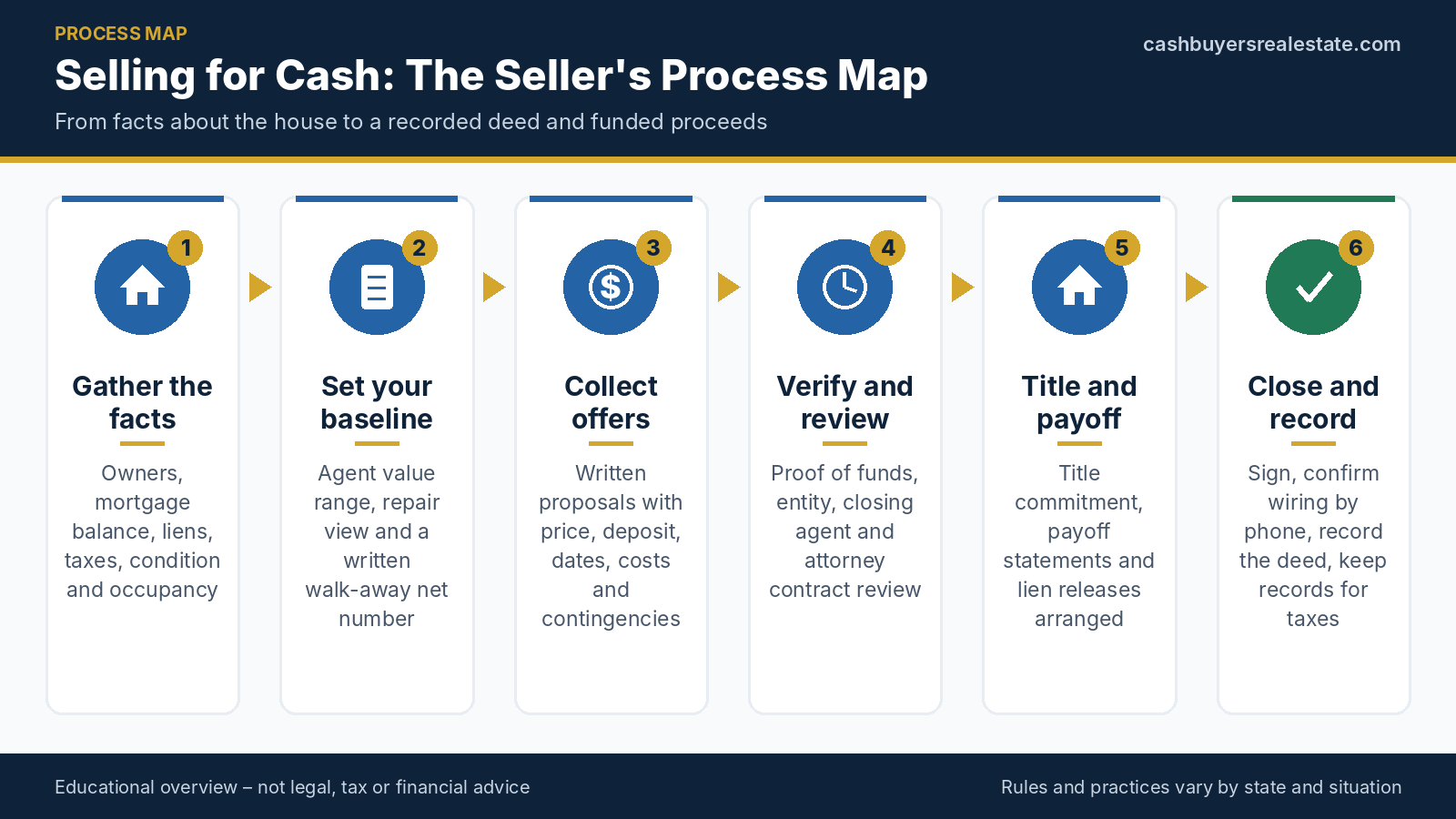
Text version of this infographic
- Gather the facts — Owners, mortgage balance, liens, taxes, condition and occupancy
- Set your baseline — Agent value range, repair view and a written walk-away net number
- Collect offers — Written proposals with price, deposit, dates, costs and contingencies
- Verify and review — Proof of funds, entity, closing agent and attorney contract review
- Title and payoff — Title commitment, payoff statements and lien releases arranged
- Close and record — Sign, confirm wiring by phone, record the deed, keep records for taxes
How Cash Offers Are Built and Why They Differ From Retail Value
The single most common source of disappointment in cash sales is a gap between what the seller imagined and what the buyer proposed. Almost all of that gap can be explained once you see the arithmetic behind the offer. This section walks through the way professional buyers set a price, why two reasonable buyers can land far apart on the same house, and what evidence and timing actually influence the number.
The Buyer’s Arithmetic
Every offer from a business that plans to resell or rent is the output of a short calculation. The inputs are estimates, and the estimates are where the negotiation lives. Knowing the formula turns a mysterious number into a set of assumptions you can check.
After-Repair Value, Repair Costs, Holding Costs, and Margin
The starting point is the after-repair value, usually abbreviated ARV: the price the buyer believes the house would bring once it is fully repaired and updated to the standard of nearby houses that recently sold. A buyer estimates ARV from comparable sales, the same sort of evidence an agent uses, though a buyer who intends to sell to a retail purchaser will be conservative. From the ARV the buyer subtracts the cost of the work, then the expenses of owning the house while the work and the resale happen: property taxes, insurance, utilities, interest on borrowed money or the opportunity cost of tied-up cash, and sometimes a monthly management cost. The buyer then subtracts the costs of buying and selling, which can include title and closing charges on both ends and a real estate agent’s commission on the resale. What remains is divided between the buyer’s profit and the offer to you.
In investor circles, a rule of thumb is often quoted in which the maximum purchase price is a set percentage of ARV, commonly seventy percent, less repair costs. That heuristic is not a standard and it is not a law; it is shorthand some investors use to ensure there is enough room for costs and profit. Some use a higher percentage in strong markets and a lower one where resale is slow or risky, and some do not use it at all. Its usefulness to you is that it shows how large the discount from retail value can be when repairs are significant: when a buyer subtracts both a percentage of value and the repair bill, the combination can be much larger than either number suggests alone.
The work is easier to follow with numbers. The table below builds a single hypothetical offer step by step. Nothing in it is a market figure; it simply shows how each assumption contributes, and why changing any one of them moves the final offer.
| Step | Assumption | Amount |
|---|---|---|
| Estimated after-repair value | Resale price once fully updated | $300,000 |
| Less: repairs and updates | Roof section, kitchen, flooring, paint, contingency cushion | -$42,000 |
| Less: holding costs | Five months of taxes, insurance, utilities, financing cost | -$9,500 |
| Less: buying and selling costs | Closing charges on both ends and resale commission | -$21,000 |
| Less: buyer’s target margin | Compensation for risk and effort | -$33,000 |
| Resulting maximum offer | What remains for the seller’s price | $194,500 |
Looking at the table, notice that no single line is outrageous, yet together they put the offer about thirty-five percent below the finished-house value. The same exercise with lighter repairs of $12,000, a shorter project, and a smaller margin would yield an offer much closer to retail. That sensitivity is the lesson: the headline discount is a sum of assumptions, and you can challenge each assumption separately. Challenging the repair line with contractor bids, or the ARV with recent comparable sales, is far more productive than telling a buyer their offer is too low.
Why Two Honest Offers on the Same House Can Differ by Tens of Thousands
Sellers who collect several offers are often surprised by how far apart they land. The spread comes from legitimate differences, not from one buyer being honest and another not. Buyers differ in their estimate of repairs, because a contractor-owner who does the work with his own crew has lower costs than an investor who hires every trade. They differ in their cost of capital, because a buyer using cash at a modest opportunity cost can accept a thinner margin than one borrowing short-term money at a high rate. They differ in how long they expect to hold the property, in how many similar projects they are already carrying, and in how they view your neighborhood, which affects their ARV and their patience.
Differences in the market pipeline matter as well. An investor with a long list of buyers waiting for finished houses in your area can sell quickly and can therefore pay more. A landlord who wants a rental and will keep the house indefinitely does not care about resale at all and may weigh the rent. An individual who happens to love the street may pay a premium that has nothing to do with models. Meanwhile, a wholesaler’s number depends on what the eventual buyer will accept, minus the wholesaler’s fee, so it can be a sensible price or an optimistic placeholder that falls apart when the end buyer does the math.
The right response to a spread of offers is neither suspicion nor excitement. It is curiosity. Ask each buyer for the assumptions behind the number, including their estimate of repairs and of resale value, and ask what would raise the price. Many will not share every detail, and that is their prerogative, but the serious ones will explain enough for you to see where you can help them, with documents, with access, or with timing. You will also begin to see which offers rest on assumptions that you know are wrong, such as an expensive repair that was actually completed last year. The explanation of how cash buyers calculate offers and the page on after-repair value and cash offers go through these inputs one by one.
Illustrative example (hypothetical numbers, not market data): A homeowner receives three written offers on the same ranch house: $176,000, $189,500, and $201,000. Asking each buyer about the assumptions reveals that the lowest buyer estimated $55,000 in repairs, the middle buyer estimated $38,000, and the highest buyer, who operates his own crew, estimated $26,000. The homeowner has a contractor’s written estimate of $29,500 for the same scope. The comparison does not prove the top bid is best, because the buyer’s proof of funds and contract terms matter, but it shows that the spread was driven by one assumption rather than by any difference in honesty.
What Is Negotiable and What Moves the Number
Sellers often assume that a cash offer is take-it-or-leave-it. In practice, most professional buyers expect some discussion, and a seller who prepares can influence the result without being adversarial. What follows separates the levers that tend to matter from those that do not.
Evidence That Changes a Buyer’s Assumptions
Buyers revise their numbers when they receive credible information that reduces their uncertainty. Contractor estimates, permits for completed work, receipts for a new roof or furnace, service records on the major systems, and a recent inspection report all help, because each replaces a buyer’s cautious guess with a known fact. If your house had a termite treatment, a plumbing repair, or foundation work documented by a licensed professional, that documentation is worth presenting early. The goal is not to argue about price, but to remove the cushion the buyer has built in for the unknown.
Comparable sales are the second kind of evidence. If the buyer’s ARV seems low, share two or three recent sales of similar nearby houses in similar condition and ask the buyer to explain why they differ. An agent’s comparative market analysis can supply this. Note that renovated comparables carry the price of renovation; a buyer who points out that your neighbor’s sale was a fully updated house is not being evasive. It is a reasonable distinction, and the way to address it is to be clear about which comparables are truly equivalent to the finished product the buyer is imagining.
Sometimes the most persuasive evidence is simply that other buyers exist. If you have another written offer or an agent’s estimate of what a listing would net, mention it factually, without bluster. A buyer who knows you have alternatives has a reason to sharpen the offer, while a buyer who believes you have none has no such reason. The page on negotiating a cash offer offers more detail on phrasing and sequence.
Present your evidence in an organized way, not as a pile of papers delivered the day before closing. A one-page summary that lists the age of the roof, furnace, water heater, and electrical panel, followed by copies of the supporting receipts, permits, and warranties, can change how a buyer’s estimator treats the house. Add dated photographs of any work in progress, a summary of recent utility costs, and the name of the contractor for major projects. Offer to share this packet before the buyer’s walk-through, not after, so that the first estimate reflects it. Buyers who see a well-documented house tend to remove some of the contingency cushion from their repair line, because documentation signals an owner who maintained the property, and it costs you nothing but an afternoon of organizing.
Timing, Competing Offers, and the Risk of Late Re-Trades
Time is a negotiating variable for both sides. If your deadline is flexible, you can wait for a better offer, and buyers can sense this. If your deadline is tight, the buyer may have less incentive to move on price but may be more willing to concede on terms such as closing date, post-closing occupancy, or leaving behind belongings. Being candid about your timing is not weakness, but you should decide in advance which constraints are firm and which are preferences, because buyers will treat all of them as firm if you do.
The most common late-stage disruption is the re-trade, in which a buyer lowers the price after the inspection or title review. Some re-trades are legitimate, grounded in a defect the seller did not mention and the buyer could not have seen. Others are tactical, relying on the seller’s reluctance to start over. Defend against the second kind by disclosing known problems early, by asking the buyer to put the inspection period in writing, and by keeping a backup path alive until the contract is past its contingency period. A backup could be a second interested buyer or an agent’s willingness to list quickly if the deal falls apart.
It also helps to remember that a good offer has terms as well as a price. A slightly lower price from a buyer who pays certain closing costs, has a short inspection period, a sizable nonrefundable deposit, and a clean contract may be worth more than a higher price with long options and many exits. The resource on repair deductions in cash offers explains how to evaluate those late changes, and the later section on net proceeds shows how to put every term on a single scale.
If you decide to collect multiple offers, run the process fairly and consistently. Give every buyer the same information about the house and the same deadline for a written proposal, ask each for a best-and-final number at that deadline, and answer questions the same way each time. Do not invent or inflate competing offers to pressure someone, because buyers talk to each other, contractors, and title companies, and false claims damage your credibility when you need it most. It is entirely appropriate to tell a buyer that you are comparing proposals and will decide by a stated date. A short, orderly process usually produces tighter offers than an open-ended one, and it protects you from the slow erosion that happens when a single buyer is allowed to keep adjusting terms.
Net Proceeds: Comparing a Cash Sale With Listing the House
An offer price tells you what a buyer will pay. It does not tell you what you will receive. Between the two sit commissions, closing costs, concessions, repairs, carrying costs, and the value of the time you spend waiting, and each of them differs between a cash sale and a listing. Sellers who compare headline prices tend to overrate the listing. Sellers who compare only the speed of a cash sale tend to overrate that. The honest method is to build a net sheet for each route and compare the bottom lines, which this section demonstrates with hypothetical numbers.
Building a Net Sheet Line by Line
A net sheet is a simple list of what you expect to receive and what will be deducted before the money reaches your account. A title company, an attorney, or an agent can prepare a formal one, and it is wise to ask for it early. Understanding what belongs on it lets you challenge an estimate that omits something important.
Costs a Seller Typically Meets in a Listing Sale
In a traditional listing, the largest deduction is usually compensation to real estate agents. How much it is and who pays it have been the subject of significant change in the industry, and the amount is negotiable and set by contract, so use the figure your agent actually proposes rather than a national average. After agent compensation come the seller’s closing costs, which commonly include a share of title and escrow or attorney charges, recording fees, transfer or documentary taxes where a state or locality imposes them, and prorated property taxes and association dues for the days you owned the house during the billing period.
Then come the costs that sellers tend to forget because they occur before and after the listing itself. Preparing the house may involve cleaning, painting, minor repairs, landscaping, and sometimes staging. After an offer, a buyer’s inspection can lead to requests for repairs or credits, and appraisals that come in below the contract price can force a price reduction or a renegotiation. If the listing sits for months, the house continues to cost money in the form of the mortgage payment, taxes, insurance, utilities, and upkeep. These carrying costs are the quietest number in a net sheet and often the most significant, especially on a vacant house in a slow season.
An honest net sheet for a listing should also reflect probability. Not every listing sells at the list price, and not every contract closes. A financed buyer might fall out, which resets the clock and means starting again with new showings. Putting a dollar value on that risk is hard, but assuming zero is a mistake. A practical approach is to run the listing scenario with a realistic sale price rather than the list price, a realistic time on market for your neighborhood, and a modest allowance for concessions, then compare the result with a version that has a less favorable outcome.
Carrying costs deserve a careful line-by-line estimate because sellers tend to understate them. Include the mortgage payment, property taxes, homeowners insurance, utilities, lawn and snow care, association dues, and the cost of any second residence you are paying for in the meantime. If the house is vacant, add the cost of a vacant-property insurance endorsement if your insurer requires one. Multiply the monthly total by a realistic number of months, not the optimistic number the listing agent hopes for, and consider what happens if the first price is too high and requires a reduction after several weeks. A price reduction is not a failure, but it is a cost, and an honest net sheet shows the sale price you expect to achieve after those adjustments rather than the price you hope to start with.
What Changes, and What Stays the Same, in a Cash Sale
A cash sale removes some deductions and leaves others. It generally removes agent compensation on the buyer’s side and, when no agent is involved, on yours too. It usually removes staging and showing preparation, and it often removes the appraisal and the repair negotiation that follows an inspection. It shortens the carrying period. It does not remove the mortgage payoff, any liens, property tax prorations, or the title and recording charges that belong to the seller under local custom, which still appear on the closing statement. It also introduces one big difference: the price itself is lower.
Who pays which closing costs in a cash sale is negotiable and varies by buyer and region. Some buyers advertise that they pay certain costs; others expect the seller to pay customary seller charges. This is why the line items matter more than the slogan. A buyer that “pays all closing costs” but offers a price discount larger than the costs saved has not given you a benefit. The page on who pays closing costs in a cash sale goes into the typical patterns, and the overview of closing costs on a fast sale adds more.
The table below summarizes the usual treatment of common cost lines. It describes tendencies, not rules. Contract language, state law, and local custom decide who pays in your transaction, and a written offer should settle each line before you sign.
| Cost line | Listing sale | Cash sale | What to confirm in writing |
|---|---|---|---|
| Agent compensation | Set by listing agreement and negotiation | Often none when buyer and seller deal directly | Whether any broker fee or finder fee is built into the offer |
| Title, escrow, or attorney fees | Split according to local custom | Varies; buyer sometimes selects and pays the closing agent | Who chooses the closing agent and who pays each fee |
| Transfer or documentary taxes | Set by state or local law; payer varies | Same law applies | The statute or local rule, not the buyer’s description |
| Prorated taxes and dues | Seller pays for days of ownership | Same | Closing statement proration dates |
| Repairs after inspection | Common negotiation point or credit | Often priced into the offer in advance | Whether further deductions can occur after inspection |
| Carrying costs | Continue until closing, often months | Typically a few weeks | Closing date and any extension rights |
| Mortgage payoff and liens | Paid from proceeds | Paid from proceeds | Updated payoff statement and per-day interest |
As you read the table, the third column is not automatically better than the second. A cash sale that eliminates agent compensation may still price in that saving on the buyer’s side, so the saved percentage is not a bonus. The real test is the bottom line, which the worked comparisons below illustrate.
The quiet variable in this comparison is how the closing costs are described. A buyer may say, accurately, that the seller will pay no commission and no repair costs. A buyer may also say that the offer already includes closing costs, which can mean that the buyer pays the buyer’s share of the title and recording charges, or that the price has been reduced by the amount the buyer expects to pay. Ask the buyer to show, on paper, which line on the settlement statement each party will pay. A professional will usually be able to produce a sample statement, or the closing agent can prepare a draft, and the exercise takes a few minutes and settles an issue that otherwise stays vague until the week of closing, when changing course is hard.
Worked Comparisons: When Cash Wins and When It Does Not
Two hypothetical sellers show the range. In the first, the house is in good shape and the discount for cash is mostly a cost. In the second, the house needs work and a listing carries more friction, so the gap narrows or reverses. In both, the mortgage payoff would be identical under either route and is left out, so the figures show what remains before the payoff.
A Well-Maintained House With Time to Spare
Consider an owner whose house is clean, updated within the last decade, and in a neighborhood where comparable houses sell in a reasonable time. An agent suggests a listing price of $385,000 and expects a final sale around $378,000. A cash buyer offers $336,000 and says they can close in three weeks. The difference in headline prices is $42,000, which sounds enormous, but the net sheets tell a different story and the choice is not yet clear.
On the listing path, the owner pays agent compensation of five percent of the sale price, about $18,900. Seller closing costs and prorations add roughly $5,670. The owner anticipates $4,000 in credits after the inspection, $3,000 in preparation costs, and three months of carrying costs at $1,950 a month, or $5,850. On the cash path, the owner pays an estimated $3,200 in customary seller charges and one month of carrying costs. Table 5 sets out the arithmetic for this house and for a second house needing work.
| Line | House A: listing | House A: cash | House B: listing | House B: cash |
|---|---|---|---|---|
| Expected sale price | $378,000 | $336,000 | $262,000 | $236,000 |
| Agent compensation (5%) | -$18,900 | $0 | -$13,100 | $0 |
| Seller closing costs | -$5,670 | -$3,200 | -$3,930 | -$2,700 |
| Inspection credits | -$4,000 | $0 | -$6,500 | $0 |
| Preparation or cleanout | -$3,000 | $0 | -$1,800 | $0 |
| Carrying costs | -$5,850 | -$1,950 | -$7,800 | -$1,950 |
| Net before payoff | $340,580 | $330,850 | $228,870 | $231,350 |
In House A, the listing nets about $9,730 more than the cash offer, which works out to roughly three percent of the sale price. For that margin the owner takes on roughly two extra months, the chance that a contract fails, and the daily disruption of showings. Whether that is worth it depends on the owner’s circumstances; a family that must close on another house in three weeks might reasonably take the cash. A family with no deadline and a tolerance for showings probably should not.
Illustrative example (hypothetical numbers, not market data): Suppose the owner of House A also knows that if the first buyer’s financing collapsed, the house would need another six weeks to get back under contract, adding about $2,900 in carrying costs and, in a softening market, perhaps an $8,000 price reduction to attract a replacement buyer. At a one-in-three chance of that outcome, the expected cost is about $3,630, which narrows the $9,730 advantage of listing to roughly $6,100. The cash path does not eliminate every risk, but it removes this one, which is why a modest discount can be rational for a seller whose timeline truly cannot slip.
One way to think about the $9,730 gap in House A is as the price of avoiding risk and effort. It buys the owner roughly two fewer months of ownership, no showings, no staging, no negotiation over inspection items, and no chance of a failed financing contingency. If the owner values each of those at a few thousand dollars, the cash offer is competitive. If the owner values them at almost nothing, the listing wins. The mistake is to treat the gap as a pure loss, as though the cash buyer received a gift, or as a pure gain, as though the seller cheated nobody. It is a price, and the only question is whether you would pay it for what it purchases. Putting your own numbers into the same table makes the answer visible.
A House That Needs Work and a Listing That Will Struggle
House B tells a different story. It needs a new roof section, an electrical update, and substantial cosmetic work, and an agent expects that even an as-is listing might sell for $262,000 after negotiation. Financed buyers may balk because a lender’s appraiser could flag the same defects, which would complicate or block a mortgage. The cash buyer offers $236,000. In the table, House B’s listing nets $228,870 while the cash offer nets $231,350, a difference of $2,480 in favor of cash. The ordering flips for reasons that are easy to see: the listing carries larger inspection credits, a longer carry, and a thinner buyer pool, while the cash sale avoids all three.
The lesson is not that cash wins for houses in poor condition. It is that the discount on an ordinary house can be large relative to what it saves, while the discount on a difficult house is partly an honest price for problems that would otherwise consume the listing’s advantages. This pattern depends on the particular numbers in the example, and a different roof, a different market, or a different carrying cost could reverse it. Run your own version with real quotes. The tools linked in the detailed comparison of net proceeds in cash and traditional sales and the guide to net proceeds on a cash offer help you do that.
Two further adjustments belong in any serious comparison. First, add the value of what you would otherwise spend. If you would renovate before listing, include the cost and the time, and consider whether the resulting price increase exceeds the spending; the guide on choosing between selling as-is and renovating works through that decision. Second, include taxes. In most cases the tax consequence depends on your basis and on how long you lived in the house, not on whether the buyer paid cash, but a lower sale price means a lower gain, and that interaction is worth understanding before you decide, as the tax section explains.
It is also worth testing how sensitive the House B result is to the repair estimate. If the inspection credits on the listing path were $12,000 instead of $6,500, the cash advantage would grow to roughly $8,000. If the house sold at $275,000 instead of $262,000 because two buyers competed for it, the listing would come out ahead by nearly $10,000 even with the credits. The range of plausible outcomes on the listing side is wide, while the cash outcome, once a contract is signed and funds are verified, is narrow. That asymmetry is the quiet value of a firm offer, and the reason a seller with limited tolerance for variance may rationally choose the lower expected number.
Mortgage Payoff, Liens, and Title: Who Gets Paid Before You Do
The price in a contract is not the money you take home. Before a dollar reaches you, the closing agent has to pay everyone with a legal claim on the property, in an order set by law and by the documents on record. For many sellers the mortgage is the only claim; for others, the title search turns up taxes, judgments, association dues, or a contractor’s lien that nobody remembered. This section explains how payoffs work, how liens surface and are cleared, and what the closing agent does to make the transfer safe for both sides.
Paying Off the Mortgage and Clearing Liens
A lender or servicer holding a mortgage on your house expects to be repaid in full when the property is sold. That is the normal course, and a cash buyer’s money flows through the closing agent to the servicer before it flows to you. The amount that must be paid is not the balance on last month’s statement; it is a calculated figure, and a few rules govern how you get it.
Payoff Statements, Per-Diem Interest, and Second Mortgages
The amount needed to retire a mortgage is called the payoff, and it differs from the unpaid principal balance because it includes interest accrued through the payoff date and may include fees. Federal regulation requires a mortgage servicer, once it receives a written request, to send an accurate statement of the total outstanding balance needed to pay the loan in full as of a specified date, and to do so within a reasonable time and in no case more than seven business days after receiving the request. In practice the closing agent usually orders the payoff directly, with your written authorization, but you can also request it yourself, and doing so early gives you an accurate figure to use in comparing offers.
Because interest accrues every day, a payoff statement also states a per-diem amount, the extra interest that will accrue for each day closing slips past the date on the statement. The closing agent uses this to update the figure at the actual closing. If you have a home equity line of credit, it must be paid off and, in most cases, formally closed so that the lender will record a release; a line that is merely paid down but left open can leave a lien on the title. The same applies to a second mortgage, an older line that you forgot about, or a loan from a family member that was secured by a recorded deed of trust.
After closing, the servicer sends a release or satisfaction of the lien, and the closing agent usually follows up to ensure that it is recorded. Keep your own record of the payoff confirmation. Any remaining balance in a mortgage escrow account for taxes and insurance is returned to you separately, typically within a period set by the servicer or by regulation, and it is not included in the closing statement, which surprises some sellers when the refund arrives weeks later.
When the payoff exceeds what the house will sell for, the sale becomes a short sale, which requires the lender to agree to accept less than it is owed. A short sale is a different process with its own timeline and its own risks, including a possible deficiency, and it is not a standard cash closing even if the buyer pays cash. If you are in that position, the planned guide on selling a house before foreclosure deals with it directly and you should talk to a housing counselor or attorney before agreeing to any buyer’s terms.
Tax Liens, Judgments, Association Dues, and Other Claims on the Property
Liens are legal claims against the property that must usually be satisfied or otherwise resolved for the buyer to receive clear title. The common ones are unpaid property taxes, which in most jurisdictions take priority over other claims, and judgments from lawsuits that have been recorded against the owner. Contractors can file mechanic’s liens for unpaid work on the house, homeowners associations can record liens for unpaid assessments, and cities can record charges for code enforcement, cleanup, or demolition. Government liens for unpaid income taxes or other obligations can attach to the property too. Rules on which claims attach, how long they last, and which come first vary by state and by creditor.
Most liens appear in a title search, and a seller who learns about them early has the most options. Some can be paid from the proceeds at closing, with the closing agent obtaining a payoff figure and a release. Some can be negotiated, particularly when a creditor would prefer a quick payment to a long collection process. Others are disputed, in which case a title company may require an escrow holdback or an attorney’s resolution before it will insure the sale. A buyer who agrees to purchase a house with liens, and with a price that already accounts for them, is not doing you a favor if the arithmetic leaves you with nothing; the right comparison is between the net you receive and the cost of clearing the same liens under another route.
A lien that is larger than the equity does not make a sale impossible, but it changes who has to agree to what. Creditors may accept less than the full amount, particularly when the alternative is foreclosure or an unsold house, and a few states have statutory procedures for settling certain liens. These are matters for an attorney, and the dedicated guide to cash buyers for houses with liens goes deeper into the process.
Title Work and the Closing Table
Title and closing are where the legal weight of a sale sits. Their purpose is to ensure that the buyer receives what the contract promised and that you are paid what the contract promised, and to give both sides a record of exactly what happened.
The Title Search, Title Commitment, and Owner’s Policy
A title search examines the public record for the chain of ownership and for anything that encumbers the property: mortgages, liens, easements, restrictions, unpaid taxes, and unresolved probate. The title company or attorney produces a title commitment, which lists what must be cleared before the title can be insured and what exceptions will remain. Buyers, including cash buyers, usually want an owner’s title insurance policy, which protects against certain defects in title that were not discovered during the search, and a cash buyer who wants to resell will need one anyway. Who pays for the policy depends on local custom, and in some places the seller customarily pays while in others the buyer does.
Items on the commitment that need to be resolved are called requirements, and sellers sometimes find them frustrating. A prior owner’s mortgage that was paid but never released, a deed with a misspelled name, an heir who never signed, a divorce decree that did not address the title, or a missing power of attorney can each stop a closing. Most are fixable with documents or short court proceedings, but they take time, and cash does not speed them up. The sooner a title company sees the property, the sooner it can tell you what lies ahead, which is one reason to choose a closing agent early.
If the title problems are serious, an ordinary buyer may be unwilling to proceed, and some investors specialize in buying with title defects and resolving them. Such buyers price the work and the delay into their offers. The planned hub on selling a house with title problems will treat the common defects and their cures in detail.
Cash transactions sometimes tempt buyers to skip title insurance to save money, which is their prerogative but which changes your exposure as a seller. A buyer without a policy has no insurer to pursue if a defect appears after closing, so the buyer may turn to you under the covenants in the deed, especially if you gave a general warranty deed. Even if you believe your title is clean, an old lien, a forged signature in the chain, or a missing heir can surface years later. Using a title search at the front end protects you as well as the buyer, and a seller who is asked to give a warranty deed without any title examination should understand what promises that deed contains before signing.
Closing Methods, Deeds, and the Documents You Will Sign or Need
How closing is conducted depends on where the property sits. In many states, a title company or an escrow company acts as a neutral agent, collecting the contract, the deposit, the documents, and the funds, and disbursing them when everything is in order. In other states, attorneys customarily handle the closing, prepare the deed, examine the title, and disburse the funds, and in some places the practice is mixed. A cash buyer may propose a closing agent; you are entitled to understand who it is, whether it is independent of the buyer, and how it protects your money. If you are uncomfortable, you can ask to use a closing agent you select, though that may change who pays.
The deed that conveys the property comes in several forms depending on the state. A general warranty deed carries the seller’s promises about the title, a special warranty deed limits those promises to the seller’s period of ownership, and a quitclaim deed conveys whatever interest the seller has without promises. The name varies, and in some states a grant deed or a similar form is used instead. A buyer who asks for a quitclaim deed from an ordinary seller, or who proposes to use a form you have not seen, deserves a question or two. A real estate attorney can explain which form your state uses and what you are promising by signing.
Whatever the method, be ready to supply identification, proof of authority for any entity or estate, and the documents that the closing agent requests. The table below lists the items sellers most often need. Gathering them while the contract is still being negotiated avoids delay.
| Item | Why it is needed | Where to get it | Common snag |
|---|---|---|---|
| Government photo identification | Verifies the signer’s identity | You already have it | Name on ID differs from name on deed |
| Deed or proof of ownership | Shows how you hold title | County recorder, closing file | Missing or outdated deed after inheritance or divorce |
| Mortgage statements and payoff authorization | Lets the closing agent request the payoff | Servicer | Servicer needs written, signed authorization |
| Property tax bill and status | Allows proration and confirms nothing is delinquent | Tax collector or assessor | Unpaid prior-year taxes |
| Association documents and payoff | Shows dues, assessments, and any lien | Association or manager | Slow response or unpaid assessments |
| Seller disclosure form | States known material facts about the property | State form or agent | Incomplete or inaccurate answers |
| Authority documents | Proves a trustee, executor, or officer may sign | Court, trust document, company records | Letters expired or probate not complete |
| Wiring or payment details for your proceeds | Delivers your net funds | Your bank | Details sent by unverified email |
Think of the table as a checklist for a first call to the title company. Each row has a source, and each snag is a real cause of delay. Sellers who solve the right-hand column before a closing date is set tend to close on time; those who discover it the week before often do not. The overview of the cash home buyer contract shows how these documents fit into the agreement itself.
The graphic below compares five routes to a cash-style closing on the dimensions that tend to matter most to sellers, from speed and repairs to net proceeds and financing risk. The comparison echoes the route table earlier and previews the decision framework later in this guide.
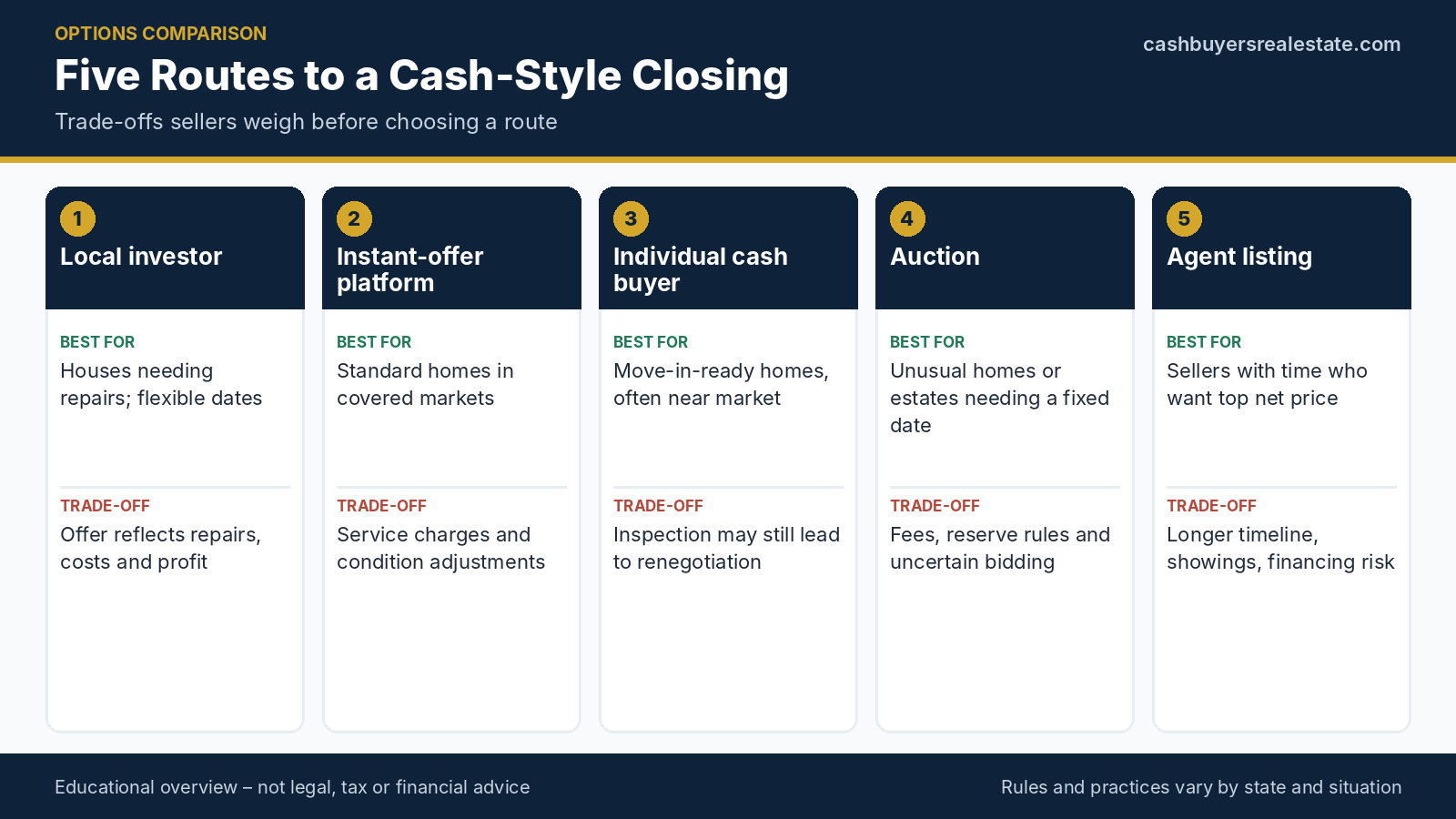
Text version of this infographic
- Local investor — Best for: Houses needing repairs; flexible dates. Trade-off: Offer reflects repairs, costs and profit.
- Instant-offer platform — Best for: Standard homes in covered markets. Trade-off: Service charges and condition adjustments.
- Individual cash buyer — Best for: Move-in-ready homes, often near market. Trade-off: Inspection may still lead to renegotiation.
- Auction — Best for: Unusual homes or estates needing a fixed date. Trade-off: Fees, reserve rules and uncertain bidding.
- Agent listing — Best for: Sellers with time who want top net price. Trade-off: Longer timeline, showings, financing risk.
Taxes on a Cash Sale: What Every Seller Should Understand First
The fact that a buyer pays cash does not change how the federal government taxes your sale. Gain is gain, whether the purchase was financed or not. What does matter is the history of the house: how long you owned and lived in it, what you paid, what you spent on improvements, whether you ever rented it, and whether you inherited it. This section gives an overview of the federal rules for selling a primary residence, based on IRS guidance, along with the situations that change the answer. It is general information, not tax advice, and state and local taxes add another layer that this article does not attempt to cover.
Gain, Basis, and the Home Sale Exclusion
Most homeowners owe no federal income tax on the sale of their main home, thanks to a provision commonly known by its Internal Revenue Code section number. But the exclusion has conditions, and some sellers fall outside it. Knowing how gain is measured is the first step to knowing whether you do.
How Gain Is Measured: Amount Realized and Adjusted Basis
The IRS describes gain or loss on the sale of a home in two steps. First, the amount realized is the selling price minus selling expenses. Second, gain or loss is the amount realized minus your adjusted basis. Basis is, generally, what you paid for the house plus certain settlement costs at purchase, such as recording fees, transfer taxes, and owner’s title insurance, plus the cost of improvements that add to the home’s value or extend its life. It does not include the cost of ordinary repairs and maintenance, and the IRS lists items such as fire and casualty insurance premiums and mortgage-related charges as excluded from basis. If you received energy credits or subsidies for improvements, those reduce your basis.
This explains why records matter. A seller who kept receipts for a new roof, a bathroom addition, a finished basement, or a replaced furnace can show a higher basis and therefore a smaller gain. A seller who did the same work and kept nothing may struggle to prove it years later. The distinction between an improvement and a repair is sometimes subtle, so it is worth asking a tax professional how a particular project would be treated before you assume it counts. In the cash sale context there is one more detail worth noting: selling expenses reduce the amount realized, so legitimate costs of the sale, such as the seller’s share of closing charges, reduce your gain, and a sale at a discount produces a lower gain than a sale at full market price.
Illustrative example (hypothetical numbers, not market data): A couple bought their home for $190,000 and paid $4,000 in qualifying settlement costs. Over the years they added a porch and replaced the roof for a documented $38,000, giving an adjusted basis of $232,000. They sell for $336,000 and pay $3,200 in selling expenses, so the amount realized is $332,800 and the gain is $100,800. Because it is less than the exclusion available to a married couple filing jointly who meet the tests, no federal income tax would be owed on that gain, though the sale may still need to be reported if a Form 1099-S is issued. Their friends with the same sale price but no records of the roof and porch would report a larger gain, which could matter if their gain were closer to the limit.
The Section 121 Exclusion: Amounts, Tests, and Limits
Under the home sale exclusion, a seller can exclude up to $250,000 of gain from income, and a married couple filing jointly can exclude up to $500,000, as described in IRS Topic 701 and Publication 523. To qualify, you generally must pass an ownership test and a use test. You must have owned the home for at least 24 months of the five years ending on the date of sale, and you must have lived in it as your main home for at least 24 months of that same five-year period. The 24 months need not be consecutive. For joint filers, only one spouse needs to meet the ownership test, but each spouse must meet the use test to claim the full $500,000.
There are limits on repeated use. Generally you cannot claim the exclusion if you excluded gain on another home sold during the two years before the current sale. If you sell before reaching 24 months because of a work-related move, a health-related move, or an unforeseeable event, you may qualify for a reduced exclusion, calculated by dividing the time you qualified by 730 days or 24 months and multiplying by the full amount. A surviving spouse may qualify for the $500,000 figure if the sale occurs within two years of the spouse’s death and other conditions are met. The exclusion does not apply if you acquired the home in a like-kind exchange within the past five years, or if you are subject to the expatriate tax.
The IRS also treats portions of gain differently when they relate to rental use after May 6, 1997. Depreciation you claimed, or could have claimed, for business or rental use cannot be excluded and is taxable and is reported as unrecaptured section 1250 gain. A sale to a cash buyer changes none of these rules. If you are unsure whether your gain exceeds the exclusion or whether a rule above applies, a tax professional can answer in a short consultation, and the answer is worth having before you agree on a price, because it determines what a given price means after tax.
Reporting the Sale and Special Tax Situations
Even if you owe nothing, you may have paperwork to complete. And a few circumstances, such as an inheritance or a former rental, change the arithmetic enough that they deserve a closer look.
Form 1099-S, Certifications, and Reporting the Sale
Form 1099-S reports the proceeds from a real estate sale to the IRS. According to the IRS instructions, the person responsible for closing the transaction is generally the one who files, and when a Closing Disclosure lists a settlement agent, that agent is the responsible person; if no one is responsible for closing, the obligation passes to the mortgage lender, the seller’s broker, the buyer’s broker, or the buyer in that order. The instructions also provide an exception for the sale of a principal residence. If the sale price is $250,000 or less, or $500,000 or less for a married seller in the circumstances the instructions describe, and the filer receives an acceptable written certification from the seller, no form is required. The certification must be signed under penalties of perjury, and it confirms that the home was the seller’s principal residence, that there was no nonqualified use after December 31, 2008, and that the full gain is excludable.
For a sale above those thresholds, the settlement agent will typically file the form, and the IRS instructions say that Box 2 shows the gross proceeds, generally the sales price, without reducing it for seller expenses. That is why the number on the form can look larger than what you actually received. IRS Topic 701 states that if you received a Form 1099-S you must report the sale even if the gain is fully excludable, and that you must report it if any of the gain is taxable. You do this on Form 8949 and Schedule D of Form 1040. Receiving a 1099-S does not mean you owe tax; it means the IRS has information about the sale and expects your return to account for it.
Be prepared to provide your taxpayer identification number to the closing agent, in a form such as a Form W-9, no later than closing. The IRS instructions describe the filer’s duty to request it. Giving this information to a title company or attorney through a secure channel, not by ordinary email, is part of the wire-safety habits discussed later. If you are asked for the same information by an unverified party before any contract exists, take that as a signal to slow down.
Inherited Homes, Former Rentals, Capital Gains Rates, and State Taxes
When you inherit a house, the tax basis generally resets to the fair market value on the date of the decedent’s death, or to the value on an alternate valuation date if the estate’s representative chooses it for estate tax purposes, as described in IRS Publication 551. There are exceptions, including for certain recent gifts of appreciated property to the decedent, and community property and joint tenancy follow their own rules. The practical result is that heirs who sell an inherited house soon after death often have little taxable gain, because the sale price is close to the stepped-up basis. This is an area where documentation, such as a date-of-death appraisal, is useful, and the general guidance on cash buyers for inherited houses expands on it.
If you rented out the home, even for a period, depreciation affects both your basis and your tax. The IRS states in Publication 523 that depreciation claimed on business or rental use after May 6, 1997 cannot be excluded and must be reported, with Form 4797 used for the recapture. Gain that is not excluded is a capital gain. Under IRS Topic 409, an asset held for more than one year generates long-term gain or loss, and most net long-term capital gain is taxed at rates of zero, fifteen, or twenty percent depending on taxable income, with the Net Investment Income Tax potentially applying to taxpayers who have significant investment income. Owners of former rentals should read the guidance on cash buyers for rental properties and speak to a professional before settling on a price.
Several other items merit a short mention. If a lender forgave part of a mortgage debt in a short sale, canceled debt may be taxable income, and Publication 523 notes that an exclusion for qualified principal residence debt applied to debt discharged under a written agreement made before January 1, 2026, so whether any extension exists should be checked with a tax professional. If you are a foreign person selling U.S. real estate, special federal withholding rules apply and the closing agent will ask about it. And state income tax, transfer taxes, and local levies vary widely, so check with your state’s department of revenue. The table below summarizes how these situations tend to be treated at the federal level.
| Situation | General federal treatment | What to confirm | IRS source |
|---|---|---|---|
| Primary residence, owned and lived in 2 of last 5 years | Up to $250,000 of gain excluded; up to $500,000 for joint filers who qualify | Both tests, and no prior exclusion within two years | Topic 701, Pub. 523 |
| Sold early due to job, health, or unforeseen event | Possible reduced exclusion, prorated by time | Which circumstance applies and the exact days | Pub. 523 |
| Form 1099-S received | Sale must be reported even if gain is excluded | Gross proceeds versus your actual amount realized | Topic 701, Form 1099-S instructions |
| Inherited home sold | Basis generally date-of-death fair market value | Appraisal or estate valuation records | Pub. 551 |
| Former rental or home office use | Depreciation after May 6, 1997 not excludable; recapture rules apply | Years and amount of depreciation | Pub. 523 |
| Gain above the exclusion | Long-term capital gain rates if held over one year | Taxable income and any additional tax | Topic 409 |
| Mortgage debt forgiven in the sale | May be ordinary income unless an exclusion applies | Whether an exclusion applies for your sale date | Pub. 523 |
Use the table as a prompt for questions, not a substitute for advice. The most useful conversation with a tax professional is a short one before you commit, with your purchase documents, improvement records, and an estimated sale price in hand. That meeting can tell you in minutes whether the numbers you are weighing are before or after tax, which changes the comparison between a cash offer and a listing less often than sellers fear, but occasionally changes it a great deal.
Verifying Buyers and Avoiding Scams in a Cash Sale
Almost everyone who buys houses for cash is operating legitimately. A few are not, and the structure of a cash sale, with its speed, its large sums, and its frequent use of unfamiliar contracts, is attractive to people who want to exploit a seller’s stress. The defense is not suspicion of every buyer. It is a set of routine checks that honest buyers pass easily and dishonest ones resist, together with a handful of habits that protect your money on closing day. This section covers both.
Verifying the Buyer, the Money, and the Contract
Three questions determine whether you can trust an offer: whether the buyer can pay, whether the contract does what the buyer says it does, and whether the people handling the money are independent of the buyer. Each can be tested before you sign anything.
Proof of Funds, the Buyer’s Identity, and the Closing Agent
Proof of funds is a document that shows the buyer has access to the money. It usually takes the form of a recent bank or brokerage statement, a letter from a financial institution, or a statement of a line of credit, and it should name the buyer or the entity that will sign the contract. Statements can be forged or edited, and a document that shows the buyer’s money in a different person’s name proves little. The more reliable verification is the closing agent’s confirmation that funds have been deposited or will be wired by a specific date, and the better habit is to treat the proof of funds as a first filter rather than a guarantee. The guide on proof of funds from a cash buyer shows what to look for on the document itself.
Identity matters as much as money. Find out whether the buyer is an individual or a company, and if a company, look it up in the secretary of state’s business records for the state where it is registered. Check whether the person signing has authority to bind it, and whether the entity has a track record. Searching the names of the principals along with words such as complaints or lawsuits will not prove anything, but it sometimes surfaces patterns. Ask for references from sellers who have sold to them, and call two. An established buyer will usually be glad to provide them; one that refuses is not necessarily dishonest, but it has withheld the easiest evidence it could have given you.
Finally, look at the closing agent. A neutral title company, escrow company, or attorney, ideally one you can verify independently, should hold the deposit and handle the funds. If the buyer insists on a particular closing agent you cannot confirm, or proposes to hold the money themselves, or tells you a closing can happen without any outside party, those are reasons to pause. You can and should look up the agent’s license with the state regulator, call the office at a number from the state’s directory, and confirm that it has your file. Taking these steps costs an hour and prevents a category of problems. The guide to judging whether a cash home buyer is legitimate offers a longer checklist.
Contract Terms That Deserve a Careful Second Reading
A contract written by a buyer for a buyer’s benefit is not improper, but it asks to be read slowly. Start with the assignment clause. If the buyer may assign the contract to someone else without your consent, you may end up selling to a party you never met, whose funds you never saw. That is common in wholesaling, and it can be acceptable if you know about it and the price reflects it, but you should be the one to decide. Next, read the inspection or due-diligence period. A very long period with a right to cancel at will, paired with a very small deposit, gives the buyer a free option on your house while you wait. Look for provisions that let the buyer extend closing repeatedly, sometimes for a fee that is small relative to the harm of waiting.
Next, check what the contract does to your title. Some buyers record a memorandum or notice of the contract with the county, which can cloud your title and make it harder to sell to someone else even if the buyer later walks away. Look for language about attorney’s fees, liquidated damages, or a penalty if you cancel, and for a clause that obliges you to use the buyer’s closing agent. Some contracts contain a hidden listing agreement or a right of first refusal that binds you to a brokerage arrangement you did not expect. If anything is unclear, ask the buyer in writing what it means, and have an attorney read the document before you sign. The content of the guide to red flags in cash offer contracts is a useful companion.
Last, confirm what you are not being asked to do. A genuine buyer should not ask you to pay an upfront fee, to deposit a check and return part of it, to sign blank documents, to sign a power of attorney that gives them control of your sale, or to keep the arrangement secret from your family or lender. Each of those is a reason to stop and talk to a lawyer. If you are in a time-sensitive situation such as foreclosure or probate, these requests are even more significant, because the people pursuing a vulnerable seller are well aware of the deadlines you face.
Illustrative example (hypothetical numbers, not market data): A seller receives a one-page agreement for $148,000 with a $500 deposit, a 45-day inspection period, an unrestricted right to assign, and a clause allowing the buyer to cancel for any reason. The buyer says that such terms are standard. The seller asks an attorney to review it and then asks the buyer for a version with a $5,000 deposit that becomes nonrefundable after ten days, a 14-day inspection period, and consent required for assignment. The buyer either accepts and demonstrates seriousness, or declines and demonstrates something else. In both cases the seller has learned what the original terms meant before being bound by them.
Fraud Patterns Around Closing and How to Respond
Some of the most damaging real estate scams do not involve the buyer at all. They involve criminals who position themselves between buyer, seller, and closing agent, and exploit the fact that a large transfer of money happens on a known date.
Wire Fraud, Fake Checks, and Payment Red Flags
The FBI describes real estate wire fraud as a subcategory of business email compromise. Criminals compromise or imitate an email account of a party to the transaction, often a title company, agent, or attorney, and send instructions that redirect funds to an account they control. The FBI’s report notes that the money is usually moved before the victim realizes what happened. The FBI’s recommended protections include verifying any request to change account information through a second channel, checking that email addresses match the real organization and watching for slightly misspelled domains, and never sending personal information by ordinary email. If a loss happens, the FBI advises contacting your financial institution immediately to ask for a recall and filing a complaint at ic3.gov as soon as possible.
The scale is not trivial. The FBI Internet Crime Complaint Center’s 2025 annual report lists 12,368 complaints in its real estate category, with reported losses of about $275 million, a category defined to include fraud involving real estate investments and rental or timeshare property, and a separate business email compromise category with 24,768 complaints and about $3.05 billion in losses. Those figures cover more than seller payouts, but they show why closing agents and banks push so hard on verification. As a seller, you are less likely to send money than to receive it, so your main risks are giving your own bank details to the wrong person and being talked into paying something before closing.
The Federal Trade Commission describes a related pattern in fake check scams: a stranger sends a check for more than is owed and asks you to return the difference, and the check turns out to be bad weeks later even though the funds appeared in your account. The FTC notes that the overpayment version targets sellers directly. It also advises never paying anyone who insists on cryptocurrency, a wire transfer service, a payment app, or gift cards, and says wired money usually cannot be recovered. In a real estate sale, a legitimate buyer pays through the closing agent. If anyone asks you to receive and forward money, accept a check that exceeds the price, or pay a fee to receive your proceeds, you should stop. The FTC’s guidance on avoiding scams is short and worth reading before any sale.
Pressure, Impersonation, and Where to Report
The FTC lists four signs of a scam: someone pretends to be from an organization you know, claims there is a problem or a prize, pressures you to act immediately, and demands a particular payment method. Cash home buyers rarely fit all four, but pressure to act now is the one that shows up most often, in the form of an offer that expires tonight, a promise to cover your costs if you sign before your attorney can review, or a claim that foreclosure is days away and only this buyer can help. The FTC’s observation that honest businesses give you time to decide applies to real estate with full force. A good offer survives a weekend, and a seller who needs a week to read a contract is behaving normally.
Impersonation takes other forms, too. Fraudsters sometimes pose as owners of vacant or unencumbered properties and attempt to sell them to unsuspecting buyers, which is why closing agents verify identity, and why you should expect to be asked for identification and to wait while the agent confirms your authority. In foreclosure and probate, others target homeowners with offers that sound like help but strip equity through unusual contracts, leaseback arrangements that are hard to meet, or deeds signed in exchange for promises that are never honored. Treat anyone who asks you to sign a deed before a purchase contract, closing, and payment have all been arranged as a reason to call a lawyer or a HUD-approved housing counselor.
If something goes wrong, act quickly. Contact your bank at once if money has moved, report to the FBI’s Internet Crime Complaint Center, and file a report at ReportFraud.ftc.gov. Notify your closing agent, your state attorney general or consumer protection office, and, where a wire is involved, local law enforcement. Document everything. The page on cash home buyer scams and how to spot them gathers the patterns in more detail, and the FBI’s report on business email compromise and real estate wire fraud explains the mechanism.
| Warning sign | Why it matters | Safer response |
|---|---|---|
| Offer expires within hours or days, with no time for review | Pressure limits your ability to compare and to get advice | Ask for a written offer valid for a reasonable period; consult an attorney |
| Proof of funds in a name that differs from the buyer | The buyer may not control the money | Ask for funds in the signing entity’s name and confirm through the closing agent |
| Contract lets the buyer assign freely and cancel at will | You may be bound to an unknown party with no commitment from the buyer | Negotiate consent, a meaningful deposit, and a short inspection period |
| Request for upfront fees or a returned overpayment | Classic advance-fee and fake-check patterns | Refuse; legitimate buyers pay through the closing agent |
| Wiring instructions arrive or change by email | Business email compromise relies on altered instructions | Call a known number for the closing agent and confirm verbally |
| Insistence on a closing agent you cannot verify | An agent tied to the buyer may not protect your funds | Check the license, call a directory number, or propose a neutral agent |
| Request to sign a deed or power of attorney early | Transfers control before you are paid | Sign only at closing, with payment arranged and verified |
The table works best as a checklist you run through before each major step: before signing the contract, before the deposit, and before closing. If one row applies, do not panic. Ask the question the third column suggests and watch how the buyer responds. People who run their business honestly will not mind.
When a Cash Sale Is Not the Best Route
A guide about selling for cash that never says when not to would be an advertisement. Cash is a good choice for many sellers and a poor one for many others, and the difference usually comes down to a few facts: how much the house would bring in an ordinary sale, how much it would cost to get it there, how long you can afford to wait, and how much the buyer’s discount really buys you. This section looks at the alternatives seriously and at the signs that a particular cash offer is more expensive than it appears.
Alternatives That Can Beat a Discounted Cash Offer
Most alternatives have been mentioned in passing earlier. Here they are examined as real options, each with its own costs and its own best uses. They are not mutually exclusive, and the strongest strategy for many sellers is to pursue two at once.
Listing With an Agent, As-Is or Lightly Prepared
An agent-assisted listing exposes the house to the widest group of buyers, including financed buyers who often pay more than investors can, and it gives you the leverage of competition. The cost is the agent’s compensation, the preparation and showing effort, and time. A good agent can help you decide how much to prepare. Sometimes the best answer is a thorough cleaning, fresh paint, and a handful of small repairs that cost a few thousand dollars and raise the price by much more. Sometimes it is nothing at all, because the house is going to be priced as a project either way and buyers will adjust for condition no matter what you do.
Listing as-is is not the same as listing in any condition. An as-is listing tells buyers that you will not pay for repairs, and it often attracts investors and buyers who will pay cash for the right price. It does not remove disclosure duties, and it does not prevent buyers from inspecting and negotiating. For houses with a few significant issues, a pre-listing inspection can give you the information to price intelligently and prevent a surprise later. The guides to selling a house as-is and to whether to fix a house before selling go into the details.
There is also a middle path worth considering. Some sellers collect a written cash offer before they list, not to accept it but to establish a floor. If the listing does not produce a better net within a reasonable period, they can return to the cash buyer, assuming the offer remains open, or to a similar buyer. The drawback is that offers expire and market conditions shift, so the floor is soft. Even so, knowing the lowest realistic outcome lets you list with less anxiety and negotiate with more patience. The comparison between a cash sale and a listing when time matters examines the decision from the speed side.
Repairing, Renting, Financing, and Selling Without an Agent
Some sellers are better off keeping the house a little longer. Renovating before sale makes sense when a modest investment yields a clear price increase, when the project is within your skills or your budget, and when you have the time and cash to carry it out. It makes less sense when the work is large, uncertain, or in a neighborhood where finished prices do not support the cost. A realistic contractor bid and an agent’s estimate of the finished value are the two numbers you need, and the result should exceed the project cost by enough to justify the work and the delay.
Renting out the house instead of selling is another possibility for owners who do not need the cash immediately, who have a manageable mortgage, and who can handle landlord responsibilities. It converts the house into an income asset, defers the tax question, and keeps options open, but it also brings vacancy risk, repair obligations, and the legal responsibilities of landlords, which differ by state. Seller financing, in which you act as the lender and accept payments from the buyer, can widen the pool of buyers and sometimes raises the price, but it means taking on credit risk, it interacts with your own mortgage if one exists, and it requires an attorney to draft the documents correctly.
Selling without an agent, often described as for sale by owner, saves commission but shifts marketing, negotiation, paperwork, and compliance to you. It works best for sellers who know the market, who have a buyer already, or who are willing to hire an attorney or a flat-fee service to handle the paperwork. For houses that are difficult to market, it often works less well. The planned hub on selling a house without a realtor covers this route, and the sections of this guide on verification apply to any direct buyer, cash or not.
| Alternative | Tends to fit when | Main cost | Main risk |
|---|---|---|---|
| List with an agent, lightly prepared | House is in sound shape and you have weeks or months | Agent compensation, preparation, carrying costs | Contract falls through; longer timeline |
| List as-is with an agent | House needs work you cannot or will not do, but you want competing bids | Agent compensation; buyers price in defects | Thin buyer pool; financed buyers may fail appraisal |
| Repair first, then list | Projects are modest and the finished price clearly exceeds cost | Repair cost, financing for repairs, delay | Overruns; improvements that buyers do not pay for |
| Sell without an agent | You have a known buyer or strong market knowledge | Your time, marketing, attorney or service fees | Pricing errors; contract or disclosure mistakes |
| Rent the house | You do not need the cash soon and can manage a rental | Vacancy, maintenance, landlord duties | Tenant problems; ongoing mortgage and tax obligations |
| Seller financing | Buyer cannot get a mortgage and you can wait for payments | Legal drafting; delayed proceeds | Buyer default; interaction with your existing loan |
| Accept the discounted cash offer | Speed and certainty are worth more than the gap in net proceeds | Lower price than a successful listing | Weak contract terms; limited competition |
The last row of the table is deliberate. Accepting a cash offer belongs on the list as one option among several, not as the default and not as a last resort. The first four rows involve an agent or a project and depend on time. The remaining rows involve different risks. Matching the row to your situation is the purpose of the framework at the end of this guide.
Judging Whether the Discount Is Worth Paying
Two kinds of mistakes are common: accepting a discount that was unnecessary, and rejecting a discount that was reasonable. Learning to tell them apart requires some arithmetic and some honesty about your own situation.
Running the Numbers: Equity, Carrying Costs, and Market Conditions
Start with equity. Equity is not the same as the price; it is what is left after the mortgage and liens are paid. A $42,000 discount hurts differently when your equity is $300,000 than when it is $60,000, because in the second case it may take most of what you hoped to keep. Compare the net proceeds of each route as in the earlier examples, then ask what that difference means for what you need to accomplish: a down payment on the next home, the cost of care for a parent, a debt you want to clear. Money is only useful for what it does.
Next, price your time. Monthly carrying costs, which include the mortgage payment, taxes, insurance, utilities, and upkeep, are real, and so is the cost of a second household if you are moving. If you are paying $2,000 a month to keep a vacant house for four extra months, that is $8,000 that belongs on the listing side of the ledger. If the house can sit at low cost with someone watching it, the number is smaller. If it is deteriorating, it may rise. Account for the risk of a listing that fails and must be relaunched, which adds time.
Finally, look at conditions. In September 2026 the National Association of Realtors reported a median time on market of 33 days nationally and 4.8 months of inventory, and its chief economist observed that higher inventory and lengthening days on market have given buyers improved negotiating power. Those national numbers say little about your street, but they suggest that sellers should expect negotiation rather than bidding wars in many places. Ask an agent for local figures: how many comparable houses are active, how long recent ones took, and how far the sale prices fell below list. A market where houses sell in two weeks at full price makes the discount for cash hard to justify. A market where they sit for months makes it easier.
Emotional and Situational Traps That Inflate the Discount
The numbers rarely settle things alone, because sellers decide while tired, grieving, or worried. Inherited houses carry memories and tasks nobody wants. Divorces involve two people who cannot agree. Houses with a long list of problems feel unsellable, and a cash offer feels like rescue. Those feelings are human and legitimate, and they are also exactly what a high-pressure buyer exploits. Pausing to ask whether the offer is good, or merely a relief from stress, is not a failure of nerve. It is the step that prevents sellers from paying a premium for peace of mind that a calmer plan would have delivered more cheaply.
Another trap is anchoring. The first number you see, whether from an online estimate, a neighbor’s story, or the first investor’s offer, tends to become the reference point for everything that follows. Resist it by gathering several independent data points before you form a view of the value. A third trap is believing there are no alternatives. Houses with serious defects, tenants, or title questions do sell on the open market, often to investors who bid against each other, and the assumption that only one buyer will take it gives that buyer all the bargaining power.
None of this is an argument against selling for cash when time truly is the constraint. A seller facing a hard deadline pays for speed, and that can be sensible if the price of speed is known and the terms are fair. The goal is to buy speed deliberately, at a price you have measured, from a buyer you have verified, with a contract you have read.
One practical defense is to build a pause into the process. Decide in advance that you will not sign anything on the day you first see it, and that you will sleep on every significant decision. Ask someone with no financial stake, such as a friend, an adviser, or a family member who does not inherit, to read the numbers with you and tell you what they see. People who are grieving or exhausted often agree to terms they would reject on a good day, and regret tends to follow. A buyer who respects that, and who gives you a few days to think without raising the price of waiting, is behaving the way a professional should. If a deal can only survive without scrutiny, it was probably not a good deal to begin with.
Special Situations: Inherited, Co-Owned, Tenant-Occupied, and Damaged Homes
Many of the sellers who consider a cash sale are not in an ordinary position. They have inherited a house in another state, they are untangling a marriage, they own a rental with a tenant in it, or the property has suffered a fire or a flood. Each of these changes who can sign, what must be disclosed, and how a buyer will price the risk. This section gives an overview of the most common situations and the first question each raises, and it points to the dedicated guides where the details are treated at length.
When Ownership or the Law Is Complicated
The most frustrating delays in a sale rarely come from the buyer. They come from the question of who has the authority to sell. Resolving that question first, ideally before a contract is signed, spares everyone a failed closing.
Inherited Houses and Probate
After an owner dies, the house does not pass automatically to a buyer’s hands, and a seller does not automatically have the power to sign. In most states, someone must be appointed by a court, or must hold authority under a trust, before the property can be sold. That person is called a personal representative, executor, or administrator, depending on the state, and they usually receive a court document, often called letters testamentary or letters of administration, which a title company will want to see. In some states and circumstances, small estates or transfer-on-death arrangements allow quicker routes. Which applies to you depends on state law and on how the property was titled, and a probate attorney can usually answer that in a short consultation.
Practical issues multiply from there. Heirs may disagree about whether to sell or about the price, and a sale usually needs agreement from everyone with an interest unless a court says otherwise. The house continues to cost money for taxes, insurance, utilities, and upkeep, and an unoccupied house may need a different insurance policy than an occupied one. Belongings must be sorted, and valuable or sentimental items need to be handled with care. A cash buyer who will take the house with its contents and close on a timeline set by the court process can be a relief, but only if the price reflects the real value and the estate is protected from a hasty decision.
The tax side tends to be favorable, as discussed earlier, because the basis generally steps up to the date-of-death value, but only if you document that value. An appraisal near the date of death is useful evidence. The planned hub on selling an inherited house and the existing guide to selling an inherited house fast go further into the court process and the options for heirs.
Divorce, Co-Owners, and Foreclosure Pressure
When a house is owned by two people who are separating, the divorce decree or settlement agreement usually dictates what happens to it. One spouse may keep the house and refinance, both may agree to sell and split the proceeds, or the court may order a sale. A buyer and a title company will want to see the decree, and both owners generally need to sign unless one has been granted sole authority. Disagreement over price or timing is common, and a sale that has not been approved by both parties or by the court can be unwound. A cash offer that appears to solve everything may also hide the complexity, so ensure the contract matches the legal agreement. The guide to selling a house fast during divorce covers this territory.
Foreclosure adds a clock, and that clock is less short than many borrowers assume. Under federal mortgage servicing rules, a servicer generally cannot make the first notice or filing for a foreclosure unless the loan is more than 120 days delinquent, and there are protections when a borrower submits a complete loss mitigation application more than 37 days before a foreclosure sale. Those rules do not stop foreclosure, and they do not set the full timeline, which depends heavily on whether your state uses a judicial or nonjudicial process. They do mean that a homeowner who is behind on payments may have more time to consider options than a cash buyer’s urgency suggests. Talking to a HUD-approved housing counselor or an attorney before accepting an offer is wise, and the planned hub on selling before foreclosure explains how a sale can protect remaining equity.
Surplus equity is the reason timing matters. If the house is sold before the foreclosure sale, the owner can keep what remains after the debts are paid. If the foreclosure goes forward, rules on surplus differ by state. A seller in this position should insist on documentation of every payoff, avoid any deal that transfers the deed before payment, and be particularly cautious about contracts that sound like rescue but give the buyer control of the property.
When the Property or Its Occupants Complicate the Sale
Even with clear title and willing owners, a house with a tenant or serious damage requires special handling. These situations also create some of the largest gaps between cash offers and retail value, and some of the clearest cases in which a cash buyer is the practical option.
Tenant-Occupied and Vacant Properties
A lease generally does not end because the owner sells. In most states, the buyer takes the property subject to the existing lease, and the tenant has rights regarding notice, entry, and the return of the security deposit that are set by state and local law. Some investors specifically seek tenant-occupied properties because the rent is already flowing, while others prefer to buy empty. A seller who needs to deliver a vacant house must follow the eviction or lease-termination process in the state and cannot lawfully pressure a tenant to leave by cutting off utilities or removing belongings. The guide to selling a house quickly with tenants covers how to approach this. Rental owners should also remember the depreciation rules described in the tax section.
Vacant houses pose different problems. Insurance policies commonly restrict coverage after a house has been unoccupied for a stated period, and utilities, winterizing, lawn care, and security need attention. Vacant houses attract break-ins, vandalism, and in some places unauthorized occupants, and municipalities may require registration and impose fines for neglected property. For these reasons, the carrying costs of an empty house tend to be higher than the arithmetic suggests, a factor that favors a shorter timeline. The hub on selling a vacant house examines practical measures. A realistic view of those costs belongs in your net sheet.
If you sell a rental with tenants in place, expect the buyer to ask for the leases, a rent roll showing who pays what and when, records of security deposits, and often an estoppel certificate, in which each tenant confirms the lease terms and that no disputes exist. The security deposit is typically credited or transferred to the buyer at closing, and state law governs how and when tenants must be notified of the new owner and where to send rent. If a lease is below market rent or about to expire, the buyer will price that into the offer. Meanwhile, you remain bound by the landlord-tenant law of your state until closing, including notice rules before showing the unit, so coordinate access with the tenants courteously and in writing. Sales of occupied rentals often go more smoothly when tenants understand that their lease rights continue.
Vacant houses call for a different checklist. Confirm with your insurer that the policy still covers an unoccupied house and under what conditions, because many policies restrict or exclude certain losses, such as vandalism or water damage from frozen pipes, after a stated period of vacancy. Keep utilities on at a minimal level, winterize if the climate requires it, and arrange regular inspections. Some municipalities require owners of vacant buildings to register them and pay fees, and they enforce lawn and exterior maintenance rules with fines that can become liens. A neighbor or property manager who checks the property and reports problems is inexpensive protection. These costs and chores are part of what a faster closing avoids, and they belong in your comparison.
Fire, Water, Hoarding, Code Violations, and Lead Paint Disclosure
Damaged houses combine a lower value, a harder financing profile, and a more complicated set of obligations. After a fire or flood, an insurance claim may be open, and the policy terms determine who is paid, whether the lender is a payee, and whether repairs are required. Selling before the claim is resolved can affect who receives the proceeds, so coordinate with your insurer and lender. Hoarded or heavily contaminated houses need clearing, and the cleanup cost is a significant variable in any offer. Code violations and unpermitted work can transfer to a new owner and may need to be resolved or disclosed according to local rules. The planned hub on selling a damaged house and the guide to selling a house with code violations treat these cases in detail.
Disclosure obligations continue regardless of condition. For housing built before 1978, federal law requires the seller to give the buyer the EPA pamphlet on lead hazards, to disclose known information about lead-based paint, to provide available records and a lead warning statement, and to allow a ten-day period for a paint inspection or risk assessment unless the buyer waives it. EPA lists foreclosure sales and housing built after 1977 as exemptions. Sellers must keep a signed copy of the disclosures for three years. State disclosure laws add their own requirements, which vary widely and are covered in the next section.
| Situation | First question to settle | Who usually needs to be involved | What tends to set the timeline |
|---|---|---|---|
| Inherited house | Who has legal authority to sign? | Probate attorney, court, heirs | Court appointment and creditor periods |
| Divorce or co-ownership | Do all owners and the decree agree on a sale? | Both owners, attorneys, sometimes the court | Agreement on price and division of proceeds |
| Foreclosure risk | Where is the loan in the foreclosure process? | Servicer, housing counselor, attorney | State foreclosure process and sale date |
| Tenant-occupied | Does the lease continue, and what do tenants have the right to? | Tenant, landlord-tenant counsel | Lease term and notice rules |
| Vacant | Is the house insured, secured, and maintained? | Insurer, local code office | Carrying costs and seasonal risk |
| Fire or water damage | Is an insurance claim open, and who must be paid? | Insurer, lender, adjuster | Claim settlement and cleanup |
| Code violations or unpermitted work | Can it be disclosed, resolved, or priced in? | Local code office, contractor | Inspection and permit timelines |
| Built before 1978 | Have lead paint disclosures been provided? | Seller, buyer, closing agent | The buyer’s ten-day inspection opportunity |
The table sorts these cases by the first thing to settle, since the first question almost always determines the rest. Notice that nearly every row ends in a process controlled by someone other than the buyer: a court, an insurer, a code office, a tenant. A buyer’s cash does not speed those processes, though a buyer with experience in the situation often knows how to work with them.
Across every one of these situations, the discount a buyer proposes comes from the same six factors: the market value of the house, its condition, the repair budget the buyer must assume, the holding costs while the work and the resale happen, the transaction costs on both sides, and the margin the buyer needs for risk. The checklist graphic that follows lays those factors out side by side so that you can see which one is driving an offer and decide whether you can change it with documentation, with time, or with a different route.

Text version of this infographic
- Market value — Compare agent range and recent sales before trusting any number
- Property condition — Know the roof, systems, water and permit issues a buyer will find
- Repair budget — Ask the buyer's repair assumption and compare with contractor bids
- Holding costs — Add months of mortgage, taxes, insurance and utilities to each route
- Transaction costs — Compare net proceeds on a settlement statement, not headline price
- Buyer margin and terms — Watch assignment rights, long options and unverified funds
State and Local Variation: Closing Practice, Disclosures, and Where to Check
Real estate is local in a way that few other transactions are. The federal government sets some rules, such as the tax code, federal lead paint disclosure, and mortgage servicing regulations, but the law of property, contracts, probate, landlords and tenants, foreclosure, and licensing belongs mostly to the states, and local custom fills the gaps. A guide that applies nationwide can describe the choices, but it cannot tell you which of them applies in your county. This section explains the main ways practice differs and shows you where to get an authoritative answer.
How Closings, Contracts, and Disclosures Differ by State
Two sellers with identical houses, identical buyers, and identical prices can have very different closings if one lives in a state where attorneys run the table and the other in a state where an escrow officer does. Understanding which model applies to you helps you hire the right professionals and anticipate the order of events.
Escrow, Title Company, and Attorney Closings
In many states, particularly in the West and parts of the South and Midwest, a neutral escrow or title company handles the closing. The buyer and seller sign documents separately, often at different times and places, and the escrow officer collects funds and releases them when conditions are met. In a number of other states, concentrated in the Northeast and Southeast, attorneys customarily or by legal requirement prepare documents, examine title, and conduct the closing, and the parties may meet in a lawyer’s office. Some states use a mix, with different customs in different regions. Because the rules on who may conduct a closing and what a lawyer must do are matters of state law and bar rules, check with your state bar or a local attorney instead of relying on a general rule.
The difference matters in practice. In attorney states, you will likely hire a lawyer, and the lawyer represents you. In escrow states, the escrow officer is neutral and does not advise you, so hiring an attorney to review the contract is a separate, optional decision that many cash sellers would be wise to make. The timing of key steps varies too. Some places record the deed the same day the funds are confirmed; others take longer. The point at which a deposit becomes nonrefundable, how prorations are calculated, who orders the title search, and whether the seller must provide an owner’s title policy are all local. A cash buyer who operates in many states may use a standard contract that does not fit your state’s practice, which is another reason to have the document reviewed locally.
A related point involves the federal Closing Disclosure. The Consumer Financial Protection Bureau describes it as a document that lenders provide to borrowers at least three business days before closing on a mortgage loan. Because a cash purchase has no mortgage lender, the document that itemizes the sale, usually called a settlement statement, is prepared by the closing agent, and its format and timing can differ from the one used for financed transactions. Ask for the draft early, and do not assume you will have three business days to review it unless your closing agent confirms it.
Seller Disclosure, As-Is Language, and Regulation of Buyers and Intermediaries
State laws on what a seller must disclose range from detailed mandatory forms to a general duty not to conceal known material defects. Many states require sellers of residential property to complete a written disclosure form describing the condition of the property, covering items such as the roof, plumbing, electrical system, water intrusion, pests, environmental hazards, and known legal issues. Some states exempt certain sellers, such as estates or banks, from some duties, which affects what an heir needs to say. Others rely heavily on the buyer’s inspection and recognize remedies primarily for active concealment or fraud. Check your state real estate commission or an attorney to learn which regime applies to you.
Selling as-is changes the allocation of repair costs and often the buyer’s remedies after closing, but as a general matter it does not authorize concealment of a known defect that the law requires you to disclose or that you actively hide. Courts in many states treat misrepresentation or concealment as a ground for rescission or damages regardless of as-is language. If you know about a leak, an unpermitted addition, a failed septic system, or a prior flood, tell the buyer in writing, in the way your state requires. Doing so protects you; it does not weaken your position. The guide to disclosures in an as-is home sale explains the distinction in more detail.
Regulation of buyers and intermediaries also varies. Some states license or regulate wholesaling, require written disclosure that the contracting party intends to assign the contract, or restrict how contracts are recorded against a seller’s title. Business registration rules affect who can lawfully buy through an entity. At the federal level, a financial crimes reporting rule covering certain non-financed residential transfers to entities and trusts has been in the regulatory pipeline, and its compliance dates have been the subject of postponements, so ask your closing agent whether any federal reporting applies to your sale; if it does, expect requests for information about the buyer’s ownership. And if you are a foreign person, federal withholding on the sale of U.S. real property may apply. These are matters for the closing agent and a tax professional, and nothing in this paragraph should be taken as a statement of current legal status.
If you are unsure what to disclose, err toward more information in writing. A disclosure that turns out to be unnecessary costs little, while an omission that a court treats as concealment can cost the sale price and more. Keep a copy of every disclosure form and every inspection report you hand over, along with proof of delivery, since those records are the best defense if a dispute arises years later. If an estate or a trustee is selling, ask the attorney whether the fiduciary has a reduced disclosure duty under your state’s law, and put whatever the attorney advises into the contract in plain language so that the buyer understands what is and is not being represented.
Where to Verify Rules and Whom to Hire
Nobody expects a homeowner to know every rule. What helps is knowing which office answers which question, and which professional is worth paying for.
Primary Sources: The Offices That Can Answer Your Question
Official offices are often the fastest way to resolve a question for no cost. The county recorder or register of deeds holds the deed and the recorded liens against your property. The county tax collector and assessor tell you what taxes are owed and how the property is assessed. The secretary of state’s business records let you check whether a buyer’s company is registered and who its officers are. The state real estate commission handles licensing, disclosure forms, and complaints about licensees. The state attorney general or consumer protection office takes complaints about deceptive practices. The state bar can refer you to attorneys, and local court clerks explain probate and foreclosure procedures. The IRS publishes the federal tax rules discussed earlier, and the state department of revenue handles state income and transfer taxes.
The following table maps typical questions to the office that is best placed to answer them. Contact details change, so look up the office for your county or state through its official website, not through an advertisement.
| Question | Office or professional | What you can expect to learn |
|---|---|---|
| What liens and mortgages are recorded against my house? | County recorder or register of deeds; title company | Recorded documents, sometimes at no cost, and a full search for a fee |
| Are property taxes current? | County tax collector or assessor | Balance, due dates, and any delinquency |
| Is this buyer’s company real? | Secretary of state business records | Registration status, registered agent, sometimes officers |
| Is this agent or broker licensed? | State real estate commission | License status and any discipline |
| What must I disclose? | State real estate commission; real estate attorney | Required forms and duties for your type of sale |
| Who can sign for an estate? | Probate court clerk; probate attorney | Procedure and documents showing authority |
| What are my foreclosure options? | HUD-approved housing counselor; attorney; servicer | Timeline in your state and available alternatives |
| How will the sale be taxed? | Tax professional; IRS; state revenue department | Gain, exclusion eligibility, and reporting |
| I think I was targeted by a scam | State attorney general; FTC; FBI Internet Crime Complaint Center | Reporting procedures and next steps |
Treat the table as a map of who can answer what. Sellers frequently ask a buyer or a real estate agent a question that only an attorney can answer, and they are often told something that sounds authoritative but is not. When a question could change a financial or legal outcome, ask the office with the legal responsibility to answer it.
When you call an office, write down the date, the name of the person you spoke with, and what they told you, and ask for the answer or the governing rule in writing if it matters. Government employees can usually describe the process and the forms, but they generally cannot give you legal advice, and they will tell you so. That distinction is useful. Use the office to learn what the rules are and what documents you need, and use an attorney to decide how those rules apply to your situation and what to do about them.
Hiring a Real Estate Attorney, a Tax Professional, and an Agent
A real estate attorney does the most good before you sign. A modest fee for reviewing a contract, explaining termination rights, checking assignment and recording clauses, and confirming how title will be conveyed is small compared with the transaction. Ask about the fee structure at the start; some lawyers offer flat fees for contract review and others bill by the hour. Choose someone who practices in your state and who regularly handles residential sales. If you are in an attorney-closing state, this is the lawyer who will conduct your closing, and the choice is even more important.
A tax professional, such as a certified public accountant or an enrolled agent, can estimate the tax consequences of different sale prices and dates, review the basis records you have, and tell you whether to expect a Form 1099-S. This is especially useful for heirs, former landlords, and sellers with large gains, and for anyone considering an installment sale. An agent, meanwhile, is a good source of a comparative market analysis and of what a listing would likely bring, and many agents will provide one without obligation. Ask any agent how they are paid, whether they work with investors, and whether they represent buyers, sellers, or both. A good agent will welcome the question.
How you interview matters. Ask each professional about their experience with sales like yours, how they communicate, who will do the work, how they handle conflicts, and what the total cost is. Ask for references where appropriate, and check licenses with the relevant state authority. Resist the pressure of a buyer who recommends their own attorney or title company as the only option; you can accept the suggestion after verifying independence, but you are entitled to choose your own advisor. Finally, keep the advice in perspective: professionals can explain risks and options, but the decision to sell, and at what price, remains yours.
Frequently Asked Questions About Selling a House for Cash
The questions below come up repeatedly once a seller starts comparing offers. The answers are brief and general; the sections above explain the reasoning, and your state and your situation may change the details.
Questions About Timing, Contracts, and Backing Out
Questions About How Long a Cash Sale Takes
- How long does it take to sell a house for cash?
There is no single figure, and any buyer who quotes one without seeing your title commitment is estimating. The buyer’s side can be quick because no loan has to be underwritten, but the seller’s side still depends on payoff statements, title work, signatures, and the closing agent’s calendar. A clean title with one mortgage and a cooperative seller is generally the fastest case. Probate, liens, missing signatures, or an occupied property usually add time. Ask the buyer for a target closing date in the written offer and ask the title company what could delay it.
- Can a cash sale really close in a week?
Occasionally, when title is simple, the buyer and the closing agent are ready, and nothing needs to be requested from a third party. That is the exception. A mortgage payoff request alone can take days, and a title search may turn up something that needs clearing. Be wary of anyone who promises a fixed number of days before reviewing your property, and be equally wary of a schedule so compressed that it leaves no time to read documents or to verify the buyer. Speed that skips verification is a cost, not a feature.
- Should I pick my own closing date?
Often you can, and you should consider doing so deliberately. A date that aligns with your move, the end of a lease, the close of a school term, or the start of a new job reduces stress and may let you avoid overlapping housing costs. Some buyers will also allow a short stay after closing under a written agreement. Be realistic about what must happen first, and leave a small cushion for a delayed payoff letter or a recording backlog. Extending a closing later is usually easier than recovering from missing a date you promised.
- Do I have to leave the house empty at closing?
That depends on the contract. Many cash buyers accept a house with belongings left inside, which is helpful for estates and for sellers who cannot clear a house quickly, but they often reduce the price for the cleanout. Other buyers require the house to be empty and broom clean. Whichever applies, put it in writing, including what happens to items you leave behind, and walk through the property just before closing so that nobody is surprised by what remains.
Questions About Contracts, Deposits, and Backing Out
- What happens to the earnest money if the buyer backs out?
The contract decides. In many contracts, the deposit is refundable to the buyer during an inspection period and becomes the seller’s if the buyer defaults after that window closes. In others, the buyer can cancel for any reason during a long option period at little cost. Read the deposit amount, the date it becomes nonrefundable, and who holds it. A deposit held by a neutral closing agent is safer than one held by the buyer, and a deposit large enough to matter shows commitment.
- Can I cancel a contract after I sign it?
Sometimes, but not always without consequences. A few states and a few kinds of contracts carry limited cancellation rights, while most real estate contracts offer none once signed. Your own contract may include a termination clause, a contingency, or a seller’s option, or it may not. If you are having second thoughts, call an attorney quickly, before closing and before the buyer spends money relying on your signature. Do not simply stop responding, which can expose you to a claim for damages.
- Can the buyer lower the price after inspecting the house?
Yes, if the contract gives them an inspection period and a right to renegotiate or cancel, which is common. A legitimate reduction reflects a problem the buyer could not have known about from the offer. A tactical reduction relies on your reluctance to start over. Disclose known defects early, ask the buyer to state in writing which findings could change the price, and keep a backup option available so you can walk away from an unreasonable request.
- Should I let an attorney read the contract first?
It is a good idea in most cases, and especially when the buyer’s contract is not on a standard state form. The cost is small compared with the stakes. A lawyer can spot assignment rights, recording clauses, open-ended options, and fee provisions that may not be obvious to a layperson. In attorney-closing states you will probably have one anyway. Ask the buyer to give you a reasonable period to have the document reviewed before signing.
Questions About Money, Risk, and Special Cases
Questions About Price, Fees, and Taxes
- Why is a cash offer usually lower than what an agent says the house is worth?
Because the two numbers answer different questions. An agent estimates what a retail buyer might pay after marketing and negotiation, with the seller bearing preparation and carrying time. A professional cash buyer estimates what they can pay and still cover repairs, holding costs, selling costs, and profit. The gap is the price of speed and certainty, and the question is whether it is larger than the costs you would avoid. Compare net proceeds, not headline prices.
- Will I pay fees or commissions in a cash sale?
Possibly. Direct sales often have no agent commission, but the seller may still pay for title services, recording, prorated taxes, transfer taxes, and a share of closing costs depending on local custom and the contract. Some buyers cover certain costs and adjust the price accordingly. Request a written estimate of every deduction from the buyer or closing agent, and be cautious of any promise that nothing will be deducted without a closing statement to prove it.
- Do I owe taxes if I sell my house for cash?
Paying cash does not create or avoid tax. Whether you owe depends on your gain, which is the amount realized less your adjusted basis, and on whether you qualify to exclude up to $250,000 of gain, or $500,000 for qualifying joint filers, under the home sale exclusion. If you received a Form 1099-S, you must report the sale even if the gain is excluded. Heirs, former landlords, and sellers with large gains should see a tax professional before settling on a price.
- What is the difference between a payoff and my mortgage balance?
The balance on your statement is the unpaid principal at a point in time. The payoff is the total needed to retire the loan on a specific date and includes interest accrued through that date and any fees. Servicers must provide an accurate payoff statement within seven business days of a written request under federal rules. Because interest accrues daily, the closing agent updates the figure at closing. Any refund of leftover escrow funds comes separately.
Questions About Safety, Trust, and Unusual Situations
- How can I tell if a cash buyer is legitimate?
No single check proves it, but several together are persuasive. Verify the entity in your state’s business records, ask for proof of funds in the right name, confirm the closing agent’s license and phone number independently, check references from past sellers, and have an attorney review the contract. Legitimate buyers expect these steps. Treat refusal, deflection, or pressure to skip them as information, not as proof of fraud.
- Is it safe to wire money or give my bank details to a title company?
It can be, if you verify the instructions yourself. Call the title company or attorney at a number you found independently, not one in an email, and confirm any account details by voice. Be suspicious of last-minute changes, misspelled email domains, and urgent requests. The FBI notes that wire fraud funds are moved quickly, so if a loss occurs, contact your bank immediately and report it at ic3.gov.
- Can I sell a house with a tenant, a lien, or damage to a cash buyer?
Often yes, and these are situations in which cash buyers are common. The price will reflect the extra risk and cost. Leases usually continue after a sale, liens must be paid or otherwise resolved at closing, and damage affects both value and insurance. Compare the offer with what a listing would net after the same issues are addressed. The relevant sections of this guide and the linked guides on those topics explain the details.
- What if I am behind on my mortgage and worried about foreclosure?
Contact your servicer and a HUD-approved housing counselor soon, because options may exist that you cannot see from the outside. Federal servicing rules generally prevent a servicer from starting foreclosure until a loan is more than 120 days delinquent, though the process and timeline differ by state. A sale before foreclosure can preserve equity, but it must close in time and be arranged without handing over the deed early. Be cautious of anyone who asks you to sign over the property first.
Choosing Your Route and Planning the First Week
After all the arithmetic and the cautions, the choice comes down to a handful of priorities and a small number of realistic routes. This final section turns the preceding material into a decision framework you can apply to your own house and then into a practical first-week plan. Neither is a script. They are ways of keeping the decision organized when emotions and deadlines make it hard to think.
Sell My House for Cash or Another Way? A Decision Framework
A framework is useful because it separates what you want from what you are being offered. Sellers who skip that separation tend to drift toward whichever option is being presented most persuasively at the moment.
Rank Your Priorities Before You Compare Offers
Begin by ranking what matters. Speed, certainty, price, effort, privacy, and control are the usual candidates, and most sellers cannot have all of them. Speed means a closing date, and the question is whether that date is firm or merely preferred. Certainty means the lowest chance that the sale collapses, which matters most to sellers with a purchase of their own depending on it. Price means the net you take home, after every deduction. Effort covers showings, repairs, and paperwork. Privacy matters to families who do not want strangers walking through, and control is the ability to set terms such as possession dates and the treatment of belongings. Put these in order, and then be honest about what you would give up for the top one.
Next, match the ranking to the routes. A seller whose top priority is net price and who has time usually does best with an agent-assisted listing, perhaps after modest preparation. A seller whose top priority is certainty and who has a firm date is the natural customer for a verified cash buyer, often an investor or an individual with proof of funds. A seller with a house in poor condition and little appetite for repairs may find investors competitive with a listing. A seller who values privacy and a quiet process may accept a lower net for a direct sale. The table below summarizes these matches. Treat it as a starting hypothesis to test with real numbers, not as a verdict.
| If your top priority is | Routes that often fit | What you usually accept in exchange | What to verify |
|---|---|---|---|
| Highest net price, with time | Agent listing, lightly prepared; possibly renovate first | Showings, uncertainty, longer timeline | Local days on market; agent’s net sheet |
| Certainty of closing on a fixed date | Verified investor or individual cash buyer | A discount from retail value | Proof of funds, deposit, closing agent |
| Little effort, house needs work | As-is sale to investors, with several bids | Price reflects repairs and risk | Repair assumptions; contract terms |
| Speed and convenience for a standard home | Instant-offer platform, compared with a listing net | Service charges and condition adjustments | Itemized final offer in writing |
| Solving a complicated ownership problem | Attorney-guided sale; buyers experienced in probate or title cases | Time for legal steps; price for risk | Authority to sell; title commitment |
| Privacy and low disruption | Direct sale to a known or vetted buyer | Narrower competition | Independent value estimate |
Read the table by finding your top priority and then checking the third column honestly. If the exchange sounds acceptable, test the route with numbers: an offer in writing, a net sheet, and a verified buyer. If it does not, move down the list. Many sellers find that their real priority is a combination, such as certainty with a floor on net proceeds, which suggests collecting both a cash offer and an agent’s estimate and comparing them. The list of questions to ask a cash home buyer can structure the conversations.
Three Hypothetical Sellers Walk Through the Framework
Examples make a framework concrete. The three below are invented and simplified, and the point is the reasoning, not the dollar amounts.
Illustrative example (hypothetical numbers, not market data): A homeowner has accepted a job in another state with a start date eleven weeks away and has already put an offer on a house there, contingent on selling hers. Her top priority is a closing she can count on. An agent estimates a listing would net about $14,000 more than a cash offer of $251,000 she received, but she knows that a failed financed contract would force her to carry two mortgages. She collects a second cash offer, verifies funds and the closing agent for both, has an attorney review the better contract, and accepts a nonrefundable-deposit offer with a closing date she chose. She values the certainty more than the $14,000 and has measured the price of that choice.
Illustrative example (hypothetical numbers, not market data): Two siblings inherit a house from a parent. Letters of authority were issued after four months. The house has deferred maintenance and a basement full of belongings, and neither sibling lives nearby. Their top priority is low effort, and they are comfortable with a discount. They obtain a date-of-death appraisal, get three offers from investors, ask each for repair assumptions, and choose the buyer who will take the contents and close in 25 days, at a price within a few percent of the best offer. Because the sale price is close to the stepped-up basis, their accountant expects little taxable gain.
Illustrative example (hypothetical numbers, not market data): A retired couple owns a well-kept home with a small remaining mortgage and no deadline. A cash investor offers $22,000 below the agent’s expected sale price and promises a fast closing. The couple wants the highest net and does not mind showings. They decline the offer politely, list the house, and keep the written offer as a floor in case the listing disappoints. The house sells in seven weeks at a price that nets them more than the cash offer would have. They would have made a different choice if their circumstances had been different, which is the whole point.
What the three have in common is not the result, since each reached a different one. They defined the priority, measured the cost of the alternative, verified the people involved, and let the numbers and their circumstances determine the outcome. That is the shape of a good decision, and it transfers to nearly any version of the question.
You can adapt the framework by scoring each route against your ranked priorities. Give each route a score from one to five on every priority, multiply by the importance you gave that priority, and add the results, then check whether the winner still wins after you replace the guesses with real numbers from written offers and a net sheet. The scoring is not meant to be precise. Its value is that it forces you to notice when a route is winning because of one priority you have not actually ranked first, and it shows quickly how much your answer depends on a single assumption. Re-run the exercise after you receive offers, since prices and terms often change which route fits best.
What to Do Next: Documents, Questions, and a First-Week Plan
Knowing what to do on the first day is often the hardest part. The plan below is a suggestion for the first week, not a requirement, and many sellers will compress or stretch it. The order matters more than the pace: gather information before you request offers, and verify before you sign.
Days One Through Three: Gather, Estimate, and Get Advice
The early days are for information. Collect the deed, the most recent mortgage statement, tax bills, any association documents, receipts for improvements, and any inspection or repair records. Ask your mortgage servicer in writing for a payoff statement, which gives you an accurate number to plan with and, under federal rules, must be provided within seven business days of a written request. Search the county records for liens and confirm who is on the title. If someone has died or the owners disagree, speak to a probate or family law attorney before approaching buyers.
Then establish value and costs. Ask a local agent for a comparative market analysis, including an as-is scenario and a scenario with modest preparation, and for the expected time on the market. Get one or two contractor bids if repairs are a major unknown. Build a rough net sheet for a listing, using the structure from the net proceeds section, and write down the minimum net at which you would take a cash offer. Book a short conversation with a tax professional if you have owned the house for less than two years, rented it out, inherited it, or have a large gain. Having these facts in hand by day three means you can respond to offers instead of reacting to them.
- Request a payoff statement from each lender in writing and note the per-day interest.
- Pull recorded liens, taxes, and association balances from official sources.
- Collect improvement receipts and your original closing documents for basis.
- Ask an agent for a comparative market analysis and a local time-on-market estimate.
- Write down your priorities in order and your walk-away net number.
- Identify an attorney and a tax professional you could call before signing anything.
Set up your communication habits as well. Use a dedicated email address and phone number for the sale so that offers, documents, and questions stay in one place, and keep a simple log of who said what and when. Decide who in the household or the estate speaks for you, so that buyers do not receive conflicting messages. Do not share your bottom-line number with anyone who is not advising you, and do not respond to an unsolicited call, text, or letter with documents or personal data until you have confirmed who is contacting you. Unsolicited contacts are common after a house is listed, after a death, or after a notice of default, and a polite request for a written proposal is a sufficient reply.
Days Four Through Seven: Compare, Verify, and Decide Without Hurry
With your information assembled, request written offers from more than one source, such as a local investor, an individual or platform buyer if available, and your agent’s estimate of a listing. Ask each buyer the same questions: who will own the property, how the price was calculated, what proof of funds they can provide, what deposit they will place and with whom, who the closing agent is, how long the inspection period lasts, who pays which costs, and whether the contract can be assigned. Record the answers side by side. Differences in the answers often matter more than differences in the price.
Then verify. Confirm the buyer’s entity and the closing agent’s license through official sources, call the closing agent at a number you found yourself, and read the contract slowly with an attorney. Turn each offer into a net sheet and compare the totals against your walk-away number and your priorities. If the numbers favor cash and the buyer is verified, you can proceed with confidence. If they do not, you have lost very little, and you have a well-informed basis for listing. If you need more time, ask for it; honest buyers generally accommodate a seller who is doing due diligence, and a buyer who withdraws because you read the contract has told you what you needed to know.
Nothing in this guide argues for or against a cash sale as a general matter. For some houses and some sellers it is the best route, for others a listing is better, and for many a carefully verified cash offer sets a useful floor under a more patient plan. The decision that serves you is the one made with accurate numbers, a verified counterpart, a contract you have read, and enough time to change your mind. If you still have questions about a particular offer, the related guides on evaluating a cash offer, selling a home for cash, and the timeline of a cash offer are good next reading, and a local attorney or housing counselor can help with the rest. The house is yours to sell, on your schedule, and you are entitled to take the time that a good decision requires.