
Cash Buyers for Rental Properties: Offers, Process & Red Flags
You own a rental, a tenant lives in it, and an investor has just told you he can pay cash. The offer sounds simple until you start asking the questions a landlord has to ask. Does the buyer take the lease as it stands? What happens to the security deposit? Who tells the tenant, and when? And how much of the sale price will your lender, the IRS and your state tax agency claim before any of it reaches you? Cash buyers for rental properties work in a corner of the market where those questions matter more than the headline number, because the property being sold is not just a building. It is a stream of rent, a bundle of agreements with people who live there, and a tax history that travels with you to the closing table.
The short version is that a cash sale of a rental can be a clean, quick exit, and for some landlords it is the best exit available. It works when the offer reflects the income the property actually produces, when the tenant situation is handled lawfully and respectfully, and when the net figure still looks good after the loan payoff, the closing costs and the tax bill. Investors who buy tenant-occupied property price it from its rent roll and operating history rather than from neighborhood comparables, which is why two offers on the same duplex can differ by tens of thousands of dollars for reasons that have little to do with how generous either buyer is feeling.
Short answer: Cash buyers for rental properties usually value the income, not just the building, and they take the property subject to existing leases. Expect requests for a rent roll, leases and operating statements, check proof of funds before relying on any offer, and compare net proceeds after payoff, closing costs and taxes.
Landlords tend to come to this decision from a few directions. Some are tired of management and want out. Some inherited a property that never fit their plans. Some are watching a deferred-maintenance list grow while rents lag behind costs, and some simply want to redeploy equity into something else, whether that is a larger building or a retirement account. Each of those motives points toward a slightly different best answer, and a good offer for one landlord can be a poor one for another. A seller who plans a tax-deferred exchange needs a buyer who will cooperate with a tight deadline. A seller with a hard-to-manage tenant needs to understand what a buyer will and won’t inherit. A seller with a low-interest loan needs to price what giving up that loan really costs.
What follows is organized around the decisions a landlord-seller actually faces, in roughly the order they arrive. The first section explains how investors turn rent into a price, because everything else in the negotiation hangs from that number. The next covers what a buyer inherits when a tenant is in place, including the notice, showing and security deposit rules that govern the sale period. Then come the tax consequences of selling rental real estate, a comparison of routes with a worked net-proceeds example, the documents buyers will want, the mechanics of offers and closing, and a detailed look at red flags. The guide ends with a decision framework and a practical list of first steps.
Some neighboring topics get only brief treatment here because they have their own guides. Speed-focused strategies for landlords are covered in the piece on selling a rental property fast, the particular legal and practical tangles of occupied homes are the subject of the guide to selling quickly with tenants in place, and the general mechanics of the cash route sit in the overview of how cash home buyers operate. This article stays with the rental-specific questions: income pricing, leases and deposits, rent rolls and operating statements, and the tax consequences of selling an investment property.
How Cash Buyers for Rental Properties Price Income Instead of Comparables
A buyer of an owner-occupied house asks what similar houses sold for. A buyer of a rental asks what the property earns and what it will cost to keep earning it. That shift in question changes almost everything about how offers are built, which documents matter and how much room there is to negotiate.
Who actually pays cash for a rental, and what each of them is solving for
Not every cash buyer is the same animal, and the differences show up in the offer. Understanding who is likely to call you, and what problem each type is trying to solve, helps you read an offer for what it is rather than for how it is phrased.
Five kinds of buyers and what drives their offers
The most common buyer for a small residential rental is another local landlord. This person already owns a handful of doors, knows the neighborhood’s rents, has a plumber and a roofer on speed dial, and is adding to a portfolio built over years. Because he understands operating costs from experience, he tends to underwrite quickly and does not pad his offer with fear of the unknown. He may, however, be buying with a mix of cash and a line of credit, so proof of funds deserves a look. A second buyer is the renovator, who intends to improve the property, raise rents or resell it, and prices the deal backward from an expected after-repair value (ARV), meaning what the property should be worth once the work is done, minus the cost of the work and a margin for risk.
The third type is the portfolio or fund buyer, an entity that acquires many properties and values them in bulk. These buyers can be efficient and reliable, but they are also the most formulaic: they apply a standard return threshold, they often want a defined list of documents delivered by a defined date, and they may not move on price much because the number came out of a model. Fourth are exchange buyers, investors who sold something else and are racing a federal deadline to identify and close on a replacement property. Their urgency can work in your favor on timing, though it can also lead them to pay a price that only makes sense because of the deadline, and to walk away if the clock runs out. The fifth type, the owner-occupant who buys a small multifamily with cash, is rarer but real, and tends to care more about condition and less about yield.
How do you learn which of these buyers you’re talking to? Ask plainly, and listen for specifics. A genuine landlord-buyer can describe the last few rentals he closed on, how he handled the tenants who came with them, and who manages his properties. A renovator can explain his typical scope of work and timeline. A fund can describe its acquisition process and who signs for it. Vague answers, shifting stories, or a reluctance to name the entity that will actually sign the contract are not proof of anything improper, but they are reasons to slow down and verify before you go further. Matching the buyer type to your own priorities, whether those are speed, price, tenant continuity or a clean tax outcome, is half of the work of choosing among offers.
Why the buyer’s exit plan sets the ceiling on the price
Every investor has a plan for what happens after closing, and that plan caps what he can pay. A buy-and-hold buyer is purchasing a stream of rent. If the in-place rents are fair and the building is sound, he can pay close to the income-based value, because the property will perform the day he owns it. A value-add buyer sees the same building as a project: rents below market, units that need updating, perhaps a tenant turnover he expects to manage. He will pay less, because he has to fund the improvements, absorb the vacancy while the work happens and earn a return for taking on the execution risk.
A resale-oriented buyer, sometimes called a flipper, has the lowest ceiling on a tenant-occupied property, because tenants complicate or delay the exit. If the unit must be vacant to be marketed to owner-occupant buyers, the investor must wait for the lease to end, negotiate a move-out, or accept a smaller buyer pool. You can often tell which type you are dealing with by what they ask about. Questions on lease expirations, rent increases and expense history signal a holder. Questions on how soon the unit can be empty and what the interior looks like signal a seller-in-waiting. Neither is wrong, but the price they can justify is not the same, and knowing who is across the table keeps you from comparing offers that measure different things.
Consider how a hypothetical four-unit building looks through each lens. To the holder, it is $48,000 a year of rent with a boiler he can service for a few hundred dollars; to the value-add buyer, it is two units he can renovate for $18,000 each and re-rent at a higher level; to the reseller, it is a headache until the leases run out. Their top prices can differ by a surprising margin, and each might be entirely rational. A seller who simply takes the first cash number can miss that the buyer best positioned to pay more is the one whose plan fits the building as it already stands. That is the practical case for letting at least two or three different kinds of buyers see the property before you commit.
The arithmetic behind an income-property offer
Investors reduce a rental to a handful of ratios. You don’t need to be a financial analyst to understand them, and understanding them is the single best protection against an offer that sounds respectable but rests on a questionable assumption.
Net operating income, cap rate and gross rent multiplier
The central figure is net operating income, usually shortened to NOI. It is the property’s rental income, minus an allowance for vacancy and unpaid rent, minus the operating costs of owning it: property taxes, insurance, repairs, management, common-area utilities and similar items. It leaves out the mortgage payment, because the buyer is paying cash and the figure is meant to describe the property rather than the financing. It also leaves out depreciation and income taxes. Dividing NOI by the price gives the capitalization rate, or cap rate, so a property earning $21,000 in NOI that sells for $280,000 has a cap rate of 7.5 percent. Turn the formula around and the buyer’s logic is plain: price equals NOI divided by the cap rate he requires.
The gross rent multiplier is cruder and quicker. It divides the price by the annual rent before expenses, so the same $280,000 sale on $34,800 of yearly rent gives a multiplier of about 8. Buyers use it as a first screen and then run the real numbers. The cap rate a buyer demands reflects his view of risk, the local market, interest rates and what else he could buy, and it is the lever that moves the price most. The table below shows how a modest swing in required return changes the offer on the same income.
| Cap rate the buyer requires | Implied price | Change from the 7.5% case | What a buyer is usually saying |
|---|---|---|---|
| 6.5% | $323,000 | +$43,000 | Confident in rents, building and neighborhood; accepts a lower yield for lower risk |
| 7.5% | $280,000 | Baseline | Typical hold-and-collect underwriting with a normal risk cushion |
| 8.5% | $247,000 | -$33,000 | Worried about tenant quality, deferred repairs or uncertain expenses |
| 9.5% | $221,000 | -$59,000 | Treating the deal as a project with real execution risk |
The table is easiest to read from the bottom up. A buyer who offers $221,000 is not necessarily lowballing out of habit; he may be pricing in a risk that you could remove with better documents. If you can show clean leases, steady collections and receipts for the expenses you report, you move the buyer toward the top rows. If you can’t, he fills the gap in your records with his own caution, and caution costs you money in this arithmetic. Notice, too, that a one-point change in the required return shifts the price by roughly $30,000 to $60,000 on this small property, which dwarfs most of the other items sellers fight over.
How in-place rent, vacancy and deferred maintenance change what a buyer will pay
NOI is only as reliable as its inputs, and buyers scrutinize three of them. The first is in-place rent against market rent. A duplex renting at $1,500 and $1,400 looks different if the neighborhood supports $1,750 than if it already sits at the top of the range. Below-market rents can raise the price, since the buyer sees room to grow, or lower it, since raising rents may mean turnover and legal limits on increases. Which way it cuts depends on the lease terms and on local rules about notice periods and rent regulation, which is another reason the lease file matters so much.
The second input is vacancy and collection loss. Buyers rarely accept a claim that a unit has never been empty, and they usually assume a modest allowance regardless of history. A property with chronic late payers or an informal payment history, such as rent accepted in cash with no receipts, gets a heavier discount because the income cannot be proved. The third is deferred maintenance. A roof near the end of its life, an aging boiler or a failing sewer line does not appear in NOI at all, so buyers subtract the likely cost from the price instead. Sellers sometimes bristle at this, but it mirrors what an inspection would force in a financed sale. Fixing known problems before listing, or at least getting written estimates, narrows the gap between what you believe the building is worth and what the buyer believes.
One more adjustment catches self-managing landlords off guard. If you run the property yourself and your books show no management fee, a buyer will usually add one back into the expenses, because he must either pay a manager or value his own time. Likewise, he may raise your repair line if you’ve been deferring work, trim it if last year included a one-time capital project, and swap your insurance and tax figures for what his own costs will be after the sale, since reassessment can follow a transfer in many places. Each of those moves is ordinary underwriting, and each lowers the NOI he is willing to capitalize. Knowing how your numbers will be rewritten lets you present them with the same adjustments already made, which keeps the negotiation about price and not about your credibility.
What a Tenant in Place Means for the Sale: Leases, Showings and Security Deposits
Selling an occupied rental is a negotiation with three parties, even though only two of them sign the contract. The tenant has a lease, a home and a set of legal protections, and the buyer is stepping into the landlord’s shoes. How well you handle the tenant’s side often decides whether a cash sale stays on schedule.
What the buyer inherits when the lease stays in place
The starting point for nearly every tenant-occupied sale is that the buyer purchases the property subject to whatever agreements already bind it. That default is simple to state and surprisingly easy to misjudge in practice, particularly where leases have been modified informally or where special programs are involved.
Fixed-term leases, month-to-month tenancies and the clause that changes everything
In general, a sale does not cancel a lease. The Texas State Law Library, for example, explains that when a property changes ownership the new owner is bound by the terms of the existing lease, unless the lease itself says it terminates on a sale, and that at the end of the term the new owner can renew, adjust the rent or change the terms. Foreclosure sales are treated differently, and the same source notes that a foreclosure buyer may end a tenancy with a 90-day notice, with federal protections layered on top. Other states reach similar results through their own statutes and case law, but the details differ, so the lease and your state’s landlord-tenant act are the documents to read rather than a general rule of thumb.
For the seller, this means the buyer is purchasing the remaining months of every lease at the rent printed in it. A lease signed last spring at $1,400 on a unit that would now rent for $1,650 transfers with that gap intact, and sophisticated buyers will have priced it. Month-to-month tenancies work differently because either side can end them with proper notice, though how much notice, and for what reasons, depends on state and sometimes city law. Some places restrict ending even a month-to-month tenancy without a stated cause. The clause worth hunting for in your leases is anything giving the tenant a purchase option, a right of first refusal, or a termination right triggered by a sale. A buyer’s attorney will look for it, and it is far better for you to find it first.
There is also the matter of oral promises and informal arrangements. A tenant who was told last year that the rent would stay flat for two years, or who agreed to mow the lawn in exchange for a discount, may be relying on an understanding that appears nowhere in the paperwork. Buyers can’t honor what they don’t know about, and tenants will assert what they remember. This is the reason many contracts call for tenant estoppel certificates, short signed statements in which each tenant confirms the rent, the lease term, the deposit held and whether any disputes or side agreements exist. Collecting them is as much a protection for you as for the buyer, since it fixes the facts before anyone’s recollection shifts.
Subsidized, regulated and purchase-right situations
Some tenancies carry obligations that follow the property into a sale. If a tenant uses a housing choice voucher, the rent is paid in part by a public housing authority under a housing assistance payments contract, and a new owner generally has to complete the authority’s change-of-ownership process before payments flow to him. One authority’s published packet, for example, asks for a declaration of ownership, proof of ownership such as a deed or settlement statement, a tax form and payment instructions, and says payments begin only after the authority receives the signed contract. Each authority sets its own procedures and timing, so a seller with voucher tenants should call the authority early, and a buyer unfamiliar with the program may price in the delay or decline.
Rent-regulated units, properties with recorded affordability restrictions and buildings in jurisdictions with tenant purchase laws add further layers. In the District of Columbia, the Tenant Opportunity to Purchase Act requires an owner to give tenants an opportunity to purchase at a price and terms that represent a bona fide offer of sale before the owner may sell, and it sets timelines for appraisals and negotiation. In San Francisco, the Community Opportunity to Purchase Act applies to buildings with three or more units and gives certified nonprofits a right of first offer or refusal, with notice to tenants required before a sale. These are examples, not a complete list. If your property sits in a city with a tenant or nonprofit purchase right, a cash buyer’s contract has to be built around that process, and any buyer who waves the issue away deserves a pointed question.
Federal fair housing law also reaches the sale itself, not just the leasing. A landlord who is selling cannot steer showings, decline offers or treat tenants differently because of a protected characteristic, and the same standard should shape how you communicate with tenants about the sale. Beyond that, a few practical points tend to matter. Ask your attorney whether your city requires a rental registration, inspection certificate or notice to the municipality at transfer. Ask whether any recorded agreement with a housing agency restricts who can buy or what rents can be charged. And ask whether any tenant has been told, in writing or otherwise, that they would get a chance to buy. Each question is quick to answer now and expensive to answer after a contract is signed.
Showings, notices and security deposits during the sale
Even when the lease survives, the weeks between accepting an offer and closing generate practical friction: buyers want to see the units, tenants want to be left alone, and money held for tenants has to land with the right party. Each of these is governed by rules that differ from state to state.
Entry for showings and inspections: what three states’ rules show
A buyer’s due diligence usually includes walking the units, and that means entering a home someone else lives in. State law on landlord entry varies from detailed to nearly silent. The table summarizes three states, chosen to show how different the approaches can be. It is a snapshot of the rules as published in the sources reviewed for this guide, not a substitute for reading your own state’s statute or your lease.
| State | Source | Notice for entry | Showings to prospective buyers |
|---|---|---|---|
| California | Civil Code § 1954 | Reasonable written notice stating date, approximate time and purpose; 24 hours presumed reasonable | Oral notice allowed only if written notice that the property is for sale was given within 120 days; written evidence of entry must be left |
| Florida | Fla. Stat. § 83.53 | For repairs, reasonable notice means at least 24 hours, between 7:30 a.m. and 8 p.m. | Tenant may not unreasonably refuse entry to show the unit to prospective purchasers; landlord may not abuse access or harass |
| Texas | Texas State Law Library guidance | No state statute regulates landlord entry; the lease controls | Governed by lease language and the implied covenant of quiet enjoyment |
Read the table as a reminder that “reasonable” is a legal standard and not a feeling. Where a statute sets a number of hours, treat that number as a floor and give more notice when you can. Where the state is silent, as in Texas, the lease language becomes the main protection for both sides, which makes it worth checking before you promise a buyer access on a particular day. In practice, the smoothest sales cluster showings into one or two scheduled windows, tell tenants in writing what is happening and why, and let tenants be present. Most conflicts in occupied sales begin with surprise, not with the underlying legal right.
Tenants also have legitimate worries that a good seller can address directly. They want to know whether the rent will change, whether they’ll be asked to leave, where to send payments and who to call about repairs. A brief written notice that answers these questions, issued as soon as there is a signed contract, heads off most of the anxiety that turns into refused access or rumors. Be careful, though, not to promise outcomes the buyer controls. You can say the lease remains in force and that rent is due on the usual terms. You can’t say the new owner will never raise the rent or sell again. Sellers who overpromise in this notice create the very disputes they were trying to avoid, and they sometimes do so in writing.
Moving the deposit and prepaid rent without creating liability
Security deposits belong to the tenant in the sense that the landlord holds them in trust or subject to statutory duties, and a sale does not erase the obligation to return them. The rules for transferring that obligation differ. California’s statute lets a landlord whose interest ends either transfer the remaining deposit to the successor, after lawful deductions, and notify the tenant by personal delivery or first-class mail with the successor’s name, address and phone number, or return the balance to the tenant with an accounting; if the landlord does neither, successors can be jointly and severally liable. Texas places responsibility on the new owner from the time he acquires title, requires the new owner to give each tenant a signed statement of ownership and the deposit amount, and keeps the former owner liable until the new owner receives the deposit or assumes the obligation. Florida requires deposits and advance rent, with any interest and an accounting for each tenant, to pass to the new owner, who gives a written receipt that releases the seller.
On the tax side, the IRS says in Publication 527 that you don’t include a security deposit in income when you receive it, but that an amount called a deposit becomes advance rent if it is to be used as a final payment of rent, and advance rent is income when you receive it. The practical lesson is to keep a clean ledger and let the closing statement carry the numbers.
Illustrative example (hypothetical numbers, not market data): A landlord selling a three-unit building holds deposits of $1,200, $1,400 and $1,000, a total of $3,600, and one tenant paid the next month’s rent early on the 28th. The contract calls for a closing on the 10th of the following month. The settlement statement credits the buyer with the $3,600 in deposits, so he holds the money he now owes the tenants, and it apportions the early rent between the parties according to the days each owns the property. Because the seller stays potentially liable under some state rules until the buyer acknowledges the transfer, the seller’s attorney asks for a signed receipt from the buyer and sends each tenant a written notice naming the new owner and the deposit amount.
Selling a rental without upsetting tenants usually comes down to a handful of stages, and the sequence matters because each one sets up the next. A landlord first gathers income and expense records and decides a minimum acceptable net. Next, tenants are told in writing what is happening and how showings will work. Then offers arrive and proof of funds is checked, a contract is negotiated with a due diligence period, and finally the closing handles prorated rent, deposit transfer and tax reporting. The process map below lays out those stages, and the sections that follow take each in detail.
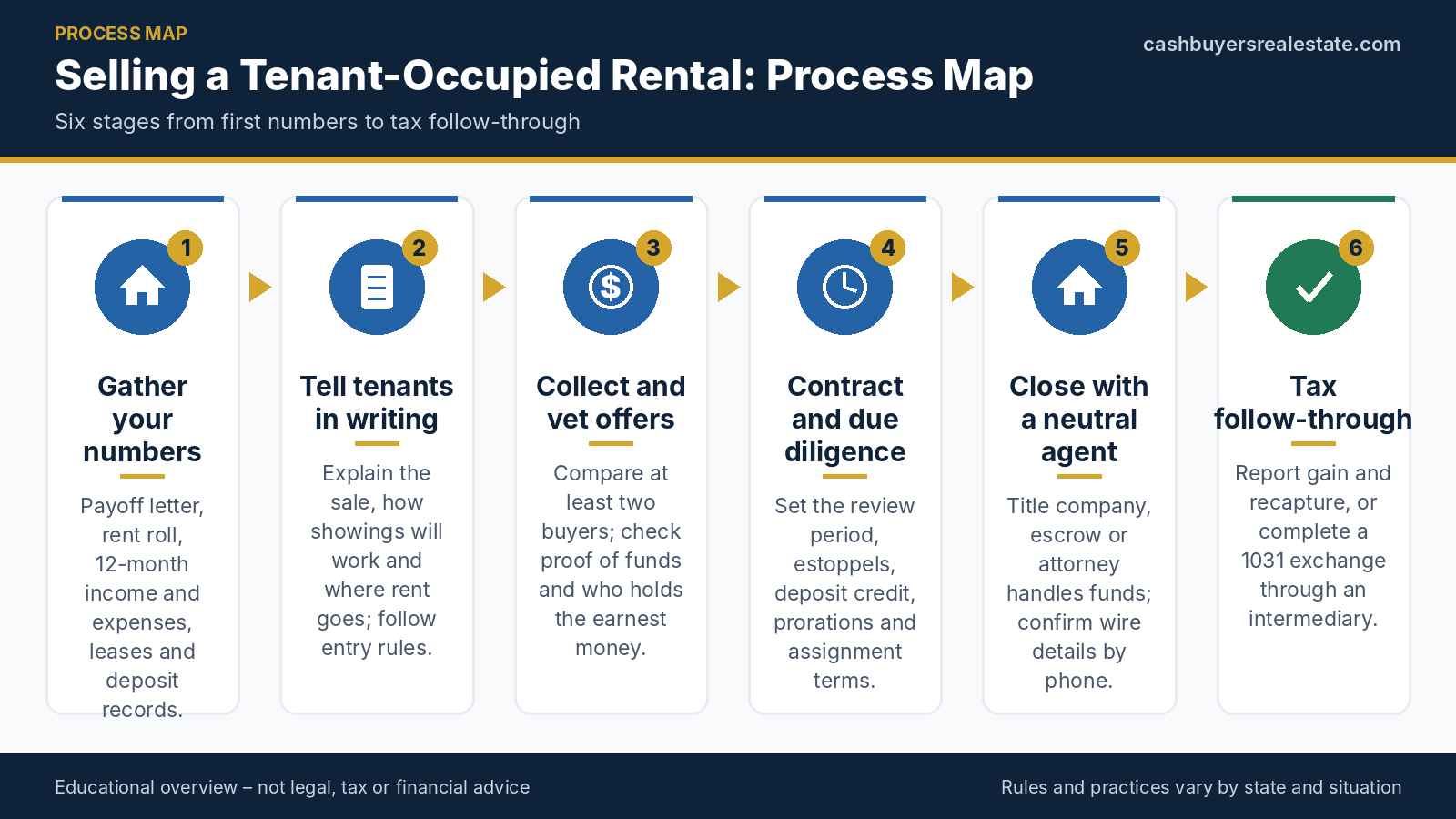
Text version of this infographic
- Gather your numbers — Payoff letter, rent roll, 12-month income and expenses, leases and deposit records.
- Tell tenants in writing — Explain the sale, how showings will work and where rent goes; follow entry rules.
- Collect and vet offers — Compare at least two buyers; check proof of funds and who holds the earnest money.
- Contract and due diligence — Set the review period, estoppels, deposit credit, prorations and assignment terms.
- Close with a neutral agent — Title company, escrow or attorney handles funds; confirm wire details by phone.
- Tax follow-through — Report gain and recapture, or complete a 1031 exchange through an intermediary.
What Selling a Rental Does to Your Tax Bill: Gain, Depreciation Recapture and Deferral
Landlords who sell for cash often discover that the largest line on their closing worksheet isn’t a commission or a repair credit but a tax liability that doesn’t appear on the settlement statement at all. The federal rules below are verified against IRS and statutory sources, while state income tax and local transfer taxes vary too widely to summarize, so treat this section as a map for the conversation with your CPA and not as a substitute for it.
How the taxable gain on a rental is built
The tax on a sale starts with a calculation that looks like simple subtraction and hides most of its complexity in one input: the adjusted basis. Understanding how that figure is assembled explains why two landlords who sell at the same price can owe very different amounts.
Adjusted basis, depreciation allowed or allowable, and the amount realized
Gain is the amount realized from the sale minus the adjusted basis of the property. The amount realized is the price, less selling expenses such as commissions, transfer taxes and legal fees. Adjusted basis starts with what you paid for the property, adds capital improvements such as a new roof or an addition, and subtracts the depreciation you took or could have taken. Land is not depreciated, so the original cost has to be allocated between land and building, usually using the county assessor’s ratio or an appraisal. For residential rental property, the IRS explains in Publication 527 that the building is generally depreciated over 27.5 years under the general depreciation system, which is why a long-held rental can carry a basis far below what the owner originally paid.
The phrase “allowed or allowable” is the one most landlords have never heard and most need to. Publication 527 states that your yearly depreciation deductions include any depreciation you were allowed to claim, even if you didn’t claim it. In other words, a landlord who never took the deduction doesn’t escape the reduction in basis; the IRS treats the depreciation as having been available and takes it into account when the property is sold. That makes the deduction a use-it-or-lose-it proposition and makes it worth asking a CPA, well before a sale, whether any missed depreciation can be corrected on prior returns. Record keeping matters here too, because a basis you can’t document is a basis a buyer’s tax preparer, and eventually an auditor, may question.
The paper trail for basis is worth assembling before you list the property, because it takes longer to find than most sellers expect. The settlement statement from your purchase fixes the original cost and the closing expenses that may be added to it. Invoices and permits document capital improvements, and each year’s depreciation schedule, usually attached to your tax return, shows how much has already been subtracted. Repairs that simply kept the property in working order are deducted in the year you pay for them and don’t add to basis, while replacements and betterments generally do, and the line between the two is where preparers and landlords most often disagree. Settling those questions before an offer arrives lets you calculate your real net with confidence instead of guessing.
The layers: capital gain, unrecaptured Section 1250 gain, the net investment income tax and state tax
The gain on a rental held longer than one year is generally a long-term capital gain, and IRS Topic 409 explains that most net capital gain is taxed at 0, 15 or 20 percent depending on taxable income, with the dollar thresholds adjusted each year. A slice of that gain is treated differently. The portion attributable to prior straight-line depreciation on real property is called unrecaptured Section 1250 gain, and Topic 409 says it is taxed at a maximum rate of 25 percent. The word “maximum” is doing real work: someone in a lower bracket pays less than 25 percent on that slice. Section 1250 itself, in the statute, reaches ordinary-income treatment only for depreciation in excess of straight-line, which most residential rentals do not have, so for many landlords the 25 percent cap is the recapture rule that matters. Equipment and appliances depreciated as personal property are treated under different recapture rules that your preparer will know.
On top of income tax, higher earners may owe the net investment income tax. IRS Topic 559 describes it as a 3.8 percent tax on net investment income for individuals above modified adjusted gross income thresholds of $200,000 for single and head-of-household filers, $250,000 for married couples filing jointly and $125,000 for married filing separately, and it lists net gains from the disposition of real estate among the items that can be included, subject to an exception for property held in a qualifying trade or business. Whether a particular rental falls into that exception is a fact-sensitive question. Finally, suspended passive losses can change the picture favorably: under Section 469(g) of the tax code, when you dispose of your entire interest in a passive activity in a fully taxable transaction with an unrelated party, losses carried forward from that activity are released after being offset against other passive income.
| Layer | What it reaches | Federal rule as published | Where to confirm |
|---|---|---|---|
| Long-term capital gain | Gain on property held more than one year | Most net capital gain taxed at 0%, 15% or 20% depending on taxable income | IRS Topic 409 |
| Unrecaptured Section 1250 gain | Part of the gain tied to straight-line depreciation on real property | Taxed at a maximum rate of 25% | IRS Topic 409; 26 U.S.C. § 1(h) |
| Net investment income tax | Net gain from real estate for higher-income individuals, estates and trusts | 3.8% above income thresholds, with an exception for qualifying trade or business property | IRS Topic 559 |
| Suspended passive losses | Carried-forward losses from the rental | Released in a fully taxable sale to an unrelated party, after netting against other passive income | 26 U.S.C. § 469(g); IRS Publication 925 |
| State and local taxes | Income tax, transfer or recording taxes | Varies widely by state and locality; some states have no income tax | State revenue department; county recorder |
The table is useful mainly for the questions it prompts. If you’ve held the property less than a year, the capital-gain row changes. If your income is near a bracket or threshold, the timing of the sale within a tax year may matter. If you have carried-forward losses, they may offset part of the bill. And if you live in a state that taxes gains as ordinary income, the combined burden can be noticeably higher than the federal figures suggest. A short session with a tax professional before accepting an offer costs little compared with discovering the layers after the check clears.
Illustrative example (hypothetical numbers, not market data): A landlord bought a small rental ten years ago for $150,000, of which $30,000 was land and $120,000 was building. Depreciating the building over 27.5 years produces roughly $4,364 a year, or about $43,600 over ten years, so the adjusted basis is about $106,400. She accepts a cash offer of $330,000 and pays $20,000 in selling costs, leaving an amount realized of $310,000 and a gain of roughly $203,600. About $43,600 of that is unrecaptured Section 1250 gain, taxed at no more than 25 percent, or about $10,900 at the cap; the remaining $160,000 taxed at 15 percent would be $24,000. Federal income tax is therefore around $34,900, before any net investment income tax or state tax, which is more than 11 percent of the amount realized. Her actual bill depends on her bracket and other income.
Ways to defer or spread the tax, and what they ask of a cash buyer
Once the size of the tax is clear, many landlords ask whether it can be postponed. Two federal tools come up most often, and each places conditions on the sale itself, which means the buyer’s cooperation matters.
Section 1031 exchanges: deadlines, intermediaries and the cooperation clause
Section 1031 lets an owner defer tax by exchanging real property held for business or investment for other like-kind real property. The IRS notes that since the Tax Cuts and Jobs Act, Section 1031 applies only to real property, and that property held primarily for sale does not qualify, which excludes dealers and many short-term flippers. The Treasury regulations on deferred exchanges set the clock: the replacement property must be identified in a signed written document within 45 days after you transfer the property you’re selling, and the exchange must be completed by the earlier of 180 days after the transfer or the due date, including extensions, of your tax return for the year of transfer. The regulations allow you to identify up to three properties of any value, or more if their combined value stays within 200 percent of what you sold, and they say that if you receive the sale proceeds yourself before acquiring the replacement property, the transaction is a sale and not an exchange.
That last rule is why exchanges use a qualified intermediary, a third party who holds the funds under an agreement that limits your access to them, so that you never have actual or constructive receipt of the money. Money or other property you receive beyond like-kind property is generally taxable to the extent of the gain, and the exchange is reported on Form 8824. From a cash-buyer perspective, the practical point is that your sale contract needs language acknowledging your intent to exchange and obliging the buyer to cooperate with the intermediary at no extra cost or delay, and that your closing date should be set with the 45-day identification window in mind. A buyer who will not sign a simple cooperation clause is telling you something about how the closing will go.
Installment sales, former residences and other planning questions
An installment sale spreads the gain over the years in which you receive payments. IRS Topic 705 describes it as a sale in which you receive at least one payment after the year of sale, reported on Form 6252, with the gain taxed as principal is collected and interest taxed as ordinary income. Two cautions belong beside any mention of it. The installment method doesn’t defer depreciation recapture, since the IRS says any portion of the gain that is ordinary income under the recapture rules must be reported in the year of sale. And seller financing means you become the lender, with the credit risk and servicing duties that implies, which is a very different arrangement from the clean exit most cash sellers expect.
Two other planning questions come up often. If the rental was once your main home, the home sale exclusion in IRS Topic 701 requires that you owned and used the home as your residence for at least 24 months in the five years before the sale, so a house you moved out of and rented for a short time may still pass those tests, and Publication 523 explains how rental use and depreciation affect the result. If you inherited the property, its basis is generally tied to its value when the prior owner died, rather than to what they paid, which can shrink the gain dramatically, a point worth confirming with the estate’s tax preparer. Neither situation is rare, and both can turn a frightening estimate into a manageable one.
Reporting is its own task. Topic 705 notes that an installment sale may require Form 6252 along with Form 4797 and Schedule D, and a like-kind exchange is reported on Form 8824, so the sale of a rental usually involves several forms that interact. The sequence matters for the cash buyer as well, because the buyer’s closing agent will typically issue an information return reporting the sale to the IRS, and the figures on it should match what you report. A mismatch isn’t fatal, but it’s an avoidable source of notices. Keep the settlement statement, the intermediary’s closing documents if you exchanged, and your depreciation schedule together in one folder, and give the whole set to your preparer rather than a summary.
Comparing Your Routes: Cash Sale, Agent Listing, Vacating First, Cash-Out Refinance and Seller Financing
A cash offer is one answer to the question of what to do with a rental, and the best way to judge it is against the other answers. The comparison that matters is net proceeds after costs, time and risk, not the largest number on a purchase agreement.
Three ways to sell, compared by what lands in your account
Selling can mean very different things depending on whether the tenants stay, who handles the marketing and how much work the property needs before it appeals to the broadest set of buyers. Putting the three main sales routes beside each other, with the same property and the same loan, makes the trade-offs visible.
A cash sale with tenants in place versus an agent listing
A cash investor buying a tenant-occupied rental is paying for convenience and certainty: no showings for a retail audience, no need to prepare the units, no mortgage underwriting delay, and the ability to take the lease obligations as they stand. In exchange, the price reflects an investor’s required return, which is usually lower than what an owner-occupant buyer might pay for a vacant, updated property. A listing with a real estate agent exposes the property to more buyers, including investors who will bid against each other, and it can yield a higher price, but it adds commissions, a longer timeline, and the friction of showing occupied units to financed buyers whose appraisals and inspections can reopen the price.
Which route nets more depends on the property and the market, and the gap is often smaller than sellers expect. The table compares a hypothetical building under three routes, including the one covered in the next section. Every figure is invented for illustration and should be replaced with your own estimates, ideally from a written net sheet prepared by a title company or an agent.
| Item | Cash sale, tenants stay | Agent listing, tenants stay | Vacate, update, then list |
|---|---|---|---|
| Sale price | $280,000 | $305,000 | $345,000 |
| Agent fees and closing costs | $4,200 (1.5%) | $19,825 (6.5%) | $22,425 (6.5%) |
| Repairs, credits, relocation payments | $0 | $3,000 | $26,000 |
| Carrying cost with no rent coming in | $0 | $0 | $10,500 |
| Net before payoff and tax | $275,800 | $282,175 | $286,075 |
| Typical timeline (hypothetical) | 3 to 6 weeks | 2 to 4 months | 5 to 8 months |
| Main risk | Buyer fails to close or re-trades price | Financed buyer’s appraisal or inspection reopens price | Tenant dispute, repair overruns, market softening |
Look at the net row first. The spread between the quickest route and the highest-priced route is about $10,000, which is under 4 percent of the cash price, while the time and risk differ by months. For a landlord who needs the money soon, or who values a clean exit, the cash route may be the rational choice despite a lower sticker price. For a landlord with time, patience and a tolerance for execution risk, the longer routes might earn more. The numbers also move if the tax bill differs by route, which it can when a long closing slips across a year-end into a different tax year, a timing question worth raising with a CPA.
Vacating first: lease endings, cash-for-keys agreements and the limits on pressure
The third route in the table assumes the units are empty before they’re marketed, because owner-occupant buyers pay more for a vacant, updated home than any investor will pay for the same building with tenants. Getting there lawfully is the hard part. A landlord can’t simply decline to honor a lease or hurry a tenant out. Fixed-term leases run to their end date, and ending a month-to-month tenancy requires a notice whose length and permissible reasons depend on state and local law, with some jurisdictions requiring a stated cause. Letting leases expire naturally and not renewing them, where that is allowed, is the cleanest path but takes the longest.
The faster alternative is a voluntary cash-for-keys agreement, in which the landlord offers a tenant a payment in exchange for moving out by an agreed date and leaving the unit in good condition. The word “voluntary” is the key. A tenant who is pressured, threatened, shut off from utilities or harassed has legal claims against a landlord in virtually every state, and a buyer who suggests such tactics is creating liability for you, since you are the landlord of record until closing. A written agreement that states the amount, the move-out date, the condition of the unit and the handling of the deposit protects both sides. If the vacant route appeals, the guide to cash buyers for vacant houses explains how that buyer pool differs from the one that buys tenant-occupied buildings.
Before pursuing either path, ask what your jurisdiction requires. Some states and cities set minimum notice periods that grow with the length of the tenancy, some require relocation payments in certain situations where the landlord ends a tenancy for reasons unrelated to the tenant’s conduct, and some bar landlords from ending a tenancy in a way that looks like retaliation for a repair request or complaint. A payment you offer may also need to be documented differently from ordinary rent. Weigh the delay honestly, too: every month a unit stays empty while you wait for a lease to end or a tenant to leave costs you the rent, and the extra price a vacant sale might bring has to outrun that loss, as the table suggests, with a margin for things going sideways.
Raising cash without selling: refinancing, leasebacks and seller financing
Some landlords who talk to cash buyers are really asking a different question: how can I pull money out of this property, or get out of day-to-day management, without losing it? The alternatives below answer that question in different ways, and each has costs a headline offer won’t reveal.
Cash-out refinance: what conventional lenders allow and what it does to cash flow
A cash-out refinance replaces your current loan with a larger one and hands you the difference. For investment properties, lenders are more cautious than for owner-occupied homes. Fannie Mae’s Eligibility Matrix, dated August 5, 2026, lists maximum loan-to-value ratios of 75 percent for a one-unit investment property and 70 percent for two to four units on a cash-out refinance under its standard desktop underwriting requirements. Individual lenders can set stricter limits, and loans outside the conforming guidelines follow their own rules, so treat those figures as a ceiling for conforming loans and not as an offer.
The trade-off is cash flow. A refinance doesn’t end your landlord duties, and the new payment is usually higher than the old one because the loan is larger and because the interest rate on a new loan may be well above the rate on a loan you got years ago. The worked example below shows how a refinance can look attractive on proceeds and still strain the property’s income, which is why lenders examine rental income closely.
Illustrative example (hypothetical numbers, not market data): A landlord owns a duplex valued at $280,000 with a remaining loan balance of $120,000 and net operating income of $21,000 a year, or $1,750 a month. A lender offers a cash-out refinance at 75 percent of value, a new loan of $210,000. Closing costs of 2 percent, about $4,200, leave net cash of $85,800 after the old loan is paid off. At a hypothetical 7 percent rate over 30 years, the new principal-and-interest payment is roughly $1,397, so the property still covers its debt with about $350 a month to spare, before reserves for repairs and vacancy. At a rate one point higher the payment rises to about $1,540, and at that level a few months of vacancy would turn the property cash-negative. A sale at the cash figure would produce about $155,800 before tax in this example, but would end the landlord’s ownership and the rent that comes with it.
Sale-leasebacks, master leases and seller financing: arrangements that keep you involved
In a sale-leaseback, the owner sells a property and immediately leases it back from the buyer. The structure is common in commercial real estate, where a business sells its building and keeps operating in it. For a small residential rental, the owner is usually not the occupant, so the pure version doesn’t apply. It can fit in two situations: a landlord who lives in one unit of a small multifamily building and wants to sell to an investor but stay in place as a tenant, or a landlord who sells to a buyer that agrees to a master lease under which the seller continues to operate and collect rents from the tenants for a fee or a fixed payment. In both cases the documents decide who controls the leases, who pays for repairs and what happens when the term ends.
Arrangements that mix a sale, a lease and an option to buy back the property deserve extra scrutiny and a lawyer’s review before anyone signs, because the economics can hide in the repurchase price, the rent schedule and the default terms. Seller financing, covered earlier from the tax side, is the other way to stay involved: the seller carries a note from the buyer and receives payments over time. It can widen the buyer pool and spread the gain, but it ties your outcome to the buyer’s ability to pay, and it needs a properly drafted note, a recorded security instrument and an understanding of what you would do if the buyer stopped paying. For most landlords who are ready to be done, a clean sale is simpler than any of these structures.
Seen together, the routes form a spectrum between certainty and potential price, and between ending your involvement and retaining it. The comparison chart below summarizes the five routes discussed in this section, including who each suits best and the main trade-off to weigh.
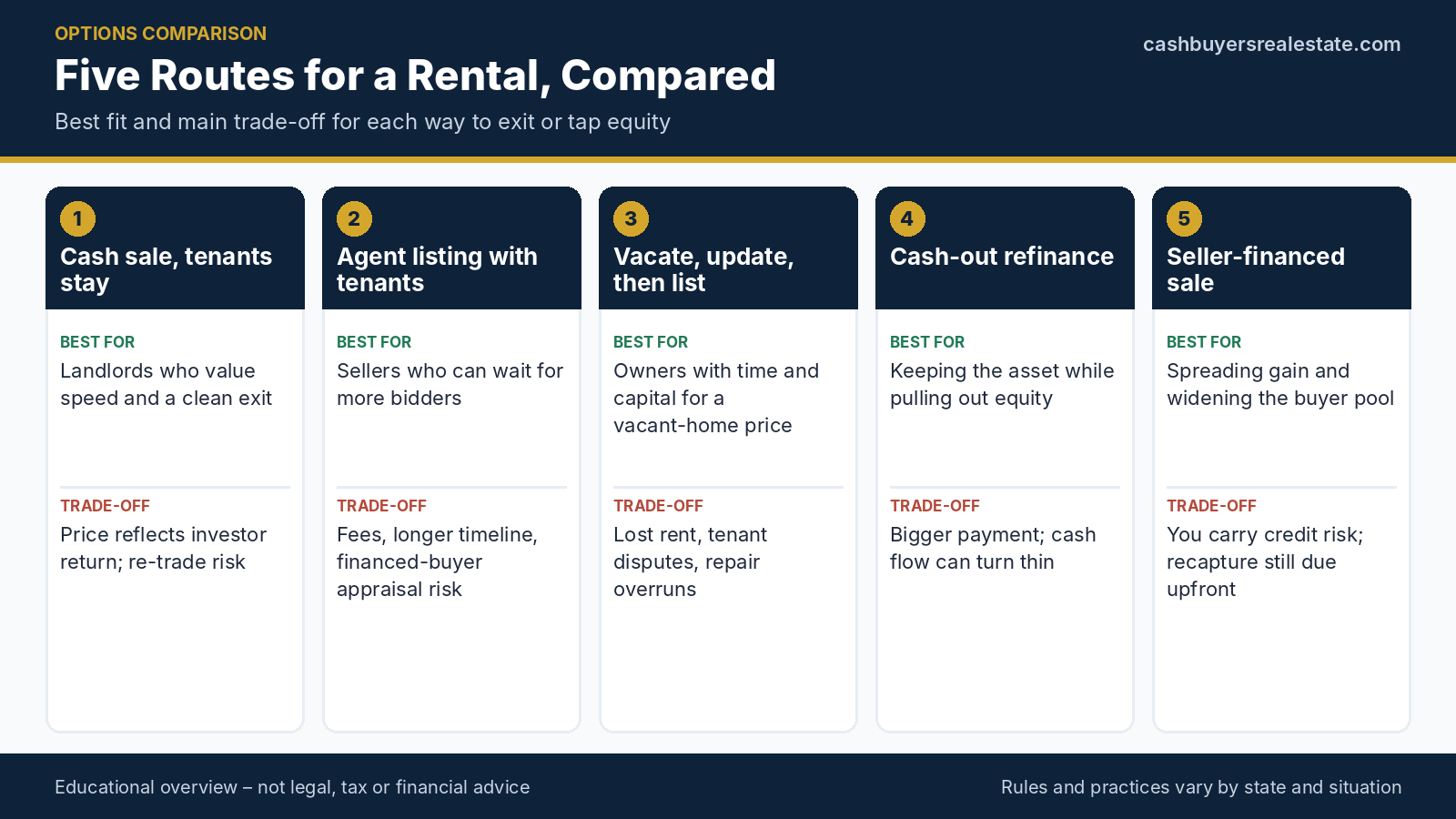
Text version of this infographic
- Cash sale, tenants stay — Best for: Landlords who value speed and a clean exit. Trade-off: Price reflects investor return; re-trade risk.
- Agent listing with tenants — Best for: Sellers who can wait for more bidders. Trade-off: Fees, longer timeline, financed-buyer appraisal risk.
- Vacate, update, then list — Best for: Owners with time and capital for a vacant-home price. Trade-off: Lost rent, tenant disputes, repair overruns.
- Cash-out refinance — Best for: Keeping the asset while pulling out equity. Trade-off: Bigger payment; cash flow can turn thin.
- Seller-financed sale — Best for: Spreading gain and widening the buyer pool. Trade-off: You carry credit risk; recapture still due upfront.
The Paper Trail Buyers Ask For: Rent Rolls, Operating Statements, Leases and Property Records
Investors buying income property are buying information as much as they’re buying bricks. The quality of your records often decides whether a buyer prices your property at the top or the bottom of the range, and whether he keeps his offer intact through due diligence or comes back with a long list of adjustments.
The two financial documents that drive the underwriting
Almost every serious buyer of a small or mid-sized rental will ask for the same two documents in the first conversation. They have unglamorous names, and sellers who haven’t seen them before sometimes assume they’re formal filings, but both are simple summaries you can build from records you already keep.
The rent roll: what it shows and how errors creep in
A rent roll is a unit-by-unit schedule of the property as it exists today. For each unit it lists the tenant, the lease start and end dates, the monthly rent, the security deposit held, any prepaid rent or unpaid balance, and any special terms such as concessions, pet rent or utility reimbursements. Buyers use it to confirm the gross income they’ll capitalize, to see when leases expire, and to judge whether rents are close to what the market supports. A clean rent roll takes an afternoon to prepare. A messy one, assembled from memory, tends to cost the seller far more in lost credibility.
The most common errors are predictable. Rents are listed at the lease rate when the tenant actually pays something different because of a concession, a partial payment arrangement or an unrecorded rent increase. Units with a month-to-month holdover are shown as though they have current leases. Deposits on the roll don’t match the deposits actually held in the account. A vacant unit is listed at its asking rent as though it were producing income. Buyers verify rent rolls against bank statements and leases, so every mismatch becomes a negotiating point at best and a reason to walk away at worst. Preparing the roll alongside three to six months of deposit records keeps it honest, and showing the reconciliation in advance builds more trust than any assurance in conversation.
Illustrative example (hypothetical numbers, not market data): A landlord with a six-unit building lists total monthly rent of $7,800 on the rent roll. A buyer’s review of twelve months of bank deposits shows an average of $7,250 a month. The difference turns out to be $300 in unrecorded concessions to two tenants and $250 in a late-paying unit that the roll shows at full rent. At a 7.5 percent cap rate, a $550 monthly gap is $6,600 a year in gross income, which could reduce the supportable price by roughly $88,000 before expenses are even considered. Had the landlord shown the actual figures and explained the concessions up front, the same buyer might have trimmed the price by a fraction of that amount and moved on.
The trailing twelve-month statement and how it differs from your tax return
The second document is the operating statement, usually called a T-12 for the trailing twelve months it covers. It is a month-by-month record of income received and expenses paid, organized by category: rent, other income, taxes, insurance, repairs, utilities, management, and so on. Buyers prefer monthly detail to an annual total because it shows seasonality, one-time expenses and trends. If you’ve kept books in a spreadsheet or accounting program, the statement can be exported. If you haven’t, a bookkeeper can reconstruct it from bank and card statements, and that work is an investment that tends to pay for itself in a better offer.
Sellers sometimes offer their tax return in place of a T-12, but the two serve different purposes. The IRS explains in Publication 527 how rental income and expenses are reported for tax purposes, and a schedule built for the IRS includes items an investor strips out when estimating operating income: depreciation, which is a non-cash tax deduction, and mortgage interest, which belongs to your financing and not to the property. It may also reflect timing choices and categories that don’t match how a buyer thinks about expenses. A good T-12 bridges the gap by showing operating figures cleanly and, ideally, a short reconciliation to the return. Expect the buyer to normalize it anyway, adding management and replacement reserves you don’t pay yourself, and removing expenses unique to your situation.
Two small accounting habits make the statement far more convincing. The first is consistency about timing: if you pay the December property tax installment in January, say so, or the statement will show eleven months of one cost and thirteen of another. The second is clarity about who pays utilities. Where tenants reimburse water or trash charges, the income and the expense should both appear, and where the landlord covers them without recovery, the buyer will want to know whether a future owner could bill them back under the lease. These details look minor, but they are where an experienced reviewer decides whether a seller’s numbers can be trusted, and trust translates directly into how little cushion the buyer builds into the price.
Leases, tenant files and property records
Financial summaries tell a buyer what the property earns. Underlying documents tell him whether those earnings are enforceable, whether the building can legally operate as described, and what liabilities might travel with it.
Lease files, tenant ledgers and estoppel certificates
Each lease is a contract the buyer will inherit, and he will want to read every one of them, including addenda, renewals and any amendments. Missing pages, unsigned copies and undated changes are common in small-landlord files and are worth fixing now. Alongside the leases, expect requests for tenant ledgers showing payments and balances, a record of deposits held, applications or screening results for current tenants where law permits sharing them, and any notices sent or received over the past couple of years, such as late-rent notices, repair requests, lease violations or complaints. Sharing tenant personal information with a prospective buyer raises privacy questions, and many sellers redact sensitive details until a contract is signed.
The estoppel certificate, mentioned earlier, is the tenant’s own signed confirmation of the facts. It typically states the lease dates, the rent, the deposit amount, whether rent has been paid in advance, whether the landlord is in default, and whether the tenant has any claims or purchase rights. Some buyers require estoppels as a condition of closing, others rely on the seller’s representations and the leases themselves. Because tenants aren’t parties to the sale and may be wary, request them politely, explain why, and provide a clear form. The table below pulls together the documents buyers commonly request, what each one demonstrates and when it makes sense to prepare it.
| Document | What the buyer is trying to confirm | Common problem | Prepare |
|---|---|---|---|
| Rent roll | Current income, lease expirations, deposits held | Roll shows lease rent, not rent actually collected | Before listing |
| Trailing 12-month operating statement | Real expenses, seasonality, one-time items | Mixes personal and property expenses | Before listing |
| Signed leases and addenda | Enforceable terms, renewal rights, purchase options | Missing pages or unsigned copies | Before listing |
| Tenant ledgers and deposit records | Payment history and exact deposit liability | Deposits not matching the account | Before listing |
| Estoppel certificates | Tenant confirms rent, term, deposit and absence of disputes | Tenants slow to respond or reluctant | During due diligence |
| Tax bills, insurance policy and claims history | True carrying costs and past losses | Reassessment or premium changes after sale | During due diligence |
| Permits, certificates, rental registration | Legal ability to operate the units as described | Unpermitted conversions or lapsed registration | Before listing |
| Repair and capital expenditure records | Age and condition of roof, systems and appliances | No receipts for major work | Before listing |
Think of the table as an order of operations. The first four rows establish the income story and ought to be ready before you speak to any buyer, because they set the first impression and shape the first offer. The estoppels and third-party records can wait until a contract is signed, when buyer and seller are committed enough to do the work. The compliance row deserves attention early, since problems there tend to be expensive and to surprise sellers, and since a buyer who discovers them in the middle of due diligence often responds by re-pricing, not by helping.
Property, compliance and operating records
Beyond the leases and the financials, buyers look for evidence that the property is what it claims to be. Permits and certificates of occupancy show that conversions, additions and extra units were approved. Municipal rental registrations, inspection certificates and any open code enforcement notices show whether the property is in good standing with the local government, and the requirements differ from city to city. Utility bills reveal who pays what, and service contracts for trash, landscaping, snow removal or pest control define commitments the buyer may assume. Insurance loss runs show whether the property has a claims history that could affect future premiums.
Disclosure obligations deserve particular care. Under the federal lead-based paint rule described by the EPA, sellers and landlords of most housing built before 1978 must disclose known lead-based paint and hazards, provide available records, give the buyer or renter the EPA pamphlet, and include a lead warning statement, and a buyer has a 10-day period, unless the parties agree otherwise, to conduct an inspection or risk assessment. Signed disclosures must be kept for three years. State seller-disclosure laws add their own forms and exemptions, and a few treat investor-sellers or estates differently from owner-occupants, so ask an attorney which apply to you. What no state allows is hiding a known defect or the existence of a problem. Concealing it risks the sale, invites a lawsuit and, in the worst cases, can create liability that outlasts the closing, and the cost of disclosure is almost always smaller than the cost of getting caught.
Physical-condition records round out the file. Keep the age of the roof, water heaters, furnaces and appliances, the dates and invoices of major repairs, any prior inspection reports, and photographs of each unit in its current state. Whether a cash buyer inspects at all varies from buyer to buyer; some walk every unit and crawl the mechanical rooms, and others rely on the documents and a quick visit, as explained in the guide on whether cash buyers require inspections. Either way, a seller who can say when the boiler was last serviced and show the invoice gives the buyer less reason to assume the worst, and assumptions about condition are one of the most common causes of late price reductions.
Reading an Offer on a Rental: Price, Proof of Funds, Contract Terms and the Closing Table
Once records are in order and offers begin to arrive, the work shifts from understanding value to comparing paper. Two offers with the same price can leave you with very different results once you read what each one asks you to accept, what each one lets the buyer walk away from and how each one handles the tenants.
What a cash offer on a rental should spell out
A written offer or letter of intent for an investment property usually carries more moving parts than one for an owner-occupied house, because the buyer is evaluating leases, income and operating history in addition to the structure. Reading those parts carefully is the best defense against a number that shrinks later.
Price, due diligence and the terms that decide your real net
Start with what the price is attached to. An offer may be stated as a flat figure, or as a figure subject to a satisfactory review of leases, rent roll, financials and a physical inspection. The second kind is common and legitimate, but it matters how long the review period lasts, what happens if the buyer finds something, and whether he must explain a price reduction with specifics. A long review period with a free exit gives the buyer an option on your property while you wait, and in the meantime you may have turned away other offers and told your tenants a sale is coming. Shorter periods, a defined list of what can justify a revision, and an earnest money deposit that becomes non-refundable at a set point shift some of that risk back to the buyer. The surrounding guide to contingencies in cash offers explains how these clauses typically work.
Several other terms deserve attention in a rental sale. Look at who pays for what at closing, since customs vary by region and by contract, and compare it with the explanation in the piece on closing costs in cash offers. Check how the contract treats the tenants: whether delivery of estoppel certificates is a condition, whether the buyer assumes all leases as they stand, how the deposits are credited, and what happens to rent that is unpaid at closing. Look for any clause that lets the buyer assign the contract to another party, and ask who that party might be, since assignment changes who closes the deal and who must be able to pay. None of these terms is unusual by itself, but the combination determines whether a headline price converts to the cash you expect.
Proof of funds and earnest money: what real verification looks like
A cash offer is only as good as the cash behind it. Proof of funds is typically a recent bank or brokerage statement, or a letter from a financial institution confirming that the buyer has available funds at least equal to the purchase price and closing costs. Reading it takes a few minutes and surfaces a surprising number of issues: the name on the account may not match the buyer named in the contract, the balance may be lower than the price, the document may be old, or the funds may belong to an entity different from the one signing. A buyer who is an LLC should be able to explain how the money gets to the entity and from whom. If the funds come from a private lender or investor partner, ask for confirmation that they’re committed and available, not merely discussed. The overview of proof of funds for cash buyers goes deeper on what the document should include.
Earnest money is the buyer’s good-faith deposit, and where it is held matters as much as the amount. In most transactions it should sit with a neutral third party such as a title company, escrow agent or attorney, not with the buyer, the seller or an intermediary whose role is unclear. Ask when it becomes non-refundable, under what conditions the buyer can recover it, and what you receive if the buyer defaults, and compare the answers with the explanation of earnest money in cash deals. A very small deposit relative to the price, or one that is refundable for the entire due diligence period and beyond, doesn’t prove a buyer is unserious, but it does mean the cost of walking away is low for him and the cost of waiting is high for you, and your decision should account for that imbalance.
Closing mechanics specific to a rental
The closing of an occupied rental has a few features that a typical house sale doesn’t. Income and obligations that belong to tenants and to each owner have to be divided on the settlement statement, and the funds have to reach the right place safely.
Prorations, deposits and the settlement statement
Rent collected for a period that straddles the closing date is divided according to the number of days each party owns the property. The same logic applies to prepaid rent, property taxes billed in advance or in arrears, and utilities and service contracts that the buyer takes over. Security deposits are generally credited to the buyer, who becomes responsible for them, in line with the state rules described earlier. The contract should also say who has the right to collect any rent that was due but unpaid before the closing. Sellers sometimes keep that right, sometimes assign it and sometimes write it off, and each choice has consequences for the tenant relationship, so decide it deliberately and put it in writing.
| Item | How it is usually handled | What to confirm in the contract |
|---|---|---|
| Rent for the month of closing | Divided by days of ownership; the party holding the full month’s rent credits the other | Which day counts for the buyer, and whether rent is prorated on actual days or a 30-day month |
| Rent unpaid at closing | Depends on the agreement; collected by seller, assigned to buyer or written off | Who may pursue it and whether payments received later are applied to current rent first |
| Security deposits and prepaid rent | Credited to the buyer, who accepts responsibility for the tenants’ funds | Exact amounts by unit, written receipt, and tenant notices required by state law |
| Property taxes | Prorated between the parties, following local custom for billing periods | Whether a recent increase or pending reassessment is accounted for |
| Utilities and service contracts | Final meter readings for the seller; assumed or terminated contracts for the buyer | Which contracts the buyer assumes and who notifies vendors |
| Existing loan payoff | Paid from proceeds using a payoff letter from the lender | Payoff good through the closing date, plus any prepayment charges in the loan documents |
You can use the table as a negotiating checklist as well as a description. Each row is a place where two reasonable people might handle things differently, and where an unclear contract invites a dispute after the money has changed hands. Walk through the draft settlement statement before closing with the actual numbers, compare it with your own net sheet and ask the closing agent to explain any line that doesn’t match. A discrepancy found two days before closing can usually be fixed, while one found two weeks afterward often can’t.
Choosing the closing partner and protecting the wire
Who closes the transaction depends on where you live. In many states a title company or escrow agent handles the money, the documents and recording, while in others an attorney closes the transaction, and some regions mix both approaches. Whichever applies, the closing agent should be an independent party with a physical office, a licensed professional, and procedures you can verify with the state’s regulator or bar association. Ask who will hold the earnest money, who prepares the settlement statement and who records the deed, and think twice about any arrangement that asks you to sign over a deed or move money before an independent party is involved.
Wire fraud is a particular risk, since a closing involves large transfers, many email exchanges and tight deadlines. The Consumer Financial Protection Bureau describes how scammers compromise email accounts and send spoofed wiring instructions, and advises people to verify instructions by calling a number they already have, not one from an email, and never to follow instructions contained in an email. As a seller you face the mirror image: you will send your own account details to the closing agent, so confirm by phone that they were received correctly, and be wary of any late request to change where funds should go. If something does go wrong, contact your bank right away to ask for a recall and file a complaint with the FBI’s Internet Crime Complaint Center. These safeguards are inexpensive, and they apply no matter how reputable the buyer appears.
Before moving to the red flags, it helps to compress the verification steps into a short decision checklist. The image below reviews six checks that deserve an answer before you sign anything on a rental sale: the buyer’s identity, proof of funds, the cancellation terms, assignment rights, the closing partner and blank forms.
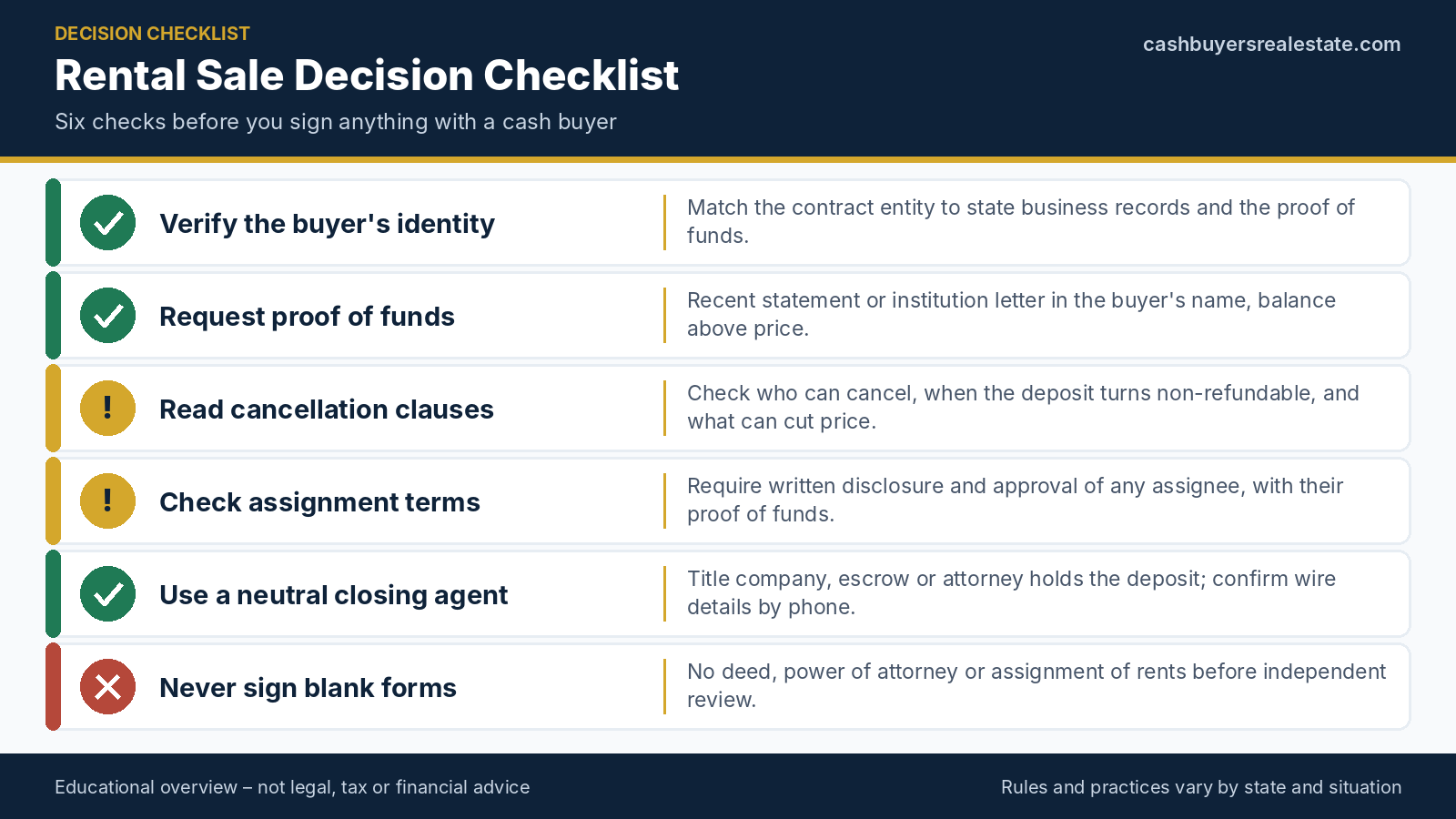
Text version of this infographic
- Verify the buyer's identity — Match the contract entity to state business records and the proof of funds.
- Request proof of funds — Recent statement or institution letter in the buyer's name, balance above price.
- Read cancellation clauses — Check who can cancel, when the deposit turns non-refundable, and what can cut price.
- Check assignment terms — Require written disclosure and approval of any assignee, with their proof of funds.
- Use a neutral closing agent — Title company, escrow or attorney holds the deposit; confirm wire details by phone.
- Never sign blank forms — No deed, power of attorney or assignment of rents before independent review.
Red Flags When Cash Buyers Approach a Landlord: Contract Traps, Tenant Tactics and Verification
Most investors who buy rental property are ordinary business people who want to close. A minority use pressure, ambiguity or fine print to get more than the price suggests, and landlords are a particular target because their properties come with complexity that can be exploited. The goal here is pattern recognition, not suspicion of everyone.
Pricing, pressure and paperwork warning signs
The earliest signals usually appear in how a buyer communicates, before any contract exists. Treat them as reasons to ask more questions, since each can also have an innocent explanation, and no single one is proof that something is wrong.
Manufactured urgency and offers that don’t connect to your numbers
An offer should be traceable to the property’s income, condition and the buyer’s required return. If the number arrives with no explanation, no request for a rent roll and no questions about leases, it probably came from a formula applied to the address alone, and it may leave out whatever makes your property valuable. Equally, a number that sounds extraordinarily high can be a pricing anchor that will fall away once due diligence begins. Ask the buyer to walk you through how he got there. An experienced investor can explain in a few sentences what he assumes for rent, expenses, repairs and his target return, and a buyer who can’t or won’t is giving you information.
Urgency is the other recurring pattern. Deadlines tied to the buyer’s convenience, such as an offer that expires tonight, a demand for an answer before you’ve had a chance to consult an attorney, or a suggestion that other landlords are about to accept the same buyer’s money, are designed to shorten your thinking time. Real deadlines exist in real estate, particularly around financing or a tax-deferred exchange, and a legitimate buyer will explain them and document them. The difference is whether the deadline survives a polite request for another day to have a professional review the contract. A buyer who disappears when you ask for a lawyer’s review has told you more than a hundred reference letters could.
Contract clauses that shift risk onto the landlord
Some of the most expensive problems are written into the contract plainly, and are overlooked because the document is long and the buyer is friendly. The table lists clauses that commonly deserve a second look in rental contracts and the safer alternative to request. Not every clause is improper, and many are negotiable, which is precisely the point: if a buyer will not discuss any of them, that is useful to know before you commit.
| Clause or practice | Why it can hurt a landlord-seller | What to ask for |
|---|---|---|
| Broad right to assign the contract with no notice | The party who closes may be someone you never vetted, with unverified funds | Disclosure of the assignee in writing, proof of funds from the assignee, and your approval right |
| Long exclusive option or extension rights for the buyer alone | Your property is tied up while the buyer keeps the freedom to walk away | A defined term, a meaningful non-refundable deposit and a firm outside closing date |
| Recorded memorandum or lien-like notice against the property at signing | It can cloud title and block other buyers if the deal fails | A promise to release it within days of termination, with a signed release delivered to the closing agent |
| Price revision allowed for any reason after inspection | The headline price becomes a starting point rather than a commitment | A defined list of defects or issues that justify revisions, with documentation required |
| Seller must deliver the units vacant, while leases remain in force | It asks you to do something the leases and state law may not allow | Tenant-in-place closing, or a separate lawful arrangement with each tenant |
| Earnest money held by the buyer or a non-neutral party | Recovery after a failed deal depends on the buyer’s cooperation | Deposit with a title company, escrow agent or attorney under written instructions |
| Unlimited seller indemnity for tenant claims or unknown conditions | It turns a sale into open-ended personal exposure after the closing | A defined, time-limited set of representations that match what you actually know |
As the table suggests, red-flag clauses tend to make the buyer’s options broad and yours narrow. A fair contract is not necessarily one in which both sides take identical risks, but each risk should sit with the party better able to manage it. The buyer is best placed to manage the risk that his own financing or partners fall through, and a firm outside date plus a real deposit reflects that. You are best placed to speak accurately about the property’s history, and reasonable representations on that point are fair. The broader treatment of problem clauses in the guide to cash offer contract red flags applies equally to rentals.
Tenant-related tactics and checking out the buyer
Rental sales invite a few tactics that homeowner sales rarely see, because tenants are in the picture. There are also practical ways to check out a buyer that don’t depend on trusting what he says.
When a buyer wants to talk to your tenants first
Buyers legitimately want to meet tenants during due diligence, and an introduction that you arrange, with notice and in your presence or with your permission, is normal. Trouble starts when a buyer approaches tenants on his own before a contract exists, suggests that rent should be withheld until the sale closes, floats the idea that tenants may have to move, or offers money to leave without your involvement. Tenants can become confused about who their landlord is and who to pay, and a tenant who stops paying rent because of something a prospective buyer said creates losses that fall on you, since you remain the landlord until the deed is recorded.
The legal responsibility stays with the owner of record. Locking tenants out, shutting off utilities, removing doors or belongings, or threatening tenants to speed a vacancy is unlawful in most states, as the Texas Property Code’s lockout and removal provisions illustrate, and a buyer who proposes it is asking you to take on liability that he can walk away from. Federal fair housing law also applies. Decisions about which tenants to retain or which units to show shouldn’t turn on a protected characteristic. A cleaner approach is to make a rule at the outset that all tenant contact flows through you or through a manager you designate until closing, and to put that rule in the contract.
It also helps to decide in advance how you’ll respond when a tenant tells you a buyer contacted them. Write down what you hear, the date and what the buyer said, and remind the buyer in writing of the contact rule. Tenants who feel respected tend to cooperate with inspections, estoppels and showings; tenants who feel ambushed tend to call the local housing office or a legal aid clinic, and neither response is unreasonable. For tenants who receive housing assistance, a poorly handled transition can interrupt payments, so make sure the buyer understands that the program’s own steps come first. A buyer who treats the tenancy as a nuisance to be cleared, as opposed to a set of people and agreements to be honored, will probably treat you the same way when something goes wrong after signing.
Checking who you are dealing with without assuming the worst
Verification doesn’t require adversarial behavior. Ask for the full legal name of the purchasing entity and confirm that it exists and is in good standing through the secretary of state’s business records in the state where it was formed. Make sure the entity named on the proof of funds is the same one named on the contract, or that the connection is explained in writing. Ask for the names of a title company or attorney the buyer has closed with recently, and call to confirm that the buyer closes deals and pays on time. Search court records for the entity and its principals to see whether there is a pattern of lawsuits over failed closings, though a few cases in a busy business are not unusual.
Online reviews and social media presence are weak evidence in either direction, since they are easy to manufacture and easy to distort. A single practice also does not prove or disprove legitimacy. What counts is consistency: whether the buyer’s statements, documents and conduct match, and whether the independent parties he points you toward confirm them. For additional perspective, the overview of how to judge whether cash home buyers are legitimate and the trust-focused hub on cash home buyer scams offer frameworks that work for any property type. If an answer is unsatisfying, slow down. There is nearly always another buyer, and rarely a reason to accept a risk you can’t evaluate.
The same scrutiny applies to the people who will handle the money. Confirm that the title company, escrow officer or attorney is licensed through the state’s insurance department, real estate regulator or bar, depending on how your state licenses closers, and find their phone number yourself instead of using one printed in an email or on a document the buyer sent. Ask the closing agent directly who has opened the file, who has deposited earnest money and what the buyer has delivered so far. A buyer who proposes his own closer is not necessarily doing anything wrong, but you are entitled to insist on a neutral one, and a buyer’s resistance to that request is worth noting before you spend more time and legal fees on the deal.
Common Questions About Selling a Rental to Cash Buyers
The questions below come up repeatedly when landlords start comparing cash offers. The answers are general and educational, so check the specifics against your lease, your state’s landlord-tenant statute and your own tax situation.
Questions about offers, buyers and contracts
Questions about price and offers
- Will a cash buyer pay more or less for a rental with tenants than for the same building empty?
It depends on who the buyer is and what the tenants are paying. An investor who plans to keep the property as a rental often pays at least as much for a building with reliable tenants and documented income, since the rent starts on day one. A buyer who wants to renovate, resell to an owner-occupant or raise rents sharply may discount for the time and effort needed to deal with leases. The only way to know is to let several kinds of buyers see the rent roll and compare their reasoning, not just their numbers.
- Do investors really use a different formula for rentals than for houses?
Yes, in most cases. A buyer pricing an owner-occupied house works from comparable sales and repair costs, while a buyer pricing a rental usually starts with net operating income and the return he requires, then adjusts for condition and risk. Some investors blend the two, checking an income-based value against what the building might fetch in a resale. If an offer on a tenant-occupied property comes without any questions about rents, expenses or leases, it may have been generated from the address alone.
- Is it acceptable to negotiate after the first offer?
Yes, and it is expected. A first offer is usually an opening position, especially if the buyer has not seen your documents. Ask how the figure was calculated, supply a clean rent roll and operating statement, and point to any assumption you believe is wrong. You can also negotiate terms that carry real value, such as a shorter review period, a larger deposit or a firm closing date. Keep every revision in writing so the final contract reflects what you agreed.
- Should I get my own valuation before talking to buyers?
It can help, particularly if the property is large or unusual. A broker or agent who handles investment property can give an opinion of value based on income and recent sales of similar buildings, and a licensed appraiser can prepare a formal appraisal for a fee. Neither will bind a buyer, but either gives you a reference point so an offer far outside the range prompts questions instead of acceptance. Compare the cost of the valuation with the size of the decision before ordering one.
Questions about trust and contracts
- How can I tell whether a buyer really has the cash?
Ask for a recent bank or brokerage statement, or a letter from the institution, in the same name as the buyer on the contract. Check that the balance covers the price and the closing costs, that the date is current and that the funds are not already committed to another purchase. Then follow up with the title company or attorney, who can confirm that funds arrived when the earnest money deposit is made. No document is perfect proof, but consistent paperwork and a neutral holder for the deposit give you solid protection.
- Is it normal for a buyer to assign the contract to someone else?
Assignment is common in investment real estate and is not improper in itself. The concern is transparency. Find out in writing who the new buyer will be, ask for their proof of funds, and make sure your contract either limits assignment or requires your approval. If the original buyer stays obligated and the assignee is qualified, the risk is modest. If the contract lets the buyer hand off the deal to an unknown party at the last moment, your certainty of closing is much weaker than the offer suggests.
- Who should hold the earnest money?
A neutral third party, such as a title company, escrow agent or attorney, working under written instructions that say when the deposit is refundable and who receives it after a default. Avoid arrangements in which the buyer, the seller or an informal intermediary holds the money, because recovering it later then depends on someone’s goodwill. State practice differs on who acts as the holder, so ask the closing agent which options your state allows and have the agreement reviewed before the deposit moves.
Questions about tenants, taxes and timing
Questions about tenants and leases
- Do I have to tell my tenants that I’m selling?
Whether a particular notice is legally required depends on your state, your lease and what you plan to do, such as schedule showings, which can trigger notice rules. Even where nothing mandates it, telling tenants early in writing is wise. They will see buyers walking through, hear rumors and worry about their housing, and an honest, plain notice answers most of those worries. After closing, tenants generally need to know who the new owner is, where to send rent and who is holding their deposit.
- Can a new owner raise the rent or end a tenancy right after closing?
A new owner usually steps into the existing lease, so a fixed-term lease generally continues on its current terms until it ends. A month-to-month tenancy can be changed or ended with proper notice, but some states and cities limit rent increases, require stated reasons for ending a tenancy or both. Your buyer is subject to the same rules as you, so ask local counsel what applies before promising tenants anything.
- Who ends up with the security deposit?
In a typical sale the buyer receives a credit for the deposits at closing and becomes responsible to the tenants, but the exact process varies by state. Some states require the former landlord to transfer or return the deposit and notify the tenant, and some keep the seller liable until the buyer takes over the obligation. Get a signed acknowledgment of the amount from the buyer, keep copies of tenant notices, and follow your state’s statute in preference to any general rule.
- What if a tenant refuses to allow showings or is behind on rent?
Start with the lease and your state’s rules on entry, give proper written notice and try to schedule showings at times that suit the tenant. A tenant who is behind on rent is still protected by the eviction process, and skipping steps or using self-help remedies can expose you to penalties. Tell the buyer about arrears honestly, since concealing a payment problem can undermine the sale, and ask an attorney how the contract should treat the unpaid balance and any pending court case.
Questions about taxes and timing
- Is depreciation recapture always taxed at 25 percent?
No. According to the IRS, the portion of gain attributable to prior straight-line depreciation on real property is taxed at a maximum rate of 25 percent, so people in lower brackets can pay less. Other pieces of the gain are taxed at the usual long-term capital gain rates, and higher earners may owe the net investment income tax as well. Equipment or personal property that was depreciated separately follows different rules, so your preparer needs the full depreciation history.
- Can I use a 1031 exchange with a quick cash sale?
You can, if you plan for it before closing. The exchange needs a qualified intermediary to hold the proceeds, the sale contract should acknowledge your intent and require the buyer’s cooperation, and you must identify replacement property within 45 days of the transfer and finish within the 180-day limit. A fast closing starts the clock sooner, which helps only if you already have candidates in mind. Property held primarily for sale generally doesn’t qualify.
- How long does selling a rental to a cash buyer usually take?
There is no reliable single figure. Timing depends on the length of the review period, how quickly estoppel certificates and documents come back, whether tenants cooperate with inspections, whether a housing authority or other program has to approve a change of ownership, and how fast the closing agent can clear title. A tidy, well-documented building with a motivated buyer can move quickly, while a messy file or a complicated tenancy can take much longer than the buyer first suggests.
Deciding Whether a Cash Sale Fits Your Rental, and What to Do First
A cash offer is a tool, not a verdict. Whether it’s the right one for your rental depends on what you need from the sale and what you’re willing to trade for it, and the decision gets easier when you put your priorities in order before you look at any number.
A decision framework for matching the route to your priorities
Three sets of questions do most of the work: what matters most to you, what the property and tenants allow, and what the numbers show once taxes and payoff are included.
Matching priorities to a cash sale, a listing or keeping the property
If your priority is certainty and speed, a cash sale to a verified buyer, with tenants in place and a short, well-defined review period, is often the most direct route. It trades some price for fewer variables, which suits a landlord facing a deadline, a property that needs more attention than you can give, or an estate that needs to be settled. If your priority is the highest price and you have time, an agent listing, possibly after the leases end and modest improvements, can reach buyers who pay more for a vacant or updated property, though it adds cost, delay and the risk of a market change along the way.
If your priority is staying invested in real estate without the daily work, other routes may serve better: a refinance to take out equity, a professional property manager, or a sale that feeds a tax-deferred exchange into something easier to run. If your priority is minimizing taxes, the order in which you decide matters, because an exchange has to be planned before closing and the installment method has to be built into the contract. Landlords with several competing priorities should rank them honestly, since the options that satisfy one often work against another. Those who inherited a rental should also read the discussion of cash buyers for inherited houses, because basis and probate issues change the math.
The condition of the tenancy shifts the weighting as well. A building with long-term tenants paying fair rents on time is an asset buyers compete for, and that competition is a reason to test the market before you accept the first bid. A building with a chronic late payer, an unresolved dispute or an unfinished eviction is different: a cash buyer experienced with occupied property may be willing to take on the complication, and the discount you accept in return buys relief from months of legal process and uncertain outcomes. Neither situation points automatically to a cash sale or away from it. The useful habit is to name your weakest points honestly and ask which route handles them best, instead of choosing the route whose headline number you like.
Running the numbers: the hold-or-sell comparison
Whatever your priorities, a clear net figure lets you compare routes fairly. Start with each route’s price. Subtract the loan payoff, selling costs, credits for deposits and prorations, repair concessions and any payments to tenants. Then estimate the tax using your CPA’s help, including recapture, capital gain and any state tax. The result is what you can actually put to use. For a route that keeps the property, estimate the annual cash flow after debt service, repairs and vacancy, then ask what the equity trapped in the building could earn elsewhere. A rental that nets 4 percent on its equity, with rising maintenance needs, may be a weaker holding than the same equity invested more simply, while one that is financed cheaply and grows steadily may be worth keeping.
Resist the temptation to use the buyer’s number as the only data point. Your own net sheet, built from the payoff statement, a title company’s estimate of closing costs and your CPA’s tax projection, is the benchmark against which every offer should be measured. The explanation of cash offer net proceeds offers a step-by-step method for the first part, and the planning overview for selling a rental property sets the decision in a broader frame. If the figures show a modest gap between routes, give more weight to the one that carries less risk of falling through.
A short hypothetical shows how the hold-or-sell comparison works in practice. Suppose that after payoff, costs and taxes you would keep $150,000 from a sale, and that the property would otherwise throw off about $9,000 a year after debt service and a reserve for repairs, which is a 6 percent yield on that equity before any change in value. If you could put the same $150,000 to work elsewhere at a similar yield with less effort, the sale looks stronger. If you couldn’t, or if the property’s rents have room to grow while its loan stays cheap, holding may earn more. The comparison is only as good as its inputs, so be careful with assumptions about appreciation and keep them modest.
What to do next: first steps, questions and documents
Moving from a decision framework to action doesn’t require committing to a sale. The first steps are useful whether or not you eventually accept an offer, because they strengthen your position in every scenario.
The first weeks, in order
The sequence below suits most landlords, and each step makes the next one easier. You can complete most of it before speaking to a single buyer, which keeps you in control of the pace. Some items take a day, such as requesting the payoff statement or exporting a rent roll, while others, particularly a CPA’s projection during a busy filing season or an attorney’s review of leases, can take a couple of weeks, so it makes sense to start the slow ones first and do the quick ones while you wait. The list is a typical order of operations and not a deadline, and nothing in it requires you to decide on a sale in the meantime.
- Request a payoff statement from your lender and note any prepayment terms in the loan documents.
- Assemble the rent roll, twelve months of income and expenses, and a complete set of signed leases and deposit records.
- Ask a CPA or enrolled agent for a rough estimate of the tax on a sale, including depreciation recapture and any available deferral.
- Read each lease for purchase options, termination clauses and notice requirements, and check local rules on tenant purchase rights and rental registration.
- Decide how and when to tell tenants, and draft a short, factual notice.
- Identify an attorney or closing agent you can verify independently, and ask what your state requires at closing.
- Gather at least two written offers from different kinds of buyers, with proof of funds, before committing to any of them.
None of these steps obligates you to sell, and each one produces information you’d want anyway. Landlords who complete them tend to find that the conversation with buyers changes character: instead of reacting to a number, they respond with documents, and instead of wondering what they’ll net, they know the range.
Questions to ask every buyer, and a balanced way to decide
When you do speak with buyers, a handful of questions reveal more than any brochure. Who will own the property at closing, and is that the entity that submitted proof of funds? How much is the earnest money, who holds it, and when does it become non-refundable? What is the review period, and what specifically can lead to a price change? How will tenants, deposits and unpaid rent be handled? Can the contract be assigned, and if so, to whom? Which closing agent will be used, and will they confirm wiring instructions by phone? A buyer who answers these directly and puts the answers in writing is behaving like a professional, and one who dodges them has helped you narrow your choices.
Once you have two or three written answers, put them side by side on a one-page comparison sheet with the same rows for every buyer: price, deposit amount and holder, review period, closing date, who pays which costs, treatment of tenants and deposits, assignment rights and your estimated net after payoff and tax. Differences that were invisible in separate emails often jump out in a single grid. Share the sheet with your attorney or CPA, and ask each of them to name the one item that worries them most. Their answer will usually point you to the term worth negotiating, which is more productive than haggling over a few thousand dollars of headline price.
There’s no single right answer for every rental. A cash sale can end a burdensome ownership, protect you from a costly repair cycle and give you a date certain, and it can also leave money on the table if you accept the first number or overlook the tax bill. A listing, a refinance or simply holding the property can each beat it in the right circumstances. Take the time you need, let qualified professionals check the pieces you can’t evaluate yourself, and choose the route that fits your finances, your tenants and your own sense of what is workable. If the numbers don’t make sense yet, waiting a few weeks while you gather information is a perfectly reasonable decision.