
Cash Buyers for Inherited Houses: Offers, Process & Red Flags
Few homes are harder to deal with than one that belonged to somebody you loved. The furniture still sits where it did, the mail keeps arriving, the property tax bill and the insurance renewal don’t pause for grief, and a family that may be spread across several states has to decide together what happens next. It is a common moment to start searching for cash buyers for inherited houses, because the promise of a fast, as-is sale with no cleanout and no repairs sounds like relief. Sometimes it is exactly that. Sometimes it is a perfectly workable offer that costs the estate more than a patient listing would have, and sometimes the person on the other end of the phone has no business being trusted with a signature. Telling those situations apart is the purpose of this guide.
The direct answer is that investors and other cash buyers do purchase inherited houses regularly, and an estate can sell to one, but the sale can only happen through the person or people who actually have legal authority to sign, and that authority depends on how the property was owned, whether there is a will, whether a court has appointed a personal representative, and the rules of the state where the house sits. A buyer’s offer is therefore only half the story. The other half is whether the seller side can deliver clear title on the schedule the buyer expects, and what happens to the price and the timeline when it cannot.
Short answer: Yes, cash buyers can buy an inherited house, but only from someone with legal authority to sell, usually a court-appointed executor or administrator or the heirs who hold title. Expect an as-is offer priced below a cleaned-up listing, a closing date that depends on probate steps, and a need to verify the buyer’s funds and contract terms.
That framing explains why this topic produces so many bad experiences. Heirs often approach a sale while the paperwork is incomplete, and buyers who work with estates know it. A seasoned buyer will ask early for the death certificate, the will, the letters issued by the court and the deed, not as obstacles but because a title company will ask for the same documents before it agrees to insure the purchase. A less careful buyer may skip those questions, sign a contract with someone who cannot legally sell, and then use the delay to renegotiate the price downward. Knowing which questions belong at the start of a conversation is one of the most protective things a family can learn.
The sections that follow take the subject in the order a family usually meets it. First comes the buyer’s point of view and the alternatives to a cash sale, including keeping the house, renting it and listing it. Next is the question of who may legally sell, with examples of how three states approach it, followed by the harder human problem of several heirs who do not agree. Pricing comes after that, including how contents, cleanout and carrying costs change the arithmetic, then the mechanics of the contract and closing, then the federal tax rules that surprise people most often: the stepped-up basis and what it means when you sell. The last topical section is about red flags and how cash buyers tend to behave with estates, and the guide closes with a decision framework and a short list of first steps.
Several neighboring subjects are intentionally kept brief. The broader question of how to move an inherited property quickly, with or without a court process, lives in the guide to selling an inherited house fast, and the court-specific side is covered in the article on selling a house quickly in probate. How the cash-buying industry works generally is explained on the cash home buyers hub, and the line-by-line anatomy of a purchase agreement belongs to the piece on the cash home buyer contract. Here the lens stays narrow on purpose: what changes about a cash sale when the seller is an estate or a group of heirs, and what a careful family should check before agreeing to anything.
Why Inherited Houses Draw Cash Buyers, and When the Fit Is Poor
Cash buyers show up around inherited property for reasons that have little to do with sentiment. An inherited house tends to combine the features an investor can price quickly: it is often older, often vacant, often unrenovated, and held by sellers who did not choose the timing of the sale. Understanding that logic helps a family judge an offer on its merits, neither treating the buyer as a predator nor as a rescuer.
What Cash Buyers for Inherited Houses See in an Estate Property
To a buyer who purchases houses for renovation, rental or resale, an estate property is a set of questions with a handful of likely answers. How old are the roof, the furnace and the water heater? Has anyone been inside since the owner became ill? Is the house full of belongings? Who has authority to sign, and how long will the court take? Each answer moves the price, and the answers are usually less favorable than the family hopes.
The typical profile: age, deferred upkeep and a house full of belongings
Homes that pass to heirs frequently belonged to owners who lived in them for decades. Long tenure is a gift to the family history and a headache for the sale, because it often means original kitchens and baths, aging mechanical systems, and a long list of small repairs that an older owner stopped chasing. A buyer who flips or rents houses prices those items in bulk, using a repair estimate rather than an itemized inspection report, and tends to assume that anything unseen is worse than what is visible. That assumption is built into the discount, which is one reason a cash offer on an inherited house can land noticeably below what a renovated neighbor sold for.
Contents add a second layer. A house that still holds a lifetime of furniture, clothing, papers and tools will need a cleanout before any renovation begins, and someone has to pay for the labor and the dumpster. In a traditional sale the family usually clears the house to make it show well. In a cash sale the buyer may take the property with the belongings in place, which is genuinely convenient, but the buyer will subtract the cost and the time of removing them. The pricing section later in this guide shows how that subtraction works with a worked example. For now the point is simply that what a buyer sees is a project, and the price follows from the size of the project.
Vacancy matters too. A house that has sat empty for months suggests deferred attention to leaks, pests, moisture and winter damage, and an investor will often budget for surprises even if the walk-through looks clean. Sellers who have kept the heat on, the lawn mowed and the water shut off at the main can sometimes narrow that discount by showing the house in better shape than the buyer assumed. Families who live far away can document the condition with dated photographs and a short log of what has been done, since a buyer who can see evidence of care is less likely to pad the offer for unknowns.
Where the estate’s timeline and the buyer’s timeline pull apart
Investors advertise speed, and speed is real in the sense that a cash buyer does not wait on a mortgage underwriter. But the fastest part of an estate sale is rarely the buyer’s part. The slow steps are usually court appointment of an executor or administrator, the collection of letters or similar proof of authority, the title company’s review of the ownership chain, and the heirs’ own agreement about price. A buyer who promises to close in a fixed number of days without asking about any of those steps either has not looked at your situation or intends to build flexibility into the contract to withdraw. Either way, the family bears the cost of the gap, in carrying expenses for the months that pass and in the emotional strain of a sale that was supposed to be quick and is not.
The honest version of the arrangement is a purchase agreement whose closing date is tied to a legal event, such as the issuance of letters or the entry of a court order, with an outside date after which either side may walk away. That structure protects the family from signing a date it cannot meet and protects the buyer from holding money against a transaction that never becomes legal. It also means the earnest money, the extension fees and the rights to terminate deserve careful reading, a subject treated in more depth in the guide to cash buyer contingencies.
It helps to remember that many buyers who work with estates are patient precisely because they know the process. They have waited through probate before, they know what a title company will ask, and some will accept a longer closing in exchange for a modest price concession or a right of first refusal on the contents. The fastest possible sale and the best possible sale are different goals, and a family does better when it decides which one it is pursuing before the first phone call.
Keep, Rent, List or Sell for Cash: Weighing the Four Paths
A cash sale is one of four reasonable paths for an inherited house, and the other three deserve a fair hearing. The right choice depends less on the house than on the heirs: how many there are, how far away they live, how much cash and patience they have, and what each of them wants from the property or from the proceeds.
What each path asks of the heirs in time, money and decisions
Keeping the house is the path that asks for the most ongoing commitment. Someone must pay taxes, insurance, utilities and maintenance for as long as the family holds it, and if several heirs share title, they must agree on who occupies the house, who pays and what happens if one of them wants out. Renting it can offset those costs, but it converts the heirs into landlords, with the screening, repairs, licensing and tenant-law obligations that come with the role. Listing the house with an agent usually produces the highest price for a property in decent condition, at the cost of preparing it, showing it, paying commission and waiting for a financed buyer’s contingencies to clear.
Selling to a cash buyer trades price for convenience. The family may avoid cleanout, repairs, showings and some of the uncertainty about financing, and it may close on a date it can plan around. In exchange it accepts an offer set by someone who needs room to profit, and it needs to confirm that the buyer has the money and the contract is fair. None of the four paths is automatically wiser. A house in good condition in a strong market, owned by heirs who can wait, will often net more through a listing. A house with heavy deferred maintenance, in the hands of one overwhelmed executor, may net comparably through a cash sale once the avoided costs are counted.
| Path | Typical time commitment | Upfront cost to the estate | Price tendency | Main risk |
|---|---|---|---|---|
| Keep the house | Ongoing | Taxes, insurance, utilities, upkeep | No sale; value may rise or fall | Carrying costs and co-owner conflict |
| Rent it out | Ongoing, plus tenant management | Repairs, screening, landlord insurance | Rental income instead of sale | Vacancy, damage, landlord-tenant compliance |
| List with an agent | Weeks to months after cleanout and prep | Cleanout, repairs, commission, staging | Often the highest gross price for a house in decent shape | Buyer financing or inspection issues delay or cancel |
| Sell to a cash buyer | Often shorter once authority and title are clear | Usually the least preparation | Typically lower gross price, with fewer deductions | Buyer reliability and contract terms |
Read the table as a map of trade-offs rather than a ranking. The row that fits best depends on which column hurts most for your family. If the carrying cost of an empty house is draining a small estate, the middle columns tilt toward a faster exit. If the house is sound and the heirs have no deadline, the price column dominates. The point of a comparison like this one is to make the cost of speed visible so that a family chooses it on purpose.
Situations where a cash sale tends to fit and where it tends not to
A cash sale tends to fit when several conditions stack up: the house needs substantial work, the heirs live elsewhere and cannot oversee a renovation, the monthly carrying cost is significant relative to the estate, and the family would rather settle the matter than maximize the last few thousand dollars. It also fits when a house has features that make financing difficult, such as serious structural problems or an unpermitted addition, because cash buyers do not need a lender’s appraisal to clear. The guide to cash home buyers for fixer-uppers explains why condition is the most important pricing variable.
It tends to fit less well when the house is in good condition and well located, when there is no pressure on the timeline, when one heir is emotionally attached and wants the chance to buy out the others, or when the family has not yet cleared up who may sign. A cash offer arriving before authority is settled is not a reason to rush the legal steps. It is a reason to ask the buyer whether the offer will survive a slower timeline. Families who want to explore how a listing compares can read the detailed analysis in cash sale versus listing for a fast sale, and anyone sorting out repairs before deciding can review selling a house fast without repairs.
One further test is worth applying. Imagine that the cash buyer disappeared tomorrow, and ask whether you would still be comfortable with the plan you would follow next. If the answer is that you would list the house, then the cash offer is competing with a known alternative, and you can negotiate from that position. If the answer is that you would have no idea what to do, the cash offer is carrying more weight than a single offer should, and the first task is to build a fallback. That might mean getting a broker’s opinion of value, asking a probate attorney what the court requires, or simply sorting the belongings so that the house can be shown in any scenario.
Who Has Authority to Sign: Letters, Personal Representatives and Title
No cash offer, however strong, can be accepted by someone who lacks the legal power to convey the house. This is the most common source of delay and renegotiation in estate sales, and it is also the question families are least prepared to answer when a buyer first calls. Authority comes from the way the property was owned, from what the deceased left behind in writing, and from what a court in the state where the house sits has decided or still needs to decide.
How Title Passes at Death and Who Steps Into the Seller’s Role
Ownership does not freeze when a person dies, and it does not automatically land in the hands of the family member who is handling the funeral. A deed, a will, a trust and a court order each have a part to play, and the right person to sign a purchase agreement depends on which of them controls the property.
What happens to ownership when the owner dies
The first thing a title company wants to know is how the decedent held title. If the house was in one person’s name alone and passes under a will or by intestacy, it generally becomes part of the probate estate, and someone appointed by the court, or named in the will and then confirmed, administers it. If the owner held title jointly with a right of survivorship, the surviving owner typically takes the entire interest by operation of law, and the house may never enter probate at all. If the owner had placed the house in a living trust, the successor trustee usually has the power to sell under the trust document, again without a probate case for that asset. And in states that allow transfer-on-death deeds, a beneficiary named on a recorded deed may take title on the owner’s death through a short administrative step.
These differences matter to a buyer because each one produces a different seller and a different paper trail. A probate sale is signed by a personal representative whose authority is evidenced by a court document. A survivorship transfer is signed by the surviving owner after a death certificate is recorded or provided. A trust sale is signed by a trustee whose authority is proved with a certification of trust. A family that cannot say which of these applies has not yet reached the point where a cash offer can be evaluated, and the best use of the first few weeks is to find the deed, the will and any trust documents and to ask a probate attorney or the title company which pathway applies in the state.
Even where title passes directly to heirs, the estate may still carry debts, taxes or claims that attach to the property, which is why careful buyers and title insurers look beyond the deed. Mortgages, liens, unpaid property taxes, judgment liens and homeowner association assessments don’t disappear at death. Whether and how they must be addressed before a sale varies by state, and the related guide to selling a house quickly with liens shows how a payoff works at the closing table. The practical point here is that clear authority and clear title are separate hurdles, and a buyer will test both.
Letters testamentary, letters of administration and what buyers ask to see
When a probate case is opened, the court typically issues a document that proves who has authority to act for the estate. If the person was named in a will, the document is often called letters testamentary; if there was no will, or the named executor can’t serve, the court appoints an administrator and issues letters of administration. Terminology differs by state, and some states use other names for the same role, but the idea is consistent: the letters are the court’s confirmation that this person may manage the estate and deal with its property. Title companies commonly ask for a recent certified copy rather than a photocopy, since a court can limit or revoke authority after the first issuance.
The personal representative’s role is defined by the job, not the title. The IRS describes the primary duties as collecting the decedent’s assets, paying creditors and distributing what remains to those entitled to it, and it points out that the representative should obtain an employer identification number for the estate and file the required tax returns. Selling the house is one way to do the first and third tasks, since an asset that is hard to divide among heirs can be converted to cash, but the representative also carries a duty to the other people with an interest in the estate. A representative who accepts the first lowball offer because it is easy may later face questions from heirs or creditors, and a careful buyer knows this.
Before a buyer or title company will move forward, expect requests for several documents. These typically include a certified death certificate, the will if there is one, the court’s order appointing the representative, current letters, a copy of the deed or other proof of how the decedent held title, and sometimes an affidavit about heirship or a statement that no other probate proceeding is pending. Gathering those papers in one folder before talking to buyers shortens the later conversation and shows the buyer that the seller side is organized. It also screens out buyers who do not ask for them, which is a quiet red flag in itself.
How Three States Handle Court Involvement in a Sale
Whether a personal representative needs a judge’s blessing to sell a house is the biggest source of variation across the country. Three states illustrate the range, and each is a reminder that the right answer for your property lives in the statutes and local court rules where the house is located.
Independent administration in Texas, and court confirmation in California
Texas gives a will-appointed independent executor wide latitude. Under its Estates Code, an independent executor may take any action that a court-supervised representative could take, with or without a court order, and the code states that it needs no court order to do so unless the title provides otherwise. The power of sale follows the same pattern: unless the will restricts it, an independent executor can sell estate property for the same purposes as in a supervised administration, but without the requirement of court approval. For a buyer, that can mean a faster path once letters are in hand, though the will, the type of administration and any disputes still shape what is possible.
California illustrates a more layered system. Under its Independent Administration of Estates Act, a personal representative with full authority can sell real property without a court confirmation hearing, but must first give interested persons a notice of proposed action that states the material terms, including the sale price and any broker commission. The court’s form for that notice explains that someone who objects can require the sale to proceed under court supervision, and that a supervised sale goes through confirmation, a hearing at which higher bids can be submitted. A representative with only limited authority cannot sell real property without court supervision at all. In practical terms, the same house can sell in very different time frames depending on the authority granted and whether anyone objects.
For a family comparing cash offers, these examples carry a simple lesson. A contract should state plainly whether court approval is required, who bears the risk if a higher bid appears at a confirmation hearing, and what the buyer’s rights are if the court declines to confirm. A buyer unfamiliar with local procedure may propose terms that cannot be performed, while an experienced one will build the process into the contract. Neither Texas nor California is representative of every state, and families should treat these as illustrations of the spectrum rather than a template.
New York’s preliminary letters, and houses that skip probate altogether
New York shows how a court can hand out limited authority before the full process is complete. Under its Surrogate’s Court Procedure Act, an executor named in a will may ask for preliminary letters testamentary after filing the probate petition. The letters give the powers of an administrator, subject to limits in the will, and unless the court or the will says otherwise, the preliminary executor may take possession of, manage and sell real property that has been devised. But there is a significant restriction for specifically devised property: it may be sold only with the written consent of the person who was left that property or by court order. The court may also limit the letters to particular assets and may revoke them, which means a buyer relying on preliminary letters needs to understand exactly what they authorize.
Not every inherited house runs through a court. Many pass through survivorship, a living trust or a recorded transfer-on-death deed, and some states offer streamlined procedures for smaller estates. In those cases, the person who signs may be a surviving co-owner, a trustee or a beneficiary who has completed a short affidavit or recording step. The shortcuts are real, but they come with rules about timing, recording and what the title company will accept, and a mistake can leave a cloud on title that surfaces years later when someone else tries to sell. If a buyer encourages you to skip an available legal step to save time, treat the suggestion with caution and ask a licensed attorney to confirm what is required.
| How the house was held | Likely signer | Proof a title company commonly requests | What can slow it down |
|---|---|---|---|
| Sole owner, will names an executor | Court-appointed executor | Certified letters, death certificate, will, deed | Delay in opening the case; will contest; court approval where required |
| Sole owner, no will | Court-appointed administrator | Letters of administration, heirship information, death certificate | Locating all heirs; competing petitions to serve |
| Joint owners with survivorship | Surviving owner | Death certificate, deed, any recording or affidavit the state requires | Mistaken belief that no steps are needed; liens on the decedent’s share |
| Living trust holds title | Successor trustee | Certification of trust, death certificate, trust pages on powers of sale | Unclear trust language; co-trustee disagreement |
| Recorded transfer-on-death deed (where allowed) | Named beneficiary | Death certificate, recorded deed, any required follow-up filing | Competing claims; creditors’ rights in some states |
| Heirs hold title but no case was opened | Usually all heirs, after a court step | Varies widely; often an order or recorded affidavit | Unknown heirs; unpaid debts; missing paperwork |
Use this table as a quick diagnostic rather than a legal opinion. If your row is the last one, plan for the longest road, because the family may need to open a case before anyone can sign. If your row is the second or third, you may be nearer the finish than you realize, but a title company will still insist on documentation. In either situation, the question to ask a prospective buyer is not only how soon it can close but also what its experience has been with the specific paperwork your estate requires.
Before turning to the harder human problem of several heirs, it helps to see the whole path in one view. A typical estate sale to a cash buyer runs through six stages. The family first confirms who has authority to sign and under what court process. It then gathers the death certificate, will, letters, deed, tax bills and any mortgage statement. A buyer next reviews the property, usually through photographs or a walk-through, and delivers an as-is offer that reflects repairs, contents and the estate’s timeline. The parties then negotiate and sign a contract that addresses probate steps, earnest money and cancellation rights. A title company follows with a search, any curative work and a closing statement, and the sale closes with proceeds payable to the estate or the heirs as the documents direct. The graphic below summarizes this sequence, and the sections that follow take the remaining stages apart, starting with the family dynamics that so often decide how quickly stage one can be finished.
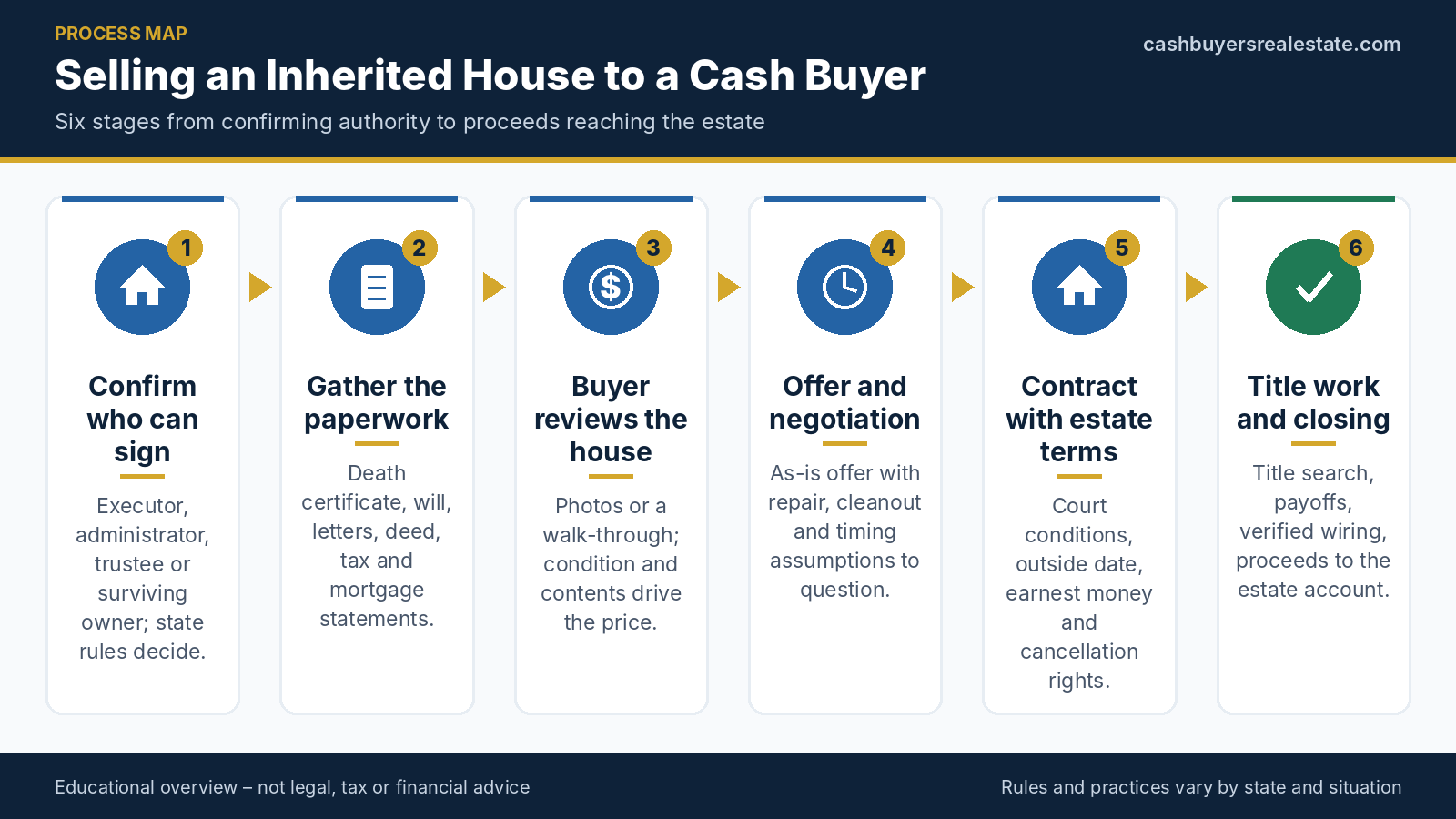
Text version of this infographic
- Confirm who can sign — Executor, administrator, trustee or surviving owner; state rules decide.
- Gather the paperwork — Death certificate, will, letters, deed, tax and mortgage statements.
- Buyer reviews the house — Photos or a walk-through; condition and contents drive the price.
- Offer and negotiation — As-is offer with repair, cleanout and timing assumptions to question.
- Contract with estate terms — Court conditions, outside date, earnest money and cancellation rights.
- Title work and closing — Title search, payoffs, verified wiring, proceeds to the estate account.
When Several Heirs Share an Inherited House: Consent, Disputes and Distance
An estate with a single heir and a single executor is the simplest version of this transaction. Real families are rarely that tidy. The house may pass to three siblings, to a surviving spouse and children from an earlier marriage, to cousins who have never met each other, or to a group in which one person lives in the home while the others live in other time zones. Each additional heir adds a signature, a viewpoint and a possible source of delay, and a cash buyer’s timeline will not wait for relatives to find agreement.
Whose Agreement Is Actually Required
People often assume that because a will names an executor, that person can simply sell, and that because heirs will receive the money, all of them must approve. Neither assumption is reliable. The legal answer depends on whether an estate is being administered, what the will says, and how the property will pass at the end.
Executor authority versus the wishes of the heirs
Where a court has appointed a personal representative with power to sell, that person generally holds the legal authority to sign, and the heirs’ consent may not be formally required. In practice, however, an executor who sells over an heir’s objection invites trouble. The representative owes duties to the people with an interest in the estate, and a sale at a price an heir considers too low, to a buyer with an unexplained connection, or without any attempt to test the market can lead to petitions, accountings and fees that cost more than the dispute was worth. Prudent executors therefore treat family agreement as a practical requirement even where the law does not make it one, and they document the reasoning behind the price they accept.
The will itself can change the picture. A will may give a particular person the house outright, which can limit the executor’s ability to sell it without that person’s consent, as New York’s rules for preliminary letters illustrate. It may direct that the house be sold and the proceeds split, in which case the executor has both the power and the instruction. It may be silent. And a will can be challenged, which can pause everything. A buyer who learns that a contest is pending should expect to wait, and a family that suspects one may come should say so early, since a contract signed in ignorance of a dispute often ends in a canceled closing.
Where no estate is being administered and heirs simply hold title together, usually as tenants in common, each owner has an undivided share and generally needs the others to convey the whole property. A buyer who wants clear title will insist that every co-owner sign. Occasionally a buyer proposes to purchase only one heir’s share, which can create a co-ownership with strangers and a lever to force a sale of the whole house later. Selling a fractional interest is legal in many places, but it usually fetches a steep discount and can spark the very conflict the family hoped to avoid, so it deserves independent legal advice before anyone agrees.
Out-of-state heirs, powers of attorney and signing from a distance
Distance is one of the biggest reasons heirs consider a cash sale, and it brings logistical questions that surprise people. A power of attorney the decedent signed during life generally ends at death, so an adult child who had been handling a parent’s affairs under that document can’t use it to sign a deed after the parent has passed away. Authority has to come from the will and the court, or from the heirs themselves. An heir who is alive and competent can, however, give another person a power of attorney to sign closing documents on his or her behalf, and many title companies accept that when the document is properly drafted, notarized and, where required, recorded.
Signing from a distance is also a matter of state practice. In some states, a closing is handled by a title or escrow company with documents mailed to signers who use a local notary. In others, an attorney conducts the closing and expects signers to attend or to arrange a remote or mobile notarization that the state permits. A family spread across the country should ask the title company, early, what signing methods it accepts for each heir, how long a mail-away package takes to arrange, and what it will need if one signer is traveling or unreachable. A buyer who supplies its own closing documents and insists on a particular notary should be reminded that the title company, not the buyer, decides what is acceptable.
Heirs who live far from the house also carry the practical burden of oversight. Someone has to check on the property, keep insurance current and make sure that bills are paid while the sale proceeds. The guide to cash buyers for vacant houses covers what vacancy does to pricing and risk, and that article is useful reading for any heir who cannot visit the property regularly. The point to hold onto is that distance should shape the choice of closing method and the choice of who coordinates, not the decision to accept an unfair price.
When Heirs Disagree: Buyouts, Mediation and Partition
Disagreement among heirs is common and rarely malicious. It usually grows from different financial needs, different attachments to the house, and unequal sacrifices made in the years before the death. A cash offer can either calm those tensions or sharpen them, depending on how it is introduced.
Common patterns of disagreement and practical ways through them
One familiar pattern pits the heir who lives in or near the house against heirs who live elsewhere. The nearby heir may have cared for the owner, paid for repairs or kept the property going, and may want to stay. The others may need their share in cash. A second pattern pits the heir who wants to sell quickly against one who insists on waiting for a better price. A third involves valuation: each sibling has a number in mind, often shaped by a neighbor’s listing or a memory of what the house once looked like. Because the underlying issue is usually fairness, the most useful tools are the ones that make value and costs transparent.
An independent appraisal or a broker’s written opinion of value gives everyone the same reference point, and the cost is generally modest compared with the stakes. A buyout, in which one heir purchases the others’ shares at an agreed value, can keep a family home in the family, though it requires that heir to have cash or financing. A neutral mediator can help when the conflict is more about emotions than numbers. And a written agreement that records who has paid what in carrying costs, who will be credited and how the proceeds will be split reduces later accusations. Whatever route is chosen, a licensed attorney can formalize it so that the title company is satisfied.
Illustrative example (hypothetical numbers, not market data): Three siblings inherit equally a paid-off house with an appraised value of $198,000. One sibling lives there and wants to stay; the other two live in different states and would prefer cash. Each sibling’s one-third share is $66,000 before any sale costs. To keep the house, the resident sibling would need to pay the other two a combined $132,000, either from savings or through a new loan, perhaps less any credit the siblings agree to for taxes and repairs she paid. If she cannot, the family compares a listing with a cash offer for the whole property, and each sibling receives a third of the net proceeds. The conversation becomes about a shared table of numbers rather than about who deserves what.
Mediation and early legal advice are especially valuable when an offer is on the table with an expiration date. A buyer who sets a short deadline for a group of grieving relatives who haven’t yet decided what they want is applying pressure, whether or not that is intended. A reasonable buyer will often extend the deadline when asked, and a buyer that refuses may be signaling that the offer was designed to be accepted before the family could compare alternatives.
Heirs’ property, partition and what buyers do when title is unclear
In many families, a house passes through several generations without a probate case ever being opened. The deed still lists a grandparent, the grandparent’s children inherited by operation of law, and their children are now co-owners of fractions nobody has computed. This kind of property is often called heirs’ property, and it creates real obstacles to a sale. A title company can’t insure a purchase until the chain of ownership is established, which may require opening one or more probate cases, locating relatives and obtaining court orders. A buyer who understands this may still make an offer, but it will price in the time, the legal expense and the risk that an heir will surface after closing.
Co-owners who can’t agree may ask a court to partition the property, which can mean dividing it or, more often for a single house, ordering a sale. Courts and legislatures have recognized that forced sales can strip family wealth, and many states have adopted the Uniform Partition of Heirs Property Act. Summaries from bar associations describe its core protections: a court-ordered appraisal, a chance for other co-owners to buy out the one who wants to force a sale, and a preference for open-market sales over auctions. A county bar summary from 2022 counted 21 states as having adopted it or substantially adopted it, but the list changes, so check your state’s current law.
Where title is clouded, the cleanest path is almost always to resolve it before negotiating price, because an offer made without knowing the problem can unravel when the title search is complete. An attorney may recommend probate, a quiet-title action or a recorded affidavit, and each carries its own cost and timeline. Families facing a long gap can read the guide on selling a house quickly in probate for how courts handle timing, and the probate real estate hub gathers related questions in one place. If a buyer says title problems are no obstacle and promises to handle them after closing, ask who bears the risk if they can’t be solved.
How Cash Offers on Inherited Houses Are Priced, and What Reaches the Estate
An offer is a number someone else chose, and the reasoning behind it is usually invisible unless you ask. For estates, the reasoning has some distinctive features, since the buyer is pricing not only a building but also its contents, its legal uncertainty and a timeline that depends on a court. A family that understands the pieces can test the offer sensibly, push back where a deduction looks inflated and recognize when the number is fair for what is being sold.
Building the Offer: Value, Repairs, Contents and Margin
Every investor has a slightly different formula, but most start from the same place: what the house could sell for in good condition, and what it takes to get it there. From that starting point the buyer subtracts the costs of getting the house ready, the costs of owning and reselling it, and the profit required to make the deal worthwhile.
From after-repair value to an as-is number
The anchor in most investor pricing is the after-repair value (ARV), meaning the estimated price the house would bring once renovated to a standard buyers in that neighborhood expect. Investors estimate it by studying recent sales of comparable renovated homes nearby. They then subtract a repair budget, an allowance for holding costs such as taxes, insurance, utilities and interest, the expenses of reselling, and a target profit. The result is the most they would pay, and the offer they actually make is often somewhat below that ceiling to leave room for negotiation. A fuller discussion of the method lives in the explainer on how cash buyers calculate offers, and the specifics of repair deductions are examined in the piece on repair deductions in cash offers.
| Line item | Amount | What it represents |
|---|---|---|
| Estimated after-repair value | $275,000 | Price the house might bring after a full renovation, from comparable sales |
| Renovation budget | ($48,000) | Kitchen, baths, flooring, paint, mechanical updates and a contingency |
| Cleanout and disposal | ($3,500) | Removing contents, dumpsters and a basic cleaning |
| Holding costs during renovation and resale | ($9,000) | Taxes, insurance, utilities and financing for several months |
| Resale costs | ($16,500) | Commission, closing costs and concessions, here about 6% of the resale price |
| Target profit | ($14,000) | The buyer’s required return for taking the project and its risks |
| Resulting cash offer | $184,000 | $275,000 minus the five deductions above |
The point of the table is not that these figures are typical, because they are invented to show the mechanics. It is that each deduction is a place where a family can ask a question. Is the renovation budget based on a contractor’s walk-through or a rule of thumb? Does the cleanout line assume the buyer will keep or sell any contents? Is the profit target in line with what the buyer would accept on a house of this size? Offers tend to move most easily on the lines where the buyer’s estimate is softest, and a seller who shows evidence, such as a roof receipt or a recent furnace inspection, can sometimes narrow a deduction.
Estates have one more consideration that standard pricing models treat unevenly: legal and timing risk. A buyer who must wait for a court to appoint a representative is tying up commitment, and some buyers translate that into a lower price or a stipulation that the price will be revisited if the process stretches past a set date. Others price nothing for it. Compare how each offer handles delay, since a higher number paired with a clause that lets the buyer reduce the price later may be worth less than a lower, firmer number.
Contents, cleanout and the estate-specific adjustments
Belongings are the feature of an inherited house that most separates it from an ordinary as-is sale. Before anything leaves the property, the executor should know what the estate owns and what the will says about it. Specific bequests of furniture, jewelry, vehicles or heirlooms must go to the named people, and items that appear worthless may carry value or sentimental weight to relatives who haven’t yet seen them. A careful sequence is to photograph and inventory every room, let family members choose what they want under whatever rule the executor sets, set aside valuables and important papers, and only then decide what to sell, donate or discard.
Some contents need special handling. Financial papers, tax returns, medical records and old checkbooks should be kept or shredded rather than thrown away, because identity theft against the deceased is a recognized problem. Medications, firearms, hazardous chemicals and electronics have disposal or transfer rules that vary by locality. Pets, plants and perishable food obviously can’t wait. A professional estate sale company, an auction house or a cleanout service can handle much of this for a fee, and a buyer who offers to take the house with contents in place is offering a service whose price is already inside the offer.
That service is useful when the family lives far away or cannot face the work, and it is expensive when the contents have real resale value that the buyer will pocket. A reasonable approach is to remove anything of sentimental or significant value first, document what remains with dated photographs, and then ask the buyer how it prices the remaining contents. If the answer is that the cleanout is a cost rather than an asset, the price should reflect modest disposal charges, not a large flat deduction. Families wanting to weigh hauling against selling in place can find more about preparation in the guide to how to prepare for a fast home sale, and heavily cluttered properties get specific attention in the article on selling a hoarder house.
Comparing Offers by Net Proceeds Rather Than Headline Price
The number on the first page of an offer is the headline, and it often hides the real comparison. What the estate receives depends on what it must spend before and during the sale, and on how long the house sits on the estate’s books.
A worked comparison of listing, as-is listing and cash sale
Imagine the same house sold three ways, with the same carrying cost of $1,150 per month for taxes, insurance, utilities and minimum upkeep. The traditional listing involves cleaning out and making light repairs and then selling with an agent. The as-is listing skips most preparation but still pays a commission. The cash sale involves no agent commission and little preparation. The numbers below are hypothetical, and an actual comparison needs local quotes and a real agent’s pricing opinion.
| Line item | Listed after cleanout and light repairs | Listed as-is | Cash sale as-is |
|---|---|---|---|
| Sale price | $225,000 | $205,000 | $184,000 |
| Agent commission (5.5% assumed) | ($12,375) | ($11,275) | $0 |
| Seller closing costs (about 1% assumed; about $1,800 on the cash sale) | ($2,250) | ($2,050) | ($1,800) |
| Cleanout and repairs paid by the estate | ($9,500) | ($2,500) | $0 |
| Carrying costs (4.5, 3 and 1.5 months) | ($5,175) | ($3,450) | ($1,725) |
| Estimated net to the estate | $195,700 | $185,725 | $180,475 |
Illustrative example (hypothetical numbers, not market data): In the table, the cash offer is $41,000 below the prepared listing price, but the gap in estimated proceeds shrinks to about $15,225 once commission, repairs and extra months of carrying costs are counted. Against the as-is listing, the difference is only about $5,250. Whether that gap is worth paying for speed and certainty is a family decision. If the listing route has a meaningful chance of falling through because of a financing problem or an inspection dispute, the extra months and a second round of marketing would erode its advantage. If the house is in a strong market and sells quickly, the listing keeps its lead.
Reading across a net table like this exposes a few lessons. The headline gap between a listing and a cash offer almost always overstates the real gap, and the real gap depends heavily on the assumptions for commission, repairs and time. It is also sensitive to the buyer’s own closing-cost allocation, a topic covered in the guide to closing costs in cash offers, because some buyers pay for title insurance and recording while others expect the seller to. And the estate’s own legal expenses, which are not in the table, may be the same under any route, but a long probate delay changes how many months of carrying costs accrue. A broader walk-through of the arithmetic appears in cash offer net proceeds.
Carrying costs, timing and how to pressure-test an offer
Carrying costs are the quiet drain in estate sales. Property taxes keep accruing, insurance premiums are due, utilities must stay on in many climates, lawns grow and gutters clog. If the house carries a mortgage or a reverse mortgage, interest accrues as well. A vacant house may need a different insurance policy than an occupied one, since many homeowners policies limit or exclude coverage after a house has been empty for a period, and the terms vary by policy. The executor should ask the insurer in writing how it treats the property now that the owner has died, rather than assuming that the old policy still protects the estate.
Once the carrying cost is known, it becomes a tool for comparing offers: every extra month of delay costs the estate that sum, so an offer that closes sooner can beat a higher offer that closes later. To pressure-test any offer, ask the buyer to itemize its assumptions in writing, request that it name the title company it plans to use, compare it with at least one other bid and a broker’s written opinion of value, and check how much of the price is paid in cash at closing rather than deferred. The guide on how to compare cash offers lays out a full side-by-side method. A family that arrives at the negotiating table with a net sheet, a documented condition record and a second option will usually get a more careful, more honest conversation.
Finally, remember that the first offer is rarely the last. Many cash buyers expect a counter, and an estate representing multiple heirs has a defensible reason to ask for time, additional documentation or a modest increase. A calm counter that cites specific evidence, such as a recent replacement of a major system or a comparable sale, is typically better received than a rejection with no explanation. If the buyer will not move at all and will not explain the numbers, that is information about what the relationship will be like when problems arise at closing.
Between the pricing conversation and the contract sits the question the table cannot answer: which route fits the family’s priorities when price, speed, effort and certainty all matter at different weights. The graphic below lays out five common routes for an inherited house side by side, naming the situation each suits best and the trade-off it carries. The fifth route, a cash sale to an investor, is the focus of this guide, but the others remain legitimate choices, and the comparison is deliberately even-handed.
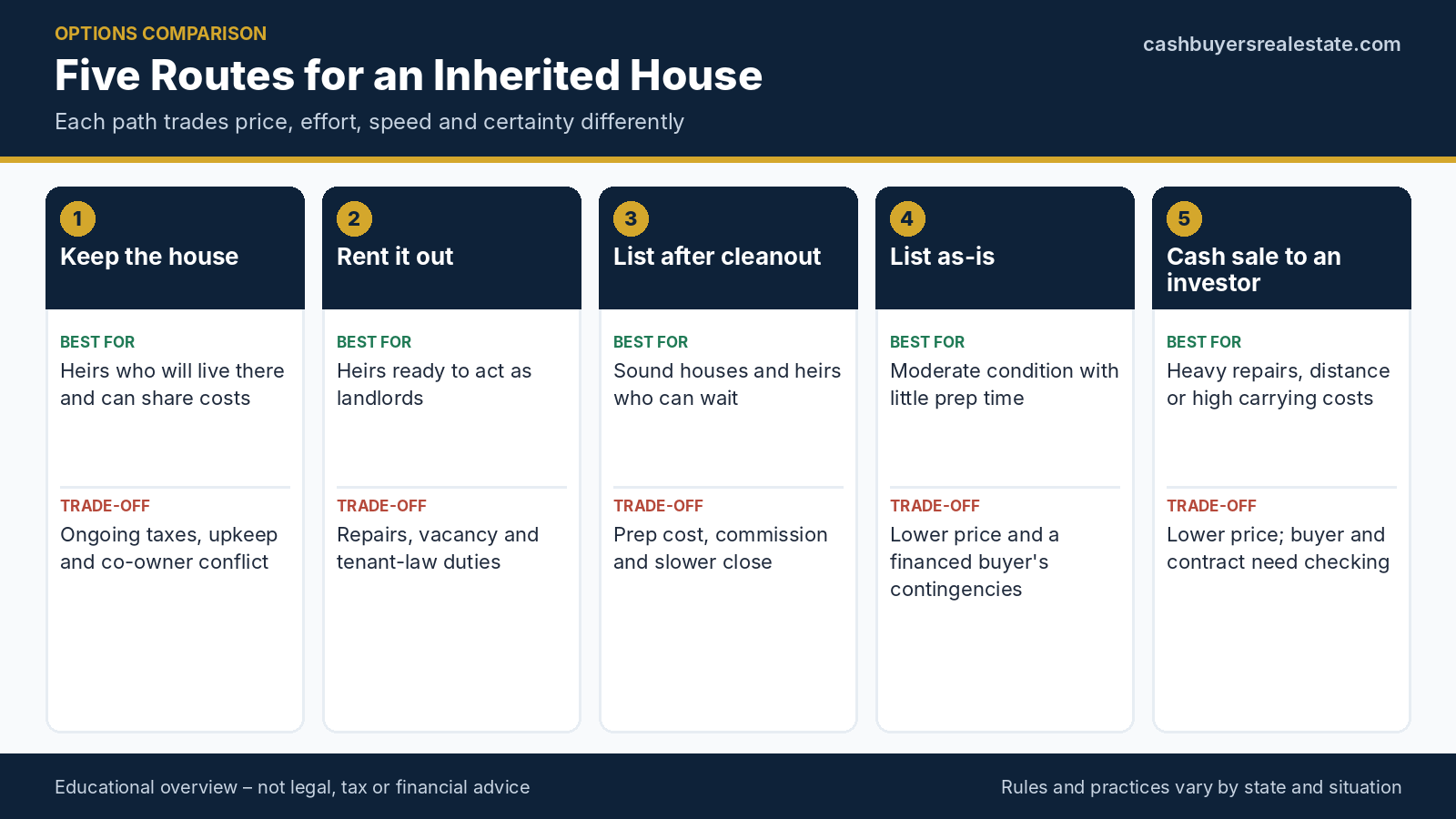
Text version of this infographic
- Keep the house — Best for: Heirs who will live there and can share costs. Trade-off: Ongoing taxes, upkeep and co-owner conflict.
- Rent it out — Best for: Heirs ready to act as landlords. Trade-off: Repairs, vacancy and tenant-law duties.
- List after cleanout — Best for: Sound houses and heirs who can wait. Trade-off: Prep cost, commission and slower close.
- List as-is — Best for: Moderate condition with little prep time. Trade-off: Lower price and a financed buyer's contingencies.
- Cash sale to an investor — Best for: Heavy repairs, distance or high carrying costs. Trade-off: Lower price; buyer and contract need checking.
From First Call to Closing: Contract Terms, Title Work and Getting Paid
A sale to a cash buyer feels simple from the outside: an offer, a signature, a closing. For an estate, the middle of that sequence contains the steps where deals either hold or fall apart. The contract has to reflect the legal reality of who can sign and when, title work has to uncover and resolve whatever the decedent left behind, and the money has to reach the right account safely. Knowing the order of these tasks makes it easier to ask for the right things at the right time.
Sequencing the Sale and the Contract Terms Estates Need
The most useful habit an executor or lead heir can develop is to separate preparation from negotiation. Preparation can start the day after a funeral, long before any buyer is involved. Negotiation should start only when the seller side knows what it can promise.
Preparing the paperwork before buyers start asking
The paperwork that a buyer and title company will want is mostly paperwork the family needs anyway to administer the estate. Collecting it early prevents the common situation in which a signed contract sits idle for weeks while someone searches for the original deed or waits for a court to issue a certified copy. The items below form a practical working set, though the exact list varies by state and by title company.
- Certified copies of the death certificate, ordered in a generous quantity because many institutions ask for originals.
- The will and any codicils, plus the court’s order admitting the will or appointing the representative, if a case has been opened.
- Current letters testamentary or letters of administration, in certified form, once the court has issued them.
- The deed or other proof of how the decedent held title, along with any trust documents or recorded transfer-on-death deed.
- Recent property tax bills, insurance declarations and homeowner association statements, if any.
- The latest mortgage or reverse mortgage statement and the servicer’s contact details, for a payoff request.
- A list of the heirs and their contact information, plus any agreement among them about who is coordinating the sale.
Once these are in hand, the executor can speak to buyers from a position of knowledge. The sequence that follows is usually predictable. The representative confirms what the court requires for a sale and whether notice to heirs or creditors is needed. The family decides on a price range using a broker’s opinion or appraisal. Buyers are invited to inspect the house and make written offers. The representative selects an offer, signs a contract that includes whatever court conditions apply, and delivers it to the title company, which opens the file, orders a title search and begins coordinating payoff letters and closing documents. Families that keep a simple calendar of these steps, with a note of who is responsible for each and what is still outstanding, tend to notice slippage early and can ask the buyer for a short extension before the contract’s outside date arrives, not after it has passed.
Throughout, written communication matters. A buyer’s verbal assurances about how fast it can close or how it will handle a problem have little value unless the promise appears in the contract. Families should resist any suggestion that they sign a short, informal agreement now and fill in the details later. A legitimate buyer working with an estate will expect a complete purchase agreement with attention to authority, title and timing, and will usually welcome review by the family’s attorney.
Contract provisions that matter more when the seller is an estate
Most purchase agreements have the same skeleton, which the guide to the cash home buyer contract walks through clause by clause. Estate sales add or sharpen several provisions. The seller’s representation of authority should be accurate, not aspirational, and if letters have not yet issued, the contract should say so and make closing conditional on their issuance. Where a court must confirm the sale, the contract should state who files, who pays the associated costs, what happens if a higher bid appears and how the buyer’s earnest money is treated if the court says no. An outside date, after which either party may cancel, protects both sides from an open-ended wait.
| Provision | What it does for an estate | Question to ask the buyer or attorney |
|---|---|---|
| Authority representation | States who is signing and on what basis | Does the contract make closing conditional on letters or a court order if they are not yet issued? |
| Probate or court-approval contingency | Lets the sale depend on a required court step | Who pays court costs, and what happens if the court refuses or an overbid arrives? |
| Outside closing date | Sets the last day before either side may cancel | Is the date realistic for the court calendar, and are there paid extensions? |
| Earnest money terms | Defines the deposit and when it can be forfeited or refunded | Who holds it, and under which conditions is it returned if probate delays the closing? |
| Contents and access | Clarifies what stays, what goes and when the buyer may enter | Is any item excluded by name, and does the buyer insure the house after access begins? |
| Assignment clause | Controls whether the buyer can transfer the contract to someone else | Is the buyer purchasing for itself, or marketing the contract to another investor? |
| Cancellation rights | Lists when the buyer may walk away | Does the buyer keep a broad right to cancel for any reason while the estate remains bound? |
The table can double as a checklist when reading an offer. If a provision is missing, ask for it; if a provision is one-sided, ask why. A contract that binds the estate tightly while leaving the buyer free to cancel for any reason on short notice is an option for the buyer, not a commitment, and sellers should price that option as they would any other. More on deposits is in the article on earnest money in cash purchases, and the general anatomy of buyer exit rights is in the guide to contingencies mentioned earlier.
Title, Mortgages and the Mechanics of Closing
After the contract is signed, the work shifts to the title company and, in some states, an attorney. This stage determines whether the sale closes on schedule, and an executor who understands it can answer questions promptly.
Title searches, payoffs and mortgages that outlive the owner
The title company researches the public record for the property: the deed history, mortgages, liens, judgments, unpaid taxes and any recorded claims. In an estate sale it also looks for something specific to the circumstances, such as an incomplete probate, an unrecorded earlier transfer or a missing heir. If problems appear, the company lists them as requirements that must be satisfied before it will insure the buyer. Some are easy, like a recorded affidavit or a payoff of a small lien. Others are not, like an unopened probate case for a prior owner, and they may force a delay or a renegotiated price.
A mortgage on the house does not vanish at death, but federal law gives heirs more breathing room than many expect. Under the Garn-St Germain Act, a lender generally may not enforce a due-on-sale clause on a transfer to a relative that results from the borrower’s death, or on a transfer by devise or descent when a joint tenant dies, for residential property with fewer than five units. The Consumer Financial Protection Bureau’s mortgage servicing rules also treat a confirmed successor in interest as a borrower, and the servicer cannot require the successor to assume the loan before it grants that status. Neither rule erases the debt. Payments still accrue, and the estate or heir must keep up with them or arrange a payoff at closing.
Reverse mortgages operate under their own timetable. HUD’s guidance for heirs of a federally insured reverse mortgage, dated 2019, explains that the loan becomes due when the last surviving borrower dies and that heirs who want to sell may be able to sell for at least 95% of the current appraised value if the balance exceeds the home’s worth. It also describes a short period to resolve the loan, with possible extensions when heirs document active efforts to sell or repay. Servicer deadlines can differ, so the first step is to call the lender promptly and ask for the current requirements in writing. The topic of liens and judgments more generally is examined in the article on selling quickly with liens.
Closing day, deeds and getting the proceeds safely to the estate
The deed in an estate sale is typically signed by the personal representative, a trustee or the heirs, in whatever capacity the title work approved, and it may carry different warranties than an ordinary seller’s deed. Many representatives sign a deed that promises less about the title’s history than a full warranty deed does, which is common and not itself a warning sign. Buyers sometimes request a particular form of deed, and the title company or attorney should advise on what is customary and what exposes the representative to personal liability. Closing may be handled by a title company or escrow officer, or by an attorney, depending on local practice, and the process in a state where lawyers conduct closings may feel different from one where escrow companies do.
Proceeds usually flow into an account opened in the estate’s name, using the estate’s tax identification number, or to the heirs directly when the sale occurs after distribution. The representative then pays remaining expenses, taxes and creditors in the order the state requires and distributes the balance according to the will or intestacy law. Keeping accurate records of the sale price, closing costs and carrying expenses matters later for the estate’s tax returns and for any beneficiary who must report the sale. Mixing estate funds with personal funds is a recurring cause of trouble, and a separate account is a simple protection.
A closing is also the last point at which questions can be answered cheaply. Before signing, read the settlement statement line by line, compare it with the contract and with the net sheet you prepared, and ask the closing agent to explain any figure you don’t recognize. If a fee appears that the buyer’s offer said it would cover, say so politely and ask for a correction. If the agent cannot reach the buyer or the buyer’s funds have not arrived in the closing account, stop and wait for confirmation rather than signing and trusting that the money will follow. A deliberate pace at the end of the transaction is far better than an apology at the beginning of a dispute.
Taxes on an Inherited House: Stepped-Up Basis, Holding Period and Reporting
Taxes are the subject where families worry most and where the rules, in the most common situation, are kinder than expected. The federal income tax treatment of an inherited house differs sharply from the treatment of a house a person bought or received as a gift, and that difference is often the reason heirs can sell soon after inheriting without a large tax bill. The rules also have exceptions, and a sale can raise reporting questions that a tax professional should answer. This section explains the core federal concepts in plain language and points out where state law may add its own layer.
How the Stepped-Up Basis Works
Basis is the number a taxpayer subtracts from the sale price to calculate gain. For a house someone bought, it is generally the purchase price plus improvements. For an inherited house, the Internal Revenue Code resets it, which is why the rule is nicknamed a step-up.
Basis at the date of death and why documentation matters
Under section 1014 of the Internal Revenue Code, the basis of property acquired from a decedent is generally the fair market value of the property at the date of the decedent’s death. IRS Publication 551, revised in December 2025, restates the rule and lists the alternatives: an estate’s personal representative may choose an alternate valuation date when the estate qualifies and makes the election, and a special-use valuation exists for certain farm and business real property. For the typical family home, the relevant number is the market value on the day the owner died, regardless of what the owner paid for the house decades earlier.
That makes the date-of-death value one of the most important numbers in the whole process, and it should be supported with evidence. Publication 551 notes that if an appraisal is missing, the basis can be determined using the appraised value at the date of death, which indirectly confirms how valuable one can be. A qualified appraiser can prepare a retrospective appraisal as of that date. Some estates are required to file a federal estate tax return, and in those cases the value reported on the return generally fixes the basis. Families should keep the appraisal, the closing statement and any improvement receipts together, because the basis calculation may be reviewed years later.
The step can also run downward. If a house lost value after the owner bought it, the heir’s basis is the lower date-of-death value rather than the owner’s original cost. This is less common in appreciating markets but not unheard of. For heirs who plan to sell the house for a loss, the question of whether the loss is deductible depends on how the property was held and used after inheritance, so a tax professional should review the facts before anyone assumes a deduction will be available.
Gain, loss and the automatic long-term holding period
Gain is the amount realized from the sale, which is the price minus selling expenses such as commissions and certain closing costs, less the basis. Because the basis is reset to date-of-death value, a house sold shortly afterward at around the same value produces little or no taxable gain, which is the reason many heirs find a prompt sale tax-efficient. A house held for several years after the death will carry a gain or loss measured from the date-of-death value, not from the owner’s original cost.
The Internal Revenue Code also gives inherited property a holding-period advantage. Section 1223(9) provides that a person who acquires property from a decedent, with a basis determined under section 1014, and who sells it within one year after the death is considered to have held it for more than one year. The practical effect is that gain on a quick sale of an inherited house is treated as long-term, and the IRS explains in its capital gains topic that long-term gains are taxed at rates of zero, 15 or 20 percent depending on taxable income and filing status, while short-term gains are taxed as ordinary income. The exact brackets change over time, so use the IRS figures for the year of sale.
Illustrative example (hypothetical numbers, not market data): A parent bought a house decades ago for $71,000. A retrospective appraisal places its value on the date of death at $228,000. Eight months later, the three heirs sell it for $247,000 and pay $16,000 in selling costs, so the amount realized is $231,000. With a stepped-up basis of $228,000, the combined gain is $3,000, or $1,000 for each heir if they share equally, and it is long-term. If the basis had instead been the parent’s original $71,000, the gain would have been $160,000. The difference shows why the date-of-death appraisal and the sale records deserve careful keeping, and it is not a tax calculation for any real situation.
| Concept | How it generally works | Where to read more |
|---|---|---|
| Basis of inherited property | Generally the fair market value at the date of death, or at the alternate valuation date if the estate elects it | IRS Publication 551; Internal Revenue Code section 1014 |
| Holding period | Sale within one year of death is treated as held more than one year, so the gain is long-term | Internal Revenue Code section 1223(9) |
| Long-term capital gain rates | 0%, 15% or 20% depending on taxable income and filing status; other rates apply to certain gains | IRS Topic 409, capital gains and losses |
| Consistency with the estate tax return | Where Form 706 was required, a beneficiary generally cannot use a basis higher than the final reported value | Instructions for Form 8971 and Schedule A |
| Federal estate tax | Applies only to estates above the basic exclusion amount, $15,000,000 for decedents dying in 2026 | IRS inflation adjustment announcement for 2026 |
| Home sale exclusion | Generally requires the seller to have owned and used the home as a main home; surviving spouses have special timing rules | IRS Publication 523 |
Use the table as a vocabulary list when you meet a tax professional. If a preparer talks about step-up, consistency or the basic exclusion amount, you will recognize the terms. A few of the concepts are federal only; states may have their own estate or inheritance taxes, and a small number do. Whether your state taxes the transfer, and at what thresholds and rates, is a question for the state revenue department or a local professional, and it can affect how much should be held back before the executor distributes the proceeds.
Exceptions, Limits and Who Reports the Sale
The step-up is a general rule with exceptions, and the sale itself raises practical questions about who reports it and when. Knowing the main ones lets a family ask better questions before the closing, not after the tax return is due.
Where the general rule does not apply cleanly
One exception targets last-minute transfers designed to exploit the step-up. Publication 551 explains that appreciated property that a person or spouse gave to the decedent within a year before death does not receive the usual step-up if it passes back to the donor, and the basis stays at the decedent’s adjusted basis. Community property creates a different wrinkle: in community property states, the IRS says the total value of the community property generally becomes the basis of the entire property when either spouse dies, which can give the survivor a full step-up on both halves. For spouses who owned a home jointly outside community property rules, only part of the home generally steps up, so a surviving spouse’s new basis blends the old and new numbers.
Other situations deserve flags. A house held in an irrevocable trust may have a different basis depending on how the trust is structured. A house that was converted to a rental before death carries depreciation questions, and the IRS publication discusses how depreciation basis is determined when property changes from personal to business use. A house that passes under a special-use valuation election has recapture rules if it leaves the family within a set period. And when a federal estate tax return was required, the beneficiary must generally use the value on the Schedule A the executor provides, and reporting a basis that is inconsistent with it can invite penalties. Most family homes pass to heirs in estates well below the federal threshold, so these rules are the exception rather than the norm, but a family should ask about them rather than assume.
The federal estate tax exclusion is high. For decedents dying in 2026, the IRS has announced a basic exclusion amount of $15,000,000, which means only large estates must file a federal estate tax return to owe tax. Many states have their own thresholds, and some impose inheritance taxes on the people who receive property, depending on the recipient’s relationship to the decedent. Because the rules differ, an executor should check the state’s revenue agency website or consult a local probate attorney or CPA early, especially before distributing funds to heirs.
Reporting the sale, the home sale exclusion and when to hire help
A sale of an inherited house is reported by whoever owned the property when it sold. If the estate sold the house before distributing it, the estate is the seller and its income tax return generally reports the sale. If the house was distributed to heirs first and they sold it, each heir reports a share. The IRS notes that a personal representative should obtain an employer identification number for the estate and file all returns when due, so the executor’s duties usually include coordinating with a preparer before and after closing. Closing agents also issue reporting forms based on the seller information provided, so make sure the name and taxpayer number match the real seller.
The familiar exclusion of up to $250,000 of gain for the sale of a main home, or $500,000 for married couples filing jointly, requires that the seller have owned and lived in the home for at least two of the five years before the sale. Heirs who never lived there generally won’t meet that test, which is why the step-up matters so much for them. Surviving spouses are treated more generously: Publication 523 explains that a surviving spouse who has not remarried and who sells within two years of the spouse’s death can claim the larger exclusion if other conditions are met, counting the late spouse’s ownership and use. These are summaries, and the specific requirements deserve a professional check.
Hiring help is usually worthwhile when the estate is large, when the house has been a rental, when heirs live in different states, when there is a question about the date-of-death value, or when anyone is unsure whether a return is required. A certified public accountant or enrolled agent experienced with estates can coordinate a retrospective appraisal, prepare the estate’s income tax return on Form 1041 and advise on the timing of distributions. The cost is typically modest next to the cost of an avoidable error, and a conversation before the contract is signed can sometimes change how the sale is structured.
One more caution applies to buyers’ marketing: no cash buyer can tell you what your tax result will be, and statements such as “there’s no tax on inherited houses” are oversimplifications. The step-up often reduces or eliminates income tax on a prompt sale, but state taxes, estate tax thresholds, rental history and unusual title arrangements can change the answer. Treat any tax claim in an offer letter or phone call as a prompt to verify, not as a reason to skip your own review.
Red Flags and How Cash Buyers Behave With Estates
Most people who buy inherited houses for cash are doing what they say they are doing: purchasing property at a discount, taking on the work and the risk, and hoping to resell or rent it at a profit. The industry also contains operators who rely on confusion, speed and the emotional weight of a death. Because estates involve several decision makers, incomplete paperwork and strong feelings, they are a natural place for both kinds of buyer to appear. The most practical protection is a clear idea of what normal looks like, which makes departures from it easy to spot.
How Buyers Find Estates and the Warning Signs That Cluster There
An heir is often surprised by how quickly the phone starts ringing. Understanding where those contacts come from takes some of the mystery, and some of the pressure, out of the experience.
How buyers find and approach estates
Probate filings are generally public court records, and so are deeds and tax records. Investors and marketing firms can use those records to identify properties where an owner has died, then send letters, postcards or text messages to the address, the apparent heirs or the person named in the filing. Others reach out through obituary notices, door hangers on a vacant house, or ads aimed at people searching for ways to sell an inherited property. None of this is illegal, and a neutral approach from a real buyer can be useful. But it explains why a message that feels personal may have been sent to hundreds of households, and it is worth asking any buyer how it found you and who it represents.
Approach style tells you a lot. A buyer who introduces itself, names the person or entity making the offer, offers to send a written proposal and accepts that you will talk with relatives and an attorney is behaving in a way that supports a fair transaction. A buyer who calls repeatedly, insists on a decision by the end of the week, suggests that the court process is unnecessary, or makes the sale sound like a favor is applying pressure. Sensitive situations deserve unhurried decisions, and a legitimate buyer who wants the house will usually still want it after a week of thought. The discussion of scam patterns in the cash-buyer hub on cash home buyer scams goes deeper on the tactics.
It is also normal for a buyer to be cautious about an estate. A professional will ask who has authority, whether there are other heirs, whether the house is occupied and whether a mortgage or lien exists. Those questions protect the buyer, and they protect you from signing a contract that cannot be performed. The distinction between a careful question and a pressure tactic often comes down to what follows the question. If the buyer listens to the answer and adjusts the timetable, the questions are diligence. If the buyer ignores the answer and keeps pushing for a signature, the questions were a script.
Red flags in the offer and the contract
Red flags are patterns that deserve extra scrutiny, not proof of wrongdoing. A single one may have an innocent explanation, and a cluster of them is a reason to slow down, ask for documents and bring in a professional. The pattern table below groups signals that commonly appear in offers on inherited houses, with a safer response for each. The broader catalogue of contract warning signs is in the guide to cash offer contract red flags.
| Signal | Why it deserves attention | Safer response |
|---|---|---|
| No proof of funds, or a letter that cannot be verified | The buyer may lack the money to close, which wastes months of carrying costs | Ask for a recent statement or lender letter showing available funds, and have the title company confirm the source |
| The buyer will not name the legal entity or principal | You cannot judge its record or enforce the contract against an unknown party | Ask for the entity’s name, state of registration and a contact you can verify in the public business registry |
| Pressure to sign before relatives or an attorney can review | Estate decisions involve several people and legal duties | Decline a same-day deadline and request a written extension |
| Suggestion to skip probate or sign a quitclaim deed now | A deed from someone without authority may be void and can cloud title | Ask a probate attorney which step the state requires before anyone signs a deed |
| Broad assignment rights buried in the contract | The party you screened may not be the party that closes | Ask whether the buyer intends to close personally and strike or limit assignment if you prefer |
| Large nonrefundable payments from the seller or an upfront fee | Legitimate buyers rarely charge sellers to receive an offer | Do not pay fees to get an offer, and have an attorney explain any seller-paid charge |
| Price reduced sharply after the inspection or title search with little explanation | Late renegotiation can exploit an estate’s lack of alternatives | Ask for an itemized reason and compare it with your own documentation and other bids |
| Instructions to use a closing agent you cannot independently verify | A neutral closing agent is a key safeguard | Choose or confirm a licensed title company or attorney, and call the number you find yourself |
The best way to use a table like this is as a before-signing conversation guide. Take the signals that apply to your offer, write the questions down and ask them politely. Most buyers have ready answers. The ones who bristle at being asked to verify funds or identify the buyer are worth noticing, since the same attitude is likely to appear when an unexpected problem arises. The related guides on proof of funds for cash buyers and whether cash home buyers are legitimate offer detailed verification steps.
Before the second half of this section turns to verification in detail, it helps to have the whole checklist in view. Six checks cover most of what a family can do on its own: confirm who is actually buying and that the person you are talking to is who they say they are; ask for proof of funds and confirm it independently; read the cancellation and assignment clauses; settle the question of who has authority and what title work is needed; insist on a neutral, licensed closing agent and verified wiring instructions; and have an attorney or tax professional review the paperwork. The next graphic puts these six checks in one place, marking which ones are routine and which signal real risk if skipped.
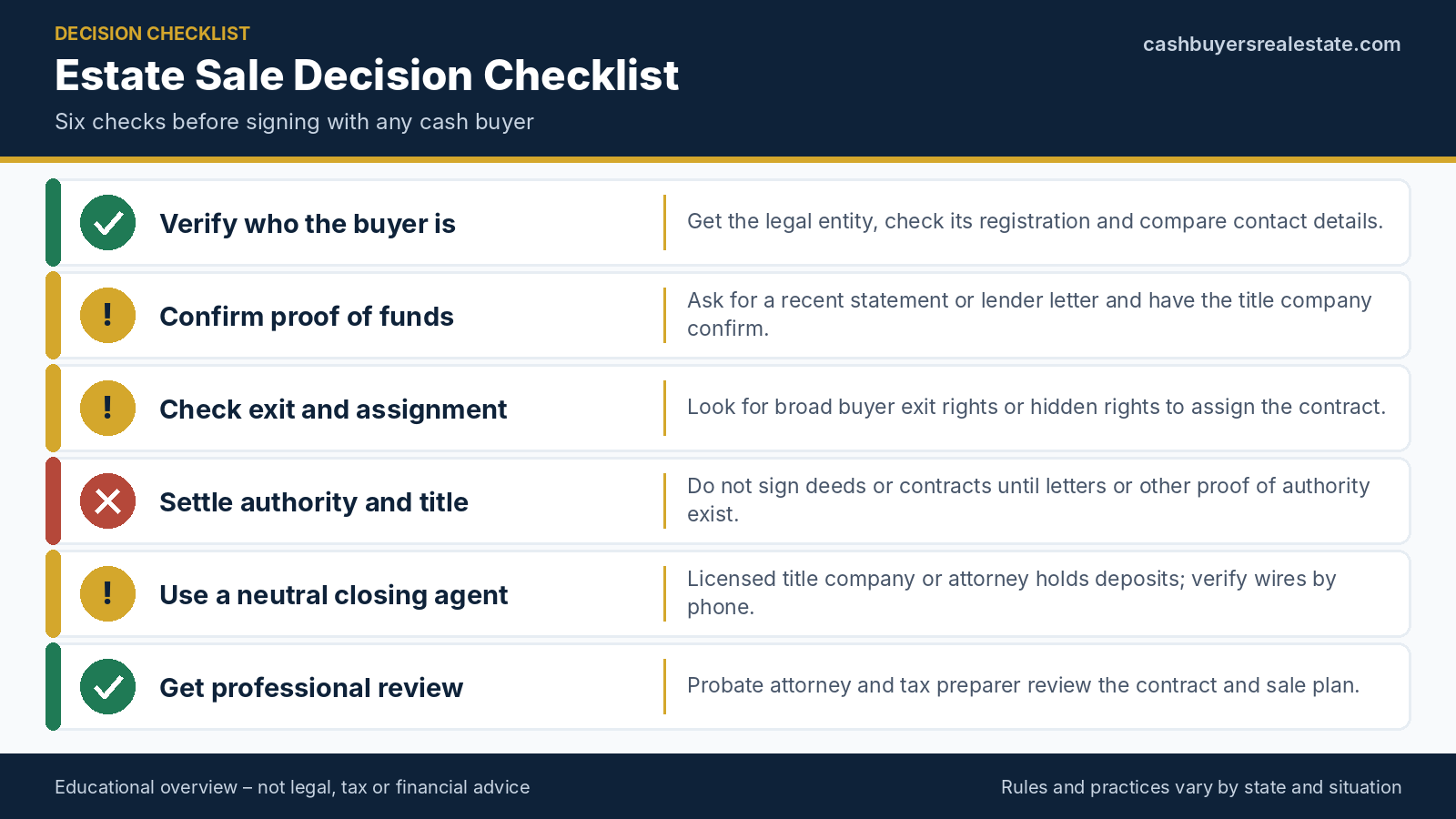
Text version of this infographic
- Verify who the buyer is — Get the legal entity, check its registration and compare contact details.
- Confirm proof of funds — Ask for a recent statement or lender letter and have the title company confirm.
- Check exit and assignment — Look for broad buyer exit rights or hidden rights to assign the contract.
- Settle authority and title — Do not sign deeds or contracts until letters or other proof of authority exist.
- Use a neutral closing agent — Licensed title company or attorney holds deposits; verify wires by phone.
- Get professional review — Probate attorney and tax preparer review the contract and sale plan.
Verifying a Buyer and Protecting the Estate
Verification is not an accusation. It is the same due diligence the buyer will do on you, applied in the other direction, and it fits easily into an ordinary negotiation when the family knows what to ask for.
Practical verification steps for an executor or lead heir
Start with identity. Ask who the buyer is in legal terms, whether that is an individual, a limited liability company or a trust, and check the entity’s registration with the secretary of state or the equivalent office. Look for a physical address and phone number that match across the website, the contract and the registry, and search the name together with words like complaint or lawsuit. A thin online record is not disqualifying, but it means you should rely more heavily on documents and less on reputation. Real estate attorneys and title companies in your area often know which local buyers close reliably, and asking them is free and fast.
Next, test the money. A proof-of-funds letter or recent account statement shows that a buyer has access to cash or credit, and you can ask the title company to confirm that the buyer’s deposit has arrived in its account before the seller counts on it. Make sure the earnest money sits with a neutral third party, such as a title company or an attorney’s trust account, and understand under which conditions it is refundable. Ask whether the buyer plans to use hard money, a partner’s funds or a line of credit, since financing arrangements can affect timing. These questions are part of the standard list in the article on questions to ask a cash home buyer.
Finally, put the safeguards in writing. A contract that spells out authority, court conditions, outside dates and the buyer’s cancellation rights is a better protection than a friendly phone call. If the buyer insists on recording a memorandum of the agreement, ask an attorney how it will affect title if the deal falls apart, because a recorded document can cloud the property for a time. Keep copies of every communication and every version of the contract. If there are several heirs, share the documents with all of them so that no one feels left out of a decision that affects everyone.
Scam patterns specific to inherited property, and the executor’s own safeguards
Some fraud patterns target estates in particular. Someone claiming to be a long-lost heir or a representative may try to sell the house without authority, or a fraudster may impersonate an owner of a vacant property to a buyer. Others solicit heirs to sign documents that transfer an interest in the property in exchange for a small payment, or they misrepresent a quitclaim deed as a routine form. Payment fraud is another hazard, since emailed wiring instructions can be altered by criminals who watch a transaction. In every case, protection comes from verifying through independent channels and from involving a licensed title company or attorney.
An executor should also guard against his or her own exposure. Because a representative owes duties to everyone with an interest in the estate, a sale to a relative, a business partner or a company the representative has a stake in should be disclosed to the heirs, supported by an independent appraisal and, in many places, reviewed by the court. A representative who is also an heir should be careful to separate personal convenience from fiduciary duty, since an apparent conflict of interest is the most common source of later disputes. Keep a transparent record: how the buyer was found, which offers were received, what the broker’s opinion of value said and why the chosen offer was accepted.
Taken together, these practices do not require expertise. They require a little time and willingness to ask for evidence. A family that does so will often find that the legitimate buyers respond professionally, that the pressure tactics fade, and that the decision, whichever route it favors, is made with a clear head. That is the larger purpose of the red-flag lens: not to make every buyer an enemy, but to keep the choice in the hands of the people who own the house.
Frequently Asked Questions About Selling an Inherited House to a Cash Buyer
The questions below come up repeatedly once a family begins comparing offers. The answers are general and educational, and the details of probate, tax and closing practice depend on the state where the house is located.
Authority, Probate and Family Questions
Questions about authority and probate
- Can I sell an inherited house before probate is finished?
Sometimes, but it depends on how the property was held and what the state requires. If a court has appointed a personal representative with power to sell, the representative can usually contract to sell while the estate is still open, though some states require notice or court confirmation. If the house passed outside probate through survivorship, a trust or a transfer-on-death deed, a sale may not wait for probate at all. If no one has been appointed, a buyer cannot get clear title from an heir alone in many cases. A probate attorney or title company can tell you which situation applies.
- Do cash buyers need letters testamentary or letters of administration?
Buyers who understand estates will ask for them whenever the sale runs through probate, because the title company will ask for proof of authority before it insures the purchase. Letters are the court’s confirmation that the person signing may act for the estate. Some contracts are signed before letters are issued, but a careful contract makes closing conditional on their arrival. A buyer who tells you letters are unnecessary should be asked to put that opinion in writing and to explain it to your attorney.
- Does the will decide who can sell the house?
The will names who inherits and often names an executor, but it does not by itself give anyone the power to sign a deed. In most cases a court must admit the will and issue letters before the executor acts. The will can also limit the executor’s authority, give the house to a specific person or direct that it be sold. A will that is contested can pause everything until the dispute is resolved.
- What if the person who died owned the house with someone else?
The type of co-ownership matters. If the owners held title with a right of survivorship, the surviving owner typically takes the whole property and can often sell after recording proof of death and completing any state-required steps. If they held as tenants in common, the decedent’s share passes through the estate and the co-owner generally needs the representative or heirs to join in a sale. Check the deed language, since the wording controls the result.
Questions about heirs and disagreements
- Do all the heirs have to agree to accept a cash offer?
It depends on who holds title and how the estate is being administered. A court-appointed representative with authority to sell can often sign without every heir’s consent, but proceeding over objections invites disputes and possible challenges. If heirs hold title directly as co-owners, a buyer wanting clear title will generally require all of them to sign. Even where unanimity is not legally required, documenting the family’s agreement is a practical safeguard.
- What happens if one heir refuses to sell?
Options include negotiating a buyout in which another heir purchases the share, using mediation to find a compromise, or asking a court to partition the property, which often leads to a court-ordered sale. In many states, protections for heirs’ property give other co-owners a chance to buy out the one who wants to force a sale. Because court action costs time and money, most families do better to settle the matter by agreement when they can. An attorney can explain the options in your state.
- Can an heir who lives far away take part without traveling?
Usually yes. Title and escrow companies can often arrange mail-away closings with a local notary, and some states permit remote notarization. An heir can also grant a power of attorney to a trusted person to sign on their behalf, if the document meets state and title company requirements. Ask the closing agent early what it will accept, since the answer varies by company and state.
Pricing, Taxes and Safety Questions
Questions about offers, contents and timing
- Why is a cash offer on an inherited house usually lower than a listing price?
The buyer is pricing in repairs, cleanout, holding costs, resale expenses and a profit margin, and it is taking on risk by buying as-is. The gap between the offer and a prepared listing price shrinks once you subtract commission, repairs and extra months of carrying costs from the listing. Compare offers by net proceeds rather than by the headline price. A written net sheet for each option makes the comparison concrete.
- Do I have to clean out the house before selling to a cash buyer?
Many cash buyers will purchase a house with contents in place, but they usually price the cleanout into the offer. Before agreeing, remove items of personal or financial value, check the will for specific bequests and give relatives a chance to choose keepsakes. Photograph the rooms so there is a record of what was in the house. If the contents have resale value, ask whether the buyer will credit it.
- How long does it take to close a cash sale on an inherited house?
The buyer’s side can be quick because there is no loan underwriting, but the estate’s side sets the pace. Time is needed to obtain letters, satisfy any court requirements, complete a title search and clear problems such as liens or missing heirs. Simple situations may move in weeks, while ones involving court confirmation or disputes can take much longer. Build realistic outside dates into the contract.
- Can I negotiate a cash offer on an inherited house?
Yes. Many buyers expect a counteroffer. Documentation of recent repairs, a broker’s opinion of value or a competing bid can all support a higher price or better terms. You can also negotiate non-price terms such as the closing date, who pays certain fees, and how the contents are handled. If the buyer won’t explain its numbers, treat that as useful information.
Questions about taxes and verifying buyers
- Do I owe capital gains tax if I sell an inherited house?
Federal tax is generally calculated on the difference between the net sale price and your stepped-up basis, which is usually the house’s fair market value at the date of death. If you sell soon after at about that value, the gain is often small or zero. A sale at a price well above the date-of-death value, or years later, can produce taxable gain. State taxes and unusual situations can change the picture, so ask a tax professional before closing.
- Is there a federal inheritance tax on the house?
The federal government does not tax heirs on what they inherit as income, and the federal estate tax applies only to estates above a high threshold, which the IRS set at $15,000,000 for decedents dying in 2026. A few states impose their own estate or inheritance taxes at lower levels, so check with your state’s revenue department or a local professional. Even in a state without such taxes, the estate may owe income tax on certain items.
- How can I tell whether a cash buyer is legitimate?
Ask for the legal name of the buyer, verify its registration, request proof of funds and confirm the earnest money will be held by a neutral title company or attorney. Be cautious about pressure to decide quickly, requests for upfront fees, vague or one-sided contracts and instructions to skip probate steps. No single sign proves a problem, but several together are a reason to slow down and consult a professional. Talking with a local title company about buyers it has seen close can also help.
Choosing a Route and Taking the First Steps
An inherited house asks a family to make a financial decision at an emotional time. The strongest approach is to separate the two, giving the grief and the history their own space while treating the sale as a set of questions with answers that can be found. The sections above have covered authority, heirs, pricing, contracts, taxes and warning signs. This final section turns those pieces into a way to decide and a way to begin.
A Decision Framework for Matching the Route to Your Priorities
No route is correct for every estate. What matters is the fit between what the family values most and what each option delivers, and the clearest way to see the fit is to rank priorities before looking at offers.
Weighing certainty, price, effort and timing
Start by naming the one or two priorities that matter most. If the highest possible net price is the priority and the heirs have time, the framework tilts toward preparing the house and listing it, perhaps after a cleanout and selective repairs, with a broker’s opinion guiding the asking price. If effort is the priority, as it often is when the executor works full time or lives far away, the framework tilts toward a buyer that takes the house as-is, with the understanding that convenience has a price. If certainty is the priority, compare how each route handles the risk that a deal fails late: a financed buyer’s loan can fall through, while a cash buyer’s money may be easier to verify but its contract rights may be broader.
Timing is the fourth axis, and it interacts with the others. When carrying costs are high or the estate is short of cash, speed becomes more valuable and a shorter route may net more in practice than a higher price that arrives months later. When the estate is solvent and the house is stable, the same speed buys less. The family should also consider the legal timeline, which sets a floor: no route can close before the person signing has authority. A cash buyer cannot make probate faster, though it can be ready when probate is done.
Keeping the house, for a time or for good, belongs in the framework too. It suits heirs who want to occupy it, who can afford the upkeep and who have reached a clear agreement about shared costs and eventual exit. It suits renting only when someone is ready to be a landlord. Both choices defer the tax and sale questions, but they do not remove them. The guide to cash buyers for rental properties discusses what changes when a house has been used as a rental before or after the owner’s death.
Questions that tilt the decision toward cash, listing or keeping the house
A handful of questions usually reveal the right direction. Is the house in good enough condition that a financed buyer would be able to get a loan on it? If not, a cash buyer may be the only realistic market, and the question becomes which cash offer is best. How far will the net proceeds differ between the options once costs are counted? If the gap is small, convenience may win; if it is large, patience may be worth it. Do all the heirs agree on the goal? Without agreement, any sale is vulnerable, and the first project is the family conversation.
It also helps to translate the answers into a leaning rather than a verdict. Answers that point to heavy repairs, distant heirs and a drain on the estate’s cash lean toward a sale to a cash buyer, provided the buyer passes the verification steps described earlier. Answers that point to a sound house, a patient family and a strong local market lean toward listing, with a cleanout first. Answers that point to one heir who wants the house and can afford it lean toward a buyout or a period of keeping the property. Most households land on a mix, and it is common to start preparing the house for listing while collecting one or two cash offers as a benchmark and a fallback.
Two more questions deserve a moment. What does the family lose if the chosen route fails, and what is the fallback? A listing that falls through costs time; a cash contract that falls through costs time and may leave a recorded claim to resolve. And has someone independent, whether an attorney, a CPA or a trusted real estate agent, reviewed the plan? The answer does not need to be yes for every household, but families who can say yes usually avoid the most costly mistakes. The hub on selling an inherited house and the sell my house fast pillar help place this decision within the larger picture of fast-sale options.
What to Do Next: First Steps, Questions and Documents
Starting is often the hardest part. A sequence of small, concrete actions turns a vague burden into a manageable project and keeps decisions from being made under pressure.
The first weeks: secure the property, find the paperwork, get advice
In the first weeks, the priorities are protection and information. Secure the house, change or collect the keys, redirect the mail, and confirm that the homeowners insurer knows about the death and what coverage applies to a vacant or unoccupied property. Locate the will, the deed and the most recent tax and mortgage statements, and order several certified copies of the death certificate. Speak with a probate attorney in the property’s state about whether a case must be opened, what authority the court will grant and whether a sale needs notice or confirmation. If a mortgage or reverse mortgage exists, call the servicer promptly to learn the requirements and any deadlines.
Communication deserves a plan as well. Decide which relative will be the single point of contact for buyers, agents and the court, and ask other family members to forward unsolicited calls and letters rather than answering them. Keep a simple log of every buyer contact, with the date, the name given, what was offered and what was promised, because memory blurs quickly when several people are involved. Tell buyers plainly that no decision will be made until authority is confirmed and the heirs have met. Serious buyers will accept that answer and call back; the ones who vanish or escalate have told you what you needed to know.
Alongside the legal steps, begin the practical ones. Photograph each room and the exterior with dates, make a simple inventory of valuables, and invite family members to identify keepsakes before any cleanout begins. Ask an agent for a broker’s opinion of value and, if the estate is large or the heirs disagree, consider a retrospective appraisal of the date-of-death value, which also supports the tax basis. Open an estate account once the representative has an employer identification number, so that expenses and proceeds are tracked in one place. None of this commits the family to a sale. It simply prepares them to evaluate any offer calmly.
Questions to ask and documents to gather before accepting an offer
When offers arrive, bring a written list of questions. Who exactly is the buyer, and will it close in its own name? How will the buyer prove funds, and who holds the earnest money? What happens to the price and the deposit if probate takes longer than expected, or if a court step fails? Which party pays for title insurance, recording and transfer taxes? Will the buyer take the contents, and how are they valued? Can the contract be reviewed by an attorney before signing? Keep the buyer’s answers in writing, and compare them with the answers of at least one other buyer or with a listing plan.
Gather the documents in one folder, in paper and digital form: death certificate copies, will, court orders and letters, deed, trust papers if any, tax and insurance records, mortgage statements, receipts for repairs and improvements, the appraisal or broker’s opinion and a list of heirs. That folder serves the buyer, the title company, the tax preparer and the family, and it is the simplest evidence of an orderly estate. If the offers disappoint, nothing is lost by waiting; if one is good, the folder speeds the closing.
Cash buyers can be a sensible choice for some inherited houses and a poor one for others, and the same is true of listing, renting and keeping. The right answer rests on the house, the heirs, the state and the clock, not on a general rule. A family that learns who has authority to sign, compares offers by what the estate actually receives, understands how the stepped-up basis may affect taxes, and checks a buyer’s identity and funds before signing is well positioned to choose any of these routes and live comfortably with the result. There is no hurry to decide, and no shame in taking the time to get it right.