
Do Cash Buyers Require Appraisals? Offers, Process & Red Flags
A cash offer lands in your inbox, and somewhere in the cover note or the phone call that followed, the buyer mentions that there’s “no appraisal to worry about.” Most sellers hear that as good news, and often it is. But it also raises a quieter question that deserves a straight answer before you sign anything: if nobody is appraising the house, who is checking that the price makes sense? Anyone who has watched a neighbor’s financed sale wobble because an appraiser came in low will understand why the topic matters, and why the question of whether do cash buyers require appraisals is really a question about price certainty, risk and who is looking out for whom.
The direct answer is that a buyer paying entirely with their own money is generally not required to obtain an appraisal, because appraisal requirements come from lenders and the rules that govern them. A mortgage lender needs an independent opinion of value before it lends against a house; a buyer with no lender has no one demanding one. That doesn’t mean cash buyers pick numbers out of the air. They price from comparable sales, repair estimates and their own margin, and in a meaningful minority of deals some form of valuation still enters the picture through a private lender, a business partner or a clause in the contract.
Short answer: No, cash buyers are generally not required to order an appraisal, because appraisals are a lender’s tool for protecting collateral. A cash buyer still values the house, usually with comparable sales and repair estimates, and may face a valuation requirement if any part of the purchase is financed or if the contract adds one.
Understanding the mechanism matters more than memorizing the answer. In a financed sale, the appraisal sits between the signed contract and the closing table and can change what the buyer is able to pay. In a cash sale that checkpoint is gone, which removes one of the most common reasons contracts fall apart or get renegotiated. It also removes a neutral, licensed professional’s opinion that the number is defensible. Neither effect is good or bad on its own; each shifts risk from one party to another, and the shift is worth seeing clearly before you compare a cash offer with a listing.
The sections that follow start with why appraisals exist and which rules create them, then move to the tools cash buyers use in their place and the limits of those tools. From there the guide walks through appraisal gap mechanics with a worked example, because the gap is the clearest picture of what a cash offer avoids, and compares routes by net proceeds instead of headline price. Later sections cover the cases where a cash buyer’s money arrives with a valuation attached, the red flags that cluster around price and verification, and practical ways to check your own home’s value so you can judge an offer with confidence.
A few neighboring topics are deliberately handled lightly here. Whether a cash buyer will inspect the property is covered in the guide on whether cash buyers require inspections, who pays which fees at the closing table is the subject of the article on closing costs in cash sales, and the detailed arithmetic investors use to arrive at a number belongs to the explainer on how cash buyers calculate offers. Here the focus stays on valuation: who needs it, who pays for it, what replaces it and what it means for the money you actually take home.
Why Appraisals Exist and Why a Cash Purchase Changes the Equation
Appraisals are not a ritual of every home sale. They are a specific response to a specific problem, which is that a lender hands over a large sum of money and wants some assurance that the house securing the loan is worth about what the buyer agreed to pay. Once you see the appraisal as an answer to the lender’s problem, the cash-buyer exception stops looking like a loophole and starts looking like a natural consequence.
What a mortgage appraisal is and who it is meant to protect
The word “appraisal” gets used loosely in everyday conversation, and the looseness causes confusion. A seller may say a buyer “appraised” the house after a ten-minute walk-through, or an agent may talk about an “appraisal” when she means a pricing opinion. In the strict sense used by lenders and regulators, an appraisal is a formal written opinion of value prepared by a licensed or certified professional under recognized standards.
The appraisal as the lender’s check on its collateral
The Consumer Financial Protection Bureau describes an appraisal as a written document that gives an opinion of how much a property is worth, one that explains what makes the property valuable and may compare it with similar properties nearby. It is meant to be an independent assessment. When a buyer borrows to purchase a home, the CFPB explains, the lender may order a new appraisal, may use other ways of checking value, and may require the borrower to pay for the report. So the person who orders it, and usually the person who pays for it, is on the lending side of the transaction or is the borrower acting at the lender’s direction.
The reason is collateral. A mortgage is secured by the house, and if the borrower stops paying, the lender’s recovery depends on what the house will sell for. A lender that lent $270,000 against a property that is really worth $240,000 starts the relationship with a built-in shortfall. The appraisal is the lender’s attempt to avoid that outcome before the money moves. The buyer benefits too, since the report is some protection against overpaying with borrowed money, and the CFPB notes that on a typical first-lien home loan the borrower is entitled to copies of appraisals and other value opinions the lender obtains, promptly and no later than three days before closing, without a charge for the copies themselves.
Professional standards are meant to keep the opinion honest. The Uniform Standards of Professional Appraisal Practice, adopted by the Appraisal Standards Board of the Appraisal Foundation, require appraisers to act independently and impartially, and federal consumer-credit law adds independence rules for loans secured by a principal dwelling. In practice that means a loan officer can ask an appraiser to consider additional comparable sales or to correct an error, but cannot pressure the appraiser toward a number. That independence is what gives the report its value to a lender, and it is the quality a seller should notice is missing when a buyer simply tells them a figure.
The federal framework that makes lender appraisals routine
For federally regulated banks, the baseline comes from banking regulation. In 2019 the Federal Reserve, the FDIC and the OCC raised the threshold at which a residential real estate transaction requires a formal appraisal from $250,000 to $400,000, and the rule says that transactions below that line need an evaluation instead, a less burdensome estimate of market value. Notice what the rule describes: obligations on supervised lenders. It says nothing about a private individual or company buying a house with its own funds.
Additional layers apply depending on the loan. For certain higher-priced mortgage loans, Regulation Z lays out appraisal requirements, and the appendix that supports its safe harbor lists what the written report must cover, including the property’s condition, the neighborhood, the approach used to reach value, whether an interior visit occurred, and the appraiser’s certification of compliance with USPAP and with the federal statute governing appraisals for federally related transactions. Government-backed programs add their own rules. A VA-approved appraiser checks the home against minimum property requirements and gives an opinion of value, and the VA says that if the house doesn’t appraise high enough, the options are a reconsideration of value, a price reduction to the appraised amount, or the buyer paying the difference.
Secondary-market rules matter as well, and they show the appraisal is a risk-management choice and not a law of nature. Fannie Mae’s Selling Guide describes a “value acceptance” option under which, for eligible loans, a lender may skip the appraisal altogether, with exclusions such as two- to four-unit properties, purchase prices of $1 million or more, and transactions involving gifts of equity. Even that option falls away if the law requires an appraisal or if the lender believes one is warranted. The pattern is consistent: every one of these provisions regulates lenders, loan programs or investors in loans. None of them describes a duty belonging to a buyer who isn’t borrowing.
Do cash buyers require appraisals when no lender is involved?
With the lender’s role in view, the cash-purchase answer follows almost by subtraction. Take away the borrowed money, and you take away the party who needs the appraisal, the regulation that obliges that party to get one, and the loan program that might attach its own property standards.
Why the requirement falls away in an all-cash purchase
An all-cash purchase is a contract between a seller and a buyer, backed by the buyer’s own funds. The usual regulatory machinery of mortgage lending has no hook in it. There is no lender’s collateral to protect, no loan program with minimum property standards, no secondary-market investor asking whether the value supports the loan. The title company or closing attorney who handles the transaction records the deed, clears liens and disburses funds according to the contract; none of those steps depends on an appraisal being in the file. That is why a buyer who says “we don’t need an appraisal” is, on the legal mechanics, generally correct.
Two qualifications keep this from becoming a slogan. First, the contract itself can create a valuation requirement. Some standard purchase forms include an appraisal contingency that a buyer may keep, strike or modify, and a cash buyer working from a form that contains the clause could in principle leave it in place, so reading the actual contract matters more than reading the sales pitch. Second, this guide describes federal frameworks and general practice, and state and local rules vary. Some states and counties set their own transfer, recording or disclosure procedures, and a few add practices that touch valuation indirectly, so a seller who wants certainty about a specific jurisdiction should ask the closing attorney or title officer rather than rely on a general article.
It also helps to separate “not required” from “not happening.” A buyer with no lender to satisfy still has to decide what the house is worth to them, and that decision usually involves research, even if none of it ends up in a formal report. The absence of a mandated appraisal removes a gatekeeper. It does not remove the need for a seller to understand how the number was reached, which is the subject of the next section.
Required versus voluntary: when a cash buyer orders one anyway
Plenty of cash buyers order valuations by choice. A buyer purchasing a high-value or unusual property, such as a house on acreage, a home with a guest cottage, or one in a market with few recent sales, may pay for an appraisal simply because the cost is small relative to the size of the decision. A family member buying out a sibling’s share of an inherited house, or one spouse buying out another in a divorce, often wants a neutral figure that both sides can accept, and a retained appraiser provides it. Buyers who answer to investors, such as a small fund or a partnership with outside money, may owe those investors documentation of how each price was set.
Voluntary appraisals differ from lender appraisals in who they serve. A lender’s report is ordered to satisfy underwriting, while a buyer’s own report belongs to the buyer and is prepared for the buyer’s purposes. The intended use and the client are stated in the report, and a seller generally has no right to see one that a buyer commissioned for their own use. If a buyer cites a valuation to justify a lower price, a seller is entitled to ask what it was based on and to weigh the answer accordingly, but the buyer is not obliged to hand it over.
For sellers, the practical takeaway is that “no appraisal required” and “no valuation of any kind” are different statements. Most cash buyers do some version of valuation, and the useful questions are which method they used, how much of the price reflects the house and how much reflects their costs and margin, and whether any part of the funding brings a lender’s requirements back into the deal. Each of those questions is taken up below, beginning with the tools investors actually use.
How Cash Buyers Arrive at a Price When No Appraisal Is Ordered
Skipping the appraisal does not mean skipping the arithmetic. A buyer risking their own capital has every reason to know what a property is worth, probably more reason than a salaried loan underwriter has, because any error comes straight out of their pocket. What differs is the toolkit. Instead of a licensed appraiser’s formal report, cash buyers work with comparable sales, repair estimates, quick opinions from local agents, and software, and they turn the result into a number that includes their own costs and required return.
The valuation tools investors use in place of an appraisal
Four tools do most of the work: comparable sales, an estimate of what the house would be worth after repairs, a broker price opinion, and an automated valuation model. They differ in cost, speed and what they can actually see, and a careful seller benefits from knowing which one sits behind a given offer.
Comparable sales and after-repair value
The workhorse is the comparable sales analysis, usually shortened to “comps.” The buyer pulls recent closed sales of similar homes nearby, compares size, age, bedroom and bathroom counts, lot, garage and condition, and adjusts the sale prices up or down for the differences. A comparable that sold with a renovated kitchen, for instance, gets a downward adjustment when the subject home has the original cabinets. The adjusted figures cluster into a range, and the buyer settles on a point in that range. Investors then take a second step that a lender’s appraisal normally doesn’t: they estimate the after-repair value, or ARV, meaning what the house should sell for once it has been brought up to the standard of the best nearby comparables. From the ARV they work backward. They subtract the cost of repairs, the cost of buying and reselling the property, the cost of carrying it while the work is done, and the profit they need for taking the risk. What’s left is the most they can pay. The method is covered in more depth in the guide on cash offers based on after-repair value.
Illustrative example (hypothetical numbers, not market data): An investor concludes that a house, once renovated, should sell for about $300,000. She estimates $40,000 in repairs, $27,000 for the combined costs of buying, financing the work, holding the property and reselling it, and wants a $33,000 return for her time and risk. Working backward gives a maximum purchase price of $200,000, since $300,000 minus $40,000, minus $27,000, minus $33,000 equals $200,000. A different investor with cheaper contractors or a lower return target could rationally offer more, which is one reason offers on the same house can differ widely.
Because the formula runs from an assumed after-repair value, the quality of the number depends on how well the buyer chose comparables and estimated repairs. An optimistic ARV or a low repair estimate produces a generous-looking offer that may shrink after the buyer walks through the house, while a pessimistic one produces a low offer that a better-informed seller can challenge with their own comps. The offer is only as sound as the two inputs behind it.
Broker price opinions and automated valuation models
A broker price opinion, or BPO, is an estimate prepared by a real estate broker, agent or salesperson of the probable selling price of a property, typically with some description of its condition, the market and recent comparable sales. It is faster and cheaper than an appraisal, and it is not held to the same standards. Federal law draws a line here for lenders: under 12 U.S.C. § 3355, a lender may not rely primarily on a broker price opinion to determine the value of a principal dwelling for purposes of originating a residential mortgage loan. That limit does not bind a buyer paying cash, which is why BPOs are common in investor purchases and rare as the sole basis of a mortgage.
An automated valuation model, or AVM, is a computer-based tool that estimates a home’s value from public records, recent sales and statistical modeling. Federal statute treats AVMs separately from BPOs and requires quality control standards when mortgage originators and secondary market issuers use them to value a consumer’s principal dwelling. The agencies, including the FHFA and CFPB, published a final rule on August 7, 2024, implementing those standards, and it took effect on October 1, 2025. The rule covers confidence in the estimates, protection against data manipulation, avoidance of conflicts of interest, random sample testing, and compliance with nondiscrimination laws. It governs mortgage lenders and securitizers, not an individual investor running a software estimate before making an offer. Those two tools tend to show up together. An investor might use an AVM as a quick screen to decide whether a lead deserves attention, then ask a local agent for a BPO or a few comps on the best prospects, then visit the property to measure repairs. Each step is cheaper than the next and more specific. The table below sets the main options side by side so you can see what each one is good at and where it stops.
| Method | Who prepares it | What it can see | Main limitation |
|---|---|---|---|
| Comparable sales analysis | The buyer, an agent or an analyst | Recent closed sales of similar nearby homes, adjusted for differences | Depends on how well comparables were chosen and adjusted |
| After-repair value model | The investor, often with a contractor’s estimate | Likely resale value after renovation, minus repair and holding costs | Rests on two estimates, resale value and repair cost, that can both be wrong |
| Broker price opinion | A real estate broker, agent or salesperson | Market conditions, comparable sales and visible condition | Not an appraisal, and subject to the preparer’s judgment and incentives |
| Automated valuation model | Software using public records and sales data | Statistical patterns across many sales | Cannot see interior condition, upgrades or defects |
| Walk-through by the buyer | The buyer or a contractor | Actual condition, layout and repair needs | Informs repair cost, not market value on its own |
Read the table as a ladder of effort rather than a menu of equals. Software is fast and blind to condition; a walk-through is slow and sees everything but price. Serious buyers combine two or three. If an offer arrives with no sign of any of them, such as no visit, no questions about the house and a number that appears the same day, the buyer may be running a purely statistical screen, and the price deserves extra scrutiny.
Where those substitutes fall short and what the price really represents
None of these tools is worthless, and none replaces a licensed appraiser’s independent judgment in every circumstance. Knowing where each one breaks lets you tell a well-supported offer from a thin one, and it helps explain why two cash offers can differ by tens of thousands of dollars on the same house on the same day.
Condition, data gaps and thin comparables
The biggest weakness is information. Software sees the public record: square footage, bedroom count, year built and past sales. It does not see a failing roof, a finished basement without a permit, a kitchen redone last year or a foundation crack. A model can therefore overvalue a neglected house and undervalue one that has been quietly improved, and the errors can be large in both directions. Even an agent’s BPO is limited when the agent has only driven by the exterior, since interior condition drives so much of a house’s price.
Comparable sales run into their own problems. In rural areas, on unusual lots, or in neighborhoods with few sales, there may be nothing close to compare against, and the buyer must reach farther in distance, time or style and apply bigger adjustments, which widens the uncertainty. Fast-moving markets create a different problem, since a sale from six months ago may reflect conditions that no longer exist. Some states also keep sale prices out of public records, which makes it harder for anyone, buyer or seller, to assemble comps without access to agent-only data. Unusual features cut across all of these methods. A property with a legal nonconforming use, a shared driveway, an accessory dwelling unit or unpermitted additions can’t be compared cleanly to standard houses. Lenders often order appraisals for these precisely because they are hard to value; an investor paying cash may price in the uncertainty by lowering the offer, which is rational from their side but is worth testing from yours.
Why the offer is a negotiated price, not an opinion of value
Even a perfectly accurate valuation wouldn’t turn a cash offer into the market value figure an appraiser would report. An appraisal estimates what the property would likely sell for under typical conditions, with reasonable exposure to the market and a buyer and seller each acting prudently. A cash offer is something else: the price at which one particular buyer is willing to take on the repairs, the risk, the carrying costs and the resale effort, in exchange for speed and simplicity for the seller. The two numbers answer different questions. That distinction explains most of the gap between a cash offer and a house’s likely list price, and it is why the discount isn’t proof of a lowball by itself. A buyer who must spend months renovating and reselling needs room in the price to cover those months. A buyer who plans to hold the property as a rental needs the numbers to work on rent. A buyer who is a private individual planning to live in it may need no margin at all. The guide on cash offers versus market value goes through that difference in detail.
For a seller, the productive move is to ask the buyer what the number is made of: what after-repair value they assumed, what repairs they priced and what margin and costs they built in. Buyers do not always disclose all of it, and nothing obliges them to. But a buyer who can explain the build-up in plain terms, and who adjusts it sensibly when you show them a comparable they missed, is behaving very differently from one who repeats a figure and sets a deadline. The next step in the process, mapped below, shows where valuation fits among the stages from first contact to closing. The process map that follows traces a typical path for a house sold to a buyer paying cash: the seller shares property details, the buyer pulls comparable sales, repairs and condition are estimated from photographs or a visit, some buyers seek a second opinion on value, the price and contract terms are set, and funds are verified before closing through a title company or closing attorney.
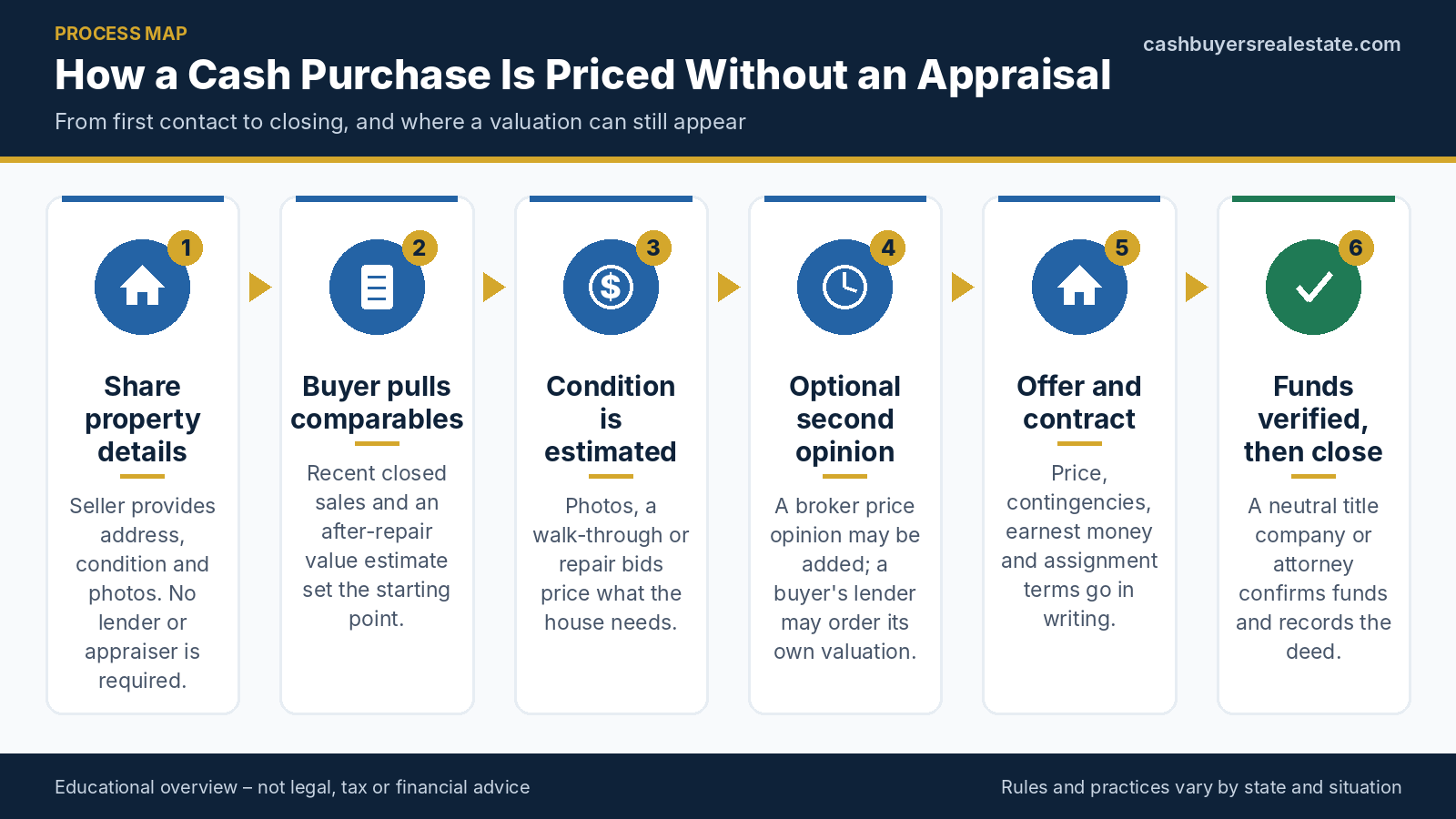
Text version of this infographic
- Share property details — Seller provides address, condition and photos. No lender or appraiser is required.
- Buyer pulls comparables — Recent closed sales and an after-repair value estimate set the starting point.
- Condition is estimated — Photos, a walk-through or repair bids price what the house needs.
- Optional second opinion — A broker price opinion may be added; a buyer's lender may order its own valuation.
- Offer and contract — Price, contingencies, earnest money and assignment terms go in writing.
- Funds verified, then close — A neutral title company or attorney confirms funds and records the deed.
Appraisal Gaps: The Mechanics That a Cash Offer Sidesteps
The clearest way to understand what an all-cash purchase leaves out is to watch what happens when an appraisal comes in below the contract price. That shortfall, the appraisal gap, is one of the most common reasons financed sales get renegotiated, and its arithmetic is simple enough to follow with a calculator. Once you can see how the gap works, you can see which parts of a cash offer’s appeal are real and which parts are only the absence of one particular risk.
How a gap forms in a financed sale
A gap is not a sign that anyone behaved badly. It appears whenever a buyer and seller agree on a price that the lender’s appraiser cannot support with the comparable sales available, and it happens in both hot and cooling markets for different reasons. Understanding the three numbers involved, price, appraised value and loan amount, is the whole key.
The contract price, the appraised value and the loan amount
When a buyer applies for a mortgage, the lender sets the maximum loan as a percentage of the property’s value, and in ordinary practice that value is the lower of the contract price or the appraised value. A buyer who agrees to pay $300,000 with a plan to borrow 80 percent expects a $240,000 loan and a $60,000 down payment. If the appraiser concludes the house is worth $285,000, the lender calculates 80 percent of $285,000 and offers only $228,000. The contract still says $300,000, so the buyer’s cash requirement jumps from $60,000 to $72,000. The $15,000 difference between price and appraised value is the gap, and the extra $12,000 the buyer must produce is the part of it the lender refuses to finance. The percentages differ by loan type and borrower, and some programs allow higher loan-to-value ratios than the example, but the mechanism is the same everywhere: the lender will not lend against more value than the appraiser supports. A low appraisal therefore does not directly cancel the deal. It changes how much money must come from somewhere other than the lender, and it forces the question of who supplies it.
Gaps arise from several causes. In rising markets, recent sales used by the appraiser can lag behind the prices buyers are now willing to pay, particularly when multiple offers push contracts above recent comps. In soft markets, a seller anchored on last year’s prices may list above what the latest sales justify. A house with unusual features, outdated condition or few comparable sales can leave the appraiser with wider adjustments and more conservative conclusions. And occasionally the appraiser simply chooses different comparables than the agents did, which is the main reason a reconsideration request can sometimes succeed.
How buyers and sellers usually resolve a low appraisal
Once a low appraisal is in hand, the parties have a short menu. The buyer can bring more cash to cover the difference, which works only if the buyer has the reserves and still believes the house is worth the price. The seller can lower the price to the appraised value or to some midpoint. The two can split the gap. The buyer can ask the lender to reconsider the value by providing additional comparable sales the appraiser may have missed; the VA describes this explicitly as a reconsideration of value, and other loan programs and lenders have review processes of their own. Or the buyer can cancel, if the contract contains an appraisal contingency that allows it.
The contract language matters a great deal here. An appraisal contingency generally gives the buyer a defined window to renegotiate or terminate if the appraised value falls short, often with return of earnest money. Some buyers in competitive markets weaken or waive that protection to make their offers more attractive, accepting the risk that they’d have to cover a gap from their own savings. Others add “appraisal gap coverage,” a promise to pay up to a stated amount above the appraised value. A seller reading an offer should be able to tell which of these is in play, because each one allocates the gap differently.
For the seller the costs of a gap are not only the price concession. A renegotiation consumes days, the buyer’s rate lock or loan approval may be on a clock, and if the deal collapses the house returns to the market after weeks off it. VA reporting indicated that, as of the end of May 2026, an average VA appraisal took about seven business days to complete, which gives a sense of how long that step alone can run. Those delays and uncertainties are exactly what a cash buyer’s offer removes, and they have real value even when the headline price is lower.
Working through a gap, one number at a time
Abstract descriptions of risk tend to blur in the memory, whereas a specific set of figures sticks. The example below follows a single hypothetical sale through several possible endings, and then contrasts it with a cash alternative so the trade-offs show up in dollars.
A worked example: a financed contract compared with a cash offer
Suppose a seller accepts a financed buyer’s $300,000 offer. The buyer plans an 80 percent loan. The appraiser reports $285,000. The table shows what each common resolution does to the loan, the buyer’s cash and the seller’s price. Every number below is invented to demonstrate the mechanism.
Illustrative example (hypothetical numbers, not market data): A seller has a signed $300,000 contract with a buyer who plans to borrow 80 percent. The appraisal comes back at $285,000. If the buyer covers the gap in cash, the loan drops to $228,000, the buyer’s cash need rises from $60,000 to $72,000, and the seller still receives $300,000. If the seller instead agrees to the appraised value, the price becomes $285,000 and the seller receives $15,000 less. If they split the difference at $292,500, the loan is still $228,000, because it’s capped by the appraisal, the buyer brings $64,500, and the seller concedes $7,500. A separate cash buyer meanwhile has offered $280,000 with no appraisal, which is $20,000 below the original contract but only $5,000 below the appraised value.
| Outcome | Sale price | Loan amount | Buyer’s cash needed | Seller’s price change |
|---|---|---|---|---|
| Original contract, before appraisal | $300,000 | $240,000 | $60,000 | $0 |
| Buyer covers the whole gap in cash | $300,000 | $228,000 | $72,000 | $0 |
| Seller lowers price to appraised value | $285,000 | $228,000 | $57,000 | -$15,000 |
| Parties split the difference | $292,500 | $228,000 | $64,500 | -$7,500 |
| Buyer cancels under an appraisal contingency | No sale | None | None | Relist; new price unknown |
| Separate cash offer with no appraisal step | $280,000 | None | $280,000 | -$20,000 versus original contract |
To read the table, compare the seller column with the buyer column. Two of the financed endings leave the seller whole or close to it, and they depend on the buyer having extra cash and wanting the house badly enough to use it. The other endings cost the seller $7,500 to $15,000 or the whole sale. The cash offer starts $20,000 below the original contract, yet it sits only $5,000 under the appraised-value outcome and carries no appraisal risk at all. Whether that trade is attractive depends on everything the table leaves out, such as commissions, repairs, timing and the odds that the financed deal survives.
What the gap teaches about price certainty
The main lesson of the example is that two different prices are in play at once. One is the contract price, which is what the buyer promised. The other is the price the lender will support, which is what the buyer can finance. Until the appraisal is done, a financed offer is a promise that depends on a third party’s opinion. A cash offer collapses the two numbers into one, so the price you agree to is the price the buyer can fund, subject to whatever other conditions the contract contains. That is the kind of certainty a cash offer really sells, and it is worth separating from other claims that sometimes get bundled with it. Eliminating the appraisal does not eliminate title issues, a buyer’s failure to perform, an inspection-based renegotiation, or a seller’s own obligations to deliver clear title and disclose known problems as state law requires. It removes one specific lender-driven contingency. Sellers sometimes assume that “cash” means “certain,” and the more accurate statement is that cash removes the financing and appraisal risks while leaving the rest of the transaction’s risks in place.
The other lesson is about how to compare. A financed offer at the full list price and a cash offer at a discount are not rivals measured by headline number. The financed offer carries a probability of renegotiation, delay or failure that should be priced in; the cash offer carries a discount that should be priced against costs the seller avoids. Weighing them honestly requires estimating both sides, which the next section does with net proceeds. For a broader treatment of how a financed buyer differs from a cash buyer across the whole transaction, the article on cash buyers versus financed buyers sets out the full comparison.
What Skipping the Appraisal Means for Timeline, Certainty and Net Proceeds
Removing the appraisal from a sale changes three things a seller cares about: how long the process takes, how likely the agreed price is to hold, and how much money is left after everything is paid. The first two are easy to see. The third is where sellers get misled, because a cash offer and a financed offer are priced on different assumptions, and the only fair way to compare them is to subtract every cost from every route.
Timeline and certainty without the appraisal step
Two effects work together when a lender drops out of the picture. The calendar shortens because a whole sequence of lender tasks disappears, and the price becomes more certain because one of the main triggers for renegotiation is gone. Neither effect is total, so it helps to be specific about what changes and what doesn’t.
Taking the appraisal off the calendar
In a financed purchase the appraisal is a chain of tasks, not a single event. The lender orders the report after the contract is signed, the appraiser must be assigned and scheduled, the visit has to happen with access arranged, the report is written and reviewed, and then the lender’s underwriter reads it and clears or conditions the file. Delay at any link pushes the closing date. VA reporting put the average at roughly seven business days for a VA appraisal as of the end of May 2026, and individual cases run longer when appraiser availability is tight or the property needs follow-up work. A cash purchase skips every link in that chain.
That does not make a cash closing instantaneous. The title search still has to be completed, liens and payoff amounts have to be identified, and the closing has to be scheduled with a title company, escrow officer or attorney, depending on local practice. In attorney-closing states the attorney’s availability sets the pace, while in escrow states the escrow officer coordinates signatures and funds. The seller’s own tasks, such as locating a payoff letter from a current lender or collecting documents for a probate sale, can also set the schedule. Cash simply removes the lender-driven items that are otherwise the most common cause of a missed closing date.
For a seller with a deadline, such as a relocation start date, a looming mortgage payment or a probate timeline, those days can matter more than a few thousand dollars of price. For a seller with no deadline, the same days may be worth little, and a patient listing aimed at financed buyers may produce a higher price. The honest framing is that the missing appraisal buys time and predictability, and you decide what those are worth in your situation. The broader question of speed is covered in the guide to a cash sale versus a listing for a fast sale.
Contingencies that remain after the appraisal is gone
It is easy to treat “no appraisal” as shorthand for “no conditions,” and that shorthand is wrong. A cash contract can still contain an inspection or due diligence period, a title contingency, a condition tied to the buyer’s review of documents, a right to inspect the property again before closing, and sometimes a clause letting the buyer cancel for any reason during a fixed window. Some of these protect a legitimate need. Others, in a poorly drafted contract, hand the buyer a free option to walk away or to reduce the price after you have already taken the house off the market. What separates a firm cash offer from a soft one is how narrow the buyer’s exits are and what it costs the buyer to use them. Earnest money held by a neutral party gives the buyer something to lose, and the terms under which it is refundable or forfeited show how committed the buyer really is. The article on earnest money in cash purchases goes through how deposits work, and the guide to cash buyer contingencies explains the common clauses one by one.
The most useful habit is to read the contract for every condition that lets the buyer reduce the price or exit, not only the ones labeled “appraisal.” A buyer who has removed the appraisal contingency but kept a broad right to renegotiate after a walk-through has not really given you more certainty. They have moved the same uncertainty to a different clause. How a buyer’s walk-through or inspection can reopen the price is a separate question, and the guide to inspections mentioned at the start of this article covers it.
Comparing routes by what you actually keep
Headline price is the number that gets quoted, but net proceeds is the number that pays off your mortgage, funds your next move and settles your debts. Comparing routes by net means listing each cost explicitly, including the ones that are easy to forget, and then asking which differences are certain and which are guesses.
A net-proceeds comparison across three routes
The example below uses a single hypothetical house and three routes. The assumptions are simplified and deliberately labeled, because real commissions, closing costs, repair bills and carrying costs vary by market, by contract and by negotiation. The purpose is to show how a lower headline price can land close to a higher one once costs are counted, and how sensitive the answer is to the assumptions.
Illustrative example (hypothetical numbers, not market data): A house would sell for about $320,000 after $25,000 of repairs, and for about $295,000 as-is if listed with a financed buyer. Assume combined real estate commissions of 5 percent, other seller closing costs of 1.5 percent for listed sales and 1 percent for a direct cash sale, and carrying costs of roughly $1,125 a month for mortgage interest, taxes, insurance and utilities. Route one repairs the house and lists it. Route two lists it as-is, and after an appraisal-driven negotiation it sells for $290,000. Route three takes a $270,000 cash offer. After costs, the seller keeps about $269,700, $268,150 and $266,800, before paying off any mortgage, and the three timelines run roughly four months, eighty days and two weeks.
| Line item | Repair, then list | List as-is, financed buyer | Cash offer, as-is |
|---|---|---|---|
| Final sale price | $320,000 | $290,000 | $270,000 |
| Real estate commissions (5 percent assumed) | -$16,000 | -$14,500 | $0 |
| Other seller closing costs | -$4,800 | -$4,350 | -$2,700 |
| Repairs before sale | -$25,000 | $0 | $0 |
| Carrying costs during the sale | -$4,500 | -$3,000 | -$500 |
| Approximate net proceeds | $269,700 | $268,150 | $266,800 |
| Rough time to close | About 4 months | About 80 days | About 2 weeks |
The pattern to notice is how close the three nets are: the spread between best and worst is under $3,000 on a house priced near $300,000, well within the error of any single assumption. That is common when the discount a cash buyer takes roughly matches the repairs, commissions and time the seller avoids, but it is not guaranteed and can break either way. If repairs run $40,000 instead of $25,000, route one drops to $254,700 and the cash route pulls ahead. If the house needs almost nothing and sells quickly at full price, the listing wins. And if the financed buyer’s loan falls through after the appraisal and the house sits another two months, route two quietly loses several thousand dollars. Because the answer is so sensitive, treat a table like this as a template for your own numbers, not a verdict. Replace each line with your best estimate, run it at pessimistic and optimistic values, and look for the route that holds up across the range. Sellers who skip this exercise tend to compare a cash number with a list price, which overstates the listing route by ignoring costs that come out before the check does. Closing-cost allocation differs by contract and by state, which is why the closing-cost line in the table is an assumption, not a rule.
Honest alternatives and when each one wins
A cash offer is one option among several, and an article about appraisals shouldn’t pretend otherwise. Traditional listing with an agent exposes the house to the whole market, including financed buyers who may pay more, at the price of commissions, preparation and the appraisal risk described above. Selling as-is to a financed buyer avoids repair work but keeps the lender’s appraisal and inspection in play. Repairing before listing can raise the price but ties up money and time, and the cost can exceed the value added. Some sellers also consider selling to an iBuyer or a relative, each with its own pricing logic.
Choosing among them usually comes down to which risk you can best tolerate. If appraisal gaps and financing fall-through worry you, a cash buyer or a financed buyer with strong reserves and a waived or capped appraisal contingency reduces that risk. If your priority is the highest possible price and you have time, a well-prepared listing is often the stronger route. If the house needs substantial work and you lack the money or energy to do it, an as-is sale to someone who prices the repairs themselves may beat a half-finished renovation. The table compares five common routes on appraisal exposure and the situations where each tends to fit.
| Route | Appraisal exposure for the seller | Main trade-off | Often fits when |
|---|---|---|---|
| Buyer paying entirely with own funds | None required by law; check the contract for any valuation clause | Price often reflects the buyer’s repair costs and margin | Time matters or the house needs work |
| Buyer funded by a private or short-term lender | The lender may require its own valuation | Looks like cash but can carry gap-like risk | The buyer can document the lender’s terms |
| Financed buyer, appraisal contingency intact | Full exposure to a low appraisal and renegotiation | Possibly higher price, less certainty | You can wait and the market is steady |
| Financed buyer, contingency waived or gap coverage | Reduced, since the buyer promises to cover a shortfall | Depends on the buyer’s cash reserves | A strong, well-documented offer is available |
| Repair, then list conventionally | Same as any financed listing, with a better-condition house | Upfront cost and time before any income | Repairs are modest and the payoff is clear |
Read the exposure column first. Notice that only the first row has no appraisal exposure of its own, and the second row demonstrates why the word “cash” in an advertisement is not enough. The right-hand column is only a starting point for thinking, and your decision should reflect your finances, deadline, the property’s condition and your tolerance for uncertainty. For house condition specifically, the article on selling a house fast without repairs covers how much repair work is worth doing. The comparison of selling routes can also be summarized visually. The options graphic that follows places five routes side by side on the factors that drive the decision: the offer price, whether repairs are avoided, who bears closing costs, how long the process takes, which contingencies remain, and how certain the closing really is.
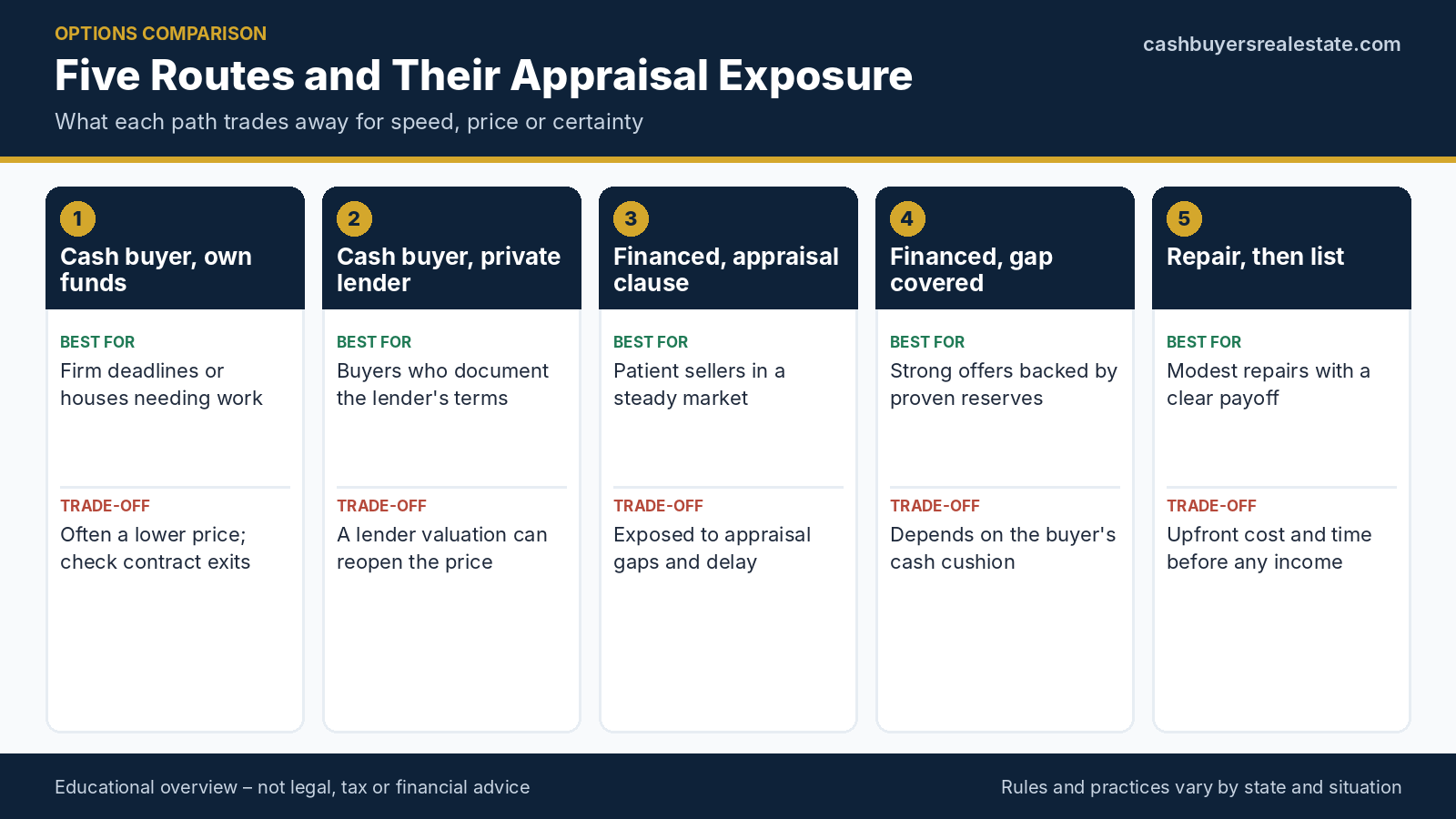
Text version of this infographic
- Cash buyer, own funds — Best for: Firm deadlines or houses needing work. Trade-off: Often a lower price; check contract exits.
- Cash buyer, private lender — Best for: Buyers who document the lender's terms. Trade-off: A lender valuation can reopen the price.
- Financed, appraisal clause — Best for: Patient sellers in a steady market. Trade-off: Exposed to appraisal gaps and delay.
- Financed, gap covered — Best for: Strong offers backed by proven reserves. Trade-off: Depends on the buyer's cash cushion.
- Repair, then list — Best for: Modest repairs with a clear payoff. Trade-off: Upfront cost and time before any income.
When a Cash Buyer’s Money Comes With a Valuation Attached
The phrase “cash buyer” describes how a buyer presents themselves, not always how the purchase is funded. Between a buyer who pays from their own bank account and a buyer who needs a mortgage lies a wide middle ground: short-term loans from private lenders, money from partners, funds raised from investors, and contracts that pass from one buyer to another. Each of these can reintroduce a valuation requirement, and a seller who understands how can spot the difference between an offer that is genuinely independent of any outside opinion and one that only looks that way.
Cash buyers who borrow: private lenders, short-term loans and partners
Many investors who buy houses quickly do not use only their own savings. They borrow against the property they are buying, often for a short period while they renovate and resell or refinance. From the seller’s side the deal still closes quickly and without a bank mortgage process, but the money has a lender behind it, and lenders tend to want to know what they are lending against.
Why “cash” sometimes means a short-term loan underneath
Short-term, asset-based loans from private lenders are a common way for investors to fund purchases and renovations. The terms vary widely from one lender to the next, but a typical structure ties the loan amount to a percentage of the property’s value, sometimes the current as-is value and sometimes the projected after-repair value, and the lender may decide how to check that value. Some lenders order a full appraisal. Others rely on a broker price opinion, an automated estimate, a drive-by review or their own experience in the area. Because these lenders are often not the federally regulated banks that follow the appraisal rules described earlier, the specific requirements depend on the lender and on the state.
For a seller, the practical consequence is that a valuation step can return even though no mortgage application is involved. If the buyer’s lender values the house below the buyer’s expectations, the buyer may face the same gap problem a conventional borrower would, and may respond the same way: by bringing more of their own money, by asking you to lower the price, or by walking away if the contract lets them. The risk exists because the buyer is relying on borrowed funds sized by someone else’s opinion of value, not because the loan is called a mortgage.
Illustrative example (hypothetical numbers, not market data): An investor offers $210,000 for a house and says the purchase is “all cash.” In fact, the investor plans to fund 75 percent of the price, $157,500, with a short-term loan, and to pay the remaining $52,500 from savings. The lender’s valuation comes back at $195,000, and its policy is to lend 75 percent of that figure, which is $146,250. That leaves the investor $11,250 short of the loan they planned on. The investor asks for a price reduction to $195,000, which would reduce the loan need to $146,250 and the cash need to $48,750. The seller who assumed there was no valuation step has just met an appraisal gap under another name.
None of this makes private lending improper or suspect. Many legitimate, experienced buyers use it routinely, and a buyer who has a lender’s commitment in hand may be as reliable as one with savings. The point is narrower: the seller should know whether any part of the money is borrowed, whether the lender’s approval is final, and whether a lender valuation can change the price or terminate the deal. Those facts belong in the contract, and a buyer who is vague about them is telling you something. The guide on proof of funds for cash buyers explains how to ask for documentation that answers these questions.
Investor partners, assignments and the valuation behind the end buyer
Another way valuation sneaks back in is through the people behind the buyer. A buyer who isn’t investing alone may need approval from partners or outside investors, who often want to see the comparable sales and the repair budget before releasing funds. A small fund or syndicate may have a written investment policy that caps the purchase price at a percentage of its own valuation. In those cases the buyer’s offer to you is conditional in practice, even if the contract doesn’t say so, and the investors’ internal valuation can reduce what the buyer is able to pay.
Assignments add a further layer. In an assignment, the party who signed the contract with you transfers their rights to another buyer, who then closes. Assignment is lawful in many places and common in investor deals, but it means the end buyer, and that buyer’s funding and valuation, may not be known when you sign. Some states regulate how contract assignments must be disclosed or who may market them, and the rules vary, so check your state’s requirements and read any clause that allows the buyer to assign. The end buyer’s lender or partners may then impose valuation requirements neither you nor the original buyer anticipated. A seller can manage this exposure without suspicion or hostility. Ask who the ultimate purchaser will be, whether the contract is assignable and on what conditions, and whether the original buyer remains responsible if the end buyer fails to close. Responsible buyers answer these questions as a matter of course, because they know sellers have been burned by deals that dissolved late. A buyer who treats the questions as an insult has not necessarily done anything wrong, but the reaction is useful information about how the rest of the transaction may go.
Finding out whether a valuation sits behind the offer
The way to learn whether a valuation is lurking in the deal is to ask direct questions early and then to read the contract for the places where those answers should appear. Both steps are ordinary due diligence, not accusations, and neither requires legal expertise to begin, though a real estate attorney is worth consulting before you sign anything unusual.
Questions about funding source and valuation conditions
Start with the money. Ask whether the full purchase price will come from the buyer’s own funds, and if any portion is borrowed, from whom and under what conditions. Ask whether the loan is already approved, or still under review, and whether its approval depends on a valuation of the property. A buyer who uses their own money can usually answer in one sentence and provide a proof of funds document, such as a recent bank or brokerage statement or a letter from a financial institution. A buyer who relies on a lender should be able to explain the structure without hedging. Then ask about valuation specifically. Will anyone order an appraisal, broker price opinion or similar report, and who will pay for it? What happens to the price or the contract if that report comes in lower than expected? Is there a deadline by which the buyer must complete any valuation step, after which the buyer loses the right to renegotiate on that ground? The answers show whether the buyer treats the valuation as a purely internal decision or as a condition that could change your deal after you have accepted it.
It is reasonable to ask for these answers in writing, and to expect that an earnest buyer will make them part of the contract rather than leave them to verbal assurance. Verbal promises are hard to enforce and easy to forget, and the contract is the only document that controls what happens if the buyer’s circumstances change. If a buyer resists putting a firm statement about funding into the agreement, treat that as a reason to pause before moving ahead, and consider asking for a larger earnest money deposit or a shorter, firmer deadline in return for your cooperation.
Reading contract language for hidden appraisal conditions
The words that carry valuation risk are not always labeled “appraisal.” A financing contingency allows the buyer to cancel if they can’t obtain a loan, and a lender’s valuation is usually the reason they can’t. A clause making the purchase “subject to buyer’s satisfaction” with some report or review may give the buyer wide discretion. A broad due diligence period lets the buyer terminate for almost any reason within a set time. The table below translates some common phrases into plain English and suggests what to ask about each.
| Phrase you might see | What it can mean for you | What to ask or negotiate |
|---|---|---|
| Subject to buyer obtaining financing | The buyer may cancel if a lender won’t fund, including after a low valuation | Whether any lender is involved, and a firm date for removing the condition |
| Appraisal contingency | The buyer may renegotiate or cancel if value falls short of price | Whether it can be removed, shortened or capped at a stated amount |
| Subject to buyer’s satisfaction with valuation or review | The buyer has wide discretion to walk away or ask for a lower price | Objective standards and a short, fixed deadline |
| Due diligence or inspection period | The buyer may terminate or reprice during a set window | Length of the window, refundable earnest money and what triggers a refund |
| Buyer and/or assigns | The contract may be transferred to a buyer you haven’t met | Whether you must approve the assignee and whether the original buyer stays liable |
| Proof of funds to be provided later | The buyer’s funding may be unverified when you accept | Documentation before signing, or a short deadline with a stated consequence |
The table works best as a checklist for reading an actual contract line by line. Highlight any phrase that gives the buyer a way out or a basis to lower the price, and ask what objective condition triggers it. If a clause is vague, ask to replace it with a specific one. If a clause is standard and fair, you will usually be able to tell because the buyer explains it clearly and offers reasonable limits. The article on red flags in cash offer contracts goes deeper into the clauses that most often work against sellers.
Red Flags: Price Pressure, Unseen Valuations and Verification Steps
Most buyers who pay cash are honest operators or ordinary households, and a missing appraisal is not evidence of anything. But the absence of a neutral checkpoint does create openings for pressure, and the problems that sellers report tend to cluster around three things: a price justified by documents nobody can see, a price that shrinks after the seller is committed, and funds or closing arrangements that were never properly verified. None of the patterns below proves bad intent by itself, and each has an innocent version. They are signals to slow down and ask for specifics, not verdicts.
Valuation claims and price changes that deserve a second look
Because a cash buyer can set the price without anyone’s independent sign-off, the explanation they give for the number carries more weight than it would in a financed deal. Sellers are best served by treating the explanation as a claim to be tested, not a fact to be accepted, while staying polite and businesslike about it.
Unseen reports and unexplained lowball justifications
A common pattern is a buyer who justifies a low number by pointing to a valuation that the seller never sees. “Our numbers show it’s worth much less,” “the appraiser said,” or “the comps don’t support more” can all be perfectly accurate statements, and they can also be a way of anchoring the seller to a figure the buyer chose. A buyer commissioning their own valuation owes the seller no copy, so the seller cannot verify it. What the seller can do is ask which comparables the number rests on, what repair costs were assumed and what margin the buyer built in, then test each element against their own research.
Pay attention to the order of events. A buyer who looks at the property, asks real questions about its condition, explains the arithmetic and invites you to challenge it is behaving like a professional who expects a negotiation. A buyer who produces a figure before seeing anything, uses an “expiring” offer to hurry you and avoids showing any reasoning is relying on your lack of information. Pressure is the more important sign than the number itself, since a low offer that is explained honestly can still be a fair one for a distressed property.
Be especially cautious about any request that you pay money to receive or process an offer. A seller should not have to pay a buyer’s appraisal, valuation or “processing” fee as a condition of getting a price, and a request of that kind is a reason to stop and ask a trusted professional or your state attorney general’s office before proceeding. Legitimate buyers absorb their own evaluation costs as part of doing business. For a fuller picture of how fraud and misrepresentation show up in this market, the hub on cash home buyer scams and trust collects the patterns in one place.
Re-trading after the contract is signed
The second pattern is the price cut after you’ve signed. The buyer visits the house, or a valuation arrives, or “the numbers changed,” and the offer drops by thousands of dollars shortly before closing. Sometimes this is legitimate: a walk-through reveals a failing roof, a title search shows a lien that must be paid, or a lender’s valuation really did come in lower. The test is whether the reduction is tied to a specific, documented finding the buyer didn’t know and couldn’t have known before signing, or whether it is a general claim that the property is worth less than the buyer thought.
Re-trading works because the seller by then has taken the house off the market, perhaps made plans to move, and dislikes the idea of starting over. A buyer who knows this can profit from the seller’s reluctance. Your protection lies in the contract: a short list of narrow conditions, earnest money that is meaningful and held by a neutral party, a clear statement of what happens to the deposit if the buyer cancels, and a deadline after which the buyer can no longer renegotiate on valuation grounds. Each of those protections is something you can propose in your counteroffer before you sign, and a buyer who agrees to them readily is easier to trust. If a price reduction does arrive, respond calmly and ask for the basis in writing. Compare it with the written findings from any inspection or title search, and decide whether the revised figure still beats your alternatives. You have more leverage than it may feel like, because a buyer who cancels loses time and possibly a deposit, and a reasonable counteroffer often settles the issue. The table lays out common claims and tactics with a measured way to respond to each.
| Claim or tactic | When it may be legitimate | Why it deserves a second look | Reasonable response |
|---|---|---|---|
| “Our valuation says the house is worth much less” | The buyer used real comps and priced real repairs | The report is unseen and the number arrived before any visit | Ask which comps, repairs and margin built the number |
| “The appraiser will need access this week” | A lender or partner requires a valuation visit | It signals a hidden financing or partner condition | Ask who is funding and what happens if the value is low |
| “Pay a fee so we can process your offer” | Rarely, if ever, for a seller | Seller-paid fees before any contract are a recognized warning sign | Decline and verify the company independently |
| “The price has changed since we signed” | A specific new finding such as a lien or serious defect | The reduction is general or unsupported | Request written findings and counter or hold to the contract |
| “This offer expires tonight” | A genuine deadline tied to the buyer’s funds | Time pressure prevents you from comparing options | Ask for the reason and take time to compare other offers |
| “No need for an attorney or title company” | Never as a general rule | Skipping neutral closing professionals removes protections | Insist on a reputable closing attorney or title company |
Treat the table as a map of conversations to have, not a scorecard. If a buyer shows one or two of these behaviors and then clears them up with good explanations, you’ve learned something reassuring. If they show several and resist every question, the pattern matters more than any single instance. Reputation checks, such as business registration, licensing where the state requires it, and consistent contact information, add to the picture, and the question of how to judge whether a company is reputable is explored in the guide on whether cash home buyers are legitimate.
Verifying the buyer, the funds and the closing path
A price you can trust is only half the transaction. The other half is knowing that real money will arrive at a real closing, through a process that treats you fairly. These checks cost little, take a few days at most, and catch most of the problems that can be caught in advance.
What proof of funds shows and what it doesn’t
A proof of funds document, usually a bank or brokerage statement or a letter from a financial institution, is meant to show that the buyer controls enough money to complete the purchase. It’s a useful screening tool, and a buyer who can’t or won’t produce one is telling you something. But it has limits. A statement shows a balance on a date, not that the money will still be there at closing, that it belongs to the buyer rather than a relative or partner, or that it isn’t already committed to another purchase. Statements can be edited, and a letter on letterhead is only as reliable as the institution that issued it.
So think of proof of funds as the start of verification, not the end. Check that the name on the account matches the buyer in the contract or that the connection between the two is explained. Look at the date, which should be recent, and ask whether the amount covers the full price plus closing costs. If funds come from a lender or partner, ask for the commitment letter or agreement. Redaction of account numbers is normal and reasonable; refusal to show anything at all is not. The proof-of-funds guide linked earlier in this article shows what a credible document looks like.
The most dependable confirmation is the closing itself, which is why the choice of who holds the money matters. If the buyer’s earnest money is deposited with a title company, escrow agent or attorney trust account, a third party has confirmed that at least a portion of the funds exists. If the whole purchase price will be delivered to that same neutral party before you sign the deed, you are protected by the structure and don’t have to rely on anyone’s word.
Contract terms, assignment and the closing partner
Read the contract for the exits. Look at every clause that allows the buyer to cancel, adjust the price or extend the closing date, and see whether you receive anything in return, such as non-refundable earnest money. Look at the assignment language to learn whether the buyer can pass the contract to someone else, and ask what happens to you if the new party fails to close. Look at the closing date and any extension rights, since a flexible date in the buyer’s favor is a flexible commitment.
Insist on a neutral closing partner and take part in choosing it. Depending on the state, that may be a title company, an escrow company or a real estate attorney, and in many places you have the right to use your own. Be wary of any arrangement in which the buyer’s own office handles the signing and the funds with no independent professional involved, and never sign a blank or incomplete document, a deed with the buyer’s name left open, or any form you do not understand. If a deed is signed before funds are confirmed, you have given up your strongest protection.
Wire fraud is a separate risk at the end of any transaction, cash or financed, because large sums move electronically at closing. Safeguards are simple. If you’re receiving proceeds by wire, give your bank details only to the closing office through a secure channel you have confirmed. If you’re told that payment instructions have changed, call the closing office on a number you found independently, not the one in the email, before acting. No single one of these steps proves a deal is safe, but together they remove most of the easy openings for a scam. The checklist that follows covers six checks worth completing before you commit: confirm the buyer’s identity and business details, request proof of funds, read the cancellation and price-adjustment clauses, check the assignment terms, use a reputable neutral closer, and never sign blank or incomplete forms.
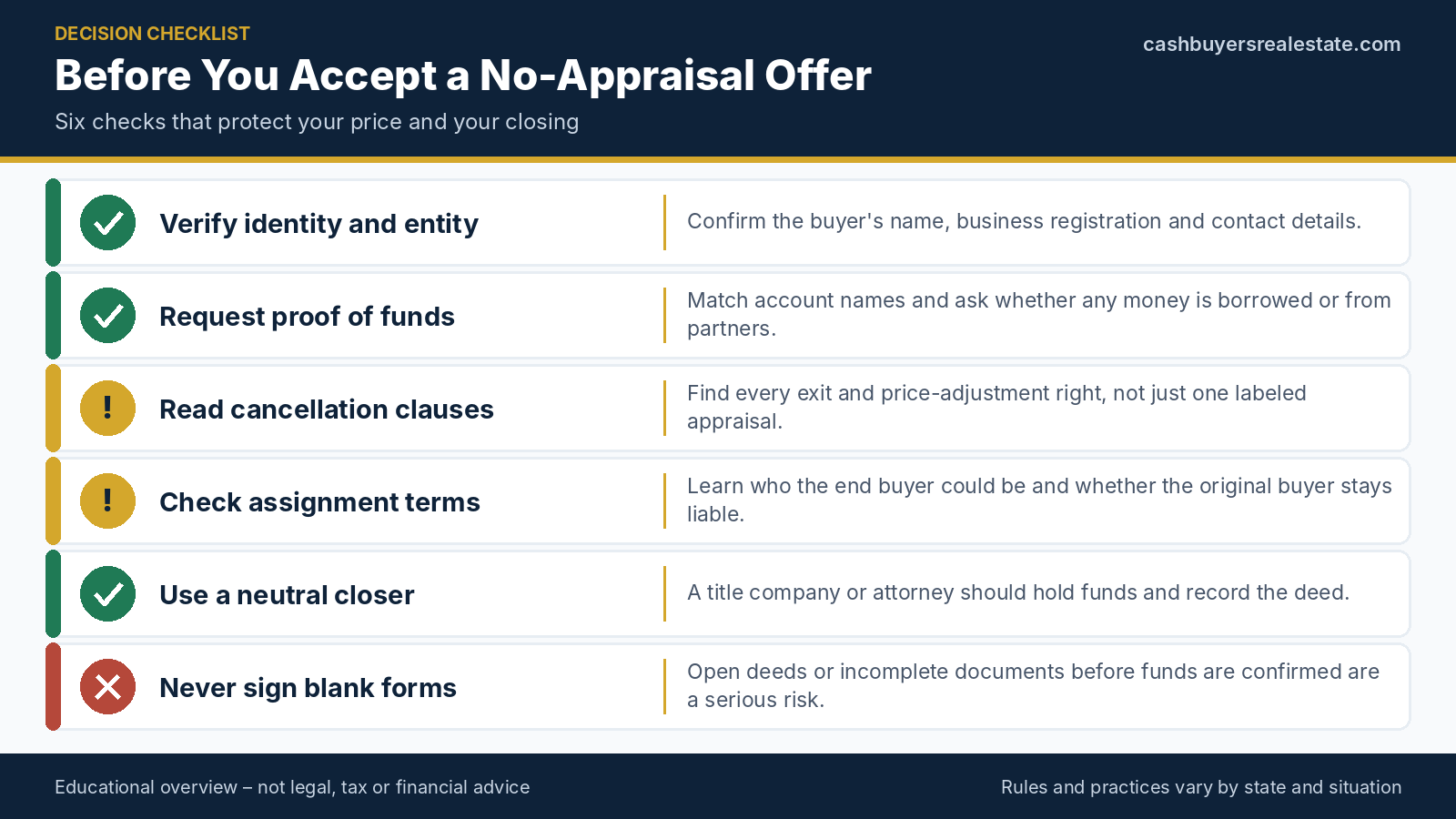
Text version of this infographic
- Verify identity and entity — Confirm the buyer's name, business registration and contact details.
- Request proof of funds — Match account names and ask whether any money is borrowed or from partners.
- Read cancellation clauses — Find every exit and price-adjustment right, not just one labeled appraisal.
- Check assignment terms — Learn who the end buyer could be and whether the original buyer stays liable.
- Use a neutral closer — A title company or attorney should hold funds and record the deed.
- Never sign blank forms — Open deeds or incomplete documents before funds are confirmed are a serious risk.
Checking Your Home’s Value Yourself Before You Weigh an Offer
The missing appraisal leaves a gap that only you can fill. In a financed sale the lender’s appraiser eventually tests the price, whether you like it or not. In a cash sale nobody is obliged to, so the testing becomes your job. The good news is that a homeowner can reach a respectable estimate of value with public records, a few hours of patient comparison, and, when the stakes justify it, one or two inexpensive outside opinions. The goal isn’t to prove a buyer wrong. It is to know your range well enough that an offer inside it can be accepted without regret, and an offer far below it can be questioned with specifics.
Building a comparable-sales picture you can defend
Comparable sales are the foundation of nearly every valuation method, including the appraiser’s. Doing the work yourself takes more care than most people expect, because the easy-to-find numbers are often the wrong ones. The two steps that matter most are choosing the right sales and then adjusting them honestly for how they differ from your house.
Choosing comparables and adjusting for differences
Begin with closed sales, meaning transactions that actually finished, not active listings or pending contracts. Asking prices show what sellers hope for, and pending sales haven’t produced a final price yet. Look at homes that sold recently, preferably within the last several months in a stable market and as close to your own date as possible in a fast-moving one, and that sit in the same neighborhood or a very similar one nearby. Match the basics: style, approximate size, age, bedroom and bathroom count, lot size and garage. In many areas a county recorder or assessor’s website shows recent transfers, and an agent with access to the multiple listing service can provide fuller detail, including condition and concessions. Some states keep sale prices out of public records, which makes agent-supplied data more important there.
Next, adjust. If a comparable has a renovated kitchen and yours has the original, its price overstates what yours would bring, so subtract a reasonable amount for the difference. If your house has a bigger lot, add. The adjustment amounts come from judgment, local knowledge and, ideally, paired sales that isolate a single feature. Be aware that the price recorded for a sale may include seller concessions, such as help with the buyer’s closing costs, which means the true value to the seller was lower than the number on the record. Sales between relatives, distressed sales and unusual transactions should be treated cautiously or excluded.
Illustrative example (hypothetical numbers, not market data): A homeowner with a three-bedroom, two-bath house of about 1,450 square feet, dated finishes and a one-car garage finds three recent sales. The first sold for $312,000 with a renovated kitchen and about 50 more square feet, so she subtracts $20,000 for the kitchen and $4,000 for the space, giving $288,000. The second sold for $295,000 in similar condition but with a two-car garage, so she subtracts $6,000 for the garage, giving $289,000. The third sold for $281,000, slightly smaller but on a better lot, so she adds $6,000 for size and subtracts $3,000 for the lot, giving $284,000. Her adjusted range is $284,000 to $289,000, a tighter and more useful figure than the raw prices, which ranged from $281,000 to $312,000.
Notice that the adjusted figures cluster far more tightly than the raw sale prices, which is the signal that the comparison is working. If your adjusted values scatter widely, you may have picked comparables that are too different, or your adjustments may be inconsistent. When that happens, narrow the set to the two or three best matches and treat the others as context. A range, not a point, is the honest product of this exercise, and it’s the range you bring to a negotiation.
Separating as-is value from repaired value
Most homeowners who consider cash offers have a house that is not in comparable condition to the best nearby sales. That means you actually need two numbers. One is what the house would likely bring after repairs and updates, which is roughly the investor’s after-repair value. The other is what it is worth in its present condition to a typical buyer. The difference between them is not simply the repair bill, because buyers who purchase as-is want compensation for the work, the risk and the time involved. To estimate repair costs without relying on the buyer’s figures, ask one or two local contractors to look at the largest items, which typically include roofing, mechanical systems, foundation or structural concerns, water damage and kitchens or bathrooms that are well past their useful life. Contractor bids are not free of bias either, but a few of them give you a reality check on whether a buyer’s repair estimate is in a plausible range. Be mindful that unpermitted work and code violations can add cost and complicate financing for a retail buyer, which narrows the field of buyers and may tilt value toward the investors who buy such houses.
Condition affects who can buy, not only what they will pay. Government-backed loan programs such as the VA’s require the property to meet minimum property requirements, and the VA says its appraisers check them, so a house with serious deficiencies may not qualify for buyers using those programs. That shrinks the pool of financed buyers and helps explain why investors dominate the market for the most distressed houses. Understanding where your property sits on that spectrum tells you whether to expect competing financed offers at all, and how much of a discount from repaired value is plausible.
Paying for or collecting outside opinions on value
Your own comparable analysis can be sharpened by outside opinions. Each has a different cost, purpose and weakness. Choosing among them depends on the size of the decision, the complexity of the property and how much dispute you expect.
Hiring your own appraiser
A homeowner is free to hire a state-licensed or state-certified appraiser directly. The appraiser works for you, not a lender, produces a written report with comparable sales, adjustments and a reconciled opinion of value as of a stated date, and follows the same professional standards, including independence and impartiality, that govern lender appraisals. Most states provide a license lookup through the state’s appraiser regulatory agency, which is the right place to confirm that someone holds the credential they claim. Fees vary by market and by the complexity of the property, so ask for a quote and an estimated delivery time before engaging anyone.
Whether this is worth the cost depends on the situation. It makes the most sense for unusual properties, for high-value homes where a small percentage error is a large sum, for estates and divorces in which several parties need a neutral figure, and for disputes in which a buyer’s claims about value are central. It makes less sense for a typical house in a market with plentiful comparable sales, where your own analysis and an agent’s opinion may be enough. Remember, too, that a private appraisal is only an opinion. A cash buyer is under no obligation to accept it, though a credible independent report can anchor a negotiation and make an unsupported lowball harder to defend.
Never ask an appraiser to reach a particular number, and be wary of any appraiser who offers to. Professional standards require appraisers to be impartial, and an opinion shaped to your wishes is worthless if a buyer or later a court examines it. What you can properly do is provide information, such as a list of improvements, copies of permits or comparable sales you believe the appraiser should consider, and then let the professional reach their own conclusion.
Agent opinions, broker price opinions and online estimates
A local real estate agent can prepare a comparative market analysis, often at no charge in the hope of earning the listing. It is useful, because agents see sales and conditions that don’t appear in public data, but remember the incentives. An agent competing for your listing may be tempted to suggest an optimistic price, and one who expects a quick investor sale may lean low. Ask for sold comparables with dates, prices and concessions rather than just a suggested figure, and compare opinions from two or three agents. A broker price opinion for a fee is a more formal product and, as noted earlier, is not an appraisal.
Online value estimates from websites and apps are the quickest check and the least reliable on their own. They are generated by automated models drawing on public records and recorded sales, so they miss interior condition, recent upgrades and defects, and they can be especially wide of the mark for unusual properties, homes in areas with few sales, and houses that sold privately. Many sites display a range or an error indicator, which is worth reading. Use these estimates as a sanity check on direction, not as a number to quote to a buyer. The strongest approach combines sources: your own adjusted comps, two or three agent opinions, perhaps one contractor visit for the big repairs, and an appraisal only where the stakes justify it. When they all point to the same neighborhood of values, you can have confidence. When they disagree, the disagreement itself is information about how uncertain your market is and how much a buyer’s offer might legitimately differ from your expectations. The table summarizes the options.
| Method | Typical cost level | What it tells you | Main caution |
|---|---|---|---|
| Your own adjusted comparable sales | Free apart from your time | A defensible range based on recent closed sales | Easy to pick poor comparables or adjust inconsistently |
| Agent comparative market analysis | Often offered without a fee | Local context, condition and concessions | The agent may have a stake in the listing |
| Broker price opinion | Modest fee, varies | A professional pricing view, quicker than an appraisal | Not an appraisal and not held to appraisal standards |
| Online value estimate | Free | A rough directional check | Cannot see condition and can be far off |
| Contractor repair bids | Often free for estimates, varies | Realistic repair cost for the biggest items | Bids differ and scope may change once work starts |
| Independent licensed appraisal | Higher fee, varies by property and market | A formal, impartial opinion of value as of a date | A buyer paying cash is not bound by it |
Use the cost column to match the tool to the decision. A modest-price house with plenty of comparable sales rarely needs more than the first three rows. A complicated or high-value property, or one involving several family members, justifies the last row. The remaining question is what to do with all this information when a real offer is on the table, which is where the final section turns.
Questions Sellers Ask About Appraisals and Cash Offers
The questions below come up repeatedly when homeowners compare a cash offer with a traditional listing. Answers are general; state law, contract terms and the specific parties involved can change the outcome, so treat them as a starting point for conversations with a licensed professional in your area.
Questions about requirements, costs and logistics
These questions deal with what is required, who arranges and pays for a valuation if one happens, and what a seller should expect when it does.
Questions about whether an appraisal is required
- Does the law require a buyer who pays cash to get an appraisal?
In general, no. The appraisal rules that people hear about come from banking regulation, government loan programs and secondary-market standards, and they apply to lenders and loans. A buyer using only their own funds isn’t covered by those rules in the same way. State and local procedures differ, however, so a closing attorney or title officer in your area is the right person to confirm that nothing unusual applies where you live.
- Can a cash buyer still order an appraisal if they want one?
Yes. Nothing prevents a buyer from commissioning a valuation for their own reasons, such as a high-value property, an unusual house, a buyout between family members or the wishes of an investor. A report ordered that way belongs to the buyer and serves the buyer’s purposes, and a seller isn’t automatically entitled to a copy. If the buyer relies on it to lower the price, you can reasonably ask what comparables and assumptions it used.
- Will the title company or closing attorney require an appraisal for a cash sale?
Typically not. The closing professional’s job is to confirm that the seller can convey clear title, clear or pay off liens, record the deed and disburse funds according to the contract. An appraisal is not usually part of that file when no lender is involved. If the transaction includes a lender, that lender may impose its own requirements, which the closing office will then coordinate.
- If the buyer’s lender wants a valuation, was it really a cash offer?
It depends on what the buyer told you and what the contract says. Many investors use short-term loans while describing a deal as cash because no bank mortgage process is involved. That can be legitimate, but it changes the risk, since a lender’s valuation can force a price change or cancellation. Ask directly whether any part of the price is borrowed and put the answer in the contract.
Questions about cost, timing and access
- Who pays if a cash buyer orders an appraisal or valuation?
The party who orders it normally pays, and in a cash purchase that is usually the buyer. A seller shouldn’t be asked to pay a buyer’s valuation or processing fee in exchange for receiving an offer. If a request like that comes up, pause and verify the company and the request with a licensed professional before sending any money.
- Does an appraisal slow down a cash closing?
If none is ordered, there’s nothing to wait for, which is one reason cash closings can move faster than financed ones. If the buyer decides to obtain a valuation or a lender is involved, the step adds scheduling, a visit and report time before the file can move forward. VA reporting, for example, put the average time for a VA appraisal at about seven business days as of the end of May 2026, though cases vary widely.
- Do I have to let an appraiser or valuation professional into my home?
That depends on the contract. If the agreement gives the buyer inspection or access rights, refusing access could breach it or give the buyer grounds to cancel. If you haven’t yet signed anything, you can decide what level of access to allow. Either way, ask who is coming, why, and for whom, and arrange visits at reasonable times.
Questions about price, risk and protection
The second group covers how the absence of an appraisal affects the number on the offer and what a careful seller should watch for.
Questions about price and value
- Does a cash buyer offer less because there’s no appraisal?
The missing appraisal isn’t the main reason cash offers tend to run below list prices. The discount usually reflects the buyer’s repair costs, carrying costs, resale expenses, risk and required return, along with the speed and certainty the seller receives. Some buyers also build in room because no one has independently confirmed value. Net proceeds after all costs, not the headline price, is the fair way to compare.
- Can I get my own appraisal to respond to a low offer?
Yes, a homeowner may hire a licensed appraiser, and a credible independent report can strengthen a negotiation. It won’t bind a cash buyer, who can still offer what they choose. It tends to be worth the fee for unusual or high-value properties, estates and disputes, and less so for ordinary houses in markets with many recent sales.
- Is an online estimate or broker price opinion reliable enough to price my house?
Treat both as inputs, not conclusions. Online estimates can’t see condition, upgrades or defects, and a broker price opinion is not an appraisal and isn’t held to appraisal standards. Combining them with your own adjusted comparable sales and a couple of agent opinions gives a much better range than any single source.
- How is a property tax assessment different from an appraisal?
A tax assessment estimates value for property-tax purposes using methods and schedules set by the state or local government, and it may lag the market or follow different rules. An appraisal estimates what the property would likely sell for as of a stated date. The two can differ substantially, so an assessment is a rough clue about value, not proof of it.
Questions about risk and red flags
- Is it a warning sign if a buyer won’t show me their valuation?
Not by itself, since a buyer generally has no duty to share an internal analysis. It becomes more meaningful alongside other signs, such as pressure to decide quickly, refusal to explain how the price was set, requests for fees or reluctance to use a neutral closing company. Ask what comparables and repair assumptions the number rests on, and weigh the response.
- What if the buyer lowers the price after saying no appraisal was needed?
Ask for the reason in writing and compare it with the contract. A reduction tied to a specific new finding, such as a lien, a serious defect or a lender’s valuation, may be legitimate. A general claim that the house is worth less than expected is weaker, especially if the contract does not give the buyer a right to adjust. You can hold to the agreement, counter or decline.
- Can a cash sale still fall through even without an appraisal?
Yes. Title problems, unresolved liens, inspection findings, a buyer’s change of mind under a broad contingency, unverified funds or a financing source that proves unreliable can all end a deal. Removing the appraisal removes one cause of failure, not all of them, which is why verifying funds and reading the exit clauses matter regardless of how the offer is described.
Deciding Whether a Sale Without an Appraisal Fits Your Situation
By now the central trade is clear. A buyer paying cash skips the lender’s appraisal, which removes a leading cause of delay and renegotiation, and in exchange the seller gives up the independent check that an appraisal provides and often accepts a price that reflects the buyer’s costs and margin. Whether that exchange is good for you depends on your priorities, your timeline and the condition of the house, and the right answer can be a cash sale, a listing or something in between.
A decision framework for matching the route to your priorities
Good decisions in this area start from your constraints, not from the offers on the table. A route that suits one seller’s deadline and house can be a poor fit for another’s, and the differences are usually predictable once you name what matters most.
Weighing certainty, price and time against each other
It helps to rank three things before looking at any offer: how much certainty you need, how much price you are willing to trade for it, and how much time you have. Certainty here means the likelihood that the deal closes on the terms you accepted, and it is greatest when funding is verified, contingencies are narrow and no lender’s opinion of value can change the price. Time includes both how long you can wait for a financed buyer and how long you can carry the property’s costs. Price is net proceeds after commissions, closing costs, repairs and carrying costs, not the figure in the headline.
Sellers who need certainty and speed, because of a relocation, a probate deadline, a looming foreclosure timeline or a property that is draining money, usually give up some price and accept a buyer who is not relying on a lender. Sellers who have time and a house in good condition often do better by listing, accepting the appraisal risk and using their own comparable analysis to defend the price. Sellers in the middle can ask financed buyers for waived or capped appraisal contingencies, or ask cash buyers for firmer terms and larger deposits, so the two kinds of offer are compared on equal footing. Apply the framework to numbers, not instincts. Take the net-proceeds approach from earlier, fill in your own figures for each realistic route, and test them against a pessimistic scenario: repairs cost more, the financed buyer’s loan falters, the cash buyer reprices. The route whose result you can live with in the bad case, and which still looks good in the base case, is usually the sound choice. A route that only works if everything goes right is a gamble, however attractive its headline.
When a cash sale tends to fit and when another route does
A cash sale tends to fit when the house needs more work than you can or want to finance, when you face a firm deadline, when the property is hard to finance because of condition, title or occupancy issues, or when the priority is closing certainty over maximum price. It often fits inherited properties, vacant houses with deferred maintenance and homes with problems that scare off retail buyers. In those cases the investor’s willingness to take on the repairs is a service you are paid for in convenience, and the discount can be a fair price for it.
Other routes tend to fit when the house is in good condition in a market with active financed buyers, when you can wait several months, and when the difference between a full-price sale and a discounted one is large relative to your needs. A listing also fits when you suspect a cash offer is well below value and want the market to test it. Repairing before listing fits only when the work is modest, the payoff is clear and you have the money and patience. None of these options is universally best, and the best one for you can change if your deadline, finances or the market change. If you are unsure, an inexpensive way to gain information is to obtain more than one kind of opinion at the same time: an agent’s view of the listing price and timeline, a couple of cash offers with their reasoning, and your own comparable analysis. The spread between them is itself a measure of what speed and certainty cost in your market, and that measurement is more useful than any rule of thumb. The overview of cash home buyers explains how the different kinds of buyers operate.
What to do next: first steps, questions to ask and documents to gather
The practical steps are not complicated, and most can be done in a week without committing to anything. The order matters more than the speed, because information gathered before you talk to buyers strengthens every later conversation.
First steps over the next week
Begin by establishing your own numbers. Pull recent closed sales, adjust them for the differences with your house, and settle on an as-is range and a repaired range. Request one or two contractor bids for the largest repairs, and ask an agent for a comparative market analysis with sold comparables. Find your current mortgage payoff and any other liens, since those determine the minimum price at which a sale makes sense. Then decide your deadline and your tolerance for uncertainty, and write both down so that pressure from a buyer doesn’t redefine them for you.
The sequence below puts those tasks in a workable order. None of the steps commits you to selling, and each one makes the next conversation with a buyer, an agent or an attorney more productive. Skipping the early ones is the most common reason sellers end up negotiating against a number they can’t evaluate.
- Assemble comparable sales and compute an as-is and a repaired value range.
- Obtain a payoff statement for each mortgage or lien on the property.
- Get one or two repair estimates for the biggest items.
- Build a net-proceeds estimate for at least two routes, including a pessimistic case.
- Ask each buyer how the price was set and whether any part is financed.
- Have a real estate attorney or closing officer review any contract before you sign.
Give yourself a realistic window for the first four items, since payoff statements and contractor visits depend on other people’s schedules. If a buyer’s deadline is shorter than the time those steps need, that is worth noticing in itself. A legitimate offer can usually survive a few days of homework, while one that can’t is asking you to make a major financial decision without the information to judge it. Where a deadline is real, such as a closing date on a purchase or a court timeline, tell each buyer and ask what they can actually commit to in writing.
Documents and questions to have ready
Gather the paperwork a buyer, a title company or an attorney will ask for: a copy of your deed, the most recent mortgage statement, recent property tax bills, any homeowners association documents, receipts and permits for major work, and any inspection or repair reports you already have. Having these ready speeds any route and reduces the chance of last-minute surprises. If you are selling as part of an estate or divorce, add the court or legal documents that establish who has authority to sell, since a buyer’s closing partner will not proceed without them.
Prepare questions for each buyer in advance. Ask who exactly is buying, whether the buyer is using any borrowed money, what proof of funds they can provide, how they determined the price, what conditions let them cancel or change the price, who will handle the closing and where the earnest money will be held. Good buyers answer these plainly. The answers, written down and compared across buyers, give you a clear basis for choosing, and they make it much easier to spot the one offer whose explanation does not hold together.
Keep a simple record of every conversation: the date, who you spoke with, what was promised and what changed. Notes like these are useful if a buyer later disputes what was agreed, and they help a lawyer or closing officer understand the history quickly. Save copies of every document you receive or sign, and ask for a complete copy of any contract before the day you sign it, not on the day, so you have time to read it and to have someone qualified review it.
There’s no single correct way to sell a house, and a cash offer without an appraisal is neither a trap nor a prize. It is a trade with specific upsides, mainly speed, simplicity and freedom from lender-driven surprises, and specific costs, usually a lower price and less independent verification. If you’ve done the numbers, asked the questions and read the contract, you can accept or decline with confidence, and take the time you need to decide.