
Cash House Buyers: Offers, Process & Red Flags
A homeowner who starts searching for cash house buyers usually meets the same wall of sameness: yard signs, mailers, websites with a phone number and a promise of a quick, simple sale. Behind that sameness sits a surprisingly wide range of people and businesses. One offer may come from a retired couple who want a one-story home and have the proceeds of their old house sitting in the bank. Another may come from a three-person renovation company that borrows short-term money for every project. A third may come from someone who has no intention of buying your house at all and plans to sell the contract to whoever pays them most. All three can truthfully say “cash,” and all three can email you a number by lunchtime, yet they want different things from your property and will treat you very differently when the inspection turns up a cracked sewer line.
The practical point of this guide is that the type of buyer explains almost everything else you will experience: how the offer was calculated, how much room there is to negotiate, what the contract is likely to contain, how reliable the closing date is, and what happens to your house afterward. Price still matters, but a price from a buyer who cannot perform is worth less than a lower price from one who can. So rather than walking through the sale from first call to closing, which the main cash home buyers guide and the explanation of how cash home buyers work already do, this article sorts the field. It looks at seven recognizable types, explains each type’s decision logic, shows how each is funded, and gives you ways to work out which one you are actually dealing with from the paperwork in front of you.
Cash house buyers are not one kind of company. They include owner-occupants, small local investors, house flippers, buy-and-hold landlords, large rental funds, technology-driven iBuyers, and wholesalers who sell the contract instead of the house. Each type pays for different reasons, funds the purchase differently, and negotiates differently, so identify the type first and compare offers second.
That answer comes with a caution that runs through the whole article: the labels overlap. A flipper can keep a house and rent it when the resale market softens. A small landlord can also be an owner-occupant of the building next door. A wholesaler can decide midway to buy the house personally. Types describe tendencies and incentives, not personalities, and no single feature of an offer proves anything about the buyer. What you are after is a working hypothesis that you then test with a handful of plain questions, because a hypothesis you have tested is far more useful than a suspicion you have not.
The article moves in a deliberate order. It begins with why “cash” is a poor descriptor and what public data can and cannot tell you about the buyer pool. It then goes through the individual buyer who plans to live in or rent the house, the flipper and the way flippers borrow, the institutional rental owner and the federal rules that changed in 2026, the iBuyer, and the wholesaler. After that comes the part most sellers find useful in the end: how to read an offer and a contract for clues about who is on the other side, and how to match your property’s condition to the buyer most likely to want it as it stands. Frequently asked questions and a decision framework close the piece.
Some topics are deliberately left to neighboring pages. How to confirm that a particular buyer can actually pay is covered in detail in the guide to proof of funds for cash buyers, and whether a given company is trustworthy is the subject of are cash home buyers legit. The arithmetic of how an offer gets built from a resale value is unpacked in how cash buyers calculate offers. Here, those subjects appear only where they help tell one buyer type from another. Readers who want the investor’s point of view will find it in the page on investors who buy houses, and those comparing the many ways people phrase the search can start with cash buyers for houses or home buyers for cash. Expect an honest treatment of trade-offs too: for many properties and many sellers, a conventional listing, a light repair job followed by a sale, or a sale to a family member beats any cash offer once net proceeds are counted, and some situations favor one buyer type over another in ways the headline price will not show.
One more framing note before the first section. Nothing here treats investors as villains or as saviors. Investors perform a real function: they take on repair risk, carrying costs, and resale uncertainty that many owners cannot or do not want to absorb, and they expect to be paid for that. The question for you is never whether a buyer is making money, because every buyer is, but whether the trade you are being offered, in price, speed, certainty, and effort, is better than your other realistic choices. You can only judge that trade properly once you understand what the buyer is trying to accomplish.
Cash House Buyers Are a Category of Businesses, Not a Single Kind of Company
The phrase “cash house buyers” works as a search term because it describes what the seller wants to see: a buyer whose money is already in hand and who does not depend on a mortgage approval. As a description of the buyer itself, though, it is nearly empty. It is a little like searching for “people who drive trucks” when what you need to know is whether the driver is a hobbyist, a delivery contractor, or a freight company with a fleet. This section builds the vocabulary the rest of the article relies on and then checks that vocabulary against the best public data available as of October 2026.
Why the Word “Cash” Hides Very Different Buyers
Start with what the word promises and what it leaves out. Sellers who hear “cash” generally assume three things: no lender will be involved, no lender’s appraisal can derail the deal, and the closing will happen quickly. The first assumption is sometimes wrong in a quiet way, the second is usually but not always right, and the third depends on much more than the payment method. Understanding where the word ends and the buyer’s real circumstances begin is the foundation for everything that follows.
Cash is a way of paying, not a description of the buyer
In a real estate contract, “cash” means that the buyer’s obligation to close is not conditioned on obtaining a mortgage. That is all. It says nothing about whose money it is, how long the buyer has had it, what the buyer plans to do with the house, or how much the buyer has left over if something goes wrong. A retiree wiring proceeds from the sale of a previous home is paying cash. So is a renovation company that borrowed the purchase price from a short-term lender last week against the promise of a profitable resale. From the seller’s side of the table, both transactions show up as a wire on closing day, but the first buyer holds the money outright and the second holds a conditional commitment from someone else.
This distinction matters because borrowed “cash” brings its own conditions along with it. A short-term lender may want its own valuation of the property, its own look at the title, and sometimes its own inspection before it releases funds. Those steps can add days or create new reasons for a buyer to ask for an extension. They are not the same as the classic mortgage contingency, and a well-run investor handles them professionally, but a seller who equates “cash” with “certain” can be surprised when a lender-funded buyer asks for more time or a re-trade because the lender’s number came in lower than expected. The fair summary is that cash removes one category of risk, the consumer mortgage process, while leaving others in place.
There is also a legal footnote worth knowing. Federal consumer lending rules, including the Truth in Lending rules the Consumer Financial Protection Bureau administers, generally do not apply to credit extended for business or commercial purposes, and the CFPB’s Regulation Z commentary treats loans used to buy or improve non-owner-occupied rental property as business credit. The practical consequence is that the short-term loans many investors use are not wrapped in the consumer protections a home buyer’s mortgage carries, which is one reason investor lenders price and structure loans differently and one reason they care so much about how fast the investor resells. You can read the underlying text at the CFPB’s Regulation Z page on exempt transactions. For you as a seller, the point is simply that “cash” at your closing table may be the visible end of a financing chain you never see.
Four questions that sort almost any buyer into a type
Rather than memorizing a long list of labels, it helps to ask four questions about any buyer, whether the answer comes from a phone call, an email, or the contract itself. First, who will actually own the house when the dust settles: the buyer who is signing with you, or someone the buyer will find later? Second, whose money is at the closing table: the buyer’s own savings, a business’s retained earnings, a pooled fund’s capital, or a loan from a lender who will want repayment within months? Third, what is the plan for the house: to live in it, to rent it, to repair and resell it, to hold it as one of hundreds, or simply to pass the contract to another buyer? Fourth, how long can the buyer wait for the plan to pay off, and what forces an exit?
The answers combine into types that behave predictably. A buyer who will own the house, uses personal funds, plans to live there, and has no deadline is an owner-occupant, and such a buyer tends to care about the same things any home buyer cares about. A buyer who will own the house, uses a short-term loan, plans to renovate and resell, and faces monthly interest is a flipper, and that buyer’s whole offer is a calculation against the clock. A buyer who will not own the house at all is a wholesaler or contract assignor. The table below lays out all seven recognizable types side by side so you can see how the same four questions produce different behavior.
| Buyer type | Plan for the house | Typical funding | Where the price logic comes from | Negotiation tendency |
|---|---|---|---|---|
| Owner-occupant | Live in it | Savings or proceeds from a prior sale | Personal budget and what comparable homes cost | Flexible on timing; sensitive to condition and inspection results |
| Small local investor | Rent it or do light repairs | Own cash, partners, or a bank line | Rent, repair estimate, and local knowledge | Direct and personal; will explain the math if asked |
| Flipper or flip LLC | Renovate and resell | Own cash plus hard-money or private loans | Resale value minus repairs, carrying costs, and margin | Price-driven and clock-driven; repair findings move the number |
| Buy-and-hold landlord | Keep as a rental | Own cash, refinancing, or investor loans | Net rental income against price | Patient; tenants and rent roll matter |
| Institutional rental fund | Add to a large rental portfolio | Pooled investor capital and credit facilities | Portfolio models and standardized criteria | Process-driven; limited room for story-telling |
| iBuyer or tech buyer | Light repairs and quick resale | Company balance sheet and asset-backed debt | Automated valuation, then inspection adjustments and a service fee | Formula-based; adjustments follow a repair list |
| Wholesaler or assignor | Sell the contract to another buyer | Little or none of their own; relies on the end buyer | End buyer’s likely price minus assignment fee | Often fast and eager; depends on finding a taker |
Read the table across a row rather than down a column. Each row is an internally consistent story: the plan for the house, the funding, and the price logic fit together, and the negotiation style follows from them. Where a buyer’s story does not hang together, for instance an offer that sounds like a flipper’s but a contract that gives the buyer a broad right to hand the deal to someone else, that mismatch is exactly the clue to follow up on. Later sections return to each row in turn, and the section on telling types apart shows which pieces of paper reveal the most.
What Public Data Says About Who Buys With Cash
Any honest discussion of buyer types should be tempered by how fuzzy the data is. There is no single federal count of “cash house buyers,” and the agencies, trade groups, and data firms that publish numbers each define terms a little differently. That said, several credible figures, taken together, give a good sense of proportion, and the exercise of comparing them is instructive in itself.
Investor, all-cash, and flip shares: what each number measures
Start with the broadest cut, payment method. The National Association of REALTORS® monthly existing-home sales report found all-cash transactions at 27 percent of sales in August 2026, a touch above the prior month and a point below August 2025, according to the summary the National Association of Home Builders published in September. That is more than one sale in four with no mortgage, and it includes everyone from downsizing homeowners to institutional funds. It tells you the segment is large, but nothing about who is inside it.
Investor purchases are a different cut. A Congressional Research Service report on institutional investors and single-family housing, updated in July 2026, cites data from the analytics firm Cotality showing that investors made about 30 percent of single-family home purchases in December 2025, up from roughly 18 percent in December 2018. The same report cites Redfin’s first-quarter 2026 finding that investors bought 19 percent of single-family homes sold across the 39 metro areas Redfin tracks, down from a peak above 20 percent in 2022 but well above the 6 to 8 percent range of the early 2000s. The two figures differ because the firms use different data, geographies, and definitions of an investor, which is exactly why neither should be quoted as “the” investor share. The full CRS text is available as a mirrored copy of the report.
The narrowest cut is flipping. ATTOM Data’s second-quarter 2026 flipping report, released October 1, 2026, counted 77,991 flipped single-family homes and condos, or 6.2 percent of all home sales, with a typical time between purchase and resale of 161 days and a typical gross profit of $60,526 before renovation and other costs. ATTOM counts a sale as a flip when the same property had an earlier arm’s-length sale within the prior year. Its first-quarter 2026 report put all-cash purchases at 61.1 percent of flips, a reminder that flippers lean heavily on cash or cash-like financing, and the details are in ATTOM’s second-quarter report. Taken together, these three numbers show a cash segment of roughly a quarter of sales, an investor segment that is a fifth to a third of purchases depending on who counts, and a flip segment well under a tenth.
Why definitions change the answer, and what that means for one seller
For a single seller, national shares matter less than the composition inside them. The CRS report sorts investors by portfolio size, and the picture it paints is more local than headlines about Wall Street suggest. In Census Bureau data it cites for 2024, about three-quarters of the 15.7 million single-family rental units were held by owners with ten or fewer additional units, and fewer than 2 percent were held by entities with more than 100 properties. Institutional owners, depending on how they are defined, hold something like 3 to 5 percent of single-family rentals nationally, though that share is far higher in a few metro areas. A Realtor.com analysis of 2015 through 2025 purchases, as summarized by CRS, found that small investors accounted for 53 percent of investor purchases, medium-sized investors 27 percent, large investors 8 percent, and institutions 12 percent.
What does this mean at your kitchen table? Mostly that the buyer who knocks on your door is more likely to be a local operator with a handful of projects than a national fund. It also means that the headline claim you may hear from a buyer, that most homes are now bought by investors, is true or false depending on definitions and local conditions, and you should not accept it as a reason to hurry. National and metro averages say little about what buyers are active around your particular street, because investors cluster in neighborhoods where the arithmetic works. A house in a market dominated by owner-occupants may draw few investor offers at all, while the same house in a neighborhood with older housing stock and strong rents may draw several. Data of this kind helps you calibrate expectations; it cannot substitute for asking each buyer who they are and what they plan to do.
Owner-Occupants and Small Landlords: The Individual Cash Buyer
Individuals, as opposed to companies with a formal acquisition process, are the oldest category of cash buyer and still the most common in the sense that matters at a typical closing table. They buy with their own money, they decide for themselves, and they can usually tell you in a sentence what they intend to do with the house. They also split into two groups with nearly opposite instincts: people who want to live in the home, who think like retail buyers, and people who want to own it as an income asset, who think like small business owners. Telling those two apart early prevents a lot of mismatched expectations.
The Owner-Occupant Who Pays Cash to Live in the House
An owner-occupant paying cash is a home buyer who happens not to need a mortgage. The reasons vary: a homeowner who sold a larger house and is trading down, a relocating professional who sold a previous home and has the proceeds on hand, a family using an inheritance or gift, or a buyer with substantial savings who simply prefers not to borrow. What unites them is that the house will be their home, and that shapes every part of their behavior.
Who these buyers are and what they weigh
Owner-occupant buyers judge a house the way anyone shopping for a home does. They care about layout, light, the street, the commute, the schools if they have children, and whether the kitchen will make them happy for the next decade. They compare your house with other houses they could buy, which means the price they are willing to pay is anchored in what comparable, move-in-ready homes sell for rather than in a repair-adjusted formula. That is the single biggest reason this type tends to offer the most among cash buyers: they are not trying to earn a margin on resale, so there is no margin to subtract.
The trade-off is condition. Because they will live in the house, they notice and care about things an investor would simply price in and fix. A stained ceiling, a musty crawl space, or a furnace near the end of its life is not an arithmetic input for them; it is a worry about the first winter in their new home. Many owner-occupant buyers also lack the contractor relationships and the appetite for project management that flippers have, so a house needing extensive work narrows their interest sharply. Where they are most likely to appear is through a conventional listing, a for sale by owner (FSBO) sign, or a referral from an agent, not through direct-mail campaigns, which is worth remembering if you are choosing how to reach buyers in the first place.
Cash gives these buyers a real advantage in a competitive market, and some choose to pay cash precisely to make an offer more attractive to a seller who prizes certainty. If you are weighing an offer from a cash-paying owner-occupant against an offer from an investor, it helps to remember that the owner-occupant is paying for the house as a finished product. The investor is paying for the house as raw material. Sellers whose home is in good condition, in a location with owner-occupant demand, often find the first kind of buyer is closer than they expected, and a listing in the ordinary market can reach them. Sellers whose home needs a lot of work, or who cannot wait for the listing process, tend to meet the second kind more often.
How they negotiate, inspect, and close
Negotiation with an owner-occupant looks like negotiation in any ordinary sale. Expect a written offer, usually with an inspection period that remains even though no lender is involved, and expect that the inspection report will become the basis for a request for repairs or a price reduction. Cash does not change the logic of the inspection contingency, which exists to protect the buyer from discovering major defects after committing. If you want to understand how those clauses work and where they can be tightened or loosened, the guide to cash buyer contingencies goes through them one at a time.
Appraisal is a separate question. Without a lender, there is no lender’s appraisal to worry about, which removes the classic risk that a low appraisal collapses a financed deal. Some cash buyers order their own appraisal anyway, either out of caution or because a family member is advising them, and a few ask for one as a condition. For owner-occupants the pattern is simple: they usually do not need one, and when they want one it is for their own comfort rather than a lender’s requirement.
Timing is where owner-occupants can be unexpectedly generous. Their schedule is dictated by life events, such as a lease ending, a job start date, or the closing on their own previous home, rather than by interest charges on a loan. A buyer in that position may be happy to close in a few weeks or in two months, may accept a short rent-back so that you can finish moving, and rarely applies the kind of pressure that comes with a clock measured in days. Closing mechanics follow your state’s norm, whether that is a title company and escrow arrangement or an attorney-led closing, and nothing about the buyer type changes that. The sensible expectation is a smooth but not instant closing, with a price near the top of what cash can fetch and a more deliberate review of the house’s condition than an investor would bother with.
The Small Local Investor and the Buy-and-Hold Landlord
Between the owner-occupant and the large company sits the individual who treats real estate as a side business or a main one, but a small one. This person might own four rental houses in the same county, work as a contractor, and buy one or two more each year when something suitable appears. Data summarized by the Congressional Research Service suggests this kind of small owner is the backbone of the single-family rental market, which is also why a seller is more likely to meet one than a national fund.
Rent math, repair tolerance, and the tenant question
A buy-and-hold landlord thinks in yields. The central calculation compares the money the house can earn in a year, after property taxes, insurance, maintenance, vacancy, and any management fee, with the price paid. Analysts call the result a capitalization rate when they use net operating income divided by purchase price, though many small landlords simply ask whether the rent covers the costs with something left over. A price that works for such a buyer is therefore tied to local rents and local expenses and has little to do with how the home looks in photographs. A house with dated finishes but a sound roof, a working furnace, and rentals nearby asking solid rents may be exactly what this buyer wants, because the dated kitchen costs nothing to leave alone.
Repair tolerance is the other defining trait. Landlords repair to a rentable standard, meaning safe, functional, clean, and durable, not to a standard that photographs well on a listing. That makes them better matched to many houses a retail buyer would reject and gives them a different view of defects: cosmetic problems barely register, while anything that threatens habitability, such as a failing electrical panel or an active leak, drives their price down by whatever it costs to cure. They also tend to be comfortable with inconvenience, such as a tenant in place. For sellers of a rented property, a landlord buyer can be the simplest exit, since the existing lease, handled carefully and in line with state law, may continue under the new owner. Tenant-side rules, including notice periods, deposits, and lease succession, differ widely by state, so check yours before assuming a lease simply carries over.
Where the money comes from and what happens after closing
Small landlords fund purchases from a patchwork: cash saved from earlier jobs or sales, rental income from existing properties, a bank line of credit secured by property they already own, or capital from a partner. Some pursue a pattern investors call buy, repair, rent, and refinance, in which they pay cash first, bring the house up to rentable condition, rent it, and then take out a conventional loan against it to recover much of their cash and repeat. That pattern explains why such buyers can sound confident about speed but will still ask for a reasonable due-diligence window: the value they are buying is the rent the house will command after repair, and they want to check that number against what they find inside.
After closing, the house typically stays in the same hands for years, which is a different incentive from a flipper’s. A landlord who plans to keep the property cares about the long-term condition of the roof and plumbing, and is more likely to walk away from a house with a hidden structural issue than to accept a modest credit. At the same time, a landlord is usually less bound by a lender’s schedule and so can be patient on closing dates. The honest caveat is that small investors vary a great deal in capital and professionalism. Some close dozens of purchases with no drama; others are stretching to cover a deposit and hope to line up money before closing. That is why verifying funds is a sensible step with every buyer type, not a sign of distrust.
Illustrative example (hypothetical numbers, not market data): A homeowner owns a three-bedroom ranch with a newer roof, original 1990s kitchen, and a water heater near the end of its life. One offer comes from a couple moving from another state who would pay $214,000, cash, but want a standard inspection period and a closing about 45 days out. A second comes from a local landlord who would pay $187,500, with no inspection period and a closing in 12 days, planning to rent the house after a modest refresh. Before comparing, the homeowner subtracts costs: assuming a 5 percent total agent commission for the first sale (about $10,700) and no commission for the second, the net figures are roughly $203,300 versus $187,500, a gap of about $15,800. Against that gap sit a probable inspection credit of a few thousand dollars, 33 more days of mortgage payments, taxes, insurance, and utilities, and the risk that a lingering inspection issue reopens the price. The couple’s offer may still win on net proceeds, but only if the homeowner is comfortable waiting and the house comes through inspection; the landlord’s offer wins on speed and certainty. Neither buyer is better in the abstract, and the arithmetic, not the label, should decide.
That example makes a general point worth restating. Each individual buyer type tends to value something different, and what you gain from one you often give up in another. The owner-occupant pays for a finished home and expects it to be delivered as one. The landlord pays for the income stream and a manageable repair list. Neither is a stand-in for the flipper, who is working to a margin and a calendar, which is the subject of the next section.
Before moving on to the remaining buyer types, it helps to see the sorting process as a whole. The process map below follows the order in which evidence normally becomes available to a seller. It starts with the buyer’s stated plan for the house, moves to the source of the money, then to what the offer’s arithmetic reveals about the buyer’s margins, then to what the draft contract allows the buyer to do, then to who will handle title and closing, and ends with confirming everything in writing before you sign. Each stage is explained in detail later in this article, and the map is meant to be used on any offer, from any type of buyer.
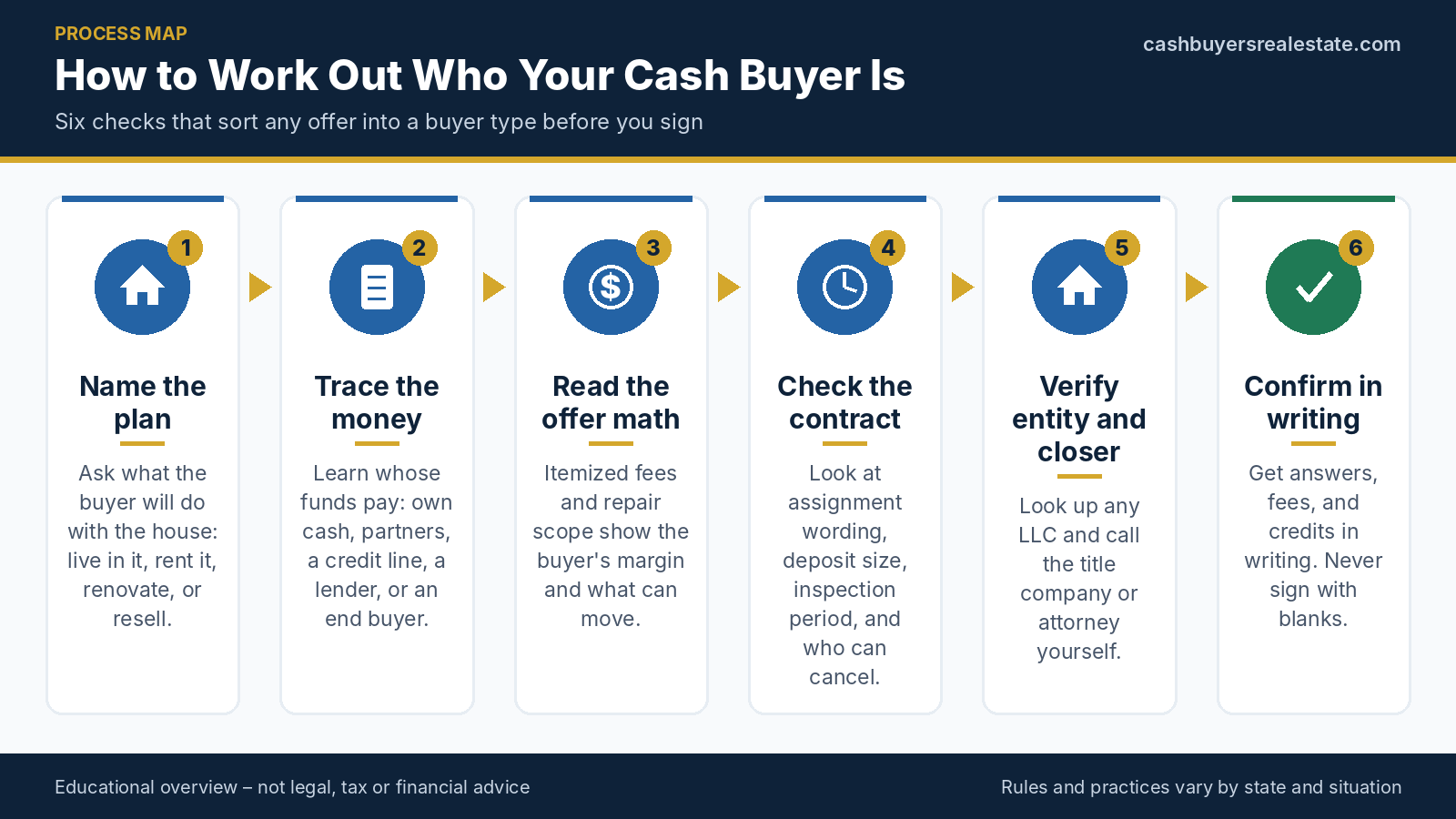
Text version of this infographic
- Name the plan — Ask what the buyer will do with the house: live in it, rent it, renovate, or resell.
- Trace the money — Learn whose funds pay: own cash, partners, a credit line, a lender, or an end buyer.
- Read the offer math — Itemized fees and repair scope show the buyer's margin and what can move.
- Check the contract — Look at assignment wording, deposit size, inspection period, and who can cancel.
- Verify entity and closer — Look up any LLC and call the title company or attorney yourself.
- Confirm in writing — Get answers, fees, and credits in writing. Never sign with blanks.
Flip Buyers and Flip LLCs: Margin Math, Funding, and the Calendar
The flipper is the buyer most sellers picture when they think of an investor, and also the one whose behavior is easiest to predict once you understand the arithmetic. A flipper buys a house in order to sell it again, usually after repairs, and earns the difference between the resale price and everything it cost to get there. Because both ends of that equation are uncertain, and because borrowed money is typically ticking the whole time, flippers build offers carefully and defend them firmly. Understanding the model tells you which parts of an offer are negotiable and which are not.
How a Flipper Builds an Offer Backward From Resale Value
Where an owner-occupant starts with the house and asks what it is worth to live in, a flipper starts with the finished product and works backward. The sequence is deliberate: estimate what the renovated house would sell for, subtract every cost between today and that sale, subtract the profit needed to justify the effort and the risk, and the remainder is the most the flipper can pay. Everything else about the conversation, including the speed, the inspection, and the tone, follows from protecting that remainder.
After-repair value, repair budget, and the margin that must remain
The starting point is the after-repair value, usually shortened to ARV, which is the price the flipper expects the house to fetch once renovated. It comes from recent sales of comparable renovated homes nearby, and its accuracy is the weakest link in the whole model: a flipper who overestimates ARV by a few percent can wipe out an entire margin. From ARV the flipper subtracts the repair budget, built from contractor quotes or a seasoned eye plus a contingency for surprises, then holding costs such as loan interest, property taxes, insurance, and utilities for the months the project will take, then purchase-side closing costs, then selling costs such as agent commission and the seller-side closing costs in that state, and finally the target profit. Some investors express this as a rule-of-thumb percentage of ARV, but the percentage varies by investor, by market, and by season, and should be treated as a habit rather than a standard.
| Line item | Illustrative amount | How the figure is formed | What a seller can ask about |
|---|---|---|---|
| Expected resale price (ARV) | $300,000 | Recent sales of renovated comparables nearby | Which sales were used and how recent |
| Repairs and contingency | ($48,000) | Scope of work plus a cushion for unknowns | What scope the number assumes |
| Holding costs, about five months | ($13,500) | Loan interest, taxes, insurance, utilities | How long the buyer expects to hold |
| Selling costs | ($21,000) | Commission, seller closing costs, concessions | Whether the buyer will list with an agent |
| Purchase closing costs | ($4,500) | Title, recording, lender fees | Who pays which closing costs |
| Target profit | ($36,000) | Buyer’s required return for the risk and effort | Rarely disclosed; do not expect an answer |
| Maximum offer | $177,000 | What remains after the subtractions | How it compares with your own net sheet |
To read the table, notice how little of the $300,000 resale value reaches you: in this made-up case about 59 percent. That is not a sign of unfair dealing, because the other 41 percent pays for real costs and real risk, but it explains why a flipper’s offer can sit far below what a renovated neighbor sold for. Two items move most easily in response to facts you can supply. If the repair scope turns out smaller than assumed, the budget shrinks and the offer can rise. If the ARV is lower than the buyer first believed, the offer falls. The profit line is the one buyers defend hardest, since it is the reason for doing the project at all. Most of these lines can be checked against your own information, which is why a seller who knows the neighborhood’s recent renovated sales is a better negotiator.
Carrying costs, the calendar, and what ATTOM’s flip data shows
Time is a cost for a flipper, and the public data shows how thin the margin for error is. ATTOM’s second-quarter 2026 flipping report put the typical time from purchase to resale at 161 days and the typical gross profit at $60,526, a 21.5 percent typical margin, down from 25.7 percent in the first quarter and 27.6 percent a year earlier. Those profit figures exclude renovation and other costs, so the net return to the flipper is lower. ATTOM also found that homes bought for $100,000 to $200,000 carried a typical 28 percent margin, while homes bought for $50,000 or less showed a typical loss of $15,000. The lesson for a seller is that flipping is not a license to print money; margins shrink when the market softens, and flippers know it.
That squeeze explains the behavior you will observe. Flippers want short inspection windows because each extra week costs interest. They revisit the price when an inspection turns up something the budget missed, because a surprise of $9,000 comes straight out of profit. They are also alert to the rules that shape their eventual buyer pool. Federal Housing Administration regulations, for example, make a home ineligible for an FHA-insured mortgage when the resale occurs 90 days or less after the seller acquired it, with additional documentation required for some quick resales at large markups, so a flipper who expects to sell to an FHA-financed buyer must plan around those windows. ATTOM reports that FHA-backed buyers purchased 10.7 percent of flipped homes in the second quarter of 2026. The details of the rule sit in 24 CFR 203.37a, and they are a small illustration of how a flipper’s calendar is partly set by someone else’s lender.
Illustrative example (hypothetical numbers, not market data): A homeowner receives a written offer of $177,000 on a two-story house with a worn roof and a 1970s bathroom, after an investor walks through for twenty minutes. The contract gives the investor a ten-day inspection period. On day eight the investor’s contractor reports that the roof decking is damaged beneath the shingles, adding an estimated $9,000 to the repair budget, and the investor asks to lower the price to $168,000. Because the investor’s margin line is fixed and the other lines are unchanged, the reduction matches the repair increase dollar for dollar. The homeowner now has three realistic paths: accept, ask for the contractor’s written scope and get a second opinion on the roof, or decline and consider other buyers. Having an independent roof opinion in hand before the walk-through would have let the homeowner see the issue first and price it into the original negotiation.
Cash, Hard Money, Private Lenders, and Credit Lines: How Flippers Pay
Flippers are cash buyers from the seller’s perspective, but few of them hold the entire purchase price in their own accounts for every project. A busy flipper might have six houses in various stages at once, and the capital required would be enormous if each were bought outright. So most draw on a mix of sources, and the mix determines the real risk profile of the offer sitting on your table.
Hard money and private lenders: short loans with their own clocks
A hard-money loan is a short-term, asset-based loan from a non-bank lender or a private individual. Underwriting looks mainly at the property and the plan, meaning purchase price, expected after-repair value, and scope of work, and less at the borrower’s wage income. Terms vary widely by lender and market, so any specific rate, fee, or loan-to-value limit should be read from that lender’s term sheet rather than assumed. In general, these loans cost more than conventional mortgages, run for months rather than decades, often require interest payments each month, and may release renovation funds in stages after the lender confirms the work. Because they are made for business purposes on non-owner-occupied property, they generally fall outside the consumer-credit rules discussed earlier, and that is part of why the lenders can move quickly.
The scarcity of conventional financing for investors is the other half of the story. According to the Congressional Research Service, Fannie Mae and Freddie Mac buy mortgages from investors only if the investor has no more than ten financed properties, and FHA-insured mortgages for single-family homes are limited to owner-occupants. An investor who is growing beyond those limits therefore turns to private capital, portfolio lenders, and partners. This is a legitimate and well-established segment of the market, and many hard-money lenders and their repeat borrowers have long, orderly track records. For a seller, the relevant point is not that such funding is suspect but that it adds a third party whose conditions have to be satisfied by closing day.
What the funding source means for your closing date and certainty
Funding source shapes how much confidence the closing date deserves. A buyer using their own cash can close as fast as the title work allows. A buyer using a partner’s capital depends on that partner’s timing. A buyer drawing on a line of credit secured by other property depends on the bank’s draw process, which is usually quick but not instant. A buyer using a hard-money or private loan depends on the lender’s own review of the property, the title, and sometimes the borrower’s insurance, which usually moves at a professional pace and occasionally stalls over an unexpected issue.
| Funding source | What it is | What a seller may notice | Typical closing risk |
|---|---|---|---|
| Buyer’s own cash | Savings, sale proceeds, or retained business profits | Fast, simple proof of funds; few extra requests | Lowest; mostly title and inspection issues |
| Partner or pooled capital | Money from one or more co-investors | Buyer may need partner sign-off before changes | Moderate; timing depends on partners |
| Bank line of credit | Revolving credit secured by other property | Letter from bank may replace a statement | Low to moderate; depends on draw process |
| Hard-money or private loan | Short-term, asset-based loan on this property | Lender may order its own valuation or inspection | Moderate; lender conditions can add days |
Use the table as a prompt for questions, not as a ranking of trustworthiness. Every row describes honest, common arrangements, and a well-capitalized investor using a credit line may be a steadier closer than an individual with a large balance and no experience. What matters is that you know which row applies, which is why a request for proof of funds should be specific: for a loan-funded purchase, a recent lender commitment or approval letter naming the property and amount tells you more than a bank statement does. Statements should show the account holder’s name and a recent date, and a document that looks altered, or a buyer who offers a screenshot instead of an institution’s letter, deserves a closer look from the closing agent.
One practical reading follows from all this. If your priority is the greatest certainty, a buyer paying from own cash or a long-established credit facility is a lower-risk choice than one whose offer depends on a lender not yet engaged. If your priority is speed on a house that needs heavy work, a flipper with an experienced lender can be the right match, because the project’s complexity is exactly what that business is set up to handle. In either case, the questions to ask are about the mechanics, such as where the money sits, who has to approve the purchase, and whether anything in the contract lets the buyer step back, and those questions are asked without insult in any normal transaction.
Institutional Rental Funds, Build-to-Rent Owners, and the 2026 Federal Rules
At the far end of the scale from the individual landlord sit companies that own thousands of rental houses and buy hundreds more each year. They are the buyers most discussed in the news and the ones least likely to ever make an offer on your particular house, yet they matter for two reasons. They influence local prices and investor competition in some metro areas, and in 2026 the federal government acted on them in ways that sellers and agents are still absorbing. Getting the facts straight is more useful than repeating headlines.
How Large Single-Family Rental Owners Decide What to Buy
No single definition of an institutional investor exists. The Congressional Research Service describes the term as shorthand for larger legal entities, such as trusts, limited liability companies, and asset managers like private equity firms and hedge funds, that invest in real estate and own large numbers of single-family properties. The Government Accountability Office observed that in 2011 no single investor owned more than 1,000 single-family homes, while by 2022 more than 30 separate investors may each have owned over that number. Even so, institutional owners hold only a few percent of single-family rentals nationwide, with concentration in particular metropolitan areas; the CRS cites an estimate of about a quarter of single-family rentals in the Atlanta area in 2024.
Scale, standardization, and the underwriting model
An institutional buyer’s defining feature is process. A fund investing pooled capital on behalf of pension plans, endowments, or other investors needs a repeatable way to decide whether a house meets its criteria, and that usually means standardized screens: price band, bedroom count, age of construction, neighborhood quality, expected rent, and the estimated cost of preparing the home for a tenant. Houses that fit the box can be evaluated quickly by a model and approved by a committee or an automated workflow. Houses outside the box, such as unusual layouts, properties with flood or foundation concerns, or homes needing structural work, are often passed over, not because they are bad properties but because they do not fit the portfolio.
Capital structure is the second distinguishing feature. These buyers raise money from investors and often add borrowing, including credit facilities and securitized structures that the CRS notes complicate measurement of ownership. Because their funding is arranged in advance, they can in principle make all-cash offers and move quickly, as the CRS observes in explaining why investors can pursue distressed properties faster than loan-financed buyers. They also face constraints that individuals do not: investment committees, lender covenants, fund mandates, and, for publicly traded real estate investment trusts, the requirement to distribute at least 90 percent of taxable income to shareholders to avoid corporate-level tax. Those constraints make them predictable, but not especially flexible.
What does a large rental owner do with the house after closing? In most cases it makes the repairs needed to rent, installs standard finishes, lists it for a tenant, and manages it through a property management arm, which is quite different from a flipper’s plan or a local landlord’s. The owner expects to hold the house for years, so its long-term operating cost matters more than its cosmetic condition. A roof with ten years left, sound plumbing, and a layout that families rent easily appeals; deferred maintenance in the major systems repels. Careful readers will see a link back to the earlier landlord discussion: the logic is the same as the small landlord’s, but applied by a committee and with less room for a seller’s story to change the numbers.
How they behave when you counter
Negotiation with an institutional buyer rarely resembles a conversation. Offers frequently arrive through a standardized process, a counter is evaluated against preset thresholds, and the person you reach may have limited authority to move off the model. That can feel impersonal, but it has a mirror-image benefit: such buyers usually perform what they sign. They have counsel, standard contracts, relationships with title companies and attorneys, and reputations that make last-minute drama unlikely. If an institutional buyer’s contract says it will close on a date, the chance of sudden financing problems is typically lower than with a thinly capitalized individual, though approvals within a large organization can add days.
A seller can usually gain more from precision than from persuasion. Providing accurate information about the roof’s age, recent repairs, rental history, and any code or permit issues lets the buyer’s model price the house correctly the first time and reduces the chance of a downward adjustment after inspection. If the property is occupied by a tenant, the lease terms and rent roll become central documents. For an owner whose goal is a clean, predictable exit and who values certainty over squeezing every dollar, a buyer of this kind can be a good fit when the house matches its criteria, and a poor one when it does not. Because the criteria are rarely published, the only way to learn the fit is to ask.
The 2026 Federal Policy Shift on Large Investor Purchases
Two federal actions in 2026 specifically target large investors in single-family homes. Both are recent, and the more important one has not yet taken effect, so this section is careful about what has happened, what is scheduled, and what remains unknown as of October 2026. Details can change with agency rulemaking and implementation guidance, so this section describes the general shape and points to the primary documents.
What Executive Order 14376 and the ROAD to Housing Act say
Executive Order 14376, titled “Stopping Wall Street from Competing with Main Street Homebuyers,” was signed on January 20, 2026, and published in the Federal Register on January 23. It declares that large institutional investors should not buy single-family homes that could otherwise be purchased by families, and it directs the Treasury Department to define “large institutional investor,” directs agencies and government-sponsored enterprises to issue guidance aimed at keeping federal financing, insurance, and property sales from enabling investor purchases of homes owner-occupants could buy, and asks for legislative proposals. You can read the text in the Federal Register notice of the executive order.
The statute followed. The 21st Century ROAD to Housing Act, Public Law 119-101, became law on July 11, 2026. Its section 1001 defines a large institutional investor as a for-profit entity with investment control over at least 350 single-family homes, counting direct and indirect control, and prohibits such an entity from purchasing single-family homes, defined as properties other than manufactured homes with two or fewer dwelling units, unless the purchase falls within a listed exception. According to law-firm summaries of the enacted text, the prohibition takes effect 180 days after enactment, which those summaries calculate as January 7, 2027, and is repealed fifteen years after that. Civil penalties can reach the greater of $1 million per violation or three times the purchase price, and large investors must report their holdings to the Department of Housing and Urban Development.
| Item | What it provides | Why a seller might care |
|---|---|---|
| Executive Order 14376 (January 2026) | States policy against large investors buying homes families could buy; directs Treasury definitions and federal-agency guidance on financing and property sales | Signals direction; most operative detail sits in later guidance and statute |
| Section 1001 threshold | “Large institutional investor” means a for-profit entity controlling at least 350 single-family homes | Covers very large owners, not local flippers or small landlords |
| Prohibition and timing | Bars covered entities from buying single-family homes of two units or fewer; effective 180 days after the July 11, 2026 enactment | Not yet in force as of October 2026 |
| Exceptions | Include build-to-rent, qualifying renovate-to-rent with improvements of at least 15 percent of price, new or renovated homes for sale, certain foreclosure or debt-satisfaction acquisitions, purchases from other covered investors, and age-restricted communities | Some institutional buyers may remain active through excepted channels |
| Penalties and reporting | Civil penalty up to the greater of $1 million per violation or three times the purchase price; annual notice to HUD | Gives covered buyers strong reasons to check their own eligibility before contracting |
The point of the table is the third column. The first two rows describe policy intent and a size cutoff; the later rows tell you whether the rules are likely to touch your sale. The 350-home threshold is high enough that the great majority of buyers you will encounter are outside it entirely, including nearly every flipper, local landlord, and wholesaler. Companies that hold large inventories of homes for resale, such as iBuyers, may or may not be covered depending on how the statute’s exception for renovated homes held for sale applies to them, and that is a question for their counsel, not for you. Those who are covered face a ban on new purchases, subject to exceptions, only from early 2027, and the exceptions mean that coverage does not equal absence from the market.
What the change means, and doesn’t mean, for a seller today
For almost every seller, the practical effect today is small. Because the prohibition is scheduled for 2027 and applies only to the largest holders, local investor demand for your house will not change overnight. In the months before the effective date, it is possible that covered funds adjust their buying, and after it, they may focus on excepted categories such as build-to-rent construction, but anyone who tells you precisely how the market will respond is guessing. The sober approach is to watch for guidance from Treasury, HUD, and the agencies, and for the way local agents and title companies describe actual buyer activity around you.
One concrete habit is worth adopting. If a buyer presents as an affiliate or subsidiary of a large rental company, ask plainly how the purchase fits the rules, and let the title company or your attorney confirm anything unclear before you take the house off the market. A covered entity that cannot lawfully close is a risk to you as the seller, because your listing time is spent waiting on a contract that may not perform. The reverse is also true: buyers outside the definition have no special eligibility problem, and you should not let a general worry about “institutional investors” shade your reading of an offer from a local operator. The better question for any buyer is whether it can perform the contract it signs, and the next sections show how to test that.
Before the two remaining buyer types, a side-by-side view of all five routes a seller is most likely to meet may help. The comparison below sets the individual owner-occupant, the small investor or landlord, the flipper, the large institutional or technology-driven buyer, and the wholesaler against the same yardsticks: what each is best suited to, and what each costs you in trade. The last two routes are examined in the next two sections, so treat the graphic as a preview there, and note that the price you are offered is only one of several things that differ.
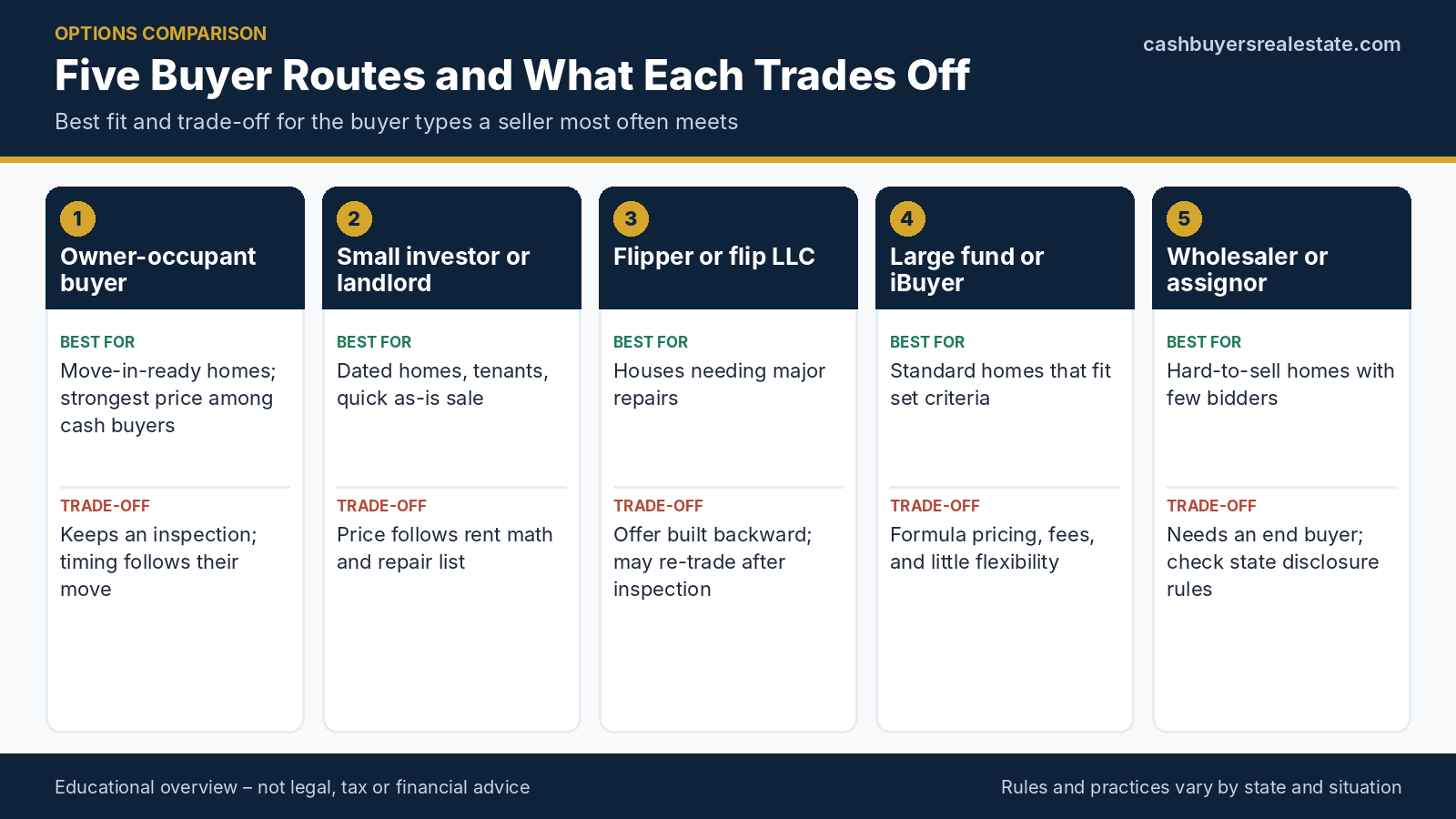
Text version of this infographic
- Owner-occupant buyer — Best for: Move-in-ready homes; strongest price among cash buyers. Trade-off: Keeps an inspection; timing follows their move.
- Small investor or landlord — Best for: Dated homes, tenants, quick as-is sale. Trade-off: Price follows rent math and repair list.
- Flipper or flip LLC — Best for: Houses needing major repairs. Trade-off: Offer built backward; may re-trade after inspection.
- Large fund or iBuyer — Best for: Standard homes that fit set criteria. Trade-off: Formula pricing, fees, and little flexibility.
- Wholesaler or assignor — Best for: Hard-to-sell homes with few bidders. Trade-off: Needs an end buyer; check state disclosure rules.
iBuyers and Other Technology-Driven Cash Buyers
An iBuyer, short for instant buyer, is a company that uses automated valuation and a large balance sheet to make a cash offer on a home quickly, buy it as a principal, and resell it. The category got a great deal of attention in the late 2010s, was shaken badly in 2021, and has since settled into a smaller, more disciplined shape. It deserves its own section because it combines features of other buyer types in an unusual way: it is institutional in scale and process, flipper-like in intent, and consumer-facing in the way it markets itself.
How the iBuyer Model Works and What It Needs From a House
The iBuyer business model rests on a simple idea: if a company can price homes accurately with data and can reduce friction, it can buy at a modest discount, make light repairs, resell quickly, and earn a thin margin on very high volume. Every part of the seller’s experience is shaped by that idea, from the quick online estimate to the itemized adjustments after inspection.
Instant estimate, inspection adjustment, and service fee
The sequence is usually recognizable. You enter an address and some details about the home, an automated model produces an estimate or range, and a representative or an inspector then reviews the property, in person or sometimes by photos and video, and issues a firm offer. The final number can differ from the initial estimate, since the company adjusts for repairs it expects to make. A service fee is typically built into the structure, either as a visible line item or as a component of the discount from the estimated resale value. One large publicly traded iBuyer’s annual report for 2025 describes its Cash Offer product as an online estimate followed by a physical inspection that can adjust the final offer, and uses a 5 percent service fee in the way it calculates its own spreads. Fees differ among companies, markets, and offers, so the written offer is the only reliable source for your numbers.
The key to reading an iBuyer offer is to see it as a company acting as principal. That annual report is explicit that the business takes ownership of homes and earns its revenue by reselling them, rather than earning a commission between two other parties. Its margin is the difference between what it pays you and what it later receives, minus what it spends in between. Three levers therefore matter for your outcome: the valuation it assigns to the house, the repair deductions it takes after inspection, and the service fee or discount it keeps. A fair comparison with other offers requires asking for all three in writing, in dollars, before deciding. Repair deductions deserve particular scrutiny, since they are built from the buyer’s own estimates of scope and cost, and you can ask to see the line items and obtain a competing bid for the same work.
These buyers sell convenience as well as price. Many let the seller choose a closing date within a window, handle most paperwork online, and avoid showings, open houses, and buyer financing risk. For a seller who values predictability, those features can be worth a lower net figure than the best conceivable alternative. For a seller who is flexible on time and whose house is in good shape, they often are not, because the same house sold on the open market after modest preparation can fetch a higher price even after commissions and costs. The right comparison is always net proceeds, after fees and credits, against net proceeds from the alternatives.
Which houses fit an algorithm and which don’t
Automated models work best where data is plentiful and homes are similar. A three-bedroom house built in the last few decades in a subdivision with many recent sales gives a valuation model what it needs. A property with an unusual floor plan, a large rural parcel, extensive additions without permits, a mixed-use layout, or heavy structural problems gives it very little to compare. In such cases the company may decline to make an offer, make a very conservative one, or route the property to a human reviewer. The condition thresholds also tend to be narrower than a local investor’s: iBuyers are built for light repairs and fast resale, not for gutting a house.
That has an important implication for how to interpret results. If an iBuyer declines your house or offers a low number, it says more about the fit between your property and its model than about the property’s true market value. A home that does not fit an algorithm may be perfectly attractive to a local flipper, a landlord, or an owner-occupant with a contractor in the family. Similarly, the fact that a house does fit an iBuyer’s profile does not guarantee its offer is the best available; it only confirms that the house is easy to price. Coverage is also geographic. These companies operate in a defined set of markets, and the list can change, so the existence of a company’s national marketing does not mean it will buy in your county.
What the Zillow Offers Shutdown Teaches Sellers
The most useful single episode for understanding iBuyers is a failure. In late 2021, one of the best-known programs in the category wound itself down, and the reasons offer a practical education in how pricing-model businesses behave under stress.
Why a large buyer with a pricing model still withdrew
On November 2, 2021, Zillow Group’s board decided to wind down Zillow Offers, its home-buying program. The company’s filing with the Securities and Exchange Commission cited home pricing unpredictability, capacity constraints, and other operational challenges, made worse by a fast-moving housing market, the pandemic, and tight labor and supply chains. It reported a $304.4 million inventory write-down in the third quarter of 2021 because it had bought homes at prices above the net amounts it expected to realize on resale. The filing also described additional charges tied to homes under contract and to the wind-down itself. The company said it would continue to complete certain purchases and renovate and resell homes it already held through 2022.
For sellers, the lesson is not that such buyers are untrustworthy. Sellers who closed with the program were paid. The lesson is structural. A buyer that holds homes as inventory is exposed to price swings while it owns them, so its offers can tighten, expand, or vanish as its confidence in resale values changes. An offer depends on the buyer’s current risk appetite, and that is why an iBuyer’s valuation of your house can differ sharply from one month to another, and why a written offer generally has an expiration date. A seller who is considering such a buyer should read the offer’s validity window, the conditions that allow the buyer to renegotiate after inspection, and the penalties, if any, for either side canceling.
Comparing a tech buyer’s offer with a local investor’s
When both types bid on the same house, the difference tends to lie in what each includes. The technology buyer usually offers a standardized, itemized process with a service fee and repair deductions spelled out, a flexible closing date, and a clean paper trail. The local investor often offers a single number, an as-is purchase with no itemization, and sometimes a lower or higher price depending on how well the house suits that investor’s current projects. Neither approach is inherently more favorable. Itemization is easier to compare but may carry more deductions, while a single figure is simpler but harder to audit. What you can always do is ask each buyer to identify what is and is not included in its number, and then build your own side-by-side net sheet.
Illustrative example (hypothetical numbers, not market data): A homeowner with a 1998 colonial receives two written offers. A technology buyer’s initial estimate is $236,000; after an inspection it deducts $7,800 for repairs it plans to make and keeps a service fee of 5 percent of the estimate, or $11,800, with the seller paying about $3,000 in other closing costs, for a net of roughly $213,400 and a closing date of the seller’s choice within 60 days. A local investor offers $221,000 as-is, paying the buyer-side costs, with the seller covering about $2,500 in closing costs for a net of roughly $218,500 and a 21-day closing. On paper the local investor’s offer nets about $5,100 more and closes sooner, while the technology buyer offers a later and more flexible closing date and a documented process. A third path, listing with an agent, might net more or less depending on condition, commissions, and time on the market. The homeowner decides based on what matters most, and the numbers make the trade visible.
It is worth noticing what the example leaves out. Offers rarely arrive with identical timelines, risk, and documentation, so a comparison is only as good as the assumptions behind it, and a careful seller states those assumptions and asks each buyer to confirm them in writing. Where the numbers are close, the less measurable factors, such as how smoothly the buyer’s earlier closings went, how clearly its contract is written, and how readily it explains each line, tend to decide the matter. The final section of this article sets out a structured way to do exactly that, and it applies as well to a technology buyer as to any other.
Wholesalers and Contract Assignors: The Buyer Who May Not Plan to Buy
Of all the cash house buyer types, the wholesaler is the one most often misunderstood, by sellers and by the investors who work with them. A wholesaler signs a contract to buy your house, usually at a price below what the wholesaler believes an end buyer will pay, and then looks for that end buyer, passing along the contract for a fee. The wholesaler may never own the house, never fund the purchase from personal money, and never touch the property after closing. That is a lawful business in many places and a tightly regulated one in a growing number of them, and it is the buyer type where knowing exactly who you are dealing with matters most.
How an Assignment Works and Where the Money Is Made
The mechanics are less mysterious than the reputation suggests. A wholesaler is, in effect, a marketer and a middleman who takes a position in a deal before locating the buyer. The profit depends on the gap between the price the wholesaler agreed to pay you and the price the end buyer will pay the wholesaler, minus any costs along the way. Everything about the structure of the contract, from the length of the inspection period to the assignment language, exists to give the wholesaler time and the right to find that end buyer.
Equitable interest, assignment clauses, and double closings
When you sign a purchase agreement, the buyer acquires what lawyers call an equitable interest in the property: a right to complete the purchase under the contract, even though legal title remains with you until closing. Many standard contracts allow the buyer to assign that right to someone else, often through wording such as “buyer and/or assigns” or an explicit assignment clause. A wholesaler uses that right. After the contract is signed, the wholesaler markets the deal to investors, often cash buyers such as flippers and landlords, and when one agrees to take over, the wholesaler assigns the contract to that buyer for an assignment fee. At closing, the end buyer pays you, and the wholesaler’s fee is paid separately or through the closing statement. Title passes straight from you to the end buyer.
A variation is the double closing, sometimes called a simultaneous closing, in which the wholesaler actually buys the house from you and sells it to the end buyer on the same day or within a short window. The wholesaler needs funds to complete the first purchase, which often come from a short-term transactional lender or from the end buyer’s money passing through the closing agent. The distinction matters to you because, under an assignment, the contract you signed continues to govern and you may never see a second contract, while under a double closing there are two separate sales and the price in the second can be disclosed on closing documents. The right structure depends on state law, the title company’s or attorney’s practices, and the parties’ preferences, and a professional closing agent will explain which is being used.
Three features of a wholesaler’s contract are worth recognizing. First, a relatively long inspection or due-diligence period, which gives time to market the contract, is common. Second, a broad assignment right, with few conditions on whom the wholesaler may assign to, is typical. Third, earnest money, the deposit that shows seriousness, is often small relative to the price, since the wholesaler is not planning to close with personal funds. None of these features is automatically improper, but together they describe a buyer whose ability to perform depends on finding someone else, which is a materially different risk from one posed by a buyer paying from a bank account. Deposits are worth reading closely: ask who holds the money, under what conditions it is refunded, and whether any part is nonrefundable once the inspection period ends.
Why wholesaling is lawful in principle but regulated in practice
Reporting on state legislation by Stateline, republished on September 28, 2026, said at least 15 states had recently approved new rules for wholesalers, ranging from mandatory disclosure to licensing, and noted that no state has outright banned wholesaling. That fits what a lawyer would expect. Assigning a contract is an ordinary legal act, and wholesalers can provide real value, such as finding a buyer for a house with title or condition problems that discourages retail buyers. The regulatory concern is narrower: that homeowners, often unrepresented and sometimes under financial or emotional pressure, may sign without understanding that the person they are dealing with plans to resell the contract for a profit, and may therefore sell for less than they could have gotten.
That concern explains the shape of the rules. Some states require wholesalers to hold a real estate license, treating the marketing of an equitable interest as brokerage activity. Others leave the activity unlicensed but require written disclosure to the seller, a cancellation right, or both. Model legislation promoted by consumer advocates has included appraisal rights, cancellation rights, and limits on aggressive marketing. For a seller, the result is that your state’s rules determine what the wholesaler must tell you, what your cancellation rights are, and whether the person across the table must be a licensee. They also mean that the same contract may be legal and complete in one state and defective in another, which is why you should look up your own state’s real estate commission or an attorney before signing, instead of relying on any national rule of thumb.
Illustrative example (hypothetical numbers, not market data): A homeowner inherits a two-bedroom bungalow with a damaged porch and an overgrown yard and signs an agreement to sell for $128,000 to a buyer who promises a quick closing. The contract has a 21-day inspection period, a $500 deposit, and a clause permitting assignment. During those 21 days the buyer markets the contract to investors and finds a flipper who agrees to pay $142,500. The assignment fee to the middleman is $14,500, and the closing proceeds on the flipper’s funds. The homeowner receives the agreed $128,000 and has not been misled about the price, but later learns that the flipper paid substantially more than that figure. Had the homeowner asked at the start whether the buyer planned to assign, or had obtained a second opinion on value, they might have negotiated a higher price or chosen another route. Under the rules of a state that requires disclosure, the homeowner would have been told the buyer might assign and could have canceled within a stated window. The example does not show wrongdoing; it shows why disclosure rules exist.
State Rules on Disclosure, Licensing, and Cancellation
There is no federal statute that specifically governs wholesaling, so the law is a patchwork of state licensing statutes, disclosure requirements, and general contract and consumer-protection principles. The examples below come from two states whose official or professional materials were available for review, and they illustrate the range rather than describe the whole country.
What Pennsylvania and Oklahoma require, as two examples
Pennsylvania’s Act 52 of 2024 amended the state’s Real Estate Licensing and Registration Act and, according to the Pennsylvania Association of REALTORS® and a title-insurer bulletin, took effect on January 4, 2025. It treats a wholesale transaction as one in which a person promotes the sale of an equitable or other interest in one-to-four-unit residential property, intending to transfer it for a fee without taking title as owner of record, and it makes that a licensed real estate activity requiring a Pennsylvania real estate license. Contracts must state that the transaction is a wholesale transaction and must disclose the consumer’s right to obtain an appraisal and to cancel until midnight of the thirtieth day after signing, or until conveyance if earlier. The association’s overview is posted at the Pennsylvania Association of REALTORS® wholesaling page.
Oklahoma took a disclosure-and-cancellation approach. The state’s Real Estate Commission publishes a cancellation-of-wholesale-contract form, dated January 1, 2026, that cites Title 59 of the Oklahoma Statutes, section 858-314. Under that section as the form describes it, a wholesaler must give the homeowner written notice before signing of any intent to assign or sell its equitable interest for a higher price than the homeowner is being offered, the contract must advise the homeowner to seek legal advice, and the homeowner may cancel without penalty within two business days after signing, or at any time if required disclosures were omitted. Rules in other states differ, in some cases substantially, in the length of the cancellation window, in whether a license is required, and in the remedies for noncompliance.
Questions that surface a wholesaler’s plan without accusing anyone
You do not need to treat every buyer as a suspect, and a wholesaler who is operating legitimately will answer direct questions plainly. A good first question is simply: “Do you intend to buy this house with your own funds and keep it, or do you plan to assign the contract to another buyer?” Follow it with: “If you assign it, will you tell me who the end buyer is and what they are paying before I sign anything binding?” and “Are you licensed as a real estate agent or broker in this state, and may I see the license number?” Each takes a few seconds to answer, and the quality of the response, including whether it is evasive or cheerful, tells you a great deal.
Several other questions deal with exposure if the deal fails. What happens to the deposit if the buyer cannot close? Does the contract let the buyer cancel for any reason during the inspection period, and how long is that period? Does it allow the buyer to record any notice of the contract against your title, and if so, how will that be removed if the sale does not close? These last two points depend heavily on state practice, and a title company or attorney can explain what is customary locally. Finally, ask for proof of funds in the buyer’s own name for the full price; a wholesaler who plans to assign may truthfully say there is none, and that answer is itself information. The guide to questions to ask a cash home buyer expands this list, and cash home buyer scams covers the patterns that are genuinely deceptive rather than merely aggressive.
The balanced conclusion is that a wholesaler is neither the hero nor the villain of the cash buyer world. For a house with serious condition or title problems, where few buyers will bid, a wholesaler’s marketing reach can be the difference between a sale and no sale. For a house in decent shape, the same arrangement may leave money on the table that a direct sale to an investor or a conventional listing would have kept. What turns the arrangement from lawful to harmful is nondisclosure, and the remedy, for you, is to ask early, read the contract’s assignment language, and insist on clear answers.
Everything in the last several sections can be compressed into a short checklist of protective habits that apply no matter which type of buyer is on the other side. The graphic below turns them into a decision and risk checklist: confirm who the buyer is and in what name the contract is written, ask for proof of funds that matches the structure of the deal, read the cancellation clauses, check what the contract says about assignment, make sure a reputable title company or attorney handles the closing, and never sign a form with blanks left to be filled in later. Each of those habits is explained in the sections that follow, with the reasoning behind it.
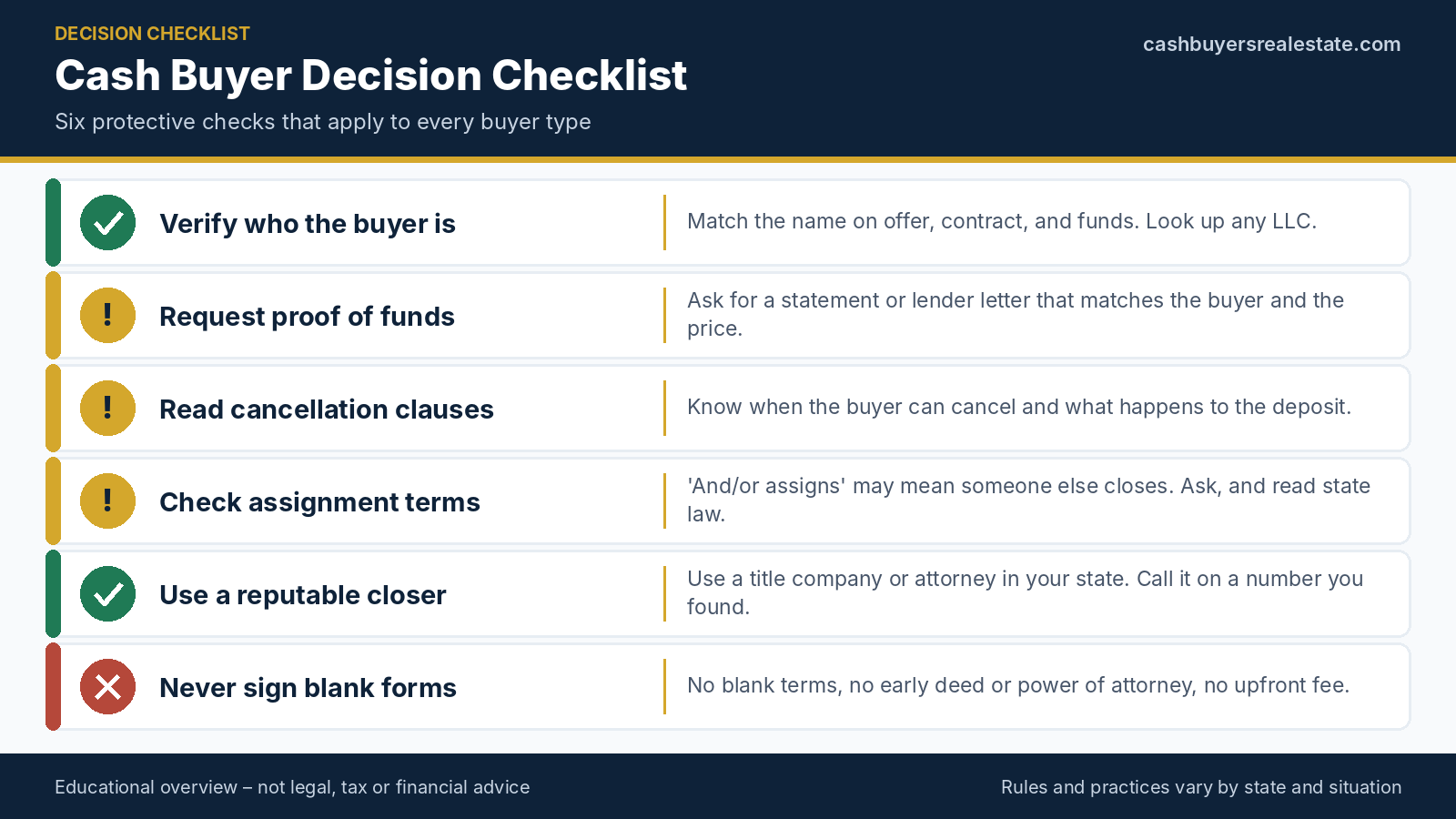
Text version of this infographic
- Verify who the buyer is — Match the name on offer, contract, and funds. Look up any LLC.
- Request proof of funds — Ask for a statement or lender letter that matches the buyer and the price.
- Read cancellation clauses — Know when the buyer can cancel and what happens to the deposit.
- Check assignment terms — 'And/or assigns' may mean someone else closes. Ask, and read state law.
- Use a reputable closer — Use a title company or attorney in your state. Call it on a number you found.
- Never sign blank forms — No blank terms, no early deed or power of attorney, no upfront fee.
Telling Buyer Types Apart and Matching Them to Your Property
Knowing the seven types is helpful only if you can recognize them in practice. Buyers rarely announce their category, and many present themselves in ways that blur it. A wholesaler may sound exactly like a local investor. A flipper may use the language of a family business. An owner-occupant may arrive through an agent and say nothing about cash at all. Fortunately, offers and contracts leave a trail of small, checkable clues, and the property itself tells you which buyers have reason to want it.
Reading the Offer, the Contract, and the Entity Behind It
Think of this work as simple observation followed by a few polite questions. No single clue is proof of anything, and most of them have innocent explanations. Together, though, they help you form the working hypothesis that makes the rest of the conversation more productive, and they tell you which questions to ask first.
Signals in the first conversation and the offer
Start with how the buyer behaves before any paper exists. A buyer who produces a number from an address alone, without seeing the house, is probably working from an automated model, which is typical for technology buyers and for wholesalers and flippers screening deals in bulk. A buyer who asks detailed questions about the roof, the age of the mechanical systems, and what the neighbors’ renovated houses sold for is likely a flipper or a landlord building a repair budget. A buyer who asks about the lease, the rent roll, and the tenants’ payment history is thinking like a landlord. A buyer who asks about the school district, the commute, and when you could vacate is probably planning to live in the house.
How the offer is framed tells you more. A single round number with a short expiration date and a promise that the offer will not be repeated is a sales tactic more often than a valuation, and it appears across types. An itemized offer with a stated fee and a list of repair deductions points toward a company with a standardized process. An offer that arrives in the name of a person while the contract names a limited liability company, or the reverse, merits a polite question about who the buyer actually is. And language that stresses the buyer’s ability to “find a buyer” or “market the property” before closing points toward the wholesaler end of the spectrum, which makes your assignment questions especially important.
| What you observe | What it may suggest | A calm follow-up question |
|---|---|---|
| Number given from the address alone | Model-driven pricing by a technology buyer, flipper, or wholesaler | “What would change this number after you see the house?” |
| Detailed questions about systems and repairs | Flipper or landlord estimating a budget | “What repair scope does your price assume?” |
| Questions about tenants and rent | Buy-and-hold landlord or rental fund | “Will you keep the existing lease in place?” |
| Questions about move-in timing and the neighborhood | Owner-occupant | “Would you want a short rent-back, and do you plan an inspection?” |
| Talk of “finding a buyer” or “marketing” the deal | Wholesaler or assignor | “Do you intend to close yourself or assign the contract?” |
| Itemized fee and repair deductions | Standardized company process | “Can I have every deduction and fee in writing?” |
| Short expiration and pressure to sign today | A sales tactic, present across buyer types | “Can the offer stay open while I review it with an attorney?” |
To use the table, look for patterns rather than single signals, and treat the third column as a way to start a conversation instead of an accusation. A buyer who welcomes these questions, answers in specifics, and lets an offer stay open for a few days while you check them is displaying exactly the behavior you want. A buyer who responds with irritation, vagueness, or a sudden new deadline has told you something as well. In many cases the combination of clues, such as detail about repairs plus a short deadline, points to a flipper under time pressure rather than a sinister actor, so interpret generously while verifying carefully.
Signals in the contract, the entity, and the title work
The contract is where the real structure appears. Look first at the buyer’s name and signature block. If the buyer is a limited liability company, that is normal and says nothing negative on its own, since investors commonly use entities to hold property. But you can look up the entity in the secretary of state’s business records for the state where it was formed, see when it was created and who is listed as an organizer or agent, and check whether the address matches what you were told. Then check the assignment clause: language allowing the buyer to assign freely without your consent is a flag for a wholesaler’s structure. Compare the inspection period to the planned closing date; a long period with an early closing suggests the buyer wants time to find an end buyer or lender.
Next examine the money terms. The size of the earnest money relative to the price, who holds it, what happens to it if the buyer defaults, and whether the buyer can cancel for any reason during the inspection period together describe how much risk the buyer carries. A substantial deposit held by a title company or attorney and a short, defined inspection window suggest a buyer committed to performing. A token deposit and a very flexible cancellation right suggest the buyer can walk away at little cost. The guide to the cash home buyer contract goes clause by clause.
The closing partner is the third area. In some states, closing is handled by a title company or escrow officer; in others, an attorney conducts it. Either way, you should expect an established firm in your state, and you have every right to ask for the identity of the closer and to contact it directly through a number you find yourself. Entity buyers also bring one regulatory footnote. FinCEN, the Treasury bureau that fights financial crime, adopted a rule requiring closing professionals to report certain non-financed residential purchases by entities and trusts, effective March 1, 2026, but a federal district court in Texas vacated the rule on March 19, 2026. FinCEN’s website states that, while the order remains in force, reporting persons need not file, and an appeal is pending, so the situation may change. The practical point is only that title companies may ask entity buyers for ownership information for their own reasons, and a seller should not read such a request as a problem. FinCEN’s status page is at fincen.gov/rre.
Matching Property Condition to the Buyer Most Likely to Want It
Once you have a sense of who is bidding, turn the lens around and ask who should be. Different houses have different natural buyers, and a mismatch is one of the most common reasons sellers feel disappointed. A house that would delight an owner-occupant may get a mediocre offer from a flipper, and a house only a flipper can use will draw little interest from retail buyers.
Condition, location, and occupancy: who wants which house
Condition is the strongest predictor. Houses in good shape in popular school districts tend to attract owner-occupants, including cash-paying ones, and their offers are anchored to retail comparables. Houses that are structurally sound but dated, with old kitchens and baths, attract landlords and light-rehab flippers, who can fix cosmetics cheaply. Houses with serious problems, such as fire damage, foundation movement, roof failure, or extensive water damage, narrow the field to flippers with strong contractors, a few landlords, and specialist buyers. Occupancy and title add further layers: tenants favor landlords and funds, while title defects favor buyers and closers who deal with them routinely. Location works alongside condition, because a house on a street where renovated homes sell quickly gives a flipper confidence in the resale number, while the same house in a neighborhood with few recent sales leaves every investor guessing and widens the discount.
| Property situation | Buyer types most likely to be interested | Why they fit | What to watch |
|---|---|---|---|
| Move-in ready, popular area | Owner-occupants; technology buyers | Retail demand and easy pricing | Listing may net more than a discounted cash offer |
| Dated but sound | Landlords; light-rehab flippers | Cosmetic work is inexpensive for them | Compare offers after repair credits |
| Major repairs needed | Flippers; experienced landlords | They have contractors and budgets for scope risk | Re-trades after inspection |
| Tenant-occupied | Landlords; rental funds | They value an income stream already in place | Lease terms and state tenant law |
| Title or lien problems | Experienced investors; some wholesalers | They have closers who solve such issues | Whether the buyer can truly cure the problem |
| Unusual, rural, or mixed use | Specialty and local investors | Models fail; local judgment prevails | Thin buyer pool and longer timelines |
| Code violations or unpermitted work | Flippers; landlords with local knowledge | They price permits and corrections into the offer | Disclosure duties and local enforcement |
Treat this table as a map of probabilities. A move-in-ready house can certainly attract a flipper if the price is low enough, and a heavily damaged house can attract an owner-occupant who happens to be a contractor. The value of the map is in setting expectations: if your house sits in the third row, a retail-style offer from an owner-occupant is unlikely, and an offer from a flipper that looks low may reflect real costs rather than opportunism. The pages on selling a house fast without repairs and selling a damaged house fast work through those two situations in more depth.
Common misreadings of buyer intent
Several assumptions lead sellers astray. The first is that “cash” means no inspection. Many cash buyers still inspect, and the inspection often drives a price change. The second is that a fast, high-confidence number must come from a large or established company; marketing polish and size are different things, and some of the most polished websites belong to small operators or to intermediaries. The third is that a limited liability company is a warning sign, when it is usually just a liability-protection structure. The fourth is the reverse: assuming that a friendly individual is necessarily the one who will close. The person who walks your house may be an acquisition scout, and the actual buyer may be someone you never meet.
Other misreadings concern money and law. Sellers sometimes hear “no commissions” or “we cover closing costs” and conclude the net is the offer, when closing costs, repair credits, and other deductions can still apply, so every such promise should be restated in writing as a dollar figure. Another is that an as-is sale cancels the seller’s disclosure duties; in many states it does not, so confirm your state’s disclosure rules with an agent or attorney before relying on that assumption. A final misreading is to treat low offers as evidence of bad faith. Most low offers are the output of arithmetic like the table earlier, applied by a buyer who would still like to be paid for risk. Bad faith shows up in other places: in concealed intentions, undisclosed assignment, pressure, and contracts that give the buyer every right and you none.
Questions Sellers Ask About Cash House Buyers
Questions About Who the Buyer Is and How They Pay
Questions about identifying the buyer
- How can I tell whether a cash buyer is a flipper or a landlord?
Ask what the buyer plans to do with the house, and compare the answer with the buyer’s history. In most counties, recorded deeds are public, so a buyer’s earlier purchases and resales can often be found in the recorder’s or assessor’s online records under the buyer’s name or entity. An owner who sold properties within months of buying them behaves like a flipper, while one who has held houses for years behaves like a landlord. Records show patterns, not intentions, so treat them as a supplement to a direct question.
- Is a buyer that uses an LLC less trustworthy than an individual?
Not by itself. Investors commonly hold property in limited liability companies to separate project risk from personal assets, and plenty of long-standing, reliable buyers do so. What an entity changes is where the buyer’s accountability sits: if the company has few assets, your protection comes from the deposit, the contract terms, and the closing partner rather than from the owner’s personal wealth. You can confirm that the company is registered through the secretary of state’s business records where it was formed.
- Can I check a buyer’s track record?
Yes, and it is a reasonable request. Ask for the addresses of two or three recent purchases and the name of the title company or attorney used, then call that closer and ask whether the buyer closed on schedule. Public records can confirm that a deed transferred. Online reviews can help, but they are easily curated, so give more weight to records and to the closer’s account than to ratings.
- Does a buyer who says “local” really live nearby?
You cannot tell from a phone number or a website. Some businesses that advertise to homeowners are lead generators that collect seller information and pass the opportunity to an investor, which is not improper but means the person you first speak to may not be the buyer. Ask for the buyer’s legal name, physical address, and who will sign the contract. Clear answers are a good sign, while reluctance to name the buyer deserves a pause.
Questions about funding and proof of funds
- What counts as proof of funds?
For a buyer paying from savings, a recent bank or brokerage statement or a letter from the institution showing an available balance at least equal to the price is the usual document, with account numbers redacted. For a buyer using a loan, a commitment or approval letter naming the property and amount does the job. Check that the name on the document matches the buyer on the contract. A statement shows that money exists on a given day, not that it will be used for your house, so the deposit and the closing agent’s confirmation still matter.
- Is it a problem if the buyer says a hard-money lender will provide the funds?
It is not a problem in itself, since many experienced investors use such lenders. Ask for the lender’s name, the approval letter, any conditions the lender attached, and how long its process typically takes. Consider whether the contract’s inspection period and closing date leave room for the lender’s steps, and what happens if the lender declines. A larger deposit held by the closing agent is a fair way to share that risk.
- Why might a buyer refuse to show proof of funds?
Some do so for privacy, and some because they do not have the money in their own name. A buyer who plans to assign the contract may truthfully have no funds to show, which is information you need. A middle path is to ask for a lender letter or a statement from the buyer’s closing attorney or title company confirming that they will handle the funds. If a buyer will show nothing at all, weigh that against the strength of the deposit and the contract terms.
Questions About Contracts, Timing, and Money
Questions about contracts and assignment
- What does “and/or assigns” in a purchase contract mean for me?
It means the buyer may transfer the right to buy your house to someone else, and you would then be obligated to sell to that person on the same terms. Some sellers are comfortable with that, particularly when the buyer has been open about it. If you are not, you can ask to remove the language, require your written consent to any assignment, or require notice of the assignee’s identity and proof of funds before closing. Your state’s rules may add disclosure requirements, so check them before signing.
- Can I cancel after signing a cash contract?
It depends on the contract and your state. An ordinary purchase contract generally does not give the seller a free right to cancel after signing, unless a contingency or a statute provides one. A few states have enacted cancellation rights specifically for wholesale transactions, such as the thirty-day window in Pennsylvania and the two-business-day window in Oklahoma, but those apply only to covered transactions. Talk to an attorney before signing, because exiting a signed contract can be costly.
- Should an attorney review a cash contract if my state uses title companies?
It is optional but often worth it, especially if the contract has unusual language about assignment, deposits, default remedies, or the buyer’s right to cancel. A title company’s staff are not generally permitted to give legal advice, and they work to close the transaction rather than to represent either party. A short review before signing costs little compared with the value of the sale. In attorney-closing states, you will likely have counsel involved already.
Questions about timing, costs, and taxes
- How quickly can different buyer types close?
There is no universal answer, but the structure of the buyer predicts the constraints. Buyers using their own funds are limited mainly by title work and the closing process in your state. Owner-occupants follow their own move dates. Lender-funded investors add the lender’s steps, and assignors depend on finding an end buyer. Title search, mortgage payoff, and any lien or probate issues set a floor for everyone, so beware of a promise that ignores them.
- Does the buyer type change what I owe at closing?
Your obligations are set by your contract and your state, not by the buyer’s category. Typical items include paying off any mortgage or lien, prorated property taxes, transfer or recording taxes where applicable, and any agent commission if one is involved. Buyer types differ in what they negotiate, such as who pays which closing costs and whether repair credits apply. Ask the closing agent for an estimated settlement statement so you can see the true figures before you commit.
- Do I owe taxes on the sale, and does the buyer’s type matter?
Your tax depends on your gain, ownership, and use of the property, not on who buys it. For a main home, the IRS allows many sellers to exclude up to $250,000 of gain, or $500,000 for qualifying joint filers, if they owned and used the home as a main residence for at least two of the five years before the sale. Other situations, such as rental or inherited property, follow different rules. A tax professional can apply them to your facts, and IRS Topic 701 covers the home-sale basics.
- What should I do if the buyer asks to lower the price after inspection?
You can accept, counter, or decline, depending on what the contract permits. Ask for the contractor’s findings and estimate in writing, and consider getting your own bid for the same work, because repair costs vary and a request can be larger than the actual fix. Compare the revised number with your other options before deciding. If the request seems inflated, the written record helps you negotiate or move on.
Choosing a Route and Taking the First Steps
A seller who has read this far understands that the question is not simply whether to accept a cash offer, but which buyer, under which terms, compared with which alternatives. The last section turns the buyer types into a way of deciding and a plan for the next few days, without assuming that any one route is right for you.
A Decision Framework for Matching a Buyer Type to Your Priorities
A decision is easier when you know what you are optimizing. Most sellers care about four things, in an order that varies by person: the net amount they walk away with, the certainty that the sale will close, the speed of the closing, and the effort and disruption involved. Different buyer types excel at different combinations, and no type wins all four.
Ranking price, certainty, speed, and effort
Start by ranking the four priorities honestly. If net proceeds come first and your house is in reasonable condition, the likeliest strong match is an owner-occupant, whether paying cash or financing, reached through a conventional listing or a for sale by owner effort, and you should expect to prepare the house and wait for the right buyer. If certainty comes first, favor a buyer who pays from their own funds, puts down a meaningful deposit with a title company or attorney, and signs a clean, short contract, a profile that fits many owner-occupants, experienced landlords, and well-run institutional or technology buyers. If speed comes first and the house needs work, a flipper with an established lender or a landlord with cash is a natural match, though you should expect an as-is price that reflects repair costs and risk.
If minimizing effort comes first, a technology buyer or a local investor offering to buy as-is may suit you, since both can spare you from repairs, showings, and open houses, and you should price that convenience against the discount it carries. Complicated situations, such as tenants, liens, or title questions, point toward buyers who handle them routinely, and sometimes toward a wholesaler when a house has few other takers, provided you understand the structure and your state’s disclosure rules. One caution applies to every case: a priority that comes from pressure, such as a deadline someone else created, deserves a second look, because manufactured urgency is a leading sign of a poor deal.
When another route beats every cash buyer type
It would be a disservice to suggest that a cash sale is always the answer. A conventional listing with a real estate agent often produces a higher sale price for a house in good condition, at the cost of commissions, preparation, showings, and a longer timeline, and the accurate comparison is net proceeds, not headline price. That trade-off is analyzed in cash sale versus listing for a fast sale. A modest repair plan before listing can raise value if the repairs cost less than the price increase they produce, though that depends on local conditions and requires getting contractor bids first. Selling to a relative, neighbor, or tenant can avoid marketing costs altogether, subject to fair-value and tax considerations that a professional should review.
Other routes fit particular situations. A seller behind on the mortgage may have options with the servicer, including repayment plans, modifications, or a sale that satisfies the loan, and should speak with the servicer or a HUD-approved housing counselor before choosing a buyer. An heir who has no urgency may benefit from waiting until probate steps are complete. An owner of rental property may do better by keeping the house and selling later, or by selling with tenants in place to a landlord. The hub page for those who need to move quickly, selling a house fast, lays out the broader menu.
What to Do Next: Documents, Questions, and a Calm Comparison
Whatever route appeals to you, a short period of preparation will improve every offer you receive and protect you against the worst outcomes. Preparation also changes the tone of the conversation: a seller who has documents in hand and questions written down is treated differently from one who is improvising.
Documents to gather and questions to ask first
Begin by gathering the paperwork a buyer or closing agent will inevitably request. That usually includes the deed or other proof of ownership, a recent mortgage statement or a payoff estimate from your lender, the latest property tax bill, homeowners association details and any dues owed, utility and insurance information, receipts and permits for major repairs, and any existing lease and rent roll if the house is tenant-occupied. Having them ready speeds every type of sale and lets you answer buyers’ questions accurately, which tends to reduce post-inspection price changes. If you have no inspection of your own, consider whether one or a contractor’s estimate for the largest concerns would give you a baseline.
- Ownership and identity documents, including the deed and a government photo ID.
- A mortgage payoff estimate and statements for any liens or loans.
- Property tax bills, insurance details, and homeowners association information.
- Repair receipts, permits, warranties, and any inspection or contractor reports.
- Leases, deposits, and rent history for any tenant-occupied unit.
Then prepare questions that apply to every buyer. What do you plan to do with the house, and will you close yourself or assign the contract? Whose funds will you use, and can you provide proof? What deposit are you putting down, who holds it, and what happens to it if you do not close? What does your inspection period allow you to do, and when does it end? Which title company or attorney will close, and may I contact it directly? Which costs will I pay, and can I see an estimated settlement statement? Sensible buyers expect these questions and answer them in writing.
Comparing written offers and deciding without pressure
Aim to hold more than one written offer, and where possible to compare at least one from a different buyer type, since the contrast reveals what each is pricing. Put them on one page: price, repair credits, who pays what at closing, deposit and who holds it, inspection period, assignment rights, closing date, and the buyer’s funding source. Convert each into expected net proceeds, then adjust for risk by asking how likely each is to close on time and what you would lose if it did not. A slightly lower offer from a buyer with a larger deposit, a short inspection window, and a record of closing may be worth more than a higher number from a buyer who can walk away cheaply.
Give yourself time. A legitimate offer rarely evaporates because you took a few days to compare it, and a buyer who insists on signing today is applying pressure rather than information. If anything in a contract is unclear, an hour with a real estate attorney in your state is inexpensive protection. In the end, the right choice may be a cash buyer of one type, a different type, a conventional sale, or no sale yet, and each of those is a reasonable outcome when it matches your priorities and your property. What matters is that you choose with the facts, know who is on the other side of the table, and keep your options open until you have what you need.