
Cash Buyers for Houses: Offers, Process & Red Flags
Two investors can look at the same house on the same afternoon and walk away with opposite answers. One says the numbers work and emails an offer before dinner. The other says the house isn’t for them and never calls back. Sellers tend to take the second reaction personally, or to assume the first buyer is being generous, when neither reaction says much about what the house is actually worth. Cash buyers for houses don’t shop for “a house” in the abstract. They shop for specific kinds of properties that fit a plan, a budget, a repair crew, and a map, and a house outside that pattern is a pass even when it is a perfectly good house. Learning the pattern is the fastest route to the answer most sellers are really after: is my property the kind of thing a cash buyer wants, and if it isn’t, what are my other options?
Investors have a name for the pattern. They call it a buy box, sometimes “acquisition criteria” or simply “what we look for.” It is the set of property characteristics a buyer has decided to pursue: which ZIP codes, which price range, how many bedrooms, how old, in what condition, vacant or occupied, with clean or complicated title, and with enough gap between the purchase price and the eventual resale or rental value to leave a margin. Some buy boxes are written in spreadsheets and shared with acquisition staff. Others live in one person’s head. Either way, every offer a cash buyer makes begins with the same silent question, “does this property fit?”, and the answer shapes everything that follows, including whether you get a number at all.
Cash buyers for houses screen every property against a buy box: location and comparable sales, price range, size, age, condition, occupancy, title status, the spread between purchase price and after-repair value, and rental potential. A house that fits a buyer’s box earns an offer. One that doesn’t earns a pass, a much lower number, or a different type of buyer.
That answer has a practical consequence. If you can see your house the way a buyer’s spreadsheet sees it, you can predict who is likely to be interested, why a given offer came in where it did, which features are costing you money, and which of those features you could realistically fix, disclose, or simply work around. You can also tell the difference between a buyer who is applying honest criteria and one who is using vague “problems” with your house as a lever to cut the price. The first kind of buyer can show you the logic behind the number. The second tends to stay general.
The scope here is deliberately narrow. This article concentrates on screening: what cash buyers measure and why. It leaves the mechanics of building an offer to the guide on how cash buyers calculate offers, and it leaves buyer verification and fraud patterns to the pages on proof of funds and whether cash home buyers are legitimate. Readers who want the broader overview of how the cash route works from first call to closing will find it in the main cash home buyers guide.
The sections ahead follow the order in which a buyer actually looks at a property. They start with what a buy box is and how a first-pass screen works, then move to location and comparable sales, then to price band, size, age, and layout, and then to condition and the repair budget it implies. After that comes the arithmetic that ties these together: the spread between purchase price and after-repair value (ARV), and the rental math that landlords use instead. A section on disqualifiers covers the things that end a conversation outright, such as title defects, occupancy problems, unpermitted additions, flood zones, and zoning. Another section covers how to verify a buyer and what to do when nobody’s box fits your house. Frequently asked questions and a decision framework close the guide. Throughout, every dollar figure is hypothetical and labeled that way, because real numbers depend on your market and your property.
What a Cash Buyer’s Buy Box Is and Why Every Buyer Has One
Nobody buys every house that crosses their desk, and cash buyers are no exception. A buy box is how a buyer says no quickly and says yes with confidence. Seen from the seller’s side it can feel arbitrary, but it is usually the opposite: a boundary drawn from hard experience about what the buyer can finance, repair, manage, and resell without losing money.
Where the buy box comes from
Buy boxes are not invented in the abstract. They grow out of a buyer’s money, labor, and track record, which means two buyers in the same town can have very different boxes and both be perfectly rational.
Finite money, finite crews, finite attention
Every investor operates under three constraints, and the buy box is the point where they meet. The first is capital. A buyer with $400,000 in available cash and a short-term credit line cannot buy a $650,000 house, however attractive it looks, and a buyer who has to keep a reserve for repairs and carrying costs has even less room than the headline balance suggests. The second constraint is labor. A flipper with two reliable crews can run perhaps a handful of projects at once; a landlord with one property manager can only absorb so many new doors per quarter. The third is attention, which is the scarcest of all. Someone reviewing thirty leads a week will not spend an afternoon on a property that sits outside the pattern their last ten successful deals followed.
Experience tightens the box over time. A buyer who lost money on a house with a failing foundation, or who spent four months evicting a holdover occupant, will often write that experience into the criteria: no foundation work above a certain scope, no occupied properties. These exclusions look like prejudice from the outside but are really scar tissue. For a seller, the useful takeaway is that a pass reflects the buyer’s history and capacity rather than a verdict on the property. A different buyer, with a different history and a different crew, may read the same house as a straightforward project.
Specialization works the same way. A buyer who has bought forty three-bedroom ranch houses in one school district knows exactly what a roof, a kitchen, and a set of floors cost there, can spot a mispriced comparable instantly, and has resale relationships that make the exit predictable. That buyer can bid with confidence on the forty-first ranch. The same buyer facing a four-story townhouse in a different county has to guess at every number, and guessing means padding the offer for risk or declining to bid. Specialization is why the buyer most likely to pay well for your house is rarely the one with the loudest marketing, and often the one who already owns three houses on your street.
The dimensions most buy boxes share
Although each buy box is personal, the dimensions are remarkably consistent across the market. Almost every box covers where the property is, what it costs, how big and how old it is, what shape it’s in, who occupies it, whether the title is clean, and whether the margin between price and eventual value is wide enough. The table below lists the most common dimensions, the question a buyer is really asking about each, and how that question usually gets answered in the first few days.
| Dimension | The question the buyer is asking | How it is usually checked | What a pass often looks like |
|---|---|---|---|
| Location | Do I know this area well enough to price it and resell or rent it? | Map review, recent sales, ZIP-level activity | “Outside our service area” |
| Price band | Does this fit my capital and my exit buyer pool? | Seller’s ask or estimated value against the buyer’s range | “Too large a check for this project” |
| Size and layout | Will the floor plan appeal to the next occupant? | Square footage, bedroom and bath count, photos | “Two-bedroom with one bath won’t resell here” |
| Age and systems | What will the roof, wiring, plumbing, and HVAC cost me? | Year built, permits, walkthrough | “Too much hidden work” |
| Condition | Is the repair budget inside what my crew can finish? | Photos, walkthrough, contractor estimate | “Structural scope is beyond us” |
| Occupancy | Can I take possession on a predictable date? | Seller’s answers, lease copies, site visit | “We don’t buy occupied homes” |
| Title status | Will a title company insure this and close on schedule? | Title search ordered after contract | “Lien and heirship issues first” |
| Spread to value | Is there enough margin after repairs, costs, and risk? | After-repair value minus all-in costs | “The numbers don’t pencil” |
| Rent potential | If I keep it, does rent cover the costs with room to spare? | Rent comparables, tax and insurance estimates | “Rent won’t support that price” |
Read the table from left to right for any single dimension and you can see the machinery: a dimension, a question, a method, and the polite sentence a buyer uses when the answer is no. The nine rows are not equally important for every buyer. A flipper cares most about condition and the spread to value, a landlord about rent potential and occupancy, an owner-occupant about layout and location. The later sections take each dimension in turn and explain what pushes it toward yes or no.
It helps to separate the dimensions into hard limits and soft ones. A hard limit is a yes-or-no condition that the buyer will not negotiate, such as “no occupied properties” or “nothing above a certain price.” A soft criterion is something the buyer will trade against price, such as an older roof or a dated floor plan. Most sellers assume that nearly everything is soft, because in a retail sale nearly everything is. In an investor’s box, a surprising number of items are hard, and the ones that are hard differ from buyer to buyer. Learning which dimensions are firm for a given buyer, which a short, direct question will usually reveal, saves both sides a walkthrough that was never going to produce an offer.
How a buy box turns into a screening decision
Understanding the dimensions is useful, but sellers also benefit from knowing the sequence in which buyers apply them. The order matters, because the cheap checks come first and the expensive ones come last, which explains why some inquiries get an answer in an hour and others take a week.
The first-pass screen takes minutes, not weeks
The first screen is almost always done from a desk. A buyer or an acquisition assistant sees an address, a phone call, or a listing, opens a map and recent-sales tool, and asks four things in roughly this order: is the address inside the target area, is the likely value inside the price range, is the property type one the buyer handles, and does anything in the description trigger an automatic exclusion such as an occupied unit, a mobile home on leased land, or a pending foreclosure sale date. Most inquiries end here. The decision is quick because the cost of looking further is high and the buyer’s time is limited.
If the property passes, the buyer moves to a second screen that costs a little more: photographs, a call with the owner, and a rough scope of what needs to be done. Experienced buyers listen less to what the seller says about condition than to how the seller says it. Phrases like “it just needs cosmetic work” or “everything was updated recently” are treated as claims to be tested rather than facts, because the buyer has heard them before on houses with active leaks. Sellers who can offer dates, receipts, and specifics (“roof replaced in 2019, here’s the invoice”) get through this stage faster and with fewer discounts built in for uncertainty.
Only after those two stages does a buyer invest in a walkthrough, an inspection, or a title search. By then the buyer has usually decided the property fits and is looking for reasons it might not. That framing changes how a seller should think about the visit. The walkthrough is not a negotiation over whether you are worth an offer; it is a verification of what the earlier screens suggested, and surprises are what move the number.
From a yes on the box to a number on paper
Once a house passes the box, the buyer turns qualitative fit into a price. The sequence is almost always the same. First comes a value estimate, either the ARV for a renovation or a stabilized rent for a rental. Second, the buyer subtracts the work: a repair budget built from the walkthrough, with a cushion for what can’t be seen. Third, the buyer subtracts the cost of holding and transacting, including financing, taxes, insurance, utilities, closing costs on the purchase and on the later sale, and any agent commissions at the exit. Fourth, the buyer subtracts the margin required to make the effort worthwhile. The remainder is the maximum purchase price, and the offer is usually made somewhat below it to leave room for negotiation.
A seller can influence this arithmetic only at certain points. You generally cannot change the buyer’s required margin or financing costs, and you rarely have much influence over the exit value. You can, however, narrow the buyer’s uncertainty about condition, occupancy, and title, and uncertainty is priced as though it were a cost. Documentation that reduces doubt tends to improve the offer, while vague answers tend to widen the cushion. The guide on cash offers and after-repair value follows the arithmetic in detail; this article is more concerned with why a property gets to the arithmetic in the first place.
Illustrative example (hypothetical numbers, not market data): A homeowner lists a 1,350-square-foot three-bedroom house at a ZIP code on the edge of a buyer’s service area. The buyer’s first-pass screen shows the address is inside the map, the estimated value falls inside the buyer’s range, and the property type is single-family. It passes. The phone call reveals the house is owner-occupied and the owner can move within thirty days, so occupancy passes. Photos show an old kitchen and worn carpet but no obvious water damage, so the scope looks cosmetic. Only then does the buyer order a walkthrough, which finds a sagging section of ceiling in the hallway. The buyer’s offer includes a roof allowance that was not in the original estimate. The ceiling, not the kitchen, moved the number, and the seller who had a roofer’s invoice from two years earlier could have reduced the allowance by showing it.
Location, Comparable Sales, and the Neighborhood Logic Behind a Yes or No
Location is the first line of almost every buy box, and it carries more weight than most sellers expect. An investor can renovate a kitchen but cannot move a house, so the surrounding neighborhood sets a ceiling on what the finished property can sell or rent for. That ceiling, more than the house’s own flaws, often decides whether the numbers work.
How buyers read a ZIP code and a set of comparable sales
Buyers don’t evaluate a neighborhood by reputation. They evaluate it by evidence: what similar houses sold for, how quickly, and how many were competing. The evidence is gathered house by house, which is why the details of how comparables are chosen matter so much.
Comparable sales: how close, how recent, how alike
A comparable sale, or comp, is a recently closed sale of a property similar to yours. Buyers use comps to estimate two numbers: what your house would sell for in its current state, and what it would sell for after repairs. The quality of that estimate depends on three choices. The first is distance. In a dense neighborhood, a few blocks can separate two very different markets, with a school boundary, a highway, or a railroad line acting as an invisible wall. In a rural area, the nearest true comparison may be several miles away. The second choice is recency. A sale from fourteen months ago in a market that has moved in either direction tells you little, so careful buyers weight recent closings more heavily and treat older ones as background. The third is likeness: square footage, bedrooms and baths, lot size, age, style, and above all condition.
Likeness is where cash buyers and sellers often disagree. A seller sees a neighbor’s house sell for a strong price and assumes theirs is worth about the same. The buyer looks at the neighbor’s sale and asks whether that house had a new roof, an updated kitchen, and a finished basement. If it did, and yours has none of those, the buyer will adjust downward by what it would cost to bring yours to that level, plus a margin for doing the work. Only renovated, move-in-ready sales count as after-repair comps; unrenovated sales are the reference for the “as is” number. Knowing which of the neighbor’s features carried the price helps you read an offer, and the guide on cash offers versus market value explains how that gap behaves in practice.
Different buyers apply different filters to the same data. A conventional agent preparing a listing price cares about what a financed buyer will pay for a finished home. A flipper cares about what the fully renovated version will bring, which means ignoring all but the best recent sales. A landlord cares about rent comps more than sales comps. When two offers on the same house differ by a wide margin, one explanation is simply that the two buyers chose different comps, and asking each to share the comparable sales behind the number is a reasonable and revealing request.
Liquidity: how quickly the neighborhood turns over
The second piece of location evidence is liquidity: how many homes like yours sell, and how long they take. A buyer who plans to renovate and resell is, in effect, borrowing against the future. Every extra month on the market costs interest, taxes, insurance, and utilities, and exposes the project to a shifting market. A neighborhood where renovated houses typically sell in a few weeks supports a thinner margin because the exit is predictable. A neighborhood where they sit for months demands a wider margin or a pass.
Buyers read liquidity from a few signals: the number of closed sales in the past year relative to the number of homes in the area, the typical time between listing and contract, the share of listings that cut their price, and the mix of cash and financed purchases. None of these needs to be exotic. A buyer who sees only two closed sales in the past year within a mile has little to price against and will either demand a large cushion or decline. A buyer who sees dozens knows the range and can bid close to it. This is one reason sellers in busy suburban corridors often receive multiple competing cash offers, while sellers in sparsely traded areas may hear from only one or two.
Liquidity also explains something that confuses sellers: why a buyer will happily pay a fair number for a worn house in one ZIP code and offer a steep discount for an identical house twenty minutes away. The house hasn’t changed. What changed is the buyer’s confidence in selling or renting the finished product, which is a function of local activity, and confidence is priced the same way as any other risk.
Urban, suburban, rural, and thin-market properties
Beyond comps and liquidity, buyers sort properties by the kind of place they sit in. The same buyer may be an enthusiastic purchaser of suburban ranch houses and a firm pass on rural acreage, not out of preference but because the risks are different.
Dense neighborhoods, rental submarkets, and areas in transition
In cities and inner-ring suburbs, houses are close together, buyers are numerous, and comps are plentiful. These conditions favor investors who run on volume. A buyer can underwrite a house in minutes because dozens of nearby sales provide a clear price range, repair costs are familiar, and both a resale buyer and a tenant are easy to find. The tradeoffs are competition among investors, which compresses margins, and sensitivity to block-by-block differences that outsiders miss. A house on a quiet street and a similar house backing onto a commercial corridor can sit in different pricing tiers even though they share a ZIP code.
Some dense areas are in transition, with a mix of renovated houses, vacant lots, boarded properties, and long-time owners. Buyers approach these places carefully. Comps are scattered and may include sales between related parties or at unusually low prices, which pull values down in ways that don’t reflect what a renovated house would bring. Buyers who specialize in such neighborhoods often have local knowledge that national platforms lack, and they may pay more than an outsider would, because they can see what the block looks like after a few more renovations. Others consider the volatility a reason to stay away. Where the house sits relative to recent investment, such as a new school, a transit stop, or a cluster of rehabilitated homes, often determines which camp the buyer falls into.
Rental-oriented neighborhoods add another layer. A landlord cares less about what a renovated house sells for and more about what it rents for, how stable that rent is, and whether tenants in the area pay reliably and stay. Neighborhoods with strong rental demand and moderate prices can attract buy-and-hold investors who accept thinner resale margins, because their return comes from monthly income. Sellers in these areas often find that the most competitive offers come from landlords rather than flippers, and that tenant-occupied houses fit more boxes than they would elsewhere.
Rural parcels and thin markets
Rural and small-town properties live in a different calculus. The market is thin, comps are sparse, and buyers who might compete for a suburban ranch are absent. Fewer cash buyers are active, and those who are tend to be local: farmers adding land, small builders, retired buyers who want acreage, or investors who know a county well. A property with a house on several acres may be priced by the land rather than the house, and the buyer pool may care about the well, the septic system, road access, and whether the acreage can be divided.
Those infrastructure details carry real weight. The U.S. Environmental Protection Agency notes that private drinking-water wells are not regulated by the federal government under the Safe Drinking Water Act and that most state governments do not regulate them either, leaving owners responsible for making sure their water is safe. In its private well guidance, EPA also cites a U.S. Geological Survey study of about 2,100 private wells in which roughly one in five contained at least one contaminant above a human-health benchmark. A buyer in a well-and-septic area therefore tends to budget for water testing and septic evaluation before offering, and a seller who has recent test results and pumping records can remove a large unknown. Septic rules and inspection requirements vary by state and county, so check with the local health or environmental agency.
Thin markets also stretch timelines. A buyer who expects a renovated house to sit for six months factors in carrying costs, and that cushion shrinks the offer. This is not a penalty for being rural; it is the same logic that governs every other dimension. If you sell in a thin market, expect fewer offers, more variation between them, and a greater benefit from putting the property in front of local buyers who already understand the area. The table below compares how buyers tend to view the four location types.
| Location type | What helps the buyer say yes | What gives the buyer pause | Who tends to be most active |
|---|---|---|---|
| Established suburb | Many comps, quick resale, predictable repair costs | Competition compresses margins; buyers want a clear discount | Flippers, small landlords, owner-occupants with cash |
| Dense urban block | Strong rental demand, deep buyer and tenant pool | Block-by-block price swings; older systems; tight lots | Landlords, local rehabbers, portfolio buyers |
| Area in transition | Visible nearby renovation; local knowledge of the block | Scattered comps, uneven resale, vacancy nearby | Local specialists with long experience on the block |
| Rural or small town | Land value, road access, a working well and septic | Few comps, long time to resell, infrastructure unknowns | Local investors, builders, land buyers, retirees |
Treat each row as a tendency. A rural property near a growing employment center can attract strong interest, and a suburban house on a busy road can struggle. The table’s real use is to help you ask better questions: which of these descriptions fits my property, and does the buyer on the other end of the phone know my area or are they guessing?
The location review is the first of several gates a house passes through, and it helps to see them in order. A buyer starts with the address and the map, to confirm the area is one they serve. Next come the comparable sales and the likely value, to see whether the price range fits. Third is a rough condition scope from photos and a call. Fourth are the yes-or-no facts of occupancy and title. Fifth is the arithmetic of price, repairs, costs, and margin. The sixth stage is an offer, a counter, or a pass. The process map below shows the same six stages at a glance.
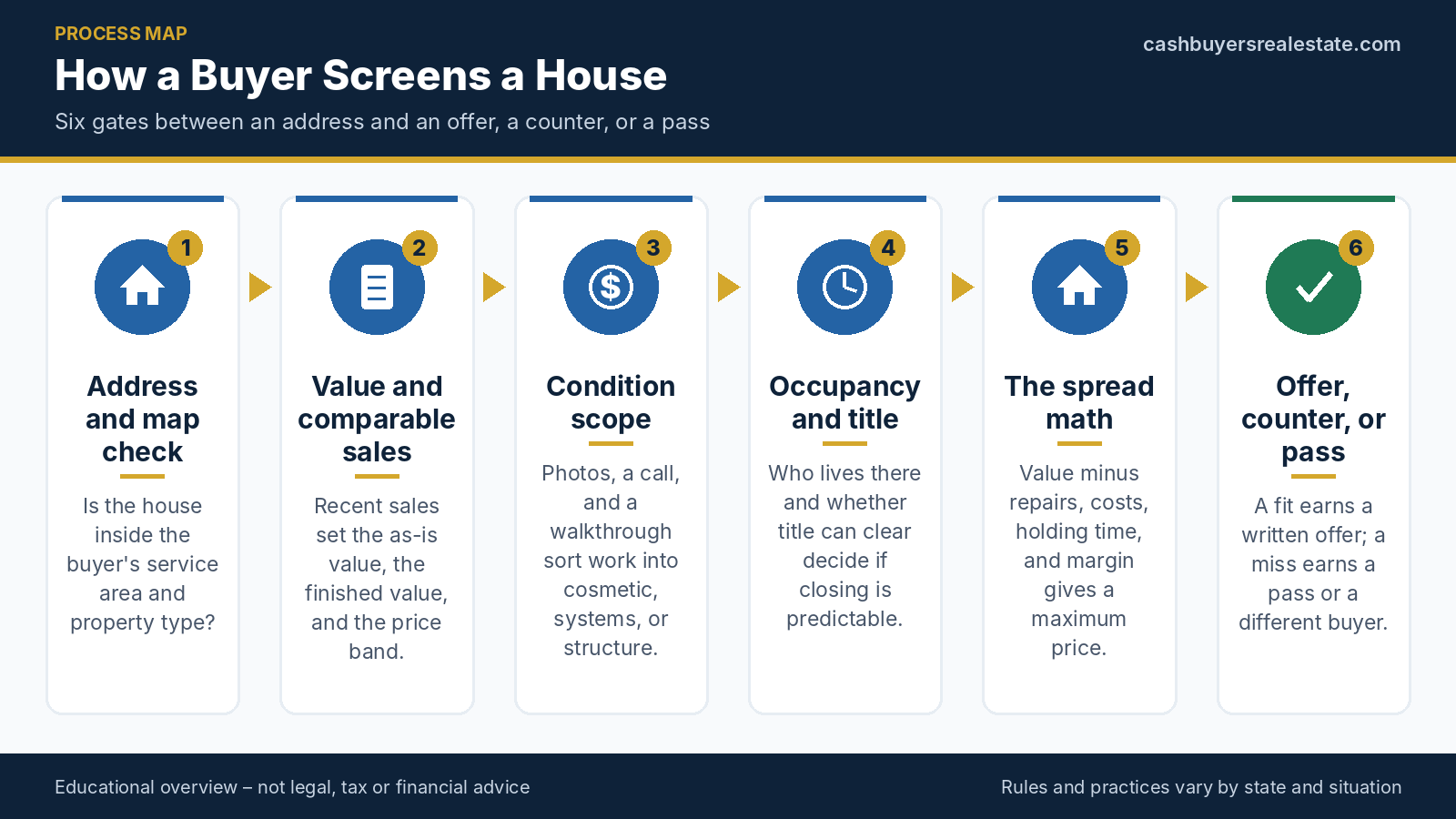
Text version of this infographic
- Address and map check — Is the house inside the buyer's service area and property type?
- Value and comparable sales — Recent sales set the as-is value, the finished value, and the price band.
- Condition scope — Photos, a call, and a walkthrough sort work into cosmetic, systems, or structure.
- Occupancy and title — Who lives there and whether title can clear decide if closing is predictable.
- The spread math — Value minus repairs, costs, holding time, and margin gives a maximum price.
- Offer, counter, or pass — A fit earns a written offer; a miss earns a pass or a different buyer.
Price Bands, Size, Age, and Layout: How the Physical Fit Is Judged
Once a buyer is satisfied with the location, the next gate is the house itself: how much it costs, how big it is, how old it is, and how the space is arranged. These characteristics feel objective, and to a degree they are, but each one stands in for a risk or an opportunity that the buyer is trying to size up. Understanding what each stands in for makes it easier to see why a perfectly good house can fall just outside a box.
Why price ceilings exist, and why expensive homes draw fewer cash buyers
Sellers of higher-priced homes are sometimes surprised to find fewer cash buyers at the table. It isn’t that wealthy buyers don’t exist; it is that investors who buy to renovate or rent usually set a ceiling on the size of any single purchase, and the reasons are structural rather than personal.
The capital and concentration math behind a ceiling
Every dollar an investor commits to one house is a dollar unavailable for the next. A buyer with a fixed pool of capital, whether personal savings, partner funds, or a revolving line of credit, thinks in terms of how many projects that pool can support at once. Spread across six moderate purchases, a stall in one project costs the buyer a sixth of capital for a few months. Concentrated in a single high-priced house, the same stall freezes most of the buyer’s operating money. Buyers who have lived through a slow sale learn to cap their exposure, which is why many boxes include a maximum purchase price that looks low next to what the neighborhood’s top homes sell for.
The ceiling is also tied to margin arithmetic. Renovation costs, holding costs, and commissions rise with a home’s size and price, but so does the risk that the finished house misses its target. A flipper who expects to net a certain return on a moderately priced home may need a much larger dollar profit to justify the same exposure on a high-priced one, and a high-priced home may be harder to sell at the necessary premium. At the same time, the pool of retail buyers shrinks with each step up in price, so every month on the market carries a higher expected carrying cost. These effects compound, and the buyer’s required discount to value grows faster than the price itself.
Illustrative example (hypothetical numbers, not market data): An investor has $2,000,000 of working capital across all projects. A $300,000 purchase with $50,000 of repairs ties up about 17.5 percent of that pool. A $1,100,000 purchase with $120,000 of repairs ties up about 61 percent. If the second project stalls for four months because of a permitting delay, the investor loses most of their ability to take on new work during that time. Even if both houses promise the same percentage return on paper, the second carries a much larger chance of disrupting everything else. Many investors respond by writing a purchase ceiling into their buy box, and by paying a smaller percentage of value for houses above it.
Not every cash buyer behaves this way. Some wealthy individuals and family offices buy expensive homes for cash precisely because they do not depend on turnover; they want a trophy property, a second home, or a long-term hold. Their motives are personal rather than formulaic, and they are hard to find through investor channels. For most sellers of high-value homes, the practical consequence is that a conventional listing with a skilled agent, which reaches buyers who are not scanning for investment spreads, often performs better than hunting for an investor.
How the resale pool narrows as price climbs
The second reason for ceilings is the exit. A flipper’s buyer is usually a household that needs a mortgage, and the available loan programs shape how large that household pool is at each price. The Federal Housing Finance Agency, which sets the maximum size of loans that Fannie Mae and Freddie Mac may purchase, announced on November 25, 2025 that the baseline conforming loan limit for one-unit properties in 2026 is $832,750, with a ceiling of $1,249,125 in the highest-cost areas, according to the agency’s announcement of 2026 loan limits. Those figures are the boundary between loans eligible for purchase by the two government-sponsored enterprises and larger loans that lenders generally underwrite under their own standards.
For a resale-minded investor, the boundary matters because a finished house priced well above the local limit depends on buyers who qualify for larger, non-conforming loans, or who pay cash. That group is smaller, and lenders’ requirements for such loans vary by institution. A buyer who projects a long marketing period for the finished house pads the offer for it. The result is that in many markets the density of cash buyers drops visibly as prices approach and then pass the conforming limit for the area. The effect is a tendency, not a wall, and in high-cost metro areas where the limit is far below typical prices it may be barely noticeable. Still, sellers of homes near or above the local limit should expect a narrower and often more local field of investors.
The floor works in the opposite direction. At very low prices, fixed costs consume the margin: title work, closing expenses, insurance, utilities, and a minimum repair scope cost roughly the same on a $60,000 house as on a $160,000 one. Some buyers set a price floor for that reason. Others specialize in the low end and run high volume on small margins, accepting rougher conditions and tighter profit per deal. If your house sits near a buyer’s floor or ceiling, you may meet a pass that is really a boundary, which another buyer sets in a different place.
Size, age, and the floor plan
Within the price band, buyers look at the physical features that determine whom the finished house will appeal to and what it will cost to bring up to standard. These features rarely decide a deal alone, but combinations of them can.
Square footage, bedrooms, lot, and layout
Buyers care about size because size predicts both repair cost and resale appeal. Repair costs scale with square footage: flooring, paint, drywall, and roofing are priced by area, so a house twice the size roughly doubles those lines. Resale appeal depends on how the square footage is used. A three-bedroom, two-bath house with an open main living area tends to attract the broadest pool of households, which is why many boxes name that configuration. A two-bedroom house with one bath is not unsellable, but it limits the audience, and investors reduce their offer accordingly or reserve it for a rental buyer who sees it differently.
Layout problems are often invisible in listing summaries and decisive in person. A bedroom that can only be reached by walking through another bedroom, a bathroom entered from the kitchen, a staircase that dominates the front hall, or a basement bedroom without a legal exit can each reduce what the finished house will bring. Buyers sometimes call this functional obsolescence: a design that was acceptable when it was built but that conflicts with how people now expect to live. Some layouts can be corrected through renovation, at a cost the buyer builds into the offer. Others, such as a house with a single bathroom and no room to add a second, are permanent limits.
The lot matters in several ways. Size and shape determine whether there is space for a parking pad, a garage, or an addition. Slope and drainage influence foundation and water issues. A lot backing onto a busy road, a power line, or commercial uses may depress resale value. In some areas, an oversized lot offers a development option that adds value that the house itself does not, and a buyer with experience in splitting or building on lots may see that value when others do not. If your property sits on more land than the neighborhood norm, say so, because it widens the field of buyers who can see its potential.
Year built and what it tells a buyer
Age is a shorthand for a list of questions. A buyer who learns the house was built in a particular decade immediately starts asking about the roof and mechanical systems that are likely original, the type of wiring and plumbing, the likelihood of materials that later became problematic, and the probable need for energy-efficiency work. None of these is a certainty. A 1950s house with updated wiring and plumbing can be a better risk than a 1990s house with deferred maintenance. But age sets the starting assumptions, and unknowns are priced as if they were bad news.
Two age thresholds carry legal weight. The first is 1978, the cutoff for federal lead-based paint disclosure. According to the Environmental Protection Agency’s real estate disclosure guidance, sellers of most housing built before 1978 must give the buyer the agency’s lead hazard pamphlet, disclose any known lead-based paint or hazards, provide available records, and include a lead warning statement in the contract; buyers get a ten-day period to conduct a paint inspection or risk assessment unless both sides agree in writing to change it, and sellers keep the signed disclosures for three years. The rule has exemptions, such as foreclosure sales. A buyer of an older house expects this paperwork and works it into the timeline.
The second threshold applies to manufactured housing. Under the federal regulation at 24 CFR Part 3282, the HUD construction and safety standards apply to manufactured homes built for sale on or after June 15, 1976. A manufactured home built before that date lacks the federal standard, and many buyers and lenders treat such homes as a separate, narrower category. Whether the home sits on owned land or in a leased lot community, and whether it is titled as real property, also changes who will buy it. Those details differ by state, so a local attorney or title professional is the right source.
| Construction era | Typical questions from a buyer | Legal or paperwork angle | What a seller can gather |
|---|---|---|---|
| Before 1950 | Original wiring and plumbing, foundation movement, layout fit, hidden past repairs | Lead-paint disclosure applies; local historic or code rules may too | Permits for any updates, electrician or plumber invoices |
| 1950 to 1977 | Aging mechanical systems, wiring type, small rooms and few closets, single bath | Lead-paint disclosure applies to most homes built before 1978 | Roof, furnace, and water-heater dates; inspection reports |
| 1978 to 1999 | Roof and windows near end of life, deferred maintenance, dated finishes | No federal lead-paint disclosure; state disclosure still applies | Replacement dates and receipts |
| 2000 to present | Builder-grade materials, moisture or siding defects, HOA rules | HOA documents and warranty status may matter | HOA statements, warranty papers, maintenance records |
| Manufactured, built on or after June 15, 1976 | Land ownership or leased lot, title as real property, foundation and tie-downs | HUD Code standard applies; titling rules vary by state | Title or certificate, data plate, lot lease |
The table is a map of questions, not a verdict on any era. Notice the final column in every row: the seller’s best response to age is documentation. A buyer who can see that the furnace was replaced in a known year, that the electrical panel was upgraded with a permit, and that a recent inspection found no active leaks, turns age from an unknown into a known. Known problems with known costs are easy to price, and that predictability is worth more to a cash buyer than a vague assurance that “everything is fine.”
From Condition to Repair Budget: How Buyers Price What’s Wrong with a House
Condition is where sellers and cash buyers most often talk past each other. The seller lives in the house and sees a place that works; the buyer walks through with a clipboard and sees a list of line items, each with a price. Neither view is wrong. They are simply answering different questions, and the buy box is built on the buyer’s.
How a buyer turns condition into a repair number
Experienced buyers don’t carry a single “fixer-upper” category in their heads. They sort what they see into tiers, because each tier has a different cost structure, a different risk of surprises, and a different type of contractor involved. Once you know the tiers, a repair estimate stops looking like a mystery.
Cosmetic work, mechanical systems, and structure: three tiers of scope
The first tier is cosmetic: paint, flooring, fixtures, cabinets, countertops, landscaping, and general cleaning. Cosmetic work is visible, predictable, and priced largely by area, so buyers can estimate it quickly and with little cushion. A dated but sound kitchen and worn carpet are routine for nearly every buyer on the market, which is why cosmetic-only houses fit the widest range of boxes and attract the most competition. The second tier is mechanical systems: roof, heating and cooling, electrical service, plumbing supply and drains, water heater, windows. Here buyers think in terms of remaining useful life. A roof near the end of its life is not a defect so much as a coming expense, and a buyer will deduct the full replacement cost if the roof cannot be expected to last through the holding period.
The third tier is structure and envelope: foundation movement, framing, sagging floors, active water intrusion, mold, termite damage, fire or storm damage. This tier is different in kind. Costs are harder to estimate before walls are opened, scope tends to expand once work starts, and some problems require permits, engineers, or specialty trades. Many buy boxes exclude this tier or limit it to buyers with the expertise to handle it. For the seller, the practical point is that houses cross an invisible line when they move from tier two to tier three, and the number of interested buyers drops sharply. A visible foundation crack is one of the things that moves a house across that line in the buyer’s mind, which is why selling a house with foundation problems deserves its own treatment.
Condition and age interact. An older house is more likely to have tier-two items near the end of their lives, and a newer house is more likely to have them still under warranty or well within their life. But age alone does not move a house from one tier to another; evidence does. A thirty-year-old roof that an inspector has measured and priced as having several years left is a smaller deduction than a fifteen-year-old roof with visible curling and no documentation. Buyers discount the unknown more heavily than the known, so the seller’s job is not to claim that a system is fine but to show how they know.
Building the budget and the cushion
A buyer’s repair estimate comes from a walkthrough in which every room and system is noted, then priced against the buyer’s own cost data from recent projects. A cost per square foot for flooring, a flat figure for a kitchen at a given quality level, a replacement price for a roof of this size, a bid range for a heating unit. Good buyers record what their last twenty projects actually cost, not what a catalog says, so their estimates reflect real prices in their market.
On top of the line items sits a cushion, often called a contingency, to cover what can’t be seen: wiring behind plaster, pipes behind tile, rot under a floor. The cushion is larger when the buyer has less information. A house with an inspection report and photos of the crawl space may attract a modest allowance, while a house where the buyer couldn’t see the basement may attract a very large one. Sellers sometimes interpret a big cushion as a buyer padding the offer, and sometimes it is. More often it is the price of not knowing. The table below illustrates how scope tiers translate into budgets, using hypothetical figures.
| Tier | Typical items | Illustrative budget | How a buyer tends to treat it |
|---|---|---|---|
| Light cosmetic | Paint, flooring, fixtures, cleanup, minor landscaping | $15,000 to $30,000 | Small cushion; fits most buy boxes |
| Cosmetic plus one system | The above plus roof or HVAC replacement | $30,000 to $60,000 | Deducted at full replacement cost if life is short |
| Full cosmetic plus several systems | Kitchen and baths, flooring, roof, HVAC, electrical panel | $60,000 to $110,000 | Suits flippers and rehabbers with crews and capital |
| Structural or damage repair | Foundation, framing, water or fire damage, mold abatement | $100,000 and up | Large cushion; many buyers pass; specialists only |
Read the table as a ladder, not a price list. Each step up adds cost and, more importantly, adds uncertainty, and the narrowing of the buyer pool at the top of the ladder matters as much as the dollar figures. A buyer who handles light cosmetic work in volume may not even call back about a house that belongs in the last row, while a rehabber who specializes in structural projects may find that same row routine and the first row too crowded to be worth chasing.
Illustrative example (hypothetical numbers, not market data): A buyer walks a 1,600-square-foot house built in the early 1970s. The notes read: interior paint throughout, $6,500; flooring in four rooms, $9,000; two bathrooms refreshed, $11,000; kitchen refresh with existing cabinets, $14,000; water heater at end of life, $1,800; roof with an estimated three years left, deducted at one half of a $14,000 replacement, $7,000; electrical panel inspection and minor corrections, $2,500. The subtotal is $51,800. The buyer adds a contingency of 12 percent for what can’t be seen, about $6,200, and arrives at a repair budget near $58,000. If the owner had provided a roofer’s written opinion and a recent electrical inspection, the buyer might have trimmed the contingency to 6 percent and the roof deduction to a smaller amount, leaving the budget closer to $50,000. The difference in the final offer would be several thousand dollars, earned purely through documentation.
Matching condition to the buyer whose box it fits
Because buyers sort houses by tier, the seller can sort buyers by tier too. Rather than asking whether cash buyers will take a house in its current condition, the better question is which kind of buyer is most likely to find a fit, and what that buyer is likely to pay for.
Light work: owner-occupants, small landlords, and local investors
Houses in the cosmetic tiers appeal to the broadest buyer pool. An owner-occupant with cash from the sale of a previous home may view dated finishes as an opportunity to personalize the space over time and may pay the highest price among cash buyers, because they intend to live there and are comparing the house to others on the retail market. A small landlord sees the same house as a candidate for modest improvements and a tenant. Rent depends mostly on location, size, and basic condition, and a landlord is often content to leave the 1990s kitchen in place if it works. Local investors, who buy a handful of houses a year, balance the two and tend to price the house against the cost of a quick refresh and resale.
For sellers, the useful consequence is competition. Houses in the lighter tiers can draw several offers, which allows a seller to compare not only price but terms: inspection period, deposit size, closing date, and flexibility on possession. It also means a seller with a lightly worn house has a legitimate reason to compare cash offers against a conventional listing. If the house is close to retail-ready, the premium from a financed buyer may outweigh the convenience of a quick cash close. The guide on selling fast without repairs addresses how to weigh that trade, and the comparison with traditional sale net proceeds shows how to put the two routes on equal footing.
Heavy work: rehabbers, contractor-investors, and the limits of any box
Houses in the upper tiers narrow the pool to buyers whose business is heavy rehabilitation. These are often contractor-investors who do much of the work themselves, small construction companies that buy houses between jobs, and experienced flippers with reliable crews and short-term financing. They price the work from cost data they trust, they accept the uncertainty that frightens other buyers, and they usually offer the best price for a house that others won’t touch. The tradeoff for the seller is that these buyers are exacting. Their offers are calculated backward from the finished value, and they often include inspection periods and the right to renegotiate if the walkthrough or inspection reveals something that wasn’t disclosed.
Some houses fit nobody’s renovation box, because the repair cost approaches or exceeds the value of the finished house. In these cases, the property may be worth more as a lot than as a building, and the relevant buyers are builders, developers, and land investors who plan to demolish or replace the structure. Their offers reflect land value less demolition and permitting costs, and they care about zoning, utility access, and lot dimensions more than the condition of the house. A seller who describes such a property as a “house that needs work” may attract the wrong buyers, while one who positions it accurately may reach the right ones. The page on cash home buyers for fixer-uppers goes further into how heavier projects are priced.
The five buyer profiles that most often appear across these tiers, and the kind of house each tends to favor, are summarized in the comparison below. It lists what each profile is best suited to and the tradeoff a seller accepts by choosing it, and it uses the same logic as the sections above: condition and plan decide the fit.

Text version of this infographic
- Owner-occupant with cash — Best for: Move-in-ready or lightly dated homes. Trade-off: Timing follows their move; keeps inspection rights.
- Small landlord — Best for: Rent-ready homes and tenant-occupied units. Trade-off: Price follows rent, taxes, and insurance math.
- Flipper with crews — Best for: Cosmetic work plus a system or two. Trade-off: Offer built backward from resale; may re-price.
- Contractor-investor — Best for: Heavy repairs and damaged or dated houses. Trade-off: Big repair cushion; exacting inspection period.
- Builder or land buyer — Best for: Teardowns and oversized or divisible lots. Trade-off: Pays for land less demolition; zoning risk.
The Spread: After-Repair Value, Holding Costs, and the Rental Math
Location, price band, age, and condition are inputs. The spread is the output: the gap between what a buyer pays for the house and what the house will be worth when the buyer is done with it, or what it will earn each month if the buyer keeps it. Nearly every pass or offer comes down to whether that gap is wide enough to absorb costs and risk, which makes it worth understanding in some detail.
After-repair value and the margin investors need
For buyers who plan to renovate and resell, the central figure is the after-repair value, or ARV: the price the finished house should bring in the current market. Every other number in the offer is subtracted from it. Because it sits at the top of the calculation, an error in ARV flows straight through to the final offer, and experienced buyers treat it with more skepticism than any other input.
Estimating ARV without fooling yourself
The honest way to estimate ARV is to find recently closed sales of renovated houses that closely resemble the finished version of the subject property, then adjust for differences. The dishonest way, which every buyer has been tempted by, is to pick the single highest nearby sale and assume the project will match it. The difference between those methods can be tens of thousands of dollars, and it explains why some buyers lose money on projects that looked profitable on paper.
Careful buyers use several guardrails. They favor sales of renovated houses that closed in the last few months. They exclude outliers, such as a sale to a relative or a house with a view the subject lacks. They compare the quality of the finish, since a renovation to builder-grade standards doesn’t sell for the same price as a designer kitchen. And they look at active and pending listings alongside closed sales, because a finished house will compete with whatever else is for sale when it hits the market, not with last year’s results. Some buyers also run a conservative case in which ARV falls several percent, to see whether the deal survives a softer market.
This matters to sellers because the ARV disagreement is often the real gap between two offers. If one buyer’s estimate of finished value is $20,000 higher than another’s, the first can pay several thousand dollars more and still earn the same margin. Asking each buyer which sales they relied on is fair, and it reveals both their care and their assumptions. A buyer who can name three specific comparable sales has done the work. One who answers in generalities may be working from a formula or a market feel that hasn’t been tested against your street.
The 70 percent guideline and the costs it leaves out
You will often hear investors refer to a “70 percent rule.” As described in Bob Vila’s explainer on the 70 percent rule in house flipping, the guideline says a flipper should pay no more than 70 percent of a home’s ARV minus the estimated cost of repairs. In formula form, ARV times 0.70, minus repairs, equals the maximum purchase price. The same source notes that the rule is a quick screen rather than a requirement, that it depends on a realistic ARV, that it leaves out closing costs, agent fees, association fees, transfer charges, and financing costs, and that in competitive markets flippers sometimes pay up to 85 percent of ARV to win a deal.
The guideline survives because it is fast. A buyer scanning dozens of leads can run the formula in the time it takes to read an address. For a house with an ARV of $236,000 and repairs of $41,500, the quick screen gives $236,000 times 0.70, or $165,200, minus $41,500, or $123,700. That figure is a ceiling for a first look, not a final offer. The 30 percent that the rule leaves uncounted is meant to cover profit, resale costs, holding costs, and a cushion for surprises, but whether it does depends on the market, the buyer’s financing, and how long the project takes.
In practice, serious buyers move past the shortcut as soon as a deal looks promising and itemize every cost. Seen that way, the 70 percent guideline is also a useful decoder for sellers. If an offer sits well below what the formula would give, ask why. It may be that the buyer’s repair estimate is larger than yours, that the buyer’s ARV is lower, that the buyer is building in a large contingency, or that the buyer is simply opening low. If an offer sits above the formula, the buyer may be in a market that is hot enough to justify thinner margins, or may be confident of a high ARV. Either way, the formula gives you a place to start the conversation, and the sibling guide on how cash buyers calculate offers covers the later stages of the calculation.
Rent potential and the buy-and-hold lens
Not every cash buyer wants to sell the house again. A large share of investors keep what they buy, and for them the key figure is the income the house will produce rather than the price it will fetch. The same house can look excellent through one lens and unattractive through the other, which is one reason offers vary so much.
Rent comparables and the benchmarks behind them
A landlord estimates rent the same way a flipper estimates ARV: by finding similar properties that recently rented and adjusting for differences. Asking rents on active listings, rents on recently signed leases, and local property-manager data all serve as evidence. The buyer also considers the pool of likely tenants, the typical length of tenancy, and whether the area depends on a single employer or institution, because a sudden loss of demand can leave a landlord with vacancies.
Government rent benchmarks sometimes enter the picture too. The U.S. Department of Housing and Urban Development publishes Fair Market Rents, which its Fair Market Rent documentation describes as estimates of 40th percentile gross rents for standard-quality units in a metropolitan area or nonmetropolitan county. HUD sets them annually, and they generally take effect at the start of the federal fiscal year on October 1. They are used mainly to set payment standards for the Housing Choice Voucher program and similar programs. A landlord interested in voucher tenants will check them, but they are an administrative benchmark rather than a forecast of what any particular house will rent for, and investors who rely on them alone can be misled.
For a seller, the important thing is that rent potential changes who values the house most. A house in a neighborhood where rents are strong relative to prices can be worth more to a landlord than to a flipper, even if it needs work. A house in an area where rents are weak relative to prices is worth little to a landlord, no matter how handsome. When offers differ widely, ask whether the buyer plans to keep or sell, because the answer explains much of the gap.
From gross rent to what the owner actually keeps
Gross rent is where landlords start, not where they finish. From each year’s rent they subtract an allowance for vacancy and non-payment, property taxes, insurance, routine maintenance and a reserve for big-ticket replacements, and management fees if someone else runs the property. What remains is net operating income, and dividing it by a purchase price gives a yield investors often call the capitalization rate. A landlord with a target yield can work backward: divide net operating income by the target to find the value, then subtract repairs and purchase costs to find the most the landlord can pay.
Two properties with identical rent can produce very different net income. A house with high property taxes, a flood-zone insurance premium, or aging systems that need constant attention loses more of its rent to costs than one without them. That is one reason landlords look closely at the tax assessment, insurance quotes, and the age of the roof and mechanical systems before they commit. For sellers, the implication is that the same documents that reassure a flipper, such as maintenance records and utility bills, also reassure a landlord, and a seller who has them ready can shorten the buyer’s analysis.
Another detail that landlords check is how the purchase itself changes the operating costs. In some places, a sale triggers a reassessment of the property for tax purposes, so the tax bill a seller pays today may not be the bill the next owner pays, and the difference can be large enough to change a buyer’s view of the house. Insurance works similarly: a policy that was written years ago on an older roof may not be available to a new owner on the same terms, and premiums in some regions have risen faster than rents. A careful landlord asks for the actual tax bill and a real insurance quote rather than assuming that last year’s figures carry over, and a seller who knows the local reassessment rules can help the buyer see the true picture.
Illustrative example (hypothetical numbers, not market data): A house has an ARV of $236,000, a repair budget of $41,500, and a market rent of $1,850 a month once repaired. A flipper’s itemized worksheet and a landlord’s income worksheet are shown in the table below. The flipper subtracts the repairs, closing costs on the purchase, 7 percent for selling costs, six months of holding and financing, and a required profit. The landlord subtracts vacancy and operating costs from the annual rent, divides the resulting net income by a target yield of 8.5 percent, then subtracts the repairs and purchase costs. In this scenario the flipper’s lens supports a higher offer. In a different market, with lower resale values and higher rents, the landlord’s lens might win instead.
| Step | Flipper’s lens | Landlord’s lens |
|---|---|---|
| Starting value | $236,000 (ARV) | $152,388 (net income of $12,953 divided by 8.5%) |
| Less repairs and contingency | $41,500 | $41,500 |
| Less purchase closing costs | $3,500 | $3,500 |
| Less resale costs at 7% | $16,520 | Not applicable (hold) |
| Less holding and financing, six months | $9,000 | Included in annual costs |
| Less required profit | $30,000 | Built into the target yield |
| Maximum purchase price | $135,480 | $107,388 |
To read the table, follow each column from top to bottom and notice that the two buyers begin from different anchors and subtract different things. Neither is wrong, and neither is the house’s “real” value. The gap between $135,480 and $107,388 is simply the difference between two business plans applied to one property. In practice, the buyer with the higher number tends to win, and a seller who understands this can aim marketing at the buyer type whose math favors the property. The net operating income used above came from $22,200 of annual rent, less a 5 percent vacancy allowance, less $8,137 in taxes, insurance, maintenance reserve, and management.
Disqualifiers: Title Problems, Occupancy, Unpermitted Work, Flood Zones, and Zoning
Most buy-box dimensions work on a sliding scale. A house a little too old or a little too far away gets a lower offer, not a refusal. Disqualifiers are different. They are conditions that a buyer can’t price, can’t finance, or can’t close over, and they end a conversation quickly. Knowing them in advance lets you decide whether to fix them, disclose them early, or aim for the narrow group of buyers who specialize in them.
Problems with who owns the house and who lives in it
The two fastest ways to lose a buyer have nothing to do with bricks and shingles. One is a cloud on the title, and the other is an occupant the buyer cannot move on a predictable schedule. Both threaten the single thing a cash buyer values most: a closing date that holds.
Title defects, liens, and unresolved ownership
Title is the legal chain of ownership, and a clear title means the seller can transfer the property free of competing claims. Before closing, a title company or closing attorney searches public records for anything that interferes: unpaid mortgages, judgment liens, mechanic’s liens from unpaid contractors, unpaid property taxes or assessments, tax liens, easements, boundary disputes, and gaps in the chain of ownership. Many of these can be resolved at closing, with the seller’s proceeds paying off the lien and the title company issuing an insurance policy. A mortgage is the most common example, and it rarely scares a buyer, because the payoff comes out of the sale price. The difficulty arises when the amount owed approaches or exceeds what the house is worth, or when a claim cannot be removed by payment alone.
The truly disqualifying defects are those that need a court, a signature from someone who isn’t cooperating, or a long delay. A house inherited without probate, where the record owner has died and no personal representative has authority to sign, can’t be sold until that gap is closed. A house owned by several heirs, one of whom can’t be located or won’t agree, faces the same barrier. A property with a disputed boundary, a recorded claim from a former spouse, or a fraudulent transfer in its history can stall for months. Most buyers exclude these cases from their boxes by default, not because they are unsympathetic but because they cannot predict how long the resolution will take.
Rules about what is required to clear title, who may sign, and how liens are prioritized vary by state, so a local real estate attorney or title company is the right authority. For sellers who suspect a problem, the useful move is to order a title search or ask a title company for a preliminary report before marketing the house; the cost is modest compared with a failed contract. Buyers who work specifically on complicated titles do exist, though they price the delay and legal cost into the offer.
Occupancy: owners, tenants, and holdover occupants
Occupancy determines when a buyer gets possession, and possession determines when the buyer can begin work or collect rent. A vacant house, or one the owner will vacate by closing, is the cleanest case. A house with a tenant is more complicated. Depending on the lease and on state and local landlord-tenant law, a tenant may have the right to stay through the lease term even after a sale, and a buyer who wants the house empty may have to wait or negotiate. Some buyers like tenants, since a paying tenant is income from day one, while others avoid them because the timeline and the tenant’s rights are outside their control. The right answer depends on the buyer’s plan.
The hardest cases involve occupants who are not on a lease or who stay beyond an agreed date: a family member who refuses to leave, a former tenant, or someone claiming a right to the property. Even a legitimate claim takes time to resolve, and the process usually runs through a court. Buyers who avoid occupied properties are protecting themselves from that uncertainty. Sensitivity matters here, because many of these situations involve family stress or housing insecurity, and the right response is to deal with the occupancy honestly and early rather than hoping the buyer won’t notice. A seller who can say “the tenant’s lease ends in March and the tenant has said they’ll move out” is in a stronger position than one who hides the occupancy, which nearly always comes to light.
Condition at move-out also matters. A house that has been vacant for months can develop plumbing leaks, mold, or vandalism, while a house that has been occupied by someone who didn’t maintain it may arrive with damage the seller hasn’t seen. Buyers who accept occupied properties usually build in a right to inspect before closing and a clause about the condition at delivery.
Problems with the building and the land
The other group of disqualifiers is physical or regulatory. They don’t prevent a sale outright, but they can remove most of the buyer pool, because they affect what the next owner may legally do and whether a lender or insurer will accept the property.
Unpermitted additions and code violations
Many houses contain work done without permits: a finished basement, a converted garage, an enclosed porch, a deck, a bathroom added in a former closet, rewired circuits. In many places such work is more common than owners realize, and some of it was done by a previous owner decades ago. For a cash buyer, unpermitted work raises three questions. Was it done safely? Will the local building department require it to be inspected, corrected, or removed? And will the square footage count in the value an appraiser or resale buyer assigns? The answers influence both the cost and the comparable sales the buyer can rely on, since space that was never permitted may not count as living area.
Buyers handle these houses in different ways. Some deduct an allowance for bringing the work into compliance, some exclude the space from their value estimate, and some pass. The least popular path is the one that sellers sometimes consider: concealing the work. Disclosure requirements about known unpermitted work and material defects vary by state, but hiding a known issue can create legal exposure for the seller and is exactly the kind of surprise that ends deals when an inspector or title company discovers it. A better approach is to find out what the local building department would require and tell buyers plainly. The guide on selling a house with unpermitted work walks through the options.
Finding out what the record actually shows is easier than most owners expect. Many building departments will tell an owner which permits were issued and closed for an address, and whether any are still open, although the process and the fees differ from one jurisdiction to the next. An open permit from a prior owner, for example, is a different problem from work that was never permitted at all, because the first may only need a final inspection while the second may require opening walls so an inspector can see what was done. Cost and difficulty swing widely with the type of work, which is why buyers who cannot see the permit history tend to assume the worse case and why a short visit to the permit office can change an offer.
Flood zones, zoning, and infrastructure
Flood risk is one of the few location factors with an official map behind it. The Federal Emergency Management Agency publishes flood maps through its Flood Map Service Center, where anyone can search by address. FEMA’s tutorial on how to read a flood insurance rate map explains that the Special Flood Hazard Area is the high-risk portion of the map, shown in zones beginning with A or V, based on a base flood that has a one percent chance of occurring in any year. Shaded X zones are moderate-risk, unshaded X zones are low-risk, and some areas are marked as having undetermined hazards. For properties in the high-risk area, owners of structures with mortgages from federally regulated or insured lenders in participating communities must buy flood insurance.
That requirement is the reason flood zones matter to cash buyers. A flipper’s eventual buyer will often use a mortgage, and in a high-risk zone that buyer will have to carry flood insurance, which adds to monthly cost and shrinks the pool of qualifying households. FEMA’s flood insurance brochure adds that standard homeowners policies don’t cover flooding, that flood policies usually take effect after a 30-day wait except for loan-related purchases, and that about one-third of National Flood Insurance Program claims between 2013 and 2023 came from outside the current high-risk areas. A buyer therefore pays attention to flood history even in moderate-risk zones. Maps are updated over time, so check the current one for your address and ask your insurance agent about coverage.
Zoning and infrastructure complete the picture. A house that is a legal nonconforming use, such as a duplex in a zone now limited to single-family homes, may lose its status if it’s damaged or vacant for too long, and buyers want to know that before they commit. Properties with failing septic systems, shared wells or driveways without recorded easements, or access only across a neighbor’s land present issues of their own. The EPA’s overview of septic system types notes that design depends on household size, soil, slope, lot size, and local regulations, which is why local health departments, not national rules, usually decide what’s acceptable. Zoning questions belong with the city or county planning office.
| Issue | Why a buyer may pass | What a seller can often do | Who to ask |
|---|---|---|---|
| Lien or judgment | Must be paid or released before title can transfer | Get a payoff letter; plan payment at closing | Title company or closing attorney |
| Missing heir or unsigned owner | Nobody with authority can sign the deed | Locate the person; open probate; seek court help | Probate or real estate attorney |
| Tenant with lease | Possession date outside the buyer’s control | Share lease; give tenant notice per local law | Landlord-tenant attorney or local housing agency |
| Holdover occupant | Removal may need a court process | Resolve occupancy before marketing | Attorney in the property’s state |
| Unpermitted addition | May be unsafe, unlisted, or excluded from value | Ask the building department; get a contractor’s estimate | Local building or permits office |
| High-risk flood zone | Required insurance and a smaller lender pool | Pull the map; gather elevation or claim records | FEMA Map Service Center; insurance agent |
| Zoning nonconformity | Use or square footage may not survive a sale | Confirm status in writing | City or county planning office |
| Failing septic or untested well | High, uncertain replacement cost | Order an inspection and water test | County health department; licensed inspector |
Use the table as a checklist of conversations to have before a buyer does. For each row, the third column describes an action a seller can usually take at modest cost, and the fourth names where the authoritative answer lives. Few of these issues are fatal if they are known, documented, and priced; nearly all are fatal if they emerge late.
Illustrative example (hypothetical numbers, not market data): A brother and sister inherit their mother’s house. Two names appear on the deed they have, but the county record still shows a third co-owner, an uncle, who died years ago and whose share was never transferred. Three buyers show interest in the house, priced near $190,000 as is. Each asks for a title search before an offer. The search reveals the uncle’s unresolved interest, and all three buyers step back until an attorney clears it. The siblings spend about three months and a few thousand dollars on the legal work, then sell. The delay was frustrating, but the house sold at a normal price. Had they marketed it first and discovered the defect through a failed contract, they would have lost time and credibility with buyers.
Verifying the Buyer, Spotting Red Flags, and What to Do When Nobody’s Box Fits
The buy box describes what buyers want. Two practical questions follow from it. The first is how to tell a buyer who is applying honest criteria from one who is using the language of criteria as a pressure tool. The second is what to do if you have honestly checked your house against the likely boxes and found that few or none fit.
Red flags in how a buyer screens, prices, and contracts
The great majority of cash buyers deal fairly, and a low offer or a pass is not evidence of anything wrong. What follows are patterns worth noticing, each of which can have an innocent explanation, together with simple checks that settle the matter whichever way it turns out.
Screening that is vague, pushy, or inconsistent
A legitimate screen leaves a trail of specifics. The buyer can tell you which features pulled the number down, how much each is worth in their estimate, and which sales they relied on for value. A buyer who offers a figure without any of that, or who answers questions about the figure with generalities such as “that’s just what the numbers say,” is not necessarily dishonest, but you have learned very little. Asking for an itemized explanation costs nothing, and the quality of the response is informative. Buyers who work from real worksheets usually welcome the question because it shows you are serious.
Inconsistency is the second pattern. A buyer who says the box fits and quotes a price on the phone, then lowers the offer substantially after a walkthrough that revealed nothing new, may be re-trading. Sometimes the walkthrough did reveal something real, such as the active leak behind the dishwasher, and the adjustment is fair. The test is whether the buyer can point to the specific finding and its cost. A change of price that comes with a vague explanation and a deadline is a different matter. A related pattern is a buyer who says the house is a perfect fit and then adds a long list of conditions in the contract that were never discussed. Fit and conditions should tell the same story.
The third pattern concerns the buyer’s own transparency. You should be able to learn who the buyer is: the legal name of the person or company on the contract, a physical or mailing address, and a way to confirm that the entity exists. Business entities are registered with state offices, which in most states publish searchable records. A buyer who uses a different name in marketing than on the contract is not necessarily hiding anything, since many companies operate under assumed names, but the contract party should be identifiable, and it should match the name on any proof of funds.
Verification: identity, funds, cancellation, assignment, closer, and blanks
Six checks cover most of what a seller can do to confirm a buyer before signing. The first is identity: match the name on the offer, the contract, and the funds, and look up any company in the state’s business records. The second is proof of funds. A bank or brokerage statement, or a letter from a lender, showing that the buyer has the money or a committed loan for the price, is the usual evidence, and the guide to proof of funds for cash buyers explains how to read it and what it does and doesn’t show. A document that is redacted, outdated, or in someone else’s name deserves a follow-up question, not an assumption of bad faith.
The third check is the cancellation language. Many cash contracts give the buyer an inspection or due diligence period during which the buyer may cancel and recover the deposit, and some give the buyer broader rights than the seller has. Read what happens to the earnest money deposit in each case, how large it is compared with the price, and whether any cancellation right continues after the inspection period ends. A very small deposit combined with a wide right to cancel means the buyer has little at stake. The fourth is assignment. Some contracts allow the buyer to transfer the agreement to another party, usually with wording such as “and/or assigns.” That is legal in many places and common in wholesaling, but it means the person who closes may not be the person you met, and some states regulate the practice. Ask directly whether the buyer intends to close personally.
The fifth check is the closing partner. In many states a title company or escrow agent handles closing, while in others an attorney does. Either way, confirm that the closer is independent and licensed in your state, look up their contact details yourself rather than relying on those printed in an email, and call to confirm they are handling the transaction. The same goes for payment instructions: if you receive a change in wiring or disbursement details, verify it by telephone using a number you already trust. The sixth check is simple and absolute: never sign a document with blank spaces, and keep a complete copy of everything you sign. The six checks form the decision checklist in the graphic that follows, with the first two and the last marked as the most basic.
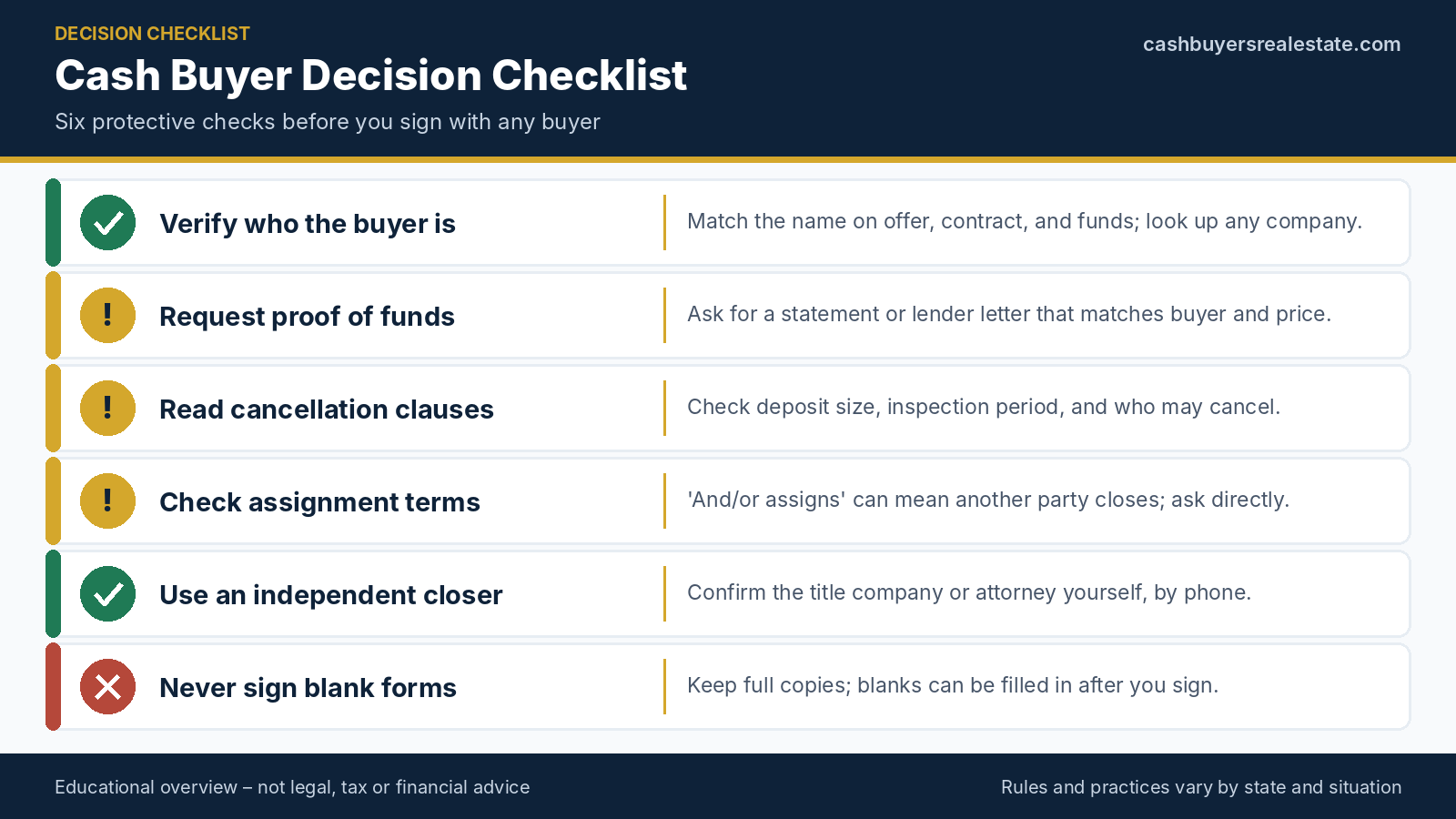
Text version of this infographic
- Verify who the buyer is — Match the name on offer, contract, and funds; look up any company.
- Request proof of funds — Ask for a statement or lender letter that matches buyer and price.
- Read cancellation clauses — Check deposit size, inspection period, and who may cancel.
- Check assignment terms — 'And/or assigns' can mean another party closes; ask directly.
- Use an independent closer — Confirm the title company or attorney yourself, by phone.
- Never sign blank forms — Keep full copies; blanks can be filled in after you sign.
What to do when no buy box fits
Sometimes the honest screen produces a discouraging result. The house is large, or priced beyond most investors’ range, or needs structural work, or has a title problem. Rather than concluding that nobody will buy it, think of the result as information about which levers are available.
Cure, disclose, or reposition
There are three broad responses. The first is to cure the disqualifier. Liens can be paid, probate can be opened, unpermitted work can sometimes be legalized, and a septic system can be inspected and pumped. A cured problem moves the house back into the boxes of ordinary buyers. The second is to disclose and document what cannot be cured, so buyers can price it rather than guess. A written inspection report, a contractor’s estimate, a flood elevation certificate, or a title commitment turns unknowns into numbers. Disclosure is also usually a legal obligation, and the rules differ by state. The third is to reposition the property toward the buyers whose boxes it does fit: a land buyer for a teardown, a rehabber for a heavy-repair house, a landlord for a tenant-occupied unit.
Illustrative example (hypothetical numbers, not market data): A buyer’s box covers single-family houses with a likely finished value between $150,000 and $300,000, within a certain county, vacant or deliverable vacant, with repairs under $70,000. Three sellers call. House one is a 1,500-square-foot ranch from 1985, vacant, with a worn roof and dated kitchen, expected to finish near $240,000. It fits, and the buyer begins a walkthrough. House two is a 3,100-square-foot house expected to finish near $610,000. It sits far above the ceiling, so the buyer passes and suggests the seller list it conventionally. House three is a 1,200-square-foot 1962 house with a month-to-month tenant, an unpermitted sunroom, and a location in a mapped high-risk flood zone. It might fit at a discount, but three flags at once lead the buyer to decline politely. The owner of house three decides to get a permit review, an elevation certificate, and written tenant plans before approaching a landlord buyer.
The example shows how a pass can mean different things. House two was simply outside the range and needed a different route. House three was inside the range but carried too many unknowns, so the owner’s work to reduce those unknowns was the productive response. A seller who understands which kind of pass they received can spend effort where it will help. The pages on selling a house as is and on selling a fixer-upper cover repositioning for properties with heavier condition problems.
Alternatives to a cash sale and how to compare them
When few cash buyers fit, a cash sale may not be the right route at all. The main alternatives are listing as is with a real estate agent, making targeted repairs and then listing, selling to an owner-occupant through a conventional or for-sale-by-owner (FSBO) route, or in some situations renting the house while problems are resolved. Each reaches a different buyer pool. A conventional listing exposes the house to financed buyers who may pay more for a house in good shape, but it brings agent commissions, buyer contingencies such as appraisal and inspection, and a longer and less predictable timeline. A cash sale gives up some price in exchange for speed, certainty, and fewer repairs.
The honest way to compare routes is by net proceeds, meaning what you keep after commissions, repair costs, closing costs, holding costs, and the time value of waiting, not by headline price. A higher listing price can net less than a lower cash offer when commissions, concessions, and months of carrying costs are subtracted, while a lower cash offer can net less than a listing when the house is close to retail-ready. Neither result is universal. The page on selling a house fast frames the speed question, and the comparison of cash sale versus listing shows how to line the numbers up.
Illustrative example (hypothetical numbers, not market data): A seller has a cash offer of $178,000 with no repairs and a close in about three weeks. A real estate agent estimates the house could list at $215,000 after about $14,000 of repairs and four weeks of preparation, with an expected two to three months on the market. The seller subtracts $14,000 for repairs, an assumed 6 percent for agent compensation ($12,900), assumed seller closing costs of $4,300, and four months of mortgage interest, taxes, insurance, and utilities at $1,650 a month ($6,600). The listing route nets about $177,200 if the house sells at the list price and more or less if it does not. The two routes are close, so timing and certainty, not price, may decide. Every figure here is invented to show the method.
A final option is to wait and cure, which suits sellers who have time. Some problems, like an unresolved estate or a lien that can be paid off from proceeds, simply take a few months to sort out, and a house that is ready for sale in the spring may bring more buyers than the same house rushed in winter.
Frequently Asked Questions About Cash Buyers and Their Buy Boxes
The questions below come up repeatedly once sellers start thinking about how buyers screen houses. The answers add detail and edge cases rather than repeating the sections above, and where the rules depend on your state, the answer says so.
Questions about fit, condition, and screening
These questions deal with whether a particular kind of house is likely to find a buyer and how condition shapes the answer.
Questions about which houses fit
- Can I find out a buyer’s buy box before I call?
Sometimes. Active investors often describe their criteria on their websites or in the first phone conversation, listing property types, price ranges, and areas they serve. Ask directly what they buy and what they typically pass on, and treat a clear answer as a good sign. A buyer who says “we’ll look at anything” is either very flexible or has not defined a plan, and the offer will show which.
- Do cash buyers only want rundown houses?
No. Plenty of cash buyers prefer houses in good or fair condition, including owner-occupants, retirees relocating with proceeds from a previous sale, and landlords who want to rent a house quickly. Their offers tend to sit closer to retail value because there is less work to deduct. Rundown houses fit a narrower set of buyers, and those buyers price in the labor and risk of a renovation.
- Will a cash buyer purchase a house worth more than a million dollars?
Some will, but the field is much smaller. Most investors who renovate and resell cap the size of a single purchase, and the pool of retail buyers shrinks at high prices. Individual buyers, family investment vehicles, and developers are more likely sources of cash offers at that level. A conventional listing with an agent experienced in the price tier often reaches more qualified buyers.
- Do cash buyers purchase manufactured or mobile homes?
Some do, but fewer than for site-built houses. Buyers look at whether the home sits on land the seller owns or on a leased lot, when it was built relative to the June 15, 1976 federal construction standard, and whether it is titled as real property or personal property. Titling and sales rules vary by state, so a local title company or attorney should confirm how the transfer works before you sign anything.
Questions about condition and repairs
- Should I make repairs before asking for cash offers?
It depends on the repair. Cash buyers expect to handle repairs and price them at their own costs, so a big renovation seldom pays back before a cash sale. Small, inexpensive fixes that remove visible doubt, such as cleaning, clearing out belongings, and patching an obvious leak, often help. Get a written estimate for any large item first, and compare what the work would cost with what a buyer would deduct.
- How can a buyer estimate repairs without opening the walls?
They can’t, which is why they add a contingency. Experienced buyers read clues such as water stains, uneven floors, a musty smell, the age of the electrical panel, and the style of any past repairs. The less they can see, the larger the cushion tends to be. Providing an inspection report, photos of crawl spaces and attics, and receipts for past work usually shrinks the cushion.
- Does an old roof automatically end a deal?
Not automatically. A roof near the end of its life is a known expense, and buyers typically deduct the portion of its replacement cost that corresponds to the remaining life or the whole cost if it cannot last the holding period. What ends deals is an unknown, such as a leak with unclear causes or interior damage that suggests long-term water entry. A roofer’s written assessment helps turn the unknown into a figure.
Questions about offers, risks, and alternatives
The remaining questions are about how offers behave once a house has passed the first screen, and what to do if something looks wrong.
Questions about offers and the process
- Why did two cash buyers give me offers that are far apart?
Usually because they plan different things for the house. One may be pricing a flip against a high resale estimate, while another is pricing a rental against expected income. They may also use different comparable sales, different repair estimates, or different margin targets. Ask each buyer which sales and which repair items they used, then compare the reasoning before the number.
- Do cash buyers need an appraisal?
A lender requires an appraisal on a financed purchase, and a true cash purchase has no lender, so the requirement does not apply by default. Many cash buyers still run their own valuation using comparable sales, and some order an appraisal or broker opinion for their own protection. Your contract determines what is required, so read it and ask.
- Can a buyer lower the offer after the walkthrough?
Yes, if the contract allows it and the walkthrough or inspection revealed something that wasn’t known. Many cash contracts include an inspection period with a right to cancel or renegotiate. A fair adjustment points to a specific finding and its cost. If the reduction is large and unexplained, you can decline, ask for the supporting detail, or return to other offers if you have them.
- How long does a buyer take to decide whether a house fits?
There is no standard. A first-pass desk screen can take minutes, and a decision after photographs and a phone call can take a day or so. A walkthrough and a price adds more time. Delays often reflect missing information on your side or a buyer who is waiting on a contractor’s estimate. Ask what the buyer needs from you to decide, and supply it.
Questions about red flags and alternatives
- Is a very low offer a sign of a scam?
Not by itself. A low offer can come from a heavy repair estimate, a thin market, or a buyer opening low to leave room to negotiate. Trouble signals include pressure to sign immediately, unwillingness to explain the number, a missing or mismatched proof of funds, and a contract with blanks. If you are concerned, run the verification checks described earlier before responding.
- What if every buyer passes on my house?
Find out why. Ask each buyer which part of the screen the house failed, then sort the reasons into those you can fix (a lien, a permit question, a cleanup), those you can disclose and price (a roof or a flood zone), and those that simply point to a different buyer or route. Listing with an agent, or waiting while a problem is resolved, may produce a better result than lowering your expectations for the same buyers.
- Do I have to tell a buyer about problems I know about?
Generally yes, and in many states it’s a legal duty. Seller disclosure rules differ by state, and some states have fewer formal requirements than others, but concealing a known material defect can expose you to claims after closing. Federal law adds requirements for most homes built before 1978 regarding lead-based paint. Ask a real estate attorney in your state what applies to your sale, and disclose in writing.
Choosing a Route and Taking Your First Steps
Everything in this guide leads to a decision that belongs to you: whether the buyers who match your house are the right way to sell it, and if so, which of them. There’s no universal answer. The aim of this last section is to turn what you’ve learned into a way of deciding and a short list of things to do next.
A decision framework for weighing cash buyers for houses against other routes
Choosing well starts with being honest about what you value most. Sellers rarely want everything at once, and the routes available trade one benefit against another. A framework helps by forcing the trade-offs into the open.
Weighing speed, price, certainty, and effort
Four priorities drive most decisions. Speed is how soon you need the sale to close. Price is what you keep after all costs. Certainty is how likely the sale is to close on the agreed date and terms. Effort is how much preparation, repair, and showing you are willing to handle. Rank them in order, and be willing to say that one matters much more than the others. A seller dealing with an estate across the country may place certainty and low effort above price. A seller with a house in good shape and no deadline may place price first. Neither is wrong, and the ranking points to a route.
The table below suggests how priorities map to routes. It is a guide to the direction of the trade-offs, not a prediction, and your own numbers will move the answer. Net proceeds should be calculated for each route that interests you, with the same set of costs counted for every one.
| If your top priority is… | A route that often fits | What you may give up | What to compare |
|---|---|---|---|
| Highest net price | Listing with an agent, possibly after targeted repairs | Speed and certainty; showings and buyer contingencies | Net proceeds after commission, repairs, and carrying costs |
| Speed with little preparation | Cash buyer whose box matches the property | Some price relative to a finished, listed house | Net proceeds and closing date across at least two written offers |
| Certainty of closing | Buyer with verified funds and a short contingency list | Flexibility on terms | Deposit size, cancellation rights, and proof of funds |
| Minimal effort for a house with major problems | Rehabber, contractor-investor, or land buyer | Competition for the house; price follows repair costs | Repair assumptions and the buyer’s evidence for them |
| Time to solve a title or occupancy issue | Cure first, then list or sell | Months of carrying costs | Cost of the cure against the price gain |
Read each row as a question rather than an answer. If speed is your priority, you still need to confirm that the buyer who promises speed can perform and that the discount is one you can accept. If price is your priority, you still need to confirm that the house can reach a retail buyer in its current state. In every row the last column names what to compare, and the common thread is that you compare net proceeds and terms, not the headline number in a text message or on a postcard.
Reading your own house through the buy box
With the priorities set, apply the screen to your own property. Go through the dimensions in order and give each an honest rating of fit, uncertain, or problem. Location and price band you can usually judge by looking at recent sales nearby. Size, age, and layout are facts. Condition requires honesty and ideally an outside opinion, since owners are poor judges of their own house. Occupancy and title are the dimensions where you may need records or professional help. The spread and the rental potential you can estimate roughly using the logic from earlier, but they belong more to the buyer than to you.
The result will usually fall into one of three patterns. In the first, nearly everything fits and one or two features are weak. You are in the strongest position, with several buyer types in play, and your job is to compare offers on net proceeds and terms. In the second, a single feature fails, such as a lien or a flood zone. That is the most fixable pattern, because curing or documenting one issue may bring the house back into many boxes. In the third, several dimensions are uncertain or failing at once. Here the best response is usually to get information before taking offers, with an inspection, a title report, or a permit review, because every unknown multiplies the buyer’s caution.
What to do next: documents, questions, and first moves
You can make progress without committing to anything. The steps below are low-pressure by design: gather information, ask questions, compare, and decide only when the picture is complete.
Documents worth gathering before you talk to anyone
Buyers price what they can verify, so the documents you assemble translate directly into fewer discounts. Start with ownership and title: the deed, any mortgage statement showing the payoff, and notices of liens or unpaid taxes. Next come property records: the tax bill, any homeowners association papers, and a survey if you have one. Then gather condition evidence: receipts and permits for past work, warranties, recent inspection reports, and ages of the roof and major systems. If the house is rented, add leases and the rent roll. If it is in or near a mapped flood zone, add flood insurance policies, claims history, and any elevation certificate.
- Deed, mortgage payoff estimate, and any lien or tax notices
- Latest property tax bill and association documents, if any
- Permits, receipts, warranties, and inspection reports for past work
- Ages of the roof, heating and cooling, water heater, and electrical panel
- Leases, rent payment records, and tenant contact details, if occupied
- Flood, septic, and well records where they apply
Some of these items take time to obtain, so it makes sense to request them early. A lender can issue a payoff statement showing what is owed on a mortgage, a county office can supply tax and lien records, and a title company can often run a preliminary search and tell you what it finds before any buyer is involved. Organize everything in one folder, paper or digital, with a short written summary of what you know about the house: age of systems, repairs made, problems you are aware of, and anything that is still unresolved. A buyer who receives a clear, honest summary will usually respond with a clearer, more confident offer, and you will have the answers ready the next time someone asks.
None of this needs to be perfect. A partial folder still helps, and gaps can be noted honestly. If something is missing that a buyer is likely to want, such as a permit for a finished basement, learning that now is better than learning it during a contract. A real estate attorney or title company can tell you what your state requires you to provide.
Questions to ask and a sensible order of operations
When you talk to buyers, you are interviewing them as much as they are screening you. Ask what the buyer plans to do with the house, because the answer reveals the type and the logic behind the number. Ask which sales and which repair assumptions support the offer. Ask who will close the transaction, whether the buyer intends to close personally or assign the contract, how large the earnest money deposit is, what the inspection period allows, and when the buyer can show proof of funds. Write down the answers and ask for them in the contract. Consistency between what is said and what is written is the single best indicator of a buyer worth trusting.
As for sequence, a reasonable order is to check your own house against likely boxes, gather documents, request an itemized written offer from more than one buyer, compare net proceeds with at least one alternative such as a listing, verify the buyer and the closer, and have a real estate attorney or title professional review any contract before you sign. Skipping a step is sometimes fine, but doing them in this order protects you from the most common mistakes. If you are weighing how a cash sale stacks up against waiting, the page on cash house buyers and the broader guide to home buyers for cash offer further context, and the main overview of companies that advertise as house buyers explains how to read their marketing.
For many sellers, the right outcome is a cash sale to the buyer whose box the house fits, at a price that survives a careful comparison. For others, it is a listing, a repair, or a pause while a problem is resolved, and there is nothing wrong with choosing the slower path if it serves your goals. The decision is yours, and it can be made calmly, with a few documents in hand, a clear picture of how buyers see the property, and a willingness to say no to any offer that doesn’t hold up when you read it closely.