
Sell Property for Cash: Offers, Costs & Closing
Selling a three-bedroom house on a street full of similar houses is a problem the market has solved thousands of times, and the advice you find online is written for it. Selling a manufactured home that sits on rented land, a condominium in a building that is about to levy a special assessment, a co-op apartment that needs a board’s blessing, ten acres with a well and a tired septic field, or a fourplex with two tenants behind on rent is a different problem, and the standard advice rarely fits. If you want to sell property for cash and your property isn’t an ordinary single-family house, the first thing to understand is that the type of property decides who your realistic buyers are, how they value what you own, which documents must exist before a closing can happen, and which obstacles can quietly add weeks or erase a deal.
The direct answer is that almost every kind of real property can be sold to a buyer who pays without a mortgage, but the route, the price logic and the paperwork change from one type to the next. “Cash” only tells you how the buyer is paying. It says nothing about whether the title is clean, whether an association has to approve the buyer, whether a mobile home is legally part of the land, or whether the buyer is a neighbor who wants your acreage or an investor who plans to subdivide it. In several categories, cash buyers are not a convenience but the main market, because lenders either won’t finance the property at all or will finance it only on terms that few buyers can meet.
Short answer: You can usually sell property for cash whatever its type, but land, manufactured homes, condos, co-ops and income properties each carry their own buyers, valuation methods and approval steps. Confirm what you legally own, gather the type-specific documents early, and compare offers by net proceeds, not headline price.
Cash buyers are drawn to non-standard property for a plain reason: a financed buyer needs the property itself to satisfy a lender, and many of these properties can’t. A lender’s underwriting asks whether the collateral fits a template, with a recognizable structure, legal access, working utilities, a project that meets its standards and a value that a licensed appraiser can support with nearby sales. A manufactured home with a missing data plate, a condo project with too many owners behind on association dues, or a parcel with no recorded road access can fail that test through no fault of the buyer or the seller. Someone paying with their own funds isn’t bound by those templates, which is why the same property that sat unsold for months with financing-dependent buyers can attract serious interest from buyers who are not.
The sections that follow start with how property type reshapes the buyer pool and the price, and then take the main non-standard categories one at a time: manufactured and mobile homes, condominiums, townhomes and cooperatives, land and rural properties, and multifamily or mixed-use buildings. After that the guide compares what a financed buyer and a cash buyer each demand from the same property, walks through the disclosures and costs that attach to each type, and finishes with a framework for choosing a route and a list of first steps. Hypothetical numbers appear in labeled examples and tables so you can see the arithmetic, and every legal point is tied to a federal or state source that you can read yourself.
Some neighboring topics are deliberately left light here. How cash buyers think about an ordinary house is covered in the guide to how cash buyers evaluate standard houses, the broader decision between a cash sale and a listing sits in the article on selling a house for cash, and the side-by-side comparison with a buyer who needs a mortgage is the subject of cash buyers versus financed buyers. This guide stays with the questions that appear only when the property is something other than a typical house.
Why Property Type Changes Who Buys, What They Offer and How the Sale Closes
Real estate is often discussed as if every property were a variation on the same house, with a bigger lot here and an extra bathroom there. In practice the categories behave like different markets. Each has its own buyers, its own pricing method, its own gatekeepers and its own list of things that go wrong in the last two weeks before closing. Understanding those differences before you ask for offers is the cheapest protection you have, because it lets you recognize a reasonable offer, a missing piece of paperwork and an unrealistic promise for what they are.
What counts as property when you sell for cash
The word “property” covers a surprising range of legal arrangements, and a cash buyer’s first questions are usually about which arrangement you hold. Before comparing offers it helps to separate three things that sellers tend to treat as one: the land, the structure and the legal form in which you own them.
Land, structure and legal form: three things you may or may not own
When you own a typical house, you own the land and the building together, recorded as one parcel under one deed. Many non-standard properties split those pieces apart. A manufactured home may belong to you while the lot underneath belongs to a park owner. A condominium owner holds title to the interior of a unit plus an undivided share of common areas, and the association owns or controls the rest. A co-op resident doesn’t hold a deed at all; the resident owns shares in a corporation and holds a proprietary lease to a particular apartment. A rural landowner may own the surface of a parcel while someone else holds mineral rights or an easement that crosses it. A cash buyer will ask which of these situations applies because the answer sets what can be transferred, and a purchase contract that promises more than you own is a contract that cannot be completed.
Sorting this out before you list or accept an offer is mostly paperwork. The recorded deed, the title or ownership document for the structure if it is titled separately, the association’s declaration or the co-op’s lease and bylaws, and any survey or easement documents will usually answer the question. Where they don’t, a title company or real estate attorney can run a title search, which is the same step the buyer’s closing partner will perform later. Learning about a gap now, such as an unrecorded easement or a home that was never converted to real property, gives you time to fix it or to price around it. Learning about it from a buyer’s title report a week before closing gives the buyer leverage you didn’t need to hand over.
The buyer pool behind each property category
Cash buyers aren’t one group. The investor who rehabilitates single-family houses for resale rarely wants raw land, and the neighbor who has been hoping to buy the adjoining pasture has no use for a duplex. Manufactured homes in parks tend to attract small investors and park-adjacent operators who think in terms of rent roll and lot rent, and sometimes buyers who plan to occupy the home themselves with cash from savings or the sale of a prior home. Condominium units draw investors who rent units, downsizing buyers with equity from another sale, and relatives of owners. Co-op apartments are bought mostly by people who intend to live in them, since the board that approves purchasers generally screens for owner-occupancy intent and financial strength.
Land attracts a different set again: adjacent landowners, farmers and ranchers, hunters and recreation buyers, builders, and developers who evaluate zoning and utilities before they look at the view. Multifamily properties attract investors who underwrite income, from individuals buying their first small building to partnerships and funds buying larger ones. The practical consequence for you is that the best buyer for your property may not be the one who answers a general “we pay cash” advertisement. A specialist who regularly buys your property type will recognize the paperwork, will price the known obstacles instead of padding for unknown ones, and will usually close with fewer surprises.
How property type reshapes price, speed and risk
Once you know who is likely to buy, the next question is what they can justify paying. Price in a cash sale is not a measure of the property’s worth in the abstract. It is the result of a buyer’s own arithmetic about what the property will fetch when the buyer exits, what it costs to get there, and how much risk and time the buyer is absorbing. Property type changes every term of that arithmetic.
Exit strategy: the question behind every cash offer
Every investor who buys with cash has an exit in mind, and the exit determines the number. For an ordinary house the exit is usually a repair-and-resell or a rental, and both rest on abundant comparable sales. For a manufactured home in a land-lease community the exit may be a resale to another occupant or a rental, and the buyer must account for lot rent, park rules and approval timelines that apply to the next buyer as well. For a condo the exit depends on whether the project can attract financed buyers later, so a building with a pending special assessment or weak reserves is harder to resell and therefore worth less to the person buying today. For land the exit may be holding for appreciation, subdividing, farming or building, each with different costs and timelines.
Seeing the exit lets you judge whether an offer is plausible. A buyer who plans to rent a four-unit building will pay a number tied to the rent roll and expenses. A buyer who plans to hold acreage until a road is extended will pay a number that reflects carrying costs, such as property taxes, for years. If the offer you receive can’t be explained by any exit you can imagine, either the buyer has information you lack or the offer is built to leave negotiating room, and a polite request for how the buyer arrived at the figure is entirely reasonable.
The exit also decides how patient the buyer can afford to be. An investor who plans to resell within a few months is carrying the property on committed money and wants a predictable closing, whereas a buyer who plans to hold land for years can tolerate a longer due-diligence period and may accept a slower title cleanup. Matching your timeline to the buyer’s exit often matters more than shaving a few percent off the price, because a buyer whose plan fits your schedule rarely asks for the extensions and credits that wear down a quoted number.
Thin comparables and the wider range of offers
Pricing an ordinary house relies on recent sales of similar houses nearby, which are typically plentiful. Non-standard property has fewer true comparables, and the ones that exist often differ in ways that matter: a double-wide on a rented lot is not comparable to a double-wide on an owned acre, and a corner condo with a view is not comparable to an interior unit over the parking garage. When comparables are thin, valuation becomes a matter of judgment, and different buyers reach different numbers for sound reasons. That is why offers on land, income property and non-standard homes often spread across a wider range than offers on standard houses.
A wide range works in your favor if you collect more than one offer and understand what drives the differences. The table below summarizes how common property types line up with typical cash buyers and with the obstacles that most often slow or complicate a sale. Treat it as a map of tendencies rather than a prediction, since local markets, lender practices and state law all shift the details.
| Property type | Typical cash buyer | Common obstacles | Where financing tends to struggle |
|---|---|---|---|
| Manufactured home on owned land | Local investors, occupants with savings, buyers who plan to convert or replace | Title still listed as personal property, missing data plate, foundation questions | Many lenders want the home classified as real property on a permanent foundation |
| Manufactured home in a land-lease community | Small investors, community-adjacent operators, occupants | Park approval of the buyer, lot rent, rules that restrict resale or age of home | Land is leased, so mortgage options narrow sharply |
| Condominium or townhome in an association | Rental investors, downsizers, relatives | Resale documents, unpaid dues, special assessments, rental caps | Project-level standards can disqualify the entire building |
| Cooperative apartment | Owner-occupants with strong finances | Board approval, flip tax, financial screening, building rules | Fewer lenders make share loans; board may limit financing |
| Vacant land or acreage | Neighbors, builders, farmers, recreation buyers, developers | Access, zoning, survey, utilities, valuation disputes | Raw land loans are scarce and often require large down payments |
| Rural home with well and septic | Investors, owner-occupants who accept repair risk | Water testing, septic condition, road access, easements | Failing systems or access gaps can stop a mortgage |
| Duplex through fourplex | Small investors, owner-occupants who live in one unit | Tenant leases, rent arrears, mixed utilities, unpermitted units | Owner-occupant loans exist, but condition and tenancy can complicate them |
| Five or more units or mixed-use building | Experienced investors, partnerships, funds | Rent roll verification, commercial leases, zoning, environmental questions | Commercial-style loans underwritten on income, with longer timelines |
Use the table to find your row first and then read the matching section of this guide, but notice the pattern across rows as well. Wherever the financing column describes a barrier, cash buyers are more likely to be your main audience, and wherever the obstacles column mentions a third party such as a park owner, an association or a board, the timeline of that third party sets the pace of your sale no matter how quickly the buyer wants to move. Those two observations explain most of what follows: the buyer’s money is usually the easy part, and the approvals and documents are where time is won or lost.
Manufactured and Mobile Homes: Federal Standards, Title and the Land Underneath
A manufactured home looks like a house to a neighbor and like a different kind of asset to a title examiner, a lender and a park owner. Whether it can be sold quickly for cash depends on three questions that have little to do with how nice the kitchen is: when and how the home was built, how it is titled, and who owns the ground it sits on. Settling those three questions early prevents the most common reasons these sales stall.
What the HUD Code is and why a missing label can stall a sale
Manufactured housing is the one category in this guide where a federal construction standard defines the product. That standard determines how the home is described, whether it can be financed by mainstream programs, and how much comfort a buyer takes from its documentation. Sellers who know the vocabulary tend to get cleaner offers.
The June 15, 1976 line and the labels that prove which side a home is on
Federal construction and safety standards for manufactured homes were created by the National Manufactured Housing Construction and Safety Standards Act of 1974, codified beginning at 42 U.S.C. 5401, and according to the federal regulation that implements the program, the standards took effect on June 15, 1976. A home whose first stage of production began on or after that date is built to the federal standard and is called a manufactured home. A home built before that date is generally called a mobile home, was never inspected under the federal program, and is harder to finance and insure. Buyers and appraisers draw this line constantly, so the build date on your paperwork matters more than the model name on the brochure.
Proof of which side of the line a home falls on usually comes from two items. The data plate is a paper document, typically found inside the home, that lists the manufacturer, date of manufacture and the standards the home was built to. The certification label, a metal tag attached to the exterior of each transportable section, is the physical evidence that the home was built under the federal program. Fannie Mae’s Selling Guide says that for an existing home a lender needs photographs of the original data plate or the labels, and that if neither can be obtained the loan isn’t eligible, though a label verification letter or a duplicate data plate can substitute in some cases. That rule belongs to one lending program, but the logic travels: a home that can’t prove its pedigree is a home many financed buyers can’t touch, which narrows the market for you and pushes the sale toward cash buyers who will price the uncertainty.
If you can’t find the data plate, look in the places manufacturers and installers commonly put it, such as a kitchen cabinet, a closet door or near the electrical panel, and photograph the labels on the exterior before you list. If both are missing, ask a title company or the state agency that administers manufactured housing how to request a duplicate or a verification letter. The effort is small compared with the discount a buyer may apply for an unprovable home.
Mobile, manufactured, modular and park model: terms that change the buyer pool
People use “mobile home,” “trailer” and “manufactured home” interchangeably, but each word points toward a different legal and financing category, and a buyer who hears the wrong one may price accordingly. Manufactured homes are built in a factory on a permanent chassis to the federal standard and are transported to the site. Modular homes are also built in factory sections, but they are built to the same state or local building codes as site-built houses, set on a permanent foundation and usually treated as ordinary real estate once installed. Park models and similar units are often regulated as recreational vehicles or under separate rules, and they may not qualify as housing for mortgage purposes at all.
Describing your home accurately, using the label on the plate rather than the word a relative used, helps you reach the right buyers. An older single-wide with no label belongs to investors who buy for rental or salvage value. A 2005 double-wide with intact labels, permanent foundation and owned land may interest local owner-occupants and investors alike, and some of them will use financing. A modular home that happens to look like a manufactured home should be marketed with its building-code documentation, because it may be eligible for ordinary mortgages and therefore worth more to a wider buyer pool. If you aren’t sure which one you own, the build documents, the state title record and the county’s property classification can usually settle it.
Personal property, real property and the land beneath the home
The second major question is legal rather than physical. In most states a manufactured home can be treated either as personal property, like a vehicle, or as real property, like a house, and the classification changes how it is titled, taxed, financed and transferred. The classification depends on the foundation, on the land and on whether the owner has completed whatever process the state requires to convert the home into real estate.
How title status decides who can buy and how
The Consumer Financial Protection Bureau explains in its research on manufactured-housing finance that these homes may be titled as real estate or as personal property, that a home titled as personal property is generally financed with a personal-property (chattel) loan, and that a manufactured home generally can be titled as real estate only if it sits on a permanent foundation on land the owner owns. The same research notes that chattel loans have fewer consumer protections than mortgages. A Fannie Mae legal paper from 2018 adds that in 43 states a home must complete a conversion procedure to become real property. The procedures vary, but they commonly involve surrendering or retiring the certificate of title, recording documents in the land records and, in many places, confirming the permanent foundation. Because the process is state-specific, the safest step is to ask a local title company how it works where your home sits.
For a seller, the practical meaning is this. A home that has been converted to real property, sits on land you own and is covered by a recorded deed can be sold with the land as an ordinary real estate transaction, and a mortgage-dependent buyer may be able to participate if the home also meets the lender’s technical rules. Fannie Mae’s guide, for example, requires a one-unit home legally classified as real property, permanently anchored, with the towing hitch, wheels and axles removed, at least 12 feet wide and at least 400 square feet above grade, and not previously installed or occupied at another site. A home that fails any of those details may still sell, but mostly to buyers who pay cash or use specialty financing, and the price will reflect it.
| Situation | What is actually being transferred | Likely buyers | Items to confirm early |
|---|---|---|---|
| Converted to real property, owned land, permanent foundation | Deed to land and home as one parcel | Investors, occupants, some financed buyers | Recorded conversion paperwork, foundation documentation, lien releases |
| Titled as personal property, home on land you own | Certificate of title for the home plus deed to land | Cash buyers and buyers willing to complete a conversion | Whether conversion is possible, who pays for it, any lien on the title |
| Home you own, lot rented in a land-lease community | Home title only; lot lease or park tenancy is separate | Occupants, small investors, park-adjacent buyers | Park approval process, lot rent, rules on age or condition, moving restrictions |
| Home on land owned by a relative with no written lease | Uncertain; the home may not be separable from the land | Very few until the arrangement is documented | Written lease or recorded deed, permission to sell, possible survey |
| Built before June 15, 1976, no federal label | Home as pre-standard housing, title varies by state | Investors who price for rental or salvage | Any local restrictions on pre-1976 units, insurability, water and sewer connections |
The table is most useful when you read it down the third column. As the arrangement becomes less standard, the list of likely buyers shrinks and shifts toward people who can absorb risk and paperwork with their own money. The final column is your to-do list: each item is a document or a question that a buyer’s closing partner will raise, and answering it before the offer arrives often shortens the timeline by a week or more.
Selling inside a land-lease community
When the lot is rented, the home isn’t the only thing the buyer is acquiring. The buyer also needs permission to occupy the lot, and the park owner usually controls that permission. State laws about this differ widely. California’s Mobilehome Residency Law offers a useful illustration; in a copy of Civil Code section 798.74, management of a park may require prior approval of a buyer of a home that will remain in the park, must provide its approval standards and required documents within 15 days of notice, and must respond in writing within 15 business days after receiving the requested information, with approval deemed granted if it doesn’t respond. Grounds for rejection are limited by the statute, and the same section addresses application fees. Other states have their own park statutes, and some are far less detailed, so treat California as one example rather than a template.
For a cash sale, park approval matters because it adds a third party’s schedule to a transaction that might otherwise close in days. Buyers who purchase in parks regularly know to submit their application the moment a contract is signed, and some will condition their offer on approval. Check your lot lease or park rules for provisions about the age or condition of homes that may remain, required skirting or exterior standards, who pays for upgrades, how lot rent can change, and whether the park or a residents’ association holds a right of first refusal. Moving a home to another site is rarely a realistic alternative, because relocation can be costly and older units sometimes can’t survive the trip, so most park homes sell in place and the park’s rules effectively set the market.
Illustrative example (hypothetical numbers, not market data): A seller owns a 1998 double-wide in a land-lease community, titled as personal property, with lot rent of $650 a month. A cash investor offers $26,000 for the home as-is, with closing in about two weeks and the investor handling the park application. An occupant-buyer would pay $34,000 but needs park approval, so the seller expects about three months on the market plus the application period. Assuming a 6% commission ($2,040), $1,950 in lot rent while waiting and $500 in small repairs, the listing nets about $29,510, roughly $3,500 more than the investor’s offer. If a delay pushes the occupant-buyer’s closing out another two months, an additional $1,300 in lot rent shrinks the gap to about $2,200, and any price reduction would erase it. Which route wins depends on how much the seller values speed and certainty.
The example is a reminder that comparing a cash offer with a listing means subtracting carrying costs and selling costs from the higher number before you decide. It also shows how a third-party approval turns a time estimate into a risk: the longer the process, the more the lot rent consumes the price gap, and the more chances a buyer has to walk away. The process from first conversation to closing follows the same basic shape for every property type in this guide, with different documents at each step. You confirm what you own and gather the type-specific papers, the buyer reviews the property and its documents, the buyer calculates an offer from the exit strategy and the obstacles, the two sides negotiate the contract terms and approvals, and a title or escrow officer or attorney completes the closing with payoffs, signatures, funds and recording.
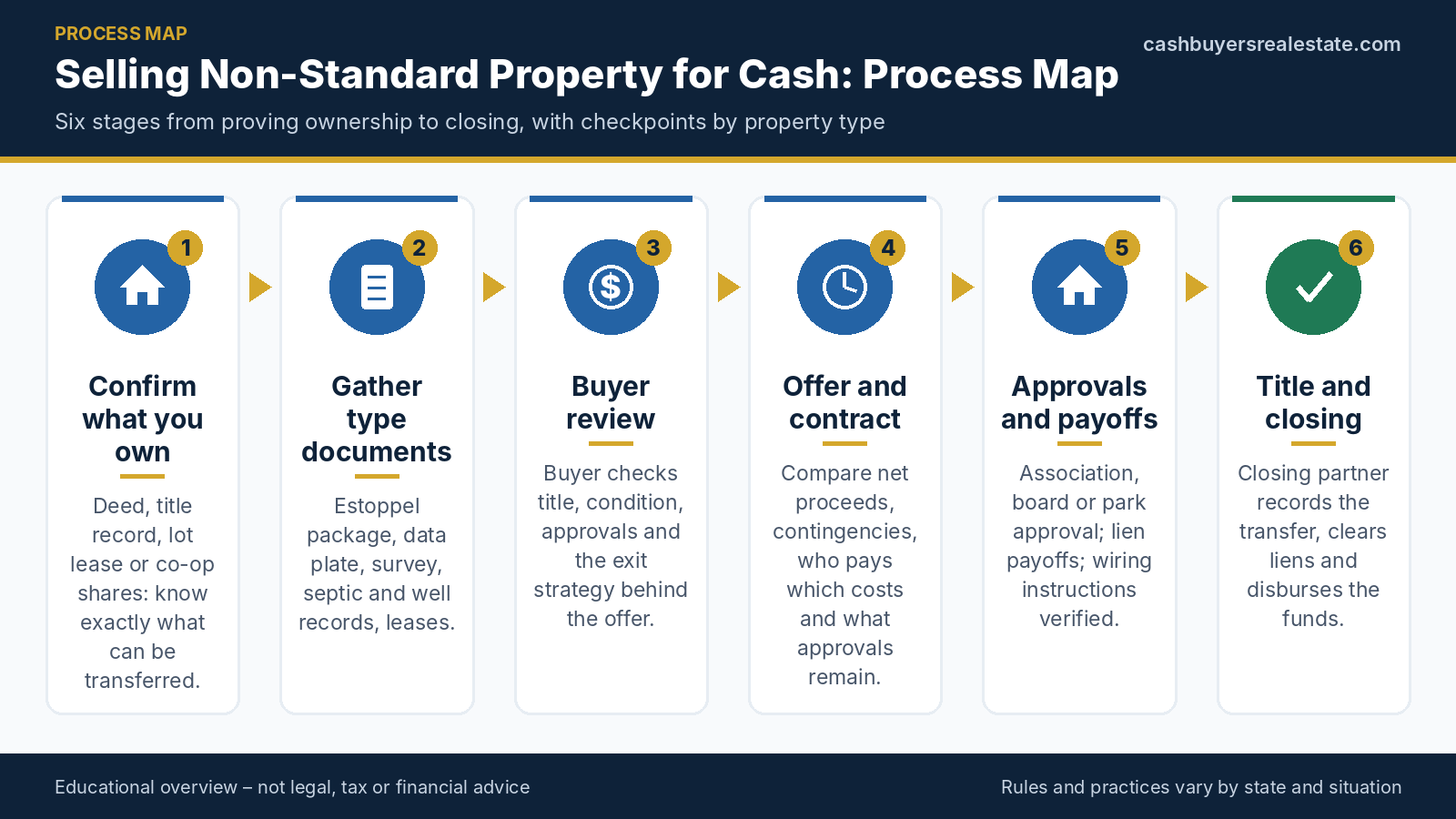
Text version of this infographic
- Confirm what you own — Deed, title record, lot lease or co-op shares: know exactly what can be transferred.
- Gather type documents — Estoppel package, data plate, survey, septic and well records, leases.
- Buyer review — Buyer checks title, condition, approvals and the exit strategy behind the offer.
- Offer and contract — Compare net proceeds, contingencies, who pays which costs and what approvals remain.
- Approvals and payoffs — Association, board or park approval; lien payoffs; wiring instructions verified.
- Title and closing — Closing partner records the transfer, clears liens and disburses the funds.
Condominiums, Townhomes and Cooperatives: Association Documents and Approval Gates
When you sell a unit in a community with shared ownership, you are not the only party with a stake in the sale. An association, a board or a managing agent holds records the buyer is entitled to see, may charge fees the buyer’s closing partner will insist on collecting, and in some structures can say yes or no to the buyer. A cash offer shortens the lender’s part of that process to nothing, but it does not remove the association’s part, and sellers who plan for that difference usually close sooner than those who discover it midway.
Condominiums and townhomes: the association is part of the sale
Condominium owners hold title to a unit and a share of the common elements, and a homeowners’ association or condominium association governs the rest. Townhomes are a style of building rather than a form of ownership, so a townhome may be a condominium unit, a fee-simple lot inside a planned community with an association, or a lot with no association at all. Which one you have decides which documents exist and who must provide them.
Resale documents and estoppel certificates: what the buyer is entitled to see
Many states require sellers or their associations to produce a package of documents for a buyer, and the details vary enough that no general rule is safe. Florida’s condominium statute is a detailed example. Under section 718.116 of the Florida Statutes, a unit owner or the owner’s designee may request an estoppel certificate from the association, which must issue it within 10 business days. The certificate states the regular assessment, the date through which it is paid, the next installment, amounts owed now and amounts scheduled to come due, any open violations, any transfer fee, and the association’s board-approval and right-of-first-refusal status. It stays valid for 30 days when delivered by hand or electronically and 35 days when mailed, the fee is capped, and a buyer who relies on it in good faith can’t later be billed for amounts above those stated.
California approaches the same goal differently. Under Civil Code section 4525, the owner of a unit in a common interest development must give a prospective buyer the governing documents, a written statement of current regular and special assessments and any unpaid assessments, fines or penalties, any unresolved violation notices, the most recent financial documents the association must distribute, and a statement about any rule that prohibits renting or leasing, along with other items, and must do so as soon as practicable before the transfer of title or the signing of a sales contract. Board-approved minutes from the prior twelve months must be provided if the buyer asks. Both states illustrate a pattern that exists in many places: the seller is responsible for ordering the package, the association may charge for it, and a late package is one of the most common causes of closing delays.
The practical advice does not depend on your state. Request the package as soon as you decide to sell, or as soon as you accept a contract if the law lets the buyer’s side order it, because an association with a monthly meeting cycle can take longer than its legal deadline suggests. Review it yourself before the buyer does, since errors in the account balance or an overlooked violation notice are easier to correct before a closing partner is waiting on them. Under Florida’s statute, a new owner is jointly and severally liable with the previous owner for assessments that came due before the transfer, which is why a buyer’s closing partner will insist on paying off any balance from the sale proceeds.
Why project-level standards give cash buyers an edge
A financed buyer purchasing a condominium faces a second review that has nothing to do with the buyer’s own credit. The lender, and often the secondary-market investor behind it, reviews the project: how many units are behind on association dues, whether the association funds its reserves, whether litigation or major repairs are pending, and how concentrated rentals are. Fannie Mae’s published full-review requirements for condominium projects, for example, say that no more than 15 percent of the total units may be 60 days or more past due on common expense assessments, and that the association’s annual budgeted replacement reserve allocation must be at least 10 percent of its annual budgeted assessment income unless a qualifying reserve study is used. Those thresholds belong to one buyer of mortgages, and individual lenders may apply stricter rules, but they show how a building’s finances can disqualify every financed purchase in it at once.
For a seller, that means a unit can be perfectly maintained and still hard to sell to anyone who needs a mortgage, because the building around it is the problem. A recent special assessment, a pending lawsuit, a high rate of delinquency, a cap on rentals or a building with an unusually high share of investor-owned units can all reduce the financed buyer pool. Cash buyers do not need a lender’s approval of the project, so they become the primary audience, but they are also pricing the same building risk. An investor weighing your unit will ask what a financed buyer could pay later, because that resale price drives the exit, and a building that can’t attract financed buyers has a lower exit value. Expect cash offers to reflect a discount that scales with the project’s problems, and be prepared to document what is being done about them.
| Property | What the owner holds | Who may need to approve or be notified | Typical sale documents |
|---|---|---|---|
| Condominium unit | Title to the unit plus a share of common elements | Association, possibly with a board approval or first-refusal clause in the declaration | Deed, resale or estoppel package, governing documents, budget and reserve information |
| Townhome in a planned community | Fee-simple title to the lot and building | Homeowners’ association for dues and rules; rarely for the sale itself | Deed, association disclosure package, dues statement, architectural rules |
| Townhome with no association | Fee-simple title, often with party-wall agreements | Neighbors only through recorded agreements | Deed, survey, party-wall or shared-maintenance agreements |
| Cooperative apartment | Shares in a corporation plus a proprietary lease | Board of directors, managing agent, sometimes the corporation’s attorney | Stock certificate, proprietary lease, house rules, financial statements, transfer paperwork |
Reading across the rows, notice how the approval column moves from “possibly” to “board of directors” as ownership shifts from real estate toward corporate shares. A townhome with no association is closest to an ordinary house sale. A condominium adds an association whose paperwork you must order. A cooperative adds a gatekeeper with discretion over who becomes your buyer, which is the subject of the next section.
Illustrative example (hypothetical numbers, not market data): A seller lists a condominium unit for $240,000 and accepts a financed buyer’s offer of $236,000. The buyer’s lender then reviews the building and finds that 17 of the 100 units are more than 60 days behind on dues, which exceeds the lender’s 15 percent limit, and declines the loan. The seller takes a cash offer of $221,000 from an investor who is comfortable with the building, with no agent on either side. Had the financed deal closed, the seller would have netted roughly $218,300 after a 6 percent commission ($14,160) and 1.5 percent in other closing costs ($3,540). The cash sale nets about $217,685 after 1.5 percent in closing costs ($3,315). The difference is under $700, and the cash sale closes with far less uncertainty about whether it will close at all.
The example is built to show that the headline price difference of $15,000 is not the number that matters. Commission, closing costs and the probability of closing change the comparison, and a financed offer that never closes has a net value of zero plus every month of dues, taxes and insurance paid while waiting for the next buyer. Run this arithmetic with your own numbers before deciding that a lower cash offer is a loss.
Cooperatives: shares, a proprietary lease and a board
Cooperative apartments are common in some metropolitan areas and rare in others, and they are the property type where the phrase “I own my home” is least literally true in the deed-and-title sense. Understanding what is being sold helps you understand why the sale is gated the way it is.
What a co-op sale actually transfers
In a cooperative, a corporation owns the building and the land, and residents own shares in that corporation. Each shareholder also holds a proprietary lease, which gives the right to occupy a specific apartment. Fannie Mae’s description of a co-op share loan captures the structure: the lender’s lien is on the borrower’s interest in the cooperative corporation, evidenced by shares or a membership certificate, along with an assignment of the borrower’s rights under the proprietary lease or occupancy agreement. When you sell, you are transferring those shares and assigning that lease, not conveying a deed to a parcel. The paperwork typically includes the stock certificate, a stock power or similar transfer instrument, an assignment of the lease, a statement from the corporation about charges owed, and the corporation’s consent.
The monthly charge a shareholder pays, often called maintenance, usually covers each shareholder’s portion of the building’s operating costs, property taxes and any underlying mortgage the corporation carries. That structure is why a cooperative buyer examines the corporation’s finances closely: unlike a condominium owner, a shareholder is indirectly responsible for part of the building’s debt. A buyer’s attorney will typically review the corporation’s financial statements, reserve levels, any planned capital projects and the underlying mortgage terms, and will ask for the same kind of statement from the managing agent that a condominium buyer would request from an association. Practice differs from city to city, so ask a local attorney who handles cooperative closings how the process works where your building is located.
Board approval, flip taxes and why “cash” does not skip the board
The feature that separates cooperatives from other property types is the approval requirement. Fannie Mae’s guide acknowledges the concept directly: where a co-op must approve a purchaser, the lender must supply evidence of that approval before the loan can be sold to Fannie Mae. The same applies in practice to a cash buyer, whose money is welcome but whose application is still reviewed. Boards commonly ask for a financial statement, tax returns, bank statements, references and an interview, and the proprietary lease and house rules govern how much discretion the board has. Some boards favor buyers who need little or no financing, and others limit how much a buyer may borrow. The documents will tell you which, and a managing agent can explain the board’s schedule.
Transfer charges are the other co-op-specific cost. Many cooperatives impose a flip tax, a fee paid on sale that the corporation’s documents define, sometimes as a percentage of the price and sometimes as a share of the seller’s profit. Fannie Mae’s guide includes rules on how it treats loans on units subject to a flip tax, including a cap of 5 percent of the property’s value for certain structures, which indicates how significant these charges can be. Whether the buyer or seller pays is a matter of the cooperative’s documents and the contract. Because the board decides who is accepted, investor-style cash buyers play a small role in most cooperatives; the realistic cash buyer is usually a person who intends to live in the apartment. That is worth knowing before you expect a flurry of investor offers.
Land, Acreage and Rural Properties: Valuation, Access and the Well-and-Septic Question
Selling land for cash is closer to selling a business asset than selling a home. There is no standard floor plan to compare, the buyer’s idea of value rests on what the parcel could become rather than what it is, and a handful of unglamorous facts, such as whether a road legally reaches the property, can matter more than acreage. Rural homes add systems that urban sellers never think about, notably a private well and a septic field, each with its own testing, maintenance and disclosure questions.
Why vacant land is hard to price
Land valuation is difficult because no two parcels are alike and because buyers differ so widely in their purposes. A builder values a lot by what a finished house on it can sell for. A farmer values it by what crops or livestock can earn. A neighbor values it by the usefulness of an adjoining strip. Each of them can be right, and each will make a different offer.
Few comparables and the factors that move a parcel’s value
National averages tell you little about a specific parcel. The U.S. Department of Agriculture’s National Agricultural Statistics Service reported in its July 31, 2026 land values summary that farm real estate averaged $4,500 per acre nationally in 2026, up 3.4 percent from $4,350 in 2025, with cropland at $6,020 per acre and pasture at $2,000. Those figures describe farmland, and they average across the entire country, so they can’t tell you what a wooded ten-acre tract near a growing town is worth. Their value for a seller is the reminder that land is priced per acre only roughly, and that a parcel’s worth depends on use, location and legal characteristics that vary enormously within a single county.
When appraisers and buyers do compare parcels, they look for recent sales of land with similar size, shape, road frontage, topography, soil, zoning and utility availability, and they adjust for differences. Small parcels often sell for more per acre than large ones, because a buyer who needs only a building site pays a premium for a ready lot. Land with water, sewer and electricity at the lot line usually commands more than land where those must be extended at the buyer’s expense. Parcels in floodplains, wetlands or steep terrain can be worth much less than flat, dry neighbors, and FEMA’s flood map service lets you look up a location’s flood zone before a buyer does. The assessed value on your property tax bill is a tax calculation, not a market opinion, so don’t anchor on it in either direction.
Because comparables are sparse, the price you hear from one buyer may differ by thirty or forty percent from another’s. Before treating that spread as a sign that one buyer is lowballing, ask each to explain the assumptions behind the number. Often one buyer assumes the parcel can be split and another assumes it can’t, or one assumes a driveway permit is easy and another has seen the county reject them. Those assumptions are exactly the issues you can resolve with documents.
How land buyers underwrite: highest and best use and entitlement risk
Developers and builders commonly use a residual method: they estimate what finished lots or homes would sell for, subtract the cost of roads, utilities, approvals, construction and a profit margin, and treat what is left as the most they can pay for the raw land. Every unknown on that list, from a pending zoning decision to the cost of extending a sewer line, becomes a deduction. That is why land with approvals already in hand sells for noticeably more than land that needs them, and why a seller who has obtained a soil evaluation, a boundary survey or a written zoning determination can often sell at a better price to the same buyer.
Cash land buyers also tend to ask for a feasibility or due-diligence period during which they investigate zoning, access, utilities and soils, and they may want the right to walk away for any reason during that time. A short, well-defined period with a non-refundable deposit is a fair compromise for many sellers, while an open-ended one effectively gives the buyer a free option on your land. Land sellers are also sometimes asked to carry financing or to accept payments over time. That can raise the price but adds credit risk and tax questions, so it deserves a conversation with a real estate attorney and a tax professional before you agree.
| Factor | Question a buyer asks | Effect on offer | Document that answers it |
|---|---|---|---|
| Legal access | Does a public road or recorded easement reach the parcel? | Missing access can make the parcel nearly unsellable to anyone but neighbors | Deed, recorded easement, survey |
| Zoning and permitted uses | Can the intended use be built or done here? | Approved or by-right uses command a premium | Zoning letter or county planning confirmation |
| Utilities | Are water, sewer or septic, and power available, and at what cost? | Extension costs are subtracted from price | Utility letters, soil or percolation evaluation |
| Physical characteristics | What do soils, slope, drainage and flood zone allow? | Wetlands and floodplain can remove buildable area | Survey, soil report, flood map |
| Taxes and programs | Is the land in a current-use, agricultural or conservation program? | Possible repayment or restrictions on change of use | County assessor letter, program contract |
| Rights that may be severed | Who owns minerals, timber or water rights? | Severed rights can limit use or require consent | Title commitment, prior deeds |
The table is most valuable as a preparation list. Each document in the last column converts a risk the buyer would otherwise price into a known fact. Sellers who gather even two or three of them before talking to buyers tend to receive firmer offers and fewer requests for extended due diligence.
Rural properties: wells, septic, access and the rights that travel with the land
A rural house comes with infrastructure that a city dweller never owns: a private well, a septic system, a long driveway, sometimes a shared road. Each is an asset when it works and a negotiating point when it doesn’t, and each has rules that vary by state and county.
Wells and septic systems: what buyers test and what sellers should know
The EPA states that private domestic well water quality is not regulated by the federal government under the Safe Drinking Water Act, that most states don’t regulate it either, and that private well owners are responsible for delivering safe drinking water to their households; the agency’s private wells page also cites a U.S. Geological Survey study of 2,100 private wells in which about one in five contained at least one contaminant above a human-health benchmark. That is why informed buyers, cash or financed, commonly order a water test, and why you may want one done first. A test result in hand lets you answer questions with data and lets you correct a problem, such as a treatable bacteria finding, before it becomes a reason to cut the price.
For septic systems, the EPA advises that household systems be inspected at least every three years by a professional and pumped typically every three to five years, with systems that have pumps or mechanical parts inspected more often, generally yearly, as described on its septic care page. Whether an inspection is required when you sell depends on the state and sometimes the county, and many places have no such rule. Ask your county health department or environmental health office. If you have pumping and inspection records, gather them; if you don’t, a pump-out and inspection before listing is often the cheapest way to turn an unknown into a number. When a system is failing, the topic deserves its own treatment, covered in the guide on selling a house with septic problems.
Access, easements, surveys, taxes and severed rights
Legal access is the question that surprises sellers most often. A parcel reached by a driveway across a neighbor’s land may have a recorded easement, an informal permission that dies with the neighbor’s goodwill, or no right at all. Title examiners look for recorded easements, and a buyer’s lender, if there is one, usually insists on proof of legal access. A cash buyer may be more willing to proceed, but will price the risk and may require a title policy that covers access. If your access depends on an easement, locate the recorded document, and if it depends on a handshake, talk to a real estate attorney about formalizing it before you sell.
Surveys matter for the same reason: fences, driveways and outbuildings often sit a little off the true boundary. A recent survey with the corners marked answers the buyer’s most obvious question and can reveal an encroachment that is cheaper to fix now than at the closing table. Check, too, whether the land is enrolled in a current-use or agricultural property tax program, because in some states changing the use or selling to a buyer with a different plan can trigger repayment of past tax savings. Rules differ enormously, so call the county assessor rather than guessing. Finally, review the title commitment for mineral, timber or water rights held by others. In some parts of the country those rights are separate property that can be sold apart from the surface, and they affect what a buyer can do with the land.
Illustrative example (hypothetical numbers, not market data): A seller owns 12 rural acres with a small farmhouse, a well and a septic system that hasn’t been inspected in years. A neighboring farmer offers $78,000 cash for everything as-is, asks for a 45-day period to review the survey and soil data, and will close within about 60 days. An investor offers $64,000 and can close in 15 days. A listing at $95,000 might attract a financed buyer, but the seller expects six to eight months on the market, a 6 percent commission ($5,700) and a $14,000 septic repair demanded after inspection, plus about $410 a month in taxes, insurance and utilities. At eight months the listing nets roughly $72,000 ($95,000 less $5,700, $14,000 and $3,280). The neighbor’s offer, after 1.5 percent closing costs ($1,170) and two months of carrying costs ($820), nets about $76,000. The investor’s faster offer nets about $63,000 after similar closing costs. Here the slower, specialized buyer wins by a wide margin.
Notice what drove the result: the neighbor valued the land for its use, not for the house, so the failing septic system barely mattered to the offer, whereas it would have cost a financed buyer’s lender its confidence. That pattern recurs across property types. The buyer who can use the property as it is, and who does not depend on a lender’s standardized approval, is frequently the one who will pay the most for it.
Looking across the property types covered so far, five routes show up again and again, and the best one depends on which property you own. The first is a direct sale to an investor for cash, which suits sellers who value speed and a short list of conditions and who are willing to accept a discount for the buyer’s risk and margin. The second is a sale to a specialist or adjacent buyer, such as a neighbor, a farmer, a park operator or a landlord who owns other units in the building. That route often produces the highest price for non-standard property, but it usually takes longer and depends on finding the right person. The third is a conventional listing with an agent, which exposes the property to the widest audience and can earn the best price for a house that financed buyers can approve, at the cost of showings, repair negotiations and the risk that a buyer’s loan falls through.
The fourth route is to complete repairs or paperwork fixes first and then list, such as pumping and inspecting a septic tank, converting a home to real property or ordering an estoppel package. It can improve both price and certainty but requires cash and time up front, with no guarantee that the work is recovered. The fifth is seller financing, in which you carry a note for part of the price. It widens the buyer pool for land and some small income properties and can spread the tax effect of a gain, but it leaves you holding the credit risk and ties up proceeds that you may need. Each route trades off speed, repairs, showings, financing risk, net proceeds and convenience differently, and the comparison below sets the five side by side.
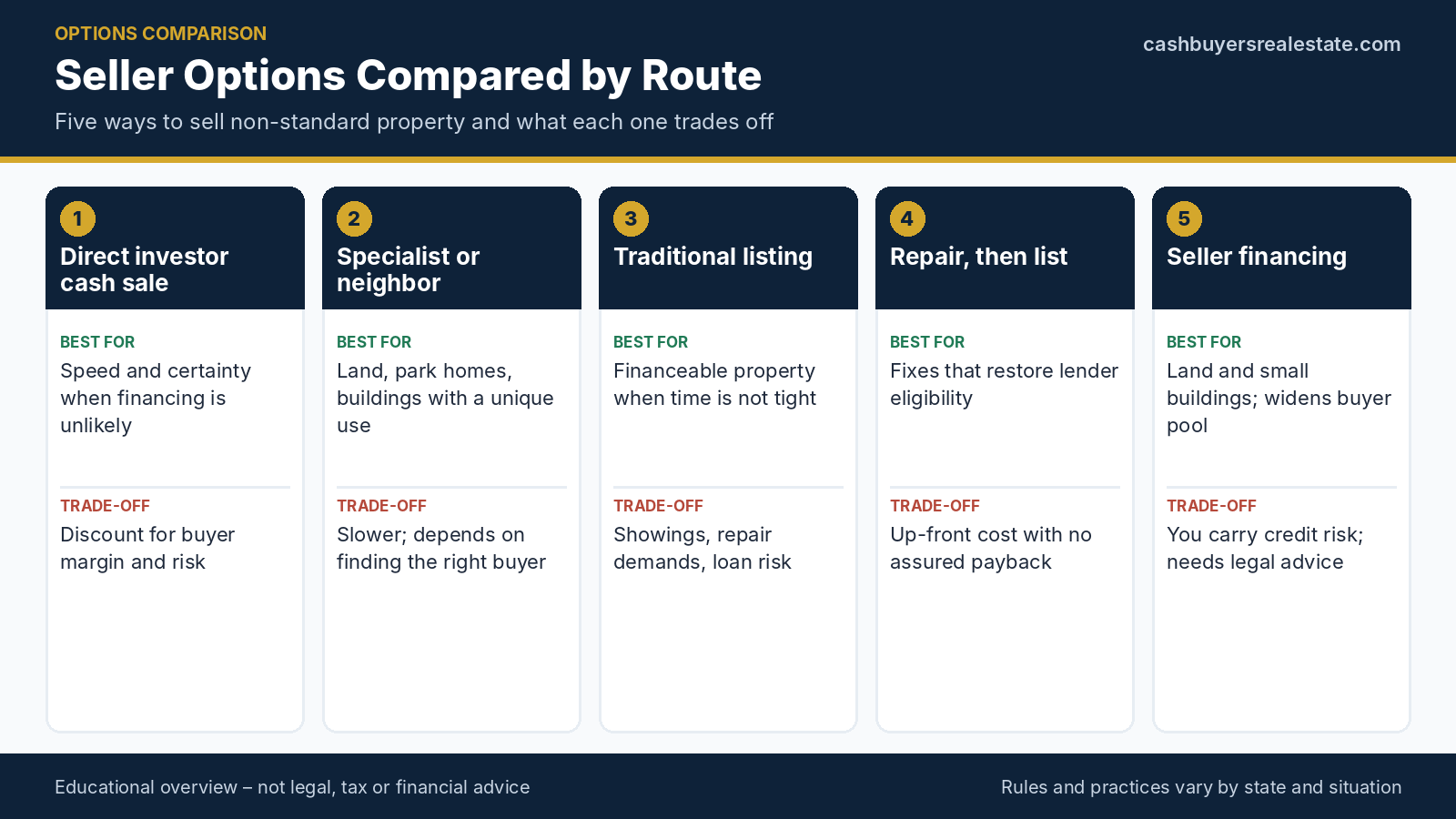
Text version of this infographic
- Direct investor cash sale — Best for: Speed and certainty when financing is unlikely. Trade-off: Discount for buyer margin and risk.
- Specialist or neighbor — Best for: Land, park homes, buildings with a unique use. Trade-off: Slower; depends on finding the right buyer.
- Traditional listing — Best for: Financeable property when time is not tight. Trade-off: Showings, repair demands, loan risk.
- Repair, then list — Best for: Fixes that restore lender eligibility. Trade-off: Up-front cost with no assured payback.
- Seller financing — Best for: Land and small buildings; widens buyer pool. Trade-off: You carry credit risk; needs legal advice.
Duplexes, Multifamily and Mixed-Use Buildings: Income, Tenants and Financing Lines
The moment a building contains more than one household, it stops being valued like a home and starts being valued like a business. Buyers care less about the paint colors and more about rent rolls, lease terms, operating expenses and who pays the utilities. That change reshapes the buyer pool, brings lenders with different rules into the picture, and creates a document trail that you will need to assemble before anyone can make a firm offer.
Where small residential ends and commercial lending begins
Mortgage markets draw a line at four units. Buildings with one to four units are generally financed with residential-style loans, and buildings with five or more are financed with multifamily or commercial loans. The line isn’t a legal definition of how buildings are used, but it organizes who can buy and how quickly they can close, so it shapes your sale more than most sellers expect.
The one-to-four unit line and what it means for buyers
HUD’s description of the basic FHA mortgage program, on its 203(b) program page, says FHA insures loans to purchase or refinance a principal residence in a one-to-four unit structure, with financing of approximately 96.5 percent. That is the doorway that lets an individual buy a duplex, triplex or fourplex while living in one unit. Beyond four units the market changes. A Congressional Research Service report on multifamily housing finance defines multifamily mortgages as loans secured by a residential building with five or more separate units, and explains that these loans are underwritten on the property’s expected rental income, with lenders typically requiring a debt service coverage ratio of at least 1.25 and a loan-to-value ratio of 80 percent or less. Private multifamily loans usually have shorter maturities, about five years, along with prepayment penalties and often adjustable rates.
Those differences affect your sale in several ways. A duplex or fourplex can attract two audiences: owner-occupants who plan to live in one unit and use residential financing, and investors who buy with cash or business loans. A building with five or more units belongs almost entirely to the investor world, where lenders examine rent rolls and operating statements, appraisals take longer, and closings are more complex. Cash buyers add speed and certainty in both markets, because they avoid the lender’s income analysis and the property inspections a lender may require. The related guide on cash buyers for rental properties covers the landlord’s side of this in more depth, including how investors evaluate portfolios.
Owner-occupants, investors and the tax consequences of a duplex sale
Owner-occupant buyers are a distinct group. Because they will live in one unit, they buy emotionally and practically like homebuyers, caring about the unit they will occupy, the neighborhood and monthly cost, while also reading the other units as income that offsets their payment. They are valuable to a seller because they often pay full retail value, but they commonly finance, and their lender may require repairs or may question the condition of the other units. Investors buy for income and are more likely to pay cash, ignore cosmetic issues and move quickly, but they apply a more demanding yardstick: the numbers have to work at the price they pay.
If you have lived in one half of a duplex and rented the other, the tax treatment of your sale is more complicated than for an ordinary home. The IRS explains in Publication 523 that for space separate from the living area, such as a duplex where you rented one unit, you generally can’t exclude gain on the rental portion unless you owned and lived in that part for at least two of the five years before the sale, and that basis and the amount realized must be allocated between the residential and rental portions. Depreciation claimed on the rental portion is also subject to recapture. These rules can change what you actually keep, so a tax professional should review the sale before you accept an offer. For investors who are selling a rental property they have held for investment, federal like-kind exchange rules, described on the IRS’s real estate tax tips page, apply only to real property held for business or investment use and have strict requirements that a qualified professional should explain.
How buyers value income property and what they ask to see
Income buyers use a vocabulary that homeowners rarely meet: net operating income, capitalization rate, rent roll, vacancy and expense ratios. You don’t need to become an appraiser, but you do need to know enough to read an offer and to see which of your records will change a buyer’s number.
Net operating income, cap rates and the rent roll
Net operating income, or NOI, is the property’s income after operating expenses but before mortgage payments, income taxes and depreciation. A buyer estimates it by starting with scheduled rent, subtracting a vacancy and collection allowance, and subtracting expenses such as property taxes, insurance, repairs, utilities the landlord pays, management and reserves. The capitalization rate, or cap rate, is the NOI divided by the price, and buyers use it in reverse to convert an income estimate into a value: divide NOI by the cap rate they require. Because small changes in either input move the answer a lot, two sophisticated buyers can arrive at prices that differ by tens of thousands of dollars from the same building. The table below illustrates how that works, using made-up inputs rather than market data.
| Buyer assumption | Expenses as share of income | Net operating income | Required cap rate | Implied value |
|---|---|---|---|---|
| Buyer A: low expenses, strong demand | 38% | $32,513 | 7.0% | $464,000 |
| Buyer B: typical expenses | 42% | $30,415 | 7.5% | $406,000 |
| Buyer C: higher expenses, cautious about risk | 46% | $28,318 | 8.0% | $354,000 |
All three buyers in the table start with the same assumed rents: four units at $1,150 a month, or $55,200 a year, reduced by a 5 percent vacancy allowance to $52,440. Only the expense ratio and the required return differ, and those two judgments alone produce a spread of about $110,000. The lesson for a seller is that documentation of real expenses and stable rents narrows the buyer’s uncertainty and supports a higher number. Utility bills, tax statements, insurance declarations, repair invoices and a twelve-month rent ledger are the records that turn guesses into facts.
Tenants, leases, estoppels and the extra duties of mixed-use buildings
When tenants live in the building, a buyer generally takes the property subject to the leases, and may request copies of every lease, a current rent roll showing who has paid, and a statement of security deposits held. In larger or commercial-leased buildings, buyers often ask tenants to sign an estoppel certificate confirming the lease terms, rent, deposits and absence of disputes. Rules about how deposits must be transferred or returned, what notice tenants must receive about a sale, and what happens to month-to-month tenancies are set by state and sometimes local law, so check the rules where the property sits. The guide on selling a house quickly with tenants in place goes through those landlord-tenant questions from the occupancy side.
Mixed-use buildings, such as apartments above a shop, add commercial-lease terms, zoning questions and sometimes environmental concerns. Commercial tenants often have lease provisions, such as options to renew or rights of first refusal, that bind a buyer, and the zoning of the parcel decides whether the current mix of uses can continue if the buyer renovates or the building is damaged. Residential units in older buildings are also subject to the federal lead-based paint disclosure rule if the housing was built before 1978; the EPA’s real estate disclosure page says the rule applies to most pre-1978 private housing including apartments, and that sellers of multi-unit buildings must provide available records covering common areas and other units. Unpermitted conversions, such as an illegal basement apartment, can complicate the sale, because a buyer may treat the unit as having no value or require that it be legalized or removed.
Cash Versus Financed Buyers: Appraisals, Underwriting and the Real Price of Certainty
The reason cash matters so much for non-standard property is that a mortgage lender examines the property in ways that an individual buyer paying with savings or business funds never does. Every extra gate a lender adds is a place where the sale can slow, shrink or fail. Understanding those gates, one at a time, lets you judge when a lower cash offer is a fair price for certainty and when it is an unnecessary concession.
Where financing breaks on non-standard property
Lenders aren’t being arbitrary when they decline unusual collateral. A mortgage is secured by the property, and the lender must be able to sell that property if the borrower defaults. Anything that makes resale slow, uncertain or legally complicated, from a missing label on a manufactured home to a condominium project in financial trouble, weakens the collateral. Seeing the lender’s problem clearly explains why so many of the property types in this guide lean toward cash.
Appraisals, collateral rules and why the value must be defensible
The Consumer Financial Protection Bureau describes a home appraisal as a written document that gives an opinion of how much a property is worth, one that explains what makes it valuable and may compare it with nearby properties; when a buyer purchases or refinances, the CFPB explains, the lender may need a new appraisal and may require the borrower to pay for it. The appraisal protects the lender, not the seller. If the appraised value comes in below the agreed price, the loan amount shrinks, and the contract is likely to be renegotiated, financed with more cash from the buyer or terminated. A cash buyer isn’t bound by that process, which is why the question of whether cash buyers need one is covered separately in the guide on whether cash buyers require appraisals.
The difficulty for non-standard property is that appraisers rely on comparable sales, and the comparables are scarce. A rural acreage with a farmhouse, a double-wide in a land-lease community or a unit in a building with unusual restrictions may have only one or two relevant sales in the past year, and an appraiser must adjust for every difference. Those adjustments produce values that can land below what a buyer and seller agreed on in good faith. A cash buyer can simply proceed at the agreed price, may rely on their own judgment of value, and may use a lighter check such as a broker opinion or a contractor’s estimate. If any part of the cash comes from a private lender or a partner, that party may ask for its own valuation, so don’t assume that “cash” means no one is checking the number.
Property eligibility rules: condition, systems, project and land status
Beyond value, lenders check whether the property qualifies at all, and several of the categories already discussed fall outside standard programs. Fannie Mae’s guide on manufactured housing loans, for example, says the loan must be secured by both the home and the borrower’s interest in the land, that both must be legally classified as real property, that a home on leased land is eligible only if it is in an approved condominium or planned unit development, and that investment properties and homes in co-op projects are ineligible. Its property-eligibility topic adds that homes with incomplete work or safety, soundness or structural defects are ineligible until those items are finished. The guide’s condominium requirements set limits on delinquent dues and reserve funding, and its co-op rules require that a co-op share loan finance a principal residence or second home rather than an investment.
These are the rules of one major purchaser of mortgages, and other lenders, government programs and portfolio lenders apply their own, sometimes more flexibly and sometimes less. The general pattern, though, holds across the industry. Land that lacks legal access, a septic system that has failed, a roof with active leaks, a home in a flood zone whose insurance is expensive, or a unit in a troubled project can each prevent a mortgage from being approved. The Federal Emergency Management Agency’s FloodSmart site notes that many owners in high-risk flood areas may be required to carry flood insurance, and invites you to look up an address in the Flood Map Service Center. Knowing which of these checks your property would fail tells you which buyers are realistic, and whether fixing the issue before listing would open the market back up.
What a cash sale removes, what it keeps and what it costs
Selling for cash removes some uncertainty and leaves other uncertainty in place. Being precise about the difference prevents unrealistic expectations on both sides of the table.
Contingencies, speed and the question of certainty
A cash purchase eliminates the financing contingency and the appraisal contingency, the two clauses that most often let a buyer back out of a financed contract. It does not eliminate title requirements, association or board approvals, a park’s review of the buyer, payoff of liens, survey questions, or any inspection or due-diligence period the buyer negotiates. Cash buyers often ask for a short inspection period and sometimes a long one for land. Reading the contract for what remains contingent is more informative than hearing the word “cash.” Questions about proof of funds, earnest money and the completeness of the contract are covered in guides such as the one on proof of funds from cash buyers, and a seller who verifies the money before taking the property off the market avoids an unpleasant surprise.
| Step | Financed buyer | Cash buyer | Property types most affected |
|---|---|---|---|
| Valuation | Lender-ordered appraisal must support the price | Buyer’s own analysis; third-party valuation only if a partner or private lender requires it | Land, rural homes, unusual buildings |
| Lender review of the property | Condition, systems, access and legal classification must meet program rules | No lender review; buyer decides what risk to accept | Manufactured homes, homes with failing systems |
| Project or community review | Lender reviews association finances and the building | Buyer reviews the same documents for its own purposes | Condominiums, co-ops, planned communities |
| Third-party approval | Association, board or park approves the buyer | Same approvals still apply | Co-ops, land-lease communities, some condominiums |
| Title, survey and payoffs | Required by lender and title insurer | Still needed to protect the buyer and clear liens | All types, especially land with access questions |
| Verification of funds | Pre-approval and underwriting | Proof of funds, earnest money, closing partner checks | All types |
The pattern in the table is that cash removes the lender-related rows and leaves the rows that involve other people: boards, parks, title companies and the buyer’s own diligence. This explains why a cash offer on a cooperative or a park home does not automatically close faster than a financed one, and why a cash offer on rural land or an unusual building is often dramatically faster, since the lender’s review was the slowest step. Ask any buyer to list every approval and document it still needs from you, from third parties and from itself, and build the schedule from that list.
The price discount versus the net you actually keep
It is natural to compare two offers by their headline numbers, but the number that matters is what remains after everything that comes out of the price. A reasonable way to compare, and one that is only illustrative, is to start with the contract price, subtract mortgage and lien payoffs, subtract commissions, subtract seller-paid closing costs such as title charges, transfer taxes where they apply and association or board fees, subtract repairs or credits the buyer will demand, and then subtract the cost of carrying the property while you wait: taxes, insurance, utilities, lot rent or association dues, and the interest on any loan you can’t pay off. For a financed sale, weigh the result by the probability that the sale actually closes, because a deal that falls apart returns you to the starting line after months of carrying costs.
That kind of comparison explains why a cash offer noticeably below a hoped-for listing price can still leave you with a similar or better result for non-standard property, and why in other cases it is a poor trade. Neither outcome is automatic. Part of the discount reflects the buyer’s expenses and margin, part reflects the speed and certainty you receive, and part reflects risk the buyer takes on that a lender would have declined. For the detailed arithmetic of how cash and conventional sales compare, see the guide on cash offer net proceeds. For the contract side, the article on cash offer contract red flags lists the terms that tilt an offer unfairly.
Whatever the property type, six factors recur when a seller decides whether a particular cash offer is reasonable. The first is the property’s market value under realistic assumptions, which for non-standard property may be a range rather than a point. The second is its physical and legal condition, including systems, title, access and approvals. The third is the repair budget, meaning what it would cost you or a buyer to fix what is wrong. The fourth is holding costs, the monthly expense of owning the property while it is unsold. The fifth is transaction costs, including commissions, closing charges, association fees and taxes. The sixth is the buyer’s margin, the gap between what the buyer pays and what the buyer expects to recover. Together these form the decision checklist summarized in the image below, and each should be answerable with a number or a document before you sign.
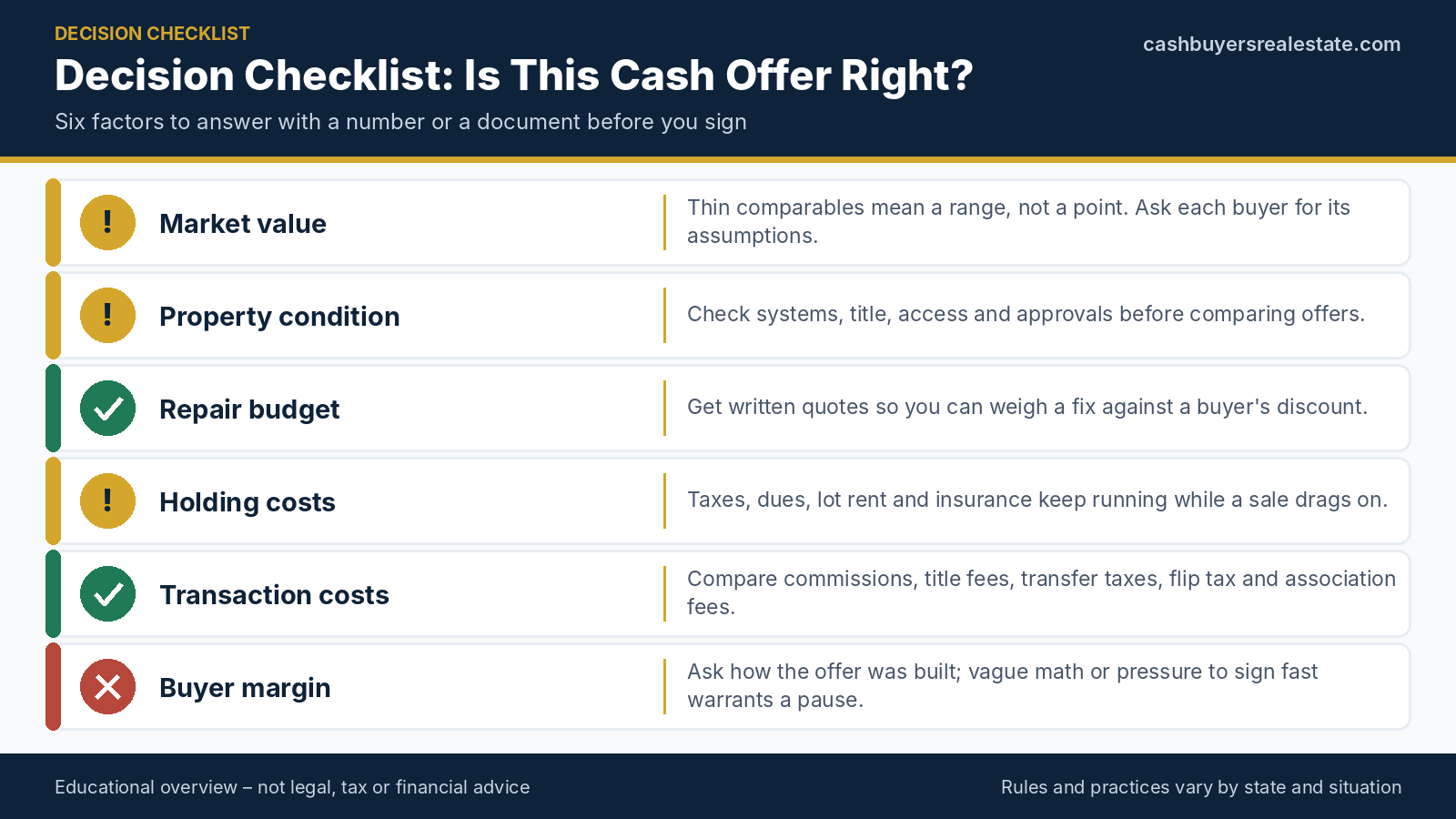
Text version of this infographic
- Market value — Thin comparables mean a range, not a point. Ask each buyer for its assumptions.
- Property condition — Check systems, title, access and approvals before comparing offers.
- Repair budget — Get written quotes so you can weigh a fix against a buyer's discount.
- Holding costs — Taxes, dues, lot rent and insurance keep running while a sale drags on.
- Transaction costs — Compare commissions, title fees, transfer taxes, flip tax and association fees.
- Buyer margin — Ask how the offer was built; vague math or pressure to sign fast warrants a pause.
Disclosures, Documents and Closing Costs That Follow Each Property Type
A cash buyer can waive a mortgage, but no buyer can waive the law’s expectations of the seller. Disclosure duties, document requirements and closing costs attach to the property and the jurisdiction, not to the buyer’s source of funds. Preparing these items before you accept an offer protects you from allegations of concealment, speeds up the buyer’s diligence, and lets you compare offers on equal terms.
Special disclosures that depend on what you are selling
Disclosure law in the United States is a patchwork. A few duties come from federal law and apply nationwide; most come from state statutes, court decisions and local ordinances; and a few come from the contract or the association’s governing documents. The right approach is to learn which apply to your property type and state and to treat the honest, documented disclosure of what you know as the default.
Federal and state disclosure duties: the baseline for every type
The federal lead-based paint rule is the best-known nationwide duty. According to the EPA, sellers of most housing built before 1978 must give the buyer the agency’s lead hazard pamphlet, disclose any known lead-based paint or hazards, provide available records and reports, include a lead warning statement in the contract, and allow a ten-day period for a paint inspection or risk assessment unless the parties agree otherwise in writing. Signed copies must be kept for three years. The rule has exemptions, including housing built after 1977, zero-bedroom units such as efficiencies and lofts, certain housing for the elderly or persons with disabilities, and foreclosure sales. The rule is triggered by the sale of covered housing, and the EPA’s description makes no exception for a cash sale. Apartments and condominiums are covered, and sellers of multi-unit buildings must supply building-wide records where they exist.
State requirements are far more varied. Many states require sellers to complete a standardized disclosure form listing known material defects, while others impose narrower duties or rely on the seller’s duty not to misrepresent or conceal known problems. Selling “as-is” changes who pays for repairs, but in many states it doesn’t excuse a seller from disclosing what they know or from fraud, and it never permits hiding a defect. Some jurisdictions add specific topics, such as flood history, proximity to known hazards, or the existence of unpermitted work. Because the statutes differ, the safest practice is to ask a local real estate attorney or your state’s real estate regulator what form applies and to answer it truthfully. The related guide on disclosures in an as-is home sale examines that question in detail.
Property-specific disclosures: wells, septic, associations, parks and tenants
Beyond the general duties, each property type carries its own set of facts a buyer will want to know. For a rural home, that includes the age and location of the septic tank and drainfield, pumping and repair history, the well’s depth, recent water tests and any known contamination or low-yield problems, as well as any drainage, flooding or erosion on the land. For a condominium or townhome in an association, it includes the association’s governing documents, current assessments, pending special assessments, litigation, insurance and rules on rentals and pets. For a cooperative, it covers the proprietary lease, the house rules, the corporation’s financial statements and the flip tax. For a park home, it means the lot lease, the rent history and the park rules. For tenant-occupied buildings, it means leases, deposits, arrears and any notices that have been served.
If a statement is required and you don’t know the answer, say so rather than guess. If you do know of a problem, put it in writing, because a documented disclosure protects you in the way an undocumented one cannot. The table below pulls these items together into a document checklist by property type, with the usual source of each record. Treat it as a starting point and add whatever your state or association requires.
| Property type | Documents to gather | Where to get them | Why a buyer asks |
|---|---|---|---|
| Manufactured home | Certificate of title or deed, data plate and labels, installation or foundation records, lot lease | State titling agency, county recorder, park management | Proves what is being sold and whether it counts as real property |
| Condominium or townhome | Resale or estoppel package, governing documents, budget, reserve study, minutes | Association or managing agent | Shows dues, assessments, restrictions and building health |
| Cooperative | Stock certificate, proprietary lease, house rules, corporation financials | Managing agent, corporation’s attorney | Defines what is transferred and who must approve |
| Land or acreage | Deed, survey, easements, soil or percolation report, zoning letter, tax bill | County recorder, surveyor, county planning and assessor offices | Answers access, use and cost questions |
| Rural home with well and septic | Water test results, septic records and permits, well log | County health office, licensed testers and septic contractors | Shows the condition of systems no one can see |
| Rental or multifamily | Leases, rent roll, deposit ledger, expense records, tax and insurance bills | Owner’s files, property manager, insurer | Lets the buyer calculate income and risk |
Look at the table by the number of third parties in the third column. Each outside party, whether a county office, an association or a park manager, works on its own schedule, and some charge fees or take weeks to respond. Starting those requests before you have an offer is one of the cheapest ways to protect the timeline you want.
Costs, holding expenses and the buyer’s margin
Costs differ more by property type than sellers expect. A cash sale of an ordinary house might involve a title search, a settlement fee and recording charges; a cash sale of a condominium adds association charges, and a cooperative adds a flip tax and board fees. Taking these in advance lets you compare offers by what you will actually receive.
Transaction costs that change by property type
Who pays what is a matter of local custom and contract. In some states the buyer customarily pays for the owner’s title policy and in others the seller does; some states charge transfer or documentary taxes on the deed and others don’t; some closings are run by attorneys and others by title or escrow companies. Beyond those basics, property types add their own items. Condominium and townhome sellers may pay for the resale or estoppel package, and Florida’s statute, for instance, caps what an association may charge for the estoppel certificate at stated amounts with additional fees for expedited or delinquent accounts. Cooperative sellers may owe a flip tax and a board package fee. Park-home sellers may face application, credit-check or transfer fees, which the park or the buyer may charge depending on the state and the lease. Land sellers may pay for a survey, a soil test or a zoning letter. Rural sellers may pay for a well test or a septic inspection.
When comparing offers, ask each buyer to state in writing which of these costs they expect to pay and which they assume you will pay. A buyer who says the offer is “net to you” should show the arithmetic. A longer treatment of how closing costs behave in quick sales is in the guide to closing costs in a fast home sale. The point to remember here is that cost allocation is negotiable, and a smaller headline price with the buyer covering most costs can beat a larger price with a long list of seller charges.
Holding costs, taxes on the sale and the buyer’s margin
Holding costs are what you pay each month to own the property while it is unsold: property taxes, insurance, utilities, upkeep, and, depending on the property, association dues, lot rent, mortgage interest or the cost of securing a vacant building. Vacant buildings can be harder or costlier to insure, so ask your insurer what changes if the property is empty. Over a long listing, these costs can erase a price advantage, as the earlier examples showed. They are also part of the buyer’s calculation after closing, which is why buyers of non-standard property price the time it will take to resell.
A cash buyer’s margin is the difference between what the buyer pays and what the buyer expects to net when the property is resold or rented. It covers the buyer’s repair costs, holding costs, selling costs, the cost of capital and the profit that compensates for risk. A buyer who is honest about those components is easier to negotiate with than one who is vague, and you are entitled to ask how the offer was built. Taxes on your own sale depend on facts that this guide cannot know. The IRS explains in Topic 701 that an owner can exclude up to $250,000 of gain on a main home, or $500,000 on a joint return, if ownership and use tests are met over two of the five years before the sale, and that a sale must be reported if you receive a Form 1099-S. The exclusion isn’t designed for land held apart from a home, for rental units or for investment property, so a tax professional should review the sale of any property that doesn’t fit the ordinary main-home pattern.
Questions Sellers Ask About Selling Non-Standard Property for Cash
The questions below come up repeatedly once a seller realizes that the property is not an ordinary house. The answers are short by design and assume the longer explanations earlier in this guide. Where the answer depends on state law or on a document you hold, the best next step is usually to ask the agency, association or professional named, and to read the recorded document itself.
Questions about the property itself
Manufactured homes, condominiums and cooperatives
- Can I sell a manufactured home for cash if I can’t find the title?
Usually a buyer’s closing partner will insist on proof that you are the owner, so a missing title is a problem to solve first. Most states have an agency that issues duplicate titles for manufactured homes, and the process normally requires identification, an application and sometimes lien information. If the home has been converted to real property, the proof of ownership is a recorded deed instead. Ask the titling agency or a local title company which record applies to your home before you accept an offer.
- Does a manufactured home need a permanent foundation to be sold?
No law stops you from selling one that rests on piers or blocks, and cash buyers regularly buy them. The foundation matters mostly for how the home is classified and financed. The CFPB notes that a manufactured home generally can be titled as real estate only if it sits on a permanent foundation on land the owner owns, and mortgage programs commonly require that classification. A home without it tends to sell to cash buyers or to buyers using personal-property loans.
- Will the condominium association have to approve a cash buyer?
It depends on the declaration and bylaws. Many associations don’t approve buyers at all, while some require board approval or hold a right of first refusal, and Florida’s estoppel certificate, for example, must report the association’s approval and right-of-first-refusal status. Read the governing documents or ask the managing agent before you list. Where approval is required, it usually applies to a cash buyer as much as a financed one.
- Do cooperative boards treat cash buyers differently?
They may, but the board still reviews the application. Some boards are comfortable with buyers who borrow little or nothing, and some require the buyer to keep a stated amount of liquid funds after closing. A few restrict how much the buyer can finance. The proprietary lease, the house rules and the managing agent are the sources that tell you what your board expects.
Land, rural systems and income property
- Do I need a survey to sell vacant land for cash?
Not necessarily, and the rules differ by state. A survey is a practical tool, however, because buyers and title insurers often ask for one when boundaries are uncertain. If you have an older survey, offer it, and be ready for a buyer to want an updated one. Paying for a survey yourself makes sense when the boundary or access is the main question holding down offers.
- Should I replace a failing septic system before I sell?
Not always. Get written repair or replacement quotes, compare the cost with the discount buyers apply, and check your county’s rules, since some jurisdictions require action at transfer. Cash buyers who plan to repair or rebuild may prefer to handle the system themselves and may price it lower than your quote. Whatever you decide, disclose what you know, and keep records of any inspection.
- Can I sell a tenant-occupied duplex for cash while the tenants stay?
Yes, and many investors prefer buildings with paying tenants already in place. The buyer generally takes the property subject to existing leases, and state and local law governs how security deposits are handled and what notice tenants must receive. Provide leases, a rent ledger and the deposit amounts early. Tenants who are behind on rent, or who occupy an unpermitted unit, will affect the price.
Questions about price, process and safety
Offers, net proceeds and timing
- Why do offers on land and unusual buildings vary so widely?
Because the buyers are valuing different futures. A farmer, a builder and a neighbor each assume a different use, and each assumes different costs for access, permits and utilities. Ask every buyer for the assumptions behind the number. If two offers differ because of one assumption you can verify, such as a zoning allowance, documenting that fact may close the gap.
- How long does a non-standard cash sale usually take?
There is no reliable single figure, because the timeline depends on the slowest outside party. Park approval, association paperwork, board review, survey work and the buyer’s due-diligence period all add time. California’s mobilehome statute, as one example, gives park management 15 days to state its standards and 15 business days after receiving information to respond. Ask the buyer to list every approval needed and build a schedule from that list.
- Is a cash offer always lower than a financed offer?
No. A cash offer is often lower than a hoped-for listing price, but a financed offer that fails at appraisal, project review or lender underwriting nets nothing, and the carrying costs keep running. Compare each offer by what you take home after commissions, closing costs, repairs and the cost of waiting, and consider how likely each is to close.
- Should I collect more than one offer?
It is a sound idea, especially for property with thin comparables. Offers from a neighbor, an investor and a specialist can differ meaningfully. Share the same documents with each buyer, ask each to put its assumptions in writing, and compare terms, including contingencies and who pays which costs, instead of price alone.
Verifying the buyer and protecting your money
- How can I tell that a cash buyer really has the money?
Ask for proof of funds, such as a recent statement or a letter from a financial institution, and have the closing partner confirm it. Look up the institution’s phone number yourself rather than using one printed on a document you were handed. A meaningful earnest money deposit held by a title company, escrow agent or attorney is another signal. No single document proves a buyer is honest, but several consistent ones lower the risk.
- What is wire fraud at closing, and how do I avoid it?
The Federal Trade Commission describes a scam in which criminals hack email accounts, learn about an upcoming closing, then pose as the agent or title company with changed wiring instructions. Treat any emailed wiring instruction as suspect, and call a number you already know to confirm. If money has been sent to the wrong account, ask your bank to recall the wire immediately and report it to the FTC and the FBI’s Internet Crime Complaint Center.
- Who should review the contract before I sign?
A real estate attorney licensed in your state is the best choice for any non-standard property, particularly one involving an association, a lease, a title question or a tax issue. Many states have lawyer-referral services through the state bar. A tax professional should review the sale if the property is land, a rental, a multi-unit building or anything other than your main home.
Choosing the Right Route for Your Property and What to Do First
By this point the central idea should be clear: the property type determines the buyers, the paperwork and the approvals, and cash is a tool that removes some of the friction without removing the rest. The remaining task is to decide what matters most to you and to take the first practical steps in an order that protects your options.
A decision framework for matching property type to selling route
A useful framework starts from your priorities rather than from the buyer’s pitch. Most sellers care about some mix of speed, price, certainty, effort and risk, and the right route is the one that serves the two or three priorities that matter most in your situation. Writing those priorities down in order, before you hear any offers, protects you from being steered toward a route that benefits the other side more than you.
Weighing speed, certainty and net proceeds against your own priorities
Start with the clock. If you have a hard deadline, such as a relocation, a probate timeline, a balloon payment or carrying costs you can’t sustain, certainty and speed carry more weight, and a cash offer that closes on a predictable schedule may deserve a premium in your thinking even if its price is lower. If you have time and the property is eligible for conventional financing, the equation shifts toward the route that exposes the property to the widest market. Next, consider effort and exposure: some sellers can’t manage repeated showings, repair negotiations and months of upkeep, and others can, and the value you place on avoiding that burden is legitimate even though no table can measure it.
Then turn those priorities into arithmetic. For each realistic route, estimate the net proceeds using the method described earlier, subtract the cost of waiting, and weigh the result by how likely the sale is to close. A route with a higher expected net and a modest delay can beat a quick sale with a deep discount, and a quick sale can beat a higher price that is unlikely to survive a lender’s review of your project or your septic system. If the numbers are close, let the tie-breaker be the thing you can’t afford to lose, whether that is time, peace of mind or the last few thousand dollars.
It helps to assign each priority a rough weight before any offer arrives, for example by asking how much you would pay, in dollars, to close two weeks sooner or to avoid a single round of showings. Sellers who do this often discover that their real constraint is narrower than they assumed: perhaps only a closing date matters, or only a minimum number, and everything else is flexible. Once the constraint is named, it becomes a screening question you can put to every buyer in the first conversation, which keeps you from investing days in an offer that was never going to fit.
When a listing, a financed buyer or a specialist is the better fit
A conventional listing with an agent tends to fit properties that financed buyers can approve and that you can present well: a manufactured home on owned land that has been converted to real property, a condominium in a healthy project, a house with working systems. It exposes the property to the largest pool of buyers, and when time isn’t tight it may produce the best price. A specialist buyer or neighbor fits when the property has a feature that matters mainly to one kind of person, such as adjoining land, a mobile home community or a building with income potential. That route can be slow, but it often yields the best price for non-standard assets.
A direct cash sale to an investor fits when the property has barriers that make financing unlikely, when the repairs or paperwork problems are larger than you want to take on, or when speed and certainty are your highest priorities. Repairing or documenting first and then listing is worth considering when a modest, well-understood fix would restore eligibility for financed buyers, such as obtaining a duplicate label for a manufactured home or ordering a septic inspection. Seller financing suits some land and small-building sales but needs legal and tax advice. Keeping and renting the property is also a legitimate alternative if the numbers work and the work of being a landlord suits you. No route is best in general, and the right one can change as facts change.
What to do next: documents, questions and safeguards
With a route in mind, the next steps are concrete. They cost little, they preserve your leverage, and they apply whichever route you pick.
The first two weeks: documents, approvals and professionals
Begin by confirming what you legally own. Pull your deed, your title or ownership record, any loan payoff information, and the governing documents that apply to your property type, whether that is a condominium declaration, a cooperative lease, a park lot lease or a recorded easement. Then request the records that take outside parties time to produce: the association’s resale or estoppel package, a septic or well record from the county, a zoning confirmation, a duplicate data plate or title, and the rent roll and leases if tenants live there. Put them in one folder, in the order the checklist in this guide suggests, and keep copies of what you send to anyone.
Next, line up the professionals who can protect you. A real estate attorney licensed in your state can read a contract, explain approvals and review title issues. A title or escrow company, or an attorney’s office where attorney closings are the norm, will run the closing. A tax professional can tell you what the sale will mean for your return, particularly for land, rentals and multi-unit buildings. If you decide to talk with cash buyers, request offers in writing and use the same set of documents for each, so that differences between offers reflect the buyers’ judgment and not what they happened to learn.
Keep a running log of every request you make, with the date, the person or office contacted and what was promised, because the outside parties on your list rarely hurry and follow-up calls are part of the work. Ask your mortgage servicer for a payoff statement if a loan exists, and ask the county or association whether any unpaid taxes, assessments or violation notices are attached to the property, since those items must be cleared at or before closing. Finally, ask your insurer whether coverage changes if the property is vacant or being sold, so that a gap in protection does not appear while a contract is pending.
Questions to ask any buyer, and how to protect the money at closing
Ask each buyer how the offer was calculated, what the buyer assumes about repairs and approvals, which costs the buyer expects to pay and which it expects you to pay, what contingencies remain in the contract, what the earnest money is and who holds it, who will conduct the closing, and what the buyer will do if a third-party approval takes longer than planned. The guide on questions to ask a cash home buyer expands this list, and the article on whether cash home buyers are legitimate explains how to judge a buyer’s credibility without assuming bad faith. Pressure to sign quickly, reluctance to put terms in writing or a refusal to let an attorney review the contract are reasons to slow down, though none alone proves wrongdoing.
Protect the money itself. Use a reputable title company, escrow agent or closing attorney who is independent of the buyer, confirm wiring instructions by calling a number you already know, and never act on instructions that arrive only by email. Make sure payoffs of any loans or liens are written into the closing statement, and check the figures against your own net estimate before you sign. Keep every contract, disclosure and receipt, since the lead-based paint rule alone requires sellers to retain signed disclosures for three years.
Choosing to sell property for cash is neither a cure-all nor a misstep. For some properties and some sellers it is the most practical route; for others a listing, a specialist buyer or a period of preparation will produce more money or fewer headaches. You can move at your own pace, gather the documents that apply, compare offers by what you would actually keep, and decide only when the terms make sense for you. If your situation is urgent, the broader overview in the guide to selling a house fast covers speed-focused options, and an attorney or tax professional in your state can answer the questions this general guide cannot.