
Sell Home for Cash: Offers, Costs & Closing
Most homeowners who decide to sell home for cash aren’t short on opinions about price. What they’re short on is a clear picture of what a buyer will ask for in the first few days, and what each unanswered question is likely to cost them. A cash buyer, whether that’s an individual investor, a small company, or a relative with savings, is deciding how much to pay for a house they usually haven’t seen in full and a file they haven’t yet read. Every gap in that file gets filled with an assumption, and assumptions made by someone about to commit money are rarely generous. The sellers who finish a cash sale with the least regret tend to be the ones who knew what the buyer needed to see and had it ready, not the ones who happened to hear the biggest number on a first phone call.
The short version is that preparation has three jobs. It proves you have the legal right to sell, it describes the property honestly enough that a buyer can price it without a large safety cushion, and it makes the handoff of keys, occupants and belongings easy to schedule. None of that raises your home’s market value, and none of it obliges you to accept anything. What it does is shrink the buyer’s uncertainty, which is the one part of a cash offer you can actually influence. The rest, including the buyer’s margin, the cost of repairs and the price a retail buyer might pay after renovation, is outside your control, and a prepared seller is simply better placed to judge whether the resulting offer is reasonable.
Short answer: To sell a home for cash with fewer surprises, assemble proof of ownership and identity, a current mortgage payoff figure, tax and HOA details, and an honest fact sheet on the property’s condition. Then settle who lives there, what stays, and how a buyer can see it. Compare any offer to your net proceeds from other routes before signing.
This guide is organized around the information a cash buyer and a title or closing professional will want from you. It starts with how buyers turn the facts you provide into a price, then walks through the ownership and payoff folder, the property fact sheet and your disclosure duties, and a plain comparison of what preparation is worth against other ways of selling. After that come the practical pieces that trip up sellers more often than price does: access and occupancy, personal property and cleanout, and realistic preparation schedules for three, seven and fourteen days. The closing sections answer common questions and give you a framework for choosing a route, along with a short list of first steps you can take this week.
Several neighboring topics deserve their own pages, so they get only brief treatment here. How buyers calculate an offer in detail and what a cash sale costs you at closing are covered in the broader guides on selling my house for cash and fast-sale closing costs. If your main concern is speed rather than paperwork, the general checklist in how to prepare for a fast home sale is the better starting point, and the process-level overview lives in the sell house for cash guide. What follows is narrower and more practical: the specific papers, facts and arrangements that let a cash buyer say yes, or a clear and informed no, without a week of back-and-forth.
How a Cash Buyer Turns Your Information Into an Offer
A cash offer isn’t a verdict on what your house is worth. It’s the answer to a narrower question: what can this buyer safely pay, given what they know today, and still expect to come out ahead after repairs, carrying costs, resale expenses and the chance that something they haven’t found yet turns out to be expensive? Understanding that question explains why the same house can draw offers that differ by tens of thousands of dollars, and why the quality of your information is one of the few levers a seller really holds.
Why Missing Information Becomes a Lower Number
Buyers who pay cash usually move quickly, often without the long inspection, appraisal and underwriting sequence that comes with a financed purchase. That speed is a large part of what they’re offering, and it only works if gaps in the file are handled by pricing rather than by waiting.
Uncertainty Is Priced as a Margin
Investors and individual buyers alike think in ranges. At one end is the best case, in which the roof has a few years left and the electrical panel is original but safe. At the other end is the case where the roof fails inspection, the panel must be replaced, and a title question holds up the closing for weeks. When a seller can’t or won’t say where the house sits within that range, the buyer has no choice but to underwrite toward the unhappy end, because the cost of being wrong lands entirely on them. That’s how a contingency allowance, sometimes called a risk margin, finds its way into the number. It isn’t a penalty for being unprepared. It’s what the buyer needs in order to protect themselves from what they can’t see.
The margin isn’t a single line item that a buyer writes down and shows you. It’s spread across the repair estimate (rounded up when the evidence is thin), the time assumption (how long the buyer expects to hold the house before reselling or renting it, since every month adds property taxes, insurance, utilities and often interest on borrowed money), and the discount applied to the eventual resale price. Buyers who plan to resell rather than keep the property must also account for the commission and closing costs they’ll face on their own exit. So a missing roof age doesn’t only affect the roof line. It affects the buyer’s confidence in every other line. In practice, the unknown is the most expensive condition a house can have.
Notice what the margin responds to: it responds to what the buyer doesn’t know, not to what you know. A seller who has lived in a house for twenty years may understand its quirks intimately, but the buyer prices only the facts that arrive in writing or that their own walkthrough confirms. That’s why most of the work in the sections ahead is translation, turning what you already carry in your head into documents and statements that a stranger can rely on without a leap of faith.
The Three Questions Behind Every First Conversation
Whatever the buyer’s script sounds like, almost every first call is trying to answer three things. What shape is the house in? Can the title be delivered cleanly? And when can the buyer actually take possession? Condition drives the repair estimate. Title and payoff drive the legal and financial feasibility of the closing: if the sale proceeds won’t cover the loan balance, liens and costs, the deal can’t close without cash from you, and the buyer wants to know that early. Possession drives timing, because an occupied house, or one full of belongings, adds days, costs or legal steps before the buyer can start work, and every one of those days is a day the buyer’s money is committed but not yet working for them. Sellers sometimes assume the buyer cares mostly about price. In practice, the buyer cares about the spread between what they will pay and what they will eventually get back, and each of these three questions affects that spread.
Seen this way, the three questions map onto the three bundles of preparation covered in this guide. The property fact sheet answers condition. The ownership and payoff folder answers title and money. The access, occupancy and cleanout plans answer possession. A seller who can address all three in the first conversation, even where the honest answer is “I don’t know yet, here’s how I’ll find out,” signals competence, and competence reads as low risk. For a deeper list of what to ask a buyer in return, the guide to questions to ask a cash home buyer pairs naturally with the preparation described here.
One more point before moving on. These three questions are also a way to read the buyer. A genuine buyer who intends to close will want answers on all three, and will usually ask follow-ups. A buyer who jumps straight to a number without asking about condition, title or possession has either not thought the transaction through or plans to adjust the price later, after you’ve committed to a timeline. Neither is proof of bad faith, and neither should be treated as a verdict, but both are worth writing down in your own notes before you sign anything.
What a Prepared File Changes When You Sell Home for Cash
Preparation is easiest to understand through what it does and doesn’t affect. It operates on certainty, speed and negotiating position. It does not operate on the underlying value of the house, which is set by condition, location and the buyers available for that kind of property.
Where Preparation Shows Up in the Numbers
Think of preparation as a way to move items out of the buyer’s unknown column and into the known column. Each item that moves reduces the allowance the buyer must hold against it. A roof invoice with a date and a warranty transfer, a payoff letter showing the exact balance, an old termite report or survey, a signed statement about who lives in the house and under what terms: these are small documents, and each one retires a specific worry. Buyers differ in how much credit they give, and some will run their own inspection no matter what, but a seller who offers documentation is in a stronger position to ask why a particular deduction is being taken and what evidence would reduce it.
Preparation also affects speed in ways that feed back into price. A buyer who is waiting on a payoff figure, a missing signature from a co-owner, or a decision about what happens to the furniture has to keep funds reserved and plans on hold. That carries a cost, and it’s reasonable for it to be reflected in the offer or in the closing window the buyer asks for. A file that’s ready lets the transaction move at the pace the title work requires, rather than the pace at which you can gather things. How long the title work takes depends on the title company or attorney, the county recorder’s office and the complexity of the property, not on any universal number.
Illustrative example (hypothetical numbers, not market data): Two homeowners own near-identical three-bedroom houses. Owner A can’t say how old the roof is, hasn’t asked the lender for a payoff figure, and has a relative living in the back bedroom whose plans are unclear. Owner B has a dated roof invoice, a written payoff statement, and a signed note describing the relative’s move-out date. A buyer pricing Owner A’s house might hold back $9,000 for the roof and $3,000 for timing uncertainty, while the same buyer looking at Owner B’s file might hold back $4,000 and $500. The $7,500 difference isn’t a promise that any buyer will behave this way, since another buyer might see both houses differently, but it shows how documentation turns into dollars at the negotiating table.
What Preparation Cannot Do
It’s worth being blunt about the limits. Preparation won’t turn an as-is house into a renovated one in the buyer’s eyes, and it won’t close the gap between a cash buyer’s price and what a retail buyer might pay on the open market after a listing, showings and negotiation. That gap exists because the cash buyer takes on repairs, time, risk and resale costs, and expects to be paid for doing so. A tidy folder narrows the gap at the edges but doesn’t erase it. A seller who expects a stack of documents to produce a near-retail offer is likely to be disappointed, and may be vulnerable to a buyer who promises exactly that outcome.
Preparation also can’t substitute for comparison. Even a fully organized seller is better served by two or three written offers, or at least by a clear comparison against what the same house might net through a listing, than by a single offer from the first buyer to respond. Net proceeds, meaning the money you actually keep after the payoff, closing costs, repairs and other deductions, are the number that matters, and they’re the subject of the comparison later in this guide and of the separate explainer on cash offer net proceeds. Getting organized doesn’t obligate you to anyone. It simply makes comparison faster and harder to manipulate.
Finally, preparation can’t eliminate the legal duties that come with a sale. Required disclosures, a valid signature from every owner, and the payoff of every recorded lien exist regardless of how eager the buyer is. Cash buyers can sometimes waive their own protections, such as an inspection period or a financing contingency, but they can’t waive yours. If a document or disclosure is mandatory where your property sits, skipping it won’t make the sale faster. It will make the sale vulnerable, sometimes long after the money has changed hands.
The Ownership, Identity and Payoff Folder
If a cash buyer ever walks away from a deal you thought was solid, the reason is more often a title or payoff problem than a disagreement about price. That’s why this folder comes first. It’s the set of papers that lets a title company or closing attorney confirm who owns the property, who is allowed to sign, and how much of the sale price has to go to other people before a dollar reaches you. Most of it already exists somewhere in your files or in a public record, which means the job is gathering and checking, not creating.
Proving You Can Sell: Title, Identity and Authority
Before any buyer’s money is committed, someone has to be satisfied that the person selling is the person, or the legal body, that actually owns the property. That check is routine, and it has become more careful in recent years for reasons that have nothing to do with you personally.
The Deed, the Vesting Name and the Name on Your ID
Start with your deed, the recorded document that transferred the property to you. If your closing papers from the original purchase are in a drawer, the deed is usually among them, and a copy can be obtained from the county recorder or clerk where the property sits if it isn’t. Read how the owners are named on it, because that wording, called the vesting, controls who must sign. A house held by a married couple as joint tenants, by siblings as tenants in common, or by one spouse alone leads to different signature requirements, and a handful of states add rules for spousal consent, homestead or community property that apply even when only one spouse is on the deed. Those rules differ widely, so treat the closing agent’s instructions as the authority rather than a general article.
Next, compare the name on the deed with the name on your government-issued photo identification. Mismatches are common and almost always innocent: a maiden name, a missing middle initial, “Jr.” on one document and not the other, a nickname used for years. They still need to be resolved before closing, usually through a short sworn statement that both names refer to the same person, and occasionally through a corrective deed. Resolving it takes minutes when you raise it on day one and can take much longer when it surfaces at the signing table. Bring an unexpired ID, and expect the notary or closing officer to check it carefully.
That statistic matters to you in a practical way. Cash transactions, vacant properties and homes with no mortgage are exactly the profile fraudsters look for, and the reporting on the survey notes that cash deals can draw less scrutiny than financed ones. Title companies have responded with more verification steps, which is good for owners as a class, but it also means a genuine seller who is slow to answer calls, hard to reach by phone, or insists on handling everything by email can look, to a cautious closing officer, like the pattern they’re trained to catch. Pick up the phone, offer a video call if one is requested, and be ready to sign in front of a notary of the closing agent’s choosing.
Entities, Trusts, Estates and Powers of Attorney
Not every seller is an individual, and when the owner is something else, the folder has to prove a second thing: that the person signing has the authority to bind the owner. If the house is held by an LLC or corporation, the closing agent will typically ask for formation documents, an operating agreement or bylaws, a current good-standing certificate from the state, and a written resolution or consent naming who may sign. If it’s held in a living trust, expect a request for the trust or a shorter certification of trust, along with proof of who the current trustee is. If the owner has died, the person selling usually needs court-issued letters, such as letters testamentary or letters of administration, or a state-approved alternative for small estates or transfer-on-death arrangements. What’s required and how long it takes depend heavily on the state and county, and the process is covered in the guide to selling a house quickly in probate.
Powers of attorney deserve special care. A family member signing under a power of attorney is common when an owner is ill, living abroad or incapacitated, but title companies read these documents closely. They look at whether the document was signed and notarized properly, whether it grants real estate authority specifically, whether it’s still in force, and sometimes whether it must be recorded or accompanied by a certification from the agent. A power of attorney that was fine for banking may not be accepted for a sale. If you’re relying on one, show it to the closing agent before you accept an offer, not after, so that you learn about any objection while you still have time to cure it.
One more category sits on the buyer’s side but belongs in your folder: documents about who you’re selling to. If the buyer is a company or a trust, ask for its legal name, state of formation and the name and authority of the person who will sign. A federal reporting rule for certain no-financing residential purchases by entities and trusts took effect on March 1, 2026, was vacated by a federal district court in Texas on March 19, 2026, and has been the subject of an appeal filed by FinCEN in May 2026. Because its status could change again, ask the closing agent whether any additional buyer information is being collected. For you, the practical takeaway is the same either way: know exactly which legal person is buying your house, and confirm it matches the contract, the proof of funds and the deed that will be recorded.
Money Documents: Mortgage, Taxes, Liens and Association Balances
Every dollar that must be paid out of your sale proceeds before you receive any is a number you want to know now, not at the closing table. These documents turn vague worries about what you owe into figures you can plug into a net-proceeds comparison.
The Mortgage Statement and a Written Payoff Figure
Your monthly mortgage statement shows your principal balance, but it isn’t what the lender will accept to release the lien. The payoff figure is a different number: it includes principal, interest that has accrued up to the payoff date, any fees the servicer is owed, and sometimes escrow or late-payment adjustments. Payoff statements are usually good through a specific date and come with a per-day interest amount, so the closing agent can adjust if the closing slips by a few days. If you have a home equity line of credit, a second mortgage or a reverse mortgage, each needs its own payoff, and a line of credit generally has to be frozen or closed as part of the sale so that nothing is drawn against the property between payoff and recording.
Federal rules help here. Under Regulation Z, as published by the Consumer Financial Protection Bureau, a creditor or servicer must provide an accurate payoff statement within a reasonable time and in no case more than seven business days after receiving a written request, with different timing for loans in bankruptcy or foreclosure, reverse and shared-appreciation mortgages, and disaster situations (see 12 CFR 1026.36). In practice, closing agents normally order the official payoff once a contract is signed, but requesting one yourself in writing before you speak to buyers tells you, with real numbers, whether a given offer would leave anything in your pocket. If the figure is larger than any plausible offer, a different path, such as a lender-approved short sale, is the conversation to have, and a cash buyer’s contract won’t solve it.
Illustrative example (hypothetical numbers, not market data): A homeowner with a $112,860 principal balance assumes the payoff will match the statement. The servicer’s written payoff, requested a week before an offer arrives, shows $1,215 in accrued interest and $235 in fees, for a total of $114,310 through the stated date, plus a per-day amount if closing runs later. On a $200,000 cash offer, the difference between planning around $112,860 and $114,310 is $1,450, small on its own but large enough to matter when the same homeowner is also budgeting for moving costs and a deposit on the next place to live. Starting with the right number turns the offer into a real decision rather than an estimate.
Tax Bills, Liens, Judgments, Association Balances and Utilities
Gather your most recent property tax bill and check whether the taxes are paid through a mortgage escrow account or directly by you, and whether any installments are unpaid. Delinquent property taxes can become a lien on the property, often with priority over other claims, though the rules for how and when differ by state and locality. Closing agents also split the year’s taxes between buyer and seller at closing based on a local custom or statute, which is why the bill matters even when it’s fully paid. Beyond taxes, think about anything that might show up in a title search: a judgment against you, an unpaid contractor who could file a mechanic’s lien, a code-enforcement fine, a tax lien from a state or federal agency, or an old mortgage that was paid off but never formally released. If you suspect any of these, the guide to selling a house quickly with liens explains how they’re typically resolved at or before closing.
If the home is in an HOA or condominium, request the governing documents, the current dues schedule and a statement of any unpaid assessments or special assessments. Many states require the seller to supply a resale certificate or similar package, and associations can charge for it and take days or weeks to issue it, so ask early. A buyer who learns about a pending special assessment late may adjust the price or walk away, and one who learns about it from you, in writing, with the amount, has little to be surprised by. Also note which utilities serve the property and who the providers are, because the closing agent or buyer will want final meter readings, and in some municipalities unpaid water, sewer or trash charges can attach to the property itself.
The table below pulls the whole folder into one place. It’s meant to be used as a working checklist: print it, mark what you have, and put a date next to anything you’ve requested.
| Document | What it tells the buyer or closing agent | Where to get it | What to watch for |
|---|---|---|---|
| Recorded deed | Who owns the property and how title is held | Original closing papers or county recorder | Name differences from your ID; co-owners who must also sign |
| Government photo ID | That the signer is the person named on title | You, unexpired | Expired ID; name changes since the deed was recorded |
| Mortgage statement and written payoff | Exact amount needed to release the lien on a given date | Servicer, on written request | Per-day interest; second liens and credit lines each need a payoff |
| Property tax bill and status | Annual amount, paid-to date and any delinquency | County or municipal tax office | Escrowed versus direct payment; unpaid installments |
| Judgments, liens or fines | Claims that must be paid or released at closing | Your own records; title search results | Old liens never released after payment; code-enforcement fines |
| HOA documents and balance | Dues, assessments, transfer fees and rules | Association or management company | Special assessments; resale certificate lead time |
| Entity, trust or estate papers | Who has authority to sign for the owner | Attorney, secretary of state, probate court | Missing resolution or certification; court letters not yet issued |
| Power of attorney (if used) | That an agent may sign a real estate sale | Attorney or family records | Missing real estate authority; recording requirements |
| Prior title policy, survey or termite report | Boundary, easement and past-condition history | Original closing file | Reports are dated and may not reflect later changes |
| Lease and tenant contact | Rent, term, deposit and who occupies the property | Landlord files | Verbal agreements; deposits to be transferred or credited |
To read the table, look first at the right-hand column. The items most likely to slow a closing are rarely the ones you already have; they’re the ones that depend on somebody else, such as a payoff from a servicer, a certificate from an association or letters from a court. Request those first, so that their lead times run while you finish everything else.
Taken together, this folder is the first stage of a sequence that every cash sale follows in some form. Information about the property and the owner flows to the buyer, the buyer reviews and prices it, an offer is made and then examined line by line in the contract, and a title or closing professional carries the transaction to the point where deed and funds are exchanged. The process map below lays out those five stages and what each one needs from you.
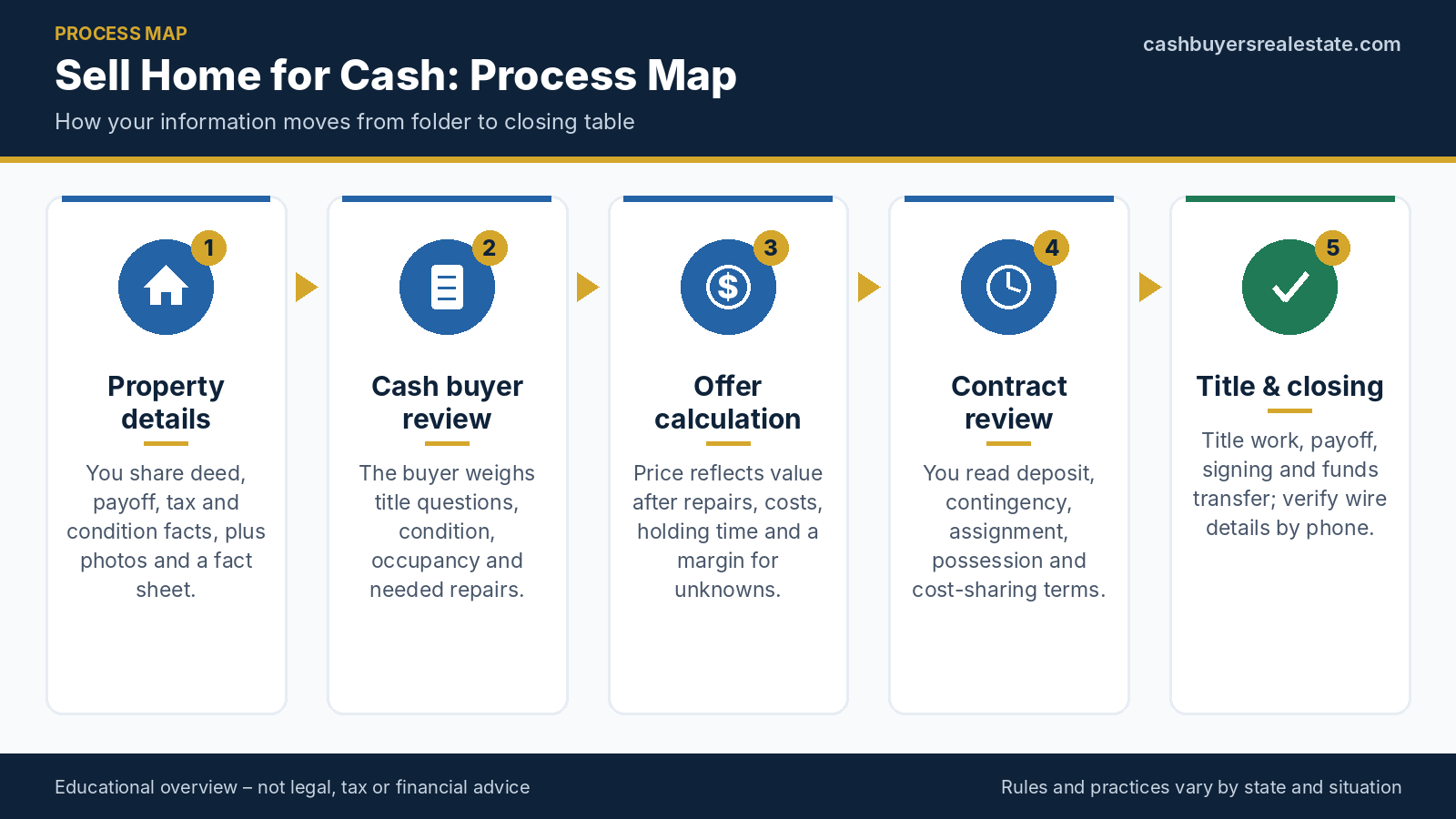
Text version of this infographic
- Property details — You share deed, payoff, tax and condition facts, plus photos and a fact sheet.
- Cash buyer review — The buyer weighs title questions, condition, occupancy and needed repairs.
- Offer calculation — Price reflects value after repairs, costs, holding time and a margin for unknowns.
- Contract review — You read deposit, contingency, assignment, possession and cost-sharing terms.
- Title & closing — Title work, payoff, signing and funds transfer; verify wire details by phone.
The Property Fact Sheet and Your Disclosure Duties
The folder in the last section answers who can sell and what’s owed. The fact sheet answers the question buyers care about most, which is what exactly they’re buying. A good one is two or three pages, written in plain sentences, and based on what you know rather than what you hope. It’s also the place where honesty and strategy point in the same direction, because every fact you state accurately is one the buyer doesn’t have to guess about, and every fact you leave out is one they’ll price at the pessimistic end.
Facts That Move a Cash Buyer’s Repair Estimate
Cash buyers who plan to renovate or resell build their offer from a repair estimate, and that estimate is assembled system by system. The more precisely you can describe each one, the less of the estimate rests on guesswork.
Systems, Structure and Age
Begin with the big-ticket components, since those are the ones that swing an estimate by thousands of dollars. For the roof, write down the material, the approximate year it was installed or last replaced, any leaks you know of, and any repairs with dates. For heating and cooling, note the type of equipment, its age, when it was last serviced, and whether it runs reliably. The water heater, the main electrical panel, the supply and drain plumbing, the windows and the foundation round out the list. Manufacturer labels on water heaters, furnaces and air conditioners usually carry a date or serial number from which age can be worked out, and a quick photograph of each label is more convincing than a memory. If you truly don’t know the age of something, say so and say why, for instance that it appears original to a house built in a given decade.
Buyers think about each system in terms of remaining life against replacement cost. A roof near the end of its useful life isn’t necessarily a problem if the price reflects it, but a roof of unknown age forces the buyer to assume the worst, and the same logic applies to a panel of unknown type or plumbing of unknown material. Older houses may contain components that insurers or lenders treat cautiously, such as certain panel designs, aluminum branch wiring or galvanized supply pipes. You don’t need to be an expert on any of this. You only need to report what you can see and document, and to avoid describing a system as “fine” when what you mean is “it hasn’t failed yet.”
Where you have paperwork, include it. Invoices, warranties, manufacturer registration emails and permit records are all evidence that someone qualified did the work on a certain date. A paper trail for the last decade of maintenance does more to reduce a buyer’s risk allowance than any amount of reassurance in a phone call. If you don’t have invoices, a short list of what was done, by whom, and roughly when still helps, as long as it’s labeled as your recollection and not presented as verified.
Repairs, Claims, Permits and History
The second layer of the fact sheet is the house’s history. Think about water first, since water is behind a large share of costly surprises: any past leaks, flooding, a wet basement or crawlspace, a failed sump pump, mold you’ve seen or treated, and whether the property sits in a mapped flood zone. Then insurance claims, which show up in the records insurers keep and which buyers’ insurers may ask about. Then permits: finished basements, additions, converted garages, decks, new electrical or plumbing circuits and replaced water heaters often require permits, and work done without one can complicate the sale, insurance coverage and the buyer’s own plans. If you know of unpermitted work, say so. Concealing it doesn’t make it disappear, and a buyer who learns of it from a city inspector may feel misled.
Include anything about pests, too, because termite or wood-boring insect damage tends to be expensive and easy to underestimate. If there’s a past inspection report, whether from your own purchase or from a sale that fell through, attach it with the date and be candid that conditions may have changed since. Even an outdated report gives the buyer a starting point and shows that you aren’t hiding from the inspection process. Also mention neighborhood or property features that affect use: a shared driveway, an easement for utilities, a history of street flooding, noise from a nearby road, or a pending assessment from the municipality.
Illustrative example (hypothetical numbers, not market data): A seller knows the basement seeped after heavy rain two years ago. In one version of the story, the seller says nothing, the buyer’s walkthrough shows water staining on the block wall, and the buyer assumes foundation work and holds back $14,000 while also worrying about what else hasn’t been mentioned. In the other version, the seller’s fact sheet says the seepage happened twice, that a sump pump was installed afterward, and attaches the installer’s invoice and a photo of the dry basement after the next big storm. The same buyer still inspects, but may hold back $3,500 for drainage work instead. The numbers are invented, yet the pattern is real: a disclosed, documented problem is usually priced as a known cost, while an undisclosed one is priced as a risk.
Describing the House and Meeting Your Disclosure Duties
The second half of the fact sheet covers the physical description and the legal obligations that travel with it. Accuracy matters more here than polish.
Size, Lot, Utilities and What Counts as Part of the House
Start with the basics buyers use to compare your house to others they’ve bought: number of bedrooms and bathrooms, finished and unfinished square footage, lot size, year built, and garage or parking. Be careful with bedroom counts and square footage. Local definitions of a legal bedroom can require a closet, an egress window or a minimum size, and a basement or attic room that has been finished without a permit may not count in official records. If your figures come from the county tax record, an old appraisal or your own measurements, say which. The tax record is easy to cite but isn’t always correct, and a buyer who measures and finds a significant difference may reopen the price conversation.
Describe the utilities and anything that connects the house to the outside world. Is it on a municipal sewer or a septic system, and when was the tank last pumped? Is the water supplied by a public system or a private well, and has the well been tested? What heats the house: natural gas, electricity, oil, propane? If a propane tank, water softener, security system or solar installation is leased or financed instead of owned, the contract and the title work have to account for it, and a solar lease or loan can require its own transfer or payoff steps. The same goes for fences, sheds and outbuildings whose ownership or location relative to the property line is unclear, which a survey, if you have one, would settle. If you plan to sell other property alongside the house, such as a vacant lot, the guide to selling property for cash covers how those sales differ.
Required Disclosures and Why Honesty Protects the Sale
Seller disclosure obligations are mostly a matter of state law, and they vary widely. Some states require a detailed form listing known defects and conditions, others require much less, and many treat the words “as is” as limiting what the buyer can demand from you without erasing your duty to disclose known material problems. Because the rules are state-specific, ask the closing attorney, title company or a local real estate attorney which form applies and when it must be delivered. The companion guide on as-is home sale disclosures goes deeper into what “as is” does and doesn’t mean for you as a seller.
One federal requirement applies in every state to most homes built before 1978. Under the lead-based paint disclosure rule enforced by the Environmental Protection Agency, sellers must give buyers the EPA pamphlet on lead in the home, disclose any known lead-based paint or lead hazards and provide available records and reports, and include a lead warning statement in or attached to the contract. Buyers get a ten-day period to conduct a lead inspection or risk assessment unless both sides agree in writing to change it, and the signed disclosures must be kept for three years after the sale. Certain categories are exempt, including housing built after 1977 and foreclosure sales, and EPA publishes sample forms (see the agency’s real estate disclosure page). A cash buyer may waive the inspection period, but the disclosure is still your duty.
It helps to see the fact sheet as protection as much as marketing. A written statement that you gave the buyer everything you knew, dated and signed, is a far stronger position than a verbal assurance that nobody can reconstruct two years later. Honest disclosure rarely costs as much as sellers fear, because a buyer who is paying cash for an as-is house has already assumed that it has flaws. What buyers dislike is learning about them from someone else. The table below organizes the main fact categories, why each matters to the person pricing your house, and the best evidence you can offer.
| Fact | Why the buyer asks | Best evidence | If you don’t know |
|---|---|---|---|
| Roof material, age, leaks | Replacement is a large, common line in repair estimates | Invoice, warranty, permit record, dated photos | State that age is unknown and describe visible condition |
| Heating and cooling equipment | Remaining life and replacement cost | Data-plate photo, service receipts | Give install decade from the house’s age |
| Electrical panel and wiring | Safety, insurability and upgrade cost | Panel photo, electrician invoice | Say you haven’t had it inspected |
| Plumbing, sewer or septic | Pipe material and past failures drive risk | Plumber invoices, septic pumping records | List past leaks or backups you remember |
| Foundation and drainage | Structural repairs are costly and hard to price | Engineer report, installer invoices | Describe cracks or moisture you’ve seen |
| Water, mold or pest history | Hidden damage multiplies repair cost | Remediation or treatment records | Disclose what you know; avoid saying “never” |
| Permits and additions | Unpermitted work can complicate sale and insurance | Permit numbers, final inspection sign-offs | Say which work was done and by whom |
| Square footage and bedrooms | Basis for comparing value and repair scope | Tax record, appraisal, plans, measurements | State the source of each figure |
| Leased or financed equipment | Solar, tanks or alarms may need transfer or payoff | Lease or loan paperwork | Ask the provider for a transfer or payoff statement |
| Lead-based paint (pre-1978 homes) | Federal disclosure duty applies | Prior reports, EPA disclosure form | Disclose that no information is available |
Use the right-hand column as a reminder that “I don’t know” is an acceptable answer when it’s true and specific. The goal isn’t to sound like an inspector. It’s to give the buyer what you can verify, flag what you can’t, and leave nothing for them to discover that you could have told them first.
What Preparation Is Worth: A Cash Sale Compared With Other Routes
Having your file in order is useful, but it isn’t a reason to sell for cash by itself. The reason to sell for cash, when there is one, is that the combination of speed, certainty and convenience is worth more to you than the extra money a slower route might produce. Preparation lets you test that tradeoff with real numbers rather than impressions. This section sets out a method for comparing routes by what you keep, then looks at the costs and tax records that sit between the sale price and your bank account.
Comparing Net Proceeds Across Five Routes
A headline price is the least informative number in any offer. Two routes with very different prices can leave you with nearly the same amount, and two routes with the same price can leave you thousands of dollars apart once costs and time are counted.
Building the Comparison: Price, Costs and Time
The comparison starts with a simple illustrative formula. Take the price you expect to receive, subtract the costs you’ll pay out of pocket to make the sale happen, and you have your net before payoff. Subtract your loan payoff and any liens, and you have your net after payoff, which is the money you can actually plan around. The costs side is where routes differ. A cash sale typically has no agent commission and no lender-driven repairs, but the price reflects the buyer’s margin. A traditional listing often has a higher price, but brings commission, buyer closing-cost concessions, repair requests after inspection, and months of carrying costs while the house is on the market. Repairing before listing adds a large upfront cost and its own timeline, with the added risk that costs overrun.
Time is the hidden line in every route. Every month a house is unsold, you pay property taxes, insurance, utilities and upkeep, and perhaps a mortgage payment. If you’ve already bought another home or have a firm move date, the cost of delay can include two housing payments at once. Time also carries uncertainty: a financed buyer can lose a loan approval, a low appraisal can reopen price negotiations, and an inspection can produce a repair list. Cash buyers can be slow or can retrade too, but the number of steps that can break is usually smaller. When you build your own comparison, assign each route a realistic range of months instead of one best-case figure, and test what happens to the result if the longer end occurs. The broader tradeoffs between these two paths are explored in the guide on cash sale versus listing for a fast sale.
The following table applies the method to a single hypothetical house. It is invented for illustration: the home would be worth about $312,000 after repairs, needs a new roof and an updated heating system, and carries a loan payoff of $118,400. Holding costs are assumed at $1,150 per month. None of these figures are market data, and the cash-sale prices in particular are assumptions chosen to show how the arithmetic works, not predictions of what any buyer would offer.
| Route | Assumed price | Assumed costs | Net before payoff | Net after $118,400 payoff | Time and certainty |
|---|---|---|---|---|---|
| Cash sale, file not ready | $236,000 | Seller closing costs $2,900 | $233,100 | $114,700 | Fastest; larger risk margin in the price |
| Cash sale, file ready | $241,000 | Closing $2,900; cleanout $1,800 | $236,300 | $117,900 | Fast; assumes a $5,000 smaller margin |
| List as-is with an agent | $268,000 | Commission $14,740; closing and concessions $4,020; 3 months’ holding $3,450 | $245,790 | $127,390 | Months; financing and inspection risk |
| Repair, then list | $309,000 | Repairs $34,000; commission $16,995; closing and concessions $4,635; 5 months’ holding $5,750 | $247,620 | $129,220 | Longest; repair overruns possible |
| Online instant-offer program | $266,000 | Service charge $13,300; repair credit $9,000; closing $2,500 | $241,200 | $122,800 | Quick quote; may change after inspection |
Reading the Illustrative Results
The first thing to notice is how narrow the spread is compared with the spread in headline prices. The prices in the table range from $236,000 to $309,000, a gap of $73,000, yet the net-before-payoff figures range only from $233,100 to $247,620, a gap of $14,520. Repairs, commissions and carrying costs absorb most of the difference. The route with the highest price, repair-then-list, nets only $1,830 more than listing the house as-is, and it requires $34,000 of upfront spending, months of project management and the risk that the roof comes in over budget. For many sellers that is a poor trade, which is one reason as-is sales exist at all.
The second lesson is about the value of preparation. The only difference between the first two rows is the file. After subtracting the $1,800 cleanout cost, being ready is worth $3,200 in this example, and it’s worth that only if the buyer actually reduces the risk margin by the assumed $5,000. It’s equally possible that the buyer’s price doesn’t change at all, in which case preparation cost you $1,800 and bought speed and certainty instead. Both outcomes are reasonable. What matters is deciding in advance which one you’re paying for, and not spending money on cleanout or documents in the belief that it will produce an exact amount.
Third, notice what the table cannot show. Listing as-is nets $9,490 more than the prepared cash sale before the payoff, yet that margin depends on selling within the assumed three months at the assumed price. At $1,150 per month, about eight more months of holding would erase it, and a buyer who renegotiates after inspection could do the same much faster. If your timeline is flexible and your risk tolerance is high, a listing may still be the better route. If you have a closing date elsewhere, a sick relative, an estate to settle or a house that can’t safely stay empty, the cash route’s value is the removal of those risks, and the table is only part of the picture. The same arithmetic can be extended with your own state’s costs once you know them, and it is worth redoing whenever an offer changes.
What You Keep: Closing Costs, Taxes and Records
Net proceeds aren’t final until you know which costs apply in your state and how the sale will be reported to the IRS. Neither is as mysterious as it sounds, but both are easier when you’ve gathered the records before closing.
Costs That Follow the Sale, Whichever Route You Pick
Even without an agent, a sale carries costs that are set by state and local practice. Depending on where the property is, the seller may pay for some or all of the title search, the owner’s title insurance policy, escrow or attorney fees, deed preparation, recording fees and transfer or documentary taxes, and these allocations are sometimes customary rather than required, which means they’re negotiable in the contract. Property taxes and association dues are prorated to the closing date. The payoff, as covered earlier, comes off the top. A buyer who advertises that they “pay closing costs” may mean only their own side, so ask for a written breakdown of who pays what, and compare it against a seller net sheet. Reading the cost lines on a sample settlement statement before you receive an offer makes it much easier to spot what is missing.
Prorations deserve a closer look because they surprise people. Property taxes, association dues and sometimes utilities are divided so that each party pays for the days they owned the property, and the arithmetic depends on whether your jurisdiction bills in advance or in arrears and on the exact closing date. A seller whose taxes were paid in advance may receive a credit, while a seller whose taxes are billed after the year ends may owe the buyer a share. Ask the closing agent for a draft settlement statement several days before closing, compare it line by line against your own net sheet, and question anything unfamiliar. Errors are far easier to fix before signing than after the funds have moved.
If you’ve hired an agent, an attorney or a cleanout service, those fees belong in the comparison too. And keep in mind the costs that don’t appear on a settlement statement: moving, storage, the overlap between housing payments, and the time you spend. They don’t belong on every route’s line, but if one route forces a rushed move and another allows a calm one, the difference is real even when it can’t be itemized. Treat the net sheet as the floor of your analysis, not the ceiling.
Tax Reporting and the Records That Protect Your Gain Calculation
Federal tax treatment of a home sale is the same whether the buyer pays cash or finances, but a few points affect what you should keep on hand. According to the IRS, you may be able to exclude up to $250,000 of gain from the sale of your main home, or up to $500,000 if you file a joint return with a spouse, if you owned and used the home as your residence for at least 24 months of the five years before the sale; generally you can’t claim the exclusion if you excluded gain on another home sold within the previous two years (see the IRS overview of selling your home, last reviewed October 12, 2026). If you receive a Form 1099-S, you must report the sale even when the gain is fully excludable. The person responsible for closing generally files that form, though a sale of a principal residence at or below certain thresholds can be exempt when the seller signs a written certification, so don’t be surprised if the closing agent asks you to sign one.
Records matter because gain is the sale price less selling expenses and your adjusted basis, and basis includes the purchase price plus capital improvements. IRS guidance in Publication 523 distinguishes improvements that add value or extend the home’s life from routine repairs and maintenance, which aren’t added to basis, so receipts for a new roof or a remodeled bathroom can reduce taxable gain while receipts for repainting generally can’t. For an inherited home, basis is generally the fair market value at the date of death, which makes an appraisal or estate valuation worth keeping. If you’re a foreign person selling U.S. real estate, the buyer is generally the withholding agent under FIRPTA, with rates and exceptions set by the IRS, so tell the closing agent early. Because individual situations vary, confirm these points with a CPA or enrolled agent.
The graphic below condenses the table into a quick reference you can keep beside your own net sheet. A cash sale, prepared or not, trades the most price for the most speed and certainty. Listing as-is gives up weeks or months in exchange for a higher price and takes on buyer-financing and inspection risk. Repairing before listing demands the most money and time up front, with the least predictable result. And an online instant-offer program sits in between, offering a fast quote that can shift once the platform inspects the house and applies its own service charge or repair credits.
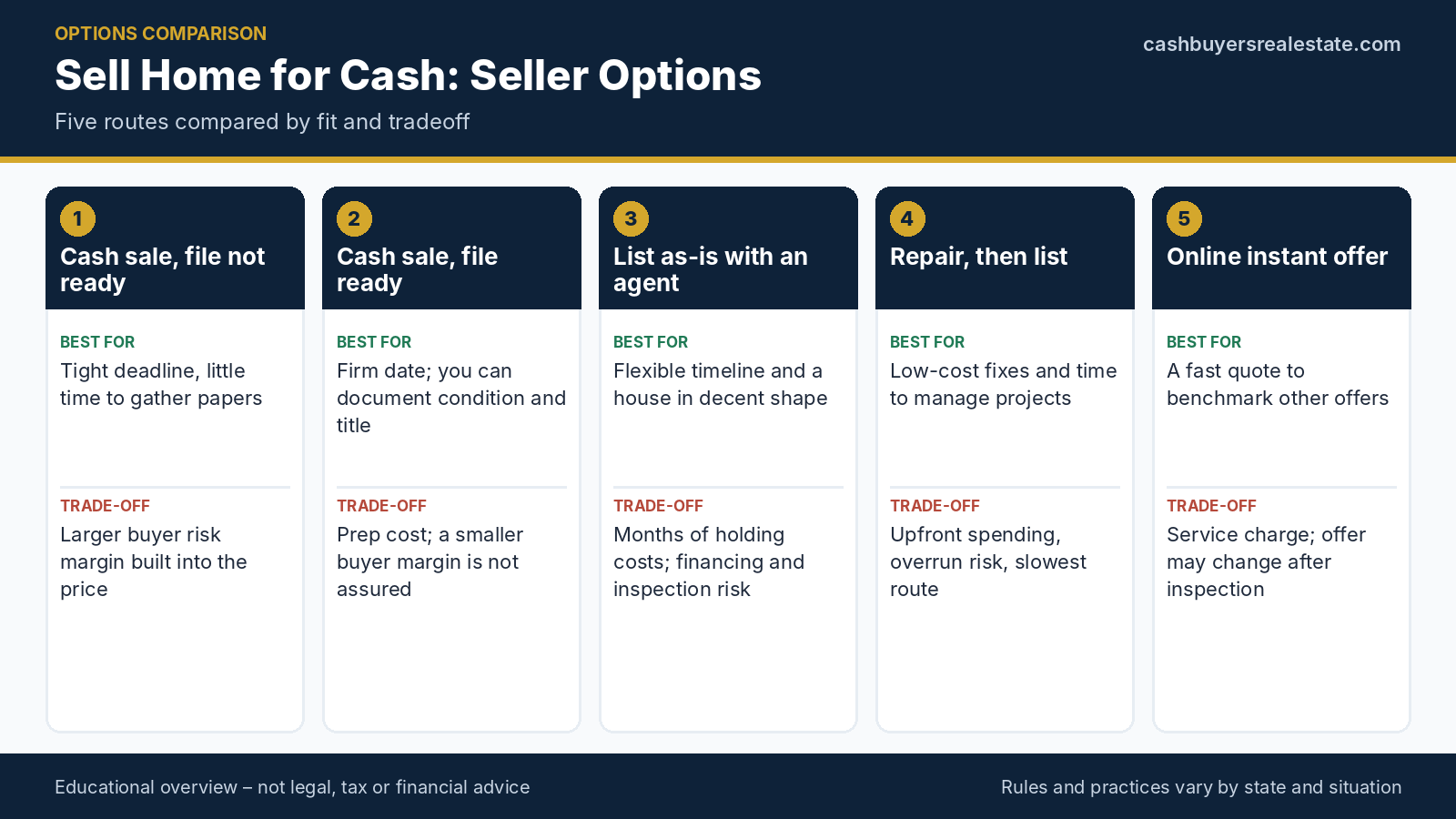
Text version of this infographic
- Cash sale, file not ready — Best for: Tight deadline, little time to gather papers. Trade-off: Larger buyer risk margin built into the price.
- Cash sale, file ready — Best for: Firm date; you can document condition and title. Trade-off: Prep cost; a smaller buyer margin is not assured.
- List as-is with an agent — Best for: Flexible timeline and a house in decent shape. Trade-off: Months of holding costs; financing and inspection risk.
- Repair, then list — Best for: Low-cost fixes and time to manage projects. Trade-off: Upfront spending, overrun risk, slowest route.
- Online instant offer — Best for: A fast quote to benchmark other offers. Trade-off: Service charge; offer may change after inspection.
Access, Occupancy and Move-Out Logistics
Paperwork gets most of the attention in a cash sale, but the physical handoff is where schedules slip. A buyer can’t price what they can’t see, and can’t close on a house they can’t take possession of. Sorting out keys, utilities, who lives there and when they will leave takes a fraction of the effort of the folder and the fact sheet, yet these are the details that most often turn a promised closing date into an extended one. They also involve people other than you, which makes them harder to control and worth settling early.
Getting a Buyer Through the Door
Cash buyers vary in how much they need to see before making an offer. Some work from photos and video and visit only once, while others want to walk the property themselves, often with a contractor. Either way, you want access to be easy, safe and under your control.
Keys, Utilities and Access Windows
Count your keys. A house usually has more locks than people remember: front and back doors, garage entry, shed or outbuilding, mailbox, a gate or community entrance, and sometimes an alarm panel, a garage remote or a smart lock tied to an app account. Then count who holds copies. Relatives, neighbors, former tenants, cleaners, contractors and caretakers often have keys that were handed out years ago, and a buyer or closing agent may reasonably ask you to account for them. If any are unaccounted for, rekeying the exterior locks before closing is inexpensive and removes a question that otherwise lingers. Any smart-lock or alarm accounts should be transferred or reset as part of the handoff, so make a note of the logins you’ll need to change.
Keep the utilities on until closing. Power and water are needed for inspections, because a contractor can’t test the furnace, the panel or the plumbing in a dark, dry house, and a buyer who can’t run the systems will price them pessimistically. In cold climates an unheated, unoccupied house is also at risk of frozen pipes, which can turn a manageable sale into a water-damage claim. If the house will sit empty, check your homeowners policy before it does, since many policies limit or exclude coverage after a house has been vacant for a stretch of time, and the terms differ by insurer and state. A short call to your insurance agent can prevent a very expensive surprise in the weeks between accepting an offer and closing.
Finally, set access windows. Offer a few specific time slots instead of an open-ended invitation, and decide in advance who will be there. Having a consistent point of contact, who can be you, a family member or a representative you trust, makes scheduling easier and reduces the chances of conflicting messages. If you live in the house, tell the buyer which days or times are off limits. Agreeing on clear windows is not obstruction. It’s the same courtesy any professional would expect.
Photos, Walkthroughs and Safe Remote Review
An organized photo and video set can stand in for several in-person visits. Walk through every room with your phone, narrating what you see, including the problems. Capture the exterior from all four sides, the roof as best you can from the ground, the attic and crawlspace if they’re accessible, the main electrical panel with its door open, the water heater and furnace data plates, and any area where you’ve noticed water, cracks or damage. Label the files by room. Buyers are more likely to trust a seller who shows the flaws than one whose photos seem to avoid them, and a thorough set often lets a buyer give a firmer number on the first visit or even without one.
Safety matters as much as convenience. Before anyone you haven’t met enters your home, confirm who they are, who they represent and who is coming with them. Don’t leave strangers alone in the house, and put away anything of value or sensitivity beforehand, such as jewelry, medications, firearms, checkbooks, mail with account numbers and your folder of documents. It’s reasonable to share your deed, your property tax bill and photos of the property with a prospective buyer, since most of that is public or visible anyway. Hold back your Social Security number, bank account details and images of your ID until the title company or closing attorney asks for them through a secure channel, and then verify the request by phone, using a number you found yourself.
Who Lives There and When They Leave
Occupancy decides how soon a buyer can take possession, and in some cases whether they can at all. It also touches rights that belong to other people, so it deserves more care than almost any other item on the list.
Owner-Occupied Homes: Move-Out Dates and Flexibility
If you live in the house, the buyer will want to know when you’ll be out. The standard assumption in most contracts is that possession transfers at closing, with the house empty and in the condition described in the agreement. That works well if you already have somewhere to go, but it can be a squeeze if you’re waiting to close on your next place or need a few extra days to finish packing. The cleanest way to buy that time is to negotiate it before you sign, either by asking for a longer closing period or by agreeing to a short post-closing occupancy in writing.
A post-closing occupancy agreement, sometimes called a rent-back, lets you stay for a limited period after the sale. It’s a real contract with a real risk, because once the sale closes the buyer owns a house that someone else still lives in. Buyers who agree usually want a daily charge, a firm end date, proof of insurance, responsibility for utilities, and a holdback from your proceeds that is released only when you’ve left and the house is in the agreed condition. If you stay beyond the end date without permission, the buyer may need to use a legal eviction process, which varies by state and can take far longer than anyone expects. Treat the date as a promise you must be able to keep.
Illustrative example (hypothetical numbers, not market data): A homeowner needs seven extra days after closing to finish a move across town. The buyer agrees to a written occupancy period at an assumed $85 per day, or $595 for the week, with $2,000 held back from proceeds until the keys are returned and the house is checked. The homeowner leaves on day six, the buyer confirms the property is empty and in the described condition, and the holdback is released. If the homeowner had stayed ten days instead, the arrangement would have required a written extension or exposed the homeowner to the cost and delay of a formal removal. The numbers are invented, but the structure, a short term, a daily charge and a holdback, is a common way to turn a handshake into something enforceable.
Tenants, Relatives and Other Occupants
When someone other than you lives in the house, the picture changes. A tenant with a lease has rights that don’t simply disappear because the property is sold, and in many states a buyer takes ownership subject to the existing lease unless the tenant agrees to leave or the lease allows termination. Month-to-month tenants generally have different notice rights than tenants with a fixed term, and local rules can add protections. A buyer will usually want a copy of the lease, the rent and deposit records, and a signed statement from the tenant confirming the terms and any problems, often called an estoppel certificate. The detailed rules are the subject of the guide to selling a house quickly with tenants. For now, the point is to gather the lease and records early and not to assume the tenant must be gone before a sale can happen.
Be especially careful about trying to speed things up. In many states a landlord may not change locks, remove belongings, or shut off utilities to push a tenant out, and offering a tenant money to leave voluntarily, sometimes called cash for keys, is a negotiation that should be documented and lawful where you live. Relatives, adult children, roommates and partners raise their own questions. Someone who has lived in a house for months without a written lease may have occupancy rights in some states, and a co-owner living in the property usually has a say in the sale. When in doubt, ask a local attorney how to give proper notice before you tell a buyer a move-out date you can’t control.
The table below lists the most common occupancy situations, what a buyer typically wants to know, what you can do to prepare, and where state or local law is most likely to change the answer. It’s a planning aid and not a legal analysis, and it is only as accurate as the facts you bring to it.
| Situation | What the buyer will want to know | How to prepare | Where state or local law matters |
|---|---|---|---|
| Owner moving out before closing | Move-out date and condition at handoff | Set a firm date; arrange final cleaning and keys | Rarely an issue if the date is realistic |
| Owner needs days after closing | Length of stay, daily charge, holdback | Request a written occupancy agreement before signing | Holdover and eviction procedures differ by state |
| Tenant with a fixed-term lease | Lease terms, rent history, deposit, defaults | Gather lease, ledger, tenant contact; ask for an estoppel statement | Whether the lease survives a sale; notice rules |
| Month-to-month tenant | Rent, deposit and willingness to stay or leave | Review notice requirements before telling anyone a date | Required notice periods and local protections |
| Relative or roommate with no lease | Whether they will leave and when | Talk early; put the plan in writing; check rights with an attorney | Whether they have tenant-like rights after a period of residence |
| Co-owner living in the home | Whether all owners agree to sell | Confirm consent and signatures; resolve disagreements first | Partition and spousal-consent rules |
| Vacant house | Who has keys; utilities and insurance status | Check vacancy coverage; keep utilities on; secure the property | Local vacant-property registration rules in some places |
Read the table from the bottom up when you’re trying to save time. The vacant house is the simplest case, and every row above it adds a person whose cooperation, rights or timeline you don’t entirely control. The more people in the picture, the earlier you should talk to them, and the more cautious you should be about promising a buyer a date.
Personal Property, Cleanouts and the Condition You Hand Over
Two sellers can own identical houses and receive very different offers simply because one house is empty and one is full. Belongings cost a buyer time and money to deal with, and they also carry decisions that only you, or your family, can make. This section covers what conveys with the house, how to handle items with emotional or financial value, and how much cleaning a buyer really expects. It’s also the stage at which many sellers feel overwhelmed, which is a good reason to break it into small, concrete choices.
Deciding What Stays and What Goes
The purchase contract will say, one way or another, what the buyer is getting. If it says nothing, disagreements can surface at the final walkthrough, when everyone is least inclined to compromise. A little clarity now avoids a lot of friction later.
Fixtures, Appliances and Items the Contract Should Name
As a general principle, fixtures, meaning things permanently attached to the house, convey with the property unless the contract excludes them, while freestanding personal property doesn’t unless the contract includes it. The line isn’t always obvious. Light fixtures, ceiling fans, built-in shelving, installed window coverings, a mounted television bracket, a garage-door opener and a wall-mounted heater are commonly treated as fixtures, whereas a refrigerator, washer, dryer, freestanding range and furniture often depend on what the parties agree. Because interpretations vary and memory is unreliable, write a short list of what you intend to take with you and what you intend to leave, then make sure the contract matches it. If you have a chandelier from your grandmother, say so and swap in a replacement fixture before the buyer ever sees the original.
Appliances deserve their own sentence in the agreement. Buyers pricing a house as-is will often assume that anything left behind works, or they will assume nothing works, depending on what you tell them. If the refrigerator is old and noisy but functional, or the dishwasher has not worked for two years, say so. If you plan to take the washer and dryer, say that too, and be prepared for the possibility that a buyer will adjust the price slightly. Items like swing sets, sheds, hot tubs, rain barrels, outdoor lighting and landscaping features should be addressed the same way. A one-page list agreed in writing is rarely controversial, and it keeps a tiny issue from turning into a closing-day argument.
Leased or financed items follow different rules. A rented water softener, a leased propane tank or a solar array financed through a separate agreement isn’t yours to convey, so the paperwork needs either a payoff, a transfer or a removal plan. If you aren’t sure whether something is owned, check the original agreement or ask the provider. Buyers who discover a leased item late sometimes request a credit or hold up closing until it is sorted out, and that’s an avoidable delay when the item is simply written into the fact sheet from the start.
Sentimental, Valuable and Shared Belongings
Some contents can’t be priced by anyone but you. Family photographs, heirlooms, documents, collections and tools carry history that doesn’t appear in a buyer’s spreadsheet, and the pressure to clear a house quickly can lead people to discard things they later regret. If time allows, work through the house in a deliberate order: first gather the items of obvious importance, including identification, financial papers, photographs, jewelry and small valuables; then the items that need decisions from other family members; and only then the bulk of furniture and household goods. Photograph everything of value before it leaves the house, particularly if more than one person may have a claim to it, because a dated photo record settles later disagreements more gently than memory does.
Inherited and shared properties add a legal layer. If the homeowner has died, the personal representative named by a will or appointed by a court generally controls what happens to the contents, and distributing or discarding items before that authority exists can create problems among heirs or with the estate. Where several relatives have an interest, agreeing in writing on who takes what, and what will be donated, sold or discarded, prevents resentment that can outlast the sale. Estate sales, auctions, consignment shops and charitable donation are all possibilities, and each has different timing and different effects on cost; the probate setting in particular has its own rules about who may act, and family disagreements can arise in other settings as well.
It’s worth saying that hoarding or heavy accumulation is a medical and emotional matter as much as a logistical one, and families dealing with it deserve patience, not judgment. A buyer used to such properties will generally price in the cleanout work, and there are professionals who specialize in this. If you are in this position, keep dignity and safety first, and consider asking a professional organizer, a social worker or a trusted advisor for help before deciding how much to do yourself and how much to leave for the buyer.
How Clean Is Clean Enough
Sellers often imagine that a cash buyer expects a spotless, staged house. They don’t. What buyers care about is how much work remains between closing and the first day of renovation or resale, and whether any of it is hazardous or unexpectedly expensive.
Broom-Clean, Partial Cleanout and Full Contents
Contracts commonly describe the delivery standard as “broom-clean,” which means the house is empty of belongings and debris and has been swept, with no trash left in the rooms, garage, attic, basement or yard. It’s a low bar, and it’s also not a legal term with a single definition, so describe it in the contract in plain language: nothing remaining except the items listed as included. Some buyers are comfortable accepting a house with contents still inside, usually at a lower price that reflects their own hauling and disposal costs. This is the “as-is with contents” arrangement, and it’s common with large cleanouts, estates and houses where the owner can’t physically do the work. Buyers who advertise under phrases like cash for houses often say they take properties in any condition, but whether that includes belongings is something to confirm in writing and not assume.
Hazardous or regulated items are a separate category. Leftover paint, solvents, pesticides, pool chemicals, propane cylinders, batteries, fluorescent bulbs, medical sharps and old electronics usually can’t go in a dumpster or the regular trash, and local rules for disposal vary. Leaving them in the house doesn’t make them the buyer’s responsibility in any helpful sense; it may cause friction, a price deduction or a delay while they are handled. Check your municipal waste or household hazardous waste program for the right way to dispose of them, and keep receipts or drop-off confirmations if there is any chance of a dispute. Also shred or securely discard any papers with account numbers or personal information before they go into a bin.
Costs, Time and Who Does the Work
The choice between doing a cleanout yourself, hiring someone, or leaving it to the buyer is mostly an arithmetic problem with an emotional component. Doing it yourself costs the least in money and the most in time, and it can be harder than expected when the house is full or located far from where you live. A professional cleanout or junk-removal service charges by volume or by the job and works quickly, though quotes vary widely by region and by what is being removed, so get written estimates from more than one provider. Leaving contents for the buyer costs nothing out of pocket but reduces the offer, and buyers have to estimate quantity and disposal costs without being able to see everything, which usually means a cautious estimate.
The right answer depends on the gap between what you would spend and what the buyer would subtract. If a buyer deducts more for hauling than it would cost you to hire a service, hiring one yourself is probably worth it. If the opposite is true, selling with contents may be the smarter move, particularly when time is short. Ask the buyer to put their cleanout assumption in writing, with the amount, so you can compare it with a real quote. This applies to cleaning as well: if the house needs a deep clean because of smoke, pet odors or years of neglect, the buyer will likely treat it as part of the repair estimate, and an honest description of the problem is better than hoping it goes unnoticed.
Illustrative example (hypothetical numbers, not market data): A buyer’s draft offer deducts $4,200 for removing furniture, kitchenware and garage contents from a house the seller can no longer visit often. The seller gets a written quote of $2,400 from a local junk-removal company and finds that two relatives will take the furniture for free. By arranging the pickup before closing, the seller saves roughly $1,800 compared with accepting the deduction, at the cost of about a week of coordination. In a second scenario, the seller lives out of state, has three weeks until closing, and decides the $1,800 isn’t worth the travel and stress. Neither choice is wrong. The useful move is to compare a real quote with the buyer’s number and then decide what your time and energy are worth.
Table 5 sets out the main cleanout paths side by side, with a rough sense of how each affects time, cost and the buyer’s view. Use it to choose a path that matches your timeline and your appetite for the work, not to find a single right answer.
| Path | What it involves | Time and effort | Likely effect on the offer | Watch for |
|---|---|---|---|---|
| Full cleanout and broom-clean | You remove everything not conveying and sweep the house | High effort; days to weeks depending on volume | Fewer deductions; easier closing | Hazardous items; disposal rules |
| Remove valuables, leave the rest | You take what matters and sell with contents | Low to moderate effort | Buyer deducts hauling and disposal | Contract must say contents convey |
| Hire a cleanout service | A company removes and disposes of items for a fee | Fast once scheduled; needs coordination | Cleaner handoff; fee comes out of your pocket | Get written estimates and insurance proof |
| Estate sale or auction first | Items are sold before the house is listed or closed | Weeks of planning; tied to the sale company’s calendar | May recover value; may delay closing | Fees, unsold leftovers, timing |
| Donation and family pickup | Items go to charities or relatives | Moderate; depends on pickup schedules | Reduces the volume the buyer must deal with | Get receipts; agree in writing on who takes what |
As the table suggests, there is no free option. Every path trades money, time or effort, and the better choice depends on which of those you have most of. If a path creates a risk of missing a closing date, it deserves a closer look before you commit to it.
Preparation Timelines and Mistakes That Cost Sellers Money
Everything so far describes what to prepare. This section is about how much you can realistically do in the time you have, and what tends to go wrong when people rush, delay or skip steps. Some sellers have months and some have a week, and an honest plan for a week looks different from an ideal plan for a month. The aim here is to separate the steps that must happen first from those that can wait, so that a tight timeline produces a shorter list instead of a panicked one.
Three-, Seven- and Fourteen-Day Preparation Plans
A schedule should be built around the items with lead times you don’t control, which are payoffs, association documents, court paperwork and other people’s availability. Everything else can be fitted around them.
The Three-Day Sprint: What Matters Most
If you have three days before a buyer wants answers, begin with the requests that depend on someone else, since their clocks start only when you ask. A payoff statement can take up to seven business days under federal rules, which means it may arrive after your three days are over, so request it on day one. The same logic applies to association documents, any court or probate paperwork, and a call to your insurer about vacancy coverage. Once those requests are out, use the remaining time to assemble what you can control: the deed, your identification, the tax bill, the mortgage statement and a first draft of the fact sheet.
- Request the written payoff from your servicer, and the resale or dues statement from the association if there is one.
- Find the deed, your photo ID and the latest property tax bill, and note any name differences between them.
- Photograph and narrate every room, the exterior, the roof from the ground, the panel and the mechanical equipment.
- Write down what you know about each major system and what you don’t, in plain sentences.
- Confirm with every owner and occupant that a sale is under consideration, and note any dates they can commit to.
- Decide what you will take with you and what stays, and list any keys, codes and accounts you hold.
What a three-day window cannot reliably produce is a clean house, finished repairs, a resolved title problem or a settled estate. Do not try to fix those in three days, and be careful of any buyer who suggests that you must. Instead, state them honestly in your fact sheet and ask whether the buyer will price them in. A seller with a good folder and an honest list of open issues is often in a better position than one who has rushed through a cleanout and left the paperwork undone.
Seven and Fourteen Days: Adding Depth Without Chaos
With a week, you can begin to reduce the biggest unknowns instead of only describing them. The usual candidates are the roof, the heating system, any suspected foundation or moisture issue, and the cleanout. A short visit from a roofer or HVAC technician, or an estimate from a cleanout service, converts a vague worry into a quote you can show a buyer. This is also the time to speak with a title company or real estate attorney about your state’s closing practices, ask what they will need from you, and check any lien or title concerns. You can then talk to two or three buyers and compare their written proposals against your net sheet.
Two weeks makes a visible difference to the handoff. By then you can complete a cleanout or a partial one, rekey locks, resolve a name mismatch through an affidavit or corrective deed, and receive the HOA resale package. If tenants are involved, you may have time to collect an estoppel statement or open a conversation about their plans. You’ll also have time to read a contract carefully, ask questions and, if needed, have an attorney review it before you sign. Fourteen days will not resolve a contested estate or a serious title defect, and it would be a mistake to promise a buyer a closing date that depends on one.
The table below lays out a workstream-by-workstream plan across the three windows. Treat it as a menu, not a requirement, and shift tasks later whenever a lead time you can’t control (a payoff, a certificate, a court order) pushes you out of the schedule.
| Workstream | Days 1–3 | Days 4–7 | Days 8–14 |
|---|---|---|---|
| Ownership and identity | Locate deed and ID; note name differences | Gather entity, trust, estate or POA papers; speak with co-owners | Sign any name affidavit; settle authority questions with the closing agent |
| Payoff, taxes and liens | Request written payoff; find tax bill | Review title or lien concerns; request association statement | Receive and review payoff; clear or plan to clear any lien |
| Property facts | Draft the fact sheet; photograph systems | Collect invoices and permits; get a quote on the biggest unknown | Finalize fact sheet and disclosures with attorney or agent input |
| Access and occupancy | Inventory keys; confirm who lives there | Agree on move-out date; check vacancy insurance | Rekey locks; document occupant agreements or notices |
| Belongings and cleaning | Set aside valuables and papers | Get cleanout quotes; arrange donations or family pickups | Complete the cleanout or confirm contents stay |
| Offers and contract | List questions to ask buyers | Compare two or three written offers on net proceeds | Have the contract reviewed; plan the final walkthrough |
The pattern across the columns is that the first three days are about starting clocks, the next four are about reducing the largest uncertainties, and the final week is about the handoff. If you’re working with a shorter window, drop the right-hand column first. If you have a longer one, use the extra time on the items that most affect the number, which are usually the largest repair unknown and the cleanout, not on cosmetic work.
Whatever the schedule, a seller’s decision comes down to a handful of factors, and it helps to put them on one page before you answer any buyer. Six checks carry most of the weight: your best estimate of market value, the property’s condition, a realistic repair budget, your holding costs while you wait, the transaction costs of each route, and the margin the buyer needs to make the deal worthwhile. The graphic below marks each of these as relatively safe, worth caution or a genuine risk, and the next part of this section shows how they surface in the mistakes sellers most often make.
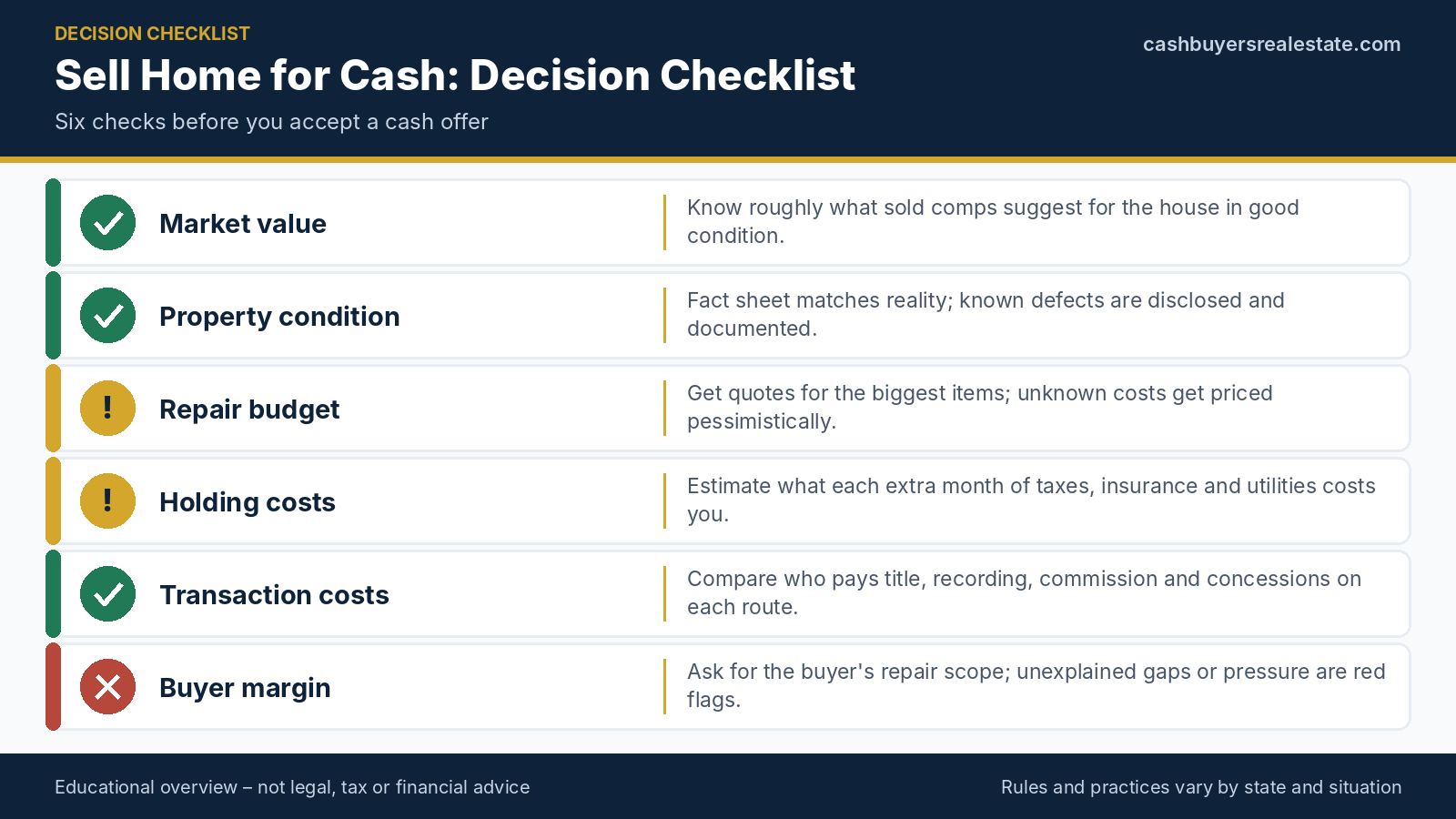
Text version of this infographic
- Market value — Know roughly what sold comps suggest for the house in good condition.
- Property condition — Fact sheet matches reality; known defects are disclosed and documented.
- Repair budget — Get quotes for the biggest items; unknown costs get priced pessimistically.
- Holding costs — Estimate what each extra month of taxes, insurance and utilities costs you.
- Transaction costs — Compare who pays title, recording, commission and concessions on each route.
- Buyer margin — Ask for the buyer's repair scope; unexplained gaps or pressure are red flags.
Mistakes to Avoid and the Six Checks That Guard Against Them
Most costly mistakes in cash sales are not dramatic. They are small omissions or assumptions that compound, and nearly all of them are easier to avoid with an hour of planning than to repair after a contract is signed.
Common Mistakes With Documents, Facts and Timing
The most common mistake is starting with the buyer instead of the file. A seller who gets a first offer before checking the payoff, the tax status or the title questions has no way to judge it. Close behind is overstating certainty: promising a closing date before confirming a payoff, a co-owner’s cooperation or a tenant’s departure, then needing an extension and losing credibility. Another is giving information that is not fully accurate, whether by guessing at roof ages, calling water stains “old” without knowing, or leaving out a known leak. Honest uncertainty can be priced. Inaccuracy that comes to light during due diligence is more likely to be treated as a reason to renegotiate or walk away.
Timing mistakes are subtler. Many sellers underestimate how long documents take and request them late, which stalls an otherwise smooth deal. Others begin a major repair or renovation just before selling, spending money that a cash buyer may not value, since the buyer plans their own scope of work, and sometimes creating new unpermitted-work questions. Spending on a cosmetic refresh makes sense when it clearly narrows a buyer’s estimate. Spending on bigger projects usually makes sense only when the numbers in a net-proceeds comparison support it, as Table 3 showed with the repair-then-list route.
The six checks give a quick way to catch these errors before they happen. Market value asks whether you know, from sold comparable homes or a professional opinion, roughly what the house might bring in good condition. Condition asks whether the fact sheet reflects reality. Repair budget asks whether you have even a rough quote for the biggest items. Holding costs asks what each additional month costs you. Transaction costs asks what each route takes off the top. And buyer margin asks how much of the gap between the cash price and the after-repair value you are comfortable ceding, based on the scope of work the buyer describes. Any check you can’t answer is a place to focus before saying yes.
Mistakes With Offers, Contracts and Money
Accepting the first offer without comparison is the classic error, and it is understandable when you are tired. A second written offer, or a net-proceeds comparison against a listing, takes little time compared with the amount it can affect. Related to this is mistaking verbal promises for terms. If a buyer says they will pay your closing costs, extend the closing date or let you stay a week, the contract has to say so. Read every page, including the sections on contingencies, assignment of the contract, earnest money and what happens if the buyer backs out. Ask whether the buyer intends to close in their own name or may assign the contract to someone else, since rules about assignment and its disclosure vary by state, and ask for proof of funds before you commit to a timeline.
Pay attention to how the buyer behaves under questions. A buyer who answers promptly, explains how they reached a number and gives you time to read is behaving the way a legitimate buyer typically does. Pressure to sign today, reluctance to put terms in writing, requests for fees before closing and vague answers about who is actually buying are warning signs worth taking seriously, though none is proof of fraud on its own. If you want the wider range of fast-sale options and the cautions that go with each, the pillar guide to selling my house fast covers them in one place.
The practical protection is a few small habits. Decide in advance which two people at the title company or law office you will treat as your contacts and write down their phone numbers from an independent source. Provide your own payout instructions in person or by a verified call, not by an unverified email. Check that the name of the closing company on the contract matches the name on the wiring instructions and on the settlement statement. And keep copies of every signed document. Each of these takes minutes, and together they close off the most common ways a cash closing can go wrong after the price has already been agreed.
Frequently Asked Questions About Preparing to Sell a Home for Cash
These answers pick up the questions sellers most often raise once they start gathering papers and talking to buyers. They’re general, and where state law matters they say so.
Questions About Documents, Ownership and the Property
Sellers tend to worry first about what they might be missing. In most cases the missing piece can be recovered from a public record or a phone call.
Questions About Paperwork and Title
- Can I sell if I’ve lost my original deed?
Yes. The deed that matters is the recorded one, and the recorded version sits in the county’s land records whether or not you still have the paper you were handed at closing. A title company or closing attorney will pull what it needs as part of the title search, and you can usually request a certified copy yourself from the county recorder or clerk for a small fee. What the closing agent cares about is that the record shows you as the owner and that nothing recorded since conflicts with your right to sell.
- Do I need a lawyer for a cash sale?
It depends on where the property is. In some states an attorney customarily handles residential closings, while in others a title or escrow company does the work and lawyers are optional. Even where it isn’t required, an attorney can be worth hiring to review a contract that a buyer has prepared, especially one with unusual terms about assignment, deposits or possession. Check what your state expects, and keep in mind that a buyer’s attorney represents the buyer, not you.
- What if the sale price won’t cover my loan and costs?
The shortfall has to be paid by someone before the lien can be released. Either you bring the difference to closing, or the lender agrees to accept less than it is owed, which is called a short sale and requires the lender’s written approval and usually a long review. A cash buyer can’t make that decision for the lender. If your written payoff is higher than any realistic offer, talk to your servicer and a housing counselor or attorney before you spend time on a purchase contract.
- Will a buyer need my Social Security number?
The closing agent, not the buyer, normally needs your taxpayer identification number, because it’s used for tax reporting and to process the payoff and your proceeds. Give it only through the title company or law office’s secure process, once you’ve verified who they are by calling a number you found independently. A buyer who asks for it in a text message before a contract exists is asking for something that serves no purpose in the early conversation.
Questions About Condition and Disclosure
- If I sell as is, do I still have to disclose problems?
In many states, yes, at least for known material defects, although “as is” usually does limit what the buyer can demand you repair or credit afterward. Some states require a specific disclosure form, and others place most responsibility on the buyer to inspect. A federal rule on lead-based paint applies to most homes built before 1978 no matter what the contract says. Because the details are state-specific, ask a local attorney or the closing agent which forms you must deliver and when.
- Should I pay for an inspection before I sell?
It’s optional, and it cuts both ways. A report can reduce a buyer’s uncertainty and may identify a problem you’d want to know about, but whatever it finds becomes information you’re expected to share. A narrow inspection aimed at the one issue that worries you most, such as the roof, the sewer line or the foundation, often gives better value than a full inspection. Cash buyers will typically run their own anyway, so the report is most useful as a negotiating reference.
- Should I fix anything before selling to a cash buyer?
Usually only a few things. Safety hazards, obvious leaks and low-cost items that remove a specific concern can be worth handling, because they take worry off the table cheaply. Larger projects rarely pay back in a cash sale, since the buyer sets their own scope and prices it at their own cost. Get a quote for any big repair you’re considering and compare it with the deduction a buyer proposes for the same item. If the quote is lower and you have the time, fixing it yourself can make sense.
Questions About People, Belongings and the Offer
The second group of questions is about the human side of the sale and the terms of the deal itself.
Questions About Occupants and Belongings
- Can I sell while someone is still living in the house?
Often you can, but the buyer will want to know the arrangement in writing. Tenants with leases usually have rights that continue after a sale, and relatives or roommates may have rights depending on the state and how long they’ve lived there. Some buyers prefer a vacant house and will pay less or walk away for an occupied one, while others are experienced with tenant-occupied properties and price accordingly. Be candid about who lives there and under what terms.
- What happens to items I leave behind?
That depends on what the contract says. If it lists contents as included or says the property is sold with everything in it, the buyer owns the items at closing and can dispose of them. If the contract requires the house to be delivered empty and broom-clean and you leave belongings, the buyer may deduct hauling costs or, in a worst case, delay closing. Put the answer in writing before you sign, and photograph the house the day you hand over the keys.
- Can I stay for a few days after closing?
It is possible if the buyer agrees, and it should be a signed agreement and not a verbal understanding. A typical arrangement includes an end date, a daily charge, a statement about insurance and utilities, and a holdback from your proceeds that is released when you leave. Staying past the agreed date can lead to costs or legal action. If you need more time, a longer closing period is often a simpler fix than a rent-back.
Questions About Offers, Costs and Timing
- How many offers should I collect?
There is no magic number, but two or three written offers give you something real to compare. A single offer tells you what one buyer is willing to pay and nothing about whether that is reasonable. Comparing offers also reveals differences in terms such as closing date, deposit, inspection period and who pays which costs. Set the offers beside a listing estimate on a net-proceeds basis, not by headline price, and ask each buyer to put their assumptions in writing.
- Are cash offers negotiable?
Yes, within limits that depend on the buyer’s margin. Price is the obvious point, but closing date, deposit size, inspection period, treatment of repairs, who pays title and recording costs, and post-closing occupancy are all negotiable too. A buyer who has seen your documentation may be more willing to move on terms that cost them little. Be wary of any buyer who refuses to discuss any term at all or insists that everything is final before you’ve had time to read.
- How quickly can a prepared seller close?
No honest answer comes with a number attached, because the pace is set by the title work, payoff, county recording practices, your state’s customs and anything unusual about the property or the buyer. Preparation removes your own delays, but not those of other parties. Ask the buyer and the closing agent for a written timeline with the steps that must happen, and be skeptical of promises that ignore them. A closing that depends on a payoff, a court order or an association certificate takes as long as those take.
- Does it matter to the IRS that the buyer paid cash?
Federal tax treatment doesn’t depend on how the buyer paid. What matters is your gain, calculated from the sale price, selling expenses and your adjusted basis, and whether you qualify for the home-sale exclusion on a main residence. The closing agent may file a Form 1099-S reporting the proceeds. Keep your improvement receipts and purchase records, and ask a tax professional about state taxes and any special situations such as inherited property or rental use.
Choosing Your Route and Taking the First Steps
After the preparation, the papers and the comparisons, you’re left with a decision that belongs to you. It isn’t the same decision for everyone, and it shouldn’t be made on the strength of whichever offer arrives first. This closing section offers a way to weigh the routes against your own priorities, then a plain list of next steps that costs little and commits you to nothing.
A Decision Framework: Matching the Route to Your Priorities
Start with what matters most to you, not with what any buyer is offering. Most sellers weigh five things: speed, certainty, net proceeds, effort and control over the process. A cash sale tends to score well on speed, certainty and effort and less well on net proceeds, while a listing reverses that. Which factor deserves the most weight depends on your circumstances.
Four Signals for a Cash Sale and Four Against
A cash sale is more likely to fit when the date matters more than the last dollar. Typical signals include a fixed move or closing date elsewhere, a house in poor condition that a financed buyer’s lender might refuse to approve, a property that is expensive to carry or unsafe to leave empty, and a situation, such as an estate or a relocation, in which time and attention are your scarcest resources. In these cases the lower price may be an acceptable cost of getting a clean, quick exit, provided it’s a conscious one.
The signals against are equally clear. If your timeline is flexible, your house is in decent condition and market conditions are favorable to sellers, a listing may produce meaningfully more money, as the comparison in this guide showed. If you’ve received a single offer from a buyer who refuses to put terms in writing or won’t show proof of funds, slow down. If you can’t tell what the repair deduction is based on, ask for the scope in writing. And if you feel rushed by anyone other than a real deadline, treat that as information about the buyer, not about your options. A cash offer is a good choice when it beats the alternatives on the things you care about, and not otherwise.
One simple test helps when the signals point in different directions. Picture the worst realistic outcome of each route and ask which you could live with. For a listing, that might be six months of carrying costs and a buyer who reopens the price after inspection. For a cash sale, it might be a lower price than you hoped for and the knowledge that a retail buyer would have paid more. If the first outcome feels more dangerous than the second, the cash route deserves a serious look, and if the reverse is true, so does the listing. The answer isn’t permanent either, since many sellers test one route and switch to another if the first one stalls.
Weighing an Offer: Net Proceeds, Certainty and What You Give Up
To compare, build a one-page summary for each offer: the net proceeds after the payoff and costs, the closing date and what could change it, the deposit and what happens to it if the buyer backs out, the inspection period and any repair or credit requests, the possession terms, and any assignment rights the buyer reserves. Then compare each against a realistic listing estimate with the same level of detail, using ranges instead of single numbers. The route with the best net proceeds isn’t automatically the winner. If the offer with the biggest headline price has the weakest proof of funds and the shortest list of commitments, the fine print may matter more than the headline.
Ask what each option takes from you as well as what it gives. A faster sale may mean giving up the chance of a better price. A listing may mean showings, repairs and uncertainty. A sale with contents left behind may mean giving up an item you’ll later wish you’d kept. Writing the tradeoffs down makes them concrete, and it makes it easier to explain your choice to family members who share the decision. If you want to verify a buyer’s financial capacity before going further, the guide to cash buyer proof of funds explains what to look for.
What to Do Next: First Steps, Questions to Ask and Documents to Gather
Preparation is the part of this process that’s fully within your control, and almost all of it can be done before you’ve spoken to a single buyer. Nothing below commits you to selling.
Your First Week, in Order
Begin with the items that have waiting periods: send your servicer a written request for the payoff statement and, if the home is in an association, request its resale or dues statement. While those are in motion, gather your deed, ID, tax bill and mortgage statement; list the owners and anyone living in the house; photograph and narrate the property; and write the fact sheet. Then decide what you’ll take and what you’ll leave, count the keys, and call your insurance agent if the house is or will be empty. Put all of it into one folder, paper or digital, with a one-page index at the front. Label anything you requested but have not yet received, with the date of the request, so you can see at a glance which pieces are still outstanding and which ones are simply waiting on another office to respond.
- Request the written payoff and any association statement, and note the dates you asked.
- Assemble the deed, ID, tax bill, mortgage statement and any entity, trust or estate papers.
- Write the fact sheet, attach what documentation you have, and record what you don’t know.
- Photograph the property, count keys and decide what conveys.
- Call a title company or local attorney with your state’s closing questions.
- Compare at least two written offers, and a listing estimate, on net proceeds.
Notice that none of these steps involves a buyer. That is deliberate. Sellers who do the groundwork first negotiate from knowledge: they know their payoff, their likely costs and the weak points of the house, and they can tell quickly whether a proposal is reasonable. They also tend to find that buyers respond well to an organized seller, because organization signals that the transaction is likely to close. If your week gets cut short, protect the first two items on the list, since they start the clocks that nothing else can speed up, and let the rest slide until the next free evening.
Questions to Ask and How to End the Search Calmly
When a buyer responds, ask for the legal name of the purchasing entity, the source and amount of funds, the earnest money and who holds it, the closing company, the planned closing date and what could change it, who pays which closing costs, whether the contract can be assigned, and what happens if the buyer doesn’t close. Ask for answers in writing, and note how long they take. A buyer who answers directly and doesn’t rush you is a better sign than any promise. If something doesn’t add up, you can stop, ask a professional, or move on, and none of those options carries a penalty before you sign.
Keep a simple log of each conversation: who you spoke to, the date, what was said about price, timing and costs, and what was promised in writing. A log makes it easy to notice when numbers shift, and it gives an attorney or title officer something concrete to work from if you need advice. It also protects against your own memory, which under stress tends to blend one buyer’s terms with another’s. Save emails and contracts in a folder separate from the main file so you can compare them side by side.
Selling a home for cash is a legitimate choice for many people and the wrong one for others, and which one you are depends on facts that only you can weigh: your timeline, your house, your finances and how much risk you can comfortably carry. If you do the preparation described here, you’ll have what you need to say yes to a fair deal, no to a poor one, or “not yet” to either, and none of that depends on how any particular buyer behaves. Take your time with the decision, ask for the paper trail, and lean on a local attorney, title professional or tax advisor wherever the rules in your state or your situation are unclear.