
Local Cash Home Buyers vs. National Companies: Offers, Process & Red Flags
Within a day or two of deciding to sell a house for cash, most owners are holding two very different kinds of contact. One is a text from a person who says he drove past the property last week and can talk this afternoon. The other is a polished online form, a phone call from a scheduler, and a brand name you may have seen on a bus bench or a late-night commercial. Both promise a number, and both say the process is easy. The real question behind the comparison of local cash home buyers vs. national companies is not which logo looks more trustworthy. It is which structure of buyer fits the house you own, the money you need, and the risks you are willing to carry.
The honest answer is that neither type wins by default. A small local buyer can often look at a house on Tuesday, decide on Wednesday, and set a closing date around your move, because the person who inspects the property is the person who owns the checkbook. A larger operator may offer a smoother, more predictable process, deeper capital, and a company that will still exist in five years, but it works from standardized rules, and standardized rules do not bend easily for an odd roof, a tenant on a month-to-month lease, or a seller who needs three extra weeks. Each model has strengths that the other lacks, and each has its own ways of going wrong.
Neither type is better by default. Local cash buyers usually decide faster, price from firsthand knowledge of one area, and are easier to reach, but may have limited funds and fewer formal complaint channels. National companies offer standardized processes and deeper capital but less flexibility. Compare net proceeds, contract terms, and verified funds rather than the name or size.
What separates the two is structure, not size or friendliness. Who has authority to say yes? Where does the purchase money come from, and can the buyer prove it? Is the price built from a person’s judgment or from a formula? If something goes wrong in week three, whom can you reach, and what leverage do you have? Those four questions, authority, capital, pricing method, and accountability, explain most of the differences you will feel in practice, and they explain why the same house can produce an offer of one size from a neighbor-style investor and a noticeably different offer from a company with a call center in another time zone.
The pages that follow take the comparison apart in a deliberate order. You will see how to sort buyers by what they actually are, how each type builds an offer and how long each takes to decide, where each can be held to account, what the law says about wholesalers and multi-state operators, and how to negotiate with each. After that come the red flags that tend to attach to each model, the property situations that tip the choice one way or the other, and a framework for deciding. Nothing here names a company as good or bad. Brand names change, ownership changes, and a company that works well in one market may perform poorly in another, so the guide teaches you to judge the structure and the paperwork instead.
Several neighboring topics get only a short mention here because they have their own pages. How to find nearby buyers and judge a local search result is covered in the guide to cash home buyers near me, a line-by-line reading of an agreement belongs to the page on the cash home buyer contract, and the arithmetic of lining up two bids is in how to compare cash offers. If you want the broad overview of how these buyers operate in general, start with the main cash home buyers guide and come back. Here the lens is narrower: given that you have, or will soon have, offers from both kinds of buyer, how do you tell them apart and choose well?
One more framing point before the details. A cash sale is one option among several, and for some houses it is not the best one. A conventional listing, even a lightly prepared one, may produce a higher net amount for a house in good shape, at the cost of time, showings, and uncertainty. Throughout this guide, offers are judged by what you keep after costs, how certain the closing is, and how much risk sits in the contract, because a high headline number attached to a fragile agreement is a worse deal than it looks.
Local Cash Home Buyers vs. National Companies: How the Two Models Are Built
Before comparing offers, it helps to be precise about what the labels mean, because “local” and “national” are marketing words more than legal categories. A buyer may call itself local while operating across a dozen counties, and a national brand may route your file to a small independent investor who signs the contract. The more useful way to sort buyers is by who holds the decision, where the money comes from, and who is actually named on the paperwork you sign.
Sorting Buyers by Structure Instead of Size
Size is a poor guide because a company’s headcount tells you little about how it treats a seller. The structural features that matter are visible once you know to look for them: the number of people between you and the person who approves the price, the source of the purchase funds, and whether the same people who inspect the house also close the deal. Using those features, most cash buyers fall along a spectrum, with the single-person investor at one end and the multi-state operator with a corporate approval chain at the other.
The Solo Investor and the Small Local Company
At the local end of the spectrum sits the individual investor or the small company with a handful of employees. The person who walks your house is usually the person who decides what to offer, which is why local buyers can often move quickly: there is no committee, no ticketing system, and no second review of the numbers by someone who has never seen the property. The money may come from the buyer’s own savings, from a partnership of a few investors, or from a private lender or hard-money loan that funds the purchase and is repaid when the house is later renovated and sold or refinanced. That last detail matters, because a buyer who is “paying cash” with a short-term lender’s money still needs that lender to approve your deal, and the timeline can depend on a third party you never meet.
The strengths of this model are familiarity and flexibility. A local investor who has bought forty houses in the same school district knows what a finished house sells for on your street, how long permits take in your city, and what a typical foundation repair costs from contractors they use every month. That knowledge usually produces a more specific offer and a more willing conversation about odd conditions. The weaknesses are mirror images. Capital may be limited, so a buyer who is juggling three other purchases might not be able to close on your date. A small company may have one person handling calls, inspections, and paperwork, which means a family emergency or a busy month can stall your file. Experience also varies enormously, from people who have completed hundreds of transactions to people who bought their first investment property last spring.
Because there are no minimum standards for calling yourself a local cash buyer, the burden of verification falls on you. Ask for the legal name of the entity that will sign, how many houses it has purchased in your county, and written proof that the funds exist (the details are in the guide to proof of funds for cash buyers). A genuine local buyer will usually answer these questions without defensiveness, and the answers will either match what you can find in public records or they will not.
Regional Operators, Franchise Brands, and Multi-Market Companies
Moving up the spectrum, a regional operator buys in a state or a cluster of nearby metro areas, often with several acquisition managers, a dedicated renovation crew or preferred contractors, and a finance partner. At the far end are multi-market companies that buy in many states, run centralized intake, and apply the same underwriting framework everywhere. Between these sit franchise or licensing arrangements, in which a recognizable brand lends its name, its marketing, and its software to independent operators who each buy with their own money in their own territory. For a seller, a franchise can feel national on the website and local at the closing table, and the contract may name the independent operator rather than the brand.
The strengths of larger operators are real. Substantial capital, whether from the company’s own balance sheet or from institutional lenders and investors, means the company can usually close without scrambling for money, and a standardized process means fewer surprises about what happens next. They are also more likely to have in-house compliance staff, template contracts reviewed by counsel in several states, and a reputation they are motivated to protect across many markets. The tradeoffs are rigidity and distance. Underwriting guidelines that work across fifty metro areas can undervalue a house with unusual features, and the person on the phone may have authority only to read you the output of a pricing model. Extra layers also mean extra handoffs, so a seller may talk to an intake agent, an acquisitions specialist, a transaction coordinator, and a closing contact in sequence.
Regional operators often sit in a useful middle position, with local market knowledge and a repeatable process, though each company is different and size alone predicts nothing. The practical point is that you cannot place a buyer on the spectrum from its advertising. You place it by asking who signs, who funds, and who decides.
The Website Is Not Always the Buyer
The most common source of confusion in this comparison is that many of the sites, calls, and mailers a seller encounters do not come from the entity that will eventually buy the house. The marketing may be run by a lead-generation business, by a franchise brand, or by a wholesaler who plans to sign a contract with you and then sell that contract to someone else. None of these arrangements is automatically improper, and several are common and lawful in many states, but each changes what you are agreeing to and whom you can hold responsible.
Lead Generators, Wholesalers, and Assignment Chains
A lead generator collects your name, address, and property details through a form or a phone call and then passes that information to one or more buyers, sometimes in exchange for a fee per lead or a share of the eventual deal. In that arrangement the site you filled out is a marketing business, not a purchaser, and the offers you receive in the following hours may come from several different companies, each of which received your details at the same moment. That explains why a single web inquiry can produce a flood of calls and texts from numbers you do not recognize. It does not mean anything is wrong; it does mean the first brand you saw is not necessarily the one you will deal with.
A wholesaler is a different kind of intermediary. A wholesaler signs a purchase agreement with you, often at a price well below what an end buyer would pay, and then looks for another investor to take over that agreement, a step called an assignment, in exchange for a fee. The wholesaler may never own the house. When the arrangement is explained clearly and the wholesaler has a real buyer lined up, it can work, but it adds risk: if the wholesaler cannot find an assignee before the deadline, the deal may fall apart or be renegotiated downward, and the person who closes may be someone you have never spoken with. Several states have enacted laws that require specific written disclosures and give sellers cancellation rights in wholesaling deals, and those laws are discussed in the licensing section later in this guide.
Assignment chains matter for the local-versus-national comparison because both kinds of company can use them. A national-looking brand can be a front end for independent operators, and a local-looking investor can be a wholesaler with a good marketing budget. The structure of the sale is what counts, and the clearest evidence is on the first page of the agreement: who the buyer is, whether the contract can be assigned, and what the buyer must disclose to you before you sign.
Reading the Contract to Find the Real Buyer
The simplest way to see through the branding is to read the parties and the assignment language before anything else. The buyer named in the agreement is the entity with legal obligations to you, and its identity decides who can be sued, who must perform at closing, and whose funds must appear. Look for the full legal name, usually ending in LLC, Inc., or a similar suffix, not a trade name. Then look for phrases such as “and/or assigns” after the buyer’s name, any clause that allows the buyer to transfer its rights, and any statement about whether the buyer intends to close personally. Those few lines tell you more than any website. Table 1 summarizes how the main buyer structures typically differ on the dimensions that affect a seller.
| Dimension | Local owner-operator | Regional or multi-market company | Intermediary (lead generator or wholesaler) |
|---|---|---|---|
| Who decides on price | Usually the person who walks the house | Acquisitions staff working inside company guidelines | Varies; the final price may depend on a later end buyer |
| Source of purchase money | Own cash, partners, or a private or hard-money lender | Company capital, institutional lenders, or credit lines | Often none at signing; money comes from the assignee |
| Pricing method | Personal comps, repair estimates, local experience | Standardized models plus a remote or local review | Works backward from what an end buyer will pay |
| Process | Informal and flexible, but depends on one or two people | Scripted and consistent, with several handoffs | Fast to sign, uncertain to close |
| Who signs the contract | A small LLC or the individual | A state-specific entity of the larger company | The intermediary, often with assignment rights |
| Complaint path | Direct contact, state regulators, small claims or civil court | Customer-service channels, regulators, formal legal process | Hard to trace if the entity changes after assignment |
| Typical strength | Flexibility and neighborhood knowledge | Funding depth and predictable steps | Quick contact and broad reach |
| Typical weak spot | Limited capital or experience | Rigid terms and distance from the property | Uncertain closing and an unfamiliar final buyer |
To read the table, treat each column as a tendency rather than a verdict. A seasoned local investor can have more capital and better paperwork than a thinly staffed regional company, and some large operators are flexible where it counts. What the table gives you is a set of questions to ask each buyer in the same order, so that the answers can be compared directly rather than judged by tone. If a buyer you are considering fits the intermediary column, the rest of this guide still applies, but treat the closing date and the price as provisional until the assignee is named.
Decision Speed, Underwriting Depth, and How Standardized the Process Is
Speed is usually the first reason sellers consider a cash buyer and the first thing buyers advertise, so it deserves a closer look than the word “fast” allows. A quick offer and a quick closing are different events, and a buyer can be genuinely quick at one and slow at the other. What determines both is how many people must agree, how much checking happens before and after the offer, and how rigid the steps are. Local and larger buyers tend to differ on all three, though not always in the direction sellers assume.
Who Can Say Yes, and How Quickly
A decision is only as fast as the person who has authority to make it, and authority is distributed differently in small and large organizations. Understanding that distribution tells you what a verbal “we can do that” is actually worth, and it helps you decide which promises to ask for in writing.
Authority to Commit: The Kitchen-Table Decision vs. the Approval Chain
When you sit across from an owner-operator, the person listening to your situation is usually the person who will sign the check. That makes some decisions almost instant: moving the closing date, agreeing to leave a few items in the garage for a week, or splitting a repair issue by adjusting the price. There is no one to consult, so a yes can be given on the spot, and a no is equally final. The risk is that the decision rests on one person’s mood, cash position, and attention. A buyer who is enthusiastic on Monday can become cautious on Thursday after another deal falls through, and nothing in the process pushes back against that.
In a larger organization the person who talks to you often cannot commit on price at all. An intake representative gathers facts, an acquisitions specialist or a model produces a number, a manager may approve exceptions, and a transaction coordinator handles the contract. Each step can happen quickly, and many large companies advertise offers within a day or two, but exceptions take longer because each one has to travel up the chain. A request such as “can you close in nine weeks because my daughter finishes the school year then” may be impossible at the first level and approved at the third, and the answer can take several days to come back. That is not a flaw; it is how organizations keep a thousand transactions consistent.
The practical lesson is to ask, early and directly, “Who has authority to approve changes to the price and closing date, and how long does an exception take?” A local buyer will say “me.” A larger operator may name a role and a typical turnaround. Either answer is useful, as long as you then put the specific terms you were promised into the written agreement instead of relying on the person you happened to speak with. Promises made by a representative who has no authority to bind the company are, in most cases, only as strong as the contract that follows.
Underwriting Depth Before and After the Offer
Underwriting here means the checking a buyer does to decide that your house, at your price, is worth purchasing. It happens in two phases, and the difference between buyers shows up mostly in the second. Before the offer, nearly every cash buyer reviews comparable sales, estimates repairs, and reaches a view of the after-repair value (ARV), meaning what the house could sell for once fixed up. A local investor typically does this with a walk-through and a mental database of nearby sales. A larger company may begin with automated data and photos, supplement it with a virtual or in-person inspection, and apply a uniform formula for repair costs and margin.
After the offer is accepted, the second phase begins: title research, a review of liens and judgments, confirmation that the seller can legally sell, and often a more detailed inspection by a contractor. This is where offers are most likely to change. A buyer who priced the house from photos may find on arrival that the roof decking is rotten, the garage conversion was never permitted, or the boundary fence sits on a neighbor’s land. Larger companies tend to have a deeper due-diligence checklist, which can mean fewer late surprises for them and sometimes more questions for you, along with a defined period during which they may back out or renegotiate. Local investors may do less formal checking before signing and rely on experience, which makes for quicker contracts but sometimes leads to a price adjustment after a contractor visits.
Neither pattern is safe or unsafe in itself. The risk to you is the gap between the first number and the number you finally close on, so ask each buyer what the inspection or due-diligence window allows them to change and what specific findings would justify a price reduction. The detailed mechanics of those windows are covered in the guide to cash buyer contingencies, but the principle is simple: the more thorough the buyer’s pre-offer review, the smaller the later surprises tend to be.
Standardized Steps Versus Custom Arrangements
Process standardization is a double-edged feature. Scripts, portals, and fixed checklists give sellers predictability, and they also remove room to adapt. Whether that trade is attractive depends on how ordinary your sale is, how much you value knowing the steps in advance, and how much you need something the standard process was not built to handle.
What Scripts, Portals, and Fixed Timelines Give and Take
A standardized process gives you a sense of control that is easy to underrate. You usually know which documents you will be asked for, in what order, and roughly when each step happens. Many larger companies use online portals where you upload photos, sign electronically, and track the status of the closing, and a coordinator checks in on a schedule. For a seller who is anxious or managing the sale from another state, that rhythm can be calming, and predictability itself has value: you can book movers and plan your next lease with more confidence when the steps rarely vary.
What standardization takes is room for the unusual. A house with a failed septic system, a boundary question, an elderly owner who cannot easily use an online portal, or a family that needs to hold a final gathering before the keys change hands can strain a process designed for typical files. Staff are trained to move each file through the same stages, and anything off-script triggers escalation, delay, or a polite refusal. Larger companies are also more likely to use the same contract form everywhere, adjusted for state requirements, so negotiating individual clauses can be harder than with a local investor who drafts the agreement on his own letterhead. The same consistency can work in your favor when something goes wrong, because a company that handles hundreds of files has seen your problem before and usually has a documented way to resolve it, while a small buyer may be improvising for the first time.
| Stage | Local buyer tendency | Larger operator tendency | What to ask |
|---|---|---|---|
| 1. Share property details | Phone call or text; an in-person visit is common | Online form, intake call, photo upload | Who will see this information and who else receives it? |
| 2. Buyer reviews the home | Owner walks the property and decides | Remote data review, then a virtual or in-person inspection | Does the visit include an inspector or contractor? |
| 3. Receive an offer | Often verbal first, then a short written offer | Written offer generated from a defined framework | What condition and repair assumptions produced this number? |
| 4. Review the contract | Short custom or form agreement; flexible edits | Standard form adapted by state; limited edits | Which clauses can change, and who can approve the change? |
| 5. Close through the title or closing company | Local title company or attorney, often the buyer’s choice | Closing partner assigned by the company, sometimes remote | Who selects the closer, and can I use my own? |
Read the right-hand column as the useful part of the table. The first four columns describe tendencies that vary from company to company, but the questions apply to every buyer. Putting the same five questions to each bidder, in the same order and preferably by email, makes differences in clarity and willingness to commit visible long before you have signed anything. A buyer who answers in writing is easier to hold to those answers later.
Illustrative example (hypothetical numbers, not market data): A landlord living three states away owns a vacant duplex with a leaking roof and an overgrown yard. She sends photos to two buyers on the same Monday. The local investor drives over on Tuesday, makes a verbal offer of $118,000 after walking both units, and says he can close in about two weeks using his own funds. The larger company sends a written offer of $121,500 on Wednesday after a remote review, then schedules a contractor visit for the following Tuesday, which lowers the figure to $119,200 once the roof estimate comes back, with closing set for roughly four weeks out. The numbers are close, the local path is quicker, and the larger company’s path is better documented. She does not have to guess which is right; she can ask each to put the price, deposit, and closing date in a contract and compare what she would keep.
The example is not meant to suggest that local always means faster or that larger always means more thorough. Plenty of local buyers take weeks to wire funds, and plenty of larger operators have teams that can close in a week when a file is clean. What it illustrates is that speed and certainty should be assessed together, using specific dates in writing and the actual steps still remaining.
The Price of Flexibility: Custom Dates, Rent-Backs, and Informal Promises
Flexibility is the best argument for the local end of the spectrum, and it is easy to see why. Sellers frequently need terms that fit their lives: a closing date tied to a lease ending, a rent-back period of a few weeks after closing, permission to leave furniture behind, or a short delay while a relative sorts through belongings. An owner-operator can agree to nearly any of these in one conversation, because the only cost is his own inconvenience. Larger companies can sometimes accommodate them too, but each accommodation typically needs approval, may carry a cost, and is sometimes ruled out by policy.
The danger of flexibility is informality. Terms discussed in a friendly phone call but not written into the agreement tend to evaporate when circumstances change, and the more casual the relationship, the more tempting it is to rely on a handshake. A rent-back, for example, raises real questions: who pays utilities and insurance during that period, what happens if you stay a few days past the end date, and what the buyer is entitled to do if the property is damaged before possession passes. If any of those details live only in a text message, you may find them contested after closing. A written addendum with a clear end date, a daily charge, and a defined remedy is far better than goodwill, and a good buyer will not mind drafting one.
Whatever the size of the buyer, the way to protect yourself is to translate every promise into a clause. Before the agreement is signed, send a short email summarizing your understanding of the price, deposit, closing date, possession date, and any special terms, and ask for a reply that confirms or corrects it. That small step costs nothing and converts verbal assurances into evidence. Once those terms are agreed, the same five stages apply to every buyer, whether the company is a neighbor with a pickup truck or a firm with offices in many states.
Across all of the sales discussed in this section the sequence is the same: details shared, property reviewed, offer received, contract read, closing completed. The infographic below lays out those five stages and flags the points where local and larger buyers most often diverge.
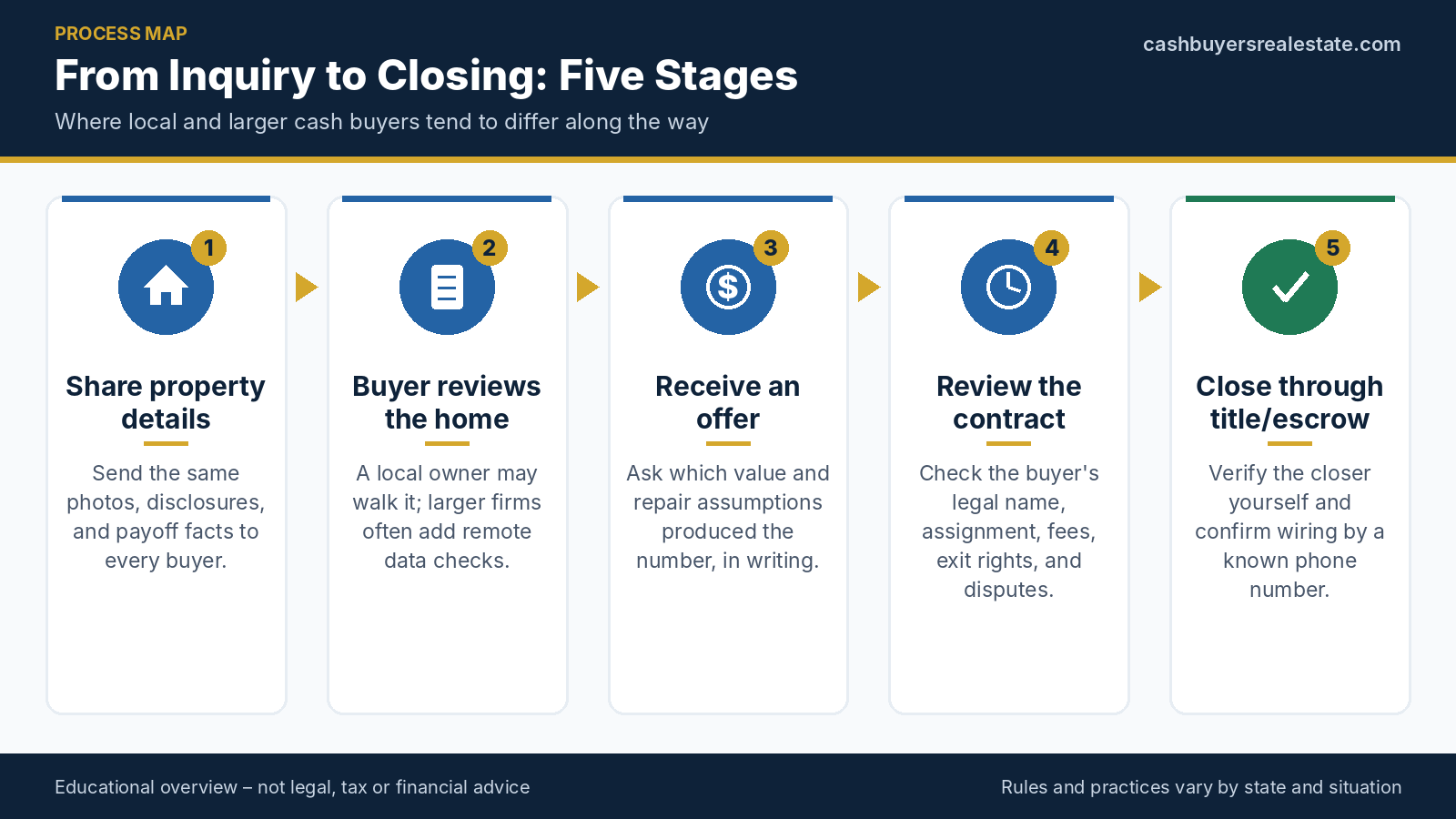
Text version of this infographic
- Share property details — Send the same photos, disclosures, and payoff facts to every buyer.
- Buyer reviews the home — A local owner may walk it; larger firms often add remote data checks.
- Receive an offer — Ask which value and repair assumptions produced the number, in writing.
- Review the contract — Check the buyer's legal name, assignment, fees, exit rights, and disputes.
- Close through title/escrow — Verify the closer yourself and confirm wiring by a known phone number.
How Local and National Buyers Build an Offer, and What You Actually Keep
An offer is the end of a calculation, and the calculation reveals what the buyer needs from the deal. Investors buy houses to resell, rent, or renovate, so every offer works backward from a future value, subtracts the costs and profit the buyer requires, and arrives at a price. Local and larger buyers run the same basic arithmetic with different inputs and different habits, and understanding the inputs lets you judge whether a number is reasonable for your property or merely convenient for the buyer.
Pricing Models: Personal Judgment vs. Standard Formulas
The two models do not differ in principle, since both start from the likely resale value. They differ in who chooses the inputs, how much those inputs are checked against the actual house, and how much room the final number has to move. That difference shapes both the first offer and the negotiation that follows, so it is worth seeing each approach laid out.
How a Local Investor Arrives at a Number
A local investor generally begins with the after-repair value, which is an estimate of what the house would sell for in good condition, derived from recent sales of similar houses nearby. Experienced buyers know the micro-markets within a city: which side of the highway commands a premium, which school boundary matters, which street floods. They then walk the property with a repair budget in mind, often built from recent invoices for similar work, and subtract the costs they expect to bear while owning and reselling the house, including financing charges, utilities, insurance, taxes, agent fees or closing costs on resale, and a profit margin that justifies the risk. What remains is the maximum they can pay.
Illustrative example (hypothetical numbers, not market data): A local investor estimates a three-bedroom house would resell for $214,000 once repaired. She subtracts a $29,500 repair estimate, leaving $184,500. She expects resale costs and holding costs of about 9 percent of the resale value, or $19,260, which leaves $165,240. She wants a profit of $17,500 for the work and risk, leaving $147,740, and expects $4,200 in financing charges, which brings the number to $143,540. She rounds to a $143,500 offer, which is about 67 percent of the after-repair value. Every line is a judgment, and a different investor could reasonably use different ones. The point is that each input can be questioned, not that this percentage is a norm.
Because the inputs are personal, they can move in response to conversation. If you show a roofing invoice from last year, a clear survey, or proof that an addition was permitted, the investor may revise the repair estimate or lower his risk allowance. If a neighbor’s recently renovated house sold for more than he assumed, he may adjust the resale value. The flexibility cuts both ways: it also means a local buyer who is busy, thinly capitalized, or uninterested in your type of house can produce a low number without much explanation. Ask which comparable sales and which repair assumptions support the figure, and note how specific the answer is. Vague answers, such as “that’s just what the market is,” are worth less than a short list of addresses and a contractor’s range.
One subtlety deserves mention. Local buyers who borrow short-term money to fund purchases carry interest costs that rise with time, so their offers often reflect how soon they expect to resell. A house they can renovate and sell quickly may command a better price than a similar house with title questions that could freeze the project for months. That sensitivity to time is part of why a local buyer’s willingness to pay can swing so widely from one property to the next.
How a Larger Operator Standardizes the Number
A larger company runs the same logic through a more controlled system. Pricing often starts from data feeds and automated valuation tools, supplemented by photo review and local staff or contractors who confirm condition. Repair costs may be drawn from standardized cost tables adjusted by region, and the margin is set by company policy rather than by the mood of one buyer. Overhead enters the arithmetic as well: a company with a call center, marketing budget, and regional managers has real costs that a solo investor does not, and those costs have to be covered out of the spread between purchase price and resale.
Standardization produces consistency. Two sellers with similar houses in the same neighborhood will often receive similar offers, and the logic can be explained step by step if you ask. It also produces a ceiling. If the model values the house at a level that does not reflect an unusual feature, such as an exceptional lot, a legal second unit, or a recent system replacement, the representative may have little power to move the number unless a manager reviews it. Larger companies also tend to concentrate on houses that fit their renovation and resale model, so a house outside that profile may receive a lower offer or no offer at all.
A seller’s best strategy with a standardized buyer is to supply the inputs that the model might miss. Documents showing permitted work, recent receipts for roof or HVAC replacement, a recent appraisal or inspection report, and clear photos of upgraded features all help a human reviewer override a default assumption. Ask whether such documents can trigger a re-review and how long it takes. For the broader mechanics of how investors reach their numbers, the guide on how cash buyers calculate offers goes into the formulas in more detail than is needed here.
From Headline Price to Net Proceeds
Headline numbers are easy to compare and easy to misread. What matters to you is the amount that reaches your bank account after the mortgage payoff, closing costs, fees, credits, and the cost of carrying the house until closing. Since local and larger buyers structure costs differently, a fair comparison requires translating every offer into a net figure.
Fees, Credits, and Closing Costs That Change the Bottom Line
Costs show up in several places. Some buyers pay all closing costs and say so in the contract; others split them or assign certain items to the seller by default. A buyer might state a flat price but deduct a “transaction fee” or “service charge” in the settlement figures, sometimes as a percentage of the price. Repair credits may be set at signing or adjusted after the inspection. Prorations for property tax and utilities, title search and recording fees, and any HOA or municipal charges can all appear on the seller’s side. Who pays these items varies by buyer, by contract, and by state custom, and in some states they are paid to an attorney who handles the closing, not to a title company.
The right habit is to ask each buyer for a written estimate of what the seller will pay at closing and what the seller will receive, and to check it against a draft settlement statement as soon as the title company or attorney prepares one. The table below compares two hypothetical cash offers with a third route, an as-is listing, on a single invented house so that the interaction among price, costs, and time becomes visible.
| Line item | Offer A: local investor | Offer B: larger company | Option C: as-is listing |
|---|---|---|---|
| Headline price | $171,000 | $178,000 | $226,000 |
| Service charge or commissions (assumed) | $0 | $10,680 | $11,300 |
| Buyer credits after inspection | $0 | $0 | $4,520 |
| Seller-paid closing costs | $2,400 | $2,000 | $2,600 |
| Cleanup or repair spending | $0 | $0 | $3,500 |
| Weeks to closing (assumed) | 3 | 5 | 13 |
| Carrying costs for those weeks | $2,340 | $3,900 | $10,140 |
| Mortgage payoff | $92,000 | $92,000 | $92,000 |
| Estimated net cash to seller | $74,260 | $69,420 | $101,940 |
The table shows three things at once. Offer B’s headline is $7,000 higher than Offer A’s, yet the seller keeps $4,840 less because of the itemized charge and the longer timeline. Option C produces the highest net figure by a wide margin, but it requires thirteen weeks in this example, depends on a retail buyer being found at that price, and exposes the seller to the possibility of a failed inspection or financing problem. Nothing in the table says cash buyers are good or bad; it shows that without a line-by-line comparison the better headline can be the worse deal, and that a faster route typically carries a price.
Why the Highest Headline Is Not Always the Best Offer
Several features can make a higher number less valuable than it looks. The first is conditionality: an offer that lets the buyer cancel for any reason during a long review period is worth less than a slightly lower offer with a short window and a meaningful deposit, because the seller bears the risk of losing weeks of market time. The second is re-pricing risk. If the contract allows the buyer to reduce the price after inspection with few limits, the number on page one is only a starting point, and a seller who has already committed to a move may be negotiating from a weaker position. The third is the cost of time itself, which includes mortgage payments, insurance on a vacant property, and the rent or temporary housing you pay while waiting.
Taxes are another factor that many sellers forget to include in a net comparison. If the house has been your main home, federal law allows you to exclude up to $250,000 of gain, or $500,000 on a joint return, when you meet the ownership and use tests, according to the IRS summary of Topic 701. That means many sellers owe no federal tax on the sale no matter which route they choose, but rental properties, inherited properties, and homes you did not live in for two of the previous five years follow different rules. A tax professional can tell you how your situation applies, and the amount you owe is the same whether the buyer is local or national, so it rarely tips the comparison between them.
Finally, remember what the as-is listing option looks like after recent industry changes. Since the National Association of REALTORS® settlement terms took effect on August 17, 2024, offers of compensation to buyer agents can no longer be published on a multiple listing service, and commission arrangements are described by NAR as negotiable. That does not change the fact that a listing involves commissions, preparation, and uncertainty, but it does mean the commission line in your own net sheet is something to discuss with each listing agent rather than assume. The full cost comparison between these routes lives in the guide to cash offer net proceeds; here the lesson is simply to compare final amounts, not headlines.
Accountability, Complaints, and Licensing: Who Answers When Something Goes Wrong
Most cash sales close without incident, and the best protection is picking a buyer and a closing process that make problems unlikely. Still, accountability is where local and larger buyers differ most sharply, and it deserves attention before you sign, not after a dispute begins. The questions are practical: who is legally responsible, how easily can you reach them, what offices will listen to a complaint, and which laws about licensing and disclosure apply to the people on the other side of the table.
Complaint Channels That Actually Exist
When people think about complaints they often picture a single hotline. In reality the channels are layered: you begin with the buyer and the contract, move to the closing professional, and, if necessary, reach for government agencies or courts. Each layer has a purpose and a limit, and knowing the sequence beforehand keeps you from wasting weeks in the wrong place.
Starting With the Buyer, the Contract, and the Closer
The first and most effective channel is a calm written message to the buyer that cites the specific clause or promise at issue and proposes a fix. A local owner-operator can usually be reached directly, and a polite message that references the contract often resolves a misunderstanding within days, because the owner’s reputation in a small market is his main asset. A larger company typically has a customer-service or transaction-coordination channel, and a written escalation request that names the contract section and the date you need a response tends to move faster than repeated phone calls. In both cases, keep the thread in writing so that the sequence of events is documented.
The second channel is the closing professional. A title company, escrow officer, or closing attorney handles funds and documents, and an experienced one will refuse to proceed with a closing that violates the contract or that appears to contain irregularities. Many states route closings through licensed escrow or title companies; others rely on attorneys. Either way, the closer is a neutral channel for questions about what the settlement statement should show. If you are uncomfortable with the closer chosen by the buyer, you can ask whether you may use your own, though the contract may specify otherwise. Ask early, because the answer determines who holds the money and who answers your questions about it.
The third channel is the contract’s own dispute provisions, which are easy to overlook. Some agreements require mediation or arbitration, specify a particular county or state as the place for any lawsuit, or limit the damages a seller can recover. Larger companies are somewhat more likely to use standardized dispute language, and their forms may point to a court far from your home. Local buyers’ agreements vary from a single page with no dispute terms at all to a detailed form copied from a template. Read these clauses before signing, not after. And think about collectability: a judgment against a thinly capitalized single-purpose LLC may be hard to collect, while a company with substantial assets is easier to pursue but may have more lawyers. That is a reason to value a real deposit and a prompt closing date more than a promise of future remedies.
Regulators, Agencies, and the Limits of Online Reviews
If direct efforts fail, several public offices may help, though none of them acts as a universal referee for cash home purchases. The Consumer Financial Protection Bureau accepts complaints about products such as mortgages, and its published process routes a complaint to the company, which generally responds within 15 days and sometimes up to 60. That tool is aimed at financial products and services, so it is most relevant to your own mortgage servicer, for example if a payoff statement is wrong, and not to a straightforward cash purchase agreement. For fraud and deceptive practices, the Federal Trade Commission collects reports through the fraud-reporting site linked from its consumer pages, and state attorneys general run consumer-protection divisions that accept complaints about unfair or deceptive business practices. The FBI’s Internet Crime Complaint Center (IC3) takes reports of online-enabled fraud, including wire diversion, and urges people to file even when they are unsure the incident qualifies.
| Type of problem | First step | Office to consider | Limits to keep in mind |
|---|---|---|---|
| Buyer will not honor a price, deposit, or date in the signed contract | Written notice citing the clause | Attorney, small claims or civil court, state attorney general | Dispute clauses may set arbitration or a distant venue |
| Misleading advertising or pressure tactics | Save messages, screenshots, and call dates | State attorney general consumer division; FTC fraud reporting | Agencies track patterns and may not resolve your individual case |
| Possible unlicensed brokerage or wholesaling violation | Check the state regulator’s license lookup | State real estate commission or agency | Rules and exemptions differ widely by state |
| Wire or payment instructions changed or fraudulent | Call your bank at once and ask about a recall | FBI IC3, local law enforcement, the closing company | Speed is critical, and recovery is never assured |
| Wrong payoff figure or servicing error on your mortgage | Written dispute to the servicer | CFPB complaint tool | Covers your lender, not the cash buyer |
| Recorded document or lien clouding your title | Ask the title company or an attorney to review | County recorder or clerk, then a court if needed | Removal may require legal action |
Treat the table as a map of who handles what, not as a promise of results. Agencies differ in whether they can order a refund, and many act mainly by collecting patterns of complaints. For wire fraud, the CFPB’s guidance for closings is to confirm payment instructions using a phone number you already know and never to follow instructions sent only by email, and its advice after a loss is to contact your bank immediately and file with IC3. Those steps are written for buyers, but the reasoning carries over to sellers whose payout instructions could be redirected by an impostor.
Online reviews deserve a measured role. They can reveal patterns, such as repeated complaints about last-minute price cuts or slow communication, and they can show whether a business responds to criticism. They also can be incomplete, easily gamed, or posted by the very marketing operations that the reader is trying to see through. A dozen detailed reviews describing the same problem are more informative than hundreds of generic five-star ratings. Combine them with objective checks: the entity’s registration with the state business office, any license lookup the real estate regulator offers, the county records showing how many properties the entity has bought, and a reference you can actually call. For the broader trust question, see are cash home buyers legit.
Licensing, Multi-State Operations, and State Wholesaling Laws
Licensing is the area where “local” and “national” hide the most variation, because real estate regulation is mostly a state matter. A company that buys in ten states must follow ten sets of rules, and a local buyer may be subject to a rule that a national company has never encountered. Rather than assuming either is covered or exempt, learn the categories and check the specific rules where your house sits.
Why Roles and Licensing Differ From State to State
Several roles can look alike from the outside. A principal buyer purchasing for its own account is generally acting on its own behalf, and in many states that does not require a real estate license, although the details vary. A licensed real estate agent or broker represents a client for compensation and is subject to a state commission’s rules. A wholesaler occupies a gray area: because it contracts to buy a property and then sells the contract rather than the house, some states treat that as brokerage activity, others regulate it through special disclosure or registration laws, and others have not addressed it explicitly. Whether a given buyer needs a license depends on the state, the number of transactions, and the way the deal is structured.
Multi-market companies add a layer of complexity. They usually form separate legal entities in different states or use state-specific contract forms, and they may use local attorneys or title partners to close. That can be an advantage, because well-run operators tend to have counsel who know each state’s requirements. It can also mean that the contract’s governing law, the buyer’s name, and the closing location differ from what the website implies. Ask which state’s law governs the contract, which entity is the buyer of record, and whether the company holds any state registrations or licenses relevant to the transaction. If a company says licensing is unnecessary, ask the state regulator whether that matches its view.
There is also a federal backdrop about money, not licensing. FinCEN adopted a rule requiring certain closing professionals to file reports on some non-financed transfers of residential property to entities and trusts. According to FinCEN’s rule page, a federal district court in Texas vacated that rule on March 19, 2026, the government has appealed, and reporting persons are not required to file while the court’s order stands. As a seller you are not the one who files, and the rule’s status may change on appeal, so treat it as background that explains why title professionals sometimes ask more questions about entity buyers, not as something you must manage.
Oklahoma and Oregon: Two Verified Examples, and How to Check Yours
Two states illustrate how wholesaling laws can protect sellers. Oklahoma’s law, which a title underwriter’s bulletin reports took effect on November 1, 2025, is codified in Title 59 of the Oklahoma Statutes. Under section 858-314, as described in the Oklahoma Real Estate Commission’s approved cancellation form, a wholesaler must disclose in writing any plan to assign or sell its interest for a higher price than the homeowner is being offered, must state that the homeowner should seek legal advice, and must state that the homeowner may cancel without penalty within two business days. A contract lacking those disclosures is invalid and unenforceable, and the homeowner may cancel at any time and is entitled to any earnest money deposit.
Oregon’s approach, passed in House Bill 4058 and described in the Oregon Real Estate Agency’s overview, took effect on July 1, 2025. Non-licensees who market residential property while holding only an equitable interest or an option to buy, for fewer than 90 days and with less than $10,000 invested in improvements, must register with the agency, and a written disclosure in at least 10-point bold type must be given to sellers before a wholesale contract is signed. Sellers and buyers may cancel without penalty by written notice before midnight at the end of the third business day after receiving the disclosure, and the right cannot be waived. These two examples differ in detail, which illustrates the main point: do not assume the protections you read about elsewhere apply to you.
To check your own state, start with the state real estate commission or department of licensing website and search for terms such as “wholesaling,” “equitable interest,” and “disclosure.” Then look up the buyer’s entity on the secretary of state’s business search, and consider a one-hour consultation with a real estate attorney licensed where the property sits. That small expense can reveal whether a contract is enforceable and which cancellation rights apply. A seller who knows which of these rights exist is also better placed to notice when a buyer or a marketing page ignores them.
Putting accountability and licensing together shows how five common routes compare on the points that matter most to a seller: offer price, repairs avoided, closing costs, timeline, contingencies, and certainty of closing. The infographic below summarizes those trade-offs for a local owner-operator, a regional operator, a national multi-market company, an intermediary or wholesaler, and a traditional as-is listing.
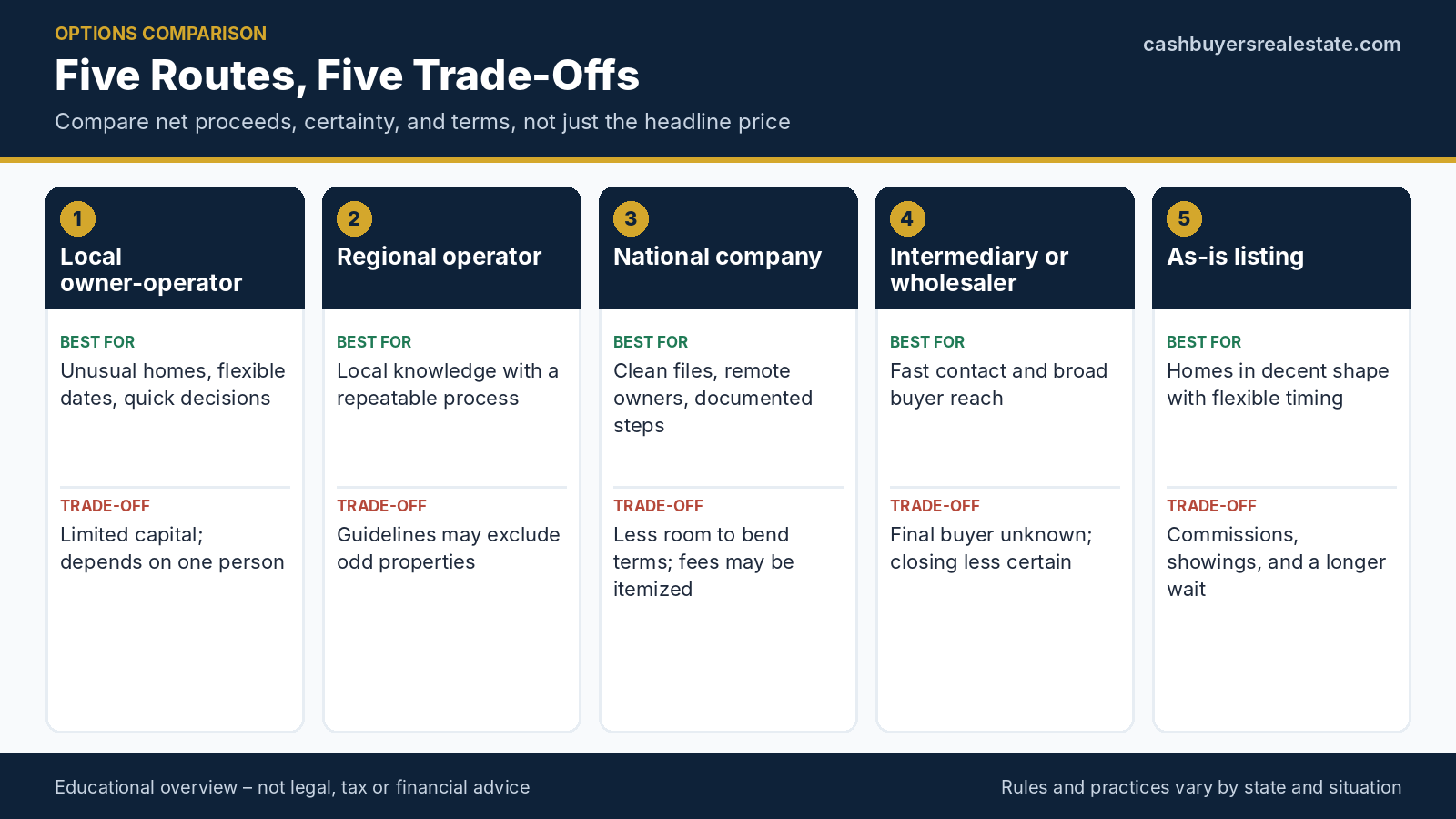
Text version of this infographic
- Local owner-operator — Best for: Unusual homes, flexible dates, quick decisions. Trade-off: Limited capital; depends on one person.
- Regional operator — Best for: Local knowledge with a repeatable process. Trade-off: Guidelines may exclude odd properties.
- National company — Best for: Clean files, remote owners, documented steps. Trade-off: Less room to bend terms; fees may be itemized.
- Intermediary or wholesaler — Best for: Fast contact and broad buyer reach. Trade-off: Final buyer unknown; closing less certain.
- As-is listing — Best for: Homes in decent shape with flexible timing. Trade-off: Commissions, showings, and a longer wait.
Negotiation Posture and Running Both Kinds of Buyer in Parallel
Many sellers assume a cash offer is a take-it-or-leave-it proposition, and a few buyers encourage that belief. In practice there is almost always something to discuss, but what is worth discussing depends on who sits across from you. A local owner-operator and a multi-state company have different constraints, different incentives, and different ways of saying no. Knowing those differences lets you ask for things that can actually be granted, and it lets you collect more than one offer without turning the process into a contest that damages your standing with either side.
Negotiating With Each Type of Buyer
A useful rule of thumb is that you negotiate with a local buyer’s judgment and with a larger company’s system. The first is persuaded by information and relationship; the second responds to documentation, defined exceptions, and a clear paper trail. Either way, calm courtesy tends to work better than bluff, because every buyer has seen the bluffs before.
Local Buyers: Reading Motivation, Margin, and Bandwidth
With an owner-operator, the most valuable thing to understand is what the buyer needs from your particular house. An investor who has a renovation crew idle next month may value a quick closing more than a few thousand dollars of margin. One whose private lender charges high interest by the week may care more about speed than price. Another who is stretched across several projects may prefer a simple house with a clean title. You can learn much of this by asking open questions, such as how soon he would like to close and what part of the project concerns him most, and by listening to what he repeats. A buyer who mentions the roof three times has told you where the number is coming from.
The strongest levers in these negotiations are usually terms rather than price. A larger deposit that becomes non-refundable after a short inspection period, a closing date that matches your needs, a clear statement that the buyer will not reopen the price for items he has already seen, and an agreement to handle closing costs in a particular way can all be worth more than another thousand dollars on the headline. Because the buyer is the decision-maker, he can grant these quickly, and a generous term often produces goodwill in return. Where the numbers are tight, it can help to ask what specific change would bring the offer up, then answer that issue with a document such as a contractor quote, a permit record, or a recent receipt.
A few cautions apply. Local buyers vary in how they respond to being compared; some welcome the competition and some interpret it as disrespect. Avoid inventing competing offers, since a buyer who calls the bluff by asking to see the paperwork leaves you in an awkward position. Be wary of artificial deadlines, such as an offer that supposedly expires tonight, because genuine buyers who want your house usually accept a reasonable review period, and urgency that cannot be explained is worth treating as a signal. The guide to cash offer negotiation covers counteroffer mechanics in more detail.
Larger Companies: Working Inside a System
With a larger operator, the first task is to learn what is fixed and what is flexible. The pricing framework, the form of the contract, the fee schedule, and the inspection process are usually fixed. The inputs to those systems, the timing within allowed ranges, the choice of closing company where the contract permits it, and the way exceptions are handled are often flexible. The person you talk to may be able to tell you which category a request falls into, and a polite question such as “Is that a policy or is it something a manager can approve?” tends to produce useful candor.
The most reliable way to move a standardized number is to supply information that the model did not have. Receipts for recent replacements, an engineer’s letter about a foundation crack, evidence of permitted work, or a written statement that tenants will vacate by a certain date can each justify a re-review. Ask for the reviewer’s name or role and for a promised response date, and keep your communications in writing. If the first answer is no, ask for a short written explanation of the assumption at issue. Sometimes the explanation reveals a factual error that can be corrected, and sometimes it shows the buyer’s reasoning is sound and you can stop pushing.
Using a competing written offer is legitimate with a larger company, and it can be effective when the offers are comparable in terms and timing. Share the facts honestly, preferably as the net amount you would receive, and ask whether the company can reach a similar figure. Some will, some will refuse to negotiate against another bid, and some will offer a different structure, such as a shorter inspection period instead of a higher price. A refusal is information, not an insult. Accept it graciously, because you may want to return to that buyer if the other offer falls through.
Running Both Kinds of Buyer in Parallel Without Burning Either
Collecting offers from a local buyer and a larger company at the same time is sensible, because it gives you a baseline for judging price and terms. The risk lies in doing it carelessly: giving different buyers different information, signing overlapping agreements, or letting a deadline slip until you have no leverage. A short, orderly process prevents most of those problems.
One Property Packet, One Net Sheet, One Deadline
Begin by assembling a single packet of facts about the property and sending the same packet to every buyer. It should include clear photos, your honest description of known problems, the age of the major systems, a copy of the latest property tax bill, your mortgage lender’s name and an approximate payoff figure, and any permit records or repair receipts you hold. Giving every buyer identical information keeps the comparison fair and keeps you consistent on what you have disclosed. Never conceal a known defect to improve an offer; beyond the ethical problem, disclosure obligations vary by state, and a buyer who later discovers an undisclosed problem may have legal remedies.
Next, build one net sheet in a spreadsheet, with a column for each offer and rows for the price, any fees or credits, seller-paid closing costs, the mortgage payoff, the expected weeks to closing, and the carrying cost for those weeks. The table earlier in this guide shows the structure. Finally, set one deadline, usually three to five business days from the day you send the packet, and tell every buyer when you expect to decide. A shared deadline creates a fair field, avoids the pressure of rolling offers, and gives you time to read contracts instead of reacting to the first one that arrives.
Illustrative example (hypothetical numbers, not market data): A homeowner sends the same packet on a Monday morning and tells both buyers she will decide by Friday at noon. By Tuesday, a local buyer has visited and offered $142,000 with a 21-day closing and a $3,000 deposit. By Wednesday, a larger company has sent a written offer of $145,500 with a 30-day closing and a $1,000 deposit, plus a five-business-day inspection period. On Thursday she asks each to confirm in writing what it would pay if the inspection revealed nothing beyond the issues she disclosed. The local buyer confirms the price is firm unless something new appears; the larger company says its inspection could adjust the price within a stated schedule of repair costs. She now has comparable information, and the decision is about risk and timing, not only about a $3,500 gap in the headline.
The example shows why questions asked in the same words of every buyer produce better answers than a negotiation based on impressions. The seller never has to claim a rival bid she does not hold, and neither buyer is surprised by the process. If one offer is clearly better, the decision is easy; if they are close, the answers to risk questions usually break the tie.
Avoiding Exclusivity Traps, Overlapping Contracts, and Re-Trades
The main hazard of working with several buyers is signing something that binds you to one of them before you intended to. Some agreements contain exclusivity or “right to match” language, option fees, or cancellation charges that apply if you sell to someone else. Others give the buyer the right to record a notice of the contract in the county records, which can cloud your title and make it difficult to close with another purchaser until it is released. Before signing anything, read for these provisions, ask what the buyer would do if you cancel within the inspection window, and consult an attorney if the language is unclear. The details of contract terms are explored in the guide to cash offer contract red flags.
Re-trades, in which a buyer lowers the price after the contract is signed, are the second hazard. Some price changes are legitimate: an inspection that reveals a collapsed sewer line really changes the value of the property. Others are tactical, based on issues that were visible at the first walk-through or on assumptions the buyer never checked. Protect yourself by documenting the condition before signing, disclosing known issues in writing, and negotiating contract language that limits price adjustments to newly discovered, documented items above a stated dollar threshold. A larger deposit that becomes non-refundable at the end of a short window also discourages casual re-trading, since the buyer then has money at stake.
When parallel conversations are managed well, one of three outcomes follows. One offer stands out clearly and you accept it. The offers are close and a small adjustment of terms decides the matter. Or neither is acceptable, in which case you have learned what the market will pay for a cash sale and can compare it with a listing or a light-repair strategy. To keep the sequence straight, many sellers find a simple schedule helpful:
- Day one: send the same property packet to every buyer and state the decision date.
- Days two and three: host walk-throughs separately, and keep notes on what each visitor asks and promises.
- Day four: collect written offers, then send each buyer the same list of clarifying questions on deposit, inspection, and closing.
- Day five: fill in the net sheet, have an attorney or title professional review the leading contract, and decide.
- After you choose: tell the other buyers promptly and courteously, and confirm in writing that you are not bound to them.
This pattern is not a rule, and a complicated property may need a longer timetable. The structure matters more than the exact days: one packet, one comparison, one decision date, and clear communication at the end. Following it makes it far less likely that you will sign out of fatigue or pressure, and it keeps relationships with both kinds of buyer intact in case you need them again.
Red Flags Specific to Each Model, and the Checks That Catch Them
Warning signs are easiest to interpret when you understand the structure that produces them. A tiny operation tends to fail in one set of ways, and a large one in another, and a few risks appear in both. None of the signals below proves that a buyer is dishonest, and every one of them has an innocent explanation in some cases. The value of the list is that it tells you what to verify, in what order, before you sign anything that is difficult to undo.
Warning Signs That Cluster Around Local Operators
Small local buyers are often the most helpful people in the market, which is why the weaknesses of the model are worth stating plainly. They arise from limited resources and informality, not from bad faith, though a few bad actors do hide inside the same pattern. The checks are simple and mostly free.
Thin Capital, One-Person Bandwidth, and Informal Paperwork
The most common local problem is not fraud but over-commitment. A buyer who has signed contracts on six houses with the hope of selling several of them to other investors, or who is waiting for a lender to release funds, can agree to your terms with complete sincerity and still fail to close. The signals include evasive answers about how the purchase will be funded, a proof-of-funds document that is old or that shows a balance far below the price, reluctance to name the closing company, and repeated requests to extend the closing date for reasons that sound reasonable individually but add up to a pattern. A genuine buyer will usually be able to show a recent bank or lender letter in the name of the buying entity and will tell you who the closer is.
Informal paperwork is the second pattern. A single-page agreement is not a problem in itself, but one that omits the legal name of the buyer, leaves the closing date blank, makes no mention of what happens to the deposit, or says “and/or assigns” without explanation is a warning. So is a request to sign anything with blank spaces to be filled in later. Another warning is a buyer who offers to handle all of the paperwork personally and discourages you from having a lawyer or title professional review it. A buyer with nothing to hide benefits from a closing professional who has verified the documents, and the guide to proof of funds for cash buyers explains what acceptable evidence looks like.
Illustrative example (hypothetical numbers, not market data): A homeowner receives a proof-of-funds letter showing $140,000 for an offer of $131,000, but the letter is dated five months earlier and names an individual, while the contract names a different LLC. She asks the buyer to provide a current letter from the institution holding the money, in the name of the entity that will sign, along with the name of the title company. The buyer sends a new letter within two days and identifies a local title office, which she phones using a number she found herself. The extra step costs a few days and resolves the question. If the buyer had refused or hedged, the contract would have been a poor risk at any price.
Because the example involves the same kind of verification you would do with any large company, the lesson is that diligence is not a sign of distrust. It is the normal way to treat a transaction that may be the largest financial event of your year. Honest buyers expect questions about money and entities and are generally relieved when sellers ask them, since it filters out those who would not follow through.
Pressure Tactics, Unsolicited Contact, and Money Moving the Wrong Way
The second cluster is behavior at the kitchen table. High pressure, such as an offer that expires at midnight, a suggestion that other sellers are lining up, or a claim that you will lose the price if you speak to a lawyer, is a warning in any buyer, local or national. It is especially noticeable with small operators because a face-to-face conversation can feel personal, and sellers hesitate to say no to someone who has driven to their house. A calm response is to say you review all contracts with a professional and will answer by a stated date. A buyer who respects the process will agree.
Unsolicited contact is another feature of the local landscape. Many small buyers market through direct mail, door knocking, and calls or texts to property owners, and sellers sometimes feel uneasy about how their information was obtained. Registering a number with the National Do Not Call Registry, which the Federal Trade Commission says never expires, can reduce sales calls from companies that follow the law, although it takes up to 31 days to take full effect, has exemptions, and does not stop scammers. The registry is a helpful hygiene step, but it does not tell you whether a given buyer is trustworthy.
The most important financial warning concerns direction of money. In a legitimate cash sale you receive funds at closing, and you do not send money to the buyer. Requests for an upfront fee, a payment to “release” a deposit, a check that you are asked to deposit and return part of, or a change in wiring instructions delivered by email are all reasons to stop and call the closing company at a number you already know. The Consumer Financial Protection Bureau’s guidance on mortgage closing scams advises confirming wiring instructions by phone with trusted contacts, never following instructions from an email, and contacting your bank immediately if money goes to the wrong place. For a wider treatment of scam patterns, see the main page on cash home buyer scams.
Warning Signs That Cluster Around Larger Companies
Larger companies have their own characteristic risks. They tend to be less about disappearing deposits and more about fine print, process friction, and the gap between marketing and contract terms. Because a representative can sound warm while reading from a script, the paper is where you find what the company actually promises.
Template Contracts, Itemized Fees, and Long Exit Windows
Template contracts carry terms that come from the company’s risk management, and some of them favor the buyer heavily. A long inspection or due-diligence window during which the buyer may cancel for any reason, with deposit refunded, shifts the risk of delay onto you. Fee provisions may call for a service or transaction charge, or an administrative fee, deducted from the proceeds. Some agreements add termination fees for sellers who cancel, grant the company the right to record a notice of the contract against your title, or require disputes to go to arbitration in a distant place. Others describe a “right of first refusal” or an exclusive period during which you may not talk to other buyers. Each of these may be acceptable if you understand it and the price reflects it; each is a problem if it is hidden or glossed over by the representative.
The way to catch these provisions is to read the whole agreement before agreeing to any step that costs you something, and to ask the company to explain each clause that mentions fees, cancellation, assignment, recording, exclusivity, or dispute resolution. Request the form early, ideally with the offer, so you have time to review it with an attorney and compare it against a competing bid. If a representative says the form cannot be changed, ask whether a state-specific addendum or a manager-approved exception is possible. A company that is confident in its terms generally gives you time to read them and does not insist on same-day signatures.
| Warning sign | Structure that makes it more likely | Why it matters | Check that answers it |
|---|---|---|---|
| Vague or outdated proof of funds | Small buyers who rely on partners or lenders | A buyer who cannot fund will not close | Current letter from the institution, in the buying entity’s name |
| Buyer named differently from the company you spoke with | Franchise brands, lead generators, wholesalers | Responsibility sits with an entity you have never met | Compare the contract’s legal name with the secretary of state’s records |
| Broad cancellation rights for the buyer only | Template contracts of larger companies | You lose weeks while the buyer keeps its options | Ask for the shortest window and a deposit at risk |
| Assignment or “and/or assigns” language | Wholesalers and some small operators | The final buyer may be unknown and untested | Ask whether the buyer intends to close personally |
| Fees deducted from proceeds | Standardized fee schedules | The net is lower than the headline | Request an itemized estimate and compare net sheets |
| Closing company chosen by the buyer and not named | Any buyer; more common when closings are remote | The closer holds the money and prepares the statement | Verify the firm independently and phone a known number |
| Blank spaces or a request to sign now | High-pressure sales approaches of any size | Terms can be added after you sign | Never sign incomplete forms; ask for time to review |
| Recorded notice of the contract | Some small and large buyers | Can block another sale until released | Ask whether one will be recorded and how it is removed |
The table’s third column is the useful one. Each risk is a way of losing time, money, or the ability to sell to someone else, and none depends on the buyer’s size. If a buyer has several of these features and cannot explain them, the sensible response is to slow down, ask for changes in writing, and consider other options, including a listing. If a single feature appears and the buyer addresses it directly, the situation is often manageable.
Marketing That Overstates Local Presence or Certainty
The final cluster is the gap between marketing and contract. A site that features a local phone number, local-sounding name, and photographs of a nearby neighborhood may be run from elsewhere and may pass inquiries to different buyers. That is not unlawful in itself, but it should not be mistaken for a local investor who will visit the house. Likewise, phrases such as “guaranteed” or “no obligation” in advertising do not override a contract. Only the signed agreement states what the buyer must do, and if the agreement contains broad exceptions, the advertising is irrelevant. Ask the representative to say, in writing, who will own the house, who will inspect it, who will fund it, and who will close it.
Look also for testimonial claims you cannot check, rankings or awards with no named source, and inconsistent descriptions of whether the company buys directly or connects sellers with buyers. A company that is honest about being an intermediary is simpler to evaluate than one that obscures it. Compare what the company says on the phone with what its terms of use and privacy policy say about sharing your information, since those documents often reveal the real business model. If they describe sharing details with a network of buyers, you now know why your phone began ringing. For the practical side of vetting, the list of questions to ask a cash home buyer is a good companion.
Taken together, the checks in this section reduce to six habits that work on every buyer: confirm who they really are, ask for current proof of funds, read the clauses about cancellation, look closely at assignment terms, insist on a reputable closing professional, and never sign anything with blanks. The infographic below presents those six checks as a quick checklist you can keep beside you during every conversation.
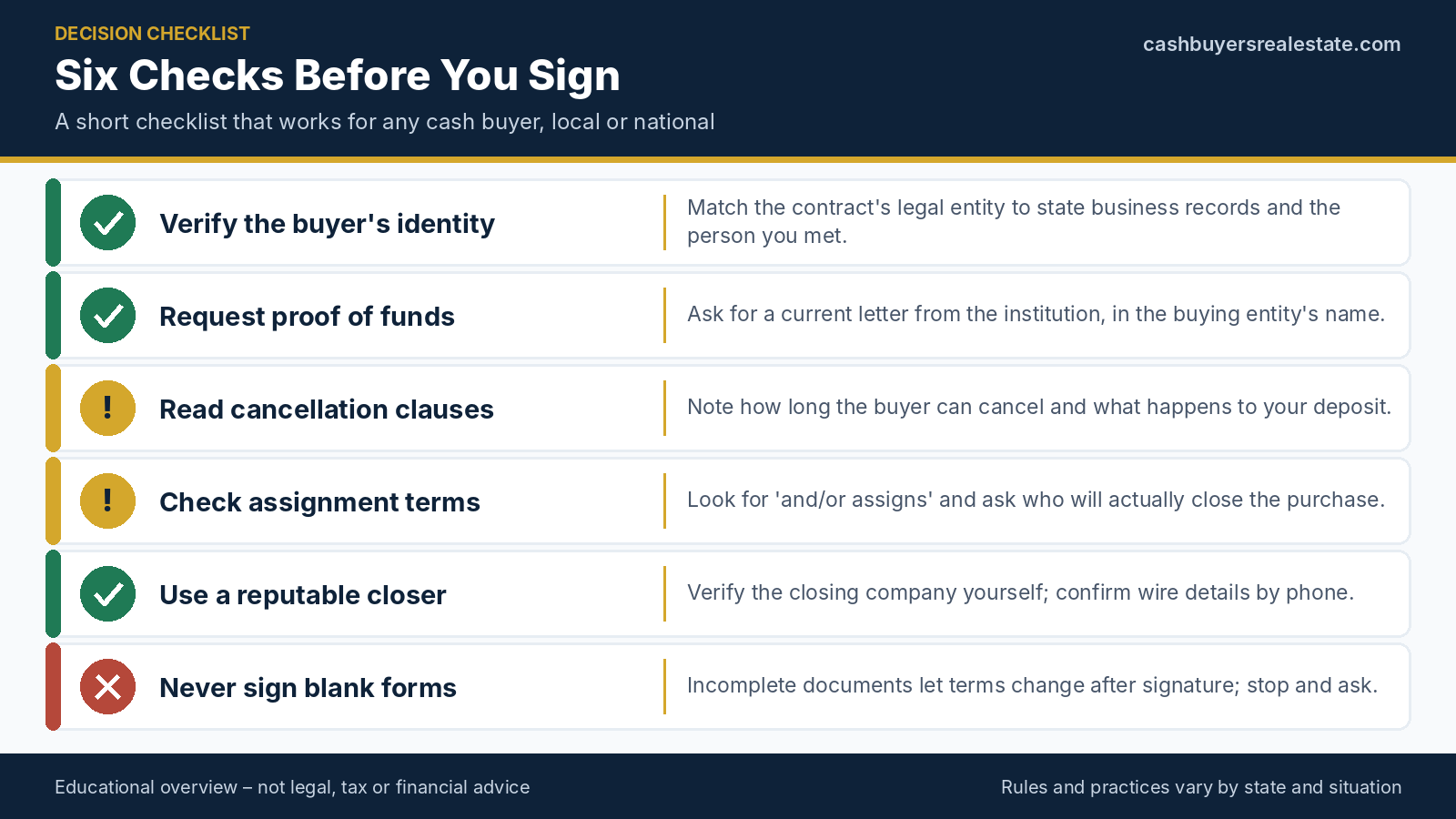
Text version of this infographic
- Verify the buyer's identity — Match the contract's legal entity to state business records and the person you met.
- Request proof of funds — Ask for a current letter from the institution, in the buying entity's name.
- Read cancellation clauses — Note how long the buyer can cancel and what happens to your deposit.
- Check assignment terms — Look for 'and/or assigns' and ask who will actually close the purchase.
- Use a reputable closer — Verify the closing company yourself; confirm wire details by phone.
- Never sign blank forms — Incomplete documents let terms change after signature; stop and ask.
Property Situations Where the Local-or-National Choice Changes
General comparisons only go so far, because the best buyer for a three-bedroom house in good shape may be the wrong buyer for a farmhouse with a failing septic tank or a rental with two leases in place. The characteristics of the property and the seller’s circumstances often matter more than the buyer’s size. Looking at the situations below, you can see which structural features become advantages and which become obstacles, and you can tell when it makes sense to widen the search beyond both categories.
Condition, Complexity, and Occupancy
The more unusual or tangled the property, the more the buyer’s willingness to think case by case matters. At the same time, complicated files expose weaknesses in underfunded buyers, so the choice is rarely about flexibility alone. It helps to separate problems of physical condition from problems of legal status, since the two favor different kinds of buyers.
Heavily Damaged, Unusual, or Rural Properties
Standardized pricing works best when a house resembles the ones the model has seen before. A damaged, dated, or unusual property, such as a house with fire or water damage, an unpermitted addition, a house on acreage, or one with a well and septic system, is harder to evaluate from data alone. A local investor who has renovated similar buildings can look at it and estimate the work in an afternoon, and may value features that a formula ignores, such as a usable outbuilding or a lot that can be divided. For houses at the rough end of the condition spectrum, the guide to cash home buyers for fixer-uppers covers what such buyers look for in more depth.
Larger operators may still be able to help with damaged houses, especially those in standard suburban settings with repair costs that can be estimated from experience. Their capital allows them to take on larger renovations, and their contractor networks can make big projects feasible. But their guidelines often exclude certain categories, such as properties in flood zones, houses with major structural damage, rural parcels beyond a set acreage, or homes with environmental problems. If a larger company declines your house, that does not reflect its value; it means the property falls outside the company’s buy box, and a local or specialty buyer may be the right audience.
Illustrative example (hypothetical numbers, not market data): A family inherits a 1950s farmhouse on eleven acres with a private well and an older septic system. A larger company declines because the parcel is beyond its acreage guidelines. A local investor offers $96,000, subject to a septic inspection and a 30-day closing, and mentions that he has a buyer for the outbuildings. The family asks for the inspection to be completed within ten days, requests that any repair credit be capped at an amount stated in the contract, and hires a surveyor so that acreage is not disputed later. The offer is lower than they hoped, but it is real, and the written limits on later changes make the risk understandable. They decide against listing because carrying costs and the estate’s other obligations make time more valuable than a possible higher price.
The example is meant to show the pattern, not a price. A rural or unusual property often yields a narrow set of buyers, and each one may value different features. Getting two or three offers matters even more than usual in these cases, since a single bid gives you no way to judge whether the figure is reasonable. Where the house has a major problem you can explain by documentation, such as an engineer’s report or a contractor’s estimate, share it with every buyer so that each prices the same facts.
Tenants, Title Problems, and Inherited Houses
Legal complexity creates a different set of demands. A house with tenants, an unresolved lien, a boundary question, or an heir who still needs court authority to sell requires a buyer who has handled such files and a closing professional who can work through them. Local investors often have the edge in knowing the county’s courts, probate clerks, code enforcement office, and the habits of local title companies, and they may be comfortable buying tenant-occupied properties because they plan to keep tenants. A larger operator may have a dedicated team and checklists for these files, and may be willing to wait for the legal steps, but many standardized programs exclude occupied properties or properties with unresolved title issues until those are cleared.
For inherited houses, the central question is whether the person selling has the legal authority to do so. Rules differ by state, and in many places the personal representative needs documentation from the probate court before a buyer’s title company will insure the sale. A buyer who promises to close in a week on an estate property that has not yet been opened in court is promising something it may not be able to deliver. Pay more attention to the buyer’s understanding of that process than to the speed of its offer, and consult an estate attorney in the state where the property sits. The related guides on cash buyers for inherited houses and selling a house quickly with tenants go into those situations directly.
Whichever route you choose, resist the idea that a sale with legal complications requires you to accept a poor price. Honest buyers do price in the time and risk of resolving those issues, but the amount they subtract should be explainable. Ask each buyer to describe the steps it expects, how long they usually take, and who will pay for them, and compare those answers the way you would compare repair estimates.
Location, Distance, and Timing
Where the property sits and where the seller lives influence which kind of buyer serves best. Those factors also interact with the closing customs of each state, which is why a company that works smoothly in one region can feel awkward in another. Timing matters too, since some sellers have a firm deadline and others can afford to wait for a better offer.
Out-of-State Owners and Remote Closings
An owner who lives far from the property faces a specific problem: someone must see the house, collect keys, resolve utilities, and attend to paperwork without the owner being there. Larger companies are often well suited to this. Their processes were designed for remote communication, with virtual walk-throughs, electronic signatures, and coordinators who send reminders. Many local buyers can also handle remote sellers well, and some prefer them, since an absent owner may be less concerned with possessions and move-out timing, but their processes are less likely to be standardized and more likely to depend on a single person’s availability.
Remote closings add verification demands. Notary requirements, ID checks, and signing procedures vary by state, and some places expect an attorney to be involved. Because remote sellers are more exposed to impersonation and wire-fraud attempts, they should use a closing company they have independently verified and confirm payment instructions by phone. If you cannot be present, appoint a trusted local representative to meet inspectors and buyers, and be cautious about handing over keys or signing a power of attorney unless an attorney has reviewed the arrangement. These precautions apply regardless of the buyer’s size.
Ownership of a house from a distance also has quiet costs that belong in the comparison. A vacant property still needs utilities, insurance, lawn care, and winter protection, and insurers often attach conditions to coverage once a building has been unoccupied for a period, so it is worth asking your insurer what its policy says before the house sits empty. Every week of delay costs money and invites minor damage, which is why remote sellers frequently weigh certainty of closing more heavily than a few thousand dollars of price. A buyer who can name a closing date, a closing company, and a plan for access and keys is more valuable to a distant owner than one who is simply enthusiastic on the phone.
Small Markets, High-Volume Metros, and Sensitive Timelines
Market depth changes the calculus. In a large metro area with many active investors, you can usually collect several offers from both local and larger buyers and rely on competition to reveal a fair range. In a small town or rural county, there may be only one or two local buyers and a larger company that treats the area as outside its normal footprint. In that setting, the local buyer has less competition and the listing alternative may deserve more weight, because a retail buyer pool in a small market can behave differently from an investor pool. Check how long comparable houses actually take to sell nearby by asking a few local real estate agents for their view, and treat their answers as opinions to be checked against recent sales.
Some sellers face deadlines that are not matters of preference, such as a relocation date, a divorce settlement schedule, a sale needed to avoid a missed payment, or the end of a lease. These situations call for care, because pressure invites exploitation, and a good buyer does not use it. State law governs foreclosure timelines, redemption rights, and divorce property rules, and a licensed attorney or housing counselor in your state can explain which dates actually bind you. A calm buyer, local or national, will agree to a schedule that matches the real deadline and will not manufacture a false one.
| Situation | Where a local buyer may help | Where a larger company may help | What to verify first |
|---|---|---|---|
| Standard house needing cosmetic updates | Fast walk-through, flexible dates | Predictable steps, fixed timeline | Net proceeds after all charges |
| Major damage or unusual features | Hands-on estimate; willing to price case by case | Capital for large renovations if within guidelines | Whether the property fits the buyer’s criteria |
| Tenant-occupied rental | Familiarity with local landlord-tenant practice | Dedicated team and checklists in some programs | Lease terms, notices, and security deposit handling |
| Inherited property in probate | Knowledge of the county court and its pace | Process for multi-heir approvals | Legal authority to sell and title insurer requirements |
| Out-of-state owner | Local presence for access and keys | Remote tools and coordinators | Closer verification and signing method |
| Rural or small-market property | May be the only active buyer | May not operate in the area | Comparable sales and the listing alternative |
| Firm deadline | Can shorten or shift dates quickly | Can promise a documented schedule | Written closing date and consequences of delay |
Use the table to decide whom to invite into the comparison, not whom to choose. If a situation points to one type of buyer, it is still wise to get at least one offer from the other type and one view of what a listing might produce, because the cost of a second opinion is small compared with the cost of a bad match. For sellers whose main concern is avoiding repairs, the page on selling a house fast without repairs lays out the wider set of options.
Frequently Asked Questions About Local and National Cash Buyers
The questions below come up repeatedly when homeowners compare a nearby investor with a larger company. The answers add practical detail to the body of the guide, and they assume that rules vary by state and that you will confirm anything that affects a contract with a licensed professional where the property is located.
Choosing and Comparing Buyers
Questions About Who the Buyer Really Is
- Is a company with a national website always a national buyer?
No. A national-looking site may be a franchise brand, a marketing business that forwards your details to buyers, or a single company with a polished web presence. The only reliable evidence is the contract, which names the entity that is obligated to buy. Ask who will own the house, who will fund it, and whether the person you speak with works for that entity. If the answers shift between conversations, treat that inconsistency as important information.
- How can I tell whether a “local” buyer is truly local?
Look for evidence you can check independently. The entity should appear in the secretary of state’s business records, its recent purchases should be visible in county property records, and its representative should be willing to meet at the house or at a title office. A local phone number or a local-sounding name proves nothing, since both are easy to display. A genuinely local buyer will usually be able to name the neighborhoods where it has bought and the closing company it uses.
- What does it mean when a buyer says it works through a network?
It usually means the company sells or routes properties to other investors rather than buying every house itself. That arrangement can work, but it introduces the question of whether the person who signs your contract will be the same person who closes. Ask whether the contract can be assigned, whether you will be told the final buyer’s name before closing, and whether your price is fixed regardless of who ends up buying.
- Should I worry if several buyers contact me after one inquiry?
It is a common result of filling out forms on lead-generation sites, which may pass your information to multiple buyers within minutes. It does not by itself indicate a scam. Still, you can reduce the flood by reading the privacy policy before submitting a form, using a phone number you do not mind sharing, and telling each caller you will review written offers by a stated date. Registering with the National Do Not Call Registry helps with some sales calls but not all of them.
Questions About Price, Fees, and Net Proceeds
- Do national companies always offer less than local investors?
No, and the reverse is not true either. Offers reflect each buyer’s costs, margin, risk tolerance, and appetite for your type of house. A larger company with lower financing costs and a streamlined renovation process may offer more on a typical house, while a local investor may pay more for a property that needs specialized knowledge. The only way to know is to compare written offers on the same net basis, after fees, credits, and the cost of waiting.
- Is it normal for an offer to change after the buyer inspects the house?
It happens often enough that you should plan for it. Changes are reasonable when an inspection reveals a problem that neither side knew about, such as a failed drain line or hidden water damage. They are less reasonable when the issue was visible at the first walk-through. Ask the buyer what findings could change the price, whether adjustments are capped or tied to a stated cost schedule, and what happens to your deposit and timeline if you decline a revised figure.
- Who pays closing costs in a cash sale?
It depends on the contract and sometimes on state custom. Some buyers agree to pay most closing costs, others split them, and some deduct fees from the seller’s proceeds. Typical items include title search, escrow or attorney fees, recording charges, transfer taxes in places that impose them, and prorated property taxes. Ask for an itemized estimate before signing, and see the guide on whether cash buyers pay closing costs for a closer look.
- Are cash offers always lower than what I would get by listing?
Not always, but the headline price is frequently lower than a retail sale price, since the buyer is paying for speed, certainty, and the work of repairs. The right comparison is the net amount after commissions, concessions, preparation costs, and carrying costs while the house is on the market. For some houses, particularly those needing major work or with complicated occupancy, a cash sale can produce a comparable net with far less risk. For others, listing wins. The guide to cash offer vs. market value explains why the gap exists.
Contracts, Closing, and Protection
Questions About Timing and the Contract
- Which kind of buyer closes faster?
Neither consistently. A local buyer with ready cash and a quick title company can close in a very short period, while a larger company with a refined process can be just as quick on a clean file. Delays usually come from title problems, payoff letters, probate steps, inspection findings, or a buyer waiting on a lender. Ask each buyer for a written closing date, the steps that must occur first, and the consequence if the date is missed.
- Can I back out after I sign?
Usually a signed purchase agreement binds you unless it gives you a cancellation right or you have a legal ground to terminate. Some states give sellers specific cancellation rights in wholesaling transactions, as Oklahoma and Oregon do, but those rights depend on the type of deal and the timing, and they do not apply everywhere. Read the termination clause, ask what happens to the deposit, and consult an attorney before signing if you are unsure.
- How much earnest money should I expect, and when is it at risk?
There is no standard amount, and the figure matters less than the terms around it. A deposit that is refundable at the buyer’s option for a long review period offers little protection, while a smaller deposit that becomes non-refundable after a short window can be more meaningful. Ask where the deposit will be held, who may release it, and under what conditions you may keep it. The details are covered in the guide to cash buyer earnest money.
- Do I need an attorney for a cash sale?
Requirements depend on your state, since some states require an attorney at closing and others typically use a title or escrow company. Even where an attorney is optional, an hour of review before signing can catch assignment language, recording provisions, and fee terms that are hard to spot. The cost is small compared with the amount at stake. Choose a lawyer licensed in the property’s state who handles real estate transactions regularly.
Questions About Complaints, Safety, and Legal Help
- Where do I complain if a buyer does not honor an agreement?
Start with a written notice to the buyer citing the clause and the fix you want, and copy the closing company. If that fails, an attorney, small claims or civil court, and your state attorney general’s consumer division are the usual next steps. Report suspected fraud to the FTC and, for wire fraud, to the FBI’s IC3. The CFPB’s complaint tool covers financial products such as mortgages, so it applies to your lender and not to a cash buyer.
- What should I do if I am asked to send money or change wiring details?
Stop, and call the closing company using a number you obtained independently. In a normal cash sale you receive money; you do not send it. A request for an upfront fee, or an email changing payment instructions, deserves suspicion even if it appears to come from someone you know. If you have already sent funds, call your bank immediately to ask about a recall and file a report with IC3, because speed improves the chance of recovery.
- Can I rely on online reviews and awards to judge a buyer?
Use them as one input, not the deciding factor. Detailed reviews that describe the same problem more than once are informative, while uniform praise or unsourced awards say little. Balance them with records you can verify yourself: entity registration, license lookups where applicable, county purchase history, and a reference from a seller or closing professional who has worked with the buyer. Reviews cannot tell you what a particular contract says, so read the contract.
Choosing Between a Local Buyer, a National Company, or Another Route Entirely
By this point the comparison should feel less like a contest between two brands and more like a set of trade-offs that you can weigh against your own situation. The decision does not need to be dramatic. It needs a clear order of priorities, a short list of verified facts about each option, and enough patience to read the paperwork before signing. The sections below turn the earlier material into a framework and a first-week plan, with no assumption that any one path is correct for everyone.
Matching the Route to Your Priorities
Different sellers value different things, and the same seller may value different things at different moments. Writing down what you are trying to protect, whether that is certainty, net cash, speed, flexibility, or simplicity, turns a confusing set of offers into a decision you can explain to a spouse, a co-heir, or an advisor.
Weighing Certainty, Net Proceeds, Speed, and Flexibility
Start with certainty, because the best price in the world is worthless if the buyer cannot close. Certainty comes from verified funds, a contract with narrow exit rights, a meaningful deposit, a named closing company, and a buyer with a record of finishing deals. Local and larger buyers can both supply it, and neither can supply it by assertion. Next consider net proceeds, which is the figure that determines whether you can afford your next step. Compare the final amount from each offer after charges, credits, payoff, and the cost of the weeks involved, and note how much of that amount depends on conditions that could change.
Speed and flexibility form the other pair. If you have a firm date, such as a closing on your next home or a lease that is ending, the buyer who can commit to that date in writing with real consequences for missing it is worth more than one who is faster in theory. If your date is soft, you can often trade speed for price by allowing a longer review period or a more conventional route. Flexibility, such as a rent-back, a staged move-out, or permission to leave belongings, tends to be easier to obtain from owner-operators but can be written into any contract that both sides sign. The table below shows how common priorities map to buyer structures, along with what to insist on in each case.
| If your top priority is | Structures that often fit | What to insist on | Caution |
|---|---|---|---|
| Certainty of closing | Well-capitalized buyers of any size with a record of finishing deals | Current proof of funds, a meaningful deposit, short exit windows | A name or size does not substitute for verified funds |
| Highest net amount | Often a listing, or competing cash bids compared on a net basis | Itemized costs and a written net sheet for every route | Higher net often means more time and uncertainty |
| Closing on a fixed date | Local owner-operators or larger companies that commit in writing | A dated contract and a stated remedy if the date slips | Verbal promises disappear when conditions change |
| Flexibility in move-out and possessions | Often local buyers, though larger companies can agree in writing | A written addendum covering utilities, insurance, and end date | Informal arrangements invite disputes |
| A predictable, documented process | Larger operators with scripted steps and portals | The full contract form before you commit | Standard forms may limit negotiation |
| Handling a complicated property | Buyers with experience in that specific problem | A clear list of steps, costs, and who pays | Complexity is priced in, so compare more than one bid |
Read the table from left to right as a prompt for your own notes. Most sellers have two or three priorities that matter and several that do not, and the right choice becomes obvious once those are written down. If your list contradicts itself, for instance wanting both the highest price and the fastest closing, that is a signal to rank the priorities and accept a trade-off rather than searching for a buyer who offers everything.
Alternatives That Belong in the Comparison
An honest comparison includes at least one route that is not a cash buyer. A conventional listing with an agent may produce a higher net amount for a house in decent condition, especially in a market with active retail buyers, at the cost of showings, negotiation, buyer financing risk, and a longer wait. A listing with limited repairs, focused on the items that most affect inspection results, sits in between. Selling to a buyer who uses a mortgage can be quite reliable when the buyer is well qualified, though the contract will involve appraisal and financing contingencies that cash offers avoid, a contrast explained in the guide to cash buyer vs. financed buyer. Instant-offer programs run by companies that buy and resell homes occupy another point on the map, usually with set fees and a defined process.
Each alternative should be assessed with the same net sheet used for the cash offers. The listing agent’s estimate of price and timing will be an opinion, so ask for comparable sales and the assumptions behind the commission and concession lines. If you are unsure which direction to lean, a useful test is to ask what you would do if the best cash offer vanished tomorrow. A seller who has a credible fallback negotiates calmly, signs more carefully, and is less likely to accept a poor term out of worry. The broader range of choices is also covered in the sell my house fast pillar guide.
What to Do Next
The practical steps are modest and can be done in a week or less without committing to anything. They build a file you can use no matter which route you choose, and they put you in a position to compare offers on your own terms.
The First Week: Documents to Gather and Steps to Take
Begin with a few documents that every buyer, listing agent, and closing professional will ask for. Having them ready saves time and signals that you are organized. Gather the following:
- Your most recent mortgage statement and the lender’s contact information, so you can request an official payoff figure.
- The latest property tax bill, along with any HOA statements and the contact for the association.
- Receipts and permit records for roof, HVAC, electrical, plumbing, or additions.
- Any inspection reports, estimates, or insurance claim records, so every buyer sees the same facts.
- Photo identification, the deed or title information, and, for inherited houses, the court papers showing who may sign.
- Copies of leases and security deposit records if the property is rented.
While you gather these, write down your top priorities and your absolute deadline, and decide who in your household or family needs to approve the sale. Then contact at least two buyers of different structures, send the same property packet, and ask each for a written offer, a draft contract, proof of funds, and the name of the proposed closing company. Request a payoff statement from your lender, since your net proceeds cannot be computed without it. If you are considering a listing, ask one or two agents for a written market analysis and an estimate of net proceeds with their assumptions spelled out. All of this can happen before you sign a thing.
The payoff request deserves a note of its own. A payoff statement from your lender lists the principal balance, accrued interest, and usually a per-day amount that applies if closing slips past the quoted date, so the number changes slightly as time passes. Ask for a statement that covers a realistic closing window, and give a copy to every buyer and to the closing company. If you also have a second mortgage, a home equity line, or a lien recorded against the property, request payoff information for each, because those amounts come out of your proceeds before you receive anything. Surprises at this stage are common and are far easier to handle before you have compared offers than after.
Questions to Ask Each Buyer, and How to Decide Calmly
When the offers arrive, ask the same core questions of each buyer and keep the answers in writing. Who is the legal buyer, and may the contract be assigned? Where do the funds come from, and can you see a current document? How long is the inspection or review period, what could change the price, and how is the deposit handled? Who chooses the closing company, and may you use your own? What charges will be taken from your proceeds? What happens if the closing date slips? Buyers who answer clearly and in writing tend to be easier to work with later, and those who dodge are telling you something about how disputes would go.
Then fill in the net sheet, have a real estate attorney or title professional read the contract you are leaning toward, and give yourself at least a day between the last piece of information and your decision. A calm interval removes most of the pressure that causes mistakes. Write down why you chose the option you did, including the price, the closing date, and the two or three terms that mattered most, because that note will help you if someone later suggests the arrangement was different. Tell the buyers you did not choose, promptly and politely, and keep their paperwork in case the selected deal falls through. If you notice yourself hurrying because of a deadline that someone else set, pause and ask whether the deadline is real, who set it, and whether you could confirm it in writing. If the numbers and terms support a local buyer, a larger company, or a listing, choose that one without second-guessing. If none of the options fits, it is reasonable to wait, repair selectively, or widen the search. Cash buyers, local and national, can serve sellers well when the structure, price, and paperwork line up with the seller’s needs, and a patient, well-documented comparison is the surest way to find out whether they do.