
Sell House Fast with a Mortgage: Timeline, Costs & Seller Options
You still owe the bank, the calendar is working against you, and one question keeps looping: can you sell a house fast with a mortgage still attached, or does the loan have to be paid off first? Most homeowners who sell have a mortgage, so the transaction is built for this. But the details matter, because the amount you owe on the day of closing is rarely the number on your last statement, and the gap between what the house sells for and what you owe decides whether you walk away with a check, break even, or need to bring money to the table.
Yes, you can sell a house with a mortgage, and you don’t pay the loan off beforehand. At closing, the title company or closing attorney pays your lender the payoff amount from the sale price, then sends you what’s left. Speed depends on your payoff letter, any second liens, your buyer’s financing, and whether the sale price covers payoff plus costs.
This guide follows the money and the clock. You’ll learn what a payoff statement is and how to request one, why your payoff differs from your balance, how equity and net proceeds work in three hypothetical scenarios (including one where you owe more than the home will sell for), and how a home equity line, second mortgage, or other lien changes the process. We’ll also compare the routes that make sense when you have a loan: listing, a cash sale, and the less common assumption of an FHA or VA loan. Then we’ll cover escrow refunds, insurance, prepayment penalties, the due-on-sale clause, a brief look at taxes, and the questions to ask your servicer.
Think of the sale as two transactions running side by side. In the first, a buyer pays a price for your house. In the second, you settle your debt with the lender that holds your mortgage, and with any other creditor that has recorded a claim against the property. The closing agent connects the two: the buyer’s money goes in, the lender and other claimants are paid out, and the remainder is yours. Nothing about that structure is unusual. What makes a sale hard or slow is almost always a mismatch somewhere between the two transactions, such as a payoff that’s higher than expected, a second lien nobody mentioned, or a sale price that can’t cover everything.
Speed has two clocks as well. One is the market clock, which covers finding a buyer and getting through their financing. The other is the payoff clock, which covers requesting the payoff statement, confirming the figure, and getting the lender paid and the lien released after closing. You control more of the second clock than you might expect, and starting it early is the single easiest way to avoid delays.
The dollar figures in this guide are hypothetical, labeled that way, and chosen to illustrate how the pieces interact, not to predict what you’ll net. Federal rules appear where they exist, with the source named so you can read it. Where practice depends on your state or lender, we say so. If you’re weighing the broader picture first, the overview on how to sell a house fast compares every route side by side, and this article stays focused on the loan.
One caution up front. If you’re behind on payments or have received a foreclosure notice, your timeline and options change, and the deadline is set by your lender and your state, not by the market. This guide touches on that only briefly; for it, start with the page on selling a house before foreclosure and consider speaking with a HUD-approved housing counselor. If you’re current on payments, which is the situation this article assumes, you have the most flexibility.
Your Mortgage Doesn’t Block a Sale: How Payoff Works at Closing
A mortgage is a lien, a recorded claim against the property that secures the loan. A buyer won’t take title with that claim attached unless it’s satisfied, and a lender won’t release it until it’s paid. The closing process resolves that standoff on one day, in a set order.
What Happens to the Loan When the House Sells
It helps to see the sequence once, because every other decision in this article plugs into it.
The closing agent pays your lender from the sale proceeds
Early in the process, the title company, escrow officer or closing attorney handling the sale asks your lender for a payoff figure good through the expected closing date. When closing happens, the buyer’s funds, whether from a mortgage lender or from the buyer’s own cash, arrive with the closing agent. The agent then disburses them according to the settlement statement: payoff to your lender first, then any other recorded liens, real estate commissions if there are any, transfer taxes and fees, prorated property taxes, and finally the balance to you. You never have to wire your lender separately, and in a normal sale you don’t write a check for the payoff yourself.
The mechanics of that disbursement differ a bit by region. In states where title or escrow companies run closings, an escrow officer typically coordinates the payoff and holds the funds until every condition is met. In states where attorneys handle closings, the attorney may issue the payoff from a trust account. Either way, the lender is paid from the buyer’s funds, and the timing of when money is released depends on when the buyer’s lender funds its loan or when a cash buyer’s wire arrives and clears. Ask your closing agent how and when funds move, so you aren’t surprised if disbursement lands the next business day.
After disbursement, the lender records, or arranges to have recorded, a document showing the mortgage has been satisfied. The name and timing of that document vary by state: satisfaction of mortgage, release of lien, reconveyance of a deed of trust. Your closing agent usually tracks it and can tell you what to expect. You’ll also want to keep your final loan statement showing a zero balance, as proof the debt is closed.
Why the payoff isn’t the number on your statement
Your monthly statement shows a principal balance. The payoff amount is the total needed to retire the loan on a specific date, which usually includes more than principal. Mortgage interest is typically paid in arrears, which means each payment covers interest that accrued during the prior period. If you sell mid-month, the payoff must add the interest that has accrued since your last paid-through date, and lenders usually express this as a per-diem, the interest for each additional day. A payoff can also include fees for recording a release or for the payoff service, and sometimes unpaid late charges or amounts advanced by the servicer, such as for property taxes or insurance.
That’s why a payoff statement lists a “good through” date. The figure is correct only for that date, and if closing slips past it, the amount rises by the per-diem for each extra day. Lenders typically issue updated figures on request, and the closing agent will ask for one if the date moves. Table 1 shows how the pieces differ.
Illustrative example (hypothetical numbers, not market data): A seller’s statement shows an unpaid principal balance of $208,400 on a loan at 6% interest. Daily interest on that balance is roughly $208,400 times 0.06 divided by 365, or about $34 a day. If closing lands 24 days after the last paid-through date, accrued interest adds about $820. A $60 recording and payoff fee brings the payoff to roughly $209,280. If closing slips another five days, the figure rises by about $170. Your lender’s method may differ, which is why the written statement controls.
| Line item | Shown on a monthly statement? | Why it matters at payoff |
|---|---|---|
| Unpaid principal balance | Yes | The starting point, but not the full payoff |
| Accrued interest since last paid-through date | Usually not as a separate line | Mortgage interest is typically paid in arrears; a mid-month closing adds days of interest |
| Per-diem interest | No | Adds to the payoff for every day past the good-through date |
| Late charges or servicer advances | Sometimes | Must be cleared before the lender will release the lien |
| Recording, release or payoff fees | No | Small charges that appear on the statement and settlement figures |
| Escrow balance | Sometimes | Usually returned to you separately after payoff, not counted as a credit on the payoff figure |
| Prepayment penalty, if the loan has one | No | Can apply when the whole loan is paid off early within a set period |
Treat your last statement as a rough guide and the payoff statement as the number that counts. Differences are often modest on a loan in good standing, but a difference of several hundred dollars is normal and worth knowing before you set a price.
Getting the Payoff Letter, Step by Step
The payoff statement is the one document the whole sale hangs on, and you have a federal right to it. Knowing how to ask, and what to look for when it arrives, keeps the closing on schedule.
How to request it and what the rule says
Federal Truth in Lending rules cover this. Regulation Z, as published on the Consumer Financial Protection Bureau’s site at 12 CFR 1026.36, says a creditor, assignee or servicer must provide an accurate statement of the total balance needed to pay off the loan as of a specified date, after a written request from the consumer or someone acting on their behalf. The statement must be provided within a reasonable time and in no case more than seven business days after the request is received. The rule allows longer, though still reasonable, timing in specific situations, including loans in bankruptcy or foreclosure, reverse mortgages and shared appreciation mortgages, and natural disasters or similar circumstances.
- Decide on an expected closing date, or a range, so the figure can be “good through” a date past it.
- Submit the request in writing, through the servicer’s portal, secure message or the address listed on your statement, and keep a copy or confirmation.
- State the loan number, the property address, and the date through which you want the payoff. If you’ve signed a listing agreement or purchase contract, say so.
- Authorize your closing agent or listing agent to request updated payoff figures directly, if your servicer allows it.
- Calendar the seven-business-day mark. If nothing arrives, follow up in writing and mention the rule.
You can request a payoff statement before you list, and doing so is a smart way to set your price floor. A request doesn’t commit you to selling, and it doesn’t alert the servicer to anything beyond a possible payoff.
Reading it, and checking it
When the statement arrives, check five things. First, the good-through date and the per-diem, so you know what a delay costs. Second, the breakdown: principal, interest, fees, and anything unexpected such as advances or late charges. Third, whether there’s a prepayment penalty line, and if so, how it was calculated. Fourth, the payment instructions, which should name the servicer and the wire or mailing details. Fifth, whether the figure is for your first mortgage only, because a second mortgage or home equity line has its own payoff and its own statement.
Some details on a payoff statement deserve a second look before you rely on it: a borrower name or property address that doesn’t match your deed, fees you can’t identify, a figure far above what your statement balance and the number of days would explain, or instructions that conflict with what your closing agent has on file. None of these automatically means something is wrong, since clerical errors and unfamiliar charges are common, but each is worth a phone call to the servicer before closing day, not during it.
Payoff instructions are also a fraud target. If a message arrives from someone claiming to be the lender with new wire details, don’t act on it, and don’t send money yourself. Your closing agent handles payoff disbursement, and any change in instructions should be verified by phone using a number from your loan statement or the lender’s official website, not the number in the message. The article on cash home buyer scams and the walkthrough of the cash home sale process cover closing-day safeguards in more detail.
Equity and Net Proceeds: What You Actually Walk Away With
Home equity sounds like cash, but it isn’t. Equity is a paper difference between what the house might sell for and what you owe. Net proceeds are what’s left after every cost of selling is paid out of the sale price, and the gap between the two surprises many sellers who started from a portal estimate.
The Equity-to-Cash Formula
Before you set a price or weigh an offer, build a simple net sheet with the lines below. You’ll update it as real numbers come in.
From sale price to proceeds, line by line
The formula is short: sale price, minus mortgage payoff, minus other recorded liens, minus selling costs, minus credits and concessions, equals net proceeds. Each piece deserves a closer look. The sale price is what the buyer agrees to pay, not the asking price or an automated estimate. The payoff comes from the lender’s statement, good through the closing date. Other liens, if any, include a home equity line, second mortgage, unpaid property taxes or association assessments, and judgments. Selling costs include commissions if you use an agent, title and escrow fees, transfer or recording taxes, and prorations for taxes and association dues. Credits and concessions include repairs you agree to make or credit for, closing-cost help for the buyer, and anything else in the contract.
Equity, by contrast, is usually estimated as value minus loan balance, and it ignores all of those costs. A house worth $300,000 with a $200,000 loan has $100,000 of “equity” on paper, but the seller may net well under that. Keep the two terms separate in your own mind, especially when you compare offers: a cash offer with fewer costs can leave you closer to your equity than a higher listing price that carries commissions, credits and extra months of mortgage payments.
Estimating your selling costs before you list
Rather than guess, ask a title or escrow company for an estimated seller net sheet. They know your area’s transfer taxes, recording fees, customary splits and prorations, and many produce an estimate quickly if you give them the address, a hypothetical price and your lender’s name. Compare that with an agent’s net sheet if you interview agents; if the two differ, ask which line explains the difference.
Costs worth asking about include the real estate commission, if any, and who pays the buyer’s agent; the title insurance premium and escrow or closing fee; transfer, documentary or excise taxes charged on the sale in your state or county; prorated property taxes; homeowners’ association transfer or resale-certificate fees; any home warranty you offer; and repairs agreed after inspection. For a fuller catalog, see the guides on closing costs when selling a house and fast-sale closing costs, and the planned net proceeds calculator.
Three Hypothetical Scenarios: Healthy Equity, Thin Equity and Underwater
The same formula produces very different outcomes depending on how big the gap is between price and payoff. These scenarios use invented numbers, rounded for clarity, to show the range.
Scenarios 1 and 2: healthy equity and thin equity
Illustrative example (hypothetical numbers, not market data): In Scenario 1, a seller lists a house for $350,000 and accepts an offer at that price. The payoff, good through the closing date, is $210,000. The seller assumes a combined 5% for real estate commissions ($17,500), $4,000 in other closing costs and prorations, and a $3,000 repair credit. Net proceeds are $350,000 minus $210,000 minus $17,500 minus $4,000 minus $3,000, or $115,500.
In Scenario 2, the house is worth less and the loan is higher compared with the price. The seller accepts $240,000 with a payoff of $218,000, 5% commissions ($12,000), $3,500 in other costs and a $2,500 repair credit. Net proceeds are $4,000. Alternatively, the seller could accept a direct cash offer of $225,000 with $2,000 in closing costs and no commissions or repairs: $225,000 minus $218,000 minus $2,000 is $5,000.
Scenario 2 shows something important: when equity is thin, the costs of selling matter more than the headline price, and a lower offer with fewer costs can match or beat a higher one. That doesn’t make a discounted cash sale better in general. It means the net sheet, not the sale price, is the right place to compare, and the answer flips depending on your numbers. The guide on how cash offers are calculated explains why offers land where they do.
Scenario 3: when the payoff exceeds the price
Illustrative example (hypothetical numbers, not market data): In Scenario 3, a seller expects to sell for $200,000, but the payoff is $215,000. Commissions at 5% are $10,000 and other closing costs are $3,000. The math is $200,000 minus $215,000 minus $10,000 minus $3,000, or negative $28,000. At closing there is a $28,000 gap between what the sale brings in and what the lender and the costs require.
When that happens, the closing agent can’t legally close until the lender is paid or agrees to something else. The seller generally has four directions: bring cash to closing to cover the gap, negotiate the costs down (some sellers skip the agent or negotiate the commission), wait until the balance and the market move in a better direction, or ask the lender to approve a short sale, in which the lender agrees to accept less than the full payoff. Each carries tradeoffs, covered in the section on underwater options below. Whichever route you consider, bring a housing counselor or attorney in early. The Consumer Financial Protection Bureau’s directory of HUD-approved housing counselors describes them as offering independent advice often at little or no cost.
| Line item | 1: Healthy equity | 2A: Thin equity, listing | 2B: Thin equity, direct sale | 3: Underwater |
|---|---|---|---|---|
| Sale price | $350,000 | $240,000 | $225,000 | $200,000 |
| Mortgage payoff | −$210,000 | −$218,000 | −$218,000 | −$215,000 |
| Commissions (assumed 5%) | −$17,500 | −$12,000 | $0 | −$10,000 |
| Other closing costs and prorations | −$4,000 | −$3,500 | −$2,000 | −$3,000 |
| Repair credit | −$3,000 | −$2,500 | $0 | $0 |
| Net to seller | $115,500 | $4,000 | $5,000 | −$28,000 |
Read the bottom row first, then trace upward to see which lines moved it. In 2A and 2B the gap is a thousand dollars; in Scenario 3 the sale cannot close without outside money or lender approval. These are illustrations, not forecasts, and each seller should rerun them with a real payoff, a real offer and real quotes.
The first infographic below maps the five stages of a mortgaged sale in order: setting the timeline, choosing a sale path, pricing for the goal, preparing title and payoff documents, and comparing net proceeds. The text above and below covers each stage in full, so the graphic works as a quick reference.
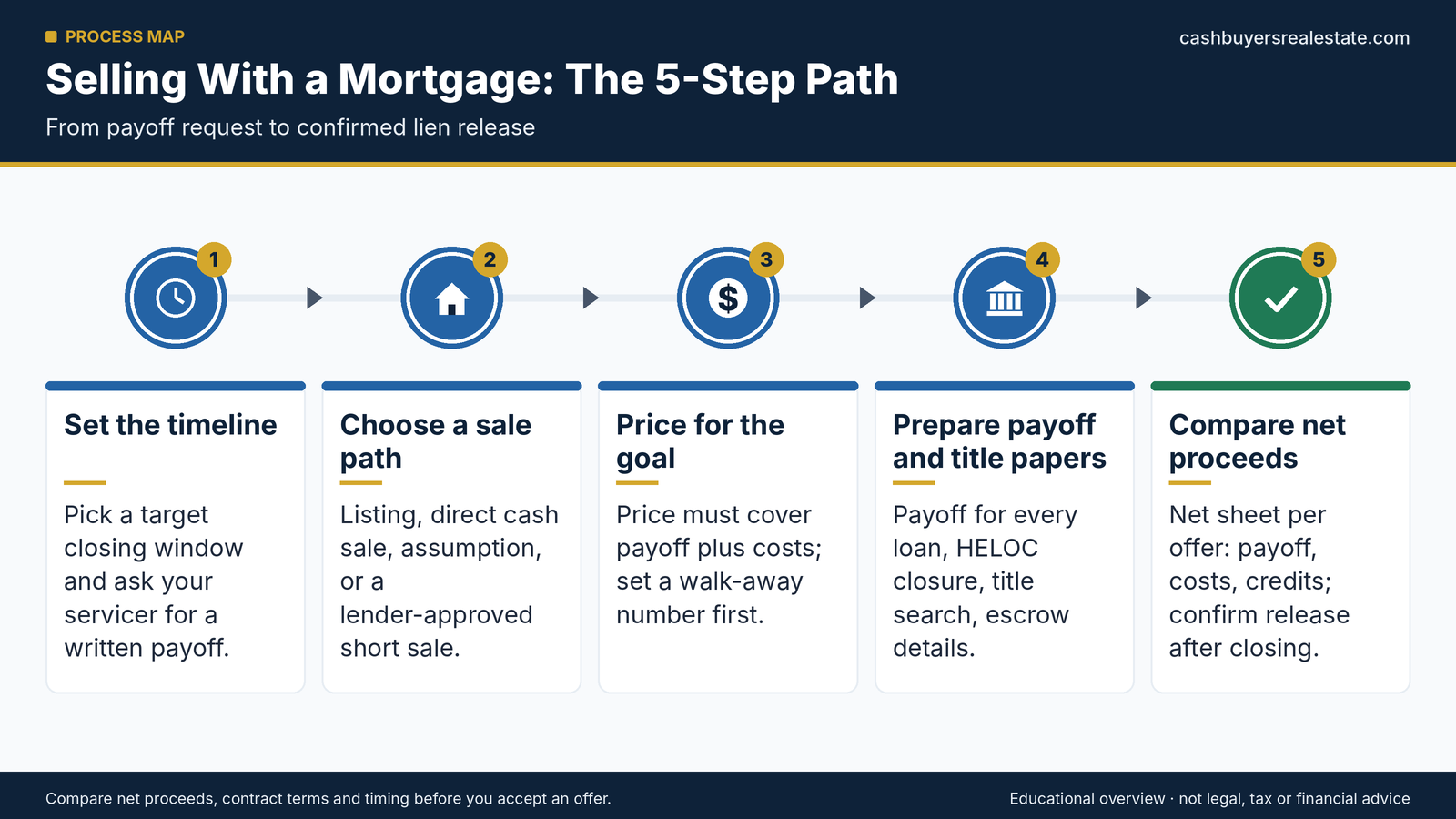
Text version of this infographic
- Set the timeline — Pick a target closing window and ask your servicer for a written payoff.
- Choose a sale path — Listing, direct cash sale, assumption, or a lender-approved short sale.
- Price for the goal — Price must cover payoff plus costs; set a walk-away number first.
- Prepare payoff and title papers — Payoff for every loan, HELOC closure, title search, escrow details.
- Compare net proceeds — Net sheet per offer: payoff, costs, credits; confirm release after closing.
The Timeline: From Decision to Lien Release
“Fast” depends on which clock you’re watching. The sale itself can be quick if a buyer is ready, but the sale only feels done when the lender has been paid, the lien is released and your escrow money has come back. Those later steps are predictable if you know to ask.
The Calendar from Decision to Closing
Two sets of milestones run at once: yours with the lender, and the buyer’s with theirs.
Payoff-side milestones
Your side begins with a written payoff request and ends when the lender confirms the payoff was received. Between those points the closing agent will ask for updated figures, you may need to sign a payoff authorization, and any second lien or line of credit needs its own request. The table below sketches the sequence and who typically acts. The time ranges describe what’s commonly reasonable, not guarantees, and your lender’s process may differ.
| Stage | Who acts | What to expect |
|---|---|---|
| Written payoff request | You (or an authorized closing agent) | Federal rule: statement within a reasonable time, no more than seven business days after the request |
| Price and net-sheet check | You, with the closing agent | Confirm that price covers payoff plus costs before accepting |
| Contract signed | You and the buyer | Closing agent opens the file and orders a title search |
| Updated payoff before closing | Closing agent and servicer | Figure good through the closing date; per-diem applies if it slips |
| Closing and disbursement | Closing agent | Lender is paid from proceeds; you receive the balance |
| Lien release recorded | Lender and closing agent | Timing and document name vary by state |
| Escrow refund and final statement | Servicer | Federal rule gives the servicer 20 days (excluding weekends and public holidays) to return escrow funds after payoff |
Use this table to set reminders. The two federal clocks, seven business days for the payoff statement and 20 days for the escrow refund, are the only ones in the table you can cite as a rule. Everything else varies.
Buyer-side milestones that set the date
Your closing date is mostly decided by the buyer’s financing. A buyer using a mortgage needs an appraisal, underwriting and a Closing Disclosure, which federal rules require the lender to provide at least three business days before closing, as the Consumer Financial Protection Bureau explains. A cash buyer can skip those steps, so title work, a signed contract and available funds are what set the pace. Inspections, repair negotiations and any association document requests can add days either way.
Plan your payoff request around the earliest realistic closing date, and renew it if that date moves. A payoff that expires before closing isn’t a crisis, but it creates a last-minute scramble for an updated figure that the closing agent usually must obtain before funds can be disbursed. For sellers on a short deadline, the guides on what slows down a home sale and selling a house in 30 days look at which delays are avoidable.
After Closing: Release, Refund and Insurance
Selling doesn’t end when you sign. A handful of loose ends belong to you, and most are simple if you know about them in advance.
Lien release and your escrow refund
After the lender receives the payoff, it should issue or record a release or satisfaction of the mortgage. The exact process and deadlines vary by state, so ask your closing agent how releases are handled locally and when you can expect it. A month or two after closing, it’s wise to check your county’s land records, or ask your title company to confirm, that the release was recorded. The buyer’s title insurance depends on a clean record, and an unreleased lien can resurface later as a headache for both of you.
If your mortgage included an escrow account for taxes and insurance, any balance remaining is yours. Under federal servicing rules published at 12 CFR 1024.34, a servicer must return the balance within 20 days, excluding legal public holidays, Saturdays and Sundays, after the borrower pays the loan in full. The rule has an exception that allows the balance to be credited to a new loan with the same servicer if the borrower agrees. Give your servicer a forwarding address before you move, because the refund usually arrives as a check, and note the date of payoff so you know when the 20-day window ends.
Insurance, autopay and the last payment
Keep your homeowners insurance in force until closing is complete and the buyer has taken possession, and then ask your insurer to cancel effective that date. Policies differ in how they refund unused premium, so ask what refund method applies and whether any short-rate penalty exists. If your lender is named on the policy, the policy usually ends its interest when the loan is paid off, but you should confirm with your insurer rather than assume.
Consider how this plays out on a mid-month closing. Say your payment is due on the first and closing is set for the twentieth. The payment due on the first still needs to be made on time, because the loan is active until payoff posts. The payoff then covers interest through the twentieth. If you had skipped the first-of-the-month payment, the servicer could add a late charge to the payoff and report the missed payment, which can complicate your next loan application. Your closing agent and servicer can tell you exactly how your payment and payoff interact.
Two payment mistakes are common. The first is skipping a regular payment because “the loan is being paid off anyway.” Unless your payoff statement or servicer tells you otherwise, keep paying the loan as scheduled until payoff posts, because a missed payment can be reported as late and can add late fees to the payoff. The second is switching off autopay too early and letting a payment lapse before closing slips. After closing, confirm the zero balance in writing, then cancel automatic payments and update any tax or insurance accounts linked to the old loan.
Comparing Routes When You Have a Loan: Listing, Cash Sale, Assumption and Others
The mortgage doesn’t dictate your route, but it does change which routes work. A loan sets a floor under your price, since the sale must at least cover the payoff and the costs, and it adds loan-specific wrinkles like prepayment penalties and assumption rules. Looking at the routes through that lens helps you rule some out quickly.
Listing and Cash Sale Compared, with a Loan in the Picture
The two most common routes treat the loan identically at closing. What differs is the price, the speed, and how much cushion you have before the numbers stop working.
Payoff works the same way; the cushion doesn’t
On either route, the closing agent pays the lender from proceeds. A conventional listing can reach buyers who will pay a full market price, but it typically carries commissions, repair credits, and a longer path to closing. A direct cash sale may carry a lower price, but it can remove commissions, showings and financing contingencies, and it can close as quickly as title work permits. Either way, what matters is the cushion between your price and your costs-plus-payoff.
With large equity, a discount for speed hurts, but it doesn’t threaten the sale. With thin equity, the same discount can push you into the shortfall zone. Suppose a house would fetch $300,000 on the open market and the payoff is $270,000. A listing that nets 94% of that after costs lands near $282,000 and leaves about $12,000 after payoff. A 15% discount for a quick cash sale would produce an offer near $255,000, which is $15,000 less than the payoff before any costs. In that example, a cash sale at that discount wouldn’t work unless the seller brought money to closing or the lender accepted less. The numbers are hypothetical, but the principle holds: check the offer against the payoff before you check it against your hopes.
When you request a payoff statement and know your approximate costs, you can work backward to the lowest price you could accept and still clear your debt. Call that your walk-away number. It’s worth writing down and comparing against every offer you receive, particularly the fast ones. The comparison pages on cash buyers versus listing with an agent and cash sale versus listing for a fast sale go deeper on how the two compare outside the mortgage question.
Prepayment penalties and loan-specific traps
A prepayment penalty is a fee some lenders charge when you pay off all or part of the mortgage early. The Consumer Financial Protection Bureau’s explanation of prepayment penalties notes that a penalty usually applies only if you pay off the entire balance, as in a sale or refinance, within a set period, typically three or five years, and that not all mortgages have one. Selling is a full payoff, so if your loan has this feature and you’re inside the window, the fee would appear on the payoff statement. Check your note and closing documents, ask the servicer in writing, and add the line to your net sheet before you decide on a price.
Illustrative example (hypothetical numbers, not market data): Suppose a loan’s penalty clause charges 2% of the amount prepaid if the loan is paid off in the first three years. On a $200,000 balance, that would add $4,000 to the payoff. A seller weighing a $305,000 listing against a $298,000 cash offer would need to count the $4,000 in both cases, because the penalty attaches to the payoff and not to the route. It matters most when it pushes a thin-equity sale toward the shortfall zone. Your own loan may have no penalty at all.
A few other loan types deserve a call to the servicer before you list. A reverse mortgage has its own payoff process and, under the federal payoff-statement rule, may take longer than the standard seven business days. A loan in forbearance or modification may include deferred amounts that appear in the payoff. A loan that has recently changed servicers may take longer to produce a clean statement. In each case the principle is the same: ask early, in writing, and plan the calendar around the answer.
Assumable Loans and Other Special Routes
Some homeowners hear that an assumable loan will sell the house faster. In practice, assumptions are a niche tool, and a few other creative routes carry more risk than they promise.
FHA and VA assumptions, and why they rarely speed a sale
An assumption means the buyer takes over your existing loan, with its rate and remaining term, rather than getting a new one. FHA and VA loans are the best-known assumable types, but the lender or the agency still has to approve the buyer. The FHA’s regulation at 24 CFR 203.512 allows a lender to approve a transfer only if at least one acquiring owner is determined to be creditworthy, among other conditions. The VA’s rule at 38 CFR 36.4303 describes the holder reviewing the prospective purchaser’s creditworthiness when the seller applies for prior approval of an assumption. In short, the buyer has to qualify, and that takes underwriting time.
Assumptions rarely save time for three reasons. First, the process involves the servicer and sometimes the agency, so the clock isn’t in your control. Second, the buyer must cover the difference between the price and the assumed balance, which can be large if you have equity, so the buyer needs cash or a second loan, which brings a second approval. Third, you’ll want written confirmation that you’re released from liability on the loan and, for a VA loan, an understanding of what happens to your entitlement; both are details to confirm in writing with the servicer or the agency before you agree to an assumption, because terms differ by loan and date. An assumption can make sense when your rate is far below current rates and a qualified buyer wants it, but it’s seldom the fast route.
Renting it out, “subject-to” deals and other alternatives
Another alternative is to keep the house and rent it. That turns you into a landlord, with the responsibilities that follow, and doesn’t help if you need cash or a clean break. It can work as a bridge when the market is soft, and the planning questions are covered in the guide to selling a rental property fast for the day you decide to sell.
| Route | How the loan is handled | What sets the speed | Main risk |
|---|---|---|---|
| Listing with an agent | Paid off from proceeds at closing | Market demand and buyer financing | Longer path; costs reduce equity |
| Direct cash sale | Paid off from proceeds at closing | Title work and buyer readiness | Discount may leave little or no cushion over payoff |
| FHA or VA assumption | Buyer takes over the existing loan after approval | Servicer or agency underwriting | Buyer needs cash for your equity; release of liability must be confirmed |
| Rent it out | Loan stays; rent helps cover payments | Finding a tenant | Landlord duties; no cash out; market risk continues |
| Short sale | Lender agrees to accept less than payoff | Lender approval, often slow | Approval isn’t guaranteed; tax and credit effects possible |
| “Subject-to” transfer | Loan stays in your name; buyer pays | Whatever the parties agree | Due-on-sale exposure; you stay liable |
To choose among the rows, weigh three things in order. First, which routes clear your payoff and costs with some room to spare, since a route that works only if everything goes right is fragile. Second, which routes can meet your deadline once you account for the lender’s and the buyer’s clocks. Third, which routes you can verify: a buyer with confirmable funds, a lender that will confirm terms in writing, and a closing agent you trust. The route that scores well on all three is usually the one to pursue, even if it isn’t the highest headline price.
The pattern across the rows is that routes which pay the loan off cleanly at closing are the predictable ones. Routes that leave your loan in place add risk in exchange for flexibility, and it’s usually the seller who carries that risk.
The second infographic condenses these routes and what each is best for. The tradeoffs it shows are all stated in the text, so use the image as a quick comparison, not a substitute for the numbers.
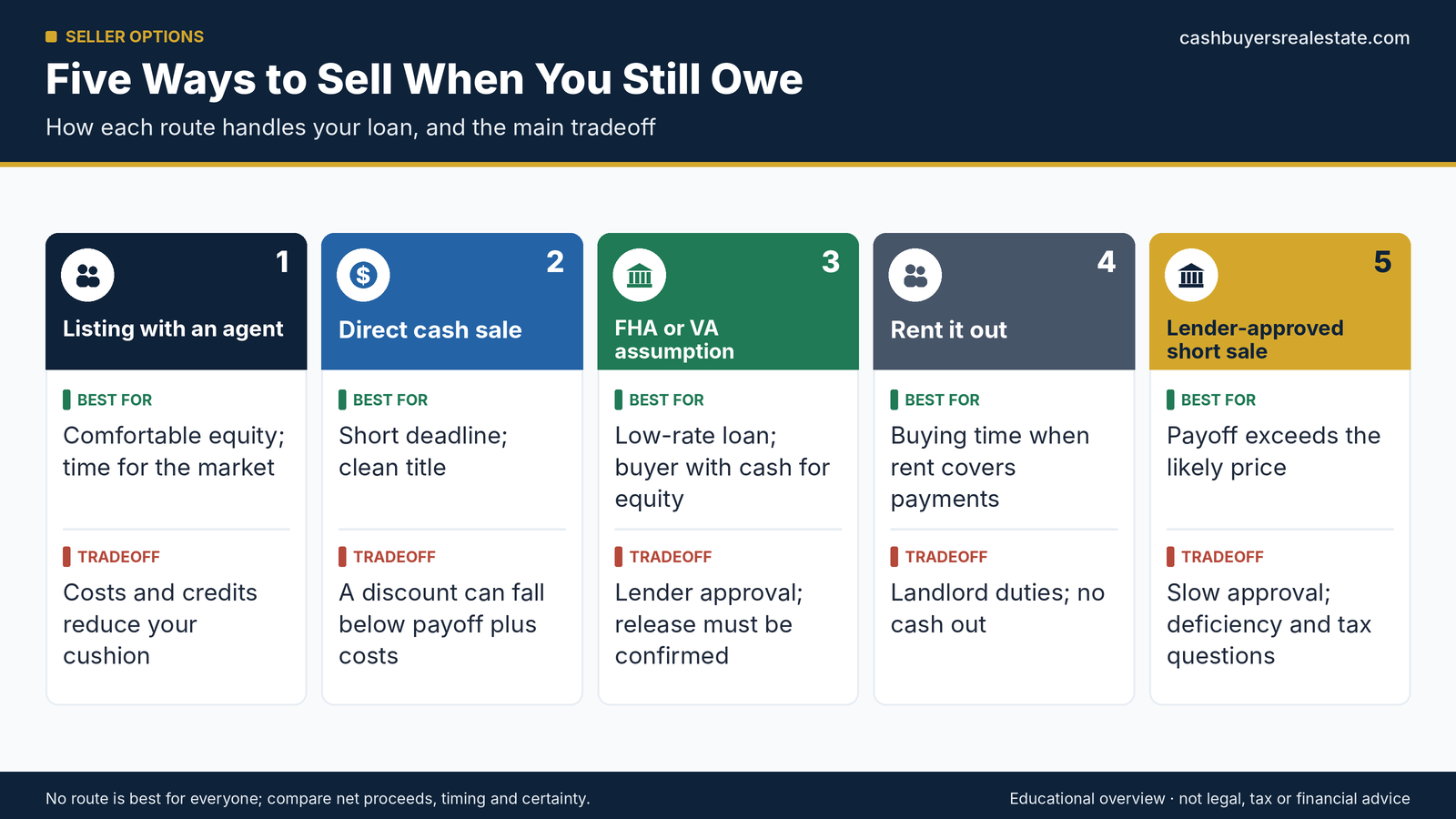
Text version of this infographic
- Listing with an agent — best for: Comfortable equity; time for the market; tradeoff: Costs and credits reduce your cushion
- Direct cash sale — best for: Short deadline; clean title; tradeoff: A discount can fall below payoff plus costs
- FHA or VA assumption — best for: Low-rate loan; buyer with cash for equity; tradeoff: Lender approval; release must be confirmed
- Rent it out — best for: Buying time when rent covers payments; tradeoff: Landlord duties; no cash out
- Lender-approved short sale — best for: Payoff exceeds the likely price; tradeoff: Slow approval; deficiency and tax questions
Second Mortgages, HELOCs and Other Liens: Clearing Everything Before You Close
Your first mortgage isn’t always the only claim on the property. A line of credit, a second loan, unpaid taxes or a judgment can sit behind it, and each must be paid or released at closing for the buyer to receive clear title. Finding them early is the most reliable way to protect your timeline.
Home Equity Loans and Lines of Credit
Home equity products are common, and they’re also a frequent source of last-minute surprises, because owners sometimes forget they still have one.
Paying off and closing a HELOC
A home equity line of credit is a revolving loan secured by your home, usually recorded as a second lien. It has its own servicer, its own payoff figure and often its own requirements. To clear it at closing, you generally need three things: a payoff statement that includes interest through the closing date, a signed request to close the line so no new draws can be made, and a release of the lien recorded after payoff. If the closing agent pays the balance but the line remains open, the lien may stay on record, and that can complicate the sale or leave you with an open line you didn’t mean to keep.
Practical points: freeze or stop drawing as soon as you decide to sell, since a draw after the payoff request changes the amount; look for checks or cards tied to the line that might still clear; and ask whether an early-closure fee applies, because some lenders charge one if the line is closed within a set number of years. Your title company will usually order the payoff and closure paperwork, but they can only do that if they know the line exists, so tell them about every loan on the property.
Second mortgages and tight prices
A second mortgage or home equity loan is paid after the first from the sale proceeds. When equity is comfortable, that’s a simple extra line on the settlement statement. When equity is thin, the sale proceeds may cover the first mortgage and only part of the second. In that case, the second lender must agree to release its lien for less than the full balance, or you must bring the difference to closing. Lenders have no duty to accept less, and their decisions take time.
Illustrative example (hypothetical numbers, not market data): A house is under contract for $260,000. The first mortgage payoff is $205,000, the HELOC payoff is $38,000, and selling costs are estimated at $20,000. The sale brings in $260,000 and requires $263,000, leaving a $3,000 shortfall. The seller has three levers: bring $3,000 to closing, trim costs by $3,000 by negotiating a lower commission or skipping a planned repair credit, or ask the HELOC lender to release its lien for $35,000. The HELOC lender isn’t required to agree, but it may prefer a certain payment to a drawn-out dispute. The seller pursues all three at once to see which closes first.
If you suspect that your price may not cover both loans, request both payoff statements at the same time and ask each servicer what documentation they would need to consider a release for less than the balance. Starting that conversation before you sign a purchase contract gives you more room to negotiate, and a HUD-approved housing counselor can walk you through it. The same logic applies to any other junior lien, such as a home improvement loan secured by the property.
Other Claims That Can Appear in a Title Search
Beyond loans, a property can carry claims for unpaid taxes, association assessments, judgments against an owner, and unpaid work. Most are paid from proceeds at closing, but each has its own paperwork.
Taxes, association assessments, judgments and contractor liens
| Claim | How it arises | Typical handling | Watch for |
|---|---|---|---|
| First mortgage | Purchase or refinance loan | Payoff statement; paid from proceeds | Per-diem, prepayment penalty |
| HELOC or second mortgage | Borrowing against equity | Separate payoff; closure request; release | Open line left active; early-closure fee |
| Property tax lien or delinquency | Unpaid taxes | Paid at closing from proceeds | Penalties and interest; local rules differ |
| Association assessment or lien | Unpaid dues or special assessments | Payoff or resale certificate from the association | Fees for the certificate; timing |
| Judgment lien | Court judgment against an owner | Payoff and release, or negotiated settlement | Name matches can surface unrelated liens |
| Contractor or mechanic’s lien | Unpaid work on the property | Payment or bonding; release required | Strict state filing rules |
Each row has more nuance than a table can hold, and the page on selling a house quickly with liens goes through them in detail, alongside the hub page on selling a house with title problems.
Finding everything early and sequencing the payoffs
The cheapest protection is an early title search. Order it when you decide to sell, not after the contract is signed, and read the list of recorded items with the title officer. Compare it with your own paperwork: every loan you remember, every contractor you hired, and every tax and association bill. If something appears that you don’t recognize, ask about it right away; clerical errors, name mix-ups and old releases that were never recorded are all common and fixable when caught early.
Then gather all payoff and release documents in one folder. The closing agent will pay claims in the legal order of priority, which varies by state and by the type of claim, so don’t assume that “first in time” always governs. If proceeds can’t cover all claims, the agent can’t simply choose which to skip. The parties have to resolve the gap, either with extra money, a negotiated release, or a different route. That is a good reason to know the whole picture before an offer is accepted.
When the Payoff Exceeds the Price: Options for an Underwater Sale
Owing more than the house will bring is stressful, but it isn’t unusual, and it isn’t a dead end. It does mean the usual “price minus payoff” math produces a negative number, so something else has to give: extra cash, time, lower costs, or the lender’s agreement to accept less. This section lays out those paths without pushing you toward any of them.
Your Realistic Paths
Start by confirming that you’re really underwater. Compare a realistic sale price, based on closed comparable sales, with your payoff statement plus honest selling costs. A portal estimate and a monthly statement balance are poor stand-ins for either number.
Bring cash, wait, or cut costs
The simplest solution is to cover the gap yourself. Some sellers use savings, retirement-account withdrawals (with tax consequences worth discussing with a professional), or help from family. If the gap is small relative to the benefit of moving on, paying it can be the cleanest result: the lien is released, the loan is closed, and no further obligation remains. If it’s large, the question becomes whether the cost of keeping the house for another year, in payments, taxes, insurance and upkeep, is worth the chance that the gap narrows.
Waiting has real math behind it. Each payment reduces principal by a modest amount, and the early years of a loan reduce it slowly. If prices in your area are flat or rising, the gap may shrink; if they are falling, it may grow. Meanwhile, you pay carrying costs. You can also narrow the gap by trimming the costs of sale: negotiating commission, skipping repairs by selling as is, avoiding double moves, or using a route with fewer fees. Renting the house for a period, if you can cover the payment with rent, is another way to buy time, although it adds landlord responsibilities and doesn’t improve your equity on its own.
Illustrative example (hypothetical numbers, not market data): A seller has a $215,000 payoff and expects to net $187,000 after costs, leaving a $28,000 gap. Paying the gap would take most of the seller’s savings. Instead, the seller considers renting the house for two years. Rent of $1,900 a month against a mortgage, tax and insurance cost of $1,700 leaves $200 a month of cushion, but principal paydown is only about $4,000 over the period, and a rise or fall in local values over two years is unknowable. The seller decides to ask the lender whether a short sale is possible and to get a counselor’s help before choosing.
The right choice depends on your cash, your timeline and the direction of your local market. If your reason for selling is a deadline, such as a job start or a divorce settlement, waiting may not be an option, which makes the lender conversation more urgent.
Short sale basics
In a short sale, the lender agrees to accept sale proceeds that are less than the amount owed. The lender must approve the arrangement, usually after you submit a hardship explanation, financial documents and a buyer’s offer. Lenders often evaluate the property’s value themselves, and approvals can take a while, so buyers need patience and the process rarely suits someone who needs a quick closing. Whether the lender will forgive the remaining balance, called a deficiency, or reserve the right to pursue it depends on the lender’s decision and on your state’s law, so get the answer in writing before you sign anything.
Lenders typically ask for a package that includes a hardship letter, recent pay stubs or income statements, bank statements, tax returns, a signed purchase offer and an authorization letting the buyer’s side or the closing agent speak with the servicer. They may also ask for proof that the sale is at arm’s length, meaning the buyer isn’t a relative or business partner. Requirements differ by lender and investor, so request the checklist from your servicer before you list, and keep every submission date in a log.
A short sale can also affect your credit and may have tax consequences, which we cover in the next subsection. It isn’t the same as foreclosure, but the two are related, and if you have missed payments or received a notice, the guides on selling a house fast before foreclosure and the hub page selling a house before foreclosure deal with that situation directly. This article assumes you are current and exploring your options, and it keeps short sales to the basics.
Tax and Counseling Cautions
Two cautions deserve a pause before you act on an underwater sale: how forgiven debt is taxed, and who can help you at low or no cost.
Canceled debt and the 1099-C
If a lender forgives part of what you owe, the forgiven amount can be taxable income. The Internal Revenue Service explains in its Topic 431 on canceled debt that debt forgiven or discharged for less than the full amount owed is generally treated as canceled debt and is generally taxable, that a creditor may send Form 1099-C showing the canceled amount, and that several exclusions exist, including bankruptcy, insolvency and qualified principal residence indebtedness. For that last exclusion, the IRS page, as checked in October 2026, describes it as covering debt discharged before January 1, 2026, or discharged under an arrangement entered into and evidenced in writing before that date. Whether Congress has extended or changed it since is something to confirm with a tax professional or the IRS before you rely on it.
Separately, the IRS states in Publication 523, Selling Your Home, that a loss on the sale of your main home can’t be deducted. So an underwater sale doesn’t produce a tax deduction, and forgiven debt may produce taxable income. Both facts are reasons to speak with a tax professional before you agree to any lender settlement. The outcome depends on your facts and may differ if you have used the home for rental or business.
Free or low-cost help, and what to avoid
HUD-approved housing counselors can review your finances, explain options, and speak with your servicer. The Consumer Financial Protection Bureau’s directory says their advice is often at little or no cost and lists help with defaults, forbearances and foreclosures, though it doesn’t specifically mention selling, so ask any agency whether it covers your situation. The directory phone number is (855) 411-2372.
If you meet with a counselor, bring your latest mortgage statement, any notices from the servicer, a list of monthly income and expenses, recent pay stubs or benefit statements, your deed or a property tax bill, and a short note describing your deadline and why you want to sell. Counselors can help you see what the servicer may offer, which can include repayment plans, loan modifications or a short sale, and they can often take part in the conversation with the lender on your behalf. Ask whether the agency charges a fee before you begin.
Be wary of anyone who asks for a large upfront fee to negotiate with your lender, promises to eliminate your debt, or tells you to stop talking to your servicer. Those are common warning signs of unreliable help, though no single feature proves misconduct. A real estate attorney licensed in your state is the best source for advice about deficiency exposure, contract terms and your lender’s documents. Table 6 summarizes the main underwater options.
| Option | What it takes | Main benefit | Main risk or cost |
|---|---|---|---|
| Bring cash to closing | Funds to cover the gap | Clean, fast, lien released | Uses savings; may be unaffordable |
| Wait and pay down | Ability to keep paying | Gap may narrow if values rise | Carrying costs; prices may fall |
| Reduce costs of sale | Lower-fee route, sell as is | Shrinks the gap without lender help | May still leave a shortfall |
| Rent it out | Rent that covers payments | Buys time | Landlord duties; no cash out |
| Short sale | Lender approval, hardship documents | Possible release for less than owed | Slow; deficiency and tax questions; credit impact |
The table is a map, not a prescription. Many sellers combine options, such as trimming costs and negotiating with the lender, and the right mix depends on how big the gap is and how firm your deadline is.
Taxes, the Due-on-Sale Clause and the Questions to Ask Your Servicer
The last piece is a mix of rules and habits. A brief look at the home-sale tax exclusion shows why most sellers with a mortgage don’t owe tax on the sale, the due-on-sale clause explains what the lender can and can’t do when title moves, and a short set of questions for your servicer closes the gaps that cause delays.
Tax and Loan-Clause Basics for a Mortgaged Sale
Neither topic changes how payoff works at closing, but both affect decisions made before it.
The home-sale exclusion, in brief
Many homeowners can exclude part or all of the gain from selling a main home. The IRS describes the rule in Publication 523: the exclusion is generally $250,000, or $500,000 for married couples filing jointly, and you generally must have owned and lived in the home as your main residence for at least 24 months of the five years before the sale. You can generally use the exclusion once every two years, and a reduced exclusion may apply if the sale is mainly due to a work change, a health issue or unforeseen circumstances. The mortgage itself doesn’t change the test, because gain is measured by the sale price against your basis, not by what you owe.
Illustrative example (hypothetical numbers, not market data): A seller bought a home for $250,000, spent $20,000 on qualifying improvements, and sells for $400,000 with $25,000 in selling costs. Gain, roughly, is $400,000 minus $25,000 minus $270,000, or $105,000. If the seller meets the ownership and use tests and has not used the exclusion in the past two years, that gain would be within a $250,000 exclusion. The outstanding mortgage payoff doesn’t enter this calculation. A tax professional should confirm basis, eligibility and reporting.
Several things change the picture: renting the house out, using part of it for business, owning it less than two years, or having claimed the exclusion on another home recently. If a job transfer is behind the sale, the reduced-exclusion rules may matter, and the guide to selling a house fast after relocation looks at that angle. When you sell, the closing agent may report the sale to the IRS on Form 1099-S, which Publication 523 mentions, so the sale doesn’t go unnoticed even when no tax is due.
The due-on-sale clause and what it protects
Most mortgages include a due-on-sale clause that lets the lender demand full repayment if the property is transferred without its consent. In a normal sale, the clause is irrelevant, because the loan is paid off at closing. It matters when title changes without a payoff: adding or removing an owner, moving the property into a trust or company, gifting it, or the “subject-to” arrangements mentioned earlier. Federal law, in 12 U.S.C. 1701j-3, protects certain transfers on residential property with fewer than five dwelling units from enforcement of the clause, including a transfer to a relative resulting from the borrower’s death, a transfer that makes the borrower’s spouse or children an owner, a transfer under a divorce decree, and a transfer into a trust where the borrower remains a beneficiary and occupancy doesn’t change.
If any of those apply to your situation, such as a divorce or an estate, speak with an attorney before you transfer anything. Conversely, if you simply plan to sell and pay off the loan, you don’t need to worry about the clause, but you shouldn’t change title before closing without talking to your closing agent and lender first.
Questions to Ask Your Servicer, and Mistakes to Avoid
A short conversation with your servicer, followed up in writing, removes most of the unpleasant surprises. The list below works as a call script.
A question list for the servicer
- Please send a written payoff statement good through my expected closing date, with the per-diem amount. How long will it take?
- Does my loan have a prepayment penalty, and if so, does it apply to a sale on this date?
- What else will appear on the payoff besides principal and interest, such as late fees, advances or recording fees?
- How and by when will my escrow balance be returned, and where will the check be mailed?
- How will you issue the release or satisfaction, and how long does it usually take in my state?
- Can my title company or closing attorney request updated payoff figures directly, and what authorization do you need?
- If I also have a home equity line or second loan, what’s the process for closing the line?
- If the sale price may be less than the payoff, what documentation would you need to consider a short sale?
- Does my loan allow assumption, and what would a buyer have to do?
- How do I verify wire instructions for the payoff, and what number should I call?
Write down the date, the representative’s name and the answers, and follow up with a secure message that summarizes the call. If an answer seems wrong or inconsistent with what the federal rules say, ask for a supervisor or contact a housing counselor.
Common mistakes and misconceptions
Several errors recur. Owners confuse their statement balance with the payoff, and discover a gap at closing. They assume equity equals cash, then are surprised by commissions, credits and taxes. They skip a monthly payment because the loan is “about to be paid off,” then learn it was reported late. They forget a home equity line, then face a lien the buyer’s title company won’t allow to stand. They cancel insurance before closing finishes, or let the escrow refund go to an old address. And they accept a quick cash offer without testing it against the payoff and their costs, then find the numbers don’t close.
Another misconception is that a lender will “forgive the rest” automatically if the house sells for less than owed. Forgiveness is a decision by the lender, in writing, and it can carry tax and credit effects. A related myth is that selling with a mortgage is slower than selling a free-and-clear house. The mortgage adds a payoff step, but it adds little time when the statement is requested early and no other lien lurks in the title.
The third infographic turns the main checks into a six-item list covering the mortgage payoff, property condition, buyer financing, title issues, closing readiness and your moving deadline. Each point is explained in the text, so the graphic is simply a quick reminder to run through before you sign.
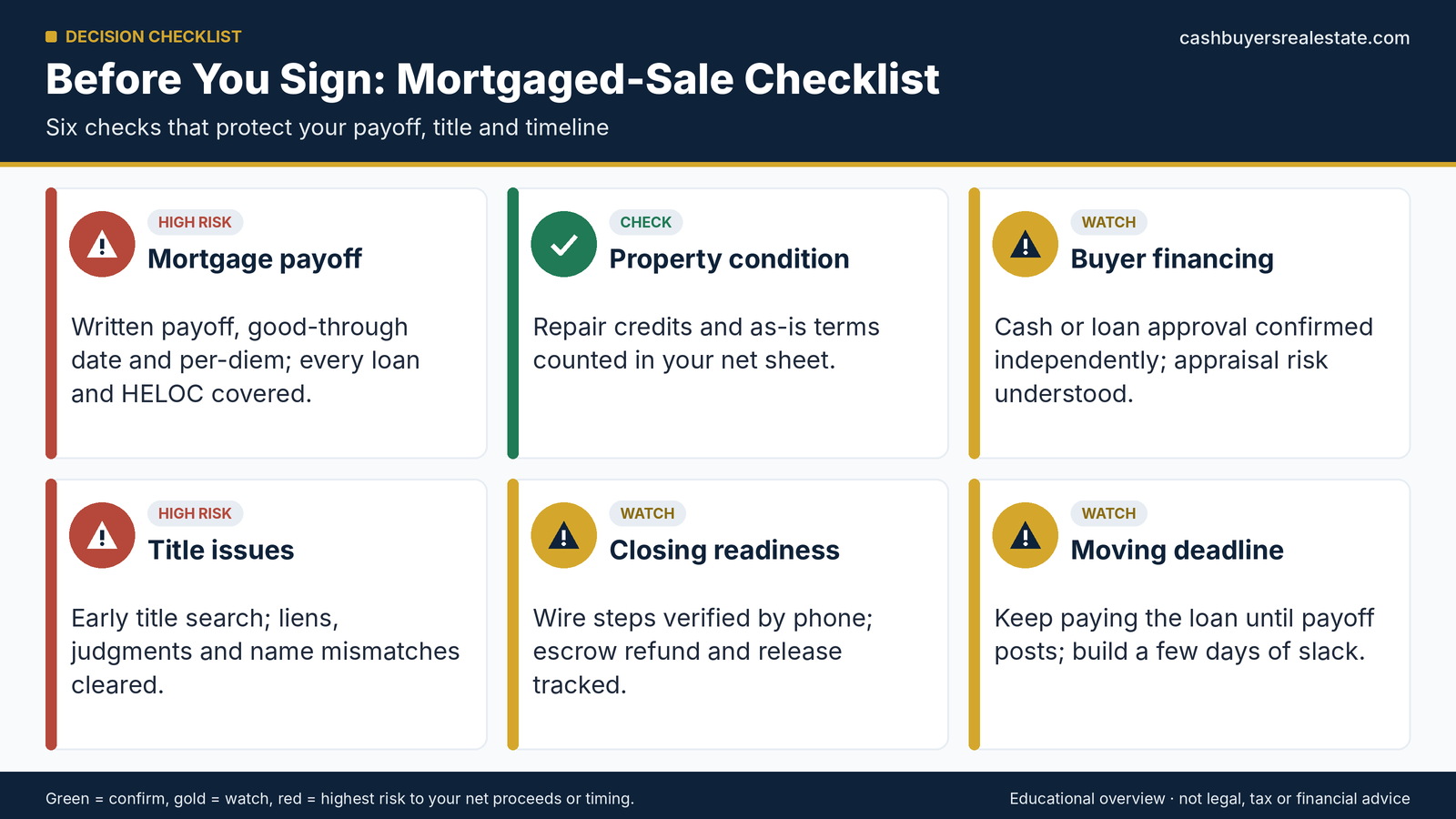
Text version of this infographic
- Mortgage payoff — Written payoff, good-through date and per-diem; every loan and HELOC covered.
- Property condition — Repair credits and as-is terms counted in your net sheet.
- Buyer financing — Cash or loan approval confirmed independently; appraisal risk understood.
- Title issues — Early title search; liens, judgments and name mismatches cleared.
- Closing readiness — Wire steps verified by phone; escrow refund and release tracked.
- Moving deadline — Keep paying the loan until payoff posts; build a few days of slack.
Frequently Asked Questions about Selling a House That Still Has a Mortgage
These answers cover the follow-ups homeowners raise most often. They stay general because loan terms, closing customs and tax outcomes depend on your documents and your state.
Questions About Payoff, Timing and Price
Questions about payoff and timing
- Do I have to pay off my mortgage before I list the house?
No. The loan is paid at closing from the sale proceeds, and the closing agent sends the payoff directly to your lender. You only need the payoff figure beforehand so you can price the house and confirm the sale will cover what you owe plus costs.
- How long does my lender have to give me a payoff statement?
Under Regulation Z, a servicer or creditor must provide a payoff statement within a reasonable time, and in no case more than seven business days after receiving a written request. The rule allows longer, still reasonable, timing for loans in bankruptcy or foreclosure, reverse mortgages and shared appreciation mortgages, and natural disasters. Many lenders respond faster, but don’t count on it.
- Can I sell if I’m behind on my mortgage payments?
Often yes, as long as the sale closes and the lender is paid, but the payoff will include missed payments, late fees and other charges, and your timeline is shaped by the lender’s and your state’s foreclosure process. If you’ve received a notice, talk to a HUD-approved housing counselor or a local attorney quickly. The guide on selling before foreclosure covers that scenario.
- Does my payoff change if closing gets delayed?
Yes. The statement is good through a specific date, and interest keeps accruing daily after it. Lenders express that as a per-diem amount, so each added day of delay raises the payoff by about that much. Ask the closing agent to request an updated figure whenever the closing date moves.
- Do I need my lender’s permission to sell the house?
Not if the loan will be paid off at closing. You can sell and the lender is paid from proceeds, whatever the lender’s preferences. Permission matters if the buyer is assuming the loan, if the sale price won’t cover the payoff and you need a short sale approval, or if title is moving without a payoff.
Questions about price and equity
- How much equity do I need to sell?
Enough that the sale price covers your payoff plus the costs of selling, or enough cash to cover any gap. Equity on paper is value minus your balance, but the costs of selling, such as commissions, closing costs and credits, come out of the price, so your real cushion is smaller. Build a net sheet with your actual payoff and an estimate from a title company.
- Is a cash offer risky if I owe a lot on the house?
It can be, because cash offers often come at a discount. If the discount pushes the price below your payoff plus costs, the sale won’t close without extra money or lender approval. Check any offer against your payoff statement before you consider anything else, and compare it with a listing on a net basis.
- What if I owe more than the house is worth?
You can bring cash to closing, wait and pay down the loan, reduce selling costs, rent the house for a time, or ask the lender about a short sale. Each has tradeoffs, summarized in Table 6. Speak with a housing counselor or attorney before you agree to a deal that leaves a balance owing.
- Will I owe taxes on the sale?
Many sellers don’t, thanks to the home-sale exclusion of up to $250,000, or $500,000 for married couples filing jointly, described in IRS Publication 523, if they meet the ownership and use tests. Gain is measured against your basis, not against your mortgage. Rental use, short ownership or a recent prior exclusion can change the result, so check with a tax professional.
Questions About Liens, Loan Terms and Closing
Questions about loans and liens
- How is a HELOC paid off when I sell?
It gets its own payoff statement, and the line must be closed, usually by a signed request, so that no further draws are possible. The title company then pays the balance from proceeds and obtains a release of the lien. Stop using the line once you decide to sell, and check for any early-closure fee.
- What is a due-on-sale clause, and does it affect a normal sale?
It’s a loan provision that lets the lender demand repayment in full if the property is transferred without its consent. In a normal sale the loan is paid at closing, so the clause doesn’t create a problem. It matters if title changes without a payoff, such as a gift, a transfer to a company or a “subject-to” deal, and federal law protects only a short list of transfers.
- Can a buyer take over my FHA or VA loan?
Sometimes. FHA and VA loans can be assumed, but the lender must approve the buyer’s creditworthiness, and the buyer must cover the difference between the price and the loan balance. Assumptions are uncommon and rarely quicker than a standard sale. Confirm in writing whether you would be released from liability.
- Will I pay a penalty for paying the loan off early by selling?
Only if your loan includes a prepayment penalty and you’re inside its time window, which the Consumer Financial Protection Bureau says is typically three or five years for loans that have one. Many mortgages have no penalty. Check your note and ask your servicer for confirmation in writing.
Questions about closing and what follows
- When will I get my escrow refund?
Federal servicing rules give the servicer 20 days, excluding weekends and legal public holidays, to return the escrow balance after the loan is paid in full. A servicer may instead credit it to a new loan with the same servicer if you agree. Provide a forwarding address so the check reaches you.
- Should I keep making mortgage payments until closing?
Yes, unless your payoff statement or servicer says otherwise. Skipping a payment can lead to a late report and added fees, and the payoff already accounts for interest through the good-through date. Turn off autopay only after you’ve confirmed the loan is paid off.
- What if I’m out of town at closing?
Many closing agents offer mobile notaries, mail-away signing or remote options, though what is allowed varies by state and lender. The payoff is sent by the closing agent, not you. Ask early what your state permits; the guide on selling after relocation covers long-distance closings.
Choosing Your Route and Taking the First Steps
You now know what the payoff is, how equity becomes cash, where second liens and clauses hide, and what happens if the numbers don’t work. The last step is matching a route to your situation and moving through a short list of actions that protect your timeline.
A Decision Framework: Match the Route to Your Equity and Deadline
Your equity cushion is the best single predictor of which routes are open to you. Start there, then add your deadline.
If your equity is comfortable
When the price comfortably covers payoff and costs, you have the widest choice. A listing may deliver the strongest price if you have time. A direct cash sale may deliver speed if the discount is tolerable. A flat-fee or limited-service arrangement can reduce costs if you’re willing to do more work. Compare the routes on net proceeds with your actual payoff, set a minimum acceptable net, and decide how much time you can afford to spend. For the cash side, the overview of selling a house for cash and the guide to companies that buy houses for cash help you set expectations.
If your equity is thin or negative
When the cushion is small, every line on the net sheet matters, and the right route is the one that protects the sale from the shortfall zone. That may mean a lower-cost route, a careful look at what a cash discount really costs, a conversation with a counselor, and an early request to the lender about options. If the payoff exceeds the price, treat the shortfall as the central problem to solve, not an afterthought. Table 7 matches common situations to routes and flags what to double-check.
| Situation | Route that often fits | Works best when | Double-check |
|---|---|---|---|
| Comfortable equity, flexible timeline | Listing with an agent | Market demand is solid | Net after commissions and credits |
| Comfortable equity, short deadline | Direct cash sale | Title is clean; discount is acceptable | Verified funds, complete contract, net vs listing |
| Thin equity | Lowest-cost route that clears payoff | You know your walk-away number | Offer vs payoff plus costs |
| Payoff exceeds price | Cash to close, short sale or a wait | You have counsel and lender dialogue | Deficiency, taxes, credit effects |
| Low-rate FHA or VA loan, qualified buyer | Assumption | Buyer has cash for your equity | Release of liability; timing |
| Second lien or unknown liens | Start with title search, then choose | All payoffs are known early | Release for less than owed |
No row is a recommendation for your house; it’s a starting point for a conversation with a closing agent, an attorney or a counselor who can see your documents.
What to Do This Week
The first seven days set the pace. These steps are low-cost, reversible and useful on every route.
First steps and the documents to gather
- Send a written payoff request to your servicer, good through a date a few weeks out, and note the date you asked.
- Find your latest mortgage statement, note, deed, homeowners’ insurance policy and recent property tax bill.
- List every loan or claim you know of, including any home equity line, and request payoff statements for each.
- Ask a title company for an early title search and an estimated seller net sheet.
- Estimate a realistic price from closed sales, then compute your walk-away number: payoff plus costs.
- Decide your fallback date for changing course, and who you’ll call if the numbers don’t work.
- Keep paying the mortgage on schedule until the payoff posts.
Sequence matters. The payoff request and title search go first because they set your numbers. Pricing comes next, because a price without a payoff is a guess. Only then does choosing a route make sense, since you’ll know your walk-away number and how much cushion you have. Sellers who reverse that order often pick a route first, such as a listing or a quick cash offer, and then discover the numbers don’t support it.
Questions to ask any buyer, agent or closing company
- Who is the buyer, and how can the proof of funds or loan approval be verified independently?
- How will the payoff be handled, and who verifies wire instructions by phone?
- What happens to the sale if the payoff changes or a lien appears?
- What fees or conditions apply if the deal doesn’t close?
- Which costs come out of my proceeds, and can I see an estimated settlement statement before I sign?
- When will the lien release be recorded, and how will I confirm it?
If you’re still comparing options and want to see how buyers and listings work for a house with a loan, the comparison of cash buyers and listing with an agent is a good next read, and the locations hub can help you find local information when it becomes available.