
Sell Fixer Upper Quickly: Timeline, Costs & Seller Options
The kitchen still has the original 1980s cabinets, the roof is nearing the end of its life, and the quote you got for the electrical panel made you put the phone down. You don’t want to spend a year managing contractors, and you may not have the cash to do it anyway. So you start looking for a way to sell a fixer-upper quickly without sinking money into a house you’re about to leave.
You can usually sell a fixer-upper faster by choosing a buyer who expects to do the work: an investor, a contractor, a landlord, or an owner-occupant using a renovation loan or cash. Speed typically costs some price, because those buyers subtract repairs, risk and profit from what the house would be worth fixed up. Compare net proceeds, not headline offers.
That one sentence hides a lot of moving parts, and most of them are about how the buyer thinks, not how the house looks. A buyer who flips houses prices your property from the finished result backward. A first-time buyer with a renovation mortgage cares about what the appraiser will say and how long the lender needs. A landlord cares about rent. Each of them will look at the same water-stained ceiling and reach a different number, and understanding why is the fastest way to tell a reasonable offer from a bad one.
This guide is written for homeowners, heirs and landlords who own a house that needs real work and want to understand the routes available. It explains who actually buys fixer-uppers, how those buyers value the property (with a worked, clearly hypothetical rehab calculation), what FHA 203(k) and Fannie Mae HomeStyle renovation loans mean for your timeline, how to price the home as-is, how to document the repair scope so buyers trust it, and how to handle inspections, appraisals and lowball offers without giving away more than you have to.
It’s also honest about the other side of the ledger. A sale to an investor can be the right call when you value certainty, can’t carry the house any longer, or don’t want showings and repair negotiations. It can be the wrong call when the house needs mostly cosmetic work and the market would pay a good price for it as-is, or when a modest repair would clearly raise your net. No route is best for everyone, and the right one depends on your equity, your timeline, the condition of the house and the rules in your state.
If your situation is closer to “the house has serious storm, fire or water damage,” our guide to selling a damaged house fast goes deeper on that. If you’re mainly trying to decide whether to repair anything at all, start with selling a house fast without making repairs. This page sits between the two: it’s about the buyers who want a project, and what they’re willing to pay for one.
Why a House That Needs Work Sells Differently
Most home-sale advice assumes a move-in-ready house. Once a house needs meaningful repairs, the buyer pool changes, the financing options narrow, and the price is no longer a simple comparison to the house down the street. Before you pick a route, it helps to see the property the way buyers do.
How buyers read the condition of a fixer-upper
Cosmetic wear, failing systems and structural problems are three different conversations
Buyers sort problems into buckets, and each bucket has a different price effect. Cosmetic items are paint, flooring, outdated fixtures, tired landscaping and old kitchens or baths that work but look dated. They’re visible, easy to price, and they scare away mainly buyers who want to move in without lifting a finger. Plenty of owner-occupants and nearly every investor can look past them.
Systems are the roof, HVAC, plumbing, electrical, water heater and sewer or septic. They’re expensive, they’re often hidden, and they can affect whether a lender will finance the house. A 25-year-old furnace is a negotiating point. Knob-and-tube wiring or a failing sewer line is a different kind of problem because the cost range is wide until someone scopes it.
Structural and moisture problems include foundation movement, sagging framing, active leaks, rot, mold and termite damage. These carry the most price uncertainty. Many buyers, especially financed ones, will walk away rather than take on a problem they can’t cost out in a weekend. The same house can attract a crowd if the issue is cosmetic and draw only one or two serious bidders if the issue is structural.
Knowing which bucket your repairs fall into tells you who your realistic buyers are. A dated but sound house can often compete on the open market with a price adjustment. A house with foundation or water-intrusion problems usually can’t, at least not without a professional’s written scope.
Why uncertainty costs more than the repair itself
Here’s a pattern that surprises many sellers: buyers often discount a house by more than the repair would actually cost. The reason is risk. A buyer looking at an unexplained stain on a ceiling has to assume the worst plausible cause, because opening the wall after closing is expensive and there’s no one to share the loss with. That assumed risk shows up as a lower offer.
A quote from a licensed contractor, a roofer’s written estimate or a plumber’s camera inspection of the sewer line converts unknowns into a number. Sometimes the number is worse than the buyer feared. More often it’s smaller than the discount they’d have applied for the unknown. That’s why the documentation we cover later in the guide can raise offers even when you never perform a single repair.
The flip side matters just as much. If you hide or minimize a defect you know about, you’re not reducing uncertainty; you’re creating legal exposure. Disclosure obligations vary by state, and an “as-is” clause doesn’t erase them. We’ll come back to this in the marketing section.
What “quickly” can realistically mean when repairs are on the table
Where the weeks go: listing, offer, inspection and closing
Every sale has the same basic stages: preparing the property, finding a buyer, agreeing on terms, a due-diligence or inspection period, financing and appraisal if a lender is involved, title work, and closing. The routes differ in which stages are short, which are long and which are risky.
On the open market, a fixer-upper often spends longer in the “finding a buyer” stage because the buyer pool is smaller, and longer again in the financing stage because a lender’s appraiser will comment on the condition. A cash buyer can skip the appraisal and loan underwriting, which is where much of the time savings come from, but the buyer still needs to inspect the property, review title and schedule a closing. Closing practice also varies: some states use attorney closings, others use title or escrow companies, and county recording and local permit requirements can add days.
Be skeptical of any single number promised for a timeline. A realistic estimate depends on the property, the buyer’s financing, the title status (liens, estate issues, unreleased mortgages) and local practice. Our guide to what slows down a home sale walks through the delays that show up most often, and the cash home sale process overview shows the stages in sequence.
Three ways to define fast, and why you can rarely have all three
“Fast” can mean three different things, and it’s worth deciding which one you mean before you talk to anyone. It might mean a short time to a signed contract, which is about finding a motivated buyer. It might mean a short time to cash in hand, which depends on closing mechanics and any liens or title steps. Or it might mean low effort: no repairs, no staging, no weekend showings, no negotiating credits after an inspection.
Most sellers of fixer-uppers care about at least two of those, and the trade-off is usually price. A buyer who takes the house as-is, skips showings and closes on your schedule is buying certainty and convenience, and it’s reasonable for that to be reflected in the offer. A buyer who will pay a higher price will typically want more time, more inspection rights or a financing contingency.
Write down your own ranking before you collect offers: certainty, net dollars, speed or effort. It turns a confusing pile of proposals into a comparison you can actually make. We’ll build that into a decision framework near the end, and the urgent home sale options guide covers the broader menu if your deadline is tighter than the house.
Who Buys a House That Needs Work, and What Each Buyer Wants
Searching for “cash buyers” gives the impression of one kind of purchaser. In practice there are at least five, and they behave differently. Knowing which one you’re talking to explains why one offer is low, another is flexible, and a third arrives with a long inspection period attached.
Investors, flippers and landlords
Flippers and rehabbers price from the finished house backward
A fix-and-flip investor buys with a specific resale in mind. They estimate what the renovated house will sell for, subtract the renovation, the cost of buying and selling, the months they’ll carry the property and the profit they need for taking the risk, and the remainder is the most they can pay. That backward calculation is why two flippers can look at the same house and differ by thousands of dollars: they disagree on the repair scope, the finished value or how much margin they require.
Flippers tend to be quick on decisions because their time is part of their cost. They are also the buyers most likely to ask for broad inspection rights, an as-is contract and a closing on a date that suits their financing. Many use short-term loans or private money rather than cash from their own accounts, so “cash buyer” can mean “no mortgage contingency,” not “money sitting in a bank account.” That’s why proof of funds matters, and why our proof of funds guide is worth reading before you sign.
The weakness in a flipper’s offer is usually the assumptions. If the finished-value comparable sales were generous or the repair estimate was padded, the offer will be lower than a calmer analysis would support. Having your own contractor bid and a short list of recent sales in hand lets you test their numbers instead of taking them on faith.
Landlords and buy-and-hold buyers care about rent, not resale
A buyer planning to rent the house after repairs looks at a different set of numbers: what the renovated home could rent for, what the property will cost to insure and maintain, the property taxes, and whether the purchase price plus the renovation produces a return they find acceptable. Because they don’t have to sell at the end, they can sometimes accept a longer timeline or a lower profit on the transaction itself than a flipper can.
Landlords can be a good fit for houses with ordinary wear, dated finishes or a layout that works for tenants, and they often care less about a stylish finish than a flipper would. They are also more likely to be financing with a lender who has its own appraisal and condition standards, so ask how the purchase will be funded. For houses that already have renters in place, the guide to selling quickly with tenants covers the lease-related questions separately.
One practical difference: a landlord may be comfortable with deferred maintenance that a flipper would plan to remove. If your fixer-upper has an older but working furnace, say, a rental buyer may value it differently from a flipper who will replace everything to appeal to retail buyers.
End users and trade buyers
Owner-occupants with cash, conventional loans or renovation financing
Owner-occupants are buyers who want to live in the house. Some have the cash to buy and renovate gradually. Some use a conventional mortgage when the house is in decent enough shape to qualify. Others use a renovation mortgage that rolls the repair budget into the loan, which we cover in the financing section. Because they’re buying their home, they tend to pay more for a fixer-upper than an investor does, since they’re not building in a resale profit, but they bring more friction: a financing contingency, an appraisal, a lender’s timeline and, often, an emotional response to what a home inspection finds.
These buyers respond well to clear information. A seller who hands over a contractor’s scope, recent utility bills, permits and an honest list of known problems makes it easier for a buyer and a lender to say yes. They are also the ones most likely to be scared off by an unexplained issue. For a house that needs work but is structurally sound and in a neighborhood with strong demand, an owner-occupant is frequently the buyer who pays the most.
Contractors, builders and wholesalers: three roles that look alike on the phone
Contractors and builders buy houses they can improve with their own crews, which lowers their repair costs and can let them pay more than an investor who has to hire the work out. They’re often local, and they may prefer houses in a particular area or style.
Wholesalers are different. A wholesaler typically puts the house under contract and then assigns that contract to another buyer for a fee, or arranges a quick double closing. They may never intend to own it. That’s a legal and common practice in many places, but it matters to you for two reasons: the price you agree to may be lower than the price the end buyer will pay, and the wholesaler’s ability to close depends on finding someone to take over the contract. Rules on advertising and assigning contracts for property you don’t own vary by state, and some states have adopted specific wholesaling disclosure or licensing requirements.
None of this makes a wholesaler a bad actor, and a contractor isn’t automatically a better deal. It just means you should ask a direct question early: “Will you be buying this property yourself, or do you intend to assign the contract?” Then read the assignment language in the agreement before signing. The cash buyer scam prevention guide covers the contract terms and verification steps in more detail.
| Buyer type | What they’re pricing | Typical funding | Speed and certainty | Watch for |
|---|---|---|---|---|
| Flipper / rehabber | Finished resale value minus repairs, costs and profit | Cash, private money or short-term loans | Often fast; varies with funding | Aggressive repair estimates; proof of funds |
| Buy-and-hold landlord | Post-repair rent and long-term return | Cash or investor loans | Moderate to fast | Lender condition rules; tenant issues if occupied |
| Owner-occupant, cash | A home they can live in and improve over time | Savings, sale proceeds | Moderate; fewer contingencies | May ask for inspection credits |
| Owner-occupant, financed | Move-in potential, often with a renovation loan | Conventional, FHA, 203(k), HomeStyle | Slower; lender and appraisal steps | Appraisal and condition problems can stall closing |
| Contractor / builder | Finished value minus low in-house repair cost | Cash or business credit | Often fast | Verify license and who the actual buyer is |
| Wholesaler | Spread between your price and an end buyer’s price | Usually none; assigns the contract | Depends on finding an end buyer | Assignment clauses; unclear who closes |
Read the table as a map of trade-offs, not a ranking. The buyer who closes fastest is not necessarily the one who pays the most, and the one who pays the most may bring a lender, an appraisal and a longer calendar with them. The process map below shows the path from decision to closing that holds for most of these buyers: set the timeline, choose a sale path, price for the goal, prepare title documents and compare net proceeds.
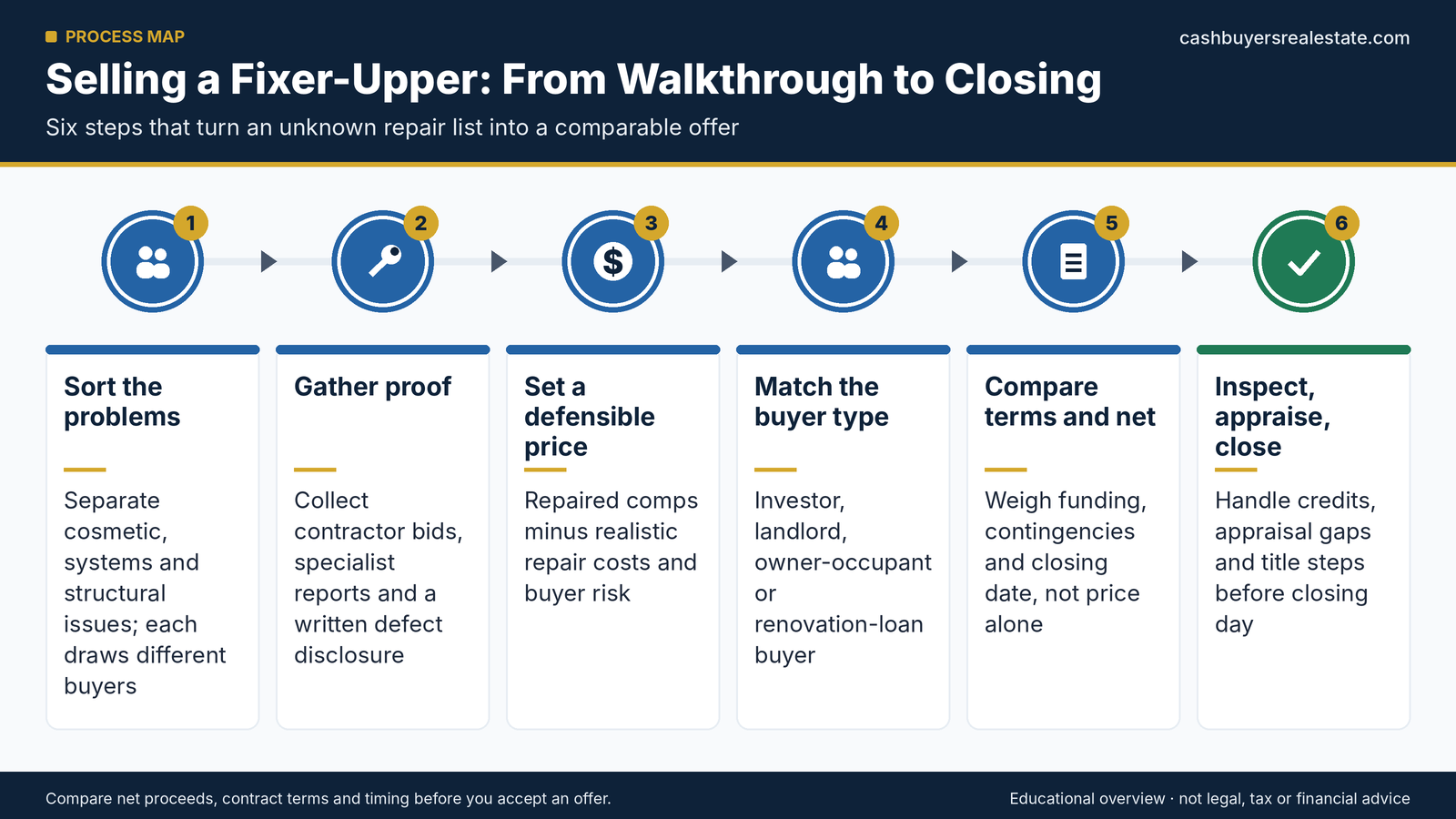
Text version of this infographic
- Sort the problems — Separate cosmetic, systems and structural issues; each draws different buyers
- Gather proof — Collect contractor bids, specialist reports and a written defect disclosure
- Set a defensible price — Repaired comps minus realistic repair costs and buyer risk
- Match the buyer type — Investor, landlord, owner-occupant or renovation-loan buyer
- Compare terms and net — Weigh funding, contingencies and closing date, not price alone
- Inspect, appraise, close — Handle credits, appraisal gaps and title steps before closing day
How Investors Value a Fixer-Upper: The Rehab Math
With the buyer types in mind, the next question is how any of them turns a walkthrough into a number. This is the part of the transaction most sellers never see, and it’s where a lot of the price difference between offers comes from.
The after-repair value framework
Estimating after-repair value from comparable sales
After-repair value, usually shortened to ARV, is an estimate of what the property would sell for once the planned work is finished. It’s the anchor for every investor calculation, and it’s also the softest number in the model. Investors build ARV from recent sales of similar renovated homes nearby: similar size, bedroom and bathroom count, lot, style and age, ideally sold within the last several months and close to the subject property.
Small differences in comps matter. A buyer who picks the three highest sales on the street will get a higher ARV and a higher offer than one who selects the middle of the pack; one who doesn’t adjust for a missing garage will overstate it. When you get an offer, ask what ARV the buyer is using and which sales support it. A good-faith buyer will usually share the reasoning. A buyer who won’t explain the number at all is giving you less to work with.
You can run a rough version yourself. Pull sold listings for renovated homes similar to yours, discard outliers, and note the range. A real estate agent can prepare a comparative market analysis, and a licensed appraiser can provide an independent opinion for a fee. The guide to how cash offers are calculated explains the same logic in a more general way.
Repair budgets, contingency and carrying costs
Next comes the cost side. A repair budget lists each item: roof, windows, kitchen, baths, flooring, paint, mechanical systems, permits, dumpsters and cleanout. Experienced buyers add a contingency, a cushion of extra money for what’s discovered when walls are opened, and they add the cost of holding the property during the project: property taxes, insurance, utilities, and interest or the cost of tied-up money. They also add the cost of buying, which may include title fees and lender charges, and the cost of selling, which includes agent compensation, transfer taxes and closing costs in many states.
None of these lines is exotic, but together they explain why an investor’s offer can look dramatically below a “repaired” comparable. The gap isn’t only profit; it includes months of carrying costs and the risk that the project goes over budget. Here is a single worked example, using made-up figures to show the mechanics.
Illustrative example (hypothetical numbers, not market data): A three-bedroom house would sell for about $300,000 if fully renovated, based on three comparable renovated sales. An investor estimates $50,000 in repairs, adds a 10% contingency ($5,000), and assumes 7% of the resale price ($21,000) for selling costs, $8,000 for buying and financing costs, and $9,000 to carry the house for five months. The investor wants a $30,000 profit.
Starting at $300,000 and subtracting $55,000 (repairs plus contingency), $21,000, $8,000, $9,000 and $30,000 leaves a maximum offer of $177,000. Change any input and the answer moves. If the investor thinks the finished value is only $280,000, the same math produces about $157,000. Every line is an assumption, which is why it’s reasonable to question them.
| Line item | Amount | What it represents |
|---|---|---|
| Estimated after-repair value (ARV) | $300,000 | Price of the finished house, from renovated comps |
| Repairs | −$50,000 | Scope-of-work estimate |
| Contingency (10%) | −$5,000 | Cushion for surprises behind walls |
| Selling costs (assumed 7%) | −$21,000 | Agent compensation, closing costs, transfer taxes |
| Buying and financing costs | −$8,000 | Title, lender and closing fees |
| Holding costs (5 months) | −$9,000 | Taxes, insurance, utilities, interest |
| Target profit | −$30,000 | Return for the investor’s time and risk |
| Maximum offer | $177,000 | Price at which the plan still meets the target |
Use the table as a checklist for questions: which line is the buyer most generous with, and which is the most conservative? A seller who can show a $38,000 contractor quote in place of the $50,000 estimate has changed the math in a verifiable way.
Margins, rules of thumb and what lands in your pocket
The 70% rule and why no single formula governs offers
You may hear about the “70% rule,” a popular shortcut among house flippers. It says an investor should pay no more than 70% of the ARV minus the cost of repairs. In our example that would be 70% of $300,000, or $210,000, minus $50,000, or $160,000. That’s lower than the $177,000 from the line-by-line approach, and the difference illustrates why shortcuts and detailed analyses can disagree.
Treat the 70% rule as an informal heuristic that circulates in investor education, not as a standard, a law or an industry requirement. Some investors use a higher percentage in strong markets or when they have cheap repairs and short timelines. Others use a lower one when the project is risky or financing is expensive. We aren’t aware of any authoritative source that sets a normal investor margin, so be wary of anyone who presents a margin as fixed.
What you can reasonably do is ask the buyer to walk through their math. A buyer who says “ARV of $300,000, $55,000 in work, and I need a margin” has given you something you can test. A buyer who simply says “that’s our number” has not.
Comparing an investor offer with a listed as-is sale on net proceeds
A headline price tells you very little. What you want to know is how much will reach your bank account after the mortgage payoff, closing costs, commissions, credits, repairs and the months you keep paying taxes and utilities. The comparison below uses the same hypothetical house and shows how a lower investor offer can sit close to a higher list price once costs are counted, and how a repair-then-list plan can beat both on paper while requiring cash and tolerance for risk.
Illustrative example (hypothetical numbers, not market data): Using the same house, an investor offers $177,000 and the seller pays about $2,500 in closing costs, netting $174,500. An as-is listing sells for $200,000 after a few months, with 6% for agent compensation and closing costs ($12,000), a $6,000 inspection credit and $4,500 for three months of carrying costs, netting $177,500. Repairing first costs $55,000, the house sells at $300,000, selling costs are 6% ($18,000), and carrying costs for six months are $9,000, netting $218,000 only if the work stays on budget and the market holds.
| Route | Sale price | Costs and credits | Repairs and carrying | Illustrative net |
|---|---|---|---|---|
| Sell to investor as-is | $177,000 | −$2,500 | $0 | $174,500 |
| List as-is on the open market | $200,000 | −$18,000 | −$4,500 | $177,500 |
| Repair, then list | $300,000 | −$18,000 | −$64,000 | $218,000 |
Notice what the table does and doesn’t say. The first two routes are close, and the investor route removes showings, inspection negotiations and months of uncertainty. The third looks best on paper but requires $55,000 up front (or financing), several months of project management, and a finished price that may not materialize; a 25% repair overrun alone would trim about $13,750 from that net. The right choice depends on your cash, your appetite for risk and your deadline, not on which line is largest. For the broader comparison of methods, see cash sale versus listing for a fast sale.
Renovation Loans and Financed Buyers: FHA 203(k), HomeStyle and Timelines
A large share of the people who would happily buy a fixer-upper can’t pay cash. They need a mortgage, and the mortgage has to cover the purchase and the work. Two renovation loan programs come up constantly in this conversation, and both affect how long your sale takes. This section reflects program rules as published by HUD and Fannie Mae as of October 2026; the limits do get revised, so a buyer’s lender is the final word on what applies.
FHA 203(k): what it is and what changed in 2024
Limited and Standard 203(k) at a glance
The FHA 203(k) program lets a buyer finance the purchase of a home and the cost of rehabilitating it in a single FHA-insured mortgage. There are two versions. The Limited 203(k) is meant for minor, non-structural work and has no minimum repair amount. The Standard 203(k) is designed for larger projects that may include structural repairs, requires at least $5,000 in eligible repairs and requires a HUD-approved 203(k) consultant who writes up the scope, estimates the cost and inspects the work as funds are released.
HUD’s Mortgagee Letter 2024-13 (summarized in FHA Info 2024-44), published in July 2024 and required for FHA case numbers assigned on or after November 4, 2024, raised the Limited program’s maximum rehabilitation cost from $35,000 to $75,000, with a promise to review the cap annually. It also lengthened the allowed rehabilitation period to nine months for Limited and twelve for Standard, raised from 15 to 30 the number of days a borrower may be unable to occupy the home during Limited work, and allowed the consultant’s fee to be financed in the Limited program. Because the cap is reviewed periodically, treat $75,000 as the figure in the July 2024 letter rather than a permanent number.
The program has historically been described, for example in the FDIC’s lending guide, as intended for people who will live in the home, not investors. So a 203(k) buyer is typically a homebuyer who plans to occupy the property, which tends to make them a better match for a house with fixable cosmetic and mechanical needs than for one with active structural failure the buyer can’t yet cost.
What a 203(k) buyer means for your timeline and contract
When a buyer uses a 203(k), the repair money doesn’t arrive in your pocket; it sits in an escrow account at the lender and is released as work is completed. For you, as the seller, the practical differences show up before closing. The lender needs the buyer’s contractor bids or the consultant’s work write-up, the appraiser values the home both as it stands and as it would be after the work, and the maximum mortgage is tied to a formula using those values. All of that adds steps compared with a cash purchase.
Two practical effects follow. First, expect more paperwork and more time between contract and closing than with a cash buyer, and ask the buyer’s loan officer for the expected schedule in writing rather than trusting a promise. Second, the contract should include a financing contingency date and clear language about what happens if the loan doesn’t clear. A buyer whose renovation budget doesn’t fit within the formula may need to renegotiate, so look at the strength of the pre-approval, not just the price.
The upside for a seller is that a 203(k) buyer is an owner-occupant, which can mean a higher price than an investor would offer, and a buyer who has chosen the house as a home rather than a spreadsheet entry. If the property qualifies and you have time to wait, a financed buyer is a legitimate way to get a better number than a discount-oriented investor, provided you accept the longer timeline.
HomeStyle and other renovation or conventional options
How Fannie Mae HomeStyle Renovation works
Fannie Mae’s HomeStyle Renovation mortgage is the conventional counterpart. According to the Fannie Mae Selling Guide, it’s available for one- to four-unit principal residences, one-unit second homes, and one-unit investment properties, along with manufactured homes and eligible condo or planned-unit-development units. That investment-property eligibility matters: a landlord who plans to rent the house after repairs can sometimes use a HomeStyle loan, which isn’t true of 203(k).
The renovation amount is limited. For a purchase, the cost of the work can be up to 75% of the lesser of the purchase price plus renovation costs, or the as-completed appraised value. Fannie Mae’s 2025 HomeStyle comparison sheet describes a contingency reserve of up to 15% of renovation costs, upfront draws of up to 50% of the renovation costs, and completion documented on Form 1004D. There is also a limited “do it yourself” option for one-unit properties capped at 10% of the as-completed value, and the borrower cannot count their own labor as a cost, so sweat equity doesn’t add borrowing power.
Freddie Mac offers a comparable product, CHOICERenovation. Individual lenders often add their own requirements on top of the agency rules, so a buyer who qualifies at one lender may not at another. That’s another reason to ask a financed buyer for a lender letter that names the specific loan program.
Condition ratings, appraisal gaps and houses that standard loans won’t finance
Fannie Mae’s Selling Guide (section B4-1.3-06) rates condition from C1 (new) to C6. A C5 property has obvious deferred maintenance and some significant repairs but is still livable. A C6 property has damage or deferred maintenance serious enough to affect safety, soundness or structural integrity, and loans on C6 homes aren’t eligible for sale to Fannie Mae until the deficiencies are repaired to at least C5. An appraisal can be done “as is” only when conditions are minor and don’t affect safety, soundness or structural integrity; otherwise the appraisal is made “subject to” completion of specific repairs.
This is why a house with a missing roof section, active water intrusion, or a failed heating system in cold weather often can’t be bought with a standard mortgage. It isn’t that buyers don’t want it; their lender may not be allowed to fund it. For those houses, the realistic buyer pool is cash buyers and renovation-loan buyers whose appraisal reflects the completed work. The Fannie Mae rule is a conventional-loan standard, so check how the buyer’s specific program treats condition rather than assuming one set of rules for every lender.
An appraisal gap is the other risk. If the appraised value comes in below the contract price, the buyer has to cover the difference, renegotiate or walk away, and the contract’s appraisal contingency determines what follows. Renovation loans use an as-completed value, which can help a buyer reach a workable number, but they also make the lender more attentive to the scope of the repairs. A seller with an organized contractor bid in hand makes that process smoother.
| Funding route | Repair funding | Condition rules | Effect on your timeline | Main risk to you |
|---|---|---|---|---|
| Cash or private money | Buyer pays separately after closing | No lender condition review | Shortest in most cases | Funds not as stated; verify proof of funds |
| Standard conventional loan | None; repairs come from buyer’s own cash | C6 not eligible; appraisal may require repairs | Typical lender timeline | Appraisal or condition issue sinks the loan |
| FHA Limited 203(k) | Up to $75,000 of rehab for minor, non-structural work | Rehab escrow and draws; FHA appraisal | Longer than cash; extra lender steps | Budget doesn’t fit loan formula |
| FHA Standard 203(k) | Structural work allowed; $5,000 minimum; consultant required | Consultant write-up and inspections | Longest of these options | Complex paperwork; delays |
| Fannie Mae HomeStyle | Up to 75% limit on renovation relative to value | As-completed appraisal; contingency reserve | Longer than cash; lender-dependent | Lender overlays; scope disputes |
The pattern across the table is simple: the more of the repair cost the buyer’s lender helps finance, the more review steps stand between the contract and your closing date. A cash buyer isn’t automatically better, but a cash buyer is the route that most reduces the number of third parties who can slow the sale.
The next graphic compares the five broad ways to sell a fixer-upper, including the cash and financed routes above, so you can see the trade-offs side by side.
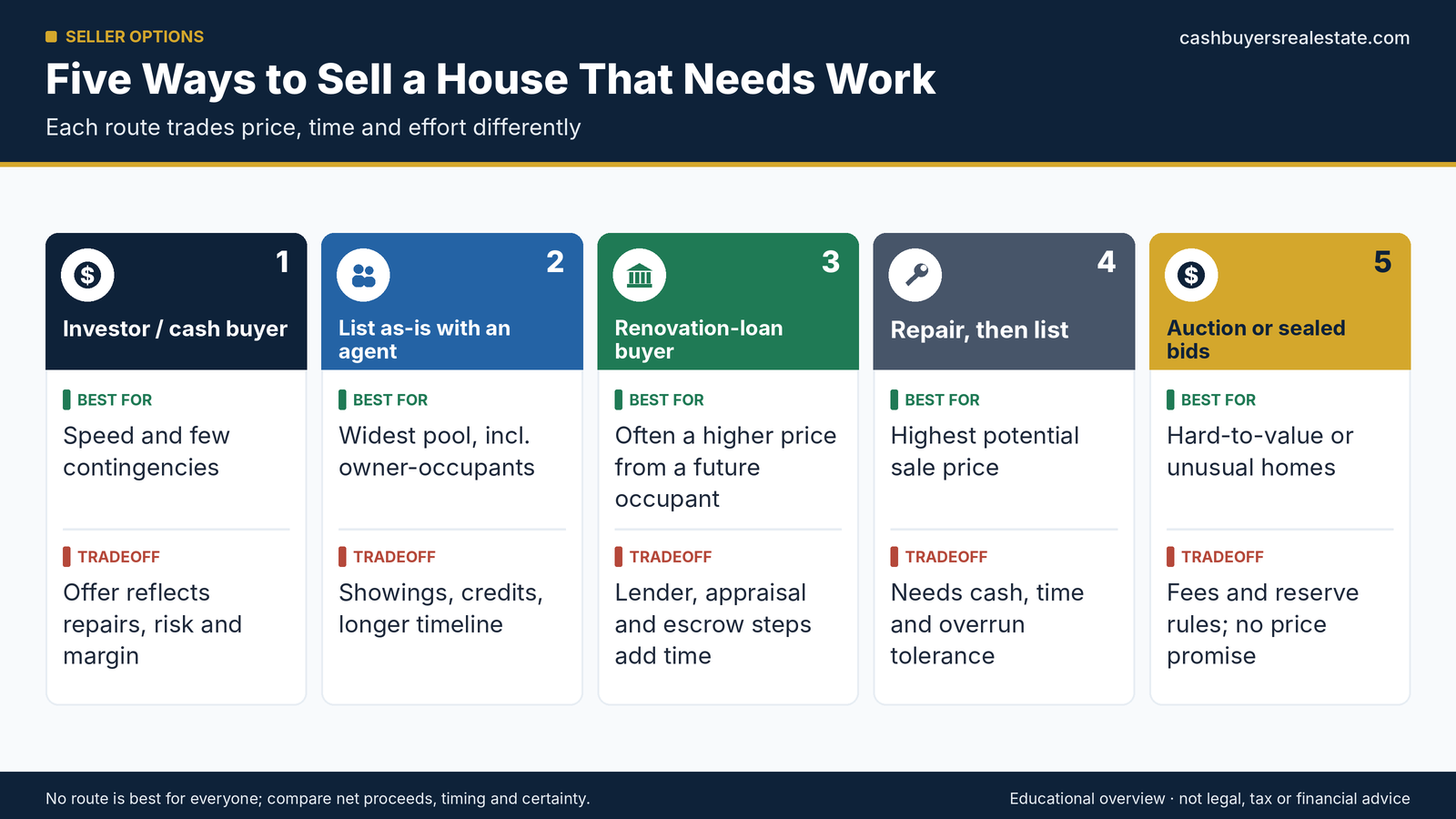
Text version of this infographic
- Investor / cash buyer — best for: Speed and few contingencies; tradeoff: Offer reflects repairs, risk and margin
- List as-is with an agent — best for: Widest pool, incl. owner-occupants; tradeoff: Showings, credits, longer timeline
- Renovation-loan buyer — best for: Often a higher price from a future occupant; tradeoff: Lender, appraisal and escrow steps add time
- Repair, then list — best for: Highest potential sale price; tradeoff: Needs cash, time and overrun tolerance
- Auction or sealed bids — best for: Hard-to-value or unusual homes; tradeoff: Fees and reserve rules; no price promise
Pricing a Fixer-Upper: As-Is Value Versus Price-to-Attract
Pricing a house that needs work is harder than pricing a polished one, because the comparable sales you’d normally rely on are of homes in different condition. Price too high and the house sits while the buyer pool shrinks. Price too low and you’ve given away value that a patient search would have found. The goal is a number you can explain.
Setting an as-is number you can defend
Start from repaired comparables, then subtract what a buyer will have to spend
The cleanest way to price an as-is house is to work the buyer’s math in reverse of what they’ll do. Begin with what similar, renovated houses nearby have sold for. Subtract a realistic repair budget based on actual bids, not guesses. Then subtract something for the buyer’s time, risk and the cost of financing the project. What’s left is a defensible range for the house in its current condition. The range will be wider than for an updated home, and that’s normal.
Cross-check it against recent sales of other houses in similar condition, if you can find them. A real estate agent with local experience can often identify sales of fixer-uppers, estate sales or investor purchases in the neighborhood, which show what buyers actually paid for houses with problems. These sales are usually more informative than online automated estimates, which don’t see your roof, your plumbing or the 1970s kitchen.
Be careful with the instinct to subtract the full cost of every repair from the repaired value. Buyers often don’t pay dollar-for-dollar for improvements they would have chosen themselves. A buyer who plans to gut the kitchen anyway gives your new countertops little credit. Conversely, items that stop a loan from funding, like a leaking roof, are often worth more to fix than their repair cost suggests because they widen the buyer pool.
Pre-listing tools: agent opinions, appraisals, inspections and contractor bids
Several tools reduce the guesswork, and they differ in cost and purpose. A comparative market analysis from a real estate agent is typically free to a prospective listing client and gives a price range based on local sales. A licensed appraiser can give an independent opinion of value, including on an as-is basis, for a fee that varies by location and property. A pre-listing home inspection identifies defects and gives you a document you can share. A contractor bid or a specialist’s report (roofer, foundation engineer, plumber with a camera) turns a vague problem into a dollar figure.
Each tool answers a different question, and none is required. Spend where the uncertainty is greatest. If the main unknown is value, get an agent opinion or an appraisal. If the main unknown is the condition of a specific system, hire the specialist. If you have no idea what’s wrong, a general inspection is a sensible starting point, with the understanding that you may have to disclose what it finds.
That last point is worth planning for. In many states a seller who knows about a material defect has a duty to disclose it, and a pre-listing report can establish what you knew and when. That isn’t a reason to skip the inspection, but it is a reason to decide how you’ll handle the findings before you order it. Our guide to preparing for a fast home sale covers the order in which sellers usually tackle these steps.
Pricing strategies and offer handling
Five pricing strategies and when each fits
There isn’t one correct pricing strategy; there are several, with different risk profiles. The table summarizes five approaches sellers commonly use for properties that need work.
| Strategy | How it works | Best when | Main risk |
|---|---|---|---|
| Realistic as-is price | Priced at the range supported by repaired comps minus repair costs | You want a straightforward sale and have a defensible estimate | Offers still come in below if buyers see more risk than you do |
| Priced to attract | Priced somewhat below the expected as-is value to draw several buyers | Demand is strong and you can set an offer deadline | Competition may not appear; you may have anchored too low |
| High and negotiate | Priced above expected value to leave room for negotiation | You can wait and have no deadline | Longer time on market; buyers may read the home as overpriced |
| Scheduled reductions | Start higher and cut price on a set schedule | You have a few months and want to test the market | Reductions can signal weakness; carrying costs accumulate |
| Auction or sealed bids | Buyers bid against a deadline or in a live auction | The house is unusual or hard to value and speed matters | Fees, reserve rules and results vary; no price guarantee |
The best strategy is the one that matches your timeline and your tolerance for a lower number. If you can’t carry the house for several months, a strategy that depends on waiting for the right buyer is working against your goal.
Reading offers, counteroffers and price reductions
An offer is a bundle: price, earnest money, the closing date, financing, contingencies, repair requests and who pays what. Two offers with the same price can have very different value. A $190,000 offer with a financing contingency, a 21-day inspection period and a request for $8,000 in credits may be worth less than a $182,000 offer with proof of funds, a short inspection window and no repair requests.
When you counter, you’re allowed to respond to terms as well as price. Shortening an inspection window, increasing earnest money or setting a firm date to confirm financing can all matter as much as a few thousand dollars. When several offers arrive together, a common tactic is to ask each buyer for their “highest and best” by a set time; it can raise the price, but it works only if there is genuine competition, so use it honestly.
If the house sits, price reductions are normal. They tend to be more effective when they are substantial enough to change which buyers consider the property, rather than a series of token cuts. And remember the question about compensation: since the National Association of REALTORS® settlement practice changes took effect on August 17, 2024, listing agents must make clear that compensation is fully negotiable, so ask any agent you interview what they charge and what, if anything, they would offer to a buyer’s agent. The cash buyer versus real estate agent comparison explains how those costs show up in the net.
Documenting the Repairs and Marketing the House Honestly
Once you have a price range, the next lever is how convincingly you present the work the house needs. Buyers discount what they can’t measure. A tidy file of bids, reports and receipts often does more for your offers than a fresh coat of paint, and it costs a fraction of the repairs themselves.
Building a repair-scope file buyers can trust
Contractor bids and scope-of-work documents
A useful bid is specific. “Roof: $14,000” tells a buyer little, while a written scope that says what will be removed, what will be installed, the materials, the permit responsibility and the warranty gives them something to compare. Ask for itemized bids from licensed contractors in the trades that matter most for your property, and ask each contractor to put the date, the address and their license number on the document. Two or three bids for the biggest items are better than one, because they show a range and let you see whether a number is an outlier.
The scope doesn’t have to be a complete renovation plan. It should describe what a sensible buyer would do to make the house livable and sellable, not an aspirational remodel. Buyers are skeptical of a seller-supplied bid that includes upgrades nobody needs, and they’ll adjust anything that looks inflated. Where possible, tie each item to something an inspector or appraiser might flag: a roof near the end of its life, a failed window seal, a nonworking water heater.
You are not promising to do the work. The bids simply show the cost of doing it. State that clearly on the document or in the listing so a buyer or lender doesn’t assume the seller will make the repairs. If a renovation-loan buyer needs bids for their lender, yours can serve as a starting point, though many lenders require their own contractor estimates.
| Document | What it shows buyers | Tip |
|---|---|---|
| Itemized contractor bids (2–3 for major items) | Realistic cost range for the biggest repairs | Include license number, date and scope; mark as estimates only |
| Specialist reports (roof, foundation, sewer scope, electrical) | Cause and extent of a specific problem | Use a qualified professional with no stake in the sale |
| General home inspection summary | Overall condition and safety items | Decide in advance how you’ll disclose the findings |
| Permits and past repair records | What work was done legally and by whom | Open or unpermitted work should be disclosed and discussed with an agent or attorney |
| Utility bills and tax statements | Operating costs a buyer inherits | Twelve months is a typical range to gather |
| Written disclosure of known defects | What you know and when you learned it | Use your state’s required form where one exists |
| Photos of problem areas | Visible condition, before any work | Date-stamped images protect both sides |
Think of the checklist as your paper trail: each document answers a question a buyer would otherwise answer pessimistically. If you can only gather three items quickly, the bids for the biggest repair, a specialist report on your biggest unknown and a written disclosure are the ones that matter most.
Inspection reports: when a pre-listing inspection helps and when it creates problems
A pre-listing inspection costs money and produces a document you may have to share. That makes it a decision, not a default. It tends to help when you suspect problems but can’t name them, when you plan to market the house to financed buyers who will inspect anyway, or when you’d rather find out about a surprise on your own schedule than in the middle of a contract.
It can hurt when it uncovers issues you’d have no obligation or inclination to address and then must disclose, or when you plan to sell to an investor who will do their own walkthrough and doesn’t care about the report. It also may not satisfy a buyer, who will often commission their own inspection regardless. In that case you’ve paid for information that doesn’t save time.
If you do get one, read it with a clear head. Inspection reports list every observation, including minor and cosmetic items, and the sheer length can look alarming. Ask the inspector to separate safety issues, major systems and routine maintenance, and use that triage in your conversations with buyers. A short cover note summarizing “here is what matters and what it costs” is more persuasive than 60 pages of photos.
One caution on timing: a report you hold but never share is still a report you have. If it identifies a material defect, many states require you to disclose it regardless of whether the buyer asked. The honest approach, and the one that protects you, is to let the report inform both your price and your disclosure.
Marketing and disclosing a house that needs work
Photos, listing language and reaching the right buyer pool
Good photography still matters, but the goal changes. You aren’t trying to hide the condition; you’re trying to show the potential and the honest condition together. Clean, bright photos of the structure, the lot, the layout and the best features help a buyer picture the finished result, and a few clear photos of the problems build credibility. Staging a house that will be gutted wastes money, though removing clutter and debris is worth the effort because it lets buyers see the actual rooms.
Listing language should be factual. Terms like “as-is,” “needs updating” or “bring your contractor” tell investors and renovators that the house is for them without making claims about condition that you’d later have to defend. Avoid slang that implies guarantees (“great bones,” “easy fix”) unless you have the paperwork to back it up. If you have bids and reports, say so in the listing remarks and offer them on request.
Different channels reach different buyers. An agent can put the house on the multiple listing service (MLS), which reaches owner-occupants, their agents and many investors. Direct outreach to local investors and contractors reaches the people most likely to buy as-is. Auctions and sealed-bid sales reach buyers comfortable with a deadline. Each has costs and trade-offs, and the comparison of companies that buy houses for cash helps you think about how to evaluate direct buyers.
Showing a house with hazards deserves its own thought. Soft floors, exposed wiring, mold and unsecured vacant properties create safety and liability risks, so coordinate with your agent about accompanied showings, secured lockboxes, waivers or limiting showings to qualified buyers with proof of funds or a lender letter. If the house is vacant, our guide on selling a vacant house fast covers securing it while it’s on the market.
Disclosure duties, lead-based paint and why “as-is” doesn’t erase them
“As-is” means you aren’t offering to make repairs or give credits. It doesn’t necessarily mean you can stay silent about what you know. State laws on seller disclosure vary widely. Texas, for example, requires a seller of residential property with no more than one dwelling unit to give the buyer a written notice of the property’s condition, and if the seller delivers it after the contract is signed the buyer may terminate within seven days of receiving it; the same statute exempts certain transfers, including foreclosure sales and some transfers by estate fiduciaries. California’s disclosure statute for single-family residential sales states that any waiver of its requirements is void as against public policy. Other states use different forms, different exemptions and, in a few, require little or no formal disclosure.
Federal law adds one rule that applies broadly, described on EPA’s real estate disclosure page. For most housing built before 1978, the seller must give the buyer an EPA-approved lead hazard information pamphlet, disclose any known lead-based paint or hazards and provide available records and reports. The contract must include a Lead Warning Statement, the buyer must be given 10 days to conduct an inspection or risk assessment (unless the parties agree otherwise in writing), and the seller must keep a signed copy of the disclosure for three years. EPA enforces the rule, and certain sales, including foreclosure sales, are exempt.
You don’t need to become a lawyer, but you should ask the right question of your agent or attorney: “What does my state require me to disclose, and in what form?” Then answer honestly. Concealing a known defect can lead to claims after closing, and the cost of a lawsuit or rescission dwarfs the discount a buyer might have asked for up front. If you inherited the property or are selling as a fiduciary, the disclosure duties may be different, so confirm them for your role.
Negotiating Inspections, Appraisals and Lowball Offers
An accepted offer isn’t a finished sale. For a fixer-upper, the inspection and the appraisal are the two moments when deals are most often renegotiated or lost. Knowing in advance how you’ll respond keeps a surprise from becoming a panic.
Handling the inspection and appraisal stage
Repair credits, price reductions or fixes: three ways to answer an inspection report
When a buyer’s inspection turns up problems, the response usually falls into one of three buckets. You can make the repair, which gives the buyer what they asked for but takes your time and may not satisfy a lender’s standards. You can give a credit at closing, which hands the buyer money to handle the work themselves and keeps you out of the project. Or you can reduce the price, which is similar to a credit but changes the contract price (and in a financed sale can interact with the appraisal and the buyer’s loan amount).
For houses that are being sold as-is, credits and price reductions are generally cleaner than repairs. A rushed repair by a seller who isn’t a contractor can create new questions: was it permitted, was it done correctly, is there a warranty? Buyers often prefer to hire their own contractor. If the lender requires a specific repair as a condition of the loan, though, you may have to complete it or give the buyer a way to do so.
Respond to the report with a counter, not a reflex. Separate the list into safety issues, major systems, items already reflected in your price and minor items. Remind the buyer, politely, that the home was priced as a fixer-upper, and point to the bids you provided. A concession on one or two significant items, with a signed amendment, is more likely to hold than a long negotiation over every line. Keep receipts and written amendments for everything you agree to.
When the appraisal or the lender’s condition review pushes back
If a buyer is financing, the lender will order an appraisal. It might come in below the contract price, it might require specific repairs before the loan can fund, or it might rate the condition in a way that affects eligibility. None of these is unusual for a fixer-upper, and each has a standard set of responses.
Illustrative example (hypothetical numbers, not market data): A financed buyer agrees to pay $210,000 for a house. The appraisal comes in at $198,000 and notes a damaged section of roof that must be repaired for the loan to proceed. The seller can lower the price to $198,000, ask the buyer to cover the $12,000 difference in cash, split it, or provide the lender’s required roof repair with a receipt and ask for the appraisal to be updated. If none of those works, the buyer may cancel under the appraisal contingency, and the seller returns to the market having lost time.
Your protection in this situation is preparation. Documented bids help the appraiser support a value, a roof estimate lets you quickly decide whether to repair or credit, and a backup buyer lets you walk away from a deal that isn’t going to close. Ask your agent whether to keep the home active for backup offers while the first contract proceeds; the contract’s terms and local practice determine whether that’s allowed.
Appraisal contingencies, financing deadlines and earnest money rules are contract terms, so the specifics depend on what you signed and on state law. If a deadline is about to pass, ask your agent or attorney what the contract says before you assume you can wait.
Spotting weak offers and risky terms
Is the offer low, or is it a red flag?
A low offer is not a red flag by itself. Investors need margin, repairs cost money, and the discount for uncertainty is real. The question is whether the offer is explained, supported and made by a buyer who can close. A lowball offer from an experienced buyer with proof of funds and a short contract may be perfectly legitimate. A slightly higher offer with unusual conditions may be a worse deal.
| Warning sign | Why it matters | What to check or ask |
|---|---|---|
| Won’t explain how the number was calculated | You can’t test the assumptions | Ask for the ARV, the repair estimate and the comps in writing |
| Pressure to sign immediately | Leaves no time to compare or consult an attorney | Take the contract home; request time for review |
| Very small or no earnest money, with a long cancellation window | Buyer can walk away at little cost while your house is tied up | Ask what you receive for giving the buyer that option |
| Price drops sharply after the inspection with no new findings | May be a re-trade rather than a response to real discoveries | Ask which items changed the price and why |
| Buyer’s name or entity is unclear | You may not know who is closing or who is liable | Ask for the legal name and whether the contract can be assigned |
| Requests for upfront fees or payments from you | Legitimate buyers usually pay for their own due diligence | Read the agreement; consult an attorney before paying anything |
| Cannot show funds or a lender letter | Closing may not be possible | Request proof of funds or a pre-approval and verify it |
One item deserves nuance: a lower price after an inspection can be fair if the inspection found real problems that were not visible earlier. The test is whether the buyer can point to specific findings. A re-trade without a reason is different, and it is one reason to keep a backup buyer in mind.
Contract terms and payment safeguards worth reading twice
Read the contract slowly, especially the clauses that determine who can walk away. Focus on the earnest money terms, the inspection period and what the buyer can do during it, the closing date and any right to extend, whether the buyer can assign the contract, and which closing company or attorney will handle the transaction. Closing practice varies: in some states an attorney handles it, in others a title or escrow company does, and the choice of who conducts the closing often belongs to the buyer or follows local custom.
Some buyers record a memorandum of the contract in the county records. That isn’t automatically improper, but it can complicate a later sale if the first deal falls apart, so have an attorney review the contract if one is requested. Any contract that gives the buyer the right to assign it should tell you clearly what happens if the end buyer can’t close.
Protect the money, too. Confirm wiring instructions by calling a phone number you already trust, not one in an email. Never wire funds to a buyer, a “processing” fee, or an unknown third party. If anything about the process feels pressured or inconsistent, pause and ask a real estate attorney or a trusted agent to review it. The guide to cash home buyer scams goes through verification steps in detail, and the guide to selling a house as-is covers the contract language that surrounds that phrase.
The checklist graphic that follows summarizes the six decision points that most often determine how a fixer-upper sale goes: mortgage payoff, property condition, buyer financing, title issues, closing readiness and your moving deadline.
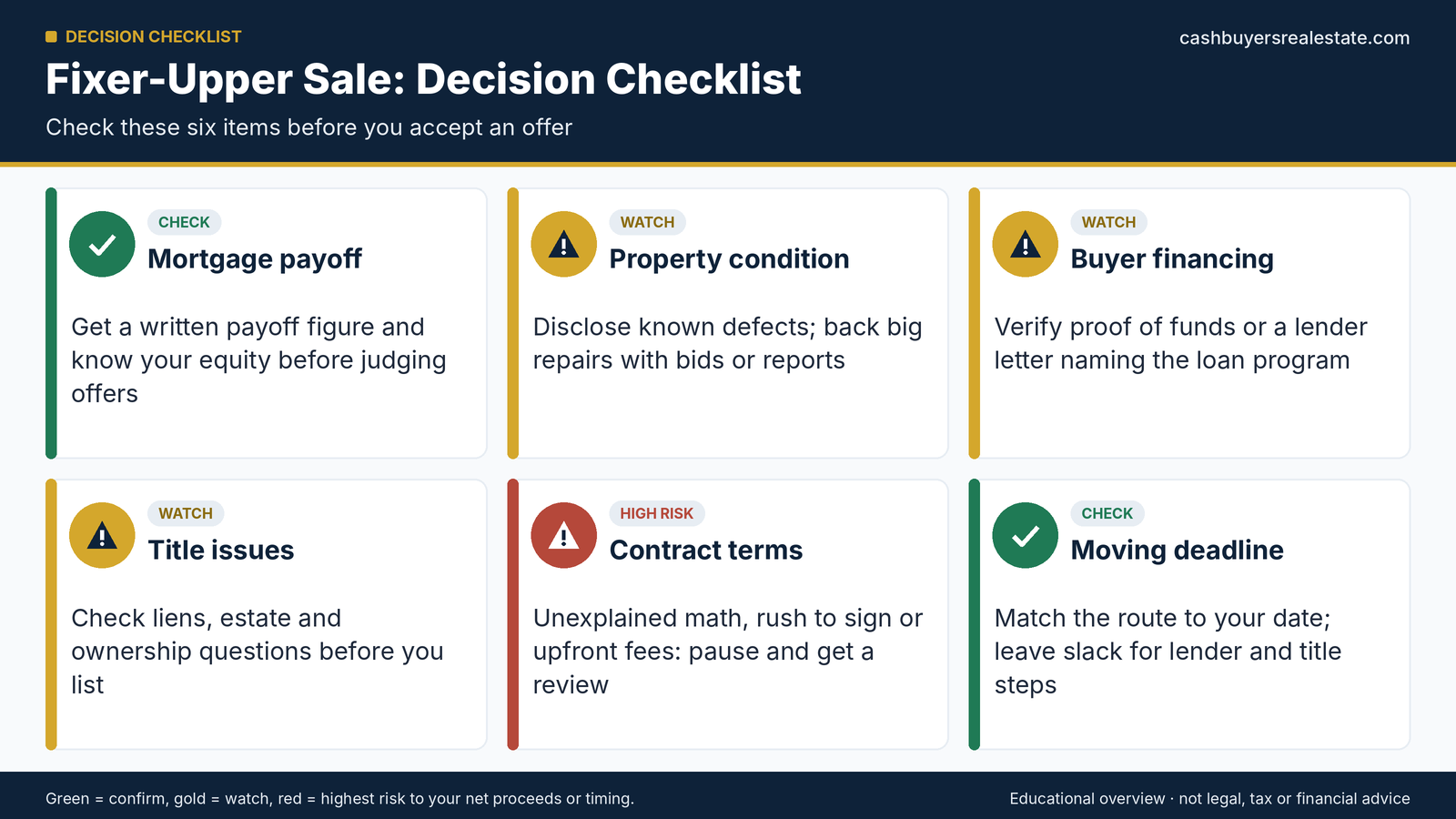
Text version of this infographic
- Mortgage payoff — Get a written payoff figure and know your equity before judging offers
- Property condition — Disclose known defects; back big repairs with bids or reports
- Buyer financing — Verify proof of funds or a lender letter naming the loan program
- Title issues — Check liens, estate and ownership questions before you list
- Contract terms — Unexplained math, rush to sign or upfront fees: pause and get a review
- Moving deadline — Match the route to your date; leave slack for lender and title steps
Frequently Asked Questions About Selling a Fixer-Upper
The questions below come up repeatedly once sellers start collecting offers. The answers are general; your state, your lender and your specific contract can change them.
Questions about buyers, offers and timing
Questions about who buys and how quickly
- Who is most likely to pay the highest price for a fixer-upper?
Often it’s an owner-occupant who wants to live in the house, because they aren’t building a resale profit into their number. The catch is that they usually bring a lender, an appraisal and an inspection, which means more time and more ways for the deal to change. Investors tend to pay less but offer speed and fewer conditions. Which one is better for you depends on your timeline and tolerance for risk.
- Can I sell a fixer-upper quickly without an agent?
Yes, sellers do it, typically by selling directly to an investor, contractor or neighbor, or by handling a for-sale-by-owner (FSBO) listing. You then take on the work an agent would otherwise do: pricing, marketing, screening buyers and negotiating. A real estate attorney or a title company can help with the paperwork, and the guide to selling without a realtor explains what to expect.
- How long does it take to close on a fixer-upper?
There is no single timeline. A buyer paying cash with a clean title can often close faster than a buyer who needs an appraisal and lender approval, and renovation-loan purchases usually add steps. Title problems, liens, estate issues and local recording practices can slow any route. Ask each buyer for their expected closing schedule and what has to happen before it.
- Should I accept the first cash offer I receive?
Not automatically. Compare it with at least one other offer or a realistic estimate of your net on the open market, and read the contract terms, not just the price. If the first offer is fair and the terms fit your timeline, accepting it can be a reasonable decision. The point is that you’ve checked, rather than assumed.
Questions about price and offers
- Why is the investor’s offer so much lower than what repaired houses sell for?
The offer has to cover repairs, a contingency, buying and selling costs, carrying costs for the months of the project and a profit for taking the risk. Those items can add up to a large share of the repaired price. Ask the buyer to show the math, and compare it with your own contractor bids and sales data.
- Is it worth making a few repairs before selling?
Sometimes. Repairs that remove a financing obstacle or fix an obvious safety problem often pay off because they widen the pool of buyers. Cosmetic upgrades in a house that will be renovated anyway usually don’t. Our guide to selling a house fast without repairs covers that decision in more detail.
- What if I get several offers within a few days?
Compare them on price, funding, contingencies, earnest money and closing date rather than price alone. You can ask each buyer for their best offer by a set time, or counter on terms such as a shorter inspection period. Respond honestly to every buyer and keep a record of what you ask for.
Questions about repairs, financing and paperwork
Questions about repairs and disclosure
- Do I have to disclose problems if I sell the house as-is?
In many states, yes. As-is language typically means you won’t make repairs; it doesn’t necessarily remove duties to disclose known material defects. Rules differ by state, so ask a local agent or attorney what your state requires and in what form. If your house was built before 1978, federal lead-based paint disclosure rules also apply to most sales.
- Is a contractor’s estimate enough, or do buyers expect an inspection?
Bids help by pricing a problem, but buyers usually want to inspect anyway, particularly financed buyers and their lenders. Investors may rely on their own walkthrough and contractors. Bids and reports are most valuable as evidence during negotiation, because they limit how far a buyer can reasonably push the price down.
- What about unpermitted work?
Unpermitted additions or alterations can affect value, financing and insurance, and in some places they must be disclosed. Some buyers will price the risk, while a lender may refuse to finance. Talk to a local agent or attorney about your options, which can include permitting the work, a buyer assuming responsibility or selling to a buyer who will manage it.
- Can I live in the house while I try to sell it?
You can, and many sellers do. Safety matters, though: if the house has active leaks, electrical hazards or mold, showings and occupancy create risk. Talk to your agent about scheduling showings and about any disclosure or insurance implications for a home with known hazards.
Questions about loans and taxes
- Can a buyer with an FHA loan buy my fixer-upper?
Possibly, if the property meets FHA’s condition standards or the buyer uses a rehabilitation program such as a 203(k) loan that finances the repairs. FHA 203(k) loans require extra steps, including a rehabilitation escrow and, for larger projects, a HUD-approved consultant. Ask the buyer’s lender what the specific loan will require from you.
- What is the difference between HomeStyle and 203(k)?
HomeStyle is a conventional loan product from Fannie Mae that can be used for principal residences, second homes and one-unit investment properties. The 203(k) is FHA-insured, with Limited and Standard versions, and is generally aimed at owner-occupants. Both place the repair money in escrow and release it as work is completed. Each has its own limits, and individual lenders may add requirements.
- Will I owe taxes on the sale of a house I’m selling at a discount?
It depends on what you paid, what you spent on improvements, how long you lived there and how you used the property. For a main home, the IRS allows an exclusion of up to $250,000 of gain ($500,000 for many joint filers) if you meet the ownership and use tests, which generally require owning and living in the home for at least two of the five years before the sale. Rental properties and inherited homes follow different rules, so ask a tax professional.
Choosing Your Route and Taking the First Steps
You now have the main pieces: who buys, how they value a house, what financed buyers add, how to price, document and market the property, and how to negotiate. The last step is turning that into a choice that fits your own situation instead of someone else’s sales pitch.
Matching the sale route to your priorities
A decision framework built around what matters most to you
Start with your top priority and work backward. If it’s certainty and speed, buyers with funds and few contingencies are the natural fit, and you accept that the price will reflect the buyer’s risk and margin. If it’s maximum price, a patient listing to owner-occupants or renovation-loan buyers, possibly after targeted repairs, usually produces more but takes longer and exposes you to inspection and appraisal outcomes. If it’s minimal effort, an as-is sale to an investor or contractor removes showings and repair work. If it’s avoiding out-of-pocket cost, you’ll want a route that doesn’t require you to front repair money.
| If your priority is… | Routes that often fit | What you give up |
|---|---|---|
| Certainty and a short timeline | Investor, contractor or other buyer with verified funds | Part of the price; limited competition |
| Highest price, with time to wait | List as-is to owner-occupants, or repair first and list | Time, showings, inspection and appraisal risk |
| Little or no work and low stress | As-is sale to an investor or a negotiated direct sale | Some price; fewer buyers to compare |
| No cash for repairs up front | As-is sale; renovation-loan buyer; credits at closing | Control over timing and final price |
| Hard-to-value or unusual property | Auction or sealed-bid sale, or specialist investor | Predictability; fees and reserve rules vary |
| A messy title or complicated ownership | Experienced buyer plus title company or attorney early | Speed until the title is cleared |
Use the table to name your top two priorities, then read across the row to see what you’d be trading. If two rows point in opposite directions, you’ve learned something: you can’t fully optimize both, and the decision is which one you will compromise on.
Alternatives to a cash sale, and what each one costs you
A cash sale to an investor is only one of several reasonable routes. Because every route has a price in time, effort or risk, it helps to see them side by side.
- List as-is with an agent. Reaches the widest set of buyers, including owner-occupants who may pay more. You pay agent compensation and closing costs, accept showings and inspections, and carry the house until it sells.
- Repair, then list. Can produce the highest sale price when the work is well chosen. Requires up-front cash or credit, management time, and tolerance for cost overruns and market changes.
- Sell to a renovation-loan buyer. Often a good price from someone who wants a home. Adds lender review, appraisal risk and time.
- Sell directly to a neighbor, relative or local contractor. Can be quick and low-cost. Verify the buyer’s ability to close and use a title company or attorney to document it.
- For sale by owner. Saves commission, but you do the pricing, marketing and negotiation, and you still need the contract and disclosures to be right.
- Auction or sealed bids. Sets a deadline and can attract buyers who like projects. Results and fees vary, and a reserve may apply.
- iBuyer or instant-offer platforms. Convenient for some homes, but eligibility and pricing vary, and houses needing major work may not qualify or may be heavily discounted.
For a side-by-side look at how investor and listing routes compare on cost and net proceeds, see cash sale versus listing, and use the net proceeds calculator to run your own figures. If the home is at risk because of unpaid taxes or liens, read about selling a house quickly with liens first, because those need to be resolved at closing.
What to do in the first two weeks
Documents, numbers and questions to gather
You can make real progress in a few days with a short list of tasks. None of them commits you to any route. Gather your mortgage statement and ask the lender for a payoff figure, find your deed and any title paperwork, and pull the most recent property tax bill. List the repairs you know about and any you suspect. Collect utility bills for the past year, permits and receipts for past work, and any prior inspection reports or warranties.
Then add the outside perspective: request itemized bids for the largest items, ask a real estate agent for a comparative market analysis on both an as-is and a repaired basis, and ask at least one direct buyer how they would calculate an offer. If you can, get two or three of each. A set of numbers from different sources shows you the range, and it’s much easier to spot an outlier than to evaluate a single figure.
Finally, run your own net proceeds for each route: price minus mortgage payoff, closing costs, commissions or fees, credits, repairs and carrying costs through the closing date. The graphic above summarizes the questions that tend to matter most, and a single page of arithmetic prevents most of the expensive surprises.
Questions to ask every buyer or agent before you sign
Whoever you talk to, the same questions apply. For a buyer: How did you calculate this number, and what ARV and repair estimate did you use? Are you buying the property yourself, or can you assign the contract? How will you pay, and can you show proof of funds or a lender letter? How much earnest money will you deposit, and when? What is the inspection period, and what happens if you cancel? Who is handling the closing, and what costs do I pay?
For an agent: What do you recommend as an as-is list price, and what comparable sales support it? What is your compensation, and what would you offer to a buyer’s agent? How do you advise handling disclosure of the problems I know about? How will you handle showings given the condition? How many fixer-uppers have you sold recently, and what was the difference between list and sale prices?
Good answers are specific and in writing. Evasive or rushed answers, or an unwillingness to put terms in a contract, are signals to slow down. If you decide to take a next step, take it at your pace, and consider having a real estate attorney review any agreement before you sign, particularly if the property has title questions, liens, tenants or an estate involved.