
Sell My Home Fast: Timeline, Costs & Seller Options
Typing “sell my home fast” into a search bar takes five seconds. Doing it while you still live there is the hard part. You’re making breakfast, taking work calls, getting kids to school, and keeping the dog out of the way, and somewhere in the middle of all that, strangers need to walk through every room. A buyer’s agent wants to see the house at 6 p.m. on a Thursday. Your toddler naps at two. The laundry never ends. Selling quickly while occupied is less a real estate puzzle than a logistics puzzle with a closing date attached.
To sell your home fast while living in it, set fixed showing windows with a few hours’ notice, lock away valuables and documents, finish a one-weekend declutter and deep clean, and choose your move-out date before the first showing. If showings aren’t workable, a cash sale removes them, usually at a lower price. If you need time after closing, a written rent-back can bridge it.
That summary hides a lot of detail, and the detail is what this guide is for. You’ll find sample showing schedules for different households, a move-timeline table that separates closing, possession, and move-out dates, a declutter and deep-clean sequence, a checklist for protecting valuables and privacy, hypothetical cost ranges for storage and staging-lite, and a plain-language look at rent-back agreements and their risks. You’ll also find the alternative that sidesteps the showing grind: selling to a cash buyer who may need only one or two visits.
Two honest points up front. First, speed and price pull against each other. A cash sale without showings is often the quickest and most private path, but offers from investors usually come in below what a prepared retail sale might bring, and a listing that you live through can net more. Neither is the right answer for everyone. Second, the numbers in this article are labeled. Dollar amounts in examples and cost tables are hypothetical planning figures, not market data, and anything time-sensitive carries its source and date. For the bigger question of which route fits your goals, the sell house fast guide compares them all; this article covers what living through the process looks like.
How to Sell Your Home Fast While Living in It: The Trade-Offs and the Timeline
What changes when the seller still lives there
Why an occupied home sells differently
An empty house is easy to show: the lights are on, the surfaces are clear, and nobody is hovering. An occupied one carries your life with it. Buyers walk past family photos, a half-finished project in the garage, a closet that’s stuffed to capacity. They find it harder to picture their own furniture, and they sometimes read crowding as a lack of storage. The fix isn’t to hide that you live there; it’s to make the house feel spacious and cared for in a way you can maintain every day.
The work is ongoing. A vacant house gets cleaned once and stays clean. An occupied house gets messy at breakfast, and a showing request can arrive an hour later. Many sellers underestimate that daily effort, and it’s the main reason showing-heavy listings feel exhausting. The effort is front-loaded: showings often cluster in the first week or two after a listing goes live, so the hardest stretch can be short if the price and condition are right.
On staging, NAR’s 2025 Profile of Home Staging offers useful perspective. Among sellers’ agents surveyed, 49 percent said staging reduced the time homes spent on the market, the median cost of a staging service was $1,500, and 51 percent of agents did not stage before listing but recommended that sellers declutter or fix property issues (NAR, May 2025). For an occupant, the practical translation is that decluttering and cleaning are the baseline, and full staging is an optional upgrade. The living room, primary bedroom, and dining room were the rooms agents most often staged, which suggests where to spend limited effort first.
Three routes from the occupant’s chair
Think about the sale as three options, each with a different daily-life cost.
A listing with showings typically asks the most of your household and, if the home is priced well, offers the best chance of full market value. You prepare the house, agree on access windows, leave during showings, and negotiate with buyers who often need financing. The timeline from listing to closing depends on the buyer’s lender and on how fast offers arrive. NAR reported a median time on market of 31 days for August 2026 sales (NAR, released September 10, 2026); remember that financed buyers need additional weeks after signing.
A cash sale to an investor or other cash buyer typically replaces dozens of showings with one or two visits. You get a written offer, and if you accept, the buyer completes due diligence, the title company clears title, and you move out by the agreed date. NAR reported that 27 percent of existing-home transactions in August 2026 were cash sales, so this is a normal part of the market, not a fringe one. The cost is usually price, as the buyer accounts for repairs, risk, and margin. The cash sale versus listing comparison weighs the trade-off in more depth.
A listing or cash sale paired with a rent-back separates the closing date from your move-out date. You sell on the buyer’s schedule and stay for a defined period after closing under a written agreement. That’s useful when your next home isn’t ready, and it carries its own risks, covered later in this guide. A fourth path, waiting, is always available: if your deadline is soft, you can prepare more thoroughly, list at a better time, and avoid paying for speed you don’t need.
Setting the timeline backward from your move date
Closing, possession and move-out are three different dates
People often say “my house closes on the 30th” and mean three different things. Separating them makes planning much easier. The closing date is when ownership transfers and funds move. The possession date is when the buyer gets the keys, which is commonly at closing but can be earlier or later if the contract says so. The move-out date is when your belongings and household are gone, and it can’t be later than the possession date unless you have a written agreement. Work backward from the date you must be out, then check which closing and possession dates would allow it.
| Date | What it means for you | Who controls it | Planning question |
|---|---|---|---|
| Listing date | Showings begin; the house must be show-ready | You and your agent | Can the house be show-ready every day from here? |
| Accepted contract date | Contract clocks start; dates become binding | You and the buyer | Which dates in the contract can move, and how? |
| End of inspection period | Buyer proceeds, negotiates, or cancels | Buyer, within contract terms | When do you know the deal is solid enough to book movers? |
| Closing date | Ownership transfers; funds are disbursed | Contract, lender, title company | What happens if it slips a few days? |
| Possession date | Buyer gets keys; you must be out unless agreed otherwise | Contract | Do you need a rent-back or an earlier handover? |
| Move-out date | Your household is out and the house is clean | You | Where do belongings and people go if closing moves? |
The reading: only the first and last dates are fully yours. Everything in between depends on a buyer, a lender, and a title company, which is why a plan that depends on a single exact closing date is fragile.
Bridging the gap: overlap, double housing and temporary options
Few sellers move out and into a new home on the same hour, so there’s usually a gap or an overlap to manage. Three patterns come up most often. If you buy first, you carry two homes for a while, with two sets of taxes, insurance, utilities, and possibly two mortgage payments. If you sell first, you need somewhere to live between closing and your next move, whether that’s a rental, a family member’s spare room, or a rent-back in the home you just sold. If you try to close on both on the same day, you’re exposed to a chain: a delay on either end can cascade into the other.
Illustrative example (hypothetical numbers, not market data): A household has closed on a new home and is still selling the old one. The old home costs about $1,100 a month in taxes, insurance, utilities, and upkeep, which is roughly $37 a day. The new home’s mortgage payment is $2,400 a month, or about $80 a day. Each additional day the old home stays unsold costs this household approximately $117 across both properties. Ten extra days cost about $1,170, and thirty extra days cost about $3,510. That figure is the household’s daily “price of waiting,” and it is the number to compare against any discount a faster buyer asks for.
Knowing that number changes decisions. If the price of waiting is $117 a day, a buyer who offers $5,000 less but closes three weeks sooner is not a bad deal, since three weeks of waiting costs about $2,450 plus the stress. If the price of waiting is $15 a day because you have no overlap, the same discount is hard to justify. Calculate yours before you accept any offer, and see the relocation-focused guide if a job move is behind your timeline. The urgent home sale options piece covers other bridging tools.
Showing Schedules, Access and Household Logistics
Designing the showing schedule
Four sample schedules for different households
A showing schedule is a promise to buyers’ agents about when the house is available, and it’s a boundary you set for your own household. Too tight, and you’ll see few buyers. Too loose, and you’ll never have a calm hour. The best approach is to build windows around the rhythms you already have, then widen them in the first ten days when buyer attention is highest.
The table below sketches four common household patterns. These are examples to adapt, not rules, and the right choice depends on your agent’s advice about your local market.
| Household | Open windows | Blocked times | Notice to request | Main trade-off |
|---|---|---|---|---|
| Two adults working outside the home, school-age kids | Weekdays 9 a.m. to 3 p.m. (house empty); weekends 11 a.m. to 4 p.m. | Mornings before school; evenings | 2 hours on weekdays, 4 hours on weekends | Prime after-work buyer slots get missed; weekend gets busy |
| Remote worker, no children | Midday and late afternoon blocks of 90 minutes | Video-call hours, shared with your calendar | 4 hours; same-day if confirmed by phone | You leave the house during working hours; plan a mobile office |
| Shift worker with irregular hours | Fixed weekly windows (for example, two weekday afternoons and Saturday) | Sleep hours | 24 hours | Fewer showings overall; buyers may need to wait for slots |
| Family with a toddler and a dog | Late morning after nap-time prep and midday outings, plus one open house on a weekend | Naps, meals, bedtime routine | 3 hours | More coordination; a bag-and-go routine is essential |
Look at the last column. Every schedule trades something: broader availability usually means more buyers and a faster sale, while narrower availability protects your routine and slows the process. If your deadline is tight, widening the windows for the first ten days is the most effective way to compress the time to an offer. If your deadline is flexible, a narrower schedule often costs less than the stress it prevents.
Access methods, notice windows and offer deadlines
How buyers’ agents get in matters as much as when. An electronic lockbox, the kind that limits access to licensed real estate professionals and records who entered and when, makes showings easy to arrange and easy to audit; NAR’s consumer guidance notes that such a box logs “exactly who enters your home and when” and considers it safer than a combination lock whose code can be passed on without your knowledge (NAR consumer guide, checked October 2026). Appointment-only access, where a person must be present to open the door or you confirm each visit, gives you more control but tends to cut showings.
Notice windows are the other lever. A requirement of 24 hours’ notice protects your household but excludes buyers who found the house this afternoon and want to see it tonight. A two-hour window catches more of them. Many agents set a short notice period for the first week and lengthen it later if the pace is high.
One tool worth asking your agent about is an offer review date: a stated day on which the seller will consider all offers received so far. It can compress the process because buyers see that waiting is risky, and it concentrates the showing activity into a defined burst you can plan around. It doesn’t guarantee multiple offers, and it isn’t right in every market. If your market is slow, your agent may advise against it.
Finally, build in a reset routine. A good one fits in 20 minutes: lights on, blinds open, counters wiped, dishes in the dishwasher, beds made, trash emptied, pets and valuables secured. Keep a plastic tote for last-minute clutter you can toss in a closet. And tell your agent exactly how to respond to short-notice requests, so they can say yes or no in minutes rather than hours.
Kids, pets, work and shared spaces
Children, naps and school schedules
Children are the part of a sale where plans fall apart fastest. A showing request lands at nap time. A teenager’s room hasn’t been cleaned in a week. A child comes home early with a cold. Build slack into the plan and make the routines simple enough for everyone to follow.
Start with the schedule. Block naps and meal times as unavailable windows from the start, and offer the longer windows when kids are at school or with a relative. Give each child a “grab and go” bag that stays packed. Treat the children’s rooms as show-ready spaces: neutral bedding, toys in lidded bins, a few books, and nothing precious on the floor. If you can, designate one place, such as a closet or a garage shelf, where each child’s most-used items go during showings, so the room can be reset in two minutes.
Privacy and safety need a thought. NAR advises sellers to put away personal items that reveal details, such as family photos and visible calendars, because “even diplomas, awards or books can give away more than you realize” (NAR consumer guide above). That’s especially relevant for families, since photos and school schedules reveal who lives in the house and when. Children shouldn’t be home alone with showing visitors, and they shouldn’t be expected to host. Plan for a parent or trusted adult to be out with them, not tucked in a back bedroom.
A final note: kids notice the stress. Letting older children know the timeline and what you need from them, in plain terms, tends to produce better cooperation than a surprise request at 4 p.m. The point isn’t to turn them into stagehands; it’s to avoid a household where every showing request becomes an argument.
Pets, odors and working from home
NAR’s pre-showing checklist includes two lines relevant here: neutralize odors by avoiding strong-smelling foods in the hours before a showing, and disable the alarm and take your pets with you, because buyers may have allergies or other concerns about pets (NAR seller checklist, checked October 2026). For a dog, that might mean a regular afternoon outing. For a cat, a carrier or a secured room is a safer choice than hoping the cat stays put; an escaped pet during a showing is a real risk. Clean litter boxes and pet bedding before each showing, vacuum fur from upholstery, and consider a wash of pet-area rugs, since odors that you no longer notice are the ones buyers do.
Working from home is its own challenge. A showing window and a video-call schedule can collide. Block showing windows in your calendar the same way you’d block meetings, and consider a mobile office: a laptop, a headset, and a spot at a library, coworking space, or a friend’s home. Remember the privacy side too. NAR’s guidance lists computer logins, wi-fi passwords, and sensitive documents among the items to put away, which is easy to forget when your desk is the dining table. Lock devices, close accounts, and clear the workspace at the end of each day so the house is always ready.
If you can’t realistically leave for each showing, say so to your agent in advance. Some buyers’ agents are fine with a seller who’s home and quiet, and some aren’t, since buyers speak more freely when the seller is absent. A cash sale may be a better fit if you can’t make the house available on short notice; that option appears later.
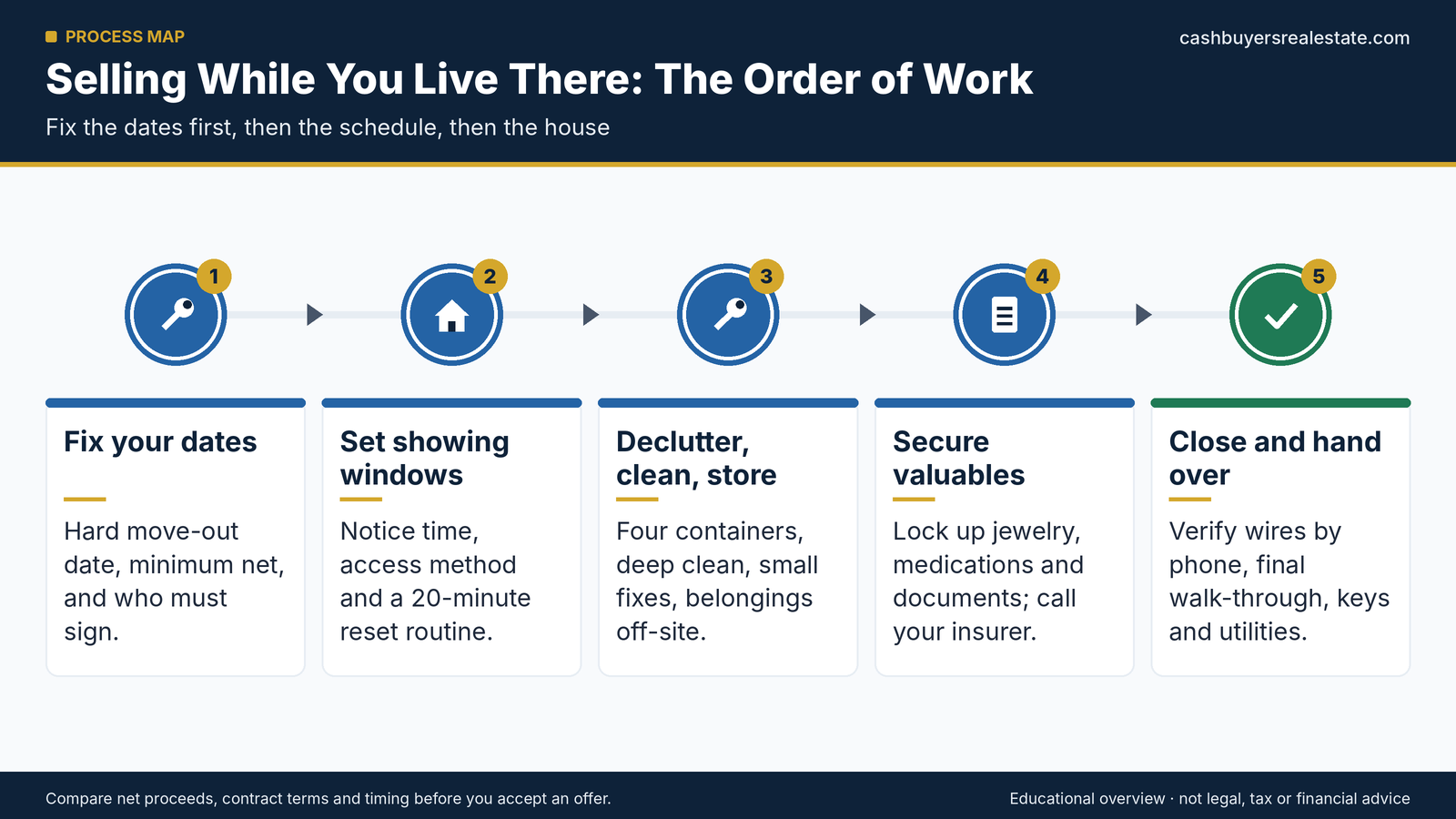
Text version of this infographic
- Fix your dates — Hard move-out date, minimum net, and who must sign.
- Set showing windows — Notice time, access method and a 20-minute reset routine.
- Declutter, clean, store — Four containers, deep clean, small fixes, belongings off-site.
- Secure valuables — Lock up jewelry, medications and documents; call your insurer.
- Close and hand over — Verify wires by phone, final walk-through, keys and utilities.
Safety, Privacy and Insurance While Strangers Walk Through
Protecting people and belongings
Valuables, medications, documents and photos
Most showings are uneventful. The point of safeguards is to make sure that the rare problem doesn’t become a loss you can’t undo. NAR’s consumer guide recommends locking up jewelry, important and sensitive documents, firearms, and prescription medications, and suggests that a small lockbox or safe can help you feel at ease when people come and go. The pre-showing checklist adds small valuables, priceless collectibles, and electronics to the list of things to put away. A safe that stays put, such as one bolted to the floor or installed in a wall, is a better choice than a portable box, according to one insurer’s open house guidance (Travelers, January 2023).
Go further than the obvious. Remove mail, bills, bank statements, and anything with account numbers or your Social Security number. Secure checkbooks, passports, spare keys, and garage door openers. Hide or take with you any list of passwords. Put prescriptions and other medications in a locked container or take them with you. Move small, high-value items, such as watches, cash, and collectible coins, out of the house entirely, to a safe-deposit box, a trusted relative, or a locked room at a storage facility, if you can.
Before the first showing, make a list of valuables and take dated photos of each room, so you can compare later if something seems to be missing. Travelers suggests the same step, along with checking after the event that every door and window is locked, including ones you didn’t use, since thieves sometimes leave a back door or window unlocked to return later. Treat that as a habit after each showing day: walk the house, check the locks, and confirm nothing has moved.
Who enters: agents, lockboxes, open houses and visitors
Your agent is your first line of control. Ask how appointments are confirmed, whether the showing agent’s identity and license are checked, and how you’ll be told about each visit. Electronic lockboxes make that easier because they record who opened the box and when. A combination lockbox is cheaper but harder to audit.
Open houses add a different risk because anyone can walk in. The Travelers guidance recommends not hosting alone, having a second person help watch visitors, asking visitors to sign in, checking that the house and yard are empty beforehand, checking rooms periodically during the event and again before locking up, and having the agent lead visitors from behind with directions instead of having them follow. If you’re not comfortable with an open house, you can decline one; a series of private showings can accomplish the same goal at a lower exposure.
Treat any unusual request as a reason to slow down. A visitor who asks for a room to be left alone, a buyer who appears without an agent, or a service person who arrives unannounced all warrant a call to your agent before you let them in. Trust your instincts. Missing a showing costs far less than an unpleasant encounter.
Insurance and privacy while the home is listed
What your homeowners policy may cover, and what to ask
It’s worth a phone call to your insurance agent before the listing goes live, because standard policies have limits that surprise people. The Insurance Information Institute (Triple-I) notes that a standard homeowners policy covers jewelry, watches, and furs against perils such as fire, windstorm, theft, and vandalism, but with a relatively low theft limit, generally $1,500, and that raising the limit or scheduling individual pieces on a “floater” policy costs more and requires an appraisal (Triple-I, checked October 2026). Your policy may differ, so check your own limits.
Questions worth asking in a short call, and following up in writing: Does listing the house for sale or hosting showings change my coverage or my premium? What are the theft sublimits for jewelry, firearms, cash, and collectibles on my policy? Are belongings in a storage unit or a relative’s garage covered at the same level, or at a reduced limit? What does my liability coverage say if a visitor is injured at the house? And when does my policy end, relative to the closing date? Don’t cancel the policy until your closing agent confirms the sale has closed and funds have moved.
If you own expensive items, the cheapest protection is to take them off-site during the sale. A $4,000 watch in a bank safe-deposit box costs almost nothing to protect; the same watch on a dresser during eight showings is a risk you’d be paying to insure. Treat insurance as the backup plan and removal as the primary one.
Cameras, smart devices and photographs
NAR’s guide warns that “everyone who enters your home during the sales process likely has a camera,” meaning that buyers may wander and take photos or video, and suggests asking your agent to add a “No Photography” note to the MLS listing and displaying polite signs in the home. That’s a practical start, and it’s an expectation, not a guarantee.
Smart devices raise further questions. Doorbell cameras, indoor cameras, baby monitors, and smart speakers can capture images or audio of visitors. Laws about recording, especially audio, vary by state, and so do norms about notifying visitors. A cautious approach is to turn off or cover indoor cameras and microphones during showings, to leave outdoor cameras only with clear notice if they’re on, and to ask your agent or a local attorney what applies where you live. Remember that your wi-fi and smart-home accounts are part of the privacy picture: change shared passwords after the sale, and don’t leave a login visible on a screen or a sticky note.
Finally, photos you take for your own record can be useful, too. A set of dated photos of every room before showings begin protects you against disputes about condition and missing items, and the same set can help if a buyer later claims something was different at closing.
Preparing an Occupied Home on a Deadline: Declutter, Clean, Stage-Lite and Store
A prep plan sized to a week
The 72-hour declutter and deep-clean sequence
You don’t need a renovation to show well; you need the house to look larger, brighter, and cared for. With a deadline, the order of work matters more than the amount. Start where buyers form their first impression and where the effort pays back fastest: the entry, the living room, the kitchen, and the primary bedroom. Then move outward.
Day one is for sorting. Work room by room with four containers: keep here, store, donate, and discard. Clear the kitchen and bath counters, since NAR’s pre-showing checklist includes clearing those surfaces and storing everything except large appliances. Empty closets halfway, because buyers open them and a packed closet reads as lack of space. Remove personal photos, refrigerator clutter, and visible mail. Put the “store” containers in a single location, ideally out of the house, because boxes stacked in a garage or spare room tell buyers you ran out of space.
Day two is for cleaning. Hire professionals if the budget allows; a crew can finish a whole-house clean in a day, and the time you save is worth more than the fee for many households. If you’re doing it yourself, go top to bottom: ceiling fans, light fixtures, windows and sills, baseboards, then floors. Focus on kitchens and bathrooms, which buyers judge by cleanliness. Wipe handles, knobs, and doors, organize the refrigerator, and replace used towels with clean ones. Deal with odors by finding sources (a trash can, a pet area, a damp towel) rather than masking them with strong scents.
Day three is for finishing touches. Replace burned-out bulbs, tighten loose handles, touch up scuffed paint, and fix anything that obviously doesn’t work. Open window treatments, turn on every light before showings, and clear walkways of debris, snow, or ice (all items on NAR’s checklist). Outside, trim, sweep, and tidy the front entry, since buyers decide about a house before they reach the door. Then stop. Chasing perfection past day three, especially on a deadline, delivers diminishing returns. The guide to preparing for a fast home sale covers the document side of preparation, which runs alongside this physical work.
Staging-lite: what small changes do and what they cost
Staging-lite means the handful of low-cost moves that make a lived-in home feel intentional. It borrows from full staging without bringing in rented furniture. Rearrange furniture to open sightlines and create clear paths. Pull oversized pieces into storage to make rooms feel bigger. Put a single plant, a neutral throw, or a fresh bowl of fruit in the main rooms. Swap dark or dated lampshades and bulbs for warm, bright light. Make the beds with plain bedding. Remove the clutter from windowsills and the top of the refrigerator.
NAR’s 2025 research provides context for how seriously to take it. In the Profile of Home Staging, 49 percent of sellers’ agents said staging reduced time on the market; the median cost of a professional staging service was $1,500; and the living room (91 percent), primary bedroom (83 percent), and dining room (69 percent) were the rooms most often staged (NAR, May 2025). Treat those figures as survey observations by agents, not a guarantee that staging will speed your sale. But they suggest where to put limited effort: the living room first, then the primary bedroom and dining area.
Where should you stop? A good rule is to spend on anything that makes the main rooms cleaner, lighter, and emptier, and to skip anything that requires buying new furniture or making permanent changes. Ask your listing agent for a walk-through critique before photos; most agents will tell you which three or four changes matter most, and photos are where first impressions are made online.
Storage and temporary housing
Where belongings go: storage options and hypothetical costs
Decluttering creates a new problem: where does it all go? The main options are an off-site storage unit, a portable storage container delivered to your driveway, space with friends or relatives, or moving some belongings to your next home early. Each has trade-offs. Units are accessible but cost money every month. Portable containers are convenient but may be regulated by your city or association if they sit on the street or in a driveway for long. A relative’s garage is cheap, but it adds a handoff and a risk of damage. Moving items early to the new home works well if you have the keys, but it can be disruptive if the move is far.
Whatever you choose, label boxes by room, keep an inventory, and photograph what goes in. Ask your insurance agent whether stored belongings are covered at the same level as at home, since limits can differ for belongings kept off the premises. Don’t store things in the places buyers will look, such as the garage, basement, attic, or closets, in stacks that block access.
The table below gives hypothetical planning ranges, not quotes. Prices vary widely by market, season, and provider, so use it to build a rough budget and then call local providers.
| Item | Low | High | Notes |
|---|---|---|---|
| Professional whole-house deep clean | $250 | $600 | Scales with square footage and condition |
| Haul-away or donation pickup | $150 | $450 | Free pickup may be available through charities |
| Storage unit, two months | $240 | $500 | Assumes $120 to $250 a month for a modest unit |
| Minor repairs and paint touch-ups | $300 | $1,200 | Bulbs, caulk, handles, scuffs, small patches |
| Staging-lite (consultation, accents, rearranging) | $300 | $1,500 | Full staging services can cost more |
| Moving belongings to storage (truck rental, helpers) | $100 | $400 | DIY costs less; movers cost more |
| Subtotal before temporary housing | $1,340 | $4,650 | Sum of the six rows above |
| Temporary housing, about 10 nights (optional) | $1,000 | $2,200 | Extended-stay or short-term rental |
| Total with temporary housing | $2,340 | $6,850 | Plan on the middle of this range |
The reading: a basic prep-and-store budget for an occupied home plausibly lands in the low thousands of dollars, not the tens of thousands, and much of it is optional. The point of the table is to make the cost of showing-ready explicit, so you can compare it with the discount a no-showings sale might carry.
Temporary housing and short-notice options
Some households decide to move out before listing, or to stay elsewhere during the busiest showing days. A vacant, staged-lite house is easier to show than one with a family in it, and it avoids the daily scramble. The cost is a second place to stay and, in some cases, different insurance considerations for an unoccupied home, which you should confirm with your insurer before you move out.
The common options are a family member’s or friend’s spare room (cheapest, with social costs), a short-term rental or extended-stay hotel (flexible, priced by the night or week), a month-to-month apartment (cheaper per night, but more commitment), or a rent-back in the home itself after closing (covered later in this guide). If you have pets, check pet policies and fees before you book. If you’re relocating for work, ask your employer whether temporary housing assistance is available; some employers offer it, though terms vary and you shouldn’t assume it.
For short notice, keep a go-bag ready for each household member and pet: medications, chargers, clothes for two days, documents, and anything you’d regret leaving. Keep it by the door. If a showing request comes in at the last minute, you can say yes without a scramble. The more you can compress the routine, the less your daily life suffers.
There are, in effect, five ways households handle the overlap between selling and moving: list and live through showings; list and negotiate a rent-back after closing; sell to a cash buyer who needs few visits; push the closing date to match your move; or move out early into temporary housing and show the house vacant. Listing with showings suits those who want the best chance of full market value and can keep the house show-ready. A rent-back suits those whose next home isn’t ready at closing, at the cost of added risk. A cash sale suits those who value privacy and a firm date and will accept a lower price. A delayed closing suits those with a flexible buyer and no cost of waiting, and early move-out suits households who can afford two places for a short time.
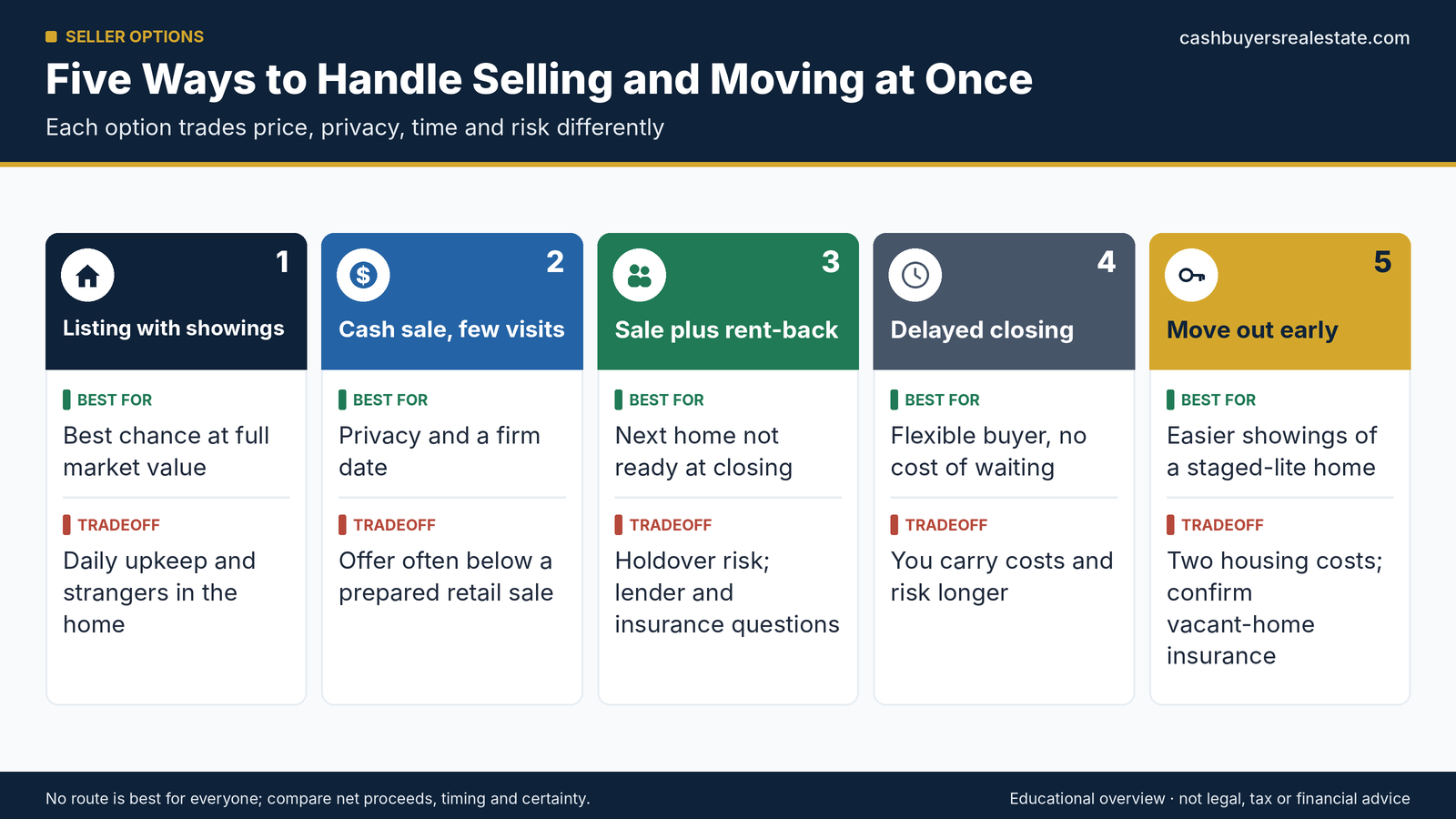
Text version of this infographic
- Listing with showings — best for: Best chance at full market value; tradeoff: Daily upkeep and strangers in the home
- Cash sale, few visits — best for: Privacy and a firm date; tradeoff: Offer often below a prepared retail sale
- Sale plus rent-back — best for: Next home not ready at closing; tradeoff: Holdover risk; lender and insurance questions
- Delayed closing — best for: Flexible buyer, no cost of waiting; tradeoff: You carry costs and risk longer
- Move out early — best for: Easier showings of a staged-lite home; tradeoff: Two housing costs; confirm vacant-home insurance
Selling to a Cash Buyer Instead: Fewer Visits, Different Trade-Offs
What changes for an occupant in a cash sale
Visits instead of showings: what the process looks like
A cash sale replaces a stream of strangers with a short sequence of visits. Typically, you contact one or more buyers or request offers, a buyer views the property in person (sometimes after reviewing photos or a video call), you receive a written offer with a proposed closing date, and if you accept, the buyer completes inspections and the title company clears title. The number of times someone walks through your home is often a handful, not dozens, and most of them are scheduled, not drop-ins.
That’s the privacy advantage. Another is certainty about timing: because a cash buyer doesn’t depend on a lender’s appraisal and underwriting, one of the most common causes of delay in a financed sale is removed. But cash is not a magic word. The buyer still conducts due diligence, title work still has to be cleared (including your mortgage payoff, which a servicer must send within seven business days of a written request under federal servicing rules), and the closing date is whatever the contract says.
You still have disclosure obligations. Rules vary by state, and some, such as Texas’s Seller’s Disclosure Notice requirement under Property Code section 5.008, require a written form delivered on or before the contract’s effective date. Federal law also requires lead-based paint disclosures for most pre-1978 housing (EPA). Selling to a cash buyer doesn’t turn disclosure into a formality, and concealing a known defect is never a safe shortcut.
The guide to selling a house for cash explains how those offers are typically built, and the cash home sale process page walks through the steps after acceptance.
Move-out timing and what to negotiate
For an occupant, the details of the contract matter more than the headline price. Four items are worth negotiating before you sign. The first is the closing date. Pick one that fits the buyer’s title timeline and your move; if you need more time, ask for it up front. The second is the possession date: is it at closing, earlier, or later under a written occupancy agreement? The third is what stays and what goes. In an as-is sale, some buyers will accept leftover furniture or belongings and handle the cleanout; others require the house to be empty and broom-clean. Get this in writing, including who disposes of what and whether any cost is deducted from your proceeds. The fourth is access for the buyer before closing: a final walk-through, contractors, or an inspector.
Be careful about promises that aren’t in the contract. A verbal “take your time moving out” is worth little if the contract says possession at closing. If you need a few extra days, put them in a short written agreement with a date, a daily charge if any, and a statement of who’s responsible for utilities and damage. The next section covers how those agreements work.
One more question to settle: who pays for the cleanout of items left behind? Make that explicit. A contract that says nothing leaves room for a surprise charge at closing.
Comparing net proceeds and verifying the buyer
Net comparison for an occupant: showings versus no showings
Money is the central trade-off. Run the numbers on both paths, including the costs that only occupants pay: preparation, storage, temporary housing, and the longer holding period of a listing.
Illustrative example (hypothetical numbers, not market data): Assume a house that would sell for $320,000 with a $150,000 mortgage payoff. In the listing route, the sale price is $320,000, the total commission is 5 percent ($16,000), seller closing costs are 1.5 percent ($4,800), preparation and storage cost about $3,200 (a figure within the range in Table 3), and carrying costs for roughly 60 days are $2,200. In the cash route, the offer is assumed to be 88 percent of value ($281,600), closing costs are 1 percent ($2,816), preparation and moving costs are $400, and carrying costs for about three weeks are $800. The commission rate, closing percentages, and the cash discount are assumptions for arithmetic, not typical or recommended figures.
| Line item | Listing with showings | Cash sale |
|---|---|---|
| Sale price | $320,000 | $281,600 |
| Commissions | $16,000 | $0 |
| Seller closing costs | $4,800 | $2,816 |
| Preparation, storage, moving | $3,200 | $400 |
| Carrying costs during the sale | $2,200 | $800 |
| Net before mortgage payoff | $293,800 | $277,584 |
| Mortgage payoff | $150,000 | $150,000 |
| Cash to seller | $143,800 | $127,584 |
| Showings and strangers in the home | Many, over weeks | One to a few visits |
| Illustrative time to closing | About 60 to 75 days | About 14 to 21 days |
In this set of assumptions, the listing nets about $16,216 more, and the cash sale closes roughly six weeks sooner with far fewer visits. Whether $16,216 is worth six weeks of showings is a personal call. If the household would carry a second mortgage payment or pay rent during those weeks, as in the earlier example, the daily price of waiting changes the math; if you have no overlap and a flexible date, the listing’s extra net looks more attractive. Run your own version before deciding, and use the net proceeds calculator or the cash buyer versus realtor comparison to test other assumptions.
Verification steps and wire safety for occupant sellers
Occupants have a unique exposure: you’re often moving out on the strength of a contract, so confirming that the buyer is real before you commit to dates matters. A short list of checks: ask for proof of funds and verify it with the institution using a number you found independently, confirm that earnest money goes to a title company, escrow agent, or attorney and not to an individual, read the whole contract for dates, contingencies, and any right to assign it, confirm the closing agent is licensed and reachable, and be cautious about pressure to sign immediately or sudden changes to price or terms. The proof of funds explainer and the cash home buyer scams guide detail the red flags.
Time your own commitments to the contract’s milestones. Don’t pay a nonrefundable deposit on a new lease or schedule movers for a date that depends on a buyer’s inspection period until that period has passed. And hold off on canceling utilities and insurance until your closing agent confirms the sale is complete.
On closing day, wire fraud is the main risk. The CFPB advises identifying two trusted people in advance to confirm the closing process and payment instructions, recording their phone numbers, treating emailed instructions as suspect, being wary of last-minute changes to wiring instructions, and never emailing financial information (CFPB blog, June 2019, archived). If you provide wiring instructions to receive your proceeds, deliver them by phone or in person, not by email, and confirm receipt with a number you already trust.
Rent-Back Agreements: Staying After Closing Without Losing Control
How a post-closing occupancy agreement works
Basic terms: length, rent, deposit, condition and insurance
A rent-back, formally a post-closing occupancy agreement, lets the seller stay in the home for a defined period after the sale closes. It’s a common way to bridge the gap when a new home isn’t ready on the closing date. The terms are negotiated, and in some states they are set on a standardized form, so the details you see here are examples, not a universal template.
The Colorado Real Estate Commission’s mandatory-use form for brokers, the Post-Closing Occupancy Agreement (Seller Rent-Back), adopted August 5, 2025 and mandatory from January 1, 2026, shows the range of issues a good agreement covers (Colorado Division of Real Estate, checked October 2026). It makes the agreement conditional on closing, lets the seller retain possession from closing through a stated date, allows the seller to end the occupancy early on five days’ written notice, and caps the term at 60 days after closing if the buyer will occupy the home as a principal residence, noting that a residential lease is required for longer terms. Rent is payable to the buyer in advance at closing, and the security deposit may not exceed two monthly rent payments and is disbursed within 30 days after the term ends.
Other practices differ. One title company’s guidance describes a typical arrangement as a stay of up to 60 days after closing, with a per-day rent that covers the buyer’s carrying costs (principal, interest, taxes, insurance, and association dues if any) and a security deposit held by the title company and returned if the property isn’t damaged (Federal Title, checked October 2026). The same source notes the arrangement isn’t the same as a landlord-tenant relationship, although local law may treat it differently, which is a question for an attorney.
| Term | What to settle | Example from the sources | Question to ask |
|---|---|---|---|
| Length | Start, end, and early-exit rights | Colorado form: up to 60 days if the buyer will live there; early end on 5 days’ written notice | What’s the latest date I must be out? |
| Rent | Amount, when due, refund if you leave early | Colorado form: rent paid to buyer in advance at closing; per-day rent covering buyer’s costs in the title-company example | How is the daily rent figured? |
| Deposit | Amount, who holds it, when returned | Colorado form: up to two months’ rent, returned within 30 days; title-company example: held by the title company | Who holds it, and what can be deducted? |
| Insurance | Seller’s renter’s policy; buyer’s owner policy | Colorado form: buyer maintains owner’s property insurance from closing; seller’s renter’s policy by checkbox | What covers my belongings and liability? |
| Condition and repairs | Who handles what; condition at move-out | Colorado form: seller keeps the property in closing-day condition, normal wear excepted | How will condition be documented? |
| Utilities | Who pays which, in whose name | Colorado form: checkboxes for water, sewer, electric, gas; seller pays other services | When do accounts switch? |
| Failure to vacate | Consequences of staying past the end date | Colorado form: seller subject to eviction and possible damages | What happens if my move slips a week? |
| Lender | Whether the buyer’s lender must approve | Title-company example: lender must be notified and grant permission | Has the lender agreed in writing? |
Read across the “failure to vacate” row twice. In the Colorado form, a seller who doesn’t leave on time “will be subject to eviction,” and that’s a harsher outcome than the casual “we’ll sort it out” many sellers assume. A rent-back is a contract with a hard edge, not a favor.
Lender, title and tax considerations
If the buyer is financing the purchase, the lender’s rules matter. Lenders generally expect the buyer to take occupancy of an owner-occupied purchase within a reasonable time after closing, so the length of a rent-back is often limited by what the buyer’s lender allows. The title-company guidance above says the lender must be notified and grant permission; the Colorado form, by contrast, contains no lender section at all, which means the form doesn’t answer the question for you. Ask the buyer’s agent or lender, in writing, whether the planned stay is acceptable before you count on it.
Title and closing agents can help. They can hold the deposit, include the occupancy terms in the closing package, and record the closing-day condition. Ask the closing agent whether a standardized form exists in your state; some states publish or require specific forms, and others leave the drafting to the parties and their attorneys. A short agreement drafted by an attorney is inexpensive relative to a dispute.
On taxes, the rent-back doesn’t change the fact that you sold the home on the closing date. The federal home-sale gain exclusion for a main home depends on ownership and use tests measured over the five years before the sale, and if the closing agent files Form 1099-S, the IRS says you must report the sale even if all the gain is excluded (IRS Topic No. 701). Whether the extra weeks affect anything specific to your situation is a question for a tax professional, and the safest assumption is to keep records of the closing date, the rent paid, and your improvements.
Risks and alternatives to a rent-back
Holdover, damage, insurance gaps and weaker offers
Rent-backs solve one problem and create several. Five risks come up repeatedly:
- Holdover. If your next home is delayed, you may be unable to leave on time. The buyer may have a lease ending, a job move, or a lender deadline of their own, and an overstay can lead to daily charges, loss of the deposit, or eviction, depending on the agreement and state law.
- Damage and wear. The agreement usually requires you to return the home in closing-day condition. Move-out damage to floors, walls, or appliances is the most common deposit dispute, and a set of dated photos or a video from the closing walk-through is the best evidence.
- Insurance gaps. Your homeowners policy typically ends when you no longer own the property, so ask your insurer what, if anything, covers your belongings and liability afterward. The Colorado form addresses this with a seller’s renter’s policy option and a requirement that the buyer carry an owner’s property policy from closing.
- Weaker offers. A buyer who wants to move in promptly may prefer an offer without a rent-back, and a lender may object. In a competitive market, requesting one can cost you leverage or price, so treat it as a cost to weigh, not a free option.
- Unclear status. Whether you are a tenant, a licensee, or an occupant under a special agreement can affect your rights and the buyer’s remedies. A written agreement that says clearly what you are is better than silence.
Mitigate the risks with specifics: a short term with a firm end date, a deposit held by a neutral party, a documented walk-through at closing, clear insurance arrangements, and a plan B if the move slips. Treat the end date like a closing date, not a suggestion.
Alternatives: delayed closing, early possession swaps, temporary housing and storage-and-stay
If a rent-back doesn’t fit, there are four other ways to bridge the gap. A delayed closing keeps you as the owner until your new home is ready. You continue to pay carrying costs and bear the risk of the property, and the buyer must be willing to wait, which can reduce your leverage on price. An early possession swap reverses the idea: the buyer takes possession before closing, which is rarely advisable for a seller because it moves risk to you without closing the sale, and many contracts and lenders discourage it. Temporary housing covers the gap with a rental, a hotel, or family space, at a cost you can plan. And storage-and-stay means moving belongings into storage and staying with family or in a short-term rental for the last few days, which keeps the closing date firm and your household flexible.
Which one wins depends on the price of waiting, the buyer’s flexibility, and your tolerance for risk. If your daily carrying cost for two homes is around $117, as in the earlier example, then even a week of rent-back or temporary housing is cheap compared with paying for both houses. If your overlap is zero, a clean closing and a short stay with family may be the simplest. The relocation guide and the piece on urgent sale options compare these bridging choices in more depth.
The Final Two Weeks: Move-Out, Closing and Possession
Closing-week sequence
Final walk-through, keys, openers and personal property
The last stretch is mostly logistics, and small oversights cause large annoyances. Work from a checklist so nothing slips.
- Seven days out: Confirm the closing date, time, and location with your closing agent, and confirm that you have the contract’s possession terms in writing. Book movers or a truck only after inspection and financing deadlines have passed.
- Five days out: Finish packing everything not included in the sale. Take photos of each room as it stands now.
- Three days out: Schedule a deep clean of the vacated areas, handle any agreed repairs, and gather manuals, warranties, and a list of codes, such as garage and alarm codes.
- Two days out: Make sure all agreed fixtures, appliances, and remotes are in place. Collect every key, garage opener, and mailbox key.
- Day before: Confirm the final wire details by phone, not email. Do a last pass through the house and take a final set of photos.
- Closing day: Attend the walk-through if the buyer has one, sign when your closing agent confirms the funds are in order, and hand over keys at the time the contract provides.
On personal property, be exact about what stays. Items that are attached to the house, such as light fixtures, built-in appliances, window treatments, and mounted fixtures, are generally treated as part of the sale unless the contract excludes them, while freestanding furniture and items you didn’t agree to leave are generally yours to remove. The details depend on state law and your contract, so list any exceptions in writing. And leave the house broom-clean and free of trash, unless the contract says otherwise; a messy handover is a common source of last-minute disputes and delays.
Utilities, mail, insurance and records
Utilities should be transferred on the possession date, not before. Call each provider a week ahead to schedule a final meter reading for the date you hand over the keys, and keep the power and water on until then, since the buyer’s final walk-through and any last inspection may need them. Provide the buyer with the account details they need to start service, as a courtesy.
For mail, file a change of address with the postal service and update your address with banks, employers, insurers, schools, and subscriptions. Keep your homeowners insurance in force until your closing agent confirms that the sale has closed and the deed has been recorded, then cancel it and ask about a refund of any unused premium.
Keep your records. The settlement statement documents your sale price, costs, and proceeds (the guide to seller closing costs explains the usual line items). Receipts for improvements can help establish your tax basis, which matters if your gain exceeds the exclusion. Under IRS guidance, a seller who qualifies may exclude up to $250,000 of gain from the sale of a main home ($500,000 on a joint return), based on ownership and use tests over the five years before the sale, and if you receive Form 1099-S you must report the sale even when the gain is fully excluded (IRS Topic No. 701). A tax professional can apply that to your facts.
When the timeline slips
If the buyer’s side slips: extensions and your housing plan
Delays on the buyer’s side are common in financed sales: an appraisal takes longer, a lender asks for another document, or a Closing Disclosure needs to be reissued, which restarts the three-business-day wait in certain circumstances (12 CFR 1026.19(f)). If you’re living in the house, a slip of a few days creates a practical problem: you’ve already packed, scheduled movers, or ended a lease.
The best protection is flexibility built in earlier. Book movers with a free-change window, and keep a storage option you can extend. If the closing moves, ask for the new date in writing as a signed amendment, and ask whether the buyer will compensate you for added costs; sometimes a buyer will agree to a small credit for a delay they caused, though it isn’t automatic. Keep the buyer’s earnest-money terms in mind: repeated unexplained delays can be a sign to ask your agent about your options under the contract.
Meanwhile, keep the house show-ready until the contract’s contingencies are cleared, since a deal that falls through sends you back to showings. A packed-and-boxed house is harder to show than a lived-in one, so pack in stages, from the least-used items first.
If your side slips: when the move isn’t ready
Sometimes the delay is yours. The new house isn’t ready, the truck is canceled, or a family emergency intervenes. The sooner you tell your agent and the buyer, the more options you have. Possible fixes include a short written rent-back, a later closing date by amendment, storing belongings and staying in temporary housing, or asking friends and family to help move on short notice. Each has a cost, and each is cheaper than missing possession without warning.
Understand the consequence of missing possession before it happens. Your sale contract sets the remedies, which can include per-day charges, loss of earnest money, or claims for the buyer’s added costs, and the details differ by state and by contract. A rent-back or occupancy agreement can carry its own consequences, such as the eviction clause in the Colorado form. If you suspect you may be late, ask your attorney or agent what your contract says and what could be negotiated, before the date arrives.
The theme running through the final two weeks is the same as in the first: dates in writing, flexibility on your side where it’s cheap, and no surprises at the closing table. If you’ve planned the logistics, the closing itself should be a short, boring appointment.
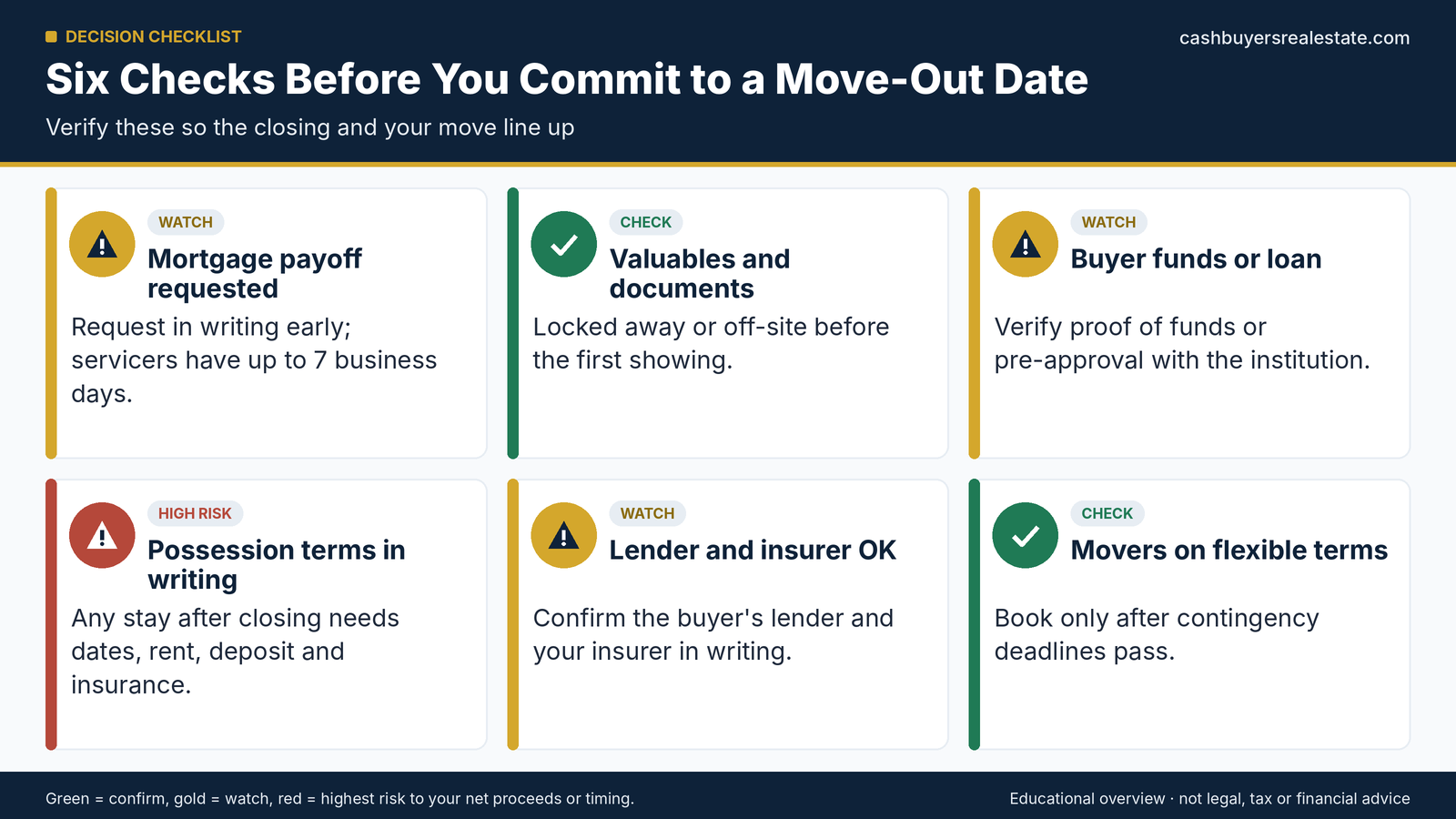
Text version of this infographic
- Mortgage payoff requested — Request in writing early; servicers have up to 7 business days.
- Valuables and documents — Locked away or off-site before the first showing.
- Buyer funds or loan — Verify proof of funds or pre-approval with the institution.
- Possession terms in writing — Any stay after closing needs dates, rent, deposit and insurance.
- Lender and insurer OK — Confirm the buyer's lender and your insurer in writing.
- Movers on flexible terms — Book only after contingency deadlines pass.
Frequently Asked Questions About Selling a Home While You Live in It
Questions about showings, preparation and daily life
Questions about showings and access
- How many showings should I expect?
There’s no reliable number, because it depends on your price, condition, neighborhood, and season. Showings usually bunch up in the first week or two after a listing goes live, and then thin out. NAR’s median time on market of 31 days for August 2026 shows that half of the homes that sold took a month or less, but that’s a market-wide figure. Ask your agent for a realistic range for your price band, and plan your busiest days for the first ten.
- Do I have to leave the house during showings?
Usually it’s your choice, not a legal requirement. Most agents recommend leaving, because buyers speak more freely and look more closely when the seller isn’t there, and because it protects your privacy and safety. If you can’t leave every time, ask your agent whether to limit those showings to scheduled slots, and stay out of the way, quiet, and out of conversations about price or condition.
- Can I limit showings to certain days or hours?
Yes, and the access terms go in your listing instructions. The trade-off is simple: narrower windows protect your routine and tend to produce fewer showings, which can slow an offer. A common compromise is to open wide windows for the first week or ten days and narrow them later, if the market allows. Your agent can also set a notice requirement, such as two hours or 24 hours, depending on how flexible you are.
- Should I agree to an open house?
It’s optional. An open house can bring many buyers at once, which can concentrate activity into a single day you can plan around. It also lets anyone walk in, so safety measures matter: a second person helping, a sign-in sheet, valuables locked away, and a check of doors and windows afterward. If you’re uncomfortable, private showings by appointment can achieve the same exposure at lower risk.
Questions about preparation and costs
- How much should I spend getting the house ready?
Start with the cheapest, highest-impact work: decluttering, cleaning, lighting, and small fixes. The hypothetical planning ranges in Table 3 suggest a basic prep-and-store budget in the low thousands of dollars, and much of it is optional. For context, NAR’s 2025 staging research found a median cost of $1,500 for a staging service, and agents most often staged the living room, primary bedroom, and dining room. Get local quotes before you commit.
- Do I need to stage if I’m still living in the house?
Not formally. In NAR’s 2025 survey, 51 percent of sellers’ agents did not stage before listing but recommended that sellers declutter or fix property issues. That suggests the baseline for an occupied home is a clean, uncluttered, well-lit space. Staging-lite changes, such as rearranging furniture and removing personal items, can help without the cost of renting furniture.
- What should I do with my belongings during the sale?
Reduce them. Donate or discard what you won’t move, store what you won’t need for a few weeks, and keep only daily essentials in the house. A storage unit, a portable container, or space with a friend or relative are common choices. Label and photograph what you store, and ask your insurance agent whether belongings kept off the premises are covered at the same level as at home.
- Do I still have to disclose problems if I’m cleaning up for showings?
Yes. Cleaning and cosmetic prep don’t replace disclosure. Rules vary by state: Texas, for example, requires most residential sellers to deliver a written Seller’s Disclosure Notice on or before the contract’s effective date, and federal law requires lead-based paint disclosures for most pre-1978 homes. Never conceal a known defect to make a showing go better; ask your agent or attorney what your state requires.
Questions about moving dates, rent-backs and cash sales
Questions about rent-backs and move-out dates
- How long can I stay in the home after closing?
That’s negotiated. As one example, Colorado’s mandatory-use rent-back form, adopted in 2025, limits the term to 60 days after closing when the buyer will occupy the home as a principal residence and requires a residential lease for longer stays. Other states and contracts differ, and a financed buyer’s lender may limit the length. Get the end date, the rent, and the consequences of overstaying in writing.
- Does a rent-back need the buyer’s lender to approve?
Often the lender needs to be told, and sometimes it must agree. One title company’s guidance says the lender must be notified and grant permission for the seller to remain. Since the Colorado form itself has no lender section, don’t assume your form covers it. Ask the buyer’s agent or lender for written confirmation before you plan around a stay.
- What happens if I’m not out on the possession date?
The contract or the occupancy agreement decides. The Colorado form says a seller who fails to surrender possession on time is subject to eviction and may be liable for damages. A sale contract can carry its own remedies, such as per-day charges or claims for the buyer’s added costs. If you suspect you’ll be late, contact your agent or attorney early, because options shrink as the date arrives.
- Can I move out before closing?
Yes, but check three things first: your insurer’s rules for unoccupied homes, your contract’s requirements to maintain the property, and your plan for keeping utilities on and the lawn or walkways cared for. A vacant house shows well, but it needs attention. Keep the house secure, keep it heated or cooled as needed, and visit regularly until closing.
Questions about cash sales, insurance and safety
- Will a cash buyer need to see the whole house?
Typically, yes. Most buyers want to walk through the property, or at least review detailed photos or a video tour, and many will schedule an inspection during due diligence. The difference from a listing is the count: usually a few scheduled visits rather than dozens of showings. Ask what the buyer needs to see and when, so you can plan around it.
- Is a cash sale better for my privacy?
It usually means fewer strangers in the house, which many occupants value. It doesn’t remove the need for care. You still disclose known problems, verify the buyer’s funds, and make sure the money goes to a title company or attorney. The cash home buyer scams guide lists verification steps, and the sell house for cash guide explains how those offers work.
- What happens to my homeowners insurance when I sell?
The policy covers you as the owner, so coverage generally ends when ownership transfers, subject to its terms. Keep it active until your closing agent confirms the sale has closed, then ask your insurer about canceling and a refund. If you’re staying under a rent-back, ask what covers your belongings and liability afterward. A renter’s policy is one option the Colorado form contemplates.
- How do I avoid wire fraud when I’m busy moving?
Decide in advance whom you’ll call to verify payment instructions, write down their numbers, and treat any emailed change to wiring details as suspect until confirmed by phone with a number you already trust. The CFPB also advises never emailing financial information and contacting your bank immediately if you suspect you sent money to the wrong account. Moving-day stress is when mistakes happen, so do the verification calls a few days early.
Matching Your Situation to a Route and Planning Your Next Seven Days
A decision framework for occupied homes
Decision matrix: household situation, route that often fits, what you give up
Choose the route by looking at your household’s constraints, not only the price. The matrix sorts common situations; treat it as a starting point and let real offers and your own numbers adjust it.
| Your situation | Approach that often fits | What you give up | Check first |
|---|---|---|---|
| You can keep the house show-ready and want the best net | Agent-led listing with fixed access windows | Privacy, daily effort, some certainty | Realistic price, prep budget, offer-deadline plan |
| Work, children, or care duties make showings hard | Cash sale with a few scheduled visits | Likely a lower price than a prepared retail sale | Written terms, proof of funds, net comparison |
| Your next home isn’t ready at closing | Listing or cash sale plus a short written rent-back, or a later closing date | Some leverage on price; added risk if you overstay | Lender approval, insurance, deposit, end date |
| You have a hard date in two to three weeks | Cash sale with firm dates, or a listing with a cash backstop | Price flexibility | Title and payoff timing; the buyer’s real schedule |
| You worry about valuables or strangers in the home | Cash sale, or a listing with strict access controls | Fewer buyers seeing the home | Lockbox logs, agent verification, items stored off-site |
| A household member has health or mobility needs | Fewer, longer-notice visits; possibly a cash sale or a delayed closing | Speed or price | Written access limits; a flexible possession date |
If two rows describe you, plan for the stricter one. You can always relax the schedule later; you can’t easily tighten it after buyers have been told it’s open.
Three short scenarios (hypothetical)
Illustrative example (hypothetical numbers, not market data): The two-income family with a toddler and a dog. Showings are possible midday and on one weekend. They choose a listing with 3 hours’ notice, a bag-and-go routine, and a storage unit for two months. Because their next home closes a week after theirs, they ask the buyer for a one-week rent-back and confirm in writing that the buyer’s lender agrees.
Illustrative example (hypothetical numbers, not market data): The remote worker on a tight timeline. A new job starts in four weeks, and video calls fill the day. They request two written cash offers and an agent’s pricing opinion, compare net proceeds with the cost of weeks of showings, and choose the route whose dates fit their start date. They keep the house tidy for the one or two visits the buyer needs.
Illustrative example (hypothetical numbers, not market data): The homeowner moving to a care community. A family member helps with the sale. The move date depends on when a room becomes available, so a flexible possession date matters more than the last few thousand dollars of price. They choose a buyer who can close on a later date and put the possession terms in writing, without pressure to decide on the first call.
What to do next
Your occupant checklist, from first week to keys
Use this as a working checklist. Not every item applies to every household, and the order can shift, but each one prevents a common occupant problem.
- Before you list: Decide your hard date and your minimum net. Request payoff statements in writing. Call your insurance agent about showings and valuables. Take dated photos of every room. Move valuables, medications, and documents to a safe or off-site.
- Prep week: Declutter in four containers (keep, store, donate, discard). Deep clean top to bottom. Fix small defects. Set up storage. Arrange a go-bag for each person and pet.
- Showing period: Agree on access windows and notice with your agent. Use an electronic lockbox if possible. Keep the reset routine to 20 minutes. Check doors and windows after each showing day. Keep a list of who has visited, if your agent supplies one.
- After you accept an offer: Put every date in one calendar. Respond to repair requests before the deadline. Confirm the buyer’s lender has approved any rent-back. Book movers only after contingency deadlines pass.
- Closing week: Verify wire details by phone. Do a final walk-through of your own and take photos. Hand over keys, openers, and codes. Keep insurance until the closing agent confirms funding.
Read the list again as a household and assign names to items. Selling while occupied is a team effort, and unassigned tasks tend to get done at the last minute.
Questions to ask your agent, buyer, insurer and closing agent
- How will showings be scheduled and confirmed, and how will I know who has been in my home?
- What are my theft limits for jewelry and valuables, and are belongings in storage covered?
- If I accept a cash offer, what exactly is the buyer’s schedule for visits and inspections?
- Can the closing date and possession date differ, and what would a written occupancy agreement include?
- Has the buyer’s lender agreed to any stay after closing?
- What will I net under each route after commissions, closing costs, prep, storage, and carrying costs?
- Who holds the earnest money and my security deposit, and under what conditions are they returned?
A seller who gets clear, written answers to these seven questions has done most of the hard thinking. The bottom line: you can sell your home fast while living in it, but the route that suits you depends on how much of your daily life you can lend to the process, how much price you’re willing to trade for privacy and speed, and how firmly your dates are fixed. Run the numbers for your household, put the dates in writing, and let the answers choose the route.