
Cash Buyers for Houses with Liens: Offers, Process & Red Flags
Most homeowners discover a lien the same way: a title company or a buyer’s attorney mentions it in the middle of a transaction, or a letter arrives that nobody remembers asking for. Sometimes the lien is ordinary and expected, such as the mortgage that every owner with a loan carries. Sometimes it is a surprise, like a contractor’s claim from a job you thought was settled, a judgment filed after a dispute years ago, or an unpaid balance with the Internal Revenue Service. Searching for cash buyers for houses with liens usually means one of two things: you want to know whether anyone will buy a home that has claims against it, or you already have an offer and need to understand how those claims affect the money you will actually receive.
The short version is that a lien does not prevent a sale, but it does change the order of operations. A lien is a creditor’s recorded claim against the property, and a buyer who pays the full price still expects to receive clear ownership. So the claims are paid or released from the sale proceeds at closing, in a legal order of priority, and the buyer takes the house free of them. A cash buyer can make that process quicker in some cases because no lender’s underwriting sits in the middle of it. But a cash buyer cannot make a debt disappear, cannot talk a lienholder into releasing a claim for less than the lienholder is willing to accept, and cannot close at all if the price is too low to satisfy the claims that rank ahead of the buyer’s purchase.
Short answer: Yes, cash buyers can purchase houses with liens, because the liens are normally paid from your sale proceeds at closing and released. The sale works only if the price covers every lien that must be cleared, or lienholders agree in writing to accept less. Verify the payoff figures, the buyer’s funds and the closing agent before signing.
That short answer hides a good deal of mechanics, and the mechanics decide whether a cash offer is helpful or merely fast. Whether a claim is a mortgage, a property tax lien, a federal tax lien, a judgment, a mechanic’s lien or an association lien determines who must be paid, how much, in what order, and what paperwork proves the payment. The same house can produce very different net proceeds depending on which claims are attached and how stale or disputed they are. A buyer pricing the house will also price the uncertainty: the longer and murkier the road to clear title, the more of the discount tends to be built into the offer.
The guide begins with how liens attach to a house and how priority decides who is paid first. It then looks at what a title search reveals and the kinds of surprises that tend to appear after an offer is accepted, and walks through the payoff statements and demand letters that turn a list of claims into exact numbers for the closing table. Federal tax liens get their own section because they follow rules that differ from ordinary creditor liens, including options called discharge and subordination. After that comes the harder case, where the proceeds do not cover everything owed, and how negotiation with lienholders works. The later sections cover how liens change a cash offer and the realistic alternatives to it, and the red flags and wire-fraud safeguards that matter most when a transaction carries extra claims and extra paperwork.
Several neighboring topics are handled lightly here on purpose. The general question of how a quick sale works when the property is encumbered is covered in the guide on selling a house quickly when liens are attached, and the wider family of ownership defects such as unknown heirs, boundary disputes and forged documents belongs to the hub on selling a house with title problems. Here the focus stays on a narrower question, which is how cash-offer mechanics interact with liens: what a buyer needs to see, what a closing agent must do, and what you should check so the net figure on the settlement statement matches the number you were expecting.
How Liens Attach to a House and Why Priority Decides Who Gets Paid
A lien is easiest to understand as a recorded creditor’s claim that follows the property, not the person. When you sell, the claim does not vanish with the change of ownership; it stays attached to the house until it is paid, released or otherwise extinguished. That is exactly why a buyer, and the title insurer standing behind the buyer, will insist on seeing every claim before closing and on knowing how each will be cleared.
The main families of liens a seller may be carrying
Real estate liens sort naturally into those you agreed to and those that arrive without your signature. The distinction matters in practice because voluntary liens are usually well documented, regularly reported on statements, and paid off routinely in almost every sale, while involuntary liens can be hard to trace, disputed on the merits, or simply forgotten.
Voluntary liens: mortgages, home equity loans and lines of credit
A voluntary lien is one you created by borrowing against the house. The purchase-money mortgage is the obvious one, but many owners also carry a second mortgage, a home equity loan, or a home equity line of credit (HELOC) that was opened for repairs, tuition or consolidating other debt. Each of these is secured by a recorded instrument, usually a mortgage or deed of trust depending on the state, and each is paid off from sale proceeds in nearly every closing. The practical risk is rarely the existence of the lien. It is the figure. A HELOC that you believe you stopped using may still carry a drawn balance, and a servicer’s payoff may include accrued interest, fees, or an escrow shortage that does not appear on the monthly statement in your kitchen drawer.
Another quiet complication is the lien that was paid but never released. A mortgage satisfied years ago may still appear in the county records if the lender or its successor failed to record the release, which is a common cause of title delays when a lender has merged, been sold or gone out of business. This is a paperwork problem rather than a debt, but a buyer cannot tell the difference from the outside, and the title company will not insure over it without evidence. If you remember paying off a loan, hunt for the satisfaction letter or the canceled note before the title search surfaces the issue for you.
Involuntary liens: taxes, judgments, contractors and associations
Involuntary liens come from a creditor’s rights rather than your signature. Unpaid real property taxes create a lien under state and local law. The federal government can create a lien for unpaid federal taxes. A creditor who wins a court judgment against you may be able to record that judgment so it attaches to real estate you own. A contractor or supplier who was not paid for work on the house may be able to record a mechanic’s lien. A homeowners association or condominium association may record a lien for unpaid assessments under the community’s governing documents and state law. Some cities and counties also record liens for code-enforcement fines, demolition or board-up costs, or unpaid utility and public-service charges.
Every one of these arises from different law, runs on a different clock and is released by a different kind of document, which is why a generic statement such as “the liens will be paid at closing” is only the beginning of the analysis. State statutes set deadlines for recording, notice, enforcement and renewal, and those deadlines differ widely. A mechanic’s lien, for instance, depends on the contractor’s timely recording, while a judgment lien may exist only if the creditor filed the right paperwork in the right county. The title search is where these details become visible, and later sections return to them one by one.
The table below puts the common families side by side, so you can see at a glance how each one is created, how it tends to appear in a title report, and what usually clears it.
| Lien type | How it is created | How it shows up in a title report | What usually clears it |
|---|---|---|---|
| Mortgage, home equity loan or HELOC | You sign a loan secured by the house | Recorded mortgage or deed of trust, with assignments if the loan was sold | Payoff at closing, then a recorded satisfaction or release |
| Real property tax or special assessment | State and local law when taxes or assessments go unpaid | Listed as a requirement or exception, often from a tax collector’s records | Payment of the balance, with a tax certificate or receipt |
| Federal tax lien | Unpaid federal tax after assessment and demand; public once a notice is filed | Notice of Federal Tax Lien recorded in the county or state office | Payoff and release, or an IRS discharge certificate |
| Judgment lien | A creditor wins a court judgment and records it where state law requires | Abstract or certified copy of judgment in the county records | Payment, then a recorded satisfaction, or a negotiated release |
| Mechanic’s or materialman’s lien | A contractor or supplier records a claim for unpaid work or materials | Recorded claim of lien, sometimes with a later lawsuit notice | Payment, bond, lien release or expiration under state deadlines |
| Association (HOA or condo) lien | Governing documents and state law when assessments go unpaid | Recorded lien, or a balance on the association’s estoppel or payoff letter | Payment of assessments, fees and costs, with a written release |
| Municipal or code-enforcement lien | A city or county records fines, abatement or utility charges | Recorded notice or municipal lien search result | Payment or compliance, then a written release from the agency |
Read the table from the right-hand column backward. The last column tells you who has to act and what proof exists once they have, and that proof, not the seller’s recollection, is what a title insurer relies on. The third column explains why a search covering only the county recorder can miss things: tax collectors, associations and municipalities keep records that do not always reach the recorder’s index, so a thorough search checks several sources.
Priority: who is paid first from the sale price
When several claims are attached to the same house, the order in which they are paid matters most when the sale price is not large enough to satisfy all of them. In a sale with ample equity, priority is almost academic because everyone is paid in full and the seller keeps the remainder. In a thin-equity or underwater sale, priority decides who is paid, who is partially paid and who is left holding an unsecured claim.
First in time, and the exceptions that cut ahead
As a general principle, many states give priority to liens in the order they were recorded, often summarized as first in time, first in right, subject to recording statutes and notice rules that differ by state. Under that default, an older mortgage ranks ahead of a later judgment, and a judgment recorded this year ranks ahead of a contractor’s claim recorded next year. The default has exceptions that matter. Many states give real property tax liens a priority that jumps ahead of earlier mortgages, and federal law recognizes that kind of priority too: under the Internal Revenue Code, a federal tax lien does not defeat certain real property tax and special assessment liens that rank ahead under local law. Some states give homeowners associations a limited priority for a few months of unpaid assessments, and Fannie Mae’s 2014 announcement about priority for common expense assessments shows how seriously mortgage investors treat that rule, describing a six-month cap for its purposes with grandfathered exceptions in certain states.
Mechanic’s liens add their own wrinkle, because in some states a contractor’s lien relates back to the date work began rather than the date the claim was recorded, which can place it ahead of a mortgage that was recorded in between. That is a state-law question with real consequences, and it is one reason a title company asks for the details of recent construction work on the house. Federal tax liens have a priority rule of their own, which is covered in the dedicated section: a notice of the lien must be filed before it is effective against purchasers, security-interest holders, mechanic’s lienors and judgment lien creditors, and then the question becomes whether the filing came before or after the competing interest.
Why priority matters more when the price is discounted
A cash offer for a house with problems is frequently set below what the same house might bring on the open market, since the buyer is pricing speed, repairs and risk. Priority becomes decisive when that discounted price falls near or below the total of the claims. At that point, the lienholders at the top of the list are paid first, and juniors may receive nothing unless they agree to accept a smaller payment in exchange for a release. A second lienholder in that position faces a simple choice between approving a discounted payoff and risking a foreclosure or forced sale that yields nothing at all, which is why junior lienholders sometimes accept less than the full balance.
For the seller, the lesson is to ask the title company for a list of every claim ranked in the order they will be paid before accepting a price, and to compare it to the offer figure line by line. A seller who knows the offer, the payoffs and the order can see in advance whether the sale clears, whether a lienholder must be approached, and how much will be left. That is the same exercise a competent buyer performs privately when deciding what to bid, and doing it first removes most of the later surprises.
What a Title Search Finds and the Surprises That Surface After an Offer
Almost every unwelcome discovery in a sale of an encumbered house comes from the title search, which is the review of public records that establishes who owns the property and what claims are recorded against it. Cash buyers order one, financed buyers order one, and the title insurer relies on one. The difference in a cash purchase is that nobody else, such as a lender’s underwriter, is looking over the buyer’s shoulder, so the quality of the title work and the closing agent’s diligence carry more of the load.
Reading the title commitment line by line
The document most sellers eventually see is called a title commitment, a preliminary report or a title binder, depending on the state and the company. It is a promise to issue a title insurance policy on stated terms, and it is more useful to a seller than most realize, because it lists what stands between the current owner and a clean transfer.
What the search covers and how requirements are listed
A title search compiles information from public records and summarizes the documents that affect the land. The Florida Department of Financial Services describes the kinds of defects a search can reveal as prior recorded mortgages, judgment liens and tax liens, environmental liens, notices of pending legal action such as a lis pendens, and easements or restrictions that run with the land. A commitment typically sorts what it finds into two groups. One group is requirements, the things that must happen before the policy is issued, such as paying off a particular mortgage, obtaining a recorded release, or having an owner sign an affidavit. The other group is exceptions, the matters the policy will not cover, such as easements or survey conditions.
For a seller with liens, the requirements list is the working to-do list for the transaction. Each requirement should name a document, a payor and a deadline, and a competent closing agent will assign each one to a person. If a requirement is vague, such as “satisfy judgment of record,” ask what exactly will be accepted as satisfaction: a payoff check delivered at closing, a recorded release, or a court-issued document. The answer controls the timeline. Title insurance policies also contain exclusions, and the same Florida overview notes that liens or encumbrances created or agreed to by the policyholder after the policy’s effective date are generally not covered, which is one more reason buyers want everything resolved at the moment of closing and nothing left open.
Liens you know about versus claims you have forgotten
Sellers tend to remember the mortgage and forget everything else. The home equity line opened during a remodel is remembered as a project, not as a lien. The contractor who was paid in cash but never signed a release may not be remembered at all. A neighbor’s lawsuit that ended in a judgment against you, a utility charge billed to the property, or an old tax installment plan can sit quietly in the records for years without any notice reaching the person who owns the house today. The practical approach is to treat the title commitment as a surprise detector and to run your own check before an offer arrives, not after. A pre-listing title report or an early call to a title company often costs little or nothing compared with the cost of a contract that collapses because a claim appeared on day twelve.
Honesty with the buyer matters here, and it is also a protection for you. Most states and most purchase contracts require a seller to deliver marketable title or to disclose known encumbrances, and trying to hide a lien rarely works because the search will find a recorded claim anyway. A seller who volunteers the full list at the start gives the buyer a chance to price the risk calmly and gives the closing agent time to gather payoff figures. A seller who is found out late gives the buyer a reason to renegotiate, or to walk away, with leverage on their side.
Taken together, the stages of a lien-aware sale follow a recognizable sequence. It begins with a title search and a ranked list of claims, continues with written requests for payoff figures and any needed lien-holder approvals, moves to an offer and a contract that spell out how the liens will be cleared, and then branches. If the price covers the claims, the closing agent disburses payoffs from the proceeds at closing. If it does not, there is a negotiation step, with approvals in writing, before the sale can proceed. After closing, the releases must actually be recorded so that the public record matches the transaction.
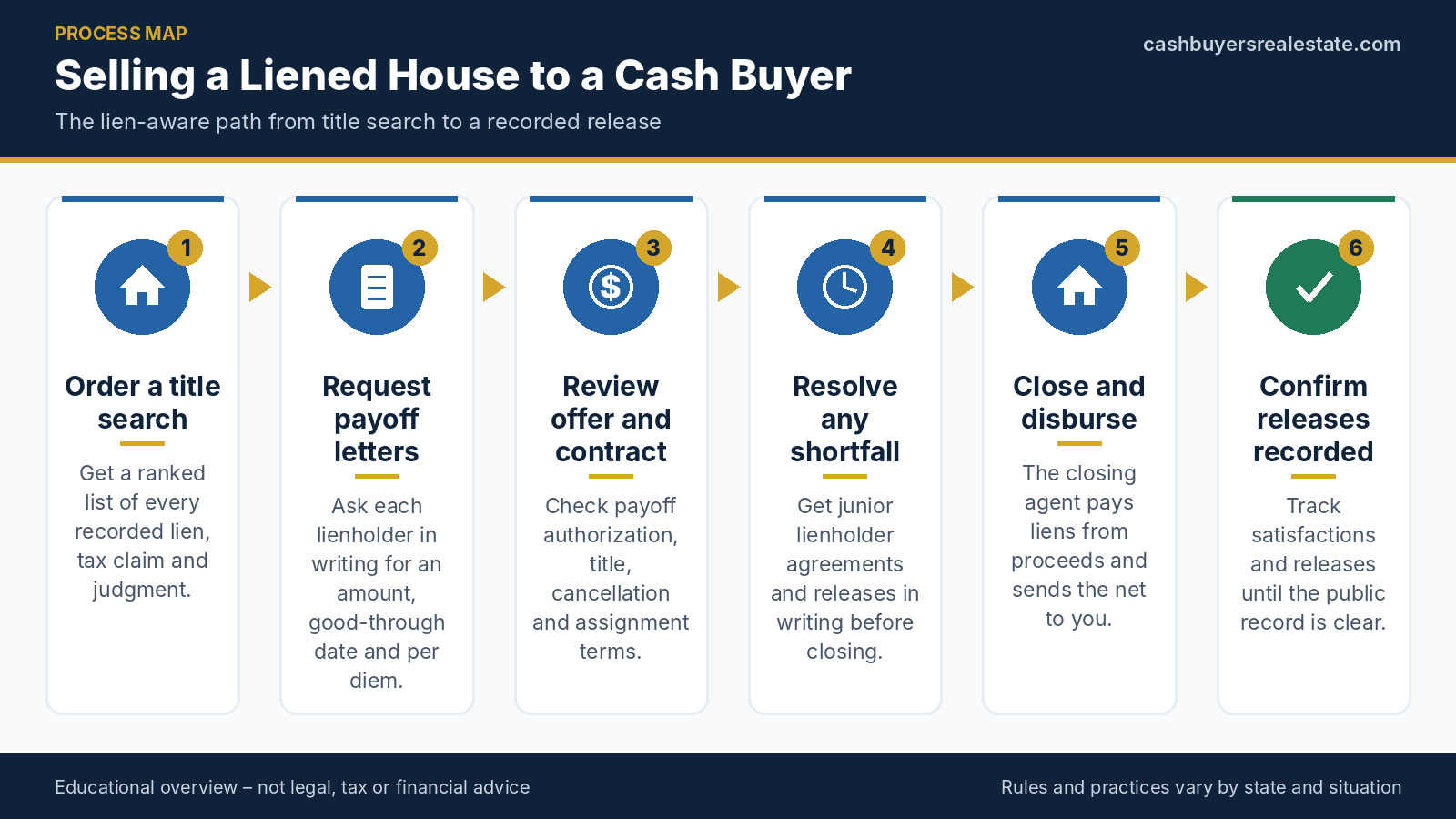
Text version of this infographic
- Order a title search — Get a ranked list of every recorded lien, tax claim and judgment.
- Request payoff letters — Ask each lienholder in writing for an amount, good-through date and per diem.
- Review offer and contract — Check payoff authorization, title, cancellation and assignment terms.
- Resolve any shortfall — Get junior lienholder agreements and releases in writing before closing.
- Close and disburse — The closing agent pays liens from proceeds and sends the net to you.
- Confirm releases recorded — Track satisfactions and releases until the public record is clear.
Surprises that change the numbers
Even a careful seller can be caught out, and the surprises are rarely random. They fall into patterns that a title professional recognizes immediately, and a few of them are worth knowing in advance because each one has a standard remedy and a typical delay attached.
Look-alike names, stale judgments and unreleased mortgages
Judgments are indexed by name, and names are not unique. A common surname, a generational suffix left off a filing, or a similar first name can cause a title search to flag a judgment against someone who is not the owner. The usual remedy is an identity affidavit in which the seller states under oath that they are not the debtor, supported by details such as a middle name, a prior address or a Social Security number partially redacted for the title company. It is routine, but it adds days. At the other end of the spectrum, a judgment that really does belong to you may be older than you think. State law sets how long a judgment lien lasts and whether it can be renewed; as examples, Texas Property Code section 52.006 provides that a judgment lien continues for ten years from the date the abstract is recorded and indexed, while Florida section 55.10 provides a ten-year lien from recording a certified copy, extendable by re-recording before it expires. A lien past its life may be unenforceable, but the record does not clear itself, and a title company will usually want a release or a court order before it insures over it.
Illustrative example (hypothetical numbers, not market data): A homeowner accepts a cash offer of $198,000 on a Monday. Four days later the title company reports a $7,300 judgment against “J. Marlowe” recorded in the county. The seller’s legal name is Jonathan Marlowe, and the debtor is a different person named James Marlowe who lived in the next county. The seller signs an identity affidavit, supplies a copy of a driver’s license and a prior-address history, and the title company reviews it and agrees to remove the exception. The fix costs nothing but takes about a week, and the closing date moves from day 14 to day 21. Had the judgment truly belonged to the seller, the same $7,300 would have been paid from proceeds, and the net would have dropped by that amount.
The same logic applies to old mortgages. A loan paid off long ago can remain on the record if the release was never recorded, and the remedy depends on state procedure. In some states, a statute lets a property owner demand that a lender record a release within a set period after payoff and imposes penalties for failure; in others the practical route is to ask the lender or its successor for a recorded satisfaction, supported by a payoff letter or canceled note. If the lender has vanished, a title company may require a court action or may be willing to insure over it with an indemnity. All of that takes time that a cash buyer’s fast closing target may not allow, and an honest buyer will say so and adjust the timeline rather than pretend the problem does not exist.
Contractor claims, code liens and utility charges
Mechanic’s liens deserve special attention because they often come from a good-faith relationship that went sideways. A roofer, a plumber or a remodeler who is not fully paid, or a subcontractor who was not paid by your general contractor, may be entitled under state law to record a lien. The deadlines are strict and vary widely: for instance, California Civil Code section 8412 requires a direct contractor to record a claim of lien before the earlier of ninety days after completion of the work or sixty days after the owner records a notice of completion or cessation. Other states use different windows, different notice requirements and different rules for subcontractors. A claim that was timely recorded must still be enforced through a lawsuit within the period state law provides, or it can expire; a claim recorded too late may be invalid; and a claim that is disputed may be settled for less than the amount stated.
Municipal and utility claims are the other recurring surprise. Cities and counties can record liens for unpaid fines, weed or debris abatement, board-up costs or unpaid water and sewer charges, depending on local law, and those liens sometimes receive a priority ranking above earlier mortgages. They are also frequently missed by a search that looks only at the recorder’s index, which is why many title companies order a separate municipal lien search or request payoff letters from the city. If a code violation exists, ask whether a lien has been recorded and whether the agency requires the violation to be corrected, or only the fine paid, before it will release. The related question of selling with open code violations is a topic of its own, and the point to carry from here is simple: a clean recorder’s search is not the same thing as a clean title, and a buyer who skips the extra searches may be pricing in a risk the seller could have eliminated for free.
Payoff Statements, Demand Letters and How Liens Are Paid at Closing
A list of liens is not yet a plan. Before anyone can close, each claim has to be converted from a rough balance into an exact payoff figure that is good through a stated date, and each lienholder has to agree in writing on how and when it will be paid and what document it will deliver in return. This is the administrative heart of selling a liened house, and it is where most timeline surprises originate, because the people who produce payoff figures work on their own schedules, not the buyer’s.
Turning claims into exact numbers
The numbers on your statements are almost never the numbers you will owe on closing day. Interest accrues daily, fees appear, escrow accounts reconcile, and some creditors add costs that only they can calculate. Each kind of creditor has its own route for stating the amount, and knowing which document to ask for saves days.
Mortgage payoff statements and the federal timing rule
For a residential mortgage, the document you need is a payoff statement, which tells you the total required to satisfy the loan as of a specific date. Federal rules give you a measure of protection on timing. Under Regulation Z, section 1026.36(c)(3), a creditor, assignee or servicer must send an accurate statement of the total outstanding balance needed to pay the obligation in full within a reasonable time, and in no case more than seven business days after receiving a written request from the consumer or from someone acting on the consumer’s behalf. The Consumer Financial Protection Bureau’s commentary indicates that a person acting on the consumer’s behalf can include an attorney. The deadline can stretch in particular situations, such as when the loan is in bankruptcy or foreclosure, or after a natural disaster, in which case the standard becomes a reasonable time. The servicer may also verify identity and require your authorization before the clock starts.
That last point explains a common source of delay. A title company or buyer’s attorney can request the payoff, but the servicer will want your signed authorization first, and a request made by email without it may sit in a queue. The efficient approach is to sign the authorization at the same time you sign the contract, confirm which servicer currently holds the loan, since servicing is frequently transferred, and ask the title officer to request the payoff on the first business day after the contract is signed. Ask also for the per diem, the daily interest amount that applies after the good-through date, because a closing that slips by a week will need an updated figure. Payoff statements are not offers to settle for less; they are statements of what is owed, and they are valid only for the stated period.
Demand letters, estoppel letters and why figures move
Outside the mortgage world there is no single federal timing rule, and the document goes by different names. A homeowners association will usually issue an estoppel or payoff letter stating unpaid assessments, late charges, collection costs and sometimes transfer fees, and state law often limits how long the association may take to deliver it and what it may charge. A county tax collector issues a tax certificate or a payoff for delinquent taxes with penalties and interest through a date. A judgment creditor, usually through an attorney, provides a payoff that includes the principal, post-judgment interest at the rate state law provides, and costs. A mechanic’s lien claimant provides a demand stating the lien amount and, often, the interest and fees claimed. The word demand is accurate: these are the creditor’s statement of what it will accept to release the lien, and nothing makes the number binding until the creditor commits to it in writing.
Figures move for ordinary reasons. Interest accrues daily, a tax installment may come due before closing, an association assessment may post, or a judgment creditor’s attorney may add fees. They also move for reasons that deserve skepticism, such as a creditor that quotes an amount, and later “discovers” an additional charge on the day of closing. The best defense is to request every payoff in writing with an explicit good-through date and per diem, to compare each figure to the original claim to see what has been added, and to ask the closing agent to confirm that each payoff letter has been received and reviewed before the settlement statement is finalized. When a payoff looks too large, ask for an itemization; creditors are often willing to reduce collection costs or late fees once the choice is between a negotiated payment now and a stalled sale.
What happens at the closing table
Once the numbers are firm, the closing agent turns them into a settlement statement and a set of disbursement instructions. The mechanics are the same whether the transaction is handled by a title company, an escrow company or an attorney, although who plays which role varies by state. Closings in some states are run by attorneys and in others by escrow or title officers, so the person on the other side of the table may not be the person you expect.
The disbursement waterfall, from sale price to your net
Think of the sale price as a pitcher of water poured through a series of obligations. The buyer’s funds come to the closing agent. The agent first pays the liens and obligations that must be cleared for the buyer to receive clear title, then the transaction costs, and finally sends the remainder to you. In a sale with enough equity, the order of payment among liens does not change the outcome because everyone is paid in full. It matters only when the money runs short, in which case priority and any negotiated agreements control. The table below illustrates a typical sequence in the simplest case, where every claim is paid in full.
| Step | Item paid from proceeds | Amount | Remaining |
|---|---|---|---|
| Start | Contract price paid by buyer | $240,000 | $240,000 |
| 1 | First mortgage payoff | $142,300 | $97,700 |
| 2 | Home equity line payoff | $18,900 | $78,800 |
| 3 | Delinquent property taxes with penalties | $3,150 | $75,650 |
| 4 | Recorded judgment, including interest | $9,800 | $65,850 |
| 5 | Contractor’s lien claim | $6,400 | $59,450 |
| 6 | Title, settlement, recording and transfer charges | $3,400 | $56,050 |
| Net | Wired to the seller | $56,050 | $56,050 |
To read the table, notice how much of the headline price never reaches the seller even in an orderly sale: in this hypothetical, about 77 percent of the contract price goes to creditors and to the cost of closing. The seller’s net is determined less by the buyer’s offer than by the stack of claims underneath it, which is why comparing two offers on price alone can mislead. An offer that is $8,000 higher but takes longer to close may cost more in accruing interest and carrying costs than it adds, and an offer that treats a contested lien as the seller’s problem may leave the seller to settle it from other funds after closing.
Illustrative example (hypothetical numbers, not market data): A seller reviews the table above and notices that the judgment payoff of $9,800 is larger than the $8,100 judgment she remembers. The difference is $1,700 of post-judgment interest and attorney costs. She asks the title officer to request an itemized payoff from the creditor’s attorney and discovers that $650 of the costs relate to an earlier collection effort the creditor already recovered. After a short exchange of letters the attorney issues a corrected payoff of $9,150. Her net rises by $650, from $56,050 to $56,700, and the correction is on the settlement statement before she signs it. The lesson is that the figure on a demand letter is a starting point, and reading it takes a few minutes.
Releases, satisfactions and recording after closing
Payment is only half of clearing a lien. The other half is the release, a document in which the lienholder confirms that the debt is satisfied and the claim against the property is discharged. For a mortgage this is a satisfaction or reconveyance, for a judgment it is a satisfaction of judgment, for a tax lien it is a certificate of release, and for a mechanic’s lien it is a release or a discharge. Someone has to record that document in the county records, and the timing varies. Some lenders send the release to the title company within weeks; some state statutes set a deadline; others leave it to the agent to follow up. Until the release is recorded, the public record still shows the claim, which can trip up a later refinance or sale of the same property by the buyer.
The closing agent typically takes responsibility for tracking recorded releases and for forwarding any that arrive late to the recorder, and the title insurer’s policy is built on the assumption that payoff and release occurred. As a seller, you do not need to chase every document, but you should ask three questions before closing: who is responsible for recording each release, what is the expected timeframe, and what proof will you receive. For a federal tax lien, the Internal Revenue Code provides that the release certificate must be issued within thirty days after the liability is satisfied, and the IRS’s own guidance says the same, so a follow-up after that date is reasonable if nothing has arrived. Keep copies of every payoff confirmation and the final settlement statement; if a lienholder later claims that a payment was not received, those documents are your evidence.
Federal Tax Liens: Notice, Release, Discharge and Subordination
A federal tax lien deserves its own treatment because it behaves differently from the liens created by private creditors. It comes from federal statute rather than from a state recording system, it attaches to everything the taxpayer owns rather than to one parcel, and it can be addressed through formal IRS procedures that have names and deadlines of their own. Buyers and title companies react to it with particular caution, partly because it is public, partly because its dollar amount can be large, and partly because the options for dealing with it take time that a quick closing may not allow.
How a federal tax lien arises and what a buyer sees
Two events are easy to confuse: the lien arising and the notice being filed. The first is a legal consequence of not paying; the second is the IRS making that consequence visible to the world. A buyer is concerned with both, but the second one is what shows up in a title search.
From assessment to a filed notice of lien
According to the IRS explanation of federal tax liens, a federal tax lien is the government’s legal claim against your property when you neglect or fail to pay a tax debt. It arises after the IRS assesses the balance, sends a notice and demand for payment, and the taxpayer neglects or refuses to pay in full within the required time, a rule that comes from section 6321 of the Internal Revenue Code. The lien covers all of the taxpayer’s property and rights to property, including real estate, personal property and financial assets, and it extends to property acquired while the lien is in effect. The tax debt that supports it includes the underlying tax plus interest, penalties and certain collection costs.
The Notice of Federal Tax Lien, often abbreviated NFTL, is the public document the IRS files to put creditors on notice that the government has a legal right to the taxpayer’s property. For real estate, the notice is filed in the office designated under state law, which in many states is the county recorder or a similar county office, and in some states is a state-level filing office. That filing is what a title search finds. A homeowner may not have thought about the debt in years and may not realize that a notice was filed; the IRS sends notices of a filing, but mail goes astray and addresses change. If you suspect you owe federal taxes, find out before you list or accept an offer, because a lien discovered at closing stops the transaction until the payoff or another resolution is agreed.
Priority against buyers, lenders and other creditors
The filing matters legally as well as practically. Section 6323(a) of the Internal Revenue Code provides that the federal tax lien is not valid against a purchaser, a holder of a security interest, a mechanic’s lienor or a judgment lien creditor until the notice has been filed. In plain terms, someone who bought the house, lent money against it or acquired a lien before the notice was filed generally takes ahead of the IRS, and someone who comes after the notice is on the record is behind it. This is why a lender holding a mortgage recorded before the notice remains ahead of the federal claim, and why a buyer who closes without clearing a filed notice takes the house subject to the lien.
The statute also carves out exceptions that can rank ahead of even a filed notice. Under section 6323(b)(6), certain liens for real property taxes, special assessments and charges for utilities or public services furnished to the property can have priority over the federal lien if they are entitled to priority under local law. Section 6323(b)(7) gives priority to a mechanic’s lien for repairs or improvements to a personal residence of not more than four dwelling units, occupied by the owner, but only if the contract price with the owner does not exceed $5,000. These carve-outs are narrow, and they explain why a title officer asks about the nature of every other claim before assuming how the federal lien ranks. In a sale where the price covers everything, ranking is moot. In a thin-equity sale, it can decide whether the IRS is paid in full, partly or not at all.
Choosing among release, discharge, subordination and withdrawal
People often use these four words as if they meant the same thing, and the confusion can lead to a missed deadline. Each is a different IRS action with a different effect, a different application and a different role in a sale. The IRS describes all of them on its lien pages, and the right one depends on whether the debt will be paid, whether the proceeds will cover it, and what the seller is trying to accomplish.
Release by payment and withdrawal of the public notice
A release is the cleanest outcome. It means the debt is paid, and the lien is gone. The Internal Revenue Code requires the IRS to issue a certificate of release within thirty days after the liability is fully satisfied or becomes legally unenforceable, or after an acceptable bond is furnished, and the IRS’s guidance states that it releases the lien within thirty days after the tax debt is paid. In a sale where proceeds cover the full balance, the usual approach is for the closing agent to obtain a payoff figure, pay it from proceeds and then follow up on the release. The title company will typically want assurance, before closing, of the payoff amount and of how and when the IRS will deliver the release, and a buyer who is informed about the process is rarely troubled by this once the paperwork is lined up. Payoff numbers can change daily as interest accrues, so as with a mortgage, a good-through date matters.
Withdrawal is something else. It removes the public Notice of Federal Tax Lien so the IRS no longer competes with other creditors on the record, but the debt remains owed. The request is made on IRS Form 12277. In a sale context, a withdrawal does not make the claim disappear for a buyer’s purposes, so it is rarely a substitute for payoff; it is more often relevant to a seller’s later credit or a refinance. If someone tells you that withdrawing the notice will let you sell without paying anything, treat it as a red flag and ask for the IRS’s own explanation of what the withdrawal does and does not do.
Discharge and subordination applications
A certificate of discharge removes the federal tax lien from a specific piece of property while leaving it on the taxpayer’s other property. The application is Form 14135, and the instructions are in IRS Publication 783. Publication 783 says to submit the application at least 45 days before the transaction date, so the IRS has time to review it and issue the documents. That timeline alone can make a discharge impractical for a cash sale scheduled to close in two or three weeks. The publication describes several grounds. One is that the remaining property subject to the lien is worth at least twice the tax liability plus senior debts. Another is that the IRS receives payment equal to its interest in the property. A third is that the government’s interest is valueless because senior debts exceed the property’s value, and a fourth is that the sale proceeds are held in an escrow fund that preserves the government’s claim. A fifth involves a third-party owner posting a deposit or bond. Attachments include the sales contract, a title report and the proposed closing statement, and an escrow agreement is required in some of the cases. The IRS issues Letter 4025 to state its decision, and a denial carries appeal rights through the Collection Appeals Program.
Subordination is different again. It leaves the federal lien in place but allows another creditor, such as a new lender, to move ahead of the IRS on a given property. Form 14134 and Publication 784 govern it, with the same 45-day timing guidance. The IRS may issue a certificate of subordination either when it receives an amount equal to the interest being subordinated or when it concludes that subordination will increase the amount the government ultimately collects or make collection easier. Subordination matters mostly when a homeowner is refinancing or borrowing against the house, and it matters less in an outright cash sale. Still, a seller who understands the vocabulary can quickly tell whether an intermediary’s proposal fits the situation or does not.
| Action | What it does | Form or authority | Does the tax debt remain? |
|---|---|---|---|
| Release | Extinguishes the lien after the debt is paid, unenforceable or bonded | IRC section 6325(a); issued within 30 days of satisfaction | No, the debt is paid |
| Discharge | Removes the lien from the named property only, letting the sale close | Form 14135; Publication 783; apply at least 45 days before the transaction | Yes, unless paid; the lien stays on other property |
| Subordination | Lets another creditor take priority over the lien on specified property | Form 14134; Publication 784; apply at least 45 days ahead | Yes, and the lien remains in place |
| Withdrawal | Removes the public notice so the IRS no longer competes on the record | Form 12277 | Yes, the debt is still owed |
The table is easiest to use as a filter. If your sale price comfortably covers the full tax balance and the other liens, the realistic path is payoff at closing followed by a release, and the other three actions are not needed. If the sale will leave the tax unpaid in whole or in part, discharge is the route that lets the buyer take the house free of the lien, and its timeline must shape the contract. Subordination and withdrawal are tools for different goals and rarely make a cash sale possible by themselves.
Illustrative example (hypothetical numbers, not market data): A seller has a $310,000 cash contract, a first mortgage payoff of $201,000 and a filed federal tax lien with a payoff of $38,400. After about $5,200 in closing charges, the proceeds are $310,000 minus $201,000, minus $38,400, minus $5,200, which leaves $65,400 for the seller. The sale clears because the price covers the lien, so the title company arranges to pay the IRS from proceeds and tracks the release. Now suppose the contract set a 21-day closing and the seller’s plan depended on a discharge application. Because the IRS guidance asks for applications at least 45 days before the transaction, the plan would not fit the contract; either the contract timeline must be extended or the lien must be paid in full at closing. Checking that mismatch before signing is far cheaper than discovering it on day 20.
A last point concerns who owns the property. Publication 783 notes that when a non-liable person owns the property, such as a spouse who did not owe the tax, a payment-based discharge may be calculated differently; for property held by tenants by the entireties, the publication indicates payment of generally one-half of the proceeds. These rules are technical, and they are one more reason to involve a professional whenever title is held by more than one person and only one of them has a tax problem.
When the Sale Price Does Not Cover the Liens: Shortfalls and Short-Sale-Style Approvals
Everything so far assumes the price is large enough to pay every claim. Sometimes it is not. A house with deferred maintenance, a modest price, a second mortgage and several recorded judgments can easily produce payoffs that exceed what any buyer will pay, and the discount built into many cash offers makes that arithmetic tighter. The sale is not necessarily dead when that happens, but it becomes a negotiation, and the people who must agree are creditors who owe you nothing.
Recognizing a shortfall early and sorting out who must approve
The earlier you see the gap, the more options you have. A shortfall discovered at the closing table leaves hours to solve a problem that may need weeks, and it is also the point at which a buyer’s patience is shortest. Calculating the gap before you sign a contract takes a few minutes with the right documents and avoids an unpleasant surprise.
Measuring the gap between price, payoffs and closing costs
The shortfall calculation is simple addition and subtraction, but it must use payoff figures rather than statement balances and must include the costs of closing. Take the contract price, subtract every payoff that must be cleared for title to pass, subtract the seller’s closing costs, and look at the result. If it is positive, you are in a solvent sale and can concentrate on getting the best net. If it is negative, the amount of the deficit tells you how much must come from somewhere else: another source of funds, a lienholder’s agreement to take less, or a different price. A small negative figure, say a few thousand dollars, can often be closed by a lender’s fee waiver or a modest reduction. A large one usually means the property’s value cannot support its debts, and the discussion changes from timing to feasibility.
Illustrative example (hypothetical numbers, not market data): A cash buyer offers $175,000. The title commitment shows a first mortgage payoff of $158,000, a second lien payoff of $21,500, and a homeowners association payoff of $4,200, and the seller’s closing charges are estimated at $4,500. The total required is $188,200, which exceeds the price by $13,200. The seller asks the second lienholder for a release in exchange for $8,000 and asks the association to waive $1,100 of late charges and collection costs, reducing its claim to $3,100. With those agreements in writing, the total becomes $158,000 plus $8,000 plus $3,100 plus $4,500, or $173,600, which leaves $1,400 for the seller. Without the concessions the sale cannot close unless the seller brings about $13,200 to the table.
The example shows two features worth noticing. First, no concession was extraordinary; the second lienholder still received a payment and a clean exit, and the association collected most of its assessments. Second, the arrangement hinged on the written release, not on a handshake or a phone call. Each creditor must sign a document that says what it will accept and that it will release the lien on receipt, and the title company must be satisfied that the document is genuine and binding. Without those writings, the buyer’s closing agent will not disburse funds on a hope.
Who has to say yes: senior lenders, junior lienholders and the buyer
Approval comes in layers. If the first mortgage payoff is itself larger than the net sale proceeds, the transaction is a short sale in the strict sense, where the servicer agrees to accept less than the full balance. The Consumer Financial Protection Bureau explains that a short sale is a type of loss mitigation in which you sell the home for less than you owe, the lender or servicer must agree, and the lender may or may not hold you responsible for the difference. That approval often involves the investor behind the loan and sometimes a mortgage insurer, and it can take weeks. Junior lienholders such as second mortgage holders must also agree to release for whatever the senior lender allows them to receive, and their incentive to cooperate depends on whether they would otherwise collect anything.
The buyer is the last party whose agreement counts. A buyer who offered cash on the assumption of a quick closing must decide whether to wait through an approval process, and the contract should say what happens if approvals are not obtained by a deadline. Well-drafted terms give each side a clean way out: the buyer may cancel and recover its earnest money if the seller cannot deliver releases by a stated date, and the seller may terminate if a required approval is refused. If a buyer or intermediary suggests skipping the approvals, paying a lienholder through a side arrangement, or closing before releases are in writing, that is a red flag, not a shortcut, and the red flags section returns to it.
Looking ahead, seller options at this stage sort into five realistic routes. You can accept the cash offer and use proceeds and lienholder concessions to clear the claims. You can pay or settle the liens first, using savings or a loan, and then sell the cleared property in whatever way suits you. You can list the property on the open market, where a higher price may cover claims that a discounted cash offer cannot. You can pursue a negotiated reduction or short sale where the price truly will not support the debts. Or you can resolve the underlying problem so you can keep the house, through a payment plan, refinance, dispute or settlement. Each has different timing, cost and certainty, and the comparison belongs to the next major section, but the infographic below summarizes how they trade off.
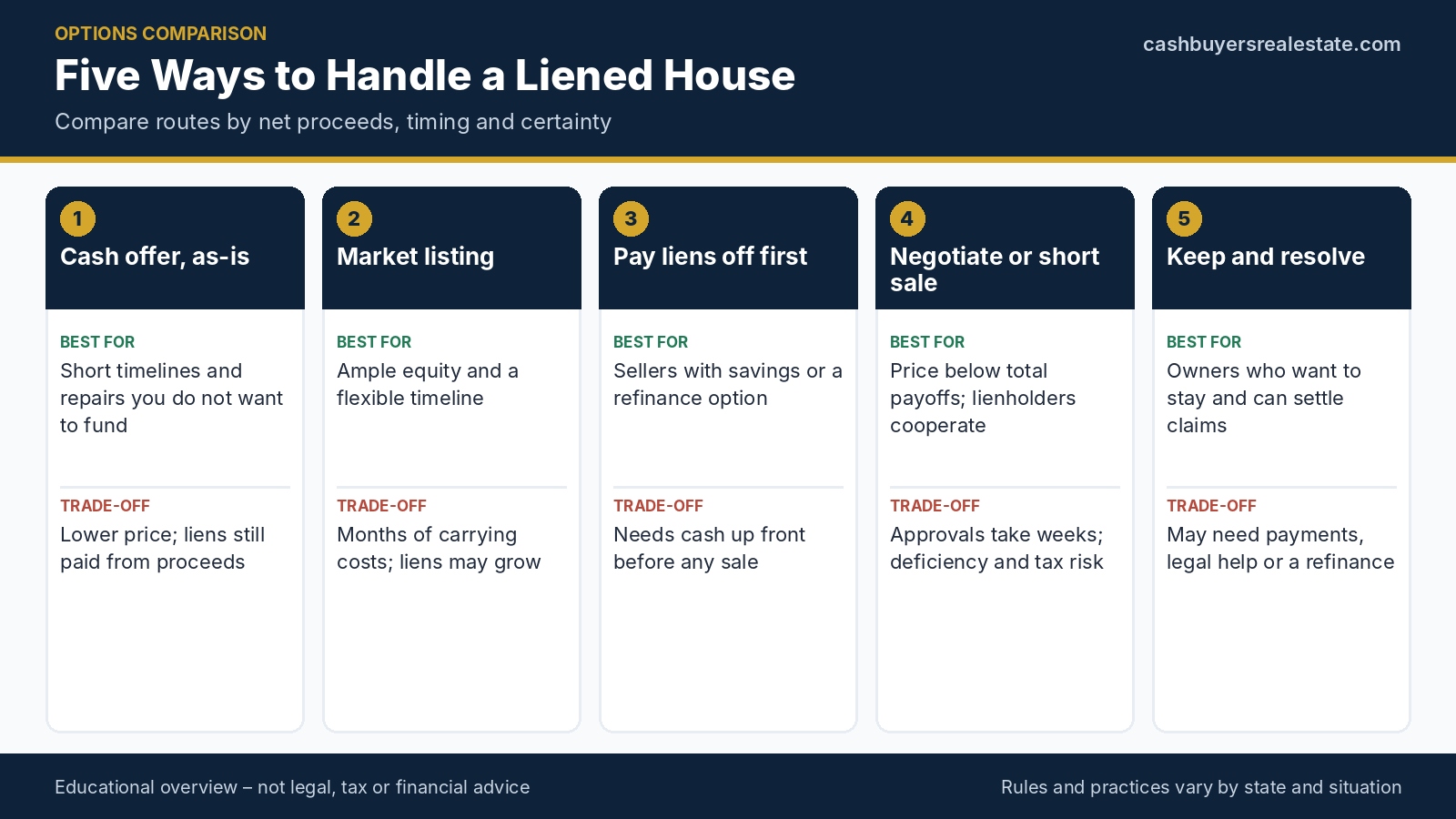
Text version of this infographic
- Cash offer, as-is — Best for: Short timelines and repairs you do not want to fund. Trade-off: Lower price; liens still paid from proceeds.
- Market listing — Best for: Ample equity and a flexible timeline. Trade-off: Months of carrying costs; liens may grow.
- Pay liens off first — Best for: Sellers with savings or a refinance option. Trade-off: Needs cash up front before any sale.
- Negotiate or short sale — Best for: Price below total payoffs; lienholders cooperate. Trade-off: Approvals take weeks; deficiency and tax risk.
- Keep and resolve — Best for: Owners who want to stay and can settle claims. Trade-off: May need payments, legal help or a refinance.
Negotiating with lienholders in a way that produces a written release
Negotiation is not haggling. It is a structured request in which you show a creditor why accepting a smaller payment now is better for it than the alternatives, and then document the agreement so that it binds. Because the creditor’s alternative to your offer is often delay, litigation or an uncertain foreclosure outcome, a well-prepared request can succeed where an unprepared one is ignored.
What junior lienholders, associations and contractors tend to accept
Creditors respond to a few consistent considerations: how likely they are to collect without the sale, how much it would cost them to enforce, and how credible your documentation is. A second mortgage holder behind a large first loan may recover nothing in a foreclosure, so a modest payoff offered through closing can be attractive. An association is often motivated by getting its ongoing assessment stream restarted with a paying owner and may be willing to reduce late charges or legal costs. A contractor who recorded a lien usually wants prompt payment, and the amount may be negotiable if there is a dispute about the work, as long as the settlement results in a signed lien release. A judgment creditor, particularly one represented by a collection law firm, evaluates a payoff against the cost and difficulty of enforcing the judgment, and may accept a lump sum smaller than the stated balance if the alternative is waiting.
| Lienholder | Why it may agree | What it usually wants to see | What to get in writing |
|---|---|---|---|
| Second mortgage or HELOC lender | Little or nothing is recoverable if the first lender forecloses | Contract, estimated settlement statement, hardship explanation | Payoff amount, release of lien, release of personal liability if negotiated |
| Homeowners association | Fast payment and a new paying owner | Closing date, payoff request, ledger review | Itemized payoff and release of recorded lien |
| Contractor or supplier | Certain payment instead of a lawsuit | Invoices, proof of payments, any dispute about the work | Signed lien release and settlement terms |
| Judgment creditor | Avoiding delay and enforcement cost | Proof the sale will close, proposed payoff and timeline | Satisfaction of judgment in recordable form |
| Taxing authority | Statutory collection; rarely negotiable on property tax principal | Payoff request and closing date | Paid receipt or tax certificate; for federal liens, the IRS certificate |
Use this table as a map of leverage rather than a script. Government taxing bodies generally have the least discretion over principal and the most structured procedures, so the sensible approach with them is accurate paperwork and enough lead time. Private creditors have the most flexibility, and the right-hand column shows the document that actually protects you: a payoff amount alone is not a release. If a creditor agrees by phone, ask them to confirm by letter or email on letterhead before the closing agent relies on it, and make sure the document states that the lien will be released upon receipt of the specified amount.
Deficiency balances, tax consequences and the cost of walking away
Two follow-on questions arise whenever a creditor accepts less than it is owed. The first is whether the remaining balance still exists as a personal debt. The CFPB notes that in some states a lender can pursue a deficiency after a short sale, and that in states where that is possible you should ask the lender to waive the deficiency and obtain the waiver in writing. The agency also recommends working with a HUD-approved housing counselor and mentions the HOPE Hotline at 888-995-4673. For junior liens, the same issue arises: a release of the lien on the house does not always release you from the debt itself, so the agreement should say whether the creditor is giving up the balance or only the claim on the property.
The second question is tax. According to IRS Topic 431, canceled debt is generally taxable income that must be reported for the year of cancellation, though some canceled debt can be excluded, including debt discharged in bankruptcy, debt canceled to the extent you were insolvent, and qualified principal residence debt. The Topic 431 page describes the principal residence exclusion as applying to debt discharged before January 1, 2026, or discharged under a written arrangement entered into and evidenced in writing before that date, so as of this October 2026 review you should ask a tax professional whether any extension has been enacted and whether another exclusion applies. Forgiven amounts are reported using Form 982 when an exclusion is claimed. A creditor may issue Form 1099-C, but you remain responsible for reporting the correct amount even if the form is wrong.
Walking away is the alternative to all of this, and it carries its own costs. Letting a property go to foreclosure or tax sale will not necessarily end liability, may bring deficiency claims in some states, and typically affects credit for years. That is not a reason to accept a poor deal, but it is a reason to compare a negotiated sale with the outcome of doing nothing, rather than with an imagined perfect result. A housing counselor or attorney can usually tell you in an hour or two which of those outcomes your state’s rules make likely.
How Liens Change a Cash Offer: Pricing, Contract Terms and Alternatives
A lien changes a cash offer in two ways. It affects what the buyer is willing to pay, because clearing title takes time and carries risk the buyer must price. And it affects what the contract needs to say, because a contract written for a clean house will not cover payoffs, releases, approvals and the consequences if a claim cannot be cleared. A seller who understands both effects can read an offer the way a buyer would and compare it fairly with other routes.
What cash buyers for houses with liens look for before they bid
An experienced buyer who sees a title report with liens asks a short list of questions before naming a price: how much is owed, who holds each claim, how cooperative each holder is likely to be, how long it will take, and what happens to the buyer’s money if clearing fails. The answers drive both the number and the terms.
How lien risk shows up in the price
Lien risk enters the price in several forms, and only some of them are legitimate. The legitimate ones are the buyer’s time, the holding costs of waiting for approvals, the possibility that a disputed claim ends up costing more than expected, and the cost of any legal or title work needed to clear defects. A buyer who expects a three-week closing to stretch into eight weeks while a judgment creditor responds is entitled to reflect that delay in the price, just as a seller is entitled to ask what the delay is assumed to cost. What is less legitimate is padding: an offer that deducts a round, unexplained “title risk” amount without reference to any specific claim, or that treats a recorded lien as a reason to cut the price by more than the lien’s payoff, effectively charging the seller twice for the same issue.
You can separate the two by asking the buyer to explain the offer in terms of your own documents. Which liens did the buyer count, at what payoff figures, and what allowance was made for time and uncertainty? A buyer willing to answer in specifics makes a comparison possible; one who answers in generalities, or who pressures you to decide before the title report arrives, is harder to evaluate. The general mechanics of how investors derive a number from repairs, resale value and margin are covered in the guide on how cash buyers calculate offers, and the point to carry over is that a lien should enter the calculation as a documented cost, not as an invisible discount. Ultimately the figure that matters is the net on the settlement statement, which the article on cash offer net proceeds walks through in detail.
Contract terms that matter when liens are involved
A standard purchase contract assumes that the seller will deliver marketable title and that liens will be paid from proceeds, but the specifics matter. Look first for the payoff authorization: the contract should direct the closing agent to pay named liens from proceeds and should authorize the agent to obtain payoff statements. Next, look for the title provisions, which should say what happens if the title commitment reveals claims the seller did not disclose, how long the seller has to cure them, and who may cancel if the cure fails. The cancellation clause deserves a careful read, since a clause that lets the buyer cancel for almost any reason while keeping the seller bound can leave you with a house off the market and no sale. Earnest money terms matter too, and the guide on earnest money in a cash purchase explains how deposits are held and when they are returned.
Assignment language is another point to read closely. Some investor contracts allow the buyer to assign its rights to another buyer, which is lawful in many places but affects who you will actually close with and how much of the price the original buyer keeps. The point is not that assignment is improper but that you should know it is in the contract, and whether the original buyer must disclose it. Finally, an as-is clause covers the property’s physical condition, not the title; a seller does not escape the obligation to clear liens because the house is being sold as-is. The wider topic of contract terms in cash deals is covered in the article on the cash home buyer contract.
Comparing your routes by net proceeds, not headline price
The honest comparison between routes is net proceeds after liens, costs and time, adjusted for how certain each outcome is. A higher headline price that closes in five months may or may not beat a lower one that closes in three weeks, and the answer depends on how much the liens grow while you wait and what else the delay costs you.
Cash sale, listing and negotiated clean-up side by side
The table below runs one hypothetical house through three routes. The property carries $64,000 in liens in total. Under the first route, a cash buyer offers $212,000 as-is. Under the second, the owner lists at $250,000 with an agent, completes some preparation and waits for a financed buyer. Under the third, the owner accepts the cash offer but first negotiates a reduction of one judgment payoff, lowering the total of liens to $56,000. The numbers are invented for illustration only.
| Line item | Cash offer, as-is | Market listing | Cash sale after lien reduction |
|---|---|---|---|
| Sale price | $212,000 | $250,000 | $212,000 |
| Agent commissions (assumed 5.5 percent) | $0 | $13,750 | $0 |
| Liens paid at closing | $64,000 | $64,000 | $56,000 |
| Seller closing costs | $3,000 | $5,500 | $3,000 |
| Preparation and repairs | $0 | $6,000 | $0 |
| Carrying costs while waiting | $1,000 | $5,400 | $1,700 |
| Estimated net to seller | $144,000 | $155,350 | $151,300 |
| Rough time to closing | 3 weeks | 4 to 5 months | 5 weeks |
Read across the net row, and then back up to the time row. The listing route yields the highest estimated net in this made-up case, about $11,350 more than the quick cash route, but it also takes many times longer, carries the risk that the price or the timeline does not materialize, and exposes the owner to months of mortgage interest, taxes, insurance and possible lien growth. The third column shows how cleaning up a single claim can close a good part of that gap without the wait. Change the assumptions and the ranking changes: a lower list price, a longer marketing period, a house that needs more repair than assumed, or a mortgage with a higher interest rate would all shift the result, and a seller with no cushion for carrying costs may value certainty more than a larger projected net.
Illustrative example (hypothetical numbers, not market data): Two owners face the same table. One has savings, no other debt and a flexible move date, and decides that waiting for the market route is worth an expected $11,000 more. The other is supporting a parent, has a balloon payment due in ten weeks and cannot absorb four months of carrying costs, so the faster route’s lower net buys protection against a worse outcome. Neither choice is wrong. The useful discipline is to put the numbers and the timelines on the page and decide with the downside in view, which is also what a reputable buyer or agent should help you do.
Ways to resolve or soften the lien without selling
Not every lien problem ends in a sale. If the house is worth more than the debts against it and you want to stay, there are routes that remove or reduce the claim directly. A disputed contractor lien can sometimes be settled or bonded off. A judgment may be paid through a negotiated settlement or, if it was entered improperly, challenged in court. Delinquent property taxes can sometimes be placed on a payment plan through the local tax authority, subject to local rules, and a federal tax debt may be addressed through IRS payment arrangements or other relief procedures that the IRS describes on its lien pages. A refinance or home equity loan can fund a lump-sum payoff when the numbers allow. Bankruptcy can affect some liens, though the effect depends on the type of lien and the chapter, and it is a decision to make with an attorney, not a shortcut.
Condition and occupancy add their own complexity. A house that is vacant, damaged by fire or subject to an insurance claim creates extra lien-related questions, such as a mortgage servicer’s rights to insurance proceeds and municipal liens for securing or demolishing a structure. These situations are treated in the guides on cash buyers for vacant houses and cash buyers for fire-damaged houses, and the general overview of the cash route is in the article on selling a house for cash. Whichever path you consider, the same principle holds: compare the net after liens, and give each option the same honest accounting of time, cost and risk.
Red Flags, Wire Fraud and Verifying the Buyer and the Closing Agent
Transactions involving liens have more moving parts than clean sales: more payoff letters, more third parties, more documents and more money moving by wire. More moving parts mean more places for honest mistakes, and also more openings for people who want to take advantage of a seller who is stressed about debts. None of the warning signs below proves bad intent by itself, and plenty of legitimate buyers occasionally do one of them for innocent reasons. The sensible reaction to a warning sign is to slow down and verify, not to assume the worst or to ignore it.
Red flags specific to offers on houses with liens
Lien situations tempt a particular set of shortcuts, because there is a real problem to solve and a seller who would like it solved quickly. The shortcuts that follow the problem are the ones to watch for.
Pressure, side payments and pitches that bypass the payoff
The most important rule is that liens should be paid through the closing, with the payoffs shown on the settlement statement, and the lienholders should provide releases. Any proposal that moves the lien payments outside that process deserves a second look. A buyer who suggests that they will “take care of” the judgment or the taxes after closing, rather than at it, may be inviting you to sign over a house that remains encumbered with your name on the debt. A buyer who proposes buying the house “subject to” the existing liens or mortgage without paying them off is describing a different structure from a standard cash sale, with consequences for you, your lender and your credit, and one to take to an attorney before you sign anything. And a buyer or intermediary who asks for an upfront fee to “negotiate” or “clear” your liens before any contract exists is asking you to pay for a service you can ask a title company or attorney to explain.
Pressure is the other constant. A deadline that appears to be tied to nothing but the buyer’s convenience, a refusal to allow time for an attorney or family member to review the contract, and a message that an offer will vanish today unless you sign all deserve more scrutiny than the offer itself. Real deadlines exist in lien situations, such as a tax sale date or a foreclosure sale, but they come from public records that you can verify, not from a phone call. Equally, an instruction to leave blanks in a document to be filled in later, to sign an unfamiliar power of attorney or to sign a deed before closing should end the conversation until a licensed professional has looked at it.
Proof of funds, earnest money and the paper trail
Because cash buyers do not rely on a lender’s commitment letter, the verification you can ask for is different. A proof-of-funds letter or a recent account statement, with sensitive numbers redacted, shows that the money exists and is accessible, though it does not prove the buyer will perform. The guide on proof of funds for cash buyers explains what such documents mean and what they leave out. Earnest money held by a title company or attorney in a trust or escrow account is another sign of seriousness, and you should confirm the account holder independently rather than from the buyer’s email. In a lien transaction, also ask how the buyer plans to cover payoffs if one comes in higher than expected, since a buyer with no flexibility may have to renegotiate at the last minute.
The paper trail should be complete. A written contract with all blanks filled, legal names and addresses of every party, a clear closing date, a named closing agent, and the payoff authorization should exist before anyone does anything on your property. If the buyer is an entity, ask for its legal name and look it up with the state’s business registry, which is public and usually free. If the buyer is acting as a middleman for an unnamed end purchaser, ask who the end purchaser is and whether you will be told. The trust guide on how to tell whether a cash home buyer is legitimate goes deeper on verification, and the hub on cash home buyer scams collects the patterns in one place.
| What you see | Why it deserves attention | A safer response |
|---|---|---|
| Buyer will “handle” liens after closing | Liens left unpaid at closing can leave title unclear and you personally exposed | Require payoffs and releases through the closing agent, shown on the settlement statement |
| Upfront fee to negotiate or clear liens | You may pay for work a title company or attorney can explain, with no guarantee of results | Ask for the service in writing, check licensing, and consult an attorney before paying |
| Blank lines in a contract or deed | Anything can be written in later | Do not sign until every field is completed and reviewed |
| Pressure to sign today | Prevents title review, payoff requests and independent advice | Verify any real deadline in public records, and ask for a reasonable extension |
| Closing agent chosen by the buyer, with no verifiable contact | Funds may pass through an unfamiliar party | Confirm the company’s licensing and phone number independently, or propose a neutral agent |
| Changed wiring instructions by email | A classic pattern in closing-fund diversion | Call a number you already verified before sending or accepting any wire details |
| Vague or shifting offer once liens appear | Price may be reduced for reasons not tied to documents | Ask for the offer reconciled line by line to the title commitment |
The table works best as a pre-signing checklist. Few of its entries are signs of fraud on their own; several describe sloppy but honest practice. What they share is that each removes a safeguard, whether a document, a neutral party or a delay, and the response in the right-hand column is a way to put the safeguard back. If a buyer resists every reasonable request to restore one, that resistance is information.
Pulling the verification points into one view, the checks that matter most in a liened-house sale are confirming who the buyer actually is, requesting proof that funds exist, reading the cancellation and assignment terms, using a closing agent you have independently verified, and refusing to sign anything with blanks. The infographic that follows condenses those into a single checklist so you can run through them before any signature.
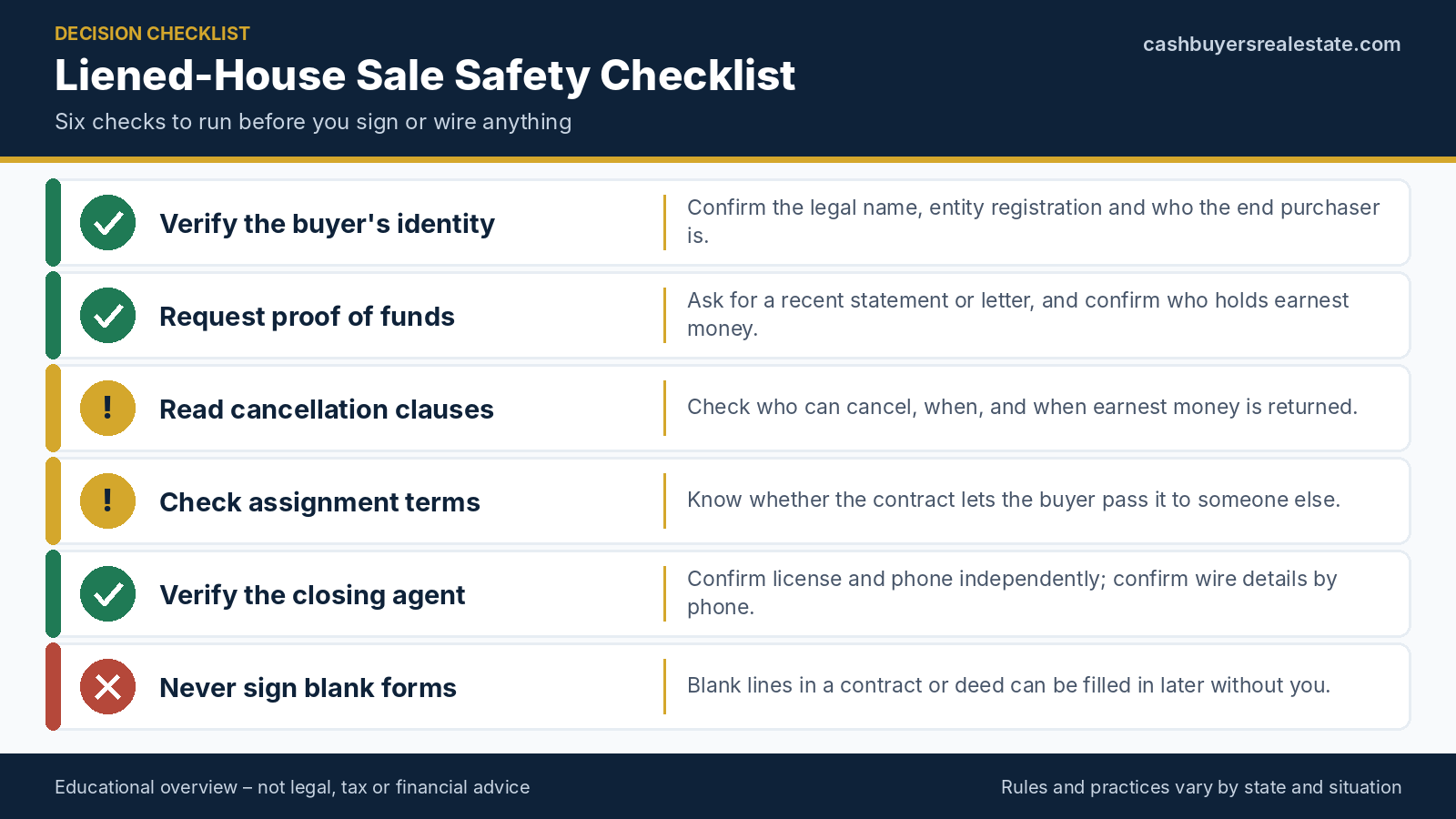
Text version of this infographic
- Verify the buyer's identity — Confirm the legal name, entity registration and who the end purchaser is.
- Request proof of funds — Ask for a recent statement or letter, and confirm who holds earnest money.
- Read cancellation clauses — Check who can cancel, when, and when earnest money is returned.
- Check assignment terms — Know whether the contract lets the buyer pass it to someone else.
- Verify the closing agent — Confirm license and phone independently; confirm wire details by phone.
- Never sign blank forms — Blank lines in a contract or deed can be filled in later without you.
Protecting closing money and confirming the liens are really gone
In a sale with several payoffs, a lot of money moves through a few hands in a short time, and fraudsters know it. The risk is not exotic: it is the ordinary business email scam applied to real estate, and it is preventable with habits that cost almost nothing.
Wire-fraud safeguards for payoffs and net proceeds
The Consumer Financial Protection Bureau describes the typical scheme: criminals compromise a real estate professional’s email account, watch for upcoming transactions, and then send spoofed messages from what looks like a trusted party with false wiring instructions or a last-minute change to existing ones. In a liened sale, the same pattern can target payoff funds, since a message that appears to come from the closing agent or a lienholder can direct the money to the wrong account, and it can target your net proceeds if the criminal impersonates you to the closing agent. The CFPB recommends choosing trusted contacts early, recording their phone numbers on paper, confirming wiring instructions by calling a number you already have rather than one in the email, being skeptical of contact details in messages, and keeping financial details out of email.
Apply those habits to your sale in a few concrete ways. When you give the closing agent instructions for where to send your net proceeds, deliver them in person or confirm them by calling the verified office number, and be wary of any message that suggests changing them. Ask the closing agent how payoff instructions from lienholders are verified, and whether payoffs are sent by wire, check or another method, since an agent with a clear verification procedure is easier to trust than one with none. If something does go wrong, the CFPB advises contacting your bank or wire-transfer company immediately to request a recall, because quick reporting improves the chance of recovery, and filing a complaint with the FBI’s Internet Crime Complaint Center at ic3.gov. Time matters, so keep those contacts handy before closing day, not after.
Checking the settlement statement and confirming recorded releases
The settlement statement is the document that tells you where the money went, and reviewing it before closing is the last practical chance to catch errors. Compare each payoff to the demand letters you collected, confirm that every lien on the title commitment appears as a payoff or is otherwise accounted for, check that the closing costs match the estimates you were given, and make sure your net proceeds equal what you calculated. If a number differs, ask for the reason in writing, not just a verbal explanation, and do not sign until you understand it. In attorney-closing states you may be reviewing the statement with the attorney, and in escrow states the statement may be circulated beforehand; either way, ask to see it at least a day before closing, if the closing agent can provide it.
After closing, follow up on the releases. A short checklist helps. First, confirm that each payoff was actually sent and ask for a confirmation or tracking record. Second, ask when each release is expected and who will record it. Third, after a reasonable period, search the county records or ask the title company to confirm that the release has been recorded and the lien no longer appears. Fourth, keep the settlement statement, payoff letters and release copies in a file for several years. For federal tax liens, the Internal Revenue Code and IRS guidance state a thirty-day period for issuing the release after payment, so a follow-up after that date is reasonable. Most releases arrive without a hitch, but the cost of checking is small, and a lien that stays on the record after you have sold can be an embarrassment to the buyer and a problem for you if the buyer’s title insurer comes looking.
Frequently Asked Questions About Selling a House with Liens to a Cash Buyer
The questions below come up repeatedly in conversations with sellers who have just learned that a claim is attached to the house. The answers are general, because lien law is state-specific, and they are meant to point you toward the right professional and the right document.
Questions about liens, title and payoffs
These questions concern how claims are found, how they are paid and how long the process takes. The answers apply broadly, though the exact documents and deadlines depend on your state and the type of lien.
Questions about lien types and the title search
- Can I sell a house that has a lien on it?
Yes. Most homes sold in the United States have at least one lien, the mortgage, and it is paid from the sale proceeds at closing. Other liens are handled the same way, as long as the price covers them or the lienholder agrees in writing to accept less. The buyer expects clear title, so the closing agent must see a payoff and a release for each claim. If the price falls short, the sale becomes a negotiation instead of a routine closing.
- How do I find out what liens are on my property?
Ask a title company for a title search or a preliminary report, which lists recorded mortgages, judgments, tax liens and other claims. You can also search the county recorder’s records yourself, check with the local tax collector for property tax balances, contact your homeowners association for an account statement, and ask your city or county about code-enforcement or utility liens. Because these records are kept in different places, a single search can miss something, so combine sources before relying on any one list.
- Will a title search find every lien?
Not always. A good search covers the county records and, depending on the company, tax, municipal and court sources, but errors and gaps happen: judgments indexed under a misspelled name, claims that were filed in a different county, or assessments that appear only in an association’s ledger. That is why title insurance exists and why buyers order separate searches in some situations. Treat the commitment as the best available picture, and answer honestly whenever you are asked about debts or disputes you know of.
- Do liens expire, and does that mean I can ignore an old one?
Many liens have limited lives under state law. Texas, for example, provides a ten-year life for a recorded judgment lien under Property Code section 52.006, and Florida has a ten-year period that can be extended by re-recording. But expiration rules differ by lien type and state, and the record often does not update itself. A title company may still ask for a release, a court order or an affidavit before it insures over an old claim, so check the rule and clear the record before a buyer finds it for you.
Questions about payoffs and timing
- How long does it take to get a payoff figure?
For a residential mortgage, federal rules require the servicer to send a payoff statement within a reasonable time and no more than seven business days after a written request, with exceptions such as bankruptcy or foreclosure. Other creditors have no uniform federal deadline; associations, tax offices, attorneys and contractors answer on their own schedules and sometimes under state-law limits. Request every payoff in writing as soon as the contract is signed, and expect that complicated or disputed claims will take longer.
- Can the sale close before a release is recorded?
Usually yes, as long as the payoff is made at closing and the title company is satisfied that the release will follow. The closing agent holds responsibility for tracking the release, and the title insurer’s policy assumes that the claim has been paid. Recording can take days or weeks after closing, depending on the lender and the county. Ask who will follow up, and check the records after a reasonable interval to make sure the lien actually comes off.
- How long after paying a federal tax lien does the IRS release it?
Section 6325(a) of the Internal Revenue Code requires the IRS to issue a certificate of release within thirty days after the liability is satisfied or becomes legally unenforceable, and the IRS says it releases the lien within thirty days after the debt is paid. Ask your title company or tax professional to confirm that the certificate has been issued and recorded where the notice was filed. If the thirty days pass without a release, follow up with the IRS and keep your payment confirmation.
Questions about offers, risk and alternatives
The second group of questions concerns price, contracts, safety and what to do when the numbers do not work. Here the right answer depends even more on your own facts.
Questions about price, contracts and buyer verification
- Will a cash buyer offer less because of liens?
Often the offer reflects the buyer’s added time, risk and costs, but a lien should not be counted twice. The lien amount is paid from your proceeds regardless of the buyer, so a fair comparison looks at the net after liens. Ask the buyer to show how the lien affected the number and how much was allowed for delay and uncertainty. If the explanation is vague, compare the offer with at least one other route before you decide.
- Should I tell a buyer about every lien I know of?
Yes. Disclosure obligations vary by state and by contract, but concealing a known lien is rarely wise, since it will normally appear in the title search and can damage trust or create a breach claim. Giving the buyer the full list at the start allows a realistic price and a realistic timeline. It also gives the closing agent time to request payoffs, which protects the closing date more than silence ever could.
- Can a buyer cancel if a lien I did not know about appears?
That depends on the contract. Many contracts give the seller a period to cure title defects and let the buyer cancel and recover earnest money if the defect is not cured. Some investor contracts give the buyer broader cancellation rights than the seller. Read the title and cancellation sections before signing, and ask an attorney about any clause that lets the buyer walk away easily while holding you to the sale.
- Is it a red flag if a buyer wants to use their own closing agent?
Not by itself, because buyers commonly choose the title company or attorney. What matters is whether the agent is licensed, whether you can verify its contact details independently, and whether it follows normal payoff and wire-verification practices. You are entitled to ask questions, to confirm the company’s license with the state, and in many places to propose a neutral agent. Resistance to every verification request is more concerning than the choice of agent.
Questions about shortfalls, taxes and next steps
- What if my liens add up to more than the cash offer?
You have a shortfall to close. The usual options are asking junior lienholders or associations to accept less in exchange for a release, bringing your own funds, renegotiating the price, or pursuing a short sale with the first lender’s approval. Each requires written agreements before closing. If none is possible, compare the outcome of a negotiated sale with the alternatives, such as foreclosure or a tax sale, with the help of a housing counselor or attorney.
- Does forgiven lien debt count as taxable income?
It can. According to IRS Topic 431, canceled debt is generally taxable income, with exclusions for situations such as bankruptcy, insolvency and, for qualifying debt, principal residence indebtedness discharged before January 1, 2026 or under a written arrangement made before then. Whether an exclusion applies to you depends on facts and on current law, so ask a tax professional before you agree to a settlement. Form 982 is used to claim an exclusion.
- Who should I talk to first?
Start with a title company or real estate attorney who can run a search and explain what they find, since that tells you what you actually owe and to whom. If the problem involves federal taxes, add a tax professional, and if you are behind on the mortgage or facing foreclosure, a HUD-approved housing counselor can be reached through the CFPB’s counselor tool or the HOPE Hotline at 888-995-4673. Gathering information before you accept any offer is rarely wasted effort.
Choosing a Route and Taking the First Steps on a House with Liens
By now the pattern should be clear: the liens decide the arithmetic, the paperwork decides the timeline and the people involved decide how smoothly it all goes. The last step is turning that understanding into a choice. There is no universally best route, only the route that fits your equity, your timeline, your tolerance for uncertainty and the nature of the claims against the house.
A decision framework for matching the route to your priorities
A useful framework starts with three questions you can answer from documents: how large is the gap between the likely price and the total of the liens, how soon do you need to close, and how predictable are the claims. Answering them in that order sorts most situations quickly.
Weighing equity, timing and certainty
Start with equity. If the likely price comfortably exceeds the payoffs and costs, you have room to choose, and the main question is how much time and certainty you are willing to trade for a higher net. A flexible timeline and a house in reasonable condition favor comparing a listing with a cash offer carefully, using the net-proceeds method shown earlier. If the margin is thin, every dollar of cost and delay matters more, and the focus moves to which route keeps the lien payoffs from growing: faster closings reduce interest and carrying costs, but a negotiated reduction can matter more than speed. If the margin is negative, the question is no longer about route but about feasibility, and approvals, counselors and professionals come first.
Timing is the second filter. A foreclosure sale date, a tax sale, a pending relocation or an estate deadline puts a hard limit on how long you can wait. In those cases, the speed of a cash buyer may be worth a lower price, but only if the buyer can actually deliver within the window once liens are accounted for, and the 45-day IRS application period or a seven-business-day payoff window may decide whether that is realistic. Certainty is the third filter: a clean title with a few well-documented liens is predictable, while a disputed claim, an unknown judgment or an uncooperative lienholder introduces variance, and variance is costly for anyone on a deadline. Where certainty is low, a cash buyer who accepts the risk may be valuable, and the price should show it honestly.
When a cash sale fits, and when another route is better
A cash sale tends to fit when the claims are known and payable from proceeds, the property needs work you do not want to fund, the timeline is short, and you value predictability over the highest possible price. It also fits when a buyer is willing to work with a title company on a realistic schedule and to put the lien payoffs in the contract. The decision is harder when the property is in good condition and your timeline is flexible, because a listing may bring a higher net. It is also harder when a claim is disputed and could be reduced with time, since a quick sale may lock in the full amount.
Another route is usually better when the debts exceed the likely price and a lender’s approval is needed, when a tax or legal matter calls for professional handling before a sale, or when you want to keep the house and can resolve the claim directly. In some cases the best answer is a sequence: resolve a judgment through a settlement, then sell to a cash buyer or list, with both steps documented. For readers weighing the broader choice between selling quickly and listing, the pillar on selling a house fast lays out the general trade-offs, and for sellers facing a deadline from a lender, the guide to selling before foreclosure covers that timeline in more detail.
First steps, questions to ask and documents to gather
The first two weeks after you learn about a lien set the tone for everything that follows. The goal is to replace uncertainty with documents, and the sequence below is one that works for most situations.
The first two weeks: an order of operations
Begin by getting a title search or preliminary report, even if you have no buyer yet, since it turns an unknown into a list. Many sellers hesitate here because they worry that asking about liens will tip off a buyer or invite a lowball number, but the reverse is more often true: a buyer who sees that you already know your payoffs has less room to pad the discount, and a seller who knows them can tell at once whether an offer actually clears. Next, request payoff statements in writing for each lien, with good-through dates and per diems, and sign any authorizations the servicers require. Third, review the list for claims that look wrong, old or disputed, and decide which to question. Fourth, speak with an attorney or tax professional if the list includes a federal tax lien, a large judgment, a disputed mechanic’s claim or anything that might exceed the likely sale price. Fifth, only then ask for offers, and ask each buyer to reconcile the offer to the list. The order matters because each step makes the next one more productive and gives you a stronger position when conversations turn to price.
Resist the urge to treat the first offer as the only option. Comparing even two routes by net proceeds, as in the earlier table, usually clarifies the decision, and it costs little to ask a second buyer or an agent for a view. If a property needs repairs that affect value, the separate guide on selling a house fast without repairs describes how condition affects the choice. Take notes of every conversation, keep copies of every document and avoid signing anything you have not read in full.
Documents to gather and questions to ask
Having the right papers together speeds everything up and shows buyers and closing agents that you are organized and serious. The table below lists the core documents for a liened-house sale, why each matters and where it usually comes from.
| Document | Why it matters | Where it usually comes from |
|---|---|---|
| Title search or preliminary report | Lists recorded liens, owners and exceptions | Title company or attorney |
| Mortgage and HELOC payoff statements | Exact balances with good-through dates and per diems | Each loan servicer, on written request |
| Tax payoff or certificate | Shows delinquent property taxes, penalties and interest | County or municipal tax collector |
| Federal tax lien notice and IRS payoff | Confirms the lien amount and the release process | IRS correspondence and the title company |
| Judgment papers and payoff letters | Identify the creditor, amount and satisfaction method | Court records and the creditor’s attorney |
| Contractor invoices, contracts and lien notices | Show what was agreed, paid and claimed | Your records and the recorded claim |
| Association account statement or estoppel | States unpaid assessments, fees and transfer charges | Association or its management company |
| Draft contract and settlement statement | Show how payoffs and costs flow through closing | Buyer and closing agent |
Use the table as a to-do list, ticking off what you already have and noting who to contact for the rest. Then prepare questions for the buyer and the closing agent: who will handle payoffs and releases, what is the verified contact information, how will wiring instructions be confirmed, what happens if a payoff is higher than expected, and what are the cancellation and earnest money terms. The guide on questions to ask a cash home buyer offers a fuller set.
A house with liens is a solvable problem in most cases, though the solution depends on facts that only your documents can reveal. Some sellers will find that a cash buyer offers a sensible mix of speed and certainty; others will find that a listing, a negotiated clean-up or a decision to keep the house serves them better. None of those choices is wrong when it is made with the numbers in front of you and time to think. Take the steps in the order that suits your situation, lean on licensed professionals for the legal and tax questions that are theirs to answer, and let the offer earn your trust with documents rather than promises.