
Home Buyers for Cash: Offers, Process & Red Flags
Most people who start looking for home buyers for cash expect the search to feel like shopping: type a phrase, compare a few websites, pick one. What actually happens is closer to opening a floodgate. Within a week a postcard arrives from someone who “noticed your property,” a text asks whether you’d consider an offer, a website form you filled in on a lunch break produces three phone calls, a neighbor mentions a cousin who flips houses, and an agent you spoke to months ago wonders aloud whether an investor might be the right audience. Each of these is a legitimate way for an offer to reach you. Together, they create a different problem than the one you started with, because you are now running a small, informal process without having designed it, and the quality of that process will shape both the price you accept and the stress you carry until closing.
This guide is about that process from the seller’s chair. It isn’t mainly about who the buyers are or whether any one of them is trustworthy, since those questions have their own pages. It is about where offers come from, how to ask several people to price the same house on the same facts, how to respond to approaches you never requested, how long to let the gathering phase run, how to keep a paper trail that makes your final comparison honest, and when paying a professional to help with the process earns its fee. The central idea is simple enough to say in one sentence, and the rest of the article is the detail behind it: offers are only comparable when buyers have seen the same information, answered the same questions, and been given the same time to respond.
Treat offers from home buyers for cash as a process you run, not pitches you react to. Decide your priorities first, give every buyer identical property facts, set one response window, log each offer and conversation in writing, and compare net proceeds and certainty rather than headline price. Decline or ignore approaches that pressure you to decide before you’ve seen alternatives.
That answer sounds obvious until you notice how rarely the situation lets it happen naturally. Buyers who approach you first usually control the pace: they choose the timing of the call, the questions that get asked, and the deadline that gets mentioned. Buyers you invite tend to arrive one at a time, each seeing a slightly different version of the house depending on what you remembered to say that day. By the third conversation, you may have described the roof as “old” to one person, “replaced in 2012” to another, and “fine as far as I know” to a third, and each of them priced what you said. Their numbers will differ, and part of the difference will have nothing to do with the buyers at all. A deliberate process removes that noise so that what remains is real: differences in price, terms, risk and reliability.
The article is organized in the order a seller usually meets the issues. It starts with the channels through which offers arrive and what each channel reveals about the buyer’s information and motives. It then turns to the work you should do before you answer anyone: defining your goals, your minimum acceptable net, and the number of offers worth collecting. The third section builds the information packet that makes offers comparable, and the fourth deals with the unsolicited approaches, including the federal rules about calls, texts and email, and the privacy habits that keep a flood of attention from turning into a flood of risk. After that come timelines and the problem of “exploding” offers, a simple offer log with a worked example of three offers on identical facts, and the places where an agent, attorney or title professional genuinely adds value. Frequently asked questions and a decision framework close the guide.
Several neighboring topics are handled elsewhere, and this page touches them only where the process requires it. The arithmetic of turning offers into comparable net figures is covered in depth in the guide on how to compare cash offers, and the specifics of requesting a price through a website are in the article on how to get a cash offer for a house. For the broader picture of who buys and why, the main cash home buyers guide and its companions on cash house buyers and cash buyers for houses are the better starting points. If your main concern is speed, the explainer on how to sell your house fast sets out the full range of options, of which this process is only one. And if the advertising that brought you here promised to buy houses outright, the pages on companies that advertise direct purchases and cash-for-houses marketing claims explain what such promises usually mean in practice.
Where Offers From Home Buyers for Cash Come From
Before you can manage offers, it helps to know how they find you. The route an offer takes says a good deal about what the buyer already knows, how much effort they’ve invested, and what kind of response they’re hoping for. For clarity, this article uses two simple labels. An inbound offer is one that reaches you without your asking: a letter, a call, a text, a knock on the door. An outbound approach is one where you go out and ask for offers: you fill in a form, call a buyer, hire an agent, or put the word out among local investors. Most sellers end up with a mix, and the mix matters, because inbound and outbound offers differ in leverage, information and pressure in ways that are easy to miss when the phone is ringing.
Offers That Find You: Buyer-Initiated Contact
Buyer-initiated contact is the most familiar channel and the one that produces the most confusion. The buyer has chosen you, usually from a list, and is reaching out because something about your property or your circumstances matched a filter. That fact alone changes the dynamic. You didn’t ask for an offer, so you have no reason to feel obligated to reply, yet a polite, specific, well-timed approach can be a real opportunity, since the buyer may have an immediate use for exactly the type of house you own. The challenge is separating the useful approaches from the noise without spending your whole week doing it.
Letters, Postcards, and Door Hangers: How Your Address Ends Up on a List
Direct mail is the oldest inbound channel and still the most common. Behind most letters sits a list, and behind the list sits public information. In most states, deeds, mortgages, tax assessments, liens, and many court filings are public records, and data vendors compile them into searchable databases that investors can filter. A buyer might ask for every owner who lives at a different address from the property, every house owned for more than twenty years, every parcel with unpaid property taxes, or every address attached to a recent probate filing. The result is a mailing list that says nothing about whether you want to sell and everything about the filter that selected you. Understanding this helps you read a letter correctly. “I’m interested in your property at 412 Elm Street” often means “your address appeared in a spreadsheet of absentee owners,” not “I’ve walked past your house and admire it.”
That doesn’t make mail worthless. A handwritten note from a local person who wants a particular neighborhood can be a perfectly sincere approach, and a buyer who sends a dozen letters in your zip code may be willing to pay a bit more than a stranger because they already know the area. What matters is what the letter commits them to. A mailer usually promises nothing except that a conversation is possible; the number, if it’s printed at all, is a teaser. Treat the first response as an exchange of information rather than a decision. If you do reply, give the same basic facts you plan to give everyone else, and keep a copy of the letter, since the sender’s name, the entity behind it and the phone number can help you verify who you’re talking to later. If you’d rather not receive more, a short written request to the sender asking to be removed from the list is reasonable, and the Association of National Advertisers’ DMAchoice service offers opt-out tools for some commercial mail, though a registry like that can’t be expected to stop every local sender.
Door hangers, flyers tucked into a screen door, and in-person knocks are a close cousin of the letter, with one difference: they arrive with a human attached. That can be reassuring or uncomfortable, and neither reaction is wrong. If someone knocks, you aren’t obliged to open the door, invite them in, or let them walk through the house. A friendly “I’m not ready to talk, but leave a card and I’ll look at it” is enough. The in-person approach is more likely to carry a time-sensitive nudge, such as “I’m in the area today,” and the best defense is to remember that nothing about a house sale gets better because you decided in the doorway.
Calls, Texts, and Social Messages: Faster, Cheaper, and Harder to Evaluate
Phone calls, text messages, and direct messages on social platforms cost the sender almost nothing, which is exactly why their volume can feel overwhelming. A single operator with a list of phone numbers and a texting tool can reach thousands of owners in an afternoon, and a message that reads like a personal note (“Hi, is this the owner of the house on Maple? Would you consider a cash offer?”) may have gone to the whole street. The brevity makes these approaches hard to evaluate. You can’t see a company name, a mailing address, or a signature; you often can’t tell whether the sender intends to buy the house personally, partner with someone who will, or simply collect your information and pass it along to a buyer who pays for leads.
That last possibility deserves attention. Some of the people who contact owners are not buyers at all but lead generators or wholesalers. A lead generator collects your details and sells them to investors. A wholesaler signs a purchase contract with you and then tries to assign it to an end buyer for a fee, a legitimate practice in many states when the roles are disclosed, though some states now require registration or written disclosure (Oregon, for example, began requiring both for residential wholesalers in July 2025, including a written notice before a wholesale contract is signed). The simplest way to find out which kind of contact you have is to ask directly: “Are you the person who would buy the house, and with whose money?” A straight answer is informative, and a vague one is informative too.
There is a further reason to treat unprompted texts with caution: the rules about who may send them are less settled than many people assume, and the same message can be harmless, annoying, or a violation depending on how it was sent and what it says. A later section looks at the federal framework and its gray areas. For now, the practical rule is that a brief, anonymous message deserves a brief, anonymous reply or none at all. Share your property address and condition only after you know who is asking.
Offers You Go Looking For: Seller-Initiated Channels
The mirror image of the unsolicited approach is the offer you deliberately seek. These channels give you control over timing, wording, and the number of conversations, and they let you present the house the way you want it understood. They also place more work on your side, since nobody will chase you for an answer when you control the pace. For most sellers, a combination of a few outbound channels with a polite filter on the inbound ones produces the best results.
Online Forms, Lead Sites, and Direct Outreach to Investors
An online request form is the quickest outbound channel. You enter an address, a few details about condition, a phone number and an email, and within minutes or days someone responds. What you can’t always tell from the form is where the information goes. On a site operated by a single buyer, your details usually stay with that buyer. On a lead-generation site, they may be sent to several buyers at once, each of whom will phone, text and email you, which is why a single form can produce an afternoon of calls from people who don’t know about each other. Neither model is improper, but they work differently, and the page you used should say which one you’ve just signed up for. If it doesn’t, assume the wider distribution. Using a separate email address and a phone number you can silence for a few weeks keeps the follow-up manageable.
The narrower alternative is to go straight to the people who buy houses in your area. Local investors and small renovation companies often advertise through yard signs, social media groups, community bulletin boards and local real estate investor meetups. Contacting two or three of them directly lets you ask about their typical purchase, request a written offer, and assess how they communicate. The downside is that you do the research yourself. The upside is a much shorter chain between you and the person writing the check, which tends to reduce misunderstandings about who is responsible for what. Whichever route you choose, resist the urge to apply to everything at once. A short, deliberate list of buyers you’ve screened will produce better offers than a long list of anonymous leads.
The article on cash home buyers near me takes up the question of local searching in more detail, including how to read a local company’s website with healthy skepticism, and the checklist in questions to ask a cash home buyer gives you the screening script. What this page adds is the discipline of sending each of them the same information, which is the subject of the third section.
Agents, Auctions, Networks, and Word of Mouth
Some of the best offers reach sellers through other people. A real estate agent who works with investors may know five or six who are actively buying in your price range and can circulate your property in a way that gets responses within days. An agent’s value in this setting is partly access and partly structure: the agent can set a deadline, collect written offers on a common form, and flag the weaker terms. Later sections cover when this is worth paying for and what to ask about the fee. The same logic applies to a real estate attorney, a title officer, a probate lawyer or an accountant who has watched investors operate in your market; they often hear who is buying and who closes reliably, and a brief introduction costs nothing.
Auctions are a more specialized channel. Property auctions, whether conducted in person or online, compress the offer process into a fixed event: bidders see the same description, bid against each other, and the high bid, subject to the auction terms, becomes the price. That structure can be efficient for certain properties, such as a vacant house with a clear title, but it also changes the risk calculation. Buyer fees, reserve prices, deposit requirements, and the speed at which a winning bidder must perform differ by auction house and state, so a seller considering this route should read the auction terms as closely as any purchase contract. Auction platforms are not the same thing as the investors who buy through them, and the same questions about funding and closing still apply.
Finally, there is word of mouth: the neighbor whose cousin buys fixer-uppers, the landlord down the street who wants one more rental, the family friend who has been looking for a second property. These offers are often the most informal and, for that reason, the easiest to mishandle. A handshake price is not a contract, and an enthusiastic relative of a friend should still receive the same property information as everyone else, still show proof that the money exists, and still put terms in writing. Informality is fine in conversation. It becomes a problem only when the paperwork stays informal as well.
| Channel | Who starts it | What the buyer typically knows | Main advantage | Main watch-out |
|---|---|---|---|---|
| Letters and postcards | Buyer | Your address and the list filter that selected you | Low pressure; time to think and verify | Teaser numbers; sender identity may be a trade name |
| Calls and texts | Buyer | Little beyond your number and address | Quick way to learn whether anyone is interested | Hard to verify; may be a lead collector or wholesaler |
| Door knocks | Buyer | What they can see from the street | You can put a face to the buyer | Same-day urgency framing |
| Online forms | Seller | Whatever you typed into the form | Fast, written, easy to compare | Your details may go to several parties |
| Direct outreach to local investors | Seller | Whatever you choose to tell them | Short chain to the person funding the purchase | You do the screening yourself |
| Agent-run circulation | Seller, through an agent | The agent’s summary plus your packet | Deadline, common format, wider reach | Fee and possible conflicts to discuss up front |
| Auction | Seller, through an auctioneer | The auction listing and any inspection access | Competitive pricing on a fixed date | Fees, reserve and deposit rules vary widely |
Read the table by asking two questions about each row: how much does the buyer already know, and who controls the clock? Inbound channels start with the buyer holding more information about you than you hold about them, and they usually tend toward the buyer’s schedule. Outbound channels reverse that, which is why the strongest strategy is to answer inbound contact with a polite request to follow your process rather than theirs. The same buyer who sent a letter can still submit an offer through the packet and deadline you set for everyone else, and the ones who can’t or won’t do so have told you something worth knowing.
Setting Your Goals and Your Floor Before You Answer Anyone
The most useful work in an offer process happens before the first buyer hears from you. Sellers who skip it end up comparing offers against a vague feeling, and a vague feeling is a poor negotiating partner: it shifts with every phone call, it responds to whoever sounds most confident, and it makes any deadline feel more urgent than it is. A short planning session, which can honestly be done in an evening with the mortgage statement and a calendar, turns that feeling into a few concrete numbers and priorities. Those numbers become the filter through which every inbound approach and every outbound request passes.
Defining What a Good Outcome Looks Like
A good outcome has two halves, and sellers tend to remember only the first. The first half is financial: how much money has to reach you, or be applied to debts, for the sale to make sense. The second half is practical: when you need to be out, what condition you’re willing to leave the house in, and how much uncertainty you can tolerate between signing and closing. Offers from home buyers for cash vary in both halves, which is why a plain statement of both, written before the calls begin, makes the later comparison much easier.
Your Net Floor: Payoff, Liens, and the Number You Actually Need
Start with the figure that matters more than any offer: the minimum net amount you need. Your net is what remains after everything that must be paid out of the sale, and it is always lower than the price. At a minimum, the list includes the payoff balance on any mortgage or home equity loan, any liens or judgments recorded against the property, unpaid property taxes or association dues, the seller-side closing charges that apply in your state, and any commission if an agent is involved. You can get the payoff figure from your lender, since the number on the monthly statement is usually not the exact payoff, which includes accrued interest through a closing date. A title company or closing attorney can run a search that reveals recorded liens you may have forgotten. This is dull work, and it’s worth doing, because it tells you which offers can even be considered.
Once you have those items, add the money you need for the next chapter: a security deposit and first month on a rental, a down payment on another home, a hospital bill, a tax payment, a reserve you don’t want to touch. Together these define your floor. Add the payoff, the cash you need to move forward, and the closing costs that apply to the transaction, and the total is the price below which the sale simply doesn’t work. Any offer that cannot meet that figure after costs is a “no” regardless of how it’s phrased. Having this in writing before a buyer calls prevents a common trap, in which an offer that is higher than expected feels like a win even though it still leaves you short.
Illustrative example (hypothetical numbers, not market data): A homeowner has a mortgage payoff of $118,000, an unpaid property tax bill of $3,400, and estimates $6,000 for the seller-side costs that apply in her state. She needs $35,000 in her pocket to cover a deposit and moving expenses on a rental. Her net floor is therefore $118,000 + $3,400 + $6,000 + $35,000 = $162,400. A buyer who offers $165,000 and asks her to cover repairs worth $4,000 leaves her at $161,000 after the repair credit, which is below her floor even though the headline number looks comfortable. Knowing the floor in advance lets her see this at once and respond with a counter instead of a celebration.
Two refinements make the floor more useful. First, state it as a range: an ideal net, an acceptable net, and a walk-away net. Having three numbers prevents the false choice between taking whatever arrives and holding out for a fantasy. Second, check whether any portion of the sale could trigger a tax consequence, such as capital gains on a house that has appreciated substantially or a different treatment for inherited property. The rules are federal in part and state in part, and the specifics depend on how long you owned the property, whether it was your primary residence and how it was acquired, so a brief conversation with a tax professional before you accept an offer is inexpensive insurance. A floor that ignores taxes is only a gross floor.
Non-Price Priorities: Timing, Condition, Occupancy, and Certainty
Money is only half of a good outcome. Many sellers who consider a cash sale are really trying to solve a non-financial problem: a closing date that matches a job start, a house full of belongings they can’t sort quickly, a property that needs work they can’t fund, a tenant whose lease is running, or simply a desire to stop managing something that has become heavy. These priorities should be written down with the same precision as the net floor, because they determine which offers have genuine value for you. A buyer who closes in three weeks with no repair requests may be worth more to you than a buyer who pays more but wants sixty days and a list of fixes.
Four questions help put the priorities into shape. How soon must you close, and is that a hard date or a preference? What condition will the house be in at closing, including whether you can remove belongings, and does it matter to you if the buyer expects a “broom-clean” property? Is anyone living in the house, whether you, a family member, or a tenant, and what are the occupancy rights? And how much certainty do you need, which is to say: if a sale falls through in week three, can you absorb the delay, or would that put a bigger obligation in jeopardy? Hard answers here will often shrink the range of acceptable buyers faster than any price filter.
It helps to rank the priorities, not merely list them. Most sellers can name one thing that would make them reject an otherwise attractive offer: a long closing period, a requirement to repair the roof, a financing contingency that could collapse, a buyer who insists on occupancy before closing. That one thing is your deal-breaker, and it deserves to be written next to the net floor. If you later feel pulled toward an offer that violates it, the note will remind you that you’ve been here before, thought clearly, and decided in advance.
The process that follows runs from those priorities to a signed contract in a handful of stages. The overview below shows how the pieces connect, from setting your floor through building the information packet, inviting and triaging offers, logging them, and verifying the finalist before you sign.
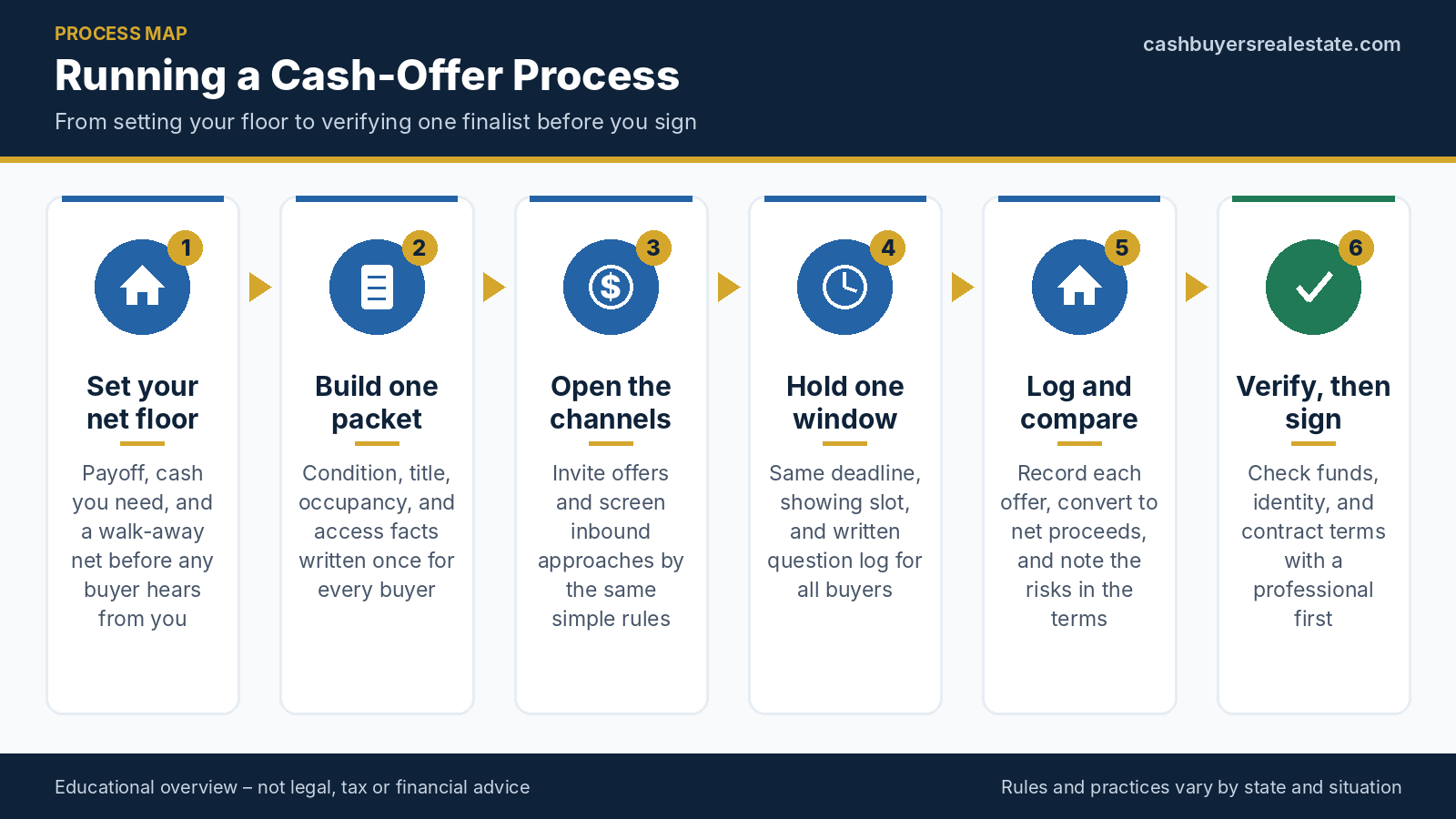
Text version of this infographic
- Set your net floor — Payoff, cash you need, and a walk-away net before any buyer hears from you
- Build one packet — Condition, title, occupancy, and access facts written once for every buyer
- Open the channels — Invite offers and screen inbound approaches by the same simple rules
- Hold one window — Same deadline, showing slot, and written question log for all buyers
- Log and compare — Record each offer, convert to net proceeds, and note the risks in the terms
- Verify, then sign — Check funds, identity, and contract terms with a professional first
Deciding How Many Offers to Collect and From Where
With a floor and a set of priorities in hand, the next question is practical: how many offers is enough, and which channels should supply them? There’s no universal answer, and anyone who offers one is guessing, but there are sensible principles. Too few offers leave you unable to tell a strong price from an average one. Too many produce fatigue, duplicated calls, and a larger footprint of your personal details across more databases than you intended.
Sample Size and Channel Mix
A reasonable working range for many sellers is three to five serious written offers from a mix of sources. Three is the smallest number that lets you see a pattern: if two offers cluster and one sits far away, you learn something about the market and about the outlier. Five gives you a cushion against dropouts, since it is normal for one or two buyers to lose interest, ask for more time, or fail a verification step. Beyond five or six, extra offers rarely change the picture unless the property is unusual, such as one with a title issue that makes most buyers walk away. In that situation, a wider net may be needed simply to find the one or two buyers who will engage at all.
The mix matters as much as the count. Three offers that all came from one lead-generation form may be three versions of the same underlying number, because the buyers could be using the same data source and the same repair assumptions. Three offers from different kinds of buyers, such as a local renovation company, an individual who intends to rent the house, and an investor with a national platform, are more likely to reveal different valuations and different terms. If possible, pair at least one inbound approach you’ve filtered with at least one outbound request you’ve made yourself. Include a conventional option in the mix as a reference point, even if only a conversation with a listing agent about expected price and timing. Without a conventional benchmark, cash offers are being measured against each other and not against what the property might fetch on the open market, and the gap between the two is precisely the information you need to decide whether the convenience of a cash sale is worth its cost.
Budgeting Your Time, Attention, and Privacy
Collecting offers takes more time than most sellers expect. A single buyer may want a phone call, a walk-through, two follow-up questions and a day or two to finalize a number. Multiply that by four buyers, add the unsolicited approaches that keep arriving, and the process can quietly consume a part-time job’s worth of hours at a moment when you may already be dealing with a move, a family situation, or a repair backlog. Plan for it. Block specific times to return calls, tell buyers when you’ll respond, and use a dedicated email address or an email filter that keeps the process out of your main inbox.
Privacy needs a budget too. Every buyer you invite receives some portion of your information, and each of them may store it, share it with partners, or add it to marketing lists. This is not a reason to avoid buyers; it is a reason to share in stages. At the first contact, the property address and condition summary are enough. Your full name, mailing address and a phone number you answer are needed for a serious conversation. Mortgage account numbers, Social Security numbers, bank details and photographs of your identification documents are not needed for an offer at all and should wait until a signed contract and a closing professional you’ve verified. Staging your disclosure this way keeps the flood of attention manageable and limits what could be misused if any one of the parties turns out to be careless or dishonest.
A last planning point concerns what you tell people about your situation. Many sellers feel pressure to explain why they’re selling, hoping that sympathy will produce a better offer. In practice, it often does the opposite, because a buyer who learns that you must close by a certain date or that you’re behind on payments can price your urgency into the number. You can answer politely without volunteering reasons: “I’m weighing a few options and expect to decide by the date I mentioned” is truthful and gives away nothing that a negotiator could use against you.
Giving Every Buyer the Same Facts: The Property Information Packet
If there is one practice that separates a clean offer process from a messy one, it is the information packet. The idea is nothing more than a single, written description of the property that every buyer receives, supplemented by one shared record of the questions buyers ask and the answers you give. It sounds modest. In practice it solves three problems at once. It makes offers comparable, because the buyers priced the same house. It protects you, because what you said is documented and consistent. And it saves time, because you stop explaining the same history of the water heater on every call.
What Belongs in the Packet
A useful packet is built from what a careful buyer would otherwise ask you one question at a time. Two broad categories cover most of it: the physical condition of the property, and the legal and practical facts around it. Neither requires professional formatting. A two-page document with a few labeled sections and a folder of photographs will serve better than a polished brochure that omits the awkward parts.
Condition and Systems: Saying What You Know, Plainly
Condition information is where inconsistency does the most damage, so it’s where the packet earns its keep. Begin with the age and status of the major systems and components: roof, heating and cooling, water heater, electrical panel, plumbing supply and drain lines, foundation, windows, and any septic system, well, or fuel tank. Where you know a year, give it. Where you don’t, say so, and avoid the temptation to guess in whichever direction seems helpful. Then describe the problems you know about, including leaks, past water intrusion, pest history, mold, settling, unpermitted work, and anything that has been repaired and how. Photographs of the defects you’re describing, taken in decent light, tell a buyer more than a paragraph of adjectives and prevent the argument at the walk-through that begins “you never mentioned this.”
There is a legal side to this as well. Many states require sellers of residential property to complete some form of written disclosure about known material defects, though the form, the exceptions and the consequences of getting it wrong vary considerably, and a sale “as is” does not erase a duty to disclose what you know in the states that impose one. Selling to a cash buyer doesn’t make those obligations disappear, and it would be a mistake to assume that an investor who plans to renovate doesn’t care what you tell them. The separate article on as-is home sale disclosures explains the structure of those duties; the point here is that the packet is a good place to put the same facts you’d be required to put on a state form, so that you only have to assemble them once. Nothing in the packet should conceal or downplay a defect, and if a question arises about what counts as material in your state, a short consultation with a real estate attorney is far cheaper than a dispute after closing.
Finally, say what you will and won’t do. If you’re not willing to make repairs, state it plainly in the packet, and mention that buyers should price the condition as it stands. This frames every offer around the same assumption and heads off the common pattern in which a buyer’s initial number quietly assumes a cleaner house than the one you described. Sellers who want to look more closely at this tradeoff will find it explored in the guide to selling a house fast without repairs, but the packet only needs the facts.
Title, Occupancy, Mortgage, and Access Facts
The second half of the packet covers what a buyer can’t see by walking through the house. Ownership comes first: who is on the deed, whether every owner is willing and able to sign, and whether anyone’s authority needs to be shown, as with an estate, a trust, a power of attorney or a divorce decree. A property with two owners where one is unresponsive, or an inherited house where the court has not yet appointed a personal representative, can’t close until that is sorted out, and every buyer needs to know before they spend time on an offer. The same is true of known liens, judgments, unpaid taxes, code violations and open permits. Disclosing them is not an admission of weakness; it’s the way you find out which buyers can handle complications and which ones will use them as an excuse to reduce the price at the last minute.
Next come the circumstances of occupancy. Is the house vacant, owner-occupied, or rented, and if rented, under what lease, with what rent and deposit, and when does the term end? Tenants have rights that vary by state and sometimes by city, and a buyer who plans to occupy or renovate needs to know whether the tenants will stay. If you’re still living there, say when you can move out and whether any belongings will remain. Homeowners’ association or condominium details, including monthly dues, any pending special assessment, and the association’s approval or right-of-first-refusal rules, belong in the packet as well, since they can change both price and timing. Finally, explain access: how the house can be viewed, whether there are pets, and any days or times that don’t work. Practical information of this kind saves buyers from making assumptions that later turn into price changes.
Illustrative example (hypothetical numbers, not market data): A seller describes her roof to the first buyer as “about ten years old,” tells the second “I think it was done around 2012,” and mentions to the third that “it leaked once but it’s been fine.” The first buyer assumes a modest remaining life, the second assumes a roof nearing the end of its warranty, and the third includes a repair allowance in the offer. When the three numbers come back, she can’t tell whether the differences reflect buyers’ views of the neighborhood or three different versions of the roof. If she had written one sentence, “Roof replaced in 2012; one leak at the chimney flashing in 2019, repaired by a roofer, no leaks since; receipt available,” all three would have priced the same fact, and any difference would have been about the buyer.
| Item | Why buyers ask for it | What to include | Caution |
|---|---|---|---|
| Systems and ages | They set repair and replacement assumptions | Years or approximate ages; recent service records | Say “unknown” rather than guess |
| Known defects | They drive the discount for condition | Plain description and photographs; what was repaired | Never conceal or minimize a known material defect |
| Ownership and signers | Every owner must be able to sign | Names on the deed; estate or trust authority if relevant | Do not send copies of identification |
| Liens, taxes, and violations | They affect title and closing | What you know about each, with dates | Get a payoff letter instead of estimating |
| Occupancy and leases | They affect timing and what the buyer can do | Who lives there; lease terms; planned move-out date | Tenant rights vary by state and city |
| HOA or condo details | Dues and approval rules can change price or timing | Monthly dues, pending assessments, contact for documents | Request association records early |
| Access and showing rules | They let buyers plan one visit instead of several | Showing windows, pets, parking, utilities on or off | Do not share alarm codes or leave keys unsecured |
| Your terms | They set the frame for every offer | Response deadline, preferred closing window, as-is statement | State terms as preferences, not threats |
The table works as a checklist you can run through before sending the packet. If an item is blank, that isn’t a failure; it simply tells you what you still need to find out, whether it’s a payoff letter, a copy of the lease, or the HOA’s contact details. Buyers will usually ask for the missing pieces eventually, and a seller who has them ready appears organized and serious, which tends to produce firmer offers.
Delivering the Packet Consistently
Assembling the packet is half the job. The other half is getting it into buyers’ hands in a way that keeps the playing field level. Where sellers go wrong is rarely in the document itself. It’s in the improvisation that follows: a quick answer on the phone that never makes it into writing, a walk-through for one buyer on Tuesday and none for another, a verbal reassurance that contradicts the packet. A few simple habits close that gap.
One Packet, One Showing Window, One Question Log
Send the same packet, in the same format, at roughly the same time, to every buyer who is serious enough to receive one. A PDF or a shared folder works well. If you’d like to avoid a stream of separate showings, offer a single window, such as a Saturday morning with fixed time slots, and let buyers choose a slot. Investors and contractors are accustomed to this arrangement, and it has a secondary benefit: a buyer who will not make time for a fixed walk-through is signaling how they’re likely to behave at closing. If a buyer cannot attend in person, a short video walk-through recorded by you is a reasonable substitute, and the same video can go to everyone.
The question log is the quiet hero of the process. Whenever a buyer asks something not covered in the packet, such as “Does the basement take on water in heavy rain?” or “Are the windows original?”, write down the question and your answer, add the answer to the packet as a dated addendum, and send the addendum to every buyer. This rule, sometimes called “what you tell one, you tell all,” keeps the information level across buyers and protects you from the suspicion that you favored someone. It also prevents the awkward situation where a late offer reflects a fact that earlier buyers never heard. If a question reveals a problem you hadn’t mentioned, the addendum is the place to say so, and the earlier you do it the less damage it causes.
What Stays Out of the Packet: Privacy and Safety
An information packet describes the property, not you. It should not contain your Social Security number, your bank or mortgage account numbers, copies of identification, or the details of your finances beyond what’s needed to explain a lien or a payoff. A buyer who needs to confirm that you own the property can do so through public records and, later, through the title company. If a buyer asks for personal documents at the offer stage, treat that as a reason for caution, not as a routine request, because a price quote doesn’t depend on any of them.
Physical safety is part of the same discipline. Showings by strangers pose small but real risks, from missing items to doors left ajar to the possibility that the visit is a scouting trip for a burglary. Remove valuables, prescription medication, firearms, and documents before any walk-through. Do not leave keys with anyone who hasn’t signed an agreement, and don’t give out alarm or gate codes in advance. Where possible, have another person present, schedule visits in daylight, and ask for a name and a phone number before the visit. None of this is unfriendly. Professional buyers expect it, and those who bristle at reasonable precautions have given you information you can use.
Taken together, these habits produce something unglamorous but valuable: a record showing that every buyer saw the same house under the same terms. If a dispute arises about what was said, that record is the document you’ll be glad to have, and if no dispute arises, it will still have saved hours and kept the offers honest.
Handling Unsolicited Offers: Triage, Etiquette, and Staying Protected
Unsolicited approaches deserve their own section because they behave differently from the offers you request. You haven’t framed the conversation, you may not know who is on the line, and the sender has usually rehearsed the interaction many times while you’re meeting it for the first time. None of that makes the sender dishonest. It does mean that the burden of structure falls on you, and a little preparation turns an intrusive phone call into a short, controlled exchange that either leads to a useful offer or ends politely.
Triage and Response: What to Do in the First Conversation
The first conversation with an unfamiliar buyer has a narrow job: find out who they are and whether they’re worth including in your process. It does not need to produce a price, a commitment, or a detailed description of your house. A sensible rule is to give information only in proportion to what you receive. If the caller learns your address and the condition of the roof, you should learn the name of the person, the name of the business entity, how they got your number, and whether they intend to buy the property themselves.
Five Questions to Ask Before You Share Anything
Five plain questions cover most of what you need to know. The first is who exactly is speaking and for which entity, including the legal name of the company and a callback number you can verify independently. The second is whether the caller would be the buyer, or would be assigning the contract to someone else, and if so, whether they’ll tell you that in writing before you sign anything. The third is how the buyer will fund the purchase, since cash can mean savings, a private lender, a line of credit or investors’ money, and the answer shapes how reliable the closing will be; the article on proof of funds for cash buyers explains what documents to expect. The fourth is how they obtained your contact details, which is a fair question and often reveals whether the list came from public records, a lead vendor or a previous inquiry. The fifth is what they would put in writing, and by when.
Pay attention to how those questions are received. A professional buyer will usually answer them quickly, because they’ve heard them before and know that answering builds trust. A caller who avoids the question about funding, insists on speaking only to the “decision maker,” or begins to push a short deadline in response to a simple question is behaving the way a pressure tactic behaves. That isn’t proof of fraud, since some very reputable buyers are simply poor at phone conversations. It’s a cue to slow down and to ask for the answers in an email you can save. If a caller refuses to put anything in writing, you can end the conversation without any regret.
Once you have the answers, decide on one of three tracks. Include the buyer, and send the information packet with your deadline. Decline politely, if what you heard doesn’t fit your priorities. Or park the contact, noting the name and number in your log with a line such as “possible; revisit after the deadline.” The third option is useful, because it recognizes that some buyers are worth keeping around in case the first round of offers disappoints. You do not need to decide on the spot.
Declining Politely and Keeping the Door Open
Many sellers find the most difficult part of unsolicited contact is simply saying no without friction. It helps to have a few sentences ready, because they are easier to deliver than improvised ones. For a phone call: “Thanks for reaching out. I’m not taking calls about the house right now. If you’d like to be considered, send a short email with your company name and what you’d need to see, and I’ll respond if it fits.” For a text: no reply is a perfectly valid answer, and a short “Please remove this number from your list” is better still when you’d like the messages to stop, because it creates a record. For a letter: toss it, or write a line on it and return it unopened if you want removal.
Courtesy has a practical benefit beyond manners. Real estate investing is a small world in most markets, and the people who send mail to your street may also be active buyers when your neighbor’s house goes on the market or when you decide to sell later. A short, civil reply costs nothing and avoids creating a reputation as someone who is hard to deal with. At the same time, civility is not obligation. You owe no one an explanation, no one a walk-through, and no one an answer by their preferred date. If a buyer replies to your polite decline with a more aggressive follow-up, that is useful information too, and the decline stands.
If a caller says the offer expires today or that “other sellers on your street have already signed,” treat the time pressure as a data point, not as a fact about your house. A real buyer with a real offer can still be asked to hold it for a short period, to allow you to collect other quotes. The detailed treatment of deadlines and their legitimate uses appears in the timeline section of this guide, but as a rule, any offer whose main selling point is that you can’t compare it with others is an offer to compare with greater care.
| Contact | Sensible first response | What to record in your log | When to stop engaging |
|---|---|---|---|
| Letter or postcard with a phone number | Look up the sender’s business name; reply by email if you are interested | Date received, sender, entity name, phone, any number quoted | The sender cannot name the entity behind the letter |
| Unknown phone call | Ask the five screening questions; request an email | Date, caller name, number, answers given | Evasive on funding or identity, or pressure for a same-day decision |
| Text message | Do not reply unless interested; ask who is writing and for which company | Screenshot with number and date | No identity after one question, or repeated messages after you ask for removal |
| Door knock | Take a card; say you will review it later | Name, business, vehicle, date and time | The visitor presses to come inside or claims a deadline |
| Email from an unfamiliar buyer | Reply with your packet request and deadline | Full header, attachments, replies | Requests for personal documents before a contract |
| Offer through an acquaintance | Send the same packet and deadline as everyone else | Who introduced them; terms proposed | The buyer asks for special treatment or secrecy |
Use the table as a script, not a verdict. Each row lists a typical starting response and a point at which the contact has stopped being useful, and the common thread is that the next step always moves the conversation toward writing and toward your timeline. A buyer who is comfortable with that direction is behaving like someone who intends to close.
The Rules on Calls, Texts, Email, and Mail, and What They Mean for You
Sellers are often told that the unwanted contact is illegal and can be stopped with a single registration. The truth is more nuanced, and it’s worth understanding the outline of the law so that your expectations are realistic. This section describes federal rules in general terms and flags where the application to home buyers is unsettled. It is not legal advice, and states add their own rules, which can be broader than the federal ones.
Federal Basics: Do Not Call, Robotexts, and CAN-SPAM
The National Do Not Call Registry, run by the Federal Trade Commission, covers personal phone numbers, including cell phones, and registering is free and does not expire. According to the FTC’s own Do Not Call FAQ, it can take up to 31 days after registration for sales calls to stop, calls that sell something using a recorded voice require your written permission whether or not your number is listed, and companies that illegally call registered numbers can face fines the FTC’s page puts above $50,000 per call. The registry targets sales calls from legitimate companies, so it does not stop scammers, and it contains exceptions for political and charitable calls, surveys, informational calls and companies you’ve recently done business with. Separately, the Federal Communications Commission’s guidance on unwanted calls and texts says that autodialed texts to mobile phones require prior consent, even if the number is on the Do Not Call list, that consent for commercial texts must be in writing, and that solicitation calls are prohibited before 8 a.m. or after 9 p.m.
The catch for home sellers is the definition. These rules are aimed at telemarketing, meaning calls and messages that encourage someone to buy something. A caller who wants to buy your house is not trying to sell you anything in the ordinary sense, and courts have wrestled with whether such messages fall within the rules. In one widely discussed 2023 decision summarized by the law firm Manatt, a federal district court in Texas dismissed a claim over texts offering to buy homes on the ground that the texts did not encourage the recipient to purchase property, goods or services. That was one trial-level ruling resting on the particular allegations in the case, it isn’t binding on other courts, and a different set of facts, such as a paid service attached to the offer, could lead to a different result. The practical takeaway is modest: you cannot count on the registry to eliminate approaches from buyers, but nothing prevents you from telling any caller or texter to stop, and a company that keeps contacting you after you say so is behaving poorly whatever its legal position.
Email is governed by the CAN-SPAM Act, which the FTC’s compliance guide for business describes as covering commercial email, with no exception for business-to-business messages. A covered message must carry truthful header information, a non-deceptive subject line, a valid physical postal address and a working way to opt out, and opt-out requests must be honored within 10 business days. Whether a particular buyer’s inquiry counts as a commercial message is not something this article can settle, but the standard is a good yardstick for behavior: a sender who hides their identity, uses a misleading subject line or ignores an unsubscribe request is not someone you want handling your closing. Direct mail has no comparable federal registry, which is why the mail-specific opt-out tools offered by the advertising industry, such as DMAchoice, are voluntary and limited in reach.
Reporting, Blocking, and Spotting Pressure Tactics and Payment Scams
Practical protection starts with the simple tools. Add your number to the registry, block repeat numbers on your phone, forward unwanted texts to 7726 (SPAM), and use a separate email address for the process. If a company keeps calling after you’ve asked it to stop, or if you suspect a scam, you can report through DoNotCall.gov for a call where you lost no money, ReportFraud.ftc.gov if you lost money or have information about a scammer, and consumercomplaints.fcc.gov for call and text complaints. Check also whether your state runs its own do-not-call list or accepts complaints about solicitation, since some states have broader rules than the federal registry. A short entry in your log noting the date and number of each unwanted contact makes any complaint more useful.
The more serious risk is not annoyance but fraud. Real estate transactions are a favorite target for impersonation scams, in which a criminal sends a convincing email posing as a title company, a closing attorney or the buyer and tells a party to send money to a different account. The FBI’s Internet Crime Complaint Center has described this pattern for years in its warning about business email compromise, noting that everyone in a home sale can be targeted and that the best defense is to verify every request to change the type or destination of a payment, preferably through a second channel such as a phone number you already trust. Funds sent to fraudulent accounts are often withdrawn quickly, which makes recovery difficult. If you ever suspect you have sent money to the wrong place, contact your bank at once and ask about a recall, then report to your local FBI office and file a complaint at ic3.gov. As a seller you rarely wire money, but you may be asked for an “earnest money” refund, a deposit toward a fee, or bank details for receiving proceeds. Each of those requests should be verified by telephone with a person at a company you’ve independently confirmed.
Beyond criminal fraud, a few ordinary pressure patterns show up repeatedly in unsolicited approaches: the offer that expires within hours, the demand that you sign before an attorney or agent has seen the paper, the insistence that you keep the arrangement quiet from family, and the promise of a number that no one will write down. The page on are cash home buyers legit and the planned scam prevention hub take these patterns apart in more detail. For this process, the point is that each pattern pushes you away from the very steps that protect you: comparing, writing things down, and involving a second pair of eyes.
Timelines and Deadlines: Gathering Offers Without Exploding-Offer Pressure
Time is the resource that sellers feel most keenly and that buyers handle most skillfully. A seller who needs to move quickly is tempted to accept the first workable number, and a buyer who understands this can build a short fuse into the first conversation. The antidote is a schedule of your own, short enough to respect your real constraints and long enough to let a few buyers respond on equal terms. It also helps to see the five main routes side by side before choosing a calendar, since each one moves at a different speed. Responding to buyers who approach you can start immediately but often yields vague numbers. Online forms usually return figures fastest, though they’re the least tailored. Direct outreach to a few local investors takes a few days longer and tends to produce firmer, more personal offers. An agent-run circulation adds structure and a clear deadline at the cost of a fee, and an auction compresses everything into a fixed date with its own fees and deposit rules. The diagram below summarizes what each route is best for and what it costs you.
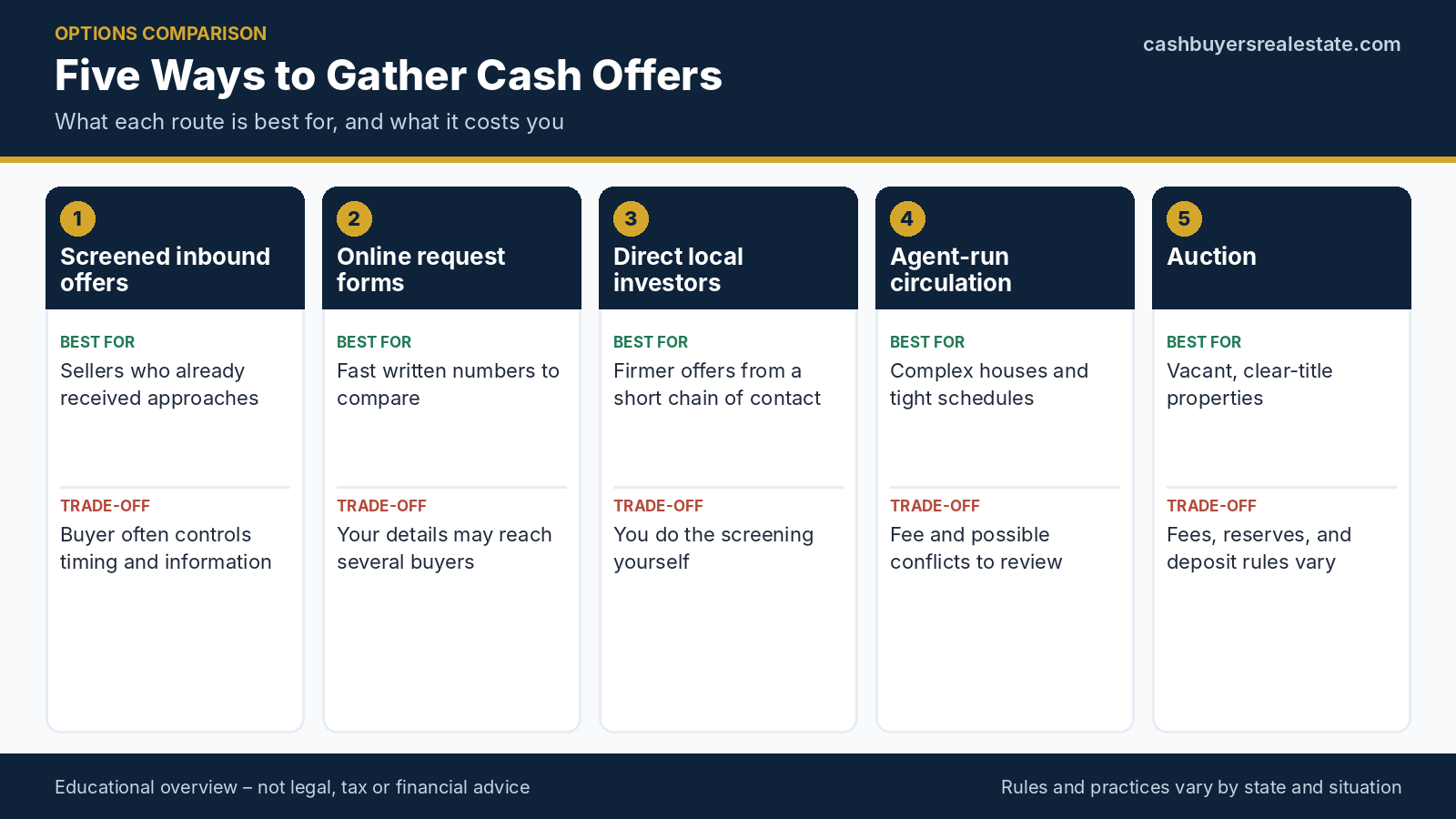
Text version of this infographic
- Screened inbound offers — Best for: Sellers who already received approaches. Trade-off: Buyer often controls timing and information.
- Online request forms — Best for: Fast written numbers to compare. Trade-off: Your details may reach several buyers.
- Direct local investors — Best for: Firmer offers from a short chain of contact. Trade-off: You do the screening yourself.
- Agent-run circulation — Best for: Complex houses and tight schedules. Trade-off: Fee and possible conflicts to review.
- Auction — Best for: Vacant, clear-title properties. Trade-off: Fees, reserves, and deposit rules vary.
A Realistic Calendar for Gathering Offers
An offer-gathering calendar needs three parts: a preparation period before anyone is invited, a request window during which all buyers have the same chance to respond, and a decision date after which you choose a finalist and begin verification. A total of one to two weeks is workable for many properties, though the right length depends on how complicated the house is, how quickly you must close, and how many buyers are actually engaged. Nothing about the exact length is magic. What matters is that it’s announced, finite, and the same for everyone.
Preparation Week and the Request Window
Preparation is the part sellers want to skip and shouldn’t. In the first two or three days you set your floor and priorities, request a payoff letter and any association documents, take photographs, write the packet, and choose a short list of buyers or channels. This is also the moment to decide on your deadline, usually counted from the date the packet goes out. A window of five to seven days is often enough for experienced buyers to look at a typical house and return a written number, and it leaves a few days afterward for questions and a decision. If your property is unusual, with a title complication, a tenant, or a major structural question, you may want ten to fourteen days, and you should say why in the cover email so that no one reads the longer window as hesitation.
The request window opens when you send the packet. Send everything on the same day, tell each buyer the deadline in the first paragraph of the email, and state what an acceptable offer includes: a purchase price, an earnest money amount, the closing date or range, any contingencies, who pays which costs, and evidence of funds. This last item is easy to leave out and expensive to chase later. A written request that lists these elements produces offers that line up with one another, which prepares the way for the comparison in the next section. Sellers who already have an agent assisting may want the agent to send the request, since a professional sender signals that the process is organized and the deadline is genuine.
| Days | What you do | What you produce | Common pitfall |
|---|---|---|---|
| 1-3 | Set net floor and priorities; request payoff letter; photograph the house | One-page goals sheet; payoff figure; photo folder | Estimating the payoff instead of requesting it |
| 3-4 | Write the packet; choose buyers and channels; set a separate email address | Packet, buyer list, response deadline | Inviting too many buyers at once |
| 5 | Send the packet and request to every buyer on the same day | Dated email with deadline and required offer elements | Different wording for different buyers |
| 5-9 | Hold one showing window; answer questions in writing; circulate addenda | Question log; shared addenda | Private answers that never reach other buyers |
| 10 | Receive written offers; log each one | Offer log with all required fields | Accepting verbal numbers without paper |
| 11-12 | Compare net proceeds and certainty; ask follow-up questions of top two or three | Ranked shortlist; written clarifications | Choosing on headline price alone |
| 13-14 | Verify the finalist’s funds and identity; review the contract with a professional | Verified proof of funds; marked-up contract | Signing before a professional has read it |
This calendar is a model, not a rule. If you must close within a few weeks, the stages compress, and the key is to protect the three that matter most: the same packet on the same day, a written offer from each buyer, and verification before signing. If you have more time, the schedule can stretch, but the rhythm stays the same. Remember too that the calendar for gathering offers is separate from the calendar for closing. The article on the cash offer timeline follows the transaction from signed contract to closing; here the clock only covers the period before you sign.
Follow-Ups, Walk-Throughs, and the Decision Date
Between the opening of the window and the deadline, your job is to be consistently available and consistently fair. Respond to questions within a day, add the answers to the shared addendum, and resist the temptation to nudge buyers toward a particular number. If a buyer asks for an extension, consider the request on its merits: a short extension granted to all buyers costs you little and may produce a better offer, while a one-off extension for a single buyer shifts the balance and should be avoided unless the others agree to the same terms. Sellers sometimes worry that extending a deadline signals weakness. In practice it signals that the process is orderly, and buyers who need an extra day to line up funds are often the ones most likely to perform.
Walk-throughs deserve some thought. Buyers who attend in person see things a photograph misses, such as the smell of the basement or the slope of a floor, and those who attend are generally more serious than those who don’t. Others will prefer to submit an offer based on photographs and a video, and that is acceptable if the offer states that it is subject to a later inspection, which affects its reliability. Be aware that once a buyer has seen the property, their written offer may be more conservative or more confident than a number given before the visit. Asking that all offers be submitted after the showing window, not before, helps ensure that the numbers reflect what each buyer saw.
On the decision date, do not announce a winner immediately. Review the log, narrow the field to two or three finalists, and send short written questions to each. Ask about anything that is unclear or inconsistent: why the repair deduction is what it is, whether the earnest money is refundable and under which conditions, whether the buyer may assign the contract, and what happens if their inspection finds something new. The responses often change the ranking. A buyer with a slightly lower price whose terms are clear and whose funds are verified can easily be a better choice than a higher bidder whose offer rests on loose language.
Deadlines, Exploding Offers, and Late Arrivals
Deadlines cut both ways. Yours keeps buyers on equal terms. Theirs can pry decisions out of you before you’ve finished comparing. Distinguishing the two matters, because the same word, “deadline,” covers a legitimate business constraint and a manufactured squeeze.
What an Exploding Offer Is and How to Test It
An exploding offer is one that expires on a very short fuse, often within hours or by the end of the day, with the implication that waiting will cost you the opportunity. Short expirations are not automatically improper. A buyer who is about to close on another property, who has a fixed pool of funds, or who is quoting a price tied to market conditions that could change may have a good reason to ask for a quick answer. The question is whether the urgency comes from a fact you can check or from a pressure technique designed to prevent you from checking anything at all.
A few questions separate the two. Ask why the offer expires when it does and what changes after that moment. A real constraint will have an explanation, such as an upcoming loan deadline on another deal. Ask whether the buyer would keep the same price if you needed forty-eight hours, and notice whether the answer is a flat refusal or a conversation. Ask whether the price is conditional on your not talking to anyone else, since a buyer who discourages comparison is rarely working in your interest. And ask whether the contract itself allows you to cancel within a set period after signing, because some states give sellers statutory cancellation rights in particular settings, and the contract may include a contractual inspection or due diligence period during which the buyer, not you, holds the exit. A short fuse on an offer with a long exit for the buyer is a very different thing from a short fuse on an offer both sides are committed to.
Illustrative example (hypothetical numbers, not market data): On the third day of a seven-day window, a buyer calls a seller and says, “I can do $178,000 cash, but only if you sign by 5 p.m. tomorrow; I’m leaving for a trip.” The seller’s floor is $162,400, and two other buyers have not yet responded. She replies, “I’m collecting written offers until Friday and will give you a prompt answer on Saturday; if $178,000 holds, I’d like it in writing today.” The buyer extends to Saturday and sends a written offer with the same figure, which she records in her log. The second and third offers arrive at $171,000 and $184,000, the latter with a longer closing period and a larger repair credit. Because she waited, she can now compare three numbers with their terms; had she signed under the original deadline, she’d have given up the chance to learn that the highest headline number was not necessarily the best net.
The lesson in the example is not that the first buyer was dishonest. He may have been entirely sincere. The point is that urgency which survives a calm request for a short extension is probably real, and urgency which does not is a signal about the buyer’s style. Either way, you have learned something that costs nothing.
Extensions, Late Bids, and Keeping a Backup
Late offers present a second form of timing problem. A buyer who reaches out after the deadline with a higher number may be sincere, or may have learned through a mutual contact that bids are already in. Decide in advance how you’ll handle late arrivals. Many sellers adopt a simple rule: a late offer is considered only if it arrives before they have signed a contract and only if it meets the same written requirements as the others. Applying the rule consistently protects you from accusations of favoritism and keeps the process from stretching indefinitely.
Once you choose a finalist, keep a backup. Cash transactions fall through for ordinary reasons: a buyer’s funds are tied up elsewhere, an inspection turns up something unexpected, a title problem emerges, or a partner withdraws. If your second choice remains interested, a courteous message saying “I’ve selected another buyer but may reach out if circumstances change” preserves the relationship without any commitment. Some contracts give the seller the right to continue marketing the property, and others prohibit it, so read the terms carefully, and have an attorney check them if a no-shop clause appears. The sections on earnest money and contingencies in cash buyer earnest money and the discussion in the guide to cash sale versus listing for a fast sale show what happens when a deal collapses and why a prepared backup is worth the small effort.
Finally, remember that you retain the right to say no to everyone. If every offer falls short of your floor, the process has still done its work: it has shown you the market’s response to your house on a level playing field, and you can now decide whether to adjust your expectations, make modest improvements, or try a different route such as a listing with an agent. A sale you decline is not a failure of the process. It is the process functioning as designed.
Keeping Records: The Offer Log and a Worked Example of Three Offers
Memory is a poor record keeper under stress. After a week of calls, texts and visits, most sellers can recall the highest number they heard and the friendliest voice, and almost nothing else. Yet the details a buyer mentioned once, on a Tuesday, such as who pays the title fees or whether the earnest money can be returned, are exactly the details that decide how an offer performs after you sign. A simple log, kept as you go, turns a blur of conversations into a record you can compare, share with a professional, and consult if anything is later disputed.
Building an Offer Log That You’ll Actually Use
The best log is the one you will keep updating, which means it should be simple. A spreadsheet or even a notebook page per buyer is enough. It should be set up before the first offer arrives, so entries are made at the moment of contact and not reconstructed afterward. What matters is consistency: the same fields for every buyer, filled in the same way, so that rows can be compared across a single glance.
The Fields That Matter
Two kinds of information belong in the log: facts about the buyer and facts about the offer. The buyer fields identify who is on the other side and how they reached you, and the offer fields capture the economics and the terms. Collect these for every buyer, adding a column for notes on anything unclear, because the notes column is where the most useful observations tend to end up. A buyer who answered the funding question in a single sentence deserves a different note than one who changed the subject twice, and six weeks later you won’t remember which was which unless you wrote it down at the time. Treat the following as a minimum:
- Buyer’s name, legal entity name, phone, email and mailing address, plus how the contact began (letter, call, form, referral).
- Date and form of every contact, with a line on what was said or sent.
- Purchase price and whether it is firm, a range, or subject to adjustment after inspection.
- Earnest money amount, who holds it, and the conditions for its return.
- Inspection or due diligence period and the buyer’s right to cancel during it.
- Closing date or range, and who handles the closing (title company, attorney, other).
- Costs each side pays, repair deductions or credits, and any fees tied to the contract.
- Assignment terms, funding source, and evidence of funds received (yes or no, and the date).
The terms in the last three bullets are where offers differ most, and they’re also where sellers most often fail to ask. A purchase price can look identical in two offers while the two contracts allocate very different risks, such as one that lets the buyer cancel for any reason during a fourteen-day inspection period and one that doesn’t. By forcing yourself to fill in each field, you notice which ones you haven’t been told yet, and the empty cells become your list of follow-up questions. If a buyer is reluctant to supply a particular field, record that too, because a refusal is information.
Conversation Notes, Documents, and Version Control
Alongside the log, keep a folder for the documents themselves: the original letter or screenshot that started the contact, every written offer, the packet and addenda you sent, and any contract drafts. Name files with the buyer, the date, and a version number, such as “BuyerB-offer-v2-oct12,” so that you can always tell the latest document from an earlier one. When a buyer revises an offer, save the revision as a new file and note in the log what changed and why. This is not bureaucracy for its own sake. Contract disputes often turn on which version of a document was in force on a given day, and a clear trail resolves most of them quickly.
For phone calls, a brief written note made immediately afterward is usually enough: the date, the caller, the main points, and anything promised on either side. Some states have rules about recording phone calls that require consent from all parties, so do not record a call unless you know the rule where you and the other person are located, or have asked permission at the start. A better habit is to follow every significant call with a short email summarizing what you understood (“To confirm, you will send a written offer by Friday that includes the earnest money amount and closing date”). The email gives the other side a chance to correct a misunderstanding and gives you a dated record in the buyer’s own inbox. Store everything somewhere you can find it years later, since questions about a sale can resurface long after closing, whether from a tax preparer, a title question on a later resale, or a dispute about the condition of the property.
Three Offers on the Same Facts: A Worked Example
Numbers make the value of the log and the packet concrete. The scenario that follows is entirely hypothetical, but its structure reflects the kinds of differences that routinely separate offers on the same house. Its purpose is to show how to read offers side by side, not to suggest what any buyer in your market will pay.
The Facts and the Three Offers
Illustrative example (hypothetical numbers, not market data): A seller owns a three-bedroom ranch house with a roof about fourteen years old, an original heating system, and a kitchen that has not been updated in decades. Her mortgage payoff is $96,000. Her priorities are to close within about thirty days if possible, to keep the risk of the sale falling through low, and to net at least $156,000 before the payoff is deducted. She sends the same information packet and the same seven-day deadline to three cash buyers: a local renovation company (Buyer A), an individual investor who intends to rent the house (Buyer B), and an investor with a larger purchasing platform (Buyer C). Her estimated carrying cost for mortgage interest, taxes, insurance and utilities is $1,150 per month, which works out to roughly $38 per day. All three offers arrive in writing before the deadline.
| Term | Buyer A | Buyer B | Buyer C |
|---|---|---|---|
| Stated price | $168,000 | $176,000 | $184,000 |
| Earnest money | $3,000 | $2,000 | $1,000 |
| Inspection period | 7 days; cancel only for major findings | 10 days; may request credit | 14 days; may cancel for any reason |
| Closing timeline | 21 days | 30 days | 45 days |
| Repair deduction in the offer | $0 (as-is) | $6,000 | $0 stated; price subject to findings |
| Seller-side closing costs | $3,100 | $1,900 | $4,200 |
| Contract assignable | No | No | Yes |
| Net before payoff | $164,900 | $168,100 | $179,800 |
| Extra carrying cost beyond day 21 | $0 | $345 | $920 |
| Net before payoff, after carrying cost | $164,900 | $167,755 | $178,880 |
| Cash to seller after $96,000 payoff | $68,900 | $71,755 | $82,880 |
Start by reading the table from top to bottom, then left to right. The stated prices rise from A to C, and so does the net before payoff, but the terms rise in risk at the same time: earnest money falls, the inspection period lengthens, the buyer’s right to cancel widens, the closing slips, and Buyer C’s contract can be assigned to someone else. The final three rows turn each offer into a comparable figure by deducting the repair credit and closing costs and adding the extra days of carrying cost, which is a simplified version of the method set out in the guide to comparing cash offers on net proceeds. On paper, Buyer C is ahead by more than $11,000 after carrying costs, which is a difference big enough to tempt anyone.
Reading the Offers: Follow-Up Questions and a Ranking
The ranking changes once risk is considered. Buyer C’s advantage rests on a price that can still be revised during a fourteen-day period in which the buyer may cancel for any reason. If an inspection or the buyer’s own review led to even a $12,000 reduction, C’s net after carrying costs would fall to $166,880, below Buyer B’s $167,755. Nothing says that will happen, and many buyers close at the agreed price, but the seller should treat that gap as the risk premium she is being asked to accept in exchange for the higher number. Buyer C also allows assignment, which means the person who ultimately buys the house may be someone she hasn’t met, funded by money she hasn’t verified, and the lower earnest money gives the buyer less to lose by walking away.
Buyer B’s offer sits in the middle on price, but its $6,000 repair deduction is stated up front, which is a form of honesty: the seller knows what she is giving up. Buyer A has the lowest price and the shortest, firmest timeline, the largest earnest money deposit and a clean as-is structure. Matching these to her priorities, the seller sees that A satisfies the speed and certainty preferences best, B comes close on timing and clearly states its deductions, and C offers the largest nominal return with the greatest uncertainty. She decides to send each of the three a short list of questions: ask C whether the price is firm after the inspection and who the intended closing party is, ask B whether the repair credit could change, and ask A whether the price has any room given the competing offers. The answers, in writing, will determine the final order.
The lesson is not that the highest bid or the lowest-risk bid always wins. It is that the log and the table let the seller see the trade explicitly, in dollars, before she signs. Another seller with the same numbers but a bridge loan to repay might rationally choose C, and a seller who cannot absorb a collapsed deal might choose A. Neither choice is wrong, and both are better informed than a decision based on the highest figure announced on the phone. If the seller’s questions lead to a negotiation, the article on cash offer negotiation covers how to approach it without souring the relationship.
Before any finalist is accepted, the same discipline applies to verification. The checklist below summarizes the six items that matter most: confirming who the buyer is, seeing proof that the funds exist, reading the clauses that let the buyer cancel, understanding any right to assign the contract, using a closing professional you have confirmed independently, and refusing to sign blank or incomplete forms. Each item is explained in greater depth in the pages on contracts and proof of funds, and the log gives you a place to tick them off before you commit.
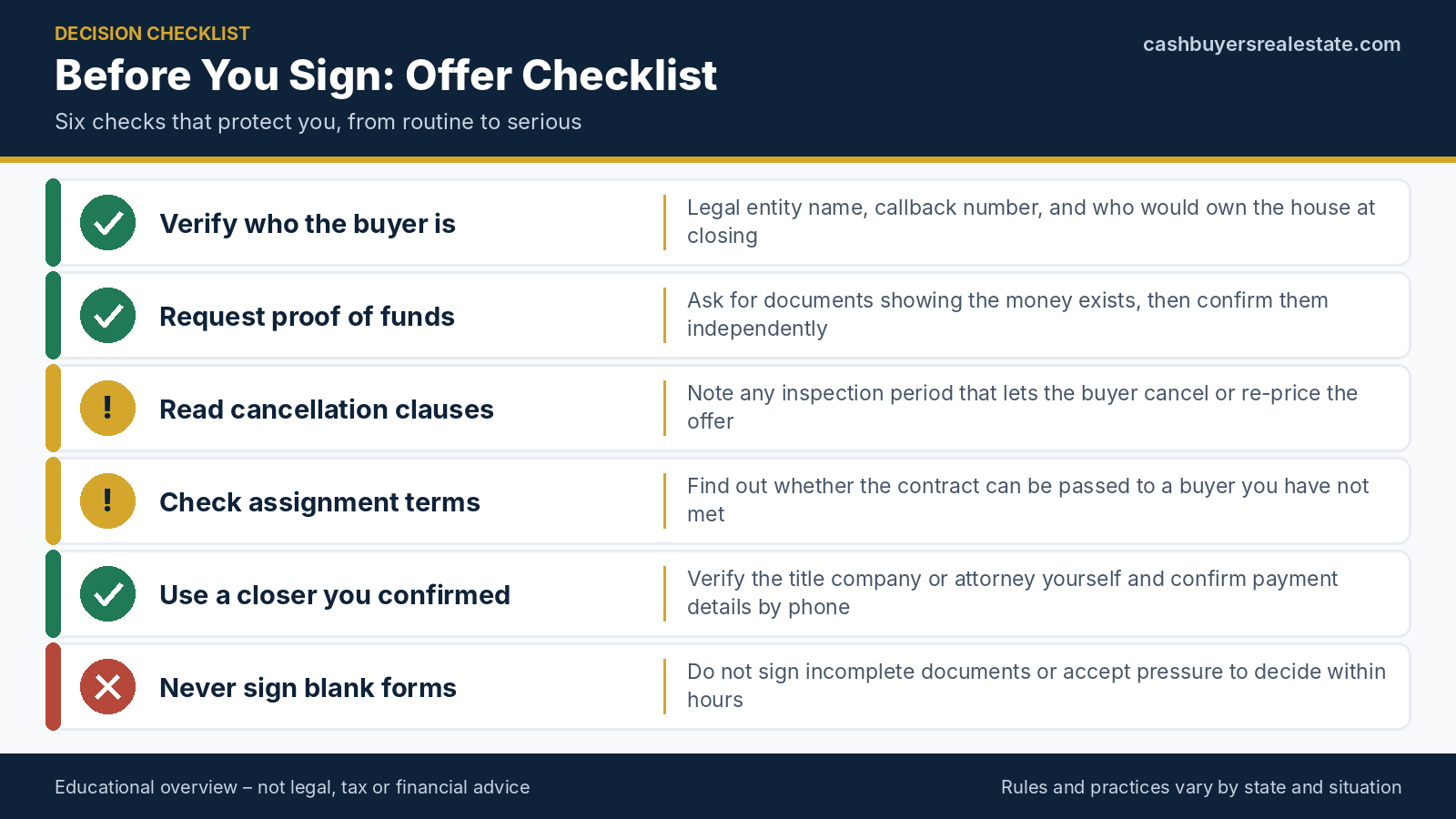
Text version of this infographic
- Verify who the buyer is — Legal entity name, callback number, and who would own the house at closing
- Request proof of funds — Ask for documents showing the money exists, then confirm them independently
- Read cancellation clauses — Note any inspection period that lets the buyer cancel or re-price the offer
- Check assignment terms — Find out whether the contract can be passed to a buyer you have not met
- Use a closer you confirmed — Verify the title company or attorney yourself and confirm payment details by phone
- Never sign blank forms — Do not sign incomplete documents or accept pressure to decide within hours
When an Agent, Attorney, or Title Professional Adds Value
Running your own offer process is entirely possible, and many sellers do it well. It is also work, and some of that work is the kind that professionals do every day and homeowners do once or twice in a lifetime. The question is not whether professionals are good or bad but where their specific skills change the outcome enough to justify the cost. Three kinds of help come up most often in cash-offer situations: a real estate agent to circulate the property and structure the offers, an attorney to read the contract, and a title or closing professional to make sure the transfer actually happens as written.
What a Real Estate Agent Can Add to an Offer Process
An agent’s usefulness in an offer process depends on what you lack. If you have time, a clear packet, and several investors already in contact, an agent adds little beyond reassurance. If you’re dealing with a complicated property, a tight schedule, or a market where you don’t know who the active buyers are, an agent can compress weeks of effort into days. The value is easiest to see in three places: reach, structure and negotiation.
Reach, Structure, and Negotiation
Reach means access to buyers you couldn’t find on your own. An agent who regularly works with investors usually has a list of people who have purchased recently and can be reached by one email, and may know which of them close reliably and which tend to retrade after the inspection. That knowledge is not written down anywhere public, and a seller who tries to replicate it with a web search will end up with the same advertising-heavy results everyone else sees. An agent can also place a property in front of retail buyers, who may pay more than investors for a house in decent shape, and so provide the conventional benchmark that any cash offer should be measured against.
Structure means converting a pile of conversations into comparable written offers. Agents are accustomed to setting a deadline, asking every buyer to submit an offer on a common form, and rejecting vague proposals. They also know which terms are routine and which are unusual, such as an inspection period that lets the buyer cancel for any reason, an assignment clause, or an earnest money deposit that is refundable under almost any circumstance. Having a person who reads these provisions for a living is particularly helpful when the offers differ in ways that aren’t obvious from the headline price, as in the three-offer example earlier in this guide.
Negotiation is the third contribution, and the one most dependent on the individual agent. A good one separates your emotions from the exchange, knows what a counter is likely to produce, and can say things that would sound pushy coming from you. A poor one will push toward the first acceptable number to close quickly. The way to tell the difference is to ask for specifics before you hire: how many properties like yours they’ve sold, how they’d approach investors, what their process is for comparing offers, and what they’d do if the offers come back below your floor.
Costs, Conflicts, and Arrangements to Ask About
Agents are paid in various ways, and the details matter. The traditional arrangement is a percentage of the sale price, payable at closing under a written listing agreement, and the percentage is a matter for negotiation between you and the agent. Some agents will accept a flat fee or a reduced rate for assisting with a sale to an investor, since the work differs from a full marketing campaign, and others offer limited-service arrangements covering only part of the process. Since the National Association of REALTORS® practice changes took effect on August 17, 2024, according to NAR’s summary of the changes, offers of compensation can no longer be made in the MLS, and agents working with buyers must have a written agreement with them before touring a property, so buyer-side compensation is now discussed and documented outside the listing database. For you as a seller, the practical consequence is to ask any agent plainly what you will owe, to whom, and under which circumstances, and to get the answer in the listing agreement, not in conversation.
Conflicts of interest deserve a direct question. Some agents are also investors who buy houses themselves, and an agent who offers to “find you a buyer” might be the buyer. That isn’t necessarily improper, and the rules about disclosing such an interest differ from state to state, but it changes the incentives. If an agent proposes to purchase your house, treat the proposal as one offer among several and get an independent view of its value. If an agent promises to introduce you to investors, ask whether any of them are affiliated with the agent or the brokerage, and whether the agent receives a referral payment from any of them. A professional who answers openly is displaying the transparency you want.
Finally, ask how long the agreement lasts and how it can be ended. A long exclusive listing agreement with an agent who is only expected to circulate your house among investors can be a poor fit. A short term, such as thirty days, with a clear definition of which buyers are covered if you sell to someone you found yourself, is easier to live with. Read the clause that describes what happens if you sell to a buyer who contacted you before you signed, since that is where misunderstandings tend to arise in a hybrid arrangement.
| Approach | Best when | What it costs you | Main risk |
|---|---|---|---|
| Run it yourself | You have time, a clear packet, and a few buyers already in contact | Your own hours and attention | Missing a contract term or the strongest buyers |
| Agent circulates to investors and manages offers | The property is complicated or the schedule is tight | A fee or commission agreed in writing | Conflicts if the agent is also a buyer; unclear fee terms |
| Attorney reviews the finalist’s contract | You are about to sign any cash purchase contract | An hourly or flat legal fee | Waiting until after you have signed |
| Title company or closing attorney handles the transfer | Every sale, with practice varying by state | Settlement fees split by custom or contract | Using a closer chosen only by the buyer without checking |
| List conventionally with an agent | The house is in marketable condition and you can wait | Commission, repairs, carrying costs | Longer timeline and financing-related contingencies |
The table is not a ranking. Several rows can apply at once: a seller might run most of the process alone, then hire an attorney for contract review and rely on a title company for closing. The goal is to match each type of help to the moment when it changes the result, and to avoid paying for services that duplicate what you’ve already done.
Attorneys, Title Companies, and the Honest Alternatives
Beyond the agent, two other professionals matter, and an honest process also includes a look at the alternatives to a cash sale. A cash offer may or may not be the best route for your house, and a calm look at the other routes is part of making the decision with open eyes.
Contract Review and Closing: Who Does What in Your State
Closing practice differs by state, and it is a mistake to assume the process looks the same everywhere. In some states the transfer is handled by a title company or an escrow officer who holds funds and documents until all conditions are met. In others, notably states where attorneys traditionally close real estate transactions, a lawyer prepares the documents, handles the title search or coordinates it, and supervises the exchange of funds. Either way, someone independent of the buyer should be responsible for confirming that the title is clear, that your payoff is satisfied, and that the proceeds reach you. If the only closing professional involved is one the buyer has chosen, ask what role they play, whom they represent, and whether you may use your own.
Contract review is a separate matter and perhaps the single most valuable hour you can buy. A real estate attorney licensed in your state can explain what the contract commits you to, flag clauses that shift risk to you, and tell you what is customary locally. The topics worth asking about include cancellation rights, inspection and re-pricing language, assignment and “and/or assigns” wording, penalties for backing out, who pays which costs, and what happens to the earnest money. The article on the cash home buyer contract goes through the typical provisions, and cash offer contract red flags highlights the wording that deserves the closest look. The attorney’s fee, whether hourly or flat, is small in relation to the size of the transaction, and it is best spent before you sign, not after a problem arises. In a few states, particular wholesale arrangements require specific written disclosures. Oregon, for instance, has required registration of residential wholesalers since July 1, 2025, along with a written disclosure before a wholesale contract is signed and a short right to cancel after receiving it, according to the state’s real estate agency; other states handle the issue differently or not at all, so ask a local professional what applies where your property sits.
Setting Cash Offers Against a Traditional Listing
A fair process includes a benchmark, and the benchmark is usually a conventional listing. Listing with an agent exposes the house to the widest set of buyers, including those using mortgages, and in good condition it can produce a higher price. The costs are real, though: commission, preparation and repairs, carrying costs while the house is on the market, and the chance that a financed buyer’s loan, appraisal or inspection process delays or derails the sale. Cash offers trade some of the price for speed and simplicity, and they often accept the property in its current condition. The question is whether the trade is worth it for you, which depends on the gap between the two net figures and on how much the timing, the certainty and the avoided work are worth.
The comparison is explored in detail in the guides to cash sale versus traditional sale net proceeds and selling as-is versus renovating, but the process described here already gives you the data. A conversation with a listing agent about expected price, likely repairs and expected time on the market produces a rough conventional net, and the offers in your log produce the cash nets. Put them next to each other, adjust for time and risk, and the decision often becomes clearer than expected. In some cases a modest hybrid wins, such as a limited set of repairs followed by a listing, or an as-is listing that invites investor interest alongside retail buyers. In others the cash route is plainly better, because the repairs are large, the schedule is short, or the property will not qualify for a buyer’s mortgage. The point is to decide by comparison, not by default.
Frequently Asked Questions About Collecting and Handling Cash Offers
The questions below come up repeatedly when homeowners start receiving and requesting offers. The answers are general, and state law, local practice and the facts of your property can change them, so use them to prepare for conversations with a licensed attorney, agent or title professional rather than to replace those conversations.
Questions About Where Offers Come From and How to Respond
Questions About Sources and Screening Buyers
- Is it normal to receive several offers after a single inquiry?
Yes, particularly if you used a website form that passes your details to more than one buyer. A single submission can produce calls and texts from several parties within hours, none of whom know about the others. If you’d prefer a quieter experience, read the form’s fine print before you submit, use a separate email address, and consider contacting two or three buyers directly instead of using a general lead form.
- How can I tell whether a letter or text came from a buyer or from a middleman?
Ask directly. A fair question is, “Would you be purchasing the house yourself, and with whose funds?” A genuine buyer will usually answer in a sentence, while a middleman may describe a “network” or “partners.” Neither answer is wrong by itself, since some middlemen operate legitimately and say so, but you should know before you sign who will hold the contract and who will own the property at closing.
- Should I tell buyers what price I want?
Sellers disagree, and both approaches have logic. Naming a target can anchor the discussion and save time, but it may also cap offers that would have come in higher. A common middle path is to ask each buyer for a written number first, keep your net floor to yourself, and counter only when you’ve seen the full set. If you do name a figure, make sure it is one you would genuinely accept.
- Is it appropriate to ask a buyer how they got my information?
It is, and the answer is informative. Buyers who work from public-record lists, purchased leads or prior inquiries can usually say so without hesitation. A reluctance to explain, or an explanation that changes between calls, is a reason to slow down. The question also gives you a record for any later complaint about unwanted contact.
Questions About Privacy, Calls, and Texts
- Will the Do Not Call Registry stop buyers from contacting me?
It may reduce some calls but cannot be relied on to stop all of them. The registry targets sales calls from legitimate companies, and the FTC says it can take up to 31 days to take effect. Whether a call from someone who wants to buy your house counts as a sales call is unsettled, and the registry does not stop scammers. You can still tell any caller to stop and keep a record of the date and number.
- What should I do with a text that doesn’t say who sent it?
You don’t have to answer. If you’re curious, reply once with a short question such as, “Who is this, and which company are you with?” If no identity follows, stop responding, block the number, and forward the message to 7726 (SPAM) if you believe it is unwanted or deceptive. Do not click links in messages from strangers or send documents in reply.
- Is it safe to share photographs and a video walk-through of the house?
Generally yes, if you edit what appears in them. Before photographing, remove mail with your name, family photographs, prescriptions, valuables and anything showing security codes or alarm panels. Photos of the exterior, the rooms and the defects you disclose are what buyers need. Keep the originals, and send identical files to every buyer.
Questions About Timing, Paperwork, and Choosing
Questions About Timing and Deadlines
- How long should I give buyers to respond?
Five to seven days is a workable window for a typical house, because it allows time for a visit, a few questions and a written number. A more complicated property may justify ten to fourteen days. If your schedule is tight, shorten the window but keep it identical for everyone, and tell buyers the deadline in your first message.
- What if a buyer says the offer expires today?
Ask what changes after the deadline and whether the buyer would hold the price for a short period. A real constraint usually has an explanation, and a reasonable buyer will talk about it. If the answer is a flat refusal to let you compare, remember that you aren’t required to decide under that pressure and that letting the offer lapse is a legitimate choice. You may find a similar or better offer later.
- How should I weigh a faster closing against a higher price?
Convert both to dollars of net proceeds and add the value of time to you. Include carrying costs for each extra week, the chance that a longer timeline raises the risk of the buyer backing out, and any obligation that depends on the closing date. A faster closing is worth more to a seller with a bridge loan or a hard moving date than to one with no deadline.
- What if a better offer arrives after I have signed?
A signed purchase contract is a legal commitment, and backing out may cost you the buyer’s earnest money, damages or a lawsuit depending on the terms and your state’s law. Some contracts include limited exit rights, such as a short cancellation period, and those should be read before signing. Speak with an attorney before taking any step that could be treated as a breach.
Questions About Contracts, Agents, and Alternatives
- Should an attorney review the contract if the buyer’s closing company provides it?
Yes, in most cases. A contract prepared by or for the buyer is written to protect the buyer, and a closing company chosen by the buyer may not represent your interests. A review by your own attorney before you sign costs little compared with the size of the transaction and may identify clauses on cancellation, assignment, costs or repairs that you would want to change.
- Can an agent help if I’m leaning toward a cash sale?
Yes. Agents who work with investors can circulate your property, collect comparable written offers and provide a conventional listing benchmark. Ask how they’re paid, whether they have any financial interest in the buyers they introduce, and how long the agreement lasts. Get the arrangement in writing before the agent begins.
- What if every offer is below my floor?
That outcome is information, not failure. You can counter, wait for additional buyers, make limited repairs and ask again, or compare the offers with a listing. Revisit your floor too, since it may include a cushion you can reduce. If your circumstances don’t allow time, a professional can help you weigh the trade-offs.
Choosing Your Route and Taking the First Steps
By this point, the mechanics should feel manageable: offers arrive through a handful of channels, you can ask each buyer to price the same facts, you know how to handle approaches you did not request, and you have a way to record what happens. What remains is the decision itself. It deserves to be made deliberately, because the goal is not simply to accept the best of the offers on the table but to decide which route fits your circumstances, including the possibility that none of the cash routes does.
A Decision Framework for Matching Your Route to Your Priorities
A framework helps when emotions are running high, because it forces you to look at the same few variables each time. The variables are the ones you identified at the start: your net floor, your timeline, your tolerance for risk, the condition of the property, and how much effort you are willing to put in. Each route, whether it’s a direct sale to one buyer, a circulated set of offers, a listing with an agent or a hybrid, gives a different answer on each variable.
Scoring Routes Against Your Floor, Timeline, and Risk Tolerance
Begin with the floor, because it is not negotiable. Any route that cannot reach your net floor after realistic costs is out, no matter how convenient. Among the routes that remain, rank timing next. If you have a fixed date, such as a job start or the end of a lease, favor the routes whose timelines are firm, which usually means buyers with verified funds, modest contingencies and a closing partner you’ve confirmed. If you have flexibility, your options broaden and the conventional listing becomes more competitive. Then consider risk tolerance: how costly would it be, financially and emotionally, if the sale fell through after three weeks? A seller who could shrug off the delay can accept more uncertainty in exchange for price, while a seller facing a looming obligation should lean toward the more certain structure even at a lower figure.
Two more variables complete the picture. Property condition determines how many buyers can realistically bid: a house that a mortgage lender would balk at financing limits the field to cash buyers, while a well-kept one invites retail buyers who may pay more. And effort matters, since a route that requires repairs, staging, showings and months of patience is a real cost even if no one writes a check for it. Weigh these with some honesty. Sellers often overstate how much effort they will tolerate at the beginning and understate it a month later.
| If your top priority is | Routes that tend to fit | Trade-off to accept | Check first |
|---|---|---|---|
| Highest possible net | Conventional listing; circulated offers including retail buyers | More time, preparation, and uncertainty | Expected repairs, commission, carrying cost |
| Speed with firm terms | Verified cash buyer with short inspection period | Often a lower price than a patient listing | Proof of funds, earnest money, closing partner |
| Avoiding repairs | As-is cash offer; investor-focused circulation | Price reflects the buyer’s repair estimate | Repair deductions in writing; disclosure duties |
| Certainty over price | Offer with large earnest money and few contingencies | Giving up a higher but looser offer | Cancellation and assignment clauses |
| Privacy and low contact | One or two direct buyers; agent-managed process | Fewer offers to compare | Who receives your information, and how it’s stored |
| Complicated title or occupancy | Buyers experienced with such properties; attorney-led process | Narrower field and possibly lower offers | What a title search shows; tenant rights in your state |
Treat the table as a starting point for discussion with your professional advisors. Few sellers have only one priority, and combinations change the answer: a seller who wants speed and a high net may find that a short, well-run offer process with several investors, supported by a listing agent’s view of the open market, gets closer to both than any single route alone.
When Cash Offers Fit, When Listing Fits, and When a Hybrid Fits
Cash offers tend to fit when the property needs work the seller cannot or does not want to do, when the timeline is short, when the seller values certainty and simplicity, or when the house is difficult to finance. They fit less well when the property is in good condition in a strong market, when time is plentiful, or when the price difference between a cash offer and a retail sale is large enough to outweigh the convenience. That difference is something you can measure rather than guess, using the offers in your log and a listing agent’s estimate. Many sellers are surprised to find that the gap is narrower than they feared once repairs, commission, carrying costs and the risk of a financed buyer’s deal collapsing are priced in, and equally surprised in the other direction when a house in good condition draws a much stronger conventional number. The only way to know is to put both sets of figures on one page, which is exactly what the log is for.
Listing fits when you want to reach the broadest pool, can tolerate a few months of showings, and are prepared to handle inspection and appraisal negotiations with financed buyers. A hybrid fits in between: limited repairs that remove the most obvious objections, a listing that allows investor and retail offers, or a parallel track in which you hold an investor’s written offer as a fallback while the property is marketed for a defined period. The hybrid has a cost in complexity, but it also reduces the risk of regret, since you can see the market’s response before you commit.
Whichever route you choose, it should feel like a decision you made and not one you drifted into. If you find yourself leaning toward an option mainly because someone is pressing for an answer, step back and return to the numbers in your log. The reason to run a process in the first place is to give yourself the standing to say yes, no, or not yet without second-guessing.
What to Do Next: First Steps, Questions, and Documents
Knowing the framework is one thing. Putting it into motion in the next few days is another, and a short sequence helps. Nothing here requires a large commitment, and most of it can be done before you speak to a single buyer.
The First Week: A Short Sequence
The first week is mostly preparation. Do these in order, because each step feeds the next:
- Write down your net floor, your timeline and your deal-breaker, using the actual payoff figure from your lender.
- Photograph the house and write the information packet, including known defects and the facts about title and occupancy.
- Choose a short list of buyers and channels, set up a separate email address, and decide your response deadline.
- Send the packet to every buyer on the same day with your deadline and the required elements of an offer.
- Start the offer log and record every contact, including the unsolicited ones you decline.
- Arrange a consultation with an attorney, title professional or agent before you sign anything.
None of these steps commits you to a sale. The point of the sequence is to keep control of the pace, since every item on the list is something you can do privately, in your own time, before any buyer has learned anything about your situation beyond the facts in the packet. Sellers who start with the buyers and work backward to the preparation often find themselves answering questions they haven’t thought through, in conversations someone else is steering. Starting with your own numbers reverses that, and it tends to make the later conversations shorter and calmer. If a family member, co-owner or executor must agree to the sale, bring them into the first two steps, not the last, because a disagreement discovered after a buyer has been chosen is far more expensive than one discovered before any buyer is contacted.
After that, the process runs on the calendar you set. Offers arrive, you log them, compare net proceeds and terms, ask follow-up questions of the finalists, and verify the one you prefer. If you feel uncertain at any point, slow the process rather than speeding it up. The cost of an extra day is almost always smaller than the cost of a rushed signature.
Documents to Gather and Questions to Bring to Professionals
A modest collection of documents will serve you at nearly every stage. Gather your most recent mortgage statement and request a formal payoff figure, your deed and any trust or estate papers that show authority to sell, recent property tax and insurance bills, utility averages, any lease and rent roll, association documents, receipts for major repairs, permits, and any inspection or appraisal reports you already hold. Keep copies in a folder you can share securely with a professional, and send documents to buyers only when the stage of the transaction calls for them and you’ve verified who is receiving them.
When you meet an attorney, an agent or a title professional, bring the log and the questions that matter most to your situation. Ask the attorney what the contract commits you to, what happens if the buyer cancels, and which state-specific disclosures or notice periods apply. Ask the agent how they would structure the offer process and what they would charge. Ask the title professional what their search shows, how your payoff will be handled, and how funds will be delivered to you. Ask each of them what they would want to know that you have not told them yet. Their answers will shape the decision more reliably than a headline number.
There’s no single correct way to sell a house, and a cash sale is one honest option among several, with strengths that suit some situations and weaknesses that disqualify it in others. Running a clear, fair process lets you find out which situation yours is without committing early. If the offers come in strong and the terms hold up under review, you can proceed with confidence. If they don’t, you’ve lost little more than a week and gained a clear picture of your options, which is a perfectly good place from which to choose a different path, or to wait.